A forgotten Anzac story in Greece’s bloody history

A king sate on the rocky brow
Which looks o’er sea-born Salamis;
And ships, by thousands, lay below,
And men in nations—all were his!
He counted them at break of day – 
And when the sun set, where were they?
Lord Byron, Don Juan

Christopher Allen, The Australian’s art critic, writes of how Greece’s antiquity presses in on the present. It is a lightweight piece, surveying as it does three millennia of history, from the days of the Greeks, Alexander, the Great and the Romans to those of the Ottomans and their successor states –  but it is elucidating nonetheless.

It is a brief reminder of the veracity of the phrase “history is always with us”, and of how the past continues to shape the present through its influence on culture, human nature, and ongoing events – a constant guide, providing both cautionary tales and inspiration for the future, as we carry our history with us in our identities, cultures, societies and recurring patterns of behaviour. As author and activist James Baldwin is attributed to have said, “History is not the past. It is the present. We carry our history with us. We are our history”.

Greece has always lived a double life. To the casual visitor, it is a sun-splashed idyll of sea and sky, but its history tells a darker story – a long, hard ledger of heroes and horrors, and the stubborn will to survive wedged between warring empires. The last two and a half millennia have been less a tranquil Mediterranean tableau than a parade of conquerors, liberators, and the occasional poet-adventurer.

Over time, Greece has drawn to its shores soldiers and adventurers, poets and dreamers – and naive youths like myself. I hitch-hiked down from what was then Yugoslav in the summer of 1970, a young man with a second-hand rucksack and followed the looping Adriatic highway from Thessaloniki and Athens. I knew enough history to feel the charge of passing near Thermopylae, where Spartans once made their famous last stand against the might of Xerxes. But I wasn’t to learn until over half a century later that an army of ANZACs battled overwhelming odds just a valley away.

The past, in Greece, as in the Middle East, always stands just offstage, awaiting its cue and refusing to stay politely within its own century. It is not merely one of the world’s most benevolent postcards; it is a crossroads of empires, a battleground of ambitions, a cavalcade of famous names and places, where East and West have met, mingled, clashed, and sometimes embraced in the long swirl of history, where the mythic and the modern travel together.

One particular reference also reminds me of how history sends out roots, twigs and branches throughout the settled and hence recorded world.

Tempe, on Sydney’s Cooks River, wears its classical inheritance more openly than most Sydney suburbs. When Alexander Brodie Spark built Tempe House in the 1830s, he christened the estate after the Vale of Tempe in northern Greece – a narrow, ten-kilometre gorge carved by the Pineiós River as it threads between Olympus and Ossa. The poets imagined Poseidon’s trident had cleft the mountains to make it; Apollo and the Muses strolled beneath its laurels; sacred branches were cut there for Delphi. Spark, standing between his own modest “Mount Olympus” and the river, saw a faint echo of the Greek idyll and gave the place its name.

But the Vale of Tempe was never entirely pastoral. Armies have squeezed through that narrow defile for millennia. The Persians marched through it on their way south – Tempe lies just north of the iconic pass of Thermopylae, part of the same chain of passes that determined so much of Greek military history. And in the twentieth century it would again become a stage for outsiders in uniform.

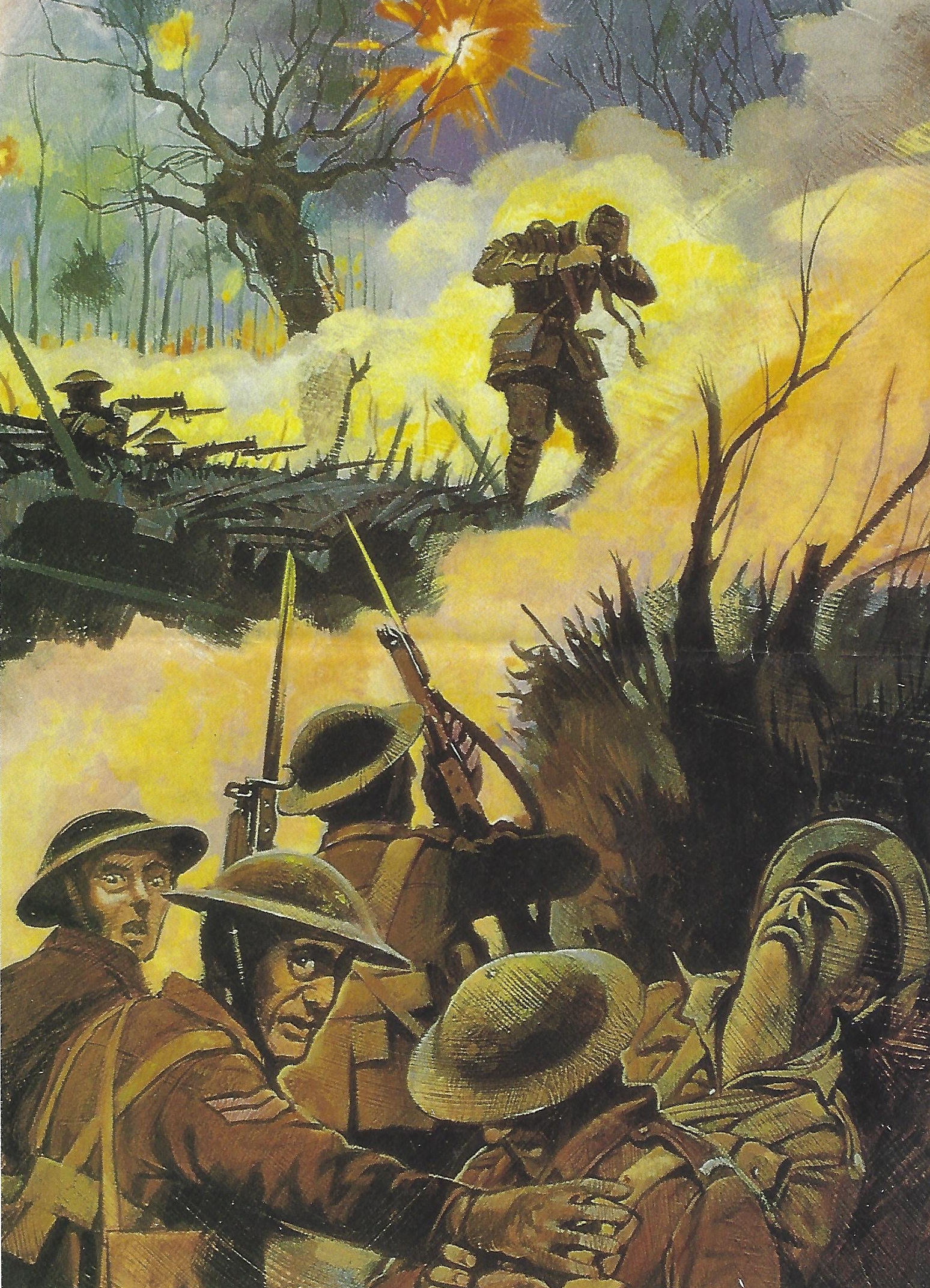
In April 1941 Australian and New Zealand troops, together with British units, were thrown into Greece as Lustre Force – outnumbered, outgunned, and facing a German army with air superiority and modern communications. One of the hardest-fought delaying actions took place – inevitably, given the geography – at Tempe Gorge on 18 April (the featured image of this post, from the collection of the Australian War Museum). The Australian brigade was commanded by Brigadier A.S. Allen, who had formed the first battalion of the new AIF. His “Anzac Force” (apparently the last operational use of that designation) held the gorge long enough to impede the German advance and allow wider Allied withdrawals. The serene valley Spark had sentimentalised became, for a few violent hours, an Anzac bottleneck: those same narrow walls that once sheltered shrines now channelling rifle fire and Stuka attacks. Many of those men would soon find themselves on Crete, resisting the first large-scale parachute assault in military history.

And then – because Australia never resists a touch of Mediterranean whimsy—the Hellenic (and Hellenistic) echoes continue in our own neighbourhood on the Midnorth Coast. Halfway along the road from Bellingen to Coffs Harbour lies the township of Toormina, home to our closest shopping centre and to the Toormi pub. Its name began its life on the slopes of Mount Tauro in Sicily, in the ancient town of Taormina, the site of a famous amphitheater. In the 1980s local Italian residents of who were clients of developer Patrick Hargraves (the late father of a good friend of ours) suggested the name “Taormina” for the new subdivision. He liked the idea but clipped the opening “a” to make it more easily pronounceable- and Toormina entered the Gregory’s and thelocal vernacular.

So in our small corner of New South Wales, Greek myth, Persian marches, Anzac rearguards, and Sicilian nostalgia all whisper from the signposts. Tempe and Toormina: unlikely twins, proof that even the quietest suburb can carry the long shadows of the ancient world.

See also in In That Howling Infinite, Ottoman Redux – an alternative history and The fall of the Ottoman Empire and the birth of Türkiye 

Uncovering a forgotten Anzac story in Greece’s bloody history

From ancient battles to World War II, a visit to Athens’ War Museum exposes the dramatic military history that shaped modern Greece. Christopher Allen’s deeply personal connection unravelled in the process.

Christopher Allen, The Australian, 21 November 2025
James Stuart, View of the Erechtheion, Athens, October 1787. Photo: Royal Academy of Arts, London. Photographer: Prudence Cuming Associates Limited.

James Stuart, View of the Erechtheion, Athens, October 1787. Royal Academy of Arts, London. Photographer. Prudence Cuming Associates Limited.

A little over 200 years ago, the Greeks began their war of independence from the Ottoman Empire, which had conquered most of the Byzantine world in the 15th century; the renaissance in Western Europe thus coincided with the beginning of a new dark age for the Greeks under Turkish oppression. Some islands held out for longer: Rhodes, home of the Knights of St John, was taken in 1522, forcing them to withdraw to Malta; Cyprus, ruled by the French Lusignan dynasty from the time of the Crusades and then by Venice, was brutally conquered in 1571, and Crete, held by Venice since 1205, finally fell after a generation-long siege in 1669.

The Ottoman Empire reached the apogee of its power in the early 18th century, but then began a slow decline, one of whose incidental effects was to make the Greek world more accessible to Western travellers: James Stuart and Nicholas Revett spent time in Athens from 1751 and published their Antiquities of Athens in several volumes in 1762. By the early 19th century, Greece had become part of the itinerary of the Grand Tour; by 1816, the Parthenon Frieze was in the British Museum and profoundly transformed modern understanding of Ancient Greek art.

Meanwhile the Greek War of Independence began with revolts in the Peloponnese in 1821 and a Declaration of Independence in 1822, eliciting a savage response from the Turks and sympathy from intellectuals and the educated public in Western European countries. The slaughter of the population of the island of Chios in 1822 led Eugène Delacroix to paint his famous Massacre at Chios, exhibited in the Salon of 1824 and purchased in the same year for the national collection; it is today in the Louvre. In 1823, the most famous poet of his day, Lord Byron, who had already demonstrated his sympathy for Armenian culture and independence from the Ottomans, went to Greece to help in the fight, both personally and financially.

This 1813 portrait by Phillips depicts Lord Byron, the famous English poet, wearing traditional Albanian attire. It captures his fascination with the Balkans and his travels, marking a moment of cultural exchange in his life. Picture: Alamy

This 1813 portrait by Phillips depicts Lord Byron in traditional Albanian attire. Alamy

Byron’s death in 1824 at Missolonghi only attracted more attention and sympathy to the cause of Greek freedom, and the great powers – Britain, France and Russia – warned the Turks about further repression, even though they were also committed, for different reasons, to maintaining the integrity of the crumbling Ottoman Empire. In 1827, at the Battle of Navarino, an international fleet led by the British and commanded by Sir Edward Codrington destroyed the Turkish and Egyptian navies. After further interventions on land by Russian and French forces, the Ottoman Empire was compelled, by the Treaty of Constantinople in 1832, to accept the independence of mainland Greece, although initially only as far north as the so-called Arta-Volos Line. The north, including Thessaly, Macedonia and Thrace, remained in Ottoman hands and Mustafa Kemal Ataturk was born in the former Byzantine city of Salonika in 1881.

Instability in the Balkan provinces of the Ottoman Empire in the 1870s gave the new Greek nation the opportunity to annex the central region of Thessaly in 1881 (while Britain incidentally acquired Cyprus in 1878). Further important gains were made during the two Balkan Wars (1912-13): much of Epirus in the northwest as well as Salonika and most of southern Macedonia, most of the Aegean Islands and Crete; the British had already ceded the Ionian Islands in 1863 and the Italians would relinquish the Dodecanese after World War II in 1947. Meanwhile, in the aftermath of World War I, Greece had briefly seized eastern Thrace and territories in Anatolia, soon to be retaken by the Turks with immense loss of life in the Great Fire of Smyrna in 1922.

Model of Byzantine warship from the War Museum

Model of Byzantine warship from the War Museum

This is of course a very much simplified version of the extraordinarily complicated story of Balkan politics from the mid-19th century, which forms such an important part of the lead-up to World War I. All of these events were accompanied not only by terrible military casualties on all sides, but by massive disruption to the population of lands where people of different ethnicities and faiths had lived side-by-side for centuries as part of a multiethnic empire, including war crimes and atrocities against civilians and non-combatants. And Greeks who had previously enjoyed political and economic prominence throughout the Ottoman world, including the Phanariots of Constantinople, were first stripped of their privileges, then persecuted and finally expelled in the tragic population exchange of 1923.

All of these events and many more are covered in the exhibits at the Athens War Museum, which I had never visited until a few weeks ago, but which gives a vivid idea of the almost continuous warfare that has been carried on over the past couple of centuries in a land most tourists imagine as a paradise of sea, sun and waterside taverns. The events of the war of liberation, especially as we pass through so many bicentenaries in the current decade, are naturally well represented: there is, for example, a new and interactive display devoted to the sea battle of Navarino and events surrounding this decisive moment in the war.

There are portraits of the many famous leaders of the independence movement in their picturesque costumes, as well as dramatic reimaginings of heroic battles, and of course weapons and equipment of the time. The resonance of the Greek struggle in Western Europe is recalled in a copy of Delacroix’s Massacre at Chios, as well as a version of Thomas Phillips’s portrait of Lord Byron in exotic Albanian costume (1813), of which the original hangs in the British embassy at Athens; another replica by the artist himself, but only of the head and shoulders, is in the National Portrait Gallery in London.

Eugène Delacroix, The Massacre at Chios

But there is much more about the history of Greece in Antiquity, and the chronological arrangement of the displays makes this an effective way to follow the sequence of events, especially the main episodes of the Persian Wars – with the great battles of Marathon in 490BC and Salamis in 480 – as well as the subsequent conflict between Athens and her quasi-subject states on one side and Sparta and her Peloponnesian allies on the other, known as the Peloponnesian War.

This disastrous war (431-404 BC) was followed in the second half of the fourth century by the rise of Philip of Macedon to hegemony, for the first time, over almost all of mainland Greece. After his assassination in 336, his young son, who became Alexander the Great, embarked on a spectacular campaign that led to the conquest of the whole of the vast Persian empire, from Egypt to what are now Afghanistan and Pakistan. Alexander’s conquests led to the extension of Greek language and civilisation deep into Asia, creating the international culture of the Hellenistic period, characterised among other things by a rich and complex exchange of ideas and forms between East and West.

He left an indelible impression on all the lands he conquered and is, for example, the first historical figure in the Persian national epic, the Shahname. By the time of Ferdowsi, who composed this masterpiece a millennium ago, the Persians had forgotten about the Achaemenid dynasty that first created the Persian empire in the sixth century BC; even the great site of Persepolis was and still is called Takht-e Jamshid, the throne of Jamshid, one of the mythical rulers from the great epic.

Each of Alexander’s battles – he is one of the handful of great generals never to have been defeated – is illustrated in clear diagrams, but they are also recalled in later images, in this case particularly in a series of 17th-century engravings whose story is probably unknown to almost all visitors to the museum. These are reproductions of gigantic paintings made as cartoons for tapestries commissioned by the young Louis XIV in the 1660s from Charles Le Brun, who was to become his court painter and who was later responsible for the decorations at Versailles, including the Hall of Mirrors. The series illustrates the valour but also the magnanimity of Alexander, as is clear from the moralising inscriptions attached in the engraved versions. For a long time, the huge canvases were not displayed at the Louvre, but for the last few decades have had their own room upstairs in the Sully wing.

Following the chronological sequence from antiquity we eventually get back to the war of independence and its sequels already mentioned above; but the story continues, after what the Greeks call the Asia Minor Catastrophe of the early 1920s, with a new calamity two decades later. For Mussolini invaded Greece in October 1940 expecting, like Putin in Ukraine, to achieve an easy victory and utterly underestimating the strength and resolve of the Greek army. By the following spring, it was clear that he was getting nowhere, and Hitler decided to come to his rescue by invading Greece in April 1941.

A. Bormans, engraving after Charles Le Brun Alexander and King Porus

A. Bormans, engraving after Charles Le Brun Alexander and King Porus

An Allied army, mostly consisting of Australian and New Zealand troops as well as some British units, was hastily put together and sent from Egypt to Greece as Lustre Force. It was heavily outnumbered by the Germans, who were also massively better equipped and had the benefit of air cover and wireless radio communication. Nonetheless, the Allied army put up a determined resistance in a series of battles including one notable action on April 18, 1941 at Tempe Gorge commanded by my grandfather, then Brigadier AS Allen, who had formed the first battalion of the new AIF and taken our first troops to World War II. The brigade he commanded at Tempe was known as “Anzac Force”, apparently the last use of the term, after the designation Anzac Corps for the whole Australian and NZ component of Lustre Force.

After the evacuation of mainland Greece, my grandfather was sent to fight the Vichy French in Syria, but many of our troops were taken to Crete, where in May 1941 they were faced with the first and only large-scale parachute assault in military history, in which the Germans suffered appalling casualties but ultimately prevailed. Next year will be the 85th anniversary of these dramatic events in Greece and Crete, and among other things will be commemorated by an exhibition of Australian and NZ artists whom I accompanied on a two-week tour of these battlefields in the second half of October.

It was a moving experience to visit what are today the peaceful sites of such desperate battles almost three generations ago, aware at the same time of the long history of warfare in the same lands: the Persians marched through Tempe, which is just north of Thermopylae; Caesar defeated Pompey at Pharsalus (now Farasala), which you pass on the train from Athens to Salonika (now Thessaloniki), and; Cassius and Brutus died at Philippi in Macedonia, defeated by the Caesarian forces of Octavian and Mark Antony.

Christopher Allen is the national art critic for Culture and has been writing in The Australian since 2008. He is an art historian and educator, teaching classical Greek and Latin. He has written an edited several books including Art in Australia and believes that the history of art in this country is often underestimated.

Continue reading

Welcome to Country, a symbol of mutual respect

We aknowledge the Gumbaynggirr People, the traditional custodians of the Land we are standing upon, and the Land from the Tablelands to the sea; and who have been here for over sixty-five thousand years. We also pay respect to Elders past, present and emerging of the Gumbaynggirr nation and to other Aboriginal and First Nation people present.

Today, at public gatherings and meetings, at carnivals and ceremonials, at conferences and conventions, many of us recognize and acknowledge our first peoples as the traditional owners of this land and acknowledge elders past, present and future.

Last year, among Murdoch’s myrmidons and his stablemates on Foxtel’s Sky after Dark, Chris Kenny was the only advocate for the Indigenous Voice to Parliament.

In the an opinion piece republished below, he writes: “In my view they have become a welcome and useful addition to our national culture. However, there is no reason they should be treated as some sacred rite, beyond criticism or even a laugh … In recent weeks there has been more anger and outrage rather than laughter over welcomes to country, and much of it is entirely unreasonable. It is clear some Australians resent them; we often hear people completely misconstrue the sentiment by declaring they do not want to be “welcomed to their own country”.

On the first anniversary of the unsuccessful Voice referendum, the Sydney Morning Herald reported that leading No campaign spokesperson Nyunggai Warren Mundine had said that debate on the Voice provoked a more profound national discussion about whether Indigenous people should have what he termed “special rights”. He says progressives and conservatives he spoke to during the campaign wanted practical improvements on issues such as education but were sick of gestures such as welcome to country ceremonies. “People like the concept but it goes overboard when it is every meeting at work and every plane when you land. It’s like a new religion, like the new saying of grace before meals. The Yes people haven’t realised they are actually turning people against them by overkill.”

Much of the antagonism towards Welcome to Country has indeed been fuelled by the divisive hangover of the referendum. In its aftermath, there was talk among some right-wing commentators, including former Liberal prime minister Tony Abbott, and organizations like Advance Australia, that the time had come to see off the irritatingly woke and ubiquitous welcomes and acknowledgements. The “silent majority” of Australians, they claimed, had made their view known with the resounding rejection of the Indigenous Voice to Parliament. The attacks have expanded and amplified on talkback radio and by some of Kenny’s colleagues on Sky News (particularly the opinionated and misanthropic swamp creatures of Sky After Dark) which had run a news-stream dedicated to promoting the No case.

But the reality is that these expectations have not been realized and that regardless of the unfortunate outcome of the referendum of October 14th, 2023, the Welcome to Country is alive and well among Australians of goodwill throughout our wide land.

I concur with what Kenny writes, including his admonition that the ritual ought not be overdone and inappropriate, such as in events wherein a local Indigenous representative offers an official welcome to country, and then every speaker feels the need to share their own version of recognition in well-intentioned but redundant virtue-signalling.

There are also instances where welcomes and acknowledgements can be too political and aggressive. Declaring that “sovereignty was never ceded”, or demanding that we defer to a particular culture can be interpreted as is an unwelcome and uncomfortable imposition and is not the reason people may have turned up to a particular event.

Back in July 2022, when The Voice was a hopeful prospect, the ABC’s Q&A programme was hosted by the indigenous Garma Festival in the Northern Territory. Its MC, Stan Grant, journalist, writer, academic and a Wiradjuri man, defined sovereignty in the context of the indigenous Voice to Parliament and the Uluru Statement from the Heart as a spiritual concept. White folk associate it with powers and thrones, with control over states and nations and their citizens, with ownership, particularly of territory, of land, of real estate. Country, as Kenny concludes in his opinion piece, does not mean a sovereign nation, but rather, the traditional lands of indigenous people – just as these routinely talk about going back to their traditional family regions as being “on country”.

To some Welcome to Country  might be a “woke” imposition, but to many others, it is a mark of respect and an acknowledgment of our history. To borrow from Mark Twain, reports of its death have been greatly exaggerated.

I’m quite relaxed  and comfortable about that …

For more in In That Howling Infinite on on Indigenous Australians and The Voice Referendum, see:

Welcomes to country are a mark of mutual respect

Brendan Kerin gave a brilliantly welcoming and informative speech prior to the GWS Giants and Brisbane Lions game at Sydney Olympic Park. Picture: Fox Sports

Brendan Kerin gives a Welcome to Country at Sydney Olympic Park.  Fox Sports

Welcomes to country and recognitions of traditional owners have rapidly become ubiquitous, if not universally embraced. They continue to spark unnecessary controversy and acrimony.

In my view they have become a welcome and useful addition to our national culture. However, there is no reason they should be treated as some sacred rite, beyond criticism or even a laugh.

Early on, I was sceptical and remember two decades ago, when working for then foreign minister Alexander Downer, we were at a function at the Adelaide Convention Centre, built over the city’s main railway station, and Downer was on stage waiting to speak when then Democrats senator Natasha Stott-Despoja began her remarks by recognising the “traditional owners”. It was quite a novel and woke gesture at the time, and I texted Downer asking why we needed to recognise the South Australian railways?

Boom Tish! The private quip was just to see the amusement on Downer’s face, and I wasn’t dis­appointed.
In recent weeks there has been more anger and outrage rather than laughter over welcomes to country, and much of it is entirely unreasonable. It is clear some Australians resent them; we often hear people completely misconstrue the sentiment by declaring they do not want to be “welcomed to their own country”.

Kenny acknowledges that there were rational and reasonable reasons to oppose the referendum, but “it was clear then and is perhaps even more obvious now that a sizeable minority voted no because they did not want to hear from their Indigenous compatriots again”.

A welcome to country speech is made ahead of the International Test Match between the Wallabies and Georgia at Allianz Stadium in Sydney in July. Picture: Getty

 Welcome to country speech of the International Test Match between the Wallabies and Georgia at Allianz Stadium in Sydney in July. Getty

Much of this antagonism has been fueled by the divisive hangover from the unsuccessful voice referendum. During that debate, Marcia Langton said that if the no vote prevailed it might be difficult for Indigenous elders to accept invitations to provide welcomes to country.

This understandably emotional reflection has been twisted into a promise to abandon the ceremonies if the referendum failed and thrown back at Professor Langton and Indigenous Australians ever since, with demands for the promise to be honoured. As a voice advocate, I was at pains to point out there were rational and reasonable reasons to oppose the referendum, but it was clear then and is perhaps even more obvious now that a sizeable minority voted no because they did not want to hear from their Indigenous compatriots again.

“Controversial Welcome to Country at AFL semi-final sparks bitter backlash,” screamed the Daily Mail this week after Brendan Kerin performed the ceremony at the GWS Giants versus Brisbane Lions match at Homebush. The story quoted social media posts saying: “What a disgrace, referring to BC as Before Cook and then lecturing everyone” and “Woke Joke. Australia has fallen.”

Others pointed out, in a chippy display, that there would be no AFL if Captain Cook had not voyaged to Australia. Our nation’s history is not a zero-sum equation.

The attacks were expanded and amplified on talkback radio and by some of my colleagues on Sky News. In my view, Kerin’s speech was brilliantly welcoming and informative, and genuinely aimed at explaining why these ceremonies are not about welcoming people to Australia.

Kerin said the ceremony had existed for 250,000 years BC, which he explained as “Before Cook” drawing laughs from the crowd. Sure, the figure he used was ridiculous (homo sapiens are only known to have existed for 200,000 years) but let us call that poetic license – his point was that welcome to country ceremonies existed in ancient Indigenous cultures as a way for members of one tribe or language group to gain permission to traverse or visit the country of another group.

“Within Australia we have many Aboriginal lands, and we refer to our lands as ‘country’,” Kerin said. “So it’s always a welcome to the lands you’ve gathered on – a welcome to country is not a ceremony we’ve invented to cater for white people.”

That was a terrific and generous explainer. Country does not mean a sovereign nation but the lands of that people – just as Indigenous people routinely talk about going back to their traditional family regions as being “on country”.

Dancers perform during the welcome to country before the friendly between AC Milan and AS Roma in Perth in May. Picture: Getty

Dancers perform during the welcome to country before the friendly between AC Milan and AS Roma in Perth in May. Getty

Major sporting events are occasions when these ceremonies are most appropriate; the crowd was about to enjoy a terrific game of a sport Indigenous Australians love, claim some role in creating, and excel at. And Kerin was there to welcome people, not to their nation, but to that particular region, letting them know about the ­cultural history of that place, and inviting them to have a wonderful night. It astounds me that anyone could find this anything but up­lifting, adding to the richness of the experience.

Sometimes welcomes to country are overdone and inappropriate. I have been to events where they open proceedings with a local Indigenous representative doing an official welcome to country, but then every speaker feels the need to share their own version of recognition, as if they have to tick it off for fear of being seen to boycott the gesture.

Even online meetings can ­labour under the same endless ­virtue-signalling. This sort of stuff is over the top and unnecessary, and in the end, it must be counterproductive because it generates eye-rolling or open resistance.

There are also instances where welcomes to country can be too political and aggressive. Telling us that sovereignty was never ceded, or demanding that we defer to a particular culture, is not welcoming. Especially at sporting, artistic or entertainment events, any sort of political lecturing is an unwelcome imposition – it is not the reason people have turned up.

Ancient tribal practices about visiting other tribal lands were very different and varied across the continent, so it is true that the modern welcome to country model has only been around for about 40 years. This does not delegitimise it; rather it correctly identifies it as a modern cultural evolution to help bring Indigenous and non-Indigenous Australians together.

In these pages last month, Melbourne barristers Lana Collaris and Georgina Schoff aired a spirited legal debate about whether a welcome to country is appropriate for law council meetings. My view is that it is hardly necessary in such a context.

More to the point, if people try to invest some legal weight to the custom – with references to “nationhood” and “sovereignty” – they will kill it off. I too object to the “first nations” terminology which has been imported from the US and is heavily politicised.

Welcomes to country work best and will survive best if we keep ­politics and legality right out of it. At heart, it is simply about people sharing their histories and offering a hand of friendship.

Just like toasts at birthday parties or speeches at weddings, these things are sometimes over-cooked or strike the wrong chord. Other times they just seem completely inappropriate and out of place – last year I heard a recorded welcome to country on a bus from Melbourne’s Spencer Street station to Tullamarine.

But conducted properly at the right events, this practice enriches all of us and furthers reconciliation. As I travel around Australia I find it fascinating to know which Aboriginal group covers which territory, and it is terrific that children learn this at school.

That does not mean that we need to change the names of our cities or places, and it does not mean that schools should send kids on a guilt trip. However, it does mean we can have a richer sense of our history, one that stretches at least 40,000 years BC.

When I have travelled in Ireland, for instance, I have wanted to know which county I am in and learn a little about its unique history, likewise the states of the US. And in America I have wanted to know a little about the indigenous groups, the Sioux or Lakota, Cherokee, Cheyenne and Navajo, their similarities, differences, battles, and their impact on contemporary events.

Why would we not want to know about all this in our own cities and states, in our own country? Sure, there are Indigenous activists who run extreme agendas, just as there are racist extremists who have abhorrent attitudes towards Indigenous people, but surely the overwhelming majority of us want to know each other, help each other, and respect each other.

It is that simple. Welcomes to country are a mark of mutual ­respect, and a touchstone for deeper understanding. I am hopeful and confident they will be part of our national culture for centuries to come

The Forest Wars – myths, spin and bare-faced lies

What are the roots that clutch, what branches grow
Out of this stony rubbish? Son of man,
You cannot say, or guess, for you know only
A heap of broken images, where the sun beats,
And the dead tree gives no shelter, the cricket no relief,
And the dry stone no sound of water.
TS Elliot, The Wasteland

This murky world of (the state-owned forestry industries) is at best ignorant and self-interested and at worst sinister and corrupt. Its most cynical manoeuvres involve aggressively logging forest as soon as there is a movement for its protection. Another is co-opting First Nations groups under the guise of “forestry gardening” or “cultural thinning”. Here, business-as-usual logging becomes “healing Country”, an attempt to “blackwash” a calamitous PR image … Attempts to regulate have been underfunded and politically compromised … ‘if everyone is losing, why does it continue? When the answer arrives, it is depressingly banal: government capture by vested interests.
Professor David Lindenmayer

There is little that surprises in the following review of Forest Wars by environmental scientist David Lindenmayer.

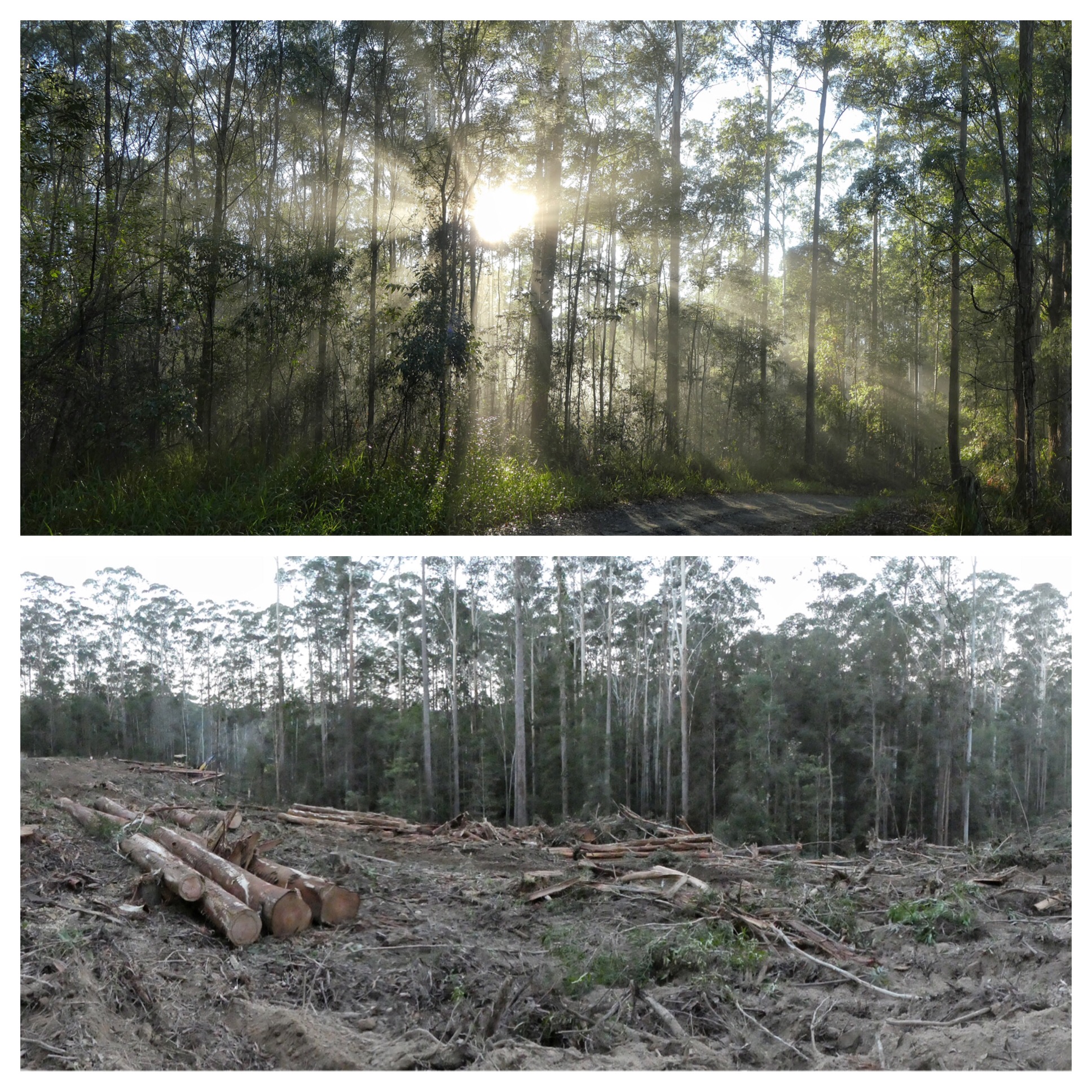
Eight years ago, In That Howling Infinite published If You Go Down to the Woods Today describing what was then happening to the forest in which we live. As logging has intensified throughout the mid-north coast over the last year, things have not changed, but rather, have gotten much, much worse. 

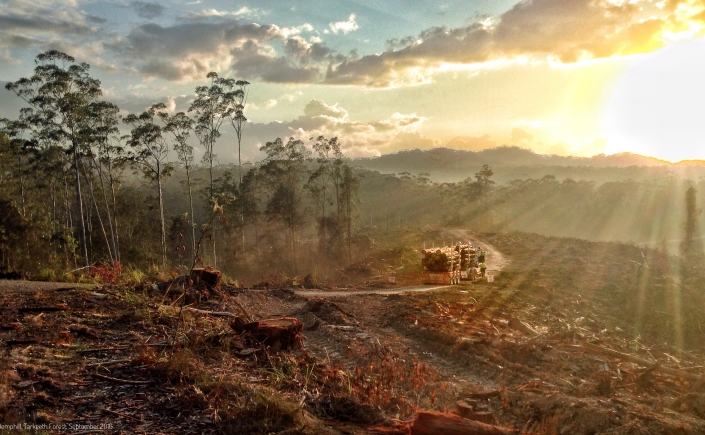
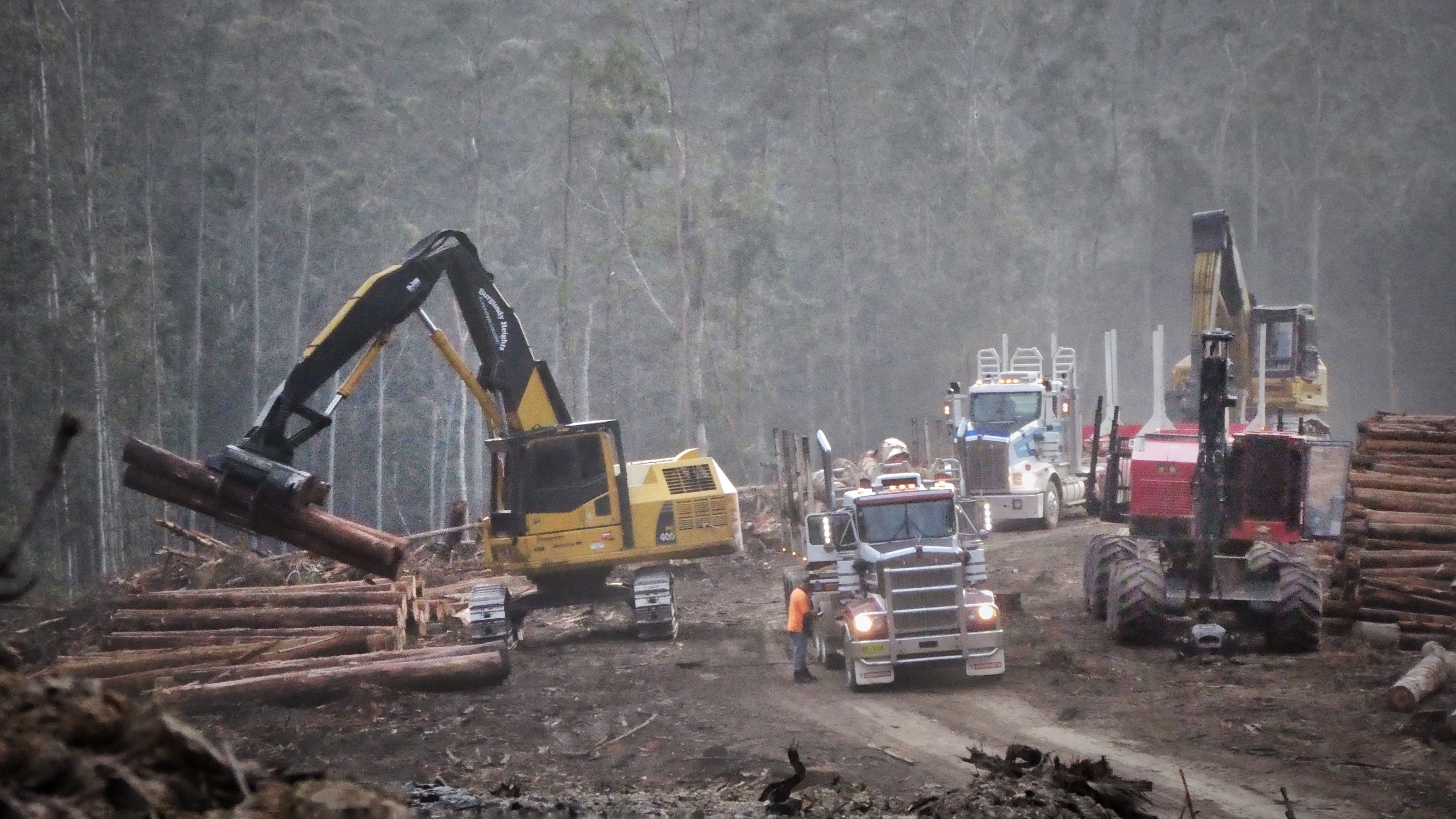
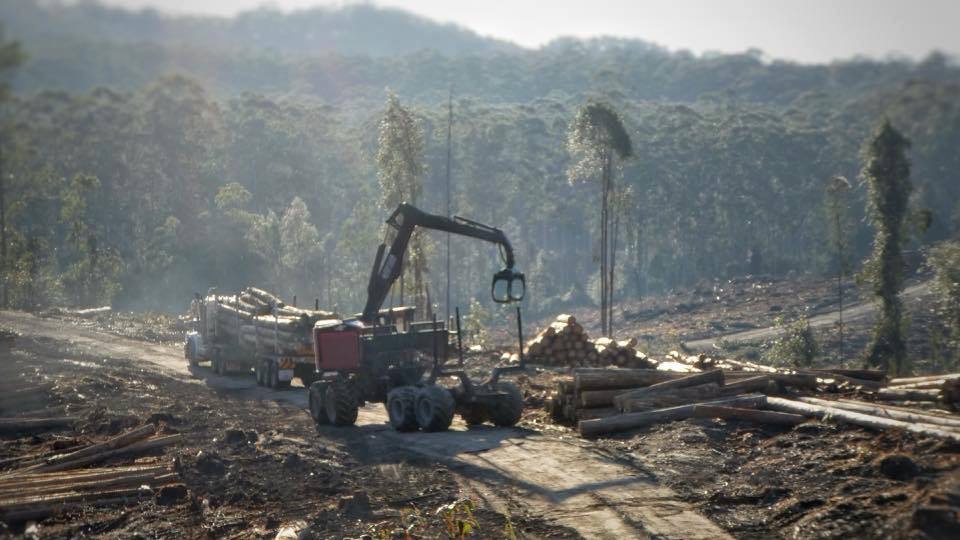
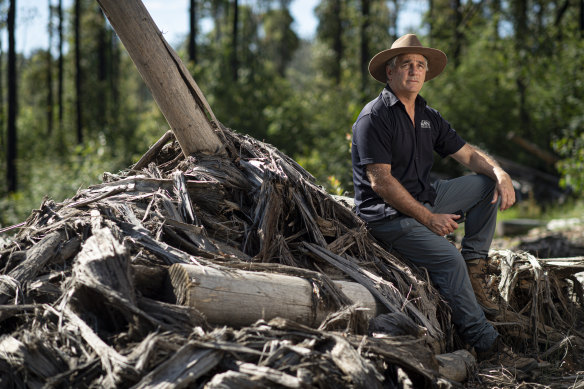
As we survey the desolation and devastation of state forests on the mid-north coast of New South Wales, we bear witness to his words at first hand. For years now we have witnessed the destruction of our ecosystems and critical wildlife habitat by large scale, broad acre industrial logging as harvesters as large as battle tanks camp upon the land like an occupying army. Forestry Corporation NSW’s operations on the Coffs Coast and its hinterland has left us and our precious ecosystem at the mercy of what is by any account a destructive and seemingly unaccountable extractive industry.

See also in In That Howling Infinite’s  Losing Earth series:

“Like an occupying army”


Tarkeeth morning, And Tarkeeth evening.
What a difference a day makes

Myths, spin and outright lies: the truth behind the logging industry

Kurt Johnson, Sydney Morning Herald 7th June 2024

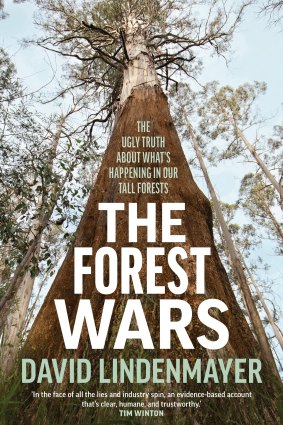
The Forest Wars, by David Lindenmayer (Allen & Unwin 2024)

It was once possible to walk the 1500 kilometres from Melbourne to Brisbane enclosed in native forest. Today Australian forests have been pushed to the margins, surviving as scattered islands, logged around and through. In most states this continues, enabled by expedient myths about forest’s resilience and replaceability that have become entrenched in popular wisdom. These range from “logging is good for fire safety” to “wildlife can simply scuttle away to another tree as soon as one is felled”.

Renowned scientist David Lindenmayer confronts these fables that he was educated on as a young student in his latest offering, The Forest Wars. He is concerned with native forest, which provides a range of benefits beyond forest plantations. Tall, wet eucalypts in particular are not only habitats for native wildlife but are more resistant to fire, better sinks for carbon and can conserve clean water for cities.

Many myths rely on a neoliberal lexicon where native forests are “resources”, or “green capital” and logging can be “sustainable”. It assumes the fungibility of nature, as if one tree were as good as another. The author explains that native forests are complex ecosystems that have developed sometimes for hundreds of years, with ancients that cannot simply be bulldozed and replanted by saplings in another cycle.

Forest Wars begins with its author tracking wildlife, trudging around wet eucalypts and through mossy gullies, but soon evolves into a sustained and righteous tract as we follow him up the production line to the sheer waste at the heart of the enterprise. Another myth: old-growth forest will end as fine furniture. In fact, only four per cent becomes sawn lumber and half of that is used for beer pallets. A whopping 60 per cent is lost as waste, with most wood taken from the forest simply pulped for paper and packaging.

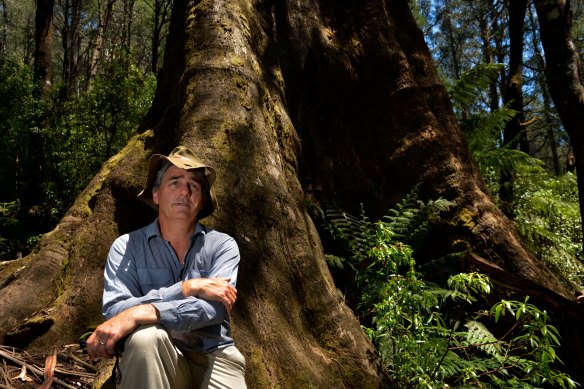
Scientist David Lindenmayer in Healesville.
David Lindenmayer in Healesville. Michael Clayton-Jones

The economics surrounding the destruction of native forests are obscene. State-run enterprises are loss-running, essentially charging taxpayers to destroy their own native forests. VicForests, for instance, has only once reported a profit, while Forestry Tasmania lost an eye-watering $1.3 billion in the decade from 1998. Over the years they have survived on generous loans from state treasuries that will never be repaid, with expenses that include settling lost court cases, and, in the case of VicForests, hiring a private investigator to spy on the author. “Melbourne is not Moscow,” Lindenmayer states.

This murky world is at best ignorant and self-interested and at worst sinister and corrupt. Its most cynical manoeuvres involve aggressively logging forest as soon as there is a movement for its protection. Another is co-opting First Nations groups under the guise of “forestry gardening” or “cultural thinning”. Here, business-as-usual logging becomes “healing Country”, an attempt to “blackwash” a calamitous PR image.

Attempts to regulate have been underfunded and politically compromised. In one instance the author meticulously investigates violations of logging boundaries and gradient guidelines, then submits the analysis to regulators, only to have his findings contradicted. Through an FOI request he discovers their results are nearly identical to his, entering a Kafkaesque netherworld.

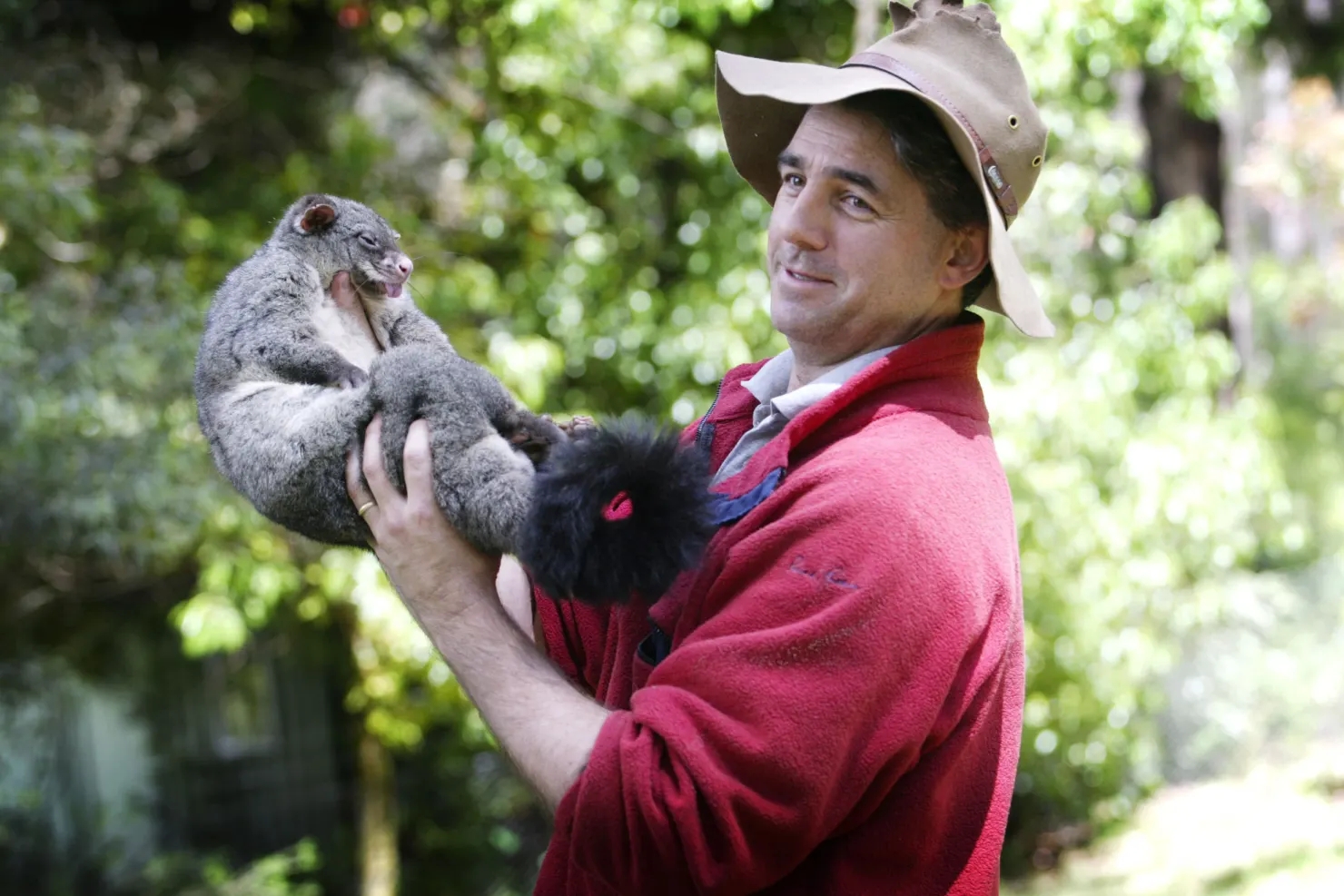
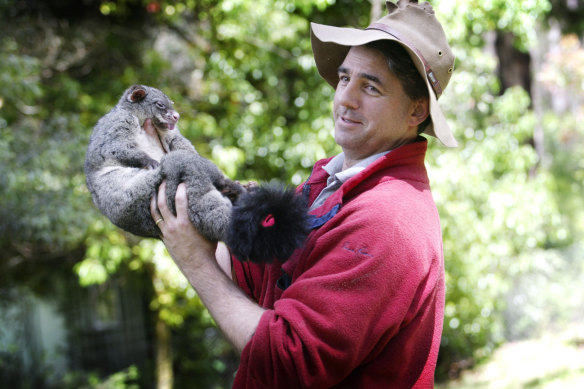
Lindenmayer with a mountain brushtail possum, 2004. Rebecca Halas

The most pressing question is left to the final chapter: if everyone is losing, why does it continue? When the answer arrives, it is depressingly banal: government capture by vested interests.

To lift us from our funk, Lindenmayer offers an invigorating alternate universe. Here forests are protected and valued. They provide habitat for endangered native species, income through carbon sequestering and tourism as well as jobs in management and conservation – far more than heavily mechanised logging provides at present.

As one of the most referenced researchers, Lindenmayer is a world-renowned scientist. Yet again he demonstrates that he is also an excellent science communicator. The book’s 37 myths are mostly treated soberly and, with the aid of diagrams, dispel many popular misconceptions without a hint of condescension. The reader will permit the author wandering from hard science to rhetoric to sum up in the final myths.

I found I was more comfortable in the forest’: The scientist who took on the logging industry

To be honest, the conversation did not begin promisingly.

Everything else was going well. I managed to get there on time and Professor David Lindenmayer was waiting out the front with a cheery grin. He had suggested we go for fish, but not too fancy. I had proposed Fich, which I’d heard was good – a takeaway joint adjoining a smart seafood restaurant in Sydney’s inner west.

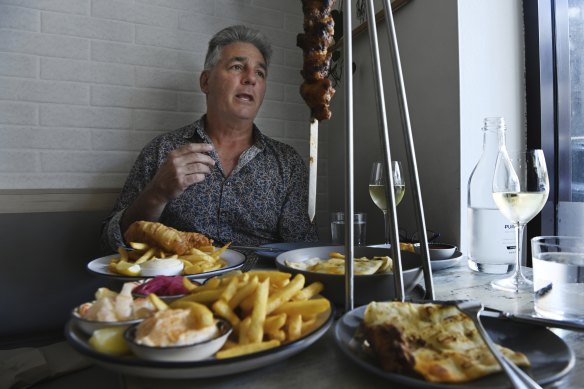
David Lindenmayer at lunch at Fich.

David Lindenmayer at lunch at Fich.Kate Gerachty

He looked neater than you’d expect from a bloke famous for the years he has spent deep in Australia’s oldest and wettest forests and for finding his way into the political heart of the sprawling battles fought over the industries that depend on cutting them down.

Tasmanian salmon is admired by conservationists about as much wood chipping is. The problem is, Lindenmayer explains with the sort of detail you’d expect from a scientist that the salmon are raised in great big floating pens in places like Macquarie Harbour.

There, he says, great clouds of fish poo sinks, sucking the oxygen and life out of the surrounds. Native species like the Maugon Skate, already threatened, are pushed towards extinction.

He explains that these salmon-farming fish-poo death clouds can also contain tiny parasitic worms called nematodes. A quick Wiki session later in the afternoon informs me that nematodes can be found in half the world’s population and that having travelled into space in the payload of the space shuttle Columbia, they are the first known life form to survive a virtually unprotected atmospheric descent to Earth’s surface.

Lindenmayer might be famous as (for a time) the nation’s single most-cited scientist (93,500) for his work on forests and regenerative farming, but he began his career in the water, and before that, he began to explore the natural world with his father, Bruce.

“He was a very, very difficult man to talk to,” recalls Lindenmayer when we get to the scallops.

The old man worked as a rocket scientist at the Woomera missile range and in Melbourne, helping to develop rockets and the propellant that would drive missiles into space or between continents. Eventually, disturbed by the machines’ violent potential, Bruce gave up the work and retrained as an economist.

Around this time, father and son began spending more time together, birdwatching in the bush. Men, says Lindenmayer, communicate better side-by-side, looking out at something rather than towards one another. “No bloke says, ’Let’s go and look at the sunset; they say, ‘let’s go fishing’.”

David Lindenmayer with a mountain brushtail possum in 2004.

Lindenmayer with a mountain brushtail possum in 2004. Rebecca Hallas

And so another world began to open somewhere between them. It was not just about what they saw but what they heard. Beside his father, Lindenmayer learned that the sounds birds made could reveal not just what species they were but what sex they were, what they were doing, and what was bothering them.

Those quiet moments resonated.

In the late 1970s, at school in Melbourne and then Canberra, Lindenmayer became a useful athlete, even playing for a graded football team in the Netherlands. Within a year, he realised he was not going to make it.

“I was a goalie. Everyone in the Netherlands has the perfect physique for a goalkeeper. I didn’t. I realised my hands are smaller than Donald Trump’s.” (First noted in the wild by Vanity Fair editor Grayden Carter, Trump’s small hands became a thing during the 2016 election.)

On his return to Australia, Lindenmayer dived into ecology, studying marine biology in Townsville and apprenticing himself to the famous reef ecologist Dr John “Charlie” Veron, the man who would become known as the “godfather to the corals” for his work in building the first expansive and accurate taxonomy of the Great Barrier Reef.

Lindenmayer volunteered on some of that world-leading work, trailing behind Veron underwater in Scuba gear, helping to gather and carry Veron’s coral samples. “He must have spent 10,000 hours underwater,” says Lindenmayer, who spent hundreds of hours in the sea with his mentor. He was calm, and he used less air than anyone. He must have had a set of gills or something. His breathing was incredible.”

Lindenmayer’s was not. “I found that I was more comfortable in the forest rather than in the water. I learnt I could see more in the forest than I could underwater,” he explains. “I didn’t have to concentrate on breathing.”

Our mains have arrived. Lindenmayer has ordered fish and chips and I have opted for a fish skewer. His plate lands like proper fish and chips should. The batter has erupted volcanically around the flesh, and the chips are holding up in the heat. My fish comes in spiced cubes impaled on a fat metal skewer hanging on its own scaffolding over a warm bed of flatbread, attended bowls of pickles and sauces.

It looks much like the famous beef and pork you get at Silvas, the famous old Portuguese joint a block up the road.

Reading Lindenmayer latest book (his 49th), The Forest Wars, you don’t get any sense of comfort. Lindenmayer’s description of his early work in the 1980s building a scientific baseline of how species like the Leadbeater possum, “the sweet-faced faunal emblem of Victoria”, use their habitat trees reads as deeply unpleasant.

The young scientist hauled bundles of traps and equipment, a tall ladder over one shoulder, deep into the dense understory of wattles and ferns, fallen logs and moss of Victoria’s central highlands to set traps, one for every 50 metres of forest. He soon discovered that the possums were “feisty and lighting fast” with a bite. By day’s end, his neck was garlanded with leeches, and in the shower, the water ran red “like a horror movie”.

He immediately fell in love with the work.

Lindenmayer’s work in those forests overturned how modern Australia understands them. When he began in the field, he believed, like everybody else, that trees would rejuvenate endlessly after their logging. His research shows the ecosystems they support are simply lost when they are felled.

His work reveals that rather than protecting us from fire, selective logging removes trees, drying forests out and creating highways for the infernos of the modern era. It has also shown that the animals that live in towering old trees do not move on from logged areas to reestablish themselves elsewhere but die in them when they are cut down.

Professor David Lindenmayer in a native forest near Currawon.

David Lindenmayer in a native forest near Currawon. Wolter Peeters

To establish this, Lindenmayer and the teams he has worked with over 40-odd years spent thousands of hours in the forests.

They sat in silence, watching the animals they had carefully caught, radio-tagged and released – birds, gliders and possums – return time and again to the same hollows high in the bows of the old mountain trees.


Thinking globally, acting locally – how landowners can protect koalas

It is generally acknowledged that we in Australia, as elsewhere on Earth, are facing an extinction crisis brought on by climate change and environmental destruction. We see in our own little part of the planet the crisis in microcosm, with accelerated clear fell logging operations in the state forests immediately adjacent to our towns and villages, and in close proximity to our rivers and flood plains with most of the timber extracted from these forests destined for chipping on the wharfs of Port Brisbane for shipping to Asia, or to feed the ostensibly “green” bio-mass power plant at Broadwater, near Byron Bay.

Such harvesting is highly aggressive. It is clear-fell by highly sophisticated and costly harvesters rather than selectively harvest by chains saws as in the past, followed by burning of what cannot be sold off in windrows or in power stations, and ground-spraying of the naked land with a cocktail of toxic chemicals. There is then plantation re-establishment with highly flammable eucalyptus monoculture. All this on moist forest escarpments and lowlands bordering large rivers, where, with heavy rains and frequent flooding, everything – soil, ash, and poison, flows downhill. Ongoing clear-felling in the state forest plantations closely rounding Bellingen and its peri-urban areas adds to the cumulative impact of similarly aggressive harvesting operations in other forests in the Coffs Harbour and Bellingen region in recent years.

Here in Bellingen Shire, people report refugee koalas, many sick, injured and starving, koalas on roadways, in backyards, and on bush properties like our own that border the logging areas. And it is not just our iconic koalas who are threatened by what is in all but name a highly mechanised and relatively unregulated extractive industry. For residents close to and adjacent to these areas, it is equivalent to living next to a open-cut coal mine.

Sitting on the edge of the wilderness
An injured koala beside the clearfell

There are many other protected and endangered species living in the understory and old habitat trees in plantations that are “waiting for the chop”. These include koalas, quolls, sooty and powerful owls, great barred frogs, and fruit doves where forty years of native forest ingrowth and state plantation neglect have ensured the development of a biodiverse ecosystem. But the fragmentation of forest, logging in both state and private forests is destroying the connectivity of healthy koala populations, and koalas are increasingly forced forced to survive on the fringes of the state forests in private landholdings.

So, what can we who live on these borderlands do?

As habitats come increasingly under threat, and as reform and remediation take time, private landholders must do all they can for themselves and for the environment. One option available to them is a legally binding agreement between the landholder and the Biodiversity Conservation Trust under the NSW Biodiversity Conservation Act of 2016

Local Land Services NSW also offers partnerships concentrating specifically on the protection of koalas. It has successfully delivered a koala project, funded by the Australian Government, that focused on recovery actions that protect, enhance and restore Koala habitat on private land in four key Areas of Regional Koala Significance (ARKS) between Port Macquarie and Coffs Harbour. Below is a short video presented by LLS officer Asheley Goodwills about the project, focussing on Bellingen Shire.

LLS’ website notes:

“Koalas are uniquely Australian. They are one of our most loved and iconic animals and people come from all over the world to see them. Koalas, like all native animals, are culturally significant to the Indigenous People of the lands in which they live. Unfortunately, koala populations are more and more at risk of decline for a variety of reasons.

A growing human population, particularly in areas along Australia’s east coast, has led to large-scale clearing of better-quality koala habitats with many koala populations struggling within smaller, fragmented patches of poorer quality habitat. Other threats, such as drought, fire, climate change, disease, vehicle strike and dog attack are further impacting koala populations.

Creating ‘habitat refuges’ in areas remote from, and resilient to, such threats is extremely important for long-term koala persistence”.

What are Conservation Agreements? 

They are designed  and financed by NSW government’s department of environment and heritage, it is available to landholders who demonstrate that their property or part of has conservation value in flora or fauna or both and who wish to preserve its environmental integrity and biodiversity through an agreement creating a Wildlife Refuge or a Conservation Area.

What do they mean?

• The landholder establishes legal protection over a specific part of their property, effectively safeguarding it from logging and from development that might compromise its ecological integrity.

• Conservation agreements are entered on the property’s certificate of title.

• There are a range of options through the BCT or also private covenants that can be on title. Some conservation agreements are in perpetuity; others can be terminated by a future owner.

• In return for preserving part of the property, the landholder can obtain practical and financial help to preserve, protect and enhance its biodiversity.

What are the drawbacks to a conservation agreement?

• Landholders may be worried about an affectation on title and may therefore be reticent about entering into an agreement for perpetuity.

• Prospective buyers may also be reluctant to undertake the obligations under the agreement.

• But times are a’changin’ and increasingly, landholders and potential purchasers of properties in areas of ecological value are interested in conserving and enhancing our natural environment and are willing to do play their own part.

• Real estate agents, valuers and banks are becoming more and more accustomed to dealing with properties containing Wildlife Refuges and Conservation Areas.

What are the landholder’s obligations?

• To maintain the property and keep it in good order.

• To take practical steps to improve its conservation values and prevent harm to its biodiversity.

• To carrying out work where necessary to protect flora and fauna and soil and drainage, and to control invasive weeds and feral animals.

• To permit inspections by BCT to ensure compliance, review work, and undertake surveys and research.

What are the benefits to the landholder?

• The individual landholder can make an important contribution to the long-term conservation of biodiversity in NSW.

• An important incentive of the Conservation Partners Programme is that owners can apply for a conservation partner’s grant. Grants available for Conservation Areas are larger than those available for Wildlife Refuges. They are utilized to maintain and enhance the ecological integrity and biodiversity of the land.

• They can be applied to a range of activities, e.g. revegetation, weed and feral animal control, and infrastructural repairs and maintenance, including access trails, drainage and fencing.

• BCT provides advice and guidance throughout the process, including how to complete the application, recommending contractors, and assessing their quotations.

What is the agreement process?

• The landholder contacts BCT and submits an “expression of interest” in making an agreement. BCT arranges a site visit to explain the process and undertake a preliminary inspection.

• The landholder decides whether the agreement is for a Wildlife Refuge or a Conservation Area.

•An application is submitted providing property details, the area/areas proposed to be conserved, and the landholder’s assessment of the ecological values.

• BCT engages a professional ecologist to provide an expert opinion, make an assessment, draft supporting maps, and recommend whether an agreement should proceed after which BCT decides to make the agreement and commences its preparation.

• The landholder provides supplementary information and schedules, including maps showing what areas are included and which are excluded, e.g. buildings and infrastructure.

Who do you call?

• Bct.nsw.gov.au; info@bct.nsw.gov.nat; 1300 992 688

• You can also reach out to North Coast Local Land Services about natural resource management and funding opportunities. Call 1300 795 299 or emailadmin.northcoast@lls.nsw.gov.au

What are we doing in our Conservation Area?

• We are in year one of a three-year grant cycle with a grant of $15000 a year. and have engaged an experienced local regenerator recommended by BCT.

• The team is engaged in extensive vine and weed control (particularly lantana which may attract invasive bell myna).

• We are very pleased with its work, particularly as it provided good feedback on species present and has identified rare flora that we had not expected to find.

• BCT has been fabulous throughout the process, providing advice and encouragement.

Further posts in In That Howling InfiniteThe agony and extinction of Blinky Bill; Paradise Regained – back to nature in Queensland; The Bonfire of the Insanities – the biofuel greenwash

Koala Detection dogs

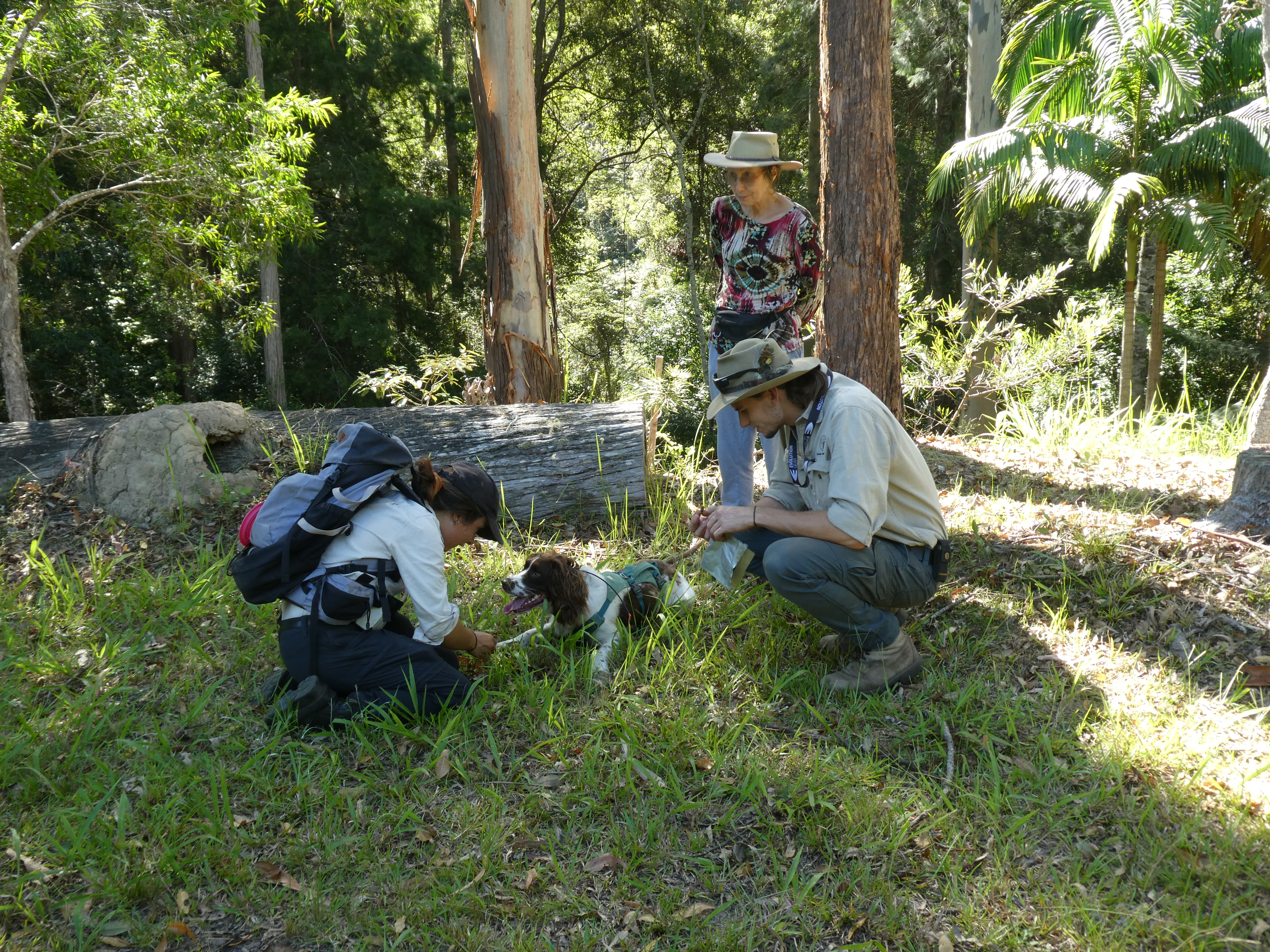
We have encountered two koalas on our property over the last two years, including a breeding female with a joey, and we’ve had the good fortune to have been assisted by Canines for Wildlife. 

Here is a lovely film of the detection dogs in action made by our friend Sarah George. They also feature in the LLS film featured above.

Scat hunting on our conservation area

Scats of a female koala and it’s joey found by Canines for Wildlife in our conservation area

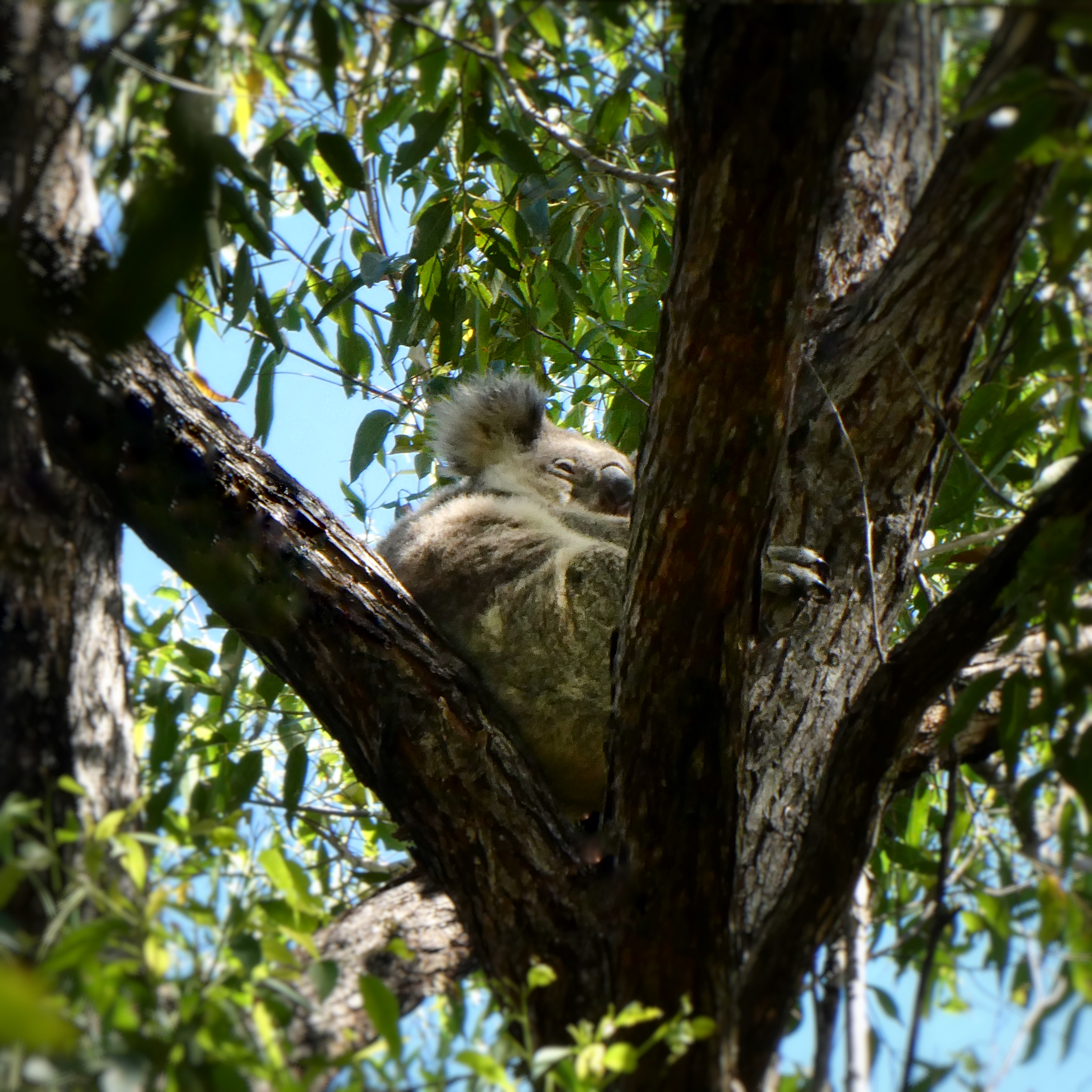
Our latest koala high up in a tallowood

Author’s note

We live in heart of the Tarkeeth Forest, some ten kilometers from the seaside town of Urunga on the mid north coast of New South Wales.

The forest rises on Fernmount Range from the Bellinger River to the north and Kalang River to the south forming a watershed and providing a vital connecting forested corridor for koalas between the habitats of the hinterland and coastal lowlands. Above and between the two rivers, the forest is an important rain-harvesting, filtration, and stabilization ecosystem vital to the wetlands and rivers. The lower estuary is formed where the two rivers converge, creating a large and dynamic system which flows into the Pacific Ocean at Urunga.

It is an important habitat for bird, reptilian, mammalian and marsupial wildlife, including koalas, quolls. wallabies, echidnas, goannas, owls, fruit doves, and cockatoos.

The east-west Fernmount Range Trail is an ancient highway from the plains to Urunga, known to the Gumbaynggirr nation as a “place of plenty”. The forest contains areas of significant indigenous culture, recalling song lines and stories of the Dreamtime, places of ceremony, of birth and burial, and of atrocity.

This land was rainforest once. In the late nineteenth and early twentieth centuries, much of it was cleared manually and laboriously for dairy farming, and in the late sixties, most of the landowners sold their farms to Australian Pulp Mills. APM cleared the farmland and established the flooded gum plantation that is now Tarkeeth State Forest to supply a paper mill that was to be built just south of Coffs Harbour. This never happened – the project’s planners had inexplicably overlooked the lack of a massive water supply. Eventually, the plantations were sold to the government-owned Forestry Commission of New South Wales – now Forestry Corporation NSW. The plantation has now been harvested – clear felled, actually, burned, sprayed, and replanted with a highly flammable eucalyptus monoculture. – a matter of considerable concern to us forest neighbours and to many in the Shire.

Silencing The Voice – the Anatomy of a No voter

It takes love over gold
And mind over matter
To do what you do that you must
When the things that you hold
Can fall and be shattered
Or run through your fingers like dust
Mark Knopfler, Dire Straits

The vibe in Bellingen town on the mid north coast of New South Wales during our months of campaigning for Yes and right up to 6pm on Saturday was such that you’d think we’d brought it home. But that was our hearts and hopes speaking – our heads were well aware that we were in trouble. The Yes vote in the two Bellingen booths was at the last count 66% – much like inner city Sydney and Melbourne – but alas we were just a cork bobbing in a rough sea of No. The overall national count was 60% No, an almost mirror image, whilst our federal electorate Cowper, with 67% No, was one of the highest in the country. In 1967, it recorded the lowest Yes vote. Plus ça change, plus c’est la même chose

Like the campaign and media coverage leading up to 14 October, the poll reflected and exposed pre-existing divisions in our society, economy and politics, each melding into each other: Inner city versus outer suburbs, cities versus the regions, younger versus older, affluent versus the less well-off, educated versus less educated, black versus white (and even, black versus black) and the the so-called black armband and the white blindfold narratives of our history. Aboriginal communities wanted the Voice, but suburban and regional Australia rejected it. Even a large number of Labor and Green Party supporters cast No votes. The further one got from the cities, the more Australia said No.

Are we a nervous, frightened nation unwilling to look back, and unable to look forward? Perhaps a less accusatory explanation is that most Aussies are not feeling too generous right now, and that they don’t want to give our First Nation fellow-citizens what they perceive is more than anybody else gets. And we allowed politics and politicians’ interests to erode Australians’ inherent goodwill. We were, it seems easy prey. As Peter Hartcher wrote in Sunday’s online Sydney Morning Herald:

“The giant Gulliver of Australian goodwill allowed itself to be immobilized by a hundred petty Lilliputian doubts and fears, turning five years of Yes into a decisive No. Most Australian adults were unable to sustain their natural big-heartedness when it was beset by an unrelenting storm of hostility and suspicion. John Howard, for instance, urged people to vote No because of the need to “maintain the rage”. What on earth does the former prime minister have to be so angry about? What is it about a disadvantaged minority comprising 3 per cent of the population that demands a sustained national rage? … Political combat overtakes rationality and, regrettably, it easily overwhelms innate human goodwill. The No campaign will be very pleased with itself for so easily frightening and befuddling the electorate out of its inherent good intentions. Australia could be forgiven for being embarrassed.”

Bernard Keane of Crikey was less constrained:

“The Voice, according to the No campaign, is a threat to white Australians – a threat mostly unarticulated, but some particularly racist No campaigners have gone there, saying it will impose reparations, or dispossess Australians of their property. The message of the No campaign, from Peter Dutton and former Liberal leaders like Howard and Abbott, is: be scared. There is always someone out to get you, to take something of yours, to get something you don’t have. You’re the victim. Indigenous peoples are just the latest in a long line of people trying to do you over, with the help of an “elite” that hates you. Live in fear, and huddle in resentment”.

Spruiking the Voice at market stalls over the last three months and visiting many booths in our shire, copping shouts of both encouragement and expletive laden opprobrium, and reading-up on a variety of media, here are some observations by myself and others. Each can apply to one or to many No voters, though not necessary to all.

There were, after all, many, many fair-minded, thoughtful and well-meaning voters who sincerely believed that the Voice was not the way to go, and they would most likely have voted for the constitutional recognition of our First Nations people if it had stood alone as the referendum question – notwithstanding that symbolic recognition by itself was not what the 250 delegates to the First Nations National Constitutional Convention of Australia Aboriginal and Torres Strait Islander leaders asked for in the Uluṟu Statement from the Heart six long years ago.

But all reflect in some way the mindset of a change-averse, suspicious and nervous nation.

Many No voters …
  1. Thought that the Voice went too far and was too powerful – some arguing that it would be litigious and would grind government to a standstill whilst others claimed it would invite indigenous intervention in all areas of policy
  2. Thought that the Voice didn’t go far enough and wasn’t powerful enough – that it was potentially impotent
  3. Thought that it would threaten their property ownership – the cry  “they’ll come after our homes!” echoed claims raised during the Mabo days
  4. Thought that it would take away native title rights from aboriginals (with help from the UN, one person told us)
  5. Thought that a mere 3.5% of the population would control our government (some people actually think the percentage is much greater than that)
  6. Thought that a Voice would lead to a treaty, “pay the rent” and reparations – a bridge too far
  7. Thought a Voice would “divide us” and render one group “more equal than others” – as if we weren’t divided and unequal already as anyone with a skerrick of awareness of Australian history, politics and society would know (but pundits believe that in the end, this was the prime factor in the No victory)
  8. Didn’t understand what they were voting for and didn’t care – lack of knowledge and interest in our political system among so many people is quite worrying.
  9. Didn’t get the Voice model – there were many who didn’t understand it and also many who did and had valid questions on detail and proces
  10. Had little or no knowledge or interest in Australia’s history since 1788
  11. Didn’t have any idea of the process First Nations people went through to arrive at the Statement from the Heart
  12. Were disgruntled with and don’t trust governments, and are basically anti any and everything.- some, like the International Socialists urged a boycott arguing that each side represented a capitalist plot
  13. Thought compulsory voting is a chore and a bore – and is seen by some as anti democraticWe’re rusted on LNP voters who like Dutton, want to take paint off the Labor government
  14. Were PHON, PUP and UAP people; antipodean Trumpistas and Putinophiles, RWNJs, QAnon, anti vaxxers and other conspiritualists; and sovereign citizens (who do not recognize the Australian state at all – “we are all individuals!”, and each man “is an island unto himself”, to reverse the John Donne aphorism
  15. Were Blak Sovereignty indigenous and their white supporters who do not recognize what they see as the colonialist state and demand sovereignty of their own – and ironically, these now claim the outcome as a victory as it will have established their credentials and even attract disappointed and disillusioned Yes voters to their cause. What might have seemed like a cul de sac may one day become a reality
  16. Were misinformed, gullible, naive and easily misled by opportunists, misinformation and downright lies, and came up with the most fantastical scenarios and ridiculous assumptions
  17. Were selfishly thinking that by depriving others of something they’d be better off, that aboriginals get too much already, that they get more than everybody else, and if they get more, they’ll waste it
  18. Were more concerned about money than anything else – we are going through straightened economic times right now with seemingly insolvable cost of living, health  and housing crises – and that it will negatively affect themselves
  19. Weren’t impressed when their rock idols Farnsey, Barnsey and the Oils supported the Voice in song and statement. As left wing columnist Julie Szego noted in a nuanced piece in my favourite  e-zine Unherd, the use of You’re the Voice “was intended to rouse the already converted into evangelical fervour — nostalgic Gen X’ers like me dutifully blubbered – but talkback callers expressed their displeasure at the soundtrack to their youth enlisted in the service of a partisan cause”
  20. Weren’t influenced by our indigenous sports icons Cathy Freeman, Nova Peris, Ash Barty and Yvonne Goolagong Cawley advocating for a Yes vote – and weren’t impressed that the major sporting codes all signed up to Yes
  21. Certainly weren’t impressed when banks and other large corporations put their shareholders’ money into the Yes  campaign – though large donors to No, including Gina Rhinehart, Australia’s richest person, kept their largesse out of the public eye (taking advantage of our lax laws on political donations)
  22. Weren’t put off by the company they had been keeping, including the likes of old Tory warhorses like John Howard and Tony Abbot, the discredited Scott Morrison, the aforementioned Gina, Rupert Murdoch, Pauline Hanson, Alan Jones, Peta Credlin, and an almost unanimous coven of Sky at Night opinionistas
  23. Didn’t have any idea of the process First Nations people went through in 2017 to arrive at the Uluṟu Statement from the Heart (see our prior article The Uluru Statement from the Heart‘)
  24. Believed that The Voice was cooked up by the Albanese Labor government and Aboriginal elites (whoever they are) otherwise know as the so-called “Canberra Voice” – these same people probably deride aboriginals for being uneducated and that when they do get an education, deride them as elites
  25. Were smug and paternalistic, thinking they know exactly what First Nations people need – and that is certainly not A Voice – even though they haven’t been within cooee of or spoken to an aboriginal in their lives
  26. Labor and Green supporters who subscribed to some but not all of the above

What next?

As the indigenous leaders of the Yes23 campaign take time out for refection and grieving, I guess we can now all go back to feeling good about ourselves and our nation, or, as former PM John Howard described it a couple of decades ago, “relaxed and comfortable”.

Questions will most certainly be asked. How did the high levels of support for the Voice slide so far? Why wasn’t there a better response to misinformation? Why couldn’t the falsehoods be sufficiently countered? Why were so many still unsure about this simple proposition? As for some other form of constitutional recognition, as suggested by Dutton, that seems far-fetched without the support of Indigenous Australians. And Labor is in no mood right now to bowl up another referendum on anything, either this term or next. So, while the political caravan moves on, the problems for Indigenous Australians will remain.

This will probably be my last word on the Indigenous Voice to Parliament in In That Howling Infinite (though, of course, never say never!). I’ll leave you with these words of the late Margaret Thatcher on the night she became prime minister of the United Kingdom in May 1979:

“I would just like to remember some words of St. Francis of Assisi which I think are really just particularly apt at the moment. ‘Where there is discord, may we bring harmony. Where there is error, may we bring truth. Where there is doubt, may we bring faith. And where there is despair, may we bring hope’ …  . and to all …. people – howsoever they voted – may I say this. Now that the election is over, may we get together and strive to serve and strengthen the country of which we’re so proud to be a part … There is now work to be done’.

We know what happened next …

Relaxed and Comfortable

© Paul Hemphill 2023 All rights reserved

See also other articles on the Voice to Parliament in In That Howling Infinite, including The Uluru Statement from the Heart, Hopes and fears – the morning after the referendum for The Voice, and A Voice crying in the wilderness

Postscript: on referendums

“Until Saturday, we had not had a referendum for 24 years, and since Saturday, no successful referendum for 45 years. They have become sport for opposition governments to gain political points and a petri dish for propagating misinformation and conspiracy theories. In a hyper-partisan and post-truth world, the prospects of referendum success now depend more than ever on an elusive spirit of bipartisan cooperation”.
Anne Twoomey, constitutional lawyer, SMH 17th October 2023


From the foggy ruins of time – our favourite history stories

I wear the weave of history like a second skin,
I wake with runes of mystery of how we all begin,
I walk the paths of pioneers who watched the circus start,
The past now beats within me like a second heart.
Paul Hemphill. E Lucivan Le Stelle

Whilst its scope is eclectic and wide ranging in content In That Howling Infinite is especially a history blog. It’s subject matter is diverse. Politics, literature, music, and memoir are featured –  but it is at its most original and informative, a miscellany of matters historical, gathered in Foggy Ruins of Time – from history’s back pages – yes, an appropriation of lyrics from two Bob Dylan Songs.

In compiling the annual retrospective for 2022, I decided I would put together a list of my favourite posts in each of the categories described above, beginning with the history ones. My primary criteria were not so much the subject matter, which is diverse, as can be seen from the ten choices (shown here in alphabetical order) but firstly, what I most enjoyed writing and secondly, those I considered the most original insofar as I referenced and republished few other voices, other than direct quotations from the sources I was consulting and books I was reviewing.

A cowboy key – how the west was sung

Outlaw songs and outlaw gothic are as much apart if the mythic Wild West as cowboys and gunslingers. A nostalgic canter through some of my personal favourites on records and in movies.

Androids Dolores and Teddy enjoy the Westworld view

Al Tariq al Salabiyin – the Crusaders’ Trail 

Western folk, long on romanticism and short on historical knowledge, associate crusades and crusaders with medieval knights, red crosses emblazoned on white surcoats and shields and wielding broadswords battling it out with swarthy scimitar-swinging, be-turbaned Saracens. Here, we widen that orientalist perspective.

The Crusades

A Short History of the Rise and Fall of the West

“… one thing is for certain: we all love a good story. As they say, in Arabic, as indeed in all tongues, times and places, “ka-n ya ma ka-n bil ‘adim izzama-n wa sa-lifi al aSri  wa la-wa-n”‘ or, “once upon an time”. An original,  idiosyncratic and not strictly accurate journey through those foggy ruins of time.

Somewhere in Syria

Beyond Wolf Hall – Icarus ascending 

We know how the story of Thomas Cromwell ends. It’s how Booker prize winner Hilary Mantel gets us there that matters. Our questions here are whether Thomas could sense where it was all headed, and whether he could have quit while he was ahead.

Beyond Wolf Hall – Revolution Road

“A wide-ranging rural road trip through England’s green and pleasant land takes the traveller by antique and desolated abbeys and monasteries, their ageing walls crumbling and lichen covered, their vaulted pediments open to the English elements. The celebrated poets of the romantic era immortalized these relics in poetry, and even today, when one stands in grassy naves, gazing skywards through skeletal pillars, one can almost feel an ode coming on”. A brief dissertation on Thomas Cromwell’s English revolution.

Mark Rylance and Damian Lewis as Tom and Hal

Martin Sparrow’s Blues

It is late summer in 1806, in the colony of New South Wales. After he loses everything he owns in a disastrous flood, former convict, failed farmer, and all-round no-hoper and ne’er-do-well Martin Sparrow heads into the wilderness that is now the Wollemi National Park in the unlikely company of an outlaw gypsy girl and a young wolfhound. Historian Peter Cochrane’s tale of adventure and more often than not, misadventure, set on the middle reaches of the Hawkesbury River at time when two culturally and spiritually disparate peoples collided.

Roman Holiday – the perils of a poet in Nero’s Rome

In the First century, the Roman Empire was a far-ranging and cosmopolitan polity extending from the shores of the Atlantic to the borders of Persia. As far as we can ascertain from the historical record, Meniscus Diabetes was born in Rome in 25 CE. His father was a Greek slave in the Imperial Household of Tiberius Caesar, Emperor of Rome. These were turbulent times for Rome and Romans, but our hero managed to navigate through them.

The Sport of Kings – CE Morgan’s “Great American Novel 

The Sport of Kings’ is not a history book – nor is it an historical novel. But it is most certainly about history. And about identity. As Morgan puts it: “You would never escape the category of your birth”. It is also about memory and myth: “Repeated long enough, stories become memory and memory becomes fact”. It is both a meditation on race, on slavery – America’s “original sin” – and a bitter inversion of the American dream.

The Twilight of the Equine Gods 

An illuminating canter through the story of the “Centaurian Pact” between humans and horses. it is at once a ride andrevelation, and a reminiscence of my short-lived ‘cowboy’ days. The horse” has been man’s most important companion – forget cats and dogs – and the most durable of historical alliances, and yet, over the span of a few decades, a relationship that endured for six millennia went “to the dogs” – excuse my awful pet-food pun. And it happened almost unremarked, unnoticed, and unsung.

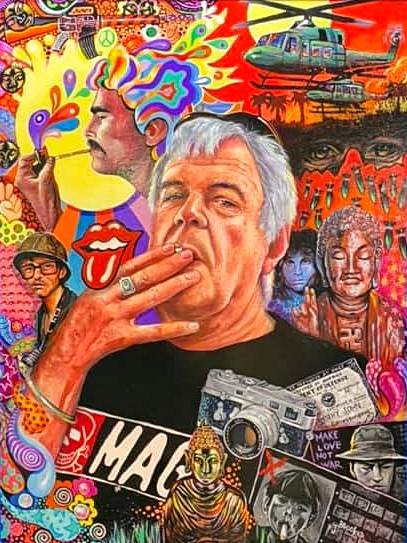
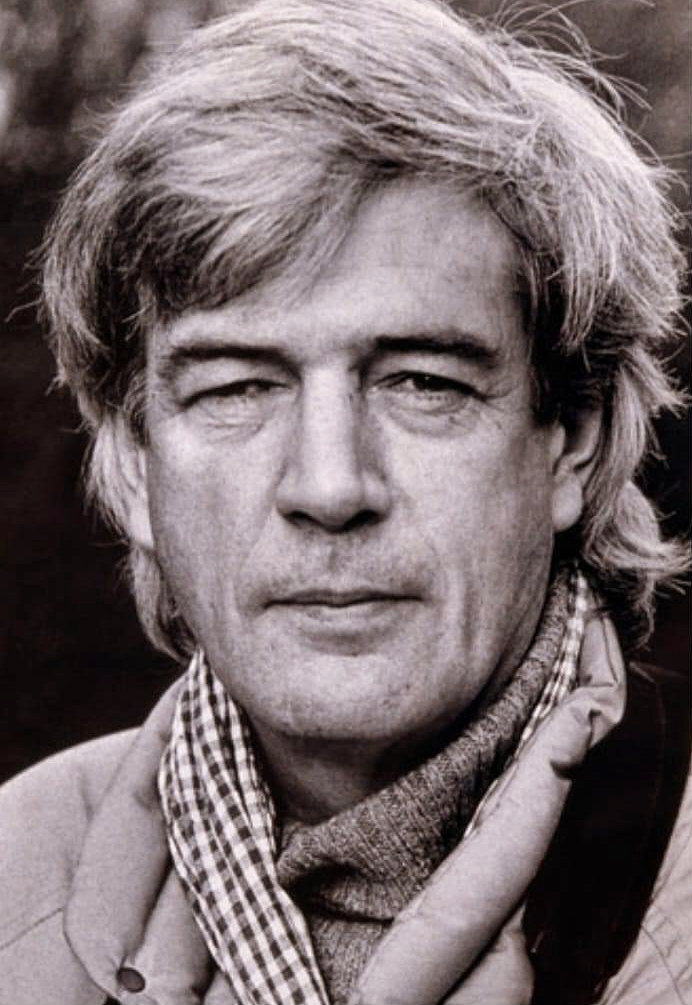
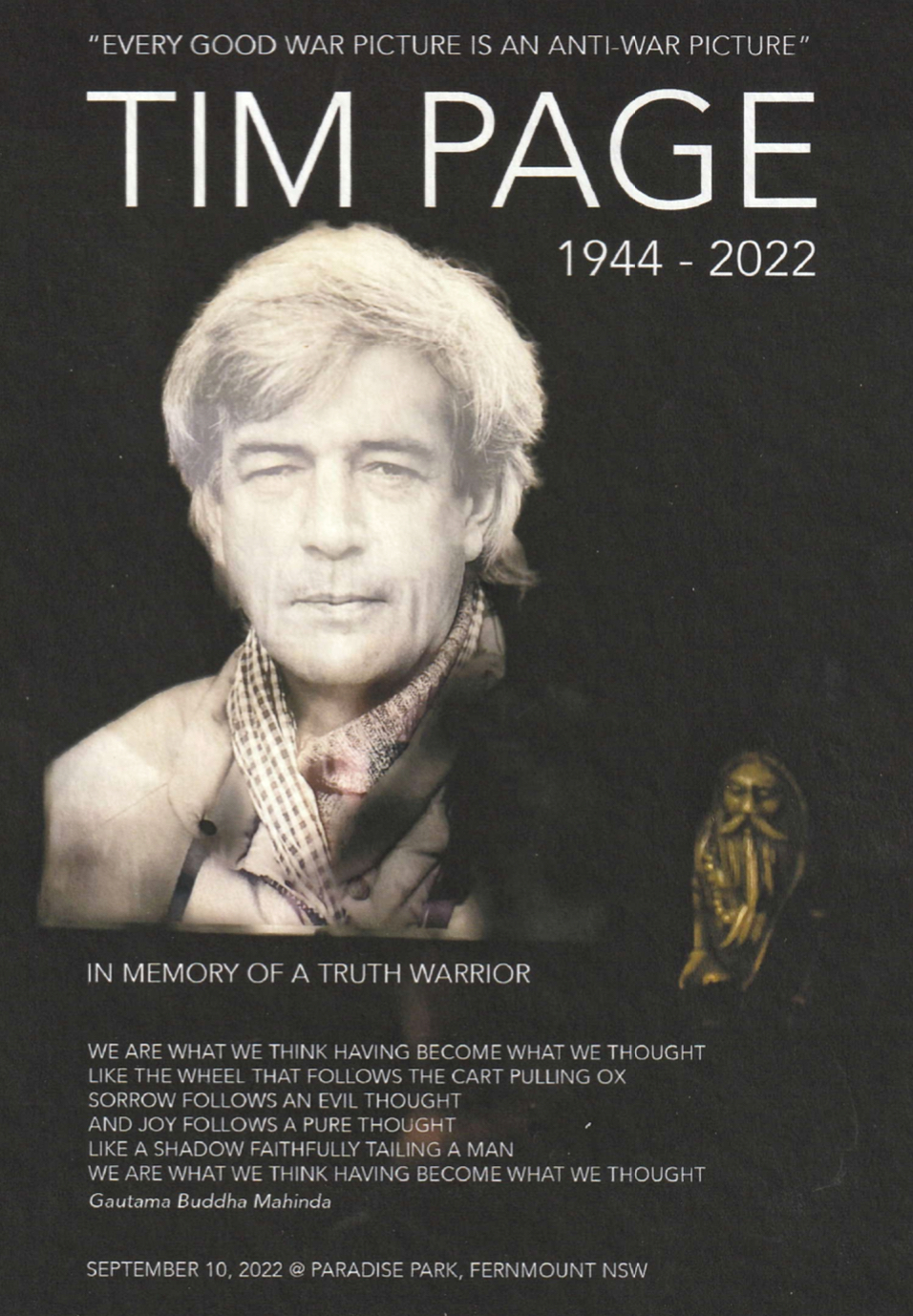
Tim Page’s War – a photographer’s Vietnam journey 

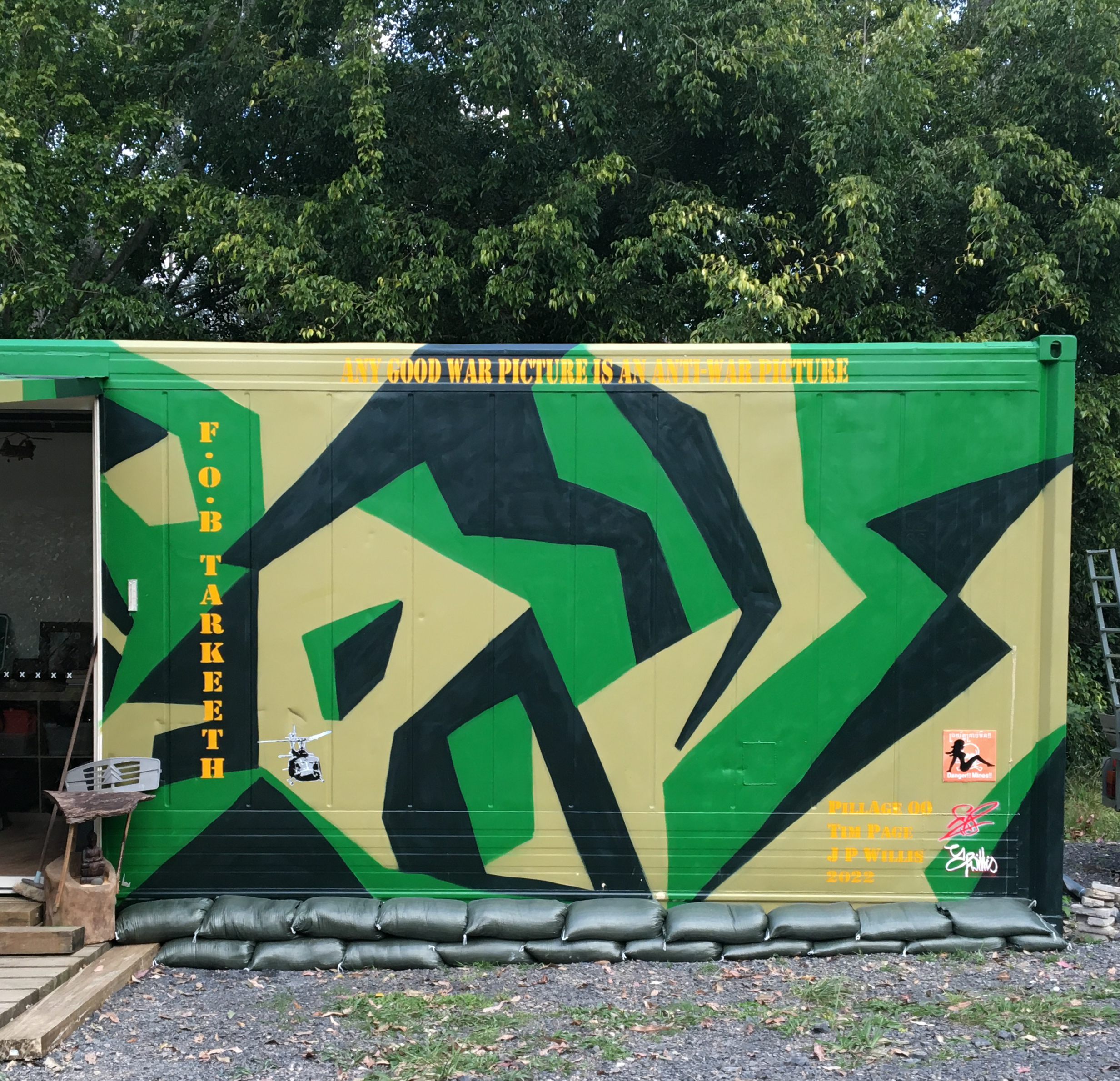
Our forest neighbour, recently deceased and internationally acclaimed English photojournalist Tim Page ran away from boring ‘sixties Britain to the exotic East at the age of seventeen, taking the ‘overland’ route that decades later would be called ‘the Hippie Trail’. He washed up in the great war of our generation, and left it critically injured and indeed clinically dead in a medivac chopper. This is the story of a war, and a young man who wandered into that war.

That was the year that was – don’t stop (thinking about tomorrow)

The prophet’s lantern is out
And gone the boundary stone
Cold the heart and cold the stove
Ice condenses on the bone
Winter completes an age
WH Auden, For the Time Being – a Christmas Oratorio, 1941

I considered using a line from the above as the title of this retrospective of 2022.  It was written during 1941 and 1942, though published in 1947, when the poet was in self-exile in the United States and viewing the war in Europe from afar – although the long poem from which it has been extracted does not in itself reflect such pessimism. A more fitting title could be taken from another long poem that was published in another (very) long poem published in 1947 – Auden’s often overlooked masterpiece The Age of Anxiety, a meditation on a world between the wreckage of The Second World War and of foreboding for the impending armed peace that we now look back on as the Cold War, with its oft-repeated mantra: “many have perished, and more most surely will”.

The year just gone was indeed a gloomy one, meriting a dismal heading. There are few indications of where it might take us in ‘23 and beyond, and my crystal ball is broken. Pundits reached for convenient comparisons. Some propounded that it was like the 1930s all over again when Europe constantly teetered on the brink of war. Others recalled 1989 with the fall of the aneroid Wall and the collapse of the Soviet Union. But, beware of false analogies. In 2022, things were more confused. The tides of history have often resembled swirling cross-currents.

Things, of course, might have been worse. There are, as I’ve noted in successive posts on my own Facebook page, many qualified “reasons to be cheerful”. The  year could have ended with Ukraine under Russian control. An emboldened China might have been encouraged to launch an assault on Taiwan. A red wave in the midterms would have buoyed Trump. And here in Australia, Scott Morrison might have secured another “miracle” election victory. The West could have retreated on all fronts.

Instead, therefore, I have selected a title that hedges its bets, because, to paraphrase the old Chinese adage, and the title of an earlier retrospective, we certainly live in interesting times and in 2023, and a lot of energy will be spent endeavouring to make sense of them – or, to borrow from Bob:

Pointed threats, they bluff with scorn
Suicide remarks are torn
From the fool’s gold mouthpiece
The hollow horn plays wasted words
Proves to warn that he not busy being born
Is busy dying

B Dylan

The year in review 

Christine McVie, longtime and founder member of Fleetwood Mac departed the planet on 30th November this year. And contemplating this year’s posts in In That Howling Infinite, I could not help thinking about one her most famous songs. I recalled that it featured on newsreels of the revolution that ousted the Shah of Iran in 1979.

Why not think about times to come?
And not about the things that you’ve done
If your life was bad to you
Just think what tomorrow will do
Don’t stop thinking about tomorrow
Don’t stop, it’ll soon be here
It’ll be better than before
Yesterday’s gone, yesterday’s gone

The song seemed quite apposite as the soundtrack of a revolution that had overthrown one of America’s many friendly autocrats. At the time, no one could predict what would happen, but, as with the fall of the Berlin Wall in 1989, it was a time optimistic expectation. And yet its shock waves have reverberated and ricocheted in ways unimagined at the time.

As 2022 ends, with blood flowing on the streets of Iran and in the mullahs’s torture cells as young people rise up against a hypocritically brutal theocratic tyranny, we see again and again how that which goes around comes around.

Women, Freedom, Life

If the malign hand of history has literally reached out and gripped Iran’s young women and girls by their hair, it has also endeavoured to strangle the thousand year old Ukrainian nation in the name of an atavistic irredentism. Russian troops invaded the Ukraine on February 24, causing what has since become the largest conflict in Europe since World War II. Out if the spotlight of the world’s easily distracted attention. intractable conflicts lumbered mercilessly on – in Syria, Yemen, Ethiopia, the Congo and many other “far away  places with strange sounding names”.  

On the far side of the world, the USA continued to struggle with the reverberations of January 6th 2021. Donald Trump, like Dracula, has not gone away, and whilst his 2024 presidential run is looking increasingly shaky, he continues to poison the atmosphere like radioactive dust. The unfortunate folk of the United Kingdom endured three prime ministers during the year, including the shortest ever in the history of the office, and after two years of pandemic, are facing a bleak economic winter as well as a frigid actual one.

In Australia, it was the year of the teal – at least according to those who study the evolution of language, the year we lost a queen, our long-serving foreign head of state, and a king of spin, the down-fallen and disgraced Scott Morrison. And a sodden La Nina saw incessant rain drown large swathes of eastern Australia, visiting misery on thousands. COVID-19 mutated, the Omicron variant surging from beginning of the year, ensuring no end to the pandemic – today, it seems like everyone we know has had it, including ourselves (and we were soooo careful for a full two years!). As restrictions were cautiously lifted, we as a nation are learning to live with it. 

Politically, it’s been a grand year for the Australian Labor Party. With our stunning Federal election win in May and in Victoria in November, the Albanese government’s star is on the ascendant and it’s legislative record in six months has out run nine years of Tory stagnation on climate, integrity and equality – a neglect that saw the rise of a new political force in the shape of a proto-party, the aforementioned “teal”, named for the colour of the candidates’ tee shirts. The opposition has been reduced to a bickering and carping crew, and whilst Labor continues to ride high in the polls, the Coalition bounces along the bottom of the pond.

Lismore, northern NSW, March 2023

Flooded house aflame, Lismore March 2022

Christine McVie was just one of many music icons who checked out this past year. The coal miner’s daughter, Loretta Lynn, crooned her last, as did rock ‘n roll bad boy Jerry Lee Lewis and Ronnie “the Hawk” Hawkins, who gave the boys in The Band their big break. Rock heavyweight (literally) Meatloaf took off like his bat out of hell and keyboard evangelist Vangelis boarded his chariot of fire.

Acclaimed British author Hilary Mantel, whose Wolf Hall trilogy inspired back to back posts in In That Howling Infinite in 2020 found “a place of greater safety”, and French author Dominique Lapierre also joined the choir invisible. I had first learned about Israel’s war of independence and the Palestinians’ al Nakba in his O Jerusalem, and about the bloody tragedy that accompanied the birth of India and Pakistan, in Freedom at Midnight, both books featuring in past posts. 

Mark Rylance and Damian Lewis as Tom and Hal

One could argue that the most significant departure was that of Britain’s longest serving monarch. Queen Elizabeth II had been on the throne for almost all of my life, as has the now King Charles III who was born four months before me, and of whom, as a nipper, I was jealous. I recall how I watched the queen’s coronation on a tiny black and white television in the crowded and smokey parlour of the boarding house run by a friend of our family. By happenstance, Netflix served up two over the top regal sagas to binge on: the penultimate season of The Crown, which whilst entertaining, was a disappointment in comparison with earlier seasons, and Harry and Meghan which was whilst excruciatingly cringe-worthy, was nevertheless addictive viewing. The passing of Her Maj reminded me that in my lifetime, I have witnessed three monarchs and eighteen British prime ministers (and incidentally, eighteen Australian prime ministers).  The public outpouring of grief for the Queen’s ascent to the choir invisible was unprecedented – the picture below demonstrates what the Poms do best …

The Queue along the Thames to pay respect to Her Maj

There were farewells much closer to home. My mediation colleague, aspiring author and friend John Rosley, and Beau Tindall, the son of my oldest Bellingen friend Warren, took off on the same day in May. Peter Setterington, my oldest friend in England – we first met in 1972 – died suddenly in London in March, and our friend and forest neighbour, the world-famous war photographer Tim Page, in August, after a short but nasty illness. Pete is memorialized in When an Old Cricketer Leave His Crease whilst Journey’s end – Tim Page’s wild ride,is an adaptation of the eulogy I gave for Tim in September, one of many on that sunny afternoon day in Fernmount. It is a coda to Tim Page’s  War – a photographer’s  Vietnam journey, a story we published a year ago.

Tim Page by Joanne Booker

What we wrote in 2022

The ongoing Ukraine War has dominated our perception of 2022, from the morning (Australian time) we watched it begin on CNN as the first Russian missiles struck Kyiv, to the aerial assault on infrastructure that has left Ukrainians sheltering through a cold, dark winter. Two posts in In That Howling Infinite examined the historical origins of the conflict: Borderlands – Ukraine and the curse of mystical nationalism and The Roots and Fruits of Putin’s Irridentism. “Because of …” Iran’s voice of freedom looks at the song that has become the rising’s anthem. None can predict the outcome – whether it will be a doomed intifada, the Arabic word that literally means a shaking off – historically of oppression – and figuratively, a rising up, like that in Ireland in 1798 and 1916, Warsaw in 1943 and 1945, and Hungary in 1956, or an Inqilab, another Arabic word meaning literally change or transformation, overturning or revolution.

The run up to May’s Australian elections inspired Teal independents – false reality in a fog of moralism.; and Australia votes – the decline and fall of the flimflam man. 

More distant history featured in Menzie’s Excellent Suez Adventure, the story of the Suez crisis of 1956 that historians argue augured the end of the British imperium, and the role played therein by longtime Australian prime minister Sir Robert Menzies. Johnny Clegg and the Washing of the Spears is a tribute to the late South African singer, dancer and songwriter, and a brief history of the war that destroyed the great Zulu nation, setting the scene for the modern history of South Africa. And journeying further back in time to sixteenth century Ireland, there is O’Donnell Abú – the Red Earl and history in a song, a discussion of the origins of a famous and favorite rebel song.

Then there are the semi-biographical “micro-histories” in In That Howling Infinite’s Tall tales, small stories, obituaries and epiphanies. In 2023, these included: Folksong Au Lapin Agile, the evening we visited Montmarte’s famous folk cabaret; Ciao Pollo di Soho – the café at the end of the M1, the story of a café that played a minor part in my London days, as described in detail in an earlier travelogue, Song of the Road – my hitchhiking days; Better read than dead – the joy of public libraries; The quiet tea time of the soul, an ode in prose to a favourite beverage; and The work, the working, the working life recalling the many jobs I took on in the sixties to keep myself in music, books, travel and sundry vices. 

We cannot pass a year without something literary. We celebrated the centenary of three iconic literary classics in The year that changed literature, and with the release of The Rings of Power, the controversial prequel to The Lord of the Rings, we published a retrospective on the influence of JRR Tolkien. One ring to rule us all – does Tolkien matter? – a personal perspective with an opinion piece by English historian Dominic Sandbrook, an informative and entertaining chronicler of postwar British history and society which featured, in Unherd, an online e-zine that became a “must read” in 2022. A Son Goes To War – the grief of Rudyard Kipling recalls the death in battle on the Western Front in 1917 of the poet’s only son, it’s influence upon his subsequent work, whilst Muzaffar al Nawab, poet of revolutions and sorrow is an obituary for another poet, who seen a lifetime speaking truth to power.

And that was that for what was in so man ways a sad year. Meanwhile, In That Howling Infinite already has several works in progress, including a review of historian Anthony Beevor’s Russia – Revolution and Civil War, what King Herod really thought about the birth of baby Jesus, and the story of a famous and favourite British army marching song.

Best wishes for 2023 …

Death of a Son

That was the year that was – retrospectives

Life in Wartime – images of Ukraine

Journey’s end – photographer Tim Page’s wild ride

Time is an ocean but it ends at the shore
You may not see me tomorrow

Bob Dylan

Friends of acclaimed Anglo-Australian photographer, writer and humanist Tim Page, gathered from all across the shire, from the mountains to the sea, and from around Australia on Saturday 10th September to bid him farewell at his bush home in Fernmount next to Tarkeeth Forest to bid him farewell. Bellingen’s resident square-tailed kite did a fly past as if to salute him, and as we sat around the campfire under a full moon, a bevy of fireflies emerged from the forest like faeries coming for to carry him home.

Tim had departed this mortal realm at 4.15pm on Wednesday 24th August 2022, after a relatively short illness. He been sleeping most of the time during those last few days when we dropped by on our way over the hill. We knew it was very close as we’d visited several times, and almost at the exact time of his passing, we’re were actually driving by but decided not to disturb him.

The international and social media response to Tim’s death was astounding and almost instantaneous. Within hours, tributes had been published and posted all over the world. The New York Times published an excellent eulogy, as did the Sydney Morning Herald. The Guardian presented an excellent gallery of his work. An interview by the ABC with Ben Bohane, photojournalist and author and longtime friend and mentee, is both poignant and precise. We had the pleasure of meeting Ben when he visited Bellingen and spent several days with Tim immediately before his death.

He was given a fine send-off. As one mourner noted in a Facebook tribute, “It was a long, melancholic, yet kind of wonderful weekend … the kind of gathering he’d have loved, crammed with people he cared about, the Stones and Dylan rolling out over the Birds of Paradise grove in the gully, a grassy aroma in the air, and tales of his misdemeanours, wisdom and humanity prompting chuckles and affirmations as a light breeze loosened leaves and sent them down in lazy spirals onto his wicker casket …”

Fine eulogies were delivered by Tim’s “brothers” in photo-journalism who’d worked with him over all over the world and down the years. There were tales of battlefields and bar-rooms, of recovery and resilience, of road trips and revelries, of incidents and accidents.

Tim Page 1944-2022

Tim Page 1944-2022

I spoke too, as a friend and a forest neighbour, and also, as a resident of Bellingen Shire. We’d had the privilege and pleasure of sitting with Tim for many an hour during the three months of his decline. We talked of was and when, of our childhoods in Nineteen Fifties England, of life in our valley, of history and politics and of his long and colourful career – and we were able to say goodbye to him in person four days before the end.

This is what I said …

Journey’s End

Living just over the hill, and forever dropping in here at paradise park, Adèle and I spent many an hours sharing stories and gossip with Tim and his partner Marianne and her sister Annette, who we farewelled right here just over a year ago. We all shared a common English heritage, having all grown up in postwar Britain with its rationing, blandness and monochrome conformity – in the midst of the Cold War and under the shadow of the mushroom cloud.

During the three months of his decline, Tim and I would reminisce about our common boyhoods in nineteen fifties England before we both split for foreign parts. 

We were into bicycles with drop handlebars and comics like The Beano and illustrated stories about “the war” – which was still a lived experience for the adults around us whilst the sons and brothers of our friends and acquaintances were called up for national service. We’d built the same Airfix aeroplane kits and hung our trophies from our bedroom ceilings – Tim’s are now hanging in his archive bunker over yonder. I believe he still has his Hornby train set and, no doubt, his Meccano – folks here of a certain vintage will know what I mean. He was and remained a great collector of stuff. He even picked up a UN Toyota “technical” utility truck in Bosnia and brought it back here. [Author’s note: he eventually gave the truck to a friend up the valley and it saw service as a water carrier during the devastating wildfires of our 2019-20 Black Summer]

In the sixties, we’d listened to the same music, and used some of the same drugs – me, much less than he. We both took to the Hippie Trail from Europe to Asia taking the ‘overland’ road that decades later would be called ‘the Hippie Trail’.

But Tim had already been two years “in country” when I was demonstrating in front of the US embassy in London’s Grosvenor Square against what Kenny Rodgers would call “that crazy Asian war”. 

Tim virtually ambled into the Vietnam War, the last of the “great” wars of the Twentieth Century, and though photography was a teenage hobby, in Vietnam, he drifted into the profession almost by accident. The war was a conflict with many names, but the best is probably one from Ken Burns great documentary: “chaos without a compass”. Tim navigated it cannily if carelessly for several but left ‘Nam a few years later critically injured in a minefield and indeed clinically dead in a medivac chopper. Post-op and recuperating in the US, Tim took himself off to Woodstock, New York State. where it was being said that there was going be a cool scene – which indeed there was, as we all remember:  the famous music festival held over three days in August 1969 on Max Yasgur’s dairy farm in Bethel, New York (65 km) southwest of the town of Woodstock. But Tim never got to hear any of the great music – complications from his injuries meant that he had to be medivacced out of Woodstock, probably on the same chopper that had just brought in the legendary Crosby, Stills and Nash.

Tim told us the clear-felled Tarkeeth Forest to our immediate south, just beyond those trees, reminded him of those Vietnam battlegrounds – indeed, the use of fires and herbicides in Forestry Corporation’s “forest re-establishment” reminded him of the devastation wrought by the defoliant Agent Orange in that unfortunate country. Ironically, Agent Orange may have contributed to his illness. He was unable to have MRI scans because of the shrapnel fragments in his liver from one of his many close encounters with the Grim Reaper. 

Listening to Tim’s stories, you wonder whether this peregrinating, ever-restless bloke had more lives than a cat! When he was first diagnosed in early May, as Adèle and sat on his hospital bed, I remarked that he’d already used up his nine lives. He replied: “No matter how many times you’ve faced the prospect of death, you’re never prepared for it”.

But, when the end came, he faced it with stoicism and courage. I hope that when we get there, we’ll all be as brave. 

Farewell wild rover.

Your’s was a life well lived, and to borrow from Rudyard Kipling, filling the unforgiving minute of the unrelenting day with sixty seconds worth of distance run.

As Bob Dylan sang, “Time is an ocean but it ends at the shore – you may not see me tomorrow”.

Of our elaborate plans, the end
Of everything that stands, the end
No safety or surprise, the end
Jim Morrison 1967

This painting by his friend Joanne Brooker portrays his long and colourful career.

Tim Page by Joanne Brooker

In Country

Tim Page’s War

Any good war picture is an anti-war picture. Tim Page

Almost exactly a year ago, In That Howling Infinite published a piece on Tim’s journey to a war. I had been editing one of his several autobiographical accounts of his adventures and reading Max Hastings’ tombstone of a book, Vietnam – an Epic Tragedy, and spent hours talking to Tim about his life and viewing his splendid if often harrowing pictures. In Tim’s words, written on his archive “bunker”, a converted shipping container that became his last great project (buoyed up on steroids, he’d risen from his bed finished unpacking his collection on the Saturday before he died), “Any good war picture is an anti-war picture”.

In Tim Page’s War – a photographer’s Vietnam Journey, I wrote:

For Tim, it was the worst of times, it was the best of times. “Hot and cold running …” he says, using the vernacular of those days … booze, drugs, girls, he meant – battle injuries and diseases – and action, lots of it, in the air in helicopters and on occasion, fighter bombers, on the land in jeeps, armoured vehicles, and motor bikes, on the rivers in patrol boats, and on foot. The lure of sex, drugs, and excitement – and paid work for a major news agency saw him wash up in Saigon and the celebrated, inebriated Frankie’s House, a kind of home-away-from home and party house for transiting bao chi – ‘round-eye’ newsmen – a decadent, dissolute, de facto foreign correspondents club. From here, they would fan out though war-wracked South Vietnam under the often dodgy and dangerous protection of Uncle Sam. Like the soldiers they accompanied, many came back in body bags or on stretchers. Many just disappeared, and it has been Tim’s mission in life to trace these lost souls. They include his best buddy Sean Flynn, the son of famous actor and pants man Errol Flynn”.

In the 1992 series of Frankie’s House, based on Tim’s Vietnam days, he was portrayed by the Scottish actor Iain Glen, famous nowadays for his role as Ser Jorah Mormont in Game of Thrones.

Iain Glen on the left as Tim Page in Frankie’s House

“Any good war picture is an anti-war picture”.

For what is it to die but to stand naked in the wind and to melt into the sun?
And what is it to cease breathing, but to free the breath from its restless tides, that it may rise and expand and seek God unencumbered?
Only when you drink from the river of silence shall you indeed sing.
And when you have reached the mountain top, then you shall begin to climb.
And when the earth shall claim your limbs, then shall you truly dance.
Khalil Gibran

We die with the dying:
See, they depart, and we go with them.
We are born with the dead:
See, they return, and bring us with them.
The moment of the rose and the moment of the yew-tree
Are of equal duration…

TS Elliot, Little Giddng

© Paul Hemphill 2022. All rights reserved

In In That Howling Infinite, see also, Tall tales, small stories, obituaries and epiphanies

Also in In That Howling InfiniteThe Ballad of Denton Crocker – a Vietnam elegy ; anThings fall apart, the centre cannot hold – 1968 revisited

Better Read Than Dead – the joy of public libraries

In 1839, in the midst of a half-century of post-Napoleonic political ferment and incipient revolution, English author Edward Bulwer-Lytton coined the adage “the pen is mightier than the sword”, implying that the written word is more effective than violence as a tool for communicating a point. It’s no wonder that the straighteners, the autocrats and the fundamentalists want to ban and even burn books. In his dystopian novel Fahrenheit 451, published in 1953 at the height of America’s McCarthy anti-communist witch-hunts, Ray Bradbury wrote: “The problem in our country isn’t with books being banned, but with people no longer reading. You don’t have to burn books to destroy a culture. Just get people to stop reading them”.

But, encouragingly, reports of the demise of the written word in the form of the humble published book are exaggerated and premature.

Which brings us to keepers of the flame – the torch of knowledge and not the bearers of the fire-brands,  the people who look after our public libraries. Oscar-winning documentary-maker Michael Moore once said admiringly that librarians were a more dangerous group than he had realized: “You think they’re just sitting there at the desk, all quiet and everything. They’re, like, plotting the revolution, man.”

To the American industrialist and philanthropist Andrew Carnegie, libraries were temples of learning and self-improvement. “A library outranks any other one thing a community can do to benefit its people,” said Carnegie, who put his money where his mouth was. By 1929, he had paid for the construction of more than 2500 libraries, most of them in the USA.

Back in the day … 

I reckon that I was visiting libraries even before I could read, but that could well be my mind playing tricks on my memory. But once I commenced grammar school, the local library, but a short walk away, was a world of wonders. Yardley Wood Library, in south Birmingham on the quiet northerly extension of busy Highfield Road, between a small housing estate of postwar prefabs on the east and a large expanse of recreation field at its rear, and but ten minutes from home, was the grail of my early education and my widening general knowledge of the outside world.

As an early teen, I’d stay weekends at my Aunt Mary’s house in the inner city on the border of Moseley and Balsall Heath, and the Victorian grandeur and shadowy interior of Balsall Heath Library became yet another “garden of earthly delights”. This library is the featured picture of this post. The tall chimney on the left belongs to the immediately adjacent Balsall Heath swimming baths, where my uncles and aunts who shared our home would take their weekly baths (even if they didn’t need them, as the old saw goes), where I’d go in my weekend sleep-overs, and where, when struggling with my Boy Scout swimming test, I’d push myself through the pool. And loathed every minute, Although I now live in a land blessed with beautiful beaches, I still hate being in water any deeper than my bath!

Yardley Wood Library, Birmingham

In these two “houses of wisdom”, I’d browse the stacks, thumbing through art books and atlases, encyclopaedias and illustratatives, and I’d always have three or four books on loan, with a particular interest in history, biographies and historical fiction. My reading was eclectic ab initio, from the early adolescent “he went with … “ great explorer adventures by Louse Andrews Kent and the many books of H Rider Haggard, both quite politically incorrect and vulnerable to ‘cancellation’ in today’s prescriptive cultural climate, to the relatively anodyne French ‘soft-porn’ of Anne Golon’s Angélique series, to Mikhail Sholokhov’s And Quiet Flows the Don and its sequel The Don Flows Home to the Sea, which introduced me to Russian history and politics and a youthful dalliance with The Communist Manifesto and the Communist Party. I remain very interested, and have written often on the subject. For example, Stalin’s Great Terror, The Russian Tradition – Russia, Ukraine and Tibor Szamuely, and Red and white terror – the Russian revolution and civil war

Eventually, as I studied for A Levels in the late ‘sixties, I entered Birmingham’s cavernous Central Library in the heart of the Second City. Opening in 1865 and rebuilt in 1882: it was a magnificent edifice within and without. I recall it when I rewatch the Game of Thrones episode in which would-be meister Sam Tarly enters the Citadel in Old Town for the first time. This Victorian relic was replaced by a brand new, brutalist building in 1974 – which I never saw as this too was closed in 2013 and replaced by the present Birmingham Library  – which I visited when I was in Birmingham two years later.

Birmingham Central Library

The interior of Birmingham Central Library

The William Shakespeare Room reconstructed atop the new BirminghamLibrary, 2015

My alma materMoseley Grammar School boasted a small but diverse library that beckoned during lunch breaks, with its high, wooden-beamed ceiling, it’s wrought iron balcony and the spiral staircase that led up to the landmark school tower in subsequent years, the library was closed for safety reasons, but a recently completed renovation project has brought it back into use as the photo of former pupils gathered therein on the occasion of Heritage Day 2022 shows.

I’ve written fleetingly of this library before: “It was one of those beautiful late-spring evenings that you would get in the England of youthful memory. The evening sun poured through the gothic stained glass windows of the school library – it was one of those schools. A group of lower sixth lads, budding intellectuals all, as lower sixth tended to be, gathered for a ‘desert island disks” show-and tell of their favourite records. Mine was Wishin’ and Hopin’  (by (Dusty Springfield). Then it was on to the next. Clunk, hiss, electric guitar intro, and: “My love she speaks like silence, without ideas or violence, she doesn’t have to say she’s faithful, but she’s true like ice, like fire…” I was gone, far gone. So was Dusty”. From Whats Bob Got To Do With It?

It is one of those instances of serendipity we encounter on our journey through life that the first serious love of my life was studying to be … drum roll! …a librarian, and in time became the chief librarian of a major English university, whilst  one of my oldest London friends rose to a that position in the university I attended in the ‘seventies. How about that?

Moseley Grammar School, Birmingham

Former pupils of Moseley Grammar School gather in the refurbished library, 2022

Here in the now …

In Australia, if attendance figures are any indication, the public library is our most valued cultural institution. In the year to July 2018, about 7.6 million people visited Australian libraries – more than went to museums (6.7 million), art galleries (6.3 million), plays (3.9 million) or musicals and opera (3.5 million). But it was the return rate that really set libraries apart. Whereas at least half of those who visited museums or the theatre went only once in the year, three-quarters of library visitors went back at least three times, and one-third visited more than 10 times. Australians make about 114 million visits to public libraries annually.

Here where I now live in Australia, on the Mid North Coast of New South Wales, Coffs Harbour library is the mother ship with satellites at the outlying townships of Woolgoolga and Toormina – the latter is named for Taormina in Sicily, the site of one of the most famous theatres of Greek antiquity. Our own shire has libraries in Bellingen, Dorrigo and Urunga.

I get to the library nearly every time I’m in Coffs Harbour, just to browse the stacks (there is something there for everyone) and check out the history books – as ever – and the large collection of cds. I almost always come away with something I had not intended to read or listen too. It’s a calm and peaceful space, with friendly and helpful staff, and yet always quite busy – particularly at its free computer and wi-fi benches. Members can even borrow ukuleles! [Since this article was written, the library has relocated to brand new premises, and it is even better than before, with a more computers for public use, study rooms off-side for small groups, and meeting rooms available to the public. The ukulele shelf is still there]

As a volunteer with Settlement Services International, before Covid 19 closed our office and cut the flow of refugees to Australia, I often took newly-arrived refugee families there as part of their orientation. I’d help them enroll and give them a brief tour of the facilities, and particularly the computers, the foreign language section which houses a growing collection, including books in Arabic and Farsi, and the children’s section (which hosts regular and free storytelling and craft sessions for preschools kiddies), and encourage them to return – it’s such an excellent introduction to our language, society and culture.

The old Coffs Harbour Library

As the following essay shows, libraries are much much more than their books and their educational and technical resources and facilities. They are not just a reference service but also a place for the vulnerable and the lonely, a “shelter from the storm” for people of all ages and circumstances. In a world where social and community services are being ground down, and loneliness and isolation are endemic, libraries provide vital lifelines for all manner of folk. from elderly people who value the human interaction with library staff and with other visitors, to the isolated young mother who enjoys the support and friendship that grows from a baby rhyme time session, to people who want to play the ukulele (visitors can actually borrow ukuleles as one would borrow books), to people like me just seeking time out time in a peaceful and welcoming space.

© Paul Hemphill 2022.  All rights reserved

Postscript

I wrote recently about Moseley Grammar School in an article on JRR Tolkien:

“Learning more about the author, I was to discover that he’d grown up in Birmingham, my home town, first in leafy Edgbaston (the home of Cadbury and the Warwickshire County Cricket Club), where he’d attended the prestigious King Edward’s Grammar School – my own school, Moseley Grammar, was not in its league. He lived near Sarehole Mill, in present day Hall Green, around the turn of century, between the ages four and eight, and would have seen it from his house. The locale at that time was rural Worcestershire farmland and countryside and not in the Birmingham ‘burbs. He has said that he used the mill as a location in The Lord of the Rings for the Mill at Hobbiton: “It was a kind of lost paradise … There was an old mill that really did grind corn with two millers, a great big pond with swans on it, a sandpit, a wonderful dell with flowers, a few old-fashioned village houses and, further away, a stream with another mill … “  Sarehole Mill was just down the road from my school, and our sports field and cross country tracks were adjacent to it. On many a wintry, cold, wet and windy Wednesday afternoon, I’d stagger past it on a muddy track. How I hated wet Wednesdays; dry ones were for rugby, and I hated them too!”  From: One ring to rule us all – does Tolkein matter?

For more stories like this one in In That Howling Infinite, see Tall tales, small stories, eulogies and epiphanies, and on books and reading generally, see Better read than dead – books, poetry and reading.

One for the books: the unlikely renaissance of libraries in the digital age

Farewell to a Tarkeeth Tiger

We Acknowledge the Gumbaynggirr People, the traditional custodians of the Land we are gathering upon, and the Land from the Tablelands to the sea; and who have been here for over sixty five thousand years. And we pay respect to Elders past, present and emerging.

Our dear friend and forest neighbour departed our planet at eight in the morning of Monday 7th June 2021, and bid farewell to country on a beautiful winter’s afternoon on Saturday 19th June.

There must have been some two hundred friends gathered at Paradise Park, her lovely property in Fernmount in the Bellinger Valley. Many beautiful eulogies were delivered recalling and celebrating her long and remarkable life.

And it was indeed a colourful one. Like many in the Shire, she hailed from the United Kingdom, but as the daughter of a regimental sergeant major in the Grenadier Guards, she and her mother and sister lived in many corners of the British Empire. She had so many amazing stories to tell about her family’s nomadic wanderings and also, of our beautiful valley.

It was a honour to be asked to deliver one of those tributes. and this is what I said:

I cannot sing the whole song – I have been here for but part of it. But Annette’s story is a long one and glorious. Others will fill in the gaps – most particularly, the story of those early days. She was one of those present at the creation of the town that we know today, those optimistic days in the seventies which many describe, some in tribute, some in rebuke, as “when the hippies came to town”. It’s all there in Peter Geddes’ films of way back when (View his films HERE). At the end of this piece, i have written a brief guide to the ‘tribes of Bellingen”.

Warren Tindall, one of our oldest Bellingen friends, told us a tale of those early days. He recalled how Annette was so gorgeous, she once stopped the traffic on main street when she was crossing the road.  Another longtime friend, from one of the old logging families of the valley, told us how on seeing Annette on the sidewalk, a local drove his car into the bowser of the local petrol station. Of such tales are legends made.

I’ve been on at her for years to write The Great Australian Novel about those days gone by. She’d even come up with a ripper title: Gone with the Weed. 

It’s the organic way Bellingen as we know it was built. Warren Tindall met Annette in Annandale in inner Sydney in the mid-seventies and came up here. He stayed for a while in this very house until he settled at Boggy Creek. I first met Warren in Coffs Harbour in January 1984 when HuldreFolk played at the Coffs Harbour Folk Festival. Warren brought the band up to Bellingen and we were the first musicians to play at La Bohème, which is now Number 5 Church Street which Annie Arnold over there ran for as The Cool Creek Café – that’s where we first met Annie. If I hadn’t met Warren, I’d never have come to Bellingen, Adèle and I would never have met Annette, and we’d never have been here, as Annette’s closest neighbours. And we’d never have met and befriended so many folk in the Shire with whom we remain acquainted. Chance encounters can work like that.

Big wheel keeps on turning.

Annette loved the Tarkeeth Forest with a fierce passion. She took the fight to its enemies, and Adèle and I were there with her when fainter hearts fell by the wayside. She defended her forest literally to her last breath.

We now know that her illness was a longtime coming, but the day she started to die was was the day FC started to cut down the trees right next to her home, the forest where her beloved animals lived. We’ve lost a fine forest defender and an irreplaceable one.

Four days before the end, I read to her a poem by the wonderful Irish poet William Butler Yeats. I’ve loved Yeat’s poetry since my schooldays, from the moment our headmaster recited to us Aedh wishes for the cloths of heaven. She hugged me to her, kissed me and said “thank you”. When I’d left, a nurse told her sister that a lovely man came in today and read to her from the Bible.

Annette would’ve smiled at that.

Had I the heavens’ embroidered cloths,
Enwrought with golden and silver light,
The blue and the dim and the dark cloths
Of night and light and the half-light,
I would spread the cloths under your feet:
But I, being poor, have only my dreams;
I have spread my dreams under your feet;
Tread softly because you tread on my dreams.

Farewell, old friend, forest neighbour, and drinking buddy – we’ve lost count of the many bottles of fizz we’ve downed together (most always French) – and Farewell to a Tarkeeth Tiger.

Gumbaynggirr postscript

What I did not say on that day – and I regret they I did not –  was that in addition to her well-known passion for the forest and its animals, Annette was a passionate advocate for indigenous Australians, and particularly the Gumbaynggirr, the traditional custodians of the Tarkeeth Forest:

I’d intended, but right there in the moment, failed, to say this:

We are, indeed, gathering here on a registered Gumbaynggirr cultural heritage site. Important artifacts have been found here. Simple everyday tools, weapons and some extremely rare sacred items – which have all been repatriated by Annette’s much loved friend Michael Donovan. It is believed that this cultural area extends well into the logging area to my left and to the north up onto the Fernmount Range. Not far too, from here, in the Tarkeeth Forest, are rare, living, old growth scarred trees, and Annette brought Michael Donovan in to search.

Unfortunately, Michael Donovan cannot be here today. Here is in South Australia. Nor could  his parents be here to represent him. They are in Queensland. But Di will now read a letter from him. It was Di who brought Annette and Michael together.

In June 2020, in the wake of the devastating  bush fires of 2019-2020 and the midst of the COVID19 pandemic, Annette spoke to Bellingen community radio 2BBB about the Gumbaynggirr heritage of the Tarkeeth Forest:

On the afternoon Thursday 12th August, a smaller group of friends gathered to celebrate Annette’s birthday and to lay her ashes in the Buddha Garden close to her cottage. As on 19th July, a rainbow appeared in the north. Her beloved but aged cat Jet followed her into the hereafter on the following Monday.

Our deepest condolences to Annette’s mother Kay, her sister Marianne, and her brothers Paul and Mark, and Marianne’s partner Tim.

© Paul Hemphill 2021. All rights reserved

She comes in colours everywhereShe’s like a rainbow

Rest In Peace – Inna lillahi wa inna ilayhi raji’un – We belong to God and to Him do we return

إِنَّا لِلَّٰهِ وَإِنَّا إِلَيْهِ رَاجِعُونَ

Annette with Julian King and Peter Greste 2017

Paradise Park

For more Bellingen stories in In That Howling Infinite’s Tall tales, small stories, obituaries and epiphanies, see: The Country Life ; A Tale of Twin Pines; The schools of the Tarkeeth: Crossing the South Arm

A Brief Guide to the ‘Tribes’ of Bellingen 

Bellingen is famous for its diversity. Not its cultural diversity – it has always been predominantly white man’s land – on land appropriated from Gumbaynggirr nation. But rather, it’s social diversity.

Bellingen is broadly made up of four amorphous “tribes”.

Here for ever, it seems, are the old farming and logging families. They were and remain conservative and Christian, and traditionally vote for the rural-based,National Party. Some call them the “born to rulers” because they’ve dominated local politics since local politics were invented – when you own the ball, you pick the team.

Then, in the mid-seventies, enter “the new comers”, predominantly city-bred young folk, seeking what was then called an “alternative lifestyle”. People still remember, some in tribute, others in rebuke, “when the hippies came to town.

Many bought up cheap land from dairy farmers who wanted to get out of the business, and established what were colloquially called “communes” but were officially designated “multiple occupancies” because families and friends would form cooperatives among themselves, buy land “in common”, and allot members house sites on which they built their own homes. There are still many such multiple occupancies in the Shire, characterized by their ‘new age’ names;; but most have lost their ‘communitarian’ ethos and lifestyle.

Some hippies wanted a life on the land. Others became artisans, artists and musicians; and many established businesses in town, like ”healthy food” shops and cafés and galleries and craft shops. They looked, dressed, thought and lived differently to the rest of the population. They practiced alternative religions, healthcare and lifestyle, and were politically progressive.

There was inevitably resentment on the part of many locals – and conflict. Town hall meetings were held to “run the hippies out of town”. When the newcomers opened a market in town, the council closed it down. When they established a community centre where the present council chambers stand, council tore it down in the dead of night.

But if time does not heal all wounds, these don’t hurt as much. As the years went by, many people married someone from the “other mob”, and the children of the old tribe and the new mixed with each other in schools, workplaces and social gatherings. Mostly, of the offspring followed the political, social and cultural footsteps of their parents.

In the nineties, and right up up to the present, a fourth and fifth “tribe” arrived in town.

Bellingen continues to attract younger people with what they perceive as Bellingen’s “hippie” and “alternative” reputation., with love and peace in their hearts and wellness and wokeness in their souls.

But increasingly, the town has witnessed an influx of more well-off city people seeking what is called a “sea change” or “tree change”. Many are retired and have sold their city homes at a good price, and purchase country properties with the idea of leading a quieter, slower life in beautiful surroundings. Others are professional people and tradespeople who also want a change of lifestyle, and a pleasant place to raise their families.

As with the earlier migrations, the reception of the newcomers is a mixed one. Some do not like the way the character of the town is changing with the arrival of people who are unaware of and even indifferent to the town’s past. Others are anxious when they see rents and house prices increase beyond what they can afford.

As always, the place is changing, and we cannot see what will become of the town and its diverse residents. But, always, at the end of the day, it’s a grand place to call home.

Postscript – About Bellingen

We have been visiting Bellingen Shire for the last thirty years, and moved a house onto our bush block over twenty years ago. Bellingen, the Bellinger Valley on the Mid North Coast of New South Wales, is well known as a picturesque, well-preserved (founded in 1870) country town. In former times, it was the centre of a thriving dairy and timber industry, and more recently, as a popular tourist spot between the university city of Armidale and the country music capital of Tamworth to the west, and the Pacific “holiday coast” of Coffs Harbour, Sawtell, Urunga, and Nambucca Heads, to the east, with their sand, surf and sun.

Between the two is the Great Dividing Range, the rolling, high country escarpment of the New England Plateau with its gorges and waterfalls, and the world-heritage Dorrigo National Park with it timeless, untouched rainforests – a “land that time forgot”. And linking them all, the old trunk road, aptly if touristically named Waterfall Way.

Bellingen is popular for its cafes and coffee shops, craft industries and shops, music festivals, and federation facades. It’s visual appeal, and it’s bucolic rural environs have seen the town used on many occasions as a film location. In the seventies, it was a Mecca for young people seeking an alternative lifestyle. The hills thereabout are still scattered with cooperatives and communes, or, in local council-speak, multiple occupancies. In the old days, no love was lost between the “hippies” and the farmers and loggers, and politics were dominated by the rural, conservative “born to rule” National and Country Party. Nowadays, it’s heir, the National Party still dominates the political scene, but its clear majorities decrease fractionally election by election, and by the turn of the century, there may no longer be a National Party member. But demographics do change, as does society. The hippies’ children and the farmers’ kids grew up together, attended the high school together, played, partied, and paired together, and now, there are grand children and great grandchildren.

As the timber and dairy industry has declined, Bellingen’s economy has changed. Once exclusively agrarian – including a time as one of the prime producers of cannabis sativa – tourism now plays a vital role. Bellingen advertises itself to visitors and to present and future residents as a clean, green and sustainable shire. Nature’s wonderland, from its golden beaches to its mountain rainforests and waterfalls. A Tourist Heaven with a cornucopia of recreational activities for young and old – from lazy bathing and picnicking to energetic rambling and trecking, camping and climbing, canoeing and fishing. A cultural mecca with many cafes, live music, craft and artisan shops, and music and writers’ festivals.

Two years ago, the online magazine Traveller published a breathless paean to “the bohemian town that is heaven on earth’. Happy traveller Sheriden Rhodes wrote: Some places are so beautiful; it feels like holy ground. For me, Bellingen has always had that consecrated feeling. It’s obvious, given the name the early pioneers gave the Promised Land, a scenic 10 minute-drive from Bellingen’s township itself. Here the land is so abundantly verdant and fruitful; it literally drips with milk and honey. It’s a place so special the fortunate locals that call it home, including its most famous residents George Negus and David Helfgott would much rather keep all to themselves”.

This is the marketing spin hyped up by the council, the chamber of commerce, and real estate and B&B interests. The reality is somewhat different. Bellingen and the “Holiday Coast” generally have seen a large influx of city folk seeking a different lifestyle for themselves and their children, and also of retirees seeking rural or seaside tranquility – in such numbers that Coffs Harbour and its seaside satellites have become in many ways the Costa Geriatrica.

Many newcomers are not fully aware that the Coffs Coast generally is one of the poorest areas of rural New South Wales. Statistics for youth unemployment and senior poverty are among the highest in the state with all the attendant economic, social and psychological impacts as evidenced by high rates of depression, domestic violence and substance abuse. Health and transport services outside the urban centres are  pretty poor. Rising property values and high rents price low-income families and singles out of the market. Decreasing profit margins have forced many of those attractive cafes and coffee shops to close.

Nor is the clean, green, sustainable shire as picture perfect as the brochures portray It. There is environmental degradation with clear-felling and land-clearing, and flammable, monoculture, woodchip-bound eucalyptus plantations that encircle Bellingen – a potential fire bomb primed to explode during one of our scorching, hot dry summers. There is generational degradation of the Bellinger’s banks and the graveling up of its once deep depths. And there the encroachment and expansion of water-hungry, pesticide and herbicide reliant blueberry farms,

But on the right side of the ledger, we in the Shire are indeed blessed by Mother Nature. The coastline boasts magnicent headlands and promontories, and long, pristine and often deserted beaches. The World Heritage Gondwana rainforests are a national treasure, and surrounding national parks truly are a natural wonderland. We never tire of the drive from Urunga to Armidale via Waterfall Way, as it crosses the Great Dividing Range and the New England Plateau. The Kalang River as it flows beside South Arm Road and between the Tarkeeth and Newry State Forests is itself one of the Shire’s hidden and largely unvisited secrets, a haven for fishermen, canoeist and all who love mucking about in boats.

Compared to many places on this planet, we’ve really not much to complain about …