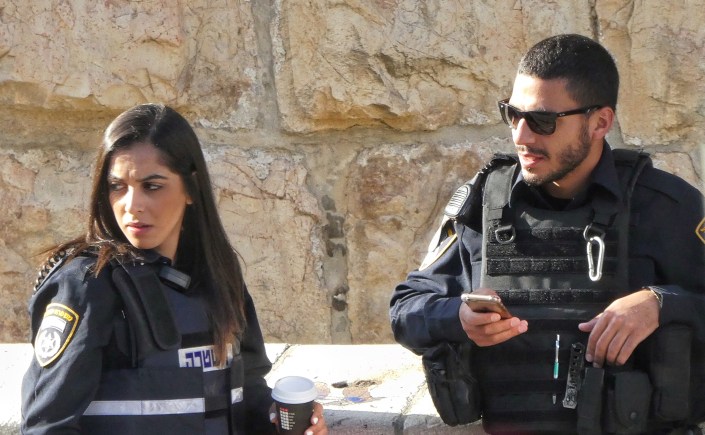
Seeing through the eyes of ‘the other’

But who are the ones that we call our friends?
These governments killing their own?
Or the people who finally can’t take anymore
And they pick up a gun or a brick or a stone.
And there are lives in the balance;
There are people under fire;
There are children at the cannons;
And there is blood on the wire.
Jackson Browne, Lives in the Balance

Indomitable ninety-four year old Uri Avnery is an Israeli writer, founder of the Gush Shalom peace movement, veteran of Israel’s Independence War, and former member of the Knesset. He has written a weekly column for Gush Shalom since 1993. I republish his latest in In That Howling Infinite as a reminder that the world looks different from the other side of the wire.

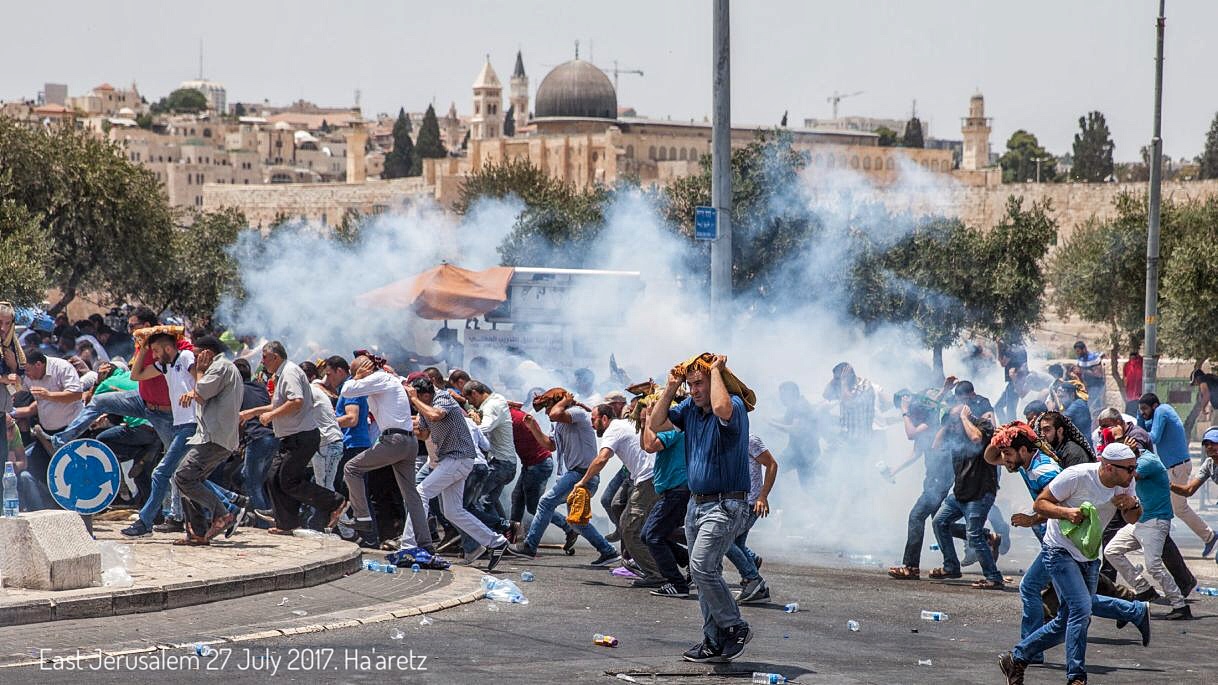
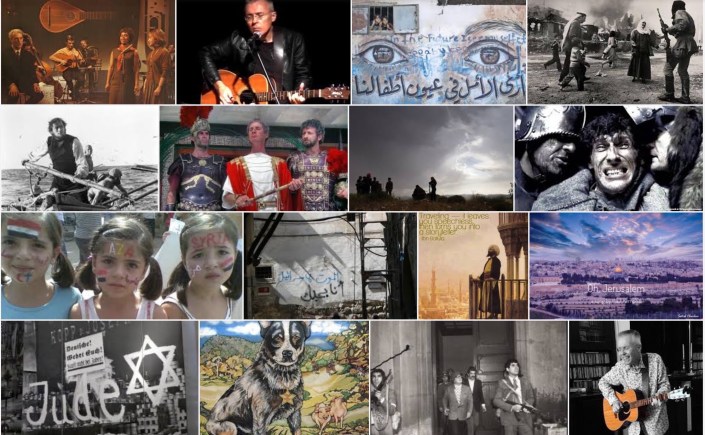
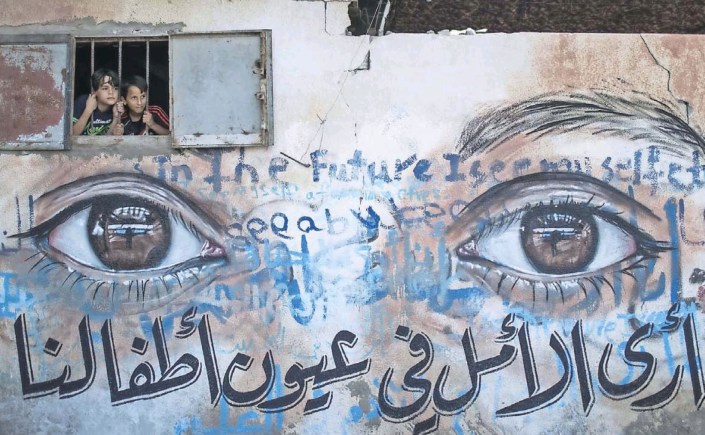
The Arabic in the featured picture says: “View Us Through the Eyes of Our Children”.

See also, my Facing the Fear of the Other, and Children of Abraham

For more posts on Jerusalem, Israel and the Middle East, visit:
https://m.facebook.com/HowlingInfinite/
https://m.facebook.com/hf1983/

A Tale of Two Stories

Uri Avnery, September 29, 2017

This is the story: at 7 o’clock in the morning, an Arab approaches the gate of Har Adar, a settlement close to the Green Line near the Israeli-Arab village of Abu Ghosh.

The man is a “good Arab”. A good Arab with a work permit in the settlement. He lives in the nearby West Bank Arab village of Beit Surik. He received a work permit there because he fits all the criteria – he is 37 years old, married and father of four children. The inhabitants of Har Adar know him well, because he has been cleaning their homes for years.

This Tuesday morning he arrived at the gate as usual. But something aroused suspicion among the guards.. He was wearing a jacket, though the weather was quite hot on this early autumn day. The guards asked him to remove his jacket.

Instead, the man took out a loaded pistol and shot three of the guards in the head at close range – two civilian guards and a member of the semi-military Border Guards. Two of the victims were Arabs (one of them a Druze) and one was a Jew. Another Jew, the local commander of the guards, was severely wounded. Since the assailant had never received military training, the precision of his shots was astounding. The pistol had been stolen 15 years ago.

All Israel was shocked. How could this happen? A good Arab like this? An Arab with permits? Why would he do such a thing in a place where he was well liked and well treated? Where he played with the children? And that after he was thoroughly vetted by the Security Service, which has innumerable Arab spies and is considered well-nigh infallible?

Something extraordinary must have happened. Someone must have incited him against the Jews and the nice people of Har Adar, who had treated him so well. Perhaps the UN speech by Mahmoud Abbas. Or perhaps some secret contacts with Hamas. “Incitement!” cried Binyamin Netanyahu.

But then another fact emerged, which explained everything. The man had quarreled with his wife. He had beaten her up, and she had escaped to her family in Jordan, leaving the four children behind.

So, obviously, he had become temporarily unhinged. In a state of mental derangement he had forgotten the kindness of the Har Adar people. Just a unique case, that need not trouble us further.

But it all shows that you can’t trust the Arabs. They are a bunch of murderers. You cannot make peace with them until they change completely. So we must keep the occupied territories.

THAT IS the story. But there is another story, too. The story as seen by the man himself.

From his home in neighboring Beit Surik, the man – whose name was, by the way, Nimr (“leopard”) Mahmoud Ahmed al-Jamal – could see Har Adar from his home every day when he woke up. For him, as for every Arab, it was a flourishing Jewish settlement, built on expropriated Arab land. Like his own village, it belonged to the Palestinian West Bank which is occupied territory.

He had to get up in the darkness of the night in order to get to Har Adar on time – 7.00 o’clock in the morning – and work hard until late in the night, arriving home at about 10 o’clock. This is the lot of tens of thousands of Arab laborers. They may look friendly, especially when their livelihood depends on it. They may even be really friendly to benevolent masters. But deep in their hearts they cannot forget for a moment that they are cleaning the toilets of the Jews who came to Arab Palestine and occupied their homeland.

Since most of the agricultural land of their villages has been expropriated for Jewish settlements, they have no choice but to work in these low-status jobs. There is no industry to speak of in the West Bank. Wages are minimal, often below the legal minimum wage in Israel proper (some 1500 dollars per month). Since they have no choice, they are not far from being slaves. Like the nice slaves in “Gone with the Wind”.

Such a man may be at peace with this reality, but if something bad happens, he may suddenly become upset with his status and decide to become a martyr. Nimr left behind a letter in which he defended his wife and absolved her from any responsibility for the deed he had planned for the next day.

So these are the two stories, which have very little in common.

The people of Har Adar are completely shocked. Since they live 20 minutes drive from Jerusalem, they do not consider themselves settlers at all, but Israelis like any other. They don’t really see the Arabs all around them as people like themselves, but as primitive natives.

The Har Adar people are not like the fanatical, religious and nearly fascist people in some settlements. Far from it. Har Adar people vote for all parties, including Meretz, the left-wing Zionist party which advocates the return of the occupied territories to the Palestinians. This is not seen as including Har Adar, of course, since there is a consensus among Zionists, right and left, that the settlements close to the Green Line should be annexed to Israel.

Har Adar people can rightly be proud of their achievements. From the air, the place looks very orderly. It has 3858 inhabitants. Their average income is about 5000 dollars a month, well over the national Israeli average (some 3000 dollars). Their local council is the third most efficient in the entire country.

Located in the mountainous area around Jerusalem, it has a beautiful landscape. It also has man-made amenities: a library, a youth club, a skate-park and an amphitheater that seats 720 people. Even for an average Israeli, this is paradise. For the Arabs around, who cannot enter without a special permit, it is a perpetual reminder of their national disaster.

Of course, like other settlements, Har Adar is not located on land that was empty. It occupies the location on which stood a village called Hirbat Nijam, a village which already stood there in Persian-Hellenistic times, some 2500 years ago. Like most Palestinian villages, they were Canaanite, then Judean, then Hellenist, then Byzantine, then Muslim, then crusader, then Mameluk, then Ottoman, then Palestinian – without the population ever changing. Until 1967.

WHEN NIMR was born, all this long history was long forgotten. What remained was the reality of the Israeli occupation.

This now looks like the normal state of things. The members of Har Adar are happy, feeling secure and well guarded by the efficient Security Service, the Border Guard and local mercenaries, mostly Arab citizens of Israel. Neighbors like Nimr seem content, and probably are, if they are lucky enough to have a job and a work permit, even with pitiful wages. The historical grudge lies deeply buried within their consciousness.

And then something happens, something that may be quite irrelevant – like the escape of his wife to Jordan – to bring it all up. Nimr the lowly laborer suddenly becomes Nimr the freedom-fighter, Nimr the martyr on his way to paradise. All his village respects his sacrifice and his family.

Israelis are furious that the families of “martyrs” are paid an allowance by the Palestinian Authority. Binyamin Netanyahu accuses Mahmoud Abbas (Abu Mazen) of incitement to murder with these payments. But it is quite impossible for Abbas to annul them – the outrage reaction of his people would be tremendous. Martyrs are holy, their families respected.

THE DAY after Nimr’s dastardly terrorist act and/or heroic martyrdom, a grandiose national ceremony took place in another settlement.

All the country’s major dignitaries, led by the President and the Prime Minister, assembled to commemorate the 50tth anniversary of “our return to our homeland, Judea and Samaria, the Jordan Valley and the Golan Heights”.

Missing in the list is the Gaza Strip, which Israel has evacuated, leaving behind a tight land and sea blockade aided by Egypt. In the Strip there are about two million Palestinians. Who the hell wants them?

All hell broke loose when the President of the Supreme Court, who was supposed to send a judge to represent the court at this ceremony, canceled his attendance because of the highly propagandist style of the event. She decided that this is party propaganda, in which her court would not take part.

Altogether not a day of quiet in this country, a state without borders and without a constitution, where every story has two totally different sides, where nice and quiet people suddenly become raging martyrs.

There will be no quiet until there is peace, with each of the two peoples living in their own state, a situation where real friendship has a chance of blooming.

Castles Made of Sand

A recent article in Newsweek noted:

“More than three-quarters of Palestinians feel their government is corrupt. Asked to name the biggest problem in society, a majority of respondents choose internal ones: poverty, unemployment, corruption and the political schism between Hamas and Fatah. Just 27 percent say the occupation is their largest concern, according to the Palestinian Center for Policy and Survey Research, the top pollster in the territories. The official unemployment rate in the West Bank is 16 percent, and roughly one in five families lives in poverty. (The actual figures are thought to be higher). Yet the streets of Ramallah are lined with billboards advertising million-shekel apartments. A tenuous middle class has loaded up on consumer debt, which soared from $1.3 billion in 2012 to $2.2 billion just three years later. All of this has served to make Palestinians more risk-averse. The way a CEO of a major bank in Ramallah sees it: “You’re not going to join an intifada when you have to make mortgage payments.”

Meanwhile, the economies of Israel and Palestine are effectively integrated. Israel controls trade The Palestinian market us captive one for Israeli products, whilst Palestinian goods have limited acess to the Israeli market. Al Jazeera has recently published an informative piece this subject.

The following is based on our own observations and knowledge, and these are informed by what we have seen and read, and what we were told by Palestinians we talked to during our travels through the West Bank. We do not profess to be experts – we are neither academics nor professional commentators. And accordingly, we welcome objective comments and contributions that both support and question our observations.

Castles Made of Sand 

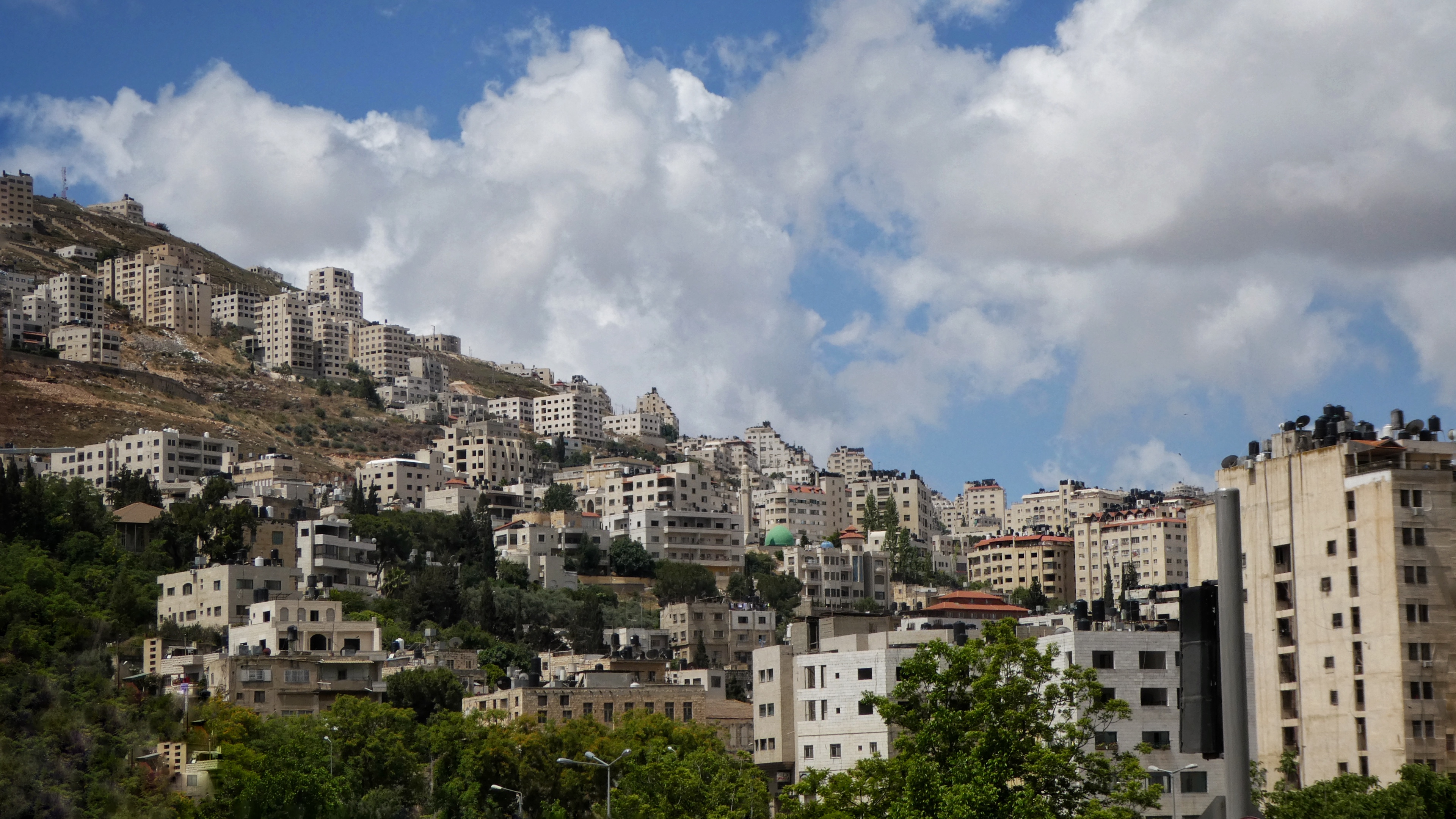
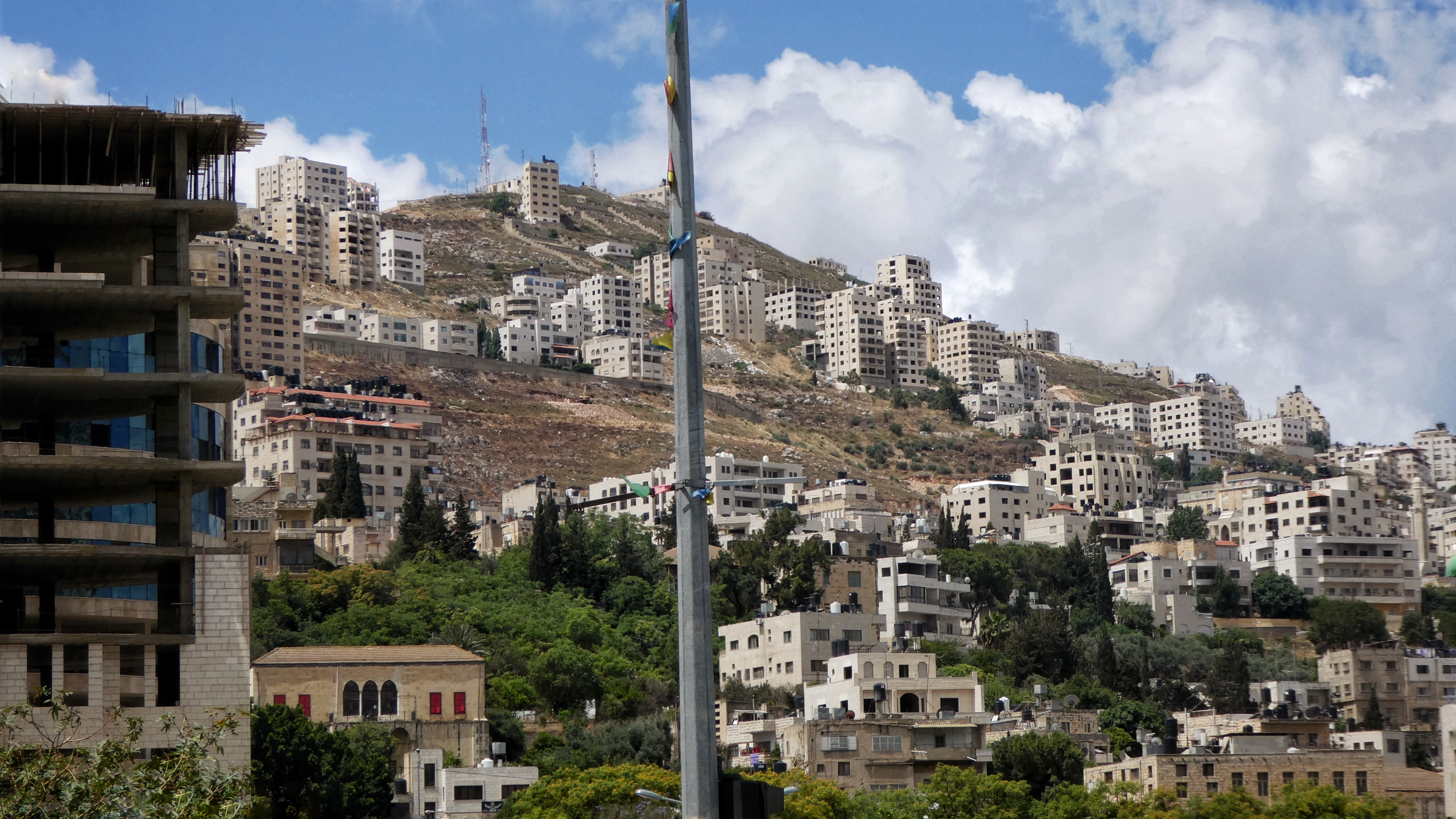
Whilst the attention of the international media and of NGOs is focused on Israeli settlements, there is a land rush going on in the cities of the West Bank.

A big surprise in our travels through the Occupied Territories, was the residential construction boom going on in cities fully governed by the Palestinian Authority (PA). We had been aware of this prior to coming to Israel, but not of its scale. To our knowledge, mainstream media has hardly  covered this at all, and when it does, more often than not it is PR rather than critical analysis (see links below). Our guides, for reasons of their own, were reticent about discussing it.

We often hear that development is held back by the Occupation, that buildings without official approval are subject to demolition, and that there is no land available for Palestinians to build on. Likewise, we hear about how the water supply to the Est Bank is severely restricted. Israeli settlements enjoy an abundance whist Palestinian homes endure meagre rations. Indeed, our guides would stand beneath hills covered in building sites and repeatedly tell us all this.

Most certainly, building by Palestinians is severely restricted in Area C (60% of the West Bank, and 4% of its Arab population) which is under Israeli control, and Area B, under the joint control Israel and the Palestinian Authority (22% and 41% respectively).  And water is indeed problem insofar as the aquifers are located in Israel itself, and supply is hostage  to logistical and political exingenices, and also, to an antiquated Jordanian distribution infrastructure vulnerable to regular breakdowns and leaks.

But billions of expatriate dollars are being invested in medium and high density apartment blocks in area A, the 18% of the West Bank controlled by the PA (and 55% of Palestinian Arabs) in Ramallah, the de facto capital, and in Nablus, Hebron and Jenin. It is a common practice throughout the Middle East for expatriates to remit funds to build a house or houses for their families, or to add extra storeys to the old family home (unfinished upper storeys are a familiar feature of Arab towns in the Levant). But since its establishment, the PA has actively encouraged Palestinians who have “made it” overseas to invest in their nascent homeland by repatriating their stash and putting it into the burgeoning property market. The national accounts prepared by the Palestinian Monetary Authorty show that remittances from overseas have risen steadily in recent years. But do not detail where it is ultimately invested

Where does the land available for development come from? Local commentators suggest that families sell their land to developers. There are suggestions too that speculators take advantage of Shariah inheritance laws, whereby a parcel of land or an apartment block is divided up between sons, by targeting the weakest link – the most needy for quick cash, or more easily intimidated by strong arm tactics – and then persuading the other siblings to sell. The PA is regarded by many as notoriously corrupt, and it is not unlikely that government land and land held in trust is transferred into private hands through cronyism, kickbacks and connections. And what better home for trousered cash that cannot be transferred into offshore bank accounts than bricks and mortar?

Whatever the mechanism, the slopes of the hills surrounding the larger cities are adorned with hectare after hectare of high rises. Most are works in progress, and much of those that are completed appear to be unoccupied. And, on the subject of water supply, we observed that the new buildings were not topped by the roof water tanks that are ubiquitous in most Palestinian towns and villages. No water shortages here, it would seem.

We were informed that a small apartment can cost between $60 and $100,000 before fit-out. Add another 10-20% for fixtures and fittings. Most Palestinians cannot afford these modest apartments. Those that do are in paid employment, mainly working for the PA or for UNRWA (United Nations Relief and Works Agency for Palestine Refugees in the Near East) and the many NGOs that operate here. And they raise the finance through very un-islamic mortgages. Large billboards on highways offer financial advice and funds to affluent-looking young professionals.

imageimage

The irony is that most employed Palestinians depend upon the survival of the PA and indeed, on the continuation of the Occupation. UNWRA, the United Nations agency that caters exclusively for Palestinian refugees employs some 30,000 people, the vast majority of whom are Palestinian (only a few hundred are not), and as such, it is the largest single employer of Palestinians in Gaza and the West Bank (by comparison, the UN High Commission for Refugees employs only 5,000 to 6,000 people globally).

Should the PA collapse or be abolished, should UNWRA be dissolved, should a Palestinian state be established in the West Bank, the government, and those businesses and agencies that depend upon it for contracts and custom could become insolvent, whilst there is always the possibility that international funding could be reduced or withdrawn. In short, the housing bubble could burst, the property market collapse, and those photogenic young professionals in the billboards, and their families, could lose their jobs and their homes.

The health of the Palestinian economy is also an perennial risk factor. The economy had been improving in recent years, with unemployment in the West Bank falling and and private investment in construction growing. The two might have been working hand in hand, coinciding with commencement of the building boom. But during the past three years, economic indicators have gone backwards owing to the political and economic uncertainty, with falling rates of growth, high inflation, and continuing high rates of unemployment and poverty. Economic recession, therefore, could likewise impact on the property market.

These are worst-case scenarios. But there are other economic implications.

For example, this property boom is speculative rather than productive investment in a Palestinian economy that is heavily dependent – some would argue almost totally – on Israel and on international aid. Whilst aid donors and agencies bankroll roads and essential services like schools, power, water, and the like, some say the money should instead be invested in business startups and entrepreneurial enterprises, developing the fiscal and human capital so that Palestinians can provide for their own welfare. National self-esteem should come from being economically sustainable and not from being an indigent state.

Also, there is growing economic inequality between the haves and the have nots. Before the establishment of the PA, we were told, things were more evenly balanced. Most of the population were on a more or less equal footing. There was a sense of “we are all in it together”. Now there is a palpable sense of every man for himself.

Author’s Note

Reiterating the forward to this post, this is based on our own observations and knowledge, and these are informed by what we have seen and read – we are neither academics nor professional commentators. But, as we sincerely desire to acquire and to present as accurate a picture as possible, we welcome objective comments and contributions that both support and question our observations. Any such insights will be incorporated into the post.

Much of what I have written is covered in this illuminating report by the Jerusalem Centre for a Public Affairs published in November 2015 (the picture gallery is an eye-opener): Luxury alongside poverty in the Palestinian Authority

See also: https://en.m.wikipedia.org/wiki/West_Bank

Photographic Postscript: every picture tells a story

Palestinian developer and billionaire Munib al Masri, so-called “Duke of Nablus” built himself a mansion atop a hill overlooking Nablus. That’s his personal mosque up there. Some locals say he could’ve built one for them in the city instead.

Al Misri's mosque

Al Masri’s mosque

New high-rise buildings look down on a billboard honouring a young shahi-d or martyr.

Those who can, invest. Those who cannot, become martyrs.

Those who can, invest. Those who cannot, become martyrs.

Afterword : The Duke of Nablus and his kin

Relatives Municipal al Masri include his cousin and fellow billionaire, Arab Bank and Paltel chairman Sabih al-Masri, and nephews, developer Bashar Masri, and Jordanian former prime minister Taher al-Masri. The Masris would appear to be the Palestininian Authority’s development choice, and also, Israel’s.

http://www.spiegel.de/international/world/dream-of-a-palestinian-tiger-boom-times-in-the-west-bank-a-759046.html
http://www.bbc.com/news/magazine-31154138
http://cnsnews.com/news/article/us-govt-funding-313m-mortgages-palestinians-west-bank
https://en.m.wikipedia.org/wiki/Munib_al-Masri
https://en.m.wikipedia.org/wiki/Bashar_Masri


Ottoman Redux – an alternative history

Counterfactual or alternative history had never gone out of fashion. As a history tragic with many kilometers on the clock, I enjoy such alternative history. “What if…?” and “if only…” are natural, if not instinctual responses to events around us – particularly the unpleasant ones. Hence the popularity of films like SS-GB and The Man in the High Castle (WW2 and the “Nazi victory” books they are based which on have always attracted us alternative history aficionados. There is currently excitement (and panic in some politically correct quarters) about the prospect of a project pitched by Game of Thrones’ show-runners visualizing a USA in which the Confederacy won the Civil War and slavery endures still. But such history is an indulgence that serious historians ought not take seriously – unless they are branching out into historical fiction, that is, which many indeed do. Popular English author Peter Ackroyd has said, the words “What if …” should never be on a historian’s lexicon. But writers of historical fiction have literary license to let their imaginations roam. Counterfactuals or alternative history is a fiction genre all of its own.

When we create alternative histories, we largely replicate a history we already know, often intimately. We replicate histories in which most of the same variables coexist, and the same historical trends prevail. Our motives are quite often as much to warn readers or audiences as to entertain them. Hence the tendency for such endeavours to drift into the depressing dystopian dramas that are so in vogue in these challenged times.

And yet, changing one or more of the players, removing or adding ingredients, hypothesizing different, even opposite scenarios, and imagining how events might have transpired differently, may not radically alter the result. In the case of the First World War, for example, if the conflict had not happened, the European empires may or may not gave endured. Often such multinational entities contain the seeds of their own demise – internal dynamics and contradictions, the impact of events in other countries. Whose to say what might have happened in say France, Germany, Russia, Türkiye or the US that might have upended the balance of power?

One surmises whether or not there is an iron law of inevitability that determines – predetermines, even – the same or similar outcome – a historical equivalent of Oedipus’ unsuccessful efforts to avoid his prophesied fate, affirming TS Elliot’s observation in Little Gidding: “And the end of all our exploring will be be to arrive where we started and know the place for the first time”.

In this entertaining podcast, British historians Dominic Sandbrook and Tom Holland discuss many examples of what might have been if …

In an interesting if light-weight and indeed disappointing exercise in alternative history, with an absolutely meaningless but catchy play on the title of a fabulous song, title, The Sultans of Spring, The Economist recently pondered how events would have unfolded if the Ottoman Empire had sat out WW1 or joined the Entente of Britain, France and Russia instead of throwing in its lot with the Central Powers of Germany and Austria-Hungary.  You may click on the above link, or page down to the full (and brief) transcript. Al-Sisi below, but preceding this is a brief précis of a a popular paperback historical novel published a short  while ago which presented an imaginative if overcooked and totally different Ottoman history.

But first, here is my own argument:

So, what if?

Removing the Ottoman Empire from the strategic equation, or else placing it in the military scales against the Central Powers, would certainly have a significant impact upon the conduct and progress of the European war on both the eastern and western fronts. Russia and Britain would not have had to divert forces and materiel to the Middle East arenas. The Ottomans could have reaped the political and economic benefit of either neutrality or victory, with commensurate benefits for their own survival. The hypotheticals with respect to what may have happened next are innumerable.

The Economist surmises: “How much of today’s mayhem in the Middle East, from civil wars to terror in the name of Islam (and of restoring the caliphate) to the emergence of sectarian dictators such as Bashar al-Assad, not to mention of such a grudge-bearing Ottoman revivalist as Recep Tayyip Erdogan, might have been avoided, if only Churchill had embraced Johnny Turk instead of sinking him?”

But would things have turned out radically different if this had happened – notwithstanding the fact that three to five million Turks, Arabs, Armenians, Africans, Indians, and Europeans who lived in or soldiered through the Middle East theatre would have lived to die a natural death after fulfilling their own particular destinies or to perish purposefully or pointlessly in some other conflict.

The previous century had seen the steady decline of the Sultan’s Empire. It had commenced with Napoleon, and the rise of Muhammad Ali in Egypt, an Albanian “slave soldier” who in practical terms, seceded from the empire. Greece followed next, assisted by European states, and then, bit by bit, the Balkans. The Czar dubbed the empire the “sick man of Europe”, or so British politician John Russell misquoted him, and everybody wanted a piece. The European powers were circling hoping to pick up pieces as the Empire’s borderlands detached – Russia in the east, France in the Levant, and Britain in Egypt and the Gulf. The Crimean War was but one manifestation of “the Eastern Question” that had excited European Chancellories for a hundred years. France and Britain challenged Russia for power and influence in the East and went to war on the Sultan’s side, ostensibly to protect Christian rights in the Holy Land, but weightier matters were in play – alliances have always been fluid in this part of the world, as today’s shifting allegiances demonstrate. Crimea ended in stalemate, but Russia kept encroaching, whilst France established its presence in the Levant. Britain, meanwhile, has its sights set on Egypt and the Red Sea, (the vital  route to its African and Asian empires), and when it was finally built, the Suez Canal, a strategic and commercial link that to this day concentrates the minds of foreign and state departments, military strategists and corporations worldwide.

The Balkan states continued to decouple from the empire, and prior to 1914, engaged in several bloody wars with each other, drawing their neighbours deeper and deeper into the tangle. The slow countdown to WW1 accelerated with the Austro-Hungarian archduke being killed by a Serbian student. Gavril Princip’s “shot that echoed around the world” in Sarajevo in 1914 was but one part of a chaotic picture, igniting tinder that had long awaited a match. Russia, supported the Serbs, Germany, the Austrians, Britain, and France, the Russians. And the Ottomans, forever hard pressed by the Russians, French and Brits, had already moved into the German orbit. When the Ottomans entered the war on the side of the central powers, the cards were dealt.

The Empire was already on a revolutionary path what with the Sultan’s desultory efforts with constitutional reform, the ascendency of Young Turks, a cabal of Turkish nationalist army officers, and the parlous state of the economy. Efforts to institute political and economic reform had faltered, and sooner or later, something was going to blow.

Arab nationalism had already taken root in the Levant, a secular creed spear-headed by Arab Christian intellectuals, to be brutally suppressed by the Young Turk triumvirate, Enver, Talat and Jamal. “Martyrs” were being strung up in Beirut, Damascus and Jerusalem. Perhaps the Ottoman Middle East would have unraveled like in the Balkans (and Balkanised too? Most probably). The “wars of the Ottoman Succession” that we are witnessing today amongst the states created in 1921 would eventually have erupted.

The Zionist project was already underway at the outbreak of war, with settlements of Jews from Eastern Europe and Russia well-established in Palestine, often encouraged by the Ottoman authorities. The pioneers included many of the founders of modern Israel, including its architect and first prime minister David Ben Gurion. The pressures that drove Jews from eastern Europe and Russia in the first place (the discrimination and the pogroms paramount) were unlikely to abate given the atavistic nationalism of Holy Russia and just as Holy Poland. Sooner or later, Zionism and Arab nationalism were going to collide. We will never know how the Ottoman state and its Arab provinces would have coped with the emergence of a Jewish state in Palestine. It certainly would have put the popular (but highly qualified) narrative of Ottoman tolerance of other faiths through a rigorous stress test. The Zionists had a pretty clear road map, and they weren’t sharing it with their new neighbours.

The British, French and Russians had been involving themselves in Middle Eastern affairs – that confounding “Eastern Question” – since the Napoleonic wars. , and Germany, seeking its coveted “place in the sun”, wanted in. German influence was already strong amongst progressive army officers – Prussian elan, ethos, menswear and weapons have exerted a powerful influence on wannabe juntas, the “men on horseback”, since the days Frederick the Great. The Kaiser’s government was very keen on expanding German influence in the east as a counter to British and French imperial power. Meanwhile, the industrial powers were already sniffing around the Gulf, Iranian, and Mesopotamian oilfields, the economic impetus behind imperialism having yet to run its course. The sea-lanes that preoccupied policy-makers in London, Paris and Moscow were soon to be joined by railways and pipelines, with the Germans making the running with its backing of the Berlin to Baghdad Bahnhof. Petroleum would soon join the fabled Great Game as a western imperial obsession. And this too, in time, would have to come up against rising Arab nationalism.

Would Ataturk and Ibn Saud’s ascendency in Turley and Arabia respectively have happened? Perhaps. The political instability in Anatolia and the Arabian Peninsula, and also, as we have described in the Levant, would have created conditions which could have brought these ambitious,  capable and charismatic men to power.

Mustafa Kemal was just one of many promising Young Turks. Whether he would have risen above his peers without his Gallipoli reputation is moot – he would still have had to shove aside the three amigos. His Turkish nationalism, like that of his Young Turk compadres, was not sympathetic to Arab aspirations. Nor was his agnosticism empathetic to what he considered to be a backward and suffocating Islam. Fezzes and face-coverings were amongst the first things to go once he established his secular republic. Whether he could have held the empire together is another question.

Ibn Saud was not the only kid on the Arabian block. The Hashimites (the descendants of Jordan’s King Abdullah) held the western edge of the peninsula, but also the most spiritually significant – the “haramayn” of Mecca and Medina, no less. The Hashimite princes has their eyes on an Arab Kingdom, but Ibn Saud had his eyes on them. The house of Saud, with its Salafi Wahhabi credentials of a cleaner Islam was way “out there” as far as Arab politics and religion went at the time. Apart from perennial outbreaks of intolerance towards and repression of religious and ethnic minorities and heterodox Muslim sects, Istanbul ruled its multinational and multicultural empire with a light if autocratic hand. But there was all that oil – and to British policy makers, that trumped loyalty to the Qurayshi wannabes in the west, for all their descent from the Prophet and their custodianship of the Holy Places.

How would British-controlled Egypt’s politics have developed? Resistance to Britain and its puppet monarchy (headed by the descendent of that famed Albanian schemer Muhammad Ali, who had caused the Europeans so much angst in the early days of the Eastern Question) was growing and would develop into a secular Egyptian nationalism on the one hand and the Islamist Muslim Brotherhood on the other.

So: no Gallipoli campaign (Churchill would have had to find another project, and young Australia another patriotic shibboleth); no Arab Revolt – the Hashemites would have remained just another influential desert clan and TE Lawrence would not have become a legend; no Balfour Declaration or Sykes Picot agreement to distort and dismember the Arab Levant with two conflicting and irreconcilable nationalisms, so, no Syria, Iraq and Lebanon; no British (and Australian) advance on Gaza, Jerusalem and Damascus (General Allenby might have ended up on the Western Front instead of the steps of King David’s Tower in Jerusalem) and arguably, therefore no Mandate, no Palestine, and no Israel; no Armenian genocide to darken Türkiye‘s reputation and prefigure the Shoah that was to come, or then again, perhaps never came; and no Türkiye as we know it today (although President Erdogan is certainly acting out his inner sultan).

As former and unlamented Secretary of State Condoleeza Rice prematurely proclaimed in 2006 too much ridicule from Arabs generally, “a new Middle East”.

© Paul Hemphill 2017 and 2023 All rights reserved

For further history stories in In That Howling Infinite, see Foggy Ruins of time – from history’s back pages

For stories about the Middle East in In That Howling Infinite, see A Middle East Miscellany
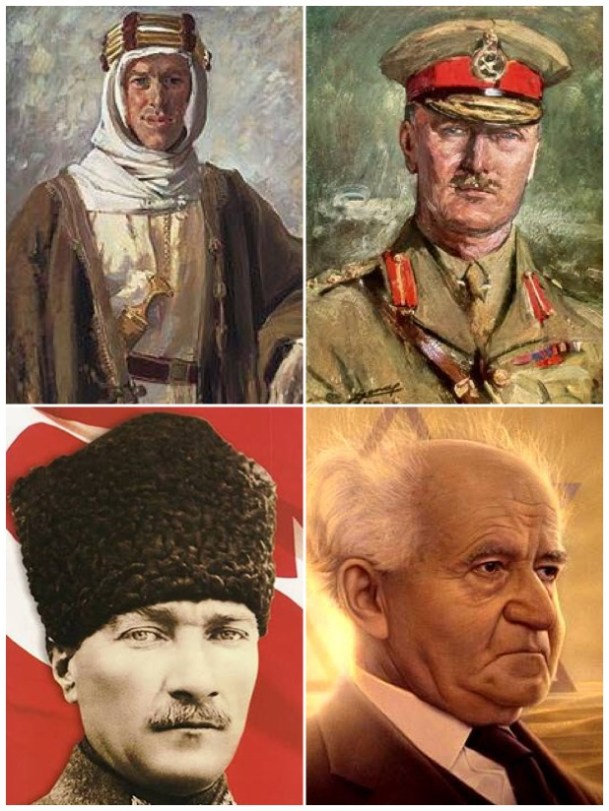
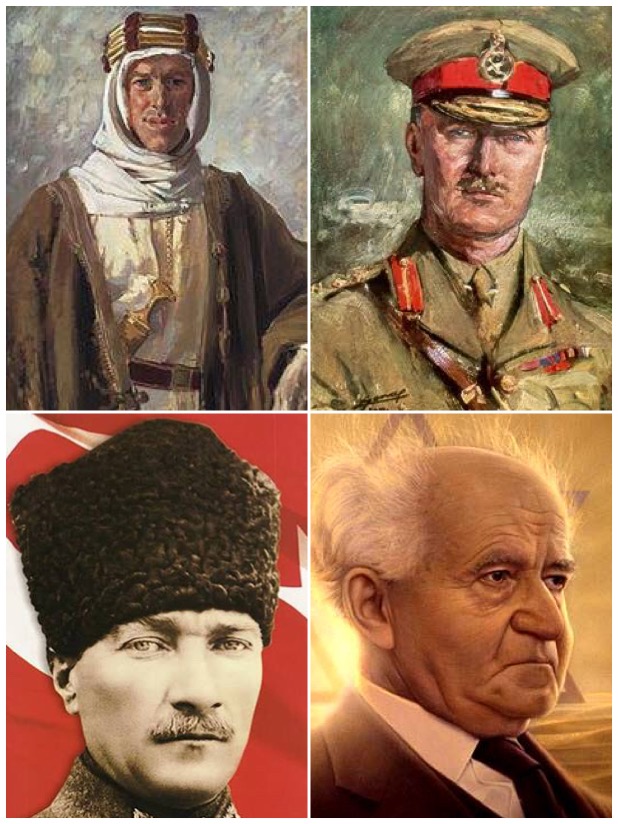
TE Lawrence, General Allenby, Ataturk, and Ben Gurion

The Ottoman Secret

By Raymond Khoury

The Ottoman siege of Vienna of 1683 sees the city fall and the Christian forces annihilated. Western Europe is conquered soon afterwards and in 2019, an increasingly repressive Sultan still rules the continent (though Britain and Russia withstood the onslaught and remain independent nations). A lot has happened in the world since 1683, and as Christendom was vanquished, many things just didn’t happen. Russia is still ruled by the Czars, and America by a post-Mayflower Christian theocracy. Concepts like democracy, freedom of thought and expression, and gender equality are ideas still struggling against heavy odds to be born.

We are in Muslim Paris in 2019. Kamal Arslan Agha is a patriotic, loyal subject of the the Sultan and a special investigator of the Tashkeelat-i Hafiye, the secret police, on the front line of the empire’s harsh response to increasing political and economic turmoil throughout Europe. The Caliphate’s efforts to maintain law and order spare no one, and soon, Kamal’s own family attracts the Hafiye’s attention.

His brother and sister-in-law discover a secret so dangerous, the Caliphate must suppress it, and with the foundations of the Empire under threat, Kamal’s family have no choice but to run. Whether or not they can escape the pursuing Hafiye will determine their own fate, and that of the Caliphate itself – its past, its present, and its future.

Khouri’s vision of a world dominated by conservative, repressive regimes combining religious conformity with modern technology is not a pleasant one. Western democracy might have its faults, but as Churchill said, it’s better than most of the alternatives.

This is, of course, fiction, written by a novelist and not a historian. Its political, cultural and technical milieu is predicated on “what if? What if the Ottomans had expanded and prospered for three centuries instead of gradually transforming into the “sick man of Europe” to be dissected and defeated by western powers? What if through serendipitous and underhand means, the empire has acquired the military, industrial, scientific and technical wherewithal to build over four centuries a world that in many ways in not unlike our own? What if their had been no enlightenment, no French or Russian revolutions, no Hitler, no Holocaust, no Hiroshima?

Incidentally, the siege of Vienna in 1683 gives its name to ‘Gates of Vienna’, a fanatically anti-Muslim far-right blog. Its essential thesis is that this was only one battle in a long war and that Europe and its civilisation are constantly threatened by a Muslim invasion.

As Kurt Vonnegut’s avatar Kilgore Trout would say, “so it goes …”

Sultans of Spring – if the Ottoman Empire hadn’t collapsed.

Imagine the mayhem that might have been avoided had the Ottoman Empire been saved rather than sunk. Blame, among others, Winston Churchill

When a Serb gunman shot an Austrian archduke in the summer of 1914, the nations of Europe tumbled into war with all the grace of bowling pins. Austria-Hungary declared war on Serbia, whose ally Russia declared war on Austria, whose ally Germany declared war on Russia, whose allies France and Britain declared war on Germany and Austria. By early August the continent was in flames.

Much as it wobbled like the rest, however, one of those bowling pins could not make up its mind. Which way would Turkey fall? Should the fading Ottoman Empire join the Triple Entente (Britain, France and Russia) or go with the Central Powers (Germany and Austria-Hungary)

Turkey’s 500-year-old empire was shrinking. It had lost its territories in Africa, nearly all its Mediterranean islands and most of its Balkan lands as well as chunks of eastern Anatolia. It was debt-ridden, industrially backward and politically shaky.

Still, the sultan’s lands straddled two continents, controlling access to the Black Sea. His Arabian territories stretched beyond the holy cities of Islam to the mountains of Yemen and the Persian Gulf, where there were rumoured to lie vast caverns of the sticky black liquid soon to replace coal as the world’s chief source of power.

Confident of Turkey’s weakness, Britain, France and Russia could have clobbered the Ottomans and divided the spoils. Thankfully, wiser heads prevailed. At a secret conclave aboard a British dreadnought off the coast of Norway in late July, a far-sighted politician by the name of Winston Churchill, then First Lord of the Admiralty, worked with French, Russian and Turkish diplomats to forge a treaty. The Turks drove a hard bargain for, as they coyly revealed, Germany too was proffering arms and gold in exchange for an alliance.

The deal that was reached proved immensely beneficial to all concerned. From France, Turkey received generous debt relief. Russia scrapped all claims to Ottoman territory, and made a limited goodwill withdrawal from parts of Anatolia. Churchill waived further payment on two warships that British shipyards were building for Turkey. And Turkey received assurances that its vulnerable extremities would not be attacked; for an empire that for a century had been preyed upon like a carcass this was a new lease of life.

The rewards to the Triple Entente were equally big. Granted exclusive access to the Black Sea, Russia’s allies could resupply the tsar’s armies when they faltered at the start of the war. With no need to defend its Turkish frontier, Russia moved thousands of crack troops from the Caucasus to shore up its front lines. Turkey signed separate agreements recognising British control of the Suez Canal, Aden and the Trucial sheikhdoms of the Persian Gulf, securing the sea lanes for Britain’s massive deployment of troops from the colonies to the Western Front. Turkey’s own army joined in a broad front against Austria-Hungary. Together, these Allied advantages are thought to have shortened the war by as much as a year; the Central Powers might not have sued for a truce as soon as America entered the war, but fought on instead.
Reprieved from collapse, the Ottoman Empire’s government pursued radical reforms. Challenged by growing nationalist tendencies from Arab, Armenian, Greek and Kurdish subjects, Sultan Mehmed V issued a historic firman or proclamation that recognised these as individual nations united under the Ottoman sovereign.

The sultan got to keep the title of caliph, commander of the Sunni Muslim faithful, which his ancestors had acquired four centuries earlier. This proved useful when the empire had to put down a rebellion of religious fanatics in central Arabia, led by a man called Ibn Saud who gained followers by claiming he would restore Islam to a purer state. But mostly the empire was seen as a tolerant place. When Nazi persecutions drove Jews from Europe in the 1930s, many took refuge there (as they had done when expelled from Spain in 1492), particularly in the province of Jerusalem.

If only…

Needless to say, none of the above happened. Quite the opposite. Turkey aligned with Germany in the first world war, and the allies did attempt to invade and divide its empire. Churchill, instead of handing over the warships that ordinary Turks had paid for by subscription, had them seized for the British navy. In 1915 he ordered a catastrophic attack on Turkey; the landing at Gallipoli cost the allies 300,000 casualties. British campaigns against Turkey in Iraq and the Levant cost another million lives.

Turkey’s casualties mounted, by war’s end, to 3m-5m people, nearly a quarter of the Ottoman population. This included some 1.5m Armenians, slaughtered because Turkish officials believed they might become a fifth column for a hostile Russia. And when Britain and France grabbed the Ottomans’ Arab lands, their suppression of uprisings cost thousands more lives.

How much of today’s mayhem in the Middle East, from civil wars to terror in the name of Islam (and of restoring the caliphate) to the emergence of sectarian dictators such as Bashar al-Assad, not to mention of such a grudge-bearing Ottoman revivalist as Recep Tayyip Erdogan, might have been avoided, if only Churchill had embraced Johnny Turk instead of sinking him?

Ataturk Monument, Istanbul

Here are other posts about Turkey past and present:

Sailing to Byzantium

The Watchers Of The Water

Cha … Cha … Changes

People Watching In Sultanahmet


Pity the nation that is full of beliefs and empty of religion

I was inspired to write this post on viewing the video below, a harrowing picture gallery of the Bosnian War, the bloodiest but not the last of the Wars of the Yugoslav Succession. I was reminded  of the iconic Lebanese poet Khalil Gibran’s poem, Pity the Nation,  a sardonic and incisive take on the politics of his time and his homeland. It is chilling in its prescience with regard to contemporary politics in the Middle East and indeed, much, much closer to home on in our liberal democracies where les mots de jour, and indeed, des temps are ‘populism’ and ‘post-truth’,  where allegations of ‘alternative facts’ and ‘fake news are ubiquitous and duplicitous, and where, in a milieu of fear, anger and loathing, intolerance and ignorance appear to be on the rise.

Today, in America, 1984 and The Handmaid’s Tale are best-sellers, and doubtless, as resignation and surrender sink in, Fahrenheit 451 and Catch 22 will catch on with intellectually and numerically inclined. The one is the temperature at which paper burns (“Remember, the firemen are rarely necessary. The public itself stopped reading”), the other, the mother of all vicious circles. The 22 was meant to be 18, but Joseph Heller was gazzumped by Leon Uris’ holocaust melodrama Mila 18  (which I do happen to like).

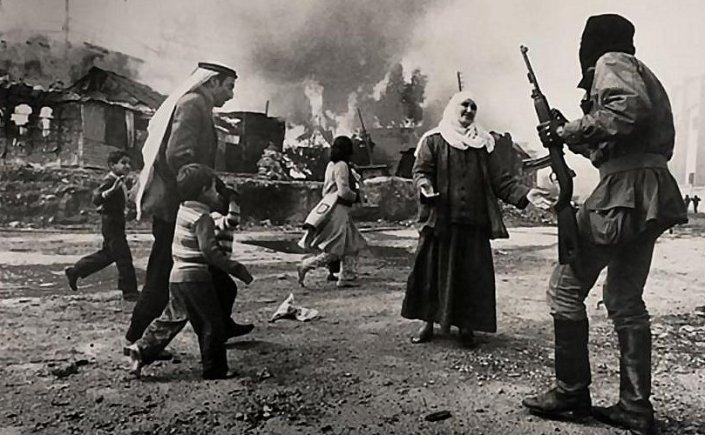
I was also reminded of a book of the same name. In Pity the Nation, his tombstone of a book about Lebanon’s civil war, and Israel’s intervention therein (inspired by Gibran’s poem, and by the fact the he has been a resident of Lebanon for going on half a century), the redoubtable British  journalist Robert Fisk writes of a Lebanese doctor, Amal Shamaa: “I had to take the babies and put them in buckets of water to put out the flames. When I took them out half an hour after, they were still burning. Even in the mortuary, they smouldered for hours”. “Next morning”, Fisk continues, “Amal Shamaa took the tiny corpses out of the mortuary for burial. To her horror, they again burst into flames”. Such is the effect of phosphorous shells on mortals. Made in America, used on Arabs, by Jews. But it happens anywhere and everywhere, inflicted by anyone on everyone.

And that, is in essence, the underlying message of Gibran’s poem, published posthumously after his death in 1931.

Pity the nation that is full of beliefs and empty of religion.
Pity the nation that wears a cloth it does not weave
and eats a bread it does not harvest.

Pity the nation that acclaims the bully as hero,
and that deems the glittering conqueror bountiful.

Pity a nation that despises a passion in its dream,
yet submits in its awakening.

Pity the nation that raises not its voice
save when it walks in a funeral,
boasts not except among its ruins,
and will rebel not save when its neck is laid
between the sword and the block.

Pity the nation whose statesman is a fox,
whose philosopher is a juggler,
and whose art is the art of patching and mimicking

Pity the nation that welcomes its new ruler with trumpeting,
and farewells him with hooting,
only to welcome another with trumpeting again.

Pity the nation whose sages are dumb with years
and whose strongmen are yet in the cradle.

Pity the nation divided into fragments,
each fragment deeming itself a nation.

Kahlil Gibran, The Garden of The Prophet (1933)

ارحم على الامة
ارحم على الأمة المليئة بالمعتقدات والخالية من الدين.
ارحم على الأمة التي تلبس ثوبا لا يحاك.
وتأكل خبزا لا تحصد.
أشفق على الأمة التي تعتبر المتنمر بطلاً ،
ويعتبر منتصرها رائعا.
ارحم أمة تحتقر الشغف في أحلامها
لكنه يخضع لها عندما تستيقظ.
ارحم على الأمة التي لا ترفع صوتها
إلا عندما تمشي في جنازة ،
وتفتخر فقط بين أطلالها ،
ولن تنقذ نفسها عندما توضع رقبتها
بين السيف والكتلة.
ارحم على الأمة التي فيها رجل الدولة وهو ثعلب ،
والفيلسوف مشعوذ
فنه من الترقيع والتقليد
ارحم على الأمة التي تستقبل حاكمها الجديد بصوت عالٍ ،
ويقول وداعا له بسخرية ،
فقط للترحيب بآخر من خلال الاحتفال الصاخب مرة أخرى
ارحم على أمة حكماؤها أغبياء السنين ،
وأولئك الذين لا يزال رجالهم الأقوياء في المهد.
ارحموا الأمة منقسمة ،
وكل قطعة تعتبر نفسها أمة.

خليل جبران

The following song, E Lucevan Le Stelle, encapsulates all this:

“And time, ’tis said reveals its dead, and we will speak what was unsaid. How he was wrong, and I was led – his song I sing who gives me bread. It wasn’t me! I kept my head – I had my kin and kind to serve. It wasn’t me – I kept the faith. It wasn’t me who lost his nerve”.

It charts the cartography of carnage: Bali, Beslan, Gaza, Grozny, Kabul, Kigali, Sabra, Srebrenica, and other “far-away places with strange sounding names”. ”Many have perished, and more most surely will”. This latter quotation is adapted from Auden’s often overlooked masterpiece The Age of Anxiety, a meditation on a world in pain. “The bane of bad geography, the burden of topography, lines where they’re not meant to be are letters carved in stone”. “Bombs and babies, girls and guns, dollars, drugs and more betides, wash like waves on strangers’ shores: damnation takes no sides”.

Related posts In That Howling Infinite:

A House Divided – the nature of civil war
Pity the Nation
A brief history of the rise and fall of the west
Bombs and Babies
Solitudinem faciunt pacemappellant

Postscript

Lawrence Ferlinghetti, American poet, painter, liberal activist, and co-founder of the legendary City Lights Booksellers & Publishers in San Francisco, wrote the following poem in 2007 as a tribute to Gibran, and as a sad testament to the aphorism “plus ça change, plus c’est la même chose”.

“Pity the nation whose people are sheep and whose shepherds mislead them.

Pity the nation whose leaders are liars, whose sages are silenced, and whose bigots haunt the airwaves.

Pity the nation that raises not its voice except to praise conquerors and acclaim the bully as heroand aims to rule the world with force and by torture.

Pity the nation that knows no other language but its own and no other culture but its own.

Pity the nation whose breath is money and sleeps the sleep of the too well fed.

Pity the nation – oh, pity the people who allow their rights to erode and their freedoms to be washed away.

My country, tears of thee, sweet land of liberty.

Red lines, red herrings, and Syria’s enduring torment

Commentator and counterinsurgency expert David Kilcullen is always worth reading. Here is his assessment of the Khan Sheikhoun gas attack and the US’ “laughably symbolic” response. Contrary to the view of many that Assad did not use sarin gas, and to those who praised Trump’s newfound, muscular foreign policy, Kilcullen maintains that it was indeed Assad wot done it, that his reasons were strategically justified, that the US and its allies need much than this one viagra hit to bring the multifarious warring parties to the negotiating table, and that anyhow, the real target of Trump’s martial signalling were Chinese President Xi and The North Korean Fat Controller, Kim Jong Il. And, perhaps, as Beirut-based correspondent for The Independent, Robert Fisk suggests in his own interpretation of the events, Vladimir Putin:

http://www.independent.co.uk/voices/donald-trump-syria-air-strike-missile-airbase-chemical-attack-russia-balance-power-bashar-al-assad-a7673166.html

Patrick Cockburn, Fisks’s colleague at at The Imdependent paints a scarier scenario. The folk who brought you the disasters in Iraq and Afghanistan are back, and are keen to attend to unfinished business:

http://www.independent.co.uk/voices/donald-trump-100-days-in-office-foreign-policy-war-air-strikes-syria-afghanistan-north-korea-a7707946.html

Sarin attack shows Assad is desperate as jihadist rebels gain ground

David Kilcullen. The Australian, April 15, 2017

US President Donald Trump’s missile strike against Syria’s Shayrat air base last week, responding to the chemical attack on Khan Sheikhoun in northern Idlib province, garnered cautious praise across the political spectrum. It also highlighted the complex choices facing the US, allies such as Australia, regional players like Turkey and Iraq, and institutions such as the UN.

The key to understanding the strike, though, lies in a question that’s been somewhat overlooked: why did Bashar al-Assad’s regime need to use the nerve agent in the first place?

We should start by noting that praise for the strike can largely be explained by the extraordinarily low expectations Trump and his predecessor set for effective action on Syria. Trump’s alleged Russia ties, praise for strongmen, positive statements about Assad until days before the attack, and expressed disdain for world opinion set the bar so low that he got credit just for upholding an international norm against chemical weapons, and showing he was prepared to go up against Moscow.

His prompt response also contrasted with president Barack Obama’s failure to enforce his own “red line” after the vastly more lethal Ghouta attack of September 2013, which killed 1500 and poisoned thousands (the Khan Sheikhoun attack killed 74). When Obama called his own bluff on the red line, ceded the diplomatic initiative to Moscow and put the Kremlin in the driver’s seat for negotiations on Syria, he enabled a Russian-brokered agreement on Syria’s chemical stockpile that bolstered the regime’s legitimacy.

Far from eliminating Syria’s chemical weapons — as former national security adviser Susan Rice repeatedly claimed — that agreement left Assad’s regime with reduced but still lethal capability, including extensive supplies of chlorine gas and smaller stocks of nerve agent that it used in later attacks. As Syrians told me after Ghouta, they felt the White House was telling Assad he could go ahead and massacre his own people, provided he did it with barrel bombs and artillery rather than chemicals.

The failure to act after Ghouta so appalled some members of Obama’s cabinet that Democratic “Syria hawks” (including former secretary of state John Kerry) came out in support of last week’s Shayrat strike. Given the continued refusal by many on the left to recognise Trump as America’s duly elected President, this speaks volumes for the level of bipartisan support for decisive action on Syria.

It also highlights the comfort of many progressive interventionists (including Kerry, but also Hillary Clinton) with unilateral American use of force — provided it is sanctified by humanitarian principles such as “responsibility to protect”. All this put Trump’s punitive strike in the political mainstream, making him look positively, well, Clintonian.

The Western narrative on Assad — reinforced just this week by presidential spokesman Sean Spicer — has been that his regime is uniquely evil, uses chemical weapons simply because it can, hates its own people and just wants to burn the country to the ground.

But, in fact, Syrian use of chemical weapons in the war so far has been highly calculated and strategic. Assad’s regime, far from being blind to international condemnation, understands the severe political consequences of using chemical weapons, and only does so when its back is against the wall. Assad’s regime has shown no compunction in using nerve agents when its survival is at stake, but otherwise it mostly keeps chemical weapons as a hip-pocket emergency reserve that can be rapidly deployed when manpower is short.

Thus, the real missed opportunity of 2013 lay in a failure to understand the regime’s motive in using chemical weapons: as a last resort, when a victorious coalition of mostly secular rebel groups was threatening the eastern suburbs of Damascus, making significant gains in the regime’s heartland and jeopardising its survival. Decisive action, combining the measured use of force with a strong diplomatic push, could have forced Assad — given the dire pressure he was under — into genuine peace talks.

The Ghouta attack was not an act of unthinking evil but one of calculated desperation, and strikes against regime positions could have not only punished Assad for his use of gas, but enabled a rebel advance into Damascus that would have opened a path to negotiations. The diplomatic price for suspending air strikes would have been regime concessions in UN-led peace talks, while the internat­ional community would have retained the ability to restart strikes at any time, or impose no-fly zones to enable humanitarian corridors to protect the people.

This, in fact, was the argument that allied airpower experts made at the time, likening the situation to the NATO-led bombing in the Balkans that ended the Bosnian war, led to the Dayton Accords and halted massacres in Kosovo in 1999.

This isn’t as far-fetched as it seems. Remember, 2013 was before Islamic State emerged, before its blitzkrieg dramatically changed the game in Iraq, before the declaration of the caliphate prompted a spike in world terrorism, before Turkey’s military incursions into Iraq and Syria, and before the Eur­opean immigration crisis.

In 2013, the dominant Syrian rebel factions still included secular groups, while jihadists were on the back foot. This was also before Russia’s intervention improved Syrian air defences and complicated targeting by putting Russians on to key regime sites, and before the presence of more than 1500 Western ground troops in Syria made it possible for the regime to easily retaliate. And it was before the Iranian nuclear deal of 2015 brought a flood of funds, advisers and troops from Tehran to further bolster the regime.

Against this background, last week’s strike seems almost laughably symbolic: 60-odd Tomahawk cruise missiles, launched from two US navy ships in the Mediterranean, with allied aircraft kept away from Syrian air defences, and the Russians (and thus, presumably, their Syrian proteges) given plenty of warning to get out of the way. The missiles destroyed some obsolete aircraft, killed a few regime troops, and left the airfield at Shayrat so lightly damaged that the regime was using it again within hours, even launching a further strike from Shayrat (with conventional munitions) against Khan Sheikhoun the very next day.

Kosovo 1999 it was not. But again, the key question is why Assad’s forces felt the need to use the nerve agent in the first place.

Khan Sheikhoun is a town of 50,000 on the southern edge of Idlib, a province in northwestern Syria that abuts Turkey to the north, Aleppo to the east, and Hama and Latakia provinces to the south and west. As of mid-April, apart from tiny regime enclaves at Fua and Kefraya, Idlib is almost totally controlled by a jihadist coalition led by al-Qa’ida’s Syrian affiliate Jabhat Fatah al-Sham, still widely known by its former name, the Nusra Front.

Nusra detests Islamic State (a feeling Abubakr al-Baghdadi’s organisation heartily reciprocates). But in many ways it poses a much more severe threat to the regime than Baghdadi’s group. The Nusra-led offensive in Idlib and Hama has been under-reported, but for Syrians it’s the most important event of 2017 so far.

Even as the regime recaptured Aleppo in December 2016 — with heavy support from Russian airstrikes, Russian special forces, Iranian advisers and Hezbollah militia — Nusra and other groups formed an alliance, Hayat Tahrir al-Sham, to recapture ground from Assad’s forces.

After weeks of preparation they launched a major offensive on March 21 with more than 5000 well-armed and well-organised fighters from seven rebel groups operating under Nusra leader Abu Mohammed al-Jolani. Tahrir al-Sham gathered the most capable rebel groups in Syria into a single coalition under al-Qa’ida’s leadership, pointed them directly at the regime’s weakest point and achieved immediate success.

Within days, rebel fighters pushed to within 5km of the Hama suburbs, threatening the regime’s control of a critical city that anchors its northern flank and provides access to Aleppo. They also made significant gains into the al-Ghab plain, Syria’s breadbasket, an area essential to the regime’s ability to feed Syria’s pro-government population.

Nusra’s rapid advance jeopardised Assad’s control of the economically and politically important Hama and Latakia provinces, and posed a risk to Russia’s naval and air bases to the south.

Khan Sheikhoun now sits at the base of a rebel salient that stretches from Idlib south into the outskirts of Hama city, and west into al-Ghab. As I write, this salient is being counter-attacked all along its perimeter by regime forces desperate to stem the Nusra advance, but lacking the manpower or ground-based firepower to roll back the rebels. Knocking out Khan Sheikhoun from the air would immediately collapse the rebel salient, letting the regime stabilise the front line. Unsurprisingly, doing exactly that has become a major priority for Assad.

The town’s importance was underlined by the fact that the pilot who allegedly carried out the sarin attack was Major General Mohammed Hazzouri, a Syrian air force officer commanding the 50th Air Brigade at Shayrat, and whose family name suggests he’s related to Mohammed Abdullah al-Hazzouri, governor of Hama, who was appointed by Assad in November 2016. Obviously, when you launch a gas attack using a fighter jet flown by a two-star general from the same prominent family as the provincial governor, you’re telegraphing that this is a pretty serious priority.

In fact, the town has been heavily attacked by regime forces (including earlier attacks with chemical weapons late last year and again last month) and subjected to multiple air strikes and artillery bombardments as the regime tries to contain the threat to its northern flank. Assad’s reliance on artillery and aircraft underlines his lack of ground assets: despite Russian, Iranian and Hezbollah support, his forces have their hands full consolidating control over Aleppo, trying to relieve the isolated city of Deir Ezzor in eastern Syria, and fighting on the southern front against other rebel groups.

All this indicates that the regime is again under serious pressure, that its position is far shakier than its propaganda narrative after the recapture of Aleppo might suggest, and that firm pressure now might bring renewed progress toward peace talks. But the situation today is vastly more complicated than in 2013. There are real risks to allied aircraft over Syria from Russian and Syrian air defences, and to special forces and conventional troops (there are now, according to media reporting, as many as 1500 rangers, marines and special forces on the ground in Syria) in the event of strikes against the regime.

The rebels opposing Assad today are not the largely secular forces of 2013 but rather are dominated by al-Qa’ida, while Russia has indicated it plans to further improve Syria’s air defences and has vetoed efforts in the UN for further talks on a Syrian peace deal.

To think that, under these circumstances, mere words — Secretary of State Rex Tillerson’s frosty visit to Moscow, Trump’s call for Vladimir Putin to stop covering for Assad, or ambassador Nikki Haley’s fiery confrontation with Russian diplomats at the UN — will force Putin to back away from a critical strategic relationship going back to the 1960s, or force Assad to stop throwing everything at an attack that threatens his survival, is fantasy. If the Shayrat strike is to be more than the latest useless symbolic gesture, it needs to be followed by a fundamental change in strategy.

Until a week ago, Trump’s Syria policy was to downplay any call for regime change, acquiesce in the permanence of Assad’s regime and collaborate with Putin against Islamic State. As recently as April 5, the day after the Khan Sheikhoun attack, Tillerson was asserting that Assad was here to stay.

This was bad policy: not just on moral or political grounds (Assad has killed 10 times as many Syrians as Islamic State, and most US partners both inside Syria and throughout the region see removing Assad and ending the war as the top priority bar none) but also in practical military terms.

Assad lacks the military cap­acity to stabilise Syria: he’s losing ground in key areas, controls less than 23 per cent of the country, has no prospect of reunifying Syria, presides over a patchwork of local militias and thuggish warlords with purely nominal allegiance to his government, and couldn’t survive six months without external support.

The use of sarin gas underlines how desperate his situation is. Even if it were morally and politically possible to work with his regime for the greater goal of destroying Islamic State, the man simply can’t do the job.

More fundamentally, the goal of destroying Islamic State may not actually be the higher strategic priority, at least not in Syria. Unlike Iraq, where recapturing Mosul and crushing the caliphate is a key first step toward stabilising the country, in Syria the greatest threat to stability is Assad himself.

For most Syrians I’ve spoken to, the idea that anyone engaged in the uprising since 2011 would sit down again under Assad is ludicrous, and many have told me the biggest winner so far isn’t Islamic State but al-Qa’ida, through its Nusra affiliate.

From a wider strategic standpoint, the other key audiences for the Shayrat strike were Chinese leader Xi Jinping (who was dining with Trump as the strike went in) and North Korean leader Kim Jong-un. Using the Syria strike to telegraph a zero-tolerance policy for weapons of mass destruction, administration spokesmen talked of a new joint effort with China to rein in North Korea’s nuclear adventurism. For a President who spoke blithely on the campaign trail about Japan and South Korea acquiring their own nuclear weapons to deal with Pyongyang, this represents a big step forward.

More importantly, the move of the USS Carl Vinson aircraft carrier battle group toward Korean waters to deter further missile launches, and the deployment of US air defence systems and special operators in South Korea, showed this was not just talk.

The choices facing President Trump on Syria today are vastly more complex than those president Obama failed to deal with in 2013. But his change of policy after the Khan Sheikhoun attack — perhaps prompted by the presence in his inner circle of experienced strategists such as Secretary of Defence James Mattis and National Security Adviser HR McMaster — shows he’s at least capable of learning and adapting.

Along with the change on Syria policy and the move to deter North Korea, last week’s strike was rapidly followed by shifts in Trump’s tone on China (evidently no longer a currency manipulator), NATO (apparently no longer obsolete) and Russia (it would have been nice to co-operate, but that’s not possible while Russia continues to back Assad). Don’t look now, but all this seems to be pushing the Trump presidency back toward something resembling relatively mainstream US policy in the tradition of presidents Bush, Clinton and Reagan.

Whether you think that’s good or bad probably depends on your view of America’s role in the world, and the longstanding propensity of US leaders to use unilateral military force. But symbolic as it was, the Shayrat missile strike may also open the door to new thinking on Syria — and after six years, half a million dead, dozens of cities destroyed and millions displaced, that can only be a good thing.

David Kilcullen is a former lieutenant-colonel in the Australian Army and was a senior adviser to US general David Petraeus in 2007-08, when he helped to design the Iraq war coalition troop surge. He also was a special adviser for counterinsurgency to former US secretary of state Condoleezza Rice. He is the author of Blood Year: Islamic State and the Failures of the War on Terror (Black Inc).

See also, a prior post featuring David Kilcullen: One, Two, Three, What Are We Fighting For?


Sailing to Byzantium

“Byzantium, Byzantium, Constantinople, Kostaniniyye, Istanbul – The City has tangled with or represented an “idea” for so many, its influence has spun so far that her story, whether imperial, spiritual, cultural or political, frequently ends up being played out anywhere and everywhere other than in the city itself”.  Bethany Hughes , Istanbul – A Tale of Three Cities

As we observe Turkish president Recep Tayyib Erdogan’s apparent drive to reestablish Ottoman autocracy, those who take a longer view of history will assert that there is nothing new under the sun. There is nothing unprecedented about Erdogan’s apparent urge to don the imperial purple, and join the long cavalcade of colourful emperors and sultans that ruled the land that now constitute modern Turkey.

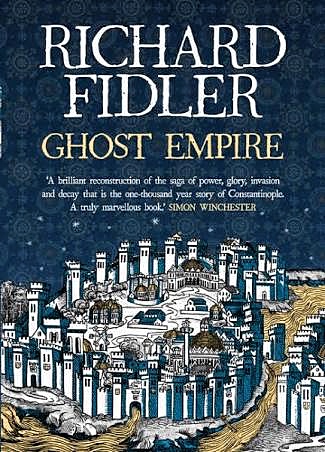
Richard Fidler reminds of this as he literally walks us through the streets of Istanbul.

Part father-son quest, part travel story, ‘Ghost Empire’ is at once a history, and a treasury of tales both true and far-fetched. The Australian author and broadcaster, and onetime member of the comedy trio, the Doug Anthony Allstars, has written a blend of popular history and meditation on the significance of history.

image

Although ‘Ghost Empire’ might in seem in parts overly breezy and lightweight, as an introduction to the ancient and wondrous city of Byzantium, Constantinople or Istanbul, it is an highly informative portal to weightier albeit less entertaining books. This is not to say it is without its more harrowing moments. Fidler dwells as much on the gory as on the glory. And indeed, for many, particularly the sons of emperors and sultans, confidants and conspirators, life could indeed be nasty, brutish and short.

Whilst Fidler’s primary focus is the story of the Byzantines, concluding with the fall of Constantinople in 1453, he travels back and forth in Istanbul’s long and storied history, between the violent past and the tumultuous present, from Julius Caesar and Constantine the Great, and the power couple Justinian and Theodosia, through Mehmet the Conqueror and Suleiman the Magnificent, to Ataturk and Erdogan, and captures the magic and at times, mayhem of the fabled metropolis that inspired WB Yeats to write:

“Once out of nature I shall never take
My bodily form from any natural thing,
But such a form as Grecian goldsmiths make
Of hammered gold and gold enamelling
To keep a drowsy Emperor awake;
Or set upon a golden bough to sing
To lords and ladies of Byzantium
Of what is past, or passing, or to come”
© Paul Hemphill 2017.  All rights reserved

If Ghost Empire has whetted you appetite, i would recommend Bethany Hughes’ more substantial – “encyclopedic ” would a better description – IstanbulA Tale of Three Cities (Orion 2017). It is a lengthy, comprehensive and fascinating journey from the prehistoric past to the polarizing present. There is also Simon Sebag Montefiore’s documentary, which personally, I found disappointing after his Jerusalem – The Biography.

Some photographs of Istanbul from our visit to Türkiye in 2014 follow …

For other posts about Türkiye in In That Howling Infinite, see: People watching in Sultanahmet, Ottoman Redux – an alternative history and The Watchers of the Water  

Here are some reviews of Ghost Empire: 

http://www.smh.com.au/entertainment/books/ghost-empire-review-richard-fidler-journeys-back-to-the-glory-of-constantinople-20160811-gqq6xo.html

http://www.canberratimes.com.au/act-news/canberra-life/richard-fidler-blends-the-historical-and-contemporary-in-his-new-book-ghost-empire-20160720-gq9js6.html

Istanbul, from Galata Tower Istanbul, from Galata Tower
Cruising the Golden Horn Cruising the Golden Horn
The Sulaymaniya Mosque The Sulaymaniya Mosque
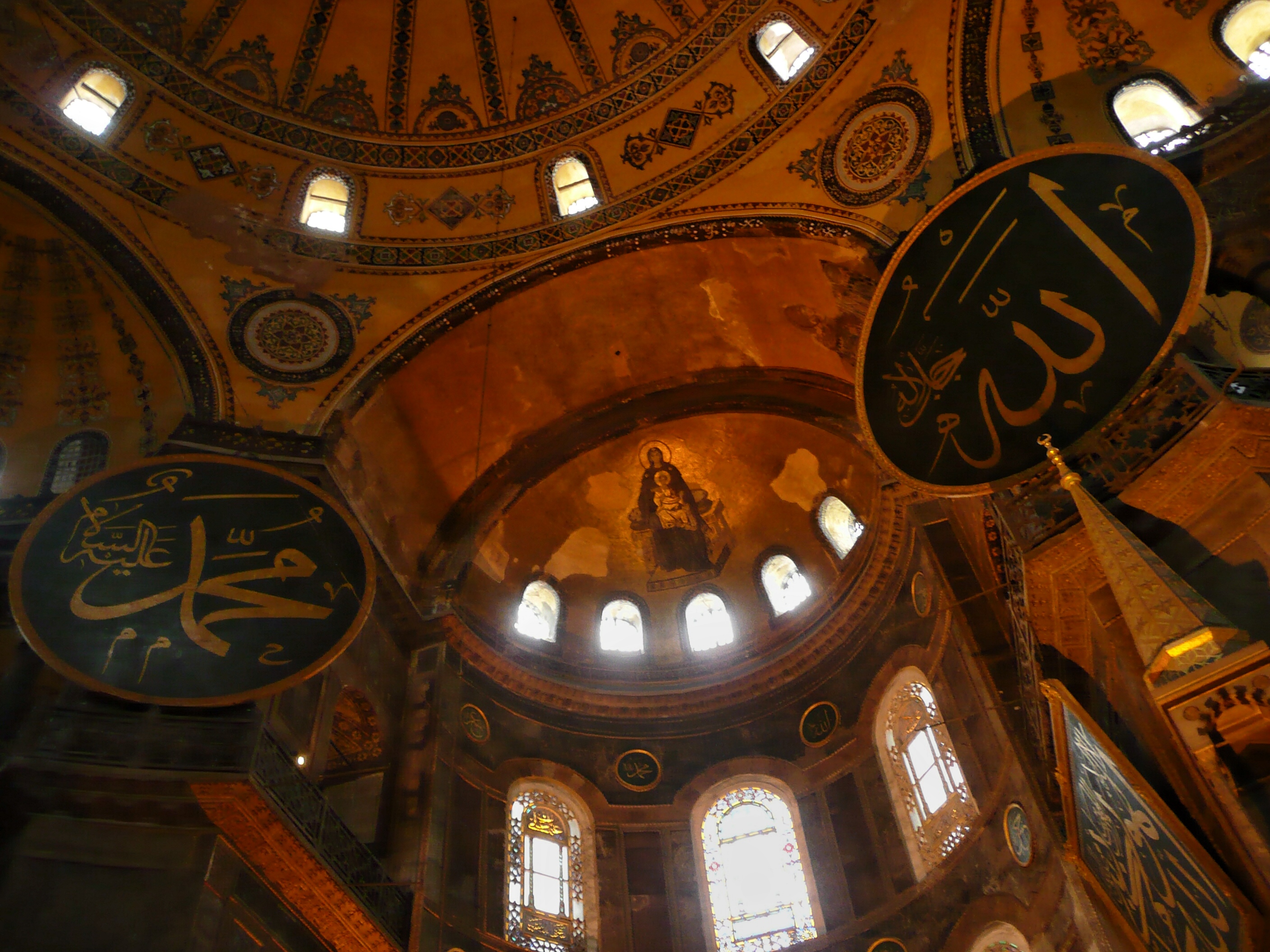
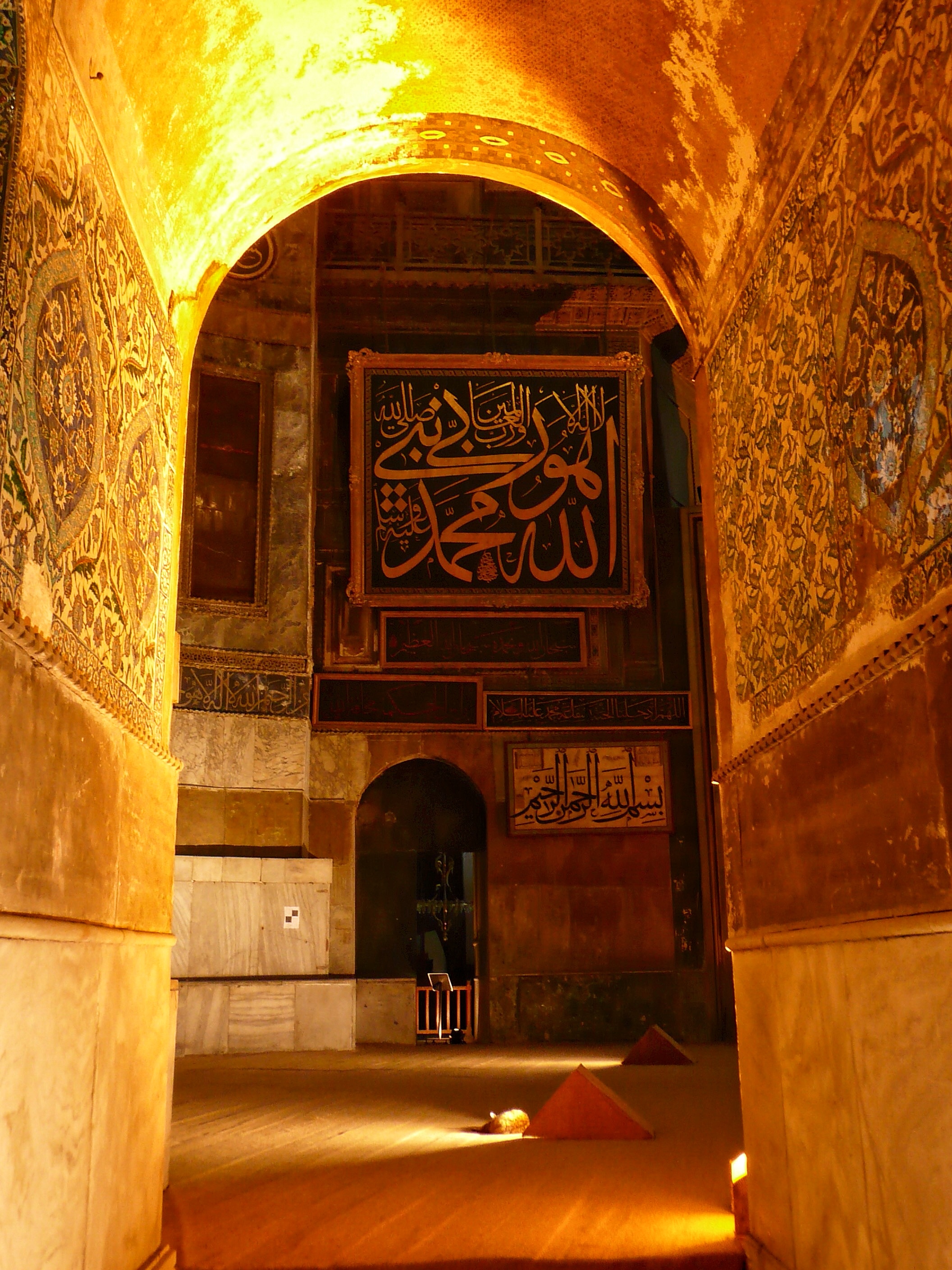
Aya Sofya Aya Sofya
The Hippodrome and the Blue Mosque The Hippodrome and the Blue Mosque
The Fortress of Europe The Fortress of Europe
Valen's Aqueduct Valen’s Aqueduct
Galata Tower Galata Tower
Aya Sofya Aya Sofya
Aya Sofya Aya Sofya
Aya Sofya Aya Sofya
Aya Sofya Aya Sofya
Halfden the Viking's Grafitti in Hagia Sofia Halfden the Viking’s Grafitti in Aya Sofya
Aya Sofya Aya Sofya
The Blue Mosque Aya Sofya
Sulaymaniya Sulaymaniya
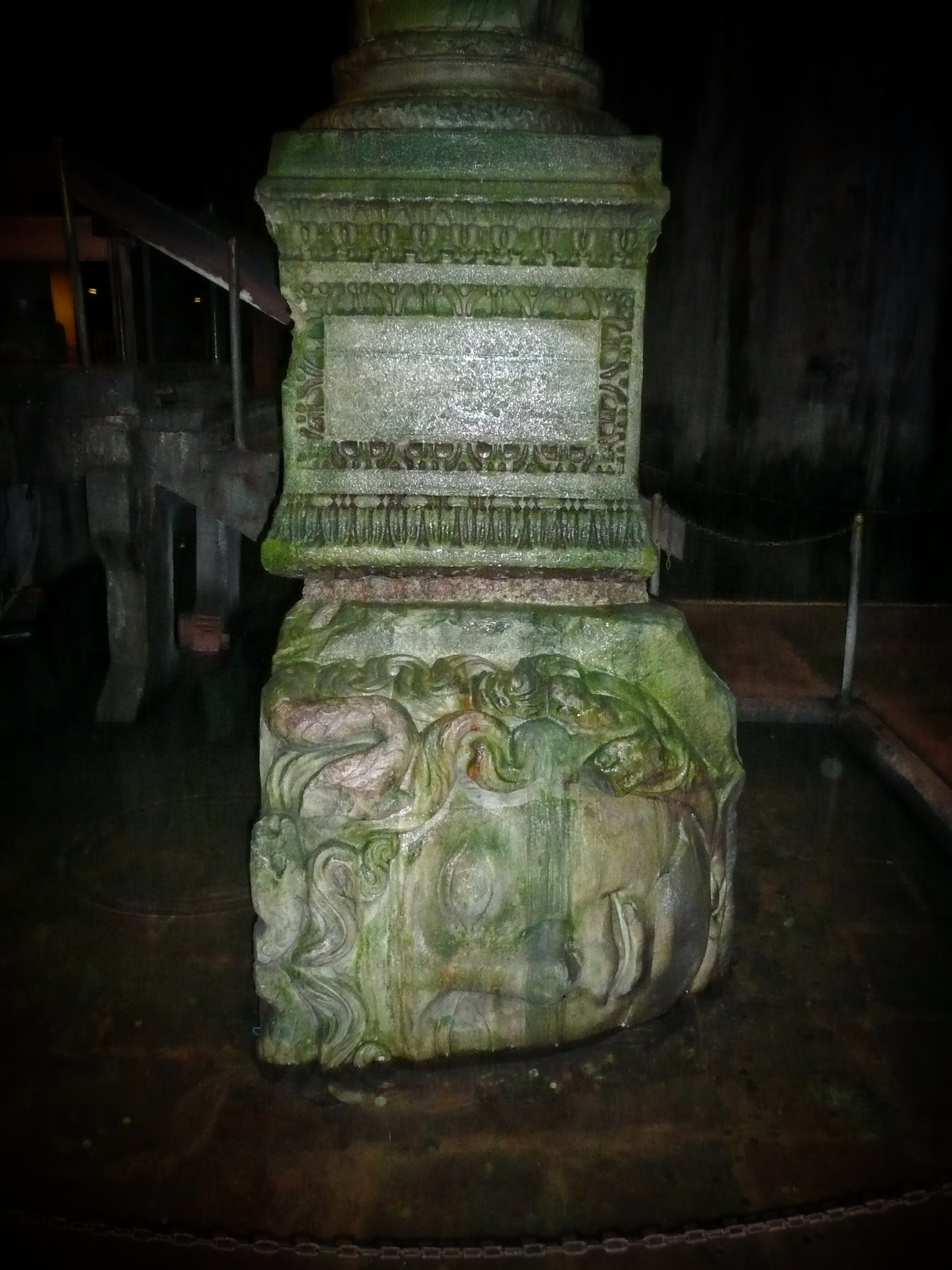
Justinian's Cistern Justinian’s Cistern

image

Apollo and MedusaApollo and Medusa


That was the year that was – may you live in interesting times

As I contemplate my annual review of In That Howling Infinite, I am reminded, with clichéd predictability, of that well-worn Chinese curse: “may you live in interesting times”.

A torturous and seemingly endless US election campaign defied all the pundits by producing an colourful and unpredictable POTUS. In the UK, the unthinkable Brexit came to pass, dividing the polity and discombobulating the establishment. Next year is certainly going to be worth watching.

The slow and tragic death of Syria continued unabated with Russian and Turkey wading into the quagmire alongside Americans, British, French, Australians, Iran, Lebanon, Gulf tyrants, and Uncle Tom Cobley and all. Da’esh might be on the the ropes in Iraq, but the long term survival of the unitary state is doubtful. And the proxy wars of the Ottoman Succession have spread to Yemen, the poorest country in the Middle Eas as Gulf tyrants face off against Shia Iran’s alleged puppets, and, armed and abetted by British and American weaponry, South American mercenaries, and Australian officers, bomb the shit out of the place.

Whilst the grim reaper scythed through the world from Baghdad to Berlin, from Aleppo to Ankara, the Year saw the passing of a record number of icons of the seventies and eighties, two of whom who have provided a continuing soundtrack for my life, Leonard Cohen and David Bowie. We shall not see the like of them again.

In our little corner of the cosmos, we endured the longest and most boring election campaign in living memory, resulting in an outcome that only accentuates Australians’ disenchantment with a lacklustre Tory government, a depressingly dysfunctional political system, and politicians of all stripes who, blinkered by short-termism, and devoid of vision, insist on fiddling whilst the antipodean Roman burns.

Meanwhile, in our own rustic backyard, we find that we too are “going up against chaos”, to quote that wonderful Canadian songster Bruce Cockburn. For much of the year, we have been engaged in combat with the Forestry Corporation of New South Wales as it proceeds to lay waste to the state forest that surrounds us. As the year draws to a close, our adversary has withdrawn with only half of its proposed harvest completed. But it will return in 2017, and the struggle will continue – as it will throughout the state and indeed the nation as timber, coal and gas corporations, empowered by legislation, trash the common treasury with the assent of our many governments.

And yet, life on the farm remains pleasant and delightful, though dams are low and rain would be most welcome. The bird and reptilian life continues to amaze us, and an ironic corollary to the clear felling of the Tarkeeth Forest is that “refugees” are seeking shelter here. Wallabies rarely seen on our land are now quite common, whilst echidnas, and, we suspect, endangered spotted quolls have been sighted hereabouts

We took time out mid-year to revisit Israel and Palestine, and road-trip through the two countries was much an education as a holiday. We certainly got our history and archeology fix, and in travelling through the Golan and the Negev, we found respite in a stunning natural environment. But the answers to our many political questions merely threw up more questions. We have unfinished business in this divine but divided land, and will return.

In That Howling Infinite addressed all these concerns during 2016, and matters more eclectic and exotic.

And so, to the year in review:

The new year commenced with a reprise of our memorable journey to Hadrians Wall, and of the Victorian lawyer who helped preserve it for posterity, the saga of the viking Harald Hardraga and also, my subjective overview of world history. In a more lighthearted vein, I indulged in an unscholarly discussion of how film and fiction have portrayed or distorted history, and in a review of Mary Beard’s superlative history of Rome, I asked the immortal question “what have the Romans done for us?”

The Life of Brian

In April, in response to a discussion with a Facebook friend in Oklahoma, I wrote a trilogy of exotically-titled posts examining the nature of rebellion, revolution, and repression: Thermidorian ThinkingSolitudinem Faciunt Pacem Appellant, and Sic Semper TyrannisThe origin of these Latin aphorisms is explained, by the way, in the aforementioned Roman review.

Nightwatch

Our travels through Israel and Palestine inspired numerous real-time posts, and a several retrospectives as we contemplated what we had experienced during what was as much an educational tour as a holiday. Historical vignettes included a tribute to bad-boy and builder King Herod the Great, a brief history of the famous Damascus Gate, and its place in Palestinian national consciousness, and a contemplation on the story of King David’s Citadel which overlooked our home-away-from home, the New Imperial Hotel. Thorny contemporary issues were covered with an optimistic piece on the Jerusalem Light Rail, a brief if controversial post about  Jewish settlers in the Old City, the story of Israel’s ‘Eastern’ Jews, the Mizrahim, and what appears to be a potentially problematic Palestinian property boom. Th e-magazine Muftah published an article I wrote about the conflicting claims to the city of Hebron. And finally, there is a poem recalling our visit to the Shrine of Remembrance at Yad Vashem and honouring the Righteous Gentiles who saved thousand of Jewish lives during the Shoah.

Carnivale

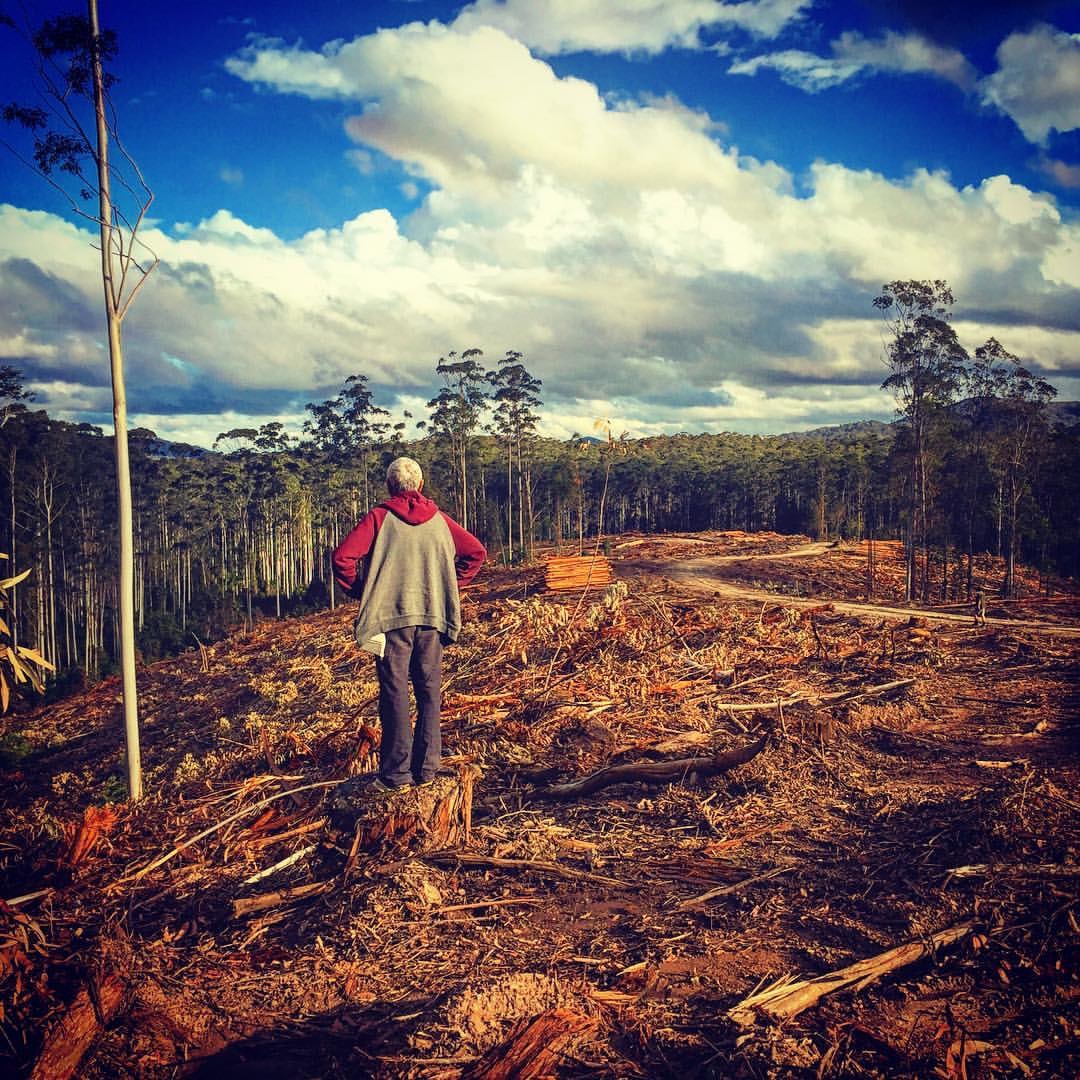
Wintertime passed with our minds on the Tarkeeth Forest. I had the pleasure discovering the history of our locality, and connecting via Facebook with the relatives of the Fells family of Twin Pines. But the latter half of the year was very much taken up with enduring and bearing witness to the clear- felling of the forest to our east. “If you go down to the woods today, you’re in for a big surprise.  If you go down to the woods today, you’ll never believe your eyes”. And you’d ask “what would JRR Tolkien have thought?”

Nothing quite prepares you for the devastation of clear felling. Joby, a Gumbaynggirr elder, surveys the Tarkeeth

The UK And US paroxysms fascinated and exasperated the mainstream and social media in equal measure, whilst the outcome of the Brexit referendum and the presidential election has initiated an a veritable orgy of punditry. Never have so many column inches and kilobytes been spent on loud sounding nothings as the sifting through the entrails of such events as Brexit, the US election, and the Australian senate! With half a dozen elections coming up in Europe, Trump’s inauguration and the triggering of Article 50 to take Britain out the European Union, we’re gonna have to endure a lot more. I confined my posts to two insightful pieces by respected right-wing Australian commentators, Paul Kelly’s Living in Interesting Times, and Greg Sheridan’s The Loss of American Virtue, and my own reflection on the right-wing media’s strange fascination with “insiders” and “outsiders”.

Finally, in comparison to last year, this year was very light on music and poetry. But American satirist Tom Lehrer got a retrospective, and murdered Pakistani qawwali singer Madhaf Sabri, an obituary, whilst an abridged and vernacular version of John Milton’s Paradise Lost told the tale of Lilith, the first and greatest femme fatale. In the words of the gloriously-named jockey Rueben Bedford Walker III says in EC Morgan’s magnificent The Sport of Kings, the subject of my first post for 2017, “Malt does more than Milton can to justify God’s ways to man”.

On that wise note,  I wish the world a Happy New Year – and may it be less interesting than this one.

In That Howling Infinite  is now on FaceBook. Check it out.  And just for the fun of it, here’s my review of 2015.

The Sabri Brothers

Dore Luciifer

The Mizrahi Factor

Strangers in a strange land

When I first visited Israel in the early ‘seventies, it seemed to me a white man’s land with the look and feel of a European colony transplanted in Levantine soil. But first impressions were deceptive. Subsequent visits made it very clear to me that State of Israel is anything but monochrome, but rather, a technicolor cultural melting pot.

Back then, European Ashkenazim (literally, “German” Jews), the returnees of the diaspora, were in the majority. They had dominated politics and culture from the days of the first Zionist immigration, and through the mandate years of the Yishuv when Eastern Europeans predominated in the movement and in the fledgling military. The republic that the Ashkenazim prepared for during the Mandate and then built after 1948 was, in intent and in actuality, a white, secular, socialist outpost of Central and Eastern Europe. But then things changed  utterly.

The Sephardim, Jews who had lived in Palestine for centuries, and up to a million Jews expelled from Arab countries after 1948, were, for some forty years of Israel’s existence, a disadvantaged minority. The name itself was misleading. ‘Sephardi’ originally described Jews who had been expelled from Spain in the late fifteenth century. But it came to be applied to anyone who was not Ashkenazi. These Jews of Middle Eastern origin are now generally referred to as Mizrahim – “eastern” or “oriental” Jews. They were discriminated against in many spheres of Israeli life, regarded as primitive, backward, ill-educated, and poor – and more like Arabs than Jews.

And this was indeed the case in many respects. Jewish communities had been an integral part of Arab society for centuries. From Morocco to Iran, they had lived, thrived, and prospered among the their Muslim neigbours. The Jewish communities in Morocco, Algeria, Tunisia, Egypt, Iraq, Lebanon, Syria, Yemen and Iran were old and populous, and indeed often predated Christianity. From high to low, they were entwined in their local politics and economics.The lower classes were as poor and as downtrodden as their Arab neighbours. The professional and mercantile middle class lived very comfortable lives, and under late Ottoman rule, and British and French suzerainty, enjoyed a cosmopolitan lifestyle.

Embedded in the heart and soul of their Arab homelands, they shared the same history, suffered the same depredations, wore the same clothes, ate the same food, made and listened to the same music. Many of their values and cultural norms had more in common with the east than the west.

Oriental Jewish culture was based on three pillars: the community, the synagogue and the father. Faith was the cornerstone and family paramount, and with these, the authority of the rabbi and the head of the household. Piety was respected, chastity honoured, modesty and decorum observed, and marriages arranged. Religion, tradition and patriarchy preserved the community for a millennium. It did not experience European-style secularization, western enlightenment, or a revolt against religion. Even when modernization came, the father and the rabbi remained dominant.

There was harmony between Arab and Jew. Life had order, meaning, and a timeless rhythm. No one imagined that one day, they would have to abandon their lives, their homes and possessions and the graves of their ancestors. Never did they contemplate having to flee, in fear of their lives from the people among whom they had lived for generations, and seek refuge in a fledgling European, secular, modern state on the edge of the Mediterranean.

After 1948, the relatively charmed existence of oriental Jews in North Africa, the Levant, and Mesopotamia ended, and thousand year old communities disintegrated. A million Jewish Arabs were uprooted, their world destroyed, their culture ruined, their homes lost.

In an ironic twist, their Aliyah (literally “ascent” to Eretz Israel) confounded the Zionist model. Israel was created to be the home of European Jewry – until the Shoah brought those Jews to the brink of extinction. Young Israel had to populate or perish, and whilst designed for a European population and culture, it had no choice but to accommodate an oriental one. .

In yet another ironic twist, the creation of the State of Israel doomed the Jews of the Middle East by making mortal enemies of its Arab neighbours. But by giving these exiles refuge, Israel saved them from a life of repression, misery and backwardness in an unstable and violent Middle East. And yet, even as their numbers rose from under ten percent of the population to over fifty today, they were looked down upon, humiliated, discriminated against, neglected, and indeed, ignored by the secular Ashkenazi establishment. They were the Israeli “other”.

Destitute and grieving for their lost world and their old identities, and for the manner in which their longtime Arab compatriots turned on them, they were like flotsam on the shore of a new land. But it was an unfamiliar world, a world made for and ruled by European Zionists with an ethos alien to their own. This was a pioneer society, spartan yet permissive, that valued the individual and his or her contribution to the new state’s collective enterprises above the ties of family, custom and congregation. And for sound if not satisfactory reasons: the ties that bound European Jews to their centuries-old communities had been severed in the killing fields of Mitteleuropa – so many had few or no surviving relatives and friends from the prewar days – and new loyalties forged in the displaced persons camps of Europe, the mass Aliyah into disputed Palestine, and the cauldron on the Independence War.

The immigrant nation of Israel was conceived as a melting pot. The goal of the education system, the exclusive use of a reinvented and modernized Hebrew, and mandatory national service in the IDF, was to assimilate all who made Aliyah as Israelis. To make them Ashkenazis, in fact. The Ashkenazi social engineers encouraged European Jews to get over the Diaspora and the Shoah, and the struggle for independence and national survival, and to get on with the challenges of nation building. These orphans of Europe neither appreciated nor accommodated the eastern Jews’ attachment to their Arab identity, tradition, and culture. And indeed, may have resented, both consciously and subliminally, the fact that these Arab Jews had not come through the Holocaust or fought in the War of Independence

In the national project, the easterners were banished to existential shadow lands. Isolated, marginalized, dispersed, and cut off from their roots and heritage, their rabbis and synagogues, they were consigned to arid development towns in the Negev, to remote villages, and to the impoverished suburbs of the major cities. The state provided refuge, housing, schooling, and jobs. But it took away community, honour and tradition, the social and normative structures that kept Jews together in the eastern diaspora. They were given few tools to deal with the new world of physical and economic hardship, no authority, no bearings, no compass, no meaning. They took low paid, menial jobs, and a lost generation of youngsters drifted into crime and gang culture, drugs and prostitution.

Decades later, these “forgotten people” rose up against the (self)chosen race in a political and cultural revolution that saw “downstairs” gate crash the “upstairs” party. In the political turmoil that followed the Yom Kippur war, they found a political voice and demanded a seat at the top table. They backed Likud against “born to rule”, secular, Ashkenazi Labour, and precipitated a new political dispensation based on faith and values-based political parties and shifting and opportunistic coalitions. They were the working class, the factory hands, the tradies, and the small business owners. They were the parvenus, the usurpers, the nouveau riche, rising about their station, and as such, were scorned and maligned by many Ashkenazim. But they were now the majority. Through immigration and natural increase, their numbers grew, and with it, their political clout. One no longer heard the term ‘Sephardi’ – but rather, ‘Mizrahim’, literally ‘easterners’ – the descendants of Jews from Middle Eastern countries. Their values, interests and expectations were different to those held by the secular, liberal-minded Ashkenazim.

The Garibaldi of this Mizrahim Risorgimento was the charismatic Moroccan Jew Ariyeh Deri who formed the ultra-Orthodox Shas party – Shomrei Sfarad, literally, “(Religious) Guardians of the Sephardim”. Through the late nineties and into the twenty first century, Shas has become a pivotal political player. In the hurly-burly of Israeli coalition politics, its Mizrahi constituency has delivered parliamentary numbers that can make or break governments, and through the torturous wheeling and dealing, it influences policies as diverse and as critical as education and defense.

One of Binyamin Netanyahu’s key people in the current right-wing government is his Minister of Culture Miri Regev, whose family came from Morocco, a former brigadier general in the IDF, where she served as chief spokesperson during the Gaza pullout. She is a member of Likud, not Shas, and Netanyahu needs her backing in order to maintain his support among the Mizrahim. Regev likes to rail against what she calls “the haughty left-wing Ashkenazi elite” and once proudly told an interviewer that she’d never read Chekhov and didn’t like classical music. She has sought to give greater prominence to Mizrahi culture and to deprive “less than patriotic” artists of government subsidies. Many of the government’s recent actions appear designed to address the traditional disenfranchisement of the Mizrahim and of citizens living in the country’s “periphery” (that is, far from the central Tel Aviv–Jerusalem corridor), whilst other measures are aimed at promoting social mobility amongst these “outsiders”.

A changing world

Which brings me back the present and to my return to Israel after an absence of thirty years.

The dazzling sunlight reflected off the limestone brickage was the same. The history literally oozing from the stones was still exhilarating and addictive. The dry heat of summer in Jerusalem was as ever cleansing and enervating. The sociability, conviviality, argumentativeness, and at times obstreperousness of Israelis was the same. But Israel, as a society, had changed – and not just the cosmopolitan cafe and restaurant strips, the vibrant arts scene, the high-tech, wired-to-the-world communication systems, and the ever-present security presence.

Israel’s complexion has changed. Over half of the Israeli population are now Mizrahim (and some twenty percent are Arabs), and Russians and Ethiopians have come in by tens of thousands. There is intermarriage between Jews of all colours and cultures, and the place has taken on a coffee-coloured hue. Israel became the multicultural country it is now.

And it is changing still. As more and more foreign workers come in to work here – one of the consequences of the lock-down and separation that followed the 2002 Intifada, as Chinese and Southeast Asians replaced Palestinian Arabs in many sectors of the booming economy, there will be an increasing number of Israelis taking Filipina, Thai and Indonesian brides..

On our recent visits, we noted the high proportion of Mizrahim, and also, to a lesser degree, Ethiopians – most particularly, among young people. In the street, in the cafes, on the light rail, and especially with respect to the conscript army in which all young Israelis, boys and girls, must serve when they turn eighteen (with the exception of the ultra-orthodox Haredim and Israeli Arabs).

We had been contemplating why in recent years, and particularly, during the last Israeli election, right wing politicians were able to capitalize on an anti-Arab sentiment so incongruent (to liberal-minded outsiders, at any rate) among a people that proclaims itself to be conscious of its history of victimization and oppression. Why Israeli street protests and social media feature virulent tirades and slogans against the country’s Arab citizens and Palestinian neigbours (such inflammatory sentiment is returned with equal if not more vigour on the Arab street, on tabloid television, and from the mana-bir of mosques during Friday sermons). And why, therefore, Bibi Netanyahu’s election dog-whistle was so effective, resulting in a coalition government that is probably the most nationalistic, anti-Arab and anti-Palestinian in memory.

Commentators have suggested that the political shift to the right and to an increasingly authoritarian character has been due in part to the influx during the nineties of tens of thousands of Russian Jews who have no experience, appreciation and empathy for the occidental democratic model established by Israel’s founding fathers. It has also been said that the shift has been propelled by the exigencies of the security state that has perpetuated a pattern of fear and retaliation with respect to internal and external threats, be these Palestinian resistance to the occupation, as in the violent street protests and and bombings the first and second intifadas, and the lone-wolf vehicle attacks and stabbings of recent times, the ongoing rocket attacks and tunnel construction of Gaza, or the calls for the destruction of the Zionist entity by the Iran and its Hizbollah proxy, and by the televangelists and shock-jocks of the Muslim media.

It may well be “all of the above”, but there is also possibly the Mizrahi factor.

Now the majority of voters – this is where I am going out on a polemical limb with an argument that runs counter to what I have written above about the Mizrahim and their oriental legacy – Mizrahim don’t want Arabs – as friends, as neighbours, as fellow-citizens. Although Arabs and eastern Jews are literally ‘brothers under the skin’, although they shared the same lands, cultures and lifestyles for centuries, have they grown so far apart that the chasm has bred contempt?

They have grown up with the stories of their parents’ and grandparents’ own Nakba, the Arabic word for “the Catastrophe” of the 1948 war, when their families were cast out of their oriental Eden, expelled from Arab countries amidst threats and pogroms, murder and plunder. They spend their military service as conscripts and as reservists either serving in the occupied territories, or subject to deployment there or in Gaza when tensions flare, as they do frequently. They are aware of Arab mainstream and social media denigrating Jews and Israelis and calling for the destruction of their country. They know that any time, they and their loved ones, including particularly their soldier children, could be attacked by car, knife or bomb, or worse still, killed or kidnapped. Young – and not so young – Mizrahim have been hearing all their lives from their families and from the Arabs themselves that “they want to kill us”.

Nowadays, in many quarters, the Arab pogroms of the twenties and thirties appear to feature more prominently in Israel’s creation story than they did in earlier decades, providing an historical leitmotif to contemporary acts of violence. Times past, it was always the about the Zionist pioneers and, inevitably and unavoidably, the Shoah (and left-wing, peacenik Jews are predominately Ashkenazi of pioneer or Shoah heritage). Back then, there was also the image of triumphant David fending off five Arab armies and killing and expelling Arab Palestinians to create a contiguous national territory. Over half of Israel’s Jewish population has no connection to the Shoah, and to the secular and socialist Zionist ethos and once-powerful foundation institutions like the Kibbutz and Histradrut. The Israel of today, and the average Israeli, indeed, are very different to those of forty, fifty, sixty years ago, as are their perceptions and prejudices.

Perhaps the “victim” narrative appeals to and exploits atavistic fears of Arab hordes threatening to push the Jews into the sea. Maybe, too, it is a function of Israel’s dysfunctional place in the turbulent and bloody Arab world: a garrison state of citizen soldiers on a permanent,  war-footing, the only democratic nation in these parts that nevertheless, paradoxically and immorally, maintains a military occupation of a conquered people, and sustains politically, financially, and among many Israelis, ideologically and spiritually, a neocolonial settler society. But in a sinister twist of fate, it is a narrative that would have been music to the ears of those long-gone Revisionist Zionists who harkened to the call of Zeev Jabotinsky and his Eastern European Ashkenazi crew who had resolved during the Mandate years that there could only be one people in Ha’Aretz, and that The Land would range from the Mediterranean to the Jordan River. Zeev’s vision inspired the vicious Irgun and Stern Gang, and these morphed in time into Likud, which is now effectively the ‘party of government, and the driver of all things intransigent.

One thing’s for sure: the Mizrahi factor adds to the many complications that hinder a just and permanent solution to the intractable conflict between Israelis and Palestinians.

__________________________________________________________________________________________________________

In writing this piece, I am indebted to Israeli journalist and author Avi Shavit and his controversial and enlightening “My Promised Land – The Triumph and Tragedy of Israel” (Scribe 2014). Shavit wrote a brief, sad sequel in March 2015:

http://www.politico.com/magazine/story/2015/03/israeli-elections-israel-future-116266

Veteran Zionist, humanist, journalist, and fighter for justice Uri Avnery wrote the following in February 2017: “When and how the Ashkenazi and Mizrahi Rift was born”. It is well worth reading:

http://zope.gush-shalom.org/home/en/channels/avnery/1487945729

See also:

http://www.haaretz.com/life/1.795156
hthttp://www.haaretz.com/life/1.795156tps://en.m.wikipedia.org/wiki/Mizrahi_Jews
https://en.m.wikipedia.org/wiki/Demographics_of_Israel
In the statistics cited herein, there was no distinction made between Sephardim and Mizrachim. (If the Sephardim, Mountain Jews and other non-European groups are included in the Middle East and Asian group, then Middle Eastern and Asian Jews outnumber European and American Jews by a margin of 52 to 48

On a musical note:
From way back, I was particularly familiar with world-famous Israeli singers of eastern origin – Esther Ofarim, of dubious ‘Cinderella Rockefeller’ fame, (with her then-husband Abi, who was, incidentally, of Russian heritage), the late, sublime Ofra Haza, Noa, and latterly, Ladino diva Yasmin Levy].

The death of the singer will not kill the song

It is not Leonard Cohen about whom I write.

The passing of a beloved singer or poet is a sad affair, the initial shock on hearing the news segueing into bitter-sweet memories of songs and poems and how they provided a soundtrack or bookmark to significant events in our lives. We’ve had opportunities aplenty this year with so many of our icons knocking on heaven’s door.

But the murder of singers and poets on account of their words and their voices is sadder still. It diminishes our lives and indeed, it diminishes the world in which we live, and in its hatred and nihilism, strikes at the heart of the values we hold most dear.

So it was with Spanish poet Garcia Lorca, murdered in 1936 by Generalissimo Franco’s Nationalist soldiery at the beginning of the savage Spanish Civil War. So it was with Chilean folk singer and songwriter Victor Lara, slain in a soccer stadium in September 1973 by Augusto Pinochet’s thugs.

Rest In Peace, Amjad Fareed Sabri, acclaimed Pakistani maestro of Qawwali Sufi devotional music who was murdered in Karachi in June this year by Taliban militants.

Ajmat and his brother Maqbool were the acclaimed Sabri Brothers, two the most renowned qawwals – up there with Nusrat Fateh Ali Khan, muse and mentor of Jeff Buckley.

The Sabri Brothers

The Sabri Brothers

The songs Ahmad Sabri and his father performed are part of a Sufi tradition dating back to the 13th century. Known as Qawwalis, steeped in mysticism and sometimes based on mystic poetry, they are a key part of the spiritual life of millions of Muslims across south Asia and enjoyed by wider audiences of many faiths.

But both the music, and the shrines at which it is often performed, have long been a target for religious conservatives who shun all forms of music and consider the shrines unorthodox. Dozens of sites have been targeted in attacks, including a 2010 suicide bombing at one of Pakistan’s most popular shrines. Qawwalis have long been criticized by the Taliban and other hard-line groups that reject all music as un-Islamic, and particularly object to those songs which focus on the life of the prophet Muhammad.

The murder of a popular singer from a famous and well-loved musical dynasty was a clear warning to others trying to celebrate and preserve Pakistan’s indigenous traditions, and the  pluralism and diversity of religious practice and cultural expression in this tortured part of the world.

I recall seeing the Sabri Brothers perform in London in 1977, led in those days by Ajmad’s father Ghukam Farid, just before I departed for Oz. I still treasure – and play – these glorious songs of praise. their driving rhythms, exotic melodies, and spirited call and response, and enthralling and hypnotic,  Here are two of my long-time favourites, sung by Sabri Senior. Listen for yourself.

‘Bhar do Jholi’ is a praise song for the Prophet and for his companion Bilal and his grandson Hussein, (who with his father Ali are the founding martyrs of Shia Islam).  Read the translated lyrics here.

‘Balaghal bi Kamalihi’ tells the story of Muhammad’s night journey to Jerusalem on the horse Buraq.  Read the translated lyrics here.

For more on the Sabri Brothers and Qawwali, see:

https://en.m.wikipedia.org/wiki/Qawwali

https://en.m.wikipedia.org/wiki/Amjad_Sabri

https://en.m.wikipedia.org/wiki/Sabri_Brothers

https://en.m.wikipedia.org/wiki/Nusrat_Fateh_Ali_Khan

Read about Victor Jara and Garcia Lorca here:

https://www.theguardian.com/music/2013/sep/18/victor-jara-pinochet-chile-rocks-backpages

https://en.m.wikipedia.org/wiki/Federico_Garc%C3%ADa_Lorca

Read also, David Kilcullen’s cogent piece on ISIS AND al Qaeda:

One, Two, Three, What are we fighting for?