David Kilcullen’s 2021 wrap up – a weak US emboldens its rivals

Commentator and counterinsurgency expert is always worth reading – and below is his latest piece  for The Australian.

As the time of the year would have it, I read his review of 2021 as I was completing my own for publication in the That Was The Year That Was series. Here is mine. Kilcullen’s follows.

As for the world at large, COVID19 continues to dominate the news, with more contagious variants popping up all over the place lake a game of “whack a mole”. As does the ongoing struggle to reach global consensus on the need to confront climate change. Tackling both looks a little like the story of Sisyphus, the Greek King of old who was condemned by Zeus to spend eternity rolling a huge boulder to the top of a hill only to have it roll back down as soon as he reached the top.

The year kicked off to a fine start with the January 6th Insurrection in Washington DC as Donald Trump endeavoured to cling on to office by inciting his supporters and sundry militias to storm the Capitol to stop the count of electoral votes that would cede the presidency to Joe Biden. Though he failed, and was impeached for a second time, and the Biden administration sought to calm America’s troubled waters, the Orange One haunts The US’ fractious and paralyzed politics and the prospect of a second Trump term is not beyond imagination.

Trump’s bestie, Benjamin Netanyahu, Israel’s longest serving Prime’s minister, also got the push in the wake of the third election in just over a year. The unique coalition that emerged from torturous negotiations spanned the political, social and religious spectrum – left and right, secular and orthodox, Arab and Jew, and promised little more than maintaining the unsatisfactory status quo, that pertaining to the occupation and the settlements, illegal migrants, and the disproportionate influence the Haredim, none of which are morally, politically, socially or economically sustainable.

China under would-be emperor Xi Jinping continues to aggressively build its military and economic power, determined to take its rightful and long overdue place at the top of the geopolitical ladder, causing consternation among its neighbours and also other powers and fears of war in our time. With Xinxiang’s Uighurs and Hong Kong firmly under its autocratic boot, it continues to expand its nautical footprint in the South China Sea and signals loudly that Taiwan’s days as a liberal democracy are numbered. It’s belligerency is increasingly meeting blow-back as other nations react in various ways to what they perceive as clear and present danger. What happens next is anybody’s guess.

Russia under would-be czar Vladimir Putin continues to aggressively rebuild its military power and influence, determined to revive the glory days of the defunct Soviet Union, whist channeling memories of its former imperial glory. Whilst in no way as powerful as China, it is taking advantage of the the world’s preoccupation with the ascendancy of the Celestial Kingdom Redux to reassert its influence in its own backyard – including the veiled threat to reconquer Ukraine – and also in the world, particularly in Syria and also, through the use of shadowy proxies and mercenaries, in Africa. What happens next is anybody’s guess.

America finally ended its “endless war” in Afghanistan, in a chaotic, deadly scramble that left that country’s forever unfortunate people in the hands of a resurgent and apparently unreformed and unrepentant Taliban. It’s over a 100 days since the last evacuation plane took off in scenes of chaos and misery, leaving behind thousands of employees and others at risk of retribution, and the new regime has yet to establish a working government. Meanwhile professionals, human rights workers, officials of the former regime, members if the old government’s security forces, and especially women and girls wait, many in hiding, for the worst. Meanwhile, winter is coming and th country is broke and on the brink of of starvation. A major humanitarian crisis is imminent. What happens next, everybody does indeed know. As St. Leonard said, “We have seen the future and it’s murder!”

Whilst the war in Afghanistan ended, there are still plenty to go around for the weapons manufacturers and arms dealers, the mercenaries and the proxies. The year began well for Azerbaijan when it emerged victorious from a vicious 44 day drone and missile war against Armenia for control of the Nagorno-Karabakh enclave that saw Turkish and Syrian proxies engaged each side of the conflict. An old War was rekindled in Ethiopia as a Nobel Peace Prize winner sent his troops to rake pillage and conquer a fractious province which turned the tables and is now poses to seize his capital. Hubris extremis?  Meanwhile, war went on in the usual places – Syria, Libya, Mali, the Central African Republic, and places too obscure to mention.

Meanwhile, back home DownUnder, the story that dominated political news – apart from COVID19 and the total fuck-up of the vaccine roll-out, was the delinquent behaviour of politicians and their staffers in Parliament House – commentators have likened the goings-on in there to a school yard or frat house, and more bluntly, to a Roman orgy, with tales of bullying and sexual harassment, drunken parties, mutual masturbation sessions, and even rape. The prime minister huffed and puffed and asked his wife how he should deal with the situation; commissions of inquiries were set up; and reports handed down. The motto is “we must do better – and we shall!” But as with most things these days, nobody believes what politicians say anymore.

And not just here in Australia, but all over the world. Trust is in short supply, and indeed, people’s faith in democratic traditions and processes is shaking as populism and a taste for autocracy spreads like … well, a coronavirus. The US was recently named a “backsliding democracy” by a Swedish based think-tank, an assessment based on the attempted Capitol coup and restrictions on voting rights in Red states. In the bizarro conspiracy universe, American right wing commentators and rabble-rousers are urging their freedom-loving myrmidons to rescue Australia from totalitarianism. Apparently we have established Covid concentration camps and are forcible vaccinating indigenous people.

In early December, US President Joe Biden held a summit for democracy, and yet his administration are still determined to bring Julian Assange to trial, a case that, if it succeeds, will limit freedom of speech. The conduct of the trial also poses a threat to the US’s reputation because it could refocus attention on the ugly incidents during the US wars in Iraq and Afghanistan that were exposed by WikiLeaks. There is a strong humanitarian and pragmatic case to look for a way out of Assange’s Kafkaesque nightmare, but the bastions of freedom, America, Britain and Australia show no interest in doing so notwithstanding the harm it does to their democratic credentials.

Uncustomary for him – it must be the season of goodwill – Kilcullen ends his review on a note of cautious optimism:

“Given the events of 2021, all this suggests that in 2022, despite the darkening international threat picture, a more independent, self-reliant, resilient and capable Australia, stepping up to confront the challenges of great-power competition – amid a rising threat from China, declining US influence and an increasingly complex and dangerous security environment – will be necessary and achievable. We should all hope for a sense of urgency and commitment in the face of the new environment’.

I am more sanguine. To quote  the famous American coach Yogi Berra. As we leave 2021:
“Predictions are always very hard, especially when they’re about the future”
Over to David Kilcullen …


.Weak US emboldens China, Russia and Iran  
The security picture for Australia has never been darker or more complex. But several key events this year offer clues into the challenges we’ll be facing in the year ahead.

David KilCullen, Weekend Australian 18th December 2021


Afghans struggle to reach the foreign forces to show their credentials to flee the country outside the Hamid Karzai International Airport, in Kabul.

Afghans struggle to reach the foreign forces Hamid Karzai International Airport,Kabul.

    As we look forward into next year, the geostrategic and security picture for Australia has never been more complex and rarely more challenging. In security terms, this year was one of American weakness, Afghan betrayal, rising Russia-NATO tension and the emergence of space warfare and advanced technologies as domains in a new Sino-American Cold War.

    But it was also the year of AUKUS and the year Australia found its feet despite increasingly belligerent bullying from Beijing. Several key events shaped 2021, and these in turn give us a clue as to how things might develop next year.

    US weakness  

    The year began in chaos as Donald Trump’s supporters stormed the US Capitol, seeking to stop what they saw as a stolen election. Belief that an election has been stolen is one of the most well-documented triggers for revolutionary unrest.

    Many Republicans, independents and even some Democrats still see the election as rigged – and, by extension, the Biden administration as illegitimate – boding ill for US stability into next year. The unrest that peaked during deadly riots in 200 US cities and all 50 states through the summer of 2020 seems to have subsided. But this is an illusion, since last year’s tension was stoked by the media and anti-Trump politicians.

    Now back in charge, establishment institutions have an interest in damping dissent and, as a result, media amplification of unrest has been more subdued this year. But the underlying issues remain: riots continue in places such as Portland and Seattle, racially charged trials have triggered deadly protests, extremists are active on left and right, and murder rates are at levels not seen for 30 years. All of this is likely to come to a head next year around the US midterm elections. The worst inflation in four decades, supply-chain disruptions, labour disputes, retail shortages, soaring fuel prices, persistent Covid-19 restrictions (800,000 Americans have now died during the pandemic) and the most illegal border crossings since records began in 1960 complete the picture of a superpower in decline whose domestic weakness encourages its international adversaries.

    Afghanistan: a triple betrayal

    US feebleness was evident in August when, without bothering to consult his allies, President Joe Biden insisted on the rampantly incompetent withdrawal from Afghanistan that prompted apocalyptic scenes at Kabul airport. The botched evacuation was not only a betrayal of our Afghan partners – in whom the international community, at Washington’s urging, had invested unprecedented effort since 2001 – but also a betrayal by Biden of NATO and non-NATO allies, including Australia.

    Afghan people climb atop a plane as they wait at the Kabul airport in Kabul on August 16, 2021, after a stunningly swift end to Afghanistan's 20-year war, as thousands of people mobbed the city's airport trying to flee the group's feared hardline brand of Islamist rule.

    Afghans climb atop a plane at the Kabul airport in Kabul,lAugust 16, 2021, 

    It was a defeat on the scale of Saigon in 1975, though the comparison is unfair to that withdrawal, which was more profes­sional and less self-inflicted than this one. The resulting contempt in coalition capitals (and military headquarters) has been quietly intense, even as Americans’ trust in the armed forces plummeted to its lowest level this century, reflecting the military’s recent inability to win wars and its failure to hold anyone accountable when it loses.

    It was a triple betrayal: Afghan leaders from president Ashraf Ghani down abandoned their people in the moment of truth, fleeing to safety while leaving them to the Taliban and the prospect of famine. The UN estimates that more than 20 million Afghans are at risk of starvation this winter, meaning 2022 may well turn out to be an even worse year for Afghans than 2021. Even while many of us continue working frantically to help evacuate his people, Ghani is calmly writing a book in Abu Dhabi – perhaps a sequel to his well-received Fixing Failed States – while his henchmen live large on money squirrelled away in advance of the collapse or carried with them as they fled. Some, such as the leaders of the National Resistance Front, Amrullah Saleh and Ahmad Massoud, fight on, while others (including former president Hamid Karzai) proved courageous in the crisis. But with these few exceptions, never was a people so ill-served by their own leaders or so badly left in the lurch by their self-styled friends.

    Russia: playing a poor hand well

    America’s enemies, and not only the terrorists emboldened by the Taliban victory, have noticed its weakness. Vladimir Putin moved quickly to fill the vacuum in Afghanistan’s Central Asian borderland, partnering with China on several military and economic initiatives, deploying troops to the Afghan-Tajik border and signing a weapons deal with India, a move that parallels his efforts to win Turkish support through arms sales. In the Pacific, Indian, Atlantic and Arctic oceans Russian ships, submarines and aircraft are more active than at any time since the fall of the Soviet Union 30 years ago next week.

    Putin always has been brilliant at playing a weak hand well, and this year has been no exception. In the early months of 2021, with Biden distracted after the Capitol riot, and congress impeaching Trump for the second time, Russian forces pressured Ukraine with a troop build-up and threatening deployments on its border. The result was a conciliatory summit meeting between Putin and Biden in June, seen in Europe as mostly benefiting the Russan side.

    President of Russia Vladimir Putin and Chinese President Xi Jinping toast with vodka during a signing ceremony in Shanghai, China.

    Vladimir Putin and  Xi Jinping toast with vodka during a signing ceremony in Shanghai

    After the Afghan fiasco, Russian activity in the Baltic States and Ukraine ramped up, and Russia’s ally Belarus tested the frontier defences of Poland and Lithuania with a manipulated flood of refugees, copying a Russian technique pioneered in Norway in 2015 and repeated several times since. Now Russian forces, including missile, tank and artillery units – perhaps 175,000 troops in all – are again massing within striking distance of the Ukrainian border, prompting urgent concern in Kiev.

    Again, the US response reeked of appeasement, with Biden allegedly urging Ukrainian President Volodymyr Zelensky to offer formal autonomy to the eastern region of his country that has been under de facto Russian occupation since 2014, while assuring Russia and NATO that the US has no plans to fight for Ukraine’s freedom. These assurances were given the same week Biden hosted the Summit for Democracy, posing as leader of the free world. Neither Ukraine’s elected leaders nor Afghan parliamentarians – now on the run for their lives – commented, though Russia and China issued stinging critiques.

    With winter approaching, Russian energy exports remain essential for Europe, while Russia – as a side effect of US policies targeting domestic energy production in pursuit of the Green New Deal – is the second largest source of US petroleum imports, giving Putin yet another card to play. The northern hemisphere winter of 2021-22 is thus likely to see Russia making use of its “energy weapon” within a broader suite of coercive tools.

    China’s uneasy rise

    If Russia played a weak hand well this year, China continued strengthening its hand. Beijing’s navy is growing at an astonishingly rapid pace while the modernisation and professionalisa­tion of its land, air, cyber and rocket forces continue. The regime’s nuclear arsenal is undergoing substantial expansion, with hundreds of new missile silos discovered in remote desert areas. Cyber attacks, economic coercion and diplomatic bullying remain core elements of the Chinese repertoire, even as Western business leaders and sports stars (again with honourable exceptions) turn a blind eye to its crackdown in Hong Kong, bullying of Taiwan and oppression of the Uighurs.

    China’s completion last year of its BeiDou satellite constellation, equivalent to the US Global Positioning System, threatened the dominance of GPS for the first time since 1993, with implications for every aspect of Western society, from EFTPOS transactions to infrastructure and transportation. Then in mid-October China tested a fractional orbital bombardment system, a shuttle-like spacecraft moving at hypersonic speed, able to evade missile def­ences and deliver a nuclear warhead anywhere in the world with limited chance of interception.

    The Chinese test demonstrated how far US technology is lagging in this area, while marking the emergence of space warfare as a domain of conflict. Russia’s demonstration of a counter-space capability, destroying one of its own satellites in orbit (and creating a debris cloud that threatened the International Space Station) showed China is not the only adversary in space. Moscow and Beijing have announced joint plans for a permanent moon base, while China’s space station appears to include military modules.

    More broadly, hypersonic technology – missiles moving at more than five times the speed of sound that can manoeuvre to avoid defences – are proliferating.

    The so-called tech war among the superpowers includes these technologies alongside directed-energy weapons, robotics, nanotechnologies, bioweapons, quantum computing and human performance enhancements. These are among the most important areas of competition in the new cold war, along with the contest to control commodities (rare earth metals, copper, cobalt, lithium and uranium) and assets such as silicon and gallium nitride semiconductors that sustain them.

    The first big event for China next year will be the Winter Olympics in February. Australia has joined a US-led diplomatic boycott of the Games, with Britain, Canada, Japan, New Zealand and Lithuania. Others may follow, but a diplomatic boycott – where athletes still participate – will have limited impact.

    The Olympics are important for another reason: Admiral John Aquilino, newly appointed chief of US Indo-Pacific Command, has argued that Beijing is holding back on any move against Taiwan until the Games are over, meaning that from next March the risk of war in the Taiwan Strait may rise significantly.

    Reservists of the Ukrainian Territorial Defence Forces line up during military exercises at a training ground outside Kharkiv, Ukraine December 11, 2021.

    Reservists of the Ukrainian Territorial Defence Forces Kharkiv, Ukraine, December 11, 2021.

    Beijing may be emboldened towards any future conflict by US failure in Afghanistan, of which China is the biggest beneficiary. China’s control of mineral res­ources in the country (and its de facto recognition of the Taliban) gives it leverage, while Beijing’s alliance with Islamabad allows the currently dominant Taliban faction in Kabul, which is heavily influenced by Pakistan’s intelligence service, to draw on Chinese support to consolidate control.

    Indirectly, the failure of two decades of intervention in Afghanistan is seen as discrediting Western attempts to meddle in the internal affairs of other countries, vindicating China’s transactional approach.

    Beijing’s 25-year strategic co-operation agreement with Tehran, signed in March, lets China import oil directly from Iran, helping to draw Afghanistan into a Chinese-dominated regional economic and security order.

    It also reduces China’s reliance on seaborne petroleum imports through the Malacca Strait and South China Sea, making it less vulnerable to US action in the Pacific.

    Iran: further than ever from a nuclear deal

    For its part, Tehran has made great strides in developing its nuclear capability since 2018, when Trump suspended US participation in the multilateral deal signed by Barack Obama in 2015. This prompted severe concern about Iranian nuclear weapons in Israel and in the Sunni Arab states of the Middle East, while European diplomats warn the 2015 deal will soon be beyond saving. Iran suspended its involvement in talks to rescue the deal, conducting an internal review after its presidential election in June. Though talks have resumed, and Tehran seems willing to co-operate with UN monitoring, a return to the previous deal appears further away than ever. The fact Iran is revising its stance largely because of pressure from Russia and China, rather than in response to US sanctions, underlines American impotence and Sino-Russian influence, even as the two US rivals meet this week to discuss joint responses to what they describe as increasingly aggressive US rhetoric and sanctions threats.

    Iran’s dominance in Iraq, Syria and Lebanon (and Lebanon’s ongoing humanitarian and security crisis) has helped cement Tehran’s influence across the Middle East and Levant while reinforcing the regional role of Iran’s proxy, Hezbollah, and the Russia-Iran and China-Iran partnerships that made that position possible. This will persist next year. After the Afghan withdrawal it is hard for Washington to justify its troop presence in Iraq (where the anti-ISIS combat mission has officially ended) or eastern Syria, where US forces are deployed without approval from congress or any clear mission or end state. Something to watch in the coming year will be whether progress towards any resumption of the nuclear agreement coincides with further US withdrawals across the region.

    AUKUS: doubling down on a weak partner?

    As this overview shows, Australia’s environment this year has been more threatening and less predictable than at any time since the 1930s, as recognised in last year’s strategic update and cyber-security strategy, and underlined by the AUKUS agreement in September. Much has been made of the nuclear-powered submarines to be acquired under the agreement, a truly transformational move for Australian naval capability, though one that will take a long time to implement. Much sooner, indeed starting next year, long-range strike capabilities including Tomahawk and JASSM-ER missiles for the navy and air force, Apache attack helicopters for the army, and self-propelled artillery (under a separate deal with South Korea) will represent an immediate step up in Australia’s military posture. A new national critical technologies strategy, part of the broader technological component of AUKUS, is another important element of the new, more assertive stance.

    As 2022 unfolds, AUKUS will represent an important indicator of the way ahead. If the agreement becomes a broadbased framework on which to build expanded co-operation with like-minded players – particularly Britain, which is rediscovering a role East of Suez and partnering with Australia on more issues than ever – then it will strengthen our leverage in the face of this new era of conflict.

    If, on the other hand, AUKUS becomes another way to double down on the US relationship, increasing our reliance on a declining partner, the agreement could quickly become a net negative.

    Prime Minister Scott Morrison announces the AUKUS pact with the President of the United States Joe Biden and the Prime Minister of the United Kingdom Boris Johnson in Canberra. Picture: Newswire/Gary Ramage

    Scott Morrison announces the AUKUS pact oe Biden and  Boris Johnson 

    The alienation of France (given that the French have more citizens and more capable military forces than any other European power in the Pacific) carries significant risks, as the South Pacific increasingly looks like a new theatre of conflict with China. Likewise, as India’s recent weapons deal with Russia illustrates, AUKUS can neither replace the Quadrilateral Security Dialogue – the informal partnership between the US, Japan, India and Australia – nor should it.

    Encouragingly, 2021 seems to have been the year Australia found its feet despite bullying by Beijing since Canberra’s call for accountability on Covid-19 last year. China’s diplomatic high-handedness, shrill anti-Australian propaganda, economic coercion, cyber attacks, political interference and aggressive deployment of intelligence assets near our coastline were designed to teach us a lesson and show every Western-allied power what happens to those who step out of line. This backfired badly, pushing Australia into closer relations with allies, helping Australia’s economy diversify away from a damaging dependence on China, and prompting a sharp decline in Australians’ perceptions of China.

    As a global energy shortage began to bite in late 2021, and China’s growth slowed, Chinese dependence on Australian iron and coal revealed itself as a key aspect of economic leverage – naturally prompting Beijing to threaten Australia over it.

    Given the events of 2021, all this suggests that in 2022, despite the darkening international threat picture, a more independent, self-reliant, resilient and capable Australia, stepping up to confront the challenges of great-power competition – amid a rising threat from China, declining US influence and an increasingly complex and dangerous security environment – will be necessary and achievable. We should all hope for a sense of urgency and commitment in the face of the new environment.

    تصور عودة الفلسطينيين – فن إسماعيل شموط

    As a COVID-19 lock-down diversion, In That Howling Infinite has translated the story of the life and art of Ismail Shammout into Arabic:  Visualizing the Palestinian Return – the art of Ismail Shammout. Please excuse any grammatical and vocabulary errors.

    قمنا بترجمة قصة حياة وفن إسماعيل شموط إلى اللغة العربية. يرجى إعفاء أي أخطاء نحوية ومفردات

    المفتاح والعودة – فلسطين كمجاز

    رأى الشاعر الفلسطيني محمود درويش فلسطين وطنًا ولكن أيضًا مجازًا – لفقدان عدن ، وأحزان الطرد والنفي ، من أجل القوة الباهتة للعالم العربي في علاقته مع الغرب (محمود درويش ، فلسطين كمجاز)

    نشرت النجمة والأستاذة الفلسطينية الأسترالية نجمة خليل حبيب – ومدرسي للغة العربية في العديد من الفصول الدراسية في جامعة سيدني – ورقة بحثية في مجلة نيبولا عام 2008 تبحث في كيفية عودة “العودة” – موضوع متكرر في الأدب العربي المعاصر. – تم تناوله في الرواية العربية ، وكيف يصور من يعيش حلم “العودة” ومن عاد بالفعل إلى فلسطين بعد حرب 1967 أو بعد اتفاقيات أوسلو.

    تكتب: “يتجلى مفهوم” العودة “في هذا الأدب بطرق مختلفة بما في ذلك العودة الروحية (كما يتجلى في الأحلام والتطلعات) ؛ العائد المادي الحرفي ؛ عودة الفرد (“العودة” على أساس لم شمل الأسرة) ؛ “العودة” نتيجة احتلال غزة والضفة الغربية بعد حرب 1967 ؛ و “العودة” نتيجة لعملية السلام بعداتفاقيات أوسلو“.

    Al Mufta مفتاح

    المفتاح ، المفتاح ، المفتاح هو رمز دائم للعودة. وهي موجودة في فن الشارع وفي اللافتات والملصقات في جميع أنحاء فلسطين وفي مخيمات اللاجئين. إنه رمز ، لذكرى ، يعود في يوم من الأيام – إلى المنازل الضائعة ، القرى ، الضواحي ، البلدات ، الأرواح وسبل العيش. كما يكتب نغمه ، “العودة” (العودة) متأصلة بعمق في الذاكرة الجماعية الفلسطينية. إنها متجذرة في ضميرهم كإيمان لا يمكن إنكاره ، لأن إنكاره سيعني اقتلاع العقدة التي يعتمد عليها التاريخ والهوية الفلسطينية الحديثة ”.

    ولكن بالنسبة للكثيرين ، هو أكثر من ذلك. كتب نجمة: “سواء حدث النفي طوعًا أو في ظل ظروف قمعية ، فإن حلم العودة إلى الوطن يبقى على قيد الحياة في ذهن الشخص المنفي. يتوهج أو يتلاشى من شخص لآخر ومن ظرف إلى آخر ؛ ومع ذلك ، فإن مفهوم “العودة” لم يعد معناه الأساسي ، ولكنه أصبح ينظر إليه على أنه وسيلة للمقاومة وتحدي القمع “.

    وتلاحظ الكاتب والناشط الأمريكي الفلسطيني الناشط فواز تركي أن “حق العودة وحلمها هو الصخرة التي تأسست عليها أمتنا والتوازن الاجتماعي الذي يوحد الأمة في هذا العالم البائس”.

    إنه الحلم ، الأمل الذي مكن عشرات الآلاف من اللاجئين في المخيمات في جميع أنحاء بلاد الشام من إدراك وضعهم على أنه مؤقت ومقاومة جاذبية الاستيعاب والتعميم في البلدان المضيفة لهم – إذا كان هذا ممكنًا بالفعل نظرًا لأن معظم المضيفين لديهم بثبات قاومت منح الفلسطينيين الحقوق والامتيازات التي يتمتع بها مواطنوهم. في حين أن كونهم جزءًا كبيرًا من الشتات في الغرب قبلوا الإدماج والتجنس ، فإن هؤلاء الفلسطينيين يتواصلون مع شعبهم وثقافتهم في فلسطين ، ولا يزالون يحتفلون بأعيادهم الوطنية.

    فر ما بين سبعمائة وثمانمائة فلسطيني من منازلهم في إسرائيل الحالية أو تم طردهم خلال حرب عام 1948. بقي العديد في إسرائيل إما في منازلهم الأصلية أو حيث لجأوا. لقد أصبحوا مواطنين إسرائيليين ، ولكن حتى بالنسبة لهم ، تستمر الذكريات ويستمر الكثيرون في الإشارة إلى المدن والقرى والمحليات بالأسماء التي كانت لديهم قبل قيام دولة إسرائيل.

    ومع ذلك ، فإن العودة وحق العودة هو وهم ، حلم يتدلى أمام أعينهم من قبل قادتهم مثل عرض منوم مغناطيسي. ووضع لاجئ الأمم المتحدة ، وهم قديم متعب دأبت عليه الأونروا لتبرير وجودها ورواتبها الجيدة ، وجامعة الدول العربية كورقة تين لنبضها. كان تعريف وتأسيس الأونروا مخطئًا منذ اليوم الأول ، وبينما خلق اللجوء إلى الأجيال ، ولّد أملًا زائفًا ، وأحلامًا غير قابلة للتحقيق ، وحاجزًا لجهود السلام اللاحقة هناك بالفعل اقتصاد كامل ، وعيش ، ونمط حياة مكرس ويعتمد على إدارة الصراع ومشكلة اللاجئين بدلاً من حلها. كان المنفى غير معقول وغير عادل ، لكن الماضي لن يتراجع أبدًا – وبالتأكيد قرارات الأمم المتحدة.

    المفتاح ، إذن ، هو أمل بائس ، باب مغلق لا يمكن لأي كمية من المفاتيح فتحه ؛ والواقع هو أن يكون هناك حظر ، خارج السياسة ، خارج المجتمع ، خارج سوق العمل والإسكان. اللاجئون هم أقلية في فلسطين. لا توجد مفاتيح للمنازل والشقق الجديدة التي ترتفع في مدن الضفة الغربية وحولها في طفرة عقارية مستمرة منذ عدة سنوات ولا يمكن الوصول إليها وبأسعار معقولة إلا للطبقة المتوسطة المتنامية من موظفي السلطة الفلسطينية والمنظمات غير الحكومية الأجنبية والمهنيين الشباب.

    ولكن بالنسبة للاجئين ، كل هذا مفارقة. إنهم محرومون من فلسطين القديمة من آبائهم وأجدادهم وأسلافهم. لكنهم أيضاً أغلقوا فلسطين الجديدة التي تناضل من أجل الولادة.

    شعراء مثل درويش والروائيين استوعبوا وعكسوا النكبة والعودة في عملهم. ينعكس حلم العودة في كتاباتهم. كما هو الحال مع فناني الجرافيك – لا شيء بنفس القوة والحيوية مثل إسماعيل شموط ، المولود في ليديا ، فلسطين عام 1930. عندما وصل آخر مرة في رام الله ، “عاصمة” إدارية بحكم الأمر الواقع لهذا الجزء من حكومة الضفة الغربية من قبل السلطة الفلسطينية – المنطقة أ (لعباس ، نكتة الذكاء) من إدارة أوسلو ، قمنا بزيارة المركز الثقافي دار زهران ، وهو منزل عثماني تم ترميمه بشكل جميل جنوب وسط المدينة مباشرة (وساحته المركزية المليئة بالصور من المفتاح).

    من خلال الصدفة المحظوظة ، كانت دار زهران تستضيف معرضًا صغيرًا للوحات بالتذكير بسلسلة مذهلة من اللوحات للفنان الفلسطيني الراحل إسماعيل شموط التي تحكي قصة النكبة والطيران والمنفى.

    لقد نشرت من جديد أدناه سيرة موجزة لشموط من مدونة

    Palijounrneys.

    https://www.paljourneys.org/en/biography/9727/ismail-shammut

    فن إسماعيل شموط

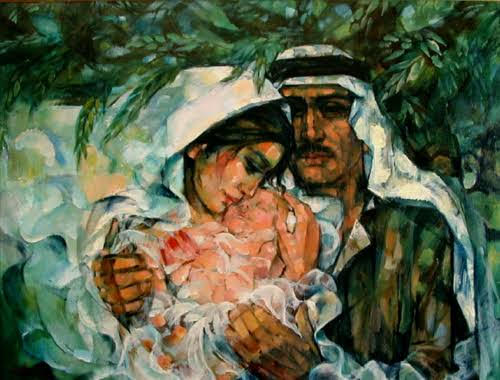
    يتذكر إسماعيل شموط ويحتفل به لتصويره للحياة اليومية في القرى الفلسطينية قبل النكبة ، لتصويره المروع لهروب وطرد الكثير من سكان فلسطين العرب المنتدبين ، ولوحاته الرمزية للشتات التالي.

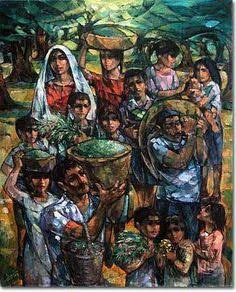
    إن فلسطين هي مكان خالد ، يكاد يكون منامياً ، شبه بعيد عن الزمان والمكان بواقعه المعاصر. كان الحنين والفنانين والشعراء في عصر سابق يصفونه بأنه رعوي مع صوره للحياة اليومية في الريف ، ونقوشه من الشباب والكبار الشباب والرجال والنساء والأطفال والرضع. هناك أزواج من الشباب في الأزياء التقليدية ، والأمهات الشابات مع الأطفال في الأسلحة ، والمزارعين في الحقول ، ومجموعات عائلية من أجيال عديدة. هم في الصالات والمطابخ ، في الساحات والحدائق والحقول والبساتين وأسواق الشوارع كمشترين وبائعين. هناك موسيقيون ومغنون وراقصون في بيئات اجتماعية لا تعد ولا تحصى – في الحفلات والاحتفالات والزواج والمهرجانات والعروض والمواكب.


    واحتفالًا بدائرة الحياة من المهد إلى اللحد وإيقاع الفصول ، هناك مشاهد من وقت الحصاد وجمع ثمار الحقول والبساتين. هناك الحبوب والخضروات والزيتون والبطيخ والمشمش والرمان والتين والعنب والبرتقال الذي اشتهرت فلسطين به منذ زمن طويل.

    هذه المشاهد الخلوية لعالم مضى – ذهب لنا جميعًا ، وليس فقط لشعب بلاد شموط – تُقترن بصور بيانية للنكبة ، والمنفى ، والطرد والتشريد ، والغزو والاحتلال ، والاحتجاجات والمقاومة المستمرة . وعبر كل شيء ، هناك زخارف أمل وسلام – أزهار وطيور مغنية وحمامات – وأيضًا صراع ومقاومة – أعلام ولافتات وبنادق وصخور.
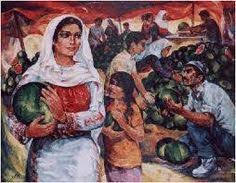
    وتشمل هذه اللوحات الشهيرة شموط لطيران الفلسطينيين وطردهم ، والطريق الطويل الصعب للطائرة على درب الدموع ، والشمس المعادية تنبض. عرضه للحرارة والجوع والعطش والإرهاق يتذكر قصيدة WH Auden المروعة  “درع أخيل”، مع صورها المتناقضة والمضطربة للفرح والاحتفال والدمار القاتم ، أحادي اللون تقريبًا … “سهل بدون ميزة ، عارية وبنية ، لا شفرة من العشب ، وليس علامة على الجوار ؛ لا شيء يأكله ولا مكان للجلوس فيه ، لكن المجتمعين على فراشه وقفت على جمهور مفهومة ، مليون عين ، ملايين الأحذية في الطابور ، دون تعبير ، في انتظار إشارة “.

    تظهر هذه الصور ، النزيهة والخطيرة ، في لوحات أكبر تصور العقود التي تلت ذلك ، سواء المباشرة – المخيمات والتناثر – والمعاصر – الاحتلال ، الانتفاضتان ، المقاومة المستمرة ، وعملية السلام المتعثرة بشكل دائم . تظهر في الخلفية رموز وأيقونات فلسطين في الماضي والحاضر – خاصة القدس والقدس الذهبية ، والأماكن المقدسة الثمينة جدًا للعديد من الأديان – المساجد والكنائس والأديرة والمدارس ، بما في ذلك الحرم الشريف وكنيسة القيامة.

    هناك صور لمخيمات اللاجئين ، ومدن الخيام المزدحمة التي استقر فيها المنفيون لأول مرة ، وحقول النفط الخليجية التي يعمل فيها المغتربون ، والمهن التي دخل إليها المغتربون في جميع أنحاء العالم ، من العمال إلى عمال المختبرات. يوجد أطفال المدارس في مكاتبهم وعمال المكاتب على أجهزة الكمبيوتر ، والحشود ، دائمًا ما تكون حشود من الأشخاص الذين لا حصر لهم ، مجهولي الهوية ، تقريبًا مجهولي الهوية. هناك مسيرات ومظاهرات واشتباكات مع جنود مجهولي الهوية مجهولي الهوية. هناك شباب يرمون الحجارة ويواجهون سيارات مدرعة وجنود يحملون أسلحة. وهناك أحداث سياسية مثل اللقاء الذي عقد في كامب ديفيد بين ياسر عرفات واسحق رابين والذي سهله الرئيس كلينتون ، مما أثار الآمال والتوقعات لم تتحقق.

    دى اللوحات هي قوية ومؤثرة بشكل خاص. امرأة مسنة وابنتها تعانقان شجرة الزيتون مع اقتراب جرافة. يسعى صبيان صغيران لعرقلة  ;طريقه الذي لا هوادة فيه – وهو مشهد غير معتاد على الإطلاق ، مثل الصورة التي قمت بإقرانها بالعروض

    “كيف نجد أشجار الزيتون عندما تختفي جميع أشجار الزيتون؟”


    إسماعيل شموط – سيرة

    وُلد إسماعيل شموط في بلدة اللدة في 2 مارس 1930. وكان والده عبد القادر شموط تاجرًا لبيع الفواكه والخضروات. كانت والدته عائشة الحاج ياسين. كان لديه سبعة أشقاء: إبراهيم ، كوثر ، جميل ، ميسر ، انعام ، جمال ، توفيق. كانت زوجته الفنان تمام عارف الأكحل ، المولود في يافا عام 1935. أولاده هم يزيد ، بشار ، وبلال.

    في عام 1936 بدأ المدرسة الابتدائية ، ورصدت موهبته الفنية في سن مبكرة. تولى مدرسه داود زلاطيمو توليه المسؤولية. خدم زلاطيمو مدرسًا للفنون في ليدا من عام 1930 حتى عام 1948 ، وزينت رسوماته للأحداث التاريخية والطبيعة جدران المدرسة. تم تعليم شموط من قبل زلاطيمو لرسم بالقلم الرصاص والحبر ، والطلاء بالألوان المائية ، والنحت في الحجر الجيري.

    بعد إقناع والده الديني والمحافظ بأن “الفن يمكن أن يكون مهنة مربحة” ، بدأ بتزيين فساتين الزفاف بالورود والطيور ثم افتتح متجرا خاصا به ، وهو في الواقع أول استوديو له. وهناك رسم أول زيوته التي تصور المناظر الطبيعية والبورتريه قبل النكبة عام 1948.

    بعد ثلاثة أيام من سقوط اللدة و الرملة على يد القوات الصهيونية ، في 13 يوليو 1948 ، اضطر شموط وعائلته (إلى جانب سكان المدينتين) إلى المغادرة والذهاب سيرا على الأقدام إلى رام الله ولم يُسمح لهم بحمل المياه . توفى شقيقه الشاب توفيق من العطش قبل وصولهما إلى قرية نيلين ، بالقرب من رام الله. وثق شموط مسيرة الموت والإرهاق والعطش في العديد من اللوحات المنفذة في الخمسينيات. استمرت العائلة في التحرك حتى استقرت في الخيام التي شكلت في نهاية المطاف مخيم خان يونس للاجئين.

    باع شموط المعجنات لمدة عام ، ثم تطوع لتدريس الرسم في مدارس اللاجئين ، التي أقيمت في خيام. هذا سمح له باستئناف مهنته الفنية وعرض لوحاته في غرفة في مدرسة خان يونس الحكومية في عام 1950. وفي نفس العام التحق بأكاديمية الفنون الجميلة في القاهرة وعاش من أرباحه ، ورسم ملصقات الأفلام.

    أقام شموط معرضه الأول في عام 1953 ، حيث جمع ما يكفي من اللوحات لمعرض كبير “لكن لم يكن لديه ما يكفي من الشجاعة” لعقده في القاهرة. لذلك عرض في نادي الموظفين في مدينة غزة بالاشتراك مع شقيقه جميل. في ذلك المعرض ، قدم شموط ستين لوحة بما في ذلك لوحاته الشهيرة الآن إلى أين؟ وفم من الماء. اعتبر هذا المعرض أول معرض فني معاصر في تاريخ فلسطين من قبل فنان فلسطيني على الأرض الفلسطينية ، وفقًا لحجمه وعدد الأعمال المعروضة وطريقة افتتاحه والحضور الجماعي.


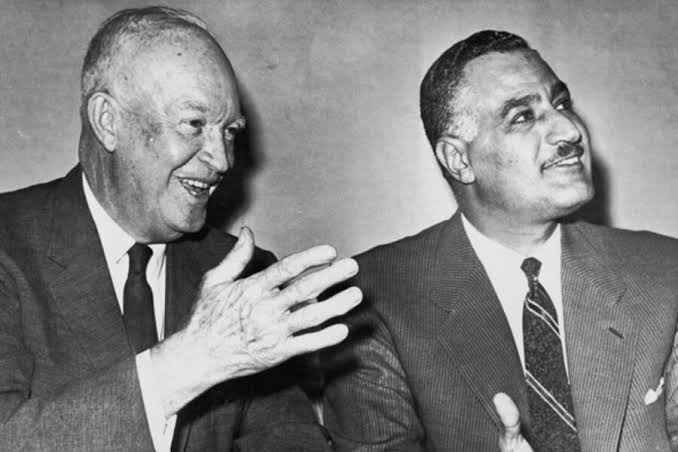
    في عام 1954 ، أقام معرضًا في القاهرة تحت عنوان “اللاجئ الفلسطيني” بالاشتراك مع طالب فني في أكاديمية الفنون الجميلة ، تمام الأكحل ، والفنان الفلسطيني نهاد سباسي. كان هذا المعرض تحت رعاية جمال عبد الناصر ، في ذلك الوقت رئيس وزراء مصر ، وحضره قادة فلسطينيون. شجعته أرباحه من هذا المعرض على السفر إلى إيطاليا حيث سرعان ما حصل على منحة للدراسة في أكاديميا بيلي أرتي في روما ، وظل هناك لمدة عامين (1954-1956).

    بعد تخرجه ، انتقل للعيش والعمل في بيروت مع شقيقه جميل في وكالة الأمم المتحدة لإغاثة وتشغيل اللاجئين الفلسطينيين (الأونروا). أنشأ الأخوان مكتبًا للفن التجاري وتصميم الكتب ؛ وقد تضمن الأخير كتيبًا للجيش اللبناني بعنوان “التربية المدنية الإنسانية”.

    في عام 1959 ، تزوج من زميلته الفنانة تمام الأخال ، وبعد ذلك عملوا معًا عن قرب ، من الناحية الفنية والمهنية. قاموا بتدريب معلمي الفنون في بيروت والقدس والضفة الغربية وقطاع غزة وعقدوا معارض مشتركة في تلك المناطق.

    تابع شموط والآخر عن كثب إنشاء منظمة التحرير الفلسطينية في المؤتمر الوطني الفلسطيني الأول في القدس في عام 1964. في عام 1965 ، أنشأ قسم الثقافة الفنية في قسم الإعلام والتوجيه الوطني لمنظمة التحرير الفلسطينية (المعروف لاحقًا باسم دائرة الإعلام والثقافة) ) ووجه أنشطته حتى عام 1984. عندما أغلقت مكاتب منظمة التحرير الفلسطينية في القدس ، عاد الزوجان إلى بيروت في عام 1966 واستأنفوا العمل مع منظمة التحرير الفلسطينية هناك ، بالإضافة إلى عملهم الشخصي كفنانين. أكمل شموط عددًا لا يحصى من الملصقات والمشاريع الأدبية والسياسية والتقليدية ، ونظمت صحيفة

    الأخال عشرات المعارض السياسية والشخصية في مدن حول العالم ، بما في ذلك غزة والقاهرة والقدس ورام الله ونابلس وعمان وواشنطن (بالإضافة إلى اثني عشر مدن أمريكية أخرى) ، طرابلس ، دمشق ، الكويت ، لندن ، بلغراد ، صوفيا ، بكين وفيينا ، بالإضافة إلى الجداريات المسماة “المسار في عمان وأنقرة واسطنبول والدوحة والشارقة ودبي والقاهرة ودمشق وحلب وبيروت . ومن بين أبرز إنجازاته قاعة تسمى دار الكرامة في بيروت حيث تم عرض معارض موسمية لفنانين شباب من مخيمات اللاجئين الفلسطينيين ، وكذلك معارض تضامن عربية ودولية أخرى

    في عام 1969 ، أسس شموط وغيره من الفنانين الفلسطينيين أول اتحاد عام للفنانين الفلسطينيين. ظل أمينًا عامًا لها حتى عام 1984. وشارك أيضًا في تأسيس الاتحاد العام للفنانين العرب في عام 1971 وكان أول أمين عام لها ، وهو المنصب الذي شغله حتى عام 1984.

    بعد الغزو الإسرائيلي للبنان في عام 1982 ، ورحيل المقاومة الفلسطينية وقادتها ، وإغلاق مكاتب منظمة التحرير الفلسطينية ، اضطر شموط (الذي كان يعاني من مرض في القلب وتفاقم) إلى الانتقال مع أسرته إلى الكويت في عام 1983 ، حيث عاشوا خلال احتلال الكويت عام 1991 وحرب الخليج الثانية. بعد تحرير الكويت ، أُجبرت الأسرة مرة أخرى على الانتقال عام 1992 ، هذه المرة إلى ألمانيا. في عام 1994 ، استقر أخيرًا شموط والأخل في عمان ، الأردن.

    يعتبر شموط عمومًا رائدًا في الفن الفلسطيني المعاصر. كان فنانًا ملتزمًا كان أسلوبه واقعيًا مع بعض العناصر الرمزية. سيطرت القضية الفلسطينية على فنه ، وقد تم توزيع بعضها على نطاق واسع في المخيمات والمنازل وتضامنًا مع حملات فلسطين في الدول العربية وخارجها. يمكن اعتبار بعض أعماله أيقونة للشعب الفلسطيني.

    لم يتوقف شموط عن تصوير الخروج الفلسطيني من فلسطين في لوحات تحمل ألقابًا ومعانيًا موجودة كثيرًا في أذهان الناس وفي تجربته الخاصة ؛ مثال على ذلك هو اللوحة التي تحمل عنوان أين؟ (1953). كانت لوحاته مستوحاة من حياة المخيم (مثل      Memories and Fire ، 1956 ؛ We Shall Return ، 1954 ؛ و Bride and Groom at the Border ، 1962) ودعت إلى التفكير في معنى الأمة في الانتظار.

    منحته منظمة التحرير الفلسطينية الدرع الثوري للفنون والآداب ، وميدالية القدس للثقافة والفنون والآداب ، وجائزة فلسطين للفنون. منحه منتدى الفكر العربي الجائزة الإبداعية للرسم العربي. يتم منح جائزة سنوية باسمه عن اللوحة الفلسطينية الممتازة. تم الحصول على أعماله من قبل العديد من المتاحف العربية والدولية.

    أجبرته حالة قلبه على الخضوع لثلاث عمليات حرجة ، أجريت الثالثة في لايبزيغ ، ألمانيا ؛ توفي في 3 يوليو 2006 ودفن في عمان.

    بالإضافة إلى لوحاته ، كتب قصصًا عن الرسم والحرف الفلسطينية وأنتج عددًا من الأفلام التي تأثرت بخبراته الفنية. تشمل هذه الأفلام فيلمًا بعنوان الذكريات والنا (1973) ) ، وفاز بجائزة الأفلام الوثائقية القصيرة في مهرجان لايبزيغ ؛ نداء عاجل (1973) ؛ وعلى الطريق إلى فلسطين (1974). أنتجت نورة الشريف فيلمًا قصيرًا يدعى إسماعيل ، وتناول جزءًا من حياته خلال فترة ولايته الأولى كلاجئ في مخيم خان يونس. يتوفر موقع ويب مخصص لعمله على الموقع

    http://www.ismail-shammout.com

       In That Howling Infinite   رأ المزيد عن سياسات وتاريخ الشرق الأوسط في كتاب   

    In English: Visualizing the Palestinian Return – the art of Ismail Shammout

    Joy فرح

    Tel as Sabi’ – Tarkeeth’s Anzac Story

    The 25th April is Anzac Day, Australia’s national day of remembrance, honouring Aussies and Kiwis who perished in foreign wars from South Africa to Afghanistan. It takes its name from the ill-fated Gallipoli campaign – on this day in the spring time of 1915, Australian and New Zealand soldiers landed under heavy fire from Ottoman forces entrenched in the heights above what was later to be called Anzac Cove on Turkey’s Gallipoli peninsula. 

    The Anzacs were just part of a wider campaign devised by British Secretary of the Navy Winston Churchill to knock The Ottoman Empire out of the war with one decisive blow by seizing the strategic Dardanelles Strait and occupying Istanbul, the capital. It do not go well. The Ottoman soldiers commanded by Mustafa Kamal Pasha, the future founder of modern Turkey, Kamal Atatürk, held the high ground and fought stubbornly and bravely, and ultimately, victoriously. 

    The bloodshed ended in stalemate. The Allies withdrew eight months later leaving behind over eight thousand dead Australians and nearly three thousand New Zealanders (along with over thirty thousand English, Irish, and Frenchmen, Indians and North Africans, and close on ninety thousand Ottoman soldiers, Turks and Arabs, Muslims and Christians), without, historians say, having had any decisive influence on the course of the First World War. 

    The rest, as we say, is our history. 

    The Anzac Trail

    Whenever we visit Israel, our friend and guide Shmuel of Israel Tours drives us all over tiny beautiful and vibrant country (travelling through the West Bank, we use Palestinian guides). During the pandemic year, most Israelis had been locked down three times and like in many countries, the all-important tourist trade barely has registered a pulse. When permitted to travel beyond his home in Jerusalem, Shmuel has spent the year exploring and learning, visiting places he has never guided to before. He believes that he has exited the plague year a better guide, and we are already making plans for our next Israel adventure, including recently excavated Herodian palaces and further travel in the Negev Desert. 

    Shmuel recently told me that he had visited Tel Sheva, Tel as Sabi’ in Arabic, in the Negev, five kilometres east of the city of Beer Sheva, a site inhabited since the fourth   millennium BC. The ancient fortified town dates from the early Israelite period, around the tenth century BC. The walls, homes, storage warehouses and water reservoir system have been excavated and opened to the public. Today, Tel as Sabi’ s also known as the first of seven Bedouin townships established in the Negev as part of the Israeli government’s policy to plant the once-nomadic Bedouin permanent settlements. 

    It was from the foot of this stark desert hill that the Light Horse Brigade launched its famous charge towards the Ottoman lines at the strategic rail-head and wells of Beersheva on October 31st 2017. 

    Today, it is the ninth (not seventh) stop on The Anzac Trail which traces the route of the Light Horse Brigade from Gaza on the Mediterranean coast to Beer Sheva. For obvious reasons, it begins beyond Gaza’s wire and concrete encirclement and trail culminates at the Anzac Memorial Centre In Beer Sheva, inaugurated on the 100th anniversary of the battle. 

    The Charge at Beersheba” by Sir Ivor Hele 1973

    Tel as Sabi’ to Tarkeeth 

    As we commemorate Anzac Day this Sunday, few folk in Bellingen Shire would know that there is a link between that hill in the heart of the Negev and Tarkeeth on the north bank of the Kalang River just six kilometres west of Urunga as the crow flies.  

    In A Tale of Twin Pines, the first of our Small Stories, I wrote of how researching the history of the Urunga area where we live, I came across Lloyd Fell’s story of the Fell Family Farm. This was located close to the present Twin Pines Trail, just east of Fells Road on South Arm Road, and west of the Uncle Tom Kelly motorway bridge over the Kalang River. Click here to access TwinPinesStory.pdf

    Lloyd tells the story of how in 1926, New Zealand farmer, solo-yachtsman, and returned ANZAC Chris Fell first saw the land that became the family farm, purchasing it from a deceased estate for a thousand pounds. Chris was impressed by the two mature hoop pines that stood on either side of the track leading to a rough timber house that already stood there – and these gave the farm its name. He cleared the bush, felling and hauling timber until he had sufficient land and capital to run cattle. In time, he built up a prosperous dairy business and cattle stud where he and his wife Laura, a Sydneysider from a well-to-do Vaucluse family, raised their three children. The house has long gone, but the two magnificent pines are still there. 

    On October 31st 1917, Chris Fell and his comrades in the New Zealand Mounted Infantry fought on Tel as Sabi’. 

    Tel as Sabi 1917, showing Ottoman trenches (AWM)

    Chris Fell and the battle of Beer Sheva

    As told in Short Stories – a tale of Twin Pines:

    in his ebook The Twin Pines Story, Lloyd Fell tells how his father served as a mounted machine gunner with the New Zealand forces in the Gaza campaign of late 1917. His war record reports that he was one of the machine gunners who fought through the day before the famous charge to knock out the Turkish machine guns on the strategic Tel al Saba, east of the strategic desert town Beersheba.

    The strong position the Ottomans had established on the hill was a key obstacle to the conquest of the town and the ANZACs had to seize it before storming Beersheva itself. The Ottoman soldiers fought valiantly, and it was only at around 3 p.m. that the fighters of the New Zealand Brigade, primarily the Auckland regiment, succeeded in capturing the hill in a face-to-face battle. Had these fortifications not been overrun, the Light Horse would have been prevented from advancing on the wells. Afterwards, the machine gunners and their Kiwi mates took part in a bayonet charge against the enemy.

    As Jean Bou wrote in The Weekend Australian:

    “The New Zealand brigade was sent against Tel el Saba’, but this steep-sided hill with terraced entrenchments was formidable. The dismounted horsemen, with the limited fire support of their machine-gunners and the attached horse artillery batteries, had to slowly suppress the enemy defences and edge their way forward. Chauvel sent light horse to assist, but as the afternoon crawled on, success remained elusive. Eventually the weight of fire kept the defenders’ heads down enough that the New Zealanders were able to make a final assault. The hill was taken and the eastern approach to Beersheba opened, but nightfall was approaching”

    Major-General Harry Chauvel, the ANZAC commander faced a dilemma. The light was fading and there wasn’t enough time to properly regroup to assault the town. An unsuccessful attack would mean withdrawing far to the south, whilst delaying ng the attack until morning would deny him the element of surprise and and also give the Turks time to destroy the town’s vital wells. He decided to attack, and assigning the  the mission to the Australian 4th Light Horse Brigade. 

    Epilogue

    The 31 light horsemen who fell are buried in the Beersheba War Cemetery along with 116 British and New Zealand soldiers who perished in the Beersheba battle. There are 1,241 graves in the military cemetery, soldiers being brought in from other Great War Middle East battlefields. We visited it in May 2016.  It is a tranquil, poignant, and beautiful place in the Negev Desert, where the bodies of young men from Australia and New Zealand and from the shires of England, Ireland, Scotland and Wales were laid to rest. “Lest we forget”

    See also, : The Taking of Tel el Saba

    In In that Howling Infinite, see also, Tall Tales, Small Stories, Obituaries and Epiphanies,  The Watchers of the Water, and Loosing Earth – Tarkeeth and other matters environmental

    Read in In That Howling Infinite more stories about Israel, Palestine and the Middle East: A Middle East Miscellany


    Song of the Road (1) – my hitchhiking days

    May the road rise up to meet you.
    May the wind be always at your back.
    May the sun shine warm upon your face,
    The rains fall soft upon your fields
    And until we meet again,
    May God hold you in the palm of His hand.
    An old  Irish blessing

    You just picked up a hitcher
    A prisoner of the white lines on the freeway
    Joni Mitchell, Coyote

    On the road

    A recent story in Haaretz brought back memories of my hitchhiking days.

    Whilst hitching has lost much of its allure in the west, it remains very popular in Israel. From my very first visit, There are always young people waiting by the roadside – it has always been so for young conscripts travelling home on leave, and motorists have traditionally been comfortable with picking up soldiers waiting with their rifles and kit bags (all non-Haredi or ultra orthodox Israelis must complete national service when they reach 18, and are required to carry their weapons with them at all times if these can’t be securely stored). It is also a popular mode of travel in the occupied West Bank where settlers regard hitching a ride as a political statement of sovereignty and freedom to travel through all of HaAretz, “the land”, and as an economical means of reaching scattered and often isolated (not to mention illegal under international law) settlements. Many drivers regard picking up fellow-settlers as a political and religious duty.


    Hitching in the West Bank

    This attachment to hitchhiking harbours a strong sense of community, but also, a delusion of safety –  it can and does have deadly consequences. For example, in June 2014, three Israeli teenagers were kidnapped by Hamas operatives at the bus/hitching stop at the Alon Shvut settlements in Gush Etzion and subsequently murdered. The atrocity precipitated Operation Protective Edge, an Israeli bombardment of Gaza which resulted in thousands of civilian deaths, and the kidnap and murder of a Palestinian boy by Jewish extremists. But that is not what this story is about …

    In the second decade of the 21st century, hitchhiking is widely viewed as an edgy, even dangerous, activity to be avoided by both a potential hitcher and a prospective motorist contemplating whether to pull over or to drive on. For some, it also carries undertones of bludging and of indigence, although in rural areas like where I live, during these straightened times with high youth unemployment and poor public transport, many young people hitch out of necessity.

    But the practice flourished for several decades, particularly during the fifties and sixties when few people owned vehicles and catching a ride with a friendly stranger was means of adventure as well as a mode of travel. Hitchhikers did so for a variety of reasons – a combination of thrift, expedience, and necessity, but also, a sense of romantic adventure – buoyed by what seems in retrospect, a naive sense of invulnerability.

    More than just a means of transportation, it was also about social interaction and the opportunity for conversations with strangers. Jack Kerouac, American beat poet and secular patron saint of hitchers. begged to differ. In his seminal On the Road, a book revered more than read, he whinged: “One of the biggest troubles hitchhiking is having to talk to innumerable people, make them feel that they didn’t make a mistake picking you up, even entertain them almost, all of which is a great strain when you are going all the way and don’t plan to stay in hotels”.

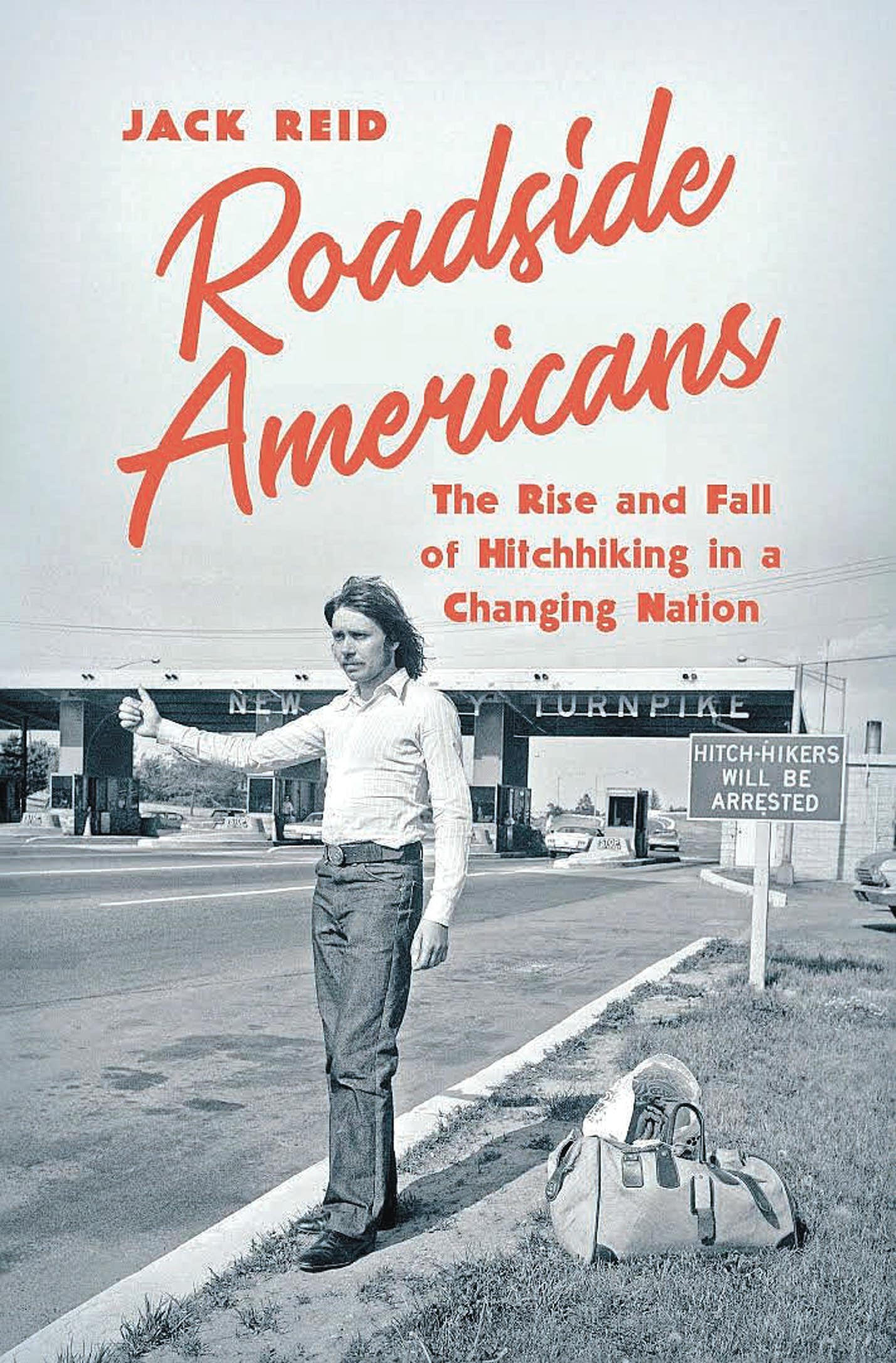
    In his recent Roadside Americans – the rise and fall of hitchhiking in a changing nation, North Carolina historian Jack Reid writes: “The waning of hitchhiking in the 1980s was a result of social change, but the main reason was related to the economy and to engineering. The highways changed. At the exits from cities, there are now huge interchanges rather than simple junctions, where it was easy to stop a car. Added to that was a sense of alienation, a growing fear of strangers and a loss of intimacy. Another reason was that years of economic prosperity and a significant reduction in car prices enabled many young people to buy their own cars”.

    Allons! the road is before us! 

    Afoot and light-hearted I take to the open road,
    Healthy, free, the world before me,
    The long brown path before me leading wherever I choose.
    Strong and content I travel the open road.
    Walt Whitman, Song of the Open Road

    I was thumbing lifts before I’d even heard of Jack Kerouac,  It seemed like the easiest and cheapest thing to do when cash was scarce  and modes of carriage were few, and the open road and the horizon beckoned.

    .In the days gone by, when money was tight and adventure beckoned, I hitched all-over England – visiting friends in far-flung towns and villages, attending music festivals and anti-war and anti-nuclear demonstrations, and often, simply for the joy of travelling and exploration.

    Looking back, my hitching was destination focused,  getting to where I wanted to go and the route that would take me there rather than exploring the highways and byways, the towns and village in between and the folk therein – although I would take in appreciatively the landscapes and cityscapes I would pass through. The roadside and the adjoining nature strip, were, on the other hand, a world of their own. Between rides, standing at a place I’d never been and to which I would not return, I’d note the micro-milieu – the grass and the wildflowers, the flotsam and jetsam, the discarded bottles and butt ends, the empty cigarette packets and the candy bar wrappers. Vehicles  whizzed by and I’d observe their type and frequency to calculate when I’d likely be picked up. And then, destination in mind’s eye, like stepping into a cold pool,or breaking into a run, I’d extend my arm and raise a thumb, gingerly at first and then with bravado.

    Living on the northeastern edge of Birmingham,  close to the motorways heading north and south, I’d simply pack a bag, walk to the nearby roundabout, and put out my thumb. It was, after it own fashion, a kind of commuting between hometown domesticity and the great beyond.

    When first I roved out, the M1 started on the outskirts of London at Watford, and ended between Coventry and Rugby. The first section of the M1 Motorway between Watford and Crick, Rugby opened in 1959. Watford Gap Services, known then as The Blue Boar Services, opened on the same day. It was long hailed as the unofficial boundary between the North and South parts of the Britain.

    The Coventry Road in south west Birmingham was my launching pad. Watford Gap services was like a transit lounge, as was Newport Pagnell. The large road sign Hatfield and the North was a landmark on the road to home. Daytime, nighttime, the wee small hours, in spring and summer sunshine or winter rain, it didn’t really matter – the M1 never slept.

    In time, the road system extended and the M1-M6 link lay just a hundred metres in front my family home. One summer, I worked on that section of the motorway as an “on the lump”  casual navvy. No workers comp,or occupational health and safety in those days. Helmets and gloves were optional. My blood, and that of many others, including some who clocked one fine summer morning and never clocked off, is in that  concrete.

    As a sixth former, I’d often hitch to “swinging” London for the weekend, to explore the capital and visit folk and jazz clubs, kipping in shop door-ways and underground car parks under cardboard and napping wrapped in newspapers, and eating at Wimpy bars and Lyons teas houses.

    A few years later, whilst at Reading University,  the M4 began near Maidenhead and finished at Chiswick, and every few weekends, I’d stand opposite the cemetery in eastern Reading and hitch a ride to London and back – for sit-ins, marches, happenings at The Roundhouse, free open-air concerts (including the famous Rolling Stones concert in Hyde Park), and to hang with my London girlfriend.

                                                                  The Roundhouse, Chalk Farm

    When first I roved abroad, I thumbed my way from Budapest to Athens via Yugoslavia and thence back to Blighty, and the following year, on a side-step from the famous hippie trail, from Beirut to Aqaba and back via Petra and Wadi Rum. I slept a night in Petra itself – in those days, a deserted and un-restored hideaway for fugitive Palestinian  fedayeen after the Black September intifada. For reasons that I can not fully explain, I took my future first wife down the same road two years later, including sleeping out among Petra’s Nabatean tombs. And this was to be the end of my gypsy ways and hitching days. They lasted eight years. Thereafter, the famous “open road” was replaced by planes and trains, buses and cars – and one agonizingly crippled Ford transit van (to … an old saying, when life gives you a lemon, you’d wish you’d’ve been willing to spend more on a reliable motor).

    If you’ve taken all you need from this post already, off you go … What follows now are an assortment of self-indulgent reminiscences of my hitchhiking days.

    From this hour I ordain myself loos’d of limits and imaginary lines,
    Going where I list, my own master total and absolute,
    Listening to others, considering well what they say,
    Pausing, searching, receiving, contemplating,
    Gently,but with undeniable will, divesting myself of the holds that would hold me.
    I inhale great draughts of space,
    The east and the west are mine, and the north and the south are mine.
    Walt Whitman, Song of the Open Road

    Travellers’ Tales

    Well I left my happy home
    To see what I could find out
    I left my folk and friends
    With the aim to clear my mind out
    Well I hit the rowdy road
    And many kinds I met there
    And many stories told me on the way to get there
    So on and on I go, the seconds tick the time out
    So much left to know, and I’m on the road to find out
    Cat Stevens, Tea for the Tillerman

    The toad road licked my wheels like a sabre. Marc Bolan

    And what should they know of England …

    There’s always a first time. We’d all like to daydream that we’d be picked up by Joni Mitchell, like she picked up that scallywag Coyote on her sublime Hejira album. Mine, alas, was as as stocky sixth former with long hair (long for those days) and horn-rims, heading down to London to meet meet up with school chums for the CND Easter March (that was a first too). Standing at the roundabout where the M1 and the world began, having already thumbed from the Coventry Road roundabout opposite the old Swan public house at Yardley, It wasn’t long before a Rolls Royce pulled up. “WTFl!” is what I’d say today A handsome bloke with shades and sideburns who looked like Englebert Humperdinck asked me where I was heading. “London”, I replied. “Of course – where else? Get in”, he said. It was all the way to Marble Arch with pop star Don Fardon – whom I’d never heard of at the time – he later entered the hit parade with a cover of John Loudermilk’s song Indian Reservation. Not a good song, I would say – with many similarly empathetic ballads, it is long on heartstring-pulling  and fucked on imagery and lyrics. If you want to listen to a good song, check out Bruce Cockburn’s evocative Indian Wars and the Australian Goanna Band’s anthemic Solid Rock.

    Henceforward, that motorway from Brum to London was a road well-traveled. In my final year at Moseley Grammar, I’d often hitch down to London for a weekend with pals who’d gone there before. We’d hang out at cheap and cheerful Pollo’s Italian restaurant in Old Compton Street in Soho and the Coach and Horses right across the road, and go to Cousins folk and blues joint in a cellar in nearby Greek Street and the 101 Jazz Club off Oxford Street. Bunjies folk club and Ronnie Scott’s jazz Club were just around the corner. After a meal or a pint, I’d often catch the last tube to the end of the line closest to the M1. I can’t recall how many times I headed off into the night; and and there were always drivers on the road at the witching hour. I guess many folks “get the urge for going”, as Joni sang back then, “and they had to go …” And in those generous times, folks were willing to offer a lift to a wayfaring stranger – gentle souls who would not leave strays stranded by the dark wayside; lonesome folks seeking company and conversation in the dark night of the soul; curios people wondering why a young  man would hitch the highways in the middle of the night.

    It is now early spring of 1968. I’d repeated my last year at Grammar School, and with assignments completed, an amenable headmaster let me take a week off to travel. This time, I headed northwest across Brum to Darkaston, near Walsall, and what was then the beginning of the M6 – it ended at Lancaster. Travelling through Lancashire, Cumbria and the Lowlands, I reached the outskirts of Glasgow by nighttime. Hitching across the city, I was picked up by a young couple who insisted that I spend the night at their place – they reckoned the green scarf I’d worn around my hat was a risky proposition in that part of sectarianist Glasgow. I loved that old brown fedora; it traveled with me all over England, to Greece and Yugoslavia, and the Middle East until it was stolen along with my harmonica at Wadi Musa, near Petra. Next morning, I was on the road to Edinburgh, crossed the silvery Tay of bad poet William McGonagall fame, transited the granite city of Aberdeen, and by nightfall, I was on the road into Inverness, where I slept by the roadside and woke up covered in snow. Next morning, I was on Culloden field, and thence, continued on my journey. It took me through the Great Glen where I’d caught a local bus that delivered the mail to isolated homesteads, a journey so slow that I was hallucinating mountains and braes for days, and thence to to Loch Lomond and beyond, southering homewards.


    The brown fedora, Giza 1971

    During my first year at the University of Reading, I kept on hitching – many more journeys to London and back and day trips to nearby Oxford and Windsor. In a cold and rainy April, with first year exams done, I headed east to London and north to the Humber and the port of Hull, to drop on a good friend who had dropped out of uni and to visit an former school chum. In a student share-house near the university, I took my first mescaline trip to the soundtrack of Roy Harper’s sang McGoohan’s Blues’, a twenty minute digression from the concept if not the plot of an iconic if indecipherable television series. “The Prisoner is taking his shoes off to walk in the rain”.  For 1,200 blissful seconds of cosmic consciousness, I found the meaning of life down that wonderful rabbit hole – and had forgotten what I’d found when I’d resurfaced the next morning. Peyote is a very colourful hallucinogenic. I still recall the Fantasia images that passed before my eyes as Roy sang:

    Daffodil April petal hiding the game
    Forests of restless chessmen life is the same
    Tides in the sand sun lover watching us dream
    Covered in stars and clover rainbows downstream …
    Under the toadstool lover down by the dream
    Everything flowing over rainbows downstream
    Silver the turning water flying away
    I’ll come to see you sooner I’m on my way

    As I headed back down south, the wet and windy old weather changed and as I rode through rural Oxfordshire, all a sudden, the sun came out for behind dull English clouds and and Springtime came in verdant glory – as doomed young Robert Browning once declaimed

    Oh to be in England now that April ’s there
    And whoever wakes in England sees, some morning, unaware,
    That the lowest boughs and the brushwood sheaf
    Round the elm-tree bole are in tiny leaf,
    While the chaffinch sings on the orchard bough
    In England—now!

    On arrival at my digs in Reading, there was a note from friends telling me that they’d headed off to Devon to spend a weekend with a fellow student’s farming family, and that me and my friend Jean should join them. So within minutes of arriving home, we were off into the west. Navigating Bristol where, I recall for no apparent reason, that on impulse. I’d bought a copy of The Beano comic) and Somerset. Late that night, we arrived in the tiny town Cullompton in the heart of rustic Devon. After some now forgotten but fun times, including a trip to the seaside and getting blotto on local cider, we hitched home. I don’t recall too much of the journey except that it took us through Basingstoke.

                                                                           Cullompton 1969

    One glorious English summer I arranged to meet up with my late pal Dave Shaw in Cambridge, where he was attending a summer school at the University, and go to the celebrated Cambridge Folk Festival. I clocked off from my work on the motorway, got home, just ten minutes away – I said we were close! – showered and packed, and headed to the Clock Garage roundabout and put out my thumb. I took the M1 to London’s North Circular, and cut across to the A10 (there was no M11 in those days) and, And, my stars were alignment on this night ride, arrived at Dave’s digs in time for breakfast.I don’t remember much of the festival bill, but American folk diva Odetta was singing, and also, our idol, Roy Harper, England’s high priest of angst.

    I had to leave Cambridge around Sunday lunchtime, after Roy’s last set, to return to Brum for work on Monday. Rather than head back down to London, to save time – a quixotic idea when you are hitching – I decided to cut cross-country to connect with the M1 at Newport Pagnell – in those days before GPS and route planners, a cheap, creased road map from WH Smith was the best we had, plus a good sense of direction, fair weather and loads of luck. And such are the movements of the cosmos, that my one and only only ride took me to, yes, what was then the bucolic village of Newport Pagnell. It was one of those summer evenings in England, when the days are long, the air warm and languorous, and the light, luminous. Birds were singing and church bells were ringing for evensong, and in my mind’s ear, I’d like to imagine that cows were lowing and sheep were bleating. One could almost feel an ode coming on. So there I was, once more, at the services on-ramp, hitching a ride to Birmingham , and hopping aboard an old Land Rover for what was the slowest and noisiest ride ever – which took me almost to my door.

    … who only England know

    The above header is the second half of Rudyard Kipling’s well known if oft misunderstood poem The English Flag, in which the old Imperialist exhorts his insular countrymen to go forth and conquer … In later and less jingoism times, it has been given a more benign slant, along the lines of the adages like “travel broadens the mind” to which I readily subscribe, or as Cat Stevens was to sing at the time “the road to find out”.

    And so it was during the holidays before my final year at Grammar School that I tried my thumb on the Continent. With another school pal, I hopped across La Manche to Belgium with the idea of hitching to Amsterdam. Why we chose Belgium, I can’t recall, but my brother had been there shortly before and he reckoned it was a great place for art and architecture (that was his thing – he scored a rare First in architecture at Uni and went to become the chief architect for Nottingham City Council, designing the international ice rink in partnership with Jane Torvill of of skating icons Torvill and Dean fame). We did a lot of beer and chips and saw a lot of great art and architecture in Bruges, Ghent and Brussels – and we visited the Waterloo battlefield, as one would. As for the Netherlands, we got as far as Antwerp but gave up on Amsterdam after a long day of futile thumbing. We were, however, adopted by a young Belgian lass who took us home to meet her ma and pa. We enjoyed a  bucolic Sunday picnic on the banks of a tributary of the Scheldt before heading back to Oostende and England. In retrospect, I regretted that hadn’t turned south south and set a course for Paris, a  pleasure which would have to wait several more years.

    My next “big hitch” was by happenstance in Eastern Europe. I’ve written of this before in In That Howling Infinite in Tanks for the Memory – how Brezhnev changed my life. Therein, I recalled how I’d flown to Prague on the first anniversary of the Soviet Invasion for Czechoslovakia, only to have the flight diverted to Budapest in Hungary.

    “Given the circumstances of our arrival, and the atmosphere prevailing in the Bloc on the anniversary of Prague invasion, the authorities had given me a visa for four days only. I had therefore to depart the country quick-smart. I had effectively two choices of non-Soviet countries –  westwards to Austria, or south to what was then Yugoslavia. In a split second decision, I took the road less traveled – south to Szeged and the Serbian border. Wondering through the rural outskirts of Novi Sad, I was taken home by a pair of Serbian boys. I spent my first evening with their most hospitable family and slept that night on a bed of furs. “Novi Sad, Beograd” the lads had chanted, and so, instead of setting my direction home, I hitch-hiked south to the ancient Danube city of Belgrade. In the Yugoslav capital, I resolved to keep going southwards. Over the next two weeks, I transited Yugoslavia to Thessaloniki, where decided to continue with my southern odyssey – to Athens and the Greek Islands. At journeys end, I hitchhiked back the way I’d come, only this time, reaching Austria via the Croatian capital of Zagreb”.

    My Balkan and Aegean adventures included that aforesaid sleepover in Novi Sad; sleeping by the highway south of Niš where I was awoken in the middle of the night by military police who reckoned I was a security risk; being propositioned – solicited more like – by a gypsy girl whose favours I forsook as she mustn’t have showered for a week; picked up by a Greek lorry-driver near the famous pass of Thermopylae who insisted we skinny-dip in the aquamarine Adriatic; and heading out of Thessaloniki on the road to Macedonia (the Slav one), I was picked by a bus load of frisky young Greek conscripts – I jumped out quicksmart into the night.

    By the time I reached Zagreb, I’d had enough of the road and took the train to Vienna and thence to Calais and Albion. But, as I wrote in Tanks for the Memory, my southwards diversion to the Mediterranean fixed my gaze on other pastures and inspired  a lifetime interest in the Middle East. For that is where I roved next: “… the clear Hellenic sky and the cobalt blue of the Mediterranean, the parched hills and pine woods of the Peloponnese, the dazzling light and the warm sun on my body, and the ruins and bones of antiquity sang a siren’s song. As Jack Bruce warbled: You thought the leaden winter would bring you down forever, but you rode upon a steamer to the violence of the sun. And the colours of the sea bind your eyes with trembling mermaids, and you touch the distant beaches with tales of brave Ulysses. My thoughts and dreams no longer ranged eastwards. My next journey took me back to the Mediterranean, and thence, following in the footsteps of Alexander the Great – the golden hero of legend, not the “mad, bad and dangerous to know” destroyer – through the Middle East and on to the famous well-trodden Hippie Trail to India”.

    I’d never intended to hit the Hippie Trail back then, in the northern summer of 1971. In fact, I didn’t even know it existed.

    I’d just finished my final exams and graduated with a good degree, and after three exciting and formative years, it was as if everything had suddenly ground to a halt. Uni was over; a romantic relationship was on the rocks; I was footloose and free, floating and feeling the urge to escape elsewhere, somewhere, anywhere. I’d no idea at all what I would do next, other than an inchoate plan to undertake post-graduate study – guided by my tutor and mentor exiled Hungarian academic Tibor Szamuely, my academic interest was Eastern Europe and the Soviet Union, but that was to be down the track.

    When the finals results came out, I spent the evening at the student union with friends, unwinding and getting pissed; and the very next day, I walked into the Student Travel office and booked a one-way air ticket to Athens, passage by steamer from Piraeus to Alexandria via Limassol, Cyprus, and from Egypt to Piraeus and thence to Tel Aviv, Israel, with no bookings for onward travel.

    Seized by the idea of visiting the two principal antagonists of the almost recent Six Day War, I’d a naive and uninformed notion to view both sides of the Arab-Israeli puzzle. Within a few weeks, I’d bought a second-hand rucksack and sleeping bag, converted my savings to traveller’s cheques – there were still currency restrictions in the UK on how much cash you could take out of the country – packed a few things, and in the words of Cat Stevens, I was “on the road to find out”. That road took me through the Middle East, and on and on, until I reached Kolkata in Bengal. What was planned as but a two month holiday to “clear my mind out”, to quote Cat again, extended to over six months as the appetite grew with the eating.

    And so I travelled through lands of which I knew little, picking up fragments of history and heritage, parables and politics as onwards I roamed

    My final hitching hejiras were played out in the Levant – an Indian traveller I’d met in a Cairo youth hostel had told me that if I thought the slums of Cairo were bad – and to a naive Brummie, they were – I should see those in Kolkata. So that is what I resolved to do. Leaving Egypt, I found my way to Damascus by way of Beirut, with a side-trip to Israel via Cyprus, and on a quixotic notion, I resolved to visit Aqaba, and also Petra, the ancient “rose” city. Back then, I knew next to nothing about the Middle East. I’d recalled Aqaba from the film Lawrence of Arabia; and I’d been told that Petra was a “must see” by a fellow traveller in my Damascus hostel. So, I set off south, to Dara’a, a border town where Lawrence was allegedly captured and buggered by the Turks, and which was, in recent times, the spark that ignited the Syrian civil war.

    The Jordanian border lay just beyond Dera’a, but all traffic thereto was forbidden – the Syrian and Jordanian army had just fought a desultory tank battle in one of the many ricochets of the latter’s suppression of the Palestinian Liberation Organisation after the failed Black September intifada the year before. The border checkpoints were still open, however, to traffic from Jordan only. So I walked across a kind of no man’s land, past tank tracks and the occasional military wreck. There was a large concrete marker at the actual borderline, with “welcome to jordan” on one side and “welcome to Syria” on the other. It was a surreal space. It’s was twilight and high summer. The air was hot and still and there was almost total silence. No birdsong, an imperceptible warm wind. And of a sudden, there was a buzzing of flies which which swarmed all about me and the marker. I walked on and before too long, passed through passport control with a tourist visa, and thumbed a ride to Amman, the capital.

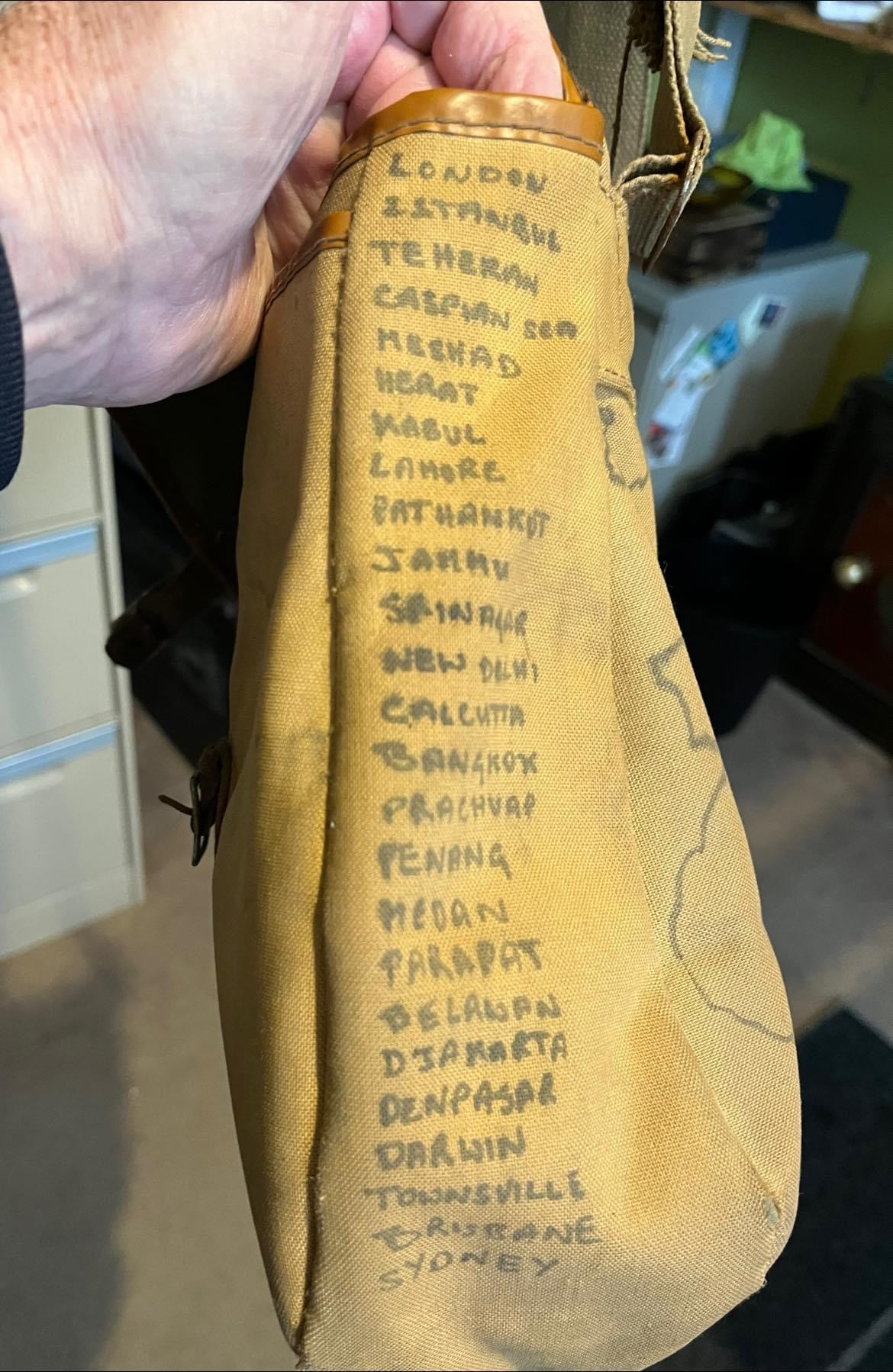
    I slept that night on the outskirts of Amman and continued on to Ma’an, the jump-off point for the village of Wadi Musa and Petra. Onwards then to Aqaba where, having paddled in the sea and walked about the town, I headed back straightaway the way I’d come, to Ma’an, Amman, Dera’a and Damascus – from whence I took the fabled Nairn Bus across the desert to Baghdad. From there, I traveled by bus through Iran, Afghanistan, and Pakistan, and finally, by train, to Delhi and journey’s end, Kolkata, in the midst of a cholera epidemic and a refugee crisis that was a prelude to the Indo-Pakistan war that led to the birth of Bangladesh.

                                                          By the rivers of Babylon, August 1971
                                                                  Agra September 1971
                                                                     Srinegar, October 1971
                                                                               Petra 1973

    If you never go, you’ll never grow 

    With that, I’ll conclude these travellers’ tales, observing in the present how in all my journeying, I never came to harm, whether by accident, misadventure or malignancy.

    As noted in opening paragraphs, there was the “combination of thrift, expedience, and necessity, but also, a sense of romantic adventure – buoyed by what seems in retrospect, a naive sense of invulnerability” .

    Back in the day, hitchhiking in Britain and on the continent was taken for granted and hitchers were commonplace, even if the practice was frowned upon by the straighteners and the fearful. In the Levant, it was a rare thing. Passers-by would often ask what I was doing, and why I traveled thus. Saving money, I’d reply, I was on a budget and had a long way to go – which was indeed the case in the days when credit cards had yet to be invented and the cash and travellers’ cheques in your body belt were all you had to get your thousands of miles. But you come from a rich country, they’d say, adding that there were cheap service-taxis and buses, and that it was dangerous and there were men out there who would rob you or do you harm. Yes, but I have a long way to go. A policeman in Jerash in northern Jordan served me Arab tea and cakes and sat me down on a bench outside the police station whilst he flagged down a driver he considered to be a decent man.

    Like those Israelis hitching between towns and villages in Israel and between settlements in the Occupied Territories, we who traveled the world before jumbo jets and cruise ships understood that bad things could happen and that they sometimes did whether you journeyed by thumb, van, bus or train. In hotels and hostels from Beirut to Baghdad, Kabul to Kolkata, you’d pick up word-of-mouth “travel advisories”, warnings and “war stories”. In India, I’d been told of a chap who’d been robbed and stranded in Afghanistan, and I actually met him when I bunked down in Sultanahmet, Istanbul, on my way back to Britain.

    So yes, there always was a risk; but if you think too much about it, you’d never go, and if you never go, you’ll never grow.

    © Paul Hemphill 2021. All rights reserved.

    Also in In That Howling Infinite, read: Tanks for the memory – how Brezhnev changed my lifeBack in the Day ; and A Window on a Gone World


    Hitching in the West Bank

    Continue reading

    Facing the music – no partying in Palestine

    It’s a crash course for the ravers – it’s a drive-in Saturday!  David Bowie

    Apparently, it’s party time in Dubai as the potentially impecunious emirate lowers its COVID19 guard and stands down its morality mukhabarat to lure champagne Charlies and Charlottes from plague infested England and its new-found Israeli tourists to raucous hootenannies in the casbah. Pandemic restrictions be damned! We’ll vaccinate the lot – well, most of them. The occidental groovers and grifters will get their shots before the lowly South and South East Asians who constitute the majority of the Emirates’ expatriate workforce.

    Business is business, and why not? In our democracies, it is our right to hire a DJ, bring in the booze and throw a party, inviting all our friends and neighbours. We’re even willing to defy lockdowns and social distancing and risk hefty fines to assert our right, nay, need to be crowdy and rowdy.

    Young folk in less liberated and licentious lands should be so lucky. As the story we publish below by Israeli-Arab writer and Haaretz editor Rajaa Natour illustrates, identity politics, cancel culture, and the right to take offence are not the exclusive preserve of the so-called “woke” leftists of the west and their particularistic adversaries on the right. When nationalism, secularism, religiosity, and identity collide the door is wide open for intolerance, misogyny and  ignorance.

    When travelling through the Middle East and studying Arabic, there are two words that you learn quicksmart: mamnu’ and muharam, ممنوع و محرم. They both mean forbidden, prohibited, “don’t do it!”. The first is the voice of secular authority enforced by police, soldiers and officials; and the second is a religious edict determined by spiritual leaders and enforced by social custom and quite often, self-appointed vigilantes. Islam as a faith observes no separation between the divine and the secular in human affairs, and in Muslim societies, the dividing line is sometimes slim to nonexistent, the one reinforcing the other – with unfortunate consequences for perceived transgressors, as Palestinian musician Sama Abdelhadi found out when she organised a dance party in a remote location, and incurred the wrath of the straighteners, the patriarchy, and, so these would declare, the Almighty.

    A crash course for the ravers

    A video clip of a dance party hosted by a celebrated female DJ at a what is reputed to be a holy site quickly goes viral on social media, infuriating many Palestinians who claim that the party-goers are debasing and desecrating the sanctity of the shrine, of Word gets out in real-time and the party is gate-crashed by a posse of young Palestinian men who violently expel the revelers. Arrested by the security forces of the Palestinian Authority, the DJ  is at first accused of desecrating a holy site, later with violating COVID19 regulations, and is remanded in custody for 15 days.

    Natour writes: “When a prophet who is the earthly apostle of the divinity, religious taboos, and a misguided Muslim Palestinian crowd join hands, it’s a lost cause, becoming a Gordian knot. A desecration of a location is directly linked to a desecration of the divinity and, accordingly, as is always the case, the defilement and disgracing of the divine requires punitive measures. And so the second act begins as the wounded Palestinian-Muslim masculinity delivers its punishment. God and his defenders will not rest until blood is shed. This time it was the blood, or more precisely the freedom, of Sama Abdulhadi … But (the) arguments are fatuous. There is no link, historical or religious, between Nebi Musa and the defiled location – its desecration and the violation of the sensibilities of many Muslims, are all imaginary. The intent is to turn an  imaginary violation into something real, and a tool in the service of political-religious interests.

    The Nebi Musa shrine, by the way, is named for the Prophet Moses – old Moshe is holy to all three Peoples of the Book – and he is reputed to be buried there. The biblical record – which was later borrowed by Christianity and by Islam is clear that Moses did not enter the Promised Land, but rather, expired on a high place overlooking Canaan on the Jordanian side of the Dead Sea – the town adjacent to the archaeological icon of Petra is called Wadi Musa, ‘the valley of Moses’.

    Palestinian political leaders (male) cooperate with the demand to issue a moral-religious condemnation of secularism in principle and particularly secular culture. The Palestinian Authority has even suggested a commission of inquiry – a roundabout way of kicking the can up the road. But what bothers the public, it would seem, is not the cultural gap between techno music and Palestinian culture, but rather, it neglects the Palestinian narrative and is therefore not legitimate.

    Then Israeli Arab politicians (male) get involved, presenting the violent expulsion of the revelers from the Nebi Musa compound as a national act of heroism, turning the violence and the disqualification of cultural events that have taken over internal Palestinian discourse into a political issue, an oppositional and subversive one.  Palestinian secularism is framed as an enemy of Palestinian nationalism that must be silenced.

    Then another change occurred in the Palestinian political-cultural discourse. Palestinian secularism, already labeled as inimical to Palestinian nationalism, became an agent of other agendas, in this case, the occupation. This wasn’t merely a struggle between secularism and religiosity, it was the disqualification of secularism as a political alternative before it became a cultural alternative. It was therefore necessary to portray it as a betrayal, to kill it so that religion could grow on its ruins.

    Natour concludes: “The people who broke into the party at Nebi Musa represent the same masses who objectify and harass women, who persecute and mock the Palestinian LGBT community, who legitimize the murder of women. These are the masses who will soon burst in, wielding clubs, into the Qasr al-Thaqafa cultural center in Ramallah, without needing to resort to any religious pretext any more”.

    Sama Abdulhadi (Lionel Bonaventure/AFP)

    The Left’s Palestinian paradox

    It is one of the great paradoxes confronting the Palestinians’ western, predominantly left-wing sympathizers. Whether these are advocating one-state or two-state solutions, they declaim that their preferred model, whatever or whenever this comes into being, will be democratic, pluralistic and if not entirely secular, then at least, tolerant, egalitarian and non-discriminatory, respecting human rights and social justice. This, alas, is wishful thinking.

    Residents of the Israeli occupied territories and of Gaza are divided on the character and complexion of their hypothetical Palestinian nation state. A majority are long accustomed to authoritarian leaders, the traditional zaim (boss or strongman), and cleave to their Islamic faith, family and clan loyalties, and their conservative social structures and strictures. This is reflected in the ideological schisms between the secularist and radical elements of the Palestinian national movement and its more religious and indeed fundamentalist adversaries. And it would appear that among Palestine’s opportunistic, unelected, often corrupt and predominantly male political elite, nationalism has donned Islamic garb.

    It was not always thus. Once upon a not too distant time, the national movement was predominantly secular. Western-style intellectuals and leftist groups played a preeminent role (as it was with most Arab nationalists back in the day, with Christians playing an influential part). Political discourse was premised on the idea that the conflict with Israel and Zionism revolved about territory, human and political rights and “the return” of refugees to their former homes and lands. The goal of the national struggle was to replace the “Zionist regime” with a democratic, secular state where Jews, Christians and Muslims could coexist in peace, or failing this, with the militarily powerful State of Israel unprepared to dissolve itself, a Palestinian State within the borders of the former Jordanian West Bank and onetime Egyptian ruled Gaza.

    But the ascendancy of Islamist movements Hamas and Islamic Jihad and their I found on the Palestinian “street” transformed the debate, and the vision of a democratic and secular Palestine is challenged by calls to expel all Jews (the settlers, hundreds of thousands of them, and the IDF) and to establish a state based, ideally, on Shariah Law. And this appeals to an increasingly dispirited, disenfranchised, impoverished, conservative and religious Palestinian street.

    Whilst the national movement increasingly abandons its former left-wing, democratic and secular ideals, there is nevertheless sustained broad support for the Palestinian cause among the western left – a broad constituency of mainstream socialists and social democrats, and also the acolytes, partisans and naïfs of the movement for Boycott, Divestment and Sanctions. Many on the left now tolerate developments in the West Bank and Gaza that are at odds with the liberal, enlightened world-view they ostensibly champion, including free elections, freedom of speech and association, religious freedom, human rights, gender equality, and LGBTQ rights.

    There has been muted criticism of the actions and rhetoric of the Palestinian Authority and Hamas, and what could be interpreted as tacit support for their corrupt, incompetent and authoritarian rule. The rationale is that if it wasn’t for the occupation, things would be democratically and economically hunky-dory; and there is a tendency to blame only Israel when violence erupts whilst ignoring the dynamics at play in Palestinian domestic politics and the internecine conflicts that dominate them (again, if it wasn’t for the occupation etc.)

    © Paul Hemphill 2021.  All rights reserved


    For more on Palestine in In That Howling Infinite, see Visualizing the Palestinian Return – the art of Ismail Shammout; Children of Abraham; Ahed Tamimi – A Family Affair; Castles made of sandand O Little Town of Bethlehem, how still we see thee lie…On the Middle East generally, see: A Middle East Miscellany.

    And so to the full story …

    For Palestinians, only God is a DJ

    Rajaa Natour  Haaretz , Jan 21, 2021 11:10 AM

    The arrest of Palestinian DJ Sama Abdulhadi after she played a set at the Nabi Musa complex wasn’t merely a struggle between secularism and religiosity

    Again and again the voices rose, decisive, mechanical, brutal, leaving no room or time for bewilderment: “Get out! Everybody, out, now.” Amid the shrieks, one young voice, angry and bellicose, stood out: “Get out or I’ll blow up the world.” The organizers countered the threats with a limp, apologetic response and stopped the party on the spot.

    The shouters weren’t Trumpists invading Capitol Hillin Washington. They were ten young Palestinians from Jerusalem who violently broke up a party that took place on December 26 in the Nabi Musa complex.

    The complex features a mosque and other buildings too and is located in the Judean Desert, south of Jericho and east of Jerusalem. These hotheads went there after one of the revelers posted young Palestinian men and women dancing, drinking and smoking on Instagram.

     Nabi Musa shrine, the West Bank Dec 2020. Ammar Awad Reuters

    In the first act, a video clip was disseminated on social media, quickly going viral and infuriating many Palestinians, who claimed that the party-goers were debasing and desecrating the sanctity of the locale. Obviously, when a prophet who is the earthly apostle of the divinity, religious taboos, and a misguided Muslim Palestinian crowd join hands, it’s a lost cause, becoming a Gordian knot. A desecration of a location is directly linked to a desecration of the divinity and, accordingly, as is always the case, the defilement and disgracing of the divine requires punitive measures.

    This is where the second act begins, in which the wounded Palestinian-Muslim masculinity delivers its punishment. God and his defenders will not rest until blood is shed. This time it was the blood, or more precisely the freedom, of Sama Abdulhadi, a popular 29-year-old Palestinian DJ who was mixing the music. She was arrested by the security forces of the Palestinian Authority, at first accused of desecrating a holy site, later with violating Palestinian Health Ministry regulations. She was then remanded in custody for 15 days.

    Abdulhadi was born and raised in Ramallah. Her musical trajectory began with the studying of musical production in Jordan. At the same time, in 2006, she started recording music, mainly light dance-pop. Towards 2008 she discovered the wonders of techno, and the genre became the focus of her musical work. The result was two techno albums, which she released under the label Skywalker. In 2011, she was accepted to the acclaimed SAE Institute sound academy in London and became a sound technician.

    Abdulhadi was born and raised in Ramallah. Her musical trajectory began with the studying of musical production in Jordan. At the same time, in 2006, she started recording music, mainly light dance-pop. Towards 2008 she discovered the wonders of techno, and the genre became the focus of her musical work. The result was two techno albums, which she released under the label Skywalker. In 2011, she was accepted to the acclaimed SAE Institute sound academy in London and became a sound technician.


    Abdulhadi has lived in a number of cities around the world and has performed at highly-acclaimed clubs in Europe, at festivals, and on the largest and most popular online techno music broadcasting platform of them all, Boiler Room. According to Abdulhadi, the party at Nebi Musa was part of a project designed to promote local tourism through techno music.

    Nothing helped Abdulhadi, not being a Palestinian woman committed to her people’s struggle against the occupation, not her cultural contribution to the global techno scene, nor even her argument, backed by documents, that she had the approval of the Palestinian Tourism Ministry. The latter retreated after the Palestinian Ministry of Religious Affairs condemned the party, supported by widespread public pressure, and ultimately denied that it had approved the event.

    The story didn’t end there. It was kept alive, mainly by male Palestinian leaders, who also capitulated and cooperated in turn with the demand to issue a moral-religious condemnation, which was primarily a castigation of secularism in principle, particularly secular culture as embodied in techno music.

    One interesting argument used against Abdulhadi was that her techno music is not part of Palestinian heritage. But what bothered the public was not the cultural gap between this music and Palestinian culture, but the gap in narratives: this music doesn’t tell the familiar Palestinian narrative, therefore it is not legitimate.

    Many Palestinian public figures condemned and denounced her actions. Among these were the Ministry of Tourism spokesman, Jarees Qumsiyeh, Hamas spokesman Abdul Latif Qanua, Jericho Governor Jihad Abu al-Asal, and others. Yet others did not make do with mere condemnation. Palestinian Prime Minister Mohammad Shtayyeh promised to punish those responsible and immediately established a commission of inquiry. Many people were angry, condemning the event and demanding retribution, but their arguments focused on religious aspects.

    But these arguments are fatuous, as there is no link, historical or religious, between Nebi Musa (i.e. Moses) and this location. Thus, the defiled location, the desecration that occurred and the violation of the sensibilities of many Muslims, are all imaginary. The intent was to turn this imaginary violation into something real, making it a tool in the service of political-religious interests.

    And then came the third act, involving among others the Knesset member Ayman Odeh, leader of the Joint List. It was the most dangerous of the three acts in terms of politics and culture. Odeh and others presented the violent expulsion of the revelers from the Nebi Musa compound as a national act of heroism. They turned the violence and the disqualification of cultural events that have taken over internal Palestinian discourse into a political issue, an oppositional and subversive one. Moreover, they presented Palestinian secularism in all its aspects as an enemy of Palestinian nationalism, thus making it imperative to silence it. Regrettably, this discourse has taken wing on social media.

    And then yet another change occurred in the Palestinian political-cultural discourse. Palestinian secularism, already labeled as inimical to Palestinian nationalism, became an agent of other agendas, in this case, the occupation. This wasn’t merely a struggle between secularism and religiosity, it was the disqualification of secularism as a political alternative before it became a cultural alternative. It was therefore necessary to portray it as a betrayal, to kill it so that religion could grow on its ruins. The people who broke into the party at Nebi Musa represent the same masses who objectify and harass women, who persecute and mock the Palestinian LGBT community, who legitimize the murder of women. These are the masses who will soon burst in, wielding clubs, into the Qasr al-Thaqafa cultural center in Ramallah, without needing to resort to any religious pretext any more.


    That was the year that was – a year of living dangerously

    Last December, when we wrote our review of the year that was ending, fires were ravaging Eastern Australia, and civil unrest had broken out across the world, from Hong to Chile, Beirut to Bolivia. Calling it The End of the Beginning, we wrote:

    “We enter a new decade with an American election that will focus our attention; Britain’s long farewell to Europe; an end, maybe, to Syria’s agony (accompanied by renewed repression and victor’s revenge); the rise and rise of China and the geopolitical challenge it presents to the senescent “Old World”. And that is just a few things we have to look forward to”.

    As they say, “be careful what you wish for”, or more prosaically, when men make plans, god laughs.

    This was a year unlike any other in my, dare I say it and invite the evil eye, long lifetime. It started so well with the abatement of our smoky, fiery Black Summer, and then the rains came. This was the year optimists hoped would be one of 20/20 vision: progress on tackling climate change, perhaps, and end to the entertaining but scary presidency of Donald Trump, a cure for … well everything.

    But it was to be the year of the virus. By year’s end nearly eight million people will have been infected and almost two million will have perished, with the US recording more than any other country – by New Years Day, its death-toll will very likely exceed its dead in World War II. Economies have been shattered, livelihoods threatened or destroyed, borders closed, cities, towns and homes closed, locked-down and isolated.

    In its turbulent and divisive election year, the death of George Floyd at the hands of – or more specifically under the knee of a policeman, painted a brutal portrait of the implacable indifference to black life that defines American policing. It reopened America’s long-festering wounds of racial and social injustice, white racism and vigilante violence. Rather than douse the flames with water and retardant, The White House reached for a can of petrol. The Black Lives Matter Movement, like #MeToo in recent years, an incendiary spark ignited protests around the world, showing that police violence, injustice and inequality do not belong to the USA alone.

    Armed protesters on the steps of the Michigan State Capitol in Lansing, demanding the reopening of businesses

    Whilst most of the world had entered into a kind of limbo, awaiting the vaccine that will end our travails and reopen our countries and indeed, the wide world, others dropped down the rabbit hole of conspiracy theories that alternatively deny that the pandemic exists or that it had been deliberately created and spread by mysterious and malevolent cabal that seeks total control, like some villain from an old James Bond film or an Avengers movie. Social media has enabled a veritable eBay of ideas and explanations where the isolated and excluded who do their own research and follow the breadcrumbs into the Matrix can buy one and get four free.

    On a saner but nonetheless destabilizing level, denizens of the so-called “cancel culture” had a field day exercising its democratic right to be easily offended by demanding the deplatforming, defenestration and demolition of persons, ideas, careers, and monuments. Long-dead slavers, imperialists and generals bit the dust; JK Rowling and Nick Cave got a serve, the latter for devaluing that “cancel culture’s refusal to engage with uncomfortable ideas has an asphyxiating effect on the creative soul of a society”; and an episode of Fawlty Towers was temporarily committed to the naughty corner. 

    In the cold-blooded, brutal real world, there was no abatement in the wars and insurgencies that have been grinding on years now in Africa and the Middle East, whilst an old conflict over blood and soil broke out anew between Armenians and Azerbaijanis. Donald Trump’s much touted “deal of the century” that would reconcile Israelis and Palestinians was revealed to be no more than a shifty and shitty bribe, whilst US-brokered “peace” deals with a bunch of autocracies who had never gone to war against Israel are but smoke and mirrors that like Kushner’s Peace to Prosperity plan throw the unfortunate Palestinians under the bus. It is as if there is, beyond the planets COVID, Conspiracy and Cancel, a parallel universe of misery and carnage, power games and proxy wars.

    Meanwhile, China, or more precisely, the Chinese Communist Party, having let loose the virus, has taken advantage of the world’s distraction and confusion by pressing forward in its quest its political, military and economic predominance. Uighurs, Mongolians and Tibetans face cultural extinction whilst in Hong Kong, the flame of freedom flickered and went out. Sooner or later, something is going to give – what some pundits perceive as President Xi’s impatient recklessness will be followed by a reckoning.

    Michelle Griffin, World Editor with the Sydney Morning Herald provides a brief but excellent run down of 2020: The 2020 Pandemic – our year of living dangerously. And on 2020 as the year of “cancel culture”, the reflex response of the easily offended, here is 2020, the year we finally broke our culture. Both are well worth a read.

    Time during 2020 has been elastic and confused. On 21st December, The Guardian asked readers to sum up how they felt about 2020 in one word – and likewise their feelings for 2021. As of Xmas Eve, the standout words were respectively (a) shit, fucked and challenging and (b) hopeful and better. My poll responses were “fascinating” and “unpredictable”.

    The year ahead?

    Our year in review

    And so to our review of what In That Howling Infinite published during the plague year. Curiously, deliberately or by mere circumstances, nothing about the plague.

    The year began with the fires and smoke abating here on our Mid North Coast, though raging still in southern New South Wales and eastern Victoria. Inspired by an early Cat Stevens song, we opened with a light, nostalgic history of the first the schools of the Tarkeeth, where we live.

    Before we knew it, Australian Day was upon us. Normally, the weeks preceding our national day see social and mainstream media, posturing politicians and personalities and cultural warriors of all our tribes caught up in argument and invective about its meaning and significance. This year, however, things are unseasonably quiet. As a nation and a community, we were perhaps too preoccupied with Australia’s unprecedented bush-fire crisis to wage our customary wars of words. Elizabeth Farrelly asked what it means to be Australian: “As the fires rage on, bringing little but anti-green and pro-coal propaganda from our governments, we have a choice. We can go on pretending that exploitation is a sustainable way of life. We can pursue this culture of denial, where truths about nature, climate, women and Indigenous peoples are held in contempt. Or we can smarten up” … It was Australia’s choice – survive by respect or die by stupid.

    February saw the first of several cynical and futile attempts by the international community to resolve the morass of the Libyan civil war. In Tangled – a cynic’s guide to alliances in the Middle East, we pointed out that Libya was not the only quagmire of outside powers and their local proxies. Then there the Trump administration’s “deal of the century”. Intended to end half a century of conflict between Israel and Palestine, it was the beginning, dead in the water: Clouded Vision – no peace, no plan, no Palestine, no point.

    The unfortunate Palestinians were viewed more sympathetically in a retrospective of the life and work of one of Palestine’s most celebrated artists: Visualizing the Palestinian Return – The art of Ismail Shammout.

    The ominous drumbeats of the novel coronavirus we now know as COVID19 drew close and closer during January and February, and by mid March, it was all on for young and old. A tiny but loud minority protested that all a cod. It was to misapply Bob Dylan, “just a dream, babe, a vacuum, a scheme babe that sucks you into feeling like this”.  With enough being written about the pandemic on mainstream and social media, we took the pasty now very well traveled with The view from the grassy knoll – the resilience of conspiracy theories.

    The onward March of the “Conspiratualists” merged by midyear with anti-lockdown protests in otherwise rational western democracies, the violence on America’s streets following the death of George Floyd, and the anticipation of open war between rival militia in the Land of the fearful – home of the heavily armed. As the US descended into a social and political division as contagious as the coronavirus, the calls to right historical wrongs led to the demands that statues of morally dubious long-dead white be torn down led to Arguments of a Monumental Proportions.

    It was time for In That Howling Infinite to retreat into history, with The Bard in the Badlands 2 – America’s Shakespearean dreaming, a sequel to an earlier piece on America’s historical fascination with William Shakespeare. The lockdowns and self-isolation of the pandemic’s first wave saw people going out less, homeschooling, drinking more (and sadly, in many instances, beating each other up more. But many of us were also avidly FaceBooking, Tweeting and Zooming; and also binge-watching Netflix and Scandi-noir and reading large books.

    In Bad Company – how Britain conquered India, we reviewed The Anarchy, the latest in a long list of excellent histories of the sub-continent by Scottish scholar and longtime resident of India, William Dalrymple – the daunting and depressing story of the rise and fall of the British East India Company, a quasi-military industrial complex that earned the misleading sobriquet The Honourable Company.

    Flashman in the Great Game

    Just in time for the lock-down, Hilary Mantel gave us the finale of her magisterial and magnificent Wolf Hall trilogy – The Light and the Mirror. In That Howling Infinite took up two themes that threaded through all three books. We know how the story ends, but are fascinated with how Mantel takes us there. Taking as it theme the golden bird-boy flying too close to the sun, Beyond Wolf Hall (2) – Icarus ascending asks the question “could Thomas Cromwell have avoided his doom?” Beyond Wolf Hall (1) – Revolution Road reviews Cromwell’s legacy, the Protestant Reformation that changed the course of English (and British) history.

    Mark Rylance and Damian Lewis as Tom and Hal

    Fast forward from the life and dangerous times of Henry VIII to the present, and Netflix’ release in November of the third season of The Crown, a sumptuous soap that beguiles even ardent republicans. The latest serve, highlighting the rise and fall of Margaret Thatcher and the salacious pas de trois of Charles, Diana and Camilla, is deliciously seditious. And there was an entertaining Australian interlude, as described in The Crown – the view from Down Under  even if it was actually filmed in Spain.

    In August 2020, the largest man-made explosion since Hiroshima and Nagasaki rippled the heart out of Lebanon’s capital. Over two thousand tons of illegal, combustible, unstable, and almost forgotten ammonium nitrate went up in a fireball that resembled an atomic blast. Social media shared memes and messages, hearts and flags, and “we are all Lebanese” profiles. Expatriates and others wrote and spoke about the country’s present turmoil and fears of a return to the bad old days. Many shared  videos of songs by Lebanon’s national cultural icon, Fairuz – most particularly, her poignant Li Beirut, which she wrote during the civil war as a tribute to the city’s timeless beauty and the suffering of its people people. O Beirut – songs for a wounded city presents Fairuz’ songs, and also Syrian poet Nizar Qabbani’s famous O Beirut, Mistress of the World, and Khalil Gibran’s iconic Pity the Nation.

    And finally, as this strangest of years was ending, we published a frolic that has been several years a’making. A cowboy key – how the west was sung takes us on a leisurely jaunt through some of those grand old songs, films and musicals that have shaped our more pleasant perceptions of America.

    Happy New Year.

    Our reviews of previous years: 2019, 201820172016; 2015

    Androids Dolores and Teddy enjoy the Westworld view

    Visualizing the Palestinian Return – the art of Ismail Shammout

    The Key and the Return – Palestine as a metaphor

    And who will live in the house after us, my father?
    The house, my son, will remain as it was!
    Why did you leave the horse alone?
    To keep the house company, my son.
    When their residents go, the houses will die.
    Together we will hold on
    until we return.
    When, my father?
    Tomorrow, my son, and perhaps in another day or two!
    That tomorrow trailed behind them, chewing the wind
    in the endless winter nights.
    Mahmoud Darwish

    Palestinian poet Mahmoud Darwish saw Palestine as a homeland but also as a metaphor –  for the loss of Eden, for the sorrows of dispossession and and of exile, for the diminishing power of the Arab world in its relationship with the west (Mahmoud Darwish, Palestine as Metaphor). Arab-Israeli commentator Raja Natoor wrote in Haaretz that Darwish “wrote, faithfully communicated and defended the undisputed Palestinian narrative – the linguistic realm that dealt with the homeland and its loss, with displacement and being a refugee. It shaped the awareness and work of many Palestinians, which turned the poet, knowingly or not, into the Palestinian narrative itself and even into the Palestine lost” (June 28, 2020). Blogger Samah Sulaimi wrote a few days later in a reply to Natour: “In the eyes of most of the Palestinian people, Darwish was able to bring the Palestinian narrative into every home where an olive-wood map of Palestine hangs in the living room, on which the following words are engraved in Arabic: على هذه الارض ما يستحق الحياة – “We have on this land all of that which makes life worth living” (8 July 2020).

    Palestinian Australian author and academic Nejmeh Khalil-Habib – and my Arabic teacher for many semesters at the University of Sydney – published a paper in Nebula magazine in 2008 examining how the “Return”  – al ‘awda العودة – a recurring theme in contemporary Arabic literature – has been dealt with in Arabic fiction, and how it depicted those who live the dream of “Return” and those who actually returned to Palestine after the 1967 war or after the Oslo Accords.

    She writes: “The concept of “Return” throughout this literature manifests itself in various ways including the spiritual return (as manifested in dreams and aspirations); the literal, physical return; an individual’s return (a “Return” on the basis of family reunions); the “Return” as a result of the occupation of Gaza and the West Bank after the war of 1967; and the “Return” as a result of the peace process after the “Oslo Accords.”

    Al Muftah, المفتاح, the key is an enduring symbol of al ‘awda. It is present in street art and in signs and posters throughout Palestine and in the refugee camps. It is a symbol, of a memory, of one day returning – to lost homes, villages, suburbs, towns, lives and livelihoods. As Nejmeh writes,“The Return” (Al-Awda) is deeply implanted in the Palestinian collective memory. It is rooted in their conscience like a faith that could not be denied, because denying it would mean uprooting the lynchpin upon which modern Palestinian history and identity depends”.

    Al Mufta مفتاح

    But for many, it is something more than that. Nejmeh writes: “Whether exile happens voluntarily or under oppressive circumstances, the dream of returning home stays alive in the mind of the exiled person. It flares or fades from person to person and from one circumstance to another; however, the concept of “return” ceases to be about its basic meaning, but comes to be seen as a means of resistance and challenging oppression”.

    She notes American-Palestinian author and activist Fawaz Turky assertion that “the right and dream of Return is the rock upon which our nation was established and the social balance that unites the nation in this wretched world”.

    It is the dream, the hope that enabled tens of thousands of refugees in camps throughout the Levant to perceive their situation as temporary and to resist the allure of assimilation and mainstreaming in their host countries – if this was indeed possible given that most hosts have steadfastly resisted granting Palestinians rights and privileges enjoyed by their own citizens. Whilst being much of the diaspora in the West has accepted inclusion and naturalization, these Palestinians connect with their people and their culture in Palestine, and still celebrate their national holidays.

    Between seven and eight hundred thousand Palestinians fled their homes in present day Israel or were expelled during the 1948 war (a similar number of Jews were expelled from Arab countries after 1948). Many remained in Israel either in their original homes or where they sought refuge. They became Israeli citizens, but even for these, the memories endure and many continue to refer to the towns and villages and localities by the names they had prior to the establishment of the state of Israel.

    And yet, al ‘awda, and the Right of Return is a chimera, a dream dangled before their eyes by their leaders like a hypnotist’s show. And UN refugee status, a tired old delusion perpetuated by UNRWA to justify its existence and well-paid salaries, and the Arab League as a fig leaf for their pulsanimity. UNWRA’s definition and establishment was at fault from day one, and whilst creating generational refugeedom, it engendered false hope, unrealisable dreams, and a road-block to subsequent peace efforts  There is indeed a whole economy, a living, a lifestyle devoted to and dependent on managing the conflict and the refugee problem rather than solving it. The exile was unreasonable and unjust, but the past will never be undone – and most certainly never by UN resolutions.

    UNRWA is the only agency dedicated to helping refugees from a specific region or conflict and is separate from the UNHCR, the main UN refugee agency, which is responsible for aiding other refugees all over the world. Unlike UNRWA, UNHCR has a specific mandate to aid its refugees to eliminate their refugee status by local integration in current country, resettlement in a third country or repatriation when possible. It focuses on resettlement and rehabilitation of refugees and building new lives, not maintaining services that prop up a six-decade-long status quo. UNRWA , uniquely, allows refugee status to be inherited by descendants.

    Palestinians were not helped by the original establishment of UNRWA which created a special, indeed, unique category of refugee where by heirs and successors are entitled to the aid and benefits normally given only to the dispossessed generation. Normally, the original refugees and their children have either returned to their homelands or have been resettled in another country within one generation. Hence, for better or for worse, Vietnamese, African, Burmese, and even Afghan, Syrian and Iraqi refugees leave the UNHCR’s care in the short to medium term.

    But generations of Palestinians are locked into their special jail of statelessness by the duplicity and discrimination of their Arab “brethren” and by their inherited culture of victimhood and dependence. It is a vicious circle which gives all (dis)interested parties an excuse to do nothing but bloviate, and posture, and propose unrealistic resolutions. 

    The key, therefore, is a forlorn hope, a closed door that no amount of keys can unlock; and the reality is that of a lock-out, out of politics, out of society, out of the jobs and housing market. The refugees are a minority in Palestine. There are no keys for the new houses and apartments that are going up in and around the cities of the West Bank in a property boom that has been going on for several years now and accessible and affordable only for a growing middle class of employees of the PA and foreign NGOs and young professionals.

    But for refugees, all this is paradox. They are locked out of the old Palestine of their parents and grandparent and forebears. But they are also locked out the new Palestine that is struggling to be born.

    Poets like Darwish and novelists have internalized and reflected al Nakba and al ‘awda in their work. The dream of al ‘awda is reflected in their writing. As it is also done with graphic artists – none as powerfully and poignantly as the late Palestinian artist Ismail Shammout, born in Lydia, Palestine in 1930. When last In Ramallah, de facto administrative “capital” of that part of the West Bank government by the  Palestinian Authority – Area A Continue reading

    Tangled! – a cynic’s guide to alliances in the Middle East

    The paradox of piety observes no disconnect
    Nor registers anxiety
    As the ship of fools is wrecked
    So leaders urge with eloquence
    And martyrs die in consequence
    We talk in last and present sense
    As greed and fear persist
    E Lucevan Le Stelle, Paul Hemphill

    At a recent conference in Berlin, Germany’s prime minister Angela Merkel and and UN Special Representative Ghassan Salamé managed, at least on paper, to cajole the external actors guilty of super-charging Libya’s misery to sign onto a unified agenda. Russia’s Vladimir Putin, Turkey’s Recep Tayyip Erdoğan, France’s Emmanuel Macron, Britain’s Boris Johnson, and Egypt’s pharaoh (and Donald Trump’s “favourite dictator”) Abdel Fatah el-Sisi,  joined a dozen or so others (with Secretary of State Mike Pompeo representing the United States) in declaring an intention to end foreign interference in Libya’s internal affairs: “We commit to refraining from interference in the armed conflict or in the internal affairs of Libya and urge all international actors to do the same,” states the communiqué, in language one hopes all participants endorsed in (what would be uncharacteristic, for some) good faith.

    This corroboree of hypocrites acknowledged that the increasingly violent and globally tangled Libyan civil war could only be ended if outside powers backed off and ended their meddling. They made altruistic and totally disingenuous declarations about a conflict  that they themselves have incited, exacerbated and perpetuated for nine years. And yet, explicitly excluded Libyan participation, contradicting the 2012 UN Guidance for Effective Mediation and its insistence on “inclusivity” and “national ownership” as fundamental elements for peaceful conflict resolution. It’s focus at this point was on the on the external, rather than the Libyan, actors and for reviving the world’s attention on the Libyan conflict.

    A follow-up conference in Munich was convened in mid-February to renew its pledges to quit meddling. Stephanie Williams, the UN deputy special envoy for Libya reported zero progress and declared the agreed-upon arms embargo to be a joke. A sick joke, indeed – plane after plane land in Benghazi loaded with weapons from the UAE and other arms-suppliers destined for self-anointed warlord Khalifa Haftar‘s self-styled Libyan National Army.

    Unfortunate Libya is neither the first nor the last pawn to be used and abused by outsiders in the new Great Game as the following guide demonstrates.

    But first, there’s this letter to a British daily from Aubrey Bailey of Fleet, Hampshire (where hurricanes hardly happen):

    Are you confused by what is going on in the Middle East? Let me explain.

    We (she’s talking if Britain and us generic “good guys”) support the Iraqi government in the fight against Islamic State. We don’t like IS but IS is supported by Saudi Arabia, whom we do like. We don’t like President Assad in Syria. We support the fight against him, but not IS, which is also fighting against him. We don’t like Iran, but Iran supports the Iraqi government against IS.

    So, some of our friends support our enemies and some of our enemies are our friends, and some of our enemies are fighting against our other enemies, whom we want to lose, but we don’t want our enemies who are fighting our enemies to win. If the people we want to defeat are are defeated, they might be replaced by people we like even less. 

    And this was started by us invading a country to drive out terrorists who weren’t actually there until we went in to drive them out. Do you understand now? Clear as mud! 

    It casts new light on that thorny old aphorism “the enemy of my enemy is my friend”!

    A cynic’s guide to alliances in the Middle East

    Libya

    We begin with  Libya, the “beneficiary” of the Berlin talk-fests.

    On the side of the internationally recognized government in Tripoli, Libya’s capital there’s: Not many … Italy (former colonial oppressor, in it for the oil, who’d just love to see an end to those refugee boats that wash up on its shores); Turkey (former Ottoman oppressor now ruled by a wannabe Ottoman sultan Recep Tayyip Erdoğan, and eager for offshore oil and gas leases); and potentially, Qatar (who fell out with Egypt, Saudi and the United Arab Emirates over its tepid support for the Sunni grand alliance against Shia Iran).  Turkish soldiers fly the government’s drones whilst Turkey’s Syrian jihadi mercenaries provide military muscle – Turkey would like to move them out of Kurdish Syria on account of their murderous behavior).  

    On the side of the self-anointed warlord Khalifa Haftar, based in Benghazi in the east, whose sharp uniform is festooned in medals for this and that act of service and heroism), there’s: Egypt, (the US’ impecunious, brutal “partner in Freedom” – strange bedfellows in this amoral “new Middle East” that is just like the old Middle East); Saudi Arabia, and the UAE (see above, re. Qatar, whom they blockaded for several years); Jordan (perennially cash-strapped and dependent on rich Arab relatives), France and Russia (arms, oil, and influence); plus Russian mercenaries (plausibly deniable, capable and reliable, and familiar with the Middle East – see below); and Sudan’s murderous Janjaweed Arab militias (broke Sudan seeks Saudi favour).

    And on the sidelines, a disinterested and divided UN, the UK and the US – although Britain, with France, helped wreck the joint by ousting longtime dictator Gaddafi; arguably, the US, although Donald Trump has confused matters by phoning Haftar and then saying that he’s a great bloke (he has a thing for dictators actual and potential, including Putin, Erdogan, Al Sisi, and the thuggish Saudi crown Prince Mohammed bin Salman); and in the middle, and against all of the above, the ever-opportunistic and troublesome Da’ish and al Qa’ida.. 

    As American baseball wizz Yogi Berra once said, “It feels like déjà vu all over again”.

    Syria

    On the side of the internationally recognized government in Damascus headed up by Bashar al Assad, there’s: The Islamic Republic of Iran (Iran’s Shia Muslims are related to Syria’s heterodox Alawi minority, whose elite happen to have rule the country for half a century, and Iran is consolidating it’s Shia axis across the Middle East); Russia (oil, pipelines, and restoring Soviet greatness); Lebanese Shia Hezbollah (de facto ruler of Lebanon) and its soldiers; the Iranian Quds brigade (the expeditionary arm of the Revolutionary Guard, a military-industrial complex that virtually runs Iran); sundry Iraqi and Afghan Shia militias beholden to Iran for cash, weapons, training and ideology); Russian and Chechen mercenaries (see above – deniable, reliable and capable); and, quite surreptitiously, Turkey (former Ottoman oppressor) which is ostensibly opposed to Assad, but needing Russian pipeline deals, runs with the hares and hunts with the hounds – but see below, and also, above with respect to Libya. As the song goes, “I’m so dizzy, my head is turning” already! 

    On the side of “the other side”, which is not really a “side’ at all, but a grab bag of sundry rebels who were once supported by the US and are predominantly Islamist, with some indeed linked to al Qa’ida, which, of course, we all love to hate (Twin Towers, Osama bin Laden and all that), there’s: the US, Britain and France (why do they persevere so in what Donald Trump has called these forever, endless wars?); Saudi Arabia (Salafi Central and banker for all the bad guys) and the United Arab Emirates (also a financier for the foe); Israel (of course – mortal foe of Iran and of Hezbollah (“the enemy of my enemy” fair-weather friend – anything that distracts its perennial enemies is good for Israel); Hamas, the Islamists who rule the Palestinian enclave of Gaza, and oppose the Alawi oppressor of Sunni Muslims and of Palestinian refugees in Syria; and Turkey (see above –  hares and hounds, on the outer with Saudi and the UAE and pals with outcast Qatar, and engaged in an ongoing blood feud with Syrian Kurds ostensibly allied with Turkey’s outlawed separatist Kurds), and as we write, ominously trading blows with the Syrian Army and its Russian allies; and Turkey’s Syrian jihadi mercenaries – erstwhile former rebels and al Qa’ida and Da’ish fighters who are in it for the money, for vengeance against the Kurds and the Assad regime, and, for many, good old blood-lust. 

    And stuck in the middle: Those Syrian Kurds, of formerly autonomous Syrian enclaves Afrin and Rojava (betrayed by America, invaded by Turkey, and forever abandoned by the rest of the world, they have been forced to come to terms with the Assad regime which has discriminated against them forever; sundry Bedouin tribes who work to a code of patronage and payback; the scattered remnants of Da’ish which was at the height of its power a veritable “internationale” of fighters from all over the world, including Europeans, Australians, Chechens, Afghans, Uighurs, Indonesians and Filipinos – the remnants of whom are still in the field and hitting back; and sundry die-hard jihadis from constantly splintering factions. Da’ish and the jihadis have been dubiously aided and abetted by money and material from allegedly unknown patrons in the Gulf autocracies, as evidenced by those long convoys of spanking new Toyota Hi Lux “technicals” – which have now curiously reappeared in Haftar’s Libyan National Army (see Libya, above).

    Yemen 

    On the side of the internationally-recognized government of Yemen, there’s: Saudi Arabia, the US, and Britain; plus sundry mercenary outfits from Australia and Brazil; and Sudan (its militias paid by Saudi, as in Libya). The UAE was formerly on this side, but now supports a breakaway would-be Yemeni government Opposed to the present one. On the side of Houthis, a rebel Shia tribe in the north of the country, there’s: Iran and ostensibly its Iraqi and Lebanese auxiliaries – see above, the Shia ‘Arc” of Iranian influence. And in the middle, and against all of the above, the ever-opportunistic and troublesome Da’ish and al Qa’ida.

    Afghanistan

    Its America’s longest ever war – ours too …

    On the side of the UN recognized government there’s: NATO, including the US, Canada, Britain, Germany, Denmark and Norway; and also, Australia and New Zealand – though why antipodeans want to get involved in the faraway Afghan quagmire beats me … Oh yes, the US alliance, and our innate empathy for the poor and downtrodden.

    On the other side, there’s: The ever-patient, ever-resilient Taliban, aided and abetted by duplicitous Pakistan (an ally of the US – yes!), and al Qa’ida and Da’ish, both dubiously aided and abetted by money and material from Gulf despots. 

    And on the sidelines,  miscellaneous corrupt and well-armed Afghani warlords who take advantage of the ongoing turmoil and grow rich on bribes, option and smuggling; and the rest of the world, really, which has long ago zoned out of those “forever, endless wars”. 

    So, what now? 

    More of the same, alas. Great Power politics and proxy wars are taxing intellectual and actual imaginations. It is business as usual in the scattered killing grounds as a bewildering array of outsiders continue to wage their proxy wars in Syria, Libya and Yemen. Bombs still explode in Afghanistan and Somalia, and whilst Islamists terrorise the countries of the Sahel, and even distant Mozambique, warlords rape and pillage in Congo. As usual in these proxy conflicts the poor people are stuck in the middle being killed in their thousands courtesy of weapons supplied by the US, European, Israeli, Russian and Chinese arms industries.

    As outsiders butt each other for dominance, and the Masters of War ply their untrammelled trade, we are condemned, as Bob Dylan sang in another time and another war, to “sit back and watch as the death count gets higher’. I am reminded of WH Auden’s September 1, 1939, a contemplation on a world descending into an abyss: “Defenseless under the night, our word in stupor lies’. All is, as Kent lamented in King Lear, “cheerless, dark and deadly”.

     © Paul Hemphill 2020.  All rights reserved

    In That Howling Infinite, see also; A Middle East Miscellany

    A postscript  from Alice’s Adventures in Wonderland

    ‘What I was going to say,’ said the Dodo in an offended tone, ‘was, that the best thing to get us dry would be a Caucus–race.’

    ‘What IS a Caucus–race?’ said Alice; not that she wanted much to know, but the Dodo had paused as if it thought that SOMEBODY ought to speak, and no one else seemed inclined to say anything.

    ‘Why,’ said the Dodo, ‘the best way to explain it is to do it.’ (And, as you might like to try the thing yourself, some winter day, I will tell you how the Dodo managed it.)

    First it marked out a race–course, in a sort of circle, (‘the exact shape doesn’t matter,’ it said,) and then all the party were placed along the course, here and there. There was no ‘One, two, three, and away,’ but they began running when they liked, and left off when they liked, so that it was not easy to know when the race was over. However, when they had been running half an hour or so, and were quite dry again, the Dodo suddenly called out ‘The race is over!’ and they all crowded round it, panting, and asking, ‘But who has won?’ This question the Dodo could not answer without a great deal of thought, and it sat for a long time with one finger pressed upon its forehead (the position in which you usually see Shakespeare, in the pictures of him), while the rest waited in silence. At last the Dodo said, ‘EVERYBODY has won, and all must have prizes.’

    Clouded Vision – no peace, no plan, no Palestine, no point

    After months of waiting, President Trump finally unveiled his peace plan for Israel and Palestine on 28th January 2020, to the delight of Israeli prime minister Netanyahu, the disgust of the Palestinians, and the bemusement of many. Amid the sound and the fury, most commentators apparently missed the point – or willfully chose to to do so – that it is not a “plan” as such, but a “vision”. The word is used some sixty times in eighty six pages that contain the political and economic framework. The remaining eighty pages, with an executive summary and copious tables and charts, more resemble a business plan, complete with SWOT analysis, than an actual peace proposal.

    But a proposal is exactly what it is – not a plan per se, nor a diktat, as some have labelled it ; nor is it a mediation – as some have inaccurately described it. Rather, its authors claim, it is a basis for further negotiation – should anyone ever get around to talking together. In an excellent piece in Times of Israel, When a vision gets clouded (which I strongly recommend reading) blogger Wendy Kalman gets right to the point:

    Both Israelis and Palestinians have long-standing negotiating positions but also must recognize that compromise is necessary to move forward. It is inevitable that each side will support and oppose aspects of this Vision. It is essential that this Vision be assessed holistically. This Vision presents a package of compromises that both sides should consider, in order to move forward and pursue a better future that will benefit both of them and others in the region.

    A peace agreement will be forged only when each side recognizes that it is better off with a peace agreement than without one, even one that requires difficult compromises….

    The role of the United States as facilitator in this process has been to collect ideas from around the world, compile them, and propose a detailed set of recommendations that can realistically and appropriately solve the conflict. The role of the United States is also to work together with other well-meaning countries and organizations to assist the parties in reaching a resolution to the conflict. But only the Israelis and Palestinians themselves can make the decision to forge a lasting peace together. The final, specific details of the Israeli-Palestinian Peace Agreement, must be worked out directly between the parties

    I have read that many who object to the Vision because Jared Kushner and Jason Greenblatt did not consult with Palestinians. The PA cut ties with the White House after the Trump declared Jerusalem the capital of Israel in 2017. In June 2018, US officials said they’d meet with PA officials if invited. They apparently had not been, and with this policy in place for over two years, Abbas refused to take calls from the White House even last month. So, if the Palestinians refused to meet with US officials, they could not have been consulted”.

    So, as Kalman suggests, people really ought to read the document rather than barrack for or  against it sight unseen and text unread. To this end, we would hope that has been published in Arabic and Hebrew by a neutral third party which would render it accurately and not redact the parts the Palestinian and Israeli Street may not like.

    At first glance, the Vision appears solid enough for friends of Palestinian and critics of Donald Trump and Benjamin Netanyahu to suggest that it is a start, at least, the end of the beginning, rather than the beginning of the end. It ticks many boxes, holding out hope for lasting peace, a Palestinian State, normalized relations, and economic opportunity. But, considering the resources available to the authors, and the work that seems to have gone into the economic side of things, it is surprising for its lack of historical and political depth and indeed, accuracy, and for the number of elephants lurking mischievously and maliciously under the worn carpet. And it is these elephants that are disturbing – they whisper that all is not quite what it seems.

    The Vision has a black heart insofar as it legitimizes Israel’s past actions, entrenches it’s control, and actually rewards its ongoing bad behaviour whilst giving Netanyahu the green light to commence annexations quicksmart – which he declared he would do until the US  pulled sharply at his reins, demanding that he wait the outcome of Israel’s elections in March – its third poll in a year.

    The President has called his Vision a “win win”, but Israeli human rights watchdog B’Tselem has described the “Deal of the Century” as “more like Swiss cheese, with the cheese being offered to the Israelis and the holes to the Palestinians”, encapsulating a world view that sees Palestinians as perennial subjects rather than free, autonomous human beings.

    On Al Jazeera on the evening of the White House presentation, Daniel Levy, President of the US/Middle East Project, former Israeli diplomat and veteran of past peace plans, pulled few punches:

    “It is not an attempt to be viable or fair”, he said. “This is America taking an Israeli proposal and translating it into an American position. But it’s worse than that. It takes what ostensibly looks like what a model peace agreement might look like, and wraps into that an act of aggression, close to a declaration of war, on the Palestinians. It is not intended to advance peace. It’s intended to force the Palestinians to say no, to depict Palestinians as rejectionists, and to allow Israel to pursue, with greater pace and greater support, Israel’s unilateral plans. It’s a very dangerous, cynical and aggressive move”.

    Regarding contentious but critical issues, like prisoners, refugees, and settlements , Levy continued, “Instead of putting it in the language of a peace agreement, they’ve put it through this supremacist, extremist and exclusivist grinder where there’s only one side that has to be paid attention to. It turns the entire logic of what peace should be on its head. Israel retains control everywhere. Israel agrees to take on itself not to do things it didn’t intend to do anyway, like this  question of Jerusalem … The Palestinians will be under increasing pressure. But bludgeoning them into negotiating won’t achieve peace. It’s taking a sledgehammer to peace efforts”.

    He elaborated further 30th January in Don’t call it a peace plan in American Prospect magazine, adding: “In its outward appearance, the plan had such a familiar feel to it, like returning to a place of one’s childhood. But as I absorbed the words, nostalgia gave way to a feeling of having entered a topsy-turvy Alice in Wonderland. The language of peace had been cut and pasted, then put through a grinder, delivering an act of aggression dripping with the coarse syntax of racism. A hate plan, not a peace plan“ … A peace plan has to be predicated on both sides saving face, on both sides being able to declare some kind of victory. The plan announced is a 180-page hate letter from the Americans (and by extension the Israelis) to the Palestinians. Until one reads the entire document (and unless one knows the history of the conflict), it is hard to convey the depth of contempt and scorn this text displays toward Palestinians. It oozes colonialist supremacism”.

    There has been commentary aplenty from pundits and partisans on all sides of the argument, many of whom will not have read the document but rather “take their instructions” from their various positions and paymasters. But anyone with a serious interest in the matter, whether by position, profession, or amateur passion, and certainly all with skin in the game, ought to read it, faithfully translated and unredacted. Because It is illuminating – and possibly even hallucinating.

    One thing is for sure, it is humiliating. For the Israelis who been promised all they they could wish for – they should by embarrassed by its bias. For the Palestinians who are invited to drop their longtime demands – some of them perfectly reasonable and others, unattainable shibboleths – in return for buckets of cash and international good will. For America’s allies – including its Arab “partners in freedom”, who, reluctant to upset the truculent Trump, gingerly but optimistically posit the that the “vision” is a perfectly good springboard, opening offer, ambit claim or whatever to get long-stalled negotiations going (meanwhile, they are ever wary of a hostile backlash from their sullen, captive citizenry). And for America, so blatantly and cynically giving the thumbs up to what amounts to the occupation and dominion of a powerful country over a weaker one.

    Many outside and within the Middle East condemn it because it is one-sided, supremacist and exclusivist – and just plain unfair. And for all it’s worthwhile bits and pieces, it is all of these. Saying that Palestinians should grab a good deal because there won’t be a better one, that they have only themselves to blame for their leaders, and that they never miss an opportunity to miss an opportunity, is to occupy the low moral ground whilst simultaneously eyeing the exit.

    It has also been condemned as actually endangering Israelis. The US President has given his blessing to a potentially explosive policy that is not even popular with the Israeli public: polls show that most Israelis are not interested in annexation. This ostensible Israeli “win” offers Israel control over areas of the West Bank that most Israelis have never heard of, let alone lived in (according to the Israeli NGO Peace Now, less than 5% of Israelis live beyond the Green Line). And the price will be paid by the Israeli exchequer, the Palestinians, assorted NGOs, and the soldier boys and girls who will have to maintain order and carry the scars for the rest of town lives.

    Reading the Vision, I identified contradictions and cul de sacs that appear to signal it’s true intent – that dark heart I referred to above. David Levy and  Yossi Klein Halevi touch on most of them and well merit close reading – but here are my own thoughts.

    Distorted Vision

    The first pages set the scene. Whilst careful not to spook the horses from get-go, they are anodyne and, indeed, simplistic in recounting the origins and the contemporary status of one of the most intractable international conflicts since World War 2 – very much Arab-Israeli Conflict 101 from  a moderately informed albeit partisan and pro-Israel American perspective. But as it gets down to the nuts and bolts, and formulates proposals for a just, equitable and lasting solution (or I assume that this is the intent of all this), it is as if the authors have got all the words and got all the notes but haven’t quite got the song. Put more bluntly, to quote Daenerys Targaryen they have come not to stop the wheel but to break it.

    A Capital Idea

    An immutable Palestinian demand since the Six Day War of 1967 has been that Jerusalem be the capital of an independent Palestinian State. Notwithstanding the US recognition as Israel’s capital, there was an understanding that if and when such a state eventuates, its capital would be in East Jerusalem. The Vision now proposes that the run-down town of Abu Dis, on the Eastern side of the Separation Barrier (the proposed border between Israel and Palestine) should be the Palestinian capital – in “eastern” but not “East” Jerusalem. It suggests also that the Palestinians can rename it Al Quds and then continues thereafter to refer to the prospective capital as Al Quds, as if saying it makes it so.

    This demonstrates either an ignorance of history and of Jerusalem’s significance in both the political and spiritual space, or, worse, a contempt for it. Or both. Al Quds means “The Holy” in Arabic. It has been used to describe Jerusalem for centuries, and indeed, by all Palestinians today and by Muslims the world over. It is not some made-up moniker that can just be attached to Abu Dis like some clever #tag. If it was merely just a location for an administration, Ramallah already boasts a modern parliament building, multi-million dollar presidential palace, and the mausoleum of Abu Amar (Yasser Arafat to us), not to mention a burgeoning middle class and an accompanying building boom.

    Soul searching

    The casual treatment of the idea al Quds is more than lazy etymology. It is indicative of how the Vision skirts the reality of the deep spiritual belonging and the atavistic yearning that lies at the root of the two competing historical and political narratives: the millennia-old connection with The Land, Ha’Aretz, that is held by religious and secular Jews, Zionist and nationalist alike; and the deep, centuries-old – roots of Arab, Islamic and Christian history and culture in the land of Christianity’s birth. These can’t be distilled down to real estate deals, the involvement of disconnected outside parties, be these brokers honest or dishonest, the chialistic urgings of American evangelicals yearning for ”the End of Days”, and Iran hawks pushing for a Grand Alliance against Shiah Iran and its Arab proxies.

    No Going Home

    This shallowness is evident also respect to its treatment of refugees, and its cursory dismissal of the Right of Return of the refugees of 1948 and 1967 and their successors. It is not so much that this perspective is a false one. The Right of Return is a chimera, a dream dangled before their eyes by their leaders like a hypnotist’s show. And UN refugee status is a tired old delusion perpetuated by UNRWA to justify its existence and well-paid salaries, and the Arab League as a fig leaf for their pusillanimity. UNWRA’s definition was at fault from day one and whilst creating generational refugeedom, engendered false hope, unrealisable dreams, and a road-block to subsequent peace efforts. But it ought to be addressed sympathetically and not summarily swept off the table in like manner to the matter of Jerusalem.  “The Return” (al Awda) is deeply implanted in the Palestinian collective memory – as is “the key’, a a symbol, of a memory, of one day returning – to homes, villages, suburbs, towns, lives and livelihoods lost in al Nakba. These are rooted in the Palestinian conscience like a faith that cannot be denied, because denying it would mean uprooting the lynch-pin upon which modern Palestinian history and identity depends.

    According to the Vision, Israel does not deem it justified to foot the bill for the refugees of al Nakba and al Naksa, the generation and their successors who are also registered as refugees in perpetuity under UNRWA’s questionable criteria. The onus will be upon Palestine and neighbouring Arab countries who have refused to recognize their own Palestinian refugees as citizens to sort this one out – with some goodwill and financial assistance from the international community. For, why indeed should the world continue to pay for Palestinian refugees? By way of explanation, the Vision notes that the international community is struggling to find sufficient funds to address the needs of the over 70 million refugees and displaced persons in the world today. And what’s more: “the State of Israel deserves compensation for the costs of absorbing Jewish refugees from those countries. A just, fair and realistic solution for the issues relating to Jewish refugees must be implemented through an appropriate international mechanism separate from the Israel-Palestinian Peace Agreement”. So, “upon the signing of the Israeli-Palestinian Peace Agreement, Palestinian refugee status will cease to exist, and UNWRA will be terminated and its responsibilities transitioned to the relevant governments”. End of story.

    Let My People Go

    All prisoners in Israel jails will be released on signature of a peace agreement commencing straightaway with minors, women, and seniors, then all others who meet Israel’s release criteria – but all must first sign an undertaking not to say or do anything that annoys Israel. Then there are those who Israel won’t and will never release. There is no mention in the Vision, neither in the historical preamble nor the detail, of a policy of indefinite detention that has seen tens of thousands of minors incarcerated. It is as if the fifty year old occupation and its punitive system of passes and checkpoints, of demolitions and administrative detention, and the civilian population’s continuing resistance to it have occurred in some parallel dimension.

    Moreover, the refusal to acknowledge the emotional and psychological influence of the prisoners issue – which has impacted on the loves of thousands upon thousands of people who have passed through the penal system or are still enmeshed within it, and their families and friends, much like the dismissal of al Quds and al Awda, could be interpreted as negligence bordering on contempt.

    Borderlines

    A territorial swap gives Israel what is already controls – the fertile, strategic Jordan valley in return for two arid and barren strips of land at the fag end of the Negev Desert, bordering on the bleak and unforgiving Sinai, and a chunk of unutilized desert south-east of Hebron. Sure, Israel has a well justified reputation for “making the deserts bloom”, and the many towns, farms and vineyards of the Negev is testament to that. But chucking a bunch of money and technology at a brace of “development” zones strung along a dangerous and well guarded border hardly seems like a fair swap. Nor does a neat new network of highways between scattered Palestinian towns and villages, and segregated access to two Israeli ports (Gaza’s historically famous harbour will not be resurrected). Meanwhile, international boarders are the sole business of Israel, with the compliant assistance Egypt and Jordan.

    The Triangle

    This is an area originally designated as Jordanian in 1949, but were retained by Israel for military reasons. These communities largely self-identify as Palestinians, and they can now be Palestinians. – notwithstanding the fact that very, very few Israel Arabs would want to live in an Arab state, even if that state was Palestine. And indeed, residents commenced their protests immediately the proposal was mooted.

    Freebie

    “Every country spends a very significant sum of money on its defense from external threats. The State of Palestine will not be burdened with such costs, because it will be shouldered by the State of Israel. This is a significant benefit for the economy of the State of Palestine since funds that would otherwise be spent on defense can instead be directed towards healthcare, education, infrastructure and other matters to improve Palestinians’ well-being”. So, “don’t  worry, be happy,”

    Gonna Build a Lego House

    The US and Israel will not accept the establishment of a state of Palestine until the Palestinians attain certain standards of good governance. These include a constitution or another system for establishing the rule of law that provides for freedom of press, free and fair elections, respect for human rights for its citizens, protections for religious freedom and for religious minorities to observe their faith, uniform and fair enforcement of law and contractual rights, due process under law, and an independent judiciary with appropriate legal consequences and punishment established for violations of the law. They include also: transparent, independent, and credit-worthy financial institutions capable of engaging in international market transactions in the same manner as financial institutions of western democracies with appropriate governance to prevent corruption and ensure the proper use of such funds, a legal system to protect investments and to address market-based commercial expectations, and meet the independent objective criteria to join the International Monetary Fund. Palestine must establish civilian and law enforcement control over all of its territory and demilitarize its population. And it must also end all programs, including school curricula and textbooks, that serve to incite or promote hatred or antagonism towards its neighbours, or which compensate or incentivise criminal or violent activity.

    Once these fortuitous conditions are established to the satisfaction of the US and Israel, “The United States will encourage other countries to welcome the State of Palestine as a full member in international organizations”. Whilst there is absolutely nothing wrong and indeed everything right with this wish-list, this world’s best practice if you will, of good governance – and as the Vision indeed states, no country, least of all Israel wants a failed state on its doorstep – the sad fact is that most countries in the world would fail these worthy and worthwhile criteria, including the Arab countries the US is looking to for support for its project.

    Lucky Old Jordan

    Whilst matters of borders and security are to be managed by Israel and the US, in close cooperation with Egypt and Jordan, Jordan cops much of the burden of the nation building project: “By virtue of territorial proximity, cultural affinity and family ties, the Hashemite Kingdom of Jordan is well placed to play a distinctive role in providing this assistance in fields such as law, medicine, education, municipal services, historic preservation and institution building. In a manner consistent with the dignity and autonomy of a future State of Palestine, the Hashemite Kingdom of Jordan will offer long-term, on-the-ground assistance in designing relevant institutions and procedures and training of relevant personnel. The objective of such assistance will be to help the Palestinians build strong and well governed institutions”. As noted above, the irony is that cash-strapped, authoritarian  Jordan – and indeed most nations in the Middle East – would find it hard to reach the standards of good governance now demanded by the US and Israel.

    The Company We Keep

    On the subject of less than perfect enablers and abettors, we’d like to thank … “Much appreciation is owed to the Kingdom of Saudi Arabia for its role in the creation of the Arab Peace Initiative, which inspired some of the ideas contemplated by this “Vision”. And acknowledgment too to Egypt, Jordan, and the UAE without whose cooperation and input, this “Vision” would not have been possible”. And yet, as the risk of bearing on a dead horse, none of these would seriously subscribe those qualities and qualifiers that would in the US and Israeli eyes render the prospective state of Palestine suitable to be admitted to the community of nations.

    Who’s Country Is This Anyway?

    And finally, after the prospective state of Palestine has met all the standards, criteria, qualifies and metrics (I did say the Vision read like a business plan), after neigbouring Arabs states have shouldered their various designated burdens, and the international community have coughed up much of the cash to pave the path to prosperity, all matters related to security and demilitarization, and based upon its own interpretation, Israel has the right to intrude, intervene, interfere, interdict, and otherwise involve itself in the affairs, interests, sovereignty and territorial integrity of the ostensibly independent State of Palestine.

    I am reminded of what Hannibal Lecter says to FBI  Agent Starling when asking her what motivates serial killer ‘Buffalo Bill’: “He covets”, Lecter says. “That is his nature. And how do we begin to covet, Clarice? Do we seek out things to covet? … We begin by coveting what we see every day … And don’t your eyes seek out the things you want?”

    So, what now? 

    A month has passed since that coopted corroboree in the Oval Room. To quote Rudyard Kipling, “The tumult and the shouting dies; the Captains and the Kings depart”. Israel’s elections are fast approaching, and are expected to be as inconclusive as the previous two, raising the prospect of a fourth – and continuing political paralysis. The world’s fickle focus has shifted to the coronavirus, China’s Belt and Road tilt at global  aggrandisement,  the bitterest of US elections, and Syrian Idlib’s cruelest of winters. The “deal of the century” has receded into the background noise. But it will not go away, nor will it’s apparent absence make hearts grow fonder.

    Ha’Aretz nailed it with a headline: “Trump’s unreal deal: No peace, no plan, no Palestinians, no point”. And in Canada’s Globe and Mail, Israeli author and journalist Yossi Klein Halevi wrote’: “The Trump plan for Palestinian-Israeli peace will almost certainly go the way of all the other failed blueprints to resolve our 100-year conflict. With leaders across the Arab world backing Palestinian opposition, the plan will likely remain an American-Israeli conversation about peace – a wedding without the bride. And yet the release of the plan has had one bracing consequence: It has exposed deeply held myths among both Israelis and Palestinians”.

    Some say that this deeply flawed, one-sided and duplicitous Vision was designed to fail, and peevishly contemptuous and prejudiced comments about the Palestinians by Jarred Kushner immediately after their immediate repudiation of his Vision appear to hammer home that conclusion. But should it indeed join previous plans on the garbage tip of barren and broken hopes, it doesn’t warrant or deserve a second coming. Presently, with the status quo effectively frozen, the Israel determines the rules of play. But it does put a ball in the Palestinians’ court. They really do need to get something happening outside the dominant and dominating US-Israeli paradigm that doesn’t involve violence, useless rhetoric and impotent willy-wagging as this just plays into their detractors’ hands. If they, the Palestinians, were able to get their act together (including acquiring half-decent leaders and achieving some of the governance performance indicators highlights in the Vision), they could do what Hawkeye and Trapper did in the uneven football game in Mash, the movie : steal the ball – and throw in a new one.

    © Paul Hemphill 2020.  All rights reserved

    In That Howling Infinite, see also:  Jerusalem, and A Middle East Miscellany

    Al Mifta مفتاح

    Author’s Note

    Whenever I pen commentaries such as this, people ask why I rarely forward my own opinion on the issues I am presenting or discussing. On the contrary, I would argue that my views are fairly transparent in the subjects I chose to engage with, the words I use, and the vein in which I use them.

    With respect to my numerous posts about Israel and Palestine, and the Middle East in general, I  come to my conclusions from a political science and sociology perspective – that’s where my academic experience came from – and a background in conflict resolution, supported by study and travel. If I do on occasions display any particular bias, it. originates in my longtime interest, understanding and affection for the history, politics and culture of the region, of its geography and archaeology, and  of its people of all faiths and nationalities that I make my observations.

    I am presently working on a piece that encapsulates my thoughts on this complex and controversial subject. But meanwhile, here is a brief exposition.

    I do believe that the systematic dispossession of almost a million Palestinians and the destruction of half of their towns and villages in 1948 is Israel’s original sin. It is the primal stain that colours and corrupts all that followed. And yet, if not for the actions, often daring, often brave, often questionable, and often deplorable, of the politicians and soldiers of 1948 – and of the generations that folllowed –  Israel would not exist today. This paradox is addressed sympathetically by Avi Shalit in My Promised Land, referred to above, and scathingly by ‘new history’ scholar Ilan Pappe in The Ethnic Cleansing of Palestine.   

    The Occupation, fifty years old this year, which grew out of the unexpectedly total victory of June 1967, has taken on strategic, ideological and indeed messianic dimensions by many in the  Israeli government and political elite. It compounded the original sin, deepened the primal stain, released the demons of messianic fervour, and wounded Israel’s soul. The settlements locked the nation into the the colonialist project. With the close-call of the Yom Kippur War, the violence and murder of the first and second Intifadat, and present Palestinian jaquerie, Israel’s heart has not just hardened, it has become sclerotic.

    I admit that I have always been sympathetic towards Israel – from my first visit in 1972. But it is not a blinkered viewpoint. I am deeply critical of Israeli politics and policies, and have no respect for many of its leaders.

    Ayelet Shaked, the nationalist’s La Passionaria, and her boss Naftali Bennett do not not represent ALL Israelis! They hold extremist views just like we in UK, US, and Australia have parties and individuals with extremist views. But there are hundreds of thousands of Israelis who oppose the present government and long for justice and peace. And if – a very big “if” – Arab Israelis and the Israeli left could work together, they could obtain a majority in the Knesset and change Israel’s politics.

    Yet meanwhile, Binyamin Netanyahu and his nationalist allies call all the shots, the Israelis continue to control and exploit the land, its people, and its resources, whilst varying degrees of annexation are on the cards. The settlements are an abomination, as are the policies and practices of the state and its occupying army, as described by Lyons and others. There’s no escaping these facts.

    But I am likewise critical of Palestinian governance, politics and politicians. Hamas and the PA are on the nose in their respective fiefdoms, and if a moderate “third force” were to arise – and survive, because sure as hell, they would risk being murdered – Palestinians who just want a quiet, normal life, adequate services, and opportunities for their children, and Israelis who want likewise, might – just might – reject their extremist, dogmatic, entrenched leaders and reach some form of modus vivendi.

    Palestinians themselves have to take control of their own lives, kick out their corrupt leaders, cease inculcating their children with hatred and jihadism, and use all that international good will and dollars to build a viable economy that can provide jobs, opportunities, and security, economic and physical to the people. Only this way will they be inoculated against cronyism, corruption and extremism. And yet, the dead hand of a moribund, patriarchal, conservative and ethnocentric culture holds them back –  but that is the subject of another, future discussion for In That Howling Infinite.

    Today, the ‘powers that be’, defenders and beneficiaries of a status quo that looks more like a cul de sac, predominate over a dispiriting array of competing, clamouring factions, left, right, nationalist, secular, tribal, Haredi, and Islamist alike. New, young, brace, local voices in both Israel and Palestine, are not heard.

    So what happens next?

    I get that question too. And I am perennially reluctant to venture an answer beyond one that runs like “on the one hand…but then on the other”.  I inevitably fall back on Robert Fisk’s response to the same question with regard to the calamitous freezing over of the Arab Spring and the fall and rise again of the same old autocrats and tyrants: “my crystal ball is broken”. It’s a cop out, really, but just as cogent as that famous line in that UK spy drama Spooks: “What’s gong to happen to me?” “Bad things!”

    One thing is for sure: as songwriter Warren Zevon sang, “the hurt gets worse, and the heart get harder”.

    October 8th 2017

    For more posts on Jerusalem, Israel and the Middle East, visit:
    https://m.facebook.com/HowlingInfinite/
    https://m.facebook.com/hf1983/

    See also, my collection of posts about Jerusalem, and A Middle East Micellany

    The Deal of the Century is designed to fail

    “Trump’s peace plan has ­morphed from being a plan to promote peace between Israel and the Palestinians to a plan to help get Netanyahu re-elected in return for Netanyahu helping to get Trump re-elected,”  Martin Indyk

    With the second Israeli election this year taking place this week, the Kushner Peace Plan, the US’ long awaited solution to the seventy year old – no, century old – conflict between Israelis and Palestinians, and put together by President Trump’s ingenue and arguably disingenuous businessman son-in-law Jared and his highly partisan, blinkered and thus discredited amigos. is about to finally be plonked down on the rickety and sloping negotiating table.One of them, Donald’s “special representative to the peace process’  Jason Greenblat has just this week left the room, which says heaps about his confidence in the project.

    The “speculative” details are now well known, and it would appear that the “deal of the Century” will be DOA. The plan has been described as a a rewriting of the old story of the king’s new clothes. It will likely be rejected by both Israeli right-wing hardliners and a majority of Palestinians, but Israel’s leadership is likely to accept the plan only because they know that the Palestinians will reject it, allowing them to blame the failure of the Trump administration-brokered “peace process” on the Palestinians. It seems like the Us is going to an awful lot of trouble to get to exactly where things are now : stalemate and the potential for annexation.

    There has been much excellent reporting on the so-called ‘deal of the century” (as in “mo one does deals like Donald’. ‘I’m finding Bel Trew’s reports from the Middle East very worthwhile and insightful, alongside her colleagues Robert Fisk and Patrick Cockburn.

    The indefatigable Fisk takes the prize, but.

    ‘How many times can you fit a South Sea Bubble into a Bermuda Triangle?’

    Whatever you might think of Robert Fisk or whatever side you take on the Israel-Palestine conundrum, he certainly pinpoints the strangeness of Jared Kushner’s “March of folly”. He was in fine form and in full flight whilst reporting on the recent Bahraini bash that launched the plan’s economic vision, he  was in fine form:

    “Trump’s fey and vain son-in-law, a supporter of Israel’s colonial expansion on Arab land, set off with” Jason Greenblatt (who says “West Bank settlements are not an obstacle to peace”) to work out the economic underpinning of Trump’s “deal of the century” … Kushner recently went to visit some Muslim killer-states, some of them with very nasty and tyrannical leaders – Saudi Arabia and Turkey among them – to chat about the “economic dimension” of this mythical deal. Middle East leaders may be murderers with lots of torturers to help them stay in power, but they are not entirely stupid. It’s clear that Kushner and Greenblatt need lots and lots of cash to prop up their plans for the final destruction of Palestinian statehood – we are talking in billions – and the Arab leaders they met did not hear anything about the political “dimension” of Trump’s “deal”. Because presumably there isn’t one …”

    Fisk continues: “This very vagueness is amazing, because the Kushner-Greenblatt fandango was in fact a very historic event. It was unprecedented as well as bizarre, unequalled in recent Arab history for its temerity as well as its outrageous assumption … this was the first time in modern Arab history – indeed modern Muslim history – that America has constructed and prepared a bribe BEFORE the acquiescence of those who are supposed to take the money; before actually telling the Palestinians and other Arabs what they are supposed to do in order to get their hands on the loot”.

    On the eve of the the peace plan’s great unveiling, we republish from behind News Limited’s paywall, the following a worthwhile interview with veteran US diplomat Martin Indyk.

    Related: Throwing Abbas under the bus; and on a lighter note, Bob Dylan’s 116th Dream – a Jerusalem Reverie.

    Also, in In That Howling Infinite, see A Middle East Miscellany

    Trump’s deal of the century engineered for failure: Indyk

    Cameron Stewart, The Weekend Australian, 14th September 2019

    People walk past an Israeli election billboard for the Likud party showing Donald Trump shaking hands with Benjamin Netanyahu with a caption in Hebrew reading ‘Netanyahu, in another league’. Picture: AFP

    Bibi and his bestie. Israeli election billboard captioned ‘Netanyahu, in another league’

    Martin Indyk’s phone won’t stop ringing in his office at the Council on Foreign Relations in New York. US President Donald Trump has just sacked his third national security adviser, John Bolton, while in Israel a few hours earlier Prime Minister Benjamin Netanyahu has vowed to annex a large chunk of the West Bank if he wins next week’s general election.

    These events mean that Indyk, the Australian-educated two-time US ambassador to Israel and former National Security Council member in Bill Clinton’s White House, is in high demand for comment from the US media.

    “The departure of Bolton suggests that President Trump is going to be his own foreign policy adviser,” he tells The New York Times in a quote that will appear on the front page the next day.

    Right now Indyk is watching a confluence of events that will help determine the future of US policy in the Middle East with ramifications for allies such as Australia. On Tuesday Israel goes to the polls in an election that could end the era of Netanyahu, its longest serving prime minister, or extend his reign and reshape Israel’s footprint in the occupied territories. Soon after that election, perhaps even within days, Trump says he will release his long-awaited Middle East peace plan, which he has dubbed “the deal of the century”.

    At the same time, the Trump White House is struggling to deal with a more assertive and aggressive Iran as it stares down the US in protest against crippling sanctions imposed on it by Washington.

    Trump’s decision to sack Bolton reflected growing differences on a range of issues including Iran, where Bolton unsuccessfully tried to push Trump to launch a military strike over its recent downing of a US drone. Indyk says Bolton’s overly hawkish views on Iran have helped lead Trump down the wrong road on dealing with Tehran. More broadly, he says Trump’s overall policy approach to the Middle East has been poorly advised and badly executed.

    “When it comes to the Middle East, Trump is effectively subcontracting to Israel and Saudi Arabia, and that can’t work, it isn’t working,” he tells Inquirer. “It doesn’t work for the peace process, as we can see, and it hasn’t worked for Arab-Israeli relations. These things, I think, are a real setback for American interests.”

    Indyk, who was the US special envoy for Israeli-Palestinian negotiations from 2013 to 2014, says there is “zero chance” the Trump White House will produce a plan that will revive the stalled peace process.

    “One leading indicator of the expectations for this plan is that Jason Greenblatt, who is Trump’s envoy for the negotiations, has resigned before the plan has come out,” he says. “If he expected that this plan would lead to negotiations he would not be resigning.”

    Indyk expects the administration’s plan, which is said to be 60 pages long, will take the form of a vague “vision” for the region rather than a document that can work towards solutions.

    “In terms of process, I don’t see how a 60-page document can be the basis for negotiation,” he says.

    “A two-page document which laid out the basis for the negotiations could, but not 60 pages. In terms of acceptance there is zero chance that the Palestinians will accept it because it will not see their minimum requirements of a Palestinian state with east Jerusalem as its capital.”

    Indyk says Trump’s peace plan was effectively dead from the moment the administration moved the US embassy from Tel Aviv to the disputed city of Jerusalem.

    “The peace process had a design fault from that time on,” says Indyk. “It was engineered for failure because there was no way they were going to get the Palestinians to engage.”

    Trump’s strong support for Netanyahu is largely driven by the belief of both leaders that they can help each other to get re-elected, Indyk says. Trump has been a far more pro-Israel president than his predecessor, Barack Obama. He has moved the US embassy to Jerusalem, recognised Israeli sovereignty in the Golan Heights, sup­ported Netanyahu’s expansionist policies in the occupied territories and adopted a far tougher stance against Iran, including withdrawing from the nuclear deal. Indyk says Netanyahu’s statement this week that he would seize on the historic opportunity given to him by a sympathetic White House to annex nearly a third of the occupied West Bank if he were re-elected would be a generational blow to peace.

    “There is no way that Israel can go ahead and annex the Jordan Valley and expect to have peace with the Palestinians. That is critical territory for the Palestinian state, which is the minimum the Palestinians would require to make peace with Israel,” he says. If the Trump administration backs such a move, as Netanyahu claims, it will be “a recipe for continued conflict”.

    “If Trump has in mind green-lighting a (partial) annexation of the Jordan Valley then that’s not a peace plan; that’s a plan for peace between the US and Israel, it’s a plan for the right-wing annexationists and it’s a plan for a one-state solution, which is not a solution at all.”

    Indyk says Trump’s support for Netanyahu, which has proved divisive with American Jews, is driven more by domestic US politics than by geo-strategic calculations.

    “Trump’s peace plan has ­morphed from being a plan to promote peace between Israel and the Palestinians to a plan to help get Netanyahu re-elected in return for Netanyahu helping to get Trump re-elected,” he says. “The key here for Trump is the (vote of the) US evangelicals. It’s not the American Jews because the vast majority of American Jews vote Democrat. But the evangelicals care deeply about Israel and appreciate what Trump has done for Israel and appreciate it when Netanyahu says he is the best president Israel has ever had, so that’s a critical part of Trump’s base.”

    The Democrats gave Trump “a gift” with controversial anti-Israeli comments made by Democratic congresswomen Ilhan Omar and Rashida Tlaib, members of the so-called Squad, Indyk adds.

    “That gave Trump the ability to try to paint the Democratic Party as anti-Semitic, and I don’t think anyone really takes it seriously, but he is trying to drive a wedge between the Democratic Party and American Jews. I don’t believe he will succeed but that is his purpose. The way he did it most recently by questioning the loyalty of American Jews … saying they should be loyal to Israel is something that is very dangerous and yet Netanyahu did not say a word. So I think it is an informal pact they have reached that he will do what he can do to get Bibi elected and in exchange Bibi will help him.”

    Indyk says if the results of the Israel election reflect current polling then Netanyahu’s prospects of forming a working coalition of 61 seats in the 120-seat Knesset are unlikely. He says in some ways the election will be a referendum on Netanyahu, who faces indictment on corruption charges and has had a larger-than-life presence in Israeli politics for a generation.

    “He has dominated the Israeli political scene for more than a decade and he has made this election very much about himself,” he says. “The fact that he is likely to be indicted within a month of the elections also ensures that it’s going to be focused on him.”

    On Iran, Indyk says the US has lost the advantage it had in negotiations with Tehran because the White House has overplayed its hand and provoked Iran to step up its aggression. He says the US decision last year to leave the Iran nuclear deal and impose tough economic sanctions on Tehran initially led to a relatively muted response from Iran. “The Iranians were kind of hunkering down in the face of this intense economic pressure from the sanctions hoping to wait Trump out while staying within the nuclear deal hoping to split the Europeans off from Trump,” he says. “So in a sense Trump was winning the game.”

    But he says when Trump went a step further by designating Iran’s Islamic Revolutionary Guard Corps as terrorists and further increasing economic pressure, sending Iran’s economy deep into negative territory, he provoked Tehran to become more assertive.

    “They decided to show Trump that they could hurt him in every area that mattered to him,” he says. This included attacks on tankers in the Strait of Hormuz, attacking Saudi oil infrastructure, threatening US troops in Iraq and a step-by-step flouting of the terms of the nuclear deal.

    “It put Trump in a tighter and tighter corner. He had to decide whether he was going to respond by confronting them.”

    But Indyk says Trump then made the mistake of blinking in June when he initially ordered a military strike against Iran for the shooting down of a US drone, only to reverse the order several hours later. As a result, Indyk says, Iran is much more confident that Trump will not pursue armed conflict.

    “Trump’s advisers, Bolton and (Secretary of State Mike) Pompeo, should never have put him up to it, one drone being shot down is not a basis for a strike on Iran,” he says. “Trump doesn’t want a war and they don’t want a war, but they have won this round.”

    Australia is correct to stand alongside the US in helping enforce safe passage of oil supplies through the Strait of Hormuz against Iranian attacks, Indyk says. “Australia has always been there in every circumstance when the United States has needed military assistance and I think that one would have to say, looking back over the years, with the exception of Vietnam, I think paying that premium has been basically a worthwhile policy from a strategic point of view.

    “And given that Australia, like all America’s allies, are now dealing with a mercurial and unreliable President who has a kneejerk disdain for allies who aren’t pulling their weight in his terms, I think it is probably a prudent thing for Australia to do.”

    Indyk, who was born in London to Jewish immigrants from Poland, was reared in Sydney, attending the University of Sydney and then the Australian National University. His brother and their family still live in Australia and he visits them each year. He moved to the US in 1992 and became a US citizen the following year. “But you can’t take the Australian out of the American,” he says. “Australia is still very much in my heart.”

    In a glittering CV, Indyk says the best job he has had were his two terms as US ambassador from 1995 to 1997 and again from 2000 to 2001, during a turbulent era in Israel. “It was really difficult and in the end disastrous with (prime minister) Yitzhak Rabin’s assassination, the Intifada, but there were also some very high points like the peace treaty between Israel and Jordan, the Oslo Accords; we did some great things,” he says.

    “Being an ambassador on the front lines of American diplomacy at a time when the US was heavily involved in trying to make peace was just an amazing experience and a real privilege.”

    Cameron Stewart is an Associate Editor of The Australian and its Washington correspondent.

    Martin Indyk