Things fall apart, the centre cannot hold – 1968 revisited

The serpentine storylines of Nathan Hill’s astonishing debut novel The Nix converge on the chaos and carnage of the Democratic National Convention in Chicago in August 1968, when Hubert Humphrey was selected as candidate to run against Richard Nixon that fall, and Mayor Daley set the city’s finest upon the thousands who had gathered to protest the Vietnam War, racial injustice, and other social and political ills in what contemporary reports described as a “police riot”.

Hill sets the scene beautifully…

“The day before the riots the weather turned. The grip of the Chicago summer loosened and the air was spring-like and agreeable…In the very early dawn there appeared on the ground a thin, slick dew. The world was alive and lubricated. It felt hopeful, optimistic, and therefore disallowable as the city prepared for battle, as National Guard troops arrived by the thousands on green flatbed trucks, as police cleaned their gas masks and guns, as demonstrators practiced evasion and self-defense techniques and assembled various projectiles to lob at the cops. There was a feeling among them all that so great a conflict deserved an nastier day. Their hatred should ignite the air, they thought. Who could feel revolutionary when the sun shined pleasantly on one’s face. The city instead was full of desire. The day before the greatest, most spectacular, most violent protest of 1968, the city was saturated with want”.

Indeed, for most of that year, the western world was full of unfulfilled desires and unsatisfied wants.

In this, the third in a series of posts recalling the tumultuous events of 1968, we review a year that breathless commentators have dubbed “the year that changed America”, and, drawing an even longer bow, “the year that changed the world”. It was indeed a year of seismic social and political change, from the anti-Vietnam War and civil rights movements in America, to protests and revolutions in Europe, and famine in Africa. And as the year ended, Apollo 8 gave us our first view of our sad, blue planet from space.

It was indeed a great year to be alive, young and engaged – although a very great many endured grief, misery and pain, and met violent deaths. Yet, it is in our nature to imagine and indeed, re-imagine our salad days as the best of times and the worst of times. But looking back through our back pages, the year was perhaps no better or worse, no more significant or seminal than any year fore or aft. Like cars seen through the rear-vision mirror, memories always seem a lot closer and bigger. Recall the last verse of Bobby Goldsboro’s tear-jerker Honey, released that February: “…see the tree how big it’s grown. But friend it hasn’t been too long. It wasn’t big”. But we do, however, enhance our depth of perception, and accordingly, our understanding.

1968 conjures up a kaleidoscope of searing images apart from those of police clubbing demonstrators on the streets of Chicago.

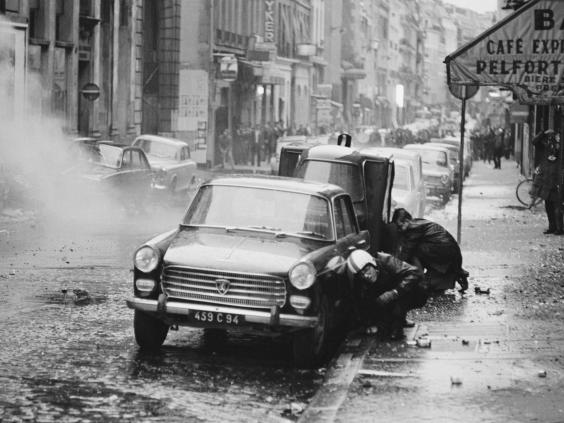
A South Vietnamese general blowing out the brains of a Vietcong prisoner on a Saigon street during the Tet Offensive. The Reverend Andrew Young Jr. and his colleagues, on the balcony of the Lorraine Motel in Memphis standing next to the body of Martin Luther King Jr. and point to where the assassin’s bullet was fired. Students at Columbia University taking over campus buildings, only to be hauled away, battered and bloody by police. Parisian protesters hurling tear gas canisters back at the police. Robert Kennedy felled by Sirhan Sirhan in the basement at the Ambassador Hotel in Los Angeles. Soviet tanks rolling into Prague. Women dumping bras and girdles into a trash can on the boardwalk outside Atlantic City’s Miss America pageant. Protesters facing off against coppers and horses in a violent mêlée in front of the US embassy in London’s Grosvenor Square. Tommy Smith and John Carlos on the Olympic medalists’ platform in Mexico City, raising their black-gloved fists in the Black Panther Salute as second-placed Aussie Peter Norman stands tall and silent in solidarity (a stance which would earn him opprobrium in his still prejudiced and conservative homeland).

As young people in the UK, we viewed these scenes to an exciting and eclectic soundtrack of blues, rock and psychedelia as the pop music cavalcade of the ‘sixties rock ‘n rolled on.

The Beatles sang Hey Jude, and The Rolling Stones, Street Fighting Man, and Jimi Hendrix delivered simply the best-ever cover of a Bob Dylan song with his blistering, sinister All Along the Watchtower. Imagining we were Born To Be Wild, we were invited to get our motors running and head out on the highway, or else to “take the load off, take the load for free”. We could pointlessly ponder the mysterious meaningless of MacArthur Park, or just lay back in a hazy daze with the Hurdy Gurdy Man (a strange ditty that has enjoyed a brief comeback with the recent hippy, trippy Romans-versus-druids soap Britannia). Koo-koo-ka-choo, Mrs. Robinson!

Images and music aside, what was it really like to experience 1968?

Christopher Allen, in a piece in The Australian reviews an exhibition commemorating the events of 1968 at the National Library of Australia in Canberra. His is an original overview, advising caution when seeking signs and patterns in contemporary events. The past, as they say, is a foreign country – they see things differently there. “The signs 50 years ago  were alarming, hopeful or dispiriting, depending on your point of view, but above all conflicting, as are the signs today. We will one day know where events on the Korean peninsula or the latest phase of tensions in the Middle East are leading. The shadowy, seemingly fluid future, with its dramatically ­different possible alternatives, will have become the ossified, unchangeable past.

In an entertaining and upbeat piece in The Guardian, Hendrick Herzberg rebuts that cliched putdown of how people who remember the sixties weren’t really there, recounts his own adventures, and claims that “In a modest way, 1968 was the kind of year that pushes history in some unforeseen, astonishing direction – a gentler little brother to 1492, 1776, 1848, 1914, 1945, and 2001”. I would add 1789, 1939, and 1989 and 2011.  Check them out.

I too remember the ‘sixties, and I too was there, albeit not on the political, social or cultural front lines. But I was at Grosvenor Square, occupied the vice-chancellor’s offices, did drugs (soft, mind), dug Cream, read Oz and IT, and totally got into Hair, which opened in London that year. And today, I share Hetzberg’s reverie: “In 1968, the ‘sixties were almost over, but The Sixties have never fully gone away. For me, and no doubt for many others of my vintage, it’s hard to believe that half a century now separates us from that momentous, tumultuous year, and that 1968 is now as distant in time as 1918 – the year of the end of World War I, the consolidation of Bolshevik power in Russia, and the flu pandemic that killed 50 million people – was in 1968. Fifty years from now, it’ll be 2068. The ‘sixties again! I Can’t wait!”

In contrast, Tod Gitlin gazes through a glass darkly in a sober retrospective for The New York Review of Books: “When we fight over the meaning of the past, we are fighting over what, today, we choose to care about. In this way, the 1968 anniversaries stalk 2018, depicting scene after scene of revolt, horror and cruelty, of fervor aroused and things falling apart, and overall, the sense of a gathering storm of apocalypse, even revolution. Inevitably, the “iconic” images of the time feature scenes of brutality, rebellion, and tragedy”.

And indeed, the enduring historical memory of 1968 is one of a succession of seemingly disconnected conflicts and collisions, turmoil and turbulence, not only in the USA but around the world. Yet beneath the apparent chaos, Gitlin seems to suggest, there were patterns that can only be discerned with the benefit of hindsight or as visions from a great height – much like, perhaps, that iconic image of our blue planet.

“Public life seemed to become a sequence of ruptures, shocks, and detonations. Activists felt dazed, then exuberant, then dazed again; authorities felt rattled, panicky, even desperate. The world was in shards. What were for some intimations of a revolution at hand were, for exponents of law and order, eruptions of the intolerable. Whatever was valued appeared breakable, breaking, or broken”.

The pendulum was swinging away from the previous year’s Summer of Love into a darker place. The lyrics of Steppenwolf’s Magic Carpet Ride, released that September, seem, in retrospect, to describe the turning tide: “Last night I held Aladdin’s lamp, so I wished that I could stay, but before the thing could answer me, well, someone took the lamp away. I looked around, and a lousy candle’s all I found”. In November 1968, Jimi Hendrix sang: “Outside in the cold distance, a wildcat did growl. Two riders were approaching, and the wind began to howl”.

There lurked a new narrative, and this was one of backlash and counterrevolution. “What haunted America”, writes Gitlin, “was not the misty spectre of revolution but the solidifying spectre of reaction. As the right consolidated around an alliance of Christian evangelicals, racial backlashers, and plutocrats, the left was unable, or unwilling, to fuse its disparate sectors. The left was maladroit at achieving political power; it wasn’t even sure that was its goal”.

”This country is going so far to the right you won’t recognize it,” Nixon’s attorney general, John Mitchell, said in 1969. He spoke prematurely. And presciently. Fifty years on from this momentous year, all that is old is new again.


Read on and enjoy these articles and the accompanying pictures.

But first, a poignant memento of 1968 from the 1979 film version of the “tribal love-rock musical” (yep, that how it was marketed back in the day) Hair, which i saw in London in the fall of 1968.

And here are other posts in In That Howling Infinite with regard to the ‘sixties: Springtime in Paris – remembering May 1968Encounters with Enoch; Recalling the Mersey Poets; The Strange Death of Sam Cooke; Looking for LehrerShock of the Old – the glory days of prog rock; Window on a Gone World; Back in the day; The Incorrigible Optimists Club

London

Paris

Prague 


1968: Year of Counter-Revolution

Associates of Dr. Martin Luther King Jr., the slain civil rights leader lying on the motel balcony, pointing in the direction of the assassin, Memphis, Tennessee, April 4, 1968

Commemorations are the greeting cards that a sensation-soaked culture sends out to acknowledge that we, the living, were not born yesterday. So it is with this year’s media reassembly of 1968. What is hard to convey is the texture of shock and panic that seized the world a half-century ago. What is even harder to grasp is that the chief political victor of 1968 was the counter-revolution.

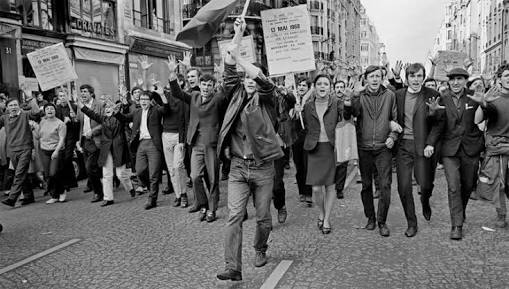
When we fight over the meaning of the past, we are fighting over what, today, we choose to care about. In this way, the 1968 anniversaries stalk 2018, depicting scene after scene of revolt, horror and cruelty, of fervor aroused and things falling apart, and overall, the sense of a gathering storm of apocalypse, even revolution. Inevitably, the “iconic” images of the time feature scenes of brutality, rebellion, and tragedy: a South Vietnamese general’s blowing out the brains of a prisoner on a Saigon street during the Tet Offensive; the Reverend Andrew Young Jr. and his colleagues, on the balcony of the Lorraine Motel in Memphis, next to the body of Martin Luther King Jr., pointing at where the assassin’s bullet had come from; demonstrators at Columbia taking over campus buildings, then hauled away, battered bloody by cops; Parisian protesters hurling tear gas canisters back at the police; Robert Kennedy felled by Sirhan Sirhan’s shots at the Ambassador Hotel;Soviet tanks rolling into Prague; police clubbing demonstrators at the Democratic National Convention in Chicago; women’s liberation activists dumping girdles, hair curlers, and bras (unburnt) in a trash can on the boardwalk outside Atlantic City’s Miss America pageant; Tommy Smith and John Carlos on the Olympic medalists’ platform in Mexico City, raising their black-gloved fists in defiance.
Helmeted police blocking antiwar protesters in Grant       Park, Democratic National Convention, Chicago, Aug 1

A more thorough survey would take note of social collisions that, however violently repressive, failed to register in America with the same supersaturated significance. For example: the killing of three students in Orangeburg, South Carolina, by highway patrol officers after the students protested segregation at a bowling alley (February 8); the near-deadly shooting of the German radical student leader Rudi Dutschke in Berlin (April 11); Chicago police battering a wholly nonviolent antiwar protest (April 27).

As for less bloody demonstrations, there were so many, so routinely, that TheNew York Times regularly grouped civil rights and antiwar stories on designated pages. Neither does this rundown of calamities take into account images that did not see the light of day until much later, like the color shots of the My Lai massacre (March 16), not published until late 1969—by which time they were almost expected. Or the images that never materialized at all, like the slaughter of hundreds of demonstrating students by troops in Mexico City (October 2).

A feminist protester at the Miss America beauty pageant, Atlantic City, New Jersey, September 7 

Images aside, what was it really like to experience 1968? Public life seemed to become a sequence of ruptures, shocks, and detonations. Activists felt dazed, then exuberant, then dazed again; authorities felt rattled, panicky, even desperate. The world was in shards. What were for some intimations of a revolution at hand were, for exponents of law and order, eruptions of the intolerable. Whatever was valued then appeared breakable, breaking, or broken.

The textureof these unceasing shocks was itself integral to what people felt as “the 1968 experience.” The sheer number, pace, volume, and intensity of the shocks, delivered worldwide to living room screens, made the world look and feel as though it was falling apart. It’s fair to say that if you weren’t destabilized, you weren’t paying attention. A sense of unending emergency overcame expectations of order, decorum, procedure. As the radical left dreamed of smashing the state, the radical right attacked the establishment for coddling young radicals and enabling their disorder. One person’s nightmare was another’s epiphany.

The familiar collages of 1968’s collisions do evoke the churning surfaces of events, reproducing the uncanny, off-balance feeling of 1968. But they fail to illuminate the meaning of events. If the texture of 1968 was chaos, underneath was a structure that today can be—and needs to be—seen more clearly.

Two Viet Cong captured during the Tet Offensive, one already dead, the other about to be executed by pistol shot, Vietnam, May 1968

The left was wildly guilty of misrecognition. Although most on the radical left thrilled to the prospect of some kind of revolution, “a new heaven and a new earth” (in the words of the Book of Revelation), the main story line was far closer to the opposite—a thrust toward retrogression that continues, though not on a straight line, into the present emergency. The New Deal era of reform fueled by a confidence that government could work for the common good was running out of gas. The glory years of the civil rights movement were over. The abominable Vietnam War, having put a torch to American ideals, would run for seven more years of indefensible killing.

The main new storyline was backlash. Even as President Nixon assumed a surprising role as environmental reformer, white supremacy regrouped. Frightened by campus uprisings, plutocrats upped their investments in “free market” think tanks, university programs, right-wing magazines, and other forms of propaganda. Oil shocks, inflation, and European and Japanese industrial revival would soon rattle American dominance. What haunted America was not the misty specter of revolution but the solidifying specter of reaction.

Even as established cultural authorities were defrocked, political authorities revived and entrenched themselves. In so many ways, the counterculture, however domesticated or “co-opted” in Herbert Marcuse’s term, became the culture. Within a few years, in public speech and imagery, in popular music and movies, on TV (All in the FamilyM*A*S*HTheMary Tyler Moore Show) and in the theater (HairOh! Calcutta!), profanity and obscenity taboos dissolved. Gays and feminists stepped forward, always resisted but rarely held back for long. It would subsequently be, as the gauchistes of May ’68 in Paris liked to say, forbidden to forbid.

In the realm of political power, though, for all the many subsequent social reforms, 1968 was more an end than a beginning. After les évènements in France in May came June’s parliamentary elections, sweeping General De Gaulle’s rightist party to power in a landslide victory. After the Prague Spring and the promise of “socialism with a human face,” the tanks of the Soviet-run Warsaw Pact overran Czechoslovakia. In Latin America, the Guevarist guerrilla trend was everywhere repulsed, to the benefit of the right. In the US, the “silent majority” roared. As the divided Democratic Party lay in ruins, Richard Nixon’s Southern strategy turned the Party of Lincoln into the heir to the Confederacy. As the right consolidated around an alliance of Christian evangelicals, racial backlashers, and plutocrats, the left was unable, or unwilling, to fuse its disparate sectors. The left was maladroit at achieving political power; it wasn’t even sure that was its goal.

Counter-revolutions, like their revolutionary bêtes noires, suffer reversals and take time to cohere. The post-1968 counter-revolution held the fort against a trinity of bogeymen: unruly dark-skinned people, uppity women, and an arrogant knowledge class. In 1968, it was not yet apparent how impressively the recoil could be parlayed into national power. “This country is going so far to the right you won’t recognize it,” Nixon’s attorney general, John Mitchell, said in 1969. He spoke prematurely.

1968: the year that changed America

Hendrick Herzberg, The Guardian, April 15, 2018

Where were you in the 1960s? And what were you? A toddler, a grade schooler, a teenager? A young adult? Were you already old enough to form your own memories? Or were you old enough but in the “if you can remember The Sixties you really weren’t there” category?

Of course, if you’re like most people, you were nowhere. You hadn’t been born yet. You didn’t exist. But wherever and whatever you were or weren’t, it’s a safe bet that you’ve heard about The Sixties – quite enough, maybe. Ad nauseam, maybe.

There is a continuing theological controversy among sixtiesologists concerning when The Sixties can properly be said to have begun and ended. Tuesday 8 November1960 – the day Senator John F Kennedy was elected president – has a pretty good claim to the beginning. Kennedy’s campaign slogan, which appeared on every campaign poster, had been LEADERSHIP FOR THE 60’s. Out with the dull, conformist, priggish, crewcut, Eisenhowerish Fifties! In with the dashing, exciting, daring, sexy, slightly longer-haired, Kennedyesque Sixties!

A darker view – the view I take – sets the clock of The Sixties ticking three years later. The assassination of President Kennedy was a crack in time. Like Sunday 7 December 1941; and like Tuesday 11 September 2001; Friday 22 November 1963 was “a date that will live in infamy”. And, like them, it was a day that is remembered in vivid detail by those who experienced it.

I was taking a noontime shower in my Harvard dorm room, having been as usual up till dawn getting out the college daily, the Crimson. I heard a faint, muffled radio news bulletin coming through the wall from the neighboring room. As I dried off, I turned on my own radio. I can still see the edge of the shower stall and the little bathroom window next to it. On the grass below, a girl was standing under a tree, weeping. The Crimson put out an extra that afternoon, but without my help. It felt too much like a schoolboy stunt. Rightly or wrongly, I didn’t want to play newspaperman. I didn’t want to be distracted from the communal grief all around me.

So The Sixties, in this conceit, began either in 1960 or, like Philip Larkin’s sexual intercourse, in 1963. And the ending? That too has long been a subject of debate. There are plenty of nominees, two of which may be considered the frontrunners. Like the beginnings, one is light and one is dark. The light one: Friday 9 August 1974, the day Richard Nixon resigned the presidency, freeing the nation from a quarter-century of having had him to kick around. The dark one: Altamont. Sunday 6 December 1969. Google it. Or see the movie.

It is possible to build a narrative around two currents of the year’s events, currents that melded and crisscrossed and fed off each other, to startling effect: the music, mostly a kaleidoscopic, wildly imaginative explosion of rock’n’roll; and the politics, mostly a politics of protest – protest against the Vietnam war, against racial injustice, and, more broadly, against what was experienced as the joyless, stultifying blandness of mainstream American life.

Those two currents, the music and the protests, washed over me as they did over millions of others. In 1966, a year out of college and a newly minted cub reporter for Newsweek, I was lucky enough to land in San Francisco. Something was happening there, and I found myself in a position to absorb it.

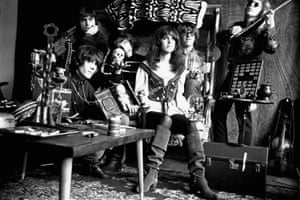
Jefferson Airplane pose for a portrait in San Francisco, 3 August 1968.
                              Jefferson Airplane  San Francisco, 3 August 1968. Photograph: AP
The scene, cultural and political, was quite something. A new kind of music – rooted in blues, rock, and electronica, and supercharged by psychedelia – was drawing motley-dressed weekend crowds to a couple of repurposed old dance halls, the Fillmore Auditorium and the Avalon Ballroom. For $2.50 you could spend hours listening and dancing to bands that were still unknown back east or down south in LA – bands still without record contracts but with wonderful names: Jefferson Airplane, the Grateful Dead, Big Brother and the Holding Company, Quicksilver Messenger Service – often paired with iconic bluesmen like Muddy Waters and James Cotton. The walls were mesmerizingly alive with rhythmically pulsating, ever-changing liquid projections. It was, in the patois of the moment, mind-blowing. For the gentle dreamers that Herb Caen, the San Francisco Chronicle’s gossip columnist, had dubbed hippies, the Fillmore and the Avalon were Carnegie Hall and the Philharmonic.

Like every young man of my generation, I had to reckon with the draft. I was against the war, of course, but I didn’t think I had the stomach to go to jail over it. I had zero desire to go to any more schools, graduate or otherwise. I was unmarried and childless. Canada was not my country, my country was the United States of America. I wasn’t physically or mentally ill and was too proud to fake it. And I wasn’t a conscientious objector. On the other hand, I didn’t want to get killed either. My solution was the US navy.

I got a haircut and reported to the naval base at Newport, Rhode Island, for three months of officer training. From there I asked to be sent to Vietnam, but it wasn’t like it sounds. Unless you were a flier (like John McCain, the future senator), a Seal (like Bob Kerrey, also a future senator) or a member of the Riverine Force (like John Kerry, a future senator, presidential nominee, and secretary of state), being a naval officer in Vietnam, especially a “public affairs” officer like me, posed very little physical risk. Instead, however, the navy, in its wisdom, assigned me to a desk job in lower Manhattan.

As the year rushed on, the pace of events grew ever more frenziedI stole away from the office whenever I could, and devoted the time to salving my conscience. I pitched in at the ramshackle headquarters of the War Resisters League. In March, after Robert Kennedy entered the presidential race, I took to hanging around his Manhattan headquarters, doing layouts and writing headlines for the Kennedy Current, the campaign’s weekly tabloid.

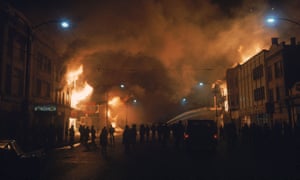
As the year rushed on, the pace of events grew ever more frenzied: the bloody shock of the Tet Offensive; the electoral abdication of President Lyndon Johnson; the assassination of Martin Luther King Jr and the riots that followed; the murder of Robert Kennedy; the chaotic, riotous Democratic convention in Chicago; Nixon’s hairsbreadth victory over Hubert Humphrey in November. And me? Well, at Christmastime I got the orders to Vietnam (as a “recreation officer” at the US base in Da Nang) I’d hoped for two years earlier. Only this time I didn’t want to go. My antiwar sentiments had hardened to the point that I decided I preferred jail to further military service, and I announced my intention to refuse the orders.

Riots in Chicago follow the assassination of Martin Luther King.
       Riots in Chicago follow the assassination of Martin Luther King.
Photograph: Lee Balterman/TimePix/Rex Features

But before I could achieve fame as a martyr for peace an unexpected medical difficulty developed: I had a wisdom tooth pulled, the wound bled for days, and when I was diagnosed with a (relatively mild) form of hemophilia, the navy quickly mustered me out. I had managed to have it both ways: veteran (kind of) and resister (in a way).

Why didn’t I think of that?

In 1968 the sixties were almost over, but The Sixties have never fully gone away. For me, and no doubt for many others of my vintage, it’s hard to believe that half a century now separates us from that momentous, tumultuous year, and that 1968 is now as distant in time as 1918 – the year of the end of World War I, the consolidation of Bolshevik power in Russia, and the flu pandemic that killed 50 million people – was in 1968. Fifty years from now, it’ll be 2068.

The Sixties again! I can’t wait!

This is an extract from the introduction to the 30th-anniversary edition of1968 in America: Music, Politics, Chaos, Counterculture, and the Shaping of a Generation by Charles Kaiser, published in the US by Grove Press on 17 April

Take a look back to our future

Christopher Allen, The Australian, June 23rd 2028

Many Cheers on the Founding of the Revolution Committee of Hubei Province, papercut poster (1968). All images from 1968: Changing Times exhibition, National Library of Australia

Many Cheers on the Founding of the Revolution Committee of Hubei Province, papercut poster (1968). All images from 1968: Changing Times exhibition, National Library of Australia

In one of the most famous stories from ­antiquity, Croesus, the proverbially rich king of sixth-century BC Lydia, in what is now Turkey, was disturbed by the rise of the Medes and the Persians on his eastern borders. Thinking it might be wise to crush these potential rivals before they became a serious threat, he consulted the oracle of Apollo at Delphi, plying it with gifts to ensure a favourable answer. The oracle replied that if he made war on the Persians, a great empire would be destroyed. Croesus accordingly gathered his ­armies and ­attacked, but he was defeated and taken prisoner by Cyrus the Great, founder of the Persian ­Empire.

The oracle had a reputation for accurate yet riddling answers. A half-century after these events, Heraclitus, one of the most brilliant Pre-Socratic thinkers and famous for enigmatic aphorisms, declared: “The lord whose oracle is at Delphi neither reveals nor conceals but sig­nifies.” It is up to us to read the sign he gives, and Croesus had fatally misconstrued that sign in his eagerness to hear what he wanted to hear.

The signs 50 years ago, in 1968, were alarming, hopeful or dispiriting, depending on your point of view, but above all conflicting, as are the signs today. We will one day know where events on the Korean peninsula or the latest phase of tensions in the Middle East are leading. The shadowy, seemingly fluid future, with its dramatically ­different possible alternatives, will have become the ossified, unchangeable past.

The political protests of May 1968 in Paris were among the most significant events of that year. Although partly emulating earlier student agitation in the US, the French protests were much broader in their implications. The term that the French use for this movement, la contest­ation, suggests its universal spirit of ­revolt and its nebulous sense of direction, if not nihilistic disorientation. It was a catastrophic time for many young people caught up in the hysteria and afterwards left to pick up the pieces of interrupted studies and broken careers, in an ambience of cynicism and disenchantment. Ever since the revolution of 1789, the French have been prone to political overexcitement, and throughout much of the 20th century ­communists continued to believe in their own kind of revolution in the same way Christians believe in the second coming.

The zealots thought 1968 heralded the end of days and the imminence of the dictatorship of the ­prole­tariat; but the grassroots movement, spreading from students to workers, was not supported by the Communist Party, which was still committed to a totalitarian and Stalinist model of ­central control. A few months later, a similar pattern evolved within the communist world: the opening up of Czechoslovakia to greater freedom, democracy and independence — the Prague Spring — was crushed in August when Soviet tanks invaded the country and ­occupied its capital.

The events of Paris and of Prague dealt a fatal blow to the credibility of communism in the West; the old left began slowly bleeding to death until its collapse with the fall of the ­Berlin Wall 21 years later. Thus May 1968, as in the story of Croesus, did indeed herald the fall of an ­empire, but not the one the student rioters thought they were going to bring down.

Much else happened in 1968, including the opening of the new National Library in ­Canberra, whose anniversary is the occasion for this exhibition. As we enter the exhibition, we are confronted by a wall of 21 tabloid bills, in the centre of which is one announcing the opening of the library. The remaining headlines sum up many other momentous events of the year, starting with the ­mysterious loss of prime minister Harold Holt, who dis­appeared, presumed drowned, while spearfishing off Portsea in December 1967.

America was shocked by two political assassinations: that of Martin Luther King in April and Robert Kennedy in June. Both events are covered in the exhibition by photographs, posters and copies of contemporary news magazines. Particularly interesting, especially today, is an article about the revulsion against gun culture that followed the death of Kennedy, whose brother, president John Kennedy, had been assassinated less than five years earlier. There are pictures of individuals willingly ­giving up guns at police stations: so many were handed in that the police, as we see in another photograph, ended up disposing of them by dumping them in the sea.

John Gorton Visiting Australian Troops in Vietnam, Australian News and Information Bureau (1968)

Meanwhile, the Vietnam War was growing more intense — it was the year of the Tet offensive — and provoking greater opposition at home, mainly because of the draft, of which fatal randomness we are reminded by a set of the wooden balls that were used in the birthday ballots. It was clearly a political mistake to send conscripted soldiers to Vietnam; professional soldiers expect to fight wherever their nation sees fit to send them, but conscripted troops should be reserved for national self-defence.

At the time, however, the spread of commun­ism in Asia looked like a serious ­menace, which it would be smug to discount with the benefit of hindsight. Communism had only recently been suppressed by the British in the course of the Malayan Emergency (1948-60) and, more recently still, by Suharto in Indonesia, in a far bloodier struggle from 1965 onwards. So the threat of violent totalitarian revolution was real. At the same time, there was a prima facie moral justification in helping South Vietnam defend itself against the north. The way that North Vietnamese ­aggression was turned into a fight for freedom in the eyes of many in the West was one of the first examples of the self-destructive neurosis that has afflicted the Western intel­ligentsia for the past couple of generations. A map of ­Vietnam published in the US in 1968 includes an insert labelled “Freedom’s struggle in Asia”, with a pall of black covering Siberia, Mongolia, China and North Vietnam. It is easy to understand the fear of the domino theory in Southeast Asia, and clear that this had serious consequences for Australia.

And to argue that time was running out for the communist dream, and that even China would, within a generation, be starting to build its own unique model, combining capitalist profiteering with communist authoritarianism, would have seemed mere wishful thinking.

For the time being Mao Zedong, after killing 45 million people by starvation during the Great Leap Forward of 1957-62, had launched the almost equally disastrous Cultural Revolution, which lasted from 1966 until his death in 1976, and posters showed beaming peasants and workers celebrating the foundation of new socialist ­regional committees.

This is the great difficulty in anticipating the future: we can imagine plausible scenarios but the really important things are often ones that seem entirely implausible until they happen. It would have seemed far-fetched to suggest that Southeast Asian countries racked with ­poverty and communist insurrection in 1968 would be booming capitalist economies by the early 20th century, but even more unbelievable that one of the most significant threats to s­ecurity, freedom and human rights would one day be the rise of fanatical Islamic belief among the populations of several regional countries. Religion in general was assumed to be a long-spent ­political factor, of marginal relevance in the thinking of left and right.

Even in the Middle East, religion was not yet an important factor. Israel had spectacularly crushed its Arab neighbours in the Six-Day War of 1967 and extended its control over buffer territories in the north and east; its neighbours were angry and humiliated, but were all ruled by secular dictators. Iran was a prosperous, secular and modernising nation under the rule of the shah, even though there was growing opposition to his authoritarian rule. But a map of The Daily Telegraph motor marathon from London to Sydney reminds us how essentially peaceful the region still was: it is many years since such a rally could follow an itinerary from London through Europe to ­Turkey, then on to Tehran, Kabul and Bombay (as Mumbai was then called), before the cars were ferried to Fremantle for the final legs from Perth to Sydney.

Culturally, the period represented a new level of mass consumption of pop music and other media. At the time, pop groups often seemed to give voice to various forms of social and political dissent, but in retrospect their ­objective role was to channel and neutralise the malaise, turning it into harmless entertainment. Television had more or less completed its takeover of family life by 1968; people who used to play the piano or talk or read a book after ­dinner now sat glued to serials and talk shows. TV was a new form of addiction, whose damaging effects we now can begin to understand in the age of far more serious ­addiction to smartphones and other devices.

National Library of Australia at Night from beneath Commonwealth Avenue Bridge near Regatta Point, Canberra, (1968, detail), by Max Dupain

The final part of the exhibition is devoted to the conception, planning and building of the new library. Canberra, only 55 years old in 1968, was still in the process of growing into its ­ambitious urban design. An area from Capital Hill down to the lake had been designated as a special ceremonial triangle, destined to house not only the new Parliament House but also some of the most significant cultural edifices of the new city. These included the National ­Library on one side and the National Gallery, which was established in 1967 and opened in 1982. The new library was a favourite project of Robert Menzies as prime minister, and the exhib­ition includes correspondence and his speech in introducing the National Library­ bill in 1960. Although he retired in January 1966, his successor Holt ­invited him to lay the foundation stone in March that year.

In his speech on that occasion, Menzies expressed­ the hope he would live long enough to see the white marble structure ­reflected in the waters of the lake: this is exactly how Max Dupain photographed the finished structure in 1968. Seeking grandeur in the depth of distance, he takes a view of the new building from across the lake at night, so the library appears as a small but radiant temple-like form, its reflection shimmering silently on the dark waters.

1968: Changing Times.  National Library of Australia, Canberra, Until August 12, 2018

https://www.theaustralian.com.au/arts/review/1968-changing-times-national-library-of-australia-look-back-at-future/news-story/ccefaad03c8a41c8b86a2820f5d53ca4


Dear Zealots – letters from a divided land

Featured photograph: Banksey mural on the road into Bethlehem, Paul Hemphill May 2016

Winston Churchill defined the fanatic as one who can’t change his mind and won’t change the subject. Celebrated Israel author Amos Oz argues against religious fundamentalism, political cynicism and wishful thinking, reflecting on the rise of fundamentalism, and how, in an increasingly complex world, we take cover in xenophobia, religious fanatic­ism, and isolationism. He argues against fanaticism and for the acceptance of differences of opinion, celebrating the Jewish tradition of disputation, interpretation and persuasion and discovering an “anarchist gene” that thrives on disagreement as the perfect antidote to dogma.

Some people argue that Israeli commentators like Amos Oz, David Grossman, Gideon Levi, Uri Avnery, Ari Shavit, and Sarah Tuttle-Singer are cliche-bound idealists who love the Israel they wish to see, and not the one of a real, mutable and dangerous world. Fanatics and zealots themselves, indeed.  It is a valid if over-the-top criticism, but does not detract from what they are telling us. They, like their critics love their country with all their hearts. But they and ourselves all have our idealized homeland, a Dreamtime of our memories and imaginations, and it is, in a way, a kind of “magical thinking”. The irony is that the outside, “western” world often appears to share the same, romanticized, idealized and unrealistic concept of what Israel was, is and ought to be, and harshly holds it to that lofty standard regardless of the fact that no nation , however heroic and  glamourous its creation story, is pure and innocent.

Nevertheless, Australian publisher Louse Adler distills perfectly the message of this timely, perceptive book:


Dear Zealots: Letters from a Divided Land, by Amos Oz
Louse Adler, The Australian May 26, 2018

Writing about the Middle East may be considered timely, given the latest battles between the Israeli military and the citizens of Gaza. Yet this impasse has been in urgent need of resolution for 70 years.

Whether you celebrate the establishment of the state of Israel or mourn it as the Nakba, what remains a tragedy is the lack of a just solution that brings peace to the region and recognises the equally rights of competing claims.

Dear Zealots: Letters From a Divided Land, the 40th book from Israeli writer Amos Oz, ­offers the slimmest hope that peace may be possible, and a dire warning about the unholy coalition of anti-democratic forces that may thwart progress. Criticism of Zionism and contemporary Israeli politics is de rigueur in ­Israel, often cited as a testimony to this democratic island isolated in the midst of a fundamentalist Middle East. It is a truism that debate in Israel is robust and that critics of the state are afforded the right to dissent.

Despite treason accusations and the issuing of death threats, writers and journalists such as Oz, David Grossman, Etgar Keret and Gideon Levy continue to identify the moral malaise infecting Israeli society while the occupation of Palestine continues and settlements increase.

But these longstanding and courageous oppo­nents of the government’s attitudes to its neighbours have had little impact, ­despite their oratorical skills, international visib­ility and credibility. Great writers continue to write, speak out, sign petitions and ­demon­strate to no avail. Paradoxically, beyond Israel it is almost impossible to speak about governme­nt policies without inciting the wrath of its loyal defenders.

Into this seemingly intractable quagmire Oz has lobbed his latest literary missile. He argues against religious fundamentalism, political cynicism and wishful thinking. In three powerful essays he reflects on the rise of fundamentalism and why, in an increasingly complex world, we take cover in xenophobia, religious fanatic­ism, isolationism.

Winston Churchill defined the fanatic as one who can’t change his mind and won’t change the subject. Dear Zealots is an argument against fanaticism and for the acceptance of differences of opinion. Only Oz could include Israel’s “hilltop thugs”, Islamophobes, the Ku Klux Klan and Islamic State in one sentence; adding veganism, smoking and breastfeeding to this catalogue of zealotry. Against the rise of the zealot Oz celebrates the Jewish tradition of disputation, interpretation and persuasion. His discovery of an “anarchist gene” that thrives on disagreement is the perfect antidote to dogma.

Oz loves Israel. He tends to romanticise the place, pointing to the country’s eight million prime ministers, eight million prophets and eight million messiahs. However, a cacophony of voices­ and opinions doesn’t ensure­ a genuinely democratic state. A state that does not offer full rights to all citizens, a state in­extricably bound by religious authority, where there is no separation of church and state, imperils democracy.

The conflation of Israeli political practice and Jewish heritage makes it difficult to prise apart the state, the residual impact of its eastern European founders, religious influences and the challenging ethnic demographics of the polity.

Oz rages against Halachic Judaism, a form of religious piety demanding blind faith, investing God with supreme authority and believing the Torah protects Jews from assimilation. In Halachic Judaism, the history of the Jewish people is an unchanging story of sin, suffering and ­repent­ance. According to this logic, the innocent victims of the Holocaust, like those killed in Israeli military service, are martyrs sanctifying God’s name. Where else do we hear this today?

Who is a Jew remains a fundamental question. The answer delivers remarkable consensus. Everyone seems to agree that the most Jewish Jews are the “black hats”. Next are the settlers, then the trad­itional Jews who drive to synagogue but don’t eat prawns, then the Jews who are lost. The worst are the Jewish anti-Zionists, lefties who go on about human rights and peace.

Oz argues Jewish identity does not derive from holding fast to religious orthodoxy but is

amassed over generations, customs absorbed from outside which become part of the family, perhaps a certain type of humour, an inclination to be critical and sceptical, to be ironic, self-pitying and sometimes self-righteous, pragmatism tinged with fantasy, ecstasy diluted with scepticism, euphoria blended with pessimism, melancholy cheerfulness, a healthy suspicion of authority and a stubborn resistance to injustice.

The summation by Oz, often described as the secularists’ rabbi, of the commandments is the exhortation “to cause no pain”. That humanist ethos insists on the right of all to equal rights and a dignified life. That principle is disappearing from the fabric of Israel and the moral lacuna­ is being filled by pieties and pessimism.

Fundamentalism in Israel has brought ­together an unholy alliance between the ultra-Orthodox Haredim (anti-Zionist) and the (pro-Zionist) Messianic Jews of the settlements. Neither recognise the authority of the state of Israel. Fortress Israel is also the binding idea for Israel’s religious fundamentalists and political right; they perpetuate the myth of Is­rael being forever in conflict with the rest of the world.

The Israeli left’s attempts to resolve the conflict imply the terrifying prospect that Israel’s exceptionalism will evaporate, its identity will be lost, with assimilation an inevitability. Oz proposes instead that the focus should be on the future, forgetting the border fetishes of both the left and right along with the flags and holy sites.

In the final essay, Dreams Israel Should Let Go of Soon, Oz argues that Israel hasn’t won a war since 1967 and that, after 100 years of ­struggle, the Palestinian aspiration to self-determinat­ion has not been vanquished. There is justice and injustice on both sides in equal measure, and a two-state solution is the only way to ensure the continuation of a Jewish state and justice for the Palestinians. This will require compromise from both, and compromise is the antithesis­ of zealotry.

Dear Zealots is a passionate polemic against dogmatism and defeatism. Viscerally angered by the idea of irreversibility, Oz rejects as ­irrevocable the settlements and occupation. Religiou­s fanatics demand a theocratic state; the right continues to ignore international ­pressure; the left argues that the status quo is apartheid and the only solution is one state. Oz, a left-wing Zionist, opposes occupation but defends­ the historical right of Jews to statehood. He refuses to give up on democracy, on Israel or on justice for Palestinians.

Jews and Arabs are Semites, sharing more than they have chosen to remember, including a sensibility tinged with pessimism. Perhaps we should keep in mind the story of the Jewish optimist­ and the Jewish pessimist. The Jewish pessimist turns to the Jewish optimist and says: “Oy, things can’t get any worse for our people!” The Jewish optimist turns to the Jewish pessim­ist, smiles, and says: “Sure it can!”

It is the oblig­ation of all of us with a social conscience to wish Oz all power to his pen.

Louise Adler is chief executive of Melbourne University Publishing.

Dear Zealots: Letters from a Divided Land, By Amos Oz (Chatto & Windus, 224pp, $29.99)

See also, in In That Howling Infinite:  A Middle East Miscellany

Author’s Note: 
Whenever I pen commentaries such as this, people ask why I rarely forward my own opinion on the issues I am presenting or discussing. On the contrary, I would argue that my views are fairly transparent in in the subjects I chose to engage with, the words I use, and the vein in which I use them.
With respect to my numerous posts about Israel and Palestine, and the Middle East in general, I  come to my conclusions from a political science and sociology perspective – that’s where my academic experience came from – and a background in conflict resolution, supported by study and travel. If I do on occasions display any particular bias, it. originates in my longtime interest, understanding and affection for the history, politics and culture of the region, of its geography and archeology, and  of its people of all faiths and nationalities that I make my observations.
I am presently working on a piece that encapsulates my thoughts on this complex and controversial subject. But meanwhile, here is a brief exposition.
I do believe that the systematic dispossession of almost a million Palestinians and the destruction of half of their towns and villages in 1948 is Israel’s original sin. It is the primal stain that colours and corrupts all that followed. And yet, if not for the actions, often daring, often brave, often questionable, and often deplorable, of the politicians and soldiers of 1948 – and of the generations that folllowed –  Israel would not exist today. This paradox is addressed sympathetically by Avi Shalit in My Promised Land, referred to above, and scathingly by ‘new history’ scholar Ilan Pappe in TheEthnic Cleansing of Palestine.   
The Occupation, fifty years old this year, which grew out of the unexpectedly total victory of June 1967, has taken on strategic, ideological and indeed messianic dimensions by many in the  Israeli government and political elite. It compounded the original sin, deepened the primal stain, released the demons of messianic fervour, and wounded Israel’s soul. The settlements locked the nation into the the colonialist project. With the close-call of the Yom Kippur War, the violence and murder of the first and second Intifadat, and present Palestinian jaquerie, Israel’s heart has not just hardened, it has become sclerotic.
I admit that I have always been sympathetic towards Israel – from my first visit in 1972. But it is not a blinkered viewpoint. I am deeply critical of Israeli politics and policies, and have no respect for many of its leaders.
Ayelet Shaked, the nationalist’s La Pasionaria, and her boss Naftali Bennett do not not represent ALL Israelis! They hold extremist views just like we in UK, US, and Australia have parties and individuals with extremist views. But there are hundreds of thousands of Israelis who oppose the present government and long for justice and peace. And if – a very big “if” – Arab Israelis and the Israeli left could work together, they could obtain a majority in the Knesset and change Israel’s politics.
Yet meanwhile, Binyamin Netanyahu and his nationalist allies call all the shots, the Israelis continue to control and exploit the land, its people, and its resources, whilst varying degrees of annexation are on the cards. The settlements are an abomination, as are the policies and practices of the state and its occupying army, as described by Lyons and others. There’s no escaping these facts.
But I am likewise critical of Palestinian governance, politics and politicians. Hamas and the PA are on the nose in their respective fiefdoms, and if a moderate “third force” were to arise – and survive, because sure as hell, they would risk being murdered – Palestinians who just want a quiet, normal life, adequate services, and opportunities for their children, and Israelis who want likewise, might – just might – reject their extremist, dogmatic, entrenched leaders and reach some form of modus vivendi.
Palestinians themselves have to take control of their own lives, kick out their corrupt leaders, cease inculcating their children with hatred and jihadism, and use all that international good will and dollars to build a viable economy that can provide jobs, opportunities, and security, economic and physical to the people. Only this way will they be inoculated against cronyism, corruption and extremism. And yet, the dead hand of a moribund, patriarchal, conservative and ethnocentric culture holds them back –  but that is the subject of another, future discussion for In That Howling Infinite.
Today, the ‘powers that be’, defenders and beneficiaries of a status quo that looks more like a cul de sac, predominate over a dispiriting array of competing, clamouring factions, left, right, nationalist, secular, tribal, Haredi, and Islamist alike. New, young, brace, local voices in both Israel and Palestine, are not heard.
So what happens next?
I get that question too. And I am perennially reluctant to venture an answer beyond one that runs like “on the one hand…but then on the other”.  I inevitably fall back on Robert Fisk’s response to the same question with regard to the calamatous freezing over of the Arab Spring and the fall and rise again of the same old autocrats and tyrants: “my crystal ball is broken”. It’s a cop out, really, but just as cogent as that famous line in that UK spy drama Spooks: “What’s gong to happen to me?” “Bad things!”
One thing is for sure: as songwriter Warren Zevon sang, “the hurt gets worse, and the heart get harder”.
October 8th 2017
For more posts on Jerusalem, Israel and the Middle East, visit:
https://m.facebook.com/HowlingInfinite/
https://m.facebook.com/hf1983/

See also, my collection of posts about Jerusalem, and A Middle East Micellany

Springtime in Paris – remembering May ‘68

“Bliss it was in that dawn to be alive, but to be young was very heaven”.

The famous line from that old romantic William Wordsworth evokes a degree of nostalgie for les temps perdue. And so it is with the many published recollections and reveries surrounding the fifties anniversary of “les évènements de Mai” 1968. Perhaps we would be better served with Charles Dickens’ take on an earlier French Revolution:

“It was the best of times, it was the worst of times, it was the age of wisdom, it was the age of foolishness, it was the epoch of belief, it was the epoch of incredulity, it was the season of Light, it was the season of Darkness, it was the spring of hope, it was the winter of despair, we had everything before us, we had nothing before us, we were all going direct to Heaven, we were all going direct the other way – in short, the period was so far like the present period, that some of its noisiest authorities insisted on its being received, for good or for evil, in the superlative degree of comparison only”.

As German social historian Ulrich Raullf has written: “Our historical memory is a motherland of wishful thinking, sacrificed to our faith and blind to known facts…This is why historical myths are so tenacious. It’s as though the truth even when it’s there for everyone to see, is powerless – it can’t lay a finger on the all powerful myth”. During the closing scenes of the western The Man Who Shot Liberty Valance, a journalist says: “This is the West, sir. When the legend becomes fact, print the legend”. And so it is with that Paris Spring.

To those of us who were young and politically progressive in those dear dead days, the protests, strikes and other forms of civil unrest of that springtime in Paris offered a mix of hope and vicarious adventure.

It was not simply a fight against something, like the Vietnam War that was raging at the time. Rather, It was a fight for something – for social change, for new forms of political, economic, social and class relations. We believed change was in the air, and there was a palpable frisson (such a great French word) of excitement.

We’d all read our Communist Manifesto, that mercifully brief and breathless primer for wannabe rebels, and now, to misquote old Karl Marx (ironically, two hundred years old this month), a spectre was indeed haunting Europe. Anything could happen. The future was unwritten. Regimes could tumble, and old ways crumble. Everything was mutable, impermanent – an idea that was simultaneously uplifting and terrifying.

We watched these events from across the La Manche with admiration and not a little envy. Our perspective may have been obscured, coloured and tittilated by distance and the biases of mainstream media, and by the pictures and the posters that found their way onto bedsit and bedroom walls. But there was not the 24/7 syndicated saturation that we get nowadays nor the live tweets and FB posts from the Sorbonne.

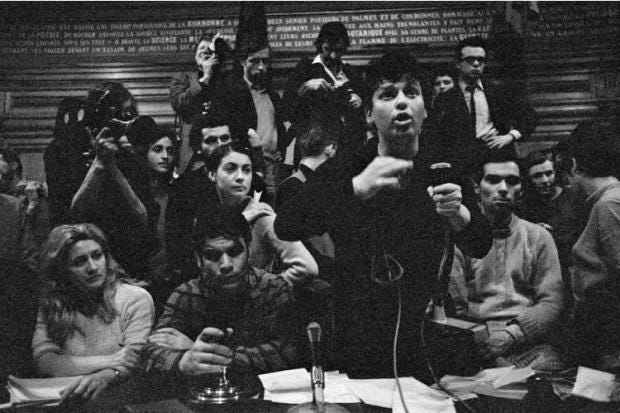
As Mitchell Abidor wrote recently in The New York Times: “The images … which changed my life when I was a teenager watching them on TV, are still burned in my memory: the enormous marches through the streets of France’s major cities; the overflowing crowds of people speechifying and debating in the amphitheater of the Sorbonne; workers occupying factories and flying red flags over the gates; students occupying universities and being beaten by the police. Workers and students, it appeared, were united against a sclerotic Gaullist state…These were images of the previously unimaginable: a revolution in the modern West. Revolution was no longer something that happened only in the past, or elsewhere, or in theory”.

Mick Jagger later explained how he and Keith Richards came to a compose one of the Rolling Stones’ seminal songs, released that August on Beggars Banquet: “Yeah, it was a direct inspiration, because by contrast, London was very quiet…It was a very strange time in France. But not only in France but also in America, because of the Vietnam War and these endless disruptions … I thought it was a very good thing at the time. There was all this violence going on. I mean, they almost toppled the government in France; de Gaulle went into this complete funk, as he had in the past, and he went and sort of locked himself in his house in the country. And so the government was almost inactive. And the French riot police were amazing”. And so the Stones sang:

Everywhere I hear the sound of marching, charging feet, boy
‘Cause summer’s here and the time is right for fighting in the street, boy
Well what can a poor boy do
Except to sing for a rock ‘n’ roll band
‘Cause in sleepy London town
There’s just no place for a street fighting man

We all have differing memories and perspectives of those days, as do today’s commentators who may or may not have been born back then, or lived of the far side of the world, and who in these polarised times, cleave to tediously turgid talking points.

News Corp opinionistas and others on the right have put it all down to the nihilistic nonsense of pampered youth, using it as yet another stick which to beat the virtue-signalling, politically correct, young culture warriors of today. And on cue, The Australian’s resident Ayn Randista Janet Albrechtson is particularly possessed of the perception that a “wabble of woudy webels” holding our universities hostage to what she sees as a virulent post-modern anarchism identical to the apparent hedonist nihilism of the students of Paris. But many on the left are also captive of binary thinking, looking back on the events as a grand and glorious upsurge of worker and student solidarity and revolutionary zeal – a latter-day replay of the Paris Commune (another doomed Intifada that ended with firing squads during le semaine sanglant”. And then there are others who view it today as the political equivalent of coitus interruptus, remembered all over the world this year as a great missed opportunity, and the end of a revolutionary illusion. But, as the selection of articles featured below demonstrate, in retrospect, it probably a mix of all three, and maybe, even, none at all …

To many contemporary commentators, the violent unrest that shook Paris through May 1968 was driven by a cathartic reaction to a national feeling of ennui. After decades of economic growth, high employment rates, rising living standards, and a burgeoning educational system, France was bored – with the ageing but immovable and indomitable President Charles de Gaulle, and with a stultifying, bureaucratic, “father knows best” vein that ran through the public, political and social establishment, through administration, education, industrial and sexual relations.

The times they were a’changin’, but the ferment, the fashion, the fun that roiled and rock ‘n rolled the US and even staid and stitched-up Great Britain, had somehow bypassed La France – 1968 did not begin in Paris, but in Berkeley, California around 1965, where the Vietnam protests originated, spreading by early 1968 to Britain and to Germany. Viewing photographs of the sit-ins, demonstrations and street-battles, commentators remark on the straight appearance of the students with their sports jackets, ties and long skirts, and “short back and sides” haircuts, such a long way away from London’s Carnaby Street and California’s Summer of Love. To borrow again from Karl, the French has nothing to loose but their chains.

No doubt there was indeed a fair dose of teen rebellion during that Parisian prima vera. But there was much more to it than just wild oats, teen spirit, a cursory reading of Marx, Mao and Marcuse, and a battle cry of Egalité! Liberté! Sexualité! It takes more than the desire for a yahoo to take to the streets for a month of barricades and cobblestones (so French and red chic!) in the face of paramilitary batons, water-cannons and teargas. Though it must be said that the French do Revolution extremely well. It doesn’t mean that they succeed. Indeed. Most have failed, and have ended badly with blood on the streets, betrayal and retribution.

But there were in, effect, three Mays, each of them quite distinct and different.

There was the May of the students, which we all recall so well in our own subjective hindsight, a protest against the rigidity and hierarchy of the French university system, defying the historical deference of young people to their elders, and yes, demanding more sex!

Then was the May of the workers with their call for higher wages, less hours, and consultation with management. Some ten million people came out on strike and brought the factories of France to a virtual standstill. They were, despite the slogans of worker-student unity,  no true friends of ostensibly spoiled middle class student firebrands and their foreign pals. They joined the revolution for their own sectional and economic reasons, and the end, the state represented by Jacques Chirac, secretary of state for employment, and the unions, led by the Communist Georges Séguy, agreed that the revolt had to end, and negotiated tremendous pay increases, a shorter working week, the strengthening of workers’ councils, and much more.

And there was a third May – an “anti-May even – that ultimately carried the day, one that the students failed to take into account and which their left wing heirs have often ignored. On May 30, half a million people paraded on the Champs-Élysées in support of President de Gaulle – perhaps the largest demonstration of the month. The France that the students were rebelling against, one they thought was all but dead, turned out to be very much alive – and eager to put rebellious youth back in its place. Charles de Gaulle emerged triumphant from the elections in June. And the political right remained in power in France until the victory in 1981 of François Mitterrand and his very un-1968 brand of socialism.

In the wings was the maker and breaker of kings and communes: the French Army, the traditional bulwark of successive French Republics, and the strong arm up canny conjurer Charles de Gaulle’s sleeve. Then there were those half a million French men and women who took to the streets at the fag end of the month to defend the staid and safe republic. De Gaulle had at first been nonplussed by the students, describing them at one point as chienlit – literally, “shit-a-bed” – youngsters and  and shocked by the scale of the strikes, and even briefly fled France for Germany whilst he recalibrated. And finally, when Le President had made his feints, and done his deals, and went to the people, he was re-elected in a landslide in an anxious conservative backlash.

The revolution, such as it was, kind of faded away, much like Marx has reckoned the state would fade away. The students went back to their crowded classrooms, and the workers, to higher wages and a shorter working week. And those who John le Carré might’ve called “the many too many” returned to the safe, serene, suburban lives. God was in his heaven and de Gaulle back in the Élysée Palace.

Since then, the French left has been reduced to a shadow of its former self, while the right and neoliberalism have grown ever stronger. As for “les soixante-huitards”, some have become grumpy old men, and conservatives even. Others, like Daniel Cohn Bendit, Sorbonniere firebrand Danny Le Rouge, and now a Green, German member of the European Parliament, are open to new ideas and changing times.

Chou En Lai, China’s premier at the time, was asked of the French Revolution – the big one, that is, if 1789 – whether he thought it was a good thing. “Its too early to tell” he replied. As many conservatives  are eager to point out, he seems to have been talking about May 1968.

But, after May 1968, “all changed, changed utterly”, to quote WB Yeats.  As the Bobster had written just a few years prior, the line had been drawn and the curse had been cast, and the order was rapidly fadin’. The old dispensation of patriarchal authority and catholic morality had been mortally wounded. the Karl’s chains had indeed been broken and France had entered the swinging ‘sixties.

That’s all from me. Read on and enjoy the stories and loads of fabulous pictures … or you can listen to historians Tom Holland and Dominic Sandbrook’s informative and also, amusing account on my favourite podcast, The Rest Is History: https://podcasts.apple.com/au/podcast/the-rest-is-history/id1537788786?i=1000622076100

And here are other posts in In That Howling Infinite with regard to the ‘sixties: Encounters with Enoch; Recalling the Mersey Poets; The Strange Death of Sam Cooke; Looking for LehrerShock of the Old – the glory days of prog rock; Window on a Gone World; Back in the day; The Incorrigible Optimists Club.
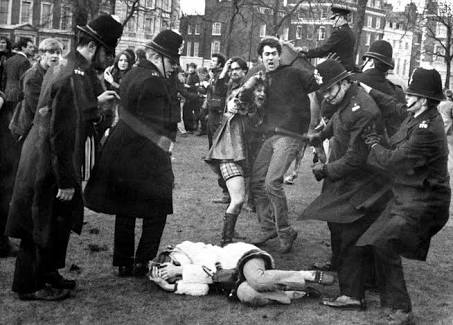


The Paris riots of May 1968: How the frustrations of youth brought France to the brink of revolution

Fifty years ago today the streets of Paris staged a battle between 6,000 student demonstrators and 1,500 gendarmes – within days it had snowballed into civil dispute that saw 10 million French workers go on general strike and brought the economy to a virtual halt. Andreas Whittam Smith recalls the events of ‘Mai 68’

The French always celebrate 1 May with a few riots. They did so this year with added piquancy because it was the 50th anniversary of the famous “Mai 68” when, in the Latin Quarter of Paris, the Left Bank, the whole month was devoted to riotous assembly led by students. In contemplating these events, I recall Wordsworth’s often quoted phrase: “Bliss it was in that dawn to be alive” – unless, of course, you were struck by a cobblestone hurled by a student demonstrator or soaked and knocked off balance by a police water cannon.

Presumably those who were demonstrating in Paris last Tuesday have now resumed their normal lives. The point about May 1968, however, is that they didn’t go back to college or to work the next day, they carried on, some of them for the whole month. Why was that? After all, economic growth had been unusually strong, the country was calm, both politically and socially, inflation was weak, living standards had been rising and there was little unemployment.

Was it in a way a very 1960s thing? That question is prompted by a French historian of the period, Éric Alary, who observes that “May 68 is seen as a period when audacious moves seemed possible and during which society profoundly changed”. For that is an accurate description of the nature of the 1960s, whether in Western Europe or in North America.

At the same time, there was a big rise in the sheer number of young people as a result of an increase in the birth rate in the closing stages of the Second World War and for some years afterwards. Thus, in France, the under-20 cohort rose from 30.7 per cent of the population in 1954 to 33.8 per cent in 1968. At the same time in France (1967), the school leaving age was raised from 14 to 16.

paris-68-1.jpg
Two men take evasive action during a Paris street riot on 30 May (Getty)

This required a massive expansion of teaching staff and building. As a result, students often found themselves being taught by hastily trained teachers in hastily built class rooms. In France, as in Britain, this was followed by a big expansion of the university sector. There was inevitably something ramshackle about it all, and students noticed. Yet the command structures of educational establishments remained unchanged.

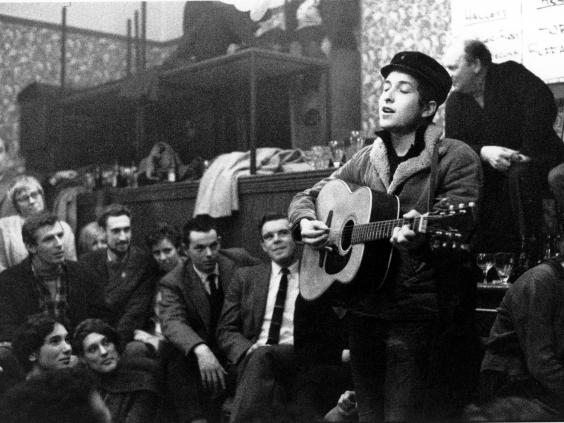
Nonetheless, universities are never just academic establishments full stop. For their campuses and their indoor and outdoor spaces lend themselves to meetings and debates and even to organising mini demonstrations. The intellectual gods of these 1960s students were Marx, Freud and Sartre, the French existentialist philosopher. In a famous passage, Sartre wrote that “God does not exist, and as a result man is forlorn, because neither within himself nor without does he find anything to cling to”. This struck home. For as Bob Dylan sang in 1965 – “How does it feel/How does it feel/To be on your own/With no direction home/Like a complete unknown/Like a rolling stone?”

One had either to start things on one’s own without adult backing, or not at all. This was an unprecedented and intoxicating freedom. As the French student leader Dany Cohn-Bendit told the Paris demonstrators in May 1968: “There are no marshals and leaders today. Nobody is responsible for you. You are responsible for yourselves.”

In fact, as is the way of things, Mai 68 began not in central Paris, but in Nanterre, a suburb seven miles to the northwest, and not in May but on 22 March. The construction of the university of Nanterre campus in a bleak shanty town had begun in 1962. In the spring of 1968 it was still not finished. The building were exceedingly functional and contained some 12,000 students. They were particularly shocked to find themselves living and doing their studies in what was in effect a building site. They demanded, too, the right to circulate freely between the residences of males and female students, still forbidden in what one might call pre-1960s style. There was a lot of justified discontent.

daniel-cohn-bendit.jpg
Daniel Cohn-Bendit  was known as ‘Dany le Rouge’ because of his politics as well as the colour of his hair (Getty)

Some 150 students, including far-left groups together with a small number of poets and musicians, occupied a building. The police surrounded it. After publication of the students’ wishes, they left the building without any trouble. But then they took their protest movement to the Sorbonne in the very middle of the Latin Quarter. That was how Mai 68 started.

In a drastic action, the authorities shut down the University of Nanterre on 2 May. The students who had decamped to the Sorbonne were bound to think that this was a hostile act, an outbreak of war between the university authorities and the student body. It had been natural to head to the Sorbonne, France’s premier university, which had the prestige of its ancient foundation 700 years earlier. This meant nothing to the police, of course, who invaded the Sorbonne the next day.

In response, on 6 May the national students’ union and the union of university teachers organised a protest march. It was one of the key events of the month. The head of the Paris police was obsessed by the need to protect the Sorbonne and its surroundings from a massive invasion by the students. He placed 1,500 officers in defence. But then came 6,000 protesters in waves. Overnight the confrontation was particularly violent. Thousands of cobblestones were ripped up and used as projectiles by the demonstrators. The police responded with teargas grenades. Dozens of gendarmes were taken to hospitals. Students were wrenched from the arms of the police by their colleagues.

The next day, students, teachers and increasing numbers of young workers gathered at the Arc de Triomphe to demand that all criminal charges against arrested students be dropped, that the police leave the university and that the authorities reopen Nanterre and the Sorbonne. But negotiations broke down. When the students returned to their campuses to find that the police were still in occupation, a near revolutionary fervour began to grip them.

bob-dylan.jpg
The lyrics of Bob Dylan captured the sense of isolation and alienation felt by many young people

The next big date was 10 May. The atmosphere became more and more tense. Left-wing students were seeking a confrontation and the force of law and order did nothing to avoid it. Senior politicians now began to fear that an insurrection was being planned that would soon set ablaze the whole country. When the Compagnies Républicaines de Sécurité, a special police unit specialising in riotous situations, blocked the demonstrators from crossing the river, the crowd again threw up barricades, which the police then attacked at 2.15 the next morning after negotiations once again floundered. The confrontation, which produced hundreds of arrests and injuries, lasted until dawn.

The events were broadcast on radio as they occurred, and the aftermath was shown on television the following day. This demonstration of heavy handed police brutality brought on a wave of sympathy for the strikers. Moreover, in a highly significant move, the major union federations called a one-day strike and demonstration for Monday, 13 May. The workers were going to march with the students.

They had their own grievances. There had been sporadic industrial trouble since the beginning of the year. More than half of them put in a 48-hour week. They feared that their standard of living had ceased to improve. Unemployment, albeit from a low base, was beginning to rise. As a result this was no longer a Paris event, for workers took to the streets throughout France. Their slogan was “Ten years! That’s enough!” referred to Charles de Gaulle’s long period as president.

de-gaulle-support-68.jpg
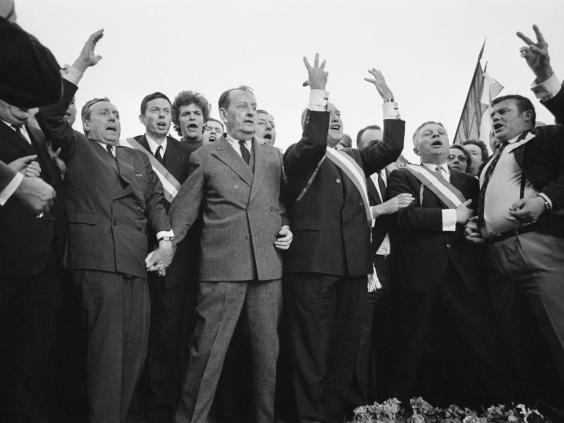
French politicians Michel Debre and Andre Malraux at the tomb of the unknown soldier, demonstrating their support for De Gaulle (Getty)

The events the next day, 14 May, were as important. For workers began occupying factories, starting with a sit-down strike at the Sud Aviation plants near the city of Nantes. If students could occupy their universities, then workers could seize control of their factories. By 16 May, workers had occupied roughly 50 factories throughout France and 200,000 were on strike by 17 May. That figure snowballed to two million workers on strike the following day (18 May) and then ten million, or roughly two thirds of the French workforce on strike the following week (23 May).

The unions assumed that the workers simply wanted more pay. So, when they were able to negotiate substantial pay increases with employers’ associations, they thought their job was done. But workers had also demanded the ousting of the De Gaulle government and in some cases demanded to run their own factories.

The demonstrations and the strikes went on. Meanwhile on the morning of 29 May, De Gaulle suddenly boarded a helicopter and left the country. He went to the headquarters of the French military in Germany and called a meeting of Council of Ministers for 30 May back in Paris. On that same day, the unions led 400,000 to 500,000 protesters through Paris chanting “Adieu, De Gaulle. The head of the Paris police carefully avoided the use of force.

Sensibly De Gaulle responded by dissolving the National Assembly and calling a new election for 23 June. He ordered the workers to return to work immediately, threatening to institute a state of emergency if they did not. The Communist Party agreed to the holding of the election. Immediately revolutionary feelings began to fade away. The police retook the Sorbonne on 16 JuneAnd the Gaullists won the greatest victory in French parliamentary history.

The May days of 1968, it turned out, had been a convulsive moment, nothing more enduring than that. Nonetheless in Wordsworth’s words, “to be young was very heaven”.

Egalité! Liberté! Sexualité!: Paris, May 1968

It began with a demand by students for the right to sleep with each other. And it ended in one of the greatest upheavals in French society since the revolution. John Lichfield goes in search of the spirit of 68 . Saturday 23 February 2008

“Bliss was it in that dawn to be alive, But to be young was very heaven!”

It took a dead British poet to understand May 1968. The conventional French politicians of the time did not have a clue what was going on, even the left-wing politicians. The student and worker revolt in France 40 years ago this spring was a cultural revolution, even a sexual revolution, before it was a political one.

The young William Wordsworth wrote the above lines about a much bloodier French revolution. They express perfectly, all the same, the mood of May 1968: the idealism, the whimsy, the zeal, the humour, the self-righteousness, the excitement.

The photographs tell the story. On the first night of rioting in the Paris Left Bank, on 3 May 1968, the riot police wore old-fashioned uniforms and old-fashioned helmets. They looked rather like French soldiers from the 1914-18 war.

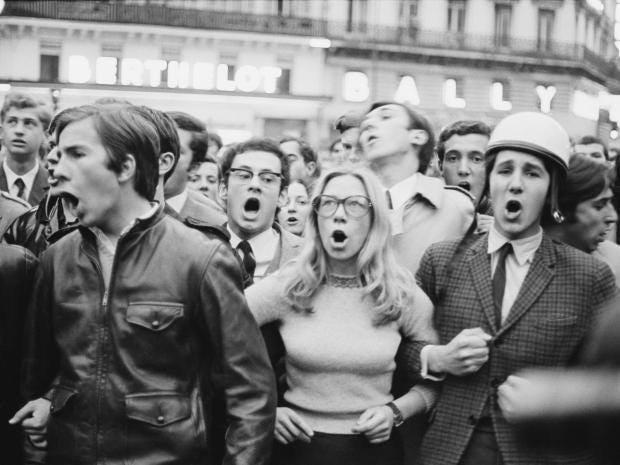
The male students wore jackets and ties or neat jumpers and short hair and well-pressed trousers. The women had long hair and sensible skirts and hair-bands. There were few jeans or sandals or beards.

This, remember, was more than a year after Sgt Pepper’s Lonely Hearts Club Band. It was the year after the Flower Power revolution had begun in San Francisco. No self-respecting, revolting student in America or Britain or Germany would have worn a jacket and tie on a barricade in the first days of May 1968. Before the end of the student revolt in early June, the French students looked more convincingly revolutionary: they were scruffier, more hirsute and more psychedelic. They had lost politically but they had won culturally and maybe even spiritually.

May 1968 was, in its origins, a revolt against the stifling papa-knows-best conservatism, and dullness, of General Charles de Gaulle’s economically booming 1960s France. It was, at one level, a catch-up, fast-forward revolution for the right to wear long hair and purple trousers. It began in March, at the new Nanterre University west of Paris, as a demand for the rights of boy and girl students in their late teens and twenties to sleep together.

There were other student revolts in Europe and America, before and after May 1968. In no other country did a student rebellion almost bring down a government. In no other country did a student rebellion lead to a workers’ revolt, one that rose up from the blue-collar grass roots and overwhelmed the paternalistic trade-union leadership as much as the paternalistic, conservative government.

The two revolts remained largely separate: despite the efforts of a fringe of Maoist students, despite the eloquence of Jean-Paul Sartre, who stood on a box outside the Renault factory at Boulogne-Billancourt telling the workers about the student-worker-intellectual paradise to come. (“Be brief,” someone advised him, but he wasn’t.)

The workers’ demands were tangible and precise. The students’ aims were diffuse and contradictory: more philosophical than political and often shot-through with sexual innuendo (and frustration). “Marxist, Groucho tendency.” “Be realistic, ask for the impossible.” “Take your desires for realities.” “Unbutton your brain as much as your trousers.”

Of the two rebellions, it was the wildcat general strike by workers which worried the government most at the time. A young minister called Jacques Chirac was sent secretly to prepare the way for the pay rises, and reduced working hours, which helped to bring the strike to an end. He put a revolver in his inside jacket pocket before going to his clandestine meetings. This was not self-dramatisation; it was just the giddy mood of the times.

And yet, 40 years on, it is the student revolt which is most remembered and the workers’ revolt which has been almost forgotten. This is partly because the leaders of the young people who built barricades and overturned cars in the Paris Latin Quarter in 1968 went on, in many cases, to become senior journalists, writers, philosophers and politicians (including the present foreign minister, Bernard Kouchner).

It is also because the French cultural and sexual revolution of the 1960s was compressed so memorably into four or five weeks. Elsewhere the changes were stealthier. Philip Larkin (another dead British poet) said: “Sex was invented in 1963, between the Chatterley trial and the Beatles’ first LP.” In truth, the end of the old social and sexual certainties and taboos in Britain was a gradual process from 1963 to 1970, driven by the Profumo scandal, the Beatles, the reforms of the first Harold Wilson government and a virus of revolt carried on the wind of television from Vietnam and the United States.

In France, typically enough, the same transition was acted out in a great, concentrated psycho-drama on the streets. As the French journalist and writer Jacques Julliard said, revolutions in France are “rites of passage”. Quiet, peaceful, social transitions, even noisy, peaceful transitions, are not the French Way.

“To go from Louis XVI to Louis XVIII, from moderate absolutism to a parliamentary monarchy, clumsy foreigners would have gone by way of a Louis XVII,” M. Julliard wrote. “We went via Robespierre and Napoleon.”

By the same logic, France needed six weeks of mayhem to go from grey trousers to purple trousers; from the social and sexual repression of the 1950s to the social and sexual freedom, and confusion, of the 1970s (and afterwards).

The French students who manned the Left Bank barricades thought – among other things – that they were revolting against French-ness itself. In fact, they were behaving in a classically French way.

Perhaps because it was such a French occasion, French commentary to this day tends to treat May 1968 as a purely French phenomenon. Reading some of the French analyses of 1968 – both for and against – one could have the impression that the May student revolt alone created the post-1970s world of tolerance and individualism, free-thinking and consumerism.

Other Western countries were going the same way before France. Most of them had brief or scattered outbreaks of anti-establishment violence in the late 1960s and early 1970s, even of terrorism in the case of Germany and Italy. None of them had a brief, intense, mythologised youth rebellion as France did.

The fast-forwarding of events made the myth of May 1968. And the myth, as myths do, has achieved a life of its own.

During his presidential campaign last year, Nicolas Sarkozy launched into a series of vituperative speeches in which he promised to “liquidate” the legacy of 1968, which he blamed for everything from poor school results to high crime figures and the decline of old-fashioned patriotism.

And yet M. Sarkozy, a twice-divorced, consumerist, value-muddling, politican par excellence, is himself a child of 1968. At least, he is a child of the social changes which 1968 symbolised rather than generated.

Similarly, on the French Left, May 1968, precisely because it was so memorable, has become a sacred totem. Unfortunately, it is the most hidebound, unthinking lefties who cling onto the memory of France’s revolution manqué. The open-minded, joyful, jokey, surreal side of May 1968 – the “Groucho tendency” – tends to be forgotten. There are, none the less, specific reasons why “May 1968” – which began in March and ended in June – happened in France in the way that it did.

From 1945 to 1975, still known as “les trentes glorieuses”, France enjoyed 30 years of unbroken growth and relative prosperity. After the revolving-door governments and the lost colonial wars of the 1950s, France under President Charles de Gaulle settled into a period of unusual stability in the 1960s (give or take a few incidents of pro-colonial terrorism).

In that period, an old France, mostly agricultural, mostly Catholic, was being quietly buried. In 1945, there were still 7,000,000 farmers and peasants in France. By 1968, there were 3,000,000. (There are now, by the way, only about 500,000.)

The rural population poured into towns and suburbs and worked in offices and factories. Their children thrived in urban schools. Long before 1968, anyone who passed the baccalaureate (equivalent to A levels) had an absolute right to go to university, virtually for free.

In 1938, France had 60,000 university students. In 1961, it had 240,000. By 1968, it had 605,000, as many as Britain, West Germany and Belgium combined. Few new university campuses were built or extended to take the massed ranks of students. Nanterre University was one exception.

Despite the overall rise in prosperity, and levels of education, De Gaulle’s France was a quietly oppressive place. Memories of French failure in the war were everywhere but rarely discussed. The general wanted a modern, dynamic France rooted in an old, conservative and non-dynamic social system.

Students felt that they were treated like children and herded like cattle into vast “amphis” or amphiteatres to scribble down notes. Factory workers were treated like inferior beings, by bosses and union bosses alike. They also resented the fact that the 1960s prosperity had failed to trickle down to the shop floor.

In a celebrated, prophetic, but also obtuse, article in Le Monde on 15 March 1968, Pierre Viansson-Ponté said that France was suffering from a dangerous political malady: “boredom”. Elsewhere, he said, from Spain to the US, students were protesting about wars or fundamental liberties. “French students are mostly concerned that the girls … should be able to visit the bedrooms of the boys, which is a rather limited conception of human rights.” Not so limited if you are French, aged 20 and the sexual revolution is already well under way in the United States and even in supposedly frigid Britain.

The right of young adults to have sex with one another in their rooms was, indeed, one of the first of the demands of students at Nanterre University, which led directly to the events of May 1968. Sociology students at Nanterre, led by a 22-year-old, red-haired, French-born German called Daniel Cohn-Bendit, successfully used sexual oppression as a symbol for political and spiritual oppression. ………

By 22 March 1968, the issues were much wider, including the Vietnam War. Cohn-Bendit led 300 students in an occupation of the admin block at Nanterre. Several students, including Cohn-Bendit, were accused of “agitation” and threatened with expulsion.

A demonstration in support was planned in the courtyard of the venerable Sorbonne, in the centre of Paris’s Left Bank, on 3 May. A far-right-wing group, Occident, enflamed tempers – and pumped the left-wing students with self-righteous adrenaline – by threatening to attack the “manif” (demo).

The police scattered the “righties” and then began to remove the “lefties” from the Sorbonne. The demonstrators had been promised that they could leave freely. About 400 of them were brutally arrested.

Larger demonstrations gathered. The first “pavés”, or cobble stones, were thrown at the police. The Paris police, supported by a few busloads of the notorious CRS riot police, responded with indiscriminate baton charges and volleys of tear gas, assaulting students, journalists, passers-by, tourists, cinema-goers and elderly couples who were sitting at café terrasses watching the fun. Many of the younger victims, and some older ones, joined in the riots. By that night, there were barricades all over the fifth arrondissement.

A week later a large crowd of students tried to “liberate” the Sorbonne, which had been ringed by the CRS. Trees were ripped up, cars overturned and cobble stones hurled – exposing yards of sand, and leading to one of the best-known anarcho-libertarian sayings of 1968: “Sous les pavés, la plage” (Under the cobble-stones, the beach).

On 13 May, the trades unions – against the better judgement of their own leaders – called a one-day strike and demonstration. The government ordered the CRS to withdraw, and an immense student and worker demonstration choked the Left Bank. But the strike did not end after one day as the union leaders planned. Eight million workers went on indefinite, wildcat strike, the largest labour stoppage in French history.

The demonstrations spread to provincial cities. A half-hearted attempt was made on 24 May to burn down the Bourse (the Paris stock exchange). The Prime Minister, Georges Pompidou, began secret – and then public – negotiations with the unions. Cohn-Bendit was expelled from France, returned and was expelled again.

Parts of the Left Bank of Paris came to resemble giant debating chambers, in which anyone who wished could discuss, endlessly, the future of humanity. At the 18th-century Odéon theatre, beside the Luxembourg gardens, there was an all day and all night, open-ended conference between, among others, Renault car workers, students, cleaning ladies, tourists, celebrated writers and artists and businessmen with nothing to do because

their factories were on strike. In the wings of the theatre, young men and women performed loveless sexual acts never previously seen on the French stage.

On 29 May, De Gaulle left France for Baden-Baden in West Germany. Crazy rumours spread that he had resigned or that there had been a military coup. In fact, De Gaulle was talking to the French military high command, making sure that they would support him.

The next day a carefully managed, but huge, counter-demonstration by De Gaulle supporters blocked the Avenue des Champs Elysées. The President called early elections (which he won easily the next month).

To the fury of the students and the more revolutionary workers, the trades unions accepted a generous, capitalism-preserving deal from the government: a 10 per cent increase in all wages and a 35 per cent increase in the minimum wage, a shorter working week and mandatory employer consultations with workers. Right wing economists argue that France’s post-war prosperity ended that day, though in fact it continued until the mid-1970s and the first oil crisis.

By early June, the strikes and the student demos had melted away. France was saved. Utopia was cancelled, or at least postponed.

What remains of May 1968? Some left-wing thinkers of the time have – like William Wordsworth before them – become grumpy and conservative in their old age. The philosopher Régis Debray, a minor figure in the events of 1968, argues that, far from a left-wing revolution, “les évènements de Mai” let loose the individualism and the ultra-capitalism of the 1980s and 1990s. Under the paving stones, the beach; under May 1968, Margaret Thatcher and Ronald Reagan.

But this is once again – in the French way – to mistake May 1968 for the whole of the Western zeitgeist of the late 1960s. If anything survives of May 1968, the month and the myth, it is the tendency to romantic absolutism of the French Left. What other developed Western country could produce four (or was it five) Trotskyist candidates in a presidential election? French social democracy is still paying the price for such dogmatism, which is quite alien to the best of the free-wheeling, mind-opening spirit of ’68.

This, at any rate, is the argument made by a 62-year-old Green German Euro MP who played a part in the “events of May” in Paris. “I say forget May 1968,” he said. “It is finished. Society today bears no relationship with that of the 1960s. When we called ourself anti-authoritarian, we were fighting against a very different society.”

The Green German Euro MP is now a pro-market, pro-European, libertarian liberal and ecologist. Like the best of the “soixante-huitards” (sixty-eighters), his mind is still open to new ideas and changing times. His name is Daniel Cohn-Bendit.

https://www.independent.co.uk/news/world/europe/egalit-libert-sexualit-paris-may-1968-784703.html

A student hurling rocks at the police in Paris during the May 1968 student uprising. The protests transformed France.CreditGamma-Keystone, via Getty Images

Just six weeks after France’s leading newspaper, Le Monde, pronounced that the country was “bored,” too bored to join the youth protests underway in Germany and in the United States, students in Paris occupied the Sorbonne, one of the most illustrious universities in Europe.

The day was May 3, 1968, and the events that ensued over the following month — mass protests, street battles and nationwide strikes — transformed France. It was not a political revolution in the way that earlier French revolutions had been, but a cultural and social one that in a stunningly short time changed French society.

“In the history of France it was a remarkable movement because it was truly a mass movement that concerned Paris but also the provinces, that concerned intellectuals but also manual workers,” said Bruno Queysanne, who, at the time was an assistant instructor at the École des Beaux-Arts in Paris, one of the country’s most prestigious art and architecture schools.

“Each person that engaged, engaged himself all the way,” he said. “That was how France could stop running, without there being a feeling of injustice or sabotage. The whole world was in agreement that they should pause and reflect on the conditions of existence.”

Jacques Sauvageot, center right, one of the protest leaders, and other students marching in Paris. Universities across the country shut down during the protests. CreditBruno Barbey/Magnum Photos
Photo

Police forces in the Latin Quarter in Paris during the “night of barricades” on May 10 to 11. CreditAgence France-Presse — Getty Images
Photo

Riot police in front of the Le Rex cinema on the Grands Boulevards in Paris. The 1968 Cannes Film Festival was cancelled about halfway through its run because of the protests and strikes.CreditBruno Barbey/Magnum Photos

Today it is hard to imagine a Western country completely engulfed by a social upheaval, but that is what happened in May 1968 in France. It is hard to find any Frenchman or woman born before 1960 who does not have a vivid and personal recollection of that month.

“Everything was enlarged by 1968; it determined all my life,” said Maguy Alvarez, a teacher of English to elementary school students, as she walked through an exhibition of posters and artworks from the period.

“In religion, in sexual things, what it meant to be a woman — that it did not mean only to serve a man or to submit to men. These are questions you think about your whole life,” she said.

Both the women’s liberation movement and the gay rights movement in France grew out of the 1968 upheaval and the intellectual ferment of the time.

Students at Nanterre University in the suburbs of Paris in 1968. CreditGilles Caron/Fondation Gilles Caron
Students gathered for a general assembly in the amphitheater at Sorbonne University on May 15. CreditAgence France-Presse — Getty Images
Posters at a French university celebrating communist leaders. CreditBruno Barbey/Magnum 

While some people saw the mass strikes and protests as a shattering and painful event that upended social norms — the authority of the father of the family and of the leader of the country — for most, it pushed France into the modern world.

“The 19th century was a very long century,” said Philippe Artières, a historian and researcher at the National Center for Scientific Research and one of the curators of the show on the posters of 1968.

“We’re hardly out of it, and you have to keep in mind that in ’68 we were just 50 years after the revolution of ’17 and a century after the Paris commune,” he said, referring to the Russian Revolution and the 1871 uprising by mostly poor and working class residents of Paris (although the leadership was middle class) that was brutally put down, leaving as many as 10,000 dead.

President Emmanuel Macron, who was born in 1977, is the first post-1968 French leader not to have personal memories of the upheaval — the exhilaration, the sense of possibility, and the potential power of the street.

Students passing cobble stones to build barricades in Paris on May 10. CreditBruno Barbey/Magnum Photos

Universities across the country shut down as students, often joined by their professors, occupied the classrooms and courtyards. In Paris and other major French cities, workers, students, intellectuals and anyone else who was interested thronged into the street for mass rallies.

Blunting the sense of exhilaration were the daily confrontations with the police. As early as May 3, police charged into the Sorbonne and ousted the students; in the ensuing melee, some 600 were arrested, according to Agence France-Presse.

The students returned and quickly set up barricades to stop the police from entering the areas where they were massing. The two factions faced off night and day: The police wearing helmets and armed with riot shields, tear gas, truncheons and water cannons; and the university students, sometimes still wearing the ties and jackets mandated at the time by the university administration. The students dug up paving stones from the Paris streets to heave at the police.

The night of May 6 was particularly violent, with 600 people wounded and 422 detained, but it was overnight between May 10 and May 11, known as the “night of barricades” that people still talk about.

The protesters ripped up the paving stones from two streets in the Latin Quarter, where the Sorbonne is, set fire to cars and confronted the police. By the time the bloody fighting ended, hundreds of students had been arrested and hundreds more hospitalized, as were a number of police officers.

A student chased by a police officer on May 6 in Paris. CreditGilles Caron/Fondation Gilles Caron
Students in the Latin Quarter being led to a police station on May 11. Hundreds of students were arrested during the protests that night, and hundreds more hospitalized, as were a number of police officers. CreditAssociated Press
The evacuation of an injured student under the eyes of the riot police during the night of May 10-11. CreditBruno Barbey/Magnum 

“During the night there were very violent protests, cars burned, things broken, but during the day, there was an air of vacation, of summer, a relaxed feeling,” said Mr. Queysanne, who later became a professor of the philosophy of architecture at the University of Grenoble and then at the Southern California Institute of Architecture in Los Angeles.

“But then the next day, people came and discussed what they had seen; some were for, some were against. This was incredible, there was freedom of speech, words were set free.”

The aftermath of a night of riots in Paris. CreditBruno Barbey/Magnum Photos

Amazingly, somehow the violence did not taint the euphoria of the protesters.

“The feeling we had in those days, which has shaped my entire life really, was: We’re making history. An exalted feeling — suddenly we had become agents in world history,” said Daniel Cohn-Bendit, the most prominent of the student leaders at the time, in an essay in the May 10 issue of The New York Review of Books.

The French philosopher Jean-Paul Sartre, right, addressing students at the Sorbonne on May 20, 1968. CreditAssociated Press
French student leaders Daniel Cohn-Bendit, left, and Pierre Delteil, with glasses, speaking to the media in the Jardin du Luxembourg in Paris after a night of violent clashes on May 7.CreditAgence France-Presse — Getty Images
Hundreds of thousands of people demonstrated their support for President Charles De Gaulle on May 31, 1968. Many sang “La Marseillaise” on the tomb of the Unknown Soldier.CreditGamma-Keystone, via Getty Images

Simultaneously with the student protests, France’s factory workers walked off the job and in many places camped out on the factory floor, refusing to work and demanding a new order.

The shipyards in Nantes stopped loading and unloading freighters, and work in much of the car manufacturing and aeronautics industries also ceased. The unions did not call the strikes but when workers and students embraced them, they acquiesced.

By the third week in May, between 10 and 11 million people were on strike. There was no gas for cars because the refineries came to a halt; the trains did not run, nor did the Paris Metro.

A May Day demonstration in Paris against the bombings in North Vietnam by United States forces. CreditGilles Caron/Fondation Gilles Caron
Strikers at the Renault factory in Boulogne-Billancourt on May 27. CreditBruno Barbey/Magnum
A student on a barricade in front of the School of Medicine; it was the last barricade to be breached by the police, on May 12. CreditBruno Barbey/Magnum 

In France, the enemy of change was the government, then headed by President Charles de Gaulle, who tried to repress the strikes and the sit-ins, but on May 29, he appeared to be overwhelmed.

In an unprecedented move, he left the country without saying either that he was leaving or where he was going. It was a startling turn of events and for a day or two the students and workers thought they had won.

But Mr. de Gaulle returned, dissolved the National Assembly and called an election for the end of June. Already, on May 27, the government and the unions had made a deal to get the striking workers back on the job, offering them generous pay increases and benefits.

But the established hierarchy and formality that permeated relationships between teachers and students, parents and children, bosses and workers, and ultimately even politicians and citizens, had been upended.

“At the level of daily life, and the relationships of people with institutions, there were big changes,” said Mr. Queysanne, the professor of the philosophy of architecture.

When students returned to classes, they could now ask questions in class and dispute ideas — a revolution in the French educational system. Bosses had to treat their workers better.

But that heady atmosphere of social foment, excitement and a sense of deep camaraderie that cut across class and education, that touched factory workers, students, intellectuals and farmers alike had passed.

There would be other moments of social protests, but none that were quite the same as those that occurred in the Paris spring of 1968.

A Paris street in June, with the aftermath of the protests still clearly visible. CreditGilles Caron/Fondation Gilles Caron

During the major strikes and student uprisings in France that year, the École des Beaux-Arts turned itself into a workshop for revolutionary messages.

Image
“Clash of Images,” an exhibition in Paris of posters, paintings, films and other works from the uprising of May 1968 and beyond.CreditFrancois Mori/Associated Press

By Alissa J. Rubin May 4, 2018

PARIS — Fifty years ago, almost to the day, students here began to strike over the rigidity and hierarchy of the French university system, defying the historical deference of young people to their elders; the same day, workers at a major factory near Nantes walked out.

Within days, the strikes spread to other universities and factories, and garbage collectors and office workers joined in. By mid-May, more than 10 million people across France were on strike, and the country had all but come to a standstill.

The protests of 1968 ushered in more than five years of social upheaval, intensifying an antiwar movement in Europe and contributing to the women’s liberation and gay rights movements. And it all started with a call to upend the old order.

“There was an idea that France was a class society and it had to be torn down,” said Éric de Chassey, a professor of contemporary art who curated, with Philippe Artières, “Clash of Images,” an exhibition at the Beaux-Arts de Paris. It showcases posters from those early days of social upheaval, as well as art and documents from subsequent protests for women’s rights and gay rights.

The show’s title refers to the way the 1968 protests evolved from uniting the left and people from different backgrounds — middle class and working class — to dividing them when the strikes ended and leftist factions re-emerged. But in those first months of protest, university students, factory workers and government employees joined intellectualsand teachers to try to fulfill the dream of making France a more egalitarian place.

Image
The protests ushered in more than five years of social upheaval, intensifying an antiwar movement in Europe and contributing to the women’s liberation and gay rights movements. CreditAssociated Press

The École des Beaux-Arts was at the center of the revolt. Many of the prestigious art school’s students and teachers occupied the 300-year-old stone structure on the Left Bank of the Seine: Rather than holding meetings only in the building’s vast rooms and courtyards, they turned the school into an atelier, or artists’ workshop, where they created protest art.The often arresting posters straddled the line between art and propaganda.

In keeping with the utopian ideals of collective work and anonymous authorship, the artists labored together to conceptualize, design and write slogans for the posters that framed their revolutionary sentiments.

“Someone would say ‘We need a poster that talks about immigration,’ ” Mr. de Chassey explained. “Then someone would propose a design, someone else would propose a slogan and then it would be discussed by a committee.”

The students printed hundreds or sometimes several thousand copies of the posters and taped them to lampposts and walls around Paris. In an era before the internet, the posters became a trusted way to communicate plans for action as well as the protesters’ political messages. There was little faith in electronic media at the time because it was state owned.

The strikes that began in May 1968 became the template for social protest in contemporary France, and although the fervent anti-establishment sentiments have faded, the mentality of struggle still resonates. The Beaux-Arts posters, on display through May 20, give a sense of the ferment of idealism, rebellion and rejection of the status quo that permeated French society and marked the second half of the 20th century.

Some of the posters are easily comprehensible, but others need a little explanation. Here’s a look at 11 of the most emblematic.

CreditÉcole des Beaux-Arts

One of the most iconic posters on display depicts a member of the French riot police (the Compagnies Républicaines de Sécurité, or C.R.S.) as a baton-wielding member of the SS, the Nazi special police.

CreditÉcole des Beaux-Arts

Under the title “Grève Illimitée” (“Unlimited Strikes”), three figures walk arm in arm, representing the students, union members and factory workers who joined together in protest.

CreditÉcole des Beaux-Arts

The words on a bottle of poison read, “Press Do Not Swallow,” a warning not to trust the state-owned news media. At the time, France’s television and radio stations were state-owned corporations.

CreditÉcole des Beaux-Arts

The raised fist is a straightforward call to march and to fight for the causes of students and workers. It remains a well-known symbol of solidarity on the left.

CreditÉcole des Beaux-Arts

Police officers raided the École des Beaux-Arts and forcibly expelled the students who had occupied it, turning the complex into a workshop. In this poster, a helmeted officer, complete with wolf-sharp teeth, grips a paintbrush in his mouth, a symbol of the police takeover of the school.The slogan plays on the French verb “afficher,” which means “to display” but in its reflexive form, “s’afficher,” means “to show up.” The poster says: “The police show up at the Beaux-Arts, the Beaux-Arts displays in the street.”

CreditÉcole des Beaux-Arts

The poster above is a straightforward reference to the ties that bond factory workers and university students and that calls on them to unite.

CreditÉcole des Beaux-Arts

This poster shows the silhouette of Charles de Gaulle, a World War II general and the French president at the time, covering the mouth of a young man. “Be young and shut up,” he says. The expression was also an adaptation of a well-known phrase, sometimes used to denounce sexism, from a popular French film of 1958 titled “Be Beautiful but Shut Up.”

CreditÉcole des Beaux-Arts

A sketch of Daniel Cohn-Bendit, a French-German student leader during the uprising, above the French words for “We are all undesirables.” It refers to Mr. Cohn-Bendit’s expulsion from France during the protests, when he was deemed “an undesirable.”

CreditÉcole des Beaux-Arts

In this poster, the factory chimney completes the last letter of “Oui,” or “Yes,” above the words “Occupied factories,” to encourage workers to take over more of them. At the time, factories all over France were closed or occupied by striking workers. Among the many companies affected were the auto manufacturers Renault and Citroën, and the aeronautics firms Sud Aviation and Dassault.

CreditÉcole des Beaux-Arts

In response to the protests, Mr. de Gaulle was reported to have said: “Reform, yes. Havoc, no.” The poster above reads “Once again, the havoc is him.” Until 1968, Mr. de Gaulle was primarily associated with the resistance in World War II, but in ’68 he tried to repress the strikes with armed police officers. His lack of sympathy for the strikers and his seeming inability to understand them made him the target of much of the protesters’ anger.

CreditÉcole des Beaux-Arts

This classic poster of May ’68 depicts unity between French and immigrant workers. France had recruited many workers from Algeria, Morocco and Tunisia to help build railroads and other infrastructure or industrial installations. A short man, who appears to symbolize the factory owners or owners of capital, tries to push them apart. The slogan reads, “Workers united.”

Daphné Anglès contributed reporting from Paris.

Alissa Johannsen Rubin is the Paris bureau chief for The New York Times. @Alissanyt

The man with the plan

All that was old is new again with the potential re-emergence of the US’ Cold War strategy of “offshore balancing”
Commentator and counterinsurgency expert David Kilcullen is always worth reading. Here is his latest piece  for The Australian on this subject.
It is a well-tried and well-documented strategy whereby an offshore power counters a rival by backing opposing coalitions in a region of ­strategic competition, supporting local allies indirectly (with weapons, money, advisers intelligence or diplomatic cover), and using proxy military muscle, regular and irregular, to prevent any one rival dominating the region.

Maritime powers (including Britain in the 18th and 19th centuries, and the US for much of its history until 1945) historically used offshore balancing to counter land-based rivals while lowering their own costs and avoiding ­decisive commitment. To succeed, the offshore power does not need to control a region itself, merely to prevent a rival doing so. As such, this is a low-cost approach — something military planners call an “economy of effort” strategy — that reduces exposure and preserves freedom of action.

This comes in the wake of hugely expensive and largely unsuccessful efforts by the US to dominate a region directly through direct military intervention – and subsequent entanglement that left it ‘neck deep in the big muddy’ to quote political activist and balladeer Pete Seeger. It was a maximalist approach that had ad­verse consequences in terms of lives lost, funds wasted, credibility eroded and loss of freedom of ­action (particularly after 9/11, as the US became bogged down in self-inflicted wars of ­occupation).

But, offshore balancing requires a cool nerves, a steady hand and deft footwork.

Bad timing and miscalculation can increase the risk of wars that the US neither wants or is prepared for. And in inexperienced, needful, and impetuous hands, it could render the US vulnerable to being played by its partners. Kilcullen notes that a body of opinion in the US intelligence community,  and also, within Israeli intelligence,  holds that the threat from Iran has been overstated, that Iran’s ability to dominate the so-called “land bridge” from Afghanistan to the Golan Heights is overblown, and that no regime in Tehran would be suicidal enough to consider a nuclear strike on Israel, Saudi Arabia or any of its other regional rivals.

But it would appear that Israeli Prime Minister Benjamin Netanyahu and the Saudi crown prince Muhammed bib Salem have successfully sold Donald Trump on their expansive vision of the Iranian threat, creating the possibility that Washington may be manipulated into decisions that run counter to its own wider interests.

Moreover, with regard to US foreign policy generally, one size does not necessarily fit all. Taking a strategy like offshore balancing, however successful it might prove to be in the Middle East, and blindly applying it on the Korean peninsula, to Russia or China  where conditions are dramatically different, would be full of risk.

Read on…

Donald Trump: The man with the plan

David Kilcullen, Contributing Editor for Military Affairs, The Australian, May

Donald Trump welcomes home three Americans released by North Korea. Picture: AFP
         Donald Trump welcomes home three Americans released by North Korea. Picture: AFP

    This week, as Donald Trump announced his decision to withdraw from the Iran nuclear deal and start reimposing sanctions on ­Teh­ran, a chorus of condemnation broke out on both sides of the Atlantic. European politicians condemned the decision and began working on ways to keep Iran in the deal, while in the US former secretary of state John Kerry engaged in last-minute direct negotiations with Iranian leaders.

    Fred Kaplan of Slate penned a piece that was typical of the mainstream media reaction, arguing that Trump withdrew “because of spite, ignorance, or both”.

    There is no doubt that the US President’s decision reflected animus toward his predecessor’s signature achievement in foreign policy. It also highlighted president Barack Obama’s self-­inflicted vulnerability over the deal, which he approved personally as an executive agreement rather than submitting it to the US Senate for formal ratification as a treaty. His administration also voted for a UN resolution lifting sanctions on Iran before congress had properly begun its review of the agreement. These ­decisions, over near-un­animous Republican opposition, made the deal a bone of partisan contention from the outset, a pro­blem Obama’s staff exacerbated through a manipulative media campaign that drew harsh criticism when disclosed in 2016. All this made it easier for Trump to leave the deal with just a stroke of the pen.

    Yet there’s reason to believe Trump may be acting from more than political spite. Indeed, it’s possible we might be witnessing the early signs of a new approach with the potential to transform America’s overseas military posture, though also carrying enhanced risk of war and other unintended consequences. The new approach may signal the re-emergence of Washington’s former strategy of working through regional coalitions to counter rivals in the ­Middle East, thereby enabling US military disengagement from the post-9/11 wars.

    The decision to dump the deal is far from the only indicator. Other recent signs include statements by Trump to the effect that he seeks to withdraw from Syria while sponsoring an Arab coalition to prevent the re-emergence of Islamic State. Under this scheme, Washington would support allies (including, potentially, Saudi Arabia and the United Arab Emirates, as well as a coalition of local Kurdish militias) but end combat troop deployments.

    Last month’s coalition strike on Syria sent a similar message in that it avoided targeting the Assad regime’s leadership or Russian and Iranian assets in Syria. It was also accompanied by clear statements that the US did not seek regime change — effectively acquiescing in Bashar al-Assad’s victory, moving away from Obama’s goal of regime change and further disen­gaging from involvement in the Syrian conflict.

    Iranians burn US flags and makeshift Israeli flags in Tehran. Picture: AFP
                         Iranians burn US flags and makeshift Israeli flags in Tehran. Picture: AFP

    Alongside an Arab coalition, ­Israel seems ready to step into any gap created by US withdrawal, while cheering Trump’s decision to exit the Iran deal. Indeed, an undeclared low-level air battle has been going on between Israel, Hezbollah and Iranian forces in Syria since February. Israel decided to retain its advanced fighter aircraft in-country rather than send them to a scheduled exercise in Alaska last month and this week it raised military forces to their highest alert level, called up air defence and intelligence reservists, and opened air-raid and missile shelters for Israelis living within range of the Syrian border. If anything, Israel’s willingness to directly engage Iranian and Iranian-backed forces in Syria has only increased after since Trump’s withdrawal from the nuclear deal.

    At the same time, statements by Saudi Arabia and the UAE indicate that the Sunni monarchies and their Gulf allies would consider participating in an Arab stabilisation force in Syria. Saudi leaders also have expressed a willingness to participate in strikes within Syria (making Saudi Arabia a de facto coalition partner with Israel, a tricky political position for Saudi leaders).

    Overtures by the US towards Egypt suggest Washington also is seeking ­Egyptian support for the same Arab coalition.

    All this may be evidence of an emerging post-deal strategy, whereby the US works through ­Israel and Arab partners in the region to weaken and contain Iran. For political reasons, Israeli and Arab components would operate separately, but Washington would co-ordinate with each and support both to prevent the re-emergence of Islamic State while containing and undermining Iran, ­Hezbollah and Russia (with the emphasis very much on Iran).

    As part of this strategy, US ­forces may launch periodic operations (missile and drone strikes, air raids or special forces operations) to preserve their preferred balance but would avoid protracted commitments, and troop numbers in Iraq and Syria would be drawn down. Washington would operate with allied support where possible, but strike unilaterally if needed.

    Provided Turkey can agree on a ­demarcation line with US-backed Kurdish groups — probably somewhere near the present line of control along the Euphrates river — the US also might support Turkey’s buffer zone in northern Syria. In that case Turkey, too, would play a role in containing Iran and preventing the re-­emergence of Islamic State — the two paramount US objectives.

    This approach, if it does emerge, would be a classic instance of offshore balancing, where an offshore power counters a rival by backing opposing coalitions in a region of ­stra­tegic competition, supporting local allies indirectly (with weapons, money, advisers intelligence or diplomatic cover) to prevent any one rival dominating the region.

    Maritime powers (including Britain in the 18th and 19th centuries, and the US for much of its history until 1945) historically used offshore balancing to counter land-based rivals while lowering their own costs and avoiding ­decisive commitment. To succeed, the offshore power does not need to control a region itself, merely to prevent a rival doing so. As such, this is a low-cost approach — something military planners call an “economy of effort” strategy — that reduces exposure and preserves freedom of action.

    One of the strategy’s key attractions would be that it might restore a critical strategic distinc­tion: the difference between hugely expensive (and largely unsuccessful) efforts to dominate a region directly, and the far cheaper and more achievable goal of merely preventing a rival doing so.

    In the post-Cold War era of liberal and neo-conservative interventionism, US leaders often con­flated the two, as if preventing a hostile power from dominating a region necessarily implied dominating it themselves.

    This maximalist approach had obvious ad­verse consequences in terms of lives lost, funds wasted, credibility eroded and loss of freedom of ­action (particularly after 9/11, as the US became bogged down in self-inflicted wars of ­occupation).

    Trump has been railing against these overseas commitments for years. Indeed, one of his themes on the campaign trail was the need to get out of overseas commitments, bring troops home, force allies to commit their own resources to their defence, cease putting American lives at risk to provide security guarantees for countries (in Europe, Asia or the Middle East) that were unwilling to pay their fair share, and stop spending money on nation-building that would be better used at home.

    An offshore-balancing strategy offers a way to do this while still acting tough and reserving the right to intervene unilaterally (another key Trump theme).

    Offshore balancing does not preclude periodic interventions to restore a favourable balance of power in a given region, but it does tend to rule out long-term occupation or decisive commitments of the post-9/11 kind. It also implies holding military power back, over the horizon or outside the region, rather than establishing permanent bases.

    As such, naval forces (including warships, expeditionary marine units, carrier-based aircraft and submarines) are the key assets needed for such a strategy — and for now, at least, the US leads the world in these capabilities, giving it a comparative advantage.

    The strategy’s other key benefit is its low cost and ability to preserve (or, in this case, restore) strategic freedom of action. Its disadvantage is that interventions, when they do occur, can be extremely costly.

    Britain’s approach to Europe from the 1680s to 1945 — periodic interventions to prevent any one power dominating the continent but reluctance to create permanent alliances or bases — is one ­example of offshore balancing. Another was the US strategy for the Middle East from just before the end of World War II (when Washington first became concerned about the strategic centrality of the region) until the Gulf war in 1991.

    From 1944 to 1992, despite periodic interventions (a CIA-backed coup in Iran in 1953, brief engagements in Lebanon in 1958 and 1983, bombing Libya in 1986) the US generally kept its military out of the region, preferring to counter Soviet influence through partners such as Israel, Turkey, the Arab monarchies, the Afghan mujaheddin in the 1980s and, until 1979, the shah of Iran.

    After 1991, everything changed: permanent US bases in Saudi Arabia (plus no-fly zones over Iraq, and the Clinton administration’s policy of “dual containment” towards Iraq and Iran) committed the US directly to the Middle East. US bases in Saudi Arabia, in particular, created intense grievances that led in part to the 9/11 attacks. After 2003, the Iraq war mired Americans in a full-scale military occupation. Successive presidents have sought to extricate themselves, but to little avail, proving what advocates of offshore balancing long have argued: hard though it is to avoid being dragged into permanent commitments, it’s far harder to ­extract yourself once committed.

    It’s unclear whether Trump knows any of this history; Harvard international relations professor Stephen Walt argued last month on Foreign Policy’s website that he probably does not.

    This may not matter, though, since offshore ­balancing so closely aligns with Trump’s instinctive preferences. Despite his surface volatility, Trump consistently follows certain patterns of strategic behaviour. His two main (and apparently contradictory) urges — the desire to appear strong, while disengaging from post-9/11 commitments in the Middle East and lopsided (“unfair”) treaty arrangements in Europe and Asia — would be well served by an offshore-balancing strategy, so he may consistently follow it, consciously or otherwise.

    A more serious criticism, from the few analysts who have yet commented on the emerging strategy, is that Trump is too mercurial and strategically illiterate, and his administration too incoherent, to enact this kind of strategy. These criticisms, too, are overblown. The sacking of secretary of state Rex Tillerson and national security adviser HR McMaster in March has removed competing power centres in US foreign policy, while former CIA director Mike Pompeo (Tillerson’s replacement as Secretary of State), and Defence Secretary James Mattis appear more than capable of executing an offshore balancing strategy.

    New national security adviser John Bolton is from the neo-conservative tradition that led directly to the post-9/11 wars of occupation and to the invasion of Iraq, and he will have to modify his views to be able to support this kind of strategy. Likewise, independent-minded UN ambassador Nikki Haley will need to collaborate more closely with the State Department and the White House than she has done to date.

    But neither Bolton nor Haley are likely to oppose the strategy if it appears to be succeeding.

    If it does succeed — a big if — offshore balancing may become a de facto Trump doctrine to be applied elsewhere. Opportunities to apply it include the Korean peninsula, where Trump seems willing to agree to partial US withdrawal and a permanent peace treaty in return for North Korean denuclearisation and enhanced sponsorship of Japan and South Korea to balance China.

    Another possible opportunity is eastern Europe, where Washington may continue arming Ukraine, and support the Baltics and Scandinavia to balance Russia while stepping back from permanent NATO commitments (or making them more conditional on European ­defence spending.)

    Africa, where efforts to work through regional coalitions against terrorists are already well advanced, naturally lends itself to this strategy, which could be further enhanced through France and its G5 Sahel regional coalition, which is already operating against Islamic State in northwest Africa.

    Likewise, in Southeast Asia, enhanced support for Vietnam and The Philippines may combine with existing US relationships with Australia, India and Japan to balance China.

    Whatever its possibilities, offshore balancing does carry significant risks. The most important is proxy conflict, which can spiral out of control when more than one external power backs local actors, drawing them into confrontation. This risk is severe in the Middle East, where Iran and Russia are sponsoring their own proxies. Saudi Arabia and the United Arab Emirates are already fighting a proxy war against Iran and its Houthi allies in Yemen, from where conflict is spilling into the Horn of Africa and bringing missile strikes to the heart of Saudi Arabia (most recently, this past week after the nuclear deal announcement).

    Internal conflict in Saudi Arabia is also a risk: a recent incident where a drone flew into the royal compound in Riyadh triggered a coup scare and highlighted nervousness within the Saudi royal family about opposition towards Crown Prince Mohammed bin Salman’s reforms. Co-operation between Saudi and Israeli forces (even tacit) would be highly controversial within Saudi Arabia and could prompt sharply increased internal unrest.

    For its part, given this week’s series of strikes and the ongoing air campaign, Israel appears to be posturing for imminent war against Hezbollah and Iranian-backed forces in Syria, and possibly Lebanon too. This could draw Israel into more direct conflict with Iran — indeed, one possibility here is that Israel is deliberately escalating conflict with Iran in order to increase its leverage in post-nuclear-deal Washington.

    In the same region, a US exit from Syria (a key element of a balancing approach) would remove deterrents on Turkey’s ability to attack Kurdish groups, heightening conflict risk between Ankara and the Kurds.

    Besides enhanced war risk, the other important concern of an ­offshore-balancing strategy is that it leaves Washington vulnerable to being played by its partners. A body of opinion in the US intelligence community (and also, ironically, within Israeli intelligence) holds that the threat from Iran has been overstated, Iran’s ability to dominate the so-called “land bridge” from Afghanistan to the Golan Heights is overblown, and no regime in Tehran would be suicidal enough to consider a nuclear strike on Israel, Saudi Arabia or any of its other regional rivals.

    But Israeli Prime Minister Benjamin Netanyahu and the Saudi crown prince seem to have successfully sold Trump on their expansive vision of the Iranian threat, creating the possibility that Washington may be manipulated into decisions that run counter to its own wider interests.

    Likewise, taking a strategy such as offshore balancing, however successful it might prove to be in the Middle East, and blindly applying it on the Korean peninsula or in Europe, where conditions are dramatically different, would be full of risk.

    Still, despite the ongoing condemnation from the policy establishment and allies alike, Trump’s decision to exit the Iran deal may indicate something deeper than mere ill-informed petulance — and if a strategy of offshore balancing does emerge, it just may point the way to disengagement from the post-9/11 wars, a goal that every president since 2001 (including George W. Bush himself, since about five minutes after his “mission accomplished” speech in May 2003) has sought but failed to achieve.

    O little town of Bethlehem, how still we see thee lie…

    Bethlehem has captured the imagination of the world for centuries – we are culturally and spiritually drawn to this famous Palestinian town, and specifically, to an event that may or may not have happened 2,020 years ago. Many express doubt but we nevertheless embrace the myth and the magic it inspires: the appearance of a “star of wonder, star of light, star of royal beauty bright”, harking back to prophecies of old; stories of wise men journeying on camels’ back from the exotic and mysterious east, choiring angels, simple shepherds watching their flocks, and homely livestock; and an auspicious birth in the outhouse of a village pub – all the well-loved dramatis personae of the classic manger scene.

    These moments in time have long inspired painters and poets, and are recalled by carol singers from the field mice of The Wind in the Willows to the sentimentality of that famous book by the one they now hail as “the man who invented Christmas” to the songs that make shopping at this time of the year cruel and unusual punishment.

    For over a century, Christian pilgrims have flocked to Bethlehem from all over the world – until COVID and the current conflict. It has long been the bedrock of the town’s economy. As a frequent visitor to Israel and Palestine, an amateur historian and a one-time catholic, I’ve visited the town and the Church of the Nativity many times over the years. Though I do not profess faith, I treasure Bethlehem for what it represents in Christianity’s story and also my own.

    Poets have always been ambivalent about Bethlehem. It’s been invested with a symbolism quite detached from the geographic. TS Elliot’s magi we’re unsure what it all actually meant, whilst to WB Yeats, it might’ve been a place where bad things would happen. But then they hardly knew the place, and them and countless others, it is a place of myth and memory, most of it imagined.

    And whilst “the hopes and fears of all our years” abide with this town of some 27,000 souls, it has a life of its own, a history, a society, an economy, and a political story that reaches back eleven thousand years.

    Like Jerusalem, its sacred, senior sibling, just ten kilometres away as the crow flies (and much, much longer by road due to the impositions of the occupation), the “little town of Bethlehem”  is as much a city of the mind and heart as one of bricks and mortar and of ordinary people with myriad preoccupations and passions.

    British author and screenwriter Nicholas Blincoe has now written an affectionate and informative biography of a town that is as close to the heart of our culture as any town ever was, and yet one that is almost unknown. Whilst “the hopes and fears of all our years” abide with this town of some 27,000 souls, it has a story of its own that reaches back eleven thousand years.

    Ballad of a border town 

    Blincoe’s story is part history, part travelogue and memoir, the past intermingling with the present in informative and ofttimes entertaining anecdotes and interviews, memories and personal experiences, as he takes us on a journey from the stone age to the stone wall – one that is in places eight metres in height.

    Bethlehem has since the beginning of recorded history been a border-town on a physical and metaphysical borderland.

    A borderland between “the desert and the sown”, the Judean Desert with it’s sheep-herding nomads and Bedouin bandits, and the orchards and vineyards in the fertile wadis that for centuries had supplied world-famous wine and olive oil.

    A borderland also between the Christians who once constituted a majority, and who for generations have tended to the churches, shrines, and monasteries that were drawn to the holy ground around the Church of the Nativity, and the vast Muslim hinterland from whence over the centuries have come traders and invaders, missionaries and marauders, tourists and tanks. For two thousand years, Jerusalem and Bethlehem have been one of the world’s preeminent destinations for religious tourism, and over two million tourists and pilgrims visit the town each year.

    Bethlehem’s location has given it a social, political, economic, and strategic significance disproportionate to its size. It grew the confluence of the springs and aqueducts that have supplied nearby Jerusalem for millennia. “All ittakes to conquer Jerusalem is to seize its water supply…This is what every future invader did.” It was close to the historic trade route between the Kings Road that linked the Hijaz to the Hauran, Damascus and the north, and the ancient Palestinian ports on the Mediterranean.

    Its importance as a Christian island in a sea of Islam saw it serve as a refuge for the oppressed and dispossessed of Ottoman pogroms and genocides and also of the Nakba, it has earned a reputuaion as a haven for the more secular and radical elements of the Palestinian national movement their struggle with more religious and indeed fundamentalist adversaries.

    But over the last half-Century, it is town that is increasingly cut off and isolated by the Separation Wall, encircled and encroached upon by the ever multiplying and expanding Israeli settlements (forty one at the last count with well over 100,000 inhabitants), hostile and acquisitive settlers, and the daily impositions and injustices of the military occupation with its restricted roads, armed soldiers and border police, checkpoints and the Kafkaesque permit system.

    A cultural caravanserai

    For most of his historical narrative, Blincoe maintains a degree of scholarly detachment with regard to the serpentine history and politics of the region, and  crafts a captivating tale of warlords and adventurers, of soldiers and saints,  as a parade of foreign armies pass through. Egyptians, Hittites, Persians, Greeks, and Romans, Arabs, Franks, and Mamluks, Turks, Brits, and finally, Israelis. There is a great picture of a group of Anzacs from the far side of the world in their winter coats emerging from the cave of the nativity in December 1917. Rulers and rebels have passed this way, and many, like mad, bad King Herod, Bar Kokba’s Jewish fighters, and the Shabab of the Palestinian Intifada-t have died nearby.

    Given its religious significance, Bethlehem has forever been a focus and at times, a flash-point for events that have enmeshed the Holy Land and its Holy Places, from the fossicking of Emperor Constantine’ mother Helena and the self-imposed exile of estranged Empress Eudocia, through the Muslim conquest, the Crusades and Mongol raids to the Crimean War, the Palestine Campaign of WW1, and the Arab-Israel conflict. Bethlehem’s history has been one of civilization, colonization and conquest.

    As a former scholar of philosophy, Blincoe seems particularly at home amidst the theological disputes of the early Christian, Byzantine period, and brings to life a host of passionate, idiosyncratic, adventurous, and infuriating men and women – the wandering saints and scholars, clerics and ascetics, wealthy widows and society matrons of the Middle Ages, and an unending caravan of pilgrims, tourists, evangelical adventurers and amateur archaeologists that have walked these hills and valleys for centuries. As with Jerusalem, seekers of the numinous could never get enough of the place.

    He doesn’t shy away from the social, theological and political complexities of his chronicle, but his objectivity is severely tested in his final chapters when writing of Bethlehem and the occupation.

    But then he does after all have a lot of skin in the game: he is married to Bethlehem filmmaker Leila Samsour, dividing his time between London and Bethlehem. He is quite embedded with Leila’s Christian Palestinian family, one with deep roots in the town’s history and politics, and has often been in the thick of the crises, protests, incursions and violent clashes that periodically embroil his adopted home.

    He is not some desktop warrior, NGO apparatchik or “occupation tourist”. And whilst he deplores the actions of the settlers and the right wing politicians – Avigdor Leiberman and other nationalist MKs are virtual neighbours of his – and ascribes to revisionist Israeli historians like Ilan Pape and Benny Morris’ reading of the Nakba, he is not one of Israel‘s haters But he is disappointed, saddened, infuriated even by the Jewish state’s often cavalier and callous approach to its Palestinians who are its neighbours and also, its sullen, subject people.

    Banksy’s Bethlehem Bouquet. Paul Hemphill

    Breaking the wheel

    Palestine, and with it,  Jerusalem and Bethlehem, have always been under strangers’ dominion. But in the past, the rulers largely left the locals to live their own lives and manage their own affairs in accordance with their own social, political, and religious ways, and in the fullness of time, they departed, ceding the land to the next despot. Until, that is, the Israelis. In the words of Daenerys Targaryen: “ We’re not going to stop the wheel. I’m going to break the wheel.”

    Year by year, Bethlehem’s economy shrinks. Over two million tourists and pilgrims visit “Royal David’s City” annually, but its economically stressed, and it has the highest unemployment rate (nearly 30%) in the West Bank.

    Year by year, Bethlehem’s Christian population diminishes as people head overseas in search of a better life – and particularly its young folk. In 1950, Bethlehem and the surrounding villages were 86% Christian, but by 2016, the Christian population was but 12%.

    Year by year, the settlements grow, and settlers, encouraged by an extremist, nationalist government and a seemingly compliant IDF, become more emboldened in their expansion onto Palestinian land. Considered illegal under international law, Israel regards them as legitimate suburbs of Jerusalem- a territorial fait accompli that is tantamount to de facto annexation.

    Year by year, Bethlehem becomes more and more cut off from the rest of the West Bank by walls, wire, and a web of “Israeli only” highways, and indeed from the world beyond the wall. Travel to Jerusalem and to the rest of the West Bank is severely restricted by roads, checkpoints and permits, whilst the interaction between Israelis and Palestinians that existed during the seventies and eighties, in workplaces, educational and health institutions, friendships and romances, ceased after the terrors of the second, bomb Intifada as israel and Israelis withdrew into their mental and physical fortress.

    A generation of young people on either side of the old and ostensibly moribund Green Line have grown up with negligible contact with their peers on the “other side” – and this is most likely to be limited to military service in the Occupied Territories on the one hand, and confrontations with armed soldiers on the other.

    Writing of the 1948 war, Blincoe notes: “From their future actions it became clear that both Jordan and Israel saw the term “Palestine” as an empty tag: it was the name of a piece of real estate rather than the home of people demanding self representation”, this is how he sees the future for Palestine and for Bethlehem, his adopted home. He argues that the settlement project is first and foremost about land and cheap housing for middle and lower class Israelis pressed by rising property values and a shortage of affordable housing to rent or buy in Israel proper. it is real estate developers, he argues, with friends in high places, who are calling the shots, rather than the more visible and vocal Zionist nationalists. As the Israeli historian and one–time deputy mayor of Jerusalem Meron Benvenisti puts it, the settlements are a “commercial real estate project that conscripts Zionist rhetoric for profit”. The story of Jesus and the money-changers somehow comes to mind.

    It is an intriguing argument that invites further research. it also echoes what would appear to be a similar patter in those parts of the West Bank that are under the direct control and administration of the Palestinian Authority, as we have reported earlier in Castles Made of Sand, an account of the land rush that is taking place in Area A.

    With this and all the other pressures in play, from Blincoe’s perspective, the future prospects of Palestine and the little town of Bethlehem not appear to be promising. Bethlehem – Biography of a Town does not have a happy ending.

    Synchronicity – a footnote

    A few days after this post was published, an article by Hillel Zand appeared in the Matzav Review addressing the settlements and the real estate argument:  “Israel’s right-wing has strengthened in recent years because it has promoted heavily financing the settlement project as a way to compensate for the not insignificant negative side-effects of neoliberal economic policy, especially rising housing prices and increasing inequality and poverty…In Israel, the “losers” are being compensated by the advocates of these policies with incentives, subsidies and entitlements that allow them to maintain, or even raise, their quality of life by living in West Bank settlements”.

    The Israel-Jordan collaboration referred to by Blincoe also raised its controversial head recently when Justice Minister Ayalet Shaked and her boss Naftali Bennett hinted, favourably, at the prospects of US’ impending “peace deal” that includes the West Bank being ceded to Jordan and Gaza to Egypt. Murmurings from US allies Egypt and Saudi Arabia have also indicated support for such an idea.

    Aida Refugee Camp, Bethlehem. Paul Hemphill

    Walls and wire define the brotherhood of man.  Paul Hemphill

    Some further reading about Bethlehem:

    There are the PLO’s official facts and figures, and the National Catholic Reporter on the declining Christian population. And there is always Wikipedia. There are a series of posts in In That Howling Infinite about Jerusalem and Palestine in: O Jerusalem, and A Middle Eat Miscellany

    Author’s Note: 

    Whenever I pen commentaries such as this, people ask why I rarely forward my own opinion on the issues I am presenting or discussing. On the contrary, I would argue that my views are fairly transparent in the subjects I chose to engage with, the words I use, and the vein in which I use them.

    With respect to my numerous posts about Israel and Palestine, and the Middle East in general, I  come to my conclusions from a political science and sociology perspective – that’s where my academic experience came from – and a background in conflict resolution, supported by study and travel. If I do on occasions display any particular bias, it originates in my longtime interest, understanding and affection for the history, politics culture and language of the region, of its geography and archaeology, and of its people of all faiths and nationalities that I make my observations.

    I am presently working on a piece that encapsulates my thoughts on this complex and controversial subject. But meanwhile, here is a brief exposition.

    I do believe that the systematic dispossession of almost a million Palestinians and the destruction of half of their towns and villages in 1948 is Israel’s original sin. It is the primal stain that colours and corrupts all that followed. And yet, if not for the actions, often daring, often brave, often questionable, and often deplorable, of the politicians and soldiers of 1948 – and of the generations that folllowed –  Israel would not exist today. This paradox is addressed sympathetically by Avi Shalit in My Promised Land, referred to above, and scathingly by ‘new history’ scholar Ilan Pappe in The Ethnic Cleansing of Palestine.   

    The Occupation, fifty years old this year, which grew out of the unexpectedly total victory of June 1967, has taken on strategic, ideological and indeed messianic dimensions by many in the  Israeli government and political elite. It compounded the original sin, deepened the primal stain, released the demons of messianic fervour, and wounded Israel’s soul. The settlements locked the nation into the the colonialist project. With the close-call of the Yom Kippur War, the violence and murder of the first and second Intifadat, and present Palestinian jaquerie, Israel’s heart has not just hardened, it has become sclerotic.

    I admit that I have always been sympathetic towards Israel – from my first visit in 1972. But it is not a blinkered viewpoint. I am deeply critical of Israeli politics and policies, and have no respect for many of its leaders.

    Ayelet Shaked, the nationalist’s La Passionaria, and her boss Naftali Bennett do not not represent ALL Israelis! They hold extremist views just like we in UK, US, and Australia have parties and individuals with extremist views. But there are hundreds of thousands of Israelis who oppose the present government and long for justice and peace. And if – a very big “if” – Arab Israelis and the Israeli left could work together, they could obtain a majority in the Knesset and change Israel’s politics.

    Yet meanwhile, Binyamin Netanyahu and his nationalist allies call all the shots, the Israelis continue to control and exploit the land, its people, and its resources, whilst varying degrees of annexation are on the cards. The settlements are an abomination, as are the policies and practices of the state and its occupying army, as described by Lyons and others. There’s no escaping these facts.

    But I am likewise critical of Palestinian governance, politics and politicians. Hamas and the PA are on the nose in their respective fiefdoms, and if a moderate “third force” were to arise – and survive, because sure as hell, they would risk being murdered – Palestinians who just want a quiet, normal life, adequate services, and opportunities for their children, and Israelis who want likewise, might – just might – reject their extremist, dogmatic, entrenched leaders and reach some form of modus vivendi.

    Palestinians themselves have to take control of their own lives, kick out their corrupt leaders, cease inculcating their children with hatred and jihadism, and use all that international good will and dollars to build a viable economy that can provide jobs, opportunities, and security, economic and physical to the people. Only this way will they be inoculated against cronyism, corruption and extremism. And yet, the dead hand of a moribund, patriarchal, conservative and ethnocentric culture holds them back –  but that is the subject of another, future discussion for In That Howling Infinite.

    Today, the ‘powers that be’, defenders and beneficiaries of a status quo that looks more like a cul de sac, predominate over a dispiriting array of competing, clamouring factions, left, right, nationalist, secular, tribal, Haredi, and Islamist alike. New, young, brace, local voices in both Israel and Palestine, are not heard.

    So what happens next?

    I get that question too. And I am perennially reluctant to venture an answer beyond one that runs like “on the one hand…but then on the other”.  I inevitably fall back on Robert Fisk’s response to the same question with regard to the calamitous freezing over of the Arab Spring and the fall and rise again of the same old autocrats and tyrants: “my crystal ball is broken”. It’s a cop out, really, but just as cogent as that famous line in that UK spy drama Spooks: “What’s gong to happen to me?” “Bad things!”

    One thing is for sure: as songwriter Warren Zevon sang, “the hurt gets worse, and the heart get harder”.

    October 8th 2017

    For more posts on Jerusalem, Israel and the Middle East, visit:
    https://m.facebook.com/HowlingInfinite/
    https://m.facebook.com/hf1983/

    See also, my collection of posts about Jerusalem. 

    The Church of the Nativity. Paul Hemphill

    Where Christianity began. Paul Hemphill

    A fortress but not yet a home

    On the seventieth anniversary of the foundation of Israel and of the Palestinian Nakba, acclaimed Israeli author David Grossman reached out across the many seemingly irreconcilable, intractable, and atavistic divisions that sunder this tortured land, appealing to what Abraham Lincoln once called “the better angels of our nature”. 

    It carries a message for all of us, of a universal longing for a world beyond the reach of the long arm of history with its monuments, myths and memories:  “Home, where we will live a peace and safe life; a clear life; a life that will not be enslaved — by fanatics of all kinds — for the purposes of some total, messianic, and nationalist vision…That life in it would be measured in its humanity. That suddenly a nation will wake up in the morning, and see that it is human. And that human will feel that he is living in an uncorrupted, connected, truly egalitarian, non-aggressive and non-covetous place”.

    Israel Is a Fortress, but Not Yet a Home

    David Grossman’s Memorial Day Speech to Bereaved Israelis and Palestinians, Haaretz Apr 18, 2018   at the Alternative Memorial Day event in Tel Aviv, April 17, 2018.

    Author David  Grossman, whose son Uri was killed in the 2006 Lebanon War and who on Thursday will be awarded the 2018 Israel Prize for Literature, addressed bereaved Israelis and Palestinians at an alternative Memorial Day event on April 17, 2018. Below is the full text of his speech

    Dear friends, good evening.

    There is a lot of noise and commotion around our ceremony, but we do not forget that above all, this is a ceremony of remembrance and communion. The noise, even if it is present, is beyond us now, because at the heart of this evening there is a deep silence — the silence of the void created by loss.

    My family and I lost Uri in the war, a young, sweet, smart and funny man. Almost twelve years later it is still hard for me to talk about him publicly.

    The death of a loved one is actually also the death of a private, whole, personal and unique culture, with its own special language and its own secret, and it will never be again, nor will there be another like it.

    It is indescribably painful to face that decisive ‘no.’ There are moments when it almost sucks into it all the ‘have’ and all the ‘yes.’ It is difficult and exhausting to constantly fight against the gravity of loss.

    It is difficult to separate the memory from the pain. It hurts to remember, but it is even more frightening to forget. And how easy it is, in this situation, to give in to hate, rage, and the will to avenge.

    But I find that every time I am tempted by rage and hate, I immediately feel that I am losing the living contact with my son. Something there is sealed. And I came to my decision, I made my choice. And I think that those who are here this evening — made that same choice.

    And I know that within the pain there is also breath, creation, doing good. That grief does not isolate but also connects and strengthens. Here, even old enemies — Israelis and Palestinians — can connect with each other out of grief, and even because of it.

    I have met quite a few bereaved families over these past years. I told them, in my experience, that even when you are at the heart of the pain you should remember that every member of the family is allowed to grieve the way they want, the way they are, and the way their soul tells them to.

    No one can instruct another person how to grieve. It’s true for a private family, and it’s true for the larger ‘bereaved family.’

    There is a strong feeling that connects us, a feeling of a joint fate, and the pain that only we know, for which there are almost no words out there, in the light. That is why, if the definition of a ‘bereaved family’ is genuine and honest, please respect our way. It deserves respect. It is not an easy path, it is not obvious, and it is not without its internal contradictions. But it is our way to give meaning to the death of our loved ones, and to our lives after their death. And it is our way to act, to do — not to despair and not to desist — so that one day, in the future, the war will fade, and maybe cease completely, and we will start living, living a full life, and not just subsisting from war to war, from disaster to disaster.

    We, Israelis and Palestinians, who in the wars between us have lost those dearer to us, perhaps, than our own lives — we are doomed to touch reality through an open wound. Those wounded like that can no longer foster illusions. Those wounded like that know how much life is made up of great concessions, of endless compromise.

    I think that grief makes us, those who are here tonight into more realistic people. We are clear-eyed, for example, about things relating to the limits of power, relating to the illusions that always accompany the one with the power.

    And we are warier, more than we were before the disaster, and are filled with loathing every time we recognize a display of empty pride, or slogans of arrogant nationalism, or leaders’ haughty statements. We are more than wary: we are practically allergic. This week, Israel is celebrating 70 years. I hope we will celebrate many more years and many more generations of children, grandchildren, and great-grandchildren, who will live here alongside an independent Palestinian state, safely, peacefully and creatively, and — most importantly — in a serene daily routine, in good neighborliness; and they will feel at home here.

    What is a home?

    Home is a place whose walls — borders — are clear and accepted; whose existence is stable, solid, and relaxed; whose inhabitants know its intimate codes; whose relations with its neighbors have been settled. It projects a sense of the future.

    And we Israelis, even after 70 years — no matter how many words dripping with patriotic honey will be uttered in the coming days — we are not yet there. We are not yet home. Israel was established so that the Jewish people, who have nearly never felt at-home-in-the-world, would finally have a home. And now, 70 years later, strong Israel may be a fortress, but it is not yet a home.

    The solution to the great complexity of Israeli-Palestinian relations can be summed up in one short formula: if the Palestinians don’t have a home, the Israelis won’t have a home either.

    The opposite is also true: if Israel will not be a home, then neither will Palestine.

    I have two granddaughters, they are 6 and 3 years old. To them, Israel is self-evident. It is obvious to them that we have a state, that there are roads and schools and hospitals and a computer at kindergarten, and a living, rich Hebrew language.

    I belong to a generation where none of these things are taken for granted, and that is the place from which I speak to you. From the fragile place that vividly remembers the existential fear, as well as the strong hope that now, finally, we have come home.

    But when Israel occupies and oppresses another nation, for 51 years, and creates an apartheid reality in the occupied territories — it becomes a lot less of a home.

    And when Minister of Defense Lieberman decides to prevent peace-loving Palestinians from attending a gathering like ours, Israel is less of a home.
    When Israeli snipers kill dozens of Palestinian protesters, most of them civilians — Israel is less of a home.

    And when the Israeli government attempts to improvise questionable deals with Uganda and Rwanda, and is willing to endanger the lives of thousands of asylum seekers and expel them to the unknown — to me, it is less of a home.

    And when the prime minister defames and incites against human rights organizations, and when he is looking for ways to enact laws that bypass the High Court of Justice, and when democracy and the courts are constantly challenged, Israel becomes even a little less of a home —for everyone.

    When Israel neglects and discriminates against residents on the fringes of society; when it abandons and continuously weakens the residents of southern Tel Aviv; when it hardens its heart to the plight of the weak and voiceless — Holocaust survivors, the needy, single-parent families, the elderly, boarding houses for children removed from their homes, and crumbling hospitals — it is less of a home. It is a dysfunctional home.

    And when it neglects and discriminates against 1.5 million Palestinian citizens of Israel; when it practically forfeits the great potential they have for a shared life here — it is less of a home — both for the minority and the majority.

    And when Israel strips away the Jewishness of millions of Reform and Conservative Jews — again it becomes less of a home. And every time artists and creators have to prove — in their creations — loyalty and obedience, not only to the state but to the ruling party — Israel is less of a home.

    Israel is painful for us. Because it is not the home we want it to be. We acknowledge the great and wonderful thing that happened to us, by having a state, and we are proud of its accomplishments in many areas, in industry and agriculture, in culture and art, in I.T. and medicine and economics. But we also feel the pain of its distortion.

    And the people and organizations who are here today, especially the Family Forum and Combatants For Peace, and many more like them, are perhaps the ones who contribute most to making Israel a home, in the fullest sense of the word.

    And I want to say here, that half of the money from the Israel Prize that I will be receiving the day after tomorrow, I intend to donate and divide between the Family Forum and the Elifelet organization, which looks after the children of asylum seekers — those whose kindergartens are nicknamed “children’s warehouses”. To me, these are groups who do sacred work, or rather — do the simply human things that the government itself should be doing.

    Home.

    Where we will live a peace and safe life; a clear life; a life that will not be enslaved — by fanatics of all kinds — for the purposes of some total, messianic, and nationalist vision. Home, whose inhabitants will not be the material that ignites a principle greater than them, and supposedly beyond their comprehension. That life in it would be measured in its humanity. That suddenly a nation will wake up in the morning, and see that it is human. And that that human will feel that he is living in an uncorrupted, connected, truly egalitarian, non-aggressive and non-covetous place. In a state that runs simply on the concern for the person living within it, for every person living within it, out of compassion, and out of tolerance for all the many dialectics of ‘being Israeli’. Because ‘These are the living words of Israel’.

    A state that will act, not on momentary impulses; not in endless convulsions of tricks and winks and manipulations; and police investigations, and zig-zags, and flip-flops backwards. In general — I wish our government to be less devious and wiser. One can dream. One can also admire achievements. Israel is worth fighting for. I also wish these things for our Palestinian friends: a life of independence, freedom and peace, and building a new, reformed nation. And I wish that in 70 years’ time our grandchildren and great-grandchildren, both Palestinian and Israeli, will stand here and each will sing their version of their national anthem.

    But there is one line that they will be able to sing together, in Hebrew and Arabic: “To be a free nation in our land,” and then maybe, at last, it will be a realistic and accurate description, for both nations.

    https://www.haaretz.com/israel-news/full-text-speech-by-david-grossman-at-alternative-memorial-day-event-1.6011820

    See also: Is an Israeli-Palestinian Confederation possible?  and Oh, Jerusalem

    Author’s Note: 
    Whenever In That Howling Infinite posts commentaries such as this, people ask why I rarely forward my own opinion on the issues I am presenting or discussing. On the contrary, I would argue that my views are fairly transparent in in the subjects I chose to engage with, the words I use, and the vein in which I use them.
    With respect to my numerous posts about Israel and Palestine, and the Middle East in general, I  come to my conclusions from a political science and sociology perspective – that’s where my academic experience came from – and a background in conflict resolution, supported by study and travel. If I do on occasions display any particular bias, it. originates in my longtime interest, understanding and affection for the history, politics and culture of the region, of its geography and archeology, and  of its people of all faiths and nationalities that I make my observations.
    I am presently working on a piece that encapsulates my thoughts on this complex and controversial subject. But meanwhile, here is a brief exposition.
    I do believe that the systematic dispossession of almost a million Palestinians and the destruction of half of their towns and villages in 1948 is Israel’s original sin. It is the primal stain that colours and corrupts all that followed. And yet, if not for the actions, often daring, often brave, often questionable, and often deplorable, of the politicians and soldiers of 1948 – and of the generations that followed –  Israel would not exist today. This paradox is addressed sympathetically by Avi Shalit in My Promised Land, referred to above, and scathingly by ‘new history’ scholar Ilan Pappe in The Ethnic Cleansing of Palestine.   
    The Occupation, fifty years old this year, which grew out of the unexpectedly total victory of June 1967, has taken on strategic, ideological and indeed messianic dimensions by many in the  Israeli government and political elite. It compounded the original sin, deepened the primal stain, released the demons of messianic fervour, and wounded Israel’s soul. The settlements locked the nation into the the colonialist project. With the close-call of the Yom Kippur War, the violence and murder of the first and second Intifadat, and present Palestinian jaquerie, Israel’s heart has not just hardened, it has become sclerotic.
    I admit that I have always been sympathetic towards Israel – from my first visit in 1972. But it is not a blinkered viewpoint. I am deeply critical of Israeli politics and policies, and have no respect for many of its leaders.
    Ayelet Shaked, the nationalist’s La Passionaria, and her boss Naftali Bennett do not not represent ALL Israelis! They hold extremist views just like we in UK, US, and Australia have parties and individuals with extremist views. But there are hundreds of thousands of Israelis who oppose the present government and long for justice and peace. And if – a very big “if” – Arab Israelis and the Israeli left could work together, they could obtain a majority in the Knesset and change Israel’s politics.
    Yet meanwhile, Binyamin Netanyahu and his nationalist allies call all the shots, the Israelis continue to control and exploit the land, its people, and its resources, whilst varying degrees of annexation are on the cards. The settlements are an abomination, as are the policies and practices of the state and its occupying army, as described by Lyons and others. There’s no escaping these facts.
    But I am likewise critical of Palestinian governance, politics and politicians. Hamas and the PA are on the nose in their respective fiefdoms, and if a moderate “third force” were to arise – and survive, because sure as hell, they would risk being murdered – Palestinians who just want a quiet, normal life, adequate services, and opportunities for their children, and Israelis who want likewise, might – just might – reject their extremist, dogmatic, entrenched leaders and reach some form of modus vivendi.
    Palestinians themselves have to take control of their own lives, kick out their corrupt leaders, cease inculcating their children with hatred and jihadism, and use all that international good will and dollars to build a viable economy that can provide jobs, opportunities, and security, economic and physical to the people. Only this way will they be inoculated against cronyism, corruption and extremism. And yet, the dead hand of a moribund, patriarchal, conservative and ethnocentric culture holds them back –  but that is the subject of another, future discussion for In That Howling Infinite.
    Today, the ‘powers that be’, defenders and beneficiaries of a status quo that looks more like a cul de sac, predominate over a dispiriting array of competing, clamouring factions, left, right, nationalist, secular, tribal, Haredi, and Islamist alike. New, young, brace, local voices in both Israel and Palestine, are not heard.
    So what happens next?
    I get that question too. And I am perennially reluctant to venture an answer beyond one that runs like “on the one hand…but then on the other”.  I inevitably fall back on Robert Fisk’s response to the same question with regard to the calamitous freezing over of the Arab Spring and the fall and rise again of the same old autocrats and tyrants: “my crystal ball is broken”. It’s a cop out, really, but just as cogent as that famous line in that UK spy drama Spooks: “What’s gong to happen to me?” “Bad things!”
    One thing is for sure: as songwriter Warren Zevon sang, “the hurt gets worse, and the heart get harder”.
    October 8th 2017
    For more posts on Jerusalem, Israel and the Middle East, visit:
    https://m.facebook.com/HowlingInfinite/
    https://m.facebook.com/hf1983/

    Peace train, holy roller. Ride on the peace train


    Enoch knocking on England’s door

    As I look ahead, I am filled with foreboding; like the Roman,
    I seem to see the River Tiber foaming with much blood

    Fifty years ago, conservative British MP Enoch Powell got himself sacked as a shadow minister after he controversially warned that Britain would face “rivers of blood” if it did not reduce immigration. The BBC has now kicked off a shit-storm by announcing that Scottish actor and erstwhile Stars Wars emperor Ian McDiarmid will recite Enoch’s incendiary speech in full for the very first time.

    What Powell said back then, at closed gathering of Conservative Party faithful in Birmingham on 20th April 1968, was regarded as unacceptably over the top, rhetorical hyperbole. But we get stuff like this all the time these days. Every Tom, Dick and Himmler on the right of politics from Brixton to Brisbane, from Galveston to Gdańsk, from Hopkins to Hanson, come up with this and worse every day – to the delight of dog-whistling shock-jocks, populist politicians, and angry white men and women who hanker after the “good old days’ and want somebody or other to go back to where they’re came from – which quite often happens to be just around the corner: comedian Lenny Henry, raised in the Midlands’ Black Country (just west of Birmingham) which many wanted to make white, would satirize such white delusions: In a gig at West Bromwich , he said the National Front wanted to give black people £1,000 to go home. Fine, Henry said: after all, that would more than cover his bus fare back to Dudley.

    After what was regarded at the time as Britain’s most racist election in 1964, Liverpudlian bard Brian Patten penned the wistful, unseasonable I’m Dreaming of a White Smethwick (just down the road from Brum and Dudley) in response to the the mood of certain sections in the population about immigration, a mood which entered the national dialogue in odorous array once Enoch let slip the hounds of woe, and which, as the Brexit referendum and its fallout continue to demonstrate, has never dissipated.

    Immigration debates are running hot in western democracies, including down here in Australia, and on the neo-authoritarian eastern edges of the European Union, as fringe and mainstream parties defend and propound their invariably conflicting and flawed understanding of western civilization against disparate and often doomsday scenarios of mass migration, islamification, and ‘white replacement”.

    This is not, however, the time or place to engage with these issues.  The fiftieth anniversary of Enoch’s seminal “Rivers of Blood” speech has been greeted with many articles and reminiscences. This one in the New York Review of Books, Enoch, Bageye and Me, I found particularly informative and also entertaining. A piece in the Guardian on that infamous Smethwick by-election is also worth reading. I reproduce Brian Patten’s poem below.

    But right now, I want to leave the commemoration and commentary to the pundits and recall my own encounters with the phenomenon of Enoch Powell. I never actually met the man – the nearest I ever got to him was about twenty metres – let’s just say  that on several occasions, our paths intersected

    Vox Pop!

    Back in the day, the words that Enoch had made flesh were not to be said in polite company. And yet, they could not be unsaid, and in pubs, parlours and playgrounds across Britain, he strummed a power chord long before these were invented.

    In the summer of 1968, I had completed my final school year in, yes, Birmingham, of all places, at what was then emphatically white-bread, boys-only Moseley Grammar School.

    Those hypothetical rivers of blood had a particular resonance in the industrial West Midlands with its motor industries and variegated populace a long-time home of immigrants and their descendants from all quarters of the coloured commonwealth. As I have written earlier, the bleak and bland streets and suburbs of our English and Irish Birmingham were already rocking with new sounds and flavours, from the ska and reggae beats of Sparkhill to the spicy aromas of Balsall Heath and Alum Rock. There was prejudice, there was discrimination, there was at times violence, but as Britain emerged from the austerity of the war years, as the bombed cities were rebuilt, and a resuscitated economy created a consumer society, labour shortages persuaded politicians to facilitate mass immigration from the empire – and particularly, from the West Indies and the Indian subcontinent (See: Weighing the White Man’s Burden)

    And Birmingham, the Motown of the north, was at the heart of the calabash. But scratch its skin, and you find … Ron Simcox.

    I spent the summer of ‘68 working as a labourer on a building site in Chelmsely Wood on the outskirts of Brum. Back then, my back was strong, my eye was keen, and my ears were sharp – and my memory for conversations, well, it must’ve been good, because a few years later, I was able to recall almost verbatim the world according to Simcox, a dark angel washed in White Tide.  Warning! Bad language follows.

    Ganger-man, foreman, industrial spy, jack of all trades, agent provocateur, martinet, scourge of the to bureaucrats, friend of the workers, champion of the oppressed, bless his soul and damn his eyes in the same breath. The man’s an institution – like prostitution. Big mouth, big belly, very big. Look, look at my tan, my body beautiful, “all muscle 18 stone and still as fit as a 18 year old!”

    “Go to the other shop – not to the black man’s. You don’t know what filth he has in that place. Mind you, his bird could do with a good seeing to …”

    “Bleedin’ wogs – we never should’ve let ‘em in now. Old Enoch Powell’s dead bloody right, int’e. We should kick ‘em all back to fucking India. If I had my way, I’d shoot the bleeding lot of them filthy cunts, coming over here and spreading their diseases, an’ fillin’ up all our hospitals, and taking the money and sending it all back home, and getting the fuck out of here when they get it …”

    “We should offer to pay to pay ‘em a thousand quid each to go home, then put them in a boat and send them all to Jamaica or wherever the black monkeys come from. And when they’re in the middle of the ocean, torpedo the lot of them buggers. Anybody who gets to Jamaica after that would deserve the thousand bloody quid, I tell you!”

    Ron couldn’t brook the shirkers, could Ron. But that was easy as he was always heard before he was seen even, and even if you had pleasure of gazing upon this Adam, he would rarely see you as he was for ever distracted by the body he was always admiring in car windows or or by the local talent of the estate across the way.

    “How would you like those thighs around you, eh? Corr! I could take that one from behind!”

    Ah, Ron, a way with words. “What are you doin’ Enoch? Come ‘ere bollock-chops. Fucking stoodents – good for nothing bastards. If I had my way, y’know what I’d do to these stoodents if they caused trouble? You know what I’d do. I’d turn the fuckin’ sewer hoses on ‘em, I would, cover ‘em in shit. Then they’d have to wash to get rid of the smell. Turn the hoses on ‘em. Cover ‘em in all the shit and rubbish, and all the jonnies and the jammies and the slime. That’d really shake ‘em up and give ‘em some sense it would!”

    Always a one for words was Ron. All this and the big blue tractor too. Nine hours a day, six days a week and thirty quid at the end of it …

    From Tabula Rase – Early Years: Poems of Paul Hemphill Volume One

    Street Fighting Man

    Among the Left, of course, Enoch was the fifth horseman of the black apocalypse. Even his name, with its Old Testament pedigree, was vicariously baleful. I recall his patrician mug on the cover of many a Private Eye, and artist Gerald Scarfe’s visceral caricature of the metaphorical hornèd one recoiling from a jar of Robertson’s Marmalade (golliwog and all – and, did you know that you can still buy golliwogs in Australia?)

    Soon after Enoch’s incendiary oratory, prime and minister Harold Wilson chose a wet and windy Sunday afternoon in Spring to attend a Labour party function at Birmingham’s Victorian town hall. It was just over a month since the memorable mêlée in front of the American embassy in Grosvenor Square, and many of us, students, unionists, anarchists, and a raj taj and bobtail of South Asian organisations, anticipated a confrontation with Birmingham’s finest. We were, predictably, outmaneuvered and outnumbered, and in an early incarnation of what  today we call “kettling”, the “wabble of woudy webels” were hemmed in, facing uphill on Bennett’s Hill, a wind-swept side street of Birmingham’s finance district. We learnt there, as we did during those Vietnam demonstrations in Grosvenor Square, that there’s no greater killer of revolutionary passion than the sight of a wall of fat horse’s arses backing towards you with those nervous hooves a’twitching (see: The Twilight of the Equine Gods).

    Children of the Revolution

    But I digress. Enoch! He was like catnip to the young and not so young of what was then the idealistic, radical, and what with Vietnam and Paris providing the fuel, fired-up left. What was it Old William Wordsworth said? “Bliss it was in that dawn to be alive. But to be young was very heaven”. As Marc would later warble, “you can’t stop the children of the revolution, oh, no…”

    Later that year, I had gone up to Reading University, and as one would in those dynamic days – though not so many working class lads like myself – and, as a political ingenue, I was  soon involved in sundry sit-ins and soviets. It was what young students did. Enoch Powell, exiled to the  back bench, was at lose end. He had yet to be born-again as an Ulster Unionist MP, this most Churchillian – in a turncoat sense – of politicians. And like many career-truncated pollies nowadays, he had embarked on what was then a not so lucrative speakers circuit – and he was addressing the Conservative Club on the subject of … economics!

    Naturally, we arrived well in advance, revved up and ready for revolution, and totally packed the lecture hall. The Young Tories were left out in the cold in their tweeds and twinsets (really, that’s what straight folk wore in those days, particularly Reading University which boasted a reputable college of agriculture that attracted the sons and a few daughters of the rural shires). When Enoch entered, there was sheer pandemonium. Cat-calls, wolf-whistles, swearwords, and those corny couplets that folk chant at marches (“Yes, we are  all individuals!”). You couldn’t hear a bomb drop. The Antichrist just stood there at the lectern, cool, calm and collected as the vitriol poured over and around him. In retrospect, knowing as I do now that he’d “had a good war” as a decorated, veteran combat officer in World War 2, he was ice-cool under fire. Stock-still, silent, that famous, disdainful mug of his calm and expressionless. As the hubbub subsided, people got bored, tired, and impatient, muttered and mumbled, and shut up. And he gave his prepared speech. On economics. No old Roman aphorisms. No allusions or innuendo. Plain and simple, dry, economics. And gave it well. Cogent, it was, the odd joke, even, and informative. He had our interest, had our attention, and we listened. And when he’d finished, he was given a standing ovation. In recognition of his courage, I would like to think. Like Daniel in the lion’s den and  the three amigos in the fiery furnace cool as a cucumber.

    I’m Dreaming of a White Smethwick
    (An old, never-to-be-forgotten song by Brian Patten)

    I’m Dreaming of a White Smethwick,
    One I didn’t want to know,
    Where they’ll have allwhite, allright children
    And the White and White Minstrel Show.
    I’m Dreaming of a White Smethwick
    Where they’ll have a brandnew dance;
    Teach their kids to close their eyes
    And forget that once
    Strange men came to Smethwick
    With slogans whitewashed on their minds,
    They campaigned about a while
    And left their shit behind.
    I saw black father christmasses
    Burning in the snow,
    Protesting to the Opposition
    About what happened a while ago.
    The last blackbird’s been shot in Smethwick
    And the council’s doing allright,
    The M.P.’s in the Commons
    Making sure his words are white.
    Chorus: May all your days be merry and bright
    And may all your citizens be white.

    Poet’s Note: As in numerous folk songs, the words may be improvised on to suit the present.

    And here are other posts in In That Howling Infinite with regard to the ‘sixties: Springtime in Paris – remembering May 1968; Recalling the Mersey Poets; The Strange Death of Sam Cooke; Looking for LehrerShock of the Old – the glory days of prog rock; Window on a Gone World; Back in the day; The Incorrigible Optimists Club.

    Looking for Lehrer

    Happy Birthday Tom Lehrer

    Years ago, American humorist Tom Lehrer was said to quip: “Political satire became obsolete when Henry Kissinger was awarded the Nobel Peace Prize”. This is most probably apocryphal. But as contemporary American politics (and our own, to a lesser degree) increasingly resembles a political satire, Lehrer’s back catalogue is welcome light relief.

    Lehrer is ninety years of age this week. It is sixty years since the release of An Evening Wasted With Tom Lehrer, the first of his three live albums. This one-time mathematician at the Los Alamos nuclear laboratory, was, for a few short years, a concert performer. In his own words:  I’m sure you’ll all agree without hesitation that Tom Lehrer is the most brilliant creative genius that America has produced in almost 20 years  (and this was forty years ago). But for two years in the United States Army, he was a teacher of mathematics, and indeed until the 21st Century,  taught at UC Santa Cruz. Here is an excellent summation of his career: https://www.nature.com/articles/d41586-018-03922-x

    For sixty years, Tom Lehrer has had an enduring influence. There were other musical comedians of similar sardonic and satirical mien, Victor Borge and Alan Sherman, for example, but none had Tom Lehrer’s infectious, eternally youthful appeal.

    The late ‘fifties and early ‘sixties. They were the best of times, they were the worst of times.

    The United States was a culture on the cusp of change. The country still enjoyed postwar economic prosperity. The Cold War, with all its fears and uncertainties, with its sanction of mutually assured destruction , with its chosen enemies and innate hypocrisies, where any dictator opposed to the Soviets was a friend of the “free west” (now there’s a phrase we haven’t heard for years!), had been simmering for over fifteen years with no conclusion in sight. Americans (or more specifically, the Marines and the CIA) were the “cops of the world”. Kennedy had been assassinated, sending shock waves through the American psyche. Thanks to that same JFK, the United States was wading well into the morass that would become Vietnam. Knee deep in the big muddy as Pete Seeger was to put it. Rock ‘n’ Roll and “Popular” Music were elbowing out the crooners. No protest, no rebellion, no drugs (well, not that sort), no race riots (a bit of trouble in Alabama, but), no positive discrimination, no ride-by-shootings, no premarital sex (as far as decent people were concerned, and besides, good girls didn’t), no AIDS, no faxes, no mobile phones, no personal computers, no Internet. And America was relaxed and comfortable.

    England, where I was born and grew up, was much the same. The postwar austerity had given way to a new found prosperity and national self-confidence. Working class kids had brass in their pockets and smart clothes. More of these (the kids, that is) were getting an education, and were gate-crashing the cultural establishment. The “Angry Young Men” were breaking down all sorts of barriers with their iconoclasm. And the pop music of America provided anthems for youth to live by.

    Robert Zimmerman still lived with his folks back in Hibbing, Minnesota, and the Silver Beetles had yet to play in Hamburg. The times were not a changing just yet.

    I can remember the ‘sixties, and I was there! What I can’t remember is listening to Tom Lehrer. That pleasure had to wait until the early ‘eighties when my friend and partner in artistic crime, Yuri the Storyteller,  sat me down to listen to The Man. But I do remember the times which created Tom Lehrer, and to listen to his songs and the soliloquies that accompanied them on his live recordings, is to be put aboard a Tardis and sent back to those days.

    For Lehrer was a product of his times and his class: the liberal, pinkish intelligentsia that constituted America’s cultural elite. Harvard, Yale, ivy covered professors in ivy covered halls, as Lehrer put it. His audience was an educated and erudite mob, well read, with a wide vocabulary. They understood Lehrer’s jokes and puns and his witty double entendres. They appreciated his droll delivery and his often risque sense of humour. He was theirs’ and they were his. Shared experiences, shared schools, shared professions, shared pastimes, shared politics, and shared prejudices.

    There was also a shared condescension to the less cerebrally endowed (or, as we would put it nowadays in the declining years of political correctness, the more intellectually challenged): Rock-n-roll and other children’s records…and: the usual jokes about the army aside, one of the very fine things one has to admit is the way the army has carried out the American democratic ideal to its logical conclusion in the sense that not only do they prohibit discrimination on  the grounds of race,creed, and colour, but also on the grounds of ability.

    So, Life is like a sewer: what you get out of it depends on what you put in.

    Lehrer flirted with the big issues of the day.

    Race:  “I Wanna Go Back To Dixie”. I wanna talk to Southern gentlemen and put my white sheet on again, I ain’t seen one good lynchin’ for years. “National Brotherhood Week”.I’m sure we all agree that we ought to love one another, and I know there are people in the world that do not love their fellow human beings, and I hate people like that.

    Nukes: “We Will All Go Together When We Go”. Down by the old maelstrom, there’ll be a a storm before the calm. “MLF Lullaby”, and “Werner Von Braun”. Don’t say that he’s hypocritical, say rather that he’s apolitical.”Once the rockets go up, who cares where they come down”.

    Environment: “Pollution”. Wear a gas mask and a veil. Then you can breathe, long as you don’t inhale (where have I heard that before?).

    America’s place in the world: “Send the Marines”. They’ve got to be protected, all their rights respected, ’til somebody we like gets elected.

    He sparred affectionately with time-honoured American icons: “Be Prepared”, “Fight Fiercely, Harvard”, The Hunting Song”, “The Wild West Is Where I Want To be”, “It Makes A Fellow Proud To Be A Soldier”. He put culture and those with pretensions to it under a spotlight whilst pushing the boundaries of morality and taste: “Oedipus Rex”, “Masochism Tango”, (the singer exhorts his partner to haunt him and taunt him and, if at all possible, to consume him with a kiss of fire),”I Hold Your Hand In Mine”, “The Old Dope Pedlar”, “Smut”. He poked fun at the nostalgia of the popular music of his day: “She’s My Girl”, “When You Are Old and Grey”. “Bright College Days”, “My Home Town”, “A Christmas Carol”.

    He took a swipe at the nascent folk song revival, the particularly fashionable form of idiocy among the self-styled intellectual: “Clementine”, “The Irish Ballad”, “The Folk Song Army”….the theory I have held for some time to the effect that the reason most folk songs are so atrocious is that they were written by the people. And at times, he verged on the manic in a manner that was almost Pythonesque: “Poisoning Pigeons in the Park”, and “Old Mexico”. I hadn’t has so much fun since the day my brother’s dog Rover got run over.  And like Python, rather daring and yet safe at the same.

    I know it’s very bad form to quote one’s own reviews, but there is something the New York Times said about me [in 1958], that I have always treasured: ‘Mr. Lehrer’s muse [is] not fettered by such inhibiting factors as taste.

    Lehrer has said of his musical career, If, after hearing my songs, just one human being is inspired to say something nasty to a friend, or perhaps to strike a loved one, it will all have been worth the while.

    So, I’d like to take you now on wings of song as it were, and try and help you forget perhaps for a while your drab, wretched lives. Without further ado, here is a selection of Tom Lehrer sites:

    First of all, by way of an entree, there’s The Tom Lehrer Home Page, and wikipedia. Very highly recommended for main course is Jeremy Mazner’s excellent paper, “Tom Lehrer: The Political Musician That Wasn’t“, a detailed analysis of Lehrer’s life, times and music. And for dessert, Paul Lehrman’s conversation with Tom Lehrer, taped in September 1997. Finally, with the coffee and a brandy, the songs of Tom Lehrer, together with the introductions that were often as memorable as the songs themselves.  From our own Sydeney Morning Herald, “Stop Clapping – This is Serious“. And in this US Election year, a recent appraisal of  Leherer as a political satirist from AV Club.

    And here are a few samples of the wit and wonder of Tom Lehrer:

    Oedipus Rex

    https://www.youtube.com/watch?v=mScdJURKGWM

    I Wanna Go Back to Dixie

    https://www.youtube.com/watch?v=HAwhC_btAUU

    In Old Mexico

    474px-Tom_Lehrer_-_Southern_Campus_1960

    Small stories – the odyssey of Assid Corban

    Dhour  al Choueir ( ضهور الشوير ), or Shweir, is a small town on the flanks of Mount Lebanon, looking down on Lebanon’s capital Beirut and the Mediterranean Sea, some thirty kilometres to the west. ‘Dhour’ means ‘summit, or top of a mountain. Illustrative of Lebanon’s diverse demography, half of it’s inhabitants are Eastern Orthodox and the other half Melkite and Maronite. It lay on the front line of during Lebanon’s long and bloody civil war (see Pity the Nation).

    Today, it is one of Mount Lebanon’s favoured summer resorts where well-off Beirutis keep apartments and enjoy the cool fresh air during the hot summer months. It is called the city of skyscrapers, due to its many tall buildings and also because up there on the mountainside, these literally touch the sky. But in the last century, people from al Choueir migrated throughout the world – and they and their descendants have retained close ties with their hometown through family contacts and visits home. The town is now famous for its annual August carnival, honouring Lebanon’s emigrants.

    Assid Abraham Corban was born in Choueir, then but a village, on 25 August 1864, the son of Abraham Hannah Corban, a vigneron from a family of stone masons and wine-growers, and Helene Hannah Bousader. In those days, there was no Lebanon. Predominantly Christian Mount Lebanon was  a Mutasarrifat or governorate of the Vilayet of Beirut, a province of the Ottoman Empire. The empire had another fifty four years to run after which the mutasarrifat and the four others that were to become the Republic of Lebanon in 1943 became part of the French mandate of Syria. Young Assid worked principally as a stonemason, but he also pruned and ploughed the family vineyard. On 22 October 1887, he married Najibie Tanyus Ataia, the daughter of another respected local family. They had two children Khalil (1889-1975) and Wadiye (1891-1982).

    In the winter of 1890 both of Assid’s parents died. Inspired by the tales of Lebanese emigrants of fortunes to be made in the New World, he set out on his own in 1891 for Australia, leaving his young family behind in Choueir. After waltzing through the outback as a pedlar, he crossed the Tasman Sea to New Zealand in 1892 where, still toting his pedlar’s pack, he travelled around the mining towns of the Coromandel Peninsula, Waikato and the Bay of Plenty. After working for a time as a haberdasher in Waihi, and later in Thames, in 1895, he opened a shop in Queen Street, Auckland, advertising himself as an ‘Eastern Importer of Fancy Goods, Jewellery, Drapery, etc.’ In the same year he became a naturalized British subject, and in 1897 sent for Najibie and the boys to join him.

    Aetearoa – New Zealand, on the far side of the world, became the new home of the Lebanese stonemason turned haberdasher. Three further three children were born whilst the family lived in Queen Street. They named their first childborn in New Zealand, Zealandia (1898-1993) to celebrate their new home, then came Corban (1900-1974), Zarefy (1901-1978), and Annis (who died in infancy in 1903).

     In western Auckland,  at at the foot of the North Island’s scenic Waitakere Range, lies the suburb of Henderson. The land once belonged to the Te Kawerau ā Maki, the mana whenua (people of the land) of West Auckland, a distinct tribal entity since the early seventeenth century  when their ancestor Maki conquered and settled the Auckland isthmus and the land as far north as the Kaipara harbour. They sold much of their land of European settlers during the last decades of the Nineteenth Century.

    And in 1902 Assid bought a scrubby ten acres of this land for £320 and planted a vineyard beside the O Panuku stream, on what is today the Great North Road. He named it Mount Lebanon Vineyards after the mountains of his birth. This became the celebrated Corbans Winery, one of New Zealand’s oldest. The property had a two-roomed cottage, an orchard and vines of the native American variety Isabella. Assid’s first 3½-acre vineyard was planted in a mix of wine grapes which included the classic red varieties Syrah, Meunier and Cabernet Sauvignon, and dual-purpose table grapes such as Black Hamburgh. It’s reputation was established swiftly. Romeo Bragato, government viticulturist from 1902 to 1909, was very impressed with Mt Lebanon Vineyards, praising it as ‘the model vineyard of New Zealand, and an object lesson to vine-growers’.

    Assid, or AA as he was now known in the area, and his growing family first lived the cottage.  work on a three-level wine cellar started in 1903 and was completed in 1907. The first grapes were crushed by hand with a wooden club, and an open hogshead was used as the fermenting vat. By 1908 Assid had a simple crusher and two small presses for his first commercial vintage. Wine-making, however, was an extremely precarious pursuit in early twentieth-century New Zealand. In those early days, the family supplement wine-making with other forms of income: vegetable crops and tobacco were planted between the vines. A produce stall sold from the front gate and a handcart went out to sell fresh goods around Henderson. The industry’s most formidable foe was the temperance movement. Henderson became ‘dry’ in 1909, possibly due to alcohol-related problems at the local Falls Hotel. Assid built a small brick building outside the railway lines bordering his land which formed the dry boundary, and he was able to sell his wine legally from the small whitewashed building that still stands today.


    The Corbin Winery’s first recorded sale, in September 1909, was to James Cottle of Taupaki who purchased two gallons of wine in his own jar at 10 shillings per gallon. Recognition of the quality of Corban’s wines came swiftly. The company won first prize for unsweetened red grape wine at the 1910 Henderson show. At the 1913–14 Auckland Exhibition, competing against wines from other countries in the British Empire, it won gold medals for its sherry and port and silver medals for its claret and red wine.

    The Corban holdings steadily expanded. In 1909 Assid bought a neighbouring 20-acre property, planting the first five acres in vines in 1912. Eight years later he opened a wine depot in Auckland city and in 1923 built a two-storeyed, 17-room family homestead on the Great North Road. By the 1920s the firm was called A. A. Corban and Company.  In 1925 the Department of Agriculture’s vine and wine instructor, J. C. Woodfin, wrote that in the previous year ‘only twenty acres of vines were planted and one brave man was responsible for eight of these’. Corban’s had clearly become the largest winery in the country. It was also very much a family concern and in the 1930s became known as A. A. Corban and Sons Limited.

    And there were indeed many sons. Four other children were born in Henderson: Annis (1905-1974), Annisie (1907-2002), Najib (1909) and Helena (1911). Other than Zealandia, all the Corban children lived in Henderson throughout their lives. The size of the family grew progressively as each of the children married and brought their spouses time to live in the homestead. Eventually some family members moved to other houses around the Henderson area. But they still maintained daily contact with the family, and the homestead remained a busy center for the family as well as for the wine business. The cooking of meals and other chores was shared, and all income was pooled. As the families grew, a system developed to fairly manage income and expenses. The costs were allocated with each adult counting as one unit, and with two children as one unit.

    Although the arrival of a rotary hoe in 1934, and a caterpillar tractor soon after, greatly eased the vineyard toil, Assid Corban remained a patriarch in the Old Testament mould and a strong believer in the virtues of hard work. His work ethic inextinguishable, he never retired – every day of the year was a working day – except Sundays. His son Corban later described him as ‘well versed in the Scriptures and a staunch adherent of the Greek Orthodox Church’. He used to ‘bring out his treasured Bible and read to the family in Arabic’.

    The end of an era came on December 2 1941when Assid suffered a stroke on his way home after a day working on a newly acquired property in Henderson Valley Road. He was in a coma for 12 days before finally passing away. His embalmed body lay in state in the homestead for a week whilst visitors filed past to pay their respects. In January 1943 work was completed on a classical tomb that had been erected in Waikumerte cemetery. And so, in a second funeral ceremony Assid Abraham Corban, villager, traveller, wanderer, immigrant, and pioneer was finally laid to rest. The respect this man commanded was evident in the large numbers who attended ceremonies in New Zealand and his hometown of Choueir where he still retained firm links.

    Najibie became the head of the family, and just as her husband had been a powerful patriarch, she become the family’s powerful matriarch, leading it through some difficult times. The company continued to grow as the Corban family pioneered many new wine-making techniques. For much of the first half of the twentieth century the winery Corban founded dominated the New Zealand wine scene. When she passed away in 1957, the family had grown to include 32 grandchildren and 26 great-grandchildren. As a mark of respect, on the day of Madame Corban’s funeral, the shops in Henderson closed for half a day.

    The growth of the winery continued as the Corban family pioneered many new wine-making techniques. With the ongoing expansion of the family owned winery, other companies began to buy shares during the 1960’s and 70’s. The business became a public company in 1963 and passed out of the family’s hands in the 1970s.y 1978, the Rothmans Corporation owned 78% of the company and took the company over. It remains one of New Zealand’s wine-making giants. The sturdy figure of Assid Abraham Corban, with his magnificent walrus moustache and trademark waistcoat and chains, gazes sternly down from a wall in the entrance to the head office of Corbans Wines Limited.

    The Corban Winery continues to play a vibrant role in the cultural life of Henderson. Many of the extended Corban family became key figures in the local community. Most notable is Assid Abraham’s grandson, Assid Corban (Junior), who became the Mayor of Henderson Borough from 1974 to 1989, and the first Mayor of Waitakere City in 1989. When the Corban Estate site was sold in 1992, it was purchased by the Waitakere City Council and by the end of 2001, the Waitakere Arts and Cultural Development Trust had taken on the lease for much of the estate and established the Corban Estate Arts Centre. The land and winery buildings have been converted into a large multi-disciplinary arts centre that is visited by thousands of Aucklanders each year. The homestead is currently home to the galleries and reception area. Members of the Corban family contributed to the formation and development of the arts centre, and Brian Corban remains the Chair of the Trust Board.

    References:

    Assid Abraham Corban, Michael Cooper, Dictionary of New Zealand Biography. Te Ara – the Encyclopedia of New Zealand
    Corban Estate Arts Centre (CEAC) 2004. A Brief History of the Corban Winery 

    Photographs are sourced from the Corbans Wines website.

    The wine vats at the Corban Estate Arts Centre

    For other posts in our Small Stories series of ordinary folk doing extraordinary things, see:  A Tale of Twin Pines  , the story of a Lebanese migrant to New Zealand, and The Monarch of the Sea, the rollicking tale of an unlikely “pirate king”.

    On a dry note:

    Whilst New Zealand’s iconic band Split Enz once sung “history never repeats”, an official Auckland strategy to minimize alcohol related harm saw predominantly working class “Hindersin” once again designated a “dry zone” in August 2016. The public consumption of alcohol is banned. Only the Waitakere Licensing Trust can operate pubs and bottle shops, whilst supermarkets sell no alcohol. The trusts, administered by publically-elected trustees, return surplus profits to the community through grants, rebates to clubs, sponsorships and other support for community activities. One of the West Auckland-based Waitakere and Portage Licensing Trust’s most significant investments in the “The Trusts Stadium”. It attracts events from fashion shows to rock concerts, community gatherings to local sporting competitions. The venue has hosted several million visitors since opening in September 2004, attracting 600,000 visitors a year, thus making it one of the most accessible stadiums in New Zealand.

    “The Death of Stalin” is no laughing matter

    When do satire and comedy cross the line and become tasteless? Some find this black comedy hilarious, whilst others think otherwise. Many whose families lived and suffered under totalitarian regimes, and those knowledgeable of the events might have a different view to those whose knowledge and experience is limited. And those who’ve actually lived under the Soviets might display the wry gallows humour of the oppressed. As a Ukrainian friend commented: ‘I think the film is better dubbed into Russian – they really worked on the dialogue. The English version is somewhat farcical. But watching it in Russian, you want to cry and laugh at the same time (not easy to do – it takes practice)”.

    In the small, beautiful Art Deco Capitol cinema in Auckland, New Zealand, we watched this blackest of black comedies: the wise-cracking, slap-sticking, foul-mouthed, Machiavellian maneuvering of the Soviet politburo on the death of venerated and feared dictator for life Joseph Stalin in 1953. The shorts promised a cinematic treat, a “comedy of terrors” replete with malice aforethought as great actors have a good time with sharp one-liners, language worthy of The Thick of It’s Malcolm Tucker (the same script-writing and production team, after all) and gags of dubious taste. The cast includes Steve Buscemi (Boardwalk Empire), Michael Palin (Monty Python) and Robert Friend (Homeland’s Peter Quinn). Critics have acclaimed it as uproarious and wickedly irreverent, and devastatingly funny (that’s the Sydney Morning Herald).

    But I personally didn’t find it funny at all. A friend commented that there was little difference  between the black humour of this film and that of, say, Black Adder and Monty Python’s The Life of Brian. Quite so, but it is a matter of degree, content, the descriptions of sexual assault, and the  explicit depiction of violence. From the opening scenes, the NKVD, the all-powerful Soviet internal security service, was a constant, threatening presence. Against a predictable, seedy but picturesque backdrop of Red Square, the Kremlin and Saint Basil’s cathedral, dingy and darkened apartments, incongruously inappropriate rococo dachas, and brooding pine forests, and a soundtrack of soulful Russian music, midnight arrests, brutal interrogations and summary executions were an ongoing leitmotif for this comedy of Soviet bad manners.

    The Independent reported in January this year that the film has been banned in Russia. Whilst some commentators see this as symptomatic of th state of democracy in Putin’s Russia, critics and filmmakers supportive of the ban have called it variously unpatriotic, blasphemous and unprofessional; hateful, vile and repugnant; and “insulting our national symbols. The trailer goes out using our national anthem and it shows our great war marshals as … I don’t know how else to put it … idiots.”

    My primary emotion was one of sadness – for the victims, so many nameless, who perished during the Soviet Union’s two decades of terror, and for the millions – from the Baltic to ththe Crimea- who were transported to the labour camps of the distant Gulags, to work, to starve, and to die.

    By strange symmetry, I had been rereading historian Robert Conquest’s tombstone of a book, The Great Terror: a relentless narrative of arrests, trials, fabricated confessions, hostage-taking, deportations, torture and executions as Stalin consolidated his rule, eliminated enemies real and imagined, and created his own model of a socialist state.

    It commenced with the elimination of the Old Bolsheviks, his former comrades in arms, and then expanded to embrace all in the party and society at large who may or may not have shared his vision. Intellectuals, philosophers, writers, poets, musicians, priests, scientists, academics, teachers,  civil servants, workers and peasants, and the Red Army’s Officer Corps – a contributing factor to the Soviet Union’s need to make a pact with Nazi Germany in 1939 and its disastrously slow response to Hitlers invasion in June 1941.

    An estimated death toll is difficult to determine. In those dark days, people simply disappeared, and the NKVD covered its tracks well. The official number for the “Great Purge” of 1936 to 1938 stands at 1,548,366 detained persons, of whom 681,692 were shot – an average of 1,000 executions a day. Various historians claim that the real number of victims could be twice as much.

    But the the arrests, executions, and deportations commenced as early as 1930 and continued right up until Stalin’s death in 1953. Conquest, in his The Great Terror: A Reassessment does the gloomy math: 1930-36, 7 million; 1937-1938, 3 million; 1039-53, 10 million. The number of deaths in the Soviet Union that were explicitly ordered by someone – in other words, the number of executions – is actually relatively low at around 1.5 million. The majority of the deaths were caused by neglect or repressive policies – for example, those who died in the Soviet gulags, those who died while being deported, and German civilians and Prisoners of War are believed to have perished while under Soviet guard.

    The numbers who were transported, exiled, displaced, and scattered to concentration camps or far-eastern towns and villages were likewise incalculable. as the brother of Boris Pasternak’s Doctor Zhivago comments in the final scenes of David Lean’s beautiful but flawed movie)

    There is a myriad of books and films about these events. Wikipedia is as good a place as any to start. Robert Conquests is the most acclaimed – and rightly so. Then there is Arthur Koestler’s chilling novel, Darkness at Noon, published in 1940, which recounts the thoughts of an Old Bolshevik as he awaits death in the execution cells.

    As for movies, there’s always David Lean’s Doctor Zhivago, which realistically albeit melodramatically portrays the choices and compromises confronting ordinary, intellectual Russians in the years of revolution and civil war. But I would highly recommend the poignant but powerful Burnt by the Sun, a 1994 film by Russian director and screenwriter Nikita Mikhailkov and Azerbaijani screenwriter Rustam Ibragimbekov. The film depicts the story of a senior officer (played by Mikhalkov) and his family during the purge of the Red Army.

    On our return from New Zealand, I retrieved from my archive a paper I wrote as an undergraduate at Reading University in 1970, under the wise tutorship of eminent Sovietologist, historian and former political prisoner Tibor Szamuely, entitled How Rational Was The Great Purge?  My writing style, the content and the conclusions I drew have changed little over the years. I shall publish it soon on Into That Howling Infinite.

    You were taken away at dawn. I followed you
    As one does when a corpse is being removed.
    Children were crying in the darkened house.
    A candle flared, illuminating the Mother of God…
    The cold of an icon was on your lips
    A death-cold sweat on your brow –
    I will never forget this; I will gather
    To wail with the wives of the murdered streltsy
    Inconsolably, beneath the Kremlin towers.
    Anna Akhmatova, Moscow 1935

    See also these posts: Ghosts of the Gulag, Thermidorian Thinking  and Sic Semper Tyrannis

    And first, English songwriter Al Stewart’s tribute to  Solzhenitsyn and those like him who were ill-paid for their service and sacrifice.

    I’m coming home, I’m coming home, now you can taste it in the wind, the war is over
    And I listen to the clicking of the train-wheels as we roll across the border
    And now they ask me of the time that I was caught behind their lines and taken prisoner
    “They only held me for a day, a lucky break, ” I say they turn and listen closer
    I’ll never know, I’ll never know why I was taken from the line and all the others
    To board a special train and journey deep into the heart of holy Russia
    And it’s cold and damp in the transit camp, and the air is still and sullen
    And the pale sun of October whispers the snow will soon be coming
    And I wonder when I’ll be home again and the morning answers “Never”
    And the evening sighs, and the steely Russian skies go on forever