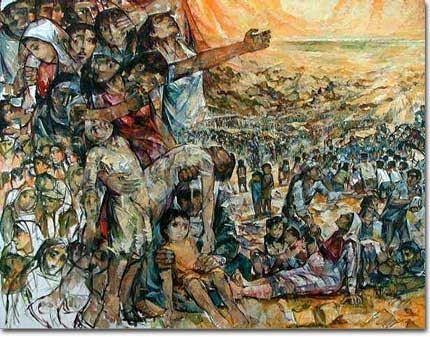
And who will live in the house after us, my father?
The house, my son, will remain as it was!
Why did you leave the horse alone?
To keep the house company, my son.
When their residents go, the houses will die.
Together we will hold on
until we return.
When, my father?
Tomorrow, my son, and perhaps in another day or two!
That tomorrow trailed behind them, chewing the wind
in the endless winter nights.
Mahmoud Darwish
Two years ago, in an essay in In That Howling Infinite published entitled Modern history is built upon exodus and displacement we wrote: “The term ethnic cleansing is elusive and politically charged. In an age of endemic conflict, identity politics and competing narratives, it has become a contested and often diluted concept invoked with increasing frequency. Yet, it remains undefined in law. Unlike genocide or war crimes, it has never been codified as a distinct offence under international law, and so its use is contested.”
Henry Ergas’s essay begins from a premise that is not wrong in itself: the Palestinian Nakba did not occur in isolation from the twentieth century’s wider history of mass displacement. Modernity proved remarkably adept at producing refugees. The collapse of empires, the rise of nation-states, world wars, partitions and revolutions uprooted tens of millions of people. Greeks and Turks, Armenians, Germans, Poles, Indians and Pakistanis, Jews from Arab lands, and many others found themselves swept into movements of population that often combined violence, dispossession and the attempt to create more homogeneous states.
This broader historical context matters because contemporary discussion of Israel–Palestine often proceeds as though 1948 emerged from a vacuum. It did not. The creation of Israel, the Palestinian exodus, and the simultaneous flight and expulsion of Jews from Arab countries all unfolded in a world where population transfer – while morally disturbing to modern sensibilities – was often treated by governments as regrettable but practical statecraft.
Yet Ergas then moves beyond historical context into a stronger argument: that the Palestinians constitute a unique exception because their refugee status became institutionalised rather than resolved. Here too there is a substantial point beneath the rhetoric. Unlike most post-war refugee populations, Palestinian refugee status passed across generations through UNRWA rather than being handled under the broader UNHCR framework. The expectation of return became central to Palestinian national identity and politics. The refugee camps in Lebanon, Syria, Gaza and elsewhere became not simply humanitarian spaces but political spaces.
But this is where the argument narrows and history becomes more selective.
The essay tends to compress a complex chain of causes into a single line of responsibility. The 1948 refugee crisis did not arise simply because Arab leaders invaded and then refused to absorb the consequences. As discussed previously, historians describe a more tangled picture: military collapse, fear, local expulsions, battlefield conditions, psychological warfare, direct expulsions in some areas, and decisions by Arab authorities all played roles that varied from place to place.
Nor does the proposition that Arab states “created” the refugee crisis command broad historical consensus. What is more broadly accepted is that many Arab states subsequently chose policies that preserved refugee distinctiveness rather than encouraging full integration, often because permanent absorption was seen as abandoning claims of return or acquiescing in Israel’s legitimacy.
There is also a danger in drawing too neat a lesson from other twentieth-century displacements. Many of those “successful” examples came after immense suffering and often under conditions we would now regard as profoundly unjust. The Greek–Turkish exchange, the expulsions of Germans from Eastern Europe, and Partition in India all left deep scars that continue to shape politics generations later. Stability eventually emerged, but stability and justice are not identical things.
This recalls themes from that earlier essay of ours. There, the argument was not that ethnic cleansing or forced population movements are unique, nor that Israel–Palestine should be detached from wider historical patterns. Rather, the point was almost the opposite: modern history itself appears built on recurring acts of uprooting and demographic engineering. Michael Mann called this “the dark side of democracy”: the tendency of modern states toward homogeneity, where political belonging becomes increasingly tied to identity.
The distinction matters because Ergas implicitly suggests that history eventually tidies itself up – that refugees are absorbed, wounds heal, and life moves on, except in the Palestinian case. The historical record appears less orderly. Displacement rarely disappears; it becomes memory, and memory becomes politics.
The Armenian diaspora still carries the memory of 1915. Partition remains embedded in Indian and Pakistani consciousness. The descendants of expelled Germans preserved memory of lost homelands for decades. Jewish memory of exile persisted for two millennia and became central to Zionism itself. Human beings have shown little inclination simply to reconcile themselves to history and forget.
Which brings us back to a previous discussion about stories and belonging in our Blue remembered hills (2) – the history we hold within us – Tolkien’s sub-creation, Scruton’s observations on home, Tyrion Lannister’s line that “there is nothing more powerful than a good story.” Nations are, among other things, stories people tell about themselves. Refugees do not merely lose houses or land; they lose continuity – the narrative linking memory, place and identity.
Palestinians constructed such a narrative around the Nakba. Israelis constructed one around return after exile and persecution. Both narratives contain truths; both contain mythologies; both can harden into absolutes.
That perhaps is the deeper tragedy. The problem was never simply refugee camps or UN agencies or demographic statistics. It was that two peoples built foundational stories around dispossession and return in the same small strip of land – your earlier “TARDIS nation”: a place physically tiny but historically and emotionally vast, where centuries of memory somehow occupy the same ground at the same time.
The twentieth century produced many displaced peoples. Most eventually found states, borders or political settlements that transformed exile into citizenship. Palestinians remain suspended between memory and statehood, between return and permanence. Whether this makes their situation unique is debatable. That it makes it unusually enduring is harder to deny.
The unravelling, then, may not be the Nakba itself, nor UNRWA, nor even 1948. It may be the wider unraveling of an older assumption: that history’s brutal rearrangements eventually settle into stable endings. History has shown a disconcerting habit of reopening what people believed was closed. And memory, unlike borders, seldom remains where states draw the lines.
What about ‘Whataboutism’?
When one widens the frame as we have dine here, an accusation appears sooner or later, often delivered with a certain weary certainty: whataboutism. The implication is not merely that one has made a weak argument but that one has committed a kind of moral sleight of hand- that by widening the frame one is really narrowing the conscience; that by speaking of Greeks and Armenians, Germans and Jews, Indians and Pakistanis, Bosnians and Rohingya, one is attempting to diminish Palestinians by dissolving them into statistics.
The charge deserves attention because there is such a thing as genuine whataboutism. The old Soviet formulation – and what about your own crimes? – was never an attempt at understanding. It was an escape hatch, a manoeuvre for changing the subject rather than addressing it. One suffering became a shield against discussing another. The object was evasion.
But comparison and evasion are not the same thing.
History itself is an exercise in comparison. Historians are forever placing one event beside another, not because they believe suffering can be ranked on some grotesque league table of misery, but because isolated events often become clearer when seen against a wider landscape. The Nakba did not occur on another planet. It unfolded amid a twentieth century that seemed to possess a grim talent for uprooting people from ancestral homes and redistributing them across maps with ruler-straight borders and bureaucratic efficiency. The century moved populations around with astonishing confidence, as though nations were puzzles whose pieces merely needed rearranging.
To note this is not to say that Palestinian suffering was unimportant, or unreal, or somehow cancelled out by the suffering of others. Human beings do not experience tragedy comparatively. Nobody standing beside a burning village pauses to think, yes, but larger displacements occurred elsewhere. People experience loss in the singular. The family home is not less mourned because millions of others lost theirs too.
And yet memory and history often operate differently. Memory looks inward. History looks outward. Memory says: this happened to us. History asks: where else has this happened, and why?
Perhaps the tension lies there.
Because the Holy Land – a curious, poorly understood TARDIS territory, tiny on a map and infinite in emotional and historical dimensions – contains overlapping stories of exile and return. Palestinians built a national memory around dispossession; Israelis built one around return after exile and persecution. Both stories contain truth. Both contain myth. Both contain wounds carried across generations.
To place one beside wider human experience is not necessarily to belittle it. Sometimes it is the opposite. Sometimes it is an attempt to recognise that the Palestinian tragedy was not an aberration committed by monsters from another species, but part of a recurring and deeply human pattern – our alarming capacity to convince ourselves that peace, security or national redemption can be achieved by separating peoples and remaking maps.
The question, then, is not whether comparison itself is suspect. It is whether comparison is being used to illuminate or to dismiss.
The former enlarges understanding. The latter shrinks it.
And perhaps that distinction matters, because if modern history teaches anything, it is that human beings have shown little talent for forgetting and remarkable talent for carrying stories — stories of homes left behind, keys kept in drawers, vanished streets and remembered landscapes — across decades and across oceans.
Borders may eventually settle.
Memory seldom does.
Keys, homelands and the stories we carry within us
We did not weep
when we were leaving –
for we had neither
time nor tears
and there was no farewell.
We did not know
at the moment of parting
that it was a parting
so where would our weeping
have come from?”
Taha Muhammad Ali
There is perhaps a further answer to the question of whether widening the frame becomes a form of whataboutism, and it lies in something written years earlier in In That Howling Infinite, in an essay on Mahmoud Darwish, Ismail Shammout and the symbolism of al-’awda – return: Visualizing the Palestinian Return – the art of Ismail Shammout].
That essay did not begin with demographic tables, refugee agencies, diplomatic resolutions or arguments about international law. It began instead with Darwish’s father and son, with a house left behind and a horse kept company in the absence of those who had gone. It entered history through memory rather than politics. The language was intimate and domestic because exile is experienced first not through abstractions but through ordinary things: streets once walked, kitchens once occupied, olive trees, neighbourhoods and names. Long before displacement becomes a political problem, it is a human one.
Darwish understood Palestine not merely as territory but as metaphor: a homeland certainly, but also a language of longing, absence and dispossession. Palestine became not simply a place on a map but a way of expressing exile itself. Around that idea grew al-’awda, the dream of return, symbolised by al-muftah, the key that appears throughout refugee camps, paintings and political iconography. The key became more than metal. It became continuity – evidence that interrupted lives had not entirely ended. Villages might disappear, maps be redrawn, and landscapes altered beyond recognition, but the key remained as a quiet refusal to surrender memory.
The earlier essay eventually moved into more contested territory, discussing UNRWA, inherited refugee status and the possibility that institutions established to preserve refugee welfare had also preserved expectation itself, transforming temporary exile into a political condition transmitted across generations. Yet the order in which those arguments appeared matters. The essay did not begin by reducing Palestinians to a demographic question or a bureaucratic problem. It first sought to understand what loss meant to those who carried it.
Perhaps that touches upon the larger issue raised here. Comparative history and lived memory often ask different questions and operate at different scales. History asks about patterns, causes and precedents. It seeks connections and broader landscapes, comparing one experience with another to understand how societies and states behave across time. Memory is more particular and less interested in patterns. It concerns itself with the singular experience of those who lost something and who continue to carry the memory of that loss.
The two perspectives are not necessarily opposed, but neither are they interchangeable. Statistics without memory can become sterile and detached. Memory without wider historical context can harden into myth, becoming a self-contained narrative resistant to complication.
This has been a recurring theme across earlier discussions – from Tolkien’s idea of sub-creation and Scruton’s reflections on belonging to Tyrion Lannister’s observation that there is nothing in the world more powerful than a good story. Stories are not merely embellishments laid over identity; they often become identity itself. They explain where people came from, who they are, and where they imagine themselves to be going.
Palestinians built such a story around the Nakba and the hope of return. Jews built one around exile and return as well: Jerusalem remembered across centuries, prayers ending with Next Year in Jerusalem, memory transformed into national aspiration. Both peoples, in different ways, carried keys. Some were literal objects passed through generations; others existed in memory and imagination.
Perhaps this explains why the accusation of whataboutism can feel misplaced in such discussions. Comparison does not necessarily diminish suffering by placing it alongside other suffering. Sometimes it attempts the opposite. Sometimes it seeks to recognise that exile, loss and the desire for return are among the oldest and most enduring of human experiences.
The danger lies not in telling stories but in mistaking stories for complete maps of reality. A key can indeed open a door, but after enough years – after generations have passed, after landscapes have changed and houses have disappeared – it may become something else entirely. It becomes not a practical instrument but a memory carried in the hand, a reminder that home is not always a physical place waiting patiently at the end of a road. Sometimes it survives most completely in the minds of those still searching for it.
In That Howling Infinite, May 2026
In That Howling Infinite has recently published a long essay explaining its position with regard to what is probably the most intractable conflict in modern times: One Land, Two Peoples: History, Memory, Continuity, and Inheritance
See also in In That Howling Infinite, Modern history is built upon exodus and displacement, Visualizing the Palestinian Return – the art of Ismail Shammout , We did not weep when we were leaving – the poet of Nazareth
The featured picture at the head of this blog post is one of Palestinian artist Ismail Shammout’s striking illustrations of Al Nakba, the dispossession of tens of thousands of Palestinian Arabs during Israel’s war of independence, from In That Howling Infinite’s Visualizing the Palestinian Return – the art of Ismail Shammout].
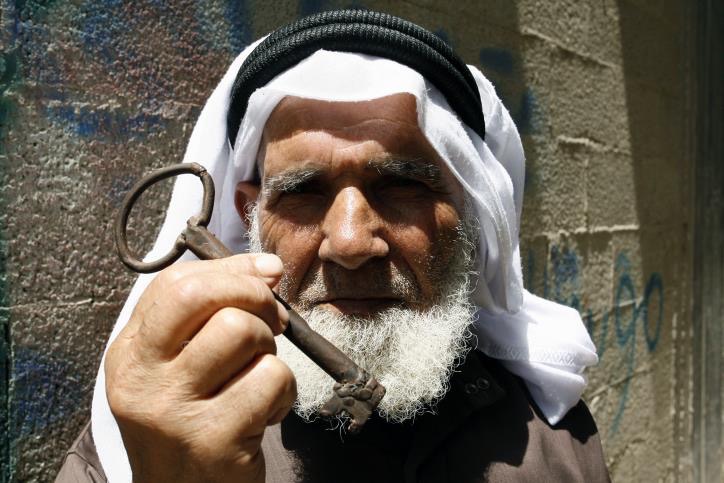
Al Miftah
How the Arab world recast the Nakba

For two centuries, modern states have been built on the unmixing of peoples. The idea is older than the romantic nationalists who weaponised it. Ferdinand and Isabella expelled the Jews from Spain in 1492, and Philip III the Moriscos a century later, precisely because they could no longer imagine a unified crown ruling a religiously mixed people. France’s revolutionary Jacobins, alarmed at Breton, Provencal and Alsatian, declared linguistic uniformity the price of citizenship; Mazzini and his epigoni said much the same for Italy.
Even that arch-liberal John Stuart Mill argued in 1861 that representative institutions could scarcely function in countries divided among “different nationalities” speaking different languages.
Bismarck drew the operational conclusion, expelling tens of thousands of Polish and Jewish “foreigners” from Prussia’s eastern provinces in 1885-86 – a program regarded at the time as enlightened statecraft and applauded throughout the liberal press of central Europe.
The unmixing accelerated as the great land empires – Ottoman, Habsburg, Romanov – gave way to nation-states. The Crimean War alone drove 900,000 Muslims from the Caucasus and Crimea into Ottoman territory; the Balkan Wars and the First World War uprooted two million more.
By 1923, the movements were no longer an incidental consequence of war; they were being designed. The burning of Smyrna in September 1922, which destroyed one of the great cosmopolitan cities of the eastern Mediterranean and drove 200,000 Greeks and Armenians into the harbour while Allied warships looked on, made any continued Greek presence in Anatolia impossible – and the world’s diplomats simply codified the new reality.
The Lausanne Convention of January 1923 compelled roughly 1.3 million Greek Orthodox to leave Anatolia for Greece and 400,000 Muslims to leave Greece for Turkey, stripping each of nationality, their possessions and any right of return. Cretan Muslims who had never seen Anatolia and knew only Greek were shipped to Anatolia; Cappadocian Greeks who knew only Turkish were shipped to Greece.
Set against the Armenian genocide of 1915, the exchange was hailed as humane and progressive, and Athens and Ankara settled into the longest peace they had ever known. Raymond Poincare spoke for the age when he concluded that “the mixture of populations of different races and religions has been the main cause of troubles and of war”.
That lesson governed what came next. In 1944, with Hitler’s empire collapsing, Churchill told the Commons he was “not alarmed by the prospect of the disentanglement of populations”. The Potsdam Agreement formalised it, providing for the expulsion of 12 million ethnic Germans from Eastern Europe.

The 1948 Palestinian exodus, known in Arabic as the Nakba. Picture: via Getty Images
The German share of Czechoslovakia’s population fell from 23 per cent to less than 2 within five years, under Benes’ decrees that stripped ethnic Germans of citizenship and property overnight. Equally, Poland’s minorities, 30 per cent of its inter-war population, were reduced to under 5 per cent; in 1947, the Ukrainian remnant was forcibly scattered across the new western territories to prevent any cohesive ethnic block reforming.
Meanwhile, the dismantling of Japan’s empire moved another five million Japanese back from Manchuria, Korea, Taiwan and Sakhalin, often after long internment, while Koreans and Chinese were marched in the opposite direction. And in 1947, Partition uprooted between 12 and 20 million people on the subcontinent; Pakistani Punjab’s Hindus and Sikhs went from 20 per cent of the population to 0.2 per cent in four years, amid massacres on the Lahore-Delhi railway that nobody who lived through them ever forgot.
Shortly afterwards it was the turn of the Jewish communities of Iraq, Egypt, Libya, Syria, Yemen and Morocco.
Some 800,000 people, whose ancestors had lived in those lands for two millennia, were evicted, forced to flee or statutorily expelled, losing their nationality and all their assets in the process. Iraq’s Jews, once 40 per cent of Baghdad’s population and producers of the country’s first finance minister, were down to under 1 per cent within five years.
In each case the expectation was the same: the receiving state would absorb its co-religionists or co-ethnics and prevent revanchism. Ataturk’s Turkey did exactly that – any attempts by the Muslims expelled from Greece to organise politically were firmly repressed.
So did the Allied occupiers, and then Adenauer’s Federal Republic, banning refugee parties in Germany and shutting down any attempt at creating new ones. Forced to accommodate to their new country, West Germany’s 12 million expellees – many of whom either spoke no German or antique forms of German locals could barely understand – powered the Wirtschaftswunder (economic miracle) and helped rebuild Germany’s fabled network of small firms.
Nor were they alone in proving a source of flexibility and innovation. In West Bengal, Hindus expelled from East Bengal transformed the jute industry, making it a pillar of India’s economy. The million-odd North Koreans who fled south during and after the Korean War, Chung Ju-yung of Hyundai prominent among them, supplied the entrepreneurial core of what became the South Korean miracle.
Israel, for its part, absorbed almost the entirety of the displaced Jews of the Arab lands: Operation Ezra and Nehemiah airlifted some 120,000 Iraqi Jews in 1950-51; Operation Magic Carpet flew 49,000 Yemenite Jews to Israel in 1949-50; Operation Moses, in 1984, collected the Beta Israel from the Sudanese desert, every wave transforming the country and yielding generations of military heroes and entrepreneurs.

Palestinian fighters beside a Haganah supply truck near Jerusalem in 1948. Picture: Getty Images
The pain was always immense; the absorption, almost everywhere, successful. Almost everywhere. For the Palestinians were the single, decisive exception.
In 1948, the Arab states had launched a war the Arab League’s Secretary-General announced would be “a war of extermination and a memorable massacre comparable to the Mongol massacres and the Crusades”, urged on by the rector of Cairo’s Al-Azhar Mosque, who told Muslims resident in Mandatory Palestine to “leave the territory temporarily so that our warriors can freely undertake their task of extermination”.
But unlike every other immediate historical precedent, the Arab states, having lost the war, refused to absorb the refugees their own actions had created. King Abdullah I of Jordan, who alone among Arab leaders had been prepared to come to terms with Israel and absorb the Palestinians, was assassinated at al-Aqsa in 1951 – a warning that subsequent Arab rulers heeded, until Anwar Sadat repeated the gesture in 1981 and met the same fate.
Predictably, the UN played a major role in the tragedy. Of the roughly 50 million people displaced by the Second World War and its aftermath, only two groups – Koreans and Palestinians – were given country-specific UN refugee agencies, and both were meant to be temporary. The UN Korean Reconstruction Agency wound up in 1958. UNRWA’s own founding report warned that “sustained relief operations inevitably contain the germ of human deterioration” and committed to speedily shut down.
Seven decades later, UNRWA still exists. It employs roughly 31,000 staff to serve almost six million registered “refugees”, the overwhelming majority of whom were born decades after 1948 and have never set foot in Mandatory Palestine. A fifth-generation Gazan whose ancestors left Jaffa remains classified as a refugee in a way that would be inconceivable anywhere else on earth.
The result was not merely administrative absurdity but political radicalisation. From the Cairo Agreement of 1969 onwards, the Palestinian camps in Lebanon became autonomous political and military zones. There and elsewhere, UNRWA facilities rapidly evolved into an integral part of the terrorist infrastructure.
Refugeehood ceased to be a temporary humanitarian condition and became an institutionalised political identity organised around the goal of destroying Israel, in an illusion that has instead destroyed generation after generation of Palestinians.
The Nakba charade
Those, in short, are the historical realities. But they do nothing to prevent the annual Nakba charade from insisting that Israel committed a uniquely monstrous act of “ethnic cleansing” in 1948.
Well, if ethnic homogenisation was truly the goal, Israel pursued it with startling incompetence. Arab citizens of Israel today are roughly a fifth of the population, a share slightly larger than at independence. And far from being “ethnically cleansed”, Israel is by far the most plural state in its region with its population Jewish (Ashkenazi, Mizrahi, Ethiopian, Russian), Arab Muslim, Christian, Druze, Circassian and Baha’i.
Compare that with northern Cyprus, where Greek Cypriots went from 82 per cent of the population in 1973 to zero within two years of the Turkish invasion.
Erdogan nevertheless stands among the loudest voices accusing Israel of practising precisely what Turkey has long excelled at – the expulsion and displacement of unwanted peoples, most recently the Kurds of northern Syria. Nor is Turkey alone. Saudi Arabia expelled 800,000 Yemeni workers in 1990 in retaliation for Sana’a’s tilt towards Saddam Hussein, while Kuwait expelled every single one of its 400,000 Palestinians in 1991 for the same offence.
These were not isolated episodes of political vengeance or wartime coercion. They formed part of a much broader regional trajectory: the ongoing, largely forced displacement and disappearance of the Muslim Middle East’s non-Muslim and minority populations.
Albert Hourani’s Minorities in the Arab World (1947) brilliantly mapped a region whose Christians, Jews, Yazidis, Druze, Alawites and countless smaller communities sustained a dense and intricate civic fabric. It was, unfortunately, a world on the cusp of extinction.
Today, the Christian share of Egypt, Syria, Iraq and Lebanon combined – around 11 per cent in 1945 – has fallen to 3 per cent, and the decline is accelerating. Syria’s Christians have declined from 9.7 per cent of its population in 1970 to under 2 per cent today; Iraq’s, once above 6 per cent, are well under 1 per cent; Egypt’s Copts continue their long erosion, from 8 per cent to no more than 3 per cent. Lebanon’s Christians, who made up over half of the population in 1970, are now below a third.
Nor is it a question of Christians alone. The Zoroastrians, whose religion once shaped an empire from the Indus to the Nile, have vanished from the Arab Middle East.
The Yazidis were enslaved and slaughtered in their thousands at Sinjar by Islamic State in 2014, in what was unquestionably a genocide. The Mandaeans of southern Iraq, who numbered 60,000 a generation ago, are now a remnant of perhaps 4,000. Almost everywhere, the Baha’is and Ahmadis have fled.
Stark contrast
As for the Jews, they are entirely gone, a population of close to a million across the Arab world reduced to a few thousand, almost all elderly; Egypt’s once 80,000-strong community now numbers in the low hundreds, and Yemen’s 50,000-strong Jewry, planted there in antiquity, was essentially lifted out by Operation Magic Carpet, with the Houthi takeover erasing the few that remained.
The trend is unmistakeable, the contrast stark. While the West accommodates ever more Muslims, the Arab world accommodates ever fewer non-Muslims. Its activists and their Western fellow travellers demand multiculturalism elsewhere; they ruthlessly deny it at home. They denounce Israel; but they are the ones engaged in the systematic destruction of ethnic and religious variety.
That is the historical fact the Nakba charade cannot accommodate. The 20th century normalised population transfer on a colossal scale, and the suffering it caused was sustained, widespread and immense.
But no international movement emerged demanding the restoration of Breslau to Germany, the ethnic reconstitution of the Sudetenland, a right of return for the Jews thrown out of the Arab lands, or hereditary refugee status for the descendants of the enormous population movements that swept across what had been British India. The displaced were expected to rebuild their lives where they arrived. However brutal the process, however bitter the pain, the governing assumption was clear: refugeehood was to disappear, not reproduce itself across generations.
The Palestinians alone were taught a different lesson – and that is the true Palestinian uniqueness. They were told not to end refugeehood but to preserve and reify it; not to build a future where they were, but to await the destruction of the state beside them; not to reconcile themselves to history, but to believe that history itself could be reversed.
For 75 years, generation after generation has been raised on that promise. It has brought not return but ruin, not recovery but repeated catastrophe. And as Gaza now demonstrates once again, it is the Palestinians themselves who pay the highest price for the post-war world’s longest and costliest political fraud.

