O’Donnell Abú – the Red Earl and history in a song

There is history in old songs, and particularly in the songs that tell the story of a nation’s resistance to invasion and occupation. Ireland’s long and troubled relationship with its powerful neighbour across the water has inspired a compendium of such songs of rebellion.

One of my favourites, Let Erin Remember, encapsulates it: “

On Lough Neagh’s banks as the fisherman strays
In the clear cold eve declining
He sees the round towers of other days
In the waters ‘neath him shining
Thus shall memory often in dreams sublime
Catch a glimpse of the days that are over
Thus sighing, look through the waves of time
For the long-faded glories they cover

In That Howling Infinite has published two essays about old Irish songs and their colourful history, Mo Ghile Mear and The Boys of Wexford. What follows is a song contemporary  to these in composition, but takes us back a century and a half to Ireland’s struggle against the Tudor crown in the late sixteenth century.

O’Donnell Abú (Ó Domhnaill Abú) is a traditional Irish song. Its lyrics were written by Michael Joseph McCann, a Fenian, in 1843. It tells of the Gaelic lord Red Hugh O’Donnell who ruled Tyrconnell (present day County Donegal) in the late sixteenth century first with the approval of the Crown authorities in Dublin and later in rebellion against them during Tyrone’s Rebellion.

Hugh Rua O’Donnell (Aodh Ruadh Ó Domhnaill), also known as Red Hugh O’Donnell (30 October 1572 – 10 September 1602), was a sixteenth-century Irish nobleman who, with his father-in-law Hugh O’Neill of Tyrone, led an alliance of Irish clans in the Nine Years’ War against the English government in Ireland. He led an Irish army to victory in the Battle of Curlew Pass, but after defeat in the Siege of Kinsale, he travelled to Spain to in an unsuccessful effort to obtain support from King Philip III. He never returned to Ireland and he died in Spain.

There is no extant portrait or visual representation of Red Hugh though a contemporary suggested that he was “above middle height, strong, handsome, well built”. An idealised image of Red Hugh is this post’s featured image. Romantics picture the youthful Red Hugh as fiery, headstrong, quick-witted, passionate, committed to Catholicism, and to the preservation of the values, language, and culture of the Gaelic world into which he had been born and reared. Above all, he is determined to rid Ireland of its English overlords.

Though limited and often biased against him, extant historical records largely validate this portrayal. They also recapture the complexities of Red Hugh’s highly militarized world, where local lords raided for cattle and reduced neighbouring lords to submission, and show Red Hugh to be a wily negotiator, an effective and pragmatic power broker, and a brave soldier.

Hugh Rua O’Donnell
Hugh Rua O’Donnell
The Flight of Red Hugh

The title refers to the Gaelic war cry of “Abú,” “To victory,” which followed a commander’s name, and is the rallying cry for the O’Donnell clan, called to assemble at a location on the banks of the River Erne in Donegal. The Bonnaught and Gallowglass were Irish and Scots mercenaries employed by O’Donnell to guard the mountain passes. They were now summoned to join the rest of O’Donnell’s forces, who await the arrival of Hugh O’Neill, Earl of Tyrone and the Borderers who protect his lands.

Stylistically O’Donnell Abú draws on the romantic nationalism of the mid-nineteenth century, similar to those of Michael McCann’s contemporary Young Ireland nationalist Thomas Davis. who composed a number of songs, including The West’s Asleep“, A Nation Once Again“, and the Lament for Owen Roe O’Neill  set to an 16th Centryu compoition bt celebrated harpist  

The song’s martial melody is proud and energetic, and its descriptive imagery is striking. You can almost visualize the war wolf and the eagle, the fires of the marauders, and the serried ranks of horsemen and foot soldiers in their chain mail advancing to avenge “Erin” with trumpets and war cries. To modern ears, the neo-Gothic romanticism of the lyrics and the aggressiveness of the melody may come across as jingoistic and over the top, but passionate nationalist McCann was probably endeavouring to emulate the bards of old. A stirring rendering of the song follows in a spirited live performance by the Clancy Brothers and Tommy Makem. This world famous folk group was an especial favourite of mine back in my teenage and folkie days.

Proudly the note of the trumpet is sounding;
Loudly the war cries arise on the gale;
Fleetly the steed by Lough Swilly is bounding,
To join the thick squadrons on Saimears green vale.
On, ev’ry mountaineer, strangers to flight or fear,
Rush to the standard of dauntless Red Hugh.
Bonnaught and Gallowglass, throng from each mountain pass.
On for old Erin, “O’Donnell Abú!”

Princely O’Neill to our aid is advancing
With many a chieftain and warrior clan.
A thousand proud steeds in his vanguard are prancing
‘Neath the borderers brave from the Banks of the Bann:
Many a heart shall quail under its coat of mail.
Deeply the merciless foeman shall rue
When on his ears shall ring, borne on the breeze’s wing,
Tír Chonaill‘s dread war-cry, “O’Donnell Abú!”

Wildly o’er Desmond the war-wolf is howling;
Fearless the eagle sweeps over the plain;
The fox in the streets of the city is prowling–
All who would scare them are banished or slain!
Grasp ev’ry stalwart hand
Hackbut and battle brand–
Pay them all back the debt so long due;
Norris and Clifford well can of Tirconnell tell;
Onward to glory–“O’Donnell abú!”

Sacred the cause that Clan Connell’s defending–
The altars we kneel at and homes of our sires;
Ruthless the ruin the foe is extending–
Midnight is red with the plunderer’s fires.
On with O’Donnell then, fight the old fight again,
Sons of Tirconnell, all valiant and true:
Make the proud  Saxon feel Erin’s avenging steel!
Strike for your country! “O’Donnell Abú!’

The hyperlinks in the song link specific names to their Wikipedia references, but here is a brief glossary:

Bonnaught is type of billeting or a billeted soldier. From Irish buannacht, billeting or billeting tax. A gallowglass (from gallóglach) was a Scottish Gaelic mercenary soldier in Ireland between mid 13th and late 16th centuries. A hackbut is a harquebuss or arquebus, the first long-arm gun fired from the shoulder. John Norris and Conyers Clifford were English commanders who fought O’Donnel and O’Neill, whilst Tír Chonaill, a kingdom of Gaelic Ireland, associated geographically with present-day County Donegal the home of the the Ó Domhnaill clan. It was the location of fighting during the Nine Years’ War

The Red Earl and the Dark Daughter

“It is hard to think, looking at the peaceful countryside of modern Donegal, “writes Ciaran Conliffe in an excellent post on his Scribbler blog, “that in days gone by men fought, bled and died on these hills. But the history of Ireland, up until relatively recently, was one of almost constant strife”. So begins his enthralling tale of Red Hugh and his feisty mother Iníon Dubh. Read it HERE

An impassioned ballad, entitled in the original Roisin Duh (or The Black Little Rose), was written in the reign of Elizabeth by one of the poets of Red Hugh’s entourage, and translated by nationalist mid-19th Century Irish poet James Clarence Mangan. It is an allegorical address by Hugh to Ireland, represented in this and many other Irish songs as a beautiful woman, of his love and his struggles for her, and of his resolve to raise her again to the glorious position she held as a nation before the irruption of the Saxon and Norman spoilers – for that’s how the romantic poets saw it: “Sons of Tirconnell, all valiant and true: make the proud  Saxon feel Erin’s avenging steel! Strike for your country! “O’Donnell Abú!'”

Donegal, Norther Ireland

The Red Hand

Red Hugh’s soldiers had their war cry with O’Donnell Abú. That of the O’Neill clan, led in O’Donnell’s ally Hugh O’Neill of Tyrone, was Lámh Dhearg Abú! – The Red Hand to Victory!

The Red Hand symbol and the war cry are believed to have been used by the O’Neills during the Nine Years’ War (1594–1603) against English rule in Ireland, A contemporary English writer observed: “The Ancient Red Hand of Ulster, the bloody Red Hand, a terrible cognizance! And in allusion to that terrible cognizance—the battle cry of Lámh Dhearg Abú!”

The motif of the Red Hand is a common one in Irish and particularly Ulster folklore. It originated in in Gaelic culture and, although its origin and meaning are unknown, it is believed to date back to pre-Christian times. There is a theory that the ancient Phoenicians may have brought the symbol to Ireland. able seamen and adventurous traders that they were, the Phoenicians of the Levant did indeed venture as far as what are now the British Isles.

A story is also told that the Red Hand symbol originated in a legendary ancestor who put his bloodstained hand on a banner after victory in battle. Bards and balladeers argue its origins, harking back to real and legendary heroes and kings, and commonly relating to shedding the blood of enemies. It was adopted by the O’Neills around 1335. Whilst demonstrating their ancient lineage, they may also may have regarded it as signifying divine assistance and strength.

The Red Hand is present in the arms of a number of Ulster’s counties, such as Antrim, Cavan, Londonderry, Monaghan and Tyrone. Itt also appears in the Ulster Banner, and is used by many other official and non-official organisations throughout the province. It can be regarded as one of the very few cross-community symbols used in Northern Ireland (which makes up six of Ulster’s nine counties) crossing the sectarian political divide.

For other historical posts in In That Howling Infinite, see: Foggy Ruins o Time – from history’s page

Let Erin Remember

Tradional

Let Erin remember the days of old
Ere her faithless sons betrayed her
When Malachy wore the collar of gold
That he won from the proud invader
When her kings with standards of green unfurled
Led the Red Branch Knights to danger
Ere the emerald gem of the Western World
Was set in the crown of a stranger

On Lough Neagh’s banks as the fisherman strays
In the clear cold eve declining
He sees the round towers of other days
In the waters ‘neath him shining
Thus shall memory often in dreams sublime
Catch a glimpse of the days that are over
Thus sighing, look through the waves of time
For the long-faded glories they cover

Dark Rosaleen

James Clarence Mangan

O my dark Rosaleen,
Do not sigh, do not weep!
The priests are on the ocean green,
They march along the deep.
There’s wine from the royal Pope,
Upon the ocean green;
And Spanish ale shall give you hope,
My Dark Rosaleen!
My own Rosaleen!

Shall glad your heart, shall give you hope,
Shall give you health, and help, and hope,
My Dark Rosaleen!

Over hills, and thro’ dales,
Have I roam’d for your sake;
All yesterday I sail’d with sails
On river and on lake.
The Erne, at its highest flood,
I dash’d across unseen,
For there was lightning in my blood,
My Dark Rosaleen!

My own Rosaleen!
O, there was lightning in my blood,
Red lighten’d thro’ my blood.
My Dark Rosaleen!

All day long, in unrest,
To and fro, do I move.
The very soul within my breast
Is wasted for you, love!
The heart in my bosom faints
To think of you, my Queen,
My life of life, my saint of saints,
My Dark Rosaleen!

My own Rosaleen!
To hear your sweet and sad complaints,
My life, my love, my saint of saints,
My Dark Rosaleen!
Woe and pain, pain and woe,
Are my lot, night and noon,
To see your bright face clouded so,
Like to the mournful moon.
But yet will I rear your throne
Again in golden sheen;
‘Tis you shall reign, shall reign alone,
My Dark Rosaleen!
My own Rosaleen!
‘Tis you shall have the golden throne,
‘Tis you shall reign, and reign alone,

Over dews, over sands,
Will I fly, for your weal:
Your holy delicate white hands
Shall girdle me with steel.
At home, in your emerald bowers,
From morning’s dawn till e’en,
You’ll pray for me, my flower of flowers,
My Dark Rosaleen!
My fond Rosaleen!
You’ll think of me through daylight hours
My virgin flower, my flower of flowers,
My Dark Rosaleen!

I could scale the blue air,
I could plough the high hills,
Oh, I could kneel all night in prayer,
To heal your many ills!
And one beamy smile from you
Would float like light between
My toils and me, my own, my true,
My Dark Rosaleen!
My fond Rosaleen!
Would give me life and soul anew,
My Dark Rosaleen!

O, the Erne shall run red,
With redundance of blood,
The earth shall rock beneath our tread,
And flames wrap hill and wood,
And gun-peal and slogan-cry
Wake many a glen serene,
Ere you shall fade, ere you shall die,
My Dark Rosaleen!

My own Rosaleen!
The Judgement Hour must first be nigh,
Ere you can fade, ere you can die,
My Dark Rosaleen!

The ballad of ‘the Breaker’ – Australia’s Boer War

The Breaker Morant story is back in the news here in Australia with the investigation of our SAS for the unlawful killing and torturing of Afghanis.

Every once in a while, the matter of the trial and execution by firing squad of Harry “the Breaker” Morant for killing unarmed prisoners of war during the 19th Century fin de siecle Anglo-Boer War surfaces as his partisans push for a pardon. The war was Australian troops’ fourth overseas military adventure in the service of British Empire (the first was New Zealand’s Maori Wars, and later, in Sudan and during The Chinese Boxer Rebellion – with few engagements and no battle casualties (see Postscript below).

The argument goes like this: Lieutenants Harry Morant, an immigrant to Australia from Devon, England, and Peter Handcock, Australian born, were tried by a military court and executed unjustly as scapegoats of the British Empire. Some partisans are more nuanced. Celebrated lawyer and human rights advocate Geoffrey Robertson questions whether there was due legal process and not whether the two were guilty as charged.

The general consensus here in Australia, however, is that the two men received a fair trial (by martial law standards, that is ) and got what they deserved. It’s a similar “hero or villain” debate to that which has persisted for a century about our most famous bad guy,  bush ranger Ned Kelly. The consensus here too is that Ned received his just deserts for the shooting of the policemen at Stringybark Creek. As Ned said just before dropped through the trapdoor at Melbourne Gaol, “such is life”.

But back to “the Breaker”, Harry Morant, and the subject of the latest book from Australian author Peter FitzSimons, Breaker Morant. Morant earned his sobriquet for his superb horsemanship. Most folk know him only from Bruce Beresford’s excellent 1981 film, Breaker Morant and particularly, his famous last words: “Shoot straight, you Bastards! And don’t make a mess of it!”

Fitz is a “popular historian” and a fine storyteller – and Bob Dylan tragic (I once asked him to write a book about the Bobster, but he hedged with his answer). He has written prolifically on subjects as diverse as Captain Cook, the gruesome Batavia mutiny, and Ned Kelly, and particularly Australian military history, including books about Gallipoli, Pozières, Tobruk and Kokoda. He is an ardent republican, and that comes through strongly in his writing. He is excellent at drawing characters out of history and describing events in detail. I enjoy his tales very much, but I do not like his style – he writes in the vernacular, which is not a bad thing, but embroiders the story much to much, putting words into his historical characters’ mouths and retelling the event, be it a battle or a horse race, as if they were a contemporary action novel.

His Breaker Morant is true to form. Fitz bulls up his voluminous text with extraneous aphorisms and superfluous intrusions “of shreds and patches, of ballads, songs and snatches” (I can be as guilty as he) as if they were intrinsic to the narrative. And his sub-paragraph headings, employing puns and tabloid catchphrases seems to me as contrived and, well, naff.

He has little affection for his subject. “… that ragged, red faced charmer, the ever garrulous Breaker Morant” is introduced to us in the Australian bush as a Pommie, a compulsive liar and cheat, con-artist and impostor, faker and fantasist, one step ahead of creditors and the law. But man, he ride and shoot! There is no colt he cannot tame nor race or polo game he cannot win. And he can drink any man under the table.

Morant is a story teller non parièl – mostly about himself and his much embroidered exploits. He is able to impress and ingratiate himself upon people of all genders, classes and occupations, not the least, our celebrated poet lorikeet Henry “Banjo” Paterson. They bond over a shared accuity for penning bush ballads – and by the standards of that genre, The Breaker holds his own among Australian poets:

There was buckjumping blood in the brown gelding’s veins,
But, lean-headed, with iron-like pins,
Of Pyrrhus and Panic he’d plentiful strains,
All their virtues, and some of their sins.
‘Twas the pity, some said, that so shapely a colt
Fate should with such temper endow;
He would kick and would strike, he would buck and would bolt
Ah! – who’s riding brown Harlequin now?

From starlight to starlight – all day in between
The foam-flakes might fly from his bit,
But whatever the pace of the day’s work had been,
The brown gelding was eager and fit.
On the packhorse’s back they are fixing a load
Where the path climbs the hill’s gloomy brow;
They are mustering bullocks to send on the road,
But – who’s riding old Harlequin now?

Style aside, Fitz’s take on the Boer War is well researched, and his narrative is gripping and colourful in descriptions and language, and also characters. His is a cast of hundreds, including entertaining walk-on roles for the likes of young Winston  Churchill, Rudyard Kipling, Arthur Conan Doyle, and The Banjo, all of whom served as newspaper correspondents at one time or another during the conflict, and also, the celebrated Daisy Bates, remembered still for her work in remote indigenous communities, who was married to Harry for a short while up Queensland way until she tired of his drinking and gambling.

A dirty little war

The Anglo Boer War (October 1899 to May 1002), second of its name, was a dirty little war, fought for gold and diamonds and sold to the public throughout the empire as a “just war” to defend the interests of the non-Boer Uitlanders (‘outlanders’, who were predominantly British residents of the legitimate Boer republics) and to uphold Imperial honour (the Boers attacked first – a preemptive strike like Israel in 1967). Some sixty thousand Boers and their African auxiliaries (bribed or conscripted) faced off against six hundred thousand British and colonial soldiers, and again, African auxiliaries.

Most of the Imperial forces were British, including militias from Cape Colony and Natal, but Australians, Kiwis, Canadians, and Rhodesians served as eager volunteers in defense of the “home country”, and Indian soldiers were “volunteered” by the Raj, whilst indigenous people served as auxiliaries, and also as porters and servants who were often in the firing line. Mahatma Gandhi served as a stretcher bearer, again, in the line of fire, and established an “ambulance” service for the British army.

Boer (meaning “farmer”) is the common name for Afrikaans-speaking white South Africans descended from the Dutch East India Company’s’s original settlers at the Cape of Good Hope who adhered to the fundamentalist strictures of the Dutch Reformed Church.The Boer forces were citizen soldiers, but small numbers of Irish, Scots and English also served in the Boer commandos, and even some Americans and Frenchmen. Most were often long time settlers who fought to defend their farms and families and also, their country, and others were soldiers of fortune attracted by the Boers’ defense of their liberty.

The Imperial forces were commanded by the ageing but highly respected Lord Roberts, but operational command lay with General Kitchener, a man who was not averse to stringent measures and also to sacrificing his own men if it served his tactical or strategic purpose. Whilst he decreed that once a combatant had laid down his arms he was to be taken prisoner, his directive was sometimes ignored, as the tale of  The Breaker illustrated. In the conquest of the Sudan, Kitchener sanctioned cold-blooded murder of tens of thousands of captured and wounded mahdists in revenge for the death of General Gordon.

In his excellent Empire, economic historian Niall Ferguson’s has no kind words for Cecil Rhodes, who had an influential part to play in the events that led to the war, and he is quite iconoclastic with regard to imperial icons like Gordon, Kitchener and also, Baden Powell, the “hero of Mafeking” and subsequent founder of the Boy Scout Movement,  all of whom he characterizes as eccentric and potential nutcases. He likes Lawrence and Churchill, however, for all their faults, foibles and fables.

Once introduced in the opening chapter, the eponymous Breaker does does not figure prominently in the narrative until the second half of the book – the first half is taken up with the “formal” war – the military campaigns that conclude with the capture of the Boer capitals of Bloemfontein and Pretoria after the conquest and annexation of the independent Boer republics of The Orange Free Sate and Transvaal.

Thence follows the guerrilla war waged by the “bittereinders” that compelled Generals Roberts and Kitchener to resort to extreme measures to subdue the hold-out Boers, including a scorched-earth policy of demolition and confiscation, barbed wire and blockhouses, and herding civilians, including women and children into concentration camps – their African servants and workers were confined in separate camps. Thousands perished of starvation and disease.

Compelled by the inability of regular military Kitchener authorized the establishment of irregular formations to counter the Boer guerrillas with like-tactics – which is where colonial volunteers, like Harry Morant and his comrades, used to living in the saddle and off the land, came into their own. The latter part of the Boer war thus became one of the first instances of modern counterinsurgency operations, setting a president for further colonial wars – for example, the French in Indochina and Algeria, the British in Aden and Cyprus, and the Americans in Vietnam.

When Roberts returns home to retirement and his chief of staff assumes total command, Kitchener is implacable, vengeful and ruthless in his determination to bring in the bittereinders dead or alive, and to collectively punish their womenfolk and children and their African servants and field hands with the destruction of their livelihood and transportation to the camps outside the main towns. Captured combatants receive the punishment often meted out to rebels against the crown – they are transported – to India, Ceylon, Bermuda, and even Portugal and Madagascar – and ironically, St. Helena, the last exile of Napoleon Bonaparte. In their own way, the exiled Boers were the heirs of the Fenians and trade unionists who ended up in Australia where so many of Kitchener’s bushmen originated.

As peace talks were initiated and ended in stalemate, Kitchener dialed the brutality knob to full. He and his soldiers would refer to Kitchener’s “bag”, the tally of Boers killed or captured – a grim precursor to General William Westmoreland’s fixation with the “body count” during the Vietnam War.

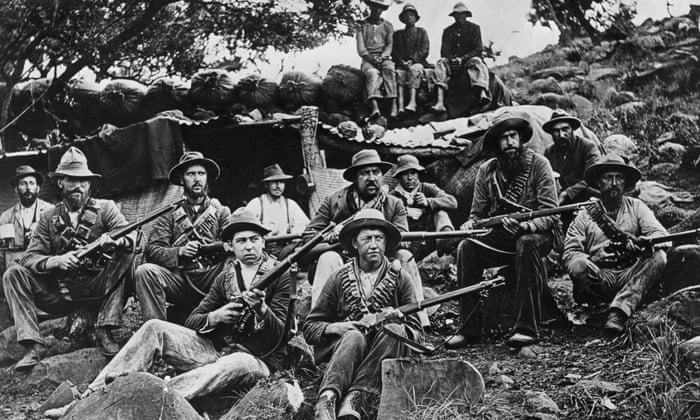
Boers at rest

Boers in action

Dark deeds in a sunny land

Enter the infamous Bushveldt Carbineers. The recruiters were by now literally scraping the barrel; as FitzSimons puts it, “a motley crew, a mix of the old and the bold, the young and the desperate, and those with no better options than joining an outfit destined to be operating in such dangerous realms. No fewer than a third of the new recruits have no military experience whatsoever, and some have never even ridden a horse”. “Rangers, rogues and renegades”  and “the rough and the rowdy, the wild and the woolly, and sometimes the demonic and dangerously”, and whilst in the field, as often as not, drunk – both officers and men. And among them, down on his luck in England and almost destitute and desperate, Harry Morant.

In control though not in command is Captain Alfred Taylor, Intelligence Officer and District and Native Commissioner, known to the natives as “Bulala”, killer. A psychopath is on the loose, appointed and sanctioned by Kitchener himself, and he finds willing henchmen in recently promoted and opportunist Lieutenants Morant and Handcock.

Half way through the 500 page book, FitzSimons changes pace. What had up to now been a largely historical narrative interspersed with colourful and entertaining vignettes, becomes a tale of dark deeds in a sunny land.

As Fitz tells it, encouraged by the sinister Taylor, who believes the only good Boer is a dead one, an increasingly delusional and unhinged Morant and the psychotic Handcock embark on a murder spree. As Moran would admit to the court, “we got them and we shot them under Rule 303”, referencing the Lee Enfield, the standard-issue British Army rifle.

Based on transcripts of their subsequent trial and letters and memoirs of fellow carbineers, Fitz reconstructs the events that conclude with Morant’s downfall and death. Reluctant members of firing squads and outright refuseniks put together a dossier and petition detailing the cold-blooded murder of surrendered Boers, children, an unfortunate priest, and also, a carbineer who’d threatened to blow the whistle.

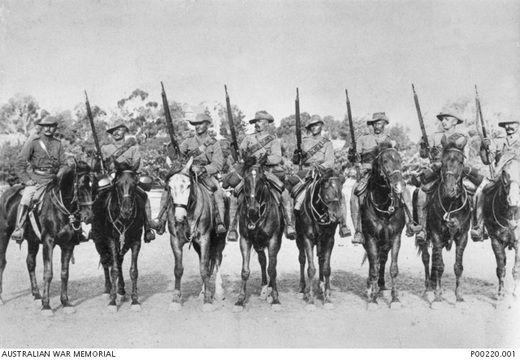
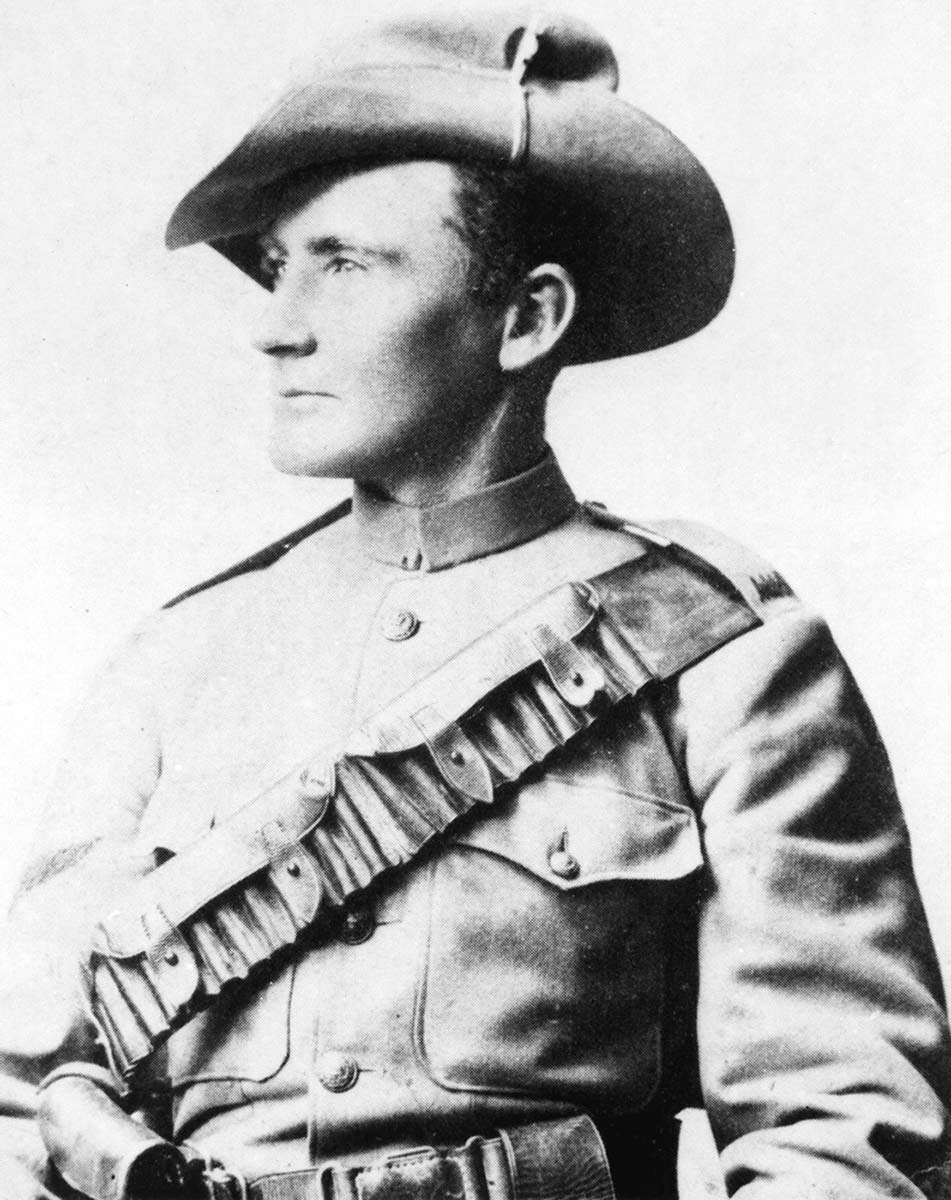
Harry ‘Breaker’ Morant and third from left with the 2nd South Australian Mounted Rifles during the Boer War, circa 1900. .

The book becomes a page-turner as the petition is dispatched up the chain of command, the prospects of a cover-up being high. But no. There are indeed men of integrity in higher command who will see justice done – not the least because they wish to see the dangerous Taylor removed. The more pragmatic view the alleged crimes as impediments to bringing the Boer leaders to the negotiating table.

But the outcome is far from certain. As court martial proceedings conclude and sentences are handed down, including an acquittal for the nefarious Taylor, and a recommendation for clemency by the court after it sentences Moran and Handcock to death for multiple murders – they were in a war zone and under serve strain and provocation after all – Kitchener refused. How could he enter the peace talks that would soon come if the killers were let off the hook?

He dies almost two years to the date of his landing in South Africa with the second Contingent

The war winds down 

By war’s end, Britain’s claims to moral supremacy, already questioned by its waging a war of aggression against two small states, was irreparably damaged. Public opinion which had in the beginning embraced jingoism and righteous anger, once informed of the true nature of the war by returning journalists and also soldiers’ letters, and fired up by clergymen and humanitarians, began to question the purpose and the morality of the war. In Australia, the new narrative was championed by none other than Banjo who had early on developed an admiration for the Boer fighters, likening them to the resilient and resourceful folk of the Australian bush.

Many consider the Boer War as marking the beginning of the questioning of the British Empire’s level of power and prosperity; this is due to the war’s surprisingly long duration and the unforeseen, discouraging losses suffered by the British fighting the Boer citizen soldiers; and repugnance with regard to the ruthless treatment of non-combatants. Many parts of occupied Boer republics with their burned farmsteads and plundered lands resembled more a desert than a once prosperous agrarian economy.

Not that the Boers were exemplars of moral rectitude by our enlightened twenty-first Century standards. Their’s was a conservative and indeed fundamentalist society that regarded the indigenous people as inferior and destined to serve their needs. The British regarded the Boers attitude towards the kaffirs as unacceptable – and yet they too regarded the indigenous Africans as their inferiors – but their’s was a righteous though none the less prejudiced and patronizing “white man’s burden” mentality that characterized Victorian Britons’ view of Empire.

By the end of 1901, the British are physically and morally exhausted. Attrition has turned to atrophy. Kitchener craved an end to the conflict. “I wish I could find some way of finishing this war”, he writes to the Secretary of State for War. Especially now that it is is believed that ordered the execution of Boer prisoners “found in khaki” – wearing items of British uniform.

And so it comes to pass that two months after Morant and Handcock are laid in their un-shared un-hallowed grave, the Boer leadership, wanted to end the devastation and human misery, and the British unable to go forward of back, agree to terms, including ceding Boer sovereignty to Britain, an amnesty for all combatants, the return of the far-flung  transportees, and the emptying of the camps.

At the end of the day, after twenty months of conflict, some twenty two thousand British forces soldiers perished, whilst five thousand were sick and wounded.  Six thousand Boers were killed and twenty four thousand captured whilst twenty one thousand bittereinders surrendered. There were over forty six thousand civilian fatalities, and of 115,000 people incarcerated in concentration camps, twenty seven thousand women and children died, and twenty thousand Africans. Thirty thousand Boer homesteads had been destroyed and tens of thousand of those of Africans, and forty towns had been razed.

By 1910, the Dominion on South Africa had been established with English  and Afrikaans as its co-equal languages. The next stage of South Africa’s eventful history had begun.

Butchered To Make A Dutchman’s Holiday

-In prison cell I sadly sit,
A d__d crest-fallen chappie!
And own to you I feel a bit- A little bit – unhappy!
It really ain’t the place nor time To reel off rhyming diction –
But yet we’ll write a final rhyme Whilst waiting cru-ci-fixion!
No matter what ‘end’ they decide – Quick-lime or ‘b’iling ile,’ sir?
We’ll do our best when crucified To finish off in style, sir!
But we bequeath a parting tip For sound advice of such men,
Who come across in transport ship To polish off the Dutchmen!
If you encounter any Boers You really must not loot ’em!
And if you wish to leave these shores, For pity’s sake, DON’T SHOOT ‘EM!!
And if you’d earn a D.S.O., Why every British sinner
Should know the proper way to go Is: ‘ASK THE BOER TO DINNER!’
Let’s toss a bumper down our throat, – Before we pass to Heaven,
And toast: ‘The trim-set petticoat
We leave behind in Devon.’
At its end the manuscript is described –
The Last Rhyme and Testament of Tony Lumpkin

Postscript – Australia’s 19th century wars

Between 1845 and 1872 just over 2,500 Australian volunteers saw service in New Zealand during the wars between the Maori and Pakeha (white colonists) over the ownership of Maori lands. Though Australian born, troops all served in British regiments. The majority of these volunteers came from the colonies of New South Wales, Victoria and Tasmania.

In the early 1880s the British-backed Egyptian regime in the Sudan came under threat from local supporters of Muhammed Ahmed, also known as the Mahdi. In 1883 the Egyptian government was sent south to crush the revolt but instead of destroying the Mahdi’s forces, the Egyptians were soundly defeated. On March 29, 1885 a New South Wales contingent, an infantry battalion and an artillery battery, totalling 758 men. arrived in Sudan, It spent three months there  with no major engagements or battle casualties. there were three wounded soldiers and seven deaths from fever or dysentery.

In 1900, a contingent of mainly naval reservists was sent to China to restore order after the Boxer Rebellion. It didn’t take part in fighting and there were no battle casualties. The few fatalities were from disease.  The first Australian contingents, mostly naval reservists from New South Wales and Victoria, sailed in August 1900. Australian personnel sent to northern China were not engaged in combat. Six Australian’s died of sickness and injury and none were killed as a result of enemy action.


Read more about Australian history and politics in In That Howling Infinite: Down Under ; and British history in Foggy Ruins of Time

Many Australians past and present view Harry Morant as harshly dealt with, a  folkloric antihero  sacrificed on the alter of empire, as the following article by Fitz himself explains. But first, a word from an Australian country music icon.

They still sanctify the monster Breaker Morant – and insult the true heroes

Peter FitzSimons, Sydney Morning Herald,  September 14, 2021 

Edward Woodward as Breaker Morant

 The idea that Breaker Morant should be given a posthumous pardon is a persistent one, as is the idea that he should have his name added to the Boer War Memorial in Adelaide – the latter idea getting a new lease of life in a strong article published in The Advertiser in Adelaide on Saturday.

For the legend is a beauty: Breaker Morant was a Man From Snowy River in Australian uniform: a brilliant horseman, soldier and bush poet who was cruelly put up against the wall by those Pommy bastards, merely for following their orders.

Yes. So strong and seductive that the article in the ’Tiser records that 70 per cent of their respondents are in favour of Morant’s name being added to the Boer War Memorial. In terms of iconic status, it is of the ilk of the Anzac legend that Education Minister Alan Tudge is insistent must not be questioned in any way in the national history curriculum. As Tudge said last week, the Anzac legend is “not going to be a contested idea on my watch”.

But, based on the book I wrote on Morant, with the help of strong researchers who were able to dig fine detail, let’s contest the Morant legend and look at just one episode of his war career, this one while commanding the roving unit, the Bushveldt Carbineers, in the latter part of the Boer War. The first thing to note is that rather than being Australian, Morant was English and had joined the war effort from Australia after being here for a couple of decades – while the Bushveldt Carbineers was a wholly British unit.

On September 7, 1901, Morant hears of three unarmed, non-combatant Boers heading their way and wanting to surrender. Morant goes out to meet them in the company of one lieutenant and two other troopers. And there they are, up yonder: Boer farmer Roelf van Staden and his two sons, the youngest of whom, Chris, is 12 and desperately ill.

Morant takes immediate action, using a procedure he has previously developed to get through such matters most efficiently. He tells his men that when they get to the clearing up ahead, they must wait till he says “Lay down your arms”, and as soon as they relax, shoot ’em. Arriving at the clearing, Morant barks: “Dismount.” His men do so, and quickly bring up their rifles. The Boers look at them, horrified. “Lay down your arms!” Morant commands.

As planned, the father and his sons relax just a little . . . only for the Troopers to shoot them dead.

How do we know Morant committed these and other atrocities in which a dozen non-combatants were gunned down? There are many reasons, but they include 14 brave Australian soldiers and a Kiwi soldier risking their lives – for the first two soldiers in the Bushveldt Carbineers to publicly dissent had finished with a bullet in their heads – writing a letter to their commanding colonel, asking for Morant to be court-martialled. He was, during which Morant famously boasted of the atrocity of lining up eight unarmed Boer prisoners and shooting them by the side of a road. “We got them, and we shot them, under Rule .303!”

Of course, Morant was a practised hand at shooting prisoners by this time, having ordered a firing squad to execute a lone, injured prisoner, Floris Visser, to the disgust of men and officers alike. At least Visser was given the farce of a “drum head” court-martial, a kangaroo court improvised by Morant to justify murder as revenge for his friend Captain Percy Hunt.

Quoted in the Advertiser on Saturday, the Melbourne lawyer James Unkles said: “Injustices in times of war are inexcusable and it takes vigilance to right wrongs, to honour those unfairly treated and to demonstrate respect for the rule of law. How we respond to this case remains a test of our values and is vitally important.”

Was he speaking in sympathy with the dead Boers? He was not. He was pushing the case for Morant’s posthumous pardon, and for his name to be added to the Boer War Memorial in Adelaide, just as he was a prime agitator behind the Australian Parliament in 2009 voting in favour of petitions being presented to Queen Elizabeth II to review and posthumously overturn Morant’s convictions. Three years later, on the 110th anniversary of the execution of Morant and co-accused Peter Handcock, the Liberal member for Mitchell, Alex Hawke, rose in the House to make a claim for Morant and company’s pardon.

“It is timely for the Australian government to do everything it can to assist the modern-day descendants of these men to access a judicial review of this case. It is the case that the executions were conducted with extreme haste and without appeal.”

(A point of order, Mr Speaker, if I may. An appeal is something they had in civilian courts, but did not exist with courts-martial.)

”I think it is important,” Alex Hawke continued, “that we seek British government’s assistance in releasing all of the available records in relation to this case so that the modern -day descendants can know what happened and rightly, if necessary, receive a judicial review and pardon. It is an episode that appeals greatly to every Australian because of the doctrine of fairness which says that no-one should be treated differently because of their birth, rank or status. We do know that these men were treated differently because of their birth, rank and status. We certainly need legends in Australian history.”

We do. And we have plenty of bona fide ones, without the need to gloss over the record of a war criminal. But still it goes on!

In February 2018, the Australian Parliament passed a motion expressing “Sincere regret that Lieutenants Morant, [et al] were denied procedural fairness contrary to law and acknowledges that this had cruel and unjust consequences; and . . . sympathy to the descendants of these men as they were not tried and sentenced in accordance with the law of 1902.”
Any mention of sympathy and sincere regrets for the defenceless Boers, including children, that Morant had gunned down? None at all. Justice for them? No mention. Just an obsessive focus on aspects of the court-martial where t’s weren’t crossed and i’s weren’t dotted. And equal insistence, despite a lack of any evidence at all, that Morant did what he did under British orders.

Bottom line?

Some historical legends, like that of Morant, are so seductive they live on because people want to believe them. And it’s so powerful you even have serious people pushing the tragic absurdity of an Australian Parliament petitioning the Queen and the British Parliament to posthumously pardon an Englishman fighting for a British unit who committed the worst war atrocities of the Boer War!

But how much more inspirational is the truth? Morant was not the Man From Snowy River put up against the wall by those Pommy bastards. He was a vicious Pommy bastard put up against the wall by the men from Snowy River and others who risked their lives to bring him to justice to stop the atrocities.

There are heroes in this story. They are those troopers who risked their lives to turn Morant in. Imagine their thoughts at his name being next to theirs on the Adelaide Boer War Memorial.

There are victims. They are unarmed Boers ruthlessly gunned down on Morant’s orders.

How monstrously unjust to both heroes and victims to simply go with the legend, unexamined, uncontested.

Of course history must be always examined, contested, reviewed, told from diverse sides. Anything less is indoctrination.

Twitter: @Peter_Fitz

Tel as Sabi’ – Tarkeeth’s Anzac Story

The 25th April is Anzac Day, Australia’s national day of remembrance, honouring Aussies and Kiwis who perished in foreign wars from South Africa to Afghanistan. It takes its name from the ill-fated Gallipoli campaign – on this day in the spring time of 1915, Australian and New Zealand soldiers landed under heavy fire from Ottoman forces entrenched in the heights above what was later to be called Anzac Cove on Turkey’s Gallipoli peninsula. 

The Anzacs were just part of a wider campaign devised by British Secretary of the Navy Winston Churchill to knock The Ottoman Empire out of the war with one decisive blow by seizing the strategic Dardanelles Strait and occupying Istanbul, the capital. It do not go well. The Ottoman soldiers commanded by Mustafa Kamal Pasha, the future founder of modern Turkey, Kamal Atatürk, held the high ground and fought stubbornly and bravely, and ultimately, victoriously. 

The bloodshed ended in stalemate. The Allies withdrew eight months later leaving behind over eight thousand dead Australians and nearly three thousand New Zealanders (along with over thirty thousand English, Irish, and Frenchmen, Indians and North Africans, and close on ninety thousand Ottoman soldiers, Turks and Arabs, Muslims and Christians), without, historians say, having had any decisive influence on the course of the First World War. 

The rest, as we say, is our history. 

The Anzac Trail

Whenever we visit Israel, our friend and guide Shmuel of Israel Tours drives us all over tiny beautiful and vibrant country (travelling through the West Bank, we use Palestinian guides). During the pandemic year, most Israelis had been locked down three times and like in many countries, the all-important tourist trade barely has registered a pulse. When permitted to travel beyond his home in Jerusalem, Shmuel has spent the year exploring and learning, visiting places he has never guided to before. He believes that he has exited the plague year a better guide, and we are already making plans for our next Israel adventure, including recently excavated Herodian palaces and further travel in the Negev Desert. 

Shmuel recently told me that he had visited Tel Sheva, Tel as Sabi’ in Arabic, in the Negev, five kilometres east of the city of Beer Sheva, a site inhabited since the fourth   millennium BC. The ancient fortified town dates from the early Israelite period, around the tenth century BC. The walls, homes, storage warehouses and water reservoir system have been excavated and opened to the public. Today, Tel as Sabi’ s also known as the first of seven Bedouin townships established in the Negev as part of the Israeli government’s policy to plant the once-nomadic Bedouin permanent settlements. 

It was from the foot of this stark desert hill that the Light Horse Brigade launched its famous charge towards the Ottoman lines at the strategic rail-head and wells of Beersheva on October 31st 2017. 

Today, it is the ninth (not seventh) stop on The Anzac Trail which traces the route of the Light Horse Brigade from Gaza on the Mediterranean coast to Beer Sheva. For obvious reasons, it begins beyond Gaza’s wire and concrete encirclement and trail culminates at the Anzac Memorial Centre In Beer Sheva, inaugurated on the 100th anniversary of the battle. 

The Charge at Beersheba” by Sir Ivor Hele 1973

Tel as Sabi’ to Tarkeeth 

As we commemorate Anzac Day this Sunday, few folk in Bellingen Shire would know that there is a link between that hill in the heart of the Negev and Tarkeeth on the north bank of the Kalang River just six kilometres west of Urunga as the crow flies.  

In A Tale of Twin Pines, the first of our Small Stories, I wrote of how researching the history of the Urunga area where we live, I came across Lloyd Fell’s story of the Fell Family Farm. This was located close to the present Twin Pines Trail, just east of Fells Road on South Arm Road, and west of the Uncle Tom Kelly motorway bridge over the Kalang River. Click here to access TwinPinesStory.pdf

Lloyd tells the story of how in 1926, New Zealand farmer, solo-yachtsman, and returned ANZAC Chris Fell first saw the land that became the family farm, purchasing it from a deceased estate for a thousand pounds. Chris was impressed by the two mature hoop pines that stood on either side of the track leading to a rough timber house that already stood there – and these gave the farm its name. He cleared the bush, felling and hauling timber until he had sufficient land and capital to run cattle. In time, he built up a prosperous dairy business and cattle stud where he and his wife Laura, a Sydneysider from a well-to-do Vaucluse family, raised their three children. The house has long gone, but the two magnificent pines are still there. 

On October 31st 1917, Chris Fell and his comrades in the New Zealand Mounted Infantry fought on Tel as Sabi’. 

Tel as Sabi 1917, showing Ottoman trenches (AWM)

Chris Fell and the battle of Beer Sheva

As told in Short Stories – a tale of Twin Pines:

in his ebook The Twin Pines Story, Lloyd Fell tells how his father served as a mounted machine gunner with the New Zealand forces in the Gaza campaign of late 1917. His war record reports that he was one of the machine gunners who fought through the day before the famous charge to knock out the Turkish machine guns on the strategic Tel al Saba, east of the strategic desert town Beersheba.

The strong position the Ottomans had established on the hill was a key obstacle to the conquest of the town and the ANZACs had to seize it before storming Beersheva itself. The Ottoman soldiers fought valiantly, and it was only at around 3 p.m. that the fighters of the New Zealand Brigade, primarily the Auckland regiment, succeeded in capturing the hill in a face-to-face battle. Had these fortifications not been overrun, the Light Horse would have been prevented from advancing on the wells. Afterwards, the machine gunners and their Kiwi mates took part in a bayonet charge against the enemy.

As Jean Bou wrote in The Weekend Australian:

“The New Zealand brigade was sent against Tel el Saba’, but this steep-sided hill with terraced entrenchments was formidable. The dismounted horsemen, with the limited fire support of their machine-gunners and the attached horse artillery batteries, had to slowly suppress the enemy defences and edge their way forward. Chauvel sent light horse to assist, but as the afternoon crawled on, success remained elusive. Eventually the weight of fire kept the defenders’ heads down enough that the New Zealanders were able to make a final assault. The hill was taken and the eastern approach to Beersheba opened, but nightfall was approaching”

Major-General Harry Chauvel, the ANZAC commander faced a dilemma. The light was fading and there wasn’t enough time to properly regroup to assault the town. An unsuccessful attack would mean withdrawing far to the south, whilst delaying ng the attack until morning would deny him the element of surprise and and also give the Turks time to destroy the town’s vital wells. He decided to attack, and assigning the  the mission to the Australian 4th Light Horse Brigade. 

Epilogue

The 31 light horsemen who fell are buried in the Beersheba War Cemetery along with 116 British and New Zealand soldiers who perished in the Beersheba battle. There are 1,241 graves in the military cemetery, soldiers being brought in from other Great War Middle East battlefields. We visited it in May 2016.  It is a tranquil, poignant, and beautiful place in the Negev Desert, where the bodies of young men from Australia and New Zealand and from the shires of England, Ireland, Scotland and Wales were laid to rest. “Lest we forget”

See also, : The Taking of Tel el Saba

In In that Howling Infinite, see also, Tall Tales, Small Stories, Obituaries and Epiphanies,  The Watchers of the Water, and Loosing Earth – Tarkeeth and other matters environmental

Read in In That Howling Infinite more stories about Israel, Palestine and the Middle East: A Middle East Miscellany


Over the sea to Skye

Many’s the lad, fought in that day
Well the claymore did wield;
When the night came, silently lay
Dead on Culloden’s field.

There are many folk songs that we are convinced are authentically “traditional”, composed in the days gone by an unknown hand and passed down to us by word of mouth and then, perhaps, by broadsheets and handbills, rustic kitchens and Victorian parlours, until finally pressed into vinyl during the mid-twentieth century folk revival. And yet many such songs were indeed written by poets and songwriters of variable fame. One such is The Skye Boat Song. 

This famous song is one of many inspired by the Scottish Jacobite Rising against Protestant England’s rule in 1745. It recalls the journey of Prince Charles Edward Stuart, “Bonny Prince Charlie”, from Benbecula to the Isle of Skye as he evaded capture by government troops after his defeat at the Battle of Culloden in 1746. The Jacobite Rebellion was sparked by many political, cultural and economic factors. but essentially, it was a dynastic civil war. 

He was aided in his flight by minor aristocrat Flora MacDonald who was subsequently arrested for her role and consigned to the Tower of London, but later amnestied. She married an army captain also named McDonald, and they later emigrated to the American colonies. Her captain served with the British forces during the American War of Independence, and as a result, their property was confiscated. They relocated to Canada and soon, after, returned to Scotland.

Flora and Charlie

Songwriter and philanthropist Sir Harold Boulton, 2nd Baronet composed the lyrics to an air collected by Anne Campbelle MacLeod in the 1870s. According to Andrew Kuntz, a collector of folk music lore, MacLeod was on a trip to the isle of Skye and was being rowed over Loch Coruisk (Coire Uisg, the “Cauldron of Waters”) when the rowers broke into a Gaelic rowing song “Cuachag nan Craobh” (“The Cuckoo in the Grove”). MacLeod set down what she remembered of the air, with the intention of using it later in a book she was to co-author with Boulton.

It was first published in 1884 Around 1885 the famed author Robert Louis Stevenson, considering Boulton’s lyrics words “ unworthy”, composed verses “more in harmony with the plaintive tune”. Purged of Jacobite content, these mentioned neither Charlie nor Culloden.

Boulton’s is the one that endured, along with the sentimental perspective Bonny Prince Charlie

Charles Stuart was the “Young Pretender” to the Protestant Hanoverian English throne that once belonged to the Roman Catholic Stuart clan, who after the bloody failure of the ’45 rebellion, fled into exile in France. And that’s where he remained, although his last resting place is in the crypt of Saint Peter’s Basilica in Rome – an ironic ending for this could’ve been champion of Catholic hopes.

He had many romantic and rousing songs written about him. But in reality he wasn’t the dashing, gallant leader that the songs portrayed and that the Scots and their Celtic Irish allies yearned for. He was an indecisive and vacillating leader, who thought himself much cleverer and popular than he actually was, and when the going got rough, he got going – and left the the Scots and Irish who supported him with blood and treasure to the tender mercies of the Sassenach foe.

But historical fact has never dimmed the popularity of the song. It is often played as a slow lullaby or waltz in many and varied contexts including soundtracks, including Outlander (adapting the text of the text Robert Lewis Stevenson’s poem “Sing Me a Song of a Lad That Is Gone” (1892), pipe bands and weddings. It entered into the modern folk canon in the twentieth century with renderings by singers as diverse and indeed betimes idiosyncratic as Paul RobesonTom Jones, Rod Stewart,  Esther & Abi OfarimThe Corries and Tori Amos. James Galway and The Chieftains recorded an instrumental version, as did The Shadows, whilst Roger Whittaker whistled it as comedic crooner Des O’Connor sang.

The song was played by pipers as the coffin of Her Late Majesty Queen Elizabeth II travelled up the Long Walk to Windsor Castle on 19 September 2022. Media comment included speculation that this was to ‘put to rest’ the conflict between the old Jacobite and Hanoverian royal houses. Maybe so, but it probably will not dampen the enthusiasm of many Scots for independence from the United Kingdom.

We much prefer the version presented below sung by the Choral Scholars of University College, Dublin, an amateur, mostly acapella bunch of Irish students. These young folk formally audition for a scholarship with the ensemble. There is little glamour or artifice, no fireworks or vocal gymnastics. Plainly dressed, they look like folk you would pass on the streets of Dublin or Galway.

Below that is a link to British film-maker Peter Watkins’ acclaimed film  Culloden (1964).

See also in In That Howling Infinite, a discussion about another famous Jacobite song:  Mo Ghile Mear – Irish myth and melody. This song is presented below.

Speed, bonnie boat, like a bird on the wing,
Onward! the sailors cry;
Carry the lad that’s born to be king
Over the sea to Skye

Loud the winds howl, loud the waves roar,
Thunderclaps rend the air;
Baffled, our foes stand by the shore,
Follow they will not dare.

Many’s the lad, fought in that day
Well the claymore did wield;
When the night came, silently lay
Dead on Culloden’s field.

Though the waves leap, soft shall ye sleep,
Ocean’s a royal bed.
Rocked in the deep, Flora will keep
Watch by your weary head.

Burned are their homes, exile and death
Scatter the loyal men;
Yet ere the sword cool in the sheath
Charlie will come again.


That was the year that was – a year of living dangerously

Last December, when we wrote our review of the year that was ending, fires were ravaging Eastern Australia, and civil unrest had broken out across the world, from Hong to Chile, Beirut to Bolivia. Calling it The End of the Beginning, we wrote:

“We enter a new decade with an American election that will focus our attention; Britain’s long farewell to Europe; an end, maybe, to Syria’s agony (accompanied by renewed repression and victor’s revenge); the rise and rise of China and the geopolitical challenge it presents to the senescent “Old World”. And that is just a few things we have to look forward to”.

As they say, “be careful what you wish for”, or more prosaically, when men make plans, god laughs.

This was a year unlike any other in my, dare I say it and invite the evil eye, long lifetime. It started so well with the abatement of our smoky, fiery Black Summer, and then the rains came. This was the year optimists hoped would be one of 20/20 vision: progress on tackling climate change, perhaps, and end to the entertaining but scary presidency of Donald Trump, a cure for … well everything.

But it was to be the year of the virus. By year’s end nearly eight million people will have been infected and almost two million will have perished, with the US recording more than any other country – by New Years Day, its death-toll will very likely exceed its dead in World War II. Economies have been shattered, livelihoods threatened or destroyed, borders closed, cities, towns and homes closed, locked-down and isolated.

In its turbulent and divisive election year, the death of George Floyd at the hands of – or more specifically under the knee of a policeman, painted a brutal portrait of the implacable indifference to black life that defines American policing. It reopened America’s long-festering wounds of racial and social injustice, white racism and vigilante violence. Rather than douse the flames with water and retardant, The White House reached for a can of petrol. The Black Lives Matter Movement, like #MeToo in recent years, an incendiary spark ignited protests around the world, showing that police violence, injustice and inequality do not belong to the USA alone.

Armed protesters on the steps of the Michigan State Capitol in Lansing, demanding the reopening of businesses

Whilst most of the world had entered into a kind of limbo, awaiting the vaccine that will end our travails and reopen our countries and indeed, the wide world, others dropped down the rabbit hole of conspiracy theories that alternatively deny that the pandemic exists or that it had been deliberately created and spread by mysterious and malevolent cabal that seeks total control, like some villain from an old James Bond film or an Avengers movie. Social media has enabled a veritable eBay of ideas and explanations where the isolated and excluded who do their own research and follow the breadcrumbs into the Matrix can buy one and get four free.

On a saner but nonetheless destabilizing level, denizens of the so-called “cancel culture” had a field day exercising its democratic right to be easily offended by demanding the deplatforming, defenestration and demolition of persons, ideas, careers, and monuments. Long-dead slavers, imperialists and generals bit the dust; JK Rowling and Nick Cave got a serve, the latter for devaluing that “cancel culture’s refusal to engage with uncomfortable ideas has an asphyxiating effect on the creative soul of a society”; and an episode of Fawlty Towers was temporarily committed to the naughty corner. 

In the cold-blooded, brutal real world, there was no abatement in the wars and insurgencies that have been grinding on years now in Africa and the Middle East, whilst an old conflict over blood and soil broke out anew between Armenians and Azerbaijanis. Donald Trump’s much touted “deal of the century” that would reconcile Israelis and Palestinians was revealed to be no more than a shifty and shitty bribe, whilst US-brokered “peace” deals with a bunch of autocracies who had never gone to war against Israel are but smoke and mirrors that like Kushner’s Peace to Prosperity plan throw the unfortunate Palestinians under the bus. It is as if there is, beyond the planets COVID, Conspiracy and Cancel, a parallel universe of misery and carnage, power games and proxy wars.

Meanwhile, China, or more precisely, the Chinese Communist Party, having let loose the virus, has taken advantage of the world’s distraction and confusion by pressing forward in its quest its political, military and economic predominance. Uighurs, Mongolians and Tibetans face cultural extinction whilst in Hong Kong, the flame of freedom flickered and went out. Sooner or later, something is going to give – what some pundits perceive as President Xi’s impatient recklessness will be followed by a reckoning.

Michelle Griffin, World Editor with the Sydney Morning Herald provides a brief but excellent run down of 2020: The 2020 Pandemic – our year of living dangerously. And on 2020 as the year of “cancel culture”, the reflex response of the easily offended, here is 2020, the year we finally broke our culture. Both are well worth a read.

Time during 2020 has been elastic and confused. On 21st December, The Guardian asked readers to sum up how they felt about 2020 in one word – and likewise their feelings for 2021. As of Xmas Eve, the standout words were respectively (a) shit, fucked and challenging and (b) hopeful and better. My poll responses were “fascinating” and “unpredictable”.

The year ahead?

Our year in review

And so to our review of what In That Howling Infinite published during the plague year. Curiously, deliberately or by mere circumstances, nothing about the plague.

The year began with the fires and smoke abating here on our Mid North Coast, though raging still in southern New South Wales and eastern Victoria. Inspired by an early Cat Stevens song, we opened with a light, nostalgic history of the first the schools of the Tarkeeth, where we live.

Before we knew it, Australian Day was upon us. Normally, the weeks preceding our national day see social and mainstream media, posturing politicians and personalities and cultural warriors of all our tribes caught up in argument and invective about its meaning and significance. This year, however, things are unseasonably quiet. As a nation and a community, we were perhaps too preoccupied with Australia’s unprecedented bush-fire crisis to wage our customary wars of words. Elizabeth Farrelly asked what it means to be Australian: “As the fires rage on, bringing little but anti-green and pro-coal propaganda from our governments, we have a choice. We can go on pretending that exploitation is a sustainable way of life. We can pursue this culture of denial, where truths about nature, climate, women and Indigenous peoples are held in contempt. Or we can smarten up” … It was Australia’s choice – survive by respect or die by stupid.

February saw the first of several cynical and futile attempts by the international community to resolve the morass of the Libyan civil war. In Tangled – a cynic’s guide to alliances in the Middle East, we pointed out that Libya was not the only quagmire of outside powers and their local proxies. Then there the Trump administration’s “deal of the century”. Intended to end half a century of conflict between Israel and Palestine, it was the beginning, dead in the water: Clouded Vision – no peace, no plan, no Palestine, no point.

The unfortunate Palestinians were viewed more sympathetically in a retrospective of the life and work of one of Palestine’s most celebrated artists: Visualizing the Palestinian Return – The art of Ismail Shammout.

The ominous drumbeats of the novel coronavirus we now know as COVID19 drew close and closer during January and February, and by mid March, it was all on for young and old. A tiny but loud minority protested that all a cod. It was to misapply Bob Dylan, “just a dream, babe, a vacuum, a scheme babe that sucks you into feeling like this”.  With enough being written about the pandemic on mainstream and social media, we took the pasty now very well traveled with The view from the grassy knoll – the resilience of conspiracy theories.

The onward March of the “Conspiratualists” merged by midyear with anti-lockdown protests in otherwise rational western democracies, the violence on America’s streets following the death of George Floyd, and the anticipation of open war between rival militia in the Land of the fearful – home of the heavily armed. As the US descended into a social and political division as contagious as the coronavirus, the calls to right historical wrongs led to the demands that statues of morally dubious long-dead white be torn down led to Arguments of a Monumental Proportions.

It was time for In That Howling Infinite to retreat into history, with The Bard in the Badlands 2 – America’s Shakespearean dreaming, a sequel to an earlier piece on America’s historical fascination with William Shakespeare. The lockdowns and self-isolation of the pandemic’s first wave saw people going out less, homeschooling, drinking more (and sadly, in many instances, beating each other up more. But many of us were also avidly FaceBooking, Tweeting and Zooming; and also binge-watching Netflix and Scandi-noir and reading large books.

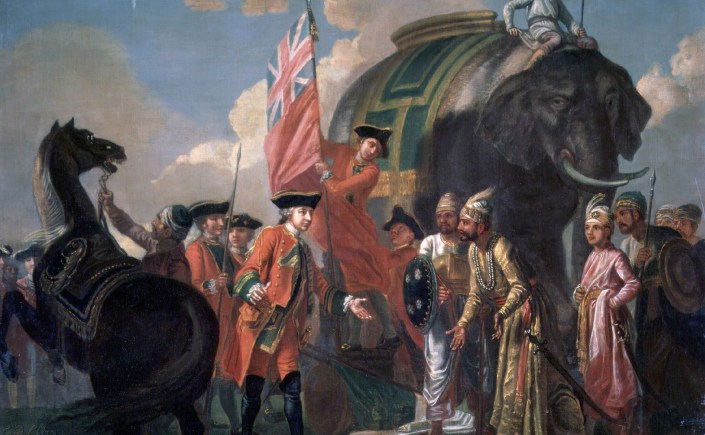
In Bad Company – how Britain conquered India, we reviewed The Anarchy, the latest in a long list of excellent histories of the sub-continent by Scottish scholar and longtime resident of India, William Dalrymple – the daunting and depressing story of the rise and fall of the British East India Company, a quasi-military industrial complex that earned the misleading sobriquet The Honourable Company.

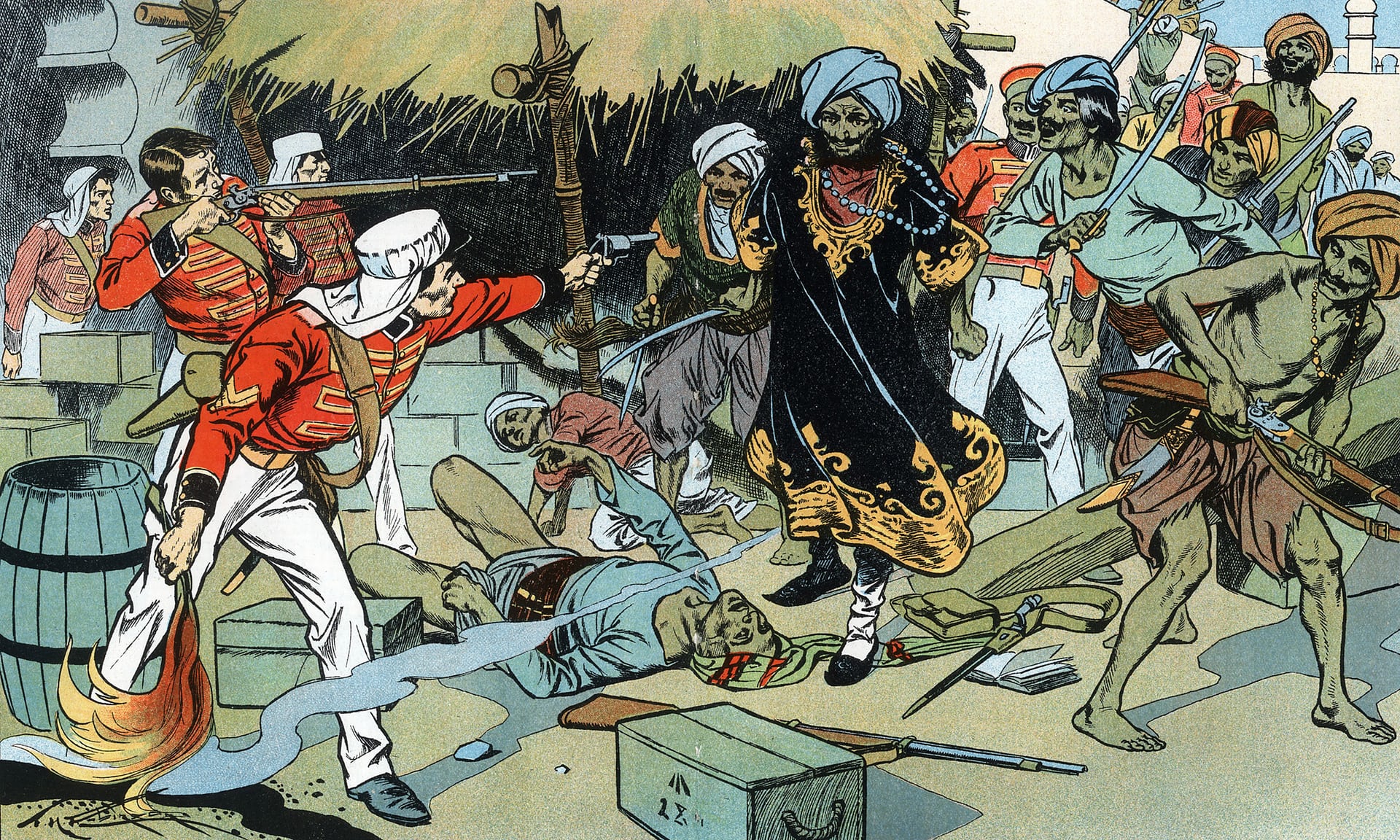
Flashman in the Great Game

Just in time for the lock-down, Hilary Mantel gave us the finale of her magisterial and magnificent Wolf Hall trilogy – The Light and the Mirror. In That Howling Infinite took up two themes that threaded through all three books. We know how the story ends, but are fascinated with how Mantel takes us there. Taking as it theme the golden bird-boy flying too close to the sun, Beyond Wolf Hall (2) – Icarus ascending asks the question “could Thomas Cromwell have avoided his doom?” Beyond Wolf Hall (1) – Revolution Road reviews Cromwell’s legacy, the Protestant Reformation that changed the course of English (and British) history.

Mark Rylance and Damian Lewis as Tom and Hal

Fast forward from the life and dangerous times of Henry VIII to the present, and Netflix’ release in November of the third season of The Crown, a sumptuous soap that beguiles even ardent republicans. The latest serve, highlighting the rise and fall of Margaret Thatcher and the salacious pas de trois of Charles, Diana and Camilla, is deliciously seditious. And there was an entertaining Australian interlude, as described in The Crown – the view from Down Under  even if it was actually filmed in Spain.

In August 2020, the largest man-made explosion since Hiroshima and Nagasaki rippled the heart out of Lebanon’s capital. Over two thousand tons of illegal, combustible, unstable, and almost forgotten ammonium nitrate went up in a fireball that resembled an atomic blast. Social media shared memes and messages, hearts and flags, and “we are all Lebanese” profiles. Expatriates and others wrote and spoke about the country’s present turmoil and fears of a return to the bad old days. Many shared  videos of songs by Lebanon’s national cultural icon, Fairuz – most particularly, her poignant Li Beirut, which she wrote during the civil war as a tribute to the city’s timeless beauty and the suffering of its people people. O Beirut – songs for a wounded city presents Fairuz’ songs, and also Syrian poet Nizar Qabbani’s famous O Beirut, Mistress of the World, and Khalil Gibran’s iconic Pity the Nation.

And finally, as this strangest of years was ending, we published a frolic that has been several years a’making. A cowboy key – how the west was sung takes us on a leisurely jaunt through some of those grand old songs, films and musicals that have shaped our more pleasant perceptions of America.

Happy New Year.

Our reviews of previous years: 2019, 201820172016; 2015

Androids Dolores and Teddy enjoy the Westworld view

The Crown – the view from Down Under

Having luxuriated in series one to three of The Crown, the fourth is deliciously seditious – particularly if one is a republican – and an Australian republican at that. 

Pheasants and peasants, dead trout and salmon, trekking the wilds in tweeds and wellies, and the stalking of a wounded stag. When Uncle Dickie gets blown to smithereens, it feels like some karmic comeuppance. This is even before we get to witnessing the making and breaking of “the people’s princess” in what transpired to be a fractured fairytale. 

There was plenty for us antipodeans to enjoy in an episode ironically titled Terra Nullius, a phrase that is particularly potent in our ongoing “history wars”. The Australian scenes were actually filmed in Spain, but never mind. There was Richard ”Cleaver Green” Roxburgh as our larrikin Prime Minister, the late Bob Hawke, remarking that Princess Di had set back the republican movement for decades. The “silver bodgie” is cast as as an impatient republican, but in reality, he did not forcefully agitate for a republic during his early years in office.

On matters Australian, series four offered up a couple more events that have contemporary echoes. 

During the royal couple’s trip to Australia in 1983, Diana tried and failed to scale our iconic Uluru – it was called Ayers Rock in those days, the site of the tragically famous “a dingo are my baby” saga. Our government has only recently conceded to the wish of the traditional owners that climbing the sacred megalith be forbidden – to the chagrin of many, and the joy of many more. 

There is also the presence of Sir Martin Charteris, the Queen’s private secretary. Though long gone to his maker, and retired well before his fictional appearance, his name and reputation have been brought into critical review with revelations of the role he played in our Governor General’s dismissal of Labour Prime  Minister Gough Whitlam on Remembrance Day 1975 – an event that resonates still nearly half a century on. Whilst it has been shown that Queen Elizabeth did not have foreknowledge, it has also come to light that Prince Charles gave retrospective encouragement to Sir John Kerr, who was enthusiastically pushing for the Crown Prince succeed him as Governor General.

It is said that Australians’ affection for Wills and Kate has an impact on republican sentiment DownUnder similar to that of Princess Diana – though The Crown’s unflattering portrayal of Prince Charles, fresh on the heels of the release of “the Palace Letters” might lead folk to contemplate that when Her Maj goes to meet the saints, will we Aussies might declare that “it’s time!”?

For further reading on Australian history and politics in In That Howling Infinite, see; Down Under and The Frontier Wars – Austrtalias Heart of Darkness

Call yourself a Republican?  Then why are you bingeing The Crown?

Jacqueline Maley, Sydney Morning Herald, 22 November 20207

The television show The Crown presents a unique dilemma for republicans. How can we maintain our disdain for the monarchy, our assurance of its irrelevance, while we are bingeing on its depiction, lapping up every detail of its costume, marvelling at the strong hairline of Princess Margaret and delighting in Diana? Even the corgis who have walk-on parts compel us with the sureness of their stride.

As a friend of mine put it in our defence: I don’t like murderers, but I like watching shows about serial killers. Tolstoy knew how interesting unhappy families were, and there is plenty of personal misery in the fourth and latest season of The Crown, even though the only person the creators give us any sympathy for is Diana, Princess of Wales.

The power of her celebrity, two decades after her death, defies gravity. We only really want to watch the show because of her – the scenes which just feature the self-absorbed, self-pitying Prince Charles are the only ones that drag.

This mirrors the central problem of Charles’ life – the public was never very interested in him. What he doesn’t understand, at least according to the show (yes, I know, I know, it’s fiction), is that nobody is actually obliged to find him interesting.Advertisement

The Real Life Charles is reportedly very cross at the characterisation of him as a cruel husband who moons around Highgrove enunciating his pretentious gardening philosophy (“There will be no straight lines, Mummy,” he tells the Queen when she comes to visit).

I find myself straining to care when I read articles where “sources close to the prince” tell us such-and-such an event never happened that way, or that the depiction of Charles as smug and insecure is mean. So what? Fiction portrays truth far better than documentary, and that is the genius of the show.

Illustration: Reg Lynch Besides, the most outlandish parts of the story are all true – the fact that two of the Queen’s first cousins were locked away in an institution for life because their disability might have caused people to believe the royal bloodline was “tainted”. The fact that a princess was so unhappy before her wedding that she tried to disappear herself through the misery of bulimia. The fact that the Queen’s children have to make appointments to see her.

I remember reading a defence of Kate Middleton – who was accused of not welcoming her sister-in-law Meghan Markle into the royal family – in which it was indignantly stated that Kate had even invited Meghan to her home once. This sort of weirdness is the second-generation iteration of Diana’s loneliness – in the show, the breeding mare/child bride Diana (she was 20) has been chosen to provide an heir, then locked in a palace to learn the rules. 

She is the key to the monarchy’s survival, yet when she rings the Queen, and her fiance, over and over, neither will take her call.

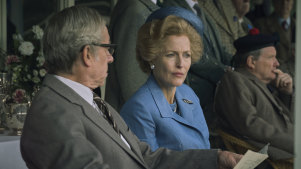
The Crown S4. Picture shows: Denis Thatcher (STEPHEN BOXER) and Margaret Thatcher (GILLIAN ANDERSON). Filming Location: Rothiemurchus, Scotland Gillian Anderson plays Margaret Thatcher in season 4 of The Crown.

In a recent essay on the pandemic, British novelist Zadie Smith writes that “suffering is not relative; it is absolute … it cannot be easily mediated by a third term like ‘privilege’.”

This sums up the Diana dynamic perfectly, and explains why millions of people loved her, or thought they did, for her vulnerability and her sadness, even though it was attended by servants and played out on the plump couches of Kensington Palace.

Here is another partial defence for republican viewers: the locations. Who is not dreaming of salmon-fishing in the Icelandic wilderness, walking the beach sadly in Mustique, a la Princess Margaret, or roaming the highlands of Scotland on a jolly hunting party (maybe minus the animal suffering)?Advertisement

The scenes of Balmoral, when Margaret Thatcher comes to stay with her husband Denis, are a fascinating portrayal of the clash between the low-born, broom-sweeping neo-liberalism of Thatcherism, and the fusty conservatism of Establishment Britain.

The Windsors look down on the shopkeeper’s daughter who doesn’t know how to dress properly for hunting. Seen through Thatcher’s eyes, the royal family are a ridiculous tribe with funny costumes and arcane habits.

Thatcher’s partially-sympathetic portrayal should be more controversial than Charles’ unsympathetic one. The bleakness of Thatcher’s Britain is shown but not focused on, and the only victim of her recession we see is Michael Fagan, the intruder who famously broke into the Queen’s bedroom in 1982. Fagan tells Liz “the system” is broken and complains about PM Maggie. The Queen is sympathetic and they have a moment together before he is whisked off by security.

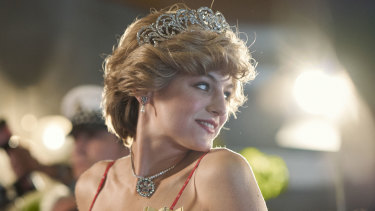
Emma Corin as Princess Diana  in an episode of The Crown  about Charles and Diana's tour of Australia.
                                                         Emma Corin as Princess Diana

But nothing happens, because the monarchy can’t make a material difference to any of its subjects’ lives, not that many of its members have shown an inclination to do so.Advertisement

Then there are the sons – Charles is self-pitying, Edward is a bullied boy turned bully, Andrew is charming but spoiled (perhaps a future series will explore the protection racket the royal family ran for the prince who refuses to answer police questions about his pedophile friend Jeffrey Epstein).

The Queen’s children, Diana, and even the Queen herself, all desperately need the validation of popularity, usually via the medium of the press, because it’s too sticky to get involved with one’s subjects personally. They are all jealous of the attention the others are getting. They all believe their misery to be worse than others’.

That, finally, is what the show brings out – how needy the royals are, and perhaps that’s the best republican take on The Crown.

That the act of divesting ourselves of the monarchy, when it eventually happens, will feel less like unshackling from a colonial power, and more like shaking off a clingy partner: the relief that comes with the end of a relationship you have simply grown out of.

Beyond Wolf Hall (1) – Revolution Road

A wide-ranging rural road trip through England’s green and pleasant land takes the traveller by antique and desolated abbeys and monasteries, their ageing walls crumbling and lichen covered, their vaulted pediments open to the English elements. The celebrated poets of the romantic era immortalized these relics in poetry, and even today, when one stands in grassy naves, gazing skywards through skeletal pillars, one can almost feel an ode coming on. Their number is remarkable – as a Wikipedia catalogue shows – and incalculable. The list is by no means exhaustive. There were one eight hundred religious houses existed in England and Wales before Henry VIII’s dissolution of the the monasteries and abbeys. Virtually every town of any size had at least one abbey, priory, convent or friary, including many small houses of monks, nuns, canons or friars. Many were spared despoliation and demolition, but many more were reduced to ruins and rubble by workmen and weather.

The 1530s were among the most significant in British history for the changes they wrought on its politics, society, culture. The backwash of the King’s Great Matter – his divorce from Katarina of Aragon, the onetime Spanish Princess and daughter of the formidable Queen Isabella, who was unable to give him a male heir to set fast his dynasty, and his marriage to Anne Boleyn in the hope that love and lust would bring forth male progeny – severed Britain from Rome’s papal dominion in matters of church and state, of its people’s bodies and souls. The pope in faraway Rome, regarded as a puppet of the Hapsburg Holy Roman Emperor in Vienna – who centuries later, historian Edward Gibbons declared as neither holy nor Roman – refused to grant Henry a divorce from Queen Katherine, his niece. Their reluctance and ultimate failure to secure this for their master doomed two wise, erudite and formidable chancellors, Cardinal Wolsey and Thomas More.

They were succeeded by Thomas Cromwell – kin, by way of his nephew, to his more famous namesake, Lord Protector Of The first and last English republic, Oliver Cromwell. Cromwell has until very recently been one of those people who whilst having immense historical significance is virtually unknown outside academia – most probably because his preeminent role in English government, politics, religion and society has long been overshadowed by the deeds and misdeeds of his royal master. Everybody knows about Henry and his six unfortunate wives – only one, Jane Parr who outlived him, got to live happily ever after – and his schism with catholic Rome that led to the establishment of the Church of England. It’s as if the narrative of the juvenile but enduring British history primer 1066 And All That had become established fact – to wit, Henry was “a bad king” but The Reformation was “a good thing”.  Few will be aware that Cromwell, Henry’s counsellor and Chief Minister, had a hand in three of those marriages and their undoing, and was the prime mover for Henry’s religious revolution, and much more besides.
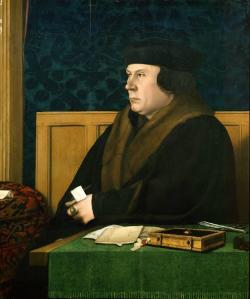
German artiist Hans Holbein The Younger’s portrait of Cromwell

The Hand of the King

In Hilary Mantel’s superb Wolf Hall and it’s equally magnificent sequels, Bring Up The Bodies and The Mirror and the Light, the story of English King Henry VIII is retold through the life and times of Thomas Cromwell, royal counsellor and chancellor. All the manoeuvres and machinations of church and state are set against the background of day to day life in 16th century England politics,trade, commerce and culture; and the annual plague that scourged high and low born alike, swift and deadly, laughing in the morning, dead by the evening. And threading through it all, is the religious ferment that was to persist, dangerous and deadly, for the next 150 years – Henry’s split with Rome, his founding of what was to become the Church of England, papists and protestants, priests and puritans, bells and smells, hair shirts, and burning flesh.

This article is the first of two published In That Howling Infinite discussing Hilary Mantel’s Cromwell. Read Beyond Wolf Hall – Icarus Ascending here.
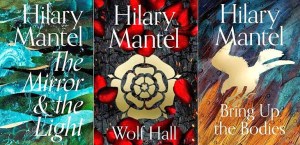
It is Mantel we must thank for placing Cromwell on a pedestal denied him for close on five hundred years. He is now a household name, and even, as she has herself described it, an industry. She and Oxford scholar and ecclesiastical historian Diarmaid MacCulloch have developed a mutual appreciation of each other’s ‘Crummie’, and it is MacCulloch’s 2018 biography Thomas Cromwell – A Life that is the ‘go to’ book for a definitive insight into the man and his works.

Before Wolf Hall, many of a certain age might remember he was portrayed with leering, Machiavellian relish by the late Leo McKern in the old movie A Man For All Seasons. In the play and film adaptation, Cromwell was the definitive ‘baddie’ and nemesis of the virtuous and principled Thomas Moore. Wolf Hall tells a different tale. More is the wowser and prig, and also, a keen inquisitor and torturer. And Cromwell is the reasonable, affable, capable, cultured “man for all seasons”.

Younger generations met him In HBO’s sprawling, splendidly dressed, violent and naughty multi-series The Tudors. James Frain plays Cromwell as an able, cunning, too-clever by half, commoner on the make; a vindictive and vengeful man who is not averse to “showing the instruments” (of torture, that is) and ordering their use upon those he wishes to interrogate and invariably execute. Hilary Mantel’s Thomas would do no such thing. A lifetime of observing and recording has taught him that less sanguinary measures more often than not encourage confessions, and indeed, as the value of information gleaned under torture is usually false, tend to elicit the truth also. Merely talking about the instruments is enough to open the most reticent of mouths. In the television adaptation of Wolf Hall, Cromwell is played with calm understatement and restraint by veteran actor Mark Rylance.
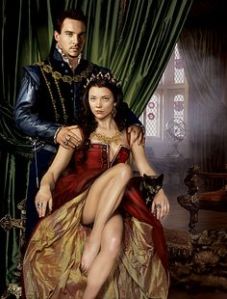
Henry VIIII and Anne Boleyn in The Tudors

In her review of the book, What Hilary Mantel left left out, The Guardian’s Jessie Collins wrote of Cromwell: “It is his contradictions that stand out: intense focus and frenetic energy, rapacity and a social conscience, “clubbability” and a trainspotterish enthusiasm for waterworks. He was a wily operator, but a favourite of widows and wayward young men. He was undoubtedly ruthless, but sometimes tried to mitigate the king’s cruellest inclinations. He was at his fiercest when seeking revenge for Wolsey’s fall, but if we are to be sympathetic to Cromwell – as MacCulloch is – then we must recognise its correlative: his ardent loyalty”.

Reviewing MacCulloch’s tome for The London Review of Books, Stephen Alford wrote that is was “necessarily the study of a royal bureaucracy knocked into shape by the size of the job it had to deal with, as well as a close encounter with a Church remodelled in the 1530’s image of a king”.

And regarding ‘The Hand of the King’, to borrow contemporary coinage, Alford continues:  “A man who in life strenuously resisted easy categories, Cromwell has been forced into the competing roles of hero and villain many times over. Neither quite fits him. To his enemies, of whom by the late 1530s there were many, he was an abominable heretic. Even today it can seem that every ruined monastery south of Carlisle and Berwick was somehow pulled to pieces by Cromwell personally … Over the centuries great claims have been made on Cromwell’s behalf. One is that he helped to bring the ‘true religion’ of Protestantism to England. Another is that he revolutionised and modernised the functioning of the English state. Both rest their weight on an individual whose life story is full of question marks …”

I have reproduced Alford’s and Collin’s reviews of MacCulloch’s biography of Cromwell below. They are well worth reading.
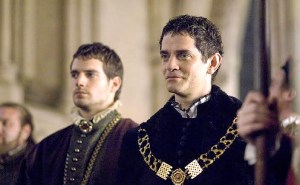
James Frain as Cromwell in The Tudors

The rift with Rome

Henry’s dispute with the Pope concerning his Great Matter was ostensibly more about monarchical power and sovereignty, his existential need to secure his heirs, and to Europe’s dynastic yet dysfunctional power struggles than about religion. He did not regard himself as one of the reformists, or Protestants as they became known. He remained, and regarded himself, a catholic monarch, and a “Defender of the Faith”, a title the Pope himself conferred upon him for his written repudiation of the heretical works and preachings of one time cleric Martin Luther – and a motto that still circles the image of the monarch on Britain’s coinage.

Mantel’s Thomas Cromwell is well aware that Henry is no true Protestant and that. His repudiation of papal authority split is about power and sovereignty, and not popish practises, which he persists in observing. The king continues to follow the mass, to observe the saints’s days (though there are less of them now). Both king and clergy resisted the publication and dissemination of the bible in English. Like their predecessors, they did not want the lower orders to discover that the scriptures made no mention therein of indulgences, of clerical celibacy, of purgatory, and indeed, of clergy. Like the kings and prelates of Catholic Europe, he was not averse to consigning heretics to faith’s cleansing fire, and torched those who’d adopted the rejectionist doctrines of Martin Luther and John Calvin – those who by the end of the sixteenth century, would be described as  Protestants – and before that, theological dissidents who populated a broad continuum between traditionalists and reformers. Later, when  Protestants were in the ascendant, the authorities cast Catholic and other adversaries into the fire.

But perennially impecunious, His Majesty can smell the money and is soon hooked on the riches and the lands that accrue to the crown and its cronies with the dissolution of the great abbeys and monastic houses. Thomas, his “go to”, “can do” red right hand fixes it – to his own benefit and that of his family and friends, and, also of the impecunious honour-rich but debt-deprived ancient families.

Whilst Henry was opportunistic and impulsively adventurous, Thomas, for all his erudition, political skill, and lived experience in Europe and England, was actually a cautious and calculating true believer. Stephen Alford again: “He was a man of the world, a pragmatist whose preoccupations were with the possible; it just so happened that for Cromwell the scope of possibility was so much greater than it seemed to be for other people. Yet he was a believer too, from at least the 1520s an enthusiast for Reformation. After 1537, as secure as he was ever likely to be politically, he began to pursue with a single mind an evangelical agenda. But he was also cautious …In the always unpredictable and often dangerous religious landscapes of the 1520s and 1530s he played his faith very close to his chest. Spared the agony and ecstasy of a public spiritual crisis, he left prophecy and martyrdom to others”.

In the wake of Cardinal Wolsey’s failure and demise, Cromwell becomes the public face of the king’s split with Rome and the spiritual and temporal authority of the Pope. His Protestant beliefs, fostered during his sojourn in the heretical Low Countries, impelled his rejection of the Roman faith with its corruption and its confidence tricks, its profiteering and its hypocrisy, its fabricated sinecures and sacraments, its relics and its indulgence. His pure hatred and contempt for the whole shaky edifice is force-fed by the prospects of divesting the English church of its immense power, wealth and influence, of filling the crown’s hungry coffers.

Cromwell is fully aware that he is loathed by the common people who yearn for the old, familiar ways, the “bells and smells”, the bits of dead saints’ bones and the shreds of their shrouds. They rise up, in a quixotic revivalist crusade called The Pilgrimage of Grace, and having risen up in rebellion against the new order, are on his orders, put down mercilessly with sword and rope by England’s hereditary warlords.

“It takes a generation, he says, to reconcile heads and hearts. Englishmen of every Shire  are wedded to what their nurses told them. They not like to think too hard, or disturb the plan of the world that exists inside their heads, and they will not accept change unless it puts them in a better case”?

And yet he is resolute in his convictions. “But new times are coming … children yet to be born – will never have known their country in thrall to an old fraud in Rome. They will not put their faith in the teeth and bones of the dead, or in holy water, ashes and wax. When they can read a Bible for themselves, they will be closer to God than to their own skin. They will speak His language, and He theirs”.
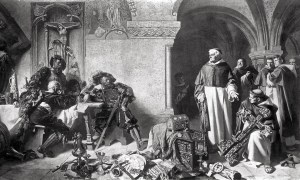
The Dissolution Of the Monasteries

The harrowing of the shires

Hilary Mantel gives us a formidable and very original account of the dissolution of the monasteries and the demolition of the very foundations of the established faith. She catalogues the work of the commissioners, the enforcers and the executioners, the suppression of the superstitions and the scams, and the rivers of gold that flowed into the pockets of the king and his agents along with lands and mansions. It’s such a remarkable read, I quote it here in full:

This winter the king is taking the surrender of the great abbeys, with their manorial titles and broad acres, their watercourses, fishponds, pastures, their livestock and the contents of their barns: Every grain of wheat weighed, every hide counted. If some geese have flocked to market, cattle strolled to the slaughterhouse, trees felled themselves, coins  jumped into passing pockets… it is regrettable, but the kings commissioners, men not easy to deceive, could not go about their work without their presence being heralded: The monks have plenty of time to spirit the assets away. Treat the King fairly, and he will be a good master. When Saint Bartholomew surrenders and it’s bells are taken to Newgate, Prior Fuller is granted land and a pension. Officers of the Court of Augmentations move into its great buildings, and Richard Riche plans to turn the prior’s lodgings into his townhouse. In the North Country, Abbot Bradley of Fountains settles for an annual pension of 100 pounds. The Abbot of Winchcombe, always a helpful man, accepts a hundred and forty. Hailes surrenders, where they displayed the blood of Christ in a phial. The great convent at Syon is marked for closure, and he reminds himself of Launde, with Prior of Lancaster has been in post for three decades, which is too long. It has not been a pious or happy house these last years. When questioned the prior would always declaring, omnia bene, all’s well, but it wasn’t: the church roof leaked and there were always women about. All that is over now. He will rebuild it, a house after his own liking, in England’s calm and green heart. In dark weather, he dreams of the garden arbour, of the drifting petals of the rose, pearl-white and blush-pink. He dreams of violets, hearts-ease and the blue stars of the pervink or periwinkle, used by our maids as lovers knots; in Italy they weave them into garlands for condemned men … (page 699)

… In November he writes in his memoranda, “the Abbott of Reading to be tried and executed”. He has seen the evidence and the indictments; there is no doubt of the verdict, so why pretend that there is? The Days of the great abbeys died with the north country rebellion. The king will no longer countenance subversion of his rule, or the existence of men who lie awake in their plush curtained lodgings and dream of Rome. Thousands of acres of England are now released, and the men who lived on them dispersed to the parishes, or to the universities if they are learned: if not, to whatever trade they can find. For the abbots and priors it’s mostly ends with an annuity, but if necessary with a noose. He has taken into custody Richard Whiting, the Abbott of Glastonbury, and after his trial he is dragged on a hurdle through the town and hanged, alongside his treasurer and his sacristan, on top of the tor: an old man and a foolish, with a traitors heart; an embezzler too, who has hidden his treasures in the walls. Or so the commissioners say. Such offences might be overlooked, if they were not proof of malice, a denial of the king’s place as head of the church, which makes him head of all chalices, pyxs, crucifixes, chasubles and copes, of candlesticks, crystal reliquaries, painted screens and images in guilds and glass.

No ruler is exempt from the death except King Arthur. Some say he is only sleeping, and will rise in an hour of peril: if say, the emperor sends troops. But at Glastonbury they have long claimed that he was as mortal as you and me, and that they have his bones. Time was, when the abbey wanted funds, the monks were on the road with the mouldy head of John the Baptist and some broken bits of the manger from Bethlehem. But when that failed to make that coffers chime, what did they arrange to find beneath the floor? The remains of Arthur, and beside him the skeleton of a queen with a long golden hair?

The bones proved durable. They survived the fires have destroyed most of the Abbey. Over the years they attracted so many pilgrims that Beckett’s shrine waxed jealous. Lead cross, crystal cross, Isle of Avalon: they wrung out of pennies from the treacherous and awed. Some say Jesus himself trod this ground, a bruit that the townsfolk encourage: at Saint George’s In they have an imprint of Christ’s foot, and for a fee you can trace around it and take the paper home. They claim that, after the crucifixion, Joseph of Arimathea turned up, with the Holy Grail in his baggage. 700 He brought a relic of Mount Calvary itself, part of the hole in which the foot of the cross was placed. He planted his staff in the ground, from which a Hawthorne flowered, and continues to flower in the fat years and lean, as the Edwards and Henrys reign and die and go down to dust. Now down to dust with them go all the Glastonbury relics, two saints called Benignus and two kings called Edmund, a queen called Bathilde, Athelstan the half-king, Bridget and Crisanta, and the broken head of Bede. Farewell, Guthlac and Gertrude, Hilda and Hubertus, two abbots called Seifredus, and pope called Urbanus.Adieu, Adelia, Aidan Alphege, Wenta, Walburga, and Cesarius the martyr: sink from man’s sight, with your muddles and your misstranscriptions, with the shaking of your flaky finger bones and the compound jumble of your skulls. Let us bury them once and for all, the skeletons of mice that mingle with holy dust; the ragged pieces of your tunics, your hairshirts clumbed with blood, your snippets and your offcuts and the crisp charred clothing of the three men who escaped from the Burning Fiery Furnace. The lily has faded, that the virgin held on the day the angel came. The taper is quenched, that lighted the Saviour’s tomb. Glastonbury Tor is over 500 feet high. You can see for miles. You can see a new country if you look, where everything is fresh, repainted, re-enamelled, bleached, scrubbed clean … (page 701)

While the welcoming party is around the sea, the Abbott of Colchester is in the air. Colchester had signed up to the King supremacy, he had taken the oath. Then he gave backward, in whispers behind the hand: More and Fisher were martyrs, how he pitied them! When he was called upon to surrender his abbey, he said the king had no right to it – which is to say, his will and laws I know. He is head neither of the spiritual realm nor the temporal; in effect he is no king and parliament can make the law. According to the Abbot.

… It is the last of the hangings, he is sure. They were infecting each other, Colchester,  Glastonbury and Reading.  But now resistance to the King’s will is broken. All other houses can be closed by negotiation: no more blood, no more ropes and chains. No more examples are needed; the traitor’s banner is trampled, that portrayed the Five Wounds. Superstitious men in the north claim that in addition to his principal wounds, Christ suffered 5470 more. They say that every day fresh ones are incised, as he is cut and flayed by Cromwell. (page 709)

Let England shake

Thomas Cromwell was executed on Tower Hill  on 28th July 1540 and was buried in the Tower of London’s  Chapel of St Peter ad Vincula. Interred thereto are  Anne Boleyn and Margaret Pole, Countess of Salisbury and the last of the Plantagenet line – both of whom were executed through Cromwell’s’ manoeuvrings. Seventeen year old Catherine Howard became Henry’s fifth wife on the day that Cromwell died – and condemned for adultery and accordingly, high treason, she went to the block on Tower Green less than two years later. These were dark times for bad girls and wide boys.

Hilary Mantel’s story has been about England, it’s legends and it’s legacies, it’s rythmns and rhymes, it’s history past, present, and future. And he, Thomas Cromwell, has made England shake. And hisnrevolution endured. Henry VIII let it run, and his son, frail but resolutely Protestant Edward, endeavoured to anchor it. The Spanish Princess’s daughter ‘Bloody Mary’ strove with fire and sword to unmake it. And Anne Boleyn’s child, Elizabeth, set it in concrete so strong that Scottish James and his unfortunate son Charles I could not crack its foundations.

The rest, as they say, is our history.

© Paul Hemphill 2020.  All rights reserved

For other posts in In That Howling Infinite on matters historical, see Foggy Ruins of Time – history’s pages

A Man It Would  Be Unwise To Cross

Stephen Alford, London Review of Books November 8th 2018

Review of Thomas Cromwell –  A Life by Diarmaid MacCulloch, September 2018

In 1517, a fierce commercial struggle broke out in England between two enterprising competitors in the busy trade of saving souls. The English Province of Austin Friars and Our Lady’s Gild of Boston, deep in the Lincolnshire fenland, went to law over the sale of indulgences, those pardons, common across the whole of Europe, offering remission for souls in purgatory. Since 1500 Our Lady’s Gild had built up what was probably the largest indulgences business in the kingdom. The friars pursued the same trade with equal vigour. The collision of interests was not surprising – big money was at stake. Far away in Saxony, Martin Luther, a brother Augustinian, was about to open heavy fire on what he saw as the whole worthless racket.

Our Lady’s Gild threw its considerable resources at the case. It appealed to Thomas Wolsey, Henry VIII’s indispensable right hand: cardinal, archbishop, lord chancellor, Wolsey was a formidable broker of power. And it also bought the services of a clever (and therefore expensive) attorney. This was Thomas Cromwell, who in early 1519 went to Rome to make his client’s case at the pope’s court. He journeyed via Calais, was away on his mission for 26 weeks, and as he travelled read Erasmus of Rotterdam’s New Testament in Greek and Latin. Erasmus, the most brilliant scholar of the age, got him thinking.

Cromwell loved books. He was a talented linguist and his Italian in particular was excellent. But he wasn’t a secluded intellectual. He hadn’t studied at a university, and the law he picked up in London he used to make a good living for himself. Intelligent and restless, he had knocked around a bit in his time. Teenage wanderlust had taken him as far as the Mediterranean, and in his twenties he was in Antwerp, the greatest European entrepôt of its day, a magnet for merchants and high financiers. He was comfortable in mercantile company and he liked money. Socially it was tricky to pin him down. His father was a yeoman with a substantial interest in brewing, his mother was a gentlewoman. He was thus himself a bit of a hybrid, and would always remain so. The accounts of Our Lady’s Gild of Boston gave their comfortably middle-aged attorney (he was now in his thirties) the gentleman’s title of master. Cromwell was the boy from Putney who rose and fell at the court of Henry VIII with, as Diarmaid MacCulloch’s biography shows, spectacular unobtrusiveness.

A man who in life strenuously resisted easy categories, Cromwell has been forced into the competing roles of hero and villain many times over. Neither quite fits him. To his enemies, of whom by the late 1530s there were many, he was an abominable heretic. Even today it can seem that every ruined monastery south of Carlisle and Berwick was somehow pulled to pieces by Cromwell personally. Reginald Pole called him a Machiavel, and the label, seemingly congruent with the Frick Collection’s famous portrait by Hans Holbein the Younger, has stuck: Cromwell’s intensely focused stillness suggests a man it would be unwise to cross. Even for those who lionised him as a champion of the English Reformation, there were bits of his life which didn’t quite fit. The story of attorney Cromwell’s mission to Rome was first told by John Foxe in Actes and Monumentes, the ‘Book of Martyrs’. Foxe had to rescue his hero with some deft literary footwork, turning on its head the uncomfortable tale of Cromwell’s journey to the heart of Roman superstition and error. Elizabethan Protestants could thank providence that Erasmus’s New Testament had spoken to Cromwell’s spiritual sensitivity in those weeks of travel and given him a ‘better understanding’ of God’s truth.

Over the centuries great claims have been made on Cromwell’s behalf. One is that he helped to bring the ‘true religion’ of Protestantism to England. Another is that he revolutionised and modernised the functioning of the English state. Both rest their weight on an individual whose life story is full of question marks. There is no tidy box of historical explanation into which we can put him. The brisk judgment of Hugh Trevor-Roper was that Cromwell ‘was a freak in English history’. It has always been easier to fall back on broad-brush assertions or to dismiss him with an adjective: ‘sinister’ and ‘Machiavellian’ used to be two of the most common. As Geoffrey Elton wrote in 1953, ‘We do not call a man sinister whom we know well, whether we like him or not.’ But Elton merely restates the problem. How do we get to know Thomas Cromwell in the first place?

The answer is by a painstaking forensic recovery of every surviving piece of evidence and then letting the completed dossier speak for itself. MacCulloch’s biography is itself an exercise in Cromwellian rigour. Nothing here is rushed, no detail overlooked. Care and precision are everything. Later reminiscences of Cromwell are positioned and repositioned, the chronology tested, every particle sifted and cross-referenced. We need to know before we can judge. We feel by the end of MacCulloch’s formidable book that we know Cromwell very well indeed.

The Cromwell of this Life seems at times to be a watcher more than an actor, purposeful and busy yet somehow also passive. He had a strong sense of family and kinship, and a gift for making friendships durable enough to survive the later painful upheavals in religious belief. He understood the obligations of courteous reciprocity in a society whose mechanisms were lubricated by patronage. MacCulloch’s Cromwell is a collector and a reader of books. Italy is his passion, Italian the shared language of his friends and colleagues. He read Machiavelli (History of Florence as well as The Prince), Petrarch and Castiglione’s manual for the courtier, Il Cortegiano – important reading for the attorney from Putney. He was on equal terms with university scholars like Cranmer, a don to his fingertips. But Cromwell never lost the self-containment and self-reliance of the autodidact. He was a man of the world, a pragmatist whose preoccupations were with the possible; it just so happened that for Cromwell the scope of possibility was so much greater than it seemed to be for other people.

Yet he was a believer too, from at least the 1520s an enthusiast for Reformation. After 1537, as secure as he was ever likely to be politically, he began to pursue with a single mind an evangelical agenda. But he was also cautious. As Foxe described it (and his description seems to fit the man), Cromwell’s conversion was a process, not a spasm of Damascene revelation. In reading the Erasmian New Testament, as Foxe put it, Cromwell ‘began to be touched and called to better understanding’. In the always unpredictable and often dangerous religious landscapes of the 1520s and 1530s he played his faith very close to his chest. Spared the agony and ecstasy of a public spiritual crisis, he left prophecy and martyrdom to others.

Striking in the world MacCulloch builds around Cromwell is its sense of order and routine, its reasonableness, its gentleness even. The fractures of the 1530s, the consequences foreseen and unforeseen of Henry’s ‘Great Matter’ – the problem of Katherine of Aragon and the break with the Church of Rome – are all the more shocking because the bonds of social and political solidarity which pushed Cromwell up the ladder of preferment and promotion had once been so resilient. He had no grand plan for greatness. To talk about his ‘rise to power’ after 1530 feels almost like bad form; however true, the cliché, which suggests the energy of personal ambition, doesn’t quite fit. Though he was ever the sharp-eyed attorney, it was his grasp of minutiae, his gift with a pen, his ability to persuade others, his patience, that really marked him out. He had an instinct for the right move to make at the right time, offering a masterclass in the softly, softly approach to the acquisition of authority. In his life, routine and process counterweighted those moments in Henrician politics when the blade of the executioner’s axe met the neck on the block or the fire was lit under the prisoner bound to a stake. Volatility in this book is left to King Henry, tantrums and petty revenge to Anne Boleyn, sulks and tactlessness to Stephen Gardiner, fuming at upstart nobodies to His Grace the Duke of Norfolk. Cromwell, without title and for a long time without proper position, moved quietly ever forward.

It all​ began in Putney, a few miles upriver from London, where he was born and from where he escaped probably as soon as he was able. Born around 1485, he was a teenager at the turn of the new century. His father, Walter Cromwell alias Smith, was a more or less successful businessman whose brushes with manorial justice were practically routine. His mother’s name may have been Katherine, and her origins can be traced with some close detective work to the Meverell family of the Staffordshire Peaks.

The mature Cromwell looked back to his own wild youth, ‘as he himself was wont oftentimes to declare unto Cranmer Archbishop of Canterbury, showing what a ruffian he was in his young days’ (the words belong to John Foxe). We shouldn’t take him too seriously here; it is easy to overlook his wry sense of humour. He was a wanderer and a traveller, and gave himself an education in the world so very different from the suffocating discipline and narrow curriculum of a university. What historians and biographers can’t fix with the certainty of fact and evidence offers the novelist the rich and necessary space of imaginative possibility. This has been true of Cromwell’s life since the 16th century. A novella by the Italian author Matteo Bandello, printed (naturally) by John Foxe, interpreted Cromwell’s adolescent travels in Europe as an escape from the violence of his father, a story with shaky foundations that was taken up with enthusiasm by the Victorians. Our first meeting with a young Thomas felled and bloodied by the calculated savagery of Walter Cromwell’s kicks in Hilary Mantel’s Wolf Hall is viscerally memorable.

There is no clear vision of Cromwell until the age of forty, though by the 1510s he begins to come a little more into focus. He married his wife, Elizabeth, probably a few years after Henry’s accession in 1509. They had two daughters, Anne and Grace, and a son, Gregory, born in 1519 or 1520. At some point in the 1520s Elizabeth’s mother, Mercy (the Mistress Prior always popular with the family’s friends and handy with medicines), moved in. In 1523 the Cromwells took up residence near Austin Friars, in a grand house on Throgmorton Street. Thomas was doing well for himself. Nestled close to the beautiful Augustinian friary, his legal practice took him upriver to the Court of Chancery in Westminster. His Anglo-Italian business and legal connections were extensive. He counted as friends and clients merchants who went to the king’s court to trade their luxurious fabrics before Henry himself. Already Cromwell was on the fringes of power.

The big step up came in 1524, when he was recruited into the household of Cardinal Wolsey. Wolsey, prince of the Church and Henry’s man, wanted to build his legacy in stone. He planned two colleges, one in Ipswich (his home town) and the other in Oxford, as well as a tomb that would stand as a masterpiece to celebrate a masterly career. With his scrupulous eye for detail, Cromwell was perfect for the job of managing these considerable projects. This laid the groundwork for a later career that, had Wolsey lived years longer, might never have happened. Cromwell had the job of winding up some small religious foundations whose liquidations funded Wolsey’s colleges and tomb. Cromwell visited these houses and, with an improvisatory talent for handling the paperwork, oversaw the legal details. By the late 1520s few outsiders knew the English monasteries better than he did. He was given a job and got on with it, enjoying his freedom. In recruiting distinguished scholars for the Oxford foundation, Cromwell already had a good eye for university men sympathetic to Reformation ideas.

And so he prospered and he learned. Elected to the House of Commons for the Parliament of 1523, he saw for the first time from the inside a body he would come to manage in the 1530s with the same confidence he demonstrated in Wolsey’s service. He knew early on what he was up against, though he saw too the very human side of institutions. Of his 17 weeks in Parliament he wrote to a friend in 1523: ‘Howbeit, in conclusion, we have done as our predecessors have been wont to do, that is to say, as well as we might, and left where we began.’ Even the frighteningly efficient attorney had a sense of humour.

The hardest year personally and professionally was 1529. Elizabeth, Anne and Grace Cromwell died and Wolsey proved unable to deliver what Henry VIII had demanded: a satisfactory conclusion to the Great Matter, the neat annulment of a marriage to Katherine of Aragon that had been no marriage at all in the eyes of the king. Wolsey – like everyone else – had failed to attend to his majesty’s delicate conscience. Yet Cromwell remained close to Wolsey. He stuck his neck out to defend the cardinal in the Parliament of 1529, where Wolsey’s many enemies were determined to bring him down once and for all. For most of 1530 Cromwell hovered uncertainly between loyalties. But he was Wolsey’s man still, handling his master’s business long after the cardinal’s fall.

Parliament had shown his capabilities. In early January 1530 he took a walk with the king in his majesty’s garden at Westminster during which, such evidence as there is suggests, he gave an expert’s view of how profit might be made out of Church reform. Henry, at a critical moment in his fight with Rome, saw the possibilities. But no deal was done. That summer Cromwell toyed with a plan to fall back on his private practice as an attorney. In August 1530 he laboured over the wording of a letter to his disgraced master, who seemed incapable of keeping himself out of the headlines. ‘Learn to experiment how ye shall banish and exile the vain desires of this unstable world,’ he wrote to Wolsey. Now with a decision to make for himself, Cromwell’s words may have spoken as much to his own situation.

Something almost irresistible seems to be acting on Cromwell in the early 1530s, MacCulloch’s biography suggests, and the next step in his career happened as a kind of natural process, like the turning of the seasons. Somehow it was inevitable. Some people noticed it, some didn’t. By 1530 he had supporters at court, and they shared a common profile: they had been close to Wolsey, they didn’t like Anne Boleyn, but they were obeying as loyal subjects the king’s efforts to get rid of Queen Katherine, though with little enthusiasm. Just when few knew precisely how to give Henry what he wanted, Cromwell was the man being talked about. ‘And forasmuch as now his Majesty had to do with the Pope, his great enemy, there was (he thought) in all England, none so apt for the King’s purpose, which could say or do more in that matter than could Thomas Cromwell.’ So, in later years, said Sir John Russell, a court insider.

From 1531 Cromwell became the king’s fixer. In a sense he merely moved from one legacy project to another, for by now Henry was no longer content to play by the rules of Rome. His majesty’s cause had run into the buffers at the legatine court at Blackfriars in 1529, precipitating the collapse of Wolsey’s power. Yet Henry refused to give up, and by 1530 a kind of royal think tank, of which Cranmer was a member, was beginning to suggest a radical change of strategy.

The King Henry of this biography is impulsive and unpredictable, with a short attention span and a consistently high regard for his own genius. In the Great Matter he knew what he wanted. When in late 1530 Henry read a dossier that set out compelling historical evidence of his own spiritual supremacy, he annotated it in 46 places. Even Henry’s normally dormant critical senses were alert enough to ask of key passages ‘Ubi hic?’ (‘Whence does this come?’). But naturally he was an enthusiast, for supposedly erudite scholarship by others told him what he wanted to hear. In his mind was the image that Cromwell and Cranmer were later able to transmit to all the king’s subjects by means of the title-page of the Great Bible: Henry at the centre of everything, beholden to no other human power, communicating with his God without the need for an intercessor.

It was Cromwell’s job to make something strong and meaningful out of this confection of royal ego, dodgy history, polarised court politics and happenstance. It was a task that involved facing down the elite of the English clergy, detaching England from the authority of the bishop of Rome by statutory means (while emphasising that the king was very firmly above any law), managing official propaganda, and breaking Henry’s opponents. Thomas More and John Fisher were two victims. In the final encounters with More we find in Cromwell the human face of a process the collateral damage of which meant almost nothing to the king; they were two servants of a royal master, bound by that commonality, who found themselves on opposite sides of his majesty’s will. Cromwell as ever got on with the job, roughly balancing duty and conscience, and smoothing to the best of his ability the sharper edges of Henry’s displeasure.

Closeness to the king himself mattered more for Cromwell than formal position. The later promotions – Baron Cromwell of Wimbledon in 1536, Earl of Essex for a mere two months in the year of his downfall, 1540 – look like overcompensations for a loyal servant snubbed early on. But the initial appointments, the earliest signs of favour, meant something. Master of the jewels (1532), chancellor of the exchequer (1533), master of the rolls (1534), vice-gerent in spirituals (1535): each of these gave access to the king and influence over the flow of paper, allowing Cromwell to expand his horizons and his control. Newly promoted, he quickly needed a portrait (hence Holbein’s extraordinary picture) and a coat of arms, for which he, daringly, chose to incorporate elements of Wolsey’s own. Always perhaps a little unpredictable, a bit of a hybrid, his standing was never quite fixed. In fact the new offices of vice-gerent and vicar-general, which gave him as the king’s deputy the authority to suppress the religious houses, produced a very English awkwardness over etiquette. How should one refer to the vice-gerent? ‘Your grace’ was out, ‘Your holiness’ a non-starter. One bureaucrat with a talent for flattery came up with the perfect title: ‘Your goodness’. Probably it spoke to Cromwell’s own genius for flexible improvisation, as well as to his sense of humour.

The question​ that used to be asked of the huge upheavals of Reformation in the 1530s was ‘King or minister?’ Henry or Cromwell? Whose responsibility was it all? Whose vision? Whose fault? These questions once made sense, based as they were on the belief that an individual alone might be masterful or visionary enough to direct the fortunes of a kingdom. We seem today to have lost that easy faith. In the 1530s there was a sustained effort at making the Henrician revolution work, at least in the interests of the king. That conversation between Cromwell and Henry in Westminster in early 1530 bore fruit. The king and his elite made a fortune out of the Church and its lands. Enforcement was tough, its instruments being a new treason law and propaganda and new agencies of government able to process a massive administration. There was of course a reaction from subjects who saw their world being ripped apart. In the great rebellion in the north of England in 1536 ‘pilgrims’ stood for the commonwealth against Cromwell and other heretics. And all of this from the king’s passion and scruple of conscience. There was little intelligent design here, at least initially. Henry was too flawed a leader to have thought very much or for very long about the consequences of what he began, other than for himself. Led by impulse from one moment to another, he put the allegiance of loyal subjects under immense strain. Disconnected from the human cost of his actions, he was a tyrant in the making.

Holbein’s portrait of Cromwell shows the ideal bureaucrat. Within reach are the implements of office: quill, book and papers. The steadiness of the gaze is what unnerves the viewer. Cromwell’s instinct for government and process, and his sense of balance, were impeccable, at least when he was at the height of his powers. He liked detail and he preferred neat uniformity. He understood possibilities and he worked with the realities of the moment. He was able to manage change on an immense scale. He shared with friends like Thomas Cranmer a reforming agenda in religion, and he had ambitions for his own promotion and the standing of his family. But even Cromwell could go only so far. He was human after all. Later portraits lack Holbein’s extraordinary precision but they succeed in showing just a little softening of that early hardness.

A Life of Thomas Cromwell is necessarily the study of a royal bureaucracy knocked into shape by the size of the job it had to deal with, as well as a close encounter with a Church remodelled in the 1530s in the image of a king. This is where MacCulloch’s passion lies: one feels his love of ecclesiastical process and order, his sympathy for spiritual men wrestling with the material realities of change and ambition. He has the pleasure in fine detail of an antiquary, the historian’s range and depth of vision and the biographer’s feel for his subject. This is a book about people, their friendships, alliances and obligations. As such it is inevitably a book about the forces in the 1530s that had the power to fracture all of those things. In it we never lose sight of Cromwell’s humanity. One strand of this is the protective eye he kept on wayward boys, the first of them Wolsey’s genially feckless illegitimate son Thomas Winter, the second his own son Gregory. An exquisite Holbein miniature of Gregory in 1537 shows a young man of about 18 with closely cropped hair. Lips pressed together, he looks down. There is something submissive in his attitude: the son of a powerful man with a certain weight of expectation resting on young shoulders. How different from the experience a generation earlier of that young ruffian who had knocked around Europe in the years after 1500, and who later made his own way up the ladder.

The end came in 1540. It was the strangest of years: an earldom, an English Bible, another neck on the block. The politics of the court finally caught up with Cromwell, as they had with so many others before. The debacle of the Cleves marriage, which was annulled after six months, left him exposed to enemies ready to take advantage of his having fallen from favour with the king. Of Cromwell’s arrest in early June we have a second-hand account by the French ambassador. Informed by the captain of the king’s guard that he was a prisoner, he ‘ripped his cap from his head and threw it to the ground in contempt, saying to the Duke of Norfolk and others of the Privy Council assembled there that this was the reward of the good service he had done to the king, and that he appealed to their consciences to know whether he was a traitor in their accusations.’ Norfolk’s response was to rip the Garter collar of St George from the prisoner’s neck. It’s likely His Grace rather enjoyed the moment.

In spite of his appeal to the loyal service he had given his majesty, he’d been around long enough to know that any minister was in the end dispensable. He served at his majesty’s pleasure, and his majesty’s track record spoke for itself. It was the same for everyone: once you were on the wrong side of Henry, he cut himself off completely, pulling down the shutters even on his closest relationships. In any case, Cromwell had never made Wolsey’s mistake of believing that he was the king’s friend. In some ways, oddly, Cromwell and Henry seem to have operated almost in parallel spheres. It was true at the very end. On the day of Cromwell’s execution, 28 July 1540, the king was otherwise occupied: that was the day he married Katherine Howard. With Cromwell on the scaffold there was no melodrama, only loyal submission to God and to Henry’s will. His thoughts in those few remaining minutes of his life were for the future wellbeing and security of his family.

In 1529, at the fall of Wolsey, Stephen Vaughan wrote to Cromwell: ‘You are more hated for your master’s sake than for anything else which I think you have wrongfully done against any man.’ We might ask ourselves whether Vaughan’s judgment is as true for the king Cromwell served, for that second legacy project he steered through to a conclusion of sorts – the heavy burden of a service from which he is only now being rescued.

Thomas Cromwell, by Diarmaid MacCulloch – What Mantel left out

Jessie Childs, The Guardian, 22nd September 2018

iarmaid MacCulloch, who is presumably no stranger to mispronunciation, thinks we’ve been getting Thomas Cromwell wrong. It should be “Crummle”. This matters more now that Cromwell is a household name, or, as Hilary Mantel has put it, “an industry”. There have been several biographies of him recently, but this is the one, according to the Booker-winner, “we have been awaiting for 400 years”.

The admiration is mutual: Mantel appears in MacCulloch’s introductory material as well as the main text, where he refers to a scene in her novel Wolf Hall in which Cromwell’s glowering portrait is unveiled. He adds that Cromwell put up with it, whereas Thomas More’s image took Holbein “quite a lot of adjustment to get right”. The two are now locked in a duel in the Frick collection in New York.

So this is far from being a buttoned-up biography of Henry VIII’s chief minister. MacCulloch is a stylish and playful writer who knows his readership and keeps his more scholarly conversations (“Frankly, that seems a naive reading of events”) to the back of the book. It is, at the same time, seriously heavyweight, both in terms of size (more than 700 pages) and archival heft. Anyone looking for the true story of Wolf Hall will be challenged, but also mightily rewarded. MacCulloch is Professor of the History of the Church at Oxford (you have to understand religion to get anywhere near Cromwell) and has spent six years reading, re-dating and interrogating Cromwell’s papers.

Cromwell only really got going in his 40s. His early years, like Shakespeare’s, are “lost” to the historian. MacCulloch does a fine job of slashing through dense undergrowth and catching “Putney straws in the wind”. The Cromwells might have had Irish roots. Thomas’s father, Walter, a brewer, was charged with assault, but was not necessarily abusive. MacCulloch doesn’t now think that he watered down his beer.

The Dissolution Of the Monasteries

As a teenager, Thomas travelled to Europe and opened his eyes to Florentine politics, Habsburg-Valois wars, Antwerp markets and the intellectual ferment of the early 16th century. He returned, according to MacCulloch, “the best Italian in all England” and it is ironic – though by no means incredible – that the man who would be known as the hammer of the monasteries began his career (in legal work for a Lincolnshire guild) as a champion of papal indulgences. MacCulloch speculates that his son Gregory might even be named after Pope Gregory the Great.

Cromwell soon caught the eye of Cardinal Wolsey and went to work on his “legacy project”, which involved dissolving monasteries in order to fund two memorial colleges and liaising with Italian sculptors on a magnificent tomb, topped by four bronze angels. Then Wolsey fell, the legacy was dismantled, and the angels flew. They eventually alighted on the gateposts of Wellingborough Golf Club and are now in the Victoria and Albert Museum.

Cromwell was rescued by Henry VIII, who relied on his “improvisatory genius” to drive through the break with Rome. Councillor Cromwell had the instinct to recognise the potential of parliament as an instrument of government. He had the talent to oversee the Valor ecclesiasticus, a financial survey comparable to the Domesday Book in scope. He had the chutzpah to curb the power of the church, as well as to marry his son to the king’s sister-in-law, and he was cut-throat enough to destroy Anne Boleyn, among others.

His greatest lasting achievement was the provision of an authorised vernacular Bible

None of this was straightforward, as can sometimes appear in more condensed narratives. MacCulloch describes Cromwell’s progress as “complex and crabwise”. He came to be loathed by the nobility as an upstart and by the rest of the country as a metropolitan elitist. The Pilgrimage of Grace (‘a northern civil war’) nearly toppled him, but iIn the end what did it was the king’s fourth marriage to Anne of Cleves. Henry’s Trumpian sense of injury was nowhere more apparent than in the bedroom.

Cromwell’s driving impulse was not to revolutionise government, but the church. MacCulloch brilliantly teases out his links to reformers in Zürich, far hotter Protestants than Martin Luther, who was too hot for Henry VIII. This was supremely risky and it is astounding that he should become, in 1535, vice-gerent in spirituals – effectively the lay head of the church under the king – a position that was unique and never repeated. His greatest lasting achievement was the provision of an authorised vernacular Bible, “the basis of every English biblical translation until modern times”.

This is a superb rendering of an extraordinary decade and a virtuoso portrait of the man whom most contemporaries blamed for its worst outrages. MacCulloch’s focus is sharp, but since nearly every item of business and news crossed Cromwell’s desk in the 1530s, there are fascinating vignettes on everything from water mills to Münster, that city state of apocalyptic fanatics who refused to baptise their babies. MacCulloch thinks it plausible that Cromwell’s much-laudedintroduction of parish registers listing burials, marriages and baptisms was a way of flushing out Anabaptist extremists at home.

Geoffrey Elton, the Cambridge don whose name was synonymous with Cromwell in the second half of the 20th century, didn’t think that his biography could be written. He thought it a poor way of doing history, and infra dig for a scholar, but the main problem was the nature of the evidence. It is overwhelmingly political and half of it is missing. MacCulloch thinks the filed copies of Cromwell’s sent letters, the ‘out-tray’, were burnt by his servants when he was arrested in June 1540. A few survive, but not enough. There is often a sense with Cromwell that we are running alongside his supplicants, clawing at his cloak as he hastens from Austin Friars, to Westminster, to The Rolls, to the Court.
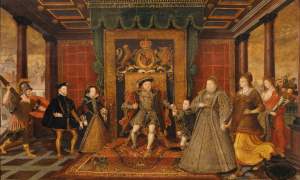
The Family of Henry Viii: an Allegory of the Tudor Succession, by Lucas de Heere, 1572.

There are no Cromwellian poems (though MacCulloch might have thrown us one of Wyatt’s), no hint from Cromwell as to why he didn’t remarry after the early deaths of his wife and two daughters, not even a legal trial at which he might have dropped his guard as More had done in 1535.

It is remarkable, therefore, how much of the man MacCulloch does, in fact, capture, certainly more than any previous attempt. It is his contradictions that stand out: intense focus and frenetic energy, rapacity and a social conscience, “clubbability” and a trainspotterish enthusiasm for waterworks. He was a wily operator, but a favourite of widows and wayward young men. He was undoubtedly ruthless, but sometimes tried to mitigate the king’s cruellest inclinations. He was at his fiercest when seeking revenge for Wolsey’s fall, but if we are to be sympathetic to Cromwell – as MacCulloch is – then we must recognise its correlative: his ardent loyalty.

There is a beautifully drawn scene in which Wolsey, his power ebbing away, avidly reads a letter from Cromwell and keeps it close, like a talisman. We later find Master Cromwell painfully drafting another letter that is full of crossings-out and corrections. He was trying to save Wolsey from himself, and from Henry VIII, who was manipulable, but always the master and sometimes a monster. “No one,” MacCulloch asserts, “reading the original of this letter can think of Cromwell simply as a heartless bureaucrat.”

• Thomas Cromwell: A Life is published by Allen Lane. To order a copy for £25.80 (RRP £30) go to guardianbookshop.com or call 0330 333 6846. Free UK p&p over £10, online orders only. Phone orders min p&p of £1.99.

Beyond Wolf Hall (2) – Icarus ascending

          Wild Bill Hickok: You know the sound of thunder, don’t you, Mrs. Garrett?
          Alma Garrett: Of course.
Wild Bill:  Can you imagine that sound if I asked you to?
Alma: Yes I can, Mr. Hickok
Wild Bill: Your husband and me had this talk, and I told him to head home to avoid a dark result. But I didn’t say it in thunder. Ma’am, listen to the thunder.
Deadwood (Series 1, Episode 4. Here was a Man. HBO

We know how it ends. It’s how we get there that matters.

There is a scene in the superlative western noir, Deadwood, where the madame of the Bella Union hotel and whore house, Joanie Stubbs, mentors the young and conniving con-artist Flora on survival in a hard world:  “ … mostly, you can steer it, sweetheart”, she says, “and when it’s going to get to where you can’t, you get just a little notice, just a couple of seconds, before the one thing turns into the other.  It’s like a funny smell comes into the air. And then you know, there’s no more steering and get the hell out of the way”. Flora, overconfident and full of herself, is deaf to th sound of thunder, and ignoring Joanie’s advice, proceeds to a brutal and bloody doom.

Towards the end of The Mirror and the Light,the final volume in Hilary Mantel‘s acclaimed Tudor trilogy, Thomas Cromwell, disgraced and imprisoned in the Tower of London in the very room he’d placed the doomed Anne Boleyn, contemplates the old Greek legend of Icarus and his father, Daedalus, the builder of the famous Minotaur’s labyrinth. There was a point at which headstrong Icarus could have changed course – but the temptation to fly higher and higher was irresistible: Thomas “reads the book of Erasmus, Preparation Until Death, written only five, six years back, under the patronage of Thomas Boleyn. It tires his eyes; he would rather look at the pictures. He lays the book side and turns the pages of his engravings. He sees Icarus, his wings melting, plummeting into the waves. It was Daedalus who invented the wings and made the first flight, he more circumspect and circumspect than his son: scraping above the Labyrinth bobbing over walls, skimming the oceans so low his feet were wet. But then as he rose on the breeze, peasants gaping upwards, supposing they were seeing gods or giant moths; and as he gained height there must have been an instant when the artificer knew, in his pulse and in his bones, This is going to work. And that instant was worth the rest of his life”.

Poet WH Auden recreated this scene decades before Hilary Mantel in his visit to Paris’ Musée des Beaux Arts. On the one hand, the poet might appear to be commenting our indifference to others’ misfortune and suffering, but on the other, the message is more mundane: whilst bad things happen to someone, life goes on around them. The multitude is not necessarily indifferent but rather, unaware, uninformed, and physically or emotionally distant. He writes:

In Breughel’s Icarus, for instance: how everything turns away
Quite leisurely from the disaster; the ploughman may
Have heard the splash, the forsaken cry,
But for him it was not an important failure; the sun shone
As it had to on the white legs disappearing into the green
Water; and the expensive delicate ship that must have seen
Something amazing, a boy falling out of the sky,
had somewhere to get to and sailed calmly on.

Mark Rylance and Damian Lewis as Tom and Hal

Thomas senses that “ funny smell” that Joanie mentioned well before his fall comes inevitable. Like Icarus ascending, he could have changed course. He senses it some two thirds into Hilary Mantel’s house brick of a literary masterpiece. When Queen Jane perishes soon after giving birth to the future Edward VI, King Henry having now got his male heir, needs a spare to ensure the survival of his dynasty and charges Cromwell with the chore of securing him a new bride. Things have already been getting dicey for the bold  Chancellor.

He is the public face of the king’s split with Rome and the spiritual and temporal authority of the Pope. The perennially cash-strapped Henry is hooked on the riches and the lands that accrue to the crown and its cronies with the dissolution of the great abbeys and monastic houses. Cromwell himself has his hand in the till, enriching himself and his family.

On the one hand, he is loathed by the common people who yearn for the old, familiar ways, the “bells and smells”, the bits of dead saints’ bones and the shreds of their shrouds, and having risen up in rebellion against the new order, have been put down mercilessly with sword and rope. On the other, there’s the ancient noble families who whilst also being enriched by the plundering of the abbeys and the appropriation of the church’s expansive landholdings, harbour hatred for Cromwell the commoner, the blacksmith’s son, who has risen so high – too high – in the kings favour. The king too is a parvenu beneath their contempt. As Mantel writes, “the grandees of England’s claim descent from emperors and angels. To them, Henry Tudor is the son of Welsh horse thieves: a parvenu, a usurper, a man to whom oaths may be broken”.

Thomas is only too aware of all this. The tide is turning, and not in his favour. And yet in his self confidence and overweening faith in his capacities, his sense of obligation to his family and friends who would almost certainly fall with him, he resolves to “manage it through” as we say today in management-speak, knowing that “he who rides the tiger never can dismount”. “We are living on borrowed time” he tells a clerical friend and Protestant, “in small rooms, a bag always packed, an ear always alert (we sleep lightly and some nights hardly at all … If the king can burn this man, he can burn us’.

James Frain as Cromwell in The Tudors

Should he have quit whilst he was ahead?

That would have been back at the end of Wolf Hall, the first volume in this outstanding trilogy. Tom, the blacksmith’s son, former street urchin, soldier, mercenary, kitchen hand, clerk, accountant, banker, dealer and merchant had risen high in the services of Henry’s first chief councillor Cardinal Wolsey. When the prelate falls in the wake of his failure to resolve the king’s “great matter”, his divorce from the first if his six wives, Katarina of Aragon, “the Spanish Princess”, Cromwell emerges unscathed and indispensable. He engineers the disgrace and death of Wolsey’s successor, Thomas More, the righteous and ruthless scourge of heretics, and fosters Henry’s affair and marriage to the vivacious and opportunistic Anne Boleyn.

Thomas finds solace at the Seymour family’s Thames-side ancestral pile, the eponymous Wolf Hall. Plain Janes sweet, and young, and though he does not quite admit it at this point in the narrative – it is one of the ‘reveals’ of book three – he’d like to make her his second missus (the first died from plague along with his two little girls, and all three haunt him throughout his odyssey).

Thomas could have pulled out of his ascent then and retired to a modest but, for his time and circumstances, quite comfortable fortune. But no. The devil drives, and his political, economic, social and spiritual ambitions, and, yes, his pride and his greed got the better of him.

His Protestant beliefs, fostered during his sojourn in the heretical Low Countries, impelled his rejection of the Roman faith with its corruption and its confidence tricks, its profiteering and its hypocrisy, its fabricated sinecures and sacraments, its relics and its indulgence.  His pure hatred and contempt for the whole shaky edifice is force-fed by the prospects of divesting the English church of its immense power, wealth and influence, of filling the impecunious crown’s coffers, and diverting a goodly portion to Thomas Cromwell and his nearest and dearest.

His hatred for the old families was undisguised – his dismissive contempt for their interests and pretensions, their precious noble lineages and pride therein. To his mind, they were all the heirs and successors of barbarians, bandits and warlords, unfettered, unlettered, and unappreciative and unworthy of his grand project

The hatred was mutual. They abhorred the Cromwell the commoner, and resented the Boleyn ascendancy – for when Anne rose, so did the boats of Cromwell, and of Anne’s father and brother and their kin – parvenus all in England’s heraldic hierarchy and tainted with French blood.  And yet, as is the manner of the English aristocracy, they are all interconnected, through marriage or the outcome of illicit liaisons, and run with hare and hunt with the hounds. Nor more so than the noble (in the aristocratic rather than the moral sense as morality doesn’t come into it) and pugnacious Duke of Norfolk. He is Cromwell’s erstwhile ally and nemesis; he fosters sad Anne’s marriage to the king, observes her fall from grace, presides over her trial and its preordained verdict, and attends her execution; and then, when the opportunity presents itself with Henry’s rejection of his fourth wife, Princess Anna of Cleves, handpicked by Thomas from a lineup of eligible, royal and strategic European beauties, goes after the matchmaker, the low-born, ambitious and avaricious Cromwell.

Add to Thomas’ reformational fervour, his ambition and greed, and a major misstep with regard to Anna, the original “sad eyed lady of the lowlands”, his justified pride in his prodigious talent and intellect, and his hubris. Too clever by half, we’d say today. He knew he was the nobles’ intellectual superior and never failed to flaunt it with friends and foe alike. And the latter, when it all came down to it, were more numerous and strategically placed.

And finally, his “doom”, to talk in Tolkien terms, was that he misjudged King Henry – his vanity, his pride, and his obsessions, his hopes and his fears. Thomas had convinced himself that he knew the king and could control – no, guide him, anticipate his desires, and his wishes. In the quiet after-hours, he was writing “The Book of Henry”, an anthology of Cromwellian ruminations on the essence of kingship. It is a theme that Mantel returns to often in this doorstep of a book. Henry is indeed “The Mirror and the Light of all other kings and princes in Christendom”. The Book Of Henry is a guide to kingship modeled on Machiavelli’s contemporary treatise “The Prince” (arguably the most quoted, misquoted and never read political tract ever published –  up there with Marx’s Communist Manifesto, Lenin’s What is to be done? and Mao’s Little Red Book – not to mention Thomas Hobbes who wrote about life being “nasty brutish and short” during the English Civil War a century after Cromwell and Henry were rendered to dust – a confrontation with the monarchy precipitated by Thomas Cromwell’s nephew’s great grandson Oliver. History sometimes works like that – that which goes around comes around.

And, yet, whilst Cromwell reckons he can “read” the king, he acknowledges throughout that when it all comes down to it, Henry is actually unpredictable, quixotic, eccentric, capricious, narcissistic, and unknowable. And dangerously so. To repeat, “If the king can burn this man, he can burn us”. Which he does, although sparing him the fire that consumes heretics and the hanging, drawing and quartering that awaits traitors; both charges having been laid against him, “the kings mercy” consigned him the headsman’s axe. Not the beautiful, scripture inscribed French long-sword that dispatches Anne of the Thousand Days, the first of the “light and the Mirror ” motifs reprised in this story, but an easily blunted English broad axe wielded by an allegedly intoxicated executioner (histrorians maintain that this story is apocryphal).

As we said, we know how it ends, but it’s how we got there that matters. And I’d long wondered how Hilary Mantel would take us there – before I’d read the final installment and whilst I was reading it.

And how do you drop the final curtain when you are in essence the narrator?

“The pain is a acute, raw stinging, and ripping, a throb. He can taste his death: slow, metallic, not come yet. It is terror he tries to obey his father, but his hands cannot get a purchase, nor can he crawl. He is an eel, he is a worm on the hook, his strength has ebbed and leaked away beneath him and it seems a long time ago now since he gave his permission to be dead; no one has told his heart, and he feels it writhe in his chest, trying to beat. His cheek rests on nothing, it rests on red … He is very cold. people imagine the cold comes after but it is now. He thinks, winter is here …  I flail my arms in angel shape, but now I am crystal, I am ice and sinking deep: now I am water. Beneath him, the ground upheaves. The river tugs him; he looks for the quick-moving pattern, for the flitting liquid scarlet. Between a pulse-beat and the next he shifts, going out on crimson with the tide of his inner sea. He is far from England now, far from these islands, from the water salt and fresh. He has vanished; he is the slippery stones underfoot, he is the last faint ripple in the wake of himself. He feels for an opening, blinded, looking for a door: tracking the light along the wall”.

“He is far from England now, far from these islands, from the water salt and fresh. He has vanished; he is the slippery stones underfoot, he is the last faint ripple in the wake of himself. He feels for an opening, blinded, looking for a door: tracking the light along the wall”.

Thomas Cromwell was executed on Tower Hill on 28th July 1540. he had sent many to their fate there, including Sir Thomas More and Anne Boleyn’s alleged paramours. He was buried in the Tower of London’s  Chapel of St Peter ad Vincula. Interred there are also Anne Boleyn herself, Margaret Pole, Countess of Salisbury and the last the Plantagenet line – their doom was Cromwell’s’ doing – and nineteen year old Catherine Howard who became Henry’s fifth wife on the day Cromwell died, and, condemned for adultery, went to the block less than two years later.

The Tower of London’s chapel,, St Peter ad Vincula

This whole story has been about England, it’s legends and it’s legacies, it’s rythmns and rhymes, it’s history past, present, and future. And he, Thomas Cromwell, has made England shake. But it’s all over now, and the saints are indeed are coming through, and the sky is folding under him. Everything is moving; there are no stepping stones. Icarus has reached ignition point, and the rest, “the rest is silence”.

But Cromwell’s revolution endured. Frail Edward endeavoured to anchor it. Bloody Mary strove with fire and sword to unmake it.  And Queen Elizabeth set it in a concrete so strong that Scottish James  and his unfortunate son could not crack it’s foundations. The rest, as they say, is our history.
© Paul Hemphill 2020.  All rights reserved
[This article is the second of two published In That Howling Infinite discussing Hilary Mantel’s Cromwell. Read Beyond Wolf Hall – Revolution Road  here.
For other posts in In That Howling Infinite on matters historical, see Foggy Ruins of Time –  history’s pages

Base Fortune, now I see, that in thy wheel
There is a point, to which when men aspire,
They tumble headlong down: that point I touch’d,
And, seeing there was no place to mount up higher,
Why shall I grieve at my declining fall?
Farewell, fair queen. Weep not for Mortimer,
That scorns the world, and, as a traveller,
Goes to discover countries yet unknown.”
Young Mortimer, in Christopher Marlowe’s Edward II

A ghost of aviation
She was swallowed by the sky
Or by the sea, like me, she had a dream to fly
Like Icarus ascending On beautiful foolish arms
Amelia, it was just a false alarm
Joni Mitchell, Amelia.


German artiist Hans Holbein The Younger’s portrait of Cromwell


Arguments of Monumental Proportions – Fallen Idols

Our historical memory is a motherland of wishful thinking. Ulrich Raulph

There was a land of Cavaliers and Cotton Fields called the Old South. Here in this pretty world, Gallantry took its last bow. Here was the last ever to be seen of Knights and their Ladies Fair, of Master and of Slave. Look for it only in books, for it is no more than a dream remembered, a Civilization gone with the wind…The opening of the film Gone with the Wind

The past is another country – they thought things differently there; and if the past shapes the present, the present also shapes the past.

With the spread of Black Lives Matter protests around the world, in response to the murder of George Floyd by a Minneapolis police officer, the defacing and destruction of monuments to dead and dubious white men is back in vogue – not that the practice has ever actually gone out of style.

As The Australian’s Art columnist Christopher Allen has written, statues have been set up as monuments to great and not so great men and removed by their enemies for a very long time. Even without considering the many precedents in antiquity, countless statues were destroyed during the French Revolution, others during the mob violence of the short-lived “Commune” government in Paris in early 1871 – including the figure of Napoleon on the Colonne Vendôme – and many more under the Nazi occupation of Paris.

Then there is the tearing down the statues of tyrants in the fall of dictatorships, from the former Soviet empire to Iraq. In those instances, the state or a despot had set up multiple effigies all over the country as symbols of power and instruments of oppression, and they were overthrown in the collective movement of popular revolution.

To paraphrase Allen once more, portrait monuments proliferated in more recent times, particularly in the 19th century, as a consequence of increasing prosperity, patriotism or nationalism and local municipal pride. Monarchs, politicians, leaders of national unification or liberation movements, explorers and founders of new colonies, notable scientists and writers, philanthropists and other prominent citizens were commemorated in public statuary. Arguably, too many were raised; sometimes their subjects have lost the prominence they once had; or some of their deeds may now be today be considered reprehensible. An argument could be made to relocate a statue to a museum instead, but such decisions ought not be taken lightly, especially if the justification for removal and relocation are ideological, or made in response to online protests and vandalism.

Fallen Idols

There is a certain historical irony that the statue of a 17th century slave trader (and on account of his wealth, philanthropist) Edward Colston has been consigned to the watery depths of Bristol Harbour from whence his ships sailed. He’d built his fortune as an influential member of the Royal African Company, a private company which branded its initials on the chests of some 100,000 men, women and children before shipping them to the Americas and the Caribbean. Thousands never made it, tossed into the ocean after drawing their last breath in the filth below decks. Ted and his fellow slavers have a case to answer. In the hundred years after 1680, some two million slaves were forcible removed from their homes in West Africa to the work camps of the West Indies. By 1750, the numbers of slaves had reached over 270,000 per decade, and by 1793, Liverpool handled three fifths of the slave trade of all Europe.Historian Peter Ackroyd wrote in his History of England: “No more than half of the transported slaves reached their destination; some plunged into the sea and were said to hike up their arms in joy from the brief sensation of liberty before they sank beneath the waves”.

Bristol owed its past prosperity to the slave trade – as did Liverpool. The statue had stood in the city centre for 125 years with a plaque that read: ‘Erected by citizens of Bristol as a memorial of one of the most virtuous and wise sons of their city’. Streets and buildings were also named after Colton though most townsfolk have probably never have heard of him. 

Activists have drawn up a hit list of 60 monuments in the United Kingdom that “celebrate slavery and racism”. London mayor Sadiq Khan paves the way for the legal removal of many of historic statues in the British capital and the changing of street names. Slave owner and West India Docks founder Robert Milligan has already been taken down. On the same day, Belgium’s bloody King Leopold, whose rule of the Congo – it was his private property – became a byword in colonial barbarity, was removed from his plinth in Brussels 

As an Aussie and a Brit of Irish parents, and as a history tragic, I find the long running monuments furore engrossing. Statues of famous and infamous generals, politicians and paragons of this and that grace plazas, esplanades and boulevards the world over, and their names are often given to such thoroughfares. They represent in visual and tangible form the historical memory of a nation, and as such, can generate mixed emotions reflecting the potentially conflicted legacies and loyalties of the citizenry. 

It is about the control of history – and who controls it. We all use history, incorporating perceptions of our national story into lessons that guide or confirm our present actions and outlooks. Our history is written not only in scholarly narratives, but also, in commemorations, in statues, flags and symbols, in the stories that children are taught about their country and their community from their earliest school years, and in the historical figure skating  they are taught to remember and honour. History, it is said, is written mostly by the victors  – but not always. So the inevitable tensions between different versions of the past fosters tension and conflict, and grievance and offense in the present. Particularly in onetime colonialist and settler countries, and the lands these once ruled and exploited.

Juxtaposing controversial British statuary, and those of American Civil War generals, against the empty plinths of the former People’s Republics of Eastern Europe, and the images of the toppling of the statue of Saddam Hussein, I have always contemplated our own monuments to reputed bad boys past. 

There are statues of Lord Protector Oliver Cromwell all over the place in England where his legacy is still debated. He stands authoritatively outside the Houses of Parliament and is remembered as one of the godfathers of that institution. And yet, when he died, and the monarchy he deposed restored, his body was disinterred and hanged. In Ireland, for so long “John Bull’s other island”, however, he is reviled. He did, after all, march through the land with “fire and fury”, to borrow Donald Trump’s hyperbole, and killed quite a number of Irish folk. In my southern Irish mother’s day, people would put his picture upside down, facing the wall. This may be apocryphal, but whatever.

Oliver Cromwell, Parliament Square

A statue of Lord Nelson stood in O’Connell Street, Dublin until March 1966 when the IRA blew him up, celebrated by the Clancies in the song below. The IRA also blew up that other famous English mariner, Lord Louis Mountbatten, inveterate pants-man, victor of the Burma campaign and facilitator of Indian Independence). It wasn’t that Horatio had inflicted anything unpleasant upon the Irish, but rather his renowned Englishness that earned him the TNT. And yet, in the wake of intermittent US monuments barnies, beady British eyes were always focusing on the admirable admiral and his ostensible racism (not a word in use at the turn of the eighteenth century) and support for the slave trade. After Colston’s dip in Bristol harbour, it won’t be long before Horatio is harangued – not that anyone actually believes that Nelsons Column should be evicted from iconic Trafalgar Square, and it would be damn difficult to paint-bomb his myopic visage. The British attachment to Lord Nelson is long and strong. In Birmingham, my hometown, the city centre around the Bullring has been refurbished, redesigned and reconstructed numerous times during my lifetime, but the immortal mariner and his battleship stand still on their plinth of honour – as in the featured picture.

The ongoing controversy in England over statues of Cecil Rhodes, colonialist and capitalist, and ostensibly an early architect of apartheid, still rages with respect to his African legacy, with many demanding that he be demolished. his statue in Cape Town, South Africa, was removed after extensive protests in  2015. as As I write, Cecil may not survive the week. There is a statue in Parliament Square, close to Cromwell and Winston Churchill (who some also abhor), of South African soldier and statesman Jan Smuts. His Boer War (on the enemy’s side) and segregationist sympathies were outweighed by his military and diplomatic record in service of the British Empire, and to date, none has called for his eviction. Perhaps he will be spared as he did not have a pariah state named for him, as it was with Cecil. Nor was he associated with the apartheid regime as it was decades before his time – although this wouldn’t satisfy some iconoclasts. But most likely, he is safe because most folk have never heard of him.  

Cecil Rhodes, Oxford University

Winston Churchill gets a paint-job

I have heard mumblings, however, of doing for General Smuts, and also for his Parliament Square neighbour Sir Winston Churchill, who has now been graffitied. Now, he might have saved Britain from Hitler’s hoards, but he did not like the Irish, nor Indians (and Pakistanis for that matter), and said some gross things about Arabs and Jews. And we Aussies, and Kiwis too, still blame him for the disastrous Dardanelles campaign – although he did give us our indefatigable and untouchable ANZAC legend and a long weekend. And whilst on the subject of the Middle East, an equestrian Richard the Lionheart stands close by. He did dastardly things to tens of thousands  of locals – Muslim, Christian and Jew – during the Third Crusade, almost a millennium ago. Watch out, Dick and Dobbin! 

Richard the Lionhearted

Lord Baden-Powell, the founder of the world scout movement, of which I was a relaxed and comfortable member for half of the sixties, sits on the seafront in Poole, Dorset, under twenty four hour CCTV protection. In a 2007 poll, he was voted the 13th most influential person in the UK in the 20th century. But critics say that he held racist views, and in 2010 declassified MI5 files revealed he was invited to meet Adolf Hitler after holding friendly talks about forming closer ties with the Hitler Youth. If old “bathing towel” as he was once affectionately called by us Boy Scouts, becomes persona non grata, what will become of Baden Powell Park in Coffs Harbour, our regional centre? It sits behind the Dan Murphy’s liquor mart, one of the town’s most popular retail outlets, and provides an opportunity for our discussion to segue DownUnder.

Dark deeds in a sunny land

In this strange, copycat world we live in, politicians and activists call for the removal of statues of our Australian founding fathers for the parts they played in the creation of our nation. In his challenging revisionist history of Australia, Taming of the Great South Land, William Lines tells us that if we look up the names of the worthies who’ve had statues, squares, streets and highways, building and bridges, parks and promontories, rivers and even mountains named after them, we will uncover a dark history of which few are aware. Try it sometime; you’ll be surprised.

There has inevitably been much fuss about Captain James Cook, the renowned and courageous navigator who “discovered” the place two hundred and fifty years ago (notwithstanding that the Aborigines, Javanese, Dutch, Portuguese, and French had been here first). His “discovery”, many argue, led to genocide and the dispossession of our First Peoples (Columbus no doubt also gets more than pigeons shitting on him!). And also, there’s Lachlan Macquarie, fifth and last of the autocratic governors of New South Wales, who laid the economic and social foundations of the new colony. He is in the cross-hairs as responsible for initiating the ‘frontier wars‘ and for ordering the massacre of Aborigines. 

The captain, his chopsticks and his lunch. James Cook, Whitby, Yorks

Lachlan Macquarie, Hyde Park,Sydney

Inevitably, right-wing politicians, shock-jocks and  commentators, came out swinging, venting against political correctness and identity politics, defending what they see as an assault on our “Australian values”. When Macquarie got a paint job three years back, for a moment it seemed that our intractable history wars” were on again – the “whitewash” brigade versus the “black arm-band” mob. Statues were vandalized, voices raised and steam emitted as opposing sides took to their hyperbolic barricades. But once the graffiti had been removed from the statues of Cook and Macquarie in Sydney, and The Australian got it off its chest with a week of broadsheet history and a swag of indignant opinion pieces by the usual suspects, things appeared to have calmed down. 

But not for long, perhaps.

All sorts of emotions, hopes and fears lie behind our various creation myths. No matter the source of our different “dream-times” we are all correct in one way or another. People wheel out the wise old “blind men and the elephant” story to illustrate how blinkered we are; but in reality, if those blind men were given more time, they would have expanded their explorations and discovered a bigger picture.

For more on our Aussie worthies, see, for example, from The Guardian, on Australia, Statues are not history, and regarding former Soviet monuments, Poles Apart – the bitter conflict over a nation’s history. Below is a review of Alex von Tunzelmann’s recent book Fallen Idols: Twelve Statues That Made History

And, in In That Howling Infinite, read also: The Frontier Wars – Australia’s heart of darkness, and America’s Confederate legacy, Rebel Yell 

Fallen Idols: up they went and down they come

Jim Davidson, Weekend Australian, 17 Sept 2021

A statue of Cecil John Rhodes on the slopes of Devil’s Peak, Cape Town, South Africa.

For as long as there have been statues, says Alex von Tunzelmann in this new book, they have been subject to attack. The Egyptian pharaohs regularly disfigured or smashed images of their predecessors. And so, what we have witnessed over the past few years, for all its urgency, in one sense has been a recurrence.

Von Tunzelmann demonstrates this very well by the way she has shaped her new book, Fallen Idols: it may end with the statue of George Washington being pulled down in Portland, Oregon, but its first focus is the statue of George III pulled down by New Yorkers. This occurred immediately after a public reading of the Declaration of Independence.

Attacking statues is as old as the United States itself.

Von Tunzelmann has been fascinated by statues for years. She challenges the notion that statue attacks are aimed at “erasing our past in its entirety” and she is sceptical that a man of his time (for they are nearly always men) can hold, say, racist assumptions, and yet be justified by good works. She says orderly removals are all very well, but the process is protracted and cumbersome: street action is sometimes necessary.

“Statues do not have rights,” she says. “They stand at the pleasure of those who live alongside them.”

The book examines 12 case studies. Each culminates in attack or removal, when statues had functioned as instruments of dominance. The massive Stalin statue that loomed over Budapest – 25 metres high – was partly constructed from melted-down Hungarian ones, and people were enjoined by the Communist Party to go and respectfully converse with it. Friendly little Stalin – and yes, he was in fact quite short, and sensitive about it.

Worse (in some respects) was Rafael Trujillo, who graduated from outright criminality to becoming police chief, supervising an election so that he came to power and stayed there. He employed state terror to rule the Dominican Republic for 31 years, peppering the place with statues and public busts – nearly 2000 of them. Almost certainly a serial rapist, he gloried in what he saw as his virility: a couple of his column-centred monuments were in-your-face phallic. In case people didn’t get the point, at one unveiling his vice-president spoke of Trujillo’s “superior natural gifts”. All these statues came down, with others like them. In India as in Eastern Europe they have been put in special statue parks, where they stand largely neglected. A relatively benign relegation, sometimes leaving behind blank spaces. In one way, the recent attacks are a reversal of the statue-building mania across the Westernised world that accelerated through the 19th century. In 1844, London had 22 statues; by 1910, there were 10 times as many. The attacks are perhaps best seen as part of the reset following through the implications of the collapse of the European colonial empires. Hence the speed with which the Black Lives Matter movement spread: 13 days after George Floyd’s murder in Minnesota, a crowd in Bristol, England pulled down the statue of slave trader Edward Colston and threw it in the harbour.

The book also gives a highly contextualised account of the “Rhodes must Fall” movement. It is shown how deeply – indeed brutally – racist Cecil Rhodes was; how his belief in the superiority of the British race led him to conclude that it had a right to occupy those lands “at present inhabited by the most despicable specimens of human beings”.

So the first statue to go, after it had been smeared in excrement, was that at the University of Cape Town. Oxford, where he gazes down at the High Street from the facade of Oriel College, has proved a tougher nut to crack. The college has prevaricated – people threatened to withdraw bequests if it moved to take Rhodes down – so he is still there. But the agitation has led to some improvement in Oxford practice, including the appointment of the first black head of a college.

Toward the end, Von Tunzelmann retreats a little from a generally abolitionist stance when it comes to statues, admitting that she is quite fond of a few. As are the British public, polls show. Certainly, some statues should be statements of what the people who live around them admire, but some are needed to remind us of who we, as people, were, when they went up. There should always be room for that: in the recent frenzy in America, a statue celebrating an antislavery abolitionist was toppled, as was another celebrating women’s rights. For there is a broader problem: the technological imperative has brought with it a flattened sense of the past.

Jim Davidson’s book, Emperors in Lilliput: Clem Christesen of Meanjin and Stephen Murray-Smith of Overland, is to be published by Melbourne University Press next year.

Fallen Idols: Twelve Statues That Made History, Alex von Tunzelmann (Headline 2021)

Bad company – how Britain conquered India

In September 1599, as William Shakespeare was putting the finishing touches to Hamlet, in Southwark, a mile to the north across the Thames, a group of London merchants, artisans, adventurer and privateers formed history’s first joint-stock, limited-liability company with tradeable shares.

The East India Company developed over two centuries into “a state in the guise of a merchant”, to use English politician Burke’s phrase, with a private army 260,000 strong – twice as large as that of Britain at the time, and the proving ground of many celebrated British officers, the most famous of those being Arthur Wellesley, later to become the Duke of Wellington and who at the time of his Indian service, was the capable younger brother of the equally capable Richard Wellesley, Governor General of the principality Bengal, the keystone of the British hold on the Indian subcontinent.

At its peak, it had built a third of London’s docklands, its annual expenditure was half that of the British government, and it oversaw a third of the country’s imports and exports. For Britain, the East India Company was a gift that kept on giving. Unwittingly and haphazardly, it established and solidified British power in India and China, seeing off their European colonial competitors – the French and the Dutch, who also coveted a piece of the Indian action – and overseeing the transfer west of massive wealth to the home country. It set the keystone for the British Empire, with India, “The Raj”, the jewel in the crown.

William Dalrymple, author, historian, Indophile and longtime resident of India, has written a page-turner of a book called The Anarchy about the rise and fall of what became known as ‘The Honourable Company’ – yes, that’s what it was called with no hint of irony! It is a harrowing tale of how a small limited stock company managed to build an empire.

When the East India Company was first established, the Britain had about 1% of world GDP compared to 43% per cent for Mughal India. By the time it was wound down over one hundred and fifty years later, it had more or less inverted that. In co-opting, corrupting and conquering the powerful warlords of the fractious Mughal Empire, it effectively established the British Empire and in the process, destroyed India’s sovereignty, economy and society. The word “loot” is of Indian origin – it came to symbolize how the company drained the blood from India’s veins, sucked the marrow from out of Its bones, and sending its wealth back to Britain, many historians argue, substantially financed the nascent industrial revolution.

Sepoys of the East India Company

Granted the right to ‘‘wage war’’ in its royal charter, the Honourable Company was the first multinational corporation to run amok (a Malay word for unrestrained rampage) on a grand scale. Having established itself in eastern India, by 1765 it had control of a production and distribution network for opium that was illegally imported into China, sowing the seeds for the Opium Wars – and a Chinese animus that resonates to this day. It bought Chinese tea, which it sold in Britain and the continent, and established tea plantations in India. It was in fact company tea that ended up in Boston Harbour in 1773 – fear of what the company could do if it was granted access to the New World was one of the causes of the American Revolution.

The company effectively bankrolled the British economy, yet ironically, it was also the Bank of England’s largest creditor. It could also be said to have invented corporate lobbying. Members of the British Parliament were on retainers, and were offered shares in exchange for extending the company’s monopolies: some  two-fifths of British MPs held stock, including most members of the cabinet. Many members were in fact former employees who had repatriated millions of pounds in ill gotten gains from Bengal.  And yet, it overextended itself and its resources and was on the verge of insolvency. The contrast between the bankruptcy of the company and the vast riches of its employees was too stark not to be investigated, and indeed it was. but was deemed “too big to fail”,  and was bailed out by the British government  in 1773.

The Company’s premier enabler and exemplar was the first governor of the Bengal Presidency, Robert Clive, or Lord Clive of Plassey, as he was ennobled after a battle that demonstrated the aphorism that one should never enter a gunfight armed with just a knife. But wasn’t that just how the East – and West – was won?

Clive was a humble accountant labouring on the ledgers, but found his calling as a soldier (just like the Spanish conquistador Hernàn Cortéz “the killer” – as Neil Young called him), and rose to great heights of power and riches through remarkable grit and graft. When arraigned by parliament for his rapacity – and acquitted – he exclaimed: “My God, Mr. Chairman, at this moment I stand astonished at my own moderation!”

If ever you are in London, visit the small, quiet and shady Berkeley Square, where the fabled nightingale sang, and where Clive of India, as he became known, his mind curdled by corruption and conscience, and haunted by guilt and ghosts, cut his own throat with a blunt paper-knife. “How are the mighty fallen”. Leonard Cohen’s poet King David said that. “Not often enough!”  I said that.

Eventually, the company – whose lobbying efforts saw its original fifteen year charter last for 274 years – became an embarrassment for the English government and establishment. Its Indian “subjects” rebelled unexpectedly and violently in the Great Rebellion of 1857, and it was only by considerable military effort and repression that the British Army was able to save the company and its Indian ’empire”. In the wake of what the British called The Indian Mutiny, which saw cruel atrocities committed by Indians and Britons alike, tens of thousands of rebel sepoys (Indian soldiers in the company’s employ) were executed in vicious reprisal. As George McDonald Fraser’s antihero says in Flashman in the Great Game, “there’s nothing as cruel as a justified Christian”. Assuming full control, the British government nationalized the company in 1859. Long outliving its purpose it was wound down in 1874. Read more about what the British did for India in Weighing the White Man’s Burden  

Imagine today, a protection racket at the heart of government with the complicity of the British establishment, A company with the global reach of Facebook and Google, the economic tentacles of the likes of Halliburton and Exxon, and the military reach of Erik Prince’s mercenary armies. The corruption and criminality of the now defunct and disgraced BCAC (the so-called “Bank of Crooks and Criminals”), and the immunity and impunity of all the big corporates who took the world for a ride in the Global Financial Crisis, and not only got away with it, got governments to bail them out and we’re permitted to persist with their banditry. As Dalrymple himself has put it, The East India Company was literally Facebook with guns!

Read more about India and The Raj in In That Howling Infinite: Weighing the White Man’s Burden; Freedom at Midnight (1): the birth of India and Pakistan; Freedom at Midnight (2): the legacy of partition ; and Paradise Lost – Kashmir’s bitter legacy

Flashman in the Great Game

The Indian Mutiny – Weighing the White Man’s Burden