As I contemplate my annual review of In That Howling Infinite, I am reminded, with clichéd predictability, of that well-worn Chinese curse: “may you live in interesting times”.
A torturous and seemingly endless US election campaign defied all the pundits by producing an colourful and unpredictable POTUS. In the UK, the unthinkable Brexit came to pass, dividing the polity and discombobulating the establishment. Next year is certainly going to be worth watching.
The slow and tragic death of Syria continued unabated with Russian and Turkey wading into the quagmire alongside Americans, British, French, Australians, Iran, Lebanon, Gulf tyrants, and Uncle Tom Cobley and all. Da’esh might be on the the ropes in Iraq, but the long term survival of the unitary state is doubtful. And the proxy wars of the Ottoman Succession have spread to Yemen, the poorest country in the Middle Eas as Gulf tyrants face off against Shia Iran’s alleged puppets, and, armed and abetted by British and American weaponry, South American mercenaries, and Australian officers, bomb the shit out of the place.
Whilst the grim reaper scythed through the world from Baghdad to Berlin, from Aleppo to Ankara, the Year saw the passing of a record number of icons of the seventies and eighties, two of whom who have provided a continuing soundtrack for my life, Leonard Cohen and David Bowie. We shall not see the like of them again.
In our little corner of the cosmos, we endured the longest and most boring election campaign in living memory, resulting in an outcome that only accentuates Australians’ disenchantment with a lacklustre Tory government, a depressingly dysfunctional political system, and politicians of all stripes who, blinkered by short-termism, and devoid of vision, insist on fiddling whilst the antipodean Roman burns.
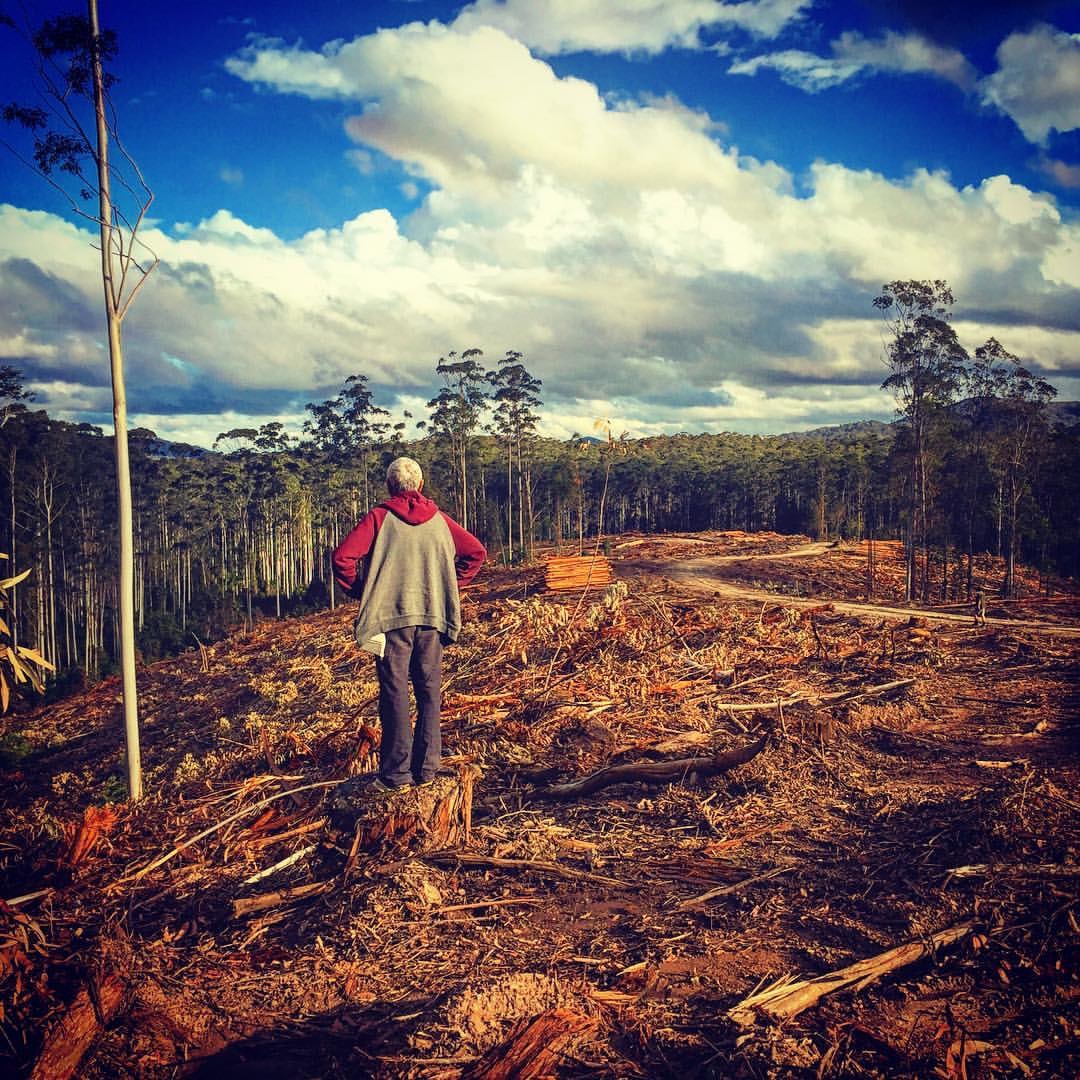
Meanwhile, in our own rustic backyard, we find that we too are “going up against chaos”, to quote that wonderful Canadian songster Bruce Cockburn. For much of the year, we have been engaged in combat with the Forestry Corporation of New South Wales as it proceeds to lay waste to the state forest that surrounds us. As the year draws to a close, our adversary has withdrawn with only half of its proposed harvest completed. But it will return in 2017, and the struggle will continue – as it will throughout the state and indeed the nation as timber, coal and gas corporations, empowered by legislation, trash the common treasury with the assent of our many governments.
And yet, life on the farm remains pleasant and delightful, though dams are low and rain would be most welcome. The bird and reptilian life continues to amaze us, and an ironic corollary to the clear felling of the Tarkeeth Forest is that “refugees” are seeking shelter here. Wallabies rarely seen on our land are now quite common, whilst echidnas, and, we suspect, endangered spotted quolls have been sighted hereabouts
We took time out mid-year to revisit Israel and Palestine, and road-trip through the two countries was much an education as a holiday. We certainly got our history and archeology fix, and in travelling through the Golan and the Negev, we found respite in a stunning natural environment. But the answers to our many political questions merely threw up more questions. We have unfinished business in this divine but divided land, and will return.
In That Howling Infinite addressed all these concerns during 2016, and matters more eclectic and exotic.
And so, to the year in review:
The new year commenced with a reprise of our memorable journey to Hadrians Wall, and of the Victorian lawyer who helped preserve it for posterity, the saga of the viking Harald Hardraga and also, my subjective overview of world history. In a more lighthearted vein, I indulged in an unscholarly discussion of how film and fiction have portrayed or distorted history, and in a review of Mary Beard’s superlative history of Rome, I asked the immortal question “what have the Romans done for us?”
In April, in response to a discussion with a Facebook friend in Oklahoma, I wrote a trilogy of exotically-titled posts examining the nature of rebellion, revolution, and repression: Thermidorian Thinking, Solitudinem Faciunt Pacem Appellant, andSic Semper Tyrannis. The origin of these Latin aphorisms is explained, by the way, in the aforementioned Roman review.
Our travels through Israel and Palestine inspired numerous real-time posts, and a several retrospectives as we contemplated what we had experienced during what was as much an educational tour as a holiday. Historical vignettes included a tribute to bad-boy and builder King Herod the Great, a brief history of the famous Damascus Gate, and its place in Palestinian national consciousness, and a contemplation on the story of King David’s Citadel which overlooked our home-away-from home, the New Imperial Hotel. Thorny contemporary issues were covered with an optimistic piece on theJerusalem Light Rail, a brief if controversial post about Jewish settlers in the Old City, the story of Israel’s ‘Eastern’ Jews, the Mizrahim, and what appears to be a potentially problematic Palestinian property boom. Th e-magazine Muftah published an article I wroteabout the conflicting claims to the city of Hebron. And finally, there is a poem recalling our visit to the Shrine of Remembrance at Yad Vashem and honouring the Righteous Gentiles who saved thousand of Jewish lives during the Shoah.
Wintertime passed with our minds on the Tarkeeth Forest. I had the pleasure discovering the history of our locality, and connecting via Facebook with the relatives of the Fells family of Twin Pines. But the latter half of the year was very much taken up with enduring and bearing witness to the clear- felling of the forest to our east. “If you go down to the woods today, you’re in for a big surprise. If you go down to the woods today, you’ll never believe your eyes”. And you’d ask “what would JRR Tolkien have thought?”
The UK And US paroxysms fascinated and exasperated the mainstream and social media in equal measure, whilst the outcome of the Brexit referendum and the presidential election has initiated an a veritable orgy of punditry. Never have so many column inches and kilobytes been spent on loud sounding nothings as the sifting through the entrails of such events as Brexit, the US election, and the Australian senate! With half a dozen elections coming up in Europe, Trump’s inauguration and the triggering of Article 50 to take Britain out the European Union, we’re gonna have to endure a lot more. I confined my posts to two insightful pieces by respected right-wing Australian commentators, Paul Kelly’s Living in Interesting Times, and Greg Sheridan’s The Loss of American Virtue, and my own reflection on the right-wing media’s strange fascination with “insiders” and “outsiders”.
Finally, in comparison to last year, this year was very light on music and poetry. But American satirist Tom Lehrer got a retrospective, and murdered Pakistani qawwali singer Madhaf Sabri, an obituary, whilst an abridged and vernacular version of John Milton’s Paradise Lost told the tale of Lilith, the first and greatest femme fatale. In the words of the gloriously-named jockey Rueben Bedford Walker III says in EC Morgan’s magnificent The Sport of Kings, the subject of my first post for 2017, “Malt does more than Milton can to justify God’s ways to man”.
On that wise note, I wish the world a Happy New Year – and may it be less interesting than this one.
In That Howling Infinite is now on FaceBook. Check it out. And just for the fun of it, here’s my review of 2015.
The great political lesson of the “black swan” 2016 year of disruption is the tearing apart of the political centre and the rise of radicals, populists and frauds from opposing ends of the political spectrum defying conventional wisdoms and up-ending weary orthodoxies. Continue reading →
One of the pleasures of moving to the Australian bush and living in Bellingen Shire is discovering its often overlooked history. This is the story of Twin Pines. Not as dippy as Twin Peaks, nor as sinister as Wayward Pines, it is a story of ordinary people doing extraordinary things.
When I first came to this land,
I was not a wealthy man,
So I built myself a shack,
And I did what I could.
I called my shack
Break My Back,
But the land was sweet and good,
And I did what I could.
When I first came to this land,
I was not a wealthy man.
So I built myself a farm.
I did what I could.
Prologue
We in Bellingen Shire , some ten kilometers west of the seaside town of Urunga on the mid north coast of New South Wales. The Tarkeeth Forest lies between the Bellinger and Kalang Rivers, and these are connected tidally to the ocean at Urunga – the only place in Australia where two rivers meet the ocean together. The forest rises from the rivers on either side of the Fernmount Range, the easternmost extension of the Great Dividing Range that spans the eastern edge of our island continent. Above and between the two rivers, it is a rain-harvesting, filtration and stabilization ecosystem vital to the waterways and wetlands around them, and is a habitat for bird, reptilian, mammalian and marsupial wildlife, including koalas, wallabies, echidnas, quolls, goannas, owls, fruit doves and cockatoos. The east-west Fernmount Range Trail is an ancient highway called the Yildaan Dreaming Track. It led from the plains beyond the Dorrigo massif to what is now the seaside town of Urunga, known then to the Gumbaynggirr people as a “place of plenty”. The first people would descend the spurs on the north and south flanks of the range to fishing and ceremonies on the riverside. The Tarkeeth Forest therefore contains areas of significant indigenous culture, recalling song lines and stories of the Dreamtime, places of ceremony, of birth and burial, and of atrocity.
The Fells of Twin Pines
Exploring the history of the forest, I chanced across Lloyd Fell’s story of the Fell Family Farm. This was located close to the present Twin Pines Trail, just east of Fells Road on South Arm Road, and west of the new bridge across the Kalang. It’s a great story of how the road got its name, and of how, in the late 19th century, Moses Lacey, the first selector, ran a store on the river bank. How back then, there was no road along the river, the South Arm (of the Bellinger), and access to farms along the river was by small jetties. South Arm Road was built to serve a quarry, now disused, just west of the present Fell’s Road.
Lloyd tells the story of how in 1926, New Zealand farmer, solo-yachtsman, and returned ANZAC Chris Fell first saw the land that became the family farm, purchasing it from Moses’s deceased estate for a thousand pounds. Chris was impressed by the two mature pines that stood on either side of the track leading to a rough timber house that already stood there – and these gave the farm its name. He cleared the bush, felling and hauling timber (helped by his neighbour Bennett’s bullock team) until he had sufficient land and capital to run cattle. In time, he built up a prosperous dairy business and cattle stud, and he and his wife Laura, a Sydneysider from a well-to-do Vaucluse family, raised their three children there. It was a hard life on the land back then – one of dedication, hard work, and perseverance. Power did not come to the South Arm until 1959. Many in the Shire still remember Chris and Laura and indeed, went to school with Lloyd, Bill and Margaret. When the kids were young, they went to the small Tarkeeth school house located just west of the present Fells Road junction. There are quite a few folk who remember attending the little school before its closure in 1972. Indeed, since I published the story on a local FaceBook page, and a former pupil published a picture of the Tarkeeth School’s “Class of ’68”, old aquaintances and school chums have reconnected with each other. Here is the History of Tarkeeth School. It can be obtained from Bellingen Museum,
Twin Pines is no more. When Chris could no longer work the farm, Bill took over the business. In 1966, with changes in the dairy industry rendering to business unprofitable, he sold it to the Errington family.They sold it shortly afterwards to Australian Paper Mills who in the early ’80s, sold it to State Forests – now the Forestry Corporation. APM cleared the land and established a flooded gum plantation thereon and on adjacent blocks – today’s Tarkeeth State Forest. That plantation is now being aggressively harvested – clear felled, actually – a matter of considerable concern to us locals and to many in the Shire. in the South, the forest comes right down to the Kalang River, and this too is a cause for concern as the harvesting and reforestation operations involve clearfelling, burning and spraying with herbicide. The consequences of an extreme weather event could be dire.
The farm house was not demolished. When the plantation was established, but was destroyed by fire years later. The school was sold to an Erik Johannsen who lived there for many years with a collection of animals. Tragically, he ended his own life after setting fire to the school. Fells Road puts the family name on the map, and whilst the Errintons did not linger here long, they are remembered in Erringtons Trail, a well-maintained forest track linking South Arm Road to the Fernmount Range Trail and thence the Bellinger Valley. Bennett the bullocky has a trail named for him too. Walking through the Forest Corp plantation, you can still just make out the place where the house stood. There is an old dam in the heart of the bush where tomatoes were once grown. In the the forest, amongst the plantation trees and native regrowth, you will come upon large, old angophera, grey gum, bloodwood and black butt habitat trees, their broad, spreading branches indicating that these once grew in open pasture.
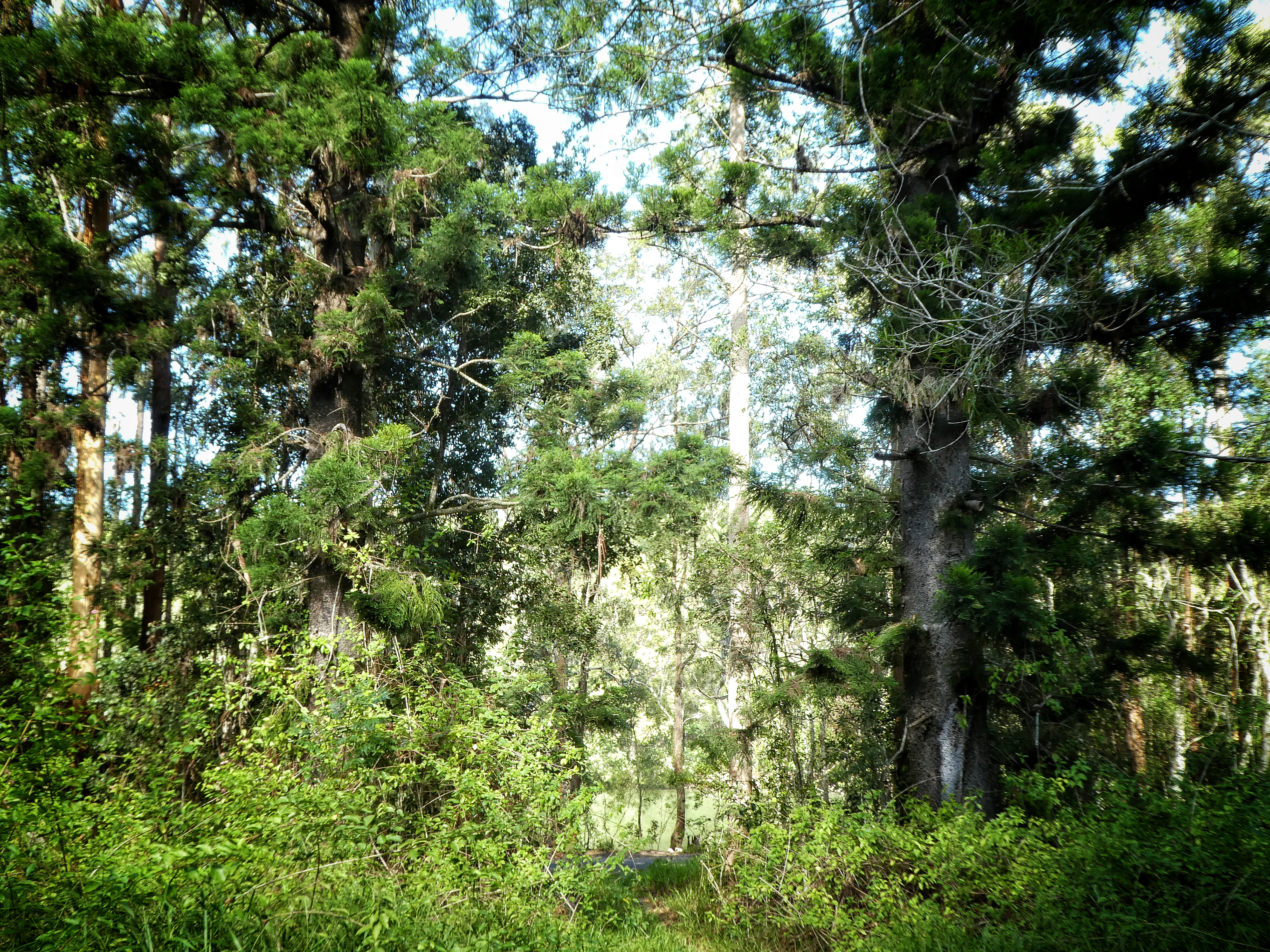
The pines are still there, some ten metres in from South Arm Road. They are not on what is now the Twin Pines Trail, but at the beginning of a trail just to the east of it. A pair of big and beautiful hoop pines. And next to one of them, an old gate post, a dumb signpost to a a vanished past. Furthermore, they have had loads of babies. There are small hoop pines close to their parents, and eastwards along the road towards the new bridge over the Kalang. Nature never sleeps.
Hoop pines at Twin Pines, Tarkeeth
Nothing remains of the Fells farm except some old fence posts, but standing there, it is easy to imagine what it would have been like in those days. But one thing has not changed. Walk into the bush halfway between the pines and Eastern Trail, you will see what Chris Fells discovered back in the ‘thirties:
“Down on the left as you looked out of the house, there was an especially thick, almost impenetrable circle of bush surrounding a small lagoon. Within this, was a haven for all kinds of wildlife such as bandicoots, native possums, snakes, frogs, and and a great assortment of birds: parrots, kingfishers, kookaburras, currawongs, black ducks, bowerbirds, honey-eaters, and by the water itself, the beautiful egrets, ibis and spoonbills. If you peep into the lagoon from the road, its great white paperbark trees, knee-deep in thick green water, gave it an air of mystery and magic”.
And indeed, as the photographs below show, the Tarkeeth Lagoon is still quite special. Folk who grew up on South Arm Road and explored the area as children, still remember the mystery of the place. Those animals and birds still live in the Tarkeeth, but the tall paperbarks have long since fallen and lie as moss and epiphyte-covered sculptures beside the water.
Read the full story of Twin Pines here in Lloyd Fell’s small but captivating book:
Local historian John Lean’s new book “Settlers of South Bellingen and the Lower South Arm”, his “Settlers of the Upper South Arm and Spicketts Creek”, and also, “The History Of Tarkeeth Public School” are available at the Bellingen and Urunga museums.
For other posts in our Small Stories series of ordinary folk doing extraordinary things, see: The schools of the Tarkeeth, another tale from our neck of the woods; TheOdyssey of Assid Corban, the story of a Lebanese migrant to New Zealand, and The Monarch of the Sea, the rollicking tale of an unlikely “pirate king”. There is also No Bull!a true though somewhat overwrought local saga of battling bovines – set in Bonville, not far north of us.
Chris Fell – The ANZAC Story
A century ago, on 31st October 1917, the Australian Light Horse charged the Turkish trenches during the Battle of Beersheba in one of history’s last great cavalry charges. The 31 light horsemen who fell are buried in the Beersheba War Cemetery along with 116 British and New Zealand soldiers who perished in the Beersheba battle. There are 1,241 graves in the military cemetery, soldiers being brought in from other Great War Middle East battlefields. It is a tranquil, poignant, and beautiful place in the Negev Desert, where the bodies of young men from Australia and New Zealand and from the shires of England, Ireland, Scotland and Wales were laid to rest. “Lest we forget”.
In his ebook The Twin Pines Story, Lloyd Fell tells how his father served as a mounted machine gunner with the New Zealand forces in the Gaza ampaign of late 1917. His war record reports that he was one of the machine gunners who fought through the day before the famous charge to knock out the Turkish machine guns on the strategic al Saba Hill east of Beersheba. Had these fortifications not been overrun, the Light Horse would have been prevented from advancing on the wells. Afterwards, the machine gunners and their Kiwi mates took part in a bayonet charge against the enemy.
As Jean Bou wrote in The Weekend Australian:
“The New Zealand brigade was sent against Tel el Saba, but this steep-sided hill with terraced entrenchments was formidable. The dismounted horsemen, with the limited fire support of their machine-gunners and the attached horse artillery batteries, had to slowly suppress the enemy defences and edge their way forward. Chauvel sent light horse to assist, but as the afternoon crawled on, success remained elusive. Eventually the weight of fire kept the defenders’ heads down enough that the New Zealanders were able to make a final assault. The hill was taken and the eastern approach to Beersheba opened, but nightfall was approaching.
See: http://specialreports.theaustralian.com.au/888793/a-remarkable-feat-of-arms/
Beersheba War Cemetery, Israel
This post opened with that great troubadour Pete Seeger singing Oscar Brand’s celebrated pioneer song. I conclude with his rendering of David Mallet’s tribute to the simple life.
Inch by inch, row by row,
Gonna make this garden grow.
Gonna mulch it deep and low,
Gonna make it fertile ground.
Pullin’ weeds and pickin’ stones,
We are made of dreams and bones
Need spot to call my own
Cause the time is close at hand
We have been visiting Bellingen Shire for the last thirty years, and moved a house onto our bush block over twenty years ago. Bellingen, the Bellinger Valley on the Mid North Coast of New South Wales, is well known as a picturesque, well-preserved (founded in 1870) country town. In former times, it was the centre of a thriving dairy and timber industry, and more recently, as a popular tourist spot between the university city of Armidale and the country music capital of Tamworth to the west, and the Pacific “holiday coast” of Coffs Harbour, Sawtell, Urunga, and Nambucca Heads, to the east, with their sand, surf and sun.
Between the two is the Great Dividing Range, the rolling, high country escarpment of the New England Plateau with its gorges and waterfalls, and the world-heritage Dorrigo National Park with it timeless, untouched rainforests – a “land that time forgot”. And linking them all, the old trunk road, aptly if touristically named Waterfall Way.
Bellingen is popular for its cafes and coffee shops, craft industries and shops, music festivals, and federation facades. It’s visual appeal, and it’s bucolic rural environs have seen the town used on many occasions as a film location. In the seventies, it was a Mecca for young people seeking an alternative lifestyle. The hills thereabout are still scattered with cooperatives and communes, or, in local council-speak, multiple occupancies. In the old days, no love was lost between the “hippies” and the farmers and loggers, and politics were dominated by the rural, conservative “born to rule” National and Country Party. Nowadays, it’s heir, the National Party still dominates the political scene, but its clear majorities decrease fractionally election by election, and by the turn of the century, there may no longer be a National Party member. But demographics do change, as does society. The hippies’ children and the farmers’ kids grew up together, attended the high school together, played, partied, and paired together, and now, there are grand children and great grandchildren.
As the timber and dairy industry has declined, Bellingen’s economy has changed. Once exclusively agrarian – including a time as one of the prime producers of cannabis sativa – tourism now plays a vital role. Bellingen advertises itself to visitors and to present and future residents as a clean, green and sustainable shire. Nature’s wonderland, from its golden beaches to its mountain rainforests and waterfalls. A Tourist Heaven with a cornucopia of recreational activities for young and old – from lazy bathing and picnicking to energetic rambling and trecking, camping and climbing, canoeing and fishing. A cultural mecca with many cafes, live music, craft and artisan shops, and music and writers’ festivals.
Two years ago, the online magazine Traveller published a breathless paean to “the bohemian town that is heaven on earth’. Happy traveller Sheriden Rhodes wrote: Some places are so beautiful; it feels like holy ground. For me, Bellingen has always had that consecrated feeling. It’s obvious, given the name the early pioneers gave the Promised Land, a scenic 10 minute-drive from Bellingen’s township itself. Here the land is so abundantly verdant and fruitful; it literally drips with milk and honey. It’s a place so special the fortunate locals that call it home, including its most famous residents George Negus and David Helfgott would much rather keep all to themselves”.
This is the marketing spin hyped up by the council, the chamber of commerce, and real estate and B&B interests. The reality is somewhat different. Bellingen and the “Holiday Coast” generally have seen a large influx of city folk seeking a different lifestyle for themselves and their children, and also of retirees seeking rural or seaside tranquility – in such numbers that Coffs Harbour and its seaside satellites have become in many ways the Costa Geriatrica.
Many newcomers are not fully aware that the Coffs Coast generally is one of the poorest areas of rural New South Wales. Statistics for youth unemployment and senior poverty are among the highest in the state with all the attendant economic, social and psychological impacts as evidenced by high rates of depression, domestic violence and substance abuse. Health and transport services outside the urban centres are pretty poor. Rising property values and high rents price low-income families and singles out of the market. Decreasing profit margins have forced many of those attractive cafes and coffee shops to close.
Nor is the clean, green, sustainable shire as picture perfect as the brochures portray It. There is environmental degradation with clear-felling and land-clearing, and flammable, monoculture, woodchip-bound eucalyptus plantations that encircle Bellingen – a potential fire bomb primed to explode during one of our scorching, hot dry summers. There is generational degradation of the Bellinger’s banks and the graveling up of its once deep depths. And there the encroachment and expansion of water-hungry, pesticide and herbicide reliant blueberry farms,
But on the right side of the ledger, we in the Shire are indeed blessed by Mother Nature. The coastline boasts magnicent headlands and promontories, and long, pristine and often deserted beaches. The World Heritage Gondwana rainforests are a national treasure, and surrounding national parks truly are a natural wonderland. We never tire of the drive from Urunga to Armidale via Waterfall Way, as it crosses the Great Dividing Range and the New England Plateau. The Kalang River as it flows beside South Arm Road and between the Tarkeeth and Newry State Forests is itself one of the Shire’s hidden and largely unvisited secrets, a haven for fishermen, canoeist and all who love mucking about in boats.
Compared to many places on this planet, we’ve really not much to complain about …
You come at the king, you best not miss.
Omar Little, The Wire (after RW Emerson)
The phrase “one man’s freedom fighter is another man’s terrorist” is at once apt, correct, and yet often oversimplified to the point of disingenuousness. The word “terrorist” itself describes its goal. To instill fear in the heart of the enemy. In the past, the target would have been the king, the dictator, the ruling class, and those who served them and upheld their rule. Politicians, officials, solders and policemen. Today, terrorists indiscriminately target whole societies. Irish bombers blasted communities of the rival faith, murdered shoppers, office workers, and pub patrons, as well as soldiers and policemen. Palestinian suicide bombers hit malls and pizza bars in city centres. ISIS, al Qa’ida and the Taliban detonate cars in busy city streets and publicly execute prisoners in callous and calculating “lectures in flesh” (the phrase is civil rights lawyer Geoffrey Robertson’s, from his chilling account of the trials and execution of King Charles I of England and those who sentenced him, The Tyrannicide Brief.).
But targeted and random terrorism has a long historical pedigree. For centuries, it has been the desperate and nihilistic weapon of last resort of resistance and rebellion against perceived oppression and injustice, and against invaders and occupiers.
In the second century BCE Palestine, the Maccabees used assassination in their resistance to the Seleucid Greeks, and a century later, the Jewish zealots, the Sicarii, named for the easily concealed small daggers, paid the Romans in like coin, and ultimately in an insurrection that culminated in the destruction of Jerusalem in 70CE and the scattering of the Jewish race (giving history the emotive and symbolic last exit that was Masada). In an etymological irony that Mark Twain would have been proud of, the present unrest in Jerusalem, a large number of young Palestinians have perished in attempting to stab jewish soldiers and civilians. Their jaquerie is called the “Intifada Sakni-in”, the ‘Knife Uprising – an echo of those long-dead Sicarii “dagger men”.
Nowadays, one would be excused for thinking that “terrorism” and “terrorist” are synonymous with Arabs and Muslims. And a historical precedent reinforces this erroneous assumption. The Hashishan or “Assassins” of Middle East fame (yes, that is where that noxious noun originated) were Muslim men and boys mesmerized and mentored by Rashid ad Din as Sina-n, the “Old Man of the Mountain” (and all this, before Osama in the caves of Tora Bora), and were Twelfth Century hit-men contracted out to rival Muslim princes in the internecine conflicts that plagued the Levant in the wake of the Crusades and the demise of the great Arab Caliphates.
But the assassin’s knife (and in modern times, the gun and bomb, and latterly cars and trucks) predates these medieval hoods and links the Hebrew rebels of old to the Irgun and Stern Gang who encouraged Britain and the UN to abandon Palestine in 1948, bequeathing most of it to the new state of Israel, and triggering the Palestinian diaspora. European anarchists and Irish rebels and loyalists were adept at shootings and ambushes. In Algeria, during the ‘fifties, the nationalist FLN and the “colon” OAS shot and bombed each other and those unfortunates caught in the crossfire. The IRA perfected the improvised explosive device that today has crippled thousands of American, Canadian, and Australian soldiers in Iraq abd in Afghanistan. Hindu Tamil separatists of Sri Lanka introduced the suicide bomber, an economical and efficient weapon against soft (civilian, that is) targets, deployed today by Islamist killers in the streets of London and Lahore, Damascus and Dar es Salaam, Jerusalem and Jakarta. Whilst Arabs – and particularly Palestinians may have given the world the hijacking of aircraft – a tactic that fell into disuse due to diminishing political returns and rapid response forces – other Arabs showed us how to fly them into public buildings as the whole world watched in horror and disbelief. The shockwaves of this one are still reverberating through the deserts of the east and the capitals of the western world.
In going up up against their occupiers, the Palestinians have an old heritage. In my old country, Boudicca and Caractacus fought a losing battle against the Romans in Britain during the First CE. The Roman historian Tacitus ascribed to a vanquished chieftain the memorable words “solitudinem faciunt, pacem appellant” – they make a desert and they call it peace. After the battle of Hastings in 1066, the defeated Saxons pushed back against the Normans and brought the genocidal wrath of William the Conqueror down on their heads with the devastating “Harrying of the North”. The Green Man and Robin Hood legends are said to be a retrospective and romanticised remembering of the Saxon resistance. Warrior fugitives from that failed guerilla war fled as far as Constantinple, where many joined the Emperor’s acclaimed Varangarian Guard, (see When Harald Went A Viking)
In the streets and the countryside of Ireland, my parents’ birthplace, the United Irishmen, Fenians, Free Staters, IRA and Unionists fought against the redcoats, tommies, and black and tans of the British Army. Fought amongst themselves, fought against each other, and killed and were killed in their centuries long war of liberation. And in my adopted country, indigenous Australians fought a futile frontier war against settlers and soldiers just as native Americans did, albeit on a much smaller scale, and paid the price in hangings, massacres, poisoned wells, dispossession, marginalization, and “stolen children”. The legacy of those times lingers still – see The Frontier Wars – Australia’s heart of darkness.
In Central America, Juarez led the Mexicans against the French, and Sandino, Nicaraguans against US marines. Spaniards rose up against Napoleon’s forces, giving the world the word “guerilla”, or “little war”. Russian partisans ambushed the Grande Armé and the Wehrmacht. Throughout occupied Europe, the very term “resistance” became synonymous with the heroic unequal struggle against tyranny. In another of history’s ironies, muqa-wamat, Arabic word for resistance, unites sectarian rivals Hamas and Hizbollah against Israel.
And not just resistance to invasion and occupation, but also against oppression by one’s own rulers. Religious tracts tie themselves in knots reconciling the obligation to obey our rulers with the right to resist and overthrow those that rule badly. The unequal struggle against tyranny – or what is perceived by the perpetrators as tyranny – is the cause that inspires men and women to desperate acts.
The most celebrated in fact, film and fiction is the death of Julius Caesar at the hands of peers who feared that he intended to usurp the ostensibly democratic Republic (ostensible because democratic it was not) and institute one-man rule. That ended badly for the conspirators, and for Rome, as it precipitated years of civil war and ultimately, half a century of empire).
In 1880 the reforming Czar Alexander II of Russia, discovered the hard way that liberating the serfs did not inoculate himself against the bomb that took his legs and his life. His fearful and unimaginative successors hardened their hearts and closed their minds against further reform. setting in train the crackdown on dissent and democratic expression that led eventually to the storming of the Winter Palace on Petrograd in 1917. Narodnaya Volya, the killers called themselves – the People’s Will. And that is what terrorists do. They appeal and owe fealty to a higher court, a greater good, a savage God.
So it was when student and Serbian nationalist Gavril Princip assassinated Archduke Ferdinand of Austria-Hungary in June 1914 and ignited the spark that lit the conflagration of World War 1 which precipitated the demise of the old European empires.
So too when John Brown and his sons brought their broadswords to bear on slavers and their sympathizers and made a date with destiny at Harpers Ferry. Their famous raid may or may not have accelerated the downward slide to the secession and civil war that erupted the following year, but it provided a moral and symbolic prelude and also, the resonating battle hymn of the republic. John Wilkes Booth bookended this bloody era with his histrionic and public murder of Abraham Lincoln, shouting “sic semper tyrannis”, “thus always to tyrants,” attributed to Brutus at Caesar’s assassination – today, it’s the Virginia state motto. Brown and Booth were quite clear in their motives. As was were the segregationalist shooters who did for African Americans Medgar Evers and Martin Luther King. Less so were the killers of the Kennedy brothers in the sixties.
To conclude, sometimes that savage, rebel God is one of faith, sometimes, of blood and soil. In some instances, it is revenge for wrongs real and imagined – the reasons at times lost or forgotten through the passage of time and fading memories. And often, “the cause” is corrupted by the immoral economics of illicit commerce, including contraband, kidnapping, blackmail and extortion. Sometimes all merge in an incongruous hybrid of religious passion, ethic identity, libertarian or anarchistic fervour, and protection racket. As was the case in Northern Ireland, in Lebanon, in sub-Saharan Africa, and currently so in Syria and Iraq.
But most times, terror and turmoil is simply a political weapon planned, targeted and executed as a mechanism of regime change. Rebellion, revolt and revolution. Resisting, opposing, challenging, confronting and defeating the central authority. The seizing, holding, consolidation and keeping of political power.
And one thing is for sure. The outcome is unpredictable. History does not move in straight lines, but often follows a bitter and twisted path. Cliched as it is, the phrase “be careful what you wish for” is an apt one. And when, as Bob Dylan sang, “the line it is drawn, the curse it is cast”, there is no going back. To quote WB Yeats’ famous lines, “all is changed, changed utterly”.
Terrorism, then, can shift the course of history. If we were to stumble into the swamp of alternative histories, imagine what might of happened
If Caesar had walked home from the senate on the Ides of March
If Lincoln had been able to guide the Reconstruction
If the reforming Czar had introduced democratic government to Russia
If Gavril Princip’s shot had missed the archduke
If Kennedy had returned from Dallas
If John Lennon outlived George Harrison
If Yitzak Rabin had left the peace concert in Tel Aviv
If the Twin Towers stood still
To quote “Stairway to Heaven”, a curiously apposite title given the millenarian mindset of many terrorists, “Oh, it makes you wonder!”
Never in modern times – since the Second World War – have there been so many refugees. There are over sixty nine million people around the world on the move today – people who have been forcibly displaced from their homes and are fleeing from persecution or conflict. Forty million people have been internally displaced within their own countries – including six million Syrians. Over 25 million are refugees in neighbouring countries and further afield -. 25% of them are in Turkey, Lebanon, Iran, Pakistan, and Uganda. five million are Syrians. These figures are of those registered by the UNHCR. The real numbers are much higher. [See below, The World Refugee Crisis in Brief, and The Refugee’s Journey]
Just imagine …
Millions are on the move – , and you are one of them.
Lebanese American BBC Journalist Kim Ghattas says well:
I often get asked why my family never left – or more pointedly, why my parents kept us there, dodging sniper fire on the way to school and back. The answer is this: We stayed because leaving is hard. Becoming refugees meant leaving our lives, our identity, and our dignity behind…No one’s first instinct is to leave. Their first choice is usually to hold on to the comforting familiarity of home; when that becomes impossible, you leave for another safer area within the country. Then you leave for a neighboring country, so you can return as soon as possible or even keep an eye on your property while you’re away. Only when the walls are closing in and the horizon is total darkness do you give up and leave everything you have ever known behind, lock the door to your home, and walk away.
no one leaves home until home is a sweaty voice in your ear saying- leave, run away from me now i don’t know what i’ve become but i know that anywhere is safer than here
Somali poet Warsan Shire, Home
A million spaces in the earth to fill, here’s a generation waiting still – we’ve got year after year to kill, but there’s no going home. Steve Knightley, Exile
Oh, the wind, the wind is blowing, through the graves the wind is blowing, freedom soon will come; then we’ll come from the shadows. Leonard Cohen, The Partisan
I pity the poor immigrant whose strength is spent in vain, whose heaven is like ironsides, whose tears are like rain. Bob Dylan, I Pity the Poor Immigrant
Just imagine …
What if you had to leave behind everything that you hold dear. Your identity, culture, language, faith. You job, your school. Your loved ones, your friends, and your play-mates.
What if you have to sleep with your shoes on so you are ready to run if your enemies are approaching your village? And then you have to flee your home and climb the mountain to escape, helping your youngsters and old folk up the rocky slopes in the summer heat, and there is nothing to eat or drink, and nothing you can do except wait for capture or rescue.
What would YOU do if you had but a short while to gather a few things together and run, leaving your whole life behind? What would you try and take with you?
Then you wash up, literally and figuratively, on foreign shores – in border refugee camps, dusty border towns or urban slums. And there you stay, with other tens, hundreds, thousands, maybe hundreds of thousands in like dire straits.
Until one day, you are selected for humanitarian settlement in a strange land at the other end of the earth.
That day may never come; so, impatient, frustrated, desperate, you use your family’s savings to pay smugglers and traffickers who prowl the desert and jungle camps like predators and the port cities of Turkey, Libya and South East Asia.
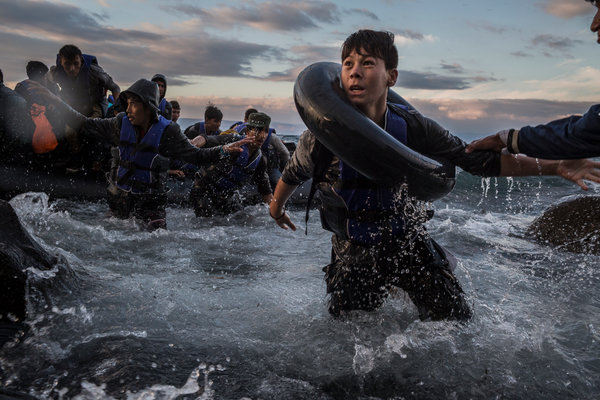
So you take to the seas in frail boats and brave the the deep and dangerous waters of the Mediterranean, the Adriatic and the Indian Ocean.
You might only have enough money for one passage, so you go on ahead and hope to send for your kin once you have reached safe haven.
You may be one of fortunate ones who make it – not one of those cast ashore, lifeless flotsam and jetsam like baby Aylan on his golden beach.
You are now one of tens of thousands in a river of desperate endeavour.
You walk the long miles of the unwelcoming highways of Eastern Europe to a German or Swedish sanctuary. You might end up in a detention camp in Italy or Spain, stranded in the Calais Jungle, or the harbours of Java and Sumatra.
Or else, you are parked in a hot and hostile makeshift camp somewhere near the Tropic of Capricorn.
Just imagine …
You have fled the terror of the warlords and the militias, the holy warriors and the ethnic cleansers.
You discover that the border camps of Jordan and Lebanon, Turkey and Afghanistan, Thailand and Malaysia, Kenya and Namibia have their own ecology of hardship and handouts, rape and robbery, beatings and bribes, illness and neglect, cursory and desultory treatment by overworked and under-resourced aid workers, and shake-downs by the criminals who thrive in these places and the cops who take a cut and turn a blind eye or else enforce punitive directives from politicians, parliaments and bureaucrats.
There, you and yours’ attempt to rebuild a semblance of a life-before amidst the tents and the shanties, the dust and the sewage, the summer’s heat and the winter’s cold. A mosque to pray in, a school for the children, games of football or backgammon for idle youth and menfolk.
You try to keep the children warm and fed and free of mortal illness; you try to keep the spirit alive in a time of anxiety, fear, threat, loss, and confusion, a time of hopeful emptiness and of empty hopelessness.
Zaatari refugee camp, Jordan July 2013
Just imagine …
You are one of the lucky few selected for settlement in the fabled, unknown ‘west’.
New lands, under foreign skies, different constellations, so far away it might as well be the moon.
You now dwell among strangers. You neither speak their language nor comprehend their ways or their foreign gods.
You have no friends or family to call on in time of need.
You must rebuild the basic buildings blocks of a normal life – where even the idea of a normal life has now changed utterly.
The houses, the streets, the shops, the money even – are all new.
The things you took for granted are no longer there, and in their place are new ways and means.
New systems and processes – social, welfare, health, education – with new rules and ways of getting things done. Going to the doctor, to the bank, to government offices.
Understanding that policemen and soldiers are not people you have to pay off or flee from.
Learning English.
Finding a home.
Getting the kids into a school.
Finding a job when your qualifications are not recognized, and work-ways are different to what you know.
The laws are new, the language is new, the way people dress and behave, talk, walk and eat is new.
Many new things are fascinating, tempting.
Others, confronting and insulting to your morality and values.
Some are alien, even, beyond your comprehension.
Codes of behaviour, dress, decorum, politeness, are new. Less formality, respect and deference; open displays of sexuality, affection, and rudeness that would not have been tolerated, permitted even, at home.
You don’t understand what makes the locals tick – their mannerisms, their speech, their body language, their concept of time and space, even.
And you are shocked and frightened by their hostility. Not all – just a noisy and troublesome few who talk quietly amongst themselves, or hurl abuse, or march through city streets with signs that scream, “go back to where you came from!”, “go home!”
Home?
There is no home.
Home is far, far away.
So far away, it might as well be on the moon.
Just imagine…
This is the new. And you still bear the cross of the old. The world you left behind is still with you.
You miss your family, your friends, and the comfort and support you all gave each other.
You miss your old life. The streets, the sounds, the smells. The weather and seasons. Your job, your status, your school, your neighbourhood.
You yearn for street and shop signs you could read, voices you understood on the radio and television, on the street, and on the buses.
You hate having to try and make yourself understood to officials and doctors, desk clerks and shop assistants, and even the supportive and ever helpful case workers whose mission is to help you get through all this.
You are homesick, and lonesome; you feel isolated, helpless, dependent.
There is a terrible ache in your heart and a rift in your soul.
And then there are the scars that won’t and perhaps can never heal. The psychological and physical effects of the events and experiences that forced you to flee your homeland.
Conflict and violence, intimidation and discrimination, torture and brutality, even. You have flashbacks, bad dreams, anxiety attacks, and actual physical and mental pain and anguish.
They say that PTSD is endless. There is no cure …
Just imagine…
You are a stranger in a strange land, and there’s no going home …
They that go down to the sea in ships, that do business in great waters; these see the works of the LORD, and his wonders in the deep. For he commandeth, and raiseth the stormy wind, which lifteth up the waves thereof. Psalm 107
Home
Warsan Shire
no one leaves home unless
home is the mouth of a shark.
you only run for the border
when you see the whole city
running as well.
your neighbours running faster
than you, the boy you went to school with
who kissed you dizzy behind
the old tin factory is
holding a gun bigger than his body,
you only leave home
when home won’t let you stay.
no one would leave home unless home
chased you, fire under feet,
hot blood in your belly.
it’s not something you ever thought about
doing, and so when you did –
you carried the anthem under your breath,
waiting until the airport toilet
to tear up the passport and swallow,
each mouthful of paper making it clear that
you would not be going back.
you have to understand,
no one puts their children in a boat
unless the water is safer than the land.
who would choose to spend days
and nights in the stomach of a truck
unless the miles travelled
meant something more than journey.
no one would choose to crawl under fences,
be beaten until your shadow leaves you,
raped, then drowned, forced to the bottom of
the boat because you are darker, be sold,
starved, shot at the border like a sick animal,
be pitied, lose your name, lose your family,
make a refugee camp a home for a year or two or ten,
stripped and searched, find prison everywhere
and if you survive
and you are greeted on the other side
with
go home blacks, refugees
dirty immigrants, asylum seekers
sucking our country dry of milk,
dark, with their hands out
smell strange, savage –
look what they’ve done to their own countries,
what will they do to ours?
the dirty looks in the street
softer than a limb torn off,
the indignity of everyday life
more tender than fourteen men who
look like your father, between
your legs, insults easier to swallow
than rubble, than your child’s body
in pieces – for now, forget about pride
your survival is more important.
i want to go home,
but home is the mouth of a shark
home is the barrel of the gun
and no one would leave home
unless home chased you to the shore
unless home tells you to
leave what you could not behind,
even if it was human.
no one leaves home until home
is a damp voice in your ear saying
leave, run now, i don’t know what
i’ve become.
This Syrian mother and her child were rescued by the Greek Coast Guard.
The World Refugee Crisis in Brief
The Melancholy Mathematics
Like death and taxes, the poor and racism, refugees have always been with us. But never in modern times – since the Second World War – have they been so many!
There are over sixty nine million people around the world on the move today – that have been forcibly displaced from their homes – fleeing from persecution or conflict.
This doesn’t count economic migrants who have hit the roads of sub Saharan Africa and Central America fleeing drought and crop failure, economic recession and unemployment, poverty, gangs and cartels, seeking a better life for themselves and the families in Europe or the USA.
Three quarters of a million ‘economic migrants’ are on the move in Central America, whilst the UN estimates that at least four million people have left Venezuela because of its political and economic crisis in what has been described as the biggest refuge crisis ever seen in the Americas. There are refugee camps on the Colombian border. Most are in Columbia but others have entered Brazil and Peru. But these are not by legal definition refugees – see below, The Refugees’ Journey .
Of those sixty nine million people over 11 million or 16% are Syrians. The numbers keep growing Thirty one people at being displaced every minute of the day. In 2018 alone, 16.2 million people were newly displaced.
Forty million people have been internally displaced within their own countries – this includes six million Syrians and off our radars, some two million souls who once lived in the contested regions of eastern Ukraine.
Over 25 million are refugees in neighbouring countries and further afield. 25% of them are in Turkey, Lebanon, Iran, Pakistan, and Uganda. Some 57% of them come from three countries: Syria, 6.3 million, Afghanistan 2.6 million and South Sudan 2.4 million. The top hosting counties are Turkey 3.5 million, Lebanon, 1 million, Pakistan 1.4 million, Uganda 1.4 million and Iran 1 million.
Jordan shelters over three quarters of a million Syrians; during the Iraq wars, this relatively poor country sheltered a similar number of Iraqis, and still hosts tens of thousands of Iraqi Christians who’ve fled persecution at home.
These figures are of those registered by the UNHCR. The real numbers are much higher. The Lebanese government estimates that there are more than 1.5 million Syrian refugees in the country.
Much of the focus these days is on the Middle East – Syria and its neighbours, on Libya and the frail boats crossing the Mediterranean, on the war in Yemen which has killed over thirteen thousand and displaced over two million.
But situation in Africa is as dire.
More than 2 million Somalis are currently displaced by a conflict that has lasted over two decades. An estimated 1.5 million people are internally displaced in Somalia and nearly 900,000 are refugees in the near region, including some 308,700 in Kenya, 255,600 in Yemen and 246,700 in Ethiopia.
By August 2018, the Democratic Republic of the Congo hosted more than 536,000 refugees from Burundi, the Central African Republic and South Sudan. And yet, there are over 4.5 million Congolese people displaced inside their own country and over 826,000 in neighbouring countries, including Namibia, Angola and Kenya.
Should the present situation in Sudan deteriorate into civil war, another tide of humanity will hit the road.
And closer to home, there are millions of refugees in Asia.
As of March 2019, there are over 100, 000 refugees in 9 refugee camps in Thailand (as of March 2019), mainly ethnic Karen and Shan. Refugees in Thailand have been fleeing ethnic conflict and crossing Myanmar’s eastern border jungles for the safety of Thailand for nearly 30 years.
There were an estimated 1 million Rohingya living in Myanmar before the 2016–17 crisis, and since August 2017, an estimated 625,000 refugees from Rakhine, had crossed the border into Bangladesh.
The top-level numbers are stupendous. The detail is scary.
Some 52% of the world’s refugees and displaced are children. And many are unaccompanied. Every hour, around 20 children run for their lives without their parents to protect them.
Children are the most vulnerable to disease and malnutrition and also to exploitation and lose years of schooling. Millions are elderly and are also face health problems.
And the problems facing young people and adults are all enormous. International aid is limited and host countries often unsympathetic. Work opportunities are few, some countries even forbidding refugees to take work, whilst unscrupulous employers exploit the desperate. Migrants are often encouraged, sometimes forcibly, to return to their countries of origin regardless of whether or not it is safe for them to return. There are reports that many have returned to Syria into the unwelcoming hands of the security services.
Refugees have lived in camps and towns in Pakistan and Thailand, Namibia and Kenyan for decades. Most refugee children were not born in their parents’ homelands.
And the camps are by no means safe havens. There may be no shelter or only basic shelter in tents; no privacy; a lack of clean water; meagre food; limited medical care; and the threat of injury, disease and epidemics. They may be poor physical security and armed attacks, and abuse by the authorities and officials. There may be organized crime, shakedowns and extortion, corruption and bribery.
Families may have become separated, exposing women and children without the protection of male family members to more fear and violence. Women are subsequently vulnerable to harsh conditions, including potential sexual and physical and abuse, poor healthcare, and unequal access to food and water. They may be coping with the loss of the head of the family and with the changing roles and responsibilities that come from being the sole parent. They may not know if their male family members will return to them safely and they must deal with the stress and anxiety, the grief and loss arising from their recent experiences. They might be fearful of the future, which in a camp is unknown and unpredictable
Australia and Refugees
Of all displaced peoples, 17% of them are being hosted in Europe. According to recent data published by the UNHCR, Germany is home to the most refugees by far in Europe – 1.4 million in total. By comparison, France and Sweden have 402,000 and 328,000 respectively, and the UK, 122,000.
Australia’s contribution to the world’s refugee problem is but a drop in the ocean. But we have a long established humanitarian refugee settlement programme for people officially recognized as refugees by the UNHCR and selected for third-country settlement in Australia.
Our humanitarian migration intake for 2016 -17 was the highest year on record. The intake of 24,162 was some 10% of our broader migration program which saw 225,941 permanent additions to the Australian population, and included the special intake of Syrian and Iraqi refugees (an estimate 12,000 places over several years).
The figures are 17,500 in 2017-18 and similar in 2018-19, whilst Scott Morrison has pledged to freeze the number of humanitarian arrivals for the next term. Under the policy there will be an overall target of 60 per cent of the offshore component for women, up from 50.8 per cent in 2017-18. The Government will also push to increase the number of refugees and humanitarian entrants being settled in regional Australia from a target of 30 per cent to 40 per cent in 2019-20, whilst insisting that new arrivals will only go to areas where there is strong community support.
Coffs Harbour
Coffs Harbour is one of several refugee intake towns in NSW, along with Armidale, Newcastle, Wollongong and Wagga Wagga. It’s medical and educational facilities have….
Coffs Harbour hosts several organizations dedicated to helping former refugees settle in Australia. They arrive in Australia on specific humanitarian visas and become permanent residents the moment they are admitted into the country. – and hence cease to be refugees.
SSI looks after them when they first arrive in Coffs Harbour. North Coast Settlement Services, a division of Saint Vincent de Paul Society, takes over once SSI’s work is done – after between six and eighteen months depending on a family’s needs, whilst the privately run Sanctuary organization assists settled migrants with such matters as family reunion and employment. An ancillary NSW government agency, the NSW Service for the Treatment and Rehabilitation of Torture and Trauma Survivors (STARTTS), assists new arrivals with psychological support, and particularly, the effects of PTSD. STARTTS services include counseling, group therapy, group activities and outings, camps for children and young people, English classes and physiotherapy
I spend two days a week as a volunteer with Settlement Services International, a Sydney-based community organisation that administers the Humanitarian Settlement Program (HSP) which supports refugees from the moment they arrive at the airport, provides essential support and information to assist refugees settle in Australia and empower them to gain independence and build strong connections in their new communities. SSI helps with the needs of new arrivals and the challenges of settling in a new country. Its aim is to enhance self-reliance with a focus on English language skills, education and job readiness.
SSI administers the Humanitarian Settlement Programme in several centres in regional NSW, including Coffs Harbour, Newcastle and Armidale. In all three areas, SSI has teams of staff on the ground who work with refugees, humanitarian entrants and their local communities to help new arrivals to through their initial settlement. The SSI team includes case managers and volunteers from the local community and from the refuge community itself
SSI’s work includes meeting and greeting, arranging temporary accommodation on arrival; orientation, including familiarization with Australian ways, our services and institutions, and getting around Coffs Harbour; basic official matters like Centrelink, banking, and health services; English classes at TAFE and enrolling children at schools; dealing with real estate agents, rental leases and looking after their rental properties.
Where do our clients come from?
When first volunteering, I worked for Anglicare. New arrivals were largely from Myanmar and Congo – mostly Christians – and from Afghanistan. Many of the latter came to Australia under the “woman at risk” programme – mothers and children with no father. Whilst all are Muslim, many were Shia Hazaras, a Turkic people persecuted by the Sunni Taliban. Since SSI took over from Anglicare in September 2017, whilst Burmese and African families continue to arrive, the emphasis has been on Yazidis from Iraq and Syria, and particularly from the Yazidi heartland of Sinjar in northern Iraq, where they endured enormous suffering and hardship at the hands of the Islamic State. Considered infidels by Da’ish, they were targets of a campaign of genocide from 2014. More than five thousand were killed, and some five to seven thousand were abducted and enslaved – mainly women and children. Such was the danger that the UNHCR and the Australian and other governments took whole families straight out of the war zone rather than from camps outside Iraq.
Yazidis are ethnically Kurdish, and their language, Kurmanji, is Kurdish. Their society is hierarchical and endogamous. Their religion, Yazidsm, is a monotheistic religion and has elements of ancient Mesopotamian faiths, including ancient Persian Mithraism, and some similarities to the Abrahamic religions, Judaism, Christianity and Islam. Because Yazidis believe in reincarnation and turn to the direction of the sun when praying, it has been thought – erroneously, that the religion has its origins in ancient Persian Zoroastrianism and Hinduism. They believe in the one god, the creator of all things, who delegated the ongoing management to a heptad of seven holy beings or angels, the chief of whom is Malek Taus – the Peacock Angel.
Malek Taus has in the past been associated, by Muslims and Christians, with Iblis, Satan, and the fall of proud Lucifer. This misinterpretation has led, historically, to Yazidis being perceived as devil worshipers, and thus being subject to persecution and pogrom. The atrocities of Da’ish were only different from past assaults and massacres in their scale and longevity.
Volunteering
Whilst case managers specifically look after the new arrivals, they depend upon a team of volunteers to assist them in a wide variety of tasks that we locals take for granted. for example: taking new arrivals them to medical or bank appointments, showing them how to use the bus network, setting up accommodation prior to arrival, minding children whilst parents attend appointments, and even helping folk to purchase use lawn mowers – there are few lawns in Iraq and Afghanistan.
As a volunteer, past and present tasks have included walkabouts to familiarize new arrivals with Coffs Harbour, accompanying clients to house inspections when seeking new rental accommodation, and assisting with rental application forms; sending important documents like birth, marriage and education certificates to Social Services’ translation service for official translations; helping clients to apply for bus concession cards, school bus cards, and children’s sport vouchers; and assisting with NBN plans and connections. I have fixed broken cupboards, replaced light bulbs, checked out washing machines and kitchen stoves. and taking families to school interviews.
As I can get by with spoken Arabic and can read and write the language, and as i am reasonably proficient with computers, I have helped with online applications and prepared resumes. I have shown clients how to budget their money, and have run a class on how to set up and use smart phone calendars to help them make and keep appointments. On occasions, I am asked to just drop in on clients to see how they are getting on, and sort any basic house problems.
My most rewarding experiences have been: assisting case managers at the airport when the clients first arrive. It’s a very emotional moment for all involved; Taking families who have never seen the sea before to the seaside; helping a clients get a job; and helping STARTTS run a youth group for children and young people by registering the young attendees
How I got into this
Since my twenties, I’ve had an interest and, indeed, a passion for the Middle East, its history and politics, its people and culture, its languages and religions. I’ve travelled often to the region, and have studied it formally and as a hobby. I learned standard Arabic in the seventies and worked in academic and government research. Though I took a very different road for two decades, I returned to Syria in the noughties and got back into Arabic both standard and colloquial (two relatively distinct languages).
On retirement, I wanted to do volunteer work, and by happenstance, Coffs Harbour was a refugees intake town with several organizations dedicated to assisting new arrivals. At first, I used my knowledge of Arabic script to assist Farsi-speaking Afghans, and then the Iraqi and Syrian Yazidis arrived. Though their native tongue is Kurdish Kurmanji, and few could speak English, many spoke Arabic. SSI had several Arabic speaking support-workers, and some new arrivals had good English and now work as Arabic and Kurmanji speaking support staff, I am able to step in when they are already booked. Who’d ever have thought I’d be able to use and grow my Arabic in Coffs Harbour.
The Refugees’ Journey
Who is a migrant? Who is a refugee? Who is an asylum seeker?
Migrants
A migrant is a person who makes a conscious choice to leave their country to seek a better life elsewhere. Before they decide to leave their country, migrants can seek information about their new home, study the language and explore employment opportunities. They can plan their travel, take their belongings with them, and say goodbye to the important people in their lives. They can continue to phone friends and family, or write, email or Skype them without fear of adverse consequences. They are free to return home at any time if things don’t work out as they had hoped, if they get homesick or if they wish to visit family members and friends left behind.
People who choose to migrate for economic reasons are sometimes called “economic refugees”, especially if they are trying to escape from poverty. But they are not recognized as refugees under international law. The correct term for people who leave their country or place of residence because they want to seek a better life is “economic migrant”.
However, the displacement of people caused by such economic circumstances, or by natural disasters like flood, drought or extreme weather, can contribute towards political, social and ethnic tensions that can precipitate refugee crises. Effective and timely external assistance from neighbours and donor nations will often help to avert this. Aid is therefore provided in an effort to keep people in their homes or in their home countries.
Refugees
The 1951 United Nations Convention relating to the Status of Refugees states:
“Any person who owing to a well founded fear of being persecuted for reasons of race, religion, nationality, membership of a particular social group or political opinion, is outside the country of his/her nationality and is unable, or owing to such fear, is unwilling to avail himself/herself of the protection of that country.”
Refugees are forced to leave their country because they are at risk of, or have experienced persecution. Their concerns are human rights and safety, and not economic advantage. They leave behind their homes, most or all of their belongings, family members and friends. Some are forced to flee with no warning, and may not be able to say goodbye to friends and family, and may never be able to contact or see them again.
Many refugees have experienced significant trauma or been tortured or otherwise ill-treated. Their journey to safety is fraught with hazards, many risking their lives in search of protection. They cannot return home unless the situation that forced them to leave improves.
Location is all important. During civil unrest and conflict, people may be forced to leave their homes, but do not leave their country. These internally displaced persons (IDPs) are often referred to as refugees. But, whilst refugees and IDPs may flee for similar reasons, their legal status is very different. Whilst remaining within the borders of their home countries, IDPs are legally under the protection of their own government, even in cases where the government’s actions are the cause of their flight. A person cannot be recognized as a refugee unless they are outside their home country.
Asylum Seekers
These seek protection as refugees, but their claim for refugee status has not yet been assessed. Many refugees have at some point been asylum seekers, that is, they have lodged an individual claim for protection and have had that claim assessed by a government or UNHCR.
Some refugees, however, do not formally seek protection as asylum seekers. During mass influx situations, people may be declared “prima facie” refugees without having undergone an individual assessment of their claims, as conducting individual interviews in these circumstances is generally impracticable (due the large numbers involved) and unnecessary (as the reasons for flight are usually self-evident). In other cases, refugees may be unable to access formal status determination processes or they may simply be unaware that they are entitled to claim protection as a refugee.
It is important to note that refugee status exists regardless of whether it has been formally recognized. People do not “become” refugees at the point when their claims for protection are upheld – they were already refugees, and the assessment process has simply recognized their pre-existing status. People become refugees (and are entitled to international protection and assistance) from the moment they flee their country due to a well-founded fear of persecution, as stipulated in the Refugee Convention.
What causes a person or a people to flee their home country?
The most common causes are war and civil unrest, persecution for political or religious beliefs, or ethnic and racial identity, and human rights violations by government authorities or rogue militias. There could be extreme political instability and fighting; assassinations of people associated with certain political or social groups; arbitrary arrest and torture, mutilation and degradation that can happen without warning; routine sexual violence towards women and girls; forced conscription of child soldiers, forcing families to flee to protect their children; and conscription for slave labour. Governments are unable to protect their citizens, and may actively participate in violations, leaving people with no place or person to turn to for protection.
Often people will hang on, hoping things will improve. Flight is the last option because it means leaving everything behind – home, possessions, jobs, education, family and friends, language, culture and identity. People are often forced to flee with very little warning, no time to collect identity documents or precious things, or say farewell to family, friends and neighbours. They may have to travel long distances, often on foot or in small boats, and through dangerous territory or waters. They may go for long periods without food and water. They may become in danger of being intercepted, robbed or recruited, raped or killed, imprisoned or repatriated.
Life in the Refugee Camps
The fortunate might reach a camp or other place of relative safety. In the camp there may be no shelter or only basic shelter in tents; no privacy; a lack of clean water; meagre food; limited medical care; and the threat of injury, disease and epidemics. They may be poor physical security and armed attacks, and abuse by the authorities and officials. There may be organized crime, shakedowns and extortion, corruption and bribery.
Families may have become separated, exposing women and children without the protection of male family members to more fear and violence. Women are subsequently vulnerable to harsh conditions, including potential sexual and physical and abuse, poor healthcare, and unequal access to food and water. They may be coping with the loss of the head of the family and with the changing roles and responsibilities that come from being the sole parent. They may not know if their male family members will return to them safely and they must deal with the stress and anxiety, the grief and loss arising from their recent experiences. They might be fearful of the future, which in a camp is unknown and unpredictable
The Role of the UNHCR
The office of the United Nations High Commissioner for Refugees (UNHCR) is mandated by the United Nations to protect refugees and help them find solutions to their plight. It has over 4,000 staff in 120 countries and an annual budget of about US$1 billion. In addition to legal protection, UNHCR now also provides material relief in major emergencies either directly or in partnership with other agencies.
Refugee protection is covered by International Human Rights Law, and this sits within a broader framework of international law. The agency responsible for the oversight of international human rights law is the Office of the United Nations High Commissioner for Human Rights (UNHCHR).
Refugees are accorded certain rights under international law, including
The right not to be sent back to a country where their life or freedom would be in danger
The right to receive public relief and welfare support at the same level as nationals
The right to access education and health care
The right to work
Entitlement to be issued with identity papers and travel documents
The role of the UNHCR is to
Safeguard the rights and wellbeing of refugees
Ensure that every person can exercise the right to seek asylum and find safe refuge in another country
Promote long-term solutions to the refugees’’ plight utilizing the options of voluntary return, local integration in the country of first asylum, or resettlement in a third country
Ensure that refugees are treated appropriately by countries that have signed the UN Convention
Ensure that refuges are given the same rights as nationals of the countries they are accepted into
Protect refuges from being forced to return to their home countries if it is likely they will be persecuted
Promote the reunification of families
Take into account the special needs of particular refuges classes, e.g. women and children
UNHCR’s “durable solutions” for refugees:
Voluntary repatriation, the preferred long-term solution – going back to the country of origin when it is safe for them to return country. Voluntary repatriation is encouraged if it is safe and reintegration is viable. Indeed, most refuges prefer to go home as soon as circumstances permit and a degree of stability has been restored.
Local settlement and integration is the next preferred option – making a home in the country to which they first fled. Such local settlement may e spontaneous with new-comers establishing a new community. Integration is facilitated there are common ethnic groups or co-religionists. However, there may be a political affiliation between the government of their homeland and the country of first asylum which may lead to continued harassment and persecution.
Resettlement in a third country – often as a last resort, when refugees can neither return home nor remain in the country of first asylum, and are then selected by the UNHCR and sent to a third country to start a new life. Some eleven countries offer resettlement on a regular basis: Australia, Canada, Denmark, Finland, Ireland, Netherlands, New Zealand, Norway, Sweden, the UK, and the USA.
Whilst the UNHCR strives for “durable solutions”, the reality of the global refugee problem is that many countries hosting refugees embrace “non-durable” solutions such as:
“Warehousing” – refugees remain indefinitely in a camp where freedom of movement is restricted, basic supplies are scarce and there are few opportunities for any meaningful activity
Involuntary Repatriation – refugees are sent back to their country or origin while it is still unsafe. Sometimes refugees are forced back; sometimes they return because this is the “least bad option”
Secondary Movement – refugees themselves attempt to get to a western country in which they can lodge a claim for refugee status. This often involves clandestine travel using people smugglers and it can be very dangerous.
Settlement and Arrival
Refugees are selected for settlement in Australia by the Department Immigration and Border Protection, in conjunction with the UNHCR. Before arriving in Australia, humanitarian entrants are required to go through security and health checks.
The Australian Cultural Orientation program (AUSCO) is provided to humanitarian visa holders who are preparing to settle in Australia. The program provides practical advice and the opportunity to ask questions about travel to and life in Australia. It is delivered overseas, before they begin their journey. The International Organization for Migration (IOM) is currently contracted to deliver AUSCO on behalf of the DIBP.
The average length of time spent in a camp or in a place of first refuge is 17 years, and migrants may have little experience beyond this. Children may not even have known their home country. Many will have experiences extreme instability and uncertainty. Being selected for resettlement can be an overwhelming experience, and can include feelings of intense elation on one hand and fear and anxiety on the other.
Under such circumstances, a person may not always be aware of the potential difficulties of resettlement. On arrival, feelings can quickly move from elation and joy to culture shock, resentment, dislocation and confusion. It can take months, years even, for new arrivals to understand aspects of their new country and adapt to it.








 In That Howling Infinite