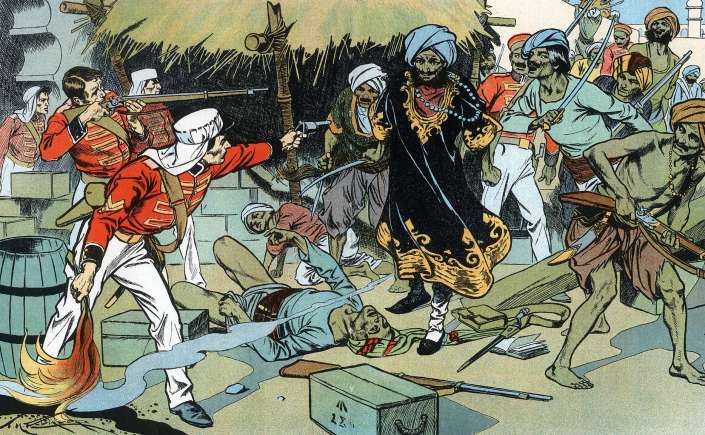
Weighing the White Man’s Burden

By all ye cry or whisper,
By all ye leave or do,
The silent sullen peoples
Shall weigh your Gods and you.
Rudyard Kipling

And where the crazy whiteman
And his teargas happiness
Lies dead and long since buried
By his own fantastic mess
Roy Harper

As a young lad in Birmingham, my school chums and I would be enthralled by a world map covered in red – the empire upon which the sun never set. As Britain turns its back on Europe, it would seem that quite a few folk are still enamoured of the defunct Imperium. A 2014 YouGov opinion poll that found 59% British people polled believed the old British Empire was something to be proud of. 34% wished they still had one.

Back in the day, we’d do school projects about cocoa cultivation on the Gold Coast (now Ghana, not our Australian schoolies’ mecca), rubber trees in Malaya and East Africa, and tea plantations in Assam and Ceylon – enhanced by attractive, child-friendly posters and other educational aids provided gratis by the likes of Cadbury, Dunlop and Typhoo. That these household names had factories in our industrial ‘second city’ which encouraged school outings rendered the wonders of empire all the more tangible.

In the Britain of my childhood, the “silent sullen peoples” of Rudyard Kipling’s famous poem were beginning to “colour-up” (pun quite intended) our monochrome, white-bread, demographic cityscape. The bleak and bland streets and suburbs of our English and Irish Birmingham were already rocking with new sounds and flavours, from the ska and reggae beats of Sparkhill to the spicy aromas of Balsall Heath and Alum Rock. There was prejudice, there was discrimination, there was at times violence, but as Britain emerged from the austerity of the war years, as the bombed cities were rebuilt, and a resuscitated economy created a consumer society, labour shortages persuaded politicians to facilitate mass immigration from the empire – and particularly, from the West Indies and the Indian subcontinent

Words like imperialism and colonialism, economics and exploitation, were yet to enter our vocabularies. The colonies and dependencies spread across all continents, and the ‘grown-up’ white ‘commonwealths’ and ‘dominions’ like Australia, New Zealand, Canada, South Africa, and Rhodesia, were the friends, partners, and indeed, children of the mother country.

It was, we perceived, in the innocence of youth and the blinkers of our school curricula, a benign and fruitful partnership of mutual benefit to all. “To serve our captives’ need”, we gave them our civilizing, Judeo-Christian, Anglo-Celtic values, our able and empathetic if patronizing and prejudiced administrators, our gallant soldiers, pious pastors, selfless doctors and inspiring teachers. They in return yielded up their natural resources and an abundance of cheap labour, and when the Empire was imperiled, they despatched their young men in their thousands to perish in our wars.

We were not to know that the mournful notes of the Last Post were sounding across a changing post-war world. The Union Jack was was descending on buildings and parade grounds the world over as unfamiliar new flags were raised in their stead. Tired, broke, and damaged Britain was retreating from Empire, as were France and the Netherlands, and a new imperium was rising in the west. Within a decade, India, and Pakistan and Ceylon were joined by Indonesia, and a score of young nations emerged throughout Africa. France fought long and bloody wars in Vietnam and Algeria to cling on to its colonial patrimony, and it too finally let go of its “fluttered folk and wild”.

And we were not to know the reality of Britain’s “mission civilatrice”. From the seventeenth century, the European colonizing powers were enmeshed by trade, greed, and national aggrandizement in what today we would define as “mission creep”. Distant posts morphed over three centuries into vast bureaucracies, mines and plantations that underwrote the North’s industrial and commercial hegemony, and into societies ruled by white, expatriate elites and segregated by class, caste, clan and colour.

How all this played out in The Raj is described in detail by politician and historian Shashi Tharoor in Inglorious Empire: What the British did in India.  This is reproduced below, together with a video, whilst the full Kipling poem, a song by Roy Harper, and a review by Australian author Christopher Kremmer follows.

Read also my earlier posts on India and the passing of Empire:

For more posts by In That Howling Infinite, visit:
https://m.facebook.com/HowlingInfinite/
https://m.facebook.com/hf1983/

But what about the railways…? The myth of Britain’s gifts to India 

Shashi Tharour, The Gusrdian, March 9, 2017
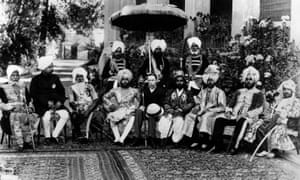
Holding court ... the lieutenant-general of the Punjab takes tea with maharajas and Rajas in 1875.
The lieutenant-general of the Punjab takes tea with maharajas and Rajas in 1875. Photograph: Popperfoto
Many modern apologists for British colonial rule in India no longer contest the basic facts of imperial exploitation and plunder, rapacity and loot, which are too deeply documented to be challengeable. Instead they offer a counter-argument: granted, the British took what they could for 200 years, but didn’t they also leave behind a great deal of lasting benefit? In particular, political unity and democracy, the rule of law, railways, English education, even tea and cricket?

Indeed, the British like to point out that the very idea of “India” as one entity (now three, but one during the British Raj), instead of multiple warring principalities and statelets, is the incontestable contribution of British imperial rule.

Unfortunately for this argument, throughout the history of the subcontinent, there has existed an impulsion for unity. The idea of India is as old as the Vedas, the earliest Hindu scriptures, which describe “Bharatvarsha” as the land between the Himalayas and the seas. If this “sacred geography” is essentially a Hindu idea, Maulana Azad has written of how Indian Muslims, whether Pathans from the north-west or Tamils from the south, were all seen by Arabs as “Hindis”, hailing from a recognisable civilisational space. Numerous Indian rulers had sought to unite the territory, with the Mauryas (three centuries before Christ) and the Mughals coming the closest by ruling almost 90% of the subcontinent. Had the British not completed the job, there is little doubt that some Indian ruler, emulating his forerunners, would have done so.
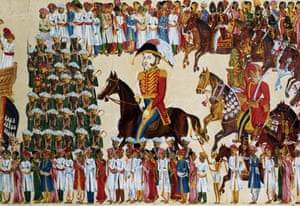
Divide and rule ... an English dignitary rides in an Indian procession, c1754. Photograph: Universal History Archive/Getty Images
 Divide and rule … an English dignitary rides in an Indian procession, c1754. Photograph: Universal History Archive/Getty Images

Far from crediting Britain for India’s unity and enduring parliamentary democracy, the facts point clearly to policies that undermined it – the dismantling of existing political institutions, the fomenting of communal division and systematic political discrimination with a view to maintaining British domination.

Since the British came from a hierarchical society with an entrenched class system, they instinctively looked for a similar one in India. The effort to understand ethnic, religious, sectarian and caste differences among Britain’s subjects inevitably became an exercise in defining, dividing and perpetuating these differences. Thus colonial administrators regularly wrote reports and conducted censuses that classified Indians in ever-more bewilderingly narrow terms, based on their language, religion, sect, caste, sub-caste, ethnicity and skin colour. Not only were ideas of community reified, but also entire new communities were created by people who had not consciously thought of themselves as particularly different from others around them.

Large-scale conflicts between Hindus and Muslims (religiously defined), only began under colonial rule; many other kinds of social strife were labelled as religious due to the colonists’ orientalist assumption that religion was the fundamental division in Indian society.
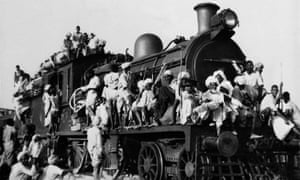
Muslim refugees cram aboard a train during the partition conflict in 1947 ... the railways were first conceived by the East India Company for its own benefit. Photograph: AP
Muslim refugees cram aboard a train during the partition conflict in 1947 … the railways were first conceived by the East India Company for its own benefit. Photograph: AP


It is questionable whether a totalising Hindu or Muslim identity existed in any meaningful sense in India before the 19th century. Yet the creation and perpetuation of Hindu–Muslim antagonism was the most significant accomplishment of British imperial policy: the project of divide et impera would reach its culmination in the collapse of British authority in 1947. Partition left behind a million dead, 13 million displaced, billions of rupees of property destroyed, and the flames of communal hatred blazing hotly across the ravaged land. No greater indictment of the failures of British rule in India can be found than the tragic manner of its ending.

Nor did Britain work to promote democratic institutions under imperial rule, as it liked to pretend. Instead of building self-government from the village level up, the East India Company destroyed what existed. The British ran government, tax collection, and administered what passed for justice. Indians were excluded from all of these functions. When the crown eventually took charge of the country, it devolved smidgens of government authority, from the top, to unelected provincial and central “legislative” councils whose members represented a tiny educated elite, had no accountability to the masses, passed no meaningful legislation, exercised no real power and satisfied themselves they had been consulted by the government even if they took no actual decisions.

As late as 1920, under the Montagu-Chelmsford “reforms”, Indian representatives on the councils – elected by a franchise so restricted and selective that only one in 250 Indians had the right to vote – would exercise control over subjects the British did not care about, like education and health, while real power, including taxation, law and order and the authority to nullify any vote by the Indian legislators, would rest with the British governor of the provinces.

Democracy, in other words, had to be prised from the reluctant grasp of the British by Indian nationalists. It is a bit rich to oppress, torture, imprison, enslave, deport and proscribe a people for 200 years, and then take credit for the fact that they are democratic at the end of it.

A corollary of the argument that Britain gave India political unity and democracy is that it established the rule of law in the country. This was, in many ways, central to the British self-conception of imperial purpose; Kipling, that flatulent voice of Victorian imperialism, would wax eloquent on the noble duty to bring law to those without it. But British law had to be imposed upon an older and more complex civilisation with its own legal culture, and the British used coercion and cruelty to get their way. And in the colonial era, the rule of law was not exactly impartial.

Crimes committed by whites against Indians attracted minimal punishment; an Englishmen who shot dead his Indian servant got six months’ jail time and a modest fine (then about 100 rupees), while an Indian convicted of attempted rape against an Englishwoman was sentenced to 20 years of rigorous imprisonment. In the entire two centuries of British rule, only three cases can be found of Englishmen executed for murdering Indians, while the murders of thousands more at British hands went unpunished.

The death of an Indian at British hands was always an accident, and that of a Briton because of an Indian’s actions always a capital crime. When a British master kicked an Indian servant in the stomach – a not uncommon form of conduct in those days – the Indian’s resultant death from a ruptured spleen would be blamed on his having an enlarged spleen as a result of malaria. Punch wrote an entire ode to The Stout British Boot as the favoured instrument of keeping the natives in order.

Political dissidence was legally repressed through various acts, including a sedition law far more rigorous than its British equivalent. The penal code contained 49 articles on crimes relating to dissent against the state (and only 11 on crimes involving death).
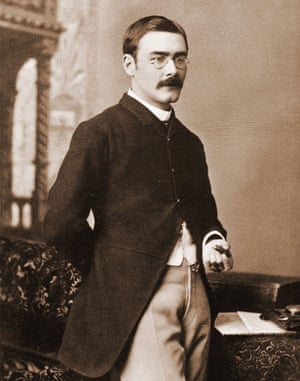
Rudyard Kipling, ‘that flatulent voice of Victorian imperialism would wax eloquent on the noble duty to bring law to those without it’. Photograph: Culture Club/Getty Images


Of course the British did give India the English language, the benefits of which persist to this day. Or did they? The English language was not a deliberate gift to India, but again an instrument of colonialism, imparted to Indians only to facilitate the tasks of the English. In his notorious 1835 Minute on Education, Lord Macaulay articulated the classic reason for teaching English, but only to a small minority of Indians: “We must do our best to form a class who may be interpreters between us and the millions whom we govern; a class of persons, Indians in blood and colour, but English in taste, in opinions, in morals and in intellect.”

The language was taught to a few to serve as intermediaries between the rulers and the ruled. The British had no desire to educate the Indian masses, nor were they willing to budget for such an expense. That Indians seized the English language and turned it into an instrument for our own liberation – using it to express nationalist sentiments against the British – was to their credit, not by British design.

The construction of the Indian Railways is often pointed to by apologists for empire as one of the ways in which British colonialism benefited the subcontinent, ignoring the obvious fact that many countries also built railways without having to go to the trouble and expense of being colonised to do so. But the facts are even more damning.

The railways were first conceived of by the East India Company, like everything else in that firm’s calculations, for its own benefit. Governor General Lord Hardinge argued in 1843 that the railways would be beneficial “to the commerce, government and military control of the country”. In their very conception and construction, the Indian railways were a colonial scam. British shareholders made absurd amounts of money by investing in the railways, where the government guaranteed returns double those of government stocks, paid entirely from Indian, and not British, taxes. It was a splendid racket for Britons, at the expense of the Indian taxpayer.

The railways were intended principally to transport extracted resources – coal, iron ore, cotton and so on – to ports for the British to ship home to use in their factories. The movement of people was incidental, except when it served colonial interests; and the third-class compartments, with their wooden benches and total absence of amenities, into which Indians were herded, attracted horrified comment even at the time.
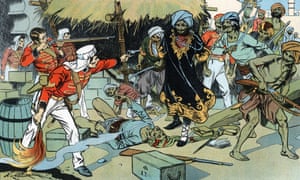
Asserting British rule during the war of independence, also known as the Indian mutiny, 1857. Photograph: Universal History Archive/Getty Images
 Asserting British rule during the war of independence, also known as the Indian mutiny, 1857. Photograph: Universal History Archive/Getty Images


And, of course, racism reigned; though whites-only compartments were soon done away with on grounds of economic viability, Indians found the available affordable space grossly inadequate for their numbers. (A marvellous post-independence cartoon captured the situation perfectly: it showed an overcrowded train, with people hanging off it, clinging to the windows, squatting perilously on the roof, and spilling out of their third-class compartments, while two Britons in sola topis sit in an empty first-class compartment saying to each other, “My dear chap, there’s nobody on this train!”)

Nor were Indians employed in the railways. The prevailing view was that the railways would have to be staffed almost exclusively by Europeans to “protect investments”. This was especially true of signalmen, and those who operated and repaired the steam trains, but the policy was extended to the absurd level that even in the early 20th century all the key employees, from directors of the Railway Board to ticket-collectors, were white men – whose salaries and benefits were also paid at European, not Indian, levels and largely repatriated back to England.

Racism combined with British economic interests to undermine efficiency. The railway workshops in Jamalpur in Bengal and Ajmer in Rajputana were established in 1862 to maintain the trains, but their Indian mechanics became so adept that in 1878 they started designing and building their own locomotives. Their success increasingly alarmed the British, since the Indian locomotives were just as good, and a great deal cheaper, than the British-made ones. In 1912, therefore, the British passed an act of parliament explicitly making it impossible for Indian workshops to design and manufacture locomotives. Between 1854 and 1947, India imported around 14,400 locomotives from England, and another 3,000 from Canada, the US and Germany, but made none in India after 1912. After independence, 35 years later, the old technical knowledge was so completely lost to India that the Indian Railways had to go cap-in-hand to the British to guide them on setting up a locomotive factory in India again. There was, however, a fitting postscript to this saga. The principal technology consultants for Britain’s railways, the London-based Rendel, today rely extensively on Indian technical expertise, provided to them by Rites, a subsidiary of the Indian Railways.
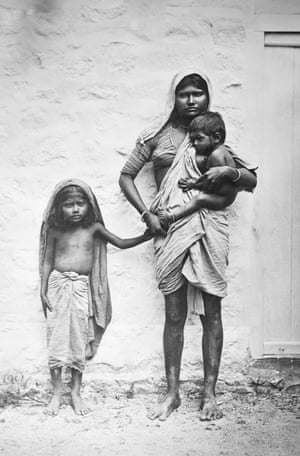
Mother and children ... the British left a society with 16% literacy, a life expectancy of 27 and over 90% living below the poverty line.
The British left a society with 16% literacy, a life expectancy of 27 and over 90% living below the poverty line. Photograph: Bettmann/Bettmann Archive


The process of colonial rule in India meant economic exploitation and ruin to millions, the destruction of thriving industries, the systematic denial of opportunities to compete, the elimination of indigenous institutions of governance, the transformation of lifestyles and patterns of living that had flourished since time immemorial, and the obliteration of the most precious possessions of the colonised, their identities and their self-respect. In 1600, when the East India Company was established, Britain was producing just 1.8% of the world’s GDP, while India was generating some 23% (27% by 1700). By 1940, after nearly two centuries of the Raj, Britain accounted for nearly 10% of world GDP, while India had been reduced to a poor “third-world” country, destitute and starving, a global poster child of poverty and famine. The British left a society with 16% literacy, a life expectancy of 27, practically no domestic industry and over 90% living below what today we would call the poverty line.

The India the British entered was a wealthy, thriving and commercialising society: that was why the East India Company was interested in it in the first place. Far from being backward or underdeveloped, pre-colonial India exported high quality manufactured goods much sought after by Britain’s fashionable society. The British elite wore Indian linen and silks, decorated their homes with Indian chintz and decorative textiles, and craved Indian spices and seasonings. In the 17th and 18th centuries, British shopkeepers tried to pass off shoddy English-made textiles as Indian in order to charge higher prices for them.

The story of India, at different phases of its several-thousand-year-old civilisational history, is replete with great educational institutions, magnificent cities ahead of any conurbations of their time anywhere in the world, pioneering inventions, world-class manufacturing and industry, and abundant prosperity – in short, all the markers of successful modernity today – and there is no earthly reason why this could not again have been the case, if its resources had not been drained away by the British.

If there were positive byproducts for Indians from the institutions the British established and ran in India in their own interests, they were never intended to benefit Indians. Today Indians cannot live without the railways; the Indian authorities have reversed British policies and they are used principally to transport people, with freight bearing ever higher charges in order to subsidise the passengers (exactly the opposite of British practice).

This is why Britain’s historical amnesia about the rapacity of its rule in India is so deplorable. Recent years have seen the rise of what the scholar Paul Gilroy called “postcolonial melancholia”, the yearning for the glories of Empire, with a 2014 YouGov poll finding 59% of respondents thought the British empire was “something to be proud of”, and only 19% were “ashamed” of its misdeeds.

All this is not intended to have any bearing on today’s Indo-British relationship. That is now between two sovereign and equal nations, not between an imperial overlord and oppressed subjects; indeed, British prime minister Theresa May recently visited India to seek investment in her post-Brexit economy. As I’ve often argued, you don’t need to seek revenge upon history. History is its own revenge.

Inglorious Empire by Shashi Tharoor is published by Hurst & Company at £20

https://www.theguardian.com/world/2017/mar/08/india-britain-empire-railways-myths-gifts#img-2

Rudyard Kipling published his famous poem to salute the US’ conquest of the Philippines in 1899, although he had originally written it to celebrate Queen Victoria Diamond Jubilee.


    The White Man’s Burden

Take up the White Man’s burden –
Send forth the best ye breed –
Go bind your sons to exile
To serve your captives’ need;
To wait in heavy harness
On fluttered folk and wild –
Your new-caught sullen peoples,
Half devil and half child.

Take up the White Man’s burden –
In patience to abide
To veil the threat of terror
And check the show of pride;
By open speech and simple,
An hundred times made plain,
To seek another’s profit,
And work another’s gain.

Take up the White Man’s burden –
And reap his old reward,
The blame of those ye better,
The hate of those ye guard –
The cry of hosts ye humour
(Ah slowly !) towards the light:-
“Why brought ye us from bondage,
“Our loved Egyptian night ?”

Take up the White Man’s burden –
Ye dare not stoop to less –
Nor call too loud on Freedom
To cloak your weariness;
By all ye cry or whisper,
By all ye leave or do,
The silent sullen peoples
Shall weigh your Gods and you.

In 1970, Roy Harper, Britain’s high priest of lyrical angst Roy created a counterpoint with this song from Flat, Baroque and Berserk.

Shashi Tharoor’s indictment of the British in India

Christopher Kremmer, Sydney Morning Herald, August 18, 2017

“Orright,” concedes the leader, Reg, played by John Cleese. “But apart from the sanitation, the medicine, education, wine, public order, irrigation, roads, the freshwater system and public health, what have the Romans ever done for us?”

In Inglorious Empire: What the British Did to India, Shashi Tharoor, writer, politician and United Nations-based diplomat for 30 years, asks a similar question to the one posed by Cleese’s beleaguered revolutionary.

In doing so, he seeks to remind misty-eyed Raj romantics that colonialism was no joke. As empires go, he says, Britain’s was uncommonly ruthless, devious and rapacious in its quest to enslave a people whose leaders failed to see how free trade, unwisely managed, can undermine a country’s long-term sovereignty and prosperity.

In the process, Tharoor accuses a number of historians, most prominent among them, Niall Ferguson, of being apologists for the racial discrimination, violence, economic sabotage and denial of liberty embodied by centuries of British rule in India.
It all began as a harmless commercial enterprise, Tharoor reminds us. In 1600, the British East India Company was formed under royal charter. Its aim was to compete with colonial rivals such as the French and Dutch for lucrative trade opportunities with India, an industrial and cultural superpower that under its Mughal emperors would account for 27 per cent of the world economy.

Awash with gems, natural resources, shipyards and a sophisticated cultural life, the Mughals were happy to trade. By the end of the century, however, they were tired, divided, and overextended. In 1739, the capital at Delhi was sacked by the Persians.

Meanwhile, in the expanding coastal trading posts, the initial presence of armed guards to protect the company’s staff and premises had evolved into a fully fledged army that by 1757 under Robert “Clive of India” had toppled the independent nawab of India’s richest province, Bengal. By 1800, the company had 260,000 men under arms and a talent for regime change that brought 200 million people under its control.

In 1857, after Hindu and Muslim rebels joined in a bloody revolt, India came under direct rule from London, and the company was eventually dissolved. The new Raj survived two world wars and the Great Depression, extending British rule for another 90 years until Gandhi’s Freedom movement triumphed in 1947, albeit at the terrible cost of Partition.

It is unusual, but not unheard of today to meet Indians who believe their country was better off under the Raj. Muddle-headed history is much more prominent in soon to be Brexited Britain. Tharoor cites a 2014 opinion poll that found 59 per cent of British people polled believed the old empire was something to be proud of. Thirty-four per cent wished they still had one.

Tharoor marshalls a formidable array of research to make the case that such attitudes are anachronistic and poorly informed. All the old chesnuts, for example, that the British modernised India, bequeathed it a tradition of parliamentary democracy and civilised the locals by teaching them the gentlemanly sport of cricket, are lined up and skewered, or at least plausibly challenged.

The company smashed India’s advanced textiles industries, literally by demolishing factories and imposing tariffs of 70-80 per cent on exports to Britain. In doing so, they turned a manufacturing, shipbuilding nation into a source of raw materials with little scope for value adding industries. The railways, he argues, were developed principally to more efficiently ship out those raw materials, and were financed by an elaborate and shonky racket that enriched British investors by inflating the cost of Indian rail track to twice that of Australia and Canada.

Meanwhile, ordinary Indians were taxed 50 per cent of their incomes, far beyond their experience and capacity to pay. Defaulters were tortured and jailed or, in the case of two-thirds of Indians under British rule in the late 18th century, fled their lands.

“The bones of the cotton weavers were bleaching the plains of India,” as one colonial administrator observed. The treasuries of princely states such as Bengal were systematically looted by coercive and corrupt methods, while prices for basic commodities were driven up by the opulent lifestyles of expatriate Britons.

Indian taxes not only paid the salaries of the British army of occupation, but also of the hundreds of thousands of Indian troops who became cannon fodder for British interests on the Western Front, at Gallipoli, and in Mesopotamia.

Behind the entire rip-off, as Ferdinand Mount, has observed, “lay the hard calculus of the City of London”. The Indian currency was manipulated to British advantage, and its trade with Europe was forced to go through London. Specifications were set to ensure that Indian steel could not be exported to Britain. India did not miss the bus of the Industrial Revolution – it was forcibly prevented from boarding it.

Discrimination against Indians in civil service employment was rife. Even the arch-colonial writer Rudyard Kipling observed that the bureaucracy was “neither Indian, nor civil, nor a service”. The “justice” British rule gave India meant it was almost impossible for a white man to be given a serious term in jail for murdering his Indian servant, which happened rather a lot. The racism of the occupiers gave the lie to the fiction of modern, enlightened and benign British rule. As one viceroy put it, “We are all British gentlemen engaged in the magnificent work of governing an inferior race”.

Tharoor acknowledges the sincere efforts of many British expats to ameliorate the harsh realities of colonial rule. But even in the 20th century, when the sun was setting on the Raj, enlightenment attitudes took second place to the desire to crush the Indian independence movement. The same people who condemned the nationalist leader Nehru to 10 years in British Indian jail cells also labelled Gandhi’s non-violent campaign for freedom as terrorism. Newspapers that alerted the public to such injustices, particularly the vernacular press, were often censored or shut down.

For all its claims to superiority, the British Empire was in charge in India during no fewer than 11 famines in which 30 to 35 million people died of starvation, Tharoor notes. Ultimately, he believes, Britain’s desire for wealth trumped all other values and considerations. The rhetoric of uplifting the benighted brown man was always a self-serving, grotesque and conceited pose to justify a regime that bribed and murdered, annexed and stole to enrich a certain class of Briton.

This book burns with the power of intellect married with conviction. It ends with Tharoor commenting that the way the Raj ended was its greatest indictment. The collapse of British rule amid devastating sectarian violence and creation of a Muslim “homeland” in Pakistan can be seen as the logical conclusion of 90 years of divide and rule strategies as London clung desperately to power in the subcontinent.

As they washed their hands and packed their carpet bags, the British departed an India in which 84 per cent of people could not read or write their own name in any language. What an achievement. In 1600, Britain produced 1.8 per cent of the world’s gross domestic product, compared with India’s 23 per cent. By the end of the Raj, Britain’s share had multiplied fivefold, while India had been reduced to penury.

But in 70 short years, India’s proud republic has made enormous strides in literacy, numeracy and poverty reduction, and is now the world’s fastest growing major economy.

Yet there are contradictions in the new India’s rise, some with their roots in the British period, like the ruling Hindu nationalist movement’s proclivity to cast the Indian identity in sectarian terms. At times, Tharoor’s determination to resist such trends leads him to downplay the injustices of earlier empires to more graphically illustrate the failings of the British one.

Yet overall, this is erudite, well-written, thoroughly documented and persuasive history that focuses varied sources into a coherent critique of colonialism in the Indian context. Tear up your copies of Ferguson’s neo-liberal mind rot and get angry like Tharoor.


Recalling The Mersey Poets


for we had love and each other and the moon for company
when I spent summer with Monica and Monica spent summer with me

June this year saw the fiftieth anniversary the publication of Roger McGough’s wistful verse-memoir “Summer With Monika”, and in October, we celebrate the publication in 1967 of that great anthology The Mersey Sound which showcased the poetry of Liverpudlians McGough, Brian Patten and Adrian Henry.

Named for the musical revolution that originated in the northern English port city of Liverpool, it became one of the best-selling poetry anthologies of all time, exerting an influence on British poetry well beyond the decade. I bought the slim volume as soon as it came out, and back in the day, guitar in hand, I would set many of its poems to music as it nurtured my nascent song-writing and poetry skills. I recall now Patten’s “Somewhere Between Heaven and Woolworths’, and “Delicate John’ and the tunes I set to them. I still sing McGough’s Great War country-and-western-noir ‘Square Dance’: “Swing your partners dos-y-doed, all around the shells explode”

The poems had an immediacy, a relevance to those breakout times when a young man’s hopes and fears seemed to centre of the availability or otherwise (mostly not) of casual sex with gorgeous dolly birds, the American quagmire in Vietnam, and the imminent threat of a nuclear Armageddon. They spoke in a familiar vernacular, everyday English that we understood and related to about ordinary events and workaday artifacts that acquired a totemic significance upon the printed page. Toasters, teapots and fish ‘n chips. Kardomah cafes and Star of India restaurants. Bus-conductors, postmen, and milk bottles on the doorstep. Schoolyards and superheroes. Miniskirts and monarchy. The northern English weather.

And all this against the soundtrack of some of the greatest popular music that ever was spilling out of radios and record players in the suburban bedrooms and inner city bedsits of teenagers across the land. There wasn’t a great lyrical leap from the songs of the Beatles with their particular Liverpudlian spirit of place to the words, worries and wonderings of our very own British ‘Beat Poets’.

I have visited those days often in these pages. In A Window on a Gone World I wrote:

“This was indeed a decade of change and ferment. Values changed, morals changed, habits changed, clothes changed, music changed (the best music ever). The way people looked at the world and thought about it. We often look back and remark that a supernova of creativity burst over the western world during those years, the likes of which was not seen before and has never been seen again. And nowhere more so than in decadent, decaying, depressing, old England, trapped in tradition, class, and prejudice”.

I browsed through the whole book the other day, and in a way, it was like a reunion party, a meeting and greeting of old friends, a pleasant, nostalgic journey to a gone time. As that well-worn saying goes, the past is indeed another country – we certainly did things different then. The places and the people, the perceptions and perspectives, the preoccupations and the passions. As I read, I’d recognize words, phrases, images, ideas that osmosised into my own verse, particularly poetry I penned in the late sixties and early seventies, and which are gathered up in my Tabula Rasa collection.

It was my habit in those days to scribble little notes in the margins. And there they were now, for me to ponder fifty years on, and to wonder how the world looked when I wore a young man’s skin, and thought with the mind of a raw, inquiring, idealistic youth who had yet to break loose of the ties that bound, of family, school, and town. But the adventure had obviously begun – if only in the imagination, as I read and rehearsed, pondered and prepared for the great escape. An upper sixth, adolescent eclecticism well-illustrated by the picture below of my additions to Adrian Henri’s stream of consciousness nomenklatura:

Like Adrian Henri’s name-dropping, my neatly-written notes list a host of folk living and dead, mostly white and mostly male. Actors, authors and autocrats. Poets, painters, and philosophers. Popstars, policians and television personalities. Most are, even today, remembered and commemorated. Some are long forgotten. There are few on my list that I failed to recognize after  all these years. But praise be to Google! I soon rediscovered that Sean Lemass was Taoiseach of Ireland in 1967; that Frank Mitchell was a notorious ax-murderer killed that year on the orders of the infamous Kray twins; that Manny Shinwell was an MP and trade unionist, and Jack Dash, a communist trade union leader. Bartle Frere was governor of Cape Colony at the time of the Zulu wars, and Dudley Stamp, a celebrated geographer of the British landscape, both included, I believe, because I was doing A Levels in History and Geography at the time, and their names struck a chord of sorts. In the light of my later life DownUnder, one name was particularly prescient: Harold Holt’s short tenure as prime minister of Australia ended in 1967 with a ill-fated swim off the coast of Melbourne. There are now Harold Holt swimming clubs and annual swimathons all over the country.

I will conclude this personal retrospective with a some quotations, poems and recordings:

Brian Patten:

She walks across the room and opens the skylight
thinking, perhaps a bird will drop in
for and teach her to sing

The children who grow old
to who squabble and grow thin
who lick their lips at disaster .
and quietly whisper of sin

Adrian Henri:

I remember
walking in empty squares in winter rain
kissing in darkened hallways
walking in empty suburban streets
saying goodnight in deserted alleyways
in the midnight hour

The Independent recently published an affectionate tribute to Roger McGough on the occasion of this fiftieth anniversary. It includes Roger’s revisiting of one of his iconic poems:

Not for me a youngman’s death
Not a car crash, whiplash
One more for the road, kind of death.
Not a gun in hand, in a far off land
IED hidden in the sand death

Not a slow-fade, razor blade
bloodbath in the bath, death.
Jump under a train, Kurt Cobain
bullet in the brain, death

Not a horse-riding, paragliding
mountain climbing fall, death.
Motorcycle into an old stone wall
you know the kind of death, death

My nights are rarely unruly.
My days of all-night parties
are over, well and truly.
No mistresses no red sports cars
no shady deals no gangland bars
no drugs no fags no rock ‘n roll
Time alone has taken its toll

Let me die an old man’s death
Not a domestic brawl, blood in the hall
knife in the chest, death.
Not a drunken binge, dirty syringe
‘What a waste of a life’ death.

And here is one of my favourites from the Summer of Love:

Summer With Monika

They say the sun shone now and again
but it was generally cloudy
with far too much rain

they say babies were born
married couples made love,
often with each other
and people died
sometimes violently.

they say it was an average ordinary moderate
run-of-the-mill common or garden summer
but it wasn’t

for I locked a yellow door
and I threw away the key.
and I spent summer with Monica
and she spent summer with me

unlike everybody else we made friends with the weather
most days the sun called and sprawled all over the place
or the wind blew in as breezily as ever
and ran his fingers through our hair
but usually it was the moon that kept us company

some days we thought about the seaside
and built sand castles on the blankets
and paddled in the pillows
or swam in the sink and played with shoals of dishes

other days we went for long walks around the table
and picnicked on the banks of the settee
or just sunbathed lazily in front of the fire
until the shilling set on the horizon.

we danced a lot that summer
bossanovaed by the bookcase
or maddisoned instead,
hulligullied by the oven
or twisted round the bed

at first we kept birds in a transistor box
to sing for us but sadly they died
we being to embrace in each other to feed them.
but it didn’t really matter because
we made love songs with our bodies
I became the words
and she put me to music

they say it was just like any other summer
but it wasn’t
for we had love and each other
and the moon for company
when I spent summer with Monica
and Monica spent summer with me.

Freedom at Midnight (1) – the birth of India and Pakistan

The partition of India, seventy years ago this month, is at the heart of the identity of two of the world’s most most populous nations, branded painfully and indelibly onto their consciousness by memories of almost unimaginable violence.

The paradox of Indian (and Pakistani) independence is that the long and torturous struggle for freedom was built upon nonviolence and civil disobedience (led by, and indeed personified by Mahatma Ghandi), and concluded with the peaceful handover of authority from an impoverished Britain that was downsizing its Empire, and yet ended with the partition of the Indian subcontinent into a majority Hindu state and a Muslim one.

The British army departed India with barely a shot fired and only seven casualties, and yet partition brought violent death to between one and two million souls, and the largest enforced mass movement of people in modern history – an estimated fifteen million people were uprooted as communities that had lived together for millennia disintegrated in bloodshed as Muslims fled to the new Pakistan and Hindus and Sikhs fled from that Muslim state to India. The Partition was one of the greatest humanitarian disasters of the 20th Century, a century that was replete with such.

Britain’s exit from India has been well-documented, and yet, is still subject to debate and disagreement. The recent film The Viceroys House, dramatizes the critical months leading up to August 14th 1947, and the countdown to “freedom at Midnight” the title of the celebrated book by Larry Collins and Dominique Lapierre (1975). The film is centered around Lord Louis Mountbatten, the last Viceroy, and his wife Edwina. It one of history’s great ironies that this aristocratic socialite, sportsman, and decorated war-hero, scion of European royals and cousin to the King of England, should be appointed by a Labour prime minister to bring down the curtain on “the jewel in the imperial crown”, ending over three hundred years of British rule, and to usher in a socialist Indian government and a brand-new Muslim state.

It is a story replete with depressing ironies. The atavistic poisons released by partition resulted in the assassination of the Mahatma at the hands of a Hindu fundamentalist. Mountbatten, who had his ship sink under him in the Mediterranean during WW2, and travelled unscathed through a dangerous and disintegrating India, died at sea at the hands of the IRA just over twenty years later. Chilling omens for the modern world – as Mark Twain reportedly observed, history doesn’t repeat itself, but it often rhymes.

Freedom at Midnight, a chronological narrative of that dramatic year, and cited as a source for the film, is an entertaining and informative account. It paints sympathetic yet critical portraits of the principal players – Mr and Mrs Mountbatten, the ascetic and quixotic Gandhi the aloof and shrewd Jawahawal Nehru, the subaritic, dying Muhammad Ali Jinnah, and other leading lights of the Congress Party and the Muslim League, the civil servants and lawyers who had to implement Mountbatten’s exit plan, and India ‘s five hundred and sixty five princes and maharajahs, often sordid, subaritic and picaresque, very occasionally, liberal and progressive, but by 1947, anachronistic and doomed.

Nehru, Mountbatten and Jinnah

A counterpoint to Freedom at Midnight, is another book also cited as a source for The Viceroy’s House: The Shadow of the Great Game: The Untold Story of India’s Partition, by former aide to Mountbatten and longtime India civil servant, Narendra Singh Sarila. Whereas Freedom at Midnight sees HMG as virtually handing Mountbatten a free hand in extricating impoverished Britain from unruly and potentially ungovernable India, Sarila, like many Indian historians, sees the Brits as more clever and subtle than in fact they actually were. Perfidious Albion redux. The film juxtaposes a Romeo and Juliet tale of love across the religious divide against Britain’s alleged strategy of creating a friendly Pakistan as a buffer between newly independent and potentially socialistic India and an aggressive Soviet Union, and also, as a prospective British outpost close to the oil fields of Iraq, Iran and Arabia.

It is as if ingenue  India, and Pakistan, the latter viewed by many some British policy makers as little more than an acronym, were set up to fail. And yet, they did not.

Bu the long arm of history reaches from the partition to the present, and from the present into an  uncertain future. It’s icy fingers probe deeply into the politics and psyches of the Raj’s successor states and the relationships, rarely harmonious, mostly acrimonious, and oftimes toxic, between them. The unrsolved armed truce that exists between India and Pakistan in the wake of two wars, with Kashmir, the one-time, much-beloved rose now a sharp and inextricable thorn. The bloody birth of Bangladesh as Muslim but culturally and racially different East and West Pakistan found that they could not share the same Muslim house. The long and brutal racial and religious civil war in Sri Lanka. The rise of Islamic extremism in Pakistan and Hindu fundamentalism in India, which combined with political and military rivalry and atavistic hatreds, passed on from generation to generation, has exacerbated the already insoluble, seemingly permanent war-zone that is modern Afghanistan, another unfortunate piece on the confused battlefield of that old “Great Game”.

India for all its problems and paradoxes, remains the world’s largest democracy, and is today one of the world’s new economic and technological powerhouses (the so-called BRICs). Pakistan, which many predicted would not last its first decade, but would reunite with India, survived, and today, is regarded by many observers as a nuclear armed, potentially failed state, poised perpetually between rowdy democrats, “born to rule” dynasties, ambitious generals, and medieval mullahs.

Acclaimed historian and longtime resident of India, William Dalrymple, concluded in a succinct review of Nisid Hajari’s Midnight’s Furies in The New Yorker:

“Today, both India and Pakistan remain crippled by the narratives built around memories of the crimes of Partition, as politicians (particularly in India) and the military (particularly in Pakistan) continue to stoke the hatreds of 1947 for their own ends. Nisid Hajari ends his book by pointing out that the rivalry between India and Pakistan “is getting more, rather than less, dangerous: the two countries’ nuclear arsenals are growing, militant groups are becoming more capable, and rabid media outlets on both sides are shrinking the scope for moderate voices.” Moreover, Pakistan, nuclear-armed and deeply unstable, is not a threat only to India; it is now the world’s problem, the epicenter of many of today’s most alarming security risks. It was out of madrassas in Pakistan that the Taliban emerged. That regime, which was then the most retrograde in modern Islamic history, provided sanctuary to Al Qaeda’s leadership even after 9/11”.

The story of one-time Imperial South Asia still has a long way to run.

See also, Freedom at Midnight (2) – the legacy of partition. 

Postscript

In 1947, WH Auden composed a poem commemorating the partition.  Specifically, he wrote of Sir Cyril Radcliffe, the English lawyer appointed by the British government to determine the borders of the new states. It was he who drew the fateful lines on the map of British India. An ironically objective narrative which recounts the story just as Collins and Lapierre tell it in Freedom at Midnight. It is, perhaps by design and intent, reminiscent of a celebrated poem by Dylan Thomas, and indeed, to paraphrase the Welsh Bard, “the hand that signed the paper” felled a city and bred a fever.

Partition

Unbiased at least he was when he arrived on his mission,
Having never set eyes on the land he was called to partition
Between two peoples fanatically at odds,
With their different diets and incompatible gods.
“Time,” they had briefed him in London, “is short. It’s too late
For mutual reconciliation or rational debate:
The only solution now lies in separation.
The Viceroy thinks, as you will see from his letter,
That the less you are seen in his company the better,
So we’ve arranged to provide you with other accommodation.
We can give you four judges, two Moslem and two Hindu,
To consult with, but the final decision must rest with you.”

Shut up in a lonely mansion, with police night and day
Patrolling the gardens to keep the assassins away,
He got down to work, to the task of settling the fate
Of millions. The maps at his disposal were out of date
And the Census Returns almost certainly incorrect,
But there was no time to check them, no time to inspect
Contested areas. The weather was frightfully hot,
And a bout of dysentery kept him constantly on the trot,
But in seven weeks it was done, the frontiers decided,
A continent for better or worse divided.

The next day he sailed for England, where he could quickly forget
The case, as a good lawyer must. Return he would not,
Afraid, as he told his Club, that he might get shot.

Ottoman Redux – an alternative history

Counterfactual or alternative history had never gone out of fashion. As a history tragic with many kilometers on the clock, I enjoy such alternative history. “What if…?” and “if only…” are natural, if not instinctual responses to events around us – particularly the unpleasant ones. Hence the popularity of films like SS-GB and The Man in the High Castle (WW2 and the “Nazi victory” books they are based which on have always attracted us alternative history aficionados. There is currently excitement (and panic in some politically correct quarters) about the prospect of a project pitched by Game of Thrones’ show-runners visualizing a USA in which the Confederacy won the Civil War and slavery endures still. But such history is an indulgence that serious historians ought not take seriously – unless they are branching out into historical fiction, that is, which many indeed do. Popular English author Peter Ackroyd has said, the words “What if …” should never be on a historian’s lexicon. But writers of historical fiction have literary license to let their imaginations roam. Counterfactuals or alternative history is a fiction genre all of its own.

When we create alternative histories, we largely replicate a history we already know, often intimately. We replicate histories in which most of the same variables coexist, and the same historical trends prevail. Our motives are quite often as much to warn readers or audiences as to entertain them. Hence the tendency for such endeavours to drift into the depressing dystopian dramas that are so in vogue in these challenged times.

And yet, changing one or more of the players, removing or adding ingredients, hypothesizing different, even opposite scenarios, and imagining how events might have transpired differently, may not radically alter the result. In the case of the First World War, for example, if the conflict had not happened, the European empires may or may not gave endured. Often such multinational entities contain the seeds of their own demise – internal dynamics and contradictions, the impact of events in other countries. Whose to say what might have happened in say France, Germany, Russia, Türkiye or the US that might have upended the balance of power?

One surmises whether or not there is an iron law of inevitability that determines – predetermines, even – the same or similar outcome – a historical equivalent of Oedipus’ unsuccessful efforts to avoid his prophesied fate, affirming TS Elliot’s observation in Little Gidding: “And the end of all our exploring will be be to arrive where we started and know the place for the first time”.

In this entertaining podcast, British historians Dominic Sandbrook and Tom Holland discuss many examples of what might have been if …

In an interesting if light-weight and indeed disappointing exercise in alternative history, with an absolutely meaningless but catchy play on the title of a fabulous song, title, The Sultans of Spring, The Economist recently pondered how events would have unfolded if the Ottoman Empire had sat out WW1 or joined the Entente of Britain, France and Russia instead of throwing in its lot with the Central Powers of Germany and Austria-Hungary.  You may click on the above link, or page down to the full (and brief) transcript. Al-Sisi below, but preceding this is a brief précis of a a popular paperback historical novel published a short  while ago which presented an imaginative if overcooked and totally different Ottoman history.

But first, here is my own argument:

So, what if?

Removing the Ottoman Empire from the strategic equation, or else placing it in the military scales against the Central Powers, would certainly have a significant impact upon the conduct and progress of the European war on both the eastern and western fronts. Russia and Britain would not have had to divert forces and materiel to the Middle East arenas. The Ottomans could have reaped the political and economic benefit of either neutrality or victory, with commensurate benefits for their own survival. The hypotheticals with respect to what may have happened next are innumerable.

The Economist surmises: “How much of today’s mayhem in the Middle East, from civil wars to terror in the name of Islam (and of restoring the caliphate) to the emergence of sectarian dictators such as Bashar al-Assad, not to mention of such a grudge-bearing Ottoman revivalist as Recep Tayyip Erdogan, might have been avoided, if only Churchill had embraced Johnny Turk instead of sinking him?”

But would things have turned out radically different if this had happened – notwithstanding the fact that three to five million Turks, Arabs, Armenians, Africans, Indians, and Europeans who lived in or soldiered through the Middle East theatre would have lived to die a natural death after fulfilling their own particular destinies or to perish purposefully or pointlessly in some other conflict.

The previous century had seen the steady decline of the Sultan’s Empire. It had commenced with Napoleon, and the rise of Muhammad Ali in Egypt, an Albanian “slave soldier” who in practical terms, seceded from the empire. Greece followed next, assisted by European states, and then, bit by bit, the Balkans. The Czar dubbed the empire the “sick man of Europe”, or so British politician John Russell misquoted him, and everybody wanted a piece. The European powers were circling hoping to pick up pieces as the Empire’s borderlands detached – Russia in the east, France in the Levant, and Britain in Egypt and the Gulf. The Crimean War was but one manifestation of “the Eastern Question” that had excited European Chancellories for a hundred years. France and Britain challenged Russia for power and influence in the East and went to war on the Sultan’s side, ostensibly to protect Christian rights in the Holy Land, but weightier matters were in play – alliances have always been fluid in this part of the world, as today’s shifting allegiances demonstrate. Crimea ended in stalemate, but Russia kept encroaching, whilst France established its presence in the Levant. Britain, meanwhile, has its sights set on Egypt and the Red Sea, (the vital  route to its African and Asian empires), and when it was finally built, the Suez Canal, a strategic and commercial link that to this day concentrates the minds of foreign and state departments, military strategists and corporations worldwide.

The Balkan states continued to decouple from the empire, and prior to 1914, engaged in several bloody wars with each other, drawing their neighbours deeper and deeper into the tangle. The slow countdown to WW1 accelerated with the Austro-Hungarian archduke being killed by a Serbian student. Gavril Princip’s “shot that echoed around the world” in Sarajevo in 1914 was but one part of a chaotic picture, igniting tinder that had long awaited a match. Russia, supported the Serbs, Germany, the Austrians, Britain, and France, the Russians. And the Ottomans, forever hard pressed by the Russians, French and Brits, had already moved into the German orbit. When the Ottomans entered the war on the side of the central powers, the cards were dealt.

The Empire was already on a revolutionary path what with the Sultan’s desultory efforts with constitutional reform, the ascendency of Young Turks, a cabal of Turkish nationalist army officers, and the parlous state of the economy. Efforts to institute political and economic reform had faltered, and sooner or later, something was going to blow.

Arab nationalism had already taken root in the Levant, a secular creed spear-headed by Arab Christian intellectuals, to be brutally suppressed by the Young Turk triumvirate, Enver, Talat and Jamal. “Martyrs” were being strung up in Beirut, Damascus and Jerusalem. Perhaps the Ottoman Middle East would have unraveled like in the Balkans (and Balkanised too? Most probably). The “wars of the Ottoman Succession” that we are witnessing today amongst the states created in 1921 would eventually have erupted.

The Zionist project was already underway at the outbreak of war, with settlements of Jews from Eastern Europe and Russia well-established in Palestine, often encouraged by the Ottoman authorities. The pioneers included many of the founders of modern Israel, including its architect and first prime minister David Ben Gurion. The pressures that drove Jews from eastern Europe and Russia in the first place (the discrimination and the pogroms paramount) were unlikely to abate given the atavistic nationalism of Holy Russia and just as Holy Poland. Sooner or later, Zionism and Arab nationalism were going to collide. We will never know how the Ottoman state and its Arab provinces would have coped with the emergence of a Jewish state in Palestine. It certainly would have put the popular (but highly qualified) narrative of Ottoman tolerance of other faiths through a rigorous stress test. The Zionists had a pretty clear road map, and they weren’t sharing it with their new neighbours.

The British, French and Russians had been involving themselves in Middle Eastern affairs – that confounding “Eastern Question” – since the Napoleonic wars. , and Germany, seeking its coveted “place in the sun”, wanted in. German influence was already strong amongst progressive army officers – Prussian elan, ethos, menswear and weapons have exerted a powerful influence on wannabe juntas, the “men on horseback”, since the days Frederick the Great. The Kaiser’s government was very keen on expanding German influence in the east as a counter to British and French imperial power. Meanwhile, the industrial powers were already sniffing around the Gulf, Iranian, and Mesopotamian oilfields, the economic impetus behind imperialism having yet to run its course. The sea-lanes that preoccupied policy-makers in London, Paris and Moscow were soon to be joined by railways and pipelines, with the Germans making the running with its backing of the Berlin to Baghdad Bahnhof. Petroleum would soon join the fabled Great Game as a western imperial obsession. And this too, in time, would have to come up against rising Arab nationalism.

Would Ataturk and Ibn Saud’s ascendency in Turley and Arabia respectively have happened? Perhaps. The political instability in Anatolia and the Arabian Peninsula, and also, as we have described in the Levant, would have created conditions which could have brought these ambitious,  capable and charismatic men to power.

Mustafa Kemal was just one of many promising Young Turks. Whether he would have risen above his peers without his Gallipoli reputation is moot – he would still have had to shove aside the three amigos. His Turkish nationalism, like that of his Young Turk compadres, was not sympathetic to Arab aspirations. Nor was his agnosticism empathetic to what he considered to be a backward and suffocating Islam. Fezzes and face-coverings were amongst the first things to go once he established his secular republic. Whether he could have held the empire together is another question.

Ibn Saud was not the only kid on the Arabian block. The Hashimites (the descendants of Jordan’s King Abdullah) held the western edge of the peninsula, but also the most spiritually significant – the “haramayn” of Mecca and Medina, no less. The Hashimite princes has their eyes on an Arab Kingdom, but Ibn Saud had his eyes on them. The house of Saud, with its Salafi Wahhabi credentials of a cleaner Islam was way “out there” as far as Arab politics and religion went at the time. Apart from perennial outbreaks of intolerance towards and repression of religious and ethnic minorities and heterodox Muslim sects, Istanbul ruled its multinational and multicultural empire with a light if autocratic hand. But there was all that oil – and to British policy makers, that trumped loyalty to the Qurayshi wannabes in the west, for all their descent from the Prophet and their custodianship of the Holy Places.

How would British-controlled Egypt’s politics have developed? Resistance to Britain and its puppet monarchy (headed by the descendent of that famed Albanian schemer Muhammad Ali, who had caused the Europeans so much angst in the early days of the Eastern Question) was growing and would develop into a secular Egyptian nationalism on the one hand and the Islamist Muslim Brotherhood on the other.

So: no Gallipoli campaign (Churchill would have had to find another project, and young Australia another patriotic shibboleth); no Arab Revolt – the Hashemites would have remained just another influential desert clan and TE Lawrence would not have become a legend; no Balfour Declaration or Sykes Picot agreement to distort and dismember the Arab Levant with two conflicting and irreconcilable nationalisms, so, no Syria, Iraq and Lebanon; no British (and Australian) advance on Gaza, Jerusalem and Damascus (General Allenby might have ended up on the Western Front instead of the steps of King David’s Tower in Jerusalem) and arguably, therefore no Mandate, no Palestine, and no Israel; no Armenian genocide to darken Türkiye‘s reputation and prefigure the Shoah that was to come, or then again, perhaps never came; and no Türkiye as we know it today (although President Erdogan is certainly acting out his inner sultan).

As former and unlamented Secretary of State Condoleeza Rice prematurely proclaimed in 2006 too much ridicule from Arabs generally, “a new Middle East”.

© Paul Hemphill 2017 and 2023 All rights reserved

For further history stories in In That Howling Infinite, see Foggy Ruins of time – from history’s back pages

For stories about the Middle East in In That Howling Infinite, see A Middle East Miscellany

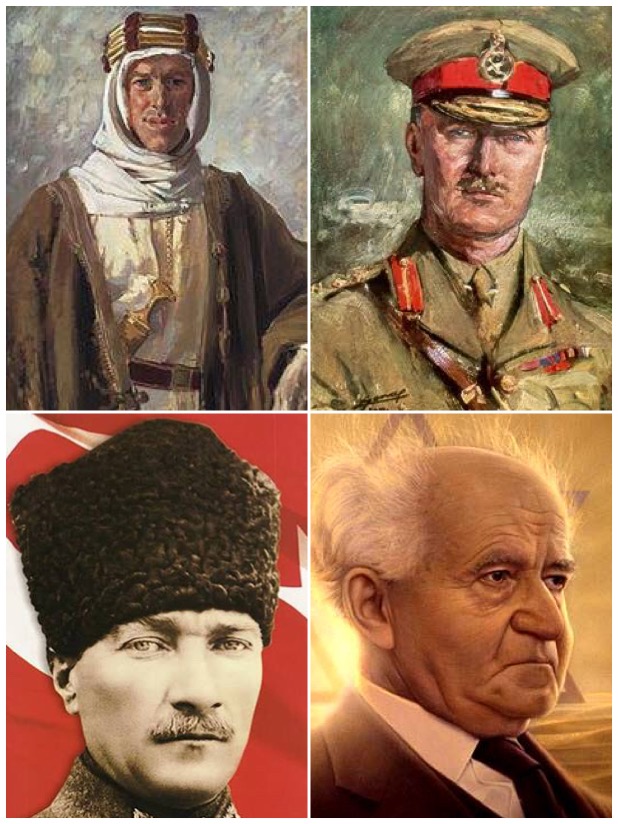
TE Lawrence, General Allenby, Ataturk, and Ben Gurion

The Ottoman Secret

By Raymond Khoury

The Ottoman siege of Vienna of 1683 sees the city fall and the Christian forces annihilated. Western Europe is conquered soon afterwards and in 2019, an increasingly repressive Sultan still rules the continent (though Britain and Russia withstood the onslaught and remain independent nations). A lot has happened in the world since 1683, and as Christendom was vanquished, many things just didn’t happen. Russia is still ruled by the Czars, and America by a post-Mayflower Christian theocracy. Concepts like democracy, freedom of thought and expression, and gender equality are ideas still struggling against heavy odds to be born.

We are in Muslim Paris in 2019. Kamal Arslan Agha is a patriotic, loyal subject of the the Sultan and a special investigator of the Tashkeelat-i Hafiye, the secret police, on the front line of the empire’s harsh response to increasing political and economic turmoil throughout Europe. The Caliphate’s efforts to maintain law and order spare no one, and soon, Kamal’s own family attracts the Hafiye’s attention.

His brother and sister-in-law discover a secret so dangerous, the Caliphate must suppress it, and with the foundations of the Empire under threat, Kamal’s family have no choice but to run. Whether or not they can escape the pursuing Hafiye will determine their own fate, and that of the Caliphate itself – its past, its present, and its future.

Khouri’s vision of a world dominated by conservative, repressive regimes combining religious conformity with modern technology is not a pleasant one. Western democracy might have its faults, but as Churchill said, it’s better than most of the alternatives.

This is, of course, fiction, written by a novelist and not a historian. Its political, cultural and technical milieu is predicated on “what if? What if the Ottomans had expanded and prospered for three centuries instead of gradually transforming into the “sick man of Europe” to be dissected and defeated by western powers? What if through serendipitous and underhand means, the empire has acquired the military, industrial, scientific and technical wherewithal to build over four centuries a world that in many ways in not unlike our own? What if their had been no enlightenment, no French or Russian revolutions, no Hitler, no Holocaust, no Hiroshima?

Incidentally, the siege of Vienna in 1683 gives its name to ‘Gates of Vienna’, a fanatically anti-Muslim far-right blog. Its essential thesis is that this was only one battle in a long war and that Europe and its civilisation are constantly threatened by a Muslim invasion.

As Kurt Vonnegut’s avatar Kilgore Trout would say, “so it goes …”

Sultans of Spring – if the Ottoman Empire hadn’t collapsed.

Imagine the mayhem that might have been avoided had the Ottoman Empire been saved rather than sunk. Blame, among others, Winston Churchill

When a Serb gunman shot an Austrian archduke in the summer of 1914, the nations of Europe tumbled into war with all the grace of bowling pins. Austria-Hungary declared war on Serbia, whose ally Russia declared war on Austria, whose ally Germany declared war on Russia, whose allies France and Britain declared war on Germany and Austria. By early August the continent was in flames.

Much as it wobbled like the rest, however, one of those bowling pins could not make up its mind. Which way would Turkey fall? Should the fading Ottoman Empire join the Triple Entente (Britain, France and Russia) or go with the Central Powers (Germany and Austria-Hungary)

Turkey’s 500-year-old empire was shrinking. It had lost its territories in Africa, nearly all its Mediterranean islands and most of its Balkan lands as well as chunks of eastern Anatolia. It was debt-ridden, industrially backward and politically shaky.

Still, the sultan’s lands straddled two continents, controlling access to the Black Sea. His Arabian territories stretched beyond the holy cities of Islam to the mountains of Yemen and the Persian Gulf, where there were rumoured to lie vast caverns of the sticky black liquid soon to replace coal as the world’s chief source of power.

Confident of Turkey’s weakness, Britain, France and Russia could have clobbered the Ottomans and divided the spoils. Thankfully, wiser heads prevailed. At a secret conclave aboard a British dreadnought off the coast of Norway in late July, a far-sighted politician by the name of Winston Churchill, then First Lord of the Admiralty, worked with French, Russian and Turkish diplomats to forge a treaty. The Turks drove a hard bargain for, as they coyly revealed, Germany too was proffering arms and gold in exchange for an alliance.

The deal that was reached proved immensely beneficial to all concerned. From France, Turkey received generous debt relief. Russia scrapped all claims to Ottoman territory, and made a limited goodwill withdrawal from parts of Anatolia. Churchill waived further payment on two warships that British shipyards were building for Turkey. And Turkey received assurances that its vulnerable extremities would not be attacked; for an empire that for a century had been preyed upon like a carcass this was a new lease of life.

The rewards to the Triple Entente were equally big. Granted exclusive access to the Black Sea, Russia’s allies could resupply the tsar’s armies when they faltered at the start of the war. With no need to defend its Turkish frontier, Russia moved thousands of crack troops from the Caucasus to shore up its front lines. Turkey signed separate agreements recognising British control of the Suez Canal, Aden and the Trucial sheikhdoms of the Persian Gulf, securing the sea lanes for Britain’s massive deployment of troops from the colonies to the Western Front. Turkey’s own army joined in a broad front against Austria-Hungary. Together, these Allied advantages are thought to have shortened the war by as much as a year; the Central Powers might not have sued for a truce as soon as America entered the war, but fought on instead.
Reprieved from collapse, the Ottoman Empire’s government pursued radical reforms. Challenged by growing nationalist tendencies from Arab, Armenian, Greek and Kurdish subjects, Sultan Mehmed V issued a historic firman or proclamation that recognised these as individual nations united under the Ottoman sovereign.

The sultan got to keep the title of caliph, commander of the Sunni Muslim faithful, which his ancestors had acquired four centuries earlier. This proved useful when the empire had to put down a rebellion of religious fanatics in central Arabia, led by a man called Ibn Saud who gained followers by claiming he would restore Islam to a purer state. But mostly the empire was seen as a tolerant place. When Nazi persecutions drove Jews from Europe in the 1930s, many took refuge there (as they had done when expelled from Spain in 1492), particularly in the province of Jerusalem.

If only…

Needless to say, none of the above happened. Quite the opposite. Turkey aligned with Germany in the first world war, and the allies did attempt to invade and divide its empire. Churchill, instead of handing over the warships that ordinary Turks had paid for by subscription, had them seized for the British navy. In 1915 he ordered a catastrophic attack on Turkey; the landing at Gallipoli cost the allies 300,000 casualties. British campaigns against Turkey in Iraq and the Levant cost another million lives.

Turkey’s casualties mounted, by war’s end, to 3m-5m people, nearly a quarter of the Ottoman population. This included some 1.5m Armenians, slaughtered because Turkish officials believed they might become a fifth column for a hostile Russia. And when Britain and France grabbed the Ottomans’ Arab lands, their suppression of uprisings cost thousands more lives.

How much of today’s mayhem in the Middle East, from civil wars to terror in the name of Islam (and of restoring the caliphate) to the emergence of sectarian dictators such as Bashar al-Assad, not to mention of such a grudge-bearing Ottoman revivalist as Recep Tayyip Erdogan, might have been avoided, if only Churchill had embraced Johnny Turk instead of sinking him?

Ataturk Monument, Istanbul

Here are other posts about Turkey past and present:

Sailing to Byzantium

The Watchers Of The Water

Cha … Cha … Changes

People Watching In Sultanahmet


That was the year that was – may you live in interesting times

As I contemplate my annual review of In That Howling Infinite, I am reminded, with clichéd predictability, of that well-worn Chinese curse: “may you live in interesting times”.

A torturous and seemingly endless US election campaign defied all the pundits by producing an colourful and unpredictable POTUS. In the UK, the unthinkable Brexit came to pass, dividing the polity and discombobulating the establishment. Next year is certainly going to be worth watching.

The slow and tragic death of Syria continued unabated with Russian and Turkey wading into the quagmire alongside Americans, British, French, Australians, Iran, Lebanon, Gulf tyrants, and Uncle Tom Cobley and all. Da’esh might be on the the ropes in Iraq, but the long term survival of the unitary state is doubtful. And the proxy wars of the Ottoman Succession have spread to Yemen, the poorest country in the Middle Eas as Gulf tyrants face off against Shia Iran’s alleged puppets, and, armed and abetted by British and American weaponry, South American mercenaries, and Australian officers, bomb the shit out of the place.

Whilst the grim reaper scythed through the world from Baghdad to Berlin, from Aleppo to Ankara, the Year saw the passing of a record number of icons of the seventies and eighties, two of whom who have provided a continuing soundtrack for my life, Leonard Cohen and David Bowie. We shall not see the like of them again.

In our little corner of the cosmos, we endured the longest and most boring election campaign in living memory, resulting in an outcome that only accentuates Australians’ disenchantment with a lacklustre Tory government, a depressingly dysfunctional political system, and politicians of all stripes who, blinkered by short-termism, and devoid of vision, insist on fiddling whilst the antipodean Roman burns.

Meanwhile, in our own rustic backyard, we find that we too are “going up against chaos”, to quote that wonderful Canadian songster Bruce Cockburn. For much of the year, we have been engaged in combat with the Forestry Corporation of New South Wales as it proceeds to lay waste to the state forest that surrounds us. As the year draws to a close, our adversary has withdrawn with only half of its proposed harvest completed. But it will return in 2017, and the struggle will continue – as it will throughout the state and indeed the nation as timber, coal and gas corporations, empowered by legislation, trash the common treasury with the assent of our many governments.

And yet, life on the farm remains pleasant and delightful, though dams are low and rain would be most welcome. The bird and reptilian life continues to amaze us, and an ironic corollary to the clear felling of the Tarkeeth Forest is that “refugees” are seeking shelter here. Wallabies rarely seen on our land are now quite common, whilst echidnas, and, we suspect, endangered spotted quolls have been sighted hereabouts

We took time out mid-year to revisit Israel and Palestine, and road-trip through the two countries was much an education as a holiday. We certainly got our history and archeology fix, and in travelling through the Golan and the Negev, we found respite in a stunning natural environment. But the answers to our many political questions merely threw up more questions. We have unfinished business in this divine but divided land, and will return.

In That Howling Infinite addressed all these concerns during 2016, and matters more eclectic and exotic.

And so, to the year in review:

The new year commenced with a reprise of our memorable journey to Hadrians Wall, and of the Victorian lawyer who helped preserve it for posterity, the saga of the viking Harald Hardraga and also, my subjective overview of world history. In a more lighthearted vein, I indulged in an unscholarly discussion of how film and fiction have portrayed or distorted history, and in a review of Mary Beard’s superlative history of Rome, I asked the immortal question “what have the Romans done for us?”

The Life of Brian

In April, in response to a discussion with a Facebook friend in Oklahoma, I wrote a trilogy of exotically-titled posts examining the nature of rebellion, revolution, and repression: Thermidorian ThinkingSolitudinem Faciunt Pacem Appellant, and Sic Semper TyrannisThe origin of these Latin aphorisms is explained, by the way, in the aforementioned Roman review.

Nightwatch

Our travels through Israel and Palestine inspired numerous real-time posts, and a several retrospectives as we contemplated what we had experienced during what was as much an educational tour as a holiday. Historical vignettes included a tribute to bad-boy and builder King Herod the Great, a brief history of the famous Damascus Gate, and its place in Palestinian national consciousness, and a contemplation on the story of King David’s Citadel which overlooked our home-away-from home, the New Imperial Hotel. Thorny contemporary issues were covered with an optimistic piece on the Jerusalem Light Rail, a brief if controversial post about  Jewish settlers in the Old City, the story of Israel’s ‘Eastern’ Jews, the Mizrahim, and what appears to be a potentially problematic Palestinian property boom. Th e-magazine Muftah published an article I wrote about the conflicting claims to the city of Hebron. And finally, there is a poem recalling our visit to the Shrine of Remembrance at Yad Vashem and honouring the Righteous Gentiles who saved thousand of Jewish lives during the Shoah.

Carnivale

Wintertime passed with our minds on the Tarkeeth Forest. I had the pleasure discovering the history of our locality, and connecting via Facebook with the relatives of the Fells family of Twin Pines. But the latter half of the year was very much taken up with enduring and bearing witness to the clear- felling of the forest to our east. “If you go down to the woods today, you’re in for a big surprise.  If you go down to the woods today, you’ll never believe your eyes”. And you’d ask “what would JRR Tolkien have thought?”

Nothing quite prepares you for the devastation of clear felling. Joby, a Gumbaynggirr elder, surveys the Tarkeeth

The UK And US paroxysms fascinated and exasperated the mainstream and social media in equal measure, whilst the outcome of the Brexit referendum and the presidential election has initiated an a veritable orgy of punditry. Never have so many column inches and kilobytes been spent on loud sounding nothings as the sifting through the entrails of such events as Brexit, the US election, and the Australian senate! With half a dozen elections coming up in Europe, Trump’s inauguration and the triggering of Article 50 to take Britain out the European Union, we’re gonna have to endure a lot more. I confined my posts to two insightful pieces by respected right-wing Australian commentators, Paul Kelly’s Living in Interesting Times, and Greg Sheridan’s The Loss of American Virtue, and my own reflection on the right-wing media’s strange fascination with “insiders” and “outsiders”.

Finally, in comparison to last year, this year was very light on music and poetry. But American satirist Tom Lehrer got a retrospective, and murdered Pakistani qawwali singer Madhaf Sabri, an obituary, whilst an abridged and vernacular version of John Milton’s Paradise Lost told the tale of Lilith, the first and greatest femme fatale. In the words of the gloriously-named jockey Rueben Bedford Walker III says in EC Morgan’s magnificent The Sport of Kings, the subject of my first post for 2017, “Malt does more than Milton can to justify God’s ways to man”.

On that wise note,  I wish the world a Happy New Year – and may it be less interesting than this one.

In That Howling Infinite  is now on FaceBook. Check it out.  And just for the fun of it, here’s my review of 2015.

The Sabri Brothers

Dore Luciifer

Roman Wall Blues – life and love in a cold climate

Over the heather the wet wind blows,
I’ve lice in my tunic and a cold in my nose.
The rain comes pattering out of the sky,
I’m a Wall soldier, I don’t know why.
The mist creeps over the hard grey stone,
My girl’s in Tungria; I sleep alone.
Aulus goes hanging around her place,
I don’t like his manners, I don’t like his face.
Piso’s a Christian, he worships a fish;
There’d be no kissing if he had his wish.
She gave me a ring but I diced it away;
I want my girl and I want my pay.
When I’m a veteran with only one eye
I shall do nothing but look at the sky

We’ve marvelled at Roman brickage from Syria to Cirencester, from Bath to Baalbek, but had never ventured to Hadrian’s Wall in Northumbria. WH Auden’s whimsical song, Roman Wall Blues, came to mind as we stood atop the windswept knoll that is Housesteads Roman Fort on a freezing May morning.

In the preface to Pax, the latest volume of his magisterial history of the Roman Empire, English historian Tom Holland notes that the northern bank of the river Tyne was the furthest north that a Roman Emperor ever visited. What was so important about Hadrian’s visit to Tyneside in 122AD was his decision there to mark in stone, for the first time, the official limits of his Empire. North of this great wall, there was paucity and unspeakable barbarism, scarcely worth bothering about; below the wall was civility and abundance and the blessings of Romanitas. To this day, those 73 miles of the Vallum Hadriani across the jugular of Britain still shape the common conception of where England and Scotland begin and end, even though the wall has never delineated the Anglo-Scottish border. For this colossal structure left enduring psychological as well as physical remains. To the Saxons, it was “the work of giants” and was often thought of as a metaphysical frontier with the land of the dead.

George RR Martin, author of The Game of Thrones, the artistic juggernaut, has said that his Ice Wall separating the northern wintry waste with its nomads and its demons from the settled and temperate Seven Kingdoms of Westeros with it castles and cities, it’s palaces and slums, it’s despots, destitute and the depraved, was inspired by a visit to Hadrian’s Wall – only he built it much longer and much, much higher.

“We walked along the top of the wall just as the sun was going down. It was the fall. I stood there and looked out over the hills of Scotland and wondered what it would be like to be a Roman centurion … covered in furs and not knowing what would be coming out of the north at you. George RR Martin has said that his Ice Wall separating the northern wintry waste with its nomads abd its demons from the settled and temperate Westeros with it castles and cities, it’s palaces and slums, and destitute and the depraved, was inspired by a visit to Hadrian’s Wall – only he built it much longer and much, much higher. “We walked along the top of the wall just as the sun was going down. It was the fall. I stood there and looked out over the hills of Scotland and wondered what it would be like to be a Roman centurion … covered in furs and not knowing what would be coming out of the north at you”.

There we were, then, on the edge of empire. The Roman Empire, that is. Among outposts and outcasts. Up on the hills in the nithering wind and the cold rain, the snow and the sleet, and in the valley below with the baths and the brothels. This is where worlds collided. Between the Roman cives and their satraps, and the barbarians of the northlands. Between Britannia and Caledonia. Where solders from Rome and the Italy-yet-to-be that surrounded it, from Gaul, Batavia, Asturias and Tungria, now France, Spain and the Low Countries, from Germania and Sarmatia in Central and Eastern Europe, marched and marauded, drank and dined, foraged and fucked, lived and died.

At the height of Empire, some seven hundred soldiers manned the fort we now call Housesteads, up high on the moors, a windswept outcrop with a vista of 360 degrees and a temperature near zero. Many more legionaries garrisoned the more sheltered Chesters Fort in the nearby-by valley below where the wall crosses the Tyne. These included cavalry, drafted from Sarmatia, in present day Hungary. This was the fanciful premise of King Arthur (2004) starring Clive Owen as a handsome, tortured soul wandering through a flawed film and Keira Knightly as a scantily clad, elfin  warrior Guinevere, backed up by a gallant band of photogenic heroes who hailed from the eastern steppes.

When the Romans departed Britain, Hadrian’s Wall fell into disrepair – it was always permeable, and in time, had served its purpose – which was perhaps as much about public relations as protection. Archeologist Terri Madenholme wrote in Haaretz: “Despite itself having a culture of violence, Rome aimed to project an image of a nation of the civilized, and what better way than having it monumentalized in stone? When Hadrian set to build the 73-miles-long wall drawing the border between Roman Britannia and the unconquered Caledonia, the message became even more clear: this is us, and that’s them. Hadrian’s Wall was much more than just a border control, keeping the Scots in check: it was a monument to Roman supremacy, an attempt to separate the civilized world from the savages”.

“He set out for Britain”, Hadrian’s historian tells us, “and there he put right many abuses and was the first to build a wall 80 miles long [Roman miles] to separate the barbarians and the Romans.”

image

Housesteads Fort

At Vindolanda, to the south, a small town grew up around a large military camp. First of wood and then of stone, constructed by the legionnaires themselves, who included in their number skilled masons and carpenters. Their settlements endure to engage our imaginations today. In times of turmoil, these soldiers fought and fell. In quieter times, they relaxed and recuperated. And the locals gathered about them, built houses and gardens, opened shops and pubs and those aforementioned brothels. And life went on like it does in our time.

During conflict, the Roman auxiliaries guarded the borderlands, deterring the Picts, a dark-skinned painted people who raided from the northern badlands. When peace prevailed, the locals visited, traded, and settled in the viccii or villages that grew organically to the south of the forts that were constructed at intervals along the empire’s perimeter wall. There, they traded, and provided goods, services and entertainment for themselves and for the martial strangers that had come among them from faraway places they’d never heard of.

In the early days, the auxiliaries were not permitted to bring wives and children to the frontier. But folks being folk, they very soon established friendly relations with their neighbours, and legionaries would keep informal wives and families in the vicus. Soviet writer and war-correspondent Vasily Grossman encapsulated all this poignantly and succinctly in An Armenian Sketchbook: “The longer a nation’s history, the more wars, invasions, wanderings, and periods of captivity it has seen – the greater the diversity of its faces .Throughout the centuries and millennia, victors have spent the night in the homes of those whom they have defeated. This diversity is the story of the crazed hearts of women who passed away long ago, of the wild passion of soldiers intoxicated by victory, of the miraculous tenderness of some foreign Romeo towards some Armenian Juliet”.

Officers were allowed to bring their wives and children to their postings, and these endured their provincial, primitive exile by importing the necessities of a comfortable Roman life, including the celebrated Roman plumbing and central heating. Chesters boasts the best preserved military bathhouse in Britain. And so, the accessories of civic consumerism reached the frontier. Food and wine from the warm South were transported to the cold north-lands. Fashions in clothes and jewelry, day-to-day articles and artifacts, from glass and pewter dinnerware to cutlery, tools and sundry hardware. Recently, it has been revealed that these domestic items included what is believed to be the only known Roman dildo. Remnants and reports gathered in the Vindolanda museum open a window into a gone world.

Housesteads Fort

The wonderful Vindolanda tablets have preserved a picture of the oh-so-normal lives of these transplanted souls so far away from home. Amidst accounts and inventories, orders and troop dispositions, a quartermaster reports that supplies of beer are running low. An officer writes to another in a neighboring fort inquiring about the availability of accommodation for visitors and the quality thereof. One tablet reveals that Roman soldiers wore underpants, which, in view of the locale and climate thereabouts, is comforting to know. And another recounts workplace harassment and bullying that would today invoke grievance procedures. The wife of an officer invites another to a birthday party at her house in Vindolanda. There is an undercurrent of “Please come, I am bored shitless”, though a polite Roman matron would not commit such sentiments to a wooden tablet (nor reveal to her friend the existence of that aforementioned sexual comforter). It is probably the oldest surviving document in Latin written by a woman.

So who were these folk so near to us in their needs and desires, their hopes, fears and expectations, and so far from us in time, space and purpose? What did they think and feel? It is a question oft asked by empathetic history tragics. The thinking of another time can be hard to understand. Ideas and ideologies once compelling may become unfathomable. And the tone and sensibility that made those ideas possible is even more mysterious. We read, we ponder, and we endeavour to empathize, to superimpose the template of our value system, our socialization, our sensibilities upon the long-dead. And thence, we try to intuit, read between the lines, draw out understanding from poems, plays, novels, memoirs, pictures, photographs, and films of the past.

We feel we are experiencing another facet of the potential range of human experience. But in reality, we are but skimming the surface, drawing aside a heavy curtain for a momentary glimpse through an opaque window into the past. Yet, we persist nevertheless, because that is what humans do. Over two and a half thousand years ago, the controversial Greek poetess Sappho wrote ”I tell you, someone will remember us; even in another time”.

And in Vindolanda, up there on the wall, on the weather-beaten rim of the long-gone empire, we do  …

© Paul Hemphill 2015.  All rights reserved

Chesters Fort

The best Roman baths in Britain at Chesters Fort

Here is some further reading about Vindolanda.
http://www.vindolanda.com/
http://en.m.wikipedia.org/wiki/Vindolanda_tablets
http://vindolanda.csad.ox.ac.uk/tablets/browse.shtml

And some pieces from my ‘Roman’ period:  Roman Holiday: What have the Romans done for us?:  Cuddling up to Caligula. Read also about what happened when Harald Went A Viking

Blood and Brick … a world of walls

Postscript – The Man who saved Hadrian’s Wall

One of the great unsung saviours of the UK’s heritage is remembered in the museum housing his remarkable collection at Chesters Roman Fort Museum which houses the Clayton Collection of and 5,500 catalogued items from a variety of sites along the central section of the wall.

Few people today have heard of John Clayton, yet he is one of the single most important individuals in the history of Hadrian’s Wall.

A classically educated Victorian gentleman who combined demanding roles running the family law firm and acting as town clerk for the city of Newcastle-upon-Tyne, Clayton had a passion for archaeology and the Roman military legacy in his beloved Northumberland.
Were it not for Clayton, large parts of Hadrian’s Wall would have disappeared as the industrial revolution fuelled the demand for stone to build factories, mines and mills. His role in the preservation and survival of Chesters Roman Fort – the best-preserved Roman cavalry fort in Britain, is now undisputed.

In the early 19th century Clayton lived at Chesters House in the parkland surrounding the Roman fort and from an early age became fascinated by the Roman relics that surrounded him.

By the 1830s he began buying land to preserve the Wall, at a time when what is now a World Heritage Site was little understood,  and was being unthinkingly vandalised by quarrying and removal of stones for reuse. Clayton’s enthusiasm helped preserve the central stretch of Hadrian’s Wall that includes Chesters (Cilurnum), Housesteads and Vindolanda. He carried out some of the first archaeological excavations on the Wall and even brought early tourism to the area by displaying some of the finds at Chesters. Clayton managed the estate and its farms successfully, generating cash to fund further preservation and restoration work on the Wall. He never married, and died in 1890

The museum housing the Clayton Collection was opened next to the fort site in 1903, 13 years after his death. It is privately owned but curated by English Heritage on behalf of the Trustees of the Clayton Collection, and has been refurbished to bring it up to 21st century standards of conservation, display and interpretation. Yet, great care has been taken to respect its character and to retain the feel of a 19th century gentleman antiquarian’s collection, and many of the labels and original cases have been retained..

John Clayon

For more on Clayton and his museum, read:

http://www.culture24.org.uk/history-and-heritage/art56960

The Long Road To Waterloo

The rebel yell that resounded in Paris in the summer of 1789 reverberated around Europe for 26 years until it sounded for the last time on the fields of Waterloo. On an overcast summer’s morning on Sunday 18th June, two hundred years ago, over one hundred thousand soldiers prepared to face each other in damp Belgian farmland. More gathered during that “longest day”. When darkness fell, up to fifty thousand of them lay dead or seriously wounded. A British rifleman would later recall: “I had never yet heard of a battle in which everybody was killed, but this seemed likely to be an exception, as all were going by turns.”

To historians, Waterloo is one of the great battles of history, a turning point, the beginning of the modern era. It ended the wars that had convulsed Europe – and since the French Revolution,  the First French Empire and the career of Napoleon Bonaparte, one of the greatest commanders and statesmen in history. And it ushered in almost half a century of international peace in Europe; no further major conflict occurred until the Crimean War.

This song is for all those men who, after these long years of war, never came home.

https://soundcloud.com/user6120518-1/the-song-of-the-soldier-1815.

The Song Of The Soldier

Chaos is majestic in its way. I contemplate this vista of destruction and death with pain and helplessness in my soul.  
Red Army Captain Pavel Kovalenko, in All Hell Let Loose, Max Hastings, 2011

Before him, he carries noise, and behind him, he leaves tears; death, that dark spirit,
in’s nervy arm doth lie; which, being advanc’d, declines, and then men die.
Volumnia, in Shakespeare’s Corialanus, Act 2, Scene 1.

A new age dawned when the Bastille fell
Twenty six long years ago.
We marched the road of Europe
In the revolution’s glow.
In the floodtide of that revolution,
We bartered our young lives away.
And shoulder to shoulder we stood to arms
And held our foes at bay.

Against the might of empires,
Beyond our wildest dreams,
We fought the professional armies
Of Europe’s old regimes.
And hungry, tired and poorly armed,
We ragged volunteers
Pushed them back in disarray
Far from our own frontiers.

And we talked that time of setting stars
And the twilight of great powers.
And we never once thought that the sun would set
On an empire such as ours’.
But the siren song of liberty
Has lost its golden thrill.
The new age is now stained with blood
And we are marching still.

There came a great adventurer
For whom France was much too small.
As if we’d had not enough of war,
We answered to his call.
He was like a father unto us.
He served his children’s need.
A substitute for politics, for intellect and greed.

But he overreached in pomp and pride
To serve his vanity.
And we, the soldiers of the line,
Paid with our blood his fee.
‘til the whole world turned against us.
It neither forgot nor forgave
We who came to liberate
But stayed on to enslave

And we talked that time of setting stars
And the twilight of great powers.
And we never once thought that the sun would set
On an empire such as ours’.
But the siren song of liberty
Has lost its golden thrill.
The new age is now stained with blood
And we are marching still.

From the dust of Torres Vedras
To the bloodstained Russian snow.
We followed the Eagles loyally.
Never questioned why we go.
‘til the tide of conquest turned abut,
And showed us how it feels
To retrace weary footsteps
With the wolves hard at our heels.

And now we march our final march
On Belgium’s fertile soil.
We see an end to all or pain
And an end to mortal toil.
And the dream which fired us through the years
Has nothing left to yield
But peace that comes from a nameless death
On a confused battlefield.

And we talked that time of setting stars
And the twilight of great powers.
And we never once thought that the sun would set
On an empire such as ours.
But the tyrant song of liberty
Has lost its golden thrill.
The new age is now stained with blood
And we are marching still.

© Paul Hemphill 1984

A Short History Of The Rise And Fall Of The West

See also:

https://howlinginfinite.com/2016/04/08/thermidorian-thinking/

 http://www.economist.com/news/books-and-arts/21651775-appallingly-bloody-yet-decisive-battle-waterloo-june-1815-deserve

http://www.telegraph.co.uk/culture/books/bookreviews/11075393/Waterloo-by-Tim-Clayton-and-Waterloo-the-Aftermath-by-Paul-OKeeffe-review-compelling.html

The Spirit of ’45

I was a child of the Welfare State.

Born in the early years after the end of World War II, I was aware that the dominant mood was relief that it was over, sadness at those lost and most importantly a forward looking attitude to improve things and not simply to get back to what life had been like before. The traces of the conflict were all around me in once blitzed Birmingham – in the barren, levelled  ‘wastelands’ where streets had once stood, in the austerity, and the monotonous and monochrome drabness of couture and cuisine. To my boyish mind, “the war” was a shared community experience, a shadow which few, I now recall, talked about; but also, the stuff of puerile fantasies fostered by comic books, Airfix models, and patriotic movies that were literally and figuratively black and white.

Life was not all roses in those immediate post-war years, but better by far than what went before. Rationing was still in place when I was born in Birmingham in 1949, not ending until 1954. Young men still had to do their national service (the last call up was in 1960, the year I started Secondary school). We lived with our aunt in a cold-water, back-alley walk-up on the border of Balsall Heath (just inside Moseley, a ‘better’ suburb). Aunty Mary was my mother’s mother’s sister. When her sister died and daddy Paddy ran off with another women, Mary brought the six children over to Birmingham from Enniscorthy, County Wexford one by one. She had come to Birmingham from Ireland before the war, after her husband had run off (these things happened in Catholic Ireland). And she lived in that same old house right through the Blitz when German bombers regularly targeted The Second City’s engineering, motor and arms factories, and not a few public buildings including the Piccadilly and Waldorf cinemas on nearby Stratford Road.

I was born in her house. She had a friend who had once given birth, so that friend was the midwife. My brothers followed over the next two years. By then, National Health Service had kicked in, so they were born in hospital. Childbirth, forever dangerous, was now rendered less life threatening. There we all lived, three kids, our folks, three uncles, two aunts, a dog and a cat. Three bedrooms, girls in one, boys in another, and our family in the third. Outside loo and coal shed, no bathroom or hot water (we kids bathed in the kitchen sink and grown- ups went down to The Baths), Cold and damp, and close to the shops. And there we lived until, in 1956 when a council house in Yardley Wood became our first family home. Cold and colder running water that froze in winter, but it was at least inside the house;  bathroom with hot water boiled in a big gas boiler; and an outside flush lavatory that was nevertheless immediately adjacent to the backdoor and not down the garden. A big garden too, for winter and spring vegetables, and summer camp-outs.

There we grew, with free medical treatment for all our ailments, and free optical and dental care. I still have crooked teeth – no fancy orthodontics on the NHS – but I have all my teeth still. And my eyesight. We were educated, for free. This came in during the war with the Butler Act. So, thanks to the Welfare State, we were housed and healthy enough to get to primary school and beyond. Once there, we had free books, free pens and paper, and compulsory sport, and doctors and nurses would turn up on a regular basis to check our vitals. And thus, we were able to reach the glorious ‘sixties ready to rock ‘n roll.

Which brings me by a circuitous route to British director Ken Loach’s 2013 documentary, The Spirit of ’45,  a celebration of the radical changes that took place under the Labour government of Clement Attlee which came to power in 1945.

What a year that was! No sooner had the war ended, than the British electorate voted out its esteemed and beloved war leader, Winston Churchill, and bought Labour’s promise of a democratic socialism. Drawing on archive footage, and presented in black and white with contemporary interviews with dockers and miners, doctors and nurses, politicians and economists, Loach describes the nationalisation of the public services, and their subsequent privatisation three decades later. His interviewees provide poignant anecdotes about the poverty of the 1930s, dangerous and exploitative working conditions, poor housing, and abysmal health care, and the renewed sense of purpose and optimism after the end of the war and Labour’s landslide victory. He recounts the subsequent expansion of the welfare state, with its free to all medical service, and the nationalization of significant parts of the British economy, most notably, electricity, the railways, and the mines.

The Attlee government was elected due to a general belief that nothing would or could be as it had been before. Britain had pulled together to win the war; now, it would transform the peace. This was The ‘Spirit’ of ’45.

But whilst ‘spirit’ can imply  ‘esprit’ and elation, it can also mean ‘ghost’ insofar as Loach rages against the death of all that hope, optimism, and vision in the decades that followed.. It is a call to arms for a return to the public unity of those heady post-war years and against the policies of subsequent governments, and most particularly those of Margaret Thatcher, that have progressively demolished the Britain that Clement Attlee and Aneurin Bevan strove to build. And it is a reminder that the NHS is worth fighting for at a time when it is being progressively dismantled. With stills of modern soup kitchens and the Occupy movement camped outside St Paul’s, Loach clearly believes that Occupy inherits that spirit of ’45.

Viewing The Spirit of ’45 was exhilarating. It was full of Wow! moments. The footage of the poverty of the depression years, the slum dwellings, urchin children playing on the streets or on the slag heaps, the unemployment queues, the scavenging for coal, the Jarrow March. Diseases now preventable or eradicated, then mortal. Five in a bed, and two of them dead. Malnutrition and rickets. Bread and dripping sandwiches? You needed beef for dripping. Fat chance. It was bread and jam, thank you (and grateful for it, one was tempted to respond – there were indeed some Monty Python moments there, particularly the one-down-manship sketch “when I was a lad, we were so poor…”

Relying so heavily on memories and reminiscences, the film is nostalgic, sentimental, and simplistic even, with little in-depth analysis. A tick-a-box of the many innovations that greeted the arrival of the baby boomers. Presented in such a clear and uncluttered fashion, it was quite stirring. That is Ken Loach for you. What you see is what you get: a one-sided history lesson.

The film leaps from the Attlee government straight into the darkest days of the Thatcher government, with no discussion of the political, economic and social changes and challenges in between. The road from Clement to Maggie was an eventful and for many, a traumatic one. The Counter Revolution took decades to establish itself. The great experiment of 1945 contained the seeds of its own destruction.

Loach’s focus on the years of nationalization and privatization makes narrative and dramatic sense.

But the years in between were dramatic also. Read Dominic Sandbrook’s great quartet. The titles say it all: Never Had It So Good: A History of Britain from Suez to the Beatles; White Heat: A History of Britain in the Swinging Sixties; State of Emergency; The Way We Were: Britain 1970–1974; and Seasons in the Sun: The Battle for Britain, 1974-1979. These were best of times, these were the worst of times, as the Great Man might have said. And the worst was to come, when Britain apparently went down the gurgler, and Thatcher had to break it to fix it. And like Dr Frank’s monster, it did not quite come back together right.

The Spirit of ’45 received favourable reviews (one follows), most writers qualifying their praise with Loach’s unapologetic partisanship – he is Ken Loach, after all, and you either dig him or you don’t. My favourite film is his 1995 Spanish Civil War drama, Land and Freedom. And you most certainly don’t get a balanced view of that conflict from this. As with The Spirit of ’45, you just sit back and go for a revolutionary ride.

See also othet memories in In That Howling Infinite:

Dave Calhoun, Time Out, 11th Feb 2013

Ken Loach rarely makes documentaries, and when he does, they’re usually about an urgent topical issue, such as the 1980s miners’ strike (‘Which Side Are You On?’) or the 1990s Liverpool Dockers’ strike (‘The Flickering Flame’). On the surface, ‘The Spirit of ’45’ takes a longer view than those films. This rousing and saddening film reminds us of the air of progress and reconstruction that took hold in British politics immediately after World War II. It takes us right back to the founding of the welfare state and, with it, the nationalization of the health service, transport, energy, housing and other areas of public life, as initiated by Clement Attlee’s 1945-1951 Labour government. The faces we see at the beginning of the film of young Britons celebrating in the fountains at Trafalgar Square in May 1945 symbolize the hope of a nation: that things can only get better after six years of war.

But Loach, the director of ‘Kes’ and ‘Looking for Eric’, is equally concerned with the spirit of modern Britain. For him, the socialism of our past – of Attlee and his comrades Nye Bevan, Herbert Morrison and others – could teach the present a thing or two. And so the second part of ‘The Spirit of ’45’ ponders an altogether different mood than that in the 1940s: Thatcherism and the more recent failure of organised labour to live up to its founding principles. If ‘The Spirit of ’45’ might provoke David Cameron to raise his eyes skywards, it might also have Ed Miliband cowering behind an unwritten manifesto. Loach’s quiet, unforced position is that the left is equally guilty of abandoning the promise and passion of the post-war years.

Yet, as political essays go, this is a tender, soft and humane film. It’s a compelling mix of interviews, old and new, with archive footage, much of it from old newsreels and public information films. There’s no voice-over, just faces and voices – the voices of ageing nurses, doctors, miners, union officials and others, alongside a handful of economists and historians. Some of Loach’s arresting interviewees, like Sam Watts from Liverpool and the former Welsh miner Ray Davies, recall what poverty looked like in the 1930s, reminding us why the welfare state was necessary in the first place. Others, like a trio of nurses from Manchester and the Welsh GP Dr Julian Tudor Hart, remember the excitement and the work of the early NHS. In fact, the NHS emerges as one of the film’s chief concerns: it’s both the great survivor of the welfare state and the institution of that age currently facing the biggest threat from political decisions.

Ninety-odd minutes is not enough for this subject. There are inevitable omissions (no education, for example), and Loach makes a slightly jarring leap from a chronology of nationalization that speeds through the 1950s and ’60s to the 1979 election of Thatcher. But always apparent is his clear thesis and the infectious commitment and fervour of his interviewees. The film works all at once as a lament, a celebration and a wake-up call to modern politicians and voters.