Riding Shotgun in Jerusalem

I know we’ve come a long way,
We’re changing day to day,
But tell me, where do the children play?
Cat Stevens

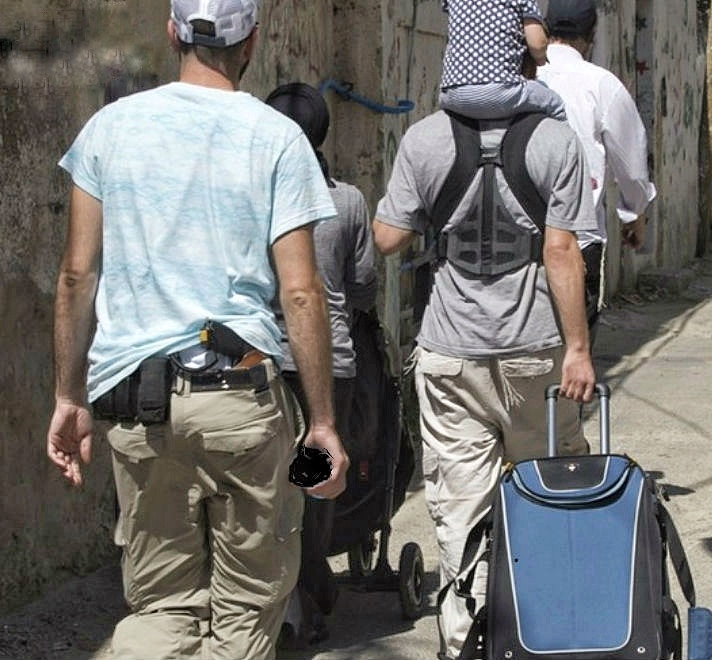
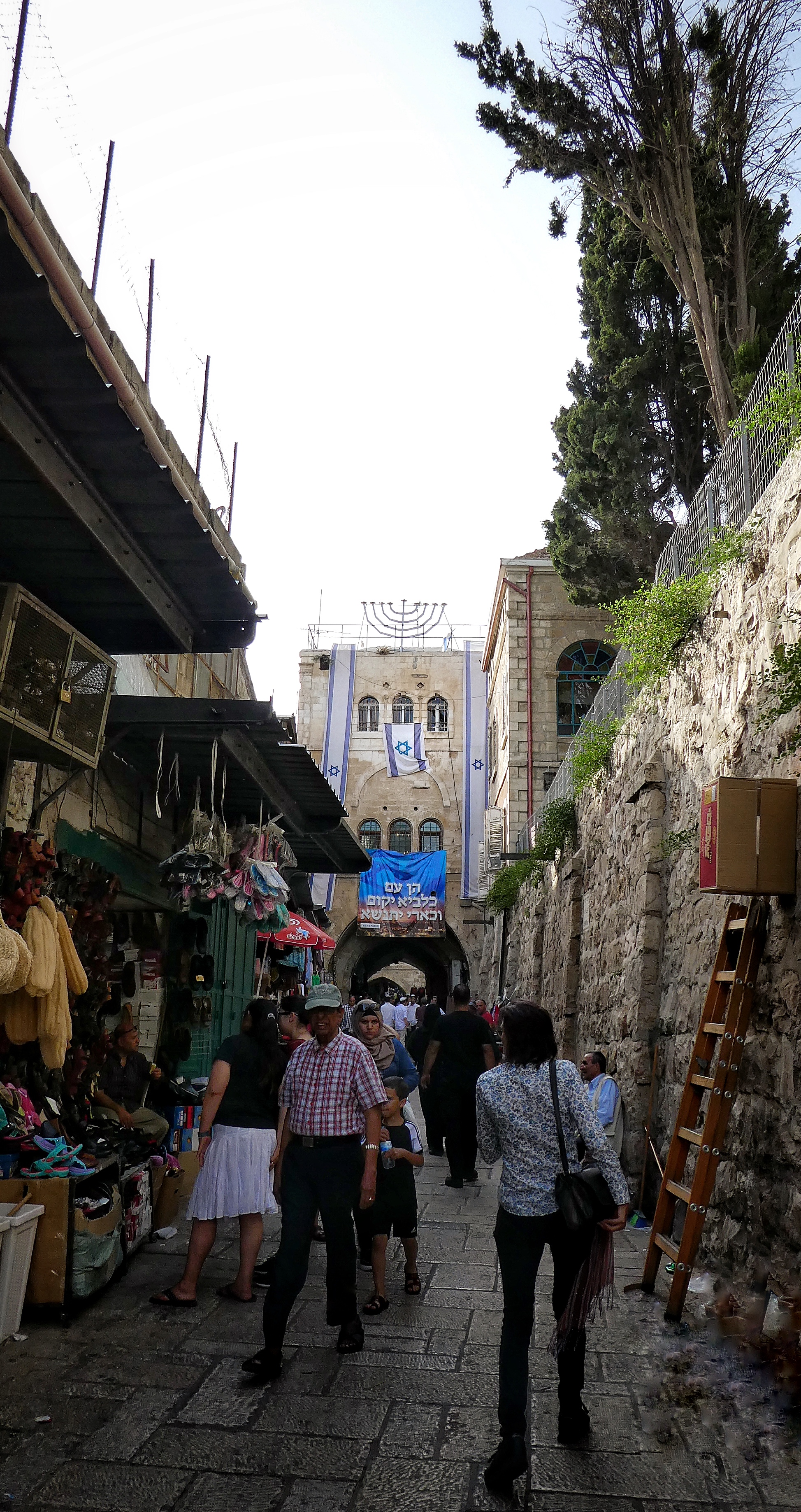
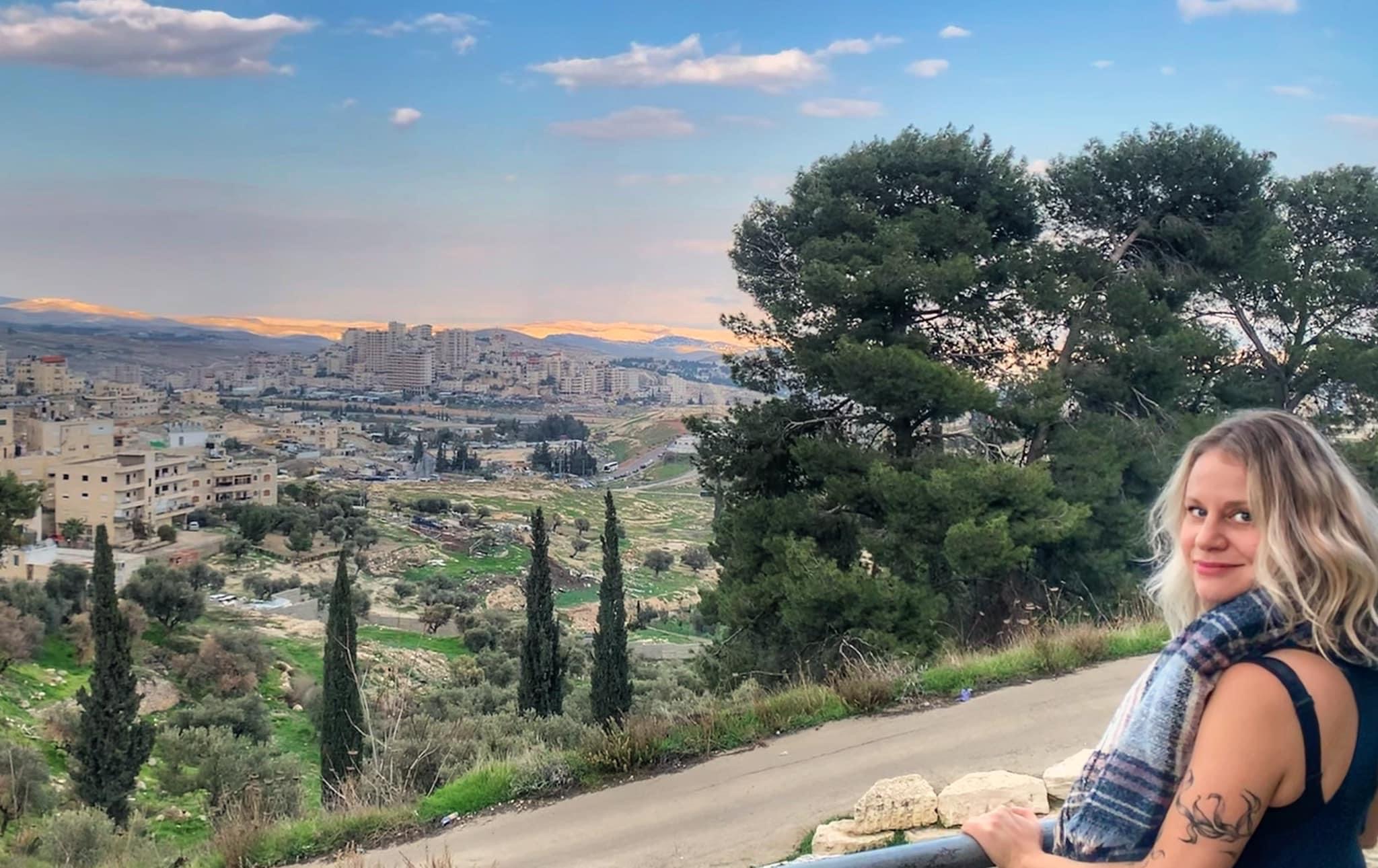
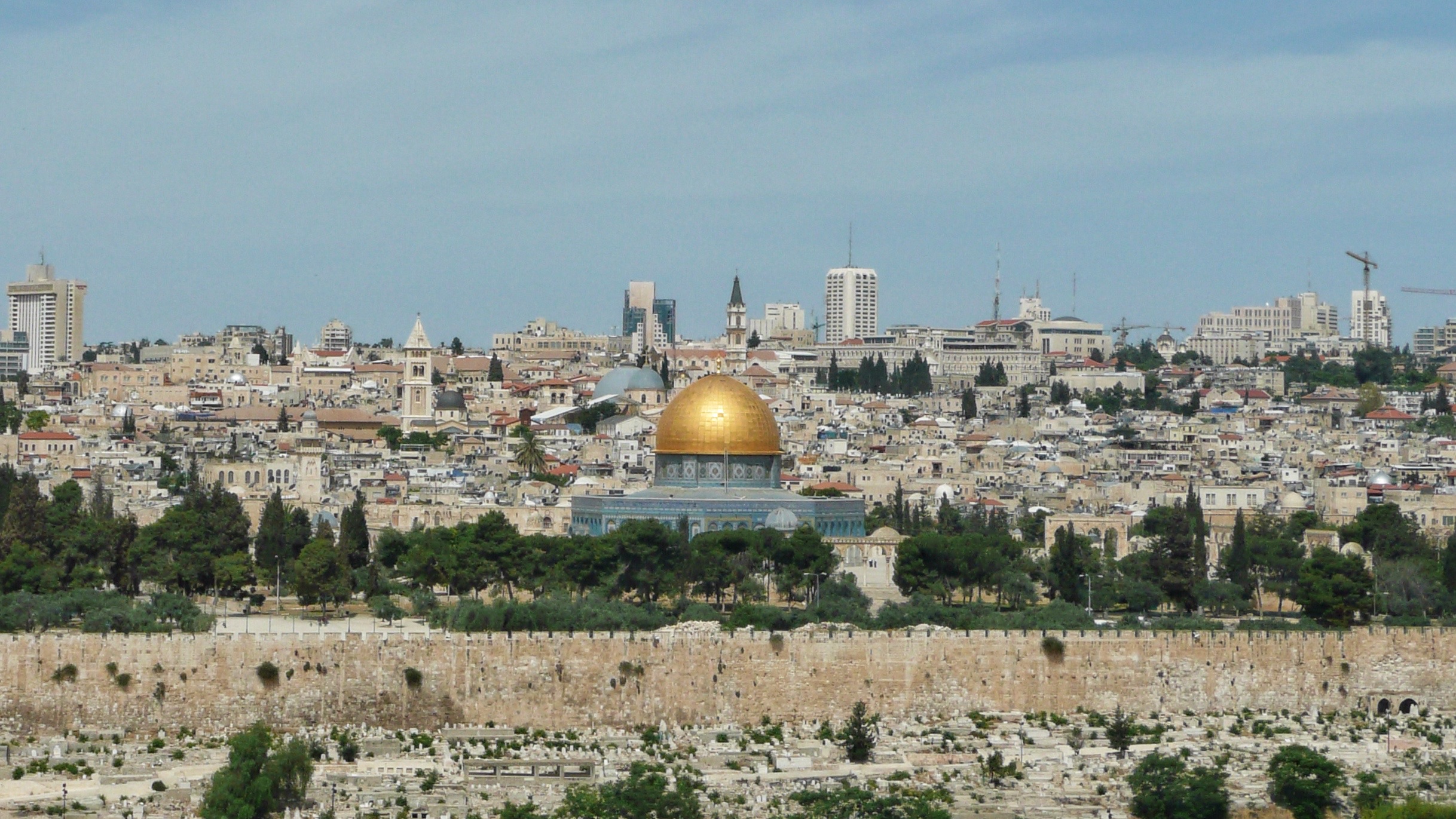
A feature of the growth of Jewish “settlements” in the Old City of Jerusalem – houses occupied by Jewish families, bought or rented from Muslim and Christian owners through a mix of arms-length transactions, subterfuge, proxy purchasers, and intimidation – is the appearance of “kindie convoys ” in the crowded, colourful, bustling streets of the Muslim Quarter.

You will be walking down Suq al Khan az Zait towards the Danascus Gate, or al Wad, the Main Street, towards where it crosses the Via Dolorosa at the IV and V Stations of the Cross, amidst busy weekend shoppers and folk heading to the Haram for Friday prayer. Then, of a sudden, like a school of little fish, a gaggle of small children in kippas and backpacks flows onto the crowded street, enroute to kindie or home.

But these kids are like none other around them – those running, jumping, excitable, hyperactive Arab children who regard these ancient streets as their playground. For the Jewish littlies are being herded, and guarded, by slim, casually dressed young men with tee shirts over what appear at first glance to be bulging waistlines, but are in fact utility belts that would make Batman proud, and concealed handguns.

Two to the fore, two aft, and two more on each side of the infant convoy, keeping them in line and coaxing in the strays who meander out of the designated two-by-two line. And all the time, these young men turn and scan the streets, pedestrians, the roof tops, constantly alert, constantly scanning – and not being discrete about it either. They make no pretense at subtlety. For their very attitude is a warning, a demonstration of firepower, to any who would disturb or threaten their little convoy in any way: “you don’t want to mess with us!”

It reminded us of the scene in Series Three of “Deadwood” when, after Alma Garrett is fired upon by Hearst’s hired guns, antihero Al Swearengen orders his men to watch over her as she walks to her bank.

We follow them for quite a distance – immediately behind them, in fact -, and the rearguard look us up and down too. This is not the time for grabbing a Kodak moment.

Then, just as suddenly as they first appeared, the young men herd their charges into the passageway of a hidden house, or up a deserted alleyway, the wary rearguard facing the street until their cargo is safely delivered.

And then they are all gone.

Demographic Qualifier

The events described above took place in the Muslim Quarter of the Old City.

The population of the Old City is overwhelmingly Muslim – are an estimated thirty thousand Muslims here, and the population is growing due to high birth rates.

In the past, Christians, predominantly Armenian and Greek Orthodox, constituted a significant minority, concentrated in the centuries-old Christian and Armenian Quarters. The Arab Christian population has declined significantly since 1967, and stands at less than 6,000 according to the latest census figures. As with so many things in Jerusalem, appearances are deceptive. In the Christian Quarter, where pilgrims and clergy throng 24/7, almost all of the shops that cater for the tourists and the faithful are owned by Muslim Arabs as Christian owners have sold up and departed.

Christian numbers have declined drastically over recent decades, a development that has been mirrored throughout East Jerusalem and the Occupied Territories. From some 20% during the Mandate, to under 1% today. Bethlehem was once a predominantly Christian city, and this is no longer the case. Ramallah’s population used to be about 20% Christian, but no more.

The Jewish Quarter, which appears so vibrant and fresh since being rebuilt and repopulated 1967, and bustling with people visiting the Kotel and the many synagogues, is home to some three thousand souls only. In addition, there are some two thousand transient yeshiva students. Apart from the Jewish Quarter, Jewish residents are very few, living in dwellings scattered throughout the Muslim Quarter.

A Bigger Picture

This is Jerusalem. In London, Paris, and in other cities throughout Europe, synagogues and Jewish schools are for good reason under armed guard as antisemitism rises.

image

 Further reading:

http://israelwithstyle.com/armed-escort-and-bodyguards-jerusalem/
https://www.catholicweekly.com.au/increasing-jewish-settlements-cause-unease-in-jerusalems-old-city/

http://alicerothchild.com/2014/06/building-dreamers-in-a-nightmare-part-three-june-23-2014/http://allaboutjerusalem.com/article/christians-and-christianity-jerusalem

Once in Royal David’s Citadel

During its long history, Jerusalem has been destroyed at least twice, besieged 23 times, attacked 52 times, and captured and recaptured 44 times.

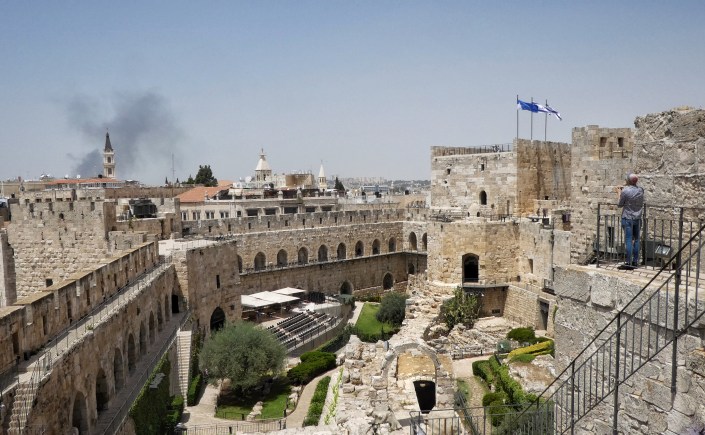
The Citadel or Tower Museum at the Jaffa Gate, the westernmost entrance to the city, is all the history you can eat in a four hour sitting. It’s a four thousand year old story: from the Canaanites and the Hebrews to the end of the Mandate and the establishment of the State of Israel, via Egyptians, Assyrians, Persians, Greeks, Hasmoneans, Romans, Byzantines, Umayyads, Abbasids, Fatamids, Crusaders, Ayyubids, Tartars, Mongols, Mamluks, Ottomans, British, and even Australians. Each left their mark on Jerusalem, and most planted their brickage upon and within the Citadel.

image

There is a long roll-call of famous names who may or may have not resided in the place.

King David didn’t, despite his name being given to the place and the apocryphal story that he once spied on the bathing Bathsheba from its ramparts – indeed, her bathroom is said to be underneath the New Imperial Hotel, just across the way. Nor did his son and heir, Solomon, builder of the First Temple. Conquerors Nebuchadnezzar and Cyrus did not. They just wrecked the joint. Judah Maccabee might have, and those other famous Jewish rebels, the Zealots didn’t, but during Great Revolt, they retreated there and trashed the place. Herod the Great, a psycho with an serious edifice complex, resided here. As did also Procurator Pontius Pilate when he was in town (he preferred the luxuries of Caesaea Maritimus (Latin for “on Sea). Historians now believe that the Citdel was where he actually cast judgement on Jesus, and not in the Antonine Fortress which overlooked the Temple (where the Haram al Sharif now stands) throwing into question the whole basis for the existence of the Via Dolorosa.

Roman general and future emperor Titus would have taken up residence therein after he destroyed the city in 70CE, leaving only the citadel standing. His troops needed somewhere to crash. Constantine didn’t, but his mom Helena most likely did when she “discovered” The True Cross, commissioned the construction of the Church of the Holy Sepulcher, and single-handedly invented the Holy Land pilgrim industry that endures to this day. The Muslim conquerors Omar Ibn Khattab, Salah ud-Din, and Baybars may have, but Ottoman Sultan Suleiman the magnificent, who built the city walls we see today, never set foot in Jerusalem, and nor did his successors.

image

Ottoman troops occupied it, and General Djemal Pasha would hang Arab Nationalists in the Square before it. General Allenby declared Jerusalem and Palestine liberated on the steps leading to the citadel in 1917, but most likely stayed across the square at our wonderful East New Imperial Hotel (the Kaiser stayed there too when he visited Jerusalem in 1898). British troops garrisoned it during the Mandate years – like the Roman legionaries before them, they’d’ve needed a place to lay their heads. The British-commanded Arab Legion of then Transjordan took control of it in during the the battle for Jerusalem in 1948 and defended it successfully against the new IDF. They did so again in 1967 only to lose it and the Old City.

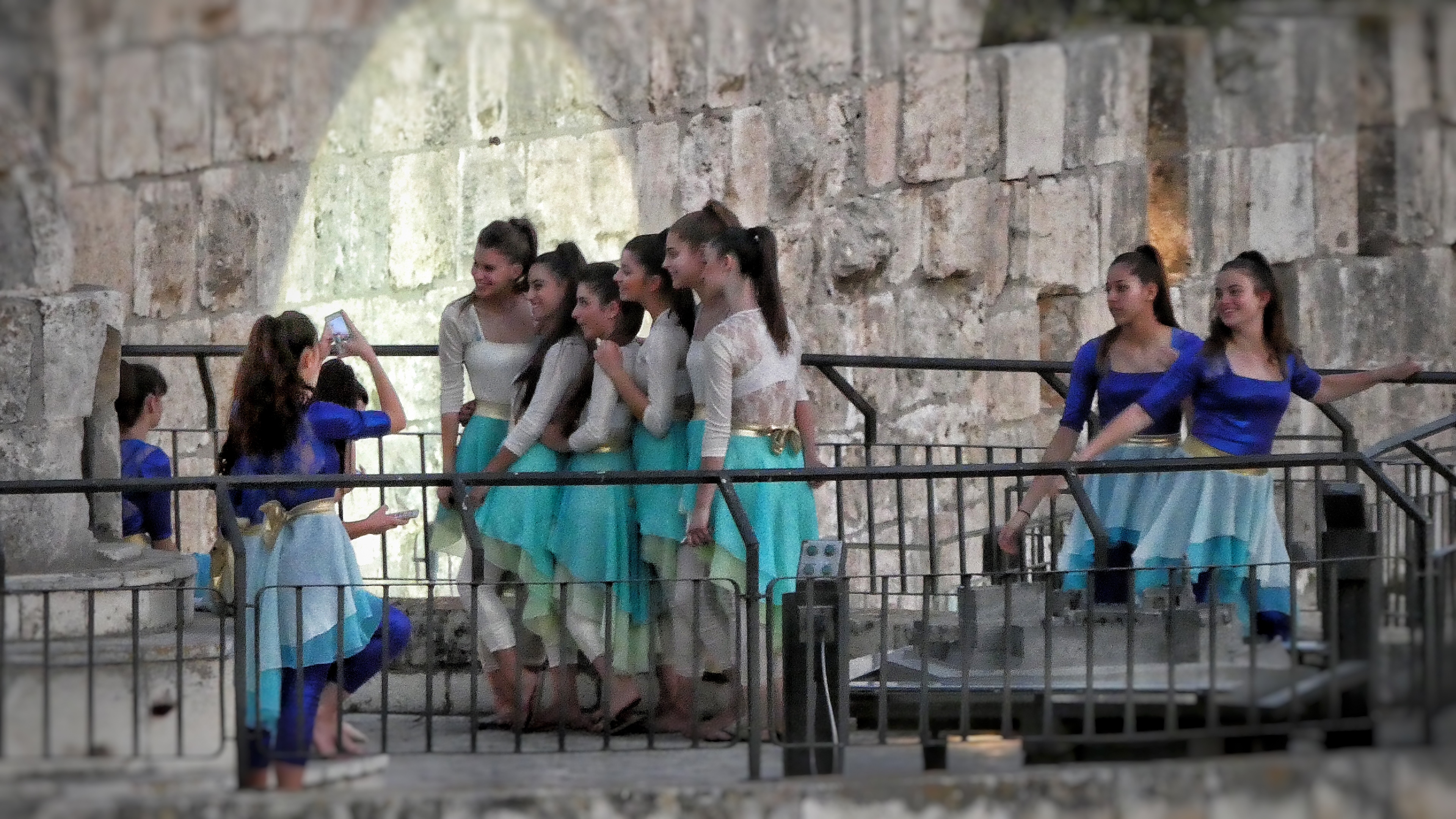
If the stones could talk, what a tale they would tell. And indeed, the museum now does just that, in content and in form. We sit on the roof garden of our hotel, directly across the street on Omar Ibn Al Khattab Square, and look across at its towers, ramparts and gardens, and sense it’s story in our souls. We watch present generations passing beneath its walls, and the young folk dancing on the ramparts, all part of the passing parade of humanity that has lingered by and upon these ancient walls.

For further reading, you can’t beat Simon Sebag-Montefiore’s Jerusalem : The Biography (Phoenix 2011).

See also in In That Howling Infinite, The Grand Old New Imperial Hotel, and Nova Via Dolorosa. For other posts about Jerusalem see: O Jerusalem

History Lessons

History Lessons

Carnivale

Dancers from the Son et Lumiere promenade

There Rides a Peace Train

“Cause out on the edge of darkness, there rides a peace train.
Oh peace train take this country, come take me home again.”
Cat Stevens, Peace Train

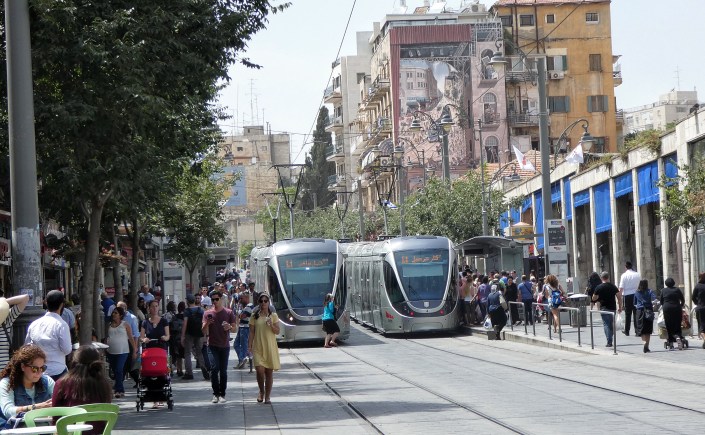
Completed in 2011, the Jerusalem Light Rail unites east and west Jerusalem. This how a light rail should be – small, light, and frequent, on a traffic free Jaffa Road. It links the Jewish suburbs of west and northeast Jerusalem with the Arab suburbs of the north and east of the Old City. The featured picture shows two trains passing at Jaffa Central, underneath a neat mural that shows one weaving down Jaffa Road through vignettes of Israeli urban life. Their destinations are shown sequentially in three languages. Synchronicity determined that in the picture, both were in Arabic.

image

It was controversial when first mooted, and extreme elements on both sides of the conflict opposed any such normalization of relations between the Jewish and the Arab communities. There were demonstrations in European countries against the “line that divided a city”, but these petered out when polls showed that Arabs in East Jerusalem found the line to be a blessing. It got dad to work on time; it got mom to the cornucopia that is the Mahane Yehuda fresh food markets, just four stops from the Damascus Gate; and it delivered the kids to school and back safely and punctually. It is said, with some justification, that earlier attacks on the line were perpetrated by thugs incited by Fatah, the political wing of the Palestinian Authority, which is alleged to control the taxi industry of East Jerusalem.

During the recent unrest, the line was often blocked and trains attacked during demonstrations and street fighting, but service was resumed quicksmart. Arab passengers were at times abused by Jews, and stations were the targets of random rammings by cars and heavy vehicles – the so-called “siyarah intifada” – with many Jewish casualties and “neutralized” perpetrators.

If you’ve ever ridden the light rail in Jerusalem, then you’ve seen the section with the chairs that go down when you sit on them – each has a wheelchair sign because people in wheelchairs get priority there since there’s space, but if you’re a mom and you’ve got a stroller, you can sit there, too, and that’s where these two women are sitting: I watched them both get in, one wore a hijab and the other wore a sheitel, and they both had their arms and leg covered, and no collarbone, no sir, and I watched the struggle through the crowd on the light rail with their strollers, big and blue and bulky, match match.

They each took a seat on opposite sides of the row where the wheelchairs go, and they put their strollers in the middle. Each woman stared straight ahead out the window as Jeursalem went by in one long smear, looking straight past each other.

Strangers on a light rail, with their matching strollers, but by accident, their strollers faced each other, and the kids met eye to eye — both bundled up in winter coats and hats and shoes, both brown eyed babes with pink cheeks, and curly hair, well fed and well loved, and they could have been brothers. And while their mothers stared straight ahead watching Jerusalem blur by, the two boys smiled at one another, and chatted back and forth as only little babies can, but as everybody should.

But calm appears to have descended, and folk of good will on all sides of the literal and figurative line pass in peace through Arab and Jewish Jerusalem.

https://en.m.wikipedia.org/wiki/Jerusalem_Light_Rail

“I believe that one fine day all the children of Abraham
Will lay down their swords forever in Jerusalem”
Steve Earl, Jerusalem

Light Rail Mural, Jaffa Road

Light Rail Mural, Jaffa Road

Facebook Postscript from Sarah Tuttle-Singer, 20th February 2023

If you’ve ever ridden the light rail in Jerusalem, then you’ve seen the section with the chairs that go down when you sit on them – each has a wheelchair sign because people in wheelchairs get priority there since there’s space, but if you’re a mom and you’ve got a stroller, you can sit there, too, and that’s where these two women are sitting: I watched them both get in, one wore a hijab and the other wore a sheitel, and they both had their arms and leg covered, and no collarbone, no sir, and I watched the struggle through the crowd on the light rail with their strollers, big and blue and bulky, match match.

They each took a seat on opposite sides of the row where the wheelchairs go, and they put their strollers in the middle. Each woman stared straight ahead out the window as Jeursalem went by in one long smear, looking straight past each other.

Strangers on a light rail, with their matching strollers, but by accident, their strollers faced each other, and the kids met eye to eye — both bundled up in winter coats and hats and shoes, both brown eyed babes with pink cheeks, and curly hair, well fed and well loved, and they could have been brothers. And while their mothers stared straight ahead watching Jerusalem blur by, the two boys smiled at one another, and chatted back and forth as only little babies can, but as everybody should.

Sarah is an author, blogger and photographer who lives in East Jerusalem and writes The Times of Jerusalem. https://blogs.timesofisrael.com/review-of-jerusalem-drawn-and-quartered-by-sarah-tuttle-singer/

Sarah Tuttle Singer, East Jerusalem


King Herod’s Edifice Complex

Herod the Great ruled from 37 to 4 BCE.

Like Lord Byron, he was mad, bad, and dangerous to know. He may or may not have been a psychopath – he killed his way to the top, murdering his relatives, and also, his wife Mariamne, whom loved truly, madly, deeply – but he suspected her of plotting to depose him, so she had to go too. He regretted it instantly and embalmed her in honey so he could spend quality time with her by her open catafalque.

Herod did a lot of questionable things, but he has gone down in Christian demonology for an atrocity he did NOT commit – he didn’t massacre the Innocents to ensure that baby Jesus would not live to supplant himself as King of the Jews! The slaughter of the babies was an invention of later Christian propagandists. Also, he was not the Herod who’s daughter Salome invented lap dancing and in payment, demanded the head of John the Baptist. Nor was he the Herod who told the imprisoned Jesus “I’m the King of the Jews!” That was Andrew Lloyd Webber’s camp caricature. Herod was a common name amongst the later (and last) Hasmoneans.

To his Jewish subjects, he was not a Kosher King, being only half Jewish, and then, only through this dad (even today, opinions about him are mixed for the same reason). Accordingly, he felt that he had to prove himself, like similarly half-Jewish, and much wiser King Solomon. So he built things. And man! Could he build! His stuff was not large – it was Monumental.

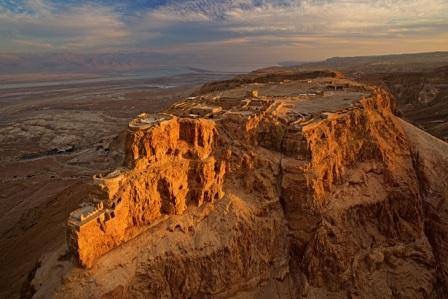
At Caesarea, on the Mediterranean coast, he build a port, a seaside palace and a city. In Jericho, another magnificent palace. At Herodium, he built a fortress-palace-mausoleum, but first, he built a hill high enough that he could see Jerusalem from the summit. Across the River Jordan, in present day Jordan, he rebuilt a fortress-palace at Machaerus which was said to be location of the imprisonment and execution of John the Baptist, and the venue for Salome’s notorious dance, The ancient town of Sebastia, on a hill with panoramic views across the West Bank, is another location of Herodian brickage; its Nabi Yahya Mosque is said to be the burial site of  the Baptist – although his head is believed to rest in an ornate catafalque in Damascus’s splendid Umayyad Mosque.  And he a fortress and summer palace on the Masada massif overlooking the Dead Sea, and the site of one of history’s most famous “last stands”.

He obviously liked palaces. When he died – and he died horribly as befits a bad boy – he was laid to rest in a bespoke tomb in his Herodium eyrie.

But his crowning glory was his breathtaking refurbishment of the Second Temple, rendering it a wonder of the contemporary world. Too bad that a “wabble of woudy webels”, to quote Bickus Dickus in “The Life of Brian”, had to rise up against Rome in 66CE, precipitating the destruction of Jerusalem, the death of thousands, and the razing of temple to the ground. All that impressive Herodian brickage was sent crashing to the ground, and all that remains is the Kotel, the hallowed Western or Wailing Wall.

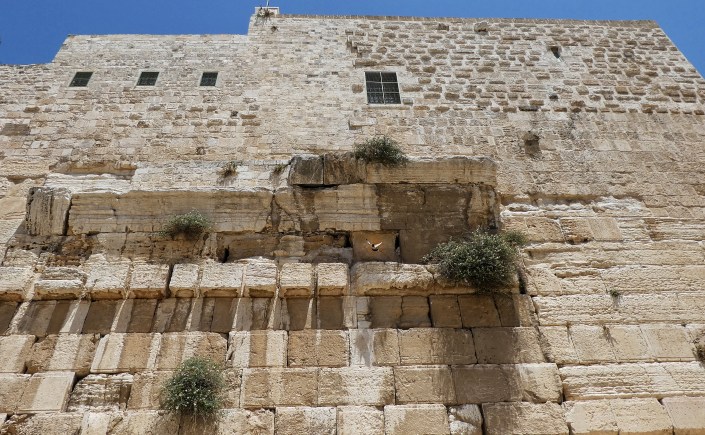
(The featured image shows signature Herodian ashlar blocks in the Kotel, the Western or “Wailing” Wall)

That’s my telling of the life and times of King Herod. Here’s what Wikipedia says : https://en.m.wikipedia.org/wiki/Herod_the_Great

Postscript

Apart from building things, was Herod really that “great”? I reckon he gave himself that soubriquet – or else the Romans did, probably in sardonic irony (which Herod, narcissistic and paranoid, probably didn’t get). His subjects didn’t think so and were happy when he died. Some accounts suggest that he’d ordered his bodyguard to slaughter the heads of prominent Hebrew families on the event of his death so that the people would not feel like rejoicing when he passed.


Herodian brickage thrown down bu the Romans

Herodian brickage thrown down by the Romans

Herodium

Herodium

Masada

Masada

The largest house brick in the world. The Western Stone of the Kotel 13.6m

The largest house brick in the world. The Western Stone of the Kotel 13.6m


Sic semper tyrannis

You come at the king, you best not miss.
Omar Little, The Wire (after RW Emerson)

The phrase “one man’s freedom fighter is another man’s terrorist” is at once apt, correct, and yet often oversimplified to the point of disingenuousness. The word “terrorist” itself describes its goal. To instill fear in the heart of the enemy. In the past, the target would have been the king, the dictator, the ruling class, and those who served them and upheld their rule. Politicians, officials, solders and policemen. Today, terrorists indiscriminately target whole societies. Irish bombers blasted communities of the rival faith, murdered shoppers, office workers, and pub patrons, as well as soldiers and policemen. Palestinian suicide bombers hit malls and pizza bars in city centres. ISIS, al Qa’ida and the Taliban detonate cars in busy city streets and publicly execute prisoners in callous and calculating “lectures in flesh” (the phrase is civil rights lawyer Geoffrey Robertson’s, from his chilling account of the trials and execution of King Charles I of England and those who sentenced him, The Tyrannicide Brief.).

But targeted and random terrorism has a long historical pedigree. For centuries, it has been the desperate and nihilistic weapon of last resort of resistance and rebellion against perceived oppression and injustice, and against invaders and occupiers.

In the second century BCE Palestine, the Maccabees used assassination in their resistance to the Seleucid Greeks, and a century later, the Jewish zealots, the Sicarii, named for the easily concealed small daggers, paid the Romans in like coin, and ultimately in an insurrection that culminated in the destruction of Jerusalem in 70CE and the scattering of the Jewish race (giving history the emotive and symbolic last exit that was Masada). In an etymological irony that Mark Twain would have been proud of, the present unrest in Jerusalem, a large number of young Palestinians have perished in attempting to stab jewish soldiers and civilians. Their jaquerie is called the “Intifada Sakni-in”, the ‘Knife Uprising – an echo of those long-dead Sicarii “dagger men”.

Nowadays, one would be excused for thinking that “terrorism” and “terrorist” are synonymous with Arabs and Muslims. And a historical precedent reinforces this erroneous assumption. The Hashishan or “Assassins” of Middle East fame (yes, that is where that noxious noun originated) were Muslim men and boys mesmerized and mentored by Rashid ad Din as Sina-n, the “Old Man of the Mountain” (and all this, before Osama in the caves of Tora Bora), and were Twelfth Century  hit-men contracted out to rival Muslim princes in the internecine conflicts that plagued the Levant in the wake of the Crusades and the demise of the great Arab Caliphates.

But the assassin’s knife (and in modern times, the gun and bomb, and latterly cars and trucks) predates these medieval hoods and links the Hebrew rebels of old to the Irgun and Stern Gang who encouraged Britain and the UN to abandon Palestine in 1948, bequeathing most of it to the new state of Israel, and triggering the Palestinian diaspora. European anarchists and Irish rebels and loyalists were adept at shootings and ambushes. In Algeria, during the ‘fifties, the nationalist FLN and the “colon” OAS shot and bombed each other and those unfortunates caught in the crossfire. The IRA perfected the improvised explosive device that today has crippled thousands of American, Canadian, and Australian soldiers in Iraq abd in Afghanistan. Hindu Tamil separatists of Sri Lanka introduced the suicide bomber, an economical and efficient weapon against soft (civilian, that is) targets, deployed today by Islamist killers in the streets of London and Lahore, Damascus and Dar es Salaam, Jerusalem and Jakarta. Whilst Arabs – and particularly Palestinians may have given the world the hijacking of aircraft – a tactic that fell into disuse due to diminishing political returns and rapid response forces – other Arabs showed us how to fly them into public buildings as the whole world watched in horror and disbelief. The shockwaves of this one are still reverberating through the deserts of the east and the capitals of the western world.

In going up up against their occupiers, the Palestinians have an old heritage. In my old country, Boudicca and Caractacus fought a losing battle against the Romans in Britain during the First CE. The Roman historian Tacitus ascribed to a vanquished chieftain the memorable words  “solitudinem faciunt, pacem appellant” – they make a desert and they call it peace. After the battle of Hastings in 1066, the defeated Saxons pushed back against the Normans and brought the genocidal wrath of William the Conqueror down on their heads with the devastating “Harrying of the North”. The Green Man and Robin Hood legends are said to be a retrospective and romanticised remembering of the Saxon resistance. Warrior fugitives from that failed guerilla war fled as far as Constantinple, where many joined the Emperor’s acclaimed Varangarian Guard, (see When Harald Went A Viking) 

In the streets and the countryside of Ireland, my parents’ birthplace, the United Irishmen, Fenians, Free Staters, IRA and Unionists fought against the redcoats, tommies, and black and tans of the British Army. Fought amongst themselves, fought against each other, and killed and were killed in their centuries long war of liberation. And in my adopted country, indigenous Australians fought a futile frontier war against settlers and soldiers just as native Americans did, albeit on a much smaller scale, and paid the price in hangings, massacres, poisoned wells, dispossession, marginalization, and “stolen children”. The legacy of those times lingers still – see The Frontier Wars – Australia’s heart of darkness.

In Central America, Juarez led the Mexicans against the French, and Sandino, Nicaraguans against US marines. Spaniards rose up against Napoleon’s forces, giving the world the word “guerilla”, or “little war”. Russian partisans ambushed the Grande Armé and the Wehrmacht. Throughout occupied Europe, the very term “resistance” became synonymous with the heroic unequal struggle against tyranny. In another of history’s ironies, muqa-wamat, Arabic word for resistance, unites sectarian rivals Hamas and Hizbollah against Israel.

And not just resistance to invasion and occupation, but also against oppression by one’s own rulers. Religious tracts tie themselves in knots reconciling the obligation to obey our rulers with the right to resist and overthrow those that rule badly. The unequal struggle against tyranny – or what is perceived by the perpetrators as tyranny – is the cause that inspires men and women to desperate acts.

The most celebrated in fact, film and fiction is the death of Julius Caesar at the hands of peers who feared that he intended to usurp the ostensibly democratic Republic (ostensible because democratic it was not) and institute one-man rule. That ended badly for the conspirators, and for Rome, as it precipitated years of civil war and ultimately, half a century of empire).

In 1880 the reforming Czar Alexander II of Russia, discovered the hard way that liberating the serfs did not inoculate himself against the bomb that took his legs and his life. His fearful and unimaginative successors hardened their hearts and closed their minds against further reform. setting in train the crackdown on dissent and democratic expression that led eventually to the storming of the Winter Palace on Petrograd in 1917. Narodnaya Volya, the killers called themselves – the People’s Will. And that is what terrorists do. They appeal and owe fealty to a higher court, a greater good, a savage God.

So it was when student and Serbian nationalist Gavril Princip assassinated Archduke Ferdinand of Austria-Hungary in June 1914 and ignited the spark that lit the conflagration of World War 1 which precipitated the demise of the old European empires.

So too when John Brown and his sons brought their broadswords to bear on slavers and their sympathizers and made a date with destiny at Harpers Ferry. Their famous raid may or may not have accelerated the downward slide to the secession and civil war that erupted the following year, but it provided a moral and symbolic prelude and also, the resonating battle hymn of the republic. John Wilkes Booth bookended this bloody era with his histrionic and public murder of Abraham Lincoln, shouting “sic semper tyrannis”, “thus always to tyrants,” attributed to Brutus at Caesar’s assassination – today, it’s the Virginia state motto. Brown and Booth were quite clear in their motives. As was were the segregationalist shooters who did for African Americans Medgar Evers and Martin Luther King. Less so were the killers of the Kennedy brothers in the sixties.

To conclude, sometimes that savage, rebel God is one of faith, sometimes, of blood and soil. In some instances, it is revenge for wrongs real and imagined – the reasons at times lost or forgotten through the passage of time and fading memories. And often, “the cause” is corrupted by the immoral economics of illicit commerce, including contraband, kidnapping, blackmail and extortion. Sometimes all merge in an incongruous hybrid of religious passion, ethic identity, libertarian or anarchistic fervour, and protection racket. As was the case in Northern Ireland, in Lebanon, in sub-Saharan Africa, and currently so in Syria and Iraq.

But most times, terror and turmoil is simply a political weapon planned, targeted and executed as a mechanism of regime change. Rebellion, revolt and revolution. Resisting, opposing, challenging, confronting and defeating the central authority. The seizing, holding, consolidation and keeping of political power.

And one thing is for sure. The outcome is unpredictable. History does not move in straight lines, but often follows a bitter and twisted path. Cliched as it is, the phrase “be careful what you wish for” is an apt one. And when, as Bob Dylan sang, “the line it is drawn, the curse it is cast”, there is no going back. To quote WB Yeats’ famous lines, “all is changed, changed utterly”.

Terrorism, then, can shift the course of history. If we were to stumble into the swamp of alternative histories, imagine what might of happened

If Caesar had walked home from the senate on the Ides of March
If Lincoln had been able to guide the Reconstruction
If the reforming Czar had introduced democratic government to Russia
If Gavril Princip’s shot had missed the archduke
If Kennedy had returned from Dallas
If John Lennon outlived George Harrison
If Yitzak Rabin had left the peace concert in Tel Aviv
If the Twin Towers stood still

To quote “Stairway to Heaven”, a curiously apposite title given the millenarian mindset of many terrorists, “Oh, it makes you wonder!”

Thermidorian Thinking … a revolutionary reverie

I fought in the old revolution
on the side of the ghost and the King.
Of course I was very young
and I thought that we were winning;
I can’t pretend I still feel very much like singing
as they carry the bodies away.
Leonard Cohen, The Old Revolution

‘Thermidorian’ refers to 9th Thermidor Year II (27 July 1794), the date according to the French Republican Calendar, when Robespierre, Danton and other radical revolutionaries came under concerted attack in the National Convention, resulting in their downfall and execution.

Grim travelers butt each other to establish dominance. One lot plays Danton to another’s Robespierre, with the moderate Manon Roland and her Girondins trampled underfoot in the melee. On the scaffold, Madame Roland is said to have exclaimed “O Liberté! O Liberté! que de crimes on commet en ton nom”. Maximillian Robespierre destroys his erstwhile friends and slaughters thousands, precipitating the Jacobin meltdown as the ascetic and purist Marat is murdered in his bath. Robespierre and Saint-Just are guillotined by those who believe “the Terror” had gone too far, soon to be followed by fellow Jacobins Georges Danton and Camille Desmoulins. [Hilary Mantel’s excellent door-stop of a debut novel, A Place of Greater Safety, tells the story of all these revolutionaries. The bones of most of them rest amongst those of tens of thousands of others in the famously macabre Catecombes de Paris, a “tourist” attraction I highly recommend]

I would argue that this “Thermidorian Reaction” – the ostensibly “better angels of our nature” (Abraham Lincoln said that) reasserting themselves – is a rare bird indeed. Inevitably, things get worse, much worse, before they get better. As WH Auden observes in his sombre eclogue The Age  of Anxiety, “many have perished: more will”. 

Revolutions are unpredictable. They never run in straight lines. They reverberate, the shockwaves expanding and impacting on their vicinity, and way beyond. The shots ricochet, like drive-bys and crossfires, and you never know who will be hit, where the bullets will come to rest, and who will be damaged or destroyed. Many people will be liberated, and many enslaved. Many peoples will prosper, and many, many will perish. As TS Elliot wrote, “between the idea and the reality falls the shadow”.”

Stalin seizing Lenin’s crown as the father of the revolution lay dying. Trotsky launching the Red Army against the sailors of Kronstadt whose guns had heralded the fall of the Romanovs, and who then fought to last man against their former comrades. Stalin and Trotsky wrestling for control of party and power as the old Bolsheviks disappeared into the gulags and the execution cells. Stalin’s long arm putting an ice pick through his rival’s skull in Mexico decades later. Trotsky knew a thing or two about “permanent revolution. See Red and white terror – the Russian revolution and civil war and Stalin’s Great Terror

Adolf Hitler making his move against the corrupt and sybaritic Rohm and his Brown Shirt bully boys, a threat to his control of party and state, in the “Night of the Long Knives”, and setting the course for a Germany’s slow spiral to damnation with the plausible deniability of the similarly dramatically named Kristalnacht. The German language has surely given the world ominous words of iron, including Nacht und Nebel; Storm und Drang; Weltanschauung, Blitzkrieg and Schadenfreude – none of them boding well for tyranny’s unwelcome attentions.

It is a zero-sum play book well-thumbed by latter-day revolutionists like the Baathists Saddam Hussein and Hafiz Assad in their relentless and merciless accession to power in Iraq and Syria respectively, like the cruel and vengeful but infinitely pragmatic regime that has ruled Iran’s Islamic Republic for these past forty years, and the kleptocratic dictators who lord over much of Sub-Saharan Africa. In the manner of revolutions past and present, each one has “devoured its children”, harrying, jailing, exiling and slaughtering foes and onetime allies alike.

The sad reality in so many countries is that when the going gets tough, the mild get going, and the hard men ride roughshod over their people.

Vengeful, vindictive. Merciless. Unforgiving and never forgetting. Do no deals. Take no prisoners. Give no quarter.

Also in In That Howling InfiniteA Political World – Thoughts and Themes

Bolshevik recruiting poster 1917

Danton, Robespierre, Desmoulin, and Manon Roland

Danton, Robespierre, Desmoulins, and Manon Roland


Solitudinem faciunt, pacem appellant

Why do countries like ours’ and those of Western Europe appear to have settled into peaceful political processes that manage a degree of continuity and stability, and others do not?

In countries where modern institutions are weak and poorly developed, and a democratic or participatory political culture based on consensus and power sharing has not had the time or the political, social and economic conditions to develop, older loyalties and obligations trump allegiance to the state and nation and respect for, or at least, acceptance of its institutions and processes. Countries like Syria and Iraq, and much of Africa, were in reality modern contrivances superimposed upon the wrecks of old empires. The cartographical design may have been determined by the presence of natural resources in such and such a place, or the location of a port or river, highway or mountain pass. And often, in wide tracts of desert or jungle, mountains or plains, lines were simply on drawn on maps from point to arbitrary point, sometimes with the agreement or collusion of a rival power or friendly local despot.

In lands such as these, loyalty and allegiance to family, clan, tribe, religious sect, and ethnic group held precedence over the fabricated state and its often transplanted institutions and processes. Patronage, nepotism, corruption, and a network of mutual favours and obligations smoothed the paths of people seeking or seizing benefits or appointments. Old ways were tried and true, compared to aspirations or pretensions to fair and open governance. Political parties which emerged on ostensibly western lines were no more than parochial political machines, whilst gerrymandering, branch-stacking, vote-rigging and even violence ensured electoral outcomes that favoured the powers that be.

The culture of dependence and obligation that characterized pre-modern societies in the West is still the norm in much the world. And it is replicated throughout society, from the humble street-vendor to city hall. Need a license? A school scholarship? A better job? A party post? Want to avoid a traffic fine? A law suit? A jail sentence? Money changes hands. Deals are done. Debts are incurred. And social and political relationships are established. And thus, the creaking wheels of bureaucracy and governance turn, driven by patronage and payola, often greased with cash and the threat or actual use of violence encourages the emergence of and tolerance for the zaim, the strong leader. That leader develops a sense of identification with the country – not in the sense of service, but that of ownership. Family, clan, kinship and sect obligations and entitlements cement the zaim – literally “boss” – in place, whist patronage and brutal security forces beholden to the elite ensure that he is not challenged. Hence the mukhabarat (literally, intelligence) keep watch on dissent and protest.

Once in power, it can be difficult for the autocrat to vacate his seat. Family interests, party, sect and ethnic ties, and economic imperatives, and fear of retribution should the patriarch depart, render it dangerous for what amounts to a family business to relinquish the keys to the kingdom, and the levers of power. As they say, he who rides a a tiger never can dismount. Hence in countries as diverse culturally and geographically as Syria, Zimbabwe, the Central African Republic, the central Asian ‘stans of the former Soviet Union, and North Korea, the “dear leader” is strongly encouraged to hang in there by his nearest and dearest.

This is indeed how societies and polities evolved and developed during Europe’s so-called Dark Ages in the wake of the collapse of the western Roman Empire. When authority fails, its place is taken by force. Today, we see it in many places around the world, especially in the Middle East and Africa, where social order is under constant attack from paramilitary thugs and religious fanatics, and violence is endemic. Any large, diverse society includes individuals who do not conform to the law. And it is said that some 10% of us have the potential to become psychopaths. When that society is in a state of breakdown, violence and the resort to force become widespread, these come into into their own as chieftains, warlords, robber barons, and pirate kings rule their parochial roost, commanding mercenaries, militias, and private armies. As the Bard wrote, “Take but order away and hark what discord follows”. Violence breeds violence, requiring a corresponding use of force by the state to maintain order. And if the initial, brutal crackdown fails to stifle dissent and rebellion, to borrow from Shakespeare again, the dogs of civil war are let lose, and all hell breaks loose. The Bard of Avon had his Henry declaim “Cry Havoc”, this being an old English war cry that signaled no quarter, and ensuing rape and pillage.

On the marches of civil wars, the bleeding edges of nations and empires collapse in on themselves like stars to create black holes where roam robber bands, death squads, militias, and drugged and indoctrinated child soldiers deal out death and destruction whilst trading variously in oil, diamonds, heroin, grass, guns, and people, extorting dollars and gold from locals and from foreign donors. Quantrill’s Raiders and Jim Lane’s Red Legs cut a swathe through “bloody Kansas” and Missouri. And other times and places have seen their sad share of jaywalkers and bushwhackers. Swedish and German mercenaries marched back and forth across a devastated Mitteleuropa during the Thirty Years War, just as Reds and Whites ranged and ravaged through Byelorussia and Ukraine during the civil war that followed the Russian Revolution. The dying decades of the Twentieth Century saw this in Bosnia, Chechnya and Afghanistan. And it prevails today in Syria and Iraq, Libya and Yemen, Afghanistan and Africa.

And so, and as clear and present example, to suffering, sad Syria.

Following in Father's Footsteps, Following Dear Old Dad

Following in Father’s Footsteps, Following Dear Old Dad

Bashar al Assad inherited this patrimony from his father Hafez. He was a reluctant ruler, not expecting to take charge. The heir apparent was his brother, a fast-living hedonist who died in a car crash. He did endeavour to bring about gradualist change in Syria. I saw changes whenever I visited Damascus.

This was not to suggest that Syria was an Arab utopia. There was a large divide between town and country, exacerbated by a a long and ongoing drought that forced many rural folk to migrate to the rundown fringes of the major towns, adding to pressures on resources, housing and employment. Whilst in practice a secular, multi-faith and multi-ethnic society, there was a cultural and spiritual divide between the conservative, Islamic rural communities and a more secular-minded urban middle class. The country was ruled for near on fifty years by a family and elite drawn from a particular, minority sect, which sat atop a pyramid of nepotism, patronage and corruption. And that rule was upheld by a cruel and efficient secret police and military special forces that kept a proactive watch on dissent. There was definitely an air of anxiety and caution amongst those who aspired to a more liberal Syria, with the midnight knock on the door, arbitrary arrest, and detention in one of the regime’s many political prisons being a fact of political life in this secular, socialist country.

But on the other hand, Syria was almost self-sufficient in food and oil products. It had well resourced and efficient health and secular education systems, and a flourishing arts scene. As a nation, Syrians were a tolerant and welcoming people, and within the bounds of religious propriety and political caution, freedom of worship, of expression, of lifestyle, and even of discreet gender preference were given. In the narrow streets of the Old City of Damascus, Thursday night, the eve of the Muslim holy day, was a fairy land of lights and laughter. Courting couples hand in hand, girls in hijab and uncovered alike; families promenading in their “Sunday best”; young goths with spiky hair and black makeup, short skirts and tight jeans. Busy stalls and sweetshops, crowded, street-side cafes – the famous Damascene maqha – or coffee shops.

Foreign observers, friendly and hostile, have noted how well-dressed and cashed-up the refugees flooding into Eastern Europe appear to be. The reality is that these are Syria’s middle class. By local metrics, they were comparatively well-off, and had a strong work ethic and a high wages to savings ratio. These were, and are Syria’s future.

Syrians were genuinely proud of their country, of its status as a centre of Arab culture and Arab nationalism, and of its history. And of its priceless archeological heritage. The Roman cities of Apamea, Palmyra, and Bosra; the Crusader castles of Krak de Chevaliers and Salah ud Din; the Byzantine monastery St.Simeon; the Umayyad mosques of Aleppo and Damascus; the Christian villages of Maaloula and Saidnaya where Aramaic is still spoken; the ancient suqs of Aleppo and Damascus. Syria was a historian’s idea of heaven.

When the revolution broke out, sympathetic commentators wondered whether Bashar would be “Hammersmith Man”, a reference to his former career as a ophthalmologist in London, where he lived for many years with his gorgeous, well connected, merchant banker wife and children, or “Hama Man”, recalling his father’s brutal crackdown on an Islamist revolt in that city in 1981 where in some thirty thousand souls perished at the hands of security forces. In the end, Junior was swept along by the elite’s blinkered but well-tried survival mechanism – force and fear.

Back in the heady days of the Arab Spring, Syrians from all ethic, religious and political groups hoped for a loosening of authoritarian controls. But the regime resorted to form and to repression. Sectarian militias murdered and mutilated initiating a cycle of bloody vengeance as a popular, peaceful and largely secular movement became militarized, polarized, in many areas, Islamized, and as internal and external interests with varying political, religious, and geopolitical motives became involved and embroiled against the regime, against the rebels, against each other. Regular forces, militias, warlords, village defense forces, Kurdish separatists, foreign fighters, mercenaries, foreign air forces, undercover operatives. A war of all against all, as Thomas Hobbes once said. To paraphrase Mark Twain, history might not repeat itself, but it certainly rhymes.

And now, whilst most of the antagonists have been herded by their foreign patrons towards a crowded and reluctant negotiating table, it all seems like a terminal case of “too little too late”. Syria is in ruins, some half a million Syrian are dead, and countless more maimed.and it its population is scattered, weighing heavily on the consciences and economies of neighbours and of the European Union. Syria as a nation state may in fact be no more. There is talk of partition, and a redrawing of the map that emerged from the peace treaties of The Great War. And the odds are that with Russian military support, Bashar al Assad, bete noir, pariah, lame-duck to those governments who wished him gone, and his Iranian and Hizbollah allies, are going to win the civil war.

He may or may not succeed. Right now, his forces are pushing back the rebels, writing himself a pivotal part in the peace. Right now, the parties talk and walk whilst the killing continues, and the diaspora grows. International forums are but talking shops, stages for self-righteous and self-aggrandizing  posturing and stotting, acrimonious gatherings that appear to function in a time bubble that is remote from the brutal reality. If and when the guns fall silent, Bashar may or may not be able to put the country back together. He may or may not be able to recreate the multi-faith, modernizing, cosmopolitan society that existed before the war. He may or may not be able to disarm the hundreds of militias and private armies that have proliferated and even prospered during five years of chaos.

He will need billions of dollars and the help and goodwill of many nations to rebuild the towns and cities, and to restore the shattered archeological heritage. He will never bring back the dead, or the skilled and educated exiles who will chose to make new lives in foreign places of greater safety. Nor will he be able to repatriate the thousands of plundered artifacts and treasures that have disappeared into the international black market. He will not be able to heal the wounds, give solace to the bereaved, assuage the grief, counsel and treat the trauma, and divert the desire for vengeance into the promethean labour of reconstruction.

Putting his own words into the mouth of a conquered British chieftain, an old Roman once said, “solitudinem faciunt, pacem appellant” –  they make a desert and they call it peace.

See also:

Sic semper tyrannis

Thermidorian Thinking

Syrian Streetscape

Syrian Streetscape

Zaatari Rrefugee Camp, Jordan
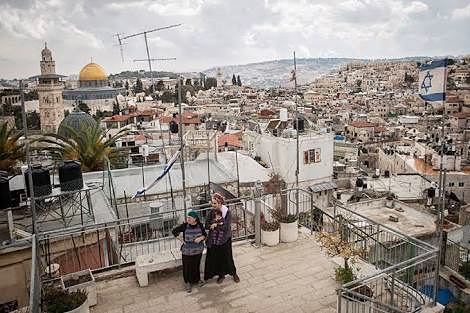
Zaatari Rrefugee Camp, Jordan
That was the year that was – from New Orleans to Jerusalem.

Its been a diverse year In That Howling Infinite. We have traveled, to quote Bob Dylan, “all the way from New Orleans to Jerusalem” – and to many other places in between. Vikings and Roman legionaries; Bob Dylan, Jackson Browne and Bruce Cockburn; Britain in the ‘forties and Paris in the ‘fifties; America, the Levant, and even Wonderland. By Year’s end a million souls will have journeyed to Europe from the war-ravaged lands of the Middle East, and my final posts for the year contemplate what it might mean for refugees who find to safe haven in Australia.

Here is a retrospective.

The year began with a short piece on recent archeological discoveries in Jerusalem that strongly suggested that the Via Dolorosa that Jesus trode on his final journey to Golgotha was the wrong route, and that instead, it began just inside of the Jaffa Gate. I took a light-hearted look at the Jerusalem Syndrome, a mental condition involving the presence of religiously-themed obsessive ideas, delusions and other psychoses triggered by a visit to The Holy City.

image

I read but one piece of fiction this year – a sad admission from a lifelong bibliophile – but this one book was probably one of the best I have read: The Incorrigible Optimists Club , winner of the prestigious Prix de Goncourt, by Jean Michel Guenassia. It is set in Paris’ Rive Gauche, as the ‘fifties gives way to the ‘sixties; as the crooners makes way for rock n’roll; as the Cold War divides a continent, sending dissidents and refugees fleeing to a safe haven in Paris; as the Algerian war divides and destroys families: and as the seeds of ‘les evenments de Mai 1968’ are sown in the hearts and souls of France’s young people. It is a coming of age book, of young hopes and fears, love and loss, a book about writers and reading, and the magic and power of the written word in prose and poetry.

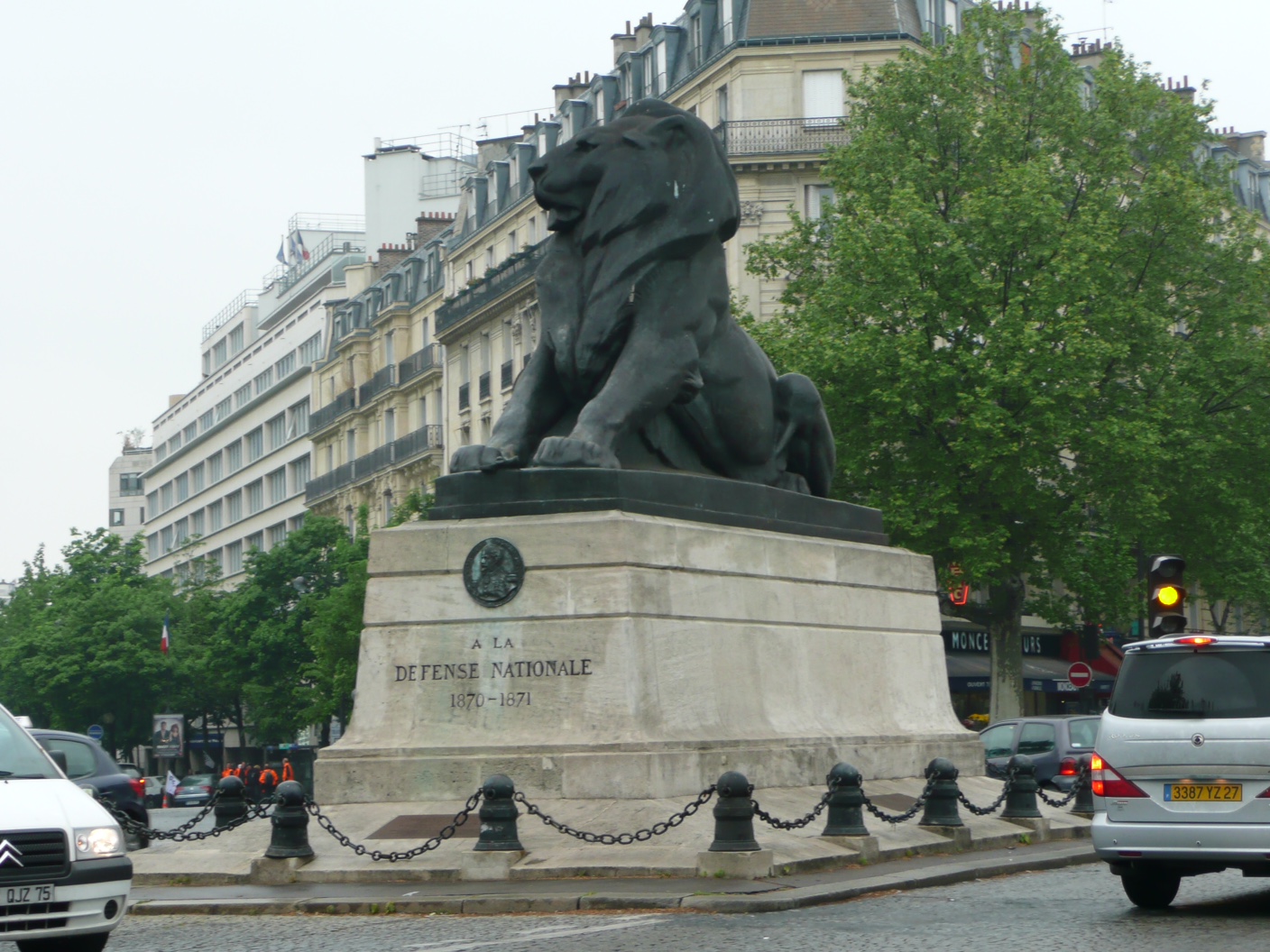
Le Lion de Belfort

March saw the passing of my old friend Dermott Ryder, chronicler and luminary of the Folk Music revival in Sydney in the early ‘seventies. Dermott’s Last Ride is my tribute to him. And April was a month of anniversaries and remembrance. Forty years since the outbreak of the Lebanese Civil War, and the centenary of the landings of the ANZACs at Gallipoli. Pity the Nation takes its title from Robert Fisk’s tombstone of a book on the long war; and he had taken it from a poem written in 1934 by Khalil Gibran, Lebanon’s most celebrated poet, a poem that was both a prophetic testament and a testimony of times to come: “Pity the nation divided into fragments, each fragment deeming itself a nation”. The Watchers of the Water is a song about Gallipoli sing by a Turkish solder.

May saw two diverse pieces of social history. The Spirit of 45  takes personal perspective of British filmmaker Ken Loach’s documentary of the excitement and optimism that followed the Labour Party’s election victory at the end of World War II. This laid the foundation stone for the British welfare state. Bob Dylan’s Americana discusses the meaning and significance of the lyrics and the imagery of Dylan’s early ‘eighties masterpiece Blind Willie McTell, a harrowing journey through America’s dark heart.

In June, we visited Yorkshire and in London, conjuring up memories and historical connections. Harald Went A Viking is a saga about the first of two kings to die on English soil in the late summer of 1066, and the adventures that took him from Norway to Constantinople and Jerusalem and finally, to Yorkshire. Roman Wall Blues takes its title from WH Auden’s poem about a homesick and grumpy legionnaire on Hadrian’s Wall, and contemplates the lives of the ethnically polyglot soldiery who defended the Empire’s borders. And June saw another famous anniversary, the Bicentennial of the momentous and bloody Battle of Waterloo. The Long Road to Waterloo prefaces a song for the men who, after twenty six long years of war, never came home.

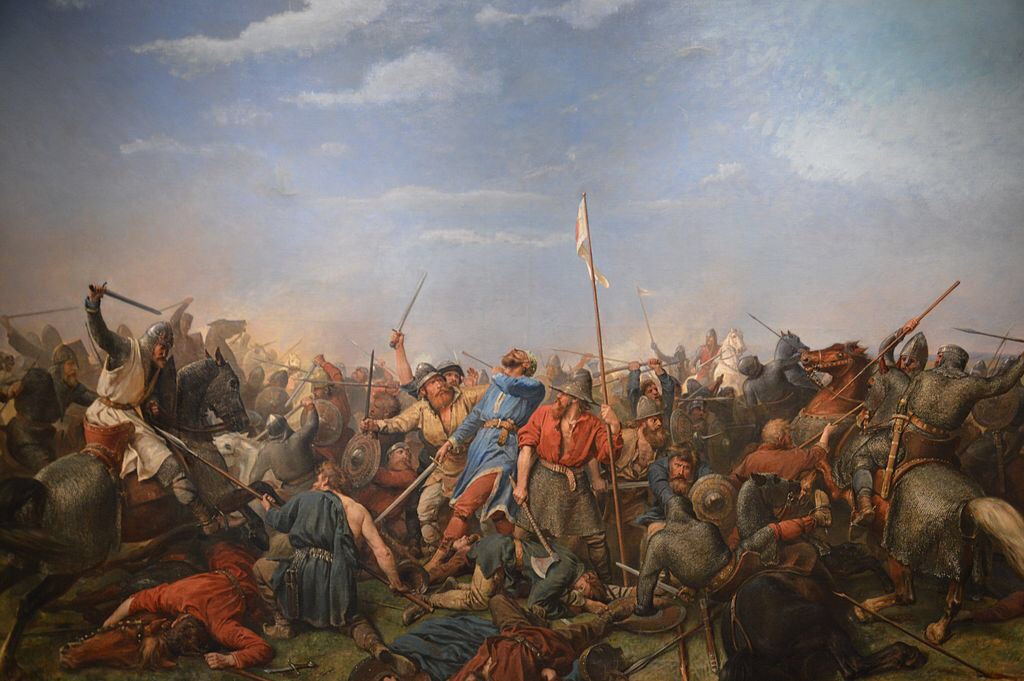
Painting of the Battle of Stamford Bridge by Peter Nicolai Arbo, depicting King Harald Hardrada hit in the neck by an arrow

Battle of Stamford Bridge, depicting King Harald Hardrada hit in the neck by an arrow

In July, controversy erupted in the Land of the Free over the flying of the Confederate Flag in states that were once part of Old Dixie. The dead hand of the Civil War reached out and touched the hearts of Americans and their friends throughout the world in the wake of yet another mass shooting. This time, a young man gunned down worshippers at prayer. That the victims were folk of colour, and the shooter, a young white extremist, reopened wounds that have never really healed. Rebel Yell surmises that The South will always be with us, in our thoughts, in our historical memory, in our art and literature, our books and films, and our favourite music.

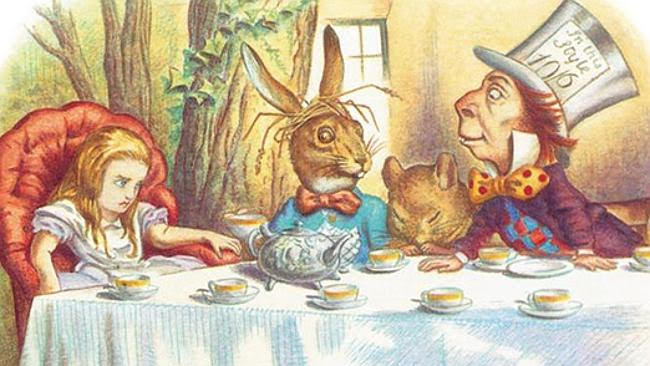
September marked the one hundred and fiftieth anniversary of the publication of Lewis Carroll’s timeless, fabulist masterpiece Alice In WonderlandGo Ask Alice, I Think She’ll Know reproduces Australian  critic Peter Craven’s masterful celebration of Alice 150. The title belongs to the mesmerizing Grace Slick of Jefferson Airplane who cut through to the rabbit chase channeling the long-gone Lewis in a psychedelic musical masterpiece.

Alice

On an infinitely sadder note, Ruins and Bones is a tribute to the memory of Syrian archeologist Khaled Muhammed al Asaad, murdered by ISIS in August 2015, and of Palmyra, the ‘Pearl of the Desert’.

Allende’s Desk and Osama’s Pyjamas is a brief commentary on the extension  of American military power and the pathology of demons and demonization. Tales of Yankee Power looks at American foreign policy during the 1980s from the perspective of the songs of Jackson Browne and Bruce Cockburn.

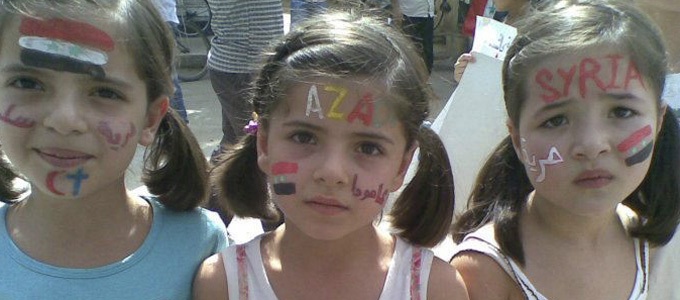
November’s Children of the Revolution looks at the events that led up to the beginning of the Syrian Civil War, and the early days before it became too dangerous to gather on the streets, when men, women and children would parade in public places, waving the flag of the old Syria, the one that flew before the Assad clan seized power in 1966. Canny camera men could take media-friendly shots of photogenic little girls in face makeup looking sad, vulnerable and defiant. Those days of hope are long gone.

A highlight of this past year has been my work as a volunteer with the Humanitarian Settlement Services programme. The HSS’ mission is to assist newly arrived refugees to settle in Australia. In No Going Home I endeavour to imagine the refugee journey. Hejira is a sequel of sorts and, indeed, a happy ending.

Happy New Year to these prospective New Australians, and to all my readers. May 2016 be fortunate and fulfilling.

Palmyra, viewed from Tadmor

Palmyra, viewed from Tadmor

The Children of the Revolution

I finally broke into the prison,
I found my place in the chain.
Even damnation is poisoned with rainbows,
all the brave young men
they’re waiting now to see a signal
which some killer will be lighting for pay.
Into this furnace I ask you now to venture,
you whom I cannot betray.
Leonard Cohen, The Old Revolution

The Syrian civil war broke lose in March 2011, two months after the events in Tahrir Square, and one month after the fall of Mubarak.

Amidst the tumult and media hype of the Arab Spring, it was as if the distant drums had suddenly hit the volume switch. In the dusty border town  of Dara’a, just north of Jordan, local kids wrote on a wall: “The people want the regime to fall”. The words had been repeated from Tunisia to Egypt, from Yemen to Bahrain. It was the cry of the revolution. The local governor decided to come down hard. The young people, all under 17, were thrown in jail. The punishment stunned the town, and suddenly, Syria, progressive, diverse, proud, beautiful, but authoritarian Syria greeted the misnamed Arab Spring.

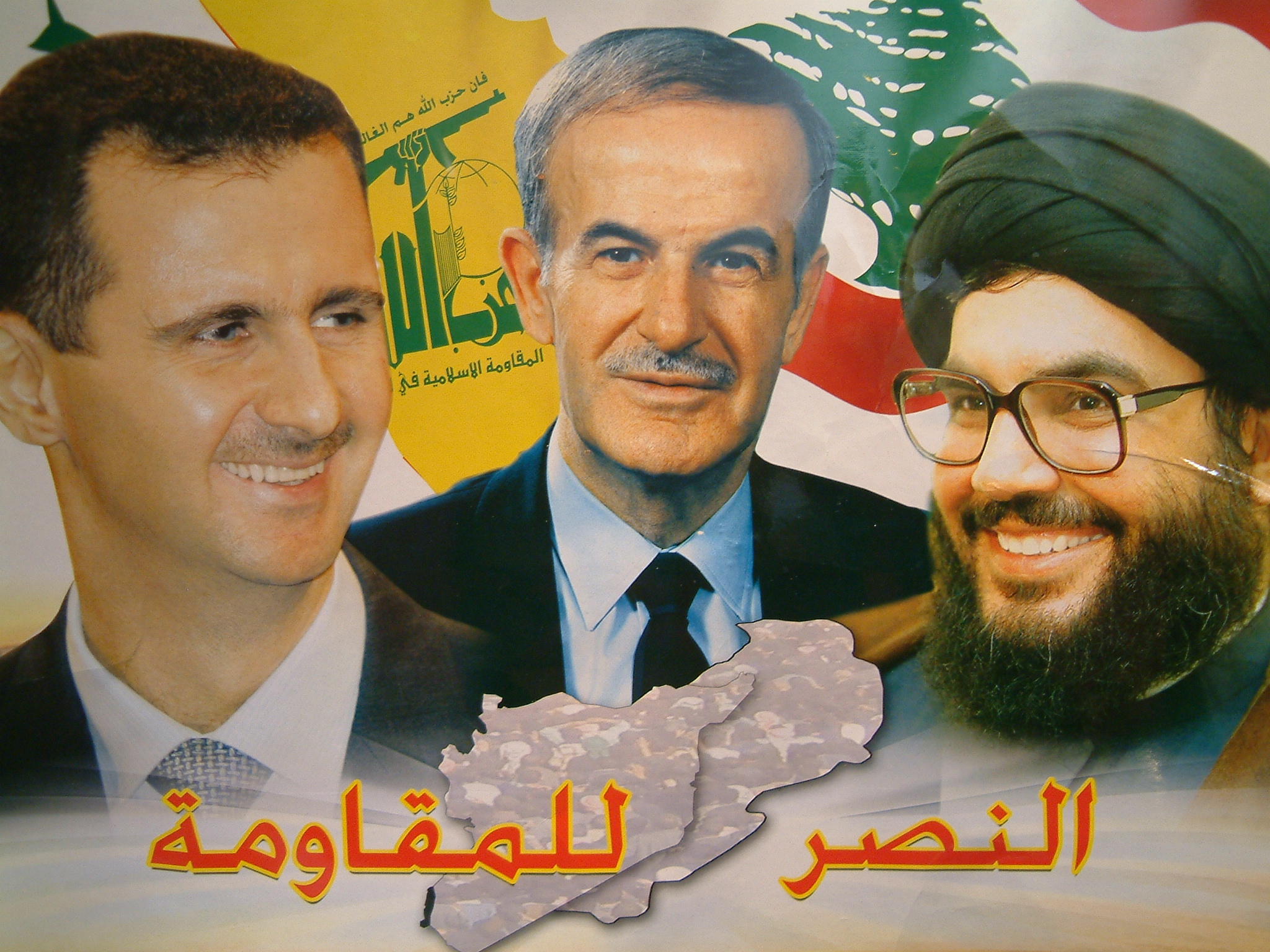
The young men’s families and friends weren’t having any of it. It is said that in broad daylight, dozens of young men pelted a poster of a smiling President Bashar Assad; a statue of the Bashar’s  late father and predecessor Hafiz Assad was demolished; and official buildings, including the HQ of ruling Ba’ath Party’ and the governor’s office, were destroyed. “There is no fear, there is no fear, after today there is no fear!” hundreds of men chanted in shaky mobile-phone footage.

Over that weekend, security forces opened fire on marchers. This was the regime’s well tried negotiating technique. But Assad responded immediately, sending a high-ranking delegation to deliver his condolences to the families of the dead. The governor was sacked, and the boys released.

So far, so “I mentioned the war but I think I got away with it” But the die had been cast. The demonstrators made demands the regime was unwilling or unable to meet. And the rest is tragedy.

I am not about to retell the story of the Syrian revolution. It is still being written, and as yet, there is no ending. Only more blood. As I write, well over three hundred thousand souls have perished (soon, it will overtake the butchers bill of the Spanish and American Civil Wars), and tens of thousands have disappeared into prisons and oubliez. Millions have been displaced within the country; millions have sought shelter in neighbouring countries; and at least eight hundred thousand have taken to the roads of Central Europe.

But I will quixotically hark back to just before events reached the fork in the road, to when there was an outside chance that Syria could avoid the chaos and carnage that was besetting other children of an Arab Spring that was turning into a bitter winter.

Back to the days before The Fall when pundits were asking whether Bashar would be Hammersmith Man, reflecting his former career as a successful ophthalmologist in London, and his glamorous, cosmopolitan, former merchant banker wife, or Hama Man, recalling his father’s crackdown on an Islamist rising in Hama in 1982, in which uncounted tens of thousand are believed to have perished. We discovered very soon whom he was destined to become.

To the days before The Fall, before the revolution became weaponized and islamized, and demonstrators danced together in the streets, earning the intifada the short lived sobriquet ‘the Dabke Revolution’, named for the circle folk dance popular throughout the Middle East and the Balkans.

image

The days before the slaughters began. First by the forces of regime, led by Bashar’s brutal brother Maher and his notorious Fourth Armoured Division. Then by the thuggish Alawi militia – the Shabiha, or “ghosts” or “shadows”, a double-edged meaning alluding to their underworld origin and methods, and also to the fact that they literally turned people into ghosts. And then, in reciprocal ferocity, by opposition militias that grew and proliferated, fought and died, divided, and divided again, and embraced a jihadi creed, sowing the dragon’s teeth that evolved into Jabhat an Nusra and Da’esh.

The days before it became too dangerous to gather on the streets, when men, women and children would parade in public places, waving the flag of the old Syria, the one that flew before the Assad clan seized power in 1966. Canny camera men could take media-friendly shots of photogenic little girls in face makeup looking sad, vulnerable and defiant. When the picture that is the featured image of this blog was first published in Al Jazeera in early 2011, I was both enchanted and inspired. I immediately started using it, with acknowledgements, in my publications and postings. When more and more of these images appeared, I used them too. But I was becoming a tad suspicious. The lasses looked too clean, too cute, and indeed, many actually looked alike. The photographers’ daughters, perhaps, or those of friends. Were they for-real or where they posed? I guess I will never find out.

Needlessly to say, as the rebellion morphed into harrowing civil war, such images disappeared, and in their place, we saw destruction and carnage, and the broken bodies of little girls and boys slain by bomb and bullet, hardship and hunger. Now, as families were forced to abandon their homes and make their way to the borders, and thence, into Jordan, Lebanon, and Turkey, and finally, into Europe, we see children staggering on dusty roads, carried piggy back by exhausted fathers, pushed in strollers, scorched by the sun, soaked by the rain, and frozen by the snow. And we see little Aylan on his golden beach, a Kurdish toddler now a symbol of all the drowned babies of the Mediterranean and the Aegean Sea.

Photogenic children no more. Just victims, survivors, lost souls.

I fought in the old revolution
on the side of the ghost and the King.
Of course I was very young
and I thought that we were winning;
I can’t pretend I still feel very much like singing
as they carry the bodies away.
Into this furnace I ask you now to venture…
you whom I cannot betray.

See also, Bombs and Babies

Children of the Revolution

On a personal note, we were last in Syria in March 2009, and whilst visiting the famed Roman amphitheater at Bosra, just northeast of Dera’a, we had the pleasure of the company of a crowd of Syrian school children. They treated us like visiting celebrities and sang us a song of welcome. It is saddening to look at these pictures now, and wonder where these children are now.

Bosra Bosra 2


Bosra

Hejira

You know it never has been easy
Whether you do or you do not resign
Whether you travel the breadth of extremities
Or stick to some straighter line
Joni Mitchell, Hejira

People’ll tell you where they’ve gone
They’ll tell you where to go
But till you get there yourself you’ll never really know
Where some have found their paradise
Other’s just come to harm
Oh Amelia it was just a false alarm
Joni Mitchell, Amelia

How sweet it is to learn new things – to walk new streets, to look through new windows. Working lately as a volunteer with the Humanitarian Settlement Services progrmme,  I have had that opportunity. The HSS’ mission is to assist newly arrived refugees to settle in Australia, participate in our way of life,  access services available to us all, and to develop the skills and knowledge needed to begin a new life in our country. The  following  pieces recall two days in my volunteer life. They are a sequel of sorts, and indeed, a happy ending to my recent post No Going Home in which I endeavored to imagine the refugee journey.  

Hejira is an Arabic word that commemorates specifically  the flight of Muhammad from Mecca to Medina in 622.  But it also refers to any emigration or flight, and this is the context here.

Arrival

I wait at our tiny  airport for an Afghani family coming to Australia from a refugee camp on the Pakistani border. They have come here straight from Iran with but a short transit in Sydney. The plane is a little QANTAS Dash 8, and the passengers walk down the gangplank. The day is hot. Young girls in short shorts and skivvies disembark, and young men in shorts, tees and thongs (the sandals, that is). There a few suited businessmen, and retirees in nondescript array.

Our new arrivals are last off. Mum and two teenage sons. She wears a hijab and Iranian dress,, and the boys, jeans and tee shirts. They step onto the hot tarmac and walk, tired and nervous, to the arrivals lounge. We are with the welcoming party – a family of Afghanis who settled here a short while ago, two young girls, their mother and their auntie. They too are dressed in salwar kameez – they came here from a  camp in Pakistan. The ladies dwelt there for twelve years, and the girls were born there.

A young Hazara serves as our interpreter. She is dressed like a fashionable Iranian muhajibabe in simple and smart attire – for it is indeed Iran that she and he family sought shelter from the Afghan storm. She is eighteen, and arrived with her mother and siblings two years ago. Her English is excellent – she wants to be an interpreter, and is working towards that goal at TAFE. And this is the thing. These folk have all come here on 204 visas for women at risk, the sole carers of dependent families. Their husbands are either dead or decamped in Afghanistan or in the border camps.

And then there are we three Aussies. The tireless Humanitarian Settlement Service caseworker, a lady from community services who wanted to witness an arrival, and myself, working for the HSS as a volunteer, likewise bearing witness to what is quite a powerful scene.

The meeting and the greeting is done with salaams, embraces (the Afghanis) and handshakes (we locals). The first minutes in their new home in the sun. I help the lads load the suitcases on to the bus, and my work done, I bid them all “khoda hafez” and take my leave. They are driven off to their new digs, an Afghan meal, the first of much paperwork, and then sleep.

But not before they are taken to the headland, from where they will view the Pacific Ocean to the east, hills covered in banana plantations to the west, and beyond them, below the cloudless blue sky, the blue-green foothills of the Great Dividing Range. On the other side, far to the northwest, their landlocked, shattered  home is 11,353 kilometers away.

Moving

Our mission today is to move a Hazara family from their first, interim dwelling, to a permanent home on the other side of town. A mother with four children. Three of these are at school today, and the eldest, a sparky eleven year old, has stayed home to help mom move house and help us with translation. Although she has been in Australia for just six months, her English is astonishing. She later tells me she can speak five Afghan languages, Urdu, and a bit of Hindi. Nothing is going to hold this one back.

Their bags and boxes are ready, and these fill the bus. So off we all go to their new home. Two Afghani neighbours greet us on  arrival, with two young girls and a tiny boy. Three ethnic groups, three languages, and two religions, and they are getting along famously.

“Why do you think that is?” asks the caseworker. “Because there are no men around”. No men. No controllers. No patriarchy. No rules. No tribes. No prejudice.

 In Sydney, in Melbourne, with the larger Afghan and Muslim communities, with the mosques and madrassas, imams and ideologies, the self-appointed and self-perpetuating mullahs and muftis, male control would be asserted, with their restrictive rules and regimentation. All the old baggage that was left behind would be brought in and unpacked – the tribal loyalties and enmities, the specious theological diktats on dress and demeanor, form and function. And the patriarchy.

But not here, in this northern, sea-side town. Just women doing their best to get along and make the new life work for themselves and their children.

What will the future hold for these women taken out of their homes, their culture, their society, and asked to craft a new life and identity for themselves and their children in a new and strange land? How will they go with the language and with life in general? Will they make new friends, find rewarding work, and “fit in”,  or will they cling to their old lives, lonely and isolated, their children the sole interface between themselves and the world?

I wonder about the young girls – and particularly the bright and outward-going ones I have met. Will they build successful school and professional careers? Will they make long and lasting friendships with their Australian and other peers?  Will they let go the costumes, conventions, and constrictions of their parents’ culture?

I wonder about the young boys, and the young men whom I greeted at the airport. How will they fare in their matriarchal domestic world? How will they adjust to their new life here with all its challenges and temptations?

If they remain in this regional city, who will be their role models? Will they become more Australian than Afghani as they grow up and mature among their north coast peers? Will they complete their education, and find work in an area with a very high level of youth unemployment? Or will they be isolated and lonely, dislocated and discontented? Will they assume their old culture’s patriarchal role and demand their mothers and sisters subject themselves to the son’s authority as head of the family, and impose restrictions their movements and morality, demeanor and dress?

Will they be drawn to the capital cities with their diverse Muslim communities. And into which circle will they be drawn? To the moderate ones who just want to get on with their lives in an Aussie world, to the pious and unassuming who see jihad as an internal spiritual quest, to the criminal and bikie gangs that we hear so much about, or to the radical proselytizers who view our culture and values as anathema to the word and will of God?

All this is in the future, and as these folk might say, in Gods hands. But in reality, it is in their’s and their’s alone. But I am glad to have been able to play a small part in setting these new arrivals on their path.

see also: No Going Home