Arguments of Monumental Importance – statuary declarations

The past is another country – they thought things differently there; and if the past shapes the present, the present also shapes the past.  Arguments of Monumental Proportions – Fallen Idols

The defacing and destruction of monuments to dead and dubious white men is back in vogue – not that the practice has ever actually gone out of style. As The Australian’s Art columnist Christopher Allen writes in an article republished below, statues have been set up as monuments to great and not so great men and removed by their enemies for a very long time. Even without considering the many precedents in antiquity, countless statues were destroyed during the French Revolution, others during the mob violence of the short-lived “Commune” government in Paris in early 1871 – including the figure of Napoleon on the Colonne Vendôme – and many more under the Nazi occupation of Paris.

Then there is the tearing down the statues of tyrants in the fall of dictatorships, from the former Soviet empire to Iraq. In those instances, the state or a despot had set up multiple effigies all over the country as symbols of power and instruments of oppression, and they were overthrown in the collective movement of popular revolution.

To paraphrase Allen, portrait monuments proliferated in more recent times, particularly in the 19th century, as a consequence of increasing prosperity, patriotism or nationalism and local municipal pride. Monarchs, politicians, leaders of national unification or liberation movements, explorers and founders of new colonies, notable scientists and writers, philanthropists and other prominent citizens were commemorated in public statuary. Arguably, too many were raised; sometimes their subjects have lost the prominence they once had; or some of their deeds may now today be considered reprehensible. An argument could be made to relocate a statue to a museum instead, but such decisions ought not be taken lightly, especially if the justification for removal and relocation are ideological or made in response to online protests and vandalism.

in Arguments of Monumental Proportions – Fallen Idols, I wrote a while back:

As an Aussie and a Brit of Irish parents, and as a history tragic, I find the long running monuments furore engrossing. Statues of famous and infamous generals, politicians and paragons of this and that grace plazas, esplanades and boulevards the world over, and their names are often given to such thoroughfares. They represent in visual and tangible form the historical memory of a nation, and as such, can generate mixed emotions reflecting the potentially conflicted legacies and loyalties of the citizenry”.  

“It is”, I wrote, “about the control of history – and who controls it. We all use history, incorporating perceptions of our national story into lessons that guide or confirm our present actions and outlooks. Our history is written not only in scholarly narratives, but also, in commemorations, in statues, flags and symbols, in the stories that children are taught about their country and their community from their earliest school years, and in the historical figure skating they are taught to remember and honour. History, it is said, is written mostly by the victors – but not always. So, the inevitable tensions between different versions of the past fosters tension and conflict, and grievance and offense in the present. Particularly in onetime colonialist and settler countries, and the lands these once ruled and exploited … All sorts of emotions, hopes and fears lie behind our various creation myths. No matter the source of our different “dream-times” we are all correct in one way or another. People wheel out the wise old “blind men and the elephant” story to illustrate how blinkered we are; but in reality, if those blind men were given more time, they would have expanded their explorations and discovered a bigger picture”.

Which brings to recent events in Hobart, in our most southern state and one of Australia’s earliest colonies and the location of many of many bloody atrocities in Australia’s Frontier Wars, and to Allen’s article which tells the tale of a nineteenth century public figure whom very few Australians have heard of and of his illicit trafficking in the remains of a decease indigenous man. 

Read also In That Howling Infinite another story of the British Empire’s sticky fingers: Bringing it all back home – the missing mosaic and other ‘stolen’ stuff  

Felling Crowther’s statue is not the way to right a historical wrong

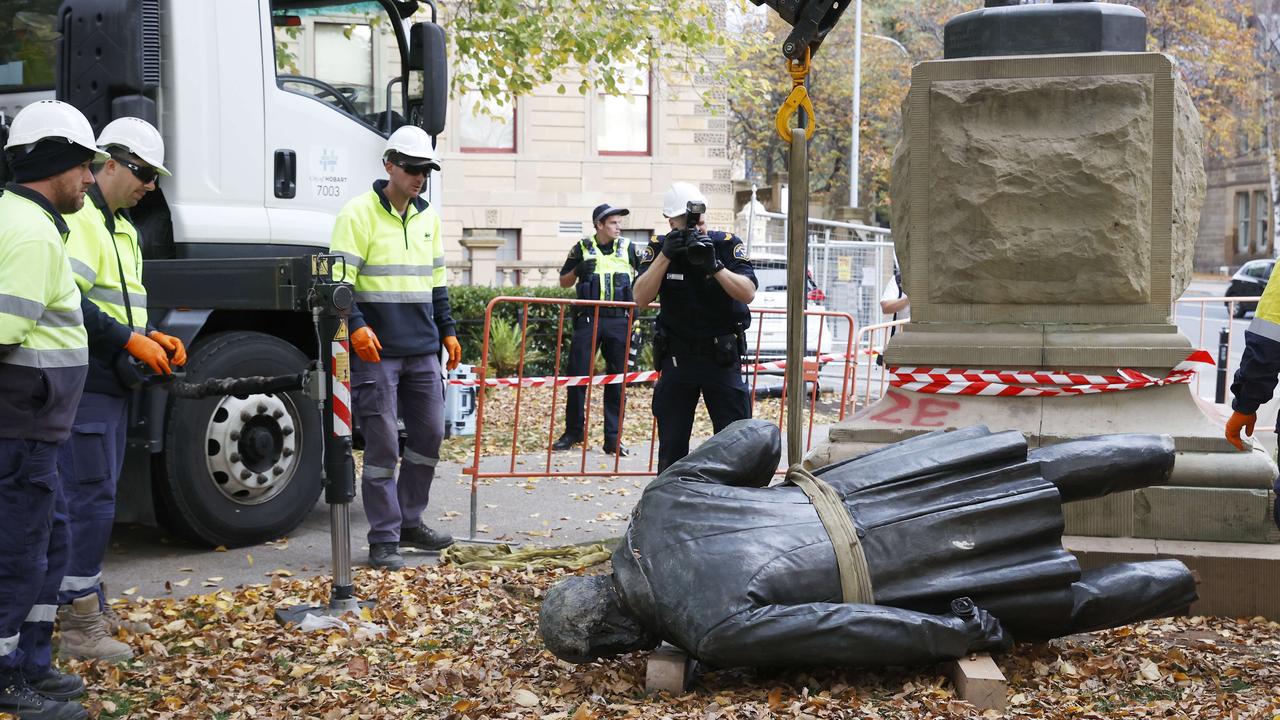
The William Crowther statue in Franklin Square Hobart was vandalised in May 2024. Picture: Nikki Davis-Jones.

William Crowther’s statue, Franklin Square Hobart, May 2024. Nikki Davis-Jones.

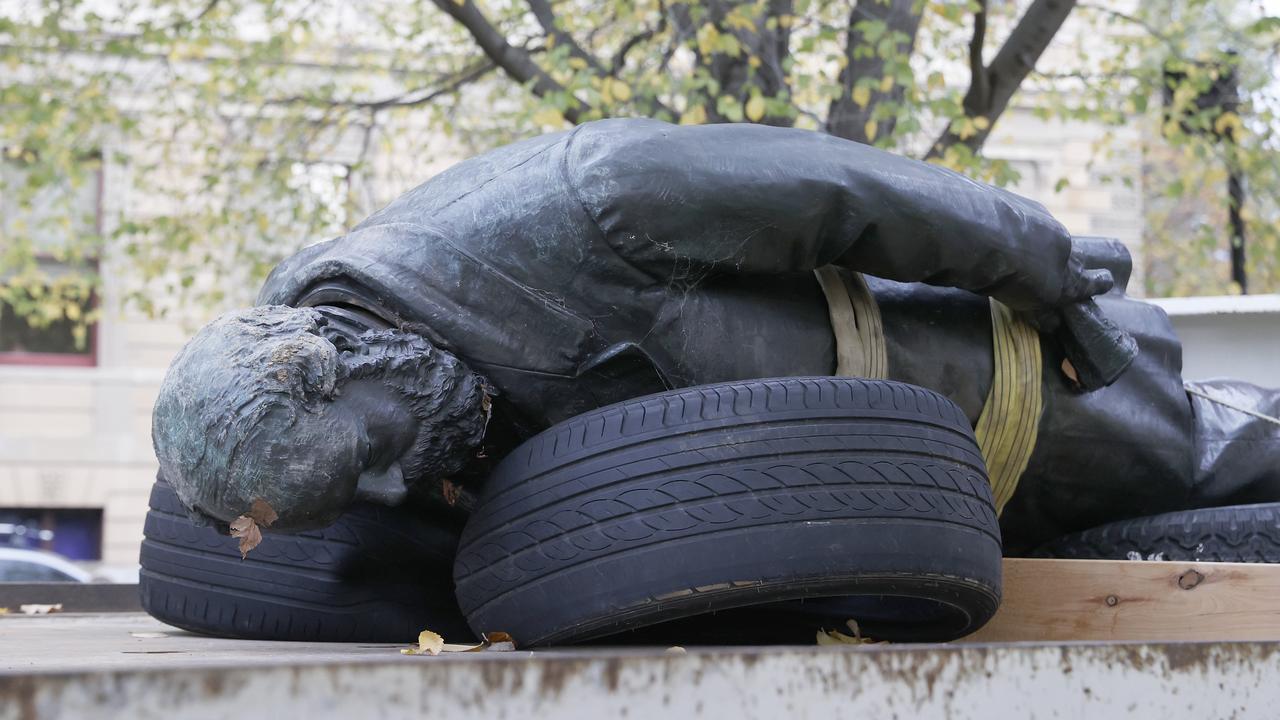
No doubt many people, regardless of their political orientation, were disturbed by the recent news that a civic statue had been vandalized and destroyed under the cover of night by an anonymous gang of attackers in Hobart. The event was all the more shocking because the city council had already determined to remove the statue from its public location following controversy about the actions of the individual it celebrated.

This kind of attack, to be quite clear, has nothing in common with tearing down the statues of tyrants in the fall of dictatorships, from the former Soviet empire to Iraq. In those instances, the state or a despot had set up multiple effigies all over the country as symbols of power and instruments of oppression, and they were overthrown in the collective movement of popular revolution. In this case an individual monument to a respected citizen, erected by the community, was destroyed by a small group of zealots.

Statues have been set up as monuments to great men and removed by their enemies for a long time. Even without considering the many precedents in antiquity, countless statues were destroyed during the French Revolution, others during the mob violence of the short-lived “Commune” government in Paris in early 1871 – including the figure of Napoleon on the Colonne Vendôme – and many more under the Nazi occupation of Paris.

Statues have not always been effigies of individuals; some of the most beautiful Greek sculptures were simply of the ideal body; others represented divinities, as also in Christian, Buddhist or Hindu traditions. Portrait sculpture began in the Hellenistic kingdoms and flourished in the Roman period. After the fall of the Empire, and with the decline of all the arts, no sculptural likeness was made for a thousand years. The Renaissance rediscovered portraiture with enthusiasm, both in painting and sculpture, and over the next few centuries portraits of monarchs and other leaders became common in big cities.

Portrait monuments proliferated in more recent times, particularly in the 19th century, as a consequence of increasing prosperity, patriotism or nationalism and local municipal pride. Not only monarchs but prominent politicians, leaders of national unification or liberation movements, explorers and founders of new colonies, notable scientists and writers, philanthropists and other prominent citizens were commemorated in public statuary. Often these adorned and helped to shape the new public parks laid out for the enjoyment of populations in great modern cities.

Arguably too many of these monuments were put up, and sometimes the individuals in question have lost the prominence they once had; or some of their deeds may now be considered reprehensible. In certain cases an argument could be made to relocate a statue to a museum instead, but such decisions should not be taken lightly, especially if the grounds for removal and relocation are ideological, or made in response to the digital mob behaviour of social media.

The felled William Crowther statue in Franklin Square Hobart. Picture: Nikki Davis-Jones

The case of William Crowther (1817-85) is an interesting one. He was a member of a prominent Hobart family of doctors and natural historians, including his own father and then his son and grandson who enjoyed distinguished careers in medicine, science, war and politics over the following century. He was an expert surgeon, a keen natural scientist and an entrepreneur with important shipping and whaling interests, as well as a member of the colonial parliament and briefly premier of Tasmania. Less than four years after his death, a statue was set up by public subscription to honour an eminent fellow citizen.

Crowther is controversial because of his alleged, and it seems fairly certain, involvement in a grisly, if scientifically motivated, affair in 1869. Darwin’s great book On the Origin of Species had only appeared a decade earlier, in 1859, and scientists were eager to understand more about the comparative morphology of different human families. Tasmania held a particular interest because the Indigenous Tasmanian population differed considerably from the mainland people.

By those years, however, over a generation after the end of the Black War (1824-31), very few individuals of unmixed Tasmanian descent survived, and just one male: William Lanne (c. 1836-69) – sometimes given as Lanney or Lanné – who worked as a whaler, was well-known in Hobart, and had even been introduced by the governor to Prince Alfred, the Duke of Edinburgh in 1868. When he died of cholera in 1869, he was buried at Saint David’s Church in Hobart, where Prince Alfred had just laid the foundation stone for the present Saint David’s Cathedral (consecrated in 1874).

Lanne’s funeral was a solemn occasion, attended by a large number of Hobart citizens. The Hobart Mercury reported (March 8, 1869): “Having been duly sealed, the coffin was covered with a black opossum skin rug, fit emblem of the now extinct race to which the deceased belonged; and on this singular pall were laid a couple of native spears and waddies, round which were twined the ample folds of a Union Jack, specially provided by the shipmates of the deceased. It was then mounted upon the shoulders of four white native lads, part of the crew of the Runneymede, who volunteered to carry their Aboriginal countryman to his grave.”

Behind the scenes, however, there was a struggle to secure a “perfect” Tasmanian skeleton for scientific research; the Royal Society of Tasmania, founded in 1843 and the first Royal Society outside Britain, wrote to the government, and according to the same article in the Mercury, “The Government at once admitted their right to it, in preference to any other institution, and the Council expressed their willingness at any time to furnish casts, photographs, and all other particulars to any scientific society requiring them. Government, however, declined to sanction any interference with the body, giving positive orders that it should be decently buried.”

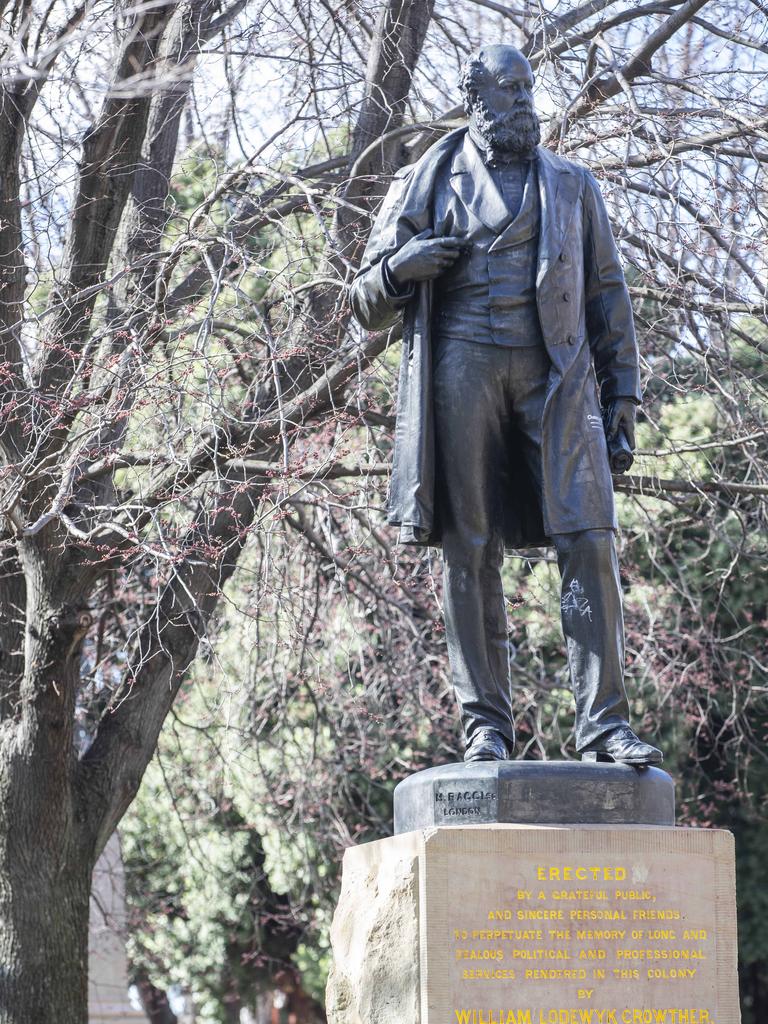
The William Crowther statue as it was. Picture: Chris Kidd

The William Crowther statue as it was. Chris Kidd

On the night before the burial, nonetheless, someone stole Lanne’s skull from the morgue, as the article goes on to relate: “The dead-house at the Hospital was entered on Friday night, the head was skinned and the skull carried away, and with a view to conceal this proceeding, the head of a patient who had died in the hospital on the same day, or the day previously, was similarly tampered with and the skull placed inside the scalp of the unfortunate native, the face being drawn over so as to have the appearance of completeness.”

Crowther was suspected of having carried out this mutilation because he had wanted the skeleton to go to the Royal College of Surgeons in London. The Royal Society, concerned that the rest of the body might similarly be stolen, then removed the hands and feet, partly to render the remaining skeleton less attractive to thieves. They also alerted the governor to the need to guard the grave against possible robbery, and while this was agreed on, it seems that the Hobart municipality failed to arrange watchmen; the grave was opened on the night after the funeral and the skeleton removed, leaving behind the skull that had been inserted into Lanne’s head.

It is not entirely clear who was responsible for these events, although it seems to be generally assumed that Crowther sent Lanne’s skull to the Royal College of Surgeons, who awarded him a gold medal and a fellowship. His entry in the Australian Dictionary of Biography (1969) states: “In 1860 he was appointed one of the four honorary medical officers at the Hobart General Hospital, but was suspended in March 1869 over charges of mutilating the body of William Lanney, the last male Tasmanian Aboriginal. An inquiry showed that two mutilations had taken place, the first at the Colonial Hospital, the other at the cemetery the night of the burial. Drs Crowther and G. Stokell, resident medical officer at the hospital, were suspected of the first, the Royal Society of Tasmania of the second.”

Whatever the truth, the story is gruesome, a window into another time and a world of which we can be highly critical but from which there is also much to learn. Perhaps it would have been preferable to move the statue to the Tasmanian Museum and Art Gallery, where it will no doubt now be transferred and where it can be accompanied by displays that explain what we know about the events surrounding Lanne’s death and burial.

Simply cutting the statue down, however, closes off the opportunity for reflection; erasing the traces of the past may offer short-term satisfaction, but in the long run it encourages forgetting rather than remembrance and reflection. Is it not better to understand this episode and ponder its implications than to bury it under self-indulgent slogans like “decolonize”, which was scrawled on the statue’s base?

The most fundamental principle in this and similar cases, however, is the protection of public space in a democratic society. In a figurative sense, it is imperative to protect the public space of free discourse and open debate. Today that space is more than ever under attack from ideologues of different political orientations who seek to suppress or silence those who disagree with their views.

We saw recently the attempt by a city council in the west of Sydney to ban a book on same-sex parenting; but we could equally have seen another group trying to ban a book critical of the same arrangements.

Freedom of speech means accepting that those who disagree with you have a right to argue their case.

The preservation of freedom of discourse and debate is harder than ever in the digital age; this may seem paradoxical, since social media ostensibly allows everyone to express their opinions more promiscuously than ever before. But in practice that expression is quickly drawn into various competing maelstroms in which people vie to agree with each other ever more vociferously.

The same kind of mechanics endanger the physical public spaces of the modern city, the streets and squares and parks which are shared by all its citizens and residents. This public space must be one of order and peaceful process, where people can live and work and socialise in security and as much as possible in an environment of harmony.

The public space is one of lawful communal process. If, in this case, a monument is put up by the community, any decision about moving it must also be taken by the community (albeit in a different time and context)..

It is as unacceptable for a self-appointed gang to destroy a public monument as it is for selfish residents to cut down trees that block their view or greedy developers to demolish a heritage building for commercial gain or looters to smash a shopfront during a natural disaster. We must be unequivocal in our condemnation of the violation of common space in a democratic society.

Wystan and Christopher’s excellent adventure

As evening fell the day’s oppression lifted
Far peaks came into focus, it had rained.
Across wide lawns and cultured flowers drifted
The conversation of the highly trained.
Two gardeners watched them pass and priced their shoes
A chauffeur waited, reading in the drive
For them to finish their exchange of views.
It seemed a picture of the private life.
Far off, no matter what good they intended
The armies waited for a verbal error
With all the instruments for causing pain
And on the issue of their charm depended
A land laid waste, its towns in terror
And all its young men slain.
Embassy, WH Auden, from Journey to a War

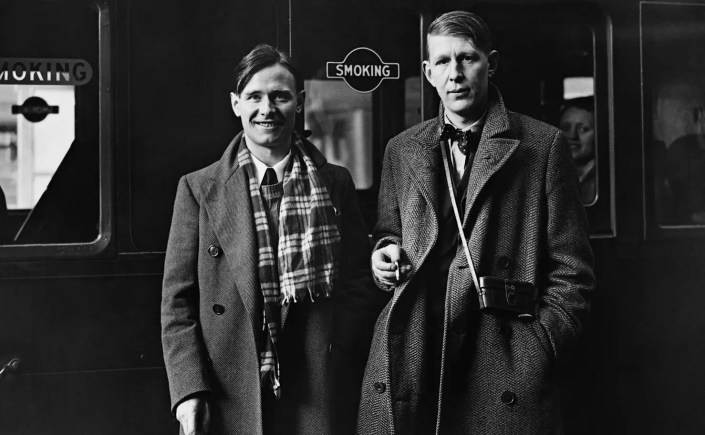
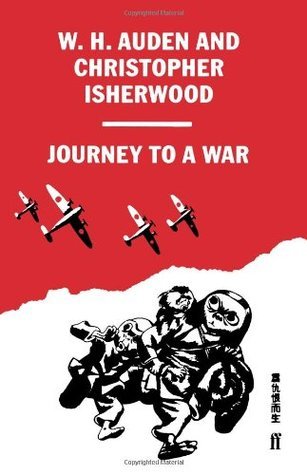
In 1938, English writers WH Auden and  Christopher Isherwood were commissioned by their publishers to write a travel book about the East. Auden was already established as one of Britain’s foremost poets whilst his friend and onetime lover Isherwood was acclaimed as an author and dramatist. His Berlin Stories, two novels set in the last days of the Weimar Republic and today acclaimed as classics of modern fiction; the semi autobiographical Goodbye to Berlin (1939) inspired the remarkable musical Cabaret (1966).

By adventurous choice they went to China for six months, their journey coinciding with Imperial Japan’s brutal invasion. American poet and educator Mildred Boie, reviewing the book for Atlantic in November 1939, takes up the story:  

“With the good fortune of famous and attractive young men they were helped and shown about by everybody from coolies to ambassadors, journalists to generals. They behaved, as they observed and wrote (to judge from the diary), with the engaging frankness and immaturity of English schoolboys, with the ingenious confidence and casual incompleteness of amateurs. But these qualities are inadequate for reporting war, for evaluating life and death in so desperate and disastrously complicated a country as China. The authors were not only amateurs as foreign correspondents, they were also dilettantes: they played at getting to the front, at taking notes on slums, at dashing from formal garden parties to meetings with intellectuals and busy military and diplomatic leaders. They suffered almost as much, certainly as consciously, from blisters, constipation, boredom, sleeplessness, and hangovers as from the shape of poverty, the taste of fear, the sight and smell of death. They were always safe, always outside.” 

Collectively, perhaps, we most resemble a group of characters in one of Jules Verne’s stories about lunatic English explorers. 

War is bombing an already disused arsenal, missing it and killing a few old women. War is lying in a stable with a gangrenous leg. War is drinking hot water in a barn and worrying about one’s wife. War is a handful of lost and terrified men in the mountains, shooting at something moving in the undergrowth. War is waiting for days with nothing to do; shouting down a dead telephone; going without sleep, or sex, or a wash. War is untidy, inefficient, obscure, and largely a matter of chance. 

On their safe return, the pair put together Journey to a War, travel book in prose and verse that was published in 1939. The book is in three parts: a series of poems by Auden describing his and Isherwood’s journey to China in 1938; a “Travel-Diary” by Isherwood (including material first drafted by Auden) about their travels in China itself, and their observations of the Sino-Japanese War; and “In Time of War: A Sonnet Sequence with a Verse Commentary” by Auden, with reflections on the contemporary world and their experiences in China. The book also contains a selection of photographs by Auden.

I am never much good at defending the British Empire, even when drunk
Christopher Isherwood

I republish below an excellent article in the blog Books and Boots – Reflections on Books and Art. It provides a more detailed background to the genesis of the book, setting the geopolitical scene, describing  Auden’s  anticlimactic and, it would seem, personally disappointing visit to Spain during its civil war, and the poetry within.

See also in In That Howling Infinite, Better read than dead … books, poetry and reading


WH Auden and Christopher Isherwood

Journey To A War by W.H. Auden and Christopher Isherwood (1939)

When we awoke early next morning the train was crossing a wide valley of paddy fields. The rising sun struck its beams across the surfaces of innumerable miniature lakes; in the middle distance farmhouses seemed actually to be floating on water. Here and there a low mound rose a few feet above the level of the plain, with a weed-grown, ruinous pagoda, standing upon it, visible for miles around. Peasants with water-buffaloes were industriously ploughing their arable liquid into a thick, brown soup.
(Journey To A War, p.191)

Collectively, perhaps, we most resemble a group of characters in one of Jules Verne’s stories about lunatic English explorers. (p.104)

The Sino-Japanese War

In July 1937 – exactly a year after the start of the Spanish Civil War – Japan attacked China. It was hardly a surprise. In 1931 the so-called ‘Mukden Incident’ had helped spark the Japanese invasion of Manchuria (the large area to the north east of China, just above Beijing). The Chinese were defeated and Japan created a new puppet state, Manchukuo (setting up the last Qing emperor as its puppet ruler) through which to rule Manchuria.

Going further back, in 1894–1895 China, then still under the rule of the Qing dynasty, was defeated by Japan in what came to be called the First Sino-Japanese War. China had been forced to cede Taiwan to Japan and to recognise the independence of Korea which had, in classical times, been under Chinese domination.

In other words, for 40 years the rising power of militaristic, modernising Japan had been slowly nibbling away at rotten China, seizing Taiwan, Korea and Manchuria. Now the military junta in Tokyo decided the time was right to take another bite, engineered an ‘incident’ at the Marco Polo bridge on the trade route to Beijing, and used this as a pretext to attack Beijing in the north and Shanghai in the south.

Thus there was quite a lot of military and political history to get to grips with in order to understand the situation in China, but what made it even more confusing was the fact that China itself was a divided nation. First, the nominal government – the Chinese Nationalist Party or Kuomintang under its leader Chiang Kai-shek – had only with difficulty put down or paid off the powerful warlords who for decades had ruled local regions of China after the collapse of the Qing Dynasty in 1911.

But second, Chiang faced stiff competition from the Chinese Communist Party. The two parties had lived in uneasy alliance until Chiang staged a massacre of communists in Shanghai in 1927 which brought the tension between Chinese nationalists and communists into the open.

It was the three-way destabilisation of China during this period – warlords v. Nationalists v. Communists – which had helped Japan invade and take over Manchuria. Prompted by the 1937 Japanese attack the Nationalists and Communists formed an uneasy alliance.

Auden in Spain

Meanwhile, back in Europe, the great political issue of the age was the Spanish Civil War which began when General Franco led a military uprising against the democratically elected government in July 1936. Like many high-minded, middle class liberals, Auden and Isherwood both felt the time had come to put their money where their mouths were. Auden did actually travel to Spain in January 1937 and was there till March, apparently trying to volunteer to drive an ambulance in the medical service. Instead, red tape and the communists who were increasingly running the Republican forces apparently blocked him from getting a useful job. He tried to help out at the radio station but discovered its broadcasts were weak and there were no vacancies.

Frustrated and embarrassed, Auden was back in England by mid-March 1937. The long-term impact of the trip was his own surprise at how much it upset him to see the churches of Barcelona which had all been torched and gutted by a furious radical populace as symbols of oppression. Auden was shocked, and then shocked at his reaction. Wasn’t he meant to be a socialist, a communist even, like lots of other writers of his generation? The Spain trip was the start of the slow process of realisation which was to lead him back to overt Christian faith in the 1940s.

Also Auden saw at first hand the infighting on the Republican side between the communist party slavishly obeying Stalin’s orders, and the more radical Trotskyite and Anarchist parties who, later in 1937, it would crush. Later he paid credit to George Orwell’s book Homage To Catalonia for explaining the complex political manoeuvring far better than he could have. But watching the Republicans fight among themselves made him realise it was far from being a simple case of black and white, of Democracy against Fascism.

So by March 1938 Auden had returned to Britain, where he was uncharacteristically silent about his experiences, and got on with writing, editing new works for publication (not least an edition of his play The Ascent of F6 and Letters From Iceland).

Meanwhile, Christopher Isherwood was living in Paris managing his on-again, off-again relationship with his German boyfriend Heinz. And although he had accommodated Auden on an overnight stop in the French capital and waved him off on the train south to Spain, Isherwood hadn’t lifted a finger for the Great Cause.

Then, in June 1937, Auden’s American publisher, Bennet Cerf of Random House, had suggested that after the reasonable sales of his travel book about Iceland, maybe Auden would be interested in writing another travel book, this time travelling to the East. Isherwood was a good suggestion as collaborator because they had just worked closely on the stage play, The Ascent of F6 and had begun work on a successor, which was to end up becoming the pay On The Frontier. The pair were considering the travel idea when the Japanese attacked China, quickly took Beijing and besieged Shanghai.

At once they seized on this as the subject of the journey and the book. Neither had really engaged with the war in Spain; travelling east would be a way to make amends and to report on what many people considered to be the Eastern Front of what was developing into a worldwide war between Fascism (in this case Japan) and Democracy (in this case the Chinese Nationalists).

China also had the attraction that, unlike Spain, it wouldn’t be stuffed full of eminent literary figures falling over themselves to write poems and plays and novels and speeches. Spain had been a very competitive environment for a writer. Far fewer people knew or cared about China: it would be their own little war.

And so Auden and Isherwood left England in January 1938, boat from Dover then training it across France, then taking a boat from Marseilles to Hong Kong, via Egypt, Colombo and Singapore.

Journey to a War

Journey To A War is not as good as Letter From Iceland, it’s less high spirited and funny. There isn’t a big linking poem like Letter To Lord Byron to pull it together, and there isn’t the variety of all the different prose and verse forms Auden and MacNeice cooked up for the earlier book.

Instead it overwhelmingly consists of Isherwood’s very long prose diary of what happened to them and what they saw in their three months journey around unoccupied China.

The book opens with a series of sonnets and this was the form Auden chose to give the book poetic unity – sonnets, after all, lend themselves to sequences which develop themes and ideas, notably the Sonnets of Shakespeare, or his contemporaries Spencer and Sidney. There’s a collection of half a dozen of them right at the start, which give quick impressions of places they visited en route to China (Macau, Hong Kong). Then, 250 pages of Isherwood prose later, there’s the sonnet sequence titled In Time of War.

But instead of the bright and extrovert tone of Letters From Iceland, Auden’s sonnets are often obscure. They are clearly addressing some kind of important issues but it’s not always clear what. This is because they are very personal and inward-looking. Auden is clearly wrestling with his sense of liberal guilt. The results are rather gloomy. Spain had disillusioned him immensely. He went to Spain thinking the forces of Evil were objective and external. But his first-hand experience of the internecine bickering on the Republican side quickly showed him there is no Good Side, there are no Heroes. History is made by all of us and so – all of us are to blame for what happens. Travel as far as you want, you’re only running away from the truth. If we want to cure the world, it is we ourselves that we need to cure first.

Where does this journey look which the watcher upon the quay,
Standing under his evil star, so bitterly envies,
As the mountains swim away with slow calm strokes
And the gulls abandon their vow? Does it promise a juster life?

Alone with his heart at last, does the fortunate traveler find
In the vague touch of a breeze, the fickle flash of a wave,
Proofs that somewhere exists, really, the Good Place,
Convincing as those that children find in stones and holes?

No, he discovers nothing: he does not want to arrive.
His journey is false, his unreal excitement really an illness
On a false island where the heart cannot act and will not suffer:
He condones his fever; he is weaker than he thought; his weakness is real…

(from The Voyage by W.H. Auden)

‘An illness on a false island’ which is clearly England, a place ‘where the heart cannot act’. The traveller is trying to escape himself but cannot and glumly realises ‘he is weaker than he thought’. Or the thumping final couplet of the sonnet about Hong Kong:

We cannot postulate a General Will;
For what we are, we have ourselves to blame.

Isherwood’s diary

Luckily, the prose sections of the book are written by Isherwood and these are much more fun. He keeps up the giggling schoolboy persona of the novel he’d recently published, Mr Norris Changes Trains (1935), he notes the way the Chinese pronounce their names Au Dung and Y Hsaio Wu, he sounds wide-eyed and optimistic. He hadn’t seen what Auden had seen in Spain, wasn’t struggling with the same doubts.

On February 28 1938 they leave Hong Kong by steamer for Canton and Isherwood finds everyone and everything hilarious. Look a Japanese gunboat! Listen, the sound of bombs falling! He has same facility for the disarmingly blunt image which he deploys in the Berlin stories. The mayor of Canton (Mr Tsang Yan-fu) is always beaming, has a face like a melon with a slice cut out of it. After dinner the Chinese general entertains them by singing Chinese opera, showing how different characters are given different tones and registers (‘the romantic hero emits a sound like a midnight cat’).

He refers to the whole trip as a dream and as a landscape from Alice in Wonderland – they expected Chinese people to behave as in a Gilbert & Sullivan opera and had rehearsed elaborate compliments, and are disarmed when they’re much more down to earth. The train journey on through Hunan province is boring, the tea tastes of fish, they amuse themselves by reading out an Anthony Trollope novel or singing in mock operatic voices.

But this sense of unreality which dogs them is simply because both of them didn’t have a clue what was going on, what was at stake, the military situation,  had never seen fighting or battle and weren’t proper journalists. They were privileged dilettantes, ‘mere trippers’, as Isherwood shamefacedly explains when they meet real war correspondents at a press conference (p.53).

In Hankow the Consul gives them Chiang, a middle-aged man with the manners of a perfect butler to be their guide. They attend the official war briefings alongside American and Australian journalists, they meet Mr Donald, Chiang Kai-shek’s military adviser, the German adviser General von Falkenhausen, Agnes Smedley, Madame Chiang Kai-shek herself, and with delight are reunited with Robert Capa, the soon-to-be legendary American war photographer who’d they’d met on the boat out. They attend traditional Chinese opera, which Isherwood observes with the eye of a professional playwright.

They catch the train to Cheng-chow which has been repeatedly bombed by the Japanese, capably looked after by their ‘boy’, Chiang. They are heading north on the train when they learn that Kwei-teh has fallen, nonetheless they decide to press on to Kai-feng. With them is an exuberant and seasoned American doctor, McClure, who takes them to watch some operations. They walk round the stinking foetid town. They go to the public baths which stink of urine. Then they catch a train to Sü-chow. And then onto Li Kwo Yi where they argue with Chinese commanding officers (General Chang Tschen) to allow them to go right up to the front line, a town divided by the Great Canal.

If you’ve no idea where any of these places are, join the club. I was reading an old edition but, even so, it had no map at all of any part of the journey. Which is ludicrous. The only map anywhere appears to have been on the front cover of the hardback edition, replaced (uselessly) by an anti-war cartoon on the paperback editions, and even this doesn’t show their actual route.

First US edition (publ. Random House)

With no indication where any of these places are, unless you are prepared to read it with an atlas open at your side, Isherwood’s long prose text becomes a stream of clever observations largely divorced from their context. Even an atlas is not that useful given that Isherwood uses the old form of the placenames, all of which, along with most people’s names, have changed. Thus Sian, capital of Shen-si province, is now Xian, capital of Shaanxi Province, Sü-chow is now Suzhou, and so on.

We are intended to enjoy the surreal aspects of travelling in a deeply foreign land – the village restaurant which was papered entirely with pages of American tabloid magazines, and so covered with photos of gangsters and revelations about fashionable divorcees (p.126); or the expensive hotel in Sian whose menu included ‘Hat cake’ and ‘FF potatoes’ (p.141). Beheading is a common punishment because the Chinese believe a body needs to be complete to enter the afterlife. They meet lots of tough and brave American missionaries, mostly from the American south.

Finally, back in Hankow (Hankou) they become part of polite society again, are invited to a party of Chinese intellectuals, a party given by the British admiral and consul, where they meet the legendary travel writer Peter Fleming and his actress wife Celia Johnson, the British ambassador Archibald Kerr, the American communist-supporting journalist, Agnes Smedley (p.156). Fleming pops up a lot later at their hotel in Tunki, and is too suave, handsome and self-assured to possibly be real.

Militarily, Journey To A War confirms the opinions of the modern histories of the war I’ve read, namely that the Nationalist side was hampered by corruption, bad leadership and, above all, lack of arms & ammunition. When they retook cities which had been under communist influence the Chiang’s Nationalists realised they needed some kind of ideology which matched the communists’ emphasis on a pure life and so, in 1934, invented the New Life Movement i.e. stricter morals, which Madame Chiang politely explains.

Isherwood notices the large number of White Russian exiles, often running shops, come down in the world. This reminds me of the Russian nanny J.G. Ballard had during his boyhood in 1930s Shanghai, as described in his autobiography Miracles of Life.

From pages 100 to 150 or so our intrepid duo had hoped to approach the front line in the north and had crept up to it in a few places, but ultimately refused permission to go further, to visit the Eighth Route Army, and so have come by boat back down the Yangtze River to Hankou. Now they plan to travel south-east towards the other main front, where the Japanese have taken Shanghai and Nanjing.

On the Emperor of Japan’s birthday there is a particularly large air-raid on Hankow and they make themselves comfortable on the hotel lawn to watch it. The Arsenal across the river takes a pasting and they go to see the corpses. 500 were killed. Nice Emperor of Japan.

They take a river steamer to Kiukiang and stay at the extraordinary luxury hotel named Journey’s End and run by the wonderfully eccentric Mr Charleton. They catch the train from Kiukiang to Nanchang, stay there a few days, then the train on to Kin-hwa (modern Jinhua). Here they are horrified to discover their arrival has been anticipated and they are treated like minor royalty, including a trip to the best restaurant in town with 12 of the city’s top dignitaries.

Auden and I developed a private game: it was a point of honour to praise most warmly the dishes you liked least. ‘Delicious,’ Auden murmured, as he munched what was, apparently, a small sponge soaked in glue. I replied by devouring, with smiles of exquisite pleasure, an orange which taste of bitter aloes and contained, at its centre, a large weevil. (p.195)

They are taken by car to the town of Tunki. They try to get permission to push on to see the front near the Tai Lake, They have to cope with the officious newspaperman, A.W. Kao. This man gives a brisk confident explanation of what’s happening at the front. Neither Auden nor Isherwood believe it. Isherwood’s explanation describes scenes they’ve seen on their visit, but also hints at what Auden might have seen on his (mysterious) trip to civil war Spain. Auden is given a speech defining the nature of modern war:

War is bombing an already disused arsenal, missing it and killing a few old women. War is lying in a stable with a gangrenous leg. War is drinking hot water in a barn and worrying about one’s wife. War is a handful of lost and terrified men in the mountains, shooting at something moving in the undergrowth. War is waiting for days with nothing to do; shouting down a dead telephone; going without sleep, or sex, or a wash. War is untidy, inefficient, obscure, and largely a matter of chance. (p.202)

Peter Fleming turns up looking gorgeous, professional, highly motivated, speaking good Chinese. He attends briefings, manages the locals with perfect manners. They organise an outing towards the front, with sedan chairs, bearers, two or three local notables (T.Y. Liu, A.W. Kao, Mr Ching, Major Yang, Shien), Fleming is indefatigable. On they plod to Siaofeng, Ti-pu and Meiki. Here the atmosphere is very restless, the miltary authorities are visibly unhappy to see them, half their own Chinese want to get away. The spend a troubled night, with people coming and going at the military headquarters where they’ve bivouaced and, after breakfast, they give in to the Chinese badgering, turn about, and retrace their steps. Twelve hours later the town of Meiki fell to the Japanese. On they plod up a steep hillside, carried by coolies, and down the precipitous other side, down to Tien-mu-shan and then by car to Yu-tsien (p.229).

We stopped to get petrol near a restaurant where they were cooking bamboo in all its forms – including the strips used for making chairs. That, I thought, is so typical of this country. Nothing is specifically either eatable or uneatable. You could being munching a hat, or bite a mouthful out of a wall; equally, you could build a hut with the food provided at lunch. Everything is everything. (p.230)

Isherwood hates Chinese food and, eventually, Auden agrees. At Kin-hwa Fleming leaves them. It’s a shame they’ve ended up getting on famously. It’s interesting that both Auden and Isherwood initially were against him because he went to Eton. The narcissism of minor differences knows no limits.

They say goodbye to all the people they’ve met in Kin-hwa and set off by bus for Wenchow. They take a river steamer from Wenchow to Shanghai.

Arrival in Shanghai on 25 May signals the end of their adventures. They stay in the chaotic, colourful, corrupt city till 12 June. Fascinating to think that over in his house in the International Settlement, young James Graham Ballard was playing with his toy soldiers, dreaming about flying and laying the grounds for one of the most distinctive and bizarre voices in post-war fiction.

And Isherwood confirms the strange, deliriously surreal atmosphere of a Chinese city which had been invaded and conquered by the Japanese, who had destroyed a good deal of the Chinese city but left the International and the French Settlements intact. They attend receptions at the British Embassy, are the guest of a British businessman hosting high-level Japs.

There is no doubt Auden and Isherwood hate the Japanese, can’t see the flag hanging everywhere without thinking about all the times in the past four months when they’ve ducked into cover as Japanese bombers rumbled overhead and fighters swooped to strafe the roads.

This is the only section of this long book with real bite. Isherwood interviews a British factory inspector who describes the appalling conditions Chinese workers endure and notes that they’ll all be made much worse by the Japanese conquerors.

Schoolboys

It’s a truism to point out that the Auden Generation was deeply marked by its experience of English public schools, but it is still striking to see how often the first analogy they reach for is from their jolly public schools, endless comparisons with school speeches and prize days and headmasters.

  • Under the camera’s eye [Chiang kai-shek] stiffened visibly like a schoolboy who is warned to hold himself upright (p.68)
  • Mission-doctors [we were told] were obliged to smoke in secret, like schoolboys (p.88)
  • They scattered over the fields, shouting to each other, laughing, turning somersaults, like schoolboys arriving at the scene of a Sunday school picnic (p.142)
  • The admiral, with his great thrusting naked chin… and the Consul-General, looking like a white-haired schoolboy, receive their guests. (p.156)
  • [Mr A.O. Kao] has a smooth, adolescent face, whose natural charm is spoiled by a perpetual pout and by his fussy school-prefect’s air of authority (p.201)
  • Producing a pencil, postulating our interest as a matter of course, he drew highroads, shaded in towns, arrowed troop movements; lecturing us like the brilliant sixth-form boy who takes the juniors in history while the headmaster is away. (p.200)
  • The cling and huddle in the new disaster
    Like children sent to school (p.278)
  • With those whose brains are empty as a school in August (p.291)

The photos

At the end of the huge slab of 250 pages of solid text, the book then had 31 pages of badly reproduced black and white photos taken by Auden. In fact there are 2 per page, so that’s 62 snaps in all.

I don’t think there’s any getting round the fact that they’re average to poor. Some are portraits of people they met, notably Chiang kai-shek and Madame Chiang, Chou en-lai of the communists, and celebrities such as Peter Fleming the dashing travel writer and Robert Capa the handsome war photographer. A dozen or more named people, Chinese, missionaries and so on. And then lots of anonymous soldiers and scenes, the dead from an air raid, the derailed steam train, coolies in poverty, a Japanese prisoner of war, a Japanese soldier keeping guard in Shanghai, Auden with soldiers in a trench and so on.

Remarkably, few if any of these seem to be online. I can’t imagine they’re particularly valuable and their only purpose would be to publicise the book and promote Auden and Isherwood’s writings generally, so I can’t imagine why the copyright holders have banned them. If I owned them, I’d create a proper annotated online gallery for students and fans to refer to.

In Time of War

The book then contains a sequence of 27 sonnets by Auden titled In Time of War. In later collections he retitled them Sonnets from China. They are, on the whole, tiresomely oracular, allegorical and obscure. The earlier ones seem to be retelling elements of the Bible, Genesis etc as if recapitulating the early history of mankind. These then somehow morph into the ills of modern society with its bombers.

But one of them stands out from the rest because it reports real details and rises to real angry eloquence.

Here war is simple like a monument:
A telephone is speaking to a man;
Flags on a map assert that troops were sent;
A boy brings milk in bowls. There is a plan

For living men in terror of their lives,
Who thirst at nine who were to thirst at noon,
And can be lost and are, and miss their wives,
And, unlike an idea, can die too soon.

But ideas can be true although men die,
And we can watch a thousand faces
Made active by one lie:

And maps can really point to places
Where life is evil now:
Nanking; Dachau.

(Sonnet XVI from In Time of War)

Those last lines have stayed with me all my life. Nanking. Dachau. The darkness at the heart of the twentieth century.

Commentary

The last thing in the book is a long poem in triplets, from pages 289 to 301 and titled simply Commentary.

It’s a sort of rewrite of Spain, again giving a hawk’s eye view of history and society, the world and human evolution. It starts off describing what they’ve seen in Auden’s characteristic sweeping style, leaping from one brightly described detail to another, before wandering off to give snapshots of great thinkers from Plato to Hegel.

But at quite a few points voices emerge to deliver speeches. Then, on the last page, the Commentary becomes extremely didactic, ending with a speech by the Voice of Man, no less, the kind of speech he turned out by the score for his plays and choruses and earlier 1930s poems.

But in this context it seems inadequate to the vast and catastrophic war in China which they have just glimpsed, and which was to last for another seven years (till Japan’s defeat in 1945) and was itself followed by the bitter civil war (1945-48) which was only ended by the triumph of Mao Zedong’s communist party early in 1949.

The Japanese invasion of 1937 turned out to be just the start of a decade of terror and atrocity, and Auden’s response is to have the ‘Voice of Man’ preach:

O teach me to outgrow my madness.

It’s better to be sane than mad, or liked than dreaded;
It’s better to sit down to nice meals than nasty;
It’s better to sleep two than single; it’s better to be happy.

Ruffle the perfect manners of the frozen heart,
And once again compel it to be awkward and alive,
To all it suffered once a silent witness.

Clear from the head the masses of impressive rubble;
Rally the lost and trembling forces of the will,
Gather them up and let them loose upon the earth,

Till they construct at last a human justice,
The contribution of our star, within a shadow
Of which uplifting, loving, and constraining power
All other reasons may rejoice and operate.

It yet another of his prayers, deliberately personal in scale, addressed mostly to chums from public school, fellow poets, friendly dons and reviewers. It is calling on people who are already well-fed, well-educated and mostly decent chaps to be a bit more decent, if that’s alright. But ‘ruffling up your perfect manners’ wasn’t going to stop Franco or the Japs, Hitler or Stalin.

It is ironic of Auden to ask people to remove from their heads ‘impressive rubble’, which I take to mean the luggage of an expensive education in the arts – as that is precisely what he was going to use to make a living out of for the next 35 years and which was to underpin and inform all his later works.

And there are numerous small but characteristic examples of learnèd wit it here, such as when they light a fire which is so smokey that it forces them out of the room and Auden wittily remarks, ‘Better to die like Zola than Captain Scott’ (i.e. of smoke asphyxiation rather than from freezing).

In this respect the Commentary is another grand speech which, like the grand speeches in the plays he’d just written with Isherwood, was, in the end, addressed to himself. Once again, as with Spain, Auden has used a huge historical event to conduct a lengthy self-analysis.

Auden’s contemporary readers were impressed, as ever, by his style and fluency but, as ever, critical of his strange inability to engage with anything outside himself and, specifically, to rise to the occasion of such a massive historical event.

Half way through the text Isherwood tells a story about Auden’s complete conviction that the train they’re on won’t be shot at by the Japanese, whose lines they are going to travel very close to. Sure enough the train emerges on to a stretch of line where it is clearly visible from the forward Japanese lines, which they know to contain heavy artillery, and so they pass a few minutes of terror, petrified that the Japanese might start shelling any second. In the event, there is no shelling, and the train veers away to safety. ‘See. I told you so,’ says Auden, and Isherwood reflects that there’s no arguing with ‘the complacency of a mystic’.

It’s a joke at his old mate’s expense and yet I thought, yes – complacency – in Auden’s case complacency means undeviating confidence in his own mind and art to hold off, inspect and analyse. He creates a rhetoric of concern but it is nothing more than that, a poet’s rhetoric, fine to admire but which changes nothing.

And he knew this, had realised it during the trip to Spain, and had lost heart in the political verse of the 1930s. The pair returned from China via America, where all mod cons were laid on by his American publishers and Auden realised that here was a much bigger, richer, more relaxed, open, friendly and less politically pressurised environment in which to think and write.

He returned to England just long enough to wind up his affairs, pack his bags, then in January 1939 he and Isherwood sailed back to the States which would become his home for the next 30 years, and set about rewriting or suppressing many of his most striking poems from the troubled Thirties, trying to rewrite and then censor what he came to think of as his own dishonesty, pursuing a quest for his own personal version of The Truth.


Related links

1930s reviews

Journey To A War by W.H. Auden and Christopher Isherwood (1939)

Lukannon … Rudyard Kipling’s deep sea song

You’ve got to feel sorry for Rudyard Kipling (1865-1936)

This remarkable poet and storyteller is today rarely read and is often vilified and dismissed as a jingoistic and chauvinistic booster of empire and white civilization. When critics reach for their guns, they “bring out the white man’s burden“and “east and west is west, and ne’er the Twain shall meet”. He is definitely guilty as charged, but he was of his time, and voiced what was then the imperial zeitgeist that enraptured his British constituency. The past, as they say, is another country – they thought much differently then.

But, as those who are familiar with his many poems and stories would attest, the poet was so much more than this.

It was Kipling’s habit to preface and bookend his remarkable if, to contemporary readers, politically incorrect stories with short poems of singular quality.

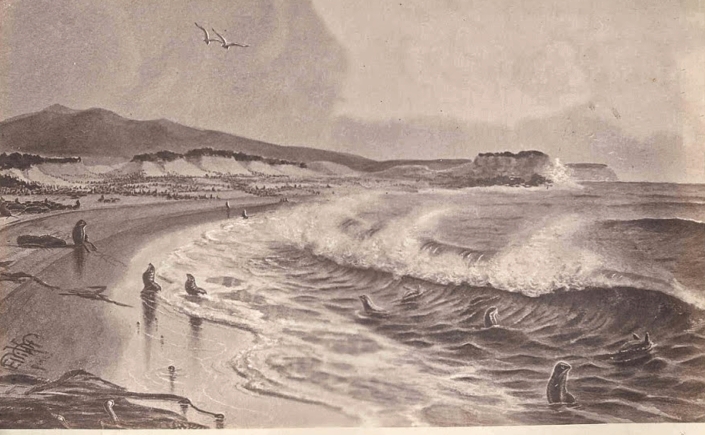
Lukannon is one of these. The story of The White Seal first appeared in print in the August 1893 issue of the London-based magazine National Review and published again in 1894 as part of the anthology The Jungle Book. Yes, that one. Mowgli, Wolf Cubs, Akela, and all. But, exceptionally for a story in The Jungle Book, none of the action in The White Seal  takes place in India. And, presaging the environmental activism and protests against the controversial seal hunts of the late 20th Century, it is remarkably prescient and pertinent.

The story is set on an island in the Aleutians in the Bering Sea between Russia and Alaska. It tells of a unique seal who, by leading his fellow seals to a secret hidden beach, saves his kind from the seal hunters. He referred to his poem as “a kind of national anthem for seals”. The title of the poem is the name of a Russian seal-fur trader, Lukanin, who gave his name to these lonely Aleutian beaches in 1788. Kipling wrote: “This is the great deep-sea song that all the St. Paul seals sing when they are heading back to their beaches in the summer. It is a sort of very sad seal National Anthem”.

Back in the day, I set the poem to music. It is featured on the rare recording HuldreFolk Live in London 1988, featuring Paul Hemphill, Victor Mishalow and Adèle Hemphill. During HuldreFolk’s tour of English folk clubs in the northern summer of 1988, it was recorded on a cheap audio cassette by a dinky, clunky old analogue tape recorder – and it shows. But the natural acoustics of the cellar at Bracknell Arts Centre, and the audience’s participation in the choruses made up for a multitude of sins.

© Paul Hemphill 2024. All rights reserved

Lukannon is such a lyrical poem that it lends itself effortlessly to musical settings. Apart from my own, i have discovered three alone, and I am pretty certain that there are many more out there on the world wide web. There is a version by folk duo William Pint and Felicia Dale set to a tune by American musician Bob Zentz from their 1997 album Round the Corner. There is also a contemporary “prog-rock” version by British band Shadows of the Sun.

In 1947, the eccentric Australian expatriate composer Percy Grainger composed a song cycle of The Jungle Book and chose as his centrepiece the story of The White Seal – and particularly, Lukannon “as a protest against civilization.” For more on Grainger’s opus, see below.

Lukannon

I met my mates in the morning (and oh, but I am old!)
Where roaring on the ledges the summer ground-swell rolled;
I heard them lift the chorus that dropped the breakers’ song –
The beaches of Lukannon – two million voices strong!

The song of pleasant stations beside the salt lagoons,
The song of blowing squadrons that shuffled down the dunes,
The song of midnight dances that churned the sea to flame –
The beaches of Lukannon — before the sealers came!

I met my mates in the morning (I’ll never meet them more!);
They came and went in legions that darkened all the shore.
And through the foam-flecked offing as far as voice could reach
We hailed the landing-parties and we sang them up the beach.

The beaches of Lukannon – the winter-wheat so tall –
The dripping, crinkled lichens, and the sea-fog drenching all!
The platforms of our playground, all shining smooth and worn!
The beaches of Lukannon — the home where we were born!

I meet my mates in the morning, a broken, scattered band.
Men shoot us in the water and club us on the land;
Men drive us to the Salt House like silly sheep and tame,
And still we sing Lukannon – before the sealers came.

Wheel down, wheel down to southward; oh, Gooverooska go!
And tell the Deep-Sea Viceroys! the story of our woe;
Ere, empty as the shark’s egg the tempest flings ashore,
The beaches of Lukannon shall know their sons no more!

Percy Grainger’s Jungle Book Cycle

In 1947, the eccentric Australian expatriate composer dedicated a song cycle of The Jungle Book and chose as his centrepiece the story of The White Seal – and particularly, Lukannon. My Kipling ‘Jungle Book’ Cycle, begun in 1898 and finished in 1947, was composed as a protest against civilization.” (Grainger’s programme note, 1947)

Grainger (1882-1961) studied at the Hoch Conservatory in Frankfurt, Germany from 1895-1901 (aged 13-19). Grainger’s mother Rose wrote to her husband John of her fears that young Percy was becoming “more Germanized every day.” In response to Rose’s concern, and to “tickle up the British Lion in him,” John (who was estranged from Rose) sent Percy, among other things, several books by Rudyard Kipling . Kipling’s writings captivated Percy immediately, and he soon started writing choral settings of the poetry, especially those of Kipling’s Jungle Books.

Grainger’s settings of the poetry of Kipling are as extensive as his settings of British folk music; Kay Freyfus’s catalog of Grainger’s manuscript scores lists 36 settings, though Grainger in a 1926 letter to Kipling mentions “some 40 or 50” settings. Grainger felt a strong kinship for Kipling’s writing, and Kipling appreciated and approved of Grainger’s work at setting his poetry. Grainger played several of his choral settings for Kipling during a meeting at Kipling’s home in 1905. Of Grainger’s settings of his poetry, Kipling said, “Till now I’ve had to reply on black and white, but you do the thing for me in colour.”

The Beaches of Lukannon is the centerpiece of the cycle, and arguably the strongest piece musically and emotionally. It tells us the tale of the tragic slaughter of seals by wicked sealers from the seals’ perspective. The opening section, told from the point of view of a seal elder, recounts what the beaches of the Bering Sea Island of Lukannon originally were for the seals – their annual meeting (and mating) opportunity. The central section, reminiscent of the music of Charles Ives in its shifting chromatics, conveys the beauty of the surroundings “before the sealers came.” The final section musically revisits the opening material, but in a smore somber mode.

For more on Rudyard Kipling in In That Howling Infinite, see A Son Goes To War – the grief of Rudyard Kipling 

We did not weep when we were leaving – the poet of Nazareth

Thursday July 15, 1948, began as another ordinary day for the Ali family in the Palestinian village of Saffuriyya in the Lower Galilee. It was during Ramadan and Umm Taha was busy preparing mulukhiyah for the iftar meal to break the daily fast at sundown. The eldest son, Taha – who was also the family breadwinner – returned after a busy day at the shop. After finishing his meal, he washed his hands and went out to the field to graze two goats he had recently bought. Taha found them to be restless, but couldn’t understand their strange behavior. Suddenly, he heard a strange whirring sound. This sound intensified and then he saw two planes approaching his village. I heard a terrifying boom. I fell to the ground, my knees shaking. Then another boom, and another boom,” he would later recall. Then he heard wailing and saw smoke in the distance, and parents and children scattering in terror. He left the goats and ran toward home to find his family, but found no one there.
Sheren Falah Saab, Haaretz

Taha Muhammad Ali was born in 1931 in the village of  Saffuriyya in the Galilee, then in the British Mandate of Palestine, and now, northern Israel. He fled to Lebanon with his family after their village came under heavy bombardment during the 1948 Arab-Israeli War, part of Operation Dekel (the 10-day Israeli military campaign that captured the Lower Galilee),

They were among more than 700,000 Palestinian Arabs – about half of prewar Mandatory Palestine‘s Arab population – who from their homes or were expelled by Jewish militias and, later, the Israeli army.

We did not weep
when we were leaving –
for we had neither
time nor tears
and there was no farewell.
We did not know
at the moment of parting
that it was a parting
so where would our weeping 
have come from?”

Unlike most who fled, he returned the following year – to Nazareth, where he lived until his death in 2011. During the 1950s and 1960s, he sold religious souvenirs to pilgrims and tourists during the day to Christian pilgrims, and studied poetry at night. Self-taught, through his readings of classical Arabic literature, including Despite ending his formal studies, Ali continued to be interested in reading and writing. He was self-taught and learned the Quran and Arabic grammar and adored classical Arabic poetry. He read American fiction, and English poetry in translation. He began his poetry career in his forties. His shop in Nazareth, near the Church of the Annunciation, became a meeting place for local and visiting writers. his family settled in Nazareth and he opened a souvenir shop.

In fact, his door was always open to intellectuals and cultural figures of that era. “My shop turned into a literary salon,” he told his biographer. Prominent intellectuals and authors like Rashid Hussein, Emile Habiby and Hanna Abu Hanna visited him regularly. He mentioned that even Mahmoud Darwish, the most celebrated of Palestinian poets, and Samih Al-Qasim, who were high school students at the time, visited him and conversed with him about current events.

The Saffuriya of his youth  and the political and social upheavals he endured served as inspiration poetry and fiction that is grounded in everyday experience and driven by a storyteller’s vivid imagination.

A profile on the From the Poetry Foundation website reads:

“Taha Muhammad Ali writes in a forceful and direct style, with disarming humor and an unflinching, at times painfully honest approach; his poetry’s apparent simplicity and homespun truths conceal the subtle grafting of classical Arabic onto colloquial forms of expression. In Israel, in the West Bank and Gaza, and in Europe and in America, audiences have been powerfully moved his poems of political complexity and humanity. He has published several collections of poetry and is also a short story writer.

In a direct, sometimes humorous, and often devastating style, He combines the personal and political as he details both village life and the upheaval of conflict. Comparing Muhammad Ali to his contemporaries, John Palattella commented in a review in The Nation: “Whereas Darwish and al-Qasim, like most Palestinian poets, have favoured the elevated and ornate rhetoric of fus’ha, or classical Arabic, Muhammad Ali writes non-metrical, unrhymed poems that blend classical fus’ha with colloquial Arabic’.”

Amongst contemporary Palestinian poets, Taha was an atypical. His aversion to performing poems that referred to intifada and resistance raised numerous questions in the hothouse atmosphere Israeli and Palestinian politics and conflict. When asked his opinion on what he called “placard like-poetry”, he declared: “The poetry of the stones is fleeting, and the true poetry that lasts is that which depicts what’s behind the stones and what’s behind the intifada, which shows life brimming with feeling and sensation and pain.”

His collections in English include Never Mind: Twenty Poems and a Story (2000) and So What: New and Selected Poems, 1971–2005 (2006), both translated by Gabriel Levin, Yahya Hijazi, and Peter Cole. He traveled to read his work in Europe and the United States, including at the Geraldine R. Dodge Poetry Festival. In 2009, the writer Adina Hoffman published a biography, My Happiness Bears No Relation to Happiness: A Poet’s Life in the Palestinian Century, which won the 2010 Jewish Quarterly Wingate Prize.

Meeting at an airport

I made my first acquaintance with the poetry of Taha Muhammad Ali with a poem about a chance meeting at an airport. Aware of his background, and the tumultuous  times he lived through, it spoke to me on many levels.

In common with much contemporary Palestinian poetry, it portrays thepain of separation and of leaving home – and of exile. It recounts a chance meeting four decades after an event which we are to assume is al Nakba.

Two friends are taking their customary walk to a village spring. The language suggests that they are more than friends – he recalls how is his companion surprises with him questions that send his blood rushing. He answers and she laughs – her laughter startles the starlings into flight,

They part or are parted – we do not know which – and do not see each other again until forty years later when they just chance to bump into each other at a foreign airport in what we assume from the Arabic title of the poem, liqa’ fi matar mahayid , is a “neutral” or “friendly” airport. Are they just travelers or is his old friend an exile? Again we are not told – although Taha did not leave what became Israel, living in Nazareth all his life, so we assume it was the latter.

He is absolutely shocked to encounter his old friend. “Ya lalmuhal min al muhali!” he exclaims, using the a high Arabic idiom equivalent to “Oh my god!
“ or “wow!” He doesn’t think she recognizes him – but it is not so. She asks the very same questions she asked all those years ago. Again his blood rushes. He gives the very same answer. But this time, she does not laugh – instead, she weeps, and there no birds to sing, but invisible, heartbroken doves.

And so, two people meet at last and harbour the same feelings for each other as the first time they met long, long ago. But in life as in art, reconnecting with a loved one does not just bring joy – it can also bring sorrow and regret. It is a timeless theme – think Rick and Lisa reunited unexpectedly and ultimately temporarily in the “gin joint” in Casablanca.

I could go out on a limb and suggest that the lost love encountered at the airport could also be construed as a metaphor for the lost Palestine.

The Israeli newspaper Haaretz provides some further insight into the poem:

“He was in love with his cousin Amira, who would later become a central figure in his poems. He wanted to ask for her hand in marriage, but decided to wait until he was financially stable and had the dowry to offer her family.

On that fateful night when Saffuriyya was bombed as, his hopes of marrying Amira were shattered. He continued to carry her in his heart after his family fled to Lebanon, and he got to meet her again in the refugee camp. However, after a year, Ali’s father decided to try his luck and returned to Israel with his children. Thus, Ali’s love for Amira was buried on the day the family left the Ein el-Hilweh refugee camp.

We were not awake, and we did not fall asleep
on the night we left, that night was not a night for us
No fire was lit, no moon rose

He is not crying over the ruins. Rather, he writes about parting from his beloved Amira. There’s room for sorrow over lives that were cut short, but he always roots it in the personal, without assimilating it into the collective pain.”

Meeting at an Airport follows, in English and in Arabic, together with a selection of Taha Muhammed Ali’s poems – all translated by Peter Cole, Yahya Hijazi and Gabriel Levin

Arab poets and exile

 A million spaces in the earth to fill, here’s a generation waiting still – we’ve got year after year to kill, but there’s no going home. Steve Knightley, Exile

Historical and social memory, and indeed, remembrance and commemoration, and their opposites, forgetfulness and letting go, are intrinsic to our human story … For the exile, the refugee, the involuntary migrant, theirs’ is a yearning, a longing, an absence of belonging – an existential homelessness and rootlessness, that is almost like a phantom limb. It is a bereavement, a loss, a spiritual and cultural death that could qualifies for descriptors drawn from Elisabeth Kübler-Ross’ Five Stages of Grief: (Shock and disbelief), denial, anger, bargaining, depression, (testing) and acceptance.

One way the refugee can assuage his or her anguish is through writing. Chicago librarian and writer Leslie Williams notes: “The literature of exile encompasses bitter, impassioned indictments of unjust, inhumane regimes, but also includes wrenching melancholy for lost homes, lost families, and a lost sense of belonging. The pervasive feeling of rootlessness, of never being quite at home echoes across centuries of exile writing” (read here her The Literature of Exile).

See also, No Going Home – the refugee’s journey (1) and Hejira – the refugee’s journey (2)

Read about other Arab poets in In That Howling Infinite: O Beirut – Songs for a wounded city, Ghayath al Madhoun – the agony of an exiled poet  and Muzaffar al Nawab, poet of revolutions and sorrow 


Jerusalem Rooftops, Sliman Mansur

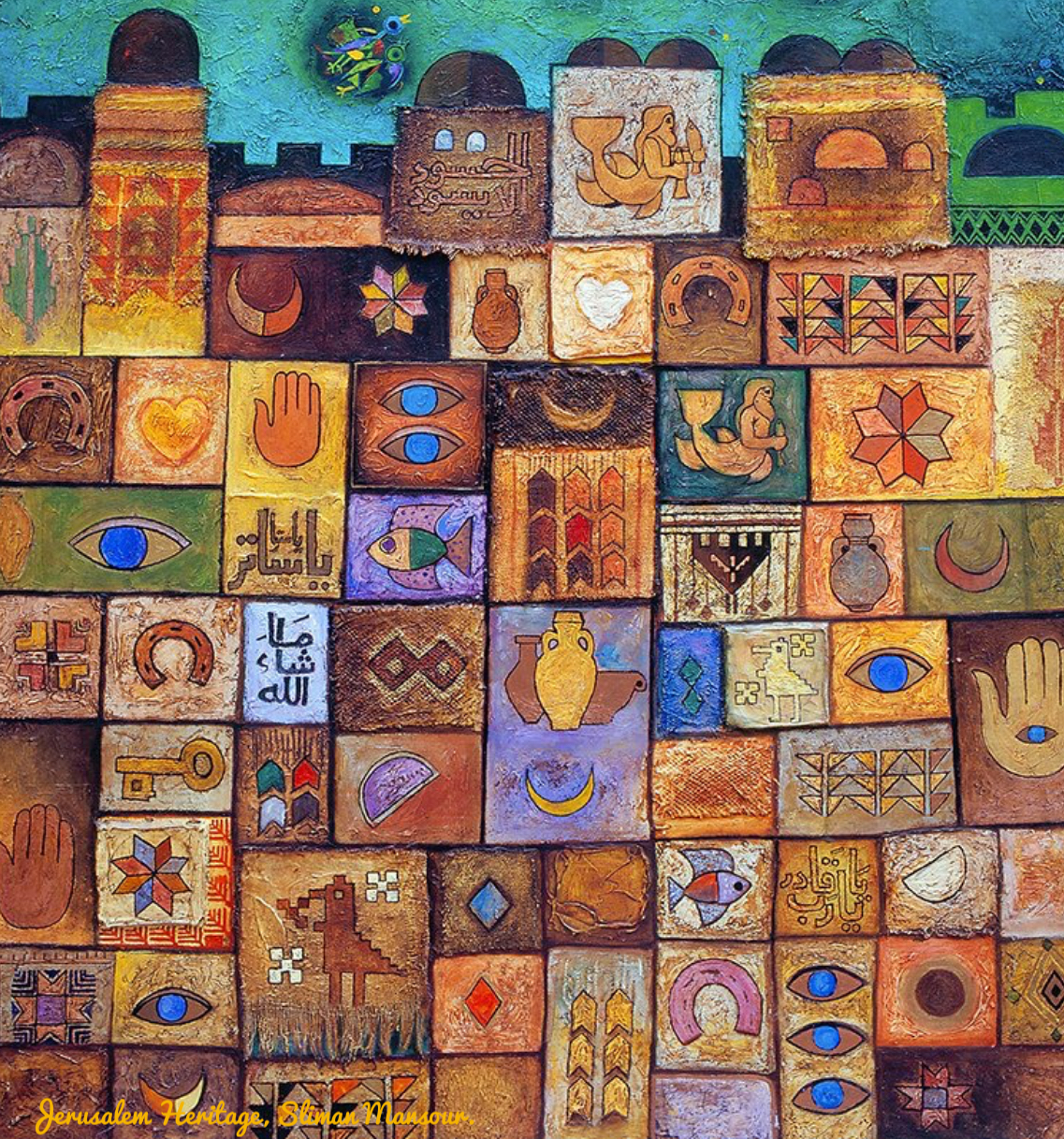
Jerusalem Heritage, Sliman Mansur

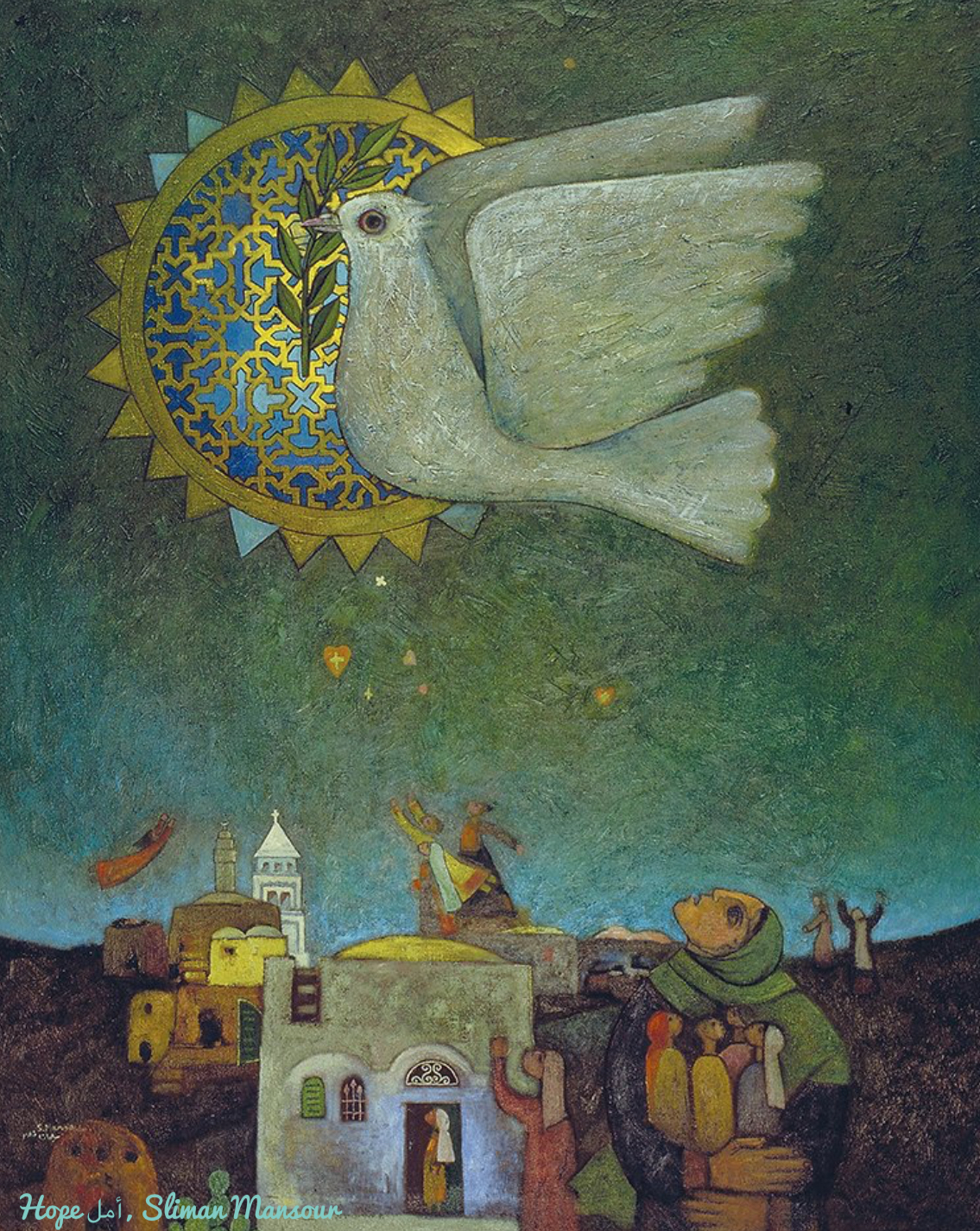
Hope, Sliman Mansur

Meeting at an Airport

Taha Muhammad Ali

You asked me once,
on our way back
from the midmorning
trip to the spring:
“What do you hate,
and who do you love?”

And I answered,
from behind the eyelashes
of my surprise,
my blood rushing
like the shadow
cast by a cloud of starlings:
“I hate departure . . .
I love the spring
and the path to the spring,
and I worship the middle
hours of morning.”
And you laughed . . .
and the almond tree blossomed
and the thicket grew loud with nightingales.

. . . A question
now four decades old:
I salute that question’s answer;
and an answer
as old as your departure;
I salute that answer’s question . . .

And today,
it’s preposterous,
here we are at a friendly airport
by the slimmest of chances,
and we meet.
Ah, Lord!
we meet.
And here you are
asking—again,
it’s absolutely preposterous—
I recognized you
but you didn’t recognize me.
“Is it you?!”
But you wouldn’t believe it.
And suddenly
you burst out and asked:
“If you’re really you,
What do you hate
and who do you love?!”

And I answered—
my blood
fleeing the hall,
rushing in me
like the shadow
cast by a cloud of starlings:
“I hate departure,
and I love the spring,
and the path to the spring,
and I worship the middle
hours of morning.”

And you wept,
and flowers bowed their heads,
and doves in the silk of their sorrow stumbled.

From So What New & Selected Poems, 1971-2005

لقاء في مطار محايد

طه محمد علي

سألتني
وكنا من ضُحى النبعِ
مرة
عائديْْنْ
‘ماذا تكره
ومن تُحِب؟

فأجبتُكِ
من خَلفِ أهدابِ الفُجاءة
ودمي
يُسرعُ ويُسرعْ
كظل سحابِة الزُرْزُورْ
‘اكرهُ الرحيلَ
أحبُّ النبعَ والدربَ
واعبُدُ الضُحى
فَضَحِكْتِ
فأزهرَ لوز
وشدَتْ في الايكِ أسرابُ العنادِلْ

سؤآلٌ
عُمرُه الآن عقودٌ أربعةْ
يا للْجواب من السؤالْ
وجوابٌ
عُمرُه عُمرُ رحيلك
يا لَلْسؤآلِ من الجوابْ

واليومَ
يا للْمُحالْ
ها نحن في مطارٍ مُحايِِدْ
على شفا صُدفةٍ
نَلتَقي
وّيحيْ…؟
نلتقي…؟
وها أنتِ
تُعيدين السؤالْ؟
يا لَلْمُحالِ من المُحالِْ
عَرَفْتُكِ
ولم تعرفيني
‘أهذا أنتَ؟
ولم تُصَدِّقي
وفجأة
انفجرتِ تسألين
‘إن كنتَ أنتَ أنتَ
فماذا تكره
ومن تُحبْ؟

فأجتبكِ
ودمي
يغادرُ الشُرفةْ
يُسْرعُ ويُسْرعُ
كظلِّ سحابةِ الزُرْوُرْ
‘أكره الرحيلَ
أُحبُّ النبعَ والدربَ
وأعبُدُ الضحى

فبكيتِ
فاطرقت ورُودً
وتعثرتْ بحرير حُرقتِها حَمائِمْ

Revenge

At times … I wish
I could meet in a duel
the man who killed my father
and razed our home,
expelling me
into
a narrow country.
And if he killed me,
I’d rest at last,
and if I were ready—
I would take my revenge!

But if it came to light,
when my rival appeared,
that he had a mother
waiting for him,
or a father who’d put
his right hand over
the heart’s place in his chest
whenever his son was late
even by just a quarter-hour
for a meeting they’d set—
then I would not kill him,
even if I could.

Likewise … I
would not murder him
if it were soon made clear
that he had a brother or sisters
who loved him and constantly longed to see him.
Or if he had a wife to greet him
and children who
couldn’t bear his absence
and whom his gifts would thrill.
Or if he had
friends or companions,
neighbors he knew
or allies from prison
or a hospital room,
or classmates from his school …
asking about him
and sending him regards.

But if he turned
out to be on his own—
cut off like a branch from a tree—
without a mother or father,
with neither a brother nor sister,
wifeless, without a child,
and without kin or neighbors or friends,
colleagues or companions,
then I’d add not a thing to his pain
within that aloneness—
not the torment of death,
and not the sorrow of passing away.
Instead I’d be content
to ignore him when I passed him by
on the street—as I
convinced myself
that paying him no attention
in itself was a kind of revenge.

Nazareth, April 15, 2006

ِنْتِقام

أَحْياناً
أَتَمَنّى أَن أُبارِزَ
الشَّخْصَ الذي
قَتَلَ والِدي
وَهَدَمَ بَيْتَنا
فَشَرَّدَني
في بِلادِ النّاسِ
الضَيِّقَةِ
فَإِذا قَتَلَني
أَكونُ قَدْ ارْتَحْتُ
وَإِنْ أَجْهَزْتُ عَلَيْهِ
أَكونُ قَدِ انْتَقَمْتُ!

لكِنْ…
إِذا تَبَيَّنَ لي
أَثْناءَ المُبارَزَةِ
أَنَّ لِغَريمي أُمّاً
تَنْتَظِرُهُ
أَوْ أَباً
يَضَعُ كَفَّ يَمينِهِ
عَلى مَكانِ القَلْبِ مِنْ صَدْرِهِ
كُلَّما تَأَخَّرَ ابْنُهُ
وَلَوْ رُبْعَ ساعَةٍ
عَنْ مَوْعِدِ عَوْدَتِهِ
فَأَنا عِنْدَها
لَنْ أَقْتُلَهُ إِذا
تَمَكَّنْتُ مِنْهُ

كَذلِكَ…
أَنا لَنْ أَفْتِكَ بِهِ
إِذا ظَهَرَ لي
أَنَّ لَهُ إِخْوَةٌ وَأَخَوات
يُحِبّونَهُ
وَيُديمونَ تَشَوُّقَهُمْ إِلَيْهِ.
أَوْ إِذا كانَ لَهُ
زَوْجَةٌ تُرَحِّبُ بِهِ
وَأَطْفالٌ
لا يُطيقونَ غِيابَهُ
وَيَفْرَحونَ بِهَداياه.
أَوْ إِذا كانَ لَهُ
أَصْدِقاءٌ أَوْ أَقارِبٌ
جيرانٌ مَعارِفٌ
زُمَلاءُ سِجْنٍ
رِفاقُ مُسْتَشْفى
أَوْ خُدَناءُ مَدْرَسَةٍ
يَسْأَلونَ عَنْهُ
وَيَحْرِصونَ عَلى تَحِيَّتِه

أَمَّا إِذا كانَ وَحيداً
مَقْطوعاً مِنْ شَجَرَةٍ
لا أَبٌ وَلا أُمٌّ
لا إِخْوَةٌ وَلا أَخَواتٌ
لا زَوْجَةٌ وَلا أَطْفالٌ
بِدونِ أَصْدِقاءٍ وَلا أَقْرِباءٍ وَلا جيران
مِنْ غَيْرِ مَعارِفٍ
بِلا زُمَلاءٍ أَوْ رُفَقاءٍ أَوْ أَخْدان
فَأَنا لَنْ أُضيفَ
إِلى شَقاءِ وَحْدَتِهِ
لا عَذابَ مَوْتٍ
وَلا أَسى فَناءٍ
بَلْ سَأَكْتَفي
بِأَنْ أُغْمِضَ الطَّرْفَ عَنْهُ
حينَ أَمُرُّ بِهِ في الطَّريقِ
مُقْنِعاً نَفْسي
بِأَنَّ الإِهْمالَ
بِحَدِّ ذاتِهِ هُوَ أَيْضاً

نَوْعٌ مِنْ أَنْواعِ الإِنْتِقامِ!

Below, poems from Norbert Bier’s Poetry Dispatch and othet notes from the Undergoud

Where

Poetry hides
somewhere
behind the night of words
behind the clouds of hearing,
across the dark of sight,
and beyond the dusk of music
that’s hidden and revealed.
But where is it concealed?
And how could I
possibly know
when I am
barely able,
by the light of day,
to find my pencil?

from SO WHAT New & Selected Poems, 1971-2005, Copper Canyon Press, 2006,

Empty Words

Ah, little notebook,
yellow as a spike of wheat
and still as a face,
I’ve protected you
from dampness and rodents
and entrusted you with
my sadness and fear,
and my dreams—
though in exchange I’ve gotten from you
only disobedience and betrayal…
For otherwise where are the words
that would have me saying:
If only I were a rock on a hill…
unable to see or hear,
be sad or suffer!
And where is the passage
whose tenor is this:
I wish I could be
a rock on a hill
which the young men
from Hebron explode
and offer as a gift to Jerusalem’s children,
ammunition for their palms and slings!

And where is the passage
in which I wanted
to be a rock on a hill
gazing. out from on high
hundreds of years from now
over hordes ,.
of masked liberators!

And where is what belongs
to my dream of being
a rock on a hill
along the Carmel—
where I call on the source of my sadness,
gazing out over the waves
and thinking of her
to whom I bade
farewell at the harbor pier
in Haifa forty years ago
and still…
I await her return
one evening
with the doves of the sea.

Is it fair, little notebook,
yellow as a spike of wheat
and still as a face,
that you conceal
what you cancel and erase,
simply because it consists of empty words—
which frighten no enemy
and offer no hope to a friend?

From Never Mind – Twenty Poems and a Story,

Twigs

Neither music,
fame, nor wealth,
not even poetry itself,
could provide consolation
for life’s brevity,
or the fact that King Lear
is a mere eighty pages long and comes to an end,
and for the thought that one might suffer greatly
on account of a rebellious child.

My love for you
is what’s magnificent,
but I, you, and the others,
most likely,
are ordinary people.

My poem
goes beyond poetry
because you
exist

Abd al Hadi Fights a Superpower 

In his life
he neither wrote nor read.
In his life he
didn’t cut down a single tree,
didn’t slit the throat
of a single calf.
In his life he did not speak
of the New York Times
behind its back,
didn’t raise
his voice to a soul
except in his saying:
“Come in, please,
by God, you can’t refuse.”

Nevertheless—
his case is hopeless,
his situation
desperate.
His God-given rights are a grain of salt
tossed into the sea.

Ladies and gentlemen of the jury:
about his enemies
my client knows not a thing.
And I can assure you,
were he to encounter
the entire crew
of the aircraft carrier Enterprise,
he’d serve them eggs
sunny-side up,
and labneh
fresh from the bag.

The Palestinian poet who never lamented the occupied land

Sheren Falah Saab, Haaretz, August 30 2023

The play ‘Taha’ offers a glimpse into the life of a poet who eschewed politics, preferring to write about personal pain and lost masculinity

The late poet Taha Muhammad Ali.
The late poet Taha Muhammad Ali. Nina Subin
Thursday July 15, 1948, began as another ordinary day for the Ali family in the Palestinian village of Saffuriyya in the Lower Galilee. It was during Ramadan and Umm Taha was busy preparing mulukhiyah for the iftar meal to break the daily fast at sundown.
The eldest son, Taha – who was also the family breadwinner – returned after a busy day at the shop. After finishing his meal, he washed his hands and went out to the field to graze two goats he had recently bought. Taha found them to be restless, but couldn’t understand their strange behavior. Suddenly, he heard a strange whirring sound. This sound intensified and then he saw two planes approaching his village.
“I heard a terrifying boom. I fell to the ground, my knees shaking. Then another boom, and another boom,” he would later recall. Then he heard wailing and saw smoke in the distance, and parents and children scattering in terror. He left the goats and ran toward home to find his family, but found no one there.
The story of Taha, from an eponymous play that was recently published in Hebrew (as part of the Maktoob project that translates Arabic literature into Hebrew), is based on the life of the Palestinian poet Taha Muhammad Ali, who died in 2011 at age 80.
הכפר ספוריה 1948

Amer Hlehel, the actor and playwright who wrote the play, takes the reader on a reflective journey through the poet’s personal life: from his escape from Saffuriyya as a teenager in 1948 following the occupation of the village, through his adaptation to life in a Lebanese refugee camp, to his return to Israel, which was fraught with dangers.

The play was first produced in 2014 and performed in Arabic at the Al-Midan Theater in Haifa. It was subsequently staged in Nazareth, Jerusalem and Ramallah, and was well-received by Palestinians on both sides of the Green Line. In the play, Hlehel incorporates quotes from things Ali said in interviews and in his meetings with him, as well as excerpts from his poetry.

Writing about leaving their Galilee village, Ali writes: “We did not weep / when we were leaving – for we had neither / time nor tears / and there was no farewell. / We did not know / at the moment of parting / that it was a parting / so where would our weeping / have come from?”

In the play, just as in real life, Ali does not manage to overcome the personal pain, but confronts it by writing poetry. He does not weep for the stones of the house that were destroyed, nor for the land that was occupied, but for the love that he lost and the life that ceased to exist.
Taha Muhammad Ali. 'He is not crying over the ruins. Rather, he writes about parting from his beloved Amira. There’s room for sorrow over lives that were cut short, but he always roots it in the personal, without assimilating it into the collective pain.'

Taha Muhammad Ali was born in Saffuriyya in 1931. At age 10, he stopped his formal education in order to help his father support the family. Later, he opened a grocery store in the village, as described by Hlehel in the play: “I opened the diwan [central room] in our house, which overlooked the main road. I filled the shelves with cigarettes and chocolate and halvah and chewing gum and pens, and the crown jewel was a block of ice inside a bowl with bottles of orange-, apple- and lemon-flavored soda.”

Despite ending his formal studies, Ali continued to be interested in reading and writing. He was self-taught and learned the Quran and Arabic grammar thanks to his neighbor, il-Hajj Taher. “He had a shelf of books and called it a library: the people of the village would read and return them,” he recounted in an interview with Adina Hoffman, who wrote the biography of Ali’s life, “My Happiness Bears No Relation to Happiness: A Poet’s Life in the Palestinian Century.”
It was through Taher’s books that Ali learned about the poets of the Umayyad and Abbasid dynasties (between the seventh and eighth centuries, and eighth and 13th centuries, respectively), and fell in love with classical Arabic poetry.
The sacrifices Ali made on behalf of his family reveal a generous and reserved personality. He was in love with his cousin Amira, who would later become a central figure in his poems. He wanted to ask for her hand in marriage, but decided to wait until he was financially stable and had the dowry to offer her family.
Dr. Daniel Behar. 'Taha Muhammad Ali had a talent to separate himself from the bitterness and political performance that surrounded Palestinian poetry.'

On that fateful night when Saffuriyya was bombed as part of Operation Dekel (the 10-day Israeli military operation that captured the Lower Galilee), his hopes of marrying Amira were shattered. He continued to carry her in his heart after his family fled to Lebanon, and he got to meet her again in the refugee camp. However, after a year, Ali’s father decided to try his luck and returned to Israel with his children. Thus, Ali’s love for Amira was buried on the day the family left the Ein el-Hilweh refugee camp.

In an interview with Hoffman, Ali described that moment as really tough. He immortalized this moment in a poem that is quoted in the play: “We were not awake, and we did not fall asleep / on the night we left, that night was not a night for us / No fire was lit, no moon rose.”
“Taha Muhammad Ali dedicates space to personal sadness in his poetry,” says Daniel Behar, a lecturer in modern Arabic literature at the Hebrew University who translated Ali’s poems for the play. He stresses that Ali’s poems distance themselves from performative-collective lamentation. “He is not crying over the ruins. Rather, he writes about parting from his beloved Amira. There’s room for sorrow over lives that were cut short, but he always roots it in the personal, without assimilating it into the collective pain.”
According to Behar, Ali decided to write in such a personal style as he was not writing with a specific audience in mind.
Ali confirmed these observations while speaking with Hoffman, when he said he would throw his writing “in the drawer and forget about it.” He said he had never thought of becoming a poet or publishing his poems, even though he was interested in culture and literature. After his return from Lebanon in the fall of 1949, his family settled in Nazareth and he opened a souvenir shop. In fact, his door was always open to intellectuals and cultural figures of that era.
'As I read his poems, I felt it was important for the Hebrew audience to get to know him,' says Guy Elhanan, a theater director, actor and translator of the play 'Taha.'

“My shop turned into a literary salon,” he told Hoffman. Prominent intellectuals and authors like Rashid Hussein, Emile Habiby and Hanna Abu Hanna visited him regularly. He mentioned that even Mahmoud Darwish and Samih Al-Qasim, who were high school students at the time, visited him and conversed with him about current events.

But, adds Behar, Ali’s poetry was different from the works of well-known Palestinian poets like Darwish, Tawfiq Zayyad and Al-Qasim, who often focused on Palestinian heroism. “Taha Muhammad Ali had a talent to separate himself from the bitterness and political performance that surrounded Palestinian poetry,” he notes. According to Behar, “his writing was intended to fill the silence of the archive for marginalized forms of life and nameless experiences, and whose voices were absent from written history.”
In 1983, Ali published his first collection of poems, “The Fourth Qasida [ode] and Ten More Poems.” This happened only after his friends urged him to publish his work. He later published a collection of stories, “Fooling the Killers” (1989), and three more collections of poetry: “Fire in the Convent Garden” (1992), “God, Caliph and the Boy with Colorful Butterflies” (2002) and “No More” (2005). A collection of his poems was published in Hebrew in 2006, translated by the author and poet Anton Shammas (published by Andalus).
The cover of Hebrew translation of the play 'Taha.'

“As I read his poems, I felt it was important for the Hebrew audience to get to know him,” says Guy Elhanan, a theater director, actor and translator of the play “Taha.”

One of the key motifs in Ali’s poetry was his native village. “Saffuriyya was dear to his heart and his love for it stood out in all his poems,” says Behar. Taha’s brother, Amin Muhammad Ali, said in an interview with the Al-Raed channel in 2016 that “the village never left him.” He added that his brother documented the small and large details in Saffuriyya throughout his life – in conversations with people, in his poetry, both day and night. The Palestinian poet Naji Daher from Nazareth added in an interview with the same Arab channel that “Ali carried Saffuriyya in his heart everywhere, and he also succeeded in conveying it to the world at large.”
The poem “Abd el-Hadi Fights a Superpower,” written by Ali in 1973 and published in Hebrew in 2006, embodies his approach as a poet. He does not write about Palestinian heroes seeking revenge against the Jews, nor does he try to conceal the sense of defeat and lost masculinity. In the poem, he portrays the character of the village fool Abd el-Hadi as an illiterate person who does not even know what The New York Times is. Between the lines, Ali reveals parts of himself, drawing the reader closer to him. “You can see aspects of Taha Muhammad Ali in the character of Abd el-Hadi – he has a joy and love of life that punctures the sadness and gives value to human love,” says Behar.
Ali concludes the poem with a description of Abd el-Hadi’s forgiving behavior: “Ladies and gentlemen of the jury / about his enemies my client knows not a thing / And I can assure you / were he to encounter the entire crew of the aircraft carrier Enterprise / he’d serve them eggs sunny-side up / and labneh fresh from the bag.”
According to Behar, in this poem (and others), Ali plays with words and sounds that were not customary in Palestinian poetry, offering sharp transitions between dialect and a high literary language.
In 2007, in an interview with the U.S. television program “PBS NewsHour,” Ali talked about his attempts to write poetry in the years after he left school. “This went together, reading and trying to write,” he said. “You have to take the pen and to take a paper, and to be ready to wait for it – otherwise it will come and you are not there. As a writer, you have to train yourself to write. Write anything, but everyday.”
Eight months after the outbreak of the second intifada at the start of the 2000s, Ali was published in London. He and Al-Qasim gave poetry readings to audiences in the British capital. Al-Qasim read his “Poem of the Intifada,” an indictment of those he called “Occupiers Who Do Not Read.” Ali, on the other hand, read distinctly different poems. “None of the poems he read contained a single direct reference to the uprising, to the ‘struggle,’ to children or to stones,” Hoffman wrote in her book.
His aversion to performing poems that referred to the intifada raised numerous questions. Hoffman noted in her book that he was indeed asked his opinion on what she called “placard like poetry.”
“The poetry of the stones is fleeting,” he declared, “and the true poetry that lasts is that which depicts what’s behind the stones and what’s behind the intifada, which shows life brimming with feeling and sensation and pain.”


Deconstructing Donald – translating Trumpspeak

“America is in a mess. We need someone to clean it up. And his name is …”

So run the opening titles of Tim Robbin’s’ 1992 satire Bob Roberts. In a dark case of life imitating art, the story of a Wall Street millionaire who begins his political career as a reactionary folk singer foreshadows the rise of a uniquely American autocrat who channels the pain and anger of millions who feel that they’ve been left behind. The eponymous Bob Roberts is portrayed as a rightwing Bob Dylan, right down to a parody of the famous Subterranean Homesick Blues story boards to the iconoclastic song Times are a’changin’ … Back. Read a 2020 retrospective of this prescient film HERE


False prophets and siren songs

The only path to a subversion of the republican system of the Country is, by flattering the prejudices of the people, and exciting their jealousies and apprehensions, to throw affairs into confusion, and bring on civil commotion,”When a man unprincipled in private life[,] desperate in his fortune, bold in his temper … is seen to mount the hobby horse of popularity … It may justly be suspected that his object is to throw things into confusion that he may ‘ride the storm and direct the whirlwind. Alexander Hamilton to George Washington in 1792.

One cannot and ought not underestimate the power and sheer durability of populism – a political style offering unworkably simple solutions to complex problems, an ebullient rejection of elite expertise in defense of homespun obscurantism. It is a particularly attractive to the many who cleave to populism, nativism, tribalism and atavism, and equate these with nationalism and patriotism – and feel that, nay believe that they’ve been ignored by the powers that be and left behind in life’s rat-race. Trust is in short supply, and indeed, people’s faith in democratic traditions and processes is shaking as populism and a taste for autocracy spreads throughout the ostensibly democratic world. And as the old epigram runs, “cometh the hour, cometh the man” …

We live, it feels, in a time of false prophets. A generation of different and dangerous populists now moves to centre stage. Some like Trump, are undisguised in their racial, sexist and selfish pitches. Trump knows the key to being a successful fraud is to be a grand fraud. He pledges “to make America great again” and wins wide applause. This is because he is an anti-politician, shaking the system, abusing the established politicians, trashing their ideas. He thrives on shock and extravagance in a culture drunk with mindless celebrity. He stands for economic nationalism, trade protectionism, xenophobic hostility,  towards Muslims particularly and a US strategic withdrawal from the world and much of its alliance system. As a wannabe autocrat, he admires actual autocrats, whom, he believes get things done because they break the rules and brook no dissent or contradiction. Nor Americans too averse to the prospect of an American strongman. For decades, polls have suggested that many Americans prefer the smack of strong leadership, even at the cost of jettisoning democratic norms. Back in the mid-1990s, for example, one in 16 Americans thought that a military dictatorship would be a “good” or “very good” thing. By 2014, two years before Trump’s shock victory over Hillary Clinton, that figure had leapt to one in six.

Trump is the vessel through which vast numbers of angry Americans can  channel their rage with the establishment. Back in March 2023, he told a Texas rally: “For those who have been wronged and betrayed … I am your retribution!” His ascent reflects not so much his political brilliance but the absolute contempt an increasing share of Americans have for the nation’s institutions. Hugh Hewitt, in an opinion piece in The Washington Post, wrote recently: “Trump’s fervent supporters continue to believe he is a noble Jean Valjean of American politics being pursued by a mob of Javerts”. Columnist Maureen Dowd is more blunt: “His hallucinatory worshippers admire him as a strongman, even when he’s shown to be liable for sexual assault and an aggrandising con man whose real estate empire was a Potemkin village”.

Irish writer Fintan O’Toole wrote in the New York Review of Book on January 19th how Trump “… exudes a dark energy. His is perhaps the most radical mainstream presidential candidacy in US history. He offers a program of organized revenge, telling his fans that “I am your warrior. I am your justice. And for those who have been wronged and betrayed, I am your retribution.” He promises a transformation of democracy into authoritarianism. He envisages a war on all the “vermin” who have thwarted him. He plans, as The New York Times has reported, “to scour the country for unauthorized immigrants and deport people by the millions per year.” He wants to build giant camps to house those awaiting deportation and to vet would-be travelers to the US for political (and presumably also religious) purity: “US consular officials abroad will be directed to expand ideological screening of visa applicants to block people the Trump administration considers to have undesirable attitudes.” The relentlessness of this determination to reshape the US into an autocracy may be horrifying, but it has the vigor of grand ambition”.

Small wonder the US was recently named a “backsliding democracy” by a Swedish based think-tank, an assessment based on the attempted Capitol coup and restrictions on voting rights in Red states.

Trump could well win, against Biden or against another candidate. The issues he’s running on – illegal immigration, the cost of living, lawlessness and crime – are huge and real. Trump may defeat himself if he campaigns about the injustices done to him. If he campaigns on issues as the champion of ordinary Americans, he’s got a big chance. He is is both instinctively talented as a campaigner but also capable of grievous self harm through wildly undisciplined statements – as with NATO – and narcissistic self-absorption. Driven by grievance and will to power, and behaving, some say, like a mafia boss, he is in so many ways lawless and dangerous.

So dangerous indeed, that many pundits believe that individually, many of his positions and actions, actual and promised, pose existential threats to the United States and its institutions that are far more threatening than any concerns raised by Biden’s age. Some rush to remind Americans of the time when Benjamin Franklin, one of the original framers of the US Constitution, was walking out of Independence Hall after the Constitutional Convention in 1787, and someone shouted out, “Doctor, what have we got? A republic or a monarchy?” To which Franklin supposedly responded, with a rejoinder at once witty and ominous: “A republic, if you can keep it.” 

If once elected, and at a second or third election outvoted by one or two votes, he will pretend false votes, foul play, hold possession of the reins of government, be supported by the States voting for him. Thomas  Jefferson to James Madison in 1787

[The quotations of the founding fathers come courtesy of Jeffrey Rosen, The Washington Post]

Found in translation …

British writer and columnist Gerard Baker does not agree with these latter day Cassandras. I republish below an entertaining and informative article written by this self-ordained translator of Trumpspeak, who describes himself as a “right-wing curmudgeon, writer and media critic. Actually, he is quite Right, a Eurosceptic and according to some, a closet Trumpista. But his piece is quite perceptive.

“Parsing Donald Trump is a uniquely difficult linguistic task …There are multiple layers of challenge. First, you can never have more than 50 per cent confidence that what he is saying is true. Second, much of what he says is intended to entertain, rather than inform or inspire. Third, and most confoundingly, the meaning of what he says is often quite different from the actual content.

In what must be the only feature of Trump’s ministry on earth that is like that of Jesus Christ’s, the former president speaks in parables. Unlike Christ’s, Trump’s stories are primarily designed to showcase his own greatness but, crucially, like the Son of Man’s, they also convey an important larger message … in focusing just on the words – and frequently distorting them – to paint a picture of a deranged despot, they [his critics] miss the meaning, the meta-story, if you like. That is a problem because it means they miss a critical part of understanding what is happening in America.

The truth about Trump and his enduring appeal to so many Americans is that, beyond the unsettling mix of Borscht-belt schtick and Munich-beerhall menace, beyond the verbal minefields of untruths, half-truths and narcissistic bombast, is a serious message channeling the reasonable fears and doubts of at least half the country … Trump understands better than anyone the dissatisfaction of Americans, their weariness with burdens …Trump’s greatest political asset has always been an almost animal-like ability to sniff out public sentiment, and then, in hyperbolic manner, to articulate it; sentiments on immigration, crime or American self-identity that are unsayable, willfully ignored by the established political class”.

© Paul Hemphill 2024.  All rights reserved.

For more in In That Howling Infinite on American politics, see My Country ’tis of Thee

Trump flogging joggers at Sneaker Con, February 2024


Trumpspeak crazy but attuned to Americans’ dissatisfaction with their burdens

Republican presidential hopeful Donald Trump raises his fist at an event in Iowa in January. Picture: AFP

The Republican presidential hopeful at an event in Iowa in January.  AFP

Parsing Donald Trump is a uniquely difficult linguistic task. There are multiple layers of challenge. First, you can never have more than 50 per cent confidence that what he is saying is true. Second, much of what he says is intended to entertain, rather than inform or inspire. Third, and most confoundingly, the meaning of what he says is often quite different from the actual content.

In what must be the only feature of Trump’s ministry on earth that is like that of Jesus Christ’s, the former president speaks in parables. Unlike Christ’s, Trump’s stories are primarily designed to showcase his own greatness but, crucially, like the Son of Man’s, they also convey an important larger message. The task of parsing this is so complicated that much of the media doesn’t even try. As with Pavlov’s dog, Trump rings their bell and away they go, barking like mad about some terrifying new thing the man is threatening.

“It is impacting the flow of support,” the NATO Secretary General said on Wednesday afternoon after a two-day meeting of defence ministers in Brussels. “To some extent, this can be compensated by increased support from… other allies. And European allies and Canada are stepping up, are doing more.
It’s understandable but in focusing just on the words – and frequently distorting them – to paint a picture of a deranged despot, they miss the meaning, the meta-story, if you like. That is a problem because it means they miss a critical part of understanding what is happening in America.

The truth about Trump and his enduring appeal to so many Americans is that, beyond the unsettling mix of Borscht-belt schtick and Munich-beerhall menace, beyond the verbal minefields of untruths, half-truths and narcissistic bombast, is a serious message channeling the reasonable fears and doubts of at least half the country.

So when the permanently unfinished Rubik’s cube of Trump’s mind last weekend produced another multisided Technicolor shocker of an outburst – this time on the subject of the US and NATO – the media as usual gave us the version they wanted us to hear: “Trump says he would encourage Russia to invade NATO countries who do not pay their bills,” says the headline on a story that is still on the BBC website. “I want Russia to invade Europe” in other words.

The first thing to point out is that Trump didn’t say this. He was instead recounting a story from his presidency – telling a campaign audience that when he was pressing European governments to spend more on their own defence, he was asked by a NATO country leader if the US would still protect them from Russian invasion if they didn’t pay up.

“No, I would not. In fact I would encourage them to do whatever they hell they wanted,” he said.

As your reliable translator of Trumpspeak, I’ll say there are three key takeaways from this. First, it didn’t happen. Don’t you think we might have heard about this some time in the past five years if it did?

Second, the point of the story is primarily to emphasise Trump’s own negotiating prowess. This has always been central to his bloated self-image. From casino construction to global security, it’s always about his unique ability to get the deal done. The irony is that the point of Trump’s story was precisely the opposite of what’s been said about it – instead of representing the end of NATO, it is about how (in his own mind) Trump saved the alliance with an act of bravado that forced Europeans to action.

But the most important truth in this fictional story is that Trump understands better than anyone the dissatisfaction of Americans, their weariness with burdens.

Trump’s greatest political asset has always been an almost animal-like ability to sniff out public sentiment, and then, in hyperbolic manner, to articulate it; sentiments on immigration, crime or American self-identity that are unsayable, wilfully ignored by the established political class.

One of these is the idea that the world Americans inhabit is dramatically changed. It is 75 years since the founding of NATO, more than 30 years since the end of the Cold War. It is remarkable how little the foreign policy establishment in the US, or America’s allies, understand the world as it appears to Americans themselves.

This is obviously true of the conspectus of global threats. In this century, first Islamist terrorism and then the rise of China have imposed themselves on the American consciousness. It’s true that NATO allies were reliable contributors to the war in Afghanistan. But that ended in disarray and disillusion – hardly an advertisement for the power of the alliance.

But more important than all that is Americans’ own, very new, sense of their own precariousness. This is not just about the changing global threats but their confidence in the success of their own country.

For more than two decades, with very brief exceptions, the vast majority of Americans have told pollsters they think their country is on the wrong track. For the first time in history most Americans think their children will be worse off than they are.

In these circumstances NATO is increasingly seen not as a critical part of America’s own security but as a costly obligation to others. The statistics – a US that contributes well beyond its economic resources – tell only half the story.

With a few exceptions, most European nations would be unable and even unwilling to stand up to an aggressor. Americans watch as Europeans have grown prosperous but dependent on US security and they resent the obligation, particularly from Europeans who seem to go out of their way to express disdain for America.

This isn’t 1930s isolationism, which reaped its own whirlwind in the 1940s. America then was an emerging superpower reluctant to get into another world war.

Today Americans see themselves as a nation in decline, under siege from global forces – uncontrolled immigration streaming across their southern border, terrorists pledging to murder them at home and abroad, a rising nuclear-armed superpower across the Pacific. And they don’t see where NATO fits in.

Trump’s words are typically extreme. Don’t let the crazy blind you to the deeper message.

The Times

Goosestepping back to political relevance

Red and white terror – the Russian revolution and civil war

… as a policeman, I would say, get hold of a man’s brother and you’re halfway home. Nor was it admiration for a better man than me. I did admire him, but I didn’t think he was a better man. Besides, I’ve executed better men than me with a small pistol. 

She’d come to Moscow to look for her child. I helped her as best I could, but I knew it was hopeless. I think I was a little in love with her. One day she went away and didn’t come back. She died or vanished somewhere, in one of the labor camps. A nameless number on a list that was afterwards mislaid. That was quite common in those days.

Yevgraf Zhivargo, in David Lean’s Doctor Zhivago (1965)

“The terror,” declared British Historian Simon Schama in his iconic Citizens: A Chronicle of the French Revolution “was merely 1789 with a higher body count; violence … was not just an unfortunate side effect … it was the Revolution’s source of collective energy. It was what made the Revolution revolutionary’. In short, “From the very beginning […] violence was the motor revolution”.

At the end of the chapter on the coming of thw Revolutionary Wars, he writes: ‘ … poets of romantic weather forecasting like William Wordsworth continued to describe the revolution is a cyclonic disturbance, but increasingly it was no longer the storm that invigorates in cleanses rather a dark and potent elemental rage moving forward in indiscriminate destruction its breath was no longer sweet but foul. It was the wind of war and if the wind of war comes, can the storm clouds of war be far behind’.

I thought a lot about the events of the French Revolution and the Napoleonic wars which followed it as I read English author and historian Anthony Beevor’s latest foray into Russian and Soviet history, Russia – Revolution and Civil War 1917-1921

Some books can be unrelentingly bleak and brutal, so grim and graphic in fact that you have to push yourself to finish them. Cormac McCarthy’s odyssey tale The Road is one such. But one doesn’t often say that about history books. Usually it is time, ennui or both that cry “enough, already!” You set it aside, promising to return to your bookmark – but you never do. I persevered with a veritable catalogue of the horrors that men can inflict upon their fellow humans (and yes, the perpetrators are apparently exclusively male, and the victims are males and females of many ethnicities). Beevor’s previous, highly acclaimed books Stalingrad and Berlin 1945 are chilling, but his latest takes top prize. And finish it I did …

The following is not a review of Beavor’s grim opus as such, but rather a thematic compendium of thoughts and observations derived from or inspired by the book.

Most academic accounts and university courses focus on the ideological and geopolitical dimensions of the origins, rise and consolidation of the Soviet Union, and its ultimate disintegration seventy years later. General public knowledge of the Russian Revolution and the civil war which followed it is relatively limited and cursory, often derived and books like Mikail Sholokhov’s saga of the Don Cossacks, Quiet Flows the Don and The Don Flows Home To The Sea, and Boris Pasternak’s Doctor Zhivago. Indeed, it was these novels and David Lean’s powerful adaptation of Doctor Zhivago that first attracted my interest in Russia as a school student in Birmingham. I majored in Politics at the University of Reading in the United Kingdom, and Soviet history and politics were an important part of my studies. Between those days and today, I’ve read widely about Russia’s history, past and present, and I am familiar with the events, ideas and personalities, their role in the broader and longer tableau of history, and the reverberations that are still felt today.

I have written often in In That Howling Infinite on Russian and Ukrainian history. Although I am no expert, and profess an amateur interest only, I do possess a short and humble pedigree. My tutor in Soviet Studies at Reading was exiled Hungarian academic and historian Tibor SzamuelyLike many refugees from Communism, he was descended from both perpetrators and victims. An uncle of the same name served in the Hungarian Soviet Republic that took power for six months under Béla Kun in 1919 and died violently that year when the revolution failed. He was among that government’s most bloodthirsty ministers and was called “Butcher Szamuely”. Szamuely’s family wound up in Moscow, where Tibor was born, and where his father was executed in Stalin’s purges. Young Tibor served in the Red Army, and he too was arrested and sent to a labour camp. Rehabilitated, he served as Chancellor of Budapest University. In 1964, then nearing 40, he was teaching in the “ideological institute” of Ghana’s Marxist president Kwame Nkrumah when he defected to England.

Back then, I was a political ingenue and a naïve communist sympathizer and fellow traveler, although my evolving perspectives were transforming and expanding. As my tutor, he advised me to study with an open mind and to put off juvenile thinking. He hadn’t been well when I knew him, and he died a year after I graduated. Under his tuition, I’d resolved to specialize in Soviet Studies – but events intervened, and I ended up in the Middle East (and that is another story. see: Tanks for the Memory – how Brezhnev changed my life). I nevertheless retained an active interest in the history and politics of Eastern Europe.

He would always impress upon me the historical and political continuity of what he called The Russian Tradition – the title of his one and only book, The Russian Tradition, published shortly before his death, and now, regrettably, out of print. I purchased a first edition when it was published and it is on my bookshelf still.

Szamuely believed that the bloodstained drama of the revolutions of 1917 – there were two, the social democratic one in the February, the Bolshevik one in November – and the years that followed, including civil war, the establishment of the USSR and Stalinism largely obscured the underlying consistency of Russian history. He did not live to see the decline and fall of the Soviet Union, and the advent of Putin and Russia Redux, but the basic pattern persists, circular and repetitive. The frequent turmoils that have overtaken this vast continent have in their various ways made changes that were essentially superficial, leading in the end to the intensification, under new forms, of the old authoritarian structure.

You – Bolshevik recruiting poster 1918


Contemplating civil wars

A civil war can emerge from the ashes of a wider, ongoing conflagration when factions or parties dispute the nature and terms of the post-bellum status quo and fracture along political and ideological lines. Many civil wars have arisen from the ashes of a prior war when there are what are perceived as existential issues unresolved and the availability of weapons and materièl and experienced and discontented men to use them.

There is a view that civil war can retrospectively be seen as a crucible of nation, a fiery furnace through which the righteous must walk – an ex post facto rationalization of the Nietzschean paradox of “that which does not kill us makes us strong”. Abraham Lincoln verbalized this in his Gettysburg Address in 1863 on a battlefield where the fallen had been only recently interred. Franco made a similar play as he laid claim to the wreckage that was Spain in the wake of three years of carnage, but then petrified his riven, country in autocratic stone until his death many decades later. The Russian Civil War was not accorded such a nation-building ethos as it was viewed by the Bolshevik victors as the crushing of a counter-revolution against a new world already being born.

Given Russia’s vast expanse, long history of restive regions, and large non-Russian ethnicities – all a result of centuries of imperial conquests – there is always the potential for the disintegration of centralized control and fragmentation. There is a rich history of state collapse following wars, revolutions, system breakdowns, economic crises, and other epochal events. Napoleon’s empire collapsed after his disastrous march on Moscow and subsequent defeat at the Battle of Leipzig. In 1918, the Ottoman, Austro-Hungarian, German, and Russian empires all collapsed in military defeat. Of course, people, decisions, and policies played a role, but ultimately it was war and the attendant economic and social crises that pushed these states over the edge into political chaos and often violence.

Once thing for sure, civil war, the Hobbesian “war if all against all” (Hobbes was thinking England’s) is undoubtedly the saddest, bloodiest and most visceral of all conflicts. I leave the last words to WB Yeats:

Things fall apart; the centre cannot hold;
Mere anarchy is loosed upon the world,
The blood-dimmed tide is loosed, and everywhere
The ceremony of innocence is drowned;
The best lack all conviction, while the worst
Are full of passionate intensity.

See: In that Howling Infinite, A House Divided – the Nature of Civil War

All fall down 

Revolutions are unpredictable. They never run in straight lines. They reverberate, the shockwaves expanding and impacting on their vicinity, and way beyond. The shots ricochet, like drive-by shootings and crossfires, and you never know who will be hit, where the bullets will come to rest, and who will be damaged or destroyed. Many people will be liberated, and many enslaved. Many peoples will prosper, and many, many will perish. As TS Elliot wrote, “between the idea and the reality falls the shadow”.”

When the Tsarist Russian empire collapsed halfway through the First World War, it was the first of four great empires to disintegrate. By war’s end, the conflict had destroyed the German, Hapsburg and Ottoman empires. But unlike these three, though the imperial house perished, the empire it ruled did not disintegrate. A handful of national movements, Finnish, Polish, Estonian, Latvian, and Lithuanian succeeded in breaking free, but most of murdered Tsar’s realm emerged from the convulsions of world war, revolution and civil war within a new Soviet empire, one that still ruled millions of square miles and a multitude of peoples.

The Russian Revolutions – the two in 1917, and a failed rising in 1905 in the wake of the disastrous (for Russia) of Russo-Japanese War – and the civil war that followed can be said to have defined the contours of modern European geopolitics, setting the stage for the Cold War and also, the current Ukraine war. The 20th Century was not kind to the countries of Central and Eastern Europe. Historian Timothy Snyder called them “the blood lands”.

The USSR was officially declared in the Bolshoi Theatre on 30th December 1922. Most people find this slightly surprising, because we assume that the Soviet Union must have been proclaimed immediately after The Bolshevik Revolution in November 1917. In fact, it only came into existence after a horrendous civil war that killed an estimated 10 million people, in which the deep national and ethnic tensions inside the old Russian Empire had been laid bare for all to see.

Historian Orlando Figes says in his seminal book about the Bolshevik revolution, A People’s Tragedy, that the failure of democracy in 1917 was deeply rooted in Russian culture and social history and what had started as a people’s revolution contained the seeds of its degeneration into violence and dictatorship.

In Russia, the revolution of February 1917 did not provoke a counterrevolution. The initial absence of any attempt to fight back was illustrative not so much apathy, as a feeling that there was very little of the ancien regime left that was worth defending. The overthrow of the czarist regime prompted a variety of reactions amongst the former ruling class: a resignation to events, bitterness at the incompetence and obstinacy of the Imperial Court, yet also an initial optimism among its more liberal and idealistic members. Most of the nobility and bourgeoisie supported the Provisional Government in the hope that it would at least restrain the worst excesses and keep the country together.

Soon after the November 1917 revolution, Lenin made it clear to the Bolsheviks that civil war was necessary to cleanse Russia of reactionary forces and old ways and to rebuild as a communist state and society. Moreover, he was confident that the Bolsheviks’ example would ignite revolution in the countries of Western Europe. German and Hungarian communists obliged, establishing people’s republics, which in turn invited counter revolution, the ousting of the revolutionaries, and reactionary military and police exacting bloody revenge on any leftists that could find.

The determination to resist only crystallized when the Bolshevik programme in the wake of the Bolshevik Revolution of October 1917 polarized opinion. The question is important when it comes to the origins of the Civil War itself, which led to the deaths of up to 12,000,000 people, the impoverishment of the whole country, and suffering on an unimaginable scale.

In June 1918 the Bolshevik regime was enjoying a brief respite from the rigors of revolution and civil war. Although surrounded on all sides by hostile forces, the Bolsheviks were in no immediate military danger. This welcome hiatus, lasting from the Treaty of Brest-Litovsk (March 1918) to the collapse of the Central Powers at the end of the year, allowed the Bolsheviks to consolidate their political and military strength.

In an uneasy alliance with the Bolsheviks were leftwing Socialist Revolutionaries who still dreamed of a constituent assembly and the anarchists who regarded Brest-Litovsk represented the watershed of the Revolution. In coming to terms with the Central Powers, the Bolsheviks had paid a staggering price in territory and resources. But, more importantly, they had preferred to make a pact with the imperialists rather than attempt to propagate the Revolution through popular initiatives, in particular, by partisan warfare.

Shortly after Brest-Litovsk the Bolsheviks turned against their erstwhile allies. The Cheka (the successor to the Czar’s Okrana secret police and the precursor to the NKVD, the KGB and the FSB) ostensibly created to suppress counterrevolutionaries, was unleashed on the Bolsheviks’ critics on the left. There were fierce battles between Chekists and anarchists in Petrograd and many other Russian cities.

It was game on.

It is difficult to comprehend to scale of the civil war that broke out in Russia in terms of its territorial extent, the numbers of nations and would-be states engaged in the conflict, and the destruction and carnage it wrought to soldier and civilian alike. Nor the ongoing relentlessness. Western European invaders had been defeated in the past (and indeed, the future) by what Mikhail Kutuzov, the Russian general who defeated Napoleon, called General Winter, but within the empire and its Soviet successor, weather did not stop play. Certainly, it complicated military operations, played havoc with logistics and supply-chains, and inflicted indescribable suffering upon soldiers and civilians. And the war went on …

The last of the Romanovs – Tsar Nicholas and his family, murdered by the Bolsheviks in July 1918

Revolution and reaction

If Lenin was politically flexible with foreign powers, he was ruthless with his own people, including rival parties on the left. He grabbed power when the hapless provisional government lost its way in setting up a constituent assembly that was intended to be a democratic representation of all Russians. Lenin initially paid lip service to the assembly, while calling for power to go the “soviets” – people’s councils. In reality he had no intention of allowing any diminishment or oversight of his control of the Bolshevik party and, through its Council of People’s Commissars, the battered Russian state.

But no sooner had the Bolsheviks cemented their rule than they were fighting a civil war on multiple fronts against a mind-boggling array of enemies, stretching from revolutionary socialists  and anarchists to unreconstructed “White Russian” tsarists, nostalgic for a corrupt and flagrantly unjust regime and in between the Reds and Whites were the Greens or Partisans, mainly deserters from all sides who hated both Reds and Whites and attacked both, increasingly so as the war continued. And a range of foreign powers dealt themselves into the game to further their own strategic and ideological interests. [the featured picture of this piece is an idealized manga depiction of charismatic Ukrainian anarchist and Green Nestor Makhno, a larger-than-life figure who miraculous survived the civil way and died in his bed in exile]

The Whites were a confused, fractured and often dysfunctional coalition with rapid changes of command occasioned by personal ambitions and fluctuating military fortunes. White generals were committed to restoring the integrity of the Russian Empire, a self-defeating handicap that alienated potential allies on the fringes, like Finland, the Baltic states and Poland. Churchill underestimated this imperial obsession which prevented the alliances he wanted to defeat the Bolsheviks. The Greater Russia obsession also hampered efforts in the Caucasus where Georgians stirred regions like Ingushetia, Chechnya and Dagestan, giving Britain nightmares of Bolshevism spreading through Central Asia towards India, an obsession that continued through the twenties as described in Peter Hopkirk’s Setting the East Ablaze – Lenin’s Dream of an Empire in Asia.

Out on the edge of the old empire, White warlords endeavoured to carve out kingdoms for themselves. Many commanders spent more time terrorizing locals than fighting the Red partisans who were operating behind enemy lines across the war zone, creating a legacy and tradition the persist to this day.

The diffusion of opponents played into the Bolsheviks’ hands, as their differences were so extreme that a unified opposition fighting force was never a viable option. But if the battle lines were often blurred, the hatred felt by the combatants for each other was nightmarishly vivid.

The White’s defeat in the civil war wasn’t for lack of outside moral and materiel support. It was due largely to their inflexibility, including their refusal to contemplate land reform until it was far too late, and their refusal to grant any autonomy to nationalities of the Czarist Empire. Their administration was so useless that it’s barely existed. Paradoxically, they lost for reasons very similar to the way the Republicans lost the Spanish Civil War two decades later. In Spain, the antifascist alliance of the Republic could not prevail against Generalissimo Franciso Franco‘s disciplined and militarized regime. In Russia, the utterly incompatible alliance of socialist revolutionaries and reactionary monarchists didn’t stand a chance against the single-minded Communist dictatorship.

A leftist libertarian with St. George’s Cross, and a Sister of Mercy nurse, 1916.

World War 1.2

It in many ways it became World War 1.2. The idea of a purely Russian Civil War is misleading simplification, prompting one historian recently to describe it instead as ‘a world war condensed’.

It was waged across European and Asian Russia, including present day Belarus and Ukraine and the successor states of the Soviet Union in the Baltic, the Caucasus, and Central Asia – from Warsaw and Eastern Europe to the Urals and eastwards through the vastness of Siberia’s forests, deserts and tundra to Vladivostok in the Far East, from the arctic north to Crimea and the Black Sea, the Caspian Sea and the borders of what in 1918 ceased to be the Ottoman Empire. Fronts stretched for thousands of miles and advances and retreats likewise. The Trans-Siberian Railway, stretching the length of the former empire from Moscow to Vladivostok, was almost six thousand miles long, and it’s tributary lines served as strategic and logistical thoroughfares for all protagonists who weren’t mounted like the innumerable Cossacks tribes and the nascent Red Cavalry, bringing to prominence the armoured trains that became a symbol of the revolution.

It drew in most of Russia’s contemporary neighbours and more far-flung nations, including The USA, Britain, France, Germany Italy and Japan – the latter providing the largest contingent, estimated by British Intelligence as some 85,000 soldiers, more than many of the various White armies. Combatants included soldiers from these countries, the British dominions of Canada, Australia, South Africa, and India, and Chinese and Mongolian troops. And a multitude of ethnicities fought for their own warlords, their national place in the sun or else their very survival. Caught up in the transcontinental maelstrom were Slavs, Cossacks, Tartars, Turkmen, Arabs, Azeris, Persians, Turks, Armenians, Chechens, Kazakhs, Buryat Mongols, Kalmyks (Europe’s only Buddhist nation) and Jews. White divisions were augmented in Siberia by Mongolian, Chinese, Uighur and Kirghiz mercenaries.

Various nationalist movements arose, successfully and unsuccessfully in all parts of the former Russian Empire. The aftermath of the First World War and the collapse of the Russian Empire saw Polish, German, Italian, Hungarian, Romanian, Czech, and myriad other nationalities fighting for disparate sides, and Beevor skillfully frames the bizarre impact of this on the ethnic nationalist dimensions of the conflict.

The scale of military manoeuvres was unprecedented, as were the physical and supply difficulties over vast distances, and the extremities in climate, particularly the bitter Russian winter. The conflict became very much a cavalry war and indeed, a “railway war” notable for its armoured trains and the logistical lifeline of the Trans-Siberian Railway, protected for much if the conflict by the Czechoslovak Legion, a force of Czech and Slovak nationalists who having fought in the Czarist army, joined the Whites who controlled many towns in Siberia.

In addition to the Czechs, there was also a Polish Legion operating in the Far East. The commanders of both forces became increasingly disenchanted with the White officers who refused to countenance the independence of the border states and who shocked many with their brutality towards prisoners and civilians, and though thousands of miles from Europe, demanded repatriation – ostensibly by sea from Vladivostok.

Western Allies’ ideological perspective of the civil war was ambivalent. Though many, politicians and military alike, were viscerally opposed to Bolshevism and what it stood for, and feared a Red contagion infecting their own countries, a fear that was not unfounded. In the wake of the Revolution, a concatenation of revolts detonated across the globe. Bolshevism spread westwards, from Vienna through Budapest and Sofia to Kiel. The Bavarian Soviet Republic was briefly established in April 1919, before the far-Right Freikorps did it in. Britain wasn’t immune to the ferment. Between the February and October Revolutions, the Leeds Soviet did indeed appear to be the beginning of something, whilst strikes and demonstrations proliferated to be violently put down by the police and army. Winston Churchill alone of his cabinet colleagues wanted a full-on allied intervention and dreamed – some believed he was indeed dreaming but others claimed that he fantasized – of creating an effective White army and a borderlands alliance to defeat the Bolsheviks. But his aspirations were foiled by the imperialism of the White leadership and of White officers and the various national movements’ fear that that if the Whites prevailed, they would restore Russian rule. Britain’s rulers were reticent about shoring up and providing financial, material support and also, soldiers sailors and airmen to brutal to demonstrably homicidal Cossack brigades and revanchist and reactionary royalist autocrats.

British regiments were nevertheless deployed in Siberia and in the Far East as well as the Arctic and Caspian Sea. Royal Navy flotillas blockaded Petrograd in the Baltic, floated up the Volga in the south and down the Dvina in the arctic north, and controlled the Caspian Sea and the waters around the Crimean Peninsula. The Royal Air Force deployed Sopwith Camels and sea planes in surveillance and surveillance missions against the Red forces, who British officers called the “Bolos”. And artillery units and armoured car squadrons were attached to the various White armies.

Wider imperial concerns were in play too. Churchill rang alarm bells as the Reds pushed the Whites back in Siberia and Central Asia, alarming even his reticent cabinet colleagues with prospect of Reds on the borders of the Raj. The Great Game still had over a quarter of century to run before the final whistle blew. In the Far East, Britain and the US, and Reds and Whites alike, were nervous about the designs imperial Japanese was revealing with regard to the resources and the empty lands of eastern Siberia, the island of Sakhalin, the pacific littoral and Manchuria. Intelligence reports revealed that Japanese forces in the region exceeded all others involved, including the warring Russians.

Pogrom

Fratricidal wars are bound to be cruel because of the lack of definable front lines, because of their instant extension into civilian life, and because of the terrible hatreds and suspicions which they engender. The fighting ranged right across the Eurasian landmass was violent beyond belief, especially the unspeakable cruelty of the Cossack atamans in Siberia. Even that archconservative politician VV Shukgin believed that one of the major reasons for the failure of the whites what is a “moral collapse” – that they behaved as badly as their enemy.

There was nevertheless one subtle yet important difference. All too often, whites represented the worst examples of inhumanity, yet on that score, the Bolsheviks were unbeatable. It has been said that their ruthlessness has few parallels in recorded European history up until that time – believing that history was on their side, and that a new world was being created. The almost religious zeal with which they brutalized and killed combatants and innocents alike could be likened to the Albigensian Crusade in the early thirteenth century. [The Crusaders were accompanied by an official representative of the Pope, a French Cistercian monk named Arnaud Amalric. According to accounts written decades later, as the attack began, a soldier asked Amalric how they would be able to tell which Beziers townspeople were Catholics and which were Cathars. Some sources give the alleged quote as “Kill them all, for the Lord knows his own” or as “Kill them all. The Lord knows his own.”]

The focus on ordinary people also means their suffering is brought to the fore. And Beevor is unsparing in showing the chaotic violence of the conflict, and unrelenting in showing the sheer violence of both sides. Reds and Whites are both revealed as more than comfortable burning villages, shooting traitors, suspected or real, and torturing and massacring prisoners, and men women and children caught in the crossfire.

There were many instances of racist violence mainly on the White side – particularly towards Jews. The Whites’ antipathy towards Jews was to some degree due to their perception that most senior Bolshevik were Jewish, but mostly it was that old devil that never went away, antisemitism. The fall of the Romanovs and the ancien regime and the anti-Semitic pogroms they perpetuated continued. Retreat from the major cities brought out the worse in the Whites, with terrible massacres of Jews – although they were not the only perpetrators. Playwright And author Isaac Babel, attached as a correspondent and propagandist to the Red Cavalry on the Polish Soviet front in late 2020 posed the question: “what sort of person is our (Red) Cossack? Many layered: looting, reckless daring, professionalism, revolutionary spirit, bestial cruelty. The population await their saviors. The Jews look for liberation – and in ride the Kuban Cossacks”.

It is estimated that there were some 1300 anti-Semitic pogroms in the Ukraine during the civil war, with some 50000 to 60000 killed by both sides. There were pogroms in Belarus also, but these were not nearly as murderous as in Ukraine. A Soviet report of 1920 mentions 150,000 dead and as many again badly injured.

Churchill was well aware of the effect of the pogroms on public opinion in the West and sought in vain to exert pressure on white leaders to restrain their forces.,

Terror begat terror, leading to greater acts of conspicuous cruelty. After a particularly hard-fought battle in early 1919, a young White horse artillery officer recalled “for the first time since the start of the civil war, prisoners were not shot. There were too many of them”. This did not happen often – and such was the brutality meted out to captives on both sides, shooting was actually a blessing. An Odesa women witness after the fall of the city to the Whites, “Urrrraaa! Four and a half months under these five-pointed star oppressors”. Two days later, Beevor notes, she noted that all the Jews were in hiding. When a city held by the Reds fell to the Cossacks, a a female surgeon observed that fearing a program, two Jewish doctors in her hospital wisely ran to hide in the attic.

Bolshevik leaders and commanders on the field eventually realized that brutality did not endear their cause to the general populace and moderated their behaviour. Some Whites too came to that conclusion, and sought to prevent it at least limit atrocities, but reactionary officers and uncontrollable Cossacks persisted in burning, looting, torturing and murdering, inflicting irreparable damage to the anti-Bolshevik cause. Beevor reports instances when allied forces actually fired on Cossack perpetrators.

The End

As the whites retreated, support for the red army amongst the populace grew, as did its numbers as deserters returned to its ranks encouraged by the announcement of an amnesty and as defections from the White forces grew. Peasants grew less reluctant to serve in the Red Army Fear that with white advances and victory, old landlords would reclaim their land. Success bred success. The Whites’ ranks thinned with desertions defections and the need to transfer troops to defend its rear from attacks by partisans and freelance militias units. The Cossacks, disappointed and tired of war, turned about and headed home to their stanitsas laden with loot. The size of the frontline Red Army was eventually twice that of the Whites, as it eliminated the White armies in the north and east and closed in on the last remaining area under White control, Crimea, where rearguards held out long enough to ensure the evacuation of 150,000 soldiers and civilians by sea protected by the British and French navies.

In the aftermath of total Soviet victory, starvation struck the towns and cities across the land. Food requisitioning detachments scoured the countryside for supplies, their rapaciousness and brutality igniting peasant rebellions from Belarus to Siberia; tens of thousands of peasants rose in revolt, dealing brutally with any Bolshevik that came into their hands. The Red Army and Cheka reciprocated in spades with burning and looting, rape and torture, execution and exile to the emergent Gulag. Workers went on strike in the starving cities, and with the Whites vanquished and the civil war won, the call for democratization of Soviet rule grew louder.

And then, the sailors of the Baltic Fleet at the Kronstadt naval base, who’s guns had heralded the fall of the Romanovs, and whom Trotsky had called “the pride and glory of the Russian Revolution”, rebelled. The regime responded with lies – that the sailors had been suborned and were now Whites – and that White forces in Finland would be crossing the ice to help them. When this didn’t work, I resolved to crush them without mercy, dispatching trustworthy forces against them.

At the end, of 16000 sailors and their families, most were able to cross that ice to final and. But some 3000 fought a last stand and died by assault or firing squad. One of the last cries of protest by the Kronstadt sailors was “All of Soviet Russia has been turned into a Russian penal colony”.

Thus ended the Russian Civil War in November 1920.

… all wars come to an end. And that’s where history restarts.
British war and foreign correspondent Robert Fisk

Evacuees board ship in a Crimean portEpilogue

Epilogue … history repeats

Whilst there were many active fronts during the civil war, often simultaneously, extending for thousands of kilometers, around Archangelsk and Murmansk in the arctic, along the great rivers the Volga, the Don and the Dniester in the south, in the Baltic provinces, and in Belarus, and along the length of the Trans-Siberian Railway. And as during WW2 and the present-day Ukraine war, opposing armies advanced and retreated across Ukraine. Kiev was occupied, often several occasions, by Reds, Whites and Greens, and finally, the Polish Army which invaded Russia and Ukraine in 1920 to reclaim and defend the independence of the onetime Polish state, long divided between the now destroyed Russian, German and Austro-Hungarian empires. The names of the war-torn cities are today tragically familiar. Mariupol and Melitopol, Karchiv and Kherson. Kiev, Odessa and Lvov are now Kyiv, Odesa and Lviv.

© Paul Hemphill 2023 All rights reserved

Posts in In That Howling Infinite, about Eastern Europe:

“You want it darker?” … Gaza and the devil that never went away …

They’re lining up the prisoners
And the guards are taking aim
I struggle with some demons
They were middle-class and tame
I didn’t know I had permission
To murder and to maim
Leonard Cohen, You want it darker?

There is no decent place to stand in a massacre”.
Leonard Cohen, The Captain

The events of the past four weeks in Israel should make us all question our previous assessments and assumptions. One assumption is that antisemitism is no longer a major threat to Diaspora Jews, and that much of the talk about it was an obsession and distraction from much weightier issues that Jews should be focusing on.

The Hamas’ assault was almost perfect act of Taqiyyah, deception and dissimulation in an ostensibly Islamic cause. The term تقیة taqiyyah is derived from the trilateral root wāw-qāf-yā, literally denoting caution, fear, prudence, guarding against a danger), carefulness and wariness. It used unprecedented intelligence tactics to mislead Israel over past last months, by giving a public impression that it was not willing to go into a fight or confrontation with Israel while preparing for this massive operation. As part of its subterfuge over the past two years, Hamas refrained from military operations against Israel even as another Gaza-based armed group known as Islamic Jihad launched a series of its own assaults or rocket attacks.

One of the reasons Israel was caught unaware was because its security apparatus believed Hamas had changed its ways. Contrary to all the evidence afforded by a long history and a painful present, a belief emerged that its leaders are at least somewhat “like us” – they want the same things, they act the same way. Israel watched Hamas train for October 7 believing that the training for the real thing was itself the deception. All of the country’s formidable military technology meant nothing for the simple reason that — despite decades filled with thousands upon thousands of Hamas-directed attacks and kidnappings — they believed there was nothing on the other side of that fence to be overly alert to.

The audacity and brutality of the attack were as astonishing as its secrecy. The images of fear and bloodletting, of ecstatic attack and capture, guarantee that October 7, 2023, will become an indelible tragedy in Jewish history. Hamas probably succeeded beyond their expectation. Now they are having to deal with an Israel determined to decimate them

Since the Simhat Torah massacre, which mirrored in so many ways the pogroms inflicted upon Jewish communities in Eastern Europe in the late nineteenth and early twentieth centuries, what we’ve been seeing in cities around the world is that antisemitism is the devil that never goes away. One could also ask whether anti-Zionism is but an old hatred clad in new clothes. One phenomenon of anti-Semitism is its ­ability to mutate over history: from religious hatred to ethnic hatred to hatred of Israel in any form. If the marchers want a two-state ­solution, a pathway to peace, they do not say so. They chant “From the river to the sea”, which is a call for ethnic cleansing at best, and genocide at worst, though many do not know the name of the river, or the name of the sea.

Hamas recorded and broadcast the images of its atrocities on October 7 to make sure Israel and the world knew exactly what it had done. Israel has struck back hard on Gaza, killing many civilians in the densely populated region to reach Hamas targets. The Palestinian authorities say over 10,000 civilians have been killed, over a third of them children, and about two-thirds of Gaza’s 2.3 million people have been made homeless, unable to escape the territory. As tens of thousands flee and the bodies pile up, the brief moment of sympathy for Israel has receded and a tide of anti-Jewish sentiment is rising around the world.

International political theorist Arta Moeini wrote in Unherd on 4th November: “The moment Hamas carried out its heinous terror attacks against Israel, the war in Gaza was instantly globalised, reverberating in the hearts and minds of people oceans away who were neither Israeli nor Gazan. Millions on social media picked a side, proudly displaying their solidarity flags and condemning their opponents as either evil terrorists or genocidal oppressors. Both foreign states and populations assumed reflexive positions, railing against antisemitism or settler-colonialism and identifying with the “victims” in a Manichaean struggle that cares little for historical context, nuance or open debate. They became virtual participants in the conflict, as if their own lives and futures depended on it, cancelling and dehumanizing their opposition other just as the most extreme Hamasi Islamist or Israeli Zionist would do”.

In western, Liberal-democratic countries with some of the largest Jewish communities there are mass marches with open calls to kill Jews; there is the defacement and removal of posters of hostages being held in Gaza; and Israel is being held responsible by mainstream politicians and media figures for war crimes committed by Hamas; and there’s a flood of antisemitic poison on social media. It appears to have given permission for progressive activists to clothe antisemitism as anti-colonialism, and indeed, an alibi to say the most racist of things, and yet to retain all innocence in their own minds. And the more morally certain people are that they are right, the easier it is for them to miss their own complicity.

Rare is the criticism of the less savoury aspects of Muslim religion and society, like its patriarchal authoritarianism, its latent misogyny, and its antisemitism and homophobia. The intersectional narrative inhaled by activists, giving comfort to the “oppressed” legitimizes unspeakable cruelty against the “oppressor”. Hence, we have the sublimation of antisemitism into support and justification for the atrocities of the Hamas. [Pogrom, by the way, is a Russian-Yiddish word derived from “to destroy by violence]

Many people, particularly on the left, have forgotten or just ignore what triggered the latest bloody episode in the long running bloody saga. If you deliberately target civilians, regardless of your ideology, religion or ethnicity, you have lost all moral authority whatsoever. There are no excuses, no mitigations and no explanations. You have become the very thing you purport to hate.

For sure, an almost sixty year long occupation of the West Bank and the ongoing blockade of Gaza are criminal, and Israel’s behaviour thereby, is inexcusable. We can argue forever whether it is justifiable or necessary. But remember that in Gaza, the Hamas is a quasi-government, and a reactionary, exclusivist outfit with a “post-Israel” vision that will produce an ethnically cleansed theocratic dictatorship. And when it launched its troops on the kibbutzs of the Negev twith orders to behave like Da’ish, murdering kids at a music festival killing, raping, mutilating, and abducting unarmed men, women, children and babies, the opprobrium inevitably and unfortunately attaches to all Palestinians.

It is not helped when in the West Bank and elsewhere, such “bravery” is celebrated with sweets, ululation and “happy shots”, when people in a crowd in the forecourt of the iconic Sydney Opera House chant from the river to the sea” and “gas the Jews”, and social media is awash with memes that display but limited knowledge of the history and politics of the Middle East.

The Hamas now holds some 250 Israeli men, women and children captive in Gaza, adding to over two million Palestinians that are serving as human shields against what it knew would be inevitable Israeli vengeance. It has reportedly three months of supplies in its tunnels whilst above them, the Gazans run out of gas, food and water and medical facilities are brought to a standstill. Hundreds of thousands of civilians are now caught in a crossfire of Hamas’ making. There are reports that the Hamas is preventing Gazans from leaving, determined to use them as human shields, and has actually fired on fleeing convoys. They need to be protected, but how? We need to seek justice for Palestinians without glorifying unspeakable violence.

Luxury beliefs and historical illiteracy 

The term “luxury beliefs” was coined to describe how privileged progressives like to traffic in a kind of unhinged extremist rhetoric. Partly, it’s a byproduct of their insulation from ever having to experience the practical impact of what they advocate. When people in Australia chant “from the river to the sea”, and “gas the Jews”, relatively few are saying this because they have a material interest in obliterating the real Israel and rendering the land “Judenfrei” (remember that word!) More have no particular animus toward Jewish people – they just don’t care about them. But most are moved by a desire to weaken what Israel symbolizes: the US.

Many left-wing impressions are coloured by a an antipathy for the policies of the United States, an antipathy that for many was born of the Vietnam War and was perpetuated by America’s interference in the affairs of nations large and small since then – and of course, America’s strong ideological and military support for Israel. Uncle Sam certainly does have a case to answer. There’s no denying the hundreds of thousands, millions maybe, of bodies of men, women and children that could be laid at the foot of Abe Lincoln’s huge statue in Washington DC. But giving aid and comfort to a regime that is antithetical to your beliefs and also your lifestyle does not compute. It is an ideological stance uninformed by knowledge and awareness of the nature of the Israeli and Palestinian entities, their peoples, and their cultures in the 21st Century. None of these are what they were in the nineteen seventies and eighties.

Writing in The Australian on 29th October, commentator Gemma Tognini wrote: “As I watched mainly white, middle-class privileged (in the truest sense of that word, not the co-opted, cheapened version) people parade themselves around as soft apologists for a declared terror organization, I felt despair. How? How did we get here? … What’s been on display on university campuses since October 7 has been terrifying in its historical illiteracy, lack of humanity and ideological zealotry”.

It’s worthwhile quoting what else she had to say about such “luxury beliefs”:

“… This is the soft generation. Their grandparents fought type 2 diabetes, not Nazism. It was reported that (perhaps unsurprisingly) the University of Sydney Student Representative Council urged students to “stand against oppression … until Palestine is free”. Let me tell you one thing I’m willing to bet on. Not one of them would volunteer to go help the cause. Not one of them would give up their Uber eats, days at the pub and total freedom to go live in a place where being gay is an offence punishable by death, fewer than 20 per cent of women are allowed to work and more than 20 per cent of women are married under the age of 17. Good luck wearing a bikini or your active wear in downtown Gaza.

And then, there’s a punchline: “… this conflict in the Middle East, this visceral, existential attack on Israel, and on Jewish people the world over, seems to have ripped something open to reveal an ideological hatred that I don’t understand. It’s a good impetus to raise the voting age, to be honest. If your response to the fact that the Arab states are refusing to take refugees, that Egypt won’t open its northern border for the same reason, is “Israel’s committing genocide”, then sorry, you’re not intellectually agile enough to be in the conversation … If it were 1400 young people barbarically slaughtered anywhere else in the world, if it were any other ethnic cohort, these same junior cowards, and the universities they attend, would be condemning the act and the actors”

I couldn’t say it better, particularly her allusion to “historical illiteracy, lack of humanity and ideological zealotry”. Many people out there in the world of university politics, social media, and reflex virtue signalling, have, for a variety of reasons a limited, even cursory knowledge of the roots and fruits of intractable conflicts that originated decades, centuries, millennia ago. As the late Israeli Amos Oz explained in his excellent book, How to Cure a Fanatic, Arabs and Jews typically understand each other far better than westerners understand either of them. Cost-free wisdom from western liberals is so often pathetically ill-informed and bathing in self-righteousness.

Russia’s invasion of Ukraine did not originate in 2022 or 2014 or even 1991 when Ukraine departed the defunct Soviet Union. The wars of the Yugoslav secession did not begin when Serbia attacked the newly independent states of Slovenia, Croatia, Bosnia and Kosovo from 1991. The seeds of the Syrian civil war were sown well before 2011. So too with the story of Israel and Palestine, one of the world’s most intractable conflicts, did not begin on October 7th.

A war of words 

Understanding is not enhanced when a conflict morphs into a battle of words as well as weapons, the words invariably loaded with emotional and ideological weight. Enter the old adage “one person’s terrorist in another’s freedom fighter. The Hamas calls itself al muqawamah, resistance – it’s the “m” in its acronymic name – see below) as also does Hezbollah, which means literally Party of God (though the deity him/herself has no say in the matter). Türkiye’s opportunistic president calls Hamas fighters mujahidin, holy warriors, a name that recalls Afghanistan resistance to Russia’s invasion in the eighties. Whilst some refer to a terrorist attack, many pro-Palestinian groups have called it an intifada, as have memes and posters put up by “progressives” recalling the two earlier risings against the occupation, implying that it was the work of freedom fighters resisting colonialism. Some have even called for a “global intifada”, though against what and whom is unclear.

Then there’s the sad semantics around other descriptors, each loaded with partisanship and emotion. Self-defense. Proportionate or disproportionate response. Collective punishment. Moral equivalence. Human shields. Hostages. Refugees. Collateral damage. Just war. War crimes. Genocide. Justice, Revenge. Warriors. Executioners. Shahidiin (or martyrs). Thugs. Pick a side, pick your vocabulary to suit. It makes you wish for the now depleted ammo of syntax like “shock and awe” and “war on terror” – though we’re getting plenty of both right now as “we sit back and watch while the death count gets higher”.

Only two things are certain: antisemitism is the devil that has never gone away, and everything is broken.

As Leonard Cohen sang, “There is no decent place to stand in a massacre”.

Meanwhile, in the corridors of power

On 24th October, Antonio Gutierrez, the perennially exasperated and disappointed secretary general of the United Nations, told the Security Council that “it is important to also recognize the attacks by Hamas did not happen in a vacuum. The Palestinian people have been subjected to 56 years of suffocating occupation. They have seen their land steadily devoured by settlements and plagued by violence; their economy stifled; their people displaced, and their homes demolished.

Truth be told, it has indeed been the past that has brought us to this. Lost in the miasma of violence is the fact that Israel has occupied the West Bank for 56 years and, along with Egypt, maintained  a cordon sanitaire around the Gaza Strip. Prominent features of life for Palestinians in these areas are violence, dispossession, and dehumanization. Under these circumstances, there are few Palestinians who regard resistance as illegitimate. The ‘Hamas attack was a reaction to many things, including settler attacks on and evictions of Palestinians in the West Bank; attacks on Muslim and Christian holy sites by Israeli extremists; and Israel’s normalization with Arab countries, that is seen as an attempt by Israeli Prime Minister Benjamin Netanyahu to “liquidate” Palestinian rights and the Palestinian cause.

“But” as Guterres then stressed, “the grievances of the Palestinian people cannot justify the appalling attacks by Hamas.  And those appalling attacks cannot justify the collective punishment of the Palestinian people”. Their hopes for a political solution to their plight have been vanishing”.

Israel’s delegate was predictably enraged. But Guterres’ statement at least condemned the Hamas – unlike a UN General Assembly resolution a few days later which condemned Israel for its collective punishment of defenseless Gazans whilst completely ignoring the direct causus bellum. Making no reference to the barbarous attack by the Hamas was an absurdist denial of reality, as if Israel had decided to bomb Gaza on a whim, unprovoked.

Like Guterres, politicians across the western world endeavour to straddle the barbed wire fence, calling almost out of habit for the elusive “two state solution” as a panacea for the Palestinians’ plight. But in reality, there can be no two-state solution when an immovable and irredentist Hamas remains as a powerful if beleaguered “third state”. As Australian prime minister Anthony Albanese stated, “we have picked a side against Hamas. And we did that very clearly and unequivocally because the actions of Hamas are against the interests of both the Israeli population, clearly, but also against the interests of Palestinians”.

Calls for a ceasefire by world leaders and humanitarian organization’s go unheeded in the stark reality that a ceasefire would effectively give the Hamas the justification to declare victory whist permitting the mortal threat it poses to Israel to continue. Israel knows that if its response to the terrorists is unconvincing, the attacks on it on all sides will redouble. The sharp rise in global antisemitism reminds Jewish people that they may never be truly safe anywhere., and this intensifies, rather than weakens, the desire for a defendable homeland.

The Hamas and together with the ineffectual, corrupt and discredited Palestinian Authority which ostensibly governs the West Bank, and Hezbollah, the Lebanese paramilitary force on Israel’s northern border, most Arab states, Iran, and their western and southern sympathizers blame the situation on the historical behaviour and present policies of Israel and the US, implying that really, Israel had it coming.

There is much discussion in the mainstream media about what comes next if the Hamas is destroyed or effectively neutered and Gaza is “liberated” from its thrall. Should the IDF reinstate the occupation it ended two decades ago? Should Israel hand the enclave over to the Palestinian Authority, to use a decidedly un-Muslim analogy, organize a piss up in a brewery? Or should the UN, or at a stretch, the Arab League, a club of autocrats and tyrants, assume military and political administration until it can be reincorporated into a reformed and workable Palestine?

And even then, should any of these scenarios work out, would Israel be in the mood to make nice? The Hamas pogrom has not helped Palestinians in besieged Gaza, nor will it help those in the occupied West Bank who have been subjected to IDF incursions and vigilante violence by angry settlers. Nor will it encourage Israel to moderate its draconian policies and end the occupation.

Little mention has been made, both before and after outbreak of war of what may have been going on in the PA’s domain. The old, ineffectual and rejected Mahmoud Abbas, “emir” of Palestine, in the eighteenth year of his four-year term, is ill and probably dying, so there is a power struggle already underway in what are in fact three Palestines, Gaza, the West Bank, and the Diaspora (principally Syria, Lebanon and Jordan) over the succession. Meanwhile, Iran and its proxy, Hezbollah are stirring the pot, whilst even the Yemeni Houthis, who you’d think were busy with their own nasty civil war, the third strand, with Hezbollah and the Hamas of Iran’s “Axis of Resistance”, are lobbying missiles Israel’s way up the Red Sea.

The whole thing is a bloody mess (literally and figuratively) and the implications for Israel, Palestine and others unpredictable. The violence reminded me of the Lebanese civil war, and particularly, of Maronite Christian militia’s massacre of Palestinians in Sabra and Chatila (ironically, with Israeli connivance) in 1982. I am reminded also of Chaim Nachman Bialik’s poem, Al haShehita (On the Slaughter), about the Kishinev Pogrom in present day Moldova in the spring of 1903:

And cursèd be he that saith: avenge this! Such vengeance for blood of babe and maiden Hath yet to be wrought by Satan.

Whosoever sows the wind reaps the whirlwind.

Rafah, Gaza

From the river to the sea, Palestine will be free 

It is much more than a snappy chant. The Hamas’ stated goal is the “liberation” of what is presently Israel and the expulsion annihilation of its people, and it pays little heed for the suffering of the people of Gaza – Hamas leader Moussa Abu Marzouk, for example, in a recent interview on Russia Today’s Arabic channel, told an interviewer that his movement had not built bomb shelters in Gaza for its population because it was the job of the UN and the “occupation” – that is, Israel – to look after the civilians of the Strip.

In an interview on October 24, 2 on Lebanon’s LBC TV. Ghazi Hamad of the Hamas political bureau declared that the Hamas, was prepared to repeat the October 7 “Al-Aqsa Flood” Operation time and again until Israel is annihilated. He added that Palestinians are willing to pay the price and that they are “proud to sacrifice martyrs.” He said that Palestinians are the victims of the occupation, therefore no one should blame them for the events of October 7 or anything else, adding: “Everything we do is justified.”

Some extracts:

“We must teach Israel a lesson, and we will do this again and again. The Al-Aqsa Flood is just the first time, and there will be a second, a third, a fourth, because we have the determination, the resolve, and the capabilities to fight. Will we have to pay a price? Yes, and we are ready to pay it. We are called a nation of martyrs, and we are proud to sacrifice martyrs”.

“We did not want to harm civilians, but there were complications on the ground, and there was a party in the area, with [civilian] population … It was a large area, across 40 kilometres”.

“The existence of Israel is illogical. The existence of Israel is what causes all that pain, blood, and tears. It is Israel, not us. We are the victims of the occupation. Period. Therefore, nobody should blame us for the things we do. On October 7, October 10, October the millionth – everything we do is justified”.

Hamad: “The occupation must come to an end … I am talking about all the Palestinian lands”
News anchor: “Does that mean the annihilation of Israel?”
Hamad: “Yes, of course”.

If the Arabs put down their weapons today, there would be no more violence. If the Jews put down their weapons today, there would be no more Israel.
Golda Meir, Israeli prime minister, 1973

© Paul Hemphill 2023 All rights reserved

Note: al Hamas is the Arabic word for ‘zeal’ and also, an acronym for Ḥarakah al-Muqāwamah al-ʾIslāmiyyah, the “Islamic Resistance Movement”; Hezbollah means ‘Party of God’.

For more on antisemitism in In That Howling Infinite, see: Little Sir Hugh – Old England’s Jewish Question; and The Shoah and America’s Shame – Ken Burns’ sorrowful masterpiece 

For more on Palestine and Israel in In That Howling Infinite, see: A Middle East Miscellany

Addendum – poster wars

Why are Americans tearing down posters of children held hostage by Hamas?

Linda Dayan wrote in Haaretz on 26th October:

Those removing flyers may not be ready to look into the eyes of ‘the other side’ and acknowledge that they are people. But the consequences of this lack of introspection go far beyond posters

If you’re a Jew on Instagram, you’ve probably seen a particular genre of video going around: a shaky phone camera follows a person, either in a big city or on a college campus, as they tear down posters bearing the names and faces of Israeli civilians kidnapped by Hamas.

Sometimes they’re smiling, sometimes they’re defiant, sometimes they hide their faces from the person filming them. In one, the person says “kalba” (the Arabic word for bitch) while tearing down a flyer. In another, a man holding a wad of posters says he is doing so because “Jews in Israel – I mean, the Israeli government – are bombing Gaza.” When the cameraman asks, in a thick Israeli accent, why Hamas killed babies and even pets, he responds: “I can’t explain what people filled with rage do.”

Channel 12’s Yuna Leibzon tweeted photos from New York of posters that had been defaced – instead of “kidnapped,” they now read “occupier.” (If the person who did this is not Algonquian, I have unfortunate news for them about their own status.)

It is clear that the posters rouse discomfort in these people, and not in the “this could have been me” way that many Jews view them. Some, like the aforementioned man, look into the faces of abducted children and see the airstrikes that followed. Others have mentally transformed them into human embodiments of the occupation. A few accounts state that the people tearing down the posters do not believe that Hamas took hostages at all.

The people kidnapped by Hamas, much like the October 7 atrocities, represent a kink in a very clear narrative thread. The people holding tight to this thread might not be ready to face the realization that not all acts are justified so long as they bear the banner of “resistance.” They might not be ready to hold the idea that it’s okay to say out loud that the occupation is wrong, but so is holding an infant hostage. They might not be ready to look into the eyes of “the other side,” and acknowledge that they are people.

But the consequences of this lack of introspection go far beyond posters and posing. After a silent vigil in which they held photos of the kidnapping victims, Jewish students at the Cooper Union had to barricade themselves into the library as anti-Israel protesters stormed the building. The Anti-Defamation League reported 193 antisemitic incidents since October 7 – a 21 percent spike in the United States. A University of California, Davis, professor posted online against “all these Zionist journalists who spread propaganda and misinformation,” and noted that their children are vulnerable.

It is good, correct and just to stand up for Palestinians, to make the plight of Gazan civilians known, to mourn for the innocent lives lost. None of that demands erasing the reality of Hamas’ campaign of kidnapping and murder. And none of that demands harassing, threatening and attacking Jewish institutions and individuals, wherever they may be.

Of course, this may not be about Palestinians at all: Alawi and Shi’ite students in America did not have to barricade themselves in after Bashar Assad’s airstrikes on the Yarmouk Palestinian refugee camp. And in that case, perhaps these people can leave the Palestinians out of such campaigns, and be open about the narratives and ideologies that drive them to erase the faces of our children.

A defaced poster depicting a woman held captive by Hamas is seen as people attend a pro-Palestinian rally as part of a walkout by New York University students

Authors Note

Whenever In That Howling Infinite posts commentaries such as this, people ask why I rarely forward my own opinion on the issues I am presenting or discussing. On the contrary, I would argue that my views are fairly transparent in in the subjects I chose to engage with, the words I use, and the vein in which I use them. 

The following is an updated version of a postscript I wrote six years ago after I’d last visited Israel. It does not mention in detail the events since then, including the Israel’s rapprochement with its autocratic neighbours, the political paralysis that has afflicted Israeli politics for several years, and the war now being wages in the besieged enclave of Gaza. The rest still holds true.

With respect to my numerous posts about Israel and Palestine, and the Middle East in general, I  come to my conclusions from a political science and sociology perspective – that’s where my academic experience came from – and a background in conflict resolution, supported by study and travel. If I do on occasions display any particular bias, it originates in my longtime interest, understanding and affection for the history, politics, and culture of the region, of its geography and archeology, and of its people of all faiths and nationalities.

I believe that the systematic dispossession of almost a million Palestinians and the destruction of half of their towns and villages in 1948 is Israel’s original sin. It is the primal stain that colours and corrupts all that followed. And yet, if not for the actions, often daring, often brave, often questionable, and often deplorable, of the politicians and soldiers of 1948 – and of the generations that followed –  Israel would not exist today. This paradox is addressed sympathetically by Avi Shalit In My Promised Land, referred to above, and scathingly by ‘new history’ scholar Ilan Pappe in The Ethnic Cleansing of Palestine.   

The Occupation, fifty-six years old this year, which grew out of the unexpectedly total victory of June 1967, has taken on strategic, ideological and indeed messianic dimensions by many in the  Israeli government and political elite. It compounded the original sin, deepened the primal stain, released the demons of messianic fervour, and wounded Israel’s soul. The settlements locked the nation into the colonialist project. With the close call of the Yom Kippur War, the violence and murder of the first and second Intifadat, and present Palestinian jacquerie, Israel’s heart has not just hardened, it has become sclerotic.

I admit that I have always been sympathetic towards Israel – from my first visit in 1972. I’ve travelled its length and breadth and also visited the major Palestinian cities of the West Bank. But mine is not a blinkered viewpoint. I am deeply critical of Israeli politics and policies and have no respect for many of its leaders. Yet there are hundreds of thousands of Israelis who oppose the present government and long for justice and peace. And if – a very big “if” – Arab Israelis and the Israeli left could work together, they could obtain a majority in the Knesset and change Israel’s politics.

Meanwhile, Binyamin Netanyahu and his nationalist coalition allies call all the shots, the Israelis continue to control and exploit the land, its people, and its resources, whilst varying degrees of annexation are on the cards. The settlements are an abomination, as are the policies and practices of the state and its occupying army. There’s no escaping these facts.

But I am likewise critical of Palestinian governance, politics and politicians. The Hamas and the PA are on the nose in their respective fiefdoms, and if a moderate “third force” were to arise – and survive, because sure as hell, they would risk being murdered – Palestinians who just want a quiet, normal life, adequate services, and opportunities for their children, and Israelis who want likewise, might – just might – reject their extremist, dogmatic, entrenched leaders and reach some form of modus vivendi.

Palestinians themselves have to take control of their own lives, kick out their corrupt leaders, cease inculcating their children with hatred and jihadism, and use all that international good will and dollars to build a viable economy that can provide jobs, opportunities, and security, economic and physical to the people. Only this way will they be inoculated against cronyism, corruption and extremism. And yet, the dead hand of a moribund, patriarchal, conservative and ethnocentric culture holds them back – but that is the subject of another, future discussion for In That Howling Infinite.

Today, the ‘powers that be’, defenders and beneficiaries of a status quo that looks more like a cul de sac, predominate over a dispiriting array of competing, clamouring factions, left, right, nationalist, secular, tribal, Haredi, and Islamist alike. New, young, brace, local voices in both Israel and Palestine, are not heard.

So what happens next?

I get that question too. And I am perennially reluctant to venture an answer beyond one that runs like “on the one hand…but then on the other”.  I inevitably fall back on Robert Fisk’s response to the same question with regard to the calamitous freezing over of the Arab Spring and the fall and rise again of the same old autocrats and tyrants: “my crystal ball is broken”. It’s a cop out, really, but just as cogent as that famous line in that UK spy drama Spooks: “What’s going to happen to me?” “Bad things!”

One thing is for sure: as songwriter Warren Zevon sang, “the hurt gets worse, and the heart get harder”.

October 8th, 2017, and 6th November 2023

The new anti-Semitism looks a lot like the old hatred

The current wave of anti-Jewish hostility did not originate with the Gaza war, and its horrors. It has been building for decades.

Anti-Israel signs are held at a Palestine rally in Melbourne’s CBD. Picture: NCA NewsWire / David Crosling

Anti-Israel signs are held at a Palestine rally in Melbourne’s CBD. Picture: NCA NewsWire / David Crosling

Since the Hamas mass terrorist attack on October 7 and Israel’s military response, we have witnessed an explosion of anti-Jewish hatred. It is frequently mixed in with legitimate expressions of support for Palestinian civilians suffering the terrible violence of a protracted conflict. The Netanyahu government’s conduct of the war is certainly a reasonable target for trenchant criticism, including by Israel’s own citizens.

The combination of these themes makes the public response to the Gaza war complex and difficult to process. For most Jews it is nothing short of a continuing nightmare.

Deep anti-Semitism has been on vivid display in certain parts of the movement leading the anti-Israel protests. This has been explicit in celebrations of Hamas and its terrorist massacre of Israeli civilians as a heroic act of resistance, together with calls for such attacks to be repeated. This has been paired with simultaneous insistence, in some quarters, that no atrocities were committed. The dual response is reminiscent of a certain type of Holocaust denial. On one hand the mass violence that the Nazis committed against European Jewry is justified as a response to the odious behaviour of the Jews, and the threat that they posed to their host societies. On the other the historical reality of the Nazi genocide is questioned, or it is denied entirely.

Shalom Lappin.

Shalom Lappin.

The New Antisemitism by Shalom Lappin

The New Antisemitism by Shalom Lappin

Some anti-Israel demonstrations have skidded into violent assaults on local Jewish communities, and harassment of Jewish students on campuses around the world. Boycotts, exclusions, and “political” acceptability tests in the academic, publishing and entertainment worlds are now common phenomena. They recall darker periods of Jewish history. No other diaspora ethnic group associated with a country run by a widely censured regime is subject to this sort of marginalisation.

When racists target Muslims, or other immigrant groups after terrorist attacks, or the misdeeds of a foreign government, broad segments of public opinion, particularly on the liberal left, defend the victims of prejudice, precisely as they should. By contrast, attacks on Jews are explained away as possibly misguided expressions of fully comprehensible outrage at Israel’s egregious behaviour.

The current wave of anti-Jewish hostility did not originate with the Gaza war, and its horrors. It has been building for decades, as indicated by the steady annual increase in anti-Semitic incidents across the globe, at least since 2000. This has now become a flood. It is the result of deeper economic and political forces that have undermined the social contract that once defined the post-war era. A sharp rise in economic inequality within countries across the world is a major factor driving the unravelling of the post-war era. The unconstrained globalisation of financial markets and trade has been largely responsible for the skewed within-country (as opposed to between-country) distribution of wealth. It is creating a cleavage of populations into a comparatively small group of wealthy beneficiaries of economic growth, and increasingly large groups of people who endure a declining standard of living and jarring social dislocation. This disaffection has provided the basis for a variety of extremist anti-globalisation movements that exploit identity politics as the focus of their reaction to the chaos and instability that is attending the collapse of the post-war order.

A pro-Palestine activist in New York. Picture: AFP

A pro-Palestine activist in New York. Picture: AFP

These movements thrive on the sense of powerlessness among electorates. This is feeding a breakdown of mainstream political institutions, which are increasingly perceived as unable to respond effectively to the pressing problems that people are contending with in their daily lives. Polarisation between far-right and far-left anti-globalisation movements has now become a defining feature in the political life of many countries, with traditional centrist parties fading into irrelevance in a variety of places. The alliance of much of the far left with radical Islamist movements (also a form of anti-globalist, identity-focused reaction) has accentuated this clash. The nature of the alliance has come sharply into view in the course of the ongoing anti-Israel protests over the past 10 months.

The far-right threat has emerged in recent European elections, in Trump’s current presidential campaign, and in the current riots sweeping the UK. It is also apparent in the authoritarian regimes that control Russia, Hungary and Turkey, as well as in Modi’s Hindu nationalist government.

Anti-Semitism is a central feature of the anti-globalisation movements of the far right, the far left and radical Islamism. This is due to the fact that it is deeply entrenched within both Western and Middle Eastern cultures. It encodes myths of power and conspiracy that provide simple, satisfying answers to complex problems in times of severe crisis. It turns on the notion that the Jews are an illicit collectivity whose continued existence as a group obstructs the realisation of the respective (and mutually incompatible) utopian programs to which each of these movements is dedicated.

Anti-Semitism was marginalised in the West during the post-war period. It has now flooded back into mainstream discourse as a potent factor in mobilising support for totalising ideologies across the political spectrum. In its capacity to cross political boundaries from right to left, anti-Semitism is a unique form of racism. To identify it properly, it is necessary to understand its history throughout the millennia that it has plagued the societies where it has taken root. It is essential to recognise its very specific expression as a reaction to the current political and social crisis. It is also important to combat it in its current manifestation, rather than through the backward-looking ideologies of the past.

For the most part the gate keepers of liberal opinion and the custodians of public discourse have simply stepped aside while anti-Jewish campaigns, often packaged as “anti-Zionism”, have been raging in their institutions. They issue pious incantations of their commitment to banishing racism, gender discrimination, anti-Semitism and Islamophobia, while doing nothing to implement this commitment in the current crisis. They take strong action against assaults on other embattled ethnic minorities and gender groups, as ought to be the case. They assume the role of neutral moderators when such attacks are launched against Jews. They frequently sanitise these attacks as an exercise of the right to free speech, even when this speech crosses into active incitement to hatred and violence.

The current wave of anti-Jewish racism is not only a threat to Jews. It is a challenge to the survival of democracy and the viability of liberal values. Political leaders are singularly failing to address this threat, and the forces that have produced it. They are largely content to step back and allow the manifestations of anti-Semitism to multiply, as long as the appearance of public peace is maintained. In fact, this peace is increasingly frayed. The extremist movements that converge on the Jews as the source of their problems have much larger agendas. They seek to transform the social order in their own image, overturning the foundations of liberal democracy.

In treating anti-Semitism as a parochial development, threatening only Jews, current political and cultural leaders are allowing large swathes of public life to be taken over by movements that are determined to overturn democracy. Recent history is littered with precedents that warn of the dangers involved in ignoring the larger threat that anti-Semitism presages. By failing to address these movements, and the deeper causes of the crisis that generated them, political and cultural leaders in the West risk repeating past historical errors that have led to disastrous consequences. It is long past time to address this issue honestly and effectively. To start to do so requires that we acknowledge the extent of the problem, and that we describe it accurately. Most people who shape mainstream opinion in the West have yet to take this initial step.

Shalom Lappin’s The New Antisemitism (Polity Books, 1 September) investigates the upsurge of anti-Jewish racism now manifest across the world

.

Silencing The Voice – the Anatomy of a No voter

It takes love over gold
And mind over matter
To do what you do that you must
When the things that you hold
Can fall and be shattered
Or run through your fingers like dust
Mark Knopfler, Dire Straits

The vibe in Bellingen town on the mid north coast of New South Wales during our months of campaigning for Yes and right up to 6pm on Saturday was such that you’d think we’d brought it home. But that was our hearts and hopes speaking – our heads were well aware that we were in trouble. The Yes vote in the two Bellingen booths was at the last count 66% – much like inner city Sydney and Melbourne – but alas we were just a cork bobbing in a rough sea of No. The overall national count was 60% No, an almost mirror image, whilst our federal electorate Cowper, with 67% No, was one of the highest in the country. In 1967, it recorded the lowest Yes vote. Plus ça change, plus c’est la même chose

Like the campaign and media coverage leading up to 14 October, the poll reflected and exposed pre-existing divisions in our society, economy and politics, each melding into each other: Inner city versus outer suburbs, cities versus the regions, younger versus older, affluent versus the less well-off, educated versus less educated, black versus white (and even, black versus black) and the the so-called black armband and the white blindfold narratives of our history. Aboriginal communities wanted the Voice, but suburban and regional Australia rejected it. Even a large number of Labor and Green Party supporters cast No votes. The further one got from the cities, the more Australia said No.

Are we a nervous, frightened nation unwilling to look back, and unable to look forward? Perhaps a less accusatory explanation is that most Aussies are not feeling too generous right now, and that they don’t want to give our First Nation fellow-citizens what they perceive is more than anybody else gets. And we allowed politics and politicians’ interests to erode Australians’ inherent goodwill. We were, it seems easy prey. As Peter Hartcher wrote in Sunday’s online Sydney Morning Herald:

“The giant Gulliver of Australian goodwill allowed itself to be immobilized by a hundred petty Lilliputian doubts and fears, turning five years of Yes into a decisive No. Most Australian adults were unable to sustain their natural big-heartedness when it was beset by an unrelenting storm of hostility and suspicion. John Howard, for instance, urged people to vote No because of the need to “maintain the rage”. What on earth does the former prime minister have to be so angry about? What is it about a disadvantaged minority comprising 3 per cent of the population that demands a sustained national rage? … Political combat overtakes rationality and, regrettably, it easily overwhelms innate human goodwill. The No campaign will be very pleased with itself for so easily frightening and befuddling the electorate out of its inherent good intentions. Australia could be forgiven for being embarrassed.”

Bernard Keane of Crikey was less constrained:

“The Voice, according to the No campaign, is a threat to white Australians – a threat mostly unarticulated, but some particularly racist No campaigners have gone there, saying it will impose reparations, or dispossess Australians of their property. The message of the No campaign, from Peter Dutton and former Liberal leaders like Howard and Abbott, is: be scared. There is always someone out to get you, to take something of yours, to get something you don’t have. You’re the victim. Indigenous peoples are just the latest in a long line of people trying to do you over, with the help of an “elite” that hates you. Live in fear, and huddle in resentment”.

Spruiking the Voice at market stalls over the last three months and visiting many booths in our shire, copping shouts of both encouragement and expletive laden opprobrium, and reading-up on a variety of media, here are some observations by myself and others. Each can apply to one or to many No voters, though not necessary to all.

There were, after all, many, many fair-minded, thoughtful and well-meaning voters who sincerely believed that the Voice was not the way to go, and they would most likely have voted for the constitutional recognition of our First Nations people if it had stood alone as the referendum question – notwithstanding that symbolic recognition by itself was not what the 250 delegates to the First Nations National Constitutional Convention of Australia Aboriginal and Torres Strait Islander leaders asked for in the Uluṟu Statement from the Heart six long years ago.

But all reflect in some way the mindset of a change-averse, suspicious and nervous nation.

Many No voters …
  1. Thought that the Voice went too far and was too powerful – some arguing that it would be litigious and would grind government to a standstill whilst others claimed it would invite indigenous intervention in all areas of policy
  2. Thought that the Voice didn’t go far enough and wasn’t powerful enough – that it was potentially impotent
  3. Thought that it would threaten their property ownership – the cry  “they’ll come after our homes!” echoed claims raised during the Mabo days
  4. Thought that it would take away native title rights from aboriginals (with help from the UN, one person told us)
  5. Thought that a mere 3.5% of the population would control our government (some people actually think the percentage is much greater than that)
  6. Thought that a Voice would lead to a treaty, “pay the rent” and reparations – a bridge too far
  7. Thought a Voice would “divide us” and render one group “more equal than others” – as if we weren’t divided and unequal already as anyone with a skerrick of awareness of Australian history, politics and society would know (but pundits believe that in the end, this was the prime factor in the No victory)
  8. Didn’t understand what they were voting for and didn’t care – lack of knowledge and interest in our political system among so many people is quite worrying.
  9. Didn’t get the Voice model – there were many who didn’t understand it and also many who did and had valid questions on detail and proces
  10. Had little or no knowledge or interest in Australia’s history since 1788
  11. Didn’t have any idea of the process First Nations people went through to arrive at the Statement from the Heart
  12. Were disgruntled with and don’t trust governments, and are basically anti any and everything.- some, like the International Socialists urged a boycott arguing that each side represented a capitalist plot
  13. Thought compulsory voting is a chore and a bore – and is seen by some as anti democraticWe’re rusted on LNP voters who like Dutton, want to take paint off the Labor government
  14. Were PHON, PUP and UAP people; antipodean Trumpistas and Putinophiles, RWNJs, QAnon, anti vaxxers and other conspiritualists; and sovereign citizens (who do not recognize the Australian state at all – “we are all individuals!”, and each man “is an island unto himself”, to reverse the John Donne aphorism
  15. Were Blak Sovereignty indigenous and their white supporters who do not recognize what they see as the colonialist state and demand sovereignty of their own – and ironically, these now claim the outcome as a victory as it will have established their credentials and even attract disappointed and disillusioned Yes voters to their cause. What might have seemed like a cul de sac may one day become a reality
  16. Were misinformed, gullible, naive and easily misled by opportunists, misinformation and downright lies, and came up with the most fantastical scenarios and ridiculous assumptions
  17. Were selfishly thinking that by depriving others of something they’d be better off, that aboriginals get too much already, that they get more than everybody else, and if they get more, they’ll waste it
  18. Were more concerned about money than anything else – we are going through straightened economic times right now with seemingly insolvable cost of living, health  and housing crises – and that it will negatively affect themselves
  19. Weren’t impressed when their rock idols Farnsey, Barnsey and the Oils supported the Voice in song and statement. As left wing columnist Julie Szego noted in a nuanced piece in my favourite  e-zine Unherd, the use of You’re the Voice “was intended to rouse the already converted into evangelical fervour — nostalgic Gen X’ers like me dutifully blubbered – but talkback callers expressed their displeasure at the soundtrack to their youth enlisted in the service of a partisan cause”
  20. Weren’t influenced by our indigenous sports icons Cathy Freeman, Nova Peris, Ash Barty and Yvonne Goolagong Cawley advocating for a Yes vote – and weren’t impressed that the major sporting codes all signed up to Yes
  21. Certainly weren’t impressed when banks and other large corporations put their shareholders’ money into the Yes  campaign – though large donors to No, including Gina Rhinehart, Australia’s richest person, kept their largesse out of the public eye (taking advantage of our lax laws on political donations)
  22. Weren’t put off by the company they had been keeping, including the likes of old Tory warhorses like John Howard and Tony Abbot, the discredited Scott Morrison, the aforementioned Gina, Rupert Murdoch, Pauline Hanson, Alan Jones, Peta Credlin, and an almost unanimous coven of Sky at Night opinionistas
  23. Didn’t have any idea of the process First Nations people went through in 2017 to arrive at the Uluṟu Statement from the Heart (see our prior article The Uluru Statement from the Heart‘)
  24. Believed that The Voice was cooked up by the Albanese Labor government and Aboriginal elites (whoever they are) otherwise know as the so-called “Canberra Voice” – these same people probably deride aboriginals for being uneducated and that when they do get an education, deride them as elites
  25. Were smug and paternalistic, thinking they know exactly what First Nations people need – and that is certainly not A Voice – even though they haven’t been within cooee of or spoken to an aboriginal in their lives
  26. Labor and Green supporters who subscribed to some but not all of the above

What next?

As the indigenous leaders of the Yes23 campaign take time out for refection and grieving, I guess we can now all go back to feeling good about ourselves and our nation, or, as former PM John Howard described it a couple of decades ago, “relaxed and comfortable”.

Questions will most certainly be asked. How did the high levels of support for the Voice slide so far? Why wasn’t there a better response to misinformation? Why couldn’t the falsehoods be sufficiently countered? Why were so many still unsure about this simple proposition? As for some other form of constitutional recognition, as suggested by Dutton, that seems far-fetched without the support of Indigenous Australians. And Labor is in no mood right now to bowl up another referendum on anything, either this term or next. So, while the political caravan moves on, the problems for Indigenous Australians will remain.

This will probably be my last word on the Indigenous Voice to Parliament in In That Howling Infinite (though, of course, never say never!). I’ll leave you with these words of the late Margaret Thatcher on the night she became prime minister of the United Kingdom in May 1979:

“I would just like to remember some words of St. Francis of Assisi which I think are really just particularly apt at the moment. ‘Where there is discord, may we bring harmony. Where there is error, may we bring truth. Where there is doubt, may we bring faith. And where there is despair, may we bring hope’ …  . and to all …. people – howsoever they voted – may I say this. Now that the election is over, may we get together and strive to serve and strengthen the country of which we’re so proud to be a part … There is now work to be done’.

We know what happened next …

Relaxed and Comfortable

© Paul Hemphill 2023 All rights reserved

See also other articles on the Voice to Parliament in In That Howling Infinite, including The Uluru Statement from the Heart, Hopes and fears – the morning after the referendum for The Voice, and A Voice crying in the wilderness

Postscript: on referendums

“Until Saturday, we had not had a referendum for 24 years, and since Saturday, no successful referendum for 45 years. They have become sport for opposition governments to gain political points and a petri dish for propagating misinformation and conspiracy theories. In a hyper-partisan and post-truth world, the prospects of referendum success now depend more than ever on an elusive spirit of bipartisan cooperation”.
Anne Twoomey, constitutional lawyer, SMH 17th October 2023


Hopes and fears – the morning after the referendum for The Voice

“We remember emotions … long after the details have faded. For the potency of emotion is barnacled on memory … and I know I’ll remember forever how I will feel when the vote for an Indigenous voice to parliament is declared. Win or lose”. Nikki Gemmell, The Weekend Australian, 23rd September 2023

“At a time when surveys tell us our sense of national pride is falling to alarming levels, we need to ask whether rejecting a voice would help us feel proud of our nation or fuel the growing sense of disconnection”. Chris Kenny, The Weekend Australian, 23rd September 2023

In July, I wrote in A Voice crying in the wilderness:

“Peter Dutton declared  that “the Prime Minister is saying to Australians ‘just vote for this on the vibe”. And yet, it is the “vibe” that will get The Voice over the line. Perhaps the good heart will prevail Australia-wide on polling day and those “better angels of our nature” will engender trust in our indigenous and also political leaders to deliver an outcome that dispels the prevailing doubt, distrust and divisiveness, and exorcise the dark heart that endures still in our history, our culture and our society. Because if the referendum goes down, none of us will feel too good the morning after …

The divisiveness of this referendum will probably be felt for years to come. The polarization it has brought into the open (for some would argue that it has already been there as illustrated by our perennialcukrure and history wars) is a path from which it is notoriously hard to turn back. Whether you were  “Yes” or  “No” may well will be a key marker of political identity? Will it also some to symbolize Australia’s great continental divide?

Sky after Dark and News Corp opinionista Chris Kenny, who is almost alone among his colleagues in speaking out in support of the Indigenous and Torres Strait Islander Voice to Parliament, wrote today of the daunting prospect of a No vote on October 14th, and what it might mean for our country and how we feel about it, and also, about ourselves as Australians. To help readers scale The Australian’s pay-wall, I republish it below.

Here are some cogent points from his article:

“When we wake on Sunday, October 15, it will be too late to reconsider …

First and foremost, a No victory would have repudiated Indigenous aspiration, rejecting a proposal for constitutional recognition and non-binding representation formulated after decades of consideration and consultation. This would not so much be a setback for reconciliation but a roadblock that will take many years to get around …

Would a No vote resolve a single issue or merely delay our attempts to resolve them? Would it make us a better nation, or anchor us to unflattering elements of our past?

Would a Yes victory give us a sense of accomplishment and set us on a course for improvement? Would a Yes vote rejuvenate reconciliation and wrap our arms around Indigenous Australians and their challenges?

Would a Yes victory display a bigger, more optimistic and accepting country? Would a No vote confirm us as a frightened, insular and small-minded nation?

While the No leadership would presumably counsel against celebrations in favour of making sober pronouncements about preventing a constitutional mistake, there would likely be outbreaks of triumphalism from many No supporters if they defeat the referendum proposal.

This would create a harrowing contrast with a mournful Yes camp and the reality of Indigenous Australians feeling rejected in their own country.

Where Yes would have provided a path forward, with immediate work to be done to legislate, construct and implement the voice, defeat will lead to nothing. The task ahead will be simply a return to the status quo, the failed status quo.

Indigenous people, communities and organisations understandably would feel dispirited. Whatever the merits of the respective campaigns, negative politics again would have proven more effective than positive advocacy – a misleading scare campaign would have thwarted a carefully devised and constitutionally conservative reform.

A nation that has been talking the talk on reconciliation would have been revealed as too timid to walk the walk.

We would have spent decades of consideration and consultation to come up with the desired constitutional amendment, and then strangely rejected it.

A country in which all sides of politics say they want reconciliation, representation and recognition would have deliberately refused to give Indigenous people a guaranteed say on matters affecting them. We would have become, for a time at least, the scared weird little country”.

Read the full article below, but first, Back to Gemmell:

“Once upon a time I was tremendously naive. I assumed the Voice would bring Australia together, in joy and healing; that it would mark a new waypoint of maturity in the evolution of our nation. In simpler times I dreamed that the vision of an advisory body on Indigenous affairs, painstakingly devised over 15 long years, would be agreed to, and a new era of nationhood would be ushered in.

The proposal felt necessary, suturing, for all of us. It felt like a proposal that went some way towards lifting the corrosive weight of past wrongs. Considered and careful, it seemed a simple request: for an Indigenous committee to be able to advise parliament on Indigenous issues, without being able to make laws or control funding. Yet what a sour-spirited campaign we’ve seen from the forces determined to scupper this vision …

More than 80 per cent of Indigenous people support this voice proposal. The idea came directly from Aboriginal communities, not politicians. I cannot imagine the broken hearts among many of them if this proposal isn’t carried; it would feel like a soul blow, along with all the other soul blows over generations, that would reverberate for years to come.

Once I dreamt of a feeling of great national pride, and relief, following a successful vote for the Voice. Now I worry there’ll be despair and disbelief among many, that in the end it came to this. And anger. Towards one of its scupperers-in-chief most of all. I feel certain Mr Dutton will never become prime minister if the No vote prevails. Be careful what you wish for, sir. The feeling towards you will linger, long after the specifics have faded”.

Press Gallery journalist of the year David Crow observed in the Sydney Morning Herald on 19th June, “The Voice is more than recognition because Indigenous leaders wanted practical change. The terrible suffering of First Australians over 235 years gave those leaders good cause to demand a right to consult on federal decisions, even at the risk of a tragic setback for reconciliation if the referendum fails. Practical change is ultimately about power, and the polls suggest many Australians do not want to give Indigenous people more power. It is too soon to be sure”.

A gloomy prospect, eh?

See other related stories in In That Howling Infinite: 

No vote would confirm us as a frightened, insular nation

The Weekend Australian, 23rd September 2023
If Australia votes No, the task ahead will be simply a return to the status quo, the failed status quo, writes Chris Kenny. Picture: NCA NewsWire / Morgan Sette

A morning is looming for this nation, just three weeks away, that warrants attention from all voters entrusted with a historic choice.

My worry is that, instead of Ron­ald Reagan’s Morning in America, the dawn after the voice referendum will herald Kris Kristofferson’s Sunday Morning Coming Down. We owe it to ourselves to think carefully about what a No vote would say and do in this country. When we wake on Sunday, October 15, it will be too late to reconsider.

First and foremost, a No victory would have repudiated Indigenous aspiration, rejecting a proposal for constitutional recognition and non-binding representation formulated after decades of consideration and consultation. This would not so much be a setback for reconciliation but a roadblock that will take many years to get around.

Similar to how the same-sex marriage plebiscite overwhelmed the gay and lesbian communities with a sense of acceptance and inclusion, a No victory would represent a fend-off to our Indigenous population. They were promised recognition, engaged in good faith to find a suitable path, made their considered request to the nation, and their fellow citizens will have slammed a door in their face.

And why? To save the nation from the risk of entrenched racial division? Or to deliver an ephemeral partisan win?

After a No victory (the phrase seems like an oxymoron) we would face a vacuum, with Labor, Greens and Liberal voice supporters left defeated and impotent, and the Coalition leadership promising more of the same – although weirdly, a vague promise of some kind of legislated voice in the future. If the referendum is defeated, we would be a discombobulated, dispirited and divided federation for some time to come.

Offers of a second referendum would be seen as a cruel joke. The option of bipartisan support for purely symbolic recognition in the preamble would be the epitome of condescension – telling Indigenous Australians we have rejected their voice but propose, instead, something less, something we are prepared to give, not because it is worthy but because it is easy.

Beads and trinkets.

This strikes to the heart of the reconciliation bargain. Reconciliation is about making good and restoring friendly relations – it is about compromise. Just as apologies require acceptance, reconciliation demands concession from all sides.

Indigenous people have provided a road map to put the sins and trauma of the past behind us and forge a future together. The No campaign rejects this because they believe they will lose something, or risk losing something. This seems selfish and paranoid given we are talking about only a constitutional guarantee to have some kind of body giving Indigenous people a non-binding say on issues that affect them.

What the No campaign is saying is that they want reconciliation without compromise or cost. They want reconciliation where the aggrieved party is given nothing, not even a constitutional protection that injustices cannot easily be perpetrated against them again.

This represents a shrivelled view of this nation’s history and future. The No campaign wants our political architecture to curl up like an echidna under attack, remaining defensive and prickly until the Indigenous issues go away.

If we put aside the deceptive scare campaigns from the No side, which pretends the voice will have real power rather than merely an advisory platform, there is an even uglier aspect to the voice opposition. The campaign has increasingly morphed into an opportunity to vent grievances against any aspect of Indigenous people’s place in our society.

The No advocates now argue that if you do not like welcomes to country, you should vote No to a voice. If you think a lot of money is wasted on Indigenous programs, vote No. If you think Indigenous people should not be given additional opportunities for university, jobs or contracts, vote No. If you think we hear too much about Indigenous culture and history, vote No. If you oppose treaties, Vote No. And if you do not want to shift the date of Australia Day, vote No.

This has become a grab-bag of anti-Indigenous grievance, which makes it the worst manifestation of politics this nation has seen in living memory.

But it is also a collection of issues that will continue to be debated and tackled, whether we have an Indigenous voice or not – which makes the argument inane.

There is a harsh, resentful and divisive element in the debate. And we must be able to call it out without the shrill cries that we are accusing others of racism or demonising people for their views.

It is clear many voters do not want to be troubled by Indigenous issues or aspirations. They might have little or no contact with Indigenous people or problems and want it all to go away. That is a benign and plausible interpretation of what seems to be a visceral rejection of the voice proposition.

These sentiments are not reason enough to vote No. And it should be beneath the No campaign to attempt to exploit them.

Voting No will not make anything go away, except a voice.

Nyunggai Warren Mundine. Picture: NCA NewsWire / Morgan Sette

Prominent No campaigner Nyunggai Warren Mundine, for instance, wants to shift the date of Australia Day and supports treaties and other agreements between Indigenous groups and governments. And state governments are negotiating treaties and establishing voices regardless.

Yet the No campaign creates irrational fear about treaties and Australia Day. If the No case wins, Mundine and others still will advocate for treaties and shifting Australia Day. So, what is the scare campaign about?

The lead No campaigner, opposition Indigenous Australians spokeswoman Jacinta Nampijinpa Price, is a brave advocate. I have helped to platform her determined efforts to give voice to grassroots Indigenous people for many years, helping her to become a national voice.

Price began speaking up for Indigenous Australians, for her community, as an Alice Springs councillor and entered federal politics to become a voice for the “silent victims” in Indigenous communities. So it is paradoxical that her robust politicking is probably the most influential factor in threatening a permanent Indigenous voice.

Her good intentions are beyond question; Price, her family and supporters believe a voice will amplify the views of the wrong people – the same Indigenous leadership she and her family have battled for years.

This novice senator and rising political star is campaigning against the possibility of a bad voice – yet the Coalition promises to legislate a voice, go figure.

The alternative was for the Coalition to throw in their lot with the voice and ensure it is effective and driven by grassroots concerns – practical rather than ideological. We will never know what might have been.

Taken to its logical conclusion, this fear of the voice running astray is a surrender that would have thwarted the creation of our Federation in the 1890s. Any representative or governance model requires constant engagement and vigilance to protect the complacent mainstream from the activism of the ideologues.

The Coalition decided instead to make this a partisan contest. While Anthony Albanese must wear his share of blame for the failure of bipartisanship, it is rich indeed for the Coalition to blame Labor for the division when it deliberately chose to make this a defining debate between the major parties.

If it is successful, the No campaigners would have done nothing but preserve a situation that the entire nation knows is grossly unsatisfactory. How would history judge them?

We should consider what this does to our sense of worth as a nation. At a time when surveys tell us our sense of national pride is falling to alarming levels, we need to ask whether rejecting a voice would help us feel proud of our nation or fuel the growing sense of disconnection.

Would a No vote resolve a single issue or merely delay our attempts to resolve them? Would it make us a better nation, or anchor us to unflattering elements of our past?

Would a Yes victory give us a sense of accomplishment and set us on a course for improvement? Would a Yes vote rejuvenate reconciliation and wrap our arms around Indigenous Australians and their challenges?

Would a Yes victory display a bigger, more optimistic and accepting country? Would a No vote confirm us as a frightened, insular and small-minded nation?

While the No leadership would presumably counsel against celebrations in favour of making sober pronouncements about preventing a constitutional mistake, there would likely be outbreaks of triumphalism from many No supporters if they defeat the referendum proposal.

This would create a harrowing contrast with a mournful Yes camp and the reality of Indigenous Australians feeling rejected in their own country.

Where Yes would have provided a path forward, with immediate work to be done to legislate, construct and implement the voice, defeat will lead to nothing. The task ahead will be simply a return to the status quo, the failed status quo.

Indigenous people, communities and organisations understandably would feel dispirited. Whatever the merits of the respective campaigns, negative politics again would have proven more effective than positive advocacy – a misleading scare campaign would have thwarted a carefully devised and constitutionally conservative reform.

A nation that has been talking the talk on reconciliation would have been revealed as too timid to walk the walk.

We would have spent decades of consideration and consultation to come up with the desired constitutional amendment, and then strangely rejected it.

A country in which all sides of politics say they want reconciliation, representation and recognition would have deliberately refused to give Indigenous people a guaranteed say on matters affecting them. We would have become, for a time at least, the scared weird little country.

Outlander – if I didna hae bad luck, I’d hae no luck at all …

History can’t be trusted
Brianna Randall

It’s good I’m Scottish. I’m Scottish. I am Scottish.
I can complain about things, I can really complain about things.

Peter Capaldi, the Twelfth Doctor, discovers he has a Scottish accent

The pipes, the pipes are calling …

Well, after nearly a decade, we heard them at last and surrendered to Outlander  

The promise of exotic Celtic locations, steamy sex scenes, and graphic violence was too irresistible – all this and the fact that we’d run out of tempting things to watch on Foxtel, SBS and Netflix … And so we settled down to what would be eight  seasons of the celebrated time-shifting highland fling (before bingeing on Game of Thrones for the umpteenth time. By happenstance, the final episodes dropped on Netflix on the same day as GoT’s imaginative prequel The House of the Dragons – a fine time for fantasy fans. 

If you’re into stories with eye-candy, period costume, great music, loads of gratuitous violence and soft porn garnished with some history, this one’s for you. It’s a bit like reading Playboy for the stories.

And, of course, there’s time-travel, a perennial fantasy and science fiction trope. Nor is time travel involving Scotland original. The many incarnations of Doctor Who have made many visits to Scotland during their adventures. Way back in 1966 The Highlanders saw Patrick Troughton’s Second Doctor arrive in the Scottish Highlands in 1746 just after the Battle of Culloden. It was here that The Doctor met Jamie McCrimmon (actually, Yorkshire actor, Frazer Hines), a piper of the Clan MacLeod who would go on to be a regular and popular companion to the Doctor. Since then, there have been four Scottish Doctors and many Scottish lead characters. American author Diana Gabaldon says she created the Outlander stories (on which the series is based – there are nine of them) after watching Hines in Doctor Who and based her leading man on him. Hines actually has a role in the 21st century Doctor,  Season 1, episode 11.

Fraser Hines as Jamie, 1966

The Whovian Paradox

So, here we were, time-hopping back and forth between 1745 and 1945, the ‘45 Scottish Highland rising and the end of WWII, and then, the American colonies before and during the American War of Independence, the late nineteen sixties and early eighties. The traffic at the magical stone rings of Craigh na Dun, somewhere near Inverness (they’re actually on Lewis in the Outer Hebrides) and North Carolina (apparently, they’re styrofoam) reaches rush hour proportions as one, two, one again, three and four, family members and other sundry “travelers” pass to and fro’.

The title of this piece, as everybody ought to know, is borrowed from the old blues song Born Under A  Bad Sign, immortalised, of course by the best rock trio ever, Cream. It describes a narrative arc which follows a “Groundhog Day” formula. The heroine Clare Fraser late of 1945, a former WWII battlefield nurse, after landing in the Scottish Highlands in 1744, is over ensuing years captured by British Army Redcoats, press-ganged by the Royal Navy, arrested by colonial vigilantes, almost burnt for a witch by superstitious puritans, has sex with Bonnie Prince Charlie, and is serially rescued in the nick of time by her husband, rebellious and handsome highlander Jamie Fraser. Jamie is captured, arrested, flogged, enslaved, kidnapped and worse, and is rescued, in the nick of time by his resilient spouse. This happens numerous times, with sundry villains outwitted, overcome and served their just desserts – with plenty of time to spare for many interminable sex-scenes (why take five minutes of screen time when you’ve seven seasons to fill), and one excruciatingly graphic and gratuitous episode of sexual violence which, counting flashbacks, must’ve taken up to a hour or more of screen time. It must have caused consumer conniptions because by series seven, the show runners had seriously toned down the adult content.

Their ill-starred son in law Roger Mackenzie endures a similar helter-skelter ride as he embarks on a literal “hero’s journey” from academic and folksinger to preacher to late twentieth century “househusband” – his adventures including being press-ganged by pirates, “sold” to native Americans, and fighting successively for the British army and the insurgent Continental Army. 

For all the back and forth, the melodramatic fol-de-rol, the surfeit of rumpy-pumpy and violence, and the gorgeous highland and American scenery, as a historical and well-costumed drama, it presents a well-researched and historically accurate – if simplified – portrayal of society and politics leading up to the Jacobite Rebellion of 1745-46, including a brutal reenactment of the Battle of Culloden, the last battle fought on British soil, and the American Revolutionary War, of the French court at Versailles, of medical techniques in the 18th Century (Clare is an experienced battlefield nurse and qualified twentieth century doctor), and of the original sins that still haunt the United States today: the institution of slavery and the fate of the indigenous Americans. There are many historical characters including an unflattering portrayal of Bonnie Prince Charlie, the leader of the Jacobite forces, and a more sympathetic George Washington (but not his alleged wooden teeth). There is also a brief cameo for the not yet treasonous Benedict Arnold. 

There was an original and to my mind amusing walk-on role which may have gone over the heads of most viewers, particularly as no reference is made to her back story. When Charles Stewart was on the run after Culloden, he was aided in his flight by minor aristocrat Flora MacDonald who was subsequently arrested for her role and consigned to the Tower of London, but later amnestied. She married an army captain also named McDonald, and they emigrated to the American colonies, where she is fleetingly introduced to our Jamie at a society soirée. Her captain actually served with the British forces during the American War of Independence, and as a result, their property was confiscated. They relocated to Canada and soon, after, returned to Scotland. 

One early criticism I had of Outlander was that the highlanders all spoke Scottish Gaelic. Not that I’ve a problem with the tongue because it’s a beautiful language and I wish I could’ve learned Gaelic in the past – it was my Irish mother’s native tongue, though she lost it after years of living in England. But because there were no subtitles. I realized very soon that this was intentional as it emphasised just how alien the whole scene must’ve been to English Claire, now dependent upon Jamie, who, like Mel Gibson’s William Wallace, was multilingual, and a handful of bilingual clansmen to understand what was being said around and about her. Jamie’s pet name for her is Sassenach, meaning foreigner or, indeed, Outlander, derived from the English saxonīs or saxons, and used by Catholic highlanders for protestants of the Anglican persuasion. By the second season, to borrow from Jamie, I “dinnae fash”.

Many books and films of the fantasy genre have endeavoured to resolve what one could call the Whovian Paradox – the desire to go back and change history for the better. But, as the ever-regenerating Doctor himself always cautioned his constantly changing and ever-enthusiastic companions, you can’t just go back and alter history.  We’ve seen it often in films like Terminator, 12 Monkeys and Looper.  For all its melodrama and conjecture, Outlander manages to weave, at times clumsily, through the conundrums and contradictions. But no spoilers here … 

Songs of Rebellion 

Now, let’s talk about the music. The Outlander books by Diana Gabaldon make constant references to songs and music from the periods in which the stories are set, be these eighteenth century Scotland and America or the twentieth century. The series’ soundtrack created by American composer and musician Bear McCreary works well in providing a sense of place and time. As an old folkie of Celtic blood, I enjoyed hearing snippets of songs and tunes that I’ve known since childhood, including Marie’s Wedding and Johnny Cope.

The main theme, in the opening TikTok’s, and as a leitmotif throughout story  is the ersatz Jacobite song Over The Sea to Skye. It’s a grand old song, and I’ve written about it before:

There are many folk songs that we are convinced are authentically “traditional”, composed in the days gone by an unknown hand and passed down to us by word of mouth and then, perhaps, by broadsheets and handbills, rustic kitchens and Victorian parlours, until finally pressed into vinyl during the mid-twentieth century folk revival. And yet many such songs were indeed written by poets and songwriters of variable fame. One such is The Skye Boat Song. 

This famous song is one of many inspired by the Scottish Jacobite Rising against Protestant England’s rule in 1745. It recalls the journey of Prince Charles Edward Stuart, “Bonny Prince Charlie”, from Benbecula to the Isle of Skye as he evaded capture by government troops after his defeat at the Battle of Culloden in 1746. The Jacobite Rebellion was sparked by many political, cultural and economic factors. but essentially, it was a dynastic civil war. 

Songwriter and philanthropist Sir Harold Boulton, 2nd Baronet composed the lyrics to an air collected by Anne Campbelle MacLeod in the 1870s. According to Andrew Kuntz, a collector of folk music lore, MacLeod was on a trip to the isle of Skye and was being rowed over Loch Coruisk (Coire Uisg, the “Cauldron of Waters”) when the rowers broke into a Gaelic rowing song “Cuachag nan Craobh” (“The Cuckoo in the Grove”). MacLeod set down what she remembered of the air, with the intention of using it later in a book she was to co-author with Boulton.

It was first published in 1884 Around 1885 the famed author Robert Louis Stevenson, considering Boulton’s lyrics words “ unworthy”, composed verses “more in harmony with the plaintive tune”. Purged of Jacobite content, these mentioned neither Charlie nor Culloden.

Boulton’s is the one that endured, along with the sentimental perspective Bonny Prince Charlie

But historical fact has never dimmed the popularity of the song. It is often played as a slow lullaby or waltz in many and varied contexts including soundtracks, including Outlander (adapting the text of the text Robert Lewis Stevenson’s poem “Sing Me a Song of a Lad That Is Gone” (1892).

Billow and breeze, islands and seas,
Mountains of rain and sun,
All that was good, all that was fair,
All that was me is gone.

The rendering of the song changes through the seasons, with female and male solos, a capella and choral. The most poignant is that of season 7, featuring as it does Irish singer Sinéad O’Connor, who passed away this July , not long after the season aired fir the first time. Listen to it below. 

There was another piece that was used to excellent and atmospheric effect in the lead up to the Battle of Culloden. Bear McCreary has written: “To properly underscore these episodes, I needed a song that was written during the Jacobite uprising as opposed to after it, a song that makes no comment about loss, only promises of victory.
 I turned to famed Scottish composer and music historian John Purser, who was gracious with his time and assembled a collection a historically-accurate songs for me. I was immediately drawn to the soaring melody in Moch Sa Mhadainn, song composed by Scottish Gaelic poet Alasdair mac Mghaighstir Alasdair (known in English as Alexander MacDonald), a member of Clan MacDonald of Clanranald). A celebrated poet of the Jacobite era, Alasdair composed this song upon hearing the news that Prince Charles Edward Stuart had landed at Glenfinnan. That was perfect!  When Jamie opens the letter in “The Fox’s Lair” and learns he has been roped into the revolution, this song was actually being composed somewhere in Scotland at that very moment.“ Moch sa Mhadainn ‘s Mi a’ Dùsgadh (Early As I Awaken), also known as Oran Eile Don Phrionnsa (Song to the Prince) or Clan Ranald’s Welcome. I have published it at the end of this post.

A Scottish footnote

The two Scottish rebellions of the 18th century were as much civil wars as insurrections against the English Crown. Lowland Scots of the south were against the highlanders of the north. Catholics fought Presbyterians – but many Protestants fought the Crown, a legacy perhaps of the English Civil War, Cromwell’s Commonwealth, the Restoration in the previous century. Clan chiefs allied themselves to the Crown or to the Jacobite cause based upon family ties and self interest. The Crown’s forces at Culloden contained many Scottish soldiers, including senior commanders. Irish Catholic forces who had no love for protestant England fought on the side of the Jacobites. The forces who tracked down the rebels after the battle were often Scots, as were the soldiers and officers carrying out the reprisals and infamous Highland Clearances that followed – the latter being dictated by economics as much as politics, often in the interests of Glasgow and Edinburgh landowners who wanted the land cleared of residents so they could run lucrative sheep farms. A larger than life character like the celebrated Rob Roy MacGregor was very much a charming scoundrel who always had some sort of scheme going, and like most clan leaders, he had contacts in the highest places, including the palace.

I recently rewatched a televisual recreation of the battle of Culloden that I’d first seen in 1964 by British film maker Peter Watkins. For its time, it was a well-balanced account, featuring “interviews” with the principal protagonists on both sides, an engrossing narrative, and some pretty harrowing scenes of the carnage inflicted on the Highland forces by the well-armed and well-trained Redcoats. There is a link to the full film below. 

The Jacobite Rebellion itself was sparked by many political, cultural and economic factors. but essentially, it was a dynastic civil war. The battle on Culloden Moor dashed for two and a half centuries the Scots’ dreams of independence. Charles Edward Stuart, the “Young Pretender” to the Protestant Hanoverian English throne that once belonged to the Roman Catholic Stuart clan, fled into exile in France. And that’s where he remained, although his last resting place is in the crypt of Saint Peter’s Basilica in Rome – an ironic ending for this could’ve been champion of Catholic hopes. Bonny Prince Charlie had many romantic and rousing songs written about him. But in reality he wasn’t the dashing, gallant leader that the songs portrayed and that the Scots and their Celtic Irish allies yearned for. He was an indecisive and vacillating leader who thought himself much cleverer and popular than he actually was. portrayal in Outlander is most unflattering. When the going got rough, he got going – and left the the Scots and Irish who supported him with blood and treasure to the tender mercies of the Sassenach foe”.

And yet, the songs live on to this day, most notably in The Skye Boat Song, Mo Gile Mear, Will Ye No Come Back Again. The old and well-recorded favourite Óró sé do bheatha ‘bhaile has also been associated with the Jacobite cause as Séarlas Óg (“Young Charles” in Gaelic). The poet Padraig Pearse, leader of the doomed intifada we know as the Easter Rising of 1916, added new verses, and so the song entered the rebel canon.

Thou art the choicest of all rulers
Here’s a health to thy returning,
Charlie His the royal blood unmingled
Great the modesty in his visage
Moch Sa Mhadainn (Song to the Prince)

The Jacobites: ‘Don’t let romanticism obscure the threat they posed

Alison Campsie, 19th Nov 2020

The Battle of Culloden as depicted by Swiss painter David Morier, who was paid a pension by the Duke of Cumberland, the commander of the British Army at the battle. PIC: Creative Commons.
The Battle of Culloden, David Morier, who was paid a pension by the Duke of Cumberland, the commander of the British Army at the battle. PIC: Creative Commons.

The romanticism of Jacobites should not obscure the threat they posed to the British Army in the years following the Battle of Culloden, a leading historian has said.

They soldiers were stationed in 400 cantonment camps – from forts to staging posts – from Lerwick to the Western Isles and from Aberdeen to Gretna, with 60 patrols remaining in Scotland a decade after the battle.

 
Professor Pittock, in an online lecture hosted by History Scotland magazine, said: “Although Jacobitism became romanticized, that romanticism should not be obscured by its reality.
 
“Its reality was that it had to be contained so extensively in such a prolonged way and so completely.”
 
He added: “Although the Jacobites became romanticised the romanticisation was itself a reaction to the seriousness of the threat it was seen as posing at the time.

“Romanticism kept the Jacobites alive but it also kept it at a safe distance.”

Prof Pittock noted that around 1,000 Jacobites died at Culloden with another 2,000 killed in the days that followed given the army’s ‘licence to kill’ supporters of the cause.

Soldiers were paid 16 guineas for the capture of Jacobite colours and 2s and 6d for every Jacobite musket or broadsword seized, Prof Pittock said.

He added that Cumberland and his commanders rotated their soldiers every three months in order to prevent connections being forged with local people.


Their longer term role was to police ‘Highland dress’, protect the collection of taxes and “overawe the local population”.

But residents chose not to help the soldiers in some cases with a report from Glen Dessary noting that ‘the people are unwilling to part with any provisions’ for the forces.

Desertions were not uncommon, with two deserters from Pulteney’s Regiment sentenced to death. However, it was decided that one should be spared, with a roll of a dice determining who should live, research by Prof Pittock found.

He pointed to the building of Fort George at Arderseir, which served as a British Army garrison from 1757, which cost around £2m to build at a time when Britain was heading into the Seven Years War while servicing a massive national debt.

“What that should tell us that whatever people might think about the Jacobite cause being romanticised, or it being wrong, it was not what their enemies thought at the time,” Prof Pittock added.

“That is extremely important. You cannot understand Jacobitism by looking down the wrong end of a telescope,” he said.

Details of the British Army occupation of Scotland following Culloden have also been brought to light by the Stennis Historical Society, which has researched and digitised hundreds of records of cantonment camps set up across the country post-Culloden.

The Jacobites who fought on after Culloden

The Scotsman, 16th Apr 2019

The battle was lost, the rising was over, and the rebels were told by their leader to go home. But for hundreds of Jacobites, the fight was still on, despite their defeat at the Battle of Culloden, with many remaining armed and engaged long after Bonnie Prince Charlie went on the run on April 16, 1746.

Around 1000 Jacobites ­gathered the following day at Ruthven ­Barracks, where a written order from Prince Charles Edward Stuart told them to “seek their own safety” and disband,

But, for many, surrendering was too dangerous an option, according to Professor Murray ­Pittock, ­historian and pro-vice principal of Glasgow University.

As time went on, the risks of Jacobites handing themselves in became clear.

Prof Pittock said: “The mood of the Ruthven meetings was downcast. Many fought on to avoid capture or because the risk of surrendering was high.

“To see how the British Army is dealing with people, there is not really a lot of incentive to go home. They think they will be at more risk.

“In June, a number of Jacobites went into Fort William after the British government ­promised six weeks’ immunity. Captain Scott drowned them in a salmon net.”

Jacobites engaged in low-level disruption, raiding and ­protection of vulnerable tenantry as well as recruitment to the Irish Brigade and probably Scottish regiments in French service, including Ecossais Royales.

Assassinations of unpopular ­government officers or sympathizers were also recorded. The British government still considered the Jacobite threat to be “major” at this time with around 12,000 to 13,000 soldiers deployed across the entire country – from Berwick and Stranraer to Elgin, Forres, Stonehaven, Inverbervie and Montrose – by the end of August 1746.

As government forces mobilized, significant units of armed Jacobites continued to appear in the field, said Prof Pittock, who is due to publish a book on the British Army between 1746 and 1760.

At the end of April, 120 armed MacGregor men were recorded in Balqhuidder after marching home ‘colours flying and pipes playing’ with the Army unwilling to tackle or pursue Jacobite units that maintained discipline, Prof Pittock said.

One battalion of Lochiel’s ­regiment was still operational in May – as were 500 men under ­Clanranald. Orkney remained under Jacobite control until late that month and, despite British attacks, four local Jacobite lairds remained successfully hidden.

Clans made concerted attempts to resist Cumberland and his men with around a dozen chiefs meeting at Mortlaig in early May.

“At the meeting… they entered into a bond for their mutual defence and agreed never to lay down their arms, or make a general peace without the consent of the whole,” according to an 1832 account by James Browne.

“By the bond of association, the chiefs agreed…to raise on behalf of the prince and in defense of their country, as many able-bodied armed men as they could on their respective properties.”

Around 600 men gathered later that month across the north and west but the clans “ultimately did not have the time or morale to raise or retain enough men in the field,” Prof Pittock said.

Although a unified response failed to materialize, Jacobites remained active across Scotland. Jacobite expresses – the non-stop delivery of letters by horse – continued until August. A British regiment was deployed across Banffshire in the summer of 1746 with insurgents reported in Argyll that September.

Arms were surrendered in the Mearns right into the summer of 1748.

“British atrocities may have been carried out against innocent ­victims, but there were plenty of continuing Jacobite threats,” Prof Pittock said.

© Paul Hemphill 2023 All rights reserved

Over the sea to Skye

Mo Ghile Mear – Irish myth and melody