
On the seventieth anniversary of the foundation of Israel and of the Palestinian Nakba, acclaimed Israeli author David Grossman reached out across the many seemingly irreconcilable, intractable, and atavistic divisions that sunder this tortured land, appealing to what Abraham Lincoln once called “the better angels of our nature”.
It carries a message for all of us, of a universal longing for a world beyond the reach of the long arm of history with its monuments, myths and memories: “Home, where we will live a peace and safe life; a clear life; a life that will not be enslaved — by fanatics of all kinds — for the purposes of some total, messianic, and nationalist vision…That life in it would be measured in its humanity. That suddenly a nation will wake up in the morning, and see that it is human. And that human will feel that he is living in an uncorrupted, connected, truly egalitarian, non-aggressive and non-covetous place”.
Israel Is a Fortress, but Not Yet a Home‘
David Grossman’s Memorial Day Speech to Bereaved Israelis and Palestinians, Haaretz Apr 18, 2018 at the Alternative Memorial Day event in Tel Aviv, April 17, 2018.
Author David Grossman, whose son Uri was killed in the 2006 Lebanon War and who on Thursday will be awarded the 2018 Israel Prize for Literature, addressed bereaved Israelis and Palestinians at an alternative Memorial Day event on April 17, 2018. Below is the full text of his speech
Dear friends, good evening.
There is a lot of noise and commotion around our ceremony, but we do not forget that above all, this is a ceremony of remembrance and communion. The noise, even if it is present, is beyond us now, because at the heart of this evening there is a deep silence — the silence of the void created by loss.
My family and I lost Uri in the war, a young, sweet, smart and funny man. Almost twelve years later it is still hard for me to talk about him publicly.
The death of a loved one is actually also the death of a private, whole, personal and unique culture, with its own special language and its own secret, and it will never be again, nor will there be another like it.
It is indescribably painful to face that decisive ‘no.’ There are moments when it almost sucks into it all the ‘have’ and all the ‘yes.’ It is difficult and exhausting to constantly fight against the gravity of loss.
It is difficult to separate the memory from the pain. It hurts to remember, but it is even more frightening to forget. And how easy it is, in this situation, to give in to hate, rage, and the will to avenge.
But I find that every time I am tempted by rage and hate, I immediately feel that I am losing the living contact with my son. Something there is sealed. And I came to my decision, I made my choice. And I think that those who are here this evening — made that same choice.
And I know that within the pain there is also breath, creation, doing good. That grief does not isolate but also connects and strengthens. Here, even old enemies — Israelis and Palestinians — can connect with each other out of grief, and even because of it.
I have met quite a few bereaved families over these past years. I told them, in my experience, that even when you are at the heart of the pain you should remember that every member of the family is allowed to grieve the way they want, the way they are, and the way their soul tells them to.
No one can instruct another person how to grieve. It’s true for a private family, and it’s true for the larger ‘bereaved family.’
There is a strong feeling that connects us, a feeling of a joint fate, and the pain that only we know, for which there are almost no words out there, in the light. That is why, if the definition of a ‘bereaved family’ is genuine and honest, please respect our way. It deserves respect. It is not an easy path, it is not obvious, and it is not without its internal contradictions. But it is our way to give meaning to the death of our loved ones, and to our lives after their death. And it is our way to act, to do — not to despair and not to desist — so that one day, in the future, the war will fade, and maybe cease completely, and we will start living, living a full life, and not just subsisting from war to war, from disaster to disaster.
We, Israelis and Palestinians, who in the wars between us have lost those dearer to us, perhaps, than our own lives — we are doomed to touch reality through an open wound. Those wounded like that can no longer foster illusions. Those wounded like that know how much life is made up of great concessions, of endless compromise.
I think that grief makes us, those who are here tonight into more realistic people. We are clear-eyed, for example, about things relating to the limits of power, relating to the illusions that always accompany the one with the power.
And we are warier, more than we were before the disaster, and are filled with loathing every time we recognize a display of empty pride, or slogans of arrogant nationalism, or leaders’ haughty statements. We are more than wary: we are practically allergic. This week, Israel is celebrating 70 years. I hope we will celebrate many more years and many more generations of children, grandchildren, and great-grandchildren, who will live here alongside an independent Palestinian state, safely, peacefully and creatively, and — most importantly — in a serene daily routine, in good neighborliness; and they will feel at home here.
What is a home?
Home is a place whose walls — borders — are clear and accepted; whose existence is stable, solid, and relaxed; whose inhabitants know its intimate codes; whose relations with its neighbors have been settled. It projects a sense of the future.
And we Israelis, even after 70 years — no matter how many words dripping with patriotic honey will be uttered in the coming days — we are not yet there. We are not yet home. Israel was established so that the Jewish people, who have nearly never felt at-home-in-the-world, would finally have a home. And now, 70 years later, strong Israel may be a fortress, but it is not yet a home.
The solution to the great complexity of Israeli-Palestinian relations can be summed up in one short formula: if the Palestinians don’t have a home, the Israelis won’t have a home either.
The opposite is also true: if Israel will not be a home, then neither will Palestine.
I have two granddaughters, they are 6 and 3 years old. To them, Israel is self-evident. It is obvious to them that we have a state, that there are roads and schools and hospitals and a computer at kindergarten, and a living, rich Hebrew language.
I belong to a generation where none of these things are taken for granted, and that is the place from which I speak to you. From the fragile place that vividly remembers the existential fear, as well as the strong hope that now, finally, we have come home.
But when Israel occupies and oppresses another nation, for 51 years, and creates an apartheid reality in the occupied territories — it becomes a lot less of a home.
And when Minister of Defense Lieberman decides to prevent peace-loving Palestinians from attending a gathering like ours, Israel is less of a home.
When Israeli snipers kill dozens of Palestinian protesters, most of them civilians — Israel is less of a home.
And when the Israeli government attempts to improvise questionable deals with Uganda and Rwanda, and is willing to endanger the lives of thousands of asylum seekers and expel them to the unknown — to me, it is less of a home.
And when the prime minister defames and incites against human rights organizations, and when he is looking for ways to enact laws that bypass the High Court of Justice, and when democracy and the courts are constantly challenged, Israel becomes even a little less of a home —for everyone.
When Israel neglects and discriminates against residents on the fringes of society; when it abandons and continuously weakens the residents of southern Tel Aviv; when it hardens its heart to the plight of the weak and voiceless — Holocaust survivors, the needy, single-parent families, the elderly, boarding houses for children removed from their homes, and crumbling hospitals — it is less of a home. It is a dysfunctional home.
And when it neglects and discriminates against 1.5 million Palestinian citizens of Israel; when it practically forfeits the great potential they have for a shared life here — it is less of a home — both for the minority and the majority.
And when Israel strips away the Jewishness of millions of Reform and Conservative Jews — again it becomes less of a home. And every time artists and creators have to prove — in their creations — loyalty and obedience, not only to the state but to the ruling party — Israel is less of a home.
Israel is painful for us. Because it is not the home we want it to be. We acknowledge the great and wonderful thing that happened to us, by having a state, and we are proud of its accomplishments in many areas, in industry and agriculture, in culture and art, in I.T. and medicine and economics. But we also feel the pain of its distortion.
And the people and organizations who are here today, especially the Family Forum and Combatants For Peace, and many more like them, are perhaps the ones who contribute most to making Israel a home, in the fullest sense of the word.
And I want to say here, that half of the money from the Israel Prize that I will be receiving the day after tomorrow, I intend to donate and divide between the Family Forum and the Elifelet organization, which looks after the children of asylum seekers — those whose kindergartens are nicknamed “children’s warehouses”. To me, these are groups who do sacred work, or rather — do the simply human things that the government itself should be doing.
Home.
Where we will live a peace and safe life; a clear life; a life that will not be enslaved — by fanatics of all kinds — for the purposes of some total, messianic, and nationalist vision. Home, whose inhabitants will not be the material that ignites a principle greater than them, and supposedly beyond their comprehension. That life in it would be measured in its humanity. That suddenly a nation will wake up in the morning, and see that it is human. And that that human will feel that he is living in an uncorrupted, connected, truly egalitarian, non-aggressive and non-covetous place. In a state that runs simply on the concern for the person living within it, for every person living within it, out of compassion, and out of tolerance for all the many dialectics of ‘being Israeli’. Because ‘These are the living words of Israel’.
A state that will act, not on momentary impulses; not in endless convulsions of tricks and winks and manipulations; and police investigations, and zig-zags, and flip-flops backwards. In general — I wish our government to be less devious and wiser. One can dream. One can also admire achievements. Israel is worth fighting for. I also wish these things for our Palestinian friends: a life of independence, freedom and peace, and building a new, reformed nation. And I wish that in 70 years’ time our grandchildren and great-grandchildren, both Palestinian and Israeli, will stand here and each will sing their version of their national anthem.
But there is one line that they will be able to sing together, in Hebrew and Arabic: “To be a free nation in our land,” and then maybe, at last, it will be a realistic and accurate description, for both nations.
See also: Is an Israeli-Palestinian Confederation possible? and Oh, Jerusalem
https://m.facebook.com/HowlingInfinite/
https://m.facebook.com/hf1983/
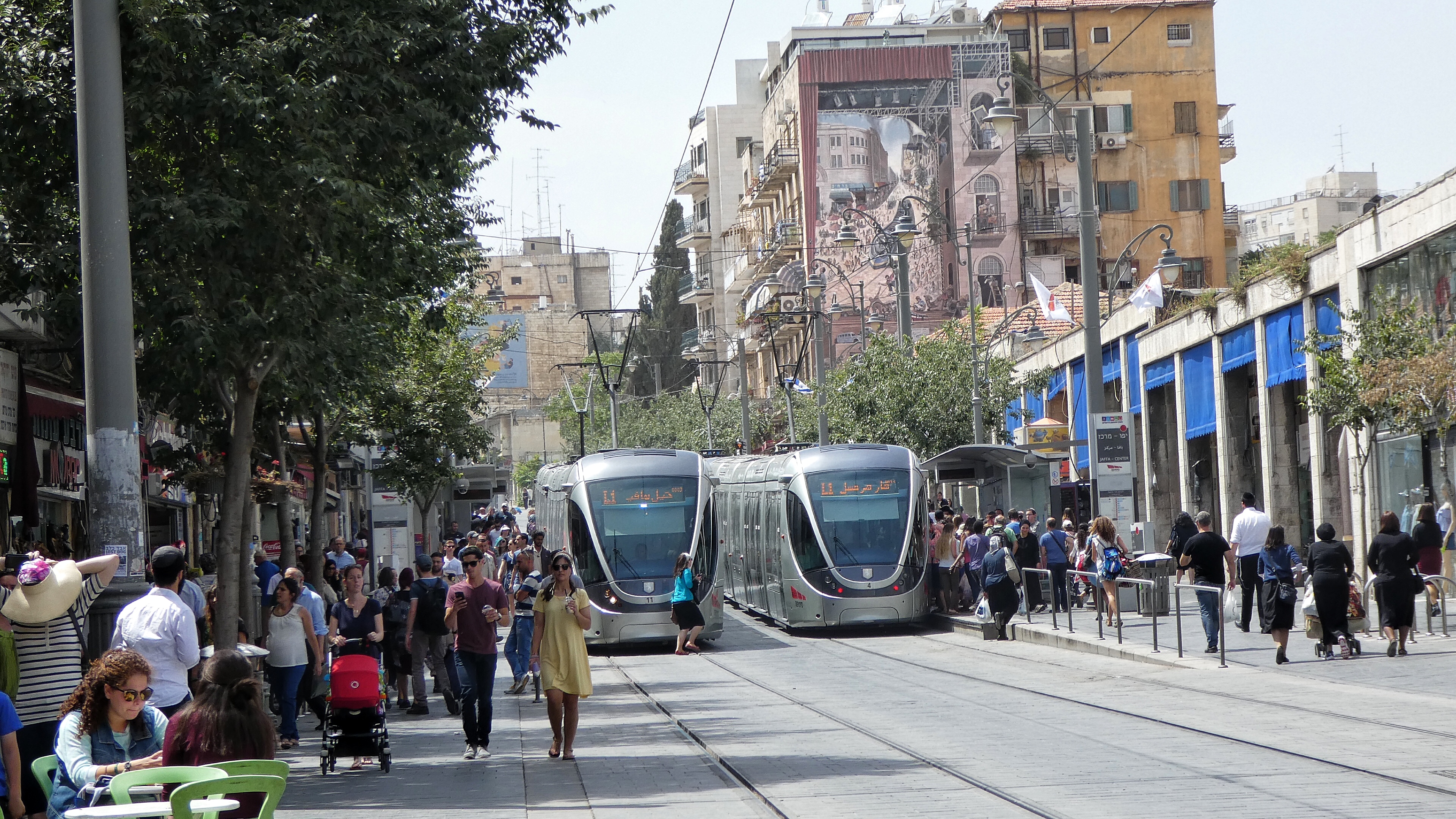
Peace train, holy roller. Ride on the peace train







 In That Howling Infinite