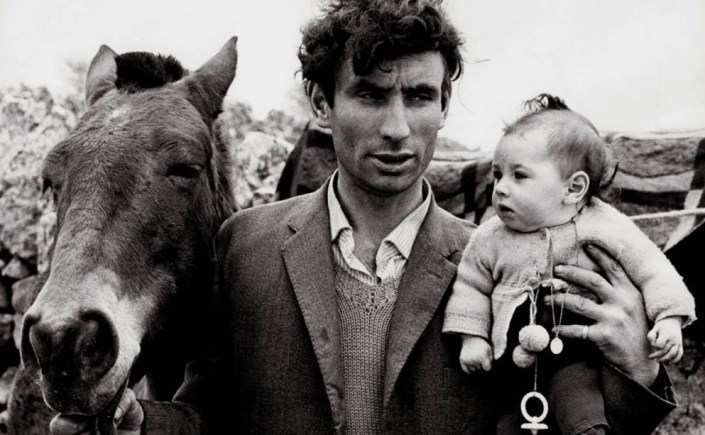
Born at the back of a hawthorn hedge,
where the black hole frost lay on the ground,
no eastern kings came bearing gifts.
Instead, the order came to shift:
“You’d better get born in some place else.”
So move along, get along,
Move along, get along –
Go! Move! Shift!
Ewan MacColl
“Why …. are we setting ourselves the impossible task of spoiling the Gypsies?… they stand for the will of freedom, for friendship with nature, for the open air, for change and the sight of many lands; for all of us that are in protest against progress … The Gypsies represent nature before civilisation … the last romance left in the world.
Arthur Symons, a gypsiologist of the early 20th century
Back in the day, when I was a nipper in Birmingham, “the tinkers,” as we called them, would camp with their caravans and lorries on what we referred to as the “waste land.” That name seemed self-explanatory to a child: a place where people left their waste, a liminal zone of half-ruin, where pre-war homes and factories had been destroyed in the Luftwaffe raids over a decade earlier. Travellers really did move through those bombed-out spaces, setting up their vardos where council workers feared to tread. They brought horses, music, and a whiff of danger to the drab post-war city.
Their Irish accents created an unexpected affinity. Our parents and relatives were Irish immigrants, and we inhabited an Irish world of history, politics, music, and stories. Listening to them, you could feel the rhythm of lives bound to roads and fields rather than concrete and council by-laws.
Peaky Blinders later turned my home city into a stylised myth. I knew the streets around Small Heath and Digbeth and the canal bridges and tow tracks of Gas Street long before Steven Knight turned them into a smoky dystopia. The series was actually filmed in Yorkshire and Lancashire, but let’s not worry about that. The travelers drift in and out of the Shelby story with their wagons and their horses, their alien tongue and their clan codes, and also, an air of imminent danger – an arcane, half-hidden life. Rewatching the series decades later, it feels less like historical fiction and more like a remembered geography, half real and half myth.
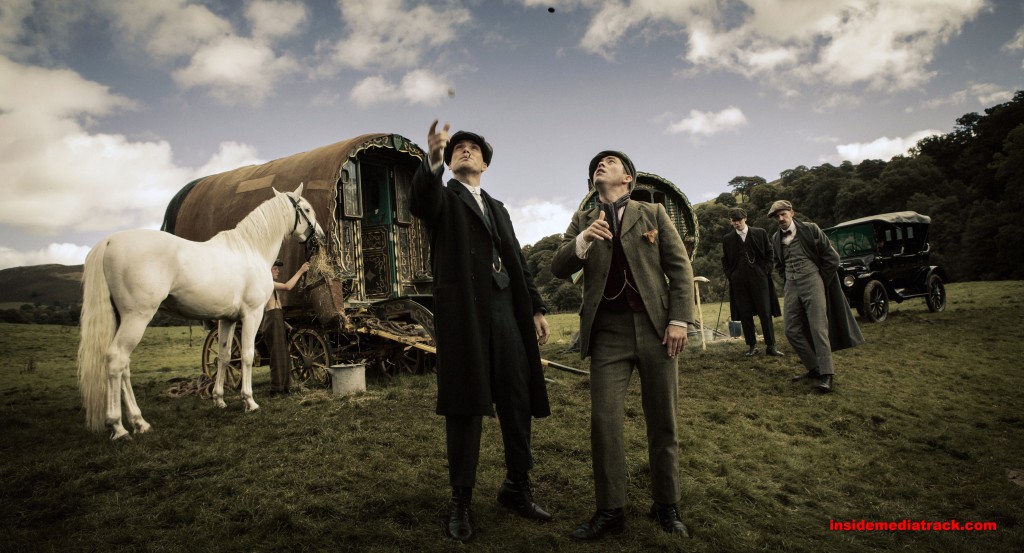
Tom Shelby and his caravan
Advisory
In order to deflect potential criticism and recrimination, please be advised that the following is a mix of memory and music and not an academic paper. It is of historical, sociological and musicological significance only in a general sense. significance, and not does not claim to be. In the light of prior criticisms of my use of the word “tinker” in online discussions about travellers – some readers have insisted that I employed it in a discriminatory and derogatory manner – this is indeed the term that we used back in the fifties and sixties, and whilst it was, indeed, a common term of abuse, it is for all that historically accurate – see the paragraphs immediately below. We cannot unhear to suit 21st century sensitivities.
An lucht siúil
Those Irish Travellers (an lucht siúil, “the walking people”), also called Mincéirs in Shelta, a secret language mixing Irish and English. They are a nomadic indigenous Irish ethnic group. Predominantly Catholic, they are English-speaking but often fluent in Shelta. Although historically labeled “Gypsies,” they have no genetic relation to the Romani; their ancestry is Irish, likely diverging from the settled population around the 1600s during Cromwell’s conquest. Over centuries, persecution, famine, and displacement hardened their itinerant ways into a distinct culture—social networks, craft skills, folklore, and traditions of travel and trade.
Many names – tinkler, tynkere, or tinker – were historically derogatory, reflecting society’s unease with their mobility. The “Acte for Tynckers and Pedlers,” passed by Edward VI in 1551, attempted to regulate their wandering. Yet, for all the attempts at control, their culture survived: a resilient, mobile society where language, music, and kinship preserve identity against erosion.
Folksong
My childhood soundtrack was full of gypsy ballads that painted freedom in a major key. A Gypsy Rover came over the hill, down through the valley so shady to win the heart of lady; three Raggle Taggle Gypsies stood at the castle gate and made off with the lady of the house; Black Jack Davy rode down hills and he rode down vale’s over many a wide-eyed mountain, luring a lady gay from her goose feather bed. The songs made the Gypsy a figure of romance and rebellion, a charmer, a rascal and a pants-man; an outsider who steals not just horses but hearts and who answers to no law but the road.
As a boy, I sang them without irony. As a teenager, on the Easter CND march in London in 1966, billeted in an old cinema in Southall, I gave my first public ‘performance’ with an a capella version Ewan MacColl’s Freeborn Man of the Travelling People. There was something electric in the way the song moved through the audience – a recognition of wandering, of roots that were not fixed in soil, but in story, song, and kin.
Ewan MacColl’s BBC Radio Ballads, especially The Travelling People (1964), went further, capturing not just the romance but the hard truth of life on the road. I can still hear the defiant swing of “Freeborn Man,” the bitter weariness of “Go Move Shift,” and the rolling litany of “The Thirty-Foot Trailer,” each song a chronicle of eviction, exclusion, and the stubborn joy of those who refuse to settle. These weren’t just pretty melodies. They were dispatches from a parallel Britain that existed beyond the pale of urban, modernising and dynamic Britain.
The songs, the caravans, the road-weary children and dogs – they are fragments of memory, but also of history. Travellers have always lived on the edge of maps, on the margins of law and land, carrying a freedom that many of us envy in memory but cannot fully grasp in practice.
Ballads of a Vanishing Road
There’s three great songs on Seeger and MaColl’s radio ballad The Travelling People: Freeborn Man, The Moving-On Song, which gives this article its title, and The Thirty-Foot Trailer. They form a kind of triptych, each panel catching a different light on the same restless life.
They begin with the open road itself: imagine if you will hedgerows dripping with rain, country lanes that meander through woods and fields, the smell of horses and wood-smoke, and the small birds singing when the winter days are over. A Freeborn Man strides out first, proud and lilting. The open road gleams with dew and possibility – open spaces and resting places where “time was not our master”. The freedom is real enough: the night fires, the sunrise on a new day, the easy rhythm of horse and dog. But you feel the weather changing. “Winds of change are blowing, old ways are going, your travelling days will soon be over.”
I can still hear the icon Yorkshire siblings, the Watersons, singing: “The auld ways are changing’, you cannot deny. The days of the traveler’ over .. It’s farewell toto the tent and the old caravan, to the Tinker, the Gypsy, the Travelling Man, and farewell to the thirty-foot trailer”. Verse by verse the song bids adieu to the things that portrayed the traveling life. The old caravan is no longer a symbol of liberty but rather a target for eviction. “You’ve got to move fast to keep up with the times,” the song warns, “for these days a man cannot dander.It’s a bylaw to say you must be on your way and another to say you can’t wander”.
If Freeborn Man celebrates the open lane, The Moving-On Song reports from the other side of the hedge. Each verse begins with a birth – on the A5, in a tattie field, beside a building site – and each is met by the same cold refrain: “Move along, get along, Go! Move! Shift!” Policemen, farmers, and local worthies take turns as chorus, a modern Nativity rewritten as perpetual eviction. Where Luke gave us shepherds and angels, MacColl gives us by-laws and property values. The travelling child is the Holy Infant born in the wrong postcode, and the only miracle is survival.
Taken together, these songs chart the whole arc of the travelling life: the exhilaration of the road, the daily skirmish with draconian laws, the slow extinguishing of a culture that once roamed the hedgerows of Britain and Europe. They are more than nostalgic laments. They are witness statements – melodic affidavits of a people whose very birthplaces are contested, whose freedom is both cherished and criminalised, and whose songs will outlast the by-laws that try to silence them.
Ewan MacColl’s “The Moving-On Song” (Go Move Shift) is, at its heart, a Nativity turned inside out. It takes the Christmas story – the miraculous birth, the wandering family, the knock at the door—and drains it of every trace of welcome. Instead of angels there are policemen, instead of shepherds there are farmers, instead of gifts there is the repeated command to move along, get along, go, move, shift. Each verse begins with a birth – on a roadside, in a potato field, beside a building site – just as Christ was born in a stable because there was no room at the inn.
But where the infant Jesus is eventually carried to safety in Egypt, MacColl’s traveller child is met at every stop with suspicion: The refrain is a bitter parody of the angelic chorus: a peremptory command instead of “tidings of great joy.” The sound of authority closing ranks, a bitter counter-melody to the dream of freedom.
It is the Flight into Egypt without sanctuary, an endless journey where every Bethlehem has a by-law.
This inversion does two things at once.
It sacralises the ordinary—making each child born in a trailer or bow tent a holy innocent—and it indicts the society that drives them out.
Listeners raised on the Nativity can hardly miss the sting: the travelling people are the Holy Family in modern Britain, but the innkeepers are us.
MacColl forces a choice—either keep singing “Go, Move, Shift” with the crowd, or recognise the Christ-child in the roadside cradle.
To the gypsyThat remainsHer face says freedomWith a little fear
Gypsies, tramps, and thievesWe’d hear it from the people of the townThey’d call us gypsies, tramps, and thievesBut every night all the men would come aroundAnd lay their money down
The dark side of the road
Ewan MacColl’s words echo still: move, shift, go – because life has often demanded it. And perhaps that is the core of the Travellers’ tale: a dance between space and place, between survival and song, between yesterday and the road ahead.
But the songs of my youth were both true and false. The gypsy rover was real enough, but his freedom came at a cost: eviction notices, police batons, barbed wire, and centuries of prejudice stretching from the wastelands of Birmingham to the bean fields of Wiltshire, from Damascus to Transylvania. The travellers remain, in MacColl’s proud phrase, freeborn men and women – though the price of that freedom has always been higher than the ballads admit.
For hundreds of years, the Gypsy way of life – the Irish Travellers among them – was one of ancient traditions and simple tastes. Until their world collided with the 21st century, with bureaucracies, police crackdowns, and urban encroachment. Romance met reality, and reality was hard. Travellers were hounded from one lay-by to the next, fined, fenced, and evicted by councils and constables who never forgave them for existing outside the parish ledger.
The romance of the traveller life had a harder edge. It is not a folk-song idyll; it is cold nights in lay-bys rough ground under wheels, police knocking at midnight. Travellers were, and still are, hounded by bylaws, denied stopping places, and stereotyped as thieves or beggars. In Britain, “tinker” and “gypo” were playground slurs. Councils moved them on, police fined them for parking on common land, newspapers blamed them for every petty crime.
Nor have modern times rendered the traveller life any easier. In the Battle of the Bean Field of 1985, Margaret Thatcher’s days of law and order, hundreds of police in riot gear smashed up a convoy of festival-bound New Age Travellers near Stonehenge, wrecking and burning their lorries and caravans, Wrecking homes and terrorising babies, and displaying the state’s fury at those who dared to live otherwise. The later Dale Farm eviction in 2011 near Basildon, Europe’s largest Traveller site, bulldozed after years of legal trench warfare, proved that little had softened.
I’ve watched video footage on YouTube of riot police in fluorescent jackets confronting families who had chained themselves to caravans, and listened to the late iconoclastic songster Ian Dury, who had long celebrated life on the margins, singing his elegy Itinerant Child – a refrain that could be sung in any layby in Britain or in the migrant camps of Calais.
Itinerant Child
It’s a right old banger and the chassis bent
It’s got a great big peace sign across the back
And most of the windows have been painted black
It starts making smoke over thirty five
It’s a psychedelic nightmare with a million leaks
It’s home sweet home to some sweet arse freaks
With my long-haired children and my one-eyed dog
With the trucks and the buses and the trailer vans
My long throw horns playing Steely Dan
And the word came down that we’d lost Old Bill
You can bet your boots I’m coming when the times are hard
That’s why they keep my dossier at Scotland Yard
Slow down itinerant child, the boys in blue are waiting
Itinerant child, don’t do what you’re doing
Itinerant child, you’d better slow down
With a lone helicopter hanging up above
We didn’t realise until we hit the field
There were four hundred cozzers holding riot shields
It’s a stone fucking miracle there’s no one dead
They turned my ramshackle home into a burning wreck
My one-eyed dog got a broken neck
Slow down itinerant child, there’s no more welcome stranger
Slow down itinerant child, you’re still accelerating
Slow down itinerant child, the boys in blue are waiting
That refrain could be sung in any layby in Britain. It could be sung in the refugee camps of Europe today.
As for those so-called New Age Travellers of the Beenfield and Basildon – part hippie, part anarchist, part rave-culture refugee – they borrowed Romany mystique but lived a diesel-fumed modern reality: buses and sound-systems instead of bow-topped wagons, dreadlocks instead of black curls, and the same hostility from the same authorities.
The Other at the Gate
Gypsies and Travellers have always been Britain’s – and the world’s – most visible “Other”- not defined by race alone, but by movement. Where the settled majority built houses, filed deeds, and mapped parishes, the travelling people carried their world on wheels and in stories. That refusal to stay put turned them into a kind of living mirror for the fears of the settled: lawless when laws were written for farmers, suspicious when surnames anchored reputations, dangerous because they belonged nowhere and therefore everywhere.
From the “Egyptians Acts” of the sixteenth century, which outlawed Romani life, to the casual playground taunts the message was the same: you are not one of us. And yet, precisely because they stood outside the pale, they became a canvas for fantasy – the romantic lovers of the ballads, the free spirits in the Radio Ballads, dark prophets in the Peaky Blinders mythos. To the townsfolk they were both temptation and threat, the embodiment of freedom and the price of it.
The Wider Road
The Wider Road: Syria, Israel, and Beyond
Later, travelling in the Middle East, I saw gypsy camps in Syria and in Israel/Palestine. They were not romantic there either. Arabs called them Nawar, a word laced with disdain. Unlike the Bedouin, whose semi-nomadic life carried a certain desert dignity, Gypsies were seen as rootless outsiders, neither honoured nor trusted, often harassed by police and locals alike. Their tents were not “exotic,” just poor.
These Middle Eastern Gypsies – Dom people, distant cousins of the European Roma – carry the same ancient story. Linguistic and genetic trails trace their origins back to northwest India a thousand years ago. From Rajasthan they moved west through Persia and Armenia, into the Byzantine world, and across Europe, bringing music, craft, and the stubborn freedom of the road.
Europe: Discrimination and Death
Freedom came at a price. In Eastern Europe the Roma were enslaved for centuries—in Wallachia and Moldavia until the 19th century—and remain targets of discrimination today, from the eviction of camps in France and Italy to far-right attacks in Hungary and Slovakia.
The darkest chapter came under the Nazis. The Porajmos—the “Devouring”—saw an estimated half a million Roma murdered in the Holocaust. They were rounded up alongside Jews, homosexuals, and the disabled, marked with black or brown triangles, gassed in Auschwitz, shot in forests, starved in camps. For decades their suffering was barely acknowledged in official memorials.
The pattern was familiar when I travelled abroad. In Syria and Israel/Palestine I saw dusty Domari camps pitched on the fringes of towns, cousins of the European Roma whose ancestors left northern India a thousand years ago. Their Sanskrit-tinged language betrays that long migration. Arabs treated them with the same mix of curiosity and disdain that dogs their European kin. Unlike the semi-nomadic Bedouin, celebrated in poetry and nationalist lore, these gypsies were harassed, marginalised, sometimes treated as beggars or tricksters.
Eastern Europe tells an even darker story. In Slovakia, Hungary, and Romania, Roma communities are still scapegoated in politics and corralled into segregated schools. The twentieth century added its own atrocity: the Porajmos—“the Devouring”—the Nazi genocide of Roma and Sinti that claimed perhaps half a million lives. Their deaths were long footnoted beside the Shoah, yet they shadow every fiddle tune and every caravan that still dares to circle a fairground.
References & Further Reading
 In That Howling Infinite