It has been said before and often, that Qatari owned Al Jazeera presents the non-Arabic speaking world with a markedly different narrative of the Gaza war to what it relays to its Arabic readers – it is the most popular news source in the Arab world, particularly among Palestinians.
Viewing or reading Al Jazeera English, you would think that Israel’s onslaught is directed entirely against the defenceless and helpless civilians of the unfortunate enclave. There are very rarely images of the militants who are engaged on a daily basis in fierce battles and deadly firefights with the IDF. Al Jazeera Arabic on the other hand, posts pictures and videos of the fighters, illustrating their courage, their resilience in the face of overwhelming odds, and their successes in the face of overwhelming military odds.
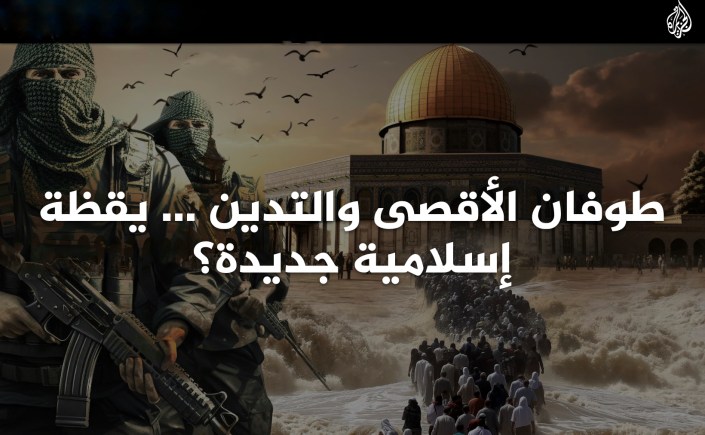
On 13 August 2024, Al Jazeera Arabic published a series of seven articles under a forward titled The Al-Aqsa Flood and Religiosity… A New Islamic Awakening?
The title refers to the pogrom of October 7 in which Islamic militants slaughtered some 1,200 Israeli men, woman and children and kidnapped over 200. It was given the name Amaliyyat Tufān al Aqsa – Al Aqsa Flood, insofar as its purpose was to preempt a Jewish takeover of Al Aqsa Mosque in Jerusalem, the third holiest Islamic shrine – notwithstanding the fact that nothing of the kind was happening. Israel’s angry response has been biblical in its brutality, with nine months of air and ground assault that has devastated the enclave of Gaza and, according to health officials killed more than 40,000 people (uncorroborated figures provided by the Hamas-run health authorities that include thousands of militants killed in the fighting, and persons who would have died under normal circumstances had war not broken out).
An earlier piece in In That Howling Infinite, Lebensraum Redux – Hamas’ promise of the hereafter revealed the Hamas master plan for the destruction of the state of Israel and the dispersion and disposal of its Jewish inhabitants. Statements like this and the longstanding foundational Hamas Covenant, which also calls for the eradication of Israel do not generally attract mainstream and social media interest, even after October 7.
Few have actually read the 1988 Hamas Covenant or the revised charter that was issued in 2017. The neglect is nonetheless surprising considering the clear exposition of the Islamist, genocidal intent of the Hamas and Islamic Jihad. This accords with a view held by many knowledgeable and well-informed observers and commentators that the original intent of Operation Al Aqsa Flood was to race en-masse across the Negev to the Occupied Territories and spark a general Palestinian rising which would precipitate an invasion of Israel by its Arab neighbours – a repeat of the war of 1948 without its outcome, but rather, al Nakba in reverse.
We’ll probably never really know why this scenario was not followed through, and what may have been the outcome. Some may argue a 100km sprint across the open desert to the nearest Palestinian city, Hebron, was an impossible task. Others might surmise that the militants who descended on the borderland kibbutzim and the Nova Trance Festival to molest, maim and murder were distracted by the easy prey and the release of pent-up rage and brutal vengeance.
Al Aqsa Flood may have failed, with only the Black Shabbat and the destruction of Gaza to show for it, but without doubt, it ignited a wildfire that has reinvigorated the Palestinian cause in the eyes of the world and severely damaged Israel’s standing on the world stage. The Hamas maintains that the ongoing carnage is justified, with many senior officials, declare in the safety of their sanctuaries in Qatar and Beirut that they’d do it all over again … and again.
The Al Jazeera series is enlightening in several respects, particularly insofar as it does not recognise the events of October 7 for what they were; and whilst acknowledging that there is a battle raging in the enclave but eschewing any reference to the carnage it is causing among the Gazan population, it presents the moral and humanitarian disaster of the Gaza war as the beginning of an Islamic enlightenment:
“Outside the military battlefield, there was another battle raging alongside the flood, which is the battle of conflicting identities that the world witnessed with the flood, and the accompanying signs of a noticeable religious awakening among young people around the world, and the restoration of the centrality of the role of religion in Arab public affairs”.
By happenstance, I read this series not long after In That Howling Infinite published A Messiah is needed – so that he will not come, which discussed the phenomenon of messianism with particular reference to the connections between the conflict and catastrophe of the Gaza war on the one hand and an emerging messianism on the other among both religious and non-religious Jew. It noted:
In the eyes of Israel’s principal foes, the so-called “Axis of Resistance”, Iran and its Islamist proxies in Palestine, Lebanon, Syria, Iraq and Yemen, the current Arab Israeli conflict is in reality a holy war with inseparable and uncompromising religious, political and military dimensions that take on a messianic character.
The irony is that increasingly in the Jewish state, the existential crisis emanating from the catastrophe of October 7 and the encirclement of the tiny country by enemies determined to wipe it off the map, has arguably fostered a messianic fervour in Israel too.
We republish the foreword to the Al Jazeera series below in both English and Arabic.
See also in In That Howling Infinite, A Middle East Miscellany:
- “You want it darker?” … Gaza and the devil that never went away …
- Total war in an urban landscape – Israel’s military quandary
- The flight into Egypt … a modern riff on an old tale
- Lebensraum Redux – Hamas’ promise of the hereafter
Al-Aqsa Flood and Religiosity … A New Islamic Awakening?
“Outside the military battlefield, there was another battle raging alongside the flood, which is the battle of conflicting identities that the world witnessed with the flood, and the accompanying signs of a noticeable religious awakening among young people around the world, and the restoration of the centrality of the role of religion in Arab public affairs”.
What is the religious symbolism of the red cows that the Zionist settlers brought before the flood? Why did the spokesman for the Qassam Brigades denounce them in a speech? And what is the meaning of the concept of the nation in the speeches of the resistance leaders? Why did the Zionist Prime Minister invoke the story of the “Amalekites” from the Old Testament to justify the Israeli brutality in the Gaza Strip? And why do we only receive clips of resistance fighters accompanied by glorification and praise and mention of the virtue of martyrdom?
Many questions about religion and religiosity and their relationship to the flood have imposed themselves since the outbreak of the flood on October 7, 2023. From the first moments of the flood, and with the resistance members crossing the security fence of the Gaza Strip, the sounds of glorification and praise of the resistance fighters preceded the sounds of the Kalashnikovs. During the battle, the leaders of each team did not limit themselves to the military and strategic mention of the battle, but they loaded the battle itself with many religious symbols, which are no less present and important than the importance of the security, intelligence and military machine. Outside the military battlefield, there was another battle raging alongside the flood, which is the battle of conflicting identities that the world witnessed with the flood, and the accompanying signs of a noticeable religious awakening among young people around the world, and the restoration of the centrality of the role of religion in Arab public affairs.
All of this prompted us to ask the question: What is the position of religion and religiosity in the battle of the flood? This was the file titled “The Flood of Al-Aqsa and Religiosity… A New Islamic Awakening?!” which consisted of 7 articles.
The first article was an extensive article titled “From the Tortured of the Earth to the Beloved of God… How did Arab Youth Return to the Questions of Faith and Religiosity after the Events of October 7?” The work on the article took 8 months, during which we met with dozens of young people around the world between the ages of 20 and 40 to monitor the transformations of Arab youth after the flood, and the transformation of many of them from “indifference” to a state of sweeping religiosity, and sometimes even readiness to engage in the broad Islamic state, and support the Islamic resistance. All of this was monitored by the article, and their testimonies recorded the impact of the flood on them and its effect on the transformations they went through.
As for the second article, it was a conceptual article entitled “Cultural Wars and the War on Gaza… How did October 7 formulate the concept of the nation?” The article followed the conflict of identities that accompanied the flood, and how the speeches of the resistance spokesman restored the concept of “nation” and made it the heart of the battle of the flood, and how the Zionists and their allies tried to redraw the concept of the term “nation” in the past decades!
Then we delved into the third article into a forward-looking article entitled “The Flood, Prophecy, and the Hour… Welcome to the Exceptional Times!” to tell us how prophecy can have its effect on military reality? And how faith becomes a refuge for salvation for the resistance fighters when all roads are narrow, moments of foresight are absent, and work becomes based on the sites of destiny.
As for the fourth article, it was about the presence of the Zionist religious narrative on social media platforms, especially TikTok. The article “Religious Zionism on TikTok… This is how genocide was legitimized in Gaza” attempted to monitor the religious presence of Zionist figures and those influenced by them on TikTok, and how this presence helped justify the genocide with a clear conscience! The article placed this Zionist religious narrative in a comparative case with the role of Arab influencers and the religious narrative they carried during the war.
From TikTok to psychology, in the fifth article we went to reconsider Western psychology and the problem of Western standards on religion and religiosity in the article “What is faith? About Gaza and the Istisqa prayer in the summer”, which monitored the academic deficiency in Western standards of religiosity when trying to apply them to Muslim peoples. The article revealed that the case of “Gaza” remains a unique case that is difficult to frame within the material framework of the psychology of religiosity in its Western perspective.
Then we reinforced it with the sixth article, in which we returned to the impact of religion on the battlefield, which is the article “Psychology of Religiosity… The Infrastructure of Resistance in Gaza”, which attempted to draw the line between religious motivation and mental health in crises, and monitored the religious beliefs of the people of Gaza that created meaning from the womb of suffering, and concluded the article by talking about the uniqueness of Islam in drawing the path of salvation for its followers in the two cases of life or martyrdom.
Finally, we concluded with the seventh article, which tells the expansion of the circle of influence to the ends of the world by reviewing the story of an evangelical Christian Islam, and how the Gazan model of religiosity was transformed into a beacon of global guidance.
طوفان الأقصى والتدين … يقظة إسلامية جديدة؟!
مقدمة الملف ما الرمزية الدينية للبقرات الحُمر التي استجلبها المستوطنون الصهاينة قبيل الطوفان؟ ولمَ ندد بها المتحدث باسم كتائب القسام في خطاب له؟ وبأي مدلولٍ حضر مفهوم الأمة في خطابات قادة المقاومة؟ ولماذا استدعى رئيس الوزراء الصهيوني قصة “العماليق” من العهد القديم تبريرًا للوحشية الإسرائيلية على قطاع غزة؟ ولماذا لا تصلنا مقاطع مقاتلي المقاومة إلا مصحوبة بالتكبير والتهليل وذكر فضل الشهادة؟
أسئلة كثيرة حول الدين والتدين وعلاقتهما بالطوفان فرضت نفسها منذ اندلاع الطوفان في السابع من أكتوبر ٢٠٢٣. فمنذ اللحظات الأولى للطوفان، ومع عبور أفراد المقاومة السياج الأمني لغُلاف غزة كان أصوات التكبير والتهليل للمقاومين تسبق أصوات الكلاشنكوف. وفي أثناء المعركة لم يكتف قادة كل فريق بالذكر العسكري والإستراتيجي للمعركة، وإنما شحنوا المعركة ذاتها بكثير من الرمزيات الدينية، التي لا تقل في حضورها وأهميتها عن أهمية الآلة الأمنية والإستخباراتية والعسكرية. أما خارج ميدان المعركة العسكري، فكان ثمة معركة أخرى تدور رحاها إلى جوار الطوفان، وهي معركة الهويات المتصارعة التي شهدها العالم مع الطوفان، وما صاحب ذلك من بوادر استفاقة دينية ملحوظة في أوساط الشباب حول العالم، واستعادة محورية دور الدين في الشأن العام العربي.
كل ذلك دفعنا إلى طرح سؤال: ما هو موقع الدين والتدين في معركة الطوفان؟ فكان هذا الملف الذي حمل عنوان “طوفان الأقصى والتدين … يقظة إسلامية جديدة؟!” والذي تكون من 7 مواد.
كانت المادة الأولى مادة مستفيضة بعنوان “من معذبي الأرض إلى أحباب الله … كيف عاد الشباب العربي إلى سؤالي الإيمان والتديّن بعد أحداث السابع من أكتوبر” وقد استغرق العمل على المادة 8 أشهر، التقينا فيها بعشرات الشباب حول العالم من الفئة العمرية ما بين 20 إلى 40 لرصد تحولات الشباب العربي بعد الطوفان، وتحول كثير منهم من “اللامبالاة” إلى حالة التدين الجارف، بل وأحيانا التأهب للانخراط في الحالة الإسلامية الواسعة، ومناصرة المقاومة الإسلامية. كل ذلك رصدته المادة، وسجلت بشهاداتهم وقع الطوفان عليهم وأثره في التحولات التي خاضوها.
أما المادة الثانية كانت مادة مفاهيمية بعنوان “الحروب الثقافية والحرب على غزة.. كيف صاغ 7 أكتوبر مفهوم الأمة؟” تتبعت المادة صراع الهويات التي صاحب الطوفان، وكيف استعادات خطابات المتحدث باسم المقاومة مفهوم “الأمة” وجعلته في القلب من معركة الطوفان، وكيف حاول الصهاينة وحلفائهم إعادة رسم مفهوم مفردة “الأمة” في العقود الماضية!
ثم دلفنا في المادة الثالثة إلى مادة استشرافية بعنوان “الطوفان والنبوءة والساعة … مرحبًا بك في الأزمنة الاستثنائية!” لتخبرنا كيف يمكن للنبوءة أن يكون لها أثرها في الواقع العسكري؟ وكيف يصبح الإيمان ملاذ الخلاص للمقاومين عندما تضيق جميع الطرق، وتنعدم لحظات الاستشراف، ويصبح العمل على مواقع القدر.
أما المادة الرابعة فكانت عن حضور السردية الدينية الصهيونية على منصات التواصل الاجتماعي، وخاصة التيك توك. فكانت مادة “الصهيونية الدينية على “تيك توك”.. هكذا شُرّعت الإبادة في غزّة” حاولت هذه المادة رصد الحضور الديني للخامات الصهاينة والمتأثريين بهم على التيك توك، وكيف ساعد هذا الحضور على تبرير الإبادة بضمير مرتاح! ووضعت المادة هذه السردية الدينية الصهيونية ضمن حالة مقارنة مع دور المؤثريين العرب والسردية الدينية التي حملوها أثناء الحرب.
ومن التيك توك إلى علم النفس، فقد ذهبنا في المادة الخامسة إلى إعادة النظر في علم النفس الغربي وإشكالية المقايس الغربية حول الدين والتدين في مادة “ما الإيمان؟ عن غزة وصلاة الاستسقاء في الصيف” والتي رصدت النقص الأكاديمي في مقاييس التدين الغربية عند محاولة تطبيقها على الشعوب المسلمة. وكشفت المادة أن حالة “غزة” تظل حالة فريدة ومستعصية على التأطير ضمن الإطار المادي لعلم نفس التدين في منظوره الغربي.
وثم عززنا بالمادة السادسة التي عُدنا فيها إلى أثر الدين في أرض المعركة، وهي مادة “سيكولوجية التديّن.. البنية التحتيّة للمقاومة في غزة” والتي حاولت رسم الخط بين الدافع الديني والصحة النفسية في الأزمات، ورصدت المسلمات الدينية لأهل غزة والتي خَلّقَت المعنى من رحم المعاناة، وختمت المادة بالحديث عن فرادة الإسلام في رسم مسار الخلاص لأتباعه في حالتي الحياة أو الشهادة.
وأخيرًا ختمنا بالمادة السابعة، التي تحكي اتساع دائرة التأثير إلى أطراف المعمورة باستعراضنا لقصة إسلام مسيحيّ إنجيليّ، وكيف تحول نموذج التديّن الغزيّ إلى منار هداية عالميّة.
من معذبي الأرض – 1
الحروب الثقافية والحرب – 2
الطوفان والنبوءة والساعة
الصهيونية الدينية على تيك توك – 4
ما الإيمان؟ عن غزة – 5
سيكولوجية التديّن -6
قصة إسلام إنجيلي أميركي
 In That Howling Infinite
Wars don’t end until one side realizes their fight is hopeless and quits, gives up and stops fighting. War in Palestine/Israel has been going on about a hundred years. Numbers on both sides are about equal counting the numbers in Palatine/Israel. And both side have support from their respective allies. We appear to be a long way from seeing this war end. No sign that either side is becoming to weak to continue.
[…] It has been said before and often, that the Qatari-owned news platform Al Jazeera presents the non-Arabic speaking world with a markedly different narrative of to what it relays to its Arabic readers – it is the most popular news source in the Arab world, particularly among Palestinians. Viewing or reading Al Jazeera English, you would think that Israel’s ongoing onslaught in Gaza is directed entirely against the defenceless and helpless civilians of the unfortunate enclave. There are very rarely images of the militants who are engaged on a daily basis in fierce battles and deadly firefights with the IDF. Al Jazeera Arabic on the other hand, posts pictures and videos of the fighters, illustrating their courage, their resilience in the face of overwhelming odds, and their successes in the face of overwhelming military odds. In that Howling Infinite recently covered the issue of divergent narratives in Al Aqsa Flood and the Hamas holy war. […]
[…] messianic in In That Howling Infinite, see A Messiah is needed – so that he will not come and Al Aqsa Flood and the Hamas holy war. On the Middle East generally, see A Middle East Miscellany: […]
[…] Al Aqsa Flood and the Hamas holy war. […]
[…] Infinite, Middle East Miscellany, Lebensraum Redux – Hamas’ promise of the hereafter, Al Aqsa Flood and the Hamas holy war. Is an Israeli-Palestinian confederation possible? and Visualizing the Palestinian Return – the […]
[…] In sum, the ideological evolution of Palestinian nationalism—from secular, civic, and political mobilization toward religiously framed struggle—illuminates why contemporary conflict cannot be understood solely through the lens of territory or governance. It is simultaneously geopolitical, generational, and spiritual, embedded in the sacred geography of the land and in the cosmology of a people who have endured loss, occupation, and existential threat. Understanding this transformation is essential to comprehending why peace is so elusive, why the Two-State Solution is increasingly improbable, and why the wounds of October 7 and the Gaza War are likely to reverberate across generations. [In In That Howling Infinite see Lebensraum Redux – Hamas’ promise of the hereafter and Al Aqsa Flood and the Hamas holy war. […]