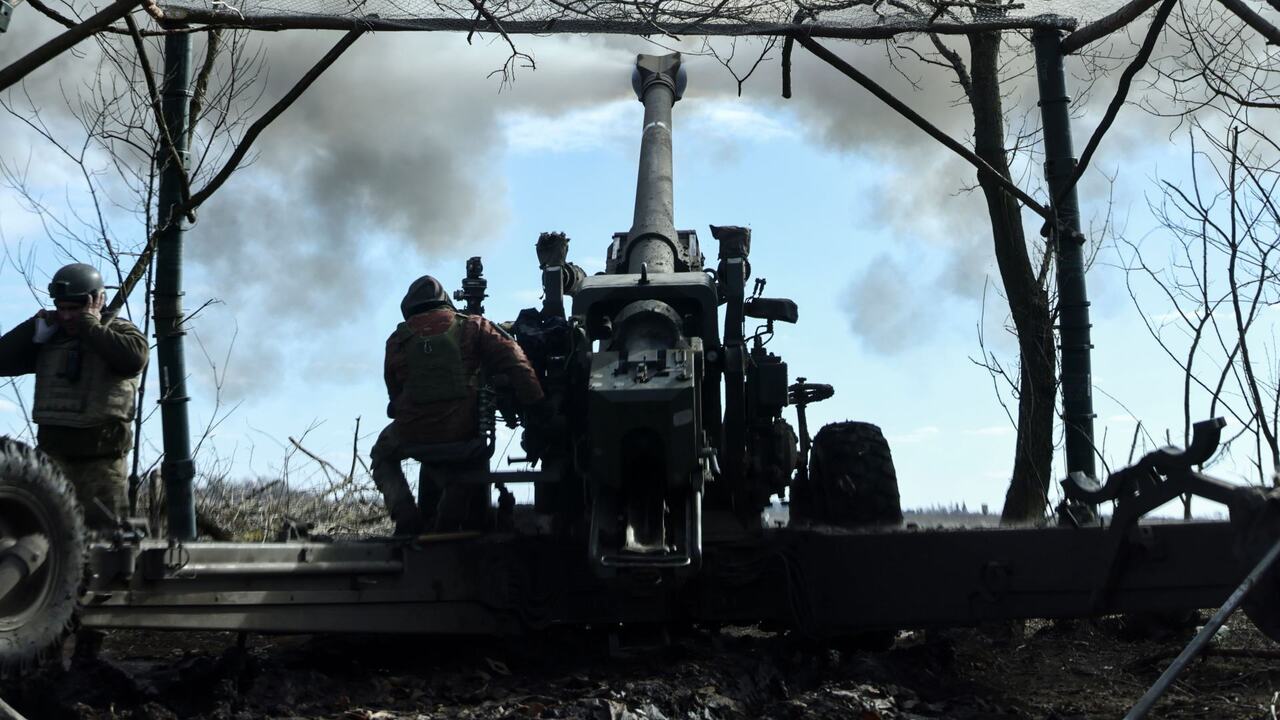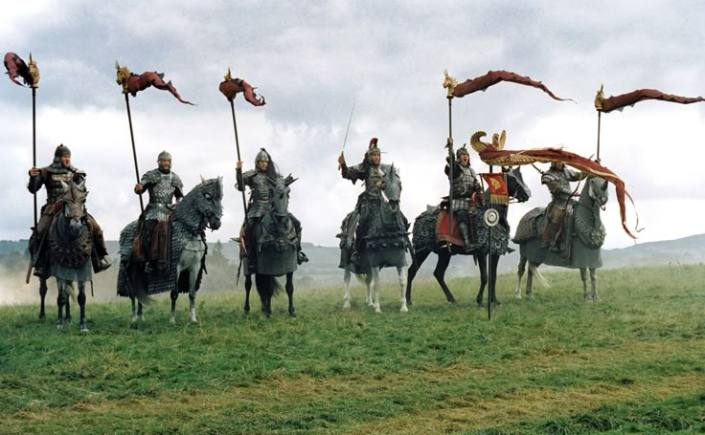
Echo of the Steppes … history’s long shadow

Fingerprints, ghosts and the long arm of History

In an illuminating essay in the e-zine Unherd, republished below, former war-correspondent Aris Roussinos’ begins an extensive and expansive review of  Australian archeologist Warwick Ball’s The Eurasian Steppe with three mute stone figures – Cuman balbals standing beside the road between Sloviansk and Bakhmut in Donetsk – watching the endless movement of armies a across what is now Ukraine’s disputed and devastated Donbas. They are ancient witnesses in a landscape where Russians and Ukrainians now fight over ground that, for most of human history, belonged to neither.

This is history as I like it: the historian as storyteller, where landscapes become characters and the past refuses to remain buried.

Long before Slavic speech reached these plains, the steppe was the domain of nomadic peoples: Scythians, Sarmatians, Alans, Huns, Turks, Mongols and many others whose empires rose and vanished like storms over the grasslands. They left few cities and fewer written records, but their fingerprints are everywhere: in languages, military traditions, political institutions, myths and identities. The grass remembers what libraries often forget.

Roussinos’ central argument is that we have misunderstood Europe by looking too exclusively westward, towards Rome. The steppe was never merely a barbarian wilderness beyond civilisation, waiting to burst through the gates. It was one of the great engines of European history. Europe was shaped not only by the legacy of Rome and Christianity but also by repeated encounters with the peoples of Inner Asia. The old frontier between “Europe” and “Asia” dissolves under closer inspection. What appears on a modern atlas as a dividing line was, for centuries, a vast zone of movement, exchange, conquest and adaptation.

The present war in Ukraine unfolds across precisely this ancient geography. The early Russian thrust towards Kyiv moved through forests and marshes that belonged historically to the old Slavic world. The grinding war of attrition in the east is being fought across the open “Wild Fields”, the immense Eurasian grasslands where mounted nomads once travelled with astonishing speed and where empires repeatedly collided. Roussinos draws parallels with the mechanised battles of the twentieth century – Kursk, Kharkiv, Stalingrad – where tanks replaced horses, but the strategic significance of the landscape remained unchanged. Geography, as Napoleon is said to have observed, is often the most enduring ally in war.

It is an enticing argument because it encourages us to look beneath the familiar surface of European history. Perhaps Europe itself carries far more of the steppe within it than we usually acknowledge. Hungary and Bulgaria were founded by peoples of the steppe. The Polish nobility cultivated a proud Sarmatian ancestry. The Magyars’ memory of their eastern origins helped shape nineteenth-century nationalism. Even the nation state, so often presented as an entirely European invention, may owe something to political traditions carried westward across the grasslands by mounted confederations whose influence extended far beyond the horizon they inhabited.

There are historical echoes scattered throughout this story. The Sarmatians and Alans revolutionised warfare with armoured cavalry, heavy lances and mounted tactics that would eventually blossom into the chivalric traditions of medieval Europe. Even the Arthurian legend may preserve a distant resonance of the steppe in the enduring image of the sword planted in the earth, waiting for the rightful king to draw it forth.

Filmmakers, naturally, could not resist. The 2004 film King Arthur, for example, stitched together Romans, Celts, Sarmatians, Picts and enough historical liberties to make any medievalist wince. Clive Owen wandered through a fictional Northumbria Britain as a brooding half-Roman, half-Sarmatian Arthur, while Keira Knightley appeared as an improbably glamorous and scantily clad Guinevere whose Pictish origins seemed less convincing than her plummy English accent. It was glorious nonsense, but enjoyable, nonetheless. The Irish landscapes were striking, the horses magnificent, the ‘Knights’ (the picture at the head of this essay) with their “Rus! Rus!” war cry (and they actually do sit at a round table) improbably photogenic. A battle fought across a frozen lake owed as much to Eisenstein’s Alexander Nevsky as it did to any surviving historical source. Ridley Scott later recycled much the same visual conceit in his disappointing Napoleon. History often survives in cinema not because the facts are accurate but because certain images possess extraordinary emotional truth.

The Cossacks offer a far more convincing example of the cultural blending that characterised the frontier. They emerged not from ethnic purity but from mixture. Runaway serfs, adventurers, escaped peasants and soldiers settled the borderlands, adopting the customs, military practices and vocabulary of the Turkic peoples who had occupied the steppe before them. Even the word “Cossack” derives from a Turkic root meaning “to roam”. The frontier was never a wall separating civilisations. It was a workshop in which entirely new identities were forged.

It is here that Roussinos, following Warwick Ball, arrives at his most provocative claim. Muscovite Russia, he argues, cannot be understood without recognising the formative influence of the Mongol world. Moscow’s rise was anything but inevitable. The Golden Horde required dependable tributaries capable of collecting taxes, maintaining order and supplying troops. The princes of Moscow proved remarkably efficient servants of the khans and, in doing so, transformed what had once been a relatively insignificant Rus’ principality into the nucleus of a future empire. The irony is delicious. Mongol domination helped create the very Russian state that would eventually conquer the steppe itself.

The fingerprints remain visible today. Administrative practices, institutions of government, systems of taxation and even elements of the Russian language bear traces of Mongol influence. Yet fingerprints are curious things. They tell us that contact occurred; they do not tell us everything that followed.

That question lies at the heart not only of Ball’s thesis but also of historian Orlando Figes’ The Story of Russia, which, by happenstance, I am reading at the moment. It is one of those literary coincidences in which two writers, approaching the same landscape from different directions, find themselves asking precisely the same question. What made Russia, Russia?

Figes is, in many respects, the perfect companion to Roussinos because he shifts our attention from inheritance to interpretation. He readily acknowledges that the Mongol conquest of the Rus’ principalities in the thirteenth century was one of the defining ruptures in Russian history. It destroyed Kyiv’s political centrality, subordinated the northern principalities to the Golden Horde and created the circumstances in which Moscow could eventually emerge as the dominant power. Like Roussinos, he recognises the profound irony that Mongol domination did not simply interrupt Russian state formation but helped shape its eventual character.

Yet Figes is ultimately less interested in what Russia inherited than in what Russia chose to become. The Mongols bequeathed methods of rule: taxation, military organisation, communications and a conception of authority that differed markedly from Western feudalism. Russia’s imagination, however, was nourished elsewhere. Orthodox Christianity, Byzantine political theology, the doctrine of Moscow as the “Third Rome” and the almost mystical conception of the Tsar as God’s anointed gave Russia a vocabulary through which it understood itself. Its civilisation emerged not from a single source but from the convergence of many.

This distinction is important because it rescues history from determinism. Fingerprints reveal contact; they do not reveal intention. They cannot tell us why someone picked up the knife, wrote the letter or opened the door. Likewise, cultural inheritance explains possibilities, not inevitabilities.

Figes presents Russia as a civilisation assembled from multiple traditions: Slavic, Byzantine, Mongol, European and imperial. The country’s enduring paradox is that it has persistently imagined itself as both European and somehow apart from Europe. Peter the Great attempted to drag Russia westward, shaving beards, importing European science, founding St Petersburg (a German name, which was changed to Petrograd during World War I for the same reasons the British royal house changed its German name to Windsor) embracing Enlightenment ideas. Yet beneath these reforms older structures of autocracy survived. Later generations reversed the argument entirely. Slavophiles celebrated Russia’s uniqueness while Westernisers lamented its failure to become sufficiently European. The debate has never really ended. It merely changes its vocabulary.

Maps have always encouraged these arguments. A glance at any atlas suggests that Russia occupies an almost impossible position: a European power that expanded across Asia until it became the largest contiguous empire on earth. The geography itself tempts us into historical mythology. Is Russia European? Asian? Eurasian? The answer has varied according to who was asking and what political purpose the answer was intended to serve. Geography creates opportunities, constraints and temptations. It does not dictate outcomes.

Figes’ also explores of recurring Russian archetypes: the Holy Tsar, the Holy Fool, the suffering nation, the belief that Russia possesses a unique historical destiny. These are not immutable characteristics embedded in some mystical national DNA. They are stories Russians have told about themselves across the centuries – including Vladimir Putin’s house ideologue, philosopher Aleksandr Dugin. Stories matter because people act upon them. Nations, no less than individuals, become attached to narratives that explain who they are and why they exist.

Juxtaposed against Ball, Roussinos and Figues is a comment on Roussinos’ essay by Alexander Morrison, a historian of Russian history at Oxford University. Every grand historical narrative requires its sceptic. Elegant theories are seductive precisely because they reduce complexity to a single organising principle. Morrison accepts much of Ball’s argument while quietly resisting its more deterministic conclusions. It is an exemplary piece of historical criticism because it neither dismisses nor genuflects. Instead, it refines.

He readily acknowledges that Muscovy inherited important administrative practices from the Mongol world and points out that Russia was far from unique. The Ottomans, Safavids, Mughals and Qing all incorporated Chinggisid or Timurid political traditions alongside older local institutions. Borrowing across Eurasia was commonplace. Civilisations have always learned from their neighbours, even while claiming absolute originality.

Where Morrison parts company with Ball is over the temptation to confuse influence with destiny. Muscovy borrowed bureaucratic structures connected with taxation, communications and administration. Indeed, the Russian language still preserves Mongol echoes in words such as kazna for treasury, den’gi for money and yam for the postal relay system. Yet the ideological foundations of the state remained overwhelmingly Byzantine and Orthodox. Ivan IV became Tsar by invoking the legacy of Caesar and the vision of Moscow as the Third Rome, not by presenting himself as the heir of Genghis Khan. Administrative inheritance did not erase cultural identity.

That distinction becomes even more important when considering the modern world. It is tempting to explain Putin’s Russia by reaching back to the Mongols, Ivan the Terrible or some timeless Russian soul. Such explanations possess an undeniable elegance because they transform political choices into historical inevitabilities. Morrison rejects this outright. Contemporary Russia, he argues, is shaped above all by decisions made by particular elites drawing upon nineteenth-century nationalism, memories of the Soviet collapse, selective readings of Russian history and modern political ideology. The past provides the vocabulary; it does not dictate the speech.

His discussion of Ukraine is equally persuasive. Southern and eastern Ukraine were settled comparatively recently by a remarkable mosaic of peoples: Ukrainians, Russians, Greeks, Jews, Armenians, Bulgarians and many others. The region’s history is therefore extraordinarily layered. Yet historical complexity does not undermine modern sovereignty. Ancient settlement patterns explain why memories remain contested, but they do not invalidate internationally recognised borders. History illuminates’ claims; it does not automatically legitimise them.

This strikes me as one of the most important lessons historians can offer our own age. We are living through a period in which politicians, nationalists and activists increasingly seek legitimacy by reaching deeper into the past. Ancient kingdoms, medieval battles, archaeological discoveries, linguistic survivals and genetic studies are all recruited into contemporary arguments about identity and territory. History becomes less an investigation than a courtroom brief.

Yet the past is a notoriously unreliable witness.

Landscapes accumulate memories without issuing verdicts. The Donbas bears the fingerprints of Scythians, Greeks, Sarmatians, Goths, Huns, Khazars, Mongols, Tatars, Cossacks, Russians, Ukrainians, Jews, Armenians and countless others. None of those fingerprints constitutes a title deed. They testify to presence, movement and encounter. They remind us that almost every place we imagine possessing an eternal identity has, in reality, been shaped by successive waves of migration, conquest, adaptation and coexistence.

Perhaps that is why I find Roussinos’ essay so compelling. Like the best historical writing, it restores movement to landscapes that modern maps often freeze into static national colours. It reminds us that frontiers have rarely been fixed and that civilisations have always been more entangled than their later myths would admit. Europe did not simply civilise the steppe. The steppe helped create Europe.

Equally, Morrison reminds us that historical explanation should never become historical imprisonment. Institutions endure, languages preserve old borrowings, myths outlive empires and landscapes retain astonishingly long memories. But people still make choices. Nations inherit the consequences of the past without becoming its captives.

The three weathered balbals still stand beside the road to Bakhmut. They have watched Scythians ride westward, Huns descend upon Europe, Mongol tumens disappear into the distance, Cossacks patrol the frontier, imperial armies march beneath Romanov eagles, Wehrmacht panzers advance across the wheatfields, Soviet tanks return in triumph and, today, drones circle silently above the same ground. Every generation has believed its struggle to be unique, its empire enduring, its victories permanent. The stones know otherwise.

History leaves fingerprints everywhere. It leaves them in words, in institutions, in ruined cities, in forgotten roads, in songs, in legends and in the memories of peoples who continue to argue about what happened centuries before they were born. Those fingerprints deserve to be studied because they tell us where we have come from and how our worlds were made. But fingerprints are not destiny. They record contact, not ownership; inheritance, not inevitability; memory, not command. The ghosts of the steppe still whisper across Eurasia, but they do not write the future. That task, as it always has been, belongs to the living.

Coda. The myth of fingerprints.

History leaves fingerprints.

That may seem an odd metaphor, but I have found myself returning to it again and again. Archaeologists brush them from shards of pottery, linguists discover them buried inside forgotten words, historians recognise them in institutions, laws, customs and myths. They are the traces left behind whenever peoples encounter one another, whenever empires rise and fall, whenever civilisations borrow, conquer, imitate or remember.

Fingerprints fascinate us because they appear to promise certainty. In a criminal investigation they identify who touched the weapon. Yet they tell us remarkably little about what actually happened. A fingerprint cannot reveal motive, explain intention or determine guilt. It records contact, not consequence.

History is much the same.

Every landscape is covered with fingerprints. They survive in place names and languages, in ruined cities and forgotten roads, in religions, legal systems, songs, frontiers and collective memory. The three ancient balbals still standing beside the road to Bakhmut are surrounded by them. For nearly a thousand years they have watched Scythians ride westward, Huns descend upon Europe, Mongol tumens disappear into the distance, Cossacks patrol the frontier, imperial armies march beneath Romanov eagles, Wehrmacht panzers cross the wheatfields, Soviet tanks return in triumph and, today, drones circle silently overhead. Every empire believed its moment would endure. Every generation imagined itself to be the culmination of history. The stones know otherwise.

And this is where I arrive at what I have come to think of as the Myth of Fingerprints.

The fingerprints themselves are not mythical. They are real. History leaves them everywhere. The myth begins when we misunderstand what they are telling us.

A fingerprint is evidence that someone was here. It cannot tell us why they came, whether they belonged, whether they acted justly or what rights their descendants may possess centuries later. In a court of law, a fingerprint may place someone at the scene; it cannot, by itself, decide the case. History works in much the same way. It explains how we arrived here, but it cannot by itself determine who ought to possess the future.

Too often we ask it to do precisely that.

Ancient maps become modern borders. Archaeological discoveries become political manifestos. Genetic inheritance becomes moral entitlement. Historical suffering becomes an enduring licence for vengeance. We confuse explanation with justification, inheritance with ownership, memory with legitimacy. That confusion – the transformation of historical evidence into historical entitlement—is what I mean by the Myth of Fingerprints.

It is a myth because it is one of the oldest stories nations tell themselves. Every people constructs narratives from the traces left by earlier generations. Sometimes those stories preserve genuine memory; sometimes they simplify; sometimes they become propaganda. But they all begin with the same temptation: to believe that because history explains the present, it therefore authorises it.

This question lies beneath far more than the current war in Ukraine. It echoes through the history of Palestine and Israel, through Australia’s History Wars, through debates over monuments, migration, frontiers and national identity. Again and again we encounter the same temptation: to search the past not for understanding, but for permission.

That is why Aris Roussinos’ essay on Warwick Ball’s The Eurasian Steppe struck me so forcefully. Ball demonstrates how profoundly the Eurasian steppe shaped Europe. Orlando Figes traces the inheritance of Byzantium, the Mongol world and the frontier in the making of Russia. Alexander Morrison reminds us that inheritances are never destinies. Together they illuminate a larger truth. Geography creates opportunities. Culture bequeaths inheritances. Myths provide meaning. Only human beings make choices.

The ghosts of the steppe still whisper across Eurasia, just as the ghosts of every civilisation whisper through the landscapes they once inhabited. Historians should listen carefully to those whispers, for they reveal how the world came to be. But they should resist the temptation to mistake echoes for commands. The past deserves understanding rather than obedience.

History leaves fingerprints everywhere. They are among our most valuable clues to the human story. They reveal connections, influences, migrations and memories that would otherwise be forgotten. Yet they are not title deeds, nor verdicts, nor chains binding the living to the ambitions of the dead. They explain inheritance without dictating destiny.

That is the real lesson of the Myth of Fingerprints.

Paul Hemphill and In That Howling Infinite, August 2026

This essay was written in conversation with books I’ve read, ideas formed and half-formed, and, more recently, in sustained dialogue with an AI language model, which contributed to drafting, phrasing, and conceptual articulation. What appears here is not unmediated thought, but considered thought: selected, tested, revised and revised again, and owned.

The concept of the Myth of Fingerprints originated in a long essay with regard to what is probably the most intractable conflict in modern times: One Land, Two Peoples: History, Memory, Continuity, and Inheritance. In That Howling Infinite has published many articles regarding the historical movement of peoples. For example: Modern history is built upon exodus and displacement. 

For more on Russia, Ukraine and the Soviet Union, see Russky Mir – Russian history’s long shadow. 

I highly recommend Ukrainian scholar Serhii Plokhy’s The Gates of Europe, a well told and fascinating story of the origins of Ukraine and Belarus, and how their histories were intertwined, and entwined with those of of Poland, Lithuania (which was a large and powerful state once) and Russia. Ukraine has historically been the border between the catholic west and the orthodox east, the division running virtually down the middle. The name Ukraine is Slav for border land. Its geopolitical location and natural resources have led to the land being inflicted by invaders, civil wars, man-made famine and repression. See, in In That Howling Infinite, Borderlands – Ukraine and the curse of mystical nationalism

Roussinos’ essay follows, and also, for readers with time on their hands, more on Figes’The Stiry of Russia and on Morrison’s critique.

The fate of Europe lies in the steppes Warwick Ball: ‘The Eurasian Steppe’

Aris Roussinos, Unherd 28 July 2022
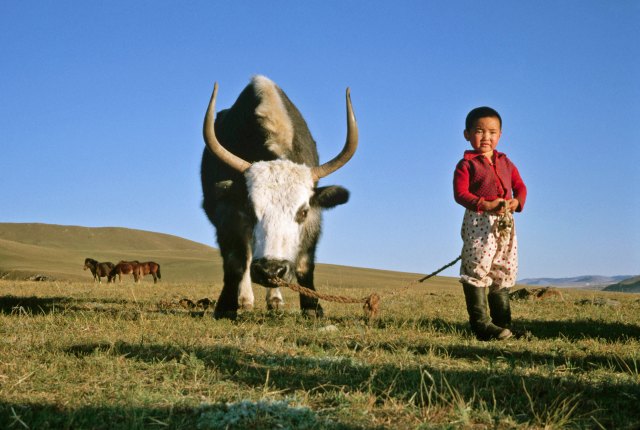
The fate of Europe lies in the steppes

Genghis has won (Dean Conger/Corbis via Getty

On the road between the frontline cities of Sloviansk and Bakhmut, in Ukraine’s eastern Donbas region, three stone statues stand mutely by the side of the road, observing the coming and going of military traffic with impassive detachment. Known as balbals, they are funerary monuments erected by the Cuman Turks, known in Russian archaeology as the Polovtsians, who once ruled this vast sea of grass, long before Russian or Ukrainian speech was ever heard in this region.

For thousands of years, the empty, spreading steppe, stretching from Hungary to Mongolia, was the home of nomadic peoples, speakers of Iranic, Turkic and Mongolic languages, who drove their herds across the vast plains in search of fresh pastures. They founded great empires, which time and the steppe grasses would soon swallow up, leaving barely a trace. Their constant irruptions into Europe sounded the death knell in turn for other, settled civilisations, part of the endless cycle of growth, invasion and collapse that has shaped our continent’s history.

The war in Ukraine has taken place in two very different climatic and cultural zones: its initial phases saw Russian armour wend its way through the dark forests and marshes of northern Ukraine, the ancient homeland of the first Slavic peoples, to be destroyed in close fighting on the narrow wooded roads in a stunning and unexpected Ukrainian victory. Yet the gruelling war of attrition in the country’s east is taking part in a very different landscape, in the open steppe that was once the home of nomadic peoples.

The expansion of Slavic peoples, both Ukrainians and Russians, into the open steppe was a very recent historic event, broadly contemporaneous with the European settlement of the Americas, its fertile plains, now the breadbasket of the developing world, Europe’s equivalent of America’s Midwest. These open plains, the “Wild Fields” of local historiography have always been a contested space, where great empires wrestled for control: in the great Second World War battles of Kursk, Kharkiv and Stalingrad, Europe’s entire fate hinged on the battle between the two great tank armies wheeling and clashing like nomad hordes.

But then, as The Eurasian Steppe by the archaeologist Warwick Ball makes clear, rather than a semi-wild anteroom to the continent, “the history, languages, ideas, art forms, peoples, nations and identities of the steppe have shaped almost every aspect of the life of Europe”. Europeans from further west have for centuries been prone to viewing the steppe as the haunt of wild tribes, and the source of occasional, fearsome destruction.

But what if the Europe of today is in fact the product of steppe dynamics? As Ball argues, rather than being a product of 19th century nationalism, some historians trace the origin of Europe’s oldest nation states to the steppe, observing that “Peoples newly arriving from the east were also among the first to create nationally defined states, such as kingdoms of the Bulgars or Magyars”. “In some ways,” Ball argues, “the incipient idea of a nation state might have been stronger with the nomadic groups from the steppe, who were bound more closely by tribal loyalties” than among the polyglot peoples of the imperial Roman successor states they conquered.

Did the steppe peoples then create the fractious patchwork quilt of nationalities that we understand as Europe? Ball cites the archaeologist Hyun Jin Kim who claims that: “The political and cultural traditions of Inner Asia brought to Europe by Central Asian immigrants, the Huns and the Alans, were just as fundamental to the formation of western Europe as the rich legacy left behind by the Roman Empire. The political and cultural landscape of early medieval Europe was shaped by the fusion of Roman and Inner Asian influences.”

While Hungary and Bulgaria were directly founded by steppe nomads, the influence of steppe rulers also helped shape the political forms taken by Poland (whose szlachtanobles claimed Sarmatian descent well into the 19th century), Bohemia, Denmark and even, it is claimed, France. Even into the 19th century, as Ball notes, it was the Hungarian awareness of their steppe Magyar ancestry that helped bring about the rise of nationalism which shook apart the great Austro-Hungarian empire. “In the long evolution of the idea of the nation state,” then “from their beginnings in late-antique Europe to their emergence in the nineteenth century, we must look east as well as west”.

Viewed in this light, the war in Ukraine, a battle between a European nation-state and a vast Eurasian empire, is resonant with all manner of strange echoes of the steppe’s dimly-understood history. The colossal earthern ramparts of the “serpent walls” outside Kyiv, erected by early Slavic kingdoms to guard against invasion by steppe nomads from the Huns to the Mongols, fulfilled their ancient role admirably earlier this year when they prevented the movement of Russian armour towards the capital’s suburbs, corralling the latest wave of invaders into killing zones to be picked off at leisure by guided missiles.

The Cossack heritage both sides claim is the result of earlier Slavic peoples, runaway Ukrainian and Russian serfs, claiming the freedom of the open steppe and adopting the customs, lifestyle and much of the vocabulary of their nomadic Turkic predecessors. The very word Cossack, Ball notes, “derives from the Turk root qaz, ‘to roam’”, and is cognate with the ethnonym Kazakh further east, as the Cossacks “comprised mainly Russians — usually renegades, escaped serfs or criminals — but they also included Turks, Tatars and remnant Polovtsi.” Even now, Ukrainian is sprinkled with Turkic words, a legacy of the two cultures’ long history of interaction and competition. One Ukrainian commander I met went by the nom de guerre “Duman, or fog, deriving from the Turkic word for smoke or mist. Even now, Ukrainians refer to Russians with the dismissive Turkic epithet Katsab, or butcher.

On the Russian side, the war effort has been marked by the use of steppe peoples as infantry, with many of the heaviest casualties borne — and apparently some of the worst war crimes committed by — the Buryat Mongols of the Russian steppe, along with the Kalmyks of the lower Volga, Europe’s only Buddhist nation, who once watered their horses as far west as Paris following the defeat of Napoleon. Similarly, among the many subject peoples of the Russian empire deployed to Ukraine are Ossetians from the Caucasus, a tiny Iranic-speaking nation who are all that remain of the Alans, who once fought the Romans across Central Europe, settling as far west as France and Spain: some of their descendants, now Magyarised, still live in Hungary as the Jasz people. Their Iranic speech is now heard in Ukraine’s steppe for the first time in a thousand years, dragged along into a war of European conquest by another great Eurasian empire.

The very concept of chivalry which defined Europe’s medieval history was the product of Iranian-speaking steppe peoples like the Sarmatians and the Alans, whose innovations in the use of cavalry — stirrups, lances and long chainmail coats — changed the face of late Roman warfare and set the stage for the knights of the High Middle Ages. Even our own medieval romances may owe something to their distant steppe traditions, after the border forts of what is now northern England became the garrison home of Sarmatian levies in Roman service. As Ball notes: “Sarmatian warrior worship of a sword fixed in the ground has been suggested as furnishing the origin of the Excalibur legend. This appears to have been a long steppe warrior tradition: Ibn Rusta in the tenth century, for example, describes how the Viking Rus ruler — whom he calls by the steppe title of Khagan or khāqān — would plant a naked sword in the earth pointing towards his newborn son.” Perhaps it is not mere coincidence, then, that the Azov Regiment’s torchlit ceremonies in the southern steppe city of Mariupol took place beneath three giant swords embedded in the ground, a striking symbol that has now become the group’s emblem.

Again and again, these strange resonances between the steppe’s ancient nomad past and its bloody present swim to the surface like long-forgotten memories. The great statue to Mother Russia, sword in hand, that rises above Stalingrad’s Hill 102, where tens of thousands of Soviet and German soldiers were ground into the soil by artillery possesses the grim grandeur of some ancient steppe monument. And indeed, Hill 102, the crucial position of the battle that decided the war’s outcome, is perhaps better viewed by its alternate name as the Mamayev Kurgan, the burial tumulus of a long-forgotten Tatar khagan. From the ancient past to now, Russia’s history was written on the steppe, and without the steppe Russia’s imperial past and present is simply impossible to understand. Indeed, as Ball observes, without the historic domination of steppe nomads, there would be no Russia as we understand it.

As Ball observes: “The future of Russian greatness was both a response to and a legacy of the Mongols… Indeed, to a large extent Muscovite power was a creation of the Golden Horde: the khans required a stable central authority as a client state which could be relied upon to raise auxiliaries for the khan’s armies and to collect and deliver taxes and tribute. Moscow fitted the bill, so the Golden Horde deliberately strengthened it against the other Russian cities and appointed its prince as their chief tax collector.” Without the Mongol-enforced primacy of Muscovy, the land that is now Russia may well have remained a series of disunited kingdoms and city states, just like medieval Italy or Germany: “The Mongols, in other words, brought about the emergence of Russia.”

Even the great king Sviatoslav of Kyivan Rus, whose legacy is claimed by both Ukraine and Russia, extended his rule across the steppe by defeating the great Jewish Khazar kingdom and in doing so, “adopted the techniques and warfare of the steppe nomad: in other words, Kievan Rus was at first simply another steppe nomad state, albeit with a Scandinavian element. Sviatoslav never decisively defeated the Pechenegs and was killed by them in 963, and his skull was made into a cup in steppe tradition.” Medieval Russia was, then, as much a steppe polity as a European state, perhaps more so. After all, “up until 1480 Muscovite coins still carried inscriptions in Arabic. As late as 1531 Vasili III of Moscow was still paying tribute to the successors of the Golden Horde: Crimea, Kazan and Astrakhan”, and the eternal symbol of Russian power, Moscow’s St Basil’s Cathedral, was modelled on Kazan’s Great Mosque, in thanks for the conquest of the great Tatar capital.

Tracing Muscovy’s traditions of governance, and then those of imperial Russia, to the Mongol and Tatar customs of the inner steppe, Ball observes that “Even by the fourteenth century the civil and military institutions of Muscovy ‘were overwhelmingly Mongol in origin’… Ivan IV, the first Russian to proclaim himself Tsar (in Russian the title is actually Tsezar), added Ulugh Khan, ‘Great Khan’, to his titles.” Though he dismisses the “Mongol Yoke” hypothesis of Russian historiography, Ball nevertheless traces Russia’s unique and terrible form of autocratic rule to steppe customs, deep into the modern period: “Ivan also adopted the Mongol policy of ‘collective guilt’ where all male relatives and retainers of a guilty man would be executed, a policy even extended to entire communities. Stalin’s similar policy was a continuation of this.” The steppe’s long influence stretches deep into the cultural DNA of our modern world: even such a giant 20th century figure as Lenin, destroyer of one great Eurasian empire and founder of another, was of part-Kalmyk descent, after all.

Imperial Russia’s second largest minority after the Ukrainians, whose post-independence relationship with their giant neighbour is today a source of such bloodshed, was the Muslim Tatars, from whose Russified nomad aristocracy some of the greatest names in Russian culture — Rachmaninoff, Turgenev, Nureyev and Akhmatova — claimed descent. “The list [of Tatar surnames] covers all walks of Russian life: artistic, religious, scientific, literary, military, political and royal. The list is virtually endless,” Ball notes, and even today “the descendants of the Mongol ‘hordes’ — the Tatars — are the second-largest minority in Russia after the Russians themselves, and the Republic of Tatarstan is the second-largest republic in European Russia.”

Written for a general audience, Ball’s book nevertheless synthesises the latest archaeological research and historical debate on the steppe’s ancient and modern peoples, archaeological research on the steppe’s history, delving back into the deepest mists of time. The burgeoning community of esoteric archaeology and anthropology posters on Twitter will surely appreciate his summarising of the latest research on the origins of the Indo-Europeans, the fate of the Khazars and the birth and decline of the great Scythian kingdoms, who’s exquisite goldwork was the highlight of the British Museum’s recent blockbuster exhibition.

Noting that St Petersburg’s great Hermitage Museum was founded primarily as a place to store the newfound Scythian treasures unearthed by Russian colonists in Crimea, Mariupol and the rest what is now Ukraine’s contested southern steppe, and alert to the theft of Scythian treasures from Ukrainian museums by their new-old Russian conquerors, we realise that the relentless cycle of history has brought a new relevance to Ball’s book, even since its publication last winter. Just as in the Middle Ages and in the bloodiest battles of the Second World War, the fate of Europe is once again being written on the endless, grassy steppe.

Aris Roussinos is an UnHerd columnist and a former war reporter.

Orlando Figes’ The Story of Russia

That is a very happy coincidence, because Roussinos’ essay and Figes’ The Story of Russia are really circling the same enormous question from different directions: what made Russia Russia?

Figes is, in many ways, the antidote to the more sweeping “fingerprints of the steppe” argument. He certainly does not deny the Mongol inheritance  – quite the opposite. The Mongol conquest of the Rus principalities in the thirteenth century was one of the decisive ruptures in Russian history. It destroyed Kyiv’s old political centrality, subordinated the northern principalities to the Golden Horde, and created the conditions in which Moscow could eventually rise. The irony, as both Roussinos and Figes emphasise, is that the Mongols did not simply delay Russian state formation; they helped create the particular form of state that emerged.

But Figes is interested less in what Russia inherited than in what Russia made of those inheritances. The Mongols supplied mechanisms of rule – taxation, military organisation, hierarchy, a relationship between ruler and subject that was very different from Western feudalism. Yet Russia’s self-understanding was built around other ideas: Orthodox Christianity, Byzantium, the idea of Moscow as the “Third Rome”, and the notion that the Tsar was not merely a monarch but a sacred figure.

This is where it links beautifully with Morrison’s critique. The danger is that we see the Mongol “fingerprints” and assume they explain everything. But fingerprints do not tell you why the person picked up the knife, wrote the letter or opened the door. They tell you something about contact and inheritance; they do not reveal intention.

Figes’ Russia is a civilisation built from multiple inheritances: Byzantine, Slavic, steppe, European and imperial. The great Russian paradox is that it has often defined itself simultaneously as both European and apart from Europe. Peter the Great famously tried to drag Russia westward — shaving beards, building St Petersburg, importing European science and manners — yet the deeper structures of autocracy, hierarchy and imperial expansion remained. Later Slavophiles rejected the West and celebrated a distinct Russian path, while Westernisers argued that Russia’s tragedy was precisely its failure to become sufficiently European.

This also connects with our earlier discussion of maps and historical memory. Russia is, geographically, an extraordinary historical anomaly: a European state that expanded across Asia until it became a continental empire. The map itself creates the tension. Is Russia Europe? Asia? Eurasia? The answer has shifted depending on who was asking and what political argument they wanted to make.

One of the things I suspect you will appreciate in Figes is his attention to recurring Russian archetypes: the Holy Tsar, the Holy Fool, the tension between obedience and rebellion, the recurring belief that Russia has a unique destiny. These are not “genes” or immutable cultural DNA; they are traditions — stories Russians told about themselves. And stories matter enormously because people act upon them.

That brings us back to Roussinos’ evocative phrase, “the echo of the steppes”. Echoes are fascinating precisely because they are not the original sound. They are altered, refracted and carried forward. The Mongol conquest echoed through Muscovy; Byzantium echoed through the Tsars; Soviet power echoed through Putin’s Kremlin. But each generation chooses which echoes to amplify.

There is also a pleasing connection with your earlier fascination with maps and atlases. A physical map of Russia looks almost inevitable: the enormous landmass stretching from Europe to the Pacific. But Figes and Morrison both remind us that geography creates possibilities, not destinies. The Russian Empire was not simply “there” waiting to happen. It was built by choices — by princes, tsars, revolutionaries and commissars who made decisions within particular historical circumstances.

So perhaps the combined lesson of Figes, Roussinos and Morrison is this:

Russia is not merely a European country contaminated by Asia, nor an Asian empire wearing European clothes. It is a civilisation formed in the meeting place of worlds. The tragedy is not that it has a complicated past; all great civilisations do. The tragedy comes when a complicated past is reduced to a single myth of inevitable destiny.

Which, interestingly, brings us back to your recurring theme: the power  – and danger –  of maps. Every map is an argument about the past. Every empire is a story it tells about itself. And every story leaves fingerprints. The historian’s job is to work out which ones are real, which ones are imagined, and which ones have been deliberately placed there.

Alexander Morrison’s critique

Alexander Morrison, a historian of Russian history at Oxford University, specialising in the Russian conquest of Central Asia, commented on Roussinos’ essay in Unherd. Here it is in full.

Roussinos, seems to have made good use of Ball’s research. Some of these arguments are completely uncontroversial when applied to the Asian neighbours of the Eurasian steppe in the early modern period: the Ottomans, the Safavids of Iran and the Qing all made use of Chinggisid and TImurid political repertoires in building their states alongside other elements (Byzantine heritage for the Ottomans, the existing Chinese imperial tradition in the Qing case, Sufi religious charisma for the Safavids). The Mughals were of course actually of Timurid (and in the female line of Chinggisid) descent, and it was at the core of their dynastic ideology in India.

However the steppe political tradition seems to have produced ever larger polities in Asia, which makes it hard to explain why it would instead produce political fragmentation in western and Central Europe – I think that part of Ball’s argument is a bit overstretched.

The Muscovite example seems to fit the Asian pattern better, and Roussinos is spot on in saying that it was the willingness of the Princes of Moscow to act as particularly loyal and effective satraps and tax collectors for the Golden Horde that allowed what had previously been a minor Rus’ princedom to rise to pre-eminence.

However we need to be clear about what it was that Muscovy took from the Mongols: it was largely bureaucratic structures linked to taxation or communication. This why key Russian words such as kazna (treasury), den’gi (money) and yam (postal service) are of Mongol origin. On the cultural side the ruling ideologies of the state were all to do with Orthodox Christianity and the semi-mythical link to Byzantium (the ‘Third Rome’), which was what Ivan IV (the Terrible) was evoking when he took the title of Tsar (Caesar) – he may have added the title of khan for good measure but this was largely for the purposes of communication with steppe peoples.

Many Tatar nobles of Chinggisid descent did become incorporated into the Muscovite aristocracy after the fall of Kazan in 1552, but you need to be careful about 19th and 20th-century claims to this ancestry, which are often bogus (it was fashionable at the time). In the case of Akhmatova it was her nom de plume (she was born Anna Gorenko – in fact a Ukrainian name). In any case Chinggisid descent did not give you any kind of claim to the throne of Muscovy, which had its own dynastic legend in the Rurikids. A better guide to the relationship between Muscovy and the Mongols than Ball is Donald Ostrowski.

There is also a bit too much cultural determinism in all of this to my liking – it suggests that neither Russia nor Ukraine can ever shake off this bloody past etc. etc. Nowhere in the world is simply a prisoner of its past. What is happening now is a result of very specific political choices made by Vladimir Putin and Russia’s ruling elite. Their thinking is rooted partly in their reading of 19th-century Russian historians (who first came up with the idea that Russians and Ukrainians were the same people), vicious forms of anti-semitic Russian nationalism of the early 20th century and the emigration (the Black Hundreds, Ivan Il’in), a particular, tendentious interpretation of both Soviet history and their own memories of the Soviet collapse.

What is perhaps more relevant is that this steppe past means that most of southern and eastern Ukraine was only relatively recently settled – not just by Russians and Ukrainians, but by the whole range of peoples of the empire (Greeks, Jews, Bulgarians, Armenians…probably also some Ossetians). They are certainly not ‘ancient Russian lands’ as Putin has claimed, but they are part of Ukrainian territory under international law and the Budapest memorandum assuring the country’s territorial integrity which Russia signed.

A couple of other corrections – the Buryats are not a steppe people, they live East of Lake Baikal. I am a bit queasy about the implication that they and the Kalmyks are disproportionately represented in the ranks of the Russian army because of their ‘savage’ steppe nature – it is simply because these are some of the poorest parts of the Russian Federation, and because the Russian regime is very deliberately trying to avoid recruiting troops from metropolitan regions of European Russia whose families might cause political trouble or have ties to Ukraine.

The ethnic Russians who are fighting are also disproportionately from Siberia or the Altai. The regiment which committed the atrocities at Bucha was from Khabarovsk in the Russian Far East, and its commander appears to have been originally from Karakalpakstan. Most Ossetians speak Russian these days, and have long identified with Russian rule. A good piece though – not many outlets would allow as thorough and as thoughtful a review of a work on Eurasian History.

Morrison’s comment stands apart from most of the thread because it does what the best scholarly criticism should do: it accepts the broad thesis where the evidence supports it, corrects errors where necessary, and resists the temptation to replace one grand narrative with another.

The essence of Morrison’s critique is this:

He accepts the central proposition that Muscovy inherited important features from the Mongol world. Indeed, he strengthens it by pointing out that similar borrowing occurred across Eurasia. The Ottomans, Safavids, Mughals and Qing all incorporated Chinggisid or Timurid political traditions into their own states. Russia was therefore not unique in absorbing institutions from the steppe.

Where he parts company with Ball is over determinism. Ball appears to argue that steppe political culture explains not only Muscovy’s rise but much of Russia’s subsequent history and perhaps even Putin’s Russia today. Morrison thinks this stretches the evidence too far. Administrative institutions can endure for centuries; they do not imprison nations forever. Modern Russia, he argues, is the product of choices made by a particular elite, drawing on nineteenth-century nationalism, Soviet memories and contemporary ideology, rather than the inevitable flowering of Mongol political culture.

He also introduces some valuable nuance. Muscovy borrowed bureaucratic techniques—taxation, communications, administration – from the Golden Horde, but its ideological heart remained Orthodox and Byzantine. Ivan IV’s claim to be Tsar rested on the idea of Moscow as the “Third Rome”, not the successor of Genghis Khan. Even the Russian language preserves this administrative inheritance in words such as kazna (also in Arabic,treasury), den’gi (money) and yam (postal relay), all of Mongol origin, illustrating that institutional borrowing need not imply cultural subordination.

Morrison is equally careful about ethnicity. He rejects romanticised claims of Chinggisid ancestry, notes that many were fashionable nineteenth-century inventions, and cautions against portraying Buryats or Kalmyks as somehow naturally warlike. Their prominence in today’s Russian army is explained far more convincingly by economics and recruitment policy than by any inherited “steppe mentality”. That is a useful reminder that socio-economic factors often explain what cultural stereotypes merely decorate.

His discussion of Ukraine is similarly restrained. Southern and eastern Ukraine were indeed settled comparatively recently by a mosaic of peoples across the imperial period, making simplistic claims of ancient ethnic ownership difficult to sustain. Yet that historical complexity does not undermine Ukraine’s internationally recognised borders or Russia’s commitments under the Budapest Memorandum. History explains; it does not necessarily justify.

Finally, Morrison performs the historian’s essential task of distinguishing influence from destiny. States inherit institutions, myths and habits, but they are not condemned to repeat them. This is perhaps his strongest point. It is tempting to explain Putin’s Russia by reaching back to the Mongols, Ivan the Terrible or the “Russian soul”, just as earlier generations invoked “ancient Balkan hatreds” to explain Yugoslavia. Such narratives are elegant because they reduce contingency to inevitability. Historians, however, are generally suspicious of elegant explanations.

His recommendation of Donald Ostrowski is also telling. Ostrowski’s work has long argued that Muscovy’s relationship with the Mongol world was one of selective adaptation rather than wholesale inheritance. That is a subtler – and probably more persuasive – account than one that sees Russia as simply Europe’s most successful steppe empire.

In short, Morrison doesn’t demolish Ball’s thesis. He refines it. He accepts that the steppe mattered enormously, but insists that institutions are not destiny, that cultures borrow selectively, and that political choices remain more important than historical determinism. It is precisely the kind of intervention that lifts an online discussion from polemic into genuine historical

What  Unherd Readers had to say about Roussinos’ essay

The comments divide into several broad themes rather than converging on a single interpretation, and in many ways become a debate about contemporary Russia as much as about history.

Many readers found the article fascinating and praised it for opening an unfamiliar chapter of Eurasian history. Several immediately ordered Christopher Ball’s book, while others supplemented the discussion with examples ranging from the Kalmyks’ influence on Austrian costume to the chess capital of Elista, the legacy of the Mongols in Central Europe, and the wider political traditions of the Eurasian steppe. A number of contributors recommended additional works, notably Peter Frankopan’s The Silk Roads and Donald Ostrowski’s scholarship on Muscovy.

A second group challenged aspects of the historical argument. Critics argued that the article overstated the influence of steppe culture on later European political development, confused mythology with history in discussing Poland and Hungary, and oversimplified the origins of the Cossacks and the Azov Regiment’s symbolism. Others objected to what they saw as cultural determinism: the suggestion that Russia’s present behaviour is somehow an inevitable product of its Mongol inheritance. Several historians in the discussion -Morrison particularly, stressed that Muscovy certainly inherited administrative and fiscal practices from the Golden Horde, but that its religious ideology and dynastic legitimacy remained fundamentally Byzantine and Orthodox. They argued that modern Russian policy reflects political choices by Vladimir Putin and his circle, not an inescapable historical destiny.

As often happens, the historical discussion quickly became a proxy for arguments over the war in Ukraine. One camp maintained that Ukraine is an artificial state whose disputed regions deserve internationally supervised referendums, criticising NATO expansion and Western military support while advocating diplomacy. The opposing view rejected these claims as Russian propaganda, pointing to Ukraine’s overwhelming vote for independence in 1991, insisting that no genuine referendum is possible under military occupation, and arguing that Russian aggression – not Western policy – is the central issue. A more extreme minority advanced familiar pro-Kremlin narratives, portraying NATO as the true aggressor and Russia as a defensive victim, provoking vigorous rebuttals from other commenters.

There was also a meta-debate about free speech. An inflammatory remark describing Russians in derogatory terms prompted accusations of hate speech and counter-accusations of “crybullying”, illustrating how discussions of Russia often slide into arguments over acceptable language as readily as they do over history.

The most substantial contribution came from historian Alexander Morrison, whose lengthy critique was widely praised by other readers. Morrison broadly accepted the article’s central insight – that Muscovy’s rise owed much to its role within the Mongol imperial system – but argued that the thesis was pushed too far. He emphasised the distinction between administrative inheritance and cultural identity, corrected numerous historical inaccuracies, warned against deterministic readings of history, and reminded readers that modern events stem from contemporary political decisions rather than immutable civilisational characteristics. His intervention effectively became the intellectual centre of the comment thread, with several readers declaring that it improved upon the article itself.

Overall, the discussion reveals both the appeal and the risks of grand historical narratives. Most readers accepted that the Eurasian steppe profoundly shaped Russia’s development. Where they diverged was over the extent to which that past explains the present, and whether history should be read as a story of enduring civilisational patterns or of contingent political choices. The resulting debate ranges from thoughtful historiography to contemporary geopolitics, with occasional excursions into conspiracy theory and internet polemics.


Alexander Dugin versus Sydney Sweeney

As a longtime student of русские вещи (russkiye veshchi or things Russian) – I have written about Russia long and often in In that Howling Infinite. And I have only seen Sydney Sweeney in her controversial jeans ad and in the new series Americana (she’s gorgeous). But I found this article by English journalist Richard Godwin in the British e-zine Unherd, republished below, an absolute hoot.

This witty article about a Russian philosopher raging over a pulchritudinous American actress becomes an exploration of the deeper currents shaping Putin’s Russia. Beneath the absurdity lies an old and dangerous idea: that Russia is not simply a nation, but a sacred civilisation with a providential mission, locked in a metaphysical struggle against a decadent West.

The result is a reflection on mystical nationalism, the enduring patterns of Russian history, and why understanding Putin requires more than headlines about geopolitics. As Dostoevsky recognised, the West’s excesses are real enough – but Russia’s historical answers have too often been empire, repression and violence.

Sometimes a pair of blue jeans can reveal more about competing visions of civilisation than a thousand diplomatic communiqués.

Godwin’s piece is, in one sense, a very English performance: clever, arch, amused by its own wit, delighted that Alexander Dugin – apostle of Eurasian apocalypse, prophet of the “Third Rome”, self-styled metaphysician of Russian destiny, often referred to as Russian president Vladimir Putin’s philosophy – can be reduced to a furious old man rage-posting about a pneumatic American in denim.

The article toggles between HBO, geopolitics, and philosophical anthropology. The juxtaposition itself is the joke. Dugin, who dreams of civilisations finds himself triggered by Euphoria, a very popular television series – which I have not watched.

And yet, Godwin actually stumbles onto something real, something many Western commentators still fail to grasp about Russia, and especially about the ideological ecosystem around Putin. Namely: that this is not merely nationalism in the ordinary sense. It is eschatological nationalism. Mystical nationalism. A civilisation-sized grievance narrative infused with theology, imperial memory, humiliation, and metaphysical longing.

Godwin traces the intellectual genealogy well. Dugin is presented not simply as “Putin’s brain” (a lazy cliché Western journalism loves) but as a mutant synthesis of older Russian currents: Slavophilism, Eurasianism, Orthodoxy, anti-liberalism, anti-modernism, and what my old tutor Tibor Szamuely long ago identified as the Russian tendency to transmute suffering into destiny. Russia, in this worldview, is never merely a country. It is always a mission. A vessel. A redemptive civilisation standing athwart decadence and chaos.

Which brings us to Sydney.

Sydney Sweeney has good jeans

But first, that advertisement.

The image captures why even before Dugin weighed in has become such a cultural Rorschach test. A fashion advertisement featuring a conventionally attractive blonde woman wearing denim. The campaign’s wordplay – great jeans”- was intended as a marketing pun. But for critics, the combination of the pun with a blonde, blue-eyed model evoked older ideas about beauty, heredity, and genetic desirability. Some argued that, whether intentionally or not, it echoed themes historically associated with eugenics and racial hierarchy.

Supporters of the campaign saw the backlash as wildly overblown –  an ordinary denim ad, using a common advertising trope (attractive people selling clothes), while critics read ideological meaning into something fundamentally mundane. The controversy therefore became less about the advertisement itself than about competing assumptions. One side asked, “How could a ‘great genes’ slogan attached to this image not carry historical baggage?” The other asked, “How could anyone look at a jeans ad and immediately see eugenics?”

In that sense, the image is indeed the controversy in a nutshell: a glamorous denim advertisement that some people see as completely ordinary and others see as freighted with cultural and historical symbolism. The argument is not really about the jeans. It is about what people bring with them when they look at the picture.

Back to Dugin and Euphoria.

As Godwin puts it (I cannot comment) it is not just television. It is civilisational evidence. The series –  with its atomised sexuality, fluid identities, drug culture, commodified intimacy, and aestheticised despair – appears to him not as critique but confession: the West displaying its own spiritual decomposition in public. Hence his fury. Hence the almost medieval language of pollution, nihilism, perversion, and annihilation.

What Godwin understands is that Dugin’s horror is not primarily racial, though race lurks around the edges of his rhetoric, nor merely political. It is metaphysical. Liberal modernity itself is the enemy. The autonomous individual severed from church, nation, family, hierarchy, and historical continuity is the enemy. The “postmodern West” becomes, in Dugin’s imagination, a civilisation of non-being.

In That Howling Infinite been circling precisely this terrain for years: the strange fusion of Russian spiritual grandeur and Russian historical trauma. The sense that Russia oscillates eternally between monastery and prison camp, icon and tank, Dostoevskian compassion and Ivan-the-Terrible brutality.

Godwin captures fragments of this, but we approach it from a deeper historical melancholy rather than fashionable bemusement. Putin’s worldview is not Soviet nostalgia in the simplistic Western sense. He is not trying to resurrect Marxism-Leninism. If anything, he sees the Soviet Union as one historical vessel of Russian power among many –  Tsarist, Soviet, Orthodox-imperial, Eurasian. The constant is not communism but empire, sacred geography, and strategic depth.

Hence Kyiv.

Kievan Rus is not merely history to Russian nationalists; it is sacred ancestry. The baptism of Vladimir in 988 functions almost like a Russian civilisational nativity story. Which is why Ukraine’s independent identity is experienced by men like Putin not merely as geopolitics but as metaphysical amputation. If Kyiv is “the mother of Russian cities”, then Ukrainian sovereignty becomes, in this fevered imagination, an ontological rebellion against history itself.

This is where Dugin becomes useful to Putin – not because Putin is his puppet (that has always been overstated), but because Dugin articulates, in exaggerated mythic form, impulses already embedded deep within Russian political culture: the siege mentality, the cult of suffering, the suspicion of liberalism, the idea of Russia as spiritually unique and perpetually humiliated by the West.

To Godwin, the irony is that Dugin himself is a creature of the very decadent global culture he condemns. He doom-scrolls X. He watches HBO. He rants about Marvel films. Like many reactionaries, he is parasitic upon the civilisation he despises. He requires Western decadence as both enemy and spectacle. One suspects, Godwin infers, that he consumes Euphoria with the same horrified fascination medieval monks reserved for demons in illuminated manuscripts.

And here the article becomes unexpectedly revealing about the West too.

Because Godwin is right that Americans, especially, often underestimate the degree to which Russia possesses its own universalist narrative. Americans assume universalism belongs to liberal democracy. But Russia has long imagined itself as universal in a completely different register: not the end of history, but the resistance to history’s dissolution. Not liberal pluralism, but sacred continuity. Not the autonomous self, but sobornost –  the mystical organic unity of the people.

That tradition runs from the Slavophiles through Dostoevsky to Solzhenitsyn and into Putinism, albeit increasingly vulgarised.

But there is another irony here – one Dostoevsky himself understood better than Dugin. The Russian critique of Western atomisation is not entirely wrong.

Walk through parts of Los Angeles, London, or indeed Sydney – the loneliness, the commodification, the performative identities, the endless monetisation of the self – and one can understand why Russian conservatives see pathology. The Crystal Palace frightened Dostoevsky for a reason. He sensed modernity’s capacity to flatten the soul into consumer mechanism long before algorithms and influencer culture existed.

The problem is that Russia’s answer to this crisis has historically involved autocracy, censorship, mystical nationalism, and redemptive violence. The village commune too easily becomes the mass grave. The sacred empire becomes the Donbas. The organic unity becomes enforced conformity.

As Tibor Szamuely emphasised and elaborated in his posthumous opus The Russian Tradition, in Russia there was indeed nothing new under the sun. The forms change – Tsars, commissars, oligarchs, Eurasianists – but the pattern recurs: humiliation transmuted into destiny; suffering elevated into proof of moral superiority; expansion justified as spiritual necessity.

Which brings us back, absurdly enough, to Sydney Sweeney in jeans: the philosopher of a nuclear-armed civilisation denouncing HBO actresses as emblems of the Antichrist while simultaneously inhabiting the digital architecture of the global capitalism he claims to despise. One can imagine those iconic Russian  authors smiling grimly somewhere in the background.

Yet beneath the farce lies something dangerous and deeply old: the conviction that liberal civilisation is spiritually illegitimate and therefore expendable. That history itself is a holy war between “being” and “non-being”. Once politics becomes metaphysics, compromise becomes heresy.

And that, other essays in In That Howling Infinite repeatedly suggest, is where mystical nationalism ceases to be merely eccentric – and becomes lethal.

Paul Hemphill, In That Howling Infinite, and an AI language model, May 2026

For more on Russia, Ukraine and the Soviet Union in In That Howling Infinite, see Russky Mir – Russian history’s long shadow

Alexander Dugin versus Sydney Sweeney

Putin’s philosopher despises Western decadence

Richard Godwin, Unherd, 27 May 2026

Sydney Sweeney has upset a lot of people in her short career. Since rising to fame playing “crazy Cassie” in the edgy Gen Z drama, Euphoria, the 28-year-old American actor has been variously accused of degrading the morals of a generation (passim), spreading Nazi propaganda (she appeared in a jeans commercial), supporting genocide (she wore a dress by an Israeli designer) and worst of all, disrespecting Taylor Swift (she was briefly involved with pop uber-villain, Scooter Braun). 


Now, should the worst come to pass – should Western civilisation be erased from the face of the earth – then those of us who make it to the fallout shelter will be able to add another crime to the list. Annihilation will also be Sydney Sweeney’s fault. A culture that can produce a scene like the one in Euphoria season three — in which Sweeney’s character performs sex-cam work while dressed as a baby — apparently deserves all the hydrogen bombs coming to it.
The HBO drama appears to have been the final straw for the influential ultra-nationalist Russian “philosopher” Alexander Dugin, who earlier this month launched into an extraordinary rant on X, apparently inspired by his late-night TV viewing. “Look: is there at least one argument why the US shouldn’t be erased from the face of the earth?” he asked. To those who might respond: “Sydney Sweeney in American Eagle jeans”, Dugin offered short shrift. Sweeney may be a MAGA darling — she is, after all, blonde haired and blue-eyed and comes from a Republican-coded family — but to a committed Russian nationalist, this is irrelevant. “You are not the people,” he wrote. “You are stupid slaves on the Epstein’s menu of cruel cannibal elites. You are eaten, your brains are. It is why you watch Euphoria. Because all of you are perverts. Disgusting civilization. No reason to exist. Please, die.”
Thanks – we’ll take that on board. 

It’s not too hard to see why Euphoria — with its interracial, intersex, into-absolutely-anything cast — would be a particular trigger for the Kremlin’s on-off court philosopher. Born in the Khrushchev era, Dugin spent his youth vaguely agitating against communism before the break-up of the Soviet Union deeply wounded his national pride. Like every fascist before and since, he became obsessed with the idea of humiliation. He co-founded the National Bolshevik Party — the “Natbols” — with Eduard Limonov in the Nineties. The party’s flag was a Nazi-style white circle on a red background — only instead of a swastika, it had a black hammer and sickle. Russians aren’t generally fans of the Nazis; Dugin admired both the Nazis and the Bolsheviks for their Nietzschean will to power. It was the liberal West, with its dangerous ideas like human rights and free speech, that he regarded as the true evil. A hairy ogre of a man, Dugin conveyed his ideas with charisma and force. He was a hard drinker and a rich storyteller with a deep resonant voice in which he delivered mesmerising monologues about the destiny of Russia to the eager young jackbooted Natbols. 

“It’s not too hard to see why Euphoria – with its interracial, intersex, into-absolutely-anything cast — would be a particular trigger for the Kremlin’s on-off court philosopher.”

For all his mad array of influences – Hitler, Stalin, Guy Debord, Terminator, Lao Tzu, Mishima, Rosa Luxemburg, René Guénon — and his fondness for terms like “rhizomatic” and “hermeneutic circle”, Dugin’s philosophy is actually pretty simple. In Foundations of Geopolitics (1997), he argues that Russia must reverse the humiliation of the Soviet collapse by rebuilding itself as the core of a new Eurasian empire that is destined to challenge and ultimately dismantle Western (i.e. American) hegemony. America and the EU in this vision are not merely political rivals like China, India or Iran, say — but decadent forces, intent on dissolving Russia’s identity and historical purpose. Beneath the book’s strategic language lies a messianic strain: a wounded civilisation is redeemed through expansion, action, spiritual renewal and permanent struggle. Only Russia, with its spiritual depth, its powers of endurance, its capacity for hard action, is capable of saving the world from the liberal antichrist. The book has become a set text for Russian military leaders and seems to have guided Vladimir Putin’s strategy in Ukraine. Asked what policy Russia should take towards its Western neighbour as early as 2014, Dugin’s response was: “Kill! Kill! Kill! There can be no other discussion.” 

Dugin’s pronouncements became more deranged following the assassination of his daughter Darya in a car bomb in 2022, and his targets have become a little more scattergun. He has a particular hatred of the popular Russian cartoon character, Cheburashka, for example — “the concentrated expression of that very feeblemindedness against which I have battled my whole life” — and frequently rails against Marvel movies, McDonalds, and various other symbols of American cultural power.

But Euphoria — in which literally every character is performing sex work to support their crystal meth addiction and/or gender reassignment surgery — would strike Dugin as a representation of everything evil and degrading in Western culture. And the fact that America permits this depiction of itself — indeed, that Euphoria has launched the careers of some of its most lauded stars, including Sweeney, Jacob Elordi and Zendaya — is further evidence of the moral degeneracy of a culture. In his fawning interview with that useful American idiot, Tucker Carlson, Dugin declared that the dystopian futures depicted in Hollywood movies like The Matrix and Terminator were not warnings, but actual visions of where the West was heading. Why do American filmmakers never depict happy families or thriving communities in their future visions, he asked. It’s because Americans are willing on this apocalypse. Thus Euphoria’s self-loathing, atomised, narcotic, nihilistic, multi-racial hell is basically a warning — this is what America would impose on the rest of the world, a staging post on the way to Skynet. 

What’s interesting about all this — and what Russocurious American conservatives like Carlson often seem to miss — is the strain of messianism in Russian thought. Americans are so accustomed to thinking of their culture as the envy of the world and their eccentric conception of “freedom” as the universal absolute that the idea Russia might have its own global vision seems not to have occurred to them. They are more comfortable patronising Russia as a backward, violent, pitiful place — much of which goes back to those images of Russians in the Eighties queuing for Big Macs in Red Square and going crazy for Levis (which clearly made Dugin furious). Thus Carlson could tour a Moscow supermarket in 2024, simply amazed that they have affordable groceries. But this cultural complacency frequently leads non-Russians to miss Russian critiques of the West (say, of American racism) and to underestimate the very real strain of messianism in Russian thought — that is, Russia’s own mission to save the world.

So as ludicrous as Dugin often appears, there is a coherent set of ideas behind his philosophy — and in any case, recent history tells us that it is the ludicrous people we need to take most seriously. To understand where Dugin is coming from you need to understand the Eurasianist tradition of which he is a mutant 21st-century outgrowth, as well as Russia’s dual conception as both an Asiatic and Christian civilisation. There are many ways this dichotomy manifests. You can see it in the rivalry between the two capitals: St Petersburg, constructed by Peter the Great as a “window onto Europe”, and Moscow, the older Slavic centre of Orthodoxy and imperial memory. But there are two key moments in Russian history that the Eurasianists have drawn upon to lend grandeur to their vision.

The first is the Battle of Kulikovo in 1380, when the forces of the Russian principalities defeated the Tatar army of the Golden Horde and began to free their lands from their Mongol oppressors. In the Russian cultural memory, this event has mythic significance: the point at which Russia begins to define itself through resistance to, and absorption of, the steppe world. “Our path runs through the steppe – and boundless anguish / Your anguish, O Russia!” wrote the symbolist poet Aleksandr Blok in his cycle On the Field of Kulikovo (1908), which conjures a “holy banner” and the “Khan’s sabre” rising against a blood-red horizon. The idea this animates is Russia as a land formed of Mongol violence and Christian redemption — with a destiny of, hurrah, “boundless anguish”. 

The influential Central Asian scholar (and virulent antisemite) Lev Gumilev — son of the appallingly persecuted poets Anna Akhmatova and Nikolai Gumilev, both acquaintances of Blok — built an entire civilisational theory from this image. He argued that the Mongol period had not merely been an occupation but a formative synthesis. Rather than seeing Tatar horseman rampaging through Russian villages, raping Russian women, burning Russian crops as a catastrophe, he reframed it as a creative ethnogenesis. The Russian “ethnos”, in Gumilev’s formulation, emerges from a fusion of Slavic and Turkic elements, formed through long cycles of what he calls “passionarity” — a kind of heroic fusing of land, soul and idea. Gumilev developed an entire theory around this “ethnos”, arguing that this was no mere abstract theory but a “biophysical reality”. 

From here comes the notion that it is actually the liberalising, secularising, Enlightenment Europeans who are actually the dangerous ones — since they want to flatten out all ethnoi into one rainbow coalition of consumerism. Or as Dugin had it in his rant on X: “Whites? They are destroyed the world and themselves. To be white means to be nihilist. It is self hatred race. It caused so meany troubles to others and to itself. It lost the right to be something. No arguments to support their existence.” (He is said to speak 15 languages, and you have to wonder if his grammar is as bad in the others.)

The second foundational moment was the fall of Byzantium in 1453, when Constantinople was conquered by the Ottoman Turks. From this rupture emerges one of the most consequential ideas in Russian political theology — of Moscow as the “Third Rome”. As Philotheus of Pskov argued in the 16th century: “Two Romes have fallen, but the third stands, and there will be no fourth.” Rome itself had fallen into heresy (i.e. Catholicism), Constantinople to conquest, which meant that Moscow remained as the final guardian of true Orthodoxy. This notion would guide Russia’s self-conception not only as a state, but as a providential civilisation — the nation destined to preserve and ultimately redeem Christendom itself and, certainly, its near neighbours like Ukraine and Georgia. So, Russia is no mere country but a vessel of sacred history, a restraining force against chaos — a katechon holding back dissolution; the dissolution of Sydney Sweeney, Zendaya, Jacob Elordi and friends. 

This is the deeper ideological field upon which later debates about Russia’s destiny take place. Whenever “Westernisers” have argued that Russia should reform itself along liberal, democratic, secular lines (Dugin would say “white” lines), there are always “Slavophiles” to argue that this is not the Russian way. In the 19th century, Slavophile philosophers like Aleksey Khomyakov and Ivan Kireevsky argued passionately against European modernity, insisting instead that Russia’s strength lay precisely in what Europe had lost: Orthodoxy, communal life, and a form of spiritual wholeness they called sobornost — a notion of organic unity in which truth emerges not from isolated individuals but from a living moral community.

There are traces of this in many of the great 19th-century Russian novels. Fyodor Dostoevsky, indeed, had his own Euphoria moment when he visited London in 1862 and was appalled by what he saw. “Everyone is drunk, but drunk joylessly,” he wrote. “Everyone is in a hurry to drink himself into insensibility…” But what unsettled him most was not vice but order — or rather, the promise of a new kind of world order. He was one of millions of international visitors to the Great Exhibition in Hyde Park, which featured 28,000 exhibitors from dozens of nations showcasing steam engines, telegraphs, leech barometers, machine tools, Japanese prints, American cocktails — the whole world assembled in one glass pyramid. Forever after, the “Crystal Palace” recurred in Dostoevsky’s work as a horrifying hallucination of mankind forced into rational order through science, commerce and industrial progress. Where Western visitors might have seen a vision of global harmony, Dostoevsky saw spiritual erasure: atomisation, loneliness, the reduction of human beings to interchangeable units in a vast rational machine. If you have ever toured the shopping malls of Los Angeles or Dubai, you may have experienced a similar shudder. 

“All Europeans try to attain one and the same goal,” Dostoevsky later wrote — that is, “the universally human ideal”. But in striving toward this abstraction they dissolve the very cultures that give human life meaning. Only Russia, he concluded, had the spiritual vigour to withstand such a fate. Russia possessed “a distinct peculiarity of its own” — a “talent for universal reconciliation, universal humanity”. This is the essence of sobornost: a paradoxical unity that preserves difference within a shared spiritual whole. This idea is the great theme of Dostoevsky’s Pushkin speech of 1880, where he presents the Russian national character as uniquely capable of absorbing and reconciling all cultures while remaining spiritually intact. It is also a theme Dugin resumes in his X commentary: “To be on the side of Russia, of Iran, of China, of multipolarity is to be on the side of the being against the non-being. The (post)modern West is the citadel of the non-being, of nihilism.” Liberalism, in his reading, is a project to liberate the individual from any form of collective identity — be it Church, family, nation, empire, even gender (trans-related scare stories are a particular source of horror).

So Russia’s mission is to save the world from all this — and especially its near neighbours in the so-called Russkiy Mir, a telling phrase. Mir in Russian means “world” and also “peace” — but it also has a connotation of a peasant village community (as opposed to svet, which means “light” but also high society). So when Putin appeals to the Russkiy Mir he is not merely referring to the Russian-adjacent peoples of Belarus, Georgia, Kazakhstan, etc — but harking to an idea of organic peasant communal life. Come back to the village-empire! (Mir is, of course, also what Russians call the International Space Station. The progenitors of the Soviet space program often referred to the idea that the USSR, owing to its enormous spiritual depth, was the most suitable nation to represent Earth in the cosmos.)

All of this would be wonderful if Russian peasant life were not famously brutish, miserable and subject to ultraviolence from on high. In Dostoevsky’s The Brothers Karamazov, Alyosha recounts the story of an eight-year-old peasant boy who accidentally injures his master’s favourite hunting dog while throwing stones. The landowner orders the child to be stripped naked and spend the night in a miserable hovel. In the morning, he is torn apart by hunting dogs in front of his mother and the whole village. For Alyosha the story represents the failure of any kind of system — Christian, political, philosophical — to account for human suffering: “If the sufferings of children go to swell the sum of sufferings which was necessary to pay for truth, then I protest that the truth is not worth such a price. I don’t want the mother to embrace the oppressor who threw her son to the dogs! She dare not forgive him!” In other words, any system or theory that tries to justify or excuse the suffering of the innocent is obscene. The realism of Dostoevsky’s depiction of this horrific event — and the social hierarchy that permits it — serves as a convincing repudiation of any argument that could be used to justify it. 

Indeed, it is never entirely clear what the Russian Utopia actually looks like — beyond “eternal anguish”, that is. Nor have I ever seen any of these thinkers truly spell out what those in the Russkiy Mir are supposed to get from their spiritual communion; the millions of Kazakhs who starved during collectivisation, for example, or the Siberian tribes slaughtered as the Russian Empire marched eastward; or for that matter the more than 350,000 young men (predominantly from the Muslim-dominated monotowns of the South) who have died fighting to impose brotherhood on the disobedient Ukrainians. A vision of nationhood that promises redemption through suffering is quite useful when you want to explain away millions of dead. The hardest pill to swallow for many following the Soviet collapse was the idea that all of that suffering meant nothing — hence the ever-escalating need to put all the famines, all the wars, all the purges and sieges and atrocities into the service of some higher ideal.

Still, rather like the oligarchs of America who romanticise honest blue-collar work but have no idea what it actually consists of, the great romantics of ordinary Russian life tended to be from the svet as opposed to the mir. Most of the Slavophiles were serf-owning aristocrats. Putin’s legitimacy, such as it is, is largely predicated on his ability to provide shopping malls and farmers’ markets for a Moscow elite who are quite happy to shuttle back and forth to their villas in Dubai, Zurich, London, Nice and Cyprus when it suits them. Dugin himself seems to spend an awful lot of his time watching HBO and scanning social media — and, I would suggest, not enough time reading Dostoevsky. 

It seems outside of Dugin’s philosophy that Euphoria might itself be a critique of precisely the kind of societal atomisation that capitalism produces — and that this capacity of Western democracies to critique themselves might indeed be a source of strength. Putin has been careful to provide modern capitalist comforts to Russian elites, but he has meanwhile cranked up the state censorship machinery to pre-Glasnost levels, so any Russian who attempts anything like an honest depiction of Russian life will soon be censored, banned, banished, imprisoned, or voluntarily exiled, like the recent Cannes Grand Prix winner, Andrei Zvyagintsev. It’s not as if Russian youths are all happily singing patriotic songs as they march towards the drones of the Donbas. 

Meanwhile, the third season of Euphoria does gesture towards redemption. After she winds up in the home of a family of Texan true believers, the character of Rue (played by Zendaya) experiences a growing religious obsession — culminating in an epiphanic vision of God and a hint that there is, in fact, a higher meaning, beyond lonely pleasure-seeking. As Dostoevsky wrote: “Love is such a priceless treasure that you can redeem the whole world by it, and expiate not only your own sins but the sins of others.”

Putin’s war … an ageing autocrat seeks his place in history

In That Howling Infinite’ has written often about Russian and Ukrainian history, not only because personally it has been of long-term academic interest, but also, because of the ongoing Russia-Ukraine war.

In In That Howling Infinite’s post, Borderlands – Ukraine and the curse of mystical nationalism, we wrote:

“Like many countries on the borders of powerful neighbours, Ukraine has long endured the slings and arrows of outrageous history. Its story, like that its neighbours, is long and complex. In competing national narratives, Russians and Ukrainians both claim credit for the creation of the Russian state, though others attribute this, with some credence, to the Vikings. The historical reality of Ukraine is complicated, a thousand-year history of changing religions, borders and peoples. The capital, Kyiv, was established hundreds of years before Moscow, although both Russians and Ukrainians claim Kyiv as a birthplace of their modern cultures, religion and language.

I highly recommend Serhii Plokhy’s The Gates of Europe, a well told and fascinating story of the origins of Ukraine and Belarus, and how their histories were intertwined, and entwined with those of of Poland, Lithuania (which was a large and powerful state once) and Russia. Ukraine has historically been the border between the catholic west and the orthodox east, the division running virtually down the middle. The name Ukraine is Slav for border land. Its geopolitical location and natural resources have led to the land being inflicted by invaders, civil wars, man-made famine and repression.

Eastern European countries, Ukraine included, have with good reason no love for Russia, be it Czarist, Soviet or Putin’s. Hungarians, Czechs, Poles and East Germans have seen Russian “peacekeeping” troops and tanks on their city streets, as have the Baltic countries, Afghans and Chechens. Millions of Ukrainians died under Stalin’s rule (and many, many millions of fellow-Soviet citizens). The 20th Century was not kind to the countries of Central and Eastern Europe. Historian Timothy Snyder called them “the blood lands”.

We republish below a recent article in The Australian by Melbourne historian and academic Mark Edele. It gives the uninformed but interested reader a short but comprehensive history of the relationship between Russia and Ukraine from the ninth century to the present day.

Here are posts in In That Howling Infinite, about Russia, Ukraine and Eastern Europe:

Putin’s puppet sells out Ukraine

Donald Trump’s bullying ‘peace plans’ to end the Ukraine war will only embolden Vladimir Putin, who fancies himself a leading a great power with historical rights beyond his borders.

Mark Edele, The Australian, 8 March 2025

Last weekend, the United States vacated the post of leader of the free world. Supporters of democracy the world over watching in disbelief as the US President and Vice-President berated, belittled, and bullied the leader of a democracy at war. On Monday, then, followed what this “great television”, as Donald Trump called it, was all about: a pretext to halt military aid to Ukraine, followed soon by the end of intelligence-sharing. The end goal: force Ukraine to the negotiation table with no security guarantees included in a “deal” with Vladimir Putin.

Four things will come out of an emboldened Russia now: more air raids on Ukraine’s civilians; a renewed push at the frontline; praise for the US administration and its visionary leader; and a disinformation campaign to convince the democratic world that black is white, up is down, left is right, Ukraine the aggressor and Russia the victim in this war. Astonishingly, we can also expect the White House to parrot such propaganda. Welcome to the era of strategic chaos.

Kremlin spokesman Dmitry Peskov noted the obvious: The US’s shift from supporting its allies to courting Moscow “largely coincides with our vision”. Foreign Ministry spokeswoman Maria Zakharova ladled on now familiar Russian propaganda. Volodymyr Zelensky, she claimed, was the head of a “neo-Nazi regime”, a “corrupt individual who lost his grip on reality”, whose “outrageously rude behaviour during his stay in Washington … reaffirmed his status of the most dangerous threat to the international community”. Zelensky was an “irresponsible figure”, a “terrorist leader” who had “built a totalitarian state” and is “ruthlessly sending millions of his fellow citizens to their deaths”.

Sigmund Freud would have classified these statements as “projection”: they are true, but apply to Zakharova’s boss, Vladimir Vladimirovich Putin. Born in 1952, Putin grew up in St Petersburg, then called Leningrad. Surrounded with stories of World War II, in which his father served and his brother perished, he came of age on the rough streets of Leningrad during the heydays of Soviet superpower. In 1975 he joined the KGB, an organisation that deeply formed his world view and behaviour. His sport is judo, a deeply tactical martial art focused on exploiting the opponent’s weaknesses and redirecting the adversary’s momentum.

Putin came of age on the rough streets of Leningrad during the heydays of Soviet superpower. Picture: AFP

After the breakdown of the Soviet empire in 1991, he served in the city administration of St Petersburg. Later he moved to Moscow to make a career in the administration of the first president of post-Soviet Russia. When Boris Yeltsin looked for a successor who would guarantee his own and his family’s safety, Putin’s name came up. He was seen as competent but unthreatening to the oligarchs running Russia at the time. In 1999, Putin became premier. Later the same year, he was appointed acting president. His tenure was defined by the brutal second Chechen War, which he prosecuted with utter ruthlessness. In 2000, he was elected President. He remained in this post until today, with a stint stepping back to the prime ministership in 2008-12, to get around term limitations in the constitution (subsequently changed).

In the quarter-century he ruled Russia, Putin broke the power of the oligarchs, rebuilt the state as a security organisation run by former KGB officers, suffocated free speech, pluralism and the opposition, and built one of the most unpleasant electoral dictatorships of the post-Soviet space. Despite an economy still only a quarter of that of the EU or the US (to say nothing of China’s), Putin fancies himself as leading a great power with a right to a sphere of influence and a major say in shaping the international order.

By the end of the second decade of his rule, however, the ageing dictator in the Kremlin began to worry about his legacy. His track record was mixed. The Russian population had been declining steadily until the 2010s. The following uptick was mostly undone again during and after the Covid pandemic, fuelling longstanding apocalyptic fears that the Russians would be dying out. The economy had grown significantly, but social inequality had exploded alongside, while political liberties continually atrophied. The Covid crisis was handled extremely poorly. Great-power status remained an aspiration. Putin worried what the history books would say about him. The answers respectable historians gave him when asked were evasive. And he was turning 70 in 2022.

History, and his place in it, obsessed Vladimir Vladimirovich. During his, quite extreme, Covid isolation, he read history books, immersing himself in the Russian imperialist tradition. Such historians had long denied that Ukraine was anything but a part of Russia. He summarised this traditional Russian view “on the historical unity of Russians and Ukrainians” in an essay of that title, published on July 12, 2021. It read like the musings of an ageing Russian imperialist. A bit over seven months later, it revealed itself as the ideological justification of a full-scale invasion of Ukraine.

Ukraine and Russia: histories entangled but separate

At the heart of Putin’s worldview is that Russia continues to be a great power with historical rights on Ukraine. It thus bears repeating that Russia and Ukraine are separate nations, which trace their heritage back to a common origin: a collection of principalities centred on Kyiv, known as the Rus of the ninth to 13th centuries. After the Mongol invasions of the 1220s and 1230s, however, the southwestern and the northeastern parts of this civilisation developed in different and quite separate ways, eventually leading to Russia and Ukraine as we know them today. As a result of such divergence, Russian and Ukrainian have developed as separate, if related, languages.

Vladimir Putin attends the Victory Day military parade in central Moscow on May 9, 2024. Picture: AFP

Putin attends the Victory Day military parade in Moscow on May 9, 2024. AFP

Overlapping histories and linguistic similarities are not unique among nations. Both Germany and France claim the Frankish empire under Charlemagne (French) or Karl (German) as part of their deeper history. Yet nobody would suggest (any more) that therefore France should be part of Germany or vice-versa. Likewise, French and Portuguese have related grammatical structures and some overlap in vocabulary. And yet nobody would argue that Portuguese is a French dialect.

Ukrainians formed a state twice: once in 1649, the Cossack-led “Hetmanate” fighting for its independence from Poland; the second time in 1917-21, after both the Russian and Austro-Hungarian empires had collapsed in World War I. Both were defeated militarily, but both were important inspirations for a democratically minded national movement.

Ukraine’s lands and peoples came into the Russian orbit in stages. First was the disastrous Treaty of Periaslav of 1654, when the Hetmanate joined a temporary military alliance with Muscovy against Poland, which the Muscovites read as a subjugation under the autocrat instead. After much fighting and diplomatic manoeuvring, Poland and Russia agreed in 1667 that Moscow could control the lands east of the Dnipro (“left bank Ukraine”) as well as Kyiv on the “right bank”. When Poland was partitioned at the end of the 18th century, what was left of Ukraine came partially under Habsburg and partially under Romanov rule. At the end of World War I, Ukraine emerged as one of the successor states of the Romanov empire, alongside Latvia, Lithuania, Estonia, Finland, Poland and Bolshevik Russia. In contrast to these states, however, it did not survive the wars and civil wars that followed the disintegration of the empire in 1917.

In 1921, it was divided between the newly resurrected state of Poland and the emergent successor of the vast majority of the lands of the Romanov empire: Bolshevik Russia. Within the latter, Ukraine was granted a pseudo independence as one of the Union republics making up the newly formed “Union of Soviet Socialist Republics”, or USSR.

The Ukrainian SSR was a Bolshevik ploy to disarm national sentiment while reasserting imperial, and increasingly totalitarian, control by Moscow. In the long run, however, it allowed not just the maintenance but even the growth of national culture and national self-awareness. Ukraine also grew geographically. During World War II, the Soviets gobbled up the rest of Ukraine from Poland and Romania. In 1954, the government transferred Crimea to Ukraine, to ease the economic development of a region with no geographic connection to Russia. Thus Ukraine acquired its current, internationally recognised borders. Eventually, they provided a ready-made demarcation of post-imperial Ukraine, once the Soviet empire collapsed in 1989-91.

After the Soviet Union

Of the 15 successor states of the Soviet Union, Russia is the largest in terms of territory (17.1 million square kilometres). Ukraine, with 0.6 million square kilometres, comes third after Kazakhstan (2.7 million square kilometres). In a comparison of population sizes, Ukraine occupies the second position, with 37.7 million in 2023, according to the World Bank, quite a way behind Russia with 143.8 million. By comparison, the most populous country of the EU, Germany, has 83.3 million, while the EU as a whole counts 448.8 million.

Of the 15 successor states of the Soviet Union, Russia is the largest in terms of territory. Picture: istock

As the largest country in the post-Soviet region, in 2023 Russia had the largest GDP adjusted for purchasing power ($US6.5 trillion), followed by Kazakhstan ($US0.8 trillion) and Ukraine ($US0.6 trillion). Again, compare this to Germany ($US5.7 trillion) or Australia ($US1.9 trillion), to say nothing of the EU ($US26.4 trillion), the US ($US27.7 trillion) or China ($US34.7 trillion).

As far as the political system is concerned, between the breakdown of the Soviet empire and today Russia has been on a steady downwards slope, from some early democratic promises to ever darker authoritarianism. Ukraine, meanwhile, evolved in three waves of democratic surges followed by counter movements: the 1990s, the second half of the 2000s, and from the middle of the 2010s. While not the freest country in the post-Soviet space (that privilege belongs to the three Baltic republics of Latvia, Lithuania, and Estonia, all members of EU and NATO), it is in no way comparable to Russia. Zelensky was elected President in 2019 with 73 per cent of the vote. As of late February 2025, he had an approval rating of 52 per cent.

Zelensky was elected Ukraine President in 2019 with 73 per cent of the vote. Picture: AFP

Zelensky was elected president in 2019 with 73 per cent of the vote. AFP

The latest report on Ukraine from a Washington-based independent watchdog, Freedom House, notes that both the President and the current legislative were elected in free, competitive, and fair elections. Since 2022, there was some deterioration of political freedoms because of the war, including the suspension of elections due to martial law, new restrictions against parties that support Russia’s aggression, and greater control of the reporting in the main news channels. However, opposition parties continue to sit in parliament and their political activities “are generally not impeded by administrative restrictions or legal harassment”. Communication channels outside the official network, such as social media platforms, remain available and used freely.

All of this contrasts sharply to the repressive nature of Russian rule, not just in the occupied territories of Ukraine, but also in Russia itself. For 2025, Freedom House categorised Ukraine as a “transitional or hybrid regime”, while Russia was a “consolidated authoritarian regime”.

The war

Russia invaded Ukraine in 2014 after a popular revolution in Kyiv had ousted pro-Russian president Viktor Yanukovych. Russia illegally annexed Crimea and fostered a proxy war in Ukraine’s east, the Donbas, at times fought with regular Russian troops; at others by Russia-sponsored rebels. Most observers at the time assumed that this was the endgame: taking over Crimea was popular among Russians who saw it as their own Riviera; the frozen conflict in Ukraine’s east served as a festering wound keeping the recalcitrant democracy down.

Ukrainian firefighters push out a fire after a strike in Zaporizhzhia in 2022, amid the Russian invasion of Ukraine. Picture: AFP

Ukrainian firefighters putout a fire after a strike in Zaporizhzhia in 2022. AFP

Two ceasefire agreements, Minsk I (September 5, 2014) and Minsk II (February 12, 2015), failed. After the first, Russia sent troops across the border to defeat Ukraine’s armed forces in the Second Battle of Donetsk Airport (September 2014 to January 2015) and the Battle of Debaltseve (January to February 2015). After the second, the frontlines remained frozen, but shelling and sporadic fighting continued. No part of the agreement was ever fully implemented and soldiers kept dying. The world, however, moved on.

Who had not moved on was Putin, dreaming of great power and empire. While convincing himself of the righteousness of his position by reading Russian imperial historiography, he observed “the West” move from crisis to crisis. In Europe, the liberal consensus was challenged by new-right populist movements. The UK was in political chaos. The US could not even execute an orderly withdrawal from Afghanistan, unlike the Soviet army in 1988. And that army, now Russia’s, had been modernised significantly under Putin’s watch. It was time to strike.

Preparations for the invasion started shortly after the fall of Kabul in August 2021. By October, the US had conclusive evidence that Russia planned an assault with the goal of controlling all of Ukraine and eliminating its President. Between then and the start of the war, the US tried repeatedly to create diplomatic off-ramps for the Kremlin. Putin was not interested.

On February 24, 2022, Putin unleashed his war of conquest. Within 10 days, Ukraine’s military was supposed to be disabled, the country’s leaders arrested or executed, pro-Russian popular support mobilised, and resisters detained. By mid-August, all of Ukraine would be occupied, the plan went. Then, it could be either annexed or given over to a puppet regime.

The plan failed. There were few collaborators and much resistance. The battle for Hostomel airport was lost by the Russian airborne forces sent in at short notice; two groups of assassins sent to kill Zelensky were hunted down and eliminated; the columns advancing towards Kyiv were stopped by the fire of artillery and main battle tanks, both of Ukrainian origin. While social media was obsessed by the David-versus-Goliath spectacle of US-made shoulder-launched missiles taking out Russian tanks, the real damage was done using Ukraine’s own resources. Victory in the battle of Kyiv was achieved by late March 2022.

Over the next three years, the war changed from a battle of movement to position warfare and a war of attrition. Russia began to rely on massed use of artillery and the liberal sacrifice of manpower. This looked like WWII: the frontal assaults, the artillery barrages, the utter disregard for human resources. But there was a new element as well: terror attacks on civilians and their infrastructure. This was not a Soviet tradition: during WWII, it was British and US air forces that had flattened German and Japanese cities. Such bombing was not part of the Red Army’s military repertoire. Its air forces were geared towards support of ground troops, not “strategic” bombing of civilians.

In its changed focus on hurting civilians from the air, Putin’s army drew on the neo-imperial wars he had overseen: Chechnya and Syria. It was here that the Russian air force first flattened cities (Grozny in 1999-2000 and Aleppo in 2015-16) and it was this experience that now came to bear on the war in Ukraine. Except that here they did not control the airspace and did not face defenceless civilians they could simply “de-house” at will. Instead, they had to deal with an enemy capable of shooting down not just bombers, which as a result were not sent into Ukraine’s airspace, but also many of the missiles and drones sent from a safe distance.

While air assaults on civilian targets became part of the normalcy of Russia’s changing way of war, tactics on the ground also evolved: rather than mass assaults after preliminary artillery preparation, increasingly Russia used surprise attacks by small groups of storm troopers to conduct reconnaissance by force. If they encountered major resistance, they would then call in airstrikes or artillery barrages. They also stopped frontal assaults on fortified positions, bypassing and encircling them instead.

But none of this led to major breakthroughs. The war bogged down.

Russia was better prepared than Ukraine for a war of attrition. It had long built a food system that could withstand international isolation, demonstrating that a major war had been on the minds of the planners in the Kremlin for a very long time. The discrepancy in the size of both the economy and the population also meant Russia had the edge in the long run. And while the militarisation of the economy came with increasingly serious economic imbalances, they were not serious enough to force Putin’s dictatorship to back down. Instead, military salaries and the growing investments in military industries led to economic mini-booms in several of the regions that supplied the volunteers and the weapons to fight in Ukraine. To many Russians, this continues to be a profitable war.

Putin’s overall strategy thus shifted from a lightning war of conquest to outlasting the democratic world. Having the Soviet experience of extreme suffering and endurance in mind, and construing “the West” as weak, effeminate and degenerate, he had every confidence that Russia would be successful in the long run. With Trump’s election victory, this confidence grew. With his behaviour in the first six weeks in office, it must have soared. Putin has less reason than ever to compromise. And he can achieve much by playing Trump diplomatically.

What now?

After the spectacular dust-up in the Oval Office a week ago, doom and gloom have descended over Ukraine and its supporters. A pouting US President seems to assume that if he pulls the plug on Ukraine, the war will simply end: “Zelensky better move fast or is not going to have a Country left,” he wrote a week before he ambushed him in front of the cameras.

The withdrawal of US support is a serious setback for Ukraine. The US and Europe have provided about equal amounts of money to Ukraine. If Europe were to try to replace US contributions, it thus would have to double its financial commitments at a time when the economy is not exactly booming and will soon be further hit by Trump’s trade wars.

The withdrawal of US support is a serious setback for Ukraine. Picture: AFP

The withdrawal of US support is a serious setback for Ukraine. AFP

The major victims of Trump’s retreat will be Ukraine’s civilians. The US air defence systems currently protecting cities cannot be replaced easily. An increase in civilian deaths is the inevitable result. The withdrawal of intelligence is also a serious blow and difficult to substitute.

However, the EU’s economy is big enough to replace US contributions. An increase equal to 0.12 per cent of Europe’s GDP would suffice. Germany’s taxpayers spend three times more on domestic subsidies for diesel fuel than they devote to military aid to Ukraine. And production capacity is growing. At the start of the war, most military aid came from quickly depleting stockpiles. By 2024, the vast majority of materiel fuelling Ukraine’s war effort are newly produced weapons and equipment.

More than half of Ukraine’s weaponry is produced in Ukraine, a further 25 per cent comes from Europe. The 20 per cent the United States contributes is particularly valuable and high-quality, but it is not the backbone of Ukraine’s capacity. In a war of attrition heavily dependent on artillery, Europe will produce some two million artillery shells for Ukraine this year. The US, before Trump pulled the plug, was expected to deliver less than one million. Elon Musk’s Starlink, providing communications at the frontline, can be replaced with alternatives.

Thus, Ukraine’s defences are unlikely to collapse. Russia has been advancing recently, but progress was slow. By the third anniversary of the invasion, Russia controlled about 20 per cent of Ukraine’s territory, including some 4000 square kilometres gained in 2024. However, Ukraine is a big country. Russia’s 2024 gains represent a mere 0.6 per cent of Ukraine’s territory. Russia has not taken major cities in 2024 and urban life continues everywhere.

Meanwhile, Russia lost parts of the Kursk region to a counteroffensive the Russian military was unable to reverse. Russia has likely enough materiel for at least another year of fighting, but not enough for a major breakthrough.

In an assessment of the war written at the end of 2024, one of the most perceptive analysts of the military side of the war in Ukraine, exiled Russian historian and former civil rights activist Nikolai Mitrokhin, developed four possible scenarios for what could happen in 2025. None of them included a complete breakdown. His “catastrophic” scenario was a “partial collapse of the front due to the reduction of Ukrainian forward units”, leading to a “rapid advance of Russian units to the left bank of the Dnipro”. He predicted that this might lead to a leadership change, but also a further rallying around the flag and a continuation of the fight.

Less catastrophic would be a return to a grinding Russian offensive, as in 2024. “At the current rate of advance,” wrote the Institute for the Study of War in its Ukraine Fact Sheet of February 21, 2025, “it would take Russian forces over 83 years to capture the remaining 80 per cent of Ukraine, assuming that they can sustain massive personnel losses indefinitely”.

This outlook explains why Putin is so enthusiastic about Trump’s “peace plans”. They might achieve diplomatically what he cannot achieve on the battlefield: the subjugation of Russia’s democratic neighbour to neo-imperial domination.

Mark Edele is a historian of the Soviet Union and its successor states, in particular Russia. He is Hansen Professor in History at the University of Melbourne. His latest book is Russia’s War Against Ukraine: The Whole Story (Melbourne University Press, 2023

Trump and Vance ambush Zelensky at the White House

The Roots and Fruits of Putin’s Irridentism

Prologue

The Soviet invasion of Czechoslovakia in August 1968 was in many ways a seminal event in my own journeying. Until then, I was a political ingenue and a naive communist sympathizer and fellow-traveler, although my evolving perspectives were transforming and expanding as I studied the history and politics of Russia and the Soviet Union, under the tutelage of exiled Hungarian academic Tibor Szamuely. Born in Moscow to a prominent communist family, his father disappeared into the Gulag. Young Tibor served in the Red Army, and he too was arrested and sent to a Labour camp. Rehabilitated, he served as Chancellor of Budapest University encore finally settling in the UK he taught me Russian politics at Reading University. He advised my to study with an open mind and to put off juvenile thinking. He hadn’t been well when I knew him and he died in 1972, a year after I graduated. Under his tuition, I’d resolved to specialize in Soviet Studies – but events intervened and I ended up in the Middle East (see: Tanks for the Memory – how Brezhnev changed my life).

I am recalling Tibor Szamuely today because he would always impress upon me the historical and political continuity of what he called The Russian Tradition – the title of his one and only book, published shortly before his death. He believed that the bloodstained drama of 1917 and the years that followed largely obscured the underlying consistency of Russian history. It is this basic pattern, circular and repetitive, that has seen the frequent turmoils that have overtaken this vast continent have in their various ways made changes that were essentially superficial, leading in the end to the intensification, under new forms, of the old authoritarian structure. From medieval times, autocracy has coexisted with a revolutionary traditionalism – a contradiction in terms as only Russia could sustain, a unique Russian capacity to seek revolution and discover regression, to invoke liberty merely to reinforce repression. if he were with us today, Szamuely would explain that the Soviet Union under Lenin and his successors and the Russia of Vladimir Putin bears so disconcertingly close  a resemblance to Russia under the most savage of its tsars.

It is a theme echoed recently by Russian scholar and historian Simon Sebag Montefiore who wrote recently about how on 17th March, Putin appeared to threaten his people with a revival of Stalin’s Great Terror that began in 1937 and in which 1 million people were shot over two-and-a-half years:

“He’s dog-whistling 1937, so that’s pretty scary and the reason he’s doing it is because he realises there’s opposition in the elite and among the populace.He used all these keywords: ‘traitors,’ ‘enemy of the people,’ ‘scum,’ ‘bastards,’ all of which were from the thirties, which a Russian would know he’s threatening massive repression in Russia. He’s literally putting the fear, an ancestral, terrifying fear into these people. People who would have heard of these stories from their old parents, and grandparents and great-grandparents about the time when people didn’t sleep at night, they kept a bag packed in case they were deported. People were never seen again. It was a terrifying speech in only a way the Russians would know.”

One nation under an Orthodox god

In That Howling Infinite’s last post, Borderlands – Ukraine and the curse of mystical nationalism, we wrote:

‘Observing Putin’s mystical nationalism, his idea of Ukraine as part of Russia’s “spiritual space” … American historian Victoria Smolkin argues that his imagination of Ukraine is a fantasy of a fallen empire, a fever dream of imperial restoration. “Undoubtedly, many still harbour fantasies of such imperial restoration. But fantasy is not history, and it’s not politics. One can lament – as Putin does – that Soviet politics was not “cleansed” of the “odious” and “Utopian” fancies “inspired by the revolution,” which, in part, made possible the existence of contemporary Ukraine. But that is the burden of History –  it is full of laments”.’

By his own account, Putin sees himself not as the heir to the Soviets but as a champion of Russian civilization and Moscow’s Eurasian empire, whose roots extend back to a much earlier Vladimir—St. Vladimir, the Grand Prince of Kyiv from about 980 to 1015. St. Vladimir was ruler of what the Russians consider their first empire, the Slavic state known as Kievan Rus—based, of course, in Kyiv, the capital of what is now Ukraine. St. Vladimir’s conversion to Christianity in 988 later gave rise to the idea that Russia would be the “third Rome”—the heir to the fallen Roman and Byzantine Empires following the surrender of Constantinople to the Ottomans. It is why, like Putin, many Russians refer to Kievan Rus as “the cradle of Russian civilization” and Kyiv as “the mother of Russian cities.”

He didn’t realize that even most of the Russian-language speakers in eastern Ukraine see themselves now as Ukrainian—that over the past 30 years, the Ukrainians had formed their own country. He didn’t realize that their sense of identity had changed,”

Fortress Russia This attitude also has profound roots in Russian history, especially the Russian belief that Orthodox Christianity is superior to the West’s liberalized Christianity, which Putin and other conservative Russians view as corrupted by Enlightenment ideas. In the early 19th century, the Russian answer to the French Revolution’s Enlightenment creed, “Liberté, Égalité, Fraternité (Freedom, Equality, Fraternity), was “Orthodoxy, Autocracy, and Nationality”—which Sergey Uvarov, minister of public education to Tsar Nikolai I, formulated as the conceptual foundation of the Russian Empire. This tripartite credo isn’t mentioned in Putin’s speeches and writings—he still likes to pretend Russia is a democracy—but it has been invoked by the far-right thinkers said to influence Putin, including Aleksandr Dugin, Lev Gumilev, Ivan Ilyin, Konstantin Leontiev, Sergei Petrovich Trubetskoy, and others dating back 200 years.

It is a sense that goes back centuries: In order to survive, you need strategic depth, so you need to push borders out as far away from the heartland as possible—not so much physical as geopolitical barriers. You just push until you meet something that can resist you.”

It is little understood by many Westerners that Russian literary figures they revere, such as Leo Tolstoy, Fyodor Dostoevsky and Aleksandr Solzhenitsyn, were also devotees of this idea of a “greater Russia” under an absolute autocrat. Solzhenitsyn, the Nobel Prize-winning author best known for writings that exposed the horrors of the Soviet gulag, later became one of Putin’s favorite intellectuals. Before his 2008 death, Solzhenitsyn wrote in an essay: “All the talk of a separate Ukrainian people existing since something like the ninth century and possessing its own non-Russian language is recently invented falsehood.” Shortly before his death in 1881, Dostoevsky wrote: “To the people the Czar is the incarnation of themselves, their whole ideology, their hopes and beliefs.”

Many commentators on left and right are now pondering what they see as the inevitability of what is happening today in Ukraine, and several of them point to the malign influence of the man people are calling “Putin’s brain”, the nationalist ideologue Aleksandr Dugin -a latter day Rasputin, indeed, although  Vladimir Putin is not as naive and dependent as the doomed Tsar Nikolai II, he is seemingly appearing to be as isolated – he is nobody’s puppet. David von Drehle wrote recently in the Washington Post: “A product of late-period Soviet decline, Dugin belongs to the long, dismal line of political theorists who invent a strong and glorious past — infused with mysticism and obedient to authority — to explain a failed present. The future lies in reclaiming this past from the liberal, commercial, cosmopolitan present (often represented by the Jewish people). Such thinkers had a heyday a century ago, in the European wreckage of World War I: Julius Evola, the mad monk of Italian fascism; Charles Maurras, the reactionary French nationalist; Charles Coughlin, the American radio ranter; and even the author of a German book called “Mein Kampf.”

Greg Sheridan, Foreign Editor of The Australian and a committed Roman Catholic, wrote a very good piece not just discussing Dugin, but also, the long arm of Russian history and the depth of Russian culture, including not only those icons of the Russian literary cannon, but also, what he describes as the “self-obsessed and self-regarding Russian Orthodox Christianity”. It is, he says, “ a treasure of spiritual depth and theological insight. But it’s view if the rest if Christianity is tied up in its tangles relationship with Russian nationalism”. Russia, he writes, considers itself as the third Rome, the true heir and successor to Rome and Byzantium, and the chaplain to the tsars.

I republish Sheridan’s article below, along with a piece from the eZine Foreign Policy by Michael Hersh, Putins Thousand Year War, which follows a similar historical track although with more emphasis on its present day geopolitical implications.

Both lead us back to Tibor Szamuely’s perspective that in Russia, there is indeed nothing new under the sun.

© Paul Hemphill 2021. All rights reserved

Posts in In That Howling Infinite, about Eastern Europe: Borderlands – Ukraine and the curse of mystical nationalism; Ghosts of the Gulag, The Death of Stalin is no laughing matter, Tanks for the memory – how Brezhnev changed my life, 2nd September 1939 – the rape of Poland (1), 17th September 1939 – the rape of Poland (2)  

Inside the twisted mind of Vladimir Putin

Greg Sheridan, Foreign Editor, The Australian, 12th March 2022

Putin sees Ukraine and Belarus as the absolute minimum he must reclaim for Russia.

Ukraine and Belarus are the absolute minimum Putin must reclaim for Russia

Is Vladimir Putin out of his mind? As their savage invasion of Ukraine began a third week, Russian forces deliberately bombed a maternity and children’s hospital in the southern city of Mariupol. Last week, they attacked a nuclear power plant. The Ukrainian government accuses Moscow of using illegal thermobaric bombs, vacuum bombs, which suck the oxygen even out of people’s lungs.

Evacuation routes for civilians fleeing the heavy fighting in Mariupol have been repeatedly agreed, then shelled when terrified women and children try to escape.

International sanctions have crippled the Russian economy, crashed the rouble, caused a flight of capital. Russian oligarchs have lost tens of billions of dollars. Civilised nations won’t let Russian planes enter their air space. Moscow has created the biggest European refugee crisis since World War II. US intelligence thinks Putin might be about to use chemical weapons.

On the battlefield, Russia’s forces have been humiliated by a much smaller, less well-equipped Ukrainian military enjoying overwhelming civilian support.

But Putin cannot afford to lose. In Russian history, losing a war normally leads to government collapse and often the ruler’s assassination. The Russian govern­ment is now a one-man show. All power resides in Putin, the most comprehensive personal dictatorship since Josef Stalin. Only Xi ­Jinping of China wields a similar degree of absolute control in a big nation.

Putin has re-established not the Cold War, but the pre-Cold War norm that major powers invade other nations for conquest and territory, and population. Putin has even threatened the use of nuclear weapons.

US senator Marco Rubio thinks Putin is deranged. Former secretary of state Condoleezza Rice, who met him many times, thinks he has changed. Previously, Putin was cool and calculated; now he’s erratic and delusional.

The televised kabuki performance Putin had his national security council put on, in which they all advised him to be tougher, from across a vast room (like Xi and ­Donald Trump, Putin is a germaphobe), not only looked weird but seemed false and clumsy, unlike most of Putin’s theatricality.

But this analysis is surely overdone. Putin has miscalculated in Ukraine. He thought his military stronger, Ukraine weaker, and the West more divided. But these are mistakes leaders, especially dictators who seldom get disagreeable advice, sometimes make. There is no reason to think Putin mad, even unbalanced. He’s always been a gambler. The next few weeks could be terrible, as the main military tactic left is simply to bomb and shell Ukrainian cities, repeatedly if not relentlessly, to cut off food, water and power, and effectively starve and murder the population into submission.

While Putin cannot afford to lose, perhaps he can compromise, using that word loosely, to describe a situation where he keeps a chunk of Ukraine but stops fighting. Putin is intensely unpredictable but he is not irrational and the Ukraine campaign lies at the very heart of his long-held ideological world view. It was predictable, and he himself often predicted it.

That world view is very particular and sees Russia as the centre of a Eurasian empire. It relies on a theory called Traditionalism, which rejects modernism and every aspect of Western liberalism, especially the West itself. This ideology is most clearly expressed in the writings of Aleksandr Dugin, who has prospered as a public sage under Putin. Dugin’s exotic views have earned him the label of Putin’s Rasputin (a mad mystic whose influence on the family of the last tsar, Nicholas II, was wholly baleful).

More of Dugin below, but Putin of course is nobody’s puppet and embodies many distinctive influences. Putin, now 69, was born in St Petersburg, studied law and went into the KGB. He rose to lieutenant-colonel and served in East Germany.

After the collapse of the Soviet Union, Putin became active in St Petersburg politics. He has said the chief lesson he learnt there was that if there’s going to be a fight, make sure you hit first.

Russian ultra-nationalist philosopher Aleksandr Dugin.

Russian ultra-nationalist philosopher Aleksandr Dugin.

He was briefly in charge of intelligence services, then rose like a rocket to become prime minister, then president. He has been the boss of Russia for 20 years. That brings its own psychological baggage. Democratic leaders have told me they think people go a bit mad if they stay in the top job too long. That’s particularly so for dictators. As they grow older they seek a special place in history and become ever more paranoid. Numerous tsars were killed by ambitious rivals. Putin has no obvious succession plan. He has two daughters and may have a couple of sons, but none is involved in Russian politics or public life.

Putin is careful to look after his personal security detail. A number have become very wealthy. But the isolation, the gnawing paranoia, the eschatological date with history, these are the dark and lonely reaches of absolute power, which no human being is meant for.

Putin has said the collapse of the Soviet Union was the greatest tragedy of the 20th century. He was an orthodox communist, but this expresses nostalgia not for communism, which Putin routinely criticises or dismisses these days, but rather for the Russian empire embodied in the Soviet Union.

Dugin is an important expression of the dominant ideology of the Putin era, but Putin emerges out of a much broader tradition. That is the long history, the dark forest, of Russian nationalism and cultural hubris.

Russia is a paradox because it is indeed one of the greatest cultures. Fyodor Dostoevsky and Leo Tolstoy were perhaps the supreme novelists in any language. Life could not be complete without the melancholy sweetness of Tchaikovsky’s music. The Thief, a film made in Russia’s brief post-­communist freedom, surely rates among the finest of all films.

But this culture is also self-­obsessed and self-regarding. Russian Orthodox Christianity is a treasure of spiritual depth and theological insight. But its view of the rest of Christianity is tied up in its tangled relationship with Russian nationalism.

It considers itself the third Rome, and the true Rome. After the fall of Rome, in this view, Christianity was carried on in the Byzantine Empire. Constantinople (Istanbul) was the second Rome. Now Moscow is Byzantine’s rightful heir, the third Rome, the true Rome. Yet the Russian Orthodox Church has also always been the tsar’s chaplain.

Putin is much more a modern tsar than a modern communist like China’s Xi.

The tsars themselves, both the occasional liberal reformers and the aloof autocrats, resided at the heart of Russian cultural self-obsession and hostility to the West.

Dostoevsky was the supreme Christian novelist of the 19th century. His Christian vision was transcendent, at times sublime. The most Christ-like character in all Dostoevsky’s novels, Prince Myshkin, surely gives expression to Dostoevsky’s own views when he declares: “Our Christ must shine forth in opposition to the West … Catholicism is no more than an unchristian faith, it is not a faith but a continuation of the Holy Roman Empire.”

That last is an astonishing comment, given that the Holy Roman Empire hadn’t by then (1869) been powerful for hundreds of years. But that paranoid style, retaining grievance over hundreds of years, seeing enemies where none exist, that is characteristic of Russian culture both at the elite and the popular levels.

These qualities animate the mind of Vladimir Putin. He must have espoused atheism when a KGB colonel, but since ruling ­Russia he funds the Russian Orthodox Church and is happy to be filmed participating in its services on feast days.

Putin is said to own luxury yachts and enjoy living very well. But the Russian population never sees any debauchery from him. He is proud of his physical fitness and his private life is entirely private.

Putin may or may not hold any religious belief himself but he is in many ways a traditional tsarist leader. This tradition pays no lip service to Western liberalism.

I attended a lunch with Putin at the Sydney APEC summit in 2007. He told a long, and it must be said very funny, joke about what a fool Alexander Kerensky was. Kerensky was the social democrat leader the Russian communists deposed in 1917. Kerensky lived for a time in Brisbane in the 1940s. What Putin thought bizarre was that he formed a romantic liaison with a journalist. Putin thought this contemptible, grotesque, in any political leader. Putin went on and on about it. At the time it seemed funny enough, but odd. Looking back, I can’t imagine any other leader behaving that way.

Most dictators would ignore the press, democrats would celebrate it or josh it or whinge about it. Dictators pretending to be democrats would pretend to tolerate the media. Putin was none of those things. In expressing contempt for the press, in this case humorously, he was giving an early sign of the contempt in which he held all the norms of Western liberalism.

There is no better insight into the strategic mind of Putin than the book (which admittedly has a pretty wordy title): The American Empire Should be Destroyed – ­Aleksandr Dugin and the Perils of Immanentized Eschatology, by James Heiser, a Lutheran bishop in the US.

Dugin is a Russian political activist, university professor, prolific author and public commentator of great note. He has been a formal and informal adviser to several figures in the Russian leadership. Some of the things he says are truly bizarre and Putin doesn’t repeat those. But there is a deep continuity and overlap between Dugin’s writings and Putin’s recent long essay on why Russia and Ukraine are the one people, the one “spiritual space”.

There is no way Dugin could be as prominent as he is if Putin didn’t approve, and there is ample evidence that Putin, whom Dugin supports with wild enthusiasm, takes Dugin very seriously.

Dugin has written many books, but changed his fundamental views little over the years. A typical Dugin passage reads: “When there is only one power which decides who is right and who is wrong, and who should be punished and who not, we have a form of global dictatorship. This is not acceptable. Therefore, we should fight against it. If someone deprives us of our freedom, we have to react. And we will react. The American Empire should be destroyed. And at one point, it will be. Spiritually, globalisation is the creation of a grand parody, the kingdom of the Antichrist. And the United States is the centre of its expansion.”

For a time, Dugin was an anti-communist but he came to support the Soviet Union not long before it collapsed. He also sees good in Nazism, especially its paganism and its rejection of modernity, though of course he condemns its wildest excesses and certainly its war against Russia. Like many Nazis, he is obsessed with the occult.

People walk past a stencil painting depicting Ukraine's President Volodymyr Zelensky on a building in downtown Podgorica. Picture: AFP

People walk past a stencil painting of President Volodymyr Zelensky in Podgorica. AFP

He believes Russia is protected by a specific good angel, that every nation has its assigned angel. Russia’s angel is at war with the West’s angel.

Dugin is a member of the Russian Orthodox Church but has a very eccentric view of Christianity. He embraces Traditionalism, which he holds shows that traditional human life, which is decent and good, comes from primordial traditions which pre-date modernism, which is evil. He has a pretty arbitrary selection of some religions as OK – Russian Orthodox Christianity, Islam, Buddhism and a few others – and some as fraudulent and twisted, especially Catholicism and Protestantism.

He believes the good religions can all live side-by-side. More than that, he thinks all Russians are automatically Russian Orthodox. It doesn’t matter whether they go to church or not. The church is a kind of accompanying minor theme in the symphony of Russian nationalism. This ideology is immensely chauvinist, but not exactly racist. A nation is defined by cultural unity rather than race.

One of the things Dugin hates most about the West is its stress on individual rights. Peoples have rights, in Dugin’s view, but individual people do not. The society has rights; individuals do not have rights.

Dugin glorifies violence and the violent assertion of culture and national destiny.

Dugin also espouses the long-held Russian doctrine of Eurasianism. He sees the Eurasian culture as land-based, wholesome and good, and the Atlantic culture as sea-based, decadent and corrupt. He erects an enormous theological and philosophical sub-structure behind all this, but the bottom line is that Moscow should rule a Eurasian empire running from Western Europe all the way through central Asia and beyond.

The aftermath of Russian army bombardment on a children hospital in Mariupol, southeastern Ukraine.

The aftermath of Russian  bombardment on a children hospital in Mariupol

Putin, following Dugin but also of course interpreting him freely, sees Ukraine and Belarus as the absolute minimum he must reclaim for Russia. Their addition would make Russia a nation of 200 million, and an even more vast geographical behemoth. Putin sometimes calls his opponents Nazis, as he grotesquely labels the Jewish President of Ukraine, but Putin has himself become a hero for the far right in the West. The right is always inclined to fall for a strongman leader. Putin funds, and thereby compromises and corrupts, the Russian Orthodox Church. He despises Western liberalism, the failings of which also distress Western conservatives. Putin promotes traditional values, as Dugin also claims to do within his bizarre world view. So before invading Ukraine, Putin had a lot of fans on the far right.

Dugin’s writings are a rich and weird compendium of often frightening conspiracies and speculations and they certainly exist at the extremes of Russian nationalism. There are countless milder versions than Dugin.

But the final element of Dugin’s theories which ought to give concern is his conviction that these are the “end days” and that a mighty battle between Russian Eurasia and the vile West is at hand. Putin is much smarter and more practical than Dugin. But this ideological impulse – to hate the West, to see anti-Russian conspiracies everywhere, to reclaim territory for Russia and favour violence – are all evident in the mind and actions of the Russian leader.

As Dugin says, chaos can think.

Putin’s Thousand-Year War

Michael Hersh, Foreign Policy, March 12th 2022

Whether or not Vladimir Putin’s invasion of Ukraine ends any time soon, what is certain to continue is the Russian president’s abiding hatred and mistrust of the United States and other Western powers, which he believes left him no choice but to launch an unprovoked war.

It’s not just Putin. These views are shared by the many Russian elites who have supported him for two decades. They have also been a chief reason for Putin’s domestic popularity—at least until recently, when his invasion ran into fierce resistance—even as he has turned himself into a dictator and Russia into a nearly totalitarian state reminiscent of the Soviet Union at its worst. It is an enmity worth probing in depth, if only to understand why Washington and the West almost certainly face another “long twilight struggle” with Moscow—in former U.S. President John F. Kennedy’s words—rivaling the 45-year Cold War.

The Russian president’s enduring antagonism toward the West is a complex tale, one compounded of Putin’s 69-year-old personal history as a child of World War II and career Soviet spy as well as the tangled, thousand-year history of Russia itself—or at least Putin’s reading of it. At the bottom, Putin and the many right-leaning Russian officials, elites, and scholars who support him not only don’t want to be part of the West and its postwar liberal value system but believe their country’s destiny is to be a great-power bulwark against it.

Even if Putin is somehow ousted from power, the generals and security mandarins who surround him are just as vested in his aggression as he is. And already, Russia is almost as isolated economically as it was during the Soviet era.

Indeed, Putin may have been preparing for this moment longer than people realize: After the Russian leader annexed Crimea in 2014, the Kremlin’s longtime ideologist, Vladislav Surkov, wrote that it would mark “the end of Russia’s epic journey to the West, the cessation of repeated and fruitless attempts to become a part of Western civilization.” Surkov predicted that Russia would exist in geopolitical solitude for at least the next hundred years.

“Putin has no path back,” said Anna Ohanyan, a political scientist at Stonehill College and the author of several books on Russia. Like other Russia experts, Ohanyan believed at one point during Putin’s 20 years in power that he was seeking a way to wield Russian influence within the institutions of the international system while trying to build new, countervailing ones, such as the Shanghai Cooperation Organization. Now most of those initiatives have turned to ashes. “By challenging territorial norms, he’s throwing out the prospect of the path he’s been building,” she said.

Biden administration officials are still grappling with the implications of the new long-term struggle. To do so, they have already delayed publishing their new national security strategy slated for the spring. While the administration expects to maintain its Indo-Pacific focus, officials say Putin’s aggression is leading to much more intensive effort to pursue what was already one of U.S. President Joe Biden’s key goals: the revitalization of NATO and the Western alliance, especially the new militarization of major European Union nations such as Germany, which hitherto had been reluctant to play a leading defense role.

Ukraine became the touchstone of Putin’s anti-Western attitudes in large part because the Russian leader and his supporters saw their historical brother nation as the last red line in a long series of Western humiliations. Putin, in his speeches, has repeatedly called this the West’s “anti-Russia project.” These perceived humiliations go back a long, long way—not just in the 30 years since the Cold War ended, nor even in the 100 years since the Soviet Union was formed in 1922. They reach all the way back to the European Enlightenment of more than three centuries ago, which gave rise to liberty, democracy, and human rights. To Russian nationalists like Putin, these developments have gradually come to eclipse Russia’s distinct character as a civilization.

By his own account, Putin sees himself not as the heir to the Soviets but as a champion of Russian civilization and Moscow’s Eurasian empire, whose roots extend back to a much earlier Vladimir—St. Vladimir, the Grand Prince of Kyiv from about 980 to 1015. St. Vladimir was ruler of what the Russians consider their first empire, the Slavic state known as Kievan Rus—based, of course, in Kyiv, the capital of what is now Ukraine. St. Vladimir’s conversion to Christianity in 988 later gave rise to the idea that Russia would be the “third Rome”—the heir to the fallen Roman and Byzantine Empires following the surrender of Constantinople to the Ottomans. It is why, like Putin, many Russians refer to Kievan Rus as “the cradle of Russian civilization” and Kyiv as “the mother of Russian cities.”

Some scholars believe this obsession with long-ago history is why Putin, who during his two decades in power was often thought to be a wily and restrained tactician, made the biggest miscalculation of his career in invading Ukraine. In doing so, he united, in one reckless move, the Ukrainians and the Europeans as well as the rest of the world against him. “He didn’t realize that even most of the Russian-language speakers in eastern Ukraine see themselves now as Ukrainian—that over the past 30 years, the Ukrainians had formed their own country. He didn’t realize that their sense of identity had changed,” said Peter Eltsov, a professor at National Defense University and author of the new book The Long Telegram 2.0: A Neo-Kennanite Approach to Russia. “He also killed all the progress he was making in dividing Europe. Even Finland and Sweden, which had been neutral, are now talking about joining NATO. He achieved the 100 percent opposite result of what he wanted.”

Statue of Archangel Michael on the Lach Gates at Kyiv’s Independence Square