Zionism derives from the Hebrew Tsiyon – Mount Zion in Jerusalem – and symbolizes the city and the Land of Israel. The term Zionismus was coined in 1890 by Austrian Jewish writer Nathan Birnbaum, replacing “Hovevei Zion” (“Lovers of Zion”). While the Jewish attachment to Zion is ancient, dating at least to the Babylonian Exile, modern Zionism emerged in late-19th-century Europe in response to anti-Semitism and rising nationalism, formalising the aspiration for Jewish return to their ancestral homeland.
We’ve been here before – not in the streets of Melbourne and Sydney with placards and police lines, nor in the corridors of Canberra where commissions are announced – but in language. Always in language.
For months now, perhaps years, In That Howling Infinite has been circling the same contested terrain: Is Israel a settler state or a returning people? Is Palestinian nationalism resistance or rejection? Is apartheid an analytic category or an accusation? Is “from the river to the sea” a geography or a prophecy? We have spent months disentangling words precisely because they matter: settler colonialism, indigeneity, apartheid, return, self-determination. Each carries law, history, trauma, aspiration. Each can illuminate. Each can distort. [See One Land, Two Peoples: History, Memory, Continuity, and Inheritance] and Same old stone, different rock. What’s in a word?]
Now another word – or rather, an old word under new atmospheric pressure – demands the same care: “Zionist.”
Once a self-description, a term of late-Ottoman and Mandate-era political theory, shorthand for Jewish national revival; now increasingly an epithet, flung with the casual certainty of moral indictment.
Before we continue, let us make clear that the following essay is not an attempt to rehearse the full intellectual or political history of Zionism – its nineteenth-century European origins, its varieties (labor, revisionist, religious), its entanglement with empire and nationalism, its debates over diaspora and return. Those accounts are readily available elsewhere, in libraries, lecture halls, and the howling internet. Nor is it an exercise in catechism, for Zionism has never commanded universal assent among Jews; from Bundists to ultra-Orthodox anti-Zionists, from liberal diasporists to post-Zionist critics within Israel itself, and among Israelis and Jews today (whom many critics of Israel and its government push to the forefront of their cause as if to demonstrate its righteousness). Jewish history and contemporary politics contains vigorous dissent from the Zionist project. Rather, what concerns us here is a narrower and more combustible phenomenon: the contemporary habit of framing Zionism not simply as mistaken or unjust, but as morally equivalent to Nazism – and the accompanying charge that Jews, through the state that claims to represent their national aspirations, are now committing genocide. It is this rhetorical escalation, and the moral confusion it both expresses and produces, that demands examination.
The escalation and confusion was evident well before October 7 2023. On streets and social media, in university classrooms and in day-to-day conversations, on placards, in memes, sprayed in graffiti, the connection between Israel and the Third Reich was being turbocharged. Zionism was no longer merely criticised; it was Nazified. Israeli policy was not compared to other nationalisms; it was collapsed into World War II. The swastika, once the emblem of genocidal antisemitism, reappeared as rhetorical prop, pasted onto flags and caricatures, deployed for shock and applause.
This escalation did not need Al Aqsa Flood and the war it precipitated to ignite it; merely intensified what had already been normalised. The analogy, once fringe, had drifted toward the mainstream of protest culture. And it matters – not only as prejudice, though that is present, but as a symptom of rage, symbolic power, and the moral weight the Holocaust carries in public imagination. Nazism has become shorthand for illegitimacy; to affix it to Israel is an attempt to delegitimise the state’s moral right to exist.
In an article published in the Sydney Morning Herald on 14 February, appropriately, on Saint Valentine’s Day, Jewish campaigner Danny Berkovic argues that the word has become a socially acceptable proxy for “Jew.” He begins with protests during President Isaac Herzog’s visit to Australia, where “Zionists” were denounced as malign actors and Zionism was equated with Nazism. In private, he recounts being asked whether he was paid by Israel – the old dual-loyalty trope reissued with updated stationery. When he pressed his interlocutor – should Israel exist? should it exist as a Jewish state with equal rights? – the answer was yes to both. By his definition, that made the accuser a Zionist.
Yet the word was being used as moral condemnation. The definitional battle begins there.
Berkovic offers a deliberately minimalist account. Zionism, he says, is the belief that the Jewish people have the right to self-determination in their ancestral homeland; that Israel should exist as a Jewish state; that such existence is compatible with equal citizenship for Jews, Christians, Muslims and others. It does not prescribe borders. It does not require annexation. It does not mandate support for any government. It does not preclude criticism. It is a national movement – broad, internally diverse.
On that definition, most Jews worldwide qualify. The overwhelming majority identify in some fashion with Israel’s continued existence. And so when “Zionist” is spat as a term of inherent evil – supremacist, genocidal, morally bankrupt — it does not land as abstract critique. It lands collectively. The elasticity of the word allows hostility to be expressed while retaining plausible deniability. One need not say “Jew.” One says “Zionist.”
There is truth here. Victor Klemperer, diarist of the Third Reich, writing in the shadow of a regime that turned vocabulary into vapour and vapour into poison, warned that words can act like arsenic. Not dramatic at first. Not even noticeable. They accumulate. They settle into the bloodstream of public life. They alter what can be said – and what can be thought. Respectable language can metabolise contempt.
Nowadays, while openly targeting Jews is socially taboo; “Zionist” can provide semantic cover. Equating Zionism with Nazism is not policy analysis; it is moral theatre. Suggesting hidden financial allegiance is not debate; it is inheritance from darker grammars.
But the story does not end with etymology.
Because when critics use the term pejoratively, they are often responding not to 19th century ideologue Theodore Herzl’s pamphlet but to rightwing Israeli politician Bezalel Smotrich’s expansionist programme. The definitional struggle is not purely semantic; it is a contest over which Zionism is politically operative – and therefore morally accountable.
Zionism has never been monolithic. Herzl’s liberal nationalism, seeking refuge and recognition among nations, is not Mandate-era Revisionist Ze’ev Jabotinsky’s iron wall. Cultural Zionism is not religious messianism. Labour Zionism, draining swamps and building institutions, is not identical to today’s annexationist maximalism. Religious Zionism grafted messianic longing onto modern sovereignty. These strands coexisted uneasily, sometimes violently.
Today, some of the most visible exponents of Zionism in power advocate annexation of the West Bank, legal differentiation between populations, and a theology-inflected claim to the whole land. They call themselves Zionists. Their critics do not invent the association; they encounter it on ministerial letterhead.
So when a protester condemns “Zionists,” the referent in their mind may not be Jewish self-determination in principle, but settlement expansion, permanent occupation, the rhetoric of “from the river to the sea” in reverse – the Greater Israel mirror-image of Palestinian maximalism. To pretend these associations are conjured ex nihilo is disingenuous.
Yet to collapse all Zionism into that current is equally disingenuous.
Here the symmetry becomes uncomfortable. Just as “Zionist” can be weaponised to mean “Jew,” “anti-Zionist” can be weaponised to mean “antisemite,” foreclosing argument before it begins. Language slides in both directions. Each side accuses the other of bad faith; sometimes each is correct.
There are further complications. 1948 is not a footnote. For Jews, it is independence wrested from catastrophe that was the Shoah; for Palestinians, it is al Nakba, literally “catastrophe”, defeat and dispossession. Zionism is not only an abstract right but a historical event – with winners, losers, and descendants who inherit both triumph and grievance. To define it purely as self-determination is to abstract it from its consequences. To define it purely as dispossession is to erase the catastrophe from which it arose.
The phrase “Jewish state” itself contains layers. A demographic majority? A Law of Return privileging Jewish immigration? National symbols and calendar? A civic democracy with Jewish cultural character but equal citizenship? Zionists disagree among themselves. So do critics. These are arguments about the nature of nation-states in a post-imperial world – arguments not confined to Israel. They are not, in themselves, antisemitic. But good faith requires precision.
If one believes Jewish collective self-determination is uniquely illegitimate – that Israel should not exist in any form as a Jewish polity – one must reckon with how that position will be heard by Jews shaped by statelessness and genocide. If one believes Israel should exist but its current government is reckless or unjust, then “Zionist” is an inadequate synonym for critique. If one believes Zionism’s realisation has entrenched unjust domination, that critique must be articulated without collapsing into collective vilification. And if one believes Jews as a group are morally bankrupt, no semantic pirouette will disguise the prejudice.
We have often warned of mirrored absolutes – annexationist dreams on one side, eradicationist chants on the other. “From the river to the sea” answered by “Judea and Samaria forever”, which envisages an Israel from that sane river to the sea. Each imagines exclusivity; each erases the other. The danger is not solidarity per se; it is the surrender of moral complexity.
In the wake of October 7 2023 and its aftermath, a hardening has taken hold across parts of the West: a rediscovery – sometimes embarrassed, sometimes defiant – of solidarity with Israel. The term “Zio,” once flung as an epithet in online polemic, has been reclaimed half-seriously, half-sardonically. If the mere assertion of Israel’s right to exist now qualifies one as a zealot, then so be it. But if Zionism becomes a reactive identity badge – tribal solidarity in the face of hostility – it grows thinner than its history.
Historically, it was a spectrum: cultural revival, agricultural collectivism, diplomatic manoeuvre, spiritual longing, armed struggle, parliamentary debate. Palestinian nationalism, too, emerged from late-Ottoman modernity into Mandate uncertainty and war – not reducible to Hamas, but spanning civic pluralism and Islamist absolutism alike. Both peoples carry aspiration and fear; both narratives are real; neither is complete alone.
Words change their weather. “Zionist” now carries heat – from hatred, from anger at power, from grief, from defiance, from genuine moral outrage at war and occupation. It can be weapon. It can be shield. It can be identity. It can be accusation.
The task is not to pretend the word is pristine, nor to concede it entirely to abuse, but to insist on distinctions.
Zionism is both refuge and sovereignty. It is both survival and statecraft. It contains Tel Aviv’s liberal dissent and Hebron’s fervour; Herzl’s diplomacy and the settler’s certainty. It is Aliyah and, in tragic counterpoint, Al-A’uda – two grammars of return spoken over the same soil. It is refuge after Auschwitz and control over al Aqsa. It is a flag raised over independence, a checkpoint on a road, and a wall bisecting the land. Sovereignty is never morally weightless.
To deny Zionism’s pluralism is to falsify it; to deny its entanglement with power is to romanticise it.
History suggests that when words are repurposed to disguise prejudice, the damage rarely stops with words. History also suggests that when words are simplified to shield power from scrutiny, resentment ferments. If “Zionist” becomes a safe word for hate, something corrosive takes root. If it becomes a talisman against scrutiny, something else corrodes.
Between those distortions lies a narrower path – unsatisfying to partisans, necessary for anyone who believes complexity is not weakness – where language is neither weapon nor alibi, but instrument.
The land remains small. The history immense. The language – elusive, illusive – continues to do its quiet work.
Perhaps our work is to be able to speak about Jewish and Palestinian self-determination without collapsing one into caricature and the other into sanctimony. Whether we can hold two national stories – each ancient, each wounded – without converting either into absolution.
The struggle, in the end, is not over a word alone. It is over whether we are willing to let it mean more than our anger requires.
Afterword
There is a moment when any extended discussion of Israel or Zionism tips into the gravitational pull that American attorney Mike Godwin formulated in 1990 as “Godwin’s Law”: that as an online discussion lengthens, there is a high probability of a comparison to Nazis or Hitler. Conceived, in part, to curb the trivialisation of the Holocaust in the unruly early days of internet debate, the maxim has since migrated into broader political discourse, where the invocation of Hitler often signals not illumination but exhaustion – the moment when analogy replaces analysis and moral thunder substitutes for evidence. It is frequently deployed to suggest that the person reaching for the Nazi comparison has, rhetorically at least, “lost” the argument. Yet Godwin himself cautioned that the law is descriptive, not absolute. It does not predict that every exchange will end in such hyperbole, only that, as tempers fray, the temptation becomes statistically likely. Nor did he deny that some comparisons to fascism may be warranted when describing genuinely fascistic behaviour. In a debate as charged as that surrounding Zionism – where accusations of apartheid, colonialism, ethnic cleansing, and even Nazism circulate with reckless ease – Godwin’s insight serves less as a gag rule than as a warning: once the Holocaust is instrumentalised as metaphor, the space for proportion, history, and moral seriousness contracts accordingly.
This essay was written in conversation with an AI language model, which contributed to drafting, and phrasing.
Read on for Berkovic’s article, and an explainer” in bullet points of the many meanings and interpretations of Zionism.
Zionism – definitions, claims, and contested meanings
In Berkovic’s minimalist framing, Zionism is:
• The belief that the Jewish people constitute a nation entitled to self-determination. • Rooted in Jewish historical, cultural, and ancestral connection to the land of Israel. • The view that Israel should exist as a Jewish state. • Compatible, in principle, with equal civil and political rights for non-Jewish citizens. • Not inherently tied to: • Specific borders. • Settlement expansion. • Annexation of the West Bank. • Opposition to a two-state solution. • Support for any particular Israeli government. • Compatible with criticism of Israeli policy comparable to criticism directed at other states.
In historical reality, however, Zionism has also been:
• A late-19th and early-20th century nationalist movement emerging from European antisemitism, Ottoman decline, and modern political thought. • A spectrum of ideological strands, including: • Liberal political Zionism (Herzl). • Cultural Zionism (Ahad Ha’am). • Labour/socialist Zionism (Ben-Gurion, kibbutz movement). • Revisionist Zionism (Jabotinsky’s “iron wall”). • Religious Zionism (messianic and covenantal interpretations of sovereignty). • A movement inseparable in practice from land acquisition, demographic change, and eventually state formation. • Experienced by Jews primarily as refuge, survival, and national restoration. • Experienced by Palestinians primarily as dispossession (Nakba) and the beginning of an enduring conflict over sovereignty and land⸻
In contemporary politics, “Zionism” can function as:
• A baseline affirmation of Israel’s legitimacy as a Jewish state. • A broad umbrella identity encompassing Israelis and diaspora Jews across the political spectrum — including fierce critics of Israeli governments. • A label claimed by religious-nationalist and annexationist actors advocating permanent control over the West Bank. • A reactive identity marker in the wake of October 7 — reclaimed by some who feel that even acknowledging Israel’s right to exist now invites condemnation
In contemporary polemic, “Zionist” is sometimes used as:
• A synonym for “Jew,” allowing hostility toward Jews to be expressed with plausible deniability. • A catch-all villain category, attributing collective moral corruption rather than critiquing specific policies. • A shorthand not for Herzl’s theory of Jewish self-determination, but for the policies of the current Israeli government or the most hard-line currents within it.
Key tensions in the definitional struggle:
• The battle is not merely semantic but political: which Zionism is operative — Herzl’s refuge, Labour’s state-building, or Smotrich’s annexationism? • Anti-Zionism can range from policy critique to categorical rejection of Jewish self-determination; its moral meaning depends on which of these is intended. • Equating all Zionism with supremacism erases its plural history. • Equating all anti-Zionism with antisemitism forecloses legitimate debate about power, occupation, and equality. • The phrase “Jewish state” itself is contested: demographic majority, civic nation with Jewish character, ethnonational preference, or religious polity?
The core unresolved duality:
• Zionism is both refuge and sovereignty. • It is both survival after statelessness and the exercise of state power. • It is experienced as national liberation by one people and as national catastrophe by another.
Any serious discussion must hold those tensions without collapsing them into slogan or slur.
At protests against Israeli President Isaac Herzog’s visit to Australia, some demonstrators directed their anger not only at Israel’s policies but at “Zionists” themselves – accusing them of malign influence in the media and government. At other recent rallies, Zionism has been equated to Nazism and terrorism.
A sign juxtaposing Zionism and Nazism is displayed at a pro-Palestinian rally last May in Melbourne. LUIS ENRIQUE ASCUI
Victor Klemperer, a Jewish academic who survived Nazi Germany, warned that words can act like tiny doses of arsenic – swallowed unnoticed, accumulating slowly, until their poison takes hold. His insight was not about shouted slogans, but about respectable language that can normalise contempt. “Zionist” has entered this territory over the past two years.
In the wake of the Bondi attack, I was involved in a public campaign for a federal royal commission into antisemitism. My role prompted a message from someone I have known for more than 20 years. Had I been paid by Israel for my advocacy, he asked. It was an offensive question. The answer was no.
What followed was more revealing. “Zionists have always been morally bankrupt with a superiority complex,” he told me.
I asked him two simple questions. Did he believe the state of Israel should continue to exist? Yes. Did he believe it should exist as a Jewish state, provided Jews, Christians, Muslims and others were given equal rights? Yes.
By the standard definition, he qualified as a Zionist. He either did not understand the term – or he was deliberately repurposing it.
People hold signs at a vigil outside the Australian consulate in New York City after the Bondi massacre.GETTY IMAGES
That exchange mattered not because it was especially aggressive, but because it was ordinary. It was delivered calmly, with moral certainty, and without any sense of contradiction. It revealed something that has become increasingly common: the use of the word “Zionist” not to describe a belief, but to impugn a target.
Zionism, properly understood, is not complicated. It is the belief that the Jewish people have the right to self-determination in their ancestral homeland. In practical terms, it is the idea that Israel should exist as a Jewish state. In Australia, Zionism has long been openly supported by mainstream leaders from across the political spectrum as a legitimate expression of Jewish self-determination.
Zionism does not dictate borders. It does not prescribe military policy. It does not require allegiance to any government, leader or political party. It does not exclude any race or religion from Israeli citizenship. It does not preclude criticism of Israel and nor does it demand support for all actions taken by the Israeli state. Expansionism is not intrinsic to it, and nor does it require opposition to a two-state solution. To be clear, criticism of Israel that is similar to that levelled against any other country cannot be regarded as antisemitic.
Like any national movement, Zionism contains a wide spectrum of political views. Many Zionists oppose Israel’s current government. Many Israelis have protested against it for years. Some of the fiercest critics of Israeli policy are Israeli citizens, who nonetheless consider themselves proudly Zionist.
This clarity matters because once a word’s meaning is hijacked, it becomes available for misuse – or abuse.
In recent years, “Zionist” has increasingly been deployed as an insult. The term Zionist is no longer used to identify an idea, but it is spat to assign blame. “Zionists” are held responsible for a wide range of evils, often without definition or limitation. In many instances, “Zionist” is used synonymously with “Jew”, while maintaining just enough ambiguity to deny that Jews are being targeted at all. So why does this substitution occur?
Because openly targeting Jews is no longer socially acceptable. “Zionist” becomes the workaround – broad enough to encompass most Jews, yet elastic enough to provide moral cover. It allows hostility to be expressed while preserving plausible deniability.
We are repeatedly told that hostility toward “Zionists” is merely political critique. But if that were true, the criticism would be of policy. Instead, “Zionists” are accused of supremacy, immorality, or inherent evil. That is not political criticism. It is collective character assassination.
This matters because Zionism is not an abstract ideology for most Jews. It is bound up with history, vulnerability and survival. For many Jews – including those deeply critical of Israel – Zionism represents the belief that Jews should not again be stateless, dependent on the goodwill of others for protection. To insist that “anti-Zionism has nothing to do with Jews” while knowing that the overwhelming majority of Jews identify in some way with Zionism is disingenuous.
At best, it ignores how the word is actually used. At worst, the ambiguity is used intentionally as cover. This is why the definitional battle matters. Hijacking the meaning of Zionism allows hatred to masquerade as politics. The federal royal commission into antisemitism must grapple with these subtleties if it is to understand Jew hatred in Australia.
Existing legal frameworks are poorly equipped to deal with language that is technically deniable yet socially corrosive. They miss the cumulative effect of rhetoric that repeatedly singles out a group under a different name.
If the commission is to be meaningful, it must confront this linguistic sleight of hand directly. It must be willing to ask whether “Zionist” has become a socially acceptable stand-in for “Jew” – a way to legitimise hostility while denying responsibility for its impact. Because when words are repurposed to disguise prejudice, history suggests the damage rarely stops with words.
Danny Berkovic is a Sydney businessman and an organiser of the bondiresponse.com petition, which pushed the Albanese government to announce a royal commission into antisemitism.
“We are cursed to live in a time of great historical significance: when future historians look back at 2023, the distinguishing feature of this year will likely be the recurrence of ethnic cleansing on a vast scale”.
Thus wrote Unherd columnist and former war correspondent Aris Roussinos in December. 2023, but he would draw the same conclusion in 2024 and in 2025. He notes that ethnic cleansing is taking place on a vast scale in many parts of the world. Yet, apart from the current outrage at Israel’s war on Hamas in Gaza, turbocharged as it is by unprecedented and arguably one-sided mainstream and social media coverage, international reaction has been muted to the point of indifference. Roussinos’ article is republished below, and the following overview is inspired by and draws on his observations.
The term ethnic cleansing is elusive and politically charged. In an age of endemic conflict, identity politics and competing narratives, it has become a contested and often diluted concept invoked with increasing frequency. Yet, it remains undefined in law. Unlike genocide or war crimes, it has never been codified as a distinct offence under international law, and so its use is contested.
A United Nations Commission of Experts investigating violations during the wars in the former Yugoslavia offered the most widely cited descriptions. In its interim report it defined ethnic cleansing as “rendering an area ethnically homogeneous by using force or intimidation to remove persons of given groups from the area.” In its final report the following year, the Commission elaborated: it is “a purposeful policy designed by one ethnic or religious group to remove by violent and terror-inspiring means the civilian population of another ethnic or religious group from certain geographic areas.” What is clear in these descriptions is that ethnic cleansing is deliberate, systematic, and political in nature.
The Commission also catalogued the methods through which such policies are carried out. They include murder, torture, arbitrary arrest and detention, extrajudicial executions, rape and sexual violence, severe injury to civilians, confinement of populations in ghettos, forcible deportation and displacement, deliberate military attacks or threats of attacks on civilian areas, the use of human shields, the destruction and looting of property, and assaults on hospitals, medical staff and humanitarian organisations such as the Red Cross and Red Crescent. The Commission concluded that these acts could amount to crimes against humanity, war crimes, and in some instances, fall within the meaning of the Genocide Convention.
Many people today use the term ethnic cleansing interchangeably with genocide, since both involve the violent removal and destruction of communities and often lead to similar outcomes of death, displacement, and cultural erasure. Ethnic cleansing, which refers to the forced expulsion of a group from a territory through intimidation, violence, or coercion, frequently overlaps with acts that fall under the 1948 UN Genocide Convention, such as mass killings and the destruction of cultural or religious life. This blurring of concepts reflects not only the moral outrage provoked by such crimes but also frustration at the narrowness of legal categories, which can leave survivors feeling their suffering has been minimized by technical distinctions. Historical cases illustrate how the line between the two has often been perilously thin: the mass deportations and killings of Armenians in 1915, which many scholars and states regard as genocide and even describe as a holocaust – though Türkiye denies it and Israel avoids official recognition for fear of diluting the unique status of the Shoah – the expulsions and massacres of Bosnian Muslims in the 1990s, and the flight of the Rohingya from Myanmar all show how ethnic cleansing has so often carried genocidal dimensions – as is particularly the case today with the war in Gaza which has polarized and politicized ordinary people and activists alike worldwide who have through lack of knowledge or opportunism conflated the two.
Yet it is important to recognize that genocide and ethnic cleansing are not strictly interchangeable. Genocide requires proof of an intent to destroy, in whole or in part, a national, ethnic, racial, or religious group, whereas ethnic cleansing focuses primarily on expulsion, which may or may not involve that deeper intent to annihilate. Ethnic cleansing can amount to genocide when the purpose is to eradicate a group, but not all instances meet this threshold. In public discourse, however, people motivated more by empathy and emotion than by detailed knowledge of history or law are often inclined to conflate the two, since the lived experience of the victims—violence, displacement, and cultural obliteration – appears indistinguishable from destruction itself. More informed observers, by contrast, emphasize legal precision and historical context, recognizing that while the outcomes often overlap, preserving the distinction remains vital for accurate analysis and accountability.
The moral revulsion ethnic cleansing excites is the natural and humane reaction, but historically and also presently, it is not an uncommon phenomenon. For the American sociologist and academic Michael Mann, ethnic cleansing is the natural consequence of modernity, “the dark side of democracy”: a recurring temptation of the modern nation-state. The following sections provided examples from the last thirty years, followed by a survey of instances of ethnic cleansing during the early to mid Twentieth Century. They describe how ethnic cleansing is not only a crime of forced removal and murder but also an assault on identity, memory, and the very visibility of a people.
[The featured picture at the head of this blog post is one of Palestinian artist Ismail Shammout’s striking illustrations of Al Nakba, the dispossession of tens of thousands of Palestinian Arabs during Israel’s war of independence, from In That Howling Infinite’s Visualizing the Palestinian Return – the art of Ismail Shammout]. More of his art is included below]
Expulsion, eradication and exile
The Wars of the Yugoslav Succession in the 1990s – encompassing Croatia, Bosnia, and Kosovo – offer a clear illustration of ethnic cleansing in a modern European context. As Yugoslavia disintegrated, political and military leaders pursued campaigns aimed at creating ethnically homogeneous territories, often through the systematic targeting of civilians. In Bosnia, Serb forces carried out mass killings, forced deportations, rape, and the deliberate destruction of homes, schools, and cultural heritage sites, culminating in the Srebrenica massacre of 1995, in which more than 8,000 Muslim men and boys were killed. In Croatia and Kosovo, similar tactics were deployed: ethnic minorities were expelled, villages razed, and communities terrorised into flight. The International Criminal Tribunal for the former Yugoslavia (ICTY) documented and prosecuted these actions as crimes against humanity and war crimes, establishing that the campaigns were not chaotic consequences of war, but deliberate, coordinated policies of ethnic removal. The tribunal’s rulings provide a legal benchmark for understanding ethnic cleansing as the purposeful removal of populations through violence, intimidation, and coercion, a pattern that recurs across history and geography—from the forced expulsions of Armenians in 1915, to the population exchanges of Greece and Turkey in 1923, to the contemporary displacement of Rohingya, Palestinians, Ukrainians, and Afghans. These cases demonstrate that ethnic cleansing combines physical violence, forced migration, and cultural erasure, often leaving long-term social, political, and demographic scars that endure generations after the immediate conflict.
Sudan has witnessed repeated waves of ethnic cleansing over recent decades, most infamously in Darfur in the early 2000s, when government-backed Arab Janjaweed militias targeted non-Arab communities with systematic violence. Villages were burned, civilians massacred, women subjected to mass rape, and more than 2.5 million people displaced, in what the International Criminal Court later described as crimes against humanity, war crimes, and genocide. The displacement and destruction in Darfur followed earlier campaigns of forced removal during Sudan’s long north–south civil war, where entire communities in the south and Nuba Mountains were uprooted by aerial bombardment, scorched earth tactics, and starvation sieges. Today, ethnic cleansing has returned with devastating intensity: since April 2023, renewed fighting between the Sudanese Armed Forces and the Rapid Support Forces (successors to the Janjaweed) has triggered mass atrocities, including the killing of thousands and the flight of more than 7 million civilians, many across borders into Chad, South Sudan, and Egypt. Reports of targeted massacres against non-Arab groups in West Darfur suggest continuity with earlier campaigns, underscoring how ethnic cleansing in Sudan is not an isolated event but a recurring feature of its violent political landscape.
The Rohingya expulsions in Myanmar provide a stark contemporary example of ethnic cleansing. Since 2017, Myanmar’s military has carried out systematic campaigns of violence, including mass killings, sexual violence, arson, and the destruction of villages, aimed at driving the Rohingya Muslim population from Rakhine State. More than 700,000 Rohingya have fled to neighbouring Bangladesh, creating one of the world’s largest refugee crises. The violence has been accompanied by measures of cultural and social exclusion: denial of citizenship, restrictions on movement, and the erasure of Rohingya identity from official records. The United Nations and international observers have described these actions as ethnic cleansing, noting the deliberate intent to remove an entire ethnic group from a geographic area, while some investigators have determined that elements of the campaign meet the criteria for genocide.
Armenia and its surrounding regions have been scarred by cycles of ethnic cleansing for more than a century. The Armenian genocide of 1915–1916, carried out by the Ottoman Empire, combined forced deportations, massacres, and cultural destruction with the intent of removing Armenians from their ancestral lands in Anatolia. More than a million were killed or died on death marches, and countless others were scattered into diaspora communities across the Middle East, Europe, and the Americas. Later, in the Soviet period, Armenians and Azerbaijanis experienced repeated forced movements, with pogroms and expulsions erupting during times of political instability. Most recently, the 2023 offensive by Azerbaijan in Nagorno-Karabakh resulted in the flight of almost the entire Armenian population of the enclave—around 120,000 people—into Armenia proper, effectively erasing a centuries-old community. These waves of displacement illustrate how ethnic cleansing in Armenia is not confined to the past but has recurred across generations, leaving lasting demographic, cultural, and political consequences for the region.
During the past two years, mass expulsions from neighbouring countries returned large numbers of Afghans to Taliban-run Afghanistan. Pakistan has deported nearly half a million Afghans; Iran has driven out hundreds of thousands more. What is packaged as “repatriation” is, in many cases, forced displacement: exiles who had tenuous livelihoods, access to education, or limited civil freedoms in exile are now returned to a polity where the rights — especially the rights of women and girls — are ruthlessly curtailed. The Taliban’s record on gender is well known: it controls a society where women are barred from education and work, forced into early marriages, and denied even minimal public freedoms. Public-life prohibitions and systematic punishments disproportionately harm women and girls. Returning families are therefore being pushed into what many observers describe as among the worst possible places in the world for women — a profoundly gendered and life-threatening form of displacement.
The erasure of culture and historical memory
Like genocide, ethnic cleansing may not be limited the physical expulsion or eradication of people. It can be political, cultural and geographical, and often works through more insidious forms of erasure.
China’s policies in Xinjiang are an example. It has renamed at least 630 villages in Xinjiang, erasing references to Uyghur culture in what human rights advocates say is a systematic propaganda rebrand designed to stamp out the Muslim minority group’s identity. Human Rights Watch has documented a campaign of renaming thousands of villages across the region, stripping out references to Uyghur religion, history and culture. At least 3,600 names have been altered since 2009, replaced by bland slogans such as “Happiness,” “Unity” and “Harmony.” Such bureaucratic changes appear mundane, but they are part of a systematic project to erase Uyghur identity from the landscape itself.
Ukraine illustrates another, more violent dimension of contemporary ethnic cleansing. Russia is coercively integrating five annexed Ukrainian regions — an area the size of South Korea — into its state and culture. Ukrainian identity is being wiped out through the imposition of Russian schooling and media, while more than a million Russian citizens have been settled illegally into the occupied zones. At the same time, some three million Ukrainians have fled or been forced out. Torture centres have been established, with one UN expert describing their use as “state war policy.” Russian forces have employed sexual violence, disappearances and arbitrary detentions, and carried out massacres. Civilian deaths officially stand at around 10,000, but independent estimates suggest a figure closer to 100,000. Homes and businesses have been seized and redistributed to the cronies of Russian officials and officers. On top of these abuses, thousands of Ukrainian children have been taken from their families and deported into Russia for adoption and assimilation, with the threat that when they reach 18 they will be conscripted into the Russian military. This programme of child transfers has been declared a war crime by international courts, and represents perhaps the most chilling element of the campaign to erase Ukrainian identity across generations. Russian propagandists, including ideologues such as Alexander Dugin, routinely describe Ukrainians as “vermin” to be eliminated — language that many experts say is consistent with genocidal intent.
The long arm of history
Historical precedent is sobering, underscoring how entrenched practices definable as ethnic cleansing are. Some examples follow.
The Armenian genocide of 1915–1916 is a historical example where the term “ethnic cleansing” can be applied alongside, though not identical to, the legal concept of genocide. Ottoman authorities systematically deported, massacred, and starved Armenians from their ancestral homelands in Anatolia, often under the guise of military necessity. Entire villages were emptied, survivors forced on death marches into the Syrian desert, and cultural and religious heritage deliberately destroyed. These actions aimed to remove the Armenian population from the territory of the Ottoman Empire, making the region ethnically and religiously homogeneous, which aligns closely with contemporary definitions of ethnic cleansing. The genocide combined mass killing with forced displacement and cultural erasure, illustrating how ethnic cleansing and genocide can overlap in both intent and method. (See The Fall of the Ottoman Empire and the birth of Türkiye)
The Armenian case also illustrates how recognition of genocide is often bound up not only with history but with contemporary politics. Türkiye continues to deny that the mass deportations and killings of Armenians in 1915 amounted to genocide, framing them instead as wartime relocations within the collapsing Ottoman Empire. Israel, despite wide acknowledgment among its own scholars of the genocidal character of the events, has avoided official recognition, partly out of diplomatic considerations toward Türkiye, once a key regional ally, but also out of concern that equating the Armenian tragedy with the Shoah might dilute the unique historical and moral status attached to the Holocaust in Jewish memory and international discourse. This reluctance is not unique to Israel: several states have long hesitated to employ the term “genocide” for fear of straining relations with Ankara or complicating their own foreign policy priorities. Such debates demonstrate how the line between ethnic cleansing and genocide is not only a matter of legal precision but also of political narrative, with governments and institutions sometimes reluctant to apply the most condemnatory labels even where evidence overwhelmingly supports them.
As the Northern Irish writer Bruce Clark observed in his excellent book Twice A Stranger on the euphemistically termed “population exchanges” between Greece and Turkey exactly a century ago, “Whether we like it or not, those of us who live in Europe or in places influenced by European ideas remain the children of Lausanne,” the 1923 peace treaty, finalizing the dismemberment of the Ottoman Empire after the First World War, which decreed a massive, forced population movement between Turkey and Greece”, and in effect, One and a quarter million Greek Orthodox Christians were removed from Anatolia, the heartland of the new republic of Türkiye, and nearly 400,000 Muslims from Greece, in a process overseen by the Norwegian diplomat Fridtjof Nansen leading a branch of the League of the Nations which would later – perhaps ironically – evolve into today’s UNHCR.
During the Second World War, Soviet Union alone deported half a million Crimean Tatars and tens of thousands of Volga Germans to Siberia. In 1945, the victorious Allied powers oversaw the removal of some 30 million people across Central and Eastern Europe to create ethnically homogeneous states. At Yalta and Potsdam, Britain, the US, and the Soviet Union endorsed the expulsion of 12 million Germans, over 2 million Poles, and hundreds of thousands of Ukrainians, Hungarians, and Finns.
The partition of British India in 1947 produced one of the largest and bloodiest forced migrations in modern history. As the new states of India and Pakistan were created, an estimated 12 to 15 million people crossed borders in both directions – Muslims moving into Pakistan, Hindus and Sikhs into India – in a desperate effort to reach what they hoped would be safer ground. The upheaval was marked by extreme communal violence, massacres, abductions, and sexual assaults. Between 500,000 and 1 million people are thought to have been killed, and millions more were uprooted from ancestral homes they would never see again. The trauma of Partition continues to shape Indian and Pakistani national identities, as well as the politics of South Asia to this day. (See Freedom at Midnight (2): the legacy of partition) and Freedom at Midnight (1): the birth of India and Pakistan
The dismemberment of Mandate Palestine by the new state of Israel, Jordan and Egypt in 1948 brought two simultaneous mass displacements that remain unresolved. During the first Arab–Israeli war more than 700,000 Palestinians fled or were expelled from their homes in what became Israel. Known as the Nakba or “catastrophe,” this created a vast refugee population now numbering in the millions, many still stateless. Jews living in what is now the Old City and East Jerusalem, and the West Bank seized by Jordan were expelled. Jews living across the Arab world in Iraq, Yemen, Egypt, Libya, Syria and elsewhere – faced growing hostility, persecution, and expulsion. Between 1948 and the 1970s, an estimated 800,000 to 1,000,000 Jews left or were forced out, many stripped of property and citizenship. Most resettled in Israel, where their presence profoundly altered the country’s politics and culture. Palestinians and Jews alike endured dispossession, trauma and exile, and both experiences fuel competing narratives of grievance that continue to define the conflict.
Israelis are themselves, for the most part, the product of 20th-century ethnic cleansings, in the Middle East as well as Europe: indeed the descendants of Middle Eastern Jews, like the Security Minister Itamar Ben-Gvir, are the country’s most radical voices on the Palestinian Question. But unlike the Mizrahim, and displaced of Eastern and south-eastern Europe, the Palestinians have no Israel to go to. There is no Palestinian state waiting to absorb them. Indeed, for Gaza’s population, the vast majority of whom descend from refugees from what is today Israel, Gaza was their place of refuge, and the 1948 Nakba the foundational event in their sense of Palestinian nationhood. For all that ethnic cleansing punctuates modern history, there is no precedent for such a process of double displacement, and the political consequences cannot at this stage be determined. We may assume they will not be good, and an analogue to Europe’s post-war neighbourly relations will not be found.
Conclusion: The Age of Dispossession
In many historical cases, expulsions, however brutal, were stabilized by the existence of ethnic homelands ready to absorb the displaced. Refugees were incorporated into nationalist projects in Greece and Türkiye, or into newly homogenized states such as Poland and Ukraine, where they became central to the shaping of modern politics. The Karabakh Armenians driven into Armenia may follow this precedent, potentially reshaping the political order of a small and embattled state.
Ethnic cleansing in the twenty-first century, however, combines these older methods with new techniques. Violence, rape, deportation, and massacre continue, but are now accompanied by cultural erasure, bureaucratic renaming, engineered resettlement, propaganda, and the deliberate targeting of children for assimilation. Unlike many twentieth-century precedents, today’s displaced populations often have nowhere safe to go, forced into territories with no protective homeland or into environments of repression, creating open-ended cycles of dispossession. The erasure of identities in Xinjiang, the coercive integration of Ukrainian territories, the expulsion of Rohingyas and Afghans, the depopulation of Karabakh, and the looming threat of Gaza – where Palestinians face the looming threat of another mass displacement, echoing the 1948 Nakba – collectively demonstrate that ethnic cleansing is not a relic of the past.
It remains a recurring feature of our age – modern history is indeed built upon exodus and displacement – and its human cost is profound and incalculable.
Postscript … Al Nakba, a case study in dispossesion
In the late nineteenth and early twentieth centuries, European Jews came to a land that was already inhabited by another, different people. Over two decades, they forced the guarantor power out by terrorism and took the land by conquest, expelling most of its original inhabitants by force. They have sowed their share of wind, too. Both sides want all the land for themselves.
Al Nakba, is the Arabic name for the “catastrophe” that befell the Arab inhabitants of Mandate Palestine during the war that was fought between Arabs and Jews in 1947-1948, resulting in the expulsion of upwards of 700,000 Arab Palestinians. That it happened is incontrovertible. But the facts, even those that are attested to by all reputable politicians and academic authorities, including Israelis, have long been subject to doubt and distortion by all sides of what has since been called “The Middle East Conflict” – notwithstanding that there have been conflicts in the Middle East more devastating and bloodier in terms of destruction and mortality including in Lebanon, Iraq, Syria, Algeria, Libya, and Sudan.
I do not to intend here to retell the history of Al Nakba. There many accounts available in print including those by Arab and Israeli authors, and in film, particularly an excellent documentary broadcast by Al Jazeera in May 2013 and repeated often?
June 17th, 2018, I wrote about it in a Facebook post:
Al Nakba did not begin in 1948. Its origins lie over two centuries ago….
So begins this award-winning series from Al Jazeera, a detailed and comprehensive account of al Nakba, the establishment of the State of Israel in 1948 and the dispossession and expulsion of the Palestinians who lived within its borders.
It is a well-balanced narrative, with remarkable footage, that will not please the ardent partisans of both sides who prefer their story of 1948 to be black and white.
Revisionist Israeli historians Ilan Pappe, Avi Shlaim, and Teddy Katz describe the ruthless and relentless military operations to clear and cleanse “Ha’aretz”, the land, of its Arab inhabitants and their history, whilst Palestinian historians tell the story from the Palestinian perspective, describing the critical failings of Palestinian’s political leaders and neighbouring Arab governments. Elderly Palestinians who were forced into exile and to camps in Jordan and Lebanon tell their sad stories of starvation and poverty, violence and death, and of terrible sadness, homesickness and longing that the passing years and old age have never diminished.
“When I left my homeland, I was a child. Now, I’m an old man. So are my children. But did we move forward? Where is our patriotism? Patriotism is about the pockets of our current leaders. They build high buildings and go to fancy banquets. They pay thousands for their children’s weddings”. Refugee Hosni Samadaa.
“We’re repeating the same mistakes. Before 1948 the Palestinian National Movement was split on the basis of rival families. Today, it is split into different parties over ideology, jurisdiction and self-interests. We didn’t learn our lesson. We were led by large, feudal landowners. Today, we are led by the bourgeoisie. Before 1948, we were incapable of facing reality. Today, we are just as inept. Before 1948, people chose the wrong leadership. And today, we are following the wrong leaders”. Researcher Yusuf Hijazi.
The truth about the ethnic cleansing in Gaza – modern Europe was built on exodus and displacement
Aris Roussinos, Unherd, December 18 2023
We are cursed to live in a time of great historical significance: when future historians look back at 2023, the distinguishing feature of this year will likely be the recurrence of ethnic cleansing on a vast scale. In just the past few months, Pakistan has deported nearly half a million Afghan migrants, while Azerbaijan has forced 120,000 Armenians — the statelet’s entire population — from newly-conquered Karabakh, both to broad international indifference. As the UNHCR has warned, the forced expulsion — that is, the ethnic cleansing — of Gaza’s Palestinian population is now the most likely outcome of the current war.
With no prospect of Palestinians and Israelis living together peaceably, anything short of absolute military victory unacceptable to both the Israeli government and its voters, but no meaningful plan for who will rule the uninhabitable ruins of post-war Gaza, the only realistic solution to the Palestinian problem, for Israel, is the total removal of the Palestinians. As Israel’s former Interior Minister has declared: “We need to take advantage of the destruction to tell the countries that each of them should take a quota, it can be 20,000 or 50,000. We need all two million to leave. That’s the solution for Gaza.”
Israeli officials have not been shy in promoting this outcome to a war, according to the President Isaac Herzog, for which “an entire nation… is responsible”. Israel’s agriculture minister Avi Dichter has asserted that “We are now rolling out the Gaza Nakba,” adding for emphasis that the result of the war will be “Gaza Nakba 2023. That’s how it’ll end.”Israel’s Intelligence Ministry has published a “concept paper” proposing the expulsion of Gaza’s entire population to the Sinai desert, and Israeli diplomats have been trying to win international support for this idea. According to the Israeli press, Israeli officials have sought American backing for a different plan to distribute Gaza’s population between Egypt, Turkey, Iraq and Yemen, tying American aid to these countries’ willingness to accept the refugees. In a Wall Street Journal opinion piece, two Israeli lawmakers have instead urged Western countries — particularly Europe — to host Gaza’s population, asserting that: “The international community has a moral imperative—and an opportunity—to demonstrate compassion [and] help the people of Gaza move toward a more prosperous future.” The outcome for Gaza’s Palestinians does not appear to be in doubt: what remains to be haggled over is their final location.
The only actor that can prevent the ethnic cleansing of Gaza is the United States, and for domestic political reasons it is disinclined to do so. While the Biden administration declaresit does not support “any forced relocation of Palestinians outside of the Gaza Strip”, it is not taking any action to prevent it. If the expulsion of Gaza’s 2.3 million population comes to pass, the result will be the most significant instance of ethnic cleansing in a generation, which will define Biden’s presidency for future historians. Yet outrage over such events is selective. It is not entirely true, as some Middle Eastern commentators claim, that Western complicity in the looming ethnic cleansing of Gaza highlights a lesser interest in Arab or Muslim lives: the Armenian case highlights that eastern Christians also barely flicker on the world’s moral radar.
This week’s awarding of the right to host next year’s COP29 climate conference to Azerbaijan, just a few months after its ethnic cleansing of Karabakh, reminds us that the supposed international taboo on the practice does not, in reality, exist. When ethnic cleansing is permissible, and when it is a war crime, depends, it seems, on who is doing it, and to whom. Azerbaijan is oil-rich, useful to Europe, and able to buy favourable Western coverage; Armenia is poor, weak and friendless in the world. Similarly, the extinction of much of the Christian population of the Middle East as a result of the chaos following the Iraq War won very little international attention or sympathy: communities which survived in their ancient homelands from Late Antiquity, riding out the passage of Arab, Mamluk, Ottoman and European imperial rule, did not survive the American empire.
Yet while the moral revulsion such events excite is the natural and humane reaction, ethnic cleansing is less rare an event than the crusading military response to its Nineties occurrence in the Balkans may make us think. For the sociologist Michael Mann, ethnic cleansing is the natural consequence of modernity, “the dark side of democracy”. As the Northern Irish writer Bruce Clark observed in his excellent book Twice A Stranger on the euphemistically termed “population exchanges” between Greece and Turkey exactly a century ago, “Whether we like it or not, those of us who live in Europe or in places influenced by European ideas remain the children of Lausanne,” the 1923 peace treaty “which decreed a massive, forced population movement between Turkey and Greece”. One and a quarter million Greek Orthodox Christians were removed from Anatolia, and nearly 400,000 Muslims from Greece, in a process overseen by the Norwegian diplomat Fridtjof Nansen leading a branch of the League of the Nations which would later — perhaps ironically — evolve into today’s UNHCR.
It was a cruel process, wrenching peoples from ancestral homelands in which they had lived for centuries, even millennia— and by the end of it half a million people were unaccounted for, presumably dead. Yet it was viewed as a great diplomatic triumph of the age, perhaps with good reason: without meaningful minorities on each side of each others’ borders to stoke tensions, Greece and Turkey have not fought a war in a century. Indeed, as late as 1993, the Realist IR scholar John Mearsheimer could propose a “Balkan Population Exchange commission” for the former Yugoslavia explicitly modelled on the 1923 precedent, asserting that “populations would have to be moved in order to create homogeneous states” and “the international community should oversee and subsidize this population exchange”. For the younger Mearsheimer, ethnic cleansing was the only viable solution to Yugoslavia’s bloody and overlapping ethnic map: “Transfer is a fact. The only question is whether it will be organized, as envisioned by partition, or left to the murderous methods of the ethnic cleansers.” Thirty years later, however, Mearsheimercondemns Israel’s planned expulsions from Gaza outright.
There is a dark irony here: the forced expulsion of peoples is an affront to liberal European values, yet it is rarely acknowledged that our modern, hitherto peaceful and prosperous Europe is built on the foundation of ethnic cleansing. Perhaps the ramifications of such a truth are too stark to bear, yet it is nevertheless the case that the peaceable post-1945 order depended on mass expulsions for its stability. Using the 1923 exchange as their explicit model, the victorious allies oversaw the forced removal of 30 million people from their homes in Central and Eastern Europe towards newly homogeneous ethnic homelands they had never seen. At the Yalta and Potsdam conferences, Britain, the United States and the Soviet Union settled upon the expulsion of 12 million Germans, more than 2 million Poles and hundreds of thousands of Ukrainians, Hungarians and Finns from their ancestral homes.
As Churchill declared in Parliament in 1944, “expulsion is the method that, so far as we have been able to see, will be the most satisfactory and lasting. There will be no mixture of populations to cause endless trouble, as has been in the case of Alsace-Lorraine. A clean sweep will be made.” Only two years later, once the Cold War had begun and the Soviet Union and its vassal Poland become a rival, did Churchill fulminate against the “enormous and wrongful inroads upon Germany, and mass expulsions of millions of Germans on a scale grievous and undreamed of” by “the Russian-dominated Polish Government”. In ethnic cleansing, as in so many other things, political context is the final arbiter of morality.
But as a result, Germany has never since unsettled Europe with revanchist dreams; both Poland and Western Ukraine became, for the first time in their histories, ethnically homogenous entities. As the Ukrainian-Canadian historian Orest Subtelny has observed, the forced separation of Poles and Ukrainians, once locked in bitter ethnic conflict against each other, has led to today’s amicable relationship: “It seems that the segregation of the two peoples was a necessary precondition for the development of a mutually beneficial relationship between them. Apparently the old adage that ‘good fences make for good neighbors’ has been proven true once more.” That we have forgotten the vast scale of the forced expulsions which established Europe’s peaceful post-war order is, in a strange way, a testament to their success.
Yet what made the mass expulsions following the First and Second World Wars broadly successful was that those expelled at least had ethnic homelands to receive them. In Greece and Turkey, the refugees fully adopted the ethnic nationalism of their new countries, in Greece providing the bedrock of later republican sympathies, and in Turkey the core support for both secular Kemalist nationalism and occasional bouts of military rule. In the newly-homogenous Poland and Ukraine, refugees shorn of their previous local roots and at times ambiguous ethnic identities fully adopted in recompense a self-identification with their new nation-states which has helped define these countries’ modern politics. The 120,000 Karabakh refugees will likely become a political bloc in tiny Armenia, affecting the country’s future political order in ways yet hard to discern.
Israelis are themselves, for the most part, the product of 20th-century ethnic cleansings, in the Middle East as well as Europe: indeed the descendants of Middle Eastern Jews, like the Security Minister Itamar Ben-Gvir, are the country’s most radical voices on the Palestinian Question. But the Palestinians, like the ethnic French narrator of Houellebecq’s Submission, have no Israel to go to. Unlike the 20th century displaced of Eastern and south-eastern Europe, there is no Palestinian state waiting to absorb them. Indeed, for Gaza’s population, the vast majority of whom descend from refugees from what is today Israel, Gaza was their place of refuge, and the 1948 Nakba the foundational event in their sense of Palestinian nationhood. For all that ethnic cleansing punctuates modern history, there is no precedent for such a process of double displacement, and the political consequences can not at this stage be determined. We may assume they will not be good, and an analogue to Europe’s post-war neighbourly relations will not be found.
Egypt’s disinclination to host two million Gazan refugees is not merely a matter of solidarity, but also self-preservation: flows of embittered Palestinian refugees helped destabilise both Lebanon, where their presence set off the country’s bloody ethnic civil war, and Jordan, where they make up the demographic majority. It is doubtful too, given the recent tenor of its politics, that Europe will be eager to receive them, no matter how humanitarian the language with which Israeli officials couch their planned expulsion. Rendered stateless, driven from their homes and brutalised by war, Gaza’s refugees remain unwanted by the world, perhaps destined to become, as the Jews once were, a diaspora people forever at the mercy of suspicious hosts.
A terrible injustice for the Palestinians, their ethnic cleansing may yet provide Israel with a measure of security, even as it erodes the American sympathy on which the country’s existence depends. The broader question, perhaps, is whether or not the looming extinction of Palestinian life in Gaza, like the expulsion of Karabakh’s Armenians, heralds the beginning of a new era of ethnic cleansing, or merely the settling of the West’s unfinished accounts. Like the movements which bloodily reshaped Central Europe, Israel’s very existence is after all a product of the same nationalist intellectual ferment of fin-de-siècle Vienna. In 1923, while acknowledging its necessity, the British Foreign Secretary Lord Curzon called the Greco-Turkish population exchange “a thoroughly bad and vicious [idea] for which the world would pay a heavy penalty for a hundred years to come”. Exactly a century later, Gaza’s Palestinians look destined to become the final victims of Europe’s long and painful 20th century
Nakba, where Palestinian victim mythology began
‘Nakba Day’ was commemorated this week with even more vehemence than usual. The greatest tragedy is that the Palestinian people who fled remain frozen in time.
Protestors at a Sydney rally to mark the anniversary of the ‘Nakba’. David Gray/AFP
On Wednesday, “Nakba Day” was commemorated around the world with even more vehemence than usual as outpourings of hatred against Israel, sprinkled with ample doses of anti-Semitism, issued from screaming crowds.
What was entirely missing was any historical perspective on the Nakba – that is, the displacement, mainly through voluntary flight, of Palestinians from mandatory Palestine. Stripped out of its broader context, the event was invested with a uniqueness that distorts the processes that caused it and its contemporary significance.
It is, to begin with, important to understand that the displacement of Palestinians was only one facet of the sweeping population movements caused by the collapse of the great European land empires. At the heart of that process was the unravelling of the Ottoman Empire, which started with the Greek war of independence in 1821 and accelerated during subsequent decades.
As the empire teetered, religious conflicts exploded, forcing entire communities to leave. Following the Crimean War of 1854-56, earlier flows of Muslims out of Russia and its border territories became a flood, with as many as 900,000 people fleeing the Caucasus and Crimea regions for Ottoman territory. The successive Balkan wars and then World War I gave that flood torrential force as more than two million people left or were expelled from their ancestral homes and sought refuge among their co-religionists.
The transfers reshaped the population geography of the entire Middle East, with domino effects that affected virtually every one of the region’s ethnic and religious groups.
The formation of new nation-states out of what had been the Ottoman Empire then led to further rearrangements, with many of those states passing highly restrictive nationality laws in an attempt to secure ethnic and religious homogeneity.
Nothing more starkly symbolised that quest for homogeneity than the Convention Concerning the Exchange of Greek and Turkish Populations signed on January 30, 1923. This was the first agreement that made movement mandatory: with only a few exceptions, all the Christians living in the newly established Turkish state were to be deported to Greece, while all of Greece’s Muslims were to be deported to Turkey. The agreement, reached under the auspices of the League of Nations, also specified that the populations being transferred would lose their original nationality along with any right to return, instead being resettled in the new homeland.
Underlying the transfer was the conviction, articulated by French prime minister (and foreign minister) Raymond Poincare, that “the mixture of populations of different races and religions has been the main cause of troubles and of war”, and that the “unmixing of peoples” would “remove one of the greatest menaces to peace”.
That the forced population transfers, which affected about 1.5 million people, imposed enormous suffering is beyond doubt. But they were generally viewed as a success. Despite considerable difficulties, the transferred populations became integrated into the fabric of the recipient communities – at least partly because they had no other option. At the same time, relations between Turkey and Greece improved immensely, with the Ankara Agreements of 1930 inaugurating a long period of relative stability.
The result was to give large-scale, permanent population movements, planned or unplanned, a marked degree of legitimacy.
Thus, the formation of what became the Irish Republic was accompanied by the flight of Protestants to England and Northern Ireland, eventually more than halving, into an insignificant minority, the Protestant share of the Irish state’s population; that was viewed as easing the tensions that had so embittered the Irish civil war.
It is therefore unsurprising that further “unmixing” was seen by the allies in World War II as vital to ensuring peace in the post-war world. In a statement later echoed by Franklin Roosevelt, Winston Churchill made this explicit in 1944, telling the House of Commons he was “not alarmed by the prospect of the disentanglement of populations, nor even by these large transferences, which are more possible in modern conditions than they ever were before”.
The immediate effect, endorsed as part of the Potsdam Agreements and implemented as soon as the war ended, was the brutal expulsion from central and eastern Europe of 12 million ethnic Germans whose families had lived in those regions for centuries. Stripped of their nationality and possessions, then forcibly deported to a war-devastated Germany, the refugees – who received very little by way of assistance – gradually merged into German society, though the scars took decades to heal.
Even more traumatic was the movement in 1947 of 18 million people between India and the newly formed state of Pakistan.
As Indian novelist Alok Bhalla put it, India’s declaration of independence triggered the subcontinent’s sudden descent into “a bestial world of hatred, rage, self-interest and frenzy”, with Lord Ismay, who witnessed the process, later writing that “the frontier between India and Pakistan was to see more tragedy than any frontier conceived before or since”. Yet in the subcontinent too, and especially in India, the integration of refugees proceeded to the point where little now separates their descendants from those of the native born.
All that formed the context in which the planned partition of Palestine was to occur. The 1937 Peel Commission, which initially proposed partition, had recommended a mandatory population exchange but the entire issue was ignored in UN Resolution 181 that was supposed to govern the creation of the two new states.
When a majority of the UN General Assembly endorsed that resolution on November 29, 1947, the major Zionist forces reluctantly accepted the proposed partition, despite it being vastly unfavourable to them. But the Arab states not only rejected the plan, they launched what the Arab League described as “a war of extermination” whose aim was to “erase (Palestine’s Jewish population) from the face of the earth”. Nor did the fighting give any reason to doubt that was the Arabs’ goal.
At least until late May 1948, Jewish prisoners were invariably slaughtered. In one instance, 77 Jewish civilians were burned alive after a medical convey was captured; in another, soldiers who had surrendered were castrated before being shot; in yet another, death came by public decapitation. And even after the Arab armies declared they would abide by the Geneva Convention, Jewish prisoners were regularly murdered on the spot.
While those atrocities continued a longstanding pattern of barbarism, they also reflected the conviction that unrestrained terror would “push the Jews into the sea”, as Izzedin Shawa, who represented the Arab High Committee, put it.
Arabs flee in 1948 ahead of the ‘war of extermination’ against Israel.
History/Universal Images Group via Getty Images
A crucial element of that strategy was to use civilian militias in the territory’s 450 Arab villages to ambush, encircle and destroy Jewish forces, as they did in the conflict’s first three months.
It was to reduce that risk that the Haganah – the predecessor of the Israel Defence Force – adopted the Dalet plan in March 1948 that ordered the evacuation of those “hostile” Arab villages, notably in the surrounds of Jerusalem, that posed a direct threat of encirclement. The implementation of its criteria for clearing villages was inevitably imperfect, but the Dalet plan neither sought nor was the primary cause of the massive outflow of Arab refugees that was well under way before it came into effect.
Nor was the scale of the outflow much influenced by the massacres committed by Irgun and Lehi – small Jewish militias that had broken away from the Haganah – which did not loom large in a prolonged, extremely violent, conflict that also displaced a very high proportion of the Jewish population.
Rather, three factors were mainly involved. First, the Muslim authorities, led by the rector of Cairo’s Al Azhar Mosque, instructed the faithful to “temporarily leave the territory, so that our warriors can freely undertake their task of extermination”.
Second, believing that the war would be short-lived and that they could soon return without having to incur its risks, the Arab elites fled immediately, leaving the Arab population leaderless, disoriented and demoralised, especially once the Jewish forces gained the upper hand.
Third and last, as Benny Morris, a harsh critic of Israel, stresses in his widely cited study of the Palestinian exodus, “knowing what the Arabs had done to the Jews, the Arabs were terrified the Jews would, once they could, do it to them”.
Seen in that perspective, the exodus was little different from the fear-ridden flights of civilians discussed above. There was, however, one immensely significant difference: having precipitated the creation of a pool of 700,000 Palestinian refugees, the Arab states refused to absorb them.
Rather, they used their clout in the UN to establish the UN Relief and Works Agency for Palestine Refugees, which became a bloated, grant-funded bureaucracy whose survival depended on endlessly perpetuating the Palestinians’ refugee status.
In entrenching the problem, the UN was merely doing the bidding of the Arab states, which increasingly relied on the issue of Palestine to convert popular anger at their abject failures into rage against Israel and the West. Terminally corrupt, manifestly incapable of economic and social development, the Arab kleptocracies elevated Jew-hatred into the opium of the people – and empowered the Islamist fanaticism that has wreaked so much harm worldwide.
Nor did it end there. Fanning the flames of anti-Semitism, the Arab states proceeded to expel, or force the departure of, 800,000 Jews who had lived in the Arab lands for millennia, taking away their nationality, expropriating their assets and forbidding them from ever returning to the place of their birth. Those Jews were, however painfully, integrated into Israel; the Palestinian refugees, in contrast, remained isolated, subsisting mainly on welfare, rejected by countries that claimed to be their greatest friends. Thus was born the myth of the Nakba.
That vast population movements have inflicted enormous costs on those who have been ousted from their homes is undeniable. Nor have the tragedies ended: without a murmur from the Arab states, 400,000 Palestinians were expelled from Kuwait after the first Gulf War, in retaliation for the Palestine Liberation Organisation’s support of Saddam Hussein. More recently, Myanmar has expelled 1.2 million Rohingya.
But the greatest tragedy associated with the plight of the Palestinians is not the loss of a homeland; over the past century, that has been the fate of tens of millions. Rather, it is the refusal to look forward rather than always looking back, an attitude encapsulated in the slogan “from the river to the sea”.
That has suited the Arab leaders, but it has condemned ordinary Palestinians to endless misery and perpetual war. Until that changes, the future will be a constant repetition of a blood-soaked past
And high up above my eyes could clearly see The Statue of Liberty Sailing away to sea And I dreamed I was flying
Paul Simon, American Tune
Ken Burns is a documentary maker and storyteller without equal. All his films are masterpieces of American history. I’ve watched much if not most of his work. They are among the most unforgettable histories I’ve ever viewed, high up in what I’d consider the pantheon of the genre, alongside The Sorrow and the Pity, The Battle of Algiers, Salvador and Waco – Terms of Engagement. The Civil War raised the bar so high that very few documentary filmmakers have reached it, with its mix of surviving photographic images (in an style that Apple now promotes as its “Ken Burns Effect”) and the mesmerizing recitation of diaries, letters home, and official communications. The West confronted his country’s enduring creation myth with an honesty balanced by empathy. The Dustbowl was breathtaking in its images, its narrative and the spoken testimonies it presented. The Vietnam War was a relentless, harrowing story told in pictures and the witness of the people ground zero of a a conflict that has been called “chaos without a compass”.
The US and the Holocaust is Burns’ latest film. It does not make for easy viewing being a searing indictment of America’s response to the catastrophe that was approaching for European Jewry. It’s a significant exposition centred on just how much evidence was accessible to Americans during that appalling time, and asks just why rescuing Jews was no priority, except for those few individuals who actually took risks to help. As Burns observed: “There is an American reckoning with this, and it had to be told. If we are an exceptional country, we have to be tough on ourselves and hold ourselves to the highest standard. We cannot encrust our story with barnacles or sanitise our history into a feel-good story”. As historian Rebecca Erbelding suggests, “There is no real perception in the 1930s that America is a force for good in the world or that we should be involved in the world at all. There is no sense among the American people, among the international community, that it is anyone else’s business what is happening in your own country”. There is indeed a disconnect between America’s self regard as the land of the free and the “light on the hill”, and the cold reality – and realpolitik – of its actual record at home and abroad. There is a none too subtle irony in the titles Burns has chosen for each two hour episode, drawn from extracts from the poem by Emily Lazarus that adorns the base of The Statue of Liberty (see below).
Burns work reminds us that historical memory in America, Europe, and indeed Australia is often like a sieve. Give it a good shake and only the big chunks are left. The story of the US’ public opinion and government policy regarding the worsening plight of European Jewry during the nineteen thirties and the a second World War is not one of those. When I posted an article about the film on Facebook, many Americans commented that they were unaware of their country’s disregard and outright obstruction. Burns has opened a crack that has let the light in.
The quotations cited above are from a review published recently in the Weekend Australian which I have republished below – it is an excellent and quite detailed account of the issues and the incidents featured in this sorry tale, and I cannot better it. But I will note one distinctive feature of Ken Burns’ documentaries – his skill at recounting unfolding stories which he interweaves through the ongoing narrative, drawing viewers inexorably in and acquainting them with the characters, their hopes and their fears, and ultimately, their fates be these tragic – alas. in the most part – or fortunate.
In The Vietnam War, I followed the journey of an eager and patriotic young soldier, Denton “Mogie” Crocker, as he roved out from mall town USA to the battlefields of Indochina. I recount it. in The Ballad of Denton Crocker – a Vietnam elegy.In America and the Holocaust, there is the story of Anne Frank’s family as they sought asylum in the USA from the moment the the Nazi regime started to come down hard on Germany’s Jewish community. We all know how that ended for Anne and her sister. There is also the saga of what Hollywood called “the voyage of the damned”, the subject of an overwrought and overacted feature film, which nevertheless was based upon the actual voyage of the SS St.Louis which departed Hamburg with nearly a thousand desperate but hopeful travellers, but was refused entry into American and Canadian ports, and returned eventfully to Rotterdam where Britain, Belgium, France and the Netherlands gave them shelter. The latter three were conquered by the Wehrmacht in 1940, with harrowing consequences for those passengers who settled there, but a half of the St. Louis’ human cargo survived the war, predominantly those who were permitted to settle in Britain.
On a personal note, whilst I am myself of Irish descent, Catholic and Protestant in equal measure on each side, my wife’s father’s family were Jews from eastern Germany and Czechoslovakia and experienced the same travails as those described in Burns’ film. Many, including her father’s elderly parents, perished in the death camps, and are memorialised the Yad Vashem shrine of remembrance in Jerusalem – which I have visited many times. Others managed to leave Germany, including her father, who settled in London, where she was born, and her uncle who a lawyer who left Germany in 1933 after the promulgation of the infamous Nuremberg Laws, who settled in England and and then made Aliyah to Palestine, ending his days in Haifa, in an independent Israel. Others headed westwards to Latin America in the hope of securing entry to the US from there.
Epilogue. Antisemitism, the devil that never dies
It has been said, with reason, that antisemitism is the devil that never dies. And yet, is antisemitism a unique and distinct form of racism, or a subset of a wider fear and loathing insofar as people who dislike Jews rarely dislike only Jews?
Fear of “the other” is a default position of our species wherein preconceptions, prejudice and politics intertwine – often side by side with ignorance and opportunism. it is no coincidence that what is regarded as a dangerous rise in antisemitism in Europe, among the extreme left as much as the extreme right, is being accompanied by an increase in Islamophobia, in racism against Roma people, and indeed, in prejudice in general, with an increase in hate-speech and incitement in the media and online, and hate-crimes.
We are seeing once again the rise of nationalism and populism, of isolationism and protectionism, of atavistic nativism and tribalism, of demagogic leaders, and of political movements wherein supporting your own kind supplants notions of equality and tolerance, and the acceptance of difference – the keystones of multicultural societies. It is as if people atomized, marginalized and disenfranchised by globalization, left behind by technological, social and cultural change, and marginalized by widening economic inequality, are, paradoxically, empowered, energized, and mobilized by social media echo-chambers, opportunistic politicians, and charismatic charlatans who assure them that payback time is at hand. These days, people want to build walls instead of bridges to hold back the perceived barbarians at the gates.
Also, on American history and politics, My country, ’tis of thee- on matters American
The New Colossus
Emily Lazarus
Not like the brazen giant of Greek fame,
With conquering limbs astride from land to land;
Here at our sea-washed, sunset gates shall stand
A mighty woman with a torch, whose flame
Is the imprisoned lightning, and her name
Mother of Exiles. From her beacon-hand
Glows world-wide welcome; her mild eyes command
The air-bridged harbor that twin cities frame.
“Keep, ancient lands, your storied pomp!” cries she
With silent lips. “Give me your tired, your poor,
Your huddled masses yearning to breathe free,
The wretched refuse of your teeming shore.
Send these, the homeless, tempest-tost to me,
I lift my lamp beside the golden door!”
Ken Burns’ “The US and the Holocaust” tells of a shameful past
Graeme Blundell, The Weekend Australian, 11th March 2023
A scene from The US and the Holocaust
The latest documentary series from Ken Burns’s Florentine Films, The US and the Holocaust, is inspired in part by the US Memorial Museum’s “America and the Holocaust” exhibition. The series was developed with the assistance of the museum’s historians (many of whom appear in it) and its extensive archives.
It’s a significant exposition centred on just how much evidence was accessible to Americans during that appalling time, and asks just why rescuing Jews was no priority, except for those few individuals who took the risk to help.
For Burns, the series is the most important work of his professional career.
“There is an American reckoning with this, and it had to be told,” he says. “If we are an exceptional country, we have to be tough on ourselves and hold ourselves to the highest standard. We cannot encrust our story with barnacles or sanitise our history into a feel-good story.”
The US and the Holocaust was originally supposed to be released in 2023 but Burns accelerated production by several months, “much to the consternation of my colleagues, just because I felt the urgency that we needed to be part of a conversation”. That conversation for Burns and his colleagues is about “the fragility of democracies” and demonstrating how, “we’re obligated then to not close our eyes and pretend this is some comfortable thing in the past that doesn’t rhyme with the present”.
The filmmaker is fond of quoting Mark Twain’s, “History doesn’t repeat itself but it often rhymes,” and like all his films he wants this one to rhyme with the present.
“We remind people that it’s important that these impulses are not relegated to a past historical event,” Burns says. “It’s important to understand the fragility of our institutions and the fragility of our civilised impulses.”
As Holocaust historian Deborah Lipstadt, a significant voice in Burns’s documentary, says with some alarm in the series, “The time to stop a genocide is before it starts”.
And Peter Hayes, also a revered historian, says, underling the subtext of the documentary, “exclusion of people, and shutting them out, has been as American as apple pie”.
The three-part, six-hour series is directed and produced by Burns, Lynn Novick and Sarah Botstein, two of his long-term collaborators, and beautifully written by another Burns regular, Geoffrey Ward. As always Burns manages to find major actors to play the parts of his central characters in voice over, including Liam Neeson, Matthew Rhys, Paul Giamatti, Meryl Streep, Werner Herzog, Elliott Gould, Joe Morton and Hope Davis.
And like so many of Burns’s films it’s narrated in that mesmerising way by Peter Coyote, who Burns calls “God’s stenographer”. Coyote is able to voice such complex ideas with authority and empathy, often with a kind of beguiling liturgical intonation.
Stylistically recognisable and cinematically audacious, Burns’s memorable documentaries (many of which he has co-produced with Lynn Novick) include The Civil War, Baseball, Jazz, The War, The National Parks, The Dust Bowl, Prohibition, Country Music and more recently Hemingway. He constructs a compelling narrative by using almost novelistic techniques, imaginatively selecting archival material, photographed in his now famous way, immersing us in photographs, developing characters and arranging details around their stories.
The filmmakers present their story in this new series across three overflowing episodes in six challenging, engrossing hours: the first The Golden Door (Beginnings-1938); the second Yearning to Breathe Free (1938-1942); and the final The Homeless, Tempest-Tossed (1941-).
There are two parallel storylines that continuously reverberate off each other – the American side details the history of American anti-Semitism, the notion of “race betterment” and the evolving immigration policy; the German narrative arc deals with the way hatred of the Jews sprouted over time, how the Nazis pursued the end of Jewish intellectualism, and of course the process of their extermination.
The first episode covers the period from roughly the end of the 19th century to the late 1930s, a historical background that delivers context and perspective for the complex narrative that follows.
A scene from The US and the Holocaust
It’s broken by a short pre-titles sequence that involves new archival material from the centre of Frankfurt in 1933 of Otto Frank, father of Anne, Hitler having been in power for some months. Otto is desperate to get his family to America, but in the absence of an asylum policy, Jews seeking to escape Nazi persecution in Europe had to go through a protracted emigration procedure. It’s an unanticipated and surprising piece of the Franks’s story highlighting an American connection to the Holocaust.
(It’s a lovely, if distressing, example of the way Burns likes compelling personal narrative to wrap his ideas around, finding “characters” who become involved as events dictate.)
There was limited willingness to accept Jewish refugees. America did not want them, as Coyote says. Frank would continue to apply when they moved to Amsterdam but his immigration visa application to the American consulate in Rotterdam was never processed.
As the filmmakers later show so tragically, existence for European Jews became a deadly, exhausting pursuit of passports, identification cards, transit visas, and affidavits. As the journalist Dorothy Thompson, who features in the series, said, “For thousands and thousands of people a piece of paper with a stamp on it is the difference between life and death.”
We then cut to a beautiful period film sequence of the Statue of Liberty, Mother of Exiles, surrounded by slowly floating clouds, and a beautiful reading of the famous poem by 19th-century poet Emma Lazarus printed on a bronze plaque mounted inside the lower level of the pedestal:
Give me your tired, your poor,
Your huddled masses yearning to breathe free …,
I lift my lamp beside the golden door!
But the Golden Door, which gives the title for the first episode, had begun to close. The filmmakers take us back through history at quotas and the favouring of northerners over immigrants from southern or eastern Europe. Asians were largely locked out by the time of the Chinese Exclusion Act of 1882.
A so-called “racial abyss” was feared by Americans as the new century began; white people feared they would be outbred by the newcomers and their offspring. The white Protestant majority at the end of 19th century was certain that unless things changed they were about to be replaced.
A US Nazi Party meeting with a sign reading “Kauft nicht bei Juden”- Don’t buy from Jews.
A “mordant sentimentalism” was blamed by some for the US becoming “a sanctuary for the oppressed”, and “suicidal ethics” were leading to the extermination of the white people.
Helen Keller called it “cowardly sentimentalism” and Henry Ford, the series reveals, blamed Jews “for everything from Lincoln’s assassination to the change he thought he detected in his favourite candy bar”. He even published a hugely successful newspaper to triumphantly publish anti-Semitic harangues.
Jews were dismissed as “uncouth Asiatics” and the hogwash “science” of eugenics, the theory that humans can be improved through selective breeding of populations, was promulgated by conservationist Madison Grant’s The Passing of the Great Race. The filmmakers show how it evolved and thrived in response to America’s changing demographics.
It was a concept taken up by Hitler who also admired America’s expansion across the continent from east to west, brushing aside those who were already there. This was manifest destiny. “The immense inner strength of the US came from the ruthless but necessary act of murdering native people and herding the rest into cages,” he wrote. His dream was of territorial expansion and Germany would in time conquer the wild east of Europe he believed. “Our Mississippi,” he said, “must be the Volga”.
Jews, scapegoats for centuries, watched as anti-Semitism was normalised in the US, in and out of Washington. Burns and his colleagues closely follow the complex manoeuvrings of President Roosevelt as he coped with the anti-immigrant xenophobiaas well as a wilful, and for many, all-consuming obsession with white supremacy.
As historian Rebecca Erbelding suggests, “There is no real perception in the 1930s that America is a force for good in the world or that we should be involved in the world at all. There is no sense among the American people, among the international community, that it is anyone else’s business what is happening in your own country”.
The series unfolds with Burns’s typical elegance: the stylised organisation of personal anecdote, Coyote’s sonorous narration, erudite, subdued commentary from historians and some ageing witnesses to atrocities, an elegiac soundtrack from Johnny Gandelsman, and gracefully realised visual documentation.
Much of the German archival footage is not unfamiliar but some new sequences horrify and disturb deeply. SS soldiers parade in the streets, chanting “When Jewish blood spurts off a knife, everything will be all right”. And the midnight book burnings on May 10, 1933, are a frenzied, phantasmagoria of volumes hurled into bonfires, including the works of Jewish authors like Albert Einstein and Sigmund Freud as well as blacklisted American authors such as Ernest Hemingway and Helen Keller.
The series is an extraordinary piece of work, resonant and at times frightening. As historian Nell Irvin Painter says, “Part of this nation’s mythology is that we’re good people. We are a democracy, and in our better moments we are very good people. But that’s not all there is to the story”.
The US and the Holocaust is streaming on SBS On Demand.
Actor, director, producer and writer, Graeme Blundell has been associated with many pivotal moments in Australian theatre, film and television. He has directed over 100 plays, acted in about the same number, appeared in more than 40 films and hundreds of hours of television. He is also a prolific reporter, and is the national television critic for The Australian.
On 17 September 1939, sixteen days after Germanyinvaded Poland from the west in an sudden and unprovoked assault [see our post 2nd September 1939 – the rape of Poland (1)], the Soviet Union invaded the country from the east in accordance with the Treaty of Non-aggression between Germany and the Union of Soviet Socialist Republics, ,forever know as the Molotov-Ribbentrop Pact. a neutrality pact between Nazi Germany and the Soviet Union signed in Moscow on August 23, 1939, by foreign ministers Joachim von Ribbentrop and Vyacheslav Molotov, respectively.
The Red Army vastly outnumbered the Polish army and the undeclared war lasted 20 days and ended on 6 October 1939 with division and annexation of the entire country territory by Nazi Germany and the Soviet Union. Some 320,000 Polish soldiers became prisoners of war and a campaign of mass persecution in the newly-acquired territory began immediately with a wave of arrests and summary executions targeting Polish figures of authority such as military officers, police and priests. In May and June 1949 alone, some 22.000 polish officers, politicians, intellectuals and professionals were murdered in the Katyn Forest.There were other such massacres as the NKVD endeavoured to eliminate the Polish elite. Hundreds of thousands of Poles were transported from eastern Poland to Siberia and other remote parts of the Soviet Union in four major waves of deportation between 1939 and 1941.
In November 1939 the Soviets annexed the eternity under its control and some 13.5 million Polish citizens became Soviet subjects following sham elections. Soviet forces occupied eastern Poland until the summer of 1941, when they were expelled by the German army in the course ofOperation Barbarossa, and the area was under German occupation until the Red Army reconquered it in the summer of 1944.
This was but the beginning.
Around six million Polish citizens perished during the Second World War about – one fifth of the pre-war population. Most were civilian victims of the war crimes and crimes against humanity during the occupation by Nazi Germany and the Soviet Union, and half of them were Jews.
An estimated 26 million Soviet citizens died during The Great Patriotic War that was to come, including as many as 11 million soldiers. Some seven million were killed in action and another 3.6 million perished in German POW camps.
And then there were the deportations. Some 2 million people were transported to Siberia and the Central Asian republics – ostensibly for treasonous collaboration with the invading Germans and anti-Soviet rebellion. Mere suspicion was sufficient to attract collective punishment. The Crimean Tartars were deported en masse, whilst Volga Germans, settled in Russia for centuries, and other non-Slavic nationalities of the strategic Crimea, Black Sea coast lands and northern Caucasus were also dispatched eastwards. Whilst many were permitted to return to their homelands in the years and sometimes decades after the war, we’ll never know how many perished in exile from violence or privation.
On the other side of the ledger, the Wehrmacht suffered three-quarters of its wartime losses fighting the Red Army.Some four million diedin action and another 370,000 in the Soviet camp system. Some 600,000 soldiers of Germany allies, mostly Eastern Europeans, died also. In Stalingrad alone, the total Axis casualties (Germans, Romanians, Italians, and Hungarians) are believed to have been more than 800,000 dead, wounded, missing, or captured.
Having sowed the wind, Nazi Germany reaped the whirlwind when the tides of war changed and the Red Army retreated, recouped, stood firm and finally advanced, pushing onwards ever onwards until it reached Berlin. As the Soviets exacted revenge for the carnage and devastation wrought by the Wehrmacht, German citizens paid a heavy price. Civilian deaths, due to the flight and expulsion of Germans, Soviet atrocities and the transportation Germans for forced labour in the Soviet Union range from 500,000 to over 2 million.
These melancholy statistics are but a portion of the millions of lives lost or changed utterly by the events of September 1939.
Lest we forget …
They crossed over the border, the hour before dawn Moving in lines through the day Most of our planes were destroyed on the ground where they lay Waiting for orders we held in the wood Word from the front never came By evening the sound of the gunfire was miles away Ah, softly we move through the shadows, slip away through the trees Crossing their lines in the mists in the fields on our hands and on our knees And all that I ever was able to see The fire in the air glowing red Silhouetting the smoke on the breeze
Al Stewart, Roads to Moscow
Worldwide, over seventy million souls perished during World War II. We’ll never know just how many …
*Worldwide casualty estimates vary widely in several sources. The number of civilian deaths in China alone might well be more than 50,000,000.
Postscript
Former Soviet spy, former Ukrainian government minister and authorViktor Suvorov kick-started a historiographical battle royal in the early eighties when he presented controversial evidence that contrary to long-held opinion, Stalin had planned to actually attack Germany in 1941, only to be preempted by Operation Barbarossa. Read more about it here.
As we commemorate the 80th anniversary of the beginning of the Second World War, with Germany’s unprovoked invasion of Poland on 2nd September, and Britain and France’s declaration of war on Germany the day after, let us bow our heads for the victims of Nazism.
The term ‘Holocaust’ generally refers to the systematic and industrialized mass murder of the Jewish people in German-occupied Europe – called the Shoah or ‘catastrophe’ by Jews. But the Nazis also murdered unimaginable numbers of non-Jewish people considered subhuman – Untermenschen (the Nazis had a way with words!) – or undesirable.
Non-Jewish victims of Nazism included Slavs who occupied the Reich’s ostensible lebensraum – living space, or more bluntly, land grab (Russians – some seven million – Poles, another two – Ukrainians, Serbs and others in Eastern Europe caught in the Wehrmacht mincer; Roma (gypsies); homosexuals; the mentally or physically disabled, and mentally ill; Soviet POWs who died in their tens of thousands; Roman Catholics, Protestants, and Orthodox Christians who defied the regime; Jehovah’s Witnesses and Freemasons; Muslims; Spanish Republicans who had fled to France after the civil war; people of colour, especially the Afro-German Mischlinge, called “Rhineland Bastards” by Hitler and the Nazi regime; leftists, including communists, trade unionists, social democrats, socialists, and anarchists; capitalists, even, who antagonized the regime; and indeed every minority or dissident not considered Aryan (‘herrenvolk’ or part of the “master race”); French, Belgians, Luxemburgers, Dutch, Danes, Norwegians, Albanians, Yugoslavs, Albanians, and, after 1943, Italians, men, women and young people alike, involved with the resistance movements or simply caught up in reprisals; and anyone else who opposed or disagreed with the Nazi regime. See below, Ina Friedman’s The Other Victims of the Nazis and also, Wikipedia’s Victims of the Holocaust
The Nazis, with a little help from their allies and collaborators, murdered (there is no other word) an estimated six million Jews and 11 million others In camps and jails, reprisals and roundups, on the streets of cities, towns and villages, in fields and in forests, and in prison cells and torture chambers. And in the fog of war, the dearth of accurate records, and the vagaries of historical memory, the actual number is doubtless higher – much higher.
Lest we forget …
Worldwide, over seventy million souls perished during World War II. We’ll never know just how many …
Fifty years after the end of World War II, few people are aware that Jews were not the only victims of the Nazis. In addition to six million Jews, more than five million non-Jews were murdered under the Nazi regime. Among them were Gypsies, Jehovah’s Witnesses, homosexuals, blacks, the physically and mentally disabled, political opponents of the Nazis, including Communists and Social Democrats, dissenting clergy, resistance fighters, prisoners of war, Slavic peoples, and many individuals from the artistic communities whose opinions and works Hitler condemned.1
The Nazis’ justification for genocide was the ancient claim, passed down through Nordic legends, that Germans were superior to all other groups and constituted a “master race.”
Who constituted this “master race?” Blue-eyed, blond-haired people of Nordic stock, or “Aryans.” As such, they had the right to declare who was worthy of life and who was not, who was to be maimed by sterilization or experimented upon in the interest of attaining racial purity, and who was to be used as slave labor to further the Nazi empire.
In the world the Nazis wished to create, Jews and Gypsies were to be eliminated as racially, socially, and physically defective. The deaf, the blind, the physically disabled, homosexuals, the mentally ill, and alcoholics were either to be sterilized or killed simply because they were viewed as “genetically defective.” Slavic people, though labeled racially inferior by the Germans, would be allowed to exist as slaves in order to supply the Nazis with free labor. Criminals, political enemies of the state, and homosexuals were pronounced socially undesirable and subject to the will of the Nazis.
Barely two months after attaining power, the Nazis laid the constitutional foundation for Hitler’s dictatorship with the passage of the Enabling Act on March 24, 1933. This legislation was subtitled “The Law to Remove Stress from the People and State.” It gave Hitler the right to pass any law without the approval of the Reichstag. In effect, the implementation of this law allowed the Nazis to completely ignore the civil and human rights previously guaranteed by the German constitution.
In addition to passing laws legalizing their denial of human rights, the Nazis began a press and radio propaganda campaign to portray their intended victims as rats, vermin, and Untermenschen (subhumans). Inmates of concentration camps were listed as Stuecks (pieces), with assigned numbers, rather than being permitted the dignity of a name. If a German gave these victims a thought, he was to think of them as animals.
Although belief in the theory that one race was superior to others was not unique to Hitler and the Nazis, the enthusiastic support given to Nazis by all facets of German society, particularly the scientific community, was unique.2 Geneticists, scientists, doctors, and anthropologists from the internationally acclaimed Kaiser Wilhelm Institute cooperated in the process of experimenting on human beings to prove the theory of a master race. Spurious experiments to “show” the inferiority of non-Nordic groups such as blacks, Jews, Gypsies, Poles, and others were conducted. Teachers embarrassed Jewish and Gypsy children by directing so-called scientific efforts that included measuring the sizes of their heads in order to prove so-called “mental deficiencies.” Other efforts by the scientific community included certifying that sterilization or annihilation was necessary for “undesirable groups.”
In 1943, Professor Eugen Fischer, director of the Kaiser Wilhelm Institute for Anthropology, Human Genetics, and Eugenics, wrote to a German newspaper: “It is a rare and special good fortune for a theoretical scientist to flourish at a time when the prevailing ideology welcomes it, and its findings immediately serve the policy of the state.”3 Professor Fischer’s “good fortune” included creating an environment that allowed Dr. Mengele and others who took the Hippocratic oath the right to experiment on human beings and to murder them in the “interest” of science. This included the experiments Mengele performed on Jewish and Gypsy twins in Auschwitz, injecting them with chemicals and germs. If one twin died, the other twin was murdered to compare their physiognomy.
In efforts to breed a master race, more than 300,000 German Aryans were sterilized and countless numbers were gassed, under a law passed on July 14, 1933, the “Law for the Prevention of Genetically Diseased Offspring.” In his book Murderous Science, Dr. Benno Mueller-Hill notes that the aforementioned statute provided for compulsory sterilization in cases of “congenital mental defects, schizophrenia, manic-depressive psychosis, hereditary epilepsy . . . and severe alcoholism.”4 This included the blind and the deaf, even those who became deaf or blind from illnesses such as scarlet fever or from accidents.
A few years ago, on a trip to Germany, I interviewed deaf people who had been sterilized by the Nazis. In one case, a nine year-old girl had been removed from her school and taken to a hospital by the principal for sterilization. “When I came to,” she said, “I found my parents by my bed weeping.” To prevent them from protesting, the state had not notified them beforehand.
The Nazis also had a significant impact on the lives of black children, who were the offspring of German women and African soldiers stationed in the Rhineland after World War I. Many of these so-called “Rhineland Bastards” were picked up from the streets or from classrooms and sterilized, often without anesthesia. Due to the application of the “Law for the Prevention of Off-spring with Hereditary Defects,” which was passed in 1933, approximately 400 of these children were deprived of their right to reproduce.
Homosexuals were often given the choice of sterilization, castration, or incarceration in a concentration camp. This treatment was “legaquot; because of a law passed in 1871, under paragraph 175 of the German penal code, making homosexuality a criminal offense.5 Under the Nazis, thousands of persons were persecuted and punished on the charge of homosexuality. Many were sent to concentration camps, where they had to wear a pink triangle (rosa Windel).
When the war broke out in 1939, Hitler ordered the elimination of the severely retarded because they were “useless eaters.”6 Operating from headquarters at Tiergartenstrasse 4 in Berlin, the “T-4” program took the retarded to extermination centers and gassed them with carbon monoxide. In two years, from 1939 to 1941, more than 50,000 persons were killed in this program. In 1941, the Bishop of Muenster protested these gassings, and they were stopped. However, the victims had served their purpose as guinea pigs in the refinement of the use of gas for the mass killing of Jews and Gypsies. The lessons learned in these earlier executions were used in the death camps.
In Mein Kampf, Hitler had made known his antipathy toward Christianity. Reverence would be shown to Hitler and not to the traditional symbols of Christianity. Statues of Jesus Christ and the Virgin Mary would be banished and, in their place, the Fuehrer’s photographs would be displayed. The Old Testament was to be discarded as “a Jew book full of lies,” and Mein Kampf would supersede the New Testament. In place of the banished cross would stand the swastika.
Both the priests and ministers who spoke out against the Nazis were labeled “political opponents,” and “enemies of the state.” Many of these dissenters were sent to Dachau concentration camp, where a special barracks was set aside for religious leaders. This isolation was to keep the clergy from giving solace or rites to the rest of the prisoners. In the camps, the clergy, like other inmates, were used as slave laborers and in medical experiments.7 Of the 2,270 priests and ministers from nineteen occupied countries who were interned in Dachau, 1,034 perished.
The handful of Catholic priests in Germany who protested the actions of the Nazis was also punished. For example, Provost Bernard Lichtenberg of St. Hedwig’s Cathedral in Berlin was arrested, imprisoned for two years, rearrested at the end of his sentence, and shipped to Dachau. He died en route.
In 1938, when Cardinal Michael von Faulhaber of Munich, a leader of the Catholic hierarchy, protested the persecution of Jews, the Nazis attempted to burn down his house.
Most clergymen either did not read Mein Kampf or ignored its foreshadowing of things to come, and thus the majority of Germany’s religious leaders supported Hitler’s nationalistic ambitions. Yet there were those among the religious community who did challenge the Nazis. Out of 17,000 Protestant clergy, three thousand were Evangelical Lutherans who opposed the Nazis. Some of the members of the group were arrested and sent to concentration camps-never to return. Others worked quietly in their opposition. Some spoke out because of Hitler’s attacks on the church, and a few because of his actions against the Jews.
Jehovah’s Witnesses, though few in number, also were seen as a threat to the Nazis. Not only did they oppose war and refuse to fight, but they also urged others not to serve. In addition, Witnesses refused to salute the flag or to say “Heil Hitler.” To a Jehovah’s Witness, saluting the flag or any authority other than Jehovah God is the same as worshipping idols.
Along these lines, my book The Other Victims: First Person Stories of Non-Jews Persecuted by the Nazis relates the story of the Kusserow family. Not only the parents, but also their eleven children, were punished for being Jehovah’s Witnesses. In 1936, when the father, Franz Kusserow, refused to renounce his religion, he was put in jail until the end of the war. Two sons were executed because they refused induction into the army. Another son was incarcerated in Dachau, where he contracted tuberculosis and died shortly after the war. The three youngest children were sent to reform school for “re-education.” Mrs. Kusserow and the older girls were taken either to prison or to concentration camps.
The Gypsies, like the Jews, were condemned by the Nazis to complete annihilation for being racially impure, socially undesirable, and “mentally defective.”8 The persecution of Gypsies was not new in Germany. A “Central Office for the Fighting of the Gypsy Menace” had been established in 1899. In 1933, a plan to put thirty thousand Gypsies aboard ships and sink the ships in the middle of the Atlantic Ocean was abandoned, but many Gypsies were sterilized under a law that permitted the sterilization of “mental defectives.” In Dachau, Gypsies were used in experiments to test the amount of salt water an individual could drink before death occurred. At least half a million Gypsies were murdered by the Germans in the gas chambers, in experiments, or in general round-ups.
Although the Nazis declared Polish people Untermenschen, or subhumans, thousands of Polish children who were blond haired and blue eyed were separated from their families and sent to Germany to be raised in German homes as Aryans. The dark-haired, dark-eyed sisters and brothers remaining in Poland were to be taught only simple arithmetic, to sign their names, and to offer obedience to their German masters. Their purpose in life was to serve as slaves for the German empire. Anyone caught trying to give further instruction to Polish children was to be punished. Despite the ban on education, secret schools flourished in attics and basements.
Because of the ideological and racial antipathy toward Russian Communism, between two and three million Russian prisoners of war were purposely starved to death by the Nazis. Others were shipped in cattle cars to concentration or extermination camps. Most died of disease, exhaustion, or starvation.
No article on the non-Jewish victims would be complete without mentioning the first opponents of the Nazis: Germans who happened to be Communists or Social Democrats, judges and lawyers, or editors and journalists who had opposed the Nazis. They were the first to be arrested.
As soon as the Nazis came to power, the goal of eliminating all opposition took primacy. Trucks and police vans raced up and down the streets arresting any threat to Nazi rule, including those members of the artistic community who demanded cultural freedom. Books were burned. Authors and artists were either imprisoned or purposely denied the ability to earn a livelihood.
Even telling a joke about Hitler could lead to a death sentence. The evening before he was to give a concert, pianist Robert Kreitin remarked to the woman with whom he was staying, “You won’t have to keep Hitler’s picture over your mantle much longer. Germany’s losing the war.” The woman reported him to the Gestapo. The day of the concert, he was arrested and executed.
A few years ago, I conducted interviews in Germany for a biography, Flying Against The Wind: The Story of a Young Woman Who Defied the Nazis. The young woman, Cato Bontjes van Beek, was one of the few Germans to resist the Nazis. While she opposed the regime, her favorite cousin, Ulrich, supported Hitler and joined the Storm Troopers. Everyone I talked to described her blond-haired, blue-eyed cousin as “a sweet and sensitive person, an artist and a poet.”
“How was it possible,” I asked Cato’s mother, “that Ulrich was so fanatical about Hitler? He came from the same background as Cato.”
“When Ulrich looked in the mirror,” she said, “he saw the Master Race.”
It was people like Ulrich, along with the scientists and the judges who administered Nazi “justice,” who gave Hitler the manpower and the consent to murder six million Jews and five million non-Jews.
Although Hitler is dead, the theories that he espoused remain alive. With the modern tools being developed by biologists and other scientists, it is important for young people to be made aware that knowledge can be manipulated and turned into tools of destruction.
In every generation, educating the young is an awesome task. Today, with new scientific advances, the rapid spread of knowledge through computer networks, and the ability to alter the material being transmitted, it is more important than ever that students learn to think for themselves. Part of that learning process should include the devastating effects of prejudice. A true understanding of the history of the Holocaust would make that lesson clear.
Notes
1Susan Bachrach, Tell Them We Remember: The Story of the Holocaust (Boston: Little Brown, 1995), 20.
2 Nora Levin, The Holocaust. (New York: Thomas Y. Crowell, 1968), 11-15
3 Eugen Fischer, Deutsche Allgemeine Zeitung (Germany) March 28, 1943.
4 Benno Mueller-Hill, Murderous Science (New York: Oxford University Press, 1984), 28.
5 Richard Plant, The Pink Triangle: The Nazi War Against Homosexuals (New York: Holt, 1986), 211-19.
6 Robert Jay Lifton, The Nazi Doctors: Medical Killing and the Psychology of Genocide (New York: Basic Books, 1986), 46.
7 Barbara Distel, Dachau (Bruxelles: Comité International de Dachau, 1985), 11.
8 Ian Hancock, The Pariah Syndrome (Ann Arbor, Michigan: Karoma Publishers, 1987), 63-6
9. BibliographyBethge, Eberhard. Costly Grace: An Illustrated Biography of Dietrich Bonhoeffer. New York: Harper & Row, 1979.Forman, James. The Traitor. New York: Hawthorn Books, 1970.Friedman, Ina. The Other Victims: First Person Stories of Non-Jews Persecuted by the Nazis. Boston: Houghton Mifflin, 1990.—–. Flying Against the Wind: The Story of a Young Woman Who Defied the Nazis. Brookline: Lodgepole Press, 1995.Hancock, Ian. The Pariah Syndrome: An Account of Gypsy Slavery and Persecution. Ann Arbor: Karoma, Inc., 1986.Hanser, Richard. A Noble Treason: The Revolt of the Munich Students Against Hitler. New York: Putnam, 1979.Kanfer, Stefan. The Eighth Sin. New York: Random House, 1978.Lukas, Richard C., ed. Out of the Inferno: Poles Remember the Holocaust. Lexington: The University Press of Kentucky, 1989.Mueller-Hill, Benno. Murderous Science: Elimination by Scientific Selection of Jews, Gypsies, and Others. Germany 1933-1945. New York: Oxford University Press, 1988.Plant, Richard. The Pink Triangle: The Nazi War Against Homosexuals. New York: Holt, 1986.Ramati, Alexander. And the Violins Stopped Playing: A Story of the Gypsy Holocaust. New York: Watts, 1986.Snyder, L. Louis. Hitler’s German Enemies: Portraits of Heroes Who Fought the Nazis. New York: Hippocrene Press, 1990.Wise, Robert. The Pastors’ Barracks. Wheaton, Illinois: Victor Books, 1986.
Ina R. Friedman is the author of The Other Victims: First Person Stories of Non-Jews Persecuted by the Nazis (Boston: Houghton Mifflin, 1990), which was cited in 1991 as one of the “Best Books” of the American Library Association-Young Adult Division. Her latest book, Flying Against the Wind: The Story of a Young Woman Who Defied the Nazis, is a biography of a German Christian who resisted the Nazis (Brookline, Massachusetts: Lodgepole Press, 1995).
During the Shoah, the biblical word for ‘the destruction”, and today, the standard Hebrew word for The Holocaust, the Nazi’s progress towards the Final Solution was aided and abetted by governments, armies, auxiliaries, officials, and individuals in the many countries that fell under the Axis thrall between 1939 and 1945. But there were also many, many people of goodwill and extraordinary courage from all walks of life who risked their lives and often, those of their families and friends, to protect Jews from persecution, and to save them from capture, deportation and extermination. untold numbers perished along with their charges. Many survived, as did thousands of Jews.
For Oscar Schindler, Raoul Wallenberg, and the ‘Righteous Gentiles’. In the words of the Talmud, “he who saves a life, saves the world entire”
We said “the worst is over”,
When the laws began to bite,
And our people crouched in silent fear
That fiery crystal night.
When they burned down the synagogues
And made Jews wear the star.
“this madness will not last”, we said,
“Nor reach us where we are”.
And we said “the worst is over”,
Bought the optimistic line.
We shared the hopes of millions,
Prayed for peace in our own time.
And we listened to our elders,
And we kept our fears controlled.
And we thought the worst was over.
Until the panzers rolled.
Then we thought the worst was over
When our army laid down arms.
And we went back to our daily lives,
Dismissed as false alarms
The rumours that these conquerors
Would wipe us from this earth.
It didn’t take us long to learn
What such false hope was worth.
Still, we thought the worst was over
When they made us wear the star,
And gathered all our people
From their townships near and far.
And they forced into ghettos
And set guards upon the gates.
We had seen worse persecution
In the history of our faith.
But we knew the worst still to come
As we watched the trucks appear.
And whispered talk of death camps
Gave dark substance to our fear.
When they sent in dogs and soldiers
To cull those trapped inside,
The ghetto was a station
On the road to genocide.
In the world beyond the wire
None could hear our people crying
As silence like a curtain fell
And cloaked a nation’s dying.
The ears of men were stricken deaf,
The eyes of men were blind
As the free world’s incredulity
Built the wall we died behind.
But we believed that at the hour of death,
When all our hopes had gone,
From the ranks of Gentiles
A just man would soon come.
He would part engulfing waters
With bold deeds and sleight of hand.
He would lead a tortured people
To a safe and promised land.
And, we believe
That when all doors are bared against us,
He will come.
When all hands are raised against us,
He will come.
When no man will defend us,
He will come
Into our darkest day.
He will walk up to our sepulcher
And roll the stone away.
Yes we believe
That in the hour of our worst torment,
He will come.
Like an angel in the darkness,
He will come.
When all our hope is dying,
He will come.
And in our blackest day,
He will walk up to our sepulcher
And roll the stone away.
Featured Image, from Yad Vashem, the World Holocaust Remembrance Centre


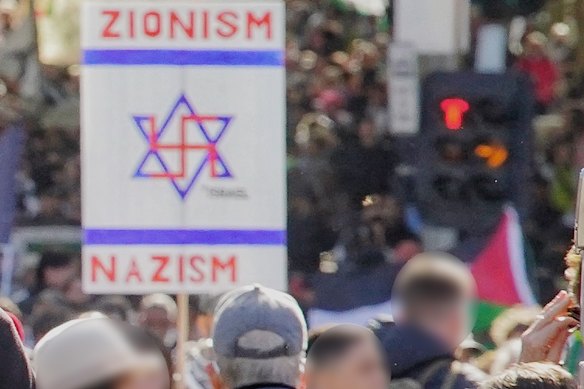
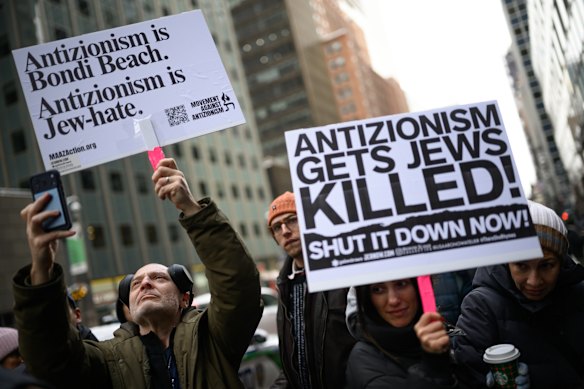


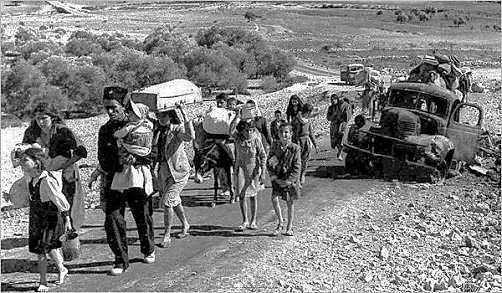


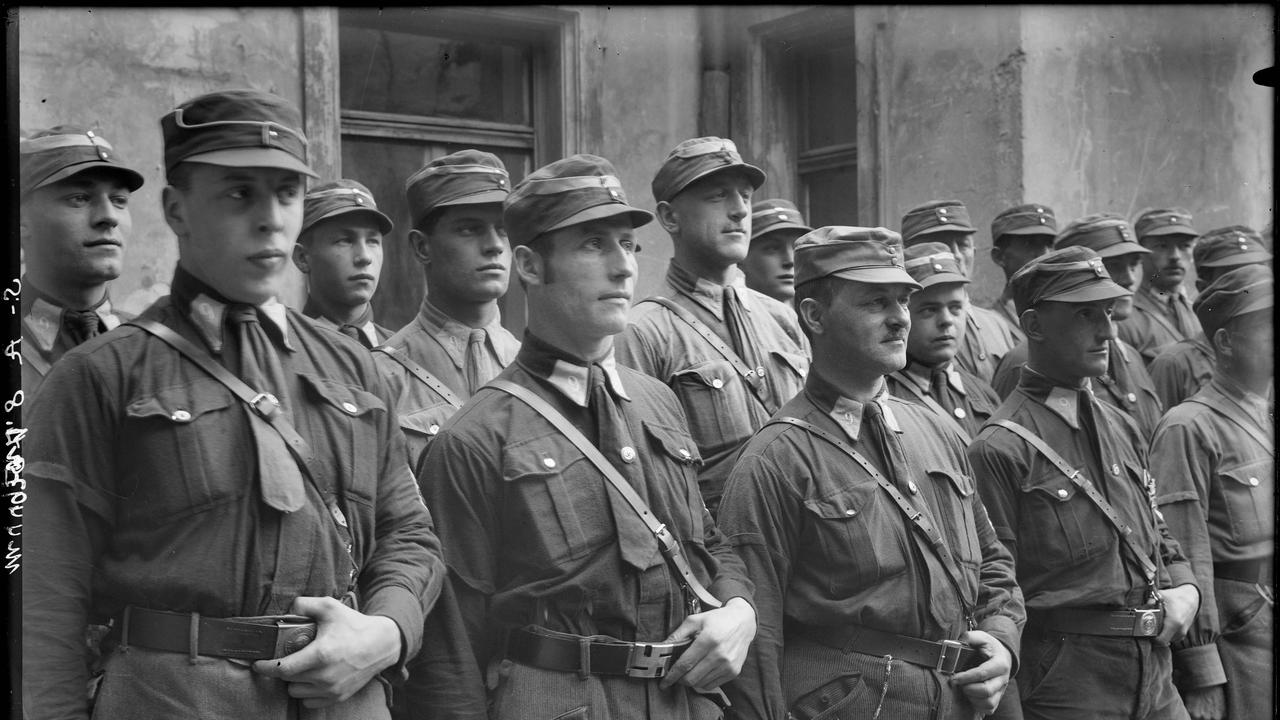
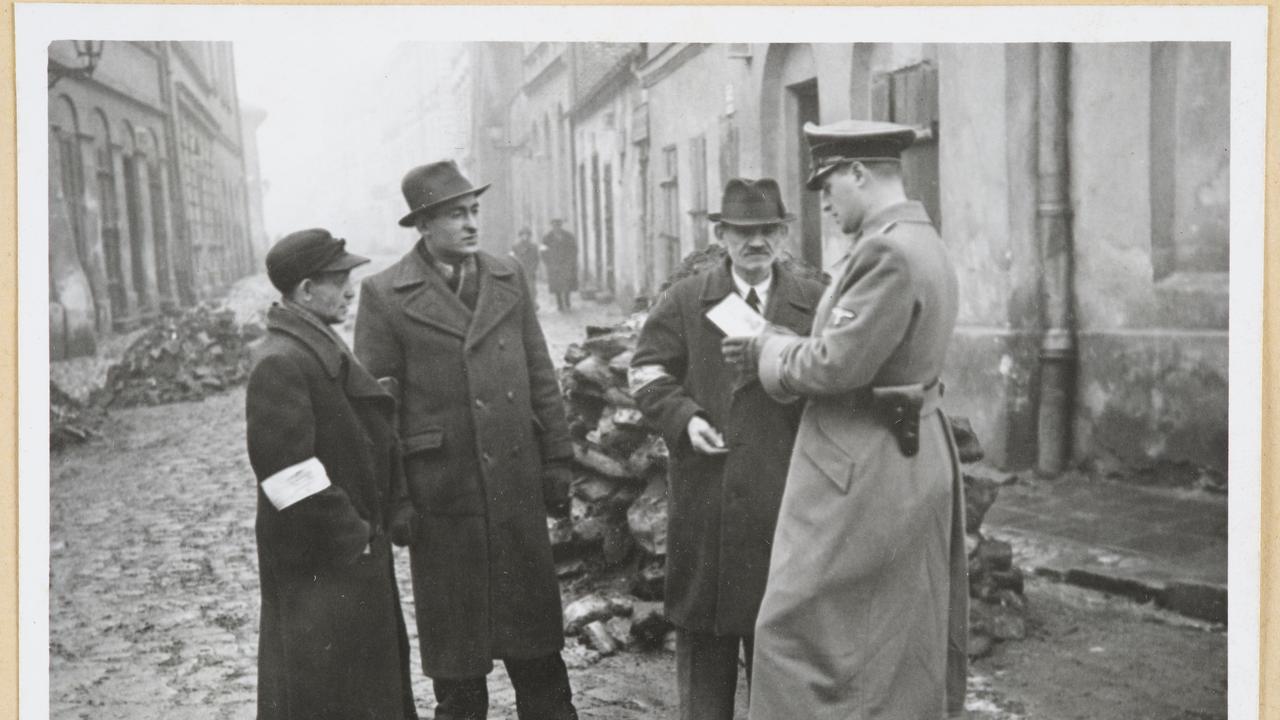
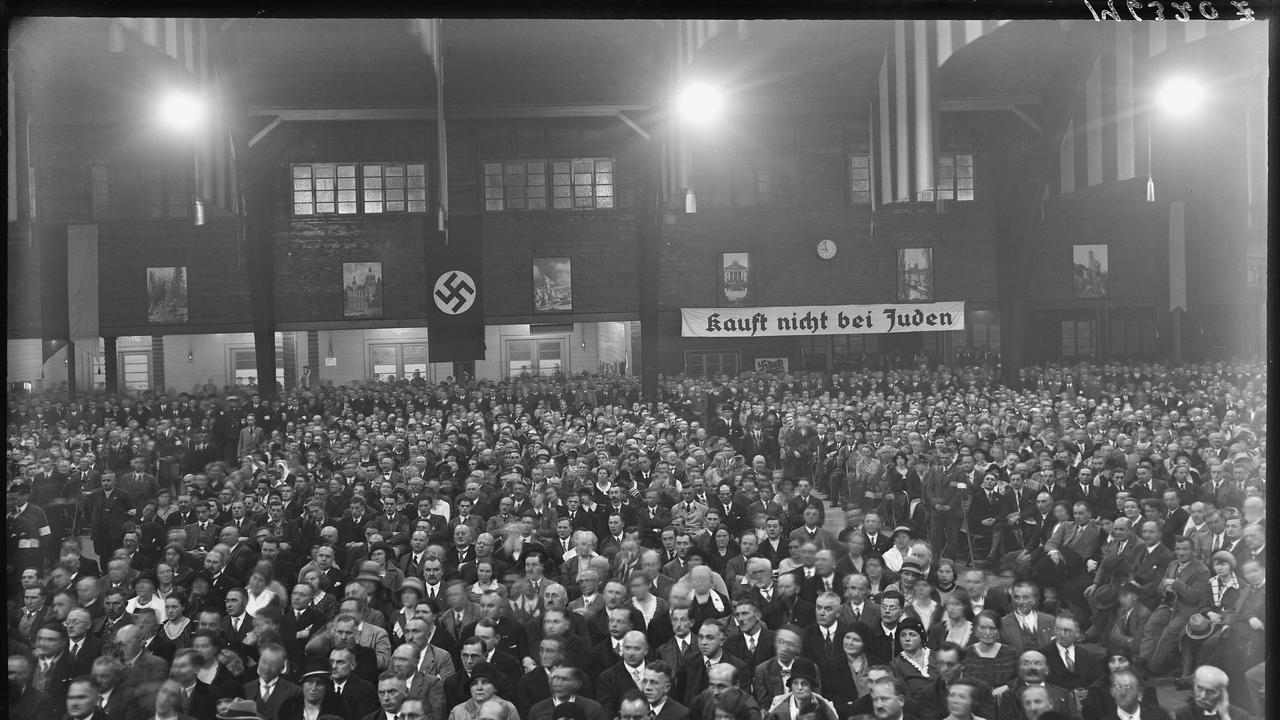


 In That Howling Infinite