Children of Abraham

The ancient and holy city of Hebron – al Khalil to Muslims, and named, like Hebron for the Jewish and Islamic patriarch Abraham/Ibrahim – is rarely out of the news; and the news is never good. “There’s this thing that happens here, over the Hell Mouth”, says Buffy the Vampire Slayer, “where the way a thing feels – it kind of starts being that way for real. I’ve seen all these things before – just not all at once”.

In May 2016, we visited Hebron, a fault line of faiths and a front line of an old war still being waged for possession of the Holy Land. It is a hot spot, a flash-point, where tensions between Israelis and Palestinians are usually followed by calamity, and bad things happen. We’ve travelled right through the West Bank, and yet nowhere did we feel exposed to the danger of a sudden flare up of violence and being caught in an indiscriminate crossfire than here in the old heart of the city. It is the seemingly intractable conflict in the raw, a microcosm of the Occupation, and there is no denying the brutality of the place. Most western journalists and commentators give their readers an impression that Israel absolutely dominates this Palestinian city of some 200,000 souls. In reality, the area under military control, immediately surrounding the ancient Ibrahimi mosque, holy to two faiths, is very small. The city, with its high rise apartments, official buildings and shopping malls,  looks down on this pressure cooker of a ghetto, where dwell some 700 settlers and thirty thousand Palestinians, segregated from each other by walls and wire, fear and loathing – and by two soldiers to every settler.

On our return, the e-magazine Muftah published the following article.

Children of Abraham and the Battle for Hebron

You who build these altars now to sacrifice these children, you must not do it anymore.
A scheme is not a vision and you never have been tempted by a demon or a god.
You who stand above them now, your hatchets blunt and bloody – you were not there before,
When I lay upon a mountain and my father’s hand was trembling with the beauty of the word.
Leonard Cohen, The Story of Isaac

I recently returned from Hebron in the occupied West Bank. The city is a fault line of faiths and a front line in the conflict between Israelis and Palestinians. It is a “hot spot,” a flash-point, a place where tensions between Israelis and Palestinians are usually followed by calamity. Hebron has been a key focus of the tension and violence that has characterized the troubled relationship between Palestinians and Israelis. Since October 2015, over 200 Palestinians and thirty Israelis have been killed across the West Bank, East Jerusalem, and Israel, in the latest flare-up in the decades-long conflict.

In March this year, an Israeli soldier was filmed shooting and killing a wounded twenty-one-year-old Palestinian, following a stabbing attack on Israeli soldiers. The soldier, just nineteen years of age, is now facing trial, amidst massive outcry on both sides of the Israeli-Palestinian divide.. In June, not long after we left Israel, a young Palestinian murdered a thirteen-year-old Israeli girl as she slept in nearby Kiryat Arba. Hours later, a Palestinian woman was shot dead by Israeli soldiers outside of the Ibrahimi Mosque. Later that afternoon, Palestinian gunmen ambushed an Israeli car on a road just south of Hebron, killing a father and wounding his family. Local Palestinians gave emergency first aid to the victims and shielded the children from any further attack.

A Holy Land

Hebron has long been sacred to Muslims and Jews as the last resting place of the prophets Abraham and Isaac – the founding father of Judaism, and the son he had resolved to sacrifice until God ordered him to stay his hand. In the first century BC, Herod the Great, famed builder and bad boy, raised a mighty mausoleum above the cave where Abraham was laid to rest. Abraham’s wife Rachel, and his son, Isaac, Isaac’s wife Rebecca, and Isaac’s sons Joseph and Jacob – whose wrestled with an Angel to represent man’s struggle with God –  and Jacob’s wife Leah are also buried there.

As time went by, Christians and then Muslims revered Hebron as a holy place. Abraham was the founding father of both religions and his sons and grandsons, buried in the cave, are considered prophets of Judaism, Christianity and Islam. In time, a mosque was established on Herod’s edifice, and for a short while, during the hundred years of the Crusader kingdom, a basilica too. The well-known story of Isaac and Abraham, told so cryptically by Leonard Cohen is in a way a metaphor for Hebron itself. It is common to Christians, Jews and Muslims (Id al Adha is islam’s Feast of the Sacrifice) but the protagonists in the Qur’an are not Abraham or Isaac or Ishaak, but Ibrahim and Ishmael the son of Hagar, Abraham/Ibrahim’s servant) the genealogical forbears of Muslims. Two faiths, two narratives. [Cohen’s lyrics are reproduced at the end of this article together with my translation into Arabic]

In the thirteenth century, the Mamluk Sultan Baybars expelled the Christians from Hebron. A small community of Jews continued to reside in the town of Hebron, however. In 1929, amidst rising religious and nationalist tension in the British Mandate of Palestine, some seventy Jewish men, women, and children were killed by Palestinians who had been incited to violence by rumours that Jews planned to overrun the Temple Mount in Jerusalem, the third holiest site in Islam. Many local Palestinians also helped save Jewish neighbors from the bloodshed. Following the riots, Hebron’s Jewish community largely ceased to exist, until the an-Naksa, or ‘setback’, of 1967, when Israeli military forces occupied the West Bank, East Jerusalem, Gaza, and the Golan Heights.

In the early days of the occupation, Israeli authorities did not encourage Jews to return to Hebron. One of the first illegal Israeli settlements was established outside Hebron in what is now Kiryat Arba, and thereafter, a small settlement was built around the Mosque of Ibrahim. Beginning in 1979, some Jewish settlers moved from Kiryat Arba to the former Jewish neighborhood near the Abraham Avinu Synagogue which had been destroyed in 1929. Other Jewish enclaves were established with the Israeli army’s support and more homes were subsequently purchased or forcibly taken over from their Palestinian owners.

With the establishment of a Jewish presence in and around Hebron, the religious right-wing demanded that Jews be permitted to pray at the tombs of the patriarchs, and the 700 years old restriction on Jews praying here was lifted. Muslims and Jews were now obliged to share the holy place, although it was formally administered by the Muslim Waqf. Thus, even prayer became a focus of conflict and tension, and sometimes, violence, particularly during each faith’s holy days.

Tensions and Divisions

Since 1979, tensions have continued to increase between the small community of Israeli settlers living in Hebron (several hundred) and the tens of thousands of Palestinians whose lives have been turned upside down by their presence. These tensions reach boiling point in February 1994, when US-born Israeli doctor Baruch Goldstein opened fire on Muslims worshippers during the dawn prayer at the Ibrahimi Mosque. He killed twenty-nine people and wounded another 125 before he was overcome and killed by survivors. Hundreds more Palestinians were killed or injured in the Israeli military’s response to the ensuing violence.

Goldstein had been inspired by a boyhood mentor, the ultranationalist New York Rabbi Meir Kahane, and had belonged Kahane’s militant Jewish Defence League, founded ostensibly to protect Jews from antisemitism, but implicated in numerous acts of violence in the USA  and elsewhere. On emigrating to Israel, he joined Kahane’s right-wing Kach Party.

The Israeli government condemned the massacre and responded by arresting Kahane’s followers, and criminalizing Kach and affiliated organizations as terrorists, forbidding certain settlers from entering Palestinian towns, and demanding that those settlers turn in their army-issued weapons. It rejected a demand by the Palestinian Liberation Organisation that all settlers in the occupied territories be disarmed and that an international force be created to protect Palestinians.

UN observers came to keep the peace, but, after Israeli and Palestinian authorities could not reach agreement on resolving the situation, they departed. The Hebron Protocol was signed in January 1997 by Prime Minister Benjamin Netanyahu and PLO Chairman Yasser Arafat under the supervision of US Secretary of State Warren Christopher. Under its terms, Hebron was divided into in two. H1, 80% of the city, and home to over 120,000 Palestinians, was placed under the Palestinian Authority’s control. H2, which was home to nearly 40,000, was placed under the exclusive control of the Israeli Defense Forces (IDF) in order to protect some 600 Israeli Jewish settlers who lived in the area. 

Jewish Israelis were barred from entering HI, whilst Palestinians found it nearly impossible to Access H2 unless they lived there. Palestinian residents of H2 experienced forcible displacement, restrictions on their movement, the closure of their businesses, IDF checkpoints and searches, and verbal and physical harassment by settlers protected by the IDF. 

In a surreal, sad parody, the mosque too was divided, with a separate mosque and synagogue. The IDF controls access, closing it to Muslims on Jewish holy days and to Jews on Muslim holy days. There are frequent bans on the call to prayer on the grounds that it disturbs the settlers, and likewise on exuberant 

Dual Narrative

We travelled to Hebron on a “dual narrative tour”. It was run by Abraham Tours, which operates out of the Abraham Hostel at Davidka Square in Jerusalem, and caters for independent and mainly young travelers on limited budgets. One half of the tour was conducted by a Palestinian guide and the other by a Jewish guide. They walked us though the streets surrounding the Mosque of Ibrahim, and gave us the opportunity to meet and talk with several members of each of the communities.

We visited the Muslim side of the mosque, which retained the wide prayer hall, the empty catafalques of Isaac and Rebecca, the qibla and minbar, and the beautiful dome; and the larger Jewish side, which was, once upon a time, the open courtyard leading to the mosque. Abraham and Sarah occupy the neutral ground between the two halves.

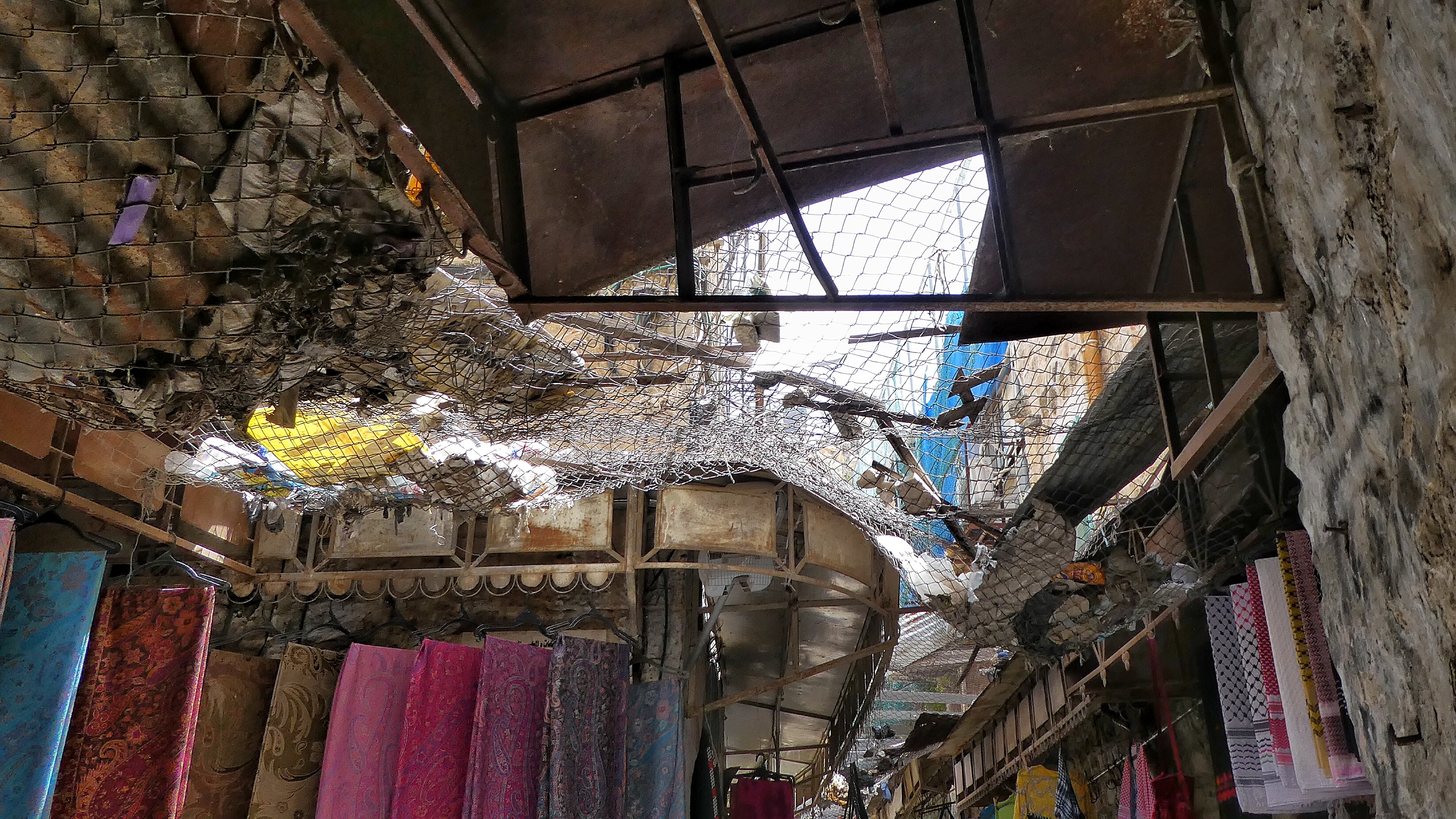
The area around the divided holy place is a ghost town. On one flank, a deserted street is patrolled by young Israeli soldiers in full battle gear, leading to the settler neighborhood. On the other side, past checkpoints and security screening, is Shuhada (martyrs) Street, an impoverished souq with more shops locked up than open, a small number of Palestinian storeowners, and a bevy of children endeavoring to sell us souvenirs. Above the few shops that are still open, there is a wire mesh to catch rocks, garbage, and various unmentionables thrown at Palestinians from Israeli settler families who have literally occupied the higher ground, abutting and overlooking the souq.

Scapegoating the Other

The Palestinians we met told us that Jewish settlers have been trying to drive them out of H2, to claim it for themselves, and that they will resort to all manner of harassment to do so, including throwing stones, and assaulting Palestinian children on their way home from school. Indeed, the United Nations Office for the Coordination of Humanitarian Affairs recently confirmed that movement restrictions, along with on-gong settler violence, reduced income, and restricted access to services and resources, has led to a reduction in the area’s Palestinian population. 

It is a desperate, hard life for all the Palestinians who live there. They cling on, refusing to leave or sell their ancestral homes. Offers, some very large, have been made in the past, but people will not trade their birthright, even when they are faced with physical threats to their lives. One Palestinian whose home we visited told me that his late wife was shot by Israeli soldiers, while his children were attacked by settlers. Nowadays, he and his few neighbors have no choice but to remain or flee without compensation as the Palestinian Authority has forbidden selling property to the settlers. And so they remain, in poverty and punishment.

The rebuilt and refurbished settler zone is a mix of run-down apartments. waste grounds, new community buildings and playgrounds, and a street of shops that once served the settlers’ needs but are now locked and neglected in a dusty, empty street. Here, the settlers too play the victim card, claiming that they area harassed, insulted, and killed. We met the administrator of the small Jewish museum and library who told us of how her grandfather was killed in 1929, and how her father was killed by an assailant in his own home. 

Today there are two Israeli soldiers for every Jewish settler. They are youngsters, barely out of high school. Heavily armed and nervous. With the power to end or destroy the lives of the Palestinians they occupy, many of them youths just like themselves. 

“You who build these altars then to sacrifice these children, you must not do it any more”.

If only it was that simple on the fault line of faith and nation.

Below is a selection of photographs taken during our visit.

Read more in In That Howling Infinite on the Middle East : A Middle East Miscellany

You can read more about the pain and passion of Hebron here:
http://www.sacred-destinations.com/israel/hebron-tombs-of-the-patriarchs
https://en.m.wikipedia.org/wiki/Israeli%E2%80%93Palestinian_conflict_in_Hebron

Author’s Note: 
Whenever I pen commentaries such as this, people ask why I rarely forward my own opinion on the issues I am presenting or discussing. On the contrary, I would argue that my views are fairly transparent in the subjects I chose to engage with, the words I use, and the vein in which I use them.

With respect to my numerous posts about Israel and Palestine, and the Middle East in general, I  come to my conclusions from a political science and sociology perspective – that’s where my academic experience came from – and a background in conflict resolution, supported by study and travel. If I do on occasions display any particular bias, it. originates in my longtime interest, understanding and affection for the history, politics, culture and language of the region, of its geography and archaeology, and  of its people of all faiths and nationalities that I make my observations.

I am presently working on a piece that encapsulates my thoughts on this complex and controversial subject. But meanwhile, here is a brief exposition.

I do believe that the systematic dispossession of almost a million Palestinians and the destruction of half of their towns and villages in 1948 is Israel’s original sin. It is the primal stain that colours and corrupts all that followed. And yet, if not for the actions, often daring, often brave, often questionable, and often deplorable, of the politicians and soldiers of 1948 – and of the generations that folllowed –  Israel would not exist today. This paradox is addressed sympathetically by Avi Shalit in My Promised Land, referred to above, and scathingly by ‘new history’ scholar Ilan Pappe in The Ethnic Cleansing of Palestine.   

The Occupation, fifty years old this year, which grew out of the unexpectedly total victory of June 1967, has taken on strategic, ideological and indeed messianic dimensions by many in the  Israeli government and political elite. It compounded the original sin, deepened the primal stain, released the demons of messianic fervour, and wounded Israel’s soul. The settlements locked the nation into the the colonialist project. With the close-call of the Yom Kippur War, the violence and murder of the first and second Intifadat, and present Palestinian jaquerie, Israel’s heart has not just hardened, it has become sclerotic.

I admit that I have always been sympathetic towards Israel – from my first visit in 1972. But it is not a blinkered viewpoint. I am deeply critical of Israeli politics and policies, and have no respect for many of its leaders.

Ayelet Shaked, the nationalist’s La Passionaria, and her boss Naftali Bennett do not not represent ALL Israelis! They hold extremist views just like we in UK, US, and Australia have parties and individuals with extremist views. But there are hundreds of thousands of Israelis who oppose the present government and long for justice and peace. And if – a very big “if” – Arab Israelis and the Israeli left could work together, they could obtain a majority in the Knesset and change Israel’s politics.

Yet meanwhile, Binyamin Netanyahu and his nationalist allies call all the shots, the Israelis continue to control and exploit the land, its people, and its resources, whilst varying degrees of annexation are on the cards. The settlements are an abomination, as are the policies and practices of the state and its occupying army, as described by Lyons and others. There’s no escaping these facts.

But I am likewise critical of Palestinian governance, politics and politicians. Hamas and the PA are on the nose in their respective fiefdoms, and if a moderate “third force” were to arise – and survive, because sure as hell, they would risk being murdered – Palestinians who just want a quiet, normal life, adequate services, and opportunities for their children, and Israelis who want likewise, might – just might – reject their extremist, dogmatic, entrenched leaders and reach some form of modus vivendi.

Palestinians themselves have to take control of their own lives, kick out their corrupt leaders, cease inculcating their children with hatred and jihadism, and use all that international good will and dollars to build a viable economy that can provide jobs, opportunities, and security, economic and physical to the people. Only this way will they be inoculated against cronyism, corruption and extremism. And yet, the dead hand of a moribund, patriarchal, conservative and ethnocentric culture holds them back –  but that is the subject of another, future discussion for In That Howling Infinite.

Today, the ‘powers that be’, defenders and beneficiaries of a status quo that looks more like a cul de sac, predominate over a dispiriting array of competing, clamouring factions, left, right, nationalist, secular, tribal, Haredi, and Islamist alike. New, young, brace, local voices in both Israel and Palestine, are not heard.

So what happens next?

I get that question too. And I am perennially reluctant to venture an answer beyond one that runs like “on the one hand…but then on the other”.  I inevitably fall back on Robert Fisk’s response to the same question with regard to the calamitous freezing over of the Arab Spring and the fall and rise again of the same old autocrats and tyrants: “my crystal ball is broken”. It’s a cop out, really, but just as cogent as that famous line in that UK spy drama Spooks: “What’s gong to happen to me?” “Bad things!”

One thing is for sure: as songwriter Warren Zevon sang, “the hurt gets worse, and the heart get harder”.

October 8th 2017

For more posts on Jerusalem, Israel and the Middle East, visit:
https://m.facebook.com/HowlingInfinite/
https://m.facebook.com/hf1983/

See also, my collection of posts about Jerusalem, and A Middle East Miscelany 

 Below, some pictures from our visit to Hebron in May 2016
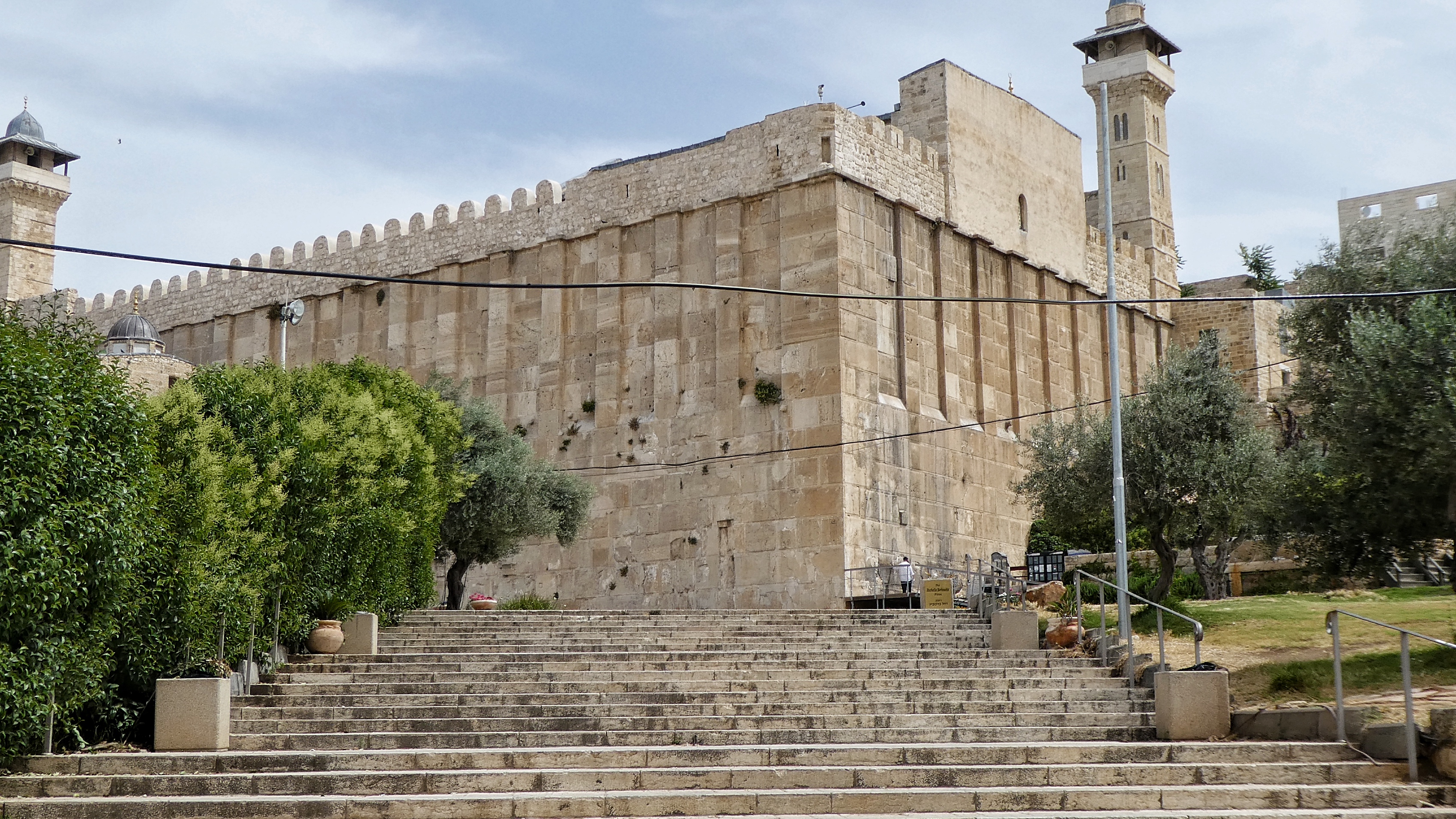
Hebron May 2016

img_5080

Hebron May 2016

Hebron 2016

Hebron 2016

Hebron 2016

Hebron 2016


The Story Of Isaac

Leonard Cohen

The door it opened slowly,
My father he came in,
I was nine years old.
And he stood so tall above me,
His blue eyes they were shining
And his voice was very cold.
He said, “I’ve had a vision
And you know I’m strong and holy,
I must do what I’ve been told.”
So he started up the mountain,
I was running, he was walking,
And his axe was made of gold.
Well, the trees they got much smaller,
The lake a lady’s mirror,
We stopped to drink some wine.
Then he threw the bottle over.
Broke a minute later
And he put his hand on mine.
Thought I saw an eagle
But it might have been a vulture,
I never could decide.
Then my father built an altar,
He looked once behind his shoulder,
He knew I would not hide.
You who build these altars now
To sacrifice these children,
You must not do it anymore.
A scheme is not a vision
And you never have been tempted
By a demon or a god.
You who stand above them now,
Your hatchets blunt and bloody,
You were not there before,
When I lay upon a mountain
And my father’s hand was trembling
With the beauty of the word.
And if you call me brother now,
Forgive me if I inquire,
“just according to whose plan?”
When it all comes down to dust
I will kill you if I must,
I will help you if I can.
When it all comes down to dust
I will help you if I must,
I will kill you if I can.
And mercy on our uniform,
Man of peace or man of war,
The peacock spreads his fan.

قصة إسحاق
ليونارد كوهن

الباب فتح ببطء ،
أبي دخل ،
أنا في التاسعة من عمري.
ووقف عاليا فوقي ،
كانت عيونه الزرقاء مشرقة
وكان صوته شديد البرودة.
قال: “كان لدي رؤية
وأنت تعرف أنني قوي ومقدس ،
يجب أن أفعل ما قيل لي “.
فبدأ الجبل ،
كنت أركض ، كان يسير ،
وكان فأسه مصنوعا من الذهب.

حسنا ، الأشجار لديهم أصغر بكثير ،
البحيرة مرآة سيدة ،
توقفنا لشرب بعض النبيذ.
ثم ألقى الزجاجة.
انكسر بعد دقيقة
ووضع يده علي.
اعتقدت رأيت نسر
ولكن ربما كانت نسر ،
لم أستطع أن أقرر أبدا.
ثم بنى والدي مذبحًا ،
نظر مرة واحدة خلف كتفه ،
كان يعلم أنني لن أختبئ.

أنت الذي تبني هذه المذابح الآن
للتضحية بهؤلاء الأطفال ،
لا يجب أن تفعل ذلك بعد الآن.
المخطط ليس رؤية
ولم تجرِ ابدا
بواسطة شيطان أو إله.
أنت الذي تقف فوقهم الآن ،
فتاكاتك حادة ودموية ،
لم تكن هناك من قبل ،
عندما استلقيت على جبل
وكانت يد والدي ترتجف
بجمال الكلمة.

وإذا اتصلت بي أخي الآن ،
سامحني إذا سألت ،
“فقط وفقًا لخطة من؟”
عندما يأتي كل شيء إلى الغبار
سأقتلك إذا لزم الأمر ،
سأساعدك إذا استطعت.
عندما يأتي كل شيء إلى الغبار
سأساعدك إذا لزم الأمر ،
سأقتلك إذا استطعت.
ارحم زينا
رجل سلام أو رجل حرب ،
الطاووس ينشر مروحة.


That was the year that was – the road to nowhere

Well we know where we’re going
But we don’t know where we’ve been
And we know what we’re knowing
But we can’t say what we’ve seen
And we’re not little children
And we know what we want
And the future is certain
Give us time to work it out
The Talking Heads

To borrow from Boz, these were the worst of times, these were the strangest of times. So disillusioned were we with our politics and our politicians, so dispirited by the sad state of the plant, so fissured and fractured as a society, with our intractable culture wars, we retreated into own private Idahos, pulled up the drawbridge and settled in with our iPads and iPhones and our Foxtel with the vino collapso and watched all the fun of the fair.

The mellifluous but perennially entertaining Donald Trump had a bad year, and a resolute Theresa May likewise. Confounding critics, she endeavours to persevere as she steers her foundering shipm of State towards Brexit and China’s Uighur Muslims. Barbaric Da’ish had a bad year (which was rather a good thing) , as did the unfortunate Rohinga of Myanmar, and the long-suffering people of Gaza.. Resilient Bashar Assad had a good year, with a little help from his Russian, Iranian and Hezbollah friends, but the wars of the Ottoman succession grind on. Vladimir Putin and the fat conductor Kim Jong Un had an excellent year, courtesy of POTUS. Angela Merkel lost her sparkle but royal Markle sparkled, and the luminous Taylor Swift, all legs and lipstick, emerged from her apolitical closet to swing the vote against the Donald in the US midterms. Her trim gluteus maximus starredin a court case that typified a year that saw women stand up strongly against years of aberrant male behaviour.

The Australian parliament devolved into a circus of tantrums and turncoats as the Liberal and National coalition devoured its own in a year book-ended by smutty sexual scandals, whilst canny Labor kept its powder dry for what bodes to be an whopping electoral victory in 2019. We wished that our rulers and representatives would stop behaving like children and start running the country and governing it for all of us.and then the children walked out of school en mass and told us that when they grew up they’d do a better job. The circus clowns huffed and puffed and denigrated the young ones – which only served to embarrass them more for their paucity of vision and partisan division.

And so, to the year in review:

During what was to many observers a dispiriting year of division and destruction, In That Howling Infinite maintained its  watch  with an eclectic mix of commentary, commemoration, culture and comedy. It was a big year – some forty posts in all. So many indeed that decided to reposted my favourite top five – those that I most enjoyed writing – on In That Howling Infinite’s Facebook page. See these at the conclusion of this review.

In a December post, Free Speech, One Each, we expressed disappointment with the ignorance, naivety, and self-absorption of electorates, left and right: their lack of historical knowledge and of curiosity, an unhealthy and self-defeating habit of accepting facts, narratives and theories based upon their preconceptions and prejudices. Nowadays, it often seems as if the reasonable middle has been excised from political discourse, drained out by the shrill voices of the extremes with their identity politics, virtue signalling, and vested interests. Social media has exacerbated the situation as folk lock themselves into their own echo chambers, listening only to those with whom they agree, ignoring or even avoiding contrary opinions and perspectives. It is a self-defeating, delusional, zero-sum form of groupthink that erodes trust and goodwill and prevents the development of consensus and cooperation. Meanwhile, opportunistic politicians and commentators build their constituencies by appealing to the particularistic, even atavistic wants and fears of their followers. Too often this reduces things down to atavistic lowest common denominators. They literally seize the low moral ground. Peoples problems and fears are real enough, and do need to be solved or allayed, but too often they are gulled, manipulated and recruited by modern-day snake-oil salesmen and show-tent shysters.

It was with this in mind that we caste a weary and cynical eye over Australian politics and society, particularly the ongoing history and culture wars, beginning in January with the self-explanatory We’ve Got The Australia Day Blues , and continuing with Conservatism in CrisisMilo Downunder, an alt-right love story, and the ongoing angst about the Ramsay Centre and its proposed university course on western civilization. Never in recent memory have so many words been printed about so little – at least not until the right’s last holy war. And so, there is The long, dark teatime of The Australian’s soul and its sequel The Oz’s lonely crusade. By year’s end, both sides appear to have run out of puff and the course will most likely end up in small regional campuses rather than the prestigious halls of Sydney and Melbourne.

Southern Discomfort.

The year’s leitmotif was the ongoing fiftieth anniversary of 1968, a tumultuous year for the world, and a formative one for myself personally. Stories of the events of that year are interspersed my own recollections – what I was doing at at the time, and what was going through my youthful head.  In Encounters with Enoch, I revisit English politician Enoch Powell’s controversial ‘Rivers of Blood’ speech. Then it’s Springtime in Paris as I recall les Évènements de Mai. And thence to Prague and the Soviet invasion of Czechoslovakia with Tanks for the memory – how Brezhnev changed my life. Finally, there was the year in review with Things fall apart, the centre cannot hold – 1968 revisited.

2018 was also the centenary of the armistice that ended The Great War. November 1918 – the counterfeit peace discussed how for many countries and peoples in Europe and beyond, the conflict and the bloodshed continued. We also shared a poignant, fitting tribute by Gerry Condon  to all the “doomed youth” of all wars with Dulce et ducorem est – the death of war poet Wilfred Owen

There were other anniversaries. The Wild Wood and the Wide World revisited Kenneth Grahame’s riverbank pastorale The Wind in the Willows 110 years after it’s publication. Ghosts of the Gulag, which followed on from an earlier discussion of film The Death of Stalin released earlier in the year, looked at the contribution of Alexander Solzhenitsyn on the fiftieth anniversary of The Gulag Archipelago. The Russian theme continued with Whoar! And Peace – a light look at the BBC’s recent racey adaptation of Tolstoy’s celebrated house-brick.

The fiftieth anniversary of the death of John Steinbeck inspired The last rains came gently – Steinbeck’s dustbowl Blues. This featured the complete first chapter of The Grapes of Wrath, describing the unfolding of an environmental disaster. Two other posts also covered ecological bad news stories: The return of the forest wars in Australia, and Losing Earth – the decade we almost stopped climate change.

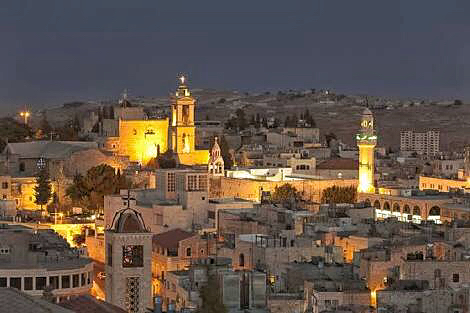
As always, the politics and people of the Middle East feature prominently in In That Howling Infinite. January kicked off with Ahed Tamimi – A Family Affair, a discussion about the young Palestinian activist and the first family of the resistance. Out of season, we visited the birthplace of the Christ child with O Little Town of Bethlehem, how still we see thee lie and tell the story of a border town that has existed since the beginning of recorded history. We considered whether an Israeli-Palestinian confederation was possible, and republished Israel author David Grossman’s A Fortess But Not Yet a Homeand a review of author Amos Oz’ Dear Zealots – letters from a divided land. Sadly, Oz passed on 28th December, his death and that of the indomitable Uri Avnery (see last September’s Seeing through the eyes of “the other’) in August saw the passing of two of the most forthright intellectual proponents of the receding ‘two state solution’. We also reviewed  the intimations, imperfections and implications of Donald Trump’s “ultimate deal”, an ostensible end to the intractable Arab-Israeli conflict but which is effectively Throwing Abbas under the bus. The wider Arab and Islamic world features in Islam’s house of many mansions, and, in the wake of the murder of journalist Jamal Khashoggi and the Yemen war, we consider the possibility of Sanctioning Saudi -1973 revisited.

Our history posts were as eclectic as ever. We continued our series of Small Stories with a profile of The Monarch of the Sea, Prince Roy of Sealand, the smallest country in the world, and The Odyssey of Assid Corban from a tiny village in Lebanon to a wine dynasty in Auckland, New Zealand. A video of University College Dublin’s celebrated Choral Scholars inspired a look at an old Jacobite song  Mo Ghile Mear, whilst the anniversary of the Irish rebellion of 1798 recalled another song and a host of personal memories: The Boys of Wexford – memory and memoir. We reviewed two historical novels. In Cuddling up to Caligula, we discovered a soft side to the controversial Roman Emperor; whilst melancholy Martin Sparrow’s Blues shone fresh light on the travails of Australia’s early white settlers. And a review of Ulrich Raulff’s Farewell to the Horse, a history of man’s long relationship with our four-legged friend, galloped away from me as we sang the song of the horse with The Twilight of the Equine Gods  – part history, part memoir, part prose-poem.

And that was the year that was.

And the top five?

Number five was that slap that resounded around the world – the story of young Ahed Tamimi and her family. Four, the tale of melancholy Martin SparrowThree, the Jacobite love song Mo Ghile Mear – Irish myth and melody. Two, the reverie of 1968. And, number one, my very, very favourite and indeed, a labour of love, The Twilight of the Equine Gods

Happy New Year. See you on the other side.

Our reviews of previous years: 20172016 2015

When Freedom Comes

Flashing for the warriors whose strength is not to fight
Flashing for the refugees on the unarmed road of flight
An’ for each an’ ev’ry underdog soldier in the night
An’ we gazed upon the chimes of freedom flashing
Bob Dylan, Chimes of Freedom

Hear the cry in the tropic night, should be the cry of love but it’s a cry of fright
Some people never see the light till it shines through bullet holes
Bruce Cockburn, Tropic Moon

When Freedom Comes is a tribute to Robert Fisk, indomitable, veteran British journalist and longtime resident of Beirut, who could say without exaggeration “I walk among the conquered, I walk among the dead” in “the battlegrounds and graveyards” of “long forgotten armies and long forgotten wars”. It’s all there, in his grim tombstone of a book, The Great War for Civilization (a book I would highly recommend to anyone wanting to know more about the history of the Middle East in the twentieth century – but it takes stamina –  at near in 1,300 pages – and a strong stomach – its stories are harrowing).

The theme, alas, is timeless, and the lyrics, applicable to any of what Rudyard called the “savage wars of peace” being waged all across our planet, yesterday, today and tomorrow – and indeed any life-or-death battle in the name of the illusive phantom of liberty and against those intent on either denying it to us or depriving us of it. “When freedom runs through dogs and guns, and broken glass” could describe Paris and Chicago in 1968 or Kristallnacht in 1938. If it is about any struggle in particular, it is about the Palestinians and their endless, a fruitless yearning for their lost land. Ironically, should this ever be realized, freedom is probably the last thing they will enjoy. They like others before them will be helpless in the face of vested interest, corruption, and brute force, at the mercy of the ‘powers that be’ and the dead hand of history.

The mercenaries and the robber bands, the warlords and the big men, az zu’ama’, are the ones who successfully “storm the palace, seize the crown”. To the victors go the spoils – the people are but pawns in their game.

There goes the freedom fighter,
There blows the dragon’s breath.
There stands the sole survivor;
The time-worn shibboleth.
The zealots’ creed, the bold shahid,
Give me my daily bread
I walk among the conquered
I walk among the dead

Here comes the rocket launcher,
There runs the bullets path,
The revolution’s father,
The hero psychopath.
The wanting seed, the aching need
Fulfill the devil’s pact,
The incremental balancing
Between the thought and act.

The long-forgotten army
In the long-forgotten war.
Marching to a homeland.
We’ve never seen before.
We feel the wind that blows so cold amidst
The leaves of grass.
When freedom comes to beating drums
She crawls on broken glass

There rides the mercenary,
Here roams the robber band.
In flies the emissary
With claims upon our land.
The lesser breed with savage speed
Is slaughtered where he stands.
His elemental fantasy
Felled by a foreign hand.

The long-forgotten army
In the long-forgotten war.
Marching to a homeland.
We’ve never seen before.
We feel the wind that blows so cold amidst
The leaves of grass.
When freedom comes to beating drums
She crawls on broken glass.

Thy kingdom come, thy will be done
On heaven and on earth,
And each shall make his sacrifice,
And each shall know his worth.
In stockade and on barricade
The song will now be heard
The incandescent energy
Gives substance to the word.

Missionaries, soldiers,
Ambassadors ride through
The battlegrounds and graveyards
And the fields our fathers knew.
Through testament and sacrament,
The prophecy shall pass.
When freedom runs through clubs and guns,
And broken glass.

The long-forgotten army
In the long-forgotten war.
Marching to a homeland.
We’ve never seen before.
We feel the wind that blows so cold amidst
The leaves of grass.
When freedom comes to beating drums
She crawls on broken glass
When freedom comes to beating drums
She crawls on broken glass

© Paul Hemphill 2012

From: Into That Howling Infinite – Poems of Paul Hemphill Volume 5. See also: East – An Arab Anthology , and: A Brief History of the Rise and Fall of the West

Throwing Abbas Under the Bus

You’re sposed to sit on you ass and nod at stupid things
Man that’s hard to do
But if you don’t they’ll screw you
And if you do they’ll screw you too
And I’m standing in the middle of the diamond all alone
I always play to win when it comes to skin and bone
Warren Zevon, Bill Lee

The details of US President Donald Trump’s “ultimate deal” for resolving the intractable Israel-Palestine conflict have been leaked, surmised or imagined – no one can be sure at this stage – for a while now. And it is one that the Palestinians would never agree to.

We provide below a selection of articles that discus the intimations, imperfections and implications of the plan that will ostensibly succeed where all other efforts have foundered because as Donald Trump has stated many times, “that is what I do”.

The US has lost its credibility as an “honest broker”, if it ever was one, that is. It is impossible to be a mediator in a conflict or develop a credible peace plan when one side refuses to even talk to you. Palestinian leaders have not met with senior U.S. officials for the past six months, not since Trump announced that he would move the U.S. Embassy in Israel to Jerusalem. Move, it did! And now there are hints that the plan actually takes Jerusalem off the negotiating table.

The Palestinians are in a bind. If they reject the deal, especially one accepted by Israel, the Israeli government could once again argue that it has no partner on the Palestinian side, and move towards annexing large parts of the West Bank, which indeed a number of Israeli openly advocate, rendering the ever-receding prospect of the two-state solution impossible. The end result would push the sides even further apart.

The dice are loaded and the deal is rotten in what is a win-lose game. The nationalists and settlers would would be delighted, and the Palestinians on one hand and the Israeli opposition on the other would be simultaneously cut out and boxed in.

Veteran Middle East correspondent and long time Lebanese resident Robert Fisk pulls no punches. “Is there no humiliation left for the Palestinians?” he asks. Soon to be granted the ultimate deal that, in Jared Kushner’s word, “will give them and their future generations new opportunities, more and better paying jobs and prospects for a better life.” Is Trump’s son-in-law – “adviser” on the Middle East, real estate developer and US investor – delusional? After three Arab-Israeli wars, tens of thousands of Palestinian deaths and millions of refugees, does Jared Kushner really believe that the Palestinians will settle for cash?… How can he humiliate an entire Arab people by suggesting that their freedom, sovereignty, independence, dignity, justice and nationhood are merely “politicians’ talking points”. “ The Palestinians, he states, will not be bought for a fistful of dollars Saudi, US or EU.

Yes they can, and maybe, they will …Maybe the prospect of a quiet, normal life with jobs for young (important given the depressingly high youth unemployment) and old and brass in pocket, might persuade ordinary Palestinians to accept the political and economic normalisation of what would be occupation-lite.

Meanwhile, there are reports that”moderate” Arab countries are supporting the US’s diktat. The current US-Gulf-israel nexus was a work-in-progress during the Obama years and whilst Donald Trump was but a candidate, and now he has delegated carriage of the “ultimate deal” to his neophyte, demonstratively pro-Israeli son-in-law, Jared Kushner. The plan is to remove the Palestinian problem off the table so that they can concentrate on their real enemy, Shiite Iran.

As for those ostensible “Moderates”, the term is an oxymoron. Saudi and the Gulf emirs are tyrants, autocrats and complicit lick-spittles who’d sell out the Palestinians (and the Israelis too, if they could) if they could conscript American blood and treasure in their perennial Sunni grudge match with Shi’a Iran. King Abdullah of Jordan is wise not to trust this shady bunch. With domestic troubles of his own, and over half of his subjects of Palestinian descent, he has good reason to be careful. Dependent on foreign aid, however, he would be vulnerable to US and Saudi pressure. Pressure is also being exerted on Egypt’s dictator al Sissi. Whilst needful of US and Saudi cash, he is probably wary of stirring up further trouble at home with the economic situation still dire, the Islamist threat in the Sinai unabated, and Gaza presenting a clear and present powder-keg on the eastern border. He has enough stuff to deal with without buying into an anti-Iranian alliance and a deal that the Palestinian will not accept. Neither Trump, Israel nor the Gulf plutocrats are popular on the Arab street.

There is talk of Saudi Arabia pumping money into a resurgent, potentially Singaporean Palestine (they do gild this hallucinatory lily). But this doesn’t gel with reports that the kingdom is in financial straits and has enough trouble at the moment at home, with Yemen, and with an ascendant Iran. Overweening crown prince Mohammed bin Salman, however, often ventures where angels fear to tread. That he has peremptorily “summoned” King Abdullah and Abbas to Riyadh with no apparent success (much like that farce with the Lebanese prime minister), might suggest that he has less influence over his fellow Arabs than he or his American pals imagine.

Meanwhile, corrupt, coopted and ailing old Abbas and his very unpopular PA, watching the Kushner caravan bumping over the rocky ground of Middle Eastern politics, would perhaps be wise to hang out for a fairer deal – should that deal ever come along.

It’s going to be an interesting journey.

https://www.independent.co.uk/voices/palestine-jared-kushner-ultimate-plan-israel-donald-trump-jerusalem-right-to-return-a8420836.html
https://www.newyorker.com/magazine/2018/06/18/donald-trumps-new-world-order

Kushner’s Peace Plan Is a Disaster Waiting to Happen


https://www.aljazeera.com/indepth/opinion/jared-kushner-latest-middle-east-tour-180624111143134.html

Mohammed bin Salman Has Thrown the Palestinians Under the Bus

Read other posts about Israel and Palestine in In The Howling Infinite in A Middle East Miscellany:

A Middle East Miscellany قصص الشرق الأوسط

Author’s Note: 
Whenever In That Howling Infinite posts commentaries such as this, people ask why I rarely forward my own opinion on the issues I am presenting or discussing. On the contrary, I would argue that my views are fairly transparent in in the subjects I chose to engage with, the words I use, and the vein in which I use them.
With respect to my numerous posts about Israel and Palestine, and the Middle East in general, I  come to my conclusions from a political science and sociology perspective – that’s where my academic experience came from – and a background in conflict resolution, supported by study and travel. If I do on occasions display any particular bias, it. originates in my longtime interest, understanding and affection for the history, politics and culture of the region, of its geography and archeology, and  of its people of all faiths and nationalities that I make my observations.
I am presently working on a piece that encapsulates my thoughts on this complex and controversial subject. But meanwhile, here is a brief exposition.
I do believe that the systematic dispossession of almost a million Palestinians and the destruction of half of their towns and villages in 1948 is Israel’s original sin. It is the primal stain that colours and corrupts all that followed. And yet, if not for the actions, often daring, often brave, often questionable, and often deplorable, of the politicians and soldiers of 1948 – and of the generations that followed –  Israel would not exist today. This paradox is addressed sympathetically by Avi Shalit in My Promised Land, referred to above, and scathingly by ‘new history’ scholar Ilan Pappe in The Ethnic Cleansing of Palestine.   
The Occupation, fifty years old this year, which grew out of the unexpectedly total victory of June 1967, has taken on strategic, ideological and indeed messianic dimensions by many in the  Israeli government and political elite. It compounded the original sin, deepened the primal stain, released the demons of messianic fervour, and wounded Israel’s soul. The settlements locked the nation into the the colonialist project. With the close-call of the Yom Kippur War, the violence and murder of the first and second Intifadat, and present Palestinian jaquerie, Israel’s heart has not just hardened, it has become sclerotic.
I admit that I have always been sympathetic towards Israel – from my first visit in 1972. But it is not a blinkered viewpoint. I am deeply critical of Israeli politics and policies, and have no respect for many of its leaders.
Ayelet Shaked, the nationalist’s La Passionaria, and her boss Naftali Bennett do not not represent ALL Israelis! They hold extremist views just like we in UK, US, and Australia have parties and individuals with extremist views. But there are hundreds of thousands of Israelis who oppose the present government and long for justice and peace. And if – a very big “if” – Arab Israelis and the Israeli left could work together, they could obtain a majority in the Knesset and change Israel’s politics.
Yet meanwhile, Binyamin Netanyahu and his nationalist allies call all the shots, the Israelis continue to control and exploit the land, its people, and its resources, whilst varying degrees of annexation are on the cards. The settlements are an abomination, as are the policies and practices of the state and its occupying army, as described by Lyons and others. There’s no escaping these facts.
But I am likewise critical of Palestinian governance, politics and politicians. Hamas and the PA are on the nose in their respective fiefdoms, and if a moderate “third force” were to arise – and survive, because sure as hell, they would risk being murdered – Palestinians who just want a quiet, normal life, adequate services, and opportunities for their children, and Israelis who want likewise, might – just might – reject their extremist, dogmatic, entrenched leaders and reach some form of modus vivendi.
Palestinians themselves have to take control of their own lives, kick out their corrupt leaders, cease inculcating their children with hatred and jihadism, and use all that international good will and dollars to build a viable economy that can provide jobs, opportunities, and security, economic and physical to the people. Only this way will they be inoculated against cronyism, corruption and extremism. And yet, the dead hand of a moribund, patriarchal, conservative and ethnocentric culture holds them back –  but that is the subject of another, future discussion for In That Howling Infinite.
Today, the ‘powers that be’, defenders and beneficiaries of a status quo that looks more like a cul de sac, predominate over a dispiriting array of competing, clamouring factions, left, right, nationalist, secular, tribal, Haredi, and Islamist alike. New, young, brace, local voices in both Israel and Palestine, are not heard.
So what happens next?
I get that question too. And I am perennially reluctant to venture an answer beyond one that runs like “on the one hand…but then on the other”.  I inevitably fall back on Robert Fisk’s response to the same question with regard to the calamitous freezing over of the Arab Spring and the fall and rise again of the same old autocrats and tyrants: “my crystal ball is broken”. It’s a cop out, really, but just as cogent as that famous line in that UK spy drama Spooks: “What’s gong to happen to me?” “Bad things!”
One thing is for sure: as songwriter Warren Zevon sang, “the hurt gets worse, and the heart get harder”.
October 8th 2017


Dear Zealots – letters from a divided land

Featured photograph: Banksey mural on the road into Bethlehem, Paul Hemphill May 2016

Winston Churchill defined the fanatic as one who can’t change his mind and won’t change the subject. Celebrated Israel author Amos Oz argues against religious fundamentalism, political cynicism and wishful thinking, reflecting on the rise of fundamentalism, and how, in an increasingly complex world, we take cover in xenophobia, religious fanatic­ism, and isolationism. He argues against fanaticism and for the acceptance of differences of opinion, celebrating the Jewish tradition of disputation, interpretation and persuasion and discovering an “anarchist gene” that thrives on disagreement as the perfect antidote to dogma.

Some people argue that Israeli commentators like Amos Oz, David Grossman, Gideon Levi, Uri Avnery, Ari Shavit, and Sarah Tuttle-Singer are cliche-bound idealists who love the Israel they wish to see, and not the one of a real, mutable and dangerous world. Fanatics and zealots themselves, indeed.  It is a valid if over-the-top criticism, but does not detract from what they are telling us. They, like their critics love their country with all their hearts. But they and ourselves all have our idealized homeland, a Dreamtime of our memories and imaginations, and it is, in a way, a kind of “magical thinking”. The irony is that the outside, “western” world often appears to share the same, romanticized, idealized and unrealistic concept of what Israel was, is and ought to be, and harshly holds it to that lofty standard regardless of the fact that no nation , however heroic and  glamourous its creation story, is pure and innocent.

Nevertheless, Australian publisher Louse Adler distills perfectly the message of this timely, perceptive book:


Dear Zealots: Letters from a Divided Land, by Amos Oz
Louse Adler, The Australian May 26, 2018

Writing about the Middle East may be considered timely, given the latest battles between the Israeli military and the citizens of Gaza. Yet this impasse has been in urgent need of resolution for 70 years.

Whether you celebrate the establishment of the state of Israel or mourn it as the Nakba, what remains a tragedy is the lack of a just solution that brings peace to the region and recognises the equally rights of competing claims.

Dear Zealots: Letters From a Divided Land, the 40th book from Israeli writer Amos Oz, ­offers the slimmest hope that peace may be possible, and a dire warning about the unholy coalition of anti-democratic forces that may thwart progress. Criticism of Zionism and contemporary Israeli politics is de rigueur in ­Israel, often cited as a testimony to this democratic island isolated in the midst of a fundamentalist Middle East. It is a truism that debate in Israel is robust and that critics of the state are afforded the right to dissent.

Despite treason accusations and the issuing of death threats, writers and journalists such as Oz, David Grossman, Etgar Keret and Gideon Levy continue to identify the moral malaise infecting Israeli society while the occupation of Palestine continues and settlements increase.

But these longstanding and courageous oppo­nents of the government’s attitudes to its neighbours have had little impact, ­despite their oratorical skills, international visib­ility and credibility. Great writers continue to write, speak out, sign petitions and ­demon­strate to no avail. Paradoxically, beyond Israel it is almost impossible to speak about governme­nt policies without inciting the wrath of its loyal defenders.

Into this seemingly intractable quagmire Oz has lobbed his latest literary missile. He argues against religious fundamentalism, political cynicism and wishful thinking. In three powerful essays he reflects on the rise of fundamentalism and why, in an increasingly complex world, we take cover in xenophobia, religious fanatic­ism, isolationism.

Winston Churchill defined the fanatic as one who can’t change his mind and won’t change the subject. Dear Zealots is an argument against fanaticism and for the acceptance of differences of opinion. Only Oz could include Israel’s “hilltop thugs”, Islamophobes, the Ku Klux Klan and Islamic State in one sentence; adding veganism, smoking and breastfeeding to this catalogue of zealotry. Against the rise of the zealot Oz celebrates the Jewish tradition of disputation, interpretation and persuasion. His discovery of an “anarchist gene” that thrives on disagreement is the perfect antidote to dogma.

Oz loves Israel. He tends to romanticise the place, pointing to the country’s eight million prime ministers, eight million prophets and eight million messiahs. However, a cacophony of voices­ and opinions doesn’t ensure­ a genuinely democratic state. A state that does not offer full rights to all citizens, a state in­extricably bound by religious authority, where there is no separation of church and state, imperils democracy.

The conflation of Israeli political practice and Jewish heritage makes it difficult to prise apart the state, the residual impact of its eastern European founders, religious influences and the challenging ethnic demographics of the polity.

Oz rages against Halachic Judaism, a form of religious piety demanding blind faith, investing God with supreme authority and believing the Torah protects Jews from assimilation. In Halachic Judaism, the history of the Jewish people is an unchanging story of sin, suffering and ­repent­ance. According to this logic, the innocent victims of the Holocaust, like those killed in Israeli military service, are martyrs sanctifying God’s name. Where else do we hear this today?

Who is a Jew remains a fundamental question. The answer delivers remarkable consensus. Everyone seems to agree that the most Jewish Jews are the “black hats”. Next are the settlers, then the trad­itional Jews who drive to synagogue but don’t eat prawns, then the Jews who are lost. The worst are the Jewish anti-Zionists, lefties who go on about human rights and peace.

Oz argues Jewish identity does not derive from holding fast to religious orthodoxy but is

amassed over generations, customs absorbed from outside which become part of the family, perhaps a certain type of humour, an inclination to be critical and sceptical, to be ironic, self-pitying and sometimes self-righteous, pragmatism tinged with fantasy, ecstasy diluted with scepticism, euphoria blended with pessimism, melancholy cheerfulness, a healthy suspicion of authority and a stubborn resistance to injustice.

The summation by Oz, often described as the secularists’ rabbi, of the commandments is the exhortation “to cause no pain”. That humanist ethos insists on the right of all to equal rights and a dignified life. That principle is disappearing from the fabric of Israel and the moral lacuna­ is being filled by pieties and pessimism.

Fundamentalism in Israel has brought ­together an unholy alliance between the ultra-Orthodox Haredim (anti-Zionist) and the (pro-Zionist) Messianic Jews of the settlements. Neither recognise the authority of the state of Israel. Fortress Israel is also the binding idea for Israel’s religious fundamentalists and political right; they perpetuate the myth of Is­rael being forever in conflict with the rest of the world.

The Israeli left’s attempts to resolve the conflict imply the terrifying prospect that Israel’s exceptionalism will evaporate, its identity will be lost, with assimilation an inevitability. Oz proposes instead that the focus should be on the future, forgetting the border fetishes of both the left and right along with the flags and holy sites.

In the final essay, Dreams Israel Should Let Go of Soon, Oz argues that Israel hasn’t won a war since 1967 and that, after 100 years of ­struggle, the Palestinian aspiration to self-determinat­ion has not been vanquished. There is justice and injustice on both sides in equal measure, and a two-state solution is the only way to ensure the continuation of a Jewish state and justice for the Palestinians. This will require compromise from both, and compromise is the antithesis­ of zealotry.

Dear Zealots is a passionate polemic against dogmatism and defeatism. Viscerally angered by the idea of irreversibility, Oz rejects as ­irrevocable the settlements and occupation. Religiou­s fanatics demand a theocratic state; the right continues to ignore international ­pressure; the left argues that the status quo is apartheid and the only solution is one state. Oz, a left-wing Zionist, opposes occupation but defends­ the historical right of Jews to statehood. He refuses to give up on democracy, on Israel or on justice for Palestinians.

Jews and Arabs are Semites, sharing more than they have chosen to remember, including a sensibility tinged with pessimism. Perhaps we should keep in mind the story of the Jewish optimist­ and the Jewish pessimist. The Jewish pessimist turns to the Jewish optimist and says: “Oy, things can’t get any worse for our people!” The Jewish optimist turns to the Jewish pessim­ist, smiles, and says: “Sure it can!”

It is the oblig­ation of all of us with a social conscience to wish Oz all power to his pen.

Louise Adler is chief executive of Melbourne University Publishing.

Dear Zealots: Letters from a Divided Land, By Amos Oz (Chatto & Windus, 224pp, $29.99)

See also, in In That Howling Infinite:  A Middle East Miscellany

Author’s Note: 
Whenever I pen commentaries such as this, people ask why I rarely forward my own opinion on the issues I am presenting or discussing. On the contrary, I would argue that my views are fairly transparent in in the subjects I chose to engage with, the words I use, and the vein in which I use them.
With respect to my numerous posts about Israel and Palestine, and the Middle East in general, I  come to my conclusions from a political science and sociology perspective – that’s where my academic experience came from – and a background in conflict resolution, supported by study and travel. If I do on occasions display any particular bias, it. originates in my longtime interest, understanding and affection for the history, politics and culture of the region, of its geography and archeology, and  of its people of all faiths and nationalities that I make my observations.
I am presently working on a piece that encapsulates my thoughts on this complex and controversial subject. But meanwhile, here is a brief exposition.
I do believe that the systematic dispossession of almost a million Palestinians and the destruction of half of their towns and villages in 1948 is Israel’s original sin. It is the primal stain that colours and corrupts all that followed. And yet, if not for the actions, often daring, often brave, often questionable, and often deplorable, of the politicians and soldiers of 1948 – and of the generations that folllowed –  Israel would not exist today. This paradox is addressed sympathetically by Avi Shalit in My Promised Land, referred to above, and scathingly by ‘new history’ scholar Ilan Pappe in TheEthnic Cleansing of Palestine.   
The Occupation, fifty years old this year, which grew out of the unexpectedly total victory of June 1967, has taken on strategic, ideological and indeed messianic dimensions by many in the  Israeli government and political elite. It compounded the original sin, deepened the primal stain, released the demons of messianic fervour, and wounded Israel’s soul. The settlements locked the nation into the the colonialist project. With the close-call of the Yom Kippur War, the violence and murder of the first and second Intifadat, and present Palestinian jaquerie, Israel’s heart has not just hardened, it has become sclerotic.
I admit that I have always been sympathetic towards Israel – from my first visit in 1972. But it is not a blinkered viewpoint. I am deeply critical of Israeli politics and policies, and have no respect for many of its leaders.
Ayelet Shaked, the nationalist’s La Pasionaria, and her boss Naftali Bennett do not not represent ALL Israelis! They hold extremist views just like we in UK, US, and Australia have parties and individuals with extremist views. But there are hundreds of thousands of Israelis who oppose the present government and long for justice and peace. And if – a very big “if” – Arab Israelis and the Israeli left could work together, they could obtain a majority in the Knesset and change Israel’s politics.
Yet meanwhile, Binyamin Netanyahu and his nationalist allies call all the shots, the Israelis continue to control and exploit the land, its people, and its resources, whilst varying degrees of annexation are on the cards. The settlements are an abomination, as are the policies and practices of the state and its occupying army, as described by Lyons and others. There’s no escaping these facts.
But I am likewise critical of Palestinian governance, politics and politicians. Hamas and the PA are on the nose in their respective fiefdoms, and if a moderate “third force” were to arise – and survive, because sure as hell, they would risk being murdered – Palestinians who just want a quiet, normal life, adequate services, and opportunities for their children, and Israelis who want likewise, might – just might – reject their extremist, dogmatic, entrenched leaders and reach some form of modus vivendi.
Palestinians themselves have to take control of their own lives, kick out their corrupt leaders, cease inculcating their children with hatred and jihadism, and use all that international good will and dollars to build a viable economy that can provide jobs, opportunities, and security, economic and physical to the people. Only this way will they be inoculated against cronyism, corruption and extremism. And yet, the dead hand of a moribund, patriarchal, conservative and ethnocentric culture holds them back –  but that is the subject of another, future discussion for In That Howling Infinite.
Today, the ‘powers that be’, defenders and beneficiaries of a status quo that looks more like a cul de sac, predominate over a dispiriting array of competing, clamouring factions, left, right, nationalist, secular, tribal, Haredi, and Islamist alike. New, young, brace, local voices in both Israel and Palestine, are not heard.
So what happens next?
I get that question too. And I am perennially reluctant to venture an answer beyond one that runs like “on the one hand…but then on the other”.  I inevitably fall back on Robert Fisk’s response to the same question with regard to the calamatous freezing over of the Arab Spring and the fall and rise again of the same old autocrats and tyrants: “my crystal ball is broken”. It’s a cop out, really, but just as cogent as that famous line in that UK spy drama Spooks: “What’s gong to happen to me?” “Bad things!”
One thing is for sure: as songwriter Warren Zevon sang, “the hurt gets worse, and the heart get harder”.
October 8th 2017
For more posts on Jerusalem, Israel and the Middle East, visit:
https://m.facebook.com/HowlingInfinite/
https://m.facebook.com/hf1983/

See also, my collection of posts about Jerusalem, and A Middle East Micellany

The man with the plan

All that was old is new again with the potential re-emergence of the US’ Cold War strategy of “offshore balancing”
Commentator and counterinsurgency expert David Kilcullen is always worth reading. Here is his latest piece  for The Australian on this subject.
It is a well-tried and well-documented strategy whereby an offshore power counters a rival by backing opposing coalitions in a region of ­strategic competition, supporting local allies indirectly (with weapons, money, advisers intelligence or diplomatic cover), and using proxy military muscle, regular and irregular, to prevent any one rival dominating the region.

Maritime powers (including Britain in the 18th and 19th centuries, and the US for much of its history until 1945) historically used offshore balancing to counter land-based rivals while lowering their own costs and avoiding ­decisive commitment. To succeed, the offshore power does not need to control a region itself, merely to prevent a rival doing so. As such, this is a low-cost approach — something military planners call an “economy of effort” strategy — that reduces exposure and preserves freedom of action.

This comes in the wake of hugely expensive and largely unsuccessful efforts by the US to dominate a region directly through direct military intervention – and subsequent entanglement that left it ‘neck deep in the big muddy’ to quote political activist and balladeer Pete Seeger. It was a maximalist approach that had ad­verse consequences in terms of lives lost, funds wasted, credibility eroded and loss of freedom of ­action (particularly after 9/11, as the US became bogged down in self-inflicted wars of ­occupation).

But, offshore balancing requires a cool nerves, a steady hand and deft footwork.

Bad timing and miscalculation can increase the risk of wars that the US neither wants or is prepared for. And in inexperienced, needful, and impetuous hands, it could render the US vulnerable to being played by its partners. Kilcullen notes that a body of opinion in the US intelligence community,  and also, within Israeli intelligence,  holds that the threat from Iran has been overstated, that Iran’s ability to dominate the so-called “land bridge” from Afghanistan to the Golan Heights is overblown, and that no regime in Tehran would be suicidal enough to consider a nuclear strike on Israel, Saudi Arabia or any of its other regional rivals.

But it would appear that Israeli Prime Minister Benjamin Netanyahu and the Saudi crown prince Muhammed bib Salem have successfully sold Donald Trump on their expansive vision of the Iranian threat, creating the possibility that Washington may be manipulated into decisions that run counter to its own wider interests.

Moreover, with regard to US foreign policy generally, one size does not necessarily fit all. Taking a strategy like offshore balancing, however successful it might prove to be in the Middle East, and blindly applying it on the Korean peninsula, to Russia or China  where conditions are dramatically different, would be full of risk.

Read on…

Donald Trump: The man with the plan

David Kilcullen, Contributing Editor for Military Affairs, The Australian, May

Donald Trump welcomes home three Americans released by North Korea. Picture: AFP
         Donald Trump welcomes home three Americans released by North Korea. Picture: AFP

    This week, as Donald Trump announced his decision to withdraw from the Iran nuclear deal and start reimposing sanctions on ­Teh­ran, a chorus of condemnation broke out on both sides of the Atlantic. European politicians condemned the decision and began working on ways to keep Iran in the deal, while in the US former secretary of state John Kerry engaged in last-minute direct negotiations with Iranian leaders.

    Fred Kaplan of Slate penned a piece that was typical of the mainstream media reaction, arguing that Trump withdrew “because of spite, ignorance, or both”.

    There is no doubt that the US President’s decision reflected animus toward his predecessor’s signature achievement in foreign policy. It also highlighted president Barack Obama’s self-­inflicted vulnerability over the deal, which he approved personally as an executive agreement rather than submitting it to the US Senate for formal ratification as a treaty. His administration also voted for a UN resolution lifting sanctions on Iran before congress had properly begun its review of the agreement. These ­decisions, over near-un­animous Republican opposition, made the deal a bone of partisan contention from the outset, a pro­blem Obama’s staff exacerbated through a manipulative media campaign that drew harsh criticism when disclosed in 2016. All this made it easier for Trump to leave the deal with just a stroke of the pen.

    Yet there’s reason to believe Trump may be acting from more than political spite. Indeed, it’s possible we might be witnessing the early signs of a new approach with the potential to transform America’s overseas military posture, though also carrying enhanced risk of war and other unintended consequences. The new approach may signal the re-emergence of Washington’s former strategy of working through regional coalitions to counter rivals in the ­Middle East, thereby enabling US military disengagement from the post-9/11 wars.

    The decision to dump the deal is far from the only indicator. Other recent signs include statements by Trump to the effect that he seeks to withdraw from Syria while sponsoring an Arab coalition to prevent the re-emergence of Islamic State. Under this scheme, Washington would support allies (including, potentially, Saudi Arabia and the United Arab Emirates, as well as a coalition of local Kurdish militias) but end combat troop deployments.

    Last month’s coalition strike on Syria sent a similar message in that it avoided targeting the Assad regime’s leadership or Russian and Iranian assets in Syria. It was also accompanied by clear statements that the US did not seek regime change — effectively acquiescing in Bashar al-Assad’s victory, moving away from Obama’s goal of regime change and further disen­gaging from involvement in the Syrian conflict.

    Iranians burn US flags and makeshift Israeli flags in Tehran. Picture: AFP
                         Iranians burn US flags and makeshift Israeli flags in Tehran. Picture: AFP

    Alongside an Arab coalition, ­Israel seems ready to step into any gap created by US withdrawal, while cheering Trump’s decision to exit the Iran deal. Indeed, an undeclared low-level air battle has been going on between Israel, Hezbollah and Iranian forces in Syria since February. Israel decided to retain its advanced fighter aircraft in-country rather than send them to a scheduled exercise in Alaska last month and this week it raised military forces to their highest alert level, called up air defence and intelligence reservists, and opened air-raid and missile shelters for Israelis living within range of the Syrian border. If anything, Israel’s willingness to directly engage Iranian and Iranian-backed forces in Syria has only increased after since Trump’s withdrawal from the nuclear deal.

    At the same time, statements by Saudi Arabia and the UAE indicate that the Sunni monarchies and their Gulf allies would consider participating in an Arab stabilisation force in Syria. Saudi leaders also have expressed a willingness to participate in strikes within Syria (making Saudi Arabia a de facto coalition partner with Israel, a tricky political position for Saudi leaders).

    Overtures by the US towards Egypt suggest Washington also is seeking ­Egyptian support for the same Arab coalition.

    All this may be evidence of an emerging post-deal strategy, whereby the US works through ­Israel and Arab partners in the region to weaken and contain Iran. For political reasons, Israeli and Arab components would operate separately, but Washington would co-ordinate with each and support both to prevent the re-emergence of Islamic State while containing and undermining Iran, ­Hezbollah and Russia (with the emphasis very much on Iran).

    As part of this strategy, US ­forces may launch periodic operations (missile and drone strikes, air raids or special forces operations) to preserve their preferred balance but would avoid protracted commitments, and troop numbers in Iraq and Syria would be drawn down. Washington would operate with allied support where possible, but strike unilaterally if needed.

    Provided Turkey can agree on a ­demarcation line with US-backed Kurdish groups — probably somewhere near the present line of control along the Euphrates river — the US also might support Turkey’s buffer zone in northern Syria. In that case Turkey, too, would play a role in containing Iran and preventing the re-­emergence of Islamic State — the two paramount US objectives.

    This approach, if it does emerge, would be a classic instance of offshore balancing, where an offshore power counters a rival by backing opposing coalitions in a region of ­stra­tegic competition, supporting local allies indirectly (with weapons, money, advisers intelligence or diplomatic cover) to prevent any one rival dominating the region.

    Maritime powers (including Britain in the 18th and 19th centuries, and the US for much of its history until 1945) historically used offshore balancing to counter land-based rivals while lowering their own costs and avoiding ­decisive commitment. To succeed, the offshore power does not need to control a region itself, merely to prevent a rival doing so. As such, this is a low-cost approach — something military planners call an “economy of effort” strategy — that reduces exposure and preserves freedom of action.

    One of the strategy’s key attractions would be that it might restore a critical strategic distinc­tion: the difference between hugely expensive (and largely unsuccessful) efforts to dominate a region directly, and the far cheaper and more achievable goal of merely preventing a rival doing so.

    In the post-Cold War era of liberal and neo-conservative interventionism, US leaders often con­flated the two, as if preventing a hostile power from dominating a region necessarily implied dominating it themselves.

    This maximalist approach had obvious ad­verse consequences in terms of lives lost, funds wasted, credibility eroded and loss of freedom of ­action (particularly after 9/11, as the US became bogged down in self-inflicted wars of ­occupation).

    Trump has been railing against these overseas commitments for years. Indeed, one of his themes on the campaign trail was the need to get out of overseas commitments, bring troops home, force allies to commit their own resources to their defence, cease putting American lives at risk to provide security guarantees for countries (in Europe, Asia or the Middle East) that were unwilling to pay their fair share, and stop spending money on nation-building that would be better used at home.

    An offshore-balancing strategy offers a way to do this while still acting tough and reserving the right to intervene unilaterally (another key Trump theme).

    Offshore balancing does not preclude periodic interventions to restore a favourable balance of power in a given region, but it does tend to rule out long-term occupation or decisive commitments of the post-9/11 kind. It also implies holding military power back, over the horizon or outside the region, rather than establishing permanent bases.

    As such, naval forces (including warships, expeditionary marine units, carrier-based aircraft and submarines) are the key assets needed for such a strategy — and for now, at least, the US leads the world in these capabilities, giving it a comparative advantage.

    The strategy’s other key benefit is its low cost and ability to preserve (or, in this case, restore) strategic freedom of action. Its disadvantage is that interventions, when they do occur, can be extremely costly.

    Britain’s approach to Europe from the 1680s to 1945 — periodic interventions to prevent any one power dominating the continent but reluctance to create permanent alliances or bases — is one ­example of offshore balancing. Another was the US strategy for the Middle East from just before the end of World War II (when Washington first became concerned about the strategic centrality of the region) until the Gulf war in 1991.

    From 1944 to 1992, despite periodic interventions (a CIA-backed coup in Iran in 1953, brief engagements in Lebanon in 1958 and 1983, bombing Libya in 1986) the US generally kept its military out of the region, preferring to counter Soviet influence through partners such as Israel, Turkey, the Arab monarchies, the Afghan mujaheddin in the 1980s and, until 1979, the shah of Iran.

    After 1991, everything changed: permanent US bases in Saudi Arabia (plus no-fly zones over Iraq, and the Clinton administration’s policy of “dual containment” towards Iraq and Iran) committed the US directly to the Middle East. US bases in Saudi Arabia, in particular, created intense grievances that led in part to the 9/11 attacks. After 2003, the Iraq war mired Americans in a full-scale military occupation. Successive presidents have sought to extricate themselves, but to little avail, proving what advocates of offshore balancing long have argued: hard though it is to avoid being dragged into permanent commitments, it’s far harder to ­extract yourself once committed.

    It’s unclear whether Trump knows any of this history; Harvard international relations professor Stephen Walt argued last month on Foreign Policy’s website that he probably does not.

    This may not matter, though, since offshore ­balancing so closely aligns with Trump’s instinctive preferences. Despite his surface volatility, Trump consistently follows certain patterns of strategic behaviour. His two main (and apparently contradictory) urges — the desire to appear strong, while disengaging from post-9/11 commitments in the Middle East and lopsided (“unfair”) treaty arrangements in Europe and Asia — would be well served by an offshore-balancing strategy, so he may consistently follow it, consciously or otherwise.

    A more serious criticism, from the few analysts who have yet commented on the emerging strategy, is that Trump is too mercurial and strategically illiterate, and his administration too incoherent, to enact this kind of strategy. These criticisms, too, are overblown. The sacking of secretary of state Rex Tillerson and national security adviser HR McMaster in March has removed competing power centres in US foreign policy, while former CIA director Mike Pompeo (Tillerson’s replacement as Secretary of State), and Defence Secretary James Mattis appear more than capable of executing an offshore balancing strategy.

    New national security adviser John Bolton is from the neo-conservative tradition that led directly to the post-9/11 wars of occupation and to the invasion of Iraq, and he will have to modify his views to be able to support this kind of strategy. Likewise, independent-minded UN ambassador Nikki Haley will need to collaborate more closely with the State Department and the White House than she has done to date.

    But neither Bolton nor Haley are likely to oppose the strategy if it appears to be succeeding.

    If it does succeed — a big if — offshore balancing may become a de facto Trump doctrine to be applied elsewhere. Opportunities to apply it include the Korean peninsula, where Trump seems willing to agree to partial US withdrawal and a permanent peace treaty in return for North Korean denuclearisation and enhanced sponsorship of Japan and South Korea to balance China.

    Another possible opportunity is eastern Europe, where Washington may continue arming Ukraine, and support the Baltics and Scandinavia to balance Russia while stepping back from permanent NATO commitments (or making them more conditional on European ­defence spending.)

    Africa, where efforts to work through regional coalitions against terrorists are already well advanced, naturally lends itself to this strategy, which could be further enhanced through France and its G5 Sahel regional coalition, which is already operating against Islamic State in northwest Africa.

    Likewise, in Southeast Asia, enhanced support for Vietnam and The Philippines may combine with existing US relationships with Australia, India and Japan to balance China.

    Whatever its possibilities, offshore balancing does carry significant risks. The most important is proxy conflict, which can spiral out of control when more than one external power backs local actors, drawing them into confrontation. This risk is severe in the Middle East, where Iran and Russia are sponsoring their own proxies. Saudi Arabia and the United Arab Emirates are already fighting a proxy war against Iran and its Houthi allies in Yemen, from where conflict is spilling into the Horn of Africa and bringing missile strikes to the heart of Saudi Arabia (most recently, this past week after the nuclear deal announcement).

    Internal conflict in Saudi Arabia is also a risk: a recent incident where a drone flew into the royal compound in Riyadh triggered a coup scare and highlighted nervousness within the Saudi royal family about opposition towards Crown Prince Mohammed bin Salman’s reforms. Co-operation between Saudi and Israeli forces (even tacit) would be highly controversial within Saudi Arabia and could prompt sharply increased internal unrest.

    For its part, given this week’s series of strikes and the ongoing air campaign, Israel appears to be posturing for imminent war against Hezbollah and Iranian-backed forces in Syria, and possibly Lebanon too. This could draw Israel into more direct conflict with Iran — indeed, one possibility here is that Israel is deliberately escalating conflict with Iran in order to increase its leverage in post-nuclear-deal Washington.

    In the same region, a US exit from Syria (a key element of a balancing approach) would remove deterrents on Turkey’s ability to attack Kurdish groups, heightening conflict risk between Ankara and the Kurds.

    Besides enhanced war risk, the other important concern of an ­offshore-balancing strategy is that it leaves Washington vulnerable to being played by its partners. A body of opinion in the US intelligence community (and also, ironically, within Israeli intelligence) holds that the threat from Iran has been overstated, Iran’s ability to dominate the so-called “land bridge” from Afghanistan to the Golan Heights is overblown, and no regime in Tehran would be suicidal enough to consider a nuclear strike on Israel, Saudi Arabia or any of its other regional rivals.

    But Israeli Prime Minister Benjamin Netanyahu and the Saudi crown prince seem to have successfully sold Trump on their expansive vision of the Iranian threat, creating the possibility that Washington may be manipulated into decisions that run counter to its own wider interests.

    Likewise, taking a strategy such as offshore balancing, however successful it might prove to be in the Middle East, and blindly applying it on the Korean peninsula or in Europe, where conditions are dramatically different, would be full of risk.

    Still, despite the ongoing condemnation from the policy establishment and allies alike, Trump’s decision to exit the Iran deal may indicate something deeper than mere ill-informed petulance — and if a strategy of offshore balancing does emerge, it just may point the way to disengagement from the post-9/11 wars, a goal that every president since 2001 (including George W. Bush himself, since about five minutes after his “mission accomplished” speech in May 2003) has sought but failed to achieve.

    O little town of Bethlehem, how still we see thee lie…

    Bethlehem has captured the imagination of the world for centuries – we are culturally and spiritually drawn to this famous Palestinian town, and specifically, to an event that may or may not have happened 2,020 years ago. Many express doubt but we nevertheless embrace the myth and the magic it inspires: the appearance of a “star of wonder, star of light, star of royal beauty bright”, harking back to prophecies of old; stories of wise men journeying on camels’ back from the exotic and mysterious east, choiring angels, simple shepherds watching their flocks, and homely livestock; and an auspicious birth in the outhouse of a village pub – all the well-loved dramatis personae of the classic manger scene.

    These moments in time have long inspired painters and poets, and are recalled by carol singers from the field mice of The Wind in the Willows to the sentimentality of that famous book by the one they now hail as “the man who invented Christmas” to the songs that make shopping at this time of the year cruel and unusual punishment.

    For over a century, Christian pilgrims have flocked to Bethlehem from all over the world – until COVID and the current conflict. It has long been the bedrock of the town’s economy. As a frequent visitor to Israel and Palestine, an amateur historian and a one-time catholic, I’ve visited the town and the Church of the Nativity many times over the years. Though I do not profess faith, I treasure Bethlehem for what it represents in Christianity’s story and also my own.

    Poets have always been ambivalent about Bethlehem. It’s been invested with a symbolism quite detached from the geographic. TS Elliot’s magi we’re unsure what it all actually meant, whilst to WB Yeats, it might’ve been a place where bad things would happen. But then they hardly knew the place, and them and countless others, it is a place of myth and memory, most of it imagined.

    And whilst “the hopes and fears of all our years” abide with this town of some 27,000 souls, it has a life of its own, a history, a society, an economy, and a political story that reaches back eleven thousand years.

    Like Jerusalem, its sacred, senior sibling, just ten kilometres away as the crow flies (and much, much longer by road due to the impositions of the occupation), the “little town of Bethlehem”  is as much a city of the mind and heart as one of bricks and mortar and of ordinary people with myriad preoccupations and passions.

    British author and screenwriter Nicholas Blincoe has now written an affectionate and informative biography of a town that is as close to the heart of our culture as any town ever was, and yet one that is almost unknown. Whilst “the hopes and fears of all our years” abide with this town of some 27,000 souls, it has a story of its own that reaches back eleven thousand years.

    Ballad of a border town 

    Blincoe’s story is part history, part travelogue and memoir, the past intermingling with the present in informative and ofttimes entertaining anecdotes and interviews, memories and personal experiences, as he takes us on a journey from the stone age to the stone wall – one that is in places eight metres in height.

    Bethlehem has since the beginning of recorded history been a border-town on a physical and metaphysical borderland.

    A borderland between “the desert and the sown”, the Judean Desert with it’s sheep-herding nomads and Bedouin bandits, and the orchards and vineyards in the fertile wadis that for centuries had supplied world-famous wine and olive oil.

    A borderland also between the Christians who once constituted a majority, and who for generations have tended to the churches, shrines, and monasteries that were drawn to the holy ground around the Church of the Nativity, and the vast Muslim hinterland from whence over the centuries have come traders and invaders, missionaries and marauders, tourists and tanks. For two thousand years, Jerusalem and Bethlehem have been one of the world’s preeminent destinations for religious tourism, and over two million tourists and pilgrims visit the town each year.

    Bethlehem’s location has given it a social, political, economic, and strategic significance disproportionate to its size. It grew the confluence of the springs and aqueducts that have supplied nearby Jerusalem for millennia. “All ittakes to conquer Jerusalem is to seize its water supply…This is what every future invader did.” It was close to the historic trade route between the Kings Road that linked the Hijaz to the Hauran, Damascus and the north, and the ancient Palestinian ports on the Mediterranean.

    Its importance as a Christian island in a sea of Islam saw it serve as a refuge for the oppressed and dispossessed of Ottoman pogroms and genocides and also of the Nakba, it has earned a reputuaion as a haven for the more secular and radical elements of the Palestinian national movement their struggle with more religious and indeed fundamentalist adversaries.

    But over the last half-Century, it is town that is increasingly cut off and isolated by the Separation Wall, encircled and encroached upon by the ever multiplying and expanding Israeli settlements (forty one at the last count with well over 100,000 inhabitants), hostile and acquisitive settlers, and the daily impositions and injustices of the military occupation with its restricted roads, armed soldiers and border police, checkpoints and the Kafkaesque permit system.

    A cultural caravanserai

    For most of his historical narrative, Blincoe maintains a degree of scholarly detachment with regard to the serpentine history and politics of the region, and  crafts a captivating tale of warlords and adventurers, of soldiers and saints,  as a parade of foreign armies pass through. Egyptians, Hittites, Persians, Greeks, and Romans, Arabs, Franks, and Mamluks, Turks, Brits, and finally, Israelis. There is a great picture of a group of Anzacs from the far side of the world in their winter coats emerging from the cave of the nativity in December 1917. Rulers and rebels have passed this way, and many, like mad, bad King Herod, Bar Kokba’s Jewish fighters, and the Shabab of the Palestinian Intifada-t have died nearby.

    Given its religious significance, Bethlehem has forever been a focus and at times, a flash-point for events that have enmeshed the Holy Land and its Holy Places, from the fossicking of Emperor Constantine’ mother Helena and the self-imposed exile of estranged Empress Eudocia, through the Muslim conquest, the Crusades and Mongol raids to the Crimean War, the Palestine Campaign of WW1, and the Arab-Israel conflict. Bethlehem’s history has been one of civilization, colonization and conquest.

    As a former scholar of philosophy, Blincoe seems particularly at home amidst the theological disputes of the early Christian, Byzantine period, and brings to life a host of passionate, idiosyncratic, adventurous, and infuriating men and women – the wandering saints and scholars, clerics and ascetics, wealthy widows and society matrons of the Middle Ages, and an unending caravan of pilgrims, tourists, evangelical adventurers and amateur archaeologists that have walked these hills and valleys for centuries. As with Jerusalem, seekers of the numinous could never get enough of the place.

    He doesn’t shy away from the social, theological and political complexities of his chronicle, but his objectivity is severely tested in his final chapters when writing of Bethlehem and the occupation.

    But then he does after all have a lot of skin in the game: he is married to Bethlehem filmmaker Leila Samsour, dividing his time between London and Bethlehem. He is quite embedded with Leila’s Christian Palestinian family, one with deep roots in the town’s history and politics, and has often been in the thick of the crises, protests, incursions and violent clashes that periodically embroil his adopted home.

    He is not some desktop warrior, NGO apparatchik or “occupation tourist”. And whilst he deplores the actions of the settlers and the right wing politicians – Avigdor Leiberman and other nationalist MKs are virtual neighbours of his – and ascribes to revisionist Israeli historians like Ilan Pape and Benny Morris’ reading of the Nakba, he is not one of Israel‘s haters But he is disappointed, saddened, infuriated even by the Jewish state’s often cavalier and callous approach to its Palestinians who are its neighbours and also, its sullen, subject people.

    Banksy’s Bethlehem Bouquet. Paul Hemphill

    Breaking the wheel

    Palestine, and with it,  Jerusalem and Bethlehem, have always been under strangers’ dominion. But in the past, the rulers largely left the locals to live their own lives and manage their own affairs in accordance with their own social, political, and religious ways, and in the fullness of time, they departed, ceding the land to the next despot. Until, that is, the Israelis. In the words of Daenerys Targaryen: “ We’re not going to stop the wheel. I’m going to break the wheel.”

    Year by year, Bethlehem’s economy shrinks. Over two million tourists and pilgrims visit “Royal David’s City” annually, but its economically stressed, and it has the highest unemployment rate (nearly 30%) in the West Bank.

    Year by year, Bethlehem’s Christian population diminishes as people head overseas in search of a better life – and particularly its young folk. In 1950, Bethlehem and the surrounding villages were 86% Christian, but by 2016, the Christian population was but 12%.

    Year by year, the settlements grow, and settlers, encouraged by an extremist, nationalist government and a seemingly compliant IDF, become more emboldened in their expansion onto Palestinian land. Considered illegal under international law, Israel regards them as legitimate suburbs of Jerusalem- a territorial fait accompli that is tantamount to de facto annexation.

    Year by year, Bethlehem becomes more and more cut off from the rest of the West Bank by walls, wire, and a web of “Israeli only” highways, and indeed from the world beyond the wall. Travel to Jerusalem and to the rest of the West Bank is severely restricted by roads, checkpoints and permits, whilst the interaction between Israelis and Palestinians that existed during the seventies and eighties, in workplaces, educational and health institutions, friendships and romances, ceased after the terrors of the second, bomb Intifada as israel and Israelis withdrew into their mental and physical fortress.

    A generation of young people on either side of the old and ostensibly moribund Green Line have grown up with negligible contact with their peers on the “other side” – and this is most likely to be limited to military service in the Occupied Territories on the one hand, and confrontations with armed soldiers on the other.

    Writing of the 1948 war, Blincoe notes: “From their future actions it became clear that both Jordan and Israel saw the term “Palestine” as an empty tag: it was the name of a piece of real estate rather than the home of people demanding self representation”, this is how he sees the future for Palestine and for Bethlehem, his adopted home. He argues that the settlement project is first and foremost about land and cheap housing for middle and lower class Israelis pressed by rising property values and a shortage of affordable housing to rent or buy in Israel proper. it is real estate developers, he argues, with friends in high places, who are calling the shots, rather than the more visible and vocal Zionist nationalists. As the Israeli historian and one–time deputy mayor of Jerusalem Meron Benvenisti puts it, the settlements are a “commercial real estate project that conscripts Zionist rhetoric for profit”. The story of Jesus and the money-changers somehow comes to mind.

    It is an intriguing argument that invites further research. it also echoes what would appear to be a similar patter in those parts of the West Bank that are under the direct control and administration of the Palestinian Authority, as we have reported earlier in Castles Made of Sand, an account of the land rush that is taking place in Area A.

    With this and all the other pressures in play, from Blincoe’s perspective, the future prospects of Palestine and the little town of Bethlehem not appear to be promising. Bethlehem – Biography of a Town does not have a happy ending.

    Synchronicity – a footnote

    A few days after this post was published, an article by Hillel Zand appeared in the Matzav Review addressing the settlements and the real estate argument:  “Israel’s right-wing has strengthened in recent years because it has promoted heavily financing the settlement project as a way to compensate for the not insignificant negative side-effects of neoliberal economic policy, especially rising housing prices and increasing inequality and poverty…In Israel, the “losers” are being compensated by the advocates of these policies with incentives, subsidies and entitlements that allow them to maintain, or even raise, their quality of life by living in West Bank settlements”.

    The Israel-Jordan collaboration referred to by Blincoe also raised its controversial head recently when Justice Minister Ayalet Shaked and her boss Naftali Bennett hinted, favourably, at the prospects of US’ impending “peace deal” that includes the West Bank being ceded to Jordan and Gaza to Egypt. Murmurings from US allies Egypt and Saudi Arabia have also indicated support for such an idea.

    Aida Refugee Camp, Bethlehem. Paul Hemphill

    Walls and wire define the brotherhood of man.  Paul Hemphill

    Some further reading about Bethlehem:

    There are the PLO’s official facts and figures, and the National Catholic Reporter on the declining Christian population. And there is always Wikipedia. There are a series of posts in In That Howling Infinite about Jerusalem and Palestine in: O Jerusalem, and A Middle Eat Miscellany

    Author’s Note: 

    Whenever I pen commentaries such as this, people ask why I rarely forward my own opinion on the issues I am presenting or discussing. On the contrary, I would argue that my views are fairly transparent in the subjects I chose to engage with, the words I use, and the vein in which I use them.

    With respect to my numerous posts about Israel and Palestine, and the Middle East in general, I  come to my conclusions from a political science and sociology perspective – that’s where my academic experience came from – and a background in conflict resolution, supported by study and travel. If I do on occasions display any particular bias, it originates in my longtime interest, understanding and affection for the history, politics culture and language of the region, of its geography and archaeology, and of its people of all faiths and nationalities that I make my observations.

    I am presently working on a piece that encapsulates my thoughts on this complex and controversial subject. But meanwhile, here is a brief exposition.

    I do believe that the systematic dispossession of almost a million Palestinians and the destruction of half of their towns and villages in 1948 is Israel’s original sin. It is the primal stain that colours and corrupts all that followed. And yet, if not for the actions, often daring, often brave, often questionable, and often deplorable, of the politicians and soldiers of 1948 – and of the generations that folllowed –  Israel would not exist today. This paradox is addressed sympathetically by Avi Shalit in My Promised Land, referred to above, and scathingly by ‘new history’ scholar Ilan Pappe in The Ethnic Cleansing of Palestine.   

    The Occupation, fifty years old this year, which grew out of the unexpectedly total victory of June 1967, has taken on strategic, ideological and indeed messianic dimensions by many in the  Israeli government and political elite. It compounded the original sin, deepened the primal stain, released the demons of messianic fervour, and wounded Israel’s soul. The settlements locked the nation into the the colonialist project. With the close-call of the Yom Kippur War, the violence and murder of the first and second Intifadat, and present Palestinian jaquerie, Israel’s heart has not just hardened, it has become sclerotic.

    I admit that I have always been sympathetic towards Israel – from my first visit in 1972. But it is not a blinkered viewpoint. I am deeply critical of Israeli politics and policies, and have no respect for many of its leaders.

    Ayelet Shaked, the nationalist’s La Passionaria, and her boss Naftali Bennett do not not represent ALL Israelis! They hold extremist views just like we in UK, US, and Australia have parties and individuals with extremist views. But there are hundreds of thousands of Israelis who oppose the present government and long for justice and peace. And if – a very big “if” – Arab Israelis and the Israeli left could work together, they could obtain a majority in the Knesset and change Israel’s politics.

    Yet meanwhile, Binyamin Netanyahu and his nationalist allies call all the shots, the Israelis continue to control and exploit the land, its people, and its resources, whilst varying degrees of annexation are on the cards. The settlements are an abomination, as are the policies and practices of the state and its occupying army, as described by Lyons and others. There’s no escaping these facts.

    But I am likewise critical of Palestinian governance, politics and politicians. Hamas and the PA are on the nose in their respective fiefdoms, and if a moderate “third force” were to arise – and survive, because sure as hell, they would risk being murdered – Palestinians who just want a quiet, normal life, adequate services, and opportunities for their children, and Israelis who want likewise, might – just might – reject their extremist, dogmatic, entrenched leaders and reach some form of modus vivendi.

    Palestinians themselves have to take control of their own lives, kick out their corrupt leaders, cease inculcating their children with hatred and jihadism, and use all that international good will and dollars to build a viable economy that can provide jobs, opportunities, and security, economic and physical to the people. Only this way will they be inoculated against cronyism, corruption and extremism. And yet, the dead hand of a moribund, patriarchal, conservative and ethnocentric culture holds them back –  but that is the subject of another, future discussion for In That Howling Infinite.

    Today, the ‘powers that be’, defenders and beneficiaries of a status quo that looks more like a cul de sac, predominate over a dispiriting array of competing, clamouring factions, left, right, nationalist, secular, tribal, Haredi, and Islamist alike. New, young, brace, local voices in both Israel and Palestine, are not heard.

    So what happens next?

    I get that question too. And I am perennially reluctant to venture an answer beyond one that runs like “on the one hand…but then on the other”.  I inevitably fall back on Robert Fisk’s response to the same question with regard to the calamitous freezing over of the Arab Spring and the fall and rise again of the same old autocrats and tyrants: “my crystal ball is broken”. It’s a cop out, really, but just as cogent as that famous line in that UK spy drama Spooks: “What’s gong to happen to me?” “Bad things!”

    One thing is for sure: as songwriter Warren Zevon sang, “the hurt gets worse, and the heart get harder”.

    October 8th 2017

    For more posts on Jerusalem, Israel and the Middle East, visit:
    https://m.facebook.com/HowlingInfinite/
    https://m.facebook.com/hf1983/

    See also, my collection of posts about Jerusalem. 

    The Church of the Nativity. Paul Hemphill

    Where Christianity began. Paul Hemphill

    A fortress but not yet a home

    On the seventieth anniversary of the foundation of Israel and of the Palestinian Nakba, acclaimed Israeli author David Grossman reached out across the many seemingly irreconcilable, intractable, and atavistic divisions that sunder this tortured land, appealing to what Abraham Lincoln once called “the better angels of our nature”. 

    It carries a message for all of us, of a universal longing for a world beyond the reach of the long arm of history with its monuments, myths and memories:  “Home, where we will live a peace and safe life; a clear life; a life that will not be enslaved — by fanatics of all kinds — for the purposes of some total, messianic, and nationalist vision…That life in it would be measured in its humanity. That suddenly a nation will wake up in the morning, and see that it is human. And that human will feel that he is living in an uncorrupted, connected, truly egalitarian, non-aggressive and non-covetous place”.

    Israel Is a Fortress, but Not Yet a Home

    David Grossman’s Memorial Day Speech to Bereaved Israelis and Palestinians, Haaretz Apr 18, 2018   at the Alternative Memorial Day event in Tel Aviv, April 17, 2018.

    Author David  Grossman, whose son Uri was killed in the 2006 Lebanon War and who on Thursday will be awarded the 2018 Israel Prize for Literature, addressed bereaved Israelis and Palestinians at an alternative Memorial Day event on April 17, 2018. Below is the full text of his speech

    Dear friends, good evening.

    There is a lot of noise and commotion around our ceremony, but we do not forget that above all, this is a ceremony of remembrance and communion. The noise, even if it is present, is beyond us now, because at the heart of this evening there is a deep silence — the silence of the void created by loss.

    My family and I lost Uri in the war, a young, sweet, smart and funny man. Almost twelve years later it is still hard for me to talk about him publicly.

    The death of a loved one is actually also the death of a private, whole, personal and unique culture, with its own special language and its own secret, and it will never be again, nor will there be another like it.

    It is indescribably painful to face that decisive ‘no.’ There are moments when it almost sucks into it all the ‘have’ and all the ‘yes.’ It is difficult and exhausting to constantly fight against the gravity of loss.

    It is difficult to separate the memory from the pain. It hurts to remember, but it is even more frightening to forget. And how easy it is, in this situation, to give in to hate, rage, and the will to avenge.

    But I find that every time I am tempted by rage and hate, I immediately feel that I am losing the living contact with my son. Something there is sealed. And I came to my decision, I made my choice. And I think that those who are here this evening — made that same choice.

    And I know that within the pain there is also breath, creation, doing good. That grief does not isolate but also connects and strengthens. Here, even old enemies — Israelis and Palestinians — can connect with each other out of grief, and even because of it.

    I have met quite a few bereaved families over these past years. I told them, in my experience, that even when you are at the heart of the pain you should remember that every member of the family is allowed to grieve the way they want, the way they are, and the way their soul tells them to.

    No one can instruct another person how to grieve. It’s true for a private family, and it’s true for the larger ‘bereaved family.’

    There is a strong feeling that connects us, a feeling of a joint fate, and the pain that only we know, for which there are almost no words out there, in the light. That is why, if the definition of a ‘bereaved family’ is genuine and honest, please respect our way. It deserves respect. It is not an easy path, it is not obvious, and it is not without its internal contradictions. But it is our way to give meaning to the death of our loved ones, and to our lives after their death. And it is our way to act, to do — not to despair and not to desist — so that one day, in the future, the war will fade, and maybe cease completely, and we will start living, living a full life, and not just subsisting from war to war, from disaster to disaster.

    We, Israelis and Palestinians, who in the wars between us have lost those dearer to us, perhaps, than our own lives — we are doomed to touch reality through an open wound. Those wounded like that can no longer foster illusions. Those wounded like that know how much life is made up of great concessions, of endless compromise.

    I think that grief makes us, those who are here tonight into more realistic people. We are clear-eyed, for example, about things relating to the limits of power, relating to the illusions that always accompany the one with the power.

    And we are warier, more than we were before the disaster, and are filled with loathing every time we recognize a display of empty pride, or slogans of arrogant nationalism, or leaders’ haughty statements. We are more than wary: we are practically allergic. This week, Israel is celebrating 70 years. I hope we will celebrate many more years and many more generations of children, grandchildren, and great-grandchildren, who will live here alongside an independent Palestinian state, safely, peacefully and creatively, and — most importantly — in a serene daily routine, in good neighborliness; and they will feel at home here.

    What is a home?

    Home is a place whose walls — borders — are clear and accepted; whose existence is stable, solid, and relaxed; whose inhabitants know its intimate codes; whose relations with its neighbors have been settled. It projects a sense of the future.

    And we Israelis, even after 70 years — no matter how many words dripping with patriotic honey will be uttered in the coming days — we are not yet there. We are not yet home. Israel was established so that the Jewish people, who have nearly never felt at-home-in-the-world, would finally have a home. And now, 70 years later, strong Israel may be a fortress, but it is not yet a home.

    The solution to the great complexity of Israeli-Palestinian relations can be summed up in one short formula: if the Palestinians don’t have a home, the Israelis won’t have a home either.

    The opposite is also true: if Israel will not be a home, then neither will Palestine.

    I have two granddaughters, they are 6 and 3 years old. To them, Israel is self-evident. It is obvious to them that we have a state, that there are roads and schools and hospitals and a computer at kindergarten, and a living, rich Hebrew language.

    I belong to a generation where none of these things are taken for granted, and that is the place from which I speak to you. From the fragile place that vividly remembers the existential fear, as well as the strong hope that now, finally, we have come home.

    But when Israel occupies and oppresses another nation, for 51 years, and creates an apartheid reality in the occupied territories — it becomes a lot less of a home.

    And when Minister of Defense Lieberman decides to prevent peace-loving Palestinians from attending a gathering like ours, Israel is less of a home.
    When Israeli snipers kill dozens of Palestinian protesters, most of them civilians — Israel is less of a home.

    And when the Israeli government attempts to improvise questionable deals with Uganda and Rwanda, and is willing to endanger the lives of thousands of asylum seekers and expel them to the unknown — to me, it is less of a home.

    And when the prime minister defames and incites against human rights organizations, and when he is looking for ways to enact laws that bypass the High Court of Justice, and when democracy and the courts are constantly challenged, Israel becomes even a little less of a home —for everyone.

    When Israel neglects and discriminates against residents on the fringes of society; when it abandons and continuously weakens the residents of southern Tel Aviv; when it hardens its heart to the plight of the weak and voiceless — Holocaust survivors, the needy, single-parent families, the elderly, boarding houses for children removed from their homes, and crumbling hospitals — it is less of a home. It is a dysfunctional home.

    And when it neglects and discriminates against 1.5 million Palestinian citizens of Israel; when it practically forfeits the great potential they have for a shared life here — it is less of a home — both for the minority and the majority.

    And when Israel strips away the Jewishness of millions of Reform and Conservative Jews — again it becomes less of a home. And every time artists and creators have to prove — in their creations — loyalty and obedience, not only to the state but to the ruling party — Israel is less of a home.

    Israel is painful for us. Because it is not the home we want it to be. We acknowledge the great and wonderful thing that happened to us, by having a state, and we are proud of its accomplishments in many areas, in industry and agriculture, in culture and art, in I.T. and medicine and economics. But we also feel the pain of its distortion.

    And the people and organizations who are here today, especially the Family Forum and Combatants For Peace, and many more like them, are perhaps the ones who contribute most to making Israel a home, in the fullest sense of the word.

    And I want to say here, that half of the money from the Israel Prize that I will be receiving the day after tomorrow, I intend to donate and divide between the Family Forum and the Elifelet organization, which looks after the children of asylum seekers — those whose kindergartens are nicknamed “children’s warehouses”. To me, these are groups who do sacred work, or rather — do the simply human things that the government itself should be doing.

    Home.

    Where we will live a peace and safe life; a clear life; a life that will not be enslaved — by fanatics of all kinds — for the purposes of some total, messianic, and nationalist vision. Home, whose inhabitants will not be the material that ignites a principle greater than them, and supposedly beyond their comprehension. That life in it would be measured in its humanity. That suddenly a nation will wake up in the morning, and see that it is human. And that that human will feel that he is living in an uncorrupted, connected, truly egalitarian, non-aggressive and non-covetous place. In a state that runs simply on the concern for the person living within it, for every person living within it, out of compassion, and out of tolerance for all the many dialectics of ‘being Israeli’. Because ‘These are the living words of Israel’.

    A state that will act, not on momentary impulses; not in endless convulsions of tricks and winks and manipulations; and police investigations, and zig-zags, and flip-flops backwards. In general — I wish our government to be less devious and wiser. One can dream. One can also admire achievements. Israel is worth fighting for. I also wish these things for our Palestinian friends: a life of independence, freedom and peace, and building a new, reformed nation. And I wish that in 70 years’ time our grandchildren and great-grandchildren, both Palestinian and Israeli, will stand here and each will sing their version of their national anthem.

    But there is one line that they will be able to sing together, in Hebrew and Arabic: “To be a free nation in our land,” and then maybe, at last, it will be a realistic and accurate description, for both nations.

    https://www.haaretz.com/israel-news/full-text-speech-by-david-grossman-at-alternative-memorial-day-event-1.6011820

    See also: Is an Israeli-Palestinian Confederation possible?  and Oh, Jerusalem

    Author’s Note: 
    Whenever In That Howling Infinite posts commentaries such as this, people ask why I rarely forward my own opinion on the issues I am presenting or discussing. On the contrary, I would argue that my views are fairly transparent in in the subjects I chose to engage with, the words I use, and the vein in which I use them.
    With respect to my numerous posts about Israel and Palestine, and the Middle East in general, I  come to my conclusions from a political science and sociology perspective – that’s where my academic experience came from – and a background in conflict resolution, supported by study and travel. If I do on occasions display any particular bias, it. originates in my longtime interest, understanding and affection for the history, politics and culture of the region, of its geography and archeology, and  of its people of all faiths and nationalities that I make my observations.
    I am presently working on a piece that encapsulates my thoughts on this complex and controversial subject. But meanwhile, here is a brief exposition.
    I do believe that the systematic dispossession of almost a million Palestinians and the destruction of half of their towns and villages in 1948 is Israel’s original sin. It is the primal stain that colours and corrupts all that followed. And yet, if not for the actions, often daring, often brave, often questionable, and often deplorable, of the politicians and soldiers of 1948 – and of the generations that followed –  Israel would not exist today. This paradox is addressed sympathetically by Avi Shalit in My Promised Land, referred to above, and scathingly by ‘new history’ scholar Ilan Pappe in The Ethnic Cleansing of Palestine.   
    The Occupation, fifty years old this year, which grew out of the unexpectedly total victory of June 1967, has taken on strategic, ideological and indeed messianic dimensions by many in the  Israeli government and political elite. It compounded the original sin, deepened the primal stain, released the demons of messianic fervour, and wounded Israel’s soul. The settlements locked the nation into the the colonialist project. With the close-call of the Yom Kippur War, the violence and murder of the first and second Intifadat, and present Palestinian jaquerie, Israel’s heart has not just hardened, it has become sclerotic.
    I admit that I have always been sympathetic towards Israel – from my first visit in 1972. But it is not a blinkered viewpoint. I am deeply critical of Israeli politics and policies, and have no respect for many of its leaders.
    Ayelet Shaked, the nationalist’s La Passionaria, and her boss Naftali Bennett do not not represent ALL Israelis! They hold extremist views just like we in UK, US, and Australia have parties and individuals with extremist views. But there are hundreds of thousands of Israelis who oppose the present government and long for justice and peace. And if – a very big “if” – Arab Israelis and the Israeli left could work together, they could obtain a majority in the Knesset and change Israel’s politics.
    Yet meanwhile, Binyamin Netanyahu and his nationalist allies call all the shots, the Israelis continue to control and exploit the land, its people, and its resources, whilst varying degrees of annexation are on the cards. The settlements are an abomination, as are the policies and practices of the state and its occupying army, as described by Lyons and others. There’s no escaping these facts.
    But I am likewise critical of Palestinian governance, politics and politicians. Hamas and the PA are on the nose in their respective fiefdoms, and if a moderate “third force” were to arise – and survive, because sure as hell, they would risk being murdered – Palestinians who just want a quiet, normal life, adequate services, and opportunities for their children, and Israelis who want likewise, might – just might – reject their extremist, dogmatic, entrenched leaders and reach some form of modus vivendi.
    Palestinians themselves have to take control of their own lives, kick out their corrupt leaders, cease inculcating their children with hatred and jihadism, and use all that international good will and dollars to build a viable economy that can provide jobs, opportunities, and security, economic and physical to the people. Only this way will they be inoculated against cronyism, corruption and extremism. And yet, the dead hand of a moribund, patriarchal, conservative and ethnocentric culture holds them back –  but that is the subject of another, future discussion for In That Howling Infinite.
    Today, the ‘powers that be’, defenders and beneficiaries of a status quo that looks more like a cul de sac, predominate over a dispiriting array of competing, clamouring factions, left, right, nationalist, secular, tribal, Haredi, and Islamist alike. New, young, brace, local voices in both Israel and Palestine, are not heard.
    So what happens next?
    I get that question too. And I am perennially reluctant to venture an answer beyond one that runs like “on the one hand…but then on the other”.  I inevitably fall back on Robert Fisk’s response to the same question with regard to the calamitous freezing over of the Arab Spring and the fall and rise again of the same old autocrats and tyrants: “my crystal ball is broken”. It’s a cop out, really, but just as cogent as that famous line in that UK spy drama Spooks: “What’s gong to happen to me?” “Bad things!”
    One thing is for sure: as songwriter Warren Zevon sang, “the hurt gets worse, and the heart get harder”.
    October 8th 2017
    For more posts on Jerusalem, Israel and the Middle East, visit:
    https://m.facebook.com/HowlingInfinite/
    https://m.facebook.com/hf1983/

    Peace train, holy roller. Ride on the peace train


    Is an Israel-Palestine confederation possible!

    Every mind you change is one less on the other side
    Sam Merlotte, True Blood

    As partisans on both sides of the Israeli and Palestinian divide engage in denunciations and blame-shifting, pessimistic jeremiads, doomsday scenarios and lose-lose solutions, it is refreshing to read this thoughtful if perhaps optimistic article by economist, historian and academic Bernard Avishai.

    Avishai chooses not to linger on the current stalemate, the conflicting narratives, the one state and two state arguments, and the politics, polices and practices of the Netanyahu government and the PA, and the unique and deal-destroying status of Hamas. Otherwise he would never have been able to get to his thesis – which he approaches from the perspective of an economist and geographer. And his glass is imaginatively half-full rather than depressingly half-empty.

    In Israel and Palestine, and indeed in any country where conflict is historical and intractable, when the going gets rough, the mild get going, and tough call the shots. Blessed might be the peacemakers, but they lack political punch and the popular support. Avishai argues that “…an implausible image of separation—an idea of two states insufficiently sketched out – erodes the chance for people to look forward to anything other than stalemate, a situation that makes winners out of the extremists on both sides”.

    “A two-state solution” he argues, “can be preempted by catastrophe, inertia, demagogy, venal leaders, weak leaders – or it can be pushed off to another generation. But it cannot just be “over””. But a one-state solution is probably more chimerical. “In no conceivable peace process will civilians on either side, as if awakening to a revelation, abolish national affinities and seriously wish for a single state, with a single parliament. Such a state would notionally take the divided citizens of the Israeli state – which is democratic in many respects, but pampers rabbinic theocrats and nationalistic populists – and jam them together with residents of the Palestinian territories, also divided, with a majority too accustomed to authoritarian leaders, and who take the Islamic faith, clan loyalties, and regional Arabism for granted”.

    And so, he hypothesizes the potential for a form of confederation. The two countries are inextricably linked geographically (between the river and the sea), demographically (yes, the settlements), economically (notwithstanding the BDS), and strategically (security cooperation, that is). There is much common infrastructure, and the potential for a more equitable sharing thereof if the physical and social exigencies, inequities and indignities of the occupation were removed. “Ehud Barak, the former Labor prime minister, famously said, “we are here, they there,” channeling the strategies of old Zionist pioneering. But we are here, and there, and so are they. That is something to build on”.

    Thus is not to say that Avishai is a starry-eyed dreamer. “Talk of confederation, I know, sounds wistful in the current environment, with Donald Trump in the White House, Likud in power, and Hamas in Gaza. But any talk of peace does. What’s really naïve is to suppose that only bad faith or ideological fanaticism has caused the two-state solution to fall into disrepute. Perhaps a confederal solution will take another generation to be realized. But in the 1970s, it was the two-state solution that seemed fanciful. (Recent polling) has found that, just in the past year, support in Israel for a confederation quite like the one described here rose from 28 to 39%”.

    Avishai’s lengthy and wide-ranging discussion reviews how a confederation would work. Whilst he skirts around the highly problematical matter of government and governance within and between the two members the hypothetical confederation, and also the matter of the borders between them – he envisages that these would become less hard, more permeable (as in the EU, perhaps?) – he addresses those perennial and apparently insoluble stumbling blocks: Jerusalem, the Settlements, and the Right of Return. He lays out blueprints for security and law enforcement, the economy, finance, tourism, infrastructure and the environment. The building blocks for these, he argues, are already in place. It is a matter of will, decisiveness and common purpose, of dismantling the many roadblocks that stand in the way of his economically sound but practicably promethean vision, and encouraging and utilizing what he considers the substantial economic, technological and human potential of both Palestinians and Israelis to grow their shared economy domestically and internationally.

    This accords very much with my own view of how a confederal solution could be achieved if and when it came to pass. It would to a degree mirror the European Union insofar as member nations retain their individual governments, identities and cultures should they so chose, and travel freely within and without for business and for pleasure – but without the stultifying, petrifying, self-perpetuating and disenfranchising bureaucratization that is debilitating that far from august body.

    The following paragraphs encapsulate my own thoughts on how it would all work…

    We would begin with an undivided Jerusalem as a federal capital with two seats of government, but under one municipality (as there is today) responsible for maintenance and essential services and financed by all ratepayers. Barriers and checkpoints would come down, and restrictions on movement and on building eased and ultimately removed. There would be shared responsibility for resources and infrastructure, including water, energy, natural resources, industry and commerce, with real and equitable access and participation for all. As a corollary to this, there  would be free and full transit of goods and services, investment, labour, ideas, and intellectual property.

    There would be separate legal and educational structures and institutions to accommodate different cultures, values and faiths, whilst safeguarding individual liberties, including freedom of movement, of speech, of assembly and of belief, equality before the law, and protection from arbitrary detention. This would include freedom from harassment, discrimination and domestic violence applicable to all regardless of age, faith and gender. There would be national education curriculum accommodating diversity and religious belief whilst proscribing hate speech and vilification. There would be an enforceable human rights regime to police and punish oppression and discrimination according to faith, gender and political affiliation.

    A national Reconciliation Commission would be established like that in South Africa to acknowledge if not redress historical wrongs done; and an anti-corruption agency exposing and punishing corruption and nepotism. Whilst the right of return of Palestinian refugee to their families’ former homes in Israel would not be possible, these refugees currently living in neigbouring Arab countries and the overseas diaspora would have the right to settle in Palestine. Financial assistance would be provided to the Palestinian government and also to the host countries by Arab and international donors to assist the resettlement and integration. Full citizenship rights would be granted to Palestinian refugees in Syria, Jordan, Lebanon who relinquish their right of return, and financial assistance would be provided to the host countries by Arab and international donors to assist the integration of new citizens

    A fund controlled by the IMF or an international body independent of both Israel and Arab countries, and provided by Arab and international donors would facilitate the transition outlined above, and also the upgrading of dilapidated and impoverished Palestinian institutions and infrastructures to levels comparable with those in Israel – very much like the assistance provided by the FDR to former East Germany.

    And the prospective partners would “hasten slowly” – a gradual implementation of confederation with confidence-building measures that would ease the path for future cooperation and collaboration, providing time for tolerance, familiarity, modernity, equality and equity to filter through.

    But, like Avishai, I do not place good odds on a confederation being considered in the current environment with extremists on one side calling for annexation, and on the other, for a third Intifada, and whilst the US administration is apparently attempting to bully the Palestinian Authority, itself an autocratic, corrupt and compromised body with little popular support, to a shaky negotiating table.

    Presently, both sides appear to have opted for the status quo, unsatisfactory as that is. Peace may only come when the costs of maintaining the status quo outweigh the benefits – or, to put it another way – somewhat accommodating Avishai’s thesis – when the benefits of a peace agreement outweigh the costs of maintaining the status quo. Hardliners might say “we are not there yet, so why make peace now, when you can wait until it is really necessary”. But it’s all in the timing. The trouble is that by then, things might be out of control. To quote JF Kennedy, “those who make peaceful revolution impossible will make violent revolution inevitable”.

    And now, read what Aishai has to say…

    View Us Through the Eyes of Our Children

    Confederation: The One Possible Israel-Palestine Solution

    Bernard Avishai

    “The two-state solution is over,” Palestinian negotiator Saeb Erekat told reporters, responding to Donald Trump’s recognition of Jerusalem as Israel’s capital. “Now is the time to transform the struggle for one state with equal rights for everyone living in historic Palestine, from the river to the sea.” As The New York Times subsequently reported, Erekat is hardly alone. The “over”-ness of “two states”- albeit with radical disagreements about the character of a hypothetical single state – has been claimed by ideological zealots, severe liberals, and exasperated peacemakers alike.

    On the Palestinian side, one hears about the almost 700,000 Israeli settlers’ making annexation an established fact; on the Israeli side, about preventing recalcitrant Palestinian terrorists from firing missiles at Ben-Gurion Airport. For those of us living in Jerusalem, just speaking of two states, implying two capitals – but also, vaguely, some redivision of the city – invites skeptical, or pitying, stares from most Jews, as well as from Arabs, over a thousand of whom applied for Israeli citizenship in 2016.

    The problem with “transforming the struggle” as Erekat suggests, however, is that every provisional argument against two states is an absolute argument against one. You can splice the word “solution” onto the words “one-state,” but this does not promise resolution of the conflict – certainly not in the way of South Africa, the model that seems to be in the back of many minds when a “one-state solution” is proposed (or, for that matter, when the term “apartheid” is thrown around). For all its trials, today’s South Africa emerged from a system of colonial racial enslavement in a country with a unifying language and a common, if tortured, history – white farm-owners, mine-owners, and industrialists lording it over black, native workers.

    Colonial Zionist pioneers, in contrast, harmed native Palestinians by working toward Jewish cultural and economic self-sufficiency, and thus the methodical displacement of the Palestinian peasantry – which is why, at least since the Peel Commission in 1937, an arrangement like “partition” could be entertained. The Israeli occupation may be, in its own way, as cruel as apartheid. But comparable cruelty does not necessarily entail a similar political architecture. (I suspect Erekat knows this, but was hoping to shake Israelis out of their complacency.)

    The justification for the two-state solution is rooted, after all, in two persistent truths: first, that two separate national communities, each with a different language, historical grievance, sense of identity in the wider world, and dominant religious culture, have been squeezed by tragic events into a single small space. Each wants “self-determination” (though anachronistic meanings for this term may be a part of the problem). Second, that a majority on each side prefers some form of compromise to a fight to the finish. Ideological rejectionists on each side number roughly a third of their respective populations—by no means a small number, to which I’ll return. But a constituency for peace remains and its numbers fall—as survey researchers Khalil Shikaki and Dahlia Scheindlin have shown—because moderate majorities “increasingly doubt its viability,” largely because they have grown jaded regarding the intentions of the other side, not because, in principle, they refuse the compromises two states would entail.

    This point needs emphasis because rash talk about one state has been obscuring it. Palestinian youth have told Shikaki of their growing interest in pursuing full civil rights in a single state, but this is really a sign of gloom and no small measure of spite—“the conviction that extremists run Israel, and a certain alienation from the corruptions of the Palestinian Authority,” Shikaki told me. His latest polling, conducted at the time of Trump’s Jerusalem statement, shows a depressing spike in the number of young Palestinians preferring “armed struggle” over the status quo—though they know that Israel, a nuclear state, cannot be invaded and destroyed by regional neighbors, and have witnessed the horrors of civil war in Syria. Israelis, for their part, may indeed be complacent regarding the status quo, but most understand that—even if the occupation can be walled off—violent polarization means that their children and grandchildren will be patrolling hostile streets, while over a fifth of their own citizens, Arab citizens, grow inflamed on their side of the wall.

    So, a two-state solution can be preempted by catastrophe, inertia, demagogy, venal leaders, weak leaders—or it can be pushed off to another generation. But it cannot just be “over.” In no conceivable peace process will civilians on either side, as if awakening to a revelation, abolish national affinities and seriously wish for a single state, with a single parliament. Such a state would notionally take the divided citizens of the Israeli state—which is democratic in many respects, but pampers rabbinic theocrats and nationalistic populists—and jam them together with residents of the Palestinian territories, also divided, with a majority too accustomed to authoritarian leaders, and who take the Islamic faith, clan loyalties, and regional Arabism for granted.

    This single state would have an economy, and presumably a social safety net, that would have to accommodate both Israelis, whose average annual income is (as of 2016) more than $37,000, and Palestinians, whose income is under $3,000. Imagine a parliament trying to budget low-cost Palestinian housing by reducing funds for the Hebrew University’s Law School. It is far easier to imagine continued occupation, insurgency, or, in the case of an explosion of violence, Bosnian levels of civil strife and ethnic cleansing. “The status quo is preferred only by a small minority,” Scheindlin told me. “As attitudes move away from the two-state solution, it’s peace against war—so we’d better find an acceptable peace.”

    None of which denies the need for “transformation.” The peacemaking of the Oslo Accords is stuck over the same linked problems that thwarted peacemaking during the previous generation: terrorism, settlements, Jerusalem, borders, the economy, and refugees. It seems vain to blame only leaders or “narratives” for the impasse, and not the way peacemakers have framed the peace that is notionally to be made. “One state” is a mirage. But so, now, is “two states”—unless this portends an overt structure of independence and interdependence: in effect, a confederation. No other arrangement can work. Talk of peace will seem implausible without a vivid sense of where two states must inescapably lead, and what confederation will look like.

    To their credit, two-state advocates on the Israeli left and Palestinian secular center have insisted on democratic norms: individual dignity, the rights of civil society, national sovereignty deriving from the consent of the governed. But most also frame the solution as separation—a “dignified divorce,” as the writer Amos Oz put it. They elide demographic facts, or imminent dangers, that critics of two states reasonably believe, most ordinary people see, and extremists on both sides shrewdly traffic in—none of which would disappear if these same extremists were forced to the margins. These facts, or threats, include the compactness of the territory, the vulnerability of any agreement to subsequent terrorist assaults, and the need for continued cross-border jurisdictional integration for many state services, a common administration of (at least) municipal Jerusalem, a now common urban infrastructure, and a common business ecosystem.

    Just consider the scale of the two states. From Beersheba in the south to the northern border with Lebanon, Israel and Palestine together constitute a territory and population roughly comparable to greater Los Angeles: perhaps 7,000 square miles, in which about 13 million people live—8.5 million citizens in Israel (about a fifth of whom are Arabs), and a little under 5 million residents of the West Bank and Gaza. (Except for the Red Sea tourist port of Eilat, most of what’s south of Beersheba is unpopulated, if picturesque, desert.) The parts of Israel and Palestine that are populated and urbanized are roughly equal in size: two arcs of cities and towns facing each other, completing an ellipse of roads and bridges. (Israel’s half also includes high-speed trains, and is far more developed.) The distance from Herzliya, Israel’s high-tech zone, to Nablus—one of Palestine’s two industrial centers, and home of its securities exchange—is about twenty-five miles, roughly the distance from Santa Monica to Long Beach. Palestinians claim that, in accepting the Green Line (the 1949 armistice line) as a border, they are resigning themselves to just 22 percent of historic Palestine. This is true but misleading, especially if it is meant to imply correspondingly reduced economic prospects (to which I shall also return).

    The most populous parts of Israel and Palestine are comparable in area and population to greater Los Angeles

    Living cheek-by-jowl has important implications for the security environment. Ben-Gurion Airport is, indeed, about eight miles from the 1967 border; planes circling from the east virtually overfly it. Irrespective of settlements, Israeli security hawks are hardly wrong to infer that one shoulder-fired missile could impair Israeli international commerce and tourism for months—or that, when one third of Palestinian society supports Hamas, there would be no lack of candidates to fire one. Likewise, about a third of Israeli Jews suppose the whole Land of Israel to be their divine patrimony; in the dozen or so yeshivas established on the plaza facing the Western Wall—a few hundred yards from the Al-Aqsa Mosque and the Mosque of Omar—one often hears exhortations to clear the site and build a Third Temple. Jewish fanatics already killed a prime minister of Israel.

    Peace, Spinoza famously said, is not the absence of violence but the presence of justice. But the presence of justice does not portend the absence of violence. Suppose 1 percent of each no-compromise third of their populations is inclined to ideological fanaticism; suppose only 1 percent of those would entertain an act of terror. That’s more than 2,000 Israelis and 1,500 Palestinians. The sides, in other words, exhibit what Nassim Nicholas Taleb (himself once a youth in war-torn Lebanon) has termed “fragility”: a system of interdependencies so dense that one rare terrorist act—a “black swan” event—will collapse any peace by pulling people away from a hopeful center to cynical extremes.

    Indeed, if self-determination means national autonomy in security matters, it is a recipe for disintegration. Israeli and Palestinian governments would be seen, respectively, as accountable for the actions of people acting from their territories—“You’re sovereign, so you’re responsible.” They would make themselves hostage to extremists. Any sustainable solution would entail security cooperation—conspicuous security cooperation—making plain the two states’ reciprocal responsibility for the entire environment. The failure to prevent a terrorist atrocity, which will almost certainly come, must be seen as a joint failure, not one side’s bloody-minded effort to gain advantage over the other.

    Yet security is only one jurisdiction where scale and demography force a high degree of collaboration—borders that are more or less permeable. The two states would be drilling into the same water table in the Judaean Hills, using the same desalination plants to preserve the Sea of Galilee and Dead Sea Basin, and managing sewage treatment from Jerusalem into the Jordan Valley. They would be sharing much of the same electrical grid and, more important, the distribution of limited telecommunications frequencies necessary for streaming mobile data. They would be sharing environmental regulations dealing with air quality and the management of public health risks, especially epidemiological risks. (“When there is plague in Qalqilya, there are patients in Kfar Saba,” General Yoav Mordechai, coordinator of Government Activities in the Territories, recently told the Globes business conference.) They would have to coordinate the extension of roads and bridges and train systems. They would need to coordinate forest-fire management (when fires broke out in the Carmel Mountains in 2010, and again in 2016, Palestinian Fire and Rescue sent mobile teams).

    Such cautionary reasons for political integration portend inevitable—and promising—economic integration. Jerusalem draws about three and a half million tourists a year. This is far less than its potential—Prague gets seven million, Florence, nine. Four million more tourists a year would add, on a recurring basis, about $9 billion to the two states’ common GDP; indeed, tourism, especially from the Gulf, would become one the biggest drivers of Palestine’s economy, as well as boost incomes for Jerusalem’s Jewish neighborhoods, just under half of whose children (especially those of the Ultra-Orthodox community) are under the poverty line. But allowing tourists to move about freely is hardly just a matter of making checkpoints perfunctory.

    The banking system would need to be highly integrated, so that tourists’ credit cards could operate everywhere—so that Israeli shekels and Palestinian cash (now mainly shekels and Jordanian dinars) could be accepted and parked in banks across the border. Sales tax collection would have to standardized, so that neither side’s retail stores and restaurants would race the other’s to the bottom. International hotel chains, tour guide, car rental, and insurance companies would expect to contract with, and meet the standards of, a single tourism agency for both states; they would expect unimpeded access to customers moving, say, from West Jerusalem to Jericho and Masada.

    What’s true for tourism would be true in many other sectors. Right now, two thirds of Palestine’s imports come from Israel; four fifths of its exports go to Israel. In the event of peace, Israeli construction companies—also hauling, plumbing, logistics, food processing, and technical infrastructure companies—would be drawn into a huge building and training effort. There would have to be a common streamlined authority for forming partnerships and enforcing supplier contracts.

    There would need to be common free-trade regulations complying with European Union and American regulations currently applied to Israel alone—and common tax-free investment zones to promote direct foreign investment. There would need to be cooperation on engineering and biopharmaceutical standards. There would need to be cooperation on immigration and labor standards, to keep the larger Israel-Palestine zone from becoming a magnet for impoverished laborers from the Nile Delta or sub-Saharan Africa.

    The inference for action should be obvious. To defend, or even entertain, any two-state solution we must presuppose a collective security apparatus, shared government jurisdictions, and a common market (possibly including Jordan, where much of the Palestinian bourgeoisie lives). Each side wants, and deserves, freedom for cultural development, its own passport, its own special ties with people outside the state—a place in the sun. But an implausible image of separation—an idea of two states insufficiently sketched out—erodes the chance for people to look forward to anything other than stalemate, a situation that makes winners out of the extremists on both sides.

    We hear much, in this context, about Jewish extremists, the settlers, as much for their encroachments on Israeli democracy as on Palestinian farmers. Many of them see themselves as a messianic vanguard and pour salt on longstanding Palestinian wounds. Grotesquely, they rally much of West Jerusalem to theocracy and treat Arab neighbors with contempt. (There are, as I have argued elsewhere, sound reasons to subject the settlements to an international boycott.) But settlers have also worked to interrupt Palestinian “territorial contiguity,” and so, presumably, to foil independent Palestinian economic prospects (the Likud rank-and-file recently voted to annex much of Area C, the roughly 62 percent of the West Bank where the settlements are, and which, owing to Oslo, was left under exclusive Israeli control). To assume they are succeeding in thatmission is to attribute too much power to the settlers. We are no longer living in the period of the 1948-9 war, when about a million people on each side fought for hilltops to control the agricultural land in the valleys.

    Roughly 70 percent of Palestinians live in cities; agriculture is under 5 percent of Palestinian GDP, and declining. The median age in Palestine is twenty-one. Olive oil and tangerine production cannot absorb this youthful population, over 25 percent of which is unemployed (in Gaza, unemployment is over 40 percent). For both sides—over 92 percent of Israelis live in cities, and perhaps three percent of GDP is agriculture—expansion depends more on urban entrepreneurship (and therefore also on elevators, trains, and parking garages) than on more exurban territory.

    Which returns us to the settlements. Growing among alienated Arab towns and villages, with no local economic resources (other than a pool of desperate Arab laborers), most Jewish settlements would, with peace, be surrounded by expanding Palestinian urban centers. They would come to resemble ectopic pregnancies. More to the point, they would be unlikely to prove serious economic burdens on Palestinian cities—not, that is, if transportation corridors between Palestinian cities could be freed up, the Israeli market opened, and the repressive occupation that was installed to protect the settlements (and favor them with water, telecommunications, access roads, and so forth) removed by common agreement.

    Drive to Nablus and you see a half-dozen big-box factories, much like those in Hebron, occupied by Palestinian contractors that employ—so veteran West Bank analyst Danny Rubinstein reckons—perhaps 150,000 Palestinian workers in Israeli traditional industries such as furniture manufacture, plastics, quarrying, paper-milling, and glass-making. The hilltop settlements surrounding Nablus are far less consequential to that city’s future growth than the reviled expressway, Route 5, that connects Tel Aviv to the settlement city, Ariel, where, in fact, shipping containers from Nablus factories change trucks. (By the same token, if one drives from the Israeli city of Afula to the Israeli city of Hadera, ones passes for virtually the road’s entire length through a series of Israeli-Arab rural towns in Wadi Ara. Nobody assumes that these Arab towns thwart either city’s economic development.) Rawabi, a planned-town north of Ramallah, has been strangled by occupation authorities refusing to build an access road through Area C. But Rawabi, like Israel’s Modiin, is building up, not out; and its future growth depends on a commercial and high-tech core, including branch-plants of global and Israeli software companies to employ some of Palestine’s thousands of computer-science graduates. (Israel’s Mellanox is already committed, Bashar Masri, Rawabi’s chief executive, told me.)

    So, settlements disrupt free movement and fair terms of trade. If these market distortions ended, the importance of “territorial contiguity” will seem exaggerated. The half-billion-dollar Palestinian stone industry employs over 13,000 workers and exports about 65 percent of its products, including luxury polished marble, to Israel. (Its products are even found in San Diego’s airport.) To build a supermarket chain (like Palestine’s fledgling Bravo chain), along with its attendant food-processing and personal care companies, investors need to know that logistics systems will not be fouled up by checkpoints everywhere in Area C.

    Palestine’s dominant telecom company, Paltel, has net assets of over a billion dollars and employs 3,000 people, but it is also being stifled. To compete on wide-bandwidth infrastructure, as Jawwal (Paltel’s mobile division) has tried to do, it must not be preempted by rival Israeli telecom operators using settlements as placement for transmission towers to which Jawwal has no access. With peace, Paltel and Israeli telecommunications companies could partner in the Gulf.

    Israel and Palestine, in other words, now live in the same commercial network and—assuming an end to occupation—both sides would benefit greatly from an exchange of intellectual capital. Israeli “know-how,” its technologies and strategic investors, would prove extremely valuable for Palestinian entrepreneurs. Palestinian partners have “know-about” that would prove indispensable in bringing Israeli companies to Jordan, Egypt, Saudi Arabia, and the Emirates. Palestine’s private sector, by my estimation now worth $9 billion, could grow quickly owing to construction and consumer ventures, capable of competing in regional and even global markets. Israel’s economy has become an urban hub, not an agricultural fortress, as Erel Margalit, head of Jerusalem Venture Partners, puts it. Palestine’s economy will have to be the same.

    Clearly, Israeli (and some Jordanian-Palestinian) companies will at first seize dominant positions in the region’s business ecosystem, as will global companies tentatively setting up operations in Palestine proper. But this initial economic asymmetry will not permanently disadvantage Palestinian entrepreneurs—not when wealth depends simply on learning how to make what the world needs. Unlike financial capital, intellectual capital gets shared between two parties and neither winds up with less. In this sense, at least, Nablus is luckier to be growing between Amman and Herzliya than, say, between Cairo and Benghazi.

    Confederal relations had better not mean any false hope for affectionate ones. It is hard to remember a time when, on the surface, political attitudes have been warped by so much antagonism. But then, look at the joining of Upper and Lower Canada in 1867, Germany and France in the Steel and Coal Community in 1951, Belgian Flemings and Walloons in various arrangements—all of these began with populations that had emerged from vicious conflict. Nor are confederal institutions new to Israeli and Palestinian peacemakers, though these have never been acknowledged as such. As I write, the Israeli military and the Palestinian authority engage in “security cooperation,” which at times has included the PA’s cracking down on Hamas operatives in the West Bank and sharing intelligence, some provided by Israeli-controlled informants.

    Two states must mean police cooperating on joint command and control. When Ehud Olmert and Mahmoud Abbas negotiated a solution for Jerusalem, they assumed a capital for each state, a Palestinian one in East Jerusalem and a Jewish one in the West, but a common municipal administration, and a new international committee, in which they would jointly participate, to act as custodian of the “Holy Basin,” in effect, the whole of the Old City. What are these—the municipality and the custodian—if not confederal institutions?

    A truly dignified divorce, in other words, means joint custody where what’s held in common—often what’s most precious—cannot be divided. Jerusalem is an obvious case, but the city is also a working model for what a larger confederation might look like, including a solution to the conflict’s most vexing problems, the Palestinian right of return and the fate of settlements. Jerusalem’s Palestinian inhabitants are not citizens of Israel, but have legal residency rights in the city, where they pay taxes, and enjoy health and welfare benefits; tens of thousands work and shop in the Western part, especially in the Talpiot industrial and retail quarter, but also in hospitals, hotels, restaurants, and taxis. Thousands of settlers work in and around Jerusalem; residents of Maale Adumin live less than a ten-minute drive to the Hebrew University in Mount Scopus. Beneath the surface, on a personal level, relations between Jews and Arabs are often surprisingly cordial.

    A larger quid pro quo suggests itself here, assuming that two states could adopt a confederal approach to residency. Many Palestinian families—in 2003, Shikaki put their number at about 10 percent of refugees in camps in Jordan, the West Bank, and Lebanon—not only claim lost property from 1948, but also say they would prefer residency in Israel over compensation. Correspondingly, many Israeli settlers are so attached to their homes in what they term “Judaea and Samaria” that they would rather become residents of Palestine than give them up. A confederal system modeled on greater Jerusalem, but without the repression mobilized by Likud governments, could allow an agreed number of Palestinians to return to Israel—a healing symbolic act—and become permanent residents but not citizens. Similarly, Israeli settlers determined to stay in their homes might become residents of Palestine, but remain citizens of Israel.

    Talk of confederation, I know, sounds wistful in the current environment, with Donald Trump in the White House, Likud in power, and Hamas in Gaza. But any talk of peace does. What’s really naïve is to suppose that only bad faith or ideological fanaticism has caused the two-state solution to fall into disrepute. Perhaps a confederal solution will take another generation to be realized. But in the 1970s, it was the two-state solution that seemed fanciful. Shikaki and Scheindlin found that, just in the past year, support in Israel for a confederation quite like the one described here rose from 28 to 39 percent.

    The most important means to confederation at this point are whatever can be done to open Palestinian cities to economic development, especially the free flow of talent and investment into West Bank and Gaza Strip cities—in support of which the American government has leverage, and to which only ideologically fanatic Israelis would object. Correspondingly, moderates on both sides should begin meeting again, but around a common agenda that fills in the gaps of a confederal framework. Ehud Barak, the former Labor prime minister, famously said, “We here, they there,” channeling the strategies of old Zionist pioneering. But we are here, and there, and so are they. That is something to build on.

    February 2, 2018

    Israeli political analyst and opinion researcher Deborah Scheindlin  has published a another cogent  argument for confederation  in Foreign Polocy, June 2018: https://foreignpolicy.com/2018/06/29/an-israeli-palestinian-confederation-can-work/


    Other articles on federal solution provided by members of the FaceBook page Path of Hope and Peace:

    Author’s Note:

    Whenever I pen commentaries such as this, people ask why I rarely forward my own opinion on the issues I am presenting or discussing. On the contrary, I would argue that my views are fairly transparent in in the subjects I chose to engage with, the words I use, and the vein in which I use them.

    With respect to my numerous posts about Israel and Palestine, and the Middle East in general, I come to my conclusions from a political science and sociology perspective – that’s where my academic experience came from – and a background in conflict resolution, supported by study and travel. If I do on occasions display any particular bias, it. originates in my longtime interest, understanding and affection for the history, politics and culture of the region, of its geography and archaeology, and of its people of all faiths and nationalities that I make my observations.

    I do believe that the systematic dispossession of almost a million Palestinians and the destruction of half of their towns and villages in 1948 is Israel’s original sin. It is the primal stain that colours and corrupts all that followed. And yet, if not for the actions, often daring, often brave, often questionable, and often deplorable, of the politicians and soldiers of 1948 – and of the generations that followed – Israel would not exist today. This paradox is addressed sympathetically by Avi Shalit in My Promised Land, and scathingly by ‘new history’ scholar Ilan Pappe in The Ethnic Cleansing of Palestine.

    The Occupation, fifty years old this year, which grew out of the unexpectedly total victory of June 1967, has taken on strategic, ideological and indeed messianic dimensions by many in the Israeli government and political elite. It compounded the original sin, deepened the primal stain, released the demons of messianic fervour, and wounded Israel’s soul. The settlements locked the nation into the the colonialist project. With the close-call of the Yom Kippur War, the violence and murder of the first and second Intifadat, and present Palestinian jaquerie, Israel’s heart has not just hardened, it has become sclerotic.

    I admit that I have always been sympathetic towards Israel – from my first visit in 1972. But it is not a blinkered viewpoint. I am deeply critical of Israeli politics and policies, and have no respect for many of its leaders.

    Ayelet Shaked, the nationalist’s La Pasionaria, and her boss Naftali Bennett do not not represent ALL Israelis! They hold extremist views just like we in UK, US, and Australia have parties and individuals with extremist views. But there are hundreds of thousands of Israelis who oppose the present government and long for justice and peace. And if – a very big “if” – Arab Israelis and the Israeli left could work together, they could obtain a majority in the Knesset and change Israel’s politics.

    Yet meanwhile, Binyamin Netanyahu and his nationalist allies call all the shots, the Israelis continue to control and exploit the land, its people, and its resources, whilst varying degrees of annexation are on the cards. The settlements are an abomination, as are the policies and practices of the state and its occupying army, as described by John Lyons and others. There’s no escaping these facts.

    But I am likewise critical of Palestinian governance, politics and politicians. Hamas and the PA are on the nose in their respective fiefdoms, and if a moderate “third force” were to arise – and survive, because sure as hell, they would risk being murdered – Palestinians who just want a quiet, normal life, adequate services, and opportunities for their children, and Israelis who want likewise, might – just might – reject their extremist, dogmatic, entrenched leaders and reach some form of modus vivendi.

    Palestinians themselves have to take control of their own lives, kick out their corrupt leaders, cease inculcating their children with hatred and jihadism, and use all that international good will and dollars to build a viable economy that can provide jobs, opportunities, and security, economic and physical to the people. Only this way will they be inoculated against cronyism, corruption and extremism. And yet, the dead hand of a moribund, patriarchal, conservative and ethnocentric culture holds them back – but that is the subject of another, future discussion for In That Howling Infinite.

    Today, the ‘powers that be’, defenders and beneficiaries of a status quo that looks more like a cul de sac, predominate over a dispiriting array of competing, clamouring factions, left, right, nationalist, secular, tribal, Haredi, and Islamist alike. New, young, brace, local voices in both Israel and Palestine, are not heard.

    So what happens next?

    I get that question too. And I am perennially reluctant to venture an answer beyond one that runs like “on the one hand…but then on the other”. I inevitably fall back on Robert Fisk’s response to the same question with regard to the calamitous freezing over of the Arab Spring and the fall and rise again of the same old autocrats and tyrants: “my crystal ball is broken”. It’s a cop out, really, but just as cogent as that famous line in that UK spy drama Spooks: “What’s gong to happen to me?” “Bad things!”

    One thing is for sure: as songwriter Warren Zevon sang, “the hurt gets worse, and the heart get harder”.

    Paul Hemphill , October 8th 2017

    For more posts on Jerusalem, Israel and the Middle East, visit:
    https://m.facebook.com/HowlingInfinite/
    https://m.facebook.com/hf1983/
    See also, my collection of posts about Jerusalem


    The Twilight of the Equine Gods

    The horse has been man’s most important companion – forget cats and dogs – and the most durable of historical alliances – against which every other covenant has been fragile and ephemeral – not even our relationship with our gods has shown a comparable degree of stability. Our story resonates with an equine leitmotif – in our dreams, our fantasies, our histories, our literature, and our movies; in our aesthetics and our notions of speed, strength, power, courage, fortitude, loyalty and beauty.

    Hey and away we go
    Through the grass, across the snow,
    Big brown beastie, big brown face,
    I’d rather be with you than flying through space. 
    Mike Oldfield, On Horseback

    Pastorale

    Oh the world is sweet
    The world is wide
    And she’s there where
    The light and the darkness divide
    And the steam’s coming off her
    She’s huge and she’s shy
    And she steps on the moon
    When she paws at the sky
    Leonard Cohen, The Ballad of the Absent Mare

    What is there not to love about a horse?

    Its big, brown, doe eyes; its earthy, sweaty aroma from a land somewhere between babies and barnyards; the warmth of its neck on your palm; the rough feel of its mane in your fingers; the smell and the squeak of saddle leather; the jingle-bells of the bridle. The strength you sense through your thighs; an exhilaration that is close to fear as you kick his flanks into a trot, a canter, a gallop, and whoa! and you’re never one hundred percent sure she will obey you. And then, when it’s over, the radiated heat, the damp hide, the glow of sweat, almost a mist of equine energy as you dismount after the ride. You feel wired, alive, and at one with the horse, with the land, with nature.

    I first rode a horse in the late seventies, on my first visit to Australia with my first wife. Her old man was a doctor on locum in Coolah, New South Wales, beyond of the Black Stump’, which is to say, the back of beyond (and there really WAS a black stump on the outskirts of town, for the infrequent tourist to be photographed by in pre-selfie days). A local farmer had invited us out to ride his large property, and so we rode, in the heat haze of high summer, through wide, dry, open, paddocks, mobs of roos scattering as we approached, flocks of cockatoos roosting riotously in the branches of dead trees, and flies. Yes, I learned about the “Aussie salute” that summer. I fell in love with the Australian bush then and there, the “wide brown land” of Dorothea Mackelllar’s sunburnt country“. A few years later, as a newly arrived immigrant, I would go riding again, this time with country friends in the Dungog cattle country north of Sydney.

    I was not a good rider, but I loved the craic. Not a natural like my future wife. When we first met, she kept four horses and looked after a whole riding school of them, bringing them in bareback riding, stock-whip cracking, a proper jillaroo. ‘Western pleasure’, it was called. No jackets and jodhpurs – it was cowboy hats, boots and blue jeans – before helmets and Occupational Health and Safety. I rode her gorgeous chestnut quarter horse called Twopence, and she, a handsome palomino named Trigger (of course). A riding accident put me in hospital – and I never rode a horse again.

    Twopence & Trigger

    That was a decades ago, but living in the bush, I still feel pleasure when I see horses in their paddocks. The sight, sound, and smell strike a melodious, atavistic chord that many would  recognize as distinctively Australian. How many Aussies of a certain age would not thrill at the Banjo’s ballad of the bushman that is almost our national poem:

    He hails from Snowy River, up by Kosciusko’s side,
    Where the hills are twice as steep and twice as rough,
    Where a horse’s hoofs strike firelight from the flint stones every stride,
    The man that holds his own is good enough’.

    In this centennial year of the Palestine Campaign of WWI and the gallop of the Australian Light Horse towards the strategic Beersheba wells – praised, inaccurately, as history’s last great cavalry charge, the Light Horseman and his hardy “Waler” (from New South Wales) have achieved iconic status in a media supercharged on “Anzackery”. Calmer voices have argued that on the scale of the carnage on the western front, where Diggers died in their thousands, and indeed the Gaza battle itself, where the Anzacs were a very small part of a very large army, it was really no big thing, But never let the facts get between a politician and a photo-opportunity. During the closing scenes of The Man Who Shot Liberty Valance, the journalist says: “This is the West, sir. When the legend becomes fact, print the legend”.

    And it was always thus. As German academic and cultural scientist Ulrich Raulff’s tells us in his captivating “micro-history” Farewell to the Horse: The Final Century of Our Relationship: 

    “Like love and the stock exchange, our historical memory is a motherland of wishful thinking, sacrificed to our faith and blind to known facts…This is why historical myths are so tenacious. It’s as though the truth even when it’s there for everyone to see, is powerless – it can’t lay a finger on the all powerful myth”.

    Farewell to the horse

    It is an easy segue from my Australian pastorale to Raulff’s illuminating canter through the story of the “Centaurian Pact” between humans and horses. it is at once a ride, a revelation, and a reminiscence of my short-lived ‘cowboy’ days.

    “The horse” Raulff begins, “has been man’s most important companion – forget cats and dogs – and the most durable of historical alliances – against which every other covenant into which we have entered has been fragile and ephemeral – not even our relationship with our gods has shown a comparable degree of stability”.

    He then recounts how over the span of a few decades, a relationship that endured for six millennia went “to the dogs” – excuse my awful pet-food pun. And it happened almost unremarked, unnoticed, and unsung. “For a century, the oat-powered engine was the universal and irreplaceable power unit of the forced mechanization of the world”. And then it was gone, replaced by the internal combustion engine. And yet, the term “horsepower” is to this day a measure of the performance of vehicle engines (although now mostly replaced by kilowatts) – a horse was the equivalent of seven men.

    “The twilight of the equine gods”, as Raulff describes it, was a long goodbye indeed, and in the realm of myth, memory and metaphor, horses are with us still; or as he so lyrically expresses it: “ghosts of modernity” (echoes of Dylan, in my mind, at least) that “haunt the minds of a humanity that has turned away from them”.

    Like its subject, Farewell to the Horse is a handsome, wide-ranging, beast. More elegy than epitaph, eclectic and imaginative in scope, viewing the horse as muse, as mount, and as metaphor, Raulff sings the song of the horse – and if ever there was a ‘horse opera’, this is it.

    Eloquently and at times poetically translated, and generously illustrated with pictures from galleries, libraries, and photo archives, Raulff takes the reader through the many worlds of the relationship. On his academic home-turf of sociology and psychology, his references are primarily German, but straying from his academic stable, he ambles into a lush and diverse pastureland of history and mythology, politics and philosophy. economics and geography, industry and commerce, physics and biology, science and medicine, sport and recreation. And art and literature: how artists and writers brought their perspectives, personas and passions onto canvas, photographs and the printed page. In many ways, its infinite variety reminded me of English historian Simon Schama’s fascinating Landscape and Memory.

    Raulff has divided his book into four broad thematic sections, each with an evocative title – The Centauran Pact, A Phantom in the Library. The Living Metaphor, and The Forgotten Player – each exploring a particular aspect of the horse’s story. But he allows himself much extempore stream of consciousness as he periodically wanders off-script with childhood reminiscences and collected anecdotes, and dips into favourite paintings, books and films. He time-travels through six thousand years, and traverses the globe too in his long ride – from the Steppes of Eurasia to the Great Plains of America, from the cities of MittelEuropa to those of the Midwest, with side trips to the Middle East and Andalusia.

    It was contagious. I too got to thinking beyond the page, recalling and contemplating a miscellany of ideas and images that came to mind whilst reading, and indeed, whilst writing this review, wandering down forgotten bridle-ways (literally, a horse riding path, or trail originally created for use by horses, but often now serving a range of travelers). And is this not what a good book should do?

    The Song of the Horse

    The horse, the intelligent mammal, the great vegetarian, a prey animal whose strength is in flight, who has no desire or need for confrontation or quarrel. It’s speed, its main asset, enabling it to flee its predators, is also what attracted it to the attention of man, with whom it entered into a long-lived, unequal devil’s bargain. “They were able to turn the inconspicuous potential energy of tough prairie grasses, inedible to almost all other animals into the spectacular energy of a fast endurance runner. Thanks to its natural properties as a converter of energy, the horse could bear kings, knights, female lovers and rural doctors, draw carriages and cannons, transport hordes of workers and employees, and mobilize entire nations”. And indeed, Raulff takes us on a jaunt   through these tableaux.

    He quotes historian Ann Hyland: “it was a small step, albeit a brave one, for man to mount a horse”, and writes: “The comparison with the moon landing is certainly not exaggerated. The moment when man began, by domestication and breeding, to connect his fate to the horse – not with a nutritional intention, but with a vectorial aim – may have been, before the invention of writing, the narrow gate through which man entered the realm of history”.

    And lo, our story resonates with an equine leitmotif.

    The horse is in our dreams and our fantasies, in our literature, and our movies, in our aesthetics, and our notions of speed, strength, power, courage, fortitude, loyalty and beauty. In their mythology, the ancient Greeks gave them wings and narwhal horns, whilst centaurs, part human and part horse, were believed to represent the combined forces within human beings – animal instinct and intellect – and the connection between the physical and spiritual realities, symbolizing independence, knowledge, adventure, fertility and spiritual wisdom.

    In our western culture their variety is infinite – from the diverse mounts that conveyed Chaucer’s pilgrims to Canterbury to that paragon of American folk culture, the cowboy. From the rambunctious centaurs and cute coloured unicorns of Disney’s’ Beethoven Fantasia to the gaunt quartet bearing the seer of Patmos’ four horsemen of the Apocalypse. From the teenage innocence of National Velvet and Black Beauty to Thomas Hardy and Carey Mulligan’s sensual and photogenic jaunt in the recent remake of Far From the Madding Crowd. From the patriotic jingoism of Alfred J Tennyson’s The Charge of the Light Brigade and Rudyard Kipling’s East is East and West is West to Banjo Patterson’s blokey bush ballad The Man From Snowy River, which I have quoted above (and will reprise below). The horse has even entered into the invented worlds of science fiction, with Joss Whedon’s rollicking space-pirate adventure, Firefly, and more recently, Westworld with its Wild West theme park populated by lifelike android cowboys and Indians on their robot horses.

    Westworld

    [If I have one small quibble about Farewell to the Horse, it is in its Eurocentricity. The Land Down Under doesn’t rate a mention even though the horse has played an important role in the evolution of Australia’s perceived national identity – “perceived” because here too, we are captive to that “powerful myth” that Raulff believes subverts fact]. We see horses every time we leave our rural property. They are an intrinsic part of our country life, and many of our friends are riders. Here are a couple of pictures of our good friend Chris riding the National Trail through Guy Fawkes National Park:

    Whilst drawing cleverly on the arts – and the book is well-furnished with illustrations that are  well spoken to in the text – Raulff does not venture into poetry, where there are to be found many wonderful images. Take but a few examples drawn from just one poem, East is East and West is West, referred to above, and marvel at the metaphors in Rudyard Kipling’s ‘Boys Own’ tale of a young British officer tracking down a daring Pathan bandit:

    The Colonel’s son has taken horse, and a raw rough dun was he,
    With the mouth of a bell and the heart of Hell and the head of a gallows-tree”.

    “It’s up and over the Tongue of Jagai, as blown dust-devils go,
    The dun he fled like a stag of ten, but the mare like a barren doe.
    The dun he leaned against the bit and slugged his head above,
    But the red mare played with the snaffle-bars, as a maiden plays with a glove”.

    “They have ridden the low moon out of the sky, their hoofs drum up the dawn,
    The dun he went like a wounded bull, but the mare like a new-roused fawn”.

    And, of course, there are the songs. Here’s the doomed Texan troubadour Townes van Zandt’s enigmatic anti-hero:

    Pancho was a bandit, boys
    His horse was fast as polished steel,
    Wore his gun outside his pants
    For all the honest world to feel
    Pancho and Lefty

    And whilst Raulff includes a poignant picture of a lone, pedestrian cowboy carrying his saddle through the scrub like a mariner lost on the land, he doesn’t mention Leonard Cohen’s bereft and distraught cowpoke :

    Say a prayer for the cowboy
    His mare’s run away
    And he’ll walk til he finds her
    His darling, his stray
    The Ballad of the Absent Mare

    But more from St. Leonard of Montreal later…

    Frederic Remington’s Bronco

    A Phantom Limb

    The horse’s glory days may be over, but the echoes of a long and fruitful relationship linger in our lives and in our language – in our idioms and our figures of speech: “getting back in the saddle”, “pulling the reins” and “taking the reins”, “champing at the bit”, “gaining the whip hand”, and the timeless put-down, “get off your high horse!” Phrases such as these are used everyday by people who have never been physically close to a horse let alone ridden one, and whose visual encounters are limited to country outings, circuses, televised equestrian events and westerns (in Australia, as in the US, we can still enjoy country fairs and carnivals that feature rodeos and endurance rides).

    Joe Curtin falls from his horse at a combined rodeo, branding, campdraft and gymkhana weekend in Birdsville, Australia. Nick Moir

    And note that these usages are somehow connected to power, control, and aggression – and often, casual, almost matter-of-fact violence (the idea of being “horse-whipped”) – violence inflicted not only on humans but on the animals too.

    Raulff asks: Why is it that the most powerful visual images of horses are in their warrior role?  Does it not say more about ourselves than what was genetically a passive, docile, tame-able (we call it “horse breaking”) grazer?

    Equestrian Statues

    Salah ud Din al Ayubi, Damascus

    The horse has a complex and varied curriculum vitae. For six millennia, it has been our dependable beast of burden, the bearer of people, packages and progress, shrinking distance and opening up new lands. But it has also been the agent of power, politics and pogroms. A bearer of great ideas, and also of great tyrants.

    The horse has long been a living metaphor of power – the absolute political metaphor, indeed.

    “The combination of horse and rider is a powerful symbol of domination, and one of the oldest in the book”. The caudillo, the martial “man on horseback” so beloved of painters and sculptors – and of putative dictators (although Stalin and Hitler, Raulff reminds us, despised horses). There’s Alexander the Great on Bucephalus, defeating Darius; David’s conquering Napoleon crossing the Alps; bodacious Boudicca reining in her chariot steeds on The Embankment. To be physically and violently unhorsed is to be taken down literally and figuratively. Hence Richard III’s anguished “my kingdom for a horse”, and George Armstrong Custer and the men of the Seventh Cavalry demountd and doomed on Last Stand Hill.

    The rise of the horse changes the position of the people and along with it, their view of the world around them – what Raulff calls the ‘cavalier perspective’. It is rooted in an age-old fantasy of the fusion of man and beast, from centaur to chevalier. The unfortunate Aztecs believed the mounted conquistadors to be half man half beast. That dismissive rebuke “get off your high horse” echoes a primal fear of the mounted marauder, be he the Scythian archer, the Mongol warrior, the rogue knight or the Red Indian (“savage” he was called back in the day) of the Great Plains. Recall the Cossacks lining up on the snow-covered square, about to charge the defenseless marchers in David Lean’s Dr Zhivago. Recall, in Game of Thrones, the Dothraki, screaming their war cries, thundering down on the doomed Lannister infantry. “We still see traces of horses’ archaic role as inspirers of terror when required to intimidate picketing workers or to drive rallies of protesters out of shopping precincts”.

    Something wicked this way comes – Clive Owen’s Slav King Arthur

    During his travels, Raulff visited Israel, where he chanced to observe ultra-orthodox Jews protesting against their youth being conscripted into the Israeli Defense Force. Jerusalem authorities mobilized mounted police officers against the recalcitrant religious. He indulges in pogrom projection, imagining the Haredim being intimated by a Cossack Shtetl flashback. Fanciful, perhaps, but as a young man during the Vietnam demonstrations in London’s Grosvenor Square, I learned that there’s no greater killer of revolutionary passion than the sight of than a wall of fat horse’s arses backing towards you with those nervous hooves a’twitching.

    And yet, the use of the horse in this manner forces it to go against its nature, trained to stand its ground in dangerous circumstances when all its instincts are to flee danger. Ostensible police brutality in Grosvenor Square was juxtaposed by the reality that police horses were stabbed by banners and tripped and stoned with glass marbles. Several were so injured that they had to be euthanized.

    Horse meets Haredim in Jerusalem

    …and meanwhile, in the other side of town

     The Wide-Open Spaces

    The power bestowed upon men by horses is much more than such authoritarian, martial muscle. The horse enabled landsmen to conquer what Australian historian Geoffrey Blainey called “the tyranny of distance”. For Rudyard Kipling’s “fluttered folk and wild”, it ushered in a tyranny of a malevolent kind.

    The horse-led conquests of European and Asian empires during the second millennium BCE by the chariots and later, cavalry of the horse-people disgorging from the steppes like some equestrian blitzkrieg, transformed world history. They brought their political structures, their warfare, their masculine, spiritual character – their “asabiyyeh” or, literally “muscle” as famed Arab historian Ibn Khaldun put it. The Eurasian nomadic warrior, “that ‘natural born’ combatant, who, as tough and austere as his resilient horse, emerged as the terror of the sedentary populations of Europe and the orient”. The same could be said of the warriors of Islam as they erupted out of their Arabian heartland and reached the walls of Constantinople and the frontiers of the Franks.

    One powerful factor in these invasions was the horsemen’s speed. “In every contemporary account of the Mongols, great stress is laid on their speed: suddenly they were there, only to vanish and appear somewhere else even more suddenly”. The alliance between man, horse, and the arrow was likewise significant, providing the ability to kill from a distance, whilst moving, on horseback.

    “Thanks to the horse, distant territories could be conquered and vast dominions could be established. The horse and its rider made the land they traversed tangible, recognizable, and able to be taken”. The horse became indispensable in terms of control of the land, subduing its inhabitants, and enabling Its exploration. In America, it brought the conquistadors, and in time, ensured that The West was won with catastrophic consequences for the native Americans with the loss their land and hunting grounds.

    War Horse

    Since it’s domestication, we humans have never resiled from putting our beloved horses in harms way. As an inspirer of terror and as a battering ram of blood and bone, mounted cavalry have been used on battlefields against soldiers and in streets and villages against civilians. Horses and mules have long provided most of the muscle used to move men and machines – the true “horsepower” of any war effort – serving in a wide variety of roles, including being ridden, as draft animals pulling vehicles and heavy weapons, and as pack animals. They, like their human comrades have perished in uncounted numbers by shot and shell, by accident and cruelty, disease and starvation, and during World War I, by poison gas. Sending animals to war seems, today, somehow even more awful than sending people to war, but in the past, there was little room for that sentiment. Animals were absolutely essential to any war effort, and they had to be sent – during WWI, millions of them, Most were horses and mules, but dogs, pigeons, camels, and even water buffalo and elephants were also found in some theatres of the war.

    Celebrated English composer Sir Edward Elgar wrote in August 1914: “Concerning the war I say nothing … the only thing that wrings my heart and soul is the thought of the horses … oh! my beloved animals … the men … and armies can go to hell but my horses: I walk round and round this room cursing God for allowing dumb brutes to be tortured … let him kill his human beings but … how can he? Oh my horses.”

    Farewell Old Friend by Fortunio Matana

    A Day at the Races

    Our pact with the horse was much more than the power and the glory, the conquest and the trail-blazing. Horses’ fleetness, stamina and beauty satisfied other, more hedonistic yearnings, and today, their days on the field of battle long over, they serve to give us pleasure – and profit.

    And they have always done thus – particularly in the antecedents and descendants of the Ancient Greek hippodrome (named thus for horses and the racing thereof). In the downtime between warring and raiding, hunting and horse and chariot racing attracted many a warrior’s energy and enthusiasm, and provided  less martial spectators with, vicarious thrills. We have been racing horses for as long as they have been our companions, and wagering on their speed and stamina. This passion fostered complementary endeavours in breeding, training, thieving, and gambling.

    The racing carnival still exerts an atavistic, ofttimes addictive spell over riders, owners and punters alike. “The spectacle of race day echoes times and indeed conflicts past, the jockeys’ bright colours, representing a return of heraldry, a way of distinguishing otherwise indiscernible participants”.

    It’s there you’ll see the jockeys and they’re mounted out so stately,
    The pink, the blue, the orange and green, the emblem of our nation,
    When the bell was rung for starting, all the horses seemed impatient,
    I thought they never stood on ground their speed was so amazing
    Galway Races (Ireland, traditional)

    Wincanton races

    In horse racing, nothing and no one is hunted, only the shadows of time”, Raulff notes prosaicly.

    American author EC Morgan is similarly lyrical: “Time is a horse you never have to whip”,

    In That Howling Infinite recently published a review of Morgan’s masterwork The Sport of Kings, a long and deep story about an old Kentucky horse-breeding family. She displays an unerring instinct for metaphor and music. A horse’s neck shudders under its rider’s hands “like a dreaming dog”. Of the racehorses, she writes: “they exploded out of the gate like doves from a cote”; and, “now the school of horses swung round the turn as if caught in a sweep net”.

    Raulff explains why horse racing was indeed ‘the sport of kings: Britain emerged as the world power of thoroughbred racing under the racIng-mad Stuart Kings who transformed the sleepy village of Newmarket into the Mecca of the turf, supplanting hunting with punting as the favourite pastime of the idle rich and the indolent upper classes. When Scots King James wasn’t corralling and coaxing the best minds in the land into producing his beautiful Bible, he was both patron and participant with a keen eye for quality horse-flesh.

    Teenage Daydream

    Did I mention that horses can be dangerous? They are large, high, broad, and heavy, and for all their tameness in the hands of a seasoned rider, they can also be excitable, unpredictable, and wild. When you take up the reins, you literally put your life in your hands. In My Early Life , his biography of his cavalry days, Winston Churchill wrote: “No hour of life is lost that is spent in the saddle. Young men have often been ruined by owning horses or through backing horses, but never through riding them, unless, of course, they break their necks, which, taken at a gallop, is a very good way to die”.

    But danger can come in other guises.

    There was probably no way a cultural scientist trained in sociology and psychology could or would avoid how in its variegated pedigree, the horse has also figured as a sexual metaphor, conjuring up thoughts erotic with images of fair maids carried away by amorous riders. Raulff’s copious images include those famous abduction scenes beloved of renaissance painters, but there are many encounters in literature, art, cinema and song that are much less violent. It is as if the rider’s skill with his mount presages his prowess in the sack. There is titillation, there is temptation, and perhaps, surrender. Picture Ross Poldark cantering broodily across the Cornish clifftop, and lifting his Demelza up onto Seamus’ back (that is indeed his name).

    True you ride the finest horse I’ve ever seen,
    Standing sixteen one or two with eyes wild and green,
    And you ride the horse so well, hands light to the touch.
    I could never go with you no matter how I wanted to.
    Jimmy McCarthy, Ride On (listen to the song at the end end of this post)

    Ross Poldark and Seamus

    Ulrich gets into his stride, so to speak, when he commits to print his daydreams of the object of many a teenage baby boomers’ longing, the androgynous, pony-tailed cow-girl. He ponders also the puzzle of pubescent girls and horses – that tom-boy world, temporary “islands in the flowing river of time”: “Somewhere between a doll and a real-life partner, the horse is the ultimate sex toy. It’s the largest, most beautiful and final plaything before the transition from home and family to a new relationship with a sexual partner”.

    Arwen Evenstar

    Having raised the subject of women on horseback, there no ignoring the Amazons. Legend says that they were adept horse-women. As are the heroines of the literary canon who express their subversive sexuality in equestrian interludes – Emma Bovary, Anna Karenina, and Thomas Hardy’s Bathsheba Everdene. Each are subjected to the author’s affectionate attention. When JRR Tolkien wanted to present a strong and wilful heroine in his ostensibly homoerotic epic, he placed Éowyn on a horse, albeit incognito. But she was the exception to JRR’s macho rule. He would never have sent elf princess Arwen Evenstar out like that. But director Peter Jackson, sensing how well it would translate to film, substituted the luminous Liv Tyler for elf lord Glorfindel to confound the Nazgul riders at the ford of Bruinen.  Here is a Carey Mulligan in glamorous array as Bathsheba:

    The horse, the healer

    So what is this spell that horses weave? We’ve talked about power. We’ve talked about prowess. We’ve talked about passion. Raulff doesn’t venture into the imaginative, the mystical, the magical, and, going further, ameliorative power of horses – that inexplicable feeling you sense when you’re in  close proximity to a horse. presence, an aura of sentient calmness. Let’s reprise our opening paragraph:

    “What is there not to love about a horse? Its big, brown, doe eyes; its earthy, sweaty aroma from a land somewhere between babies and barnyards; the warmth of its neck on your palm; the rough feel of its mane in your fingers; the smell and the squeak of saddle leather; the jingle-bells of the bridle. The strength you sense through your thighs; an exhilaration that is close to fear as you kick his flanks into a trot, a canter, a gallop, and whoa! and you’re never one hundred percent sure she will obey you. And then, when it’s over, the radiated heat, the damp hide, the glow of sweat, almost a mist of equine energy as you dismount after the ride. You feel wired, alive, and at one with the horse, with the land, with nature”.

    It is said that there there is more to a horse than its rider and that undeniably physical allure – that if you put your hands on or even near a horse’s body and close your eyes, you can feel a golden thread of energy travelling from your hands to its body, and from that body to your hands. There is a quiet strength to a horse that communicates a state of calm, relation, and peace. Therapists who work with grief and trauma are discovering that an emotional connection can exist between a horse and a human, that being in nature, in the presence of horses, seems to help children, teenagers and adults expand their emotional awareness and enhance their mental health, beginning the work of reconnecting them to the self, and to their environment, and even healing something inside that has been broken, often for years.

    Poets might describe it as an opening up the heart – WH Auden’s “healing fountain”. Therapists call it limbic resonance, the capacity for sharing deep emotional states arising from the limbic system of the brain, which can include heightened feelings of empathic harmony. Horses, they believe, are highly sensitive creatures and possess an uncanny ability to read and mirror us because it is a skill that keeps them alive. They are instinctively prey animals, and in order to survive, they had to become excellent interpreters of energy, emotion and intention. Their sensitivity has been bred into their DNA for millions of years. But It is still all about the heart and the emotional states of calm and even joy when we feel positive emotions.

    As a coda to this brief commentary on the horse as healer, a friend of mine passed away recently in Bellingen Hospital. The hospice ward is an impressive place in terms of its staff and the care they give. As he lay in declining repose, a horse came to his bedside and lay its head on his chest – a small horse, but a horse nonetheless. I have learned since that this pony is a regular visitor to hospices and aged care homes in the area. Bellingen hospital also allows cats and dogs to visit their owners.

    For further reading on the horse as therapist, read this piece on horse heart math and an article by Candida Baker, an equine facilitated learning practitioner who helps people suffering  from trauma in the  Sydney Morning Herald. 

    The Unequal Bargain

    There are wealth of emotions associated with horses, such as pride and admiration, a desire for power, fear and joy, compassion, and companionship, and a lust for freedom. The pony is the cowboys’ closest pal. Western star and crooner Roy Rogers described it best:

    Who carries your burden, who carries your load
    On tumbleweed land or a long dusty road
    Who asks you no questions, who tells you no lies
    That four legged friend with the two honest eyes
    A four legged friend, a four legged friend
    He’ll never let you down
    He’s honest and faithful right up to the end
    That wonderful four legged friend
    Roy Rogers, A Four Legged Friend (listen to the song at the end end of this post)

    Over two millennia we have lavished depthless emotion, boundless affection and unlimited treasure upon horses. But we have also been capable of great cruelty both casual and calculated, – from willful neglect and senseless whipping to silent sacrifice as expendable extras on battlefields and motion picture sets. Raulff documents in prose and picture the violence inflicted upon our “four-legged friend”, and also how pathos and sympathy for the horses’ plight evolved into a worldwide movement for the prevention of cruelty to all creatures great and small.

    That very same Banjo Paterson who gave us the Snowy Mountain man’s famous ride also glorifying the racetrack – and yet the annual Melbourne Cup,  Australia’s ‘race that stops a nation’, sees horses killed every year. we as a nation continue to praise and perpetuate what many see as animal cruelty. In Paterson’s day, horses were valuable and relied upon for transport and pleasure – theft was common – yet they were treated appallingly. Read The Man From Snowy River and reflect on the agony the hero inflicts upon his mount, which could barely move by the end of the ride and ‘was blood from hip to shoulder from the spur’. Yet Banjo, like apologists for the deaths on the track today – suggests that the horse was reveling in the chase.

    But horses’ iconic place in our hearts and souls are sealed by their status as mobile metaphors of speed, of grace, of the wind in one’s hair, of wild, exhilarating, uninhibited freedom: “Run wild, run free”, like the troubled teen and the wild blue-eyed white colt in the 1969 British film of that name.

    As Victorian bush poet James Cayce write in his poem A Magnificent Contradiction, a reminder of a debt that cannot be repaid:

    The swirl of your mane alive in the wind, the glow on your flanks in the sun
    The spirit of freedom you stir in my soul, the rhythm and grace when you run.
    A whirlwind of power to wield or withhold; each movement made with conviction, 
    A titan at work, a child at play; a magnificent contradiction

    And it is with this in mind that Raulff concludes his epic ride, for it  is one of the most poignant paradoxes that the idea of freedom and movement associated with horses and being on horseback, the image of the wild mustangs in The Misfits and Banjo Paterson’s Colt from Old Regret, is juxtaposed with the reality that this “creature of the wind”, as the Arabs described him, has surrendered her freedom and free will in the service of man.

    Quoting the poet Albrecht Schaefer, Raulff tells of how “the horse knows that it would like to be free … but the burden is never ending, and it is rarely allowed to run and has to stand there even when it is frightened and when it is seized by the urge to return to its nature, to flee … It is trapped in eternal captivity, always overshadowed by an inescapable will to which it resigns itself without ever realizing”.

    This magnificent animal, Raulff  writes, “held in perpetual captivity, is seen by us as the epitome of all in nature that embodies nobility and magnanimity, stature, pride, and courage”.

    Now the clasp of this union
    Who fastens it tight?
    Who snaps it asunder
    The very next night
    Some say the rider
    Some say the mare
    Or that love’s like the smoke
    Beyond all repair
    Leonard Cohen, The Ballad of the Absent Mare

    © Paul Hemphill 2018.  All rights reserved


    Icelandic horses play at a stud farm in Wehrheim near Frankfurt. M Proust/AP

     Epilogue

    The Troubled Trail – an equine parable 

    In primeval times, horses were indigenous to North America, but were long extinct by the time the white man came into the new world. He brought with him his deity and his diseases, his guns and his greed – and his horses. He conquered the land and broke it – its ecology, its  pre-Colombian history, and its people.

    In the early years, the horses of the conquistadors humbled and harried the Native Americans. In time, many horses scattered and ran wild, and on the open prairie grasslands, they prospered and multiplied. The free people of the plains captured and tamed those feral mustangs, and so mounted, were better able to travel over great distances to fresh pastures and to the wide grazing grounds of the vast herds of buffalo, a rich source of food and fashion.

    The horse gave the Native Americans mobility and speed, and an economic asset of value. They began trading horses with their neighbours, and also horse stealing, whilst their mounts gave them the edge in their territorial vendettas with neighbouring tribes. They bought steel axes and knives From the white traders who ventured into their lands from the east, and also, firearms which augmented their already effective mounted archery. This gave them a tactical edge when they first came up against the mounted soldiers of the US Army.

    They were a formidable foe, their speed and maneuverability and their skill with bow and rifle, were more than a match for the clumsy, old-school heavy cavalry, and these, indeed, were compelled to adjust their own style and tactics to match their guerrilla adversaries, taking up light weapons – carbines and revolvers – and fighting on foot as circumstances dictated.

    An irony of the Battle of Little Big Horn in the summer of 1876 is that George Armstrong Custer and his men rode over-confidently and fatefully onto a battlefield in which they were out-horsed, outgunned, and outmaneuvered by their numerically stronger foe. Another irony is that the only US Army survivors of that famous battle were the cavalry horses. As a contemporary witness of the aftermath wrote:

    “As the men looked up and searched the broken terrain with weary, tearful eyes, down by the river a horse was struggling to get to its feet. Several of the men recognized the horse because of its peculiar buckskin-like colour. It was Comanche, the favourite mount of Capt. Myles Keogh, who had valiantly rallied the men of “I” Company right up to the end… He had apparently sustained at least seven wounds, and his coat was matted with dried blood and soil.” Comanche’s wounds were serious, but he recovered and spent his days as a celebrity, taking part in ceremonies and parades as a symbol of Custer’s memory. After his death, he was stuffed and placed on display at the University of Kansas Museum of Natural History. https://www.globetrotting.com.au/comanche-the-horse-that-survived-custers-last-stand/

    The US Army exacted a terrible revenge for Little Big Horn. The days of the Plains Indian were numbered as the army and the hunters destroyed the buffalo herds that fed and clothed the tribes, and killed their horses, ending forever their wandering ways. As Neil Young was later to sing in Pocahontas:

    They killed us in our tepee
    And they cut our women down
    They might have left some babies
    Cryin’ on the ground
    But the firesticks and the wagons come
    And the night falls on the setting sun

    © Paul Hemphill 2018.  All rights reserved

    Frederic Remington’s Braves


    The Ballad of the Absent Mare

    Leonard Cohen 

    Say a prayer for the cowboy
    His mare’s run away
    And he’ll walk til he finds her
    His darling, his stray
    But the river’s in flood
    And the roads are awash
    And the bridges break up
    In the panic of loss.

    And there’s nothing to follow
    There’s nowhere to go
    She’s gone like the summer
    Gone like the snow
    And the crickets are breaking
    His heart with their song
    As the day caves in
    And the night is all wrong

    Did he dream, was it she
    Who went galloping past
    And bent down the fern
    Broke open the grass
    And printed the mud with
    The iron and the gold
    That he nailed to her feet
    When he was the lord

    And although she goes grazing
    A minute away
    He tracks her all night
    He tracks her all day
    Oh blind to her presence
    Except to compare
    His injury here
    With her punishment there

    Then at home on a branch
    In the highest tree
    A songbird sings out
    So suddenly
    Ah the sun is warm
    And the soft winds ride
    On the willow trees
    By the river side

    Oh the world is sweet
    The world is wide
    And she’s there where
    The light and the darkness divide
    And the steam’s coming off her
    She’s huge and she’s shy
    And she steps on the moon
    When she paws at the sky

    And she comes to his hand
    But she’s not really tame
    She longs to be lost
    He longs for the same
    And she’ll bolt and she’ll plunge
    Through the first open pass
    To roll and to feed
    In the sweet mountain grass

    Or she’ll make a break
    For the high plateau
    Where there’s nothing above
    And there’s nothing below
    And it’s time for the burden
    It’s time for the whip
    Will she walk through the flame
    Can he shoot from the hip

    So he binds himself
    To the galloping mare
    And she binds herself
    To the rider there
    And there is no space
    But there’s left and right
    And there is no time
    But there’s day and night

    And he leans on her neck
    And he whispers low
    “Whither thou goest
    I will go”
    And they turn as one
    And they head for the plain
    No need for the whip
    Ah, no need for the rein

    Now the clasp of this union
    Who fastens it tight?
    Who snaps it asunder
    The very next night
    Some say the rider
    Some say the mare
    Or that love’s like the smoke
    Beyond all repair

    But my darling says
    “Leonard, just let it go by
    That old silhouette
    On the great western sky”
    So I pick out a tune
    And they move right along
    And they’re gone like the smoke
    And they’re gone like this song


    Grosvenor Square, London 1968

    Poll Tax Riots, London 1990

    Grosvenor Square 1968