
Yesterday, upon the stair,
I met a man who wasn’t there
He wasn’t there again today
I wish, I wish he’d go away
William Hughes Mearns, Antigonish (1899)
When bestselling Australian author Richard Flanagan recently delivered a provocative address at the Festival of Dangerous Ideas, he struck a nerve. Conservative commentators were quick to condemn what they saw as a dangerous minimisation of antisemitism, particularly in the wake of the Bondi attack.
His argument was not that antisemitism did not exist, but that much of the contemporary Australian discussion of it had been misdirected. He argued that the “Israel lobby” – a term he used broadly for those campaigning on behalf of Israel and against what they regarded as antisemitism – had helped create a climate in which criticism of Israel was too readily conflated with hatred of Jews. More controversially, he questioned the way the Bondi murders of 14 December last year had been understood, arguing that the killings should not simply be explained as the product of antisemitism, and suggested that provocative actions and rhetoric surrounding Israel and Gaza had contributed to the circumstances in which they occurred.
Three responses, from academic Greg Craven, historian Nick Dyrenfurth, and economist Henry Ergas, each republished below., were particularly interesting, if hardly surprising given their respective positions on the subject.
For Craven, this amounted to a profound inversion of cause and effect: antisemitism was being treated not as something that produced violence, but as something produced by the political conduct of its victims or their alleged representatives. Dyrenfurth similarly saw in Flanagan’s argument a refusal to confront the deeper sources of contemporary Jew-hatred.
Ergas argues that contemporary antisemitism need not take the familiar form of overt hostility towards Jews. Instead, Jews can disappear as people while Jewishness remains present as a political abstraction: “the Lobby”, hidden influence, divided loyalty, or an alleged mechanism of control. Accusations of antisemitism can themselves be dismissed as instruments of Jewish or pro-Israel manipulation.
Yet what particularly caught my attention was something almost incidental in Craven’s response. He suggested that there is a phenomenon distinct from antisemitism, which he called “asemitism”: not hatred of Jews, but a curious inability to see Jews at all – to acknowledge their presence as Jews, or their particular vulnerability, within an argument ostensibly about something else.
The Jew becomes almost invisible as an individual human being, yet somehow omnipresent as an explanation. It is, in effect, absence becoming presence – the Jew disappearing from view while the imagined Jew remains everywhere.
This struck a chord because it was something I had observed before, although from a rather different perspective, without giving it a name. I have written about the tendency, in arguments over Israel and Palestine, to turn actual people into political abstractions: Israelis into Zionists, Jews into Israel, Palestinians into Hamas, and individuals into representatives of causes they may or may not support.
Craven’s word therefore got me thinking. What happens when Jews disappear from the argument, when they disappear from the moral field as people and reappear only as a political abstraction?
The invisible man
There is a curious form of antisemitism that does not necessarily hate Jews. It simply cannot see them.
The former Australian Catholic University vice-chancellor Greg Craven has given this phenomenon a useful name: asemitism. His immediate target was the novelist Richard Flanagan, whose argument about antisemitism in Australia, as Craven describes it, attributes much of the present hostility to Jews to the activities of an amorphous “Israel lobby”. But the larger idea is more interesting than the particular quarrel. Asemitism describes the tendency to make Jews disappear from a discussion precisely when Jews are among the people most directly affected by it.
The distinction matters. Antisemitism is relatively easy to recognise when it takes the familiar form of hatred, conspiracy theory, racial slurs, intimidation or violence. Asemitism is subtler. It says, in effect: this isn’t about Jews. It is about Israel, Zionism, colonialism, Gaza, the occupation, the lobby, American foreign policy, or something else entirely. Jews therefore need not enter the moral equation.
The problem is that they do.
A Jewish school requiring armed security is not merely a footnote to a debate about Israel. A Jewish child being abused in the street is not simply collateral damage from a geopolitical argument. A Jewish Australian being told that he or she is responsible for the actions of a government on the other side of the world is not participating in a debate about foreign policy. These are things happening to actual people.
Asemitism works by substituting an abstraction for those people. “The Jews” become “the Israel lobby”; Jewish identity becomes Zionism; Zionism becomes Israel; Israel becomes the actions of its current government; and suddenly the ordinary Jew has vanished from view. Once that substitution has been made, almost anything can be explained without reference to the people experiencing it. Antisemitism becomes an invention of the lobby. Jewish anxiety becomes political manipulation. Jewish objections become attempts to silence criticism of Israel. A threat to Jews becomes merely an unpleasant but understandable by-product of protest.
None of this means that criticism of Israel is antisemitic. It plainly is not. Nor is criticism of Zionism, the Israeli government, the occupation or the conduct of the Gaza war automatically antisemitic. Democratic societies depend upon the freedom to make precisely such arguments. Nor should accusations of antisemitism be used as a shield against uncomfortable political criticism.
The test is rather different: can Jews remain visible as Jews and as individuals while the argument is being made?
That question has particular force in Australia because the history of Australian Jewry does not fit neatly into the popular image of multiculturalism as a succession of migrant communities arriving from elsewhere. Jews were here with the First Fleet. They have been part of the Australian story for more than two centuries. They have served in the armed forces, entered Parliament, populated universities and the professions, built businesses, contributed to philanthropy and the arts, and occupied distinguished positions in public life.
In other words, most Australian Jews are not visibly “foreign”. They are Australians.
That makes the contemporary phenomenon of asemitism especially revealing. Australian Jews are often indistinguishable, culturally and physically, from their fellow Australians. Their Jewishness may be expressed through religion, family, memory, community or simply ancestry; it may be barely visible at all. Yet in moments of political crisis they can suddenly be transformed from ordinary Australians into representatives of an imagined foreign entity.
It is a strange reversal. A community that has spent generations becoming unexceptional in the best sense of the word – part of the ordinary fabric of Australian life – is suddenly rendered foreign by the political imagination of others.
There is an analogy here with the long history of Irish Catholics in Australia. They were once regarded by sections of the Anglo-Protestant establishment as a suspect, disloyal or insufficiently Australian minority. Over generations, that distinction largely dissolved. The descendants of Irish immigrants became simply Australians. Their Irishness did not disappear; it ceased to (determine their status as citizens.
Something similar happened with Australian Jews. They did not cease to be Jewish. They became Australian Jews.
Asemitism threatens to reverse that achievement. It does so not necessarily by expelling Jews from the national community but by reassigning them to another political category. You are Jewish; therefore you are assumed to have a position on Israel. You are a Zionist; therefore you are assumed to support everything Israel does. You support Israel’s existence; therefore you are treated as an agent of the Israeli state. You object to antisemitic rhetoric, therefore you are assumed to be defending the Israeli government. The individual disappears beneath the label.
There is an even older pattern here. One of the most persistent features of antisemitism has been the refusal to allow Jews to be merely what everyone else is allowed to be: individuals with differing opinions, loyalties, interests and political beliefs. Jews have historically been imagined as a collective possessing a hidden solidarity and a common agenda. The modern version need not invoke the old language of Jewish conspiracy. It can speak instead of “the lobby”, “Zionists”, “Jewish influence” or “Israel supporters”. The vocabulary changes; the underlying collectivisation can remain.
That is why asemitism is an interesting concept. It identifies the point at which apparently sophisticated political discourse can reproduce an ancient habit without necessarily resembling traditional antisemitic rhetoric.
And it cuts both ways. If every criticism of Israel is declared antisemitic, Jews themselves are reduced to a political instrument: their identity is invoked to protect a government or ideology with which individual Jews may agree, disagree or have no connection. That too makes Jews disappear as individuals. The cure for asemitism cannot therefore be to place Israel beyond criticism. It must be to insist upon the opposite: Jews are entitled to the same diversity of political opinion as everybody else.
Asemitism is, at bottom, a failure of recognition. It is the inability to see the Jewish person standing behind the political abstraction.
That is why the concept is potentially more important than the particular controversy in which Craven introduced it. It allows us to distinguish between hatred and blindness. The antisemite sees the Jew and hates him. The asemite may insist that the Jew isn’t there at all.
But if Jews are absent from the argument, while Jewish schools require guards, Jewish children are intimidated, Jewish institutions are threatened and Jewish Australians are held responsible for events overseas, then something has gone badly wrong with the argument.
The first obligation is simply to see the person.
Before Jew, before Zionist, before Israeli, before Palestinian, before supporter or opponent of any government or cause, there is an Australian citizen standing in front of us. And that, perhaps, is precisely what asemitism makes hardest to see.
In That Howling Infinite, September 2026
Coda: Mearn’s paradox
William Hughes Mearns, the American educator and poet, best known for Antigonish (“The Little Man Who Wasn’t There”). That makes the opening much more directly relevant. His short poem, Antagonish, inspired by a Nova Scotia ghost story, gives us the paradox of something simultaneously absent and impossible to ignore: a phantom whose very invisibility makes him present. It is an apt metaphor for asemitism – not necessarily hatred of Jews, but the tendency to make Jews disappear from the frame while they remain implicated in what is being discussed. The Jewish Australian is “not there” when the subject is Israel, Zionism, Gaza or the lobby, yet somehow reappears in the consequences. In other words, Jews can be rendered invisible as people while becoming conspicuously visible as symbols: the ordinary Australian suddenly recast as “Zionist”, “Israel”, or part of some amorphous “lobby”
That is a neat metaphor for what you are exploring. Asemitism is not necessarily the hatred of Jews; it is the curious phenomenon in which Jews disappear from the frame while remaining the unacknowledged subject of what is happening. The Jewish Australian is “not there”—the discussion is about Israel, Zionism, Gaza, colonialism, lobbying or foreign policy—but somehow the Jew keeps turning up in the consequences.
Indeed, the Mearns poem gives you an even sharper formulation. The man “wasn’t there”, yet the speaker met him. His absence has become an encounter.
That is precisely the paradox you can pursue: Jews can be rendered invisible as people while becoming highly visible as symbols. The Australian Jew may be simply another Australian—neighbour, colleague, soldier, academic, businessperson, friend—until a distant conflict causes him or her to be recast as “Zionist”, “Israel”, “the lobby”, or some other political abstraction.
And this makes your later reference to H. G. Wells’s The Invisible Man rather nice. Mearns gives you the whimsical, unsettling version: the man who wasn’t there. Wells gives you the literalised version: a man who is physically present but cannot be seen. Your essay explores a third version: the person who is visible but whom a political culture has learned not to see.
That could become a particularly elegant opening motif for the essay: Mearns’ little poem begins as a ghost story but turns out to be a story about perception. Your argument then asks what happens when an entire category of people becomes similarly imperceptible—not because they have disappeared, but because we have learned to look past them.
The curious asymmetry
There is a paradox here, one that takes us beyond asemitism itself. Many of those caught up in what has become an algorithmic tangle had never previously shown much interest in the Middle East. They had not followed its history, its competing national narratives or its wars, and had never displayed anything like the same intensity about conflicts and atrocities elsewhere in the world. Yet Israel and Gaza have somehow acquired the extraordinary capacity to inflame them—to turn a distant and complicated conflict into an intensely personal moral cause.
There are, of course, perfectly legitimate reasons why Israel–Palestine attracts unusual attention. The conflict has a long and tragic history; it touches three major religions; it has involved the great powers; Australia has its own connections to the region; and the images emerging from Gaza are genuinely horrific. Israel is also a Western-aligned democracy, and it is entirely reasonable to argue that democratic states should be held to demanding standards.
But none of this quite explains the asymmetry.
We do not ordinarily hold Russian Australians responsible for Putin’s invasion of Ukraine, or Chinese Australians for the policies of Beijing, or Serbian Australians for the crimes of Belgrade. Indonesians in Australia were not generally treated as proxies for the Indonesian government when East Timor was invaded. There have certainly been outbreaks of hostility towards people associated with countries whose governments have behaved appallingly; nothing about antisemitism is unique in that respect. What is unusual is the persistent tendency to collapse the distinction between a Jewish person and a foreign state.
A Jewish Australian may be expected to explain or condemn the actions of the Israeli government simply because he is Jewish. His views about Netanyahu, Gaza or the occupation may be unknown and entirely irrelevant. His Jewishness itself can become politically diagnostic. The individual disappears and the symbol takes his place.
This is where the algorithmic age adds another layer to the problem. Social media does not require historical knowledge before it delivers moral certainty. A sequence of images of dead children, demolished buildings, grieving parents, angry slogans and simplified historical explanations can turn a previously remote conflict into an emotional universe. The more intensely one reacts, the more of the same material the algorithm supplies. Complexity becomes noise; qualification becomes equivocation; competing narratives become evidence of bad faith. Eventually the viewer may know remarkably little about the history of the conflict while possessing absolute certainty about who is guilty.
The result is not necessarily antisemitism. Many people genuinely care about Palestinian suffering and are motivated by a perfectly legitimate moral impulse. But something else can happen along the way. Israel ceases to be a country whose government is being criticised and becomes a moral abstraction: colonialism, racism, Western imperialism, apartheid, or some other embodiment of political evil. And because Israel is so closely identified with Jews in the popular imagination, Jews can become implicated in that abstraction whether they want to be or not.
This is the point at which the idea of asemitism becomes useful. The Jewish Australian is simultaneously invisible and hyper-visible. Invisible as an individual, because nobody asks who he or she actually is or what they actually believe; hyper-visible as a symbol, because Jewishness is treated as evidence of a presumed relationship to Israel.
The irony is considerable. Australian Jews have been here since the First Fleet. They are not, for the most part, visibly distinguishable from their fellow citizens. They have served in our armed forces, entered Parliament, taught in our universities, built businesses, practised the professions and contributed to public and cultural life. Like the descendants of Irish Catholics who were once regarded as an alien and suspect minority, generations of Australian Jews have simply become Australians.
Yet a conflict thousands of kilometres away can suddenly make them foreign again.
That is the question I find difficult to get past. Not why people criticise Israel—they should be free to do so, vigorously. Not even why this particular conflict attracts more attention than others. But why the asymmetry becomes so pronounced when Jews are involved. Why can an ordinary Australian citizen be transformed, by nothing more than his or her Jewish identity, into a representative of a foreign state? Why is the distinction between a government and the people associated with it so readily maintained in almost every other case, yet so often abandoned here?
There may be many answers: the extraordinary history of antisemitism; the symbolic and religious importance of the land; the polarising power of the Israeli–Palestinian conflict; the politics of the diaspora; the peculiarities of the Western left and right; the influence of social media; or simply the human tendency to reduce complicated conflicts to stories of innocent victims and malevolent perpetrators.
Perhaps it is some combination of all of them.
But the question remains. Why this conflict? Why this country? And why, when Israel becomes the object of moral outrage, do Jews so often become entangled in a conflict that is not theirs simply by virtue of being Jewish?
That is where the phantom in Mearns’s poem returns. The Jew who supposedly “isn’t there” turns out to have been there all along.
Pavlov’s progressives
There seems to be a Pavlovian reflex abroad among progressives – whenever there are government moves to combat the upsurge of antisemitism in Australia, and when resources are allocated towards combatting it, and particularly when Jewish organisations are the perceived or actual recipients, people of ostensible goodwill post comments and share memes asserting: that there is no upsurge in antisemitism; that other minorities are the most vulnerable targets of harassment and discrimination, particularly Muslims ; that Jews receive special treatment, and benefits disproportionate to their meagre numbers population-wise; that special treatment runs contrary to our government’s duty to promote equality for all. These arguments were also raised – ironically on the right – during the Voice to Parliament referendum campaign.
Why is this is so?
Part of it is simple moral competition in an age of scarcity – not scarcity of money necessarily, but scarcity of attention, legitimacy, symbolic recognition, and institutional empathy. Modern politics increasingly operates through what sociologists sometimes call a “hierarchy of suffering,” in which recognition of one group’s vulnerability is often interpreted, wrongly but emotionally powerfully, as diminishing another’s.
So when governments announce funding, inquiries, security measures, educational programs, or public condemnations relating to antisemitism, some progressives instinctively translate this not as “the state is addressing one real problem,” but as “the state is privileging this minority over others.”
The response becomes comparative rather than diagnostic: what about Islamophobia? what about Indigenous Australians? what about refugees? In principle, comparative concern can be healthy. In practice, it often slides into resentment politics.
There is also a specifically post-October 7 dynamic at work. For many people on the progressive side, support for Palestinians has become morally central to their political identity. Because Israel is widely perceived within those circles as aligned with Western power, military dominance, and colonial structures, Jews in diaspora communities are sometimes – unfairly and dangerously – perceived as adjacent to that power. The distinction between “Jews,” “Zionists,” “supporters of Israel,” “the Israeli government,” and “organised Jewish institutions” becomes blurred in public discourse. Once that blur occurs, anti-antisemitism initiatives are no longer viewed neutrally as anti-racism measures; they are interpreted as political instruments protecting power.
That helps explain the peculiar reflex whereby even acknowledging antisemitism can be treated with suspicion. If Jewish vulnerability is admitted, then Jews cease to fit neatly into the binary moral framework of “powerful oppressor” versus “marginalised oppressed.” Contemporary activist culture often struggles with complexity of that sort. Jews occupy an awkward sociological position: a tiny minority with visible success in some sectors, but also with a long history of persecution and recurring vulnerability. Minority status and perceived privilege coexist. Many ideological frameworks are uncomfortable holding both ideas simultaneously.
The irony is that similar arguments emerged from parts of the conservative side during the Indigenous Voice to Parliament debate – which led to the failure of the referendum: why should one group receive special recognition? why should resources or institutional mechanisms exist for one minority and not others?
The rhetoric changes, but the underlying egalitarian objection is structurally similar. Liberal democracies constantly wrestle with the tension between universal equality and targeted protections. We accept specialised programs for veterans, Indigenous communities, domestic violence victims, rural Australians, disabled people, and multicultural groups because formal equality alone does not always address particular vulnerabilities. Yet when Jews are involved, some people suddenly become hyper-universalist.
Another factor is the persistence of older tropes about Jewish influence and access. These rarely appear today in openly conspiratorial language among educated progressives. Instead they emerge in coded institutional form: “disproportionate influence,” “special access,” “lobby power,” “politicians are afraid,” “media protection,” “exceptional treatment.” Sometimes there are legitimate discussions to be had about lobbying or political advocacy – every organised community advocates. But Jews occupy a unique symbolic place in Western political imagination, shaped by centuries of antisemitic narratives portraying them as secretly powerful, unusually connected, or able to manipulate institutions for communal gain. Modern educated discourse often reproduces these themes unconsciously while believing itself entirely anti-racist.
Social media worsens all this.
Algorithms reward outrage, simplification, and tribal reinforcement. It is emotionally satisfying within online communities to puncture perceived hypocrisy: “Look, the government cares more about Jews than Muslims.” The claim signals moral sophistication and resistance to establishment narratives. But the medium discourages nuance – for example, the possibility that both antisemitism and Islamophobia have risen; that both Jews and Muslims can feel vulnerable simultaneously; that governments can address multiple forms of racism at once; or that Jewish institutions receiving security funding after synagogue attacks is not evidence of sinister favouritism but a response to assessed threat levels.
There is also an older progressive discomfort with Jews that long predates Israel. Jews historically complicated left-wing narratives because they did not fit neatly into class categories either: often urban, diasporic, literate, commercially successful in in some fields, yet periodically scapegoated, excluded, expelled, and massacred. In some strands of radical thought, success itself becomes suspicious. A minority perceived as “doing well” can lose moral legitimacy in the eyes of movements that increasingly interpret justice through visible disadvantage.
And finally, there is the psychological appeal of inversion. Many educated people like to imagine themselves as resisting dominant power. Since antisemitism is associated in public memory with fascism and the far right, acknowledging antisemitism within progressive spaces threatens self-identity. It is easier to redefine the problem away – to insist concerns are exaggerated, instrumentalised, or distractions from Gaza – than to confront the uncomfortable possibility that movements devoted to justice can also incubate prejudice.
None of this means criticism of Israeli policy is antisemitic, nor that concerns about unequal treatment of minorities are inherently illegitimate. Democracies should debate allocation of resources and consistency of anti-racism policy. But when every discussion of antisemitism immediately triggers denial, deflection, comparative minimisation, or insinuations about Jewish power, something deeper than ordinary policy disagreement is usually operating beneath the surface.
In That Howling Infinite, September 2026
This essay was written in conversation with an AI language model, which contributed to drafting, phrasing, and structure.
Postscript: We’ve been here before.
This opinion piece is one of several which discus the attitudes of progressives towards the Israel, Palestine and the Gaza war, and also, consider the subjects of invisibility and asymmetry.
The first is Moral capture, conditional empathy and the failure of shock, a discussion on why erstwhile liberal, humanistic, progressive people from all walks of life have been caught up in what can be without subtly described as that anti-Israel machinery Shaping facts to feelings – debating intellectual dishonesty– regarding the Gaza war, intellectual dishonesty is everywhere, on both sides of the divide, magnified by mainstream and social media’s hunger for moral simplicity and viral outrage. Standing on the high moral ground is hard work! discusses the issues of free speech and “cancellation”, and boycotts with regard to the recent self-implosion of the Adelaide Writers’ Festival, one of the country’s oldest and most revered. Meet the Crybully, a hybrid of victim and victor, the symbolic citizen of a culture that increasingly confuses feeling wounded with being right, visibility with virtue, and accusation with truth. See also, Regarding Australia’s Royal Commission into Antisemitism, see also in In That Howling Infinite: An Australian Jew’s submission to the Royal Commission
In most of these essays, we concluded with the following segment. It touches on many of the issues and arguments of this article on Asemitism. It is followed by a supplemental section written by ChatGPT on the question of the so-called “Jewish Lobby” that underlies many contemporary narratives on the extreme left and right and what we see as the myth of Jewish influence over Australian politics.
Looking for the “good Jews”
In This Is What It Looks Like, we wrote: “… antisemitism does not arrive announcing itself. It seeps. It jokes. It chants. It flatters those who believe they are on the right side of history, until history arrives and asks what they tolerated in its name”.
One of those jokes landed, flatly, on January 7 when the otherwise circumspect Age and Sydney Morning Herald published a caricature drawn by the award-winning cartoonist Cathy Wilcox. It presented those calling for a forthcoming royal commission into antisemitism as naïve participants in a hierarchy of manipulation. At the surface were the petitioners themselves; beneath them senior Coalition figures – Sussan Ley, Jacinta Nampijinpa Price, John Howard, David Littleproud – alongside Rupert Murdoch and Jillian Siegel, lawyer, businesswoman and Australia’s Special Envoy to Combat Antisemitism; and behind them all, setting the rhythm, Israel’s prime minister, Benjamin Netanyahu. Each layer marched to a beat not its own.
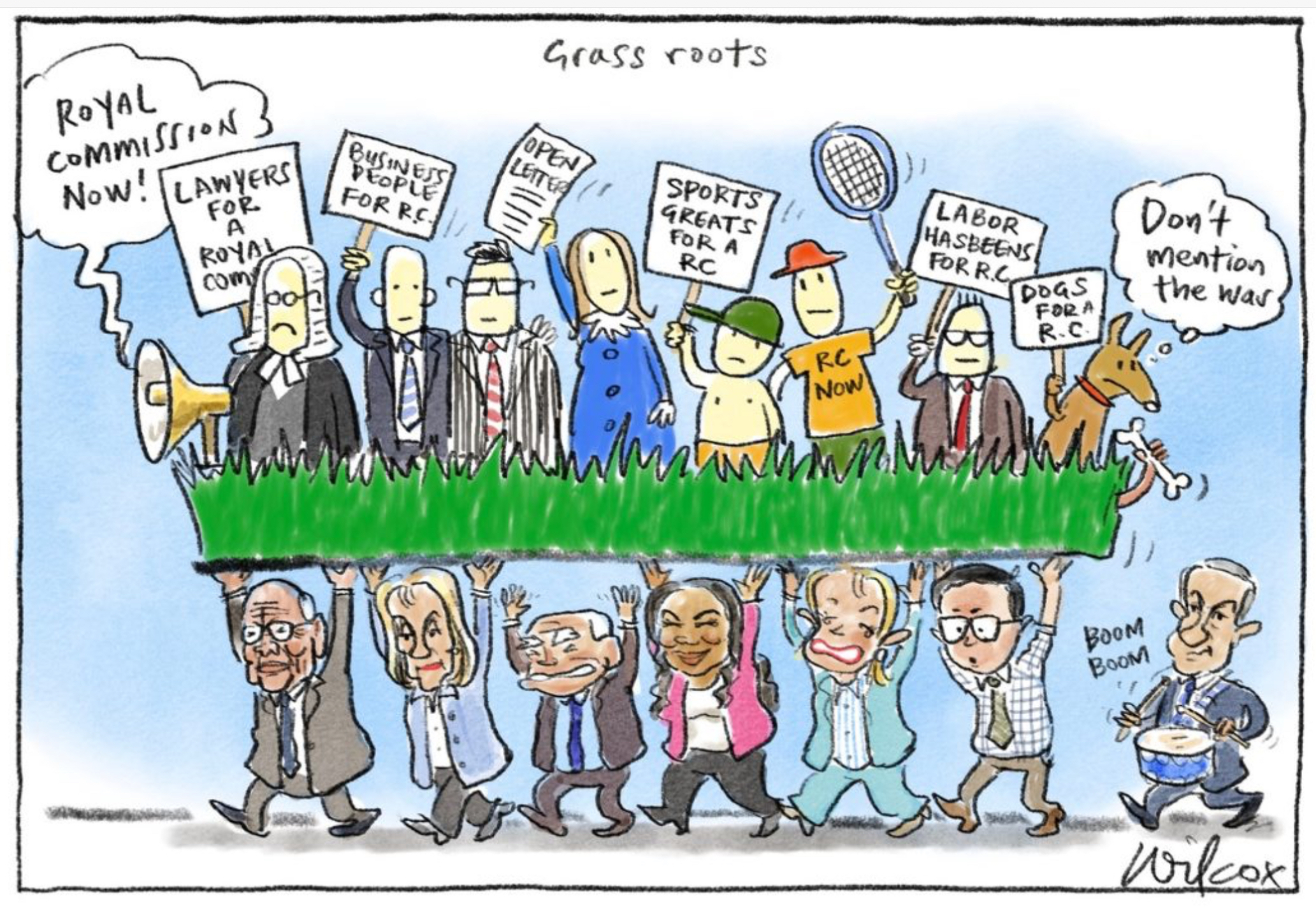
Cathy Wilcox cartoon, SMH 7 January 2026
Critics argued that the image revived a familiar and corrosive trope: the suggestion of hidden Jewish influence directing political life from the shadows. The cartoon, titled Grass roots, depicts a cluster of foolish-looking figures demanding a royal commission. They are presumably meant to represent the families of the dead, as well as lawyers, judges, business leaders and sporting figures who had urged government action long before the Prime Minister concluded that continued indifference might stain his legacy. When he finally announced a royal commission—expanded, without explanation, to include the elastic phrase “social cohesion” – no journalist paused to ask what that addition was meant to clarify.
In the drawing, a dog stands among these Australians, holding a placard and thinking, “Don’t mention the war.” The grass beneath their feet is supported by a menacing cast: and stock villains of the anti-Zionist imagination. The implication is unmistakable: that the pleas of grieving families and prominent citizens are neither organic nor sincere, but choreographed – another performance conducted from afar.
That implication did not arise in isolation. Across social and mainstream media, many progressives called for Jillian Segal to be removed and her report rejected out of hand. Others elevated Jewish critics of the war, of Zionism, or of Netanyahu as moral exemplars – “good Jews,” “some Jews tell the truth” – as if Jewish legitimacy were contingent on ideological alignment. Some wrote openly that Jews, “for their numbers,” exercised excessive influence. One circulating meme complained, “We didn’t vote for a Zionist voice”, whilst other posts informed their echo chamber that Chabad Bondi, a branch of the global Jewish outreach organisation, which had organised the Hanukkah gathering on the fateful Sunday evening and also the local commemorations for the victims (and later, the tribute at the Sydney Opera House) was but another tentacle of the sinister and uber-influential Jewish Lobby. Some of the most incongruous postings have been of ultra Orthodox Jews – Haredim – with signs condemning the Gaza war and Zionism, as if to say these are the authentic, “good” Jews. Some footage actually shows Haredim protesting against the Israeli government’s efforts to conscript exempt yeshiva students into the IDF – but, as they say, every picture tells a story.
Running beneath this was a persistent misconception. Judaism was treated as a religion, detachable and voluntary, rather than as an ethnoreligious identity shaped by lineage, memory and shared fate. Jews were asked not simply to oppose Israeli policy but to renounce their “homeland,” their inheritance, their sense of collective belonging. Census figures were deployed to minimise Jewish presence, overlooking the fact that many Jews, with Germany in the 1930s still in mind, remain reluctant to advertise religious affiliation. Genealogical platforms tell a different story: the number of people who discover Jewish ancestry far exceeds those who publicly profess the faith.
Another factor further clouds understanding. Jews are rarely dogmatically regarded as part of what Australians loosely call our “multicultural” society – a variegated demographic more often reserved for the post–White Australia waves of migration – communities that are visibly non-European or culturally distinct. Jews slipped beneath that radar. Many arrived well before the Second World War, and those who came before and after tended to integrate, to go mainstream, to succeed, and therefore not to stand out.
As a result, Jews were quietly folded into an older Judeo-Christian demographic, grouped alongside Protestants and Catholics as part of the cultural furniture rather than recognised as a minority with a distinct history and vulnerability. In most urban, and even regional settings, many Australians would be unaware that Jewish families live among them at all. At the same time, a surprising number of people carry Jewish ancestry several generations back, or are connected through marriage or descent, without regarding this as identity in any conscious way.
This invisibility cuts both ways. It has allowed Jews to belong without friction, but it has also made Jewishness strangely abstract – easy to misclassify as belief rather than continuity, easy to overlook as lived experience, and easy, when political passions rise, to treat as conditional.
Here the paradox sharpens, particularly among progressives. There is genuine respect for Indigenous Australians’ reverence for history, genealogy and Country: an understanding that identity is inherited as much as chosen, that land carries memory and obligation across generations. Yet the Jewish connection to Zion is denied that same conceptual dignity. What is recognised as ancestral continuity in one case is dismissed in the other as theology, nationalism or ideology.
The inconsistency is telling. Jewish attachment to place is stripped of its historical depth and cultural persistence, judged by standards not applied elsewhere. In that light, the cartoon does more than offend. It gives visual form to a deeper habit of thought: one that sorts Jews into acceptable and unacceptable categories, organic grief and foreign orchestration, legitimate belonging and suspect attachment- depending on who is being asked to explain themselves, and to whom.
All of this helps to explain the dangerous and disturbing upsurge in antisemitism over the past two years and earlier.
The Bondi massacre did not invent anti-Semitism in Australia; it exposed a system already bent, quietly, against seeing it. Two recent articles in The Australian show in complementary ways two faces of the same failure: one structural, one intimate. On the one hand, Professor Timothy Lynch diagnoses the intellectual and institutional blindness that allows hatred to incubate unchecked; on the other, author Lee Kofman shows the personal toll when grief itself is made conditional on passing someone else’s moral purity test. Together, they reveal a society in which moral frameworks have become cages rather than guides.
For decades, Australian multiculturalism has performed a delicate contortion: apologising for its own history while demanding loyalty from newcomers. Original British settlement is framed as a sin; multiethnic immigration is a progressive corrective. The paradox, Lynch notes, is that the very order migrants join is simultaneously denigrated by the leaders they are expected to trust. Within this structure, Jews occupy an uncomfortable space: electorally negligible, culturally visible, historically persecuted, yet paradoxically recoded as white and colonial. Zionism – a project of survival and refug e- is reframed as a form of imperial wrongdoing, while other nationalisms pass without scrutiny. Anti-Semitism, filtered through progressive identity politics, becomes an exception to the very rules designed to prevent harm.
Bondi rendered these abstract asymmetries concrete. The massacre forced recognition that anti-Semitism, once dismissed as campus rhetoric or aestheticised resistance, could and would become lethal. Lynch observes that progressive moral frameworks – micro-aggressions monitored, systemic racism theorised -stop precisely at the Jew. A royal commission, he argues, would not be vindictive; it would be a sober exercise in moral clarity, tracing the cultural and ideological currents that incubated violence. Yet the same cultural institutions that produced those currents remain invested in their own innocence, framing ideas as harmless discourse even as they provide tacit validation for hatred.
The myth of Jewish influence
The starting question – whether there is “solid, concrete evidence” of Zionist or Jewish influence over Australian government and society – has, since October 7, acquired a sharper edge and a louder echo. In the wake of the attacks, the war in Gaza, and the subsequent rise in domestic tension, social media in particular has filled with claims—often from the progressive side, and not infrequently from otherwise careful and intelligent commentators – about the malign and disproportionate influence of a “Zionist” or “Jewish lobby.” This rhetoric has been further amplified in Australia by the appointment of Jillian Segal as the Special Envoy to Combat Antisemitism, and by the establishment of a parliamentary inquiry (often loosely described as a “royal commission”) into antisemitism on Australian university campuses and in public life. Together, these developments have been read by some as evidence not of a policy response to rising antisemitism, but of the very influence they allege.
That interpretation, however, only makes sense if one begins from the assumption that such influence exists in a covert, coordinated, and disproportionate form. The more useful approach is to step back and examine how influence actually operates across the Australian system as a whole.
Australian public life is shaped most heavily by large, well-resourced peak bodies, particularly in business and industry. Organisations such as the Business Council of Australia, the Minerals Council, the Property Council, and the Australian Energy Producers (formerly APPEA) are permanent fixtures in policy formation. They produce economic modelling, maintain direct access to ministers and departments, and help define what governments regard as economically viable. Their influence is not hidden; it is structural, continuous, and grounded in resources, expertise, and institutional proximity to decision-making.
Alongside them sit the trade union movement, coordinated by the ACTU and expressed through powerful sectoral unions like the CFMEU, ANMF, and TWU. Their influence operates through membership, industrial leverage, and formal ties to the Labor Party. They shape debates on wages, workplace law, and social policy, sometimes from within government, sometimes through public campaigns. Like business groups, their role is embedded and enduring.
A third layer consists of issue-based advocacy organisations, particularly in the environmental sector. Groups such as the Australian Conservation Foundation, Greenpeace, WWF, and the Climate Council have been central to elevating climate and environmental concerns within national politics. Their influence tends to operate through public persuasion, media engagement, and strategic litigation rather than direct economic leverage. They rarely determine policy outcomes alone, but they have significantly shifted the parameters of debate over time.
The social welfare sector – including ACOSS, Anglicare, Mission Australia, and the St Vincent de Paul Society – contributes a different kind of influence. These organisations draw on service delivery and lived experience to inform policy on poverty, housing, and inequality. They are less dominant in fiscal decision-making but play an important role in shaping the ethical and empirical context in which those decisions are made.
In health and medicine, bodies such as the AMA, RACGP, and Cancer Council exercise influence grounded in professional authority and public trust. Their input is often decisive in technical areas of policy and becomes especially prominent during national crises, though it remains part of a broader advisory ecosystem.
Legal and civil liberties organisations – the Law Council, Human Rights Law Centre, and others – operate at the level of principle, scrutinising legislation and advocating for rights-based constraints on government action. Their influence is typically indirect but can be significant in shaping legal frameworks and public debate.
Within this wider system sit community and diaspora advocacy groups, including Jewish organisations (such as the Executive Council of Australian Jewry and the Australia/Israel & Jewish Affairs Council), Muslim organisations (AFIC, ANIC), and others (such as FECCA and Armenian advocacy bodies). These groups engage in standard democratic practices: making submissions, meeting with policymakers, contributing to public debate, and, at times, facilitating international engagement. Their influence is real in the sense that they are part of the policy conversation, particularly on foreign affairs and multicultural issues. However, in comparative terms, they are generally modest in financial resources, institutional reach, and structural power relative to major business or union actors.
Finally, think tanks such as the Australian Strategic Policy Institute, the Lowy Institute, and the United States Studies Centre play a distinct role. They do not represent mass constituencies, but they shape the analytical frameworks within which policy is discussed, particularly in foreign policy and national security. Their influence lies in framing, expertise, and elite networks rather than direct political mobilisation.
Against this broader landscape, the claim that “Jewish or Zionist interests control or infiltrate many of these groups” does not withstand scrutiny. To sustain such a claim would require evidence of coordinated, cross-sector control—shared command structures, dominant funding pipelines, or consistent policy alignment traceable to a central directive. No such evidence exists.
What does exist is something far more prosaic: Australians of Jewish background, like Australians of every background, participate across public life. Some hold senior roles in business, academia, media, and government. Their views are not uniform. Some are strongly supportive of Israel; others are critical; many occupy positions in between. That diversity alone makes the idea of a single, coherent “Zionist interest” directing multiple sectors implausible.
Moreover, the organisations themselves behave exactly as their mandates would predict. Industry groups advocate for industry; unions for workers; environmental organisations for climate action; welfare bodies for social support. Their positions frequently conflict – not only with each other, but also with the policies of Israel, the United States, and indeed with the views of different Jewish organisations. If there were hidden coordination, one would expect consistency. What we observe instead is disagreement, fragmentation, and issue-specific alignment.
It is also important to recognise a recurring pattern in such claims. Assertions of diffuse, concealed Jewish influence have historically relied on association, inference, and aggregation—not on demonstrable mechanisms of control. By the normal standards of evidence applied to any other claim of political power, they fall short.
This returns us to the initial concern. There is clear, concrete evidence that Jewish and pro-Israel organisations—like many other advocacy groups – engage in lobbying, public debate, and policy advocacy in Australia. There is also clear evidence that they do so openly, within democratic norms, and on a scale generally smaller than that of major economic or industrial actors. What is not supported by credible evidence is the claim that they exercise covert, disproportionate, or controlling influence over Australian government or society.
The more accurate picture is not one of hidden command, but of a system in which many organised interests compete to persuade, and where outcomes reflect the shifting balance between them.
Richard Flanagan’s dangerous idea is just a chilling form of denial
Greg Craven, The Australian, September

At the Festival of Dangerous Ideas, Richard Flanagan asked where the antisemitism was in the Bondi massacre and answered: “Nowhere. Nowhere. Nowhere”. Pictures: News Corp/Supplied
The longwinded speech by novelist Richard Flanagan at the Festival of Dangerous Ideas last month, flicking aside the reality of antisemitism, falls into all these categories. When it comes to identifying evil, here is a bloke who could not pick Satan out of a line-up of nuns.
Flanagan’s position seems to be that antisemitism in Australia is all the fault of “the Israel lobby”, a loathsome gang he never satisfactorily defines but you have a horrible feeling includes every Australian Jew – and probably non-Jew – who dares disagree with Flanagan on the October 7 attack, the Bondi Beach massacre and the war in Gaza.
His elaborated thesis is that the Bondi murders were not fundamentally antisemitic but were incited by provocative acts and misrepresentations by – you guessed it – the “Israel lobby”. What’s more, if things get any worse it will be all its fault as well.

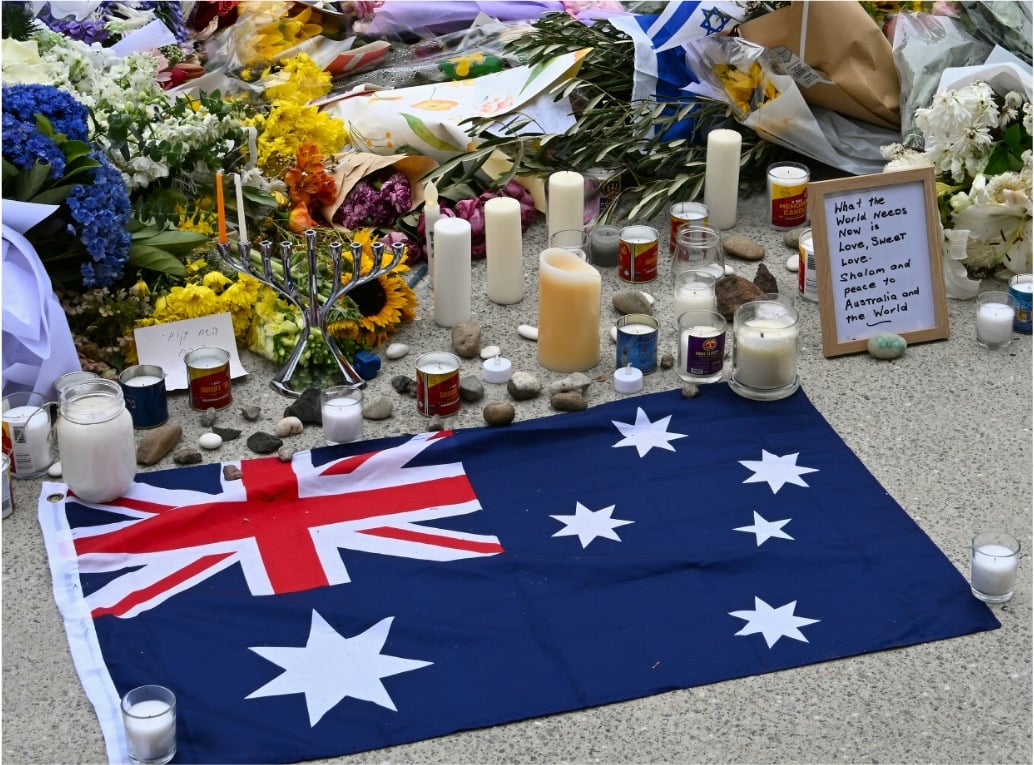
A menorah is lit as people participate in a candlelight vigil at Bondi Pavilion. Picture: Getty Images
Two general things stand out about Flanagan’s rant. First, it illustrates there is no correlation between creative talent, whether writing, acting or tap dancing, and intelligence. Flanagan is a passable author, but as a cultural analyst he ranks well below most rugby league commentators. Second, as an exercise in bad schoolboy debating, Flanagan has the lot. In his speech he packs in denial, deflection, blame-shifting, abuse, threats, distraction, conspiracy and obfuscation. Where was he when I needed him in grade 4?
This is not his first foray into mangled prose. His famously garbled Gould’s Book of Fish was reviewed by my brother Peter as comprising “multiple verbal collisions” and “massive lapses of narrative judgment”. I’m with you, brother.
Flanagan’s central and most bizarre claim is there actually was no antisemitism present at Bondi, other than the two shooters themselves. He seems incapable of comprehending that those monsters fired their guns from within a wider capsule of social antisemitism that walked alongside them. The shooters did not produce antisemitism. It produced them.
But let us indulge the Fish Man just for a moment. His analysis is the best let out for any war criminal so far detected. So as long as you were not the man pouring the Zyklon B into the gas chamber, you’re off scot-free. The person who hands you the canister, the man who orders it, the man who makes it and the man who thought up the idea in the first place are neither antisemitic nor murderers. They are just bystanders to the guilty physical act of another.
In the same way, vicious antisemites abusing Jews in the streets, chanting infamy and intimidation, and forcing Jewish schools to be secured by armed guards are not an actively authorising environment but merely a realistic human context.
If you tried to apply this analysis to the persecution of any other minority group in Australia, whether Indigenous people or indeed our Muslim brothers and sisters, you rightly would be run out of town on a very sharp rail.

Special Envoy to Combat Antisemitism Jillian Segal appears at Parliament House in Canberra. Picture: Martin Ollman
The constant references to the “Israel lobby” are less illogical than chilling. One of the oldest stereotypes of Jewish history, the existence of some shadowy, all-powerful Jewish conspiracy, is wheeled out one more time.
Of course, Flanagan does accept that these insidious Jewish types are supported by an array of malicious non-Jewish Australians. It is unclear why they have joined the plot. Money, probably.
This is where it all gets rather more sinister. Flanagan makes repeated references not only to antisemitism being the result of the insidious actions of the “Israel lobby” itself but hints pretty broadly that future horrors also will be self-inflicted.
He seems to have a particular terror of special envoy to combat antisemitism Jillian Segal. Apparently she plans a McCarthyistic takeover of the Australian nation-state. Good luck to her.
In fairness to Flanagan’s positions, they may not be positively antisemitic. Instead, they may represent a different form of Jewish dismissal. This is asemitism.
Asemitism does not involve hating Jews, it just involves never being able to see them in any debate or controversy. So, there’s no antisemitism here because it’s not about the Jews. I’m not antisemitic, I just hate all Zionists and the state of Israel. These protests aren’t threatening anyone, they’re just healthy instances of freedom of assembly.
As Basil Fawlty might have put it: “Don’t mention the Jews.”
Greg Craven is former vice-chancellor of the Australian Catholic University.
Source: The Australian. Full Article at theaustralian.com.au.
Why Richard Flanagan is in denial on the true sources of Jew hate
Nick Dyrenfurth, The Australian, 31 August 2026

Author Richard Flanagan at No Stadium Rally in Hobart. Picture: Nikki Davis-Jones
Not long ago I stood in synagogue saying Kaddish for my late grandmother. Kaddish is called the Jewish prayer for the dead, though it says almost nothing about death. It is about life, God and continuity. Like so much of Judaism, it is an act of memory. Zachor – remember.
The command runs through Jewish civilisation. We remember slavery in Egypt, Jerusalem, persecution, liberation, catastrophe and survival. Jewish tradition is scaffolded by memory.
That is why much of the Australian left does not understand what happened to Jewish Australians since October 7, 2023. They imagine war ends, the marches will shrink, social media will move on, old alliances will re-form and everyone will forget what was said and done. Left-wing Jews like me will not.
The Royal Commission on Antisemitism and Social Cohesion has finished its public hearings. But where was the accountability for those who celebrated October 7, romanticised slaughter as “resistance”, doxxed Jews, reduced Jewish grief to propaganda or revived ancient ideas about Jewish money and conspiratorial power with “Zionist” substituted for “Jew”?
Criticism of Israel is not antisemitism. Zionism itself has been an argument among Jews since its birth. But something remarkable has happened to the word. In sections of the left, Zionist has mutated into a receptacle for old fantasies about Jews: greedy Zionists, bloodthirsty Zionists, media-controlling Zionists. Change the noun and the grammar is ancient.
The Soviets did not invent Zionism or Zionist but after 1967 Soviet propaganda helped perfect their use as a proxy for Jew. Secret power, divided loyalty, financial influence and conspiracy were repackaged. The Jew became the Zionist; the conspiracy remained.

Special Envoy to Combat Antisemitism Jillian Segal, Prime Minister Anthony Albanese and Special Envoy to Combat Islamophobia Aftab Malik. Artwork: Frank Ling
At the Festival of Dangerous Ideas, Flanagan asked where the antisemitism was in the Bondi massacre and answered: “Nowhere. Nowhere. Nowhere.” He argued instead that an “Israel lobby” politicised the massacre and asked whether that lobby might be fuelling antisemitism.
Think about that. Jews are massacred at a Jewish festival and an acclaimed Australian writer peers into the wreckage, concludes antisemitism is absent, then turns his suspicion back on organised Jewish Australians. Flanagan distinguishes the “Israel lobby” from Jews, then attributes to it extraordinary power over government, universities, broadcasters, schools and public debate.
Antisemitism survives because it adapts to the moral vocabulary of each age.
The same alarm sounds in a recent piece published by The Shot. Dave Milner describes an “Epstein class” comprising “vampiric corporations, techno-fascists, militarists, Zionists” and American imperial power. Elsewhere he writes of Labor being “beholden to the Zionist lobby”, called for “Zionist plants” to be expelled from trade unions and described government as acting for a “cadre of genocidal pedophiles”.
Epstein. Zionists. Pedophiles. Secret influence. A corrupt ruling class controlling governments and institutions. At what point does a supposedly progressive publication hear the historical alarm screaming? Jeffrey Epstein was a real criminal. Turning “Epstein” into a metaphysical category of global power and placing “Zionists” inside it is something else.
You do not need the Protocols open on your desk for the architecture of an ancient conspiracy theory to become recognisable. For Jews of the left, Jews like me, the betrayal is profound.
We were not tourists in left politics asking for indulgence. Jews helped build trade unions, labour parties, civil rights campaigns and anti-racist movements.
Many of us spent our lives insisting minorities should be listened to when they describe hatred directed at them.
Jews as politically diverse as Mark Leibler and Henry Pinskier backed the voice to the hilt precisely because they believed Indigenous Australians should be heard when describing their own experience of dispossession and prejudice. That instinct was treated as a basic principle of anti-racism. Yet when Australian Jews asked for the same courtesy, parts of the left decided lived experience required ideological clearance.

A menorah is lit as people participate in a candlelight vigil at Bondi Pavilion at Bondi Beach. Picture: Audrey Richardson / Getty Images
Jewish fear was “weaponised”. Jewish grief was “politicised”. Jewish institutions became suspect. Jews were expected to denounce Israel before their experience of antisemitism could be admitted into evidence.
Solidarity that operates only for minorities whose politics you approve of is not solidarity. The answer is not censorship. It is argument, daylight and accountability. Ask people what they meant. Make movements defend their rhetoric. Stop allowing Palestine to function as an intellectual indemnity against ordinary standards of decency.
The left once knew hatred matters before it becomes violence, language prepared the ground for dehumanisation and minorities do not have to earn the right to be afraid. Jews know something else: hatred mutates, and memory helps us recognise the mutation.
Recently I was at a public Jewish festival with my seven-year-old daughter. She noticed the security men at the festival’s entrance, then their guns. “Why do they have guns?”
There are questions you expect from a seven-year-old at a festival. Can I have something to eat? Can we go on that ride? Not that. I gave her the answer a seven-year-old could understand. One day she will be old enough for the longer answer.
And when that day comes, I will remember standing in synagogue saying Kaddish for my grandmother. I will remember these years. I will remember who stood beside us, who remained silent, who explained it away – and who, even after Jews were murdered on an Australian beach, somehow managed to make the Jews answer for antisemitism.
Nick Dyrenfurth is executive director of the John Curtin Research
Source: The Australian. Full Article at theaustralian.com.au. For corporate sharing, find licensing options at the end of the article.
Richard Flanagan’s dangerous ideas were intellectually lazy

At the Festival of Dangerous Ideas, Flanagan asked where the antisemitism was in the Bondi massacre. He answered: “Nowhere. Nowhere. Nowhere.”: News Corp / Supplied
Richard Flanagan’s speech at the Festival of Dangerous Ideas has one merit and one merit only: it crystallises the falsehoods, delusions and hypocrisy at the heart of the wave of hatred that has swept Australia since October 7, 2023.
Listening to the litany of factual errors, it is hard to know whether Flanagan is stupid, ignorant or both. He claims, for example, that Einstein was ardently opposed to Zionism. Yet Einstein famously called Israel “our state” – “unser staat”, a possessive stronger in German than any English can convey – bequeathed his papers to the Hebrew University and was working, when he died, on an address celebrating Israel’s seventh Independence Day.
Flanagan equally presents the Bund – a Jewish socialist movement – as implacably hostile to the state of Israel, conveniently ignoring that in 1955, as the reality of the Holocaust and of Stalinist antisemitism sank it, the Bund’s Third World Conference clamorously reversed its position.
But the factual errors are not mere intellectual sloppiness: they contribute to demonising Israel and the Australian Jews who support its right to exist, in some cases by ignoring reality in others by not providing crucial context.
To take just one instance, Flanagan recycles the Committee to Protect Journalists’ contention that “more journalists have been killed in Gaza by the IDF than in the entirety of World War Two”. What he omits is that the comparison applies a far looser definition of “journalist” to Gaza than to World War Two.
Worse, as the scholarly source underlying the wartime tally acknowledges, it excludes journalists killed on the Soviet and Chinese fronts, where 80 per cent of combat fatalities occurred, as well as journalists reporting from the Axis forces. Making those adjustments shows the claim to be utterly baseless – a fact Flanagan either knew or should have known.
All that, however, merely prepares the ground for “exposing” a conspiracy of monstrous scope and ambition. There is, in Flanagan’s telling, an ominously amorphous “Israel lobby”, operating both directly and through the Special Envoy for Antisemitism, Jillian Segal. Aided by “sustained” yet “mysterious” pressure from the Trump administration, its aim is to control “every significant arena of Australian public life”.
The “lobby’s” not-so-secret weapon is the International Holocaust Remembrance Alliance’s definition of antisemitism, which it wants enforced by “oversight committees” designed to “cower civil society and curb free speech”, leaving “Australians silenced, fearful and divided”. The restrictions those committees impose are “certain to be (on) terms that please Israel, a foreign nation”, so that this country would be controlled not by “the Australian state, but essentially the Israeli state”. Australians would become vassals of a foreign power, denied even the freedom to criticise their overlords.
Faced with those claims, one is irresistibly reminded of Richard Hofstadter’s classic 1964 essay on the paranoid style in American politics. Unlike clinical paranoids, the conspiracists Hofstadter focused on did not see themselves as singled out by a hostile world. Rather, they perceived, lurking behind every event, the sinister hand of a demonic force directed “against a nation, a culture, a way of life”.
Hofstadter called this style paranoid, he explained, “because no other word adequately evokes its qualities of heated exaggeration, suspiciousness, and conspiratorial fantasy”. And its archetypal expression is the malevolent fiction of a Jewish cabal plotting to bring the world to heel.
Little wonder then that direct references to “the Lobby’s” machinations account for almost a third of the words Flanagan utters. Yet what is most telling is not what Flanagan says but what he leaves unsaid. In a speech devoted to Gaza, Israel is mentioned 60 times; Hamas once. Jews are mentioned 43 times; Islam and Muslims, never.
The distortions that bias creates are glaring. Demonstrating that abject ignorance cannot dent his outrage, Flanagan foolishly claims that Zionism, whose intellectual origins owe incomparably more to Mazzini’s liberal nationalism and Moses Hess’s romantic socialism than to Fichte’s chauvinistic illiberalism, “arose out of the same fetid, ethno-nationalist ferment” that “gave the world Nazism, fascism, extreme nationalism and authoritarianism”. What he does not say is that this ferment, which left no discernible imprint on Zionism, shaped post-war Arab nationalism and modern Islamism, reinforced by fascism and Nazi ideology’s vitriolic antisemitism.
Equally, he endlessly excoriates the “Israel lobby”. Yet he never mentions the lavishly taxpayer-funded Muslim lobby, with its own special envoy, which has coalesced a wide range of Islamic and pro-Palestinian organisations in submissions to public inquiries, including the royal commission, urging, among other things, for the terrorism legislation to be weakened.
And while denouncing the International Holocaust Remembrance Alliance definition in vitriolic terms, Flanagan passes over the far more sweeping restrictions on what they call Islamophobia proposed by those organisations and by the Islamophobia Special Envoy: restrictions advanced without even the sketchiest definition of the “Islamophobia” they seek to repress.
The double standard then reaches its nadir in his suggestion that the representative bodies of Australian Jewry benefit from inciting hatred against the very people they represent – a charge he would never level at their Muslim counterparts.
To describe those assertions as outrageous would be an understatement; and Flanagan is plainly aware of their enormity. He therefore moves to pre-empt criticism by adopting the manoeuvre notoriously associated with former London mayor Ken Livingstone, who dismissed every charge of antisemitism as an attempt to silence legitimate criticism of Israel.
The goal is simple: to avoid addressing the substance of the charge by impugning the accuser’s supposed motives. Critics are presumed to be acting in bad faith, fabricating persecution to advance their political ends. Hatred is thus rebaptised as legitimate criticism, while those who object become accomplices in a secret campaign to stifle debate.
With every attempt to expose antisemitism is therefore just further proof of Jewish deceit, allowing the Jews to be accused of inventing the antisemitism that now mars our national life.
But Flanagan’s evasive tactics do not end there. Aping the techniques that saturate social media, he repeatedly poses as merely asking questions. The rhetorical approach is puerile: “A question needs to be asked,” Flanagan declares, casting himself as prepared to ask what others dare not. Then the inflammatory allegations are smuggled in: “To what extent has the Israel lobby itself contributed to antisemitism in Australia”, because it would, “perhaps perversely”, “accord with their existential message that only in Israel are Jews safe”? The insinuation is left hanging, as though the answer were self-evident, allowing Flanagan to don the mantle of truth-telling without ever shouldering the burden of proof it entails.
Every one of those claims and tactics could and should have been ruthlessly demolished on the day. Yet the so-called Festival of Dangerous Ideas evidently considered that prospect too dangerous to countenance. Its lineup featured Israel haters, but it included absolutely no one who would take them on.
The imbalance is, unfortunately, completely unremarkable: it is now a deeply ingrained feature of this country’s increasingly mediocre cultural life. But that only makes it even more important that those who purport to care about the truth should restore the balance that has been destroyed.
It is therefore much worse than scandalous that the festival was sponsored by the Ethics Centre and the NSW state government. It is an unforgivable disgrace.
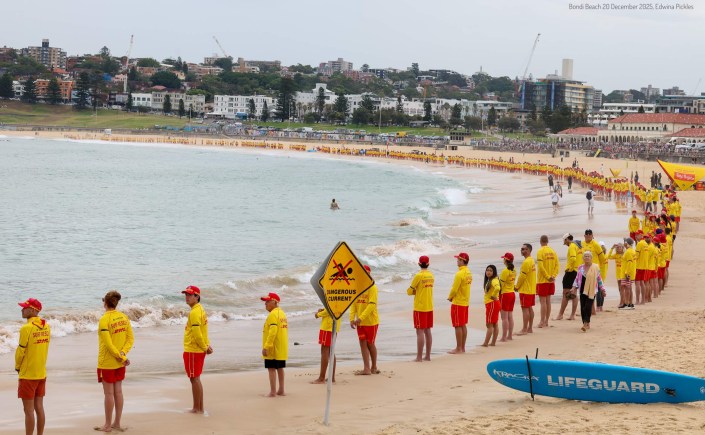


It’s always a good opening to a column to write that the only thing needed for evil to triumph over good is that good men stay silent. But this nostrum is not entirely true. The added element is that supposedly good people cannot recognise evil when they see it – or misattribute it to the wrong source or spend so much time denying it they end up with an apologia.