Five things about about Masada

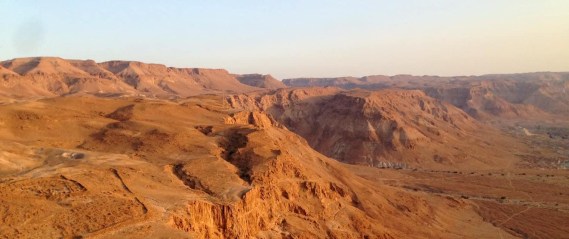
Firstly, it’s been there for eons, it’s cliffs of chalk and dolomite keeping a lonely watch over the Judean Desert, the Great Rift Valley with the Dead Sea 400 meters below in its deep, and the limestone plateau of Moab beyond.

Secondly, Herod the Great (37-4BCE) built a palace atop its mesa-like summit (see my King Herod’s edifice complex), and during the great Judean Revolt against Rome which ended in 71CE with the destruction of Jerusalem, it was occupied and fortified by sicarii rebels (named so for their knives, their weapon of choice) and their families.

Third, it’s one of Israel’s most popular tourist attractions.

Fourth, it was a terrible, interminable film. The aging Peter O’Toole could only have done it for the dosh, though all those Judean landscapes are cinematic heaven – the Judean Desert is one of the most beautiful vistas in the world.

And fifthly, and most importantly, Masada is intrinsic to the state of Israel’s national story and its Identity. It was the site of a very famous last stand – like Thermopylae, the Alamo, Gandamak, Little Big Horn, and Isandlwana were famous last stands. An heroic, to the very ‘last man’ of the few against an overwhelmingly, most often ‘savage’ many. But this one raises a finger of defiance at all who threaten the tiny but nuclear state: Never again shall Masada fall!

Masada has long been a favourite place of pilgrimage site for Jewish youth groups, and for years the IDF has held induction ceremonies there. These ceremonies are now also held at various other memorable locations, including the Armoured Corps Memorial at Latrun, the Western Wall and Ammunition Hill in Jerusalem, Akko Prison, and training bases. It was declared a UNESCO World Heritage Site in 2001.

But there’s a sixth thing about Masada, or more accurately a 5.2 – the historical truth of the story is open to conjecture.

The popular narrative of what happened long ago in the Spring of 74 CE is that a tiny band of men, women and children, having held out against for two years on a barren mountain top defying the might of the greatest military power the antique world has known, and chose to self-slaughter rather than endure the indignity of execution or captivity.

The only historical account of the siege was written after the event by the Jewish scholar Flavius Josephus who allegedly interviewed a couple of the survivors who has managed to escape before the end.

Josephus was a high born, well-educated rebel leader who had surrendered to the Romans before the siege of Jerusalem. Apparently, he impressed Vespasian, the Roman general but predicting he’d become emperor, and thence acted as his advisor on Jewish affairs. Vespasian did indeed become emperor, so Josephus’ star must’ve shone even brighter, and he served Vespasian’s son Titus when the latter took command of the forces in Judea on his father’s accession and conquered and destroyed Jerusalem in 70CE.

Nowadays, historians and archaeologists are reconsidering the facts of the siege and the suicides, and whilst not arguing outright that Josephus fabricated the story, suggest he may have embellished it. Most interested parties, including our guide Shmuel, have their own interpretation – the archeological evidence is ambiguous at best and is entirely rejected by some scholars. Some believe the holdout and the siege were not that significant by The Romans’ reckoning – they certainly took their time doing something about it two years afterwards in fact. But a sideshow in a successfully concluded war. Others argue that the mass-suicide did not occur and that the rebels and their families were simply massacred.  A selection of articles regarding the many theories about Masada are republished below.

As the journalist exclaims at the end of The Man Who Shot Liberty Valence, why let the truth get in the way of a good story?

Climbing Masada 

I wrote in my Travel diary for Thursday, 12 July 1971: “A desert ride, traveling the length of the Dead Sea to the mountain fortress of King Herod with a a host of American Jews. It was high summer, and the sun was at its height. The climb was a 35-minute agony but oh, the panorama! And it was heaven to collapse atop as tourists stepped over me on their way to the cable car (at a pound a return trip, way too much for my budget). The summit was an empty ruin of reconstruction, but it must’ve been impressive, and view from below must’ve given the Romans the shits. I came, saw and descended. The return journey to Jerusalem via the Ein Gedi oasis and a Dead Sea resort was a bad trip dominated by those American Jews”.

I visited Masada again in May 2014 with my wife Adèle – and we decided we’d watch the sunrise from its crest. So, there we were in the car park, five o’clock in the morning, in the deep dark with fellow travelers a third our age. And we were off! at a brisk pace up the zig zag track. It was better maintained since my prior trek, but torturous, nonetheless. Up up and up as the lightening day at our backs reminded us that the clock was tick tick ticking and that any delay or mishap would render our mission pointless. I can’t say whether this climb was any better or worse than my first – but this time, I was much fitter, even at my age, and it was not in the middle of the day in high summer.

And then, there we were – in good time to catch our breath and settle in at a good vantage point as the horizon glowed and old sol peeked bit by bit above the blackness of the Moab wilderness in the east, casting his good day sunshine rays on the glistening Dead Sea over a thousand feet below. It was a glorious feeling – the sense of achievement we felt that we were fit enough to keep pace with the young folk, and the beauty of the view. To our left, a pair of lovely Israeli girls began to sing a joyous Hebrew song. On our right, a gaggle of German Pentecostals were led in prayer by their pastor. Hosanna in excelsis!

And then, it was all over. The daylight revealed the remains of Herod’s palace and the zealot rebels’ village spread out behind us, and the rock-fill ramp the Romans constructed to take Masada by storm. A too-short reconnoiter and it was time to head back to join our bus. We’d looked forward to taking the easy way down, by cable car. But that didn’t start running until nine o’clock; it was seven o’clock and our bus left in less than an hour. So off we went …

Our return journey to Jerusalem was much like my first – a refreshment stop at the oasis of Ein Gedi (and a brief stroll through the scenic national park in the wadi – which hadn’t been established in 1971) and a two-hour stopover at a sad venerate of a resort on the diminishing Dead Sea so our companions could wallow in the mud. We chose to sit at a deserted bar like a couple of Tom Waits’ mates with a couple of glasses of local vino blanco. The resort itself appeared to be designed for Russian tourists, as was demonstrated by the arrival of a bus load of babushkas led by a black-robed and bearded orthodox priest. To borrow from Leonard, I have seen the future baby, and it mundane!

© Paul Hemphill 2024.  All rights reserved.

See also in In That Howling Infinite: A Middle East Miscellany

A selection of my photos of Masada: 

The Roman’s ramp

The author on the rampart

Reconstruction in progress

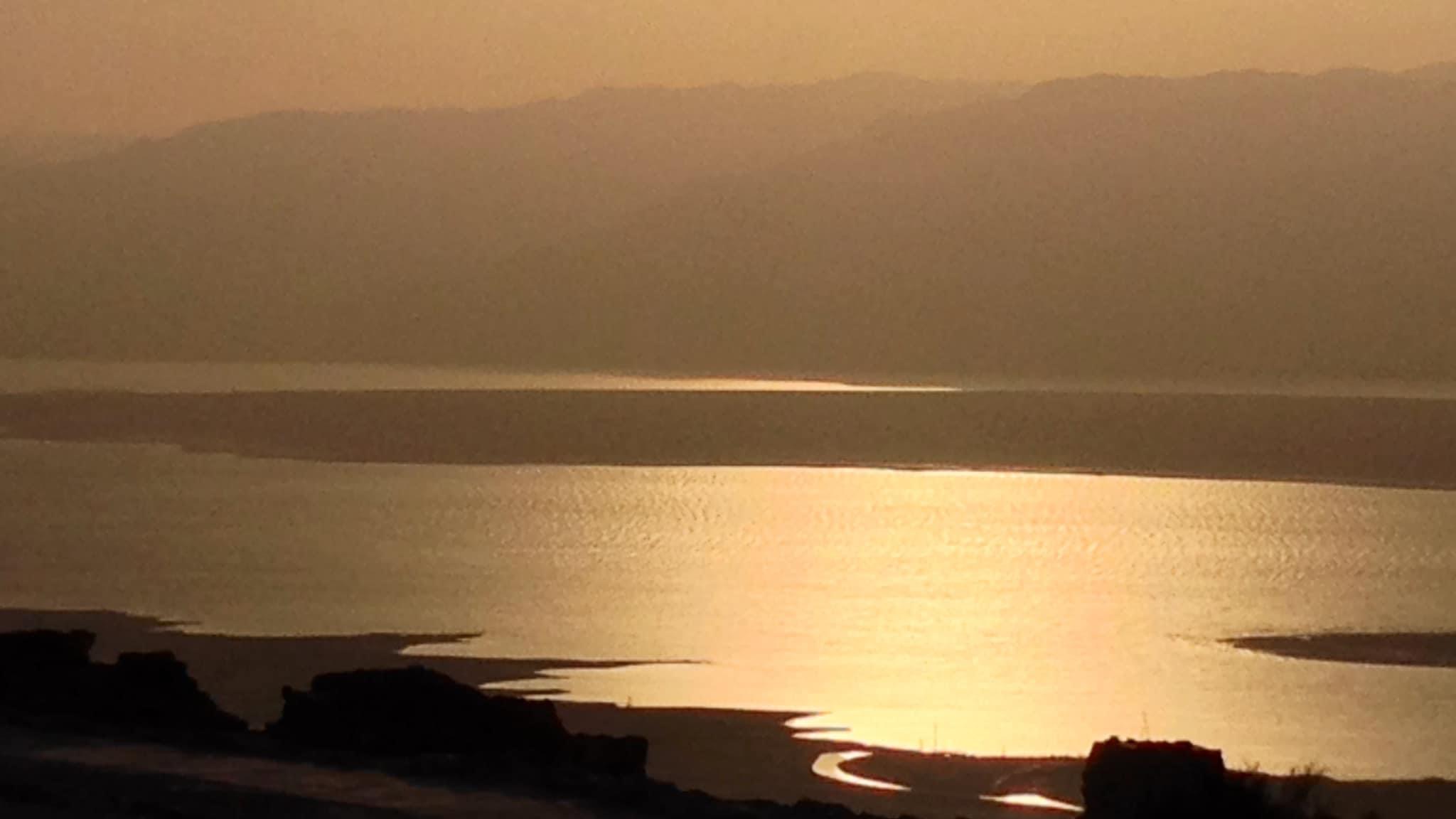
The Dead Sea viewed from Masada

Israel’s Masada myth: doubts cast over ancient symbol of heroism and sacrifice

Story of Jewish rebels taking their own lives while under siege in desert fortress was either exaggerated or untrue, say experts

Herod the Great’s fortified complex at Masada was a winter retreat but also an insurance against a feared rebellion of his Jewish subjects or an attack from Rome. Luxurious palaces, barracks, well-stocked storerooms, bathhouses, water cisterns sat on a plateau 400m above the Dead Sea and desert floor. Herod’s personal quarters in the Northern Palace contained lavish mosaics and frescoes.

But by the time the Jews revolted against the Romans, Herod had been dead for seven decades. After the temple in Jerusalem was destroyed, the surviving rebels fled to Masada, under the command of Eleazer Ben Yair. Around 960 men, women and children holed up in the desert fortress as 8,000 Roman legionnaires laid siege from below.

Using Jewish slave labour, the Romans built a gigantic ramp with which they could reach the fortress and capture the rebels. On 15 April in the year 73CE, Ben Yair gathered his people and told them the time had come to “prefer death before slavery”. Using a lottery system, the men killed their wives and children, then each other, until the last survivor killed himself, according to historian Flavius Josephus’s account.

After the declaration of the state of Israel in 1948, Masada took on a new significance, symbolising heroism and sacrifice. “It is a place of ancient doom which time has turned into a symbol of the pride of a new nation,” wrote Ronald Harker in the Observer book on Masada, published in 1966.

Newly enlisted soldiers were taken to the desert fortress to swear their oath of allegiance, including the shout: “Masada will not fall again!”

But some have cast doubt on the “myth of Masada”, saying it was either exaggerated or the suicide story was simply wrong.

Guy Stiebel, professor of archaeology at Jerusalem’s Hebrew University and Masada expert, said the evolution of myth is common in young nations or societies. “In Israel it’s very typical to speak in terms of black and white, but looking at Masada I see a spectrum of grey.

The left regard Masada as a symbol of the destructive potential of nationalism. The right regard the people of Masada as heroes of our nation. For me, both are wrong.

“If you put me in a corner and ask do you think they committed suicide, I will say yes. But this was not a symbolic act, it was a typical thing to do back then. Their state of mind was utterly different to ours.

“The myth evolved. All the ingredients were there. At the end of the day, it’s an excellent story and setting, you can’t ask for more.”

Yadin Roman, the editor of Eretz magazine, who is compiling a commemorative book on the Masada excavation, said some archaeologists had posited alternative theories, involving escape, although in the absence of evidence many were now returning to the suicide theory.

“Masada became an Israeli myth,” he said. For a nation still reeling from the revelations of the 1961 trial of Adolf Eichmann, “brave Jewish warriors standing up to the might of the Roman army was a much-needed antidote. But some people challenged the merits of the story – you stand alone on a hill to fight your enemies and then commit suicide? This is the ‘Masada complex’? This is the model for Israel?”

David Stacey, a veteran of the excavation 50 years ago, dismissed the story of mass suicide. “It was completely made up, there was no evidence for it,” he said. “Did Yadin pursue this story because he was an ardent nationalist, or because he needed to raise money for his excavation? Yadin was a smart enough operator to know that to succeed, you’ve got to sell a story. He succeeded.”

Masada: From Jewish Revolt to Modern Myth

Jodi Magness. Princeton: Princeton University Press 2019.

Reviewed by Karen B. Stern ,American Journal of Archeology, July 2020 (124.3)

“A dream of ages has come true: Masada has been excavated and reconstructed.” So wrote Yigael Yadin of the Hebrew University of Jerusalem in a tourist pamphlet about Masada published in November 1965. Yadin extolled remarkable finds, including “tens of miles of walls; 4000 coins,” and more than 700 inscribed ostraka, which he and his team recovered from the Herodian palace-fortress of Masada during 11 months of excavations between 1963 and 1965. To some scholars in the 21st century, however, the exultant tone of Yadin’s expression (in both the pamphlet and his popular book, Masada: Herod’s Fortress and the Zealots’ Last Stand, Random House 1966) betrayed a political agenda that complicated both his professional legacy and that of the site. In Masada: From Jewish Revolt to Modern Myth, however, Jodi Magness reclaims both the remains of Masada and the work of its famed excavator Yadin by reframing, and thus transforming, the narratives about each. Rather than merely summarizing the results of excavations or associated scholarship, Magness’ treatment does something novel: it constitutes a multidimensional work that uses Masada as “a lens through which to explore the history of Judea” (3) from the middle of the second century BCE through the first century CE.

The renown of Masada, of course, predates Magness’ treatment and more recent explorations of the site. Part of its fame owes to the remarkable geographic position of the elaborate palace-fortress, constructed by Herod, which looms over an extreme and desiccated landscape beside the Dead Sea. Yet Josephus, who composed his Jewish War in Rome under Flavian patronage, is credited for immortalizing this fortress and the demise of the Jewish rebels who had retreated there. Indeed, the soliloquy Josephus attributes to a certain Eleazar Ben-Yair dramatically concludes his account of the Jewish revolt against Rome (66–73 CE). Fully aware that the Romans had encircled their holdout and that the remainder of Judea had already fallen into Roman hands, Ben-Yair exhorts his compatriots in their final hour “not [to] disgrace ourselves. . . . Let us not . . . deliberately accept the irreparable penalties awaiting us if we are to fall alive into Roman hands” (Joseph., BJ 7.553–65; Loeb transl.). Ben-Yair proposes, instead, to enact a mass suicide whereby he and his peers would take their own lives immediately after those of their surviving wives and children (“Let our wives thus die dishonored, our children unacquainted with slavery,” BJ 7.335). Magness begins her preface with Ben-Yair’s words, but then, unexpectedly, challenges the plausibility of the associated account; she introduces readers to why stories in Josephus such as this one are of suspect historicity. In discussing the remains of Roman camps and siege works at Masada, including those she excavated herself, Magness demonstrates why answers to questions about the last days of Masada are best sought through archaeology, outside of Josephus’ narrative (ch. 1). This is so, despite the renown of Josephus’ writings on the topic, which lured generations of explorers and archaeologists to risk their lives in search of the original site where Ben-Yair and his peers purportedly chose death over surrender (ch. 2).

In subsequent chapters, Magness takes a panoramic view, contextualizing Masada in its natural, architectural, political, and historical settings. “Masada in Context” (ch. 3) manifests how harsh, inaccessible, and challenging for human habitation were the landscapes surrounding and including Masada, even if, under periods of Hasmonean control of Judea, rulers systematically constructed fortresses in comparable locations (e.g., Hyrcania, Machaerus, Callirhoe). Whether the Hasmoneans originally built on Masada remains debatable, but Magness’ summary of Herod’s local construction illustrates how elaborate his northern palace was, with a service quarter, synagogue, western palace quarter (which included a bathhouse and rooms with elaborate mosaic decoration), and southern portion, which included water installations and cisterns that Yadin once estimated could hold 1,400,000 cubic feet of water (69; cf. BJ 7.290–91). But while Masada might have reflected multiple feats of engineering, particularly given its topography and climate, Magness notes that it was merely one component of Herod’s legendary building program, which entailed extensive construction in Jerusalem (including Herod’s palace, the western hill, Temple Mount, and Antonia fortress), Caesaria Maritima (a man-made harbor, pagan temples, and aqueducts), as well as Samaria-Sebaste, Jericho, and Herodium (ch. 4). “Judea Before Herod” (ch. 5) and “From Herod to the First Jewish Revolt Against Rome” (ch. 6) collectively offer a valuable historiography of the region, emphasizing the social, political, economic, and religious unrest that ultimately impelled the revolt in 66 CE. Magness chronicles how Judea grew increasingly fractious, following internal divisions between “sects” of Pharisees, Essenes, Sadducees, and Jesus followers; political machinations of the Hasmoneans; and intersections between local and regional geopolitics. These last included Parthian invasions; the ascendancy and reign of Herod; the division of Herod’s kingdom among his three sons; and the subsequent imposition of a series of Roman governors, including procurators Lucceius Albinus in 62–64 CE and Gessius Florus in 64–66. By 66, Judea had indeed become a “tinderbox about to go up in flames” (141). Jewish rebellions in Caesaria Maritima followed provocations of non-Jewish residents; revolt spread to Jerusalem and ultimately precipitated the Roman destruction of the Jerusalem Temple. Yet, as Magness details, Jewish rebellions against Rome also spread outside urban centers; Herod’s old fortresses in Machaerus and Masada became sites of refuge for ragtag groups of rebels and refugees, brigands, and those identified as the Sicarii (164–65), as well as women and children.

In “The Rebel Occupation of Masada (66–73/74 CE)” Magness resumes her direct consideration of the site (ch. 8). This chapter offers a significant payoff: its evaluation of the stratigraphy and quality of finds at Masada yields a gripping analysis of the rebels’ last days in the fortress. Magness’ interpretations of distributions of cooking pots, ovens (tabuns),utensils, domestic objects, and cosmetic items, as well as hair nets, louse-ridden combs, plaited human hair, and remains of olives, fish, dough, dried figs, nuts, and pomegranates, recreate the tenor of daily life for those who had taken over Herod’s fortress. This analysis reflects the strengths of her previous work, Stone and Dung, Oil and Spit: Jewish Daily Life in the Time of Jesus (Eerdmans 2011). It is in fact the very abundance of food and daily supplies found on Masada that prompts Magness to suggest that “Josephus’s account of the mass suicide” (BJ 7.336), which had also detailed the rebels’ preliminary destruction of their means of subsistence, “is all or partly fabricated” (170). In chapter 9 (“‘Masada Shall Not Fall Again’: Yigael Yadin, the Mass Suicide, and the Masada Myth”), Magness continues to reassess aspects of the excavation and reception history of Masada in the 20th and 21st centuries.

Among the most satisfying portions of the book are its final chapters, where the work of preceding sections comes to fruition in revealing why Masada fell as it likely did. These are also the places where Magness fully enters the narrative, describing her own role in the history of the site. For instance, while she chronicles the life and excavations of Yadin, as well as his professional career in archaeology and Israeli politics; she also situates her personal experience studying with him as an 18-year-old student at the Hebrew University of Jerusalem. Indeed, she declares that Yadin was “. . . the most mesmerizing speaker I have ever heard” (190). After briefly engaging with the work of scholars who have critiqued Yadin’s interpretations of data, including Nahman Ben-Yehuda (The Masada Myth: Collective Memory and Mythmaking in Israel, University of Wisconsin Press 1995), Magness consolidates her appreciation for Yadin’s methods and cautiousness as an archaeologist, particularly following her own excavation of the Roman military camp. The epilogue also plays a significant role in concluding the book, where Magness rewards readers by giving them directions for her favorite route to tour Masada, detailing how and where to ascend the site, in which order to view its remains, and where to gaze. She thereby invites readers, as future tourists, to enter the same spatial continuum as Herod, ancient rebels, explorers, and archaeologists, who once occupied the same ground under wildly discrepant circumstances and conditions.

Few would be better suited to produce a work such as this one. Magness herself studied with Yadin; she co-published the military equipment from his excavations and, in 1995, excavated the assault ramp and Camp F at Masada alongside Gideon Foerster, Haim Goldfus, and Benny Arubas. As Yadin never completely published his teams’ discoveries from Masada (he produced only one report, The Excavation of Masada 1963/4: Preliminary Report, Israel Exploration Society 1965, and popular assessments in Hebrew and English in 1966), various archaeologists and specialists, including Ehud Netzer and Magness, published the findings from his original excavations in eight volumes after his death (Masada: The Yigael Yadin Excavations 1963–1965 Final Reports, Israel Exploration Society and Hebrew University of Jerusalem 1984–2007). Amnon Ben-Tor subsequently synthesized these reports, making their contents accessible to the “educated and inquisitive layperson” (Back to Masada, Israel Exploration Society 2009, quote from p. 2). Magness’ project expands on these preceding works, as she redefines the story of Masada by vivifying its historical age as much as the state of its remains. She is also a rare field archaeologist skilled in transforming technical findings into riveting and thoroughly readable historiography, thereby successfully filling a lacuna in existing literature about the period; her account meaningfully integrates literary and archaeological evidence and scholarship in ways that differently benefit researchers, undergraduate students in archaeology and ancient history, and an interested public. Her Masada is a distinctive one, revealing why Masada has mattered to so many people throughout history and continues to do so today.

Karen B. Stern
Department of History, Brooklyn College of the City University of New York

Did the Jews Kill Themselves at Masada Rather Than Fall Into Roman Hands?

The tradition of mass suicide at the ancient desert fortress as described by Josephus has little archaeological support

Ruins atop MasadaCredit: Ilan Assayag
Elizabeth Sloane, Haaretz, May 16, 2017

“Since we long ago resolved never to be servants to the Romans, nor to any other than to God Himself, Who alone is the true and just Lord of mankind, the time is now come that obliges us to make that resolution true in practice … We were the very first that revolted, and we are the last to fight against them; and I cannot but esteem it as a favor that God has granted us, that it is still in our power to die bravely, and in a state of freedom.Elazar ben Yair, leader of the Sicarii rebels

A servant of the American people, the new U.S. president, Donald Trump, will be visiting Israel next week on his very first foreign tour. Among the rumored stops on his brief trip – later debunked – was Masada, icon of Jewish resistance. But is the story behind Masada and the suicide of the Jews cornered there, rather than capitulate to Roman hegemony, fake news?

Every schoolchild in Israel knows the story of how Jewish heroes revolted against the pagan Romans, holed up in the desert fortress of Masada – and opted for mass suicide, killing themselves and their families, over capture and humiliation by Emperor Vespasian’s forces.

The story of the Siege of Masada was brought down the ages thanks to Joseph ben Matityahu, a.k.a. Flavius Josephus, once a commander in the Great Jewish Revolt that began in 67 C.E. who turned coat and became an advisor to Vespasian. He told of the defenders led by Elazar ben Yair and their decision to die rather than be taken.

Josephus’ account in “The Wars of the Jews” states that there were 967 people at the fortress of Masada. They had been waging a guerrilla campaign against the Romans, the historian recounted, but in 73 C.E., with the war all but won by the Romans, Flavius Silva and his legions arrived to complete the victory.

Born free, die free

According to the romantic story, to die free rather than live as slaves, the defenders each killed their own families, and then drew lots to determine who would kill their compatriots. Only two women and five children were supposed to have survived, by hiding.

The late general and archaeologist Yigael Yadin, who led the 1963 excavations of the fortress built by King Herod, felt that the archaeological evidence supported Josephus’ account. However, despite the general acceptance of this account among Israelis as fact, scholars do not all agree.

The truth is that Yadin’s excavations yielded little archaeological material to corroborate, or negate, the account of the siege laid out by Josephus. The finds remain open to interpretation. And the fact is that Josephhus’ account remains the only one of the events on the windswept desert plateau by the Dead Sea.

The walls of the Masada fortress, built by King Herod, once bore frescoes.Credit: Ilan Assayag

What wasn’t there

The excavators under Yadin were disappointed by how little they found to confirm Josephus’ account, admits Professor Nachman Ben-Yehuda, professor at Hebrew University in Jerusalem. He for one feels that Yadin modified his conclusions to support Josephus’ version in his own book “The Masada Myth: Collective Memory and Mythmaking in Israel” (1995).

Among the items that Yadin found at Masada were scrolls, pottery, clothes, including a sandal, weapons that include arrow heads of indeterminate origin and slingshot stones, and Jewish coins that date up to the year of the siege, proving human occupation at the time. However, what these items do not prove, is what happened at Masada in 73 C.E.

Haim Goldfus, professor at Ben Gurion University of the Negev, has long cast doubt on the existence of a siege. In fact he suspects there was no war there at all. “There is no evidence at all at the site of blood being spilled in battle,” Goldfus told Haaretz in the past.

Any tour guide worth his salt immediately points at the battery, otherwise known as the “Roman ramp,” which the Roman soldiers were supposed to have used to position a battering ram to break through the fortress’ massive stone walls.

Nonsense, say some scholars. “It couldn’t have fulfilled the role attributed to it in breaking through the wall, because it was too narrow and small and couldn’t have been used by the Roman army to position a battering ram. In light of the finds in the area where the [Romans] broke through, we understood that nothing happened there,” Goldfus says.
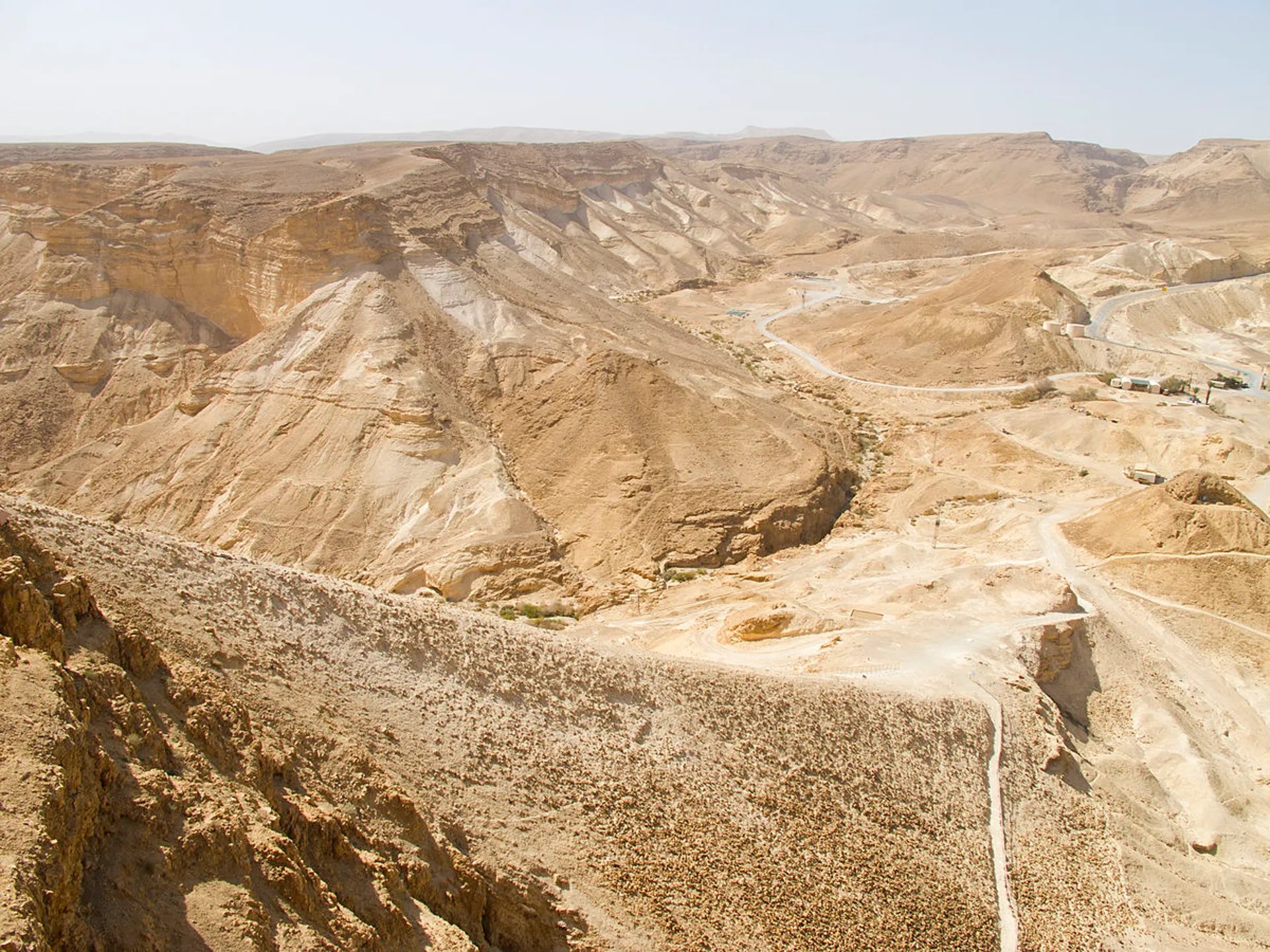
 

The “Roman ramp” at Masada: Some scholars think it too narrow and small to have been used to breach the fortress’ thick walls. Credit: Dan Lundberg

Other scholars argue in favor of tradition. Jonathon Roth of San Jose State University in California believes that a siege did take place, and that due to the height of the rock spur the Romans used as a foundation for their construction, they would have been able to construct their ramp in as little as four to six weeks. The siege would have been over shortly after that, Roth feels.

Though the first interpretation is tempting, unfortunately, no one can say for certain.

The missing dead

Despite Josephus’ account that 967 people called the fortress of Masada home in their final day, only 28 bodies were discovered by excavators, and only three were found in the palace, where Josephus said all were killed.

While wild animals, scavengers, and weather could explain why more intact bodies have not been found, thus far there have been no signs of any other bodies.

The missing bodies cast further doubt on Josephus’ account. It raises the possibility that Professor Jerome Murphy-O’Conner, from Ecole Biblique, was correct: there was no mass suicide at Masada.

Professor Yadin thought the remains had to be of Masada’s defenders and that the three found together were a family, perhaps the last defender who killed his men and his family and then finally killed himself. Yadin based his interpretation on the remains of armor found nearby, as Richard Monastersky wrote in 2002.

However, an anthropologist on the excavation team estimated that the man was between 20 and 22 years old, the woman was between 17 and 18, and the child was 11 or 12. While the man and woman could have been a married couple, the child could not have been theirs.

The other 25 bodies were found in a cave, which isn’t mentioned in Josephus’ account, while the bodies he did mention just aren’t there.

Shay Cohen, professor of Hebrew literature and philosophy at Harvard University, suspects these remains were indeed of Jews hiding from the Romans, but not well enough, and they were killed.

If so, that would contradict the account that the defenders of Masada were willingly killed by their own people to avoid capture by the Romans.

Joseph Zias of Jerusalem’s Rockefeller Museum suggests another possibility. He believes that the remains could be those of Roman soldiers. This would fit with Yadin’s admission that he had found the bones of pigs with the remains.

Dwelling with the swine would have been taboo for the Jewish rebels. However, Zias says, the Romans had no such constraints and also sacrificed pigs during burials.
The Legion Tenth Fretensis, who conducted the siege, even had a boar as one of their emblems, Zias says

Fourteen of the skeletons found in the cave were adult males. Six of them were between the ages of 35-50 and had builds that were of a “distinctly different physical type from the rest,” Prof. Ben Yehuda told Monastersky. That begs the thought that some of the bodies belonged to Romans soldiers, who may have been killed during a fight for the fortress, or may have been part of the occupation force left behind after the siege.

Unfortunately, the question of what happened to the remaining defenders is still unanswered. And if some of the few bodies belonged to Romans, killed in fighting for the fortress of Masada or otherwise, the story of a mass suicide becomes more questionable.

Blood and Brick … a world of walls

When our gallant Norman foes
Made our merry land their own,
And the Saxons from the Conqueror were flying,
At his bidding it arose in its panoply of stone,
A sentinel unliving and undying.
Insensible, I trow, as a sentinel should be,
Though a queen to save her head should come a-suing,
There’s a legend on its brow that is eloquent to me,
And it tells of duty done and duty doing.
The screw may twist and the rack may turn,
And men may bleed and men may burn,
O’er London town and its golden hoard
I keep my silent watch and ward!
WS Gilbert and Arthur Sullivan, The Yeomen of the Guard

I read British historian David Fry’s informative Walls: a history of civilisation in blood and brick a few years ago.

We’re not talking here of idioms, metaphors and analogies, like “facing the wall”, “up against the wall”, “another brick in the wall” and the anodyne “blank wall”. It’s all about imposing and impressive, massive and deliberately built structures designed to protect, contain or separate.

The breaching of Israel’s formidable high-tech wall which ostensibly sealed off the Palestinian enclave of Gaza on October 7th 2023 (more on that later) brought me back to my earlier notes. I’d gathered a few excellent reviews and random thoughts thereon, and I resolved to complete this article. The reviews republished below are informative and comprehensive, and well-worth reading.

I offer my own thought on the subject by way of an introduction. Neither they or I mention of a certain iconic song by Pink Floyd (I “almost mentioned the war” above) but I couldn’t resist opening with what many would call “the wall of walls”. It’s not Hadrian’s Wall, which has fascinated me since our first visit in 2015, when we stood atop the windswept knoll that is Housesteads Roman Fort on a freezing May morning. Nor is the Great Wall of China, iconic and impressive as it is – though I’m sure that if it had existed, you’d’ve been able to see this too from space. By the way, the opening quotation is a paean to the Tower of London, which, “if walls could talk” would have a great tale to tell.

The author at Housesteads Fort on Hadrian’s Wall

The view from Housesteads Fort, Hadrian’s Wal

The Wall has stood through it all …

I am the watcher on the wall. I am the shield that guards the realms of men. I pledge my life and honor to the Night’s Watch, for this night and all the nights to come.
The Oath of The Night’s Watch, Game of Thrones

George RR Martin, the author of the Game of Thrones epic has said that his Ice Wall separating the northern wintry waste with its nomads and its demons from the settled and temperate Westeros with its castles and cities, its palaces and slums, and destitute and the depraved, was inspired by a visit to Hadrian’s Wall – only he built it much longer and much, much higher. “We walked along the top of the wall just as the sun was going down. It was the fall. I stood there and looked out over the hills of Scotland and wondered what it would be like to be a Roman centurion … covered in furs and not knowing what would be coming out of the north at you” However, the author adds thats: Hadrian’s Wall is impressive, but it’s not really tall. A good ladder would be all you need to scramble right on over it. When you’re doing fantasy, it has to be bigger than in real life”.

We built a wall once …

A big one. Separating the backyard of our house from Camden Street, Newtown, Sydney. It was well over six foot high, rendered and scored to look “authentic” and entered thought a gate set into an ornate arch moulded to replicate the century-old portico of our front door. To build a wall that high, we had to take Council to the Land and Environment Court. We left that house over two decades ago. Our old house has changed hands several times since, but when the present owners wanted to redevelop the back end of that one-time corner shop that we once called home, Council mandated that the wall and the gateway had to be preserved because it was “heritage”. Such is the power and presence of walls.

Which brings us to the punchline. We built the wall for privacy and for security. But one night, while we were socialising upstairs, person or persons unknown scaled our wall, entered our house and swiped the handbags on the kitchen table. When the police came to investigate, a very agile constable shimmied up the wall and sat atop. So much for our wall. We ought to have laid broken glass or razor wire!

And that is the thing about walls:

Walls work … until they don’t 

We know that the Ice Wall protected by those Watchers of our opening quote fell to the zombie ice dragon Viserion and the dead. Drogon, the last of Queen Daenerys Targaryen’s “children” shattered the walls of Kings Landing, the decadent yet depressing capital of Westeros, and incinerated its unfortunate townsfolk.

The dead watch Visarion do his thing

Hadrian’s Wall fell into disrepair – it was always permeable, and in time, had served its purpose – which was perhaps as much about public relations as protection. Archeologist Terri Madenholme wrote in Haaretz: “Despite itself having a culture of violence, Rome aimed to project an image of a nation of the civilized, and what better way than having it monumentalized in stone? When Hadrian set to build the 73-miles-long wall drawing the border between Roman Britannia and the unconquered Caledonia, the message became even more clear: this is us, and that’s them. Hadrian’s Wall was much more than just a border control, keeping the Scots in check: it was a monument to Roman supremacy, an attempt to separate the civilized world from the savages”.

“He set out for Britain”, Hadrian’s historian tells us, “and there he put right many abuses and was the first to build a wall 80 miles long [Roman miles] to separate the barbarians and the Romans.

The Great Wall of China has in many places withstood the ravages of time, which says something about the skills of the workers who built it and the quality of its brickage. It had only been breached by Genghis Khan and the Manchus – until August 24 2023 when two Chinese construction workers in Shanxi province, were looking for a shortcut and drove heavy machinery through it, causing what authorities described as “irreversible damage” when they used an excavator to widen a gap in the wall.

The hole in the wall

The famous Theodosian Walls protected Constantinople since the foundation of the new capital of the Roman Empire by Emperor Constantine in 324 until they were breached by the Ottoman sultan Mehmet the Conqueror in 1453. He’d brought along a huge army and a bloody big gun. [The event is imaginatively recreated in Cloud Cuckoo Land  the 2021 novel by Pulitzer prize-winning author Anthony Doerr] Istanbul remained the capital of then Ottoman Empire for over half a millennium, and though dilapidated and discontinuous, they endure still. We have walked around them.

During the Cold War, Soviet controlled East Germany built its Berlin Wall virtually overnight to halt the haemorrhage of its population to the west and freedom, and it endured for thirty years with all its concrete, wire, guards, guns and deaths, until it fell, over thirty years ago, virtually overnight. And rejoicing Germans demolished it for souvenirs.

In Belfast, the capital of Northern Ireland, there are imposing walls that have actually stood longer than that in Berlin. Now called the the Peace Walls, they were first erected by the British army in 1969. They were temporary affairs of corrugated iron, as the inter-community conflict solidified and ossified, they were soon  extended and upgraded to bricks, steel and concrete. The walls separated predominantly Protestant loyalist and Catholic nationalist enclaves throughout The Troubles, the three decades of bombings, murders, riots and civil-rights protests.

Though not all linked, 38 kilometres of walls still slice through the city, outliving the conflict that engendered them. Only some short sections have been removed – partly they’ve become a tourist attraction, while the communities that live closest to them say they still provide a sense of security – though tensions may have eased, people are easily divided and it’s much harder to bring them together again. In the Shankill and Falls roads area of western Belfast, which were particularly notorious during The Troubles, the wall is splattered with political messaging, which makes it easy to know which side you’re on. One side has portraits of British soldiers and the queen and kerbs are painted red, white and blue. On the other the colours of the Irish flag predominate, framing portraits of Republican heroes and hunger-strike martyrs.

Belfast’s Peace Wall

Walls or fortified fences are all the fashion in the Middle East. Egypt has built one on its border with Libya – and also with Gaza. Saudi Arabia has put one between it a Yemen and also, one with Iraq. Kuwait has one too with its former invader. In the Maghreb, Morocco constructed the longest wall in the world dividing the former colony of Spanish Sahara from its independence fighters in their Algerian sanctuaries; and yet, the modern world’s longest enduring independence struggle continues.

The Israelis built the Separation Wall to halt the bombings of buses and bistros in Jerusalem and Tel Aviv during the Second Intifada and have maintained it as an instrument of security and control and of divisive national politics. And on the whole, it has worked, except that it has entrenched the isolation from each other of the Israeli and Palestinian communities, and increased in many, a lack of familiarity and empathy and a mutual fear and loathing that does not auger well for peaceful coexistence.

If you walk atop the Ottoman Walls that still circle the Old City of Jerusalem, you can see it and the Haram Al Sharif, the Dome of the Rock, from where the walls pass Mount Zion. It snakes away in the distance through the arid landscape and white sandstone suburbs like an incongruous grey scar. We’ve crossed through the wall and IDF and Border Police checkpoints many times in our travels through Israel and Palestine. On one journey, a cross-country drive across the Judean desert from the satellite city of Ma’ale Adumin to the ancient and amazing monastery of Mar Saba, we passed through fields where Bedouin women harvested wild wheat with sickles as their forebears did of old and actually walked across the footings of a section of the wall that has been abandoned when the high court determined that its construction would prevent the Bedouin from traversing their traditional grazing grounds.

In his final book, Night of Power, published posthumously in 2024, the late foreign correspondent Robert Fisk provides a dramatic description of this “immense fortress wall” which snakes “firstly around Jerusalem but then north and south of the city as far as 12 miles deep into Palestine territory, cutting and escarping its way over the landscape to embrace most of the Jewish colonies … It did deter suicide bombers, but it was also gobbled up more Arab land. In places it is 26 feet or twice the height of the Berlin wall. Ditches, barbed wire, patrol roads and reinforced concrete watchtowers completed this grim travesty of peace. But as the wall grew to 440 miles in length, journalists clung to the language of ‘normalcy’ a ‘barrier’ after all surely is just a pole across the road, at most a police checkpoint, while a ‘fence’ something we might find between gardens or neighbouring fields. So why would we be surprised when Italian Prime Minister Silvio Berlisconi, traveling through the massive obstruction outside Bethlehem in February 2010 said that he did not notice it. But visitors to Jerusalem are struck by the wall’s surpassing gray ugliness. Its immensity dwarfed the landscape of low hills and Palestinian villages and crudely humiliated beauty of the original Ottoman walls Churches mosques and synagogues .. Ultimately the wall was found to have put nearly 15% of West Bank land on the Israeli side and disrupted the lives of a third of the Palestine population. It would, the UN discovered, entrap 274,000 Palestinians in enclaves and cut off another 400,000 from their fields, jobs, schools and hospitals”.

Leftwing Israeli journalist Amira Haas, who lives in the West Bank, takes Fisk on a tour of the wall:

“Towering 26 feet above us, stern, monstrous in its determination, coiling and snaking between the apartment blocks and skulking in wadis and turning back on itself until you have two walls, one after the other. You shake your head a moment – when suddenly through some miscalculation surely – there is no wall at all but a shopping street or a bare hillside of scrub and rock. And then the splash of red, sloping rooves and pools and trees of the colonies and yes, more walks and barbed wire fences and yet bigger walls. And then, once more the beast itself, guardian of Israel’s colonies: the Wall.

The Separation Wall between Jerusalem and Ramallah. Paul Hemphill 2016

Israel also built a forty-mile so-called smart fence around the Hamas-controlled enclave of Gaza, decked out with cameras, radars, and sensors. It was meant to both stop large-scale Hamas attacks and provide warning if Hamas was gathering its forces. This failed disastrously on October 7th 2023.

Those defenses, of course, did work for many years. The Hamas, which used to send numerous suicide bombers into Israel, was largely unable to penetrate the border from Gaza, in large part due to the fence. In fact, Hamas had to plan for several years and conduct a massive operation to overcome the defenses – not an easy task and one that should have been detected and disrupted by Israeli intelligence.

The Hamas’ assault on the black Shabbat demonstrated chillingly that defenses by themselves are never sufficient. They must be backed up by intelligence and a rapid-response capability, making any breach less consequential for Israel and potentially disastrous for Hamas. Indeed, had Israel been able to scramble a small number of attack helicopters to Gaza quickly as the assault force was breaching the fence, Hamas would have suffered huge losses.

Yes, walls work, until, for one reason or another, they don’t …

Aida Refugee Camp outside  Bethlehem, Paul Hemphill 2016

An illusion of safety

I will ask more of you than any khal has ever asked of his khalassar! Will you ride the wooden horses across the black salt sea? Will you kill my enemies in their iron suits and tear down their stone houses? Will you give me the Seven Kingdoms, the gift Khal Drogo promised me before the Mother of Mountains? Are you with me? Now… and always!”  
Danearys Targaryen, Game of Thrones

And they were, and they did, with the help, of course, of dragons.

While walls are destined to fall one day, people like walls. They project a language of security – but their construction stems from a sense of insecurity, an intense fear of losing what you have.

In an early post, The Twilight of the Equine Gods, we talked of the horsemen of the plains and steppes who descended violently upon the sedentary lands of Europe the Middle East and China. The folk on the pointy end of their depredations built walls to keep them out.

But while people feel safe behind walls, their impregnability is often illusory.

Walls have gates and these permit ordinary, decent folk to enter and exit – to work, to trade, to parlay, to mingle, communicate and court. The forts along Hadrian’s Wall tell the story of such coexistence and cohabitation. But some people don’t bother with gates. Thieves can scale them and climb over them. Enemies too – they clamber over them, dig under them, mine them and bring them tumbling down, or by subterfuge, they can suborn, beguile or bribe a turncoat or waverer to open the gates or reveal a secret entrance. The ancient Greeks bearing their dubious gifts brought down “the topless towers of Illium” with a ruse that launched a thousand analogies and the famous aphorism “beware Greeks bearing gifts”. The Greeks have never lived that one down.

I’ve had the privilege and pleasure of walking the corridors and standing on battlements of some of those great crusader castles of Syria and Palestine – of Qala’t al Husn, known to the world as Krak de Chevaliers, of Qala’t Salahuddin in Syria’s Alawite heartland, and Belvoir in Israel. These fell not by storm but by subterfuge – plants, turncoats or bribes By geological happenstance, these three significant citadels were built above the great Rift Valley that runs from Africa to Turkey and from their still imposing ramparts, the traveller can look out over several countries and appreciate the strategic importance of these man-made megaliths.

Krak de Chevaliers, Husn, near Homs, Syria. Paul Hemphill 2006

Krak de Chevaliers,Paul Hemphill 2006

The Golden Gate, Jerusalem, from Gethsemene. Paul Hemphill 2016

A world of walls

And the great and winding wall between us
Seem to copy the lines of your face
Bruce Cockburn, Embers of Eden

In his Booker Award winning novel Apeirogon, Irish author Column McCann’s Palestinian protagonist Rami, speaking of the death of his daughter at the hands of the IDF, says: “all walls are destined to fall, no matter what”. But Rami “was not so naive, though, to believe that more would not be built. It was a world of walls. Still, it was his job to insert a crack in the one most visible to him”.

Walls are in vogue nowadays. We declare that we should be building bridges, and yet, we keep building walls. Indeed, walls and wire define and divide the brotherhood of man.

Walls keep unwanted people out and nervous people in. Or prisoners – the world is full of those. The USA, The Land of the Free, incarcerates more than any other nation – except China. More than Iran, or Turkey, each with tens of thousands of political prisoners. The majority of inmates in American and Australian jails are black.

And walls protect us from “the other”.

Australian commentator Waleed Aly wrote in the SMH 9 November 2019: “A wall doesn’t just exclude. It obscures. It renders those on the other side invisible. And once people are invisible, they become mythological beasts. Their lives, their attitudes, their aspirations all become figments of our imagination”. Read the full article below.

To my thinking, this can apply to several of today’s intractable conflicts. The division between North and South Korea, for example, with its heavily weaponized DMZ. Iran and its ostensible enemies. And as I alluded to above, the walls that divide Israelis and Palestinians in the West Bank and in Gaza.

Back in the day, I would walk from Ramallah, then but a small town, to Jerusalem. I’d traverse the old city, and head up the Jaffa Road to the bus station and thence, to Tel Aviv. Today, there is the Separation Barrier and checkpoints, and exclusive roads – easier for visitors like ourselves as we traversed the Occupied Territories, but excruciating and humiliating for the tens of thousands of Palestinians who, until October 7, crossed into Israel daily to work “on the other side” and visit family and friends in East Jerusalem and in Israel.

Amira Haas describes the road I once walked down: “It’s a destruction of peoples life – it’s the end of the world. See here? We go straight to Jerusalem. Not now. This was a busy road and you can see here how people invested in homes with a little bit of grace, the strength of the houses, the stone. Look at the Hebrew signs because these Palestinians used to have so many Israeli customers”. But, Fisk writes, “almost all the shops are closed, the houses shuttered, weeds and sticks along the broken curb. The graffiti is pitiful, the sun merciless, the sky so caked with the heat that the grey of the Wall sometimes merges into the grey stone of the sky. “It is pathetic this place” Amira Hass says. I’ve always been showing it to people always, you know hundred times and it never stop shocking me”.

The border fence between Saudi Arabia and Iraq

The border fence between Kuwait and Iraq

Girt by sea … 

That’s from our Australian national anthem, a paean to our pale Anglo-Celtic Christian heritage, continually updated as our values and our demography changes. It reminds us that walls are not necessarily built of bricks and mortar. An ocean can serve the same purpose.

The English, for example, have always rejoiced in their insular status. As early as the 13th century, an English chronicler described England as “set at the end of the world, the sea girding it around”. It was the sentiment which Shakespeare put into the mouth of the dying John of Gaunt in Richard II”: This precious stone set in the silver sea, which serves it in the office of a wall, or as a moat defensive to a house, against the envy of less happy lands.” It is part of the classic canon of English patriotism. Yet it was and remains a myth. As historian Jonathan Sumption, has pointed out, politically, England was not an island until defeat in the Hundred Years War made it one – had been part of a European polity.

Indeed, the aforementioned Hadrian’s Wall served as a more strategic historical reference point. In the preface to Pax, the latest volume of his magisterial history of the Roman Empire, English historian Tom Holland notes that the northern bank of the river Tyne was the furthest north that a Roman Emperor ever visited. What was so important about Hadrian’s visit to Tyneside in 122AD was his decision there to mark in stone, for the first time, the official limits of his Empire. North of this great wall, there was paucity and unspeakable barbarism, scarcely worth bothering about; below the wall was civility and abundance and the blessings of Romanitas. To this day, those 73 miles of the Vallum Hadriani across the jugular of Britain still shape the common conception of where England and Scotland begin and end, even though the wall has never delineated the Anglo-Scottish border. For this colossal structure left enduring psychological as well as physical remains. To the Saxons, it was “the work of giants” and was often thought of as a metaphysical frontier with the land of the dead – George  R got that part right too.

The “sceptred isle” tag prevails, but. It’s how many Brit’s saw themselves back then and right up to the sixties when we had to memorise it at grammar school: This earth of majesty, this seat of Mars, this other Eden, demi-paradise, this fortress built by Nature for herself against infection and the hand of war. This happy breed of men, this little world”. I couldn’t resist quoting it.

Our Island Story: A Child’s History of England, by British author Henrietta Elizabeth Marshall, first published in 1905, covered the history of England from the time of the Roman occupation until Queen Victoria’s death, using a mixture of traditional history and mythology to explain the story of British history in a way accessible to younger readers. It depicted the union of England and Scotland as a desirable and inevitable event, and praises rebels and the collective will of the common people in opposing tyrants, including kings like John and Charles I. It inspired a parody, 1066 and All That. Former Prime Minister David Cameron chose the book when asked to select his favourite childhood book in October 2010: “When I was younger, I particularly enjoyed Our Island Story … It is written in a way that really captured my imagination and which nurtured my interest in the history of our great nation”.

Maybe the Island Nation prevailed in its time – notwithstanding John Bull’s Other Island just over the water and the “troubles” it caused. But the French port of Calais that was such a headache to the Plantagenet kings back in the day is a persistent migraine today as folk from faraway places arrivethere hoping to board flimsy boats, casting their fortunes and their lives to the waves of one of the world’s busiest and tempestuous sea ways in the hope of a better life in the green and pleasant land of song and story.

We in Australia do have a unique wall – the ocean surrounding us.

Our former and now disgraced Australian prime minister Scott Morrison prime minister once declared that he himself was a wall, barring what we in official Australia call unauthorized arrivals by sea. The wall surrounding our continent – we are indeed the only nation that covers exclusively its own continent – is a wide watery one – huge, forbidding, and, depending on the operating budget and competence of the Australian Border Force, impenetrable. And it costs is a motza. In December 2020, The Guardian reported that Australia will spend nearly $1.2 billion on offshore detention – it’s called “processing” – that financial year, even though fewer than 300 people remained in ‘offshore detention” in Papua New Guinea and Nauru That’s roughly $4m for each person. Our government has spent more than $12 billion on offshore processing in the past eight financial years.

It might be less than the US$20 billion President Trump wanted to waste on a border wall, but it is far more as a proportion of government revenue and national income and more than five times the UN refugee agency’s entire budget for all of Southeast Asia.

That’s all from me. The reviews follow, but first some of the articles referred to in my narrative.

© Paul Hemphill 2024.  All rights reserved.

Al Tariq al Salabiyin – the Crusaders’ Trail

Roman Wall Blues – life and love in a cold climate

The Twilight of the Equine Gods

Thirty years after the fall of the Berlin Wall, we are building them again

Waleed Ali, Sydney Morning Herald, November 7, 2019

Sometimes that is literal as in the case of Donald Trump most famous, still unfulfilled promise. Sometimes this is figurative as in the case of Brexit (though it has dangerously literal implications in Northern Ireland). And sometimes this is a particularly pointed development, as in the case of countries that were once part of the Soviet bloc, which have turned in sharply illiberal, nationalist, anti-immigrant directions: places like Hungary and Poland.

Even as far afield as Australia we are being lightly stalked by this fortress mentality, too. Mostly this has focused on boats, but it is spreading now to a populist suspicion of globalisation more generally, especially where it involves us having obligations to other countries or the environment.

I don’t want to stretch the comparison too far. Today’s walls are about excluding the foreigner, while the Berlin Wall was built for the opposite reason: to keep East Germans in. But there is still an important continuity here, something powerful and important in the idea of a wall, that makes it so symbolic, whatever immediate function it serves. More profound than the physical barrier is the psychological one. That’s as true today as it was in Berlin.

Konrad Schumann leaps the barbed wire into West Berlin on 15 August 1961

Children at the Berlin Wall on Sebastianstrasse, around 1964 (Lehnartz/ullstein bild, Getty Images)

The fall of the Berlin Wall, November 1989

These narratives tell an uncomplicated story of the other that is really designed to tell an uncomplicated, heroic story about oneself. The East’s imagined multitudes of poor Westerners was a way of saying the Eastern system was superior and just. Hence, the West had to be wild and unequal. Meanwhile, the Western story of the East was a way of eliding its own shortcomings, establishing a triumphant narrative of freedom that swept away concerns about social injustice.

Walls make this so much easier. Aside from all else they do, walls prevent us from knowing each other. That has serious real-world consequences. We call the period after the Berlin Wall fell “reunification”, but it was really a Western annexation of the East. East became West, not some other accommodation. So thorough was the West’s self-regard, so comprehensive its belief in the East’s unmitigated bleakness, that it respected none of the institutions the East had built. It privatised and sold off its industries to the highest bidder – inevitably West Germans. It shut down its companies, more or less assuming they had nothing to offer.

The result saw East Germans with little choice but to head West for jobs, and the East hasn’t quite recovered. Today it is older, poorer, and endures higher unemployment. It’s only by knowing this that we can understand why a government study found 38 per cent of East Germans think reunification was a bad thing. A majority feel they are now second-class citizens. We’re seeing a rise of far-right radicalism, even neo-Nazism, in Germany. Its heartland is in the East.

Today’s walls are built on the same logic. They all offer some self-aggrandizing view of the world in which everyone else deep down wishes they were like us. Whether believing in the eternal supremacy of the British Empire in the case of Brexit, or that asylum seekers are really more interested in finding a back door to Australia than they are in fleeing persecution, the foreigner exists mostly as a counterpoint to our own magnificence. What matters is that they remain unknown and unknowable so we can mould them to our opposites, and they can be scapegoated for our problems.

We’re so committed to this kind of psychology that we will establish walls precisely where we’re told they can’t be built. Even something as borderless as the internet has become a landscape of barricades, populated by people talking only about their enemies and only to their friends. As a result, almost no one is knowable anymore.

So let me add one more idea to this week’s litany of Berlin Wall reflections: that it be a symbol of human arrogance. The arrogance to control and lie to one’s own people, sure. But the arrogance of choosing isolation, too. The arrogance of believing that the other has nothing to offer us. And the arrogance of believing that we can be fully formed in others’ absence; of treating other people as mere raw material from which we can manufacture ourselves.

Waleed Aly is a regular columnist and a lecturer in politics at Monash University.

A crash course in barrier building

Walls: a history of civilisation in blood and brick by David Fry Faber 2018.
Reviewed in the Australian by Pat Shell, March 16, 2019

“Build bridges, not walls. It’s a slogan”, writes Frye (Ancient and Middle Eastern History/Eastern Connecticut State Univ.), “designed to give military historians fits.”

Bridges, after all, have military purposes: to get across moats and earthworks and to ford rivers into enemy territory. Walls, on the other hand, make peace – history offers plenty of examples, he writes, to show that “the sense of security created by walls freed more and more males from the requirement of serving as warriors.”

Indeed, by Frye’s account, walls are hallmarks of civilization, if ones that are easily thwarted.

One of his examples is the Tres Long Mur, a defensive structure built more than 4,000 years ago, stretching across the Syrian desert and shielding some of the world’s oldest towns from marauders from the steppes beyond. There are mysteries associated with the ruins, just as there are with the Great Wall of China, another of Frye’s examples—and one that proves, readily, that where walls go up, people find ways to get around and over them.

The author’s pointed case study of Hadrian’s Wall shows that it may not have been a defensive success, but that does not mean it didn’t have a defensive purpose, as some scholars have recently argued. As he writes, wittily, “there is little to be gained from rationalizing an irrational past.”

Another defensive failure is the Maginot Line, which became more symbolic than practical in an age of modern tanks; on the reverse side are spectacular successes, such as the great walls of Constantinople, which shielded the city from siege by as many as 200,000 soldiers of the caliphate, “one of the greatest turning points in history.”

Walls have many purposes, he concludes, and it is rather ironic that the matter of walls is often as divisive as a wall itself.

A provocative, well-written, and – with walls rising everywhere on the planet – timely study.

Walls work, and walls save lives. So declared Donald Trump in the 2019 State of the Union address. Not long after that, he went a step further, just clearing Congress’ refusal to front with the funds for 4 billion bricks to be a national emergency.

There are times when that view could be right. How a well-built levee might postpone the inevitable when the rain keeps fallin’ and the river done rose. For a while it least.

But the US president wasn’t talking about breakwaters and climate change mitigation. The tsunami he is hoping to surf home to a tsecond term is a tidal bore of human flesh. He thinks that a Mexican wall is needed to keep out rapists, drug dealers, terrorists and Venezuelan communists.

But his wall, if ever built, will never achieve what wall builders through the ages have vainly striven for: to stop time itself, to freeze history at the pinnacle of their power. And in so doing, through the erection of military masonry on a monumental scale, confidently wallow in the triumphant delusions screamed by Ozymandias at weary gods who have heard it all before.

In short, the inevitable corollary of the invention of Real Estate: the creation of an exclusive neighbourhood to keep out riffraff.

Walls, David Frye’s fascinating and timely analysis of the rise and fall of empires, religions, cultures and languages, is so compellingly readable because it urges to look closely at human artifacts so everyday, so ordinary that we only rarely see them as instruments of power and authority. They can be impressive, sure, but not like an aircraft carrier steaming lies and all the flight of the two banners overhead.

We walk past walls every day. We live behind them. They hold up our roofs. Once fitted with a solid locked door and the steel-grated windows, they protect us, and not just from the wind and the rain.

Frye is an American historian. His main point is not just that walls, the stone and earthen shield of homesteads, palaces, towns, indeed entire nations, are as old as civilisation itself. He thinks that for all intents and purposes, walls are civilisation itself, or, at the very least have allowed civilisations to come into being.

He reminds us that like armies, walls don’t go anywhere. Like armies, they can be enormous, and symbolic of great power and proprietary rights, but they rise and fall in situ, and define the status of all who live around them.

Either you live inside the wall, or you don’t. And depending on how you define civilizations, they rarely flourish without a stable address of some sort. The Athenians wouldn’t have bothered building the Parthenon if they’d had to pull it down every winter to follow their goats to Macedonia in search of greener pastures. But they had to be able to go to bed at night confident that the marvels of the Acropolis would still be there in the morning.

And while the kind of people who write and read books such as Walls are by definition “inside the wall” characters, Frye notes the disdain with which “basket carrying” sybarites were regard by those on the outer.

The barbarians, the hordes. The marauding warriors. Luxury is for wimps, art an affectation citation for the feeble and effete. The Huns, Mongols, Cossacks, Names that are synonymous for people who would rather burn a city to the ground than simply move in and celebrate their luxurious residential arrangements by draining the wine cellars and frolicking in the fountains.

When the great unwashed arrived in sufficient numbers to break down the ramparts, they didn’t mess around. To them, plumbing, hanging gardens, marble theatres and elegant geometry will not try ounce of human aspiration, but conversions.

It is this primal fear of defenses overwhelmed that fuels Trump’s calculated hysteria today. While he may, without quite saying it in so many words, be grasping for historical legitimacy by asking his countrymen to “Remember The Alamo”, He does play on fears food in for thousands of years of siege warfare, and the grizzly fates that befell the losers.

And while the discounted insurance premiums that come with the electrified fences and gated communities of Bel Air and Rhode Island might ease the terror of wealthy Americans, a home invasion is small beer compared to the total collapse of “homeland security” in the real world.

Of the examples Frye gives of barriers breached and the resultant bloodbaths, and there are many, perhaps the most extraordinary is the Mongol demolition of Thirteenth Century China. “ The population of China fell from a 120 million in 1207 to 60 million in 1290. Mongols “boasted that they could ride over the sites of many former cities without encountering any remains high enough to make their horses stumble”.

Genghis Khan, born and bred on the merciless steppe, saw Chinese sophistication as an affront to nature, much as the Spartans mocked the music and theatre of the Athenians.

He shrugged off the carnage and destruction he had wrought as nature’s mockery of Chinese hubris and pretensions: “Heaven is weary of the beauty of the inordinate luxury of China”.

Trump doesn’t care for it much either, it seems. Perhaps a wise adviser might take a moment to point out to him the bridges are usually a far better long-term investment than barbed wire.

as The Eurasian Steppe by the archaeologist Warwick Ball makes clear, rather than a semi-wild anteroom to the continent, “the history, languages, ideas, art forms, peoples, nations and identities of the steppe have shaped almost every aspect of the life of Europe”. Europeans from further west have for centuries been prone to viewing the steppe as the haunt of wild tribes, and the source of occasional, fearsome destruction.
https://unherd.com/2022/07/the-fate-of-europe-lies-in-the-steppes/

Review of Walls: history of civilisation in blood and brick 

John M. Formy-Duval, retired teacher of ancient and medieval history and educator, on this books and  reading blogspot.

In Walls: a History of Civilization in Blood and Brick, David Frye has written an encompassing and enlightening review of walls through the centuries, ranging from 2000 B.C. to the present. A “Selected Timeline” covers the subject matter in four geographical areas: Near East and Central Asia; Europe; China; and the Americas. Frye writes that walls can take the form of “protectionist economic policies,” a “great internet firewall,” razor wire with motion sensors, or concrete barriers. Stringent, punitive immigration policies around the world seek to keep the perceived destroyers of “our culture out.” That is, we belong here; you do not.

“Few civilized people have even lived without them,” Frye emphasizes. From ditches to sapling fences to berms to walls, the level of sophistication rose as people perceived an increasing need for protection from, literally, the barbarians at the gate. Farmers settled and fortified their small villages. Even today one finds fences around Maasai villages in Tanzania. As villages transitioned into cities, their walls grew with them, often into great defensive bulwarks. Even Shakespeare’s Juliet recognized that “these walls are high and hard to climb.”

The epilogue “Love Your Neighbor, but Don’t Pull Down Your Hedge” covers the period from 1990 to the present. This section begins and ends with an account of how the Malibu coastline transitioned from the single ownership of May Rindge in 1892 until 1926, when she grudgingly agreed to lease some properties after numerous shootings, sheep poisonings, and a Supreme Court decision that went against her. Focusing on the present, Frye embarks on an account of the spate of walls built since the Berlin Wall was torn down. From the United States to the Middle East to Southern Europe and India, and nearly everywhere else, it seems, the pace, enormity, and sophistication of these walls is astounding.

People are familiar with the walls Israel has erected in which “infrared night sensors, radar, seismic sensors for detecting underground activity, balloon-born cameras, and unmanned, remote-controlled Ford F-350 trucks, equipped with video cameras and machine guns, augment the wall’s concrete slabs and concertina wire.” Lesser known is Saudi Arabia’s effort, begun in 2003, to create a barrier across its eleven-hundred-mile border with Yemen. The barrier rises across the desolate Empty Quarter, home of significant oil reserves. “Ten-foot high steel pipes, filled with concrete” provide the frame for razor wire while tunnels burrow deep underground. The Saudis have a second, more heavily fortified wall that ranges six hundred miles along their border with Iraq. Egypt, Jordan, India, Thailand and Malaysia, Morocco and Algeria, and Kenya are also in the wall-building business, often with funds or construction assistance either from the United States government or private businesses.

The U.S. was in the wall-building business along our border with Mexico long before the present administration, although the present focus changed the dialogue. We had barriers, little more than fences, before the Berlin Wall fell. Under President Clinton, for example, extensions were added to the existing barriers in 1993, 1994, and 1997. After Berlin, however, the word “wall” was largely abandoned in favor of softer language, and in 2006 the “Secure Fence Act” extended the extensions undertaken during Clinton’s time in office. Who knows what will happen at the present time?

Walls have deep effects on us. They box us in; they shut us out; they keep others out. They come in physical form, but they can be purely psychological, designed to prevent us from sinking into “the other side of the tracks.” Professional nomenclature excludes people and gives the holders of the language key a sense of superiority. Myriad iterations of “wall” provide endless means to isolate us and keep them out.

Frye provides the who, what, where, when, and how of walls ancient and modern. The Great Wall and Hadrian’s Wall are generally known, but he touches on the thousands of walls that continue to exist today and continue to be built “while we wait on everyone else to become just as civilized as we are.”

About Walls

Review in Always Trust in Books blog

For thousands of years, humans have built walls and assaulted them, admired walls and reviled them. Great Walls have appeared on nearly every continent, the handiwork of people from Persia, Rome, China, Central America, and beyond. They have accompanied the rise of cities, nations, and empires. And yet they rarely appear in our history books.

Spanning centuries and millennia, drawing on archaeological digs to evidence from Berlin and Hollywood, David Frye uncovers the story of walls and asks questions that are both intriguing and profound. Did walls make civilization possible? Can we live without them?

This is more than a tale of bricks and stone: Frye reveals the startling link between what we build and how we live, who we are and how we came to be. It is nothing less than the story of civilization.

‘The creators of the first civilisations descended from generations of wall builders. They used their newfound advantages in organization and numbers to build bigger walls. More than a few still survive. In the pages that follow, I will often describe these monuments with imposing measures – their height, their thickness, sometimes their volumes, almost always their lengths. These numbers may begin to lose their impact after a while. They can only tell us so much. We will always learn more by examining the people who built the walls or the fear that lead to their construction.’

David Frye’s Walls is a classic non-fiction read that left me not only well informed but with a deeper appreciation and understanding of world history. From 10,000 B.C right up to the present day, David Frye explains how fundamental the invention, construction and development of walls were (and still are) to the progression of humanity. If you are here purely for a history of walls then you may be disappointed as DF is more interested in the influence instead of the existence of walls. DF took me on a guided tour through key periods in the history of mankind and how the creation (and protection) of walls allowed us to flourish as a species but also the ramifications and innovations that they led to later on.

DF lead me through civilisations that either accepted or rejected the concept of being walled (or caged) in and how their decisions affected the population and also the other nations around them. Walls redefined our ability to exist in a barbaric world and allowed us to focus on scientific and cultural advancements. It also allowed some kingdoms to go soft, so to speak. DF also focuses on the absence of walls and how it changed the civilisations who refused to hide behind them; nations like the Spartans, Mongols and Native Americans who lived to fight for what was theirs or claim new lands for themselves.

The amount of coverage is exceptional, from the Roman Empire, Mesopotamia and China (with their many great walls) to Greece, Constantinople and Berlin. Walls are essential to the telling of history and David Frye did a fantastic and immersive job with his writing. Informative, concise, engrossing (narrative elements), well structured and paced out, David’s writing made this book totally worth my time. He could have easily knocked out this book with his extensive knowledge of war and culture but he went the extra mile. Making connections, observations and theories that made the content more comprehensive and digestible (with some hilarious comments too).

Recent history seems in part to be governed by a chain reaction that saw the building of more and more elaborate walls. Each emperor saw fit to out do their predecessors or competition. Each iteration of wall has its successes and failures, while destroying them advanced weaponry and military tactics along the way. I loved spending time with different time periods and walking amongst the mythos, history, socio-economic backgrounds, knowledge and statistics surrounding the world’s walls and those compelled to build them for their own needs or the needs of many. I especially enjoyed how David Frye’s message about walls was fluid and how it evolved over the course of the book. How humanity grew out of their need for walls and yet still see them in a symbolic nature. How destroying a wall can be as powerful as building one.

Frye knows perfectly where to stop and elaborate or move on to new points. He also doesn’t shy away from the darker shades of history so be aware of graphic detail. There is a lot to learn in this book but DF has written it in a way that it is never too much and I always wanted to know more. There are many highlights to Walls and I can’t recommend it enough to Non-Fiction lovers of many varieties. If you like detail, history, mythology (and ghost stories), the many aspects of building civilisation and humanity’s past then Walls is a great book to get stuck into. We owe walls our lives and without their protection our societies would have never been the same.

‘The walls alone have seen the truth, and they are mute’

David Frye

A native of East Tennessee, David Frye received his Ph.D. in late ancient history from Duke University in 1991 and is presently a professor of history at Eastern Connecticut State University, where he teaches ancient and medieval history. Frye’s academic articles have appeared in the UK, Germany, Sweden, and Denmark, as well as the United States, in journals such as Nottingham Medieval Studies, Classical World, Byzantion, Historia, Hermes: Zeitschrift fur klassische Philologie, The Journal of Ecclesiastical History, and Classica et Mediaevalia. In addition, he has published in various popular archaeological and historical magazines and on the online humor site McSweeney’s. As part of his research, he has participated in archaeological excavations in Britain and Romania. (Goodreads Biography)


The calculus of carnage – the mathematics of Muslim on Muslim mortality

Call it moral relativism or “whataboutism” (or, like some conjuror’s trick, “don’t look here, look over there!) but it is not a matter of opinion, more a simple matter of observation, to point out that Muslims are in the main subdued when their fellow Muslims are killed by other Muslims.

The Syrian civil War has killed over half a million souls. 150,000 have did in Yemen.  In Sudan, more than ten thousand people have perished in the latest civil war. ISIS killed tens of thousands. Iraq, Libya, Afghanistan. Muslims killed by Muslims. And millions displaced and enduring famine and disease.

In recent years Muslims have slain more Muslims than those killed by Israeli forces and settlers since 1948 (though we”ll never know how many  – official and semiofficial figures cite casualties from the Independence War and al Nakba of 1948 to 2021, 63,543, including 31,227 fatalities, plus, of course, the ghastly toll of the current Gaza war, but this is probably massively understated).

There has been no significant unrest in the West over the hundreds of thousands of Muslims killed by fellow Muslims (apart from a visceral horror of the violence inflicted upon civilians and prisoners by the jihadis of the Islamic State. No public outcry or social media fury, no angry street protests by left-wing activists of vacuous members by armchair, value-signaling clicktavists.

Why this apparent indifference? Many left-wing impressions are coloured by a an antipathy for the policies of the United States, an antipathy that for many was born of the Vietnam War and was perpetuated by America’s interference in the affairs of nations large and small since then – and of course, America’s strong ideological and military support for Israel. Uncle Sam certainly does have a case to answer. There’s no denying the hundreds of thousands, millions maybe, of bodies of men, women and children that could be laid at the foot of Abe Lincoln’s huge statue in Washington DC.

And what of the rise in antisemitism around the world? After the blood Hamas pogrom of October 7, it took just 24 hours for anti-Israeli sentiment to turn into anti-Jewish sentiment. It was on full display throughout the West before the bodies of the men and women and children murdered had even been counted and identified, and the number of hostages revealed; and before Israel’s relentless and brutal retaliation again Gaza which has killed tens of thousands more innocents.

A charitable explanation would be a mix of political and historical ignorance and a dogmatic belief that renders Jews, whether Israeli or in the diaspora ‘white’, ‘colonial’ and ‘oppressors’, and Muslims ‘oppressed’, and encourages progressives to turn a blinkered or blind eye to some of the most hideous crimes on the planet. It is an ideological stance uninformed by knowledge and awareness of the nature of the Israeli and Palestinian entities, their peoples, and their cultures in the 21st Century.

But there is also reality that what we’ve been seeing in cities around the world is that antisemitism is the devil that never goes away.

I republish below an article that summarizes quite well the mathematics of Muslim on Muslim mortality. It is written by a rightwing author in a right-wing publication, and many of his observations thereon may be selective, subjective, controversial, and potentially exaggerated and inaccurate, but the underlying basic arguments is sound. Countries subject to interminable potentially intractable and often internecine conflict, rigid, authoritarian, and ofttimes theocratic conservative beliefs and social structures, and endemic political instability rarely prosper in our modern interconnected world and often end up serving as expendable pawns in more powerful players’ power games. 

I also republish a recent article by The Australian’s foreign editor Greg Sheriden on how the rising antisemitism in the West is undoubtable fueled by the increasing numbers of migrants form conservative countries where antisemitism is encouraged and inculcated by the media, by educational systems and by socialization.

These communities often have an enormous political and cultural impact on their host countries. While the overwhelming majority of Muslims in Australia and other western countries are law-abiding, productive citizens, a small minority is attracted to some form of political violence or intimidation. And, if Australia’s Arab and North African Muslims are remotely similar to those in Europe and the US, they harbour serious anti-Semitic attitudes, plus other views that are anti-Western.

In 2014, the Jewish Anti-Defamation League conducted an immense survey that sampled the opinions of 53,000 people in numerous countries. It found that 74 per cent of Middle East and North African respondents (not necessarily all of them Muslim, though the overwhelming majorty would be) expressed anti-Semitic attitudes, which was measured by endorsing six or more of 11 common anti-Semitic stereotypes, such as Jews controlling world banking, or the US government, or being responsible for most of the world’s wars. This figure of 73 per cent was vastly in excess of any other regional or national group. Non-Jewish think tanks produce similar results. A survey conducted by the Henry Jackson Society in 2020 found nearly half of British Muslims hold anti-Semitic views.

See also in On That Howling Infinite, “You want it darker?” … Gaza and the devil that never went away …

For more on antisemitism in In That Howling Infinite, see: Little Sir Hugh – Old England’s Jewish Question; and The Shoah and America’s Shame – Ken Burns’ sorrowful masterpiece 

For more on Palestine and Israel in In That Howling Infinite, see: A Middle East Miscellany

The paradox of piety
Observes no disconnect,
Nor registers anxiety
As the ship of fools is wrecked.
So, leaders urge with eloquence,
And martyrs die in consequence.
We talk in past and present tense.
As greed and fear persist.
For reasons only dead men know,
Few can resist the call to go.
That is your fate, the wise man said,
The good book in his fist!

From E Lucevan Le Stelle, Paul Hemphill

Journalists should not be duped into blaming Jews for the Middle East’s problems

Chris Mitchell, Australian Business Review, 17 December 2023

Syrians run for cover following Syrian government air strikes on the Eastern Ghouta rebel-held enclave of Douma, on the outskirts of the capital Damascus in 2018. Picture: AFP

Syrians run for cover following government air strikes on the Eastern Ghouta rebel-held enclave of Douma, Damascus 2018. AFP

Why do so many journalists analysing the Middle East’s problems think the answers lie in a tiny country of 9.7 million people, seven million of whom are Jewish?

Israel has no natural resources while Arab countries surrounding it occupy 1000 times more land, dominate global oil production and have a combined population of more than 400 million?

Look at income distribution patterns and one thing becomes apparent. The Arab and Persian worlds are among the poorest areas on Earth, despite the vast wealth of their rulers. Israel, with ingenuity its only resource, has average income about the same as Australia’s, while most in the Middle East languish on lower wages than black South Africans or Brazilians.

Yet it’s not only the grinding daily poverty of the Arab street that the moralising Western left ignores. It’s also the violence done to ordinary Muslims across the Middle East and North Africa by other Muslims. Add the 48,000 Islamic terror attacks listed by the French think tank Fondapol between 1979 and 2021 and their 210,000 mostly Muslim victims.

Where is the left on the medieval Arab and Persian regimes that spread Islamist terror from the Middle East to Europe, Pakistan, Afghanistan and Indonesia?

This is not another call for a Muslim reformation, but for political and media honesty.

Yet the Islamic Middle East certainly needs modernisation. The left’s favourite French economist Thomas Piketty and fellow Paris School of Economics writers Facundo Alvaredo and Lydia Assouad in 2018 analysed income inequality in the Middle East. They found “the Middle East appears to be the most unequal region in the world with a top decile share as high as 64 per cent (of national wealth) compared with 37 per cent in Western Europe, 47 per cent in the US and 55 per cent in Brazil”.

Regular readers will know this writer has a daughter living in Tel Aviv and working in the tech sector. Previously, family members have lived and worked in Jordan. Comparisons between the two countries are fascinating given both were once part of British mandate Palestine.

Thomas Piketty and colleagues analysed Middle East income inequality. Picture: Getty Images
Thomas Piketty and colleagues analysed Middle East income inequality. Getty 

Jordan has a slightly larger population of 11.3 million. With at least three million Palestinians according to the government, and perhaps many more if you follow the historical arguments, it occupies four times the land area of Israel.

Life expectancy for males in Israel is 81 years and 85 for females.

In Jordan the averages are 72 and 77.

Israel’s unemployment rate is 3.5 per cent, Jordan’s 17.9.

Average income in Israel is $80,000 and in Jordan $6,500.

Jordan is a good and safe place to visit but it is clear within hours that it is much poorer than Israel. Israel’s GDP of $783bn dwarfs Jordan’s of $72bn.

The wealth picture is less stark comparing Israel with the Middle East’s oil states. Saudi Arabia has 32 million people, GDP of $1.5 trillion and is the world’s No.18 economy. Its GDP per capita is $40,000, so half Israel’s. Saudi average wages are less than Israel’s, although Saudi prices can be cheaper.

Iranian GDP sits at $549bn but its wage levels are far below those in Saudi Arabia and Israel. Its legislated minimum wage this year sits at $1700 a month.

The Western left also ignores violence against Muslims by Muslims. Few demonstrators took to the streets of Western cities to protest during the Syrian civil war this past decade. The death toll as of last March stood at 613,000, dwarfing the casualties in Gaza the past two months.

Ditto the ongoing Yemen civil war that started in 2014 and in which 150,000 have died fighting and 227,000 have perished in famine.

The disastrous Somalian civil war has been going for 40 years. Genocide Watch last year said between 350,000 and one million mainly Muslims have been killed since 1991 and 3.5 million displaced Somalis, including 1.5 million children, face starvation. The country is 99 per cent Muslim.

Add the millions killed in the Iran-Iraq war in the 1980s and the thousands killed by al-Qa’ida in Iraq after the US invasion in 2003.

To put the Israel story into perspective, between 1948 and 2021 total Palestinian deaths number 31,227. Total Israeli deaths in war excluding terrorism number 24,981. The 1948, 1967 and 1973 wars that cost Palestinians so much of their land followed invasions by Israel’s Arab neighbours.

Former farmer Habiba Osman Ahmed in Dollow refugee camp in southern Somalia in 2011. After Somalia's 20-year civil war pushed the drought into famine she didn’t even have a pot to cook in, and had to share with another family.
Former farmer Habiba Osman Ahmed in Dollow refugee camp in southern Somalia. 2011. After Somalia’s 20-year civil war pushed the drought into famine she didn’t even have a pot to cook in, and had to share with another family.

Islam has also been waging war on black Africa for much of the past 100 years.

Tablet Magazine on December 12 said “the same Jihad that targeted Jews on October 7 has been targeting black Africans for decades”.

Tablet discusses the “hidden holocaust” from 1983 to 2005 when “northern Sudanese Arabs sought to subjugate and enslave the black Sudanese of the mostly Christian south. The onslaught cost the lives of perhaps 2.5 million black Sudanese. The Arab Muslim government’s jihad utilised kidnapping as its terror weapon of choice, not to mention casual gang rape and mutilation”.

Tablet cites Arab pogroms against black Africans in Nigeria, Mauritania and Sudan’s Western Darfur. Asking why the civil rights left ignores these, it says “on account of their ‘intersectional’ dogma – which makes Jews ‘white’ and Muslims ‘oppressed’ – the Western human rights industry, media and campus left activists are ideologically determined to mostly ignore some of the most hideous crimes on the planet”.

Trouble is, most journalists know nothing about Islam or Islamism. The Koran is not a peaceful book: it does encourage Jew hatred and other violent behaviours against non-believers. When large communities celebrate the martyrdom of their sons and daughters, the left needs to understand that fanatics mean and do what they say. They really do see Jihad as the road to paradise.

This religious outlook has served the interests of the Sunni princes who finance the spread of Wahabism and the Islamic boarding schools (Pesantren) that spread it to Pakistan and Indonesia. It serves Iran well to finance Hamas and Hezbollah.

Blaming Jews for the Middle East’s problems lets the mullahs and princes off the hook for what they don’t do for their own people. Journalists covering the Middle East should not be duped the way the Arab street is. Of course Palestinian lives matter but Islamism is the real “context”.

Matti Friedman
Matti Friedman

Back on August 26, 2014, after another Israeli-Gaza war, former AP Jerusalem bureau editor Matti Friedman published a fascinating account in Tablet explaining how much the Western media mis-reports what is really happening in Israel and Palestine. He says AP had more than 40 staff in Israel in 2011 but only a single stringer in Syria where tens of thousands were dying each week. Its Israel bureau was bigger than staff numbers in Russia, China or India. Why?

The answer then was the same as now: it’s about Western media assumptions about Jews, power and victimhood.

That combines with a complete media disregard for what real Palestinians think and want and what Islamists really believe.

Here’s a clue. Most Palestinians and Hamas do not support a two-state solution. They support the elimination of Israel, and at least some support the elimination of all Jews.

A poll last week by the Palestinian Centre for Policy and Survey Research found 72 per cent support across Gaza and the West Bank for Hamas’s murder of 1200 civilians on October 7. While 95 per cent thought Israel had committed war crimes since October 7, only 10 per cent believed Hamas had.

Chris Mitchell began his career in late 1973 in Brisbane on the afternoon daily, The Telegraph. He worked on the Townsville Daily Bulletin, the Daily Telegraph Sydney and the Australian Financial Review before joining The Australian in 1984. He was appointed editor of The Australian in 1992 and editor in chief of Queensland Newspapers in 1995. He returned to Sydney as editor in chief of The Australian in 2002 and held that position until his retirement in December 2015.

Muslim migrants and Western Left create new anti-Semitism crisis

Greg Sheridan.

Palestinian supporters demonstrate in Melbourne against the current Israeli bombardment and invasion of the Gaza Strip.
Palestinian supporters demonstrate in Melbourne against the Israeli bombardment and invasionThe worldwide crisis in anti-Semitism, so much of it fuelled by Arab and North African anti-Semitism, now in a crude alliance with the anti-Semitism of the far left, points to a deeper malaise in Western democ­racies.

It raises again the compatibility of large Arab and North African populations with the traditions and culture of liberal democracy.

Consider. EU Home Affairs Commissioner Ylva Johansson declared Europe confronts a “huge risk of terrorist attacks” over Christmas because of the conflict between Israel and Hamas in Gaza.

In December a terrorist killed one tourist and injured others in Paris. In Dublin a knife attack allegedly by a Muslim asylum-seeker left children and adults severely wounded, though Irish police say they believe it was not terror related. In Germany, alleged terrorists were arrested preparing a bomb. In Brussels in October a Tunisian terrorist killed two Swedish football fans.

If Middle East conflict pro­duces terrorism in Western democratic nations, it’s reasonable to ask how anyone living in a modern, free, democratic society views random murder as a constructive, purposeful, moral response.

Australian agencies believe there is an increased risk of politically or communally motivated violence here, too, but not to the point where they’ve formally altered the terror alert level.

We’ve also seen US President Joe Biden plead for the world, including Western feminists, to condemn the “horrific” sexual violence of the October 7 Hamas atrocities. The deliberate, premeditated Hamas attacks were the most depraved, sexualised sadism the world has seen. Yet Western feminists, deafening in their silence, practise #MeToo unless you’re a Jew.

In Australia, the authorities decided that Islamic clerics who welcomed the Hamas atrocities and urged all Muslim nations to spit on Israel so it would drown had no legal case to answer. Demonstrators filmed on the Sydney Opera House forecourt screaming “Kill the Jews! Gas the Jews! F..k the Jews!” – none of them has been arrested or charged either.

Imagine the shuddering national convulsions that would follow if some group of extremist Christian activists gathered a few hundred demonstrators to scream: “Kill the Muslims!” All society would be rightly outraged. The whole nation would denounce it. The counselling bill at the ABC alone would double the national debt.

But society seems never to react this way when the target group is Jewish, although NSW has moved to strengthen its laws.

The Albanese government has been mealy-mouthed, equivocal, all at sea on all of this. It can’t mention anti-Semitism without conjuring a spectral, matching Islamophobia. Let’s be clear. The global anti-Semitism crisis, a profound civilisational challenge, is not matched by an equal, opposite and morally equivalent phenomenon called Islamo­phobia.

Start with the numbers. There are perhaps 1.9 billion Muslims and about 16 million Jews. There are about 50 Muslim majority nations and one Jewish majority nation. In dozens of other nations, Muslims make up a big minority. Only in the US do Jews pass even 2 per cent. Within Australia there are about 100,000 Jews, perhaps a touch more, and almost 900,000 Muslims. The size of the Jewish population is static. The Muslim population will continue to grow rapidly. Its age profile is younger, it has a higher birthrate and continuing Muslim immigration.

Opposition foreign affairs spokesman Simon Birmingham will lead a bipartisan delegation to Israel in solidarity with the Jewish state. The Albanese government is terrified of being seen as too pro-Jewish or pro-Israel. No head of government solidarity visit from it. Instead, in response to Birmingham, the anonymous Tim Watts, Assistant Minister for Foreign Affairs, will call in on Israel as part of a Middle East Cook’s tour. Foreign Minister Penny Wong will visit Israel early next year as part of a wider Middle East tour. By then it’s certainly not a visit of solidarity but an old-fashioned Australian pretence of participating in Middle East diplomacy.

Jews are the most intensely targeted people in the world for terrorism and irrational hatred. It’s true there have been a small number of violent attacks on Muslims in the US by people it would be fair to call far-right terrorists. Such attacks are horrific and deserve absolute condemnation. Their number, thankfully, is very small.

The vast majority of Muslims who die in terrorism are killed by fellow Muslims. Hamas killed Israeli and foreign Muslims on October 7.

A pro-Palestinian rally in Sydney in October. Picture: NCA NewsWire / Monique Harmer
Pro-Palestinian rally in Sydney in October. CA NewsWire / Monique Harmer

The plague of anti-Semitism is a crime against Jewish people. It is the world’s oldest racial hatred. There are distinct anti-Semitic traditions in the West, but after the Holocaust, in which the Nazis murdered six million Jews, all of the old Western traditions of anti-Semitism have been repudiated.

The West has a new tradition of anti-Semitism in the West, on the far left, especially at universities.

This week, in US congressional testimony, Harvard University president Claudine Gay, Liz Magill of the University of Pennsylvania and Sally Kornbluth of the Massachusetts Institute of Technology all said anti-Semitism was a serious and growing problem at their institutions.

That is astonishing, and grotesquely illiberal, for 2023.

But it’s hooked up with an entirely different anti-Semitism too. For by far the most important dynamic of anti-Semitism, globally and within the West itself, is the age-old Arab and North African anti-Semitism.

Naturally, a concern for the suffering of innocent people in Gaza is not a sign of anti-Semitism. Every human being feels compassion for the people of Gaza. The moral responsibility for their suffering lies 100 per cent with Hamas.

Anti-Semitism has broadened and is now a deep, pervasive ideological, cultural and fanatical strain in contemporary Western life. Proceeding from the left’s identity politics ideology, which damns the entire Western project as intrinsically unjust, sexist, economically exploitative, colonialist, racist, hetero-normative, the left has, logically enough, arrived at a hatred of Jews, for the Jewish tradition is so central to the West. And because the left sees all Muslims as victims, it has allied with Islamic anti-Semitism.

But the cross-pollination of Islamic and Western anti-Semitism goes back a long way. It reached a height in the deep Nazi collaboration with both the Muslim Brotherhood and the mufti of Jerusalem. Arab anti-Semitism long predates either Nazis or the Muslim Brotherhood.

The earliest military victories of Muslims involved conquering and sometimes slaughtering Jewish communities. Christians and Jews were often allowed to live reasonably safely in Muslim kingdoms, but only as acknowledged inferiors, dhimmis. Frequently that status was abrogated.

Bernard Lewis, the legendary scholar of Islam, has written that “the golden age of equal rights (under Islam) was a myth”. In the ninth century Baghdad Jews were required to wear a yellow badge, echoed by the Nazis a millennium later. This happened in many Arab centres.

It’s important to note many Christian kingdoms practised similar or worse persecution of Jews. The facts about Arab history simply establish the obvious that a long and pervasive anti-Semitism flourished in Arab and North African culture. There are indeed some explicitly anti-Jewish pas­sages in the Koran.

The contrast with Christianity is that all Christian denominations comprehensively repudiated their past anti-Semitism, which in any event was never uncontested. There has not been a similar Arabic repudiation of anti-Semitism. Some Arab states are liberalising a little, but it’s easy to over-estimate this.

Arab anti-Semitism also obviously long predates the modern state of Israel.

From the mid-1930s the Nazis strongly backed Arab anti-Semitism. They co-operated especially with Amin al-Husseini, the mufti of Jerusalem, who helped recruit Bosnian Muslims into Hitler’s SS.

Sayyid Qutb, the leading thinker of the Muslim Brotherhood, was notable for his hatred of the West. However, he also hated Jews, describing them as “the bitterest enemies of Islam” and urging Muslims: “Do not rest until your land is free of the Jews.”

Sayyid Qutb.
Sayyid Qutb.

The Nazis provided money for the Muslim Brotherhood and translated some Islamist publications into German. The Nazis wanted to eradicate European Jews and also the Jews of the Middle East. For six years, the Nazis broadcast anti-Semitic material, in Arabic, on radio. In the 1930s and ’40s, radio was the one true mass medium.

The first most important rejection of the two-state solution, a Jewish Israel next to an independent Palestine, came when all of Israel’s neighbours and the local Palestinians refused to accept the UN partition of the territory and launched an all-out war against Israel.

Today there are probably 40 million Muslims in Western Europe and North America, though so much population movement is irregular and undocumented that it’s impossible to establish reliable figures. They are having an enormous political and cultural impact. They also have introduced into those nations a savage new burst of anti-Semitism. It is neither racist nor discriminatory to look at the beliefs and behaviours of potential and actual immigrant populations and question problematic features for a liberal democratic society.

It goes without saying, but must be said, that the overwhelming majority of Muslims in Australia are law-abiding, productive citizens. A small minority is attracted to some form of political violence or intimidation. And, if Australia’s Arab and North African Muslims are remotely similar to those in Europe and the US, they harbour serious anti-Semitic attitudes, plus other views that are anti-Western.

In 2014, the Jewish Anti-Defamation League conducted an immense survey that sampled the opinions of 53,000 people in numerous countries. It found that 74 per cent of Middle East and North African respondents (not necessarily all of them Muslim, though the overwhelming majorty would be) expressed anti-Semitic attitudes, which was measured by endorsing six or more of 11 common anti-Semitic stereotypes, such as Jews controlling world banking, or the US government, or being responsible for most of the world’s wars. This figure of 73 per cent was vastly in excess of any other regional or national group.

Non-Jewish think tanks produce similar results. A survey conducted by the Henry Jackson Society in 2020 found nearly half of British Muslims hold anti-Semitic views.

In 2015 German chancellor Angela Merkel admitted a million Muslim irregular immigrants to Germany. By 2017 she pronounced that German multiculturalism had “utterly failed”. By 2018 she said “refugees or people of Arabic background” had brought a new wave of anti-Semitism to Germany.

In 2020, the libertarian Cato Institute published a long essay, Freedom in the Muslim World, by Mustafa Akyol. This was a systematic comparison of human freedom across a range of dimensions among Muslim societies and against international averages.

Akyol found that Muslim societies were substantially less free than the global average, and much less free than Western Europe or North America. Of course, there was great variety among Muslim nations and some were relatively free. The least free of all were the Muslim nations of the Middle East and North Africa.

He also found, paradoxically, in numerous Muslim nations increasing democracy led to decreasing personal liberties. In other words, the curtailing of human freedom was often a popular move by Muslim governments.

I’ve spent some time in the past few years in Poland, Hungary and Greece. In Poland and Hungary I interviewed Jewish leaders who told me these were the safest countries for Jews in Europe. In every case the government and society had turned against traditional anti-Semitism. But, most important, there were very few Muslims, so little active, threatening anti-Semitism.

Greece does receive a lot of asylum-seekers but doesn’t give them much welfare and they quickly move on. In Thessaloniki in northern Greece recently I saw a hotel hosting a big international delegation and there was the Israeli flag flying proudly out the front with no sign, in the days I was there, of demonstrations or disturbance.

Australia, on the other hand, is subject to an Israeli travel warning; it’s not safe for identifiable Jews or Israelis.

Nobody wants a religiously or ethnically discriminatory immigration program. But countries and cultures with deep traditions of anti-Semitism and anti-Western sentiment pose a big challenge if they are a major source of immigration.

Consider three books.

The French Intifada, by Andrew Hussey, establishes an extraordinary degree of hostility towards France itself by its Muslims. Reflections on the Revolution in Europe by Christopher Caldwell establishes how attitudes have in some manner grown more radical through succeeding generations among Europe’s Muslims. He also establishes that European voters never wanted this huge influx. The Strange Death of Europe by Douglas Murray shows Europe being eaten up by hostile attitudes among its citizens, both some immig­rants and the left establishment at universities, with no one to defend Europe’s traditional beliefs.

As we watched anti-Semitic demonstrations in London recently, an English colleague remarked: “Imagine what it’ll be like in 20 years, when the Muslim population is twice as big as now.”

In France, where Muslims may be nearly 10 per cent of the population, they are younger and have a higher birthrate than the host population. They could be 40 per cent of France by 2060.

Islam holds that its mission is to establish a political order in accordance with its teachings. Once the Islamic minority becomes big enough, that becomes a problem.

To settle immigrants successfully, a society should be self-confident, secure in its history, civic identity and ethical culture. Sound like the West at the moment? There are now types of self-loathing in our societies almost beyond parody. The Canadian Human Rights Commission recently argued that having public holidays for Christmas and Easter is discriminatory because other religions’ holiest days don’t have public holidays.

There’s plenty of equivalent nuttiness in Australia. When we hate our own traditions that much, how can we imagine migrants with contrary ideas will fall in love with our nation?

Greg Sheridan is The Australian’s foreign editor. His most recent book, Christians, the urgent case for Jesus in our world, became a best seller weeks after publication. 

“You want it darker?” … Gaza and the devil that never went away …

They’re lining up the prisoners
And the guards are taking aim
I struggle with some demons
They were middle-class and tame
I didn’t know I had permission
To murder and to maim
Leonard Cohen, You want it darker?

There is no decent place to stand in a massacre”.
Leonard Cohen, The Captain

The events of the past four weeks in Israel should make us all question our previous assessments and assumptions. One assumption is that antisemitism is no longer a major threat to Diaspora Jews, and that much of the talk about it was an obsession and distraction from much weightier issues that Jews should be focusing on.

The Hamas’ assault was almost perfect act of Taqiyyah, deception and dissimulation in an ostensibly Islamic cause. The term تقیة taqiyyah is derived from the trilateral root wāw-qāf-yā, literally denoting caution, fear, prudence, guarding against a danger), carefulness and wariness. It used unprecedented intelligence tactics to mislead Israel over past last months, by giving a public impression that it was not willing to go into a fight or confrontation with Israel while preparing for this massive operation. As part of its subterfuge over the past two years, Hamas refrained from military operations against Israel even as another Gaza-based armed group known as Islamic Jihad launched a series of its own assaults or rocket attacks.

One of the reasons Israel was caught unaware was because its security apparatus believed Hamas had changed its ways. Contrary to all the evidence afforded by a long history and a painful present, a belief emerged that its leaders are at least somewhat “like us” – they want the same things, they act the same way. Israel watched Hamas train for October 7 believing that the training for the real thing was itself the deception. All of the country’s formidable military technology meant nothing for the simple reason that — despite decades filled with thousands upon thousands of Hamas-directed attacks and kidnappings — they believed there was nothing on the other side of that fence to be overly alert to.

The audacity and brutality of the attack were as astonishing as its secrecy. The images of fear and bloodletting, of ecstatic attack and capture, guarantee that October 7, 2023, will become an indelible tragedy in Jewish history. Hamas probably succeeded beyond their expectation. Now they are having to deal with an Israel determined to decimate them

Since the Simhat Torah massacre, which mirrored in so many ways the pogroms inflicted upon Jewish communities in Eastern Europe in the late nineteenth and early twentieth centuries, what we’ve been seeing in cities around the world is that antisemitism is the devil that never goes away. One could also ask whether anti-Zionism is but an old hatred clad in new clothes. One phenomenon of anti-Semitism is its ­ability to mutate over history: from religious hatred to ethnic hatred to hatred of Israel in any form. If the marchers want a two-state ­solution, a pathway to peace, they do not say so. They chant “From the river to the sea”, which is a call for ethnic cleansing at best, and genocide at worst, though many do not know the name of the river, or the name of the sea.

Hamas recorded and broadcast the images of its atrocities on October 7 to make sure Israel and the world knew exactly what it had done. Israel has struck back hard on Gaza, killing many civilians in the densely populated region to reach Hamas targets. The Palestinian authorities say over 10,000 civilians have been killed, over a third of them children, and about two-thirds of Gaza’s 2.3 million people have been made homeless, unable to escape the territory. As tens of thousands flee and the bodies pile up, the brief moment of sympathy for Israel has receded and a tide of anti-Jewish sentiment is rising around the world.

International political theorist Arta Moeini wrote in Unherd on 4th November: “The moment Hamas carried out its heinous terror attacks against Israel, the war in Gaza was instantly globalised, reverberating in the hearts and minds of people oceans away who were neither Israeli nor Gazan. Millions on social media picked a side, proudly displaying their solidarity flags and condemning their opponents as either evil terrorists or genocidal oppressors. Both foreign states and populations assumed reflexive positions, railing against antisemitism or settler-colonialism and identifying with the “victims” in a Manichaean struggle that cares little for historical context, nuance or open debate. They became virtual participants in the conflict, as if their own lives and futures depended on it, cancelling and dehumanizing their opposition other just as the most extreme Hamasi Islamist or Israeli Zionist would do”.

In western, Liberal-democratic countries with some of the largest Jewish communities there are mass marches with open calls to kill Jews; there is the defacement and removal of posters of hostages being held in Gaza; and Israel is being held responsible by mainstream politicians and media figures for war crimes committed by Hamas; and there’s a flood of antisemitic poison on social media. It appears to have given permission for progressive activists to clothe antisemitism as anti-colonialism, and indeed, an alibi to say the most racist of things, and yet to retain all innocence in their own minds. And the more morally certain people are that they are right, the easier it is for them to miss their own complicity.

Rare is the criticism of the less savoury aspects of Muslim religion and society, like its patriarchal authoritarianism, its latent misogyny, and its antisemitism and homophobia. The intersectional narrative inhaled by activists, giving comfort to the “oppressed” legitimizes unspeakable cruelty against the “oppressor”. Hence, we have the sublimation of antisemitism into support and justification for the atrocities of the Hamas. [Pogrom, by the way, is a Russian-Yiddish word derived from “to destroy by violence]

Many people, particularly on the left, have forgotten or just ignore what triggered the latest bloody episode in the long running bloody saga. If you deliberately target civilians, regardless of your ideology, religion or ethnicity, you have lost all moral authority whatsoever. There are no excuses, no mitigations and no explanations. You have become the very thing you purport to hate.

For sure, an almost sixty year long occupation of the West Bank and the ongoing blockade of Gaza are criminal, and Israel’s behaviour thereby, is inexcusable. We can argue forever whether it is justifiable or necessary. But remember that in Gaza, the Hamas is a quasi-government, and a reactionary, exclusivist outfit with a “post-Israel” vision that will produce an ethnically cleansed theocratic dictatorship. And when it launched its troops on the kibbutzs of the Negev twith orders to behave like Da’ish, murdering kids at a music festival killing, raping, mutilating, and abducting unarmed men, women, children and babies, the opprobrium inevitably and unfortunately attaches to all Palestinians.

It is not helped when in the West Bank and elsewhere, such “bravery” is celebrated with sweets, ululation and “happy shots”, when people in a crowd in the forecourt of the iconic Sydney Opera House chant from the river to the sea” and “gas the Jews”, and social media is awash with memes that display but limited knowledge of the history and politics of the Middle East.

The Hamas now holds some 250 Israeli men, women and children captive in Gaza, adding to over two million Palestinians that are serving as human shields against what it knew would be inevitable Israeli vengeance. It has reportedly three months of supplies in its tunnels whilst above them, the Gazans run out of gas, food and water and medical facilities are brought to a standstill. Hundreds of thousands of civilians are now caught in a crossfire of Hamas’ making. There are reports that the Hamas is preventing Gazans from leaving, determined to use them as human shields, and has actually fired on fleeing convoys. They need to be protected, but how? We need to seek justice for Palestinians without glorifying unspeakable violence.

Luxury beliefs and historical illiteracy 

The term “luxury beliefs” was coined to describe how privileged progressives like to traffic in a kind of unhinged extremist rhetoric. Partly, it’s a byproduct of their insulation from ever having to experience the practical impact of what they advocate. When people in Australia chant “from the river to the sea”, and “gas the Jews”, relatively few are saying this because they have a material interest in obliterating the real Israel and rendering the land “Judenfrei” (remember that word!) More have no particular animus toward Jewish people – they just don’t care about them. But most are moved by a desire to weaken what Israel symbolizes: the US.

Many left-wing impressions are coloured by a an antipathy for the policies of the United States, an antipathy that for many was born of the Vietnam War and was perpetuated by America’s interference in the affairs of nations large and small since then – and of course, America’s strong ideological and military support for Israel. Uncle Sam certainly does have a case to answer. There’s no denying the hundreds of thousands, millions maybe, of bodies of men, women and children that could be laid at the foot of Abe Lincoln’s huge statue in Washington DC. But giving aid and comfort to a regime that is antithetical to your beliefs and also your lifestyle does not compute. It is an ideological stance uninformed by knowledge and awareness of the nature of the Israeli and Palestinian entities, their peoples, and their cultures in the 21st Century. None of these are what they were in the nineteen seventies and eighties.

Writing in The Australian on 29th October, commentator Gemma Tognini wrote: “As I watched mainly white, middle-class privileged (in the truest sense of that word, not the co-opted, cheapened version) people parade themselves around as soft apologists for a declared terror organization, I felt despair. How? How did we get here? … What’s been on display on university campuses since October 7 has been terrifying in its historical illiteracy, lack of humanity and ideological zealotry”.

It’s worthwhile quoting what else she had to say about such “luxury beliefs”:

“… This is the soft generation. Their grandparents fought type 2 diabetes, not Nazism. It was reported that (perhaps unsurprisingly) the University of Sydney Student Representative Council urged students to “stand against oppression … until Palestine is free”. Let me tell you one thing I’m willing to bet on. Not one of them would volunteer to go help the cause. Not one of them would give up their Uber eats, days at the pub and total freedom to go live in a place where being gay is an offence punishable by death, fewer than 20 per cent of women are allowed to work and more than 20 per cent of women are married under the age of 17. Good luck wearing a bikini or your active wear in downtown Gaza.

And then, there’s a punchline: “… this conflict in the Middle East, this visceral, existential attack on Israel, and on Jewish people the world over, seems to have ripped something open to reveal an ideological hatred that I don’t understand. It’s a good impetus to raise the voting age, to be honest. If your response to the fact that the Arab states are refusing to take refugees, that Egypt won’t open its northern border for the same reason, is “Israel’s committing genocide”, then sorry, you’re not intellectually agile enough to be in the conversation … If it were 1400 young people barbarically slaughtered anywhere else in the world, if it were any other ethnic cohort, these same junior cowards, and the universities they attend, would be condemning the act and the actors”

I couldn’t say it better, particularly her allusion to “historical illiteracy, lack of humanity and ideological zealotry”. Many people out there in the world of university politics, social media, and reflex virtue signalling, have, for a variety of reasons a limited, even cursory knowledge of the roots and fruits of intractable conflicts that originated decades, centuries, millennia ago. As the late Israeli Amos Oz explained in his excellent book, How to Cure a Fanatic, Arabs and Jews typically understand each other far better than westerners understand either of them. Cost-free wisdom from western liberals is so often pathetically ill-informed and bathing in self-righteousness.

Russia’s invasion of Ukraine did not originate in 2022 or 2014 or even 1991 when Ukraine departed the defunct Soviet Union. The wars of the Yugoslav secession did not begin when Serbia attacked the newly independent states of Slovenia, Croatia, Bosnia and Kosovo from 1991. The seeds of the Syrian civil war were sown well before 2011. So too with the story of Israel and Palestine, one of the world’s most intractable conflicts, did not begin on October 7th.

A war of words 

Understanding is not enhanced when a conflict morphs into a battle of words as well as weapons, the words invariably loaded with emotional and ideological weight. Enter the old adage “one person’s terrorist in another’s freedom fighter. The Hamas calls itself al muqawamah, resistance – it’s the “m” in its acronymic name – see below) as also does Hezbollah, which means literally Party of God (though the deity him/herself has no say in the matter). Türkiye’s opportunistic president calls Hamas fighters mujahidin, holy warriors, a name that recalls Afghanistan resistance to Russia’s invasion in the eighties. Whilst some refer to a terrorist attack, many pro-Palestinian groups have called it an intifada, as have memes and posters put up by “progressives” recalling the two earlier risings against the occupation, implying that it was the work of freedom fighters resisting colonialism. Some have even called for a “global intifada”, though against what and whom is unclear.

Then there’s the sad semantics around other descriptors, each loaded with partisanship and emotion. Self-defense. Proportionate or disproportionate response. Collective punishment. Moral equivalence. Human shields. Hostages. Refugees. Collateral damage. Just war. War crimes. Genocide. Justice, Revenge. Warriors. Executioners. Shahidiin (or martyrs). Thugs. Pick a side, pick your vocabulary to suit. It makes you wish for the now depleted ammo of syntax like “shock and awe” and “war on terror” – though we’re getting plenty of both right now as “we sit back and watch while the death count gets higher”.

Only two things are certain: antisemitism is the devil that has never gone away, and everything is broken.

As Leonard Cohen sang, “There is no decent place to stand in a massacre”.

Meanwhile, in the corridors of power

On 24th October, Antonio Gutierrez, the perennially exasperated and disappointed secretary general of the United Nations, told the Security Council that “it is important to also recognize the attacks by Hamas did not happen in a vacuum. The Palestinian people have been subjected to 56 years of suffocating occupation. They have seen their land steadily devoured by settlements and plagued by violence; their economy stifled; their people displaced, and their homes demolished.

Truth be told, it has indeed been the past that has brought us to this. Lost in the miasma of violence is the fact that Israel has occupied the West Bank for 56 years and, along with Egypt, maintained  a cordon sanitaire around the Gaza Strip. Prominent features of life for Palestinians in these areas are violence, dispossession, and dehumanization. Under these circumstances, there are few Palestinians who regard resistance as illegitimate. The ‘Hamas attack was a reaction to many things, including settler attacks on and evictions of Palestinians in the West Bank; attacks on Muslim and Christian holy sites by Israeli extremists; and Israel’s normalization with Arab countries, that is seen as an attempt by Israeli Prime Minister Benjamin Netanyahu to “liquidate” Palestinian rights and the Palestinian cause.

“But” as Guterres then stressed, “the grievances of the Palestinian people cannot justify the appalling attacks by Hamas.  And those appalling attacks cannot justify the collective punishment of the Palestinian people”. Their hopes for a political solution to their plight have been vanishing”.

Israel’s delegate was predictably enraged. But Guterres’ statement at least condemned the Hamas – unlike a UN General Assembly resolution a few days later which condemned Israel for its collective punishment of defenseless Gazans whilst completely ignoring the direct causus bellum. Making no reference to the barbarous attack by the Hamas was an absurdist denial of reality, as if Israel had decided to bomb Gaza on a whim, unprovoked.

Like Guterres, politicians across the western world endeavour to straddle the barbed wire fence, calling almost out of habit for the elusive “two state solution” as a panacea for the Palestinians’ plight. But in reality, there can be no two-state solution when an immovable and irredentist Hamas remains as a powerful if beleaguered “third state”. As Australian prime minister Anthony Albanese stated, “we have picked a side against Hamas. And we did that very clearly and unequivocally because the actions of Hamas are against the interests of both the Israeli population, clearly, but also against the interests of Palestinians”.

Calls for a ceasefire by world leaders and humanitarian organization’s go unheeded in the stark reality that a ceasefire would effectively give the Hamas the justification to declare victory whist permitting the mortal threat it poses to Israel to continue. Israel knows that if its response to the terrorists is unconvincing, the attacks on it on all sides will redouble. The sharp rise in global antisemitism reminds Jewish people that they may never be truly safe anywhere., and this intensifies, rather than weakens, the desire for a defendable homeland.
The Hamas and together with the ineffectual, corrupt and discredited Palestinian Authority which ostensibly governs the West Bank, and Hezbollah, the Lebanese paramilitary force on Israel’s northern border, most Arab states, Iran, and their western and southern sympathizers blame the situation on the historical behaviour and present policies of Israel and the US, implying that really, Israel had it coming.

There is much discussion in the mainstream media about what comes next if the Hamas is destroyed or effectively neutered and Gaza is “liberated” from its thrall. Should the IDF reinstate the occupation it ended two decades ago? Should Israel hand the enclave over to the Palestinian Authority, to use a decidedly un-Muslim analogy, organize a piss up in a brewery? Or should the UN, or at a stretch, the Arab League, a club of autocrats and tyrants, assume military and political administration until it can be reincorporated into a reformed and workable Palestine?

And even then, should any of these scenarios work out, would Israel be in the mood to make nice? The Hamas pogrom has not helped Palestinians in besieged Gaza, nor will it help those in the occupied West Bank who have been subjected to IDF incursions and vigilante violence by angry settlers. Nor will it encourage Israel to moderate its draconian policies and end the occupation.

Little mention has been made, both before and after outbreak of war of what may have been going on in the PA’s domain. The old, ineffectual and rejected Mahmoud Abbas, “emir” of Palestine, in the eighteenth year of his four-year term, is ill and probably dying, so there is a power struggle already underway in what are in fact three Palestines, Gaza, the West Bank, and the Diaspora (principally Syria, Lebanon and Jordan) over the succession. Meanwhile, Iran and its proxy, Hezbollah are stirring the pot, whilst even the Yemeni Houthis, who you’d think were busy with their own nasty civil war, the third strand, with Hezbollah and the Hamas of Iran’s “Axis of Resistance”, are lobbying missiles Israel’s way up the Red Sea.

The whole thing is a bloody mess (literally and figuratively) and the implications for Israel, Palestine and others unpredictable. The violence reminded me of the Lebanese civil war, and particularly, of Maronite Christian militia’s massacre of Palestinians in Sabra and Chatila (ironically, with Israeli connivance) in 1982. I am reminded also of Chaim Nachman Bialik’s poem, Al haShehita (On the Slaughter), about the Kishinev Pogrom in present day Moldova in the spring of 1903:

And cursèd be he that saith: avenge this! Such vengeance for blood of babe and maiden Hath yet to be wrought by Satan.

Whosoever sows the wind reaps the whirlwind.

Rafah, Gaza

From the river to the sea, Palestine will be free 

It is much more than a snappy chant. The Hamas’ stated goal is the “liberation” of what is presently Israel and the expulsion annihilation of its people, and it pays little heed for the suffering of the people of Gaza – Hamas leader Moussa Abu Marzouk, for example, in a recent interview on Russia Today’s Arabic channel, told an interviewer that his movement had not built bomb shelters in Gaza for its population because it was the job of the UN and the “occupation” – that is, Israel – to look after the civilians of the Strip.

In an interview on October 24, 2 on Lebanon’s LBC TV. Ghazi Hamad of the Hamas political bureau declared that the Hamas, was prepared to repeat the October 7 “Al-Aqsa Flood” Operation time and again until Israel is annihilated. He added that Palestinians are willing to pay the price and that they are “proud to sacrifice martyrs.” He said that Palestinians are the victims of the occupation, therefore no one should blame them for the events of October 7 or anything else, adding: “Everything we do is justified.”

Some extracts:

“We must teach Israel a lesson, and we will do this again and again. The Al-Aqsa Flood is just the first time, and there will be a second, a third, a fourth, because we have the determination, the resolve, and the capabilities to fight. Will we have to pay a price? Yes, and we are ready to pay it. We are called a nation of martyrs, and we are proud to sacrifice martyrs”.

“We did not want to harm civilians, but there were complications on the ground, and there was a party in the area, with [civilian] population … It was a large area, across 40 kilometres”.

“The existence of Israel is illogical. The existence of Israel is what causes all that pain, blood, and tears. It is Israel, not us. We are the victims of the occupation. Period. Therefore, nobody should blame us for the things we do. On October 7, October 10, October the millionth – everything we do is justified”.

Hamad: “The occupation must come to an end … I am talking about all the Palestinian lands”
News anchor: “Does that mean the annihilation of Israel?”
Hamad: “Yes, of course”.

If the Arabs put down their weapons today, there would be no more violence. If the Jews put down their weapons today, there would be no more Israel.
Golda Meir, Israeli prime minister, 1973

© Paul Hemphill 2023 All rights reserved

Note: al Hamas is the Arabic word for ‘zeal’ and also, an acronym for Ḥarakah al-Muqāwamah al-ʾIslāmiyyah, the “Islamic Resistance Movement”; Hezbollah means ‘Party of God’.

For more on antisemitism in In That Howling Infinite, see: Little Sir Hugh – Old England’s Jewish Question; and The Shoah and America’s Shame – Ken Burns’ sorrowful masterpiece 

For more on Palestine and Israel in In That Howling Infinite, see: A Middle East Miscellany

Addendum – poster wars

Why are Americans tearing down posters of children held hostage by Hamas?

Linda Dayan wrote in Haaretz on 26th October:

Those removing flyers may not be ready to look into the eyes of ‘the other side’ and acknowledge that they are people. But the consequences of this lack of introspection go far beyond posters

If you’re a Jew on Instagram, you’ve probably seen a particular genre of video going around: a shaky phone camera follows a person, either in a big city or on a college campus, as they tear down posters bearing the names and faces of Israeli civilians kidnapped by Hamas.

Sometimes they’re smiling, sometimes they’re defiant, sometimes they hide their faces from the person filming them. In one, the person says “kalba” (the Arabic word for bitch) while tearing down a flyer. In another, a man holding a wad of posters says he is doing so because “Jews in Israel – I mean, the Israeli government – are bombing Gaza.” When the cameraman asks, in a thick Israeli accent, why Hamas killed babies and even pets, he responds: “I can’t explain what people filled with rage do.”

Channel 12’s Yuna Leibzon tweeted photos from New York of posters that had been defaced – instead of “kidnapped,” they now read “occupier.” (If the person who did this is not Algonquian, I have unfortunate news for them about their own status.)

It is clear that the posters rouse discomfort in these people, and not in the “this could have been me” way that many Jews view them. Some, like the aforementioned man, look into the faces of abducted children and see the airstrikes that followed. Others have mentally transformed them into human embodiments of the occupation. A few accounts state that the people tearing down the posters do not believe that Hamas took hostages at all.

The people kidnapped by Hamas, much like the October 7 atrocities, represent a kink in a very clear narrative thread. The people holding tight to this thread might not be ready to face the realization that not all acts are justified so long as they bear the banner of “resistance.” They might not be ready to hold the idea that it’s okay to say out loud that the occupation is wrong, but so is holding an infant hostage. They might not be ready to look into the eyes of “the other side,” and acknowledge that they are people.

But the consequences of this lack of introspection go far beyond posters and posing. After a silent vigil in which they held photos of the kidnapping victims, Jewish students at the Cooper Union had to barricade themselves into the library as anti-Israel protesters stormed the building. The Anti-Defamation League reported 193 antisemitic incidents since October 7 – a 21 percent spike in the United States. A University of California, Davis, professor posted online against “all these Zionist journalists who spread propaganda and misinformation,” and noted that their children are vulnerable.

It is good, correct and just to stand up for Palestinians, to make the plight of Gazan civilians known, to mourn for the innocent lives lost. None of that demands erasing the reality of Hamas’ campaign of kidnapping and murder. And none of that demands harassing, threatening and attacking Jewish institutions and individuals, wherever they may be.

Of course, this may not be about Palestinians at all: Alawi and Shi’ite students in America did not have to barricade themselves in after Bashar Assad’s airstrikes on the Yarmouk Palestinian refugee camp. And in that case, perhaps these people can leave the Palestinians out of such campaigns, and be open about the narratives and ideologies that drive them to erase the faces of our children.

A defaced poster depicting a woman held captive by Hamas is seen as people attend a pro-Palestinian rally as part of a walkout by New York University students

Authors Note

Whenever In That Howling Infinite posts commentaries such as this, people ask why I rarely forward my own opinion on the issues I am presenting or discussing. On the contrary, I would argue that my views are fairly transparent in in the subjects I chose to engage with, the words I use, and the vein in which I use them. 

The following is an updated version of a postscript I wrote six years ago after I’d last visited Israel. It does not mention in detail the events since then, including the Israel’s rapprochement with its autocratic neighbours, the political paralysis that has afflicted Israeli politics for several years, and the war now being wages in the besieged enclave of Gaza. The rest still holds true.

With respect to my numerous posts about Israel and Palestine, and the Middle East in general, I  come to my conclusions from a political science and sociology perspective – that’s where my academic experience came from – and a background in conflict resolution, supported by study and travel. If I do on occasions display any particular bias, it originates in my longtime interest, understanding and affection for the history, politics, and culture of the region, of its geography and archeology, and of its people of all faiths and nationalities.

I believe that the systematic dispossession of almost a million Palestinians and the destruction of half of their towns and villages in 1948 is Israel’s original sin. It is the primal stain that colours and corrupts all that followed. And yet, if not for the actions, often daring, often brave, often questionable, and often deplorable, of the politicians and soldiers of 1948 – and of the generations that followed –  Israel would not exist today. This paradox is addressed sympathetically by Avi Shalit In My Promised Land, referred to above, and scathingly by ‘new history’ scholar Ilan Pappe in The Ethnic Cleansing of Palestine.   

The Occupation, fifty-six years old this year, which grew out of the unexpectedly total victory of June 1967, has taken on strategic, ideological and indeed messianic dimensions by many in the  Israeli government and political elite. It compounded the original sin, deepened the primal stain, released the demons of messianic fervour, and wounded Israel’s soul. The settlements locked the nation into the colonialist project. With the close call of the Yom Kippur War, the violence and murder of the first and second Intifadat, and present Palestinian jacquerie, Israel’s heart has not just hardened, it has become sclerotic.

I admit that I have always been sympathetic towards Israel – from my first visit in 1972. I’ve travelled its length and breadth and also visited the major Palestinian cities of the West Bank. But mine is not a blinkered viewpoint. I am deeply critical of Israeli politics and policies and have no respect for many of its leaders. Yet there are hundreds of thousands of Israelis who oppose the present government and long for justice and peace. And if – a very big “if” – Arab Israelis and the Israeli left could work together, they could obtain a majority in the Knesset and change Israel’s politics.

Meanwhile, Binyamin Netanyahu and his nationalist coalition allies call all the shots, the Israelis continue to control and exploit the land, its people, and its resources, whilst varying degrees of annexation are on the cards. The settlements are an abomination, as are the policies and practices of the state and its occupying army. There’s no escaping these facts.

But I am likewise critical of Palestinian governance, politics and politicians. The Hamas and the PA are on the nose in their respective fiefdoms, and if a moderate “third force” were to arise – and survive, because sure as hell, they would risk being murdered – Palestinians who just want a quiet, normal life, adequate services, and opportunities for their children, and Israelis who want likewise, might – just might – reject their extremist, dogmatic, entrenched leaders and reach some form of modus vivendi.

Palestinians themselves have to take control of their own lives, kick out their corrupt leaders, cease inculcating their children with hatred and jihadism, and use all that international good will and dollars to build a viable economy that can provide jobs, opportunities, and security, economic and physical to the people. Only this way will they be inoculated against cronyism, corruption and extremism. And yet, the dead hand of a moribund, patriarchal, conservative and ethnocentric culture holds them back – but that is the subject of another, future discussion for In That Howling Infinite.

Today, the ‘powers that be’, defenders and beneficiaries of a status quo that looks more like a cul de sac, predominate over a dispiriting array of competing, clamouring factions, left, right, nationalist, secular, tribal, Haredi, and Islamist alike. New, young, brace, local voices in both Israel and Palestine, are not heard.

So what happens next?

I get that question too. And I am perennially reluctant to venture an answer beyond one that runs like “on the one hand…but then on the other”.  I inevitably fall back on Robert Fisk’s response to the same question with regard to the calamitous freezing over of the Arab Spring and the fall and rise again of the same old autocrats and tyrants: “my crystal ball is broken”. It’s a cop out, really, but just as cogent as that famous line in that UK spy drama Spooks: “What’s going to happen to me?” “Bad things!”

One thing is for sure: as songwriter Warren Zevon sang, “the hurt gets worse, and the heart get harder”.

October 8th, 2017, and 6th November 2023

The new anti-Semitism looks a lot like the old hatred

The current wave of anti-Jewish hostility did not originate with the Gaza war, and its horrors. It has been building for decades.

Anti-Israel signs are held at a Palestine rally in Melbourne’s CBD. Picture: NCA NewsWire / David Crosling

Anti-Israel signs are held at a Palestine rally in Melbourne’s CBD. Picture: NCA NewsWire / David Crosling

Since the Hamas mass terrorist attack on October 7 and Israel’s military response, we have witnessed an explosion of anti-Jewish hatred. It is frequently mixed in with legitimate expressions of support for Palestinian civilians suffering the terrible violence of a protracted conflict. The Netanyahu government’s conduct of the war is certainly a reasonable target for trenchant criticism, including by Israel’s own citizens.

The combination of these themes makes the public response to the Gaza war complex and difficult to process. For most Jews it is nothing short of a continuing nightmare.

Deep anti-Semitism has been on vivid display in certain parts of the movement leading the anti-Israel protests. This has been explicit in celebrations of Hamas and its terrorist massacre of Israeli civilians as a heroic act of resistance, together with calls for such attacks to be repeated. This has been paired with simultaneous insistence, in some quarters, that no atrocities were committed. The dual response is reminiscent of a certain type of Holocaust denial. On one hand the mass violence that the Nazis committed against European Jewry is justified as a response to the odious behaviour of the Jews, and the threat that they posed to their host societies. On the other the historical reality of the Nazi genocide is questioned, or it is denied entirely.

Shalom Lappin.

Shalom Lappin.

The New Antisemitism by Shalom Lappin

The New Antisemitism by Shalom Lappin

Some anti-Israel demonstrations have skidded into violent assaults on local Jewish communities, and harassment of Jewish students on campuses around the world. Boycotts, exclusions, and “political” acceptability tests in the academic, publishing and entertainment worlds are now common phenomena. They recall darker periods of Jewish history. No other diaspora ethnic group associated with a country run by a widely censured regime is subject to this sort of marginalisation.

When racists target Muslims, or other immigrant groups after terrorist attacks, or the misdeeds of a foreign government, broad segments of public opinion, particularly on the liberal left, defend the victims of prejudice, precisely as they should. By contrast, attacks on Jews are explained away as possibly misguided expressions of fully comprehensible outrage at Israel’s egregious behaviour.

The current wave of anti-Jewish hostility did not originate with the Gaza war, and its horrors. It has been building for decades, as indicated by the steady annual increase in anti-Semitic incidents across the globe, at least since 2000. This has now become a flood. It is the result of deeper economic and political forces that have undermined the social contract that once defined the post-war era. A sharp rise in economic inequality within countries across the world is a major factor driving the unravelling of the post-war era. The unconstrained globalisation of financial markets and trade has been largely responsible for the skewed within-country (as opposed to between-country) distribution of wealth. It is creating a cleavage of populations into a comparatively small group of wealthy beneficiaries of economic growth, and increasingly large groups of people who endure a declining standard of living and jarring social dislocation. This disaffection has provided the basis for a variety of extremist anti-globalisation movements that exploit identity politics as the focus of their reaction to the chaos and instability that is attending the collapse of the post-war order.

A pro-Palestine activist in New York. Picture: AFP

A pro-Palestine activist in New York. Picture: AFP

These movements thrive on the sense of powerlessness among electorates. This is feeding a breakdown of mainstream political institutions, which are increasingly perceived as unable to respond effectively to the pressing problems that people are contending with in their daily lives. Polarisation between far-right and far-left anti-globalisation movements has now become a defining feature in the political life of many countries, with traditional centrist parties fading into irrelevance in a variety of places. The alliance of much of the far left with radical Islamist movements (also a form of anti-globalist, identity-focused reaction) has accentuated this clash. The nature of the alliance has come sharply into view in the course of the ongoing anti-Israel protests over the past 10 months.

The far-right threat has emerged in recent European elections, in Trump’s current presidential campaign, and in the current riots sweeping the UK. It is also apparent in the authoritarian regimes that control Russia, Hungary and Turkey, as well as in Modi’s Hindu nationalist government.

Anti-Semitism is a central feature of the anti-globalisation movements of the far right, the far left and radical Islamism. This is due to the fact that it is deeply entrenched within both Western and Middle Eastern cultures. It encodes myths of power and conspiracy that provide simple, satisfying answers to complex problems in times of severe crisis. It turns on the notion that the Jews are an illicit collectivity whose continued existence as a group obstructs the realisation of the respective (and mutually incompatible) utopian programs to which each of these movements is dedicated.

Anti-Semitism was marginalised in the West during the post-war period. It has now flooded back into mainstream discourse as a potent factor in mobilising support for totalising ideologies across the political spectrum. In its capacity to cross political boundaries from right to left, anti-Semitism is a unique form of racism. To identify it properly, it is necessary to understand its history throughout the millennia that it has plagued the societies where it has taken root. It is essential to recognise its very specific expression as a reaction to the current political and social crisis. It is also important to combat it in its current manifestation, rather than through the backward-looking ideologies of the past.

For the most part the gate keepers of liberal opinion and the custodians of public discourse have simply stepped aside while anti-Jewish campaigns, often packaged as “anti-Zionism”, have been raging in their institutions. They issue pious incantations of their commitment to banishing racism, gender discrimination, anti-Semitism and Islamophobia, while doing nothing to implement this commitment in the current crisis. They take strong action against assaults on other embattled ethnic minorities and gender groups, as ought to be the case. They assume the role of neutral moderators when such attacks are launched against Jews. They frequently sanitise these attacks as an exercise of the right to free speech, even when this speech crosses into active incitement to hatred and violence.

The current wave of anti-Jewish racism is not only a threat to Jews. It is a challenge to the survival of democracy and the viability of liberal values. Political leaders are singularly failing to address this threat, and the forces that have produced it. They are largely content to step back and allow the manifestations of anti-Semitism to multiply, as long as the appearance of public peace is maintained. In fact, this peace is increasingly frayed. The extremist movements that converge on the Jews as the source of their problems have much larger agendas. They seek to transform the social order in their own image, overturning the foundations of liberal democracy.

In treating anti-Semitism as a parochial development, threatening only Jews, current political and cultural leaders are allowing large swathes of public life to be taken over by movements that are determined to overturn democracy. Recent history is littered with precedents that warn of the dangers involved in ignoring the larger threat that anti-Semitism presages. By failing to address these movements, and the deeper causes of the crisis that generated them, political and cultural leaders in the West risk repeating past historical errors that have led to disastrous consequences. It is long past time to address this issue honestly and effectively. To start to do so requires that we acknowledge the extent of the problem, and that we describe it accurately. Most people who shape mainstream opinion in the West have yet to take this initial step.

Shalom Lappin’s The New Antisemitism (Polity Books, 1 September) investigates the upsurge of anti-Jewish racism now manifest across the world

.

Getting back to the garden – Tom Holland’s Dominion

The Battle of Basildon 2011

There’s a whisper in our souls – the world has suffered long.
Beneath these skies have rolled two thousand years of wrong.
Bless This Day, Paul Hemphill
(after Edward Sears’ carol It Came Upon A Midnight Clear)

There’s a memorable scene towards the end of Martin Scorsese’s masterful adaptation of Nikos Kazantzakis’ historical novel The Last Temptation of Christ (he also wrote Zorba the Greek) in which the peregrinating proselytizer Saint Paul meets a raised and reluctant Jesus who has sought domestic anonymity in contented cohabitation with reformed hooker Mary Magdalene – or so we are led to believe, for there is more than meets the eye in this iconoclastic film (the soundtrack alone, Passion, by Peter Gabriel, is more than worth the price of admission). “I am so glad that I’ve met you”, says the pompously dismissive Paul, “and now, I can forget you”.

I thought of this scene often whilst reading British historian Tom Holland’s revelatory and wide-ranging Dominion (2019), recounting the origins and the transformative and disruptive influence of the world’s biggest faith. Saint Paul, a central character in the drama, has a lot to answer for – though the Persians, Greeks, Romans, Jews and Muslims are significant supporting actors.

Tom Holland is an erudite British historian, specializing in classical and early medieval history. I’ve read many of his books. His Roman trilogy, RubiconDynasty and his recent Pax read like thrillers, as does In the Shadow of the Sword which chronicles the rise of Islam. He’s also written on Greek and Persian classical history. Together with fellow historian Dominic Sandbrook,, he writes and broadcasts The Rest is History, an excellent podcast [Sandbrook is an informative and entertaining authority on postwar British history and society, and his quad of books on the fifties to the early eighties are wide-ranging and highly entertaining and informative – particularly so as I actually grew from boy to man in these dynamic decades.

In an earlier book, Dynasty, the saga of the Augustan caesars, Holland wrote: “The age was a rotten one: diseased, debased and degraded”. But to us, two thousand years on, it seems like it was always thus. He doesn’t shy away from criticism. All over Europe and the New World, Holland writes, “in church after church, we encounter the same fascinating admixture of the salacious, the sexual, the sadistic, and the sacred”.

We of the western world are heirs to a civilization that has for two millennia endeavoured to get back to the garden – in a continual cycle of striving for perfection and falling into to evil ways. 

Holland argues that all “western” moral and social norms are the product of what he defines as the Christian revolution, a revolution that continues to shape the modern world. Even if churches across the West continue to empty, Christian values continue to define who we are and the battles we choose to fight. In a recent interview in The Australian occasioned by the imminent arrival DownUnder of The Rest is History podcast’s roadshow, Holland refers to instincts and muscle memories that derive from 2000 years of Christianity.

Though Christianity’s spiritual roots go deeper than year one of the Christian era, it had to actually begin as it did – with believers. As American author EC Morgan wrote in her magnificent Deep South epic The Sport of Kings, “Our stories about life and death are meaningless if they aren’t shared. Community is what religious faith is all about. Believers are persistent. They refuse to forget. Without believers, the sacrifice of Jesus Christ would have been forgotten, a lost relic of history, just the story of a wandering radical with a vision for a new kingdom. It was only the witness of a community through storytelling that transformed Jesus’ tragic death into God’s ultimate sacrifice. In their rebelling, he was no longer a political dissident put to death by the state, but a hero”.

Holland is not a nostalgic Christian who reads history. At the time of Dominion’s publication, he confessed to being an atheist. Like atheists, including myself, he sways to the rhythm of a spiritual drum. He is, rather, a historian observing the influence of Christianity without making moral judgments. He says large swathes of Western modernity are having arguments within a Christian framework, often without realising it.

Even those who reject religion – those who hold to atheism, humanism, scientism, secularism, egalitarianism, feminism, and many other ‘isms, find their beliefs ineradicably shaped by Christian preconceptions, prejudices, and, indeed, superstitions. Holland writes that Christianity continues to infuse people’s morals and presumptions “so utterly that many failed even to detect their presence. Like dust particles so fine as to be invisible to the naked eye, they were breathed in equally by everyone: believers, atheists and those who never paused so much as to think about religion … perhaps the most compelling point is the way Christianity defines even its opponents. Even as the woke generation condemns Christian history as oppressive, patriarchal, racist and all the other now-standard derelictions, the standards of justice and equality by which they judge these shortcomings remain ineradicably Christian. In that sense, Holland concludes, Christendom will remain with us a while yet”.

Our conservatism, our fear of change, our contempt for “the other”, our atavistic hopes and fears, our yearning for renewal and revolution, and in the contemporary argot, our political correctness and value signaling, even – our love for our neighbour and our intolerance of his and her resistance and reticence, doubt and difference, our hostility and our hubris, our ethnocentrism and our ecumenism, all spring from the same source: that lowly stable in a satellite suburb of Jerusalem, in the Roman colony of Judea two millennia ago. O Little Town of Bethlehem, how still we see thee lie

In his interview with The Australian, Holland said that at the centre of social movements of the ’60s and onwards, from civil and gay rights to the more recent Black Lives Matters and #MeToo is “Christ’s great promise that the last should be first”.

“The 1960s will come to be seen as a decade as significant for Christendom as the 1520s. We are living through a process of moral and ethical and, indeed, theological change comparable to the Reformation in the 16th century. And the idea of reformation, the idea of casting off superstition, idols, opening yourself to the spirit. You get that in the 1520s, and you get that in the 1960s. The difference in the 1960s is that what is being cast off is essentially what you might call a conservative Christian understanding of how society should function, going to church, experiencing liturgies, Sunday schools, familiarity with the Bible.”

There is, he continues, “a kind of Christ-shaped hole in our public culture. And George Floyd kind of filled that gap for that summer of 2020 … Two thousand years of Christian sexual morality had resulted in men and women widely taking this for granted. Had it not, then #MeToo would have had no force”.

Again, Holland makes no judgment about this. He is simply observing that Christianity explains “woke­ism”, whatever that portmanteau word might mean to the mind of the beholder. Not to mention our polarized and argumentative modernity.

Whatever Holland’s own spiritual beliefs – in Dominion he is quite discreet – there is a curious dualism, disconnect even, in the manner in which Dominion has been presented to its prospective readership. On the one hand, it is offered as an essentially humanistic tract linking the rise and rise of Christianity with humankind’s eternal striving for perfection of a sort. When I bought the book, it this aspect that drew me to it after reading the reviews I republish below. And yet, as illustrated by its two distinctively different covers, it has also been deliberately targeting a Christian market. here they are, the opaquely secular and the transparently sacred.

But, back to Dominion.

The reviews below provide an excellent overview of the scale and achievement of Holland’s project. I see no reason to compete with them. but I must add that I was mightily impressed by the literal cast of thousands he assembled to tell his story. There are many surprising and entertaining but always pertinent segues, from Adam to Zarathustra (of Nietzsche fame), with cameo appearances from a long-dead famous white men, iconic persons of colour like Martin Luther King, Nelson Mandela and Desmond Tutu, some most impressive women, and contemporaries as diverse as Harvey Weinstein, Margaret Atwood and Angela Merkel. There is a cornucopia of texts from Job’s tears to John Lennon’s Imagine, a connecting of movements and zeitgeists from crusaders to slavery abolitionists to #MeToo, from the protestant reformation to revolutions political and social, and a globetrotting, time-shifting odyssey from Megiddo to Mordor, the Crucifixion to California Dreaming.

Surprisingly, the Bard of Avon doesn’t earn a guernsey. You won’t find him in the glossary. It was after all he who held up a mirror to our humanity, and who is in his turn held most highly in the canon of our Anglosphere. Is it because there was no room at the inn? Because that rundown inn in that little town of Bethlehem, is the alpha and omega, the hopes and fears all our years, and they abide with us still.

And by us, I also include myself. My father was an Orangeman from Ulster, and my mother, a Catholic from County Wexford. I was born in Birmingham, England, baptized as a Catholic, and raised as a Catholic. I was educated in the British cultural milieu, with Roman Catholic teaching and thinking, but received prodigious input from a British upbringing and an education in an English grammar school grounded in the Church of England and replete with the history of invasions, civil wars, reformation, revolution and empire.

 All these laid the bedrock of my spiritual and cultural identity. Much of this was inherited from “priest-ridden Ireland” and its centuries of resistance to the Sassenach (Saxon, that is) overlord, from whence I acquired most of my DNA and to which I ascribe to myself (a subjective thing and not for others to judge) a Celtic soul and a rebel heart.

“Once a Catholic, always a Catholic” they used to say to me when I’d declare that I’d given up practicing when I was good enough. That was not long after my confirmation by the Archbishop of Birmingham in St Chad’s Cathedral. There was no great epiphany. No revelation from the sea of unknowing. I remained in a Catholic scout troop and participated in church parades and attended mass of a Sunday to pleased my mother. I just kind of slip slided away, and then came the sixties with its Marx and music, and all the rest: the sights, sounds, sensibilities and substances of that generous decade …

But, as my songs and stories and politics attest, like Holland, I’ve not ventured all that far from the mother ship.

As a parting disclaimer, I am named not for Saint Paul but for the acclaimed American socialist and singer Paul Robeson.

Lord of the starfields
Ancient of Days
Universe Maker
Here’s a song in your praise
Bruce Cockburn

We are stardust
Billion year old carbon
We are golden
Caught in the devil’s bargain
And we’ve got to get ourselves
Back to the garden

Joni Mitchell, Woodstock

Featured picture: Dale Farm – The Battle of Basildon 2011

© Paul Hemphill 2023 All rights reserved

Postscript

By 2025, Tom Holland has openly returned to the Christian fold, as have many prominent intellectuals, including historian Niall Ferguson, or converted like and his wife, activist and author Ayaan Hirsi Ali who was formerly a Muslim. The reasons why such thinkers seek the transcendent in their later years is beyond the remit of this review, though Holland admits to having been wrong about Christianity, that his spiritual quest led him to Dominion. now come to see Christianity as the story of power willingly spent on behalf of the vulnerable; strength deployed to protect the weak, power that is used to take the vulnerable off of crosses, rather than put them there. https://theopolisinstitute.com/tom-holland-and-the-liberating-power-of-christianity/

As for myself, I still hear the thrum of that spiritual drum, but even though I head for that inevitable final exit and the “great unknown”, I do not hear the call of the numinous. I was unexpectedly presented with an opportunity to contemplate this recently when old friend of my own age shared with me the story of how he’d taken the hallucinatory drug mescaline for the first time in a bucolic Welsh setting in 1972:

“I had an experience of enlightenment, of self-discovery, that transformed my understanding of the world. I realised that all is one, and that this One is what ‘I’ am – an unborn, undying, eternal, formless Reality – that is all that exists and all that has ever existed – and that this world of form that we perceive is nothing other than this formless Reality. This experience led me down the path of spiritual search from that moment on. Scriptural writings like the Upanishads which had previously seemed obscure and impenetrable suddenly became dazzlingly clear to me as I realised that their writers were describing the experience I had just had myself. I found numerous teachers who were describing the same experience and showing a path to discover it. I felt a particular affinity for the teaching of the South Indian guru Ramana Maharshi, but also found my experience reflected in the teachings of the Sufis and the Zen masters”.

Though I too had taken mescaline and acid in the late sixties, I did not travel down such paths. “For whatever reasons”, I wrote him back, “nature, nurture or narcotics, I’ve never experienced anything like what you describe, nor, for good or ill, have I sought it. Transcendence is something I read about but have never encountered, although I might’ve got a hint of it momentarily in the Taj Mahal when I was high on speed (to keep me awake on overnight train Indian journeys). Maybe that might explain my perspective on history, politics, society and culture, and life, even. Matter of fact. Hard-boiled. Blunt. Brutal even. Quizzical, yes. Cynical, certainly. Your favourite song of the seventies is probably John Lennon’s Imagine. Mine is more like David Bowie’s Life on Mars”.

See also in In That Howling Infinite: The Rest is History – a gift that keeps on giving ; O Little Town of Bethlehem, how still we see thee lie

Barney Zwartz, Sydney Morning Herald November 15, 2019
Caravaggio's The Crowning with Thorns.

Caravaggio’s The Crowning with Thorns.

This huge and sweeping account of the past 2500 years has a similarly large-scale ambition: “to explore how we in the West came to be what we are and to think the way that we do.” And his argument is compelling: even those who reject religion – those who hold to atheism, humanism, scientism, secularism – find their beliefs ineradicably shaped by Christian presuppositions.

Holland writes that Christianity continues to infuse people’s morals and presumptions “so utterly that many failed even to detect their presence. Like dust particles so fine as to be invisible to the naked eye, they were breathed in equally by everyone: believers, atheists and those who never paused so much as to think about religion.”

Holland explores the influence of the world’s biggest faith.
Holland manages to traverse Western history from the Persian invasion of Greece in 480BC to Donald Trump by the technique of taking some often-obscure figure or event and expanding from that to social transformation. So he leaps from the Apostle Paul, herald of a new beginning, to church fathers Irenaeus and the development of the canon, Origen and the invention of theology, the council of Nicaea, Martin of Tours and the exaltation of poverty, and Bede and a calendar based on the birth of Christ.

Perhaps Holland’s most important contribution is to lay waste the secularist founding myth that reason, empiricism, evidence, humanism and the like emerged in the Enlightenment fully formed like Botticelli’s The Birth of Venus, not only owing nothing to the preceding centuries but indeed in contrast to them.

Holland, an atheist, is no apologist for Christianity but is honest enough to acknowledge that his values and world view emerged from Christianity rather than pagan antiquity.

Take human rights, a key concept in modern law and ethics. Rights are by no means self-evident or inalienable, as the US Declaration of Independence states, and would have attracted contempt in pre-Christian societies such as ancient Rome or China.

Rights’ essential precondition is the Genesis teaching of humans made in God’s image, and therefore endowed with dignity and worth. It led Gregory of Nyssa in the fourth century to rail against slavery and abandoning unwanted infants on rubbish heaps and was made explicit by 11th-century canon lawyer Gratian, who pronounced that everyone was equal in the sight of God. Anything in the legal system obstructing this idea had to go.

“Much flowed from this formulation that earlier ages would have struggled to comprehend. Age-old presumptions were being decisively overturned: that custom was the ultimate authority; that the great were owed a different justice from the humble; that inequality was something natural, to be taken for granted,” Holland writes. In 1550 Bartolome de las Casas demanded justice for South American Indians, using the term “derechos humanos”, human rights. The genius of the authors of the US Constitution 200 years later was to garb in the robes of the Enlightenment the radical Protestantism that shaped the fledgling nation.

Darwin, in contrast, pointed out how unnatural such a concept is in the light of evolution, observing that “philanthropy and care for the poor must be highly injurious to the race of man”.

And today the insistence of the United Nations and others on the antiquity and broad acceptance of human rights is a fiction to allow it to be a global rather than merely a Western understanding. Secularism, in an identical manner, depended on the care with which it covered its tracks, Holland says.

The idea of the secular, contrasted with the religious, is an important theme of the great fourth-century theologian Augustine, in The City of God, and reaches fulfilment in the humiliation of Henry IV before Pope Gregory in 1076, which divided the religious and secular realms (giving the Church great power in both).

So embedded is it that nearly a millennium later German chancellor Angela Merkel appealed to it in 2014 to claim that Islam belongs as much as Christianity in modern Germany. So it may, but not because traditional Islam admits the idea of the secular, a notion born purely from Christian history. To Islam, it is an artificial divide. But, as Holland notes, the West has become skilled in repackaging Christian concepts for non-Christian audiences.

The idea that science needed to set itself free of dogma and superstition, possible only in the Enlightenment, is another fiction that can be believed only by those ignorant of history. Holland turns to Abelard – the ill-fated lover of Heloise – who devoted his post-castration life to promoting the idea that God’s order was rational and governed by rules that humans could seek to comprehend. His conviction that identifying the laws that governed nature would honour the God who made them led to the founding of universities in the 12th century.

Similarly, humanism has smuggled in Christian assumptions unacknowledged. Without the biblical story of creation in God’s image, the reverence of humanists for their own species “risks seeming mawkish and shallow”. Indeed, philosophers such as Peter Singer have attacked such notions as “speciesism”.

And the claim in the Humanist Manifesto that morals can be developed from science is another fantasy. “The primary dogma of humanism – that morality is an intrinsic part of human nature based on understanding and a concern for others – found no more corroboration in science than did the dogma of the Nazis that anyone not fit for life should be exterminated,” Holland writes. “The wellspring of humanist values lay not in reason, not in evidence-based thinking, but in history.”

An interesting thesis is that those who most truly understood Christianity’s radical role were those who most despised it, and here Holland cites Nietzsche, the Marquis de Sade, Thomas Huxley and Heinrich Himmler. Nietzsche thought Christianity a slave morality, a way for the weak to bind the strong, but also recognized its values could not survive without the God who sanctioned them. Himmler, who had a 50-year plan to eradicate Christianity, believed the strong had both a duty and obligation to eliminate the weak.

Holland acknowledges that the course of Christianity has been a mixed blessing. Christians have indeed been oppressors and exploiters, although the backlash against that has also been Christian. He details many embarrassing aspects, from crusades to corruption, and especially the totalitarian idea of truth that justifies persecuting those who differ. The heresy hunters of the inquisition survive today in the self-righteous “woke” fanatics, who no longer have the power to burn people at the stake but try to end careers, ruin reputations and close down discussions.

This is an astounding book, not only for its scope – cultural, political, social, intellectual, historical – and its originality, but for its masterly writing. Holland has a knack for the colourful twist. Writing of the summer of love, 1967, he notes: “Preachers, seen through the marijuana haze of a squat in San Francisco, had the look of bigots. Where was the love in short-haired men jabbing their fingers and going puce?”

He also has an eye for fascinating detail. For example, we owe capital letters and question marks to the abbot Alcuin of Tours, adviser to Charlemagne in the eighth century, who did a vast amount to popularize the Bible as a single source of revelation.

But sometimes Holland is a bit too graphic to be comfortable. His detailed discussion of death by crucifixion is stomach-churning; still more so the Persian punishment of the scaphe, in which the victim is trapped inside a log but for his extremities, covered in honey, and devoured over days by insects and maggots from within. Believe me, Holland’s account is horrifically more detailed.

In an enterprise as vast as Dominion, there are inevitably lacunae. Critics have observed that Holland underplays the role of Eastern Orthodox Christianity and the rise of trade, but the book is already nearly 600 pages. Another occasional weakness is that Holland’s narrative style means that he may pass over contested aspects of history to stick with his main line, though footnotes can redeem him.

For me, perhaps the most compelling point is the way Christianity defines even its opponents. Even as the woke generation condemns Christian history as oppressive, patriarchal, racist and all the other now-standard derelictions, the standards of justice and equality by which they judge these shortcomings remain ineradicably Christian. In that sense, Holland concludes, Christendom will remain with us a while yet.

Barney Zwartz is a Senior Fellow of the Centre for Public Christianity.

The legacy of Christianity

An absorbing survey of Christianity’s subversive origins and enduring influence is filled with vivid portraits, gruesome deaths and moral debates

Holland might also have pointed out that the ancient Romans reserved crucifixion mostly for political rebels. Jesus may not have been a Lenin, but it might have suited the Jewish leaders to persuade Pontius Pilate, the Roman governor, that he was. He would certainly have knocked around with Zealots, the anticolonial revolutionaries of the day. A few of his disciples were probably paid-up members of the group, as (probably) were the two so-called thieves between whom he hung on the cross. Pilate wouldn’t have needed much convincing to reach for the hammer and nails. Contrary to the gospels’ portrait of him as a kind of Guardian-reading liberal, reluctant to use his power and bemusedly in search of truth, the historical Pilate was a moral monster who would have crucified his own grandmother, and who was finally dismissed from the imperial service for corruption.

Despite these omissions, Dominion packs an astonishing amount of stuff into its 500 pages on Christianity’s enduring influence. Holland has all the talents of an accomplished novelist: a gift for narrative, a lively sense of drama and a fine ear for the rhythm of a sentence. He also has an intense, sometimes rather grisly feel for the physical: the book is resonant with the cracking of bones, flaying of flesh and shrieks of small children tossed into fires. Some of this was inflicted on Christians, and some of it inflicted by them.

Rather than unpack complex theological debates, the book gives us a series of vivid portraits of some key figures in Christian history: St Paul, St AugustinePeter Abelard, Catherine of Siena, a former playboy known as Francis of Assisi and a host of more modern luminaries. Yet this is not just a galaxy of Christian superstars. They are all embedded in their historical contexts, as the book moves from Caesar Augustus to the #MeToo movement. There is even a medieval forerunner of feminism in the figure of the Milanese noblewoman Guglielma, who announced that she was the Holy Spirit made flesh for the redemption of women, and with engaging modesty baptised them in the name of the Father, the Son and herself.

Other intriguing details abound. When Notre Dame was being built in medieval Paris, a collective of prostitutes offered to pay for one of its windows and dedicate it to the Virgin Mary. Followers of Satan around the same time were obliged to suck on the tongue of a giant toad and lick the anus of a black cat. Galileo had a craving for celebrity and was an inveterate social climber. Yet, though the book is full of such titbits, there is a seriousness at its heart. Holland argues that all “western” moral and social norms are the product of the Christian revolution. He is haunted by St Paul’s claim that God chose the weak and foolish things of the world to shame the strong, and to drive the point home he might have looked at the beginning of Luke’s gospel. We encounter there an obscure young Jewish woman called Mary who is pregnant with Jesus, and Luke puts into her mouth a cry of praise that some scholars believe is a Zealot chant. It speaks of how you will know who God is when you see the poor coming to power and the rich sent empty away. It is this which must be weighed in the balance against the killing fields of Christendom.

Louis IX en route to Egypt, leading the Seventh Crusade.
Louis IX en route to Egypt, leading the Seventh Crusade. Photograph: Alamy

So, too, must the notion of love. This book is full of saints and martyrs selflessly devoted to others. Yet what distinguishes the Judeo-Christian idea of love from the romantic, erotic, touchy-feely sense it has acquired in modern times is that it has nothing to do with feeling. Love for the New Testament is a social practice, not a sentiment. How you feel about the person whose place you take in the queue for the gas chambers is neither here nor there. You don’t even have to know him. Only a love of this ruthlessly impersonal kind, which couldn’t care less about the gender, rank, skin colour or personality of whoever needs your help, could prove equal to what St John darkly calls the powers of this world: Trump, PutinBolsonaro and their lackeys.

You can, however, make a fetish or idol out of anything, as Freud instructs us. Such false gods fill every chapter of this illuminating study. Yet Holland is surely right to argue that when we condemn the moral obscenities committed in the name of Christ, it is hard to do so without implicitly invoking his own teaching.

Terry Eagleton is a literary critic, writer and chair in English literature in Lancaster University’s department of English and creative writing. His latest book is The Event of Literature

Bringing it all back home – the missing mosaic and other ‘stolen’ stuff

“Old stuff. The Old World is full of it. But objects speak.They tell us things”.

The word “loot” derives from from the Hindi lūṭ or “booty” either from Sanskrit loptra, “booty, stolen property” orluṇṭ, “to rob, plunder”. It is one of the many words that entered into the anglophone vernacular in the wake of European imperial expansion. Charles James’s “Military Dictionary, London 1802, defines it as “Indian term for plunder or pillage”, and “goods taken from an enemy”. Like the very concept of empire itself, the word is a loaded one, loaded with historical memories, with national identities, and with differential moralities. Are goods taken in war by the victors as reparations or recompense for blood and treasure spent? Are they stolen goods that the perpetrators have a moral obligation to return to their rightful owners – or, as is the case with most of the inheritors of once imperial patrimony, the current territorial powers that be.

These questions loom large in the commentatary of an entertaining if lightweight, and yet, most informative programme running on the ABC at the moment, called, provocatively, Stuff the British Stole.

In this Australian-Canadian production Marc Fennell, the affable host the ABC’s Mastermind, trots the globe recounting the stories of the artefacts that ended up in British and Australian museums, galleries and churches during the days of Empire. Arriving in the wake of global protests that have seen statues ripped down and colonial legacies scrutinised with renewed vigour, the series offers an accessible beginner’s guide to the British empire’s long shadow and sticky fingers. Along the way, he encounters academics and diasporic communities for whom these objects, and the dispossession, death and cultural erasure they represent, have been open wounds for generations.

Each artefact acquired during the age of Empire is a reminder of colonial rule, be this benign or oppressive as determined from the perspective of the observer. For a long time, Britain’s best excuse for having nicked and then held on to many of these priceless antiquities has been that in a world of chaos and destruction, its institutions have long been the safest place to keep its ill-gotten treasures. The programme asks rhetorically in commentary and actually to museum curators: “is there an honourable way of handing in to your stolen stash?” Shouldn’t you be handing it back to its people? “Is this loot” asks the narrator of the director of the Art Galley of NSW. It is a public art gallery”, he replies.” … it belongs to the people of NSW … it’s there for education and discussion … I think it’s best not to use words like this right away … it was coming out of the rubble in the middle of a war zone … its a bit problematic”.

Britain was not the sole perpetrator of plunder, mind. A lot of loot of found its way into the museums of other European empires and and also the United States and Russia. And it was acquired in much the same way, in a mix of altruism, academic inquiry, subterfuge and outright banditry.

In our own travels, Adèle and I encountered an amusing tale of imperial skulduggery. When we were in Damascus, we stood by the modest catafalque of the celebrated Muslim war lord Salah ad Din al Ayubi, known in the west as Saladin, as our guide recounted the story of how before the First World War, the German Kaiser visited the Levant, then under the rule of the Ottoman Empire. Whilst visiting the Old City of Damascus, Wilhelm cast covetous eyes over the famous sultan’s casket. It is said that his entourage attempted to poach Salah ad Din’s tomb and spirit it back to Germany, but was intercepted by the Sultan’s police. By way of contrition, the emperor presented Damascus with a gaudy new catafalque more suited, he reckoned, to the last resting place of a renowned warrior. The two monuments now sit side by side in Salah ad Din’s small mausoleum beside the looming Roman wall of the splendid Umayyad Mosque, and pilgrims weep beside them. Our guide, a Syrian Kurd, upbraided elderly fellahin visiting from the countryside for praying at the empty fake – “don’t you know that Salah ad Din al Ayubi was not Arab but Kurdi, and he is in that tomb, not this one!”

But I digress …

Marc Fennell with Stuff the British Stole

A stone and a rock, a statue and a shirt …

Episode One kicks off a tad earlier than Imperial age, and closer to home with Scotland’s Stone of Scone, the big brick upon which Scottish kings were crowned until Edward I took it home to Westminster as a symbol of Sassenach conquest. It has seated the arses of British monarchs ever since, and though it was sent back home to Edinburgh in recent times as a recognition of Scottish nationalist sympathies, it will doubtless be lent to London for the enthronement of Charles, Third of His Name.

But the usual imperial suspects follow. There’s the Koh i Nor Diamond “gifted” to Queen Victoria from an adolescent Duleep Singh, maharajah of the independent but defeated state of Punjab, along with his empire, in the mid-19th century It is now in Britain’s Crown Jewels, tucked away in the vaults of Tower of London (the ones on show to the public are replicas). Once the centrepiece of the Great Exhibition, the diamond is now set in a crown that Queen Consort Camilla may or may not wear at her husband’s coronation in May. Britain’s royals have amassed a Smaug-like treasure trove of bling that might featured in future lists of Stuff the British Stole.

The Peking Shadow Boxer is an ancient bronze statue “rescued” from the ruins of war by a British sea captain during the Boxer Rebellion at end of the nineteenth century and now somewhere in the storerooms of the Art Gallery of New South Wales – the rebellion was one of Australia’s first overseas war. Then there is the story of a ceremonial war-shirt once worn by Native American Blackfoot chief Crow Foot, his “uniform’ or regalia, if you will, “gifted” (no one really knows how or why) to the Mounties during treaty negotiations when Canada was a British Dominion, and now, “in a place where it does not belong”, in London’s V&A Museum. This episode was particularly visceral. Coming almost contemporaneously with the recent revelations of what happened in Canadian “residential schools” that endeavoured to “take the Indian out if the Indians”.

We’ve heard that one in Australia too as we still struggle to come to terms with our past. As Mark Twain quipped, history might not repeat, but sometimes it rhymes. And it is passing ironic that the final episode is a brief, sadly predictable chapter in Australia’s frontier war in the early Nineteenth Century.

The hunt for Yagan’s head

Yagan was warrior and Noongar man whose people lived by what is now the Swan River near Perth in Western Australia. Settlement land grabs and tit for tat robberies and murders, and revenge for the deaths for his brother and father provoked him to violence. The colonial authorities put a price of his head, dead or alive, for a payback killing in 1834-35 and he was shot in the back by two young settlers. His head cut off and was paraded around the colony to send a message to his people.

It took over a century to track down Yagan’s head. Ken Colberg, a Noongar war veteran and elder, made it his mission to find it. He traced it to a house in London – a colonial lieutenant had brought it back to England and endeavoured to sell it to a surgeon who was interested in such “trophies “. The surgeon declined to purchase it so the soldier conveyed it to Liverpool where he flogged it to Liverpool Museum. Over a century later, on the instructions of the museum, it was buried in Everton Cemetery near Liverpool in an unmarked common grave along other with other remains including 22 still born babies interred by a local hospital. Two English archaeologists agreed to assist Ken in his quest, tracing the location of the grave and negotiating with the authorities and descendants of the deceased children to effect Yagan’s exhumation.

It was handed over to a Noongar delegation in Liverpool Town Hall on 28th August 1997 – the day Princess Diana died in Paris. Ken made a passing reference to this during the ceremony: “That is how nature goes … Nature is a carrier of all good things and all bad things. And because the Poms did the wrong thing, they now have to suffer”. That went down well in the. Australian media, his comment prompted a media with newspapers receiving many letters from the public expressing shock and anger. Ken later claimed that his comments had been misinterpreted.

Yagan’s remains were finally laid to rest in Australian soil, on the banks of the Swan River on Noongar country.

And so concluded the first season of Stuff the British Stole. But there’s more to come – season two is promised and is already available as a podcast. It includes Tipu Sultan’s mechanical Tiger from Bengal, India, presently in the British Museum, commissioned by the sultan and depicting a tiger munching down on a prostrate English soldier. That one was taken when Tipu met his doom at the hands of Clive (of India, that is, and looter in chief of Indian artefacts). There’s there’s a revered chalice from Cork from a time when catholic worship was banned by British authorities; the Gweagal Shield acquired by Captain Cook when he hove to in Botany Bay; and the Makomokai tattooed heads from Aotearoa. And, of course, the most celebrated of artefact of all, the Elgin Marbles that most folk associate with the British Museum rather than with the Athens Parthenon which has served successively as a temple, church and mosque before Venetian ships bombed it in the seventeenth century – and from whence the eponymous Lord Elgin lifted them on the dubious pretext of preservation and plonked them down in perfidious Albion.

The return of Yagan. Ken Colberg is in the centre

Which brings us to the mosaic …

This is the story that enticed me into Stuff the British Stole and thence, into this post. Having enjoyed half a century of interest in the Middle East, I was immediately sucked in. And as with Yagan’s los head, it too has as Australian connection.

It is April 1917, during the second battle of Gaza, and British General Allenby’s army of soldiers from Britain and its empire is pushing northwards across the Negev Desert towards Ottoman-ruled Gaza and thence Jerusalem. It’s not officially called Palestine yet – the old Roman name, favoured by theologians, romantics, and British tourists and politicians, would not enter world politics and controversy for a few years yet. The Reverend William Maitland Woods is chaplain of the Australian and New Zealand Anzac division, and soldiers of a Queensland brigade of the Australian Light Horse are digging trenches at Besor Springs, near Gaza. The Reverend is an amateur archeologist and made a habit of entertaining the troops with stories about the Holy Lands where they were campaigning. The soldiers uncover the remnant of a 6th Century Byzantine mosaic dating from 561-562, during the reign of Emperor Justinian. A excited chaplain seeks professional advice from curators at the Cairo Museum and is given permission to organise a group of volunteers to uncover and remove the remains. Sapper McFarlane of the New Zealand Wireless Troop was given the job of drawing what they uncovered. That’s him in the picture below.

The reverend convinces his higher-ups that the mosaic must be saved, and sixty three crates are sent to Cairo. Egypt at the time was a British “dependency “ (good word, that).

There then commenced a tussle between British high command in Cairo and the Australian defence department. By September 1917, the Australian Records Section was feverishly collecting battlefield trophies. Charles Bean the official ANZAC historian liked to call them “relics”, consistent with the reverential language of “spirit”, “sacrifice” and “the fallen” he afforded his soldiers. The British : “It’s not a trophy of war – you cannot have it – it may be returned” or words to that effect. TheAussies: we wanted stuff for our prospective Australian War Museum, and anyhow, we’ve shed blood in this fight”.

And so, what would be called the Shellal Mosaic ended up in Canberra. Most of it, anyway. Other fragments found their way to St James Church in the Sydney CBD and in a church in Brisbane. It is believed that some diggers took pieces too. In 1941, when the War Memorial was under construction, an appeal was sent out to ageing members of the light horse regiments to return the bits they’d souvenired, but there were few, if any, volunteers.

Concerned, with very good reason, that the treasure might not get all the way Down Under, Woods gathered up several baskets of tesserae from the site, the individual fragments from which a mosaic is made, and commissioned an artisan to fashion an exact replica of the inscription headstone, one metre by half a metrre. He gave this to a friend, a Colonel John Arnott who at war’s end, returned to his family property at Coolah in rural New South Wakes and embedded itinto his garden steps. The farmhouse and its steps are with the family today.

Ancient History interlude: What makes the Shellal Mosaic such a significant archaeological find? For one, it was a Christian chapel from the Byzantine period when Hellenic pagan culture was giving way to Christianity. For two, the mosaic was made of marble, an expensive material and not commonly used other than by the very wealthy. And for three, the use of exotic animals from different lands, such as lions, tigers, flamingos and peacocks, common images in Byzantine art, all paying homage to a central chalice, could point to other pagan races and lands embracing Christianity.

The Shellal Mosaic

Yet, the tale gets curiouser and curiouser …

During the excavations, Maitland Woods discovered a chamber beneath the mosaic. It contained human bones lying with its feet to the east and its arms closed on the chest. The bones and inscriptions on the mosaic got the reverend quite excited, more so than the more mosaic itself as a rough translation of the inscription suggested to him that let him they were the bones were those of St George – of England and dragon fame, not the Dragons.the league football team of the eponymous suburb in southern Sydney which was not established until 1920. They were not, however. Saintly George lived in intolerant pagan Roman times and was martyred for his faith. More likely, they belonged to a local bishop time called as George. Woods feared these would be sent to England in perpetuity so he packed them up and gave a ‘parcel’ to his friend, Reverend Herbert Rose, for safe keeping, and this found its way to Rose’s home parish of St Anne’s in Strathfield in Sydney’s inner west, where they are interred in the floor in front of the church’s communion table. Woods’ fears were justified. During the delivery of the remaining bones from Cairo to London, George’s skull disappeared, never to be seen again.

As Yagan would aver, heads do that.

© Paul Hemphill 2023 All rights reserved

For further history stories in In That Howling Infinite, see Foggy Ruins of time – from history’s back pages

For stories about the Middle East, see A Middle East Miscellany

For stories about Australia and also the Frontier Wars, see Down Under – Australian history and politics 

Bronze, stone and possum fur

Song of the Road (2) – The Accidental Traveller

In a highway service station
Over the month of June
Was a photograph of the earth
Taken coming back from the moon
And you couldn’t see a city
On that marbled bowling ball
Or a forest or a highway
Or me here least of all
You couldn’t see these cold water restrooms
Or this baggage overload
Westbound and rolling taking refuge in the roads
From Joni Mitchell’s Hejira

When the Beatles and their partners, with Donovan and Mia Farrow in tow, travelled to India to sit at the well-kissed feet of the Maharishi, they would’ve travelled by BOAC jetliner. But hundreds if not thousands of young people from Europe and North America were already making their own own way, by boats, trains, trucks and automobiles, motorbikes and bicycles, and in extremis, shank’s pony, some ten thousand kilometres and more  to the end of the line, be this Kathmandu, Kolkata (where I ended up), South East Asia (Tim Page, a recently departed friend, ended up there as a war photographer in America’s “crazy Asian war) or Australia (that’s where my uni pals washed up – see below). Other adventurers set out in the opposite direction from conservative Australia and New Zealand-Aotearoa heading for Britain, the “old country” and a wider world. The numbers would swell during the seventies and the “overland” as it was then called became the well-travelled “Hippie Trail” – until the Iranian Revolution and the Afghan wars effectively blocked it to all but a resolute and crazy-brave few.

The Beatles in India

I’d never intended to hit the hippie trail back in the day. In the northern summer of 1971, I didn’t even know it existed.

I’d just finished my final exams, graduating with a good degree, but after three exciting and formative years, it was as if everything had suddenly ground to a halt. Uni was over; a romantic relationship was on the rocks; I was footloose and free, floating and feeling the urge to escape elsewhere, somewhere, anywhere. I’d no idea at all what I would do next, other than an inchoate plan to undertake post-graduate study – guided by my tutor and mentor exiled Hungarian academic Tibor Szamuely, my academic interest was Eastern Europe and the Soviet Union, but that was to be down the track.

When the finals results came out, I spent the evening at the student union with friends, unwinding and getting pissed; and the very next day, I walked into the Student Travel office and booked a one-way air ticket to Athens (only my second time on an aeroplane), passage by steamer from Piraeus, Athen’s port, to Alexandria, Egytpt, via Limassol, Cyprus, and back from Egypt to Piraeus and thence to Tel Aviv, Israel, with no bookings for onward travel.

Seized by the idea of visiting the two principal antagonists of the almost recent Six Day War, I’d a naive and uninformed notion to view both sides of the Arab-Israeli puzzle (and we’re no nearer a solution today, and I’ve spent half a century since watching and waiting – but that is another story). Within a few weeks, I’d bought a second-hand rucksack and sleeping bag, converted my savings to traveler’s cheques – there were still currency restrictions in the UK on how much cash you could take out of the country – packed a few things, and in the words of Cat Stevens, I was “on the road to find out”.

That road took me through the Middle East, and on and on, until I reached Kolkata in Bengal. What was planned as but a two month holiday to “clear my mind out”, to quote that Cat song again, extended to over six months as the appetite grew with the eating.

I traveled through lands of which I knew very little, picking up fragments of history and heritage, parables and politics as eastwards I roamed, through the lands of antiquity and of empire: Greece and Cyprus; Egypt and Israel; the Levant (old French for the lands of the rising sun – Lebanon, Syria, and Jordan); Iraq before Saddam, and Iran under the Shah; Pakistan and India, who went to war with each other as I crossed their frontiers (a story for another time); and then back to Britain by way of Turkey and the fabled Pudding Shop.

I stood beside the great rivers of ancient stories – the Nile and the Jordan, the Orontes and the Yarmouk, the Tigris and Euphrates, the Indus and the Ganges. I traveled though deserts and mountains, the Himalayas and the Hindu Kush. I climbed through the Kyber Pass, immortalised by imperial endeavour and hubris, and the valley of Kashmir, a betrayed and battered paradise. I crossed Lake Van, in the shadow of Mount Ararat, and the Bosphorus, from into Europe. I stood atop ancient stones in Memphis and Masada, Baalbek and Babylon, Jalalabad and Jerusalem.

On my return, my plan to specialize in Soviet Studies evaporated as I resolved to learn more about these lands, their peoples, and their histories, and this I did. The Middle East has long-since captivated and colonized much of my intellectual life, imbuing it with a passion that has found expression in my persona, my politics, my prose, my poetry, and my songs.

See: East – an anthology and Song of the Road (1)  – my hitchhiking days

Broken statues, empty tombs.
Ghosts of commoners and kings
Walk the walls and catacombs,
The castles and the shrines,
Marking lives and story lines,
Lie the ruins and the bones,
The ruins and the bones,
Ruins and bones.

Through the desert to the beyond … 

I was at the end of the beginning. Having travelled through Egypt and Israel, I’d decided, for many reasons, that I wasn’t ready to return to England as planned, and recalling the advice of a fellow traveler I’d met in Cairo, I resolved to head east …

In early 1972, I wrote in an empty1962 diary: “Friday 20th August 1971, a fateful day indeed, when manifold and manifest destinies unfolded, when plans were forgotten and begotten, when the past was shelved and the future postponed. To the desert. Through the desert. To the beyond. To see. To decide. To move forever onwards with no direction home. With no grip of time to defeat me or dictate to me …”

Less prosaically, my actual travel diary recorded on that day:

“Arriving in Nicosia from Tel Aviv at 15.15 after a neglectful and body-shaking El Al flight, I headed straight into town from.an almost deserted airport. How much Anglo, how much Greek, how empty. Hot and boring in my mobile mood. Bought a ticket to Beirut and headed straight out again on the six o’clock Air Liban Boeing 707. A highly hospitable fifty five minute flight and by seven o’clock I was passing through Lebanese customs … “

The following day, I wrote:

Saturday, 21st August 1971, Beirut
“Now for a calculation space … I have £55 in travelers’ cheques and £25 in cash. Eighty quid in all. How far will that go? Syria? Iraq? Jordan? Afghanistan, Iran? Then home? Visas, maybe five quid? Amman to Baghdad, four? Damascus Amman Two? Amman to Baghdad, Teheran, Kabul 10 quid? That’s £21 all up. Kabul to Istanbul, £13, so £34 in all. £3 max in each for contingencies? £15 or £49. Leaving about 30 quid by Istanbul. Cutting Jordan, could save four. India? There is time, but little money … Even if the three quid were cut and Jordan too, that would leave £19 from Kabul to Delhi – but I must eat, I must eat somewhere – hence, no India…this time … “

But the appetite grew with the eating and the road led on and on …

Life on the road …

People will tell you where they’ve gone
They’ll tell you where to go
But till you get there yourself you never really know
Where some have found their paradise
Others just come to harm
Amelia, it was just a false alarm

Joni Mitchell, Amelia

Traveling was sooo different back then in the days before ubiquitous air travel, the Internet and mobile phones. On the road, our destinations were set, but these were fluid in their timeline and attainment. Much of our information came by word of mouth from other travellers on the road. You’d head to places other people had recommended, without having seen pictures and read descriptions on the internet. You couldn’t book a hotel room in advance so we often never knew where we’d sleep. You’d find a bed for the night once we’d arrived in a city, town or village or if you were in the information loop, you’d rock up at well-frequented hostelries like Amir Kabir in central Teheran, Mrs Dunkeley’s Guest House in the heart of New Delhi, and the famed houseboats on Dal Lake in Kashmir. Often, you slept on floors, in railway station waiting rooms, in constant fear of robbery, or beneath the stars. You’d spend long hours waiting in the post office to place a call home, and sometimes the operator didn’t know where that was. Letters would take an age to reach their destination. I wrote letters to England from Amir Kabir, and picked up the replies on my return journey months later. You’d work out how to deal with banks and money changers to convert travelers cheques to the local currency – and  keep a close count of every cent because these were limited, and you were constantly worried about being ripped off.

Hotel Amir Kabir, Teheran

Like many on the road, I travelled on the cheap, crowded onto local buses, struggling to grab a third class seat on packed trains, eating street food. watched every dinar and dollar, rial and rupee. To supplement my diminishing funds, I washed dishes – and sold blood twice, to the Red Crescent in Jerusalem’s Old City (risky) and In New Delhi (in hindsight, potentially suicidal).

I’d only intended to be out of the country for about a month, but had cleaned out my bank account. I’d worked on building sites in Birmingham during the summer breaks from University, and had earned enough to keep me in books and records and other “luxuries” and also for travel. And I got to India and back to Istanbul before I ran out of cash and had to get my folks to wire me enough for a ticket home. My university pals who took The Overland a year later washed up in Darwin stoney broke and had to work their way all the way south to Bondi Beach, where they’d resolved to rent a flat overlooking the Pacific Ocean. Of the five who roved out, three returned to England, but two remained, establishing careers, marrying “sheilas” and raising children and grandchildren – by happy circumstance, I too settled in Australia six years later, and John (RIP) and Christian became my oldest friends in Australia.

Most of us travelled without cameras and so relied on travel diaries and memories. I had a dinky old Kodak and couldn’t afford a lot of film – I sold some for extra cash somewhere along the way – so I had had just a few pictures on a couple of rolls. And I had to wait until my return to England to take them to Boots Chemist for processing. And looking back, perhaps it was easier and also most adventurous in those days to be present, to live in the moment, and to be surprised over things you hadn’t seen before, not even in books and photographs. So many everyday things are now very practical with ATMs and mobile phones and travel advisories to hand, whilst our mobile phones and tablets absorb so much of our attention. In some ways these take away much of the vicarious risks and also, magic. I’m sure glad to have experienced travelling in the old-fashioned way.

If you never go, you’ll never grow 

I’ll conclude this story by observing in the present how in all my journeying, I never came to harm, whether by mishap or misadventure, malice or malignancy.

The accidental journey was driven by a combination of whim, thrift, expedience, and necessity, but also, by a sense of romantic adventure – buoyed by what seems in retrospect, a naive feeling of dare-devil invulnerability.

Passers-by, and local people I’d meet would often ask where I was going and why I traveled thus. They’d tell me it was dangerous, that there were men out there who would rob me or do me harm. When I returned home, folk would ask if I faced danger and if I was  afraid. Yet, we who traveled the world before jumbo jets and cruise ships understood that bad things could happen and that they sometimes did whether you journeyed by thumb, van, bus or train. In hotels and hostels from Beirut to Baghdad, Kabul to Kolkata, you’d pick up word-of-mouth “travel advisories”, warnings and “war stories”. In India, I’d been told of a chap who’d been robbed and stranded in Afghanistan, and I actually met him when I bunked down in a backpackers’ in Sultanahmet, Istanbul, on my way back to Britain.

As I journeyed “there and back again”, I took risks on rickety buses and in reckless cars. I’d walk alone through slums and shanty towns and eat food sold on the streets. I risked typhoid and cholera outbreaks, caught “Cairo belly”, sold blood in “third world” clinics, and ran from thrown stones and the sound of gunfire. I was arrested for spying on the Aswan Dam in upper Egypt (though released soon afterwards) and handcuffed as a “joke” in a Beirut police station. I’d crossed a battle-scarred landscape between Syria and Jordan on foot, and watched the military buildup in Kashmir as the Indo-Pakistan war was breaking out.

So yes, there always was a risk; but if you think too much about it, you’d never go, and if you never go, you’ll never grow.

The Road goes ever on and on
Down from the door where it began.
Now far ahead the Road has gone,
And I must follow, if I can,
Pursuing it with eager feet,
Until it joins some larger way
Where many paths and errands meet.
And whither then? I cannot say.
Walking Song, JRR Tolkien

© Paul Hemphill 2023 All rights reserved

My road in pictures

The brown fedora, Giza 1971

By the rivers of Babylon, August 1971

Srinegar, October 1971

Luxor, Egypt 1971

Me and the gang, Mount Scopus, Jerusalem 1971

Layers, Damascus 2009

Salah ad Din al Ayubi, Damascus 2009

Sun al Hamadiyya, Damascus 2006

Bakdash ice cream parlour, Damascus 2009

Cruising the Golden Horn, Istanbul 2014

The Sulaymaniya Mosque, Istanbul 2014

Jerusalem the Golden

Bondi or Bust

The morning after the night before …
In late summer 1972 we housemates threw an all-night farewell party before going our separate ways. Christian, Brendan, John, Mike and Eric embarked on the hippie trail across Asia and ended up in God’s Own Country. Having recently returned from that same odyssey, I remained in London, but destiny saw me washed up DownUnder five years later. The first picture portrays the laid-back lethargy of that morning in East Finchley. Chris is in the shot so Brendan must’ve taken the photograph. The second is taken when we got it all together for a more formal tableau with Chris behind the camera.


Shortly thereafter, the five pioneers set off for Dover and the East. Many years later, Christian revealed these pictures from their journey. The first is of John and Chris soon after landing in northern Australia. The others are pictures of Chris’ tote bag. He still has it.

From the foggy ruins of time – our favourite history stories

I wear the weave of history like a second skin,
I wake with runes of mystery of how we all begin,
I walk the paths of pioneers who watched the circus start,
The past now beats within me like a second heart.
Paul Hemphill. E Lucivan Le Stelle

Whilst its scope is eclectic and wide ranging in content In That Howling Infinite is especially a history blog. It’s subject matter is diverse. Politics, literature, music, and memoir are featured –  but it is at its most original and informative, a miscellany of matters historical, gathered in Foggy Ruins of Time – from history’s back pages – yes, an appropriation of lyrics from two Bob Dylan Songs.

In compiling the annual retrospective for 2022, I decided I would put together a list of my favourite posts in each of the categories described above, beginning with the history ones. My primary criteria were not so much the subject matter, which is diverse, as can be seen from the ten choices (shown here in alphabetical order) but firstly, what I most enjoyed writing and secondly, those I considered the most original insofar as I referenced and republished few other voices, other than direct quotations from the sources I was consulting and books I was reviewing.

A cowboy key – how the west was sung

Outlaw songs and outlaw gothic are as much apart if the mythic Wild West as cowboys and gunslingers. A nostalgic canter through some of my personal favourites on records and in movies.

Androids Dolores and Teddy enjoy the Westworld view

Al Tariq al Salabiyin – the Crusaders’ Trail 

Western folk, long on romanticism and short on historical knowledge, associate crusades and crusaders with medieval knights, red crosses emblazoned on white surcoats and shields and wielding broadswords battling it out with swarthy scimitar-swinging, be-turbaned Saracens. Here, we widen that orientalist perspective.

The Crusades

A Short History of the Rise and Fall of the West

“… one thing is for certain: we all love a good story. As they say, in Arabic, as indeed in all tongues, times and places, “ka-n ya ma ka-n bil ‘adim izzama-n wa sa-lifi al aSri  wa la-wa-n”‘ or, “once upon an time”. An original,  idiosyncratic and not strictly accurate journey through those foggy ruins of time.

Somewhere in Syria

Beyond Wolf Hall – Icarus ascending 

We know how the story of Thomas Cromwell ends. It’s how Booker prize winner Hilary Mantel gets us there that matters. Our questions here are whether Thomas could sense where it was all headed, and whether he could have quit while he was ahead.

Beyond Wolf Hall – Revolution Road

“A wide-ranging rural road trip through England’s green and pleasant land takes the traveller by antique and desolated abbeys and monasteries, their ageing walls crumbling and lichen covered, their vaulted pediments open to the English elements. The celebrated poets of the romantic era immortalized these relics in poetry, and even today, when one stands in grassy naves, gazing skywards through skeletal pillars, one can almost feel an ode coming on”. A brief dissertation on Thomas Cromwell’s English revolution.

Mark Rylance and Damian Lewis as Tom and Hal

Martin Sparrow’s Blues

It is late summer in 1806, in the colony of New South Wales. After he loses everything he owns in a disastrous flood, former convict, failed farmer, and all-round no-hoper and ne’er-do-well Martin Sparrow heads into the wilderness that is now the Wollemi National Park in the unlikely company of an outlaw gypsy girl and a young wolfhound. Historian Peter Cochrane’s tale of adventure and more often than not, misadventure, set on the middle reaches of the Hawkesbury River at time when two culturally and spiritually disparate peoples collided.

Roman Holiday – the perils of a poet in Nero’s Rome

In the First century, the Roman Empire was a far-ranging and cosmopolitan polity extending from the shores of the Atlantic to the borders of Persia. As far as we can ascertain from the historical record, Meniscus Diabetes was born in Rome in 25 CE. His father was a Greek slave in the Imperial Household of Tiberius Caesar, Emperor of Rome. These were turbulent times for Rome and Romans, but our hero managed to navigate through them.

The Sport of Kings – CE Morgan’s “Great American Novel 

The Sport of Kings’ is not a history book – nor is it an historical novel. But it is most certainly about history. And about identity. As Morgan puts it: “You would never escape the category of your birth”. It is also about memory and myth: “Repeated long enough, stories become memory and memory becomes fact”. It is both a meditation on race, on slavery – America’s “original sin” – and a bitter inversion of the American dream.

The Twilight of the Equine Gods 

An illuminating canter through the story of the “Centaurian Pact” between humans and horses. it is at once a ride andrevelation, and a reminiscence of my short-lived ‘cowboy’ days. The horse” has been man’s most important companion – forget cats and dogs – and the most durable of historical alliances, and yet, over the span of a few decades, a relationship that endured for six millennia went “to the dogs” – excuse my awful pet-food pun. And it happened almost unremarked, unnoticed, and unsung.

Tim Page’s War – a photographer’s Vietnam journey 

Our forest neighbour, recently deceased and internationally acclaimed English photojournalist Tim Page ran away from boring ‘sixties Britain to the exotic East at the age of seventeen, taking the ‘overland’ route that decades later would be called ‘the Hippie Trail’. He washed up in the great war of our generation, and left it critically injured and indeed clinically dead in a medivac chopper. This is the story of a war, and a young man who wandered into that war.

That was the year that was – don’t stop (thinking about tomorrow)

The prophet’s lantern is out
And gone the boundary stone
Cold the heart and cold the stove
Ice condenses on the bone
Winter completes an age
WH Auden, For the Time Being – a Christmas Oratorio, 1941

I considered using a line from the above as the title of this retrospective of 2022.  It was written during 1941 and 1942, though published in 1947, when the poet was in self-exile in the United States and viewing the war in Europe from afar – although the long poem from which it has been extracted does not in itself reflect such pessimism. A more fitting title could be taken from another long poem that was published in another (very) long poem published in 1947 – Auden’s often overlooked masterpiece The Age of Anxiety, a meditation on a world between the wreckage of The Second World War and of foreboding for the impending armed peace that we now look back on as the Cold War, with its oft-repeated mantra: “many have perished, and more most surely will”.

The year just gone was indeed a gloomy one, meriting a dismal heading. There are few indications of where it might take us in ‘23 and beyond, and my crystal ball is broken. Pundits reached for convenient comparisons. Some propounded that it was like the 1930s all over again when Europe constantly teetered on the brink of war. Others recalled 1989 with the fall of the aneroid Wall and the collapse of the Soviet Union. But, beware of false analogies. In 2022, things were more confused. The tides of history have often resembled swirling cross-currents.

Things, of course, might have been worse. There are, as I’ve noted in successive posts on my own Facebook page, many qualified “reasons to be cheerful”. The  year could have ended with Ukraine under Russian control. An emboldened China might have been encouraged to launch an assault on Taiwan. A red wave in the midterms would have buoyed Trump. And here in Australia, Scott Morrison might have secured another “miracle” election victory. The West could have retreated on all fronts.

Instead, therefore, I have selected a title that hedges its bets, because, to paraphrase the old Chinese adage, and the title of an earlier retrospective, we certainly live in interesting times and in 2023, and a lot of energy will be spent endeavouring to make sense of them – or, to borrow from Bob:

Pointed threats, they bluff with scorn
Suicide remarks are torn
From the fool’s gold mouthpiece
The hollow horn plays wasted words
Proves to warn that he not busy being born
Is busy dying

B Dylan

The year in review 

Christine McVie, longtime and founder member of Fleetwood Mac departed the planet on 30th November this year. And contemplating this year’s posts in In That Howling Infinite, I could not help thinking about one her most famous songs. I recalled that it featured on newsreels of the revolution that ousted the Shah of Iran in 1979.

Why not think about times to come?
And not about the things that you’ve done
If your life was bad to you
Just think what tomorrow will do
Don’t stop thinking about tomorrow
Don’t stop, it’ll soon be here
It’ll be better than before
Yesterday’s gone, yesterday’s gone

The song seemed quite apposite as the soundtrack of a revolution that had overthrown one of America’s many friendly autocrats. At the time, no one could predict what would happen, but, as with the fall of the Berlin Wall in 1989, it was a time optimistic expectation. And yet its shock waves have reverberated and ricocheted in ways unimagined at the time.

As 2022 ends, with blood flowing on the streets of Iran and in the mullahs’s torture cells as young people rise up against a hypocritically brutal theocratic tyranny, we see again and again how that which goes around comes around.

Women, Freedom, Life

If the malign hand of history has literally reached out and gripped Iran’s young women and girls by their hair, it has also endeavoured to strangle the thousand year old Ukrainian nation in the name of an atavistic irredentism. Russian troops invaded the Ukraine on February 24, causing what has since become the largest conflict in Europe since World War II. Out if the spotlight of the world’s easily distracted attention. intractable conflicts lumbered mercilessly on – in Syria, Yemen, Ethiopia, the Congo and many other “far away  places with strange sounding names”.  

On the far side of the world, the USA continued to struggle with the reverberations of January 6th 2021. Donald Trump, like Dracula, has not gone away, and whilst his 2024 presidential run is looking increasingly shaky, he continues to poison the atmosphere like radioactive dust. The unfortunate folk of the United Kingdom endured three prime ministers during the year, including the shortest ever in the history of the office, and after two years of pandemic, are facing a bleak economic winter as well as a frigid actual one.

In Australia, it was the year of the teal – at least according to those who study the evolution of language, the year we lost a queen, our long-serving foreign head of state, and a king of spin, the down-fallen and disgraced Scott Morrison. And a sodden La Nina saw incessant rain drown large swathes of eastern Australia, visiting misery on thousands. COVID-19 mutated, the Omicron variant surging from beginning of the year, ensuring no end to the pandemic – today, it seems like everyone we know has had it, including ourselves (and we were soooo careful for a full two years!). As restrictions were cautiously lifted, we as a nation are learning to live with it. 

Politically, it’s been a grand year for the Australian Labor Party. With our stunning Federal election win in May and in Victoria in November, the Albanese government’s star is on the ascendant and it’s legislative record in six months has out run nine years of Tory stagnation on climate, integrity and equality – a neglect that saw the rise of a new political force in the shape of a proto-party, the aforementioned “teal”, named for the colour of the candidates’ tee shirts. The opposition has been reduced to a bickering and carping crew, and whilst Labor continues to ride high in the polls, the Coalition bounces along the bottom of the pond.

Lismore, northern NSW, March 2023

Flooded house aflame, Lismore March 2022

Christine McVie was just one of many music icons who checked out this past year. The coal miner’s daughter, Loretta Lynn, crooned her last, as did rock ‘n roll bad boy Jerry Lee Lewis and Ronnie “the Hawk” Hawkins, who gave the boys in The Band their big break. Rock heavyweight (literally) Meatloaf took off like his bat out of hell and keyboard evangelist Vangelis boarded his chariot of fire.

Acclaimed British author Hilary Mantel, whose Wolf Hall trilogy inspired back to back posts in In That Howling Infinite in 2020 found “a place of greater safety”, and French author Dominique Lapierre also joined the choir invisible. I had first learned about Israel’s war of independence and the Palestinians’ al Nakba in his O Jerusalem, and about the bloody tragedy that accompanied the birth of India and Pakistan, in Freedom at Midnight, both books featuring in past posts. 

Mark Rylance and Damian Lewis as Tom and Hal

One could argue that the most significant departure was that of Britain’s longest serving monarch. Queen Elizabeth II had been on the throne for almost all of my life, as has the now King Charles III who was born four months before me, and of whom, as a nipper, I was jealous. I recall how I watched the queen’s coronation on a tiny black and white television in the crowded and smokey parlour of the boarding house run by a friend of our family. By happenstance, Netflix served up two over the top regal sagas to binge on: the penultimate season of The Crown, which whilst entertaining, was a disappointment in comparison with earlier seasons, and Harry and Meghan which was whilst excruciatingly cringe-worthy, was nevertheless addictive viewing. The passing of Her Maj reminded me that in my lifetime, I have witnessed three monarchs and eighteen British prime ministers (and incidentally, eighteen Australian prime ministers).  The public outpouring of grief for the Queen’s ascent to the choir invisible was unprecedented – the picture below demonstrates what the Poms do best …

The Queue along the Thames to pay respect to Her Maj

There were farewells much closer to home. My mediation colleague, aspiring author and friend John Rosley, and Beau Tindall, the son of my oldest Bellingen friend Warren, took off on the same day in May. Peter Setterington, my oldest friend in England – we first met in 1972 – died suddenly in London in March, and our friend and forest neighbour, the world-famous war photographer Tim Page, in August, after a short but nasty illness. Pete is memorialized in When an Old Cricketer Leave His Crease whilst Journey’s end – Tim Page’s wild ride,is an adaptation of the eulogy I gave for Tim in September, one of many on that sunny afternoon day in Fernmount. It is a coda to Tim Page’s  War – a photographer’s  Vietnam journey, a story we published a year ago.

Tim Page by Joanne Booker

What we wrote in 2022

The ongoing Ukraine War has dominated our perception of 2022, from the morning (Australian time) we watched it begin on CNN as the first Russian missiles struck Kyiv, to the aerial assault on infrastructure that has left Ukrainians sheltering through a cold, dark winter. Two posts in In That Howling Infinite examined the historical origins of the conflict: Borderlands – Ukraine and the curse of mystical nationalism and The Roots and Fruits of Putin’s Irridentism. “Because of …” Iran’s voice of freedom looks at the song that has become the rising’s anthem. None can predict the outcome – whether it will be a doomed intifada, the Arabic word that literally means a shaking off – historically of oppression – and figuratively, a rising up, like that in Ireland in 1798 and 1916, Warsaw in 1943 and 1945, and Hungary in 1956, or an Inqilab, another Arabic word meaning literally change or transformation, overturning or revolution.

The run up to May’s Australian elections inspired Teal independents – false reality in a fog of moralism.; and Australia votes – the decline and fall of the flimflam man. 

More distant history featured in Menzie’s Excellent Suez Adventure, the story of the Suez crisis of 1956 that historians argue augured the end of the British imperium, and the role played therein by longtime Australian prime minister Sir Robert Menzies. Johnny Clegg and the Washing of the Spears is a tribute to the late South African singer, dancer and songwriter, and a brief history of the war that destroyed the great Zulu nation, setting the scene for the modern history of South Africa. And journeying further back in time to sixteenth century Ireland, there is O’Donnell Abú – the Red Earl and history in a song, a discussion of the origins of a famous and favorite rebel song.

Then there are the semi-biographical “micro-histories” in In That Howling Infinite’s Tall tales, small stories, obituaries and epiphanies. In 2023, these included: Folksong Au Lapin Agile, the evening we visited Montmarte’s famous folk cabaret; Ciao Pollo di Soho – the café at the end of the M1, the story of a café that played a minor part in my London days, as described in detail in an earlier travelogue, Song of the Road – my hitchhiking days; Better read than dead – the joy of public libraries; The quiet tea time of the soul, an ode in prose to a favourite beverage; and The work, the working, the working life recalling the many jobs I took on in the sixties to keep myself in music, books, travel and sundry vices. 

We cannot pass a year without something literary. We celebrated the centenary of three iconic literary classics in The year that changed literature, and with the release of The Rings of Power, the controversial prequel to The Lord of the Rings, we published a retrospective on the influence of JRR Tolkien. One ring to rule us all – does Tolkien matter? – a personal perspective with an opinion piece by English historian Dominic Sandbrook, an informative and entertaining chronicler of postwar British history and society which featured, in Unherd, an online e-zine that became a “must read” in 2022. A Son Goes To War – the grief of Rudyard Kipling recalls the death in battle on the Western Front in 1917 of the poet’s only son, it’s influence upon his subsequent work, whilst Muzaffar al Nawab, poet of revolutions and sorrow is an obituary for another poet, who seen a lifetime speaking truth to power.

And that was that for what was in so man ways a sad year. Meanwhile, In That Howling Infinite already has several works in progress, including a review of historian Anthony Beevor’s Russia – Revolution and Civil War, what King Herod really thought about the birth of baby Jesus, and the story of a famous and favourite British army marching song.

Best wishes for 2023 …

Death of a Son

That was the year that was – retrospectives

Life in Wartime – images of Ukraine

“Because of …” Iran’s voice of freedom

The caged bird sings
with a fearful trill
of things unknown
but longed for still
and his tune is heard
on the distant hill
for the caged bird
sings of freedom
Maya Angelou

زن زندگی آزادی  Zan zandaky āzādy  Women freedom life

In our relatively comfortable, free and still democratic countries, it is difficult to put ourselves in the position of people desperate and passionate enough to risk life and limb and to face the terrible consequences of potentially heroic failure. We can but sense, vicariously, the ache and the urge behind Maya Angelous’s poem The caged bird sings of freedom (above) and Lord Byron’s passionate couplet:

Yet, Freedom! thy banner, torn, but flying,
Streams like the thunder-storm against the wind.

The courage of the of the Iranian protesters, and particularly the woman and girls who have been the vanguard of this unprecedented intifada cannot be exaggerated. For brave they are indeed. Having endured long years of a brutal and vengeful, corrupt and misogynistic theocratic regime and its security and paramilitary enforcers, they are fully aware of the consequences of their actions.

Several weeks, the nationwide protests that followed the murder in custody of a young woman arrested by the morality police after wearing her hijab inappropriately, and other young women and also, now, young men, who, officially, have died at their own hand or of pre-existing causes, have mobilized Iranians of all ethnicities, classes, ages and genders. And the security state us reacted predictably, red in tooth and claw. There is torture and death actual and awaiting on the streets of villages, towns and cities throughout the country, and the public trials with their black-garbed and turbaned hanging judges are in place and ready to protect the nation and the revolution in the name of Allah and the legacy of the canonised grey and dour uber-mullah Ayatollah Khomeini.

The perseverance and nihilistic exuberance of the Iranian street has reminded me of an exhilarating song and video created by a young Egyptian and his friends celebrating the demonstrations in Cairo’s Tahrir Square that precipitated the fall of practically Egyptian president-for-life Hosni Mubarak thirteen  years ago last February. Sawt Al Huriya (The Voice of Freedom), went viral on YouTube after its release on 11 February 2011, the day before Mubarak’s departure?

Fast forward to the present, and we examine why the Islamic Republic’s  sclerotic theocratic regime is so afraid of another song of revolution, the crowd sourced protest anthem, Baraya, which has become a thorn in the side of the government in Tehran.

Baraye, translated as “because of …” or “for …”, the anthem of Iran’s Woman, Life, Liberty protest movement grew organically from a Twitter hashtag trend in which Iranians expressed their uncountable discontents and their commitment to the protests. It continues to unite Iranians in their opposition to the rules, restriction nd repression of Islamic Republic weeks after it was first released online on an international and social media that the authorities have tried and failed to silence. To paraphrase Canadian songwriter and activist for injustice and the environment in his song Santiago Dawn (see below) to keep millions down “takes more than a strong arm up your sleeve”.

Bareya’s lyrics were created by the Iranians themselves and gathered and set to music , recorded, sung and shared by a young Iranian singer, Shervin Hajipour. Crazy brave, perhaps for predictably, he was detained by security operatives soon after he posted it on his Instagram page and forced to remove it from his feed. But it had already attracted millions of views worldwide and continued to be shared and shared and shared, and it has now been played and performed the world over as people across the glob empathize, identify with, and add to the images verbalised and the emotions these engender. We all have stories to relate of oppression and exclusion, of the abuse of power and privilege and the pervasiveness of prejudice and discrimination. To quote Bruce Cockburn once more about an earlier resistance, “see them matching home, see them rising like grass through cement in the Santiago dawn”.

Baraja gives voice to the voiceless – as Bob Dylan sang in another century, in comparatively  straightened times:

For the countless confused, accused, misused, strung-out ones an’ worseAn’ for every hung-up person in the whole wide universeAn’ we gazed upon the chimes of freedom flashing

The Recording Academy, which hosts the annual Grammy Awards, announced that in its new merit category for best song for social change, more than 80% of nominations were for Baraye. Below is a video of the world-famous band Cold Play singing the song in Buenos Aires with Iranian actor Goldshifte Farahani.

The genesis of Baraya mirrors the organizational structure of the protests themselves insofar as like these, it is networked and leaderless, Ironically, however, David Patrikarakos editor of the e-zine Unherd wrote recently, this lack of leadership portends the protests’ doom:

“No leader has yet emerged. Instead, the protests are organised by different people or groups in different cities and towns on an almost ad hoc basis.The truth is that if the mullahs were to collapse tomorrow, there are no signs that a democratic movement would sweep to power …It is far more likely that the security state — led by the Revolutionary Guard Corps — would step into the void and make apparent what is already largely a fact: that Iran is no longer a clerical state but is now ruled by a Praetorian Guard …

… In 1979, Iranians held up images of Khomeini. In 2022, they tear them down. They know they want the regime gone but they have no one to hold up in its place. For a revolution to succeed, it’s not enough to be against someone; you have to be for someone else. It’s not enough that Khamenei loses. Someone else must win. Until that time, the mullahs will continue to cling on as murderously and barbarously as they always have, and Iranians will continue to die. For years Palestinians would say they needed a Saladin. They were wrong. What they need is a Ben Gurion. What the Iranian revolutionaries need now more than anything else is a Khomeini. Until that happens, this will only ever be half a revolution”.

At this moment in time, the outcome of that revolution hangs in the balance. The passion of the people for a better world is once again going up against the iron fist of the security state. Sadly, history past and present, in Iran and elsewhere, has shown us that when an irresistible force comes up against an immovable object, no matter how popular, righteous and justified that force may be, the immovable object invariably wins.

Meanwhile, hope springs eternal …

Our weapon was our dreams.
And we could see tomorrow clearly.
We have been waiting for so long.
Searching, and never finding our place.
In every street in my country,
The voice of freedom is calling.

Sawt al Huriya

Baraya … Because of 

Because of dancing in the street
Because of fear while kissing
Because of my sister, your sister, our sister
Because of changing rotten minds

Because of shame for moneyless
Because of yearning for an ordinary life
Because of the scavenger kid and his dreams
Because of a command economy

Because of air pollution
Because of ‘Vali Asr’ Avenue, and its dying trees
Because of a cheetah (Pirouz) that may go extinct
Because of innocent, outlawed dogs

Because of the incessant crying
For the image to repeat this moment
Because of the smiling face
For students, for the future
Because of students, for the future

Because of this forced paradise
Because of the imprisoned elites
Because of Afghan kids
Because of all (Because of…) non-repetitive

Because of all these empty slogans
Because of the rubble of fake houses
Because of the feeling of peace
Because of the sun after a long night

Because of the nerve pills and insomnia
Because of man, country, rebuilding
Because of a girl who wished she was a boy
Because of woman, life, freedom

Because of freedom

Because of Mahsa Amini

See also in In That Howling Infinite, Sawt al Hurriya – remembering the Arab Spring, Messing with the Mullahs – America’s phoney war?. and A Middle East Miscellany

Why Is Iran’s Regime So Afraid Of This Song?

Nahid Shamdouz,  assistant professor of Middle East and Media Studies at the University of Texas at Austin, Foreign Policy, 26th October 2022
Demonstrators sing "Baraye" while holding their phone lights high during a march in support of protests in Iran.

Demonstrators sing “Baraye” while holding their phone lights high during a march in support of protests in Iran. Allison Bailey, Reuters. 26th October 2021

“Baraye,” the anthem of Iran’s “Woman, Life, Liberty” protest movement—a song woven together entirely from a Twitter hashtag trend in which Iranians express their investment in the current protests—continues to unite Iranians in their opposition to the Islamic Republic several weeks after it was first released online.

For Iranians in Iran but also for the millions in the diaspora, this is the song of a generation, perfectly expressing this political moment and all that is at stake.

For dancing in the alleyways
Because of the fear you feel when kissing
For my sister, your sister, our sisters
To change the minds that have rotted away
Because of shame, because of being broke
Because of yearning for an ordinary life  

What makes this moment different from previous periods of protest is that the wall of acquiescence and pretense that maintained the state’s authority in the public realm has been torn down on a scale not seen since the 1979 revolution. In its recounting of all the painful grievances, “Baraye,” which translates in English to “for” or “because of,” signals the end of patience with the status quo and opens vistas onto a new future with a vocal crescendo that culminates in the word “freedom.”

The song reveals the simple, ordinary nature of the things that Iranians are aching for, asking for, and even dying for. It is radical in revealing on a national level the cruelty of a system that denies such basic demands—exposing the devastating conditions Iranians face under the current regime.

“Baraye” creates national intimacy by citing very specific events that all Iranians have suffered through together, in a palimpsest of collective traumas.

If “Baraye” reflects a different, perhaps unprecedented mood on a national level, it also mirrors the organizational structure of this recent protest movement. If it is networked and leaderless, so is the song. The lyrics were written by Iranians at large and merely set to music and vocalized by the young up-and-coming singer Shervin Hajipour. This explains why security forces detained Hajipour a couple of days after he posted it on his Instagram page, where it had already accrued millions of views. The regime has tried for years to push the apparent and already real aspects of people’s lives out of the public sphere.

On social media, Iranians have created a life that more closely mirrors their inner selves—replete with harsh criticism of leading clerics including Iran’s supreme leader, Ayatollah Ali Khamenei; female solo vocalists who are otherwise banned singing at the top of their lungs; and the exhibition of private lives that are anything but a reflection of the state’s projected pious paradise. Still, the state has sought to maintain a semblance of its ideology and control in actual public spaces and its media.

“Baraye” has broken that violently imposed wall between the state’s enforced reality and people’s real lives. It forced into the open, in the face of authority, all that people have known for long but were not supposed to express openly on such a national dimension.

For the sake of a laughing face
For schoolkids, for the future
Because of this mandatory paradise
For imprisoned intellectuals

Since its release, the song has become the single most covered protest song in Iran’s history. Within a few short weeks after Hajipour composed the music for it, musicians across Iran and beyond its borders have sung it verbatim in their own voices, translated it, and sung it in other languages—and even universalized the lyrics for a more global audience.

Last week, the Iranian rapper Hichkas released a militant hip-hop track referencing “Baraye” through the more casual rap lingo “vase,” enumerating his reasons, starting with “vase Mahsa” (for Mahsa Jina Amini, whose death at the hands of Iran’s morality police sparked the protests) and ending with “for a good day,” in a nod to his own 2009 Green Movement protest song.

Mahsa Amini Protest in Iran

Protesters gather in London on Oct. 1 in solidarity with people protesting across Iran.

Protesters gather in London on Oct. 1 in solidarity with people protesting across Iran.

For the garbage-picking kid and her dreams
Because of this command economy
Because of this polluted air …
For a feeling of peace
For the sun after long nights

At the same time, “Baraye” creates national intimacy by citing very specific events that all Iranians have suffered through together, in a palimpsest of collective traumas. Hajipour sings “For the image of this moment repeating again,” drawn from a tweet with a photo of Hamed Esmaeilion and his young daughter relaxing together on a couch reading newspapers. (His wife and 9-year-old daughter were killed when Iran’s Revolutionary Guards mistakenly shot down a Ukrainian airliner leaving Tehran in January 2020, and Esmaeilion has become the face of the grief affecting all those who lost loved ones in the crash.)

This line resonates with Iranians because so many families have been torn apart by the country’s massive brain drain, caused by a closed and corrupt economy that offers few opportunities.

In other lines, Hajipour sings sarcastically “Because of this mandatory paradise,” referring to the theocratic state’s imposed restrictions, justified in the name of achieving an Islamic utopia.

In yet another, he sings of “houses in rubble,” pointing to collapsing buildings caused by the rampant nepotism and corruption that shield state-connected builders from transparency on safety measures. In another, he sings of the “imprisoned intellectuals,” in a nod not just to the hundreds of journalists, human rights lawyers, and filmmakers but even award-winning university students who have been locked up.

The chorus arising from hundreds of tweets is clear: This is a regime that seems to be against life itself, punishing dancing, kissing, and smiling faces.

The song’s singular overnight success is not a small achievement given the long, rich history of protest songs in Iran. Already at the time of Iran’s Constitutional Revolution in 1906, poets created songs about the spilled blood of the youth who agitated for representative government and, not long after, about the Morning Bird breaking the cage of oppression, which many decades later became one of the most intoned protest songs in post-revolutionary Iran.

The trajectory of Iran’s musical history clearly exhibited a century-long struggle for freedom and justice, not yet realized.

Although “Baraye” and other songs of the current protest movement continue this strong tradition, they break with the post-revolutionary legacy on one key point: They no longer call for reforms.

At the time of the last major convulsions in 2009, many activists and musicians of the Green Movement called forth songs from the 1979 revolution to stake a claim to the revolution’s original yet unattained promises. People wore headscarves and wristbands in the green of Imam Hussain and went to their rooftops to shout “Allahu akbar” to invoke God’s help against a corrupt, earthly power.

But this time around, there are no religious signifiers or any demands for reforms. If classical songs are performed, they are not the icon Mohammad Reza Shajarian’s conciliatory song Language of Fire in 2009, when Iranians were still agitating for reforms from within, but his militant 1979 song Night Traveler, (also known as “Give Me My Gun”) in which he calls “sitting in silence” a sin and asks for his gun so he can join the struggle. One of Shajarian’s masterful female protégés posted the song with the hashtag #Mahsa_Amini and swapped “the brother” out of the verses to sing “The sister is an adolescent, the sister is drowning in blood,” in recognition of the teenage girls who have given their lives in the protests.

The state security system instantly understood the significance of “Baraye” as a protest song. Hajipour was forced to take it off his Instagram account; however, not only has his song already been shared widely by other accounts and on other platforms, but the sentiments behind the lyrics are within the millions of people who wrote them.

The chants of “Death to the Dictator” have reverberated from the streets to the universities, from oil refineries to urban rooftops, and from bazaars to school courtyards. And so have the haunting calls for freedom repeatedly intoned at the end of “Baraye,” pouring forth from every corner of the actual and virtual Iranian public sphere.

That song’s reality can no longer be repressed and hidden by force.

Song lyrics in this article are based in part on Zuzanna Olszewska’s translations.

Nahid Siamdoust is an assistant professor of Middle East and Media Studies at the University of Texas at Austin, and the author of Soundtrack of the Revolution: The Politics of Music in Iran.