Modern history is built upon exodus and displacement

“We are cursed to live in a time of great historical significance: when future historians look back at 2023, the distinguishing feature of this year will likely be the recurrence of ethnic cleansing on a vast scale”.

Thus wrote Unherd columnist and former war correspondent Aris Roussinos in December. 2023, but he would draw the same conclusion in 2024 and in 2025. He notes that ethnic cleansing is taking place on a vast scale in many parts of the world. Yet, apart from the current outrage at Israel’s war on Hamas in Gaza, turbocharged as it is by unprecedented and arguably one-sided mainstream and social media coverage, international reaction has been muted to the point of indifference. Roussinos’ article is republished below, and the following overview is inspired by and draws on his observations.

The term ethnic cleansing is elusive and politically charged. In an age of endemic conflict, identity politics and competing narratives, it has become a contested and often diluted concept invoked with increasing frequency. Yet, it remains undefined in law. Unlike genocide or war crimes, it has never been codified as a distinct offence under international law, and so its use is contested.

A United Nations Commission of Experts investigating violations during the wars in the former Yugoslavia offered the most widely cited descriptions. In its interim report it defined ethnic cleansing as “rendering an area ethnically homogeneous by using force or intimidation to remove persons of given groups from the area.” In its final report the following year, the Commission elaborated: it is “a purposeful policy designed by one ethnic or religious group to remove by violent and terror-inspiring means the civilian population of another ethnic or religious group from certain geographic areas.” What is clear in these descriptions is that ethnic cleansing is deliberate, systematic, and political in nature.

The Commission also catalogued the methods through which such policies are carried out. They include murder, torture, arbitrary arrest and detention, extrajudicial executions, rape and sexual violence, severe injury to civilians, confinement of populations in ghettos, forcible deportation and displacement, deliberate military attacks or threats of attacks on civilian areas, the use of human shields, the destruction and looting of property, and assaults on hospitals, medical staff and humanitarian organisations such as the Red Cross and Red Crescent. The Commission concluded that these acts could amount to crimes against humanity, war crimes, and in some instances, fall within the meaning of the Genocide Convention.

Many people today use the term ethnic cleansing interchangeably with genocide, since both involve the violent removal and destruction of communities and often lead to similar outcomes of death, displacement, and cultural erasure. Ethnic cleansing, which refers to the forced expulsion of a group from a territory through intimidation, violence, or coercion, frequently overlaps with acts that fall under the 1948 UN Genocide Convention, such as mass killings and the destruction of cultural or religious life. This blurring of concepts reflects not only the moral outrage provoked by such crimes but also frustration at the narrowness of legal categories, which can leave survivors feeling their suffering has been minimized by technical distinctions. Historical cases illustrate how the line between the two has often been perilously thin: the mass deportations and killings of Armenians in 1915, which many scholars and states regard as genocide and even describe as a holocaust – though Türkiye denies it and Israel avoids official recognition for fear of diluting the unique status of the Shoah – the expulsions and massacres of Bosnian Muslims in the 1990s, and the flight of the Rohingya from Myanmar all show how ethnic cleansing has so often carried genocidal dimensions – as is particularly the case today with the war in Gaza which has polarized and politicized ordinary people and activists alike worldwide who have through lack of knowledge or opportunism conflated the two.

Yet it is important to recognize that genocide and ethnic cleansing are not strictly interchangeable. Genocide requires proof of an intent to destroy, in whole or in part, a national, ethnic, racial, or religious group, whereas ethnic cleansing focuses primarily on expulsion, which may or may not involve that deeper intent to annihilate. Ethnic cleansing can amount to genocide when the purpose is to eradicate a group, but not all instances meet this threshold. In public discourse, however, people motivated more by empathy and emotion than by detailed knowledge of history or law are often inclined to conflate the two, since the lived experience of the victims—violence, displacement, and cultural obliteration – appears indistinguishable from destruction itself. More informed observers, by contrast, emphasize legal precision and historical context, recognizing that while the outcomes often overlap, preserving the distinction remains vital for accurate analysis and accountability.

The moral revulsion ethnic cleansing excites is the natural and humane reaction, but historically and also presently, it is not an uncommon phenomenon. For the American sociologist and academic Michael Mann, ethnic cleansing is the natural consequence of modernity, “the dark side of democracy”: a recurring temptation of the modern nation-state. The following sections provided examples from the last thirty years, followed by a survey of instances of ethnic cleansing during the early to mid Twentieth Century. They describe how ethnic cleansing is not only a crime of forced removal and murder but also an assault on identity, memory, and the very visibility of a people.

[The featured picture at the head of this blog post is one of Palestinian artist Ismail Shammout’s striking illustrations of Al Nakba, the dispossession of tens of thousands of Palestinian Arabs during Israel’s war of independence, from In That Howling Infinite’s Visualizing the Palestinian Return – the art of Ismail Shammout]. More of his art is included below]

Expulsion, eradication and exile

The Wars of the Yugoslav Succession in the 1990s – encompassing Croatia, Bosnia, and Kosovo – offer a clear illustration of ethnic cleansing in a modern European context. As Yugoslavia disintegrated, political and military leaders pursued campaigns aimed at creating ethnically homogeneous territories, often through the systematic targeting of civilians. In Bosnia, Serb forces carried out mass killings, forced deportations, rape, and the deliberate destruction of homes, schools, and cultural heritage sites, culminating in the Srebrenica massacre of 1995, in which more than 8,000 Muslim men and boys were killed. In Croatia and Kosovo, similar tactics were deployed: ethnic minorities were expelled, villages razed, and communities terrorised into flight. The International Criminal Tribunal for the former Yugoslavia (ICTY) documented and prosecuted these actions as crimes against humanity and war crimes, establishing that the campaigns were not chaotic consequences of war, but deliberate, coordinated policies of ethnic removal. The tribunal’s rulings provide a legal benchmark for understanding ethnic cleansing as the purposeful removal of populations through violence, intimidation, and coercion, a pattern that recurs across history and geography—from the forced expulsions of Armenians in 1915, to the population exchanges of Greece and Turkey in 1923, to the contemporary displacement of Rohingya, Palestinians, Ukrainians, and Afghans. These cases demonstrate that ethnic cleansing combines physical violence, forced migration, and cultural erasure, often leaving long-term social, political, and demographic scars that endure generations after the immediate conflict.

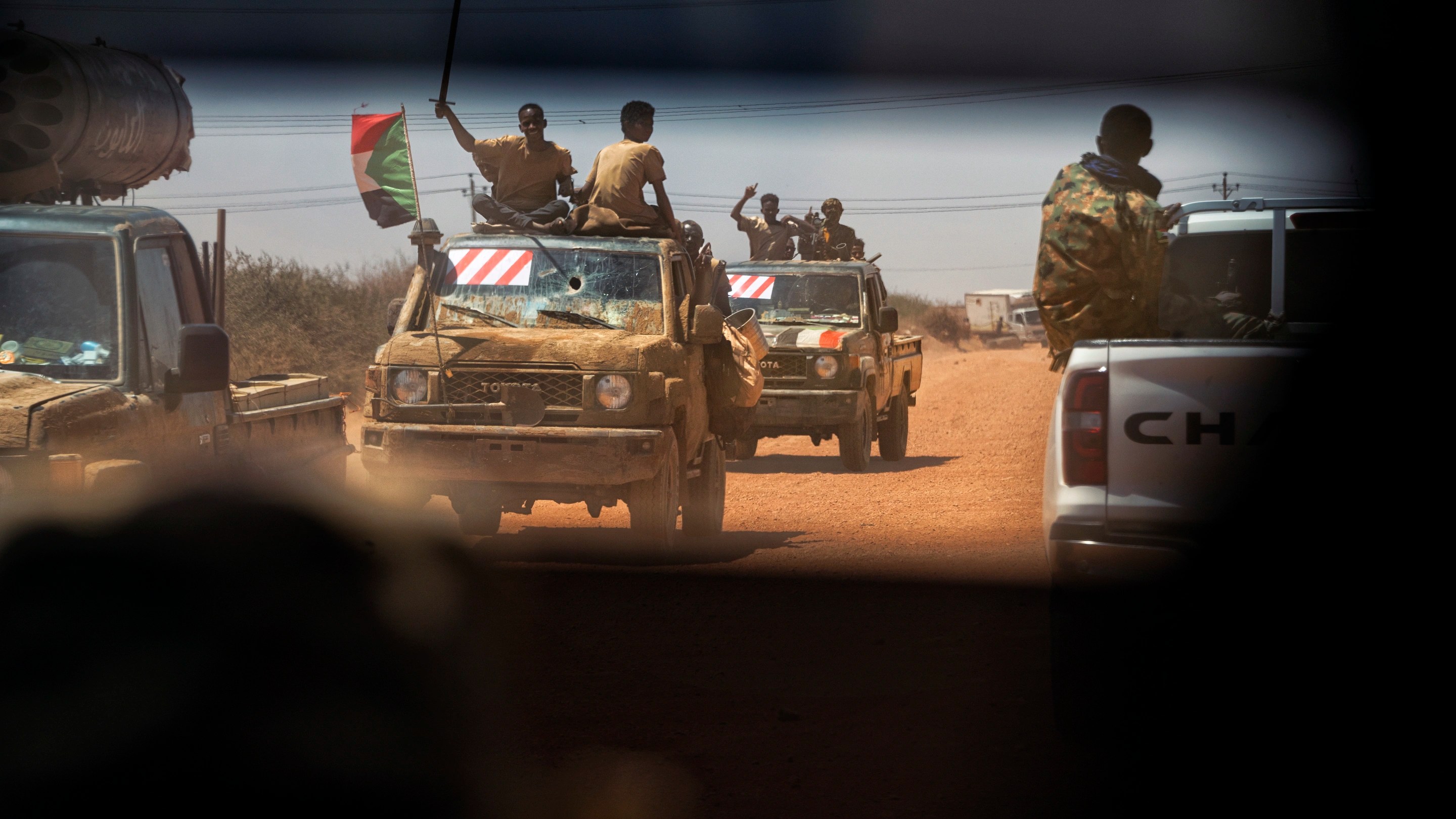
Sudan has witnessed repeated waves of ethnic cleansing over recent decades, most infamously in Darfur in the early 2000s, when government-backed Arab Janjaweed militias targeted non-Arab communities with systematic violence. Villages were burned, civilians massacred, women subjected to mass rape, and more than 2.5 million people displaced, in what the International Criminal Court later described as crimes against humanity, war crimes, and genocide. The displacement and destruction in Darfur followed earlier campaigns of forced removal during Sudan’s long north–south civil war, where entire communities in the south and Nuba Mountains were uprooted by aerial bombardment, scorched earth tactics, and starvation sieges. Today, ethnic cleansing has returned with devastating intensity: since April 2023, renewed fighting between the Sudanese Armed Forces and the Rapid Support Forces (successors to the Janjaweed) has triggered mass atrocities, including the killing of thousands and the flight of more than 7 million civilians, many across borders into Chad, South Sudan, and Egypt. Reports of targeted massacres against non-Arab groups in West Darfur suggest continuity with earlier campaigns, underscoring how ethnic cleansing in Sudan is not an isolated event but a recurring feature of its violent political landscape.

The Rohingya expulsions in Myanmar provide a stark contemporary example of ethnic cleansing. Since 2017, Myanmar’s military has carried out systematic campaigns of violence, including mass killings, sexual violence, arson, and the destruction of villages, aimed at driving the Rohingya Muslim population from Rakhine State. More than 700,000 Rohingya have fled to neighbouring Bangladesh, creating one of the world’s largest refugee crises. The violence has been accompanied by measures of cultural and social exclusion: denial of citizenship, restrictions on movement, and the erasure of Rohingya identity from official records. The United Nations and international observers have described these actions as ethnic cleansing, noting the deliberate intent to remove an entire ethnic group from a geographic area, while some investigators have determined that elements of the campaign meet the criteria for genocide.

Armenia and its surrounding regions have been scarred by cycles of ethnic cleansing for more than a century. The Armenian genocide of 1915–1916, carried out by the Ottoman Empire, combined forced deportations, massacres, and cultural destruction with the intent of removing Armenians from their ancestral lands in Anatolia. More than a million were killed or died on death marches, and countless others were scattered into diaspora communities across the Middle East, Europe, and the Americas. Later, in the Soviet period, Armenians and Azerbaijanis experienced repeated forced movements, with pogroms and expulsions erupting during times of political instability. Most recently, the 2023 offensive by Azerbaijan in Nagorno-Karabakh resulted in the flight of almost the entire Armenian population of the enclave—around 120,000 people—into Armenia proper, effectively erasing a centuries-old community. These waves of displacement illustrate how ethnic cleansing in Armenia is not confined to the past but has recurred across generations, leaving lasting demographic, cultural, and political consequences for the region.

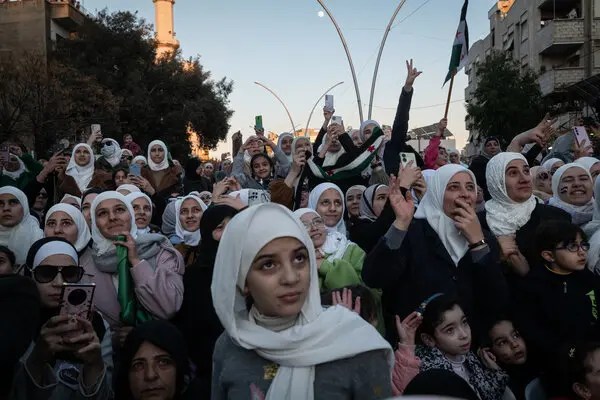
During the past two years, mass expulsions from neighbouring countries returned large numbers of Afghans to Taliban-run Afghanistan. Pakistan has deported nearly half a million Afghans; Iran has driven out hundreds of thousands more. What is packaged as “repatriation” is, in many cases, forced displacement: exiles who had tenuous livelihoods, access to education, or limited civil freedoms in exile are now returned to a polity where the rights — especially the rights of women and girls — are ruthlessly curtailed. The Taliban’s record on gender is well known: it controls a society where women are barred from education and work, forced into early marriages, and denied even minimal public freedoms. Public-life prohibitions and systematic punishments disproportionately harm women and girls. Returning families are therefore being pushed into what many observers describe as among the worst possible places in the world for women — a profoundly gendered and life-threatening form of displacement.

The erasure of culture and historical memory

Like genocide, ethnic cleansing may not be limited the physical expulsion or eradication of people. It can be political, cultural and geographical, and often works through more insidious forms of erasure.

China’s policies in Xinjiang are an example. It has renamed at least 630 villages in Xinjiang, erasing references to Uyghur culture in what human rights advocates say is a systematic propaganda rebrand designed to stamp out the Muslim minority group’s identity. Human Rights Watch has documented a campaign of renaming thousands of villages across the region, stripping out references to Uyghur religion, history and culture. At least 3,600 names have been altered since 2009, replaced by bland slogans such as “Happiness,” “Unity” and “Harmony.” Such bureaucratic changes appear mundane, but they are part of a systematic project to erase Uyghur identity from the landscape itself.

Ukraine illustrates another, more violent dimension of contemporary ethnic cleansing. Russia is coercively integrating five annexed Ukrainian regions — an area the size of South Korea — into its state and culture. Ukrainian identity is being wiped out through the imposition of Russian schooling and media, while more than a million Russian citizens have been settled illegally into the occupied zones. At the same time, some three million Ukrainians have fled or been forced out. Torture centres have been established, with one UN expert describing their use as “state war policy.” Russian forces have employed sexual violence, disappearances and arbitrary detentions, and carried out massacres. Civilian deaths officially stand at around 10,000, but independent estimates suggest a figure closer to 100,000. Homes and businesses have been seized and redistributed to the cronies of Russian officials and officers. On top of these abuses, thousands of Ukrainian children have been taken from their families and deported into Russia for adoption and assimilation, with the threat that when they reach 18 they will be conscripted into the Russian military. This programme of child transfers has been declared a war crime by international courts, and represents perhaps the most chilling element of the campaign to erase Ukrainian identity across generations. Russian propagandists, including ideologues such as Alexander Dugin, routinely describe Ukrainians as “vermin” to be eliminated — language that many experts say is consistent with genocidal intent.

The long arm of history

Historical precedent is sobering, underscoring how entrenched practices definable as ethnic cleansing are. Some examples follow.

The Armenian genocide of 1915–1916 is a historical example where the term “ethnic cleansing” can be applied alongside, though not identical to, the legal concept of genocide. Ottoman authorities systematically deported, massacred, and starved Armenians from their ancestral homelands in Anatolia, often under the guise of military necessity. Entire villages were emptied, survivors forced on death marches into the Syrian desert, and cultural and religious heritage deliberately destroyed. These actions aimed to remove the Armenian population from the territory of the Ottoman Empire, making the region ethnically and religiously homogeneous, which aligns closely with contemporary definitions of ethnic cleansing. The genocide combined mass killing with forced displacement and cultural erasure, illustrating how ethnic cleansing and genocide can overlap in both intent and method. (See The Fall of the Ottoman Empire and the birth of Türkiye)

The Armenian case also illustrates how recognition of genocide is often bound up not only with history but with contemporary politics. Türkiye continues to deny that the mass deportations and killings of Armenians in 1915 amounted to genocide, framing them instead as wartime relocations within the collapsing Ottoman Empire. Israel, despite wide acknowledgment among its own scholars of the genocidal character of the events, has avoided official recognition, partly out of diplomatic considerations toward Türkiye, once a key regional ally, but also out of concern that equating the Armenian tragedy with the Shoah might dilute the unique historical and moral status attached to the Holocaust in Jewish memory and international discourse. This reluctance is not unique to Israel: several states have long hesitated to employ the term “genocide” for fear of straining relations with Ankara or complicating their own foreign policy priorities. Such debates demonstrate how the line between ethnic cleansing and genocide is not only a matter of legal precision but also of political narrative, with governments and institutions sometimes reluctant to apply the most condemnatory labels even where evidence overwhelmingly supports them.

As the Northern Irish writer Bruce Clark observed in his excellent book Twice A Stranger on the euphemistically termed “population exchanges” between Greece and Turkey exactly a century ago, “Whether we like it or not, those of us who live in Europe or in places influenced by European ideas remain the children of Lausanne,” the 1923 peace treaty, finalizing the dismemberment of the Ottoman Empire after the First World War, which decreed a massive, forced population movement between Turkey and Greece”, and in effect, One and a quarter million Greek Orthodox Christians were removed from Anatolia, the heartland of the new republic of Türkiye, and nearly 400,000 Muslims from Greece, in a process overseen by the Norwegian diplomat Fridtjof Nansen leading a branch of the League of the Nations which would later – perhaps ironically – evolve into today’s UNHCR.

During the Second World War, Soviet Union alone deported half a million Crimean Tatars and tens of thousands of Volga Germans to Siberia. In 1945, the victorious Allied powers oversaw the removal of some 30 million people across Central and Eastern Europe to create ethnically homogeneous states. At Yalta and Potsdam, Britain, the US, and the Soviet Union endorsed the expulsion of 12 million Germans, over 2 million Poles, and hundreds of thousands of Ukrainians, Hungarians, and Finns.

The partition of British India in 1947 produced one of the largest and bloodiest forced migrations in modern history. As the new states of India and Pakistan were created, an estimated 12 to 15 million people crossed borders in both directions – Muslims moving into Pakistan, Hindus and Sikhs into India – in a desperate effort to reach what they hoped would be safer ground. The upheaval was marked by extreme communal violence, massacres, abductions, and sexual assaults. Between 500,000 and 1 million people are thought to have been killed, and millions more were uprooted from ancestral homes they would never see again. The trauma of Partition continues to shape Indian and Pakistani national identities, as well as the politics of South Asia to this day. (See Freedom at Midnight (2): the legacy of partition) and Freedom at Midnight (1): the birth of India and Pakistan

The dismemberment of Mandate Palestine by the new state of Israel, Jordan and Egypt in 1948 brought two simultaneous mass displacements that remain unresolved. During the first Arab–Israeli war more than 700,000 Palestinians fled or were expelled from their homes in what became Israel. Known as the Nakba or “catastrophe,” this created a vast refugee population now numbering in the millions, many still stateless. Jews living in what is now the Old City and East Jerusalem, and the West Bank seized by Jordan were expelled. Jews living across the Arab world in Iraq, Yemen, Egypt, Libya, Syria and elsewhere – faced growing hostility, persecution, and expulsion. Between 1948 and the 1970s, an estimated 800,000 to 1,000,000 Jews left or were forced out, many stripped of property and citizenship. Most resettled in Israel, where their presence profoundly altered the country’s politics and culture. Palestinians and Jews alike endured dispossession, trauma and exile, and both experiences fuel competing narratives of grievance that continue to define the conflict.

Israelis are themselves, for the most part, the product of 20th-century ethnic cleansings, in the Middle East as well as Europe: indeed the descendants of Middle Eastern Jews, like the Security Minister Itamar Ben-Gvir, are the country’s most radical voices on the Palestinian Question. But unlike the Mizrahim,  and displaced of Eastern and south-eastern Europe, the Palestinians have no Israel to go to. There is no Palestinian state waiting to absorb them. Indeed, for Gaza’s population, the vast majority of whom descend from refugees from what is today Israel, Gaza was their place of refuge, and the 1948 Nakba the foundational event in their sense of Palestinian nationhood. For all that ethnic cleansing punctuates modern history, there is no precedent for such a process of double displacement, and the political consequences cannot at this stage be determined. We may assume they will not be good, and an analogue to Europe’s post-war neighbourly relations will not be found.

Conclusion: The Age of Dispossession 

In many historical cases, expulsions, however brutal, were stabilized by the existence of ethnic homelands ready to absorb the displaced. Refugees were incorporated into nationalist projects in Greece and Türkiye, or into newly homogenized states such as Poland and Ukraine, where they became central to the shaping of modern politics. The Karabakh Armenians driven into Armenia may follow this precedent, potentially reshaping the political order of a small and embattled state.

Ethnic cleansing in the twenty-first century, however, combines these older methods with new techniques. Violence, rape, deportation, and massacre continue, but are now accompanied by cultural erasure, bureaucratic renaming, engineered resettlement, propaganda, and the deliberate targeting of children for assimilation. Unlike many twentieth-century precedents, today’s displaced populations often have nowhere safe to go, forced into territories with no protective homeland or into environments of repression, creating open-ended cycles of dispossession. The erasure of identities in Xinjiang, the coercive integration of Ukrainian territories, the expulsion of Rohingyas and Afghans, the depopulation of Karabakh, and the looming threat of Gaza – where Palestinians face the looming threat of another mass displacement, echoing the 1948 Nakba – collectively demonstrate that ethnic cleansing is not a relic of the past.

It remains a recurring feature of our age – modern history is indeed built upon exodus and displacement – and its human cost is profound and incalculable.

© Paul Hemphill 2024,2025. All rights reserved

Nagoorno Karabakh

Postscript … Al Nakba, a case study in dispossesion

In the late nineteenth and early twentieth centuries, European Jews came to a land that was already inhabited by another, different people. Over two decades, they forced the guarantor power out by terrorism and took the land by conquest, expelling most of  its original inhabitants by force. They have sowed their share of wind, too. Both sides want all the land for themselves.

Al Nakba, is the Arabic name for the “catastrophe” that befell the Arab inhabitants of Mandate Palestine during the war that was fought between Arabs and Jews in 1947-1948, resulting in the expulsion of upwards of 700,000 Arab Palestinians. That it happened is incontrovertible. But the facts, even those that are attested to by all reputable politicians and academic authorities, including Israelis, have long been subject to doubt and distortion by all sides of what has since been called “The Middle East Conflict” – notwithstanding that there have been conflicts in the Middle East more devastating and bloodier in terms of destruction and mortality including in Lebanon, Iraq, Syria, Algeria, Libya, and Sudan.

I do not to intend here to retell the history of Al Nakba. There many accounts available in print including those by Arab and Israeli authors, and in film, particularly an excellent documentary broadcast by Al Jazeera in May 2013 and repeated often?

June 17th, 2018, I wrote about it in a Facebook post:

Al Nakba did not begin in 1948. Its origins lie over two centuries ago….


So begins this award-winning series from Al Jazeera, a detailed and comprehensive account of al Nakba, the establishment of the State of Israel in 1948 and the dispossession and expulsion of the Palestinians who lived within its borders.

It is a well-balanced narrative, with remarkable footage, that will not please the ardent partisans of both sides who prefer their story of 1948 to be black and white.

Revisionist Israeli historians Ilan Pappe, Avi Shlaim, and Teddy Katz describe the ruthless and relentless military operations to clear and cleanse “Ha’aretz”, the land, of its Arab inhabitants and their history, whilst Palestinian historians tell the story from the Palestinian perspective, describing the critical failings of Palestinian’s political leaders and neighbouring Arab governments. Elderly Palestinians who were forced into exile and to camps in Jordan and Lebanon tell their sad stories of starvation and poverty, violence and death, and of terrible sadness, homesickness and longing that the passing years and old age have never diminished.

“When I left my homeland, I was a child. Now, I’m an old man. So are my children. But did we move forward? Where is our patriotism? Patriotism is about the pockets of our current leaders. They build high buildings and go to fancy banquets. They pay thousands for their children’s weddings”. Refugee Hosni Samadaa.

“We’re repeating the same mistakes. Before 1948 the Palestinian National Movement was split on the basis of rival families. Today, it is split into different parties over ideology, jurisdiction and self-interests. We didn’t learn our lesson. We were led by large, feudal landowners. Today, we are led by the bourgeoisie. Before 1948, we were incapable of facing reality. Today, we are just as inept. Before 1948, people chose the wrong leadership. And today, we are following the wrong leaders”. Researcher Yusuf Hijazi.

https://www.aljazeera.com/program/featured-documentaries/2013/5/29/al-nakba

I republish below Roussinos’ article in full, also a brief but comprehensive account about Al Nakba by economist and commentator Henry Ergas.

al Nakba, Ismail Shammout

al Nakba, Ismail Shammout

The truth about the ethnic cleansing in Gaza – modern Europe was built on exodus and displacement

Aris Roussinos, Unherd, December 18 2023

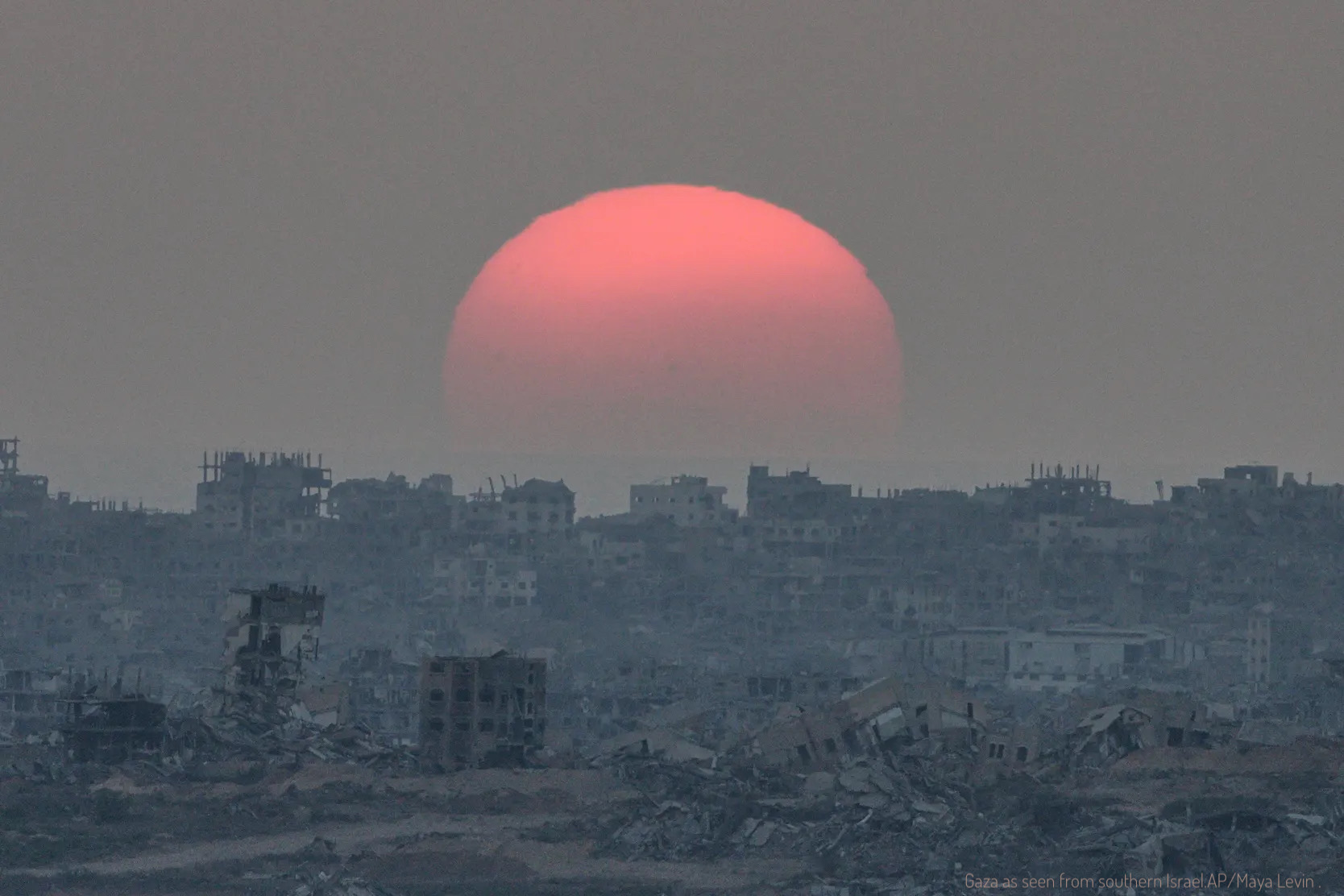
We are cursed to live in a time of great historical significance: when future historians look back at 2023, the distinguishing feature of this year will likely be the recurrence of ethnic cleansing on a vast scale. In just the past few months, Pakistan has deported nearly half a million Afghan migrants, while Azerbaijan has forced 120,000 Armenians — the statelet’s entire population — from newly-conquered Karabakh, both to broad international indifference. As the UNHCR has warned, the forced expulsion — that is, the ethnic cleansing — of Gaza’s Palestinian population is now the most likely outcome of the current war.

With no prospect of Palestinians and Israelis living together peaceably, anything short of absolute military victory unacceptable to both the Israeli government and its voters, but no meaningful plan for who will rule the uninhabitable ruins of post-war Gaza, the only realistic solution to the Palestinian problem, for Israel, is the total removal of the Palestinians. As Israel’s former Interior Minister has declared: “We need to take advantage of the destruction to tell the countries that each of them should take a quota, it can be 20,000 or 50,000. We need all two million to leave. That’s the solution for Gaza.”

Israeli officials have not been shy in promoting this outcome to a war, according to the President Isaac Herzog, for which “an entire nation… is responsible”. Israel’s agriculture minister Avi Dichter has asserted that “We are now rolling out the Gaza Nakba,” adding for emphasis that the result of the war will be “Gaza Nakba 2023. That’s how it’ll end.”Israel’s Intelligence Ministry has published a “concept paper” proposing the expulsion of Gaza’s entire population to the Sinai desert, and Israeli diplomats have been trying to win international support for this idea. According to the Israeli press, Israeli officials have sought American backing for a different plan to distribute Gaza’s population between Egypt, Turkey, Iraq and Yemen, tying American aid to these countries’ willingness to accept the refugees. In a Wall Street Journal opinion piece, two Israeli lawmakers have instead urged Western countries — particularly Europe — to host Gaza’s population, asserting that: “The international community has a moral imperative—and an opportunity—to demonstrate compassion [and] help the people of Gaza move toward a more prosperous future.” The outcome for Gaza’s Palestinians does not appear to be in doubt: what remains to be haggled over is their final location.

The only actor that can prevent the ethnic cleansing of Gaza is the United States, and for domestic political reasons it is disinclined to do so. While the Biden administration declaresit does not support “any forced relocation of Palestinians outside of the Gaza Strip”, it is not taking any action to prevent it. If the expulsion of Gaza’s 2.3 million population comes to pass, the result will be the most significant instance of ethnic cleansing in a generation, which will define Biden’s presidency for future historians. Yet outrage over such events is selective. It is not entirely true, as some Middle Eastern commentators claim, that Western complicity in the looming ethnic cleansing of Gaza highlights a lesser interest in Arab or Muslim lives: the Armenian case highlights that eastern Christians also barely flicker on the world’s moral radar.

This week’s awarding of the right to host next year’s COP29 climate conference to Azerbaijan, just a few months after its ethnic cleansing of Karabakh, reminds us that the supposed international taboo on the practice does not, in reality, exist. When ethnic cleansing is permissible, and when it is a war crime, depends, it seems, on who is doing it, and to whom. Azerbaijan is oil-rich, useful to Europe, and able to buy favourable Western coverage; Armenia is poor, weak and friendless in the world. Similarly, the extinction of much of the Christian population of the Middle East as a result of the chaos following the Iraq War won very little international attention or sympathy: communities which survived in their ancient homelands from Late Antiquity, riding out the passage of Arab, Mamluk, Ottoman and European imperial rule, did not survive the American empire.

Yet while the moral revulsion such events excite is the natural and humane reaction, ethnic cleansing is less rare an event than the crusading military response to its Nineties occurrence in the Balkans may make us think. For the sociologist Michael Mann, ethnic cleansing is the natural consequence of modernity, “the dark side of democracy”. As the Northern Irish writer Bruce Clark observed in his excellent book Twice A Stranger on the euphemistically termed “population exchanges” between Greece and Turkey exactly a century ago, “Whether we like it or not, those of us who live in Europe or in places influenced by European ideas remain the children of Lausanne,” the 1923 peace treaty “which decreed a massive, forced population movement between Turkey and Greece”. One and a quarter million Greek Orthodox Christians were removed from Anatolia, and nearly 400,000 Muslims from Greece, in a process overseen by the Norwegian diplomat Fridtjof Nansen leading a branch of the League of the Nations which would later — perhaps ironically — evolve into today’s UNHCR.

It was a cruel process, wrenching peoples from ancestral homelands in which they had lived for centuries, even millennia— and by the end of it half a million people were unaccounted for, presumably dead. Yet it was viewed as a great diplomatic triumph of the age, perhaps with good reason: without meaningful minorities on each side of each others’ borders to stoke tensions, Greece and Turkey have not fought a war in a century. Indeed, as late as 1993, the Realist IR scholar John Mearsheimer could propose a “Balkan Population Exchange commission” for the former Yugoslavia explicitly modelled on the 1923 precedent, asserting that “populations would have to be moved in order to create homogeneous states” and “the international community should oversee and subsidize this population exchange”. For the younger Mearsheimer, ethnic cleansing was the only viable solution to Yugoslavia’s bloody and overlapping ethnic map: “Transfer is a fact. The only question is whether it will be organized, as envisioned by partition, or left to the murderous methods of the ethnic cleansers.” Thirty years later, however, Mearsheimercondemns Israel’s planned expulsions from Gaza outright.

There is a dark irony here: the forced expulsion of peoples is an affront to liberal European values, yet it is rarely acknowledged that our modern, hitherto peaceful and prosperous Europe is built on the foundation of ethnic cleansing. Perhaps the ramifications of such a truth are too stark to bear, yet it is nevertheless the case that the peaceable post-1945 order depended on mass expulsions for its stability. Using the 1923 exchange as their explicit model, the victorious allies oversaw the forced removal of 30 million people from their homes in Central and Eastern Europe towards newly homogeneous ethnic homelands they had never seen. At the Yalta and Potsdam conferences, Britain, the United States and the Soviet Union settled upon the expulsion of 12 million Germans, more than 2 million Poles and hundreds of thousands of Ukrainians, Hungarians and Finns from their ancestral homes.

As Churchill declared in Parliament in 1944, “expulsion is the method that, so far as we have been able to see, will be the most satisfactory and lasting. There will be no mixture of populations to cause endless trouble, as has been in the case of Alsace-Lorraine. A clean sweep will be made.” Only two years later, once the Cold War had begun and the Soviet Union and its vassal Poland become a rival, did Churchill fulminate against the “enormous and wrongful inroads upon Germany, and mass expulsions of millions of Germans on a scale grievous and undreamed of” by “the Russian-dominated Polish Government”. In ethnic cleansing, as in so many other things, political context is the final arbiter of morality.

But as a result, Germany has never since unsettled Europe with revanchist dreams; both Poland and Western Ukraine became, for the first time in their histories, ethnically homogenous entities. As the Ukrainian-Canadian historian Orest Subtelny has observed, the forced separation of Poles and Ukrainians, once locked in bitter ethnic conflict against each other, has led to today’s amicable relationship: “It seems that the segregation of the two peoples was a necessary precondition for the development of a mutually beneficial relationship between them. Apparently the old adage that ‘good fences make for good neighbors’ has been proven true once more.” That we have forgotten the vast scale of the forced expulsions which established Europe’s peaceful post-war order is, in a strange way, a testament to their success.

Yet what made the mass expulsions following the First and Second World Wars broadly successful was that those expelled at least had ethnic homelands to receive them. In Greece and Turkey, the refugees fully adopted the ethnic nationalism of their new countries, in Greece providing the bedrock of later republican sympathies, and in Turkey the core support for both secular Kemalist nationalism and occasional bouts of military rule. In the newly-homogenous Poland and Ukraine, refugees shorn of their previous local roots and at times ambiguous ethnic identities fully adopted in recompense a self-identification with their new nation-states which has helped define these countries’ modern politics. The 120,000 Karabakh refugees will likely become a political bloc in tiny Armenia, affecting the country’s future political order in ways yet hard to discern.

Israelis are themselves, for the most part, the product of 20th-century ethnic cleansings, in the Middle East as well as Europe: indeed the descendants of Middle Eastern Jews, like the Security Minister Itamar Ben-Gvir, are the country’s most radical voices on the Palestinian Question. But the Palestinians, like the ethnic French narrator of Houellebecq’s Submission, have no Israel to go to. Unlike the 20th century displaced of Eastern and south-eastern Europe, there is no Palestinian state waiting to absorb them. Indeed, for Gaza’s population, the vast majority of whom descend from refugees from what is today Israel, Gaza was their place of refuge, and the 1948 Nakba the foundational event in their sense of Palestinian nationhood. For all that ethnic cleansing punctuates modern history, there is no precedent for such a process of double displacement, and the political consequences can not at this stage be determined. We may assume they will not be good, and an analogue to Europe’s post-war neighbourly relations will not be found.

Egypt’s disinclination to host two million Gazan refugees is not merely a matter of solidarity, but also self-preservation: flows of embittered Palestinian refugees helped destabilise both Lebanon, where their presence set off the country’s bloody ethnic civil war, and Jordan, where they make up the demographic majority. It is doubtful too, given the recent tenor of its politics, that Europe will be eager to receive them, no matter how humanitarian the language with which Israeli officials couch their planned expulsion. Rendered stateless, driven from their homes and brutalised by war, Gaza’s refugees remain unwanted by the world, perhaps destined to become, as the Jews once were, a diaspora people forever at the mercy of suspicious hosts.

A terrible injustice for the Palestinians, their ethnic cleansing may yet provide Israel with a measure of security, even as it erodes the American sympathy on which the country’s existence depends. The broader question, perhaps, is whether or not the looming extinction of Palestinian life in Gaza, like the expulsion of Karabakh’s Armenians, heralds the beginning of a new era of ethnic cleansing, or merely the settling of the West’s unfinished accounts. Like the movements which bloodily reshaped Central Europe, Israel’s very existence is after all a product of the same nationalist intellectual ferment of fin-de-siècle Vienna. In 1923, while acknowledging its necessity, the British Foreign Secretary Lord Curzon called the Greco-Turkish population exchange “a thoroughly bad and vicious [idea] for which the world would pay a heavy penalty for a hundred years to come”. Exactly a century later, Gaza’s Palestinians look destined to become the final victims of Europe’s long and painful 20th century

Nakba, where Palestinian victim mythology began

‘Nakba Day’ was commemorated this week with even more vehemence than usual. The greatest tragedy is that the Palestinian people who fled remain frozen in time.

The Australian, 18th May 2024

Pro-Palestinian protesters hold banners and flags as they listen to speakers at a rally held to mark the anniversary of the ‘Nakba’ or ‘catastrophe’ of 1948, in Sydney on Wednesday. Picture: David Gray/AFP

Protestors at a Sydney rally to mark the anniversary of the ‘Nakba’. David Gray/AFP

On Wednesday, “Nakba Day” was commemorated around the world with even more vehemence than usual as outpourings of hatred against Israel, sprinkled with ample doses of anti-Semitism, issued from screaming crowds.

What was entirely missing was any historical perspective on the Nakba – that is, the displacement, mainly through voluntary flight, of Palestinians from mandatory Palestine. Stripped out of its broader context, the event was invested with a uniqueness that distorts the processes that caused it and its contemporary significance.

It is, to begin with, important to understand that the displacement of Palestinians was only one facet of the sweeping population movements caused by the collapse of the great European land empires. At the heart of that process was the unravelling of the Ottoman Empire, which started with the Greek war of independence in 1821 and accelerated during subsequent decades.

As the empire teetered, religious conflicts exploded, forcing entire communities to leave. Following the Crimean War of 1854-56, earlier flows of Muslims out of Russia and its border territories became a flood, with as many as 900,000 people fleeing the Caucasus and Crimea regions for Ottoman territory. The successive Balkan wars and then World War I gave that flood torrential force as more than two million people left or were expelled from their ancestral homes and sought refuge among their co-religionists.

The transfers reshaped the population geography of the entire Middle East, with domino effects that affected virtually every one of the region’s ethnic and religious groups.

The formation of new nation-states out of what had been the Ottoman Empire then led to further rearrangements, with many of those states passing highly restrictive nationality laws in an attempt to secure ethnic and religious homogeneity.

Nothing more starkly symbolised that quest for homogeneity than the Convention Concerning the Exchange of Greek and Turkish Populations signed on January 30, 1923. This was the first agreement that made movement mandatory: with only a few exceptions, all the Christians living in the newly established Turkish state were to be deported to Greece, while all of Greece’s Muslims were to be deported to Turkey. The agreement, reached under the auspices of the League of Nations, also specified that the populations being transferred would lose their original nationality along with any right to return, instead being resettled in the new homeland.

Underlying the transfer was the conviction, articulated by French prime minister (and foreign minister) Raymond Poincare, that “the mixture of populations of different races and religions has been the main cause of troubles and of war”, and that the “unmixing of peoples” would “remove one of the greatest menaces to peace”.

That the forced population transfers, which affected about 1.5 million people, imposed enormous suffering is beyond doubt. But they were generally viewed as a success. Despite considerable difficulties, the transferred populations became integrated into the fabric of the recipient communities – at least partly because they had no other option. At the same time, relations between Turkey and Greece improved immensely, with the Ankara Agreements of 1930 inaugurating a long period of relative stability.

The result was to give large-scale, permanent population movements, planned or unplanned, a marked degree of legitimacy.

Thus, the formation of what became the Irish Republic was accompanied by the flight of Protestants to England and Northern Ireland, eventually more than halving, into an insignificant minority, the Protestant share of the Irish state’s population; that was viewed as easing the tensions that had so embittered the Irish civil war.

It is therefore unsurprising that further “unmixing” was seen by the allies in World War II as vital to ensuring peace in the post-war world. In a statement later echoed by Franklin Roosevelt, Winston Churchill made this explicit in 1944, telling the House of Commons he was “not alarmed by the prospect of the disentanglement of populations, nor even by these large transferences, which are more possible in modern conditions than they ever were before”.

The immediate effect, endorsed as part of the Potsdam Agreements and implemented as soon as the war ended, was the brutal expulsion from central and eastern Europe of 12 million ethnic Germans whose families had lived in those regions for centuries. Stripped of their nationality and possessions, then forcibly deported to a war-devastated Germany, the refugees – who received very little by way of assistance – gradually merged into German society, though the scars took decades to heal.

Even more traumatic was the movement in 1947 of 18 million people between India and the newly formed state of Pakistan.

As Indian novelist Alok Bhalla put it, India’s declaration of independence triggered the subcontinent’s sudden descent into “a bestial world of hatred, rage, self-interest and frenzy”, with Lord Ismay, who witnessed the process, later writing that “the frontier between India and Pakistan was to see more tragedy than any frontier conceived before or since”. Yet in the subcontinent too, and especially in India, the integration of refugees proceeded to the point where little now separates their descendants from those of the native born.

All that formed the context in which the planned partition of Palestine was to occur. The 1937 Peel Commission, which initially proposed partition, had recommended a mandatory population exchange but the entire issue was ignored in UN Resolution 181 that was supposed to govern the creation of the two new states.

When a majority of the UN General Assembly endorsed that resolution on November 29, 1947, the major Zionist forces reluctantly accepted the proposed partition, despite it being vastly unfavourable to them. But the Arab states not only rejected the plan, they launched what the Arab League described as “a war of extermination” whose aim was to “erase (Palestine’s Jewish population) from the face of the earth”. Nor did the fighting give any reason to doubt that was the Arabs’ goal.

At least until late May 1948, Jewish prisoners were invariably slaughtered. In one instance, 77 Jewish civilians were burned alive after a medical convey was captured; in another, soldiers who had surrendered were castrated before being shot; in yet another, death came by public decapitation. And even after the Arab armies declared they would abide by the Geneva Convention, Jewish prisoners were regularly murdered on the spot.

While those atrocities continued a longstanding pattern of barbarism, they also reflected the conviction that unrestrained terror would “push the Jews into the sea”, as Izzedin Shawa, who represented the Arab High Committee, put it.

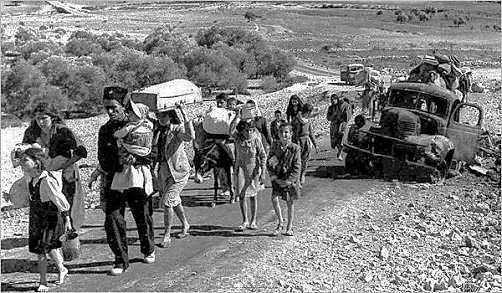
Arabs flee in 1948 ahead of the ‘war of extermination’ against Israel. Picture: History/Universal Images Group via Getty Images
Arabs flee in 1948 ahead of the ‘war of extermination’ against Israel.
History/Universal Images Group via Getty Images

A crucial element of that strategy was to use civilian militias in the territory’s 450 Arab villages to ambush, encircle and destroy Jewish forces, as they did in the conflict’s first three months.

It was to reduce that risk that the Haganah – the predecessor of the Israel Defence Force – adopted the Dalet plan in March 1948 that ordered the evacuation of those “hostile” Arab villages, notably in the surrounds of Jerusalem, that posed a direct threat of encirclement. The implementation of its criteria for clearing villages was inevitably imperfect, but the Dalet plan neither sought nor was the primary cause of the massive outflow of Arab refugees that was well under way before it came into effect.

Nor was the scale of the outflow much influenced by the massacres committed by Irgun and Lehi – small Jewish militias that had broken away from the Haganah – which did not loom large in a prolonged, extremely violent, conflict that also displaced a very high proportion of the Jewish population.

Rather, three factors were mainly involved. First, the Muslim authorities, led by the rector of Cairo’s Al Azhar Mosque, instructed the faithful to “temporarily leave the territory, so that our warriors can freely undertake their task of extermination”.

Second, believing that the war would be short-lived and that they could soon return without having to incur its risks, the Arab elites fled immediately, leaving the Arab population leaderless, disoriented and demoralised, especially once the Jewish forces gained the upper hand.

Third and last, as Benny Morris, a harsh critic of Israel, stresses in his widely cited study of the Palestinian exodus, “knowing what the Arabs had done to the Jews, the Arabs were terrified the Jews would, once they could, do it to them”.

Seen in that perspective, the exodus was little different from the fear-ridden flights of civilians discussed above. There was, however, one immensely significant difference: having precipitated the creation of a pool of 700,000 Palestinian refugees, the Arab states refused to absorb them.

Rather, they used their clout in the UN to establish the UN Relief and Works Agency for Palestine Refugees, which became a bloated, grant-funded bureaucracy whose survival depended on endlessly perpetuating the Palestinians’ refugee status.

In entrenching the problem, the UN was merely doing the bidding of the Arab states, which increasingly relied on the issue of Palestine to convert popular anger at their abject failures into rage against Israel and the West. Terminally corrupt, manifestly incapable of economic and social development, the Arab kleptocracies elevated Jew-hatred into the opium of the people – and empowered the Islamist fanaticism that has wreaked so much harm worldwide.

Nor did it end there. Fanning the flames of anti-Semitism, the Arab states proceeded to expel, or force the departure of, 800,000 Jews who had lived in the Arab lands for millennia, taking away their nationality, expropriating their assets and forbidding them from ever returning to the place of their birth. Those Jews were, however painfully, integrated into Israel; the Palestinian refugees, in contrast, remained isolated, subsisting mainly on welfare, rejected by countries that claimed to be their greatest friends. Thus was born the myth of the Nakba.

That vast population movements have inflicted enormous costs on those who have been ousted from their homes is undeniable. Nor have the tragedies ended: without a murmur from the Arab states, 400,000 Palestinians were expelled from Kuwait after the first Gulf War, in retaliation for the Palestine Liberation Organisation’s support of Saddam Hussein. More recently, Myanmar has expelled 1.2 million Rohingya.

But the greatest tragedy associated with the plight of the Palestinians is not the loss of a homeland; over the past century, that has been the fate of tens of millions. Rather, it is the refusal to look forward rather than always looking back, an attitude encapsulated in the slogan “from the river to the sea”.

That has suited the Arab leaders, but it has condemned ordinary Palestinians to endless misery and perpetual war. Until that changes, the future will be a constant repetition of a blood-soaked past

Red and white terror – the Russian revolution and civil war

… as a policeman, I would say, get hold of a man’s brother and you’re halfway home. Nor was it admiration for a better man than me. I did admire him, but I didn’t think he was a better man. Besides, I’ve executed better men than me with a small pistol. 

She’d come to Moscow to look for her child. I helped her as best I could, but I knew it was hopeless. I think I was a little in love with her. One day she went away and didn’t come back. She died or vanished somewhere, in one of the labor camps. A nameless number on a list that was afterwards mislaid. That was quite common in those days.

Yevgraf Zhivargo, in David Lean’s Doctor Zhivago (1965)

“The terror,” declared British Historian Simon Schama in his iconic Citizens: A Chronicle of the French Revolution “was merely 1789 with a higher body count; violence … was not just an unfortunate side effect … it was the Revolution’s source of collective energy. It was what made the Revolution revolutionary’. In short, “From the very beginning […] violence was the motor revolution”.

At the end of the chapter on the coming of thw Revolutionary Wars, he writes: ‘ … poets of romantic weather forecasting like William Wordsworth continued to describe the revolution is a cyclonic disturbance, but increasingly it was no longer the storm that invigorates in cleanses rather a dark and potent elemental rage moving forward in indiscriminate destruction its breath was no longer sweet but foul. It was the wind of war and if the wind of war comes, can the storm clouds of war be far behind’.

I thought a lot about the events of the French Revolution and the Napoleonic wars which followed it as I read English author and historian Anthony Beevor’s latest foray into Russian and Soviet history, Russia – Revolution and Civil War 1917-1921

Some books can be unrelentingly bleak and brutal, so grim and graphic in fact that you have to push yourself to finish them. Cormac McCarthy’s odyssey tale The Road is one such. But one doesn’t often say that about history books. Usually it is time, ennui or both that cry “enough, already!” You set it aside, promising to return to your bookmark – but you never do. I persevered with a veritable catalogue of the horrors that men can inflict upon their fellow humans (and yes, the perpetrators are apparently exclusively male, and the victims are males and females of many ethnicities). Beevor’s previous, highly acclaimed books Stalingrad and Berlin 1945 are chilling, but his latest takes top prize. And finish it I did …

The following is not a review of Beavor’s grim opus as such, but rather a thematic compendium of thoughts and observations derived from or inspired by the book.

Most academic accounts and university courses focus on the ideological and geopolitical dimensions of the origins, rise and consolidation of the Soviet Union, and its ultimate disintegration seventy years later. General public knowledge of the Russian Revolution and the civil war which followed it is relatively limited and cursory, often derived and books like Mikail Sholokhov’s saga of the Don Cossacks, Quiet Flows the Don and The Don Flows Home To The Sea, and Boris Pasternak’s Doctor Zhivago. Indeed, it was these novels and David Lean’s powerful adaptation of Doctor Zhivago that first attracted my interest in Russia as a school student in Birmingham. I majored in Politics at the University of Reading in the United Kingdom, and Soviet history and politics were an important part of my studies. Between those days and today, I’ve read widely about Russia’s history, past and present, and I am familiar with the events, ideas and personalities, their role in the broader and longer tableau of history, and the reverberations that are still felt today.

I have written often in In That Howling Infinite on Russian and Ukrainian history. Although I am no expert, and profess an amateur interest only, I do possess a short and humble pedigree. My tutor in Soviet Studies at Reading was exiled Hungarian academic and historian Tibor SzamuelyLike many refugees from Communism, he was descended from both perpetrators and victims. An uncle of the same name served in the Hungarian Soviet Republic that took power for six months under Béla Kun in 1919 and died violently that year when the revolution failed. He was among that government’s most bloodthirsty ministers and was called “Butcher Szamuely”. Szamuely’s family wound up in Moscow, where Tibor was born, and where his father was executed in Stalin’s purges. Young Tibor served in the Red Army, and he too was arrested and sent to a labour camp. Rehabilitated, he served as Chancellor of Budapest University. In 1964, then nearing 40, he was teaching in the “ideological institute” of Ghana’s Marxist president Kwame Nkrumah when he defected to England.

Back then, I was a political ingenue and a naïve communist sympathizer and fellow traveler, although my evolving perspectives were transforming and expanding. As my tutor, he advised me to study with an open mind and to put off juvenile thinking. He hadn’t been well when I knew him, and he died a year after I graduated. Under his tuition, I’d resolved to specialize in Soviet Studies – but events intervened, and I ended up in the Middle East (and that is another story. see: Tanks for the Memory – how Brezhnev changed my life). I nevertheless retained an active interest in the history and politics of Eastern Europe.

He would always impress upon me the historical and political continuity of what he called The Russian Tradition – the title of his one and only book, The Russian Tradition, published shortly before his death, and now, regrettably, out of print. I purchased a first edition when it was published and it is on my bookshelf still.

Szamuely believed that the bloodstained drama of the revolutions of 1917 – there were two, the social democratic one in the February, the Bolshevik one in November – and the years that followed, including civil war, the establishment of the USSR and Stalinism largely obscured the underlying consistency of Russian history. He did not live to see the decline and fall of the Soviet Union, and the advent of Putin and Russia Redux, but the basic pattern persists, circular and repetitive. The frequent turmoils that have overtaken this vast continent have in their various ways made changes that were essentially superficial, leading in the end to the intensification, under new forms, of the old authoritarian structure.

You – Bolshevik recruiting poster 1918


Contemplating civil wars

A civil war can emerge from the ashes of a wider, ongoing conflagration when factions or parties dispute the nature and terms of the post-bellum status quo and fracture along political and ideological lines. Many civil wars have arisen from the ashes of a prior war when there are what are perceived as existential issues unresolved and the availability of weapons and materièl and experienced and discontented men to use them.

There is a view that civil war can retrospectively be seen as a crucible of nation, a fiery furnace through which the righteous must walk – an ex post facto rationalization of the Nietzschean paradox of “that which does not kill us makes us strong”. Abraham Lincoln verbalized this in his Gettysburg Address in 1863 on a battlefield where the fallen had been only recently interred. Franco made a similar play as he laid claim to the wreckage that was Spain in the wake of three years of carnage, but then petrified his riven, country in autocratic stone until his death many decades later. The Russian Civil War was not accorded such a nation-building ethos as it was viewed by the Bolshevik victors as the crushing of a counter-revolution against a new world already being born.

Given Russia’s vast expanse, long history of restive regions, and large non-Russian ethnicities – all a result of centuries of imperial conquests – there is always the potential for the disintegration of centralized control and fragmentation. There is a rich history of state collapse following wars, revolutions, system breakdowns, economic crises, and other epochal events. Napoleon’s empire collapsed after his disastrous march on Moscow and subsequent defeat at the Battle of Leipzig. In 1918, the Ottoman, Austro-Hungarian, German, and Russian empires all collapsed in military defeat. Of course, people, decisions, and policies played a role, but ultimately it was war and the attendant economic and social crises that pushed these states over the edge into political chaos and often violence.

Once thing for sure, civil war, the Hobbesian “war if all against all” (Hobbes was thinking England’s) is undoubtedly the saddest, bloodiest and most visceral of all conflicts. I leave the last words to WB Yeats:

Things fall apart; the centre cannot hold;
Mere anarchy is loosed upon the world,
The blood-dimmed tide is loosed, and everywhere
The ceremony of innocence is drowned;
The best lack all conviction, while the worst
Are full of passionate intensity.

See: In that Howling Infinite, A House Divided – the Nature of Civil War

All fall down 

Revolutions are unpredictable. They never run in straight lines. They reverberate, the shockwaves expanding and impacting on their vicinity, and way beyond. The shots ricochet, like drive-by shootings and crossfires, and you never know who will be hit, where the bullets will come to rest, and who will be damaged or destroyed. Many people will be liberated, and many enslaved. Many peoples will prosper, and many, many will perish. As TS Elliot wrote, “between the idea and the reality falls the shadow”.”

When the Tsarist Russian empire collapsed halfway through the First World War, it was the first of four great empires to disintegrate. By war’s end, the conflict had destroyed the German, Hapsburg and Ottoman empires. But unlike these three, though the imperial house perished, the empire it ruled did not disintegrate. A handful of national movements, Finnish, Polish, Estonian, Latvian, and Lithuanian succeeded in breaking free, but most of murdered Tsar’s realm emerged from the convulsions of world war, revolution and civil war within a new Soviet empire, one that still ruled millions of square miles and a multitude of peoples.

The Russian Revolutions – the two in 1917, and a failed rising in 1905 in the wake of the disastrous (for Russia) of Russo-Japanese War – and the civil war that followed can be said to have defined the contours of modern European geopolitics, setting the stage for the Cold War and also, the current Ukraine war. The 20th Century was not kind to the countries of Central and Eastern Europe. Historian Timothy Snyder called them “the blood lands”.

The USSR was officially declared in the Bolshoi Theatre on 30th December 1922. Most people find this slightly surprising, because we assume that the Soviet Union must have been proclaimed immediately after The Bolshevik Revolution in November 1917. In fact, it only came into existence after a horrendous civil war that killed an estimated 10 million people, in which the deep national and ethnic tensions inside the old Russian Empire had been laid bare for all to see.

Historian Orlando Figes says in his seminal book about the Bolshevik revolution, A People’s Tragedy, that the failure of democracy in 1917 was deeply rooted in Russian culture and social history and what had started as a people’s revolution contained the seeds of its degeneration into violence and dictatorship.

In Russia, the revolution of February 1917 did not provoke a counterrevolution. The initial absence of any attempt to fight back was illustrative not so much apathy, as a feeling that there was very little of the ancien regime left that was worth defending. The overthrow of the czarist regime prompted a variety of reactions amongst the former ruling class: a resignation to events, bitterness at the incompetence and obstinacy of the Imperial Court, yet also an initial optimism among its more liberal and idealistic members. Most of the nobility and bourgeoisie supported the Provisional Government in the hope that it would at least restrain the worst excesses and keep the country together.

Soon after the November 1917 revolution, Lenin made it clear to the Bolsheviks that civil war was necessary to cleanse Russia of reactionary forces and old ways and to rebuild as a communist state and society. Moreover, he was confident that the Bolsheviks’ example would ignite revolution in the countries of Western Europe. German and Hungarian communists obliged, establishing people’s republics, which in turn invited counter revolution, the ousting of the revolutionaries, and reactionary military and police exacting bloody revenge on any leftists that could find.

The determination to resist only crystallized when the Bolshevik programme in the wake of the Bolshevik Revolution of October 1917 polarized opinion. The question is important when it comes to the origins of the Civil War itself, which led to the deaths of up to 12,000,000 people, the impoverishment of the whole country, and suffering on an unimaginable scale.

In June 1918 the Bolshevik regime was enjoying a brief respite from the rigors of revolution and civil war. Although surrounded on all sides by hostile forces, the Bolsheviks were in no immediate military danger. This welcome hiatus, lasting from the Treaty of Brest-Litovsk (March 1918) to the collapse of the Central Powers at the end of the year, allowed the Bolsheviks to consolidate their political and military strength.

In an uneasy alliance with the Bolsheviks were leftwing Socialist Revolutionaries who still dreamed of a constituent assembly and the anarchists who regarded Brest-Litovsk represented the watershed of the Revolution. In coming to terms with the Central Powers, the Bolsheviks had paid a staggering price in territory and resources. But, more importantly, they had preferred to make a pact with the imperialists rather than attempt to propagate the Revolution through popular initiatives, in particular, by partisan warfare.

Shortly after Brest-Litovsk the Bolsheviks turned against their erstwhile allies. The Cheka (the successor to the Czar’s Okrana secret police and the precursor to the NKVD, the KGB and the FSB) ostensibly created to suppress counterrevolutionaries, was unleashed on the Bolsheviks’ critics on the left. There were fierce battles between Chekists and anarchists in Petrograd and many other Russian cities.

It was game on.

It is difficult to comprehend to scale of the civil war that broke out in Russia in terms of its territorial extent, the numbers of nations and would-be states engaged in the conflict, and the destruction and carnage it wrought to soldier and civilian alike. Nor the ongoing relentlessness. Western European invaders had been defeated in the past (and indeed, the future) by what Mikhail Kutuzov, the Russian general who defeated Napoleon, called General Winter, but within the empire and its Soviet successor, weather did not stop play. Certainly, it complicated military operations, played havoc with logistics and supply-chains, and inflicted indescribable suffering upon soldiers and civilians. And the war went on …

The last of the Romanovs – Tsar Nicholas and his family, murdered by the Bolsheviks in July 1918

Revolution and reaction

If Lenin was politically flexible with foreign powers, he was ruthless with his own people, including rival parties on the left. He grabbed power when the hapless provisional government lost its way in setting up a constituent assembly that was intended to be a democratic representation of all Russians. Lenin initially paid lip service to the assembly, while calling for power to go the “soviets” – people’s councils. In reality he had no intention of allowing any diminishment or oversight of his control of the Bolshevik party and, through its Council of People’s Commissars, the battered Russian state.

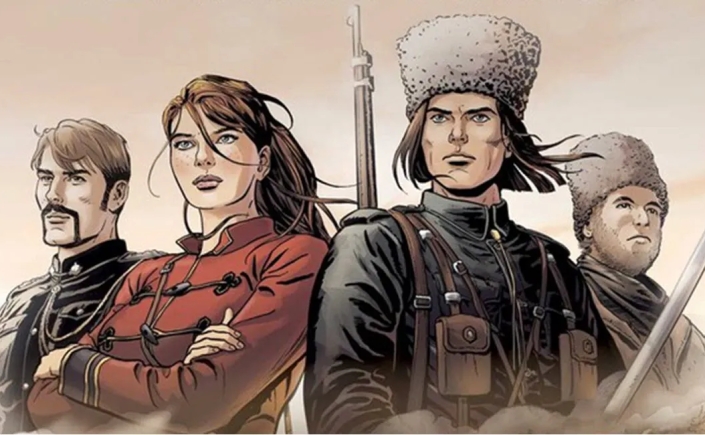
But no sooner had the Bolsheviks cemented their rule than they were fighting a civil war on multiple fronts against a mind-boggling array of enemies, stretching from revolutionary socialists  and anarchists to unreconstructed “White Russian” tsarists, nostalgic for a corrupt and flagrantly unjust regime and in between the Reds and Whites were the Greens or Partisans, mainly deserters from all sides who hated both Reds and Whites and attacked both, increasingly so as the war continued. And a range of foreign powers dealt themselves into the game to further their own strategic and ideological interests. [the featured picture of this piece is an idealized manga depiction of charismatic Ukrainian anarchist and Green Nestor Makhno, a larger-than-life figure who miraculous survived the civil way and died in his bed in exile]

The Whites were a confused, fractured and often dysfunctional coalition with rapid changes of command occasioned by personal ambitions and fluctuating military fortunes. White generals were committed to restoring the integrity of the Russian Empire, a self-defeating handicap that alienated potential allies on the fringes, like Finland, the Baltic states and Poland. Churchill underestimated this imperial obsession which prevented the alliances he wanted to defeat the Bolsheviks. The Greater Russia obsession also hampered efforts in the Caucasus where Georgians stirred regions like Ingushetia, Chechnya and Dagestan, giving Britain nightmares of Bolshevism spreading through Central Asia towards India, an obsession that continued through the twenties as described in Peter Hopkirk’s Setting the East Ablaze – Lenin’s Dream of an Empire in Asia.

Out on the edge of the old empire, White warlords endeavoured to carve out kingdoms for themselves. Many commanders spent more time terrorizing locals than fighting the Red partisans who were operating behind enemy lines across the war zone, creating a legacy and tradition the persist to this day.

The diffusion of opponents played into the Bolsheviks’ hands, as their differences were so extreme that a unified opposition fighting force was never a viable option. But if the battle lines were often blurred, the hatred felt by the combatants for each other was nightmarishly vivid.

The White’s defeat in the civil war wasn’t for lack of outside moral and materiel support. It was due largely to their inflexibility, including their refusal to contemplate land reform until it was far too late, and their refusal to grant any autonomy to nationalities of the Czarist Empire. Their administration was so useless that it’s barely existed. Paradoxically, they lost for reasons very similar to the way the Republicans lost the Spanish Civil War two decades later. In Spain, the antifascist alliance of the Republic could not prevail against Generalissimo Franciso Franco‘s disciplined and militarized regime. In Russia, the utterly incompatible alliance of socialist revolutionaries and reactionary monarchists didn’t stand a chance against the single-minded Communist dictatorship.

A leftist libertarian with St. George’s Cross, and a Sister of Mercy nurse, 1916.

World War 1.2

It in many ways it became World War 1.2. The idea of a purely Russian Civil War is misleading simplification, prompting one historian recently to describe it instead as ‘a world war condensed’.

It was waged across European and Asian Russia, including present day Belarus and Ukraine and the successor states of the Soviet Union in the Baltic, the Caucasus, and Central Asia – from Warsaw and Eastern Europe to the Urals and eastwards through the vastness of Siberia’s forests, deserts and tundra to Vladivostok in the Far East, from the arctic north to Crimea and the Black Sea, the Caspian Sea and the borders of what in 1918 ceased to be the Ottoman Empire. Fronts stretched for thousands of miles and advances and retreats likewise. The Trans-Siberian Railway, stretching the length of the former empire from Moscow to Vladivostok, was almost six thousand miles long, and it’s tributary lines served as strategic and logistical thoroughfares for all protagonists who weren’t mounted like the innumerable Cossacks tribes and the nascent Red Cavalry, bringing to prominence the armoured trains that became a symbol of the revolution.

It drew in most of Russia’s contemporary neighbours and more far-flung nations, including The USA, Britain, France, Germany Italy and Japan – the latter providing the largest contingent, estimated by British Intelligence as some 85,000 soldiers, more than many of the various White armies. Combatants included soldiers from these countries, the British dominions of Canada, Australia, South Africa, and India, and Chinese and Mongolian troops. And a multitude of ethnicities fought for their own warlords, their national place in the sun or else their very survival. Caught up in the transcontinental maelstrom were Slavs, Cossacks, Tartars, Turkmen, Arabs, Azeris, Persians, Turks, Armenians, Chechens, Kazakhs, Buryat Mongols, Kalmyks (Europe’s only Buddhist nation) and Jews. White divisions were augmented in Siberia by Mongolian, Chinese, Uighur and Kirghiz mercenaries.

Various nationalist movements arose, successfully and unsuccessfully in all parts of the former Russian Empire. The aftermath of the First World War and the collapse of the Russian Empire saw Polish, German, Italian, Hungarian, Romanian, Czech, and myriad other nationalities fighting for disparate sides, and Beevor skillfully frames the bizarre impact of this on the ethnic nationalist dimensions of the conflict.

The scale of military manoeuvres was unprecedented, as were the physical and supply difficulties over vast distances, and the extremities in climate, particularly the bitter Russian winter. The conflict became very much a cavalry war and indeed, a “railway war” notable for its armoured trains and the logistical lifeline of the Trans-Siberian Railway, protected for much if the conflict by the Czechoslovak Legion, a force of Czech and Slovak nationalists who having fought in the Czarist army, joined the Whites who controlled many towns in Siberia.

In addition to the Czechs, there was also a Polish Legion operating in the Far East. The commanders of both forces became increasingly disenchanted with the White officers who refused to countenance the independence of the border states and who shocked many with their brutality towards prisoners and civilians, and though thousands of miles from Europe, demanded repatriation – ostensibly by sea from Vladivostok.

Western Allies’ ideological perspective of the civil war was ambivalent. Though many, politicians and military alike, were viscerally opposed to Bolshevism and what it stood for, and feared a Red contagion infecting their own countries, a fear that was not unfounded. In the wake of the Revolution, a concatenation of revolts detonated across the globe. Bolshevism spread westwards, from Vienna through Budapest and Sofia to Kiel. The Bavarian Soviet Republic was briefly established in April 1919, before the far-Right Freikorps did it in. Britain wasn’t immune to the ferment. Between the February and October Revolutions, the Leeds Soviet did indeed appear to be the beginning of something, whilst strikes and demonstrations proliferated to be violently put down by the police and army. Winston Churchill alone of his cabinet colleagues wanted a full-on allied intervention and dreamed – some believed he was indeed dreaming but others claimed that he fantasized – of creating an effective White army and a borderlands alliance to defeat the Bolsheviks. But his aspirations were foiled by the imperialism of the White leadership and of White officers and the various national movements’ fear that that if the Whites prevailed, they would restore Russian rule. Britain’s rulers were reticent about shoring up and providing financial, material support and also, soldiers sailors and airmen to brutal to demonstrably homicidal Cossack brigades and revanchist and reactionary royalist autocrats.

British regiments were nevertheless deployed in Siberia and in the Far East as well as the Arctic and Caspian Sea. Royal Navy flotillas blockaded Petrograd in the Baltic, floated up the Volga in the south and down the Dvina in the arctic north, and controlled the Caspian Sea and the waters around the Crimean Peninsula. The Royal Air Force deployed Sopwith Camels and sea planes in surveillance and surveillance missions against the Red forces, who British officers called the “Bolos”. And artillery units and armoured car squadrons were attached to the various White armies.

Wider imperial concerns were in play too. Churchill rang alarm bells as the Reds pushed the Whites back in Siberia and Central Asia, alarming even his reticent cabinet colleagues with prospect of Reds on the borders of the Raj. The Great Game still had over a quarter of century to run before the final whistle blew. In the Far East, Britain and the US, and Reds and Whites alike, were nervous about the designs imperial Japanese was revealing with regard to the resources and the empty lands of eastern Siberia, the island of Sakhalin, the pacific littoral and Manchuria. Intelligence reports revealed that Japanese forces in the region exceeded all others involved, including the warring Russians.

Pogrom

Fratricidal wars are bound to be cruel because of the lack of definable front lines, because of their instant extension into civilian life, and because of the terrible hatreds and suspicions which they engender. The fighting ranged right across the Eurasian landmass was violent beyond belief, especially the unspeakable cruelty of the Cossack atamans in Siberia. Even that archconservative politician VV Shukgin believed that one of the major reasons for the failure of the whites what is a “moral collapse” – that they behaved as badly as their enemy.

There was nevertheless one subtle yet important difference. All too often, whites represented the worst examples of inhumanity, yet on that score, the Bolsheviks were unbeatable. It has been said that their ruthlessness has few parallels in recorded European history up until that time – believing that history was on their side, and that a new world was being created. The almost religious zeal with which they brutalized and killed combatants and innocents alike could be likened to the Albigensian Crusade in the early thirteenth century. [The Crusaders were accompanied by an official representative of the Pope, a French Cistercian monk named Arnaud Amalric. According to accounts written decades later, as the attack began, a soldier asked Amalric how they would be able to tell which Beziers townspeople were Catholics and which were Cathars. Some sources give the alleged quote as “Kill them all, for the Lord knows his own” or as “Kill them all. The Lord knows his own.”]

The focus on ordinary people also means their suffering is brought to the fore. And Beevor is unsparing in showing the chaotic violence of the conflict, and unrelenting in showing the sheer violence of both sides. Reds and Whites are both revealed as more than comfortable burning villages, shooting traitors, suspected or real, and torturing and massacring prisoners, and men women and children caught in the crossfire.

There were many instances of racist violence mainly on the White side – particularly towards Jews. The Whites’ antipathy towards Jews was to some degree due to their perception that most senior Bolshevik were Jewish, but mostly it was that old devil that never went away, antisemitism. The fall of the Romanovs and the ancien regime and the anti-Semitic pogroms they perpetuated continued. Retreat from the major cities brought out the worse in the Whites, with terrible massacres of Jews – although they were not the only perpetrators. Playwright And author Isaac Babel, attached as a correspondent and propagandist to the Red Cavalry on the Polish Soviet front in late 2020 posed the question: “what sort of person is our (Red) Cossack? Many layered: looting, reckless daring, professionalism, revolutionary spirit, bestial cruelty. The population await their saviors. The Jews look for liberation – and in ride the Kuban Cossacks”.

It is estimated that there were some 1300 anti-Semitic pogroms in the Ukraine during the civil war, with some 50000 to 60000 killed by both sides. There were pogroms in Belarus also, but these were not nearly as murderous as in Ukraine. A Soviet report of 1920 mentions 150,000 dead and as many again badly injured.

Churchill was well aware of the effect of the pogroms on public opinion in the West and sought in vain to exert pressure on white leaders to restrain their forces.,

Terror begat terror, leading to greater acts of conspicuous cruelty. After a particularly hard-fought battle in early 1919, a young White horse artillery officer recalled “for the first time since the start of the civil war, prisoners were not shot. There were too many of them”. This did not happen often – and such was the brutality meted out to captives on both sides, shooting was actually a blessing. An Odesa women witness after the fall of the city to the Whites, “Urrrraaa! Four and a half months under these five-pointed star oppressors”. Two days later, Beevor notes, she noted that all the Jews were in hiding. When a city held by the Reds fell to the Cossacks, a a female surgeon observed that fearing a program, two Jewish doctors in her hospital wisely ran to hide in the attic.

Bolshevik leaders and commanders on the field eventually realized that brutality did not endear their cause to the general populace and moderated their behaviour. Some Whites too came to that conclusion, and sought to prevent it at least limit atrocities, but reactionary officers and uncontrollable Cossacks persisted in burning, looting, torturing and murdering, inflicting irreparable damage to the anti-Bolshevik cause. Beevor reports instances when allied forces actually fired on Cossack perpetrators.

The End

As the whites retreated, support for the red army amongst the populace grew, as did its numbers as deserters returned to its ranks encouraged by the announcement of an amnesty and as defections from the White forces grew. Peasants grew less reluctant to serve in the Red Army Fear that with white advances and victory, old landlords would reclaim their land. Success bred success. The Whites’ ranks thinned with desertions defections and the need to transfer troops to defend its rear from attacks by partisans and freelance militias units. The Cossacks, disappointed and tired of war, turned about and headed home to their stanitsas laden with loot. The size of the frontline Red Army was eventually twice that of the Whites, as it eliminated the White armies in the north and east and closed in on the last remaining area under White control, Crimea, where rearguards held out long enough to ensure the evacuation of 150,000 soldiers and civilians by sea protected by the British and French navies.

In the aftermath of total Soviet victory, starvation struck the towns and cities across the land. Food requisitioning detachments scoured the countryside for supplies, their rapaciousness and brutality igniting peasant rebellions from Belarus to Siberia; tens of thousands of peasants rose in revolt, dealing brutally with any Bolshevik that came into their hands. The Red Army and Cheka reciprocated in spades with burning and looting, rape and torture, execution and exile to the emergent Gulag. Workers went on strike in the starving cities, and with the Whites vanquished and the civil war won, the call for democratization of Soviet rule grew louder.

And then, the sailors of the Baltic Fleet at the Kronstadt naval base, who’s guns had heralded the fall of the Romanovs, and whom Trotsky had called “the pride and glory of the Russian Revolution”, rebelled. The regime responded with lies – that the sailors had been suborned and were now Whites – and that White forces in Finland would be crossing the ice to help them. When this didn’t work, I resolved to crush them without mercy, dispatching trustworthy forces against them.

At the end, of 16000 sailors and their families, most were able to cross that ice to final and. But some 3000 fought a last stand and died by assault or firing squad. One of the last cries of protest by the Kronstadt sailors was “All of Soviet Russia has been turned into a Russian penal colony”.

Thus ended the Russian Civil War in November 1920.

… all wars come to an end. And that’s where history restarts.
British war and foreign correspondent Robert Fisk

Evacuees board ship in a Crimean portEpilogue

Epilogue … history repeats

Whilst there were many active fronts during the civil war, often simultaneously, extending for thousands of kilometers, around Archangelsk and Murmansk in the arctic, along the great rivers the Volga, the Don and the Dniester in the south, in the Baltic provinces, and in Belarus, and along the length of the Trans-Siberian Railway. And as during WW2 and the present-day Ukraine war, opposing armies advanced and retreated across Ukraine. Kiev was occupied, often several occasions, by Reds, Whites and Greens, and finally, the Polish Army which invaded Russia and Ukraine in 1920 to reclaim and defend the independence of the onetime Polish state, long divided between the now destroyed Russian, German and Austro-Hungarian empires. The names of the war-torn cities are today tragically familiar. Mariupol and Melitopol, Karchiv and Kherson. Kiev, Odessa and Lvov are now Kyiv, Odesa and Lviv.

© Paul Hemphill 2023 All rights reserved

Posts in In That Howling Infinite, about Eastern Europe:

Большой террор … Stalin’s Great Terror

You were taken away at dawn. I followed you
As one does when a corpse is being removed.
Children were crying in the darkened house.
A candle flared, illuminating the Mother of God…
The cold of an icon was on your lips
A death-cold sweat on your brow –
I will never forget this; I will gather
To wail with the wives of the murdered streltsy
Inconsolably, beneath the Kremlin towers.
Anna Akhmatova, Moscow 1935

I have written often in In That Howling Infinite on Russian and Ukrainian history. Although I am no expert, and profess an amateur interest only, I do possess a short and humble pedigree. Once in another lifetime, I read politics at the University of Reading in the United Kingdom.  My tutor in Soviet Studies was exiled Hungarian academic and historian Tibor SzamuelyLike many refugees from Communism, he was descended from both perpetrators and victims. An uncle of the same name served in the Hungarian Soviet Republic that took power for six months under Béla Kun in 1919, and died violently that year when the revolution failed. He was among that government’s most bloodthirsty ministers, and was called “Butcher Szamuely”. Szamuely’s family wound up in Moscow, where Tibor was born, and where his father was executed in Stalin’s purges. Young Tibor served in the Red Army, and he too was arrested and sent to a Labour camp. Rehabilitated, he served as Chancellor of Budapest University. In 1964, then nearing 40, he was teaching in the “ideological institute” of Ghana’s Marxist president Kwame Nkrumah when he defected to England.

Back then, I was a political ingenue and a naive communist sympathiser and fellow-traveler, although my evolving perspectives were transforming and expanding. As my tutor, he advised me to study with an open mind and to put off juvenile thinking. He hadn’t been well when I knew him and he died a year after I graduated. Under his tuition, I’d resolved to specialize in Soviet Studies – but events intervened and I ended up in the Middle East (and that is another story. see: Tanks for the Memory – how Brezhnev changed my life). I nevertheless retired an active interest in the history and politics of Eastern Europe. 

He would always impress upon me the historical and political continuity of what he called The Russian Tradition – the title of his one and only book, The Russian Tradition, published shortly before his death, and now, regrettably, out of print. I purchased a first edition when it was published and it is on my bookshelf still.

Szamuely believed that the bloodstained drama of the revolutions of 1917 – there were two, the social democratic one in the February, the Bolshevik one in November – and the years that followed, including civil war, the establishment of the USSR and Stalinism largely obscured the underlying consistency of Russian history. He did not live to see the decline and fall of the Soviet Union, and the advent of Putin and Russia Redux, but the basic pattern persists, circular and repetitive. The frequent turmoils that have overtaken this vast continent have in their various ways made changes that were essentially superficial, leading in the end to the intensification, under new forms, of the old authoritarian structure.

A few years back, I retrieved from my archive a dissertation I wrote under Szamuely’s supervision in 1970, entitled How Rational Was The Great Purge? Reading it fifty years later, I was surprised to observe that my writing style, the content and the conclusions I drew have changed little over the years. In retrospect the tenor is somewhat naïf but it foreshadows a perspective that I’ve developed over the years of “walking in the shoes of others – contemplating what might be going through the heads of the protagonists, be they the Old Bolsheviks who became the sacrificial victims or Stalin himself. Fathoming the mind of “Uncle Joe”, as the Allied PR departments dubbed him during WWII when he was deemed a friend and indeed a bulwark against Nazi aggression, was a bit of a pretentious stretch for a twenty one year old, even though I did only have an audience of one – and did earn a “first” in Soviet Studies.

A couple of days ago, I pulled it out again to show Adèle, and discovered to my horror that the handwritten foolscap roneo had faded almost to the point of vanishing. In a bright light, I managed to recite it into iPad notes and transcribe it into a fresh document and have now the privilege to publish it in  Into That Howling Infinite.

Privilege not pleasure, I must note. It does not make for easy reading.

When it was conceived, my dissertation was written with academic grades in mind, and particularly for Szamuely’s assessment alone. There is little explanation of context and of the events and personalities referred to therein (ironically, in the light of contemporary events, many of whom were Ukrainian and many, Jewish), and chronology was less important than argument. There was a word limit and also no need for explanation as my tutor knew, from his own academic and personal history, what had happened, who was what and who was who – and what became of them.

Most, sadly, did not die comfortable in their beds surrounded by family and friends, and more often than not in dark execution cells or in fields and forests beside their own graves. He was was also very much aware of the victims of the Great Purge and it’s many siblings, so many of them nameless, who perished during the Soviet Union’s two decades of terror, and for the millions – from the Baltic to the Crimea – who were deported en masse from ancestral lands to the Siberian or transported to the labour camps of the distant Gulags, to work, to starve, and to die.

The ordinary reader, of this blog and of world affairs generally is not very acquainted with the  history and politics of Russia and the defunct Union of Soviet Socialist Republics. Much of what casual observers know is learned from wide reading and often filtered through the distorted lenses of unreliable and potentially misleading and false analogies and partisan preconceptions, or worse, uninformed and prejudiced certainties. We see these in full flight in mainstream media commentary and particularly in social media with respect to the current conflict between Ukraine and its powerful neighbour. This article does not discus that conflict, although the reader will certainly see patterns, hear echoes and feel reverberations, for the consequences of events which occurred down the foggy ruins of time do indeed ricochet through history to strike us today.

And so, then, to my resurrected dissertation, which I have edited to include the full names of the principal actor. But first, some historical background to put it into perspective.

‘I’ve executed better men than me with a small pistol, Yevgraf Zhivago”

The Great Terror 

By strange symmetry, when I retrieved my now faded dissertation, I’d recently reread historian Robert Conquest’s tombstone of a book, The Great Terrora relentless and harrowing narrative of arrests, trials, fabricated confessions, hostage-taking, deportations, torture and executions as Soviet Communist Party General Secretary Josef Stalin consolidated his rule, eliminated enemies real and imagined, and created his own model of a twentieth century socialist state.

It commenced with the elimination of the Old Bolsheviks, his former comrades in arms in the Russian Revolution of October 1917 (there were two revolutions that year) and the bloody civil war that followed, and then expanded to embrace all in the party and society at large who may or may not have shared his vision. Intellectuals, philosophers, writers, poets, musicians, priests, scientists, academics, teachers, civil servants, workers and peasants, and the Red Army’s Officer Corps – the latter being a contributing factor to the Soviet Union’s need to make a pact with Nazi Germany in 1939 and its disastrously slow response to Hitlers invasion in June 1941.

An estimated death toll is difficult to determine. In those dark days, people simply disappeared, and the NKVD (the precursor to the KGB and present day FSI) covered its tracks well. The official number for the “Great Purge” of 1936-38, or “the Yezhovchina”, named for Victor Yezhov, head of the NKVD and Stalin’s lord high executioner, stands at 1,548,366 detained persons, of whom 681,692 were shot – an average of 1,000 executions a day. Various historians claim that the real number of victims could be twice as much.

But the the arrests, executions, and deportations commenced as early as 1930 and continued right up until Stalin’s death in 1953. Conquest, in his The Great Terror: A Reassessment does the gloomy math: 1930-36, 7 million; 1937-1938, 3 million; 1039-53, 10 million. The number of deaths in the Soviet Union that were explicitly ordered by someone – in other words, the number of executions – is actually relatively low at around 1.5 million. The majority of the deaths were caused by neglect or repressive policies – for example, those who died in the Soviet gulags, those who died while being deported, and German civilians and Prisoners of War are believed to have perished while under Soviet guard.

The numbers who were transported, exiled, displaced, and scattered to concentration camps or far-eastern towns and villages were likewise incalculable – as Yevgraf, the brother of Boris Pasternak’s Doctor Zhivago comments in the final scenes of David Lean’s beautiful but flawed movie):

“Indeed, as a policeman, I would say, get hold of a man’s brother and you’re halfway home. Nor was it admiration for a better man than me. I did admire him, but I didn’t think he was a better man. Besides, I’ve executed better men than me with a small pistol”

… and

“She (Lara) had come to Moscow to look for her child. I helped her as best I could, but I knew it was hopeless. I think I was a little in love with her. One day she went away and didn’t come back. She died or vanished somewhere, in one of the labor camps. A nameless number on a list that was afterwards mislaid. That was quite common in those days”.

There are a myriad of books and films about these events. Wikipedia is as good a place as any to start. Robert Conquest’s is the most acclaimed – and rightly so. Then there is Arthur Koestler’s chilling novel, Darkness at Noon, published in 1940, which recounts the thoughts of an Old Bolshevik as he awaits death in the execution cells:

A shapeless figure bent over him, he smelt the fresh leather of the revolver belt: but what insignia did the figure wear on the sleeves and shoulder-straps of its uniform – and in whose name did it raised the dark pistol barrel?

Both  books are cited often in my dissertation.

As for movies, there’s always David Lean’s Doctor Zhivago, which realistically albeit melodramatically portrays the choices and compromises confronting ordinary, intellectual Russians in the years of revolution and civil war. And I would highly recommend the poignant but powerful Burnt by the Sun, a 1994 film by Russian director and screenwriter Nikita Mikhailkov and Azerbaijani screenwriter Rustam Ibragimbekov. The film depicts the story of a senior officer (played by Mikhalkov) and his family during the purge of the Red Army.

And there was the poet Anna Akhmatova, whose words open this piece, bearing sad witness to the imprisoned, the deported, the disappeared and the dead – including in their number, two husbands and her only son – memorializing the suffering of herself, her family and millions of her compatriots in her tortured testament, RequiemUnlike so many of her contemporaries, she died of natural causes in March 1966. Russian born philosopher amd historian Isiah Berlin described the impact of her life: 

“The widespread worship of her memory in Soviet Union today, both as an artist and as an unsurrendering human being, has, so far as I know, no parallel. The legend of her life and unyielding passive resistance to what she regarded as unworthy of her country and herself, transformed her into a figure …  not merely in Russian literature, but in Russian history in (the twentieth) century”.

Anna Akhmatova, by Amedeo Modigliani

Russia’s Stations of the Cross did not cease with the end of the Terror. Three years later came Operation Barbarossa and the German invasion of the Soviet Union, the rapid blitzkreig that took the Wehrmacht to the gates of Leningrad, Moscow and Stalingrad, and the bloody clawback that brought the Red Army to Berlin and to take captive the peoples of Eastern Europe.

Over twenty five million Soviet citizens died during the Great Patriotic War, of which just under ten million were military. Most died as a direct result of the military conflict that ranged from the Baltic to the Caucasus. But miilions also perished at the hands of the NKVD and in the forced mass deportations of “suspect” peoples, including the Volga Germans and the Crimean Tartars.

At wars’ end, the Terror rolled on, albeit at a lower setting. Josef Stalin remained suspicious, vengeful and paranoid, and the purges continued right up until the moment he departed this mortal coil (as depicted in dubious slapstick in Armando Iannucci‘s recent The Death of Stalin).

Many, many Red Army soldiers who had been taken captive by the Nazis were arrested on their return from captivity. Many were shot for ‘desertion’, and thousands sent to the Gulags. Whether they had surrendered or had been subdued and taken captive, often as fast-moving battle fronts left them stranded, abandoned and entrapped behind enemy lines, they were deemed cowards, traitors and enemies of the Soviet Union and its people. They were moreover doubly damned. Whether from behind the wire of concentration camps or as slave labourers in German mines, fields and factories, they had witnessed, come into contact with, and had been contaminated by the world outside.

In one of his most cited poems, The Caucasus, written in 1845, Ukraine’s national poet, the 19th-century bard Taras Shevchenko, who’d helped build national identity through his verse, which he composed in both Russian and Ukrainian, ridicules Russian expansionism and mourns the immense loss of life it had already wrought. He could have been writing about tyranny, repression and violence all around the world and through the ages:

“We groan beneath the yoke of hangmen while drunken justice sodden sleeps”.

© Paul Hemphill 2023 All rights reserved, adapted from Ghosts of the Gulag,© Paul Hemphill 2018 

See also. The Death of Stalin is no laughing matter; Borderlands – Ukraine and the curse of mystical nationalism ;  TheRussian Tradition – Russia, Ukraine and Tibor Szamuely; and The Roots and Fruits of Putin’s Irridentism

How rational was the Great Purge? 

Paul Hemphill, Reading, 17 June 1970

When veteran Bolshevik leaders Grigory Zinoviev and Lev Kamenev had demanded reprisals against their comrade Leon Trotsky, party secretary Josef Vissarionovich Stalin replied: “a policy a lopping off heads is fraught with danger … you chop off one head today, another one tomorrow, still another one the day after – what in the end will be left of our party?” (Deutsche, Stalin, 344). Lenin himself and warned “let not blood flow between you” (Ibid 377). Yet in 1932, Stalin was forced to back down when having advocated the death sentence for oppositional activities, he met the opposition of Sergei Kirov, First Secretary of the Leningrad branch of the CPSU and the party – an opposition that may have contributed to Kirov’s untimely death in December 1934 and the events which followed). And in 1938, Trotsky was to proclaim that “Stalin is like a man who wants to quench his thirst with salted water” (Fainsod 356j). But not, in Stalin’s view, without reason.

Old Comrades Trotsky, Kamenev and Zinoviev

“We are a country surrounded by capitalist states … The internal enemies of our revolution are the agents of capitalism of all countries. In fighting against enemies at home….fight the counterrevolutionary elements of all countries”. Thus, Stalin attempts to rationalize terror. In his grim novel Darkness at Noon, Arthur Koestler described “how there were two elements in our party. One consisted of adventurers who wanted to risk all we had won to promote the revolution abroad. We recognized this current to be dangerous and have liquidated it … We stand alone … We have only one duty: not to perish”. The survival of the week and embryonic socialist state in a hostile world depended upon the strictest unity within that state, and no oppositional tendencies could be tolerated. “We have only one duty: not to perish”.

Victor Hugo once wrote: “ Mr Bonaparte’s crime is not a crime it is called a necessity. Mr Bonaparte’s robberies are not robberies, they are called measures of state. Mr Bonaparte’s murders are not murders, they are called public safety”. Here then was Machiavellian rationalism in action. “As long as the capitalist encirclement costs, there will be be wreckers, deviationists, spies, terrorists” (Stalin in Fainsod ibid 356 … and an endless host of counterrevolutionaries, bourgeois nationalists, kulaks or German and Japanese agents plotting the demise of socialist Russia.

Before 1917, the purge been excepted within the party. “Unity of Will” and submission to central authority being vital in the face of Czarist repression. Compromise was comparable to treason, obedience, the highest virtue. After 1917 the need remained in order to overcome inertia, suspicion and ignorance, hostility, subversion and sabotage. Lenin had stressed “better fewer and better”, and the consolidation of the party by the constant self purging of fellow travellers. The class struggle did not cease with Red October.

Indeed, as Lenin had prognosticated in “State and Revolution”, it intensified, as external enemies would find allies in the party. Every step towards socialism met with fierce resistance from within: the trade union dispute, the polemics of Trotsky, Kamenev and Zinoviev. When “enemies” infiltrate into the ranks of the vanguard itself, their suppression is not so easy as envisaged by Lenin’s ideals. In the years subsequent to the Civil War, therefore, constant vigilance and battle was all important. Yet the gradual liquidation of the old Bolsheviks in the years 1936 to 1938 pointed to less exalted motives, those of Stalin, using terror as a means for maintaining a monopoly of party leadership. The problem of reconciling this with the class struggle was solved by identifying any form of opposition to his rule with counterrevolution and espionage.

He effectively wrote the script that others followed. At his trial in August 1936 Kamenev confessed how “we have become fascists, we have organized counter-revolution against socialism. Zinoviev likewise: ”my defective Bolshevism was transformed into anti-Bolshevism, and through anti-Bolshevism, I arrived at fascism. Trotskyism is a variety of fascism and Zinovievism is a variety of Trotskyism” (Deutsche, The Prophet Outcast 333).

Having seized power after Lenin’s death, Stalin had to reconquer it again and again. Endless struggle will be terminated by the physical elimination of all whose party past or present attitudes made them potential opponents. Expulsion, Lenin’s penalty for “factionalism”, had been ineffective. Men who represented the potentiality of an alternative government of rival power centres had to be destroyed, be they active leaders or impotent symbols of opposition like Kamenev and Zinoviev. Reason justified the swift, merciless and all embracing preemptive strike to paralyse and to deter. Potential leaders, the men they influenced or were likely to influence, and an ever- widening circle of associates, friends and relative, who by the very nature of design were implicated. Vengefulness could engender opposition. Oppositional leaders had trained or promoted party man administrators and soldiers – in short, numberless alternative power centres.

The determining reason for Stalin‘s decision on his “final solution” lay perhaps in the realization that the mood of the Old Bolsheviks was one of hostility towards him, having remain unreconciled to personal dictatorship since the Kirov purges. Hostility could erupt into open challenge , and both he and his old comrades remembered the dying Lenin’s s pronouncement: “I propose to the comrades that they consider a means of removing Stalin from his post and appointing to it another person more patient, more loyal, more polite, and (relevant in this context) more considerate to his comrades” (Conquest 537)

When  the “Trial of the Sixteen began in August 1936, Trotsky wrote how “Stalin is staging this trial in order to suppress discontent and opposition … (he) treats every criticism and every form of opposition as a conspiracy”. (Deutsche, Outcast 322). Yet, in 1932 Trotsky himself had recognises the need for “unity of will”, “the upsetting at the bureaucratic equilibrium would benefit the forces of counter revolution” (Deutsche Stalin 344). But times had changed, and for the type of man Trotsky represented, there was no place in the party.

The reason for hostility perhaps lay in the basic psychology of the Old Bolsheviks. Nikolai Bukharin told historian Boris Nicolaevsky in 1936 that “we had all been trained in the psychology of oppositionalists … we are critics, destructionionists not builders” (Nicolaevsky 60) Soviet Russia wanted builders, not idealists. Stalin needed therefore to eliminate this millstone, to bring a new ruling class aimed at positive construction and not schismatic criticism. The theorist and the visionary were being supplanted by the young , hard and ambitious New Soviet Man, sincere communists holding key posts which merged political and professional leadership. The integration and stabilization of the regime necessitated increased centralization and the concentration of power in the hands of a select elite. The growing stability called for greater efficiency and control, the crystallization of totalitarianism demanding authority and obedience, and the accountability of the citizen for his inability to adjust to the new pattern.

Economic and social change that was not spontaneous as a product of attitudes and social relationships needed terror as a motive force. The men of the old revolution with the old ideas and ideals were liabilities to the new revolution. The “new man” created by Stalin’s regime, without a revolutionary past or tradition, ignorant and suspicious of intellectual arguments propounded by the oppositions, they were Koestler’s “Neanderthalers”, the generation “that started to think after of the flood … a generation without an umbilical cord”. Provided by Stalin with guidance, nurtured on Stalin’s Marxism- Leninism, and on the concrete achievements of the Five Year Plan.

Bukharin, in Nikolaevsky’s interview, and Koestler’s Rubachov see the new man as their creations, inevitable to socialist progress. They realise that survival depends upon success, and if they fail, they can no longer serve the revolution. History absolves those who are right – but those who are wrong must pay. Tthey understand the mechanics of the system. They share to some extent the values of the rulers. The process of selection is vital to stability and progress. And they are fatalistically determinist, agreeing to fabricated confessions because there was no existence outside of the party. Stalinism was the acceptable alternative to the counter-revolution.

“In a war which may be only a few months away”, Gletkin tells Rubachov in Darkness at Noon, “such currents (that is disaffection and popular dissatisfaction) could lead to catastrophe … the party must be cast in one mold, filled with blind discipline and absolute trust”. In 1936 the chances of agreement with Germany were slim. Cases such as “the homosexual conspiracy” of 1933-34 gave substance to fabricated charges of treason and espionage.

The threat of war and undoubtedly heightened Stalin’s fears for his political survival. He remembered how the Bolsheviks has seized power in such conditions after 1914. It certainly gave him a pretext, and legitimacy sanctioned by popular patriotism, for what Deutsche called a “perverted psychological truth” which instigated a pre-emptive strike to prevent instability and collapse during a national emergency. Yet, wouldn’t a conciliatory policy aimed at creating voluntary, popular and national cooperation and solidarity have been more logical than the disorganisation and demoralisation which Stalin had invited? Purges are deliberate and planned, and Stalin in no doubt realised their consequences if not their scope.

The motive for the Yezhovchina, named for Victor Yezhov, the head of the NKVD, does not hold its own independently. Neither does that of protecting the revolution. Bukharin in 1936, and Nikita Khrushkev in his groundbreaking Secret Speech to a closed plenum of the Central Committee in February 1956 claimed that Stalin had used too extreme means when the economy had been strengthening, the exploiting classes destroyed, and the party consolidated ideologically and numerically. Stalin himself would not have downplayed his achievements merely to attack his enemies. In reality, the new range of the charges brought against the “enemies of the people” avoid the question of a specific motivation, whilst not once did the chief victim of so many conspiracies. and yet the author, manager and producer, appear in court as a witness. Once again therefore, Machiavellian motives appear to predominate – those of Stalin consolidating his personal power. Potential opponents must be kept in a state of permanent insecurity so that all embracing terror by the “lopping off of heads” of possible alternatives to the regime. The party is cleansed of infiltrators and careerists, opening channels for new blood more loyal and more efficient. Individuals, uncontrolled and undirected, were susceptible to intrigue, and hence the unreliable need to be replaced.

The Nikolaev case following the assassination of Kirov by Leonid Nicolaev in December 1934.  Nikolaev and several suspected accomplices were convicted in the Moscow Trials and executed less than 30 days later, with complicity as a common charge for the condemned. Kirov’s assassination remains controversial and unsolved, with varying theories regarding the circumstances of his death., and provided a blueprint for discovery of accomplices and instigators, and the investigation of “ideologically undisarmed oppositions”, for “capacities for mischief” (Nicolaevsky 60), and for the punishment for the negligence of security and party organs for tolerating oppositional circles in their midst. In 1934, harmless Leningrad dissidents became terrorists; and in 1934, “Trotskyists” and ”Zinovievites” were tried, being told that by admitting complicity and condemning terrorism, they would check their own supporters.

The trials of 1936-38 merely keynoted the purge, the grand design finding full realisation in prisons and camps. The slaughter of the Old Guard showed that their day was gone, that resistance and opposition to the new regime was futile. Their fall, in a power struggle which had been waged since Lenin’s death, had been completed after Kirov’s murder, yet they were now called upon to justify the purge, to vilify the victims to publicise and popularize the forthcoming purges.

The trials of “the sixteen (August 1936 – Kamenev and Zinoviev, and others), of “the seventeen” (January 1937 – Pyatkov, Sokolnikov and the so-called anti-Soviet Trotskyist Centre), and of “the twenty one (March 1938 – Bukharin, Rykov, Yagoda, and the so called anti-Soviet Bloc of the Rightists and Trotskyists), saw the extermination of the Old Guard, and with it, the reputation of Trotsky, the arch-instigator and defendant in absentia. In colluding with Trotsky, the greatest “enemy of the people”, they were accused of treason, espionage, diversion, terrorism, and wr cling. They had plotted disrupt the economy to betray the Soviet state; they had plotted Kirov’s death, and had conspired to assassinate Stalin himself, together with others of his inner circle.

The case was different with popular national figures, and hence trial and publicity gave way to secrecy and speed trial “in camera”, illustrating Stalin’s determination bypassing even superficial legality. Hence, in secrecy, the party itself was purged by “electoral defeat” and arrest, by vigilance and police infiltration. 4434 Of 11,017 Moscow committee members were in 1937 new replacements, whilst elsewhere, 50 to 70% renovation was quite common, introducing new and ideologically pure cadres (Z Brzezinsky The Permanent Purge 94). Public trials would have strained loyalty and discipline.

This was also the case with the military, a fair accompli being necessary. In June 1937 civil war hero General Mikhail Tukachevsky and seven others were executed for treason and sabotage. Only by purging potentially disloyal or unduly independent commanders like Tukachevsky, who opposed politicisation, could be army be absorbed into the totalitarian system, and hence removing its strength as an alternative source of power while simultaneously developing its efficiency and its potency as a subordinate weapon. Whether a conspiracy existed or not is questionable, but but facility of suppression suggests the negative. Elimination would have been inevitable in order to insure full control in the event of war.

The purge of the Nationalities shows similar motivations. Nationalism had been contrary to the socialist ideals of international totalitarianism and international economics. Growing national resentment towards Russian central control had led Moscow to believe that national cadres and local leaders were responsible, whilst the atmosphere was highly conducive it the wide discovery of plots and conspiracies among the Nationalities. More objective reasoning saw the necessity of solidifying central control by removing sources independent national leadership, and hence, throughout the USSR bourgeois nationalists, deviationists, White Guards, kulaks and spies were exposed, the purges extending from the elimination of identifiable opponents to the impersonal elimination of thousands of suspects.

“Unity of Will” was all important, and all subsidiary elements had to be subordinated. Even the Comintern had to be cleansed to provide uniformity of policy in accordance with Soviet national interests, as opposed to Communist international interest. Soviet diplomats were removed. German, Hungarian, Polish, and Italian communists domiciled in the Soviet Union including former Hungarian strongman Bela Kun) were liquidated. Even in Spain, the KGB successfully purges the extremist left wing. Not even the KGB remained immune, Genrich Yagoda and Nikolai Yezhov both falling to their own terror.

Stalin and Yezhov

In the industrial and agricultural sectors, also. the politically unreliable became scapegoats for failure, and inefficiency, to be replaced by the new generation of graduates in technical and professional fields. Technicians holding key posts in the economic structure, and intellectuals – natural critics – had to be submissive. Socialist competition being achievement orientated meant that failure to produce and to fulfill norms was tantamount to wrecking and sabotage. Failure demanded retribution: to deter, and to provide additional stimuli for greater endeavours. Yet, Stalin’s prime aim was total control – imprisonment have have been deterrent enough to encourage efficiency, whilst a general improvement in the standard of living was beginning emerge, giving little cause for such repression. Physical liquidation was primarily a means of control and not of production … as Lazar Kagonovich failed to note when, at the 18th Congress, he proclaimed: “ we have now cadres which carry out every directive of the party, of the Central Committee of the Soviet power, every directive of Comrade Stalin” (ibid 90).

Isaac Deutsche describes “Trial of the Sixteen”as “so hallucinatory in its masochism and sadism that it seemed to surpass human imagination” (Deutsche Outcast 332)…The defendants were made to crawl to their deaths amidst denunciation and self-derision. Although this justifies the character rather than the reason behind the Great Purge, it’s illustrates an all important function of the Purge as an institution – what Fainsod calls prophylactic and preventative.

The first Five Year Plan had brought a degree of stability, but the regime could not afford to let stability lapseinto inactivity. The messianic and totalitarian nature of the regime, demanded further goals, and further fervour and enthusiasm, to avoid the degeneration of party and the state. The internal emigration of the silent majority was synonymous with negation and opposition; and hence participation was vital. The policy of critique had originally been intended as an instrument of improvement, of exposing inefficiency, and error, but now, Kritika was associated with denunciation and Samokritika, with confession (often false), mutual suspicion, and fear of denunciation for lack of fervour, providing mass participation, synthetic enthusiasm, and Revolutionary, Watchfulness”… Legitimacy and consensus was thus created whilst also serving to crystallise and dramatise the policies of the government… The success of propaganda campaigns was shown during the public trials when frequent and hostile emotional outbursts often provided an ex post facto rationale for physical liquidation. State Prosecutor Andrev Vyshynski was symptomatic of the popular hysteria generated… “These mad dogs of capitalism, tried to tear limb from limb the best of the Soviet land… I am joining my angry indignant voice to the, rumbling voices of millions… I demand that dogs gone mad should be shot, every one of them … “ (Conquest 335)

Propaganda campaigns were aimed at dehumanising the enemies, and developing an atmosphere of hostility that stifled resistance. The supreme correctness of the regime was asserted and failings were attributed to the accused, who would be charged with conspiring with hostile powers (Germany, in particular) planning to destroy the fruits of the revolution … their fate was pragmatic; resistance was useless; the system is unchallengeable; the leadership is in fallible. Confession, wrote Koestler in Darkness at Noon, is “to gild the right to blacken the wrong … to make the opposition appear contemptible, to make the masses understand that opposition is a crime… Sympathy and pity for the opposition are danger to the country…The can be no martyrs or heroes – no potential focii for factionalism … they must die as degenerate traitors, and this must be impressed upon the uninformed, easily influenced masses … Hence the victim is often called upon to collaborate in his own moral and physical destruction, often willingly, as a final service to the party and to the revolution …his duty is “to gild the right, to blacken the wrong” … his wrong – he must pay!

To Soviet leaders, the purge is an instrument employed in a rational and predetermined fashion, cleansing the system of undesirable elements, and streamlining organisation, revitalising the system and eliminating alternative power centres. Such motives, provide rationalism enough – but Stalin perhaps sinned in his excess … If his fear of war and collapse had precipitated his actions, then disaster of 1941 revealed his folly. In advancing and preserving the revolution, at face value, the immediate consequence was of detriment. The liquidations had outstripped available replacements, whilst privation and hardship, damage and hatred amongst the influential sectors, severely hampered the development of Soviet society … Yet, the dynamic momentum of industrialisation had been maintained, and “new men” quickly adapted to their new responsibilities, whilst fear of an rest had led many to great endeavours in all fields of production … Yet, the economic and social needs of the Soviet state could not justify the bloodshed … When Stalin told the 18th Congress that “we shall have no further for resorting to the method of mass purges” (Deutsche Stalin 381), he was, perhaps primarily reviewing his own position, firmly established at the apex of a hierarchy of power of his making. Frederick Engels may have told Karl Marx that “terror consist mostly of useless cruelties, perpetuated by frightened people in order to reassure themselves” – and Stalin was certainly in need of reassurance in 1934: but on the eve of the great purge, Stalin had held a position of strength, his opposition defeated, his Politburo hand-picked. Yet, the very nature, personal dictatorships necessitated control at all levels of the system – supreme control, unlimited and in divided. His aim was total control, the vanguard of the revolution personified – and all other aims, all other motive were subordinate and indivisible from this. It is therefore rational to secure complete personal power? Khrushchev condemned Stalin as a mad man – but was not Stalin his teacher, and the teacher and mentor of the Soviet leadership after his death – and no one would obviously seriously admit that his creator (for this was just what Stalin was) was a madman …

The question invites to consideration whether the acquisition and the maintenance of power is rational, or whether, in Stalin’s case, it was a men’s to an end escapes explanation, whether power was his aim – and this he had achieved – or whether power was a necessary means of strengthening the Soviet state and economy, for despite failure and setback he did create a major industrial power. Totalitarian purges are unnecessarily carefully planned, and controlled from the centre. In Stalin’s case the purge was perhaps carried too far, and with detrimental consequences, by the sheer force own momentum, but the fact that Stalin had maintained control was demonstrated by the facility and efficiency which the purgers themselves, and in particular, Yezhov, of were also purged after 1938, Stalin’s targets within the party, the nationalities, the economy, the intelligentsia in the army, were categorised and identified. Potential enemies and obstacles to his total control were officially eliminated. From the Machiavellian standpoint, this was more rational than Hitler’s “Final Solution”, although in both cases, pretexts were created, whether sabotage or treason or “lebensraum”. But once again, subjectivity is strong when a word such as rational is employed. “Expedient” would perhaps be more applicable. Innocent victims were numberless as the circle widened, yet even then, the psychological and deterrent effect on the population was beneficial to the regime. The toll and ensuing atmosphere of insecurity in the wasteland called peace induced submission and facilitated control, necessitating only occasional and selective terror, such as employed during 1939-41 in the newly sovietised Baltic states… In its way, the Great Purge was in fact a “final solution”, ridding the regime of opposition, and the disunity it brought. To Stalin, unity was essential to progress, and perhaps, like Peter the Great, it was necessary to employ barbaric means to modernise a backward, and perhaps in western eyes, barbaric state, and to ride roughshod over all obstacles to achieve this end …

The Old Bolsheviks. Most perished

Bibliography

I Deutsche, Stalin
I Deutsche, The Prophet Outcast
M Fainsod, How Russia is Ruled
A Koastler, Darkness at Noon
H Finer, The Man in Horseback
R Conquest, The Great Terror
H Nicolaevsky, Power and the Soviet Elite
Z Brzezinski, The Permanent Purge

17th September 1939 – the rape of Poland (2)

On 17 September 1939, sixteen days after Germany invaded Poland from the west in an sudden and unprovoked assault [see our post 2nd September 1939 – the rape of Poland (1)], the Soviet Union invaded the country from the east in accordance with the Treaty of Non-aggression between Germany and the Union of Soviet Socialist Republics,  ,forever know as the Molotov-Ribbentrop Pact. a neutrality pact between Nazi Germany and the Soviet Union signed in Moscow on August 23, 1939, by foreign ministers Joachim von Ribbentrop and Vyacheslav Molotov, respectively.

The Red Army vastly outnumbered the Polish army and the undeclared war lasted 20 days and ended on 6 October 1939 with division and annexation of the entire country territory by Nazi Germany and the Soviet Union. Some 320,000 Polish soldiers became prisoners of war and a campaign of mass persecution in the newly-acquired territory began immediately with a wave of arrests and summary executions targeting Polish figures of authority such as military officers, police and priests. In May and June 1949 alone, some 22.000 polish officers, politicians, intellectuals and professionals were murdered in the Katyn Forest.There were other such massacres as the NKVD endeavoured to eliminate the Polish elite. Hundreds of thousands of Poles were transported from eastern Poland to Siberia and other remote parts of the Soviet Union in four major waves of deportation between 1939 and 1941. 

In November 1939 the Soviets annexed the eternity under its control and some 13.5 million Polish citizens became Soviet subjects following  sham elections. Soviet forces occupied eastern Poland until the summer of 1941, when they were expelled by the German army in the course of Operation Barbarossa, and the area was under German occupation until the Red Army reconquered it in the summer of 1944.

This was but the beginning.

Around six million Polish citizens perished during the Second World War about – one fifth of the pre-war population. Most were civilian victims of the war crimes and crimes against humanity during the occupation by Nazi Germany and the Soviet Union, and half of them were Jews.

An estimated 26 million Soviet citizens died during The Great Patriotic War that was to come, including as many as 11 million soldiers. Some seven million were killed in action and another 3.6 million perished in German POW camps.

And then there were the deportations. Some 2 million people were transported to Siberia and the Central Asian republics – ostensibly for treasonous collaboration with the invading Germans and anti-Soviet rebellion. Mere suspicion was sufficient to attract collective punishment.  The Crimean Tartars were deported en masse, whilst Volga Germans, settled in Russia for centuries, and other non-Slavic nationalities of the strategic Crimea, Black Sea coast lands and northern Caucasus were also dispatched eastwards. Whilst many were permitted to return to their homelands in the years and sometimes decades after the war, we’ll never know how many perished in exile from violence or privation.

On the other side of the ledger, the Wehrmacht suffered three-quarters of its wartime losses fighting the Red Army.  Some four million died in action and another 370,000 in the Soviet camp system. Some 600,000 soldiers of Germany allies, mostly Eastern Europeans, died also. In Stalingrad alone, the total Axis casualties (Germans, Romanians, Italians, and Hungarians) are believed to have been more than 800,000 dead, wounded, missing, or captured.

Having sowed the wind, Nazi Germany reaped the whirlwind when the tides of war changed and the Red Army retreated, recouped, stood firm and finally advanced, pushing onwards ever onwards until it reached Berlin. As the Soviets exacted revenge for the carnage and devastation wrought by the Wehrmacht, German citizens paid a heavy price. Civilian deaths, due to the flight and expulsion of Germans, Soviet atrocities and the transportation Germans for forced labour in the Soviet Union range from 500,000 to over 2 million.

These melancholy statistics are but a portion of the millions of lives lost or changed utterly by the events of September 1939.

Lest we forget …

They crossed over the border, the hour before dawn
Moving in lines through the day
Most of our planes were destroyed on the ground where they lay
Waiting for orders we held in the wood
Word from the front never came
By evening the sound of the gunfire was miles away
Ah, softly we move through the shadows, slip away through the trees
Crossing their lines in the mists in the fields on our hands and on our knees
And all that I ever was able to see
The fire in the air glowing red
Silhouetting the smoke on the breeze
Al Stewart, Roads to Moscow

Worldwide, over seventy million souls perished during World War II. We’ll never know just how many …

DEATHS BY COUNTRY  

COUNTRY MILITARY DEATHS TOTAL CIVILIAN AND MILITARY DEATHS
Albania 30,000 30,200
Australia 39,800 40,500
Austria 261,000 384,700
Belgium 12,100 86,100
Brazil 1,000 2,000
Bulgaria 22,000 25,000
Canada 45,400 45,400
China 3-4,000,000 20,000,000
Czechoslovakia 25,000 345,000
Denmark 2,100 3,200
Dutch East Indies 3-4,000,000
Estonia 51,000
Ethiopia 5,000 100,000
Finland 95,000 97,000
France 217,600 567,600
French Indochina 1-1,500,000
Germany 5,533,000 6,600,000-8,800,000
Greece 20,000-35,000 300,000-800,000
Hungary 300,000 580,000
India 87,000 1,500,000-2,500,000
Italy 301,400 457,000
Japan 2,120,000 2,600,000-3,100,000
Korea 378,000-473,000
Latvia 227,000
Lithuania 353,000
Luxembourg 2,000
Malaya 100,000
Netherlands 17,000 301,000
New Zealand 11,900 11,900
Norway 3,000 9,500
Papua New Guinea 15,000
Philippines 57,000 500,000-1,000,000
Poland 240,000 5,600,000
Rumania 300,000 833,000
Singapore 50,000
South Africa 11,900 11,900
Soviet Union 8,800,000-10,700,000 24,000,000
United Kingdom 383,600 450,700
United States 416,800 418,500
Yugoslavia 446,000 1,000,000

WORLDWIDE CASUALTIES*

Battle Deaths 15,000,000
Battle Wounded 25,000,000
Civilian Deaths 45,000,000

*Worldwide casualty estimates vary widely in several sources. The number of civilian deaths in China alone might well be more than 50,000,000.

Postscript

Former Soviet spy, former Ukrainian government minister and author Viktor Suvorov kick-started a historiographical battle royal in the early eighties when he presented controversial evidence that contrary to long-held opinion, Stalin had planned to actually attack Germany in 1941, only to be preempted by Operation Barbarossa.  Read more about it here.

See also, in In That Howling Infinite: Ghosts of the Gulag, The Death of Stalin is no laughing matter, and Thermidorian Thinking