The Night of Power – Robert Fisk’s bitter epilogue

“All wars come to an end and that’s where history restarts”

“History stretches out into the future as well as the past”

“All wars may end in negotiations, but not all negotiations end wars”

The indefatigable British journalist, author, and longtime Beirut resident Robert Fisk Robert Fisk died of a stroke in St Vincent’s Hospital, Dublin, on October 30, 2020. He was 75. Fearless and inquisitive, often iconoclastic and controversial, “Mister Robert,” as he was known from Algeria to Afghanistan, was one of the finest journalists of his generation—the greatest reporter on the modern Middle East. There is probably no better body of work for understanding the region. Respected and reviled in equal measure by left and right alike, Fisk spoke truth to power for more than half a century.

He was obsessive, he was angry, and – having read many of his books – I believe he suffered from undiagnosed PTSD throughout his career in the Middle East. His lifelong obsessions were the arrogance and misuse of power, the lies and impunity of the rulers: presidents and prime ministers, kings and emirs, dictators and theocrats, torturers and murderers. And always the countless innocents who endured and suffered, dying in their tens – and tens – of thousands on the altar of power and greed.

The Night of Power 

His last book, The Night of Power: The Betrayal of the Middle East, published posthumously in 2023, takes up where his monumental The Great War for Civilisation (2005) ended—with the contrived U.S.-British-Australian invasion of Iraq. The Great War for Civilisation was a tombstone of a book, literally and figuratively, as was its predecessor Pity the Nation (1990), his definitive history of the Lebanese civil war.

The Night of Power  is no less harrowing, covering the occupation of Iraq, the 2006 Israel–Lebanon war, the Arab Spring, the rise of Egypt’s new pharaoh Abdel Fattah al-Sisi, the lonely death of Mohammed Morsi, Israel’s occupation of the West Bank and seize of Gaza, and the Syrian civil war. It ranges widely – but its coherence lies in Fisk’s unrelenting theme: the cycle of war, the corruption of power, and the persistence of memory. To read it is to feel Fisk’s own cynicism, sadness and anger.

The title is deeply symbolic. In Islamic tradition, Laylat al-Qadr, the Night of Power, is the night the Qur’an was first revealed to the Prophet Muhammad: “The Night of Power is better than a thousand months … Peace it is, until the rising of the dawn” (Qur’an 97). It is a night of blessing beyond measure, greater than a lifetime of devotion. The title is bitterly ironic: the “night of power” he recounts is one of betrayal, cruelty, and endless war.

It is both a summation of his life’s work and a testament to his method. Over four decades, Fisk was a witness to almost every major conflict in the Middle East — Lebanon, Iran, Iraq, Palestine, Algeria, Afghanistan, Syria, Egypt — and the wars of the Yugoslav succession. His dispatches carried both forensic detail and moral outrage. This last work, published in the year of his death, is less a memoir than a vast chronicle of empire, war, betrayal, and resistance.

Fisk had long insisted that reporters must “be on the side of those who suffer.” He was no neutral stenographer of official sources. He distrusted governments – Western and Arab alike – and prized first hand testimony, walking the ruins, speaking to survivors, writing down the words of the powerless. The Night of Power continues in this vein, but with a sharpened sense of history. Fisk threads together centuries of conquest and resistance, showing how imperial arrogance, local despotism, and religious zealotry have conspired to devastate the region.

The last two paragraphs Robert Fisk wrote before his death, closing The Night of Power, cut like a blade through the pieties of Western journalism:

“Failure to distinguish between absolute evil, semi-evil, corruption, cynicism and hubris produced strange mirages. Regimes which we favoured always possessed ‘crack’ army divisions, ‘elite’ security units, and were sustained by fatherly and much revered ruling families. Regimes we wished to destroy were equipped with third-rate troops, mutineers, defectors, corrupt cops, and blinded by ruling families. Egypt with its political prisoners, its police torture and fake elections, was a tourist paradise. Syria with its political prisoners, police torture and fake elections, would like to be. Iran, with its political prisoners, police torture and fake elections was not — and did not wish to — be a tourist paradise.” (p. 533)

In the end, according to those closest to him, including his wife Nelofer Pazira-Fisk, an award-winning Afghan-Canadian author, journalist and filmmaker, who edited the book and wrote its final chapter, Fisk despaired. He feared that nothing he had written over four decades had made any difference – that things had, in fact, grown worse. As Kent says to the blinded King Lear, “All is cheerless, dark, and deadly”.

And yet the worst was arguably still to come: the chaotic retreat of America and its allies from Afghanistan and the Taliban’s reimposition of rule, including the literal silencing of women’s voices; Russia’s invasion of Ukraine and its murderous war of attrition that has now passed its thousandth day; Hamas’s atrocity of October 7, 2023, Israel’s biblical-scale revenge, and the utter destruction of Gaza; and the latest Israel–Lebanon war that saw the decapitation and emasculation of Hezbollah.

The Legacy of a Fearless Reporter

The Night of Power stands as a testament to Robert Fisk’s fearless journalism and his relentless moral compass. Across decades of war reporting, Fisk bore witness to suffering few dared to confront. He was unflinching in exposing the hypocrisies of Western powers, the brutality of dictators, and the costs of occupation, war, and empire. Yet he also captured the human dimension: the courage, endurance, and resilience of those who suffered, whether in Iraq, Gaza, Egypt, or Syria.

This final work synthesizes Fisk’s signature qualities: exhaustive research, direct engagement with the people whose lives were upended, and an ethical rigor that held both oppressors and complicit outsiders accountable. The Night of Power is not merely a chronicle of events; it is a meditation on power, betrayal, and history itself.

Fisk’s prose, vivid and often lyrical, reminds readers that journalism can be a form of witness — bearing truth against overwhelming odds. Even in despair, he recognized the persistence of human agency, the cycles of history, and the moral imperative to see, to name, and to remember. His death in 2020 marked the end of a career unparalleled in courage and conscience, but his work, particularly this last book, endures as both a warning and a guide for understanding the Middle East and the forces that shape our world.

In reading The Night of Power, one cannot avoid Fisk’s central lesson: history may restart at the end of every war, but the witness to injustice is what shapes the moral memory of humanity. The quotations at the head of this review, indeed, the final words of the book, weary yet resolute, are a fitting epitaph. Fisk saw the world as it was, not as we wished it to be: corrupt, cruel, but always turning, always restarting.

All wars come to an end and that’s where history restarts
Robert Fisk, The Night of Power

Postscript

The final chapter of The Night of Power was written by Fisk’s wife Nelofer Pazira-Fisk, She was based in Beirut for fifteen years working alongside her late husband and reported from Iraq, Afghanistan, Turkey, Egypt and Syria. The following podcast by American war correspondent Chris Hedges, with Fisk’s first wife Lara Marlowe is a worthy tribute .

See also, in In That Howling Infinite The calculus of carnage – the mathematics of Muslim on Muslim mortality 

The following briefly summarizes the main themes of The Night of Power drawing largely upon his own words

Robert Fisk’s Catalogue of Carnage

Hear the cry in the tropic night, should be the cry of love but it’s a cry of fright
Some people never see the light till it shines through bullet holes
Bruce Cockburn, Tropic Moon

Iraq: Catastrophe Foretold

Fisk argued that Iraq’s occupation was fraudulent from the start, brutal in execution, and ferocious in its response to insurgency. The Americans tolerated the inhuman behaviour of their own soldiers, relied on mercenaries and “greedy adventurers,” and mixed Christian religious extremism with an absurd political goal of “remaking the Middle East.” It was “tangled up in a web of political naivety and Christian muscularity”.It was bound, he wrote, to end in catastrophe.

“We were pulling at the threads of the society with no sense of responsibility as occupiers just as we had no serious plans for state reconstruction. Washington never wanted Iraq’s land. Of course the countries resources were a different matter, but its tactics did fit neatly into the prairies of the old West. The tribes could be divided and occupiers would pay less in blood. as long as they chose to stay. One set of tribes were bought off with guns and firewater the other with guns and dollar bills. Serious resistance, however, would invoke “the flaming imperial anger” of all occupation armies.

The rhetoric echoed the 19th century missionary zeal of empire. Western fascination with the Biblical lands was used to justify conquest: as Lieutenant General Stanley Maude told the people of Baghdad in 1917, the Allies wished them to “prosper even as in the past when your ancestors gave to the world Literature, Science, and Art, and when Baghdad city was one of the wonders of the world” (p. 92).

The modern occupation, Fisk observed, was nothing but “the rape of Iraq”. Oil wealth was divided up in a scandal of corruption involving US contractors and Iraqi officials. “The costs were inevitably as dishonest as the lies that created the war … I knew corruption was the cancer of the Arab world but I did not conceive of how occupying Power supposedly delivering Iraqi their long sort freedom could into a mafia and at such breathtaking speed”.

Security became a malignant industry; by 2006 mercenaries accounted for half of Western forces, sucking money out of the country. The food system, 10,000 years old, was destroyed by Paul Bremer’s infamous Order 81, which forbade farmers from saving their own seed. Iraq became a “giant live laboratory for GMO wheat,” its people “the human guinea pigs of the experiment”.

And through it all, a campaign of suicide bombings –  unprecedented in scale –  turned Iraq into the crucible of modern terror. Editors never tried to count them. The figures, Fisk noted, were historically unparalleled.

The trial of Saddam Hussein

The US ambassador to Iraq once claimed she had been “unable to convince Saddam that we would carry through what we warned we would.” Fisk dismissed this as absurd. Saddam, he argued, was well aware of Western threats, but the framing of his trial was designed to obscure deeper truths.

If Saddam had been charged with the chemical massacre at Halabja, defence lawyers could have pointed out that every US administration from 1980 to 1992 was complicit in his crimes. Instead, he was tried for the judicial murder of 148 men from Dujail — heinous, but “trifling in comparison” (p. 92). The great crimes of the Baathist regime — the 1980 invasion of Iran, the suppression of Shia and Kurdish revolts in 1991 — were deemed unworthy of the court’s attention.

Pakistan: Fragile State, Useful Pawn

Fisk’s lens widened to Pakistan, where he recorded with scorn the ISI’s admission that the reality of the state was defined not by American might but by “corrupt and low-grade governance”. A US intelligence officer boasted: “You’re so cheap … we can buy you with a visa, with a visit to the US, even with a dinner.”

This, Fisk suggested, was not just Pakistan but almost every Arab or Muslim state in thrall to Washington: Egypt, Jordan, Syria, the Gulf states under their dictators and kings, even Turkey. He wrote that Osama Bin Laden’s choice to hide in Pakistan embodied a weird symmetry: the man who dreamed of a frontierless caliphate sought refuge in the very sort of corrupt, Western-backed dictatorship he despised.

Rendition: Complicity in Torture

The “war on terror” extended beyond borders. CIA, MI5 and MI6 operatives were deeply involved in rendition. Prisoners were knowingly dispatched to states where torture was inevitable, even fatal. Fisk insisted on repeating this uncomfortable truth: Western democracies had integrated torture into their security architecture.

Israel and Palestine: The Last Colonial War

Fisk was unsparing in his treatment of Israel’s expansion. He rejected any obfuscation: Israel seized the opportunity to consolidate its control with a land grab for the most prominent hilltops and the most fertile property in the West Bank for settlements constructed on land legally owned for generations by Arabs, destroying any chance the Palestinian Arabs could have a viable state let alone a secure one.”). These settlements, he wrote, “would become the focus of the world’s last colonial war.”

He surmised: “Will the Jews of what was Palestine annex the West Bank and turn its inhabitants into voteless guest workers and all of mandate Palestine into an apartheid state? There was a mantra all repeat that only other way to resolve Israeli rule in the West Bank would be a transfer of the Palestinians across the Jordan into the Hashemite kingdom on the other side of the river. In other words, expulsion”

The Wall 

Fisk’s Fisk’s description of the Separation Wall is dramatic and unforgettable: an   “immense fortress wall” which snakes “firstly around Jerusalem but then north and south of the city as far as 12 miles deep into Palestine territory, cutting and escarping its way over the landscape to embrace most of the Jewish colonies … It did deter suicide bombers, but it was also gobbled up more Arab land. In places it is 26 feet or twice the height of the Berlin wall. Ditches, barbed wire, patrol roads and reinforced concrete watchtowers completed this grim travesty of peace. But as the wall grew to 440 miles in length, journalists clung to the language of ‘normalcy’ a ‘barrier’ after all surely is just a pole across the road, at most a police checkpoint, while a ‘fence’ something we might find between gardens or neighbouring fields. So why would we be surprised when Italian Prime Minister Silvio Berlisconi, traveling through the massive obstruction outside Bethlehem in February 2010 said that he did not notice it. But visitors to Jerusalem are struck by the wall’s surpassing gray ugliness. Its immensity dwarfed the landscape of low hills and Palestinian villages and crudely humiliated beauty of the original Ottoman walls Churches mosques and synagogues .. Ultimately the wall was found to have put nearly 15% of West Bank land on the Israeli side and disrupted the lives of a third of the Palestine population. It would, the UN discovered, entrap 274,000 Palestinians in enclaves and cut off another 400,000 from their fields, jobs, schools and hospitals. The UN concluded that many would “choose to move out.” Was that the true purpose?“.

Leftwing Israeli journalist Amira Haas, who lives in the West Bank, takes Fisk on a tour of the wall: “Towering 26 feet above us, stern, monstrous in its determination, coiling and snaking between the apartment blocks and skulking in wadis and turning back on itself until you have two walls, one after the other. You shake your head a moment – when suddenly through some miscalculation surely – there is no wall at all but a shopping street or a bare hillside of scrub and rock. And then the splash of red, sloping rooves and pools and trees of the colonies and yes, more walks and barbed wire fences and yet bigger walls. And then, once more the beast itself, guardian of Israel’s colonies: the Wall”.

See also, in In That Howling InfiniteBlood and Brick … a world of walls

Banksy on The Wall. Paul Hemphill, May 2016

Gaza: Junkyard of History

Although Oslo’s creators fantasied that it would become part of the Palestinian state, Gaza’s destiny was isolation. It has been a junkyard of history variously ruled by Christians and Muslims, ruined and rebuilt under the Ottomans, and fought for by the British and Turks in the First World War, and now reduced to a prison state.,

Egypt: A Revolution Betrayed

Mohammed Morsi embodied both hope and tragedy. “An intelligent, honourable, obtuse, arrogant and naïve man”. No visionary, he was “was shambolic, inspiring, occasionally brutal and very arrogant”.  He set off down the road to Egyptian democracy with no constitution no parliament and no right to command his own countries army …set off down the road to democracy “with no constitution, no parliament and no right to command his own country’s army”. And when the end came, as come it must, he could not smell trouble; he did not see what was coming.

In a coup that was not a coup, which former British prime minister Tony Blair called “an awesome manifestation of power”, “the democratically elected president was suspended, the constitution annulled, tekevion stations closed, the usual suspects arrested … Yet President Obama could not bring himself to admit this. He asked the Egyptian military “to return full authority back to a democratically elected civilian government… Through an inclusive and transparent process” without explaining which particular elected civil civilian government he had in mind”.

This was just the beginning. In the six years that followed, Egypt’s executioners and jailers were kept busy. “They hung 179 men, many of them tortured before confessing to murder, bomb attacks or other acts of terrorism”. It was claimed that Al Sisi had returned the country to a Mubarak style dictatorship in the seven years of his own war against the brotherhood between 1990 and 1997. Mubarak’s hangman had executed only 68 Islamists and locked up 15,000. By 2019  Al Sisi had 60,000 political prisoners

To Fisk, this was a sign of fear as much as it was evidence of determination to stamp out terror. Al Sisi had three separate conflict on his hands: his suppression of the brotherhood on the ground that they were themselves violent terrorists, the campaign by Islam extreme groups against Egypt’s minority Christian cops, and most frightening of all the very real al Qaeda and ISIS war against Al Sisi’s own regime. “The prisons of the Middle East, Fisk concluded, were “universities for future jihadi”.

See also, in In That Howling Infinite and Sawt al Hurriya – remembering the Arab Spring
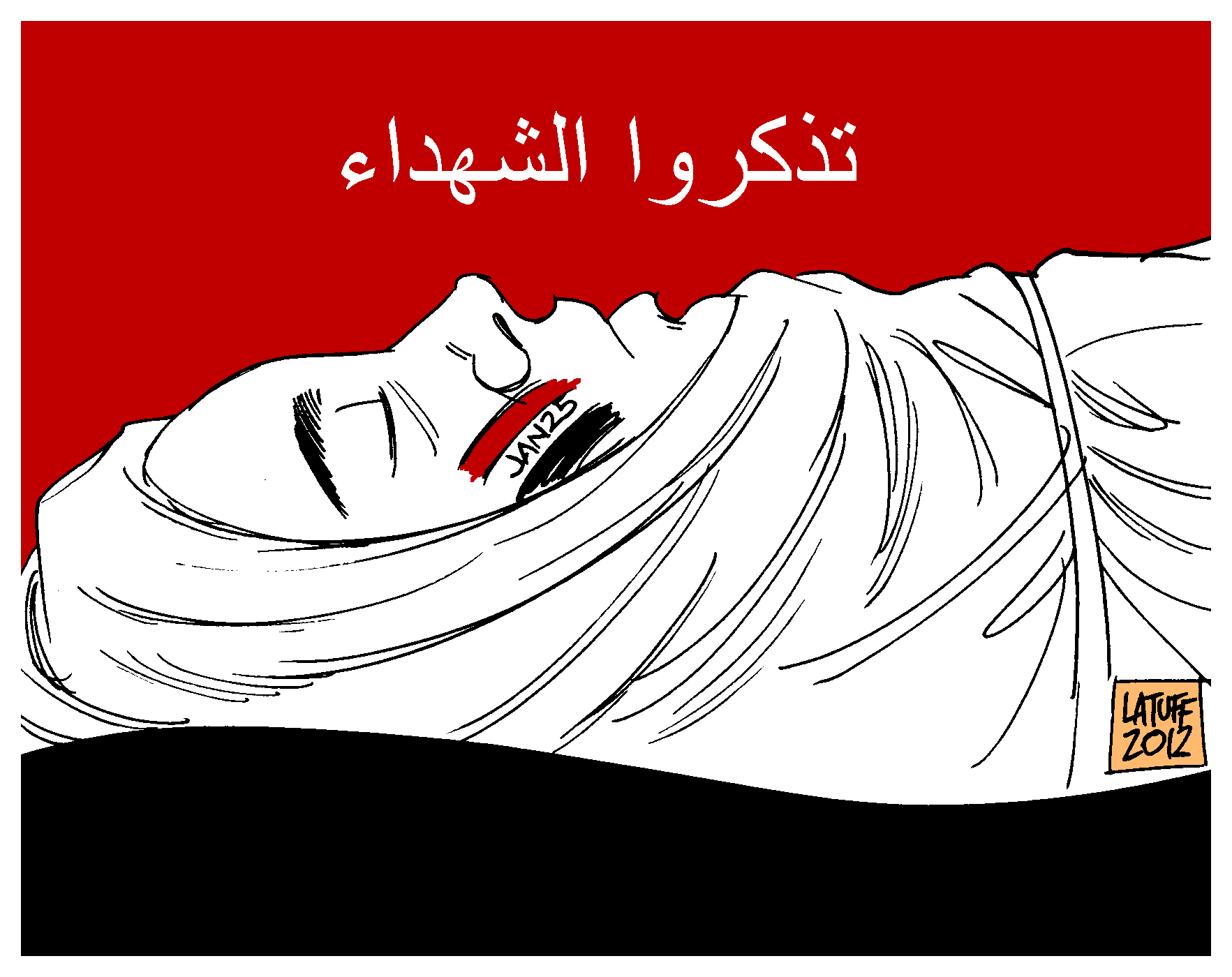
Remember and witness

Silencing the women of the revolution 

The misogyny if the counterrevolution was stark. Fisk wrote: “… if the senior officers wished to prune the branches of the revolution the participation of women was something that could not be tolerated. Why did there suddenly occur without apparent reason a spate of sexual attacks by soldiers that were clearly intended to frighten young women off the street,  revealing a side to the Egyptian military that none of us had recognised. The misogynistic and shocking display of brutality towards women that could not have been the work of a few indisciplined units”. With sexual assaults on women protesters, virginity tests and public humiliation, “heroes of the 1973 war had become molesters”.

The lonesome death of Muhammad Morsi

Morsi would struggle on for years before a series of mass trials would entrap him and his brotherhood colleagues and quite literally exhaust him to death. Morsi’s slow death in solitary confinement was, Fisk insisted, “utterly predictable, truly outrageous and arguably a case of murder”. He was denied treatment, denied family visits, denied a funeral. “To die in a dictator’s prison, or at the hands of a dictator’s security services”, Fisk wrote, “is to be murdered.”

It did not matter, he continued “if it was the solitary confinement, the lack of medical treatment or the isolation, or if Morsi had been broken by the lack of human contact for those whom he loved. “The evidence suggested that Morsi’s death must’ve been much sought after by his jailers, his judges, and the one man in Egypt who could not be contradicted. You don’t have to be tortured with electricity to be murdered”.

Fisk’s description of Morsi’s death is a sad one. “Symbolism becomes all”, he wrote. “The first and last elected president of a country dies in front of his own judges and is denied even a public funeral. The 67-year-old diabetic was speaking to the judges, on trial this time for espionage, when he fainted to the floor. Imagine the response of the judges when he collapsed. To be prepared to sentence a man to the gallows and to witness him meeting his maker earlier than planned must’ve provoked a unique concentration of judicial minds. could they have been surprised groups had complained of Morsi’s treatment for the world media and the world had largely ignored the denunciations. What might have been surprising to his judges was that he managed to talk for five minutes before he departed the jurisdiction forever?”

See also, in In That Howling Infinite, Nowhere Man – the lonesome death of Mohamed Morsi 

Mohammed Morsi in the cage of justice

Russia in the Syrian Cockpit

Regarding Russia’s critical intervention in the Syrian civil war, Fisk wrote:

“We Westerners have a habit of always looking at the Middle East through our own pious cartography, but tip the map 90° and you appreciate how close Syria is to Russia and its Chechen Muslim irredentists. No wonder Moscow watched the rebellion in Syria with the gravest of concern. Quoting Napoleon, who said “if everyone wants to understand the behaviour of a country, one has to look at a map”, my Israeli friend (the late) Uri Avnery wrote that “geography is more important than ideology, however fanatical. Ideology changed with time”.

The Soviet Union, he continued was most ideological country in the 20th century. “It abhorred it predecessor, Tsarist Russia. It would have abhorred its successor, Putin‘s Russia. But Lo and behold – the Tsars, Stalin and Putin conduct more or less the same foreign policy. I wrote that Russia is back in the Middle East. Iran is securing its political semicircle of Tehran, Baghdad Damascus, and Beirut. And if the Arabs – or the Americans – want to involve themselves, they can chat to Putin”.

Yarmouk camp, Damascus. Once the thriving home of Syria’s Palestinian refugees, September 2025

Author’s note

Laylatu al Qadri

لَْيلَُةاْلَقْدِر َخْيٌر ِّمْنأَْل ِف َشْھٍر. َسَلاٌم ِھَي َحَّتى َمْطلَِعاْلَفْجِر
Laylatu alqadri khayrun min alfi shahriin.Salamun hiya hatta matla’i alfajrii
The night of power is better than one thousand months.
(That night is) Peace until the rising of the dawn.
Al Qur’an al Karīm, Surat Al Qadr 97

I first learned about the Quran and The Night of Power in Cairo when I was staying at the home of Haji Abd al Sami al Mahrous a devout Muslim doctor who had cared for me when I had fallen ill. There was a particular beauty and magic about the idea of a night that surpassed all other nights in sacredness. The fascination stayed with me, and when I returned to London and was learning Arabic and studying Middle East politic at SOAS, it inspired a song.

Shape without form, a voice without sound,
He moves in an unseen way;
A night of power, eternal hour,
Peace until the break of day;
The doubter’s dart, the traveller’s chart,
An arrow piercing even to the coldest heart,
A hand surpassing every earthly art,
And shows everyone his own way

Paul Hemphill, Embryo

When Freedom Comes, She Crawls on Broken Glass

In an earlier post in In That Howling Infinite, I wrote:

My song  When Freedom Comes is a tribute to Robert Fisk (1946-2020), indomitable, veteran British journalist and longtime resident of Beirut, who could say without exaggeration “I walk among the conquered, I walk among the dead” in “the battlegrounds and graveyards” of “long forgotten armies and long forgotten wars”. It’s all there, in his grim tombstone of a book, The Great War for Civilization (a book I would highly recommend to anyone wanting to know more about the history of the Middle East in the twentieth century – but it takes stamina – at near in 1,300 pages – and a strong stomach – its stories are harrowing).

The theme, alas, is timeless, and the lyrics, applicable to any of what Rudyard called the “savage wars of peace” being waged all across our planet, yesterday, today and tomorrow – and indeed any life-or-death battle in the name of the illusive phantom of liberty and against those intent on either denying it to us or depriving us of it. “When freedom runs through dogs and guns, and broken glass” could describe Paris and Chicago in 1968 or Kristallnacht in 1938. If it is about any struggle in particular, it is about the Palestinians and their endless, a fruitless yearning for their lost land. Ironically, should this ever be realized, freedom is probably the last thing they will enjoy. They like others before them will be helpless in the face of vested interest, corruption, and brute force, at the mercy of the ‘powers that be’ and the dead hand of history.

The mercenaries and the robber bands, the warlords and the big men, az zu’ama’, are the ones who successfully “storm the palace, seize the crown”. To the victors go the spoils – the people are but pawns in their game.

In 2005, on the occasion of the publication of his book, Fisk addressed a packed auditorium in Sydney’s Macquarie University. Answering a question from the audience regarding the prospects for democracy in the Middle East, he replied:

“Freedom must crawl over broken glass”

When Freedom Comes, She Crawls on Broken Glass 

There goes the freedom fighter,
There blows the dragon’s breath.
There stands the sole survivor;
The time-worn shibboleth.
The zealots’ creed, the bold shahid,
Give me my daily bread
I walk amongst the conquered
I walk amongst the dead

Paul Hemphill, When Freedom Comes

I reference this melancholy state of affairs in man of my songs:

High stand the stars and moon,
And meanwhile, down below,
Towers fall and tyrants fade
Like footprints in the snow.
The bane of bad geography,
The burden of topography.
The lines where they’re not meant to be
Are letters carved in stone.
They’re hollowed of all empathy,
And petrified through history,
A medieval atrophy
Defends a feeble throne.
So order goes, and chaos flows
Across the borderlines,
For nature hates a vacuum,
And in these shifting tides,
Bombs and babies, girls and guns,
Dollars, drugs, and more besides,
Wash like waves on strangers’ shores,
Damnation takes no sides.
Paul Hemphill, E Lucevan Le Stelle

Total war in an urban landscape – Israel’s military quandary

Commentator and counterinsurgency expert is always worth reading – and below is his latest piece for The Australian. In my opinion, he is one of the most articulate and knowledgeable analysts of political and military affairs in the contemporary Middle East.

In the following analysis of Israel’s invasion of the Palestinian enclave of Gaza, in response to the Hamas’ murderous assault on October 7th last year, he argues that despite calls from the US and others to “fight a different war”, the realities on the ground and the torturous dynamics of Israeli and Palestinian politics – which few outside observers are aware of or are even interested – dictate that is that the present carnage and destruction is unavoidable when you conduct large-scale combat operations in a heavily populated city in which a committed and unscrupulous enemy has spent years and millions of dollars constructing an elaborate and powerful attack base within and below a crowded and built-up urban landscape unmindful of the human consequences of its actions. The Hamas and its Islamist allies have taken Mao Zedong’s dictum that “the guerrilla must move amongst the people as fish swim in the sea” to extreme lengths, not only embedded within civilian population, but denying it protection and shelter whilst exploiting its vulnerability.

UN and world opinion is demanding Israel cease its brutal operations, and the Arab street and western progressives, if not expressing support for the Hamas, are  justifying its actions, including downplaying or even denying the atrocities of October 7. Israeli military planners are therefore in a moral and tactical quandary. With the Hamas and its Islamist allies and enablers posing a real and long-proclaimed existential threat to the Jewish state, what would a rational, reasonable person have Israel do to defend itself? If the current approach is inhumane, what is the alternative?

Kilcullen concludes that the only way Israel could have avoided the present outcome would have been to not go into Gaza at all – or for October 7 never to have happened. Short of a permanent ceasefire, which seems highly unlikely, or the Hamas surrenders and releases the remaining hostages living and dead, which also seems improbable – or a fundamental transformation of the conflict through direct intervention by Hezbollah in the north – “things seem set to continue as they are for the immediate future”.

And then what?

I wrote in an earlier piece:

“There is much discussion in the mainstream media about what comes next if the Hamas is destroyed or effectively neutered and Gaza is “liberated” from its thrall. Should the IDF reinstate the occupation it ended two decades ago? Should Israel hand the enclave over to the Palestinian Authority, to use a decidedly un-Muslim analogy, organize a piss up in a brewery? Or should the UN, or at a stretch, the Arab League, a club of autocrats and tyrants, assume military and political administration until it can be reincorporated into a reformed and workable Palestine? And even then, should any of these scenarios work out, would Israel be in the mood to make nice? The Hamas pogrom has not helped Palestinians in besieged Gaza, nor will it help those in the occupied West Bank who have been subjected to IDF incursions and vigilante violence by angry settlers. Nor will it encourage Israel to moderate its draconian policies and end the occupation”.

I concluded then, and believe still that “the whole thing is a bloody mess (literally and figuratively) and the implications for Israel, Palestine and others unpredictable”.

For more on Israel and Palestine in In That Howling Infinite, see A Middle East Miscellany..See also, The Calculus of Carnage – the mathematics of Muslim on Muslim mortality

The bloody reality of fighting an embedded enemy

David Kilcullen, Weekend Australian March  24, 2024

An Israeli soldier walks past army bulldozers deployed near the border with Gaza. Picture: Menahem Kahana/AFP        Bulldozers deployed near the Gaza border. Menahem Kahana/AFP

You can tell a lot about a military force, and the conditions under which it operates, by watching how it prefers to fight. Americans, for example, prefer stand-off strikes with laser-guided bombs and long-range rockets: they seek the illusion of distance, precision and cleanness, avoiding the bloody, complex reality of ground combat. Russians, by contrast, are famous for massing enormous weights of artillery against a single point, then flinging “disposable infantry” into meat-grinder assaults.

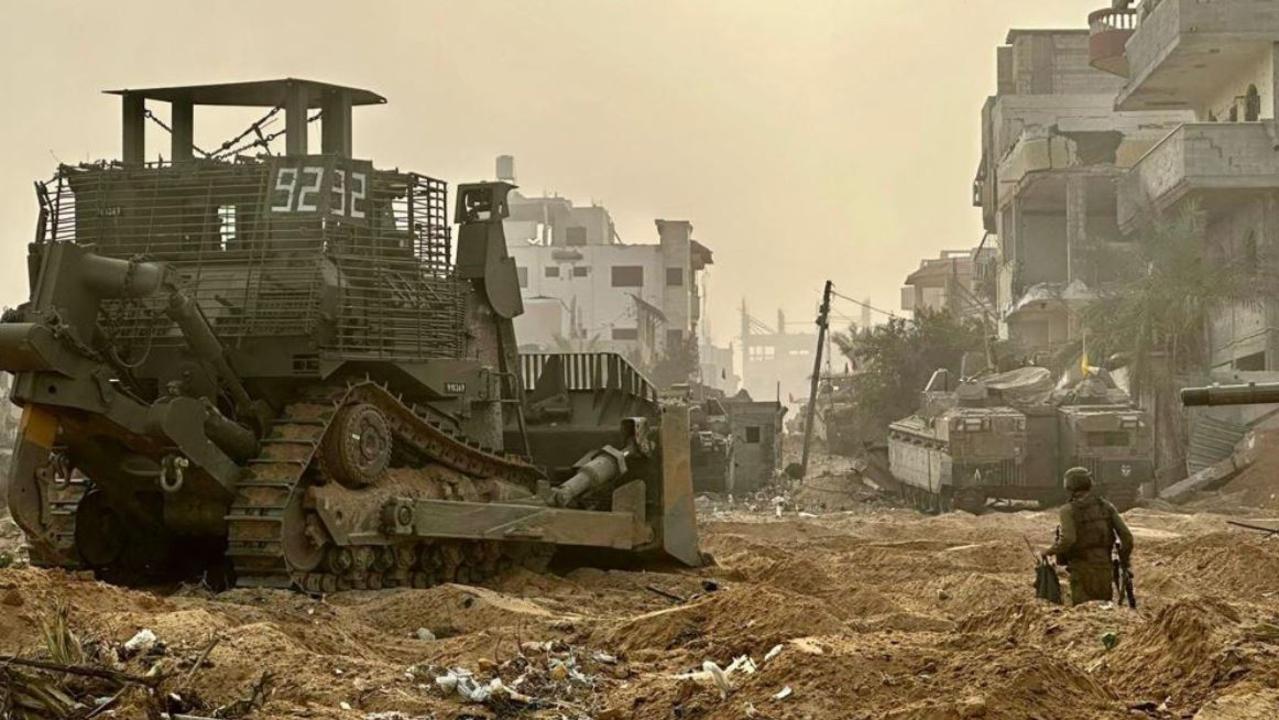
A central tool of Israeli tactics is the armoured bulldozer: slow, implacable, destroying obstacle after obstacle as it grinds forward. Israel’s ground campaign in Gaza has relied heavily on these bulldozers, which weigh more than an Abrams tank and can demolish buildings, clear rubble, destroy strong points or build berms under heavy fire.

US criticism of Israel’s approach reflects the preference for precision. Council on Foreign Relations president emeritus Richard Haass, one of America’s most distinguished foreign policy thinkers, wrote recently that Israel could have fought a different war. Its approach, Haass wrote, “should have been more precise, giving priority to eliminating Hamas’s leadership and key fighters as intelligence allowed. Israel should have relied more on small-unit operations rather than aerial bombardment.”

A central tool of Israeli tactics is the armoured bulldozer. Picture: Menahem Kahana/AFP
Armoured bulldozer.Menahem Kahana/AFP

While acknowledging that this might have taken months or years, and “some Hamas fighters who embedded themselves in schools and hospitals would have escaped punishment”, he argued that “this would have been preferable to killing thousands of civilians, further radicalising the Palestinian population and alienating the region and the world”.

It might indeed have been preferable, but would it have been possible? Could Israel really have adopted a stand-off approach, using small-team raids and surgical strikes to target Hamas leadership, do minimal damage to Gaza and its population, and still achieve its objectives? Answering these questions starts by understanding why the armoured bulldozer has become so central to Israeli tactics in the first place.

We are talking here of what is, rather than what ought to be. In an ideal world, October 7 would not have happened, Israel would never have needed to mount a full-scale ground invasion of the Gaza Strip, and thousands of civilians – Israeli and Palestinian, men, women and children – would be alive and well today instead of dead, wounded or held hostage.

But those things did happen, and any attempt to make sense of the war needs to take that fact as its starting point.

Richard Haass. Picture: Alex Wong/Getty Images
Richard Haass. Alex Wong/Getty Images

For reasons we will explore, destruction of the urban environment itself, rather than merely defeating an opponent within it, has become a key part of how the Israel Defence Forces fight in cities.

This, in turn, reflects the reality that, in a multi-generational struggle for territorial and demographic dominance, across a tiny area – all of Israel is only about twice the size of Greater Melbourne – it’s often simply impossible to disentangle opponents such as Hamas from the populations and landscapes in which they hide. Under these conditions, military commanders sometimes see destroying an urban area outright (or flattening parts of it) as the only way to achieve their missions. Some analysts (including several Israelis) condemn this as “urbicide” – killing entire cities rather than just fighting within them – but many IDF commanders, tasked by Israeli politicians with clearing a deeply embedded enemy from a densely urbanised, heavily populated area, see few other options.

On the ground in Gaza, infantry and armour move together in integrated combat teams with dismounted troops, tanks and armoured personnel carriers co-operating to support the manoeuvre of bulldozers as they push forward, clearing rubble, destroying Hamas positions and knocking down houses. Demolition teams, equipped with explosives and moving on foot, systematically blow up structures that could pose a threat. Tunnels and bunkers are blown up or bulldozed, their entrances sealed, with explosions often caught on video and disseminated on social media by the troops themselves. These videos have prompted criticism and some were cited as evidence in the genocide case against Israel in the International Court of Justice. But the videos also encourage civilians to evacuate ahead of advancing troops, reinforcing official IDF calls for the population to leave, and arguably reducing their exposure to combat.

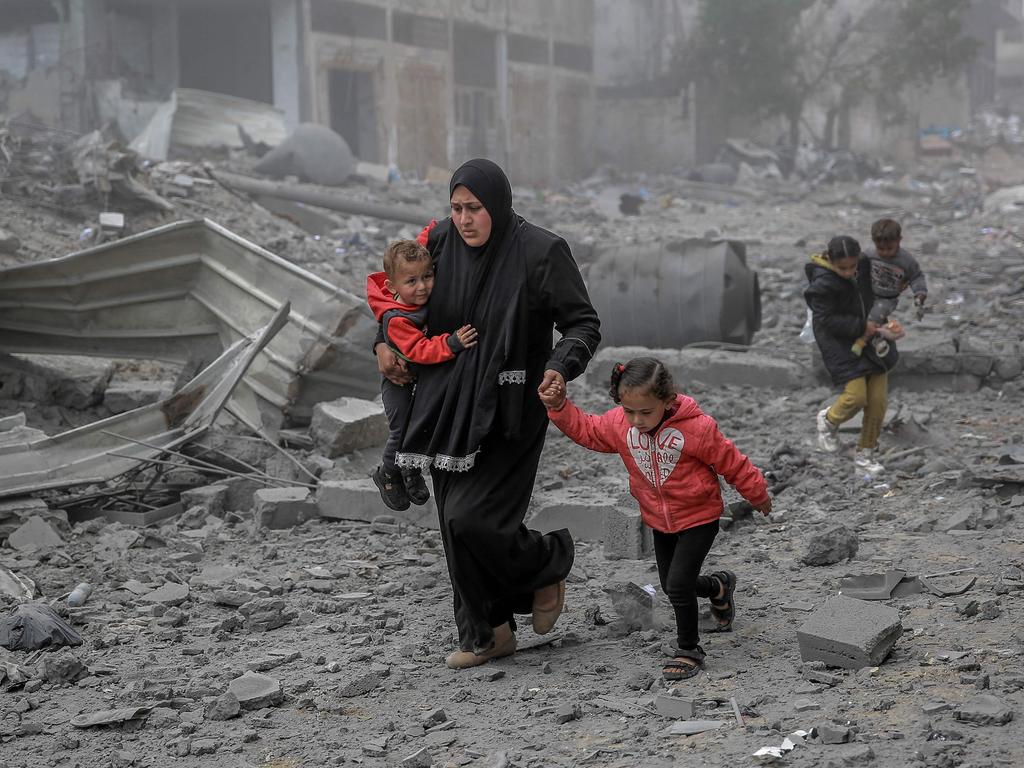
Palestinians flee the area after Israeli bombardment in central Gaza City. Picture: AFP
Palestinians flee after Israeli bombardment in central Gaza City. AFP

Much of the Gaza Strip is now not only uninhabitable but uninhabited. The IDF advance has pushed the population ahead of it, with civilians fleeing along evacuation corridors such as Salah al-Din Road, the main thoroughfare that runs down the middle of the strip and connects Gaza City with Khan Younis farther south. Both are depopulated, with 1.5 million civ­ilians now crowded into Rafah in the far south. Only about 300,000 civilians now remain in northern Gaza. (Before the war, the entire strip had a population slightly less than 2.2 million people.)

As the advance pauses each evening, rather than withdraw and thereby cede territory that would then have to be recaptured, the bulldozers build berms and defensive positions for the assault troops, allowing them to encamp in the ruins and restart the advance after resting. Most camps are used for one or two nights, then abandoned as the advance moves on, but some are semi-permanent forward operating bases. Attack helicopters provide fire support and air cover.

By January, entire neighbourhoods in Gaza had been razed using these methods.

Israeli forces also are constructing a buffer zone along Gaza’s landward border. Described before the current war as the “world’s largest open-air prison”, Gaza already had a 300m-wide exclusion zone that separated residential areas from the border fence. Israeli observation posts covered that zone and could shoot anyone approaching the fence.

But October 7 showed that a determined enemy could cut the fence at numerous places, so bulldozers and combat engineers have been widening the buffer since. Israeli officials say this is a critical security measure to allow civilians to return to the settlements that Hamas attacked on October 7. IDF engineers also are bulldozing buildings to construct an east-west road across the northern third of the strip, cutting Gaza in two and creating a field of fire 300m wide.

IDF D9 Israeli bulldozer in Gaza. Picture: IDF Spokesperson's Unit
IDF D9 Israeli bulldozer in Gaza. IDF Spokesperson’s Unit

The bulldozer (or perhaps the steamroller) is an apt metaphor for the campaign itself – the IDF is, in effect, bulldozing its way across Gaza, slowly but implacably pushing the population ahead of it, destroying Hamas as it goes, while removing much of the urban area itself. This represents a brutally terrain-centric approach to battle. But it also reflects the reality of deep entanglement among armed enemies, civilian populations and dense urban areas, in a zero-sum territorial conflict fought explicitly for control of living space. It embodies decades of tit-for-tat adaptation by both sides.

One battle – the Battle of Jenin, fought in a West Bank refugee camp in April 2002 – was an inflection point. The term refugee camp is technically accurate but gives the wrong impression: the Jenin camp was not a temporary collection of huts but a densely built-up area with multi-storey concrete structures. The IDF entered the camp to clear it of Hamas and other militants who were using it as a base for suicide bombings against Israeli civ­ilians. Nine days into the battle, after severe losses in an ambush, the IDF pulled back, reorganised, then re-entered using new tactics based on small combined-arms combat teams centred on armoured bulldozers. The bulldozers cleared improvised explosive dev­ices and booby traps, destroyed fighting positions, then flattened a 200m-by-200m area in the centre of the camp, which became an IDF base, effectively ending that round of fighting.

The IDF approach in Jenin was studied by US and Australian commanders during the Iraq war. They concluded its impact on civilians – and its physical destructiveness – made it a last resort at best. US forces tried (often unsuccessfully) to protect Iraqi civilians and avoid urban incursions. They built kilometres of concrete T-wall in Baghdad, for example, to keep hostile populations apart, separate them from insurgents and stop militants moving around the city, precisely so as to avoid destructive armoured forays into inhabited areas.

But Iraq – where the US-led coalition saw itself (and was seen by locals) as a purely temporary presence, trying to defeat an enemy with minimal damage, then stabilise things enough to leave – was far different from Israel, where both sides claim much of the same territory as their own. This is a demographic and territorial conflict between populations with irreconcilable claims to the same tiny area of land, a zero-sum contest where destruction of settlements and denial of access helps cement control at the expense of the adversary.

A more apt analogy for today’s fighting would be the battle against Islamic State in the northern Iraqi city of Mosul during 2016-17. This was an enormous battle, about the same size and duration as the current Gaza campaign. It did massive damage to Mosul, which before the battle had a population of 1.2 million people, and lasted nine months.

Islamic State had just over two years to put Mosul into a state of defence – from June 2014, when it captured the city, until October 2016, when the Iraqi-led offensive to retake it began. In that short period, Islamic State fighters developed dense belts of booby traps, dug deep defensive positions, and embedded themselves in the human and physical fabric of the city, thereby making it impossible for an opponent to attack them without also damaging the city and killing civilians.

Ultimately, Mosul soaked up more than 90,000 Iraqi troops and hundreds of foreign advisers, against 6000 to 12,000 Islamic State fighters. The battle displaced at least a million people, destroyed large parts of the city and may have killed as many as 40,000 civilians, according to the Asayish, the Kurdish Regional government’s intelligence service.

Hamas, by contrast, had almost two decades in complete control of Gaza (from 2006 to 2023). It used that time to develop a fearsome defensive complex, with numerous strong points and hundreds of kilometres of underground passages, embedding itself thoroughly into the physical environment of the strip and its population. The organisation had 30,000 fighters in total before the Gaza campaign began, far more than the Islamic State garrison defending Mosul.

Any ground invasion of Gaza was therefore bound to be bloody, protracted and destructive, on the scale of Mosul or larger. This is exactly what we are seeing, and what most military analysts expected.

Palestinians gather in a street as humanitarian aid is airdropped. Picture: AFP
Palestinians gather as humanitarian aid is airdropped: AFP

The notion of a clean, surgical, stand-off campaign, using precision strikes and small-team raids to destroy Hamas without damaging Gaza or harming civilians – as attractive as it sounds in theory – is simply not practicable, as our own recent history in places such as Mosul shows. Again, we are talking about what is rather than what ought to be. But reality is reality: the only way for Israel to avoid the kind of campaign that is happening now would have been not to go in at all, leaving Hamas in control of Gaza, which was politically unacceptable after October 7. To understand why that was so, we need to return briefly to Jenin.

Jenin was designated in the 1995 Oslo II Accord as part of “Area A”, putting it under the control of the Palestinian Authority, but the IDF repeatedly raided the camp before and after the 2002 battle.

From March 2022, incursions increased to an almost nightly tempo under Operation Breakwater, a counterterrorism effort targeting Jenin and the town of Nablus, 35km farther south.

The IDF said in mid-2023 that at least 50 attacks against Israeli civ­ilians had originated from Jenin in the preceding two years. In late July, weeks before the October 7 attacks, Israeli tanks, bulldozers and infantry launched their largest incursion into Jenin since the 2002 battle. Since the IDF launched its full-scale ground invasion of Gaza, raids into Jenin, Nablus and other West Bank towns have continued.

This is what some Israelis call “mowing the grass” – repeated raids into an area to disrupt terrorist groups and reduce the threat.

IDF commanders historically knew that such incursions were only a temporary measure, doing little more than managing the threat until it inevitably regenerated. They recognised the destruction and enduring hatred that the raids caused among local populations but accepted that the intractable politics behind the conflict precluded any permanent solution.

Israeli Prime Minister Benjamin Netanyahu. Picture: Leo Correa/AFP
 Prime Minister Benjamin Netanyahu. Leo Correa/AFP

This attitude – resignedly mowing the grass, forever, with no hope of any permanent settlement given the underlying politics – changed radically for many Israelis on the morning of October 7. After that assault, public pressure for a final defeat of Hamas built up inexorably on the Netanyahu government, from a population stunned by the audacity, scale and suddenness of the attacks, infuriated by the intelligence failure that allowed them to happen, horrified at their brutality, and demanding Hamas be destroyed once and for all.

Mowing the grass was no longer acceptable.

Tactics are downstream from politics, and this fundamental change in the underlying politics of the conflict is why, despite escalating criticism from the Biden administration and a genocide accusation in The Hague, Israel’s campaign has unfolded in such an implacable, bulldozer-like manner.

Since October 7, opinion has hardened even further on both sides: in polls last month a large majority of Israeli respondents expressed opposition to a Palestinian state “under any circumstances” and opposed a ceasefire until all hostages are released. Likewise, in November last year, 59 per cent of Palestinians surveyed said they “extremely supported” the October 7 attacks, while 16 per cent “somewhat supported” them.

The IDF’s campaign, successful though it has been in achieving the goals laid down by Israeli political leaders, has reached the point where politicians themselves have to take it to the next stage. This is all that any military operation can deliver. But given the hardening of Israeli and Palestinian public opinion – and the fact Hamas still holds 130 hostages and has refused to guarantee their safety – it’s hard to see any space for a political solution.

The pre-October 7 political conditions, of uneasy coexistence and periodic mowing of the grass, have been overtaken by events, suggesting that the campaign (with or without a temporary ceasefire) will end only with a complete Israeli tactical victory in Gaza. Whether such a victory would meet Israel’s broader strategic goals – and whether the country could then rebuild relationships that have been tested by the conflict – is a more complex question.

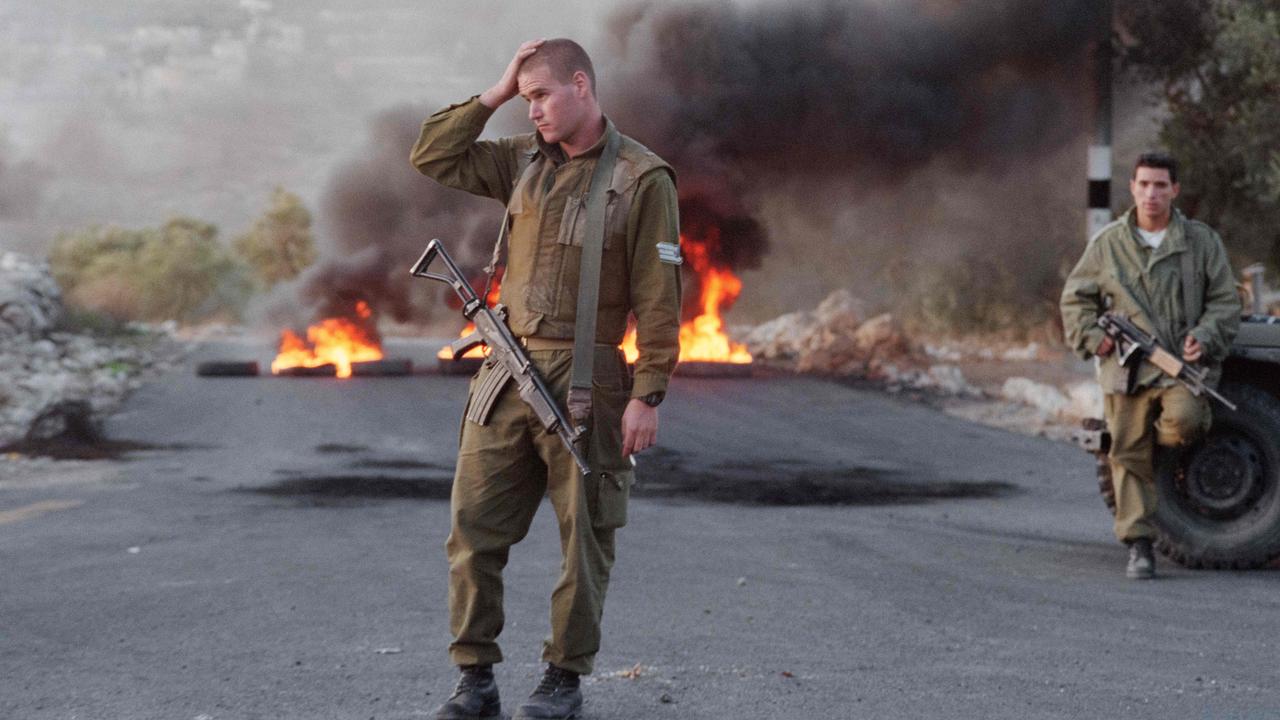
Israeli soldiers stand near a roadblock of burning tires placed by Jewish settlers. Picture: Sven Nackstrand/AFP)
 Israeli soldiers near a roadblock of burning tires placed by Jewish settlers. Sven Nackstrand/AFP

The next military objective is Rafah, where vast numbers of civilians are now crowded, under horrific conditions, into one of the last remaining Hamas-controlled areas. The more the advance squeezes civilians into this southwestern corner of the strip, the greater the pressure on Israel for a ceasefire or evacuation of non-combatants. That pressure has been growing from the US congress and the Biden administration, with stop-start negotiations periodically raising hopes of a temporary ceasefire but offering little likelihood of an enduring end to the fighting.

But even as the campaign inside Gaza itself comes to a crisis, two other crises threaten to expand the conflict. Roughly 1900 km south of Gaza, in the Bab al-Mandab, the narrowest point of the Red Sea, forces loyal to Ansarallah – the so-called Houthi movement that controls much of Yemen – have mounted a successful campaign to interdict shipping, using drones and missiles, in support of Hamas and probably at the behest of Iran, which sponsors both the Houthis and Hamas.

Targeting Western and Israeli-connected ships, the Houthis have managed to reduce regional shipping by more than 90 per cent since last November. Perhaps more important, the cost to ship a 40-foot container from China to Europe has almost tripled since the start of December, putting significant pressure on global trade. This brings other players – including several European powers and, most important, China – into the equation. China’s approach has been characteristically cautious, but the Red Sea crisis is increasing pressure on Tel Aviv to end the conflict, even as the IDF nears its last major objective.

A second problem is Hezbollah, another Iranian proxy whose forces sit just across Israel’s northern border and are vastly more militarily capable than those of Hamas. Indeed, it is hard to overstate how much more powerful Hezbollah is than Hamas: it possesses an enormous inventory of rockets, drones and missiles, exercises functional control of Lebanon’s government, and has barely used its most capable assets since the start of the Gaza conflict. Hassan Nasrallah, head of Hezbollah, repeatedly has called for an end to the war, and Hezbollah is intensifying its artillery and rocket attacks against northern Israel but is yet to mount a ground offensive or unleash its full force. If it were to do so, Israel’s strategic position would worsen catastrophically, overnight.

All this is true, but also perhaps irrelevant. In war, military action is driven by political decisions, and political decisions are shaped by public opinion.

In Israel’s case, public pressure for a permanent defeat of Hamas is now overwhelming, and this in turn drives political decisions that have resulted in the Gaza ground campaign. In turn, the evolution of Israeli (and Hamas) tactics and tools over decades of conflict have shaped the way that campaign is being conducted. To imagine that Israel could or should have fought the campaign using a surgical, precision, stand-off, small-team approach would be a fundamental misunderstanding of urban warfare and of how the underlying politics driving the conflict have shifted since October 7.

While many Australians are rightly watching the Gaza war with horror, the harsh reality – as Mosul shows – is that this is what happens when you do large-scale combat operations in a heavily populated city. The only way to avoid this would have been for Israel not to go in at all or for October 7 never to have happened. Short of a ceasefire (which seems highly unlikely) or a fundamental transformation of the conflict via direct Hezbollah intervention, things seem set to continue as they are for the immediate future.

David Kilcullen served in the Australian Army from 1985 to 2007 and was a senior counter-insurgency adviser to General David Petraeus in 2007 and 2008, when he helped design and monitor the Iraq War troop surge. His 2015 essay Blood Year: Terror and the Islamic State won the 2015 Walkley award for long-form writing and was published as a full-length book in 2016 by Oxford University


Muzaffar al Nawab, poet of revolutions and sorrow

Iraq bade farewell on May 20 2022 to one of its foremost poets, Muzaffar Abdul Majeed Al-Nawab. He passed away in the UAE, where he’d lived in exile, after a long illness at the age of 88. His body was brought back to Iraq, where it was  met by the prime minister and other prominent officials, and was buried in the holy Shiite city of Najaf.

He was known in the Arab world as the “revolutionary poet” in recognition of a lifetime of publically opposing and criticizing corrupt Arab regimes, and for which, he spent many, many years in jail or in exile.

He was following a long tradition of writers and intellectuals who have ‘suffered’ for their art. Nearly 175 years ago English poet Percy Bysshe Shelley wrote in his Defence of Poetry: “poets are the unacknowledged legislators of the world.” In the years since, many poets have taken that role to heart, right up to the present day.

They’ve been rebel-rousers and protesters, revolutionaries and yes, sometimes, lawmakers. Some, like Czech author Václav Havel have become presidents. Poets like Nawab have commented on the events of the day, giving voice to oppressed and downtrodden, condemned tyrants, immortalized rebels, and campaigned for social change. Most chant from the sidelines and the bleachers. Others place themselves in harms way. Many end up in dungeons and torture chambers, and some have perished for their art and articulation. So it was with Spanish poet Garcia Lorca, murdered in 1936 by Generalissimo Franco’s Nationalist soldiery at the beginning of the savage Spanish Civil War. So it was with Chilean folk singer and songwriter Victor Lara, slain in a soccer stadium in September 1973 by Augusto Pinochet’s thugs.

The silencing of singers and poets on account of their words and their voices diminishes our lives and indeed, it diminishes the world in which we live, and in its hatred and nihilism, strikes at the heart of the values we hold most dear. But history has shown that the death of the singer does not kill the song. The dictator perishes but the poet remains.

What is Freedom? – ye can tell
That which slavery is, too well –
For its very name has grown
To an echo of your own.
Shelley The Masque of Anarchy, published posthumously in 1832

Revolution Road

Let the word makers and the revolution singers awake!
Egyptian poet Abd al-Wahhab al-Bayati

Al-Nawab was born in Baghdad, Iraq, in 1934,  into an aristocratic Shi’ite family of Indian origin that appreciated art, poetry and music, and from an early age, he displayed a talent for poetry . Completing his undergraduate studies at the University of Baghdad he became a teacher, but was expelled for political reasons in 1955 and remained unemployed for three years.

He joined the Iraqi Communist Party while still at college, and was detained and tortured by the Hashemite regime that ruled Iraq at that time. After the Iraqi revolution in 1958 which overthrew the monarchy, he was appointed an inspector at the Ministry of Education. In 1963 he was forced to leave Iraq to neighbouring Iran, after the intensification of competition between the nationalists and the communists who were prosecuted and put under strict observation by the republican regime. He was arrested and tortured by Savak, the Iranian secret police, before being forcibly repatriated to the Iraqi government. An Iraqi court handed down a death sentence against him for one of his poems, but this was later commuted to life imprisonment. He escaped from prison by digging a tunnel and fled to the marshlands, where he joined a communist faction that sought to overthrow the government.

Known for his powerful revolutionary poems and scathing invective against Arab dictators, the first complete Arabic language edition of his works was published in London in 1996 by “Dar Qanbar” He lived in exile in many countries, including Syria, Egypt, Lebanon and Eritrea, where he stayed with the Eritrean rebels, before returning to Iraq in 2011. Before he returned to Iraq, he had been essentially stateless, being able to travel only on Libyan travel documents.

Nawab’s popular and eloquent poetry earned him a prominent position at the forefront of modern Arabic literature. He was known as the “revolutionary poet” for decrying corrupt regimes across the Arab world. His poems were filled with revolutionary fervor, social anger, satire, and rebellion against injustice and corruption by Arab dictators. Syrian writer Aws Daoud Yaqoub described Nawab in a book dedicated to his poetry as the poet of “revolutions and sorrow.”

Nawab was also known as a poet of pop culture as his poems spoke to the Iraqis of all age groups, useing simplified folk language in a frank and sharp way. He sometimes resorted to attacks and obscene words to deliver a specific message. In 2018, he was nominated by the Iraqi Writers Union for the Nobel Prize for Literature. Many of his poems, composed in the spoken dialect,  were sung by some of the most renowned Iraqi singers, such as Yas Khoder. These include the poems called “Oh, Basil [Ya Rihan], “Al-Rayl and Hamad,” and The Night of Violet.”

Some Arab intellectuals considered him a great poet with sincere revolutionary principles who railed  against  oppressive regimes, injustice and corruption, using piercing words to expose the defects and deficiencies of the state, society, and poetry and to strip the emperor naked. He called for an end to the traditional practice in Arabic poetry of setting up poets and singers to perform songs of praise to the regime, sultan, or king.

He took extreme hostile positions against the West, Israel and the allies of the United States, such as the Gulf states. In one of his most renowned poems, he described the commanders of these countries as “the pigs of this Gulf” in the poem of this title. He described Arab meetings to solve the Arab issues, especially Palestine, as “lesbian meetings” in the sense that they produce nothing, and mocked the Arab rulers, saying “a pig’s pen is cleaner than the cleanest of you.”

And yet, many criticized him for his selective attitudes towards the tyrannical regimes in the region, and for behaviour that appeared to contradict to his declared principles. For example, the UAE has normalized ties with Israel, which contradicted Nawab’s opposition to both the rulers of the Gulf states and to Israel. His attitude attracted harsh criticism from critics on social media, who lamented the special treatment he received before his death in Gulf state that he had often condemned. Dhafer Al-Ajmi, Executive Director of the Gulf Monitoring Group, tweeted that Nawab was mostly known for decrying Gulf leaders using vulgar language to describe them. “Despite that, he died in a Gulf hospital, where he received treatment at the order of a Gulf Sheikh.” Saudi journalist Ali Al-Quhais noted that Nawab died in the Gulf states after he offended them and their rules, and even insulted Mecca. “The Gulf countries held poetry evenings for him and opened their hospitals to him,” Quhais said, criticizing Nawab for keeping mute when his own country [Iraq] was occupied

Other critics have  described him as sectarian and partisan, since he often attacked Arab rulers, the West and Israel, whilst praising Ayatollah Khomeini and Syrian dictator Bashar al-Assad, and failed to take any position on the occupation of Iraq, which brought the Shiites to power in that country after American invasion and the fall of Saddamn Hussein.. His poetry also included strong words against sacred Sunni figures such as Abu Sufyan and Amro bin Al-Aas, who are among the Ansar or Companions of the Prophet – and who are are frowned upon by Shiites because of their attitude towards Imam Ali.

.Others, howver, believe Nawab’s positions were not sectarian at all, but rather, expressed his revolutionary left-wing stance against reactionary principles, colonialism and injustice – he referred to himself in his poetry as an Qarmatian, in reference to a social movement which led a revolution against the Abbasid Caliphate between the years 899 -107, and which included non-Arab nationalities, including black-skinned people.

By describing himself thus, he sought to allude to his Indian origins, family having migrated to Iraq during 19th century. This would explains the diverse cultural aspect of his poems, and why he addressed issues like Iraq’s oppressed Iraqi cultural minorities and their long history of persecution under the dominion of the Arab majority.

Iraq was once distinguished by its ethnic, religious and cultural diversity, as it was home to large communities of diverse origins. Today, these communities are on the brink of disappearance, as they were forced to flee the political, security and societal pressures in the absence of the authority of law and the state.

From an obituary published by e-zine al Monitor on 27th May 2022.

For more on Arab poets, in In That Howling Infinite, see: Ghayath al Madhoun – the agony of an exiled poet, and O Beirut – songs for a wounded city (Syrian poet Nizār Tawfīq Qabbānī and  Lebanon’s national cultural icon, Fairuz).

Poetry Defeats Authority: Muzaffar al-Nawab 

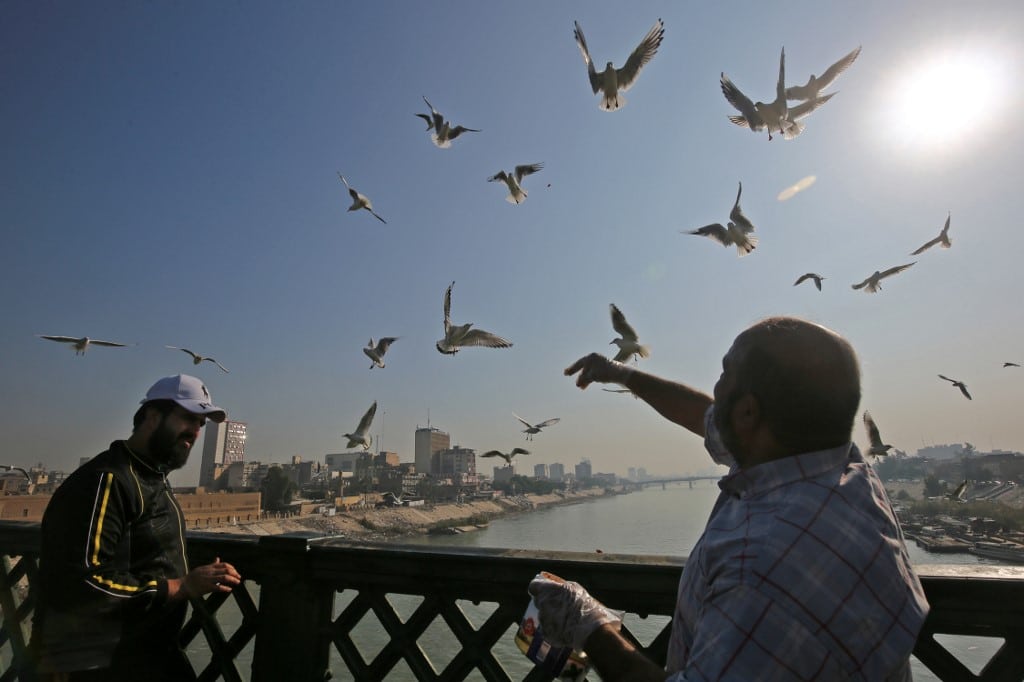
An Iraqi man feeds seagulls

An Iraqi man feeds seagulls on a bridge across the Tigris River in central Baghdad,
December 11, 2020. Ahmad al Rubaye AFP

There are still poets that dare to tell this world about the wrong things that occur. They do that as if they were “Romeo” in Shakespeare’s play “Romeo & Juliet”. However, Arab repression forces them to “praise” rulers, politicians and security apparatus instead of writing for “Juliet”. While doing that, they use a totally very different language to deal with that circle. They curse when hit by batons and spit when tortured. They “pee on this apparatus” when their humanity is killed! The Iraqi poet Muzaffar al-Nawab (1934) managed to develop a unique style to deal with such a thing. He used a language that no other poet can create unless he/she was exiled from an Arab capital or subjugated to physical and psychological torture. Poets even have to face firmly “the beast” in Tehran to develop such a language. There, dozens of flagellants will be waiting to beat the poet with a whip and large boots.

Al-Nawab wrote in one of his poems about that experiment:

“ike two dull houses of ants
Are the eyes of the flagellants’ chief
His nose’s hair was growing like those of a pig
Mucus words were in his mouth
He was dripping them in my ears
He asked me: Who are you?
I was embarrassed to tell him:
I resisted colonization, so my homeland displaced me.
My eyes fainted from torture.

Although his family was an aristocratic one, al-Nawab became a member of the Iraqi Communist Party. After the coup of 1963, he became a fugitive. He fled to Iran and hid in Tehran. He was arrested there and held in prison for 5 months without knowing what was happening in his country. Then, he was sent back from Tehran to Basra in Iraq  and afterwards to Baghdad.

His journey of rejection started there. Later rejection turned into a language that Al-Nawab mastered. He produced his first poem of rejection “Acquittal”. This poem became for him the start of being abused and tortured continuously. It was like a monster that kept chasing him.

At that moment, al-Nawab defeated authority for the first time. He uttered his first “no” in public. This refusal costed him 20 years of prison. Writing the aforementioned poem meant also putting him into jail for extra three years. Thus, his journey of rejection started with a “no” and a poem.

The trail was absurd. Al-Nawab stood and they asked him to insult the communist party to claim his acquittal. It wasn’t an easy choice as the poet’s answer would have affected another 120 prisoners by doing what he was asked to do. They said to him: Curse the party. But he said: No. They asked him to curse all parties. He said: No. And he wrote his “Acquittal” poem in a folk Iraqi poetry. While imitating the language of a mother, he wrote the following:

Time crashes your bones for betrayal.
You compromise your wound for meanness
And you have to hide it.
O son, let the wound be cleaned.
Let it bleed.
My son, don’t conceal our honor.
O son, acquittal remains rotten forever.
You know my son with every acquittal,
We rebury each martyr of our people.

Al-Nawab wasn’t using rejection in his poetry alone, but also in each situation of his life. “Semi actions” used to annoy him a lot. In Al Hillah prison, the poet helped in 1965 Hamed Maksood, who was sentenced to death, to escape. Like a painter, he made Hamed back then look like an eighty years old man. He stamped Hamed’s hands with the prison’s stamp to look like a visitor. He also transformed his pillow into a sick sleeping man and the police got deceived by this ruse. After that, Al-Nawab himself escaped from the prison at the beginning of 1967. He got used to escaping with the same way. Meanwhile, his poems were reaching readers and this casted him with homage. He got used to escaping which comes before confrontation and even when he got arrested in Iran, he tried to escape. His second attempt to escape from Al Hillah prison succeeded by digging a tunnel in the prison that 40 prisoners, including Al-Nawab, escaped from. He, then, disappeared in Baghdad before authorities issued an amnesty order for political opponents.

This was his second victory over the authority in poetry and life. These victories were accompanied usually with him being tortured and exiled. He was arrested in 1968 and he met the former Iraqi president Saddam Hussein. May be the authority was trying to buy his silence or to direct his speech, but he said about both options: “Why does suppression enter the heart and censorship controls my silence, papers, steps and my mazes? Don’t I have the right to be silent, to speak, to walk outside the official path or to cry? Don’t I have the right to publish and distribute fire for free?”

In an unknown building, Saddam Hussein met him and asked him: “Don’t you trust the central government?” Al-Nawab replied: “I don’t trust you; you can send me back to jail.”

These constant escapes from one place to another have violated Al-Nawab’s humanity. In return, he created linguistic violations by attacking ministers, parliament’s meetings, police, informants and Arab league’s summits. He asks in his poem “The old pub”:

“How can man maintain his dignity while security apparatus hands reach everywhere?”

Al-Nawab was cursing on behalf of a whole nation. He represented hundreds of thousands of the poor who couldn’t curse the ones who deserved being cursed. Through this, he was freeing the anger of a whole nation, speaking to it in a way that he learned by blood. He cursed, with generosity, those who deserved that; those who tortured him, occupied his land, sold him and killed his joy. His curses became inclusive. He utters them from his throat that contains the throats of the silenced nation in an era that he called the urine era as he says:

I pee on the governing police.
It is the era of urine.
I pee on the tables, the parliaments and ministers with no shame
As they fought us with no shame.
The authorities of apes,
The parties of apes,
The apparatus of apes,
No!
The apes’ shit is better than you.

Using these linguistic violations in poetry was a response to abusing and suppressing thousands of people. But one person dared to use it and utter words before batons and torture chairs. That one was Muzaffar al-Nawab.

The poet, whose joy was killed in all Arab capitals, acknowledges the outright defeat and declares that in his poem “Summits”:

Now, I confess before the desert
That I’m filthy like your defeat.
O defeated rulers, defeated parties
Oh loser rulers
O defeated public
How rude we are!
And we deny it, how rude we are!

After the curse that he wrote in the poem: “Son of bitches, I exclude none of you”, he was shot but he survived. He says about this sentence: “They now got used to it” and he laughs.

In the home of foreignness and the collective feeling of alienation, Al-Nawab asks:

Oh, my homeland;
Are you the land of enemies?
O my homeland that is displayed as a morning star in the market

Speaking to God, he says:

Glory to you, I have accepted all things except humiliation.
I was satisfied that my share of life to be like that of a bird.
But glory to you, even birds have homes that they come back to.
And I’m still flying.
This homeland that extends from the sea to the sea
Is like adjacent prisons.
They are like a jailer who arrests another jailer.

Al-Nawab asks after all for forgiveness but tries to maintain his rejection:

Forgive my sadness, wine, outrage and harsh words.
Some of you will say that they were saucy.
Ok!
Show me then a situation that is more insolent
than the one we are now living in!

Sic semper tyrannis

You come at the king, you best not miss.
Omar Little, The Wire (after RW Emerson)

The phrase “one man’s freedom fighter is another man’s terrorist” is at once apt, correct, and yet often oversimplified to the point of disingenuousness. The word “terrorist” itself describes its goal. To instill fear in the heart of the enemy. In the past, the target would have been the king, the dictator, the ruling class, and those who served them and upheld their rule. Politicians, officials, solders and policemen. Today, terrorists indiscriminately target whole societies. Irish bombers blasted communities of the rival faith, murdered shoppers, office workers, and pub patrons, as well as soldiers and policemen. Palestinian suicide bombers hit malls and pizza bars in city centres. ISIS, al Qa’ida and the Taliban detonate cars in busy city streets and publicly execute prisoners in callous and calculating “lectures in flesh” (the phrase is civil rights lawyer Geoffrey Robertson’s, from his chilling account of the trials and execution of King Charles I of England and those who sentenced him, The Tyrannicide Brief.).

But targeted and random terrorism has a long historical pedigree. For centuries, it has been the desperate and nihilistic weapon of last resort of resistance and rebellion against perceived oppression and injustice, and against invaders and occupiers.

In the second century BCE Palestine, the Maccabees used assassination in their resistance to the Seleucid Greeks, and a century later, the Jewish zealots, the Sicarii, named for the easily concealed small daggers, paid the Romans in like coin, and ultimately in an insurrection that culminated in the destruction of Jerusalem in 70CE and the scattering of the Jewish race (giving history the emotive and symbolic last exit that was Masada). In an etymological irony that Mark Twain would have been proud of, the present unrest in Jerusalem, a large number of young Palestinians have perished in attempting to stab jewish soldiers and civilians. Their jaquerie is called the “Intifada Sakni-in”, the ‘Knife Uprising – an echo of those long-dead Sicarii “dagger men”.

Nowadays, one would be excused for thinking that “terrorism” and “terrorist” are synonymous with Arabs and Muslims. And a historical precedent reinforces this erroneous assumption. The Hashishan or “Assassins” of Middle East fame (yes, that is where that noxious noun originated) were Muslim men and boys mesmerized and mentored by Rashid ad Din as Sina-n, the “Old Man of the Mountain” (and all this, before Osama in the caves of Tora Bora), and were Twelfth Century  hit-men contracted out to rival Muslim princes in the internecine conflicts that plagued the Levant in the wake of the Crusades and the demise of the great Arab Caliphates.

But the assassin’s knife (and in modern times, the gun and bomb, and latterly cars and trucks) predates these medieval hoods and links the Hebrew rebels of old to the Irgun and Stern Gang who encouraged Britain and the UN to abandon Palestine in 1948, bequeathing most of it to the new state of Israel, and triggering the Palestinian diaspora. European anarchists and Irish rebels and loyalists were adept at shootings and ambushes. In Algeria, during the ‘fifties, the nationalist FLN and the “colon” OAS shot and bombed each other and those unfortunates caught in the crossfire. The IRA perfected the improvised explosive device that today has crippled thousands of American, Canadian, and Australian soldiers in Iraq abd in Afghanistan. Hindu Tamil separatists of Sri Lanka introduced the suicide bomber, an economical and efficient weapon against soft (civilian, that is) targets, deployed today by Islamist killers in the streets of London and Lahore, Damascus and Dar es Salaam, Jerusalem and Jakarta. Whilst Arabs – and particularly Palestinians may have given the world the hijacking of aircraft – a tactic that fell into disuse due to diminishing political returns and rapid response forces – other Arabs showed us how to fly them into public buildings as the whole world watched in horror and disbelief. The shockwaves of this one are still reverberating through the deserts of the east and the capitals of the western world.

In going up up against their occupiers, the Palestinians have an old heritage. In my old country, Boudicca and Caractacus fought a losing battle against the Romans in Britain during the First CE. The Roman historian Tacitus ascribed to a vanquished chieftain the memorable words  “solitudinem faciunt, pacem appellant” – they make a desert and they call it peace. After the battle of Hastings in 1066, the defeated Saxons pushed back against the Normans and brought the genocidal wrath of William the Conqueror down on their heads with the devastating “Harrying of the North”. The Green Man and Robin Hood legends are said to be a retrospective and romanticised remembering of the Saxon resistance. Warrior fugitives from that failed guerilla war fled as far as Constantinple, where many joined the Emperor’s acclaimed Varangarian Guard, (see When Harald Went A Viking) 

In the streets and the countryside of Ireland, my parents’ birthplace, the United Irishmen, Fenians, Free Staters, IRA and Unionists fought against the redcoats, tommies, and black and tans of the British Army. Fought amongst themselves, fought against each other, and killed and were killed in their centuries long war of liberation. And in my adopted country, indigenous Australians fought a futile frontier war against settlers and soldiers just as native Americans did, albeit on a much smaller scale, and paid the price in hangings, massacres, poisoned wells, dispossession, marginalization, and “stolen children”. The legacy of those times lingers still – see The Frontier Wars – Australia’s heart of darkness.

In Central America, Juarez led the Mexicans against the French, and Sandino, Nicaraguans against US marines. Spaniards rose up against Napoleon’s forces, giving the world the word “guerilla”, or “little war”. Russian partisans ambushed the Grande Armé and the Wehrmacht. Throughout occupied Europe, the very term “resistance” became synonymous with the heroic unequal struggle against tyranny. In another of history’s ironies, muqa-wamat, Arabic word for resistance, unites sectarian rivals Hamas and Hizbollah against Israel.

And not just resistance to invasion and occupation, but also against oppression by one’s own rulers. Religious tracts tie themselves in knots reconciling the obligation to obey our rulers with the right to resist and overthrow those that rule badly. The unequal struggle against tyranny – or what is perceived by the perpetrators as tyranny – is the cause that inspires men and women to desperate acts.

The most celebrated in fact, film and fiction is the death of Julius Caesar at the hands of peers who feared that he intended to usurp the ostensibly democratic Republic (ostensible because democratic it was not) and institute one-man rule. That ended badly for the conspirators, and for Rome, as it precipitated years of civil war and ultimately, half a century of empire).

In 1880 the reforming Czar Alexander II of Russia, discovered the hard way that liberating the serfs did not inoculate himself against the bomb that took his legs and his life. His fearful and unimaginative successors hardened their hearts and closed their minds against further reform. setting in train the crackdown on dissent and democratic expression that led eventually to the storming of the Winter Palace on Petrograd in 1917. Narodnaya Volya, the killers called themselves – the People’s Will. And that is what terrorists do. They appeal and owe fealty to a higher court, a greater good, a savage God.

So it was when student and Serbian nationalist Gavril Princip assassinated Archduke Ferdinand of Austria-Hungary in June 1914 and ignited the spark that lit the conflagration of World War 1 which precipitated the demise of the old European empires.

So too when John Brown and his sons brought their broadswords to bear on slavers and their sympathizers and made a date with destiny at Harpers Ferry. Their famous raid may or may not have accelerated the downward slide to the secession and civil war that erupted the following year, but it provided a moral and symbolic prelude and also, the resonating battle hymn of the republic. John Wilkes Booth bookended this bloody era with his histrionic and public murder of Abraham Lincoln, shouting “sic semper tyrannis”, “thus always to tyrants,” attributed to Brutus at Caesar’s assassination – today, it’s the Virginia state motto. Brown and Booth were quite clear in their motives. As was were the segregationalist shooters who did for African Americans Medgar Evers and Martin Luther King. Less so were the killers of the Kennedy brothers in the sixties.

To conclude, sometimes that savage, rebel God is one of faith, sometimes, of blood and soil. In some instances, it is revenge for wrongs real and imagined – the reasons at times lost or forgotten through the passage of time and fading memories. And often, “the cause” is corrupted by the immoral economics of illicit commerce, including contraband, kidnapping, blackmail and extortion. Sometimes all merge in an incongruous hybrid of religious passion, ethic identity, libertarian or anarchistic fervour, and protection racket. As was the case in Northern Ireland, in Lebanon, in sub-Saharan Africa, and currently so in Syria and Iraq.

But most times, terror and turmoil is simply a political weapon planned, targeted and executed as a mechanism of regime change. Rebellion, revolt and revolution. Resisting, opposing, challenging, confronting and defeating the central authority. The seizing, holding, consolidation and keeping of political power.

And one thing is for sure. The outcome is unpredictable. History does not move in straight lines, but often follows a bitter and twisted path. Cliched as it is, the phrase “be careful what you wish for” is an apt one. And when, as Bob Dylan sang, “the line it is drawn, the curse it is cast”, there is no going back. To quote WB Yeats’ famous lines, “all is changed, changed utterly”.

Terrorism, then, can shift the course of history. If we were to stumble into the swamp of alternative histories, imagine what might of happened

If Caesar had walked home from the senate on the Ides of March
If Lincoln had been able to guide the Reconstruction
If the reforming Czar had introduced democratic government to Russia
If Gavril Princip’s shot had missed the archduke
If Kennedy had returned from Dallas
If John Lennon outlived George Harrison
If Yitzak Rabin had left the peace concert in Tel Aviv
If the Twin Towers stood still

To quote “Stairway to Heaven”, a curiously apposite title given the millenarian mindset of many terrorists, “Oh, it makes you wonder!”

Thermidorian Thinking … a revolutionary reverie

I fought in the old revolution
on the side of the ghost and the King.
Of course I was very young
and I thought that we were winning;
I can’t pretend I still feel very much like singing
as they carry the bodies away.
Leonard Cohen, The Old Revolution

‘Thermidorian’ refers to 9th Thermidor Year II (27 July 1794), the date according to the French Republican Calendar, when Robespierre, Danton and other radical revolutionaries came under concerted attack in the National Convention, resulting in their downfall and execution.

Grim travelers butt each other to establish dominance. One lot plays Danton to another’s Robespierre, with the moderate Manon Roland and her Girondins trampled underfoot in the melee. On the scaffold, Madame Roland is said to have exclaimed “O Liberté! O Liberté! que de crimes on commet en ton nom”. Maximillian Robespierre destroys his erstwhile friends and slaughters thousands, precipitating the Jacobin meltdown as the ascetic and purist Marat is murdered in his bath. Robespierre and Saint-Just are guillotined by those who believe “the Terror” had gone too far, soon to be followed by fellow Jacobins Georges Danton and Camille Desmoulins. [Hilary Mantel’s excellent door-stop of a debut novel, A Place of Greater Safety, tells the story of all these revolutionaries. The bones of most of them rest amongst those of tens of thousands of others in the famously macabre Catecombes de Paris, a “tourist” attraction I highly recommend]

I would argue that this “Thermidorian Reaction” – the ostensibly “better angels of our nature” (Abraham Lincoln said that) reasserting themselves – is a rare bird indeed. Inevitably, things get worse, much worse, before they get better. As WH Auden observes in his sombre eclogue The Age  of Anxiety, “many have perished: more will”. 

Revolutions are unpredictable. They never run in straight lines. They reverberate, the shockwaves expanding and impacting on their vicinity, and way beyond. The shots ricochet, like drive-bys and crossfires, and you never know who will be hit, where the bullets will come to rest, and who will be damaged or destroyed. Many people will be liberated, and many enslaved. Many peoples will prosper, and many, many will perish. As TS Elliot wrote, “between the idea and the reality falls the shadow”.”

Stalin seizing Lenin’s crown as the father of the revolution lay dying. Trotsky launching the Red Army against the sailors of Kronstadt whose guns had heralded the fall of the Romanovs, and who then fought to last man against their former comrades. Stalin and Trotsky wrestling for control of party and power as the old Bolsheviks disappeared into the gulags and the execution cells. Stalin’s long arm putting an ice pick through his rival’s skull in Mexico decades later. Trotsky knew a thing or two about “permanent revolution. See Red and white terror – the Russian revolution and civil war and Stalin’s Great Terror

Adolf Hitler making his move against the corrupt and sybaritic Rohm and his Brown Shirt bully boys, a threat to his control of party and state, in the “Night of the Long Knives”, and setting the course for a Germany’s slow spiral to damnation with the plausible deniability of the similarly dramatically named Kristalnacht. The German language has surely given the world ominous words of iron, including Nacht und Nebel; Storm und Drang; Weltanschauung, Blitzkrieg and Schadenfreude – none of them boding well for tyranny’s unwelcome attentions.

It is a zero-sum play book well-thumbed by latter-day revolutionists like the Baathists Saddam Hussein and Hafiz Assad in their relentless and merciless accession to power in Iraq and Syria respectively, like the cruel and vengeful but infinitely pragmatic regime that has ruled Iran’s Islamic Republic for these past forty years, and the kleptocratic dictators who lord over much of Sub-Saharan Africa. In the manner of revolutions past and present, each one has “devoured its children”, harrying, jailing, exiling and slaughtering foes and onetime allies alike.

The sad reality in so many countries is that when the going gets tough, the mild get going, and the hard men ride roughshod over their people.

Vengeful, vindictive. Merciless. Unforgiving and never forgetting. Do no deals. Take no prisoners. Give no quarter.

Also in In That Howling InfiniteA Political World – Thoughts and Themes

Bolshevik recruiting poster 1917

Danton, Robespierre, Desmoulin, and Manon Roland

Danton, Robespierre, Desmoulins, and Manon Roland