This remarkable poet and storyteller is today rarely read and is often vilified and dismissed as a jingoistic and chauvinistic booster of empire and white civilization. When critics reach for their guns, they “bring out the white man’s burden“and “east and west is west, and ne’er the Twain shall meet”. He is definitely guilty as charged, but he was of his time, and voiced what was then the imperial zeitgeist that enraptured his British constituency. The past, as they say, is another country – they thought much differently then.
But, as those who are familiar with his many poems and stories would attest, the poet was so much more than this.
It was Kipling’s habit to preface and bookend his remarkable if, to contemporary readers, politically incorrect stories with short poems of singular quality.
Lukannon is one of these. The story of The White Seal first appeared in print in the August 1893 issue of the London-based magazine National Review and published again in 1894 as part of the anthology The Jungle Book. Yes, that one. Mowgli, Wolf Cubs, Akela, and all. But, exceptionally for a story in The Jungle Book, none of the action in The White Seal takes place in India. And, presaging the environmental activism and protests against the controversial seal hunts of the late 20th Century, it is remarkably prescient and pertinent.
The story is set on an island in the Aleutians in the Bering Sea between Russia and Alaska. It tells of a unique seal who, by leading his fellow seals to a secret hidden beach, saves his kind from the seal hunters. He referred to his poem as “a kind of national anthem for seals”. The title of the poem is the name of a Russian seal-fur trader, Lukanin, who gave his name to these lonely Aleutian beaches in 1788. Kipling wrote: “This is the great deep-sea song that all the St. Paul seals sing when they are heading back to their beaches in the summer. It is a sort of very sad seal National Anthem”.
Back in the day, I set the poem to music. It is featured on the rare recording HuldreFolk Live in London 1988, featuring Paul Hemphill, Victor Mishalow and Adèle Hemphill. During HuldreFolk’s tour of English folk clubs in the northern summer of 1988, it was recorded on a cheap audio cassette by a dinky, clunky old analogue tape recorder – and it shows. But the natural acoustics of the cellar at Bracknell Arts Centre, and the audience’s participation in the choruses made up for a multitude of sins.
Lukannon is such a lyrical poem that it lends itself effortlessly to musical settings. Apart from my own, i have discovered three alone, and I am pretty certain that there are many more out there on the world wide web. There is a version by folk duo William Pint and Felicia Dale set to a tune by American musician Bob Zentz from their 1997 album Round the Corner. There is also a contemporary “prog-rock” version by British band Shadows of the Sun.
In 1947, the eccentric Australian expatriate composer Percy Grainger composed a song cycle of The Jungle Book and chose as his centrepiece the story of The White Seal – and particularly, Lukannon “as a protest against civilization.” For more on Grainger’s opus, see below.
Lukannon
I met my mates in the morning (and oh, but I am old!)
Where roaring on the ledges the summer ground-swell rolled;
I heard them lift the chorus that dropped the breakers’ song –
The beaches of Lukannon – two million voices strong!
The song of pleasant stations beside the salt lagoons,
The song of blowing squadrons that shuffled down the dunes,
The song of midnight dances that churned the sea to flame –
The beaches of Lukannon — before the sealers came!
I met my mates in the morning (I’ll never meet them more!);
They came and went in legions that darkened all the shore.
And through the foam-flecked offing as far as voice could reach
We hailed the landing-parties and we sang them up the beach.
The beaches of Lukannon – the winter-wheat so tall –
The dripping, crinkled lichens, and the sea-fog drenching all!
The platforms of our playground, all shining smooth and worn!
The beaches of Lukannon — the home where we were born!
I meet my mates in the morning, a broken, scattered band.
Men shoot us in the water and club us on the land;
Men drive us to the Salt House like silly sheep and tame,
And still we sing Lukannon – before the sealers came.
Wheel down, wheel down to southward; oh, Gooverooska go!
And tell the Deep-Sea Viceroys! the story of our woe;
Ere, empty as the shark’s egg the tempest flings ashore,
The beaches of Lukannon shall know their sons no more!
Percy Grainger’s Jungle Book Cycle
In 1947, the eccentric Australian expatriate composer dedicated a song cycle of The Jungle Book and chose as his centrepiece the story of The White Seal – and particularly, Lukannon. My Kipling ‘Jungle Book’ Cycle, begun in 1898 and finished in 1947, was composed as a protest against civilization.” (Grainger’s programme note, 1947)
Grainger (1882-1961) studied at the Hoch Conservatory in Frankfurt, Germany from 1895-1901 (aged 13-19). Grainger’s mother Rose wrote to her husband John of her fears that young Percy was becoming “more Germanized every day.” In response to Rose’s concern, and to “tickle up the British Lion in him,” John (who was estranged from Rose) sent Percy, among other things, several books by Rudyard Kipling . Kipling’s writings captivated Percy immediately, and he soon started writing choral settings of the poetry, especially those of Kipling’s Jungle Books.
Grainger’s settings of the poetry of Kipling are as extensive as his settings of British folk music; Kay Freyfus’s catalog of Grainger’s manuscript scores lists 36 settings, though Grainger in a 1926 letter to Kipling mentions “some 40 or 50” settings. Grainger felt a strong kinship for Kipling’s writing, and Kipling appreciated and approved of Grainger’s work at setting his poetry. Grainger played several of his choral settings for Kipling during a meeting at Kipling’s home in 1905. Of Grainger’s settings of his poetry, Kipling said, “Till now I’ve had to reply on black and white, but you do the thing for me in colour.”
The Beaches of Lukannon is the centerpiece of the cycle, and arguably the strongest piece musically and emotionally. It tells us the tale of the tragic slaughter of seals by wicked sealers from the seals’ perspective. The opening section, told from the point of view of a seal elder, recounts what the beaches of the Bering Sea Island of Lukannon originally were for the seals – their annual meeting (and mating) opportunity. The central section, reminiscent of the music of Charles Ives in its shifting chromatics, conveys the beauty of the surroundings “before the sealers came.” The final section musically revisits the opening material, but in a smore somber mode.
In Australia, there is no song more iconic than that based on the poem by AB ‘Banjo” Paterson, Waltzing Matilda. Back in the days gone by, schoolchildren across the Anglophone world would sing it, and most of the adult population could hum it – although I am informed that this is no longer the case in our globalized culture. But at one time, folk singers would croon it, bush bands would rollick it, and film scores would kitsch it. Sentimental souls would hold back tears at its tragic denouement. It was as Australian as football, meat pies, Vegemite, and Holden cars, as dinky di as Chips Rafferty, Barry “Mckenzie” Crocker, Paul “Crocadile Dundee” Hogan and Dame Edna Everage.
No wonder then that from its eariiest days it made an ideal marketing hook – as writer and commentator Monica Dux points out in an entertaining article in the Sydney Morning Herald (read it below):
“In the early 20th century, a copy of the song was included in packets of the popular Billy Tea, as a promotional stunt. The tea manufacturers were concerned that the song ended on a pretty grim note, so the word “jolly” was added to the opening line. To liven things up a bit. Shocking, isn’t it? That one word changes the whole feel of the thing, elevating the swag man from an impoverished, homeless man, hounded to death by police, to a happy-go-lucky bush scamp. Yet the only reason the word is there is so the song would work better as an ad.”
Waltzing Matilda is recognizable around the world. Tom Waits excerpted it in Tom Traubert’s Blues, and saloon dogsbody Jewel sung it to Al Swearagen as he lay dying in the Deadwoodwrap-up -incongruously, as historically, the song hadn’t been written then. Our old mate Victor Mishalow, the onetime Carlingford Cossack and formerly one of the iconoclastic HuldreFolk, performs his own arrangement (see below).
Such is its status in our folklore that when anational plebiscite was held to choose a new anthem to replace God Save The Queen, it was one of the four songs selected for the people’s choice. I voted for it, but it came in second to Advance Australia Fair and well ahead of that British entry. No candidate received a majority of votes – the field was full of wannabes which delivered an informal vote of nearly 11% of ballots issued – doubtless including Johnny Farnham’s rousing You’re the Voice, Men At Work’s ironic Downunder, Slim Dusty’s The Pub With No Beer, and, ahem. Rolf Harris’ Sun Arise.
I pondered why Advance, flawed and fallacious as it was, got the gig. I concluded that it was because in our multicultural country’s changing demographic, cultural and social landscape, a plurality of voters were ether ignorant of the song or indifferent to its context and status. And in truth, a song about a person who steals a sheep and commits suicide when the police arrive is hardly an inspirational and aspirational anthem. Paterson’s original poem is republished below.
But it remains in some quarters an enduring tribal totem. The Banjo would’ve been surprised and perhaps flattered at its sustained popularity. His poem told the tale of a bloke who would rather die than succumb to authority. Historians now argue that Banjo was inspired by the story of a German gold prospector, down on his luck and mentally unstable, who took his own life when confronted by the law. It is also believed that he actually co-wrote Waltzing Matilda with a Queensland lass he was courting (and it is said, leading on) and that he took all the credit. That’s show biz, I guess!
Although it lost out as our anthem, I still cheer for Matilda. Maybe it would have made the grade if our anthem just had music, and not words open to potential controversy and ridicule. And yet, critics would argue that the tune is itself not original, and is actually an old English one, a march played by Marlborough’s army at the beginning of the eighteenth century. I have a recording of it, The Rochester Recruiting Sergeant, sung by an English folk group called Strawhead. On a flight of fancy, the aforementioned HuldreFolkused to perform the Italian version – sung and played as an actual waltz to the tune of the famous Neapolitan song Farewell to Sorrento (Torna a Surriento). As far as I know, there is no recording – although the concert may have been taped and retained by the National Archive in Canberra.
Monica Dux, Sydney Morning Herald September 24th 2021
I was lucky to read an early copy of Symbols of Australia, a soon to be republished collection of essays about things that have traditionally been used to represent and define Australia. Included in the assortment are essays on wattle, Vegemite and cooees, all tired national cliches, yet the book still manages to surprise, and is packed with curious and unexpected detail.
Take Waltzing Matilda. In the early 20th century, a copy of the song was included in packets of the popular Billy Tea, as a promotional stunt. The tea manufacturers were concerned that the song ended on a pretty grim note, so the word “jolly” was added to the opening line. To liven things up a bit. Shocking, isn’t it? That one word changes the whole feel of the thing, elevating the swagman from an impoverished, homeless man, hounded to death by police, to a happy-go-lucky bush scamp. Yet the only reason the word is there is so the song would work better as an ad.
I thought my daughter would enjoy this fact, but as I told her, I could see her zoning out. “You do know the song I’m talking about, don’t you?“, I asked. “Well”, she ventured, “I think it’s the thing they used to sing at important events, before Australia had an official anthem?”
Fair enough. But could she sing it? I was a little shocked to discover that she could not. I certainly could, so I did. With gusto. Prompting my son to pop his head out of his bedroom, appalled, as he always is when I break into song. This gave me an opportunity to question him about his own familiarity with the adventures of the swagman and the jumbuck. “Yeah, I know it,” he grunted. “Sort of. But can you please stop singing now?”
Like his sister, he was vaguely aware that Waltzing Matilda existed, but that was about it. “Ra-ra Australia, or something”, he replied, when I grilled him on what he thought the song was actually about.
I felt a strange mix of pride and sadness at discovering my children’s ignorance about Waltzing Matilda. My own childhood was awash with Australiana. Growing up, I sang Waltzing Matilda countless times, but also other bush ballads, such as The Wild Colonial Boy. I was also fond of Rolf (spit on the ground) Harris, particularly his Six White Boomers – the eugenically white kangaroos that helped Santa deliver presents across Australia – which I listened to every December, in anticipation of Christmas.
The stories and songs of Australia that I heard were filled with bearded bushrangers, stockmen, damper and diggers; people who said things such as “fair dinkum” and “true blue”, and greeted everyone with hearty “giddays”. Very few people I knew actually spoke like that, and my class at school had to have damper explained to us, as it was an entirely mysterious substance. Yet that’s how we were encouraged to see our country, our culture and our history.
As a child, I was happy with that simplistic story. But it quickly soured as I entered my teens, and started learning more about the realities of colonisation, and our relationship to First Nations. About the White Australia policy, and the complexity of our many wars, seen through a very specific Anglo-male prism. To quote my son, Ra Ra Australia!
My children have a very different understanding of their country. And I’ve actively encouraged that. I’ve taught them that the accident of birth should not in itself be a source of pride, and that the real measure of a nation is not how hairy-chested its soldiers and bushrangers are, but how it treats its most vulnerable.
But it’s not just my aversion to jingoism that has resulted in a pair of children who can’t sing a single bush ballad. It has more to do with the internationalised world they inhabit, one that all too often obscures what’s local and home-grown. And that’s where my twinge of sadness came in. After all, Waltzing Matilda is a lovely little song, and a delight to sing. And I do sometimes wonder whether we’ve done much better in trading some of our local culture for the hyper-commercial global version we see on YouTube and social media.
So, maybe Waltzing Matilda is still relevant. A song with a dark undercurrent, brightened up and made more palatable so that it could be used to flog tea. That really does sound like an apt representation, not only of what we were, but of what we’ve become.
Monica Dux is a writer, columnist and social commentator
Our could’ve been national anthem
In June 2019, in our own antipodean version of America’s footballers “taking the knee” to protest racial injustice and particularly, police violence against people of colour, Aussie football players refused to sing our national anthem, In a fresh bout in our ongoing history and culture wars, the white and angry brigade are rallying around Advance Australia Fair.
Personally, though i am not a sports fan, I was on the side of the players. Our anthem is archaic, Eurocentric and corny, And it’s a simply awful song – as i write above, I would have much preferred Waltzing Matilda – and it’s poetry is doggerel. And, at the time, its motif was anachronistically inaccurate – we are not a young fair country at all. It was only on January 1st this year that our the government officially altered the song’s second line, It was a move cheered by some of the country’s almost 800,000 Indigenous people, and millions of other Aussies of goodwill, “Australians all let us rejoice for we are young and free” (young we are not – our first people have been here for sixty thousand years and more) with “one and free”.
So, if I don’t like Advance and i cant have Matilda, if the choice was solely mine, what would I pick?
Well, I loved that old Qantas ad of the children’s choir singing Tenterfield son Peter Allen’s I Still Call Australia Homeas they stood before iconic Aussie places, like the Sydney Opera House and the Sydney Harbour Bridge, the Kimberleys and Uluru. I would hum it every time I’d fly into Sydney from overseas on the Flying Kangaroo,
But just the other night, I watched a government advertisement that featured children in COVID19 lockdown all over Australia, children of many cultures singing “We are One but we are Many”. It was written and often sung by our ever popular vocal group The Seekers.
Old softy that I am, I thought “now that make a fine anthem!”. I am sure that i would not be alone on that.
A new version has been created to celebrate ninety years of the ABC. This one celebrates our cultural and ethnic diversity, with a dynamic mix of dancing and drumming. It’s a lot of fun and quite uplifting too.
Australia’s rugby team has received praise for singing a version of the country’s national anthem in a First Nations language. The Wallabies sang “Advance Australia Fair” in both the Eora language and English before their international match against Argentina on Saturday. It is the first time a joint-language version of the anthem has been performed at an international event. The players, wearing their indigenous jerseys, sang along with both versions.
Young musician Olivia Fox performed the anthem in the language of the Eora Nation – a clan from around the coastal area of Sydney, where the match was held. All of the players sang along. They had regular practice sessions with Ms Fox before the match in order to learn the words and sing it confidently, the Sydney Morning Herald reports.”
Who am i to blow against the wind?
Postscript (2)
In June 2019, eZine New Matilda waded through Facebook comments on a tabloid morning TV show’s poll on changing the national anthem. It is entertaining and informative. And yet, at the same time, it is sad insofar as it shows how ignorant of history and lacking in empathy many of us Australian are. Here are a couple of choice pieces:
Comment: Leave things alone most people in Australia want things left alone. Stop the minority from interfering. Who are these people who want to change everything. Don’t like our anthem go home
New Matilda” Aboriginal people are Indigenous to Australia. They already are ‘home’.
Comment: amazing 40 years ago when I arrived in this land, they used to say it was 40000 of indigenous history, so what happened, how can it be, in 40 years we added 20000 years.
New Matilda: It’s called ‘science’. Current indications are that Aboriginal people have lived here at least 120,000 years.
Oh there once was a swagman camped in the billabongs,
Under the shade of a Coolibah tree;
And he sang as he looked at the old billy boiling
“Who’ll come a-waltzing Matilda with me.”
Who’ll come a-waltzing Matilda, my darling.
Who’ll come a-waltzing Matilda with me.
Waltzing Matilda and leading a water-bag.
Who’ll come a-waltzing Matilda with me.
Up came the jumbuck to drink at the waterhole,
Up jumped the swagman and grabbed him with glee;
And he sang as he put him away in his tucker-bag,
“Who’ll come a-waltzing Matilda with me.”
Who’ll come a-waltzing Matilda, my darling.
Who’ll come a-waltzing Matilda with me.
Waltzing Matilda and leading a water-bag.
Who’ll come a-waltzing Matilda with me.
Up came the squatter a-riding his thoroughbred;
Up came the policeman – one, two, and three.
“Whose is the jumbuck you’ve got in the tucker-bag?
You’ll come a-waltzing Matilda with we.”
Who’ll come a-waltzing Matilda, my darling.
Who’ll come a-waltzing Matilda with me.
Waltzing Matilda and leading a water-bag.
Who’ll come a-waltzing Matilda with me.
Up sprang the swagman and jumped into the waterhole,
Drowning himself by the Coolibah tree;
And his voice can be heard as it sings in the billabongs,
“Who’ll come a-waltzing Matilda with me.”
Who’ll come a-waltzing Matilda, my darling.
Who’ll come a-waltzing Matilda with me.
Waltzing Matilda and leading a water-bag.
Who’ll come a-waltzing Matilda with me.
Written 1895, first published as sheet music 1903
We are Australian
I came from the dream-time
From the dusty red-soil plains
I am the ancient heart
The keeper of the flame
I stood upon the rocky shores
I watched the tall ships come
For forty thousand years I’ve been
The first Australian
I came upon the prison ship
Bowed down by iron chains
I fought the land, endured the lash
And waited for the rains
I’m a settler, I’m a farmer’s wife
On a dry and barren run
A convict, then a free man
I became Australian
I’m the daughter of a digger
Who sought the mother lode
The girl became a woman
On the long and dusty road
I’m a child of the Depression
I saw the good times come
I’m a bushie, I’m a battler
I am Australian
We are one, but we are many
And from all the lands on earth we come
We’ll share a dream and sing with one voice
“I am, you are, we are Australian”
I’m a teller of stories
I’m a singer of songs
I am Albert Namatjira
And I paint the ghostly gums
I’m Clancy on his horse
I’m Ned Kelly on the run
I’m the one who waltzed Matilda
I am Australian
I’m the hot wind from the desert
I’m the black soil of the plains
I’m the mountains and the valleys
I’m the drought and flooding rains
I am the rock, I am the sky
The rivers when they run
The spirit of this great land
I am Australian
We are one, but we are many
And from all the lands on earth we come
We’ll share a dream and sing with one voice
“I am, you are, we are Australian”
We are one, but we are many
And from all the lands on earth we come
We’ll share a dream and sing with one voice
“I am, you are, we are Australian”
We Acknowledge the Gumbaynggirr People, the traditional custodians of the Land we are gathering upon, and the Land from the Tablelands to the sea; and who have been here for over sixty five thousand years. And we pay respect to Elders past, present and emerging.
Our dear friend and forest neighbour departed our planet at eight in the morning of Monday 7th June 2021, and bid farewell to country on a beautiful winter’s afternoon on Saturday 19th June.
There must have been some two hundred friends gathered at Paradise Park, her lovely property in Fernmount in the Bellinger Valley. Many beautiful eulogies were delivered recalling and celebrating her long and remarkable life.
And it was indeed a colourful one. Like many in the Shire, she hailed from the United Kingdom, but as the daughter of a regimental sergeant major in the Grenadier Guards, she and her mother and sister lived in many corners of the British Empire. She had so many amazing stories to tell about her family’s nomadic wanderings and also, of our beautiful valley.
It was a honour to be asked to deliver one of those tributes. and this is what I said:
I cannot sing the whole song – I have been here for but part of it. But Annette’s story is a long one and glorious. Others will fill in the gaps – most particularly, the story of those early days. She was one of those present at the creation of the town that we know today, those optimistic days in the seventies which many describe, some in tribute, some in rebuke, as “when the hippies came to town”. It’s all there in Peter Geddes’ films of way back when (View his films HERE). At the end of this piece, i have written a brief guide to the ‘tribes of Bellingen”.
Warren Tindall, one of our oldest Bellingen friends, told us a tale of those early days. He recalled how Annette was so gorgeous, she once stopped the traffic on main street when she was crossing the road. Another longtime friend, from one of the old logging families of the valley, told us how on seeing Annette on the sidewalk, a local drove his car into the bowser of the local petrol station. Of such tales are legends made.
I’ve been on at her for years to write The Great Australian Novel about those days gone by. She’d even come up with a ripper title: Gone with the Weed.
It’s the organic way Bellingen as we know it was built. Warren Tindall met Annette in Annandale in inner Sydney in the mid-seventies and came up here. He stayed for a while in this very house until he settled at Boggy Creek. I first met Warren in Coffs Harbour in January 1984 when HuldreFolk played at the Coffs Harbour Folk Festival. Warren brought the band up to Bellingen and we were the first musicians to play at La Bohème, which is now Number 5 Church Street which Annie Arnold over there ran for as The Cool Creek Café – that’s where we first met Annie. If I hadn’t met Warren, I’d never have come to Bellingen, Adèle and I would never have met Annette, and we’d never have been here, as Annette’s closest neighbours. And we’d never have met and befriended so many folk in the Shire with whom we remain acquainted. Chance encounters can work like that.
Big wheel keeps on turning.
Annette loved the Tarkeeth Forest with a fierce passion. She took the fight to its enemies, and Adèle and I were there with her when fainter hearts fell by the wayside. She defended her forest literally to her last breath.
We now know that her illness was a longtime coming, but the day she started to die was was the day FC started to cut down the trees right next to her home, the forest where her beloved animals lived. We’ve lost a fine forest defender and an irreplaceable one.
Four days before the end, I read to her a poem by the wonderful Irish poet William Butler Yeats. I’ve loved Yeat’s poetry since my schooldays, from the moment our headmaster recited to us Aedh wishes for the cloths of heaven. She hugged me to her, kissed me and said “thank you”. When I’d left, a nurse told her sister that a lovely man came in today and read to her from the Bible.
Annette would’ve smiled at that.
Had I the heavens’ embroidered cloths, Enwrought with golden and silver light, The blue and the dim and the dark cloths Of night and light and the half-light, I would spread the cloths under your feet: But I, being poor, have only my dreams; I have spread my dreams under your feet; Tread softly because you tread on my dreams.
Farewell, old friend, forest neighbour, and drinking buddy – we’ve lost count of the many bottles of fizz we’ve downed together (most always French) – and Farewell to a Tarkeeth Tiger.
Gumbaynggirr postscript
What I did not say on that day – and I regret they I did not – was that in addition to her well-known passion for the forest and its animals, Annette was a passionate advocate for indigenous Australians, and particularly the Gumbaynggirr, the traditional custodians of the Tarkeeth Forest:
I’d intended, but right there in the moment, failed, to say this:
We are, indeed, gathering here on a registered Gumbaynggirr cultural heritage site. Important artifacts have been found here. Simple everyday tools, weapons and some extremely rare sacred items – which have all been repatriated by Annette’s much loved friend Michael Donovan. It is believed that this cultural area extends well into the logging area to my left and to the north up onto the Fernmount Range. Not far too, from here, in the Tarkeeth Forest, are rare, living, old growth scarred trees, and Annette brought Michael Donovan in to search.
Unfortunately, Michael Donovan cannot be here today. Here is in South Australia. Nor could his parents be here to represent him. They are in Queensland. But Di will now read a letter from him. It was Di who brought Annette and Michael together.
In June 2020, in the wake of the devastating bush fires of 2019-2020 and the midst of the COVID19 pandemic, Annette spoke to Bellingen community radio 2BBB about the Gumbaynggirr heritage of the Tarkeeth Forest:
On the afternoon Thursday 12th August, a smaller group of friends gathered to celebrate Annette’s birthday and to lay her ashes in the Buddha Garden close to her cottage. As on 19th July, a rainbow appeared in the north. Her beloved but aged cat Jet followed her into the hereafter on the following Monday.
Our deepest condolences to Annette’s mother Kay, her sister Marianne, and her brothers Paul and Mark, and Marianne’s partner Tim.
Bellingen is famous for its diversity. Not its cultural diversity – it has always been predominantly white man’s land – on land appropriated from Gumbaynggirr nation. But rather, it’s social diversity.
Bellingen is broadly made up of four amorphous “tribes”.
Here for ever, it seems, are the old farming and logging families. They were and remain conservative and Christian, and traditionally vote for the rural-based,National Party. Some call them the “born to rulers” because they’ve dominated local politics since local politics were invented – when you own the ball, you pick the team.
Then, in the mid-seventies, enter “the new comers”, predominantly city-bred young folk, seeking what was then called an “alternative lifestyle”. People still remember, some in tribute, others in rebuke, “when the hippies came to town.
Many bought up cheap land from dairy farmers who wanted to get out of the business, and established what were colloquially called “communes” but were officially designated “multiple occupancies” because families and friends would form cooperatives among themselves, buy land “in common”, and allot members house sites on which they built their own homes. There are still many such multiple occupancies in the Shire, characterized by their ‘new age’ names;; but most have lost their ‘communitarian’ ethos and lifestyle.
Some hippies wanted a life on the land. Others became artisans, artists and musicians; and many established businesses in town, like ”healthy food” shops and cafés and galleries and craft shops. They looked, dressed, thought and lived differently to the rest of the population. They practiced alternative religions, healthcare and lifestyle, and were politically progressive.
There was inevitably resentment on the part of many locals – and conflict. Town hall meetings were held to “run the hippies out of town”. When the newcomers opened a market in town, the council closed it down. When they established a community centre where the present council chambers stand, council tore it down in the dead of night.
But if time does not heal all wounds, these don’t hurt as much. As the years went by, many people married someone from the “other mob”, and the children of the old tribe and the new mixed with each other in schools, workplaces and social gatherings. Mostly, of the offspring followed the political, social and cultural footsteps of their parents.
In the nineties, and right up up to the present, a fourth and fifth “tribe” arrived in town.
Bellingen continues to attract younger people with what they perceive as Bellingen’s “hippie” and “alternative” reputation., with love and peace in their hearts and wellness and wokeness in their souls.
But increasingly, the town has witnessed an influx of more well-off city people seeking what is called a “sea change” or “tree change”. Many are retired and have sold their city homes at a good price, and purchase country properties with the idea of leading a quieter, slower life in beautiful surroundings. Others are professional people and tradespeople who also want a change of lifestyle, and a pleasant place to raise their families.
As with the earlier migrations, the reception of the newcomers is a mixed one. Some do not like the way the character of the town is changing with the arrival of people who are unaware of and even indifferent to the town’s past. Others are anxious when they see rents and house prices increase beyond what they can afford.
As always, the place is changing, and we cannot see what will become of the town and its diverse residents. But, always, at the end of the day, it’s a grand place to call home.
We have been visiting Bellingen Shire for the last thirty years, and moved a house onto our bush block over twenty years ago. Bellingen, the Bellinger Valley on the Mid North Coast of New South Wales, is well known as a picturesque, well-preserved (founded in 1870) country town. In former times, it was the centre of a thriving dairy and timber industry, and more recently, as a popular tourist spot between the university city of Armidale and the country music capital of Tamworth to the west, and the Pacific “holiday coast” of Coffs Harbour, Sawtell, Urunga, and Nambucca Heads, to the east, with their sand, surf and sun.
Between the two is the Great Dividing Range, the rolling, high country escarpment of the New England Plateau with its gorges and waterfalls, and the world-heritage Dorrigo National Park with it timeless, untouched rainforests – a “land that time forgot”. And linking them all, the old trunk road, aptly if touristically named Waterfall Way.
Bellingen is popular for its cafes and coffee shops, craft industries and shops, music festivals, and federation facades. It’s visual appeal, and it’s bucolic rural environs have seen the town used on many occasions as a film location. In the seventies, it was a Mecca for young people seeking an alternative lifestyle. The hills thereabout are still scattered with cooperatives and communes, or, in local council-speak, multiple occupancies. In the old days, no love was lost between the “hippies” and the farmers and loggers, and politics were dominated by the rural, conservative “born to rule” National and Country Party. Nowadays, it’s heir, the National Party still dominates the political scene, but its clear majorities decrease fractionally election by election, and by the turn of the century, there may no longer be a National Party member. But demographics do change, as does society. The hippies’ children and the farmers’ kids grew up together, attended the high school together, played, partied, and paired together, and now, there are grand children and great grandchildren.
As the timber and dairy industry has declined, Bellingen’s economy has changed. Once exclusively agrarian – including a time as one of the prime producers of cannabis sativa – tourism now plays a vital role. Bellingen advertises itself to visitors and to present and future residents as a clean, green and sustainable shire. Nature’s wonderland, from its golden beaches to its mountain rainforests and waterfalls. A Tourist Heaven with a cornucopia of recreational activities for young and old – from lazy bathing and picnicking to energetic rambling and trecking, camping and climbing, canoeing and fishing. A cultural mecca with many cafes, live music, craft and artisan shops, and music and writers’ festivals.
Two years ago,the online magazine Traveller published a breathless paean to “the bohemian town that is heaven on earth’. Happy traveller Sheriden Rhodes wrote: Some places are so beautiful; it feels like holy ground. For me, Bellingen has always had that consecrated feeling. It’s obvious, given the name the early pioneers gave the Promised Land, a scenic 10 minute-drive from Bellingen’s township itself. Here the land is so abundantly verdant and fruitful; it literally drips with milk and honey. It’s a place so special the fortunate locals that call it home, including its most famous residents George Negus and David Helfgott would much rather keep all to themselves”.
This is the marketing spin hyped up by the council, the chamber of commerce, and real estate and B&B interests. The reality is somewhat different. Bellingen and the “Holiday Coast” generally have seen a large influx of city folk seeking a different lifestyle for themselves and their children, and also of retirees seeking rural or seaside tranquility – in such numbers that Coffs Harbour and its seaside satellites have become in many ways the Costa Geriatrica.
Many newcomers are not fully aware that the Coffs Coast generally is one of the poorest areas of rural New South Wales. Statistics for youth unemployment and senior poverty are among the highest in the state with all the attendant economic, social and psychological impacts as evidenced by high rates of depression, domestic violence and substance abuse. Health and transport services outside the urban centres are pretty poor. Rising property values and high rents price low-income families and singles out of the market. Decreasing profit margins have forced many of those attractive cafes and coffee shops to close.
Nor is the clean, green, sustainable shire as picture perfect as the brochures portray It. There is environmental degradation with clear-felling and land-clearing, and flammable, monoculture, woodchip-bound eucalyptus plantations that encircle Bellingen – a potential fire bomb primed to explode during one of our scorching, hot dry summers. There is generational degradation of the Bellinger’s banks and the graveling up of its once deep depths. And there the encroachment and expansion of water-hungry, pesticide and herbicide reliant blueberry farms,
But on the right side of the ledger, we in the Shire are indeed blessed by Mother Nature. The coastline boasts magnicent headlands and promontories, and long, pristine and often deserted beaches. The World Heritage Gondwana rainforests are a national treasure, and surrounding national parks truly are a natural wonderland. We never tire of the drive from Urunga to Armidale via Waterfall Way, as it crosses the Great Dividing Range and the New England Plateau. The Kalang River as it flows beside South Arm Road and between the Tarkeeth and Newry State Forests is itself one of the Shire’s hidden and largely unvisited secrets, a haven for fishermen, canoeist and all who love mucking about in boats.
Compared to many places on this planet, we’ve really not much to complain about …
Oh, give me land, lots of land under starry skies above, Don’t fence me in. Let me ride through the wide open country that I love, Don’t fence me in. Let me be by myself in the evenin’ breeze, And listen to the murmur of the cottonwood trees, Send me off forever but I ask you please, Don’t fence me in.
Cole Porter and lyrics by Robert Fletcher and Cole Porter.
Outlaw songs and cowboy gothic
“An old cowpoke went riding by one dark and windy day …”
In his informative and entertaining Way Out West series, in The Immortal Jukebox, British blogger and music chronicler Thom Hickey reminds us that the Western Writers of America declared Ghost Riders In The Sky the greatest of all Western songs. I’m totally with Thom here. Written and recorded in 1948 by Sons of The Pioneers alumni Stan Jones, it is probably the best of a glorious herd. The lyrics echo the Seer of Patmos’ four horsemen of the apocalypse …
Their brands were still on fire and their hooves were made of steel Their horns were black and shiny and their hot breath he could feel A bolt of fear went through him as they thundered through the sky For he saw the riders coming hard and he heard their mournful cry
It’s as far way from “Whoopee ti yi yo, get along little dogies” as Kansas is from Oz.
What makes a man to wander? What makes a man to roam? What makes a man leave bed and board And turn his back on home? Ride away, ride away, ride away
The Searchers is regarded by many to be the best western ever, and many modern filmmakers pay visual homage to it – recall Kill Bill and Westworld. I would argue that it is the second best, after Clint Eastwood’s redemptive avenger saga The Outlaw Josie Wales – which also had a memorable song, the corny Rose of Alabama, which would not be in Thom’s or anyone’s else’s cowboy song pantheon.
The Searchers and Kill Bill
And there’s Marty Robbins’ fatal fight for the affections of flirtatious Feleena at Rosa’s cantina in the West Texas town of El Paso. Yes, El Paso of 1959 is up there near the summit. It’s a crowded peak, with these songs tussling for space alongside a swag of worthy contenders.
Western movies provided irresistible opportunities for city songwriters to try their hands at moralistic cowboy carols. These included the Tin Pan Alley ring-in written by Burt Bacharach and Hal David and sung so well by Gene Pitney: The Man Who Shot Liberty Valance (1962). Those who tamed the wild west had cleaved to an ambivalent moral code …
But the point of a gun Was the only law that Liberty understood When the final showdown came at last A law book was no good
From the moment a girl gets to be full grown The very first thing she learns When two men go out to face each other Only one returns
The cowboy hero faced many challenges in his lonesome quest – none more so than Marshall Will Kane in Stanley Kramer’s showdown classic High Noon(1952) with its iconic theme song written by Ukrainian-born Dimitri Tiomkin and sung by the Chicago son of Sicilian immigrants Francesco Paolo LoVecchio – known to us as crooner Frankie Laine.
Oh, to be torn ‘tweenst love and duty Supposin’ I lose my fair-haired beauty Look at that big hand move along Nearin’ high noon
The song is iconic. But rather than play it here, here is something completely different – the Ukrainian version performed by a shadowy, iconoclastic Australian combo:
Frankie Laine became a master of the genre with a swag of hits, including Gunfight at the OK Corral, Mule Train, The Hanging Tree, Cool Water, and Rawhide.
On the subject of films, let’s never forget the luminous, numinous, pulchritudinous Jane Fonda as Cat Balou on that “hangin’ day in Wolf City, Wyoming”, serenaded outside her death cell by Nat King Cole and Stubby Kayes as celluloid Earl Flatt and Lester Scruggs.
Pancho was a bandit, boys – outlaw chic
There is a multitude of latter day tributes to the genre.
Many have tried their hand, and many have given us songs that endure. One is most certainly the mysteriously poignant, mariachi fever-dream Pancho and Leftyby the doomed Texan troubadour Townes Van Zandt, a song that has been covered by Emmylou Harris, Willie Nelson, and Bob Dylan. Townes later said that when writing the song, he had in mind President Nixon – figure that one out (as Neil Young did when he declaimed in The Old Campaigner that “even Richard Nixon has got soul …”).
Pancho was a bandit, boys His horse was fast as polished steel, Wore his gun outside his pants For all the honest world to feel
“Dying outlaw’ ballads are a breed of their own, ranging from the maudlin and admonitory “take a warning from me” Streets of Laredo, to the syrupy Seven Spanish Angels sung so beautifully by Ray Charles and Willie Nelson:
There were seven Spanish angels at the altar of the sun They were praying for the lovers in the valley of the gun When the battle stopped and the smoke cleared There was thunder from the throne And seven Spanish angels took another angel home.
Troy Seals and Eddie Setser
Bob Dylan gave us a doom-laden outlaw Romeo and Juliet with Romance in Durango, not one of Desire’s outstanding tracks, but what a grand chorus:
No llores, mi querida, Dios nos vigila Soon the horse will take us to Durango Agarrame, mi vida, Soon the desert will be gone Soon you will be dancing the fandango
El Paso, Pancho, Durango, those attendant Spanish angels – it is passing paradox that notwithstanding America’s ambivalent relationship with its Latino demographic, a Hispanic mystique permeates so many gorgeous songs!
Cocaine Canyon bad-boy Warren Zevon, never lost for a cowboy and rebel riff in his outstanding gothic oeuvre – his ingenue Frank and Jessie James, his tale of how two-timing Jeannie needed “a shooter, a shooter on her side”. and the nihilistic Play it all night long: “Sweet home Alabama, play that dead band’s song!”.
Most bandit songs’ protagonists come out alive. But not all our trigger-happy troubadours end up with a bullet or a noose. The Everly Brothers sent a Message to Maryfrom a cold cell where the failed stage-coach robber was doing a long stretch, advising Mary that she ought to court a better beau; and Marty Robbins and Frankie Laine were both lucky enough to be spared The Hanging Tree.
Bob Dylan’s wonderful Blood on the Tracks included the cowboy-noir ballad Rosemary, Lily and the Jack of Hearts, a characters-driven saloon story of payback and pay-dirt which would not be out of place in decadent Deadwood and wired Westworld.
And, of course, there are the songs dedicated to the one they loved, the cowboy’s best pal, his Four Legged Friend. Roy Rogers blazed this equine trail, with that very song about his photogenic palomino Trigger. St. Leonard of Montreal, who had aspirations once upon a time to join a cowboy band, has given us his lyrically gorgeous paean to the pony and its desolate rider with the Ballad of the Absent Mare:
Say a prayer for the cowboy His mare’s run away And he’ll walk til he finds her His darling, his stray
And from the sublime to the ridiculous, there’s Lyle Lovett calling up both Roy and Trigger and singing of how “… we could all together go out on the ocean, me upon my pony on my boat”.
Then there’s Lee Hazelwood, “the wayward guru of cowboy psychedelia” and onetime mentor of Nancy Sinatra (yes, he wrote These Boots Were Made For Walking – all over you). With his Great Plains drawl and his hankering for the outlaw Bad Girl who’d “took my silver spurs, a dollar and a dime, and left me cravin’ for more Summer Wine” with its “strawberries, cherries and an angel’s kiss in spring”,he was the inspiration for a kind of cowboy gothic that saw urban roustabout cos-play with Wild West dress-ups and bad-boy cowboy noir that found its apotheosis in the cover of the Eagles’s Desperado.
Emmylou Harris’ beau, Carolina coast-born Gram Parsons, who brought the Byrds eight miles down to the Sweetheart of the Rodeo, pioneered “country rock”, went on to muster Keith Richards into the rockabilly ambiance of the Rolling Stones’s Devils Banquet, and on the brink of stardom, he exited on an overdose at the Jericho Tree Motel, close to the primeval vegetation that provided the title for Irish band U2’s excellent album – but that is not part of this story.
As big as all outdoors
Lost my heart in the Black Hills The Black Hills of Dakota Where the pines are so high That they kiss the sky above
Sammy Fain, and Paul Francis Webster
There’s a bright golden haze on the meadow, There’s a bright golden haze on the meadow, The corn is as high as an elephant’s eye, An’ it looks like its climbin’ clear up to the sky.
Oh what a beautiful morning, Richard Rodgers and Oscar Hammerstein II
It was inevitable that cowboys should infiltrate that most American of theatrical excess, the musical. The contributions of the great musical songwriters – many of them urban Jewish immigrants from Eastern Europe – have endured with countless outings on screen and stage. Oklahoma gave us songs “as big as all outdoors” with the title song, its standout ballad Oh What a Beautiful Mornin’, and the hand-clappin’, foot-stompin’ The Farmer and the Cow Man (“Territory Folks should stick together”). Seven Brides For Seven Brothers brought the backwoods to the city with its retelling of the old tale of “the sobbin’ women who lived in the Roman days” (“… least that’s what Plutarch said!”) and songs like Wonderful, Wonderful Day, Bless Your Beautiful Hide, and Goin’ Courtin’. The rags to rodeo soapie Annie Get Your Gun gave us Doin’ What Comes Naturally and Anything You can Do. As they say, “there’s no business like show business”, and any excuse for a barn dance, shindig, hoedown or hootenanny.
My personal favourite is Calamity Jane. Doris Day could not be further from Robin Weigert’s foul-mouthed, drunk of Deadwood, but boy, could this girl “whip crack away” as she drove the Deadwood Stage into town. And didn’t we all yearn for “the Black Hills and the beautiful Indian country that I love” – notwithstanding the brutal irony that the seizure of that Indian country was the prelude to the annihilation of the Plains Indians.
Musical movies give film stars with terrible voices a chance to let it all hang out. Paint Your Wagon, was brought painfully and rib-ticklingly to life on the big screen by Clint Eastwood and Lee Marvin, who were not, to borrow Leonard Cohen’s word, “born with the gift of the golden voice”. Gruff Rod Steiger’s darkish Poor Judd is Daid in Oklahoma gave Peter O’Toole and Richard Harris license to break out in dubious song in Man of La Mancha and Camelot. There is something evocative and timeless about Lee’s croaky I Was Born Under a Wondering Star: “… wheels were mean for rollin’, mules were mad to pack; I never saw a sight that don’t look better lookin’ back”. One can’t help but like it.
And whilst we’re breaking out the corn that sometimes is “as high as an elephant’s eye”, I have to admit that I have also always had an inexplicable affection for Tony Orlando’s melodramatic, latter-day revenger tragedy and El Paso clone I Did What I Did For Maria, and the overblown, whip-crackin’ Legend of Xanadu by that peculiar British band Dave Dee, Dozy, Beaky, Mick and Titch (the video is below – very cowboy cosplay and “all a bit Zorro”). Which brings us ineluctably – to the irreverently awful, bowdlerized Rawhide by the strange Scottish The Chaps (as in blokes or cowboy leg coverings?) and Sting’s eminently forgettable Cowboy Song. Here’s Tony grooving it with the dolly-birds during the decade that fashion forgot. And we never did find out what was done to Maria.
My cowboy days
How many Aussies of a certain age did not thrill at the Banjo’s ballad of the bushman that is almost our national poem:
He hails from Snowy River, up by Kosciusko’s side, Where the hills are twice as steep and twice as rough, Where a horse’s hoofs strike firelight from the flint stones every stride, The man that holds his own is good enough.
Though I was immigrant and a townie, I had my ‘cowboy’ days. I was not a good rider, but I loved the craic. Not a natural like my future wife. When we first met, she kept four horses and looked after a whole riding school of them, bringing them in bareback riding, stock-whip cracking, a proper jillaroo. ‘Western pleasure’, it was called. No jackets and jodhpurs – it was cowboy hats, boots and blue jeans – before helmets and Occupational Health and Safety. I rode her gorgeous chestnut quarter horse called Twopence, and she, a handsome palomino named Trigger (of course). A riding accident put me in hospital – and I never rode a horse again. See In That Howling Infinite‘s The Twilight of the Equine Gods.
My riding days are over, but as this post will aver, I am still into westerns, and as a onetime musician myself, I have, in days gone by, penned songs in a cowboy key.
The Ballad of The Drover’s Dog is twin to iconic Australian poet Henry Lawson’s Harry Dale The Drover, that wistful if overwrought tragedy of the homeward bound stock-man who, along with his faithful hound, comes to grief in the flooded creek. Playing at a pub in Pontadawe, in South Wales, we sang the story of Bluey, a brave blue cattle dog. As ever, the audience took the song seriously albeit sardonically. But this time it was different – knowing smiles flickered across many faces. Afterwards, folk came up to us and asked if we heard of Swansea Jack, a local hero of yore who’d rescued sundry dogs and humans from the wild Bristol Channel until meeting dying a sailor’s death. Read the notes that accompany the song. Greater love hath no dog. Inspired by Henry, this story references council by-laws governing Sydney’s famous Bondi Beach.
From The Ballad of The Drovers Dog, it is only a hop, step, and a boot scoot to that song that dares not mention its name, a rollicking cross between The Man From Snowy River and Seven Brides For Seven Brothers. It is loosely based on a true story – it was actually banned on our local radio station. As is Capricorn Cowboy: we were doing a gig in Cairns, in the tropical far north of Australia, against a backdrop of frogs and cicadas, street noise and broken and breaking glasses. One of the floor singers was Henry, a wannabe country & western singer. And country music of the cowboy variety is a thread that runs through most of these songs and stories. Three quarter time, regardless of the subject matter. I Still Call Mongolia Home, notwithstanding its title and subject matter, is a cowboy song through and through, dedicated as it is to The Duke himself. And Summer Is The Time, a Viking saga that meanders all over the map , resolves into a finale that would not be out of place in Oklahoma! Well, sort of. Listen to it and also the story of Henry below.
My Cowboy Days with Twopence & Trigger
Postscript – a cowboy like me
Americans love their outlaws and really love them running wild, and if that means going out in a blaze of glory, so much the better. We recall the closing camera pan of Bonny and Clyde, and the fade to sepia freeze-frame ending of Butch Cassidy and the Sundance Kid. In part, this is because the world’s most powerful country, and indeed, as recent history has shown, most libertarian, cleaves to its foundational “don’t tread on me” and “us against them” identities. In the American noir series Justified, an inept backwoods criminal declaims “he who is not with us – is not with us!”
But it is not only in the Land of the Free. England has its perennial and ageless Robin Hood – “age cannot wither nor custom stale” his infinite screen resurrections (there’s another on the way in 2021). And aren’t we still fascinated by those East End bully boys, the Kray Twins, DownUnder, the ghost of Ned Kelly haunts our ethos still, alongside those our famed and favoured bushrangers Captain Lightfoot and Ben Hall.
But the fascination with the cowboy is much more than outlaw chic. It is a deep and colourful repository of folk memories and foundation myths where fact and fiction coexist. During the closing scenes of The Man Who Shot Liberty Valance, the journalist says: “This is the West, sir. When the legend becomes fact, print the legend”. And it was always thus. As German cultural scientist Ulrich Raulff noted in his captivating Farewell to the Horse: “Like love and the stock exchange, our historical memory is a motherland of wishful thinking, sacrificed to our faith and blind to known fact s…This is why historical myths are so tenacious. It’s as though the truth even when it’s there for everyone to see, is powerless – it can’t lay a finger on the all powerful myth”. [See: The Twilight of the Equine Gods]
The sad irony is that even as these songs, films and musicals were being created, the world of the cowboy was fast disappearing. Films such as The Wild Bunch and Butch Cassidy and The Sundance Kid saw its protagonists exit in a blaze of bloody glory. But the reality was more poignant: a slo-mo and allegorical lone rider heading into the sunset for one last time, an American archetype that is lost forever, as country singer Ed Bruce tells us in The Last Cowboy Song, the end of a hundred year waltz”, the video illustrated with a fine gallery of old photographs that recall Frederic Remington’s iconic paintings.
An Oklahoman friend reminded me of the famous Chisholm Trail, the rout for arduous cattle drives that traversed her state from Texas to Kansas. And there it is in Ed Bruce’s song too, together with references to Lewis & Clark, The Alamo, Custer’s Last Stand and other American epics. I had visions of visions of Rawhide and a young Clint Eastwood, but I also recalled our own Long Paddock, the “travelling stock routes” where stockmen would walk their cattle to market over hundreds of miles exist today largely as tourist drives. Like the cowboy, our “drover” is a precious but passing of artefact of historical iconography.
We all get that cowboy vibe, the idea of a life lived on the edge. Though long “civilized” and sedentary, we harbour atavistic folk memories of running wild and free – from the law, from the tax man, from ‘civilization and its discontents‘. Even Taylor Swift has got the drift – albeit as image rather than actual in her song about a pair of hustlers: .
You’re a cowboy like me Perched in the dark Telling all the rich folks anything they wanna hear … You’re a bandit like me Eyes full of stars Hustling for the good life Never thought I’d meet you here … I’ve had some tricks up my sleeve Takes one to know one You’re a cowboy like me
Residents of Bellingen Shire have been protesting for almost two years against the aggressive forestry harvesting practices employed by Forestry Corporation New South Wales in the Tarkeeth Sate Forest. The following is an on-line record and archive of interviews, videos and media coverage.
Adele Hemphill talks to Bunda of 2bbb about the fires that have shrouded Bellingen in toxic smoke. 10th November 2017
2. Adele Hemphill talks to Bunda about her forest neighbour from hell. 17th March 2017
3. Bellingen barrister John Carty talked to 2bbb’s Leo Bradney-George about the trials of the Tarkeeth Three, and particularly, the acquittal of the Tarkeeth Two at Coffs Harbour courthouse on March 2nd 2017. 10th March 2017
4. Prior to the trial of the Tarkeeth Three on 17th January 2017, forest protector Sean Maigh talked to Leo Bradney-George about the Tarkeeth Forest and its defenders.
5. Paul Hemphill talks to Leo Bradney-George about an upcoming recital in the Tarkeeth Forest by acclaimed bandurist Victor Mishalow. 28th November 2016
The interviews are followed by a compendium, an archive, indeed, of videos and media coverage of the Tarkeeth Forest protests.
Further viewing: a selection of videos about the Tarkeeth protests
Here is what the recent burning of the windrows of Tarkeeth State Forest looked like to The Lord God Almighty. The Coffs Coast Advocate likened it to “a scene from a doomsday sci-fi movie”. The scariest thing is that this video was taken as dusk was descending. The Forestry Corporation fire crew work office hours – they had knocked off at four o’clock and left all this to burn overnight.
In September, last year, the windrow fire set by Forestry Corporation closed Fells Road and had the potential to threaten local homes. “It’s dying down. It was a lot worse a minute ago”!
Greens MLC Jeremy Buckingham’s live coverage of Simmo’s lock-on at Tarkeeth on 25th July 2016:
Protest leader Susan Weil’s live coverage of the Not In My Forest action group’s onsite protest at Tarkeeth State Forest on 28th July 2016, where Sean and AJ locked on to a timber harvester machine:
A short video of the destructive clearfell and burn forestry operations that inspired the Tarkeeth Three to direct action:
Further reading:
Tales of Tarkeeth– other stories in this blog about Tarkeeth’s past and present.
A selection of local newspaper coverage of the Tarkeeth Forest story:
Monday 25th April is Australia and New Zealand’s national day of remembrance for all Anzac solders killed and wounded in their nation’s wars, and to honour servicemen and women past and present. At first, the Anzacs fought in the British Empire’s Wars, beginning with the Boer War, and then through two World Wars. From the mid -twentieth century, they have fought and died in what could ostensibly be called America’s wars even though these were waged under UN, EU or western alliance auspices: Korea, Gulf Wars II and III, Afghanistan, and the current interventions in Syria and Iraq. Incidentally, Australian veterans commanded mercenary forces hired by Saudi Arabia and the United Arab Emirates that laid waste to towns and villages in Yemen during its recent civil way – with the help of American and British weaponry.
At the heart of the Anzac Day remembrance is the Australian and New Zealand Army Corps’ role the Dardanelles campaign of 1915-16, Winston Churchill’s grandiose and ill-conceived plan to take the Ottoman Empire out of the war by seizing the strategic strait between the Black Sea and the Mediterranean, thereby threatening Istanbul, the Ottoman capital. It was a military failure. From the initial seaborne assault to the evacuation, it lasted eight months and cost 114,000 lives with 230,000 wounded.
In 1915, Australians greeted the landings at Gallipoli with unbridled enthusiasm as a nation-making event. But it wasn’t long before they were counting the dreadful cost. More than 8000 Australians died during the Gallipoli campaign. As a loyal member of the British Empire, Australia eventually sent 330,000 men overseas to fight for the King. Volunteers all, not all of them white men – despite the authorities policy of recruiting only Australians of Anglo-Celtic stock, their ranks included many indigenous, Chinese and others. By the time the war ended in 1918, 60,000 of them were dead. As the late historian Ken Inglis once pointed out: “If we count as family a person’s parents, children, siblings, aunts and uncles and cousins, then every second Australian family was bereaved by the war.
[As for the Anzac Day march], I’d say only returned people could march. And then the day would come, I’d hope, when there’d be the last person marching, the last survivor as it were. And I’d think what a great day that would be … because it would mean we’d been at peace for a long time. And that’s what those men in the First World War were fighting for.”
Bill Gammage, historian and author of The Broken Years.
Gallipoli is cited as the crucible of Australian nationhood, but the Anzacs’ part in the doomed campaign was but a sideshow of the wider campaign. Although it is celebrated in Australian song and story, it was the Ottomans’ most significant victory in the war that was to destroy the seven hundred year old Ottoman Empire secure the reputation of its most successful general Mustafa Kemal, who as Ataturk, became the founder of modern Turkey.
Some thirty four thousand British soldiers died on the peninsula, including 3,400 Irishmen, and ten thousand Frenchmen – many of these latter being “colonial” troops from West and North Africa. Australia lost near on ten thousand and NZ three. Some 1,400 Indian soldiers perished for the King Emperor. Fifty seven thousand allied soldiers died, and seventy five thousand were wounded. The Ottoman army lost fifty seven thousand men, and one hundred and seven thousand were wounded (although these figures are probably much higher). An overlooked fact is that some two thirds of the “Turkish” solders in Kemal’s division were actually Arabs from present day Syria, Israel and Palestine – and a small number of European Jews who had settled there and who as Ottoman citizens were subject to conscription.
Gallipoli was indeed a multicultural microcosm of a world at war.
Whilst the flower of antipodean youth is said to have perished on Gallipoli’s fatal shore, this was just the overture. Anzac troops were despatched to the Western Front, and between 1919 and 1918, 45,000 Aussies died there and 124,000 were wounded.
Once upon a war, the Dardanelles Campaign of 1915-16 was a sideshow to the bigger theatres of the Eastern and Western Fronts. To some, it was a reminder that they could not stomach Winston Churchill for this was said to be his greatest stuff up in a career replete with such (although they would admit that he more than exonerated himself his and Britain’s Finest Hour). For many Australians and New Zealanders, it was a national baptism of fire, of youthful sacrifice on the altar of Empire. And notwithstanding the military defeat and retreat, the folly and foolhardiness, in the harrowing adversity and heroism, lay the bones of a young country’s enduring creation myth.
Former soldier James Brown, Anzac’s Long Shadow
There are abundant primary and secondary sources relating to the Dardanelles campaign and the Anzacs, but here is a wiki primer: Gallipoli Campaign
The genesis of a song …
Back in the last century, before ANZAC Day became the secular Christmas that it has become, before marketing people and populist politicians saw its commercial and political potential, before the fatal shore became a crowded place of annual pilgrimage, my Turkish friend, the late Naim Mehmet Turfan, gave me a grainy picture of a Turkish soldier at Gelibolu carrying a large howitzer shell on his back. Then there was this great film by Australian director Peter Weir, starring young Mel Gibson and Mark Lee. There were these images of small boats approaching a dark and alien shore, of Lighthorsemen sadly farewelling their Walers as they embarked as infantry, and of the doomed Colonel Barton humming along to a gramophone recording of Bizet’s beautiful duet from The Pearl Fishers, ‘Au fond du temple saint’ before joining his men in the forlorn hope of The Nek.
There were other melodies I could never quite get out of my head. One I first heard in a musical in Beirut before that magical city entered its Dark Ages – Al Mahatta, written by the famous Rabbani Brothers and starring the Lebanese diva Fayrouz. And The Foggy Dew, one of the most lyrical and poignant of the Irish rebel songs:
Right proudly high over Dublin town, they hung out the flag of war. ‘Twas better to die ‘neath that Irish sky than at Suvla or at Sud el Bar…Twas England bade our Wild Geese go that small nations might be free, But their lonely graves are by Suvla’s waves or the fringe of the grey North Sea.
Over three thousand Irishmen died at Gallipoli.
The song grew out of these many inspirations.
It was first performed in public by HuldreFolk in the closing concert of Coffs Harbour Folk Festival at the RSL on Australia Day 1984. When we had finished, there was absolutely silence in the hall. Then a voice cried out “the sky didn’t fall down!”, and the hall erupted with applause.
And here is HukdreFolk’s rendering of Russian poet Yevtushenko’s account of the parade of German prisoners of war through the streets of Moscow in 1941, juxtaposed with The Watchers of the Water.
Anthem for Doomed Youth
Wilfred Owen
What passing-bells for these who die as cattle?
Only the monstrous anger of the guns.
Only the stuttering rifles’ rapid rattle
Can patter out their hasty orisons.
No mockeries now for them; no prayers nor bells;
Nor any voice of mourning save the choirs,—
The shrill, demented choirs of wailing shells;
And bugles calling for them from sad shires.
What candles may be held to speed them all?
Not in the hands of boys, but in their eyes
Shall shine the holy glimmers of goodbyes.
The pallor of girls’ brows shall be their pall;
Their flowers the tenderness of patient minds,
And each slow dusk a drawing-down of blinds.
So, when my time it comes and at last I leave this place, I’ll walk out past the charge hand’s gate and never turn my face. Up to the gates and into the sun, and I’ll leave it all behind, with one regret for the lads I’ve left to carry on their grind. Factory Lad, Colin Dryden
Dermott Ryder, poet, writer, collector and chronicler of songs and stories, singer and songwriter, stalwart of the seventies and eighties Sydney folk scene, one-time manager of the legendary ‘‘Liz” Folk Club, and creator and longtime presenter of the iconic weekly folk radio programme Ryder ‘Round Folk, headed off to his big gig at the great folk club in the sky on the night of Tuesday 3rd March.
A retrospective follows, but first, enjoy two minutes of delight with the theme to Ryder Round Folk: a merrie morris, a hornpipe, and a hoot!
Dermott and I go back a long way, though not as long as most.
He arrived in Oz in 1968 as a Ten Pound Pom. Before that, he’d spent five years in the Royal Artillery on a short term commission, seeing service in Germany and in Malaya, avoiding the nasty places that proliferated during the declining decades of the moribund British Empire. Trained in management, accounting and IT, he worked in Papua New Guinea before settling down in Sydney where he became a pillar of the folk music scene. Since his retirement, he has devoted his energies to his music and writing.
It was Victor Mishalow who first introduced me to Dermott in 1983. He was dropping into 2MBS for an interview on Ryder Round Folk, and he brought me and Yuri the Russian Storyteller along too. We had just launched our short and almost illustrious career as HuldreFolk. Dermott, as guru, mentor, and propagandist for the Sydney folk scene, gave us our first radio appearance. There is a famous photograph to commemorate it (Dermott’s archive of folkdoms’ seventies and eighties should be a national treasure. All the wannabes and could’ve beens, the famous and almost famous are celebrated therein).
The live concerts at 2MBS’s Chandos Street studios were a must-listen on the monthly calendar, with the good and the great of Sydney’s folksingers and musicians doing their thing. Guests included Victor, Yuri, Jim Taylor, Robin Connaughton, Penny Davies, Roger Illot, John Broomhall, Gordon McIntyre and Kate Delaney, Phil Lobl, Mary Jane Field, and the Fagans.
This was when Adele and I got to know Dermott and Margaret Ryder for the first time. We then learnt of his history: his part in the famous folk revival of the late sixties and early seventies, the first Port Jackson Folk Festival, the foundation if the NSW Folk Federation, and the famous Liz Folk Club in the Sydney CBD. He was among that first golden generation of folkies, including Colin Dryden, Gary Shearston, Declan Affley, Warren Fahey, John Dengate, Danny Spooner, Mike McClellan, Bernard Bolan, and Judy Small. Many other performers moved in Dermott’s musical orbit, including Andy George, Rhonda Mawer and the Shackistas of Narrabeen, Jim Jarvis, Al Ward, John Summers, and many, many more.
Dermott and I bonded further with our shared origins in the old country. He of Lancashire Irish heritage (Widnes, actually), and me, an Irish Brummie. We had a shared love of traditional Irish and English folk music. We probably even crossed bars in one of the many English folk clubs, in the ‘sixties. Most notably, the celebrated Jug O’Punch in the Birmingham suburb of Digbeth, run by the famous Ian Campbell Folk Group.*
The Parting Glass
Trad. as sung by Liam Clancy and Tommy Makem
Oh all the money that e’er I had
I spent it in good company
And all the harm that e’er I’ve done
alas, it was to none but me
For all I’ve done for want of wit
to memory now I can’t recall
So fill to me the parting glass
good night and joy be with you all
Oh all the comrades that e’er I’ve had
they are sorry for my going away
And all the sweethearts that e’er I’ve had
they would wish me one more day to stay
But since it falls unto my lot that
that I should rise and you should not
I’ll gently rise and I’ll softly call
good night and joy be with you all
Farewell, old friend.
Leaving Can Be Easy
By Dermott Ryder
Leaving can be easy, when the right time comes. Many will have gone before, in a long, long line. When it’s your turn, you look back, and smile, then look forward to your own new, far horizon.
There are people to tell, and books to return, Broken bridges to mend now, better this way, leave no hurt feelings behind at the end of the day. We are all travellers, and we will meet again.
Don’t think of sleep. Keep that for much later. Give and take addresses and phone numbers. Make promises you probably won’t remember. Be pleasantly surprised and strangely grateful.
Welcome the crowd come to see you on your way, and to share this rite of passage, to keep the faith in this next step in the long tradition of the traveller. Shake hands, and know that you cannot return.
* What a club that was. Back in the day, it hosted the cream of British folk music, including the Dubliners, the Furey Brothers, Martin Carthy, Peter Bellamy, and a very young and acoustic Al Stewart. Overseas guests included Tom Rush, an unknown Paul Simon, a young goddess called Joni Mitchell, and on an antipodean note, Trevor Lucas, who went to marry Fairport’s fair maid, Sandy Denny, and later, become a founding member of The Bushwhackers before his untimely demise in 1989.
My old friend and Huldrefolk founder member, George Hofsteters, Yuri The Storyteller, passed away peacefully in his sleep yesterday morning, 9th July 2014.
Passing strangest is Yuri’s passing. He had such a life force. He was a force of nature, even, the kind of person you’d think would outlive us all. And it was ironic that he who raged so long against the establishment should go so quietly into the night. I would have expected a contrarian like Yuri to have been lynched by a mob of irate god-botherers.
Yuri’s departure brought me back to the dying decades of the last century, when the shadowy and iconoclastic HuldreFolk appeared out of nowhere with their unique combination of stories and songs, and then almost as suddenly, disappeared into the mists of memory.
I was playing at the celebrated Three Weeds Folk Club in Rozelle in the spring of 1983, performing a cover of Roman poet Meniscus Diabetes‘ popular song Roman Holiday. I was distracted by a cackling in the front row; and there was Yuri, laughing his head off. After my set, we got together and swapped notes on life, the universe and everything. Fate would have it that celebrated bandurist Victor Mishalow was also on the bill that night. And Yuri and I were enthralled by the magic of the Carlingford Cossack’s grand instrument.
Yuri told us he was a Russian Storyteller, and that he was performing at the Humanist Society the following Tuesday. “Come along and play some songs and tunes”, he said. And so we did. Yuri enthralled us with his spirited rendering of Alfred Noyes’ The Highwayman. And it was there, in Shepherd Street, Surrey Hills, that HuldreFolk was born. Over the next two years, HuldreFolk, named for the mythical and mystical ‘hidden people’ of Icelandic legend, played throughout Australia.
One such occasion was the very first time I visited Coffs Harbour, a seaside graveyard with lights on the mid north holiday coast of New South Wales, sometimes known as the Costa Geriatrica (as fate would have it, we now live in the forest some forty clicks away from there). Looking for a parking space outside the venue, Yuri cut into a space ahead of a car that had already bagged that spot. A few minutes later, the occupants of the car approached us, looking mean and moody. Tall, broad and hairy, they looked like bad news. Yuri was unperturbed. “My mate Paul is a black belt in karate”, he chirped …
On a return visit to Coffs Harbour, he and Victor Mishalow got a gig performing on the back of a flatbed truck in the mall for a smattering of disinterested passers-by. When they’d finished, the organiser asked Yuri how much they wanted, “Two hundred dollars”, Yuri said. Before the paymaster could reply, Yuri added: “Each!” And they got it.
Yuri could be a proper bastard sometimes.
Although HuldreFolk pursued their own paths and projects, during the following decades, they would pop up in unexpected places, like their namesakes, in ones, twos, threes, and on occasions with guest HuldreFolkies. Their last outing as a trio was in October 2007 at the North By Northwest Poetry And Folk Club. Google the videos on YouTube.
Such was his energy, after a series of concerts, I’d need several months away from him to recover. Whenever we had to do a road trip, Yuri would tell jokes non-stop – it was as if they were on a loop. Once he’d finished his repertoire, he’d automatically start again.
Whenever HuldreFolk worked together, their collaborations were creative and at times, crazy.
Listen to Victor’s haunting bandura arrangements behind many of Yuri’s stories, the bravado of ‘The Ballad of Boreslav’ and the wackiness of ‘The Song Of The Volga Shearers’. Back in the day when I was performing ‘I Still Call Mongolia Home’, ‘Brave Goliath’, and ‘Roman Holiday’, Yuri would say: “There has never been as song about the Spanish Inquisition. Why don’t you write one”. Or, “How about a song about the Vikings?” The rest, of course, is hysterical.
We would always introduce George as “The One And Only Yuri The Storyteller”. Watch him on You Tube reciting the epical ‘McArthur’s Fart’ or the poignant ‘Claudy’, and telling the magical story of ‘The Algonquin Cinderella’ or the faerie ‘Green Lady’, and you will see that he really was.
Goodbye old friend.
Blast from the past
On 28th October 2013, Yuri posted on the HuldreFolk Facebook page:
Hi, Amigo!
You’ve done a great job on the Huldrefolk page, I’m with you 100% and will support at every opportunity. Could not be on your side more if I was Eddie Obeid. Now here comes the ‘but’. It’s only a tiny elephant in a big room.
It’s been quite a while since we’ve trod the boards together. Obviously neither of us will get the applause or the audiences we once had and sensibly, we should be content to let someone else drive the celebrity bus. We once had the opportunity to be bigger than the Kingston Trio and Tiny Tim together, but the choices that were made ensured we would never be plagued by the paparazzi. Yet I do believe we have influenced others with the idea we once spearheaded. Story, song, music are being metamorphosed in countless variations. I’m glad we had something to do with that.
Today, however, I’m puzzled at why one would go to the trouble of going to the ‘Pet Cemetary’ of entertainment to resurrect on social media a tired old dinosaur that is hardly remembered, let alone noticed by all but a small coterie of moth eaten folkies whose perception of “Macarthur’ is deemed akin to ‘high culture’. Traditional folktales, I’m afraid, will always belong in the musty archives and forgotten bookshops. They are a relic. Fossils belong in museums. But then, being the sentimental bastard that my nature dictates me to be, I hope you get something nice and rewarding for your efforts. If it’s sentiment before oblivion, light the fuse. Cheers!
Yuri’s race had less than a year to run when he penned this piece.
In many ways, he was right – a cruel man but fair, as they say.
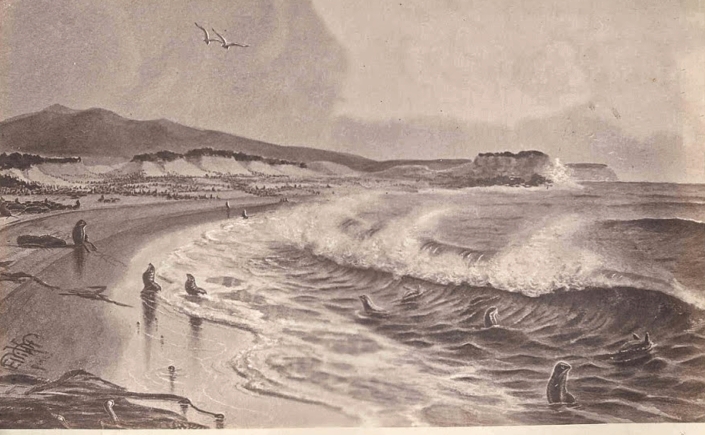





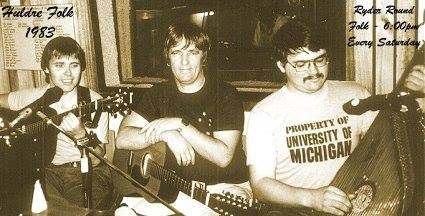
 In That Howling Infinite