Whitewashing slavery’s deep and dark history

Forward. The Gravest Crime – and selective conscience

On March 25, the UN General Assembly declared the transatlantic slave trade the “gravest crime against humanity.” 123 countries voted in favour, three against, and 52 abstained – including the UK, all 27 EU member states and Australia.

The moral core is unobjectionable. The slave trade was monstrous, its consequences did not end with abolition, and saying so plainly is not theatre  –  it is history. But UN resolutions are not history lectures. They are political instruments.

This one was carefully engineered. Its most controversial element was the recognition of slavery as a violation of jus cogens  – peremptory norms of international law binding on all states. Not a historical observation, but a legal foundation for future liability claims. The EU noted the resolution’s “unbalanced interpretation of historical events” and legal references inconsistent with international law, including retroactive application of rules that simply did not exist at the time.

The 123 who voted yes include states with active, present-tense records of forced labour and ethnic persecution. Their zeal for condemning 18th-century European slave traders carries a faint whiff of convenience. And the Western abstentions were the diplomatic equivalent of leaving before the bill arrives – not endorsement, but not courage either.

Slavery was real. The suffering was immense. But a resolution shaped by reparations politics and the arithmetic of bloc voting is not the act of collective moral reckoning it claims to be. It is politics, dressed, as so much UN business is, in the language of justice.​​​​​​​​​​​​​​​​

Whitewashing slavery’s deep and dark history

Slavery sits in the human story like a dark, deep river that refuses to keep to its banks. It runs from the Assyrian deportations and Roman estates, mines and galleys, through the markets of old Baghdad and the longships on the rivers of Keven Rus, down into the Atlantic crossings from Africa to the Americas and thence to Europe. and out again into the contract-labour regimes and hidden rooms of the present. Names change – thrall, concubine, slave, servant, “sponsored worker” – but the underlying grammar is stubborn: power converting vulnerability into utility, often with a theory to justify it and a market to sustain it.

Into this long, uneasy history steps the modern urge to judge it – to apportion blame, to rank crimes, to extract from the past a usable morality for the present. The UN resolution is one such attempt: part commemoration, part indictment, part politics by other means. A counter-brief insists that this particular ledger has been selectively drawn, that some entries are inked in heavily while others are left in the margin or omitted altogether. Between them lies not a settled account but a contested one, in which the Atlantic system with its Islamic trades, and African agency, “King Cotton” and John Brown, and modern forms of coercion all jostle for place and proportion.

The following essay does not endeavour to tidy that argument into a single verdict. It widens the frame without dissolving the particulars; to hold in view both the universality of slavery and the distinctiveness of its forms; to recognise the rarity of abolition without mistaking it for completion. History, in this register, is less a courtroom than a map – dense, overlapping, and resistant to clean lines.

The deep and dark river 

That UN resolution formally condemned slavery as a universal crime – indeed, the “gravest crime”. But, in practice it narrows its indictment to the transatlantic trade of the seventeenth and eighteenth centuries, presenting it as a distinctively Western, racialised, and capitalist enterprise.

It is precise, almost prosecutorial, assigning blame, embedding the trade in a narrative of structural injustice that echoes into the present. Yet it grows evasive when confronting the forces that ended slavery: the Enlightenment, abolitionist movements, legal reforms – reduced to a kind of historical afterthought.

More significantly, as economist and commentator Henry Ergas argues in an article in The Australian, republished below, the resolution omits the long and substantial history of slavery in the Islamic world – trans-Saharan, Red Sea, Indian Ocean – systems that endured for centuries, moved millions, and in many places persisted well into the modern era. Unlike in the West, he contends, there was no sustained, institutionalised moral revolt against slavery at scale; abolition came late, often under external pressure, and in some cases remains incomplete in practice.

He pushes further. By declaring the slave trade “the greatest” crime against humanity, the resolution risks collapsing distinctions – most notably between exploitation and extermination – thereby, in his reading, relativising the Holocaust. And finally, he notes the political choreography: strong support from authoritarian states and those with troubling contemporary records, contrasted with the hesitant abstention of many Western democracies.

That is his case – straightforward, and cleanly drawn –  perhaps a little too cleanly. Because once we widen the frame, the lines begin to blur in ways that resist both the UN’s moral staging and Ergas’s counter-brief.

Slavery is not an aberration of one civilisation but a near-constant of many; and it spans millenia. The Assyrians and Persians deported whole populations as instruments of empire. Sennacherib and other potentates would empty a conquered land of its indigenous peoples and replace them with deportees from another conquest. The Romans built an economy on servile labour whilst the Byzantines continued the practice. Muslim caliphates and emirates, including the Abbasids and Ayyubids, Mamluks and Ottomans, sustained vast networks of concubinage and domestic and military slavery.

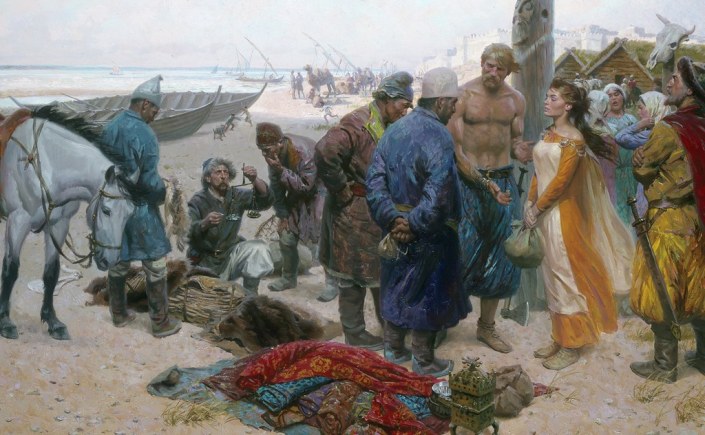
The Vikings – often reduced in popular memory to picturesque if violent raiders – operated something closer to a transcontinental syndicate. The river systems of the Rus, threading south through the Volga and Dnieper, connected the Baltic to the Black Sea and Baghdad. Silver flowed north; human beings flowed south. This was not episodic plunder but a business model – structured, repeatable, and profitable. And conducted across astonishing distances. Baghdad and York sat at the far ends of a human supply chain. [The illustration at the head of this article is that of a young Slavic woman being sold into slavery by Vikings to a Persian merchant (Image: Tom Lovell / National Geographic)]

So, it is necessary to resist any account that isolates the Atlantic trade as if it emerged sui generis from European wickedness. The Islamic world sustained large-scale slave systems over a long durée; and African polities were not merely passive victims but active participants in capture and sale; Arab traders were integral intermediaries. The Atlantic system, or “the Middle Passage” and “Triangular Trade” as it was euphemistically described, depended in its operation on a web of local agency as well as European demand. To acknowledge that is not to dilute culpability but to complicate it – uncomfortably, but necessarily.

And yet – here the counterweight – the Atlantic system was not merely one more iteration of an ancient practice. In the Americas – north and south –  fused race, heredity, and commerce into something peculiarly rigid and self-reproducing. Slavery became not just a condition but a caste, encoded in law and biology, and scaled through plantation economies that fed a global market. Cotton, sugar, coffee and tobacco were not marginal commodities but engines of early modern capitalism. The system’s brutality was not incidental; it was structural.

It is here that the North American story assumes its central, paradoxical role. Chattel slavery became both foundational and explosive – so deeply embedded in the economy that its removal threatened the entire edifice, and yet so morally corrosive that it generated its own opposition. The American Civil War was among many things, the moment when that contradiction could no longer be managed rhetorically or regionally; it was settled, instead, in blood. Abolition here was not simply argued into being; it was fought into being.

Slavery was America’s original sin, and its malign influence ricochets still through its politics and society. [See American historian Sarah Churchwell’s.chilling account of darkest Dixie in In That Howling Infinite’s The Wrath to Come. Gone With the Wind and America’s Big Lie]

Which brings us to what may be the most historically unusual feature in all of this: not slavery itself, but the sustained movement to abolish it. The West generated, from the 17th century onward, a mounting moral and political challenge to slaver, in legal cases, religious agitation, popular campaigns – that eventually dismantled it – significant help from the Royal Navy. Comparable, system-wide movements were less evident in the Islamic world, where dissent existed but did not crystallise into mass abolitionism with similar force or effect.

The distinction matters. Saying it did not happen is a statement of fact; suggesting it could not have happened, or that its absence reflects some deeper civilisational failing, goes beyond the evidence. The divergence likely owes as much to political economy, state structure, and the contingencies of modernity as to theology alone. Which is where English historian and The Rest is History podcaster Tom Holland’s excellent doorstop of a book Dominion hovers, suggestively, over the argument [See In That Howling Infinite’s Getting back to the garden – Tom Holland’s Dominion 

Holland’s claim – broadly put – is that the moral vocabulary underpinning abolition in the West owes much to a Christian inheritance: the elevation of the weak, the insistence on the equal worth of souls, the suspicion of unrestrained power. Even as the Enlightenment secularises these ideas, it carries their imprint. One need not follow him into every chapel of that argument to see the outline: abolition is historically anomalous, and anomalies tend to have genealogies. The West did not simply stumble into anti-slavery; it argued its way there, drawing on intellectual and moral resources that had been accumulating, often ambivalently, for centuries.

Old poison, new bottles

The story end in the 19th century however much resolutions might prefer it to. The Gulf states remind us that abolition in law does not always mean abolition in practice. The kafala system – sponsorship, contract labour – operates in a grey zone where dependence can harden into coercion. Passports withheld, mobility constrained, recourse limited: not chattel slavery, but an echo, or perhaps a mutation. History rarely repeats itself verbatim; it adapts, keeping the structure while altering the terminology.

And then there are the moments when the past returns not as echo but as revival. ISIS, with its enslavement of Yazidi women, did not merely exploit chaos; it articulated a doctrine. Slavery, and most particularly, sexual slavery, was justified, systematised, and bureaucratised with price lists, allocations, and rules, and even, trans-national trafficking: one captive ended up in Gaza where she was eventually rescued from a war zone. It was, in the grimmest sense, a reactivation of an old logic under modern conditions. Old poison in new bottles. If abolition was an anomaly, here was the reminder that anomalies can be reversed.

Governments and citizens of ostensibly westernized states should look to their self-awarded laurels. We should be wary of treating coercion as something that happens “over there.” The exploitation of domestic workers – underpaid, over- controlled , sometimes effectively trapped – appears not only in the Gulf but in Lebanon, Israel, and also parts of Western Europe and North America, where immigration status and private households create shadows the law struggles to reach. And closer still, in our own economies, sweatshop labour, debt bondagea and various forms of servitude persist at the margins, along with physical violence and sexual exploitation – which is precisely why regulation, inspection, and enforcement remain not moral luxuries but necessities.

Against this broader canvas, the UN resolution begins to look less like a statement of history than a negotiation, negation, even – of memory. Its selectivity – foregrounding Western guilt, backgrounding Western abolition, omitting other systems – is not unusual in such documents; it is, in some sense, as we have often seen, their defining feature. They are less concerned with completeness than with consensus, less with analysis than with alignment. Countries with difficult presents often find it convenient to condemn curated pasts.

Ergas is justified in objecting to that selectivity. Where he overreaches is in answering it with a counter-selectivity of his own – one that risks understating the distinctiveness of the Atlantic system and overstating the clarity of civilisational contrasts. History, inconveniently, refuses to stay within either brief.

On the question of the Holocaust, however, his warning lands. To rank atrocities – to declare one “the greatest” – is to turn history into a macabre competition. More importantly, it obscures differences of intent. Most slave systems, however brutal, were premised on exploitation; the Holocaust was premised on annihilation. That distinction is not a matter of moral bookkeeping but of historical substance.

And so we arrive, circuitously, at a position that satisfies no one entirely – which is probably how one knows it is closer to the truth.

Slavery is not the property of any one civilisation; it is a recurrent human institution, appearing wherever power, profit, and permission align. The Atlantic trade is distinctive but not unique; Islamic and African systems are substantial but not singular; modern forms persist under altered names and legal veneers. What is genuinely unusual is the emergence of sustained, organised movements that declare slavery illegitimate and succeed – partially, unevenly – in abolishing it.

Between the UN’s moral narrowing and Ergas’s corrective widening lies a more uncomfortable landscape: one in which culpability is diffuse, agency is shared, and progress, where it occur, is contingent, fragile, and slow. The past does not arrange itself into neat indictments or tidy vindications. It lingers, instead, as habit and warning.

And, if one is honest, as a question still not fully answered.

On the Holocaust comparison, Ergas is on firmer ground. Collapsing all historical crimes into a single ranked category – the greatest” – is less analysis than moral theatre. The distinction between exploitation and extermination is not pedantic; it goes to intent. The Nazi project was annihilatory in a way most slave systems, however cruel, were not. History flattens at our peril.

And then there is the politics of the thing. UN resolutions are not monographs; they are negotiated texts, shaped by blocs, interests, and the quiet arithmetic of votes. Selectivity is almost baked in – as is prejudice. Countries with uncomfortable presents often find safety in condemning selective pasts. Western abstentions, too, are rarely acts of intellectual surrender; more often they are the diplomacy of not quite wanting to pick a fight that cannot be cleanly won.

Unfinished business 

So we end where we began, with a familiar tension. Yes, slavery is a near-universal inheritance, and any telling that singles out one civilisation to the exclusion of others is suspect. But neither does the universality of the crime dissolve its particular forms. The Atlantic system, the Islamic trades, ancient chattel systems – they rhyme, but they are not identical verses.

And there remains a broader, less comfortable truth: the story of slavery is not a morality play with a single villain, but a long human habit, periodically challenged, never entirely extinguished, and always ready, given the right circumstances and excuses, to return.

History, in other words, refuses both the courtroom brief and the absolution. It is messier than Ergas allows, but also less conveniently moralised than the resolution he criticises.

It leaves us not ranking guilt, but paying closer attention. The Atlantic system was distinctive; the Islamic and other trades were vast and enduring; African rulers and Arab merchants were participants as well as intermediaries; the West generated powerful abolitionist movements even as it profited from what it eventually condemned. None of these claims cancels the others. Together they form a picture that is, at once, more accurate and less flattering than any single narrative allows.

And the present refuses to sit quietly beneath the verdicts we pass on the past. The exploitation of domestic workers in the Gulf, Lebanon, Israel, and parts of Western Europe; the persistence of sweatshop labour, debt bondage, and coerced work within Western economies themselves – these are not historical footnotes but contemporary reminders. Laws and conventions matter, but so do inspection, enforcement, and the unglamorous work of closing the gap between principle and practice.

Which is why the most suspect posture, at the end of such an inquiry, is self-congratulation. There is no stable ground here for laurel wreaths, no civilisational vantage point from which to survey a completed moral victory. At best there is a difference in degree – of scrutiny, of institutional capacity, of willingness to act. And even that requires constant renewal.

Slavery, in its older forms, has been dismantled in many places; in its newer guises, it adapts. The question is less who was worst than who is still looking, and still prepared to do something about what they find.

Postscript: Etymology

The history lingers, as it often does, in the words. They carry within themselves their own freight.

“Slave” in English carries within it a map of early medieval Europe. The term is widely traced to the Latin sclavus, itself derived from Sclavus – “Slav” – a reflection of the large numbers of Slavic peoples captured and sold through the trading networks that ran from the Baltic down the great river systems to Byzantium and the Islamic world. What began as an ethnonym hardened into a condition. By the High Middle Ages the word had shed its geographic specificity and settled into general use- esclave, schiavo, esclavo, slave – the person eclipsed by the status, the origin story buried in the syllable. The modern word is not, in itself, a slur; but its lineage is a reminder of how readily a name can be stripped of personhood and repurposed as a category of subjection.

Arabic offers a parallel, though not an identical one. The root ʿabd (عبد) denotes a servant or slave, but in its primary register it is theological: ʿabd Allāh, servant of God – a posture of submission before the divine rather than a description of worldly bondage. Yet the plural ʿabīd (عبيد) – once a straightforward term for slaves – acquired, over time and in certain contexts, a sharper edge, used for Black slaves and, by extension, Black people more generally. In modern usage it can carry derogatory force, depending on context and intent, illustrating how a neutral descriptor can drift into insult as it absorbs the hierarchies of the societies that use it.

In both cases, language records a quiet transformation. A people becomes a condition; a condition gathers associations; those associations harden into overtones that may wound long after their origins are forgotten. The vocabulary survives the systems that shaped it, carrying their traces forward – compressed, half-visible, but still there for those inclined to listen.

Afterword: Thraldom, it’s unwinding and its afterlives

A final turn of the lens, back to northern Europe, where the language and the practice briefly align – and then, tellingly, reappear in altered guises.

In Anglo-Saxon England, þræl – thrall – named a condition within a broader spectrum of unfreedom. These were the captured, the indebted, the born into it: men and women who laboured in households and on estates, who could be bought and sold, though not yet within the fully racialised, hereditary system that would later define Atlantic chattel slavery. The boundaries were hard but not always impermeable. Manumission occurred; over generations, absorption was possible. It was a system of subjection, but not yet a totalising one.

The British port of Bristol stands as a reminder of how visible and organised that system could be. It became wealthy with the transatlantic slave trade. But in the 11th century it also functioned as a significant slaving port, exporting captives – often from Wales and the Welsh borderlands – into Irish and wider networks. This was not an anomaly but a node in a broader medieval traffic in human beings, linking the British Isles to circuits that extended, directly and indirectly, toward the Mediterranean and beyond.

Nor was England unique. Across medieval Europe, slavery persisted in varied forms: Italian city-states drew on Black Sea supplies; Iberian polities, both Muslim and Christian, trafficked in captives amid the long wars of the Reconquista; eastern Europe fed human cargo into Byzantine and Islamic markets. The word “slave” itself, with its Slavic root, is a linguistic fossil of that traffic (see below)..

And yet, in England at least, something shifted – and the Norman Conquest appears to have hastened it. On the eve of 1066, Domesday would soon record servi in significant numbers, perhaps around a tenth of the population. By the 12th century, however, chattel slavery had largely withered. The causes were less a single decree than a convergence. The Norman regime imported a more continental feudal logic, in which labour was bound to land rather than owned outright; a villein, fixed, dues-paying, and reproductively stable, was often more useful than a saleable slave. The Church, already critical of slave trading – Wulfstan of Worcester’s condemnation of the Bristol trade is emblematic. – found firmer footing in the new order, aligning moral pressure with institutional power. Trade patterns shifted too, as England’s orientation tilted across the Channel, loosening older Irish Sea networks that had sustained export markets.

None of this amounted to abolition in the modern sense. What replaced slavery was serfdom: a different architecture of dependence, less overtly transactional but hardly free. The change was real, but it was also a translation—from one form of unfreedom into another, quieter one.

And, as if to underline the point, elements of the older logic resurfaced later under new names. In the 17th and 18th centuries, Britain exported large numbers of indentured labourers – many English, but also Scots and Irish, including prisoners of war and political rebels after uprisings – to the American colonies and the Caribbean. Bound by contract rather than owned outright, they nonetheless occupied a coercive world of limited rights, harsh discipline, and restricted movement. The loss of the American colonies in 1783 did not end this habit of displacement; it redirected it. Transportation – of convicts and dissidents – to Australia became the next imperial outlet for managing surplus and troublesome populations, a system different in law but recognisably akin in its logic of removal and compelled labour [see in In That Howling InfiniteFarewell to Old England forever … reappraising The Fatal Shore 

Meanwhile, further east, a different trajectory prevailed. In eastern Europe and Russia, serfdom did not wither but intensified. From the late medieval period into the early modern era, landlords consolidated control over peasant populations, binding them ever more tightly to the land and to service. In Russia, this culminated in a system that, by the 18th century, bore striking resemblances to slavery in practice, if not always in name – serfs bought, sold, and mortgaged along with estates, their mobility sharply curtailed, their obligations exacting. Emancipation would come late: 1861 in Russia, and even then imperfectly, leaving behind structures of dependency that proved stubbornly durable.

Which is, perhaps, the thread worth keeping in hand. Systems of coercion rarely disappear cleanly; they evolve, recur and rephrase. From thrall to serf, from market to manor, from indenture to transportation, from eastern estate to western plantation. The names change; the grammar does not. Waiting, as ever, for the conditions that allow it to harden once again. waiting, as ever, for the conditions that allow it to harden once again.

In that Howling Infinite, May Day 2026

This essay was written in conversation with an AI language model, which contributed to researching, drafting, phrasing, and conceptual articulation. What appears here is not unmediated thought, but considered thought: directed and selected, revised and revised again, and owned.

See also in In That Howling InfiniteA Political World – Thoughts and Themes, and A Middle East Miscellany

UN resolution on slavery falsifies history by ignoring Islamic world’s role

Henry Ergas, The Australian, 1 May 2026

The UN resolution on slavery has sparked debate over historical interpretation. Picture: Getty Images

The UN resolution sparks debate over historical interpretation: Getty Images

Henry Ergas, The Australian, 1 May 2026

That the African slave trade was a monstrosity, inflicting unspeakable cruelty on millions of innocent victims, is beyond dispute. But the resolution the UN General Assembly passed two weeks ago, marking the trade’s commemoration, is nothing less than an appalling falsification of history.

Formally, the resolution condemns the African slave trade as a whole. Substantively, every concrete reference targets the transatlantic trade, fixating on a “racialised capitalist system” and its purported Western antecedents. The cumulative effect is unmistakeable: to brand the trade a distinctively Western crime. To sustain that impression, the resolution parades a sequence of decrees, starting with the papal bulls of 1452 and 1455, which it casts as the founding charters of the enslavement and “structural racism” that still unjustly impoverishes Africa, thereby grounding a claim to substantial reparations.

Yet, having been forensically specific about blame, the text turns conspicuously evasive when it confronts the forces that brought the Atlantic trade to an end. The Enlightenment, the abolitionist movements, and the Western legal and political campaigns that culminated in the trade’s eventual demise are, it appears, unmentionable.

While the offending decrees are named, dated and indicted, the tide of opposition to slavery, which gathered momentum in the 17th century, is dismissed as “certain legal challenges and judicial developments in the 18th century” that “questioned the legality and morality of chattel enslavement”.

That descent into vagueness reflects a deliberate strategy: to particularise the guilt while diluting the credit. Merely cataloguing the misrepresentations, confusions and factual errors this strategy produces would require far more space than is available here. What is especially striking, however, are the omissions.

It is, for example, intellectually dishonest to invoke the papal bulls of 1452 and 1455 while ignoring Pope Paul III’s bull of 1537, which denounced as an invention of the devil the idea that native peoples “should be treated as dumb brutes created for our service”, and affirmed “that they may and should, freely and legitimately, enjoy their liberty”.

Paul III’s exhortations had limited immediate effect; so too did Cartwright’s Case (1569), which declared that England’s air was “too pure for slaves to dwell in”. What matters is what they reveal: an unceasing moral interrogation of slavery within the West itself – an interrogation that gave abolitionism the bedrock on which to build.

Here, too, the resolution’s selectivity is purposeful. It allows it to avoid an obvious and crucial comparator: the long history of slavery under Islamic rule, which it ignores altogether. From the Arab conquests to the early 20th century, some 14 million black slaves were transported into the lands of Islam via the trans-Saharan, Red Sea and Indian Ocean routes, with nearly a million more carried beyond the East African coast. Add to these more than a million white slaves, and the total comfortably exceeds the 10 million to 12 million who landed in the Americas.

Yet the numbers are not what is most significant. The salient fact is the absence of any sustained doctrinal or institutional challenge to the morality and legality of the slave trade within the Islamic world – even where it starkly contradicted the Koranic prohibition on enslaving Muslims. As Bruce Hall shows in his study of Saharan and Sahelian slavery, by the 19th century – when the West was vigorously suppressing chattel slavery – the operative presumption among Maliki jurists was that black Africans, routinely described as “savages”, were enslavable by default, whatever their faith.

There were individuals who objected strenuously to chattel slavery, such as Syrian reformer Abd al-Rahman al-Kawakibi (1855-1902); but no Muslim opponent of slavery ever forged those concerns into a mass movement. Bernard Lewis’s verdict that “even the most radical Muslim modernists” fell well short of matching the fervour and effectiveness of Western abolitionists retains all its force.

It is therefore unsurprising that Islam’s leading theologians, far from championing abolition, actively resisted it – beginning with the infamous 1855 fatwa, issued with the full authority of Mecca’s Shaykh Jamal, which declared any prohibition of the slave trade “contrary to the holy law of Islam” and any official who attempted to enforce it “lawful to kill”.

Nor is it surprising that Saudi Arabia and Yemen abolished slavery only in 1962, the United Arab Emirates in 1964, Oman in 1970, and Mauritania – after repeated ineffectual measures – in 2007. Moreover, even where slavery was formally abolished, forms of vassalage have remained firmly in place: of the 10 countries with the highest incidence of “modern slavery”, eight are majority-Muslim.

But the resolution does not merely distort history by pretending Islamic slavery didn’t exist. It declares the slave trade “the greatest” crime against humanity ever committed. Although not explicitly stated, a central purpose of this travesty – which converts the horrors of the past into a “suffering Olympics” – is again transparent: to relativise the Holocaust.

It is frankly obscene to degrade moral evaluation into a body count, with medals of ignominy awarded by a show of hands. Yet even in so repulsive a spectacle, realities should have been allowed to intrude. Those realities are well known. Death rates in the Holocaust – whose unrelenting aim was the complete extermination of Jews – were close to or above 90 per cent. So complete was the indifference to fatalities that the German railways were paid whether the Jews being shipped by them lived or died during their transport – and the few who survived the journeys were killed, on average, within days of arrival.

In contrast, as investor Thomas Starke wrote to Captain James Westmore in 1700, “the whole benefit of the voyage lyes in your care of preserving negroes’ lives”. As a result, strenuous efforts were made to ensure slaves remained alive and saleable, including by granting handsome bonuses to captains for high survival rates and imposing stiff penalties for excess mortality.

Although those efforts hardly eliminated the trade’s horrors, they did mean that by the late 18th century, death rates for black slaves on the “middle passage” had declined dramatically, to the point where they were only marginally greater than those for crews. To pretend otherwise is to erase the distinction between exploitation and extermination: for there was nothing in the slave trade even remotely comparable to the systematic mass murder at the heart of the Holocaust.

But to acknowledge those facts – which flatly contradict the assault on the standing of the Holocaust – might have eroded the overwhelming support the resolution secured. And the composition of that support says everything one needs to know about the resolution.

Thus, every one of the 20 countries that have the highest incidence of modern slavery and forced labour cynically voted in its favour; so did all the authoritarian states that participated in the vote, with the exception of Kazakhstan and Kyrgyzstan; and, again with the exception of Kazakhstan and Kyrgyzstan, it received the active backing of every Muslim-majority country.

Yet that is not the real tragedy. Rather, it is that only three Western countries – the US, Israel and Argentina – had the decency to vote against the falsification of history, instead of abstaining, as Australia and the European Union did. Those three were willing to oppose this charade. Why weren’t we?


The Wrath to Come. Gone With the Wind and America’s Big Lie

You offspring of serpents who warned you of the wrath to come. Matthew 3:7

There was a land of Cavaliers and Cotton Fields called the Old South. Here in this pretty world, Gallantry took its last bow. Here was the last ever to be seen of Knights and their Ladies Fair, of Master and of Slave. Look for it only in books, for it is no more than a dream remembered, a Civilization gone with the wind.  Prelude to the film of Gone with The Wind (1939)

… by the time you can no longer avoid thinking about your history, it has become so complex and confusing that you can no longer think about it clearly, and your morality is what is gone with the wind.
Sarah Churchwell, The Wrath to Come (2023)

American cultural historian Sarah Churchwell’s book The Wrath to Come – Gone With the Wind and the Myth of the Lost Cause or its alternative title, the Lies America Tells (tells itself” is more accurate) is a harrowing read about slavery, America’s original sin; about the civil war fought to end it; the brief Reconstruction years that followed; the lingering stain of white supremacism and racial violence; and of how discriminatory and oppressive Jim Crow laws of the late nineteenth century survived well into the twentieth with lynch law, segregation, vote suppression and the civil rights struggles of the sixties.

The Wrath to Come is also about how historiography – how historians analyze and interpret history, and how “we, the people” recall and retell history.

She quotes author and civil rights advocate James Baldwin’s essay The White Man’s Guilt:

“White man, Hear me! History, as nearly no one seems to know, is not merely something to be read. And it does not refer merely, or even principally, to the past. On the contrary, the great force of history comes from the fact that we carry it within us, are unconsciously controlled by it in many ways, and history is literally present in all we do”.

Churchwell notes how in 1935, Black writer WEB Du Bois warned “against writing history for our pleasure and amusement, for inflating our national ego”, or “using a version of historic fact, in order to influence and educate the new generation along the way we wish”. Such propaganda history is merely “lies agreed upon”, and had enabled a toxic mixture of libel, innuendo and silence to poison the well of American historiography”.

The Wrath to Come is also very much about today. Running right through the narrative are the currents and crises that culminated in the great American unraveling that led to the storming of the Capitol on January 6, 2021 – and as we know well, are yet to be fully played out in November 2024, and, as is most likely, beyond it. January 6th was, in her opinion the actualization of what Baldwin called “the wrath to come”, the moral derangement – spinning the nation off its axis. “Beyond the bars of our foolish little cages”, she writes, “a reckoning looms, at a scale we can’t assimilate”.

As an article in the New Yorker wrote recently, the pertinent issue now is not what caused the Civil War but what we should have learned from it. “January 6, 2021, is not an equivalent date in our history to April 12, 1861, but the radical Republican leaders who lived through the Civil War understood a principle that has been lost on their successors: that, if entrusted with power, leaders who commit assaults on the national government once may well attempt to do so again”. Many commentators remind Americans of the time when Benjamin Franklin, one of the original framers of the US Constitution, was walking out of Independence Hall after the Constitutional Convention in 1787, when someone shouted out, “Doctor, what have we got? A republic or a monarchy?” To which Franklin supposedly responded, with a rejoinder at once witty and ominous: “A republic, if you can keep it.”

“The past is not a prediction” Churchwell writes, “but it is a precedent, creating the possibilities for what the future will tolerate. The American future would, it turns out, tolerate a great deal”.

Gone with the myth 

Gone with the Wind shows what white America has believed – and wanted to believe – about its own history; it’ curates and cultivates America’s great white myths about itself.

Churchwell anchors her history around one of the most well known and loved stories of the twentieth centuries – the novel and the film of Atlanta author Margaret Mitchell’s epical Gone With the Wind. But while she may be deconstructing the iconic motion picture, it is very evident that the real target of her thesis is number forty-seven, whom she sees as America’s chaos personified. Whilst describing the brief and ineffective Reconstruction years that followed the American Civil War, with its “scallywags and carpetbaggers”, she gaslights “the greatest grifter the Republic has ever seen”. Like slavers, abortion and Vietnam, Trump is an issue that divides Americans, splitting families, straining the mystic chords of memory.

Within six months of its release in June 1936, Mitchell’s tale of tangled love set against the northern invasion and fall of the Old South, sold one million copies, making it the biggest-selling American novel to that date. It won a Pulitzer Prize and National Book Award, and has sold more than 30 million copies internationally.

The 1939 film adaptation starring Vivien Leigh as willful anti-heroine Scarlett O’Hara and Clark Gable as her rakish third husband Rhett Butler, won eight Academy Awards, including best picture, best actress for Leigh and best supporting actress for African-American actress Hattie McDaniel. McDaniel portrayed Scarlett’s outspoken chief house slave, Mammy, and made film history as the first black woman to take home an Oscar (although she was colour-barred from attending the Atlanta world premier).

Churchwell mounts an excoriating critique of the novel-turned-film for its denialism of the horrors of slavery and “shameless” historical distortions about the civil war and its aftermath. Such denialism, she contends, continues to divide America today.

Churchwell’s book adds a contemporary, political twist to such criticism: she argues America’s “most famous epic romance … provides a kind of skeleton key, unlocking America’s illusions about itself” and she links its sanitized treatment of slavery and promotion of white nationalism to Trumpism and the January 6, 2021, attack on Washington’s Capitol.

“When we understand the dark truths of American experience that have been veiled by one of the nation’s favourite fantasies, we can see how the country travelled from the start of the Civil War in 1861 to parading the flag of the side that lost that war (the Confederate flag) through the US Capitol in 2021.’’

Gone with the Wind advances a misleading version of American history known as the Lost Cause. This is the notion that “the Confederacy fought the Civil War (1861–65) as a principled defense of a noble civilization (the Old South) and its democratic rights, rather than as an unprincipled defense of the white supremacist system of chattel slavery … The specific rights in question were individual states’ rights to keep and trade enslaved people, but the Lost Cause skipped that part.’’

Extending this mythology, the film’s opening title cards briefly mention slavery but also refer to the Old South – which was home to four million slaves – as “a land of Cavaliers and Cotton fields,” and a “pretty world where Gallantry took its last bow.”

Similarly, she writes that Gone with the Wind “marks a cultural breakdown, the point where mythology triumphed over history’’. Therefore, “urging the erasure of Gone with the Wind would simply reinforce that … “

“… when a nation’s myths, no longer make sense of its reality, violence erupts. That is one of the many things that has happened to America. Mythmaking and misinformation have been spinning wildly through American political discourse, so they can be hard to catcher as they float, disembodied across our conversations … Like a carnival magician, myth-making points at something with its right hand while picking our pockets, with its left stop. If we stop looking where it’s pointing, we might just manage to protect our valuables – in this case a republic, if we can keep it … It turns out that the heart of the myth, as well as its mind, and its nervous system, most of its arguments and beliefs, it’s loves and hates, it’s lies and confusions and defense mechanisms, and wish fulfilments, are all captured) for the most part in inadvertently) in America’s most famous epic romance: Gone with the Wind.

… and when a country, become so lost in dreams, that it can no longer see reality, it loses its moral sanity … This book follows American history back down into the myth, to excavate what’s been buried – not just the fact that historians have carefully been long, bringing to light … but also suppressed psycho political realities. The lies, the distortions, justifications, the half-truths, the rampant projections, the cognitive dissonances, the negations, the flat denials all the stinging truths Americans don’t want to admit about ourselves that Gone with the Wind caught like flypaper …

It has often been said that America had to imagine itself to existence. Less often remarked is the corollary, that America is, in a very real sense, mainly a story the nation tells itself. That makes the US singularly subject to the meanings of stories and myths – all nations tell stories about themselves, but America has little to hold it together beyond those stories (which is one of the reasons it fetishes its founding documents). If Gone with the Wind is one of the most popular stories America has ever told about itself, then it matters that it is a profoundly antidemocratic, and a moral horror Show … judgment has been remarkably absent from the stories we tell about ourselves.

While Churchwell hopes that Donald Trump loses the November election, she is hardly optimistic about the republic’s future.  She sees the events of the last eight years, and indeed those preceding as “portents of a much deeper dislocation in American society. For over two decades now, Americans have been battered by non-stop crises at home and abroad – from the long War on Terror to Covid and the George Floyd protests – leading to what feels like national exhaustion and a deep pessimism about the future of democracy”.

 The old revolution and The Lost Cause

Gone with the Wind took a series of historical forces, and made them seem only natural

Maybe we were on the losing side. Not quite sure it was the wrong one. 
Captain Mal Reynolds, Firefly (episode 3)

From the beginning of Donald Trump‘s campaign to the turbulent end of his presidency, debates raged about whether his supporters were motivated by economic anxiety or racial animus. But in America the two are intertwined in a system of racial capitalism.

Gone with the Wind doesn’t just romanticize that system – it eroticizes it. The Lost Cause provided a genesis for modern America’s racialized economics and paramilitary white nationalism, in which racial segregation was the supposedly logical outcome of a fight over states’ rights. But the most vicious fights over these supposedly principled stances on states’ rights have always consistently been over racial power. In fact, states’ rights are almost never invoked in a context that is distinct from race. States’ rights created a fig leaf, an alibi from which white America benefits so deeply that the denials continue to this day.

Slavery was America’s Original Sin, a stain running through its technicolor grain. Over the period of the Atlantic Slave Trade, from approximately 1526 to 1867, some 12.5 million men, women, and children were taken in captivity from Africa; 10.7 million were taken aboard ship to the New World and placed in bondage in the Americas – possibly the costliest in human life of all long-distance global migrations. Four hundred years of slavery ended in civil war and a wasteland.

America’s road to the Civil War took decades. It is beyond the scope of this article. but within a month of Lincoln’s victory in the presidential election of 1861, South Carolina took the fatal step, followed over the next few months by the secession of most of the Lower South. A month after his inauguration, the Civil War erupted with the bombardment of Fort Sumter in Charleston harbour. As Churchwell recounts it, “…. once a people decides that it cannot live together or when a citizenry divides into clearly opposed blocs, it is impossible to predict just how conflict may erupt. But to say that it cannot happen is to ignore history. Even Lincoln downplayed the threat of southern secession during the 1860 campaign, not believing until it was too late that the South ever would take such a final step”.

The American Civil War claimed more than seven hundred thousand American lives, tore a young nation apart, and its echoes reverberate still one hundred and sixty years later, reflecting unresolved political fault lines that go back two centuries. years. Though the war ended slavery, there was still another hundred years of toiling towards true freedom. As Martin Luther King said, “Lord, we ain’t what we want to be; we ain’t what we ought to be; we ain’t what were gonna be, but thank God, we ain’t where we was”.

“The white South grabbed the moral high ground and clung on for dear life – while the white North met it more than halfway. By the turn of the century the south was winning the war of ideas, its big lie accepted across the United States”.

It used to be said that the South would rise again. It did, and indeed, some reckon, the South finally won the war.

Dixie rising 

Predictably, the ghosts of the American civil war have been haunting the ongoing presidential campaign and have forced their way back into popular consciousness.

Statues depicting figures from the war – and even of founding fathers or older presidents – and even the names of the schools, military bases and streets, have increasingly become a flashpoints for a real political and cultural struggle. A low-intensity war on the past is now being waged across many states, with the effect of hardening hearts and solidifying the battle lines being drawn in the sand.

In May 2024, it was reported that the Shenandoah County School Board in Virginia would restore the names of Confederate generals Thomas “Stonewall” Jackson, Robert E. Lee and Turner Ashby to two local schools. The controversial reversal comes nearly four years after the names were changed.

“Residents speaking in favour of reverting to the Confederate names included Stuart Didawick, who noted that his family’s roots run deep in the community, where his ancestors received land grants in the decades before the American Revolution. “When you vote on the name restorations”, he asked board members, “will you listen to the opinions of woke outsiders who have for the most part no ties to the land, the history, or the culture of this county? Or will you listen to the voices of the people who elected you to represent them, the people whose families built and have sustained this county for generations?” To which a student and athlete responded: “I would have to represent a man that fought for my ancestors to be slaves,” adding that she would feel as if she’s being disrespectful both to her ancestors and her family’s values.

Another pervasive ghost of the Civil War, the battle flag of Dixie, has never gone away. It was long a favoured accessory above government buildings and at right wing rallies in The South, those former secessionists states that lay south of the Mason-Dixon Line. It played a cameo role in popular culture, flying in The Dukes of Hazzard, True Blood, and even The Walking Dead. The right to flaunt “the Stars and Bars”, an enduring symbol of the lost Confederate cause, and a rallying point for those who still believe the rebel cause to be just, those who take solace from an heroic defeat, and those who believed that “the South will rise again”, and indeed those who KNOW that the South has indeed risen again. For have not the white, right wing, God fearing, Clinton-baiting, and Obama-hating ‘Red’ states of the South conquered and colonized the American political system?

Failed Republican presidential hopeful Nikki Haley was governor of South Carolina, the first state to secede in 1861, in 2015, when in 2015, Dylann Roof, a young white supremacist who had draped himself in the Confederate flag, massacred nine African American parishioners at a Black church in Charleston, the state capital. Haley called for the removal of the Confederate flag from the grounds of the State House, where it had been hoisted in the early 1960s as a rebuke to the civil rights movement. When the flag came down, a ceremony that felt like the final surrender of the Civil War, little did we know that what we were actually witnessing that summer was the beginning of the white nationalist counter-offensive headed by Trump. In a strange quirk of history, he launched his presidential bid the very day before the Charleston massacre.

During the run up to the Republican primaries, POTUS aspirant and Florida Governor Ron DeSantis defended part of his state’s African American history curriculum standards that claimed some enslaved people developed skills that “could be applied for their personal benefit.” Flag-remover Nikki Haley omitted any mention of slavery when she was asked to explain the cause of the Civil War at a town hall event. It wasn’t until the next day that Haley acknowledged the war was “about slavery”. Both now failed candidates reflected unresolved political fault lines that go back nearly 200 years.

© Paul Hemphill 2024.  All rights reserved

In !955, Ella Fitzgerald was jailed for singing to an integrated audience in Texas

Author’s note

Last year, my favorite podcast The Rest is History broadcast a long but informative interview with Churchwell herself. The link is below. I also republish a review of the book and its content that first appeared in The Australian in April 2023, and the unique story an escaped slave who found his way to Australia and lived to tell his tale in print – an 18,000-word essay about slavery, titled The United States Governed by Six Hundred Thousand Despots. 

Such was my enthusiasm for Churchwell’s book, I transcribed many of what I considered to be memorable and cogent quotes.  They are categorized and listed immediately after the following videos.

For other posts in In That Howling Infinite about the American Civil War, see Blind Willie McTell – Bob Dylan’s Americana, Cross the Green Mountain – Bob Dylan’s Americana, Rebel Yell, Land of the fearful – home of the heavily armed, and regarding American Fascism prior to World War II, see The Shoah and America’s Shame – Ken Burns’ sorrowful masterpiece 

Like my father before me
I will work the land
And like my brother above me
Who took a rebel stand
He was just 18, proud and brave
But a Yankee laid him in his grave
I swear by the mud below my feet
You can’t raise a Kane back up
When he’s in defeat
Robbie Robertson, The Band

Churchwell quotes …

The Dixie Dreamtime

The story is cloaked in self-delusion far worse than Scarlet’s, and the film – which recognizes the novel’s flaws more clearly perpetuated these solutions out of commercial interests. This modern myth affirmed all the nation’s favorite illusions about itself, up to and including its faith in its own innocence – and then sold that bill of goods to all and sundry, making a fortune in the process. Scarlett’s blinkers are typical too – the willful ignorance in which American popular memory likes to trade. What she couldn’t or wouldn’t see is the subject of the rest of this book …

… the savage viciousness of Jim Crow produced the consoling legend of a noble land of Cavaliers, and ladies, who presided over loyal servants, with gentle benevolence, which would become America’s favourite story for decades to come. Listen closely to what a culture keeps telling itself, and you’ll know not only what’s on its mind, but what it needs to hear. Gone with the Wind told Americans that they could survive anything, especially if ignored it … the denialism of American culture (is) its refusal to face facts, to recognize that what it tells itself simply isn’t true …

Even as white Americans were sharply censoring the rise of Fascism in Europe, traveling to Spain to volunteer against Franco’s army, they were also longing for the good old days when the United States have enslaved millions of non-white Americans …

Good stock

Slavery was abolished by the war, but white supremacism was not. The problem was that white Americans could abhor slavery, and fight a war to end it, and also abhor Black people. They could believe that slavery was a moral abomination, and also believe in eugenicist racial science that claimed non-white people were biologically inferior to white people, and that racism was the natural order of things, even if slavery was not …

Gone with the Wind appeared a mere decade after the Scopes Monkey Trial took Darwinism to court to try to deny that humans will be related to apes. The immense anxiety sparked by this idea was bound up in older racist tropes which held the Black people were apes and white people were human. Proof that white people were also descended from apes challenged the racial hierarchy …

Once white people were forced to concede that they might’ve come out of jungles two, scientific gracious, and sort through that they had emerged much earlier, and how much farther and Black people

Playing along with lesser folks, taking from them what you can, and then, kicking them to the curb, is also the secret of social Darwinism, which is inextricable from the novels racism. Both preach survival of the fittest, defining fitness through biological determinism, as heritable traits that mean survivalism is a question of innate character rather than environmental good fortune These ideas are fundamentally eugenicist, claiming not only that some humans “stock” is biologically superior to others, but that such groups come racially and ethnically presorted. Presumptions of lesser and greater beings, the right of merit to rule, was at the heart of the argument: an aristocratic entitlement to title that claimed privilege was founded on inherited superiority, rather than brute force or the dumb luck of circumstance … the notion of “good stock” and “breeding” that underpinned scientific racism …

In the wake of first first world war and the Russian revolution, the “red scare” enabled the second Klan to maintained its white supremacism but expanded its list of enemies to include most foreigners, especially Catholics, Jews, eastern and southern Europeans, as well as communist, socialist and labor organizations, all of whom it generally equated. This broad, stroke nativism was strongly eugenicist, promising to protect the “pure stock” of white American Protestantism from the racial “pollution” of mixing with inferior breeds …

Heirs to the white supremacist cause, the replacement theorists, Tucker Carlson, Kyle Rittenhouse. Fox host Tucker Carlson professed to be “shocked” that “seventeen year olds with rifles decided they had to maintain order when no one else would”. This is precisely the alibi that was always offered for white supremacist violence, straight out of Gone with the Wind and the newspaper lynching reports that that accompanied it. Scapegoating makes violence redemptive, as savagery is projected onto its victims, who deserve what they’re getting. The Klan was a group shaped around projection and scapegoating. Apologists of white supremacist from Thomas Dixon and Margaret Mitchell to Tucker, Carlson and Ann Coulter to the hyper partisan mob that stormed the Capitol all insisted that they were defending “extralegal justice”, as if extralegal were not just another word for illegal …

History is endlessly revised, even when it’s been chiseled in stone. Newly discovered facts can improve our understanding of the past, and sometimes people even ask new questions about the same old facts.

… Black Americans are left arguing that they are the ones owed by a nation which is yet to redeem the promises it made to the makes to them. That is the entire import of Dr. King’s 1963 “I have a dream” speech, a metaphor of redemption that he makes explicit, and explicitly economic: “we’ve come to our national capital to cash a check”, King said, on the “promissory note” signed by the architects of our republic, a promise of “unalienable rights” to “life, liberty and the pursuit of happiness”. But America has “defaulted on this promissory note” King charged. “America has given the Negro people a bad check, a check which has come back marked “insufficient funds” .

… the seed of white grievance, a nostalgic, resentment that perceives only loss of individual power, refusing to consider the question of collective equality. Grievance is the politics of narcissism, the refusal to shift your ground, nursing your grudges, building spite into politics, while telling your enemies to move on in the interest of unity, a unity in which you do not believe, and which you have no intention of compromising.

Women’s rights and suffrage

Mitchell was outraged that Blacks could vote and women could not … Real estate was also entangled with women’s rights, as women gradually bou property and paid tax, but still could not vote. Her mother argued the women’s suffrage, and is very terms woman paid taxes, but we’re not allowed to vote drunken bums on the sidewalk because they were men that they haven’t paid a dime when titled to vote, and we are not …

White wealth through property ownership is what Gone with the Wind wants to exult – while trying, less than successfully, to ignore the role of slavery and it’s aftermath in the creation of that wealth.

Gone with the Wind Shows how the mythology of American success stories, including those of immigrants, were also inculpated in the bloody history of institutionalized slavery. The triumphalism of the end of the immigrant success story has worked to school the question of complicity, the suppose and dog in this town, making good does so at the expense, And More, senses of one, of an entire Other, racially marked, underclass.

Fascism and the kloning of the Klan

My summary: Fascism as represented by the KKK and the plethora of “clothes line” political groups distinguished by a colourful array of shirts was characterized by an American nativism, xenophobic, and white supremacist, conspiratorially anti-Semitic and anti-communist paramilitary groups, leveraging existing bigotries on behalf of state violence, consolidating power for one small group, while dehumanizing, persecuting, and annihilating – the eugenicist exultation of certain “bloodlines” of over others, white grievance displaced onto racialized enemies within.

Fascism as represented by the KKK and the plethora of “clothes line” political groups distinguished by a colourful array of shirts was characterized by an American nativism, xenophobic, and white supremacist, conspiratorially anti-Semitic and anti-communist paramilitary groups, leveraging existing bigotries on behalf of state violence, consolidating power for one small group, while dehumanizing, persecuting, and annihilating – the eugenicist exultation of certain “bloodlines” of over others, white grievance displaced onto racialized enemies within.

The affinities between the second Klan and European fascism had only grown clearer since they are simultaneous start in the early 20s, with their shared cults of paramilitary violence, legal apartheids, eugenicist, ideologies, and paranoid cultures … a mast native about the sacredness of the course, the purity of the nation, and the exultation of violence to defend against the enemy within.

… there is a strong case for the fascism of the Klan with its paramilitary violence, it’s extra-legal assertions of power, it’s uniforms and rituals, it’s love of esoterica, its nostalgic racial fantasies, its conspiracy theories, and its existential rejection of the legitimacy of any government that opposes it, as historians of fascism pointed out … It was ennobled by myths of national purity, performed by masculinist cults of the leader, and sold as the will of the people.

Robert O Paxton, in the five stages of fascism, characterized it as a politics, “marked by obsessive preoccupation with community decline, humiliation, or victimhood, and by compensatory cults of unity, energy, and purity, in which a mass based party of committed nationalist militants, working in un easy, but effective collaboration with traditional elites, abandons democratic liberties and pursues, with redemptive violence, and without ethical or legal restraints, goals of internal cleansing and external expansion“.

The Black and brown shirts of European fascism were met by America’s own clothesline politics, all declaring sympathy with European fascism and espousing the rights of the white Christian American herrenvolk to dominate their nation too. The American right wing “haberdashery brigade” includes silver shirts, white shirts, dress shirts, and gray shirts. They were joined by the black Legion, the order of ‘76 and as well as Cristo-fascist groups, including defenders of the Christian faith and the Christian Front, whose members called themselves the brown shirts. The Friends of the Hitler movement, the official Nazi Association in America, was established in 1933, eventually becoming the German American Bund.

Denialism it had nothing to do with European Fascism ….

Racial bigotry in America, the times insisted, was just unthinking in the good, old, thickheaded, prejudiced, irrational human fashion. Whether unthinking racism is preferable to thinking racism is probably immaterial to its victims, as if lynching would be less objectionable if it weren’t defended on the grounds of rationality … i.e. white supremacism was just good old thickheaded American prejudice.

If Gone with the Wind is broadly fascistic in its outlook, the lost cause is even more so, in its glorification of the confederate causus belli, the cults of its leaders of its dead, its propaganda, it’s wars for territorial expansion, and the insistence on the sacred rebirth of the nation in the ashes reconstruction, the new order founded on the ongoing defiance of the federalist government of the United States, and a fundamental rejection of pluralist democracy.

A collection of material at Ferris State’s Jim Crow Museum of Racist Memorabilia, Grand Rapids, Michigan, 2004. Jim Prichard/AP

The Grapes of Wrath

Eight months before the film premiered in Atlanta, John Steinbeck published the grapes of broth, which would become the most popular novel of 1939. Widely hailed as a testament to human endurance, the novel took its title from the battle hymn of the Republic, Julia Ward Howe’s mighty Civil War anthem …Howe’s Bible steeped language comes from the book of revelation, in invoking divine Justice, when God’s truth will force the wine of freedom from the grapes of wrath. It is an image of anger, accumulated, even cultivated, long march of times.

What defined fascist propaganda was never its lies, wrote Hannah Arendt in 1945, for all propaganda is based on lies. What distinguishes fascist lies is that they are intended to negate reality, making “that true, which, until then could only be stated as a lie”. Fascists don’t lie to deceive; they lie to change reality. Lies about the Lost Cause did just that, using fiction to displace reality until the fiction has become a reality. Soon that fiction spread beyond the cult of true believers, normalizing itself in the body, politic for the best part of the century, a cancer legitimating unreason that metastasized long ago Mythology replaced history as the arbiter of American truth.

Line is not only the Hitlerian big lie of propaganda, but a culture of perversive, lying, what a Arendt called “lying as a way of life” and “lying on principle”. It is a systematic dishonesty that destroys the collective space of historical-factual reality.

The Birth of a Nation

In February 1915, upon viewing The Birth of a Nation at a special White House screening, President Woodrow Wilson reportedly remarked, “It’s like writing history with lightning. My only regret is that it is all so terribly true. This line has appeared in numerous books and articles over the past seventy years. But it was appended twenty years after the event to add a spurious authority- from a former president no less – to the mythical account of reconstruction told in the birth of a nation that gone with the wind recycled, creating a very efficient closed circle of mythmaking.

The Birth of a Nation, by all accounts the first American blockbuster, the first historical epic, the first Hollywood film to resemble what movies are like today, premiered in Los Angeles exactly 100 years ago on Sunday. But the centennial won’t be celebratory. It will likely be awkward, sobering even — because in director D.W. Griffith’s 12-reel Civil War saga, the Ku Klux Klan members are the glorious heroes.

Since its premiere on Feb. 8, 1915, the film has been at once wildly popular and widely condemned. It inspired the revival of the KKK but also galvanized what was then a nascent NAACP into action. It helped define what cinema means for American audiences. It was the first film ever shown inside the White House.

After 100 years, it has left a complicated, powerful legacy, but a legacy of what, exactly?

“Excuses are sometimes made by scholars of film for the content, but I don’t think that for the last ten to 15 years there has been any doubt that this is an unequivocally, viciously racist film,” says Paul McEwan, Associate Professor of Media and Communications at Muhlenberg College. McEwan has been studying and writing about the history of Birth of a Nation for 12 years. “I mean, this film makes Gone With the Wind look very progressive.”

Griffith claimed to be filming history, but Birth of a Nation, based on the novel The Clansman by Thomas Dixon, features a stunning revision of Reconstruction. White actors in blackface portray members of a barbaric, sex-crazed militia of freedmen that terrorizes and disenfranchises cowering whites. Black men overtake South Carolina’s judicial system and legislature, swigging whiskey and eating fried chicken on the floor of the State House. After the blackface character Gus attempts to rape a white woman, the protagonists don their hoods and apprehend him, lynching him after their version of a fair trial. The film is ostensibly about white national reconciliation at the expense of emancipated black Americans. A title card punctuates the action toward the end of the silent film to declare, “The former enemies of North and South are united again in defense of their Aryan birthright.” Despite its objectionable content, the film remains an essential part of the discussion about American cinema because of Griffith’s pioneering technical innovations. Things that today are completely taken for granted — like close-ups, fade-outs and even varying camera angles — originated with The Birth of a Nation‘s director and crew.

From the poverty shacks, he looks from the cracks to the tracks
And the hoofbeats pound in his brain
And he’s taught how to walk in a pack
Shoot in the back
With his fist in a clinch
To hang and to lynch
To hide ‘neath the hood
To kill with no pain
Like a dog on a chain
He ain’t got no name
But it ain’t him to blame
He’s only a pawn in their game
Bob Dylan

In the courtroom of honor, the judge pounded his gavel
To show that all’s equal and that the courts are on the level
And that the strings in the books ain’t pulled and persuaded
And that even the nobles get properly handled
Once that the cops have chased after and caught ’em
And that the ladder of law has no top and no bottom
Stared at the person who killed for no reason
Who just happened to be feelin’ that way without warnin’
And he spoke through his cloak, most deep and distinguished
And handed out strongly for penalty and repentance
William Zanzinger with a six-month sentence
Bob Dylan, The Lonesome Death of Hattie Carroll

In !955, Ella Fitzgerald was jailed for singing to an integrated audience in  Houston, Texas

Goosestepping back to political relevance

Artist Barry Blitt’s “Back to the Future.” In another year of political chaos, he “looks forward to depicting the pageantry, solemnity, and awe of the upcoming Presidential election”.

A slave writes to a Sydney paper

I’m trying to imagine what it might have been like to be the editor of a little Sydney newspaper called The Empire in the 1850s when a “fugitive slave” – owned from birth by the invalid daughter of an innkeeper in North Carolina – walked through the door, asking for a copy of the US Constitution.

He wanted to write about the slavery endured by whole branches of his family, and he needed the Constitution for reference.

It seems that this actually happened in Sydney in 1855. The New York Times had a story about it on the weekend. And you’re not going to believe how that story ends.

The slave in question was John Swanson Jacobs, described by the editors of The Empire (they are sadly not named) as “a man of colour, with bright intelligent eyes, a gentle firm voice, and a style of speech decidedly American.”

Jacobs had escaped bondage and made his way to Australia where he was desperate to find somebody willing to tell the story of slavery. By chance, the editors had “the last edition of the United States’ Constitution authorised by Congress” in their offices, and they agreed to lend it to Jacobs, who returned it after a fortnight, with an 18,000 word essay about slavery, titled The United States Governed by Six Hundred Thousand Despots.

The editors of The Empire agreed to publish it, and “scarcely altered a word”.

A first-hand account of slavery by an escaped slave has been found in an Australian newspaper archive.

A first-hand account of slavery by an escaped slave has been found in an Australian newspaper archive.

“The writer is in Sydney; we understand he has been among the successful gold-diggers,” they said. “We shall be much mistaken if his narrative is not read with a lively interest.”

More than 160 years later, you are being offered the opportunity to read that essay, because it has rather amazingly been re-discovered, and published in book form, and oh, it’s so harrowing.

It begins: “I was born in Edenton, North Carolina, one of the oldest States in the Union, and had five different owners in 18 years.

“My first owner was Miss Penelope Hannablue, the invalid daughter of an innkeeper. After her death I became the property of her mother.”

He describes the slavery endured by his father: “To be a man, and not to be. A father without authority – a husband and no protector … Such is the condition of every slave throughout the United States; he owns nothing – he can claim nothing. His wife is not his – his children are not his; they can be taken from him, and sold at any minute, as far as the fleshmonger may see fit to carry them.

“Slaves are recognised as property by the law and can own nothing except at the consent of their masters.

“A slave’s wife or daughter may be insulted before his eyes with impunity; he himself may be called on to torture them, and dare not refuse. To raise his hand in their defence, is death by the law. He must bear all things and resist nothing. If he leaves his master’s premises at any time without a written permit, he is liable to be flogged; yet they say we are happy and contented.”

He describes the death of Mrs Hannablue, and the sale of her slaves: “Here they are, old and young, male and female, married and single, to be sold to the highest bidder … They began to sell off the old slaves first, as rubbish; one very old man sold for one dollar; the old cook sold for 17 dollars; from that to 1,600 dollars, which was the price of a young man who was a carpenter.

“Dr Norcom, whose daughter owned my sister, bought me for a shop boy. It would be in vain for me to attempt to give a description of my feelings while standing under the auctioneer’s hammer.”

Jacobs escaped, and spent years on a whaling ship before landing in Australia. His essay was discovered just a few years ago, by an American literary scholar, Jonathan D.S. Schroeder, who came across it while digging through the Australian online newspaper database, Trove.

It is being published by the University of Chicago Press, who says accounts of slavery by the slaves themselves are exceedingly rare, and precious. They believe that Jacob was the brother of Harriet Jacobs, whose 1861 autobiography, Incidents in the Life of a Slave Girl is revered in the US as one of the first, first-hand published accounts of slavery, and therefore a treasure, as this essay also so very clearly is. You may read the whole thing on Trove or buy the book here.

Gone with the Lost Cause: O’Hara, Butler recast as ‘homicidal white supremacists’

The 20th century’s most famous fictional lovers had ‘profoundly fascistic worldviews’, according to an author who has mounted an excoriating critique of the novel-turned-film for its denialism of the horrors of slavery.

Actors Clark Gable and Vivien Leigh in 1939 film Gone with the Wind. Picture: Supplied

Clark Gable and Vivien Leigh in Gone with the Wind

American author Margaret Mitchell expected her first and only novel, Gone With The Wind, to sell about 5000 copies. Yet from the day it was published on June 30 1936, Mitchell’s 1037-page fable about the American Civil War and the pampered, manipulative daughter of a Georgia plantation owner, was not merely a bestseller: it evolved into an enduring – and polarising – cultural phenomenon.

Within six months of its release, Mitchell’s tale of tangled love set against the northern invasion and fall of the Old South, sold one million copies, making it the biggest-selling American novel to that date. It won a Pulitzer Prize and National Book Award and has sold more than 30 million copies internationally.

The 1939 film adaptation starring Vivien Leigh as willful anti-heroine Scarlett O’Hara and Clark Gable as her rakish third husband Rhett Butler, won eight Academy Awards, including best picture, best actress for Leigh and best supporting actress for African American actress Hattie McDaniel. McDaniel portrayed Scarlett’s outspoken chief house slave, Mammy, and made film history as the first black woman to take home an Oscar.

The film’s melodramatic love story — Scarlett spends years pining for a man she cannot have — along with its elegant balls, burnt orange skies, hooped gowns and epic scenes of dead and injured Confederate troops, proved a hit with moviegoers around the world. When adjusted for inflation, Gone with the Wind, which tracks Scarlett’s journey through civil war, near-starvation, three marriages and the loss of her only child, remains the highest-grossing film of all time, ahead of Avatar and Titanic.

American author Sarah Churchwell recounts these milestones in her provocative book, The Wrath to Come: Gone with the Wind and the Lies America Tells — and goes on to mount an excoriating critique of the novel-turned-film for its denialism of the horrors of slavery and “shameless” historical distortions about the civil war and its aftermath. Such denialism, she contends, continues to divide America today.

In fact, Churchwell — one of the headline speakers at next month’s Melbourne Writers Festival — argues that society belle-turned-wily survivor, Scarlett O’Hara, and gambler turned doting father, Rhett Butler, are “homicidal white supremacists with profoundly fascistic worldviews’’. Not the kind of academic who pulls her punches, she adds that Mitchell’s novel is “about enslavers busily pretending that slavery doesn’t matter — which is pretty much the story of American history’’.

The novel and film’s depiction of loyal, happy enslaved people — neither Scarlett’s family nor their wealthy plantation neighbours mistreat their slaves — has long been criticised. “Gone with the Wind does such violence to American history that it practically lynches it,’’ black journalist Ben Davis Jr wrote in 1940.

Scarlett (Vivien Leigh) being laced into a corset by Mammy (Hattie McDaniel) in Gone With the Wind.

Scarlett (Vivien Leigh) being laced into a corset by Mammy (Hattie McDaniel)

Churchwell’s book adds a contemporary, political twist to such criticism: she argues America’s “most famous epic romance … provides a kind of skeleton key, unlocking America’s illusions about itself” and she links its sanitised treatment of slavery and promotion of white nationalism to Trumpism and the January 6, 2021 attack on Washington’s Capitol. Significantly, just months before this attack, Donald Trump invoked Gone with the Wind at a rally while complaining about the South Korean film, Parasite, winning the Best Picture Oscar. Trump said he wished America would “bring back” films like the 1939 classic: “Can we get, like, Gone with the Wind back please?’’

As an American who lives in London and writes about US culture and history, Churchwell is often asked, “What has happened to America?”, since the 2016 election of Trump as US president “dumbfounded most of the watching world’’. She writes: “When we understand the dark truths of American experience that have been veiled by one of the nation’s favourite fantasies (Gone With The Wind), we can see how the country travelled from the start of the Civil War in 1861 to parading the flag of the side that lost that war (the Confederate flag) through the US Capitol in 2021.’’

In a Zoom interview, Review asks Churchwell whether she has faced pushback over her claims Scarlett and Rhett are homicidal white supremacists. A professor of American Literature at the University of London, she grins and says: “People have noticed it.’’

She says the book hasn’t come out in the US yet – it will be published there in June – “so we’ll see what they think’’ of her revisionist history of this popular American classic.

With her curtain of long blonde hair, Churchwell cuts a glamorous figure as she delivers her rapid-fire answers, which, like her writing, are mercifully free of academic jargon. She says of her denunciation of Scarlett and Rhett: “It is a statement of fact because they both espouse white supremacism over and over and over again. So it’s not an interpretation. It is a simple description of the things that they do and the things that they say.’’

The Wrath to Come – which British critics have described as “extraordinary” and as prising opening “often jaw-dropping history’’ – documents how, when under pressure, Scarlett uses the n-word in the novel. This racial slur appears in Mitchell’s book more than 100 times but was removed from the film’s script after black cast members and activists lobbied the blockbuster’s powerful producer, David O. Selznick.

Gone With the Wind author Margaret Mitchell

In Mitchell’s novel, during one wartime crisis, Scarlett threatens to sell a young, flighty slave, Prissy, “down the river’’ and also threatens her with: “You’ll never see your mother again or anybody you know’’. Later, when Scarlett and her Tara household are facing starvation following the siege of Atlanta, she again loses her temper with Prissy, uses the n-word against her for the first time and threatens to “wear this whip out on you’’.

During Reconstruction, Scarlett refers in disparaging terms to “damned n—-r lovers” and when she starts a timber mill business, she is troubled by “free nxxxxrs’” who won’t work for her (because ex-slaves now have the right to resign). All of these racial insults are omitted or softened in the film.

As for those homicidal claims, Scarlett shoots a white Yankee deserter who invades her family’s plantation house, in self-defence, takes his money and hides the body. In the novel, she is initially shocked at her violence, but Churchwell notes how she later mused she “could have … taken sweet pleasure in the feel of his warm blood on her bare feet’’. Rhett Butler, a self-interested gambler who eventually joins the Confederacy, admits in the book he killed a Yankee soldier in a bar-room argument, and murdered a black man because “he was uppity to a lady, and what else could a Southern gentleman do?’’

Then there is the racist language of Mitchell’s novel, which is “far more extreme”, says Churchwell, “than those who haven’t read it probably imagine’’. She argues: “Gone with the Wind never once refers to Black people as people or human beings – not a single time. They are only dehumanised and generic racial categories. Black people are either (various) animals, especially all sorts of apes; or they are savages, just out of the jungle; or they are ‘slaves’, ‘blacks’, ‘darkies’, ‘pickaninnies’, ‘negroes’, ‘mulattos’, or ‘nxxxxrs’.

“ … Tara’s field hands have ‘huge black paws’ and ‘caper with delight’ at encountering Scarlett, while freed slaves run wild ‘like monkeys or small children’ after emancipation, ‘as creatures of small intelligence might naturally be expected to do’.’’

The film uses the now-objectionable term “darkies” and as mentioned above, dropped the n-word. This toning down of the book’s racism “had the perverse outcome of reinforcing the Lost Cause myth that white Southerners treated Black people courteously,’’ Churchwell argues.

For the academic and author, the novel’s racial prejudice goes beyond its extensive use of offensive words: “It’s unreflective in its racism. It thinks there’s such a thing as a willing slave without stopping to think about the fact that those two words literally mean the opposite.’’ Although slavery ended because of the Civil War, she also contends that Gone with the Wind presents America’s post-war reconstruction and new era of rights for freed slaves as a tragedy – for Scarlett, and her slave-owning plantation class.

Churchwell, who has also written cultural histories of other American icons Marilyn Monroe and The Great Gatsby, says Gone with the Wind advances a misleading version of American history known as the Lost Cause. This is the notion that “the Confederacy fought the Civil War (1861–65) as a principled defence of a noble civilisation (the Old South) and its democratic rights, rather than as an unprincipled defence of the white supremacist system of chattel slavery … The specific rights in question were individual states’ rights to keep and trade enslaved people, but the Lost Cause skipped that part.’’

Extending this mythology, the film’s opening title cards briefly mention slavery but also refer to the Old South – which was home to four million slaves – as “a land of Cavaliers and Cotton fields,” and a “pretty world where Gallantry took its last bow.”

Churchwell, who has a PhD in English and American literature from Princeton University, is not the only cultural expert to question Gone with the Wind’s use of racist terms and extreme euphemism. This month, British journalists revealed that Pan Macmillan, publisher of Mitchell’s epic, had added a detailed trigger warning to the 2022 edition, pointing out the novel “includes problematic elements including the romanticisation of a shocking era in our history and the horrors of slavery’’.

In 2020, HBO Max temporarily pulled the film in the wake of George Floyd’s murder. It has since been restored to the streaming service with accompanying videos that denounce its racial representations and examine the film’s historical context.

The African-American rapper Queen Latifah has said the film should have been permanently banned by HBO Max. “Let Gone with the Wind be gone with the wind,’’ she said. Actress and TV host Whoopi Goldberg – the second black woman to win an acting Oscar after McDaniel – disagreed. She favoured educating viewers on the film’s context, adding: “If you start pulling every film, you’re going to have to pull … a very long list of films.’’

Churchwell’s inspiration for her book, which took her five years to write, were the American and UK statue wars. “I initially envisioned it as a much shorter, faster book,’’ she says. “ … At the same time, history kept galloping forward and Gone With the Wind kept coming into the news and Donald Trump kept pushing things forward. And so it was like it had more and more to say to our moment.’’

Sarah Churchwell.

Sarah Churchwell

She does not advocate cancelling Gone with the Wind or destroying statues. She argues it is better to place key statues of controversial historical figures in museums, with accurate contextual information. Similarly, she writes that Gone with the Wind “marks a cultural breakdown, the point where mythology triumphed over history’’. Therefore, “urging the erasure of Gone with the Wind would simply reinforce that failure’’.

Mitchell disliked nostalgic characterisations of the Old South as a land of “magnolias and moonlight’’. She describes Rhett – the embodiment of masculine virility – as “dark of face, swarthy as a pirate”, and conceived of Scarlett as a not especially beautiful anti-heroine: she was perplexed when her self-centred protagonist became a national heroine. An ex-journalist from Atlanta, Mitchell saw the adoration of Scarlett as “bad for the mental and moral attitude of a nation” and once complained: “The mythical Old South has too strong a hold on their (the public’s) imaginations to be altered by the mere reading of a 1037-page book.’’

The Wrath to Come acknowledges all this but notes that while Mitchell condemns Scarlett’s failings such as her greed and lack of self-awareness, she doesn’t challenge her racism. “Her white supremacism isn’t part of what makes her not admirable for Mitchell,’’ Churchwell tells Review.

Mitchell maintained that her black characters, including Tara’s slaves Mammy, Pork and Big Sam – the latter saves Scarlett’s life when she is attacked – behaved in a more noble manner than their white mistress. “It’s true most of the black characters in the novel are admirable in the sense they’re not evil,’’ responds Churchwell. However, she says that after the Civil War, as slaves were freed, Mitchell’s text often falsely characterised them as “a danger to civilised society’’.

Published in 27 languages, the novel has often been praised as a powerful account of the effects of war on innocent civilians, especially women, and Scarlett has been seen as a proto-feminist — a selfish but determined young woman who endures the chaos of war and flouts the stifling gender conventions of her time by going into business for herself. Former Democrat first lady Eleanor Roosevelt was a fan of the book, writing that it made the lingering enmity of the south “easy to understand … even to those who haven’t understood it before”. As a result, she sympathised, she said, with southern women whose “bitterness persisted so long” against the “northern invaders”.

Churchwell writes scornfully of this: “Even a white liberal like Eleanor Roosevelt sympathised after reading the novel not with enslaved people but with the women fighting to keep them in chains. This is what it means to naturalise a value system.’’ In our interview, Churchwell says Roosevelt’s sympathetic take “was obviously very representative of the ways that Americans read the book at that time’’.

The university professor concedes Scarlett has some winning qualities: “Vivien Leigh’s portrayal of Scarlett is one of the things that makes the film quite indelible. I think it’s an incredible performance. And she takes this character who is unlikable in all kinds of ways — is kind of stupid — and makes her a lot more interesting, charming and sympathetic.’’

McDaniel’s parents had been enslaved and she famously retorted to critics of her devoted house-slave role that she had chosen between $7 a week to be a maid, or $700 a week to play a maid. Even so, on the night she made Oscars history, McDaniel was forced to sit apart from white cast members during the awards ceremony in Los Angeles. Says Churchwell: “A lot of people now have the idea of a Jim Crow segregation in the US as being something that only happened in the south, but …. a kind of an apartheid line ran all the way across the US.’’

What about the notion Mitchell was a product of the early 20th century era, and that adult readers of her saga would understand this? “It’s true up to a point,” replies Churchwell. She says Mitchell’s contemporaries, Hemingway and Fitzgerald, also reflected the casual racism of their era, but “considerably less viciously” than she did. Unlike Mitchell, who defended her right to use the n-word, “they both evolved”.

Although Leigh’s Scarlett and Gable’s Rhett were arguably 20th century film’s most recognisable lovers, Churchwell maintains that Gone with the Wind’s historical distortions are still “vastly underestimated.’’.

“The book has always been recognised as racist,’’ she says. “I certainly didn’t write the book to be like, ‘Hey, I’ve got a revelation, ‘Gone With the Wind is racist – we never knew’.

“But the more that you go into it, the more you realise that there are ways in which we still haven’t reckoned with some of the truths about their (Scarlett and Rhett’s) positions. And (this is) despite the fact that they are both homicidal white supremacists — they just are.’’

Rebel Yell

I didn’t surrender, but they took my horse and made him surrender. They have him pulling a wagon up in Kansas I bet.
Chief Dan George, as Lone Watie in The Outlaw Josie Wales

In the winter of ’65
We were hungry, just barely alive
By May the 10th, Richmond had fell
It’s a time I remember, oh so well,
The night they drove old Dixie down.
Robbie Robertson and The Band

The Band, from The Last Waltz

I do not profess to be an expert on the subject, and being an outsider, I do not presume to preach. Nor am I a civil war tragic like some of our politicians here in Australia – they can tell you precisely who said what at what o’clock on such and such a location on this battlefield or that.

Mind you, a civil war that claimed more than seven hundred thousand American lives, tore a young nation apart, and the echoes of which reverberate still one hundred and fifty years later, is bound to exert a degree of fascination on an inquiring mind.

Recently, the dead hand of the American Civil War reached out and touched the hearts of Americans and their friends throughout the world in the wake of yet another mass shooting. This time, a young man gunned down worshippers at prayer. That the victims were folk of colour, and the shooter, a young white extremist, reopened wounds that have never really healed.

What made this massacre different from all the other massacres was the prominence of the Confederate flag in the iconography of the fresh-faced killer. The battle flag of Dixie has never gone away. It flies inThe Dukes of Hazzard, True Blood, and even The Walking Dead, and is a favoured accessory above government buildings and at right wing rallies in The South, those former secessionists states that lay south of the Mason-Dixon line

But what also makes this slaughter different from all those other slaughters is that something is actually being done about it.

Not, however a tightening of gun laws. The Second Amendment is safe and still well kept. The President mourns with the grieving relatives and congregation and breaks into song. POTUS’ rendering of Amazing Grace goes viral on You Tube. But as ever, nothing can be done. No God or mortal can stymy the U.S’ long-time love affair with the gun, nor challenge the NRA choke-hold on the American polity – particularly with the next presidential race in the starting blocks.

No, not the right to bear arms. But the rather, the right to flaunt the Stars and Bars, an enduring symbol of the lost Confederate cause, and a rallying point for those who still believe the rebel cause to be just, those who take solace from an heroic defeat, and those who believed that “the South will rise again”, and indeed those who KNOW that the South has indeed risen again. For have not the white, right wing, God fearing, Clinton-baiting, and Obama-hating ‘Red’ states of the South conquered and colonized the American political system?

Flags can unite nations. And also divide them. And none more so, it seems, than this one.  Professor Colin Tatz once said People will forget what you said. People will forget what you did. But people will never forget how you made them feel. This flag is potent symbol that spans both sides of the great divide. It is seen by many a a symbol of racism, and in the wake of the killings, there has been a loud call to remove it from public places and events. Others see it as part of their identity, of who they and their families are. They refuse to surrender it and to trade it in for Old Glory. The call has been met with with, well, dare I say it, defiance and rebellion. If you’ve got one, flaunt it – on houses, on cars, on roadsides, on Facebook posts, blogs and websites. Here are few of th m, all worth reading to place the battle flag in its social and political context:

http://www.thedailybeast.com/articles/2016/09/21/for-the-virginia-flaggers-it-s-hate-not-heritage.html

http://www.vox.com/first-person/2016/9/30/13090100/confederacy-myths-lost-cause

http://www.historynet.com/embattled-banner-the-convoluted-history-of-the-confederate-flag.htm

I do not want to editorialize here. Rather, I would like to share the following piece in the Washington Post. It is symptomatic of the intellectual and cultural reaction to tragic events. If your cannot do something positive and practical about a problem. Advocate something symbolic, politically correct, a placebo even. Like banning the film Gone with the Wind.

http://www.washingtonpost.com/news/act-four/wp/2015/07/01/why-we-should-keep-reading-gone-with-the-wind/

The past is another country. They thought things differently there: The iconic film opened with “There was a land of Cavaliers and Cotton Fields called the Old South. Here in this pretty world, Gallantry took its last bow. Here was the last ever to be seen of Knights and their Ladies Fair, of Master and of Slave. Look for it only in books, for it is no more than a dream remembered, a Civilization gone with the wind…”

So, as students of history, do we call for the suppression of an artistic rendering of the past because we feel uncomfortable with the ideas, opinions and sentiments expressed therein? If this sprawling Southern soap opera, this pseudo Shakespearean tale of love lost and found and lost again, against a backdrop of great events, is to be consigned to the oublier of history, why cease there? Why not Lawrence of Arabia? The Outlaw Josie Wales? The Searchers? Showboat?

Let’s not go there. The South will always be with us, in our thoughts, in our historical memory, in our art and literature, our books and films. It is forever on the border of our consciousness. Even when listening to our favourite music.

Take the Flag, but leave the songs alone.

Here is what the Rebel Yell sounded like:

Alison Krauss and Union Station

Paul Robeson, from Show Boat

Chet Atkins

http://www.deathandtaxesmag.com/254760/hero-rushes-through-traffic-to-rip-confederate-flag-off-truck/

.