Farewell to Old England forever … reappraising The Fatal Shore

A previous article In That Howling Infinite, Martin Sparrow’s Blues, wrote about historian Peter Cochrane’s excellent historical novel The Making of Martin Sparrow. It is an enthralling tale of adventure and more often than not, misadventure, set on the middle reaches of the Hawkesbury River, north of Windsor, NSW. and the treacherous terrain of the picturesque Colo Gorge. Taking my cue from Cochrane’s  narrative, and the vibe of the late Robert Hughes’ iconic history of early white settlement in Australia,The Fatal Shore, I wrote:
“In the young colony, for free and unfree, men and women alike, life could be nasty, brutish and short, beset by hard labour, hard living and for many, hard liquor, cursed with casual violence, and kept in order by a draconian regime of civil and military justice. Particularly so for the felons, formerly of the convict transports, and only moderately less for free settlers and the expirees, former convicts endeavouring to make a living on hard-scrabble blocks on the outer fringes of the Sydney Basin, far from young and barely civilized Sydney Town”.

But, as author and journalist Luke Slattery has written in a brace of articles published six years apart in The Australian, whilst The Fatal Shore says many true things about early Australia, it leaves many true things unsaid.

“Three decades after its publication”, he writes, “The Fatal Shore remains the most influential work of popular Australian history written – certainly the most widely read. Yet it is, in a very fundamental sense, wrong about early Australia. The book’s flaws have their origins in the same common source: an imagination drawn to the infernal notes of the early Australian story and insufficiently attentive to the lighter tones, the grace notes. Hughes sets out to tell a harrowing tale of systematic oppression and abuse that has been aptly described as a “gallery of horrors”. The result is a ghoulish Goya-esque aquatint rather than a rounded picture of early Australian society”.

I republish both articles below. I do not do so to gild the white settlement lily. As we now acknowledge, Australia was not an empty land. It was a peopled landscape, a much revered, well-loved, and worked terrain, its inhabitants possessed of deep knowledge, wisdom and respect for “country”. I have written passionately and often about whatI have referred to as the darkness at the heart of our history, and what many historians refer to as “the great Australian silence”. The failure of our recent referendum on an Indigenous Voive to Parliament demonstrated that as a nation, we have still to come to terms with our past. Whilst acknowledging this clearly,, Slattery’s pieces, brief as they are, tell a fascinating story of how strangers in a strange land, transplanted from half a world away, struggled, survived and over time, prospered.

But first, some background …,

Farewell to Old England forever …

Now all my young Dookies and Dutchesses
Take warning from what I’ve to say
Mind all is your own as you toucheses
Or you’ll find us in Botany Bay
Traditional folk song

Between 1788 and 1868, about 162,000 convicts were transported by the British government to various penal colonies in Australia. It had begun transporting convicts to the American colonies in the early 17th century, but the American Revolution had put an end to this. An alternative was required to relieve the overcrowding of British prisons and on the decommissioned warships, the hulks, that were used to house the overflow. In 1770, navigator Captain James Cook had claimed possession of the east coast of Australia for Britain, and pre-empting French designs on Terra Australis, the Great Southern Land was selected as the site of a penal colony.

In 1787, the First Fleet of two Royal Navy vessels, three store ships and six convict transports. On 13 May 1787 the fleet under the command of Captain Arthur Phillip, with some 1400 people, mostly convicts with an additional number of marines, sailors, civil officers and free settlers – departed Portsmouth, England on a journey of over 24,000 kilometres (15,000 miles) and over 250 days to eventually arrive in what would become the first British settlement in Australia. On 20 January 1788 the fleet made landfall at Botany Bay, named by Cook for its abundant and unique flora and fauna. Phillip deemed it unsuited due to poor soil, the lack of secure anchorage and of reliable water source. Six days later, the fleet hove to in the natural harbour to its north landing not at wha became Sydney Cove in Port Jackson (or Sydney Harbour as it is known today). On 26th January, raising the British flag and formally claiming the land for King George III. The building for the settlement began on 27th January, and on Phillip officially declared the establishment of the colony of New South Wales on 7th February 1788, becoming its first Governor.

Other penal colonies were later established in Tasmania –
Van Diemen’s Land – in 1803 and Queensland In 1824, whilst Western Australia, founded in 1829 as a free colony, received convicts from 1850. Penal transportation to Australia peaked in the 1830s and reduced significantly in succeeding decades. The last convict ship, Hougoumont, left Britain in 1867 and arrived in Western Australia on 10 January 1868. In all, about 164,000 convicts were transported to the Australian colonies from Britain and Ireland between 1788 and 1868 onboard 806 ships.

Convicts were transported primarily for petty crimes – serious crimes, like rape and murder, were punishable by death. But many were political prisoners, exiled for their participation in the Irish Rebellion of 1798 and the nascent trade union movement. Their terms served, most ex-convicts remained in Australia, and joining the free settlers, many rose to prominent positions in Australian society and commerce. Yet they and their heirs bore a social stigma – convict origins were for a long time a source of shame: “the convict stain”. Nowadays, more confident of our identity and our national story, many Australians regard a convict lineage as a cause for pride. A fifth of today’s Australians are believed to be descended from transported convicts.

Almost straight away, the new colony faced starvation. The first crops failed because of the lack of skilled farmers, spoilt seed brought from England, poor local soils, an unfamiliar climate and bad tools. Phillip insisted that food be shared between convicts and free settlers. The British Officers didn’t like this, nor the fact that Phillip gave land to trustworthy convicts. But both actions meant that the colony survived

In a brief but succinct summary, Britannica describes what came next: “Increasingly, the convict element was overshadowed by men and women who came to the colony as free people. The British government encouraged migrants who, it was hoped, could employ, discipline, and perhaps reform the convicts. Few arrived until after 1815, by which time the activities of John Macarthur and other pastoralists had shown that New South Wales was well suited to the production of meat and especially wool. During the 1820s the pastoral industry attracted men of capital in large numbers. They were joined in the 1830s and ’40s by some 120,000 men, women, and children who sought to escape the harsh conditions of industrial England. Their passages were in many cases paid from a fund resulting from the decision of the British government in 1831 to sell crown land in colonies instead of giving it away. Often, they were carefully selected to remedy imbalances perceived in colonial society, such as the young women – “God’s police” – whom the philanthropist Caroline Chisholm worked to settle in pastoral districts. These migrants brought skills rather than capital and added greatly to the workforce”.

The rest, as we say, is our white history. The experience of indigenous Australians is an altogether different story: see, for example, in In That Howling Infinite, The Frontier Wars – Australia’s heart of darkness and Dark Deeds in a Sunny Land – a poet’s memorial to a forgotten crime   

© Paul Hemphill 2024.  All rights reserved.

Sydney Society 1800

Echoes

“History – and indeed, our lives – have a way of echoing across the world and down the years. In 1804, Irish convicts in the far-away penal colony of New South Wales, raised the flag of rebellion against the British soldiery and the colonial masters they served. It was the only convict rising in Australia. Many of those convicts would have been involved in the ‘98 and transported to Botany Bay for their part in it. Their quixotic Intifada was crushed at a place they called Vinegar Hill after the Wexford battle. In 1979, having migrated to Australia, I visited what is believed to be the site of the convicts’ revolt, the Castlebrook lawn cemetery on Windsor Road, Rouse Hill, where a monument commemorating the revolt was dedicated in 1988, Australia’s bicentennial year. Once open farmland, a place of market gardens and horse riding (back in the day, Adèle and I would canter across its  gently rolling paddocks), it is now a suburban sprawl of McMansions”.

Extract from The Boys of Wexford – memory and memoir 

It was one of life’s ironies that in London, I married an Aussie and in April 1979, immigrated Down Under. There I remained, becoming an Australian citizen and learning more and more about Australia’s history, politics and culture. See Down Under.

In Birmingham, back in the day, all I knew about Australia came from Irish folk songs like The Wild Colonial Boy and The Black Velvet Band, and The Rolf Harris Show, with the now disgraced songster painting scenes of the Australian bush on a big canvass with a broad paintbrush. It was all kangaroos, koalas and aborigines, didgeridoo and wobble board, Sun Arise and Tie Me Kangaroo Down, Sport – with winsome long-legged ladies dancing about.  Everyone know the chorus of Waltzing Matilda, of course, though few know about swagmen, billabong and coolabah trees (see Banjo’s Not So Jolly Swagman – Australia’s could’ve been anthem). Then there were The Dubliners, entering the Top Ten with their rousing version of The Black Velvet Band (they also recorded the famous Pub With No Beer, about a place that just happens to be quite near where we now live in rural New South Wales – although there are other claimants). At my favourite folk club, there was a Walsall chap called Barry Roberts who sang Australian folk songs – I won a copy of his EP in the raffle – whilst touring Aussie songster, the late Trevor Lucas, gave us Fair Brisbane Ladies. Trevor went on to join Fairport Convention, marry its lead singer Sandy Denny, and later, become a founding member of The Bushwhackers, Australia’s iconic bush band.

Writing this postscript, I resolved to find out more about Barry Roberts. I discovered that he was much much than a folkie. In his daytime job as a civil liberties campaigner, legal adviser and  administrator, he worked prodigiously to improve the rights of Travelers, worked on the case to exonerate the Birmingham Six convicted wrongfully of the 1974 IRA Birmingham bombings, and later, after a stint in South Australia, worked on the campaign to redress victims of Britain’s atomic tests at Maralinga. Read an excellent obituary here: https://www.theguardian.com/news/2007/aug/27/obituaries.mainsection

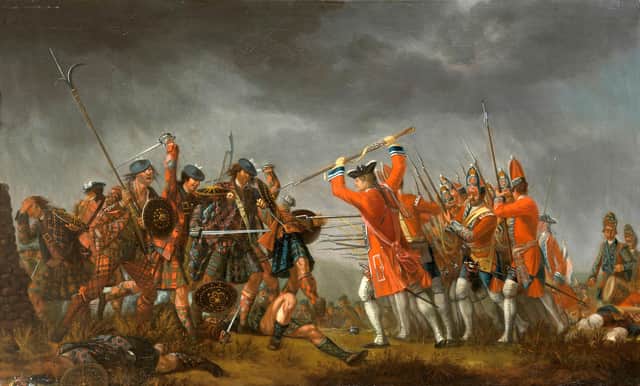
The Battle of Vinegar Hill, Rouse Hill, New South Wales 1804


Further reading 

For wider reading about Australian history, I highly recommend William Lines’ challenging Taming of the Great South Land’ – a history of the conquest of naturecin Australia, David Day’s Claiming a Continent, and Bruce Pascoe’s challenging Dark Emu.

In an earlier piece, The agony and extinction of Blinky Bill  I wrote about Lines’ book:

“It was, and remains, an eye-opener and a page-turner. All our past, present and future environmental hotspots are covered. Squatters and selectors,  rabbits and real estate, hydro and homosexuals, uranium and aluminium, environmental degradation and deforestation, and the trials of our indigenous fellow-citizens who up until a referendum in 1967 were excluded from the census – and therefore not counted [The referendum of October 14th 2023, rejecting the Indigenous Voice to Parliament and the inclusion of our First Nations in the Australian constitution, demonstrates that we have yet to come to terms with our past. [See Silencing The Voice – the Anatomy of a No voter]

Behind many of the names that are attached to our suburbs, our highways, our rivers and our mountains are the names of dead white men who were aware of, even witnessed, and were often complicit in “dark deeds in a sunny land”. Perhaps I shall write more on this at a later date, but meanwhile, the following is what Lines has to say about our iconic wildlife, and particularly, our endangered koalas”.

Captain Cook, his chopsticks and his lunch.
Whitby, Yorks


Lachlan Macquarie, Hyde Park, Sydney

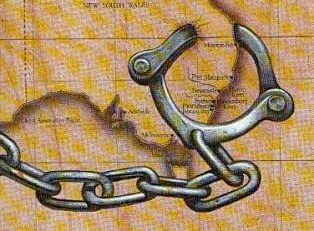
Detail from the cover of The Fatal Shore

Hughes’s Fatal Shore unfairly shows early Australia as a Gulag

Augustus Earle’s <i>A Government Jail Gang </i>(1830).

Augustus Earle’s A Government Jail Gang (1830).

A year before his 50th birthday, at the height of his protean literary powers, expatriate art critic Robert Hughes published his masterpiece: a long-arc history of early colonial Australia titled The Fatal Shore. Hughes’s account, written in his engagingly virile prose, would quickly vault to bestseller status.

Three decades after its publication The Fatal Shore remains the most influential work of popular Australian history written — certainly the most widely read. Yet it is, in a very fundamental sense, wrong about early Australia.

The book’s flaws have their origins in the same common source: an imagination drawn to the infernal notes of the early Australian story and insufficiently attentive to the lighter tones, the grace notes. Hughes sets out to tell a harrowing tale of systematic oppression and abuse that has been aptly described as a “gallery of horrors”. The result is a ghoulish Goya-esque aquatint rather than a rounded picture of early Australian society.

Time magazine, to which ­Hughes contributed his splendid art criticism, got this right when it awarded The Fatal Shore 47th place at in its all-time top 100 nonfiction titles, describing the book as the “shocking story” of Australia’s penal colony origins: a story that submerged readers in “the dark heart of the subject matter”.

Its title, taken from a convict ballad about conditions in Tasmania soon after white settlement, has become shorthand for the early Australian reality. It has never seemed to matter that the “fatal shore” refers to the sites of secondary correction, not the mother colony at Port Jackson. The latter quickly saw itself as a way station between its origins as a penal colony and its future as a branch of civilisation.

The interesting thing about early Australia — interesting socially, politically, philosophically — was how and why it rose from a state of base felonry to democracy and prosperity. But this is not the focus of Hughes’s lengthy narrative. He’s interested in the inner circles of this antipodean hell, the lower realms of the convict system, the heart of darkness.

By the time Charles Darwin visited the colony on the Beagle in 1836, the student of natural evolution was moved to report: “On the whole, as a place of punishment the object is scarcely gained, but as a means of making men outwardly honest — of converting vagabonds, most useless in one hemisphere, into active citizens in another, and thus giving birth to a new and splendid country — a grand Centre of Civilisation — it has succeeded to a degree perhaps unparalleled in history.” Hughes records Darwin’s visit, yet he ignores this sunny manifesto of the colony’s moral significance.

Hughes framed his narrative around a powerful and lasting image of colonial Australia as a precursor to the Soviet Gulag, or concentration camp, and secondarily as a Grand Guignol, or horror story. “In Australia,” he writes, “England drew the sketch for our own century’s vaster and more terrible fresco of repression, the Gulag.” In the conclusion he again describes it as an “ancestor” of the Gulag.

Conditions at Port Jackson may have been harsh, particularly in the early years before the soils of Rose Hill (Parramatta) and the Hawkesbury began to yield maize, wheat and barley, and the colony’s sheep and cattle began to multiply. But the convicts enjoyed basic freedoms such as protection from harsh treatment under the rule of law. Their masters were not permitted to flog them. Only a court could sentence an offender to corporal punishment.

The image of the roguish convict iron gang is preserved in popular memory thanks to Augustus Earle’s watercolour of a string of malefactors at their morning muster at Hyde Park Barracks. They have threadbare hats, simian stoops, sly grins and glints in their eyes; and they regard the viewer on something like equal terms. This may have been a reality for serious offenders, re­offenders and absconders who were clapped into irons and forced to undergo hard labour. But it was manifestly not the reality for most. Most of the men, in the early years, worked unfettered in the government lumberyards, dockyards and quarries; most of the women were assigned as ­servants.

“Go and provide lodgings where they can be found for the remainder of the day and come to work in the morning,” the principal supervisor is reported to have told the convicts after their first muster. Before the completion of the Hyde Park Barracks most convicts were lodged in huts under the care of a convict woman. They were expected to pay for their board and washing out of money earned from overtime work.

A 20-year-old marine officer, Watkin Tench, perhaps the most appealing of the early chroniclers, describes how the fledgling colony readied itself in its first autumn for the approach of winter. Barracks were erected for the soldiers and lodgings built for married couples.

“Nor were the convicts forgotten,” he writes, “and as leisure was frequently afforded them for the purpose, little edifices quickly multiplied on the ground allotted them (on the harbour’s western edge) to build upon.” The liberality of this arrangement is astounding in the light of the Gulag metaphor.

The convict system in Tasmania was a much better fit with the Gulag image. But even then recent research of a near complete sample of Tasmanian convicts shows that they lived an average of 10 years longer than their free counterparts back in Britain.

Beyond the hours of work — dawn to 3pm in summer with Saturday afternoons and Sundays off — the convict was permitted to sell his labour, though payment was more often than not in goods or spirits. Profit-sharing schemes were not unknown. James Ruse, the first convict to be granted land by a colonial governor, induced convicts to clear his land in their own time and paid them with a share of the first crop. As skilled ­labour was scarce it could be sold at a high price. A man who could fix a watch could make a small fortune, even while he was serving out his term.

Before long convicts assigned to settlers on the expanding frontier were earning a set £10 a year for regular overtime, and within the first 30 years of settlement this mutated into a standard £10 annual wage. Convicts working at difficult tasks, such as construction, could earn even more in indul­gences such as cuts from the settler’s table, tobacco, tea, sugar and rum.

Before their sentences had expired, usually after four years for a seven-year term, though often earlier, many were given tickets of leave: forms, in effect, of early parole. Conditional and full pardons were also used as incentives to reformation of character and neces­sary measures to ensure specific projects, such as the road across the Blue Mountains, were completed on time. Following a pardon, the typical emancipist was granted 30 acres (12ha) and implored to go make his fortune.

Skilled convicts such as David Dickenson Mann quickly settled into a life of bondage without any great sense of confinement. Convicted of defrauding his master in 1798, the clerk was transported for life. Arriving in Sydney in 1799, he soon found work as a clerk in the colonial bureaucracy. Less than three years later he had received an absolute pardon.

A convict such as architect Francis Greenway more or less stepped off the transport and into government employment in his former profession.

In 1819 a French ship commanded by Louis de Freycinet entered Sydney Cove. On board was Freycinet’s wife Rose and an illustrator-writer named Jacques Arago. The latter’s account of his journey, published in 1822 as Narrative of a Voyage Round the World, describes Sydney Cove in tones that seem to anticipate Darwin.

“Spacious buildings assume the place of smoky huts; an active and intelligent population is now in motion, and eager in pursuit of pleasure, on the very spot where savages formerly engaged in bloody combats,” he writes. “Obscure paths become broad and level roads: a town arises — a colony is formed — Sydney becomes a flourishing city.”

Hughes ignores this paean to the convict revolution, just as he had ignored Darwin’s.

“Some Frenchmen — though not, as a rule, those who had actually been there — did admire the English penal settlement in Australia,” he writes

As a matter of fact most French witnesses — including both Freycinets, Francois Peron in 1802 and the splendidly named Hyacinthe de Bougainville (1825) — pondered the miracle of social and moral reformation: the convict revolution.

Early in his book Hughes avers that colonial Australia was “a more normal place than one might imagine”. In his conclusion, too, he acknowledges the powerful reforming impact of the assignment system. And at various points in the book he cites ­evidence about the convict labour system and convict society that undermines his own broad rhetoric.

Historian John Hirst, author of Convict Society and its Enemies (1983), understood Hughes’s narrative strategy with penetrating clarity. Hughes’s acknowledgment of normality, Hirst insisted, did nothing to disturb the “controlling image of the book: that one society determined on a sort of final solution for crime by shipping its ‘scum’ to the other side of the world”.

Thirty years after its first Australian publication, The Fatal Shore still astonishes with the seductive power of its writing — its rhetoric. And in his wonderful rococo sentences, Hughes gave his all: he shows flashes of lyricism and asperity; he varies the pace of his narrative, its syntax and rhythm.

The 600-page narrative is, above all else, a masterclass in the neglected craft of writing.

He may not make of the grace notes of his narrative what the full story of convict Australian demands, but he doesn’t ignore them.

He records, for example, that the first generations of the native-born currency lads and lasses “turned out to be the most law-abiding, morally conservative people in the country. Among them, the truly durable legacy of the convict system was not ‘criminality’ but the revulsion from it: the will to be as decent as possible, to sublimate and wipe out the convict stain, even at the cost — heavily paid for in later education — of historical amnesia.”

As Hughes winds towards his ambivalent conclusion, his deep target reveals itself: the sin of sublimation, the fog of forgetting. And the book’s great triumph is that it restores the horrors of the convict system to vivid — unforgettable — life.

The Fatal Shore says many true things about early Australia, but it leaves many true things unsaid.

Luke Slattery is a Sydney-based freelance writer

A unique story with a powerful contemporary resonance

The founding of modern Australia is much more than a tale of colonization.

Controversy can focus the mind, and the more we debate the history of the country’s colonisation, the better. Illustration by Eric Lobbecke.

Illustration, Eric Lobbecke.

There is much to celebrate in their story. It tells how a miserable convict underclass in exile went on to build a dynamic, prosperous, open and relatively egalitarian society. This had never happened before, and it hasn’t happened since.

It’s a historical story with a powerful contemporary resonance. How do contemporary societies, both developing and developed, find ways to improve and empower citizens trapped at the lower end of the social scale? It’s an intractable dynamic that, expressed as grievance, finds expression in Trumpism, nationalism, separatism – even terrorism. But colonial Australia found answers to the problem of social advancement when a criminal class was empowered to create a society defined by the idea of advancement and liberation. It was a social and economic revolution – a revolution without a proclamation. An accidental revolution. But a revolution nevertheless.

The chief obstacle to the dissemination of this story is the usual culprit: ignorance. To take one example: many Australians – and visitors to Australia – picture colonial Sydney and Hobart as vicious prison systems. They imagine convicts incarcerated, in leg irons, flogged for petty offences, subjected to cruel and arbitrary forms of torture.

The Founding of Australia By Captain Arthur Phillip R.N. Sydney Cove, January 26th 1788 by Algernon Talmage R.A First Fleet, 1787-1788. Picture: Supplied

The Founding of Australia by Captain Arthur Phillip R.N. Sydney Cove, January 26th 1788
Algernon Talmage R.A First Fleet, 1787-1788

At no stage were the run-of-the-mill convicts who went ashore at Port Jackson clapped in chains: that’s part folklore, part colonial Gothic cliche, part lazy assumption.

In 1822, the British government published the detailed report of a punctilious London lawyer named John Thomas Bigge – reputedly very small – who’d been sent to investigate the state of the convict system and suggest reforms. At their first muster the newly arrived convicts were, Bigge found, “told by the principal superintendent ‘to go and provide lodging where they could for the remainder of the day, and to come to their work in the morning’.” They weren’t chained. They weren’t imprisoned. They weren’t even confined – and they didn’t shuffle around town in leg irons.

After the hours of 3pm weekdays and on Saturdays, the convicts generally worked for themselves – fixing watches, building fences or furniture – and with their earnings they were expected to pay for their “weekly lodgings and their washing”, in Bigge’s words.

[Slattery’s account of Bigge’s inquiry does not mention that he and Governor Macquarie did not get on at all, and indeed were at loggerheads over political and bureaucratic seniority – see his entry in The Australian Dictionary of Biography]

The most remarkable thing about the convict colony at the end of the earth was its air of liberality, despite the harshness of the work and the climate. Convicts were formed into various work gangs. Only hardened criminals and repeat offenders were assigned to the chain gangs.

Commissioner Bigge observed that tradesmen were generally paid “a certain weekly sum, generally amounting to 10 shillings … In return for this payment, and so long as it is regularly made, the convict is allowed to be at large at Sydney, and elsewhere, and to be at his own disposal.”

A Tory and a snob with an unshakeable disdain for the convict classes, Bigge was determined to stamp out the payment of wages drawn from His Majesty’s coffers to felons who had subverted the British property system. As the Yale historian Peter Gay wrote in his groundbreaking study of the Enlightenment, British law in these years “grew more stringent, religiously safeguarding property – or, rather, safeguarding property as if it were a new religion”.

In 1810, more than 220 offences, most of them petty, incurred the death penalty.

Convicts in government service benefited from the shortage of skilled labour in the early years. Francis Greenway, the colony’s first architect – and a convicted ­forger – stepped straight from his transport into permanent employment. The most common gubernatorial indulgence was the ticket-of-leave – an early form of parole that gave the convict freedom, though not freedom to leave the colony. Between 1810 and 1816, some 50 per cent of male convicts who had been sentenced to seven-year terms were paroled in this fashion after they had served three years or less.

The trouble with Robert Hughes’ Fatal Shore myth of an antipodean gulag is that it’s not only an illusion, it’s an occlusion: it obscures the very real social, moral and political value in those features of the convict system that were in part a pragmatic response to economic need. We get a very different impression from the witness accounts of visitors to, and, in one rather special case, victims of the system.

The First Fleet in Sydney Cove. Picture: National Library of Australia

The First Fleet in Sydney Cove. Picture: National Library of Australia

In 1802, a young Frenchman named Francois Peron arrived at Sydney Harbour as part of the French “scientific” expedition commanded by Nicholas Baudin. In his journals of that voyage, Peron explicitly, though fleetingly, uses the term “revolution” to describe the mechanism of social advancement he’d witnessed first-hand at the penal colony at the end of the earth.

The mechanism of this “revolution” was, in Peron’s view, rational self-interest. The emancipated convicts were generally given land grants and starter provisions from the government stores. They were concerned with “the maintenance of order and justice, for the purposes of preserving the property they have acquired”, Peron observed.

At the same time, they “behold themselves in the situation of husbands and fathers; they have … powerful motives for becoming good members of the community in which they exist”.

Peron’s account has an English equivalent in the witness account of the 26-year-old Charles Darwin, who arrived at Sydney Cove in 1836 aboard HMS Beagle. “On the whole, as a place of punishment the object is scarcely gained, but as a means of making men outwardly honest – of converting vagabonds, most useless in one hemisphere, into active citizens in another, and thus giving birth to a new and splendid country – a grand Centre of Civilisation – it has succeeded to a degree perhaps unparalleled in history,” Darwin wrote.

It was the French who seemed the most acutely attuned to the political and moral force of the social experiment at Sydney Cove. The writer and illustrator Jacques Arago arrived in Sydney in 1819 aboard a ship commanded by Louis de Freycinet, who had smuggled his spirited wife Rose on board in the disguise of a deckhand.

Arago, too, was keen to lay bare the mechanisms of social elevation. “A convict arrives, condemned to seven years’ transportation. If he be of any trade, he may procure employment at it as soon as he arrives: and if he be industrious and frugal, he is soon enabled to work on his own account, and to earn money enough to begin a little business.”

A convict in this condition – unable to leave the colony yet free to earn wages – “is given as an assistant, or servant” in the form of a ­convict whose term has recently finished or “has been granted an exemption”. The servant’s labours are “recompensed; and, if he be frugal when his time has expired, he in his turn, obtains the same advantages as his master, and, like him, receives servants, who assist him in clearing fresh lands. In this manner the labour, the trouble, and the reward have been equally distributed; and while the country is improved, the man becomes better, and society is benefited.”

The Governor's rest house at Rooty Hill in 1918. Picture: State Library of NSW

The Governor’s rest house at Rooty Hill in 1918. Picture: State Library of NSW

We have another early colonial narrative of personal elevation, though one that lies outside this French tradition of looking on – somewhat admiringly as Voltaire had also done – to English society from without. It’s the narrative of Joseph Mason, a convict who arrived in the colony in 1831 and returned home after an early pardon. Far from being fettered or in any sense constrained, Mason was free to roam and explore the countryside. “I have traced the (Nepean) river its whole length through the mountain both alone and with company,” he boasted.

These witness accounts of early Sydney miss much detail, some supporting their vision of a benign social revolution, some challenging it. They fail, for example, to note the tensions in the colony between ex-convict emancipists, free settlers, convicts and the military; there is only a glancing mention of the fact that many convicts spend their earnings on grog, while others return to crime. And they fail by and large to see that the sunny social experiment was made possible by an act of colonial dispossession.

Contemporary Australians, and particularly the young, tend to view the early settlement solely through the prism of colonisation and dispossession. Many others have absorbed the gulag myth propagated by Hughes, who wilfully confused the harshness of the places of secondary punishment – such as Port Arthur, Norfolk Island and Moreton Bay – with conditions and practices in the main settlements.

The untold story of the Australian revolution carries its freight – moral, political, philosophical – into our century. It suggests that individuals, and entire societies, can be improved by improving their conditions; that work and purpose are, in fact, morally uplifting.

It illuminates some of the causes of social misery, as well as some of the cures. It’s an optimistic, and a badly needed, tale.

Peron, Arago and de Bougainville were convinced they’d witnessed something worthy of philosophical reflection. Their compatriot Jules (20,000 Leagues Beneath the Sea) Verne would later embellish Peron’s account in a non-fiction mash-up of famous maritime voyages. “A more worthy subject for the reflection of a philosopher or statesman never existed – no brighter example of the influence of social institutions can be imagined – than that afforded on the distant shores of which we are speaking,” wrote Verne.

But philosophers and statesmen were a little short on the ground at Sydney Cove.

Protesters at Frenchmans Bay, La Perouse for the First Fleet re-enactment carry banners "Australia Day = Invasion Day" in 1988. Picture: Michael Jones
Protesters at Frenchmans Bay, La Perouse for the First Fleet re-enactment carry banners “Australia Day = Invasion Day” , 1988. Picture: Michael Jones

This cheering vision of what has often been seen as an infernal colony, shouldn’t skew towards utopianism. In its broad outlines the convict experience was, as Darwin put it, about remaking, conversion and elevation. But it was, nevertheless, at heart, a form of extreme punishment for mostly petty offences. For many coveys the pursuit of freedom, despite the considerable risks, was preferable to the rigidities of indentured servitude. They escaped – even from the strictly supervised chain gangs – into the bush. Many perished there.

The reason, I think, that French observers were keen to stress the philosophical implications of the Australian revolution – the wonderfully named Hyacinthe de Bougainville also makes this point during his visit of 1825 – is that the French Revolution had been so heavily freighted with unrealised, or betrayed idealism. They were attuned to the sentiments of equality and fraternity. But they had lived through bloodshed, repression and, at the end of it all, the heady swell of Bonapartism and the restoration of a repressive monarchy. What they observed at Sydney Cove was the realisation of humane social ideas without any espousal of those ideals: a revolution without a Robes­pierre; a revolution without a guillotine.

It was not, of course, a revolution without bloodshed. Or violence, in the form of dispossession. Or murder, on both sides. But it would be facile to reduce the one story – the celebratory story with a powerful contemporary resonance – to the other. To reduce everything to black and white. Sophisticated cultures deal with complex origin stories of many strands.

Luke Slattery is the author of four works of non-fiction and one of fiction

What did Lenin do for us? The welfare state, that’s what,

Vladimir Ilyich Ulyanov (22 April 1870 – 21 January 1924), better known as Vladimir Lenin, was a Russian revolutionary, politician, and political theorist. He is widely considered one of the most significant and influential figures of the 20th century. Yet whilst his embalmed body still lies in Red Square, the real Lenin has been buried by decades of dictatorship and Cold War, and a century of sanctification and vilification.

Lenin speaking to a crowd in Moscow’s Sverdlov Square with Leon Trotsky and Lev Kamenev beside him, May 1920

In That Howling Infinite has written often about Russian history. So, we couldn’t resist commemorating the centennial of Lenin’s death.

I first became acquainted with him in the fall of 1968 whilst reading politics at Reading University under the tutorship of émigré academic and historian of Russian and Soviet politics Tibor Szamuely. For a while,

Back then, I was a political ingenue and a naïve communist sympathizer and fellow traveler, although my evolving perspectives were transforming and expanding. As my tutor, he advised me to study with an open mind and to put off juvenile thinking. He hadn’t been well when I knew him, and he died a year after I graduated. Under his tuition, I’d resolved to specialize in Soviet Studies – but events intervened, and I ended up in the Middle East (and that is another story. see: Tanks for the Memory – how Brezhnev changed my life). I nevertheless retained an active interest in the history and politics of Eastern Europe.

Szamuely would always impress upon me the historical and political continuity of what he called The Russian Tradition – the title of his one and only book, The Russian Tradition, published shortly before his death, and now, regrettably, out of print. I purchased a first edition when it was published and it is on my bookshelf still.

He believed that the bloodstained drama of the revolutions of 1917 – there were two, the social democratic one in the February, the Bolshevik one in November – and the years that followed, including civil war, the establishment of the USSR and Stalinism largely obscured the underlying consistency of Russian history. He did not live to see the decline and fall of the Soviet Union, and the advent of Putin and Russia Redux, but the basic pattern persists, circular and repetitive. The frequent turmoils that have overtaken this vast continent have in their various ways made changes that were essentially superficial, leading in the end to the intensification, under new forms, of the old authoritarian structure. See The Russian Tradition – Russia, Ukraine and Tibor Szamuely. 

Studying Soviet politics, I read quite a few of Lenin’s writings – the mercifully short paperbacks like What Is To Be Done? Burning Questions of our Movement (1901), Imperialism, the highest state of Capitalism (1917), and The State and Revolution (1917), and Leftwing Communism, an Infantile Disorder (1920), the best title of them all. They cost very little at a Communist Bookshop, in Soho, I think – a source also, of posters from the Revolution and the Russian Civil War. In my Russian phase, I’d even bought a balalaika – though admittedly my purchase was inspired more by its use by Ian Anderson of Jethro Tull in a great concert in our hall of residence. I never did much with it and saw it last on the sideboard of my late mother’s house in Birmingham.

I still have those books, in addition to the panegyric 1942 edition of The Truth about Soviet Russia, by famous British socialists (and Stalinist apologists) Sydney and Beatrice Webb, which was everything but the truth, posing the rhetorical question “Is Soviet Communism a New Civilization based on the ethical principle of ‘From each man according to his faculty to each man according to his need’. 

Better Read than Dead

Vladimir Lenin has a way of confounding Marxist and indeed other historians for he was that rare thing – an individual and singular instigator of historical change. A hundred years after his death, hagiographies and obloquies continue to pouring off printing presses as once did concrete to erect statues of Uncle Volodya. Even his most hostile critics would be churlish to dismiss his outsized role during the heady months leading to Red October.

The principal protagonist of the Bolshevik Revolution of November 1917 and the brutal and bloody civil war that followed, Lenin served as the first and founding head of government of Soviet Russia from 1917 to 1924 and of the Soviet Union from 1922 to 1924. Under his administration, Russia, and later the Soviet Union, became a one-party socialist state governed by the Communist Party. Ideologically a Marxist, his additions to the ideology earned their own title: Leninism.

There is near universal consensus that Lenin had no use for “liberalism” in any form, or democracy which he regarded as a bourgeois delusion. He closed down the elected Constituent Assembly, when elections to it rejected his party, at gunpoint. He then proceeded to ban all other parties. He instigated the Red Terror via setting up the Cheka, the prototype KGB and brought about the deaths of hundreds of thousands, establishing the apparatus and mechanisms of terror so definitively exploited by Stalin. His administration laid the framework for the system of government that ruled Russia and the USSR for seven decades and provided the model for later Communist-led states that came to cover a third of the inhabited world in the mid-20th century.

As a result, Lenin’s influence was global. A controversial figure, he remains both reviled and revered, a figure who has been both idolized and demonized. Even during his lifetime, Lenin “was loved and hated, admired and scorned” by the Russian people. This has extended into academic studies of Lenin and Leninism, which have often been polarized along political lines.

Back in the day, I admired him for the smooth operator that he was, though I was shocked by his cold-bloodedness. No matter what his sophisticated musings in exile or during 1917 told his readers, he conducted the civil way to à l’outrance. See: Red and white terror – the Russian revolution and civil war. Today, I come not to bury Vladimir nor to praise him – Wikipedia provides a good overview of his life and times, and his legacy. It’s a good source for further reading: HERE

Detail of Man, Controller of the Universe, a fresco by Diego Rivera in the Palacio de Bellas Artes in Mexico City

I republish below and interesting article from Unherd, my favourite e-zine, on the debatable influence of Lenin and the Bolshevik Revolution in British politics.

In the immediate wake of World War One, and the outbreak of civil war, Western Allies’ ideological perspective of the conflict was ambivalent. Many, politicians and military alike, were viscerally opposed to Bolshevism and what it stood for, and feared a Red contagion infecting their own countries, a fear that was not unfounded. After the Revolution, a concatenation of revolts detonated across the globe. Bolshevism spread westwards, from Vienna through Budapest and Sofia to Kiel. The Bavarian Soviet Republic was briefly established in April 1919, before the far-Right Freikorps did it in.

Britain wasn’t immune to the ferment. Between the February and October Revolutions, the Leeds Soviet did indeed appear to be the beginning of something, whilst strikes and demonstrations proliferated to be violently put down by the police and army. Winston Churchill alone of his cabinet colleagues wanted a full-on allied intervention and dreamed – some believed he was indeed dreaming but others claimed that he fantasized – of creating an effective White army and a borderlands alliance to defeat the Bolsheviks. But his aspirations were foiled by the imperialism of the White leadership and of White officers and the various national movements’ fear that that if the Whites prevailed, they would restore Russian rule. Britain’s rulers were reticent about shoring up and providing financial, material support and also, soldiers sailors and airmen to brutal to demonstrably homicidal Cossack brigades and revanchist and reactionary royalist autocrats.

The concern of His Majesty’s Government with the the Bolsheviks is the theme of series three of the superlative British crime saga Peaky Blinders. It is set in 1924, three years after the civil war, and not long after the fabricated Zionoviev Letter implicating the British communist party and by association, the Labour Party in a seditious plot, instigated a “Red Scare” that saw Britain’s first Labour Government defeated in a general election. Home Secretary Mr WS Churchill employs the services of Thomas Shelby and his Brummie brethren in a devious plot to fit-up and compromise the Soviet regime. The White Russian èmigrés, a cabal of revanchist aristocrats that Tommy has to do business with are an unsavory, unprincipled, bigoted and amoral crew.

The fear of this “Red contagion” after  Revolution, saw conservative British governments preempt insurrection by mollifying, co-opting even, and caring for the workers and the disadvantaged. The interwar years saw major strides in universal education, healthcare, and insurance Post-war, all that was left for Labour to do was to extend it to one and all. Already covering some 80% of the population, welfare was brought to the remaining one-fifth of Britain by Clement Attlee and William Beveridge.

I qualify this by noting that the article ignores the trends that emerged in the UK during the 19th century, such as the Poor Law Amendment Act, the Factory Acts and the 1870 Education Act which were built upon during the 20th century.

Historian Anil Pratinav’s writes how paradoxically, Soviet communism unwittingly fortified British capitalism. The unintended upshot of Anglo-Marxism was to make the Establishment more heedful of working-class interests. The same went for the welfare state. Peace was preserved between the classes. Redistribution took the edge off class conflict. What’s more, an educated and healthy workforce proved good for business. Moderately progressive taxation was a tiny insurance premium to keep the workers in working condition and the barbarians at bay.

Lenin might’ve said there are decades when nothing happens; and there are weeks when decades happens – but “these days, barring a few libertarian crackpots, Tory radicals, nostalgics, and campus Marxists, nearly everyone is united in confirming the wisdom of this arrangement. The simple fact is that most Brits like their politics dull.

© Paul Hemphill 2024.  All rights reserved.

Lenin’s funeral, as painted by Isaac Brodsky, 1925

Other articles on Russian and Soviet history is In That Howling Infinite has written often about Russian history: Ghosts of the Gulag; The Death of Stalin is no laughing matter; Stalin’s Great Terror; Borderlands – Ukraine and the curse of mystical nationalism:The Roots and Fruits of Putin’s Irridentism

How Bolshevism built modern Britain

Lenin still haunts our welfare state

Pratinav Anil Unherd, 15th January 2024

Yet there is another achievement that Lenin was inadvertently, indeed perversely, responsible for: the Western welfare state. That we rarely recognise this owes to a common misperception. Very many of us regrettably buy that Labour conceit, hawked by spin doctors and court historians, that celebrates Clement Attlee and William Beveridge as the co-fathers of our welfare jstate. But as the historian David Edgerton reminds us, it is in fact the Liberal-Tory coalition of David Lloyd George in the immediate aftermath of the First World War that we ought to be thanking. These were the years when the major strides in education, healthcare, and insurance were made. Post-war, all that was left for Labour to do was to extend it to one and all. Already covering some 80% of the population, welfare was brought to the remaining one-fifth of Britain by Beveridge.

More importantly, it was neither paternalism nor prodigality that prompted these early stirrings of dirigisme. Rather it was red contagion. In the wake of the Russian Revolution, a concatenation of revolts detonated across the globe. Bolshevism spread westwards, from Vienna through Budapest and Sofia to Kiel. The Bavarian Soviet Republic was briefly established in April 1919, before the far-Right Freikorps did it in. Britain wasn’t immune to the ferment. Between the February and October Revolutions, the Leeds Soviet did indeed appear to be the beginning of something. That nothing came of it was down to Lloyd George’s unsentimental pragmatism. Many of the workers’ demands were duly conceded, taking the sting out of union radicalism, even as many leaders were put behind bars.
Two years later, Lloyd George’s Bolshevik bugbear was to return with a vengeance, when shipbuilders stormed the Glasgow City Chambers. With hindsight, it is obvious that “Red Clydeside” was never, in any meaningful sense, a harbinger of “Red Britain”: the radicalism of Glaswegian trade unions on either side of the River Clyde was never going to spread to the rest of the country. Yet at the time, the red threat was all too real. “This country was nearer to Bolshevism that day than at any time since,” Lloyd George would later recall of the police and prison officers’ strike. London and Birmingham were spared, but Merseyside had rocked to the sound of rioting and looting. Violence was brought to a halt only when the army was brought in.
It is difficult for us to conceive what the “peace” after the armistice actually looked like. Yet Simon Webb’s 1919: Britain’s Year of Revolutions reconstructs a society teetering on the brink of collapse: soldiers roughing up workers; martial law in Luton; tanks cruising the streets of Liverpool. The Italians call the two years immediately following the war the biennio rosso, and it seems fair to speak of a red biennium in Britain as well. For one thing, it would be impossible to understand British domestic and foreign policy without reference to that singular neurosis of the interwar ruling class. While cavorting with the antisemitic Whites to crush the Reds in Russia, Westminster and Whitehall were at the same time crushing the unruly bolshies back at home. Churchill, then minister for war, put forward the government line with characteristic crassness: “kill the Bolshie, kiss the Hun.”

As it must in democracies, with the stick also came the carrot. Yes, the workers were brutally put down. But they hadn’t protested in vain. Gone were the Gladstonian days of cheese-paring Liberalism. Lloyd George’s Liberals were an altogether different beast: by turns technocratic, interventionist and ambitious. They were, no doubt, building on pre-war precedent, in particular the health and insurance schemes of 1911, and making good on wartime promises, but they were above all trying to make peace with the bad, mad and dangerous Brits on the streets.

To begin with, they gave a great many people a greater share in government, shepherding them from the barricades into polling stations. Universal male suffrage in 1918 enfranchised unpropertied men — that is, two in five men — as well as propertied women over 30. The same year, the Education Act, lobbied by Lancashire unionists, raised the school-leaving age from 12 to 14 to forestall cotton bosses from battening on benighted boys. And in 1919, the Housing and Town Planning Act put in motion the construction of what became that instantly recognisable feature of the British urban landscape: the council estate.

Bettered by Attlee and Harold Wilson, battered by Margaret Thatcher and David Cameron, the early interwar consensus around the welfare state survives to this day. Both under Labour and the Tories, truculent workers with ideas above their station have been shown their place: from Ramsay MacDonald’s disciplining of the “communistic” trade unions in 1924 through Thatcher’s thwarting of the miners in 1984 to Keir Starmer’s disavowal of organised labour in 2024. Likewise, since 1945, both parties have shown a general commitment to public spending around the 40% of GDP mark. Creaking, underfunded, “our NHS” continues nevertheless to be spoken of only in hallowed whispers.

Time and again, our rulers have let slip the real reason why welfare matters. Here’s Attlee in Margate in 1950: “our policy of democratic socialism is the only dynamic alternative to totalitarian communism.” Is it any surprise that two of the most robust welfare states across La Manche were created in societies that boasted a formidable communist presence? The Parti Communiste Français in 1946 counted some 800,000 members, and the Partito Comunista Italiano nearly two million. It is true that the Communist Party of Great Britain never had much to recommend it, but the strength of the post-war British Left — independent of Labour — is undeniable. It was the miners who brought down Edward Heath in 1974.

As with the British welfare state, so with British intellectual life. Our republic of letters would have been a dreary landscape of conformity were it not for the Russian Revolution, which fired three generations of Anglo-Marxists. The interwar years were a time when communists could rise to the very top of the cultural establishment. E.H. Carr, for example, became a leader writer and deputy editor of The Times, a perch from which he preached the gospel of collectivist planning and conciliation with Stalin. His monumental History of Soviet Russia — running to 7,000 pages and 14 volumes — remains the best account of the early years of the revolutionary regime.

Even such a sceptic of the state as George Bernard Shaw was swept away by Russomania. By 1931, with Britain reeling from the Depression, he was singing Stalin’s praises. Fabian gradualism, his old creed, wasn’t going to cut it in the 20th century. MacDonald’s Labour had evidently failed, he reflected in a new preface to Fabian Essays in Socialism. What was needed was “swift effectiveness” — Soviet-style. A trip to Moscow was written up in glowing terms in The Rationalisation of Russia.

In a manner of speaking, the remoter reaches of the ivory tower, too, succumbed to the Soviets. G.E.M. de Ste. Croix inaugurated what was by far the most arresting development in classical studies. A child of empire born in Macau, “Croicks” turned his back on his “thoroughly Right-wing upbringing” on the “lunatic fringe of Christianity” — as he later put it — in the Twenties. A romp across the Soviet Union in 1937 with Intourist, the Soviet travel agency, left him critical of Stalinism but committed to Marxism, on the strength of observing the peasants of the Caucasus. Thereafter, he became a “thoroughgoing Marxist”, tutoring a generation of students at New College, Oxford, who, in their own writings, were to remain alert to class in the classics. The Class Struggle in the Ancient Greek World appeared in 1981.

Such profiles can be indefinitely multiplied. Suffice it to say that most of the smartest minds of the interwar period were on the Left. This would soon change with the emigration of Eastern and Mitteleuropean conservatives to Britain — Friedrich Hayek, Karl Popper, Lewis Namier, Ernest Gellner — producing a more balanced intellectual division of labour. But before that, Left hegemony was unrivalled. John Strachey was undoubtedly among the most important political commentators of the Thirties. His father was the editor of The Spectator for nearly 40 years, and Strachey’s best man was Oswald Mosley, then still on the Left. When Mosley founded the British Union of Fascists, Strachey led some of the largest demonstrations against him.

As it was, the Marxist Strachey lost the battle of ideas to the Liberal John Maynard Keynes, who famously had no truck with communism: “How can I adopt a creed which, preferring the mud to the fish, exalts the boorish proletariat above the bourgeois and intelligentsia who, with all their faults, are the quality of life and surely carry the seeds of all human advancement?” Yet Keynes could do little to prevent one of his Cambridge protégés, Maurice Dobb, from taking up the cudgels for the boorish proletariat.

Communism gained a bridgehead in Cambridge thanks to Dobb, who edited The Plebs, a Marxist magazine, in the Twenties. He extolled Lenin as a “stern realist” blessed “with all the Jesuit’s sincerity and idealism”. By contrast, “non-Marxists” were “as silly as pre-Darwinian biologists”. He helped found the Communist Party Historians Group, and set up Kim Philby — of the Cambridge Five ring of spies — with the NKVD. Later students included Amartya Sen and Eric Hobsbawm, whose own Oxbridge appointments were blocked by Tory dons.

Paradoxically, then, Soviet communism unwittingly fortified British capitalism. The unintended upshot of Anglo-Marxism was to make the Establishment more heedful of working-class interests. The same went for the welfare state. Peace was preserved between the classes. Redistribution took the edge off class conflict. What’s more, an educated and healthy workforce proved good for business. Moderately progressive taxation was a tiny insurance premium to keep the workers in working condition and the barbarians at bay. These days, barring a few libertarian crackpots, Tory radicals, Bridesheady (Saltburny?) nostalgics, and campus Marxists, nearly everyone is united in confirming the wisdom of this arrangement. The simple fact is that most Brits like their politics dull.

Pratinav Anil is the author of two bleak assessments of 20th-century Indian history. He teaches at St Edmund Hall, Oxford.

Other articles by Anil: The Marxism of Horrible Histories, and Gandhi hasnt aged well. Both are good reads.

I wrote on Facebook regarding his article Horrible Histories, a Marxist plot?,:

I am a lifelong history tragic and I’ve degrees in history and politics. Now I’ve heard about horrible histories, I’ll have to look further. All history is, in a manner of speaking, storytelling, its validity and verification changing with the perspectives, perspicacity and prejudices of the storyteller. And on a potentially controversial tangent, all history is political – exhibit one is the proliferation of the culture wars and their corollary, the history wars.

If HHs can bring young folk to history and encourage them to learn more, so much the better. From what I read here, the histories are a more detailed and graphic version of that old, corny chestnut 1066 And All That. Which I still dip into now and then, for its perspective on what we’re owecievd back in the day as “good kings” and “good things”. Bad kings were more often than not the stuff of Shakespeare, whilst there were remarkably few bad things. I share the view of one commentator – that Deary is probably no Marxist, but was taught by a history teacher with Marxist leanings. History can and should be fun as well as serious, and not just the bailiwick of crusty academics and history snobs and culture warriors.

There’s a Canadian writer who tells similar stories about world history called Sweary History or The Day Shit Went Down – I’m sure you get the drift. By the way, I highly recommend Dominic Sandbrook and Tom Holland’s excellent podcast  The Rest is History – a gift that keeps on giving. Solid and well researched stories from history’s back pages with bad impersonations , lots of friendly banter, and loads of humorous irreverence regarding assorted shibboleths and sacred cows”.

Sleeping still, in Red Square

Blood and Brick … a world of walls

When our gallant Norman foes
Made our merry land their own,
And the Saxons from the Conqueror were flying,
At his bidding it arose in its panoply of stone,
A sentinel unliving and undying.
Insensible, I trow, as a sentinel should be,
Though a queen to save her head should come a-suing,
There’s a legend on its brow that is eloquent to me,
And it tells of duty done and duty doing.
The screw may twist and the rack may turn,
And men may bleed and men may burn,
O’er London town and its golden hoard
I keep my silent watch and ward!
WS Gilbert and Arthur Sullivan, The Yeomen of the Guard

I read British historian David Fry’s informative Walls: a history of civilisation in blood and brick a few years ago.

We’re not talking here of idioms, metaphors and analogies, like “facing the wall”, “up against the wall”, “another brick in the wall” and the anodyne “blank wall”. It’s all about imposing and impressive, massive and deliberately built structures designed to protect, contain or separate.

The breaching of Israel’s formidable high-tech wall which ostensibly sealed off the Palestinian enclave of Gaza on October 7th 2023 (more on that later) brought me back to my earlier notes. I’d gathered a few excellent reviews and random thoughts thereon, and I resolved to complete this article. The reviews republished below are informative and comprehensive, and well-worth reading.

I offer my own thought on the subject by way of an introduction. Neither they or I mention of a certain iconic song by Pink Floyd (I “almost mentioned the war” above) but I couldn’t resist opening with what many would call “the wall of walls”. It’s not Hadrian’s Wall, which has fascinated me since our first visit in 2015, when we stood atop the windswept knoll that is Housesteads Roman Fort on a freezing May morning. Nor is the Great Wall of China, iconic and impressive as it is – though I’m sure that if it had existed, you’d’ve been able to see this too from space. By the way, the opening quotation is a paean to the Tower of London, which, “if walls could talk” would have a great tale to tell.

The author at Housesteads Fort on Hadrian’s Wall

The view from Housesteads Fort, Hadrian’s Wal

The Wall has stood through it all …

I am the watcher on the wall. I am the shield that guards the realms of men. I pledge my life and honor to the Night’s Watch, for this night and all the nights to come.
The Oath of The Night’s Watch, Game of Thrones

George RR Martin, the author of the Game of Thrones epic has said that his Ice Wall separating the northern wintry waste with its nomads and its demons from the settled and temperate Westeros with its castles and cities, its palaces and slums, and destitute and the depraved, was inspired by a visit to Hadrian’s Wall – only he built it much longer and much, much higher. “We walked along the top of the wall just as the sun was going down. It was the fall. I stood there and looked out over the hills of Scotland and wondered what it would be like to be a Roman centurion … covered in furs and not knowing what would be coming out of the north at you” However, the author adds thats: Hadrian’s Wall is impressive, but it’s not really tall. A good ladder would be all you need to scramble right on over it. When you’re doing fantasy, it has to be bigger than in real life”.

We built a wall once …

A big one. Separating the backyard of our house from Camden Street, Newtown, Sydney. It was well over six foot high, rendered and scored to look “authentic” and entered thought a gate set into an ornate arch moulded to replicate the century-old portico of our front door. To build a wall that high, we had to take Council to the Land and Environment Court. We left that house over two decades ago. Our old house has changed hands several times since, but when the present owners wanted to redevelop the back end of that one-time corner shop that we once called home, Council mandated that the wall and the gateway had to be preserved because it was “heritage”. Such is the power and presence of walls.

Which brings us to the punchline. We built the wall for privacy and for security. But one night, while we were socialising upstairs, person or persons unknown scaled our wall, entered our house and swiped the handbags on the kitchen table. When the police came to investigate, a very agile constable shimmied up the wall and sat atop. So much for our wall. We ought to have laid broken glass or razor wire!

And that is the thing about walls:

Walls work … until they don’t 

We know that the Ice Wall protected by those Watchers of our opening quote fell to the zombie ice dragon Viserion and the dead. Drogon, the last of Queen Daenerys Targaryen’s “children” shattered the walls of Kings Landing, the decadent yet depressing capital of Westeros, and incinerated its unfortunate townsfolk.

The dead watch Visarion do his thing

Hadrian’s Wall fell into disrepair – it was always permeable, and in time, had served its purpose – which was perhaps as much about public relations as protection. Archeologist Terri Madenholme wrote in Haaretz: “Despite itself having a culture of violence, Rome aimed to project an image of a nation of the civilized, and what better way than having it monumentalized in stone? When Hadrian set to build the 73-miles-long wall drawing the border between Roman Britannia and the unconquered Caledonia, the message became even more clear: this is us, and that’s them. Hadrian’s Wall was much more than just a border control, keeping the Scots in check: it was a monument to Roman supremacy, an attempt to separate the civilized world from the savages”.

“He set out for Britain”, Hadrian’s historian tells us, “and there he put right many abuses and was the first to build a wall 80 miles long [Roman miles] to separate the barbarians and the Romans.

The Great Wall of China has in many places withstood the ravages of time, which says something about the skills of the workers who built it and the quality of its brickage. It had only been breached by Genghis Khan and the Manchus – until August 24 2023 when two Chinese construction workers in Shanxi province, were looking for a shortcut and drove heavy machinery through it, causing what authorities described as “irreversible damage” when they used an excavator to widen a gap in the wall.

The hole in the wall

The famous Theodosian Walls protected Constantinople since the foundation of the new capital of the Roman Empire by Emperor Constantine in 324 until they were breached by the Ottoman sultan Mehmet the Conqueror in 1453. He’d brought along a huge army and a bloody big gun. [The event is imaginatively recreated in Cloud Cuckoo Land  the 2021 novel by Pulitzer prize-winning author Anthony Doerr] Istanbul remained the capital of then Ottoman Empire for over half a millennium, and though dilapidated and discontinuous, they endure still. We have walked around them.

During the Cold War, Soviet controlled East Germany built its Berlin Wall virtually overnight to halt the haemorrhage of its population to the west and freedom, and it endured for thirty years with all its concrete, wire, guards, guns and deaths, until it fell, over thirty years ago, virtually overnight. And rejoicing Germans demolished it for souvenirs.

In Belfast, the capital of Northern Ireland, there are imposing walls that have actually stood longer than that in Berlin. Now called the the Peace Walls, they were first erected by the British army in 1969. They were temporary affairs of corrugated iron, as the inter-community conflict solidified and ossified, they were soon  extended and upgraded to bricks, steel and concrete. The walls separated predominantly Protestant loyalist and Catholic nationalist enclaves throughout The Troubles, the three decades of bombings, murders, riots and civil-rights protests.

Though not all linked, 38 kilometres of walls still slice through the city, outliving the conflict that engendered them. Only some short sections have been removed – partly they’ve become a tourist attraction, while the communities that live closest to them say they still provide a sense of security – though tensions may have eased, people are easily divided and it’s much harder to bring them together again. In the Shankill and Falls roads area of western Belfast, which were particularly notorious during The Troubles, the wall is splattered with political messaging, which makes it easy to know which side you’re on. One side has portraits of British soldiers and the queen and kerbs are painted red, white and blue. On the other the colours of the Irish flag predominate, framing portraits of Republican heroes and hunger-strike martyrs.
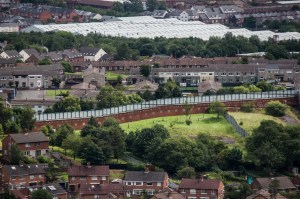
Belfast’s Peace Wall

Walls or fortified fences are all the fashion in the Middle East. Egypt has built one on its border with Libya – and also with Gaza. Saudi Arabia has put one between it a Yemen and also, one with Iraq. Kuwait has one too with its former invader. In the Maghreb, Morocco constructed the longest wall in the world dividing the former colony of Spanish Sahara from its independence fighters in their Algerian sanctuaries; and yet, the modern world’s longest enduring independence struggle continues.

The Israelis built the Separation Wall to halt the bombings of buses and bistros in Jerusalem and Tel Aviv during the Second Intifada and have maintained it as an instrument of security and control and of divisive national politics. And on the whole, it has worked, except that it has entrenched the isolation from each other of the Israeli and Palestinian communities, and increased in many, a lack of familiarity and empathy and a mutual fear and loathing that does not auger well for peaceful coexistence.

If you walk atop the Ottoman Walls that still circle the Old City of Jerusalem, you can see it and the Haram Al Sharif, the Dome of the Rock, from where the walls pass Mount Zion. It snakes away in the distance through the arid landscape and white sandstone suburbs like an incongruous grey scar. We’ve crossed through the wall and IDF and Border Police checkpoints many times in our travels through Israel and Palestine. On one journey, a cross-country drive across the Judean desert from the satellite city of Ma’ale Adumin to the ancient and amazing monastery of Mar Saba, we passed through fields where Bedouin women harvested wild wheat with sickles as their forebears did of old and actually walked across the footings of a section of the wall that has been abandoned when the high court determined that its construction would prevent the Bedouin from traversing their traditional grazing grounds.

In his final book, Night of Power, published posthumously in 2024, the late foreign correspondent Robert Fisk provides a dramatic description of this “immense fortress wall” which snakes “firstly around Jerusalem but then north and south of the city as far as 12 miles deep into Palestine territory, cutting and escarping its way over the landscape to embrace most of the Jewish colonies … It did deter suicide bombers, but it was also gobbled up more Arab land. In places it is 26 feet or twice the height of the Berlin wall. Ditches, barbed wire, patrol roads and reinforced concrete watchtowers completed this grim travesty of peace. But as the wall grew to 440 miles in length, journalists clung to the language of ‘normalcy’ a ‘barrier’ after all surely is just a pole across the road, at most a police checkpoint, while a ‘fence’ something we might find between gardens or neighbouring fields. So why would we be surprised when Italian Prime Minister Silvio Berlisconi, traveling through the massive obstruction outside Bethlehem in February 2010 said that he did not notice it. But visitors to Jerusalem are struck by the wall’s surpassing gray ugliness. Its immensity dwarfed the landscape of low hills and Palestinian villages and crudely humiliated beauty of the original Ottoman walls Churches mosques and synagogues .. Ultimately the wall was found to have put nearly 15% of West Bank land on the Israeli side and disrupted the lives of a third of the Palestine population. It would, the UN discovered, entrap 274,000 Palestinians in enclaves and cut off another 400,000 from their fields, jobs, schools and hospitals”.

Leftwing Israeli journalist Amira Haas, who lives in the West Bank, takes Fisk on a tour of the wall:

“Towering 26 feet above us, stern, monstrous in its determination, coiling and snaking between the apartment blocks and skulking in wadis and turning back on itself until you have two walls, one after the other. You shake your head a moment – when suddenly through some miscalculation surely – there is no wall at all but a shopping street or a bare hillside of scrub and rock. And then the splash of red, sloping rooves and pools and trees of the colonies and yes, more walks and barbed wire fences and yet bigger walls. And then, once more the beast itself, guardian of Israel’s colonies: the Wall.

The Separation Wall between Jerusalem and Ramallah. Paul Hemphill 2016

Israel also built a forty-mile so-called smart fence around the Hamas-controlled enclave of Gaza, decked out with cameras, radars, and sensors. It was meant to both stop large-scale Hamas attacks and provide warning if Hamas was gathering its forces. This failed disastrously on October 7th 2023.

Those defenses, of course, did work for many years. The Hamas, which used to send numerous suicide bombers into Israel, was largely unable to penetrate the border from Gaza, in large part due to the fence. In fact, Hamas had to plan for several years and conduct a massive operation to overcome the defenses – not an easy task and one that should have been detected and disrupted by Israeli intelligence.

The Hamas’ assault on the black Shabbat demonstrated chillingly that defenses by themselves are never sufficient. They must be backed up by intelligence and a rapid-response capability, making any breach less consequential for Israel and potentially disastrous for Hamas. Indeed, had Israel been able to scramble a small number of attack helicopters to Gaza quickly as the assault force was breaching the fence, Hamas would have suffered huge losses.

Yes, walls work, until, for one reason or another, they don’t …

Aida Refugee Camp outside  Bethlehem, Paul Hemphill 2016

An illusion of safety

I will ask more of you than any khal has ever asked of his khalassar! Will you ride the wooden horses across the black salt sea? Will you kill my enemies in their iron suits and tear down their stone houses? Will you give me the Seven Kingdoms, the gift Khal Drogo promised me before the Mother of Mountains? Are you with me? Now… and always!”  
Danearys Targaryen, Game of Thrones

And they were, and they did, with the help, of course, of dragons.

While walls are destined to fall one day, people like walls. They project a language of security – but their construction stems from a sense of insecurity, an intense fear of losing what you have.

In an early post, The Twilight of the Equine Gods, we talked of the horsemen of the plains and steppes who descended violently upon the sedentary lands of Europe the Middle East and China. The folk on the pointy end of their depredations built walls to keep them out.

But while people feel safe behind walls, their impregnability is often illusory.

Walls have gates and these permit ordinary, decent folk to enter and exit – to work, to trade, to parlay, to mingle, communicate and court. The forts along Hadrian’s Wall tell the story of such coexistence and cohabitation. But some people don’t bother with gates. Thieves can scale them and climb over them. Enemies too – they clamber over them, dig under them, mine them and bring them tumbling down, or by subterfuge, they can suborn, beguile or bribe a turncoat or waverer to open the gates or reveal a secret entrance. The ancient Greeks bearing their dubious gifts brought down “the topless towers of Illium” with a ruse that launched a thousand analogies and the famous aphorism “beware Greeks bearing gifts”. The Greeks have never lived that one down.

I’ve had the privilege and pleasure of walking the corridors and standing on battlements of some of those great crusader castles of Syria and Palestine – of Qala’t al Husn, known to the world as Krak de Chevaliers, of Qala’t Salahuddin in Syria’s Alawite heartland, and Belvoir in Israel. These fell not by storm but by subterfuge – plants, turncoats or bribes By geological happenstance, these three significant citadels were built above the great Rift Valley that runs from Africa to Turkey and from their still imposing ramparts, the traveller can look out over several countries and appreciate the strategic importance of these man-made megaliths.

Krak de Chevaliers, Husn, near Homs, Syria. Paul Hemphill 2006

Krak de Chevaliers,Paul Hemphill 2006

The Golden Gate, Jerusalem, from Gethsemene. Paul Hemphill 2016

A world of walls

And the great and winding wall between us
Seem to copy the lines of your face
Bruce Cockburn, Embers of Eden

In his Booker Award winning novel Apeirogon, Irish author Column McCann’s Palestinian protagonist Rami, speaking of the death of his daughter at the hands of the IDF, says: “all walls are destined to fall, no matter what”. But Rami “was not so naive, though, to believe that more would not be built. It was a world of walls. Still, it was his job to insert a crack in the one most visible to him”.

Walls are in vogue nowadays. We declare that we should be building bridges, and yet, we keep building walls. Indeed, walls and wire define and divide the brotherhood of man.

Walls keep unwanted people out and nervous people in. Or prisoners – the world is full of those. The USA, The Land of the Free, incarcerates more than any other nation – except China. More than Iran, or Turkey, each with tens of thousands of political prisoners. The majority of inmates in American and Australian jails are black.

And walls protect us from “the other”.

Australian commentator Waleed Aly wrote in the SMH 9 November 2019: “A wall doesn’t just exclude. It obscures. It renders those on the other side invisible. And once people are invisible, they become mythological beasts. Their lives, their attitudes, their aspirations all become figments of our imagination”. Read the full article below.

To my thinking, this can apply to several of today’s intractable conflicts. The division between North and South Korea, for example, with its heavily weaponized DMZ. Iran and its ostensible enemies. And as I alluded to above, the walls that divide Israelis and Palestinians in the West Bank and in Gaza.

Back in the day, I would walk from Ramallah, then but a small town, to Jerusalem. I’d traverse the old city, and head up the Jaffa Road to the bus station and thence, to Tel Aviv. Today, there is the Separation Barrier and checkpoints, and exclusive roads – easier for visitors like ourselves as we traversed the Occupied Territories, but excruciating and humiliating for the tens of thousands of Palestinians who, until October 7, crossed into Israel daily to work “on the other side” and visit family and friends in East Jerusalem and in Israel.

Amira Haas describes the road I once walked down: “It’s a destruction of peoples life – it’s the end of the world. See here? We go straight to Jerusalem. Not now. This was a busy road and you can see here how people invested in homes with a little bit of grace, the strength of the houses, the stone. Look at the Hebrew signs because these Palestinians used to have so many Israeli customers”. But, Fisk writes, “almost all the shops are closed, the houses shuttered, weeds and sticks along the broken curb. The graffiti is pitiful, the sun merciless, the sky so caked with the heat that the grey of the Wall sometimes merges into the grey stone of the sky. “It is pathetic this place” Amira Hass says. I’ve always been showing it to people always, you know hundred times and it never stop shocking me”.

The border fence between Saudi Arabia and Iraq

The border fence between Kuwait and Iraq

Girt by sea … 

That’s from our Australian national anthem, a paean to our pale Anglo-Celtic Christian heritage, continually updated as our values and our demography changes. It reminds us that walls are not necessarily built of bricks and mortar. An ocean can serve the same purpose.

The English, for example, have always rejoiced in their insular status. As early as the 13th century, an English chronicler described England as “set at the end of the world, the sea girding it around”. It was the sentiment which Shakespeare put into the mouth of the dying John of Gaunt in Richard II”: This precious stone set in the silver sea, which serves it in the office of a wall, or as a moat defensive to a house, against the envy of less happy lands.” It is part of the classic canon of English patriotism. Yet it was and remains a myth. As historian Jonathan Sumption, has pointed out, politically, England was not an island until defeat in the Hundred Years War made it one – had been part of a European polity.

Indeed, the aforementioned Hadrian’s Wall served as a more strategic historical reference point. In the preface to Pax, the latest volume of his magisterial history of the Roman Empire, English historian Tom Holland notes that the northern bank of the river Tyne was the furthest north that a Roman Emperor ever visited. What was so important about Hadrian’s visit to Tyneside in 122AD was his decision there to mark in stone, for the first time, the official limits of his Empire. North of this great wall, there was paucity and unspeakable barbarism, scarcely worth bothering about; below the wall was civility and abundance and the blessings of Romanitas. To this day, those 73 miles of the Vallum Hadriani across the jugular of Britain still shape the common conception of where England and Scotland begin and end, even though the wall has never delineated the Anglo-Scottish border. For this colossal structure left enduring psychological as well as physical remains. To the Saxons, it was “the work of giants” and was often thought of as a metaphysical frontier with the land of the dead – George  R got that part right too.

The “sceptred isle” tag prevails, but. It’s how many Brit’s saw themselves back then and right up to the sixties when we had to memorise it at grammar school: This earth of majesty, this seat of Mars, this other Eden, demi-paradise, this fortress built by Nature for herself against infection and the hand of war. This happy breed of men, this little world”. I couldn’t resist quoting it.

Our Island Story: A Child’s History of England, by British author Henrietta Elizabeth Marshall, first published in 1905, covered the history of England from the time of the Roman occupation until Queen Victoria’s death, using a mixture of traditional history and mythology to explain the story of British history in a way accessible to younger readers. It depicted the union of England and Scotland as a desirable and inevitable event, and praises rebels and the collective will of the common people in opposing tyrants, including kings like John and Charles I. It inspired a parody, 1066 and All That. Former Prime Minister David Cameron chose the book when asked to select his favourite childhood book in October 2010: “When I was younger, I particularly enjoyed Our Island Story … It is written in a way that really captured my imagination and which nurtured my interest in the history of our great nation”.

Maybe the Island Nation prevailed in its time – notwithstanding John Bull’s Other Island just over the water and the “troubles” it caused. But the French port of Calais that was such a headache to the Plantagenet kings back in the day is a persistent migraine today as folk from faraway places arrivethere hoping to board flimsy boats, casting their fortunes and their lives to the waves of one of the world’s busiest and tempestuous sea ways in the hope of a better life in the green and pleasant land of song and story.

We in Australia do have a unique wall – the ocean surrounding us.

Our former and now disgraced Australian prime minister Scott Morrison prime minister once declared that he himself was a wall, barring what we in official Australia call unauthorized arrivals by sea. The wall surrounding our continent – we are indeed the only nation that covers exclusively its own continent – is a wide watery one – huge, forbidding, and, depending on the operating budget and competence of the Australian Border Force, impenetrable. And it costs is a motza. In December 2020, The Guardian reported that Australia will spend nearly $1.2 billion on offshore detention – it’s called “processing” – that financial year, even though fewer than 300 people remained in ‘offshore detention” in Papua New Guinea and Nauru That’s roughly $4m for each person. Our government has spent more than $12 billion on offshore processing in the past eight financial years.

It might be less than the US$20 billion President Trump wanted to waste on a border wall, but it is far more as a proportion of government revenue and national income and more than five times the UN refugee agency’s entire budget for all of Southeast Asia.

That’s all from me. The reviews follow, but first some of the articles referred to in my narrative.

© Paul Hemphill 2024.  All rights reserved.

Al Tariq al Salabiyin – the Crusaders’ Trail

Roman Wall Blues – life and love in a cold climate

The Twilight of the Equine Gods

Thirty years after the fall of the Berlin Wall, we are building them again

Waleed Ali, Sydney Morning Herald, November 7, 2019

Sometimes that is literal as in the case of Donald Trump most famous, still unfulfilled promise. Sometimes this is figurative as in the case of Brexit (though it has dangerously literal implications in Northern Ireland). And sometimes this is a particularly pointed development, as in the case of countries that were once part of the Soviet bloc, which have turned in sharply illiberal, nationalist, anti-immigrant directions: places like Hungary and Poland.

Even as far afield as Australia we are being lightly stalked by this fortress mentality, too. Mostly this has focused on boats, but it is spreading now to a populist suspicion of globalisation more generally, especially where it involves us having obligations to other countries or the environment.

I don’t want to stretch the comparison too far. Today’s walls are about excluding the foreigner, while the Berlin Wall was built for the opposite reason: to keep East Germans in. But there is still an important continuity here, something powerful and important in the idea of a wall, that makes it so symbolic, whatever immediate function it serves. More profound than the physical barrier is the psychological one. That’s as true today as it was in Berlin.

Konrad Schumann leaps the barbed wire into West Berlin on 15 August 1961

Children at the Berlin Wall on Sebastianstrasse, around 1964 (Lehnartz/ullstein bild, Getty Images)

The fall of the Berlin Wall, November 1989

These narratives tell an uncomplicated story of the other that is really designed to tell an uncomplicated, heroic story about oneself. The East’s imagined multitudes of poor Westerners was a way of saying the Eastern system was superior and just. Hence, the West had to be wild and unequal. Meanwhile, the Western story of the East was a way of eliding its own shortcomings, establishing a triumphant narrative of freedom that swept away concerns about social injustice.

Walls make this so much easier. Aside from all else they do, walls prevent us from knowing each other. That has serious real-world consequences. We call the period after the Berlin Wall fell “reunification”, but it was really a Western annexation of the East. East became West, not some other accommodation. So thorough was the West’s self-regard, so comprehensive its belief in the East’s unmitigated bleakness, that it respected none of the institutions the East had built. It privatised and sold off its industries to the highest bidder – inevitably West Germans. It shut down its companies, more or less assuming they had nothing to offer.

The result saw East Germans with little choice but to head West for jobs, and the East hasn’t quite recovered. Today it is older, poorer, and endures higher unemployment. It’s only by knowing this that we can understand why a government study found 38 per cent of East Germans think reunification was a bad thing. A majority feel they are now second-class citizens. We’re seeing a rise of far-right radicalism, even neo-Nazism, in Germany. Its heartland is in the East.

Today’s walls are built on the same logic. They all offer some self-aggrandizing view of the world in which everyone else deep down wishes they were like us. Whether believing in the eternal supremacy of the British Empire in the case of Brexit, or that asylum seekers are really more interested in finding a back door to Australia than they are in fleeing persecution, the foreigner exists mostly as a counterpoint to our own magnificence. What matters is that they remain unknown and unknowable so we can mould them to our opposites, and they can be scapegoated for our problems.

We’re so committed to this kind of psychology that we will establish walls precisely where we’re told they can’t be built. Even something as borderless as the internet has become a landscape of barricades, populated by people talking only about their enemies and only to their friends. As a result, almost no one is knowable anymore.

So let me add one more idea to this week’s litany of Berlin Wall reflections: that it be a symbol of human arrogance. The arrogance to control and lie to one’s own people, sure. But the arrogance of choosing isolation, too. The arrogance of believing that the other has nothing to offer us. And the arrogance of believing that we can be fully formed in others’ absence; of treating other people as mere raw material from which we can manufacture ourselves.

Waleed Aly is a regular columnist and a lecturer in politics at Monash University.

A crash course in barrier building

Walls: a history of civilisation in blood and brick by David Fry Faber 2018.
Reviewed in the Australian by Pat Shell, March 16, 2019

“Build bridges, not walls. It’s a slogan”, writes Frye (Ancient and Middle Eastern History/Eastern Connecticut State Univ.), “designed to give military historians fits.”

Bridges, after all, have military purposes: to get across moats and earthworks and to ford rivers into enemy territory. Walls, on the other hand, make peace – history offers plenty of examples, he writes, to show that “the sense of security created by walls freed more and more males from the requirement of serving as warriors.”

Indeed, by Frye’s account, walls are hallmarks of civilization, if ones that are easily thwarted.

One of his examples is the Tres Long Mur, a defensive structure built more than 4,000 years ago, stretching across the Syrian desert and shielding some of the world’s oldest towns from marauders from the steppes beyond. There are mysteries associated with the ruins, just as there are with the Great Wall of China, another of Frye’s examples—and one that proves, readily, that where walls go up, people find ways to get around and over them.

The author’s pointed case study of Hadrian’s Wall shows that it may not have been a defensive success, but that does not mean it didn’t have a defensive purpose, as some scholars have recently argued. As he writes, wittily, “there is little to be gained from rationalizing an irrational past.”

Another defensive failure is the Maginot Line, which became more symbolic than practical in an age of modern tanks; on the reverse side are spectacular successes, such as the great walls of Constantinople, which shielded the city from siege by as many as 200,000 soldiers of the caliphate, “one of the greatest turning points in history.”

Walls have many purposes, he concludes, and it is rather ironic that the matter of walls is often as divisive as a wall itself.

A provocative, well-written, and – with walls rising everywhere on the planet – timely study.

Walls work, and walls save lives. So declared Donald Trump in the 2019 State of the Union address. Not long after that, he went a step further, just clearing Congress’ refusal to front with the funds for 4 billion bricks to be a national emergency.

There are times when that view could be right. How a well-built levee might postpone the inevitable when the rain keeps fallin’ and the river done rose. For a while it least.

But the US president wasn’t talking about breakwaters and climate change mitigation. The tsunami he is hoping to surf home to a tsecond term is a tidal bore of human flesh. He thinks that a Mexican wall is needed to keep out rapists, drug dealers, terrorists and Venezuelan communists.

But his wall, if ever built, will never achieve what wall builders through the ages have vainly striven for: to stop time itself, to freeze history at the pinnacle of their power. And in so doing, through the erection of military masonry on a monumental scale, confidently wallow in the triumphant delusions screamed by Ozymandias at weary gods who have heard it all before.

In short, the inevitable corollary of the invention of Real Estate: the creation of an exclusive neighbourhood to keep out riffraff.

Walls, David Frye’s fascinating and timely analysis of the rise and fall of empires, religions, cultures and languages, is so compellingly readable because it urges to look closely at human artifacts so everyday, so ordinary that we only rarely see them as instruments of power and authority. They can be impressive, sure, but not like an aircraft carrier steaming lies and all the flight of the two banners overhead.

We walk past walls every day. We live behind them. They hold up our roofs. Once fitted with a solid locked door and the steel-grated windows, they protect us, and not just from the wind and the rain.

Frye is an American historian. His main point is not just that walls, the stone and earthen shield of homesteads, palaces, towns, indeed entire nations, are as old as civilisation itself. He thinks that for all intents and purposes, walls are civilisation itself, or, at the very least have allowed civilisations to come into being.

He reminds us that like armies, walls don’t go anywhere. Like armies, they can be enormous, and symbolic of great power and proprietary rights, but they rise and fall in situ, and define the status of all who live around them.

Either you live inside the wall, or you don’t. And depending on how you define civilizations, they rarely flourish without a stable address of some sort. The Athenians wouldn’t have bothered building the Parthenon if they’d had to pull it down every winter to follow their goats to Macedonia in search of greener pastures. But they had to be able to go to bed at night confident that the marvels of the Acropolis would still be there in the morning.

And while the kind of people who write and read books such as Walls are by definition “inside the wall” characters, Frye notes the disdain with which “basket carrying” sybarites were regard by those on the outer.

The barbarians, the hordes. The marauding warriors. Luxury is for wimps, art an affectation citation for the feeble and effete. The Huns, Mongols, Cossacks, Names that are synonymous for people who would rather burn a city to the ground than simply move in and celebrate their luxurious residential arrangements by draining the wine cellars and frolicking in the fountains.

When the great unwashed arrived in sufficient numbers to break down the ramparts, they didn’t mess around. To them, plumbing, hanging gardens, marble theatres and elegant geometry will not try ounce of human aspiration, but conversions.

It is this primal fear of defenses overwhelmed that fuels Trump’s calculated hysteria today. While he may, without quite saying it in so many words, be grasping for historical legitimacy by asking his countrymen to “Remember The Alamo”, He does play on fears food in for thousands of years of siege warfare, and the grizzly fates that befell the losers.

And while the discounted insurance premiums that come with the electrified fences and gated communities of Bel Air and Rhode Island might ease the terror of wealthy Americans, a home invasion is small beer compared to the total collapse of “homeland security” in the real world.

Of the examples Frye gives of barriers breached and the resultant bloodbaths, and there are many, perhaps the most extraordinary is the Mongol demolition of Thirteenth Century China. “ The population of China fell from a 120 million in 1207 to 60 million in 1290. Mongols “boasted that they could ride over the sites of many former cities without encountering any remains high enough to make their horses stumble”.

Genghis Khan, born and bred on the merciless steppe, saw Chinese sophistication as an affront to nature, much as the Spartans mocked the music and theatre of the Athenians.

He shrugged off the carnage and destruction he had wrought as nature’s mockery of Chinese hubris and pretensions: “Heaven is weary of the beauty of the inordinate luxury of China”.

Trump doesn’t care for it much either, it seems. Perhaps a wise adviser might take a moment to point out to him the bridges are usually a far better long-term investment than barbed wire.

as The Eurasian Steppe by the archaeologist Warwick Ball makes clear, rather than a semi-wild anteroom to the continent, “the history, languages, ideas, art forms, peoples, nations and identities of the steppe have shaped almost every aspect of the life of Europe”. Europeans from further west have for centuries been prone to viewing the steppe as the haunt of wild tribes, and the source of occasional, fearsome destruction.
https://unherd.com/2022/07/the-fate-of-europe-lies-in-the-steppes/

Review of Walls: history of civilisation in blood and brick 

John M. Formy-Duval, retired teacher of ancient and medieval history and educator, on this books and  reading blogspot.

In Walls: a History of Civilization in Blood and Brick, David Frye has written an encompassing and enlightening review of walls through the centuries, ranging from 2000 B.C. to the present. A “Selected Timeline” covers the subject matter in four geographical areas: Near East and Central Asia; Europe; China; and the Americas. Frye writes that walls can take the form of “protectionist economic policies,” a “great internet firewall,” razor wire with motion sensors, or concrete barriers. Stringent, punitive immigration policies around the world seek to keep the perceived destroyers of “our culture out.” That is, we belong here; you do not.

“Few civilized people have even lived without them,” Frye emphasizes. From ditches to sapling fences to berms to walls, the level of sophistication rose as people perceived an increasing need for protection from, literally, the barbarians at the gate. Farmers settled and fortified their small villages. Even today one finds fences around Maasai villages in Tanzania. As villages transitioned into cities, their walls grew with them, often into great defensive bulwarks. Even Shakespeare’s Juliet recognized that “these walls are high and hard to climb.”

The epilogue “Love Your Neighbor, but Don’t Pull Down Your Hedge” covers the period from 1990 to the present. This section begins and ends with an account of how the Malibu coastline transitioned from the single ownership of May Rindge in 1892 until 1926, when she grudgingly agreed to lease some properties after numerous shootings, sheep poisonings, and a Supreme Court decision that went against her. Focusing on the present, Frye embarks on an account of the spate of walls built since the Berlin Wall was torn down. From the United States to the Middle East to Southern Europe and India, and nearly everywhere else, it seems, the pace, enormity, and sophistication of these walls is astounding.

People are familiar with the walls Israel has erected in which “infrared night sensors, radar, seismic sensors for detecting underground activity, balloon-born cameras, and unmanned, remote-controlled Ford F-350 trucks, equipped with video cameras and machine guns, augment the wall’s concrete slabs and concertina wire.” Lesser known is Saudi Arabia’s effort, begun in 2003, to create a barrier across its eleven-hundred-mile border with Yemen. The barrier rises across the desolate Empty Quarter, home of significant oil reserves. “Ten-foot high steel pipes, filled with concrete” provide the frame for razor wire while tunnels burrow deep underground. The Saudis have a second, more heavily fortified wall that ranges six hundred miles along their border with Iraq. Egypt, Jordan, India, Thailand and Malaysia, Morocco and Algeria, and Kenya are also in the wall-building business, often with funds or construction assistance either from the United States government or private businesses.

The U.S. was in the wall-building business along our border with Mexico long before the present administration, although the present focus changed the dialogue. We had barriers, little more than fences, before the Berlin Wall fell. Under President Clinton, for example, extensions were added to the existing barriers in 1993, 1994, and 1997. After Berlin, however, the word “wall” was largely abandoned in favor of softer language, and in 2006 the “Secure Fence Act” extended the extensions undertaken during Clinton’s time in office. Who knows what will happen at the present time?

Walls have deep effects on us. They box us in; they shut us out; they keep others out. They come in physical form, but they can be purely psychological, designed to prevent us from sinking into “the other side of the tracks.” Professional nomenclature excludes people and gives the holders of the language key a sense of superiority. Myriad iterations of “wall” provide endless means to isolate us and keep them out.

Frye provides the who, what, where, when, and how of walls ancient and modern. The Great Wall and Hadrian’s Wall are generally known, but he touches on the thousands of walls that continue to exist today and continue to be built “while we wait on everyone else to become just as civilized as we are.”

About Walls

Review in Always Trust in Books blog

For thousands of years, humans have built walls and assaulted them, admired walls and reviled them. Great Walls have appeared on nearly every continent, the handiwork of people from Persia, Rome, China, Central America, and beyond. They have accompanied the rise of cities, nations, and empires. And yet they rarely appear in our history books.

Spanning centuries and millennia, drawing on archaeological digs to evidence from Berlin and Hollywood, David Frye uncovers the story of walls and asks questions that are both intriguing and profound. Did walls make civilization possible? Can we live without them?

This is more than a tale of bricks and stone: Frye reveals the startling link between what we build and how we live, who we are and how we came to be. It is nothing less than the story of civilization.

‘The creators of the first civilisations descended from generations of wall builders. They used their newfound advantages in organization and numbers to build bigger walls. More than a few still survive. In the pages that follow, I will often describe these monuments with imposing measures – their height, their thickness, sometimes their volumes, almost always their lengths. These numbers may begin to lose their impact after a while. They can only tell us so much. We will always learn more by examining the people who built the walls or the fear that lead to their construction.’

David Frye’s Walls is a classic non-fiction read that left me not only well informed but with a deeper appreciation and understanding of world history. From 10,000 B.C right up to the present day, David Frye explains how fundamental the invention, construction and development of walls were (and still are) to the progression of humanity. If you are here purely for a history of walls then you may be disappointed as DF is more interested in the influence instead of the existence of walls. DF took me on a guided tour through key periods in the history of mankind and how the creation (and protection) of walls allowed us to flourish as a species but also the ramifications and innovations that they led to later on.

DF lead me through civilisations that either accepted or rejected the concept of being walled (or caged) in and how their decisions affected the population and also the other nations around them. Walls redefined our ability to exist in a barbaric world and allowed us to focus on scientific and cultural advancements. It also allowed some kingdoms to go soft, so to speak. DF also focuses on the absence of walls and how it changed the civilisations who refused to hide behind them; nations like the Spartans, Mongols and Native Americans who lived to fight for what was theirs or claim new lands for themselves.

The amount of coverage is exceptional, from the Roman Empire, Mesopotamia and China (with their many great walls) to Greece, Constantinople and Berlin. Walls are essential to the telling of history and David Frye did a fantastic and immersive job with his writing. Informative, concise, engrossing (narrative elements), well structured and paced out, David’s writing made this book totally worth my time. He could have easily knocked out this book with his extensive knowledge of war and culture but he went the extra mile. Making connections, observations and theories that made the content more comprehensive and digestible (with some hilarious comments too).

Recent history seems in part to be governed by a chain reaction that saw the building of more and more elaborate walls. Each emperor saw fit to out do their predecessors or competition. Each iteration of wall has its successes and failures, while destroying them advanced weaponry and military tactics along the way. I loved spending time with different time periods and walking amongst the mythos, history, socio-economic backgrounds, knowledge and statistics surrounding the world’s walls and those compelled to build them for their own needs or the needs of many. I especially enjoyed how David Frye’s message about walls was fluid and how it evolved over the course of the book. How humanity grew out of their need for walls and yet still see them in a symbolic nature. How destroying a wall can be as powerful as building one.

Frye knows perfectly where to stop and elaborate or move on to new points. He also doesn’t shy away from the darker shades of history so be aware of graphic detail. There is a lot to learn in this book but DF has written it in a way that it is never too much and I always wanted to know more. There are many highlights to Walls and I can’t recommend it enough to Non-Fiction lovers of many varieties. If you like detail, history, mythology (and ghost stories), the many aspects of building civilisation and humanity’s past then Walls is a great book to get stuck into. We owe walls our lives and without their protection our societies would have never been the same.

‘The walls alone have seen the truth, and they are mute’

David Frye

A native of East Tennessee, David Frye received his Ph.D. in late ancient history from Duke University in 1991 and is presently a professor of history at Eastern Connecticut State University, where he teaches ancient and medieval history. Frye’s academic articles have appeared in the UK, Germany, Sweden, and Denmark, as well as the United States, in journals such as Nottingham Medieval Studies, Classical World, Byzantion, Historia, Hermes: Zeitschrift fur klassische Philologie, The Journal of Ecclesiastical History, and Classica et Mediaevalia. In addition, he has published in various popular archaeological and historical magazines and on the online humor site McSweeney’s. As part of his research, he has participated in archaeological excavations in Britain and Romania. (Goodreads Biography)


 

Blue remembered hills – a land of lost contentment

Let everyone debate the true reality
I’d rather see the world the way it used to be”
A little bit of freedom’s all we lack
So catch me if you can I’m goin’ back
Carole King and Gerry Goffin as sung by Dusty Springfield

Blue Remembered Hills

Into my heart an air that kills from yon far country blows:
What are those blue remembered hills,
What spires, what farms are those?

That is the land of lost content,
I see it shining plain,
The happy highways where I went
And cannot come again

From The Shropshire Lad. AE Houseman

Houseman’s famous poem looks back at childhood as a “land of lost content”; when you are a child you are innocent, and you don’t have a care in the world. He says that childhood is a “happy highway where I went and cannot come again”, implying that they are the best years of your life but that you can never go back there. When the late British playwright Dennis Potter took the poem and turned it in to a play about a group of children on their school holidays in the Forest of Dean in Gloucester, he was asking if childhood is indeed such a land of lost content and are children really so innocent.

“Nostalgia”, literally the pain associated with the thought of home, or homesickness, is derived from the Greek “nostos”, a theme used in Ancient Greek literature – most notably in Homer’s Odyssey –  involving an epic hero returning home after a long time away, often by sea. In Ancient Greek society, it was deemed a high level of heroism or greatness for those who managed to return. The Greeks compared the feeling to the pain of an old wound, a twinge in the heart more potent than memory alone

But nostalgia isn’t all it’s cracked out to be. And indeed, it can bring out the worst in us becoming a millstone of bitterness and regret strung about the necks of discontented souls who drift off into a maze of memories, meanings and emotions.

In the seventeenth century, many considered it an illness that was curable, and could be treated with opium or with trip to the countryside. Other scholars of the phenomenon have noted that until the nineteenth century it was regarded as more a geographical longing than a temporal one, homesickness for a place rather than for an era. American author and essayist Thomas Mallon  wrote in a review in New Yorker: “In the same seventeenth century that prescribed methods of relief for nostalgia, writers like the poet John Milton and Robert Burton, who actually wrote a book called The Anatomy of Melancholy. went hunting for twinges of wistfulness as if these were magic mushrooms. Through the centuries, it has been regarded sometimes a harmless solace and occasionally, as a dangerous indulgence, a mental quicksand in which we allow the past to drown the present”.

Nostalgia’s pain can be exquisite, and many of those susceptible to it have sought to cultivate rather than banish the condition. But even if we do not dive in and get lost in the past, it is nevertheless built into us consciously or subliminally. We practice it culturally all of the time. It is often more triggered by the elemental senses, smell and taste and touch, than the sights and sounds from which constant revivals of fashion and music are constructed. Which, I guess, is why folk still flock to ever recycled retreads of the musicals of Andrew Lloyd Webber. 

The film Casablanca has probably inspired more feelings of nostalgia than any other movie, no matter that its famous song insists that “the fundamental things apply time goes by”. Likewise Yesterday, , the most covered song in history with well over two  thousand iterations: “Yesterday, my troubles seemed so far away.  Now it looks as though they’re here to stay.  Oh, I believe in yesterday”.  As Paul sings in the “outro”, “mmm-mmm-mmm-mmm, hmm-hmm”. I reckon he played us softies like a fiddle. “Oh, it makes you wonder”, exclaims Robert Plant in Stairway to Heaven, another opaquely nostalgic piece

Comedians have been know to lampoon nostalgia. Monty Python’s famous “Four Yorkshiremen” sketch is an absurdist riff on nostalgia itself, its quartet of old codgers wallowing in pseudo-memories of deprivation and competing for pride of place with the sheer awfulness of the pasts that they invent. Australian comic Rodney Rude went outrageously further. Go google.

And then there are “memberberries”. These featured in the long running American TV show South Park in 2016 as a purple sentient grape like-fruit that rots the brain with fake nostalgia. They evoke feelings of nostalgia in those who eat them, recalling pop culture icons that engender comforting feelings for the supposedly good times of the past. They almost constantly talk about things people remember fondly, particularly the original Star Wars trilogy. They always phrase their reminiscing as “member…?” They also make conservative comments, like recalling when marriage was only between a man and Ronald Reagan. “Member when there weren’t so many Mexicans?” They appear seem to be indestructible as one was seen burned by a torch and acid, and electrified with little to no effects, but, can be squished, eaten, and shot. Their exact origin remains unknown, but they are believed to date back to Ancient Rome.

But seriously, nostalgia is like a “pathology” that  presents as an inability to move forward and accept change. As technology frog-marches us into the future, we keep a constant backward glance. 

Personal genealogical research, German academic and cultural historian Tobias Becker reminds us in his recent  Yesterday- A New History of Nostalgia that it is the third most common use of the internet after shopping and pornography. Some of those pursuing it, he notes, are just casually curious,. Others are taking what feels like refuge in an earlier time, or seeking a more solid sense of an ethnic identity that can shape their own outlooks and politics.

And this is where it can get dangerous because the word itself can be weaponised. People on the left often insist that people overtly inclined to nostalgia are really seeking a fig leaf for their own racism. Folk of the right cleave to the revival of glory days of old, whether they existed or not, which at its most extreme can be used as a battle cry in the “war against woke”, “replacement theory” and the likes of the MAGA movement, and even Brexit.

Thomas Mallon, quoted above, provides what I consider a fair explanation for this present day fascination, and to some, preoccupation, with our past. Nostalgia, he reckons, goes much deeper than just an idea or concept. So deep in fact “that one wonders if it isn’t a neurological condition, something fundamental and immune to the vagaries of history. As people begin living beyond their Biblical allotment of seventy years, they experience the first exaggerated panics over forgetting a name or a date, which is usually remedied by a Google search. But then comes the growing realization that short-term memory has nothing like the staying power of the long-term variety. Mentally, the seven ages of man speed up their full-circling, until the past’s sovereignty over the present is complete. The further along one gets, the more one understands that the past is indeed another country, and that, moreover, it is home. Long-term memory’s domination of short may be a hardwired consolation that nature and biology have mercifully installed in us”.

Margaret Thatcher, however, often she might have invoked her hardworking grocer father, generally regarded the past as a place where she wouldn’t be caught dead (she was happier sitting atop a bulldozer or a tank).

[For a broader, academic discussion of the topic see The Future of Nostalgia by the late American cultural theorist and artist Svetlana Boyd (Basic Books, New York 2001 or this précis http://monumenttotransformation.org/atlas-of-transformation/html/n/nostalgia/nostalgia-svetlana-boym.html  She wrote about two kinds of nostalgia: restorative nostalgia, which is an attempt to restore the past, and reflective nostalgia, which focuses on longing, loss and the instability of memory. I don’t want to be 17 again – that starry-eyed slacker! – but neither would I wish that self away. Then there’s Bulgarian author and essayist Maria Popova’s analogy that we are all our ages “stacked within the current self like Russian nesting dolls, not to be outgrown but to be tenderly incorporated”.]

A warm inner glow

What happened to the boy I was?
Why did he run away?
And leave me old and thinking, like
There’d be no yesterday?
Spike Milligan, Indian Boyhood

There’s nothing inherently or intrinsically wrong with nostalgia. Nostalgia is not just wanting to go back to something that no longer exists, but wanting to go back to something because it no longer exists. It’s not just that the past is another country, to borrow JP Hartley’s famous aphorism, where they did things differently, as did we, they perceived and thought things differently too. Whilst we rejoice in “the good old days” of our youth, like the parable of the blind wise men examining an elephant, our perspective is coloured by our experiences and our circumstances before, during and after, and the expectations and assumptions, prejudices and predilections that these engendered.

When we were younger, time appeared to move more slowly than in our later years. It is in our nature to imagine and indeed, re-imagine our salad days as the best of times and the worst of times. But looking back through our back pages, these years was perhaps no better or worse, no more significant or seminal than any era fore or aft. Like objects seen through the rear-view mirror, memories always seem a lot closer and bigger. When I’ve revisited roads and streets where I grew up, playing or sauntering or rolling home with a skinful in the pale moonlight, they are no way as wide, long or spacious as they are to the mind’s eye.

Vivid memories can distort time, making you feel that that weren’t that long ago. It’s not easy to let go of what you can’t forget, particularly if your imagine yourself in a perpetual winter of discontent in which everything passes and everything changes, and the pace, the degree and the contours of change are difficult to comprehend, leaving you feeling discombobulated, disassociated and maybe, even, a little disappointed. But we do, however, enhance our depth of perception and perspective and accordingly, our understanding.

Yet, memories are fallible at the best of times, and the way we narrate our own lives can often be partial versions of the truth. Whether our images of worse-but-better times are accurate, or just scrappy patchworks of meme, myth and memory, they are deeply ingrained.

But with most things, it’s all a matter of proportion.

call it memory, call it geography, call it
the vast landscape of childhood or night—a thing
disappearing—a country turning into a map.
Stav Poleg, Memory and Geography

Sunbathing in Banalities

When we talk about the past, we always reveal something about the present. It is hard to imagine a more intriguing or overlooked body of evidence for assessing recent British social history than the Facebook groups that have proliferated in the last couple of decades as young folk have surrendered the Facebook social media space to us “boomers”. These nostalgia communities have flourished on Facebook as its user base has grown ever older in the past decade.

It may not be “representative” in any quantifiable way, but the sample size is vast, and the memes are a canvas for a whole range of contemporary insecurities and collective memories. History might be written by the winners, but anyone can share a post on Facebook. It has given us something like a more chaotic, 21st-century version of Mass Observation, that treasure trove of vox populi reportage from the ‘thirties onwards.

Though there is nothing generationally unique in the desire to bask in the banalities of our pasts, there are now many Facebook groups devoted to commemorating the same mundane aspects of life. They’re not necessarily rivals – many folk subscribe to several. British groups include The Yesteryears Revisited, Do You Remember This?, I Grew Up In The 1970s, The British Nostalgic Bible, and One Hundred and Ten Percent British. Together, these Facebook groups have close to 2 million members: more than the official pages for the Labour Party, the Conservatives and the Lib Dems combined. The baby boomer nostalgia industrial complex is thriving.

I am a member of several such groups. My favourites are Midland Memories, celebrating where I grew up in Birmingham and it’s environs; Swinging Sixties London, rejoicing in those generous times of music, colour and adventure; Yesterday’s Britain, It was a Better Britain, which i believe is now defunct, was long on nostalgia and short on tolerance for “the new “, but had wonderful pictures; and three fabulous Hippie Trail groups which are a kind of virtual “school reunion” for now superannuated former rovers like myself and many friends who journeyed overland to India and beyond in the sixties and seventies.

On these blue remembered hills, there are no births, marriages or deaths, no wars, no world-historic events, no great men and women of history. There is no post asking “who remembers the Cuban missile crisis?” or “who remembers the sinking of the Belgrano?” Or even, given the recent broadcasting of deliciously subversive The Crown, “where were you when you heard that Prince Di had died?”  Those questions are too remote from ordinary life. Instead, we have “Who remembers ….? … bin men, street cleaners, milkmen and coal men, dinky toys and chocolate bars, gramophones, Dixon of Dock Green and Listen With Mother. We truly are … The Village Green Preservation Society:

We are the Sherlock Holmes English Speaking Vernacular
Help save Fu Manchu, Moriarty and Dracula
We are the Office Block Persecution Affinity
God save little shops, china cups and virginity
We are the Skyscraper condemnation Affiliate
God save Tudor houses, antique tables and billiards …
Preserving the old ways from being abused
Protecting the new ways for me and for you
What more can we do?
Ray Davies, The Kinks

The “proper binmen(the featured picture of this post) and like memes are popular to a degree that may feel initially baffling. They attract phenomenal interest and enthusiasm from older Britons on Facebook, where a whole constellation of meanings and memories are projected on to them: pride, anger, resentment, weariness, ennui and fond, at times very touching, personal recollection. They embody a lost postwar idyll – and often, in many people’s imaginations, point to a decline in the fortunes of a once-proud and powerful nation and its national character, as seen in what is perceived as the apparently appalling state of their modern-day counterparts, and indeed, society as a whole, which is rotten in spirit, character and service.

The gripes of wrath

There used to be trams
Not very quick got you from place to place
But now there’s just jams, half a mile thick
Stay in the human race, I’m walking
They’ve stuck parking meters outside our door to greet us
No, Fings ain’t wot they used t’be
Monkeys flying around the moon
We’ll be up there wiv ’em soon
Fings ain’t wot they used t’be
Once our beer was froffy, but now its froffy coffee
No fings ain’t wot they used t’be
Lionel Bart, as sung by Max Bygraves

This was actually the title song of a 1959 musical produced by British playwright Joan Littlewood with songs by Lionel Bart (of Oliver fame). It launched the career of “Carry On …” star Barbara Windsor. The Carry On films, featuring the cream of contemporary British comedy, were themselves an audiovisual time capsule of a simpler time with their contrived plot lines, slapstick humour and “nudge nudge wink wink” innuendo.

It is a revelation to observe how lovely snaps of the past and “the way we were” (yet another retroflective weepy) can so easily trigger the rantings of “grumpy old white folk” against “wokey snowflakes”. The past was not better or worse than the present. It was just different and we held different views, perceptions, prejudices and, as importantly, expectations. And maybe, it is disappointed expectations and the realities of ageing that engender a jaundiced view of today’s world. To quote American baseball ace Yogi Berra, “the future ain’t what it used to be”.

Those were days when boys were boys, girls were girls, and  “when chips were chips”, not microchips, and preferably with lashings of salt and vinegar and wrapped up in newspaper. These, like so much else, were much better then.

“Everyone knew their place”, lament some aging nostalgists. One member of a “memories” group shared: “In those days we had capital punishment, homosexuals were jailed, and prison was not like a holiday camp. Hardly any illegal immigrants, most children were brought up in a family with two parents who were allowed to discipline their children if necessary. The woke brigade did not exist and snowflakes only fell from the sky in the winter” Another wrote of “a lack of discipline in all walks of society, therefore lack of respect. Too many immigrants from the 50s on, not heeding Mr Powell’s wise words. Glad I’m old and won’t be here in 20 years time; I feel sorry for generations to come. Certain areas are already like the lawless, drug-fuelled, murderous parts of the Caribbean. You can never bring back those wonderful early post war times portrayed in that picture”. And another: “No wokey snowflakes, no oil protesters, no green loonies, people being allowed to get on with their lives. Happy days!” Also, while we’re at it, let’s reclaim well-loved and once casually used words like “gay”, “queer” and “fag” and many others that mean something else, usually unpleasant, today. And we never did get an answer to Spike Milligan’s Goon Show query: “What’s become of that crispy bacon we had before the war, ey

Back in those days, we were “a gentler, kinder more law abiding and respectful society”. There was respect, you read. “Men were men and women were women. Streets were cleaner, as was our language. Policemen were politer. There were no litter, no wogs, no tattoos”. There was no intrusive and onerous health and safety regulations, so kiddies could play on the spotless streets and on unfenced and cluttered bombsites without fear of accident and stranger danger, and almost ever face you’d see was white, and you could actually see those faces

The right wing has an advantage in appealing to dislocated and atomised people: It doesn’t have to provide a compelling view of the future. All it needs is a romantic conception of the past, to which it can offer the false promise of return. When people are scared and full of despair, “let’s go back to the way things were” is a potent message, especially for those with memories of happier times. Those were invariably remembered as socially cohesive – and white.

Ever since then, to quote another song, “It’s been a hard days night …”

Many folk comment about the absence of coloured faces, hijabs, etcetera in old photos, and rant about “the invasion”. They blame “the government” for introducing mass immigration. Hardly surprising when half the government are immigrants themselves”. Some add that politicians ought to to be indigenous – whatever that means as indigeneity is a murky subject. One states that any politician should be an indigenous person . “What idiot first allowed immigrants to take office. Us ordinary folk know they don’t give a hoot for their own people they are in it for themselves and power trip and I’m talking about our own indigenous MPs as for the others …Can you imagine Brits going to Asian countries and being elected to the three highest offices in their government?it just would not happen, but here is does. this is why were are the state we are in”.

When a group member declared “time take the country back!”, I cheekily replied “where to? 1950?”

“There was a time”, someone wrote, “a time when the Sceptred Isle [that came from the Bard of Avon] was full of proper born and bred British folk … who had been through two world wars … Fought for this country … got married had two lovely white children, a boy wearing boys’ things a girl wearing girls’ things … No doubt husband still slogging away twelve hours a day down some coal pit, not sunning himself on some Caribbean island … Showed respect to king and queen … Armed forces … Police and doctors … And discipline was enforced in school and home … There was conscription and hanging and children called out “mum and and dad, auntie and uncle” … A policeman, doctor, teacher were Sir or Miss or Mrs … church on Sunday .. Christening, Confirmation, Holy Matrimony. The priest was a Vicar for the CofE … Vicar was called “Father” there were no women vicars … Catholics were tolerated but the Irish were a problem … I could go on reminiscing but it’s time for my meds and an afternoon nap … GOD SAVE THE KING and GOD SAVE THIS SEPTIC ISLE …

At this point, I realized that this stream of unconsciousness was probably a wind-up. But it encapsulated perfectly a mindset of disconsolate misery. We are not only surrounded by the ghosts of Old Britain – and here in Australia by a comparable cohort – but also by its living dead, the remnants and survivals, the attitudes and assumptions, the fallacies and fears, the nostalgia and the neurosis. As American author William Faulkner wrote, “the past is never past. It is always with us”.

Glory days

I could tell you my adventures—beginning from this morning,” said Alice a little timidly; “but it’s no use going back to yesterday, because I was a different person then.
Lewis Carroll, Alice’s Adventures in Wonderland

And so, the past takes on the appearance of a mythical landscape, and escapist fantasy even, of the monoculture, the civility, the cleanliness of minds, hearts, and places, the abiding sense of order, the and the idea – or the lie, more like, that if things were better run nowadays, we can retreat to it.

The following comment to an article like this one in my favourite e-zine Unherd on 3rd October 2023 put it thus: “… as my generation has aged and the future hasn’t perhaps turned out as well as our parents would have hoped, we have created a slightly cartoonish overly sentimental narrative that harks back to ‘our’ glory days. But of course, they weren’t our glory days at all – they were the glory days of our parents”. WH Auden said it similarly in a sonnet of 1938:

Some could not like or change the young and mourn for
Some wounded myth that once made children good,
Some lost a world they never understood,
Some saw too clearly all that man was born for.

There were never any “good old days”, really. There was poverty, slum dwellings, inequality, intolerance, deference, corporal and capital punishment. Things might seem bad today, but social, medical and technological change and growing awareness and concern for others have made life better overall. The “freedom” of those “good old days” was an illusion. Step out of line, be you female, gay or Red, long-haired or “other”, and you were taunted, cold-shouldered, black-balled or bullied. Homosexuals were jailed. “It was hard”, one member once commented, “but respectful of community. To which I replied: “…yeah, but no, but … there was always an “other”. Irish, Catholics, travelers, beatniks, teddy boys, gays, West Indians

As for everyone “knowing their place”, my place would’ve been at the bottom if not for the social and political change, including free healthcare and education, that enabled working class children to grow up healthy and ambitious.

And what’s with the discipline thing? One group member commented that the banning of corporal punishment in schools was “the start of the rot”, whatever that meant to him (yes, it’s usually males who seem dig a bit of biffo against school children – you see it often on social media when schoolies walk out on climate strikes). I never relished the ruler, cane or gym pump (which I endured, infrequently, fortunately).

Corporal punishment was often administered by teachers who enjoyed meting it out – that it was a power thing, and arguably, at times psycho-sexual. In short, child abuse. I was caned and slippered on several occasions, not for indiscipline at all but for academic performance. The teachers inflicting it were known to be bullies but the powers that be tolerated it because such measures were for “our own good” and didn’t cause long term harm. The “it made a man of me” school are possibly retrofitting their childhood experience to suit their contemporary grumpiness.

The “this will hurt me more than it hurts you”, “it’s for your own good”, and “spare the rod …” etcetera, left me cold. Nor the likes of “manners maketh the man”. I can’t say that this made a “man” of me! That, I put down to the National Health Service, free public education right through to sixth form and scholarships to university – and public libraries.

[As an aside, Fintan O’Toole’s “personal” history of modern Ireland, We don’t know ourselves, describes the horrific abuse meted out on generations of Irish children by church run schools, children’s homes and reformatories – to which the authorities turned a blind eye, and which the public tacitly condoned with its silence. O’Toole is mostly definitely in the “corporal punishment is potentially sadism or sado-masochism” camp]

When it comes to modern devices and distractions, folk hark back with a “we didn’t have … and ….” and “we had to made do with …” To which I reply “we would’ve if we could’ve if it had been invented”. Which is probably the case as we boomers took enthusiastically to music cassettes and cds, Walkman and PCs, mobile phones and smart TVs. Odds are the group members are typing their griping on an iPad or iPhone or similar.

I get it that, for some folk, there is an atavistic, rueful longing for the good old days, a golden age when things were simpler albeit less comfortable, when folk were respectful and deferential, and appreciative of the achievements and sacrifices of their fellow countrymen and, at times, women. otherwise”. But, those “seasons in the sun” were, to quote Boz, “… the worst of times and the best of times”. They were then and now is now.

Think I’m going down to the well tonight
And I’m going to drink ’til I get my fill
And I hope when I get old, I don’t sit around thinking about it
But I probably will
Yeah, just sitting back
Trying to recapture a little of the glory of
Well, the time slips away
Leaves you with nothing, mister, but boring stories of
Glory days
They’ll pass you by, glory days
In the wink of a young girl’s eye, glory days
Bruce Springsteen

A glass half full

“So what? Yes, things change. I’ve noticed. Yes”, wrote British stand-up comic, satirist, writer, and broadcaster Simon Evans, in Quillette, 2nd March 2023. “The sands of time will run through the hourglass and the desert winds will blow away the dust of my bones and raze my vainglorious monuments to the ground. Big deal. I like change. New things replace the old and the world would be boring were it not so”.

Indeed! To riff once more on Charles Dickens, the past and the present are no better or worse, just different. Times change. Things change. We change. I was born in 1949, grew up in the fifties and came of age in the sixties. “Then” was good. It is now 2023, and “now” is good too. Back “then”, I could never have imagined today. 

I’m a glass half full person, and also, a keen participant on social media nostalgie. Not because I’m embittered or regretful, but rather, I derive great enjoyment from basking in “les temps perdu”. Things change, for change they must – and not all change is for the best. To some changes, I am reconciled. Others sadden me, but I have accepted that it is less than politic and also quite pointless to complain.

The “good old days” narratives that “we might’ve been poor, but we were happy” and that simpler, slower-moving times were better than today’s fast-paced, economically and socially and culturally changing world, might be comforting, but may not be realistic ones. Yes, we recall that might’ve been happier, more contented even, as Houseman might’ve thought, and our world seemed bigger and brighter, like objects seen through the rear-view mirror, as noted above; but we were young and naïve and everything was new to us. We looked about ourselves with fresh and un-taught eyes and minds. Back then, we may have been young gods and goddesses, and the open road was laid out before us.

And yet, give me today any day for all its faults, challenges and complications – and its cultural and technological advances. In truth my wife and I would not be here now if not for modern medicine. And that might well be the problem when it comes to our present “civilization and its discontents” (that’s from my old friend Nietzsche). In olden days we’d’ve been dust by now and wouldn’t have had to go through this existential “vale of tears”.

If, like dear dead Dusty, my school boy crush, who opened this piece, I’d like think that if I could go back “to the things I learned so well in my youth, those days when I was young enough to know the truth”,  I’d like to take with me my twenty first century septuagenarian sense and sensibility, sans the world-weary cynicism and physical inconveniences of my age and aging – and my iPad. Forget the phone!

And every day can be my magic carpet ride

On a personal note, back in those dear gone days, I was a Roman Catholic and my folks were paddies and went to a school that was secular with a very strong CofE ethos. Boy Scout, Senior Scout. Working class, obedient to a degree but never deferential to the powers that be, republican from an early age, socialist when I reached the age of independence, though with half-informed thinking, got into fabulous music, went to uni, had sex, did drugs, hitchhiked, travelled the hippy trail, dodged the slings and arrows of outrageous fortune, and even worked for the MoD, emigrated to Australia, where, through hard yakka and a shitload of good fortune, I did quite well for myself. So I’ll admit that my up-beat perspective of today is to a very large degree due to my good fortune. Not that I’ve been especially astute, canny, and opportunistic, but rather, I’ve been lucky with the hands that have been dealt me throughout my life.

And that went right back to the beginning. As I have written often before, my brothers and I grew up in a a comfortable, happy home with loving parents and a great aunt, “with free medical treatment for all our ailments, and free optical and dental care. I still have crooked teeth – no fancy orthodontics on the NHS – but I have all my teeth still. And my eyesight. We were educated, for free. This came in during the war with the Butler Act. So, thanks to the Welfare State, we were housed and healthy enough to get to primary school and beyond. Once there, we had free books, free pens and paper, and compulsory sport, and doctors and nurses would turn up on a regular basis to check our vitals. When we came out the other side, we were free to make our own choices, and chart our own course through the reefs and shoals of life. And thus, we were able to reach the glorious ‘sixties ready to rock ‘n roll”.

The Spirit of ’45

Back in the days gone by

My memories are my greatest riches
From back in the days gone by ,,,…
Time moves on like a melody, and
I can hear those memories sing
Larkin Poe, Tears of Blue and Gold (2020)
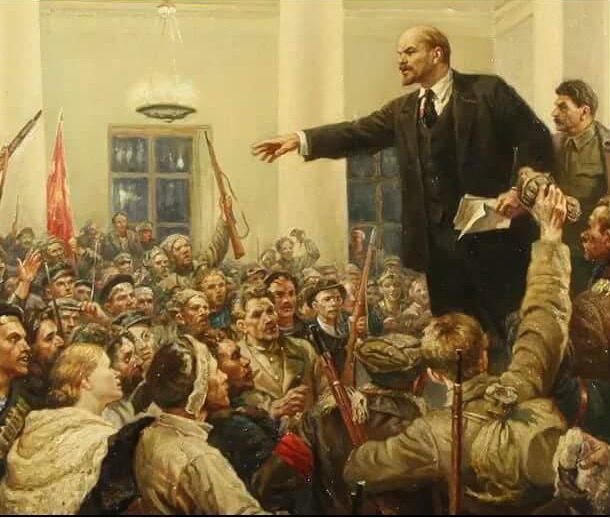
Yes, my formative years were the sixties, and I wouldn’t have missed them for quids (not that I’d had anything to do with being born at the right time in the right place), when, if we wished, we were able to break free of the surly bonds of the past. I have written earlier:

“Cynics say that most people who remember the sixties were not there. Well, I was, and I remember it all so well. And was it as great as they say? Yes it was, to me at any rate. But in reality, the story of the ‘swinging sixties’ has grown with the telling. In the closing scene of The Man Who Shot Liberty Valance, the journalist says: “This is the West, sir. When the legend becomes fact, print the legend”. And much of what has been remembered, written, and said about those years has followed that maxim.

This was indeed a decade of change and ferment. Values changed, morals changed, habits changed, clothes changed, music changed (the best music ever, many have argued). The way people looked at the world and thought about it. We often look back and remark that a supernova of creativity burst over the western world during those years, the likes of which was not seen before and has never been seen again. And nowhere more so than in decadent, decaying, depressing, old England, trapped in tradition, class, and prejudice.

And yet, this revolution road was walked by but a few. The greater proportion of the populace, young and old alike, carried on as if nothing untoward was happening. Following in their fathers’ footsteps, faithful to social and economic scripts written before their time, possessed of neither time, means, opportunity or inclination to indulge in the sensual, intellectual, artistic and political playground that was accessible to students and socialites of that generation. People were more affluent, no doubt, more comfortable in a maslovian sense, more socially mobile, better educated (a relative term, this), but overall, not overly adventurous. And truth be said, many of the social and political changes that are said to epitomize the ‘sixties, were well underway during the ‘fifties and even earlier or did not reach true fruition until the decades that followed.

But for we few, we happy few, in our own private Idahos, our little self-important backwaters of intellectual and cultural elitism, times were indeed a’changin”.

London was the “scene”, and then only the West End. The rest of the was still pretty drab and monochrome. But everywhere, clothes and music started to brighten things up.

With these metaphorical themes, so then did the threads unravel, so began a journey that is now drawing to a conclusion. These were the moments I occupied, looking out onto England, but imagining the wider world. And then, from the far side of the world, where the journey will most likely end, in the midst of an Australian forest. Here we are then, with the world literally at our fingertips, as we look out onto a world that is smaller, more knowledgeable, more prejudiced, less wise, more dangerous, more enthreatened, but as ever, beautiful, unfathomable, and magical. And at times like these, perhaps like Banjo, “I somehow fancy that I’d like to change with Clancy” as he “sees the vision splendid of the sunlit plains extended, and at night, the wondrous glory of the everlasting stars”. And hope that like the Bobster, we shall “dance beneath the diamond sky with one hand waving free, silhouetted by the sea, circled by the circus sand, with all memory and fate driven deep beneath the waves”. But let’s leave the last words to AA Milne as we bid farewell forever to The House at Pooh Corner: “wherever they go, and whatever happens to them on the way, in that enchanted place on the top of the Forest, a little boy and his Bear will always be playing”.

Back In The Day

The beat goes on

When we reminisce about our “salad days”, they’re nothing more emotionally satisfying than the music we listened to; it is a portal to those times because there is nothing like songs and music from our past for unlocking memories. As the old crooner used to sing, those “magic moments” provided us with our very own soundtrack, a veritable code that even today, connects us to our contemporaries.

One constant nostalgist Facebook meme is the audio cassette tape. It inaugurated an era when it was possible to control one’s private soundscape, something we all take for granted now. It was cheap, portable, easy to use, and eminently shareable. It could live in the footwell of the a car or the bottom of a backpack. And was thrilling to those of us raised on vinyl. Suddenly, anyone with a cheap tape player could record music and share it. With its advent of the audio cassette, many of us took to compiling party tapes and car tapes of favourite songs to mark our passage from adolescence to adulthood, tapes that we would share with friends and also, with the objects of our young emotions and affections.

Nowadays, we have more ways to access music than at any time in history and a whole world of unfamiliar styles to explore, aided by instant access if we desire, to platforms like You Tube. And yet, there has been research to show that our willingness to explore new or unfamiliar music declines with age. It’s as if we believe, like American songwriter and musician Bob Seger: “today’s music ain’t got the same soul; like that old time rock ‘n’ roll”. There appears to be a consensus that people are highly likely to have their taste shaped by the music they first encounter in adolescence when our brains have developed to the point where we can fully process what we’re hearing, whilst the new experiences and heightened emotions of those years create strong and lasting bonds of memory based on pleasures past.

Donovan and Jenny Boyd wear the love like heaven

Farewell Middle Earth 

I’ll leave my conclusion to American writer, artist and Druid (yes), Cerri Lee:

I suddenly realized it is a profound and overwhelming sense of loss for their world and mine that I feel as the Elves sail away from the Grey Havens. When the Elves leave, they take with them the enchantment from the land, something dies in it and I am left on the shores of Middle Earth amidst a fading beauty, as they sail on into the distance. The realization that now humans will have no restraints in their actions and will push forward the rise of mechanism, commerce on a global scale, and a discarding of anything that even looks like ‘fluffy’ thinking. My Middle Earth will never be the same again and I am constantly mourning its passing through this story. It leads me to wonder if some part of that feeling is what drove Tolkien to write his story.

As a fifty something woman I am starting to feel my age in the way I think. Occasionally I fall pray to the “In my day” ‘rose-tinted’ view of how things were ‘back in the day’. I don’t really think times were ever any better as such, no, definitely not better. But maybe the problems seemed more understandable, more bite sized and chewable. In truth they were not, but memory is a funny thing, as we all know, it can warp and change how we view the past.

I know that things on the global scale have always been complicated, difficult and a fine tightrope walk between warring factions, people in famine and glut, all striving for a peaceful coexistence. It is only the access to media coverage that bring the problems so close to home leaving me with the sense that I am standing before the Black Gates of Mordor, with the armies of the enemy massing on the other side and the Great Eye glaring down on me from his Tower.

© Paul Hemphill 2023.  All rights reserved

Finally I understand why Tolkien’s Elves make me cry

Outlander – if I didna hae bad luck, I’d hae no luck at all …

History can’t be trusted
Brianna Randall

It’s good I’m Scottish. I’m Scottish. I am Scottish.
I can complain about things, I can really complain about things.

Peter Capaldi, the Twelfth Doctor, discovers he has a Scottish accent

The pipes, the pipes are calling …

Well, after nearly a decade, we heard them at last and surrendered to Outlander  

The promise of exotic Celtic locations, steamy sex scenes, and graphic violence was too irresistible – all this and the fact that we’d run out of tempting things to watch on Foxtel, SBS and Netflix … And so we settled down to what would be eight  seasons of the celebrated time-shifting highland fling (before bingeing on Game of Thrones for the umpteenth time. By happenstance, the final episodes dropped on Netflix on the same day as GoT’s imaginative prequel The House of the Dragons – a fine time for fantasy fans. 

If you’re into stories with eye-candy, period costume, great music, loads of gratuitous violence and soft porn garnished with some history, this one’s for you. It’s a bit like reading Playboy for the stories.

And, of course, there’s time-travel, a perennial fantasy and science fiction trope. Nor is time travel involving Scotland original. The many incarnations of Doctor Who have made many visits to Scotland during their adventures. Way back in 1966 The Highlanders saw Patrick Troughton’s Second Doctor arrive in the Scottish Highlands in 1746 just after the Battle of Culloden. It was here that The Doctor met Jamie McCrimmon (actually, Yorkshire actor, Frazer Hines), a piper of the Clan MacLeod who would go on to be a regular and popular companion to the Doctor. Since then, there have been four Scottish Doctors and many Scottish lead characters. American author Diana Gabaldon says she created the Outlander stories (on which the series is based – there are nine of them) after watching Hines in Doctor Who and based her leading man on him. Hines actually has a role in the 21st century Doctor,  Season 1, episode 11.

Fraser Hines as Jamie, 1966

The Whovian Paradox

So, here we were, time-hopping back and forth between 1745 and 1945, the ‘45 Scottish Highland rising and the end of WWII, and then, the American colonies before and during the American War of Independence, the late nineteen sixties and early eighties. The traffic at the magical stone rings of Craigh na Dun, somewhere near Inverness (they’re actually on Lewis in the Outer Hebrides) and North Carolina (apparently, they’re styrofoam) reaches rush hour proportions as one, two, one again, three and four, family members and other sundry “travelers” pass to and fro’.

The title of this piece, as everybody ought to know, is borrowed from the old blues song Born Under A  Bad Sign, immortalised, of course by the best rock trio ever, Cream. It describes a narrative arc which follows a “Groundhog Day” formula. The heroine Clare Fraser late of 1945, a former WWII battlefield nurse, after landing in the Scottish Highlands in 1744, is over ensuing years captured by British Army Redcoats, press-ganged by the Royal Navy, arrested by colonial vigilantes, almost burnt for a witch by superstitious puritans, has sex with Bonnie Prince Charlie, and is serially rescued in the nick of time by her husband, rebellious and handsome highlander Jamie Fraser. Jamie is captured, arrested, flogged, enslaved, kidnapped and worse, and is rescued, in the nick of time by his resilient spouse. This happens numerous times, with sundry villains outwitted, overcome and served their just desserts – with plenty of time to spare for many interminable sex-scenes (why take five minutes of screen time when you’ve seven seasons to fill), and one excruciatingly graphic and gratuitous episode of sexual violence which, counting flashbacks, must’ve taken up to a hour or more of screen time. It must have caused consumer conniptions because by series seven, the show runners had seriously toned down the adult content.

Their ill-starred son in law Roger Mackenzie endures a similar helter-skelter ride as he embarks on a literal “hero’s journey” from academic and folksinger to preacher to late twentieth century “househusband” – his adventures including being press-ganged by pirates, “sold” to native Americans, and fighting successively for the British army and the insurgent Continental Army. 

For all the back and forth, the melodramatic fol-de-rol, the surfeit of rumpy-pumpy and violence, and the gorgeous highland and American scenery, as a historical and well-costumed drama, it presents a well-researched and historically accurate – if simplified – portrayal of society and politics leading up to the Jacobite Rebellion of 1745-46, including a brutal reenactment of the Battle of Culloden, the last battle fought on British soil, and the American Revolutionary War, of the French court at Versailles, of medical techniques in the 18th Century (Clare is an experienced battlefield nurse and qualified twentieth century doctor), and of the original sins that still haunt the United States today: the institution of slavery and the fate of the indigenous Americans. There are many historical characters including an unflattering portrayal of Bonnie Prince Charlie, the leader of the Jacobite forces, and a more sympathetic George Washington (but not his alleged wooden teeth). There is also a brief cameo for the not yet treasonous Benedict Arnold. 

There was an original and to my mind amusing walk-on role which may have gone over the heads of most viewers, particularly as no reference is made to her back story. When Charles Stewart was on the run after Culloden, he was aided in his flight by minor aristocrat Flora MacDonald who was subsequently arrested for her role and consigned to the Tower of London, but later amnestied. She married an army captain also named McDonald, and they emigrated to the American colonies, where she is fleetingly introduced to our Jamie at a society soirée. Her captain actually served with the British forces during the American War of Independence, and as a result, their property was confiscated. They relocated to Canada and soon, after, returned to Scotland. 

One early criticism I had of Outlander was that the highlanders all spoke Scottish Gaelic. Not that I’ve a problem with the tongue because it’s a beautiful language and I wish I could’ve learned Gaelic in the past – it was my Irish mother’s native tongue, though she lost it after years of living in England. But because there were no subtitles. I realized very soon that this was intentional as it emphasised just how alien the whole scene must’ve been to English Claire, now dependent upon Jamie, who, like Mel Gibson’s William Wallace, was multilingual, and a handful of bilingual clansmen to understand what was being said around and about her. Jamie’s pet name for her is Sassenach, meaning foreigner or, indeed, Outlander, derived from the English saxonīs or saxons, and used by Catholic highlanders for protestants of the Anglican persuasion. By the second season, to borrow from Jamie, I “dinnae fash”.

Many books and films of the fantasy genre have endeavoured to resolve what one could call the Whovian Paradox – the desire to go back and change history for the better. But, as the ever-regenerating Doctor himself always cautioned his constantly changing and ever-enthusiastic companions, you can’t just go back and alter history.  We’ve seen it often in films like Terminator, 12 Monkeys and Looper.  For all its melodrama and conjecture, Outlander manages to weave, at times clumsily, through the conundrums and contradictions. But no spoilers here … 

Songs of Rebellion 

Now, let’s talk about the music. The Outlander books by Diana Gabaldon make constant references to songs and music from the periods in which the stories are set, be these eighteenth century Scotland and America or the twentieth century. The series’ soundtrack created by American composer and musician Bear McCreary works well in providing a sense of place and time. As an old folkie of Celtic blood, I enjoyed hearing snippets of songs and tunes that I’ve known since childhood, including Marie’s Wedding and Johnny Cope.

The main theme, in the opening TikTok’s, and as a leitmotif throughout story  is the ersatz Jacobite song Over The Sea to Skye. It’s a grand old song, and I’ve written about it before:

There are many folk songs that we are convinced are authentically “traditional”, composed in the days gone by an unknown hand and passed down to us by word of mouth and then, perhaps, by broadsheets and handbills, rustic kitchens and Victorian parlours, until finally pressed into vinyl during the mid-twentieth century folk revival. And yet many such songs were indeed written by poets and songwriters of variable fame. One such is The Skye Boat Song. 

This famous song is one of many inspired by the Scottish Jacobite Rising against Protestant England’s rule in 1745. It recalls the journey of Prince Charles Edward Stuart, “Bonny Prince Charlie”, from Benbecula to the Isle of Skye as he evaded capture by government troops after his defeat at the Battle of Culloden in 1746. The Jacobite Rebellion was sparked by many political, cultural and economic factors. but essentially, it was a dynastic civil war. 

Songwriter and philanthropist Sir Harold Boulton, 2nd Baronet composed the lyrics to an air collected by Anne Campbelle MacLeod in the 1870s. According to Andrew Kuntz, a collector of folk music lore, MacLeod was on a trip to the isle of Skye and was being rowed over Loch Coruisk (Coire Uisg, the “Cauldron of Waters”) when the rowers broke into a Gaelic rowing song “Cuachag nan Craobh” (“The Cuckoo in the Grove”). MacLeod set down what she remembered of the air, with the intention of using it later in a book she was to co-author with Boulton.

It was first published in 1884 Around 1885 the famed author Robert Louis Stevenson, considering Boulton’s lyrics words “ unworthy”, composed verses “more in harmony with the plaintive tune”. Purged of Jacobite content, these mentioned neither Charlie nor Culloden.

Boulton’s is the one that endured, along with the sentimental perspective Bonny Prince Charlie

But historical fact has never dimmed the popularity of the song. It is often played as a slow lullaby or waltz in many and varied contexts including soundtracks, including Outlander (adapting the text of the text Robert Lewis Stevenson’s poem “Sing Me a Song of a Lad That Is Gone” (1892).

Billow and breeze, islands and seas,
Mountains of rain and sun,
All that was good, all that was fair,
All that was me is gone.

The rendering of the song changes through the seasons, with female and male solos, a capella and choral. The most poignant is that of season 7, featuring as it does Irish singer Sinéad O’Connor, who passed away this July , not long after the season aired fir the first time. Listen to it below. 

There was another piece that was used to excellent and atmospheric effect in the lead up to the Battle of Culloden. Bear McCreary has written: “To properly underscore these episodes, I needed a song that was written during the Jacobite uprising as opposed to after it, a song that makes no comment about loss, only promises of victory.
 I turned to famed Scottish composer and music historian John Purser, who was gracious with his time and assembled a collection a historically-accurate songs for me. I was immediately drawn to the soaring melody in Moch Sa Mhadainn, song composed by Scottish Gaelic poet Alasdair mac Mghaighstir Alasdair (known in English as Alexander MacDonald), a member of Clan MacDonald of Clanranald). A celebrated poet of the Jacobite era, Alasdair composed this song upon hearing the news that Prince Charles Edward Stuart had landed at Glenfinnan. That was perfect!  When Jamie opens the letter in “The Fox’s Lair” and learns he has been roped into the revolution, this song was actually being composed somewhere in Scotland at that very moment.“ Moch sa Mhadainn ‘s Mi a’ Dùsgadh (Early As I Awaken), also known as Oran Eile Don Phrionnsa (Song to the Prince) or Clan Ranald’s Welcome. I have published it at the end of this post.

A Scottish footnote

The two Scottish rebellions of the 18th century were as much civil wars as insurrections against the English Crown. Lowland Scots of the south were against the highlanders of the north. Catholics fought Presbyterians – but many Protestants fought the Crown, a legacy perhaps of the English Civil War, Cromwell’s Commonwealth, the Restoration in the previous century. Clan chiefs allied themselves to the Crown or to the Jacobite cause based upon family ties and self interest. The Crown’s forces at Culloden contained many Scottish soldiers, including senior commanders. Irish Catholic forces who had no love for protestant England fought on the side of the Jacobites. The forces who tracked down the rebels after the battle were often Scots, as were the soldiers and officers carrying out the reprisals and infamous Highland Clearances that followed – the latter being dictated by economics as much as politics, often in the interests of Glasgow and Edinburgh landowners who wanted the land cleared of residents so they could run lucrative sheep farms. A larger than life character like the celebrated Rob Roy MacGregor was very much a charming scoundrel who always had some sort of scheme going, and like most clan leaders, he had contacts in the highest places, including the palace.

I recently rewatched a televisual recreation of the battle of Culloden that I’d first seen in 1964 by British film maker Peter Watkins. For its time, it was a well-balanced account, featuring “interviews” with the principal protagonists on both sides, an engrossing narrative, and some pretty harrowing scenes of the carnage inflicted on the Highland forces by the well-armed and well-trained Redcoats. There is a link to the full film below. 

The Jacobite Rebellion itself was sparked by many political, cultural and economic factors. but essentially, it was a dynastic civil war. The battle on Culloden Moor dashed for two and a half centuries the Scots’ dreams of independence. Charles Edward Stuart, the “Young Pretender” to the Protestant Hanoverian English throne that once belonged to the Roman Catholic Stuart clan, fled into exile in France. And that’s where he remained, although his last resting place is in the crypt of Saint Peter’s Basilica in Rome – an ironic ending for this could’ve been champion of Catholic hopes. Bonny Prince Charlie had many romantic and rousing songs written about him. But in reality he wasn’t the dashing, gallant leader that the songs portrayed and that the Scots and their Celtic Irish allies yearned for. He was an indecisive and vacillating leader who thought himself much cleverer and popular than he actually was. portrayal in Outlander is most unflattering. When the going got rough, he got going – and left the the Scots and Irish who supported him with blood and treasure to the tender mercies of the Sassenach foe”.

And yet, the songs live on to this day, most notably in The Skye Boat Song, Mo Gile Mear, Will Ye No Come Back Again. The old and well-recorded favourite Óró sé do bheatha ‘bhaile has also been associated with the Jacobite cause as Séarlas Óg (“Young Charles” in Gaelic). The poet Padraig Pearse, leader of the doomed intifada we know as the Easter Rising of 1916, added new verses, and so the song entered the rebel canon.

Thou art the choicest of all rulers
Here’s a health to thy returning,
Charlie His the royal blood unmingled
Great the modesty in his visage
Moch Sa Mhadainn (Song to the Prince)

The Jacobites: ‘Don’t let romanticism obscure the threat they posed

Alison Campsie, 19th Nov 2020

The Battle of Culloden as depicted by Swiss painter David Morier, who was paid a pension by the Duke of Cumberland, the commander of the British Army at the battle. PIC: Creative Commons.
The Battle of Culloden, David Morier, who was paid a pension by the Duke of Cumberland, the commander of the British Army at the battle. PIC: Creative Commons.

The romanticism of Jacobites should not obscure the threat they posed to the British Army in the years following the Battle of Culloden, a leading historian has said.

They soldiers were stationed in 400 cantonment camps – from forts to staging posts – from Lerwick to the Western Isles and from Aberdeen to Gretna, with 60 patrols remaining in Scotland a decade after the battle.

 
Professor Pittock, in an online lecture hosted by History Scotland magazine, said: “Although Jacobitism became romanticized, that romanticism should not be obscured by its reality.
 
“Its reality was that it had to be contained so extensively in such a prolonged way and so completely.”
 
He added: “Although the Jacobites became romanticised the romanticisation was itself a reaction to the seriousness of the threat it was seen as posing at the time.

“Romanticism kept the Jacobites alive but it also kept it at a safe distance.”

Prof Pittock noted that around 1,000 Jacobites died at Culloden with another 2,000 killed in the days that followed given the army’s ‘licence to kill’ supporters of the cause.

Soldiers were paid 16 guineas for the capture of Jacobite colours and 2s and 6d for every Jacobite musket or broadsword seized, Prof Pittock said.

He added that Cumberland and his commanders rotated their soldiers every three months in order to prevent connections being forged with local people.


Their longer term role was to police ‘Highland dress’, protect the collection of taxes and “overawe the local population”.

But residents chose not to help the soldiers in some cases with a report from Glen Dessary noting that ‘the people are unwilling to part with any provisions’ for the forces.

Desertions were not uncommon, with two deserters from Pulteney’s Regiment sentenced to death. However, it was decided that one should be spared, with a roll of a dice determining who should live, research by Prof Pittock found.

He pointed to the building of Fort George at Arderseir, which served as a British Army garrison from 1757, which cost around £2m to build at a time when Britain was heading into the Seven Years War while servicing a massive national debt.

“What that should tell us that whatever people might think about the Jacobite cause being romanticised, or it being wrong, it was not what their enemies thought at the time,” Prof Pittock added.

“That is extremely important. You cannot understand Jacobitism by looking down the wrong end of a telescope,” he said.

Details of the British Army occupation of Scotland following Culloden have also been brought to light by the Stennis Historical Society, which has researched and digitised hundreds of records of cantonment camps set up across the country post-Culloden.

The Jacobites who fought on after Culloden

The Scotsman, 16th Apr 2019

The battle was lost, the rising was over, and the rebels were told by their leader to go home. But for hundreds of Jacobites, the fight was still on, despite their defeat at the Battle of Culloden, with many remaining armed and engaged long after Bonnie Prince Charlie went on the run on April 16, 1746.

Around 1000 Jacobites ­gathered the following day at Ruthven ­Barracks, where a written order from Prince Charles Edward Stuart told them to “seek their own safety” and disband,

But, for many, surrendering was too dangerous an option, according to Professor Murray ­Pittock, ­historian and pro-vice principal of Glasgow University.

As time went on, the risks of Jacobites handing themselves in became clear.

Prof Pittock said: “The mood of the Ruthven meetings was downcast. Many fought on to avoid capture or because the risk of surrendering was high.

“To see how the British Army is dealing with people, there is not really a lot of incentive to go home. They think they will be at more risk.

“In June, a number of Jacobites went into Fort William after the British government ­promised six weeks’ immunity. Captain Scott drowned them in a salmon net.”

Jacobites engaged in low-level disruption, raiding and ­protection of vulnerable tenantry as well as recruitment to the Irish Brigade and probably Scottish regiments in French service, including Ecossais Royales.

Assassinations of unpopular ­government officers or sympathizers were also recorded. The British government still considered the Jacobite threat to be “major” at this time with around 12,000 to 13,000 soldiers deployed across the entire country – from Berwick and Stranraer to Elgin, Forres, Stonehaven, Inverbervie and Montrose – by the end of August 1746.

As government forces mobilized, significant units of armed Jacobites continued to appear in the field, said Prof Pittock, who is due to publish a book on the British Army between 1746 and 1760.

At the end of April, 120 armed MacGregor men were recorded in Balqhuidder after marching home ‘colours flying and pipes playing’ with the Army unwilling to tackle or pursue Jacobite units that maintained discipline, Prof Pittock said.

One battalion of Lochiel’s ­regiment was still operational in May – as were 500 men under ­Clanranald. Orkney remained under Jacobite control until late that month and, despite British attacks, four local Jacobite lairds remained successfully hidden.

Clans made concerted attempts to resist Cumberland and his men with around a dozen chiefs meeting at Mortlaig in early May.

“At the meeting… they entered into a bond for their mutual defence and agreed never to lay down their arms, or make a general peace without the consent of the whole,” according to an 1832 account by James Browne.

“By the bond of association, the chiefs agreed…to raise on behalf of the prince and in defense of their country, as many able-bodied armed men as they could on their respective properties.”

Around 600 men gathered later that month across the north and west but the clans “ultimately did not have the time or morale to raise or retain enough men in the field,” Prof Pittock said.

Although a unified response failed to materialize, Jacobites remained active across Scotland. Jacobite expresses – the non-stop delivery of letters by horse – continued until August. A British regiment was deployed across Banffshire in the summer of 1746 with insurgents reported in Argyll that September.

Arms were surrendered in the Mearns right into the summer of 1748.

“British atrocities may have been carried out against innocent ­victims, but there were plenty of continuing Jacobite threats,” Prof Pittock said.

© Paul Hemphill 2023 All rights reserved

Over the sea to Skye

Mo Ghile Mear – Irish myth and melody

Rider Haggard and the book that launched a genre

In 2014, English author and academic Katherine Rundell published an entertaining article in the London Review of Books entitled Fashionable Gore. It served recently as the primarily source and backdrop for a podcast in the highly addictive podcast The Rest is History. The hosts, historians Tom Holland and Dominic Sandbrook, specialist in ancient and modern history respectively, have a jolly good time  discussing the legacy of English fin de siècle author Henry Rider Haggard, and particularly, his hugely popular adventure yarn King Solomon’s Mines.

Rundell writes: “King Solomon’s Mines is a very Victorian fable of endurance but it’s also a glorious romp, if you don’t mind your romps racist, sexist and tin-eared … It would be surprising if any white man born in 1856 had written non-racist, non-sexist fiction, whether it was set in Africa or not … You make a choice with Haggard: if you suspend not just disbelief but politics, logic and taste, the rewards are very real”. She first encountered the novel as a liberal-minded, educated adult when she could judge a book on its merits and its shortcomings. I was a pubescent early teen when it was recommended to us schoolboys by our English teacher, and was soon hooked on the adventure, the exotic settings and, especially the violence – and quickly moved on to its sequel, Alan Quartermain, follow up and 

I republish Fashionable Gore below. It’s a very good read.  Here is The Tom and Dom Show. But read on …

As a young man, in January 1879, Henry Rider Haggard walked the field of Isandlwana in present day in Kwa-Zulu Natal Province, South Africa just days after the battle in which a Zulu army totally destroyed – indeed, massacred – a British army. He was fascinated by and enamoured with Africa, the “dark continent” of myth and story. Having spent but a few weeks in the African bush, I fully under it – though I was accustomed to Australia’s big sky, the “vision splendid of the western plains extended” (that’s the “banjo”), the eldritch aura of Uluru, and the primeval magic of the coastal rain forest, we too succumbed to its spell.

To Henry, Africa was the “heart of darkness”, and yet also, a Garden of Eden, the home of the “noble savage” where a white Englishman, freed of the bonds of straightened Victorian Britain, could walk unexplored and uncharted lands, encounter many wonders, and in “proving” himself and testing his mettle, find himself and weigh his own worth.

You could say King Solomon’s Mines, his third of many adventure novels, could be said to have launched a thousand clichés and I’ve used a swag of them just then …

It all started with a bet …

Henry did not bide long in Africa, though long enough to be involved in the annexation of the Boer state of the Transvaal after the first Boer War in 1881, one of the triggers for the second and greater Boer War in 1899. He’d returned to England by 1885 when his elder brother pledged him five bob if the he could write a book half as good as Robert Lewis Stevenson’s hugely popular pirate jaunt “Treasure Island”.

By the end of the year, he had penned a novel that would become the foundational text of the lost world literary genre. King Solomon’s Mines was one of the first English adventure novels set in Africa, a story brimming with treasure, bravery and romance, and featuring all-action hero and big game hunter (naturally) Allan Quartermain and his conflicted band of British brothers (Scots and English to be precise – Stevenson, and before him, Sir Walter Scott

It was a romantic and what we call today white supremacist, man’s world of Britishness and brotherhood, martial prowess and manliness (or as Tom and Tom jest, “men in tight trousers”) in which the plucky British adventurer bested beast and barbarian and laughed in the face of fear. A “boy’s own” universe indeed, which I and my school chums lapped up with vicarious pubescent relish in the early sixties. All this “derring-do” is now dismissed as an outdated and anachronistic perspective of earlier generations, and what I perceived early on in my coming of age, as old-school Englishness. It was, of course, of its times. It lacked none of the sardonic ‘seventies irony of George McDonald Fraser’s celebrated Flashman comi-tragic adventures in which the eponymous antihero, the unreconstructed villain of Thomas Hughes’ Victorian yarn Tom Brown’s Schooldays, roves and rogers his way through the wars of the nineteenth century, somehow managing to escape by the skin of his teeth from one military disaster after another, including Custer’s famous “Last Stand” at Little Big Horn, the Charge of the Light Brigade, and the last stand of the 44th Foot at Gandamak during the disastrous First Afghan War of 1842.

In his turn-of-the-century prudish, Henry would never have let Quartermain and his pals go forth in such amours and priapic array as the nineteen seventies unchained and unzipped Harry Flashman. Though he shyly dallied with the picaresque – like Fraser, his few female characters were either portrayed as drop-dead gorgeous and dangerous or as plug-ugly and dangerous. But he views womenfolk with an almost schoolboy insouciance and deflection. Rundell observes that “the noble native woman always dies in Haggard – Quatermain feels ‘bound to say … that I consider her removal a fortunate occurrence, since, otherwise, complications would have been sure to ensue’, whilst she and the podcast pals chuckle over the male protagonists’ “euphoric homosociality”, taking great pleasure in quoting at length the following mellifluous piece of Victorian soft porn from King Solomon’s Mines: 

I am impotent even before its memory. Straight before us, rose two enormous mountains, the like of which are not, I believe, to be seen in Africa, if indeed there are any other such in the world, measuring each of them at least fifteen thousand feet in height, standing not more than a dozen miles apart, linked together by a precipitous cliff of rock, and towering in awful white solemnity straight into the sky. These mountains placed thus, like the pillars of a gigantic gateway, are shaped after the fashion of a woman’s breasts, and at times the mists and shadows beneath them take the form of a recumbent woman, veiled mysteriously in sleep. Their bases swell gently from the plain, looking at that distance perfectly round and smooth; and upon the top of each is a vast hillock covered with snow, exactly corresponding to the nipple on the female breast. The stretch of cliff that connects them appears to be some thousands of feet in height, and perfectly precipitous, and on each flank of them, so far as the eye can reach, extend similar lines of cliff, broken only here and there by flat table-topped mountains, something like the world-famed one at Cape Town; a formation, by the way, that is very common in Africa. To describe the comprehensive grandeur of that view is beyond my powers.

Much to my surprise and mirth, I’ve learnt that Shebas Breasts actually do exist.

Sheba’s Breasts Ezulwini Valley Swaziland

Rundell wrote of the titular character of She, Rider Haggard’s follow up adventure yarn, “she was wise and beautiful beyond imagining: a sultry multilingual virgin, wish-fulfillment made flesh … and even more than King Solomon’s Mines, it’s a book out of which obsessions and anxieties leak”. More into power than sex, she was, of course, the original “She Who Must Be Obeyed”. A Hammer horror film version released in 1965 starring pneumatic Bond siren Ursula Andress was an international success and notwithstanding the dusty demise of Ayesha, led to a 1968 sequel, The Vengeance of She, with another femme fatale from Mitteleuropa, Olinka Berova, in the title role. Neither film has aged well, though both ladies are still with us today. 

Ursula Andress as Ayesha

Rider Haggard’s work, particularly King Solomon’s Mines and She, would would inspire authors from the late nineteenth century to the early twenty first. His literary legacy can be tracked from his contemporaries and pen pals Conan Doyle and Rudyard Kipling, both of whom were to visit South Africa during the Boer War, including the former’s Lost World and Kipling’s Gunga Din and Kim, through early twentieth century early Irish Republican Army “martyr” Erskine Childers’ Riddle of the Sands, John Buchan’s Thirty Nine Steps and Prester John, and Edgar Rice Burroughs Tarzan series, to JRR Tolkien’s The Lord of the Rings (to many, regarded as the pinnacle of the adventure novel genre). Grahame Greene and Ian Fleming have acknowledged their debt to Rider Haggard, whilst the book has inspired movies from the beginning of the art form, including several remakes of King Solomon’s Mines and (the featured picture is from a loose British adaptation of 1937 starring Cedric Hardwicke, Anna Lee, and my namesake Africa American crooner and socialist Paul Robeson – unlike the movies, Henry would never have countenanced “leading ladies” in his manly romps) and latter day day blockbusters like the original Star Wars , and the Indiana Jones and Tomb Raider film series.

King Solomon’s Mines, its follow-ups and the many subsequent imitators are all variations on the derivative ‘hero’s quest’, the mono-myth popularized by by Joseph Campbell in his celebrated book The Hero with a Thousand Faces.That author described it thus:

A hero ventures forth from the world of common day into a region of supernatural wonder: fabulous forces are there encountered, and a decisive victory is won: the hero comes back from this mysterious adventure with the power to bestow boons on his fellow man.

Campbell borrowed the term monomyth from Irish author James Joyce’s Finnegans Wake – Joyce’s Ulysses was also highly influential in the structuring of the archetypal motif. He published The Hero’s Quest in 1949 but the idea behind the monomyth preceded him by millennia – think Odysseus and Aeneas, Beowulf and Sigurd/Siegfried, contemporaries like JRR, and latter-day film makers and authors. Star Wars creator George Lucas and Richard Adams, bunny-quest Watership Down have both acknowledged their debt to his book.

And so, to Fashionable Gore. The title refers to what Rundell refers to as a particularly Victorian fascination with bloodshed: “Second only to the relish of battle is Henry’s fascination with unusual ways a man might die”. A bit like Vikings, really, without the bonking …

© Paul Hemphill 2023 All rights reserved

See other stories of Africa in In That Howling Infinite: Johnny Clegg’s Impi – the Washing of the Spears and The ballad of ‘the Breaker’ – Australia’s Boer War and for more on “the hero’s quest”, see One ring to rule us all – does Tolkien matter? 

Fashionable Gore

Katherine Randell, London Review of Books, 3rd April 2014

I first encountered King Solomon’s Mines in the children’s section of a public library in Harare. Most of the books smelled of water damage and many had been taken out so rarely that the last ‘return by’ stamp pre-dated Mugabe and decimalisation. I was working through shelves of books about horses and morality tales written by women who manifestly did not like children, and took King Solomon’s Mines because it’s set in ‘the Manica country’, a province a few hundred miles east of Harare. It seemed run of the mill at the time, much like the other books in the library: it was tightly plotted, suspense-driven, lavishly sexist and racist. In fact, though it is often read as a children’s book, it isn’t; nor is it run of the mill. It is the book which sowed the seed for John Buchan’s Richard Hannay, for Indiana Jones and James Bond, and though less slick than its successors, its anxieties and lunacies are more interesting. It isn’t suitable for children; perhaps not suitable at all.

As a child Henry Rider Haggard was believed to be stupid: his father told him he was destined to become a greengrocer. The books aren’t proof that he wasn’t stupid; but they are proof that he was dogged and canny, with a strange and lurid imagination. Haggard’s father lived long enough to see his son become wealthier than he was and the author of a 15-volume series which ran for forty years; he was dead by the time his son was knighted in 1912 (a knighthood for services to literature was at the time largely unheard of, so his was given for services to the development of agriculture in Norfolk). King Solomon’s Mines was written in answer to a bet Haggard had made with his brother that he could write a book as good as Treasure Island. He said it took him six weeks (though novelists always lie about that sort of thing) and it was an immediate bestseller. The 1870 Education Act had produced a large cohort of literate citizens with an appetite for fiction. There was much in the book to be admired by the stay-at-home population of late 19th-century England: in the world Haggard created the governing principle was survival, not class or intellect, and the rewards for bravery were blood (other people’s) and diamonds. Graham Greene said that he valued Haggard’s book ‘a good deal higher than Treasure Island’.

The story follows the narrator Allan Quatermain – an elephant hunter with good manners – and his colleagues, Sir Henry Curtis and Captain Good, on a journey into Mashukulumbwe country. Quatermain early on stakes his claim to heroic status when he says that he has already killed, but always with the stern regret of the Victorian imperialist: ‘I have killed many men in my time, yet I have never slain wantonly or stained my hand in innocent blood, but only in self-defence.’ The men’s aim is to find Curtis’s estranged brother, about which they are guardedly optimistic, and to discover King Solomon’s diamonds, about which – not knowing the title of the book – they are sceptical.

The novel is peppered with geographical detail conveyed in the confident vernacular of contemporary explorers’ reports, though the information itself is often mildly insane. In Manicaland, only the Chimanimani mountains and Mount Nyangani, Zimbabwe’s highest peak, could serve as the basis for ‘Suliman’s Mountains’. The heroes expend much blood and sweat traversing snowy terrain (which, in real life, 11-year-old schoolchildren climb as a matter of routine). In a crevice Quatermain’s hired bearer freezes to death (‘like most Hottentots, he cannot stand cold’) and deep inside a cavern the explorers discover a dead body three hundred years old, preserved ‘fresh as New Zealand mutton’ in the atmosphere. Even in the coldest months the temperature in the Chimanimanis is between 12 and 15 degrees Celsius; Nyangani last had snow in 1935. Haggard knew Southern Africa – he made his first trip to South Africa as secretary to the governor of Natal at 19 and was later master and registrar of the High Court in the Transvaal – but the land he paints is as lurid and fantastical as the witches and secret kings who populate it.

Following an ancient Portuguese map, the three men and their servant, Umbopa, walk into the territory of a hostile tribe, who are awed out of their murderous intentions by the spectacle of Good’s false teeth and white legs. Good, the light-relief character, is forced to walk much of the journey without his trousers, so enamoured of his lower half are the Kukuana people. The tribesmen are also impressed by Quatermain’s gun, as he picks off an antelope from seventy yards with childlike pleasure. ‘“Bang! thud!” The antelope sprang in the air and fell on the rock dead as a door nail. A groan of simultaneous terror burst from the group before us.’ The Kukuanans, Quatermain learns, are ruled by an impostor king called Twala, who is in thrall to Gagool, a witch so pocked and wizened by age that Quatermain mistakes her for ‘a withered-up monkey, wrapped in a fur cloak’. Luckily, Umbopa turns out to be the rightful king of the Kukuana people: a snake tattooed around his middle is the proof. The next night, under cover of a convenient lunar eclipse, Umbopa unveils himself and declares war on the usurper king.

Most of the book focuses on the Kukuana kraal and the battlefield; despite the title, the quest to find the stones takes up only the last fifty pages. When the diamonds are found, in a cave with a hidden door, the moment is muted: ‘The chest was three-parts full of uncut diamonds, most of them of considerable size. Stooping, I picked some up. Yes, there was no doubt about it, there was the unmistakeable soapy feel about them.’ In the novel it isn’t the diamonds that shine but the sweat of male bodies at war. There’s no sex in the book: where there is delight in things bodily, it’s in the euphoric homosociality of the post-battle glow. Haggard’s reluctance to involve women is the most obvious difference between the Quatermain books and those of the writers who emulated them. John Buchan followed Haggard’s adventure-suspense formula closely and self-consciously: in The 39 Steps, the hero’s story is said to be ‘pure Rider Haggard’. But Buchan moistens his stories with sensual descriptions of food – particularly ham – and of beautiful women. Haggard’s heroes are small, bluff men, part of a literary tradition of beta males performing great feats, but the companions – Henry Curtis in King Solomon’s Mines, Leo Vincey in She –have beautiful bodies:

Round his throat he fastened the leopard-skin cloak of a commanding officer … the dress was, no doubt, a savage one, but I am bound to say that I seldom saw a finer sight than Sir Henry Curtis presented … It showed off his magnificent physique to the greatest advantage, and when [Umbopa] arrived presently, arrayed in similar costume, I thought to myself that I had never before seen two such splendid men.

Second only to the relish of battle is Haggard’s fascination with unusual ways a man might die. The highlight of King Solomon’s Mines for most children is the moment when a bull elephant, wounded by a bullet, attacks Good’s servant: ‘The brute seized the poor Zulu, hurled him to the earth, and placing one huge foot onto his body about the middle, twined its trunk around his upper part and tore him in two.’ It was in part because of the death of the poor Zulu that the manuscript was rejected by one of the first publishers to see it: ‘Never has it been our fate to wade through such a farrago of obscene witlessness …nothing is likely in the hands of the young to do so much injury as this recklessly immoral book.’ But it was a fashionable kind of gore. At the Colonial and Indian Exhibition, held at South Kensington in 1886, the entrance was taken up by a diorama depicting a stuffed tiger attacking a stuffed elephant. The exhibition attracted more than five and a half million visitors. Like Haggard’s fiction, it was lit by the radiance of Livingstone, Richard Burton and other empire-building Übermenschen. King Solomon’s Mines is a very Victorian fable of endurance but it’s also a glorious romp, if you don’t mind your romps racist, sexist and tin-eared.

It would be surprising if any white man born in 1856 had written non-racist, non-sexist fiction, whether it was set in Africa or not. Quatermain says of the Kukuana people: ‘These women, for a native race, are exceedingly handsome … the lips are not unpleasantly thick as is the case among African races.’ Narrators, of course, are not spokespersons for their authors and Haggard certainly wrote in the idiom of the time; the explorer Mungo Park, in the purportedly factual Travels in the Interior Districts of Africa, wrote in similar vein: ‘The noses of the Jaloffs are not so much depressed, nor the lips so protuberant, as among the generality of Africans … they are considered by the white traders as the most sightly Negroes in this part of the continent.’ You could say that if we excised all patriarchal books from the canon we would be left with The Very Hungry Caterpillarand little else, but few writers have embraced the status quo with such conviction. The racism in King Solomon’s Mines takes the form mainly of exhaustingly oracular pronouncements: there is none of Forster’s anxiety, or Kipling’s affection. Foulata is a tribeswoman who falls in love with Good, and risks her life to save him. When she dies – the noble native woman always dies in Haggard – Quatermain feels ‘bound to say … that I consider her removal a fortunate occurrence, since, otherwise, complications would have been sure to ensue’. The Quatermain novels become more explicitly unsettling as the series progresses; in a diary entry written in 1924, the year before his death, Haggard foresaw conflict between races as inevitable and bloody: ‘The great ultimate war, as I have always held, will be that between the white and coloured races.’ The sexism, on the other hand, is glossed as a charming foible: ‘I can safely say there is not a petticoat in the whole history.’ His characters describe themselves as misogynists with the same irritating coyness with which people today describe themselves as chocoholics.

She (1887) is a very different book; it certainly isn’t coy. It follows wise but ugly Ludwig Holly and beautiful but slow Leo Vincey to unknown lands on the east coast of Africa. Leo’s dying father bequeaths him a potsherd on which is written in Greek a family history showing that Leo is descended from the royal house of pharaohs, and an instruction that he seek out a beautiful white sorceress and her fiery pillar of eternal life. Haggard gives the Greek in full, in both uncial and cursive, and some of the earliest jacket covers used a photograph of a potsherd, made by Haggard’s sister-in-law, to add verisimilitude. (Vintage Classics has rejected the pot in favour of an orgasmic-looking woman.) The men travel by sea and land to find Ayesha, also known as She Who Must Be Obeyed: an all-powerful ruler, her beauty so terrible she is concealed from face to foot in ‘corpse-like wrappings’. She is wise – ‘the wisest man up on earth was not one-third as wise’ – and beautiful beyond imagining: a sultry multilingual virgin, wish-fulfilment made flesh. She, like King Solomon’s Mines, was written in six weeks and even more than King Solomon’s Mines, it’s a book out of which obsessions and anxieties leak. As Kipling wrote to Haggard, ‘you are a whale at parables and allegories and one thing reflecting another.’

The plot is as simple and linear as that of the earlier book: Queen Ayesha believes that Leo is the reincarnated soul of Kallikrates, a man she had loved and murdered when he remained loyal to another woman. When she learns that Leo too is in love with another woman, Ustane, Ayesha kills her with a gesture. Ayesha’s beauty is so overwhelming that Leo forgives her and kneels at her feet. The terrifying power of female beauty shapes the book. ‘No doubt she was a wicked person,’ Holly says, ‘and no doubt she had murdered Ustane when she stood in her path, but then she was very faithful, and by a law of nature man is apt to think but lightly of a woman’s crimes, especially if that woman be beautiful.’ And later: ‘What a terrifying reflection it is, by the way, that nearly all our deep love for women who are not our kindred depends … upon their personal appearance.’ Ayesha offers to reveal the source of her absolute power, and leads the men to the Fountain and Heart of Life. She bathes first, unclothing herself and re-wrapping her snake belt around her falling hair. It’s the only erotic moment in the book. Suddenly, as the men watch, she begins to shrivel in the flames, ageing before their eyes until she is ‘no larger than a monkey, skin puckered into a million wrinkles’. The powerful monkey-like woman seems to be a keystone of Haggard’s imagination: Gagool, unidentifiable as a woman when first encountered, is ‘so shrunken in size that it seemed no larger than the face of a year-old child’, ‘a withered-up monkey’ with ‘a skinny claw’; Ayesha’s body becomes ‘no bigger than that of a two-months’ child …the delicate hand was nothing but a claw now.’ Holly and Leo flee; Holly’s servant, Job, has died of fright, and they leave his corpse behind.

At the heart of the book is the sense that women, given power, will reign like despots or fail like children. As Margaret Atwood points out in her introduction, Haggard and his siblings had a doll called She Who Must Be Obeyed, who lived in a cupboard and whom the children both tortured and were haunted by. Read as an embodiment of Victorian neuroses and desires, She is a marvel. There are good feminist interpretations: Sandra Gilbert and Susan Gubar connect the witch-goddess figure with the newly fierce debates over the rights of women in Victorian England, and the proliferation of semi-scientific studies of woman’s ‘true nature’. With or without this reading, Shehas extraordinary moments. You make a choice with Haggard: if you suspend not just disbelief but politics, logic and taste, the rewards are very real. There is a peculiar and beautiful scene in which tribesmen, at Ayesha’s command, dance an ‘infernal and fiendish cancan’ in a room lit by burning corpses. ‘As soon as ever a mummy had burned down to the ankles, which it did in about twenty minutes, the feet were kicked away, and another put in its place.’ She burns the body of her two-thousand-year-old embalmed lover with acid: there is ‘a fierce fizzing and cracking sound’ and the man is turned into ‘a few handfuls of smoking white powder’. V.S.Pritchett wrote: ‘Mr E.M. Forster once spoke of the novelist sending down a bucket into the subconscious; the author of She installed a suction pump.’

The trouble with She is that it’s structured around a blank face. We are told that Ayesha had beauty ‘greater than the loveliness of the daughters of men’, but her beauty is sketchily imagined, asserted but never depicted. The result is that she is impossible to desire; a problem exacerbated by her voice and what she has to say. She rants like Nigel Farage, and has only one point to make: men are powerless in the face of beautiful women, women desire not men but power. The greatest woman to have lived is a disappointment, a heckling sex witch. Haggard would think I’m jealous. He says as much, near the end:

Of course, I am speaking of any man. We never had the advantage of a lady’s opinion of Ayesha, but I think it quite possible that she would have regarded the Queen with dislike, would have expressed her disapproval in some more or less pointed manner, and ultimately have got herself blasted.

Well, quite.

McGoohan’s Blues – sunbathing in the rain

All along the ancient wastes the thin reflections spin
That gather all the times and tides at once we love within
That build the edges round the shrouds that cloud the setting sun
And carry us to other days and other days to one

Roy Harper, The Same Old Rock, Stormcock

It must’ve been May 1969. A cold, wet and windy day in Hull, Yorkshire. I’d hitch-hiked from Reading in Berkshire to London and then northwards on the A1 to visit an old school chum in the Humberside port city. And it is there, in a student share house that I first dropped Mescaline, a derivative of peyote, an hallucinogenic psychotropic favoured by Mexican shamans of yore. In our circles, it was prized for its visual and aural delights rather than the more ”head trip”, mood-manipulating and psychologically unpredictable and potentially unsettling lysergic acid. And that evening, headphones on, I first listened to McGoohan’s Blues.

This eighteen minute digression from the concept if not the plot of an iconic if indecipherable ‘sixties’ television series (that’s the featured picture), was the penultimate track on Folkjokeopus, the third album of English folk singer, songwriter and acoustic guitarist extraordinaire Roy Harper. The song was indeed the whole point of Folkjokeopus – its raison d’être- the rest of the album was predominantly light-weight, comedic psychedelia – with the exception of the bleak and bitter but nevertheless captivating “love gone wrong” song She’s The One.

Wikipedia and generic music sites tell us that Folkjokeopus was released in June 1969, but more hip sources reckon it was released on May Day – and my memory concurs with that because Spring sprung as I was hitching homeward, and I reveled in the record all summer long.

Though I’d been going to folk clubs for several years, I’d not heard much of Roy Harper apart from a throwaway hippie-vaudeville track from his second album on The Rock Machine Turns You On, one of the many popular ”sampler” albums of that. The best was CBS’ double album gatefold Fill Your Head With Rock (loosely defined – it included Leonard Cohen and Laura Nyro).

Sunbathing in the rain …

And how does it feel with your god strapped to your wrist?
And him leading you such a chase …

Roy Harper, How Does It Feel, Flat Baroque and Berserk 

So, there was I, on Humberside in a space “somewhere between Heaven and Woolworths”, to borrow from contemporary Mersey poet Brian Patten, who I was into at the time, listening to a sprawling and bawling, angry, eighteen minute solo acoustic guitar-driven folkie rant against capitalism, consumerism, hedonism, religion, conformity, ignorance, deceit, hypocrisy, the system, the establishment, the plutocracy, the banks, the media, the baubles and bibles, modern life … everything really. You can’t fight the manipulated, oppressive, powerless, pointless and utter futility of it all – as the song unfolds, you start out questioning, but you end up obeying.

The singer had indeed become the eponymous Prisoner, yearning for liberty but trapped in a deceptively bucolic and scenic and yet sinister “village” that is in reality an open-air jail – kind of nightmare Butlins Holiday Camp (beloved yet satirised by a generation of Britons) with all attempts at escape foiled. It was in fact filmed in Portmeirion in North Wales, a town that has developed a robust tourist industry on the back of the cult classic.

Patrick McGoohan and Virginia Maskell in  The Prisoner

Roy Harper was twenty-eight years of age and already a jaded veteran of the folk-circuit and ad bitter divorcee with heavy personal baggage, a wee son he dotes on and chips on both shoulders (well-balanced, I suppose) raging against the machine. His is a seemingly nihilistic anomie with no direction home, denouncing “the deceit of my friends the betrayals of which I am part …” He sees himself as an outsider, “the festive consumer who end up consumed by the feast”, but nevertheless questioning “the rules and the codes and the system that keeps them in chains, which is where they belong with no poems, no love and no brains”.

This is reflected in many of his songs from that era, most particularly those featured on his fifth and to many, his best album, Stormcock, released in May 1971; and this led me then and always to regard him a kind of high priest of Anglo angst.

There’s this from 1970’s Flat, Baroque and Berserk, already quoted above:

And how does it feel to be the master’s right hand nose?
How does it feel to be lieutenant?
And how does it feel to be stood on someone’s toes?
With a leech bleeding you for rent
When you say you want a bit more rank
You wanna be a big wheel
You can feel magnified if you hide in your pride
It’s not real
And how does it feel with a white flag in your fist?
How does it feel to have two faces?
And how does it feel with your god strapped to your wrist?
And him leading you such a chase

During my many, many years on the hamster wheel as the mater’s right-hand nose, I would often remember often that penultimate line.

In 1969, Roy had a few more years on the clock than me. I was twenty. A naïf, ingenue, whatever, at the end of the beginning of my journey. I was optimistic, adventurous, devil-may-care, inexperienced with people and their variegated behaviours, untainted by pride and prejudice, and in retrospect unfamiliar with the bitterness and vitriol that he injected into his song. But I guess I “got it”, understood what he was saying to me through those headphones in the sanctum of my “trip” – yeah, that’s where I was at that point in time, for the want of a better description. Though I was aware of what he was preaching, I’d had precious little direct experience – those lessons were down the road apiece, and not that far away either. But that’s another tale … long story short, I was radical when I first heard the song. I remain so half a century hence. And. I still “get it”!

The title of this article, by the way, is taken from an entertaining an informative book by Welsh author Gwyneth Lewis: Sunbathing in the Rain – a cheerful book about depression. This is not to suggest that Roy Harper is actually a depressive – but he’s certainly a master of writing excruciatingly sad, depressing and borderline nihilistic songs and delivering them with an angry, emotional intensity. Having seen him perform live many many times over the following five years, I recall that many times he would deliver rambling and even disjointed introductions and extended soliloquies that taxed his audience’s patience and forbearance. I once walked out at the interval during a gig at the Royal Albert Hall even though he was accompanied by guitar icon and Led Zeppelin alumni Jimmy Page. The songs did indeed mirror the man.

Roy in his seventies, still rockin’ in the free world

But, back to Hull and my headphones …

Having ridden the rollercoaster through the seemingly stream of consciousness rant for some ten minutes, Roy imperceptibly segues into a lyrical, calmer (though still edgy) and quieter mood, a dreamy, trippy vision of hope and resilience, suggesting that despite all the difficulties and diversions, the compromises and cop outs that went with being enveloped, embedded, trapped even, in the system, there is still hope for a better future. And climaxes in a folk-rock coda cum apotheosis.

The band kicked in – and so did the mescaline. Listening today, the band’s entry entrance feels contrived and ponderous, but in my mind’s eye, I can still recall the multicoloured images that flashed across bay closed eyelids. Disneyesque “Fantasia” forms of many ebbed and flowed, shape-shifted and morphed with the music and the lyrics. Rivers and rainbows, fairies and fires, sunrise and sunset, galaxies and stars.

Under the toadstool lover down by the dream
Everything flowing over rainbows downstream
Silver the turning water flying away
I’ll come to see you sooner I’m on my way
And there’s a mirror that I’m looking straight through
And I get it
And there’s a doorway that I’m ducking into
To forget it
But flashing just beyond the sky
The shattering midnight gathers
And reminding me behind my mind
The earth quakes, the sun flakes flutter

Over the mountain fairground
Candy flies stay
Under the moonshine fountain
I’m on my way
Lemon tree blossom ladies
Poured my tea
After the blue sky breezes following me
There’s a river that I’m making it with
And I know it
And I’m floating to I don’t care where
I just go it
But flashing just beyond the sky
The shattering midnight gathers
And reminding me behind my mind
The earth quakes, the sun flakes flutter

Daffodil April petal hiding the game
Forests of restless chessmen life is the same
Tides in the sand sun lover watching us dream
Covered in stars and clover rainbows downstream
And the question in the great big underneath is forever
And the fanfare that I’m forcing through my teeth answers “Never”
But flashing just beyond the sky
The shattering midnight gathers
And reminding me behind my mind
The earth quakes, the sun flakes flutter …

But it was not Roy’s way to end on a brighter note. As with all trips, there is often a comedown:

The pumpkin coach and the rags approach
And the wind is devouring the ashes

Words and images such as those McGoohan’s apotheosis were commonplace back in those days, when Marc Bolan could warble “My people were fair, and had sky in their hair, but now they’re content to wear crowns stars on their brows“. We thoroughly understood that and empathized. And we marveled at the Scottish bard who could pen ‘The Minotaur’s Song‘ and ‘Job’s Tears‘, and then run off with Old Father Hubbard. But then didn’t we all in the days when Tolkien was king, and elves and ents walked amongst us. So when Roy went gambolling through toadstools and daffodils, fairgrounds and fountains, that was just the way it was back then in that Middle Earth between Shangri La and the real world that we’d have to re-enter sooner or later – which I did adventurously two years later.

… down through the years

I dropped mescaline and acid many times over the next few months but though I longed to repeat it, never again did I recreate that very first journey. By year’s end, I’d done with both, and by the end of the eighties, was done with dope. But I remember it still over half a century down the road and I still get flashbacks and glimpses of those fantastical images … How does the great song by that Irish band go?

Unicorns and cannonballs, palaces and piers
Trumpets, towers, and tenements, wide oceans full of tears
Flags, rags, ferry boats, scimitars and scarves
Every precious dream and vision underneath the stars
Yes, you climbed on the ladder with the wind in your sails
You came like a comet blazing your trail
Too high, too far, too soon
You saw the whole of the moon

And what happened next? I graduated, travelled, moved on, and following Roy’s lead, wrote lengthy, opaque songs well over ten minutes long with sonic, narrative and lyrical transitions just like he had done on Folkjokeopus and Stormcock. These include London John and Christopher Columbus in the seventies, and in latter days In That Howling Infinite which gave its name to this blog, an allegorical saga of a Mad Sea Captain and a White Whale, the dystopian E Lucivan le Stelle, and the irreverent O Jerusalem.

I’ve harked back to Roy Harper in several posts in In That Howling Infinite. There’s When An Old Cricketer Leaves The Crease, a eulogy to one of my oldest friends, an avid cricketer who passed last year; and Back in the Day, a chronicle of roots and fruits.  And for more stories like these in In That Howling Infinite, see Tall Tales, Small Stories, Eulogies and Epiphanies.

As for Roy Harpe, he is eighty three, with some thirty albums under belt. He was still touring in 2019, but is now officially retired’, and living in a secluded corner of Ireland,

© Paul Hemphill 2023 All rights reserved

The complete lyrics of McGoohan’s Blues follow the song below.

“I am not a number. I am a free man!” What was The Prisoner?

A Facebook group called Silver Screen Hub posted the following on 26 May 2025:

“What kind of mad genius builds a show like The Prisoner and drops it on 1967 television like a philosophical hand grenade? Patrick McGoohan, that’s who—a man too intense to play James Bond (he turned it down), yet too restless to stay in the spy-fi comfort zone of Danger Man. So he created something far weirder, more provocative, and utterly uncategorizable. The Prisoner  is what happens when a Cold War paranoia thriller gets hijacked by Kafka, Orwell, and a pinch of Lewis Carroll, then force-fed into a psychedelic blender. It starts like an espionage mystery, but by the end, we’re in a surreal, existential theme park ride where the rails vanish and the ride turns inward.

For the first batch of episodes, the hook is clean: Number Six resigns from British Intelligence for reasons unknown. He’s abducted and wakes up in the Village, a whimsically sinister resort-like prison where everyone has a number, no one uses names, and nothing is quite as it seems. Each new Number Two—those middle managers of manipulation—takes their turn trying to crack the riddle of his resignation. Why did he quit? Was he going to defect? Is he a threat, or just an enigma wrapped in a black turtleneck? It’s a classic “information is power” game, and Six refuses to play. That stubborn defiance—his relentless “I am not a number, I am a free man!”- is more than a catchphrase. It is the moral engine of the show.

But as the series barrels toward its final episodes, the narrative glue begins to melt. “Fall Out,” the finale, detonates any sense of traditional resolution. Suddenly we’re dealing with masked judges, dancing robed figures, Beatles songs, and an underground lair that feels like Monty Python got hired to direct 1984. The reveal—that Number One is, in fact, Number Six himself (or at least his own darker self)—doesn’t just bend the show’s premise, it vaporizes it. What began as a battle of wills between prisoner and captors transforms into a full-blown identity crisis. We’re left not with answers, but with allegory, ambiguity, and the unnerving suspicion that the Village isn’t just a place. It’s a condition.

So, why was Number Six in the Village? The surface-level answer is: because he quit and they couldn’t risk what he knew. But that’s just the narrative scaffolding. McGoohan had bigger fish to fry—he wasn’t interested in tidy spy plots. The Village, in the end, is less about geography and more about psychology. It’s conformity. It’s societal pressure. It’s the quiet terror of losing your individuality in a world that insists you define yourself by the systems you serve. Number Six’s imprisonment is the cost of his nonconformity—and maybe, his own unresolved ego. In that light, the final episodes aren’t incoherent so much as unflinchingly internal.

What makes The Prisoner brilliant—and infuriating—is that it never lets you settle. It evolves from a stylish spy series into a metaphysical character study, then swerves into satirical opera. No one episode is like the next. “The Chimes of Big Ben” feels like *Mission: Impossible* with better tailoring; “Living in Harmony” is a Western pastiche with mind control; “Once Upon a Time” is a claustrophobic descent into madness. And “Fall Out”? That’s McGoohan lighting the whole set on fire while cackling in Esperanto. The studio was stunned. Audiences were baffled. And fifty years later, we’re still unpacking it.

In Hollywood, that kind of swing-for-the-fences storytelling is rare, especially in an era when networks wanted neat resolutions and smiling leads. McGoohan didn’t care. He wrote, directed, and performed with the fevered conviction of a man trying to warn the world about something too dangerous to name. If Number Six is trapped in the Village, it’s because we all are. Our habits, our fears, our roles—we build our own prisons.T he Prisoner just had the guts to show us the bars.”

McGoohan’s Blues

Nicky my child he stands there with the wind in his hair
Wondering whether the water the wind of the where
I fear that someday he might ask me if mine is the blame
And I’ve got no reply save to tell him it’s all just a game
And Heather and I lay together and I was in love
She weighted up the gains and the losses and gave me the shove
The fear of mankind’s untogetherness pounds in my heart
The deceit of my friends the betrayals of which I am part
And O how the sea she roars with laughter
And howls with the dancing wind
To see my two feet standing here questioning

And I’m just a social experiment tailored to size
I’ve tried out the national machine and the welfare surprise
I’m the rich man the poor man the peace man the war man the beast
The festive consumer who ends up consumed in the feast
And my fife eyed promoter is clutching two birds in the bush
He’s a thief he’s as bad as the joker they’re both in the rush
He’s telling me Ghandi was handy and Jesus sold his ring
(Dunno who to, God maybe)
“And everyone knows dat dis dough’s gonna make me de king”

And O how the sea she roars with laughter
And howls with the dancing wind
To see my two feet standing here questioning

Meanwhile the ticket collectors are punching their holes
Into your memories your journeys and into your souls
Your life sentence starts and the judge hands you down a spare wig
Saying: “Get out of that and goodbye old boy have a good gig”
And the town label makers stare down with their gallery eyes
And point with computer stained fingers each time you arise
To the rules and the codes and the system that keeps them in chains
Which is where they belong with no poems no love and no brains

And O how the sea she roars with laughter
And howls with the dancing wind
To see my two feet standing there questioning

Meanwhile the TV commercials are sweeping the day
Brainwashing innocent kids into thinking their way
The wet politicians and clergymen have much to say
Defending desires of the sheep they are leading astray
And Ma’s favourite pop star is forcing a grin he’s a smash
Obliging the soft-headed viewers to act just as flash
The village TV hooks its victims on give away cash
The addicts are numbers who serve to perpetuate trash

And O how the sea she roars with laughter
And howls with the dancing wind
To see my stupid poetry shuffleing

And the bankers and tycoons and hoarders of money and art
Full up with baubles and bibles and full of no heart
Who travel first class on a pleasure excursion to fame
Are the eyes that are guiding society’s ludicrous aim
And the village is making its Sunday collection in church
The church wobbles ‘twixt hell and heaven’s crumbling perch
Unnoticed the money box loudly endorses the shame
As the world that Christ fought is supported by using his name

And O how the sea she roars with laughter
And howls with the dancing wind
To see my stupid poetry burbling

And the pin-striped sardine-cum-magician is packed in his train
Censoring all of the censorship filling his brain
He glares through his armour-plate vision and says “Hmm, insane”
The prisoner is taking his shoes off to walk in the rain
And the luminous green prima donna is sniffing the sky
She daren’t tread the earth that she’s smelling her birth was too high
Her bank balance castle is built on opinion and fear
Which is all she allows within three hundred miles of her ear

And O how the sea she roars with laughter
And howls with the dancing wind
To see my stupid poetry burbling

And I’ve seen all your pedestal values your good and your bad
If you really believe them your passing is going to be hard
And I’ve thought through our thought and I know that its blind silly season
Occurs when our reasoning is trying to fathom a reason
And if you really know it’s all a joke but you’re just putting me on
Well it’s sure a good act that you’ve got ‘cos you never let on
But if all of that supersale overkill world is for real
Well there’s nowhere to go kid so you might as well start to freewheel

And O how the sea she roars with laughter
And howls with the dancing wind
To see my two feet standing there burbling

And I had this dream in here same time as standing awake
These various visions rushed through as I giggled and quaked
The distant guns thunder my end and I duck for a while
Auntie Lily is handing me candy she chuckles I smile
And our village is where I was born and it’s where I will die
And I’ll never be able to leave it whatever I try
The ebb and the flow of the forces of life pass me by
Which is all that I’ll know from my birth to my last gasping sigh

And O how the sea she roars with laughter
And howls with the dancing wind
To see the dying lying there obeying

My age and my time
The blood fire wine and rhyme
That fills my dream reminds me of an atom in a bubble on a wave
That held its breath for one sweet second then was popped and disappeared
Into fruitful futilities meaningless meaning
Meaningless meaning

Under the toadstool lover down by the dream
Everything flowing over rainbows downstream
Silver the turning water flying away
I’ll come to see you sooner I’m on my way
And there’s a mirror that I’m looking straight through
And I get it
And there’s a doorway that I’m ducking into
To forget it
But flashing just beyond the sky the shattering midnight gathers
And reminding me behind my mind the earth quakes the sun flakes flutter

Over the mountain fairground
Candy flies stay
Under the moonshine fountain
I’m on my way
Lemon tree blossom ladies
Poured my tea
After the blue sky breezes following me
There’s a river that I’m making it with
And I know it
And I’m floating to I don’t care where
I just go it
But flashing just beyond the sky the shattering midnight gathers
And reminding me behind my mind the earth quakes the sun flakes flutter

Daffodil April petal hiding the game
Forests of restless chessmen life is the same
Tides in the sand sun lover watching us dream
Covered in stars and clover rainbows downstream
And the question in the great big underneath is forever
And the fanfare that I’m forcing through my teeth answers “Never”
But the flashing just beyond the sky the shattering midnight gathers
And reminding me behind my mind the earth quakes the sun flakes flutter

The pumpkin coach and the rags approach and the wind is devouring the ashes

I am the enemy you killed – Wilfred Owen’s solemn testament

If you could hear, at every jolt, the blood
Come gargling from the froth-corrupted lungs,
Obscene as cancer, bitter as the cud
Of vile, incurable sores on innocent tongues,
My friend, you would not tell with such high zest
To children ardent for some desperate glory,
The old Lie: Dulce et decorum est
Pro patria mori.

Poet Wilfred Owen died on 4 November 1918 – seven days before the guns fell silent in the war that people though would end all wars – as it turned out, the Treaty of Versailles became the peace that ended all peace.

That “old Lie,” from which his most famous poem Dulce et Decorum Est takes its title, comes from the Roman poet Horace. No bitter irony was intended, though, as Horace beseeched Romans to embrace the cleansing fire of a noble death.

In a brief article in the e-zine Quillette, titled The End of War Poetry, Simon British stand-up comic, satirist, writer, and broadcaster Simon Evans wrote:  “Privately, I still find the idea of young men gladly ploughing themselves back into the earth of their homeland unbearably moving. But after Owen, recreating such an ecstatic embrace of death in the service of a greater cause became as impossible as nailing Christ back onto the cross, or rather, nailing that cross back onto the wall”.

As Evans observes, the First World War at least gave us some of the most cherished and painfully beautiful verse in our history. “Poetry bubbled from the trenches in France as abundantly as methane, oaths, and blisters … [and] central to earlier war poetry was the tension between the terror, devastation, and death on one hand, and the opportunity for virtues like loyalty and honour on the other”.

Contemplating explanations, he writes that a junior officer’s prospects of survival were considerably worse than those of his men. According to one account, as little as six weeks. That might explain the poetry. Such a violently diminished life expectancy must have focused the mind wonderfully. World War Two was—on that score at least—considerably more democratic and egalitarian … By 1939, the culture had shifted for officers and men alike. The practice of soldiers carrying a slim volume of Browning or Keats, and of aspiring to emulate whoever was in their pockets, had passed. In 1914, the available persona of the poet was still vital—or seems so now, in sepia vignette. He was the sensitive man quietly scratching a wet match against sandpaper and putting it to a candle, careful not to wake the slumbering cattle. Ignoring the grotesque shadows that leapt in the dug-out, he would unfold his notebook, its neat ruled lines like trenches in which the words would hunker, later pressed against his breast as a Talisman once returned to his pocket. Working slowly through his exhaustion and his tobacco ration, setting down his impressions in bottled ink, striving with purpose to resolve the lunacy and the oceans of spilt blood just a few dark yards away”.

Second lieutenant Wilfred Owen, 25 years of age, was one of the last to die in a war that claimed 20 million dead and 20 million injured.  At least for the past half-centur­y, his poems have served as a prism through which the so-called Great War is viewed. But, despite being anthologised by his friend Siegfried Sassoon in 1920 and Edmund Blunden a decade later, they did not enter popular parlance until pacifist composer Benjamin Britten incorporated some of Owen’s most pot­ent verses in his War Requiem, written for the 1962 inauguration of the restored Coventry Cathedral

Gassed, John Singer Sargent 1919

Owen entered Britain’s national curriculum during the 1960s, and eventually the high school curricula of Commonwealth nations, which is where I first encountered him – and I was shocked by his viscer­al descriptions and implicit denunciations of war. He did not dwell on the causes but seemed to suggest that the sheer awfulness of military conflict between nations had stripped away all justifications.

“There had been many wars before, of course, but none where the poet was the soldier and, therefore, the intimate witness. This war was the rendering of wounds, both flesh and spiritual, by words”.

We republish below two excellent articles on Wilfred Owen and the poets of the First World War.

Othe posts in In That Howling Infinite: Dulce et Decorum est – the death of Wilfred Owen. A Son Goes To War – the grief of Rudyard Kipling and November 1918 – the counterfeit peace

Bent double, like old beggars under sacks,
Knock-kneed, coughing like hags, we cursed through sludge,
Till on the haunting flares we turned our backs,
And towards our distant rest began to trudge.
Men marched asleep. Many had lost their boots,
But limped on, blood-shod. All went lame; all blind;
Drunk with fatigue; deaf even to the hoots
Of gas-shells dropping softly behind.

Gas! GAS! Quick, boys!—An ecstasy of fumbling
Fitting the clumsy helmets just in time,
But someone still was yelling out and stumbling
And flound’ring like a man in fire or lime.—
Dim through the misty panes and thick green light,
As under a green sea, I saw him drowning.

In all my dreams before my helpless sight,
He plunges at me, guttering, choking, drowning.

If in some smothering dreams, you too could pace
Behind the wagon that we flung him in,
And watch the white eyes writhing in his face,
His hanging face, like a devil’s sick of sin;
If you could hear, at every jolt, the blood
Come gargling from the froth-corrupted lungs,
Obscene as cancer, bitter as the cud
Of vile, incurable sores on innocent tongues,—
My friend, you would not tell with such high zest
To children ardent for some desperate glory,
The old Lie: Dulce et decorum est
Pro patria mori.

Qurba-n قُرْبان

Sacrifice -Rayner Hoff, Anzac Memorial, Hyde Park, Sydney

War poet Wilfred Owen: sweet and honourable lie 

Artwork: Sturt Krygsman.

Artwork: Sturt Krygsman.

Mahir Ali, Weekend Australian, 10th November 2018

During a visit to London in 1920, Bengali poet, philosopher and polem­icist Rabindranath Tagore receive­d an unexpected letter from a Mrs Susan Owen. She wished to share some information about her favourite son.

“It is nearly two years ago, that my dear eldest son went out to the War for the last time,” she wrote, “and the day he said Goodbye to me … my poet son said these wonderful words of yours … ‘when I leave, let these be my parting words: what my eyes have seen, what my life received, are unsurpassable’. And when his pocket book came back to me — I found these words written in his dear writing — with your name beneath.”

Tagore was something of a celebrity in Britain at the time, a white-bearded Indian sage who bore a resemblance to the then recently ­deceased Leo Tolstoy. He had won the Nobel Prize in Literature in 1913 on the strength, essentially, of Gitanjali, a collection of poetry he had translated from the original Bengali with the assistance of William Butler Yeats, which is the source for the aphorism that appealed to Owen’s son. That son, Wilfred, is likely to have perceived rather differently from Tagore the context of what each of them considered “unsurpassable”.

It is equally likely that the young Englishman was unfamiliar with Tagore’s thought-provoking critique of nationalism as well as the poem, compos­ed on the last day of the 19th century, that demonstrates a remarkable prescience about the maelstrom that sneaked up on Europe shortly afterwards:

The last sun of the century sets amidst the blood red clouds of the West and the whirlwind of hatred The naked passion of self-love of Nations, in its drunken delirium of greed, is dancing to the clash of steel and the howling verses of vengeance The hungry self of Nation shall burst in a violence of fury from its own shameless feeding For it has made the world its food …

A plate from <i>Poems by Wilfred Owen </i>(1920).

               A plate from Poems by Wilfred Owen (1920)

Wilfred Owen’s final foray into that maelstrom came in August 1918. He won a Military Cross shortly afterwards. But while the Armistice Day bells pealed on November 11, his family received a telegram informing them that Wilfred had been killed a week earlier — 100 years ago last Sunday — while leading the men under his command across the Sambre-Oise canal at Ors.

The second lieutenant was 25, his longevity abbreviated by a year even in comparison with the life span of his favourite predecessor poet, John Keats.

Unlike all too many of his contemporaries, though, Owen did not exactl­y die in vain. At least for the past half-centur­y, his poems have served as a prism through which the so-called Great War is viewed. But, despite being anthologised by his friend Siegfried Sassoon in 1920 and Edmund Blunden a decade later, they did not enter popular parlance until pacifist composer Benjamin Britten incorporated some of Owen’s most pot­ent verses in his War Requiem, written for the 1962 inauguration of the restored Coventry Cathedral.

Coincidentally, about the same time, a fellow composer appropriated a contemporary young poet’s verses as the centrepiece of his 13th symphony: Dmitri Shostakovich immortalised Yevgen­y Yevtushenko’s poem Babi Yar, which catapults from a reflection on an egregiously atrocious component of the Judeocide that accompa­nied World War II into a searing condem­nation of anti-Semitism. It also serves as a reminder that the “war to end all wars” not only did nothing of the kind but in fact sowed the seeds for an even more outrageous bloodbath.

Owen entered Britain’s national curriculum during the 1960s, and eventually the curricula of Commonwealth nations, which is where I first encountered him and was blown away by his viscer­al descriptions and implicit denunciations of war. He did not dwell on the causes but seemed to suggest that the sheer awfulness of military conflict between nations stripped away all justifications.

The alliteration and onomatopoeia of the sonnet Anthem for Doomed Youth made a powerful impression, but so did the realisat­ion that “those who die as cattle” were by no means restricted to Gallipoli or the Somme, and that “the stuttering rifles’ rapid rattle” continued to “patter out” all too many “hasty orisons”.

Dulce et Decorum Est stands out not only for nailing Horace’s destructive untruth about the value of patriotic sacrifice but also because gas attac­ks against unsuspecting victims remain par for the course on Middle Eastern battlefields — notably in Syria, where chlorine, used to such devastating effect in World War I, continues to serve as a favourite weapon for the Assad regim­e and some of its opponents.

Owen pictured a gas attack on a retreating column of comrades in which just one fails to fit “the clumsy (helmet) just in time”. “In all my dreams, before my helpless sight, / He plunges at me, guttering, choking, drowning,” he declares, comparing the soldier’s “hanging face” to “the devil’s sick of sin”, before going in for the kill, so to speak:

If you could hear, at every jolt, the blood
Come gargling from the froth-corrupted lungs,
Obscene as cancer, bitter as the cud
Of vile, incurable sores on innocent tongues,
My friend, you would not tell with such high zest
To children ardent for some desperate glory,
The old Lie: Dulce et decorum est
Pro patria mori.

The Latin translates as “it is sweet and honoura­ble to die for one’s country”, and Owen’s oeuvre offers incontrovertible evidence to the contrary.

He goes much further in Futility, whose title has been cited by scholars as a key to framing contemporary conceptions of the conflict. Yet in this poem Owen is questioning not just the war but the very point of life on earth. Again, it’s based on a single casualty, a human being the sun can no longer manage to revive after having roused it for so many years. “Was it for this the clay grew tall?” the poet asks: “O what made fatuous sunbeams toil / To break earth’s sleep at all?”

Then there’s Strange Meeting, a reinforcement of the trope whereby warriors in the battlefield come up against a foe who is a doppel­ganger, as in Bob Dylan’s relatively obscu­re early song John Brown, where the narrat­or informs his mother: “But the thing that scared me most was when my enemy came close / And I saw that his face looked just like mine.” In Owen’s case, the resemblance is not physical but spiritual, in a poem replete with the half-rhymes that distinguished his style; groined/groaned, moan/mourn, spoiled/spilled, mystery/mastery and so on.

He escapes “down some profound dull ­tunnel” to a “sullen hall”, and by the “dead smile” of an inmate who greets him “with piteou­s recognition in fixed eyes” knows that “we stood in Hell”. Back in the day, those socia­l democrats (synonymous at the time with socialists and communists) who had not fallen into the patriotic trap tended to describe a bayonet as “a weapon with a worker at both ends”. Owen sees a blade with a poet at both ends: “Whatever hope is yours, / Was my life also,” his new acquaintance tells him. “I went hunting wild / After the wildest beauty in the world … For by my glee might many men have laughed, / And of my weeping something had been left, / Which must die now. I mean the truth untold, / The pity of war, the pity war distilled­.” The poem concludes thus:

I am the enemy you killed, my friend.
I knew you in this dark: for so you frowned
Yesterday through me as you jabbed and killed.
I parried; but my hands were loath and cold.
Let us sleep now …

In The Parable of the Old Man and the Young, meanwhile, Owen subverts a key narrat­ive from the Old Testament to formul­ate his angst. An angel intervenes as Abraham prepares to murder his firstborn, Isaac, and offer­s a ram instead. “But the old man would not so, but slew his son / And half the seed of Europe one by one.” It’s unlikely he would have quarrelled with American “singer-journalist” Phil Ochs’s declaration almost a half-century later: “It’s always the old to lead us to the war / It’s always the young to fall / Now look at all we’ve won with the sabre and the gun / Tell me is it worth it all …”

It wasn’t, of course, just the seed of Europe that perished in the early 20th-century carnag­e. We never cease to be reminded how Australia answered the call — and paid proportionat­ely a higher price than any other country in what purportedly served as a nation­-building cull. Its effort was voluntary, a precursor to almost every Western-waged war through the 20th century and beyond — from Korea to Vietnam, Afghanistan and Iraq — to which our nation has contributed its young blood, chiefly as a means of ingratiating itself with its imperial “protectors”, and partly by regurgi­tating “the old Lie”.

But plenty of countries that were still colonie­s in 1914 also contributed their spawn — a million men in India’s case, as reflected in Trench Brothers, a play premiered in Brighton a couple of weeks ago. Besides, the Ottoman Empire was a participant, on Germany’s side, in the Great War, so substantial parts of the Middle East were not immune to the conflict. And the war’s last shots were fired in southern Africa, where the imperial urge had drawn several European nations, including Britain and Germany.

Owen wasn’t a conscientious objector by nature. As a Shropshire lad he was deeply religio­us, to the extent that initially the liturgy trumped his second love, poetry, and for a time he was expected to join the clergy. But better sense prevailed, and he was teaching in France when the war broke out. He returned home, joined up and underwent training, but wasn’t cast into the cauldron until January 1917. He was back home by midsummer, after having been blown out of a trench into a well. He recuperated at Craiglockhart Hospital near Edinburgh, a facility for the shell-­shocked, or those with what today would be designated as post-traumatic stress disorder.

It was there that he encountered Sassoon, an army captain who had been dispatched partly as means of silencing his increasingly trenchant anti-war propaganda.

Owen was familiar with the poetry of Sassoon, who was six years older, and tentatively approached him for an autograph before sharing his own efforts at wartime verse. In response, Sassoon combined constructive criticism with a great deal of encouragement, and soon enough the pent-up poems began pouring out of Owen.

Almost all of his best-known poems surface­d during the year or so between then and his demise, most of them emotions re­collected during the relative tranquillity of sojourn­s in his homeland. Among the first was The Send-Off, in which he compares soldiers on an outward bound train, their “faces grimly gay”, with “wrongs hushed-up”. He goes on to ask: “Shall they return to beating of great bells / In wild train-loads? / A few, a few, to few for drums and yells, // May creep back, silent, to villag­e wells, / Up half-known roads.”

In Exposure, we encounter frozen corpses as: “The burying-party, picks and shovels in ­shaking grasp, / Pause over half-known faces. All their eyes are ice, / But nothing happens.” In Mental Cases, there is the devastating verse: “Surely we have perished/ Sleeping, and walk hell; but who these hellish?”

In a draft preface to a planned 1919 collection of his verse, Owen wrote: “Above all, this book is not concerned with Poetry. The subject of it is War, and the pity of War. The Poetry is in the pity. Yet these elegies are to this generation in no sense consolatory. They may be to the next. All the poet can do to-day is to warn.’’

Less than 30 years later, Wilfred Burchett, the Australian who became the first Western journalist to witness the devastation of Hirosh­ima, prefaced his accoun­t with the words: “I write this as a warning to the world.”

Unheeded warnings remain one of the drivin­g forces of history’s chariot wheels, clogged as they are with much blood, but who can sensibly argue that they ought not to have been articulated? Who can say when we will ever learn, but it’s unlikely Owen would have disputed his contemporary Robert Graves’s reflectio­n on November 11, 1918:

When the days of rejoicing are over,
When the flags are stowed safely away,
They will dream of another ‘War to end Wars’
And another wild Armistice Day

Poets in action: How writers captured the horrors of the Great War

Warwick McFadyen, Sydney Morning Herald 2nd 

One hundred years ago today, Wilfred Owen, poet and soldier, had 24 hours to live. On November 4, 1918, Owen and his men were trying to cross a canal near Ors in France. As Owen was walking among his men, offering encouragement, German machine guns burst into action. Owen fell. He was one of the last to die in a war that claimed 20 million dead and 20 million injured. He was promoted to lieutenant the next day.

In the cruellest twist, Owen’s mother in Shrewsbury received the telegram of his death on November 11, Armistice Day, as the bells were ringing for peace.

A generation of young men marched to the front in World War I, often singing and with cheerful abandon, at least in the beginning, to be slaughtered.

Poetry would mourn the loss of a singular talent, whose star was just beginning to light the sky. Owen had seen but a handful of his poems in print before his death, aged 25. He had written all we have, in little more than 12 months, from August 1917.

The first collection, edited by Siegfried Sassoon, was published in 1920, and then in 1931 appeared an expanded collection. In the latter edition, editor Edmund Blunden wrote that Owen “was a poet without classifications of war and peace. Had he lived, his humanity would have continued to encounter great and moving themes, the painful sometimes, sometimes the beautiful, and his art would have matched his vision.”

Wilfred Owen had seen but a handful of his poems in print before his death, aged 25.

Apart from what are regarded as classics such as Anthem for Doomed Youth and Dulce Et Decorum Est, it is Owen’s preface to the collection that is as famous as the poems: “Above all I am not concerned with Poetry/ My subject is War, and the pity of War/ The Poetry is in the pity/ Yet these elegies are to this generation in no sense consolatory/ They may be to the next/ All a poet can do today is warn/ That is why the true Poets must be truthful.”

The First World War was a charnel house. A generation of young men marched to the front, often singing and with cheerful abandon, at least in the beginning, to be slaughtered. Poetry, unlike any time before or since, was the vehicle for their voices and those of bystanders. At first, it was celebratory, but as the days of carnage rolled on and on, truth came to be heard.

There had been many wars before, of course, but none where the poet was the soldier and, therefore, the intimate witness. This war was the rendering of wounds, both flesh and spiritual, by words.

Robert Giddings, in The War Poets, writes that “before 1914, when poets dealt with war it was to render it exotically or historically removed from immediate experience. War, in the hands of Macaulay, Tennyson, Arnold, Newboult and Aytoun, had all the conviction of modern television costume drama. There were two outstanding exceptions – Rudyard Kipling and Thomas Hardy.”

<i>Anthem for Doomed Youth</I> by Wilfred Owen is regarded as a classic.
    Anthem for Doomed Youth, World Archive 

The primacy of the poet in people’s lives a century ago can be seen in the immediate bringing into action of writers to support war aims. On September 2, 1914, only five weeks after war was declared, The Times, published a letter from the Poet Laureate, Robert Bridges, in which he likened the good soldiers of empire fighting the Devil. The image of the soldier as Christ was popular in these early stages, as was the theory that war was a necessary purification of nations. The government’s Propaganda Bureau enlisted writers such as Arthur Conan Doyle and G.K. Chesterton to promote Britain’s war aims. It took the pre-eminent war poet Sassoon to use the figure of Christ in a heightened awareness of spirit, flesh and suffering that had nothing to do with patriotism.

Professor Tim Kendall, in Poetry of the First World War, writes that during the war “poetry became established as the barometer for the nation’s values: the greater the civilisation, the greater its poetic heritage”. He believes that the “close identification of war poetry with a British national character persists to the present day”.

Siegfried Sassoon was among the poets who showed that there was art in death and suffering.
Siegfried Sassoon 

As to Australia’s war effort in poetry, despite more than 415,000 men enlisting (from a population of fewer than 5 million) with 60,000 killed and more than 150,000 injured or taken prisoner, the results hardly trouble the margins of anthologies.

As Geoff Page noted in Shadows from Fire: Poems and Photographs of Australians in the Great War, the literary efforts of those Australians with direct experience in the war were less than memorable. His intention with the book was to juxtapose recent poems “with Australians poems actually written during the conflict”.

“On closer examination, however, I found the quality of these latter poems to be depressingly low – especially when contrasted with those of the English war poets: Owen, Sassoon and Rosenberg . . . It rapidly became apparent that a much more appropriate and powerful record of the conflict could be found among the contemporary photographs held by the Australian War Memorial. These speak with a directness and truth seldom attempted, at that time, by our poets.”

By the end of 1914, two anthologies of wartime verse had been published. Many poets in the early years were no more than writers of patriotic doggerel. The Georgian movement, of pastoral whimsy, and gentle beauty, had found a cause in which to celebrate England. The modernism that had slowly been growing in Europe had not permeated English literary minds, but in the aftermath of the war it blossomed, seen no more so than in T.S. Eliot’s The Waste Land, published in 1922.

Dominic Hibberd and John Onions, in their book The Winter of the World, cite the work of historian Catherine Reilly in which she records 2225 British writers who experienced the war, and published poems of their experience. A quarter of the writers were women. By contrast Westminster Abbey honours 16 poets of WWI, all men: Richard Aldington, Laurence Binyon, Edmund Blunden, Rupert Brooke (“If I should die, think only this of me: That there’s some corner of a foreign field that is for ever England”), Wilfred Gibson, Robert Graves, Julian Grenfell, Ivor Gurney, David Jones, Robert Nichols, Owen, Sir Herbert Read, Isaac Rosenberg, Sassoon, Charles Sorley and Edward Thomas.

Since suffering and death were universal there were no frontiers in the writing of it, geographically, with Austrian Georg Trakl, German Alfred Lichtenstein, Italian Giuseppe Ungaretti, Canadian John McCrae and Frenchmen Guillaume Apollinaire and Henri Barbusse, or in gender, Edith Sitwell, Margaret Sackville, Alice Meynell and Vera Brittain, whose Testament of Youth is regarded as a masterpiece of the period.

This was the flowering that has not been captured again. The poets of the Second World War do not go much beyond Keith Douglas and Paul Celan.

It seems curious and strange now, but the biggest barricade to the acceptance of the war poets in the immediate years after came from the towering figure of Nobel Laureate W.B. Yeats.

The Oxford Book of Modern Verse 1892-1935, published in 1936, was edited by Yeats. It contained nothing from the war. Yeats defended his decision thus: “In poems that had for a time considerable fame, written in the first person, they made suffering their own. I have rejected these poems . . . passive suffering is not a theme for poetry. In all the great tragedies, tragedy is a joy to the man who dies, in Greece the tragic chorus danced. If war is necessary, or necessary in our time and place, it is best to forget its suffering, as we do the discomforts of fever, remembering our comfort at midnight when our temperature fell.”

Yeats was wrong, comprehensively so. But the glory was that Owen, Sassoon, Thomas, Rosenberg et al showed that there was art in death and suffering. The war poets found in the desolation of France and in the ruined bodies and spirits in hospital wards, a voice transcendent. Theirs was the fundamental expression of what it meant – still means – to be human. And there was a warning, but as history turned, no one was listening.

“Out there, we’ve walked quite friendly up to death;/ Sat down and eaten with him, cool and bland,/ Pardoned his spilling mess tins in our hand./ We’ve sniffed the green thick odour of his breath,/ Our eyes wept, but our courage didn’t writhe./ He’s spat at us with bullets and he’s coughed/ Shrapnel. We chorused when he sang aloft;/ We whistled while he shaved us with his scythe.” (The Next War, Wilfred Owen)

Siegfried Sassoon wrote in his diary of November 11: “The war is ended. It is impossible to realise. I got to London about 6.30 and found masses of people in streets and congested Tubes, all waving flags and making fools of themselves – an outburst of mob patriotism. It was a wretched wet night, and very mild. It is a loathsome ending to the loathsome tragedy of the last four years.”

The Rite Stuff – the coronation’s pomp and circumstance

… remember in this country of yours that every man, woman and child who sees you will remember it with joy – remember it in the words of that 17th century poet who wrote these lines, “I did but see her passing by and yet I’ll love her till I die”.
Australian Prime Minister Sir Robert Menzies to Queen Elizabeth, Melbourne, 1963.

Watching a coronation is the constitutional equivalent of visiting a zoo, and finding a Triceratops in one of the enclosures.
British historian Tom Holland

The United Kingdom is alone in Europe in marking the accession of a new monarch with a coronation. Indeed, no monarchy can lay claim to a longer lineage – one reaching back it is said to the Bronze Age and rooted in history and religion, and also magic and superstition. Inside Westminster Abbey, ­audiences will be encouraged to follow six phases of what is essentially a medieval rite, some of it dating back to Anglo-Saxon kingship: the recognition, oath, anointing, investiture (which includes the crowning), enthronement and homage. Britain is indeed the only ­European monarchy to retain a religious ceremony.

So, anyone expecting that the upcoming coronation of King Charles III and Queen Camilla would be a thoroughly modern affair suited to the 21st Century is likely to be disappointed.

One significant innovation, however, is that millions of other Commonwealth citizens attending coronation events and watching on television will be asked to cry out and swear allegiance to the King with the public given an active role in the ancient ceremony for the first time in history.

King Charles III’s coronation service – the first for a British monarch in 70 years – has been modernised to include the first-ever Homage of the People and will also include faith leaders from Jewish, Hindu, Sikh, Muslim and Buddhist communities to better represent the make-up of modern Commonwealth countries. A new homage was written to allow “a chorus of millions of voices” to be “enabled for the first time in history to participate in this solemn and joyful moment”, Lambeth Palace – the office of the Archbishop, announced. The Archbishop of Canterbury will call upon “all persons of goodwill in The United Kingdom of Great Britain and Northern Ireland, and of the other Realms and the Territories to make their homage, in heart and voice, to their undoubted King, defender of all … a great cry around the nation and around the world of support for the King” from those watching on television, online or gathered in the open air at big screens.

…. our strength in ages past

As these two highly entertaining and most informative articles makes clear, whilst the guest list is much shorter than that of past right royal enthronements, in the interests of public health bad safety, we are told.  There will be no silk stockings and knee breeches for the King or any of the peerage; the number The length of the ceremony has been shortened, for economy and impatient news cycle. The banquets and street parties have been exhorted to eat quiche, a nod to HM’s vegetarianism. The old times are by no means a’changin’. But, rites and rituals historically and hysterically archaic and arcane will prevail as will the imprimatur of the deity, the unctuous sanction of the demographically diminished Church of England and the rights and privileges of the theoretically hereditary aristocracy are upheld in time-honoured, anachronistic fashion.

The first is written by Australian constitutional expert Anne Twomey who has taken time off from her busy day-job explaining defending the coming referendum on the Indigenous and Torres Strait Island Voice to Parliament.  the second, by Observer columnist Catherine Bennett describes the amazing and unforetold apotheosis of soon to be Queen Camilla, Charle’s longtime paramour.

But first, a brief forward from celebrated/celebrity Anglo-Australian barrister and author Geoffrey Robertson. He is no fan of royalty, and is possessed of a sharp pen and a wit to match:

“In London, plans for the coronation of the King and Queen of Australia proceed apace. The ceremony is entirely unnecessary because Charles has been our lawful king from the moment of his mother’s death. This event has no meaning in law; it is merely a superstitious rite whereby God is supposed to anoint the King to run the Church of England, a church to which, according to our last census, only 9.8 per cent of Australians adhere. [Indeed, some 40% of Britain’s profess to having no religion, whilst Christianity accounts for a large diminishing proportion of believers in a celestial deity]

But sadly we will not see the most important bit, the spiritual centre of the ceremony, which the palace has decided must be censored. This is the divine appointment itself. Suddenly, in a Pythonesque moment, into the abbey will rush a team of Knights of the Garter carrying a large tent, which they will erect to cover the King and Queen, the Queen’s hairdresser, and the Archbishop of Canterbury. Inside, unseen by the public, the King will change into a white shirt and be anointed with holy oil – on his head, his breast, and his hands – ladled from the coronation spoon. The holy oil has already been mixed in Jerusalem, with the traditional ambergris eliminated reportedly because the King supports “save the whales”.
The Queen is then anointed on her head, and the royal hairdresser steps forward to clean her up. The King quick-changes back into his purple robes, and the divinely appointed monarchs step out of the canopy and back into view for Charles to swear the coronation oath, “to maintain the Protestant Reformed religion and preserve inviolably the settlement of the Church of England”. The King is at last allowed to sit on his throne (it’s only built for one) holding his orb and sceptre, to “receive homage” from the audience. It is uncertain whether Prime Minister Anthony Albanese will manage to swear to be “your liegeman of life and limb and of earthly worship, to live and die against all manner of folks, so help me God”.
Amen!

Meanwhile, down under …

On Saturday, when the Archbishop of Canterbury conducts the coronation at Westminster Abbey, he will not just be crowning Charles as the King of England, but the King of Australia as well – though we Aussies will not be granted a three day holiday for the occasion like our British cousins.

Australians should never underestimate Charles III’s deep emotional connection to this country.

When the late Queen was crowned in 1953, she promised “to govern the peoples of the United Kingdom of Great Britain and Northern Ireland, Canada, Australia, New Zealand, the Union of South Africa, Pakistan and Ceylon, and of [Her] Possessions and the other Territories to any of them belonging or pertaining, according to their respective laws and customs”. These were the nations which at the time were British dominions, and constituted what is still called “the Realm”, i.e. the countries which recognised the sovereign as their head of state.

The words of the coronation oath that Charles will take are briefer. As there are now 15 Realm nations (of which Australia is one), it has been decided not to list them all individually. His majesty’s promise will be to govern “the Peoples of the United Kingdom of Great Britain and Northern Ireland, [His] other Realms and the Territories to any of them belonging or pertaining”.

And thereafter, to reprise, we will be exhorted to pledge homage “in heart and voice, to our undoubted King, defender of all … “

On matters monarchical, read also in In That Howling Infinite, The Crown – the view from Down Under; Beyond Wolf Hall (1) – Revolution Road, Beyond Wolf Hall (2) – Icarus ascending, and Bringing it all back home – the missing mosaic and other ‘stolen’ stuff 

Expect arcane pomp during King Charles III’s coronation

Anne Twomey, The Weekend Australian, 22nd April 2023

What can we expect from Charles’ coronation? Picture: AFP

The right to brandish a wand, bear a golden spur or produce a right-handed scarlet glove is more likely to conjure associations with Hogwarts than Westminster Abbey. Yet these rights have been bitterly fought over by British families for centuries, leading to a tense wait for the email summons to fulfil their dynastic destinies at the upcoming coronation.

The Sovereign’s Orb was made from gold in the 17th century.
The Sovereign’s Orb, made from gold in the 17th century.
St Edward’s Crown will be used to crown the King. It was made for King Charles II in 1661, as a replacement for the medieval crown which had been melted down in 1649.
St Edward’s Crown, used to crown the King was made for King Charles II in 1661
to replace the medieval  one melted down in 1649 under Oliver Cromwell.

For King Charles III, it will be quite the dilemma. Does he cut out the historical rights and duties of ancient British families to perform particular services at the coronation, such as the King’s Champion, so he can present a modern, relevant monarchy to the world? Or would doing so set the monarchy adrift from the history that justifies its existence?

It seems he is taking a halfway approach, with some of the eccentric pomp and drama surviving, while other roles have been swept away into the dustpan of history.

The golden spurs

One of the most fought-over roles has been to carry the golden spurs and present them to the King, touching them against his ankles.

The gold, leather and velvet spurs symbolise knighthood, and they were altered in 1820 for King George IV.
The gold, leather and velvet spurs symbolise knighthood

Spurs were first presented at the coronation of Richard the Lion­heart at Westminster Abbey on September 3, 1189. They symbolised his chivalry and his valour as a knight. John Marshal was accorded the honour of presenting them, and this honour has been passed down to his descendants.

The chronicler of Richard’s coronation recorded that there were “evil omens” at the service, including a bat that swooped around the king during the ceremony and a mysterious pealing of bells. Richard survived another decade until dying from battle wounds in 1199.

But the evil omen may have attached itself to the bearer of the spurs, as his line of descendants was sometimes disrupted, with one heir suffering summary execution after having been accused of sorcery in the 14th century and another being killed in a tournament. Second marriages and failures to produce male heirs resulted in disputes about which branch of the family had inherited its coronation rights.

Queen Elizabeth II on her Coronation Day, 1953 by Cecil Beaton.

In the 19th century, the role was dominated by the redoubtable Barbara, Baroness Grey de Ruthyn, a notable fossil collector and geologist, who carried the spurs with aplomb at the coronations of George IV, William IV and Queen Victoria. But her two marriages and a surfeit of daughters who were co-heirs led to a messy chain of inheritance, with four families fighting for the coronation honour ever since.

These disputes were resolved before each coronation by a court of claims, where barristers armed with large scrolls of family trees would battle it out before eminent judges. In 1902, the court held that none of the three claimants had proved their right to carry the spurs at the coronation of Edward VII, and left it to the king to decide. He diplomatically decided that Baron Grey de Ruthyn could carry one spur and the Earl of Loudoun could carry the other. The same division was applied at the coronation of George V.

But in 1936 the coronation court of claims inconveniently found that three claimants had established their claim – Lord Hastings, the Earl of Loudoun and Lord Churston. King George VI, probably wishing he had three legs, found he could not divide two spurs into three and appointed Lord Hastings and Lord Churston to carry one spur each. The same decision was made in 1953 at the coronation of Queen Elizabeth II.

So who would win the right to carry the golden spurs at the coronation of King Charles III? The elderly Lord Churston died in February and the role instead has gone to Lord Hastings, a retired actor and farmer, along with the Earl of Loudoun, an Australian who lives in Wangaratta in Victoria. Each will carry one of the golden spurs.

As the Earl of Loudoun presents his spur, he might indulge a passing thought about how it could have been him on the throne. Some historians have argued that King Edward IV was illegitimate and that the throne should therefore have been passed down a different line to the current Earl of Loudoun.

But while his family still claims the right to present the golden spurs at the coronation, it does not make any claim to the throne.

Coronation of George IV in Westminster Hall: The Champion's Challenge, 1897. Picture: Print Collector/Getty Images
Coronation of George IV in Westminster Hall: The Champion’s Challenge 1897. 

The King’s Champion

If the earl did challenge the King’s right to the throne, he could have to face in mortal combat a retired accountant and farmer, Francis Dymoke, who is the King’s Champion. This role, which he traces back to an ancestor who aided William the Conqueror, is actually attached to the ownership of his family home, the manor of Scrivelsby. Anyone who owns the land is the lord of the manor and is therefore the King’s Champion.

It would be interesting to see how a real estate agent would price this unusual land attribute, but as the Dymoke family has held on to the land for many centuries the role of King’s Champion has remained in the family.

Originally it entailed wearing full armour and riding a horse into the coronation banquet in Westminster Hall. The champion would throw down a gauntlet three times in a challenge to anyone who disputed the king’s title. If the challenge was accepted, there was an obligation to fight to the death. The sight was so impressive, however, that no one ever challenged the champion, although one wonders whether any “sovereign citizens” today might take up the gauntlet.

British Bangladeshis welcome the King and Queen on a visit to Brick Lane in February. Picture: Reuters/The Times
British Bangladeshis welcome the King and Queen on a visit to Brick Lane in February

The greater challenge for the champion was to find a horse that could back out of Westminster Hall without facing its rear-end towards the king, knocking over any tables or defecating over the diners. The last champion to perform this feat at the banquet hired a circus horse that had been trained to walk backwards. But it is claimed that as soon as the horse heard applause from the guests, it assumed it was in the circus and started performing circus tricks, much to the consternation of the man in armour seeking to maintain his balance and the solemnity of the occasion.

As the banquet is no longer held, this picturesque role has ceased. But the King’s Champion was instead given the duty of carrying the Standard of England in the 1937 coronation and the Union Flag at the 1953 coronation.

While the current champion filled in his online form to claim his place, the most recent announcement by the Coronation Claims Office (which replaced the coronation court of claims) made no mention of a role for the King’s Champion. Perhaps the champion’s day is done, or maybe he will get back on the horse.

Queen Camilla. Picture: Imageplotter/Alamy/The Times
Queen Camilla. The Times

The scarlet glove

Another duty that attaches to the ownership of land is to provide a scarlet glove for the King’s right hand and to support his arm while he holds the royal sceptre during the coronation ceremony. This duty attaches to the lord of the manor of Worksop. From the coronation of Charles II, the owner of the land was the Duke of Norfolk, but in 1840 part of the land was sold to the Duke of Newcastle.

There was a dispute about whether he owned the right part of the land to claim the glove duty, but in 1902 the court of claims decided that he did, and the duke’s family fulfilled this role in the coronations of 1902, 1911 and 1937.

But by 1953 the duke had passed ownership of the land to a family company. The court of claims decided that only an individual, as lord of the manor, could provide the glove and support the king’s arm, so the Duke of Newcastle was excluded.

The manor of Worksop was later sold and it is unknown who owns it and whether they have made a claim to exercise their glove duty. If a prominent footballer, Russian oligarch or a pop singer is seen propping up the King’s elbow during the coronation, you will now know why.

Wands

Elizabeth II holds the royal sceptre at her coronation in 1953. Picture: Topical Press Agency/Getty/The Times
Elizabeth II holds the royal sceptre at her coronation in 1953 

The most dramatic moment at the end of the funeral rites for Queen Elizabeth II was when the Lord Chamberlain broke his wand of office and placed it on the queen’s coffin as it was interred.

But a coronation marks the beginning of a reign, so there are plenty of wands, rods, batons and sticks on display, including St Edward’s staff.

So far, we know that the Lord High Constable of Scotland, the Earl of Erroll, has won his right to carry a silver baton tipped at each end with gold.

The Sovereign's Sceptre with Cross.
The Sovereign’s Sceptre with Cross.
The Sovereign’s Ring, left, and Queen Consort’s Ring.

The Lord Mayor of London, who traditionally carries the crystal mace, will participate. In addition, the Usher of the White Rod (as distinct from the Usher of the Black Rod, who is a parliamentary officer, and the Ushers of the Green Rod, Scarlet Rod, Blue Rod and Purple Rod who serve the royal household) has been invited to attend.

As for the white wand, it is traditionally wielded by the Lord High Steward of Ireland, but the Coronation Claims Office may have exercised the modern-day equivalent of the disarming spell Expelliarmus, leaving him wandless. We must await the coronation spectacle to find out.

Anne Twomey is a professor emerita at the University of Sydney and a constitutional expert.

As Charles is bestowed with mystical powers, so much for a secular coronation

The Guardian, 16th April 2023
The Church of England is doing its best to turn the new king and queen into latter-day deities

In 1996 more than half of England’s bishops thought Camilla and Charles should never marry. When, in 2005, they did, in a register office, 73% of those polled were opposed to her becoming queen. Although the late queen then denied Camilla the bespoke name checks in Anglican worship enjoyed (until their withdrawal in 1996) by Charles’s first wife, she did enjoy inclusion in regular state prayers for “all the royal family”, followed by her 2022 orison upgrade, one that can still shock unwary congregants out of a spiritual reverie: “Almighty God, the fountain of all goodness, we humbly beseech thee to bless Camilla the Queen Consort.

Now, after a transformation that might in more primitive times have been considered miraculous, the Church of England invites us in its new booklet, Daily Prayers for the Coronation of King Charles III, to celebrate Camilla’s “calling to a life of public service”. Church of Ireland liturgists beseech – or challenge – God, in another Camilla prayer, to “make her an example of virtue and godliness”. If this dismays Diana loyalists unable to forget the rottweiler years, Camilla’s acolytes could reasonably argue that a similar delay in St Augustine’s calling only added to his appeal. There may be hope, yet, for Prince Andrew.

Whatever the final shape of the coronation, traditionalists who fear – as recently reported – that Charles wants some all-faithsy sort of variations on the old template, should surely take heart from the conviction, as testified by feats of prayer-composition alone, with which the Church of England has assumed ownership of the rite. (Not forgetting the king’s probable awareness that a more modest or ecumenical coronation would likely come at considerable cost in Camilla homage.)

While the palace states, vaguely, that the ceremony “will reflect the monarch’s role today”, a letter from the archbishops of Canterbury and York reminds clergy that the ornate enthronement is a religious event: “through it we receive from Jesus”. Though, in a more easily observable transaction, it also receives from the king, in visibly enhanced status, while his mystical authority is, in return, supplied by the clergy in a style that might have verged on the obsequious at the Restoration.

In today’s new coronation prayer we are invited to pray, for example, on behalf of “thy chosen servant Charles our King and Governor”, “that we and all his subjects (duly considering whose authority he hath) may faithfully serve honour and humbly obey him”. A prayer for journalists, in particular, to remember, next time they are denied information on whatever finances he hath concealed.

Repeated arguments for a much edited or secular coronation, citing dwindling Christian belief as well as protagonists less obviously creditable than was Elizabeth in 1953, appear to have dented neither the church’s coronation ambitions nor the palace’s matching enthusiasm for spiritual choreography and knick-knacks. Only the Koh-i-noor has been sacrificed, to be sensitively replaced at the religious ceremony by the largest diamond in the world, the South African Cullinan. With decorative crosses over them, such jewels “remind us”, the prayerbook explains to the untutored, “that Jesus Christ is king over all”.

A royal guide to the “sacred regalia” confidently ignores the possibility that the non-religious, now outnumbering Christians in England and Wales, might find its inventory of treasures, if not absurd, roughly as meaningful as museum labels speculating on the importance of some prehistoric grave-good. Which is not to say that I wouldn’t like my own eagle-shaped chrism-dispenser with convenient removable head; “the oil is poured through an aperture in the beak”.

Non-believers must simply accept that, say, Camilla’s 3ft ivory rod with a dove “symbolic of the Holy Ghost” is too critical to national reverence to allow substitution with a replica more suited to the same nation’s acquired aversion to ivory. That this rod was brand-new on its introduction in 1685 merely underlines, to the devout, the still greater sacredness of an older spoon used in the anointing process. And that this year’s olive oil is literally from the Mount of Olives demonstrates, says the archbishop of Canterbury, “the deep historic link between the Coronation, the Bible and the Holy Land”.

If these links fail to convince younger, more secular, more republican-minded subjects, they may not automatically impress older ones whose presumed pro-Charles tendencies are potentially offset by long memories. Anyone who can recall him, aged 32, smirking “Whatever ‘in love’ means” at the 19-year-old Diana, may think there are worthier objects of prayer. And when did the virtuous Camilla, famously lazy and still a sucker for £735-a-night wellness retreats, start reminding clerics of King Solomon? Or is the deep religious message of the coronation one that the last queen’s conduct helped for so long to obscure: that with heredity in charge, the Church of England is never safe from supreme governance by a future version of Prince Andrew?

Either way, even given the accepted difficulties of picking spiritual leaders, it might have been wise for a church dedicated to the poor to invite fellow professionals to share the responsibility of anointing an irascible billionaire, however docile Charles might currently appear.

No wonder some of the coronation prayers read like a cry for help.

Day 27, “Self-control”: “As we remember the important tasks set before our King, and the challenges he will face, we pray that the fruit of self-control, which informs all our actions and decisions, will give him patience and strength…”

Amen.

Catherine Bennett is an Observer columnist

The great outdoors – camping days

And the bush hath friends to meet him, and their kindly voices greet him
In the murmur of the breezes and the river on its bars,
And he sees the vision splendid of the sunlit plains extended,
And at night the wond’rous glory of the everlasting stars.
Clancy of the Overflow, AB (Banjo) Paterson

Sleeping under the stars, close to nature and exposed to the elements has a timeless allure, whether under canvas or on a bedroll or in a swag. It’s almost atavistic – a harking back to simpler and indeed, primeval days, a retreat albeit temporary from the workaday world and the ties that bind us to it, and a genuine pleasure of the open road.

For those with a drop of vagabond blood in their veins, and the echoes of a gypsy soul, it’s a sure cure for those “summertime blues”!

The Travelling People

Countries where the nomadic life has long been consigned to history and where the sedentary lifestyle is regarded as the civilised norm, individuals and authorities have long struggled to decide what camping is, and who is allowed to do it. Over the decades, the act of sleeping outside has served wildly varying ends: as a return to agrarian ideals, a rite of passage, a route to self-improvement. But whilst some camp for leisure and pleasure, for many, it is a economic and social necessity that has often been condemned as uncivilised, unsanitary, indigent, and even criminal – and it has also served as a proxy for disputes about race, class, discrimination and rootlessness.

For centuries, sleeping outside has been embraced or condemned, depending on who’s doing it. A recent book on the history of camping in the US explores what, exactly, camping is, and how the pursuit intersects with protest culture, homelessness, and identity. A excellent review in The New Yorker is republished below.

In some countries that are seeking to modernise rapidly, heavy-handed authorities have endeavoured to curtail the wandering life by regulation and resettlement, at times, by brute force. Recall the sad conclusion to James A Michener’s novel Caravans, set in Afghanistanand the its movie adaptation, and also British historian Vincent Cronin’s The Last Migration (1957), a  account of the Pahlavi shah’s regime’s repression of the Falqani nomads in the name of “progress”. I can’t recommend it enough. It is tragic and beautiful, and authentic in every finely drawn detail, like a Persian miniature on ivory. Closer to our western consciousness and consciences, is the savage repression and dispossession of the Native American and Australian First Nations. It is historically and culturally ironic that a loop-hole in Australian law decreed that camping was permitted on the lawns of Old Parliament House in Canberra, the Australian capital provided no more than twenty tents were erected. So it was that on Australia Day, 26th January 1972, indigenous activists established an Aboriginal Tent Embassy to protest against the the Australian government’s refusal to recognize indigenous land rights. It is there to this day, drawing national attention to unresolved indigenous issues. Read about the Aboriginal Tent Embassy HERE 

The early light is breaking
The morning sun is waiting in the sky
And I think I’m gonna break away
And follow where the birds of freedom fly

Caravans, Mike Batt

Aboriginal Tent Embassy 26th January 1972

The big backyard

As a nipper in Birmingham back in the late fifties, we had a very large backyard, with a lawn, apple and pear trees and a huge veggie garden. And one of our pleasures during the few warm months of school summer holidays was to erect a tent on that lawn. My brothers and I would spend our days outdoors, with a picnic and an old wind-up phonogram record player, until ordered in at sundown. We’d always wanted to spend the night there but our folks wouldn’t let us. We never understand why – we were perfectly safe in our own garden, and in our suburban backyard, there were none of the wild things we encounter in the wild. Looking back, I surmised that it had a lot to do with social norms. The folks grew up in rural Ireland, and probably associated camping out with the peregrinating ‘travellers’ who were regarded very much as unsightly and shady – a prejudice that persevered into their new lives in Birmingham. Back then, we had other names for them, for which I’ve been called to order on many a Facebook post.

In those days, “the travellers” would camp with their caravans and lorries on the “waste land” (yes, that what we called it, for reasons that were never explained – there was a lot that was not explained back the but was just taken for granted) that used to be homes and factories before the Luftwaffe destroyed them over ten years before. They had Irish accents, and this created an affinity with these itinerant folk as our parents and relatives were Irish immigrants, and we lived in an Irish world of Irish history, politics and music – as a young teen, I loved Ewan MacColl’s beautiful song Freeborn Man of the Travelling People, and it was the very first folk song I ever sang in public – in a billet in Southall during an Easter CND march.

As teens, we joined the Boy Scouts – where camping was deemed not only acceptable when under the auspices of the institution, but also, character building, and a means to learning resilience, self-reliance, and of acquiring valuable Baden-Powell bushcraft skills. To my folks, this gave camping the tick of respectability.

I must’ve been eleven or twelve when I first went off to camp, the whole troop   on the back of an open lorry with all our gear and supplies. That was was my first night away from home, in the middle of nowhere, and it was, well, unsettling. Two blankets pinned together, rucksack for a pillow, rubber groundsheet on the cold hard ground. Washing in the freezing country river. Drop latrines that we had first to dig . Tea “brewed” in a huge dixie, fry-ups in a big frying pan, and “spud bashing”. “Bush” walks and “survival” tips, and the famous “wide game”. Cocoa around a roaring camp of a summer evening fire at night singing jolly scouting songs.

The annual summer camp became a permanent fixture of my early adolescence, and off I went every year until I left senior scouts and grew out of “god, queen and country”. But it was an important and enjoyable experience. I still remember those songs, and snatches often pop into my memory unannounced.

We’d see parts of our land that few of us had the means to travel to, and experience a rural England that city folk had long lost touch with. On overnight hikes we’d tote our backpacks along country lanes and byways, compass and ordinance survey map in hand, and set up a flimsy tent in an open field when the sun went down. The following hazy pictures were taken at a combined South Birmingham troop scout camp in Echternach, Luxembourg, on the German border. We were an eclectic crew – it even included a trio of Sea Scouts (incongruous as Birmingham was a long way from the sea). Of its time – nowadays, such a group shot would be so much more cosmopolitan. That’s me, arms folded.

Echternach Scout Camp, August 1963

Echternach Scout Camp, August 1963

As I grew to manhood – and outgrew scouting, I remained accustomed to sleeping out. At music festivals in rural England in the late sixties, it was a given that we would bed down on site come all weather – as the lovely pictures of the retro-medieval fayres provided by my good friend Charles Tyler show (Charles in the lad with the guitar in the featured photograph). I would often sleep on the side of the road when hitchhiking throughout the land. I’ve slept under the stars in England and Scotland, in Greece and Yugoslavia, Syria and Jordan, Iran and Afghanistan, Pakistan and India.

I’ve awoken covered in snow near the Culloden battlefield outside Inverness; been moved on by Yugoslav police when I’d mistakenly turned in for the night next to a military base outside Niš; settled down in a shabby park by the Sea of Galilee, wary of scorpions; slept on a precarious ledge high above the rose city of Petra in Jordan; bedded down in the desert on the border between Iran and Afghanistan; and battled mosquitoes on the banks of the Hawkesbury River. In latter years, on safari in Tanzania, we awoke in the night in our tent by the Rufiji river to see a big eye staring at us through the flimsy window as an old tusker proceeded to do his business right beside our tent; and sat around a fire of acacia sticks in a makeshift bush camp on the Serengeti savanna.

Just the other day, I was browsing through my travel diary for 26th August 1971 and came upon the description of my nighttime arrival in the outskirts of Amman, Jordan, on my way to Petra and Aqaba – a night I had long forgotten: “In my lostness, I came upon a policeman. And soon, three traffic cops were crashing the ash and buying me tea and bread. At last, they took me to a park, where King Hussein had a palace,  and bade me sleep – under their protection. Come morning, I was gently awoken by the coppers who bought me breakfast and commandeered a taxi to take me into the town centre (where) again, police assisted me by asking a taxi driver to take me to the Aqaba road”. We took risks, we travellers of “the Overland” back in the day, and many times we were blessed with the charity and caring of our fellow humans.

My hitching days are now long gone, and so is the urge to set up camp in the great outdoors – apart from that African journey, when there was little alternative. And yet, I still love the great outdoors and being close to nature. Living off-grid on a rural property far from the madding crowd and surrounded by forest, with birdsong by day and frog song by night, I reckon I have have the best of both worlds.

© Paul Hemphill 2023 All rights reserved

Read also in In That Howling Infinite, Song of the Road (1) – my hitchhiking days, and Song of the Road (2) – The Accidental Traveller

Barsham Faire 1973

Meagan Fair, Pembrokeshire, 1975

The Confounding Politics of Camping in America

For centuries, sleeping outside has been embraced or condemned, depending on who’s doing it. A recent book by the historian Phoebe S. K. Young explores what, exactly, camping is, and how the pursuit intersects with protest culture, homelessness, and identity.
Illustration by Sally Deng 

Just a drop would do, though. Early campers didn’t wish to be mistaken for actual vagabonds, and the line between the two was easily smudged. In 1884, Samuel June Barrows, an outdoors enthusiast and, later, a one-term congressman, warned that a traveller carrying a “motley array of bedding, boxes, bags, and bundles” might arouse “suspicions of vagrancy”; to distinguish oneself from the riffraff, it was best to pack a “de luxe” tent and fashionable attire. Barrows’s anxiety underscored the contradictions of recreational camping, which he described as “a luxurious state of privation.” One of its luxuries was that it was temporary. In the name of leisure, well-heeled campers sought out the same conditions that, in other contexts, they condemned as uncivilized, unsanitary, or criminal.

In “Camping Grounds: Public Nature in American Life from the Civil War to the Occupy Movement” (Oxford University Press), the historian Phoebe S. K. Young finds that Americans have long struggled to decide what camping is, and who is allowed to do it. Over the decades, the act of sleeping outside has served wildly varying ends: as a return to agrarian ideals, a means of survival, a rite of passage for the nuclear family, a route to self-improvement, and a form of First Amendment expression. In Young’s account, it becomes a proxy for disputes about race, class, and rootlessness—all the schisms in the American experiment.

As Barrows slept beneath the stars, countless workers were forced to do the same. In the eighteen-seventies, a boom-and-bust economy and a burgeoning network of railroads compelled laborers to crisscross the nation, following the cycles of the market. The “tramp problem” vexed those of means. Allan Pinkerton, the founder of the ruthless, union-busting Pinkerton National Detective Agency, blamed the Civil War for giving men a taste of “the lazy habits of camp-life.” In 1878’s “Strikers, Communists, Tramps and Detectives,” Pinkerton detailed the “grotesque company” tramps kept by moonlight, writing that debauchees would doze “in a stupid sodden way that told of brutish instincts and experiences.” Scarier than the encampments was the fear that some Americans might find them appealing, retreating from society to enjoy “the genuine pleasure of the road.”

The travel industry soon recognized those pleasures by making tramping an aesthetic, something that campers could slip into and shuck off as they pleased. A writer for Outing, a magazine aimed at moneyed outdoorsmen, preferred to “rough it in the most approved ‘tramp’ style—to abjure boiled shirts and feather beds and dainty food, and even good grammar.” As Young points out, the quotation marks around “tramp” raised a barricade between the imitation and the original. Real tramps led a precarious existence, subject to arrest, surveillance, poverty, and ostracism. When élite campers wore their costume, they shrugged at a world in which, as Pinkerton wrote, “a man may be eminent to-day and tomorrow a tramp.”

The double standard was especially glaring in Native communities. White Americans, including Barrows, saw tribal settlements as the epitome of savagery. The U.S. Office of Indian Affairs hoped that Native populations would disavow their “barbarous life” and take up “a distaste for the camp-fire.” Such goals were presented as matters of public health, but the message diverged sharply depending on the audience. Although Native groups “learned that the only way to prevent consumption was to give up camp life,” Young writes, “recreational campers read that exposure to fresh air and sunlight” could cure the illness. The government forced Native children to attend boarding school and subjected adults to dehumanizing reëducation projects. Meanwhile, Outing, as it had with tramps, presented Indianness as an identity to be adopted and discarded on a camper’s whim. One contributor confessed that summer gave him “an irresistible desire” to “live the life of a savage in all of its most primitive simplicity.”

In the early twentieth century, the automobile allowed legions of new drivers to flock to the countryside. Camping shed some of its élitist pretensions, but its popularity exposed new rifts. Eager for traffic, many towns constructed no-frills auto camps at their outskirts, where entry was often free, at least until the camps attracted hordes of families and their Model Ts. These “tin-can” tourists, as Sunset magazine called them, ate canned food heated on the engine—or, more boldly, by a camp stove connected to the exhaust pipe. Camps couldn’t keep such people away; now that the backcountry, or even the frontcountry, was within reach, Americans intended to pitch their tents wherever they could. From 1910 to 1920, national parks and monuments saw a fivefold increase in visitors, reaching a million a year; by 1930, that figure had jumped to more than three million. The deluge was unmanageable. In addition to arresting vistas and pristine forests, campers expected generous amenities—firewood, electric lights, running water, garbage collection—and they were not in the habit of leaving nature as they found it. California’s redwoods, in particular, were so frequently, heedlessly beheld that their roots began to choke underfoot.

To save the trees, Emilio Meinecke, a plant pathologist for the U.S. Forest Service, conceived a template still in use today: a one-way loop road with short “garage-spurs,” each of which functioned as parking for a designated campsite. By presenting campers with private, manicured spaces, Meinecke hoped to spare the surrounding plant life, reminding visitors that they were “guests of the nation.” Intentionally or not, his campsites had the flavor of the suburbs—the land, once for farming, was now to be savored as a consumer, and every family had its plot. The New Deal funded the “Meineckizing” of almost ninety thousand acres of federal campgrounds, about half of which were new, signalling the rise of what Young calls “the campers’ republic.” “Mixing leisure with nature,” she writes, “became a potent way for citizens to demonstrate national belonging.”

But all was not well in the republic. The Great Depression had pushed record numbers of Americans into homelessness: by one estimate, during one day in the spring of 1933, a million and a half people were sleeping outside or in public shelters, and the actual number was likely higher. Because camping was so popular, budget-minded vacationers were sometimes cheek by jowl with the down-and-out. Who could say which was which? Manufacturers of camping trailers went out of their way to disclaim the use of their products as “a permanent address.” Others argued that campgrounds were too affordable or unsupervised. In 1940, J. Edgar Hoover, never one for understatement, alleged that roadside tourist camps had become “dens of vice and corruption” for “gangs of desperados.” Even Meinecke, for all his talk of hospitality, did not look kindly on extended stays at national parks. In an internal report, he complained that some visitors, “evidently camped for a long time,” had given one of his campsites a “ ‘used,’ second-hand look,” spoiling it for “decent people who are not slum-minded.”

If the U.S. has dithered about the basics of camping—who can do it, where, and for how long—it’s been outright bewildered by camping as political speech. Could anyone have a message so urgent that it can be delivered only by sleeping outdoors? The answer is yes, as thousands of protesters have made clear, but the government has seldom taken them at their word, instead casting them as devious freeloaders or closet indigents. Occupy Wall Street, which famously enjoined its participants to bring tents, honed an approach popularized after the Civil War, when the Grand Army of the Republic, a Union veterans’ group, camped near the Washington Monument to raise awareness of their sacrifices. In 1932, the Bonus Army—thousands of out-of-work veterans seeking their service bonuses—followed suit, encamping in plain view of the Capitol. For weeks, the public debated whether the soldiers were heroes or hobos. President Herbert Hoover, deciding on the latter, ordered the clearing of the camps, resulting in a fiery conflict that claimed at least one life.

But a tent makes a forceful statement: someone is here, and that someone intends to stay. When Martin Luther King, Jr., and the Southern Christian Leadership Conference wanted to show Washington the true toll of poverty, they decided that camping was the only suitable action. The Poor People’s Campaign brought more than two thousand people to the Lincoln Memorial Reflecting Pool in May, 1968, a month after King’s assassination. Known as Resurrection City, the encampment lasted for six weeks, drawing support and ire. A concerned citizen wrote to President Lyndon B. Johnson that “a hoard [sic] of locusts” was abusing “hallowed ground.” Calvin Trillin, writing for this magazine, noted the irony: the poor had intended to show America that they were “sick, dirty, disorganized, and powerless—and they are criticized daily for being sick, dirty, disorganized, and powerless.” By June 24th, the camp had dwindled to five hundred, and police fired tear gas to expel those remaining. A demonstration about homelessness, it seemed, was no different than homelessness itself.

Just three years later, Vietnam Veterans Against the War began planning to camp near the Capitol, and the Nixon Administration, fearing a repeat of Resurrection City, refused to give them a permit. The V.V.A.W. requested a stay on the ban, and the case went to court. Determining the legality of protest encampments, Young writes, “required finding an elusive balance between Constitutional freedoms and public safety.” The N.P.S. would allow only a “simulated” camp on federal grounds: no fires, no tents. John Kerry, who argued for the V.V.A.W., maintained that a real campsite was the only way to “tell our story to the people of this country.” The judge hearing the case, meanwhile, felt that to camp was essentially to sleep and was an act that couldn’t “express a single idea”—and that couldn’t claim First Amendment protection. He upheld the camping ban; the Court of Appeals reversed it; the Supreme Court reinstated it. The V.V.A.W. decided to camp anyway, and, not wanting a public-relations disaster, Nixon let them be. The Washington Post quoted a Park Police officer who, looking over a National Mall clotted with sleeping bags, waxed philosophical: “What’s the definition of camping? You tell me. I don’t know.”

The ensuing decades did little to answer that question. By 2012, Congress was holding hearings on the subject, in which Trey Gowdy, a House member from South Carolina, grilled Jonathan Jarvis, the director of the N.P.S at the time. “What is the definition of camping?” Gowdy demanded. Occupy D.C. had been staying in McPherson Square, in downtown Washington, for months, and Jarvis had been reluctant to say that the protesters were camping—their actions were a means to an end, not the end itself, which was reason enough to avoid enforcing the N.P.S. ban. Gowdy seemed to understand the Occupiers as recreational campers in disguise; their politics were a cover story for a good time, and taxpayers were footing the bill. But the Occupiers emphasized that they weren’t camping at all. (“WE ARE NOT CAMPING,” signs on their tents read.) Campers slept outside for the joy of it; Occupiers wanted “a redress of grievances.” Gowdy couldn’t compute how people camping “for fun” were permitted only in certain areas, while those “pitching a camp in protest of fun” were welcomed by the National Park Service. Without a clear distinction between camping and not-camping—the distinction that generations of Americans had tried and failed to make—he felt that “the fabric of this republic” was “going to unravel.”