Forward. The Gravest Crime – and selective conscience
On March 25, the UN General Assembly declared the transatlantic slave trade the “gravest crime against humanity.” 123 countries voted in favour, three against, and 52 abstained – including the UK, all 27 EU member states and Australia.
The moral core is unobjectionable. The slave trade was monstrous, its consequences did not end with abolition, and saying so plainly is not theatre – it is history. But UN resolutions are not history lectures. They are political instruments.
This one was carefully engineered. Its most controversial element was the recognition of slavery as a violation of jus cogens – peremptory norms of international law binding on all states. Not a historical observation, but a legal foundation for future liability claims. The EU noted the resolution’s “unbalanced interpretation of historical events” and legal references inconsistent with international law, including retroactive application of rules that simply did not exist at the time.
The 123 who voted yes include states with active, present-tense records of forced labour and ethnic persecution. Their zeal for condemning 18th-century European slave traders carries a faint whiff of convenience. And the Western abstentions were the diplomatic equivalent of leaving before the bill arrives – not endorsement, but not courage either.
Slavery was real. The suffering was immense. But a resolution shaped by reparations politics and the arithmetic of bloc voting is not the act of collective moral reckoning it claims to be. It is politics, dressed, as so much UN business is, in the language of justice.
Whitewashing slavery’s deep and dark history
Slavery sits in the human story like a dark, deep river that refuses to keep to its banks. It runs from the Assyrian deportations and Roman estates, mines and galleys, through the markets of old Baghdad and the longships on the rivers of Keven Rus, down into the Atlantic crossings from Africa to the Americas and thence to Europe. and out again into the contract-labour regimes and hidden rooms of the present. Names change – thrall, concubine, slave, servant, “sponsored worker” – but the underlying grammar is stubborn: power converting vulnerability into utility, often with a theory to justify it and a market to sustain it.
Into this long, uneasy history steps the modern urge to judge it – to apportion blame, to rank crimes, to extract from the past a usable morality for the present. The UN resolution is one such attempt: part commemoration, part indictment, part politics by other means. A counter-brief insists that this particular ledger has been selectively drawn, that some entries are inked in heavily while others are left in the margin or omitted altogether. Between them lies not a settled account but a contested one, in which the Atlantic system with its Islamic trades, and African agency, “King Cotton” and John Brown, and modern forms of coercion all jostle for place and proportion.
The following essay does not endeavour to tidy that argument into a single verdict. It widens the frame without dissolving the particulars; to hold in view both the universality of slavery and the distinctiveness of its forms; to recognise the rarity of abolition without mistaking it for completion. History, in this register, is less a courtroom than a map – dense, overlapping, and resistant to clean lines.
The deep and dark river
That UN resolution formally condemned slavery as a universal crime – indeed, the “gravest crime”. But, in practice it narrows its indictment to the transatlantic trade of the seventeenth and eighteenth centuries, presenting it as a distinctively Western, racialised, and capitalist enterprise.
It is precise, almost prosecutorial, assigning blame, embedding the trade in a narrative of structural injustice that echoes into the present. Yet it grows evasive when confronting the forces that ended slavery: the Enlightenment, abolitionist movements, legal reforms – reduced to a kind of historical afterthought.
More significantly, as economist and commentator Henry Ergas argues in an article in The Australian, republished below, the resolution omits the long and substantial history of slavery in the Islamic world – trans-Saharan, Red Sea, Indian Ocean – systems that endured for centuries, moved millions, and in many places persisted well into the modern era. Unlike in the West, he contends, there was no sustained, institutionalised moral revolt against slavery at scale; abolition came late, often under external pressure, and in some cases remains incomplete in practice.
He pushes further. By declaring the slave trade “the greatest” crime against humanity, the resolution risks collapsing distinctions – most notably between exploitation and extermination – thereby, in his reading, relativising the Holocaust. And finally, he notes the political choreography: strong support from authoritarian states and those with troubling contemporary records, contrasted with the hesitant abstention of many Western democracies.
That is his case – straightforward, and cleanly drawn – perhaps a little too cleanly. Because once we widen the frame, the lines begin to blur in ways that resist both the UN’s moral staging and Ergas’s counter-brief.
Slavery is not an aberration of one civilisation but a near-constant of many; and it spans millenia. The Assyrians and Persians deported whole populations as instruments of empire. Sennacherib and other potentates would empty a conquered land of its indigenous peoples and replace them with deportees from another conquest. The Romans built an economy on servile labour whilst the Byzantines continued the practice. Muslim caliphates and emirates, including the Abbasids and Ayyubids, Mamluks and Ottomans, sustained vast networks of concubinage and domestic and military slavery.
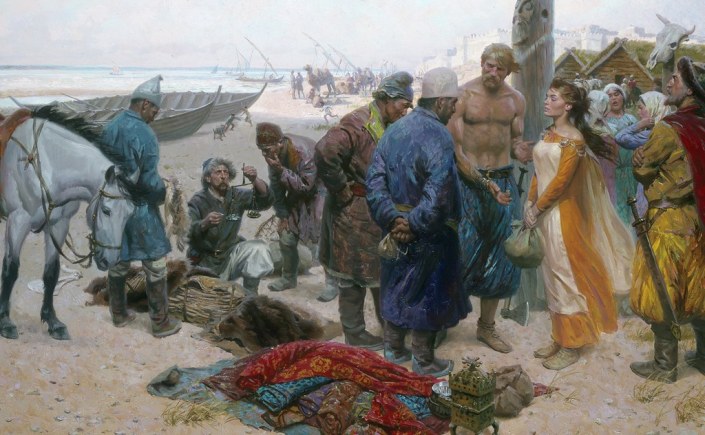
The Vikings – often reduced in popular memory to picturesque if violent raiders – operated something closer to a transcontinental syndicate. The river systems of the Rus, threading south through the Volga and Dnieper, connected the Baltic to the Black Sea and Baghdad. Silver flowed north; human beings flowed south. This was not episodic plunder but a business model – structured, repeatable, and profitable. And conducted across astonishing distances. Baghdad and York sat at the far ends of a human supply chain. [The illustration at the head of this article is that of a young Slavic woman being sold into slavery by Vikings to a Persian merchant (Image: Tom Lovell / National Geographic)]
So, in short. Salvery has existed in some form in almost every known civilisation. In the ancient world, captives were routinely taken, bought, sold, and traded. Greek city-states enslaved defeated populations; Rome built much of its economy on slave labour; raiding societies from the Eurasian steppe to the Atlantic world, and across the ocean, among the First Nations people of the Americas, treated slavery as part of warfare and survival. For most of human history, slavery was seen less as a moral evil than as an accepted social institution, however tragic it might be for those caught within it.
It is necessary therefore to resist any account that isolates the Atlantic trade as if it emerged sui generis from European wickedness. The Islamic world sustained large-scale slave systems over a long durée; and African polities were not merely passive victims but active participants in capture and sale; Arab traders were integral intermediaries. The Atlantic system, or “the Middle Passage” and “Triangular Trade” as it was euphemistically described, depended in its operation on a web of local agency as well as European demand. To acknowledge that is not to dilute culpability but to complicate it – uncomfortably, but necessarily.
And yet – here the counterweight – the Atlantic system was not merely one more iteration of an ancient practice. In the Americas – north and south – fused race, heredity, and commerce into something peculiarly rigid and self-reproducing. Slavery became not just a condition but a caste, encoded in law and biology, and scaled through plantation economies that fed a global market. Cotton, sugar, coffee and tobacco were not marginal commodities but engines of early modern capitalism. The system’s brutality was not incidental; it was structural.
It is here that the North American story assumes its central, paradoxical role. Chattel slavery became both foundational and explosive – so deeply embedded in the economy that its removal threatened the entire edifice, and yet so morally corrosive that it generated its own opposition. The American Civil War was among many things, the moment when that contradiction could no longer be managed rhetorically or regionally; it was settled, instead, in blood. Abolition here was not simply argued into being; it was fought into being.
Slavery was America’s original sin, and its malign influence ricochets still through its politics and society. [See American historian Sarah Churchwell’s.chilling account of darkest Dixie in In That Howling Infinite’s The Wrath to Come. Gone With the Wind and America’s Big Lie]
Which brings us to what may be the most historically unusual feature in all of this: not slavery itself, but the sustained movement to abolish it. The West generated, from the 17th century onward, a mounting moral and political challenge to slaver, in legal cases, religious agitation, popular campaigns – that eventually dismantled it – significant help from the Royal Navy. Comparable, system-wide movements were less evident in the Islamic world, where dissent existed but did not crystallise into mass abolitionism with similar force or effect.
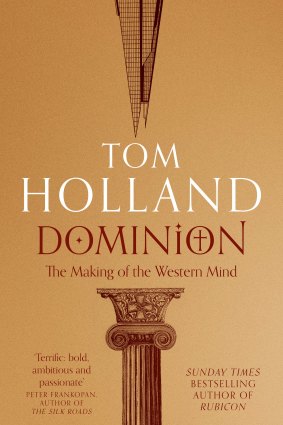
The distinction matters. Saying it did not happen is a statement of fact; suggesting it could not have happened, or that its absence reflects some deeper civilisational failing, goes beyond the evidence. The divergence likely owes as much to political economy, state structure, and the contingencies of modernity as to theology alone. Which is where English historian and The Rest is History podcaster Tom Holland’s excellent doorstop of a book Dominion hovers, suggestively, over the argument [See In That Howling Infinite’s Getting back to the garden – Tom Holland’s Dominion
Holland’s claim – broadly put – is that the moral vocabulary underpinning abolition in the West owes much to a Christian inheritance: the elevation of the weak, the insistence on the equal worth of souls, the suspicion of unrestrained power. Even as the Enlightenment secularises these ideas, it carries their imprint. One need not follow him into every chapel of that argument to see the outline: abolition is historically anomalous, and anomalies tend to have genealogies. The West did not simply stumble into anti-slavery; it argued its way there, drawing on intellectual and moral resources that had been accumulating, often ambivalently, for centuries.
One must exercise caution here. Moral discomfort with slavery existed elsewhere and earlier, even if it did not produce mass abolitionist movements in the same way as in the West. Nor does the existence of Western abolition somehow erase the brutality or scale of European colonial slavery, particularly the Atlantic slave trade and plantation economies. The West occupies both roles in history: architect of the largest racialised slave system in modern history, and birthplace of the most influential abolitionist movements against it.
History is often untidy like that.
Old poison, new bottles
The story end in the 19th century however much resolutions might prefer it to. The Gulf states remind us that abolition in law does not always mean abolition in practice. The kafala system – sponsorship, contract labour – operates in a grey zone where dependence can harden into coercion. Passports withheld, mobility constrained, recourse limited: not chattel slavery, but an echo, or perhaps a mutation. History rarely repeats itself verbatim; it adapts, keeping the structure while altering the terminology.
And then there are the moments when the past returns not as echo but as revival. ISIS, with its enslavement of Yazidi women, did not merely exploit chaos; it articulated a doctrine. Slavery, and most particularly, sexual slavery, was justified, systematised, and bureaucratised with price lists, allocations, and rules, and even, trans-national trafficking: one captive ended up in Gaza where she was eventually rescued from a war zone. It was, in the grimmest sense, a reactivation of an old logic under modern conditions. Old poison in new bottles. If abolition was an anomaly, here was the reminder that anomalies can be reversed.
Governments and citizens of ostensibly westernized states should look to their self-awarded laurels. We should be wary of treating coercion as something that happens “over there.” The exploitation of domestic workers – underpaid, over- controlled , sometimes effectively trapped – appears not only in the Gulf but in Lebanon, Israel, and also parts of Western Europe and North America, where immigration status and private households create shadows the law struggles to reach. And closer still, in our own economies, sweatshop labour, debt bondagea and various forms of servitude persist at the margins, along with physical violence and sexual exploitation – which is precisely why regulation, inspection, and enforcement remain not moral luxuries but necessities.
Against this broader canvas, the UN resolution begins to look less like a statement of history than a negotiation, negation, even – of memory. Its selectivity – foregrounding Western guilt, backgrounding Western abolition, omitting other systems – is not unusual in such documents; it is, in some sense, as we have often seen, their defining feature. They are less concerned with completeness than with consensus, less with analysis than with alignment. Countries with difficult presents often find it convenient to condemn curated pasts.
Ergas is justified in objecting to that selectivity. Where he overreaches is in answering it with a counter-selectivity of his own – one that risks understating the distinctiveness of the Atlantic system and overstating the clarity of civilisational contrasts. History, inconveniently, refuses to stay within either brief.
On the question of the Holocaust, however, his warning lands. To rank atrocities – to declare one “the greatest” – is to turn history into a macabre competition. More importantly, it obscures differences of intent. Most slave systems, however brutal, were premised on exploitation; the Holocaust was premised on annihilation. That distinction is not a matter of moral bookkeeping but of historical substance.
And so we arrive, circuitously, at a position that satisfies no one entirely – which is probably how one knows it is closer to the truth.
Slavery is not the property of any one civilisation; it is a recurrent human institution, appearing wherever power, profit, and permission align. The Atlantic trade is distinctive but not unique; Islamic and African systems are substantial but not singular; modern forms persist under altered names and legal veneers. What is genuinely unusual is the emergence of sustained, organised movements that declare slavery illegitimate and succeed – partially, unevenly – in abolishing it.
Between the UN’s moral narrowing and Ergas’s corrective widening lies a more uncomfortable landscape: one in which culpability is diffuse, agency is shared, and progress, where it occur, is contingent, fragile, and slow. The past does not arrange itself into neat indictments or tidy vindications. It lingers, instead, as habit and warning.
And, if one is honest, as a question still not fully answered.
On the Holocaust comparison, Ergas is on firmer ground. Collapsing all historical crimes into a single ranked category – the greatest” – is less analysis than moral theatre. The distinction between exploitation and extermination is not pedantic; it goes to intent. The Nazi project was annihilatory in a way most slave systems, however cruel, were not. History flattens at our peril.
And then there is the politics of the thing. UN resolutions are not monographs; they are negotiated texts, shaped by blocs, interests, and the quiet arithmetic of votes. Selectivity is almost baked in – as is prejudice. Countries with uncomfortable presents often find safety in condemning selective pasts. Western abstentions, too, are rarely acts of intellectual surrender; more often they are the diplomacy of not quite wanting to pick a fight that cannot be cleanly won.
Unfinished business
So we end where we began, with a familiar tension. Yes, slavery is a near-universal inheritance, and any telling that singles out one civilisation to the exclusion of others is suspect. But neither does the universality of the crime dissolve its particular forms. The Atlantic system, the Islamic trades, ancient chattel systems – they rhyme, but they are not identical verses.
And there remains a broader, less comfortable truth: the story of slavery is not a morality play with a single villain, but a long human habit, periodically challenged, never entirely extinguished, and always ready, given the right circumstances and excuses, to return.
History, in other words, refuses both the courtroom brief and the absolution. It is messier than Ergas allows, but also less conveniently moralised than the resolution he criticises.
It leaves us not ranking guilt, but paying closer attention. The Atlantic system was distinctive; the Islamic and other trades were vast and enduring; African rulers and Arab merchants were participants as well as intermediaries; the West generated powerful abolitionist movements even as it profited from what it eventually condemned. None of these claims cancels the others. Together they form a picture that is, at once, more accurate and less flattering than any single narrative allows.
And the present refuses to sit quietly beneath the verdicts we pass on the past. The exploitation of domestic workers in the Gulf, Lebanon, Israel, and parts of Western Europe; the persistence of sweatshop labour, debt bondage, and coerced work within Western economies themselves – these are not historical footnotes but contemporary reminders. Laws and conventions matter, but so do inspection, enforcement, and the unglamorous work of closing the gap between principle and practice.
Which is why the most suspect posture, at the end of such an inquiry, is self-congratulation. There is no stable ground here for laurel wreaths, no civilisational vantage point from which to survey a completed moral victory. At best there is a difference in degree – of scrutiny, of institutional capacity, of willingness to act. And even that requires constant renewal.
Slavery, in its older forms, has been dismantled in many places; in its newer guises, it adapts. The question is less who was worst than who is still looking, and still prepared to do something about what they find.
Postscript: Etymology
The history lingers, as it often does, in the words. They carry within themselves their own freight.
“Slave” in English carries within it a map of early medieval Europe. The term is widely traced to the Latin sclavus, itself derived from Sclavus – “Slav” – a reflection of the large numbers of Slavic peoples captured and sold through the trading networks that ran from the Baltic down the great river systems to Byzantium and the Islamic world. What began as an ethnonym hardened into a condition. By the High Middle Ages the word had shed its geographic specificity and settled into general use- esclave, schiavo, esclavo, slave – the person eclipsed by the status, the origin story buried in the syllable. The modern word is not, in itself, a slur; but its lineage is a reminder of how readily a name can be stripped of personhood and repurposed as a category of subjection.
Arabic offers a parallel, though not an identical one. The root ʿabd (عبد) denotes a servant or slave, but in its primary register it is theological: ʿabd Allāh, servant of God – a posture of submission before the divine rather than a description of worldly bondage. Yet the plural ʿabīd (عبيد) – once a straightforward term for slaves – acquired, over time and in certain contexts, a sharper edge, used for Black slaves and, by extension, Black people more generally. In modern usage it can carry derogatory force, depending on context and intent, illustrating how a neutral descriptor can drift into insult as it absorbs the hierarchies of the societies that use it.
In both cases, language records a quiet transformation. A people becomes a condition; a condition gathers associations; those associations harden into overtones that may wound long after their origins are forgotten. The vocabulary survives the systems that shaped it, carrying their traces forward – compressed, half-visible, but still there for those inclined to listen.
Afterword: Thraldom, it’s unwinding and its afterlives
A final turn of the lens, back to northern Europe, where the language and the practice briefly align – and then, tellingly, reappear in altered guises.
In Anglo-Saxon England, þræl – thrall – named a condition within a broader spectrum of unfreedom. These were the captured, the indebted, the born into it: men and women who laboured in households and on estates, who could be bought and sold, though not yet within the fully racialised, hereditary system that would later define Atlantic chattel slavery. The boundaries were hard but not always impermeable. Manumission occurred; over generations, absorption was possible. It was a system of subjection, but not yet a totalising one.
The British port of Bristol stands as a reminder of how visible and organised that system could be. It became wealthy with the transatlantic slave trade. But in the 11th century it also functioned as a significant slaving port, exporting captives – often from Wales and the Welsh borderlands – into Irish and wider networks. This was not an anomaly but a node in a broader medieval traffic in human beings, linking the British Isles to circuits that extended, directly and indirectly, toward the Mediterranean and beyond.
Nor was England unique. Across medieval Europe, slavery persisted in varied forms: Italian city-states drew on Black Sea supplies; Iberian polities, both Muslim and Christian, trafficked in captives amid the long wars of the Reconquista; eastern Europe fed human cargo into Byzantine and Islamic markets. The word “slave” itself, with its Slavic root, is a linguistic fossil of that traffic (see below)..
And yet, in England at least, something shifted – and the Norman Conquest appears to have hastened it. On the eve of 1066, Domesday would soon record servi in significant numbers, perhaps around a tenth of the population. By the 12th century, however, chattel slavery had largely withered. The causes were less a single decree than a convergence. The Norman regime imported a more continental feudal logic, in which labour was bound to land rather than owned outright; a villein, fixed, dues-paying, and reproductively stable, was often more useful than a saleable slave. The Church, already critical of slave trading – Wulfstan of Worcester’s condemnation of the Bristol trade is emblematic. – found firmer footing in the new order, aligning moral pressure with institutional power. Trade patterns shifted too, as England’s orientation tilted across the Channel, loosening older Irish Sea networks that had sustained export markets.
None of this amounted to abolition in the modern sense. What replaced slavery was serfdom: a different architecture of dependence, less overtly transactional but hardly free. The change was real, but it was also a translation—from one form of unfreedom into another, quieter one.
And, as if to underline the point, elements of the older logic resurfaced later under new names. In the 17th and 18th centuries, Britain exported large numbers of indentured labourers – many English, but also Scots and Irish, including prisoners of war and political rebels after uprisings – to the American colonies and the Caribbean. Bound by contract rather than owned outright, they nonetheless occupied a coercive world of limited rights, harsh discipline, and restricted movement. The loss of the American colonies in 1783 did not end this habit of displacement; it redirected it. Transportation – of convicts and dissidents – to Australia became the next imperial outlet for managing surplus and troublesome populations, a system different in law but recognisably akin in its logic of removal and compelled labour [see in In That Howling Infinite, Farewell to Old England forever … reappraising The Fatal Shore
Meanwhile, further east, a different trajectory prevailed. In eastern Europe and Russia, serfdom did not wither but intensified. From the late medieval period into the early modern era, landlords consolidated control over peasant populations, binding them ever more tightly to the land and to service. In Russia, this culminated in a system that, by the 18th century, bore striking resemblances to slavery in practice, if not always in name – serfs bought, sold, and mortgaged along with estates, their mobility sharply curtailed, their obligations exacting. Emancipation would come late: 1861 in Russia, and even then imperfectly, leaving behind structures of dependency that proved stubbornly durable.
Which is, perhaps, the thread worth keeping in hand. Systems of coercion rarely disappear cleanly; they evolve, recur and rephrase. From thrall to serf, from market to manor, from indenture to transportation, from eastern estate to western plantation. The names change; the grammar does not. Waiting, as ever, for the conditions that allow it to harden once again. waiting, as ever, for the conditions that allow it to harden once again.
In that Howling Infinite, May Day 2026
This essay was written in conversation with an AI language model, which contributed to researching, drafting, phrasing, and conceptual articulation. What appears here is not unmediated thought, but considered thought: directed and selected, revised and revised again, and owned.
See also in In That Howling Infinite, A Political World – Thoughts and Themes, and A Middle East Miscellany
Coda
When this essay was published on Facebook, it elicited several comments that amounted to a polemical defense of the West that began with a legitimate historical observation – slavery was historically near-universal and abolitionism emerged most powerfully from Enlightenment Europe – but then overextended the claim into a triumphalist narrative about Western moral uniqueness and non-Western incapacity for self-criticism. Its tone is combative, culturally chauvinistic, and marked by sweeping generalisations about “the Third World,” Islamic societies, Arabs, and Asian civilisations.
Intellectually, they mixed valid historical points with selective history, rhetorical exaggeration, and resentment politics. They treated “the West” as unusually self-critical and morally generative, while caricaturing other societies as conformist or authoritarian. The result is less a sober historical analysis than a reaction against contemporary anti-Western discourse, expressed through broad-brush civilisational language.
A more balanced critique might read as follows:
Slavery has existed in some form in almost every known civilisation. In the ancient world, captives were routinely taken, bought, sold, and traded. Greek city-states enslaved defeated populations; Rome built much of its economy on slave labour; raiding societies from the Eurasian steppe to the Atlantic world treated slavery as part of warfare and survival. For most of human history, slavery was seen less as a moral evil than as an accepted social institution, however tragic it might be for those caught within it.
One of the major intellectual shifts of the Enlightenment era was the emergence, particularly in Western Europe and North America, of the idea that slavery itself was morally illegitimate. Philosophical ideas about natural rights, combined with religious and humanitarian movements, helped give rise to organised abolitionism. Britain, France, and the United States were deeply implicated in the Atlantic slave trade, yet they also produced influential movements that eventually challenged and dismantled it. Modern international norms against slavery owe much to these developments.
At the same time, slavery was not uniquely Western, nor was opposition to injustice confined solely to the West. Different forms of servitude and human bondage existed across Africa, the Middle East, Asia, and the Americas, and criticism of oppression has emerged within many cultures and traditions. The historical record is complex: societies can simultaneously perpetrate injustice and generate the ideas that challenge it.
Contemporary debates about slavery and colonialism sometimes oversimplify history by treating Europe and the West as uniquely culpable, while overlooking the broader global history of slavery. But responding to that simplification with sweeping condemnations of non-Western societies is equally reductive. A more useful approach is to recognise both the universality of slavery in human history and the particular historical significance of the abolitionist movements that emerged during the Enlightenment and after.
UN resolution on slavery falsifies history by ignoring Islamic world’s role
Henry Ergas, The Australian, 1 May 2026

The UN resolution sparks debate over historical interpretation: Getty Images
Formally, the resolution condemns the African slave trade as a whole. Substantively, every concrete reference targets the transatlantic trade, fixating on a “racialised capitalist system” and its purported Western antecedents. The cumulative effect is unmistakeable: to brand the trade a distinctively Western crime. To sustain that impression, the resolution parades a sequence of decrees, starting with the papal bulls of 1452 and 1455, which it casts as the founding charters of the enslavement and “structural racism” that still unjustly impoverishes Africa, thereby grounding a claim to substantial reparations.
Yet, having been forensically specific about blame, the text turns conspicuously evasive when it confronts the forces that brought the Atlantic trade to an end. The Enlightenment, the abolitionist movements, and the Western legal and political campaigns that culminated in the trade’s eventual demise are, it appears, unmentionable.
While the offending decrees are named, dated and indicted, the tide of opposition to slavery, which gathered momentum in the 17th century, is dismissed as “certain legal challenges and judicial developments in the 18th century” that “questioned the legality and morality of chattel enslavement”.
That descent into vagueness reflects a deliberate strategy: to particularise the guilt while diluting the credit. Merely cataloguing the misrepresentations, confusions and factual errors this strategy produces would require far more space than is available here. What is especially striking, however, are the omissions.
It is, for example, intellectually dishonest to invoke the papal bulls of 1452 and 1455 while ignoring Pope Paul III’s bull of 1537, which denounced as an invention of the devil the idea that native peoples “should be treated as dumb brutes created for our service”, and affirmed “that they may and should, freely and legitimately, enjoy their liberty”.
Paul III’s exhortations had limited immediate effect; so too did Cartwright’s Case (1569), which declared that England’s air was “too pure for slaves to dwell in”. What matters is what they reveal: an unceasing moral interrogation of slavery within the West itself – an interrogation that gave abolitionism the bedrock on which to build.
Here, too, the resolution’s selectivity is purposeful. It allows it to avoid an obvious and crucial comparator: the long history of slavery under Islamic rule, which it ignores altogether. From the Arab conquests to the early 20th century, some 14 million black slaves were transported into the lands of Islam via the trans-Saharan, Red Sea and Indian Ocean routes, with nearly a million more carried beyond the East African coast. Add to these more than a million white slaves, and the total comfortably exceeds the 10 million to 12 million who landed in the Americas.
Yet the numbers are not what is most significant. The salient fact is the absence of any sustained doctrinal or institutional challenge to the morality and legality of the slave trade within the Islamic world – even where it starkly contradicted the Koranic prohibition on enslaving Muslims. As Bruce Hall shows in his study of Saharan and Sahelian slavery, by the 19th century – when the West was vigorously suppressing chattel slavery – the operative presumption among Maliki jurists was that black Africans, routinely described as “savages”, were enslavable by default, whatever their faith.
There were individuals who objected strenuously to chattel slavery, such as Syrian reformer Abd al-Rahman al-Kawakibi (1855-1902); but no Muslim opponent of slavery ever forged those concerns into a mass movement. Bernard Lewis’s verdict that “even the most radical Muslim modernists” fell well short of matching the fervour and effectiveness of Western abolitionists retains all its force.
It is therefore unsurprising that Islam’s leading theologians, far from championing abolition, actively resisted it – beginning with the infamous 1855 fatwa, issued with the full authority of Mecca’s Shaykh Jamal, which declared any prohibition of the slave trade “contrary to the holy law of Islam” and any official who attempted to enforce it “lawful to kill”.
Nor is it surprising that Saudi Arabia and Yemen abolished slavery only in 1962, the United Arab Emirates in 1964, Oman in 1970, and Mauritania – after repeated ineffectual measures – in 2007. Moreover, even where slavery was formally abolished, forms of vassalage have remained firmly in place: of the 10 countries with the highest incidence of “modern slavery”, eight are majority-Muslim.
But the resolution does not merely distort history by pretending Islamic slavery didn’t exist. It declares the slave trade “the greatest” crime against humanity ever committed. Although not explicitly stated, a central purpose of this travesty – which converts the horrors of the past into a “suffering Olympics” – is again transparent: to relativise the Holocaust.
It is frankly obscene to degrade moral evaluation into a body count, with medals of ignominy awarded by a show of hands. Yet even in so repulsive a spectacle, realities should have been allowed to intrude. Those realities are well known. Death rates in the Holocaust – whose unrelenting aim was the complete extermination of Jews – were close to or above 90 per cent. So complete was the indifference to fatalities that the German railways were paid whether the Jews being shipped by them lived or died during their transport – and the few who survived the journeys were killed, on average, within days of arrival.
In contrast, as investor Thomas Starke wrote to Captain James Westmore in 1700, “the whole benefit of the voyage lyes in your care of preserving negroes’ lives”. As a result, strenuous efforts were made to ensure slaves remained alive and saleable, including by granting handsome bonuses to captains for high survival rates and imposing stiff penalties for excess mortality.
Although those efforts hardly eliminated the trade’s horrors, they did mean that by the late 18th century, death rates for black slaves on the “middle passage” had declined dramatically, to the point where they were only marginally greater than those for crews. To pretend otherwise is to erase the distinction between exploitation and extermination: for there was nothing in the slave trade even remotely comparable to the systematic mass murder at the heart of the Holocaust.
But to acknowledge those facts – which flatly contradict the assault on the standing of the Holocaust – might have eroded the overwhelming support the resolution secured. And the composition of that support says everything one needs to know about the resolution.
Thus, every one of the 20 countries that have the highest incidence of modern slavery and forced labour cynically voted in its favour; so did all the authoritarian states that participated in the vote, with the exception of Kazakhstan and Kyrgyzstan; and, again with the exception of Kazakhstan and Kyrgyzstan, it received the active backing of every Muslim-majority country.
Yet that is not the real tragedy. Rather, it is that only three Western countries – the US, Israel and Argentina – had the decency to vote against the falsification of history, instead of abstaining, as Australia and the European Union did. Those three were willing to oppose this charade. Why weren’t we?


 In That Howling Infinite
That the African slave trade was a monstrosity, inflicting unspeakable cruelty on millions of innocent victims, is beyond dispute. But the resolution the UN General Assembly passed two weeks ago, marking the trade’s commemoration, is nothing less than an appalling falsification of history.