Rojava revisited. Can Syria break its sectarian cycle?

In January 2019, In That Howling Infinite published, Rojava and the Kurdish conundrum. The post wrote of Rojava as both experiment and predicament – a small, improbable polity suspended between larger, harder powers, “trapped between the Turkish hammer and the Syrian anvil.” Aris Roussinos, whose work we have reviewed before, now returns to the same terrain with the sombre clarity of hindsight. His recent essay on the collapse of the Autonomous Administration of North and East Syria reads less like contradiction than culmination. What was foreboding then is aftermath now.

Back in 2019, the drama was framed in the key of Trumpian bombast – promises to “totally destroy and obliterate” Turkey’s economy if Ankara stepped out of line — but the underlying reality was austere. The Kurdish-led Syrian Democratic Forces had borne the brunt of the fight against ISIS, lost thousands of men and women, guarded tens of thousands of jihadist detainees, and constructed, under the thin canopy of American airpower, a fragile, decentralised experiment in multi-ethnic governance. Remove the canopy and the weather would change. The Kurds knew it. So did Ankara, Damascus, Moscow and Tehran.

Roussinos describes that experiment –  the AANES – as an attempt to defy the “grim logic” of civil war in divided societies: that conflict eventually collapses into sectarian arithmetic. Ideologically, it was a pivot away from classic PKK ethnonationalism toward Abdullah Öcalan’s “democratic confederalism”: devolved authority, gender parity, communal councils, a deliberate blurring of ethnic hierarchy. In a region shaped by the memory of genocide, forced migration, Baathist Arabisation and mutual suspicion, it was both necessity and idealism. The geography of the Jazira –  oil-rich, landlocked, demographically mixed – demanded accommodation if it was to function at all.

Yet even in 2019 the limits were visible. Rojava was romanticised abroad –  “an anarchist-lite Paris Commune,” as we noted, perhaps half  ironically half-ironised then – but on the ground it was strategically exposed and socially fissured. Arabs and Turkmen did not uniformly welcome Kurdish administration. Kurdish politics itself was riven by clan and party rivalries. Turkey, Syria, Iraq and Iran all loathed the prospect of a sovereign Kurdistan. The experiment depended not merely on theory but on patronage.

That patronage proved fickle. The likely endgame sketched seven years ago was stark: the Kurds would fight if forced, but ultimately they would deal with Damascus to save their towns and families. Russia would mediate; Turkey would demand a border free of the YPG; Assad would insist on reintegration, autonomy trimmed to vassalage. The analogy to the Paris Commune was offered with unease – bold communal experiments have a habit of ending in blood and absorption.

Roussinos now writes from beyond that threshold. The new Damascus government –  jihadist-derived yet internationally tolerated – has reasserted control. The much-vaunted multi-ethnic Syrian Democratic Forces, proudly described as majority Arab, fractured under pressure. Arab components drifted back toward their ethnic kin in Damascus. What remained was recognisably Kurdish: the YPG under another name. Integration proceeded not as confederal partnership but as coerced subsumption.

Pro–Damascus media have seized on the SDF’s recruitment of women, alleging coercion and forced enlistment of minors. While underage recruitment has been documented in past years and prompted formal pledges to demobilise minors -with uneven implementation – broader claims of systematic kidnapping lack clear substantiation and coexist with extensive evidence of voluntary female participation grounded in the movement’s gender-egalitarian ethos. Such allegations serve a wider political purpose: portraying the Kurdish administration as socially aberrant and incompatible with a re-centralised Syrian state, framing critique of specific practices as part of its broader delegitimisation. In Roussinos’ terms, this is another instrument of Syria’s recurring cycle: peripheral autonomy is undermined not only by coercion on the battlefield but also by shaping perception, marking alternative governance as morally and politically untenable.

His larger point is less about Kurdish miscalculation than Syrian structure. Since independence, Syria has oscillated between peripheral revolt and centralised coercion. Its demographic entanglement – Sunni Arab majorities, Alawite and Druze minorities, Kurds without a state, ancient Christian communities –  renders majoritarian triumph unstable and decentralisation fragile. The AANES sought to transcend that arithmetic; it ultimately succumbed to it. Meanwhile, sectarian reprisals against Alawites and Druze in western Syria deepen minority distrust of Damascus, reinforcing the very cycle the new regime claims to end.

The pattern is not uniquely Syrian. Lebanon’s confessional balancing act has veered between uneasy accommodation and paralysis; Iraq’s post-2003 settlement oscillates between sectarian mobilisation and fragile cross-sectarian moments; the Balkans, from Bosnia to Kosovo, demonstrate how externally brokered pluralism can freeze conflict without dissolving its underlying fears. In each case, demography and memory shape politics as much as constitutions do. Power-sharing without trust calcifies; centralisation without restraint provokes resistance. The pendulum swings.

What is striking is the dialectical twist. The Kurdish movement in Syria attempted to move beyond ethnonationalism toward a post-national confederalism. Its collapse may instead accelerate a harder pan-Kurdish nationalism – the revival of the Ala Rengin flag, the renewed invocation of Rojava as West Kurdistan, the rhetoric of betrayed nationhood. When pluralist experiment yields vulnerability, ethnic consolidation gains appeal. The effort to dissolve identity politics may intensify it.

Can Syria break its sectarian cycle? Roussinos leaves the question open, but the burden is heavy. It would require disciplined control over disparate armed factions, credible guarantees to minorities, and a majority willing to exercise restraint rather than vengeance – feats rarer than battlefield victories. The Kurdish experiment failed not simply because it was naïve, but because it unfolded within a regional system that punishes fragility and rewards coercion.

In 2019, the mood was, borrowing from King Lear, “cheerless, dark and deadly.” In 2026, the darkness feels less theatrical, more structural. The Kurds remain what they have long been: resilient, battle-hardened, accustomed to betrayal. Their attempt to sketch another way -neither Baathist despotism nor jihadist dominion – has been curtailed. Yet the problem it sought to solve endures, not only in Syria but in every state where demography, memory and power are tightly braided. The lesson, as Roussinos insists, reaches well beyond the plains of the Jazira.

Paul hemphill, February 2026, with assistance in drafting by ChatGPT

For more on the Middle East in in That Howling Infinite, see A Middle East Miscellany.

See also, Syria. Illusion, delusion and the fall of tyrants, Cold Wind in Damascus …Syria at the crossroads, Between Heaven and Hell … Syria at the crossroads

Can Syria break its sectarian cycle?The Kurdish experiment was doomed

Aris Roussinos, Unherd 10 February 2026
Can Syria break its sectarian cycle?

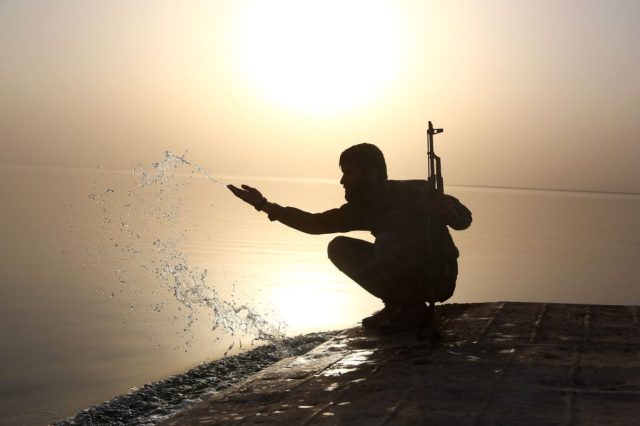
‘The remorseless logic of a country, like neighbouring Lebanon and Iraq, held hostage by its own tangled demographics.’ (Delil Souleiman / AFP / Getty Imges)

It is generally expected that, whatever the ostensible cause of a civil war, in a country divided on ethnic and religious lines the fighting will sooner or later assume an interethnic or sectarian flavour. The Autonomous Administration of North and East Syria (AANES), now having surrendered its autonomy under assault from the Syrian state’s new jihadist-derived government, was, whatever else it may have been, an attempt to rebut this grim logic. Indeed, the dusty and unprepossessing plains of the Syrian Jazira — the northeastern portion of the country, east of the Euphrates — served for more than a decade as an unlikely political experiment in the management and diffusion of ethnic conflict.

Whether noble or naive, this project now looks doomed as AANES’s great power backers turn their fickle attentions to Damascus, and the Damascus government has in turn successfully reasserted its control through military coercion. Within a matter of days, as its Sunni Arab levies turned their affections to their ethnic kin in Damascus and their guns on their former allies, Northeast Syria switched from a bold experiment in multi-ethnic governance to a desperate, rearguard battle for Kurdish cultural and political autonomy. The war, at its presumed end, reverted to the dynamics of its earliest days, when Ahmed al-Sharaa, then leader of the Syrian al-Qaeda faction Jabhat al-Nusra, had attempted, along with the Free Syrian Army (FSA) rebels and tribes of changeable loyalties, to seize control of the oil-rich, and newly Kurdish-run region, Syria’s breadbasket.

Simultaneously rich in resources yet neglected by its central government, and host to the country’s richest mix of ethnic and religious minorities, alternately the tools and the victims of the central state, the Syrian Jazira had always run according to its own dynamics. Both colonial French and independent Syrian administrations in distant, Levantine Damascus expended significant, if sporadic, effort in absorbing this neglected region of Mesopotamia within the modern state system, privileging one ethnic group against another for reasons of statecraft, and building model towns and vast dams, as evocative in their current dilapidation of failed modernities as the ancient tells dotting the landscape, now repurposed as gun emplacements, are of earlier lost civilisations.

Perhaps the AANES experiment can now be added to this melancholy list. Birthed from the fusion of Kurdish nationalism and Marxist-Leninist thought that initially drove the Kurdistan Workers’ Party (PKK) independence movement, the AANES, a project of the PKK’s Syrian sister organisation, the Democratic Union Party ‎(PYD), performed an attempted shift to anarchist political theory. The thought of the American writer Murray Bookchin, as reworked by the PKK’s occluded godhead figure Abdullah Öcalan from his Turkish jail cell, was its most notable innovation. Echoing Öcalan’s rejection of the PKK’s previous project of independence for the Kurdish nation, the AANES presented itself as an explicitly multi-ethnic, multi-sectarian state in which the greatest possible autonomy was devolved to religious and ethnic communities, beneath the benign framework of Jazira’s de facto autonomy from Damascus. In practice, the quasi-anarchist devolution of power resulted in the proliferation of bureaucratic structures. Local empowerment, similarly, meant the elevation of new elites loyal to the project, and the freezing out of dissidents, particularly rival Kurdish factions. Imperfect though it may have been, compared to the overt totalitarianism of the Baathist state, the anarchic infighting of the FSA rebels, and the gothic cruelties of ISIS, history is likely to remember it more favourably than today’s discourse would suggest.

“Perhaps the AANES experiment can now be added to this melancholy list.”

Barely populated until the French Mandate period, except during the annual circulation of nomadic Bedouin shepherds, the portion of Syria east of the Euphrates underwent during the early 20th century a transformative period of internal and external immigration and development analogous, in a modest way, to that of California or Australia. Ethnic Kurds fleeing the collapse of proto-nationalist rebellions in Ataturk’s Turkey, along with Syriac Christians fleeing the Seifo genocide and many uprooted Armenians streamed south across the culverts and rusting tracks of the Berlin-to-Baghdad railway line, which still marks the modern border, joining their ethnic kin residing there from the beginning of recorded history. Ethnic Assyrians from British-Mandate northern Iraq similarly sought French protection from the predation of the Iraqi state and its Kurdish, Arab and Turkmen auxiliaries, establishing a string of fiercely Christian villages along the Khabur river. Northeast Syria was shaped by the cultural memory of ethnic conflict; its past decade of governance was an attempt to evade the return of its attendant cruelties.

As such, the AANES project was always as much one of necessity as Leftist idealism. The Kurdish regions of northern Syria, stretching West of the Euphrates into Aleppo, were separated from each other by clusters of Arab and Turkmen towns and villages, in large part the result of the Baathist state’s settlement of Arabs from Syria’s desert hinterland to hinder any Kurdish attempts at secession. While the early successes of the Syrian Kurds under the PYD, following a negotiated handover of control by Assad’s overstretched government, resulted in what was essentially the occupation by its YPG military forces of Arab settlements, loyal to one or other rebel or jihadist faction, America’s decisive intervention in the war against ISIS resulted in both sudden and unexpected great power backing for Northeast Syria and an evolution of Kurdish political attitudes towards local Arabs.

Partly at America’s behest, in a failed attempt to assuage the Syrian rebels’ combative Western think-tank diaspora, and partly a genuine attempt to impose progressive governance among a population Kurds frequently portray as stunted by its own reactionary obscurantism and crude ethnic chauvinism, Northeast Syria’s autonomous quasi-government undertook a project of delegating political and military authority to Arab regions won back from ISIS. It was an ambitious goal which seemed, for a decade, to have won majority acquiescence, if not affection. It became the boast of the regional administration that its armed forces, the Syrian Democratic Forces (SDF), was now predominantly composed of Arabs, a feat of enlightened governance that rapidly proved hollow, over the past two weeks, when the majority of these Arab fighters effortlessly switched sides. Having lost almost all its Arab accretions, the SDF was once again, in practice, the Kurdish YPG, an ethnic militia fighting for purely Kurdish goals. Now that, under the threat of military defeat, a shrunken version of these forces will be subsumed under the Damascus government’s control, their future role — on paper, and in reality — remains to be seen.

The integration terms finally accepted, at gunpoint, by the autonomous administration last weekend, though better than those of a fortnight ago are worse than those of the unimplemented March agreement. Consequently, much has been made in recent days of the AANES’s failures to come to terms with al-Sharaa’s shock capture of the Syrian state just over a year ago, and negotiate a settlement with the new reality. Certainly, the region’s political focus had, since the seeming cornering of the Sunni Arab rebellion into its Idlib Bantustan, centred on negotiating re-integration into Assad’s Baathist state in a manner that preserved some means of political and military autonomy. Yet Assad, over-confident of his own position as victor of the long and bloody war, refused to offer more than integration into the central state on terms that amounted to surrender. The new regime in Damascus now offers little different: what has changed is its greater power of coercion, and international backing, compared to its previous Baathist iteration.

Putin, once an occasional, tacit partner of the Kurds west of the Euphrates, has fully backed the new Damascus government, another instance where Russia, once America’s rival in Syria, shares increasingly aligned interests with the Trump White House. Calls for the protection of Kurdish cultural rights and social norms by European states are outweighed by their overriding political interest in the accelerated removal of their more than one million mostly Sunni Arab refugees. Regionally, the success or otherwise of the Northeast’s reintegration will determine Israel’s ability to justify its military protection of Druze autonomists in the southern province of Sweida. Relations with mostly Shia Iraq, which has its own reasons to look askance at Sunni jihadist governance and is currently making a show of reinforcing its border with Syria, will be fraught at best. Given the sheer improbability of fate’s wheel suddenly projecting al-Sharaa into Assad’s Damascus palace, it would be foolhardy to offer any firm predictions, rather than vague anxieties, for the country’s future.

For the Kurds themselves, the experiment in enlightened multi-ethnic governance proved, at the crucial moment, a dramatic and costly Achilles heel. The result, over time, will likely be the weakening of PKK ideology in favour of some form of pan-Kurdish ethnic nationalism, whose early stirrings are apparent in the flow of volunteers from northern Iraq to defend their ethnic kin, the sudden revival of the Kurdish flag, Ala Rengin, in Northeast Syria, and in the readoption of the ethnic term Rojava, or West Kurdistan, in place of its previously bland geographic descriptor. When even Abdullah Öcalan’s nephew Ömer, an MP in Turkey’s parliament for the movement-aligned DEM party, feels compelled to proclaim “Long live the Kurds and Kurdistan”, and “the Kurdish nation will not forgive the enmity committed against it”, we sense the tectonic plates of Kurdish politics shifting away from Leftist post-national idealism towards an embryonic ethnic nationalism. The decade-long experience of Kurdish self-governance, military success and international diplomacy will shape whatever follows the likely collapse of the AANES statelet, whether what replaces it will coalesce in the mountainous redoubts of eastern Turkey, Western Iran and northern Iraq, or in the grey cities of the European diaspora. So, too, will bitter analysis of the project’s failings.

Yet it would be unfair for harsh self-criticism to so soon follow hindsight. For all its faults, the Kurdish project of autonomy from the Syrian central state evolved, through managing the dynamics of their multi-ethnic region, into one that ironically and idealistically attempted to make the very idea of equable Syrian co-existence a political possibility. Inversely, the current Damascus project of re-centralisation has, in western Syria, been accompanied by sectarian massacres and other abuses, which have increased the antipathy of peripheral minority populations towards the central state. Sunni Arab supporters of the al-Sharaa government, whose decade-long displeasure at having their ethnic kin ruled by minorities is accompanied by certainty of their own natural right to rule those same minorities, have made much of Kurdish intransigence while minimising or even justifying the starkest governance failures of their own new regime. Yet the past year’s massacres of Alawites and Druze, punctuating the failed integration talks with the AANES, only heightened the Kurdish disinclination to disarm and dissolve its forces and place the fates of its people in the benevolence of the central state.

Syria’s post-independence oscillation between peripheral revolts and centralised coercion, the very cycle that produced both Assad and his own overthrow, is simply the remorseless logic of a country, like neighbouring Lebanon and Iraq, held hostage by its own tangled demographics. Whether or not the new Syria can break this cycle is an open question. It will take great feats of governance, and of control over his own disparate armed forces, by al-Sharaa to avoid the logic of Syria’s demographic confusion weakening his own state-building project just as, suddenly and catastrophically, it did for the Kurds. Syria’s ethnic and religious complexity makes it a hard country to rule, historically veering, as a result, between instability and oppression. The Kurdish attempt to find another, progressive path ultimately failed, for the same reasons. The lessons, it ought not to need underlining, reach far beyond Syria’s borders.


Aris Roussinos is an UnHerd columnist and a former war reporter.

The tears of Zenobia – will Palmyra rise again?

The National Museum in Damascus is a magical place.

It’s most amazing exhibits are its smallest, the tiny alphabet of the bronze age city of Ugarit from the 4th Century BC, said to be the world’s first alphabet, and its largest, the interior of second century synagogue from the Greco-Roman city of Dar Europa on the Euphrates.

The museum has not only survived Syria’s war unscathed, and for a long time closed to safeguard its contents, it has been reopened for almost a year. Whilst this is wonderful news, reflect on the memory of Khaled Mohammad al Asaad, renowned Syrian archaeologist and historian, and Director of Antiquities in Palmyra who was murdered by Islamic State in August 2015 for endeavouring to protect Syria’s archaeological treasures, and reflect also on the destruction of the World Heritage site for which he sacrificed his life.

Palmyra, the ancient and venerable ‘Pearl of the Desert stands in an oasis in the Syrian desert, north-east of Damascus. This once great city was in its day one of the most important cultural centres of the ancient world, at the junction of trade routes between Europe, Asia and Africa. Although a vassal of Rome, it was the capital of the third century Palmyrene Empire, and of its famous queen, Zenobia. She led a revolt against the Roman Empire, expanding her domain throughout the Levant and conquering Egypt, and ruled until 271, when she was defeated by the Romans and taken as a hostage to Rome by Emperor Aurelian.

Palmyra contains monumental ruins from the 1st to the 2nd century, its art and architecture spanning several civilizations, combining Graeco-Roman techniques with local traditions and Persian influences. There are few remnants of the ancient world that compared wit it. Ba’albek, in Lebanon, maybe; Ephesus, in Turkey, possibly; and also, Apamea, in western Syria between Hama and Aleppo. Palmyra’s treasures hide in plain sight. For all the world to see and wonder.

When Da’ish captured Palmyra and Tadmor, the adjacent town (it’s name means ruin in Arabic) al Asaad refused to flee and though tortured for a month, refused to reveal where valuable artifacts had been moved for safekeeping. He was then publicly beheaded, his remains displayed amidst the ruins he has spent his life preserving for us, for humanity, for history. His murderers declared in a sign hanging from his body, that he’d did because he had overseen idols and had attended infidel archaeological conferences as his country’s representative.

Da’ish then proceeded to dynamite Palmyra’s monuments.

Four years on and the suffering of the Syrians continues unabated. The so called-civilized rulers of the so called-civilized world stood by and watched, first with fear and loathing, and then opportunistically and strategically as innocent Syrians were savaged by all sides in a war of all against all. For want of will and resources, and party to the proxy wars that are still being playing out between neighboring states and heat powers. Whilst the territorial Caliphate is no more, thousands of of the murderers and desecrators have melted into the Syrian and Iraqi deserts to carry on their atavistic struggle.

What is happened in Palmyra is no worse than what has happened in many Syrian and Iraqi towns and villages during the last nine years.

We now confront the fact that whilst the recent destruction of Paris’ iconic Notre Dame Cathedral encouraged a deluge of plutocratic philanthropy, the great and good of the western world, having expressed horror and outage at Islamic State’s destructive iconoclasm, are not demonstrating such open-pocketness when it comes to the reconstruction of Syria’s ancient and priceless archaeological heritage. The reason, it is said, is because the Assad government, victorious in its vicious and bloody reconquest of the country, is subject to international economic sanctions. Neither aid for the destitute and displaced nor the reconstruction of ancient monuments is forthcoming on the scale theses crises require.

Expensive, inspirational 3D representations of Palmyra’s lost monuments in London, Paris and New York are no substitute for for actually funding the reconstruction of the real thing.

We republish here a timely feature from the Sydney Morning Herald addressing this melancholy irony. It recalls many of the places we visited when we were last in Palmyra. We drove in from Damascus on a long desert highway that even in peacetime, had mukhabarat checkpoints and also boasted The Baghdad Cafe where we took refreshment, and departed a few days later on the Homs road. The feature photograph was taken from the breakfast room of our  hotel in Tadmor – which the author says is now destroyed. The picture below was taken from Fakhr-al-Din al-Ma’ani Castle above Palmyra. It was a magnificent vantage point for a panoramic view of the ancient city, and also for watching the most spectacular sunsets over the Syrian desert. It is now a military outpost.

In ages far beyond our ken,
These stones weren’t set by mortal men.
In friendly fields and foreign lands.
They say these walls were by giants’hands were raised.
But few, few remember when.
With mortar mixed with blood and soil
And leavened thence with sweat and toil.
The masons and the muscle
All are bones, bones, dry bones,
And nothing else remains.
Their histories are carved in stone.
Their mysteries are locked in stone.
And so the monuments decay
As lonely sands stretch far away,
And hide the stones.
Paul Hemphill, Ruins and Bones

The article follows our small photo gallery.

Read also, in In That Howling InfiniteRuins and Bones, a tribute to al Asaad, and to Palmyra, and all, The Rubble Of Palmyra by Leon Wieseltier, published in The Atlantic, 5th September, 2014.

And more on Syria in In That Howling Infinite:

Queen Zenobia’s Last Look Upon Palmyra, by Herbert Gustave Schmalz (1888). Art Gallery of South Australia, Adelaide.

Palmyra – will she rise again?

Chris Ray, Sydney Morning Herald,

All the world talks about the damage to Palmyra, Aleppo and our other World Heritage sites, but hardly anyone outside Syria does anything to help.  Damascus museum archaeologist Houmam Saad 

Islamic State barbarians almost destroyed this World Heritage-listed site. Its wonders can be saved – so why is there such little international will to do so?

“Your heart will break when you see Palmyra,” says Tarek al-Asaad, looking out the window pensively as we cross the wide Syrian steppe on the road towards the ancient city. For Tarek, Palmyra represents a deep reservoir of sorrow that includes the public execution of his father Khaled, a renowned archaeologist and historian. Khaled had been instrumental in achieving Palmyra’s UNESCO World Heritage listing in 1980. The world stood by, horrified, while the fanatics of Islamic State, also known as IS, took to its majestic monuments with explosives and sledgehammers 35 years later.

We stop at a roadside store, where a young boy with old eyes is gathering aluminium cans to sell for scrap. Inside, soldiers of the Syrian Army guzzle sugary vodka drinks and beer. It’s May and the Muslim fasting month of Ramadan, when Tarek eats and drinks nothing from dawn to dusk, but the young conscripts are on leave and in a mood to celebrate. Tarek buys supplies for his first night in Palmyra since he fled the city in 2015 for the relative safety of Damascus, Syria’s capital.

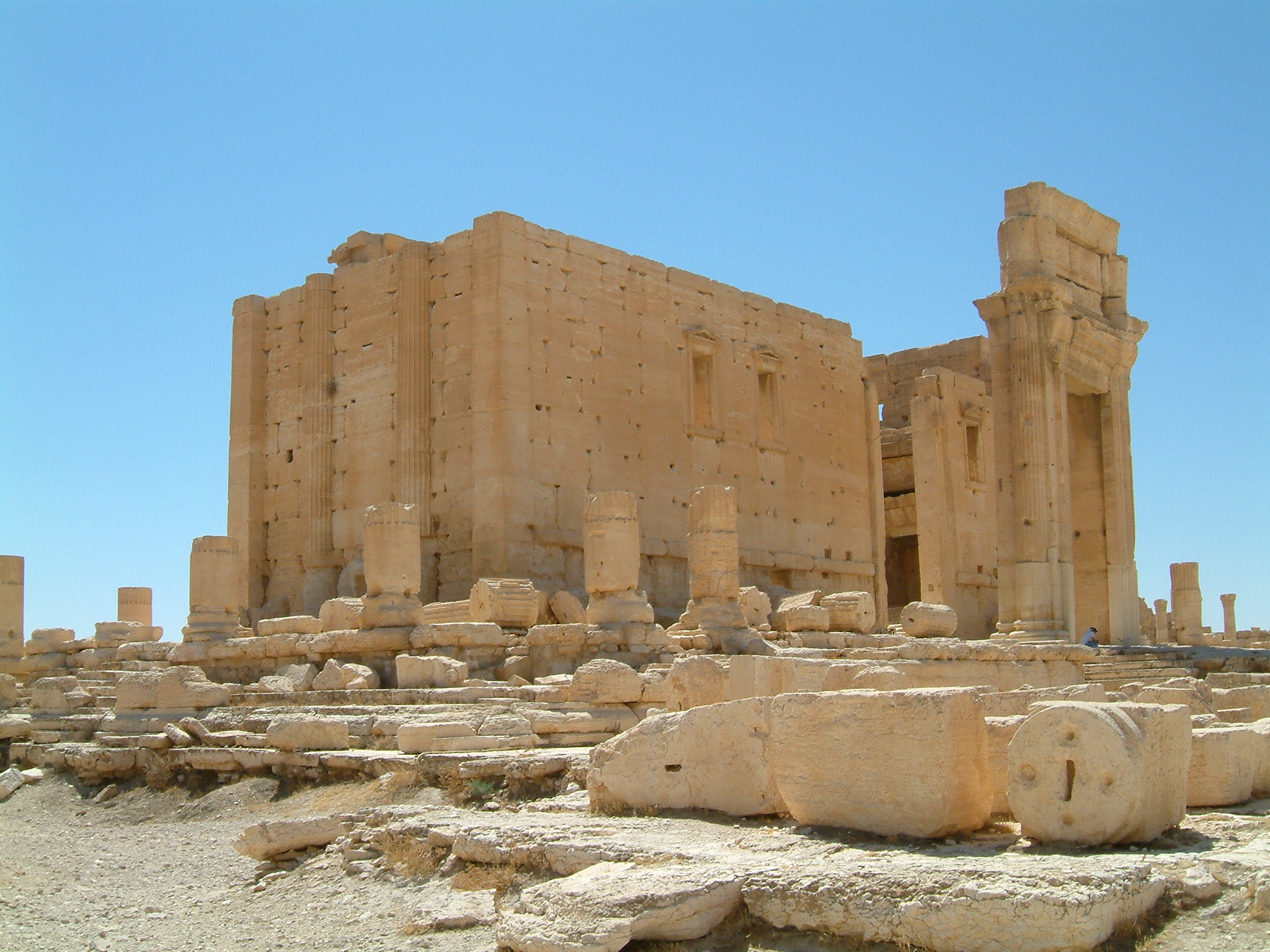
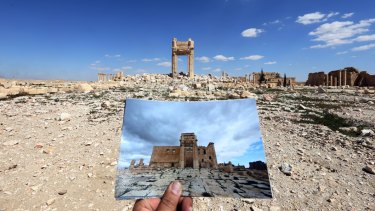
Palmyra’s Temple of Bel in March 2014, and the same view two years later.
Palmyra’s Temple of Bel in March 2014, and in 2016. Getty Images 

Tarek’s father, Khaled al-Asaad, was 83 when he was beheaded by IS. He had devoted more than 50 years to uncovering, restoring and publicising the remnants of this historic Silk Road hub that reached its peak in the third century. Tarek, one of his 11 children, grew up in the modern town of Tadmur next to the site. “Every day I would rush out of school to ride in the wheel-barrows and buckets that carried the soil from the diggings,” he remembers. Khaled retired as Palmyra’s head of antiquities in 2003 but stayed on as an expert much in demand. Fluent in ancient Palmyrene, a dialect of Aramaic, he translated inscriptions, wrote books and advised foreign archaeological missions. Meanwhile, Tarek, now 38, a nuggety, full-faced man with a ready smile, ran a successful tourism business.

We’re travelling towards Palmyra from the western city of Homs, through undulating pasture sprinkled with crimson poppies. Bedouin herders, austere and watchful, graze flocks of long-haired goats and fat-tailed sheep. Soldiers hitch rides on passing trucks through concrete-block settlements edged with green rectangles of wheat and barley. Roadside military checkpoints mount extravagant displays of patriotism: the double-starred national flag is painted on concrete barriers, oil drums and blockhouse walls while banners depict Syria’s president Bashar al-Assad looking resolute behind aviator sunglasses, or waving to crowds. Sentries who inspect identity papers are relaxed and happy to banter. “I hope the fasting is going okay for you?” asks a driver. “We’re not fasting, we’re kuffar [non-believers],” jokes a guard,  alluding to the jihadist insult thrown at adversaries.

Further along, pasture gives way to stony ground studded with pale green tussock. Remnants of the war are more evident here; burnt-out trucks and tanks, toppled electricity pylons and fortified berms of rammed earth crowned with barbed wire. Near a military airbase ringed by radar stations the checkpoint is heavily guarded and businesslike.

A Russian tank transporter going our way is a reminder that IS still fights in the desert beyond Palmyra, where several Syrian troops were reportedly killed this month. While IS lost its last Syrian stronghold of Baghouz in March, small bands continue to mount guerrilla attacks. This is my first visit to Palmyra since a trip as a tourist in 2009, drawn by the mystique of its spectacular architecture beside a desert oasis. Two years later, Syria was torn apart by war. As we approach Palmyra through a gap in a low mountain range, one question is playing on my mind: has the remote and mesmerising site suffered a fatal blow, or can it rise again?

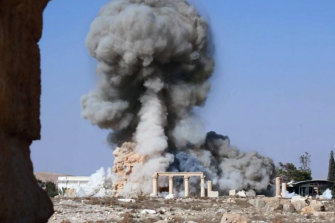
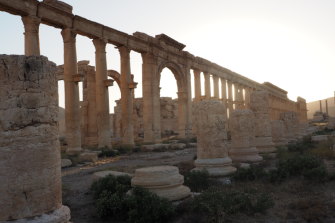
Palmyra’s Grand Colonnade suddenly emerges out of a sandy plain. It is the city’s still magnificent spine, a kilometre-long avenue of towering limestone columns that slowly turn from pale gold to burnt orange in the setting sun. We park near the ruins and set out on foot to take a closer look. At the Grand Colonnade’s eastern end, the great temple of the Mesopotamian god Bel lies in ruins – though its portico somehow survived IS’s explosives – and the ornately carved triumphal arch is a pile of massive blocks. The invaders also blew up the tetrapylon that marked the city’s crossroads and the Baalshamin temple, a richly decorated combination of Roman and indigenous building styles. The theatre’s finely chiselled facade is a pile of rubble along with several multi-storey burial towers that sat on a bare hillside.

On the crossroads of international trade, cosmopolitan Palmyra developed an unorthodox and pluralist culture reflected in its surviving art and architecture. That, along with its location between the Mediterranean coast and the Euphrates river, made it a tempting symbolic and strategic target for modern-day fundamentalists. Muslims lived at Palmyra for 13 centuries, establishing mosques in structures that earlier functioned as Byzantine churches and pagan temples, but the bigots of IS were scandalised by almost everything they found. Every act of vandalism was videoed for use in IS propaganda, its shock value aimed at attracting extremist recruits and intimidating opponents.

An Islamic State-released photo showing the destruction of Palmyra’s 1900-year-old Baalshamin temple.
Islamic State-photo of the destruction of Palmyra’s 1900-year-old Baalshamin temple. AAP

IS occupied Palmyra twice: between May 2015 and March 2016, and between December 2016 and March 2017. During its first takeover, Tarek escaped, but Khaled refused to leave. “I phoned my father and begged him, ‘Please leave; Palmyra has been lost to evil people and you are not safe,’ Tarek says. “He answered, ‘I’m glad you got away, but this is my home and I’m not leaving.’”

After six weeks of house arrest, Khaled was imprisoned in a hotel basement and tortured to reveal the location of hidden treasures that Tarek says never existed. After a month in the basement, the old man was beheaded with a sword in front of an assembled crowd. “He refused to kneel for the blade, so they kicked his legs out from under him,” Tarek says. An online photograph showed his corpse tied to a traffic pole and his head, spectacles in place, positioned mockingly at his feet. A placard tied to his body labelled him an apostate who served as “director of idolatry” at Palmyra and represented Assad’s government at “infidel” conferences abroad.

Before war broke out in 2011, tourism and agriculture supported more than 50,000 people in Tadmur. Only a few hundred have returned, burrowing into half-demolished buildings along streets that sprout giant weeds from bomb craters. Tarek is not among the returnees; he lives with his mother Hayat in Damascus, where he manages a cafe. Russian sappers have cleared Tadmur of IS mines and booby-traps and power and water is back on. Commerce has made a tentative recovery, with a bakery, a hole-in-the-wall pharmacy and a simple restaurant. Its owner, Ibrahim Salim, 45, grills chicken on the footpath under a banner portraying President Assad and his Russian patron Vladimir Putin. Salim says he fled Palmyra after IS killed his wife Taghreed, a 36-year-old nurse, for the crime of treating an injured government soldier. “Security is good, so I can sleep peacefully in Tadmur now,” he says. “We hope the school will reopen soon, so more families will return.”

UNESCO has extolled Palmyrene art – particularly its expressive funerary sculpture – as a unique blend of indigenous, Greco-Roman, Persian and even Indian influences. As IS battled Syrian troops for control of Tadmur in 2015, Tarek rushed to save the most valued examples in Palmyra’s two-storey museum. With him were his archaeologist brothers, Mohammed and Walid, and their brother-in-law, Khalil Hariri, who had succeeded Khaled al-Asaad as museum director. They packed sculptures, pottery and jewellery into wooden crates and were loading them into trucks when mortars exploded around them. Shrapnel hit Tarek in the back and Khalil took a bullet in the arm. They got away with hundreds of pieces, but left many more behind. UNESCO has praised Syria’s wartime evacuation of more than 300,000 exhibits from the country’s 34 museums as “an extraordinary feat”.

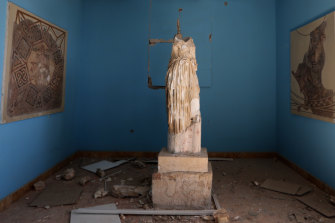
We walk to Palmyra’s museum. Khaled’s former workplace is a desolate shell, its walls pockmarked by bullets, windows blown out and the foyer roof holed by a missile. Galleries that showcased the accomplishments of millennia are bare save for a few statues and bas-reliefs. They are minus heads, faces and hands – desecrated by IS cadres enraged by “idolatrous” objects, Tarek says, adding: “They even pulled the embalmed mummies out of their cabinets and ran over them with a bulldozer.”

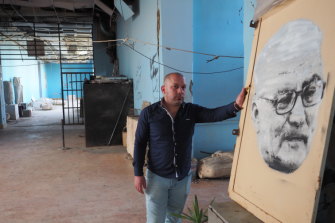
I find only one intact exhibit – a portrait of Khaled (pictured) by Sydney artist Luke Cornish, a work that I and Cornish assumed had been lost. Painted onto a steel door, the portrait is propped against a wall and covered in a protective sheet of clear plastic. Tarek doesn’t know how it survived or who put it in the museum. “Someone must have hidden it from IS, because they would have destroyed it for sure,” he says.

Tarek al-Asaad with the portrait of his late father, Khaled, by Sydney artist Luke Cornish.
Tarek al-Asaad with the portrait of his late father, Khaled, by Sydney artist Luke Cornish. Alex Ray 

No fewer than 15 employees of Syria’s museum network have suffered violent deaths in the eight-year war, but only Khaled’s murder made world headlines. The news prompted Cornish to pay him a remarkable tribute. Cornish makes art by spraying aerosol paint over layers of stencils. Twice a finalist for the Archibald Prize, his award-winning work achieves a near-photographic realism and carries strong humanitarian themes. In June 2016, he went to Syria to film a group of Australian boxers on a “hope-raising mission” led by a Sydney Anglican priest, “Fighting Father” Dave Smith, known for his use of boxing to help at-risk youths. Between bouts and training, Cornish held impromptu stencil-art demonstrations for children in war-ravaged places such as Aleppo, once Syria’s biggest city.

“The kids were fascinated by the immediacy of the medium,” he told me in Sydney. “Most were very poor and had never known anything but war, so it was great to see them having fun putting stuff like [cartoon character] Dora the Explorer on a schoolyard wall or along a bombed-out street. Even with soldiers around and artillery going off, we always drew a curious crowd.”

Before leaving for Syria, Cornish prepared a stencil in the hope of painting Khaled’s portrait somewhere in the country. He got the chance when the boxers went to Palmyra. They arrived more than two months after a Russian-backed offensive first expelled IS from the city, and a week after St Petersburg’s Mariinsky Theatre Orchestra played a concert there to celebrate – prematurely, as it turned out – Palmyra’s liberation. The orchestra performed Prokofiev, Bach and Shchedrin in a Roman-era theatre that IS used as a backdrop for mass executions.

Cornish chose the door of the theatre’s electrical room to paint the man he calls “a hero who sacrificed his life for what he loved”. A YouTube clip of Cornish working on the painting led Tarek to contact him. “Luke’s painting was a beautiful gesture and a very kind gift to our family. We think of him as our friend and brother,” Tarek says.

But six months later, IS retook Palmyra, dynamiting the theatre and posting a gloating video of the damage. Cornish had assumed his painting was lost, too. “I’m used to having my work destroyed on the street, but having it blown up by IS is something else,” he says.

A beheaded and mutilated statue in a Palmyra museum.
A beheaded and mutilated statue in a Palmyra museum. Getty Images

Syria boasts six World Heritage cultural sites and all are on UNESCO’s endangered list. Normally, World Heritage funds would be released to protect the threatened properties. In Syria’s case, UN support has been limited to the restoration of a single Palmyrene statue, and training for museum staff. A UNESCO emergency appeal for $US150,000 ($222,000) to safeguard the portico of Palmyra’s Temple of Bel has failed to attract support from potential donors. At the national museum in Damascus, white-coated conservators have begun the exacting job of repairing hundreds of Palmyra’s damaged exhibits. It is an almost entirely Syrian effort, done on a tiny budget. “We hope for more international help because Palmyra belongs to the world, not just to Syria,” says Khalil Hariri, the Palmyra museum director. He says the fallen stones of the triumphal arch, theatre and tetrapylon are mostly intact and can be put back together, but the museum service can’t afford to employ workers and buy machinery. Says a Palmyra specialist at the Damascus museum, archaeologist Houmam Saad: “All the world talks about the damage to Palmyra, Aleppo and our other World Heritage sites, but hardly anyone outside Syria does anything to help.”

More than two dozen European and US organisations have sprung up to promote Syria’s imperilled heritage. They collect data, hold meetings and issue statements of concern. One such group spent £2.5 million ($4.1 million) to erect a two-thirds-scale model of Palmyra’s triumphal arch in London’s Trafalgar Square, then repeated the exercise in Washington, D.C. Money raised for Syrian antiquities would be better spent where the damage was done, writes Ross Burns, a former Australian ambassador to Syria and author of four books on its archaeology and history: “Putting money into faux arches and 3D models vaguely mimicking historical structures does little more than salve the consciences of outsiders whose nations have encouraged – even funded and armed, then walked away from – the conflagration that grew to overwhelm Syria.”

Syria is a nation of many faiths and ethnicities that emerged in its present boundaries only in 1945. Its rulers have popularised a shared history as a tool to promote national identity and social cohesion. In 2018, UNESCO’s Director-General Audrey Azoulay acknowledged this heritage as “a powerful force for reconciliation and dialogue”. She added a caveat: UNESCO would help rebuild Syria’s historic sites “when conditions allow”. That could mean a long wait.

The UN has banned its agencies from providing reconstruction aid until a “genuine and inclusive political transition negotiated by the parties” is achieved. The ban reflects the stance of the US, European Union and other nations which have imposed economic sanctions on Syria. The Australian government did the same in 2011 in response to what it called the “deeply disturbing and unacceptable use by the Syrian regime of violence against its people”. A year later, the Gillard government applied further sanctions and called for “intensified pressure on Damascus to stop its brutality”.

Luke Cornish ran up against the sanctions when he tried to send $28,000 raised for Syrian orphans to SOS Children’s Villages International last year. Sanctions have isolated Syria from global banking and payment systems, so the charity advised him to wire the money to its German bank account. However, his Australian bank declined the transfer, Cornish says, adding: “I made the mistake of using the word ‘Syria’ on the transfer description.” The UN Special Rapporteur on sanctions, Idriss Jazairy, says the restrictions have “contributed to the suffering of the Syrian people” by blocking imports ranging from anti-cancer drugs and vaccines to crop seeds and water pumps. Though not endorsed by the UN, the sanctions have had a “chilling effect” on humanitarian aid and obstruct efforts to restore schools, hospitals, clean water, housing and employment, Jazairy reported in 2018.

What, then, are the prospects for restoring Syria’s endangered antiquities, including Palmyra? Answers may lie in an ambitious Russian-funded project to rebuild Aleppo’s Great Mosque. It’s a masterpiece of Islamic architecture and symbol of the city, which lies north-west of Palmyra and lost one-third of its famed Old Quarter in fighting which ended in 2016. The mosque’s 45-metre minaret stood for more than 900 years until it collapsed during fighting in 2013. Today, it is a thousand-tonne pile of limestone blocks overlooked by a towering crane. Putting the minaret back up is the job of an all-Syrian team of architects and engineers, stonemasons and woodworkers. They must also restore the badly damaged columns, ceilings and walls of the prayer hall and arcades surrounding the mosque’s vast courtyard. Project director and architect Sakher Oulabi, who showed me around the site, says the workers feel a heavy responsibility: “We all understand we are doing something very important for the soul of our city and our country.”

Driving the rebuild is the Syria Trust for Development, chaired by Asma al-Assad, the President’s wife – so the project has considerable clout. Nevertheless, its technical challenges are almost as formidable as Palmyra’s. The minaret’s 2400 or so fallen stones must be weighed and measured, strength-tested with ultrasound and photographed from many angles so that photogrammetry – the science of making three-dimensional measurements from images – can help to determine where every stone fits. Materials and techniques must be as close as possible to the original: “An expert may notice the difference between new and old, but the public must not,” engineer Tamim Kasmo says. However, limestone that best matches the original is in a quarry outside government control, in Idlib province. As a senior US Defence Department official, Michael Mulroy, noted, Idlib harbours “the largest collection of al-Qaeda affiliates in the world right now”.

The Grand Colonnade, built in the second and third centuries; noted by UNESCO as an example of Rome’s engagement with the East.
The Grand Colonnade, built in the second and third centuries; noted by UNESCO as an example of Rome’s engagement with the East. Alex Ray

 Palmya’s giant stones are as white as old bones when we leave the site one evening at dusk. Tarek joins friends for iftar, the meal that breaks the Ramadan fast and begins with dates and water in line with a tradition supposedly begun by the prophet Muhammad. Our driver, Ahmad, has put aside the pistol he’s been carrying in his belt. He insists there is no prospect of an IS comeback, but says he carries the weapon because local roads can be dangerous. All the town’s hotels are destroyed, so we bed down in a private home and hear artillery fire throughout the night.

At dawn, a steady wind blows cold off the mountains. A road runs past the wreckage of a luxury hotel, where guests once dined while overlooking the ruins and below which Khaled al-Asaad was chained for his last 28 days, to the high perimeter walls of the Temple of Bel complex. From here, having sought the blessings of temple deities, ancient camel trains made the long desert crossing eastward to the Euphrates, with merchandise destined for markets as far away as China.

At the temple entrance today, a young soldier is hunkered down in a guard-post made from ammunition boxes and corrugated iron plastered with mud. “I was here all winter, but at least it didn’t snow,” he says. He apologises for having to inspect our papers and invites us to wait on plastic chairs while he clears our visit with a superior. I ask about the night’s gunfire. “It was only the army practising,” he says, pointing to a nearby mountain with a medieval citadel on its summit. A decade ago, I stood on its ramparts to take panoramic photos of Palmyra, but now it is an off-limits military zone.

Tarek and the soldier discuss welcome news: the spring that feeds Palmyra’s oasis is flowing for the first time in 27 years. The source of the city’s historic wealth, it has watered settlements here since Neolithic times. The spring’s revival has come too late for Tarek’s family orchard; its olive and pistachio trees have withered and died. But he takes it as a hopeful sign that enough of fabled Palmyra can be restored, for the prosperity of its people and the wonder of the world.