One ring to rule us all – does Tolkien matter?

The world was young, the mountains green,
No stain yet on the Moon was seen,
No words were laid on stream or stone,
When Durin woke and walked alone.

The Song of Durin, JRR Tolkien

In Innovation, the final installment of Peter Ackroyd’s entertaining and informative History of England, he writes:

“The post-war years had brought fables of splrltual or material collapse, from That Hideous Strength to Brave New World to Ninteen Eighty-Four. During the Fifties, the novel seemed to be settling back to its journalistic roots – quotidian in subject, unpretentious in style – but the zeitgeist is a wayward wind. Among writers of fiction, another response was offered to the bewilderments of the post-war world, which was to fly above it. In 1955, Return of the King, the last installment of R. R. Tolkien’s The Lord of the Rings, was published. It was the resurrection of heroic romance, tempered by its author’s memories of war. It tells of a small, unregarded race of Middle-earth, the ‘hobbits’,who ‘arise to shake the counsels of great’. The freedom of the world hinges upon the destruction of something tiny, beautiful and evil, evil, a ring forged by a fallen angel. While elves, men and dwarves fight, two hobbits are tasked with the destruction of the great destroyer. A whole world, formed of its author’s experiments in language came into being to the extent that if anyone were to point out that Middle-earth’ is only a translation of the Norse ‘Mittlegard’, the hearer would respond with a shrug. It was there, whatever its origins. For the English journalist Bernard Levin, it offered a beautiful and salutary reminder that the ‘meek will inherit the earth’; for the American critic Edward Wilson, it was “juvenile trash”, a story of good boys being rewarded. In spite of the naysayers, the popularity and influence of The Lord of the Rings grew to unprecedented heights. Tolkien himself, a scholar and devout Catholic, was later to find his work taken up as a banner by most unlikely allies, a group that came to be known as ‘hippies’”.

Whenever a survey or poll crowns JRR Tolkien’s The Lord of the Rings as the public’s favourite novel – and there have been many during the past seventy years – and lauds the author as one of the most influential writers of the twentieth century, the reaction has always been the same from critics who have been sneering at his books since their publication. The Lord of the Rings has been dismissed as trivial, juvenile even, and not worth arguing about. It has been called archaic, backward looking, nostalgist and sentimentalist, and has been gaslit for misogyny and homo-eroticism, violence and even racism (with its ethnocentric and androgynous elves and it’s Graeco-Roman Gondorians besieged by darker races from the south and east). Yet, most critics have probably never read it.

On the side of the angels (or is it the elves?) are the millions who came of age with and fell in love with the books and adopted a Tolkienesque taxonomy for viewing the world as a perpetual dialectic between the forces of light and of darkness. Some have even studied the lineages and languages. The actress Liv Tyler, who plays a luminous Arwen Evenstar in Peter Jackson’s award-winning film trilogy is said to have learned elven, and I sometimes see people on the street with elven rune tattoos. Liv probably has one too. I once spied a young lady walking down King Street in Newtown, the boulevard of Sydney’s myriad young tribes, sporting eleven runes on the backs of her suntanned calves. I was cheekily tempted to tell her that they were upside down, but let the moment go. I recall that as we queued at the cinema to see The Fellowship of the Ring, young folk rhapsodized among themselves on the delights about to unfold before their very eyes.
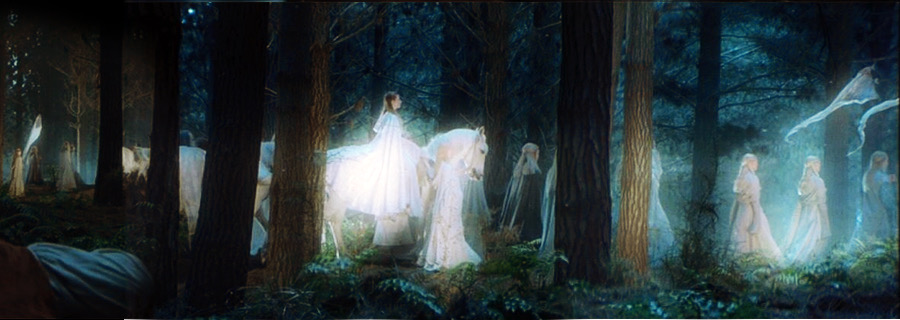
The Elves leave Middle Earth

The Hobbiton film-set on New Zealand’s North Island is one of that country’s premier tourist destinations – indeed, during the three years of the films’ successive release, a big sign at Auckland International Airport declared “Welcome to Orc Land!” The trilogy’s diverse film locations revealed to the world the exquisitely beautiful landscapes of Aotearoa.

The films’ casting prompted criticism in some quarters insofar as the elves, men and dwarves were played by predominantly white Anglo Celtic actors the dubious Hobbit films (included spook Richard Armitage, Poldark heart-throb Aiden Turner,” everyman” Benedict Cumberbatch, and angsty Scottish actor Ian Nesbitt, all shrunk-down) whilst New Zealand’s indigenous Māori portrayed the evil orcs and Uruk Hai. Nevertheless, hundreds of kiwis, Pakeha and Māori alike, were employed as extras, the scenery dazzled the world and the economy of Aotearoa, The Land of the Long White Cloud, enjoyed a Middle Earth boom.

The recent streaming in 2022 of the extravagantly expensive prequel series The Rings of Power has stirred controversies of an altogether different variety insofar as many Tolkien die-hards and purists protested the acting of actors of colour as hobbits, dwarves and, heavens for it, elves! A most peculiar paradox, you might think, given those aforementioned condemnations of JRR’s ostensible racism. It just goes to show that you can please some of the people some of the time, but you can’t please all of the people all of the time. But more on Amazon’s epic later with an excellent article from the New York Review of Books.

Arwen Evenstar

In an opinion piece in the Unheard e-zine, republished below, British historian and author Dominic Sandbrook asks whether Tolkien’s works are indeed trivial. “Surely not”, he retorts. “Even if you can’t stand them, only a fool would deny that The Lord of the Rings occupies an extraordinary place in the modern imagination … he wasn’t just a man of his time; he remains a guide for our own … And his themes might have deliberately been chosen to appeal to modern readers, anxious about the consequences of science, the environmental costs of industry, the dangers of war and the fate of the individual in the face of the vast forces reshaping Western societies in the early 21st century.

I am reminded of a piece I read recently by writer, artist and Druid Cerri Lee:

” I suddenly realized it is a profound and overwhelming sense of loss for their world and mine that I feel as the Elves sail away from the Grey Havens.  When the Elves leave they take with them the enchantment from the land, something dies in it and I am left on the shores of Middle Earth amidst a fading beauty, as they sail on into the distance. The realization that now humans will have no restraints in their actions and will push forward the rise of mechanism, commerce on a global scale, and a discarding of anything that even looks like ‘fluffy’ thinking. My Middle Earth will never be the same again and I am constantly mourning its passing through this story. It leads me to wonder if some part of that feeling is what drove Tolkien to write his story”.

To put it simply, then, Tolkien matters. How many writers can you say that about, these days?”

Tolkien and me

The Road goes ever on and on
Down from the door where it began.
Now far ahead the Road has gone,
And I must follow, if I can,
Pursuing it with eager feet,
Until it joins some larger way
Where many paths and errands meet.
And whither then? I cannot say.
Walking Song, JRR Tolkien

My own life has intersected with JRR Tolkien on many serendipitous levels.

I first encountered The Lord of the Rings in my late teens when curiosity, imagination, and various substances bought me admission to his fantasy world, along with that of his fellow Inkling CS Lewis, creator of The Chronicles of NarniaI read all three books in the trilogy over a weekend in the autumn of 1968, and when I’d finished, I felt bereft and out of sorts. I reread it soon after, and again, and again – but didn’t we all in the days when Tolkien was king, and elves and ents walked among us. I set many of the songs to music – now long forgotten – and an apposite quotation was always on hand. I recall reciting the opening lines of The Song of Durin, which prefaces this piece, as I was walking home from a concert under a full moon on the eve of the landing of Apollo 11 upon the moon in July 1969. And many times as I headed eastwards on what we now call the hippie trail, I would recall Bilbo Baggin’s Walking Song.

In subsequent years as I evolved from naïf to cynical, and thence to other passions, the rereads slowed and then stopped, although I read and enjoyed The Silmarillion, and still treasure the opening chapter describing in a manner reminiscent of the St. James Bible of how the world was created by music. I began to pick holes in The Lord of the Rings’ story linewith its derivative ‘hero’s quest’, a monomyth popularised by Joseph Campbell in his celebrated book The Hero with a Thousand Faces; what I now viewed as stereotypical characters; the outdated and anachronistic perspectives of earlier generations; and what I perceived as old-school English prejudices. But, as Sandbrook points out, Tolkien was of his times, and those times were not kind to diversity and dissent.

And yet, The Lord of the Rings is ever present in my cultural and literary consciousness, and is often referred to and quoted. Here us one of my favourites:

It is not our part to master all the tides of the world, but to do what is in us for the succour of those years wherein we are set, uprooting the evil in the fields that we know, so that those who live after may have clean earth to till. What weather they shall have is not ours to rule.” The Return of the King

I have never lost my love for the poetry and the songs that complement the narrative  – the archaic syntax, rhyme, rhythm and balladry that I’ve incorporated into my own writing. There was a wonderful lyricism and, indeed, musicality to them that I still love. It’s as if they are just waiting for a tune to accompany them. Compare Tolkien’s Song of Ëarendil with own

– the style, that is, not the subject matter:

JRR:

In panoply of ancient kings,
in chainéd rings he armoured him;
his shining shield was scored with runes
to ward all wounds and harm from him;
his bow was made of dragon-horn,
his arrows shorn of ebony;
of silver was his habergeon,
his scabbard of chalcedony;
his sword of steel was valiant,
of adamant his helmet tall,
an eagle-plume upon his crest,
upon his breast an emerald.

Me:

With massive head,
And shoulders broad,
As lean and mean as Rambeau
(That’s Sly, and not that fey French bard
This bruiser was no bimbeau!).
His hide as dark as ebony,
As tough as old mahogany,
His horns shone like chalcedony,
This massif of solidity
Was built like a Pajero.

Years passed without a revisitation, but working for a publishing company that ‘owned’ the rights to his work, I collected the latest editions and often gave them away to young people who had yet to enter the magical world of Middle Earth. For all my later cynicism, I still regarded it as a book all young people ought to read. I read the whole thing once more prior to the release of Peter Jackson’s epic trilogy. The films were excellent, although I found the hobbits increasingly irritating, wishing that they’d all jump into the fires of Mount Doom, and the ents were a disappointment, a mob of corny and badly conceived muppets (they were indeed conceived by Jim Henson, the ‘father’ of Kermit and Miss Piggy). I am looking forward to the upcoming, uber-expensive television series – but I don’t reckon I’ll reread in preparation this time around. As for Jackson’s three part Hobbit extravaganza, in my opinion, it was a travesty.

Learning more about the author, I was to discover that he’d grown up in Birmingham, my hometown, first in leafy Edgbaston (the home of Cadbury and the Warwickshire County Cricket Club), where he’d attended the prestigious King Edward’s Grammar School – my own school, Moseley Grammar, was not in its league. He lived near Sarehole Mill, in present day Hall Green, around the turn of century, between the ages four and eight, and would have seen it from his house. The locale at that time was rural Worcestershire farmland and countryside and not in the Birmingham ‘burbs. He has said that he used the mill as a location in The Lord of the Rings for the Mill at Hobbiton: “It was a kind of lost paradise … There was an old mill that really did grind corn with two millers, a great big pond with swans on it, a sandpit, a wonderful dell with flowers, a few old-fashioned village houses and, further away, a stream with another mill … “

Sarehole Mill was just down the road from my school, and our sports field and cross-country tracks were adjacent to it. On many a wintry, cold, wet and windy Wednesday afternoon, I’d stagger past it on a muddy track. How I hated wet Wednesdays; dry ones were for rugby, and I hated them too!

Tolkien died aged 81 on September 2nd, 1973, in Bournemouth, Dorset, a town that I’ve visited infrequently. But I was actually in Bournemouth on that day to meet an old friend. Perchance his spirit swept passed me. On 2nd September 2017, the Oxford Oratory, Tolkien’s Roman Catholic parish church during his time in Oxford, offered its first Mass to advocate for his beatification, the first station on the road to canonisation, as an evangelist for nature, beauty and love.  A prayer was written for his cause:

“O Blessed Trinity, we thank You for having graced the Church with John Ronald Reuel Tolkien and for allowing the poetry of Your Creation, the mystery of the Passion of Your Son, and the symphony of the Holy Spirit, to shine through him and his sub-creative imagination. Trusting fully in Your infinite mercy and in the maternal intercession of Mary, he has given us a living image of Jesus the Wisdom of God Incarnate and has shown us that holiness is the necessary measure of ordinary Christian life and is the way of achieving eternal communion with You. Grant us, by his intercession, and according to Your will, the graces we implore [….], hoping that he will soon be numbered among Your saints. Amen.”

Just imagine, Saint John Ronald Reuel of Middle Earth!

© Paul Hemphill 2022.  All rights reserved

Read also in In That Howling Infinite, Tolkien’s Tarkeeth – in the darkest depths of Mordor and Better Read than Dead – books and reading

Gandalf the White

This is Tolkien’s World

The Lord of the Rings is more than nostalgic medievalism

Dominic Sandbrook, Unheard December 10th 2021

It’s exactly 20 years since I stood in line to see a film I had dreamed about since I was a little boy. Ever since I had first turned the pages of J. R. R. Tolkien’s The Lord of the Rings, I had wondered what it would be like to see it on the big screen: the hobbits, the battles, the sweeping landscapes, the blood and thunder. When I read that the director Peter Jackson was filming a trilogy of Tolkien’s masterpiece in New Zealand, I felt almost sick with anxiety. Would it be terrible? Would they sound like the All Blacks? What were they going to do about Tom Bombadil?

I need not have worried, of course. From the moment the lights dimmed in the Odeon, Leicester Square on 10 December 2001, the Lord of the Rings films were a phenomenal success. And although poor Tom B. never made it onto the screen, Jackson’s trilogy carried all before it, grossing a staggering $3 billion and winning a record-equalling 11 Oscars for the final instalment alone.

Two decades on, the films stand up remarkably well. As for the wider Tolkien industry, the bestselling books just keep on coming: The Fall of Arthur in 2013, Beren and Luthien in 2017, The Fall of Gondolin in 2018. And next autumn sees the release of Amazon’s Lord of the Rings prequel series – at a cool $1 billion over five seasons, the most expensive television project in history. Not bad for a writer who’s been dead since 1973.

To some people, all this could hardly be more infuriating. For as we all know, Tolkien is still associated in the public mind with a sweaty, furtive gang of misfits and weirdos — by which I mean those critics who, for more than half a century, have been sneering at his books and their readers.

As far back as the mid-Fifties, the American modernist Edmund Wilson published a comically wrong-headed review dismissing Tolkien’s work as “juvenile trash”, marked by — of all things! — an “impotence of imagination”. Decades later, Philip Pullman, never happier than when sneering at his Oxford forebears, called Tolkien’s efforts “trivial”, and “not worth arguing with”. And whenever some new survey crowns The Lord of the Rings as the public’s favourite novel, the reaction is always the same.

“Another black day for British culture” was Howard Jacobson’s verdict after a Waterstones poll put Tolkien’s work well clear at the top. “Ever since I arrived at Cambridge as a student in 1964,” agreed Germaine Greer, “it has been my nightmare that Tolkien would turn out to be the most influential writer of the 20th century. The bad dream has been realised.” Yet by her own admission, she had never even read him.

So are Tolkien’s works “trivial”, as Pullman claims? Surely not. Even if you can’t stand them, only a fool would deny that The Lord of the Rings occupies an extraordinary place in the modern imagination. Indeed, in his trenchant defence of Tolkien’s reputation, the literary scholar Tom Shippey suggests that much of the criticism is rooted in pure social and intellectual condescension, not unlike the rank snobbery that Virginia Woolf directed at Tolkien’s fellow Midlander Arnold Bennett. Shippey even argues that in the future, literary historians will rank The Lord of the Rings alongside post-war classics such as Nineteen Eighty-FourLord of the Flies and Slaughterhouse-Five. Who’s to say he’s wrong?

One reason highbrow people dislike The Lord of the Rings is that it is so backward-looking. But it could never have been otherwise. For good personal reasons, Tolkien was a fundamentally backward-looking person. He was born to English parents in the Orange Free State in 1892, but was taken back to the village of Sarehole, north Worcestershire, by his mother when he was three. His father was meant to join them later, but was killed by rheumatic fever before he boarded ship.

For a time, the fatherless Tolkien enjoyed a happy childhood, devouring children’s classics and exploring the local countryside. But in 1904 his mother died of diabetes, leaving the 12-year-old an orphan. Now he and his brother went to live with an aunt in Edgbaston, near what is now Birmingham’s Five Ways roundabout. In effect, he had moved from the city’s rural fringes to its industrial heart: when he looked out of the window, he saw not trees and hills, but “almost unbroken rooftops with the factory chimneys beyond”. No wonder that from the moment he put pen to paper, his fiction was dominated by a heartfelt nostalgia.

Nostalgia was in the air anyway in the 1890s and 1900s, part of a wider reaction against industrial, urban, capitalist modernity. As a boy, Tolkien was addicted to the imperial adventure stories of H. Rider Haggard, and it’s easy to see The Lord of the Rings as a belated Boy’s Own adventure. An even bigger influence, though, was that Victorian one-man industry, William Morris, inspiration for generations of wallpaper salesmen. Tolkien first read him at King Edward’s, the Birmingham boys’ school that had previously educated Morris’s friend Edward Burne-Jones. And what Tolkien and his friends adored in Morris was the same thing you see in Burne-Jones’s paintings: a fantasy of a lost medieval paradise, a world of chivalry and romance that threw the harsh realities of industrial Britain into stark relief.

It was through Morris that Tolkien first encountered the Icelandic sagas, which the Victorian textile-fancier had adapted into an epic poem in 1876. And while other boys grew out of their obsession with the legends of the North, Tolkien’s fascination only deepened. After going up to Oxford in 1911, he began writing his own version of the Finnish national epic, the Kalevala. When his college, Exeter, awarded him a prize, he spent the money on a pile of Morris books, such as the proto-fantasy novel The House of the Wolfings and his translation of the Icelandic Volsunga Saga. And for the rest of his life, Tolkien wrote in a style heavily influenced by Morris, deliberately imitating the vocabulary and rhythms of the medieval epic.

But there’s more to Tolkien than nostalgic medievalism. The Lord of the Rings is a war book, stamped with an experience of suffering that his modern-day critics can scarcely imagine. In his splendid book Tolkien and the Great War, John Garth opens with a rugby match between the Old Edwardians and the school’s first fifteen, played in December 1913. Tolkien captained the old boys’ team that day. Within five years, four of his teammates had been killed and four more badly wounded. The sense of loss haunted him for the rest of his life. “To be caught in youth by 1914 was no less hideous an experience than to be involved in 1939 and the following years,” he wrote in the second edition of The Lord of the Rings. “By 1918, all but one of my close friends were dead.”

Tolkien arrived on the Western Front in June 1916 as a signals officer in the 11th Lancashire Fusiliers, and experienced the agony of the Somme at first hand. In just three and a half months, his battalion lost 600 men. Yet it was now, amid the horror of the trenches, that he began work on his great cycle of Middle-earth stories. As he later told his son Christopher, his first stories were written “in grimy canteens, at lectures in cold fogs, in huts full of blasphemy and smut, or by candlelight in bell-tents, even some down in dugouts under shell fire”.

But he never saw his work as pure escapism. Quite the opposite. He had begun writing, he explained, “to express [my] feeling about good, evil, fair, foul in some way: to rationalise it, and prevent it just festering”. More than ever, he believed that myth and fantasy offered the only salvation from the corruption of industrial society. And far from shaking his faith, the slaughter on the Somme only strengthened his belief that to make sense of this broken, bleeding world, he must look back to the great legends of the North.

Yet The Lord of the Rings is not just a war book. There’s yet another layer, because it’s also very clearly an anti-modern, anti-industrial book, shaped by Tolkien’s memories of Edwardian Birmingham, with its forges, factories and chimneys. As a disciple of the Victorian medievalists, he was always bound to loathe modern industry, since opposition to the machine age came as part of the package. But his antipathy to all things mechanical was all the more intense because he identified them — understandably enough — with killing.

And although Tolkien objected when reviewers drew parallels between the events of The Lord of the Rings and the course of the Second World War, he often did the same himself. Again and again he told his son Christopher that by embracing industrialised warfare, the Allies had chosen the path of evil. “We are attempting to conquer Sauron with the Ring,” he wrote in May 1944. “But the penalty is, as you will know, to breed new Saurons, and slowly turn Men and Elves into Orcs.” Even as the end of the war approached, Tolkien’s mood remained bleak. This, he wrote sadly, had been, “the first War of the Machines … leaving, alas, everyone the poorer, many bereaved or maimed and millions dead, and only one thing triumphant: the Machines”.

Dominic Sandbrookis an author, historian and UnHerd columnist. His latest book is: Who Dares Wins: Britain, 1979-1982

Austin Gilkeson, New York Review of Books, January 24, 2023
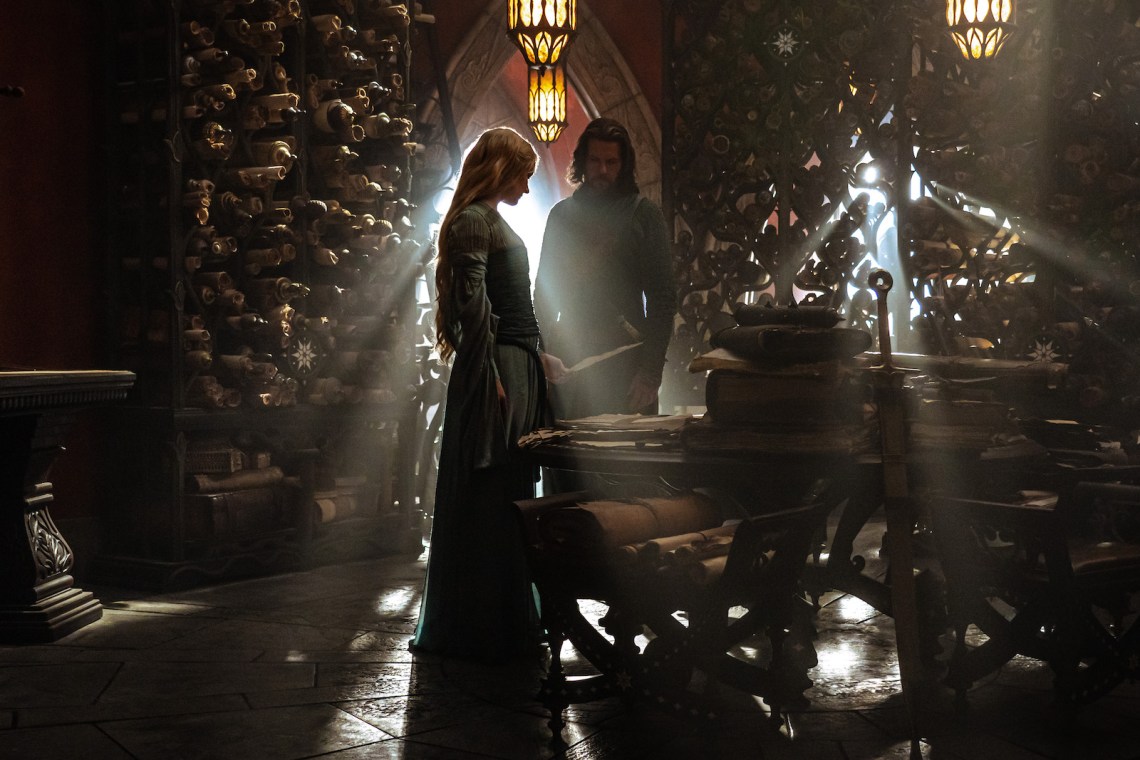
Galadriel (Morfydd Clark) and Elendil (Lloyd Owen) in the archive of the Hall of Law in Númenor,  The Lord of the Rings: The Rings of Power, 2022

One September day in 1914, a young J.R.R. Tolkien, in his final undergraduate year at Oxford, came across an Old English advent poem called “Christ A.” Part of it reads, “Éalá Éarendel engla beorhtast/ofer middangeard monnum sended,” which he later rendered: “Hail Éarendel, brightest of angels/above the middle-earth sent unto men!” Safe in his aunt’s house in Nottinghamshire while battles raged on the continent, Tolkien took inspiration from this ode to the morning and evening star and wrote his own poem in modern English, “Éarendel the Mariner.” That poem was not published in his lifetime, but after it came the stories that would become The Silmarillion, The Hobbit, and The Lord of the Rings, which in turn inspired, to varying degrees, Earthsea, Star Wars, Dungeons & Dragons, Harry Potter, The Wheel of Time, The Witcher, Game of Thrones, and so on, an apostolic succession of fantasy.

The latest in the line is The Lord of the Rings: The Rings of Power. Amazon Studios does not have the rights to The Silmarillion, the posthumous collection of Tolkien’s mythology that serves as a sort of bible for Middle-earth, nor is it adapting The Lord of the Rings, Tolkien’s 1954 novel about the hobbit Frodo’s quest to save Middle-earth by destroying the One Ring, which holds the power of the Dark Lord Sauron. Peter Jackson’s film trilogy still looms too large. Instead, the showrunners, J.D. Payne and Patrick McKay, have crafted a prequel, set thousands of years before the events of the three-volume novel and drawn from bits of lore in its prologue, “Concerning Hobbits,” and extensive appendices on Middle-earth history and culture. It’s an undertaking not dissimilar from Tolkien’s own reworking of “Christ A,” spinning out a narrative from a few textual scraps—the kind of academic exercise an Oxford professor of Old English could appreciate.

It’s a pity the show doesn’t extend the same scholarly pleasures to its viewers. Its narrative conceits are those of big-budget TV: the so-called mystery boxes popularized by shows like Lost. What is the sigil that the elf warrior Galadriel (Morfydd Clark) finds carved in her dead brother’s flesh? Who is the stranger (Daniel Weyman) who falls from the sky and ends up living among a nomadic clan of proto-hobbits? Which character is really Sauron? Will the mortal Bronwyn (Nazanin Boniadi) and the elf Arondir (Ismael Cruz Córdova) kiss? The show hurries along toward the inevitable revelations: the sigil turns out to be a map of Sauron’s realm of Mordor; the magical stranger is almost certainly the wizard Gandalf; Sauron himself is the roguish drifter Halbrand (Charlie Vickers), who has a Forrest Gump–like ability to accidentally be in the right place at the right time. Beyond a few delightful glimpses of ancient hobbit culture, there is little sense of a deep past that can be excavated through careful reading.

This is partly a problem of translation. Contemporary television drives its narratives with its characters, by their arcs and inner conflicts. Tolkien’s characters remain largely static; it’s the world around them that changes. The concerns of the novel are civilizational rather than individual. What Aragorn thinks or wants in his personal life matters far less than the fact that he is descended from kings of Arnor, and before it Númenor and Beleriand. His fitness for the throne of Gondor is never in doubt, neither to himself nor to the reader. He’s simply the last pebble in a royal landslide that has been slowly rolling over Middle-earth for millennia.

The reader encounters this history in ruins and snippets of legendary songs. Galadriel speaks of her wanderings before the fall of the kingdoms of Nargothrond and Gondolin. Treebeard, an ancient tree-like creature, reminisces about long-lost forests and departed Entwives. Merry, whose hobbit-memory is not as long, wonders at the strange, weather-worn statues that line the path to Dunharrow in Rohan. Even the earthy Samwise sings about the death of the elf-king Gil-galad (played by Benjamin Walker in The Rings of Power). The songs, in particular, may seem like digressions or page-fillers, especially those sung in fictional languages, but they also provide a sense of Middle-earth’s cultures and history, stretching back into “the deeps of time.” The effect is like Tolkien’s description of the mines of Moria, where, “in the pale ray” of Gandalf’s illuminated staff, Frodo sees “glimpses of stairs and arches, and of other passages and tunnels, sloping up, or running steeply down, or opening blankly dark on either side. It was bewildering beyond hope of remembering.”
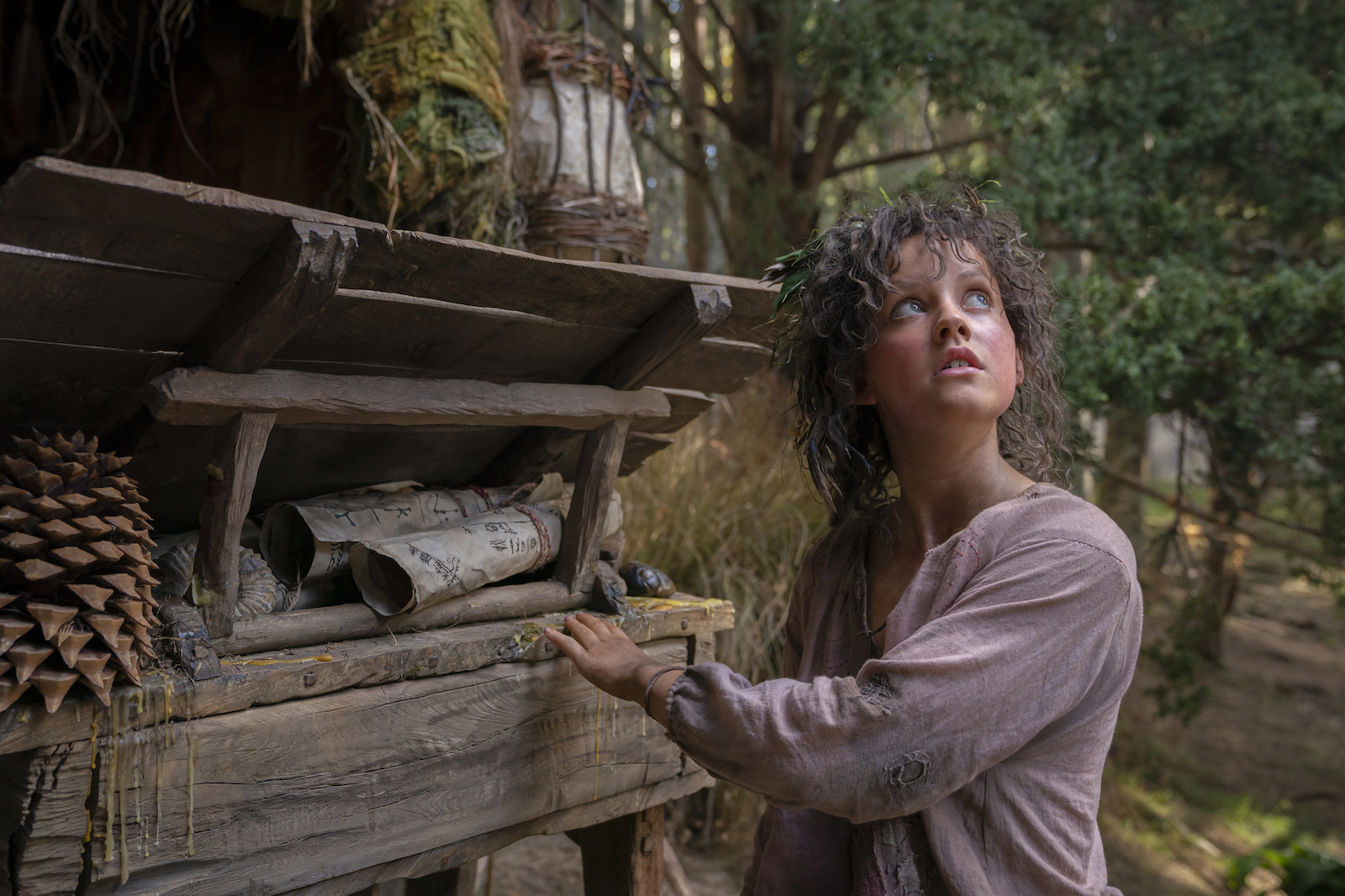
Nori Brandyfoot (Markella Kavenagh) in The Lord of the Rings: The Rings of Power, 2022

The novel evokes a wanderlust to go back and take those untrodden paths, but since its world exists only on paper all further discovery must be textual. In other words, it requires research. Payne and McKay understand the academic aspect of Tolkien’s work. Twice during the season, Galadriel goes to archives (one in the mortal kingdom of Númenor, another in the Elven Eregion) in search of the truth about Sauron. But there will be no flipping through card catalogs or paging through dusty tomes for our heroine—she has orcs to eviscerate. Galadriel has librarians pull the scrolls for her. Like the show itself, she’s afraid to sit still.

Tolkien’s books feature plenty of battles, but they also reflect the joys and pains of academic work. The Lord of the Rings is a novel “in which the scholarly rituals [are] observed; in which you flipped from index to text to appendix, cross-referring to maps,” as Jenny Turner wrote in 2001 in the London Review of Books. The book becomes, in her words, “a machine for the evocation of scholarly frisson. The thrills are the thrills of knowledge hidden, knowledge uncovered, knowledge that slips away.” Tolkien’s wizards are scholars first and sorcerers second. They each have areas of expertise and are renowned for their wisdom. And unlike Amazon’s Galadriel, they do their own research. Gandalf seeks out the history of the One Ring in the “hoards” of Gondor’s archives (a scene Jackson wisely kept in The Fellowship of the Ring, having Ian McKellen smoking a pipe and shuffling through piles of musty pages), while the arrogant Saruman turns traitor to the forces of good after delving too deep into the archives in an attempt to learn “the arts of the Enemy.” Tolkien’s greatest paean to academic pleasure is in the sprawling elf haven Rivendell, run by the “lore-master” Elrond and hidden in an alpine valley, which in The Silmarillion is described as “a refuge for the weary and the oppressed, and a treasury of good counsel and wise lore.” In Tolkien, refuge and research are bound together.

Tolkien’s brief respite at his aunt’s house, where he wrote “Éarendel the Mariner,” could not last. He belonged to what Angela Carter later described as “that generation for whom history [had] already prepared a special, exemplary fate in the trenches of France,” and soon he was on his way to the front. He fought at the Somme, a battle in which nearly 20,000 British soldiers, including one of his closest friends, were killed on the first day. He got lucky: he soon contracted trench fever in the lice-infested dugouts and was sent home to recuperate.

The Somme haunts Middle-earth, which is pocked with broken and drowned lands. “This is Mordor,” Frodo remarks on the ruins of his beloved home Bag-End when he returns to a scarred, occupied Shire at the end of The Lord of the Rings. After the war, Tolkien transformed Éarendel the Mariner from a celestial sailor into a warden on eternal watch, sailing over the Walls of Night to guard against the return of Morgoth, the Great Enemy, from out of the Void. The Rings of Power alludes to these wartime experiences. Early in the first episode, Galadriel wanders a devastated battlefield reminiscent of the Western Front. “We learned many words for death,” she says, and the show takes pains to demonstrate some of them in detail: stabbings, hackings, slashings, burnings, and decapitations. This is the visual language of contemporary prestige fantasy shows like Game of Thrones. Galadriel dispatches a snow-troll with John Wick–like elan—a far cry from the more measured violence of the novel, in which the soldier Faramir tells Frodo, after a battle against Sauron’s forces in his homeland of Gondor, “I do not love the bright sword for its sharpness, nor the arrow for its swiftness, nor the warrior for his glory. I love only that which they defend.”
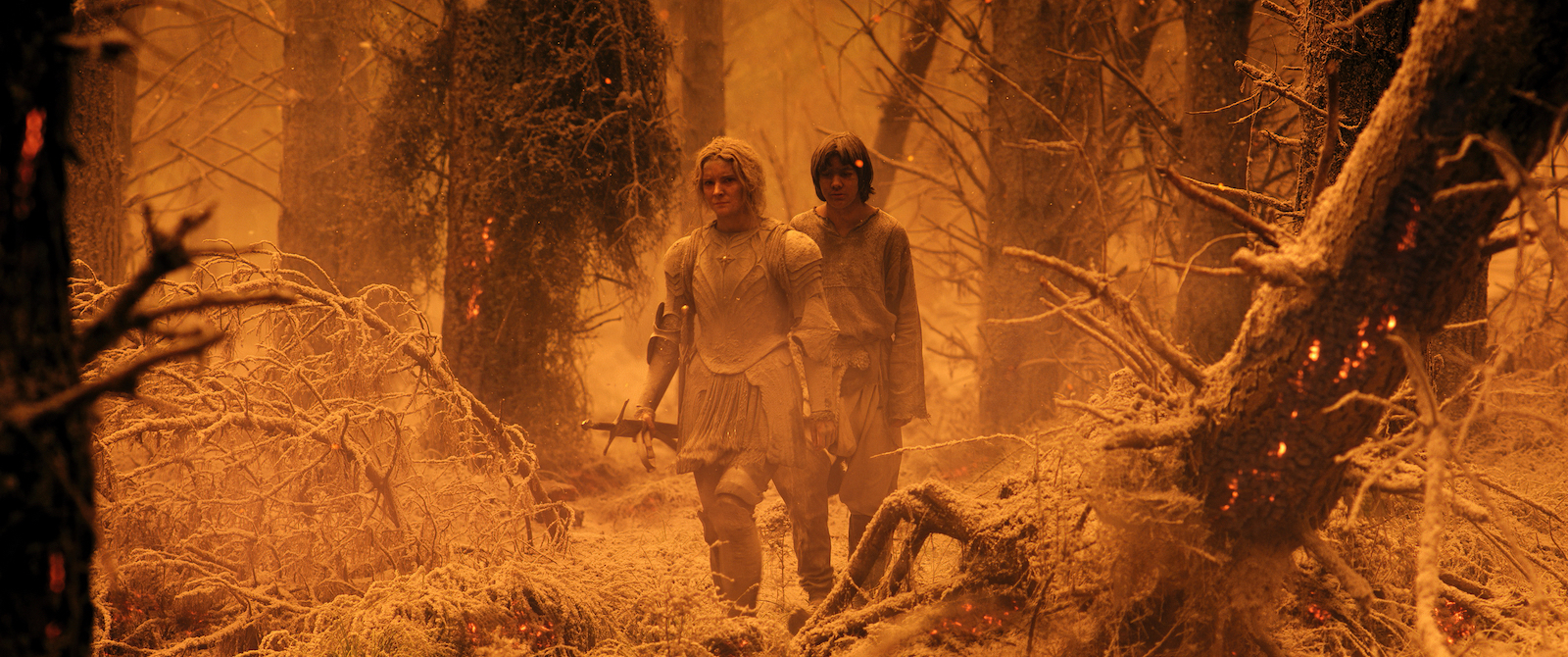
Galadriel and Theo (Tyroe Muhafidin) in The Lord of the Rings: The Rings of Power, 2022

After the war Tolkien returned to academic work, first at the Oxford English Dictionary as a researcher and then as a professor at Leeds and Oxford. Besides enthralling some students, like W.H. Auden, and boring others, like Kingsley Amis, with his lectures on Old English, he translated Sir Gawain and the Green Knight and other Middle English texts. His greatest contribution to scholarship remains his 1936 lecture “Beowulf: The Monsters and the Critics,” which recast the Old English saga as a work of art rather than a historical document that served only as “a quarry of fact and fancy.”

To ennoble history and legend was also part of Tolkien’s fictional project: his books are stuffed with allusions to Old English texts. Bilbo’s burglary of Smaug’s hoard in The Hobbit mirrors a scene in Beowulf. Aragorn quotes a poem from Rohan that echoes the elegy “The Wanderer.” Elrond’s father is none other than Eärendil the Mariner. They also provide their own store of fictional lore. You can stop reading The Lord of the Rings when Samwise says, “Well, I’m back” by his hearth, or you can keep going, depending on how much you want to know about various elvish scripts and runes, or the differences between the calendars used in the Shire and the ones used in Númenor, or the fact that Merry Brandybuck’s actual name, in one of Tolkien’s invented languages, is “Kalimac Brandagamba.” “By the time the reader has finished the trilogy, including the appendices,” Auden wrote, “he knows as much about Tolkien’s Middle-earth, its landscape, its fauna and flora, its peoples, their languages, their history, their cultural habits, as, outside his special field, he knows about the actual world.”

This lore is essential to the structure and ultimate pleasure of the novel. Tolkien’s great theme is loss, the “inevitable overthrow in Time,” as he put it in his Beowulf lecture, fated for all cultures and civilizations. The reader can hardly be expected to feel that loss without some sense of its width and depth. Even the most casual reader can feel, as Frodo does in Galadriel’s forest of Lothlórien, that she has “stepped over a bridge of time…and was now walking in a world that was no more.”

*

The appendices are only the first step out the door. In the years after Tolkien’s death, in 1973, his son Christopher compiled, edited, and published a huge quantity of his father’s writing, starting with The Silmarillion in 1977 and later the twelve-volume History of Middle-earth. These books are labors of love. Much of what Tolkien left behind was disorganized and incongruent. He frequently switched characters’ names, rewrote and then left unfinished parts of stories and poems that contradicted what he’d written before, and changed his mind about such fundamental concepts as the origin of orcs, the nature of the sun and moon, and even the shape of the earth. Out of the drafts and notes, Christopher could have created any number of Silmarillions.

Tolkien’s original aim in his fiction was to craft a “a body of more or less connected legend…which I could dedicate simply to: to England; to my country,” which he felt lacked one beyond, as he wrote in a 1951 letter, “impoverished chap-book stuff.” This mythology would not be a political project like Virgil’s Aeneid, which tied Rome’s foundation to ancient Greek civilization, but an artistic attempt to capture “the tone and quality I desired, somewhat cool and clear…redolent of our ‘air.’” It was a particular and old air. The Englands of Dickens, Austen, Fielding, Milton, or even Chaucer are nowhere to be found. Instead, Tolkien’s is the England of the anonymous poets who wrote Beowulf and Pearl, largely bygone even by the time the English language settled into a familiar form, swamped by the Norman Conquests, great vowel shifts, gunpowder, and paper. There was no returning to that England, Tolkien knew, just as his characters could never return to the drowned lands of Beleriand and Númenor. “As the poet looks back into the past,” he wrote of Beowulf, “surveying the history of kings and warriors in the old traditions, he sees that all glory (or as we might say ‘culture’ and ‘civilization’) ends in night.” His project was to delay that night while he could—to preserve, not restore, what he felt was that older country’s “elusive beauty.”
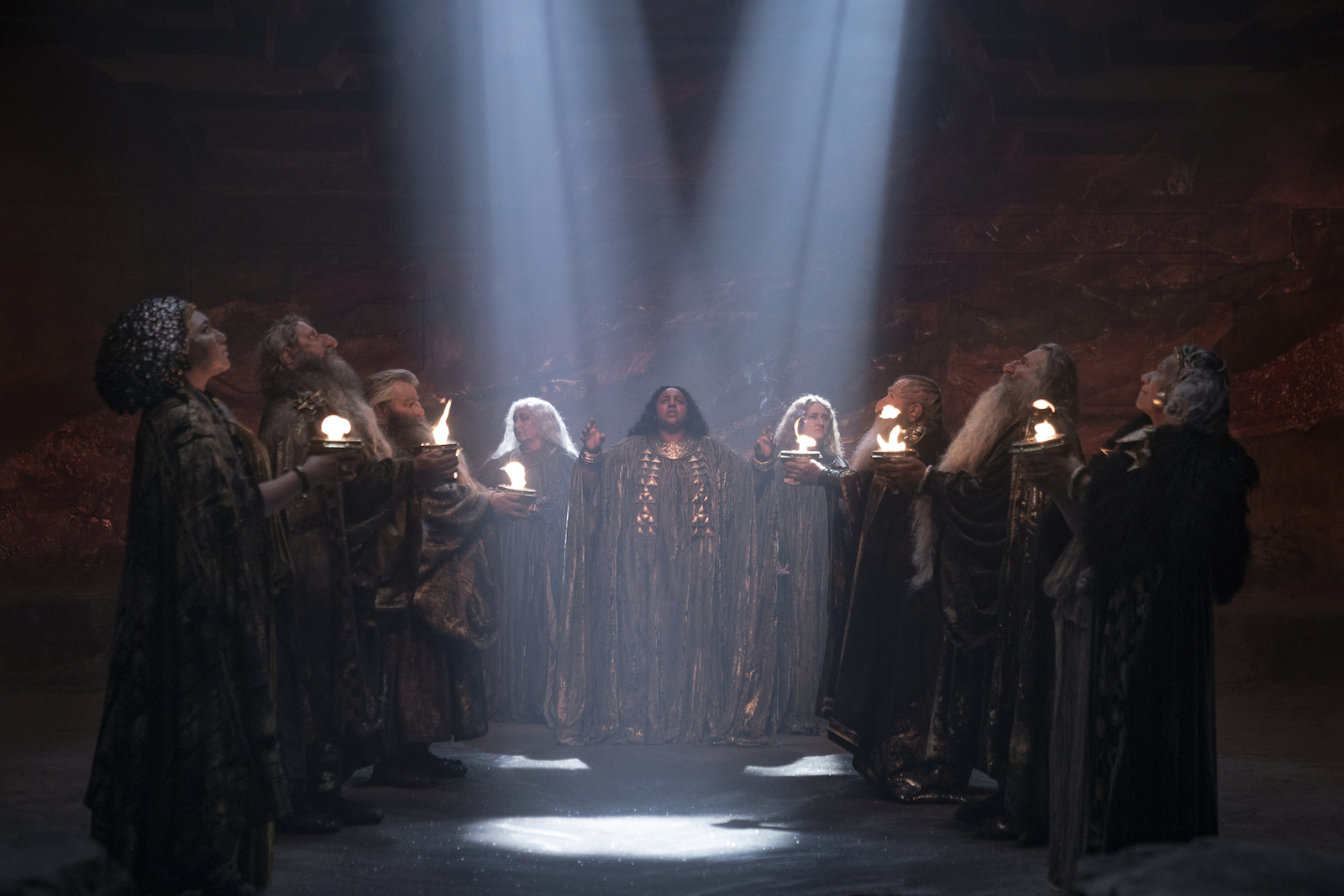
Princess Disa (Sophia Nomvete) singing a funerary song in TThe Rings of Power

In the course of a few decades Tolkien achieved, quite by accident, what the Old English scribes, singers, and poets had taken centuries to create: a large, confused, and contradictory body of myths and legends. The mythology is unstable, snapping into whatever form one happens to be reading. Far from being frustrating, this has allowed for nearly endless exploration and debate: academic Tolkien journals, conferences, and societies—not to mention fan fiction, up to and including The Rings of Power—have sprouted around the world.

Amazon wants its own mythology, but for the same reason that Disney purchased Marvel and revived Star Wars and HBO spun off Game of Thronesinto House of the Dragon: there’s money to be made. However good their intentions, the showrunners’ ultimate task is to mine Tolkien’s works in order to create and expand the franchise. Tolkien’s “machine for the evocation of scholarly frisson” has been turned into an assembly line. The goal is to keep the machine running for as long as it is profitable, with no natural end in sight.

The Rings of Power does add its own bit of lore. In the fifth episode, Elrond (Robert Aramayo) recounts the legend of “The Roots of Hithaeglir,” according to which a lightning-struck tree creates the ore mithril, a powerful metal used in weapons and armor like the mail-shirt Frodo wears. Elrond calls the story “apocryphal,” a nod to the fact that it was invented whole-cloth for the show. It’s one of the writers’ attempts to tie various parts of Tolkien’s unwieldy legendarium together, in the same way that the show has Galadriel share a sea-tossed raft with Sauron and witness the creation of Mordor. Mithril, it is explained, is suffused with the light of a Silmaril, a holy jewel that can prevent the downfall of the Elves, who are otherwise due to suddenly “fade” in a matter of months (the show never tells us why or how).

This is an imperative of the contemporary franchise: everything must be connected somehow in an endless feedback loop (or ring). This is usually achieved through “fan service,” knowing winks and nods to characters and events the audience already knows, but an overreliance on such references seals the worlds off, and the air in them soon turns stale. There is no room for the organic happenstance of real life, for the inexplicable and strange, like Tolkien’s immortal weirdos Tom Bombadil and Goldberry, who were jettisoned from Jackson’s adaptation.

The show’s conceit about mithril also misunderstands the elegiac character of Tolkien’s novel. In the final episode, the elves create three rings—“Three Rings for the Elven kings under the sky,” in Tolkien’s lore—from mithril to stop the cataclysmic fading of their race (a fate clumsily literalized by diseased leaves falling from a magic tree). The Rings provide a convenient cure to the season’s contrived crisis, whereas in the book they were created, in Elrond’s words, for “understanding, making, and healing, to preserve all things unstained.” The tragedy is that the destruction of the One Ring, the only act that can save Middle-earth, will also mean the destruction of the Three, and “many fair things will fade and be forgotten.” The elves, like their creator did, understand that dwindling is inevitable. They just want to slow it and enjoy their works while they can, before they become, as Frodo thinks of Galadriel, “present and yet remote, a living vision of that which has already been left far behind by the flowing streams of Time.”

That was that was year that was – It’s like déjà vu all over again

The best thing one can say about 2021 is that it is not 2020.  i guess we’ll all be glad when twenty one is done.

There were no bushfires to entertain us like last year, but the pandemic hung like a dark cloud over our everyday lives. In this, the second year of the pandemic, economies continue to struggle, livelihoods continue threatened or destroyed, many borders remain closed, and cities, towns and homes  continue to be locked-down and isolated, and restrictions and precautions are ever-present.

There’s a sense that time has stood still, as if nothing much has really happened since the pandemic struck and that we’ve been treading water, awaiting wake if not rescue, them at least, release.

Things have changed, of course. The affairs of gods and men carry on above it all. But in our personal lives, there have been changes too – our behaviour and the nature of our interactions with others and the outside world, have indeed changed utterly. And our outlook on life, the universe and everything has changed too.

Most of all, we’re all feeling tired. Burnt out. Disengaged. Cynical.

I noticed it during the recent local government election when otherwise astute and active folk could not summon up the energy and interest to involve themselves with the issues at stake. The elections had been cancelled twice due to COVID19, and many had just lost interest. “When is the election again?” they’d ask apathetically.

A year ago almost to the day, we wrote in our our review of 2020, A year of living dangerously: “Time during 2020 has been elastic and confused. On 21st December, The Guardian asked readers to sum up how they felt about 2020 in one word – and likewise their feelings for 2021. As of Xmas Eve, the standout words were respectively (a) shit, fucked and challenging and (b) hopeful and better. My poll responses were “fascinating” and “unpredictable”.

And a year hence, I would give much  the same response. Compared to other folk here in Australia and overseas, we’ve had a “good” Covid – if that indeed is the most appropriate descriptor. We don’t have to earn a living and we live on a beautiful rural acreage that is totally stand-alone and off-grid – there couldn’t be a more congenial spot to self-isolate. But we’d love to be able to escape the padded cell – to exit the Australian bubble for a while, to visit friends and relatives in England and to reconnect with the history and geography that we love in the world outside. Perhaps in 2022, we’ll have that opportunity.

The title of this review is borrowed from the famous American baseball coach Yogi Berra. As we leave 2021, here’s another:

“Predictions are always very hard, especially when they’re about the future”

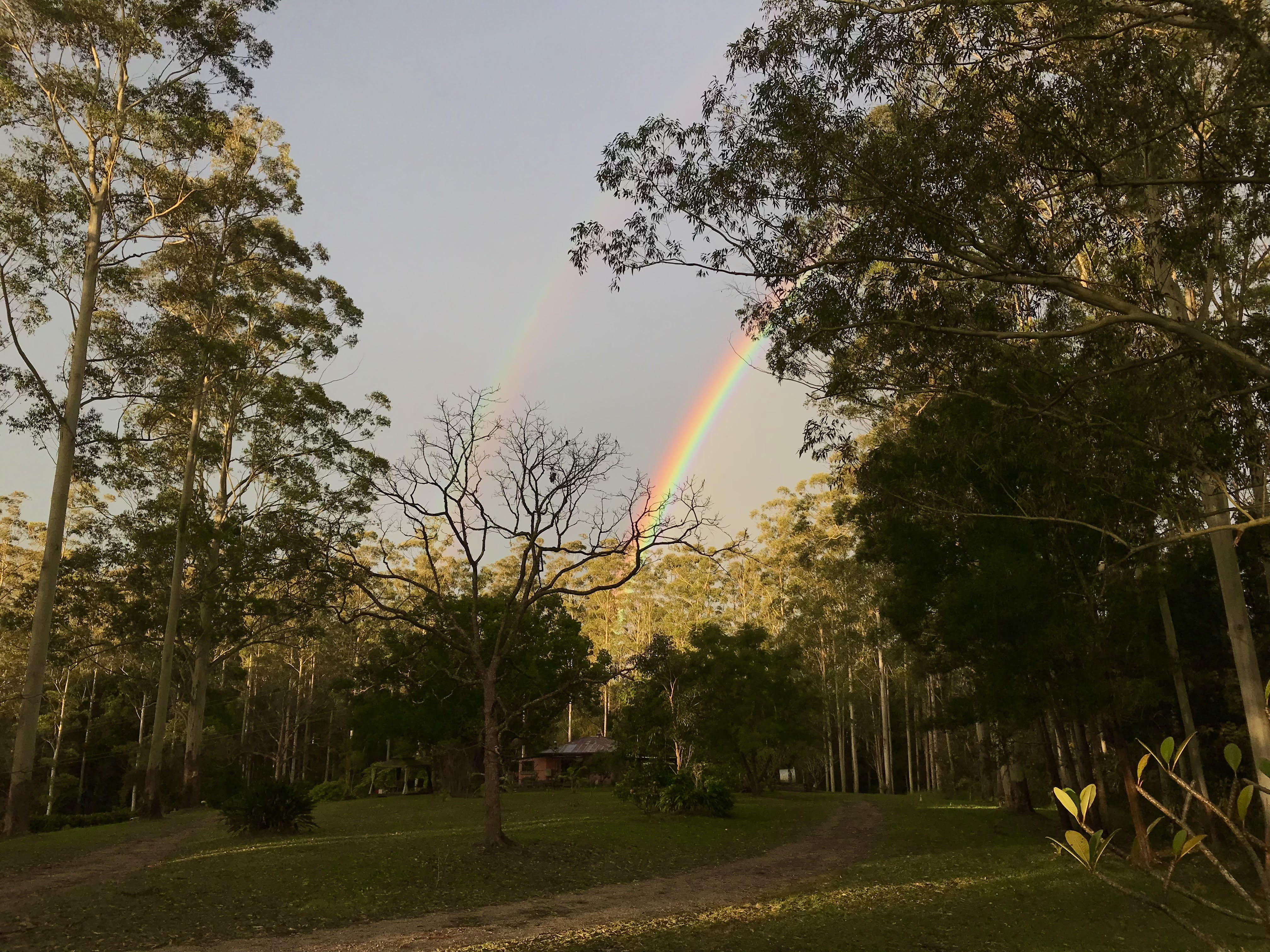
She’s a Rainbow
Paradise Park Fernmount

The World in review

It was for us personally the saddest of years. Our close friend, neighbour and forest warrior, Annette, departed our planet mid-year after what seemed like short, aggressive illness – although in retrospect, we know that it was a slow train coming for a long while. I wrote Farewell to a Tarkeeth Tiger in tribute to her. And in September, our beautiful, talented, wise friend and soul sister Krishna Sundari.

As for the world at large, COVID19 continues to dominate the news, with more contagious variants popping up all over the place lake a game of “whack a mole”. As does the ongoing struggle to reach global consensus on the need to confront climate change. Tackling both looks a little like the story of Sisyphus, the Greek King of old who was condemned by Zeus to spend eternity rolling a huge boulder to the top of a hill only to have it roll back down as soon as he reached the top.

The year kicked off to a fine start with the January 6th Insurrection in Washington DC as Donald Trump endeavoured to cling on to office by inciting his supporters and sundry militias to storm the Capitol to stop the count of electoral votes that would cede the presidency to Joe Biden. Though he failed, and was impeached

for a second time, and the Biden administration sought to calm America’s troubled waters, the Orange One haunts The US’ fractious and paralyzed politics and the prospect of a second Trump term is not beyond imagination.

Trump’s bestie, Benjamin Netanyahu, Israel’s longest serving Prime’s minister, also got the push in the wake of the third election in just over a year. The unique coalition that emerged from torturous negotiations spanned the political, social and religious spectrum – left and right, secular and orthodox, Arab and Jew, and promised little more than maintaining the unsatisfactory status quo, that pertaining to the occupation and the settlements, illegal migrants, and the disproportionate influence the Haredim, none of which are morally, politically, socially or economically sustainable.

China under would-be emperor Xi Jinping continues to aggressively build its military and economic power, determined to take its rightful and long overdue place at the top of the geopolitical ladder, causing consternation among its neighbours and also other powers and fears of war in our time. With Xinjiang’s Uighurs and Hong Kong firmly under its autocratic boot, it continues to expand its nautical footprint in the South China Sea and signals loudly that Taiwan’s days as a liberal democracy are numbered. Its belligerency is increasingly meeting blow-back as other nations react in various ways to what they perceive as clear and present danger. What happens next is anybody’s guess.

Russia under would-be czar Vladimir Putin continues to aggressively rebuild its military power and influence, determined to revive the glory days of the defunct Soviet Union, whist channeling memories of its former imperial glory. Whilst in no way as powerful as China, it is taking advantage of the the world’s preoccupation with the ascendancy of the Celestial Kingdom Redux to reassert its influence in its own backyard – including the veiled threat to reconquer Ukraine – and also in the world, particularly in Syria and through the use of shadowy proxies and mercenaries, in Africa. What happens next is anybody’s guess.

Turkey under would-be Sultan Recep Tayyip Erdogan continues to aggressively pull its self away from the west and towards some concept of a leadership role in the Muslim world.Its economy, meanwhile, is in free-fall, with unemployment and food prices rising and the lira tanking. At the heart of the problem is Erdogan’s attempt to take a sophisticated globalized economy and run it as an emirate does, replacing state institutions with personalized rule. You cannot run a sophisticated, modern economy on conspiracy theories and doctrines from the 7th century. But President Erdogan, having rigged the electoral system and cornered the religious and nationalist vote, and with no rivals in sight, isn’t gong anywhere soon.

America finally ended its “endless war” in Afghanistan, in a chaotic, deadly scramble that left that country’s forever unfortunate people in the hands of a resurgent and apparently unreformed and unrepentant Taliban. It’s over a 100 days since the last evacuation plane took off in scenes of chaos and misery, leaving behind thousands of employees and others at risk of retribution, and the new regime has yet to establish a working government. Meanwhile professionals, human rights workers, officials of the former regime, members if the old government’s security forces, and especially women and girls wait, many in hiding, for the worst. Meanwhile, winter is coming and the country is broke and on the brink of of starvation. A major humanitarian crisis is imminent. What happens next, everybody does indeed know. As St. Leonard said, “We have seen the future and it’s murder!”

Whilst the war in Afghanistan ended, there are still plenty to go around for the weapons manufacturers and arms dealers, the mercenaries and the proxies. The year began well for Azerbaijan when it emerged victorious from a vicious 44 day drone and missile war against Armenia for control of the Nagorno-Karabakh enclave that saw Turkish and Syrian proxies engaged each side of the conflict. An old War was rekindled in Ethiopia as a Nobel Peace Prize winner sent his troops to rake pillage and conquer a fractious province which turned the tables and is now poses to seize his capital. Hubris extremis? Meanwhile, war went on in the usual places – Syria, Libya, Yemen, Mali, the Central African Republic, and places too obscure to mention.

Meanwhile, back home DownUnder, the story that dominated political news – apart from COVID19 and the shmozzle of the vaccine roll-out, was the delinquent behaviour of politicians and their staffers in Parliament House – commentators have likened the goings-on in there to a school yard or frat house, and more bluntly, to a Roman orgy, with tales of bullying and sexual harassment, drunken parties, mutual masturbation sessions, and even rape. The prime minister huffed and puffed and asked his wife how he should deal with the situation; commissions of inquiries were set up; and reports handed down. The motto is “we must do better – and we shall!” But as with most things these days, nobody believes what politicians say anymore.

And not just here in Australia, but all over the world. Trust is in short supply, and indeed, people’s faith in democratic traditions and processes is shaking as populism and a taste for autocracy spreads like … well, a coronavirus. The US was recently named a “backsliding democracy” by a Swedish based think-tank, an assessment based on the attempted Capitol coup and restrictions on voting rights in Red states. In the bizarro conspiracy universe, American right-wing commentators and rabble-rousers are urging their freedom-loving myrmidons to rescue Australia from totalitarianism. Apparently we have established covid concentration camps and are forcible vaccinating indigenous people.

In early December, US President Joe Biden held a summit for democracy, and yet his administration are still determined to bring Julian Assange to trial, a case that, if it succeeds, will limit freedom of speech. The conduct of the trial also poses a threat to the US’s reputation because it could refocus attention on the ugly incidents during the US wars in Iraq and Afghanistan that were exposed by WikiLeaks. There is a strong humanitarian and pragmatic case to look for a way out of Assange’s Kafkaesque nightmare, but the bastions of freedom, America, Britain and Australia show no interest in doing so notwithstanding the harm it does to their democratic credentials.

I chose these invigorating times to stand as a Labor candidate for Bellingen Shire Council in those elections I referred to at the beginning of this review. What we thought would be a short, sharp two month campaign extended to an exhausting five month slog as the Delta variant necessitated delaying the elections for a second time.

Few in the Shire can remember the last time Labor candidate stood for council, so we began with a very low public recognition, but we ran a good, honest campaign and raised our profile.

But alas, we were outgunned, outspent and outnumbered by the well-funded, professionally organised chamber of commerce independents coordinated, advised and directed by the National Party, who played to a disengaged and cynical electorate by gas-lighting us with the claim that we were “infiltrators” from mainstream political parties, bankrolled by big party money, and dictated to by Macquarie Street (the NSW Parliament), and thence, with no entitlement to represent the Shire – even though we were long-standing residents well-known in the community. Progressives on council are now but two against five, and the Nationals have reclaimed the Shire for business, development and traditional values. Back to the future. There will be buyer’s remorse for many ho voted for them without checking their credentials. And meanwhile, I’m quite happy not to have to sit in the council chamber with a bunch of neo-Thatcherites.

And finally, on a bright note, in the arts world, there was Taylor Swift. Fresh from her Grammy award for the sublime Folklore, she released her re-recorded version of her copyright-purloined album Red. How can anyone improve on the fabulous original?  Swift does! It’s brighter, shinier, sharper, bigger, beatier and bouncier (I stole the last alliterations from the Who album of yonks ago), and her mature voice is a pleasure. Released just over nine years ago, when she was 22, it feels as fresh today, and for all the gossip and innuendo that surrounded its conception and reception and endure to this day, even in the hallowed habitats of the New York Times, the Washington Post and Rolling Stone (the Economist hasn’t weighed in yet), I find it refreshing and encouraging to listen to an artist so articulate and audacious, precocious and prodigious for one so young. Tay Tay also delivered one of the pop culture moments of the year, beguiling us all with the adventures of her old scarf. It out that not only did actor Jake Gyllenhall take her innocence, but he nicked her scarf too, and for one weekend in November all the internet cared about was its whereabouts. Safe to say it was a bad 48 hours to be Gyllenhaal.

Our year in review …

True to its mission statement, In That Howling Infinite reflected the events of the year with an eclectic collection. But, curiously, deliberately or by mere circumstance, we published nothing about the plague that had dominated our lives.

In a year when the treatment of women dominated the Australian news, and Grace Tame and Brittany Hughes became household names, we look at the status of women and girls in less fortunate parts of the world. Facing the Music – no dance parties in Palestine tells the story of a young Palestinian DJ and her confrontation with social conservatism and religious orthodoxy. In Educate a girl and you educate a community – exclude her and you impoverish it, we discus how countries who exclude women from political, social and economic life are the worse for it.

Schoolchildren in Gaza


Inevitably, a decade on, we revisit the events in Egypt in January and February of 2011: Sawt al Huriya (The Voice of Freedom) – remembering the Arab Spring. Tangled 2 – Libya’s bloody circus rolls on examines the torturous dynamics of one of the many conflicts that emerged from the Arab Spring, whilst the humiliating and chaotic end of America’s “endless war” in Afghanistan in Between the idea and the reality falls the shadow – coda in Kabul. One of the many consequences of the unravelling of the Middle East was the wave of refugees that sept into Europe. Ghayath al Madhoun – the agony of an exiled poet looks as the life and work of a Syrian-Palestinian poet now living in Sweden, whilst Exit West – a hejira of hope reviews a work magical realism that charts the refugees’ journey.

As always, this blog has a strong history focus. I spent a lot of time conversing with our friend and forest neighbours, acclaimed photographer Tim Page about his adventures in Indochina during the Vietnam War. I’d edited his unpublished autobiography, and written a forward to open it. It ended up in Tim Page’s War – a photographer’s Vietnam journey. This was accompanied by a story told by Ken Burns in his excellent documentary The Vietnam War about a young man who went to war and did not return: The Ballad of Denton Crocker – a Vietnam elegy. Part memoir, part memory lane, i recall the story of my own youthful travels in Song of the Road – my hitchhiking days

A Celtic heartbeat inspired Over the Sea to Skye, the story of the famous folk song and  of Bonnie Prince Charlie and Flora MacDonald, whilst a continuing interest in The Middle East saw the completion of a log-standing piece, a contemplation on the Crusade: Al Tarikh al Salabin – the Crusader’s Trail. Our Israeli friend and guide Shmuel Browns explored the Anzac Trail in the Negev Desert and discovered a forgotten battle that had a direct connection to our own neighbourhood and the ever-evolving story of Chris Fell of Twin Pines: Tel al Sabi’ – Tarkeeth’s Anzac Story.

The Crusades


Our own Kalang River was the subject of the latest in the Small Stories series, Crossing the South Arm – how that wide river was first spanned back in the day. On Christmas Eve last year, a koala took up residence on our property and stayed for several weeks – the only koala we have actually seen in forty years (we do hear them often). This led to a historical and contemporary commentary on the parlous predicament of our much-loved marsupial: The Agony and Extinction of Blinky Bill. Last year, we exposed the alarming reality that Tarkeeth Forest wood was being chipped and used to generate electricity. Our earlier The Bonfire of the Insanities- the Biomass Greenwash was followed by The Bonfire of the Insanities 2 – the EU’s Biomass Dilemma.

And finally to poetry and song. In  Dark Deeds in a Sunny Land – a poet’s memorial to a forgotten crime, we looked at “the great Australian silence – what historian Henry Reynolds called “this whispering in the bottom of our hearts” in the context of a famous poem by Judith Wright and the almost forgotten secrets of our own hinterland here on the “holiday coast”. On a brighter note, we revisit the history and legacy of Banjo  Paterson’s iconic poem Waltzing Matilda with Banjo’s not to jolly swagman – Australia’s could’ve been anthem.

In Rhiannon the Revelator – in the dark times, will there be singing?, we present an uplifting song of defiance from American folk and roots diva Rhiannon Giddens. And finally, I was delighted to discover an amazing song by Bob Dylan that I’d never heard before even though it was some four decades old: Cross the Green Mountain – Bob Dylan’s Americana.

Goodbye the old year – welcome the next!

Dark Girl In The Ring
Kingston, Jamaica 1983

Read  reviews of previous years: 2020; 2019201820172016; 2015


Tel as Sabi’ – Tarkeeth’s Anzac Story

The 25th April is Anzac Day, Australia’s national day of remembrance, honouring Aussies and Kiwis who perished in foreign wars from South Africa to Afghanistan. It takes its name from the ill-fated Gallipoli campaign – on this day in the spring time of 1915, Australian and New Zealand soldiers landed under heavy fire from Ottoman forces entrenched in the heights above what was later to be called Anzac Cove on Turkey’s Gallipoli peninsula. 

The Anzacs were just part of a wider campaign devised by British Secretary of the Navy Winston Churchill to knock The Ottoman Empire out of the war with one decisive blow by seizing the strategic Dardanelles Strait and occupying Istanbul, the capital. It do not go well. The Ottoman soldiers commanded by Mustafa Kamal Pasha, the future founder of modern Turkey, Kamal Atatürk, held the high ground and fought stubbornly and bravely, and ultimately, victoriously. 

The bloodshed ended in stalemate. The Allies withdrew eight months later leaving behind over eight thousand dead Australians and nearly three thousand New Zealanders (along with over thirty thousand English, Irish, and Frenchmen, Indians and North Africans, and close on ninety thousand Ottoman soldiers, Turks and Arabs, Muslims and Christians), without, historians say, having had any decisive influence on the course of the First World War. 

The rest, as we say, is our history. 

The Anzac Trail

Whenever we visit Israel, our friend and guide Shmuel of Israel Tours drives us all over tiny beautiful and vibrant country (travelling through the West Bank, we use Palestinian guides). During the pandemic year, most Israelis had been locked down three times and like in many countries, the all-important tourist trade barely has registered a pulse. When permitted to travel beyond his home in Jerusalem, Shmuel has spent the year exploring and learning, visiting places he has never guided to before. He believes that he has exited the plague year a better guide, and we are already making plans for our next Israel adventure, including recently excavated Herodian palaces and further travel in the Negev Desert. 

Shmuel recently told me that he had visited Tel Sheva, Tel as Sabi’ in Arabic, in the Negev, five kilometres east of the city of Beer Sheva, a site inhabited since the fourth   millennium BC. The ancient fortified town dates from the early Israelite period, around the tenth century BC. The walls, homes, storage warehouses and water reservoir system have been excavated and opened to the public. Today, Tel as Sabi’ s also known as the first of seven Bedouin townships established in the Negev as part of the Israeli government’s policy to plant the once-nomadic Bedouin permanent settlements. 

It was from the foot of this stark desert hill that the Light Horse Brigade launched its famous charge towards the Ottoman lines at the strategic rail-head and wells of Beersheva on October 31st 2017. 

Today, it is the ninth (not seventh) stop on The Anzac Trail which traces the route of the Light Horse Brigade from Gaza on the Mediterranean coast to Beer Sheva. For obvious reasons, it begins beyond Gaza’s wire and concrete encirclement and trail culminates at the Anzac Memorial Centre In Beer Sheva, inaugurated on the 100th anniversary of the battle. 

The Charge at Beersheba” by Sir Ivor Hele 1973

Tel as Sabi’ to Tarkeeth 

As we commemorate Anzac Day this Sunday, few folk in Bellingen Shire would know that there is a link between that hill in the heart of the Negev and Tarkeeth on the north bank of the Kalang River just six kilometres west of Urunga as the crow flies.  

In A Tale of Twin Pines, the first of our Small Stories, I wrote of how researching the history of the Urunga area where we live, I came across Lloyd Fell’s story of the Fell Family Farm. This was located close to the present Twin Pines Trail, just east of Fells Road on South Arm Road, and west of the Uncle Tom Kelly motorway bridge over the Kalang River. Click here to access TwinPinesStory.pdf

Lloyd tells the story of how in 1926, New Zealand farmer, solo-yachtsman, and returned ANZAC Chris Fell first saw the land that became the family farm, purchasing it from a deceased estate for a thousand pounds. Chris was impressed by the two mature hoop pines that stood on either side of the track leading to a rough timber house that already stood there – and these gave the farm its name. He cleared the bush, felling and hauling timber until he had sufficient land and capital to run cattle. In time, he built up a prosperous dairy business and cattle stud where he and his wife Laura, a Sydneysider from a well-to-do Vaucluse family, raised their three children. The house has long gone, but the two magnificent pines are still there. 

On October 31st 1917, Chris Fell and his comrades in the New Zealand Mounted Infantry fought on Tel as Sabi’. 

Tel as Sabi 1917, showing Ottoman trenches (AWM)

Chris Fell and the battle of Beer Sheva

As told in Short Stories – a tale of Twin Pines:

in his ebook The Twin Pines Story, Lloyd Fell tells how his father served as a mounted machine gunner with the New Zealand forces in the Gaza campaign of late 1917. His war record reports that he was one of the machine gunners who fought through the day before the famous charge to knock out the Turkish machine guns on the strategic Tel al Saba, east of the strategic desert town Beersheba.

The strong position the Ottomans had established on the hill was a key obstacle to the conquest of the town and the ANZACs had to seize it before storming Beersheva itself. The Ottoman soldiers fought valiantly, and it was only at around 3 p.m. that the fighters of the New Zealand Brigade, primarily the Auckland regiment, succeeded in capturing the hill in a face-to-face battle. Had these fortifications not been overrun, the Light Horse would have been prevented from advancing on the wells. Afterwards, the machine gunners and their Kiwi mates took part in a bayonet charge against the enemy.

As Jean Bou wrote in The Weekend Australian:

“The New Zealand brigade was sent against Tel el Saba’, but this steep-sided hill with terraced entrenchments was formidable. The dismounted horsemen, with the limited fire support of their machine-gunners and the attached horse artillery batteries, had to slowly suppress the enemy defences and edge their way forward. Chauvel sent light horse to assist, but as the afternoon crawled on, success remained elusive. Eventually the weight of fire kept the defenders’ heads down enough that the New Zealanders were able to make a final assault. The hill was taken and the eastern approach to Beersheba opened, but nightfall was approaching”

Major-General Harry Chauvel, the ANZAC commander faced a dilemma. The light was fading and there wasn’t enough time to properly regroup to assault the town. An unsuccessful attack would mean withdrawing far to the south, whilst delaying ng the attack until morning would deny him the element of surprise and and also give the Turks time to destroy the town’s vital wells. He decided to attack, and assigning the  the mission to the Australian 4th Light Horse Brigade. 

Epilogue

The 31 light horsemen who fell are buried in the Beersheba War Cemetery along with 116 British and New Zealand soldiers who perished in the Beersheba battle. There are 1,241 graves in the military cemetery, soldiers being brought in from other Great War Middle East battlefields. We visited it in May 2016.  It is a tranquil, poignant, and beautiful place in the Negev Desert, where the bodies of young men from Australia and New Zealand and from the shires of England, Ireland, Scotland and Wales were laid to rest. “Lest we forget”

See also, : The Taking of Tel el Saba

In In that Howling Infinite, see also, Tall Tales, Small Stories, Obituaries and Epiphanies,  The Watchers of the Water, and Loosing Earth – Tarkeeth and other matters environmental

Read in In That Howling Infinite more stories about Israel, Palestine and the Middle East: A Middle East Miscellany


That was the year that was – the road to nowhere

Well we know where we’re going
But we don’t know where we’ve been
And we know what we’re knowing
But we can’t say what we’ve seen
And we’re not little children
And we know what we want
And the future is certain
Give us time to work it out
The Talking Heads

To borrow from Boz, these were the worst of times, these were the strangest of times. So disillusioned were we with our politics and our politicians, so dispirited by the sad state of the plant, so fissured and fractured as a society, with our intractable culture wars, we retreated into own private Idahos, pulled up the drawbridge and settled in with our iPads and iPhones and our Foxtel with the vino collapso and watched all the fun of the fair.

The mellifluous but perennially entertaining Donald Trump had a bad year, and a resolute Theresa May likewise. Confounding critics, she endeavours to persevere as she steers her foundering shipm of State towards Brexit and China’s Uighur Muslims. Barbaric Da’ish had a bad year (which was rather a good thing) , as did the unfortunate Rohinga of Myanmar, and the long-suffering people of Gaza.. Resilient Bashar Assad had a good year, with a little help from his Russian, Iranian and Hezbollah friends, but the wars of the Ottoman succession grind on. Vladimir Putin and the fat conductor Kim Jong Un had an excellent year, courtesy of POTUS. Angela Merkel lost her sparkle but royal Markle sparkled, and the luminous Taylor Swift, all legs and lipstick, emerged from her apolitical closet to swing the vote against the Donald in the US midterms. Her trim gluteus maximus starredin a court case that typified a year that saw women stand up strongly against years of aberrant male behaviour.

The Australian parliament devolved into a circus of tantrums and turncoats as the Liberal and National coalition devoured its own in a year book-ended by smutty sexual scandals, whilst canny Labor kept its powder dry for what bodes to be an whopping electoral victory in 2019. We wished that our rulers and representatives would stop behaving like children and start running the country and governing it for all of us.and then the children walked out of school en mass and told us that when they grew up they’d do a better job. The circus clowns huffed and puffed and denigrated the young ones – which only served to embarrass them more for their paucity of vision and partisan division.

And so, to the year in review:

During what was to many observers a dispiriting year of division and destruction, In That Howling Infinite maintained its  watch  with an eclectic mix of commentary, commemoration, culture and comedy. It was a big year – some forty posts in all. So many indeed that decided to reposted my favourite top five – those that I most enjoyed writing – on In That Howling Infinite’s Facebook page. See these at the conclusion of this review.

In a December post, Free Speech, One Each, we expressed disappointment with the ignorance, naivety, and self-absorption of electorates, left and right: their lack of historical knowledge and of curiosity, an unhealthy and self-defeating habit of accepting facts, narratives and theories based upon their preconceptions and prejudices. Nowadays, it often seems as if the reasonable middle has been excised from political discourse, drained out by the shrill voices of the extremes with their identity politics, virtue signalling, and vested interests. Social media has exacerbated the situation as folk lock themselves into their own echo chambers, listening only to those with whom they agree, ignoring or even avoiding contrary opinions and perspectives. It is a self-defeating, delusional, zero-sum form of groupthink that erodes trust and goodwill and prevents the development of consensus and cooperation. Meanwhile, opportunistic politicians and commentators build their constituencies by appealing to the particularistic, even atavistic wants and fears of their followers. Too often this reduces things down to atavistic lowest common denominators. They literally seize the low moral ground. Peoples problems and fears are real enough, and do need to be solved or allayed, but too often they are gulled, manipulated and recruited by modern-day snake-oil salesmen and show-tent shysters.

It was with this in mind that we caste a weary and cynical eye over Australian politics and society, particularly the ongoing history and culture wars, beginning in January with the self-explanatory We’ve Got The Australia Day Blues , and continuing with Conservatism in CrisisMilo Downunder, an alt-right love story, and the ongoing angst about the Ramsay Centre and its proposed university course on western civilization. Never in recent memory have so many words been printed about so little – at least not until the right’s last holy war. And so, there is The long, dark teatime of The Australian’s soul and its sequel The Oz’s lonely crusade. By year’s end, both sides appear to have run out of puff and the course will most likely end up in small regional campuses rather than the prestigious halls of Sydney and Melbourne.

Southern Discomfort.

The year’s leitmotif was the ongoing fiftieth anniversary of 1968, a tumultuous year for the world, and a formative one for myself personally. Stories of the events of that year are interspersed my own recollections – what I was doing at at the time, and what was going through my youthful head.  In Encounters with Enoch, I revisit English politician Enoch Powell’s controversial ‘Rivers of Blood’ speech. Then it’s Springtime in Paris as I recall les Évènements de Mai. And thence to Prague and the Soviet invasion of Czechoslovakia with Tanks for the memory – how Brezhnev changed my life. Finally, there was the year in review with Things fall apart, the centre cannot hold – 1968 revisited.

2018 was also the centenary of the armistice that ended The Great War. November 1918 – the counterfeit peace discussed how for many countries and peoples in Europe and beyond, the conflict and the bloodshed continued. We also shared a poignant, fitting tribute by Gerry Condon  to all the “doomed youth” of all wars with Dulce et ducorem est – the death of war poet Wilfred Owen

There were other anniversaries. The Wild Wood and the Wide World revisited Kenneth Grahame’s riverbank pastorale The Wind in the Willows 110 years after it’s publication. Ghosts of the Gulag, which followed on from an earlier discussion of film The Death of Stalin released earlier in the year, looked at the contribution of Alexander Solzhenitsyn on the fiftieth anniversary of The Gulag Archipelago. The Russian theme continued with Whoar! And Peace – a light look at the BBC’s recent racey adaptation of Tolstoy’s celebrated house-brick.

The fiftieth anniversary of the death of John Steinbeck inspired The last rains came gently – Steinbeck’s dustbowl Blues. This featured the complete first chapter of The Grapes of Wrath, describing the unfolding of an environmental disaster. Two other posts also covered ecological bad news stories: The return of the forest wars in Australia, and Losing Earth – the decade we almost stopped climate change.

As always, the politics and people of the Middle East feature prominently in In That Howling Infinite. January kicked off with Ahed Tamimi – A Family Affair, a discussion about the young Palestinian activist and the first family of the resistance. Out of season, we visited the birthplace of the Christ child with O Little Town of Bethlehem, how still we see thee lie and tell the story of a border town that has existed since the beginning of recorded history. We considered whether an Israeli-Palestinian confederation was possible, and republished Israel author David Grossman’s A Fortess But Not Yet a Homeand a review of author Amos Oz’ Dear Zealots – letters from a divided land. Sadly, Oz passed on 28th December, his death and that of the indomitable Uri Avnery (see last September’s Seeing through the eyes of “the other’) in August saw the passing of two of the most forthright intellectual proponents of the receding ‘two state solution’. We also reviewed  the intimations, imperfections and implications of Donald Trump’s “ultimate deal”, an ostensible end to the intractable Arab-Israeli conflict but which is effectively Throwing Abbas under the bus. The wider Arab and Islamic world features in Islam’s house of many mansions, and, in the wake of the murder of journalist Jamal Khashoggi and the Yemen war, we consider the possibility of Sanctioning Saudi -1973 revisited.

Our history posts were as eclectic as ever. We continued our series of Small Stories with a profile of The Monarch of the Sea, Prince Roy of Sealand, the smallest country in the world, and The Odyssey of Assid Corban from a tiny village in Lebanon to a wine dynasty in Auckland, New Zealand. A video of University College Dublin’s celebrated Choral Scholars inspired a look at an old Jacobite song  Mo Ghile Mear, whilst the anniversary of the Irish rebellion of 1798 recalled another song and a host of personal memories: The Boys of Wexford – memory and memoir. We reviewed two historical novels. In Cuddling up to Caligula, we discovered a soft side to the controversial Roman Emperor; whilst melancholy Martin Sparrow’s Blues shone fresh light on the travails of Australia’s early white settlers. And a review of Ulrich Raulff’s Farewell to the Horse, a history of man’s long relationship with our four-legged friend, galloped away from me as we sang the song of the horse with The Twilight of the Equine Gods  – part history, part memoir, part prose-poem.

And that was the year that was.

And the top five?

Number five was that slap that resounded around the world – the story of young Ahed Tamimi and her family. Four, the tale of melancholy Martin SparrowThree, the Jacobite love song Mo Ghile Mear – Irish myth and melody. Two, the reverie of 1968. And, number one, my very, very favourite and indeed, a labour of love, The Twilight of the Equine Gods

Happy New Year. See you on the other side.

Our reviews of previous years: 20172016 2015

November 1918, the counterfeit peace

Of our elaborate plans, the end
Of everything that stands, the end
No safety or surprise, the end
Jim Morrison

For God so loved the world, that He gave His only begotten Son.  John 3:16

The eleventh hour of the eleventh day of the eleventh month of 1918 saw an end to four years of carnage on the western front and the end of of the First World War. The armies were demobbed and men went home to lives that were changed utterly:  British and French, Austrian and German, Belgian and Italian, Serbs and Bulgarians, Turks and Arabs, and also, soldiers from across the ocean – Americans and Canadians, Australians and New Zealanders,  South Africans and Indians. Friends and foes.

The victors retired to a restless peace, but the vanquished, Germany, Austria, and Hungary, descended into revolution and civil war for a time as  gangs of former soldiers fought on the left and the right. In eastern Europe, the crumbling of empires, the Russian revolution, civil war and the struggle to establish the borders of newly established states meant that armed violence continued, leaving deep scars and bitterness that many ways set the stage for the autocracies of the 1930s and further bloodshed.

The Polish-Soviet war lasted until 1921. The Russian Civil War, ending in 1923, raged across most of today’s Ukraine, Belarus, Moldova and the Baltic region. British, Australian, American and French soldiers were dispatched to Murmansk and Archangel to fight the Red Army; Poles fought Ukrainians and Lithuanians, and defeated the Soviets at the gates of Warsaw; pogroms were perpetrated against Jews just as they had been for years, decades, centuries prior, accelerating  ,  with subsequent consequence, Aliyah to Palestine.

The Greek-Turkish war of 1919-1922, which saw the Greeks, with British and French support, endeavouring to seize Constantinople, led to terrible massacres, and a forced exchange of populations that uprooted one and a half million Greeks and Turks from towns and villages they had occupied for a millennium. Armies marched back and forth across the Great European Plain, bringing devastation and starvation and destroying millions of lives. Central Asia, the lands now covered by the once Soviet ‘’stans likewise became battlegrounds for Reds, Whites and local warlords.

And in ‘John Bull’s Other Island’, as expat GBS Shaw called it, a “terrible beauty was born” – WB Yeats’ exquisite words – the doomed intifada that was the rebellion of Easter 1916, launched, opportunistically yet quixotically whilst English eyes were elsewhere, led exponentially into open rebellion, a qualified victory, and a civil war and partition that rested, roused and then resurrected in Derry in 1968 and decades termed somewhat innocuously ‘The Troubles’.

For some, there was light at the end of the terrible territorial tunnel. Poles, Czechs, Slovaks, Finns, Estonians, Latvians and Lithuanians, achieved statehood, or the restoration of nationhood, as did, fleetingly, Ukrainians, Armenians and Azerbaijanis. Poland reappeared on the map after over a century of having been carved up by empires. Hungarians lost two-thirds of their territory and more than half of their population. “Little” Serbia, which had ignited the Balkan powder keg in 1914, with Gavril Princip’s famous shot that ricocheted through complacent, twitchy and mightily armed Europe, was united with its Slav but religiously fractured Balkan neighbours in the Kingdom of Yugoslavia – and we now know how well that worked out.

Beyond Europe too, a bitter ‘Peace’ sowed dragon’s teeth. Last year, we commemorated the centenaries of the infamous Sykes Picot Agreement, the first draft of a colonial dispensation that established borders that remained unchallenged until Da’ish assaulted the status quo in 2014, and the Balfour Declaration, which set in train the rise and rise of the state of Israel and the long descent of Palestinian hopes for a land of their own. Ironically, the most militant Zionist pioneers and later, soldiers, terrorists and statesmen, emigrated from Poland and the Tsarist empire. These many legacies resonate today.

The end of WW1 saw the destruction of the Ottoman Empire and left Britain in control of Palestine and Mesopotamia. The peace conferences that followed led to the creation of modern Turkey, and, though for decades under French and British colonial rule, Lebanon, Syria, Iraq and Jordan. The Kurds turned up at the conference table but were denied a seat and thereafter, a state.

The war changed more than maps, frontiers and regimes. The needs of modern warfare brought women into the workforce, galvanizing the movements that won them the vote in many democracies. The pace of technological change already underway in industrialized countries was quickened by the demands of war, and advances in land transportation and aviation continued exponentially, as did the development of weaponry, together with the insatiable demand for fossil fuels. Economic privation precipitated the first successful Communist revolution and many failed ones, whilst the peace, resentments, reparations, and recession prompted many to turn to far-right authoritarians in Italy and then Germany. The mass movements of populations helped spread the deadliest epidemic the world has ever known: the 1918 influenza virus or Spanish Flu, which quietly killed possibly up to a hundred million souls – more than both world wars combined.

In the last decades of the Twentieth Century, historians would observe with the benefit of hindsight how the Second World War rose ineluctably from the ashes of the first, just as the division of Europe and the Soviet enslavement (and I say this as a lifelong leftist) of those Eastern European countries that emerged after 1918 led to the Europe of today, and as the peoples of the Middle East reaped the whirlwinds of both conflagrations. Many look back on the tumultuous decades that followed the Great War, and sensing signals and signposts in contemporary  temporal tea leaves, advise is to be afraid, be very afraid.

We like to identify patterns in history that help us understand and explain our contemporary world. But we should exercise caution. To continue the hindsight riff, remember that things we see in the rear view mirror appear closer than they really are. The world is very much different today, as is our knowledge, our perception, our hopes and fears, and so also, our prognostications and expectations. If we can do it all over again, we’ll do it differently, and much more dangerously and destructively. Having learned so much, we have, one fears, understood so little.

 As we remember that moment in Western Europe and the Levant when the guns at last fell silent, let us contemplate melancholy mathematics of the human toll poignantly described by American economist and academic Patrick Chovanec in a fine article in the New York Review of Books, which I have reproduced below:

 “In the Great War itself, over sixteen million people died, including almost seven million civilians. The US got off relatively lightly, with 117,465 people killed, just 0.13 percent of its population. In Serbia, somewhere between 17 and 28 percent of the country’s population was killed. But even numbers like these leave little concrete impression on our minds … people would (tell) me about a grandfather or great-uncle who fought and died in the war, and is forever twenty-four-years old in some field in France, or Turkey, or Italy, or at sea. For most people, that absence is what defined the war: someone left and never came home. The world that they shaped, by their presence and their absence, is the one that we live in, whether we realize it or not. And we, like them, can only grope our way forward, day by day, into an unknown future”.

Qurba-n قُرْبان

Sacrifice  – Rayner Hoff, Anzac Memorial, Sydney

On the occasion of the centenary, read also, Dulce et ducorem est – the death of Wilfred Owen, and A Brief History of the Rise and Fall of the West, 


World War I Relived Day by Day

Photo12/UIG via Getty Images

Gavrilo Princip arrested after his assassination of Archduke Franz Ferdinand of Austria, Sarajevo, June 28, 1914

Four years ago, I went to war. Like many of the people whose stories I followed in my daily “live-tweets” on World War I, I had no idea what I was getting myself into. What began as an impulsive decision to commemorate the hundredth anniversary of Austrian Archduke Ferdinand’s death at the hands of a Serbian assassin, in June 1914, snowballed into a blood-soaked odyssey that took me—figuratively and literally—from the rolling hills of northern France, to the desert wastes of Arabia, to the rocky crags of the Italian Alps, to the steel turret of a rebel cruiser moored within range of the czar’s Winter Palace in St. Petersburg, Russia. And like the men and women who actually lived through it, now that the Great War is ending I find myself asking what, if anything, I’ve learned from it all.

In the American mind, World War I typically occupies an unimpressive place as a kind of shambolic preamble to the great good-versus-evil crusade of World War II, a pointless slugfest in muddy trenches for no worthy purpose, and no worthwhile result. Its catchphrases—“The War to End All Wars,” “Make the World Safe for Democracy”—evoke a wry and knowing chuckle. As if. But the war I encountered, as it unfolded day by day, was far more relevant, passionate, and unpredictable.

Posting daily newspaper clippings and photographs, found mainly in books and online archives, I began to see the Great War as a kind of portal between an older, more distant world—of kings with handlebar mustaches, splendid uniforms, and cavalry charges—and the one that we know: of planes and tanks, mass political movements, and camouflage. It snuffed out ancient monarchies in czarist Russia, Habsburg Austria, and Ottoman Turkey, and gave birth to a host of new nations—Poland, Hungary, Czechoslovakia, Syria, Iraq, Jordan, Lebanon, Finland, Estonia, Latvia, Lithuania, Ukraine, Armenia, Azerbaijan—that, in their struggles to survive and carve out an identity, continue to shape our world today. The British declared their intent to create a national homeland in Palestine for the Jews.

Daily Mirror/Mirrorpix via Getty Images

Russian infantry marching to battle, Poland, August 1914

The needs of the war brought women into the workforce, and helped win them the right to vote. The huge privations it inflicted triggered the world’s first (successful) Communist revolution, and the frustrations it unleashed prompted many, afterward, to turn to far-right authoritarians in Italy and then Germany. And finally—though many have forgotten it—the comings and goings of people caused by the war helped spread the deadliest epidemic the world has ever known: the 1918 influenza virus, which quietly killed an estimated 50–100 million human beings in their homes and in hospitals, more than both world wars combined.

I also encountered a cast of characters more varied and amazing than I thought possible. Rasputin, the dissolute Russian mystic who warned Czar Nicholas that going to war would destroy his dynasty, and was murdered in part because he was (falsely) suspected as a German agent. The Austrian Emperor Karl, who inherited a war he didn’t want, and tried fruitlessly to make peace. T.E. Lawrence, a scholarly young intelligence officer whose affinity for the Arabs helped turn them to the Allied cause, and shaped the modern Middle East. Mata Hari, a Dutch-born exotic dancer who played double-agent, seducing high-ranking Allied and German officers for valuable information, until she was caught and shot by the French as a spy.

Some of the names are familiar, and offer hints of future greatness—or infamy. A young anti-war journalist named Benito Mussolini, sensing the way the wind blows, changes his tune and aggressively advocates for Italy to enter the war, before signing up himself. A young Charles De Gaulle is wounded at Verdun and taken prisoner for the rest of the conflict. A relatively young Winston Churchill plans the disastrous Gallipoli Campaign and pays his penance by serving in the trenches, before making a political comeback. A young Harry S. Truman serves as an artillery officer on the Western Front, alongside (and outranked by) a young George C. Marshall (his future Army Chief of Staff and Secretary of State) and Douglas MacArthur (his future general in the Pacific and Korea). A young George S. Patton develops a fascination with tanks. A young Walt Disney doodles cartoons on the side of the ambulances he drives, in the same unit as a young Ray Kroc (the founder of McDonald’s). Another young ambulance driver, Ernest Hemingway, finds inspiration on the Italian Front for his novel A Farewell to Arms. A young Hermann Göring (later head of the Luftwaffe) becomes a dashing flying ace, while a young Erwin Rommel wins renown fighting at Verdun and in the Alps. Meanwhile, an odd young German corporal, who volunteered in the very first days of the war, is blinded by poison gas in its final days, and wakes up in hospital to the bitter news that Germany has lost. His name is Adolf Hitler.

General Photographic Agency/Getty Images

French troops under shellfire during the Battle of Verdun, 1916

The dramatic panoply of people, places, and events, however, only occasionally rises to the fore. For the most part, the war is a steady stream of ordinary people doing ordinary things: washing their clothes, attending a concert, tallying supplies, fixing a car. History books give us a distorted sense of time, because they fast forward to major events. A day may take a chapter, a month may be passed over in a sentence. In fact, there were periods where nothing much happened—plans were being made, troops trained, supplies positioned—and when you live-tweet, you experience that waiting. Sometimes, it led to intriguing surprises, like photographs of dragon dances performed by some of the 140,000 Chinese laborers brought over to France to lend muscle to the Allied war effort. Mostly, it was a matter of endurance. Each winter, the fighting came to almost a complete stop as each country hunkered down and hoped its food would last. The “turnip winter” of 1916–1917, when the potato crop failed, nearly broke Germany; the increasingly desperate craving for “bread and peace” did break Russia the following year.

The future president Herbert Hoover made his reputation by coordinating food relief shipments to German-occupied Belgium, and later as the US “food czar” ensuring Allied armies and populations were fed. The vast mobilization was effective: by 1918, the Allies were able to relax their food rationing, while Germany and its confederates, strangled by an Allied naval blockade, were on the verge of starvation. America’s war effort was accompanied by a vast expansion in the federal government’s power and reach. It nationalized (temporarily) the railroads and the telephone lines. It set prices for everything from sugar to shoes, and told motorists when they could drive, workers when they could strike, and restaurants what they could put on their menus. It seized half a billion dollars of enemy-owned property, including the brand rights to Bayer aspirin, and sold them at auction. The US government also passed espionage and sedition laws that made it illegal to criticize the war effort or the president. Some people were sent to prison for doing so, including the Socialist Party leader Eugene V. Debs, who ran for president for a fifth and final time from a cell.

Hulton Archive/Getty Images

A woman munitions worker operating a machine in an armaments factory, Britain, circa 1915

Winning the war, however, was far from a sure thing. For three years, the Allies threw themselves against an evenly-matched enemy on the Western Front, without making any breakthroughs, while the Eastern Front gradually crumbled. An early Allied foray to take out Turkey, at Gallipoli in 1915, ended in bloody disappointment. Inducing Italy to enter the war on the Allies’ side, that same year, was supposed to swing the entire conflict in their favor; instead, the catastrophic Italian rout at Caporetto, in the autumn of 1917, put the Allied effort in greater jeopardy. When Lenin seized power in Russia, at the end of 1917, he took it immediately out of the war and ceded immense land and resources to German control. True, the US had by then entered the war, in response to Germany’s submarine campaign against merchant ships and its clumsy diplomatic scheming in Mexico. But with the war in the East essentially won, the Germans saw a window in which they could shift all of their armies to the West and crush the exhausted British and French before enough American troops could arrive to make a difference. Their spring offensive, or “Kaiser’s Battle,” in early 1918 drove deep into Allied lines, prompting the French government to evacuate Paris.

The Germans’ big roll of the dice failed. The Allies held, and the US mobilized much faster than anyone expected. By the summer of 1918, a perceptible change had taken place. Hundreds of thousands of American troops were arriving every month at French ports, and their first units were taking part in battles, piecemeal at first, to push the Germans back. Even in September, however, nearly everyone expected the war to continue into 1919. That was when a huge US army of 3 million men would be ready to take part in a big Allied offensive that would drive all the way to Berlin. It never happened. That fall, the German army—and those of Turkey, Austria, and Bulgaria—first buckled, then collapsed like a rotten log. By November 11, the war was over.

The fact that nobody saw the end coming, the way it did, highlights the value of going back, a hundred years later, and reliving events day by day, as they took place. What may seem obvious now was anything but so then, and we do the people who lived through it, and our understanding of them, a real disservice when we assume that it was. “Life can only be understood backwards,” the Danish philosopher Søren Kierkegaard observed, “but it must be lived forwards.” The British historian C.V. Wedgewood elaborated on the same idea: “History is lived forwards but is written in retrospect. We know the end before we consider the beginning and we can never wholly recapture what it was like to know the beginning only.” We can’t entirely forget that we know what happened next, but when we at least try to identify with people who did not know, we shed new light on them, and on what did happen.

Fine Art Images/Heritage Images/Getty Images

Leon Trotsky with the Soviet delegation to negotiate a peace treaty with Germany, Brest-Litovsk, 1918

Take the Russian Revolution. We see it as the birth of a Communist superpower, and struggle to make sense of the seemingly half-baked, half-hearted effort by the Allies to intervene by sending troops, including Americans, to Russia’s ports in the far north and far east. People at the time, however, saw it almost entirely through the prism of the Great War. At first, the Allies welcomed the overthrow of the czar, and believed it would rejuvenate the failing Russian war effort. By replacing an infamous autocrat on the Allied roster with a fledgling democracy, it made “making the world safe for democracy” a more credible call to arms, and helped pave the way for the US to enter the war. When Lenin took over and made a ruinous peace with the Central Powers, he was seen as simply a German puppet. And when Bolshevik forces, augmented with released German and Austrian prisoners of war, attacked a unit of Czech soldiers crossing Siberia to rejoin the Allies on the Western Front, those suspicions blossomed into fear of a full-fledged German takeover of Russia. The Allies sent troops to key Russian ports to secure the war supplies stockpiled there and provide an exit route for the loyal Czechs. They considered trying to “reopen” the Eastern Front, but realized it would take far too many men. They assumed that when Germany was defeated, their proxy Lenin would eventually fall, and when the war ended, they naturally lost interest. It all makes sense, but only if you see through the eyes that people saw through at the time.

Did it really matter who won the war? In its aftermath, the Great War came to be seen as a colossal waste, a testament to the vanity of nations, of pompous older men sending foolish younger men into the meat-grinder for no good reason. War poems like “Dulce et decorum est” and novels like All Quiet on the Western Front have crystalized this impression. But this was not how people felt at the time. German atrocities in Belgium and on the high seas—some exaggerated, but others quite real—convinced many people that civilization, as they knew it, really was at stake. I was consistently and often surprisingly struck by the sincerity of support, not just on the home front, but among soldiers who had seen the worst of combat, for pursuing the war unto victory. The tone matures, but remains vibrant: these were, for the most part, people who believed in what they were fighting for. At what point the bitter cynicism set in, after the war ended, I cannot say. But at some point, that enthusiasm, and even the memory of it, became buried with the dead.

Bettmann/Getty Images

Boys wearing bags of camphor around their necks to ward off influenza, 1917

Though, in fact, in many places the war did not actually end. An armistice was declared on the Western Front, and the armies there were disbanded and sent home. But Germany, Austria, and Hungary all descended into revolution and civil war for a time, with gangs of demobilized soldiers fighting on all sides. In Russia, the Soviet regime and its multiple enemies would battle for several years, while trying to reconquer territory surrendered when it quit the war against Germany. The Greeks tried to reclaim Constantinople from the Turks, and would be massacred when the Turks succeeded in reconsolidating their country. The Poles fought wars with the Ukrainians and the Soviets to define the boundaries of their newly independent country. Jews and Arabs continue to fight over the new lands liberated from the Ottoman Empire to this day.

In the Great War itself, over 16 million people died, including almost 7 million civilians. The US got off relatively lightly, with 117,465 people killed, just 0.13 percent of its population. In Serbia, somewhere between 17 percent and 28 percent of the country’s population was killed. But even numbers like these leave little concrete impression on our minds. Some of the most touching parts of my experience live-tweeting were the times when people would tweet back to me about a grandfather or great-uncle who fought and died in the war, and is forever twenty-four-years old in some field in France, or Turkey, or Italy, or at sea. For most people, that absence is what defined the war: someone left and never came home. The world that they shaped, by their presence and their absence, is the one that we live in, whether we realize it or not. And we, like them, can only grope our way forward, day by day, into an unknown future.

Historica Graphica Collection/Heritage Images/Getty Images

British artillery at the Somme, France, 1916

Dulce et decorum est – the death of Wilfred Owen

Poet Wilfred Owen died on 4 November 1918 – seven days before the guns fell silent. The centenary of his death was marked in the village where he died by a ceremony in which the Last Post was played on a bugle Owen took from a German soldier killed during the battle to cross the nearby Sambre-Oise.

A poignant, fitting tribute by Gerry Condon of Liverpool to all the “doomed youth” of all wars. Lest we forget …

On the road to the last resting place of Wilfred Owen

Ors Communal Cemetery, the last resting place of Wilfred Owen

See also in Into That Howling Infinite,: In the dark times, will there also be singing?, a selection of poetry compiled by Gerry Cordon around the theme of “undefeated despair”

Sic semper tyrannis

You come at the king, you best not miss.
Omar Little, The Wire (after RW Emerson)

The phrase “one man’s freedom fighter is another man’s terrorist” is at once apt, correct, and yet often oversimplified to the point of disingenuousness. The word “terrorist” itself describes its goal. To instill fear in the heart of the enemy. In the past, the target would have been the king, the dictator, the ruling class, and those who served them and upheld their rule. Politicians, officials, solders and policemen. Today, terrorists indiscriminately target whole societies. Irish bombers blasted communities of the rival faith, murdered shoppers, office workers, and pub patrons, as well as soldiers and policemen. Palestinian suicide bombers hit malls and pizza bars in city centres. ISIS, al Qa’ida and the Taliban detonate cars in busy city streets and publicly execute prisoners in callous and calculating “lectures in flesh” (the phrase is civil rights lawyer Geoffrey Robertson’s, from his chilling account of the trials and execution of King Charles I of England and those who sentenced him, The Tyrannicide Brief.).

But targeted and random terrorism has a long historical pedigree. For centuries, it has been the desperate and nihilistic weapon of last resort of resistance and rebellion against perceived oppression and injustice, and against invaders and occupiers.

In the second century BCE Palestine, the Maccabees used assassination in their resistance to the Seleucid Greeks, and a century later, the Jewish zealots, the Sicarii, named for the easily concealed small daggers, paid the Romans in like coin, and ultimately in an insurrection that culminated in the destruction of Jerusalem in 70CE and the scattering of the Jewish race (giving history the emotive and symbolic last exit that was Masada). In an etymological irony that Mark Twain would have been proud of, the present unrest in Jerusalem, a large number of young Palestinians have perished in attempting to stab jewish soldiers and civilians. Their jaquerie is called the “Intifada Sakni-in”, the ‘Knife Uprising – an echo of those long-dead Sicarii “dagger men”.

Nowadays, one would be excused for thinking that “terrorism” and “terrorist” are synonymous with Arabs and Muslims. And a historical precedent reinforces this erroneous assumption. The Hashishan or “Assassins” of Middle East fame (yes, that is where that noxious noun originated) were Muslim men and boys mesmerized and mentored by Rashid ad Din as Sina-n, the “Old Man of the Mountain” (and all this, before Osama in the caves of Tora Bora), and were Twelfth Century  hit-men contracted out to rival Muslim princes in the internecine conflicts that plagued the Levant in the wake of the Crusades and the demise of the great Arab Caliphates.

But the assassin’s knife (and in modern times, the gun and bomb, and latterly cars and trucks) predates these medieval hoods and links the Hebrew rebels of old to the Irgun and Stern Gang who encouraged Britain and the UN to abandon Palestine in 1948, bequeathing most of it to the new state of Israel, and triggering the Palestinian diaspora. European anarchists and Irish rebels and loyalists were adept at shootings and ambushes. In Algeria, during the ‘fifties, the nationalist FLN and the “colon” OAS shot and bombed each other and those unfortunates caught in the crossfire. The IRA perfected the improvised explosive device that today has crippled thousands of American, Canadian, and Australian soldiers in Iraq abd in Afghanistan. Hindu Tamil separatists of Sri Lanka introduced the suicide bomber, an economical and efficient weapon against soft (civilian, that is) targets, deployed today by Islamist killers in the streets of London and Lahore, Damascus and Dar es Salaam, Jerusalem and Jakarta. Whilst Arabs – and particularly Palestinians may have given the world the hijacking of aircraft – a tactic that fell into disuse due to diminishing political returns and rapid response forces – other Arabs showed us how to fly them into public buildings as the whole world watched in horror and disbelief. The shockwaves of this one are still reverberating through the deserts of the east and the capitals of the western world.

In going up up against their occupiers, the Palestinians have an old heritage. In my old country, Boudicca and Caractacus fought a losing battle against the Romans in Britain during the First CE. The Roman historian Tacitus ascribed to a vanquished chieftain the memorable words  “solitudinem faciunt, pacem appellant” – they make a desert and they call it peace. After the battle of Hastings in 1066, the defeated Saxons pushed back against the Normans and brought the genocidal wrath of William the Conqueror down on their heads with the devastating “Harrying of the North”. The Green Man and Robin Hood legends are said to be a retrospective and romanticised remembering of the Saxon resistance. Warrior fugitives from that failed guerilla war fled as far as Constantinple, where many joined the Emperor’s acclaimed Varangarian Guard, (see When Harald Went A Viking) 

In the streets and the countryside of Ireland, my parents’ birthplace, the United Irishmen, Fenians, Free Staters, IRA and Unionists fought against the redcoats, tommies, and black and tans of the British Army. Fought amongst themselves, fought against each other, and killed and were killed in their centuries long war of liberation. And in my adopted country, indigenous Australians fought a futile frontier war against settlers and soldiers just as native Americans did, albeit on a much smaller scale, and paid the price in hangings, massacres, poisoned wells, dispossession, marginalization, and “stolen children”. The legacy of those times lingers still – see The Frontier Wars – Australia’s heart of darkness.

In Central America, Juarez led the Mexicans against the French, and Sandino, Nicaraguans against US marines. Spaniards rose up against Napoleon’s forces, giving the world the word “guerilla”, or “little war”. Russian partisans ambushed the Grande Armé and the Wehrmacht. Throughout occupied Europe, the very term “resistance” became synonymous with the heroic unequal struggle against tyranny. In another of history’s ironies, muqa-wamat, Arabic word for resistance, unites sectarian rivals Hamas and Hizbollah against Israel.

And not just resistance to invasion and occupation, but also against oppression by one’s own rulers. Religious tracts tie themselves in knots reconciling the obligation to obey our rulers with the right to resist and overthrow those that rule badly. The unequal struggle against tyranny – or what is perceived by the perpetrators as tyranny – is the cause that inspires men and women to desperate acts.

The most celebrated in fact, film and fiction is the death of Julius Caesar at the hands of peers who feared that he intended to usurp the ostensibly democratic Republic (ostensible because democratic it was not) and institute one-man rule. That ended badly for the conspirators, and for Rome, as it precipitated years of civil war and ultimately, half a century of empire).

In 1880 the reforming Czar Alexander II of Russia, discovered the hard way that liberating the serfs did not inoculate himself against the bomb that took his legs and his life. His fearful and unimaginative successors hardened their hearts and closed their minds against further reform. setting in train the crackdown on dissent and democratic expression that led eventually to the storming of the Winter Palace on Petrograd in 1917. Narodnaya Volya, the killers called themselves – the People’s Will. And that is what terrorists do. They appeal and owe fealty to a higher court, a greater good, a savage God.

So it was when student and Serbian nationalist Gavril Princip assassinated Archduke Ferdinand of Austria-Hungary in June 1914 and ignited the spark that lit the conflagration of World War 1 which precipitated the demise of the old European empires.

So too when John Brown and his sons brought their broadswords to bear on slavers and their sympathizers and made a date with destiny at Harpers Ferry. Their famous raid may or may not have accelerated the downward slide to the secession and civil war that erupted the following year, but it provided a moral and symbolic prelude and also, the resonating battle hymn of the republic. John Wilkes Booth bookended this bloody era with his histrionic and public murder of Abraham Lincoln, shouting “sic semper tyrannis”, “thus always to tyrants,” attributed to Brutus at Caesar’s assassination – today, it’s the Virginia state motto. Brown and Booth were quite clear in their motives. As was were the segregationalist shooters who did for African Americans Medgar Evers and Martin Luther King. Less so were the killers of the Kennedy brothers in the sixties.

To conclude, sometimes that savage, rebel God is one of faith, sometimes, of blood and soil. In some instances, it is revenge for wrongs real and imagined – the reasons at times lost or forgotten through the passage of time and fading memories. And often, “the cause” is corrupted by the immoral economics of illicit commerce, including contraband, kidnapping, blackmail and extortion. Sometimes all merge in an incongruous hybrid of religious passion, ethic identity, libertarian or anarchistic fervour, and protection racket. As was the case in Northern Ireland, in Lebanon, in sub-Saharan Africa, and currently so in Syria and Iraq.

But most times, terror and turmoil is simply a political weapon planned, targeted and executed as a mechanism of regime change. Rebellion, revolt and revolution. Resisting, opposing, challenging, confronting and defeating the central authority. The seizing, holding, consolidation and keeping of political power.

And one thing is for sure. The outcome is unpredictable. History does not move in straight lines, but often follows a bitter and twisted path. Cliched as it is, the phrase “be careful what you wish for” is an apt one. And when, as Bob Dylan sang, “the line it is drawn, the curse it is cast”, there is no going back. To quote WB Yeats’ famous lines, “all is changed, changed utterly”.

Terrorism, then, can shift the course of history. If we were to stumble into the swamp of alternative histories, imagine what might of happened

If Caesar had walked home from the senate on the Ides of March
If Lincoln had been able to guide the Reconstruction
If the reforming Czar had introduced democratic government to Russia
If Gavril Princip’s shot had missed the archduke
If Kennedy had returned from Dallas
If John Lennon outlived George Harrison
If Yitzak Rabin had left the peace concert in Tel Aviv
If the Twin Towers stood still

To quote “Stairway to Heaven”, a curiously apposite title given the millenarian mindset of many terrorists, “Oh, it makes you wonder!”