Putin’s war … an ageing autocrat seeks his place in history

In That Howling Infinite’ has written often about Russian and Ukrainian history, not only because personally it has been of long-term academic interest, but also, because of the ongoing Russia-Ukraine war.

In In That Howling Infinite’s post, Borderlands – Ukraine and the curse of mystical nationalism, we wrote:

“Like many countries on the borders of powerful neighbours, Ukraine has long endured the slings and arrows of outrageous history. Its story, like that its neighbours, is long and complex. In competing national narratives, Russians and Ukrainians both claim credit for the creation of the Russian state, though others attribute this, with some credence, to the Vikings. The historical reality of Ukraine is complicated, a thousand-year history of changing religions, borders and peoples. The capital, Kyiv, was established hundreds of years before Moscow, although both Russians and Ukrainians claim Kyiv as a birthplace of their modern cultures, religion and language.

I highly recommend Serhii Plokhy’s The Gates of Europe, a well told and fascinating story of the origins of Ukraine and Belarus, and how their histories were intertwined, and entwined with those of of Poland, Lithuania (which was a large and powerful state once) and Russia. Ukraine has historically been the border between the catholic west and the orthodox east, the division running virtually down the middle. The name Ukraine is Slav for border land. Its geopolitical location and natural resources have led to the land being inflicted by invaders, civil wars, man-made famine and repression.

Eastern European countries, Ukraine included, have with good reason no love for Russia, be it Czarist, Soviet or Putin’s. Hungarians, Czechs, Poles and East Germans have seen Russian “peacekeeping” troops and tanks on their city streets, as have the Baltic countries, Afghans and Chechens. Millions of Ukrainians died under Stalin’s rule (and many, many millions of fellow-Soviet citizens). The 20th Century was not kind to the countries of Central and Eastern Europe. Historian Timothy Snyder called them “the blood lands”.

We republish below a recent article in The Australian by Melbourne historian and academic Mark Edele. It gives the uninformed but interested reader a short but comprehensive history of the relationship between Russia and Ukraine from the ninth century to the present day.

Here are posts in In That Howling Infinite, about Russia, Ukraine and Eastern Europe:

Putin’s puppet sells out Ukraine

Donald Trump’s bullying ‘peace plans’ to end the Ukraine war will only embolden Vladimir Putin, who fancies himself a leading a great power with historical rights beyond his borders.

Mark Edele, The Australian, 8 March 2025

Last weekend, the United States vacated the post of leader of the free world. Supporters of democracy the world over watching in disbelief as the US President and Vice-President berated, belittled, and bullied the leader of a democracy at war. On Monday, then, followed what this “great television”, as Donald Trump called it, was all about: a pretext to halt military aid to Ukraine, followed soon by the end of intelligence-sharing. The end goal: force Ukraine to the negotiation table with no security guarantees included in a “deal” with Vladimir Putin.

Four things will come out of an emboldened Russia now: more air raids on Ukraine’s civilians; a renewed push at the frontline; praise for the US administration and its visionary leader; and a disinformation campaign to convince the democratic world that black is white, up is down, left is right, Ukraine the aggressor and Russia the victim in this war. Astonishingly, we can also expect the White House to parrot such propaganda. Welcome to the era of strategic chaos.

Kremlin spokesman Dmitry Peskov noted the obvious: The US’s shift from supporting its allies to courting Moscow “largely coincides with our vision”. Foreign Ministry spokeswoman Maria Zakharova ladled on now familiar Russian propaganda. Volodymyr Zelensky, she claimed, was the head of a “neo-Nazi regime”, a “corrupt individual who lost his grip on reality”, whose “outrageously rude behaviour during his stay in Washington … reaffirmed his status of the most dangerous threat to the international community”. Zelensky was an “irresponsible figure”, a “terrorist leader” who had “built a totalitarian state” and is “ruthlessly sending millions of his fellow citizens to their deaths”.

Sigmund Freud would have classified these statements as “projection”: they are true, but apply to Zakharova’s boss, Vladimir Vladimirovich Putin. Born in 1952, Putin grew up in St Petersburg, then called Leningrad. Surrounded with stories of World War II, in which his father served and his brother perished, he came of age on the rough streets of Leningrad during the heydays of Soviet superpower. In 1975 he joined the KGB, an organisation that deeply formed his world view and behaviour. His sport is judo, a deeply tactical martial art focused on exploiting the opponent’s weaknesses and redirecting the adversary’s momentum.

Putin came of age on the rough streets of Leningrad during the heydays of Soviet superpower. Picture: AFP

After the breakdown of the Soviet empire in 1991, he served in the city administration of St Petersburg. Later he moved to Moscow to make a career in the administration of the first president of post-Soviet Russia. When Boris Yeltsin looked for a successor who would guarantee his own and his family’s safety, Putin’s name came up. He was seen as competent but unthreatening to the oligarchs running Russia at the time. In 1999, Putin became premier. Later the same year, he was appointed acting president. His tenure was defined by the brutal second Chechen War, which he prosecuted with utter ruthlessness. In 2000, he was elected President. He remained in this post until today, with a stint stepping back to the prime ministership in 2008-12, to get around term limitations in the constitution (subsequently changed).

In the quarter-century he ruled Russia, Putin broke the power of the oligarchs, rebuilt the state as a security organisation run by former KGB officers, suffocated free speech, pluralism and the opposition, and built one of the most unpleasant electoral dictatorships of the post-Soviet space. Despite an economy still only a quarter of that of the EU or the US (to say nothing of China’s), Putin fancies himself as leading a great power with a right to a sphere of influence and a major say in shaping the international order.

By the end of the second decade of his rule, however, the ageing dictator in the Kremlin began to worry about his legacy. His track record was mixed. The Russian population had been declining steadily until the 2010s. The following uptick was mostly undone again during and after the Covid pandemic, fuelling longstanding apocalyptic fears that the Russians would be dying out. The economy had grown significantly, but social inequality had exploded alongside, while political liberties continually atrophied. The Covid crisis was handled extremely poorly. Great-power status remained an aspiration. Putin worried what the history books would say about him. The answers respectable historians gave him when asked were evasive. And he was turning 70 in 2022.

History, and his place in it, obsessed Vladimir Vladimirovich. During his, quite extreme, Covid isolation, he read history books, immersing himself in the Russian imperialist tradition. Such historians had long denied that Ukraine was anything but a part of Russia. He summarised this traditional Russian view “on the historical unity of Russians and Ukrainians” in an essay of that title, published on July 12, 2021. It read like the musings of an ageing Russian imperialist. A bit over seven months later, it revealed itself as the ideological justification of a full-scale invasion of Ukraine.

Ukraine and Russia: histories entangled but separate

At the heart of Putin’s worldview is that Russia continues to be a great power with historical rights on Ukraine. It thus bears repeating that Russia and Ukraine are separate nations, which trace their heritage back to a common origin: a collection of principalities centred on Kyiv, known as the Rus of the ninth to 13th centuries. After the Mongol invasions of the 1220s and 1230s, however, the southwestern and the northeastern parts of this civilisation developed in different and quite separate ways, eventually leading to Russia and Ukraine as we know them today. As a result of such divergence, Russian and Ukrainian have developed as separate, if related, languages.

Vladimir Putin attends the Victory Day military parade in central Moscow on May 9, 2024. Picture: AFP

Putin attends the Victory Day military parade in Moscow on May 9, 2024. AFP

Overlapping histories and linguistic similarities are not unique among nations. Both Germany and France claim the Frankish empire under Charlemagne (French) or Karl (German) as part of their deeper history. Yet nobody would suggest (any more) that therefore France should be part of Germany or vice-versa. Likewise, French and Portuguese have related grammatical structures and some overlap in vocabulary. And yet nobody would argue that Portuguese is a French dialect.

Ukrainians formed a state twice: once in 1649, the Cossack-led “Hetmanate” fighting for its independence from Poland; the second time in 1917-21, after both the Russian and Austro-Hungarian empires had collapsed in World War I. Both were defeated militarily, but both were important inspirations for a democratically minded national movement.

Ukraine’s lands and peoples came into the Russian orbit in stages. First was the disastrous Treaty of Periaslav of 1654, when the Hetmanate joined a temporary military alliance with Muscovy against Poland, which the Muscovites read as a subjugation under the autocrat instead. After much fighting and diplomatic manoeuvring, Poland and Russia agreed in 1667 that Moscow could control the lands east of the Dnipro (“left bank Ukraine”) as well as Kyiv on the “right bank”. When Poland was partitioned at the end of the 18th century, what was left of Ukraine came partially under Habsburg and partially under Romanov rule. At the end of World War I, Ukraine emerged as one of the successor states of the Romanov empire, alongside Latvia, Lithuania, Estonia, Finland, Poland and Bolshevik Russia. In contrast to these states, however, it did not survive the wars and civil wars that followed the disintegration of the empire in 1917.

In 1921, it was divided between the newly resurrected state of Poland and the emergent successor of the vast majority of the lands of the Romanov empire: Bolshevik Russia. Within the latter, Ukraine was granted a pseudo independence as one of the Union republics making up the newly formed “Union of Soviet Socialist Republics”, or USSR.

The Ukrainian SSR was a Bolshevik ploy to disarm national sentiment while reasserting imperial, and increasingly totalitarian, control by Moscow. In the long run, however, it allowed not just the maintenance but even the growth of national culture and national self-awareness. Ukraine also grew geographically. During World War II, the Soviets gobbled up the rest of Ukraine from Poland and Romania. In 1954, the government transferred Crimea to Ukraine, to ease the economic development of a region with no geographic connection to Russia. Thus Ukraine acquired its current, internationally recognised borders. Eventually, they provided a ready-made demarcation of post-imperial Ukraine, once the Soviet empire collapsed in 1989-91.

After the Soviet Union

Of the 15 successor states of the Soviet Union, Russia is the largest in terms of territory (17.1 million square kilometres). Ukraine, with 0.6 million square kilometres, comes third after Kazakhstan (2.7 million square kilometres). In a comparison of population sizes, Ukraine occupies the second position, with 37.7 million in 2023, according to the World Bank, quite a way behind Russia with 143.8 million. By comparison, the most populous country of the EU, Germany, has 83.3 million, while the EU as a whole counts 448.8 million.

Of the 15 successor states of the Soviet Union, Russia is the largest in terms of territory. Picture: istock

As the largest country in the post-Soviet region, in 2023 Russia had the largest GDP adjusted for purchasing power ($US6.5 trillion), followed by Kazakhstan ($US0.8 trillion) and Ukraine ($US0.6 trillion). Again, compare this to Germany ($US5.7 trillion) or Australia ($US1.9 trillion), to say nothing of the EU ($US26.4 trillion), the US ($US27.7 trillion) or China ($US34.7 trillion).

As far as the political system is concerned, between the breakdown of the Soviet empire and today Russia has been on a steady downwards slope, from some early democratic promises to ever darker authoritarianism. Ukraine, meanwhile, evolved in three waves of democratic surges followed by counter movements: the 1990s, the second half of the 2000s, and from the middle of the 2010s. While not the freest country in the post-Soviet space (that privilege belongs to the three Baltic republics of Latvia, Lithuania, and Estonia, all members of EU and NATO), it is in no way comparable to Russia. Zelensky was elected President in 2019 with 73 per cent of the vote. As of late February 2025, he had an approval rating of 52 per cent.

Zelensky was elected Ukraine President in 2019 with 73 per cent of the vote. Picture: AFP

Zelensky was elected president in 2019 with 73 per cent of the vote. AFP

The latest report on Ukraine from a Washington-based independent watchdog, Freedom House, notes that both the President and the current legislative were elected in free, competitive, and fair elections. Since 2022, there was some deterioration of political freedoms because of the war, including the suspension of elections due to martial law, new restrictions against parties that support Russia’s aggression, and greater control of the reporting in the main news channels. However, opposition parties continue to sit in parliament and their political activities “are generally not impeded by administrative restrictions or legal harassment”. Communication channels outside the official network, such as social media platforms, remain available and used freely.

All of this contrasts sharply to the repressive nature of Russian rule, not just in the occupied territories of Ukraine, but also in Russia itself. For 2025, Freedom House categorised Ukraine as a “transitional or hybrid regime”, while Russia was a “consolidated authoritarian regime”.

The war

Russia invaded Ukraine in 2014 after a popular revolution in Kyiv had ousted pro-Russian president Viktor Yanukovych. Russia illegally annexed Crimea and fostered a proxy war in Ukraine’s east, the Donbas, at times fought with regular Russian troops; at others by Russia-sponsored rebels. Most observers at the time assumed that this was the endgame: taking over Crimea was popular among Russians who saw it as their own Riviera; the frozen conflict in Ukraine’s east served as a festering wound keeping the recalcitrant democracy down.

Ukrainian firefighters push out a fire after a strike in Zaporizhzhia in 2022, amid the Russian invasion of Ukraine. Picture: AFP

Ukrainian firefighters putout a fire after a strike in Zaporizhzhia in 2022. AFP

Two ceasefire agreements, Minsk I (September 5, 2014) and Minsk II (February 12, 2015), failed. After the first, Russia sent troops across the border to defeat Ukraine’s armed forces in the Second Battle of Donetsk Airport (September 2014 to January 2015) and the Battle of Debaltseve (January to February 2015). After the second, the frontlines remained frozen, but shelling and sporadic fighting continued. No part of the agreement was ever fully implemented and soldiers kept dying. The world, however, moved on.

Who had not moved on was Putin, dreaming of great power and empire. While convincing himself of the righteousness of his position by reading Russian imperial historiography, he observed “the West” move from crisis to crisis. In Europe, the liberal consensus was challenged by new-right populist movements. The UK was in political chaos. The US could not even execute an orderly withdrawal from Afghanistan, unlike the Soviet army in 1988. And that army, now Russia’s, had been modernised significantly under Putin’s watch. It was time to strike.

Preparations for the invasion started shortly after the fall of Kabul in August 2021. By October, the US had conclusive evidence that Russia planned an assault with the goal of controlling all of Ukraine and eliminating its President. Between then and the start of the war, the US tried repeatedly to create diplomatic off-ramps for the Kremlin. Putin was not interested.

On February 24, 2022, Putin unleashed his war of conquest. Within 10 days, Ukraine’s military was supposed to be disabled, the country’s leaders arrested or executed, pro-Russian popular support mobilised, and resisters detained. By mid-August, all of Ukraine would be occupied, the plan went. Then, it could be either annexed or given over to a puppet regime.

The plan failed. There were few collaborators and much resistance. The battle for Hostomel airport was lost by the Russian airborne forces sent in at short notice; two groups of assassins sent to kill Zelensky were hunted down and eliminated; the columns advancing towards Kyiv were stopped by the fire of artillery and main battle tanks, both of Ukrainian origin. While social media was obsessed by the David-versus-Goliath spectacle of US-made shoulder-launched missiles taking out Russian tanks, the real damage was done using Ukraine’s own resources. Victory in the battle of Kyiv was achieved by late March 2022.

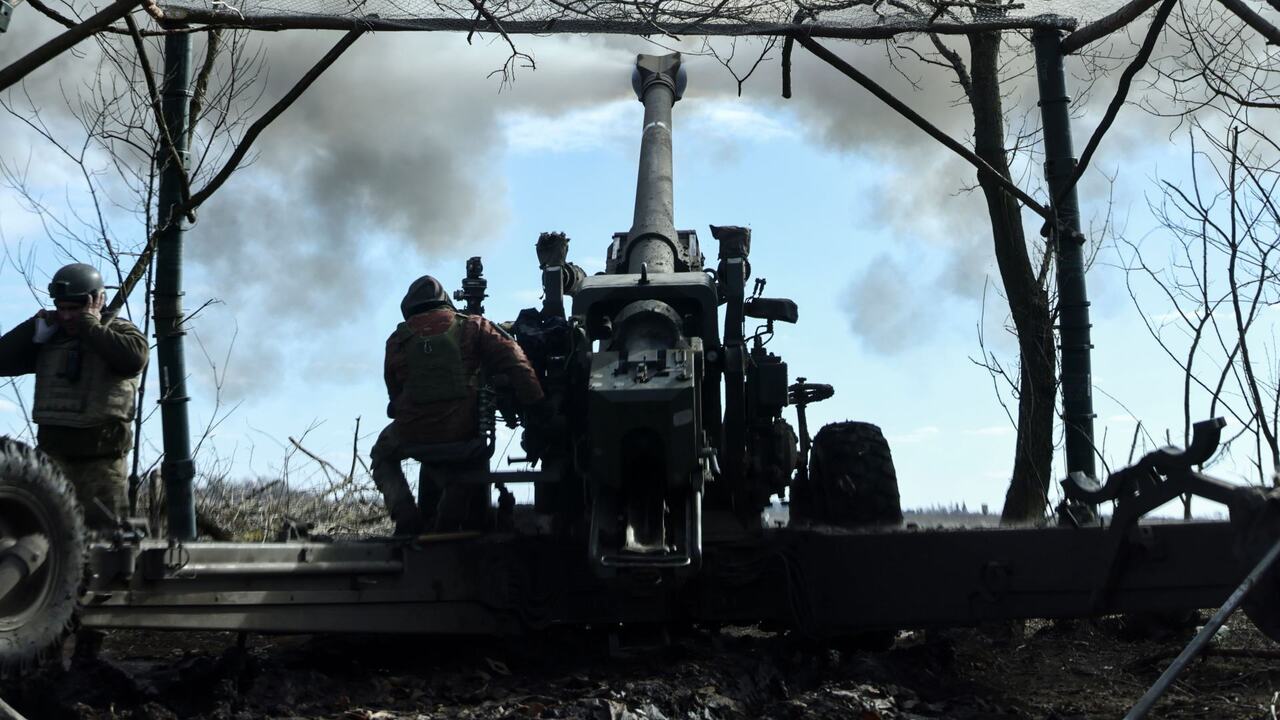
Over the next three years, the war changed from a battle of movement to position warfare and a war of attrition. Russia began to rely on massed use of artillery and the liberal sacrifice of manpower. This looked like WWII: the frontal assaults, the artillery barrages, the utter disregard for human resources. But there was a new element as well: terror attacks on civilians and their infrastructure. This was not a Soviet tradition: during WWII, it was British and US air forces that had flattened German and Japanese cities. Such bombing was not part of the Red Army’s military repertoire. Its air forces were geared towards support of ground troops, not “strategic” bombing of civilians.

In its changed focus on hurting civilians from the air, Putin’s army drew on the neo-imperial wars he had overseen: Chechnya and Syria. It was here that the Russian air force first flattened cities (Grozny in 1999-2000 and Aleppo in 2015-16) and it was this experience that now came to bear on the war in Ukraine. Except that here they did not control the airspace and did not face defenceless civilians they could simply “de-house” at will. Instead, they had to deal with an enemy capable of shooting down not just bombers, which as a result were not sent into Ukraine’s airspace, but also many of the missiles and drones sent from a safe distance.

While air assaults on civilian targets became part of the normalcy of Russia’s changing way of war, tactics on the ground also evolved: rather than mass assaults after preliminary artillery preparation, increasingly Russia used surprise attacks by small groups of storm troopers to conduct reconnaissance by force. If they encountered major resistance, they would then call in airstrikes or artillery barrages. They also stopped frontal assaults on fortified positions, bypassing and encircling them instead.

But none of this led to major breakthroughs. The war bogged down.

Russia was better prepared than Ukraine for a war of attrition. It had long built a food system that could withstand international isolation, demonstrating that a major war had been on the minds of the planners in the Kremlin for a very long time. The discrepancy in the size of both the economy and the population also meant Russia had the edge in the long run. And while the militarisation of the economy came with increasingly serious economic imbalances, they were not serious enough to force Putin’s dictatorship to back down. Instead, military salaries and the growing investments in military industries led to economic mini-booms in several of the regions that supplied the volunteers and the weapons to fight in Ukraine. To many Russians, this continues to be a profitable war.

Putin’s overall strategy thus shifted from a lightning war of conquest to outlasting the democratic world. Having the Soviet experience of extreme suffering and endurance in mind, and construing “the West” as weak, effeminate and degenerate, he had every confidence that Russia would be successful in the long run. With Trump’s election victory, this confidence grew. With his behaviour in the first six weeks in office, it must have soared. Putin has less reason than ever to compromise. And he can achieve much by playing Trump diplomatically.

What now?

After the spectacular dust-up in the Oval Office a week ago, doom and gloom have descended over Ukraine and its supporters. A pouting US President seems to assume that if he pulls the plug on Ukraine, the war will simply end: “Zelensky better move fast or is not going to have a Country left,” he wrote a week before he ambushed him in front of the cameras.

The withdrawal of US support is a serious setback for Ukraine. The US and Europe have provided about equal amounts of money to Ukraine. If Europe were to try to replace US contributions, it thus would have to double its financial commitments at a time when the economy is not exactly booming and will soon be further hit by Trump’s trade wars.

The withdrawal of US support is a serious setback for Ukraine. Picture: AFP

The withdrawal of US support is a serious setback for Ukraine. AFP

The major victims of Trump’s retreat will be Ukraine’s civilians. The US air defence systems currently protecting cities cannot be replaced easily. An increase in civilian deaths is the inevitable result. The withdrawal of intelligence is also a serious blow and difficult to substitute.

However, the EU’s economy is big enough to replace US contributions. An increase equal to 0.12 per cent of Europe’s GDP would suffice. Germany’s taxpayers spend three times more on domestic subsidies for diesel fuel than they devote to military aid to Ukraine. And production capacity is growing. At the start of the war, most military aid came from quickly depleting stockpiles. By 2024, the vast majority of materiel fuelling Ukraine’s war effort are newly produced weapons and equipment.

More than half of Ukraine’s weaponry is produced in Ukraine, a further 25 per cent comes from Europe. The 20 per cent the United States contributes is particularly valuable and high-quality, but it is not the backbone of Ukraine’s capacity. In a war of attrition heavily dependent on artillery, Europe will produce some two million artillery shells for Ukraine this year. The US, before Trump pulled the plug, was expected to deliver less than one million. Elon Musk’s Starlink, providing communications at the frontline, can be replaced with alternatives.

Thus, Ukraine’s defences are unlikely to collapse. Russia has been advancing recently, but progress was slow. By the third anniversary of the invasion, Russia controlled about 20 per cent of Ukraine’s territory, including some 4000 square kilometres gained in 2024. However, Ukraine is a big country. Russia’s 2024 gains represent a mere 0.6 per cent of Ukraine’s territory. Russia has not taken major cities in 2024 and urban life continues everywhere.

Meanwhile, Russia lost parts of the Kursk region to a counteroffensive the Russian military was unable to reverse. Russia has likely enough materiel for at least another year of fighting, but not enough for a major breakthrough.

In an assessment of the war written at the end of 2024, one of the most perceptive analysts of the military side of the war in Ukraine, exiled Russian historian and former civil rights activist Nikolai Mitrokhin, developed four possible scenarios for what could happen in 2025. None of them included a complete breakdown. His “catastrophic” scenario was a “partial collapse of the front due to the reduction of Ukrainian forward units”, leading to a “rapid advance of Russian units to the left bank of the Dnipro”. He predicted that this might lead to a leadership change, but also a further rallying around the flag and a continuation of the fight.

Less catastrophic would be a return to a grinding Russian offensive, as in 2024. “At the current rate of advance,” wrote the Institute for the Study of War in its Ukraine Fact Sheet of February 21, 2025, “it would take Russian forces over 83 years to capture the remaining 80 per cent of Ukraine, assuming that they can sustain massive personnel losses indefinitely”.

This outlook explains why Putin is so enthusiastic about Trump’s “peace plans”. They might achieve diplomatically what he cannot achieve on the battlefield: the subjugation of Russia’s democratic neighbour to neo-imperial domination.

Mark Edele is a historian of the Soviet Union and its successor states, in particular Russia. He is Hansen Professor in History at the University of Melbourne. His latest book is Russia’s War Against Ukraine: The Whole Story (Melbourne University Press, 2023

Trump and Vance ambush Zelensky at the White House

The first Intifada … Palestine 1936

In 1929, there is violence at the Western Wall in Jerusalem – then a narrow alley named for Buraq, the steed with a human face that bore the Prophet Mohammed on his midnight journey to Jerusalem, and not the Kotel Plaza of today. The event, which was actually called the Buraq rising was incited by rumours that Jews planned to overrun the Haram al Sharif, the third holiest site in Islam. A massacre of Jews in Hebron in the south followed. These were a bleak precursor of the wars to come.

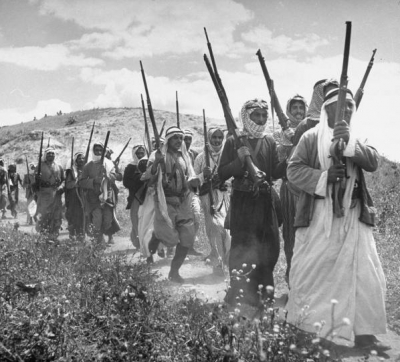
Fast forward to mid-April 1936. Following two incidents of killing carried out in by both Arabs and Jews, an Arab National Committee declared a strike in the city of Jaffa. National Committees were formed in other Palestinian cities and representatives of Arab parties formed the “Arab Higher Committee” led by Haj Amin al-Husseini. A general strike spread throughout Palestine, accompanied by the formation of Palestinian armed groups that started attacking British forces and Jewish settlements. Thus began the “Great Palestinian Revolt. It lasted for three years.

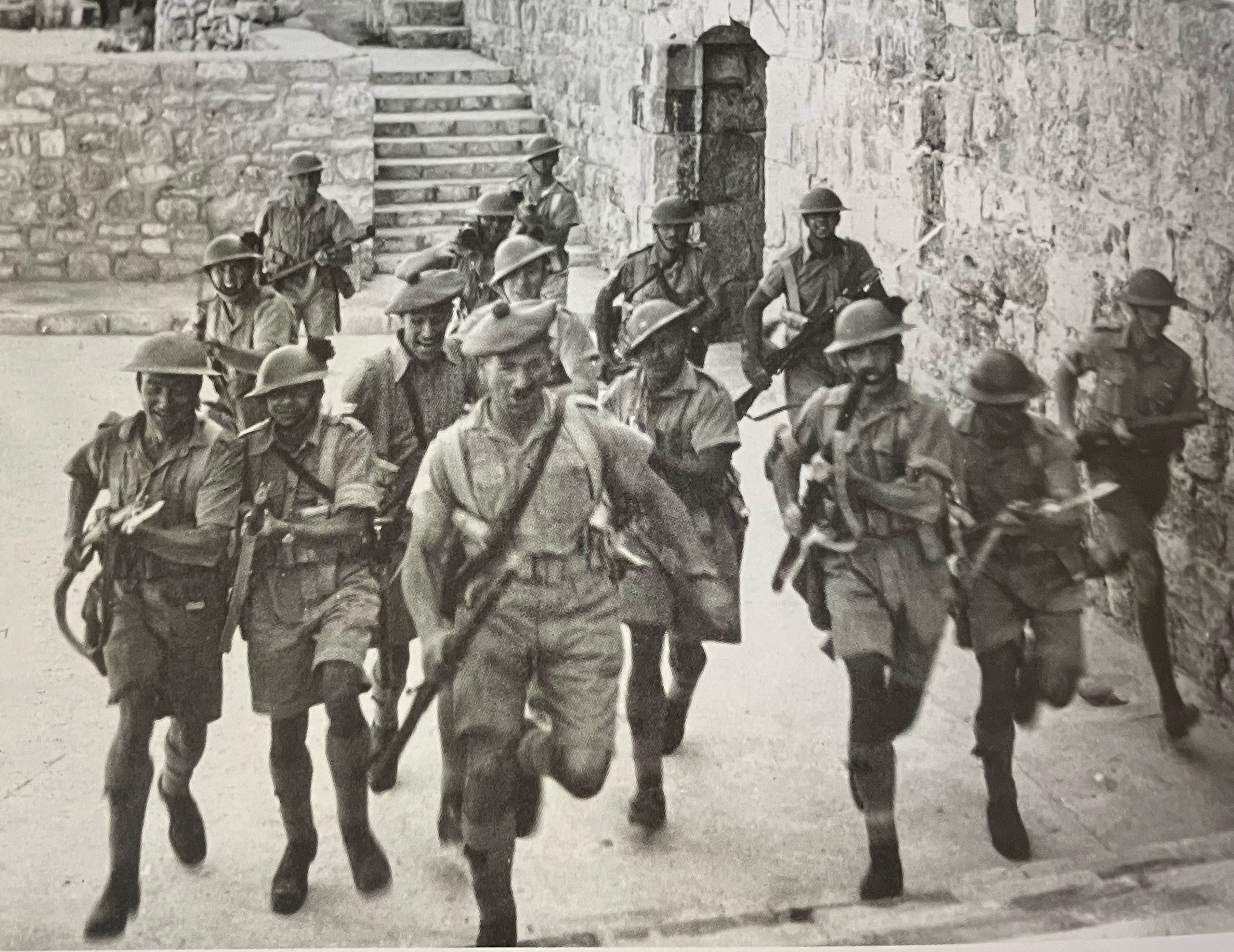
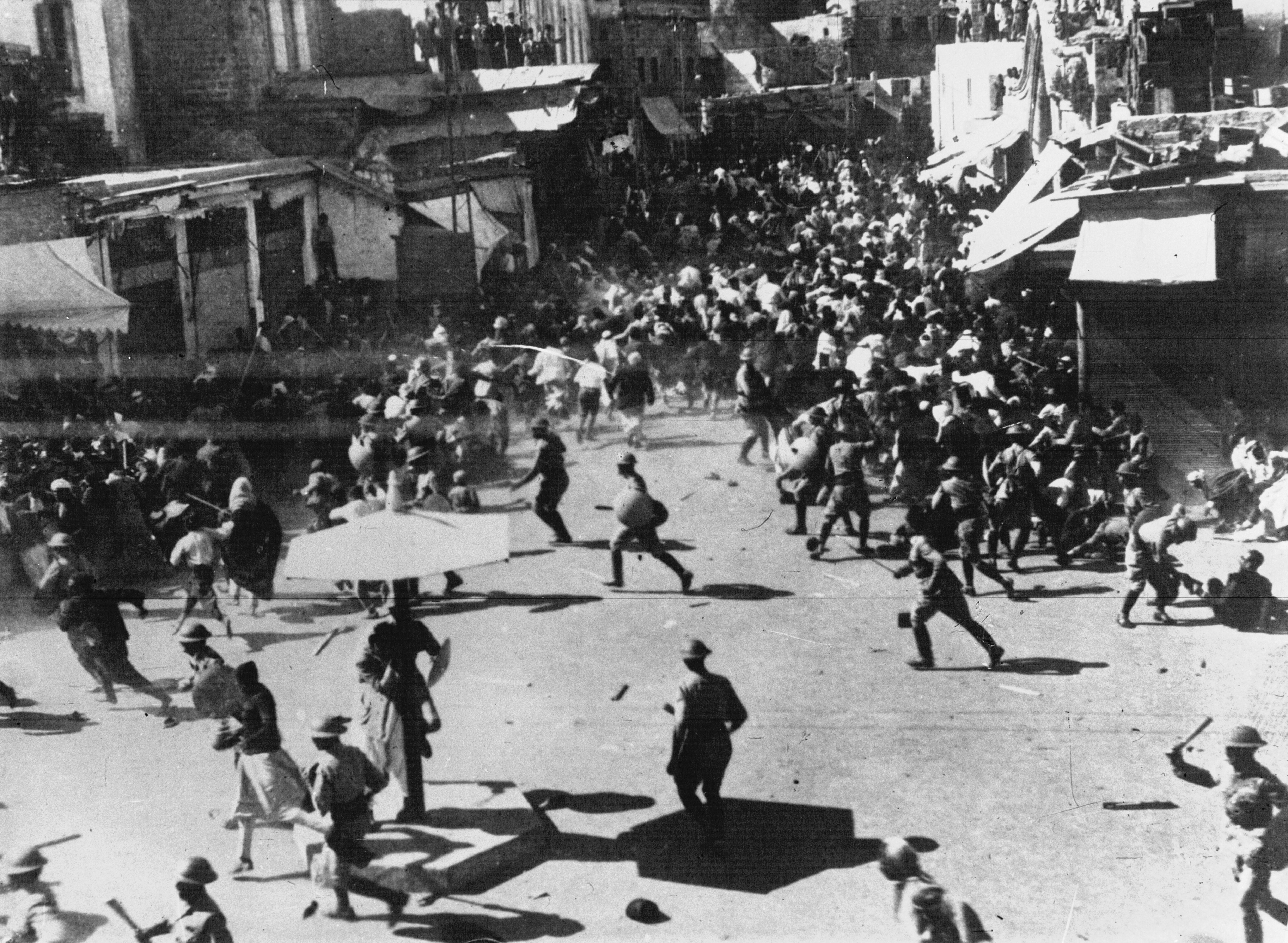
British troops run through Jerusalem’s’ Old City during the Great Revolt

Roots and fruits 

The ongoing struggle with regard to the existence Israel and Palestine is justifiably regarded the most intractable conflict of modern times. Whilst most agree that its origins lie in the political and historical claims of two people, the Jewish Israelis and the predominantly Muslim Palestinians for control over a tiny wedge of one-time Ottoman territory between Lebanon and Syria in the north, Jordan in the east, and Egypt to the south, hemmed in by the Mediterranean Sea. There is less consensus as to when the Middle East Conflict as it has become known because of its longevity and its impact on its neighbours and the world in general, actually began.

Was it the infamous Balfour Declaration of 1917 promising a national home for Jews in an Ottoman governate already populated by Arabs, or the secretive Sykes Picot Agreement that preceded it in 1916, staking imperial Britain’ and France’s claim to political and economic influence (and oil pipelines) in the Levant? Was it the establishment of the British Mandate of Palestine after the Treaty of Sèvres of 1922 which determined the dissolution of the defeated Ottoman Empire. Or was it the end of that British mandate and the unilateral declaration of Israeli independence in 1948 and the war that immediately followed?

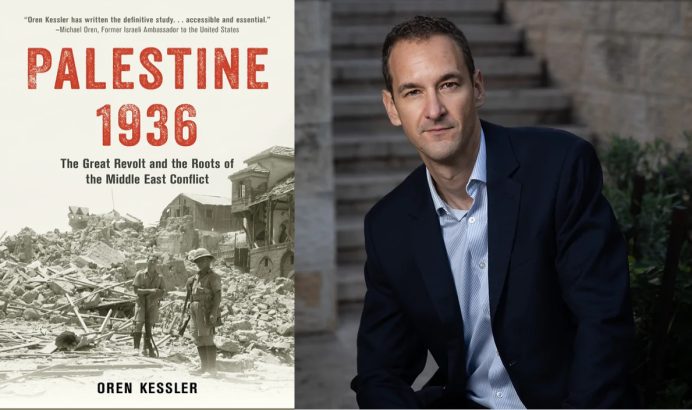
In his book Palestine 1936: The Great Revolt and the Roots of the Middle East Conflict (Rowman & Littlefield, 2023) Israeli journalist and author Oren Kessler argues powerfully that the events in Mandatory Palestine between 1936 and 1939 shaped the subsequent history of the conflict for Israelis and Palestinians. The book identifies what was known at the time as The Great Revolt  as the first Intifada, a popular uprising which actually sowed the seeds of the Arab military defeat of 1947-48 and the dispossession and displacement of over seven hundred thousand Palestinian Arabs, which has set the tone of the conflict for almost a century.

It is a tragic history shared with knowledge in hindsight of the decades of violence and bloodshed in the region that followed. It begins in the time before Palestine became political entity, when mainly Eastern European Jews began settling in progressively larger numbers to the consternation of the Arab populace.

The 1936 conflict stemmed from questions of how to divide the land and how to deal with the influx of Jewish people – questions that remain relevant today. In an extensive interview coinciding with the book’s publication (republished below) Kessler notes that, for the Arab residents, the problem was one of immigration and economics; for the Zionists, it was about finding a home. These two positions soon became irreconcilable issues, leading to sporadic violence and then to continual confrontation.

He believes that the Revolt is the point when both sides really came to see the conflict as zero sum. insofar that whichever community had the demographic majority in Palestine would be the one that would determine its fate. However, in the 1920s, the Jews were so far from that majority that both sides were able to postpone the final reckoning. In the 1930s, the Jews threatened to become a majority, and this was the immediate precursor to the rising. There was no way that the objective of bringing as many Jews to the land as possible could be achieved without bringing about some serious Arab pushback.

It is Kessler’s view that it was during revolt that a strong sense of Arab nationalism in Palestine extended beyond the urban elites to all corners of the country. All segments of Arab society – urban and rural, rich and poor, rival families, and even to a large extent Muslim and Christian – united in the same cause against Zionism and against its perceived enabler, the British Empire. The Arab public in Palestine was becoming increasingly politically aware and consciously perceiving itself as a distinct entity – distinct from its brethren in Syria, in large part because it has a different foe: not simply European imperialism but this very specific threat presented by Zionism.

The British government made early efforts at keeping the peace, but these proved fruitless. And when the revolt erupted in 1936, it sent a royal commission to Palestine, known to history as the Peel Commission, to examine the causes of the revolt. It proposed in effect the first ‘two state solution.’ The Emir Abdullah of Transjordan publicly accepted this plan. The main rival clan to the Husseinis, the Nashashibis, privately signaled that they were amenable – not thrilled, but amenable. And their allies held the mayorships of many important cities – Jaffa, Haifa, and even Nablus, Jenin and Tulkarem, which today are centres of militancy. And yet the Mufti makes very clear that he regards this plan as a degradation and a humiliation, and all of these erstwhile supporters of partition suddenly realise that they are against partition.

Kessler believes that this is the point at which a certain uncompromising line became the default position amongst the Arab leadership of Palestine, with dire consequences for the Palestinians themselves, and when Yishuv leader David Ben Gurion saw an opportunity to achieve his long-standing objective of creating a self-sufficient Jewish polity, one that could feed itself, house itself, defend itself, employ itself, without any help from anyone – neither British or Arabs. When the Arabs called a general strike and boycott, cut all contacts with the Jewish and British economies and closed the port of Jaffa in Spring 1936, he lobbied successfully with the British to allow the Jews to open their own port in Tel Aviv, ultimately causing a lot of economic pain to the Arabs and helping the Jews in their state-building enterprise.

This is a mosaic history, capturing the chaotic events on the ground through snippets of action. And also, the people involved. 

There are heroes and villains aplenty in this relatively untold story. The urbane and erudite nationalists Muhammed Amal and George Antonius who strive for middle ground against increasingly insurmountable odds, and who died alone and exiled having failed to head off the final showdown that is today known as Al Nakba. The farseeing, resolute, and humourless Ben Gurion and the affable, optimistic Chaim Weizmann, who became Israel’s first prime minister and president respectively. The New York born Golda Meyerson, more of a realist than either leader, who would also one day become prime minister. The irascible revisionist Vladimir Ze’ev Jabotinski, the forebear of today’s virulent rightwing nationalists

The hardliner Mufti Haj Amin al Husseini, whose uncompromising stance, malign political influence, and conspiratorial association with the Nazis set the stage for a long general strike, the Great Revolt, and ultimately, the débâcle of 1948. The flamboyant rebel leaders, Syrian Izz al Din al Qassam, who is memorialized in the name of the Hamas military wing and a Gaza-made rocket, and Fawzi al Qawuqji. Qassam was gunned down by British soldiers during the revolt whilst Qawuqji lived on to become one of the most effective militia leaders in the war of 1948, and to perish therein. Both are remembered today as Palestinian martyrs whilst the Mufti is an arguably embarrassing footnote of history. There’s an article about his relatively unremarked death at the end of this post. 

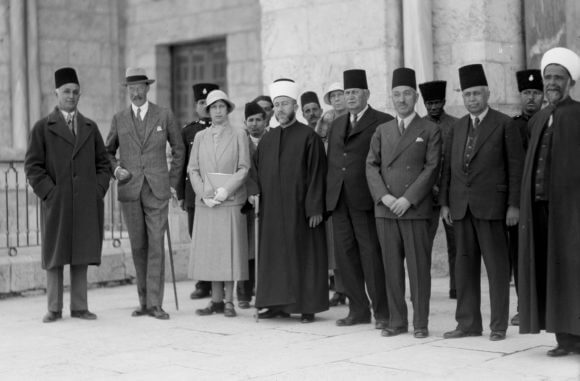
Amin al-Husseini in 1929

And in the British corner, the well-intentioned high commissioners who vainly endeavoured to reconcile the claims of two aspirant nations in one tiny land, and quixotic figures like the unorthodox soldier Ord Wingate who believed he was fulfilling prophecy by establishing the nucleus of what would become the IDF (like many charismatic British military heroes, and particularly General Gordon and Baden-Powell, both admirers and detractors regarded him a potential nut-case); and the Australian-born ex-soldier Lelland Andrews, assistant district commissioner for Galilee, who also conceived of his mission as divinely ordained. Lewis was murdered by Arab gunmen and Wingate went down in an aeroplane over Burma during WW2.

There are appearances from among many others, Lloyd George, Winton Churchill and Neville Chamberlain, Adolph Hitler and Benito Mussolini, Franklin D Eisenhower and Joseph Kennedy.

The book highlights the work of powerful British functionaries in handling early confrontations: they are memorialized for starting commissions to study the matter and to generate ideas, though many of their ideas weren’t followed or were followed to ill effect. None solved the problem, making this account of the earliest days of the conflict all the more heartbreaking.

All under the shadow of the impending Shoah, and the inevitable showdown that would culminate in al Nakba.

The road to Al Nakba

Kessler argues that the Arab social fabric and economy are completely torn and shattered by the end of this revolt that in many ways the final reckoning for Palestine between Jews and Arabs – the civil war that erupts in 1947 – is actually won by one side and lost by the other nearly a decade earlier.

The final paragraphs of Kessler’s enthralling book are worth quoting because they draw a clear line between the events of the Great Revolt and the catastrophe, al Nakba, of 1948:

“For the Jews, perhaps the greatest shift was psychological. they had withstood of powerful sustained assault and lived to tell about it. One book on Zionist leaders” thinking in this era is titled Abandonment of Illusions. The belief of material gains would bring Arab consent now naïve and, worse, dangerous. Instead, by the end of the revolt and the start of the world war, much of Palestine’s Jewish mainstream had accepted the fact that the country’s fate would ultimately be determined and maintained by force.
 
“By 1939, the Yishuv had achieved the demographic weight, control of strategic areas of land, and much of the weaponry and military organization that would be needed as a springboard for taking over the country within less than a decade”, writes the Palestinian American historian Rasheed Khalidi.
 
Khalid argues that the Palestinian catastrophe of 1947 -1949 was predicated on a series of previous failures: “a deeply divided leadership, exceedingly limited finances, no centrally organized military forces or centralized administrative organs, and no reliable allies. They faced a Jewish society in Palestine which although small relative to theirs, was political unified, had centralized para-state institutions, and was increasingly well-led and extremely highly motivated”.
 
For Palestinians, he maintains, the Nakba – the catastrophe of their military drubbing, dispossession and dispersal – was but a forgone conclusion. For them, the terrible events that bookended the year 1948 “were no more than a postlude, a tragic epilogue to the shattering defeat of 1936- 39”.
 
The Great Revolt, Kessler says, has cast its shadow over the Israeli-Palestinian conflict ever since – for the Arabs, for the Jews, and for attempts to resolve the conflict. It is still remembered by Palestinians and Israelis alike. Palestinian folk songs still celebrate the revolt, and in my he regards the. BDS movement as direct descendant of the general strike that preceded the revolt. The two-state solution that is still the international community’s favoured solution to the conflict is but a variation of that original partition plan of 1937.

In so many ways, for both Israelis and Palestinians, this revolt rages on.

© Paul Hemphill 2024.  

Kessler’s interview in Fathom e-zine follows, together with serval informative articles on the Great Revolt and its aftermath

For more on Israel and Palestine in In That Howling Infinite, see: A Middle East Miscellany

The picture at the head of this post shows British troops marching through Ibn Khatib Square in 1936 past King David’s Citadel and towards the Jaffa Gate

British policemen disperse an Arab mob during the Jaffa riots in April 1936 (The Illustrated London News)


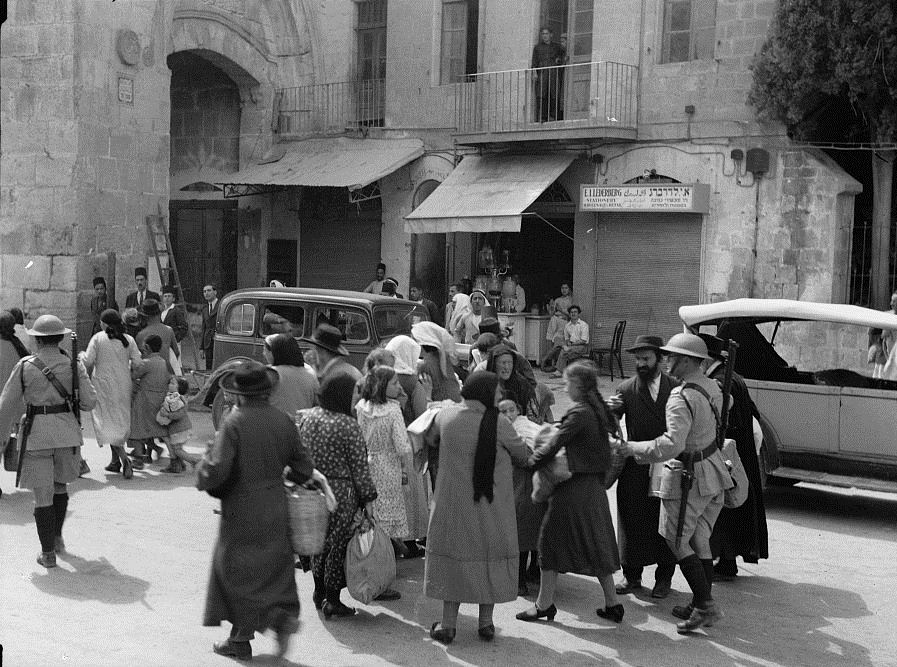
Jews evacuate the Old City of Jerusalem after Arab riots in 1936.

An interview with Oren Kessler

by Oren Kessler
 
 
3365748242
Great Arab Revolt, 1936-1939
A Popular Uprising Facing a Ruthless Repression
 
In 1936, widespread Palestinian dissatisfaction with Britain’s governance erupted into open rebellion. Several key dynamics and events can be seen as setting the stage for this uprising. In Palestine, as elsewhere, the 1930s had been a time of intense economic disruption. Rural Palestinians were hit hard by debt and dispossession, and such pressures were only exacerbated by British policies and Zionist imperatives of land purchases and “Hebrew labor.” Rural to urban migration swelled Haifa and Jaffa with poor Palestinians in search of work, and new attendant forms of political organizing emerged that emphasized youth, religion, class, and ideology over older elite-based structures. Meanwhile, rising anti-Semitism—especially its state-supported variant—in Europe led to an increase of Jewish immigration, legal and illegal, in Palestine.

Unsurprisingly, the combination of these various trends produced periodic upheavals, from the 1929 al-Buraq Uprising to multicity demonstrations in 1933 against the British Mandate. In October 1935, the discovery of a shipment of arms in the Jaffa port destined for the Haganah fueled Palestinian concerns that the Zionist movement was introducing the human and military resources necessary for its state-building project under the nose of the British. Meanwhile, the popular and populist Syrian Shaykh Izzeddin al-Qassam , who preached to the slum-dwelling rural transplants near Haifa’s rail yards and who had spent the early 1930s building a cell-based paramilitary network, was killed in a firefight with British forces in November 1935. Qassam’s funeral in Haifa elicited a mass outpouring of public outrage. These events are often seen as direct predecessors of the mass Palestinian uprising that took place in 1936.

The Great Palestinian Rebellion , or the Great Arab Revolt, as this uprising came to be known, lasted for three years and can be generally divided into three phases. The first phase lasted from the spring of 1936 to July 1937. With tensions throughout Palestine running high since the fall of 1935, the revolt was ignited in mid-April 1936 when followers of Qassam attacked a convoy of trucks between Nablus and Tulkarm , killing two Jewish drivers. The next day, the  Irgun killed two Palestinian workers near Petah Tikva , and in the following days, deadly disturbances ensued in Tel Aviv and Jaffa. In Nablus, an Arab National Committee was formed and a strike was called on 19 April. National Committees in other cities echoed the call to strike, and on 25 April the Arab Higher Committee (Lajna) (AHC) was formed, chaired by Haj Amin al-Husseini , to coordinate and support a nationwide general strike, which was launched on 8 May.

The strike was widely observed and brought commercial and economic activity in the Palestinian sector to a standstill. Meanwhile, Palestinians throughout the countryside came together in armed groups to attack—at first sporadically, but with increasing organization— British and Zionist targets. Some Arab volunteers joined the rebels from outside Palestine, though their numbers remained small in this period. The British employed various tactics in an attempt to break the strike and to quell the rural insurrection. The ranks of British and Jewish policemen swelled and Palestinians were subjected to house searches, night raids, beatings, imprisonment, torture, and deportation. Large areas of Jaffa’s Old City were demolished, and the British called in military reinforcements.

Concurrent with military operations and repressive measures, the British government dispatched a commission of inquiry headed by Lord Peel to investigate the root causes of the revolt. In October 1936, under the combined pressure of British policies, other Arab heads of state, and the effects of a six-month general strike on the Palestinian population, the AHC called off the strike and agreed to appear before the Peel Commission . A period of lower intensity conflict prevailed as the Peel Commission toured the country, but tensions continued to build in anticipation of the commission’s report. In July 1937, the Peel Commission published its report, recommending Palestine’s partition into Jewish and Arab states. Dismayed by this negation of their desires and demands, the Palestinian population relaunched their armed insurgency with renewed intensity, initiating the second phase of the revolt.

This second phase, lasting from July 1937 until the fall of 1938, witnessed significant gains by the Palestinian rebels. Large swaths of the hilly Palestinian interior, including for a time the Old City of Jerusalem , fell fully under rebel control. Rebels established institutions, most significantly courts and a postal service, to replace the British Mandate structures they sought to dismantle. The British, meanwhile, imposed even harsher measures to try to quash the revolt. The AHC and all Palestinian political parties were outlawed, political and community leaders were arrested, and a number of high-profile public figures exiled. The military aspects of counterinsurgency intensified, and British tanks, airplanes, and heavy artillery were deployed throughout Palestine. The British also meted out collective punishment: thousands of Palestinians were relegated to “detention camps”; residential quarters were destroyed; schools were closed; villages were collectively fined and forced to billet British troops and police. Zionist military institutions took advantage of the situation to build up their capacities with British support. By early 1939, members of the Jewish Settlement Police (about 14,000) were subsidized, uniformed, and armed by the British government as a thinly veiled front for the Haganah, and so-called Special Night Squads  comprising Jewish and British members launched “special operations” against Palestinian villages.

The third phase of the rebellion lasted roughly from the fall of 1938 to the summer of 1939. The British dispatched another commission of inquiry, this one headed by Sir John Woodhead , to examine the technical aspects of implementing partition. In November 1938, the Woodhead Commission report concluded that partition was not practicable, marking a certain British retreat from the Peel recommendation. At the same time, however, the British launched an all-out offensive: in 1939 more Palestinians were killed, more were executed (by hanging), and nearly twice as many were detained than in 1938. Such brutality placed immense pressure on the rebels, exacerbating rifts between the political leadership of the AHC exiled in Damascus and local leadership on the ground, between rebel bands and village populations that were expected to support and supply them, and ultimately between Palestinians who remained committed to the revolt and those willing to reach a compromise with the British. British-supported Palestinian “Peace Bands” were dispatched to battle their compatriots.

In May 1939, the British government published a new White Paperthat proposed the following: Britain’s obligations to the Jewish national home had been substantially fulfilled; indefinite mass Jewish immigration to and land acquisition in Palestine would contradict Britain’s obligations to the Palestinians; within the next five years, no more than 75,000 Jews would be allowed into the country, after which Jewish immigration would be subject to “Arab acquiescence”; land transfers would be permitted in certain areas, but restricted and prohibited in others, to protect Palestinians from landlessness; and an independent unitary state would be established after ten years, conditional on favorable Palestinian-Jewish relations.

The combined impact of Britain’s military and diplomatic efforts brought the rebellion to an end in the late summer of 1939. Over the revolt’s three years, some 5,000 Palestinians had been killed and nearly 15,000 wounded. The Palestinian leadership had been exiled, assassinated, imprisoned, and made to turn against one another. At the same time, the White Paper—despite its limitations—offered certain concessions to the rebels’ demands. Whatever gains Palestinians might have made through the revolt, however, were quickly overtaken by the larger geopolitical processes of World War II , and the combined British-Zionist assault on Palestinian political and social life during the revolt had a long-lasting impact.

 
Selected Bibliography:

Anderson, Charles W. “State of Formation from Below and the Great Revolt in Palestine.” Journal of Palestine Studies 47, no. 1 (Autumn 2017): 39-55.

Hughes, Matthew. “From Law and Order to Pacification: Britain’s Suppression of the 1936–1939 Arab Revolt in Palestine.” Journal of Palestine Studies 39, no.2 (Winter 2010): 6–22.

Kanafani, Ghassan. The 1936–39 Revolt in Palestine.

Shbeib, Samih. “Poetry of Rebellion: The Life, Verse and Death of Nuh Ibrahim during the 1936–39 Revolt.” Jerusalem Quarterly 25 (Winter 2006): 65–78.

Sufian, Sandy. “Anatomy of the 1936-39 Revolt: Images of the Body in Political Cartoons of Mandatory Palestine.” Journal of Palestine Studies 37, no.2 (Winter 2008):  23–42.

Swedenburg, Ted. Memories of Revolt: The 1936–1939 Rebellion and the Palestinian National Past. Fayetteville: University of Arkansas Press, 2003.

Britain says releasing a 1941 document about Palestine might ‘undermine security’

A two-part archive, labeled “Activities of the Grand Mufti of Jerusalem” and dated 1940-1941, sits in Britain’s National Archives in Kew. This writer successfully had the first part declassified in 2014. The second part remains sealed. My 2018 attempt to have these ten pages declassified was refused on the grounds that the archive might “undermine the security of the country [Britain] and its citizens.”[1] None of its secrets are to be available until January, 2042; and if the paired file is any precedent, even in 2042 it will be released only in redacted form.

The ‘Grand Mufti’ in the archive’s heading is Haj Amin al-Husseini, the Palestinian leader whom posterity best remembers for his alignment with the Italian and German fascists; and the years 1940-1941 place him not in Palestine, but in Iraq — and if the second archive extends to late 1941, in Europe. What could possibly be hidden in a World War II document about a long-dead Nazi sympathizer that would present such a risk to British national security eight decades later, that none of it can be revealed? At present, only the UK government censors know; but the answer may have less to do with the fascists and al-Husseini than with British misdeeds in Iraq, and less to do with Britain’s national security than with its historical embarrassment.

When in 1921 votes were cast for the new Mufti of Jerusalem, Amin al-Husseini came in last among the four candidates. But votes in Palestine mattered as little then as they do now, and the British, Palestine’s novice replacement occupiers for the Ottomans, handed the post to al-Husseini. At first, he proved to be an asset to the British. But as the years passed, his opposition to Zionism, support for Palestinian nationalism, and ultimately his involvement in the 1936 Palestinian uprising, led to calls for his arrest.

Photograph labelled 'Arab demonstrations on Oct. 13 and 27, 1933. In Jerusalem and Jaffa. Return of Grand Mufti from India. Met by hundreds of cars at Gethsemane, Nov. 17, 1933.'

“ARAB DEMONSTRATIONS ON OCT. 13 AND 27, 1933. IN JERUSALEM AND JAFFA. RETURN OF GRAND MUFTI FROM INDIA. MET BY HUNDREDS OF CARS AT GETHSEMANE, NOV. 17, 1933.” LIBRARY OF CONGRESS, LC-M33- 4218.

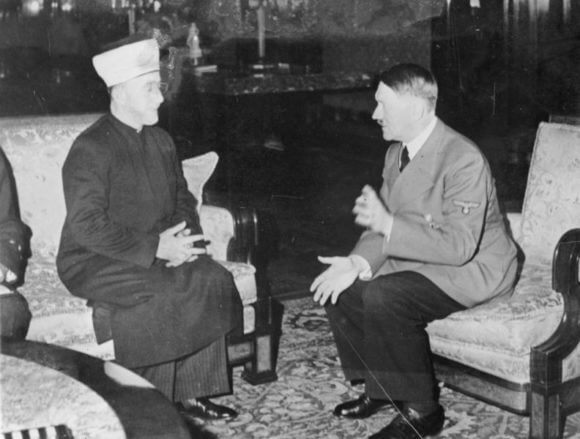
In mid-October of 1937, he fled from hiding in Palestine to Beirut. Two years later and six weeks after the outbreak of World War II, in mid-October of 1939, he slipped to Baghdad, where his sympathies for the Italian fascists further alarmed the British. Fast-forward another two years to late 1941, and al-Husseini is in Europe, meeting with Benito Mussolini on the 27th of October, and on the 28th of November meeting with the Führer himself at the Reich Chancellery in Berlin.

Al-Husseini’s motivation for embracing the Axis was likely a combination of selfish political opportunism and the belief that the alignment would help safeguard against the takeover of Palestine by the Zionists. The reasoning, however grotesque, was the same used by Lehi (the ‘Stern Gang’) in its own attempted collaboration with the fascists: Britain was the obstacle both to Palestinian liberation, and to unbridled Zionism, and for both the Mufti and Lehi, defeating that obstacle meant embracing its enemies. Even the ‘mainstream’ David Ben-Gurion had no moral qualms about taking advantage of Britain’s struggle against the Nazis — a struggle for which his Jewish Agency was already conspicuously unhelpful — by exploiting Britain’s post-war vulnerabilities.[2]

Posterity has treated Lehi’s and the Mufti’s flirtations with the fascists quite differently. Lehi, the most fanatical of the major Zionist terror organizations, was transformed into freedom fighters, and ex-Lehi leader Yitzhak Shamir was twice elected as Israeli Prime Minister. In contrast, Zionist leaders quickly seized on al-Husseini’s past to smear not just him, but the Palestinians as a people, as Nazis.

The use of al-Husseini’s unsavory history to ‘justify’ anti-Palestinian racism continues to the present day. Most bizarrely, in 2015 Israeli Prime Minister Benjamin Netanyahu claimed that Hitler had not intended to exterminate the Jews — that is, not until al-Husseini planted the words in his ear — which translates as “got the idea from the Palestinians”. A private citizen would likely have been arrested under German law for this attempt to rewrite the Holocaust.

The mufti of Jerusalem, Sayid Amin al Husseini, meets with Hitler, November 1941.

THE MUFTI OF JERUSALEM, SAYID AMIN AL HUSSEINI, MEETS WITH HITLER, NOVEMBER 1941.

Iraq won limited independence in 1932, just before the Nazis came to power. When the Mufti ensconced himself in Iraq seven years later, the country was under nominally ‘pro-British’ Prime Ministers, and Regent ‘Abd al-Ilah for the four-year-old king, Faisal II. This uneasy British-Iraqi equilibrium ended on first day of April 1941, when four Iraqi officers known as the Golden Square, wanting full independence (and similarly aligning themselves with the fascists in the foolish belief that doing so would help them get it), staged a coup d’état. It lasted two months. British troops ousted the coup on the first day of June — and as they did, anti-Jewish riots rocked Baghdad. An estimated 180 Jewish Iraqis were killed and 240 wounded in this pogrom known as the Farhud.

Why would the momentary power vacuum of the British takeover lead to anti-Jewish terror? While doing research for my 2016 book, State of Terror, I was intrigued by the claim of one Iraqi Jewish witness, Naeim Giladi, that these ‘Arab’ riots were orchestrated by the British to justify their return to power.[3] Indeed, the riots seemed unnatural in a society where Jews had lived for two and a half millennia, and the “pro-Axis” Golden Square takeover two months earlier had not precipitated any such pogrom. Yet it was also true that Zionism had created ethnic resentment, and Giladi did not question that junior officers of the Iraqi army were involved in the violence. The evidence provided by Giladi was compelling enough to seek out clues among British source documents that were not available to him.

And that, along with the hope of shedding new light on the Mufti’s pro-fascist activities, brought me to the archive at issue and my qualified (redacted) success in getting the first part declassified– officially titled, CO 733/420/19. Not surprisingly, much of the file focused on legitimate worry over the Mufti’s dealings with the Italian fascists. Some of the British voices recorded considered him to be a serious threat to the war effort, and a report entitled “Inside Information” spoke of the Mufti’s place in an alleged “German shadow government in Arabia”. Others dismissed this as “typical of the sort of stuff which literary refugees put into their memoirs in order to make them dramatic” and suggested that the Mufti’s influence was overstated.

Whatever the case, by October 1940, the Foreign Office was considering various methods for “putting an end to the Mufti’s intrigues with the Italians”, and by mid-November,

it was decided that the only really effective means of securing a control over him [the Mufti] would be a military occupation of Iraq.

British plans of a coup were no longer mere discussion, but a plan already in progress:

We may be able to clip the Mufti’s wings when we can get a new Government in Iraq. F.O. [Foreign Office] are working on this”.

So, the British were already working on re-occupying Iraq five months before the April 1941 ‘Golden Square’ coup.

A prominent thread of the archive was: How to effect a British coup without further alienating ‘the Arab world’ in the midst of the war, beyond what the empowering of Zionism had already done? Harold MacMichael, High Commissioner for Palestine, suggested the idea “that documents incriminating the Mufti have been found in Libya” that can be used to embarrass him among his followers; but others “felt some hesitation … knowing, as we should, there was no truth in the statement.”

But frustratingly, the trail stops in late 1940; to know anything conclusive we need the second part’s forbidden ten pages: CO 733/420/19/1.

The redacted first part partially supports, or at least does not challenge, Giladi’s claim. It proves that Britain was planning regime change and sought a pretext, but gives no hint as to whether ethnic violence was to be that pretext. Interestingly, Lehi had at the time reached the same conclusion as Giladi: its Communique claimed that “Churchill’s Government is responsible for the pogrom in Baghdad”.[4]

Does the public have the right to see still-secret archives such as CO 733/420/19/1? In this case, the gatekeepers claimed to be protecting us from the Forbidden Fruit of “curiosity”: They claimed to be distinguishing between “information that would benefit the public good”, and “information that would meet public curiosity”, and decided on our behalf that this archive fit the latter.[1] We are to believe that an eight-decade-old archive on an important issue remains sealed because it would merely satisfy our lust for salacious gossip.

Perhaps no assessment of past British manipulation in Iraq would have given pause to the Blair government before signing on to the US’s vastly more catastrophic Iraqi ‘regime change’ of 2003, promoted with none of 1940’s hesitation about using forged ‘African’ documents — this time around Niger, instead of Libya. But history has not even a chance of teaching us, if its lessons are kept hidden from the people themselves.

Note: According to Giladi, the riots of 1941 “gave the Zionists in Palestine a pretext to set up a Zionist underground in Iraq” that would culminate with the (proven) Israeli false-flag ‘terrorism’ that emptied most of Iraq’s Jewish population a decade later. Documents in Kew seen by the author support this. But to be sure, the Zionists were not connected with the alleged British maneuvers of 1941.

1. Correspondence from the UK government, explaining its refusal to allow me access to CO 733/420/19/1:

Section 23(1) (security bodies and security matters): We have considered whether the balance of the public interest favours releasing or withholding this information. After careful consideration, we have determined that the public interest in releasing the information you have requested is outweighed by the public interest in maintaining the exemption. It is in the public interest that our security agencies can operate effectively in the interests of the United Kingdom, without disclosing information that would assist those determined to undermine the security of the country and its citizens.

The judiciary differentiates between information that would benefit the public good and information that would meet public curiosity. It does not consider the latter to be a ‘public interest’ in favour of disclosure. In this case, disclosure would neither meaningfully improve transparency nor assist public debate, and disclosure would not therefore benefit the public good.

2. Ben-Gurion looked ahead to when the end of the war would leave Britain militarily weakened and geographically dispersed, and economically ruined. He cited the occupation of Vilna by the Poles after World War I as a precedent for the tactic. For him, the end of WWII only presented an opportunity for the takeover of Palestine with less physical resistance; it also left Britain at the mercy of the United States for economic relief, which the Jewish Agency exploited by pressuring US politicians to make that assistance contingent on supporting Zionist claims to Palestine. At a mid-December 1945 secret meeting of the Jewish Agency Executive, Ben-Gurion stressed that “our activities should be directed from Washington and not from London”, noting that “Jewish influence in America is powerful and able to cause damage to the interests of Great Britain”, as it “depends to a great extent on America economically” and would “not be able to ignore American pressure if we succeed in bringing this pressure to bear”. He lauded Rabbi Abba Silver in the US for his aggressiveness on the issue, while noting that he was nonetheless “a little fanatical and may go too far”. (TNA, FO 1093/508). The Irgun was more direct in 1946, stating that Britain’s commuting of two terrorists’ death sentences and other accommodations to the Zionists “has been done with the sole purpose to calm American opposition against the American loan to Britain”. (TNA, KV 5-36). Meanwhile, in the US that year Rabbi Silver’s bluntness on the tactic worried Moshe Shertok (a future prime minister). Although like Ben-Gurion, Shertok said that “we shall exploit to the maximum the American pressure on the British Government”, in particular the pre-election period (and in particular New York), but urged “care and wisdom in this” so as not to give ammunition to “anti-Zionists and the anti-semites in general”. Shertok criticized Silver for saying publicly that “he and his supporters opposed the loan to be granted to the British Government”. (TNA, CO 537/1715)

3. Suárez, Thomas, State of Terror: How Terrorism Created Modern Israel[Skyscraper, 2016, and Interlink, 2017]; In Arabic, هكذا أقيمت المستعمرة [Kuwait, 2018]; in French, Comment le terrorisme a créé Israël[Investig’Action, 2019]
Giladi, Naeim, Ben-Gurion’s Scandals: How the Haganah and the Mossad Eliminated Jews [Dandelion, 2006]

4. Lehi, Communique, No. 21/41, dated 1st of August 1941

Update: This post originally referred to the “four-year-old Prime Minister, ‘Abd al-Ilah,” not the four-year-old King Faisal under Regent ‘Abd al-Ilah. Commenter Jon S. corrected us, and the post has been changed.

The day the Mufti died 

Yes, Hajj Amin al-Husayni collaborated with the Nazis, but that’s not why he was dropped from the Palestinian narrative 

Martin Kramer, Times of Israel Blogs, July 5, 202

Please note that the posts on The Blogs are contributed by third parties. The opinions, facts and any media content in them are presented solely by the authors, and neither The Times of Israel nor its partners assume any responsibility for them. Please contact us in case of abuse. In case of abuse,

“To His Eminence the Grand Mufti as a memento. H. Himmler. July 4, 1943.” Israel State Archives.

Fifty years ago, on July 4, 1974, Hajj Amin al-Husayni, the “Grand Mufti” of Jerusalem, passed away in Beirut, Lebanon, at the American University Hospital. At age 79, he died of natural causes. The Mufti had faded from the headlines a decade earlier. In 1961, his name had resurfaced numerous times during the Jerusalem trial of Adolf Eichmann. But a couple of years later, the Palestinian cause gained a new face in Yasser Arafat. With that, the Mufti entered his final eclipse.

When he died, the Supreme Muslim Council in Jerusalem asked the Israeli authorities for permission to bury him in the city. Israel refused the request. Any Palestinian who wanted to attend the funeral in Lebanon would be allowed to do so, but the Mufti of Jerusalem would not be buried in Jerusalem. Instead, the Mufti was laid to rest in the Palestinian “Martyrs’ Cemetery” in Beirut.

The Mufti was appointed to his position by the British in 1921. Within the British Empire, authorities preferred to work through “native” institutions, even if they had to create them on the fly. So they established a supreme council for Palestine’s Muslims and placed the Mufti at its helm. Although he lacked religious qualifications, he came from a leading family and appeared capable of striking deals.

In fact, he used his position to oppose the Jewish “National Home” policy of the Mandate. The “Arab Revolt” of 1936 finally convinced the British that he had to go, and in 1937 he fled the country.

After a period in Lebanon, he ended up in Iraq, where he helped foment a coup against the pro-British regime. When British forces suppressed the coup, he fled again, making his way through Tehran and Rome to Berlin. There, the Nazi regime used him to stir up Arabs and Muslims against the Allies. He was photographed with Hitler and Himmler, recruited Muslims to fight for the Axis, and attempted to secure promises of independence for colonized Arabs and Muslims. None of his efforts met with much success. His role, if any, in the Holocaust is a contested matter. Hitler and his henchmen hardly needed any prompting to execute their genocidal plans. Clearly, though, the Mufti rooted for Jewish destruction from the fifty-yard line.

After the Nazi collapse, he fell into French hands and spent a year in comfortable house detention near Paris. Later, he fled to Egypt and subsequently moved in and out of Syria and Lebanon. Following the Arab debacle of 1948, Egypt established an “All Palestine Government” in the refugee-choked Gaza Strip, leaving the presidency open for the Mufti. It didn’t last long. He continued to maneuver through Arab politics, but he was yesterday’s man to a new generation of Palestinians born in exile. During the Eichmann trial, the prosecution sought to implicate the Mufti as an accomplice. Yet the Mossad never came after him, and he didn’t die a martyr’s death.

Man without a country

The Mufti was a formidable politician. In 1951, a State Department-CIA profile of him opened with this evocative enumeration of his many talents, which is worth quoting at length:

King of no country, having no army, exiled, forever poised for flight from one country to another in disguise, he has survived because of his remarkable ability to play the British against the French, the French against the British, and the Americans against both; and also because he has become a symbol among the Arabs for defending them against the Zionists. His suave penchant for intrigue, his delicate manipulation of one Arab faction against another, combined with the popularity of his slogan of a united Muslim world, has made him a symbol and a force in the Middle East that is difficult to cope with and well nigh impossible to destroy. The names of Machiavelli, Richelieu, and Metternich come to mind to describe him, yet none of these apply. Alone, without a state, he plays an international game on behalf of his fellow Muslims. That they are ungrateful, unprepared, and divided by complex and innumerable schisms, does not deter him from his dream. 

Profilers would later write similar things about Arafat, but the Mufti had none of Arafat’s cultivated dishevelment. He was manicured, even chic:

The Mufti is a man of striking appearance. Vigorous, erect, and proud, like a number of Palestinian Arabs he has pink-white skin and blue eyes. His hair and beard, formerly a foxy red, is now grey. He always wears an ankle length black robe and a tarbush wound with a spotless turban. Part of his charm lies in his deep Oriental courtesy; he sees a visitor not only to the door, but to the gate as well, and speeds him on his way with blessings. Another of his assets is his well-modulated voice and his cultured Arabic vocabulary. He can both preach and argue effectively, and is well versed in all the problems of Islam and Arab nationalism. His mystical devotion to his cause, which is indivisibly bound up with his personal and family aggrandizement, has been unflagging, and he has never deviated from his theme. For his numerous illiterate followers, such political consistency and simplicity has its advantages. The Mufti has always known well how to exploit Muslim hatred of ‘infidel’ rule. 

So why did the Mufti fade into obscurity? (By 1951, he was on his way out.) Many mistakenly believe his collaboration with Hitler and the Nazis discredited him. It didn’t. Not only did the Arabs not care, but Western governments eyed the Mufti with self-interest. The general view in foreign ministries held that he had picked the wrong side in the war, but not more than that.

The above-quoted American report expressed this view perfectly: “While the Zionists consider him slightly worse than Mephistopheles and have used him as a symbol of Nazism, this is false. He cared nothing about Nazism and did not work well with Germans. He regarded them merely as instruments to be used for his own aims.” If so, why not open a discreet line to him and let him roam the world unimpeded?

Nakba stigma

What finally discredited the Mufti in Arab opinion, where it mattered most, was his role in the 1948 war. It was a war he wanted and believed his side would win. In late 1947, the British sent someone to see if there might be some behind-the-scenes flexibility in his stance on partition, which he had completely rejected. There wasn’t. He explained:

As regards the withdrawal of British troops from Palestine, we would not mind. We do not fear the Jews, their Stern, Irgun, Haganah. We might lose at first. We would have many losses, but in the end we must win. Remember Mussolini, who talked of 8,000,000 bayonets, who bluffed the world that he had turned the macaronis back into Romans. For 21 years he made this bluff, and what happened when his Romans were put to the test? They crumbled into nothing. So with the Zionists. They will eventually crumble into nothing, and we do not fear the result, unless of course Britain or America or some other Great Power intervenes. Even then we shall fight and the Arab world will be perpetually hostile. Nor do we want you to substitute American or United Nations troops for the British. That would be even worse. We want no foreign troops. Leave us to fight it out ourselves. 

This underestimation of the Zionists proved disastrous, even more so than his overestimation of the Axis. He later wrote his memoirs, blaming “imperialist” intervention, Arab internal divisions, and world Zionist mind-control for the 1948 defeat. To no avail: his name became inseparable from the Nakba, the loss of Arab Palestine to the Jews. His reputation hit rock bottom, along with that of the other failed Arab rulers of 1948.

Upon his death in 1974, he received a grand sendoff in Beirut from the PLO. In 1970, Arafat had transferred the PLO headquarters from Jordan to Lebanon, and the funeral finalized his status as the sole leader of the Palestinian people. Four months later, Arafat addressed the world from the podium of the UN General Assembly, achieving an international legitimacy that the Mufti could never have imagined.

The PLO then dropped the Mufti from the Palestinian narrative; nothing bears his name. Even Hamas, which inherited his uncompromising rigidity and Jew-hatred, doesn’t include him in their pantheon. (Their man is Izz al-Din al-Qassam, a firebrand “martyr” killed by the British in 1935.)

If anyone still dwells on the Mufti, it’s the Israelis, including their current prime minister, who find him useful as a supposed link between the Palestinian cause and Nazism. One can understand Palestinians who push back on this; the Mufti was no Eichmann. But that doesn’t excuse Palestinian reluctance to wrestle candidly with the Mufti’s legacy. He personified the refusal to see Israel as it is and an unwillingness to imagine a compromise. Until Palestinians exorcise his ghost, it will continue to haunt them.


The many lives of an unsung Anzac hero

Once upon a war

Back in the last century, before ANZAC Day became the secular Christmas that it has become, before marketing people and populist politicians saw its commercial and political potential, before the fatal shore became a crowded place of annual pilgrimage, my Turkish friend, the late Naim Mehmet Turfan, gave me a grainy picture of a Turkish soldier at Gelibolu carrying a large howitzer shell on his back. Then there was this great film by Australian director Peter Weir, starring young Mel Gibson and Mark Lee. There were these images of small boats approaching a dark and alien shore, of Light Horsemen sadly farewelling their Walers as they embarked as infantry, and of the doomed Colonel Barton humming along to a gramophone recording of Bizet’s beautiful duet from The Pearl Fishers, ‘Au fond du temple saint’ before joining his men in the forlorn hope of The Nek …

At the heart of the Anzac Day remembrance is the Australian and New Zealand Army Corps’ role the Dardanelles campaign of 1915-16, Winston Churchill’s grandiose and ill-conceived plan to take the Ottoman Empire out of the war by seizing the strategic strait between the Black Sea and the Mediterranean, thereby threatening Istanbul, the Ottoman capital. It was a military failure. From the initial seaborne assault to the evacuation, it lasted eight months and cost 114,000 lives with 230,000 wounded.

In 1915, Australians greeted the landings at Gallipoli with unbridled enthusiasm as a nation-making event. But it wasn’t long before they were counting the dreadful cost. More than 8000 Australians died during the Gallipoli campaign. As a loyal member of the British Empire, Australia eventually sent 330,000 men overseas to fight for the King. Volunteers all, not all of them white men – despite the authorities’ policy of recruiting only Australians of Anglo-Celtic stock, their ranks included many indigenous, Chinese and others. By the time the war ended in 1918, 60,000 of them were dead. As the late historian Ken Inglis once pointed out: “If we count as family a person’s parents, children, siblings, aunts and uncles and cousins, then every second Australian family was bereaved by the war.

Gallipoli is cited as the crucible of Australian nationhood, but the Anzacs’ part in the doomed campaign was but a sideshow of the wider campaign. Although it is celebrated in Australian song and story, it was the Ottomans’ most significant victory in the war that was to destroy the seven-hundred-year-old Ottoman Empire secure the reputation of its most successful general Mustafa Kemal, who as Ataturk, became the founder of modern Turkey.

Some thirty-four thousand British soldiers died on the peninsula, including 3,400 Irishmen who are remembered In The Foggy Dew, one of the most lyrical and poignant of the Irish rebel songs: Right proudly high over Dublin town, they hung out the flag of war. ‘Twas better to die ‘neath that Irish sky than at Suvla or at Sud el Bar…Twas England bade our Wild Geese go that small nations might be free, But their lonely graves are by Suvla’s waves or the fringe of the grey North Sea.

Ten thousand Frenchmen perished too, many of these being “colonial” troops from West and North Africa. Australia lost near on ten thousand and New Zealand three. Some 1,400 Indian soldiers perished for the King Emperor. Fifty seven thousand allied soldiers died, and seventy five thousand were wounded. The Ottoman army lost fifty seven thousand men, and one hundred and seven thousand were wounded (although these figures are probably much higher). An overlooked fact is that some two thirds of the “Turkish” solders in Kemal’s division were actually Arabs from present day Syrian and Palestine. Gallipoli was indeed a multicultural microcosm of a world at war.

Whilst the flower of antipodean youth is said to have perished on Gallipoli’s fatal shore, this was just the overture. Anzac troops were dispatched to the Western Front, and between 1919 and 1918, 45,000 Aussies died there and 124,000 were wounded.

Once upon a war, the Dardanelles Campaign of 1915-16 was a sideshow to the bigger theatres of the Eastern and Western Fronts. To some, it was a reminder that they could not stomach Winston Churchill for this was said to be his greatest stuff up in a career replete with such (although they would admit that he more than exonerated himself his and Britain’s Finest Hour). For many Australians and New Zealanders, it was a national baptism of fire, of youthful sacrifice on the altar of Empire. And notwithstanding the military defeat and retreat, the folly and foolhardiness, in the harrowing adversity and heroism, lay the bones of a young country’s enduring creation myth.
Former soldier James Brown, Anzac’s Long Shadow

From The Watchers of the Water – a song about Gallipoli, © Paul Hemphill 2015. All rights reserved

Official war historian Charles Bean went ashore at Anzac Cove on 25 April, more than 5 hours after the first troops. Here is his first dispatch (it was not published in Australia until 13th May):

It was eighteen minutes past four on the morning of Sunday, 25th April, when the first boat grounded. So far not a shot had been fired by the enemy. Colonel McLagan’s orders to his brigade were that shots, if possible, were not to be fired till daybreak, but the business was to be carried through with the bayonet. The men leapt into the water, and the first of them had just reached the beach when fire was opened on them from the trenches on the foothills which rise immediately from the beach. The landing place consists of a small bay about half-a-mile from point to point with two much larger bays north and south. The country rather resembles the Hawkesbury River country in New South Wales, the hills rising immediately from the sea to 600 feet [183m]. To the north these ridges cluster to a summit nearly 1,000 feet [305m] high. Further northward the ranges become even higher. The summit just mentioned sends out a series of long ridges running south-westward, with steep gullies between them, very much like the hills and gullies about the north of Sydney, covered with low scrub very similar to a dwarfed gum tree scrub. The chief difference is that there are no big trees, but many precipices and sheer slopes of gravel. One ridge comes down to the sea at the small bay above mentioned and ends in two knolls about 100 feet [30m] high, one at each point of the bay.

It was from these that fire was first opened on the troops as they landed. Bullets struck fireworks out of the stones along the beach. The men did not wait to be hit, but wherever they landed they simply rushed straight up the steep slopes. Other small boats which had cast off from the warships and steam launches which towed them, were digging for the beach with oars. These occupied the attention of the Turks in the trenches, and almost before the Turks had time to collect their senses, the first boatloads were well up towards the trenches. Few Turks awaited the bayonet. It is said that one huge Queenslander swung his rifle by the muzzle, and, after braining one Turk, caught another and flung him over his shoulder. I do not know if this story is true, but when we landed some hours later, there was said to have been a dead Turk on the beach with his head smashed in. It is impossible to say which battalion landed first, because several landed together. The Turks in the trenches facing the landing had run, but those on the other flank and on the ridges and gullies still kept up a fire upon the boats coming in shore, and that portion of the covering force which landed last came under a heavy fire before it reached the beach. The Turks had a machine gun in the valley on our left, and this seems to have been turned on to the boats containing part of the Twelfth Battalion. Three of these boats are still lying on the beach some way before they could be rescued. Two stretcher-bearers of the Second Battalion who went along the beach during the day to effect a rescue were both shot by the Turks. Finally, a party waited for dark, and crept along the beach, rescuing nine men who had been in the boats two days, afraid to move for fear of attracting fire. The work of the stretcher-bearers all through a week of hard fighting has been beyond all praise.

And this was just the beginning …

More on the Anzacs in In That Howling Infinite: Tel al Sabi – Tarkeeth’s ANZAC Story 

On 27th July 2024, the Australian published extracts from a recently published biography of Henry Koba Freame, adventurer, soldier, orchardist and interpreter. It provides such a stirring account of the landing of Australian soldiers at what is now Anzac Cove on 25th April 2015 and the subsequent Gallipoli campaign that it was worth republishing below. But first, a brief summary of Freame’s eventful life.

The road to Gallipoli

Wykeham Henry Koba Freame is believed to have been born on 28 February 1885 at Osaka, Japan, though on his enlistment in the Australian Imperial Force he gave his birthplace as Kitscoty, Canada. He was the son of Henry Freame, sometime teacher of English at the Kai-sei Gakko in Japan, and a Japanese woman, Shizu, née Kitagawa. As he was fluent in Japanese and spoke English with an accent it is likely that he was brought up in Japan. In 1906 he was a merchant seaman and on 19 July of that year married Edith May Soppitt at St John’s Anglican Church, Middlesbrough, England.

Freame probably came to Australia in 1911 and on enlisting in the A.I.F. on 28 August 1914 described himself as a horse-breaker of Glen Innes, New South Wales. Posted to the 1st Battalion as a private, he embarked for Egypt on the troopship Afric on 18 October and was promoted lance corporal on 7 January 1915. On 25 April he landed at Anzac and after three days of heavy fighting was promoted sergeant. He was awarded one of the A.I.F.’s first Distinguished Conduct Medals for ‘displaying the utmost gallantry in taking water to the firing-line although twice hit by snipers’. He was mentioned in dispatches for his work at Monash Valley in June when Charles Bean described him as ‘probably the most trusted scout at Anzac’.

Having served in the Hottentot rising of 1904-06 in German East Africa and in the Mexican wars, Freame was an accomplished scout before joining the A.I.F. He had an uncanny sense of direction and would wriggle like an eel deep into no man’s land, and at night even into enemy trenches, to pick up information. His dark complexion and peculiar intonation of speech had led his companions to believe that he was Mexican—an impression which he reinforced at Anzac where, in cowboy fashion, he carried two revolvers in holsters on his belt, another in a holster under his armpit and a bowie knife in his boot pocket. On 15 August he was wounded during operations at Lone Pine and was evacuated to Australia. He was discharged as medically unfit on 20 November 1916.

Freame settled on the Kentucky estate in New England, New South Wales, when the estate was subdivided for a soldier settlement scheme, and was appointed government storekeeper. He eventually acquired a Kentucky block and was a successful orchardist. His wife died in 1939 and on 16 August 1940 he married Harriett Elizabeth Brainwood, nurse and divorced petitioner, at St John’s Anglican Church, Milson’s Point, Sydney. With the outbreak of World War II he offered his services to the Australian Military Forces and in December 1939 was planted among the Japanese community in Sydney as an agent by military intelligence. In September 1940 he was appointed as an interpreter on the staff of the first Australian legation to Tokyo.

Early in April 1941, however, Freame returned to Australia because of ill health and was admitted to North Sydney Hospital suffering from a severe throat condition which greatly impaired his speech. He died on 27 May and was buried in Northern Suburbs cemetery with Anglican rites. His death certificate records the cause of death as cancer though Freame himself and later his wife alleged that he had been the victim of a garrotting in Japan. He considered that the attack was the consequence of the injudicious wording of the announcement in the Australian press of his posting to Tokyo. He had been described as employed by the Defence Department at a time when he was telling his Japanese acquaintances another story. Extant evidence provides no definite clarification of the circumstances of his death, though the claim of garrotting was investigated, and rejected, at the time.

James W. Courtney, the Australian Dictionary of Biography, Volume 8,1981

How did we forget this Anzac hero?

Harry Freame in 1915 before departing for Gallipoli

Harry Freame in 1915 before departing for Gallipoli

In the years after World War I, Harry Freame had a legitimate claim to be considered the most famous Anzac soldier to have landed at Gallipoli. Born in Japan and raised as a Samurai, he was the recipient of the first Distinguished Conduct Medal to be awarded to an Australian soldier for his efforts in those first bloody days of Gallipoli, and his name was legend among the Australian troops who had fought that tragic battle. As the landing turned into trench warfare, the troops knew Harry risked his neck each night to venture out into no-man’s land and map the Turkish defences.

Harry was on personal terms with the key Anzac commanders, and in the postwar years generals would visit him and reminisce about the war. Australia’s official war historian for World War I, Charles Bean, who first met Harry in June 1915, was fascinated by Harry his whole life. The Australian public came to know Harry through the newspapers of the day that splashed his wartime exploits of courage and daring across their pages.

What became of him?

The Bravest Scout at Gallipoli by Ryan Butta

Harry Freame’s boots hit the sands of Anzac Cove at around 7.40am on April 25, 1915. He was part of D Company, 1st Battalion. By the time they landed, Anzac Beach, as it came to be known, was already strewn with the broken and bloodied bodies of the men and pack animals that had come before them on that infamous morning.

It wasn’t Harry’s first sight of the region – he had sailed this way before – and it wasn’t his first taste of war.

There is a picture of Harry taken before the landing, most likely in Egypt. In it he is in full uniform, flat-brimmed hat, a bandana tied around his neck, wire clippers and binoculars attached to his belt. He holds his Lee–Enfield full wood .303 rifle by the barrel, the butt resting on the ground. He is looking slightly downwards at the camera. There is none of the naive merriment so often seen in the pictures of young Australian soldiers who had mistaken war for a great boys’ own adventure. But nor is there any fear in those eyes. Harry knew what he was in for, and he was ready for it.

As he waded through the waist-high water towards the sand, Harry carried in his pack three days’ rations and an extra 150 rounds of ammunition. He would have heeded the warning of Lieutenant General William Birdwood, the British officer in overall command of the ANZAC (Australian and New Zealand Army Corps) forces, who had advised the troops prior to landing to drink as much water as they could, as once ashore supply of food and water could not be guaranteed for at least three days.

The landing itself had been rehearsed as much as possible on the nearby Greek islands, under conditions nothing like what Harry and the rest of the Anzacs would soon face, but as the 1st Battalion’s official war diary records, “we knew very little of the actual plans for the attack – in fact, the whole thing seemed to be rather in the air, and so it proved”.

All that the officers of the 1st Battalion knew was that the 3rd Brigade was to land first and rush the enemy positions. When Harry and D Company landed on Anzac Beach, they had no idea what success, if any, the 3rd Brigade had had. Judging by the dead and dying who littered the beach, staining the Aegean waters red, and the enemy bullets and shells that whistled around their heads and whipped the waves to foam, it could be easily believed that none of the 3rd Brigade had survived that hellfire of a dawn.

Harry at age the age of 24

Harry at age the age of 24

Harry’s battalion formed up just north of Anzac Beach, in the shadow of Ari Burnu, sheltered from the murderous fire being poured down upon the landing from the peaks of Gaba Tepe, and waited for orders. When the orders came, they “were very vague”, alluding to nothing more than the need for the battalion to reinforce the firing line. But to reinforce a firing line, you needed to first find the firing line, and when the men looked up towards the imposing ridges and valleys that confronted them, there was no firing line.

The ridges above the beaches were crawling with pockets of men, some engaged in isolated fights, hand-to-hand combat wherein they lived or died by the thrust of their bayonets or the quickness of their wits.

Recalling that bloody morning, poet John Masefield wrote:

“All over the broken hills there were isolated fights to the death, men falling into gullies and being bayoneted, sudden duels, point blank, where men crawling through the scrub met each other and life went to the quicker finger, heroic deaths, where some half section which had lost touch were caught by ten times their strength and charged and died.

“No man of our side knew that cracked and fissured jungle. Men broke through it on to machine guns, or showed up on a crest and were blown to pieces, or leaped down from it into some sap or trench, to catch the bombs flung at them and hurl them at the thrower.

“Going as they did, up cliffs, through scrub, over ground … they passed many hidden Turks, who were thus left to shoot them in the back or to fire down at the boats, from perhaps only fifty yards away.”

The firing line, a concept easily imagined in the safety of an officer’s headquarters, was non-existent on the actual field of battle. On that first morning there was just a mad rush for high ground, up the forbidding slopes and into the ridges and valleys that held not only Turkish and German and Syrian troops and gunners but also the hope of cover and survival.

A primeval need to push further and further inland gripped the soldiers, in the hope that there, beyond the next valley, the next ridge, lay safety.

By 10am, with clothes still heavy with sea water after the landing and many of their rifles jammed with sand, now useful only for bayonet thrusts and charges, Harry and what elements of D Company were able to be formed up left the beach and set off for the ridges. Coming upon officers from the 3rd Battalion, D Company was redirected to the hill known as Baby 700, where reinforcements were urgently needed.

Through dense, waist-high scrub of gorse-like bushes and along the dried-up water courses littered with boulders, the men forged ahead uphill, legs heavy but the words of the commanding officers to advance, advance, advance running through their heads. Many of the men of D Company who fought their way up towards Baby 700 that clear bright morning would etch their names into the history of the Anzacs and the 1st Battalion: Major FJ Kindon, second-in-command of 1st Battalion; Major Blair Swannell, commanding officer of D Company; Captain Harold Jacobs, second-in-command of D Company; Lieutenant Geoffrey Street; and Captain Alfred Shout, the man who would leave Gallipoli the most decorated soldier of all, though sadly not with his life. And beside Shout, as was so often the case in the blood-soaked months that followed, in lock step, there was Lance Corporal Harry Freame.

Strategically important, Baby 700 had been the focus of intense fighting all morning, with remnants of the Australian 9th, 11th and 12th battalions all joining the battle as the Turkish troops advanced and retreated in a series of intense skirmishes conducted under the continuous hail of shrapnel fire from unseen Turkish positions. The approaches to Baby 700 were complicated by folds of ridges and valleys, and in these the Australian men became detached from their companies and lost until they could connect up with other Australian soldiers, sometimes from their own company, sometimes not.

Freame at his final Anzac Day march, in 1940.

Freame at his final Anzac Day march, in 1940.

By 11am, Harry and D Company had reached The Nek, a thin strip of ridge that connected to Baby 700. The area was being held by Captain Lalor and men of the 12th Battalion. Lalor was the grandson of Peter Lalor, the man who had led the revolt at Eureka. With him on that morning on the approaches to Baby 700, Lalor carried a magnificent sword, said to be the one used by his grandfather at that famous stockade. Swords had been prohibited to be carried during the landing, but Lalor had disregarded the order.

Across The Nek on the slopes of Baby 700, Turkish troops were gathering. Joining up with Lalor’s group, the newly arrived men of D Company formed up and charged the Turkish troops, driving them back into a gully before advancing up Baby 700.

After reaching the summit, D Company started to dig into that hardscrabble ground. The Turkish troops they had driven before them had retreated, but only to a previously unseen trench, and from here they poured heavy fire on the entrenching D Company. It was here that D Company’s commander, Major Blair Swannell, was killed on that first morning, shot dead just as he had earlier predicted he would be to his mates aboard the Minnewaska in the predawn fog before the landing.

Against the fierce Turkish assault, the Australians had only their rifles (when they worked), bayonets and pistols. The naval guns offered no support, as those manning them were afraid of firing on their own troops in the complicated mess of invaders and invaded that swarmed the hills of the peninsula.

A few artillery guns had been brought ashore at midday but were then ordered to be sent back out to the boats. Other commanders had refused to allow their guns to be landed, such was the chaos on the beaches, and it wasn’t until dusk that the first artillery guns came into action in support of the Australian troops.

The Australian firing line on Baby 700 could not hold, and over the course of the morning the Australian troops moved over the summit only to be thrown back by vicious counterattacks no fewer than five times.

In the midst of the fighting, there was Harry Freame, moving from position to position, scouting the ground and enemy positions, running messages between commanding officers.

At one point Harry and a small group of men drove a contingent of Turkish troops from a trench. But having gained the trench they found they were then held in place by persistent enemy fire. The men hadn’t heeded the words of Lieutenant General Birdwood, and who could blame them, and they were out of water, exhausted and near death. Without water they felt that they would soon perish or be forced to surrender.

Harry called for volunteers to brave the bullets and shrapnel and go for water. None raised a hand or spoke a word, so over the side of the trench he went, collecting water bottles from those who would never thirst again, fallen soldiers whose twisted repose could never be mistaken for the sleeping, a last look, a last thought of home or their best girl held fast in a glassy eye like a butterfly trapped in amber.

When Harry returned, he brought not only precious water but food and pickaxes for the grateful men.

All day the fighting raged on Baby 700, with ground taken then lost, the attackers and counterattackers continually changing roles, the air perfumed with the smell of the wild thyme that had been lashed by the bullets and shrapnel bursts. And as the day stretched on, still the men had no idea where the firing line was, only supposing that it was somewhere ahead of them, always somewhere over the next ridge, and that they must get to it. And if they could not advance, then at all costs they tried to hold on to whatever patch of land they had come to stop on.

At around 4.30pm, as D Company, reinforced now with New Zealand troops, fought to hold the right side of the Baby 700 slope, a massive Turkish counterattack was launched that peeled the Australians off the slope. Alfred Shout, who had been with Lalor when he was killed, had earlier left Harry and fourteen men at The Nek with orders to hold it no matter what. The small group came under intense fire and before long only nine men were left, and by the time Shout returned, retreating from Baby 700, only Harry and one other man held the position. The rest lay dead or dying about them. Shout ordered them both to follow him in retreat towards the beach.

After regrouping on the beach, Shout and Harry then set about rounding up men from various battalions, a combination of the stragglers and shirkers, the lost and the shell-shocked. Harry collected around two hundred men and led them back up the slopes to reinforce the New Zealand troops who were holding Walker’s Ridge, a key position leading back to Baby 700, which was by now firmly in Turkish hands.

Recording the efforts of Lance Corporal Harry Freame on that chaotic first day at Anzac Cove, official war correspondent Charles Bean wrote:

 “With such fighters as Lieutenant A.J. Shout, Lieutenant G.A. Street and Lieutenant Jacobs, all of his own battalion, he and others held vital positions in that constantly moving and changing fight but none was so ubiquitous as he, now holding a key ­position on The Nek leading to Baby 700, now ­finding for his commander the scattered parts of his battalion.”

As night fell on the evening of April 25, the fighting abated only somewhat; rifle fire and shrapnel bursts echoed through the night. At around midnight, Lieutenant General Birdwood sent an urgent message to his commander-in-chief, Sir Ian Hamilton, urging an immediate evacuation of the peninsula. Hamilton, from the comfort of the HMS Queen Elizabeth, was having none of it, advising Birdwood that he had “got through the difficult business and you have only to dig, dig, dig until you are safe”.

Freame with his stepsister in 1898.

Freame with his stepsister in 1898.

The following morning, April 26, the hills of the peninsula rang with the sounds of shovels, digging, digging, digging. Those not digging or engaged in holding a position were out scouring the ravines and hillsides for the wounded and missing, and it was while thus engaged that Harry came across a detachment of men under the command of Captain Harold Jacobs sheltering in a trench at Quinn’s Post. The men had had no water to drink and were in a desperate state. Harry offered to go for water and without a second thought braved the enemy fire that came in from unseen snipers and dashed back down the valley from where he had just come. He soon returned with the promised water, allowing the position to be held.

Realising that Lieutenant-Colonel Leonard Dobbin, the company commander, would need information on Captain Jacobs’ position and situation, Harry was again up and over the side of the trench, making his way back down the valley to where Lieutenant-Colonel Dobbin was located. As Harry approached Dobbin’s trench, he was heard to yell out, ‘All right!’ Arriving, he delivered his message to Dobbin. Mission accomplished, it was only then that Harry revealed that on the descent he’d been struck twice by snipers’ bullets, once through the fingers of the left hand and once through the left arm.

For the duration of the fighting at Gallipoli, Quinn’s Post remained the Anzacs’ most advanced position and the key to their defensive positions. It would never have been held if not for the bravery of Harry Freame.

Charles Bean later noted that very few men received decorations for the deeds performed at the Anzac Cove landings. But when the recommendations came out, the name Harry Freame was first among them. His citation read: “Has displayed the utmost gallantry in taking water to the firing line, though twice hit by sniper fire.” Harry’s commanding officer further reported: “Since I have assumed command of the Brigade, Serjeant Freame has almost daily performed some action worthy of recognition in the shape of carrying out night reconnaissance, conveying messages through dangerous zones etc etc. He is a fine fearless soldier who I strongly recommend for recognition.”

The recommendation was heeded and Harry, for his work over those first days of Gallipoli, was awarded the Distinguished Conduct Medal. Writing both publicly and privately years after the war, Bean offered the view that Harry should have been awarded the Victoria Cross and that the only reason he wasn’t awarded the VC was because, “Australian commanders hesitated to set up for that hallowed decoration any standard short of the impossible. I think that it is safe to say but for that Harry would have been awarded the highest decoration”.

When I set out to write this book, I wanted to discover why we had forgotten Harry Freame. Why, when our schoolchildren learn of the history of the Anzacs, do they learn more about a donkey than a man who was known at the time as the Marvel of Gallipoli? And I wanted to know why the Australian government covered up their role in the death of Harry Freame, why the man Charles Bean described as probably the most trusted scout at Gallipoli was never believed when he said, “They got me”.

This is an extract from The Bravest Scout At Gallipoli by Ryan Butta (Affirm Press) out now.

Red and white terror – the Russian revolution and civil war

… as a policeman, I would say, get hold of a man’s brother and you’re halfway home. Nor was it admiration for a better man than me. I did admire him, but I didn’t think he was a better man. Besides, I’ve executed better men than me with a small pistol. 

She’d come to Moscow to look for her child. I helped her as best I could, but I knew it was hopeless. I think I was a little in love with her. One day she went away and didn’t come back. She died or vanished somewhere, in one of the labor camps. A nameless number on a list that was afterwards mislaid. That was quite common in those days.

Yevgraf Zhivargo, in David Lean’s Doctor Zhivago (1965)

“The terror,” declared British Historian Simon Schama in his iconic Citizens: A Chronicle of the French Revolution “was merely 1789 with a higher body count; violence … was not just an unfortunate side effect … it was the Revolution’s source of collective energy. It was what made the Revolution revolutionary’. In short, “From the very beginning […] violence was the motor revolution”.

At the end of the chapter on the coming of thw Revolutionary Wars, he writes: ‘ … poets of romantic weather forecasting like William Wordsworth continued to describe the revolution is a cyclonic disturbance, but increasingly it was no longer the storm that invigorates in cleanses rather a dark and potent elemental rage moving forward in indiscriminate destruction its breath was no longer sweet but foul. It was the wind of war and if the wind of war comes, can the storm clouds of war be far behind’.

I thought a lot about the events of the French Revolution and the Napoleonic wars which followed it as I read English author and historian Anthony Beevor’s latest foray into Russian and Soviet history, Russia – Revolution and Civil War 1917-1921

Some books can be unrelentingly bleak and brutal, so grim and graphic in fact that you have to push yourself to finish them. Cormac McCarthy’s odyssey tale The Road is one such. But one doesn’t often say that about history books. Usually it is time, ennui or both that cry “enough, already!” You set it aside, promising to return to your bookmark – but you never do. I persevered with a veritable catalogue of the horrors that men can inflict upon their fellow humans (and yes, the perpetrators are apparently exclusively male, and the victims are males and females of many ethnicities). Beevor’s previous, highly acclaimed books Stalingrad and Berlin 1945 are chilling, but his latest takes top prize. And finish it I did …

The following is not a review of Beavor’s grim opus as such, but rather a thematic compendium of thoughts and observations derived from or inspired by the book.

Most academic accounts and university courses focus on the ideological and geopolitical dimensions of the origins, rise and consolidation of the Soviet Union, and its ultimate disintegration seventy years later. General public knowledge of the Russian Revolution and the civil war which followed it is relatively limited and cursory, often derived and books like Mikail Sholokhov’s saga of the Don Cossacks, Quiet Flows the Don and The Don Flows Home To The Sea, and Boris Pasternak’s Doctor Zhivago. Indeed, it was these novels and David Lean’s powerful adaptation of Doctor Zhivago that first attracted my interest in Russia as a school student in Birmingham. I majored in Politics at the University of Reading in the United Kingdom, and Soviet history and politics were an important part of my studies. Between those days and today, I’ve read widely about Russia’s history, past and present, and I am familiar with the events, ideas and personalities, their role in the broader and longer tableau of history, and the reverberations that are still felt today.

I have written often in In That Howling Infinite on Russian and Ukrainian history. Although I am no expert, and profess an amateur interest only, I do possess a short and humble pedigree. My tutor in Soviet Studies at Reading was exiled Hungarian academic and historian Tibor SzamuelyLike many refugees from Communism, he was descended from both perpetrators and victims. An uncle of the same name served in the Hungarian Soviet Republic that took power for six months under Béla Kun in 1919 and died violently that year when the revolution failed. He was among that government’s most bloodthirsty ministers and was called “Butcher Szamuely”. Szamuely’s family wound up in Moscow, where Tibor was born, and where his father was executed in Stalin’s purges. Young Tibor served in the Red Army, and he too was arrested and sent to a labour camp. Rehabilitated, he served as Chancellor of Budapest University. In 1964, then nearing 40, he was teaching in the “ideological institute” of Ghana’s Marxist president Kwame Nkrumah when he defected to England.

Back then, I was a political ingenue and a naïve communist sympathizer and fellow traveler, although my evolving perspectives were transforming and expanding. As my tutor, he advised me to study with an open mind and to put off juvenile thinking. He hadn’t been well when I knew him, and he died a year after I graduated. Under his tuition, I’d resolved to specialize in Soviet Studies – but events intervened, and I ended up in the Middle East (and that is another story. see: Tanks for the Memory – how Brezhnev changed my life). I nevertheless retained an active interest in the history and politics of Eastern Europe.

He would always impress upon me the historical and political continuity of what he called The Russian Tradition – the title of his one and only book, The Russian Tradition, published shortly before his death, and now, regrettably, out of print. I purchased a first edition when it was published and it is on my bookshelf still.

Szamuely believed that the bloodstained drama of the revolutions of 1917 – there were two, the social democratic one in the February, the Bolshevik one in November – and the years that followed, including civil war, the establishment of the USSR and Stalinism largely obscured the underlying consistency of Russian history. He did not live to see the decline and fall of the Soviet Union, and the advent of Putin and Russia Redux, but the basic pattern persists, circular and repetitive. The frequent turmoils that have overtaken this vast continent have in their various ways made changes that were essentially superficial, leading in the end to the intensification, under new forms, of the old authoritarian structure.

You – Bolshevik recruiting poster 1918


Contemplating civil wars

A civil war can emerge from the ashes of a wider, ongoing conflagration when factions or parties dispute the nature and terms of the post-bellum status quo and fracture along political and ideological lines. Many civil wars have arisen from the ashes of a prior war when there are what are perceived as existential issues unresolved and the availability of weapons and materièl and experienced and discontented men to use them.

There is a view that civil war can retrospectively be seen as a crucible of nation, a fiery furnace through which the righteous must walk – an ex post facto rationalization of the Nietzschean paradox of “that which does not kill us makes us strong”. Abraham Lincoln verbalized this in his Gettysburg Address in 1863 on a battlefield where the fallen had been only recently interred. Franco made a similar play as he laid claim to the wreckage that was Spain in the wake of three years of carnage, but then petrified his riven, country in autocratic stone until his death many decades later. The Russian Civil War was not accorded such a nation-building ethos as it was viewed by the Bolshevik victors as the crushing of a counter-revolution against a new world already being born.

Given Russia’s vast expanse, long history of restive regions, and large non-Russian ethnicities – all a result of centuries of imperial conquests – there is always the potential for the disintegration of centralized control and fragmentation. There is a rich history of state collapse following wars, revolutions, system breakdowns, economic crises, and other epochal events. Napoleon’s empire collapsed after his disastrous march on Moscow and subsequent defeat at the Battle of Leipzig. In 1918, the Ottoman, Austro-Hungarian, German, and Russian empires all collapsed in military defeat. Of course, people, decisions, and policies played a role, but ultimately it was war and the attendant economic and social crises that pushed these states over the edge into political chaos and often violence.

Once thing for sure, civil war, the Hobbesian “war if all against all” (Hobbes was thinking England’s) is undoubtedly the saddest, bloodiest and most visceral of all conflicts. I leave the last words to WB Yeats:

Things fall apart; the centre cannot hold;
Mere anarchy is loosed upon the world,
The blood-dimmed tide is loosed, and everywhere
The ceremony of innocence is drowned;
The best lack all conviction, while the worst
Are full of passionate intensity.

See: In that Howling Infinite, A House Divided – the Nature of Civil War

All fall down 

Revolutions are unpredictable. They never run in straight lines. They reverberate, the shockwaves expanding and impacting on their vicinity, and way beyond. The shots ricochet, like drive-by shootings and crossfires, and you never know who will be hit, where the bullets will come to rest, and who will be damaged or destroyed. Many people will be liberated, and many enslaved. Many peoples will prosper, and many, many will perish. As TS Elliot wrote, “between the idea and the reality falls the shadow”.”

When the Tsarist Russian empire collapsed halfway through the First World War, it was the first of four great empires to disintegrate. By war’s end, the conflict had destroyed the German, Hapsburg and Ottoman empires. But unlike these three, though the imperial house perished, the empire it ruled did not disintegrate. A handful of national movements, Finnish, Polish, Estonian, Latvian, and Lithuanian succeeded in breaking free, but most of murdered Tsar’s realm emerged from the convulsions of world war, revolution and civil war within a new Soviet empire, one that still ruled millions of square miles and a multitude of peoples.

The Russian Revolutions – the two in 1917, and a failed rising in 1905 in the wake of the disastrous (for Russia) of Russo-Japanese War – and the civil war that followed can be said to have defined the contours of modern European geopolitics, setting the stage for the Cold War and also, the current Ukraine war. The 20th Century was not kind to the countries of Central and Eastern Europe. Historian Timothy Snyder called them “the blood lands”.

The USSR was officially declared in the Bolshoi Theatre on 30th December 1922. Most people find this slightly surprising, because we assume that the Soviet Union must have been proclaimed immediately after The Bolshevik Revolution in November 1917. In fact, it only came into existence after a horrendous civil war that killed an estimated 10 million people, in which the deep national and ethnic tensions inside the old Russian Empire had been laid bare for all to see.

Historian Orlando Figes says in his seminal book about the Bolshevik revolution, A People’s Tragedy, that the failure of democracy in 1917 was deeply rooted in Russian culture and social history and what had started as a people’s revolution contained the seeds of its degeneration into violence and dictatorship.

In Russia, the revolution of February 1917 did not provoke a counterrevolution. The initial absence of any attempt to fight back was illustrative not so much apathy, as a feeling that there was very little of the ancien regime left that was worth defending. The overthrow of the czarist regime prompted a variety of reactions amongst the former ruling class: a resignation to events, bitterness at the incompetence and obstinacy of the Imperial Court, yet also an initial optimism among its more liberal and idealistic members. Most of the nobility and bourgeoisie supported the Provisional Government in the hope that it would at least restrain the worst excesses and keep the country together.

Soon after the November 1917 revolution, Lenin made it clear to the Bolsheviks that civil war was necessary to cleanse Russia of reactionary forces and old ways and to rebuild as a communist state and society. Moreover, he was confident that the Bolsheviks’ example would ignite revolution in the countries of Western Europe. German and Hungarian communists obliged, establishing people’s republics, which in turn invited counter revolution, the ousting of the revolutionaries, and reactionary military and police exacting bloody revenge on any leftists that could find.

The determination to resist only crystallized when the Bolshevik programme in the wake of the Bolshevik Revolution of October 1917 polarized opinion. The question is important when it comes to the origins of the Civil War itself, which led to the deaths of up to 12,000,000 people, the impoverishment of the whole country, and suffering on an unimaginable scale.

In June 1918 the Bolshevik regime was enjoying a brief respite from the rigors of revolution and civil war. Although surrounded on all sides by hostile forces, the Bolsheviks were in no immediate military danger. This welcome hiatus, lasting from the Treaty of Brest-Litovsk (March 1918) to the collapse of the Central Powers at the end of the year, allowed the Bolsheviks to consolidate their political and military strength.

In an uneasy alliance with the Bolsheviks were leftwing Socialist Revolutionaries who still dreamed of a constituent assembly and the anarchists who regarded Brest-Litovsk represented the watershed of the Revolution. In coming to terms with the Central Powers, the Bolsheviks had paid a staggering price in territory and resources. But, more importantly, they had preferred to make a pact with the imperialists rather than attempt to propagate the Revolution through popular initiatives, in particular, by partisan warfare.

Shortly after Brest-Litovsk the Bolsheviks turned against their erstwhile allies. The Cheka (the successor to the Czar’s Okrana secret police and the precursor to the NKVD, the KGB and the FSB) ostensibly created to suppress counterrevolutionaries, was unleashed on the Bolsheviks’ critics on the left. There were fierce battles between Chekists and anarchists in Petrograd and many other Russian cities.

It was game on.

It is difficult to comprehend to scale of the civil war that broke out in Russia in terms of its territorial extent, the numbers of nations and would-be states engaged in the conflict, and the destruction and carnage it wrought to soldier and civilian alike. Nor the ongoing relentlessness. Western European invaders had been defeated in the past (and indeed, the future) by what Mikhail Kutuzov, the Russian general who defeated Napoleon, called General Winter, but within the empire and its Soviet successor, weather did not stop play. Certainly, it complicated military operations, played havoc with logistics and supply-chains, and inflicted indescribable suffering upon soldiers and civilians. And the war went on …

The last of the Romanovs – Tsar Nicholas and his family, murdered by the Bolsheviks in July 1918

Revolution and reaction

If Lenin was politically flexible with foreign powers, he was ruthless with his own people, including rival parties on the left. He grabbed power when the hapless provisional government lost its way in setting up a constituent assembly that was intended to be a democratic representation of all Russians. Lenin initially paid lip service to the assembly, while calling for power to go the “soviets” – people’s councils. In reality he had no intention of allowing any diminishment or oversight of his control of the Bolshevik party and, through its Council of People’s Commissars, the battered Russian state.

But no sooner had the Bolsheviks cemented their rule than they were fighting a civil war on multiple fronts against a mind-boggling array of enemies, stretching from revolutionary socialists  and anarchists to unreconstructed “White Russian” tsarists, nostalgic for a corrupt and flagrantly unjust regime and in between the Reds and Whites were the Greens or Partisans, mainly deserters from all sides who hated both Reds and Whites and attacked both, increasingly so as the war continued. And a range of foreign powers dealt themselves into the game to further their own strategic and ideological interests. [the featured picture of this piece is an idealized manga depiction of charismatic Ukrainian anarchist and Green Nestor Makhno, a larger-than-life figure who miraculous survived the civil way and died in his bed in exile]

The Whites were a confused, fractured and often dysfunctional coalition with rapid changes of command occasioned by personal ambitions and fluctuating military fortunes. White generals were committed to restoring the integrity of the Russian Empire, a self-defeating handicap that alienated potential allies on the fringes, like Finland, the Baltic states and Poland. Churchill underestimated this imperial obsession which prevented the alliances he wanted to defeat the Bolsheviks. The Greater Russia obsession also hampered efforts in the Caucasus where Georgians stirred regions like Ingushetia, Chechnya and Dagestan, giving Britain nightmares of Bolshevism spreading through Central Asia towards India, an obsession that continued through the twenties as described in Peter Hopkirk’s Setting the East Ablaze – Lenin’s Dream of an Empire in Asia.

Out on the edge of the old empire, White warlords endeavoured to carve out kingdoms for themselves. Many commanders spent more time terrorizing locals than fighting the Red partisans who were operating behind enemy lines across the war zone, creating a legacy and tradition the persist to this day.

The diffusion of opponents played into the Bolsheviks’ hands, as their differences were so extreme that a unified opposition fighting force was never a viable option. But if the battle lines were often blurred, the hatred felt by the combatants for each other was nightmarishly vivid.

The White’s defeat in the civil war wasn’t for lack of outside moral and materiel support. It was due largely to their inflexibility, including their refusal to contemplate land reform until it was far too late, and their refusal to grant any autonomy to nationalities of the Czarist Empire. Their administration was so useless that it’s barely existed. Paradoxically, they lost for reasons very similar to the way the Republicans lost the Spanish Civil War two decades later. In Spain, the antifascist alliance of the Republic could not prevail against Generalissimo Franciso Franco‘s disciplined and militarized regime. In Russia, the utterly incompatible alliance of socialist revolutionaries and reactionary monarchists didn’t stand a chance against the single-minded Communist dictatorship.

A leftist libertarian with St. George’s Cross, and a Sister of Mercy nurse, 1916.

World War 1.2

It in many ways it became World War 1.2. The idea of a purely Russian Civil War is misleading simplification, prompting one historian recently to describe it instead as ‘a world war condensed’.

It was waged across European and Asian Russia, including present day Belarus and Ukraine and the successor states of the Soviet Union in the Baltic, the Caucasus, and Central Asia – from Warsaw and Eastern Europe to the Urals and eastwards through the vastness of Siberia’s forests, deserts and tundra to Vladivostok in the Far East, from the arctic north to Crimea and the Black Sea, the Caspian Sea and the borders of what in 1918 ceased to be the Ottoman Empire. Fronts stretched for thousands of miles and advances and retreats likewise. The Trans-Siberian Railway, stretching the length of the former empire from Moscow to Vladivostok, was almost six thousand miles long, and it’s tributary lines served as strategic and logistical thoroughfares for all protagonists who weren’t mounted like the innumerable Cossacks tribes and the nascent Red Cavalry, bringing to prominence the armoured trains that became a symbol of the revolution.

It drew in most of Russia’s contemporary neighbours and more far-flung nations, including The USA, Britain, France, Germany Italy and Japan – the latter providing the largest contingent, estimated by British Intelligence as some 85,000 soldiers, more than many of the various White armies. Combatants included soldiers from these countries, the British dominions of Canada, Australia, South Africa, and India, and Chinese and Mongolian troops. And a multitude of ethnicities fought for their own warlords, their national place in the sun or else their very survival. Caught up in the transcontinental maelstrom were Slavs, Cossacks, Tartars, Turkmen, Arabs, Azeris, Persians, Turks, Armenians, Chechens, Kazakhs, Buryat Mongols, Kalmyks (Europe’s only Buddhist nation) and Jews. White divisions were augmented in Siberia by Mongolian, Chinese, Uighur and Kirghiz mercenaries.

Various nationalist movements arose, successfully and unsuccessfully in all parts of the former Russian Empire. The aftermath of the First World War and the collapse of the Russian Empire saw Polish, German, Italian, Hungarian, Romanian, Czech, and myriad other nationalities fighting for disparate sides, and Beevor skillfully frames the bizarre impact of this on the ethnic nationalist dimensions of the conflict.

The scale of military manoeuvres was unprecedented, as were the physical and supply difficulties over vast distances, and the extremities in climate, particularly the bitter Russian winter. The conflict became very much a cavalry war and indeed, a “railway war” notable for its armoured trains and the logistical lifeline of the Trans-Siberian Railway, protected for much if the conflict by the Czechoslovak Legion, a force of Czech and Slovak nationalists who having fought in the Czarist army, joined the Whites who controlled many towns in Siberia.

In addition to the Czechs, there was also a Polish Legion operating in the Far East. The commanders of both forces became increasingly disenchanted with the White officers who refused to countenance the independence of the border states and who shocked many with their brutality towards prisoners and civilians, and though thousands of miles from Europe, demanded repatriation – ostensibly by sea from Vladivostok.

Western Allies’ ideological perspective of the civil war was ambivalent. Though many, politicians and military alike, were viscerally opposed to Bolshevism and what it stood for, and feared a Red contagion infecting their own countries, a fear that was not unfounded. In the wake of the Revolution, a concatenation of revolts detonated across the globe. Bolshevism spread westwards, from Vienna through Budapest and Sofia to Kiel. The Bavarian Soviet Republic was briefly established in April 1919, before the far-Right Freikorps did it in. Britain wasn’t immune to the ferment. Between the February and October Revolutions, the Leeds Soviet did indeed appear to be the beginning of something, whilst strikes and demonstrations proliferated to be violently put down by the police and army. Winston Churchill alone of his cabinet colleagues wanted a full-on allied intervention and dreamed – some believed he was indeed dreaming but others claimed that he fantasized – of creating an effective White army and a borderlands alliance to defeat the Bolsheviks. But his aspirations were foiled by the imperialism of the White leadership and of White officers and the various national movements’ fear that that if the Whites prevailed, they would restore Russian rule. Britain’s rulers were reticent about shoring up and providing financial, material support and also, soldiers sailors and airmen to brutal to demonstrably homicidal Cossack brigades and revanchist and reactionary royalist autocrats.

British regiments were nevertheless deployed in Siberia and in the Far East as well as the Arctic and Caspian Sea. Royal Navy flotillas blockaded Petrograd in the Baltic, floated up the Volga in the south and down the Dvina in the arctic north, and controlled the Caspian Sea and the waters around the Crimean Peninsula. The Royal Air Force deployed Sopwith Camels and sea planes in surveillance and surveillance missions against the Red forces, who British officers called the “Bolos”. And artillery units and armoured car squadrons were attached to the various White armies.

Wider imperial concerns were in play too. Churchill rang alarm bells as the Reds pushed the Whites back in Siberia and Central Asia, alarming even his reticent cabinet colleagues with prospect of Reds on the borders of the Raj. The Great Game still had over a quarter of century to run before the final whistle blew. In the Far East, Britain and the US, and Reds and Whites alike, were nervous about the designs imperial Japanese was revealing with regard to the resources and the empty lands of eastern Siberia, the island of Sakhalin, the pacific littoral and Manchuria. Intelligence reports revealed that Japanese forces in the region exceeded all others involved, including the warring Russians.

Pogrom

Fratricidal wars are bound to be cruel because of the lack of definable front lines, because of their instant extension into civilian life, and because of the terrible hatreds and suspicions which they engender. The fighting ranged right across the Eurasian landmass was violent beyond belief, especially the unspeakable cruelty of the Cossack atamans in Siberia. Even that archconservative politician VV Shukgin believed that one of the major reasons for the failure of the whites what is a “moral collapse” – that they behaved as badly as their enemy.

There was nevertheless one subtle yet important difference. All too often, whites represented the worst examples of inhumanity, yet on that score, the Bolsheviks were unbeatable. It has been said that their ruthlessness has few parallels in recorded European history up until that time – believing that history was on their side, and that a new world was being created. The almost religious zeal with which they brutalized and killed combatants and innocents alike could be likened to the Albigensian Crusade in the early thirteenth century. [The Crusaders were accompanied by an official representative of the Pope, a French Cistercian monk named Arnaud Amalric. According to accounts written decades later, as the attack began, a soldier asked Amalric how they would be able to tell which Beziers townspeople were Catholics and which were Cathars. Some sources give the alleged quote as “Kill them all, for the Lord knows his own” or as “Kill them all. The Lord knows his own.”]

The focus on ordinary people also means their suffering is brought to the fore. And Beevor is unsparing in showing the chaotic violence of the conflict, and unrelenting in showing the sheer violence of both sides. Reds and Whites are both revealed as more than comfortable burning villages, shooting traitors, suspected or real, and torturing and massacring prisoners, and men women and children caught in the crossfire.

There were many instances of racist violence mainly on the White side – particularly towards Jews. The Whites’ antipathy towards Jews was to some degree due to their perception that most senior Bolshevik were Jewish, but mostly it was that old devil that never went away, antisemitism. The fall of the Romanovs and the ancien regime and the anti-Semitic pogroms they perpetuated continued. Retreat from the major cities brought out the worse in the Whites, with terrible massacres of Jews – although they were not the only perpetrators. Playwright And author Isaac Babel, attached as a correspondent and propagandist to the Red Cavalry on the Polish Soviet front in late 2020 posed the question: “what sort of person is our (Red) Cossack? Many layered: looting, reckless daring, professionalism, revolutionary spirit, bestial cruelty. The population await their saviors. The Jews look for liberation – and in ride the Kuban Cossacks”.

It is estimated that there were some 1300 anti-Semitic pogroms in the Ukraine during the civil war, with some 50000 to 60000 killed by both sides. There were pogroms in Belarus also, but these were not nearly as murderous as in Ukraine. A Soviet report of 1920 mentions 150,000 dead and as many again badly injured.

Churchill was well aware of the effect of the pogroms on public opinion in the West and sought in vain to exert pressure on white leaders to restrain their forces.,

Terror begat terror, leading to greater acts of conspicuous cruelty. After a particularly hard-fought battle in early 1919, a young White horse artillery officer recalled “for the first time since the start of the civil war, prisoners were not shot. There were too many of them”. This did not happen often – and such was the brutality meted out to captives on both sides, shooting was actually a blessing. An Odesa women witness after the fall of the city to the Whites, “Urrrraaa! Four and a half months under these five-pointed star oppressors”. Two days later, Beevor notes, she noted that all the Jews were in hiding. When a city held by the Reds fell to the Cossacks, a a female surgeon observed that fearing a program, two Jewish doctors in her hospital wisely ran to hide in the attic.

Bolshevik leaders and commanders on the field eventually realized that brutality did not endear their cause to the general populace and moderated their behaviour. Some Whites too came to that conclusion, and sought to prevent it at least limit atrocities, but reactionary officers and uncontrollable Cossacks persisted in burning, looting, torturing and murdering, inflicting irreparable damage to the anti-Bolshevik cause. Beevor reports instances when allied forces actually fired on Cossack perpetrators.

The End

As the whites retreated, support for the red army amongst the populace grew, as did its numbers as deserters returned to its ranks encouraged by the announcement of an amnesty and as defections from the White forces grew. Peasants grew less reluctant to serve in the Red Army Fear that with white advances and victory, old landlords would reclaim their land. Success bred success. The Whites’ ranks thinned with desertions defections and the need to transfer troops to defend its rear from attacks by partisans and freelance militias units. The Cossacks, disappointed and tired of war, turned about and headed home to their stanitsas laden with loot. The size of the frontline Red Army was eventually twice that of the Whites, as it eliminated the White armies in the north and east and closed in on the last remaining area under White control, Crimea, where rearguards held out long enough to ensure the evacuation of 150,000 soldiers and civilians by sea protected by the British and French navies.

In the aftermath of total Soviet victory, starvation struck the towns and cities across the land. Food requisitioning detachments scoured the countryside for supplies, their rapaciousness and brutality igniting peasant rebellions from Belarus to Siberia; tens of thousands of peasants rose in revolt, dealing brutally with any Bolshevik that came into their hands. The Red Army and Cheka reciprocated in spades with burning and looting, rape and torture, execution and exile to the emergent Gulag. Workers went on strike in the starving cities, and with the Whites vanquished and the civil war won, the call for democratization of Soviet rule grew louder.

And then, the sailors of the Baltic Fleet at the Kronstadt naval base, who’s guns had heralded the fall of the Romanovs, and whom Trotsky had called “the pride and glory of the Russian Revolution”, rebelled. The regime responded with lies – that the sailors had been suborned and were now Whites – and that White forces in Finland would be crossing the ice to help them. When this didn’t work, I resolved to crush them without mercy, dispatching trustworthy forces against them.

At the end, of 16000 sailors and their families, most were able to cross that ice to final and. But some 3000 fought a last stand and died by assault or firing squad. One of the last cries of protest by the Kronstadt sailors was “All of Soviet Russia has been turned into a Russian penal colony”.

Thus ended the Russian Civil War in November 1920.

… all wars come to an end. And that’s where history restarts.
British war and foreign correspondent Robert Fisk

Evacuees board ship in a Crimean portEpilogue

Epilogue … history repeats

Whilst there were many active fronts during the civil war, often simultaneously, extending for thousands of kilometers, around Archangelsk and Murmansk in the arctic, along the great rivers the Volga, the Don and the Dniester in the south, in the Baltic provinces, and in Belarus, and along the length of the Trans-Siberian Railway. And as during WW2 and the present-day Ukraine war, opposing armies advanced and retreated across Ukraine. Kiev was occupied, often several occasions, by Reds, Whites and Greens, and finally, the Polish Army which invaded Russia and Ukraine in 1920 to reclaim and defend the independence of the onetime Polish state, long divided between the now destroyed Russian, German and Austro-Hungarian empires. The names of the war-torn cities are today tragically familiar. Mariupol and Melitopol, Karchiv and Kherson. Kiev, Odessa and Lvov are now Kyiv, Odesa and Lviv.

© Paul Hemphill 2023 All rights reserved

Posts in In That Howling Infinite, about Eastern Europe:

I am the enemy you killed – Wilfred Owen’s solemn testament

If you could hear, at every jolt, the blood
Come gargling from the froth-corrupted lungs,
Obscene as cancer, bitter as the cud
Of vile, incurable sores on innocent tongues,
My friend, you would not tell with such high zest
To children ardent for some desperate glory,
The old Lie: Dulce et decorum est
Pro patria mori.

Poet Wilfred Owen died on 4 November 1918 – seven days before the guns fell silent in the war that people though would end all wars – as it turned out, the Treaty of Versailles became the peace that ended all peace.

That “old Lie,” from which his most famous poem Dulce et Decorum Est takes its title, comes from the Roman poet Horace. No bitter irony was intended, though, as Horace beseeched Romans to embrace the cleansing fire of a noble death.

In a brief article in the e-zine Quillette, titled The End of War Poetry, Simon British stand-up comic, satirist, writer, and broadcaster Simon Evans wrote:  “Privately, I still find the idea of young men gladly ploughing themselves back into the earth of their homeland unbearably moving. But after Owen, recreating such an ecstatic embrace of death in the service of a greater cause became as impossible as nailing Christ back onto the cross, or rather, nailing that cross back onto the wall”.

As Evans observes, the First World War at least gave us some of the most cherished and painfully beautiful verse in our history. “Poetry bubbled from the trenches in France as abundantly as methane, oaths, and blisters … [and] central to earlier war poetry was the tension between the terror, devastation, and death on one hand, and the opportunity for virtues like loyalty and honour on the other”.

Contemplating explanations, he writes that a junior officer’s prospects of survival were considerably worse than those of his men. According to one account, as little as six weeks. That might explain the poetry. Such a violently diminished life expectancy must have focused the mind wonderfully. World War Two was—on that score at least—considerably more democratic and egalitarian … By 1939, the culture had shifted for officers and men alike. The practice of soldiers carrying a slim volume of Browning or Keats, and of aspiring to emulate whoever was in their pockets, had passed. In 1914, the available persona of the poet was still vital—or seems so now, in sepia vignette. He was the sensitive man quietly scratching a wet match against sandpaper and putting it to a candle, careful not to wake the slumbering cattle. Ignoring the grotesque shadows that leapt in the dug-out, he would unfold his notebook, its neat ruled lines like trenches in which the words would hunker, later pressed against his breast as a Talisman once returned to his pocket. Working slowly through his exhaustion and his tobacco ration, setting down his impressions in bottled ink, striving with purpose to resolve the lunacy and the oceans of spilt blood just a few dark yards away”.

Second lieutenant Wilfred Owen, 25 years of age, was one of the last to die in a war that claimed 20 million dead and 20 million injured.  At least for the past half-centur­y, his poems have served as a prism through which the so-called Great War is viewed. But, despite being anthologised by his friend Siegfried Sassoon in 1920 and Edmund Blunden a decade later, they did not enter popular parlance until pacifist composer Benjamin Britten incorporated some of Owen’s most pot­ent verses in his War Requiem, written for the 1962 inauguration of the restored Coventry Cathedral

Gassed, John Singer Sargent 1919

Owen entered Britain’s national curriculum during the 1960s, and eventually the high school curricula of Commonwealth nations, which is where I first encountered him – and I was shocked by his viscer­al descriptions and implicit denunciations of war. He did not dwell on the causes but seemed to suggest that the sheer awfulness of military conflict between nations had stripped away all justifications.

“There had been many wars before, of course, but none where the poet was the soldier and, therefore, the intimate witness. This war was the rendering of wounds, both flesh and spiritual, by words”.

We republish below two excellent articles on Wilfred Owen and the poets of the First World War.

Othe posts in In That Howling Infinite: Dulce et Decorum est – the death of Wilfred Owen. A Son Goes To War – the grief of Rudyard Kipling and November 1918 – the counterfeit peace

Bent double, like old beggars under sacks,
Knock-kneed, coughing like hags, we cursed through sludge,
Till on the haunting flares we turned our backs,
And towards our distant rest began to trudge.
Men marched asleep. Many had lost their boots,
But limped on, blood-shod. All went lame; all blind;
Drunk with fatigue; deaf even to the hoots
Of gas-shells dropping softly behind.

Gas! GAS! Quick, boys!—An ecstasy of fumbling
Fitting the clumsy helmets just in time,
But someone still was yelling out and stumbling
And flound’ring like a man in fire or lime.—
Dim through the misty panes and thick green light,
As under a green sea, I saw him drowning.

In all my dreams before my helpless sight,
He plunges at me, guttering, choking, drowning.

If in some smothering dreams, you too could pace
Behind the wagon that we flung him in,
And watch the white eyes writhing in his face,
His hanging face, like a devil’s sick of sin;
If you could hear, at every jolt, the blood
Come gargling from the froth-corrupted lungs,
Obscene as cancer, bitter as the cud
Of vile, incurable sores on innocent tongues,—
My friend, you would not tell with such high zest
To children ardent for some desperate glory,
The old Lie: Dulce et decorum est
Pro patria mori.

Qurba-n قُرْبان

Sacrifice -Rayner Hoff, Anzac Memorial, Hyde Park, Sydney

War poet Wilfred Owen: sweet and honourable lie 

Artwork: Sturt Krygsman.

Artwork: Sturt Krygsman.

Mahir Ali, Weekend Australian, 10th November 2018

During a visit to London in 1920, Bengali poet, philosopher and polem­icist Rabindranath Tagore receive­d an unexpected letter from a Mrs Susan Owen. She wished to share some information about her favourite son.

“It is nearly two years ago, that my dear eldest son went out to the War for the last time,” she wrote, “and the day he said Goodbye to me … my poet son said these wonderful words of yours … ‘when I leave, let these be my parting words: what my eyes have seen, what my life received, are unsurpassable’. And when his pocket book came back to me — I found these words written in his dear writing — with your name beneath.”

Tagore was something of a celebrity in Britain at the time, a white-bearded Indian sage who bore a resemblance to the then recently ­deceased Leo Tolstoy. He had won the Nobel Prize in Literature in 1913 on the strength, essentially, of Gitanjali, a collection of poetry he had translated from the original Bengali with the assistance of William Butler Yeats, which is the source for the aphorism that appealed to Owen’s son. That son, Wilfred, is likely to have perceived rather differently from Tagore the context of what each of them considered “unsurpassable”.

It is equally likely that the young Englishman was unfamiliar with Tagore’s thought-provoking critique of nationalism as well as the poem, compos­ed on the last day of the 19th century, that demonstrates a remarkable prescience about the maelstrom that sneaked up on Europe shortly afterwards:

The last sun of the century sets amidst the blood red clouds of the West and the whirlwind of hatred The naked passion of self-love of Nations, in its drunken delirium of greed, is dancing to the clash of steel and the howling verses of vengeance The hungry self of Nation shall burst in a violence of fury from its own shameless feeding For it has made the world its food …

A plate from <i>Poems by Wilfred Owen </i>(1920).

               A plate from Poems by Wilfred Owen (1920)

Wilfred Owen’s final foray into that maelstrom came in August 1918. He won a Military Cross shortly afterwards. But while the Armistice Day bells pealed on November 11, his family received a telegram informing them that Wilfred had been killed a week earlier — 100 years ago last Sunday — while leading the men under his command across the Sambre-Oise canal at Ors.

The second lieutenant was 25, his longevity abbreviated by a year even in comparison with the life span of his favourite predecessor poet, John Keats.

Unlike all too many of his contemporaries, though, Owen did not exactl­y die in vain. At least for the past half-centur­y, his poems have served as a prism through which the so-called Great War is viewed. But, despite being anthologised by his friend Siegfried Sassoon in 1920 and Edmund Blunden a decade later, they did not enter popular parlance until pacifist composer Benjamin Britten incorporated some of Owen’s most pot­ent verses in his War Requiem, written for the 1962 inauguration of the restored Coventry Cathedral.

Coincidentally, about the same time, a fellow composer appropriated a contemporary young poet’s verses as the centrepiece of his 13th symphony: Dmitri Shostakovich immortalised Yevgen­y Yevtushenko’s poem Babi Yar, which catapults from a reflection on an egregiously atrocious component of the Judeocide that accompa­nied World War II into a searing condem­nation of anti-Semitism. It also serves as a reminder that the “war to end all wars” not only did nothing of the kind but in fact sowed the seeds for an even more outrageous bloodbath.

Owen entered Britain’s national curriculum during the 1960s, and eventually the curricula of Commonwealth nations, which is where I first encountered him and was blown away by his viscer­al descriptions and implicit denunciations of war. He did not dwell on the causes but seemed to suggest that the sheer awfulness of military conflict between nations stripped away all justifications.

The alliteration and onomatopoeia of the sonnet Anthem for Doomed Youth made a powerful impression, but so did the realisat­ion that “those who die as cattle” were by no means restricted to Gallipoli or the Somme, and that “the stuttering rifles’ rapid rattle” continued to “patter out” all too many “hasty orisons”.

Dulce et Decorum Est stands out not only for nailing Horace’s destructive untruth about the value of patriotic sacrifice but also because gas attac­ks against unsuspecting victims remain par for the course on Middle Eastern battlefields — notably in Syria, where chlorine, used to such devastating effect in World War I, continues to serve as a favourite weapon for the Assad regim­e and some of its opponents.

Owen pictured a gas attack on a retreating column of comrades in which just one fails to fit “the clumsy (helmet) just in time”. “In all my dreams, before my helpless sight, / He plunges at me, guttering, choking, drowning,” he declares, comparing the soldier’s “hanging face” to “the devil’s sick of sin”, before going in for the kill, so to speak:

If you could hear, at every jolt, the blood
Come gargling from the froth-corrupted lungs,
Obscene as cancer, bitter as the cud
Of vile, incurable sores on innocent tongues,
My friend, you would not tell with such high zest
To children ardent for some desperate glory,
The old Lie: Dulce et decorum est
Pro patria mori.

The Latin translates as “it is sweet and honoura­ble to die for one’s country”, and Owen’s oeuvre offers incontrovertible evidence to the contrary.

He goes much further in Futility, whose title has been cited by scholars as a key to framing contemporary conceptions of the conflict. Yet in this poem Owen is questioning not just the war but the very point of life on earth. Again, it’s based on a single casualty, a human being the sun can no longer manage to revive after having roused it for so many years. “Was it for this the clay grew tall?” the poet asks: “O what made fatuous sunbeams toil / To break earth’s sleep at all?”

Then there’s Strange Meeting, a reinforcement of the trope whereby warriors in the battlefield come up against a foe who is a doppel­ganger, as in Bob Dylan’s relatively obscu­re early song John Brown, where the narrat­or informs his mother: “But the thing that scared me most was when my enemy came close / And I saw that his face looked just like mine.” In Owen’s case, the resemblance is not physical but spiritual, in a poem replete with the half-rhymes that distinguished his style; groined/groaned, moan/mourn, spoiled/spilled, mystery/mastery and so on.

He escapes “down some profound dull ­tunnel” to a “sullen hall”, and by the “dead smile” of an inmate who greets him “with piteou­s recognition in fixed eyes” knows that “we stood in Hell”. Back in the day, those socia­l democrats (synonymous at the time with socialists and communists) who had not fallen into the patriotic trap tended to describe a bayonet as “a weapon with a worker at both ends”. Owen sees a blade with a poet at both ends: “Whatever hope is yours, / Was my life also,” his new acquaintance tells him. “I went hunting wild / After the wildest beauty in the world … For by my glee might many men have laughed, / And of my weeping something had been left, / Which must die now. I mean the truth untold, / The pity of war, the pity war distilled­.” The poem concludes thus:

I am the enemy you killed, my friend.
I knew you in this dark: for so you frowned
Yesterday through me as you jabbed and killed.
I parried; but my hands were loath and cold.
Let us sleep now …

In The Parable of the Old Man and the Young, meanwhile, Owen subverts a key narrat­ive from the Old Testament to formul­ate his angst. An angel intervenes as Abraham prepares to murder his firstborn, Isaac, and offer­s a ram instead. “But the old man would not so, but slew his son / And half the seed of Europe one by one.” It’s unlikely he would have quarrelled with American “singer-journalist” Phil Ochs’s declaration almost a half-century later: “It’s always the old to lead us to the war / It’s always the young to fall / Now look at all we’ve won with the sabre and the gun / Tell me is it worth it all …”

It wasn’t, of course, just the seed of Europe that perished in the early 20th-century carnag­e. We never cease to be reminded how Australia answered the call — and paid proportionat­ely a higher price than any other country in what purportedly served as a nation­-building cull. Its effort was voluntary, a precursor to almost every Western-waged war through the 20th century and beyond — from Korea to Vietnam, Afghanistan and Iraq — to which our nation has contributed its young blood, chiefly as a means of ingratiating itself with its imperial “protectors”, and partly by regurgi­tating “the old Lie”.

But plenty of countries that were still colonie­s in 1914 also contributed their spawn — a million men in India’s case, as reflected in Trench Brothers, a play premiered in Brighton a couple of weeks ago. Besides, the Ottoman Empire was a participant, on Germany’s side, in the Great War, so substantial parts of the Middle East were not immune to the conflict. And the war’s last shots were fired in southern Africa, where the imperial urge had drawn several European nations, including Britain and Germany.

Owen wasn’t a conscientious objector by nature. As a Shropshire lad he was deeply religio­us, to the extent that initially the liturgy trumped his second love, poetry, and for a time he was expected to join the clergy. But better sense prevailed, and he was teaching in France when the war broke out. He returned home, joined up and underwent training, but wasn’t cast into the cauldron until January 1917. He was back home by midsummer, after having been blown out of a trench into a well. He recuperated at Craiglockhart Hospital near Edinburgh, a facility for the shell-­shocked, or those with what today would be designated as post-traumatic stress disorder.

It was there that he encountered Sassoon, an army captain who had been dispatched partly as means of silencing his increasingly trenchant anti-war propaganda.

Owen was familiar with the poetry of Sassoon, who was six years older, and tentatively approached him for an autograph before sharing his own efforts at wartime verse. In response, Sassoon combined constructive criticism with a great deal of encouragement, and soon enough the pent-up poems began pouring out of Owen.

Almost all of his best-known poems surface­d during the year or so between then and his demise, most of them emotions re­collected during the relative tranquillity of sojourn­s in his homeland. Among the first was The Send-Off, in which he compares soldiers on an outward bound train, their “faces grimly gay”, with “wrongs hushed-up”. He goes on to ask: “Shall they return to beating of great bells / In wild train-loads? / A few, a few, to few for drums and yells, // May creep back, silent, to villag­e wells, / Up half-known roads.”

In Exposure, we encounter frozen corpses as: “The burying-party, picks and shovels in ­shaking grasp, / Pause over half-known faces. All their eyes are ice, / But nothing happens.” In Mental Cases, there is the devastating verse: “Surely we have perished/ Sleeping, and walk hell; but who these hellish?”

In a draft preface to a planned 1919 collection of his verse, Owen wrote: “Above all, this book is not concerned with Poetry. The subject of it is War, and the pity of War. The Poetry is in the pity. Yet these elegies are to this generation in no sense consolatory. They may be to the next. All the poet can do to-day is to warn.’’

Less than 30 years later, Wilfred Burchett, the Australian who became the first Western journalist to witness the devastation of Hirosh­ima, prefaced his accoun­t with the words: “I write this as a warning to the world.”

Unheeded warnings remain one of the drivin­g forces of history’s chariot wheels, clogged as they are with much blood, but who can sensibly argue that they ought not to have been articulated? Who can say when we will ever learn, but it’s unlikely Owen would have disputed his contemporary Robert Graves’s reflectio­n on November 11, 1918:

When the days of rejoicing are over,
When the flags are stowed safely away,
They will dream of another ‘War to end Wars’
And another wild Armistice Day

Poets in action: How writers captured the horrors of the Great War

Warwick McFadyen, Sydney Morning Herald 2nd 

One hundred years ago today, Wilfred Owen, poet and soldier, had 24 hours to live. On November 4, 1918, Owen and his men were trying to cross a canal near Ors in France. As Owen was walking among his men, offering encouragement, German machine guns burst into action. Owen fell. He was one of the last to die in a war that claimed 20 million dead and 20 million injured. He was promoted to lieutenant the next day.

In the cruellest twist, Owen’s mother in Shrewsbury received the telegram of his death on November 11, Armistice Day, as the bells were ringing for peace.

A generation of young men marched to the front in World War I, often singing and with cheerful abandon, at least in the beginning, to be slaughtered.

Poetry would mourn the loss of a singular talent, whose star was just beginning to light the sky. Owen had seen but a handful of his poems in print before his death, aged 25. He had written all we have, in little more than 12 months, from August 1917.

The first collection, edited by Siegfried Sassoon, was published in 1920, and then in 1931 appeared an expanded collection. In the latter edition, editor Edmund Blunden wrote that Owen “was a poet without classifications of war and peace. Had he lived, his humanity would have continued to encounter great and moving themes, the painful sometimes, sometimes the beautiful, and his art would have matched his vision.”

Wilfred Owen had seen but a handful of his poems in print before his death, aged 25.

Apart from what are regarded as classics such as Anthem for Doomed Youth and Dulce Et Decorum Est, it is Owen’s preface to the collection that is as famous as the poems: “Above all I am not concerned with Poetry/ My subject is War, and the pity of War/ The Poetry is in the pity/ Yet these elegies are to this generation in no sense consolatory/ They may be to the next/ All a poet can do today is warn/ That is why the true Poets must be truthful.”

The First World War was a charnel house. A generation of young men marched to the front, often singing and with cheerful abandon, at least in the beginning, to be slaughtered. Poetry, unlike any time before or since, was the vehicle for their voices and those of bystanders. At first, it was celebratory, but as the days of carnage rolled on and on, truth came to be heard.

There had been many wars before, of course, but none where the poet was the soldier and, therefore, the intimate witness. This war was the rendering of wounds, both flesh and spiritual, by words.

Robert Giddings, in The War Poets, writes that “before 1914, when poets dealt with war it was to render it exotically or historically removed from immediate experience. War, in the hands of Macaulay, Tennyson, Arnold, Newboult and Aytoun, had all the conviction of modern television costume drama. There were two outstanding exceptions – Rudyard Kipling and Thomas Hardy.”

<i>Anthem for Doomed Youth</I> by Wilfred Owen is regarded as a classic.
    Anthem for Doomed Youth, World Archive 

The primacy of the poet in people’s lives a century ago can be seen in the immediate bringing into action of writers to support war aims. On September 2, 1914, only five weeks after war was declared, The Times, published a letter from the Poet Laureate, Robert Bridges, in which he likened the good soldiers of empire fighting the Devil. The image of the soldier as Christ was popular in these early stages, as was the theory that war was a necessary purification of nations. The government’s Propaganda Bureau enlisted writers such as Arthur Conan Doyle and G.K. Chesterton to promote Britain’s war aims. It took the pre-eminent war poet Sassoon to use the figure of Christ in a heightened awareness of spirit, flesh and suffering that had nothing to do with patriotism.

Professor Tim Kendall, in Poetry of the First World War, writes that during the war “poetry became established as the barometer for the nation’s values: the greater the civilisation, the greater its poetic heritage”. He believes that the “close identification of war poetry with a British national character persists to the present day”.

Siegfried Sassoon was among the poets who showed that there was art in death and suffering.
Siegfried Sassoon 

As to Australia’s war effort in poetry, despite more than 415,000 men enlisting (from a population of fewer than 5 million) with 60,000 killed and more than 150,000 injured or taken prisoner, the results hardly trouble the margins of anthologies.

As Geoff Page noted in Shadows from Fire: Poems and Photographs of Australians in the Great War, the literary efforts of those Australians with direct experience in the war were less than memorable. His intention with the book was to juxtapose recent poems “with Australians poems actually written during the conflict”.

“On closer examination, however, I found the quality of these latter poems to be depressingly low – especially when contrasted with those of the English war poets: Owen, Sassoon and Rosenberg . . . It rapidly became apparent that a much more appropriate and powerful record of the conflict could be found among the contemporary photographs held by the Australian War Memorial. These speak with a directness and truth seldom attempted, at that time, by our poets.”

By the end of 1914, two anthologies of wartime verse had been published. Many poets in the early years were no more than writers of patriotic doggerel. The Georgian movement, of pastoral whimsy, and gentle beauty, had found a cause in which to celebrate England. The modernism that had slowly been growing in Europe had not permeated English literary minds, but in the aftermath of the war it blossomed, seen no more so than in T.S. Eliot’s The Waste Land, published in 1922.

Dominic Hibberd and John Onions, in their book The Winter of the World, cite the work of historian Catherine Reilly in which she records 2225 British writers who experienced the war, and published poems of their experience. A quarter of the writers were women. By contrast Westminster Abbey honours 16 poets of WWI, all men: Richard Aldington, Laurence Binyon, Edmund Blunden, Rupert Brooke (“If I should die, think only this of me: That there’s some corner of a foreign field that is for ever England”), Wilfred Gibson, Robert Graves, Julian Grenfell, Ivor Gurney, David Jones, Robert Nichols, Owen, Sir Herbert Read, Isaac Rosenberg, Sassoon, Charles Sorley and Edward Thomas.

Since suffering and death were universal there were no frontiers in the writing of it, geographically, with Austrian Georg Trakl, German Alfred Lichtenstein, Italian Giuseppe Ungaretti, Canadian John McCrae and Frenchmen Guillaume Apollinaire and Henri Barbusse, or in gender, Edith Sitwell, Margaret Sackville, Alice Meynell and Vera Brittain, whose Testament of Youth is regarded as a masterpiece of the period.

This was the flowering that has not been captured again. The poets of the Second World War do not go much beyond Keith Douglas and Paul Celan.

It seems curious and strange now, but the biggest barricade to the acceptance of the war poets in the immediate years after came from the towering figure of Nobel Laureate W.B. Yeats.

The Oxford Book of Modern Verse 1892-1935, published in 1936, was edited by Yeats. It contained nothing from the war. Yeats defended his decision thus: “In poems that had for a time considerable fame, written in the first person, they made suffering their own. I have rejected these poems . . . passive suffering is not a theme for poetry. In all the great tragedies, tragedy is a joy to the man who dies, in Greece the tragic chorus danced. If war is necessary, or necessary in our time and place, it is best to forget its suffering, as we do the discomforts of fever, remembering our comfort at midnight when our temperature fell.”

Yeats was wrong, comprehensively so. But the glory was that Owen, Sassoon, Thomas, Rosenberg et al showed that there was art in death and suffering. The war poets found in the desolation of France and in the ruined bodies and spirits in hospital wards, a voice transcendent. Theirs was the fundamental expression of what it meant – still means – to be human. And there was a warning, but as history turned, no one was listening.

“Out there, we’ve walked quite friendly up to death;/ Sat down and eaten with him, cool and bland,/ Pardoned his spilling mess tins in our hand./ We’ve sniffed the green thick odour of his breath,/ Our eyes wept, but our courage didn’t writhe./ He’s spat at us with bullets and he’s coughed/ Shrapnel. We chorused when he sang aloft;/ We whistled while he shaved us with his scythe.” (The Next War, Wilfred Owen)

Siegfried Sassoon wrote in his diary of November 11: “The war is ended. It is impossible to realise. I got to London about 6.30 and found masses of people in streets and congested Tubes, all waving flags and making fools of themselves – an outburst of mob patriotism. It was a wretched wet night, and very mild. It is a loathsome ending to the loathsome tragedy of the last four years.”

Bringing it all back home – the missing mosaic and other ‘stolen’ stuff

“Old stuff. The Old World is full of it. But objects speak.They tell us things”.

The word “loot” derives from from the Hindi lūṭ or “booty” either from Sanskrit loptra, “booty, stolen property” orluṇṭ, “to rob, plunder”. It is one of the many words that entered into the anglophone vernacular in the wake of European imperial expansion. Charles James’s “Military Dictionary, London 1802, defines it as “Indian term for plunder or pillage”, and “goods taken from an enemy”. Like the very concept of empire itself, the word is a loaded one, loaded with historical memories, with national identities, and with differential moralities. Are goods taken in war by the victors as reparations or recompense for blood and treasure spent? Are they stolen goods that the perpetrators have a moral obligation to return to their rightful owners – or, as is the case with most of the inheritors of once imperial patrimony, the current territorial powers that be.

These questions loom large in the commentatary of an entertaining if lightweight, and yet, most informative programme running on the ABC at the moment, called, provocatively, Stuff the British Stole.

In this Australian-Canadian production Marc Fennell, the affable host the ABC’s Mastermind, trots the globe recounting the stories of the artefacts that ended up in British and Australian museums, galleries and churches during the days of Empire. Arriving in the wake of global protests that have seen statues ripped down and colonial legacies scrutinised with renewed vigour, the series offers an accessible beginner’s guide to the British empire’s long shadow and sticky fingers. Along the way, he encounters academics and diasporic communities for whom these objects, and the dispossession, death and cultural erasure they represent, have been open wounds for generations.

Each artefact acquired during the age of Empire is a reminder of colonial rule, be this benign or oppressive as determined from the perspective of the observer. For a long time, Britain’s best excuse for having nicked and then held on to many of these priceless antiquities has been that in a world of chaos and destruction, its institutions have long been the safest place to keep its ill-gotten treasures. The programme asks rhetorically in commentary and actually to museum curators: “is there an honourable way of handing in to your stolen stash?” Shouldn’t you be handing it back to its people? “Is this loot” asks the narrator of the director of the Art Galley of NSW. It is a public art gallery”, he replies.” … it belongs to the people of NSW … it’s there for education and discussion … I think it’s best not to use words like this right away … it was coming out of the rubble in the middle of a war zone … its a bit problematic”.

Britain was not the sole perpetrator of plunder, mind. A lot of loot of found its way into the museums of other European empires and and also the United States and Russia. And it was acquired in much the same way, in a mix of altruism, academic inquiry, subterfuge and outright banditry.

In our own travels, Adèle and I encountered an amusing tale of imperial skulduggery. When we were in Damascus, we stood by the modest catafalque of the celebrated Muslim war lord Salah ad Din al Ayubi, known in the west as Saladin, as our guide recounted the story of how before the First World War, the German Kaiser visited the Levant, then under the rule of the Ottoman Empire. Whilst visiting the Old City of Damascus, Wilhelm cast covetous eyes over the famous sultan’s casket. It is said that his entourage attempted to poach Salah ad Din’s tomb and spirit it back to Germany, but was intercepted by the Sultan’s police. By way of contrition, the emperor presented Damascus with a gaudy new catafalque more suited, he reckoned, to the last resting place of a renowned warrior. The two monuments now sit side by side in Salah ad Din’s small mausoleum beside the looming Roman wall of the splendid Umayyad Mosque, and pilgrims weep beside them. Our guide, a Syrian Kurd, upbraided elderly fellahin visiting from the countryside for praying at the empty fake – “don’t you know that Salah ad Din al Ayubi was not Arab but Kurdi, and he is in that tomb, not this one!”

But I digress …

Marc Fennell with Stuff the British Stole

A stone and a rock, a statue and a shirt …

Episode One kicks off a tad earlier than Imperial age, and closer to home with Scotland’s Stone of Scone, the big brick upon which Scottish kings were crowned until Edward I took it home to Westminster as a symbol of Sassenach conquest. It has seated the arses of British monarchs ever since, and though it was sent back home to Edinburgh in recent times as a recognition of Scottish nationalist sympathies, it will doubtless be lent to London for the enthronement of Charles, Third of His Name.

But the usual imperial suspects follow. There’s the Koh i Nor Diamond “gifted” to Queen Victoria from an adolescent Duleep Singh, maharajah of the independent but defeated state of Punjab, along with his empire, in the mid-19th century It is now in Britain’s Crown Jewels, tucked away in the vaults of Tower of London (the ones on show to the public are replicas). Once the centrepiece of the Great Exhibition, the diamond is now set in a crown that Queen Consort Camilla may or may not wear at her husband’s coronation in May. Britain’s royals have amassed a Smaug-like treasure trove of bling that might featured in future lists of Stuff the British Stole.

The Peking Shadow Boxer is an ancient bronze statue “rescued” from the ruins of war by a British sea captain during the Boxer Rebellion at end of the nineteenth century and now somewhere in the storerooms of the Art Gallery of New South Wales – the rebellion was one of Australia’s first overseas war. Then there is the story of a ceremonial war-shirt once worn by Native American Blackfoot chief Crow Foot, his “uniform’ or regalia, if you will, “gifted” (no one really knows how or why) to the Mounties during treaty negotiations when Canada was a British Dominion, and now, “in a place where it does not belong”, in London’s V&A Museum. This episode was particularly visceral. Coming almost contemporaneously with the recent revelations of what happened in Canadian “residential schools” that endeavoured to “take the Indian out if the Indians”.

We’ve heard that one in Australia too as we still struggle to come to terms with our past. As Mark Twain quipped, history might not repeat, but sometimes it rhymes. And it is passing ironic that the final episode is a brief, sadly predictable chapter in Australia’s frontier war in the early Nineteenth Century.

The hunt for Yagan’s head

Yagan was warrior and Noongar man whose people lived by what is now the Swan River near Perth in Western Australia. Settlement land grabs and tit for tat robberies and murders, and revenge for the deaths for his brother and father provoked him to violence. The colonial authorities put a price of his head, dead or alive, for a payback killing in 1834-35 and he was shot in the back by two young settlers. His head cut off and was paraded around the colony to send a message to his people.

It took over a century to track down Yagan’s head. Ken Colberg, a Noongar war veteran and elder, made it his mission to find it. He traced it to a house in London – a colonial lieutenant had brought it back to England and endeavoured to sell it to a surgeon who was interested in such “trophies “. The surgeon declined to purchase it so the soldier conveyed it to Liverpool where he flogged it to Liverpool Museum. Over a century later, on the instructions of the museum, it was buried in Everton Cemetery near Liverpool in an unmarked common grave along other with other remains including 22 still born babies interred by a local hospital. Two English archaeologists agreed to assist Ken in his quest, tracing the location of the grave and negotiating with the authorities and descendants of the deceased children to effect Yagan’s exhumation.

It was handed over to a Noongar delegation in Liverpool Town Hall on 28th August 1997 – the day Princess Diana died in Paris. Ken made a passing reference to this during the ceremony: “That is how nature goes … Nature is a carrier of all good things and all bad things. And because the Poms did the wrong thing, they now have to suffer”. That went down well in the. Australian media, his comment prompted a media with newspapers receiving many letters from the public expressing shock and anger. Ken later claimed that his comments had been misinterpreted.

Yagan’s remains were finally laid to rest in Australian soil, on the banks of the Swan River on Noongar country.

And so concluded the first season of Stuff the British Stole. But there’s more to come – season two is promised and is already available as a podcast. It includes Tipu Sultan’s mechanical Tiger from Bengal, India, presently in the British Museum, commissioned by the sultan and depicting a tiger munching down on a prostrate English soldier. That one was taken when Tipu met his doom at the hands of Clive (of India, that is, and looter in chief of Indian artefacts). There’s there’s a revered chalice from Cork from a time when catholic worship was banned by British authorities; the Gweagal Shield acquired by Captain Cook when he hove to in Botany Bay; and the Makomokai tattooed heads from Aotearoa. And, of course, the most celebrated of artefact of all, the Elgin Marbles that most folk associate with the British Museum rather than with the Athens Parthenon which has served successively as a temple, church and mosque before Venetian ships bombed it in the seventeenth century – and from whence the eponymous Lord Elgin lifted them on the dubious pretext of preservation and plonked them down in perfidious Albion.

The return of Yagan. Ken Colberg is in the centre

Which brings us to the mosaic …

This is the story that enticed me into Stuff the British Stole and thence, into this post. Having enjoyed half a century of interest in the Middle East, I was immediately sucked in. And as with Yagan’s los head, it too has as Australian connection.

It is April 1917, during the second battle of Gaza, and British General Allenby’s army of soldiers from Britain and its empire is pushing northwards across the Negev Desert towards Ottoman-ruled Gaza and thence Jerusalem. It’s not officially called Palestine yet – the old Roman name, favoured by theologians, romantics, and British tourists and politicians, would not enter world politics and controversy for a few years yet. The Reverend William Maitland Woods is chaplain of the Australian and New Zealand Anzac division, and soldiers of a Queensland brigade of the Australian Light Horse are digging trenches at Besor Springs, near Gaza. The Reverend is an amateur archeologist and made a habit of entertaining the troops with stories about the Holy Lands where they were campaigning. The soldiers uncover the remnant of a 6th Century Byzantine mosaic dating from 561-562, during the reign of Emperor Justinian. A excited chaplain seeks professional advice from curators at the Cairo Museum and is given permission to organise a group of volunteers to uncover and remove the remains. Sapper McFarlane of the New Zealand Wireless Troop was given the job of drawing what they uncovered. That’s him in the picture below.

The reverend convinces his higher-ups that the mosaic must be saved, and sixty three crates are sent to Cairo. Egypt at the time was a British “dependency “ (good word, that).

There then commenced a tussle between British high command in Cairo and the Australian defence department. By September 1917, the Australian Records Section was feverishly collecting battlefield trophies. Charles Bean the official ANZAC historian liked to call them “relics”, consistent with the reverential language of “spirit”, “sacrifice” and “the fallen” he afforded his soldiers. The British : “It’s not a trophy of war – you cannot have it – it may be returned” or words to that effect. TheAussies: we wanted stuff for our prospective Australian War Museum, and anyhow, we’ve shed blood in this fight”.

And so, what would be called the Shellal Mosaic ended up in Canberra. Most of it, anyway. Other fragments found their way to St James Church in the Sydney CBD and in a church in Brisbane. It is believed that some diggers took pieces too. In 1941, when the War Memorial was under construction, an appeal was sent out to ageing members of the light horse regiments to return the bits they’d souvenired, but there were few, if any, volunteers.

Concerned, with very good reason, that the treasure might not get all the way Down Under, Woods gathered up several baskets of tesserae from the site, the individual fragments from which a mosaic is made, and commissioned an artisan to fashion an exact replica of the inscription headstone, one metre by half a metrre. He gave this to a friend, a Colonel John Arnott who at war’s end, returned to his family property at Coolah in rural New South Wakes and embedded itinto his garden steps. The farmhouse and its steps are with the family today.

Ancient History interlude: What makes the Shellal Mosaic such a significant archaeological find? For one, it was a Christian chapel from the Byzantine period when Hellenic pagan culture was giving way to Christianity. For two, the mosaic was made of marble, an expensive material and not commonly used other than by the very wealthy. And for three, the use of exotic animals from different lands, such as lions, tigers, flamingos and peacocks, common images in Byzantine art, all paying homage to a central chalice, could point to other pagan races and lands embracing Christianity.

The Shellal Mosaic

Yet, the tale gets curiouser and curiouser …

During the excavations, Maitland Woods discovered a chamber beneath the mosaic. It contained human bones lying with its feet to the east and its arms closed on the chest. The bones and inscriptions on the mosaic got the reverend quite excited, more so than the more mosaic itself as a rough translation of the inscription suggested to him that let him they were the bones were those of St George – of England and dragon fame, not the Dragons.the league football team of the eponymous suburb in southern Sydney which was not established until 1920. They were not, however. Saintly George lived in intolerant pagan Roman times and was martyred for his faith. More likely, they belonged to a local bishop time called as George. Woods feared these would be sent to England in perpetuity so he packed them up and gave a ‘parcel’ to his friend, Reverend Herbert Rose, for safe keeping, and this found its way to Rose’s home parish of St Anne’s in Strathfield in Sydney’s inner west, where they are interred in the floor in front of the church’s communion table. Woods’ fears were justified. During the delivery of the remaining bones from Cairo to London, George’s skull disappeared, never to be seen again.

As Yagan would aver, heads do that.

© Paul Hemphill 2023 All rights reserved

For further history stories in In That Howling Infinite, see Foggy Ruins of time – from history’s back pages

For stories about the Middle East, see A Middle East Miscellany

For stories about Australia and also the Frontier Wars, see Down Under – Australian history and politics 

Bronze, stone and possum fur

The Russian Tradition – Russia, Ukraine and Tibor Szamuely

In a televised address on September 30th last year, Vladimir Putin said: Russia is a great, 1000-year-old power, a whole civilisation, and it is not going to live by such makeshift, false rules … What, if not racism, is the West’s dogmatic conviction that its civilisation and neoliberal culture is an indisputable model for the entire world to follow?”

Now, one might not agree with Putin, and today, he is certainly persona non grata in Western forums, but one thing is for sure: Russian history mines its own unique seamWe republish below an article by American author, journalist and editor Christopher Caldwell. He advocates that we adopt a cautious and open minded perspective on historical memory, contemporary perceptions, lexicological differences, the dangers of making assumptions, and coming to conclusions and adopting opposing positions on the basis of incomplete and inadequate knowledge of other countries than our own with their distinct but not hermetically sealed histories and cultures.

Caldwell’s central focus is the colourful life and legacy of exiled Hungarian academic Tibor Szamuely.

Like many refugees from Communism, Szamuely was descended from both perpetrators and victims. An uncle of the same name served in the Hungarian Soviet Republic that took power for six months under Béla Kun in 1919, and died violently that year when the revolution failed. He was among that government’s most bloodthirsty ministers, and was called “Butcher Szamuely”. Szamuely’s family wound up in Moscow, where Tibor was born, and where his father was executed in Stalin’s purges. Young Tibor served in the Red Army, and he too was arrested and sent to a Labour camp. Rehabilitated, he served as Chancellor of Budapest University. In 1964, then nearing 40, he was teaching in the “ideological institute” of Ghana’s Marxist president Kwame Nkrumah when he defected to England.

He taught at the University of Reading in England and befriended Kingsley Amis, Robert Conquest, and Anthony Powell, among other literary anti-Communists. His book, unfinished when he died of cancer in 1972, was edited into its final form by Conquest and published two years later.

Szamuely taught me Russian and Soviet history and politics at Reading University. Back then, I was a political ingenue and a naive communist sympathizer and fellow-traveler, although my evolving perspectives were transforming and expanding. As my tutor, he advised me to study with an open mind and to put off juvenile thinking. He hadn’t been well when I knew him and he died a year after I graduated. Under his tuition, I’d resolved to specialize in Soviet Studies – but events intervened and I ended up in the Middle East (and that is another story. see: Tanks for the Memory – how Brezhnev changed my life).

He he would always impress upon me the historical and political continuity of what he called The Russian Tradition – the title of his one and only book, published shortly before his death, and now, regrettably, out of print. I purchased a first edition when it was published and it is on my bookshelf still.

Szamuely believed that the bloodstained drama of the revolutions of 1917 – there were two, the social democratic one in the February, the Bolshevik one in November – and the years that followed, including civil war, the establishment of the USSR and Stalinism largely obscured the underlying consistency of Russian history. He did not live to see the decline and fall of the Soviet Union, and the advent of Putin and Russia Redux, but the basic pattern persists, circular and repetitive. The frequent turmoils that have overtaken this vast continent have in their various ways made changes that were essentially superficial, leading in the end to the intensification, under new forms, of the old authoritarian structure.

From medieval times, autocracy has coexisted with a revolutionary traditionalism – a contradiction in terms as only Russia could sustain, a unique Russian capacity to seek revolution and discover regression, to invoke liberty merely to reinforce repression. if he were with us today, Szamuely would explain that the Soviet Union under Lenin and his successors and the Russia of Vladimir Putin bears so disconcertingly close a resemblance to Russia under the most savage of its tsars. His people, it turned out, had wanted freedom but wanted to retain the idea of their old Russian empire more. They ended up with the would-be czar, Vladimir Putin. And so the world turns.

© Paul Hemphill 2023 All rights reserved

Posts in In That Howling Infinite, about Eastern Europe: The Roots and fruits of Putin’s irridentism; Borderlands – Ukraine and the curse of mystical nationalism; Ghosts of the Gulag, The Death of Stalin is no laughing matter, Tanks for the memory – how Brezhnev changed my life, 2nd September 1939 – the rape of Poland (1), 17th September 1939 – the rape of Poland (2)  

You – Bolshevik recruiting poster 1918

You Are Needed In Kiev 2014

Churchill, Roosevelt and Stalin divide Europe at the Yalta Conference in Crimea, 1945

Why is Russia obsessed with slavery?

Tibor Szamuely: ‘The Russian Tradition’

Christopher Caldwell, UnHerd, 23rd august 2022

There’s nothing wrong with being cautious. Since 1709, when Peter the Great routed the troops of Swedish King Charles XII at Poltava, smack-dab in the middle of modern-day Ukraine, Europeans have understood Russia as a military threat. Never has this required us to close our minds to the glories of Russian culture or to forget that Russia’s strategic posture always has an explanation — and sometimes even a rationale.

But what was intellectually possible for Westerners in the winter of 1943, when Hitler’s troops and Stalin’s were killing each other by the millions on the Eastern front, is apparently beyond our powers today. In the wake of Russia’s February invasion of Ukraine, many Europeans will not be content with anything less than wiping Russia and its culture off the map. In April, novelist Oksana Zabuzhko, writing in the TLS  that it was the morality of Tolstoy and other Russian writers that “wove the camouflage net for Russia’s tanks”, urged us to “take a long, hard look at our bookshelves”. In early August, the Russian-language novelist Wolodymyr Rafejenko declared he now felt a “revulsion” when he conversed in Russian, and vowed never again to write in it.

These are Ukrainians — one can understand their anguish and rage. But Western Europeans, who are not even at war, have been even more zealous. A Milan university cancelled its Dostoevsky class last spring. The EU and UK have blacked out the Russian internet channel RT. Russians have been declared unwelcome at venues from Wimbledon to Estonia.

Back in the middle of the 20th century, when Russia was capable of far worse, the Russian-born historian Tibor Szamuely wrote an extraordinary book. The Russian Tradition explained how Russian political behaviour (about which Szamuely was wary to the point of hostility) arose from Russian history and culture (about which Szamuely was respectful to the point of reverence). This is the right balance. It has not been struck so well since. Too bad the book is out of print, because it is strangely relevant to a lot of this decade’s preoccupations: slavery, political correctness and Ukraine, for starters.

Like many refugees from Communism, Szamuely was descended from both perpetrators and victims. An uncle of the same name served in the Hungarian Soviet Republic that took power for six months under Béla Kun in 1919, and died violently that year when the revolution failed. He was among that government’s most bloodthirsty ministers, which is really saying something. Szamuely’s family wound up in Moscow, where his father was executed in Stalin’s purges. In 1964, Szamuely, then nearing 40, was teaching in the “ideological institute” of Ghana’s Marxist president Kwame Nkrumah when he defected to England. He taught at Reading and befriended Kingsley Amis, Robert Conquest, and Anthony Powell, among other literary anti-Communists. His book, unfinished when he died of cancer in 1972, was edited into its final form by Conquest and published two years later.

The simple question that animates it is how Russia came to be the centre of Marxist revolution and late 20th-century totalitarianism. Did aggressive Communism subvert blameless Russia? Or was aggressive Russia using blameless Communism as a pretext?

The beginnings of an answer lie in geography. Lacking frontiers, Szamuely writes, Russia has faced “a history of armed struggle against invaders that, for length, intensity and ferocity has no parallel in the annals of any other nation”. That is a large claim. Russia is always vulnerable someplace — at least for as long as it takes to gather and concentrate its killing power. And it is always fighting for its life, which tends — at least in domestic Russian debates — to empty of meaning our concepts of just and unjust war. “Despotic government,” Szamuely writes, “was the instrument she shaped to cope with the everlasting emergency.”

For Szamuely, the central problem in Russian history is slavery. Yes, slavery. Using the word “serf” to describe its put-upon agricultural workers leads us to think of the society as merely backward, quaint, feudal. But this is wrong. Russian slavery was a creation of modernity. Once-free agricultural labourers somehow got buried under debt about 500 years ago, and in the mid-16th century the government bound them to the land, the better to tax them. The owner of the serfs was the state, not the notables on whose land they toiled. There was an equality in this, for the notables were beholden to the state, too. The upper crust owed the tsar military service. Until recent centuries, Russia was one of the rare countries where nobles could be publicly flogged.

But this changed, as Peter the Great tried to modernise the system — Russia got rum, minuets, a navy and of course St. Petersburg. For aristocrats it meant Western connections and new opportunities, for serfs an overload of labour and hard discipline. That was an end to society’s old “mystic unity” and the mumbo-jumbo that had surrounded it. Serfs could now be sold or lost at cards. Russia now had not one people, Szamuely writes, but two: “the Westernised upper classes, and the masses, whose way of life became ever less distinguishable from that of the population of the great Asian empires.” As middle classes in America and France were forging republics, aristocrats were living a Golden Age under Catherine the Great (1762-95). “The most striking feature of 18th-century Russian social history,” Szamuely writes, “was the great expansion and intensification of peasant bondage at the precise moment when, with the emancipation of the nobility, it finally lost any vestige of moral, political or legal justification.”

Szamuely’s preoccupation with slavery anticipates a lot of the “woke” discussion of our own time. If slavery warped the development of the United States (which was one-eighth slave at the start of its civil war in 1861), Szamuely asks, then why has there been so much less soul searching about Russia (which was seven-eighths slave at the time of emancipation that same year)? He may misunderstand the parallel: The difference lies not in the size of the enslavement but in the identity of the rememberer. Progressive white America is wracked by guilt over what it did to “them”. Russia feels no such guilt because the misdeeds were done to “us”. The moral tenor of its soul-searching is more like that of Sicily, or Ireland, or black America.

But it is not as if Russia had no reckoning with serfdom. As access to higher education and newsprint spread, “gradually the idea began to sink in that every Russian of education and leisure was an accomplice in a crime unparalleled in its enormity”. This was the cause around which a revolutionary and often violent intelligentsia arose in the late 19th century, a class unique in Europe until the rise of political correctness. “The Russian intelligentsia was an instrument of destruction,” Szamuely writes. “Unlike the European bourgeoisie it had no constructive purposes, neither was it equipped to fulfil any such tasks.”

There was something Messianic in the intelligentsia’s role. Szamuely recognises that it used others’ suffering as a rationale for autocracy. But he never entertains the idea that the intelligentsia was an outright racket. He even praises the “intellectual honesty” of the critic Nikolay Chernyshevsky, who saw that equality would be won only at a very steep price in liberty: “What a contrast he provides to certain Western ‘progressive’ intellectuals, who worship at the altar of egalitarianism yet refuse to recognise that their dream… can only be realised by an arbitrary dictatorial government. Chernyshevsky and his followers, down to the present day, have never harboured any illusions about this.”

He is nonetheless struck that the great 19th-century Russian novelists (“men of sensibility, compassion and humanity”) were almost unanimously contemptuous of the intelligentsia (“with their joyless utilitarianism, their dogmatic intolerance, their fanatical devotion to a messianic vision”).

The modern enslavement of Russia’s peasantry was not, strictly speaking, a capitalist project. But it felt like one. More than the exploitation undergone in advanced industrial countries, it resonated with the exploitation Marx described. In the end, the Russian revolution was a matter of adjusting Marx’s teaching to powerful Russian folk-institutions, above all the autonomous peasant cooperative known as the obshchina. Marx himself wound up backing peasant “populists” against his own more orthodox followers. It actually turned out to be a piece of good fortune for the revolutionaries that the Marxist spark caught in what Szamuely considers the most conservative country on earth.

That is where Szamuely’s book ends. It is a shame he was never able to write at book-length about the 20th century, of which he was a passionate chronicler. He considered Lenin “the supreme political genius of the century”, and was impressed with the way he and his followers allied Russia’s interests abroad to Asian and African nationalism, not Communism. It was, in a way, the same judgment Marx had made in backing the populists.

Szamuely was fascinated with Ukraine. “Perhaps no other historical experience,” he writes in The Russian Tradition, “has left as lasting an impression on the folk-memory of the Russian people as the horrors of [the] interminable struggle against the slavers and killers of the south. For centuries the steppe remained a source of constant menace, a land of terror, death, destruction and degradation. It was called the Wild Plain, or, as we would say today, the Frontier; the greater part of this region is now called the Ukraine…”

He was highly sympathetic to Ukraine’s modern struggles. In 1968 he wrote a fascinating and well-informed account of the nationalist protests and ensuing prosecutions that had then been going on in Ukraine for much of the decade. While granting that the Ukrainians welcomed the Nazis as liberators in June 1941, he wasn’t surprised by this nationalist sentiment, given the decade of famine and purges they had endured. He noted, too, the “methodological dilution” of Ukraine’s ethnic composition by Russia, insisting that Russian dominance of the country’s high culture was a recent and unnatural phenomenon. Only 41% of books published in Ukraine were in Ukrainian, it is true, but in 1930, before Russification and famine, that figure had been 84%.

Szamuely never let justified fear of Russia drive out justified fascination. Vastly well read in the country’s history, he still found it ambiguous, describing the policies of Ivan the Terrible at one point as “a strange mixture of farsightedness and paranoia — a combination frequently reproduced by his successors through the centuries”. Few historians have been better equipped than Szamuely to understand the paradoxes of Russia, where the novelists are sublime and the politics are unendurable, and often for the same reasons.

Tsar Nicholas the Last

The last of the Romanovs – Tsar Nicholas and his family, murdered by the Bolsheviks in July 1918


That was the year that was – don’t stop (thinking about tomorrow)

The prophet’s lantern is out
And gone the boundary stone
Cold the heart and cold the stove
Ice condenses on the bone
Winter completes an age
WH Auden, For the Time Being – a Christmas Oratorio, 1941

I considered using a line from the above as the title of this retrospective of 2022.  It was written during 1941 and 1942, though published in 1947, when the poet was in self-exile in the United States and viewing the war in Europe from afar – although the long poem from which it has been extracted does not in itself reflect such pessimism. A more fitting title could be taken from another long poem that was published in another (very) long poem published in 1947 – Auden’s often overlooked masterpiece The Age of Anxiety, a meditation on a world between the wreckage of The Second World War and of foreboding for the impending armed peace that we now look back on as the Cold War, with its oft-repeated mantra: “many have perished, and more most surely will”.

The year just gone was indeed a gloomy one, meriting a dismal heading. There are few indications of where it might take us in ‘23 and beyond, and my crystal ball is broken. Pundits reached for convenient comparisons. Some propounded that it was like the 1930s all over again when Europe constantly teetered on the brink of war. Others recalled 1989 with the fall of the aneroid Wall and the collapse of the Soviet Union. But, beware of false analogies. In 2022, things were more confused. The tides of history have often resembled swirling cross-currents.

Things, of course, might have been worse. There are, as I’ve noted in successive posts on my own Facebook page, many qualified “reasons to be cheerful”. The  year could have ended with Ukraine under Russian control. An emboldened China might have been encouraged to launch an assault on Taiwan. A red wave in the midterms would have buoyed Trump. And here in Australia, Scott Morrison might have secured another “miracle” election victory. The West could have retreated on all fronts.

Instead, therefore, I have selected a title that hedges its bets, because, to paraphrase the old Chinese adage, and the title of an earlier retrospective, we certainly live in interesting times and in 2023, and a lot of energy will be spent endeavouring to make sense of them – or, to borrow from Bob:

Pointed threats, they bluff with scorn
Suicide remarks are torn
From the fool’s gold mouthpiece
The hollow horn plays wasted words
Proves to warn that he not busy being born
Is busy dying

B Dylan

The year in review 

Christine McVie, longtime and founder member of Fleetwood Mac departed the planet on 30th November this year. And contemplating this year’s posts in In That Howling Infinite, I could not help thinking about one her most famous songs. I recalled that it featured on newsreels of the revolution that ousted the Shah of Iran in 1979.

Why not think about times to come?
And not about the things that you’ve done
If your life was bad to you
Just think what tomorrow will do
Don’t stop thinking about tomorrow
Don’t stop, it’ll soon be here
It’ll be better than before
Yesterday’s gone, yesterday’s gone

The song seemed quite apposite as the soundtrack of a revolution that had overthrown one of America’s many friendly autocrats. At the time, no one could predict what would happen, but, as with the fall of the Berlin Wall in 1989, it was a time optimistic expectation. And yet its shock waves have reverberated and ricocheted in ways unimagined at the time.

As 2022 ends, with blood flowing on the streets of Iran and in the mullahs’s torture cells as young people rise up against a hypocritically brutal theocratic tyranny, we see again and again how that which goes around comes around.

Women, Freedom, Life

If the malign hand of history has literally reached out and gripped Iran’s young women and girls by their hair, it has also endeavoured to strangle the thousand year old Ukrainian nation in the name of an atavistic irredentism. Russian troops invaded the Ukraine on February 24, causing what has since become the largest conflict in Europe since World War II. Out if the spotlight of the world’s easily distracted attention. intractable conflicts lumbered mercilessly on – in Syria, Yemen, Ethiopia, the Congo and many other “far away  places with strange sounding names”.  

On the far side of the world, the USA continued to struggle with the reverberations of January 6th 2021. Donald Trump, like Dracula, has not gone away, and whilst his 2024 presidential run is looking increasingly shaky, he continues to poison the atmosphere like radioactive dust. The unfortunate folk of the United Kingdom endured three prime ministers during the year, including the shortest ever in the history of the office, and after two years of pandemic, are facing a bleak economic winter as well as a frigid actual one.

In Australia, it was the year of the teal – at least according to those who study the evolution of language, the year we lost a queen, our long-serving foreign head of state, and a king of spin, the down-fallen and disgraced Scott Morrison. And a sodden La Nina saw incessant rain drown large swathes of eastern Australia, visiting misery on thousands. COVID-19 mutated, the Omicron variant surging from beginning of the year, ensuring no end to the pandemic – today, it seems like everyone we know has had it, including ourselves (and we were soooo careful for a full two years!). As restrictions were cautiously lifted, we as a nation are learning to live with it. 

Politically, it’s been a grand year for the Australian Labor Party. With our stunning Federal election win in May and in Victoria in November, the Albanese government’s star is on the ascendant and it’s legislative record in six months has out run nine years of Tory stagnation on climate, integrity and equality – a neglect that saw the rise of a new political force in the shape of a proto-party, the aforementioned “teal”, named for the colour of the candidates’ tee shirts. The opposition has been reduced to a bickering and carping crew, and whilst Labor continues to ride high in the polls, the Coalition bounces along the bottom of the pond.

Lismore, northern NSW, March 2023

Flooded house aflame, Lismore March 2022

Christine McVie was just one of many music icons who checked out this past year. The coal miner’s daughter, Loretta Lynn, crooned her last, as did rock ‘n roll bad boy Jerry Lee Lewis and Ronnie “the Hawk” Hawkins, who gave the boys in The Band their big break. Rock heavyweight (literally) Meatloaf took off like his bat out of hell and keyboard evangelist Vangelis boarded his chariot of fire.

Acclaimed British author Hilary Mantel, whose Wolf Hall trilogy inspired back to back posts in In That Howling Infinite in 2020 found “a place of greater safety”, and French author Dominique Lapierre also joined the choir invisible. I had first learned about Israel’s war of independence and the Palestinians’ al Nakba in his O Jerusalem, and about the bloody tragedy that accompanied the birth of India and Pakistan, in Freedom at Midnight, both books featuring in past posts. 

Mark Rylance and Damian Lewis as Tom and Hal

One could argue that the most significant departure was that of Britain’s longest serving monarch. Queen Elizabeth II had been on the throne for almost all of my life, as has the now King Charles III who was born four months before me, and of whom, as a nipper, I was jealous. I recall how I watched the queen’s coronation on a tiny black and white television in the crowded and smokey parlour of the boarding house run by a friend of our family. By happenstance, Netflix served up two over the top regal sagas to binge on: the penultimate season of The Crown, which whilst entertaining, was a disappointment in comparison with earlier seasons, and Harry and Meghan which was whilst excruciatingly cringe-worthy, was nevertheless addictive viewing. The passing of Her Maj reminded me that in my lifetime, I have witnessed three monarchs and eighteen British prime ministers (and incidentally, eighteen Australian prime ministers).  The public outpouring of grief for the Queen’s ascent to the choir invisible was unprecedented – the picture below demonstrates what the Poms do best …

The Queue along the Thames to pay respect to Her Maj

There were farewells much closer to home. My mediation colleague, aspiring author and friend John Rosley, and Beau Tindall, the son of my oldest Bellingen friend Warren, took off on the same day in May. Peter Setterington, my oldest friend in England – we first met in 1972 – died suddenly in London in March, and our friend and forest neighbour, the world-famous war photographer Tim Page, in August, after a short but nasty illness. Pete is memorialized in When an Old Cricketer Leave His Crease whilst Journey’s end – Tim Page’s wild ride,is an adaptation of the eulogy I gave for Tim in September, one of many on that sunny afternoon day in Fernmount. It is a coda to Tim Page’s  War – a photographer’s  Vietnam journey, a story we published a year ago.

Tim Page by Joanne Booker

What we wrote in 2022

The ongoing Ukraine War has dominated our perception of 2022, from the morning (Australian time) we watched it begin on CNN as the first Russian missiles struck Kyiv, to the aerial assault on infrastructure that has left Ukrainians sheltering through a cold, dark winter. Two posts in In That Howling Infinite examined the historical origins of the conflict: Borderlands – Ukraine and the curse of mystical nationalism and The Roots and Fruits of Putin’s Irridentism. “Because of …” Iran’s voice of freedom looks at the song that has become the rising’s anthem. None can predict the outcome – whether it will be a doomed intifada, the Arabic word that literally means a shaking off – historically of oppression – and figuratively, a rising up, like that in Ireland in 1798 and 1916, Warsaw in 1943 and 1945, and Hungary in 1956, or an Inqilab, another Arabic word meaning literally change or transformation, overturning or revolution.

The run up to May’s Australian elections inspired Teal independents – false reality in a fog of moralism.; and Australia votes – the decline and fall of the flimflam man. 

More distant history featured in Menzie’s Excellent Suez Adventure, the story of the Suez crisis of 1956 that historians argue augured the end of the British imperium, and the role played therein by longtime Australian prime minister Sir Robert Menzies. Johnny Clegg and the Washing of the Spears is a tribute to the late South African singer, dancer and songwriter, and a brief history of the war that destroyed the great Zulu nation, setting the scene for the modern history of South Africa. And journeying further back in time to sixteenth century Ireland, there is O’Donnell Abú – the Red Earl and history in a song, a discussion of the origins of a famous and favorite rebel song.

Then there are the semi-biographical “micro-histories” in In That Howling Infinite’s Tall tales, small stories, obituaries and epiphanies. In 2023, these included: Folksong Au Lapin Agile, the evening we visited Montmarte’s famous folk cabaret; Ciao Pollo di Soho – the café at the end of the M1, the story of a café that played a minor part in my London days, as described in detail in an earlier travelogue, Song of the Road – my hitchhiking days; Better read than dead – the joy of public libraries; The quiet tea time of the soul, an ode in prose to a favourite beverage; and The work, the working, the working life recalling the many jobs I took on in the sixties to keep myself in music, books, travel and sundry vices. 

We cannot pass a year without something literary. We celebrated the centenary of three iconic literary classics in The year that changed literature, and with the release of The Rings of Power, the controversial prequel to The Lord of the Rings, we published a retrospective on the influence of JRR Tolkien. One ring to rule us all – does Tolkien matter? – a personal perspective with an opinion piece by English historian Dominic Sandbrook, an informative and entertaining chronicler of postwar British history and society which featured, in Unherd, an online e-zine that became a “must read” in 2022. A Son Goes To War – the grief of Rudyard Kipling recalls the death in battle on the Western Front in 1917 of the poet’s only son, it’s influence upon his subsequent work, whilst Muzaffar al Nawab, poet of revolutions and sorrow is an obituary for another poet, who seen a lifetime speaking truth to power.

And that was that for what was in so man ways a sad year. Meanwhile, In That Howling Infinite already has several works in progress, including a review of historian Anthony Beevor’s Russia – Revolution and Civil War, what King Herod really thought about the birth of baby Jesus, and the story of a famous and favourite British army marching song.

Best wishes for 2023 …

Death of a Son

That was the year that was – retrospectives

Life in Wartime – images of Ukraine

A Son Goes To War – the grief of Rudyard Kipling

These were our children who died for our lands: they were dear in our sight.
We have only the memory left of their home-treasured sayings and laughter.
The price of our loss shall be paid to our hands, not another’s hereafter.
Neither the Alien nor Priest shall decide on it. That is our right.
But who shall return us the children?

In an excellent article commissioned by Vanity Fair in 1997, and republished below, the late author and celebrated contrarian Christopher Hitchens told a poignant story of the British poet Rudyard Kipling and the death in battle of his son John in France in 1915.

 He prefaced his tale with a scene-setting prelude:

“A ghost is something that is dead but won’t lie down. Those who were slaughtered between 1914 and 1918 are still in our midst to an astonishing degree. On the first day of the Battle of the Somme, in July 1916, the British alone posted more killed and wounded than appear on the whole of the Vietnam memorial. In the Battle of Verdun, which began the preceding February, 675,000 lives were lost. Between them, Britain, France, the United States, Germany, Turkey, and Russia sacrificed at least 10 million soldiers. And this is to say nothing of civilian losses. Out of the resulting chaos and misery came the avenging forces of Fascism and Stalinism”.

Hitchens referred to many of Kipling’s poems in his article, particularly those relating to the First World War, the jingoistic ones that greeted, indeed welcomed the beginning of hostilities, and the melancholy ones that marked their end, reflecting his personal loss and also that of tens of thousands of other parents and partners and siblings.

He does not mention however, Kipling’s post war short story, The Gardener, which directly addresses the grief and the loss felt by so many. John Kipling’s body was never found, but the poet and his wife made fruitless inquiries as to his fate and his whereabouts and, as patrons of the War Graves Commission, made many visits to the military cemeteries of Flanders.

British War Cemetery in Flanders

The Gardener tells the tale of a woman’s search for a loved one who fell. It is told from the woman’s point of view. Is the missing solder her her nephew or or son? Kipling is deliberately ambiguous, reflecting perhaps the morality of his times. It is up to the reader to draw his or her own conclusion. The ending is likewise opaque. Unlike the author, she does indeed find her lost soldier, but only with the the help of a kind, anonymous stranger. Again it is for the reader to judge – although Kipling himself left little room for ambiguity. The story ends in some editions with an asterisk in the text that links to a line from the Bible, John 20:15: “Jesus saith unto her, ‘Woman, why weepest thou; whom seekest thou?’ She, supposing him to be the gardener, saith unto him, ‘Sir, if thou has borne him hence, tell me where thou has laid him.’”

The Gardener is is republished below, following Hitchens’ article.

In 1992 the Commonwealth War Graves Commission announced that it had identified an Irish Guards lieutenant’s body in St Mary’s Advanced Dressing Station (ADS) near Loos as that of John Kipling. Seven years later authors Tonie and Valmai Holt published a book My Boy Jack, named for Kipling’s poemwhich disputed that the body in St Mary’s ADS is that of John Kipling. They based their case on two separate arguments: John Kipling was a 2nd lieutenant not a lieutenant when he died, and his body was found six kilometres away from where he fell. My Boy Jack is the story of a father in pursuit oh his son whose body was never found. Although Kipling’s poem, quoted by Hitchens in his piece, was a tribute to a 16 year old sailor, Jack Cornwell, who perished at his post during the Battle of Jutland in 1915, becoming the youngest recipient of the Victoria Cross, the book and the play and film adapted from it tell the story of Kipling and his son.

For all their money, fame and connections, the Kiplings were just another one of the 415,325 British and Irish families whose sons were killed during the first World War and were left with no place to grieve. It was Kipling who gave us the headstone words “known unto God”.

The Death of Son

American novelist Scott Spencer wrote about The Gardener in an opinion piece in The Atlantic in June 2017. He wrote:

“It’s hard to talk about a Kipling story without talking about Kipling, a shameless apologist for English imperialism who coined the phrase “the white man’s burden” and who was the first person to refer to the Germans as Huns. He was a man who glorified war without ever having fought in one—and that’s where you get into the intense mix of grief and shame that Kipling surely brought to this story. Like so many young men at the time, Kipling’s son John was frantic to get into the war, but was at first turned down for duty because of weak eyes. His father, a person of almost unimaginable influence for a writer—the youngest Nobel prize winner, a darling of the English military and the British aristocracy—intervened, greasing the wheels and getting his son into the war, with the result that the younger Kipling was killed almost instantly.

When all hope of finding his son alive or dead was at last abandoned, Kipling, in his famous “Epitaphs of the War,” wrote: “If any question why we died / tell them, because our fathers lied.” You sense this same self-implication in “The Gardener.” After all, why were those boys clamoring to go over and get themselves blown up like that? Because a culture had been created that glorified that military sacrifice, and encouraged you to feel that your life was incomplete if you hadn’t fought for your country. Millions of English boys like John Kipling (and like the fictional Michael) were raised in this atmosphere of almost rabid patriotism, an atmosphere that Rudyard Kipling had not only exploited in his writing but also helped to create. And when war was declared, some six million Englishmen, many of them little more than boys, were put to battle; nearly one million were killed, and still more were grievously injured.

The Gardener gets to the grief and futility Kipling must have felt by the end of it all.

In Kipling’s case, he never found that grave. But in Helen’s case, Jesus leads her right to it. Was Kipling himself looking for an expiation of the shame he felt for his share of the responsibility for the loss of his son in such a useless and meaningless way—and all the other hundreds of thousands of wartime deaths? It could be said that all armed conflicts are a ludicrous and shameful waste of lives, but World War I has a special place in the history of futility—a war without clear purpose, a war whose resolution would ultimately make the world a far worse place. What moves me in “The Gardener” is the way Kipling so artfully seeks relief from his own complicity in the myths that led to war

On his 18th birthday, Michael enlists in the British Army, and is slaughtered shortly after, his body covered over by debris and unable to be located. Much, much later Michael’s body is discovered and finally Helen is able to travel to his grave in a military cemetery in France to pay her last respects. The story, which is not very long, moves with the efficiency of a fable—years go by in a half sentence. The tone is almost matter-of-fact, but we are being set up by a master craftsman for the story’s devastating climactic scene. Helen wanders through a vast expanse of graves, all of them marked with a number, not a name, each individual soldier located only through a painstaking process of record-keeping. (It was Kipling who lifted the phrase “known unto God,” out of the Bible and into the cemeteries and the monuments for unknown soldiers.) Then, while searching the endless sea of crosses, helpless, Helen comes upon a gardener. Kipling describes the exchange this way:

[The gardener] rose at her approach and without prelude or salutation asked: “Who are you looking for?”

“Lieutenant Michael Turrell—my nephew,” said Helen slowly and word for word, as she had many thousands of times in her life.
The man lifted his eyes and looked at her with infinite compassion before he turned from the fresh-sown grass toward the naked black crosses.

“Come with me,” he said, “and I will show you where your son lies.”

“The man lifted his eyes and looked at her with infinite compassion before he turned from the fresh-sown grass toward the naked black crosses.
“Come with me”, he said, “and I will show you where your son lies.”

The story ends in some editions with an asterisk in the text that links to a line from the Bible, John 20:15: “Jesus saith unto her, ‘Woman, why weepest thou; whom seekest thou?’ She, supposing him to be the gardener, saith unto him, ‘Sir, if thou has borne him hence, tell me where thou has laid him.’”

See also in In That Howling Infinite, November 1918 – the counterfeit peace and  Dulce et ducorem est – the death of Wilfred Owen
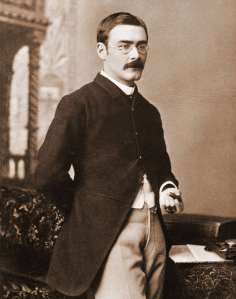
Rudyard Kipling

Kipling and the Great War

© Paul Hemphill 2022. All rights reserved

Young Men and War

Christopher Hitchens, Vanity Fair, February 1997

Recently, amid the legions of anonymous W.W.I grave sites that cover northern France, the body of Rudyard Kipling’s son, John, was identified, almost 80 years after he died in the Battle of Loos. His tragic story explains the guilt and rage that consumed his father, England’s immortal Bard of Empire

Fin de Siècle

In Regeneration, the opening book of Pat Barker’s “Ghost Road” trilogy, about the First World War, one of the characters summons the waking nightmare of the trenches: “I was going up with the rations one night and I saw the limbers against the skyline, and the flares going up. What you see every night. Only I seemed to be seeing it from the future. A hundred years from now they’ll still be ploughing up skulls. And I seemed to be in that time and looking back. I think I saw our ghosts.”

A ghost is something that is dead but won’t lie down. Those who were slaughtered between 1914 and 1918 are still in our midst to an astonishing degree. On the first day of the Battle of the Somme, in July 1916, the British alone posted more killed and wounded than appear on the whole of the Vietnam memorial. In the Battle of Verdun, which began the preceding February, 675,000 lives were lost. Between them, Britain, France, the United States, Germany, Turkey, and Russia sacrificed at least 10 million soldiers. And this is to say nothing of civilian losses. Out of the resulting chaos and misery came the avenging forces of Fascism and Stalinism.

One reason for the enduring and persistent influence of the Great War (as they had to call it at the time, not knowing that it would lead to a second and even worse one) is that it shaped the literature of the Anglo-American world. Think of the titles that remain on the shelves: Good-Bye to All That, by Robert Graves, Anthem for Doomed Youth, by Wilfred Owen. The poetry of Rupert Brooke and Siegfried Sassoon. Translations from German and French, such as Erich Maria Remarque’s All Quiet on the Western Front and Under Fire, by Henri Barbusse. By enlisting in the Great War, a whole generation of Americans, including William Faulkner, Ernest Hemingway, e. e. cummings, and John Dos Passos, made the leap from small-town U.S.A. to 20th-century modernism. Loss of moral virginity and innocence is the burden of Sebastian Faulks’s elegiac novel, Birdsong, written in this decade, but as full of pain and poetry as if composed in his grandfather’s time. We owe the term “shell shock” to this period, and it sometimes feels as if the shock has never worn off.

I’ve been passing much of my time, over the past year or so, in trying to raise just one of these ghosts. On September 27, 1915, during the Battle of Loos, a young lieutenant of the Irish Guards was posted “wounded and missing.” His name was John Kipling, and he was the only son of the great Bard of Empire, Rudyard Kipling. Kipling never goes out of print, because he not only captured the spirit of imperialism and the white man’s burden but also wrote imperishable stories and poems—many of them to the boy John—about the magic and lore of childhood. And on that shell-shocked September day, the creator of Mowgli and Kim had to face the fact that he had sacrificed one of his great loves—his son, whom he called his “man-child”—to another of his great loves: the British Empire. You can trace the influence of this tragedy through almost every line that he subsequently wrote.

Go to the small towns of northern France today if you want to discover that the words “haunted landscape” are no cliche. Around the city of Arras, scattered along any road that you may take, are cemeteries. Kipling called them “silent cities.” (I came across an article in a French tourist magazine that recommended Arras to those who wished to pursue “de tourisme de necropole”—mass-grave tourism. Indeed, there isn’t much else to see.) This used to be the coal-bearing region of France, and great slag heaps and abandoned mine works add an additional layer of melancholy to the scenery. But otherwise it’s graveyards, graveyards all the way. Some of them are huge and orderly, with seemingly endless ranks and files of white markers stretching away in regimental patterns. But many are small and isolated, off in the middle of fields where French farmers have learned to plow around them. These represent heaps of bodies that simply couldn’t be moved and were interred where they lay. Huge land grants have been made by the government and people of France, in perpetuity, to Britain and Canada and India and the United States, just to consecrate the fallen.

His is one of the few parts of France where the locals are patient with Anglo-Saxon visitors trying to ask directions in French. And those French plowmen know what to do when, as so often happens, they turn up a mass of barbed wire or a batch of shells and mortars or a skeleton. (“A hundred years from now they’ll still be ploughing up skulls.”) They call the police, who alert the Commonwealth War Graves Commission. And then the guesswork can begin. There’s a good deal of latitude. Of the 531,000 or so British Empire dead whose remains have been fertilizing the region for most of the century, about 212,000 are still unidentified.

“Every now and then we have a bit of luck,” I was told by Peter Rolland of the commission, which runs a large and quiet office just outside Arras and which is charged with keeping all the graves clean. “Last year we dug up 12 corpses. Most of their dog tags and uniforms were eroded or decayed hopelessly. But we did manage to identify one Australian chap called Sergeant J. J. White. We even found his daughter, who was two years old when he was killed, and she came over for the funeral.”

And a few years ago, almost eight decades after he went missing, they found Kipling’s son, John. His body had lain in no-man’sland for three years and then been hastily shoveled into an unmarked grave. Kipling and his wife made several desperate visits to the area in the hope of identifying him, touring battlefield after battlefield. But this was in the days before proper dental records and DNA, and they gradually gave up. In 1992, thanks to painstaking record-keeping and the amateur interest taken by a member of the commission staff, one anonymous grave in one small cemetery was finally commemorated as John’s.

This means that a new marker has been erected. The old one read, A LIEUTENANT OF THE GREAT WAR. KNOWN UNTO GOD. The wording is actually that of Kipling Sr., who in order to atone for John’s disappearance became a founding member of what was then called the Imperial War Graves Commission, and helped design its monuments and rituals. As another atonement, he took on the unpaid job of writing the wartime history of the Irish Guards. In that work, he coldly summed up the regiment’s toll of 324 casualties in a single battle and noted that “of their officers, 2nd Lieutenant PakenhamLaw had died of wounds; 2nd Lieutenants Clifford and Kipling were missing. … It was a fair average for the day of a debut.”

John Kipling’s body had lain in no-man’s-land for three years and then been hastily shoveled into an unmarked grave.

Kipling’s autobiography, Something of Myself, is even more eerily detached. “My son John arrived on a warm August night of ’97, under what seemed every good omen.” That’s the only mention of the boy in the entire book. Kipling had already lost a beloved daughter to influenza. He seems to have felt that if he wrote any more he wouldn’t be able to trust himself.

For a father to mourn or to bury his son is an offense to the natural order of things. Yet another reason for the endless fascination of the Great War is the reverse-Oedipal fashion in which, for several lunatic years, the sight of old men burying young men was the natural order. And this in a civilized Europe bred to the expansive optimism of the late 19th century.

John Kipling was only 16 when the war broke out. Pressed, by his father to volunteer, he was rejected on the grounds of poor eyesight. (Those who have read “Baa Baa, Black Sheep,” Rudyard’s chilling story derived from his own childhood at the mercy of sadistic guardians, will remember the horror of the small boy being punished for clumsiness and poor scholarship when actually he has an undiagnosed myopia.) The proud and jingoistic father used his influence with the high command to get young John commissioned anyway. His mother’s diary recorded that “John leaves at noon. . . . He looks very straight and smart and young, as he turned [sic] at the top of the stairs to say: ‘Send my love to Dad-o.’ “

He didn’t last more than a few weeks. The village of Loos, where he disappeared, was also where the British found out about modern warfare; it was at Loos that they first tried to use poison gas as a weapon of combat. (It blew back into their own trenches, with unimaginable results.) In a neighboring sector a short while later, the British became the first to deploy a tank. But in late 1915, war was mainly blood, mud, bayonets, and high explosives.

Accounts of the boy’s last moments differ, but Kipling’s friend H. Rider Haggard (creator of King Solomon’s Mines and She) took a lot of trouble interviewing witnesses. He recorded in his diary that one of them, a man named Bowe, “saw an officer who he could swear was Mr Kipling leaving the wood on his way to the rear and trying to fasten a field dressing round his mouth which was badly shattered by a piece of shell. Bowe would have helped him but for the fact that the officer was crying with the pain of the wound and he did not want to humiliate him by offering assistance. I shall not send this on to Rudyard Kipling—it is too painful.”

Indeed it would have been: a halfblind kid making his retreat under fire and in tears, with a devastating wound. No definition of stiff upper lip would have covered it. And almost the last of John’s letters home had said, “By the way, the next time would you get me an Identification Disc as I have gone and lost mine. . . . Just an aluminum Disc with a string through it.” Probably it’s a good thing that the poet of the Raj never knew his boy died weeping. At one point he wrote, in a cynical attempt to brace himself, “My son was killed while laughing at some jest. I would I knew / What it was, and it might serve me in a time when jests are few.”

To a friend he wrote, “I don’t suppose there is much hope for my boy and the little that is left doesn’t bear thinking of. However, I hear that he finished well. . . . It was a short life. I’m sorry that all the years’ work ended in one afternoon, but lots of people are in our position, and it’s something to have bred a man.” His wife, Caroline, wrote more feelingly to her mother, “If one could but know he was dead …”

Haggard may have wished to spare Kipling pain, but one has to say that Kipling did not try to spare himself. His whole personality as an author underwent a deep change. At different stages, one can see the influence of parental anguish, of patriotic rage, of chauvinistic hatred, and of personal guilt. A single couplet almost contrives to compress all four emotions into one: “If any question why we died, / Tell them, because our fathers lied.”

These Spartan lines are anti-war and pro-war to almost the same extent. The fathers had lied, not just by encouraging their sons to take lethal risks, but by not preparing enough for war and therefore letting the young people pay for their complacency. Kipling’s longer poem “The Children” possesses the same ambiguity:

These were our children who died for our lands: they were dear in our sight.

    We have only the memory left of their home-treasured sayings and laughter.
    The price of our loss shall be paid to our hands, not another’s hereafter.
Neither the Alien nor Priest shall decide on it.    That is our right.
        But who shall return us the children?
At the hour the Barbarian chose to disclose his pretences,
    And raged against Man, they engaged, on the breasts that they bared for us,
    The first felon-stroke of the sword he had long-time prepared for us—
Their bodies were all our defence while we wrought our defences.
They bought us anew with their blood, forbearing to blame us,
Those hours which we had not made good when the Judgment o’ercame us.
They believed us and perished for it.    Our statecraft, our learning
Delivered them bound to the Pit and alive to the burning
Whither they mirthfully hastened as jostling for honour—
Nor since her birth has our Earth seen such worth loosed upon her.
Nor was their agony brief, or once only imposed on them.
    The wounded, the war-spent, the sick received no exemption:
    Being cured they returned and endured and achieved our redemption,
Hopeless themselves of relief, till Death, marveling, closed on them.
That flesh we had nursed from the first in all cleanness was given
To corruption unveiled and assailed by the malice of Heaven—
By the heart-shaking jests of Decay where it lolled in the wires—
To be blanched or gay-painted by fumes— to be cindered by fires—
To be senselessly tossed and retossed in stale mutilation
From crater to crater.    For that we shall take expiation.
        But who shall return us our children?

After a few lines of expressive loathing about the German foe, Kipling returns to the idea that the massacre of the innocents has an element of domestic responsibility to it:

(Chalk Pit Wood was the last place his son was seen alive.) And then, giving vent to all the ghastly rumors he and his wife had heard about what happened to bodies caught in no-man’sland, he continues:

Uncertainty was torturing Kipling here into imagining the worst and most obscene fate for his son. At other times he was more resigned and more wistful, as in the short poem “My Boy Jack” (1915):

“Have you news of my boy Jack? ”
Not this tide.
“When d’you think that he’ll come back?”
Not with this wind blowing, and this tide.

“Has any one else had word of him?”
Not this tide.
For what is sunk will hardly swim,
Not with this wind blowing, and this tide.

“Oh, dear, what comfort can I find?”
None this tide,
Nor any tide,
Except he did not shame his kind—
Not even with that wind blowing, and that tide.

Then hold your head up all the more,
This tide,
And every tide;
Because he was the son you bore,
And gave to that wind blowing and that tide!

The impression that the seeker in the poem is a woman. Odd to think of Kipling as having a feminine aspect, but perhaps the verse is meant as a tribute to his American wife, who was driven almost out of her mind with grief. On the other hand, one might throw sentiment to one side and remember that Kipling famously wrote (in a poem designed to tease a daughter who favored female suffrage) that “the female of the species is more deadly than the male.” And this is most certainly true of the main character in a subsequent short story of Kipling’s entitled “Mary Postgate.” Angus Wilson once described it as evil; at all events it is a paean of hatred and cruelty and shows Kipling banishing all his doubts and guilts in favor of one cathartic burst of sickening revenge.

Mary Postgate is a wartime spinster who looks after an elderly lady in an English village. One day, a German airman crashes in her garden and lies crippled in the laurel bushes. Mary Postgate decides to see how long it will take him to die. She tells nobody about the intruder and makes no effort to summon help. She waits and watches “while an increasing rapture laid hold on her.” As the young man finally expires, she “drew her breath short between her teeth and shivered from head to foot.” Then she takes a “luxurious hot bath before tea” and, “lying all relaxed on the other sofa,” startles her employer by looking, for once, “quite handsome!”

It’s really seriously creepy to find Kipling—normally rather reticent in such matters—writing a caricature of a female orgasm and wallowing in the voluptuousness of sadism. The justification for it all is that a child has been killed by a bomb in the village. “I have seen the dead child,” says Mary Postgate to the dying airman. So the link is unmistakable. And the story—published in 1917—is closed by one of the worst sets of verses that this splendid poet ever composed. Its refrain is the line “When the English began to hate.” Omitted from most anthologies, it is a vulgar and bullying rant, which promises that “Time shall count from the date / That the English began to hate.”

I first became aware of the poem when it was dished out as a leaflet by a British Nazi organization in the 1970s. (David Edgar makes use of it in Destiny, his incisive play about the mentality of Fascism.) I have often thought it very fortunate that Kipling died in 1936. He had already begun to praise Mussolini by then, and God knows what he might have said about the manly new Germany-even though his visceral dislike of all Germans would perhaps have kept him in check. He certainly disliked Germans (whom he habitually called “Huns”) even more than he did Jews (whom he generally called “Hebrews”).

His letters are fiercer than his poems and short stories, and like them they took a turn for the worse after John’s disappearance. To his old friend L. C. Dunsterville he wrote, at the height of the bloodletting in September 1916, that things seemed to be going jolly well on the Western Front. “It’s a scientific-cumsporting murder proposition with enough guns at last to account for the birds, and the Hun is having a very sickly time of it. He has the erroneous idea that he is being hurt, whereas he won’t know what real pain means for a long time. I almost begin to hope that when we have done with him there will be very little Hun left.”

The word for this, in or out of context, is “unseemly.”

Most interesting, though, was his extensive wartime correspondence with Theodore Roosevelt. One has to remember that Kipling at that time was the best-known living writer in the English language. His following in the United States was immense. His famous poem “The White Man’s Burden,” more often quoted than read, had actually been written for Roosevelt in 1898 and was addressed to the U.S. Congress. It urged that body (successfully) to “take up the white man’s burden” by annexing the newly conquered Philippines. Such was Kipling’s ability to sway public opinion on both sides of the Atlantic that in 1914, when the Liberal British foreign secretary, Sir Edward Grey, heard that Kipling was planning a trip to America, Grey told the Cabinet that unless he was assured that this dangerous Tory poet was going in an unofficial capacity he would resign at once.

Teddy Roosevelt, of course, favored American entry into the Great War, and Kipling made a point of supplying him with ammunition. The poet didn’t hesitate to make very emotional appeals, and as a result gave a few hostages to fortune. In December 1914 he wrote to T.R. telling him encouragingly that the Germans “have been sending up their younger men and boys lately on our front. This is valuable because these are prospective fathers, and they come up to the trenches with superb bravery. Then they are removed.”

The letter goes on, “Suppose my only son dies, I for one should not View with equanimity’ Mr Wilson (however unswayed by martial prejudice) advising or recommending my country how to behave at the end of this War.” Kipling really despised Woodrow Wilson and his hypocritical neutrality, and after John’s death he gave his contempt free rein, describing Wilson as equivalent to an ape looking down from a tree. “My grief,” he wrote, “is that the head of the country is a man unconnected by knowledge or experience with the facts of the world in which we live. All of which must be paid for in the lives of good men.”

This relentless drumbeat, which also urged T.R. in menacing tones to beware of the millions of potentially disloyal German-Americans, helped breed a prowar atmosphere in the United States. Many of the Americans who went to fight in Europe did so as volunteers, preparing the ground for later, full-scale intervention. And when the American Expeditionary Force got going, it took heavy casualties. Among these was Quentin Roosevelt, son of Teddy, who was killed while serving as a pilot. T.R.’s response was almost Kiplingesque in its gruffness. “My only regret is that I could not give myself,” he said. But of course he could not have given himself, any more than Kipling could. This was an opportunity open strictly to sons.

The creator of Mowgli and Kim sacrificed one of his great loves-his son-to another of his great loves: the British Empire.

The current tenant of Headstone Two I in Row D of Plot Seven in St. Mary’s I Advanced Dressing Station Cemetery never had any idea of what a titanic conflict had snuffed out his life. Nor had he any notion of the role his death would play in his father’s poetry or his father’s propaganda. His is just one of 1,768 British and 19 Canadian graves in St. Mary’s ADS, 1,592 of which are unidentified and likely to remain so forever.

The gardener, Ian Nelson, met me at the gate and took me around. He was a working-class type from my hometown in Hampshire, just one of the many hundreds of people who live and work in northern France, stranded in time, preserving a moment and observing the decencies. He wasn’t the garrulous type, preferring to roll his own cigarettes and to say briefly that he was “old-fashioned” and “felt we owed something” to the fallen. His main enemies were the moles, which spoil the flower beds and lawns. He explained to me how certain alpine and herbaceous plantings protect the headstones from mud splashes in the winter and mowing machines in the summer. Floribunda roses were in profusion, and baby maple trees, and there was the odd Flanders poppy.

The register and the visitors’ book were kept in a metal-and-stone safe in a corner of the cemetery, and as we got there we found an old metal button in the dirt. It was a standard-issue Great War soldier’s button, with a faded lion-and-unicorn motif, and Mr. Nelson let me keep it with a look that said, Plenty more where that came from. Most of the names in the register are printed and have been for decades, and it is reprinted every few years. But a handwritten addition had just been made, showing that John, only son of Mr. and Mrs. Rudyard Kipling of Bateman’s, Burwash, Sussex, England, had made the supreme sacrifice while serving as a lieutenant in the Irish Guards. The visitors’ book had a space for remarks, and many visitors had done their best to say something. I didn’t want to let down the side, so I put in the last few lines of Wilfred Owen’s “The Parable of the Old Man and the Young.”

Owen was killed in a futile canal crossing skirmish just a few days before the end of the war, in November 1918 (his mother got the telegram just as the church bells were pealing for victory and a general rejoicing was getting under way), but before he died he composed the most wrenching and lyrical poetry of the entire conflict. Nearly 50 years later, it furnished the libretto for Benjamin Britten’s War Requiem. In Owen’s rewriting of the story of Abraham and Isaac, the old man is about to press the knife to the throat of his firstborn:

When lo! an angel called him out of heaven, Saying, Lay not thy hand upon the lad, Neither do anything to him. Behold,

A ram, caught in a thicket by its horns; Offer the Ram of Pride instead of him.

But the old man would not so, but slew his son,

And half the seed of Europe, one by one. □

British women tending war graves, Abbeville

The Gardener

By Rudyard Kipling

Every one in the village knew that Helen Turrell did her duty by all her world, and by none more honourably than by her only brother’s unfortunate child. The village knew, too, that George Turrell had tried his family severely since early youth, and were not surprised to be told that, after many fresh starts given and thrown away he, an Inspector of Indian Police, had entangled himself with the daughter of a retired non-commissioned officer, and had died of a fall from a horse a few weeks before his child was born.

Mercifully, George’s father and mother were both dead, and though Helen, thirtyfive and independent, might well have washed her hands of the whole disgraceful affair, she most nobly took charge, though she was, at the time, under threat of lung trouble which had driven her to the south of France. She arranged for the passage of the child and a nurse from Bombay, met them at Marseilles, nursed the baby through an attack of infantile dysentery due the carelessness of the nurse, whom she had had to dismiss, and at last, thin and worn but triumphant, brought the boy late in the autumn, wholly restored, to her Hampshire home.

All these details were public property, for Helen was as open as the day, and held that scandals are only increased by hushing then up. She admitted that George had always been rather a black sheep, but things might have been much worse if the mother had insisted on her right to keep the boy. Luckily, it seemed that people of that class would do almost anything for money, and, as George had always turned to her in his scrapes, she felt herself justified – her friends agreed with her – in cutting the whole non-commissioned officer connection, and giving the child every advantage. A christening, by the Rector, under the name of Michael, was the first step. So far as she knew herself, she was not, she said, a child-lover, but, for all her faults, she had been very fond of George, and she pointed out that little Michael had his father’s mouth to a line; which made something to build upon.

As a matter of fact, it was the Turrell forehead, broad, low, and well-shaped, with the widely spaces eyes beneath it, that Michael had most faithfully reproduced. His mouth was somewhat better cut than the family type. But Helen, who would concede nothing good to his mother’s side, vowed he was a Turrell all over, and, there being no one to contradict, the likeness was established.

In a few years Michael took his place, as accepted as Helen had always been – fearless, philosophical, and fairly good-looking. At six, he wished to know why he could not call her ‘Mummy’, as other boys called their mothers. She explained that she was only his auntie, and that aunties were not quite the same as mummies, but that, if it gave him pleasure, he might call her ‘Mummy’ at bedtime, for a pet-name between themselves.

Michael kept his secret most loyally, but Helen, as usual, explained the fact to her friends; which when Michael heard, he raged.

“Why did you tell? Why did you tell?” came at the end of the storm.

“Because it’s always best to tell the truth”, Helen answered, her arm round him as he shook in his cot.

“All right, but when the troof’s ugly I don’t think it’s nice.”

“Don’t you, dear?”

“No, I don’t and” – she felt the small body stiffen – “now you’ve told, I won’t call you ‘Mummy’ any more – not even at bedtimes.”

“But isn’t that rather unkind?” said Helen softly.

“I don’t care! I don’t care! You have hurted me in my insides and I’ll hurt you back. I’ll hurt you as long as I live!”

“Don’t, oh, don’t talk like that, dear! You don’t know what – “

“I will! And when I’m dead I’ll hurt you worse!”

“Thank goodness, I shall be dead long before you, darling.”

“Huh! Emma says, ‘Never know your luck’.” (Michael had been talking to Helen’s elderly, flat-faces maid.) “Lots of little boys die quite soon. So’ll I. Then you’ll see!”

Helen caught her breath and moved towards the door, but the wail of ‘Mummy! Mummy!’ drew her back again, and the two wept together.

At ten years old, after two terms at a prep. school, something or somebody gave him the idea that his civil status was not quite regular. He attacked Helen on the subject, breaking down her stammered defences with the family directness.

“Don’t believe a word of it”, he said, cheerily, at the end. “People wouldn’t have talked like they did if my people had been married. But don’t you bother, Auntie. I’ve found out all about my sort in English Hist’ry and the Shakespeare bits. There was William the Conqueror to begin with, and – oh, heaps more, and they all got on first-rate. ‘Twon’t make any difference to you, by being that – will it?”

“As if anything could – ” she began.

“All right. We won’t talk about it any more if it makes you cry”. He never mentioned the thing again of his own will, but when, two years later, he skilfully managed to have measles in the holidays, as his temperature went up tot the appointed one hundred and four he muttered of nothing else, till Helen’s voice, piercing at last his delirium, reached him with assurance that nothing on earth or beyond could make any difference between them.

The terms at his public school and the wonderful Christmas, Easter, and Summer holidays followed each other, variegated and glorious as jewels on a string; and as jewels Helen treasured them. In due time Michael developed his own interests, which ran their courses and gave way to others; but his interest in Helen was constant and increasing throughout. She repaid it with all that she had of affection or could command of counsel and money; and since Michael was no fool, the War took him just before what was like to have been a most promising career.

He was to have gone up to Oxford, with a scholarship, in October. At the end of August he was on the edge of joining the first holocaust of public-school boys who threw themselves into the Line; but the captain of his O.T.C., where he had been sergeant for nearly a year, headed him off and steered him directly to a commission in a battalion so new that half of it still wore the old Army red, and the other half was breeding meningitis through living overcrowdedly in damp tents. Helen had been shocked at the idea of direct enlistment.

“But it’s in the family”, Michael laughed.

“You don’t mean to tell me that you believed that story all this time?” said Helen. (Emma, her maid, had been dead now several years.) “I gave you my word of honour – and I give it again – that – that it’s all right. It is indeed.”

“Oh, that doesn’t worry me. It never did”, he replied valiantly. “What I meant was, I should have got into the show earlier if I’d enlisted – like my grandfather.”

“Don’t talk like that! Are you afraid of its ending so soon, then?”

“No such luck. You know what K. says.”

“Yes. But my banker told me last Monday it couldn’t possibly last beyond Christmas – for financial reasons.”

“I hope he’s right, but our Colonel – and he’s a Regular – say it’s going to be a long job.”

Michael’s battalion was fortunate in that, by some chance which meant several ‘leaves’, it was used for coast-defence among shallow trenches on the Norfolk coast; thence sent north to watch the mouth of a Scotch estuary, and, lastly, held for weeks on a baseless rumour of distant service. But, the very day that Michael was to have met Helen for four whole hours at a railway-junction up the line, it was hurled out, to help make good the wastage of Loos, and he had only just time to send her a wire of farewell.

In France luck again helped the battalion. It was put down near the Salient, where it led a meritorious and unexacting life, while the Somme was being manufactured; and enjoyed the peace of the Armentières and Laventie sectors when that battle began. Finding that it had sound views on protecting its own flanks and could dig, a prudent Commander stole it out of its own Division, under pretence of helping to lay telegraphs, and used it round Ypres at large.

A month later, and just after Michael had written Helen that there was noting special doing and therefore no need to worry, a shell-splinter dropping out of a wet dawn killed him at once. The next shell uprooted and laid down over the body what had been the foundation of a barn wall, so neatly that none but an expert would have guessed that anything unpleasant had happened.

By this time the village was old in experience of war, and, English fashion, had evolved a ritual to meet it. When the postmistress handed her seven-year-old daughter the official telegram to take to Miss Turrell, she observed to the Rector’s gardener: “It’s Miss Helen’s turn now”. He replied, thinking of his own son: “Well, he’s lasted longer than some”. The child herself came to the front-door weeping aloud, because Master Michael had often given her sweets. Helen, presently, found herself pulling down the house-blinds one after one with great care, and saying earnestly to each: “Missing always means dead.” Then she took her place in the dreary procession that was impelled to go through an inevitable series of unprofitable emotions. The Rector, of course, preached hope end prophesied word, very soon, from a prison camp. Several friends, too, told her perfectly truthful tales, but always about other women, to whom, after months and months of silence, their missing had been miraculously restored. Other people urged her to communicate with infallible Secretaries of organizations who could communicate with benevolent neutrals, who could extract accurate information from the most secretive of Hun commandants. Helen did and wrote and signed everything that was suggested or put before her.

Once, on one of Michael’s leaves, he had taken her over a munition factory, where she saw the progress of a shell from blank-iron to the all but finished article. It struck her at the time that the wretched thing was never left alone for a single second; and “I’m being manufactured into a bereaved next of kin”, she told herself, as she prepared her documents.

In due course, when all the organizations had deeply or sincerely regretted their inability to trace, etc, something gave way within her and all sensations – save of thankfulness for the release – came to an end in blessed passivity. Michael had died and her world had stood still and she had been one with the full shock of that arrest. Now she was standing still and the world was going forward, but it did not concern her – in no way or relation did it touch her. She knew this by the ease with which she could slip Michael’s name into talk and incline her head to the proper angle, at the proper murmur of sympathy.

In the blessed realization of that relief, the Armistice with all its bells broke over her and passed unheeded. At the end of another year she had overcome her physical loathing of the living and returned young, so that she could take them by the hand and almost sincerely wish them well. She had no interest in any aftermath, national or personal, of the war, but, moving at an immense distance, she sat on various relief committees and held strong views – she heard herself delivering them – about the site of the proposed village War Memorial.

Then there came to her, as next of kin, an official intimation, backed by a page of a letter to her in indelible pencil, a silver identity-disc and a watch, to the effect that the body of Lieutenant Michael Turrell had been found, identified, and re-interred in Hagenzeele Third Military Cemetery – the letter of the row and the grave’s number in that row duly given.

So Helen found herself moved on to another process of the manufacture – to a world full of exultant or broken relatives, now strong in the certainty that there was an altar upon earth where they might lay their love. These soon told her, and by means of time-tables made clear, how easy it was and how little it interfered with life’s affairs to go and see one’s grave.

So different”, as the Rector’s wife said, “if he’d been killed in Mesopotamia, or even Gallipoli.”

The agony of being waked up to some sort of second life drove Helen across the Channel, where, in a new world of abbreviated titles, she learnt that Hagenzeele Third could be comfortably reached by an afternoon train which fitted in with the morning boat, and that there was a comfortable little hotel not three kilometres from Hagenzeele itself, where one could spend quite a comfortable night and see one’s grave next morning. All this she had from a Central Authority who lived in a board and tar-paper shed on the skirts of a razed city of whirling lime-dust and blown papers.

“By the way”, said he, “you know your grave, of course?”

“Yes, thank you”, said Helen, and showed its row and number typed on Michael’s own little typewriter. The officer would have checked it, out of one of his many books; but a large Lancashire woman thrust between them and bade him tell her where she might find her son, who had been corporal in the A.S.C. His proper name, she sobbed, was Anderson, but, coming of respectable folk, he had of course enlisted under the name of Smith; and had been killed at Dickiebush, in early ‘Fifteen. She had not his number nor did she know which of his two Christian names she might have used with his alias; but her Cook’s tourist ticket expired at the end of Easter week, and if by then she could not find her child she should go mad. Whereupon she fell forward on Helen’s breast; but the officer’s wife came out quickly from a little bedroom behind the office, and the three of them lifted the woman on to the cot.

“They are often like this”, said the officer’s wife, loosening the tight bonnet-strings. “Yesterday she said he’d been killed at Hooge. Are you sure you know your grave? It makes such a difference.”

“Yes, thank you”, said Helen, and hurried out before the woman on the bed should begin to lament again.

Tea in a crowded mauve and blue striped wooden structure, with a false front, carried her still further into the nightmare. She paid her bill beside a stolid, plain-featured Englishwoman, who, hearing her inquire about the train to Hagenzeele, volunteered to come with her.

“I’m going to Hagenzeele myself”, she explained. “Not to Hagenzeele Third; mine is Sugar Factory, but they call it La Rosière now. It’s just south of Hagenzeele Three. Have you got your room at the hotel there?”

“Oh yes, thank you, I’ve wired.”

“That’s better. Sometimes the place is quite full, and at others there’s hardly a soul. But they’ve put bathrooms into the old Lion d’Or – that’s the hotel on the west side of Sugar Factory – and it draws off a lot of people, luckily.”

“It’s all new to me. This is the first time I’ve been over.”

“Indeed! This is my ninth time since the Armistice. Not on my own account. I haven’t lost anyone, thank God – but, like everyone else, I’ve lot of friends at home who have. Coming over as often as I do, I find it helps them to have someone just look at the – place and tell them about it afterwards. And one can take photos for them, too. I get quite a list of commissions to execute.” She laughed nervously and tapped her slung Kodak. “There are two or three to see at Sugar Factory this time, and plenty of others in the cemeteries all about. My system is to save them up, and arrange them, you know. And when I’ve got enough commissions for one area to make it worth while, I pop over and execute them. It does comfort people.”

“I suppose so”, Helen answered, shivering as they entered the little train.

“Of course it does. (Isn’t lucky we’ve got windows-seats?) It must do or they wouldn’t ask one to do it, would they? I’ve a list of quite twelve or fifteen commissions here” – she tapped the Kodak again – “I must sort them out tonight. Oh, I forgot to ask you. What’s yours?”

“My nephew”, said Helen. “But I was very fond of him”.

“Ah, yes! I sometimes wonder whether they know after death? What do you think?”

“Oh, I don’t – I haven’t dared to think much about that sort of thing”, said Helen, almost lifting her hands to keep her off.

“Perhaps that’s better”, the woman answered. “The sense of loss must be enough, I expect. Well I won’t worry you any more.”

Helen was grateful, but when they reached the hotel Mrs Scarsworth (they had exchanged names) insisted on dining at the same table with her, and after the meal, in the little, hideous salon full of low-voiced relatives, took Helen through her ‘commissions’ with biographies of the dead, where she happened to know them, and sketches of their next of kin. Helen endured till nearly half-past nine, ere she fled to her room.

Almost at one there was a knock at her door and Mrs Scarsworth entered; her hands, holding the dreadful list, clasped before her.

“Yes – yes – I know”, she began. “You’re sick of me, but I want to tell you something. You – you aren’t married, are you? Then perhaps you won’t… But it doesn’t matter. I’ve got to tell someone. I can’t go on any longer like this.”

“But please -” Mrs Scarsworth had backed against the shut door, and her mouth worked dryly.

“In a minute”, she said. “You – you know about these graves of mine I was telling you about downstairs, just now? They really are commissions. At least several of them are.” Here eye wandered round the room. “What extraordinary wall-papers they have in Belgium, don’t you think? … Yes. I swear they are commissions. But there’s one, d’you see, and – and he was more to me than anything else in the world. Do you understand?”

Helen nodded.

“More than anyone else. And, of course, he oughtn’t to have been. He ought to have been nothing to me. But he was. He is. That’s why I do the commissions, you see. That’s all.”

“But why do you tell me?” Helen asked desperately.

“Because I’m so tired of lying. Tired of lying – always lying – year in and year out. When I don’t tell lies I’ve got to act ’em and I’ve got to think ’em, always. You don’t know what that means. He was everything to me that he oughtn’t to have been – the real thing – the only thing that ever happened to me in all my life; and I’ve had to pretend he wasn’t. I’ve had to watch every word I said, and think out what lie I’d tell next, for years and years!”

“How many years?” Helen asked.

“Six years and four months before, and two and three-quarters after. I’ve gone to him eight times, since. Tomorrow I’ll make the ninth, and – and I can’t – I can’t go to him again with nobody in the world knowing. I want to be honest with someone before I go. Do you understand? It doesn’t matter about me. I was never truthful, even as a girl. But it isn’t worthy of him. So – so I – I had to tell you. I can’t keep it up any longer. Oh, I can’t!”

Next morning Mrs Scarsworth left early on her round of commissions, and Helen walked alone to Hagenzeele Third. The place was still in the making, and stood some five or six feet above the metalled road, which it flanked for hundreds of yards. Culverts across a deep ditch served for entrances through the unfinished boundary wall. She climbed a few woodenfaced earthen steps and then met the entire crowded level of the thing in one held breath. She did not know that Hagenzeele Third counted twenty-one thousand dead already. All she saw was a merciless sea of black crosses, bearing little strips of stamped tin at all angles across their faces. She could distinguish no order or arrangement in their mass; nothing but a waist-high wilderness as of weeds stricken dead, rushing at her. She went forward, moved to the left and the right hopelessly, wondering by what guidance she should ever come to her own. A great distance away there was a line of whiteness. It proved to be a block of some two or three hundred graves whose headstones had already been set, whose flowers were planted out, and whose new-sown grass showed green. Here she could see clear-cut letters at the ends of the rows, and, referring to her slip, realized that it was not here she must look.

A man knelt behind a line of headstones – evidently a gardener, for he was firming a young plant in the soft earth. She went towards him, her paper in her hand. He rose at her approach and without prelude or salutation asked: “Who are you looking for?”

“Lieutenant Michael Turrell – my nephew”, said Helen slowly and word for word, as she had many thousands of times in her life.

The man lifted his eyes and looked at her with infinite compassion before he turned from the fresh-sown grass toward the naked black crosses.

“Come with me”, he said, “and I will show you where your son lies.”

When Helen left the Cemetery she turned for a last look. In the distance she saw the man bending over his young plants; and she went away, supposing him to be the gardener.

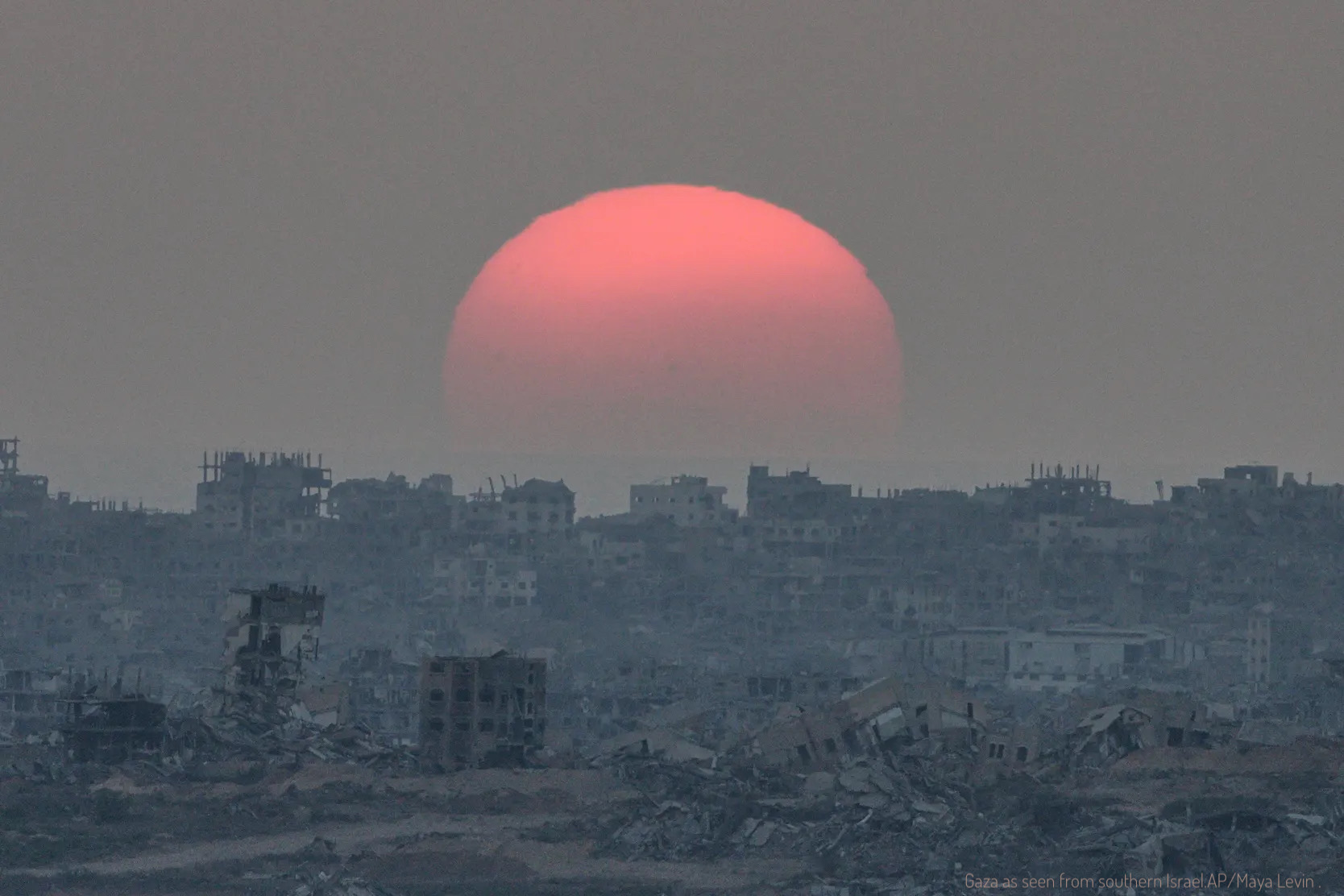
One ring to rule us all – does Tolkien matter?

The world was young, the mountains green,
No stain yet on the Moon was seen,
No words were laid on stream or stone,
When Durin woke and walked alone.

The Song of Durin, JRR Tolkien

In Innovation, the final installment of Peter Ackroyd’s entertaining and informative History of England, he writes:

“The post-war years had brought fables of splrltual or material collapse, from That Hideous Strength to Brave New World to Ninteen Eighty-Four. During the Fifties, the novel seemed to be settling back to its journalistic roots – quotidian in subject, unpretentious in style – but the zeitgeist is a wayward wind. Among writers of fiction, another response was offered to the bewilderments of the post-war world, which was to fly above it. In 1955, Return of the King, the last installment of R. R. Tolkien’s The Lord of the Rings, was published. It was the resurrection of heroic romance, tempered by its author’s memories of war. It tells of a small, unregarded race of Middle-earth, the ‘hobbits’,who ‘arise to shake the counsels of great’. The freedom of the world hinges upon the destruction of something tiny, beautiful and evil, evil, a ring forged by a fallen angel. While elves, men and dwarves fight, two hobbits are tasked with the destruction of the great destroyer. A whole world, formed of its author’s experiments in language came into being to the extent that if anyone were to point out that Middle-earth’ is only a translation of the Norse ‘Mittlegard’, the hearer would respond with a shrug. It was there, whatever its origins. For the English journalist Bernard Levin, it offered a beautiful and salutary reminder that the ‘meek will inherit the earth’; for the American critic Edward Wilson, it was “juvenile trash”, a story of good boys being rewarded. In spite of the naysayers, the popularity and influence of The Lord of the Rings grew to unprecedented heights. Tolkien himself, a scholar and devout Catholic, was later to find his work taken up as a banner by most unlikely allies, a group that came to be known as ‘hippies’”.

Whenever a survey or poll crowns JRR Tolkien’s The Lord of the Rings as the public’s favourite novel – and there have been many during the past seventy years – and lauds the author as one of the most influential writers of the twentieth century, the reaction has always been the same from critics who have been sneering at his books since their publication. The Lord of the Rings has been dismissed as trivial, juvenile even, and not worth arguing about. It has been called archaic, backward looking, nostalgist and sentimentalist, and has been gaslit for misogyny and homo-eroticism, violence and even racism (with its ethnocentric and androgynous elves and it’s Graeco-Roman Gondorians besieged by darker races from the south and east). Yet, most critics have probably never read it.

On the side of the angels (or is it the elves?) are the millions who came of age with and fell in love with the books and adopted a Tolkienesque taxonomy for viewing the world as a perpetual dialectic between the forces of light and of darkness. Some have even studied the lineages and languages. The actress Liv Tyler, who plays a luminous Arwen Evenstar in Peter Jackson’s award-winning film trilogy is said to have learned elven, and I sometimes see people on the street with elven rune tattoos. Liv probably has one too. I once spied a young lady walking down King Street in Newtown, the boulevard of Sydney’s myriad young tribes, sporting eleven runes on the backs of her suntanned calves. I was cheekily tempted to tell her that they were upside down, but let the moment go. I recall that as we queued at the cinema to see The Fellowship of the Ring, young folk rhapsodized among themselves on the delights about to unfold before their very eyes.

The Elves leave Middle Earth

The Hobbiton film-set on New Zealand’s North Island is one of that country’s premier tourist destinations – indeed, during the three years of the films’ successive release, a big sign at Auckland International Airport declared “Welcome to Orc Land!” The trilogy’s diverse film locations revealed to the world the exquisitely beautiful landscapes of Aotearoa.

The films’ casting prompted criticism in some quarters insofar as the elves, men and dwarves were played by predominantly white Anglo Celtic actors the dubious Hobbit films (included spook Richard Armitage, Poldark heart-throb Aiden Turner,” everyman” Benedict Cumberbatch, and angsty Scottish actor Ian Nesbitt, all shrunk-down) whilst New Zealand’s indigenous Māori portrayed the evil orcs and Uruk Hai. Nevertheless, hundreds of kiwis, Pakeha and Māori alike, were employed as extras, the scenery dazzled the world and the economy of Aotearoa, The Land of the Long White Cloud, enjoyed a Middle Earth boom.

The recent streaming in 2022 of the extravagantly expensive prequel series The Rings of Power has stirred controversies of an altogether different variety insofar as many Tolkien die-hards and purists protested the acting of actors of colour as hobbits, dwarves and, heavens for it, elves! A most peculiar paradox, you might think, given those aforementioned condemnations of JRR’s ostensible racism. It just goes to show that you can please some of the people some of the time, but you can’t please all of the people all of the time. But more on Amazon’s epic later with an excellent article from the New York Review of Books.

Arwen Evenstar

In an opinion piece in the Unheard e-zine, republished below, British historian and author Dominic Sandbrook asks whether Tolkien’s works are indeed trivial. “Surely not”, he retorts. “Even if you can’t stand them, only a fool would deny that The Lord of the Rings occupies an extraordinary place in the modern imagination … he wasn’t just a man of his time; he remains a guide for our own … And his themes might have deliberately been chosen to appeal to modern readers, anxious about the consequences of science, the environmental costs of industry, the dangers of war and the fate of the individual in the face of the vast forces reshaping Western societies in the early 21st century.

I am reminded of a piece I read recently by writer, artist and Druid Cerri Lee:

” I suddenly realized it is a profound and overwhelming sense of loss for their world and mine that I feel as the Elves sail away from the Grey Havens.  When the Elves leave they take with them the enchantment from the land, something dies in it and I am left on the shores of Middle Earth amidst a fading beauty, as they sail on into the distance. The realization that now humans will have no restraints in their actions and will push forward the rise of mechanism, commerce on a global scale, and a discarding of anything that even looks like ‘fluffy’ thinking. My Middle Earth will never be the same again and I am constantly mourning its passing through this story. It leads me to wonder if some part of that feeling is what drove Tolkien to write his story”.

To put it simply, then, Tolkien matters. How many writers can you say that about, these days?”

Tolkien and me

The Road goes ever on and on
Down from the door where it began.
Now far ahead the Road has gone,
And I must follow, if I can,
Pursuing it with eager feet,
Until it joins some larger way
Where many paths and errands meet.
And whither then? I cannot say.
Walking Song, JRR Tolkien

My own life has intersected with JRR Tolkien on many serendipitous levels.

I first encountered The Lord of the Rings in my late teens when curiosity, imagination, and various substances bought me admission to his fantasy world, along with that of his fellow Inkling CS Lewis, creator of The Chronicles of NarniaI read all three books in the trilogy over a weekend in the autumn of 1968, and when I’d finished, I felt bereft and out of sorts. I reread it soon after, and again, and again – but didn’t we all in the days when Tolkien was king, and elves and ents walked among us. I set many of the songs to music – now long forgotten – and an apposite quotation was always on hand. I recall reciting the opening lines of The Song of Durin, which prefaces this piece, as I was walking home from a concert under a full moon on the eve of the landing of Apollo 11 upon the moon in July 1969. And many times as I headed eastwards on what we now call the hippie trail, I would recall Bilbo Baggin’s Walking Song.

In subsequent years as I evolved from naïf to cynical, and thence to other passions, the rereads slowed and then stopped, although I read and enjoyed The Silmarillion, and still treasure the opening chapter describing in a manner reminiscent of the St. James Bible of how the world was created by music. I began to pick holes in The Lord of the Rings’ story linewith its derivative ‘hero’s quest’, a monomyth popularised by Joseph Campbell in his celebrated book The Hero with a Thousand Faces; what I now viewed as stereotypical characters; the outdated and anachronistic perspectives of earlier generations; and what I perceived as old-school English prejudices. But, as Sandbrook points out, Tolkien was of his times, and those times were not kind to diversity and dissent.

And yet, The Lord of the Rings is ever present in my cultural and literary consciousness, and is often referred to and quoted. Here us one of my favourites:

It is not our part to master all the tides of the world, but to do what is in us for the succour of those years wherein we are set, uprooting the evil in the fields that we know, so that those who live after may have clean earth to till. What weather they shall have is not ours to rule.” The Return of the King

I have never lost my love for the poetry and the songs that complement the narrative  – the archaic syntax, rhyme, rhythm and balladry that I’ve incorporated into my own writing. There was a wonderful lyricism and, indeed, musicality to them that I still love. It’s as if they are just waiting for a tune to accompany them. Compare Tolkien’s Song of Ëarendil with own

– the style, that is, not the subject matter:

JRR:

In panoply of ancient kings,
in chainéd rings he armoured him;
his shining shield was scored with runes
to ward all wounds and harm from him;
his bow was made of dragon-horn,
his arrows shorn of ebony;
of silver was his habergeon,
his scabbard of chalcedony;
his sword of steel was valiant,
of adamant his helmet tall,
an eagle-plume upon his crest,
upon his breast an emerald.

Me:

With massive head,
And shoulders broad,
As lean and mean as Rambeau
(That’s Sly, and not that fey French bard
This bruiser was no bimbeau!).
His hide as dark as ebony,
As tough as old mahogany,
His horns shone like chalcedony,
This massif of solidity
Was built like a Pajero.

Years passed without a revisitation, but working for a publishing company that ‘owned’ the rights to his work, I collected the latest editions and often gave them away to young people who had yet to enter the magical world of Middle Earth. For all my later cynicism, I still regarded it as a book all young people ought to read. I read the whole thing once more prior to the release of Peter Jackson’s epic trilogy. The films were excellent, although I found the hobbits increasingly irritating, wishing that they’d all jump into the fires of Mount Doom, and the ents were a disappointment, a mob of corny and badly conceived muppets (they were indeed conceived by Jim Henson, the ‘father’ of Kermit and Miss Piggy). I am looking forward to the upcoming, uber-expensive television series – but I don’t reckon I’ll reread in preparation this time around. As for Jackson’s three part Hobbit extravaganza, in my opinion, it was a travesty.

Learning more about the author, I was to discover that he’d grown up in Birmingham, my hometown, first in leafy Edgbaston (the home of Cadbury and the Warwickshire County Cricket Club), where he’d attended the prestigious King Edward’s Grammar School – my own school, Moseley Grammar, was not in its league. He lived near Sarehole Mill, in present day Hall Green, around the turn of century, between the ages four and eight, and would have seen it from his house. The locale at that time was rural Worcestershire farmland and countryside and not in the Birmingham ‘burbs. He has said that he used the mill as a location in The Lord of the Rings for the Mill at Hobbiton: “It was a kind of lost paradise … There was an old mill that really did grind corn with two millers, a great big pond with swans on it, a sandpit, a wonderful dell with flowers, a few old-fashioned village houses and, further away, a stream with another mill … “

Sarehole Mill was just down the road from my school, and our sports field and cross-country tracks were adjacent to it. On many a wintry, cold, wet and windy Wednesday afternoon, I’d stagger past it on a muddy track. How I hated wet Wednesdays; dry ones were for rugby, and I hated them too!

Tolkien died aged 81 on September 2nd, 1973, in Bournemouth, Dorset, a town that I’ve visited infrequently. But I was actually in Bournemouth on that day to meet an old friend. Perchance his spirit swept passed me. On 2nd September 2017, the Oxford Oratory, Tolkien’s Roman Catholic parish church during his time in Oxford, offered its first Mass to advocate for his beatification, the first station on the road to canonisation, as an evangelist for nature, beauty and love.  A prayer was written for his cause:

“O Blessed Trinity, we thank You for having graced the Church with John Ronald Reuel Tolkien and for allowing the poetry of Your Creation, the mystery of the Passion of Your Son, and the symphony of the Holy Spirit, to shine through him and his sub-creative imagination. Trusting fully in Your infinite mercy and in the maternal intercession of Mary, he has given us a living image of Jesus the Wisdom of God Incarnate and has shown us that holiness is the necessary measure of ordinary Christian life and is the way of achieving eternal communion with You. Grant us, by his intercession, and according to Your will, the graces we implore [….], hoping that he will soon be numbered among Your saints. Amen.”

Just imagine, Saint John Ronald Reuel of Middle Earth!

© Paul Hemphill 2022.  All rights reserved

Read also in In That Howling Infinite, Tolkien’s Tarkeeth – in the darkest depths of Mordor and Better Read than Dead – books and reading

Gandalf the White

This is Tolkien’s World

The Lord of the Rings is more than nostalgic medievalism

Dominic Sandbrook, Unheard December 10th 2021

It’s exactly 20 years since I stood in line to see a film I had dreamed about since I was a little boy. Ever since I had first turned the pages of J. R. R. Tolkien’s The Lord of the Rings, I had wondered what it would be like to see it on the big screen: the hobbits, the battles, the sweeping landscapes, the blood and thunder. When I read that the director Peter Jackson was filming a trilogy of Tolkien’s masterpiece in New Zealand, I felt almost sick with anxiety. Would it be terrible? Would they sound like the All Blacks? What were they going to do about Tom Bombadil?

I need not have worried, of course. From the moment the lights dimmed in the Odeon, Leicester Square on 10 December 2001, the Lord of the Rings films were a phenomenal success. And although poor Tom B. never made it onto the screen, Jackson’s trilogy carried all before it, grossing a staggering $3 billion and winning a record-equalling 11 Oscars for the final instalment alone.

Two decades on, the films stand up remarkably well. As for the wider Tolkien industry, the bestselling books just keep on coming: The Fall of Arthur in 2013, Beren and Luthien in 2017, The Fall of Gondolin in 2018. And next autumn sees the release of Amazon’s Lord of the Rings prequel series – at a cool $1 billion over five seasons, the most expensive television project in history. Not bad for a writer who’s been dead since 1973.

To some people, all this could hardly be more infuriating. For as we all know, Tolkien is still associated in the public mind with a sweaty, furtive gang of misfits and weirdos — by which I mean those critics who, for more than half a century, have been sneering at his books and their readers.

As far back as the mid-Fifties, the American modernist Edmund Wilson published a comically wrong-headed review dismissing Tolkien’s work as “juvenile trash”, marked by — of all things! — an “impotence of imagination”. Decades later, Philip Pullman, never happier than when sneering at his Oxford forebears, called Tolkien’s efforts “trivial”, and “not worth arguing with”. And whenever some new survey crowns The Lord of the Rings as the public’s favourite novel, the reaction is always the same.

“Another black day for British culture” was Howard Jacobson’s verdict after a Waterstones poll put Tolkien’s work well clear at the top. “Ever since I arrived at Cambridge as a student in 1964,” agreed Germaine Greer, “it has been my nightmare that Tolkien would turn out to be the most influential writer of the 20th century. The bad dream has been realised.” Yet by her own admission, she had never even read him.

So are Tolkien’s works “trivial”, as Pullman claims? Surely not. Even if you can’t stand them, only a fool would deny that The Lord of the Rings occupies an extraordinary place in the modern imagination. Indeed, in his trenchant defence of Tolkien’s reputation, the literary scholar Tom Shippey suggests that much of the criticism is rooted in pure social and intellectual condescension, not unlike the rank snobbery that Virginia Woolf directed at Tolkien’s fellow Midlander Arnold Bennett. Shippey even argues that in the future, literary historians will rank The Lord of the Rings alongside post-war classics such as Nineteen Eighty-FourLord of the Flies and Slaughterhouse-Five. Who’s to say he’s wrong?

One reason highbrow people dislike The Lord of the Rings is that it is so backward-looking. But it could never have been otherwise. For good personal reasons, Tolkien was a fundamentally backward-looking person. He was born to English parents in the Orange Free State in 1892, but was taken back to the village of Sarehole, north Worcestershire, by his mother when he was three. His father was meant to join them later, but was killed by rheumatic fever before he boarded ship.

For a time, the fatherless Tolkien enjoyed a happy childhood, devouring children’s classics and exploring the local countryside. But in 1904 his mother died of diabetes, leaving the 12-year-old an orphan. Now he and his brother went to live with an aunt in Edgbaston, near what is now Birmingham’s Five Ways roundabout. In effect, he had moved from the city’s rural fringes to its industrial heart: when he looked out of the window, he saw not trees and hills, but “almost unbroken rooftops with the factory chimneys beyond”. No wonder that from the moment he put pen to paper, his fiction was dominated by a heartfelt nostalgia.

Nostalgia was in the air anyway in the 1890s and 1900s, part of a wider reaction against industrial, urban, capitalist modernity. As a boy, Tolkien was addicted to the imperial adventure stories of H. Rider Haggard, and it’s easy to see The Lord of the Rings as a belated Boy’s Own adventure. An even bigger influence, though, was that Victorian one-man industry, William Morris, inspiration for generations of wallpaper salesmen. Tolkien first read him at King Edward’s, the Birmingham boys’ school that had previously educated Morris’s friend Edward Burne-Jones. And what Tolkien and his friends adored in Morris was the same thing you see in Burne-Jones’s paintings: a fantasy of a lost medieval paradise, a world of chivalry and romance that threw the harsh realities of industrial Britain into stark relief.

It was through Morris that Tolkien first encountered the Icelandic sagas, which the Victorian textile-fancier had adapted into an epic poem in 1876. And while other boys grew out of their obsession with the legends of the North, Tolkien’s fascination only deepened. After going up to Oxford in 1911, he began writing his own version of the Finnish national epic, the Kalevala. When his college, Exeter, awarded him a prize, he spent the money on a pile of Morris books, such as the proto-fantasy novel The House of the Wolfings and his translation of the Icelandic Volsunga Saga. And for the rest of his life, Tolkien wrote in a style heavily influenced by Morris, deliberately imitating the vocabulary and rhythms of the medieval epic.

But there’s more to Tolkien than nostalgic medievalism. The Lord of the Rings is a war book, stamped with an experience of suffering that his modern-day critics can scarcely imagine. In his splendid book Tolkien and the Great War, John Garth opens with a rugby match between the Old Edwardians and the school’s first fifteen, played in December 1913. Tolkien captained the old boys’ team that day. Within five years, four of his teammates had been killed and four more badly wounded. The sense of loss haunted him for the rest of his life. “To be caught in youth by 1914 was no less hideous an experience than to be involved in 1939 and the following years,” he wrote in the second edition of The Lord of the Rings. “By 1918, all but one of my close friends were dead.”

Tolkien arrived on the Western Front in June 1916 as a signals officer in the 11th Lancashire Fusiliers, and experienced the agony of the Somme at first hand. In just three and a half months, his battalion lost 600 men. Yet it was now, amid the horror of the trenches, that he began work on his great cycle of Middle-earth stories. As he later told his son Christopher, his first stories were written “in grimy canteens, at lectures in cold fogs, in huts full of blasphemy and smut, or by candlelight in bell-tents, even some down in dugouts under shell fire”.

But he never saw his work as pure escapism. Quite the opposite. He had begun writing, he explained, “to express [my] feeling about good, evil, fair, foul in some way: to rationalise it, and prevent it just festering”. More than ever, he believed that myth and fantasy offered the only salvation from the corruption of industrial society. And far from shaking his faith, the slaughter on the Somme only strengthened his belief that to make sense of this broken, bleeding world, he must look back to the great legends of the North.

Yet The Lord of the Rings is not just a war book. There’s yet another layer, because it’s also very clearly an anti-modern, anti-industrial book, shaped by Tolkien’s memories of Edwardian Birmingham, with its forges, factories and chimneys. As a disciple of the Victorian medievalists, he was always bound to loathe modern industry, since opposition to the machine age came as part of the package. But his antipathy to all things mechanical was all the more intense because he identified them — understandably enough — with killing.

And although Tolkien objected when reviewers drew parallels between the events of The Lord of the Rings and the course of the Second World War, he often did the same himself. Again and again he told his son Christopher that by embracing industrialised warfare, the Allies had chosen the path of evil. “We are attempting to conquer Sauron with the Ring,” he wrote in May 1944. “But the penalty is, as you will know, to breed new Saurons, and slowly turn Men and Elves into Orcs.” Even as the end of the war approached, Tolkien’s mood remained bleak. This, he wrote sadly, had been, “the first War of the Machines … leaving, alas, everyone the poorer, many bereaved or maimed and millions dead, and only one thing triumphant: the Machines”.

Dominic Sandbrookis an author, historian and UnHerd columnist. His latest book is: Who Dares Wins: Britain, 1979-1982

Austin Gilkeson, New York Review of Books, January 24, 2023

Galadriel (Morfydd Clark) and Elendil (Lloyd Owen) in the archive of the Hall of Law in Númenor,  The Lord of the Rings: The Rings of Power, 2022

One September day in 1914, a young J.R.R. Tolkien, in his final undergraduate year at Oxford, came across an Old English advent poem called “Christ A.” Part of it reads, “Éalá Éarendel engla beorhtast/ofer middangeard monnum sended,” which he later rendered: “Hail Éarendel, brightest of angels/above the middle-earth sent unto men!” Safe in his aunt’s house in Nottinghamshire while battles raged on the continent, Tolkien took inspiration from this ode to the morning and evening star and wrote his own poem in modern English, “Éarendel the Mariner.” That poem was not published in his lifetime, but after it came the stories that would become The Silmarillion, The Hobbit, and The Lord of the Rings, which in turn inspired, to varying degrees, Earthsea, Star Wars, Dungeons & Dragons, Harry Potter, The Wheel of Time, The Witcher, Game of Thrones, and so on, an apostolic succession of fantasy.

The latest in the line is The Lord of the Rings: The Rings of Power. Amazon Studios does not have the rights to The Silmarillion, the posthumous collection of Tolkien’s mythology that serves as a sort of bible for Middle-earth, nor is it adapting The Lord of the Rings, Tolkien’s 1954 novel about the hobbit Frodo’s quest to save Middle-earth by destroying the One Ring, which holds the power of the Dark Lord Sauron. Peter Jackson’s film trilogy still looms too large. Instead, the showrunners, J.D. Payne and Patrick McKay, have crafted a prequel, set thousands of years before the events of the three-volume novel and drawn from bits of lore in its prologue, “Concerning Hobbits,” and extensive appendices on Middle-earth history and culture. It’s an undertaking not dissimilar from Tolkien’s own reworking of “Christ A,” spinning out a narrative from a few textual scraps—the kind of academic exercise an Oxford professor of Old English could appreciate.

It’s a pity the show doesn’t extend the same scholarly pleasures to its viewers. Its narrative conceits are those of big-budget TV: the so-called mystery boxes popularized by shows like Lost. What is the sigil that the elf warrior Galadriel (Morfydd Clark) finds carved in her dead brother’s flesh? Who is the stranger (Daniel Weyman) who falls from the sky and ends up living among a nomadic clan of proto-hobbits? Which character is really Sauron? Will the mortal Bronwyn (Nazanin Boniadi) and the elf Arondir (Ismael Cruz Córdova) kiss? The show hurries along toward the inevitable revelations: the sigil turns out to be a map of Sauron’s realm of Mordor; the magical stranger is almost certainly the wizard Gandalf; Sauron himself is the roguish drifter Halbrand (Charlie Vickers), who has a Forrest Gump–like ability to accidentally be in the right place at the right time. Beyond a few delightful glimpses of ancient hobbit culture, there is little sense of a deep past that can be excavated through careful reading.

This is partly a problem of translation. Contemporary television drives its narratives with its characters, by their arcs and inner conflicts. Tolkien’s characters remain largely static; it’s the world around them that changes. The concerns of the novel are civilizational rather than individual. What Aragorn thinks or wants in his personal life matters far less than the fact that he is descended from kings of Arnor, and before it Númenor and Beleriand. His fitness for the throne of Gondor is never in doubt, neither to himself nor to the reader. He’s simply the last pebble in a royal landslide that has been slowly rolling over Middle-earth for millennia.

The reader encounters this history in ruins and snippets of legendary songs. Galadriel speaks of her wanderings before the fall of the kingdoms of Nargothrond and Gondolin. Treebeard, an ancient tree-like creature, reminisces about long-lost forests and departed Entwives. Merry, whose hobbit-memory is not as long, wonders at the strange, weather-worn statues that line the path to Dunharrow in Rohan. Even the earthy Samwise sings about the death of the elf-king Gil-galad (played by Benjamin Walker in The Rings of Power). The songs, in particular, may seem like digressions or page-fillers, especially those sung in fictional languages, but they also provide a sense of Middle-earth’s cultures and history, stretching back into “the deeps of time.” The effect is like Tolkien’s description of the mines of Moria, where, “in the pale ray” of Gandalf’s illuminated staff, Frodo sees “glimpses of stairs and arches, and of other passages and tunnels, sloping up, or running steeply down, or opening blankly dark on either side. It was bewildering beyond hope of remembering.”

Nori Brandyfoot (Markella Kavenagh) in The Lord of the Rings: The Rings of Power, 2022

The novel evokes a wanderlust to go back and take those untrodden paths, but since its world exists only on paper all further discovery must be textual. In other words, it requires research. Payne and McKay understand the academic aspect of Tolkien’s work. Twice during the season, Galadriel goes to archives (one in the mortal kingdom of Númenor, another in the Elven Eregion) in search of the truth about Sauron. But there will be no flipping through card catalogs or paging through dusty tomes for our heroine—she has orcs to eviscerate. Galadriel has librarians pull the scrolls for her. Like the show itself, she’s afraid to sit still.

Tolkien’s books feature plenty of battles, but they also reflect the joys and pains of academic work. The Lord of the Rings is a novel “in which the scholarly rituals [are] observed; in which you flipped from index to text to appendix, cross-referring to maps,” as Jenny Turner wrote in 2001 in the London Review of Books. The book becomes, in her words, “a machine for the evocation of scholarly frisson. The thrills are the thrills of knowledge hidden, knowledge uncovered, knowledge that slips away.” Tolkien’s wizards are scholars first and sorcerers second. They each have areas of expertise and are renowned for their wisdom. And unlike Amazon’s Galadriel, they do their own research. Gandalf seeks out the history of the One Ring in the “hoards” of Gondor’s archives (a scene Jackson wisely kept in The Fellowship of the Ring, having Ian McKellen smoking a pipe and shuffling through piles of musty pages), while the arrogant Saruman turns traitor to the forces of good after delving too deep into the archives in an attempt to learn “the arts of the Enemy.” Tolkien’s greatest paean to academic pleasure is in the sprawling elf haven Rivendell, run by the “lore-master” Elrond and hidden in an alpine valley, which in The Silmarillion is described as “a refuge for the weary and the oppressed, and a treasury of good counsel and wise lore.” In Tolkien, refuge and research are bound together.

Tolkien’s brief respite at his aunt’s house, where he wrote “Éarendel the Mariner,” could not last. He belonged to what Angela Carter later described as “that generation for whom history [had] already prepared a special, exemplary fate in the trenches of France,” and soon he was on his way to the front. He fought at the Somme, a battle in which nearly 20,000 British soldiers, including one of his closest friends, were killed on the first day. He got lucky: he soon contracted trench fever in the lice-infested dugouts and was sent home to recuperate.

The Somme haunts Middle-earth, which is pocked with broken and drowned lands. “This is Mordor,” Frodo remarks on the ruins of his beloved home Bag-End when he returns to a scarred, occupied Shire at the end of The Lord of the Rings. After the war, Tolkien transformed Éarendel the Mariner from a celestial sailor into a warden on eternal watch, sailing over the Walls of Night to guard against the return of Morgoth, the Great Enemy, from out of the Void. The Rings of Power alludes to these wartime experiences. Early in the first episode, Galadriel wanders a devastated battlefield reminiscent of the Western Front. “We learned many words for death,” she says, and the show takes pains to demonstrate some of them in detail: stabbings, hackings, slashings, burnings, and decapitations. This is the visual language of contemporary prestige fantasy shows like Game of Thrones. Galadriel dispatches a snow-troll with John Wick–like elan—a far cry from the more measured violence of the novel, in which the soldier Faramir tells Frodo, after a battle against Sauron’s forces in his homeland of Gondor, “I do not love the bright sword for its sharpness, nor the arrow for its swiftness, nor the warrior for his glory. I love only that which they defend.”

Galadriel and Theo (Tyroe Muhafidin) in The Lord of the Rings: The Rings of Power, 2022

After the war Tolkien returned to academic work, first at the Oxford English Dictionary as a researcher and then as a professor at Leeds and Oxford. Besides enthralling some students, like W.H. Auden, and boring others, like Kingsley Amis, with his lectures on Old English, he translated Sir Gawain and the Green Knight and other Middle English texts. His greatest contribution to scholarship remains his 1936 lecture “Beowulf: The Monsters and the Critics,” which recast the Old English saga as a work of art rather than a historical document that served only as “a quarry of fact and fancy.”

To ennoble history and legend was also part of Tolkien’s fictional project: his books are stuffed with allusions to Old English texts. Bilbo’s burglary of Smaug’s hoard in The Hobbit mirrors a scene in Beowulf. Aragorn quotes a poem from Rohan that echoes the elegy “The Wanderer.” Elrond’s father is none other than Eärendil the Mariner. They also provide their own store of fictional lore. You can stop reading The Lord of the Rings when Samwise says, “Well, I’m back” by his hearth, or you can keep going, depending on how much you want to know about various elvish scripts and runes, or the differences between the calendars used in the Shire and the ones used in Númenor, or the fact that Merry Brandybuck’s actual name, in one of Tolkien’s invented languages, is “Kalimac Brandagamba.” “By the time the reader has finished the trilogy, including the appendices,” Auden wrote, “he knows as much about Tolkien’s Middle-earth, its landscape, its fauna and flora, its peoples, their languages, their history, their cultural habits, as, outside his special field, he knows about the actual world.”

This lore is essential to the structure and ultimate pleasure of the novel. Tolkien’s great theme is loss, the “inevitable overthrow in Time,” as he put it in his Beowulf lecture, fated for all cultures and civilizations. The reader can hardly be expected to feel that loss without some sense of its width and depth. Even the most casual reader can feel, as Frodo does in Galadriel’s forest of Lothlórien, that she has “stepped over a bridge of time…and was now walking in a world that was no more.”

*

The appendices are only the first step out the door. In the years after Tolkien’s death, in 1973, his son Christopher compiled, edited, and published a huge quantity of his father’s writing, starting with The Silmarillion in 1977 and later the twelve-volume History of Middle-earth. These books are labors of love. Much of what Tolkien left behind was disorganized and incongruent. He frequently switched characters’ names, rewrote and then left unfinished parts of stories and poems that contradicted what he’d written before, and changed his mind about such fundamental concepts as the origin of orcs, the nature of the sun and moon, and even the shape of the earth. Out of the drafts and notes, Christopher could have created any number of Silmarillions.

Tolkien’s original aim in his fiction was to craft a “a body of more or less connected legend…which I could dedicate simply to: to England; to my country,” which he felt lacked one beyond, as he wrote in a 1951 letter, “impoverished chap-book stuff.” This mythology would not be a political project like Virgil’s Aeneid, which tied Rome’s foundation to ancient Greek civilization, but an artistic attempt to capture “the tone and quality I desired, somewhat cool and clear…redolent of our ‘air.’” It was a particular and old air. The Englands of Dickens, Austen, Fielding, Milton, or even Chaucer are nowhere to be found. Instead, Tolkien’s is the England of the anonymous poets who wrote Beowulf and Pearl, largely bygone even by the time the English language settled into a familiar form, swamped by the Norman Conquests, great vowel shifts, gunpowder, and paper. There was no returning to that England, Tolkien knew, just as his characters could never return to the drowned lands of Beleriand and Númenor. “As the poet looks back into the past,” he wrote of Beowulf, “surveying the history of kings and warriors in the old traditions, he sees that all glory (or as we might say ‘culture’ and ‘civilization’) ends in night.” His project was to delay that night while he could—to preserve, not restore, what he felt was that older country’s “elusive beauty.”

Princess Disa (Sophia Nomvete) singing a funerary song in TThe Rings of Power

In the course of a few decades Tolkien achieved, quite by accident, what the Old English scribes, singers, and poets had taken centuries to create: a large, confused, and contradictory body of myths and legends. The mythology is unstable, snapping into whatever form one happens to be reading. Far from being frustrating, this has allowed for nearly endless exploration and debate: academic Tolkien journals, conferences, and societies—not to mention fan fiction, up to and including The Rings of Power—have sprouted around the world.

Amazon wants its own mythology, but for the same reason that Disney purchased Marvel and revived Star Wars and HBO spun off Game of Thronesinto House of the Dragon: there’s money to be made. However good their intentions, the showrunners’ ultimate task is to mine Tolkien’s works in order to create and expand the franchise. Tolkien’s “machine for the evocation of scholarly frisson” has been turned into an assembly line. The goal is to keep the machine running for as long as it is profitable, with no natural end in sight.

The Rings of Power does add its own bit of lore. In the fifth episode, Elrond (Robert Aramayo) recounts the legend of “The Roots of Hithaeglir,” according to which a lightning-struck tree creates the ore mithril, a powerful metal used in weapons and armor like the mail-shirt Frodo wears. Elrond calls the story “apocryphal,” a nod to the fact that it was invented whole-cloth for the show. It’s one of the writers’ attempts to tie various parts of Tolkien’s unwieldy legendarium together, in the same way that the show has Galadriel share a sea-tossed raft with Sauron and witness the creation of Mordor. Mithril, it is explained, is suffused with the light of a Silmaril, a holy jewel that can prevent the downfall of the Elves, who are otherwise due to suddenly “fade” in a matter of months (the show never tells us why or how).

This is an imperative of the contemporary franchise: everything must be connected somehow in an endless feedback loop (or ring). This is usually achieved through “fan service,” knowing winks and nods to characters and events the audience already knows, but an overreliance on such references seals the worlds off, and the air in them soon turns stale. There is no room for the organic happenstance of real life, for the inexplicable and strange, like Tolkien’s immortal weirdos Tom Bombadil and Goldberry, who were jettisoned from Jackson’s adaptation.

The show’s conceit about mithril also misunderstands the elegiac character of Tolkien’s novel. In the final episode, the elves create three rings—“Three Rings for the Elven kings under the sky,” in Tolkien’s lore—from mithril to stop the cataclysmic fading of their race (a fate clumsily literalized by diseased leaves falling from a magic tree). The Rings provide a convenient cure to the season’s contrived crisis, whereas in the book they were created, in Elrond’s words, for “understanding, making, and healing, to preserve all things unstained.” The tragedy is that the destruction of the One Ring, the only act that can save Middle-earth, will also mean the destruction of the Three, and “many fair things will fade and be forgotten.” The elves, like their creator did, understand that dwindling is inevitable. They just want to slow it and enjoy their works while they can, before they become, as Frodo thinks of Galadriel, “present and yet remote, a living vision of that which has already been left far behind by the flowing streams of Time.”