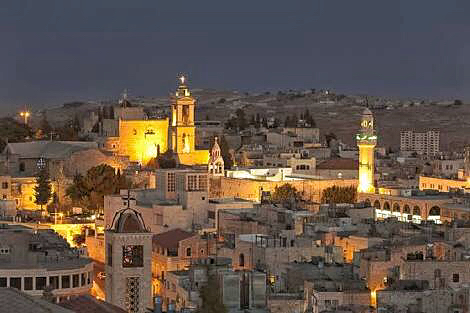
O little town of Bethlehem, how still we see thee lie…

Bethlehem has captured the imagination of the world for centuries – we are culturally and spiritually drawn to this famous Palestinian town, and specifically, to an event that may or may not have happened 2,020 years ago. Many express doubt but we nevertheless embrace the myth and the magic it inspires: the appearance of a “star of wonder, star of light, star of royal beauty bright”, harking back to prophecies of old; stories of wise men journeying on camels’ back from the exotic and mysterious east, choiring angels, simple shepherds watching their flocks, and homely livestock; and an auspicious birth in the outhouse of a village pub – all the well-loved dramatis personae of the classic manger scene.

These moments in time have long inspired painters and poets, and are recalled by carol singers from the field mice of The Wind in the Willows to the sentimentality of that famous book by the one they now hail as “the man who invented Christmas” to the songs that make shopping at this time of the year cruel and unusual punishment.

For over a century, Christian pilgrims have flocked to Bethlehem from all over the world – until COVID and the current conflict. It has long been the bedrock of the town’s economy. As a frequent visitor to Israel and Palestine, an amateur historian and a one-time catholic, I’ve visited the town and the Church of the Nativity many times over the years. Though I do not profess faith, I treasure Bethlehem for what it represents in Christianity’s story and also my own.

Poets have always been ambivalent about Bethlehem. It’s been invested with a symbolism quite detached from the geographic. TS Elliot’s magi we’re unsure what it all actually meant, whilst to WB Yeats, it might’ve been a place where bad things would happen. But then they hardly knew the place, and them and countless others, it is a place of myth and memory, most of it imagined.

And whilst “the hopes and fears of all our years” abide with this town of some 27,000 souls, it has a life of its own, a history, a society, an economy, and a political story that reaches back eleven thousand years.

Like Jerusalem, its sacred, senior sibling, just ten kilometres away as the crow flies (and much, much longer by road due to the impositions of the occupation), the “little town of Bethlehem”  is as much a city of the mind and heart as one of bricks and mortar and of ordinary people with myriad preoccupations and passions.

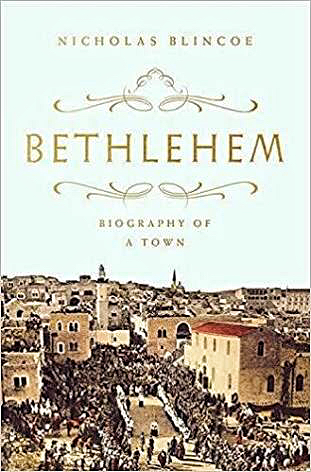
British author and screenwriter Nicholas Blincoe has now written an affectionate and informative biography of a town that is as close to the heart of our culture as any town ever was, and yet one that is almost unknown. Whilst “the hopes and fears of all our years” abide with this town of some 27,000 souls, it has a story of its own that reaches back eleven thousand years.
Ballad of a border town 

Blincoe’s story is part history, part travelogue and memoir, the past intermingling with the present in informative and ofttimes entertaining anecdotes and interviews, memories and personal experiences, as he takes us on a journey from the stone age to the stone wall – one that is in places eight metres in height.

Bethlehem has since the beginning of recorded history been a border-town on a physical and metaphysical borderland.

A borderland between “the desert and the sown”, the Judean Desert with it’s sheep-herding nomads and Bedouin bandits, and the orchards and vineyards in the fertile wadis that for centuries had supplied world-famous wine and olive oil.

A borderland also between the Christians who once constituted a majority, and who for generations have tended to the churches, shrines, and monasteries that were drawn to the holy ground around the Church of the Nativity, and the vast Muslim hinterland from whence over the centuries have come traders and invaders, missionaries and marauders, tourists and tanks. For two thousand years, Jerusalem and Bethlehem have been one of the world’s preeminent destinations for religious tourism, and over two million tourists and pilgrims visit the town each year.

Bethlehem’s location has given it a social, political, economic, and strategic significance disproportionate to its size. It grew the confluence of the springs and aqueducts that have supplied nearby Jerusalem for millennia. “All ittakes to conquer Jerusalem is to seize its water supply…This is what every future invader did.” It was close to the historic trade route between the Kings Road that linked the Hijaz to the Hauran, Damascus and the north, and the ancient Palestinian ports on the Mediterranean.

Its importance as a Christian island in a sea of Islam saw it serve as a refuge for the oppressed and dispossessed of Ottoman pogroms and genocides and also of the Nakba, it has earned a reputuaion as a haven for the more secular and radical elements of the Palestinian national movement their struggle with more religious and indeed fundamentalist adversaries.

But over the last half-Century, it is town that is increasingly cut off and isolated by the Separation Wall, encircled and encroached upon by the ever multiplying and expanding Israeli settlements (forty one at the last count with well over 100,000 inhabitants), hostile and acquisitive settlers, and the daily impositions and injustices of the military occupation with its restricted roads, armed soldiers and border police, checkpoints and the Kafkaesque permit system.

A cultural caravanserai

For most of his historical narrative, Blincoe maintains a degree of scholarly detachment with regard to the serpentine history and politics of the region, and  crafts a captivating tale of warlords and adventurers, of soldiers and saints,  as a parade of foreign armies pass through. Egyptians, Hittites, Persians, Greeks, and Romans, Arabs, Franks, and Mamluks, Turks, Brits, and finally, Israelis. There is a great picture of a group of Anzacs from the far side of the world in their winter coats emerging from the cave of the nativity in December 1917. Rulers and rebels have passed this way, and many, like mad, bad King Herod, Bar Kokba’s Jewish fighters, and the Shabab of the Palestinian Intifada-t have died nearby.

Given its religious significance, Bethlehem has forever been a focus and at times, a flash-point for events that have enmeshed the Holy Land and its Holy Places, from the fossicking of Emperor Constantine’ mother Helena and the self-imposed exile of estranged Empress Eudocia, through the Muslim conquest, the Crusades and Mongol raids to the Crimean War, the Palestine Campaign of WW1, and the Arab-Israel conflict. Bethlehem’s history has been one of civilization, colonization and conquest.

As a former scholar of philosophy, Blincoe seems particularly at home amidst the theological disputes of the early Christian, Byzantine period, and brings to life a host of passionate, idiosyncratic, adventurous, and infuriating men and women – the wandering saints and scholars, clerics and ascetics, wealthy widows and society matrons of the Middle Ages, and an unending caravan of pilgrims, tourists, evangelical adventurers and amateur archaeologists that have walked these hills and valleys for centuries. As with Jerusalem, seekers of the numinous could never get enough of the place.

He doesn’t shy away from the social, theological and political complexities of his chronicle, but his objectivity is severely tested in his final chapters when writing of Bethlehem and the occupation.

But then he does after all have a lot of skin in the game: he is married to Bethlehem filmmaker Leila Samsour, dividing his time between London and Bethlehem. He is quite embedded with Leila’s Christian Palestinian family, one with deep roots in the town’s history and politics, and has often been in the thick of the crises, protests, incursions and violent clashes that periodically embroil his adopted home.

He is not some desktop warrior, NGO apparatchik or “occupation tourist”. And whilst he deplores the actions of the settlers and the right wing politicians – Avigdor Leiberman and other nationalist MKs are virtual neighbours of his – and ascribes to revisionist Israeli historians like Ilan Pape and Benny Morris’ reading of the Nakba, he is not one of Israel‘s haters But he is disappointed, saddened, infuriated even by the Jewish state’s often cavalier and callous approach to its Palestinians who are its neighbours and also, its sullen, subject people.

Banksy’s Bethlehem Bouquet. Paul Hemphill

Breaking the wheel

Palestine, and with it,  Jerusalem and Bethlehem, have always been under strangers’ dominion. But in the past, the rulers largely left the locals to live their own lives and manage their own affairs in accordance with their own social, political, and religious ways, and in the fullness of time, they departed, ceding the land to the next despot. Until, that is, the Israelis. In the words of Daenerys Targaryen: “ We’re not going to stop the wheel. I’m going to break the wheel.”

Year by year, Bethlehem’s economy shrinks. Over two million tourists and pilgrims visit “Royal David’s City” annually, but its economically stressed, and it has the highest unemployment rate (nearly 30%) in the West Bank.

Year by year, Bethlehem’s Christian population diminishes as people head overseas in search of a better life – and particularly its young folk. In 1950, Bethlehem and the surrounding villages were 86% Christian, but by 2016, the Christian population was but 12%.

Year by year, the settlements grow, and settlers, encouraged by an extremist, nationalist government and a seemingly compliant IDF, become more emboldened in their expansion onto Palestinian land. Considered illegal under international law, Israel regards them as legitimate suburbs of Jerusalem- a territorial fait accompli that is tantamount to de facto annexation.

Year by year, Bethlehem becomes more and more cut off from the rest of the West Bank by walls, wire, and a web of “Israeli only” highways, and indeed from the world beyond the wall. Travel to Jerusalem and to the rest of the West Bank is severely restricted by roads, checkpoints and permits, whilst the interaction between Israelis and Palestinians that existed during the seventies and eighties, in workplaces, educational and health institutions, friendships and romances, ceased after the terrors of the second, bomb Intifada as israel and Israelis withdrew into their mental and physical fortress.

A generation of young people on either side of the old and ostensibly moribund Green Line have grown up with negligible contact with their peers on the “other side” – and this is most likely to be limited to military service in the Occupied Territories on the one hand, and confrontations with armed soldiers on the other.

Writing of the 1948 war, Blincoe notes: “From their future actions it became clear that both Jordan and Israel saw the term “Palestine” as an empty tag: it was the name of a piece of real estate rather than the home of people demanding self representation”, this is how he sees the future for Palestine and for Bethlehem, his adopted home. He argues that the settlement project is first and foremost about land and cheap housing for middle and lower class Israelis pressed by rising property values and a shortage of affordable housing to rent or buy in Israel proper. it is real estate developers, he argues, with friends in high places, who are calling the shots, rather than the more visible and vocal Zionist nationalists. As the Israeli historian and one–time deputy mayor of Jerusalem Meron Benvenisti puts it, the settlements are a “commercial real estate project that conscripts Zionist rhetoric for profit”. The story of Jesus and the money-changers somehow comes to mind.

It is an intriguing argument that invites further research. it also echoes what would appear to be a similar patter in those parts of the West Bank that are under the direct control and administration of the Palestinian Authority, as we have reported earlier in Castles Made of Sand, an account of the land rush that is taking place in Area A.

With this and all the other pressures in play, from Blincoe’s perspective, the future prospects of Palestine and the little town of Bethlehem not appear to be promising. Bethlehem – Biography of a Town does not have a happy ending.

Synchronicity – a footnote

A few days after this post was published, an article by Hillel Zand appeared in the Matzav Review addressing the settlements and the real estate argument:  “Israel’s right-wing has strengthened in recent years because it has promoted heavily financing the settlement project as a way to compensate for the not insignificant negative side-effects of neoliberal economic policy, especially rising housing prices and increasing inequality and poverty…In Israel, the “losers” are being compensated by the advocates of these policies with incentives, subsidies and entitlements that allow them to maintain, or even raise, their quality of life by living in West Bank settlements”.

The Israel-Jordan collaboration referred to by Blincoe also raised its controversial head recently when Justice Minister Ayalet Shaked and her boss Naftali Bennett hinted, favourably, at the prospects of US’ impending “peace deal” that includes the West Bank being ceded to Jordan and Gaza to Egypt. Murmurings from US allies Egypt and Saudi Arabia have also indicated support for such an idea.

Aida Refugee Camp, Bethlehem. Paul Hemphill

Walls and wire define the brotherhood of man.  Paul Hemphill

Some further reading about Bethlehem:

There are the PLO’s official facts and figures, and the National Catholic Reporter on the declining Christian population. And there is always Wikipedia. There are a series of posts in In That Howling Infinite about Jerusalem and Palestine in: O Jerusalem, and A Middle Eat Miscellany

Author’s Note: 

Whenever I pen commentaries such as this, people ask why I rarely forward my own opinion on the issues I am presenting or discussing. On the contrary, I would argue that my views are fairly transparent in the subjects I chose to engage with, the words I use, and the vein in which I use them.

With respect to my numerous posts about Israel and Palestine, and the Middle East in general, I  come to my conclusions from a political science and sociology perspective – that’s where my academic experience came from – and a background in conflict resolution, supported by study and travel. If I do on occasions display any particular bias, it originates in my longtime interest, understanding and affection for the history, politics culture and language of the region, of its geography and archaeology, and of its people of all faiths and nationalities that I make my observations.

I am presently working on a piece that encapsulates my thoughts on this complex and controversial subject. But meanwhile, here is a brief exposition.

I do believe that the systematic dispossession of almost a million Palestinians and the destruction of half of their towns and villages in 1948 is Israel’s original sin. It is the primal stain that colours and corrupts all that followed. And yet, if not for the actions, often daring, often brave, often questionable, and often deplorable, of the politicians and soldiers of 1948 – and of the generations that folllowed –  Israel would not exist today. This paradox is addressed sympathetically by Avi Shalit in My Promised Land, referred to above, and scathingly by ‘new history’ scholar Ilan Pappe in The Ethnic Cleansing of Palestine.   

The Occupation, fifty years old this year, which grew out of the unexpectedly total victory of June 1967, has taken on strategic, ideological and indeed messianic dimensions by many in the  Israeli government and political elite. It compounded the original sin, deepened the primal stain, released the demons of messianic fervour, and wounded Israel’s soul. The settlements locked the nation into the the colonialist project. With the close-call of the Yom Kippur War, the violence and murder of the first and second Intifadat, and present Palestinian jaquerie, Israel’s heart has not just hardened, it has become sclerotic.

I admit that I have always been sympathetic towards Israel – from my first visit in 1972. But it is not a blinkered viewpoint. I am deeply critical of Israeli politics and policies, and have no respect for many of its leaders.

Ayelet Shaked, the nationalist’s La Passionaria, and her boss Naftali Bennett do not not represent ALL Israelis! They hold extremist views just like we in UK, US, and Australia have parties and individuals with extremist views. But there are hundreds of thousands of Israelis who oppose the present government and long for justice and peace. And if – a very big “if” – Arab Israelis and the Israeli left could work together, they could obtain a majority in the Knesset and change Israel’s politics.

Yet meanwhile, Binyamin Netanyahu and his nationalist allies call all the shots, the Israelis continue to control and exploit the land, its people, and its resources, whilst varying degrees of annexation are on the cards. The settlements are an abomination, as are the policies and practices of the state and its occupying army, as described by Lyons and others. There’s no escaping these facts.

But I am likewise critical of Palestinian governance, politics and politicians. Hamas and the PA are on the nose in their respective fiefdoms, and if a moderate “third force” were to arise – and survive, because sure as hell, they would risk being murdered – Palestinians who just want a quiet, normal life, adequate services, and opportunities for their children, and Israelis who want likewise, might – just might – reject their extremist, dogmatic, entrenched leaders and reach some form of modus vivendi.

Palestinians themselves have to take control of their own lives, kick out their corrupt leaders, cease inculcating their children with hatred and jihadism, and use all that international good will and dollars to build a viable economy that can provide jobs, opportunities, and security, economic and physical to the people. Only this way will they be inoculated against cronyism, corruption and extremism. And yet, the dead hand of a moribund, patriarchal, conservative and ethnocentric culture holds them back –  but that is the subject of another, future discussion for In That Howling Infinite.

Today, the ‘powers that be’, defenders and beneficiaries of a status quo that looks more like a cul de sac, predominate over a dispiriting array of competing, clamouring factions, left, right, nationalist, secular, tribal, Haredi, and Islamist alike. New, young, brace, local voices in both Israel and Palestine, are not heard.

So what happens next?

I get that question too. And I am perennially reluctant to venture an answer beyond one that runs like “on the one hand…but then on the other”.  I inevitably fall back on Robert Fisk’s response to the same question with regard to the calamitous freezing over of the Arab Spring and the fall and rise again of the same old autocrats and tyrants: “my crystal ball is broken”. It’s a cop out, really, but just as cogent as that famous line in that UK spy drama Spooks: “What’s gong to happen to me?” “Bad things!”

One thing is for sure: as songwriter Warren Zevon sang, “the hurt gets worse, and the heart get harder”.

October 8th 2017

For more posts on Jerusalem, Israel and the Middle East, visit:
https://m.facebook.com/HowlingInfinite/
https://m.facebook.com/hf1983/

See also, my collection of posts about Jerusalem. 

The Church of the Nativity. Paul Hemphill

Where Christianity began. Paul Hemphill

The Return of the Forest Wars

“Whether we like it or not, community expectations on the conservation front are rising, not falling. And I suspect they will continue to rise…After 20 years, it is clear that RFAs have not ended the forest wars’. 

I am republishing this article from The Australian for those who cannot jump the News Ltd pay wall. Although the writer is supportive of the forest industry and the Regional Forest Agreements that are coming up for renewal in NSW, Victoria and Tasmania, his report includes valuable background information.

The forest wars: loggers v greenies in Victoria, NSW

Graham Lloyd, The Australian March 1st 2018

Deep in East Gippsland’s Kuark forest, ancient trees tower overhead, the scent of sassafras wafts on the breeze and birdsong fills the air. Old-growth trees such as these provide a rare example of a landscape undisturbed by human harvest. But Kuark is under threat of logging.

Had it not taken action, Environmental Justice Australia says, by now the birdsong in Kuark would have been replaced by the sound of chainsaws, and the fragrance of sassafras supplanted by the odour of diesel.

The Kuark action taken in the Victorian Supreme Court is one of two legal challenges that point to the shape of things to come as the Keating era Regional Forest Agreements expire and discussions about how to manage forests nationally come to a head.Logging companies want increased access to timber and funding for new plantations.

Environmental groups have been flexing their political muscle — from the recent Queensland election, where they campaigned on tree clearing and the Adani mine, to this month’s Batman by-election in Victoria, where Labor is pitted against the Green

With RFAs coming to an end, green groups have started to apply to the timber sector the template of litigation and market intervention that has slowed Australia’s coal industry. “We are going back to the tools at our disposal: court action and the marketplace,” The Wilderness Society’s national director Lyndon Schneiders says.

International buyers are being warned off Australian products that do not meet “acceptable” forest practices. And courts are being asked by environmentalist groups to break through what they have long considered a key political compromise at the heart of the RFA process.

Environmental lawyers have challenged the belief that RFAs exempt logging operations from oversight under the federal Environment Protection and Biodiversity Conservation Act.

In Victoria, Friends of Leadbeater’s Possum has argued through Environmental Justice Australia that some of the past and future logging in Victoria’s central highlands should not be exempt from the EPBC Act, as it has not been undertaken in accordance with the RFA.

This is because the state government had failed to conduct five-yearly reviews, as required under the agreements with the commonwealth. The Federal Court is expected to rule on the matter today.

If the court action is a success in Victoria, the leadbeater’s possum quickly will be joined by the koala in NSW, where the state government has been similarly lax in sticking to the required timetable for five-yearly reviews of its RFAs.

While the Federal Court considers the possums, the Victorian Supreme Court has been asked to rule that the state government has an obligation to preserve a significant percentage of old growth in state forests.

The Victorian government says it has introduced 11th-hour protections in response to Kuark protests, whereby trees more than 2.5m in diameter could not be cut.

East Gippsland, where Kuark is located, was the first area whose RFA was due to expire, in February last year, but was extended temporarily. It is now due to expire this month along with the Central Highlands RFA, but the Supreme Court action is not expected to be heard until May.

The industry is already feeling the squeeze. Planned future timber harvest was lost to the state’s catastrophic Black Saturday bushfires in 2009. Last year the Victorian government poured more than $60 million into keeping the Heyfield hardwood timber mill open in the La Trobe Valley after the previous owner, Hermal Group, said dwindling timber supplies from VicForests had made it unviable.

Under government ownership, Heyfield is laying off workers and local manufacturers are saying it has become increasingly difficult to source timber of a size appropriate for making furniture. There is speculation about further cuts to timber supplies. The alternative is to downgrade protections for the leadbeater’s possum from critically endangered to endangered and open up new areas to logging.

The state government’s plan for Heyfield is unclear but it is possible the taxpayer money already invested will be lost along with the mill workers’ jobs it was trying to protect. A key decision on the leadbeater’s possum is expected shortly, before the Victorian election in November, setting up a contest of trees, possums and jobs.

Hermal, meanwhile, has been given $190m to relocate its operations to focus on plantation hardwood timber in Burnie, Tasmania.

In NSW, the looming expiry of RFAs has breathed fresh urgency into what have been long-festering concerns in forest areas from north to south. In January, eight NSW environmental groups wrote to Premier Gladys Berejiklian, urging her to intervene to protect an area of Gladstone State Forest near Bellingen, which they said was vital to the protection of koalas in NSW.

The environmental groups said polling in the north coast seats of Ballina and Lismore in December last year had shown people were very aware of the plight of koalas, and highly supportive of new national parks for their protection. The call coincided with a month-long NSW government road show for regional forest communities as part of its RFA renewal process. Environmental groups have boycotted the public information meetings, claiming a lack of good faith and accusing state and federal governments of having already made up their minds.

There are deep divisions within the NSW government over what environmental message it wishes to present in the lead-up to next year’s state election. State Nationals are pushing a hard line on tree clearing and environmental groups are worried redrawn RFAs may allow timber harvesting in hitherto protected areas.

Malcolm Turnbull committed the commonwealth to a new vision and plan for forest industries at an industry gala dinner in Canberra at the end of last year. The Prime Minister says the plan will provide “vision and certainty” and develop the industry as “a growth engine for regional Australia”. Details of the plan have been left to Assistant Minister for Agriculture and Water Resources Anne Ruston, who has spoken in support of continuing the RFAs. “RFAs are the best mechanism to balance competing economic, social and environmental demands on native forests,” she told the industry in December. Federal Labor has offered conditional support. “If it’s a good plan, it’s a well-thought-out plan and it’s an economically responsible plan, then of course we will support it,” opposition forestry spokesman Joel Fitzgibbon says.

But he is realistic about the difficulties ahead. “Whether we like it or not, community expectations on the conservation front are rising, not falling. And I suspect they will continue to rise,” Fitzgibbon says.

Labor was the architect of RFAs in the mid-1990s as it ­became increasingly split after Graham Richardson famously identified the electoral power of the environmental vote in north Queensland. RFAs were the peace bargain that came at the culmination of a torturous “forest wars” period for the Keating government. The final straw came with a 1995 blockade of Parliament House by timber workers.

The recently released 1995 cabinet papers show that when the deal was done federal cabinet was told: “Inevitably, RFAs will involve compromises in ambit conservation and industry positions, and this can be expected to attract criticism from the more extreme elements on both sides.”

More than $400m has been spent but state-federal bickering has dogged the development of RFAs from the outset. The agreements are set to expire between this year and 2022, and are up for renewal.

Greg McCormack, chairman of industry group the Australian Forest Products Association, says RFAs “have not been brilliant for the industry”. “RFAs were supposed to be the line in the sand which would sustain our industry,” McCormack says. “Since then, three million hectares were taken out of production and moved into national parks. Having said that, without RFAs those seeking to close our industry down would succeed very quickly via relentless legal challenges under the EPBC Act.”

Environmental groups are looking for new ways to attack on this front.

The timber industry calculates it is responsible for $24 billion in economic activity and 80,000 ­direct jobs. In its blueprint for the future it has called for support to expand the plantation reserve, build a biofuels revolution, bring carbon abatement cash to the industry and ensure a sustainable native forest estate.

“We simply cannot grow as an industry if we don’t get more trees in the ground,” McCormack says.

The challenge for government is not to repeat the mistakes of the past. This includes the tax-effective managed investment schemes whereby hundreds of plantations were established across the country, the vast majority of which failed due to a combination of factors including poor management and inappropriate locations so that trees lacked access to market.

The schemes were introduced to encourage agricultural diversification after the decline of the local forestry industry. A Senate report found managed investment schemes had quickly become an attractive tax deduction for wealthy investors, but as demand grew the nature of the industry changed rapidly, to the point where it is best described as an abhorrent Ponzi scheme. Two of the largest schemes, Timbercorp and Great Southern, collapsed in spectacular fashion, with combined losses of more than $1bn.

Today’s industry has set a national target of planting an additional 400,000ha, with up to a quarter of that done by farmers on a small scale. For funding, the industry is eyeing $100m from the Emissions Reduction Fund across four years, establishment of low-interest loans for plantations and new carbon-related financing programs, “including carbon pricing mechanisms and purchasing of the rights to stored carbon”.

The industry says it can now access 5.5 million hectares of Australia’s 125 million hectare state forest reserves. It wants the RFAs to be extended for another 20 years on a rolling five-year basis, with state and federal agreement that there will be no loss in net timber supply.

Conservation groups say it is too early to commit to extending the RFAs.  “The first thing you should do is assess whether the RFAs have met their objective,” says Alix Goodwin, chief executive of non-governmental conservation group National Parks Association of NSW. “It should be a scientific and economic review done by someone who is respected and independent from the process.”

Such a review would look at the options for future forest management.

A base case might be to leave the forests as they are. A second option might be to continue logging. And a third option would be for state forests to be transferred to the protected areas system.

“Having done that, you would have a preferred pathway forward — and only if that said the best ­future use was logging would you then move to renegotiate the Regional Forest Agreements,” Goodwin says.

The National Parks Association has done its own research, which has led it to some stark conclusions about the economics of the state forest operations. It says the value of Australia’s native timber stocks has declined by 30 per cent to $2bn between 2005 and 2015, and hardwood sawn wood production has dropped by 44 per cent over a similar period. In contrast, plantation stocks increased in value to $10bn and softwood sawn wood production is up by 10 per cent.

The National Parks Association says Forestry Tasmania had lost $64m and Forestry Corporation (NSW) $84m between 2009 and 2012 in native forest logging operations.

Forestry Corporation also received annual funding from NSW Treasury in the form of a Community Service Obligation worth $15.6m in 2014-15.

In contrast to industry estimates, the association says direct employment in forestry and logging (including the native as well as plantation sectors) in NSW was 2131 according to the 2011 census, with extended employment of 5166, or 0.02 per cent of primary industries employment.  Across Australia, 7561 people were directly employed in forestry and logging, with indirect employment estimated at 18,328, NPA says. Employment in the native forest logging sector in NSW is estimated to be about 600, and in Tasmania less than 1000.

NPA says the primary drivers behind the decline in hardwood production in state forests are increasing competition from hardwood and softwood plantations, both domestically and internationally, and higher costs relative to international competitors.

There is weak demand for structural timber; decreasing demand from Japan for pulp because of falling paper consumption and efficiencies in the production process; and a reduction in the area of forest available for harvest.

“Many of these trends are predicted to continue, which means that demand will continue to fall and profitability from native forest logging will be increasingly difficult to achieve,” according to the NPA report.

“A strong case can be made that continued native forest logging operations are not a result of certainty and sound management via the RFAs but, rather, of successive and regular government intervention using public funds.”

Like the industry, environmental groups see the future in plantation timbers.

But Schneiders says the industry’s woes are largely of its own making.  “The industry is facing a shortfall of softwood timber because it put the wrong trees in the ground. They had the opportunity but billions of dollars was wasted on fraudulent tax schemes which put the wrong types of trees in the wrong places. Now they are going back again for another attempt.”

Nonetheless, environmental groups are willing to listen to proposals that include genuine carbon abatement. But they are wary of plans to encourage the use of forest residues for renewable power production. Most of all they believe there is still a rich vein of community opposition to logging old trees such as those at risk in the Kuark forest in Victoria, or a return to now protected stands in the north and south of NSW.

After 20 years, it is clear that RFAs have not ended the forest wars — but they may have helped to point the way to a more profitable future in plantations.

https://www.theaustralian.com.au/news/inquirer/the-forest-wars-loggers-v-greenies-in-victoria-nsw/news-story/1ad61f912c3a0136a19aaf7617dcfb86

For Further reading on Belligen and the Tarkeeth Forest, see The Tarkeeth Tapes – Interviews on 2bbb, and If You Go Down to the Woods Today, 

Tarkeeth Tonka Toys

We’ve got them Australia Day blues … again

We Acknowledge the Gumbaynggirr People, the traditional custodians of the Land we live upon, and the Land from the Tablelands to the sea. We also pay respect to Elders past, present and emerging of the Gumbaynggirr nation  

Australia Day has always been celebrated on 26th January – except when it wasn’t …

On this day, we celebrate the first settlement of white settlers on Australian shores. Captain Cook had been here a decade before, and Dutch, Portuguese and English mariners had touched land at various point earlier in the century, but didn’t find the amenities attractive enough to stick around.

People, particularly right wing politicians and opinionistas, and white Anglo-Celtic nationalists regards this seminal moment as “a good thing” to borrow a phrase from “1066 and All That”. After all, it brought the benefits of European civilization to those whom Rudyard Kipling might later have referred to as “fluttered folk and wild, half demon and half child”. After two centuries of dispossession, enslavement, massacre, and, in recent times, gradual steps towards recognition and restitution, many descendants of the first peoples think otherwise and regard 26th January as Invasion Day, a time of mourning, as do an ever increasing proportion of the population generally, particularly the younger generations.

The day is celebrated throughout the land with ceremonies and performances by representatives of our many cultures. But indigenous artists, dancers, and musicians face a profoundly deep dilemma when asked to perform. By participating in official commemorations, are they helping to sanction and even sanitize a day they associate with deep historical pain and trauma? Conversely, by boycotting the event, would they be giving up an important opportunity to celebrate and promote indigenous culture, helping non-indigenous Australians to understand that Australia has an indigenous history as well as a white one, and that this is a living culture and that over two hundred years, it is still with us today.

Australia Day January 26th 1988

The days and weeks leading up to Australia Day have become a time for debating our history, and also, our  identity. Author and commentator Henry Ergas as wrote in The Australian on 18 January 2025: “Historical events need to be faced, not defaced. We can celebrate foundational events such as Australia Day without reducing them to a Manichean choice between good and evil, sin and virtue: as John Stuart Mill aptly put it, “Ages are no more infallible than individuals”, our own included. Rather, the point is that foundational events are foundational: they set a beginning whose course always remains to be shaped. And by maturely commemorating those events we can find, as others have, the enduring values to steer us along that course and make our common future one all Australians consider well worth having”.

Australia Day is also very much about memory and myth. As American author CE Morgan has written, “Repeated long enough, stories become memory and memory becomes fact”. German academic Ulrich Raulff put it this: “ … our historical memory is a motherland of wishful thinking, sacrificed to our faith and blind to known facts … This is why historical myths are so tenacious. It’s as though the truth even when it’s there for everyone to see, is powerless – it can’t lay a finger on the all powerful myth”.

And so  around this time every year, people argue about moving the date to one that is less divisive, and indeed, to one that more realistically commemorates the founding of the Commonwealth of Australia. January 1st for example. is put forward as the day six states came together as one Commonwealth under a federal government. The problem with January 1st is of course that being New Year’s Day, and already a fireworks and hoopla day off, no one would notice. The British monarch’s official birthday weekend in June (it’s actually George III’s, but never mind) is also mooted. But that’s wintertime And not good for the beach and a cold beer. Moreover, January 26th is ideally placed as the last long-weekend before the kids go back to school.

As if responding to Pavlov’s bell, folk of a conservative persuasion evoke the irrevocable sanctity of January 26th as a commemoration of how we became who we are – that is, a mainly white and Christian but increasingly multi-hued and multi-faith democracy at the fag-end of the earth. The conservative media seize upon it as an opportunity to serve up overblown, meretricious flimflam not withstanding the fact that the story of the First Fleet is thrilling enough without over-leavening it with patriotic flag-waving, triumphalism, and a big serve of manifest destiny.

The idea of celebrating the acknowledged virtues of our country – its tolerance and openness, its acceptance of immigrants of all colours, cultures, and religious beliefs, its mythical values of “mateship” and a “fair go” are sound. In citizenship ceremonies across our island continent, migrants from all over swear allegiance to our nation and it’s English monarch (but we won’t go there). And yet, the day itself has evolved into a shibboleth, a caricature, a bombastic, jingoistic carnival of flags and fireworks, partying and posturing. It’s as if we forget that on January 26 1788, Captain Arthur Phillip established a penal colony – not a nation. Of the 1336 souls who landed, over half of them were in chains, and most of the others were guarding them.

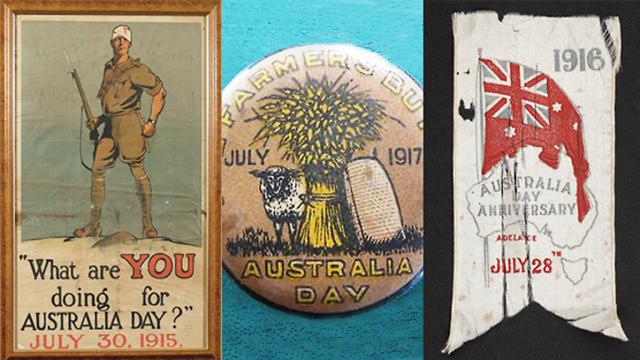
Ironically, the day is not at all sacrosanct. For most of the century of our existence as a nation, most Australian states did not see a reason to celebrate this Sydney-centric beano with such gusto. Indeed, as the picture below shows, the date itself was quite portable. the It was only on the occasion of our bicentenary in 1988 that it officially donned the aura of a secular holy day of obligation – and, of course a public holiday conveniently placed between the hot and lazy Xmas holidays and the commencement of the school year.

Recent polls have show that a majority of Australians wouldn’t be too fussed if the date was moved, although since the failure of the referendum for an Indigenous Voice to Parliament in October 2024, more Australians appear to favour sticking to the holiday we know (though a significant proportion are hard pressed to say what it is we are actually commemorating). Commentators on the right attribute the poll results to what they see as “the end of woke” (and emboldened by the failure of the referendum, they also advocate a winding back of Welcome to Country ceremonies and acknowledgements like the one at the head of this piece).

But has support for changing the date we celebrate Australia Day really fallen away, or was it never really there in the first place (“Australia Day roars back into favour: poll”, January 24, 2025)? The media megaphone has been magnifying the issue for some years, stoking controversy to create something of a self-fulfilling prophecy. Some Australians may be eager for change, but probably most of us Australians have always been content with 26th January, and besides, we have more pressing matters to think about.

“For now”, wrote Stan Grant, author, commentator, and Wiradjuri man, “26 January is all that we are. It is all that we are not. Australia lives in that tension”. We have yet to come to terms with it, and no matter what date we chose, it will continue to be challenged: Indigenous leader and Voice advocate Megan Davis said she was not a “change the date” person because the shift would only move rather than resolve a toxic argument.

Perhaps one good reason we ought to abolish Australia Day is that we are not grown up enough as a nation to deserve it.

And so, enjoy our national day, as the “black armband” and “white armband” tribes leave off their month-long cage-fight that has dominated the media during the Xmas holiday doldrums, and just enjoy a day off.

And we can have a break from self righteous patriotics until our next official day off: Anzac Day, when we celebrate our defeat the hands of Johnny Turk at Gallipoli, and when, of course, The Australian and it’s hired hacks will get carried away by all the Anzacery bluster, and express their indignation with all who criticize that shibboleth. The irony of Anzac Day is that whilst it rightfully remembers the cost and futility of war, its commercialization has meant that more money is spent on political and patriotic posturing than on our serving soldiers and on those who return home injured and traumatized. As Samuel Johnson quite rightly (is said to have) said, “patriotism is the last refuge of the scoundrel”.

© Paul Hemphill 2018, 2025. All rights reserved

We republish below a bit of Australia Day history, and. also, what I consider a reasonably well-nuanced appraisal of the culture wars being fought out over Australia Day. Paul Kelly of The Australian  is a conservative commentator, and is obliged to recite form the News Corp song sheet when it comes to repeating the cliched mantras of his mother-ship – or is it ‘fathership’?) but he weighs well the tired arguments of left and right and argues for what would, could or should pass for the ‘reasonable middle’.

See also, The Frontier Wars – Australia’s heart of darkness, and We oughtn’t  fear an indigenous voice – but we do.

For more in In That Howling Infinite on Australian history and politics, see Down Under


We’ve had those Australia Day blues for a long time as this report from the ABC demonstrates:

We thought they were going to be massacred’ 

ABC Broken Hill. Aimee Volkofsky, 25 January 2018

Watch the  video here:  Eighty years since forced First Fleet re-enactment (ABC News)

WARNING: This story contains images of deceased Indigenous people.

Aboriginal men perform a dance at a 1938 re-enactment of the landing and proclamation of Captain Arthur Phillip at the 150th Australia Day celebrations.    (State Library of NSW)

On January 26, 1938, as the first rally against Australia Day was held, 25 Indigenous men were told if they did not perform the role of ‘retreating Aborigines’ in a re-enactment of the First Fleet, their families would starve.

Government officials had selected the best dancers and singers from Menindee mission in far-west New South Wales and told them they were required to perform cultural dances in Sydney. What they were sent to take part in was a re-enactment of the landing and proclamation of Captain Arthur Phillip at the 150th Australia Day celebrations.

Ngiyaampaa elder Dr Beryl (Yunghadhu) Philp Carmichael, born and raised on the mission, was only three at the time, but her memory of the fear in the community never left her.

Ngiyaampaa elder Dr Beryl (Yunghadhu) Philp Carmichael,

My grandfather protested Australia Day in 1938

The inescapable reality is that Australia’s current national day excludes and alienates Indigenous people — 80 years after my grandfather marched the streets in a fight for equality, writes Ngarra Murray. “All I can remember is the crying, all the women were crying,” she said.  “Whether they were taking them away to be massacred or what, no-one knew. The community went into mourning once they were put on the mission truck.”

The men returned a week later, but Dr Carmichael said it was many years until they would talk about their experience. ‘They came back very quiet,” she said. “It was only in the late 70s they started saying something about what it was like down there. We knew whatever happened down there really hurt them and we didn’t question them.”

Hidden from friends and family

It is speculated that part of the reason for bringing Indigenous people all the way from Menindee was because those in Sydney refused to take part. In Sydney plans were afoot to hold a rally on Australia Day; the Aborigines Progressive Association would declare it a ‘day of mourning’.

Aboriginal rights leaders William Ferguson and John Patten published the Aborigines Claim Citizen Rights! pamphlet on January 12, 1938. In it they declared, “We do not ask you to study us as scientific freaks … the superstition that we are a naturally backward and low race … shows a jaundiced view of anthropologists’ motives”.

Those in power at the time seemed eager to keep the Menindee men well away from activists, keeping them locked away in police barracks.

The incident was detailed in a biography on William Ferguson, written by Jack B Horner in 1974. “The Secretary of the Protection Board had a shrewd idea that Ferguson would try to prevent the Menindee men from taking part in this re-enactment. The Board was taking no chances. Nobody could meet the Aborigines in the coming week in Sydney, without … obtaining personal permission.” — from Vote Ferguson for Aboriginal freedom: a biography by Jack B Horner
Dr Carmichael said there had been whisperings of the movement on the mission, and a direct link to Mr Ferguson.

“Most people on missions couldn’t read and write; that made it really hard for them to understand the government documents they were throwing around,” she said. “Old Bill [Ferguson], because he knew his brother Duncan was back on the mission, he used to send messages back to him. But in the end the mission manager found that out, picked the old fella [Duncan] up in a truck and dumped him over the hill [outside the mission boundary].”

Mr Ferguson attempted to get word to the Menindee men while they were in Sydney but, as elaborate as they were, his efforts were unsuccessful.  “Then followed in the week before the celebrations an amusing battle of tactics between the Protection Board officers and the executive of the Aborigines’ Progressive Association….Some Sydney relatives of a Peter Johnson from Menindee tried to see him at the barracks.  The relatives had been sent by Ferguson, of course, in order to pass to Hero Black (the leader of the Menindee party) a message not to take part in the mortifying ‘retreat’ from the ‘first party of Englishmen’.” (From Vote Ferguson for Aboriginal freedom: a biography by Jack B Horner) . They were eventually allowed a closely supervised visit from two female relatives.

The men soon discovered their duties would include playing the part of Aboriginal people fleeing British soldiers.

Threatened with ration cuts

While the activists may have gotten their message through to the performers, discouraging them from taking part in the re-enactment, the men were left with little choice.

Dr Carmichael said when it came to performing traditional dance, the men were troubled to find they would be led by an Aboriginal actor who did not speak their language or know their culture.

“The government unknowingly or knowingly put up a big Aboriginal, good looking fella as the leader of the dancers and they didn’t even know him. He wasn’t from Ngiyaempaa,” she said. “That really devastated the people and they refused to dance. [The government] threatened them and threatened them; if they didn’t perform they’d cut off the rations to their people on the mission. It was the toughest time of their lives, I think.  I’m just happy we survived’

Eighty years on, as debate continues around whether January 26 is celebrated or mourned, Dr Carmichael said she was happy to have survived, even though she was sad about the past. “We were brought up to tolerate a lot of things and to give thanks for being alive,” she said. “I’m just glad I survived with my culture intact and am alive to teach and pass it on. We should strive for peace, between all nations. We need to come together as people.”

Australia Day: we must face the two truths about January 26

Paul Kelly, Editor-At-Large, The Australian,  
Illustration: Eric Lobbecke

Australia Day is getting bigger, brighter, more celebratory and stained by the rising tide of culture war hostility. The transformation of January 26 from a sleepy public holiday two generations ago into a boisterous party and civic commemoration has provoked a political backlash conceived in two different sentiments — grievance and exploitation.

The debate is not just about our national day. It’s really about who we are, what symbols we honour and, ultimately, the legitimacy of our civilisation. This debate can break one of two ways: robust differences can generate a better understanding of Australia and its national day or the upshot can be a destructive orgy of self-interested identity politics leading to a diminished and divided country.

The progressive crusade to ­remove January 26 as Australia Day has won fresh momentum for a movement bent upon imposing its views on the nation. Nobody should be surprised.

The volatility of social media, the power of negative politics and the emotional manipulation around “invasion day” constitutes sufficient warning that things could go badly wrong.

A nation ignorant of its history or simply unable to handle its history is heading for trouble in the present age of populist and cheapjack disruption.

Those pledged to “change the day” underestimate the popularity of the late January public holiday before the kids return to school, when barbecues abound in parks and backyards, fireworks make a spectacular night, the Australian flag adorns cars and front verandas, the sense of community is tangible, and civic and citizenship ceremonies at the local level testify to a beating patriotism.

In every such event there are tributes to the first Australians. This is embedded in our civic ­culture. More indigenous peoples are participating and being recognised on Australia Day, with its ­official emphasis on multi­culturalism and diversity. Since governor Lachlan Macquarie nominated the public holiday in 1818, the day has seen enormous and essential reinterpretation.

Beware, however, the emerging malaise — a culture war between the green-identity, politics-progressive left determined to destroy the current day and the hopelessly unpersuasive conservatives who defend the status quo, speak and listen only to one another and lose every battle because they cannot find a language to appeal to a ­diverse mainstream.

There are two truths about January 26, 1788. It was the threshold moment for one of the most audacious experiments of the ­Age of Enlightenment seeding a British settlement and society on the continent most distant from Britain under the practical yet visionary leadership of Arthur Phillip, in many ways the true founder of Australia who, against almost every prospect, had the ­insight to believe this convict ­colony at the ends of the earth would one day be “the most valuable ­acquisition Great Britain ever made”.

Those who say the story of the First Fleet and settlement are boring and uninspiring are dead in their imagination and blind in their vision.

The associated truth is that the oldest civilisation on earth, isolated for thousands of years from the rest of the globe and hence ­extremely vulnerable, was unable to defend ­itself and suffered dis­possession of its lands, ravage from disease, loss of life in conflict and loss of its way of life.

Despite the ­initial good ­intentions towards the Aborigines displayed by Phillip, the great moral failure in Australian polity was the belief there was no place, no dignity and, indeed, no life for the original Australians.

Both truths are authentic. Neither can, nor should, be denied. This is our inheritance and, in its soaring achievement and murderous squalor, it constitutes the unique meaning of Australia. One of the central purposes of our existence is to find a way of living with these truths and ensuring the peoples who embody such different traditions can live together and thrive together. There is simply no alternative.

We should exist neither in perpetual grievance nursed by the ­indigenous peoples and those, like the Greens, who recklessly exploit their grievances, nor in the complacency of those Europeans who still pretend there was no dark side to the civilisation we enjoy.

The issue is whether we have the maturity to hold together conflicting truths and sort things through, or whether we choose ideological indulgence and cynical zero-sum politics.

Australia Day needs to stand because the nation cannot run or hide from either the glory or ­tragedy in its duality. The answer to indigenous feelings about January 26 is to construct, not destroy — if there is sufficient agreement, then construct a new day of indigenous commemoration, suffering, survival and triumph. That will take time but over time it may emerge as one of the constructive solutions for Australia.

Declaring that January 26 must be shut down as a day of shame, genocide and mourning offers no solution to anyone. Telling the ­descendants of Arthur Phillip that the origin of the British civilisation and prosperous multicultural democracy they have built lacks sufficient legitimacy to be honoured as the national day is dishonest and destructive. How could it not be?

In this paper today, indigenous leader Noel Pearson says the blackfellas were here 65,000 years before whites arrived and it is vital we “recognise and honour this”. Pearson also says the whitefellas aren’t going away, they created something and it is also vital to “recognise and honour this”.

Tearing one truth down in the cause of another is the road to ruin for Australia. Both truths need to be confronted and engaged. “Trying to erase January 26 is denying the very history we want Australians to face up to,” Pearson says. “There is no other relevant time or date other than those 24-48 hours when ancient Australia passed into the new Australia.” It is this transition the nation must face.

The enemies of this obligation are thick on the ground as radicals and conservatives, often peddling phony mantras. The self-interested cynicism in the stand of Greens leader Richard Di Natale is gobsmacking. With his eye on stealing future votes in inner-city Melbourne, Di Natale announces changing Australia Day will be a priority for the Greens during the rest of the year since the day is about theft and genocide.

What will replace January 26? Why should Di Natale bother with such trifles when there are ideological axes to be swung and votes to be purchased through cultivating national self-abasement under the fraudulent cover of morality?

In response, Labor leader Bill Shorten was just pathetic: he won’t defend Australia Day, he won’t abandon Australia Day and he doesn’t like another day of ­Aboriginal commemoration. In the end he says the day itself is not what really counts. Yes, this is the alternative PM on our national day. Perhaps we should be grateful he didn’t line up with Di ­Natale’s view that the flag should be flown at half mast on the national day.

Malcolm Turnbull, unsurprisingly, said he’d like to hear Shorten speak “proudly and passionately” about Australia Day. But Shorten has a problem, given the embrace by much of the Labor rank and file of a progressive orthodoxy ­towards changing the national day anyway and at odds with majority public opinion.

Indigenous ALP frontbencher Linda Burney stepped into this confusion, criticising the Greens, saying Australia Day won’t be changing any time soon, but highlighting the difficulty it poses for Aborigines as a day of celebration. Aware that NSW ALP policy calls for consultation about a new and separate public holiday devoted to indigenous commemoration, Burney put this idea on the table. It is not ALP policy but Burney was being constructive and her proposal merits serious consideration.

Turnbull preaches an Australia Day that brings people together and celebrates our multicultural diversity. The government has properly removed the right of local councils to hold citizenship ceremonies if they refuse to recognise Australia Day and hold citizenship ceremonies on that day. But the ­reality cannot be avoided: division over Australia Day will mount in the future and this will require astute leadership and management.

For many Aborigines, January 26 will remain invasion day, and that is understandable. But any alternative national day that commemorates British settlement or the foundation of Australia has a similar problem. The logical ­alternative of January 1 — the ­inauguration of the Commonwealth of Australia — would honour an event that denied any role or existence for Aboriginals and assumed they were a dying race.

In truth there is no escape from the history — yet the historical story must be authentic, not convenient mythology. Australia was always destined to be settled by a European power. The force of the Enlightenment and the Industrial Revolution would never be denied from the great southern land. There are few inevitabilities in history and this was inevitable.

We are fortunate the European power was Britain, not France or Spain. This was an 18th-century blessing. We are fortunate the British came not just to establish a convict colony but to bring their values and institutional ethos.

Phillip had an 18th-century faith in improvement, a belief he was founding a new British society and serving the cause of humanity. With slavery still not abolished in the empire, Phillip declared from the inception of Australia that “there can be no slavery in a free land and consequently no slaves”.

The Aborigines he encountered were not a nation state. They were a collection of hundreds of tribes speaking different lan­guages, devoid of collective political purpose or leadership, often at war with each other and without the structures to allow sovereign negotiations or dealings.

To say the British should not have come is a ludicrous denial of reality and makes as much sense as saying the early explorers should not have advanced inland to ­discover the continent. To pretend the Aborigines could or should have retained their possession of the continent forever is delusional and is a device to avoid historical reality.

The encounter between the British and the Aborigines was without precedent in human history. The idea that good intentions were enough for success is absurd. Historian Geoffrey Blainey says in first volume of his The Story of Australia’s People: “The racial conflict in Australia — nearly all would agree today — should have been handled more wisely and firmly but the British leaders lacked the political and cultural experience needed to handle a ­dilemma that was exceptional in world history. Furthermore, London at one end of the globe and Sydney and Hobart at the other end viewed the dilemma and their duties and powers, differently.”

The idea that the British ­arrivals should have negotiated a treaty is nonsense. With whom and on what basis? There is no ­answer. During the 70 years after settlement many thousands of ­Aborigines were killed by Europeans — though far more died from diseases — creating a moral legacy the nation cannot deny and must confront.

Efforts to do this have been substantial while incomplete. Witness the Reconciliation process, the Mabo case and granting of native title rights, huge though flawed public funding, and the continuing process of constitutional ­recognition.

The first Australians lost much from the events of 1788 yet they also gained much, eventually — proving that indigenous peoples could live and thrive in a modern urban society. Aborigines are poised to become more prominent in every facet of Australian life.

The related truth, however, is that as a nation we cannot pretend there is full atonement for the ­dispossession. We cannot say: “Sorry, let’s leave.” We could not do this in 1808, let alone 1901, let alone 2018. There can be no full rendering of justice, no full recompense after dispossession. History cannot be reversed.

We must honour and reflect on the history, restore Aboriginal rights, and strive for justice as much as practicable. But it cannot serve indigenous Australians to engage in perpetual grievance, to magnify the sins of the past in an endless demand for atonement and more atonement still, part of a futile quest to deny any legitimacy to January 26. That is the road to a self-defeating misery.

The bulk of the Australian population, including the millions of post-World War II immigrants and their descendants, will neither accept nor tolerate the idea that the British founding of this country was a shameful and illegitimate event. When the Greens and other progressives promote this sentiment — exploiting indigenous ­resentment for their own ideo­logical and electoral gains — there is no upside for our polity, just ­counterproductive bitterness with the risk of violence.

Where is the legitimacy in January 26? It lies in the society that evolved and continues to evolve, a nation that, for all its faults, is democratic, egalitarian, tolerant and, in per capita terms, has opened its door to immigrants on a more sustained basis than ­virtually any other developed country. This constitutes a powerful legitimacy.

It was Noel Pearson more than a decade ago, in a famous letter to John Howard, who offered the most honest and enduring framework for presenting and understanding contemporary Australia. For Pearson, the nation embodies three traditions: the indigenous peoples, the first Australians, who roamed this continent for 65,000 years, long before the ages of Babylon, Athens and Rome, finding a way to live and thrive in this environment; the British inheritance dating first from the voyages of James Cook and then from the ­initial colony under Phillip, followed eventually by Lachlan Macquarie and more settlements across the continent that led to a polity of British-derived laws, values and institutions that still operate today; and the immigrant tradition, the ethnic input from so many nations that broadened and deepened the culture and led to a multicultural nation, one of the most successful on earth.

These three traditions need formal embodiment. Pearson’s vision was adopted by Tony Abbott as PM. But it needs a more declaratory form authorised by the parliament or the people. This is a critical step in finding a national identity that is shared and inclusive and can win wide support ­because of its validity.

The issue of constitutional recognition of indigenous peoples needs to be reopened with a new process. This time there needs to be greater realism on all sides. The Turnbull cabinet rejected the final recommendation for an indigenous advisory body to be inserted into the Constitution because it believed such a referendum had no prospect of success. Those ­attacking this decision have singularly failed to offer any explanation or strategy of how such a referendum could be passed.

There have been some suggestions that the Australia Day issue can be postponed pending the ­inauguration of an Australian ­republic. That is a tempting but most unwise proposition. The ­republic will not provide the ­answer and, moreover, it is probably many years or decades away.

While the republic is a necessary step in Australia’s evolution, its cause is currently weak and devoid of energy. This is because of the ­destructive transformation in progressive politics to embrace change based on individual and group rights around sex, gender and race, a combination of tribal and narcissistic imperatives.

The republic has no voice or ­appeal in this world. It won’t change your personal life, it won’t relate to how you live, it won’t speak to your gender, sexual or ­racial identity. Paul Keating once lamented the republic had been consigned to an after-dinner conversation; these days it doesn’t even win that rating. When was the last dinner party you attended where the republic got anything more than the briefest mention?

Shorten pledges that in office he will launch a path to the republic. But that will prove immensely difficult in today’s Australia. The republic is now a token of progressive politics, nothing more. The emotions, energy and priorities of progressive politics lie ­elsewhere.

The nation must face the Australia Day issue and competing historical truths as a constitutional monarchy or not at all.

Ahed Tamimi – a family affair

You’d have had to have been sleeping for most of December 2017 to have missed Ahed Tamimi, the sixteen (some say eighteen) year old, wild-haired, blonde heroine of the Palestinian resistance, the face that launched a thousand posts (more like a million, really) on the howling internet.

I don’t know where he’s going
When he gets there, I’ll be glad
I’m following in father’s footsteps
I’m following the dear old dad
English Music Hall song by EW Rogers

…we hold them by the balls, and they hold us by the throat. We squeeze and they squeeze back. We are trapped by them, and they are trapped by us
Avi Shalit, My Promised Land

Ahed is no doubt “choleira”, Hebrew slang for bad (or worse), to the Israeli right, nationalists and settlers. But she’s catnip to the pro-Palestinian and anti- Israel left, be they Israelis who would like to see an end to the occupation, mainstream socialists and social democrats, and the acolytes, partisans and naïfs of the BDS who to greater or lesser degrees seek to delegitimize Israel, demolish the Zionist project, and replace it with a Palestinian entity (democratic, of course, multiethnic and multi-faith).

You can’t doubt her courage and her resilience, and her sharp eye for the photo-op and the “hilltop” soundbite. To borrow from Monty Python, she is not the messiah, but she’s certainly a naughty girl. Canny, bright, articulate, photogenic, and media-savvy to many; a puppet and a dupe to her detractors. And poster-girl for a family business that has been in the resistance game for near on a decade since Nabi Saleh became the tiny village with the big voice, and her father, Bassem, its international face. Read all about it in Ben Ehrenreich’s long travelogue in the New York Times: Is this where the third intifada will start? (there is a much less laudatory article in pro-Israeli The Tower). And Nabi Saleh is Tamimi country. Most of its (est. 600) villagers are related by blood or marriage, and many bear the same name. They originated a long time ago from the Abu Tamim, one of the largest Saudi tribes. Bassem Tamimi cut his teeth as a youth activist during the first Intifada, and a Fatah operative in the second.

Nabi Saleh, 20 km northwest of Ramallah, is on the front line of resistance to the settlements, its campaign to reclaim from settlers a spring traditionally owned by the village, having transformed since 2009 into a weekly demonstration guaranteed to draw its young people, its shebab, into confrontation with the IDF, and hence a magnet for activists from Israel and overseas, and, of course, an international array of journalists and photographers – who always seem to be on hand when young Ahed, all blonde hair, blue jeans, sneakers and attitude goes mano a mano with heavily armed and befuddled soldiers.

Ahed’s looks, her clothes, her forthrightness, and her chutzpah, are not those of the average Palestinian Muslim girl, and to present her as such is to gives uninformed outsiders an erroneous impression. Nor are her prospects. The average Muslim girl of her age in the villages of Palestine is covered and modest, engaged at 16, married at 18, and has had her first child at 20. Most girls of Ahed’s age don’t leave school to go to university – they are groomed for their husband’s kitchen. But not Ahed. She is presented as the feisty jack-in-the-box, the free spirit, who wanted to be a soccer player and now wants to be a lawyer to help her people. She is being groomed for show-biz and for jihad, and perhaps, even, for jail. She’s the public face of a successful family business – and that business is protest and resistance, with a media and public relations operation that rarely misses an opportunity to promote itself and its cause. The Tamimiyin are to the resistance what the Kardashians are to vacuity – masters of self-promotion, agitprop and political theatre. And can follow them on Facebook and Twitter.

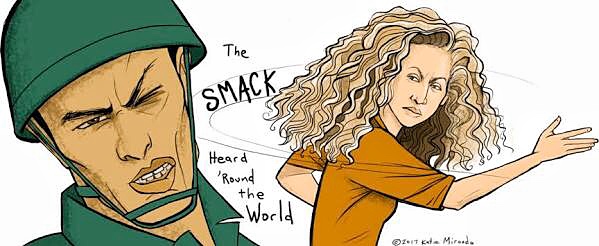
International media have been drawn to Nabi Saleh and its unofficial “first family” since at least 2011 and eleven year old Ahed’s debut, shaking he tiny fist at a tall, bemused, confused infantryman. In August 2015, she hit the big time when she and her female relatives prevented a masked and armed soldier from arresting her little brother. That soldiers should arrest a wee lad with his arm in a caste might see, slightly incredulous to outsiders. But it was the scrum that ensued, a melee of flying fists, writhing bodies, shouts, screams and tears, as women and girls piled into the unfortunate soldier, recorded by convenient posse of professional photographers and handy smartphones, that sent images ricocheting around the world. And then, in December, there was the slap that reverberated across the globe. One thing for sure: this girl has really been trying hard to get herself arrested.

Of course you can’t make such a splash without all kinds of opportunists muscling in on the act. Hamas has praised the heroes and martyrs of Nabih Saleh, whilst Abbas has commended Ahad and  her quasi fedayyin family. After her fist-waving defiance, she was invited to Turkey and feted by then prime minister Erdogan himself. Not everyone reacted so enthusiastically. One right-wing blogger dubbed Ahed “Shirley Temper.” The Israeli news site Ynet  saw the images as evidence that “Palestinian protesters use children to needle IDF soldiers in the hope of provoking a violent response.”

A month after Ahed’s wrestle with the soldier, Bassem was invited on a five-week speaking tour of American colleges and universities by a group of anti-Israeli organizations, during which he spruiked on behalf of the Boycott, Divestment, Sanctions movement (BDS). Read about it in The Times of Israel.

The villagers of Nabi Saleh – and the Tamimis – have taken hits over the years, of dead and injured. Hundreds have been arrested, so many are familiar with the inside of Israeli military prisons – and this includes many of its youth who have been caught up in Israel’s controversial juvenile justice system – and now, so has Ahed. Her father has been jailed many times, as have other relatives, including her auntie, Ahlam Tamimi, imprisoned for her role in the horrific Sbarro pizza restaurant bombing in Jerusalem in August 2001 which killed fifteen Israelis including seven children. Ahlam was released in the prisoner exchange that secured Hamas’ release of Sergeant Gilad Shalit in 2011 after five years of captivity, and deported to Jordan, and is to this day, unrepentant, and proud of her part in this massacre of the innocents. She now hosts a radio show in Jordan, calling for the killing of Jews.

Ahed therefore joins a long line of political prisoners. And that, of course, places the IDF and the Israeli authorities in a bind. the whole business of Nabi Saleh, and its latter-day Joan of Arc present a security and public relations nightmare. It draws an unwelcome spotlight on an occupation that most nations regard as illegal. It illuminates the inequities, iniquities and indignities of the occupation (see my post The View From a Balcony in Jerusalem, and also, the recent anthology Kingdom of Olives and Ash – writers confront the Occupation). If that wasn’t bad enough, the Education Minister of the most democratic country in the Middle East declared that Ahed and her ilk should be locked up for life, and a popular newspaper columnist suggested euphemistically that she be assaulted in jail whilst no one was watching (he later implied that the goyim didn’t get his joke!).

Israelis on all sides are complaining that the lass made the soldiers of the vaunted IDF look like sissies. Others declare that the soldiers ought to be praised for their patience and forbearance at Ahed’s attempts to provoke a more violent reaction. Some say that a young person continually trying this stunt on an American, British, or Australian soldier or copper would not be let off so lightly. And yet others hope and pray that their soldier boys and girls show the same fortitude under pressure, and come home safe from their days in the badlands. And then there are those who declare that Ahed has been brainwashed, those who believe she needs counseling and psychological care, and those who believe that her unconscionable and manipulative parents have deprived her of a normal childhood.

But how can anyone view as normal the lives of children in the often volatile West Bank, particularly in a hot spot like Nabi Saleh, with the separation wall, checkpoints, and the kafkaesque permit system, with youngsters’ perennial contact and indeed dangerous confrontation with army patrols and military vehicles, with armed men barging through the living rooms before dawn, as Ahed herself has experienced, with parents and siblings, relatives and friends having endured fifty years of military rule, and with a school curriculum preaching martyrdom and hatred of Jews.

Meanwhile, commentators the world over are asking what does the region’s most powerful, and in its own words, “most moral” army have fear from a mere slip of a girl?

Under pressure from all sides, the IDF and the military justice system are caught between a rock and a hard place. Too harsh a judgement and world opinion is outraged; too soft, and the Israeli street is up in arms. Too harsh, and the easily incensed Arab street is again on the march; too mild, and the Palestinians and their Arab and other friends will be celebrating a rare victory. Sweets and happy shots all around as the mighty IDF is humbled by a brave girl – although how well this role model sits in a milieu of male machismo, who can say?

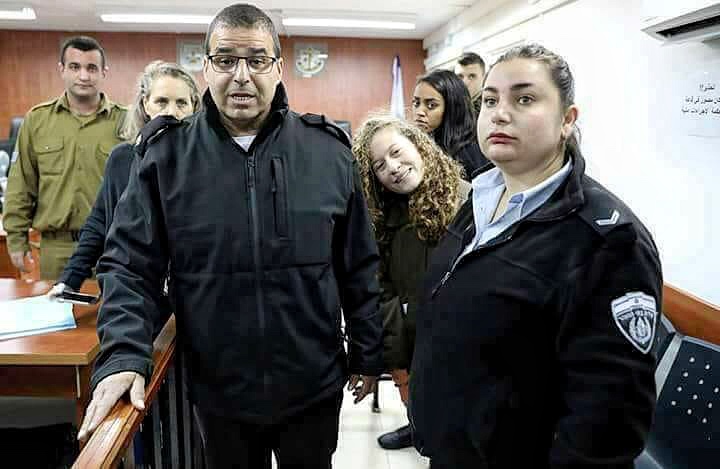
The honour and reputation of the army is at stake, and yet, it was but a slap, albeit a very provocative one. And so, Ahed, blonde locks awry in brown prison garb and flanked by stout police women, is shuttled from jail to jail, court to court, judge to judge as the baffled authorities wrestle with a dilemma that they made for themselves when she was arrested at her home in the wee small hours three days after her famous fisticuffs, along with her mother and sister – and, naturally, it was all captured on smart phone and shared everywhere. Now, who’d’ve thunk it?

Caught in the Middle are the Palestinians themselves, as full of conflicting ideas, opinions and positions as a warren is full of rabbits. And the Tamimi clan, treading a fine line so as not to incur the wrath, envy or enmity of the powers that be – the PA, its dominant and often unruly faction Fatah, its mukhabarat, and its blood enemy Hamas – and also to evade the strong arm of Israel’s Shabak state.

It is a tenuous and torturous tightrope. Bassem Tamimi has estimated that some two-thirds of the villagers depend on the Palestinian Authority for a living [as its largest employer, the PA probably controls the livelihoods of a quarter of the West Bank population. see my post on the Palestinian economy and property boom, Castles Made of Sand]. He himself was once PA employee with an apparently flexible arrangement for working from home with time to organize and strategize, and to meet and greet the foreign journalists and visiting activists who dropped in for the Friday follies.

Bassem Tamimi is no stranger to jail, and indeed, has good resistance cred as one of Amnesty International’s “prisoners of conscience”, But he is probably much more useful as Nabi Salih’s articulate and respected front-man and his famous daughter’s erstwhile agent and manager. His views are well-known. He is anti-normalization, and pro-BDS. He longs for the end of the occupation, and also, Inshallah, the end of Israel. He wants Nabi Saleh to be the epicentre of the third Intifada, but does not openly condone violence – and carefully avoids accusations of inciting it. For that way, danger lies. Whilst he might resent the endemic corruption of the co-opted and compromised PA, he does not come out against it. For that way too, danger lies too.

His wife is not so cautious. When the so-called “stabbing intifada” began in late 2015, Nariman Tamimi shared graphic instructions on how best to stab a Jew. Nor does Ahed appear to be as savvy as her father. The Times of Israel quotes a family Face Book post of December 15 in which she says: “Whether it is stabbings or suicide bombings or throwing stones, everyone must do his part and we must unite in order for our message to be heard that we want to liberate Palestine”. Are her parents being reckless with their daughter, potentially setting her up for a life of jail?

So, where to from here for Ahed Tamimi? as of today, January 1st, she has been formally charged with assault, but the case has yet to be heard. But  early indications are that the prosecutors would like to make an example of her, bulking up her charge sheet with prior altercations for which she was never cautioned let alone arrested. Left-wing Israeli newspaper Ha’Aretz‘s editorial today concluded: “They are using Tamimi to placate a vengeful public, and send a determined message to young Palestinian men and women so they don’t dare rise up against the occupation. Instead of putting an end to this wrong, Israel perpetuates it. The problem is not Tamimi but the occupation. Not only was there no justification for indicting Tamimi, she should be released immediately”.

Will she do jail time, joining a long line of Palestinian heroes, her travails at the hands of the occupier burnishing her resistance credentials. Will she be released on probation, free to continue her role as pop star provocatrice? If she is released on a good-behaviour bond, she could wind up behind bars again the next time she taunts soldiers or settlers. Will she complete her education and study law, perhaps overseas even, far from the Palestinian pressure cooker? Will she return home to be an advocate, a politician, a leader, a rebel or a shahida?

And what of her prospects in a future Palestinian state should that indeed come to pass? Will she and her father have a part to play? Will their energies be directed against the PA and Fatah old guard and it’s families’ vested interests, inviting retribution and persecution? How would she fare if that Palestinian state was an Islamic one guided by the Sharia and controlled by the patriarchy? Would the straighteners try to put this fiery rebel back in their box?

 Postscript

Ahed was detained for three months and in March 2018, she was sentenced to eight months jail after reaching a plea deal with the Israeli authorities. She was released at the end of July and returned home to a hero’s welcome. Praised by her supporters and anti-Israel partisans for her stoicism and endurance and her undiminished nationalist fervour, her critics were predictably unimpressed. Many commented tartly that she exited prison looking none the worse for wear, and were quick to point out that she had indeed put on a few extra kilos. She immediately embarked on a highly publicized and well- choreographed world tour – a veritable victory lap, but has otherwise maintained a low political profile.

Meanwhile, meet the next wave : Janna Jihad, Ahed’s  young, blue eyed and very photogenic cousin. Florida-born  Journalist, activist, and resistance icon. Dubbed “the prettiest girl in Nabi Saleh, here is her interview with e-zine Democracy Now.

Author’s Note: 

Whenever I pen commentaries such as this, people ask why I rarely forward my own opinion on the issues I am presenting or discussing. On the contrary, I would argue that my views are fairly transparent in the subjects I chose to engage with, the words I use, and the vein in which I use them.

With respect to my numerous posts about Israel and Palestine, and the Middle East in general, I  come to my conclusions from a political science and sociology perspective – that’s where my academic experience came from – and a background in conflict resolution, supported by study and travel. If I do on occasions display any particular bias, it. originates in my longtime interest, understanding and affection for the history, politics and culture of the region, of its geography and archaeology, and  of its people of all faiths and nationalities that I make my observations.

I am presently working on a piece that encapsulates my thoughts on this complex and controversial subject. But meanwhile, here is a brief exposition.

I do believe that the systematic dispossession of almost a million Palestinians and the destruction of half of their towns and villages in 1948 is Israel’s original sin. It is the primal stain that colours and corrupts all that followed. And yet, if not for the actions, often daring, often brave, often questionable, and often deplorable, of the politicians and soldiers of 1948 – and of the generations that folllowed –  Israel would not exist today. This paradox is addressed sympathetically by Avi Shalit in My Promised Land, referred to above, and scathingly by ‘new history’ scholar Ilan Pappe in The Ethnic Cleansing of Palestine.   

The Occupation, fifty years old this year, which grew out of the unexpectedly total victory of June 1967, has taken on strategic, ideological and indeed messianic dimensions by many in the  Israeli government and political elite. It compounded the original sin, deepened the primal stain, released the demons of messianic fervour, and wounded Israel’s soul. The settlements locked the nation into the the colonialist project. With the close-call of the Yom Kippur War, the violence and murder of the first and second Intifadat, and present Palestinian jaquerie, Israel’s heart has not just hardened, it has become sclerotic.

I admit that I have always been sympathetic towards Israel – from my first visit in 1972. But it is not a blinkered viewpoint. I am deeply critical of Israeli politics and policies, and have no respect for many of its leaders.

Ayelet Shaked, the nationalist’s La Passionaria, and her boss Naftali Bennett do not not represent ALL Israelis! They hold extremist views just like we in UK, US, and Australia have parties and individuals with extremist views. But there are hundreds of thousands of Israelis who oppose the present government and long for justice and peace. And if – a very big “if” – Arab Israelis and the Israeli left could work together, they could obtain a majority in the Knesset and change Israel’s politics.

Yet meanwhile, Binyamin Netanyahu and his nationalist allies call all the shots, the Israelis continue to control and exploit the land, its people, and its resources, whilst varying degrees of annexation are on the cards. The settlements are an abomination, as are the policies and practices of the state and its occupying army, as described by Lyons and others. There’s no escaping these facts.

But I am likewise critical of Palestinian governance, politics and politicians. Hamas and the PA are on the nose in their respective fiefdoms, and if a moderate “third force” were to arise – and survive, because sure as hell, they would risk being murdered – Palestinians who just want a quiet, normal life, adequate services, and opportunities for their children, and Israelis who want likewise, might – just might – reject their extremist, dogmatic, entrenched leaders and reach some form of modus vivendi.

Palestinians themselves have to take control of their own lives, kick out their corrupt leaders, cease inculcating their children with hatred and jihadism, and use all that international good will and dollars to build a viable economy that can provide jobs, opportunities, and security, economic and physical to the people. Only this way will they be inoculated against cronyism, corruption and extremism. And yet, the dead hand of a moribund, patriarchal, conservative and ethnocentric culture holds them back –  but that is the subject of another, future discussion for In That Howling Infinite.

Today, the ‘powers that be’, defenders and beneficiaries of a status quo that looks more like a cul de sac, predominate over a dispiriting array of competing, clamouring factions, left, right, nationalist, secular, tribal, Haredi, and Islamist alike. New, young, brace, local voices in both Israel and Palestine, are not heard.

So what happens next?

I get that question too. And I am perennially reluctant to venture an answer beyond one that runs like “on the one hand…but then on the other”.  I inevitably fall back on Robert Fisk’s response to the same question with regard to the calamitous freezing over of the Arab Spring and the fall and rise again of the same old autocrats and tyrants: “my crystal ball is broken”. It’s a cop out, really, but just as cogent as that famous line in that UK spy drama Spooks: “What’s gong to happen to me?” “Bad things!”

One thing is for sure: as songwriter Warren Zevon sang, “the hurt gets worse, and the heart get harder”.

October 8th 2017

For more posts on Jerusalem, Israel and the Middle East, visit:
https://m.facebook.com/HowlingInfinite/
https://m.facebook.com/hf1983/

See also, my collection of posts about Jerusalem, and 

That was the year that was – going up against chaos

Reviewing 2017, I am reminded of Game of Thrones‘ Mance Rayder’s valedictory: “I wish you good fortune in the wars to come”.

On the international and the domestic front, it appeared as if we were condemned to an infernal and exasperating ‘Groundhog Day’.

Last November, we welcomed Donald Trump to the White House with bated breath and gritted teeth, and his first year as POTUS did not disappoint. From race-relations to healthcare to tax reform to The Middle East, South Asia and North Korea, we view his bizarro administration with a mix of amusement and trepidation. Rhetorical questions just keep coming. Will the Donald be impeached? Are we heading for World War 3? How will declining America make itself “great again” in a multipolar world set to be dominated by Russia Redux and resurgent China. Against the advice of his security gurus, and every apparently sane and sensible government on the globe (including China and Russia, but not King Bibi of Iz), his Trumpfulness recognized Jerusalem as the capital of Jerusalem. Sure, we all know that Jerusalem is the capital of Israel – but we are not supposed to shout it out loud in case it unleashed all manner of mayhem on the easily irritated Muslim street. Hopefully, as with many of Trump’s isolationist initiatives, like climate change, trade, and Iran, less immoderate nations will take no notice and carry on regardless. The year closes in, and so does the Mueller Commission’s investigation into Russia’s meddling in the last presidential election and the Trumpistas’ connivance and complicity – yes, “complicit”, online Dictionary.com’s Word of the Year, introduced to us in her husky breathlessness by the gorgeous Scarlett Johansson in a spoof perfume ad that parodies Ivanka Trump’s merchandizing.

Britain continues to lumber towards the Brexit cliff, its unfortunate and ill-starred prime minister marked down as “dead girl walking”. Negotiations for the divorce settlement stutter on, gridlocked by the humongous cost, the fate of Europeans in Britain and Brits abroad, and the matter of the Irish border, which portends a return to “the troubles” – that quintessentially Irish term for the communal bloodletting that dominated the latter half of the last century. The May Government’s hamfistedness is such that at Year End, many pundits are saying that the public have forgotten the incompetence of Labour leader Jeremy Corbyn, and predict that against all odds, his missus could soon be measuring up for curtains in Number Ten.

Beset by devilish twins of Trump and Brexit, a European Union written-off as a dysfunctional, divided bureaucratic juggernaut, appears to have found hidden reserves of unity and purpose, playing hardball with Britain, dismissing the claims of Catalonia and Kurdistan, rebuking an isolationist America, and seeing-off resurgent extreme right-wing parties that threaten to fracture it with their nationalist and anti-immigration agendas. Yet, whilst Marine Le Pen and Gert Wilders came up short in the French and Dutch elections, and centrists Emmanuel Macron and Angela Merkel hold the moderate middle, atavistic, autocratic and proto-fascist parties have risen to prominence and influence in formerly unfree Eastern Europe, driven by fear of a non-existent flood of refugees from the Middle East and Africa (these are headed for the more pleasant economic climes of Germany, Britain and Scandinavia), and perhaps, their historically authoritarian DNA. Already confronted with the Russian ascendency in the east, and the prospects of the Ukrainian – Donetsk conflict firing up in the near future, the EU’s next big challenge is likely to be reacquainting itself with its original raisin d’etre – the European Project that sought to put an end to a century of European wars – and addressing the potential expulsion of parvenu, opportunistic member states who fail to uphold the union’s democratic values. As a hillbilly villain in that great series Justifed declaimed, “he who is not with is not with us”.

The frail, overcrowded boats still bob dangerously on Mediterranean and Aegean waters, and the hopeful of Africa and Asia die hopelessly and helplessly. Young people, from east and west Africa flee poverty, unemployment, and civil war, to wind up in Calais or in pop-up slave markets in free but failed Libya. In the Middle East the carnage continues. Da’ish might be finished on the battlefields of Iraq and Syria, with the number of civilian casualties far exceeding that of dead jihadis. But its reach has extended to the streets of Western Europe – dominating headlines and filling social media with colourful profile pictures and “I am (insert latest outrage)” slogans. Meanwhile, tens, scores, hundreds die as bombs explode in Iraq, Syria, Yemen, Egypt, Afghanistan and Pakistan, with no such outpourings of empathy – as if it’s all too much, too many, too far away.

Bad as 2017 and years prior were for this sad segment of our planet, next year will probably not be much better. The autocrats are firmly back in the saddle from anarchic Libya and repressed Egypt to Gulf monarchs and Iranian theocrats. There will be the wars of the ISIS succession as regional rivals compete with each other for dominance. Although it’s ship of state is taking in water, Saudi Arabia will continue its quixotic and perverse adventures in the Gulf and the Levant. At play in the fields of his Lord, VP Pence declared to US troops in December that victory was nigh, the Taliban and IS continue to make advances in poor, benighted Afghanistan. Meanwhile, Africa will continue to bleed, with ongoing wars across the Sahel, from West and Central Africa through to South Sudan,  ethnic tensions in the fragile nations of the Rift Valley, and further unrest in newly ‘liberated’ Zimbabwe as its people realize that the military coup is yet another case what The Who called “meet the old boss, same as the new boss”.

This Syrian mother and her child were rescued by the Greek Coast Guard.

In our Land Down Under, we endured the longest, most boring election campaign in living memory, and got more of the same: a lacklustre Tory government, and a depressingly dysfunctional and adversarial political system. Politicians of all parties, blinkered by short-termism, and devoid of vision, insist on fiddling whilst the antipodean Rome burns. All this only accentuates Australians’ disenchantment with their representatives, warps their perception of the value and values of “democracy”, and drives the frustrated, disgruntled, fearful and alienated towards the political extremes – and particularly the Right where ambitious but frustrated once, present and future Tory politicians aspire to greatness as big fishes in little ponds of omniphobia.

Conservative Christian politicians imposed upon us an expensive, unnecessary and bitterly divisive plebiscite on same-sex marriage which took forever. And yet, the non-compulsory vote produced a turnout much greater than the U.K. and US elections and the Brexit referendum, and in the end, over sixty percent of registered voters said Yes. Whilst constituencies with a high proportion of Muslims, Hindus, Christians and Chinese cleaved to the concept that marriage was only for man and women, the country, urban and rural, cities and states voted otherwise. The conservatives’ much-touted “silent majority” was not their “moral majority” after all. Our parliamentarians then insisted on dragging the whole sorry business out for a fortnight whilst they passed the legislation through both Houses of Parliament in an agonizingly ponderous pantomime of emotion, self-righteousness and grandstanding. The people might have spoken, but the pollies just had to have the last word. Thanks be to God they are all now off on their summer hols! And same-sex couples can marry in the eyes of God and the state from January 9th 2018.

Meanwhile, in our own rustic backyard, we are still “going up against chaos”, to quote Canadian songster Bruce Cockburn. For much of the year, as the last, we have been engaged in combat with the Forestry Corporation of New South Wales as it continues to lay waste to the state forest that surrounds us. As the year draws to a close, our adversary has withdrawn for the long, hot summer, but will return in 2018, and the struggle will continue – as it will throughout the state and indeed the nation as timber, coal and gas corporations, empowered by legislation, trash the common treasury with the assent of our many governments.

And finally, on a light note, a brief summary of what we were watching during the year. There were the latest seasons of Game of Thrones and The Walking Dead. The former was brilliant, and the latter left us wondering why we are still watching this tedious and messy “Lost in Zombieland”. Westworld was a delight with its fabulous locations and cinematography, a script that kept us backtracking to listen again to what was said and to keep up with its many ethical arcs and literary revenues. and a cavalcade of well cast, well-written and original characters. Westworld scored a post of its own on this blog – see below. The Hand Maid’s Tale wove a dystopian tale all the more rendered all the more harrowing by the dual reality that there are a lot of men in the world who would like to see women in servitude, and that our society has the technology to do it. To celebrate a triumphant return, our festive present to ourselves were tee-shirts proclaiming: “‘ave a merry f@#kin’ Christmas by order of the Peaky Blinders”.  And on Boxing Day, Peter Capaldi bade farewell as the twelfth and second-best Doctor Who (David Tennant bears the crown), and we said hello to the first female Doctor, with a brief but chirpy Yorkshire “Aw, brilliant!” sign-on from Jodie Whittaker.

Whilst in Sydney, we made two visits to the cinema (tow more than average) to enjoy the big-screen experience of the prequel to Ridley Scott’s Alien and the long-awaited sequel to our all-time favourite film Blade Runner. Sadly, the former, Alien: Covenant, was a disappointment, incoherent and poorly written.  The latter, whilst not as original, eye-catching and exhilarating as its parent, was nevertheless a cinematic masterpiece. It bombed at the box office, just like the original, but Blade Runner 2049 will doubtless become like it a cult classic.

This then was the backdrop to In That Howling Infinite’s 2017 – an electic collection covering politics, history, music, poetry, books, and dispatches from the Shire.

An abiding interest in the Middle East was reflected in several posts about Israel and Palestine, including republishing Rocky Road to Heavens Gate, a tale of Jerusalem’s famous Damascus Gate, and Castles Made of Sand, looking at the property boom taking place in the West Bank. Seeing Through the Eyes of the Other publishes a column by indomitable ninety-four year old Israeli writer and activist Uri Avnery, a reminder that the world looks different from the other side of the wire. The Hand That Signed the Paper examines the divisive legacy of the Balfour Declaration of 1917. The View From a Balcony in Jerusalem reviews journalist John Lyons’ memoir of his posting in divided Jerusalem. There is a Oh, Jerusalem, song about the Jerusalem syndrome, a pathology that inflects many of the faithful who flock to the Holy City, and also a lighter note, New Israeli Matt Adler’s affectionate tribute to Yiddish – the language that won’t go away.

Sailing to Byzantium reviews Aussie Richard Fidler’s Ghost Empire, a father and son road trip through Istanbul’s Byzantine past. Pity the nation that is full of beliefs and empty of religion juxtaposes Khalil Gibran’s iconic poem against a politically dysfunctional, potentially dystopian present, whilst Red lines and red herrings and Syria’s enduring torment features a cogent article by commentator and counterinsurgency expert David Kilcullen.

On politics generally, we couldn’t get through the year without featuring Donald Trump. In The Ricochet of Trump’s Counterrevolution, Australian commentator Paul Kelly argues that to a certain degree, Donald Trump’s rise and rise was attributable to what he and other commentators and academics describe as a backlash in the wider electorate against identity and grievance politics. Then there is the reblog of New York author Joseph Suglia’s original comparison between Donald Trump’s White House and Shakespeare’s Julius Caesar. But our particular favourite is Deep in the Heart of Texas, a review of an article in The New Yorker by Lawrence Wright. His piece is a cracker – a must-read for political junkies and all who are fascinated and frightened by the absurdities of recent US politics.

Our history posts reprised our old favourite, A Brief History of the Rise and Fall of the West, whilst we examined the nature of civil wars in A House Divided. Ottoman Redux poses a hypothetical; what if The Ottoman Empire has sided with Britain, France and Russia in World War I? In the wake of Christopher Nolan’s blockbuster movie, Deconstructing Dunkirk looked at the myths surrounding the famous evacuation. On the seventieth anniversary of the birth of India and Pakistan, we looked at this momentous first retreat from Empire with three posts: Freedom at Midnight (1) – the birth of India and Pakistan, Freedom at Midnight (2) – the legacy of partition, and Weighing the White Man’s Burden. Rewatching the excellent sci-fi drama Westworld – one of the televisual gems of 2017 –  we were excited to discover how the plays of William Shakespeare were treasured in the Wild West. This inspired our last post for the year: The Bard in the Badlands – Hell is empty and the devils are here, the title referencing a line from The Tempest.

Happy Birthday, Indiaekkent

Our continuing forest fight saw us return to Tolkien’s Tarkeeth, focusing this time around on fires that recalled Robert Plant’s lyrics in Ramble On: In the darkest depths of Mordor. The trial in Coffs Harbour of the Tarkeeth Three and the acquittal of two of our activists were chronicled on a series of interviews recorded by Bellingen’s Radio 2bbb, whilst other interviews were presented in The Tarkeeth Tapes. On a lighter note, we revisited our tribute to the wildlife on our rural retreat in the bucolic The Country Life.

And finally to lighter fare. There was Laugh Out Loud – The Funniest Books Ever. Poetry offerings included the reblog of Liverpudlian Gerry Cordon’s selection of poetry on the theme of “undefeated despair”: In the dark times, will there also be singing?; a fiftieth anniversary tribute to Liverpool poets Roger McGough, Adrian Henri and Brian Patten, Recalling the Mersey Poets; and musical settings to two of our poems, the aforementioned Oh, Jerusalem, and E Lucevan Le Stelle.

And there was music. Why we’ve never stopped loving the Beatles; the mystery behind The Strange Death of Sam Cooke; Otis Redding – an unfinished life, and The Shock of the Old – the Glory Days of Prog RockLegends, Bibles, Plagues presented Bob Dylan’s laureate lecture. We reprised Tales of Yankee Power – how the songs of Jackson Brown and Bruce Cockburn portrayed the consequences of US intervention in Latin America during the ‘eighties. And we took an enjoyable journey into the “Celtic Twilight” with the rousing old Jacobite song Mo Ghille Mear – a piece that was an absolute pleasure to write (and, with its accompanying videos, to watch and listen to). As a Christmas treat, we reblogged English music chronicler Thom Hickey’s lovely look at the old English carol The Holly and the Ivy, And finally, for the last post of this eventful year, we selected five christmas Songs to keep the cold winter away.

Enjoy the Choral Scholars of Dublin’s University College below. and here are Those were the years that were : read our past reviews here:  2016   2015 

In That Howling Infinite is now on FaceBook, as it its associate page HuldreFolk. Check them out.

And if you have ever wondered how this blog got its title, here is Why :In That Howling Infinite”?

See you in 2018.


Rocky Road to Heaven’s Gate

And it’s oh, what a beautiful,        
Oh, Oh Lord, what a beautiful city
Twelve gates to the city, hallelujah!
Reverend Gary Davis

We all have a city or, if we are fortunate, cities of our heart. A place you see for the first time and say “I am home”.  It is intangible – a feeling, a sense of you belonging to it, and it belonging to you. You might call it a “spirit of place”. And whenever you return to your city of the heart, you feel that you’ve never been gone, that the years that have passed since your last visit, and the changes time has wrought on it and on yourself mean nought.

I felt this spirit the first time entered London with a bunch of Birmingham school mates on a spree. When I first saw Paris. And when I first crossed the Jebal ash-Sharqi from Lebanon and descended to the oasis that was Damascus.

And so too when first I set eyes on the Old City of Jerusalem, and walked through the Damascus Gate. This ancient gate was the portal to a city that has forever danced on the edge of my consciousness (for that it what these cities do).

I fear that I will not see Damascus again. Back in the day, I was drawn to it again and again. When i spent months in Jordan, I would travel by “service” taxi once a week to Damascus just to BE there. To eat bouza ice cream at Bakdash in the Souk al Hamidiyye. To sit quietly in al Takiyya al-Sulaymaniyya, the most beautiful little mosque I have ever visited. To walk into history along The Street Called Straight. The guards on both sides of the border knew me by name.

Damascus is beyond my reach today. but there is still Jerusalem, Yrushahlahyim, al Quds. the Holy, the Golden, the magical…

Back in the day, I would roll down from Ramallah or Mount Scopus to Jerusalem and stand before it’s faux mediaeval walls. I would walk through the Damascus Gate into the Old City, grab a felafel sandwich, some figs, or a plate of kanafah, depending on the time of day, and amble contentedly through the alleyways and souks down to the Via Dolarosa, and then up Daoud Street to Omar Ibn al Khatab Square and the Jaffa Gate beyond. Traveling back from West Jerusalem, I would retrace my steps, and always with the same sense of wonder and delight.

It was a journey of the senses – the call of the muezzin and the peal of church bells, the cacophony of the hustle and bustle of the marketplace, the colours of the markets and shops, the aromas of spices, sweets, and cooking meats, the infinite variety of dress and custom of the many faiths, tribes and communities that dwelt therein or, like me, were passing through. If I had time on my hands, I would sit for a while in the gardens atop the Haram ash-Sharif, or wander into the Dome of the Rock or al Aqsa to sit and ponder awhile, or else progress through ecstatic clamour of the Escher edifice that is the Church of the Holy Sepulcher.

The Occupation was relatively new then. I was not oblivious to it, but rather, very aware of its manifestations. I had crossed from Jordan, via the famous Allenby Bridge, and had watched my fellow bus passengers, Palestinians, endure the humiliating searches and questions  of the border police, whilst armed military patrols were commonplace. None expected it to endure, ossify, and drag on for fifty years. There was bitterness, shame, and anger, for the memory of an-Naksa of 1967 was fresh, and the wounds livid, but not the frustration and  hopelessness and the latent and actual violence that prevails today.

But, let’s return to the Damascus Gate.

Damascus Gate Thursday

Damascus Gate Thursday

It has been in the news a a lot of late. The recent and still ongoing Intifada Saki-niyeh – the Knife Intifada – has brought this venerable and famous gate into the world’s focus. It has been the site of many violent confrontations of between Palestinian protesters and Israeli security since  October 2015. Many Palestinians have been killed and wounded in the act of attempting to stab Israelis, and several  Israeli police men and women and civilians have been killed or injured.

In recent years, whenever the Israeli authorities, fearing unrest, prohibit access to the Haram ash Sharif for men under fifty years of age, the Gate has become a de facto place of worship as scores of Muslims pray in the open spaces in front of a gate that has now acquired nationalist and religious significance – most recently, the stand-off in July 2017.

Nazmi Jubeh, a professor at Birzeit University notes that the gate “has become a symbol for the Palestinian national struggle because of its accessibility to Palestinians and the main connecting point for both worshippers and for markets.” See Daoud Khuttab’s article in the Middle East newsletter al Monitor – the piece which inspired me to write this post.

Kuttab quotes Azzam Soud, a well-known Palestinian writer whose stories are often set in Jerusalem. The Damascus Gate, he says, is a recurring feature of Palestinian novels and short stories.

It is the Old City’s biggest, oldest, and most important gate, and the beginning of all roads to the north. Today, it stands beside the bus station that services East Jerusalem and the West Bank, and is the most direct access to the al Aqsa Mosque and the Khan Ezzat souk. Before 1948 and the division of Jerusalem, the gate competed with the Jaffa Gate which was the primary entry point for pilgrims. With the partition line running in front of it, the Jaffa Gate was unusable, but since 1967, has been the portal for tourists, pilgrims, and Jewish worshippers visiting the Kotel. The Damascus Gate remains the main entry for Palestinians.

And it will remain, at least for the foreseeable future, a focus and a locus for Palestinian expressions of faith, identity and resistance.

But as with most things in the Holy City, the Gate has a long historical pedigree that is worth recalling.

Damascus Gate in 1856

Damascus Gate in 1856

In antiquity, there were twelve gates to the city. These were destroyed when the Bablylonians razed the walls and the Temple of Solomon.in 587 BCE. Named for the twelve tribes of Israel, these are now best remembered in Revelations and in the Reverend Gary Davis’ song.

The gate we see today was built in 1537 during the reign of the Ottoman Sultan Suleiman the Magnificent. But its existence is very much older than that, as reflected in its Arabic name, Bab al ‘a-mu-d, the Gate of the Column. That refers to a victory column erected by the Romans in honour of the Emperor Hadrian in the second century. It was Hadrian who ordered the rebuilding of Jerusalem as a Roman city in the wake of the city’s destruction by Titus’ legions in 70CE, during the Great Revolt that saw the razing of the temple and the expulsion of most of the Jewish population. The remains of the Roman gates have now been excavated, and we pass under the lintel of that gate, this being inscribed with the name the Romans gave to Jerusalem, Aelia Capitolina.

The gate is situated in the northwest wall where the road leads to Nablus, and thence, in days long past, all the way to Damascus in Syria. Hence its name in Hebrew, Sha’ar Shkhem  or Nablus Gate, and in English, Damascus Gate. Imagine, travelers of old on foot or horseback and caravans of traders passing under that Roman lintel. And even before Hadrian, pilgrims like the biblical Jesus and his comrades would have entered Jerusalem the Golden through this gate to sacrifice at Herod’s massive and magnificent new temple, having journeyed from Galilee and places north. Saul of Tarsus would have set out from this portal on the fateful journey to Damascus that was to transform him into Paul of Tarsus, Christianity’s first and most celebrated missionary, and the catalyst who transmuted a breakaway Jewish sect into a world- wide religion.

The Roman gate was preserved and built upon during the Byzantine, Muslim, and Crusader occupations of Jerusalem, and was given its present form when under Suleiman’s orders, the walls of Jerusalem were rebuilt and seven of the eight gates used today were constructed. The eighth, the New Gate, was constructed in the mid nineteenth century to give Christian pilgrims swifter access to their Holy Places.

Imagine also then, Guy de Lausignan and Reynald de Chatilon at the head of twenty thousand crusaders setting out for their doomed rendezvous with Salah ad Din on the parched Horns of Hattin. Or Christian pilgrims and holy men walking the long miles through Anatolia and Syria to the Holy Places. Or Kaiser Wilhelm on his grand tour through the Sultan’s domain from Istanbul to Damascus and Jerusalem. In Jerusalem, the authorities opened the wall next to the Jaffa Gate so that he could ride through in state. In Damascus, he visited the tomb of Salah ad Din and considering it a little shabby, donated a new improved model. It is still there, in all its gaudy emptiness , alongside the real deal.

In an earlier post, I recounted the history of the Jaffa Gate, the westernmost of the Holy City’s eight gates. Over millennia, this was the pilgrims’ gate, the entry point for the faithful – for Jews come to worship and make sacrifice at the Temple of Solomon and later of that of Herod; and for Christians to walk in the footsteps of the Christ, and to worship at the oft-rebuilt Church of the Holy Sepulcher and the many other Holy Places that have drawn pilgrims to Jerusalem over the centuries. It is named for the port at which so many of these pilgrims disembarked. See my posts Amazing Grace: There’s Magic in the Air, The Grand Old New Imperial Hotel,  and Messianic Carpet Rides.

Read Israeli Sarah Tuttle Singer’s wonderful  tribute to al Wad Street: My Street Has Two Names. It’s a gem.

© Paul Hemphill  March 2016

Postscript

Here is a brief description of each of the eight gates of Jerusalem, counter-clockwise from south to west:

The Zion Gate: Bearing Jerusalem’s earliest biblical name in Hebrew and English, this gate’s  Arabic name is the Gate of the Prophet David, as the Tomb of King David on nearby Mount Zion, is but a short distance away. This gate leads directly to the Armenian and Jewish Quarters. It is also known as “the Hurt Gate”, a reference to the damage it sustained during a vicious firefight in 1948 when Hagannah soldiers fought and failed to lift the Arab Legion’s siege of the Jewish Quarter. The Quarter was razed to the ground and its inhabitants expelled, and was rebuilt when the Old City was taken by Israel in 1967.


The Zion or “Hurt” Gate

The Dung Gate: Its name derives from the refuse dumped here in olden days where the prevailing winds would carry odors away. Nehemiah 2:13 mentions a Dung Gate that was probably near this one. The gate leads directly to the Kotel, the famous Western Wall, and the Southern Wall Archaeological Park.

The Gate of Mercy: This gate, in the eastern wall of the Haram ash Sharif or Temple Mount is also called the Golden Gate or the Eastern Gate, and has been blocked for centuries.  It is said that when Christ returns in glory, and the dead are resurrected, this gate will be miraculously opened.

The Golden Gate, viewed from Gethsemene

The Lion’s Gate: This is named for the pair of ferocious looking carvings that flank it. They are tigers, the heraldic sigil of the blonde, blue-eyed, Albanian 13th Century Sultan Beybars. It is also called St. Stephen’s Gate, after the first Christian martyr, who tradition says was stoned nearby. Lion’s Gate, which leads to the Pools of Bethesda and the Via Dolorosa became famous during the Six Day War when the IDF stormed through en route to the Haram.

Herod’s Gate: Notwithstanding the name, the infamous Judean King, builder and all-round bad boy had nothing to do with this gate. In Arabic and Hebrew this north-facing gate, which leads to the Old City markets, is called the Gate of Flowers. It is said that the name derives from a rosette carved over it. The north facing gate leads to the Old City markets, and is at the southern end of Salah ad Din Street, the main shopping strip of Arab east Jerusalem.

And finally, The Damascus, New Gate, and Jaffa Gates all which are described in this post.
Faces in the Street – images of the Damascus Gate and the ancient Muslim Quarter

Sultan Suleiman Street

Damascus Gate

Damascus Gate

Al Wad Street


Al Wad Street

Khan al Zait


Al Zait Street

Al Wad Street

Via Dolorosa

Via Dolorosa

Al Daud Street

Allah ud Din Street

Allah ud Din Street

Khan al Zait

Khan al Zait


Tales of Yankee Power

When Jackson Browne released Lives in the Balance in 1986, critics reckoned that its contemporary content, the USA’s bloody meddling in Central America, limited its appeal and long-term significance. And yet, here in the early twentieth first century, with the wars of the Arab Dissolution dragging the world into its vortex, the Great Power politics and proxy wars that taxed intellectual and actual imaginations in that seemingly distant decade jump back into the frame like some dystopian jack in the box. As Mark Twain noted, “history doesn’t repeat itself, but it does rhyme”.

Lives in the Balance was certainly a record for and of its times. Months before the Iran-contra scandal broke, Browne sang “I want to know who the men in the shadows are, I want to hear somebody asking them why. They can be counted on to tell us who our enemies are but they’re never the ones to fight or to die”. After the “arms for hostages” deals hit the news, increased public awareness of the US’ secret and dirty war in Nicaragua inspired him to produce a video for the title track well after the album had passed its sales peak.

Lives in the Balance

The album’s other songs sustained the assault. Soldier of Plenty condemns America’s paternalism towards its poor Latin neighbours. Lawless Avenues, with poignant Spanish lyrics by Browne and Warren Zevon’s old friend and collaborator, Jorge Calderón, takes us down the mean streets of Latino Los Angeles before sending its young anti-hero off to die in America’s wars. In the driving and ironic For America, Browne regrets his prior indifference and qualifies his conflicted patriotism: “I have prayed for America; I was made for America; it’s in my blood and in my bones. By the dawn’s early light! by all I know is right, we’re going to reap what we have sown”. in Til I Go Down, he sings “I’m not gonna shut my eyes, I’ve already seen the lies on the faces of the men of war leading people to the killing floor”. This song aptly plays out the end credits of the harrowing academy award winning The Panama Deception  which documents the US’ invasion of that unfortunate country.

Browne was not the first mainstream singer and songwriter to address America’s long and troublesome relationship with its Latin American neighbours. In his 1983 Stealing Fire and 1984 World of Wonders, Canadian Bruce Cockburn gave us the tragically beautiful Nicaragua and Santiago Dawn and the visceral If I Had a Rocket Launcher. On The Trouble With Normal (1983), there is Tropic Moon, with its cinematic imagery, and the lyrically deceptive Waiting For The Moon. The theme is the same as Browne’s – the North’s intervention in the politics of the South – particularly when comes to financing and arming rogue militias and warlords, and pliable, vicious and corrupt dictators: “Yanqui wake up, don’t you see what you’re doing, trying to be the Pharoah of the West bringing nothing but ruin…You’re my friend but I say Yanqui go home!”

World of Wonders

In this sad world, whenever Uncle Sam (or Uncle Ivan for that matter) plays his hand, something wicked this ways comes: “Little spots on the horizon into gunboats grow – waiting for the moon to show. Might be a party, might be a war when those faceless sailors come ashore. Whatever’s coming, there’s no place else to go, waiting for the moon to show”.

Cockburn’s poetic muse trumps Browne’s agit-prop. These lines from Tropic Moon are nonpareil: “Away from the river, away from the smoke of the burning, fearful survivors, subject of government directives. One sad guitar note echoes off the wall of the jungle. Seen from the air they’re just targets with nowhere to run to”. And: “the light through the wire mesh plays on the president’s pistol like the gleam of bead of sweat in the flow of a candle”.

Very little has changed since Browne and Cockburn sang their Tales of Yankee Power. “But who are the ones that we call our friends? These governments killing their own? Or the people who finally can’t take anymore, and they pick up a gun or a brick or a stone. And there are lives in the balance; there are people under fire; there are children at the cannons; and there is blood on the wire”. And if you were one of those people, why wouldn’t you say “If I had a rocket launcher, I would retaliate!“  As Cockburn sings in Santiago Dawn, “military thugs with their dogs and clubs spreading through the poblacion, hunting whoever has a voice, sure that everyone will run. They come in strong but its not that long before they know its not that easy to leave. To keep a million homeless down takes more than a strong arm up your sleeve”.

From Petrograd to Palestine, the story-line endures. The eighties were also the years of Russia’s Afghan quagmire, which led, ideologically if not geographically to the Chechen pogroms; and of a decade of bloodletting in Lebanon and in what in reality was the First Gulf War, that between Iran and Iraq. The Berlin Wall fell a few years before the events that drove these records, inspiring an outpouring of optimism as the countries of Eastern Europe broke free of the Soviet thrall. But this was not the Kumbaya moment that dreamers yearn for. Ensuing decades have seen a cartography of carnage: Bali and Beslan, Gaza and Grozny, Kabul and Kigali, Manhattan and Mogadishu, Sarajevo and Srebrenica.

We witness the anatomy of the new world economy in which millions of souls are on the move and everything can be traded for value. Bombs and babies, girls and guns, dollars, drugs and more besides. False prophets and bad dreams, broken promises and forlorn hopes, obscured visions and false horizons. “Many have perished, and more most surely will” – a line taken from WH Auden’s often overlooked masterpiece The Age of Anxiety, a meditation on a world in transition between the wreckage of The Second World War and foreboding for the impending armed peace that was itself to endure for another forty five years.

It is sadly ironic that our present world is passing through another time of uneasy transition, between the fixed certainties of great power rivalry and the intractable and bloody asymmetrical conflicts of today.

Paul Hemphill, November 2015 © All rights reserved

Postscript

The other day, I was listening to Dire Straits’ excellent 1985 album Brothers in Arms, and was reminded that several of the songs thereon refer, albeit obliquely, to the “bush wars” of Central America, and possibly also, to the US and Soviet Union’s proxy wars in Southern Africa and Afghanistan. There is Ride Across the River, with its Latino mood, and the beautiful and haunting title track. And there is The Man’s Too Strong, a powerful indictment of the cult of “the big man” that plagues countries all over the world. How often have these tyrants “re-written history with my armies and my crooks. Invented memories. I did burn all the books”. And how often too have they been tolerated, supported and bankrolled by Uncle Sam and Comrade Ivan.

Somewhere In Syria

Author’s Note:

This post is very much a companion piece to my recent post, Allende’s Desk and Osama’s Pyjamas, another tale of Yankee power, and its subject matter echoes that of A Brief History of the Rise and the Fall of the Westand my poem  E Lucevan le Stelle.

Its story does not relate to Bob Dylan’s cryptic and nihilistic Señor (Tales of Yankee Power), from Street Legal (1978), played here by bluegrass wiz Tim O’Brien. As for the meaning of the Bobster’s song, well, that’s pretty hard to fathom. A cowboy fever dream, perhaps; one of those strange illusions you channel in the early morning between sleeping and waking, more about mood than meaning. Perhaps it deserves a post of its own one find day.

Listen to Lives in the Balance in full be clicking on the blue text. Amid the its hard-hitting political commentary sits In the Shape of a Heart, considered to be one of Browne’s finest love songs. Yet this too might be regarded as controversial with regard to what it may or may not imply about the doomed relationship it describes. But like “the ruby she wore on the chain around her neck”, it is a finely cut gem.


Seeing through the eyes of ‘the other’

But who are the ones that we call our friends?
These governments killing their own?
Or the people who finally can’t take anymore
And they pick up a gun or a brick or a stone.
And there are lives in the balance;
There are people under fire;
There are children at the cannons;
And there is blood on the wire.
Jackson Browne, Lives in the Balance

Indomitable ninety-four year old Uri Avnery is an Israeli writer, founder of the Gush Shalom peace movement, veteran of Israel’s Independence War, and former member of the Knesset. He has written a weekly column for Gush Shalom since 1993. I republish his latest in In That Howling Infinite as a reminder that the world looks different from the other side of the wire.

The Arabic in the featured picture says: “View Us Through the Eyes of Our Children”.

See also, my Facing the Fear of the Other, and Children of Abraham

For more posts on Jerusalem, Israel and the Middle East, visit:
https://m.facebook.com/HowlingInfinite/
https://m.facebook.com/hf1983/

A Tale of Two Stories

Uri Avnery, September 29, 2017

This is the story: at 7 o’clock in the morning, an Arab approaches the gate of Har Adar, a settlement close to the Green Line near the Israeli-Arab village of Abu Ghosh.

The man is a “good Arab”. A good Arab with a work permit in the settlement. He lives in the nearby West Bank Arab village of Beit Surik. He received a work permit there because he fits all the criteria – he is 37 years old, married and father of four children. The inhabitants of Har Adar know him well, because he has been cleaning their homes for years.

This Tuesday morning he arrived at the gate as usual. But something aroused suspicion among the guards.. He was wearing a jacket, though the weather was quite hot on this early autumn day. The guards asked him to remove his jacket.

Instead, the man took out a loaded pistol and shot three of the guards in the head at close range – two civilian guards and a member of the semi-military Border Guards. Two of the victims were Arabs (one of them a Druze) and one was a Jew. Another Jew, the local commander of the guards, was severely wounded. Since the assailant had never received military training, the precision of his shots was astounding. The pistol had been stolen 15 years ago.

All Israel was shocked. How could this happen? A good Arab like this? An Arab with permits? Why would he do such a thing in a place where he was well liked and well treated? Where he played with the children? And that after he was thoroughly vetted by the Security Service, which has innumerable Arab spies and is considered well-nigh infallible?

Something extraordinary must have happened. Someone must have incited him against the Jews and the nice people of Har Adar, who had treated him so well. Perhaps the UN speech by Mahmoud Abbas. Or perhaps some secret contacts with Hamas. “Incitement!” cried Binyamin Netanyahu.

But then another fact emerged, which explained everything. The man had quarreled with his wife. He had beaten her up, and she had escaped to her family in Jordan, leaving the four children behind.

So, obviously, he had become temporarily unhinged. In a state of mental derangement he had forgotten the kindness of the Har Adar people. Just a unique case, that need not trouble us further.

But it all shows that you can’t trust the Arabs. They are a bunch of murderers. You cannot make peace with them until they change completely. So we must keep the occupied territories.

THAT IS the story. But there is another story, too. The story as seen by the man himself.

From his home in neighboring Beit Surik, the man – whose name was, by the way, Nimr (“leopard”) Mahmoud Ahmed al-Jamal – could see Har Adar from his home every day when he woke up. For him, as for every Arab, it was a flourishing Jewish settlement, built on expropriated Arab land. Like his own village, it belonged to the Palestinian West Bank which is occupied territory.

He had to get up in the darkness of the night in order to get to Har Adar on time – 7.00 o’clock in the morning – and work hard until late in the night, arriving home at about 10 o’clock. This is the lot of tens of thousands of Arab laborers. They may look friendly, especially when their livelihood depends on it. They may even be really friendly to benevolent masters. But deep in their hearts they cannot forget for a moment that they are cleaning the toilets of the Jews who came to Arab Palestine and occupied their homeland.

Since most of the agricultural land of their villages has been expropriated for Jewish settlements, they have no choice but to work in these low-status jobs. There is no industry to speak of in the West Bank. Wages are minimal, often below the legal minimum wage in Israel proper (some 1500 dollars per month). Since they have no choice, they are not far from being slaves. Like the nice slaves in “Gone with the Wind”.

Such a man may be at peace with this reality, but if something bad happens, he may suddenly become upset with his status and decide to become a martyr. Nimr left behind a letter in which he defended his wife and absolved her from any responsibility for the deed he had planned for the next day.

So these are the two stories, which have very little in common.

The people of Har Adar are completely shocked. Since they live 20 minutes drive from Jerusalem, they do not consider themselves settlers at all, but Israelis like any other. They don’t really see the Arabs all around them as people like themselves, but as primitive natives.

The Har Adar people are not like the fanatical, religious and nearly fascist people in some settlements. Far from it. Har Adar people vote for all parties, including Meretz, the left-wing Zionist party which advocates the return of the occupied territories to the Palestinians. This is not seen as including Har Adar, of course, since there is a consensus among Zionists, right and left, that the settlements close to the Green Line should be annexed to Israel.

Har Adar people can rightly be proud of their achievements. From the air, the place looks very orderly. It has 3858 inhabitants. Their average income is about 5000 dollars a month, well over the national Israeli average (some 3000 dollars). Their local council is the third most efficient in the entire country.

Located in the mountainous area around Jerusalem, it has a beautiful landscape. It also has man-made amenities: a library, a youth club, a skate-park and an amphitheater that seats 720 people. Even for an average Israeli, this is paradise. For the Arabs around, who cannot enter without a special permit, it is a perpetual reminder of their national disaster.

Of course, like other settlements, Har Adar is not located on land that was empty. It occupies the location on which stood a village called Hirbat Nijam, a village which already stood there in Persian-Hellenistic times, some 2500 years ago. Like most Palestinian villages, they were Canaanite, then Judean, then Hellenist, then Byzantine, then Muslim, then crusader, then Mameluk, then Ottoman, then Palestinian – without the population ever changing. Until 1967.

WHEN NIMR was born, all this long history was long forgotten. What remained was the reality of the Israeli occupation.

This now looks like the normal state of things. The members of Har Adar are happy, feeling secure and well guarded by the efficient Security Service, the Border Guard and local mercenaries, mostly Arab citizens of Israel. Neighbors like Nimr seem content, and probably are, if they are lucky enough to have a job and a work permit, even with pitiful wages. The historical grudge lies deeply buried within their consciousness.

And then something happens, something that may be quite irrelevant – like the escape of his wife to Jordan – to bring it all up. Nimr the lowly laborer suddenly becomes Nimr the freedom-fighter, Nimr the martyr on his way to paradise. All his village respects his sacrifice and his family.

Israelis are furious that the families of “martyrs” are paid an allowance by the Palestinian Authority. Binyamin Netanyahu accuses Mahmoud Abbas (Abu Mazen) of incitement to murder with these payments. But it is quite impossible for Abbas to annul them – the outrage reaction of his people would be tremendous. Martyrs are holy, their families respected.

THE DAY after Nimr’s dastardly terrorist act and/or heroic martyrdom, a grandiose national ceremony took place in another settlement.

All the country’s major dignitaries, led by the President and the Prime Minister, assembled to commemorate the 50tth anniversary of “our return to our homeland, Judea and Samaria, the Jordan Valley and the Golan Heights”.

Missing in the list is the Gaza Strip, which Israel has evacuated, leaving behind a tight land and sea blockade aided by Egypt. In the Strip there are about two million Palestinians. Who the hell wants them?

All hell broke loose when the President of the Supreme Court, who was supposed to send a judge to represent the court at this ceremony, canceled his attendance because of the highly propagandist style of the event. She decided that this is party propaganda, in which her court would not take part.

Altogether not a day of quiet in this country, a state without borders and without a constitution, where every story has two totally different sides, where nice and quiet people suddenly become raging martyrs.

There will be no quiet until there is peace, with each of the two peoples living in their own state, a situation where real friendship has a chance of blooming.

Rhiannon the Revelator – In the dark times will there also be singing?

 In the dark times will there also be singing?
Yes, there will also be singing. About the dark times.
Berthold Brecht

Rhiannon Giddens, a multifaceted singer, musician, folklorist and storyteller brings American history alive in her her drive to unearth the stories of forgotten people so that her audiences and listeners may remember them.
On Moon Meets The Sun,  a defiantly joyous song, Giddens and her comrades of Our Native Daughters sing in the round over a polyrhythmic lacework of banjo and guitar, vowing not to let radical suffering diminish humanity. “You put the shackles on our feet, but we’re dancing”, she sings, “You steal our very tongue, but we’re dancing” “Ah, you sell our work for your profit, but we’re dancing,” she scoffs. “Ah, you think our home we have forgotten, but we’re dancing.” Then she recedes into the jubilant tangle of voices: “You can’t stop us now (We’ll be dancing). You can’t keep us down (We’ll be dancing)”.
Rhiannon Giddens: “There is surely racism in this country — it’s baked into our oldest institutions – just as there is sexism, millennia old. At the intersection of the two stands the African American woman. Used, abused, ignored and scorned, she has in the face of these things been unbelievably brave, groundbreaking and insistent. Black women have historically had the most to lose, and have therefore been the fiercest fighters for justice — in large, public ways that are only beginning to be highlighted, and in countless domestic ways that will most likely never be acknowledged.”

https://www.youtube.com/watch?v=F0FfAagEkH8

https://www.youtube.com/watch?v=iZa1AMr7Kk0

Quasheba, Quasheba
You’re free now, you’re free now
How does your spirit fly?
Blood of your blood
Bone of your bone
By the grace of your strength we have life

From the Golden Coast of Ghana
To the bondage of Grenada
You kept the dream of hope alive
They burned your body
They cursed your blackness
But they could not take your lights

Raped and beaten, your babies taken
Starved and sold and sold again
Ain’t you a woman, of love deserving
Ain’t it somethin’ you survived?

Quasheba, Quasheba
You’re free now, you’re free now
How does your spirit fly?
Blood of your blood
Bone of your bone
By the grace of your strength we have life

You dreamt of home, you dreamt of freedom
You died a slave, you died alone
You came from warriors who once built empires
Ashanti’s kingdom carries on

You were forgotten, almost forsaken
Your children founded generations
Your strength sustained them
They won their freedom
Traced their roots to find you [waiting?]

Quasheba, Quasheba
You’re free now, you’re free now
How far your spirit’s flown
Blood of your blood
Bone of your bone
By the grace of your strength we are home

Blood of your blood
Bone of your bone
By the grace of your strength we are home
We are home
We are home
We are home

https://www.youtube.com/watch?v=zse7aJodkKg


Kingston, Jamaica 1983

I am reminded of  Pete Seeger’s adaptation of the old Baptist hymn:

” My life flows on in endless song
Above earth’s lamentation.
I hear the real, thought far off hymn
That hails the new creation
Above the tumult and the strife,
I hear the music ringing;
It sounds an echo in my soul
How can I keep from singing?”

Here is the wondrous Éabha McMahon of Celtic Woman:

https://www.youtube.com/watch?v=Z9hth14hokI


Gerry's avatarThat's How The Light Gets In

In the dark times
Will there also be singing?
Yes, there will also be singing
About the dark times.
– Bertolt Brecht, motto to Svendborg Poems, 1939

In an essay called ‘Undefeated Despair’, John Berger wrote of ‘Despair without fear, without resignation, without a sense of defeat.’ ‘However you look at it’, the Guardian editorialised a few days ago, ‘2017 offers a fearful prospect for America and the world.’ In the words of Paul Simon’s ‘American Tune’, I don’t have a friend who feels at ease when weighing the prospects for the year ahead. In the spirit that some solace may be found in poetry in these dark times, I offer a selection of poems or brief extracts – some have which have appeared in posts here before – which seem to offer meaning and hope; they may reflect Berger’s stance of undefeated despair, offering not ‘a promise, or a consolation, or an oath…

View original post 1,467 more words

Trial and Tribulation – Radio 2bbb’s Tarkeeth interviews

People crushed by laws, have no hope but to evade power. If the laws are their enemies, they will be enemies to the law.  Edmund Burke

The protest against the aggressive and toxic nature of Forestry Corporation’s clearfell, burn and poison forestry operation at Tarkeeth State Forest has been ongoing for over a year. The protest campaign kicked off in March 2016 with meetings and rallies, followed by the establishment of a protest camp in June, and direct action by forest protectors in July.

In January 2017, the Tarkeeth Three, Peter “Simmo” Simmonds, John “Sean” May, and Amber “AJ” Daley were convicted at Coffs Harbour Courthouse for their direct actions to protect The Tarkeeth. Sean and AJ appealed their convictions, and these were quashed in March. Simmo, a dedicated and veteran environmentalist, did not appeal his conviction because he had breached an earlier bond in relation to his direct action against coal seam gas operations at Narrabri, when he locked on at Tarkeeth. Thus did the Tarkeeth Three become the Tarkeeth Two. Simmo has since been acquitted of breaching the Narrabri bond.

As forest protector and protest leader Susan Weil said after the January trial, the outcome of the court proceedings:“allows people around Australia to not panic, and to not be scared to go out and protest for the environmental issues and social issues that matter to them”.

The following article features two interviews broadcast by Bellingen’s community radio 2bbb, with respect to these direct forest actions and the subsequent court proceedings. There are also live videos of the locks-ons, and links to media coverage.


Bellingen barrister John Carty, Counsel for the appellants, talked with 2bbb radio host Leo Bradney-George about the trial of the Tarkeeth Three, and particularly, the acquittal of the Tarkeeth Two at Coffs Harbour Courthouse on 2nd March 2017.
John Carty explains how Forestry Corporation had acted in a “disingenuous and opportunist” manner.


Prior to the Tarkeeth Three trial on 18th January 2017, forest protector Sean talked with 2bbb radio host Leo Bradney-George about Tarkeeth Forest and its defenders.


Greens MLC Jeremy Buckingham’s live coverage of Simmo’s lock-on at Tarkeeth on 25th July 2016:

Protest leader Susan Weil’s live coverage of the Not In My Forest action group’s onsite protest at Tarkeeth State Forest on 28th July 2016, where Sean and AJ locked on to a timber harvester machine:


A short video of the destructive clearfell and burn forestry operations that inspired the Tarkeeth Three to direct action:


Further reading …

  • Tales of Tarkeeth – other stories in this blog about Tarkeeth’s past and present.

A selection of local media coverage of the Tarkeeth Three: