Ulster’s history and the long shadow of The Troubles

This is not a comprehensive history of Ireland. It is, rather, an explainer – a guide for the interested reader to understand how the late twentieth-century conflict, known in euphemistic understatement as The Troubles, began, endured, and proved so intractable. Though the guns and bombs have for the most part fallen silent, memories endure. In some quarters, the bitterness remains, the venom lingers, and the need to keep fighting – at least in memory, at least in ritual – has not entirely faded. As the old rebel song goes, “No surrender is the war cry of the Belfast Brigade”. Its notes echo still across streets, walls, and the ever-present consciousness of a place where the past is never far from the present. Though the hatchet may be buried, many remember where they buried it.

The Troubles did not begin in 1969 when civil rights marchers were viciously ambushed by Protestant gangs. They erupted then. Their deeper roots stretched back to the early seventeenth century, when the English Crown undertook the Plantation of Ulster after the defeat of Gaelic lords in the Nine Years’ War (1594–1603). After the Flight of the Earls in 1607, when those lords fled to continental Europe, James VI of Scotland –  now also James I of England – set about remaking Ulster. Confiscated land – taken from Irish Catholic chieftains – was granted to “undertakers” from England and, crucially, from lowland Scotland. This was not mere migration; it was a state project of demographic engineering, designed to pacify and anglicise a rebellious province.

The Plantation was not simply an English imposition; it was profoundly Scottish. Tens of thousands of Presbyterian Scots crossed the narrow North Channel. The geography made it almost inevitable: on a clear day you can see Scotland from Antrim. What had once been a porous Irish sea became, in effect, a corridor of Protestant settlement.

These were not aristocrats alone. Many were farmers, tradesmen, smallholders – industrious, Calvinist, wary of episcopal hierarchy and religious certainly wary of Rome. They brought with them kirk discipline, covenant theology, and a hard-earned suspicion of both Catholic rebellion and Anglican condescension. In the seventeenth century they were themselves dissenters within the British confessional order – not the establishment, though they would become it locally. From that moment, land, religion, and political loyalty fused. Ownership mapped onto confession. Power mapped onto identity.

So when we speak of “settlers,” it is not an abstraction. It is families. It is surnames. It is my own father’s ancestors crossing from Ayrshire or Galloway into Antrim or Down, carving farms from confiscated land, building kirks, speaking Scots-inflected English, marrying within their community, and slowly – almost without noticing – becoming native to a place that had been politically engineered for them. Over generations, the settler becomes the local. The memory of arrival fades; the memory of threat remains.

The seventeenth century hardened the divide. The 1641 Irish Rebellion, with massacres of Protestant settlers, entered Protestant folk memory as proof of Catholic barbarity; Cromwell’s subsequent campaign (1649–53), with its sieges and land seizures, entered Catholic memory as atrocity and dispossession. The Williamite War (1689–91), culminating in the Battle of the Boyne, sealed Protestant ascendancy. In Ulster especially, victory became ritualised memory –  parades, commemorations, banners – history as annual rehearsal.

That is one of the deep paradoxes of Ulster: both communities can claim indigeneity and grievance simultaneously. Catholic memory looks back to dispossession; Protestant memory looks back to siege – 1641, the Boyne, 1798. One narrative emphasises loss of land; the other, survival against massacre. Each contains truth. Each edits.

The eighteenth century formalised Protestant dominance through the Penal Laws, which marginalised Catholics politically, economically, and educationally. Landownership remained overwhelmingly Protestant. Catholics were not exterminated; they were subordinated. Resentment, therefore, did not burn out. It banked.

The nineteenth century complicated everything. The Act of Union (1801) abolished the Irish Parliament and bound Ireland directly to Westminster. Catholic Emancipation (1829) removed many legal disabilities, but not structural inequities. An Gorta Mór (The Great Hunger) (1845–52) devastated the island demographically and psychologically; in Ulster, its effects were uneven, reinforcing regional distinctions. Meanwhile, industrialisation made Belfast a Protestant-majority, shipbuilding powerhouse – economically dynamic, culturally British, and deeply anxious about being subsumed into a Catholic-majority Ireland.

By the nineteenth century, the descendants of those Scottish Presbyterians were no longer temporary colonists but industrial citizens of Belfast — shipbuilders, linen magnates, skilled labourers — economically confident, culturally British, and deeply anxious about being subsumed into a Catholic-majority Ireland.  As Irish nationalism (increasingly Catholic in composition, though not exclusively) pressed for Home Rule — limited self-government within the United Kingdom. Ulster unionists resisted fiercely. “Home Rule is Rome Rule” was not merely a slogan; it was an inherited reflex. Paramilitary formations appeared before the twentieth century: the Ulster Volunteer Force (1912) to oppose Home Rule; the Irish Volunteers (1913) to advance it. Guns were imported on both sides. The pattern was set.

The First World War postponed the crisis but did not dissolve it. The Easter Rising (1916), the War of Independence (1919–21), and the Anglo-Irish Treaty (1921) partitioned the island. Six counties of Ulster -with a built-in Protestant majority – became Northern Ireland, remaining within the United Kingdom. Partition did not resolve identity; it institutionalised it.

Northern Ireland’s new parliament at Stormont operated, for decades, as a Protestant-dominated state. Catholics faced systemic discrimination in housing allocation, employment, and electoral boundaries. This was not apartheid in the South African sense, but it was structured inequality, visible and resented.

By the 1960s, inspired partly by global civil rights movements, Northern Irish Catholics began peaceful campaigns for equal voting rights, fair housing, and an end to discriminatory practices. The response from elements within the Protestant community and the security apparatus was defensive, sometimes violent. Marches were attacked. The police (RUC), largely Protestant, were perceived as partisan. In 1969, serious sectarian rioting broke out; the British Army was deployed initially as peacekeeper. Very quickly, it became another protagonist.

From there, the Troubles crystallised: Provisional IRA campaigns against British presence and unionist authority; loyalist paramilitary violence against Catholics; tit-for-tat bombings, assassinations, internment without trial, Bloody Sunday (1972), hunger strikes (1981), urban segregation hardening into peace walls and psychological walls alike. Roughly 3,500 people died between the late 1960s and the Good Friday Agreement in 1998. That number, in global terms, is small. Its density in a small place was immense.

Which is why the Troubles cannot be reduced to simple binaries of coloniser and colonised, though that language has its place. The Ulster story is more entangled. Plantation created a settler community; centuries created a rooted one.

The Good Friday Agreement did not erase those centuries. It acknowledged them obliquely: consent as the principle of sovereignty; power-sharing between unionist and nationalist parties; recognition that identity in Northern Ireland could be British, Irish, or both. It was less a solution than a framework for managing disagreement without bloodshed.

And that, perhaps, is the long arc: from plantation to partition to power-sharing. Land engineered into loyalty. Religion hardened into political identity. Memory ritualised into grievance. Grievance institutionalised into governance. Governance resisted into violence. Violence exhausted into compromise.

History hardens. Families blur.

Memory, and the Theatre of Symbols

If history is the argument, memory is the costume in which it appears on stage.

In Ireland — and perhaps nowhere more intensely than in the North — the past does not lie quietly in archives. It walks. It marches. It drums. Specifically, the Lambeg drum is a large traditionally orange-painted drum, beaten with curved malacca canes brought out for  Unionist and the Orange Order’s street parades. Along with the bagpipes, it is one of the loudest acoustic instruments in the world, frequently reaching over 120 dB. Named for the village of  Lambeg it is commonly believed to have come to Ulster with the English settlers orvekse with the army of William of Orange during the Williamite war. Having its roots in 17th-century European military instruments, it was originally smaller. Traditionally it was accompanied by the shrill fife, a small transverse flute similar to the piccolo – and sometimes irreverently referred to as the Audi Orange Flute.

Oliver Cromwell is not merely a seventeenth-century general and dictator; he is a moral shorthand. For Catholics, his name condenses siege, massacre, confiscation – Drogheda and Wexford becoming synecdoche for atrocity itself. “To Hell or to Connacht” may not survive scholarly cross-examination as a verbatim decree, but as memory it requires no footnote. It signals dispossession. It names a wound. Invoke Cromwell and one need not rehearse the details; the symbol carries the freight.

William of Orange – King William III – King Billy – performs a parallel function on the other side of the ledger. Astride his white horse at the Boyne, he is less a Dutch Protestant prince than a guarantor of survival. The Battle of the Boyne (1690) was, in European terms, a minor theatre in a wider war. In Ulster, it became sacrament. Each Twelfth of July, sashes are worn, drums beaten, banners unfurled – if through or adjacent to Catholic areas, so much the better – not to refight the battle but to rehearse belonging and dominion.The Orange Lodge is both fraternal society and mnemonic device. Its rituals keep memory warm. Its parades trace routes that are never neutral, geography turned into catechism.

Thus Oliver Cromwell and King Billy face each other across centuries like bookends of grievance – one representing conquest, the other deliverance –  though each is also more complicated than the emblem allows.

Move forward, and symbolism thickens.

The War of Independence (1919–21) and the Civil War (1922–23) fractured Irish nationalism itself. Partition in 1922 was not only a constitutional arrangement; it was an emotional amputation. For nationalists in the North, the new border confirmed abandonment and unfinished struggle. For unionists, it secured a state in which they would not be submerged. The same act – partition – functioned simultaneously as betrayal and salvation.

Martyrs followed. The executed leaders of 1916. The hunger strikers of 1981, their faces rendered in mural form, eyes large and unsurrendered. Martyrdom, in Ireland, has rarely required embellishment; death itself supplies the poetry. Funerals render it local – masked men in military dress fire shots into the damp airship air. Graves become pilgrimage sites. Names become incantation. Commemoration ceremonies bind past sacrifice to present purpose, as if history were an unfinished sentence demanding completion.

And always, the Protestant marches. The Twelfth of July. Apprentice Boys in Londonderry – a name that changes with  one’s allegiance. Even the name of the city is a declaration. The ancient Derry” gestures toward Gaelic continuity; “Londonderry” toward plantation charter and imperial connection. To choose a word is to choose a side. Language itself becomes boundary wall.

In 1969, the Bogside in Derry turned symbolic geography into lived confrontation. “You Are Now Entering Free Derry” was not merely graffiti; it was a claim to moral and territorial autonomy. The walls and wire that later cut through Belfast –  peace walls, they are called, with a certain exhausted irony –  materialised distrust in concrete and corrugated steel. They were defensive architecture, but also mnemonic devices. Every barrier says: remember.

And then the murals.

On the Falls Road and the Shankill, gable walls became galleries of memory. Masked volunteers with rifles. King Billy crossing the Boyne. Bobby Sands’ thin, resolute face. The Red Hand of Ulster. Palestinian flags in nationalist districts; Israeli flags in loyalist ones – global conflicts borrowed to refract local identity. These images are not random decoration. They are narrative shorthand, pedagogy in paint. Children grow up under them. They learn who they are by the stories on the wall.

Symbolism, of course, simplifies. It flattens ambiguities into heroes and villains, saints and tyrants. Cromwell the monster. King Billy the saviour. The hunger striker the pure martyr. The volunteer the defender of the realm. Real history is messier: Cromwell was brutal and also a product of his century’s ferocities; William’s victory secured Protestant liberties while entrenching Catholic subordination; the independence struggle produced both liberation and internecine slaughter. But symbols do not trade in nuance. They trade in clarity.

Yet the Good Friday Agreement, too, is a symbol – though a quieter one. No horse. No musket. No mural of triumphant death. Its symbolism is procedural: consent, parity of esteem, power-sharing. It offers not a martyr but a mechanism. Its genius is almost anti-theatrical. It asks people to live with ambiguity rather than resolve it in blood.

And so Northern Ireland today remains a place where the past is both curated and contested. Bonfires blaze each July; wreaths are laid each Easter; murals are repainted; walls still stand, though some have gates that open by day. Memory has not faded. It has been domesticated, partially, into ritual rather than riot.

Perhaps that is the final paradox. Symbols once mobilised for war now coexist within a fragile peace. The same banners flutter, but fewer guns answer them. The same songs are sung, but often as heritage rather than summons.

History argues. Memory performs.

And in Ulster –  and in the bloodlines that carry it beyond Ulster — the stage is never entirely dismantled.

What have I now?” said the fine old woman
“What have I now?” this proud old woman did say
“I have four green fields, one of them’s in bondage
In stranger’s hands, that tried to take it from me
But my sons have sons, as brave as were their fathers
My fourth green field will bloom once again” said she
Tommy Makem

Personal Reflection

For me, this is not abstract history. My own lineage embodies that braid: Scottish Protestant migration on one side, Irish Catholic inheritance on the other – far from Belfast or Derry, those threads met in my family; I grew up carrying both memories, the power of both histories.

When I watch film footage or view pictures of Orange parades and civil rights marches, of explosions, street riots and military manoeuvres, of walls and murals, I am not a casual onlooker viewing a “quarrel in a far-away country between people of whom we know nothing”, to borrow Neville Chamberlain’s fateful words. I feel weight of dual inheritance. Scottish Presbyterian settlers on one side, Irish Catholic dispossessed on the other –  both lineages threading through my own family, colliding and entwining in Birmingham, far from the streets of Belfast or Derry.

I grew up knowing these histories not as abstractions but as intimations, as stories that shaped who I was. Though vicariously, I feel the pull of both pasts –  the grievance and the survival, the displacement and the rootedness. Perhaps that is the quiet hope: that memory, with all its violence and ritual, can also be inherited as empathy, that symbols can teach not just fear, but recognition; that families, however braided by history, can live in the space between suffering and reconciliation.

This short history of The Troubles was largely written by an AI language model as an explainer first and foremost, and not as an opinion piece. 

Read more on The Troubles in In That Howling Infinite in Free Derry and the battle of the Bogside: and on Irish history, Mo Ghile Mear – Irish myth and melody, The Boys of Wexford – memory and memoir and O’Donnell Abú – the Red Earl and history in a song 

Dreaming in the night, I saw a land where no man had to fight
Waking in your dawn, I saw you crying in the morning light
Lying where the Falcons fly, they twist and turn all in you e’er blue sky
Living on your western shore, saw summer sunsets asked for more
I stood by your Atlantic sea and I sang a song for Ireland
June and Phil McLough

Postscript … from Blood and Brick … a world of walls

In Belfast, the capital of Northern Ireland, there are imposing walls that have actually stood longer than that in Berlin. Now called the the Peace Walls, they were first erected by the British army in 1969. They were temporary affairs of corrugated iron, as the inter-community conflict solidified and ossified, they were soon extended and upgraded to bricks, steel and concrete. The walls separated predominantly Protestant loyalist and Catholic nationalist enclaves throughout The Troubles, the three decades of bombings, murders, riots and civil-rights protests.

Though not all linked, 38 kilometres of walls still slice through the city, outliving the conflict that engendered them. Only some short sections have been removed – partly they’ve become a tourist attraction, while the communities that live closest to them say they still provide a sense of security – though tensions may have eased, people are easily divided and it’s much harder to bring them together again. In the Shankill and Falls roads area of western Belfast, which were particularly notorious during The Troubles, the wall is splattered with political messaging, which makes it easy to know which side you’re on. One side has portraits of British soldiers and the queen and kerbs are painted red, white and blue. On the other the colours of the Irish flag predominate, framing portraits of Republican heroes and hunger-strike martyrs.

Belfast’s Peace Wall

Blood and Brick … a world of walls

“High above the dawn is waiting” … the unlikely origin of a pop song

It is three years since Australian songstress Judith Durham took the Morningtown Ride. Dusty Springfield’s brother Tom followed soon afterwards.

Judith might not have been my teenage crush – that was Dusty – but The Seekers were a significant part of my adolescent soundtrack. Aussies were an exotic species back then in Britain, and to me, more associated with now-disgraced Rolf Harris with Tie Me Kangaroo Down Sport and Sun Arise, but there was also Frank Ifield and Patsy Ann Noble. More Aussies followed them to Britain – the Easybeats and Bee Gees entering the pop charts soon afterwards, while soon to be famous actors, artists, authors and activists had already steamed back to Old England’s Shores and were busy making names for themselves.

The Seekers were “discovered” by Tom Springfield and were marketed as the new Springfields, the natural heirs to that wholesome folksey trio (he had written their greatest hits or adapted them from folk standards). When the Seekers folded in 1969, group member Keith Potger gave us the New Seekers, a bunch of pretty blonde Brits who most people now believe wanted to buy the world a coke! For trivia fans, that song was (spoiler alert!) the happy hippie  finale of that fabulous series Madmen.

The Seekers released their smash hit, the allegorical song of farewell The Carnival Is Over in 1965. Tom based it on a traditional Russian song about a brutal Cossack rebel [read all about him below]. A natural linguist, he’d learned Russian whilst undergoing compulsory national service in the fifties. Apparently, those few conscripts who graduated from the Ministry of Defence’s Russian Language School as interpreters and translators were regarded as the crême de la crême of conscripts. Often, trainees would put on concerts of Russian songs and plays for their own amusement.

Tom Springfield borrowed the melody of The Carnival is Over from Stenka Razin a traditional folk tune set to music in the 19th Century by Dimitry Sadovnikov. It told the tale of a drunken seventeenth century Cossack rebel who threw his Persian bride of one night over the side of his boat into the Volga River when his men accused him of going soft. Tom changed the story entirely though he retained a nautical riff and cast the star-crossed lovers as the theatre characters Pierrot and Columbine rather than casting them overboard.

Stepan Razin on the Volga (by Boris Kustodiev, (1918) State Russian Museum, St Petersburg.

Tom’s song was an ironic mid twentieth century reimagining in which a tragic, violent and mythic saga of patriotism, loyalty, and patriarchal authority illustrative of national an revolutionary folklore was reinvented into wistful pop as a saccharine song of romance, emotion, loss, and a meditation on the impermanence – how the joys of love are fleeting. No such maudlin melancholy on the part of the preening old riverboat pirate. Over the side she goes!

The lyrics and the sentiment couldn’t have been more different:

From beyond the wooded island
To the riverbank he came,
On his breast he held a maiden,
And his comrades called her name.
Then he flung her to the waters,
Crying, ‘Thus I make my vow,
I will have no foreign woman
As a wife to me now.’

Say goodbye, my own true lover
As we sing a lovers’ song
How it breaks my heart to leave you
Now the carnival is gone
High above the dawn is waiting
And my tears are falling rain
For the carnival is over
We may never meet again

Pierrot and Columbine

The shift from revolutionary folklore to wistful pop is emblematic of the 20th-century repurposing of folk traditions – filtering political anthems through modern, personal, and emotional frameworks. The lyrics and the sentiment couldn’t have been more different:

If you watch the hoary old Hammer horror film Rasputin, about the sinister Svengali who enchanted the last Czarina of Russia – portrayed herein by that eminent old frightener Christopher Lee – you will recognise the tune as a recurring leitmotif.

There is a clunky film reenactment of the story, sung by the famous Red Army Choir immediately below the Seekers‘ song.

Read more about music in In That Howling Infinite in Soul Food – Music and Musicians

Stenka Razin – A Cossack who scared the tsar

Old Seekers and New


The Carnival is Over 

Say goodbye, my own true lover
As we sing a lovers’ song
How it breaks my heart to leave you
Now the carnival is gone

High above the dawn is waiting
And my tears are falling rain
For the carnival is over
We may never meet again

Like a drum, my heart was beating
And your kiss was sweet as wine
But the joys of love are fleeting
For Pierrot and Columbine

Now the harbour light is calling
This will be our last goodbye
Though the carnival is over
I will love you ’til I die

Like a drum, my heart was beating
And your kiss was sweet as wine
But the joys of love are fleeting
For Pierrot and Columbine
Now the harbour light is calling

This will be our last goodbye
Though the carnival is over
I will love you ’til I die
Though the carnival is over
I will love you ’til I die

Stenka Razin

From beyond the wooded island
To the river wide and free
Proudly sailed the arrow-breasted
Ships of Cossack yeomanry.

On the first is Stenka Razin
With his princess by his side
Drunken holds in marriage revels
With his beauteous young bride.

From behind there comes a murmur
“He has left his sword to woo;
One short night and Stenka Razin
Has become a woman, too.”

Stenka Razin hears the murmur
Of his discontented band
And his lovely Persian princess
He has circled with his hand.

His dark brows are drawn together
As the waves of anger rise;
And the blood comes rushing swiftly
To his piercing jet black eyes.

“I will give you all you ask for
Head and heart and life and hand.”
And his voice rolls out like thunder
Out across the distant land.

Volga, Volga, Mother Volga
Wide and deep beneath the sun,
You have never such a present
From the Cossacks of the Don.

So that peace may reign forever
In this band so free and brave
Volga, Volga, Mother Volga
Make this lovely girl a grave.

Now, with one swift mighty motion
He has raised his bride on high
And has cast her where the waters
Of the Volga roll and sigh.

Now a silence like the grave
Sinks to all who stand and see
And the battle-hardened Cossacks
Sink to weep on bended knee.

“Dance, you fools, and let’s be merry
What is this that’s in your eyes?
Let us thunder out a chantey
To the place where beauty lies.”

From beyond the wooded island
To the river wide and free
Proudly sailed the arrow-breasted
Ships of Cossack yeomanry.

Let Stalk Strine – a lexicon of Australian as it was once spoken (maybe)

How’s your ebb tide?
Do you sign on the dotted lion?
Is your tea nature Orpheus Rocker?
Who is Charlie Charm Puck in ‘Waltzing Matilda’

Back in London in the early seventies, when Earl’s Court in Kensington was such a mecca for itinerant Australians that it was known in London and in Australia as Kangaroo Valley, I was acquainted with many expatriate and transient Aussies. Indeed, I married one I’d met at the School of Oriental and African Studies where we were both studying.

Breaking free of the cultural confines of their conservative country, many young Aussies overcame historian Geoffrey Blainey called “the tyranny of distance” by flying across it or joining the famous Hippie Trail from Southeast Asia to what many still referred to as “The Old Country”. Some became household names, including actor Barry Humphries, writer Clive James, art critic Robert Hughes, journalists John Pilger, lawyer Geoffrey Robertson, fashion designer Jenny Kee and sociologist Germaine Greer, and bands like The Easy Beats and The Bee Gees, who were actually Poms returning home, and the Seekers. By far the most controversial were the editors of Oz Magazine, Richard Neville, Richard Walsh and Martin Sharpe, the defendants in the infamous Oz Trial of 1970, at the time, the longest obscenity trial in British legal history, and the first time that an obscenity charge was combined with the charge of conspiring to corrupt public morals. See The Australians who set 60s Britain swinging 

Most, however, were just ordinary folk, and they were so ubiquitous in London that they were often the butt of jokes (mostly good natured) and comedies, as personified in the cringeworthy uber-Coker Barry McKenzie which featured in Nicholas Garland’s comic strip in the satirical magazine Private Eye and Bruce Beresford’s dubious directorial debut, The Adventures of Barry McKenzie. 

I was fascinated and highly amused by the Aussie’s accents and their many hilarious colloquialisms, including “I’m as dry as a dingo’s conger” and “flat out as a lizard drinking”. To assist my communication with these antipodean strangers, I purchased a little lexicon assembled by Professor Afferbeck Lauder of the University of Sinny. I was assured that this was exactly how Strine was spoke by dinkum Strayans.

When I emigrated DownUnder a few years later, I found that very few natives spoke proper Strine – though there was The Paul Hogan Show – that the Australian accent was perpetually evolving due to the country’s exposure to outside cultural influences – especially American and British – and its increasing multiculturalism.

Rereading Let Stalk Strine recently, I found was a little like opening a time capsule or deciphering a text of Chaucerian English, though vagrant traces of the old vernacular linger still in such “Australianisms” as nukelar, envimint, gomint, and, of course, Straya. But even the use of words such as these is not widespread, and usually confined to interviews with National Party politicians and Pauline Hanson.

The book is still available, and although air fridge Strines and new Strines no longer speak the lingo, it is picture of the strine wire flife half a century ago.

Here are some of my personal favourites. They’re still pretty grouse after all these years.

There’s “baked necks” and “egg nishner”, “garbled mince” and “nairm semmitch”, the public speaking opener “laze and gem…”, and the nursery rhyme Chair Congeal. There’s idioms like “fitwer smeeide” and “fiwers youide”, translated as “if I were you, I would” and “if I were you, I’d…” as in “fitwer smeeide leave him. He saw-way sonn the grog” and “fiwers youide leave him anode goan livener unit”. And there’s the prefix didjerie as in “didgerie dabout it in the piper” and “ didgerie lee meenit or were you kidding”, and, of course, “he plays the didgerie do real good”.

My personal favourite, relevant, apt even, to this day is “Aorta”.

To quote the author, it is “the personification of the benevolently paternal welfare state to which all Strines – being fiercely independent and individualistic- appeal for help and comfort in moments of frustration and anguish. The following are typical examples of such appeals. They reveal the innate reasonableness and sense of justice which all Strines possess to such a marked degree: “Aorta build another arber bridge. An aorta stop half these cars from cummer ninner the city – so a fella can get twerk on time”. “Aorta have more buses. An aorta mikey smaller so they don’t take up half the road. An aorta put more seats in ‘em so you do a tester stand all the time. An aorta put more room in ‘em. You can tardily move in ‘em air so cradled. Aorta do summing about it.”

For more on Australia in In That Howling Infinite, see Down Under

Lucifer descending … encounters with the morning star

Please allow me to introduce myself
I’m a man of wealth and taste
I’ve been around for a long, long year
Stole many a man’s soul and faith
The Rolling Stones, Sympathy for the Devil (1968)

Strange things happen If you stay
The devil will catch you anyway
He’ll seek you here he’ll seek you there
The devil will seek you everywhere.
Gun. Race with the Devil (1968)

My words appear to leave you cold;
Poor babes, I will not be your scolder:
Reflect, the Devil, he is old,
To understand him, best grow older.
Goethe, Faust

Say what you like about The Devil, he does at least give a fair price for souls. Faust got twenty four years of worldly knowledge and pleasure in exchange for his (more about him later). When Robert Johnson met him at the crossroads, he mastered the blues overnight. When it comes to music, he’s a hot fiddler – though when he came down to Georgia “lookin’ for a soul to steal”, young Johnny whupped him good. Leonard Cohen reversed this analogy when in one of his last songs, he sang “now the angel’s got a fiddle and the devil’s got a harp”. So, a warning to all: “Beelzebub has a devil put aside for me” and thee.

It is said the Devil “gets all the best songs”. He also gets a good few stories, in the form of “biographies” both scholarly and light-hearted and novels and movies that range from allegory to fantasy, depicting him the personification of evil or as a clever and entertaining trickster. In some, he is the ageless hornèd one, and in others, he is just plain horny – I’m thinking here of Jack Nicholson’s scene-stealing performance in the 1987 adaptation of John Updike’s The Witches of Eastwick, all wicked grins, lecherous asides and comedic menace. That’s actually one of the better films in a catalogue of cinematic corn that features Satan, to use another of his many names, in person, through a proxy or in psychic proximity to an endangered mortal soul.

Closer to home, my friend and budding author John Rosley, published a novella called A Touch of Sulphur before he passed on in 2022. Its narrator, an incarnated Satan, boasts about his achievements on earth. He has strong and politically incorrect views, particularly regarding the Catholic Church and its clergy whom he regards as his bitterest enemies, ripe for degradation in ways only a devil may invent. I hope that his story, available on Kindle via Amazon, didn’t cause him too many problems when he arrived at Saint Peter’s Gate and knocked on Heaven’s Door.

In the interest of balance, I must note that there been plenty of books written about the old fellow’s nemesis and arch-adversary – including those claimed to have been written by or on behalf of himself. The Almighty, Our Lord, Yahweh, Jehovah, Allah, Big Hughie, and more. There are, as Muslims rightly aver, a thousand names for God. Many contemporary scholars have penned biographies, and so has another friend of mine. This I actually proof-read, but it remains to this day unpublished.

The following, however, is a contemplation of Lucifer, biblical bête noir and literary anti-hero (he, like God goes by a multitude of soubriquets; but I like Lucifer best). It leans more to light-hearted than to outer darkness and neither scholarly nor theological, it is slightly iconoclastic, and, I hope, informative and entertaining. It describes my long and enduring artistic relationship with the “great tempter”, a literary fancy rather than some kind of weird bond with the evil one – neither amoral, immoral nor menacing, but more like a muse.

And …

It all began with Christopher Marlowe 

Dr Faustus. Was not that Lucifer an angel once?
Mephistopheles. Yes, Faustus, and most dearly loved of God.
Faust. How comes it then that he is Prince of Devils?
Meph. O, by aspiring pride and insolence,
For which God threw him from the face of heaven.
Faust. And what are you that live with Lucifer?
Meph. Unhappy spirits that live with Lucifer,
Conspired against our God with Lucifer,
And are for ever damned with Lucifer.
Faust. Where are you damned?
Meph. In hell.
Faust. How comes it then that thou art out of hell?
Meph. Why this is hell, nor am I out of it.
Think’st thou that I that saw the face of God
And tasted the eternal joys of heaven
Am not tormented with ten thousand hells,
In being deprived of everlasting bliss?
O, Faustus, leave these frivolous demands,
Which strike a terror to my fainting soul.
Christopher Marlowe, The Tragicall History of D. Faustus

That was Kit Marlowe, the Elizabethan playwright who gave us the story of Doctor Faust, the ambitious alchemist who “sold his soul to the Devil” – a salty tale taken up centuries later by German poet Friedrich Goethe and French composer Charles Gounod. His play is best known for his description of the legendary Helen of Troy as “the face that launched a thousand ships”: Marlowe may not have been the first to give us Faust, and nor was he to be the last. German polymath and write Johann Wolfgang Von Goethe took him in the early nineteenth century as did French composer Charles Gounod in 1859: a wonderful opera with a fabulous “soldiers’ chorus”. German author Thomas Mann published Doctor Faustus in 1947 wherein a gifted composer strikes a “Faustian bargain” for creative genius. These tales always end badly, their protagonists forgetting the maxim that those who sup with the devil should use a long spoon.

As for Marlowe, this sixteenth century “rake and rambling boy”, alleged bisexual and also government secret agent, was also an accomplished playwright, recognized as one of the most accomplished in a crowded Elizabethan field, and a master of blank verse – it’s still called “Marlowe’s mighty line”. In the perennial debate about whether or the Bard of Avon wrote the plays attributed to him, Marlowe’s name pops up as one of the prime candidates. A bit of a cruiser, a bit of a bruiser, he died in a tavern brawl in Deptford, southeast London.

It was through Marlowe that I first made a literary acquaintance with Lucifer – back in Moseley Grammar School in the mid-sixties when Kit got himself on to our A Level syllabus, and though one of our set plays was Edward II, the sad tale of a conflicted and controversial king, we were encouraged to read some of his plays. And I’ve always remembered the following exquisite demonstration of his “mighty line” as the medieval Mongol conqueror Amir Tamburlane grieves for his dying wife:

Black is the beauty of the brightest day;
The golden ball of heaven’s eternal fire,
That danc’d with glory on the silver waves,
Now wants the fuel that inflam’d his beams;
And all with faintness, and for foul disgrace,
He binds his temples with a frowning cloud,
Ready to darken earth with endless night.

Zenocrate, that gave him light and life,
Whose eyes shot fire from their ivory brows,
And temper’d every soul with lively heat,
Now by the malice of the angry skies,
Whose jealousy admits no second mate,
Draws in the comfort of her latest breath,
All dazzled with the hellish mists of death.
Now walk the angels on the walls of heaven,
As sentinels to warn th’ immortal souls
To entertain divine Zenocrate …

The crystal springs, whose taste illuminates
Refined eyes with an eternal sight,
Like tried silver run through Paradise
To entertain divine Zenocrate:

The cherubins and holy seraphins,
That sing and play before the King of Kings,
Use all their voices and their instruments
To entertain divine Zenocrate;

And, in this sweet and curious harmony,
The god that tunes this music to our souls
Holds out his hand in highest majesty
To entertain divine Zenocrate.

Then let some holy trance convey my thoughts
Up to the palace of th’ empyreal heaven,
That this my life may be as short to me
As are the days of sweet Zenocrate.

But back to Lucifer …

Lucifer and me

I heard the snake was baffled by his sin
He shed his scales to find the snake within
But born again is born without a skin
The poison enters into everything
Leonard Cohen, Treaty

As a nipper, I was well aware of his bad reputation. Brought up Irish catholic in Birmingham, there was no way that I could’ve missed him – it was always a “him” back then and never “her”, though our childhood was replete with biblical archetypes of amorally lapsed ladies with exotic names like Salome, Delilah, and Jezebel who often had songs, plays or movies written about them. Often, they too were portrayed as “the devil incarnate”. Elvis Presley sang about The devil in Disguise. Cliff Richard whinged about his Devil Woman. Fifties crooner Frankie Laine of High Noon and Rawhide fame sang about his unfaithful girlfriend: “if ever a devil was born without a pair of horns, it was you, Jezebel, it was you!”

That business in the Garden of Eden assured us that it was a woman who had committed the “original sin” and that all women were per se “the root of all evil”. This was when Satan earned his reputation as a tempter (nice apple), deceiver (Adam needn’t know) and liar (God won’t mind), and with it, the tag “Prince of Lies”. The implication was, that, if you fucked up, like evangelist preachers today who are caught with their pants down, “the devil made me do it”.

We were taught that Old Nick, as he was called, was forever lying in wait to divert us from the straight and narrow, and that the holier you were, indefinable though that was, the greater the effort he put into suborning you and the greater the rejoicing in the infernal realms should you stumble and fall. He isn’t alone, mind; look at the vicarious  pleasure we take in seeing the high and mighty brought low by human failings, particularly politicians and clerics who lecture us on old values like family, neighbourliness, decency, courtesy, and self-control. The internet preys upon everything vile in the human spirit and can corrupt what is good into that vileness, which would certainly be the work of Satan.

A comment in the e-zine Unherd recently described this well: “… what is evil within humanity is only there because of Satan in the first place, having been the one who tempted Adam and Eve into eating the fruit of the Tree of the Knowledge of Good and Evil that placed within us the seeds of his own evil and the root of our corruption. The knowledge of Evil is what spurs us to such negative and destructive impulses, but the knowledge of Good would pull us towards something higher. This of course would be abhorrent to the Dark Prince, thus necessitating the construction of such and infernal mechanism as this to further debase and erode God’s creation, to ‘finish the job’ as it were.”

By coincidence, I was only just listening to The Rest is History podcast about Martin Luther, and Dom and Tom recounted how the Reformation’s progenitor believed the evil one to be intensely real, a clear and present danger. Rantings about Satan were virulent and often quite alimentary, featuring lots of bodily fluids. There is an apocryphal story of how one time, assailed by Satan, Luther threw an inkwell at him. another time, when during an hallucinatory episode, Lucifer appeared to him as a little dog, though an avowed dog-lover, Martin flung unlucky Rover out of the window. A sad case of being in the wrong place at the wrong time. 

But I’d never encountered him represented as an actual person. Until I met Christopher Marlowe in Lower Sixth. Along with Kit, I also met Mephistopheles, a demonic go-between tasked by Lucifer to purchase the soul of the ambitious Dr Faustus. Admittedly, M was merely the middleman, but he gave his crew a bad name and literary fame. 

About the same time, I happened to bump into him at the amazing Birmingham Museum and Art Gallery – the magnificent statue of Lucifer that stood imperiously in the centre of the central hall. The winged bronze oversized figure (11 feet tall, weighing in at 2,000kg) is Jacob Epstein’s depiction of the Archangel  Lucifer, inspired by the renowned sculptor’s fascination with John Milton’s epic poem Paradise Lost (1667). It has stood at the heart of the museum, tall, stern and perhaps androgynous, a custodian of the gallery’s collection, an affirmation of the artist’s genius, and its value to the museum.

And so it was that at Moseley Grammar we learned through the unfortunate Faustus that Lucifer was an actual person, and an untrustworthy one at that. A fellow student, whom I did not know too well, and who was in fact one of the few Jewish students, wrote a poem for our school magazine (of which I was one of the editors). I remember but the last stanza (and later in life, used it as the last verse of a song).

But my literary liaison with Lucifer did not end there. Flatting in London in the early seventies, a friend introduced be to Lucifer’s Cage, a fiery instrumental by English guitarist Gordon Giltrap (who, incidentally, grew up in Deptford, the place of Kit Marlowe’s demise). The tune and its title, and that one verse slept in my imagination for decades, until they crystallized in a song.

Lucifer, star of the morning
Lucifer, prince of the night
Lucifer falling through darkness
Lucifer cast from the light.

Lucifer sits in his wasteland
Trapped in the cage of his pride
The sirens of importunate circumstance
Reclining in ranks by his side
Plots he has made, so ingenuous.
Dangerous follies and schemes
For he has stage-managed quite strenuous
Drunken prophecies, libels and dreams.

Lucifer frets in the wasteland
Locked in a pillar of ice
We know of this only to well
We have visited him there once or twice
For his is the language of liars
And his is the honour of thieves
And he is the master of eloquence
As the last of the honest men leaves.

Lucifer crawls from the wasteland
No solace or peace or rest.
For he has corrupted the wisest
And he has co-opted the best.
And all that is good has since vanished
And with it, the fair and the true
And the silences hurting his demon heart
Are haunting, haunting you.

And the road that winds out of Meggido
Is the path that leads to the pit
For Lucifer prizes a web of disguises
He merely selects one to fit.
And the road that runs down to Jericho
Is the path that leads him to you
And the paradox searing his demon soul
Is hunting, hunting you.

So make you no truce with Lucifer
Lucifer of fiery breath
For Lucifer is treachery
And treachery is death.

Lucifer, star of the morning
Lucifer, prince of the night
Lucifer falling through darkness
Lucifer cast from the light.

The “pillar of ice”, by the way, is borrowed from the fourteenth century Italian poet Dante Alighiari’s Inferno. In his account of life after death, the ninth and last of the concentric spheres of hell, is where betrayers and traitors languish.  It is presided over by the man himself, the greatest betrayer of all, though now impotent, encased up to chest in ice, a giant, bat-winged demon with with one head and three faces. Each weeps as it chews on a notorious sinner: Jesus’ betrayer Judas Iscariot, and Julius Caesar’s backstabbers Brutus and Cassius. His wing-beats raise a chill wind that continues to freeze the ice surrounding himself and the other sinners in the Ninth Circle, a wind that is felt throughout the other circles of Hell. In contrast to depictions of the devil in Dante’s day as a cunning foe ever ready to prey on human weakness, his Lucifer is strikingly modern, a metaphor for nothingness. Dribbling and speechless, he is all hat and no horse, or more apposite, all horns and no hellfire.

The Emperor of the kingdom dolorous
From his mid-breast forth issued from the ice …
Consider now how great must be that whole,
Which unto such a part conforms itself.
Were he as fair once, as he now is foul.

Doré’s Dante – Satan in Hell

Jacob Epstein’s Lucifer

Fallen Angels

So who exactly was this Lucifer, the biblical sum of all our fears?

Many Christians, whom I do not profess to be (I gave up practicing when I was good enough), believe that Satan, or “the devil” as he is commonly known, was once upon an eon ago a gorgeous angel much loved by God and named Lucifer – which means “star (or ‘son’) of the morning” – on account of his exemplary luminescence. No wonder early marketing folk got the idea of naming a brand of matches “Lucifers” – a tag memorialized in the First World War song It’s a long way to Tipperary and the soldiers’ trench superstition from the Crimean War to World War II  of “Three on a match.

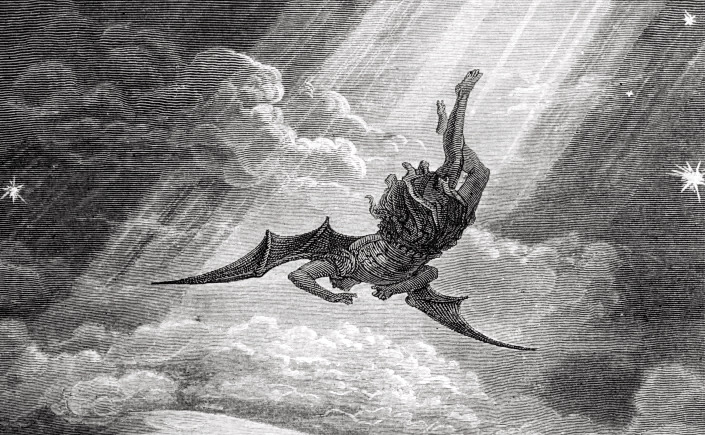
He’d got tickets on himself, defied the boss and fell from grace. “Cast out into the Outer Darkness”, in fact. Hence French illustrator Gustave Doré’s striking image of him descending to Earth to fracture a cozy de facto relationship between Adam and Eve, the first human beings, a perfect pair “created in God’s image”, and thereafter to inflict mayhem upon mankind, including, as we have noted above, the concept of “original sin” which broadly defined all humanity as damned until it accepted the dominion of an almighty creator and condemned womankind to an eternity of subjugation to the patriarchy.

This assumption that he is a fallen angel is, scripturally, based the Book of Isaiah in the Old Testament of The Bible: “How art thou fallen from heaven, O Lucifer, son of the morning! How art thou cut down to the ground, which didst weaken the nations” (14:12).

But the tabloid story that has been handed down to us through the ages arguably originated in the apocryphal Book of Enoch, written sometime between 300-100 BCE and quite popular around the time of Jesus. It was widely circulated although it was considered a heretical text by the religious authorities on account of its opposition to mainstream Rabbinical Judaism. Whilst referenced a few times in the New Testament, it was rejected by the ecclesiastical canon, (though not, apparently, in Ethiopia – to this day, a unique African outlier to Christianity, and indeed, Judaism). But it’s from Enoch that we’ve inherited most of our mythology of the fallen angels, and also, a lot of apocalyptic imagery and millenarian or “end times” belief. 

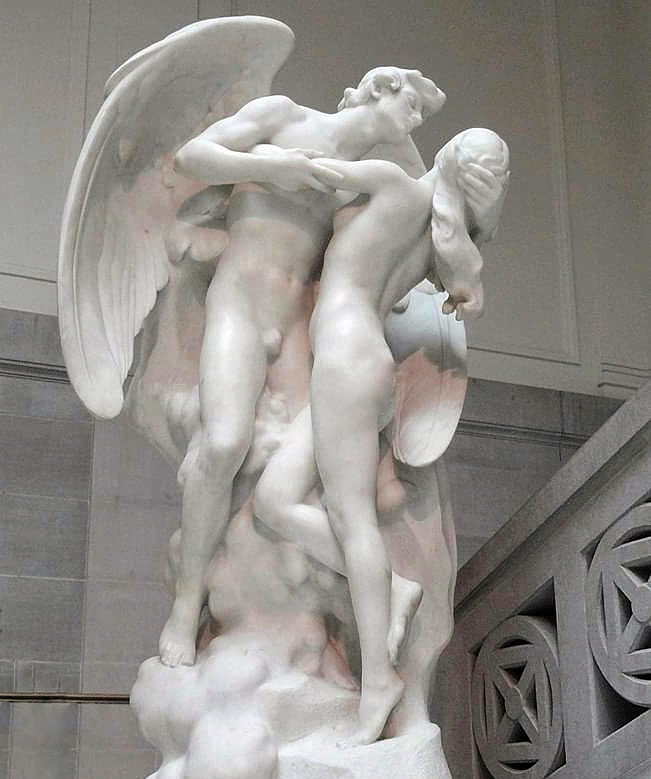
The apocalyptic Book of Enoch gave names to the Sons of God – Lucifer and his comrades, and also, a mob called the Nephilim. The eponymous Enoch understood them to be fallen angels who, having fallen to Earth, had sex with human women – beautifully portrayed in Daniel Chester French’s sculpture, which has been described as the sexiest statue in Washington DC. God, naturally, punished them, and, their behaviour, it is said, in Noah’s flood.  So, it would seem, the fall of the angels related more to sexual sin than to Lucifer’s pride.

The Sons of God Saw the Daughters of Men That They Were Fair.

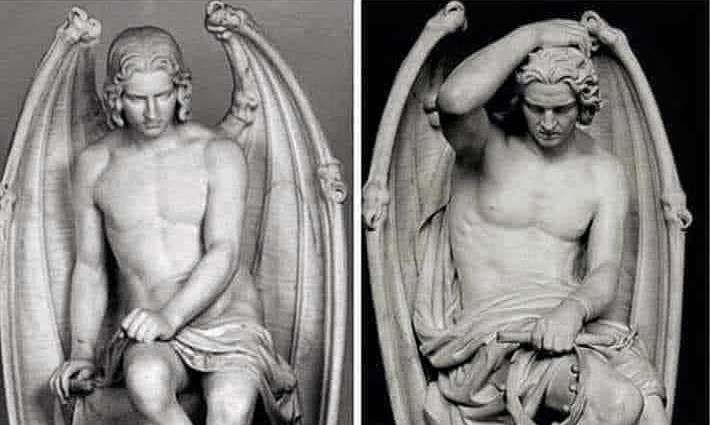
An artist made a sculpture of Lucifer that was too hot for the church so it commissioned his brother. He made an even hotter one!

Regarding the above picture, a Facebook comment read: “The depiction of Lucifer on the right looks exactly like the one in my dream.  I dreamt that I was in very dark hallway or corridor and suddenly the room lit up, not a very divine bright light but more like a very dim light, lit enough to see what was going on. There was this huge very tall, partially robed angel in crimson red. He raised his hands in the air, and when he did, blood exploded out of the walls. It scared the shit out of me. I jumped up out of bed and didn’t go back sleep until the next day. Satan is definitely real, and he isn’t a red goat with horns – he’s a very tall, nice-looking angel with wavy blonde hair – and very very powerful he has wavy blonde hair sort of like Logan Paul’s (an American social media influencer, professional wrestler, YouTuber, entrepreneur, and actor). Though this may sound silly or fun,  I’m not joking. I’ve I seen this m…..f…..r in my dream! It was Lucifer!”

And with regard to artistic depictions, there is the amazing sculpture The Fall of the Rebel Angels” created by sculptor Agostino Fasolato in the eighteenth-century. Almost two meters high and carved from a single block of Carrara marble, it is a pyramid of sixty contorted figures. At the top, wielding his sword of fire, is the archangel Michael who, according to religious tradition, led to forces of light in the tumultuous battle that saw Lucifer and his rebel angels consigned to hell. It an extraordinary intertwining of bodies, depicting the falling angels at the moment of their transformation into demons. So, there they are, agonised faces, hornèd heads, and serpents’ tails, rocking and rolling, tossing and turning, tumbling down, down, down into the infernal pit.

Paradise lost

The story of the fall of Lucifer is actually underpinned by not one but two works of fiction: Enoch’s, and the English puritan poet and pamphleteer John Milton’s imaginative and lyrical masterpiece Paradise Lost (1667) which has dominated our perspective of the story ever since.

Milton gave us the first lyrically and psychologically compelling portrait of Lucifer. He was not the sly predator of myth and menace but rather, (initially, at least) an edgy seductive hero. With his fine words, theatricality and swagger, the only ostensible sign of evil within, a lightning scar on his face: “He above the rest, in shape and gesture proudly eminent, stood like a tow’r”. And yet, he winds up as a washed out up idealist and revanchist cynic, “dismay mixt with obdurate pride and steadfast hate”.

Although I was familiar with Paradise Lost, I did not read Milton’s prose opus until the late seventies, encouraged by the the work of nineteenth century French lithographer Gustave Doré who rendered the poet’s words into pictorial flesh. That’s his iconic image of Lucifer descending to Earth at the head of this story.

Sometime in the early eighties, 83 or 84 I think, my old pal and provocateur Yuri the Storyteller introduced me to Lilith.

Lilith has been around for thousands of years. In the Talmud, she is described as a winged demoness with a human appearance. She appears in the bible, in the Dead Sea Scrolls, and in Hebrew folklore, and has been mentioned in black magic treatises. The apocryphal story is that Lilith was Adam’s first wife. God made Adam from dirt and clay. Adam bored, requested a companion, and God obliged with Lilith. Legend has it that her dirt was dirtier than Adam’s, but put that down to patriarchal prejudice and propaganda. More likely, she had the dirt on him! But I digress. Apparently, Lilith was not as inferior to Adam as he wanted. She wanted to be her own person, not Adam’s wife-slave. The story is that when Adam insisted on the missionary position, Lilith refused, saying “Why must I lie beneath you? We are both equal. We come from the same earth”. Adam got mad, and Lilith took off.

Because of this, she was banished from Eden and became a spirit associated with the seductive side of a woman. Eve came in her place to stand behind Adam, not beside him. Lilith became the timeless femme fatale, preying on the easily tempted weaker sex, the fabled incubus who comes at night upon men as they sleep. It is not for nothing that she has been hailed the (informal) goddess of wet dreams.

The legends are many and various. If you buy into the Lilith theory, you will see her cropping up throughout history in a variety of guises. In biblical times: Delilah, Salome, and Potophar’s wife. In fact and fable: Sheherazade, Lucrezia Borgia, Mata Hari, Evita Peron. Hollywood’s screen ‘sirens’ like Vivien Leigh, Elizabeth Taylor, and Marilyn Monroe. All of them antitheses to secular saints like Eve, Mary Magdalene, Joan of Arc, Florence Nightingale, Jackie Onassis, Mother Theresa, and Princess Diana.

Lilith’s story deserved an epic poem, so borrowing from Milton and the opening chapter of JRR Tolkien’s Silmarillion, I duly wrote Lilith – a poem of the fall. It was attributed to a Roman poet celebrated during the reigns of emperors Claudius and Nero. It’s forward read:

“The style of Lilith differs markedly from that of other poems attributed to Meniscus – most notably the Hebrew Heroes cycle and was evidently written for a different manner of presentation. It was most likely written to be recited rather than sang (as were his other “story songs”). Recitations were a common form of entertainment in the middle Roman period, owing their popularity to the enduring reputations of the “classical” writers of the time, Ovid, Horace and the like. It was not uncommon for such recitations to last several hours. But Meniscus, mindful of the fast-moving times, and also of the attention span of his audiences, appears to have honed his pieces down to between ten or fifteen minutes”.

It debuted at Victoria’s Port Fairy Folk Festival in about 1986 in a shambolic busy poetry competition – it came first, I recall, but the event was so poorly organized that I received neither award or recognition.


It began in suitably histrionic Genesis style:

Long time ago In a time before time,
When man was an atom in primeval slime,
When darkness lay hard on the face of the deep,
God called for his angels to sing him to sleep.

I hadn’t finished with Lucifer, however. He reappeared as metaphor in a gloomy commentary of the state of humanity in Devil’s Work, published in full at the end of this article. The narrative actually came to me in a dream – though this was not the nightmarish image of the sleepless Facebook commenter quoted above:

For what you’ve done to you own kind, you’ve done of your own will.
If I went away on a holiday, you’d be malignant still.
For all you’ve done unto yourselves, you’ve done because you must –
A self-destructive legacy to bring yourselves to dust.
To render you to dust.

The implication here is that we actually know Lucifer, Satan, the Devil, because, to use a an enduring aphorisms, “we have seen the enemy and he is us!”. Many writers have implied this. In 1942, not long after his return to the Anglican faith in which he’d been raised, my favourite poet WH Auden asked a Sunday School class: “Do you know what the Devil looks like? The Devil looks like me.” As an informative piece in The Daily Beast observed, “his sensitivity and acuity as a poet made him aware that the pathologies of ideology are first manifest in the pathologies of individuals, including and especially himself, a character he never shied from satirizing or indeed using as a template for the doomed romantic or cruel authoritarian he took as the protagonist of so many of his poems”.

And finally,Lucifer is also name checked in a sprawling ballad about Herman Melville’s Captain Ahab and his obsessive hunt for Moby-Dick, the famous white whale:

Down, down, deep down we dove
In a tangle of rigging and rage –
Down to the deep where the dead sailors sleep
In the darkness of Lucifer’s cage.
From Chapter Forty One – In That Howling Infinite 

A brief satanography

The following is an updated version in the introduction to Roman Holiday: The Poems of Meniscus Diabetes (1989). Most of it is compiled from Wikipedia.

‘Satanic’ implies the old God-Satan contradiction – and yet it is a paradox. You can’t really have the idea of a universal, omnipotent a God AND a universal, quite potent black hat opposing both Him and Man.

Indeed, we tend to anthropomorphize Old Nick more than we do his rival and nemesis God, although Jesus and Satan often have their own Fight Club going in the New Testament – the ostensibly “evil one” doesn’t get much of a gig in the Old Testament, which is not to say that Jewish folklore didn’t quite ignore him, as I will explain in eccentric detail below. The Essenes of old, who left us a heap of important written material in caves overlooking the Dead Sea, bought into the idea of a conflict between the spirit Princes of Light (God, and in time, Jesus) and of Darkness (Satan – which might’ve come from the ancient Persian Zoroastrian spirit of light and wisdom, Ahura Mazda (remember the light bulbs back in the day?) the Zoroastrian present day heirs are the persecuted Baha’i of Iran (though their HQ is in Haifa, Israel. Ironic, eh?) and the Parsi in India and Pakistan, a name derived from Farsi, now the language Iran and much of Afghanistan.

Then we have the old Parthian prophet Mani who, according to Wikipedia, sought to synthesize the teachings of most of the faiths in vogue from Europe to China and all places betwixt during the third century CE. He gave us Manichaeism, which teaches an elaborate dualistic cosmology that describes a struggle between a good, spiritual world of light, and an evil, material world of darkness. It’s not an optimistic one – through an ongoing historical process, light is gradually removed from the world of matter and returned to the world of light, whence it came. The Manicheans believed that God was just, and kind, and loving. He was forgiving God who would forgive us our trespasses. It was the Devil, therefore, who had to be propitiated with prayers and amulets and so on – averting “the Evil Eye”. The Manicheans were accordingly persecuted as heretics at best, and as devil-worshipers at worst.

Lucifer, of course, derived from the Latin, meant “light”. He was, of course, an angel. In angelology – yes, there is indeed such a field of study, angels were, or are, because quite a few folk believe that they are real, God’s bodyguards (assuming he was corporeal) and cops before the Jesuits took over. They are categorised by power, authority and also, light. Lucifer was “top gun”, the bee’s knees, dog’s balls, the primus inter pares. Until he got to big for his wings and staged a rebellion.

There is a downside to doing deals with the devil, unless you’re Robert Johnson at the famous Crossroads, or successfully challenging him to a duel like the young fiddler in The Devil Came Down to Georgia or the likely lad in the old English folk song False Knight on the Road. Look what happened to the ambitious Marlowevian sybarite Doctor Faustus.

The unfortunate Yazidi people of Iraqi Kurdistan and northern Syria, ethnically Kurdish, but an ancient religion in an intolerant sea of Islam, were long accused of being “devil worshippers” because they believe that whilst God is benevolent and will not do us intentional harm, the Devil can be quite malevolent and hence needs propitiating. This was how others perceived it back in the dark day, although more enlightened times have emphasized that the Yezidi Peacock Angel is a beautiful and as benign and benevolent a deity as any other in the deities beloved of the world’s believers.

The Peacock Angel,
 Deviant Art

There was no diabolical god in the Roman and Greek pantheon – or amongst the Norse Gods for that matter. There were gods who did nasty things, but that was because they are annoyed, or angered, or moved to vengeance or malice, or even, envy and lust. These, one placated to restore them to a better humour. Nor is the Satan, the principle of evil personified, actually in the bible. This was a later construct that was read back into it. In the bible according to the poet John in Milton, the devil, whilst not exactly pleasant and delightful, is either on the side of the heavenly authorities at the least, or at the least, not destructively opposed to them. In the words of that great song out of the Brill Building, NYC, “I’m just a boy whose intentions are good. Please don’t let me be misunderstood”.

© Paul Hemphill 2024. All rights reserved

For other indulgences in In That Howling Infinite. see It’s 3am and an hour of existential angst, Blue remembered hills – a land of lost contentment and The quiet teatime of the soul

Devil’s Work

I dreamt I fought the Devil and I bound him in strong chains
To answer for our consciences, to blame for mankind’s stains;
For all pain and perversion, crime and atrocity,
I brought the criminal to trial in the name of humanity.
This bane of humanity.

In judgement of the power man who makes us fight his fights,
And the holy men in uniform who trample on our rights;
To exact compensation for his prey alive and dead.
But when I brought him to the dock, this is what he said…
He said: “I had no part on what you say I’ve done to hapless man.
He’s master of his destiny – he does the worst he can.
I did not set the fires that burn – I only tend the flames.
Men forged the swords and lit the brands, wrought carnage my name.
They conquered in my name.

“The tyrants and oppressors who jockey for control,
Are of mankind’s own substance, the product of his soul.
The torturers and murderers – in these, I had no part.
They spring from man’s perverse desires and his infernal heart.
Damn his eternal heart.

“The tyrant is not guilty and the killer has clean hands.
They are but pawns of the soul of man and the fruits of his demands.
One half of mankind does not think, the other does not care –
And the sheep go to the slaughter when the wolf pack leaves the lair.
The wolf has left his lair.

“And I am but an image, a figment of your mind;
I am but the whipping boy your hide your sins behind.
I was here before you came to Earth, I’ll be here when you’re gone.
I don’t ask your forgiveness when you’re deserving none!
My undeserving son.

“For what you’ve done to you own kind, you’ve done of your own will.
If I went away on a holiday, you’d be malignant still.
For all you’ve done unto yourselves, you’ve done because you must –
A self-destructive legacy to bring yourselves to dust.
To render you to dust.

So when you say I want to rule a realm of ash and bones,
Let he who is devoid of sin go cast self-righteous stones.
I stand upon the sidelines, contemptuous, aloof.
I won’t condemn all that you’ve done.
I may condone all that you’ve done.
I’m quite content with what you’ve done. But cause it?
Give me proof!”