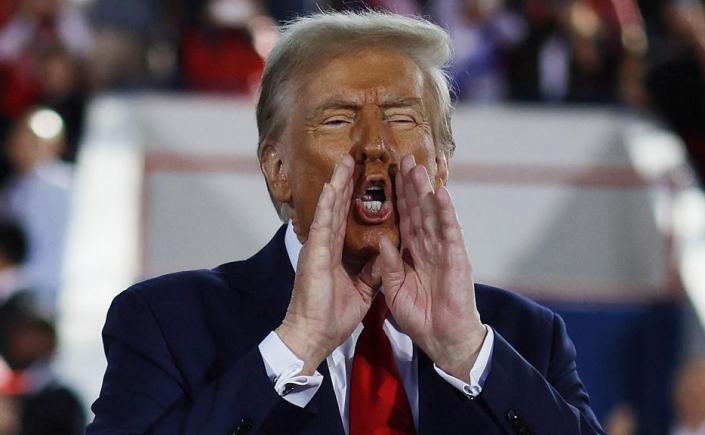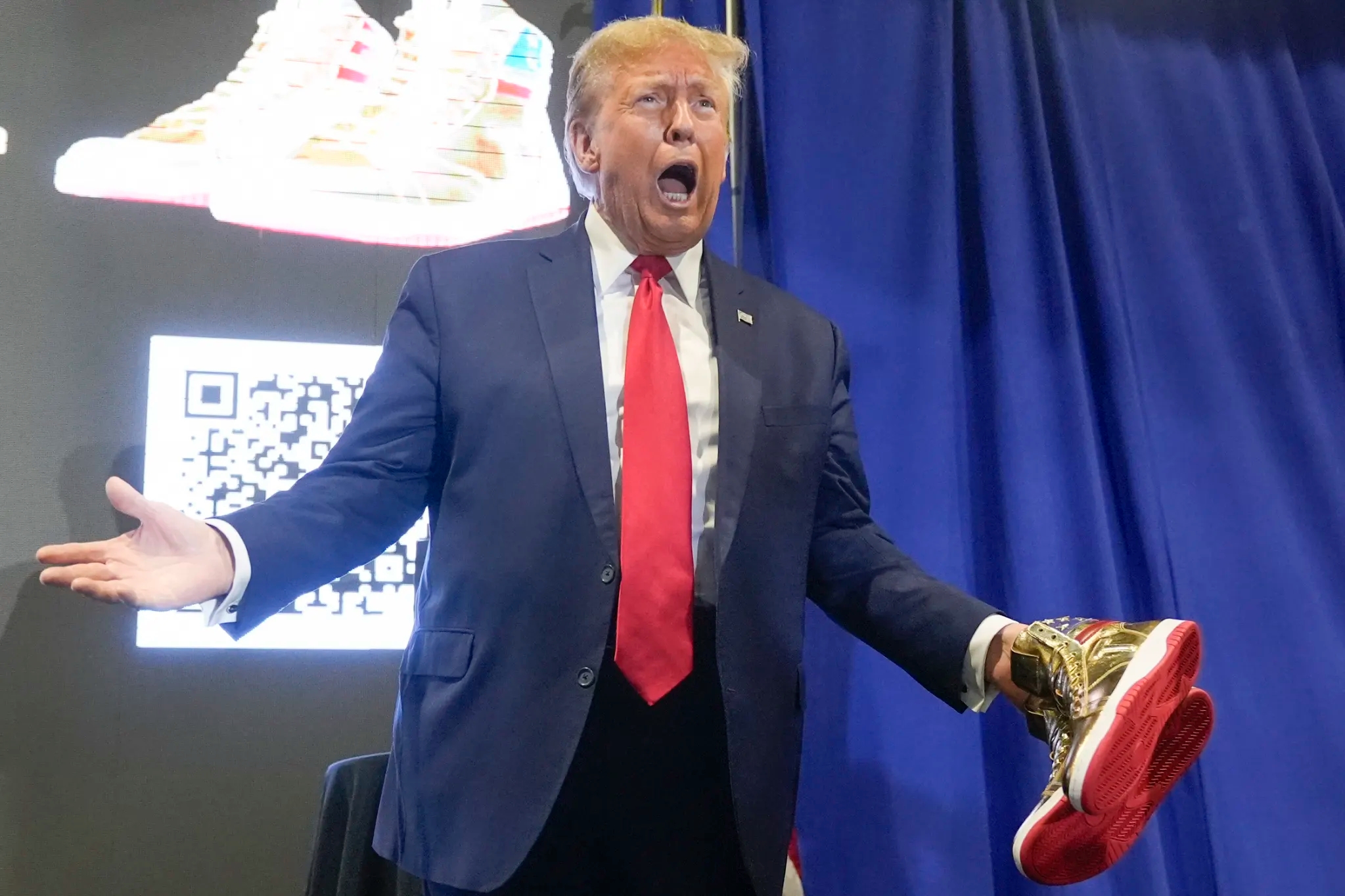
The Trump Revolution …. ‘I run the country and the world’

If I ruled the world
Every day would be the first day of Spring
Every heart would have a new song to sing
And we’d sing of the joy every morning would bring
If I ruled the world
Every man would be as free as a bird
Every voice would be a voice to be heard
Take my word, we would treasure each day that occurred
My world would be a beautiful place
Where we would weave such wonderful dreams
My world would wear a smile on its face
Like the man in the moon has when the moon beams

Leslie Bricusse and Cyril Ornadel

On his inauguration on January 20 2025, US President Donald Trump declared to the American people, “My fellow citizens, the golden age of America begins right now.”

Pundits and partisans right across the political spectrum, both at home and overseas, agree that Donald John Trump’s second presidential term is probably the most consequential since Franklin Delano Roosevelt. That is perhaps the only thing that they can agree on.

After 100 days in office, he is in command, testing the limits of executive power, resetting political and cultural perceptions and expectations, and reframing America’s role in the worked. But it would seem to many that having arguably declared war on America and the world, he is veering out of control.

There is almost no part of American society which has not felt the blizzard of change from the day he was sworn in. In a stand-over style that is more mob boss than head of state, he has forged a new American imperialism to project what he perceives as US interests, secure strategic assets and rebuild American economic self-sufficiency. The global trading system that has been in place for 75 years has been crippled, if not destroyed, and economists and stock markets surmise that the US economy is on the verge of crashing. America is no longer the leader of the free world because the world is no longer following America, but rather, is taking evasive action. Trump has united the people of most countries around the world around their political leadership, and yet he has not united America and Americans.

In a recent opinion piece in the Sydney Morning Herald, Bruce Wolpe, a senior fellow at the University of Sydney’s United States Studies Centre and former Congressional staffer, wrote a concise overview of Trump’s tumultuous first 100 Days. I have borrowed from it to write the following précis.

Trump is not governing by legislating but by an unprecedented exercise of executive power. He has signed fewer bills into law than any recent modern president while his 100 executive orders have triggered a tidal wave of new policies to change what the government can and cannot do. His political style of is marked by decrees coupled with complete domination of the airwaves for several hours each day, from greeting world leaders in the Oval Office to his televised cabinet meetings. For Trump, it is all streaming, all the time.as he remarked in the prime-time public takedown of the Ukrainian president in the Ovak Office, this it makes for “good television”.

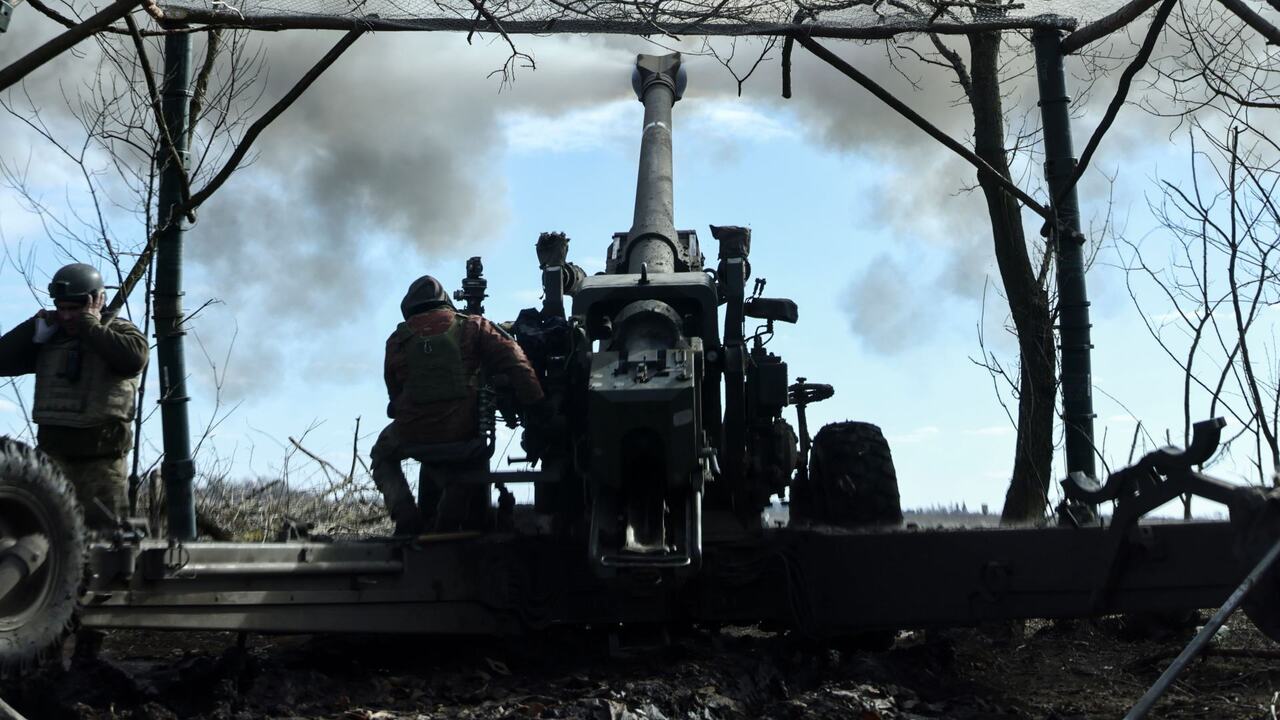
On foreign policy, Trump promised groundbreaking early success on the world stage. But he has to date failed to end the wars in Ukraine and Gaza, come close to a nuclear deal with Iran , or settling the dozens of trade wars he launched against his allies. Instead, there are constant reversals in tactics and rhetoric. He has decoupled America from the wider world with ramifications which will be felt for many years, if not decades. He has treated allies like adversaries, withdrawn America from numerous global institutions and treaties, erected daunting tariff barriers on all US trading partners and slashed US foreign aid and the State Department, terminating foreign aid, vaccines and food programme. The cumulative effect has been to gravely weaken America’s ability to wield soft power at a time when China and Russia are rushing to fill the vacuum.

Aided and abetted by billionaire Elon Musk, the world’s richest man, Trump unleashed Project 2025’s sledgehammer to the bureaucracy with overriding acts of Congress to dismantle agencies and programmes, mass firings, loyalty oaths, and the seizure of databases. And, as he promised on the campaign trail, Trump is exacting vengeance on his enemies. He has called on judges who have ruled against him to be impeached. He has blacklisted law firms that worked with Democrats, or else shook them down for millions of dollars of free work.  In a speech at the Department of Justice, Trump said his enemies were “scum”, that the cases brought against him were “bullshit”, that the judges who ruled against him were corrupt, his prosecutors were deranged, and that those who came after him should be imprisoned. In a war against the nation’s most prestigious universities, he is demanding their leftist woke elitism be expunged, or else research dollars and tax-free status will be eliminated. Meanwhile, he continues to target the media as the enemy of the people. The Associated Press has been excluded from presidential events; the Voice of America has been shut down; and Trump has asked the regulator to cancel the broadcast license of CBS whilst moving to defund public media’s NPR and PBS.

The Democrats in Washington meanwhile are adrift and effectively leaderless. With control of the House and the Senate, Trump dominates everything in the capital. The force, speed and scope of his administration’s actions are so intense that the Democrats cannot respond effectively. Its not as if everyone has been taken by surprise. If they had been paying attention, this is exactly what Trump and his team said they would do. It is the scale of this revolution that has put everyone into a spin. It is a time of everything happening everywhere all at once – in accordance with the MAGA mantra of “move fast and break things”.

But, say optimists, the pushback is coming. Every weekend, people are flooding the streets in cities across the country. That movement is growing. If all that Trump and his administration have let loose comes into full force but does not deliver the American miracle he promised – with recession, inflation, and chaos taking hold across the land – the midterm elections next year could be a turning point. The Democrats are in striking distance of retaking control of Congress. If so, Trump’s power may be checked and his golden age may be stillborn. And yet, nothing about Trump is certain. His approval ratings might now be at a historical low, but he has been wrongly written off many times before.

So, how did it come to this?

As the authors of the long but excellent opinion piece in The Atlantic published below explains, Donald Trump’s Second Coming began four years ago and took meticulous planning.

That’s right, it’s come to this
Yes, it’s come to this
And wasn’t it a long way down?
Wasn’t it a strange way down?
L Cohen, Dress Rehearsal Rag

Postscript: a bad case of imperial purple …

The story goes that Roman Emperor and stoic “philosopher king” Marcus Aurelius engaged a slave to follow him as he walked around Rome; his only job, whenever his master was praised, was to whisper in his ear, “Remember, you are just a man, you are just a man”. Washington, meanwhile, is starting to resemble some of the more excruciating scenes from the BBC’s iconic sword and sandals series I Claudius.

A recent artilce in The New Yorker wrote:

‘Brazen transaction mixed with humbling obeisance is hardly unknown in Washington … In Trump’s Washington, the imperative has never been plainer: if you want to get ahead or stay out of trouble, praise the President as much as he praises himself … The gestures of servility come from all over. At a Cabinet meeting not long ago, Trump’s secretaries took turns: “Your vision is a turning point and inflection point in American history” (Brooke Rollins, Agriculture); “You were overwhelmingly elected by the biggest majority—Americans want you to be President” (Pam Bondi, Attorney General); “What you’re doing now is a great service to our country, but ultimately to the world” (Marco Rubio, State) … At a hearing of the House Committee on Natural Resources, where a dozen or so members were discussing the Gulf of America Act of 2025, sponsored by Marjorie Taylor Greene. Democrat congressman Jared Huffman said: “This is remarkable new stuff in this committee, just bootlicking sycophancy of the highest order,” he said. (Not long after the hearing, Huffman suggested an amendment to rename Earth “Planet Trump”.’

Other Trump articles in In That Howling Infinite: Deconstructing Donald – translating Trumpspeak; Trumps second coming … a new American Revolution?; Trump’s revolution … he can destroy, but he cannot create

Heaven’s above! David Rowe

‘I RUN THE COUNTRY AND THE WORLD’

Donald Trump believes he’s invincible. But the cracks are beginning to show.

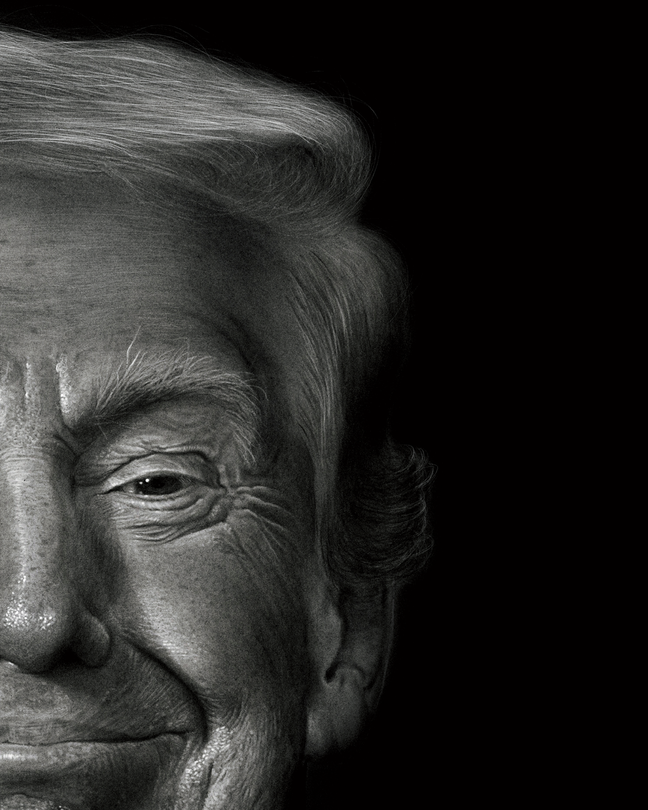
A black-and-white image of a smirking Donald Trump, cropped to half of his face.
Illustration by Dale Stephanos. Source: Ethan Miller / Getty.

In ordinary times, reporters seeking an on-the-record encounter with the commander in chief first write an elaborate proposal. The proposal details the goals of the interview, the broad areas of concern, and the many reasons the president must, for his own good, talk to these particular reporters and not other, perfectly adequate but still lesser reporters. This pitch is then sent to White House officials. If the universe bends favorably, negotiations ensue. If the staff feel reasonably confident that the interview will somehow help their cause, they will ask the president—with trepidation, at times—to sit for the interview. Sometimes, the president will agree.


Such is what happened recently to us. We went through this process in the course of reporting the story you are reading. We made our pitch, which went like this: President Donald Trump, by virtue of winning a second term and so dramatically reshaping the country and the world, can now be considered the most consequential American leader of the 21st century, and we want to describe, in detail, how this came to be. Just four years ago, after the violent insurrection he fomented, Trump appeared to be finished. Social-media companies had banned or suspended him, and he had been repudiated by corporate donors. Republicans had denounced him, and the country was moving on to the fresh start of Joe Biden’s presidency. Then came further blows—the indictments, the civil judgments, and the endless disavowals by people who once worked for him.

Trump agreed to see us. We were tentatively promised a meeting and a photo shoot—likely in the Oval Office, though possibly the Lincoln Bedroom. But then, as is so often the case with this White House, everything went sideways.

The week our interview was supposed to occur, Trump posted a vituperative message on Truth Social, attacking us by name. “Ashley Parker is not capable of doing a fair and unbiased interview. She is a Radical Left Lunatic, and has been as terrible as is possible for as long as I have known her,” he wrote. “To this date, she doesn’t even know that I won the Presidency THREE times.” (That last sentence is true—Ashley Parker does not know that Trump won the presidency three times.) “Likewise, Michael Scherer has never written a fair story about me, only negative, and virtually always LIES.”

Apparently, as word of our meeting spread through Trump’s inner circle, someone had reminded him of some of the things we (specifically Ashley) had said and written that he didn’t like. We still don’t know who it was—but we immediately understood the consequences: no photo shoot, no tour of the newly redecorated Oval Office or the Lincoln Bedroom, and definitely no interview.

But we’ve both covered Trump long enough to know that his first word is rarely his final one. So at 10:45 on a Saturday morning in late March, we called him on his cellphone. (Don’t ask how we got his number. All we can say is that the White House staff have imperfect control over Trump’s personal communication devices.) The president was at the country club he owns in Bedminster, New Jersey. The number that flashed on his screen was an unfamiliar one, but he answered anyway. “Who’s calling?” he asked.

Despite his attacks on us a few days earlier, the president, evidently feeling buoyed by a week of successes, was eager to talk about his accomplishments. As we spoke, the sounds of another conversation, perhaps from a television, hummed in the background.

The president seemed exhilarated by everything he had managed to do in the first two months of his second term: He had begun a purge of diversity efforts from the federal government; granted clemency to nearly 1,600 supporterswho had participated in the invasion of the U.S. Capitol on January 6, 2021, including those caught beating police officers on camera; and signed 98 executive orders and counting (26 of them on his first day in office). He had fired independent regulators; gutted entire agencies; laid off great swaths of the federal workforce; and invoked 18th-century wartime powers to use against a criminal gang from Venezuela. He had adjusted tariffs like a DJ spinning knobs in the booth, upsetting the rhythms of global trade and inducing vertigo in the financial markets. He had raged at the leader of Ukraine, a democratic ally repelling an imperialist invasion, for not being “thankful”—and praised the leader of the invading country, Russia, as “very smart,” reversing in an instant 80 years of U.S. foreign-policy doctrine, and prompting the countries of NATO to prepare for their own defense, without the protective umbrella of American power, for the first time since 1945.

TK

Donald Trump after being sworn in as president for his second term in the Rotunda of the United States Capitol (Shawn Thew / Reuters)

He had empowered one of his top political donors, Elon Musk, the richest man in the world, to slice away at the federal government and take control of its operating systems. He had disemboweled ethics and anti-corruption architecture installed after Watergate, and had declared that he, not the attorney general, was the nation’s chief law-enforcement officer. He had revoked Secret Service protection and security clearances from political opponents, including some facing Iranian death threats for carrying out actions Trump himself had ordered in his first term. He had announced plans to pave over part of the Rose Garden, and he had redecorated the Oval Office—gold trim and gold trophies and gold frames to go with an array of past presidential portraits, making the room look like a Palm Beach approximation of an 18th-century royal court.

Old foes were pleading for his grace. Meta—whose founder, Mark Zuckerberg, had become an enthusiastic supplicant—had paid $25 million to settle a civil lawsuit with Trump that many experts believed was meritless. Amazon’s founder, Jeff Bezos, the owner of The Washington Post, announced that he was banning his opinion writers from holding certain opinions—and then joined Trump for dinner the same night at the White House.

“He’s 100 percent. He’s been great,” the president told us, referring to Bezos. “Zuckerberg’s been great.”

We asked Trump why he thought the billionaire class was prostrating itself before him.

“It’s just a higher level of respect. I don’t know,” Trump said. “Maybe they didn’t know me at the beginning, and they know me now.”

“I mean, you saw yesterday with the law firm,” he said. He was referring to Paul, Weiss, Rifkind, Wharton & Garrison, one of the nation’s most prestigious firms, whose leader had come to the Oval Office days earlier to beg for relief from an executive order that could have crippled its business. Trump had issued the order at least partially because a former partner at the firm had in 2021 gone to work for the Manhattan District Attorney’s Office, where he was part of an investigation of the Trump Organization’s business practices. Also that week, an Ivy League institution, threatened with the cancellation of $400 million in federal funding, had agreed to overhaul its Middle Eastern–studies programs at the Trump administration’s request, while also acceding to other significant demands. “You saw yesterday with Columbia University. What do you think of the law firm? Were you shocked at that?” Trump asked us.

Yes—all of it was shocking, much of it without precedent. Legal scholars were drawing comparisons to Franklin D. Roosevelt and the early stages of the New Deal, when Congress had allowed FDR to demolish norms and greatly expand the powers of the presidency.

As ever, Trump was on the hunt for a deal. If he liked the story we wrote, he said, he might even speak with us again.

“Tell the people at The Atlantic, if they’d write good stories and truthful stories, the magazine would be hot,” he said. Perhaps the magazine can risk forgoing hotness, he suggested, because it is owned by Laurene Powell Jobs, which buffers it, he implied, from commercial imperatives. But that doesn’t guarantee anything, he warned. “You know at some point, they give up,” he said, referring to media owners generally and—we suspected—Bezos specifically. “At some point they say, No más, no más.” He laughed quietly.

Media owners weren’t the only ones on his mind. He also seemed to be referring to law firms, universities, broadcast networks, tech titans, artists, research scientists, military commanders, civil servants, moderate Republicans—all the people and institutions he expected to eventually, inevitably, submit to his will.

We asked the president if his second term felt different from his first. He said it did. “The first time, I had two things to do—run the country and survive; I had all these crooked guys,” he said. “And the second time, I run the country and the world.”

For weeks, we’d been hearing from both inside and outside the White House that the president was having more fun than he’d had in his first term. “The first time, the first weeks, it was just ‘Let’s blow this place up,’ ” Brian Ballard, a lobbyist and an ally of the president’s, had told us. “This time, he’s blowing it up with a twinkle in his eye.”

When we put this observation to Trump over the phone, he agreed. “I’m having a lot of fun, considering what I do,” he said. “You know, what I do is such serious stuff.”


EXILE

that trump now finds himself once again in a position to blow things up is astonishing, considering the depth of his fall. So much has happened so fast that the improbability of his comeback gets obscured. Perhaps no one in American history has had a political resurrection as remarkable as Donald Trump’s.

In the waning days of his first term, his approval rating stood at a pallid 34 percent. A few weeks earlier, he had watched on television while an insurrection he incited overran the Capitol; polls showed that a clear majority of Americans believed he bore responsibility for the attack. The House of Representatives had just impeached him for the second time—making him the only president to ever achieve that ignominy. And although the Senate failed to reach the two-thirds majority required for conviction, seven Republican senators voted to convict—the most members of a president’s own party to vote for an impeachment conviction in history.

Twitter and Facebook, his favorite social-media platforms, had banned or effectively silenced him, along with Instagram and YouTube. To try to reestablish direct connection with his followers, he would launch a blog, “From the Desk of Donald J. Trump.” But it gained little traction and was abandoned within weeks.

Major corporations announced that they were cutting off political contributions to officials who had supported Trump’s election lies. Deutsche Bank and Signature Bank decided to stop doing business with Trump and his companies. Perhaps most painful to the president, the PGA of America yanked its scheduled 2022 championship tournament from Trump’s Bedminster golf course. Former members of his own Cabinet and staff—people he had hired—would declare him, or had already declared him, “a moron” (Rex Tillerson, secretary of state), “more dangerous than anyone could ever imagine” (James Mattis, secretary of defense), “the most flawed person I have ever met” (John Kelly, chief of staff), and “a laughing fool” (John Bolton, national security adviser). And now longtime allies were abandoning him. Kevin McCarthy, the Republican House minority leader, had discussed pushing Trump to resign from office. On the evening of the insurrection, Senator Lindsey Graham, a compass reliably magnetized toward wherever power in the Republican Party lies, pointed away from Trump for the first time in four years. “Count me out,” Graham had declared on the Senate floor. “Enough is enough.” Rupert Murdoch, then the chairman of Fox Corporation, sent an email to a former Fox Broadcasting executive in which he declared, “We want to make Trump a non person.” Coming from Murdoch himself, the former Trump adviser Steve Bannon told us recently, “that’s a papal bull.”

On the morning of Joe Biden’s inauguration, Trump was a dozen miles southeast of the festivities, at Joint Base Andrews, preparing to depart for Florida. (Trump was the first president since Andrew Johnson, in 1869, to boycott the swearing-in of his successor.) Standing before a modest crowd, his dark overcoat a meager bulwark against the cold, the soon-to-be-former president cut a diminished figure.

Just before boarding Air Force One for the final time, to head to Mar-a-Lago, Trump spoke to those gathered to bid him farewell. “We will be back in some form,” he said, a notably modest framing from such a formerly oversize figure.

Few believed him. It didn’t even sound like he believed it himself. The Trump era was over.

Almost as soon as Trump arrived at his gilded Elba, he began plotting his return. He missed the press pool—the gaggle of reporters that tails every president—and once tried to summon it, only to be told that no such pool still existed. But it would turn out that the lack of attention in those first months—and the lack of access to social-media platforms—was a blessing. Enforced obscurity gave him the time and clarity he needed to plan his comeback.

To understand how Trump rose from the political dead, and how he set himself up to wield power in his second term, we spoke with dozens of top advisers, senior aides, allies, adversaries, and confidants. Many who talked with us did so only on the condition of anonymity, in order to be more candid or to avoid angering the president. The story they told us revealed that Trump’s time in the political wilderness is crucial to understanding the way he’s exercising power now.

He had been in Palm Beach a week when an opportunity presented itself. Trump heard that Kevin McCarthy would be in South Florida for fundraisers. Though the two men had clashed after the Capitol riot, Trump invited McCarthy to Mar-a-Lago. Even before the meeting happened, news of it leaked to The New York Times, shaking the political universe: Were Republican leaders, who had seemed so intent on purging Trump, embracing him again? When Trump and McCarthy met in person, the former president asked the minority leader who had tipped off the Times.

TK
Donald Trump departed Washington in 2021 a pariah, twice impeached, abandoned by former allies, and banned or suspended from his favorite social-media platforms. (Photo-illustration by Paul Spella. Sources: Noam Galai / Getty; Alex Edelman / AFP / Getty; Sepia Times / Universal Images Group / Getty.)

“I know who leaked it—you did,” McCarthy replied, multiple people briefed on the exchange told us.

“It’s good for both of us,” Trump shot back.

Both men were right. McCarthy had already concluded that the path back to Republican control of the House in the 2022 midterms—and his own path to the speakership—required a unified party, one that included Trump and his MAGA base. After the meeting, each man separately released the same photo: the two of them grinning amid the ostentatious splendor of Mar-a-Lago. Trump had taken his first step toward political redemption.

It is a truism that Trump has never felt governed by the traditional rules of politics. And he has always been convinced of his own genius, his pure gut instincts. But never more so than today. The past four years have turned him into a Nietzschean cliché. Banishment, multiple indictments, a 34-count felony conviction, repeated brushes with assassins—all have combined to convince him that he is impervious to challenges that would destroy others. Those years also strengthened in him the salesman’s instinct that he can bend reality to his will—turn facts into “fake news,” make the inconceivable not just conceivable but actual, transform the Gulf of Mexico into the Gulf of America, make people believe what he’s selling in defiance of what they see with their own eyes. This is the core lesson that Trump and his acolytes internalized from the 2020 election and January 6. The real-estate mogul who branded buildings with his name everywhere from Turkey to Uruguay, who sold the “world’s greatest steaks” and the “finest” wine and “fantastic” mattresses, had mastered the alchemy of perception. Reality, to Trump, is fungible. While reporting on Trump over the past four years, we were repeatedly struck that, in failing to drive a stake directly through his heart, all of the would-be vampire slayers—Democrats, Never Trumpers, Republican-primary opponents, prosecutors, judges, media critics—only strengthened him. Which brings us to a second lesson: Trump and his team realized that they could behave with near impunity by embracing controversies and scandals that would have taken down just about any other president—as long as they showed no weakness.

Even now, Trump—who described himself to us as “a very positive thinker”—struggles to admit that his return to power was a comeback. To concede that he’d had to come back would be to admit that he had fallen in the first place.

Early in our reporting for this article, we asked the Trump loyalist and former Breitbart News editor Raheem Kassam to explain how the president had been able to bend the country, and the world, to his will. Over a meal of oysters brûlées, duck confit, and fries cooked in beef tallow at Butterworth’s, the new MAGA haunt on Capitol Hill, he responded crudely, if vividly. “He didn’t bend them to his will,” Kassam said. “He bent them over.”

When we spoke with Trump in late March, his approval ratings seemed steady, his political base apparently unshakable. Institution after institution was submitting to him—“obeying in advance,” as the historian of authoritarianism Timothy Snyder has put it. Trump was carrying out his agenda with surprisingly little resistance, even from Democrats. But in the days and weeks that followed, the patina of infallibility began to crack. At the instigation of Elon Musk’s DOGE team, critical workers had been getting fired—and then hired back. An embarrassing (and possibly illegal) operations-security snafu, in which the editor of this magazine was included on a Signal group chat that discussed imminent attack plans on Houthi targets in Yemen, made the administration look incompetent, in a fashion reminiscent of the clown-car chaos of Trump 1.0. The president’s tariff rollout was shambolic, tanking the stock market and causing even some loyalists to question him publicly. His approval rating on the economy, long a buttress of his polling support, went negative. Was this what happens when a feeling of indomitability curdles into hubris? Or was this just the next setback for Trump—some combination of Houdini and Lazarus—to recover from?
THE ART OF THE COMEBACK

he had almost been destroyed before. After a real-estate downturn in the early 1990s, Trump found himself on the brink of financial ruin. His near bankruptcy and recovery led to his 1997 book, The Art of the Comeback. For his political advisers in exile, this book became essential reading.

The first pages list Trump’s “Top Ten Comeback Tips.” When we met one of his advisers recently, this person recounted from memory some of the rules on the list. “Rule 1 is: Play golf,” this adviser told us. “Rule 9 is: Get even.” (Rule 10, “Always have a prenuptial agreement,” seemed less applicable to politics.)

To stage a comeback, Trump would need the right staff. He had realized, in his exile, that at nearly every turn in his first term, someone on his own team—Reince Priebus, John Kelly, James Mattis, Bill Barr, Gary Cohn—had blocked him. He needed smart people who would figure out how to let him do everything that he wanted to do, in whatever way he wanted to do it. His first key hire was a political operative who had impressed the former president with her retrospective analysis of the 2020 election. Biden had won the election that year by flipping back into the Democratic column five key states—Arizona, Georgia, Michigan, Pennsylvania, and Wisconsin (along with a lone congressional district in Nebraska). One of the few bright spots for Trump in 2020 had been Florida, where he had increased his winning margin from 2016. What, Trump began asking his allies after the election, had he done right in Florida that he hadn’t done in the rest of the country?

The answer, in large part, boiled down to Susie Wiles, who had run Trump’s 2016 and 2020 campaigns in the state. Wiles, the daughter of the legendary NFL announcer Pat Summerall, is an experienced campaign operative (she was a scheduler for Ronald Reagan’s 1980 presidential campaign), who over the past three decades had developed deep Florida ties. After every campaign she runs, Wiles writes an “after action” report, documenting what worked and what didn’t. Over dinner with Trump on the patio at Mar-a-Lago in early 2021, she delivered “the Florida memo.” Soon after, he hired her to run his political operation, which eventually became his 2024 campaign.

Wiles saw that one thing that had held Trump back in 2020 was that he had not finished taking over the Republican Party during his first term. Part of Trump’s leverage had been his ability to endorse in Republican primaries—influence he was eager to reprise. “When I endorse somebody, they win,” Trump told us on the phone. “But even when I endorse them in the general election, mostly they win. It’s important.” (Now when Trump calls to pressure a fellow Republican about an issue or a vote, they are almost always grateful for his past support, or feel that they owe their seat to him.)

The Wiles process for evaluating potential endorsees—which she undertook with James Blair, now a deputy chief of staff in the White House, and Brian Jack, now a congressman representing Georgia—involved researching how they had spoken about Trump in the past. “The basic thing was their loyalty and their political viability,” one adviser told us. “So we were looking for things like: So, what did they say on J6? What did they say during the Access Hollywood tapes? What is their voting record with us?” Trump was building a coalition of loyalists, something he hadn’t sufficiently done during the first term.

Wiles had plenty of experience managing men with big personalities. But colleagues say a key reason she’s been successful working with Trump (she is now his White House chief of staff) is that she never tries to manage him. She does not imagine that she can control him, as some former top advisers attempted, and she tends not to offer advice unless specifically asked. Her primary role, as she sees it, is to set up processes to help ensure Trump’s success, and then to execute his directives, whatever they may be.

At first, Trump’s banishment from the big social-media platforms, along with mainstream media outlets’ reluctance—including Fox News’s—to give him much coverage, seemed potentially devastating. But Trump turned to the far-right platforms and activists still welcoming him. Taylor Budowich—now a White House deputy chief of staff—worked with MAGA influencers to evade the Twitter and Facebook bans: They would print out pro-Trump social-media posts; Budowich would have Trump sign the paper with his Sharpie, and then mail the signed post back to the influencer; almost invariably, the influencer would then post the signed missive, flexing their access and building their audience—while simultaneously amplifying Trump’s voice. At the same time, a video ecosystem grew up around Trump, with streaming platforms such as Right Side Broadcasting Network stepping in to cover his events when cable networks would not.

“Him being banned gave rise to people like me, because the president’s supporters followed me to find out what he was saying,” one MAGA influencer told us. “It backfired on the tech people who deplatformed him, because it platformed all of us.”

Trump, meanwhile, continued to promote the lie that he’d won the 2020 election, and that January 6 was just an ordinary Wednesday. Normal political logic suggested that this was a bad strategy. But his shamelessness, as ever, remained a strength. By repeating something frequently enough, he could slowly make it feel true, at least for his supporters.

Not long ago, we sat in Steve Bannon’s Capitol Hill rowhouse, where he records his War Room podcast, pressing him on Trump’s refusal to accept the results of the 2020 election, and his denial of what transpired on January 6. “Our reality is that we won” and that January 6 was a “fedsurrection,” Bannon said, referring to the conspiracy theory that FBI agents had incited the crowd on the Ellipse that day.

But this reality, we pointed out to Bannon, is simply not true.

“Now, here’s the interesting thing,” Bannon said. “Who’s won that argument? I think we have.”

“BE READY!”

the first televised hearing of the House select committee on January 6 was scheduled for the beginning of June 2022, and it was sure to be a spectacle that reminded viewers of the horror of the insurrection and emphasized the former president’s culpability. Trump’s team at Mar-a-Lago was desperate to distract attention from the hearing. At one point, someone proposed a brazen gambit: Trump could announce his 2024 bid for the presidency just minutes before the hearing gaveled in.

Trump’s response was telling. “I’m not ready for this,” he said. “We’re not ready for this right now.”

“That was the first moment of, like, ‘Okay, he’s not just thinking about it; he’s seriously thinking about how he wants to do it,’ ” one of his advisers told us. “He’s not going to just use it as a stunt to make a moment. He wants to win.”

Before long, Trump began emphasizing behind the scenes that he was serious. “Be ready,” he would repeat to people who had served with him the first time around. “Be ready! Be ready! We’re coming back! Be ready!”

Still, when Trump did launch his campaign, in November 2022, it did not get off to an auspicious start. Even his most fiercely supportive advisers concede that the announcement, in the form of an hour-long speech at Mar-a-Lago, was a dud.

Surprisingly few political reporters from major outlets were in attendance; it was as though the mainstream media still didn’t believe that Trump could be a viable candidate again. Worse, some members of Trump’s own family hadn’t bothered to show up. As the speech dragged on, even Fox News cut away, switching to what Bannon called “a C-level panel,” before returning for the final few minutes.

The campaign struggled to gain traction. Trump’s longtime pollster Tony Fabrizio told us that even months later, into early 2023, getting donors to attend the first big super-PAC event “was like pulling teeth.” And although Trump was now a declared presidential candidate, his team said it was still having trouble getting him booked even on shows such as Fox & Friends.

The first turning point, several advisers told us, came in February 2023. A Norfolk Southern train carrying hazardous chemicals derailed in East Palestine, Ohio, near the Pennsylvania border, spewing toxic material. Sitting in the West Palm Beach campaign headquarters one day, Trump’s team watched Joe Biden’s press secretary struggle to answer a question about the president’s plans for outreach to East Palestine. Soon after, Susie Wiles received a call from Trump’s oldest son, Don Jr., saying that his father ought to just show up there himself. When Wiles brought the suggestion to Trump, in the living room of Mar-a-Lago, his response was unequivocal: “That’s a great idea,” he enthused. “When can we go?”

Trump’s visit to East Palestine—and the footage of him buying McDonald’s for the first responders—had a potent effect. “It just reminded everyone that people still like this guy,” one adviser told us. “He’s still a draw.” Nearly two years later, Trump’s visit continued to resonate. “People are living their lives and they don’t delve that easily into policy,” a woman across the border in the swing state of Pennsylvania told our colleague George Packer before the election last fall. “All they know is that Trump was here buying everyone McDonald’s” and that Biden hadn’t visited for more than a year.

The halting start to the campaign kept Trump off the radar, giving his team time to plan. Former Trump advisers had used their years out of power to set up their own groups—America First Legal, America First Policy Institute, Center for Renewing America—to prepare for a second Trump administration.

“The people who were the true believers knew Trump was going to run again and win,” Caroline Wren, a former top Trump fundraiser, told us, adding that Trump’s policy loyalists “sat there and prepared executive orders for four years.”

The time out of the spotlight also allowed the team to build a new election strategy. By now, Trump had alienated a significant share of the voting public, and he was polling lower among some demographic groups than in previous elections. The conventional wisdom was that the criminal investigations and legal proceedings then under way would only increase that alienation. His campaign directors decided that the best tactic was to turn this problem into a strength. Chris LaCivita, who was a co–campaign manager alongside Susie Wiles and a military veteran wounded in the Gulf War in 1991, took to exhorting younger staffers with a Marine slogan: “Embrace the suck.”

The impulse to let Trump be Trump, so contrary to the instincts of much of the first-term staff, was laid out in a memo that James Blair and Tim Saler, the campaign’s lead data expert, sent to Wiles in early 2024. This became known around the campaign as the “gender memo.” “Instead of saying, ‘Look, we did two points worse with white suburban women between 2016 and 2020’ and ‘How do we get those points back?,’ what if we did it the other way?” an adviser familiar with the memo told us. “What if we said, ‘We gained eight points with non-college-educated men. What if we won them by 12?’ ”

TK
During his brief political exile, Trump hired the campaign operative Susie Wiles. (Photo-illustration by Paul Spella. Sources: ablokhin / Getty; Tom Brenner / The Washington Post / Getty; ZUMA Press / Alamy.)

The strategy had the benefit of letting Trump be the version of himself that appealed to those men. In a moment when the Democratic Party often felt like an amalgamation of East Coast elitists, niggling scolds, and far-left activists, Trump appeared to offer judgment-free populism to a populace sick of being judged.

Trump’s own view, we were told, was more self-referential: “Why would I distance myself from my people? They love me.”


“IT MADE ME STRONGER”

on friday, may 31, 2024, the day after Trump was convicted of 34 felony charges in a New York City courtroom, the treasurer at Make America Great Again Inc., the main super PAC supporting the former president, called his boss, Taylor Budowich, with good news. A large wire transfer was incoming—a record $15 million. The call set off an internal scramble, because the bank needed the donor’s name to approve the transfer, and nobody knew who it was.

Shortly thereafter, the treasurer called back. “I’m so sorry,” he told Budowich. “I misheard him. It’s not $15 million—it’s $50 million.”

“Don’t be sorry!” Budowich said. (The donation was eventually traced to Timothy Mellon, an heir to the Mellon banking fortune.)

The Democrats assumed that Trump’s legal issues would politically neuter him. “A convicted felon is now seeking the office of the presidency,” Biden would say. But all the scandals and controversies that would have sunk a different candidate became background static. “The thing about the court cases is there were too many of them, and this is one of Trump’s superpowers—he never just breaks the law a little bit; he does it all over the place,” Sarah Longwell, a formerly Republican, anti-MAGA political strategist who regularly conducts focus groups, told us. “And as a result, there were so many court cases that it was just white noise to voters. They couldn’t tell them apart.”

The Democratic base remained outraged. Trump’s base continued to believe his claims that all the criminal investigations and January 6 hearings constituted a “witch hunt.” But for the sliver of voters who would actually decide the election, the Democratic argument that Trump was a threat to democracy was too far removed from their more urgent concerns about grocery prices. As time passed and Trump continued to rewrite history to turn insurrectionists into “patriots,” the events of January 6 receded into abstraction for many of these voters.

“If you said, ‘What’s J6?,’ it’s like, ‘What is that? Bingo? Are you playing Battleship?’ ” the adviser familiar with the gender memo told us, describing what the campaign’s voter research had found.

Trump’s felony conviction actually proved to be a boon. This did not surprise his advisers. A year earlier, in the spring of 2023, when Trump had been indicted over hush-money payments to a porn star, his support in Republican-primary polls jumped 10 points within a month, to more than 50 percent—a level it would never drop below again. In the first three months of 2023, MAGA Inc. had reported raising only about $600,000; in the three months following the indictment, the group took in nearly $13 million. “Democrats just played right into our hands,” Fabrizio, the Trump pollster, told us.

For Trump’s base, the cases were energizing, and they put his Republican-primary opponents in the difficult position of having to defend Trump against “lawfare” or risk being seen as supporting the Democrats’ position. So even while campaigning against him for the nomination, they were in effect campaigning for him.

During his 2016 campaign, Trump had ignored the traditional fundraising circuit, which increased donor skepticism of him. But during his time in the wilderness, he began to enjoy raising money. He asked advisers to schedule more call time for him with top donors. He wrote personal notes, and he regularly invited wealthy supporters and potential donors to dine with him at Mar-a-Lago. He judged generosity not by the size of the check, his allies told us, but by the size of the check relative to the donor’s net worth. He liked pressuring donors to bet on him—and watching them squirm if they hedged. Sometimes he was blunt, invoking the specter of a President Kamala Harris taking their wealth.

(“If I’m not president, you’re fucked,” he would tell a roomful of oil executives at Mar-a-Lago after the election. “Look at your profit-and-loss statements. You realize what would have happened to you if she was president? What’s wrong with you?”)

The Supreme Court decision in July 2024 regarding a legal challenge to the federal prosecution of Trump for interfering in the 2020 election gave Trump and his allies further momentum. Trump v. United States addressed the question of legal liability for a president, but Trump’s allies focused on how the Court described the presidency itself, suggesting that all the powers of the executive branch were imbued in the personage. “Unlike anyone else,” the Court wrote, “the President is a branch of government.” That the prosecution of Trump both revivified his candidacy and then gave him more executive power in his second term remains a stinging irony for Democrats.

When we talked with Trump, we asked him if he thought the criminal prosecutions had made him stronger. “Shockingly, yes,” he said. “Normally, it would knock you out. You wouldn’t even live for the next day. You know, you’d announce your resignation, and you’d go back and ‘fight for your name,’ like everybody says—you know, ‘fight for your name, go back to your family.’ ”

He paused. “Yeah, it made me stronger, made me a lot stronger.”

In the final months of the campaign, Democratic strategists working for Vice President Harris focused on seven swing states. Trump, by contrast, told aides that he wanted to put resources into picking up voters even in states he was already certain to win.

“We don’t want anyone to know—it’s a surprise—but I think we might win the popular vote,” Trump would say to his advisers. “We have got to run up the score.”

During breaks between events, his team would place calls to groups of voters in red states and put him on the line. “This is your favorite president, Donald Trump,” he’d say, before launching into brief remarks. They would make calls from the motorcade, from the campaign plane, as many as 10 a day. In this way, working around the old mass media, Trump reached thousands of voters directly.

“If there was someone in America in some state, still awake, Donald Trump would find a way to get to them,” Chris LaCivita told us.

In 2016, Trump had been so frustrated about losing the popular vote to Hillary Clinton that he’d falsely asserted, “I won the popular vote if you deduct the millions of people who voted illegally.” Eight years later, he didn’t have to pretend. As Election Night gave way to dawn in Palm Beach, Trump basked in the comprehensiveness of his victory—all seven swing states, and a strong showing in the popular-vote tally, which he ultimately won. Several aides got calls from him around 4 a.m. “You won’t believe it,” Trump crowed, according to one. “I’ve already had 20 world leaders call me. They all want to kiss my ass.”

Some time later, Trump addressed a gathering of supporters in the living room at Mar-a-Lago. During his first term people would say, “Yeah, he won, but he doesn’t have a mandate, ” Trump told the crowd. “Now they can’t say it anymore.”


THE TRANSITION

people who worked with Trump in his first term used to play a parlor game of sorts. What would happen, they wondered, if they, the human guardrails, weren’t there to correct the president’s errors, to explain to him all the things he did not know or understand, to talk him out of or slow-walk his most destructive impulses?

During his first term, he faced resistance and obstruction from all over the government: from the courts and from the Democrats, but also from Republicans in the House and Senate, who at times treated him like a floundering student. The contempt was mutual. “Paul Ryan was a stupid person,” Trump told us in March, referring to the former Republican speaker of the House. “And Mitch, Mitch wasn’t much better,” Trump said of Mitch McConnell, the former Senate Republican leader and, lately, the epicenter of GOP resistance to Trump, such as it is. But some of the most crucial pushback came from within the executive branch. At times, his chief of staff and his White House counsel declined to carry out his orders. Trump had been apoplectic when “his” Justice Department, under Jeff Sessions and Rod Rosenstein, opened an independent-counsel investigation into whether the Russians had influenced the 2016 election and whether the Trump campaign had colluded with them.

This time would be different, because he’d learned from experience. “When I did it before, I never did it, you know?” he told us. “I didn’t know people in Washington.”

On January 15, at 8 p.m., five days before the inauguration, Trump sent out an incendiary post on Truth Social. In it, he described the sorts of people his incoming administration would not be hiring—a list that included anyone who had ever worked for, in his words, “Americans for No Prosperity (headed by Charles Koch), ‘Dumb as a Rock’ John Bolton, ‘Birdbrain’ Nikki Haley, Mike Pence, disloyal Warmongerers Dick Cheney, and his Psycho daughter, Liz,” and anyone “suffering from Trump Derangement Syndrome.” For those staffing Trump’s second term, the missive was doctrine: This time, loyalty would be absolute.

In 2016, few experienced Republicans had been involved in Trump’s campaign, so the pool of presumptive loyalists to draw from was small. His incoming team also used key transition picks—Cabinet secretaries, West Wing advisers—to reassure a still-skeptical Republican Party that Trump was one of them. This produced a dysfunctional dichotomy in which Reince Priebus, a mild-mannered traditional Republican from Wisconsin, and Steve Bannon, a revolutionary hell-bent on dismantling the administrative state, shared top billing in the West Wing. The competing camps—the MAGA fire-breathers, the establishment swamp creatures, “Javanka” and the globalists—leaked relentlessly to the media and tried to knife one another. A miasma of chaos surrounded Trump, and impaired the administration’s ability to carry out its policy agenda.

But by 2024, Trump had effectively consumed the party, and he had no need to recruit traditional Republicans, if any even remained. Cliff Sims, who during Trump’s first term had served as a communications aide in the White House before going to work for the director of national intelligence, helped the transition team manage hiring for the second term. The formula for staffing the administration wasn’t hard this time, Sims told us: “Don’t hire anyone who wasn’t committed to the agenda last time.”

“I knew that Stephen Miller would ultimately run the policy operation, with immigration as a top priority,” Sims told us, referring to Trump’s senior domestic-policy adviser, who is, famously, an immigration hard-liner. “So I just asked him, ‘Who do you want? Who should prepare DHS? Who should prepare ICE? Who are the rock stars from your team? Let’s get them all rolling.’ ” Same, too, with trade. Sims called Jamieson Greer, who had served as the chief of staff to the U.S. trade representative in Trump’s first term before taking over the role himself this time around. He asked Greer who Trump’s pro-tariff “killers on trade” were. “And he’s like, ‘I’ve been sitting here hoping someone would call about this; I’ve already got a list ready,’ ” Sims told us.

Because the transition hiring for the second term harvested a uniformly loyalist crop of staffers, getting things done the way Trump wants became easier. In the first term, executive orders designed by the MAGA faction were sometimes rushed through without proper legal vetting, in an attempt to prevent a warring faction from killing the directive, someone familiar with this process told us—which made them vulnerable to court challenges. This time around, the process for generating the orders is more disciplined.

Trump’s aides and advisers also now understood the hydraulics of the government better. They’d learned, for instance, that immigration policy was not contained solely within the Department of Homeland Security, and that to curb the flow of immigrants across the southern border, they also needed to install loyalists in crucial roles at the Department of Health and Human Services. When it came to the Bureau of Western Hemisphere Affairs at the State Department, they now knew they needed MAGA diehards in key roles. This kind of knowledge would now be applied to thousands of hires across dozens of agencies.

When his cabinet nominees hit trouble in the Senate, Trump and his team were determined to test their new power. “It was ‘You’ll eat your breakfast and you’ll like it,’ ” a veteran Republican operative told us. The first major test came during the former Fox News host Pete Hegseth’s quest for confirmation as defense secretary.

Senator Joni Ernst of Iowa, a Republican, was skeptical about Hegseth’s qualifications. Ernst is the first female combat veteran to serve in the Senate; Hegseth had previously said that women should not serve in combat roles. Ernst is also a sexual-assault survivor; Hegseth has been accused of sexual assault and other misconduct, including alcohol abuse. (Hegseth has denied the accusations.) But when Ernst publicly signaled that she might not be able to support the nomination, Trump’s allies leaped into action. On private text chains, they talked about how failing to win confirmation for Hegseth was untenable. The consensus was clear: Because Matt Gaetz had already had to withdraw as Trump’s pick for attorney general, if they lost another major nominee, there would be blood in the water. Even the most controversial—Hegseth, Tulsi Gabbard, Robert F. Kennedy Jr., Kash Patel—needed to be muscled through.

TK

Trump and his team saw the confirmation of their most controversial Cabinet nominees—Robert F. Kennedy Jr., Pete Hegseth, Tulsi Gabbard—as a chance to flex their power over the Republican Party. (Photo-illustration by Paul Spella. Sources: Rebecca Noble / Getty; Anna Moneymaker / Getty; Philip Yabut / Getty; Print Collector / Getty.)

They decided to make an example of Ernst, as a warning to other senators about what to expect if they stepped out of line. An op‑ed implicitly excoriating her appeared on Breitbart News ; Bannon and the gang on his War Room podcast hammered her relentlessly; and the powerful young conservative activist Charlie Kirk and his Turning Point USA team threatened to send resources to Iowa to oppose her reelection in 2026. Ernst’s effort to “end Pete Hegseth,” Kirk posted on X in early December, “is a direct attempt to undermine the President and his voters. Pete Hegseth is the redline. If you vote against him, primaries will ensue.”

Trump’s team knew that once the most prominent MAGA figures began their onslaught, second-tier influencers would follow. Ernst called around to Trump allies, begging them to stop the attacks. But they wouldn’t relent; she voted to confirm Hegseth.

Bill Cassidy, a Republican senator and physician from Louisiana, also briefly found himself in the hot seat as he struggled with his confirmation vote on Kennedy, a vaccine critic who has misstated scientific findings, to lead the nation’s top health agency. (Cassidy was also viewed as a problem by Trump supporters because he’d voted to convict the president for his role in the January 6 insurrection.)

Cassidy ultimately supported Kennedy’s nomination, though he maintained that the vote had nothing to do with his own reelection prospects in 2026. Afterward, in the course of general conversations about the midterms, Cassidy’s team sought Trump’s support in his upcoming GOP primary. Trump told an aide to relay to Cassidy: “I’ll think about it.” (A Trump adviser told us that, for the moment, the president and Cassidy have reached “an uneasy détente.”)

Business leaders fell more quickly in line. After the election, they descended on Mar-a-Lago.

At dinner with Silicon Valley moguls, Trump would sometimes play “Justice for All”—a song by the J6 Prison Choir that features men imprisoned for their actions on January 6 singing “The Star-Spangled Banner,” interspersed with Trump reciting the Pledge of Allegiance. One Trump adviser gleefully recounted how confused the tech billionaires appeared when “Justice for All” started, looking around for cues before inevitably rising and putting their hands over their hearts.

“The troll is strong,” the adviser told us.

The Thursday before the inauguration, a friend of Trump’s was sitting with him at Mar-a-Lago when the once and future president held up his phone to show off his recent-call log.

“Look who called in the past hour,” Trump boasted, then scrolled through a list that included Jeff Bezos, Elon Musk, Mark Zuckerberg, and Tiger Woods. Apart from Woods, all were former Trump critics who, eight years earlier, had tried to keep their distance.


SHOCK AND AWE

the start of a new presidency is a famously harried and jury-rigged affair. But Trump and his team had spent his time out of office preparing for his return. Longwell, the anti-MAGA strategist, told us—echoing something our colleague David Frum had warned about four years ago—that watching Trump’s second-term team attack the federal bureaucracy was like watching “the velociraptors who have figured out how to work the doorknobs.” Day one of the second term, the product of weeks of meticulous planning, was all about—in the Trump team’s words—“shock and awe.” “We did all the immigration and border executive orders,” an adviser told us. “If we just left it at that, all the stories would have been about what bad people we are—we’re kicking people out of this country. But then right after he signed those border executive orders, bam: the J6 pardons.” The adviser explained that, along with Trump’s multiple speeches that day and inaugural balls that evening, this meant “the media had to choose what to cover. It’s either the J6 pardons or the immigration executive orders.” This convulsion of activity, the adviser told us, was all “planned”—designed to overwhelm.

“We have everyone kind of in the barrel, like everyone’s on the spin cycle, just getting whipped around, and that’s advantageous for us,” another adviser told us.

In his first term, Trump had floated the idea of buying Greenland—speaking of it almost offhandedly as a potentially intriguing if unusual real-estate acquisition. But now, even before taking office again, he had suggested that Canada should be America’s 51st state, threatened to reclaim the Panama Canal, and vowed to gain control of Greenland—“one way or the other,” as he would later put it. He followed this during his inaugural address by invoking “manifest destiny,” the 19th-century idea that the United States has a divinely ordained right to control North America.

“This time it’s ‘Hey, fuck you, Greenland’s ours,’ ” Bannon told us.

He added that many of the things that, in his first term, Trump had floated as provocations or trollings or idle musings are now things the president realizes he can actually do. “These are all doable,” Bannon told us. “When you’ve come back from such long odds, you clearly feel, ‘I can do anything.’ ”

In his first term, Trump and his team had not done certain things—fired key bureaucrats, upended certain alliances, overhauled various initiatives—because, as one former adviser told us, “we thought they were red-hot.

“And then you touch it,” the former adviser continued, “and you realize it’s actually not that hot.” This may be the key insight of Trump’s second term. The first time around, aides were constantly warning him that the stove was too hot. This time, no one is even telling him not to touch the stove.

Tradition holds that artists honored with lifetime-achievement awards at the Kennedy Center meet with the sitting president. During Trump’s first term, some of the most prominent artists refused to do so. He, in turn, didn’t attend a single performance there.

“I didn’t really get to go the first time, because I was always getting impeached or some bullshit, and I could never enjoy a show,” Trump said, according to an adviser familiar with the comments. But as planning for the second inauguration got under way, someone mentioned the possibility of holding an event there, impelling Trump to muse aloud about naming himself chairman of the Kennedy Center, a position that had long been held by the philanthropist and Carlyle Group founder David Rubenstein. Trump ordered, “Call David Rubenstein and tell him he’s fired.”

TK

Overnight, Trump’s cultural remit went from queuing oldies on his iPad on the patio of Mar-a-Lago to being chairman of the Kennedy Center, one of the nation’s premier arts institutions. (Chip Somodevilla / Getty)

Some of Trump’s advisers have learned to operate by an unofficial rule: They make sure to do things after he says them twice. This is a necessary and important rule because, as one adviser explained, “he says a lot of shit.” So the second time Trump mentioned wanting to take over the Kennedy Center, his aides got to work, and in early February, Trump fired most of the board and named himself chairman. His cultural remit had gone overnight from entertaining his aides by playing oldies on his iPad on the patio of Mar-a-Lago to being chairman of the board of one of the nation’s premier arts institutions.

One of the most chaotic departures from convention has been Elon Musk’s prominent role in the administration. The disruption Musk has unleashed through DOGE, putting swaths of government “into the wood chipper,” as he described it, has tended to obscure the fact that the richest man in the world, who is one of Trump’s biggest financial donors, is attending Cabinet meetings while continuing to run his private businesses, which benefit from billions of dollars in federal contracts. The conflicts of interest here run fathoms deep. But Trump has confidently normalized all of it, even going so far as to conduct an infomercial for Tesla on the White House grounds.

In previous presidencies, Musk’s role in the administration would have been a scandal that dominated the media and congressional hearings for months. In Trump’s second term, this—by design—gets drowned out by everything else.

So, too, does Trump’s complete departure from convention regarding the Justice Department, which has historically had some independence from the president. In April, Trump ordered the DOJ to investigate Chris Krebs, who in Trump’s first term ran the Cybersecurity and Infrastructure Security Agency, which declared the 2020 election secure and Biden the legitimate winner. Trump, in short, wanted to prosecute Krebs for accepting reality. He has also made clear that he wants the attorney general to protect his supporters, including Musk, whose Tesla dealerships and charging stations have been targeted by vandals. “When I see things going on like what they’re doing to Elon, that’s terrible,” Trump told us. “That’s a terrible thing. That’s terrorism.”

Trump boasted to us of Musk’s private business successes as if they were his own. One of Musk’s companies, SpaceX, had just helped to retrieve astronauts who had been marooned for months on the International Space Station. “They don’t come out of there at some point, you know, the bones start to break down,” Trump said.

Trump marveled at the media’s coverage of the splashdown. “They said, ‘And the rocket’s coming down in the Gulf of America.’ They didn’t make a big deal. They didn’t say Trump named it,” he told us. “It was like it was old hat. And it’s been the Gulf of Mexico for hundreds of years, literally hundreds of years. The Gulf of Mexico, before our country was formed. It’s been a long time. And that’s good.”


“THAT IS NOT WHAT THEY SIGNED UP FOR”

for all of trump’s success in dominating the political sphere, Democrats have grown more optimistic that his political fortunes may be changing. Senator Elissa Slotkin of Michigan, who gave the Democratic rebuttal to Trump’s address to Congress in early March, told us that some of her constituents say their votes for Trump were born of despair. “They’ll say to me, ‘Look, it’s like I’m a Stage 4 cancer patient. My life has been getting worse, from my grandfather to my father, from my father to me, and my kids are going to do worse than me, so I need experimental chemo. Trump is my experimental chemo. It may hurt like hell. It may not work at all. But I’m at the end of my rope, and I’ll try anything.’ ”

We asked her whether now, several months into the second Trump administration, her constituents think the chemo is working. “I can’t tell you how many Trump voters have said to me, like, ‘Look, I voted for him to make the economy work. I did not vote for all of this craziness, and I certainly didn’t vote, for instance, for cuts to the VA,’ ” Slotkin said. “That is not what they signed up for.”

But in nearly every conversation we had with various Trump advisers, they told us that delivering on what people had voted for was in fact essential to holding the House and the Senate in the 2026 midterms. Trump himself has his eyes on a larger, long-term political realignment. “It’s a much different party,” he told us. “I got 38 percent of the male Black vote. Nobody knew that was possible. That’s a lot. I got 56 percent of Hispanics. How about that one? Every county along the Texas border is Hispanic. I won every one of them.” Though every single number he cited was wrong, the general thrust of his observation was correct.

Delivering on Trump’s campaign promises, his advisers told us, was the key not only to securing his legacy but to transforming the MAGA base into Republican voters for decades to come. (This project—persuading MAGA supporters to vote for Republicans even when Trump is not on the ballot—is a “central theme” of this presidency, one adviser repeatedly told us.) During the campaign and then the transition, Trump’s aides kept a shared document that meticulously cataloged and updated his promises for what he would do on day one, as well as what he’d promised to do more generally. The advisers we spoke with said that voters had absolutely known what they were asking for when they pulled the lever for Trump—and Trump’s team was determined to deliver.

But this is where the now nationally ingrained tendency to take Trump seriously but not literally may have created a disconnect between what Trump’s supporters thought they were voting for and what they are now getting, even among his most committed base. Over the years, Trump said many things that never came to fruition. Or he spoke with such hyperbole that everyone substantially discounted the reality of what he was ostensibly committing to. Or the policy implications of what he said would get obscured in the cloud of his ruminations about shark attacks and electrocutions and Hannibal Lecter—allowing voters to focus on what they liked and to ignore the riskier, more worrisome aspects of his promises. So although it’s true that Trump is delivering on commitments to impose tariffs, cut government waste, and aggressively deport immigrants, many of his voters are only now beginning to realize the effect these policies will have on their daily lives.

Several months into his second chance, the blitzkrieg of the early days continues—but it seems to be meeting more substantial resistance. Federal courts are once again blocking—or at least trying to block—Trump plans that flout the Constitution or stretch legal reasoning. The repeated rollouts and rollbacks and re-rollouts of his tariff measures have pushed the world toward an economic breaking point. (Even in the best-case scenario, any renaissance of the U.S. industrial base remains a long way off.) The Federal Reserve recently adjusted short-term-inflation projections higher, and GDP projections are getting lower. Financial analysts say the odds of a recession have risen significantly. The stock market just had its worst quarter in three years. When we talked with him in March, Trump had told us that Vladimir Putin “is going to be fine” in the Ukraine peace negotiations—but Putin has thwarted Trump’s promise of a quick deal. (“I’m trying to save a lot of lives in the world,” Trump told us. “You know, Ukraine and Russia—it’s not our lives, but it could end up in a Third World War.”)

The Signalgate fiasco appalled even a majority of Republicans. (Here Trump has so far stuck to his second-term policy of conceding essentially nothing, of never admitting weakness or a lie. To date, no one has been fired over Signalgate—though advisers we spoke with privately predicted that National Security Adviser Michael Waltz, who inadvertently added The Atlantic’s editor in chief to the attack-planning chain, would exit the administration by the end of the year, if not much sooner.) Mass anti-Trump protests, notably absent during the first two months of this term, have become more frequent, including in red states.

Even as Trump continually seeks to expand his presidential powers, he at times seems to acknowledge that they have limits. In our March conversation, he seemed frustrated at the notion that a court might try to curb his ability to deport anyone he wanted, however he wanted. Yet when we asked if he would go so far as to actively disregard a judicial order, his answer suggested that he understood the Constitution would not allow that. “I think the judge is horrible,” he said, referring to James Boasberg, the federal-district-court judge who had tried to stop deportations of Venezuelan migrants to El Salvador. But Trump then referenced the Supreme Court’s more congenial opinion in Trump v. United States, which had given him immunity from criminal prosecution for anything he does as part of his core “official” duties as president. “But I’ve had a lot of horrible judges, and I won on appeal, right? I got immunity on appeal,” he said. He told us that the Court is “going to do what’s right” when reviewing his expansive use of executive power, and he spoke with uncharacteristic charity about the Court’s Democratic appointees. “I see them at the State of the Union, things that I do, and I think they’re very good people,” he said.

When questioned, Trump has sought to evade direct responsibility for individual deportations by his administration, legal challenges to which are wending their way through the courts.

“You know, I’m not involved in that. I have many people, many layers of people that do that,” Trump told us when we asked if he was worried that he may have mistakenly deported innocent people. “I would say they are all extremely tough, dangerous people. I would say that. And, don’t forget, they came in the country illegally.”

Trump’s advisers argue that, overall, the shock-and-awe approach is working. “Think about everything that’s happened immediately on immigration,” Cliff Sims told us. “Oh, we’re just going to ship gang members to a prison in El Salvador? ‘Sure.’ We’re going to send Tom Homan”—Trump’s border czar—“to kick down the door of every criminal illegally in the country? ‘Have at it.’ It is the ultimate example of the ruthless efficiency of Trump 2.0.”

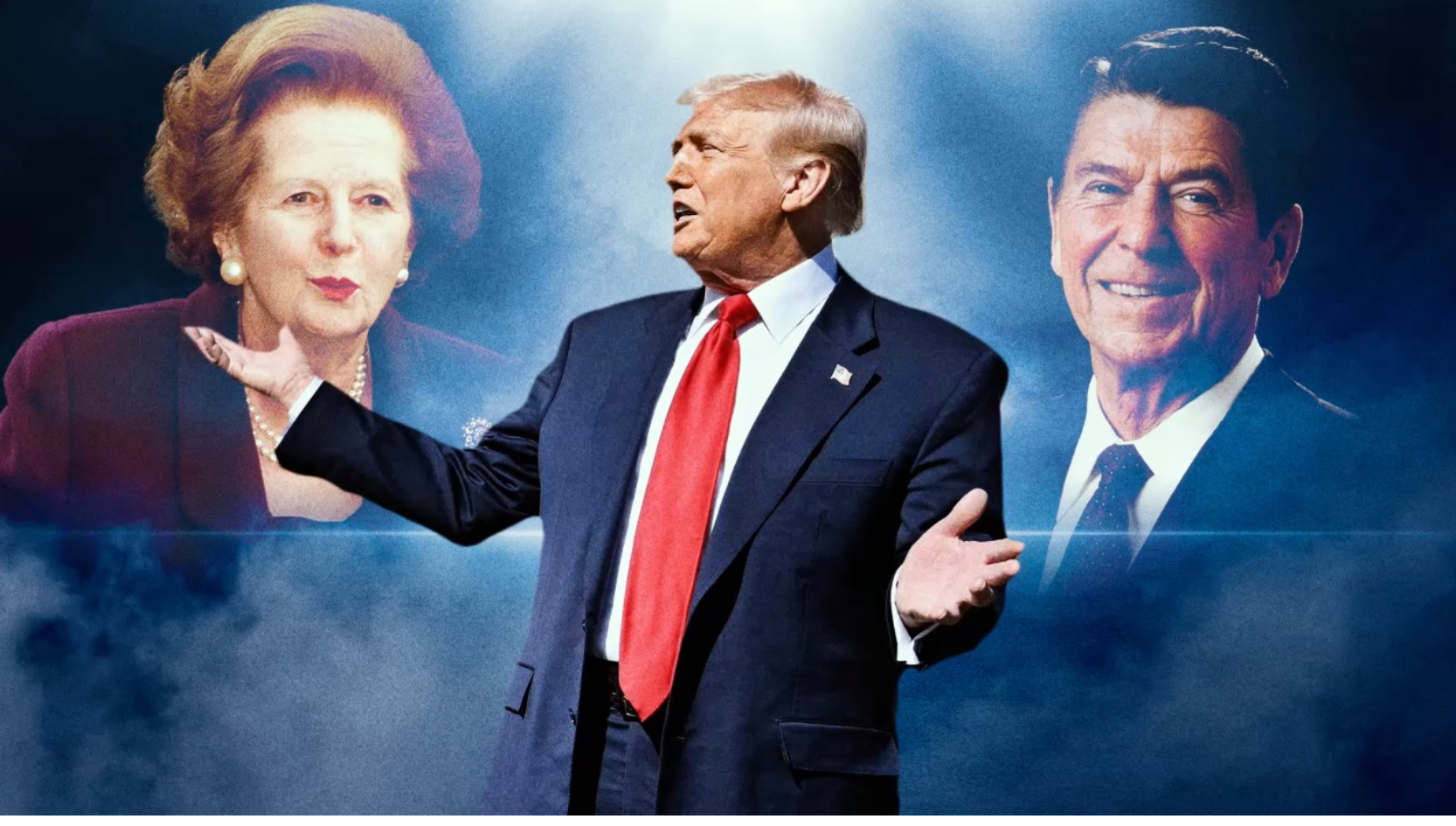
We asked Trump about the portraits on the walls of the Oval Office. Who, we wondered, had a legacy that he himself might like to have? “Ronald Reagan, I like in terms of style. But he was not good on trade—terrible on trade,” Trump replied. We pointed out that Reagan was also far more welcoming of immigrants. “Well, the toughest one in immigration was Eisenhower, believe it or not,” Trump said. “He was tough, and he just didn’t want people to come in illegally, like, you know, me. Well, I’m great on trade.”

Trump has also started talking publicly about running for a third term, which the Twenty-Second Amendment clearly prohibits. This started as joking comments with advisers—before making them, he would sometimes teasingly instruct the sober-minded Wiles, “Susie, close your ears”—but now seems to have become more serious. MAGA acolytes outside the administration have said they’ve been investigating ways of getting around the Twenty-Second Amendment, and an adviser acknowledged that if Trump thought a third term could somehow be made feasible, he would likely consider it.

We asked Trump about a rumor we’d heard that he had tasked his Justice Department with looking into the legality of his running again in 2028. He said he hadn’t, but then seemed to leave open the possibility. Was this the rare democratic norm he was unwilling to shatter? “That would be a big shattering, wouldn’t it?” he mused, laughing. “Well, maybe I’m just trying to shatter.” He noted, twice, that his supporters regularly shout for him to seek a third term, but concluded, “It’s not something that I’m looking to do. And I think it would be a very hard thing to do.” But not, it appears, a hard thing to profit from: The Trump Organization is now selling “Trump 2028” hats.

As a final question during our conversation in March, we asked the president whether he had concerns that his successor will follow his precedent and directly steer the powers of the presidency against his opponents, something he had accused Biden of doing against him. Wasn’t he laying the groundwork for an endless cycle of tit-for-tat retribution?

“Oh, I don’t know. I’ve already gone through it,” the president told us. “I got indicted five different times by five different scumbags, and they’re all looking for jobs now, so it’s one of those things. Who would have thought, right? It’s been pretty amazing.”

Three weeks after our initial phone call, the political complexion of the moment seemed to have shifted rather dramatically, and we wondered if that had changed Trump’s thinking. So we called the president’s cellphone, hoping to ask some follow-up questions. He didn’t answer. We left a voicemail.

That night, Saturday, April 12, Trump traveled from Mar-a-Lago to Miami to watch the mixed-martial-arts spectacle of UFC 314. He entered the arena like a conquering general, surrounded by a coterie of Cabinet secretaries and other high-level advisers and officials. The cheers from the adoring fans were uproarious. After some of the fights, the winner would rush to the side of the ring where Trump was sitting, to demonstrate fealty.

When the fights were over, well after midnight, Trump’s motorcade headed back to Air Force One, at the Miami airport. The next morning, one of us awoke to find that, at 1:28 a.m., the president had called, just as the pool report showed he was getting back in his motorcade. He hadn’t left a message. Had he been calling to ask if we’d seen what had transpired—the display of obeisance from these gladiators, and from his base? Or was this merely a late-night pocket dial? His team declined to clarify.

We made another appeal for an in-person interview. Later that day, an aide told us Trump was denying our request. But the rejection came with a message from the president—a message, Trump specified, only for Michael, not Ashley, with whom he was still annoyed. If the article we were working on really told the remarkable story of how he had come back from the political dead, “maybe The Atlantic will survive after all.” As is often the case with Trump, his business advice could also be interpreted as a kind of a threat.

The president had one last message for us. “What can be said?” Trump had instructed his aide to tell us. “I won the election in a landslide, and there isn’t anyone who can say anything about that. What can they write about?”

We thought we’d finished our story. But for Trump, negotiation is a perpetual state, and nine days later, he reversed himself again. We were asked to report to the Oval Office on the afternoon of April 24 for the interview we had first requested two months earlier. Trump also invited the editor in chief of this magazine, Jeffrey Goldberg, whom he had recently attacked as a “total sleazebag,” to join the meeting. Then, hours before we arrived, the president announced the interview to the world.

“I am doing this interview out of curiosity,” he wrote on Truth Social, “and as a competition with myself, just to see if it’s possible for The Atlantic to be ‘truthful.’ ” Goldberg, he added falsely, was a writer of “many fictional stories about me.” (Several White House aides, upon reading the message, joked about playing a prank on National Security Adviser Michael Waltz, the official who had accidentally added Goldberg to the Signal chat. “Tell Waltz to go into the Oval,” they dared one another, “but don’t tell him who’s in there.”)

“This will be very, very interesting,” Trump said, by way of greeting us as we approached the Resolute Desk. “You think Biden would do this? I don’t think so.”

In private, Trump often plays against the bombastic persona he projects in larger settings—at rallies, on television, on social media. He was launching a charm offensive, directed mainly at Goldberg. There was none of the name-calling or hostility he regularly levels at our magazine. He boasted about the 24-karat gold leaf he’d had imported from Palm Beach to decorate the Oval Office. “The question is: Do I do a chandelier?” he asked. “Beautiful crystal chandelier, top of the line.”

When we mentioned the turmoil at the Pentagon, including recent reporting that Pete Hegseth had installed a makeup room in the building, the president smiled. “I think he’s gonna get it together,” Trump said of Hegseth. “I had a talk with him, a positive talk, but I had a talk with him.” Trump also said that Waltz was “fine” despite being “beat up” by accidentally adding Goldberg to the Signal chat. What had Trump told his staff after the controversy? “Maybe don’t use Signal, okay?”

He spoke of his opposition with earnest befuddlement, if not actual pity. “I think that the Democrats have lost their confidence in the truest sense,” he said. “I don’t think they know what they’re doing. I think they have no leader. You know, if you ask me now, I know a lot about the Democrat Party, right? I can’t tell you who their leader is. I can’t tell you that I see anybody on the horizon.”

Trump pushed back on the notion, popular among some Wall Street analysts, that financial turmoil—plummeting markets, the threat of a recession, a weakened dollar—would cause him to roll back his tariff policies. “It always affects you a little bit,” he said, but there’s no red line, no “certain number” at which he would feel compelled to change course.

We asked about the concern that his administration was pushing the country toward authoritarianism, where politicians use the power of their office to punish their enemies for speaking their minds, as Trump was attempting to do to Chris Krebs, Harvard, law firms, universities, and news outlets. He did not answer the question directly, but instead talked about how he’d been wronged.

We pressed further, again bringing up his efforts to deport undocumented immigrants without due process. What would happen, we asked, if his administration accidentally got the wrong person—a legal resident, or even an American citizen? “Let me tell you that nothing will ever be perfect in this world,” he said.

Near the end of the interview, we asked Trump why, given that he’s now definitively won a second term, he can’t just let go of the claim that he won the 2020 election.

The president told us it would “be easier” for him to just accept our assertion. But he couldn’t. “I’m a very honest person, and I believe it with all my heart,” he said. “And I believe it with fact—you know, more important than heart. I believe it with fact.”

“I’d like to say that that is reality,” Trump said. “Probably I do create some things, but I didn’t create that.”

Never mind that the votes had been counted, the court cases concluded. He was still trying to shift perceptions, make a sale, bend the world to his will.


This article appears in the June 2025 print edition with the headline “Donald Trump Is Enjoying This.”

Trump’s revolution … he can destroy, but he cannot create

Trump presides over the death of the old conservatism. The Trumpian paradox is that Trump himself, elected off the back of a powerful conservative movement, is not an authentic conservative. Paul Kelly.

From time to time, In That Howling Infinite republishes articles by News Ltd commentators that I believe are worth sharing with those who cannot scale the News paywall – and those who, out of misguided principle, refuse to read articles by its more erudite and eloquent contributors. This, by The Australian’s editor at large Paul Kelly, is one of those. Regarding what many commentators see as the demise of traditional American conservatism and the advent of a right wing ‘enlightenment’, he writes:

“Trump won in 2024 on, among other things, conservative votes. Yet the conundrum of his presidency is that Trump is reinvigorating conservatism but trashing it at the same time. What will be left of the conservative remnant when he finishes? Trump’s brand of governance is unique, a blend of executive intervention, American nationalism, trade protectionism, contempt for democratic checks and balances, and retreat from US global leadership. None of his successors will replicate this model because it belongs to Trump’s personality. Have no doubt, Trump will permanently change America, but what stays and what goes cannot remotely be guessed at this stage, nor how US conservatism will emerge”.

This is In That Howling Infinite’s second post regarding the present and future ramifications of Donald Trump’s second presidency. We recently published Trumps second coming … a new American Revolution? It noted:

“America made its choice – most, for quite understandable reasons that have little to do with populism, racism, fascism or in fact any of the other “isms’ that are tossed about like confetti at a wedding – and must live with it. The march to the “right side of history” has turned out just to be to the right …

Commentators and author Troy Branston wrote in The Australian, on 9th November 2024: “It’ll be a wild four years with Trump back in power. He remains a despicable and disgusting man devoid of integrity and ethical values, is boorish, moronic, and unstable, and I fear, by a narrow margin, Americans have made the wrong decision. But it a decision that they must live with we must accept”.

We published a similar piece exactly six years ago at the commencement of Trump’s first term: The Ricochet of Trump’s Counter-revolution. Back then, we were unsure what the next three years would bring. This time around, we probably have a good idea, and it’s likely to be a wild ride for America and also the world.

On other matters American in In That Howling Infinite, see My Country ’tis of thee

Trump can dismantle … but he cannot build

Paul Kelly, Th3 Australian, 22 March 2025

Donald Trump is the ultimate transformational leader. He has been characterised as a conservative, a populist and a libertarian, but he transcends any philosophical brand. Trump is unique, a charismatic autocrat whose political essence lies in his idiosyncratic personality.

Trump presides over a political phenomenon – the cultural right is ascendant yet divided and agitated. Trump has a dominant political personality, rather than an ideology, but his personality inspires followers and generates hatred. Trump cannot unite America because his core method is divide and rule.

His path to power involved the hijacking of the Republican Party – once seen as the embodiment of conservative values, free-market capitalism, personal liberty and US global leadership. But Trump has devoured the Republican Party along with the honoured rituals that it championed.

Trump presides over the death of the old conservatism. The Trumpian paradox is that Trump himself, elected off the back of a powerful conservative movement, is not an authentic conservative.

The Trumpian paradox is that Trump himself is not an authentic conservative. Picture: AFP

He has empowered the combined forces of the New Right and the national conservative movement yet in his first three months of office Trump has assailed the core institutions of the American state: the judiciary, the federal bureaucracy, the intelligence agencies, individual liberties, and the foreign policy and economic settlements of the past two generations.

Historian and economist Niall Ferguson, who cheered Trump’s win, recently wrote in The Free Press that few Trump supporters grasped they were voting not just for lower inflation and higher border security “but for a radical project to turn back the economic clock”, with their hero aiming “to reverse at least four decades of American economic history”.

Ferguson said ordinary Americans elected Trump to punish the Democrats for 9 per cent inflation at its 2022 peak and millions of illegal border crossers. While they may not necessarily believe Trump’s claim of a new “golden age” they expect things to get better. But the Trump administration says it is doing things “the hard way”, and delivering “cheap goods” is not such a priority.

The President has now moved into negative territory on the approval/disapproval ratings.

Trump won in 2024 on, among other things, conservative votes. Yet the conundrum of his presidency is that Trump is reinvigorating conservatism but trashing it at the same time. What will be left of the conservative remnant when he finishes?

Trump’s brand of governance is unique, a blend of executive intervention, American nationalism, trade protectionism, contempt for democratic checks and balances, and retreat from US global leadership. None of his successors will replicate this model because it belongs to Trump’s personality. Have no doubt, Trump will permanently change America, but what stays and what goes cannot remotely be guessed at this stage, nor how US conservatism will emerge.

None of this is to deny the impact he will have – cutting federal spending, red and green tape, punishing the curse of identity politics, even perhaps restoring integrity to the education system and reviving a sense of pride and belief in the American dream.

There is a justification for Trump – as a necessary and powerful corrective mechanism for the arrogant over-reach of the progressive establishment in its control of public and private institutions and its attack on the foundations of liberalism. Trump is the figurehead for a cultural transformation driven by an American right that turned traditional conservatism to a radical counter-revolutionary movement. Trump did not create this movement but he has seized control of it through his charismatic appeal.

The extent of the transformation is best grasped in the comparison between Trump and Ronald Reagan, once seen as the best recent reflection of the American conservative presidency.

Reagan’s recent and best biographer, Max Boot, writes: “There were many obvious differences between Trump and Reagan, both in their policies and style. Reagan was pro-immigration, pro-free trade, pro-democracy and pro-NATO. He was also a consummate gentleman who never indulged in name-calling or acerbic putdowns. He was, moreover, a staunch believer in American democracy who would never have dreamed of instigating an insurrection to prevent a lawfully elected candidate from taking office.”

Ronald Reagan was once seen as the best recent reflection of the American conservative presidency. Picture: AFP

Ronald Reagan AFP

Reagan made Americans feel good about themselves – and, for better or worse, he was a two-term successful governing president while shifting the country decisively to the right.

Will Trump be a successful governing president? The jury is out but the omens aren’t encouraging. Interviewed by the author at an early stage of Trump’s first presidency, John Howard, issuing a warning, said: “It’s misleading the political landscape for conservative commentators in Australia to see Donald Trump as the embodiment of modern conservatism. Trump is not my idea of a conservative. Trump is no Reagan or Thatcher and they are the two most conservative lodestars in my lived political experience.”

Both Howard and Tony Abbott have a deeply conventional view of conservatism compared with the Trump project. Abbott previously said the conservative instinct “is to repair rather than to replace, it’s to leave well enough alone, it’s to fix only what needs to be fixing, it draws inspiration from the past and wants the future to be a better version of what we know and love”.

There are shades of Trump in this, but you need to look hard. Howard and Abbott had an orthodox interpretation of conservatism drawn heavily from Edmund Burke, who saw society as a partnership and espoused evolutionary change, backing the American Revolution but opposing the French Revolution.

But in the US this view was de-constructed pre-Trump by a new class of activists and apostles demanding a more radical conservatism. Indeed, Boot wrote: “If Reagan had been alive in 2016, he undoubtedly would have been derided by most Republicans as a RINO (Republican in Name Only) like the two Bushes, John McCain and Mitt Romney” – an accurate yet extraordinary situation.

Since Reagan there has been a mounting belief among US conservatives that they had lost their country; that even Reagan made too many compromises and look what happened! The view took hold that nearly all institutions were controlled by secular progressives hostile to notions of family, faith, nation and educational integrity.

Trump became the instrument of restoration. People with a grievance against the system flocked to him – from the displaced industrial worker to the world’s richest man, Elon Musk, forming an astonishing alliance to smash whatever they hated. And there was plenty of that.

Trump is a conqueror able to puncture and even dismantle an established progressive order – but he manifestly cannot create a replacement order.

Even in his first three months, this is the singular insight. It’s because his presidency is about himself and his colossal ego. Trump is not a builder. He lacks the institutional and policy capacity to strengthen America’s economic base; witness his misunderstanding about how high tariffs work given they will lift prices, penalise consumers and misdirect resources.

A former president of the American Enterprise Institute and self-declared “old establishment conservative” who shifted to the radical side, Christopher DeMuth, writing in 2021, outlined what drove the conservative reinvention: “Have you noticed that almost every progressive initiative subverts the American nation, as if by design?

Donald Trump’s presidency is about himself ... and his colossal ego. Picture: AFP

Donald Trump’s presidency is about himself … and his colossal ego. Picture.  AFP

“Explicitly so in opening national borders, disabling immigration controls and transferring sovereignty to international bureaucracies. But it also works from within – elevating group identity above citizenship; fomenting racial, ethnic and religious divisions; disparaging common culture and the common man; throwing away energy independence; defaming our national history as a story of unmitigated injustice; hobbling our national future with gargantuan debts that will constrain our capacity for action.”

So, the conservatives became the radicals.

Many became activists.

Manhattan Institute senior fellow Christopher Rufo, a leader in the fight against critical race theory in US institutions, outlined his manifesto for counter-revolution in January 2024: “The world of 18th and 19th-century liberalism is gone and conservatives must live with the world as it is – a status quo that requires not conservation but reform, and even revolt. For 50 years establishment conservatives have been retreating from the great political tradition of the West – republican self-government, shared moral standards and the pursuit of eudaimonia, or human flourishing – in favour of half-measures and cheap substitutes.

“The chief vectors for the transmission of values – the public school, the public university and the state – are not marketplaces at all. They are government-run monopolies. Conservatives can no longer be content to serve as the caretakers of their enemies’ institutions, or as gadflies who adopt the posture of the ‘heterodox’ while signalling to their left-wing counterparts that they have no desire to disrupt the established hegemony. We must recruit, recapture and replace existing leadership. We must produce knowledge and culture at a sufficient scale and standard to shift the balance of ideological power. Conservative thought has to move out of the ghetto and into the mainstream.

“My conviction is that ends will ultimately triumph over means; men will die for truth, liberty and happiness, but will not die for efficiency, diversity and inclusion.”

But will they die for Trumpian excesses?

Offering an alternative view, New York Times columnist David Brooks, a sympathiser with Burkean conservatism, warned in 2022 in The Atlantic that Trumpian Republicanism “plunders, degrades and erodes institutions for the sake of personal aggrandisement”. Brooks said, by contrast, the profound insight of conservatism “is that it’s impossible to build a healthy society on the principle of self-interest”.

In February, Brooks spoke to the Alliance for Responsible Citizenship conference in London – an organisation pledged to the revival of Western civilisational principles – saying of Trump, JD Vance and Musk: “They’re anti-left, they don’t have a positive, conservative vision for society, they just want to destroy the institutions that the left now dominates. I’m telling you as someone on the front row to what’s happening, do not hitch your wagon to that star.

US Vice President JD Vance exits the Oval Office in the opposite direction as US President Donald Trump and Elon Musk. Picture: AFP

President Donald Trump, Vice President JD Vance and Elon Musk. AFP

“Elite narcissism causes them to eviscerate every belief system they touch. Conservatives believe in constitutional government – Donald Trump says ‘I can fix this.’ Conservatives believe in moral norms – they’re destroying moral norms. The other belief system that they are destroying is Judeo-Christian faith – based on service to the poor, to the immigrant, and service to the stranger.”

Brooks highlighted the refrain: that Trump is not a conservative and it is folly for conservatives to claim him. In the end, they will be damaged.

Further evidence emerged this week when US Supreme Court Chief Justice John Roberts rebuked Trump – though not by name – after the President called for the impeachment of a federal judge who had ruled against the administration deporting to El Salvador nearly 300 alleged Venezuelan gang members.

When Judge James Boasberg issued an order to temporarily block the move and the administration said the planes were already in the air, the judge verbally ordered the planes to turn around. That didn’t happen.

An angry Trump called the judge a “Radical Left Lunatic”, pointed out the judge hadn’t won the election and nor did he win all seven swing states and should be impeached.

Roberts noted that “for more than two centuries” impeachment was not “an appropriate response to disagreement concerning a judicial decision”. Trump’s immigration tsar, Tom Homan, said: “We’re not stopping. I don’t care what the judges think.”

The Wall Street Journal asked in its editorial: “Are we already arriving at a constitutional impasse when the administration thinks it can ignore court orders?” It said: “What the administration can’t do is defy a court order without being lawless itself.”

Yet there is evidence Trump wants a showdown of sorts with the judiciary given a succession of court decisions that have restrained implementation of his executive decisions.

The messages from much of the MAGA (Make America Great Again) movement is that they want the executive to defy the courts. Trump’s line of attack – that Boasberg didn’t win an election – is revealing because it implies the executive has a legitimacy the judiciary lacks, rather than the two arms being co-equal branches in a separation of power.

Trump didn’t accept Joe Biden’s democratic election by the people; now the issue is whether he will accept decisions by the judiciary. These, obviously, are deep violations of conservative principles.

At the same time Trump and Musk in their campaign through the Department of Government Efficiency to dismantle the “deep state” and generate huge savings are guaranteed to provoke an electoral revolt, let alone make savings on the basis of efficiency.

In The Wall Street Journal, Peggy Noonan, summarised the epic lack of judgment on display. Noonan said: “Everyone knows DOGE will make mistakes, but that isn’t the point. You have to be a fool to think there won’t be dreadful mistakes with broad repercussions. To take on seemingly all parts of government at the same time is to unsettle and confuse the entire government at the same moment. That is dangerous. It was a mistake to announce going in that they’d find $2 trillion in savings.”

They can’t – or, if they do to keep face and honour their target, the issue will finish on the streets and Trump can kiss goodbye to ratings.

Governments around the world – led by Canada but also including Australia – are left with no option but to criticise or attack Trump’s tariff policy. He is bent upon penalising nations – whether friends or potential foes – as he acts on the conviction that America has been ripped off for decades by virtually everybody else. The steel and aluminium decisions have little direct impact on Australia. The issue is: what next? Might Trump damage our beef and pharmaceutical trade? Will he listen to US pharmaceutical company hostility to our Pharmaceutical Benefits Scheme? Will Trump listen to Musk’s demands and declare against Australia’s laws to rein in Big Tech through our ban on the use of social media by children under 16 and our proposed News Media Bargaining Incentive scheme to force digital companies to pay for the news they use?

This week, Jim Chalmers went hard against Trump’s tariff policies. The Treasurer said the decision not to exempt Australia was “disappointing, unnecessary, senseless and wrong”. Australia deserved better “as a long-term partner and ally”. Chalmers criticised Trump’s global policies – not by name – saying the rules underpinning “global economic engagement for more than 40 years are being rewritten”.

Australia’s attitude towards Trump – both the political response and public opinion – will move to resentment and anger if Australia faces more retaliation. Understand what is happening: Trump’s obsessive and flawed view of tariffs is damaging global trade, won’t deliver the gains he predicts for America and, on the way through, is punishing countries such as Australia.

Why would people in Australia support him?

How the Trumpian paradox plays out defies prediction. The movement that helped to put Trump into the White House was an authentic counter-revolution with deep roots in American culture. This is what makes Trump a complex historical figure. He is ignorant of history yet he sees himself as leading a historical revolution.

It is a revolution where Trump has scant interest in the limits to his power – executive power – within America’s constitutional democracy. It is a revolution that defies the basic principles of conservatism although it is given legitimacy by much of the conservative movement. US conservatives face tough political and moral choices ahead – whether to back a leader who has empowered them but thrashes the essence of conservatism.

Putin’s war … an ageing autocrat seeks his place in history

In That Howling Infinite’ has written often about Russian and Ukrainian history, not only because personally it has been of long-term academic interest, but also, because of the ongoing Russia-Ukraine war.

In In That Howling Infinite’s post, Borderlands – Ukraine and the curse of mystical nationalism, we wrote:

“Like many countries on the borders of powerful neighbours, Ukraine has long endured the slings and arrows of outrageous history. Its story, like that its neighbours, is long and complex. In competing national narratives, Russians and Ukrainians both claim credit for the creation of the Russian state, though others attribute this, with some credence, to the Vikings. The historical reality of Ukraine is complicated, a thousand-year history of changing religions, borders and peoples. The capital, Kyiv, was established hundreds of years before Moscow, although both Russians and Ukrainians claim Kyiv as a birthplace of their modern cultures, religion and language.

I highly recommend Serhii Plokhy’s The Gates of Europe, a well told and fascinating story of the origins of Ukraine and Belarus, and how their histories were intertwined, and entwined with those of of Poland, Lithuania (which was a large and powerful state once) and Russia. Ukraine has historically been the border between the catholic west and the orthodox east, the division running virtually down the middle. The name Ukraine is Slav for border land. Its geopolitical location and natural resources have led to the land being inflicted by invaders, civil wars, man-made famine and repression.

Eastern European countries, Ukraine included, have with good reason no love for Russia, be it Czarist, Soviet or Putin’s. Hungarians, Czechs, Poles and East Germans have seen Russian “peacekeeping” troops and tanks on their city streets, as have the Baltic countries, Afghans and Chechens. Millions of Ukrainians died under Stalin’s rule (and many, many millions of fellow-Soviet citizens). The 20th Century was not kind to the countries of Central and Eastern Europe. Historian Timothy Snyder called them “the blood lands”.

We republish below a recent article in The Australian by Melbourne historian and academic Mark Edele. It gives the uninformed but interested reader a short but comprehensive history of the relationship between Russia and Ukraine from the ninth century to the present day.

Here are posts in In That Howling Infinite, about Russia, Ukraine and Eastern Europe:

Putin’s puppet sells out Ukraine

Donald Trump’s bullying ‘peace plans’ to end the Ukraine war will only embolden Vladimir Putin, who fancies himself a leading a great power with historical rights beyond his borders.

Mark Edele, The Australian, 8 March 2025

Last weekend, the United States vacated the post of leader of the free world. Supporters of democracy the world over watching in disbelief as the US President and Vice-President berated, belittled, and bullied the leader of a democracy at war. On Monday, then, followed what this “great television”, as Donald Trump called it, was all about: a pretext to halt military aid to Ukraine, followed soon by the end of intelligence-sharing. The end goal: force Ukraine to the negotiation table with no security guarantees included in a “deal” with Vladimir Putin.

Four things will come out of an emboldened Russia now: more air raids on Ukraine’s civilians; a renewed push at the frontline; praise for the US administration and its visionary leader; and a disinformation campaign to convince the democratic world that black is white, up is down, left is right, Ukraine the aggressor and Russia the victim in this war. Astonishingly, we can also expect the White House to parrot such propaganda. Welcome to the era of strategic chaos.

Kremlin spokesman Dmitry Peskov noted the obvious: The US’s shift from supporting its allies to courting Moscow “largely coincides with our vision”. Foreign Ministry spokeswoman Maria Zakharova ladled on now familiar Russian propaganda. Volodymyr Zelensky, she claimed, was the head of a “neo-Nazi regime”, a “corrupt individual who lost his grip on reality”, whose “outrageously rude behaviour during his stay in Washington … reaffirmed his status of the most dangerous threat to the international community”. Zelensky was an “irresponsible figure”, a “terrorist leader” who had “built a totalitarian state” and is “ruthlessly sending millions of his fellow citizens to their deaths”.

Sigmund Freud would have classified these statements as “projection”: they are true, but apply to Zakharova’s boss, Vladimir Vladimirovich Putin. Born in 1952, Putin grew up in St Petersburg, then called Leningrad. Surrounded with stories of World War II, in which his father served and his brother perished, he came of age on the rough streets of Leningrad during the heydays of Soviet superpower. In 1975 he joined the KGB, an organisation that deeply formed his world view and behaviour. His sport is judo, a deeply tactical martial art focused on exploiting the opponent’s weaknesses and redirecting the adversary’s momentum.

Putin came of age on the rough streets of Leningrad during the heydays of Soviet superpower. Picture: AFP

After the breakdown of the Soviet empire in 1991, he served in the city administration of St Petersburg. Later he moved to Moscow to make a career in the administration of the first president of post-Soviet Russia. When Boris Yeltsin looked for a successor who would guarantee his own and his family’s safety, Putin’s name came up. He was seen as competent but unthreatening to the oligarchs running Russia at the time. In 1999, Putin became premier. Later the same year, he was appointed acting president. His tenure was defined by the brutal second Chechen War, which he prosecuted with utter ruthlessness. In 2000, he was elected President. He remained in this post until today, with a stint stepping back to the prime ministership in 2008-12, to get around term limitations in the constitution (subsequently changed).

In the quarter-century he ruled Russia, Putin broke the power of the oligarchs, rebuilt the state as a security organisation run by former KGB officers, suffocated free speech, pluralism and the opposition, and built one of the most unpleasant electoral dictatorships of the post-Soviet space. Despite an economy still only a quarter of that of the EU or the US (to say nothing of China’s), Putin fancies himself as leading a great power with a right to a sphere of influence and a major say in shaping the international order.

By the end of the second decade of his rule, however, the ageing dictator in the Kremlin began to worry about his legacy. His track record was mixed. The Russian population had been declining steadily until the 2010s. The following uptick was mostly undone again during and after the Covid pandemic, fuelling longstanding apocalyptic fears that the Russians would be dying out. The economy had grown significantly, but social inequality had exploded alongside, while political liberties continually atrophied. The Covid crisis was handled extremely poorly. Great-power status remained an aspiration. Putin worried what the history books would say about him. The answers respectable historians gave him when asked were evasive. And he was turning 70 in 2022.

History, and his place in it, obsessed Vladimir Vladimirovich. During his, quite extreme, Covid isolation, he read history books, immersing himself in the Russian imperialist tradition. Such historians had long denied that Ukraine was anything but a part of Russia. He summarised this traditional Russian view “on the historical unity of Russians and Ukrainians” in an essay of that title, published on July 12, 2021. It read like the musings of an ageing Russian imperialist. A bit over seven months later, it revealed itself as the ideological justification of a full-scale invasion of Ukraine.

Ukraine and Russia: histories entangled but separate

At the heart of Putin’s worldview is that Russia continues to be a great power with historical rights on Ukraine. It thus bears repeating that Russia and Ukraine are separate nations, which trace their heritage back to a common origin: a collection of principalities centred on Kyiv, known as the Rus of the ninth to 13th centuries. After the Mongol invasions of the 1220s and 1230s, however, the southwestern and the northeastern parts of this civilisation developed in different and quite separate ways, eventually leading to Russia and Ukraine as we know them today. As a result of such divergence, Russian and Ukrainian have developed as separate, if related, languages.

Vladimir Putin attends the Victory Day military parade in central Moscow on May 9, 2024. Picture: AFP

Putin attends the Victory Day military parade in Moscow on May 9, 2024. AFP

Overlapping histories and linguistic similarities are not unique among nations. Both Germany and France claim the Frankish empire under Charlemagne (French) or Karl (German) as part of their deeper history. Yet nobody would suggest (any more) that therefore France should be part of Germany or vice-versa. Likewise, French and Portuguese have related grammatical structures and some overlap in vocabulary. And yet nobody would argue that Portuguese is a French dialect.

Ukrainians formed a state twice: once in 1649, the Cossack-led “Hetmanate” fighting for its independence from Poland; the second time in 1917-21, after both the Russian and Austro-Hungarian empires had collapsed in World War I. Both were defeated militarily, but both were important inspirations for a democratically minded national movement.

Ukraine’s lands and peoples came into the Russian orbit in stages. First was the disastrous Treaty of Periaslav of 1654, when the Hetmanate joined a temporary military alliance with Muscovy against Poland, which the Muscovites read as a subjugation under the autocrat instead. After much fighting and diplomatic manoeuvring, Poland and Russia agreed in 1667 that Moscow could control the lands east of the Dnipro (“left bank Ukraine”) as well as Kyiv on the “right bank”. When Poland was partitioned at the end of the 18th century, what was left of Ukraine came partially under Habsburg and partially under Romanov rule. At the end of World War I, Ukraine emerged as one of the successor states of the Romanov empire, alongside Latvia, Lithuania, Estonia, Finland, Poland and Bolshevik Russia. In contrast to these states, however, it did not survive the wars and civil wars that followed the disintegration of the empire in 1917.

In 1921, it was divided between the newly resurrected state of Poland and the emergent successor of the vast majority of the lands of the Romanov empire: Bolshevik Russia. Within the latter, Ukraine was granted a pseudo independence as one of the Union republics making up the newly formed “Union of Soviet Socialist Republics”, or USSR.

The Ukrainian SSR was a Bolshevik ploy to disarm national sentiment while reasserting imperial, and increasingly totalitarian, control by Moscow. In the long run, however, it allowed not just the maintenance but even the growth of national culture and national self-awareness. Ukraine also grew geographically. During World War II, the Soviets gobbled up the rest of Ukraine from Poland and Romania. In 1954, the government transferred Crimea to Ukraine, to ease the economic development of a region with no geographic connection to Russia. Thus Ukraine acquired its current, internationally recognised borders. Eventually, they provided a ready-made demarcation of post-imperial Ukraine, once the Soviet empire collapsed in 1989-91.

After the Soviet Union

Of the 15 successor states of the Soviet Union, Russia is the largest in terms of territory (17.1 million square kilometres). Ukraine, with 0.6 million square kilometres, comes third after Kazakhstan (2.7 million square kilometres). In a comparison of population sizes, Ukraine occupies the second position, with 37.7 million in 2023, according to the World Bank, quite a way behind Russia with 143.8 million. By comparison, the most populous country of the EU, Germany, has 83.3 million, while the EU as a whole counts 448.8 million.

Of the 15 successor states of the Soviet Union, Russia is the largest in terms of territory. Picture: istock

As the largest country in the post-Soviet region, in 2023 Russia had the largest GDP adjusted for purchasing power ($US6.5 trillion), followed by Kazakhstan ($US0.8 trillion) and Ukraine ($US0.6 trillion). Again, compare this to Germany ($US5.7 trillion) or Australia ($US1.9 trillion), to say nothing of the EU ($US26.4 trillion), the US ($US27.7 trillion) or China ($US34.7 trillion).

As far as the political system is concerned, between the breakdown of the Soviet empire and today Russia has been on a steady downwards slope, from some early democratic promises to ever darker authoritarianism. Ukraine, meanwhile, evolved in three waves of democratic surges followed by counter movements: the 1990s, the second half of the 2000s, and from the middle of the 2010s. While not the freest country in the post-Soviet space (that privilege belongs to the three Baltic republics of Latvia, Lithuania, and Estonia, all members of EU and NATO), it is in no way comparable to Russia. Zelensky was elected President in 2019 with 73 per cent of the vote. As of late February 2025, he had an approval rating of 52 per cent.

Zelensky was elected Ukraine President in 2019 with 73 per cent of the vote. Picture: AFP

Zelensky was elected president in 2019 with 73 per cent of the vote. AFP

The latest report on Ukraine from a Washington-based independent watchdog, Freedom House, notes that both the President and the current legislative were elected in free, competitive, and fair elections. Since 2022, there was some deterioration of political freedoms because of the war, including the suspension of elections due to martial law, new restrictions against parties that support Russia’s aggression, and greater control of the reporting in the main news channels. However, opposition parties continue to sit in parliament and their political activities “are generally not impeded by administrative restrictions or legal harassment”. Communication channels outside the official network, such as social media platforms, remain available and used freely.

All of this contrasts sharply to the repressive nature of Russian rule, not just in the occupied territories of Ukraine, but also in Russia itself. For 2025, Freedom House categorised Ukraine as a “transitional or hybrid regime”, while Russia was a “consolidated authoritarian regime”.

The war

Russia invaded Ukraine in 2014 after a popular revolution in Kyiv had ousted pro-Russian president Viktor Yanukovych. Russia illegally annexed Crimea and fostered a proxy war in Ukraine’s east, the Donbas, at times fought with regular Russian troops; at others by Russia-sponsored rebels. Most observers at the time assumed that this was the endgame: taking over Crimea was popular among Russians who saw it as their own Riviera; the frozen conflict in Ukraine’s east served as a festering wound keeping the recalcitrant democracy down.

Ukrainian firefighters push out a fire after a strike in Zaporizhzhia in 2022, amid the Russian invasion of Ukraine. Picture: AFP

Ukrainian firefighters putout a fire after a strike in Zaporizhzhia in 2022. AFP

Two ceasefire agreements, Minsk I (September 5, 2014) and Minsk II (February 12, 2015), failed. After the first, Russia sent troops across the border to defeat Ukraine’s armed forces in the Second Battle of Donetsk Airport (September 2014 to January 2015) and the Battle of Debaltseve (January to February 2015). After the second, the frontlines remained frozen, but shelling and sporadic fighting continued. No part of the agreement was ever fully implemented and soldiers kept dying. The world, however, moved on.

Who had not moved on was Putin, dreaming of great power and empire. While convincing himself of the righteousness of his position by reading Russian imperial historiography, he observed “the West” move from crisis to crisis. In Europe, the liberal consensus was challenged by new-right populist movements. The UK was in political chaos. The US could not even execute an orderly withdrawal from Afghanistan, unlike the Soviet army in 1988. And that army, now Russia’s, had been modernised significantly under Putin’s watch. It was time to strike.

Preparations for the invasion started shortly after the fall of Kabul in August 2021. By October, the US had conclusive evidence that Russia planned an assault with the goal of controlling all of Ukraine and eliminating its President. Between then and the start of the war, the US tried repeatedly to create diplomatic off-ramps for the Kremlin. Putin was not interested.

On February 24, 2022, Putin unleashed his war of conquest. Within 10 days, Ukraine’s military was supposed to be disabled, the country’s leaders arrested or executed, pro-Russian popular support mobilised, and resisters detained. By mid-August, all of Ukraine would be occupied, the plan went. Then, it could be either annexed or given over to a puppet regime.

The plan failed. There were few collaborators and much resistance. The battle for Hostomel airport was lost by the Russian airborne forces sent in at short notice; two groups of assassins sent to kill Zelensky were hunted down and eliminated; the columns advancing towards Kyiv were stopped by the fire of artillery and main battle tanks, both of Ukrainian origin. While social media was obsessed by the David-versus-Goliath spectacle of US-made shoulder-launched missiles taking out Russian tanks, the real damage was done using Ukraine’s own resources. Victory in the battle of Kyiv was achieved by late March 2022.

Over the next three years, the war changed from a battle of movement to position warfare and a war of attrition. Russia began to rely on massed use of artillery and the liberal sacrifice of manpower. This looked like WWII: the frontal assaults, the artillery barrages, the utter disregard for human resources. But there was a new element as well: terror attacks on civilians and their infrastructure. This was not a Soviet tradition: during WWII, it was British and US air forces that had flattened German and Japanese cities. Such bombing was not part of the Red Army’s military repertoire. Its air forces were geared towards support of ground troops, not “strategic” bombing of civilians.

In its changed focus on hurting civilians from the air, Putin’s army drew on the neo-imperial wars he had overseen: Chechnya and Syria. It was here that the Russian air force first flattened cities (Grozny in 1999-2000 and Aleppo in 2015-16) and it was this experience that now came to bear on the war in Ukraine. Except that here they did not control the airspace and did not face defenceless civilians they could simply “de-house” at will. Instead, they had to deal with an enemy capable of shooting down not just bombers, which as a result were not sent into Ukraine’s airspace, but also many of the missiles and drones sent from a safe distance.

While air assaults on civilian targets became part of the normalcy of Russia’s changing way of war, tactics on the ground also evolved: rather than mass assaults after preliminary artillery preparation, increasingly Russia used surprise attacks by small groups of storm troopers to conduct reconnaissance by force. If they encountered major resistance, they would then call in airstrikes or artillery barrages. They also stopped frontal assaults on fortified positions, bypassing and encircling them instead.

But none of this led to major breakthroughs. The war bogged down.

Russia was better prepared than Ukraine for a war of attrition. It had long built a food system that could withstand international isolation, demonstrating that a major war had been on the minds of the planners in the Kremlin for a very long time. The discrepancy in the size of both the economy and the population also meant Russia had the edge in the long run. And while the militarisation of the economy came with increasingly serious economic imbalances, they were not serious enough to force Putin’s dictatorship to back down. Instead, military salaries and the growing investments in military industries led to economic mini-booms in several of the regions that supplied the volunteers and the weapons to fight in Ukraine. To many Russians, this continues to be a profitable war.

Putin’s overall strategy thus shifted from a lightning war of conquest to outlasting the democratic world. Having the Soviet experience of extreme suffering and endurance in mind, and construing “the West” as weak, effeminate and degenerate, he had every confidence that Russia would be successful in the long run. With Trump’s election victory, this confidence grew. With his behaviour in the first six weeks in office, it must have soared. Putin has less reason than ever to compromise. And he can achieve much by playing Trump diplomatically.

What now?

After the spectacular dust-up in the Oval Office a week ago, doom and gloom have descended over Ukraine and its supporters. A pouting US President seems to assume that if he pulls the plug on Ukraine, the war will simply end: “Zelensky better move fast or is not going to have a Country left,” he wrote a week before he ambushed him in front of the cameras.

The withdrawal of US support is a serious setback for Ukraine. The US and Europe have provided about equal amounts of money to Ukraine. If Europe were to try to replace US contributions, it thus would have to double its financial commitments at a time when the economy is not exactly booming and will soon be further hit by Trump’s trade wars.

The withdrawal of US support is a serious setback for Ukraine. Picture: AFP

The withdrawal of US support is a serious setback for Ukraine. AFP

The major victims of Trump’s retreat will be Ukraine’s civilians. The US air defence systems currently protecting cities cannot be replaced easily. An increase in civilian deaths is the inevitable result. The withdrawal of intelligence is also a serious blow and difficult to substitute.

However, the EU’s economy is big enough to replace US contributions. An increase equal to 0.12 per cent of Europe’s GDP would suffice. Germany’s taxpayers spend three times more on domestic subsidies for diesel fuel than they devote to military aid to Ukraine. And production capacity is growing. At the start of the war, most military aid came from quickly depleting stockpiles. By 2024, the vast majority of materiel fuelling Ukraine’s war effort are newly produced weapons and equipment.

More than half of Ukraine’s weaponry is produced in Ukraine, a further 25 per cent comes from Europe. The 20 per cent the United States contributes is particularly valuable and high-quality, but it is not the backbone of Ukraine’s capacity. In a war of attrition heavily dependent on artillery, Europe will produce some two million artillery shells for Ukraine this year. The US, before Trump pulled the plug, was expected to deliver less than one million. Elon Musk’s Starlink, providing communications at the frontline, can be replaced with alternatives.

Thus, Ukraine’s defences are unlikely to collapse. Russia has been advancing recently, but progress was slow. By the third anniversary of the invasion, Russia controlled about 20 per cent of Ukraine’s territory, including some 4000 square kilometres gained in 2024. However, Ukraine is a big country. Russia’s 2024 gains represent a mere 0.6 per cent of Ukraine’s territory. Russia has not taken major cities in 2024 and urban life continues everywhere.

Meanwhile, Russia lost parts of the Kursk region to a counteroffensive the Russian military was unable to reverse. Russia has likely enough materiel for at least another year of fighting, but not enough for a major breakthrough.

In an assessment of the war written at the end of 2024, one of the most perceptive analysts of the military side of the war in Ukraine, exiled Russian historian and former civil rights activist Nikolai Mitrokhin, developed four possible scenarios for what could happen in 2025. None of them included a complete breakdown. His “catastrophic” scenario was a “partial collapse of the front due to the reduction of Ukrainian forward units”, leading to a “rapid advance of Russian units to the left bank of the Dnipro”. He predicted that this might lead to a leadership change, but also a further rallying around the flag and a continuation of the fight.

Less catastrophic would be a return to a grinding Russian offensive, as in 2024. “At the current rate of advance,” wrote the Institute for the Study of War in its Ukraine Fact Sheet of February 21, 2025, “it would take Russian forces over 83 years to capture the remaining 80 per cent of Ukraine, assuming that they can sustain massive personnel losses indefinitely”.

This outlook explains why Putin is so enthusiastic about Trump’s “peace plans”. They might achieve diplomatically what he cannot achieve on the battlefield: the subjugation of Russia’s democratic neighbour to neo-imperial domination.

Mark Edele is a historian of the Soviet Union and its successor states, in particular Russia. He is Hansen Professor in History at the University of Melbourne. His latest book is Russia’s War Against Ukraine: The Whole Story (Melbourne University Press, 2023

Trump and Vance ambush Zelensky at the White House

Calling Australia! Reading the Trump revolution

Countless left-wing memes about American stupidity illustrate how out of touch, self righteous, arrogant and morally “superior” many of the so-called “left” have become – unlike the Democrats whom New York Times columnist Maureen Dowd said were “finally waking up and realizing that woke is broke” after having embraced a self-defeating world view of “hyper-political correctness, condescension and cancellation”.

The Democrats. – and indeed, our Labor party – would ignore the outcome of the presidential election at their peril. The people, for better or worse, have spoken, and it’s a pointless exercise for the Democrats to live in a fantasy world of denial, not accepting their own responsibility in the loss. The Sydney Morning Herald’s Peter Hartcher wrote on 12 November:“ It’s also extremely condescending and arrogant to assume you know better and anyone who didn’t agree must be an idiot. In that light, I’d suggest Trump didn’t win this. The Democrats lost it in a spectacular fashion, and if you can lose it to the likes of Trump, something is majorly wrong on the left side of politics”.

There are lessons aplenty for Australian politics. The Coalition wants to spend the months leading up to next year’s election talking about migration driving up household bills. It has no actual plan for decreasing immigration or reducing inflation, but voters don’t care. They don’t do nuance. They’re disatisfied with the status quo and disappointed in the government. They’ll just want to punish the mob in charge. Sure, they’ll be burning down the house, and they’ll be in the house when it burns down (two song references there!) but they won’t care. The question will be “are you better off today than you were four years ago?” And, like in America, for a great many, the answer will be a big “no!”

Waleed Ali’s recent article on why Trump won concurs with the above: “Last week, a historically unpopular government, presiding over a period of high inflation that saw food prices especially explode, got thrown out of office. There is quite simply nothing extraordinary about that”. Former Liberal attorney general and high commissioner to the UK George Brandis wrote similar in the Herald on 18 November:“… the sheer weirdness of Donald Trump himself: narcissistic, vulgar, bombastic, mendacious, idiosyncratic, outrageous; while at the same time flamboyant, mesmerizing and on occasions very funny. He broke every rule, told every lie, did the unthinkable, said the unsayable and still came up … (you complete the pun). The epic unconventionality of Trump’s campaign dramatised a result that would probably have been the same had the Republican candidate been less unorthodox. For that reason, the outcome is fertile ground for over-interpretation and exaggeration”.

On a different but not dissimilar tack, John Carroll, Professor Emeritus of Sociology at La Trobe University wrote in The Australian:

“The resounding Trump victory confirms the cardinal law: politics is about power. In times of peace and prosperity, such as we in Australia have enjoyed for almost 80 years, it is easy to forget, and continue along in the hopeful illusion that life is good, people are intrinsically nice, and problems can be solved amicably …

… One of the appeals of Donald Trump to the United States electorate – I suspect his main appeal – has been that, in his bluster and braggadocio, he flexes power muscles and seems to show he is unafraid to mobilise power for his own ends. There is an intuitive understanding across middle and lower-middle America that progressive posturing and feel-good speeches will not steer the ship of state safely through turbulent waters. In contrast, Trump policy appears clear, direct, and down-to-earth – booming economy, secure borders, and resolved international conflict. When 70 per cent of Americans feel worse off than they were four years ago, they want strength in leadership and focus on their everyday interests.

…The Trump persona – aggressive, confrontational, and petulant, not to mention pathologically narcissistic – also seems to have appealed to marginalised social strata. Those living in poorer states, young black and Latino males, recent immigrants, and the old city working classes resenting their decline, all seem to have been drawn to his maverick contempt for the trendy issues of the time. His character may be suspect – indeed he is widely disliked – but he appears powerful, practical, and not of the coterie elite. In politics, power eclipses niceness”.

I republish below an opinion piece by The Australian’s editor at large Paul Kelly. It is to my mind one if the best articles I have read to date regarding the outcome of the  American elections and how this may impact Australian politics. It is particularly interesting insofar as Kelly pushes back against the conservative narrative prevalent in the Murdoch media and among more extreme right wing commentators, politicians and culture warriors. Regarding Australian politics, he writes:

“If Trump succeeds he will further undermine the shaky policy framework of the Labor Party. The optics will be: Trump’s strength versus Albanese’s weakness. In this situation, the pro-Trump media and conservative drum-beaters in this country – in effect the Trump Appeasement Syndrome lobby – will demand the Peter Dutton-led Coalition follow their messiah while they will use Trump’s success to undermine Albanese. Destroying former prime minister Kevin Rudd as ambassador to the US is just the first step”.

“So what’s driving the campaign to target Rudd”, asked Hartcher on 16 November. “The Murdoch media, in short. Some other commentators have been drawn into it, too, useful idiots for the Murdoch effort. Ostensibly they demand that Rudd go because he was critical of Trump, but in reality, “this is revenge”, as Malcolm Turnbull explained this week. “This is a campaign that News Corp kicked off, and they are running a vendetta,” he told my colleague Matthew Knott. Revenge for what? Rudd founded a movement called Australians for a Murdoch Royal Commission. Murdoch’s empire was “a cancer on our democracy”, he said. A royal commission would examine the level of concentration in Australian media ownership and the conduct of the Murdoch group in particular”.
“But the Murdoch media is not monolithic”, Hartcher continues.”Its éminence grise is Paul Kelly. Kelly has the stature to make his own judgment. The campaign to remove Rudd as “a ritual sacrifice before Trump has even said anything” is “part of Trump Appeasement Syndrome”. “This shows a contempt for Australian sovereignty and a craven weakness before Trump,” Kelly wrote this week. “For any Americans wasting their time following this saga, we must look a sad, pathetic little country.”

Trump and his cabinet picks Robert F Kennedy Jr and Elon Musk

Donald Trump’s revolution leaves Albanese exposed

America’s leap to the right will have political repercussions for Australia.

The Trump Revolution is coming and, like all revolutions, its outcome will fluctuate between a glorious remaking of the existing order or a spectacular overreach and fall – maybe even a contradictory mix of both – with Anthony Albanese and Australia in front-row seats for the drama.

[In the same issue as this article, national affairs editor Joe Kelly summed up this revolution: “Trump’s sweeping “day one agenda” includes dismantling the deep state, pursuing mass deportations, imposing across-the-board tariffs, scrapping the “Green New Scam”, withdrawing from the Paris Agreement, rolling back environmental regulations, ending the Ukraine conflict, unpicking pro-transgender policies, pardoning January 6 offenders, and rolling back the Biden health and education agendas. This is a blueprint to overhaul the country. Leading thinkers are already focused on which items are set in stone and which could merely be attempts to enhance Trump’s negotiating position. While Trump is a familiar political figure, this exercise reveals his policy agenda has still generated widespread uncertainty. Paradoxically, no one knows how the experiment will turn out or even exactly what it is – a recipe for a populist catastrophe, or a profound new American reinvention”.]


From the Trump appointments so far, the big “America First” play is on. The sharemarket has been excited, the bond market is wary, Big Tech is king, Beijing should be worried. President Trump Mark II is more resolute and revolutionary than Trump Mark I.

His hunger for change seems ferocious; his willingness to take risks is more pronounced. He is assembling a tribe of Trump loyalists to punch through the disintegrating Democratic scaffold. Trump demands loyalty and prioritises vindication.

Two lights are flashing – danger and opportunity. Some people will make a stack of money and others will be cast into painful obscurity.

Trump is going to remind everyone of the extent of power vested in the office of US president when pushed to the limit.

Consider the Elon Musk appointment. Surely this can’t be true. The world’s richest man, heading social-media platform X, hanging out at Mar-a-Lago, almost part of the Trump family, will now co-lead a Department of Government Efficiency – sitting outside the federal government – and while keeping all his existing corporate positions, he will pursue his pledge to cut US agency budgets by $US2 trillion ($3 trillion), or about one-third.

Tesla CEO Elon Musk will now co-lead a Department of Government Efficiency. Picture: AFP

Tesla CEO Elon Musk will now co-lead a Department of Government Efficiency. Picture: AFP

Of course, it is true – only in America. Think about this marriage: Trump’s America meets the Big Tech oligarchs. This is a serious moment for US capitalism, great for innovation, bad for integrity. Trump likens Musk’s brief to “the Manhattan Project of our time”. How many struggling Americans are going to be punished in the process? Australian officials, long familiar with our experience of external budget audits (think Tony Shepherd in 2013), know Musk’s promise is impossible in delivery terms. It can’t be done, short of a massive anti-Trump electoral revolt from the public.

At this time, however, such quibbles don’t matter. Nothing seems impossible in the exaggerated hype of Trump’s vindication. A tariff of 60 per cent on China’s imports? Sure. Cutting a third off federal agency budgets? No problem. Licensing the king of Big Tech, loaded with conflict-of-interest federal contracts, to stage a shooting gallery across the entire federal bureaucracy? Great idea. It’s called purging the deep state.

Change on the scale Trump wants generates both high excitement and high risk. Nobody can be sure of the consequences because these things have never been tried before and we don’t know where the line will be drawn between impression and reality. How long before Trump and Musk fall out?

Trump’s appointments show his priority to purge the “deep state” institutions of justice and intelligence. Given his history, these seem non-negotiable personal passions for Trump. He appointed former Democrat, now Trump loyalist, Tulsi Gabbard as director of national security despite, or perhaps because of, her sustained support for Russian leader Vladimir Putin.

He appointed a professional provocateur, Republican congressman Matt Gaetz, as attorney-general with Gaetz, already at political war with the Justice Department he is supposed to run, praised by Trump, who said Gaetz will end “the partisan weaponisation of our justice system”. That means a purge.

Trump has appointed Republican congressman Matt Gaetz as attorney-general. Picture: AFP

Trump has appointed Republican congressman Matt Gaetz as attorney-general. AFP

The wilful naivety of Trump’s apologists in this country looks embarrassing given Trump’s resolve to impose his will on the ­intelligence community, justice and the FBI. Gabbard’s appointment is highly dubious and Gaetz’s should be overruled, with The Wall Street Journal saying it would “undermine confidence in the law” and would be used for “political revenge”.

Trump’s mind seems a cross between powerful insights into the flaws of the Obama-Biden-Harris age and the vindictive fantasies of all rebels pulling down the established order.

But Trump’s experiment will resonate far beyond America. Markets seem alert to the inflationary consequences of his fiscal policy. The combination of Trump and our tight labour market will further weaken Anthony Albanese’s hope of an interest-rate cut before the election.

But the big picture consequences are far larger. At a time when most Western democracies are burdened by disillusion, poor economic and social outcomes and leadership that lacks either conviction or courage, Trump arrives as a giant on the stage of history.

He mocks the orthodox governing model. Much of Trump’s appeal is because he presents as a change agent against leaders running a failed status quo, witness the dismissed Biden-Harris team. More than 70 per cent of Americans felt their country was going in the wrong ­direction.

Trump’s win is the antithesis of Albanese’s victory in 2022 when Albanese ran on reassurance, incrementalism and “safe change”. Trump consigns “safe change” to the dustbin of history. He will steamroll Albanese’s “safe change” into the gutter. Trump’s American political strategy is the complete opposite of Albanese’s Australian strategy.

Of course, America is not Australia; we are different countries and in different moods. Yet the stakes for Australia cannot be denied – the more Trump succeeds, the more Labor’s policies will look feeble, ineffective and missing the big picture.

At almost every point in his agenda, Trump is diametrically opposed to Labor’s framework.

Consider the list: Trump wants savage public-sector cuts, a reduction in federal bureaucratic numbers, a purging of regulation, cutting the corporate tax rate to 15 per cent (half that of Australia), extending income tax cuts, imposing punitive tariffs on China where Australia is just restoring trade normality, repudiating free trade by resurrecting across-the-board tariffs, more support for oil and gas, walking out of the Paris Agreement on climate, dismantling ­environmental obstacles to development, cracking down on immigration, launching a domestic war on all forms of identity politics, boosting US defence spending and disdaining global institutions.

It is folly to think Trump won’t be influenced by the chasm between himself and Albanese. It’s good he told Albanese on the phone that Australia was the “perfect friendship”. Let’s cut to reality – if Trump has initial success in fuelling the animal spirits of the US economy, the governance model for Western democracy will be shaken to its foundations. Parties of the radical right will gain fresh traction everywhere.

It is folly to think Trump won’t be influenced by the chasm between himself and Anthony Albanese. Picture: AFP

It is folly to think Trump won’t be influenced by the chasm between himself and Albanese. AFP

If Trump succeeds he will further undermine the shaky policy framework of the Labor Party. The optics will be: Trump’s strength versus Albanese’s weakness. In this situation, the pro-Trump media and conservative drum-beaters in this country – in effect the Trump Appeasement Syndrome lobby – will demand the Peter Dutton-led Coalition follow their messiah while they will use Trump’s success to undermine Albanese. Destroying Kevin Rudd as ambassador is just the first step.

Of course, it might not evolve this way. It might be the precise ­opposite. You never know with Trump. He may overreach from the start, prioritising vengeance, smash too many institutional norms and, drunk on hubris, alienate even his own voters.

But last week Trump sent another message of profound significance for Australia – he is riding with the China hawks. This means Trump will expect Albanese to muscle up and toughen up against China. Forget the idea of Trump going cool on Australia – he likes us, he’ll go hot on Australia and ­expect more action from us to ­reinforce his China hawks.

This is surely the coming message from the appointment of Senator Marco Rubio as Secretary of State and Congressman Mike Waltz as his National Security ­Adviser.

Waltz, in a jointly written essay for The Economist, said the US must wind up the Ukraine conflict and direct its assets towards confronting and deterrence of China. Rubio warns China is “far more dangerous” than the old Soviet Union and poses the central threat of the 21st century. They will drive deeper US rivalry with China.

Rubio supports AUKUS. That’s the good news – but under Trump the US support for AUKUS means more action and commitment from Australia against China. That’s the transactional deal, got it?

China's President Xi Jinping. Picture: AFP

China’s President Xi Jinping. AFP

How does this fit with Albanese’s “stabilisation” agenda with China? Answer: not comfortably. History tells us that Australian domestic support for the US alliance falls when there’s a US president we don’t like, witness the fall in popular backing for the alliance under George W. Bush. Now we will likely have in Trump a US president who expects us to get more hawkish on China while domestic support for that Trump-induced option will plummet.

It’s better for Australia that Trump rides with the China hawks, not the China doves. But you cannot miss the problem. Paul Keating sees it and fell upon the remarkable political monitor poll in The Sydney Morning Herald showing that 57 per cent said Australia should avoid taking sides in any war between the US and China, with only 16 per cent disagreeing. Extraordinary stuff.

Keating said this repudiated ­Albanese’s “lock-in” military ­arrangement with the US, the AUKUS agreement and the ­assumption Australia is tied to the US in any conflict.

Trump’s China policy looks ominous for Labor – his tariff strategy will weaken our trade with China while his overall “get tough” strategy will intensify anti-Trump sentiments within the public in Australia and ignite a debate within Labor, with protests the party is too accommodating of Trump’s anti-China stand. It will be dangerous and unpredictable.

The broader political takeout from Trump’s victory is the failure of Democratic Party progressivism – economic and cultural. This is a mammoth event. Of course, direct political lessons cannot be simply transposed from America to Australia. These are very different countries. Yet it would be unwise to assume there is no connection point for Australia from this epic US election.

Here are three propositions – that US progressives are no longer the party of the working class or the non-college educated; that US progressivism contains the seeds of its own destruction, witness the Trump counter-revolution; and that the deepest faith of the progressives – that Trump is a threat to democracy – didn’t work because the progressives constitute their own threat to democracy.

Let’s consider the first proposition – in effect, the voter realignment. Australian pollster Kos Samaras wrote post-election that low-income, working-class voters were heading right-wing. This realignment would reshape politics including in Australia and was tied to the changing nature of left-wing politics with its new priorities around climate change, social justice, urban fashions and housing.

Analysis by the Financial Times shows that in the US poorer and less-educated voters think Republicans best represent them, with the Democrats now the party of high-income and college-educated voters.

Trump won a majority of households with incomes of less than $100,000 while the Democrats won more support from the top third of the income bracket. Education is a sharp line of division – nearly two-thirds of voters without a college degree supported Trump.

Samaras warns the realignment in Australia deepens the divide between urban and rural voters and between professional and low-income voters, “creating fertile ground for conservative and populist leaders”. Is the urban professional class slowly suffocating Labor? Obviously, Dutton will be exploiting this divide at the coming poll.

On the second proposition, most progressives and elites in Australia are in denial, unable to admit what is happening, despite the defeat of the voice referendum at home and the evidence in the American election – many people voted for Trump on cultural grounds, pointing to a counter-­revolution.

There are numerous pro-Trump commentators hailing the moment. Many exaggerate, yet the trend is manifest. Writing in the Financial Times, respected analyst John B Judis said Democrats must dissociate themselves from support for “gender-affirming care”, their opposition to strong borders, their backing of equal outcomes rather than equal opportunity on racial issues, their indifference to the plight of working-class men, just dismissing Trump supporters as racists and sexists, and their focus on imminent planetary apocalypse to justify draconian ­climate action.

He said the priorities of many voters who deserted the Democrats are decent jobs, safe streets and a proper safety net. But Judis warns even action on these fronts will fail politically “if Democrats don’t sever their identification with cultural radicalism”.

Labor hasn’t gone as far as the Democrats – but it is largely and proudly a progressive party now, and this risk is potent. Most progressive leadership elites in Australia don’t understand the consequences of the cultural positions they champion. Their cultural ignorance is astonishing and dangerous. They need to read the long masterclass provided in July this year by David Brooks in The New York Times.

Prime Minister Anthony Albanese. Labor hasn’t gone as far as the Democrats – but it is largely and proudly a progressive party. Picture: NewsWire / Nikki Davis Jones.

s

Brooks said that with the demise of religion, US public life became secular in recent decades with “science and reason” becoming the methods by which the nation could be held together. It is now obvious that this answer, championed by the elites, has failed. “By the 21st century, it became clear that Americans were no longer just disagreeing with one another,” Brooks said. “They didn’t even perceive the same reality.”

Was there anything to fill this moral void? As usual, the left produced an answer – identity politics. Brooks said: “This story provides a moral landscape – there are those bad guys over there and us good guys over here. The story provides a sense of belonging. It provides social recognition.” It is orientated around proper esteem for and inclusion of different identity groups.

The problem, however, is the incompatibility of identity politics with the liberal principle of equality – that regardless of identity we are bonded by a common humanity. This is the foundation stone of our liberal democracy. Undermine this principle and our society is undermined. As Brooks says, “the problem with this form of all-explaining identity politics is that it undermines democracy”.

Trump’s voters don’t offer such sophisticated reasoning for their vote. But their visceral distrust of how they are being treated says this is what they feel in their bones. It is reinforced by numerous examples across their lives, telling them they don’t really count.

The more progressives in Australia push this ideology, the more they guarantee a backlash. Dutton knows this – he just needs to judge how far it has gone in Australia and how much to advance the counter-revolution.

This leads directly to the third proposition. The Democrats were consumed by the idea of Trump as a threat to democracy. Ultimately, this was the Harris campaign – and the argument was correct. Watching Trump’s backers in this country trying to pretend black was white was pitiful intellectual dishonesty. Trump refused to concede he lost in 2020 – of course he was a threat to democracy.

But what the Democrats didn’t get was the point brilliantly made by political scientist Yascha Mounk – some exit polls suggested that people felt Harris was a greater threat to democracy than Trump. “This hints at the fundamental fact of the past decade,” Mounk said. “A fact that elite discourse still has not fully confronted: citizens’ trust in mainstream institutions has been absolutely shattered. Corporations and the military, universities and the courts, all used to enjoy a certain modicum of residual trust. That trust is now gone. It is unlikely to return any time soon.”

It is gone because of the left’s march through the institutions, the story in both America and Australia. Progressive activists took charge, while established leaders were weak and ignorant. When people look across the landscape – universities, bureaucracies, cultural bodies, corporates, government departments – they see progressive values, great and small, shoved in their faces. It’s not the democracy they voted for

Deconstructing Donald – translating Trumpspeak

“America is in a mess. We need someone to clean it up. And his name is …”

So run the opening titles of Tim Robbin’s’ 1992 satire Bob Roberts. In a dark case of life imitating art, the story of a Wall Street millionaire who begins his political career as a reactionary folk singer foreshadows the rise of a uniquely American autocrat who channels the pain and anger of millions who feel that they’ve been left behind. The eponymous Bob Roberts is portrayed as a rightwing Bob Dylan, right down to a parody of the famous Subterranean Homesick Blues story boards to the iconoclastic song Times are a’changin’ … Back. Read a 2020 retrospective of this prescient film HERE


False prophets and siren songs

The only path to a subversion of the republican system of the Country is, by flattering the prejudices of the people, and exciting their jealousies and apprehensions, to throw affairs into confusion, and bring on civil commotion,”When a man unprincipled in private life[,] desperate in his fortune, bold in his temper … is seen to mount the hobby horse of popularity … It may justly be suspected that his object is to throw things into confusion that he may ‘ride the storm and direct the whirlwind. Alexander Hamilton to George Washington in 1792.

One cannot and ought not underestimate the power and sheer durability of populism – a political style offering unworkably simple solutions to complex problems, an ebullient rejection of elite expertise in defense of homespun obscurantism. It is a particularly attractive to the many who cleave to populism, nativism, tribalism and atavism, and equate these with nationalism and patriotism – and feel that, nay believe that they’ve been ignored by the powers that be and left behind in life’s rat-race. Trust is in short supply, and indeed, people’s faith in democratic traditions and processes is shaking as populism and a taste for autocracy spreads throughout the ostensibly democratic world. And as the old epigram runs, “cometh the hour, cometh the man” …

We live, it feels, in a time of false prophets. A generation of different and dangerous populists now moves to centre stage. Some like Trump, are undisguised in their racial, sexist and selfish pitches. Trump knows the key to being a successful fraud is to be a grand fraud. He pledges “to make America great again” and wins wide applause. This is because he is an anti-politician, shaking the system, abusing the established politicians, trashing their ideas. He thrives on shock and extravagance in a culture drunk with mindless celebrity. He stands for economic nationalism, trade protectionism, xenophobic hostility,  towards Muslims particularly and a US strategic withdrawal from the world and much of its alliance system. As a wannabe autocrat, he admires actual autocrats, whom, he believes get things done because they break the rules and brook no dissent or contradiction. Nor Americans too averse to the prospect of an American strongman. For decades, polls have suggested that many Americans prefer the smack of strong leadership, even at the cost of jettisoning democratic norms. Back in the mid-1990s, for example, one in 16 Americans thought that a military dictatorship would be a “good” or “very good” thing. By 2014, two years before Trump’s shock victory over Hillary Clinton, that figure had leapt to one in six.

Trump is the vessel through which vast numbers of angry Americans can  channel their rage with the establishment. Back in March 2023, he told a Texas rally: “For those who have been wronged and betrayed … I am your retribution!” His ascent reflects not so much his political brilliance but the absolute contempt an increasing share of Americans have for the nation’s institutions. Hugh Hewitt, in an opinion piece in The Washington Post, wrote recently: “Trump’s fervent supporters continue to believe he is a noble Jean Valjean of American politics being pursued by a mob of Javerts”. Columnist Maureen Dowd is more blunt: “His hallucinatory worshippers admire him as a strongman, even when he’s shown to be liable for sexual assault and an aggrandising con man whose real estate empire was a Potemkin village”.

Irish writer Fintan O’Toole wrote in the New York Review of Book on January 19th how Trump “… exudes a dark energy. His is perhaps the most radical mainstream presidential candidacy in US history. He offers a program of organized revenge, telling his fans that “I am your warrior. I am your justice. And for those who have been wronged and betrayed, I am your retribution.” He promises a transformation of democracy into authoritarianism. He envisages a war on all the “vermin” who have thwarted him. He plans, as The New York Times has reported, “to scour the country for unauthorized immigrants and deport people by the millions per year.” He wants to build giant camps to house those awaiting deportation and to vet would-be travelers to the US for political (and presumably also religious) purity: “US consular officials abroad will be directed to expand ideological screening of visa applicants to block people the Trump administration considers to have undesirable attitudes.” The relentlessness of this determination to reshape the US into an autocracy may be horrifying, but it has the vigor of grand ambition”.

Small wonder the US was recently named a “backsliding democracy” by a Swedish based think-tank, an assessment based on the attempted Capitol coup and restrictions on voting rights in Red states.

Trump could well win, against Biden or against another candidate. The issues he’s running on – illegal immigration, the cost of living, lawlessness and crime – are huge and real. Trump may defeat himself if he campaigns about the injustices done to him. If he campaigns on issues as the champion of ordinary Americans, he’s got a big chance. He is is both instinctively talented as a campaigner but also capable of grievous self harm through wildly undisciplined statements – as with NATO – and narcissistic self-absorption. Driven by grievance and will to power, and behaving, some say, like a mafia boss, he is in so many ways lawless and dangerous.

So dangerous indeed, that many pundits believe that individually, many of his positions and actions, actual and promised, pose existential threats to the United States and its institutions that are far more threatening than any concerns raised by Biden’s age. Some rush to remind Americans of the time when Benjamin Franklin, one of the original framers of the US Constitution, was walking out of Independence Hall after the Constitutional Convention in 1787, and someone shouted out, “Doctor, what have we got? A republic or a monarchy?” To which Franklin supposedly responded, with a rejoinder at once witty and ominous: “A republic, if you can keep it.” 

If once elected, and at a second or third election outvoted by one or two votes, he will pretend false votes, foul play, hold possession of the reins of government, be supported by the States voting for him. Thomas  Jefferson to James Madison in 1787

[The quotations of the founding fathers come courtesy of Jeffrey Rosen, The Washington Post]

Found in translation …

British writer and columnist Gerard Baker does not agree with these latter day Cassandras. I republish below an entertaining and informative article written by this self-ordained translator of Trumpspeak, who describes himself as a “right-wing curmudgeon, writer and media critic. Actually, he is quite Right, a Eurosceptic and according to some, a closet Trumpista. But his piece is quite perceptive.

“Parsing Donald Trump is a uniquely difficult linguistic task …There are multiple layers of challenge. First, you can never have more than 50 per cent confidence that what he is saying is true. Second, much of what he says is intended to entertain, rather than inform or inspire. Third, and most confoundingly, the meaning of what he says is often quite different from the actual content.

In what must be the only feature of Trump’s ministry on earth that is like that of Jesus Christ’s, the former president speaks in parables. Unlike Christ’s, Trump’s stories are primarily designed to showcase his own greatness but, crucially, like the Son of Man’s, they also convey an important larger message … in focusing just on the words – and frequently distorting them – to paint a picture of a deranged despot, they [his critics] miss the meaning, the meta-story, if you like. That is a problem because it means they miss a critical part of understanding what is happening in America.

The truth about Trump and his enduring appeal to so many Americans is that, beyond the unsettling mix of Borscht-belt schtick and Munich-beerhall menace, beyond the verbal minefields of untruths, half-truths and narcissistic bombast, is a serious message channeling the reasonable fears and doubts of at least half the country … Trump understands better than anyone the dissatisfaction of Americans, their weariness with burdens …Trump’s greatest political asset has always been an almost animal-like ability to sniff out public sentiment, and then, in hyperbolic manner, to articulate it; sentiments on immigration, crime or American self-identity that are unsayable, willfully ignored by the established political class”.

© Paul Hemphill 2024.  All rights reserved.

For more in In That Howling Infinite on American politics, see My Country ’tis of Thee

Trump flogging joggers at Sneaker Con, February 2024


Trumpspeak crazy but attuned to Americans’ dissatisfaction with their burdens

Republican presidential hopeful Donald Trump raises his fist at an event in Iowa in January. Picture: AFP

The Republican presidential hopeful at an event in Iowa in January.  AFP

Parsing Donald Trump is a uniquely difficult linguistic task. There are multiple layers of challenge. First, you can never have more than 50 per cent confidence that what he is saying is true. Second, much of what he says is intended to entertain, rather than inform or inspire. Third, and most confoundingly, the meaning of what he says is often quite different from the actual content.

In what must be the only feature of Trump’s ministry on earth that is like that of Jesus Christ’s, the former president speaks in parables. Unlike Christ’s, Trump’s stories are primarily designed to showcase his own greatness but, crucially, like the Son of Man’s, they also convey an important larger message. The task of parsing this is so complicated that much of the media doesn’t even try. As with Pavlov’s dog, Trump rings their bell and away they go, barking like mad about some terrifying new thing the man is threatening.

“It is impacting the flow of support,” the NATO Secretary General said on Wednesday afternoon after a two-day meeting of defence ministers in Brussels. “To some extent, this can be compensated by increased support from… other allies. And European allies and Canada are stepping up, are doing more.
It’s understandable but in focusing just on the words – and frequently distorting them – to paint a picture of a deranged despot, they miss the meaning, the meta-story, if you like. That is a problem because it means they miss a critical part of understanding what is happening in America.

The truth about Trump and his enduring appeal to so many Americans is that, beyond the unsettling mix of Borscht-belt schtick and Munich-beerhall menace, beyond the verbal minefields of untruths, half-truths and narcissistic bombast, is a serious message channeling the reasonable fears and doubts of at least half the country.

So when the permanently unfinished Rubik’s cube of Trump’s mind last weekend produced another multisided Technicolor shocker of an outburst – this time on the subject of the US and NATO – the media as usual gave us the version they wanted us to hear: “Trump says he would encourage Russia to invade NATO countries who do not pay their bills,” says the headline on a story that is still on the BBC website. “I want Russia to invade Europe” in other words.

The first thing to point out is that Trump didn’t say this. He was instead recounting a story from his presidency – telling a campaign audience that when he was pressing European governments to spend more on their own defence, he was asked by a NATO country leader if the US would still protect them from Russian invasion if they didn’t pay up.

“No, I would not. In fact I would encourage them to do whatever they hell they wanted,” he said.

As your reliable translator of Trumpspeak, I’ll say there are three key takeaways from this. First, it didn’t happen. Don’t you think we might have heard about this some time in the past five years if it did?

Second, the point of the story is primarily to emphasise Trump’s own negotiating prowess. This has always been central to his bloated self-image. From casino construction to global security, it’s always about his unique ability to get the deal done. The irony is that the point of Trump’s story was precisely the opposite of what’s been said about it – instead of representing the end of NATO, it is about how (in his own mind) Trump saved the alliance with an act of bravado that forced Europeans to action.

But the most important truth in this fictional story is that Trump understands better than anyone the dissatisfaction of Americans, their weariness with burdens.

Trump’s greatest political asset has always been an almost animal-like ability to sniff out public sentiment, and then, in hyperbolic manner, to articulate it; sentiments on immigration, crime or American self-identity that are unsayable, wilfully ignored by the established political class.

One of these is the idea that the world Americans inhabit is dramatically changed. It is 75 years since the founding of NATO, more than 30 years since the end of the Cold War. It is remarkable how little the foreign policy establishment in the US, or America’s allies, understand the world as it appears to Americans themselves.

This is obviously true of the conspectus of global threats. In this century, first Islamist terrorism and then the rise of China have imposed themselves on the American consciousness. It’s true that NATO allies were reliable contributors to the war in Afghanistan. But that ended in disarray and disillusion – hardly an advertisement for the power of the alliance.

But more important than all that is Americans’ own, very new, sense of their own precariousness. This is not just about the changing global threats but their confidence in the success of their own country.

For more than two decades, with very brief exceptions, the vast majority of Americans have told pollsters they think their country is on the wrong track. For the first time in history most Americans think their children will be worse off than they are.

In these circumstances NATO is increasingly seen not as a critical part of America’s own security but as a costly obligation to others. The statistics – a US that contributes well beyond its economic resources – tell only half the story.

With a few exceptions, most European nations would be unable and even unwilling to stand up to an aggressor. Americans watch as Europeans have grown prosperous but dependent on US security and they resent the obligation, particularly from Europeans who seem to go out of their way to express disdain for America.

This isn’t 1930s isolationism, which reaped its own whirlwind in the 1940s. America then was an emerging superpower reluctant to get into another world war.

Today Americans see themselves as a nation in decline, under siege from global forces – uncontrolled immigration streaming across their southern border, terrorists pledging to murder them at home and abroad, a rising nuclear-armed superpower across the Pacific. And they don’t see where NATO fits in.

Trump’s words are typically extreme. Don’t let the crazy blind you to the deeper message.

The Times

Goosestepping back to political relevance

That was the year that was – don’t stop (thinking about tomorrow)

The prophet’s lantern is out
And gone the boundary stone
Cold the heart and cold the stove
Ice condenses on the bone
Winter completes an age
WH Auden, For the Time Being – a Christmas Oratorio, 1941

I considered using a line from the above as the title of this retrospective of 2022.  It was written during 1941 and 1942, though published in 1947, when the poet was in self-exile in the United States and viewing the war in Europe from afar – although the long poem from which it has been extracted does not in itself reflect such pessimism. A more fitting title could be taken from another long poem that was published in another (very) long poem published in 1947 – Auden’s often overlooked masterpiece The Age of Anxiety, a meditation on a world between the wreckage of The Second World War and of foreboding for the impending armed peace that we now look back on as the Cold War, with its oft-repeated mantra: “many have perished, and more most surely will”.

The year just gone was indeed a gloomy one, meriting a dismal heading. There are few indications of where it might take us in ‘23 and beyond, and my crystal ball is broken. Pundits reached for convenient comparisons. Some propounded that it was like the 1930s all over again when Europe constantly teetered on the brink of war. Others recalled 1989 with the fall of the aneroid Wall and the collapse of the Soviet Union. But, beware of false analogies. In 2022, things were more confused. The tides of history have often resembled swirling cross-currents.

Things, of course, might have been worse. There are, as I’ve noted in successive posts on my own Facebook page, many qualified “reasons to be cheerful”. The  year could have ended with Ukraine under Russian control. An emboldened China might have been encouraged to launch an assault on Taiwan. A red wave in the midterms would have buoyed Trump. And here in Australia, Scott Morrison might have secured another “miracle” election victory. The West could have retreated on all fronts.

Instead, therefore, I have selected a title that hedges its bets, because, to paraphrase the old Chinese adage, and the title of an earlier retrospective, we certainly live in interesting times and in 2023, and a lot of energy will be spent endeavouring to make sense of them – or, to borrow from Bob:

Pointed threats, they bluff with scorn
Suicide remarks are torn
From the fool’s gold mouthpiece
The hollow horn plays wasted words
Proves to warn that he not busy being born
Is busy dying

B Dylan

The year in review 

Christine McVie, longtime and founder member of Fleetwood Mac departed the planet on 30th November this year. And contemplating this year’s posts in In That Howling Infinite, I could not help thinking about one her most famous songs. I recalled that it featured on newsreels of the revolution that ousted the Shah of Iran in 1979.

Why not think about times to come?
And not about the things that you’ve done
If your life was bad to you
Just think what tomorrow will do
Don’t stop thinking about tomorrow
Don’t stop, it’ll soon be here
It’ll be better than before
Yesterday’s gone, yesterday’s gone

The song seemed quite apposite as the soundtrack of a revolution that had overthrown one of America’s many friendly autocrats. At the time, no one could predict what would happen, but, as with the fall of the Berlin Wall in 1989, it was a time optimistic expectation. And yet its shock waves have reverberated and ricocheted in ways unimagined at the time.

As 2022 ends, with blood flowing on the streets of Iran and in the mullahs’s torture cells as young people rise up against a hypocritically brutal theocratic tyranny, we see again and again how that which goes around comes around.

Women, Freedom, Life

If the malign hand of history has literally reached out and gripped Iran’s young women and girls by their hair, it has also endeavoured to strangle the thousand year old Ukrainian nation in the name of an atavistic irredentism. Russian troops invaded the Ukraine on February 24, causing what has since become the largest conflict in Europe since World War II. Out if the spotlight of the world’s easily distracted attention. intractable conflicts lumbered mercilessly on – in Syria, Yemen, Ethiopia, the Congo and many other “far away  places with strange sounding names”.  

On the far side of the world, the USA continued to struggle with the reverberations of January 6th 2021. Donald Trump, like Dracula, has not gone away, and whilst his 2024 presidential run is looking increasingly shaky, he continues to poison the atmosphere like radioactive dust. The unfortunate folk of the United Kingdom endured three prime ministers during the year, including the shortest ever in the history of the office, and after two years of pandemic, are facing a bleak economic winter as well as a frigid actual one.

In Australia, it was the year of the teal – at least according to those who study the evolution of language, the year we lost a queen, our long-serving foreign head of state, and a king of spin, the down-fallen and disgraced Scott Morrison. And a sodden La Nina saw incessant rain drown large swathes of eastern Australia, visiting misery on thousands. COVID-19 mutated, the Omicron variant surging from beginning of the year, ensuring no end to the pandemic – today, it seems like everyone we know has had it, including ourselves (and we were soooo careful for a full two years!). As restrictions were cautiously lifted, we as a nation are learning to live with it. 

Politically, it’s been a grand year for the Australian Labor Party. With our stunning Federal election win in May and in Victoria in November, the Albanese government’s star is on the ascendant and it’s legislative record in six months has out run nine years of Tory stagnation on climate, integrity and equality – a neglect that saw the rise of a new political force in the shape of a proto-party, the aforementioned “teal”, named for the colour of the candidates’ tee shirts. The opposition has been reduced to a bickering and carping crew, and whilst Labor continues to ride high in the polls, the Coalition bounces along the bottom of the pond.

Lismore, northern NSW, March 2023

Flooded house aflame, Lismore March 2022

Christine McVie was just one of many music icons who checked out this past year. The coal miner’s daughter, Loretta Lynn, crooned her last, as did rock ‘n roll bad boy Jerry Lee Lewis and Ronnie “the Hawk” Hawkins, who gave the boys in The Band their big break. Rock heavyweight (literally) Meatloaf took off like his bat out of hell and keyboard evangelist Vangelis boarded his chariot of fire.

Acclaimed British author Hilary Mantel, whose Wolf Hall trilogy inspired back to back posts in In That Howling Infinite in 2020 found “a place of greater safety”, and French author Dominique Lapierre also joined the choir invisible. I had first learned about Israel’s war of independence and the Palestinians’ al Nakba in his O Jerusalem, and about the bloody tragedy that accompanied the birth of India and Pakistan, in Freedom at Midnight, both books featuring in past posts. 

Mark Rylance and Damian Lewis as Tom and Hal

One could argue that the most significant departure was that of Britain’s longest serving monarch. Queen Elizabeth II had been on the throne for almost all of my life, as has the now King Charles III who was born four months before me, and of whom, as a nipper, I was jealous. I recall how I watched the queen’s coronation on a tiny black and white television in the crowded and smokey parlour of the boarding house run by a friend of our family. By happenstance, Netflix served up two over the top regal sagas to binge on: the penultimate season of The Crown, which whilst entertaining, was a disappointment in comparison with earlier seasons, and Harry and Meghan which was whilst excruciatingly cringe-worthy, was nevertheless addictive viewing. The passing of Her Maj reminded me that in my lifetime, I have witnessed three monarchs and eighteen British prime ministers (and incidentally, eighteen Australian prime ministers).  The public outpouring of grief for the Queen’s ascent to the choir invisible was unprecedented – the picture below demonstrates what the Poms do best …

The Queue along the Thames to pay respect to Her Maj

There were farewells much closer to home. My mediation colleague, aspiring author and friend John Rosley, and Beau Tindall, the son of my oldest Bellingen friend Warren, took off on the same day in May. Peter Setterington, my oldest friend in England – we first met in 1972 – died suddenly in London in March, and our friend and forest neighbour, the world-famous war photographer Tim Page, in August, after a short but nasty illness. Pete is memorialized in When an Old Cricketer Leave His Crease whilst Journey’s end – Tim Page’s wild ride,is an adaptation of the eulogy I gave for Tim in September, one of many on that sunny afternoon day in Fernmount. It is a coda to Tim Page’s  War – a photographer’s  Vietnam journey, a story we published a year ago.

Tim Page by Joanne Booker

What we wrote in 2022

The ongoing Ukraine War has dominated our perception of 2022, from the morning (Australian time) we watched it begin on CNN as the first Russian missiles struck Kyiv, to the aerial assault on infrastructure that has left Ukrainians sheltering through a cold, dark winter. Two posts in In That Howling Infinite examined the historical origins of the conflict: Borderlands – Ukraine and the curse of mystical nationalism and The Roots and Fruits of Putin’s Irridentism. “Because of …” Iran’s voice of freedom looks at the song that has become the rising’s anthem. None can predict the outcome – whether it will be a doomed intifada, the Arabic word that literally means a shaking off – historically of oppression – and figuratively, a rising up, like that in Ireland in 1798 and 1916, Warsaw in 1943 and 1945, and Hungary in 1956, or an Inqilab, another Arabic word meaning literally change or transformation, overturning or revolution.

The run up to May’s Australian elections inspired Teal independents – false reality in a fog of moralism.; and Australia votes – the decline and fall of the flimflam man. 

More distant history featured in Menzie’s Excellent Suez Adventure, the story of the Suez crisis of 1956 that historians argue augured the end of the British imperium, and the role played therein by longtime Australian prime minister Sir Robert Menzies. Johnny Clegg and the Washing of the Spears is a tribute to the late South African singer, dancer and songwriter, and a brief history of the war that destroyed the great Zulu nation, setting the scene for the modern history of South Africa. And journeying further back in time to sixteenth century Ireland, there is O’Donnell Abú – the Red Earl and history in a song, a discussion of the origins of a famous and favorite rebel song.

Then there are the semi-biographical “micro-histories” in In That Howling Infinite’s Tall tales, small stories, obituaries and epiphanies. In 2023, these included: Folksong Au Lapin Agile, the evening we visited Montmarte’s famous folk cabaret; Ciao Pollo di Soho – the café at the end of the M1, the story of a café that played a minor part in my London days, as described in detail in an earlier travelogue, Song of the Road – my hitchhiking days; Better read than dead – the joy of public libraries; The quiet tea time of the soul, an ode in prose to a favourite beverage; and The work, the working, the working life recalling the many jobs I took on in the sixties to keep myself in music, books, travel and sundry vices. 

We cannot pass a year without something literary. We celebrated the centenary of three iconic literary classics in The year that changed literature, and with the release of The Rings of Power, the controversial prequel to The Lord of the Rings, we published a retrospective on the influence of JRR Tolkien. One ring to rule us all – does Tolkien matter? – a personal perspective with an opinion piece by English historian Dominic Sandbrook, an informative and entertaining chronicler of postwar British history and society which featured, in Unherd, an online e-zine that became a “must read” in 2022. A Son Goes To War – the grief of Rudyard Kipling recalls the death in battle on the Western Front in 1917 of the poet’s only son, it’s influence upon his subsequent work, whilst Muzaffar al Nawab, poet of revolutions and sorrow is an obituary for another poet, who seen a lifetime speaking truth to power.

And that was that for what was in so man ways a sad year. Meanwhile, In That Howling Infinite already has several works in progress, including a review of historian Anthony Beevor’s Russia – Revolution and Civil War, what King Herod really thought about the birth of baby Jesus, and the story of a famous and favourite British army marching song.

Best wishes for 2023 …

Death of a Son

That was the year that was – retrospectives

Life in Wartime – images of Ukraine

That was the year that was – a year of living dangerously

Last December, when we wrote our review of the year that was ending, fires were ravaging Eastern Australia, and civil unrest had broken out across the world, from Hong to Chile, Beirut to Bolivia. Calling it The End of the Beginning, we wrote:

“We enter a new decade with an American election that will focus our attention; Britain’s long farewell to Europe; an end, maybe, to Syria’s agony (accompanied by renewed repression and victor’s revenge); the rise and rise of China and the geopolitical challenge it presents to the senescent “Old World”. And that is just a few things we have to look forward to”.

As they say, “be careful what you wish for”, or more prosaically, when men make plans, god laughs.

This was a year unlike any other in my, dare I say it and invite the evil eye, long lifetime. It started so well with the abatement of our smoky, fiery Black Summer, and then the rains came. This was the year optimists hoped would be one of 20/20 vision: progress on tackling climate change, perhaps, and end to the entertaining but scary presidency of Donald Trump, a cure for … well everything.

But it was to be the year of the virus. By year’s end nearly eight million people will have been infected and almost two million will have perished, with the US recording more than any other country – by New Years Day, its death-toll will very likely exceed its dead in World War II. Economies have been shattered, livelihoods threatened or destroyed, borders closed, cities, towns and homes closed, locked-down and isolated.

In its turbulent and divisive election year, the death of George Floyd at the hands of – or more specifically under the knee of a policeman, painted a brutal portrait of the implacable indifference to black life that defines American policing. It reopened America’s long-festering wounds of racial and social injustice, white racism and vigilante violence. Rather than douse the flames with water and retardant, The White House reached for a can of petrol. The Black Lives Matter Movement, like #MeToo in recent years, an incendiary spark ignited protests around the world, showing that police violence, injustice and inequality do not belong to the USA alone.

Armed protesters on the steps of the Michigan State Capitol in Lansing, demanding the reopening of businesses

Whilst most of the world had entered into a kind of limbo, awaiting the vaccine that will end our travails and reopen our countries and indeed, the wide world, others dropped down the rabbit hole of conspiracy theories that alternatively deny that the pandemic exists or that it had been deliberately created and spread by mysterious and malevolent cabal that seeks total control, like some villain from an old James Bond film or an Avengers movie. Social media has enabled a veritable eBay of ideas and explanations where the isolated and excluded who do their own research and follow the breadcrumbs into the Matrix can buy one and get four free.

On a saner but nonetheless destabilizing level, denizens of the so-called “cancel culture” had a field day exercising its democratic right to be easily offended by demanding the deplatforming, defenestration and demolition of persons, ideas, careers, and monuments. Long-dead slavers, imperialists and generals bit the dust; JK Rowling and Nick Cave got a serve, the latter for devaluing that “cancel culture’s refusal to engage with uncomfortable ideas has an asphyxiating effect on the creative soul of a society”; and an episode of Fawlty Towers was temporarily committed to the naughty corner. 

In the cold-blooded, brutal real world, there was no abatement in the wars and insurgencies that have been grinding on years now in Africa and the Middle East, whilst an old conflict over blood and soil broke out anew between Armenians and Azerbaijanis. Donald Trump’s much touted “deal of the century” that would reconcile Israelis and Palestinians was revealed to be no more than a shifty and shitty bribe, whilst US-brokered “peace” deals with a bunch of autocracies who had never gone to war against Israel are but smoke and mirrors that like Kushner’s Peace to Prosperity plan throw the unfortunate Palestinians under the bus. It is as if there is, beyond the planets COVID, Conspiracy and Cancel, a parallel universe of misery and carnage, power games and proxy wars.

Meanwhile, China, or more precisely, the Chinese Communist Party, having let loose the virus, has taken advantage of the world’s distraction and confusion by pressing forward in its quest its political, military and economic predominance. Uighurs, Mongolians and Tibetans face cultural extinction whilst in Hong Kong, the flame of freedom flickered and went out. Sooner or later, something is going to give – what some pundits perceive as President Xi’s impatient recklessness will be followed by a reckoning.

Michelle Griffin, World Editor with the Sydney Morning Herald provides a brief but excellent run down of 2020: The 2020 Pandemic – our year of living dangerously. And on 2020 as the year of “cancel culture”, the reflex response of the easily offended, here is 2020, the year we finally broke our culture. Both are well worth a read.

Time during 2020 has been elastic and confused. On 21st December, The Guardian asked readers to sum up how they felt about 2020 in one word – and likewise their feelings for 2021. As of Xmas Eve, the standout words were respectively (a) shit, fucked and challenging and (b) hopeful and better. My poll responses were “fascinating” and “unpredictable”.

The year ahead?

Our year in review

And so to our review of what In That Howling Infinite published during the plague year. Curiously, deliberately or by mere circumstances, nothing about the plague.

The year began with the fires and smoke abating here on our Mid North Coast, though raging still in southern New South Wales and eastern Victoria. Inspired by an early Cat Stevens song, we opened with a light, nostalgic history of the first the schools of the Tarkeeth, where we live.

Before we knew it, Australian Day was upon us. Normally, the weeks preceding our national day see social and mainstream media, posturing politicians and personalities and cultural warriors of all our tribes caught up in argument and invective about its meaning and significance. This year, however, things are unseasonably quiet. As a nation and a community, we were perhaps too preoccupied with Australia’s unprecedented bush-fire crisis to wage our customary wars of words. Elizabeth Farrelly asked what it means to be Australian: “As the fires rage on, bringing little but anti-green and pro-coal propaganda from our governments, we have a choice. We can go on pretending that exploitation is a sustainable way of life. We can pursue this culture of denial, where truths about nature, climate, women and Indigenous peoples are held in contempt. Or we can smarten up” … It was Australia’s choice – survive by respect or die by stupid.

February saw the first of several cynical and futile attempts by the international community to resolve the morass of the Libyan civil war. In Tangled – a cynic’s guide to alliances in the Middle East, we pointed out that Libya was not the only quagmire of outside powers and their local proxies. Then there the Trump administration’s “deal of the century”. Intended to end half a century of conflict between Israel and Palestine, it was the beginning, dead in the water: Clouded Vision – no peace, no plan, no Palestine, no point.

The unfortunate Palestinians were viewed more sympathetically in a retrospective of the life and work of one of Palestine’s most celebrated artists: Visualizing the Palestinian Return – The art of Ismail Shammout.

The ominous drumbeats of the novel coronavirus we now know as COVID19 drew close and closer during January and February, and by mid March, it was all on for young and old. A tiny but loud minority protested that all a cod. It was to misapply Bob Dylan, “just a dream, babe, a vacuum, a scheme babe that sucks you into feeling like this”.  With enough being written about the pandemic on mainstream and social media, we took the pasty now very well traveled with The view from the grassy knoll – the resilience of conspiracy theories.

The onward March of the “Conspiratualists” merged by midyear with anti-lockdown protests in otherwise rational western democracies, the violence on America’s streets following the death of George Floyd, and the anticipation of open war between rival militia in the Land of the fearful – home of the heavily armed. As the US descended into a social and political division as contagious as the coronavirus, the calls to right historical wrongs led to the demands that statues of morally dubious long-dead white be torn down led to Arguments of a Monumental Proportions.

It was time for In That Howling Infinite to retreat into history, with The Bard in the Badlands 2 – America’s Shakespearean dreaming, a sequel to an earlier piece on America’s historical fascination with William Shakespeare. The lockdowns and self-isolation of the pandemic’s first wave saw people going out less, homeschooling, drinking more (and sadly, in many instances, beating each other up more. But many of us were also avidly FaceBooking, Tweeting and Zooming; and also binge-watching Netflix and Scandi-noir and reading large books.

In Bad Company – how Britain conquered India, we reviewed The Anarchy, the latest in a long list of excellent histories of the sub-continent by Scottish scholar and longtime resident of India, William Dalrymple – the daunting and depressing story of the rise and fall of the British East India Company, a quasi-military industrial complex that earned the misleading sobriquet The Honourable Company.

Flashman in the Great Game

Just in time for the lock-down, Hilary Mantel gave us the finale of her magisterial and magnificent Wolf Hall trilogy – The Light and the Mirror. In That Howling Infinite took up two themes that threaded through all three books. We know how the story ends, but are fascinated with how Mantel takes us there. Taking as it theme the golden bird-boy flying too close to the sun, Beyond Wolf Hall (2) – Icarus ascending asks the question “could Thomas Cromwell have avoided his doom?” Beyond Wolf Hall (1) – Revolution Road reviews Cromwell’s legacy, the Protestant Reformation that changed the course of English (and British) history.

Mark Rylance and Damian Lewis as Tom and Hal

Fast forward from the life and dangerous times of Henry VIII to the present, and Netflix’ release in November of the third season of The Crown, a sumptuous soap that beguiles even ardent republicans. The latest serve, highlighting the rise and fall of Margaret Thatcher and the salacious pas de trois of Charles, Diana and Camilla, is deliciously seditious. And there was an entertaining Australian interlude, as described in The Crown – the view from Down Under  even if it was actually filmed in Spain.

In August 2020, the largest man-made explosion since Hiroshima and Nagasaki rippled the heart out of Lebanon’s capital. Over two thousand tons of illegal, combustible, unstable, and almost forgotten ammonium nitrate went up in a fireball that resembled an atomic blast. Social media shared memes and messages, hearts and flags, and “we are all Lebanese” profiles. Expatriates and others wrote and spoke about the country’s present turmoil and fears of a return to the bad old days. Many shared  videos of songs by Lebanon’s national cultural icon, Fairuz – most particularly, her poignant Li Beirut, which she wrote during the civil war as a tribute to the city’s timeless beauty and the suffering of its people people. O Beirut – songs for a wounded city presents Fairuz’ songs, and also Syrian poet Nizar Qabbani’s famous O Beirut, Mistress of the World, and Khalil Gibran’s iconic Pity the Nation.

And finally, as this strangest of years was ending, we published a frolic that has been several years a’making. A cowboy key – how the west was sung takes us on a leisurely jaunt through some of those grand old songs, films and musicals that have shaped our more pleasant perceptions of America.

Happy New Year.

Our reviews of previous years: 2019, 201820172016; 2015

Androids Dolores and Teddy enjoy the Westworld view

Land of the fearful – home of the heavily armed

Vladimir Lenin once remarked that “there are decades where nothing happens and there are weeks when decades happen”. As the leader of the Russian revolution, he was a bit of an expert on sudden upheavals following long stasis. We are living through such weeks now.  The worldwide reaction to the death of George Floyd under the knee of a Minneapolis police officer has all the hallmarks of one of those momentous weeks.

Predicatively, such outbursts of outage, where peaceful protests are often accompanied by mayhem and wanton destruction, are a magnet for opportunists of all persuasions. It’s a revolutionist’s dream. Lenin called moments like this a “revolutionary situation”. Most self-respecting Bolsheviks and Nazis never let such volatile circumstances go to waste. One mob’s crisis was always some other mob’s opportunity – I’m talking in the Aussie vernacular here, by the way, a ‘mob’ is a bunch of folks, or livestock, sheep or roos, mainly – and not necessarily a Pythonesque “wabble of wowdy webels ”  – although the featured photograph would suggest this this might indeed be so. The smiling chappie with the brolly looks like he was doing a Hong Kong “umbrella revolution”. Maybe He was just an accidental tourist caught in the camera’s gaze. But his nonchalance belies the seriousness of America’s turmoil.

David Kilcullen, Australian author, strategist and counterinsurgency expert refers to these agents provocateurs as ‘accelerationists’. In the following article, He writes of how the rise of militias and armed protesters across the US is sometimes seen as a fringe right-wing issue, but argues that it is much broader. Armed groups have formed across the political spectrum, reflecting divisions in American society that the coronavirus and it’s social and economic impacts have exacerbated. There are, he says, “already hundreds militias of varying political complexions across the country. Donald Trump is as much a symptom as a cause of America’s toxic polarization. Thus, far from being a purely right-wing phenomenon, rifts within US society that are most stressed by the coronavirus — urban versus rural interests, racial and class tensions, state overreach versus anti-government militancy, far left against alt-right, “collectivist” coastal elites versus rugged individualists in “flyover country” – align with pre-existing grievances. And heavily armed ­actors across the spectrum are poised to exploit them’.

Kilcullen writes: “One reason for the overemphasis on right-wing extremism  is that analysts often characterized armed actors as “hate groups”. It is absolutely true that the intense hatred from right-wing extremists dwarfs most other groups. But the focus on hate is a misunderstanding of what drives violence in internal conflicts … the worst atrocities are driven not by hate but by fear. Fear of other groups, encroachment of those groups into one’s territory and collapse of confidence in government’s ability to impartially keep the peace are the key factors that provoke communal violence. Hate follows and rationalizes fear, not the other way around. And fear of the coronavirus, alongside the demonstrable inability of government to keep people safe, is driving today’s growth in armed militancy”.

Commentators on the left and right have for a long time now been discussing the the prospects of a second American civil war; and its has been particularly talked up during the reign of the incendiarist in chief. in the White House. but Kilcullen begs to differs, suggesting a less dystopian but nonetheless disturbing outcome:

“In ‘contested areas’ – where the territories of left and right-wing militants overlap – we can expect violence irrespective of the outcome. Whether it spreads will depend on level-headed political leadership – and today’s hyper-partisan coronavirus debate offers little hope of that. If violence does spread, it will not be a re-run of the American Civil War. Rather, given the multiplicity of groups involved, their geographical overlap and loose structure, we can expect something much more diffuse”.

In the land of the fearful, the home of the heavily armed, matters can very easily spiral out of control get out of hand. Conflict resolution expert and mediator Lawrence Susskind encapsulated it thus: when two sides are locked into an apparently intractable conflict, “you must engage the constructive middle. When you lose the constructive middle, extremists on all sides are empowered” (from 51 Days at Waco, Paul Hemphill September 2003 – see below ). When the going gets tough, the mild get going. As the indestructible but fictitious Agent Jack Bauer, said between 11 and 11.14 am in the turn of the millennium series 24:

If you bring in the CTU (Counter terrorism Unit), they could screw up and there’d be another Waco”.

See also, Salon’s piece on the subject of America’s militias,  Soldiers of the Boogaloo -the far rights plans for a new civil war and the Washington Post’s  What is antifa and Why does Donald Trump want to blame if for the violence in the US?

For other posts on world politics in In That Howling Infinite, including several articles by David Kilcullen, see: Political World – thoughts and themes. 

Home of the hateful, fearful and heavily armed

David Kilcullen, The Australian, 30th May 2020

The rise of militias and armed protesters across the US is sometimes seen as a fringe right-wing issue, but it is much broader. Armed groups have formed across the political spectrum, worsening divisions the coronavirus has exposed in American society.

Protesters, some heavily armed, are out in force to demand reopening of the economy. The husband of one leader posted a Facebook video this week expressing his readiness to take up arms against the government to prevent a “new world order” being imposed through lockdowns.

Protesters in Lansing, Michigan, during a rally earlier this month organised by Michigan United for Liberty to condemn coronavirus pandemic stay-at-home orders. Picture: AFP
Protesters in Lansing  during a rally earlier this month organised by
Michigan United for Liberty to condemn coronavirus pandemic stay-at-home orders. AFP

As I write, there are 1.7 million coronavirus cases in the US and more than 100,000 deaths. The little county where I live — only a half-million people, in a part-urban, part-wilderness area of the Rocky Mountains — has a death toll higher than Australia and New Zealand combined. And this is one of the safe places, positively benign compared with hot spots such as New York or New Jersey with deaths in the tens of thousands.

Second to its health impact, the economic crisis wrought by ­government-imposed lockdowns has grabbed the most attention: 40 million Americans were forced on to the dole in the past 10 weeks. The job market, strong until mid-March, has fallen off a cliff. A flood of bankruptcies is sweeping US business; analysts expect a wave of municipal bankruptcies as tax ­revenue collapses. Congress has committed $US2 trillion ($3 trillion) in crisis spending, even as public debt nears $US30 trillion, or roughly 120 per cent of gross domestic product. If the first wave of the coronavirus tsunami was its health effect, the second — economic devastation — may be worse. But there is a third wave coming: the possibility of armed conflict towards the end of this year, when the combined health and economic impacts of the crisis will peak amid the most violently contested presidential election in memory.

READ MORE :President vows to send in army|Trump faces a dangerous test|Race riots spread after death of unarmed black man|Why the US is in serious trouble

There were already many militias of varying political complexions across America — one pro-militia website lists 361 groups across all 50 states. Membership surged after the 2008 financial crisis, then accelerated as thugs from both political extremes fought each other with baseball bats, ­bicycle chains and pepper spray in the streets of Washington, DC, Seattle, Portland and Detroit. The deadly “Unite the Right” rally in the normally sleepy university town of Charlottesville, Virginia, in August 2017 brought the danger home to many Americans, but the trend was longstanding.

Rioting among groups such as Antifa (on the anarchist left), Patriot Prayer and the Proud Boys (on the alt-right) and mass demonstrations by issue-motivated groups such as Black Lives Matter, ­Extinction Rebellion and the Women’s March kicked into high gear after Donald Trump’s election.

Far-left militias such as Redneck Revolt and the John Brown Gun Club emerged, copying the methods and military-style weapons of right-wing militias while opposing their politics. Both far-right and far-left armed groups were at Charlottesville, with ­cadres of gun-carrying militants guarding protesters on both sides and a third-party “constitutionalist” militia, the Oath Keepers — composed mainly of military and law-enforcement veterans — standing by as self-appointed umpires.

In the west, a separate rural militia movement had already coalesced around “sovereign citizen” groups that rejected federal authority. Despite media portrayals of its leaders as racially motivated, in fact the sovereign citizen ideology is neither left nor right in a traditional sense — it might better be described as a form of militant libertarianism with roots in the self-reliant cowboy culture of the old west. In April 2014, a dispute over grazing rights in Nevada triggered an armed stand-off between militia and federal agencies including the Bureau of Land Management and the FBI. This dispute — over federal attempts to impound the cattle of a rancher named Cliven Bundy — brought hundreds of militia members from across the country to Nevada where they surrounded federal agents, trained weapons on them and forced them to back down.

The 2014 stand-off ended in a bloodless militia victory, but almost two years later Bundy’s son Ammon led an armed occupation of the headquarters of a federal wildlife refuge in southeastern Oregon. This time, things went the other way. The occupation prompted a six-week siege by federal and state agencies in January-February 2016. It resulted in the death of LaVoy Finicum, a charismatic Arizona rancher whose killing, captured on government aerial-camera footage that appears to show him with hands raised in surrender before being shot, made him a martyr.

Though Trump is as much a symptom as a cause of America’s toxic polarisation, the passions he inspires among friend and foe alike have exacerbated it: during the 2016 election campaign, ­Arizona militias mounted armed patrols to support his border wall. In response, Redneck Revolt held a heavily armed show of force in Phoenix, Arizona, later posting a YouTube video showing members shooting semiautomatic rifles at targets displaying alt-right symbols. A few months later, Antifa convened an “anti-colonial anti-fascist community defence gathering” near Flagstaff, Arizona, that included weapons training and coaching in anti-police tactics. Today, far-left and far-right groups operate within close striking distance of each other in several border states and in “contested zones” including the Pacific Northwest, parts of Michigan, Pennsylvania, Virginia and the Carolinas.

A Youtube still of Neo-Nazi group Atomwaffen Division training outside Seattle.

A Youtube still of Neo-Nazi group Atomwaffen Division training outside Seattle.

The pandemic — and the grievances inspired by heavy-handed responses to it — have brought these tensions to a head. Camouflage-clad militia sporting semiautomatic rifles and body ­armour and riding in military-­surplus trucks joined an armed protest against the governor of Pennsylvania in April. Similar protests took place in Ohio and North Dakota. A week later demonstrators, some carrying AK-47 rifles, swarmed into the state ­capital in Lansing, Michigan, to confront politicians.

A racial edge also emerged: a week after the Lansing incident a group of African-Americans, armed with AR-15 rifles and automatic pistols, mounted a show of force outside the Michigan State Capitol building to support a black member of the legislature. Class inequities, which track closely with racial disparities here, have prompted socialist groups — notably Antifa but also traditionally nonviolent Trotskyist and anarchist networks — to arm themselves for an incipient revolutionary moment.

In Minneapolis, the killing by white police officers of an unarmed black man, George Floyd, brought thousands of protesters on to the streets for several nights of rioting, with multiple buildings and cars burned and shopping malls and restaurants looted. By Thursday, militarised police were on the streets firing tear gas and rubber bullets against vociferous opposition. At least one person has been killed in the riots and the Minnesota National Guard is expected to join the police in attempting to restore order.

Thus, far from being a purely right-wing phenomenon, rifts within US society that are most stressed by the coronavirus — urban versus rural interests, racial and class tensions, state overreach versus anti-government militancy, far left against alt-right, “collectivist” coastal elites versus rugged individualists in “flyover country” — align with pre-existing grievances. And heavily armed ­actors across the spectrum are poised to exploit them.

One reason for the overemphasis on right-wing extremism, I believe, is that analysts often mis­characterise armed actors as “hate groups”. It is absolutely true that the intense hatred from right-wing extremists dwarfs most other groups. But the focus on hate is a misunderstanding of what drives violence in internal conflicts.

As Stathis Kalyvas demonstrated a decade ago in The Logic of Violence in Civil War, the worst atrocities are driven not by hate but by fear. Fear of other groups, encroachment of those groups into one’s territory and collapse of confidence in government’s ability to impartially keep the peace are the key factors that provoke communal violence. Hate follows and rationalises fear, not the other way around. And fear of the coronavirus, alongside the demonstrable inability of government to keep people safe, is driving today’s growth in armed militancy.

Like Iraq, like Somalia

To me, current conditions feel disturbingly similar to things I have seen in Iraq, Lebanon, Libya, Somalia and Colombia. Indeed, the theory of guerrilla and unconventional warfare fits today’s situation all too well.

If we visualise an armed movement as a pyramid, then the thousands of protesters on the street (and the tens of thousands who support and sympathise with them but stay home) represent the mass base. A smaller group of organisers and support networks (physical and virtual) plays an auxiliary role further up the pyramid. The armed, gun-toting element is smaller still, but higher in skill, weaponry, organisation and motivation. It’s worth remembering that almost three million Americans served in Iraq and Afghanistan, coming home familiar with urban and rural guerrilla warfare to a country where 41 per cent of people own a gun or live with someone who does.

A militia group with no political affiliation from Michigan stands in front of the Governor’s office after protesters occupied the state capitol building on April 30.
A militia group with no political affiliation from Michigan stands in front of the
Governor’s office after protesters occupied the state capitol building on April 30.

The US has no national firearms register, so only estimates are possible, but analysts believe around 100 million firearms are in private hands in the US, and hundreds of billions of rounds of ammunition. Given widespread com­bat experience from the war on terror, this reservoir of military potential sets the US apart from any other Western democracy.

The pandemic has seen a surge in gun purchases, with background checks spiking to their highest number. Many of these are first-time buyers from the ­pro­gressive end of politics, who traditionally shun firearms and have little knowledge of weapon safety.

Racial war, class war

More worrying, on left and right, are underground groups including so-called “accelerationists”. These tend to be small, secretive and far more violent than the militias or mass movements. They follow a decentralised command-and-­control philosophy known as “leaderless resistance” that was pioneered by far-right groups in the 1980s but has since been taken up by terrorists across the political spectrum, including jihadists. Their goal is to accelerate the collapse of a social order they see as doomed, by bringing on a racial war, a class war or both.

Underground networks operate using a clandestine cell structure, and communicate via the deep web and tools such as Telegram or RocketChat, secure-messaging apps that have become havens for extremists as more open channels, including chat rooms such as the neo-Nazi forum Iron March, have been shut down.

Language policing on social media has not only pushed accelerationist groups underground; it has created a whole new language.

The term “Boogaloo” is widely used for the coming civil war. Variants — coined to avoid Twitter censors — include “The Big Igloo” or “The Big Luau”, the last explaining why Hawaiian shirts are popular among militias. Memes from television (“Winter is Coming”, “Cowabunga”) are popular, as are meme-based references such as “Spicy Time” or acronyms such as BAMN (“by any means necessary”) and BFYTW (“because f..k you, that’s why”). Some call the urban guerrilla aspect of the Boogaloo “Minecrafting”: Twitter threads seeming to discuss the game may actually refer to the coming conflict — context is everything. Some discussion hides in plain sight on social media: more open, practical and gruesome conversations are left to the deep web, Telegram or neo-Nazi sites such as Daily Stormer, which ­resides on the orphaned former Soviet “.su” internet domain as a way to avoid censorship. Doctoral dissertations could be written on the kaleidoscope of visual symbols used by groups, left and right, to signal allegiances.

Accelerationism has a long history on the Marxist left and among environmental activists such as Earth Liberation Front or Earth First! It has since been embraced by right-wing extremists including 2019 Christchurch killer Brenton Tarrant, whose manifesto included environmentalist ideology and was celebrated by neo-Nazi ecoterrorist group Green Brigade.

Other right-wing accelerationist groups include Atomwaffen ­Division (which has a presence in Australia) and The Base, a white-supremacist group founded in mid-2018 whose name is a play on al-Qa’ida (“the base” in Arabic). FBI agents targeted The Base after its members allegedly sought to ­attack a massive pro-gun rally outside the Virginia State Capitol building in Richmond in January. In a classic accelerationist move, they planned to infiltrate the rally, start shooting both protesters and law enforcement officers, provoke a massacre and thereby convert a peaceful ­(albeit armed) demonstration into a militant uprising.

A heavily-armed young man poses for a photo with his assault rifle during the protest at the State Capitol in Salem, Oregon on May 2.
A heavily-armed young man poses for a photo with his assault rifle
during the protest at the State Capitol in Salem, Oregon on May 2.

The group’s leader, until recently known by his nom de guerre “Norman Spear”, was unmasked in January as Rinaldo Nazzaro, a New Jersey native based in St Peters­burg, Russia, from where he directed cells in Maryland, Delaware and New Jersey. There is no public evidence of any relationship between Nazzaro and Russian intelligence, though his presence in Russia triggered speculation in the media and within The Base itself. But this highlights another risk factor for 2020: the possibility of foreign interference astride the upcoming presidential election.

A new cold war

The US and China are fast descending into a new cold war, as recriminations over the pandemic heighten conflicts that were already acute. Each is seeking to improve its military position against the other: the Chinese navy has ramped up activity in the South China Sea, for example, while US forces mounted more incursions into the area in the past three months than in all of last year. China’s history of sponsoring agents of influence in the US and other Western countries (including Australia) and its track record of cyber-espionage and technology theft make it a reasonable assumption that some (with or without official backing) may be considering ways to exploit America’s internal tensions. Indeed, it would be intelligence malpractice if they were not.

Likewise, Iran — which lost Qassem Soleimani, head of its Revolutionary Guards covert action arm, the Quds Force, to a US drone strike in January — has been on a path of military confrontation with the US for years. A ­series of incidents in the Middle East and the increasing pain of US economic sanctions motivate Tehran to create internal distractions for the US, relieving pressure on itself. The regime has a history of sponsoring lethal covert action inside the US — most recently in 2011, when Quds Force members recruited a criminal gang in an ­attempt to assassinate the Saudi ambassador by bombing an upscale Washington, DC, restaurant.

Again, there is no public evidence of such activity at present, but ­Iranian operatives watching the US today would be remiss not to consider it.

If interference does occur, US armed groups probably would not know it. Just as members of The Base were dismayed to discover their leader living in Russia, militant groups in the US — many of which are patriotic, albeit opposed to the current character of government — would likely spurn any overt foreign approach. But anonymous funding, amplification of online messaging, offers of training or equipment through “cut-outs” such as tactical training companies or non-government organisations, or “false flag” operations (where agents of one organisation pretend to belong to another) would allow ­hostile foreign actors to inflame tensions.

It is, of course, impossible to say with certainty whether significant violence will occur this year. All we can conclude from the available evidence is that the risk is real and growing. We can also make some judgments about where and when violence might break out and what form it might take.

Given the pandemic health crisis, widespread economic disruption over the northern summer, then a predicted second wave of infection in October-November, peak compound impact — when the combined health, economic and security effects of the coronavirus will be at their worst — will likely run from late October until March-April next year, astride the next election and transition to the next presidential term.

Even without the virus, the election was already set to be a flashpoint; the combined health, economic and security effects of the pandemic could make it far worse. If Trump is re-elected, mass protests are a given, while factions within the militant left might undertake what they term “direct action”. As The Base’s targeting of January’s Richmond rally showed, street protests are fertile ground for provocations. If Trump is defeated, elements of the militia movement or street protesters might also engage in violence.

In “contested areas” — where the territories of left and right-wing militants overlap — we can expect violence irrespective of the outcome. Whether it spreads will depend on level-headed political leadership — and today’s hyper-partisan coronavirus debate offers little hope of that. If violence does spread, it will not be a re-run of the American Civil War. Rather, given the multiplicity of groups involved, their geographical overlap and loose structure, we can expect something much more diffuse.

Remember Colombia

Perhaps the best analogy is ­Colombia, which saw 10 years of amorphous conflict from 1948 to 1958, a decade known as La Violencia. Starting as rioting in Bogota — driven by pre-existing urban-rural, left-right, class and racial divisions — violence spread to the countryside as the two main political parties, the Colombian Liberal Party and the Conservative Party, mobilised rural supporters to attack each other’s communities. Local governments weaponised police to kill or expel political opponents. Extremists joined in and “conflict entrepreneurs” emerged to prolong and profit from the violence. In the end 200,000 people were killed, two million were displaced and the Colombian Army — after initially staying out of the conflict — eventually stepped in to end the violence, seizing control in a coup in 1953. External actors, including the Cold War superpowers, also interfered.

Colombia is not the only precedent. Last month marked the 25th anniversary of the Oklahoma City bombing, the deadliest domestic terrorist attack in US history. The bomber, Gulf War veteran Timothy McVeigh, claimed to be enraged by government over­reactions at Ruby Ridge (1992) and Waco, Texas (1993), which between them saw law ­enforcement kill 78 civilians including 26 children. He bombed a building that housed the federal agencies he blamed, along with a childcare centre. His comment after his trial — that the 19 children killed, of 168 dead and 680 injured, were “collateral damage” — highlighted his military mindset and intent to trigger an anti-­government uprising. There was indeed a huge rise in militia ­activity. But the callousness of McVeigh’s attack made most militias condemn him, and — by ­tarnishing the self-perceived righteousness of their anti-­government cause — undermined the movement he hoped to inspire. He was executed a few months ­before 9/11.

Protestors try to enter the Michigan House of Representative chamber.

In retrospect, the risk that Ruby Ridge and Waco would trigger a terrorist backlash seems obvious. Analysts warned this year that extremism poses as much risk today as it did in 1995. Ahead of time, McVeigh’s attack was far harder to foresee and its specifics impossible to predict. But far from a fringe issue of neo-Nazi nut cases, the pandemic has made the risk of ­violence in 2020 far more widespread, larger in scale and more militarily serious than we might imagine. America may well be in a “pre-McVeigh moment”.

https://howlinginfinite.com/wp-content/uploads/2015/07/51-days-at-waco.pdf

The view from the grassy knoll – the resilience of conspiracy theories

Plots he has made, so ingenuous.
Dangerous follies and schemes
For he has stage-managed quite strenuous
Drunken prophecies, libels and dreams.
Lucifer, Paul Hemphill, after Shakespeare’s Richard II

Everybody who was alive when JF Kennedy was assassinated remembers where they were, just as we remember where we were when Neil Armstrong made that “great step for mankind”, and when we’d heard that the Twin Towers had been hit. And there is an almost universal consensus as to how, why and when these events occurred.

But many beg to differ, and cynical or suspicious, curious or just plan mischievous, they say “Ah, but …” and ascribe ulterior motives, describe oblique patterns, and maintain that they possess clear sight whilst the rest of us sport white sticks and dark glasses.

So, it was inevitable that some folk would some how find a link between COVID19, atmospheric chemtrails and the roll-out of the 5G telecommunications network. Before the coronavirus outbreak even began, 5G was being blamed for everything from cancer to infertility. Now, there are hints of deep state” plots and Illuminati plans to control population growth.

Many of the people spreading such theories are the same that share unfounded warnings about the dangers of vaccinations.​ indeed, folk who grasp conspiracy theories tend to go for the buy one, get five free deal – and the rest! Antivax, chem trails, JFK, 9/11, Apollo II, climate change, Illuminati, deep state, white replacement, the Rothschilds, George Soros, Satanic cults, black helicopters, Freemasons, Jews … Yes, it always come back to the Jews …

Although many common conspiracy theories flourished – some would say festered – in back streets and bedsits, the advent of social media has energized and amplified them. Facebook groups that act as petri dishes for new viral rumours to spread can be easily found by searching for ‘5G’ or ‘coronavirus’ on the social network.

Opportunistic political groups stir the pot, often for subversive and strategic ends. For example, RT, the Kremlin-backed broadcaster, has given a platform for 5G conspiracy theories long before coronavirus existed. The New York Times recently suggested that consistently reporting the “5G apocalypse” through its foreign media channels could all be part of a ploy to slow the roll-out of the technology so that Russia won’t be left behind.

Fear, suspicion, insecurity, resentment, powerlessness and a feeling that things are out of our control have much to do with it, rendering people of a bitter, misanthropic or nihilistic disposition – or a compendium of such traits – susceptible to unproven facts, untethered rumours, and in some cases, outright fantasy, and subscribing to alternative narratives, histories and universes.

In Contagion, a 2011 film about a deadly worldwide pandemic that has killed seventy million, a public health official retorts to a conspiracy theorist: “In order to get scared, all you have to do is come into contact with a rumour”.

Below, In That Howling Infinite provides links to three recent articles that endeavour to cast a light into the shadowy world of conspiracy theories and its inhabitants. But first, the irrepressible Sybil Fawlty’s excruciating exposition on fear and loathing:

“Old people are wonderful when they have so much life, aren’t they? Gives us all hope, doesn’t it? My mother on the other hand is a little bit of a trial, really. You know, it’s alright when they have the life force but Mother – well she’s got more of the death force really. She’s a worrier. She has these, well, morbid fears they are, really. Vans is one. Rats. Doorknobs. Birds. Heights. Open spaces. Confined spaces. It’s very difficult getting the space right for her really, you know. Footballs. Bicycles. Cows. And she’s always on about men following her, I don’t know what she thinks they’re going to do to her. Vomit on her, Basil says”.

Lies travel faster than facts

“Lies travel faster than facts and, perversely, efforts to debunk a conspiracy theory can end up reinforcing it …  Increasingly, authorities treat such misinformation contagion like their biological equivalent – proactively pushing out the right facts to inoculate people against unfounded theories or encouraging good information hygiene (such as checking sources) … such theories more as symptoms of a bigger problem, whether it be lack of transparency or a failure of communication … For most people, the more consistent and clear the messaging is from the people higher up, the better – even if that information is “we don’t know yet”.

How conspiracy theories about COVID-19 went viral, The Sydney Morning Herald

Never let the facts get in the way of a good story

“Conspiracy theories aren’t fueled by facts; they are fueled by attention. Twitter in particular, as the platform of choice for many national journalists as well as Trump, has become the perfect vehicle for conspiracy theories, misinformation and racist screeds to find massive audiences; messages grow from a few viral tweets, to a trending topic, to news coverage … When you ask experts about ways to limit the reach of racism and conspiracy theories on platforms such as Twitter, they’ll tell you to watch how it’s amplified: Sharing a meme to condemn it is still a share. Retweeting a racist tweet to shame its writer still gives the tweet more eyeballs … Even though many journalists and media organisations have gotten better at realizing that trending hashtags are often more representative of the weaponization of attention rather than a reflection of popular opinion, trending hashtags are still an effective tactic for courting news coverage of fringe ideas – even if that coverage is intended to debunk it”.

A dangerous cycle of conspiracy theories circulate around Donald Trump, The Sydney Morning Herald

The internet’s dark spaces

Christopher French, a professor of psychology at Goldsmiths, University of London explains in a Scientific American article. “As a species, one of our greatest strengths is our ability to find meaningful patterns in the world around us and to make causal inferences. We sometimes, however, see patterns and causal connections that are not there, especially when we feel that events are beyond our control.”

Voting for Brexit and Trump was found to be associated with a wide range of conspiratorial beliefs, with researchers uncovering that these groups are more likely to believe climate change is a hoax, vaccines are harmful, and that Illuminati-style groups rule the world. They also found that 33 percent of British and French people believe their governments are obscuring the truth about immigration and that many also supported a theory known as “the great replacement” which posits that Muslim immigration is part of a plan to make Muslims the global majority …

… As is the case with the Holocaust and the Second World War, as time passes, truth and fact often become distorted and replaced with myth and alternative stories to support new, disruptive thought. Although many common conspiracy theories flourished – some would say festered – in back streets and bedsits, the advent of social media has energized and amplified them. In the dark recesses of the Internet, all amplified by the likes of QAnon and 8chan which are only loosely tethered to reality, and para-State organs like RT which have more subversive and strategic motives.

How moon landing conspiracy theories influenced the far-right, The Independent

Read other posts about politics in In That Howling InfiniteA Political World – Thoughts and Themes

The Deal of the Century is designed to fail

“Trump’s peace plan has ­morphed from being a plan to promote peace between Israel and the Palestinians to a plan to help get Netanyahu re-elected in return for Netanyahu helping to get Trump re-elected,”  Martin Indyk

With the second Israeli election this year taking place this week, the Kushner Peace Plan, the US’ long awaited solution to the seventy year old – no, century old – conflict between Israelis and Palestinians, and put together by President Trump’s ingenue and arguably disingenuous businessman son-in-law Jared and his highly partisan, blinkered and thus discredited amigos. is about to finally be plonked down on the rickety and sloping negotiating table.One of them, Donald’s “special representative to the peace process’  Jason Greenblat has just this week left the room, which says heaps about his confidence in the project.

The “speculative” details are now well known, and it would appear that the “deal of the Century” will be DOA. The plan has been described as a a rewriting of the old story of the king’s new clothes. It will likely be rejected by both Israeli right-wing hardliners and a majority of Palestinians, but Israel’s leadership is likely to accept the plan only because they know that the Palestinians will reject it, allowing them to blame the failure of the Trump administration-brokered “peace process” on the Palestinians. It seems like the Us is going to an awful lot of trouble to get to exactly where things are now : stalemate and the potential for annexation.

There has been much excellent reporting on the so-called ‘deal of the century” (as in “mo one does deals like Donald’. ‘I’m finding Bel Trew’s reports from the Middle East very worthwhile and insightful, alongside her colleagues Robert Fisk and Patrick Cockburn.

The indefatigable Fisk takes the prize, but.

‘How many times can you fit a South Sea Bubble into a Bermuda Triangle?’

Whatever you might think of Robert Fisk or whatever side you take on the Israel-Palestine conundrum, he certainly pinpoints the strangeness of Jared Kushner’s “March of folly”. He was in fine form and in full flight whilst reporting on the recent Bahraini bash that launched the plan’s economic vision, he  was in fine form:

“Trump’s fey and vain son-in-law, a supporter of Israel’s colonial expansion on Arab land, set off with” Jason Greenblatt (who says “West Bank settlements are not an obstacle to peace”) to work out the economic underpinning of Trump’s “deal of the century” … Kushner recently went to visit some Muslim killer-states, some of them with very nasty and tyrannical leaders – Saudi Arabia and Turkey among them – to chat about the “economic dimension” of this mythical deal. Middle East leaders may be murderers with lots of torturers to help them stay in power, but they are not entirely stupid. It’s clear that Kushner and Greenblatt need lots and lots of cash to prop up their plans for the final destruction of Palestinian statehood – we are talking in billions – and the Arab leaders they met did not hear anything about the political “dimension” of Trump’s “deal”. Because presumably there isn’t one …”

Fisk continues: “This very vagueness is amazing, because the Kushner-Greenblatt fandango was in fact a very historic event. It was unprecedented as well as bizarre, unequalled in recent Arab history for its temerity as well as its outrageous assumption … this was the first time in modern Arab history – indeed modern Muslim history – that America has constructed and prepared a bribe BEFORE the acquiescence of those who are supposed to take the money; before actually telling the Palestinians and other Arabs what they are supposed to do in order to get their hands on the loot”.

On the eve of the the peace plan’s great unveiling, we republish from behind News Limited’s paywall, the following a worthwhile interview with veteran US diplomat Martin Indyk.

Related: Throwing Abbas under the bus; and on a lighter note, Bob Dylan’s 116th Dream – a Jerusalem Reverie.

Also, in In That Howling Infinite, see A Middle East Miscellany

Trump’s deal of the century engineered for failure: Indyk

Cameron Stewart, The Weekend Australian, 14th September 2019

People walk past an Israeli election billboard for the Likud party showing Donald Trump shaking hands with Benjamin Netanyahu with a caption in Hebrew reading ‘Netanyahu, in another league’. Picture: AFP

Bibi and his bestie. Israeli election billboard captioned ‘Netanyahu, in another league’

Martin Indyk’s phone won’t stop ringing in his office at the Council on Foreign Relations in New York. US President Donald Trump has just sacked his third national security adviser, John Bolton, while in Israel a few hours earlier Prime Minister Benjamin Netanyahu has vowed to annex a large chunk of the West Bank if he wins next week’s general election.

These events mean that Indyk, the Australian-educated two-time US ambassador to Israel and former National Security Council member in Bill Clinton’s White House, is in high demand for comment from the US media.

“The departure of Bolton suggests that President Trump is going to be his own foreign policy adviser,” he tells The New York Times in a quote that will appear on the front page the next day.

Right now Indyk is watching a confluence of events that will help determine the future of US policy in the Middle East with ramifications for allies such as Australia. On Tuesday Israel goes to the polls in an election that could end the era of Netanyahu, its longest serving prime minister, or extend his reign and reshape Israel’s footprint in the occupied territories. Soon after that election, perhaps even within days, Trump says he will release his long-awaited Middle East peace plan, which he has dubbed “the deal of the century”.

At the same time, the Trump White House is struggling to deal with a more assertive and aggressive Iran as it stares down the US in protest against crippling sanctions imposed on it by Washington.

Trump’s decision to sack Bolton reflected growing differences on a range of issues including Iran, where Bolton unsuccessfully tried to push Trump to launch a military strike over its recent downing of a US drone. Indyk says Bolton’s overly hawkish views on Iran have helped lead Trump down the wrong road on dealing with Tehran. More broadly, he says Trump’s overall policy approach to the Middle East has been poorly advised and badly executed.

“When it comes to the Middle East, Trump is effectively subcontracting to Israel and Saudi Arabia, and that can’t work, it isn’t working,” he tells Inquirer. “It doesn’t work for the peace process, as we can see, and it hasn’t worked for Arab-Israeli relations. These things, I think, are a real setback for American interests.”

Indyk, who was the US special envoy for Israeli-Palestinian negotiations from 2013 to 2014, says there is “zero chance” the Trump White House will produce a plan that will revive the stalled peace process.

“One leading indicator of the expectations for this plan is that Jason Greenblatt, who is Trump’s envoy for the negotiations, has resigned before the plan has come out,” he says. “If he expected that this plan would lead to negotiations he would not be resigning.”

Indyk expects the administration’s plan, which is said to be 60 pages long, will take the form of a vague “vision” for the region rather than a document that can work towards solutions.

“In terms of process, I don’t see how a 60-page document can be the basis for negotiation,” he says.

“A two-page document which laid out the basis for the negotiations could, but not 60 pages. In terms of acceptance there is zero chance that the Palestinians will accept it because it will not see their minimum requirements of a Palestinian state with east Jerusalem as its capital.”

Indyk says Trump’s peace plan was effectively dead from the moment the administration moved the US embassy from Tel Aviv to the disputed city of Jerusalem.

“The peace process had a design fault from that time on,” says Indyk. “It was engineered for failure because there was no way they were going to get the Palestinians to engage.”

Trump’s strong support for Netanyahu is largely driven by the belief of both leaders that they can help each other to get re-elected, Indyk says. Trump has been a far more pro-Israel president than his predecessor, Barack Obama. He has moved the US embassy to Jerusalem, recognised Israeli sovereignty in the Golan Heights, sup­ported Netanyahu’s expansionist policies in the occupied territories and adopted a far tougher stance against Iran, including withdrawing from the nuclear deal. Indyk says Netanyahu’s statement this week that he would seize on the historic opportunity given to him by a sympathetic White House to annex nearly a third of the occupied West Bank if he were re-elected would be a generational blow to peace.

“There is no way that Israel can go ahead and annex the Jordan Valley and expect to have peace with the Palestinians. That is critical territory for the Palestinian state, which is the minimum the Palestinians would require to make peace with Israel,” he says. If the Trump administration backs such a move, as Netanyahu claims, it will be “a recipe for continued conflict”.

“If Trump has in mind green-lighting a (partial) annexation of the Jordan Valley then that’s not a peace plan; that’s a plan for peace between the US and Israel, it’s a plan for the right-wing annexationists and it’s a plan for a one-state solution, which is not a solution at all.”

Indyk says Trump’s support for Netanyahu, which has proved divisive with American Jews, is driven more by domestic US politics than by geo-strategic calculations.

“Trump’s peace plan has ­morphed from being a plan to promote peace between Israel and the Palestinians to a plan to help get Netanyahu re-elected in return for Netanyahu helping to get Trump re-elected,” he says. “The key here for Trump is the (vote of the) US evangelicals. It’s not the American Jews because the vast majority of American Jews vote Democrat. But the evangelicals care deeply about Israel and appreciate what Trump has done for Israel and appreciate it when Netanyahu says he is the best president Israel has ever had, so that’s a critical part of Trump’s base.”

The Democrats gave Trump “a gift” with controversial anti-Israeli comments made by Democratic congresswomen Ilhan Omar and Rashida Tlaib, members of the so-called Squad, Indyk adds.

“That gave Trump the ability to try to paint the Democratic Party as anti-Semitic, and I don’t think anyone really takes it seriously, but he is trying to drive a wedge between the Democratic Party and American Jews. I don’t believe he will succeed but that is his purpose. The way he did it most recently by questioning the loyalty of American Jews … saying they should be loyal to Israel is something that is very dangerous and yet Netanyahu did not say a word. So I think it is an informal pact they have reached that he will do what he can do to get Bibi elected and in exchange Bibi will help him.”

Indyk says if the results of the Israel election reflect current polling then Netanyahu’s prospects of forming a working coalition of 61 seats in the 120-seat Knesset are unlikely. He says in some ways the election will be a referendum on Netanyahu, who faces indictment on corruption charges and has had a larger-than-life presence in Israeli politics for a generation.

“He has dominated the Israeli political scene for more than a decade and he has made this election very much about himself,” he says. “The fact that he is likely to be indicted within a month of the elections also ensures that it’s going to be focused on him.”

On Iran, Indyk says the US has lost the advantage it had in negotiations with Tehran because the White House has overplayed its hand and provoked Iran to step up its aggression. He says the US decision last year to leave the Iran nuclear deal and impose tough economic sanctions on Tehran initially led to a relatively muted response from Iran. “The Iranians were kind of hunkering down in the face of this intense economic pressure from the sanctions hoping to wait Trump out while staying within the nuclear deal hoping to split the Europeans off from Trump,” he says. “So in a sense Trump was winning the game.”

But he says when Trump went a step further by designating Iran’s Islamic Revolutionary Guard Corps as terrorists and further increasing economic pressure, sending Iran’s economy deep into negative territory, he provoked Tehran to become more assertive.

“They decided to show Trump that they could hurt him in every area that mattered to him,” he says. This included attacks on tankers in the Strait of Hormuz, attacking Saudi oil infrastructure, threatening US troops in Iraq and a step-by-step flouting of the terms of the nuclear deal.

“It put Trump in a tighter and tighter corner. He had to decide whether he was going to respond by confronting them.”

But Indyk says Trump then made the mistake of blinking in June when he initially ordered a military strike against Iran for the shooting down of a US drone, only to reverse the order several hours later. As a result, Indyk says, Iran is much more confident that Trump will not pursue armed conflict.

“Trump’s advisers, Bolton and (Secretary of State Mike) Pompeo, should never have put him up to it, one drone being shot down is not a basis for a strike on Iran,” he says. “Trump doesn’t want a war and they don’t want a war, but they have won this round.”

Australia is correct to stand alongside the US in helping enforce safe passage of oil supplies through the Strait of Hormuz against Iranian attacks, Indyk says. “Australia has always been there in every circumstance when the United States has needed military assistance and I think that one would have to say, looking back over the years, with the exception of Vietnam, I think paying that premium has been basically a worthwhile policy from a strategic point of view.

“And given that Australia, like all America’s allies, are now dealing with a mercurial and unreliable President who has a kneejerk disdain for allies who aren’t pulling their weight in his terms, I think it is probably a prudent thing for Australia to do.”

Indyk, who was born in London to Jewish immigrants from Poland, was reared in Sydney, attending the University of Sydney and then the Australian National University. His brother and their family still live in Australia and he visits them each year. He moved to the US in 1992 and became a US citizen the following year. “But you can’t take the Australian out of the American,” he says. “Australia is still very much in my heart.”

In a glittering CV, Indyk says the best job he has had were his two terms as US ambassador from 1995 to 1997 and again from 2000 to 2001, during a turbulent era in Israel. “It was really difficult and in the end disastrous with (prime minister) Yitzhak Rabin’s assassination, the Intifada, but there were also some very high points like the peace treaty between Israel and Jordan, the Oslo Accords; we did some great things,” he says.

“Being an ambassador on the front lines of American diplomacy at a time when the US was heavily involved in trying to make peace was just an amazing experience and a real privilege.”

Cameron Stewart is an Associate Editor of The Australian and its Washington correspondent.

Martin Indyk