A mighty voice … the odyssey of Paul Robeson

Robeson’s extraordinary career intersects with some of modernity’s worst traumas: slavery, colonialism, the Cold War, Fascism. Stalinism. These are wounds covered over and forgotten, but never fully healed. Not surprisingly, the paths Robeson walked remain full of ghosts, whose whispers we can hear if we stop to listen. They talk to the past, but they also speak to the future.
Jeff Sparrow, No Way But This. In Search of Paul Robeson (2017)

I read Jeff Sparrow’s excellent biography of the celebrated American singer and political activist Paul Robeson several years ago. I was reminded of it very recently with the publication of a book about Robeson’s visit to Australia in November 1960, a twenty-concert tour in nine cities. I have republished a review below, together with an article by Sparrow about his book, and a review of the book by commentator and literary critic Peter Craven. the featured picture is of Robeson singing for the workers constructing the Sydney Opera House.

I have always loved Paul Robeson’s songs and admired his courage and resilience in the face of prejudice and adversity.  Duriung his colourful and controversial career (see the articles below), he travelled the world, including Australia and New Zealand and also, Britain. He visited England many times – it was there that my mother met him. She was working in a maternity hospital in Birmingham when he visited and sang for the doctors, nurses, helpers and patients. My mother was pregnant at the time – and, such was his charisma, that is why my name is Paul.

Paul Robeson was a 20th-century icon. He was the most famous African American of his time, and in his time, was called the most famous American in the world. His is a story of political ardour, heritage, and trauma.

The son of a former slave, he found worldwide fame as a singer and an actor, travelling from Hollywood in the USA to the West End of London, to Europe and also Communist Russia. In the sixties, he visited Australia and is long remembered for the occasion he sang the song Old Man River for the workers building the famous Sydney Opera House.

He became famous both for his cultural accomplishments and for his political activism as an educated and articulate black man in a white man’s racist world.

Educated at Rutgers College and Columbia University, he was a star athlete in his youth. His political activities began with his involvement with unemployed workers and anti-imperialist students whom he met in Britain and continued with support for the Republican cause in the Spanish Civil War and his opposition to fascism.

A respected performer, he was also a champion of social justice and equality. But he would go on to lose everything for the sake of his principles.

In the United States he became active in the civil rights movement and other social justice campaigns. His sympathies for the Soviet Union and for communism, and his criticism of the United States government and its foreign policies, caused him to be blacklisted as a communist during the McCarthy era when American politics were dominated by a wave of hatred, suspicion and racism that was very much like we see today,

Paul Robeson, the son of a slave, was a gifted linguist. He studied and spoke six languages, and sang songs from all over the world in their original language.

But his most famous song was from an American musical show from 1927 – Show Boat, by Jerome Kern and Oscar Hammerstein – called Old Man River. The song contrasted the struggles and hardships of African Americans during and after the years of slavery, with the endless, uncaring flow of the Mississippi River. It is sung the point of view of a black stevedore on a showboat, and is the most famous song from the show.

It is a paradox that a song written by Jewish Americans from the Jewish villages of Eastern Europe, the targets of prejudice and pogrom, should voice the cries of America’s down-trodden people.

When the song was first heard, America was a divided country and people of colour were segregated, abused and murdered. The plot of the musical was indeed about race, although it pulled its punches with the romantic message that love is colour-blind

It reflected America’s split personality – the land of the free, but the home of the heartless. Robeson sung the words as they were written, but later in his career, as he became more and more famous, he changed them to suit his own opinions, feelings, sentiments, and politics. So, when he sang to the workers in Sydney, Australia, his song was not one of slavery but one of resistance.

© Paul Hemphill 2025. All rights reserved

For other posts in In That Howling Infinite on American history and politics, see My Country, ’tis of Thee – Matters American

The Big Voice of the Left … Paul Robeson Resounds to this Day

Mahir Ali The Australian November 9, 2010

FIFTY years ago today, more than a decade before it was officially inaugurated, the Sydney Opera House hosted its first performance by an internationally renowned entertainer when Paul Robeson, in the midst of what turned out to be his final concert tour, sang to the construction workers during their lunch break.

Alfred Rankin, who was at the construction site on November 9, 1960, recalls this “giant of a man” enthralling the workers with his a cappella renditions of two of his signature songs, Ol’ Man River and Joe Hill.

“After he finished singing, the men climbed down from the scaffolding, gathered around him and presented him with a hard hat bearing his name,” Paul Robeson Jr writes in his biography of his father, The Undiscovered Robeson. “One of the men took off a work glove and asked Paul to sign it. The idea caught on and the men lined up. Paul stayed until he had signed a glove for each one of them.”
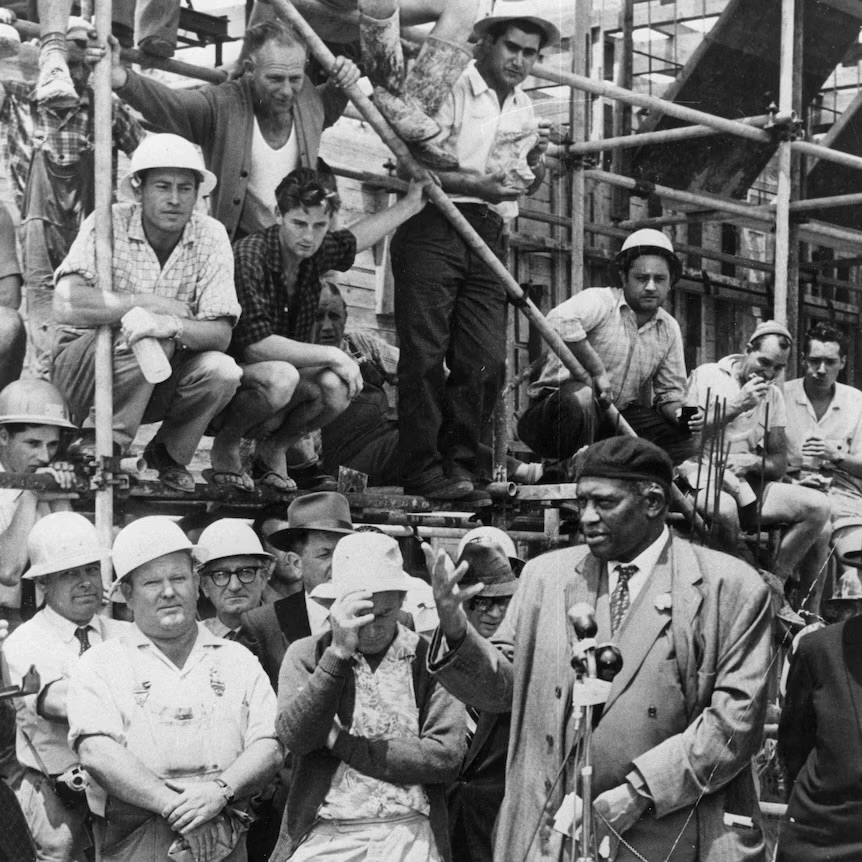
Workers had the best seats when Robeson sang at the Sydney Opera House, 9 November 1960

The visit, Rankin tells The Australian, was organised by the Building Workers Industrial Union of Australia and the Australian Peace Council’s Bill Morrow, a former Labor senator from Tasmania.

In a chapter on Robeson’s visit in the book Passionate Histories: Myth, Memory and Indigenous Australia, which will be launched in Sydney tomorrow, Ann Curthoys quotes the performer as saying on the day after his visit to the Opera House site: “I could see, you know, we had some differences here and there. But we hummed some songs together, and they all came up afterwards and just wanted to shake my hand and they had me sign gloves. These were tough guys and it was a very moving experience.”

In 1998, on the centenary of Robeson’s birth, former NSW minister John Aquilina told state parliament his father had been working as a carpenter at the Opera House site on November 9, 1960: “Dad told us that all the workers – carpenters, concreters and labourers – sang along and that the huge, burly men on the working site were reduced to tears by his presence and his inspiration.”

Curthoys, the Manning Clark professor of history at the Australian National University, who plans to write a book about the Robeson visit, also cites a contemporary report in The Daily Telegraph as saying that the American performer “talked to more than 250 workmen in their lunch hour, telling them they were working on a project they would be proud of one day”. [Curthoy’s book, The Last Tour: Paul and Eslanda Robeson’s visit to Australia and New Zealand, was published at last in 2025]

According to biographer Martin Duberman, Robeson wasn’t particularly enthusiastic about the offer of a tour of Australia and New Zealand from music entrepreneur D. D. O’Connor, but the idea of earning $US100,000 for a series of 20 concerts, plus extra fees for television appearances and the like, proved irresistible.

Robeson had once been one of the highest paid entertainers in the world, but from 1950 onwards he effectively had been deprived of the opportunity of earning a living. A combination of pressure from the US government and right-wing extremists meant American concert halls were closed to him, and the US State Department’s refusal to renew his passport meant he was unable to accept invitations for engagements in Europe and elsewhere. Robeson never stopped singing but was able to do so only at African-American churches and other relatively small venues. His annual income dwindled from more than $US100,000 to about $US6000.

At the time, Robeson was arguably one of the world’s best known African Americans. As a scholar at Rutgers University, he had endured all manner of taunts and physical intimidation to excel academically and as a formidable presence on the football field: alone among his Rutgers contemporaries, he was selected twice for the All-American side.

Alongside his athletic prowess, which was also displayed on the baseball field and the basketball court, he was beginning to find his voice as a bass baritone. When a degree in law from Columbia University failed to help him make much headway in the legal profession, he decided to opt for the world of entertainment, and made his mark on the stage and screen as a singer and actor.

An extended sojourn in London offered relief from the racism in his homeland and established his reputation as an entertainer, not least through leading roles in the musical Show Boat and in Othello opposite Peggy Ashcroft’s Desdemona.

(He reprised the role in a record Broadway run for a Shakespearean role in 1943 and again at Stratford-upon-Avon in 1959)

Robeson returned to the US as a star in 1939 and endeared himself to his compatriots with a cantata titled Ballad for Americans.

In the interim, he had been thoroughly politicised, not least through encounters in London with leaders of colonial liberation movements such as Kenya’s Jomo Kenyatta, Ghana’s Kwame Nkrumah and India’s Jawaharlal Nehru.

He had sung for republicans in Spain and visited the Soviet Union at the invitation of filmmaker Sergei Eisenstein.

Robeson’s refusal to reconsider his political affiliations once World War II gave way to the Cold War made him persona non grata in his homeland: his infatuation with the Soviet Union did not perceptibly pale in the face of horrific revelations about Stalinist excesses, partly because he looked on Jim Crow as his pre-eminent foe. It is therefore hardly surprising that exposure in Australia to Aboriginal woes stirred his passion.

On the day after his appearance at the Opera House site, at the initiative of Aboriginal activist and Robeson fan Faith Bandler he watched a documentary about Aborigines in the Warburton Ranges during which his sorrow turned to anger, and he vowed to return to Australia in the near future to fight for their rights. He made similar promises to the Māori in New Zealand.

But the years of persecution had taken their toll physically and psychologically: Robeson’s health broke down in 1961 and, on returning to the US in 1963, he lived the remainder of his life as a virtual recluse. He died in 1976, long after many of his once radical aspirations for African Americans had been co-opted into the civil rights mainstream. His political views remained unchanged.

It’s no wonder that, as writer and broadcaster Phillip Adams recalls, Robeson’s tour was like “a second coming” to “aspiring young lefties” in Australia.

Duberman cites Aboriginal activist Lloyd L. Davies’s poignant recollection of Robeson’s arrival in Perth on the last leg of his tour, when he made a beeline for “a group of local Aborigines shyly hanging back”.

“When he reached them, he literally gathered the nearest half dozen in his great arms.”

Davies heard one of the little girls say, almost in wonder, “Mum, he likes us.”

She would have been less surprised had she been aware of the Robeson statement that serves as his epitaph: “The artist must take sides. He must elect to fight for freedom or slavery. I have made my choice. I had no alternative.”

Left for Good – Peter Craven on Paul Robeson

The Weekend Australian. March 11 2017

What on earth impelled Jeff Sparrow, the Melbourne-based former editor of Overland and left-wing intellectual, to write a book about Paul Robeson, the great African American singer and actor?

Well, he tells us: as a young man he was transporting the libraries of a lot of old communists to a bookshop and was intrigued by how many of the books were by or about Robeson.

All of which provokes apprehension, because politics is a funny place to start with

Robeson, even if it is where you end or nearly end. Robeson was one of the greatest singers of the 20th century. When I was a little boy in the 1950s, my father used to play that velvet bottomlessly deep voice singing not only Ol’ Man River — though that was Robeson’s signature tune and his early recording of it is one of the greatest vocal performances of all time — but all manner of traditional songs. Not just the great negro spirituals (as they were known to a bygone age; Sparrow calls them slave songs) such as Go Down, Moses, but Shenandoah, No, John, No and Passing By, as well as the racketing lazy I Still Suits Me.

My mother, who was known as Sylvie and loathed her full name, which was Sylvia, said the only time she could stand it was when Robeson sang it (“Sylvia’s hair is like the night … such a face as drifts through dreams, such is Sylvia to the sight”). He had the diction of a god and the English language in his mouth sounded like a princely birthright no one could deny.

It was that which made theatre critic Kenneth Tynan say the noise Robeson made when he opened his mouth was too close to perfect for an actor. It did not stop him from doing Eugene O’Neill’s All God’s Chillun’ Got Wings or The Emperor Jones, nor an Othello in London in 1930 with Peggy Ashcroft as his Desdemona and with Sybil Thorndike as Emilia.

Robeson later did Othello in the 1940s in America with Jose Ferrer as Iago and with Uta Hagen (who created Martha in Who’s Afraid of Virginia Woolf?) as his Desdemona. He toured the country; he toured the south, which was almost inconceivable. When he was told someone had said the play had nothing to do with racial prejudice, Robeson said, “Let him play it in Memphis.”

Southern white audiences were docile until Robeson’s Othello kissed Hagen’s Desdemona: then they rioted. Robeson also made a point, at his concerts and stage shows, of insisting the audience not be segregated. James Earl Jones. who would play Robeson on the New York stage, says in his short book about Othello, “I believe Paul Robeson’s Othello is the landmark performance of the 20th century.”

Robeson would play the Moor again in 1959 at Stratford-upon-Avon. By that time, though, he had fallen foul of 1950s America. He had been called before the McCarthyist House Un-American Activities Committee. You can hear a dramatisation of his testimony with Earl Jones as Robeson, which includes an immemorial reverberation of his famous words when senator Francis E. Walter asked him why he didn’t just quit the US and live in Russia.

“Because my father was a slave and my people died to build this country, and I am going to stay here and have a part of it just like you. And no fascist-minded people will drive me from it. Is that clear?”

It’s funny how it was the real communists such as Bertolt Brecht and Robeson who handled the committee best. Still, in an extraordinary act of illiberalism, they took away his US passport and it took two years for the Supreme Court to declare in 1958 in a 5-4 decision that the secretary of state was not empowered to withdraw the passport of any American citizen on the basis of political belief.

When Paul Robeson sang at the Sydney Opera House

It was this that allowed Robeson to do his Othello in Peter Hall’s great centenary Stratford celebration along with Charles Laughton’s Lear and Laurence Olivier’s Coriolanus. It also allowed him to come to Australia. Very early on Sparrow tells the story of watching the clip of Robeson singing Ol’ Man River to construction workers in Sydney with the Opera House still a dream in the process of meeting impediments. The version Robeson sings is his own bolshie rewrite (“I must keep fightin’/ Until I’m dyin’ ”).

Well, fight he did and bolshie he was. I remember when I was a child my father telling me Robeson was a brilliant man, that he had won a sporting scholarship for American football (to Rutgers, in fact), that he’d gone on to receive a law degree (from Columbia, no less) and that he was so smart he had taught himself Russian.

But the sad bit was, according to my father, that he’d become a communist. Understandably so, my father thought, because of how the Americans treated the blacks. My father’s own radical impulses as a schoolboy had been encouraged, as Robeson’s were on a grander scale, by World War II where Uncle Joe Stalin was our ally in the war against Hitler’s fascism.

But this was the Cold War now, and a lot of people thought, with good reason, that it was behind the Iron Curtain that today’s fascists were to be found. Even if others such as the great German novelist Thomas Mann and Robeson thought they were encroaching on Capitol Hill.

Sparrow’s book No Way But This is circumscribed at every point by his primary interest in Robeson as a political figure of the Left rather than as a performer and artist.

It’s an understandable trap to fall into because Robeson was an eloquent, intelligent man of the Left and his status was also for a while there — as Sparrow rightly says — as the most famous black American on Earth. So his radicalism is both pointed and poignant.

His father, who became a Methodist minister, was born a slave and was later cruelly brought down in the world. But, unlike the old Wobblies whose bookcases he transported, Sparrow is not inward with what made Robeson famous in the first place and it shows.

No Way But This is a great title (“no way but this / killing myself, to die upon a kiss” is what Othello says when he’s dying over the body of Desdemona, whom he has killed) but Sparrow’s search for Robeson is not a great book.

As the subtitle suggests, it is a quest book but Sparrow is a bit like the Maeterlinck character cited in Joyce’s Ulysses who ends up meeting himself (whether in his Socrates or his Judas aspect) on his own doorstep. Sparrow goes to somewhere in the US associated with Robeson and meets a black-deaths-in-custody activist full of radical fervour. She introduces him to an old African-American who was in Attica jail for years. There is much reflection on the thousands of black people who were slaves on the plantations and the disproportionate number of them now in US prisons.

Yes, the figures are disquieting. No, they are not aspects of the same phenomenon even though ultimately there will be historical connections of a kind.

And so it goes. But this is a quest book that turns into a kind of travelogue in which Sparrow goes around the world meeting people who might illuminate Robeson for him but don’t do much for the reader except confirm the suspicion that the author’s range of acquaintance ought to be broader or that he should listen to people for a bit more rather than seek confirmation of his own predilections.

There are also mistakes. Sparrow seems to know nothing about the people with whom Robeson did Othello. There’s no mention of Thorndike, and when Ashcroft comes up as someone he had an affair with, Sparrow refers to the greatest actress of the Olivier generation as “a beautiful glamorous star”. Never mind that she was an actress of such stature, Judi Dench said when she played Cleopatra she could only follow Ashcroft’s phrasing by way of homage.

Sparrow also says “American actor Edmund Kean started using paler make-up for the role, a shift that corresponded with the legitimisation of plantation slavery”. Kean, who was the greatest actor of the later romantic period, was English, not American. His Othello would, I think, be more or less contemporary with William Wilberforce lobbying to have slavery made illegal. Sparrow seems to be confusing Kean with Edwin Booth, the mid-century Othello who happens to have been the brother of John Wilkes Booth, the assassin of Abraham Lincoln. But it’s still hard to see where the plantations fit in.

A few pages later — and it’s not important though it’s indicative — we hear of the rumour that Robeson was “romancing Edwina Mountbatten, Countess Mountbatten of Burma”. Well, whatever she was called in the early 1930s, it wasn’t Countess Mountbatten of Burma because her husband, Louis Mountbatten, the supreme allied commander in Southeast Asia during World War II, didn’t get the title until after the Japanese surrendered to him — guess where?

Such slips are worth belabouring only because they make you doubt Sparrow’s reliability generally. It’s worth adding, however, that his chapter about the prison house that the Soviet Union turned itself into is his most impressive. And the story of the last few years of Robeson’s life, afflicted with depression, subject to a lot of shock treatment, with recurrent suicide attempts, is deeply sad.

He felt towards the end that he had failed his people. He just didn’t know what to do. It was the melancholy talking as melancholy will.

It’s better to remember the Robeson who snapped back at someone who asked if he would join the civil rights movement: “I’ve been a part of the civil rights movement all my life.”

It’s to Sparrow’s credit that he’s fallen in love with the ghost of Robeson even if it’s only the spectral outline of that power and that glory he gives us.

Peter Craven is a cultural and literary critic

The Last Tour: Paul and Eslanda Robeson’s visit to Australia and NZ

Australians of a certain age know all about Paul Robeson’s magnificent voice. They know, too, that on a warm November day more than 60 years ago, the bass-baritone sang to 250 construction workers on the Sydney Opera House building site as the workers sat on scaffolding and stacks of timber and ate their lunch. Fewer know of Robeson’s Pro-Communist and pro-Soviet views and of how those beliefs damaged his career at home and abroad. And that’s not so surprising – as historian Ann Curthoys points out, the Cold War suppression of Robeson’s career and memory has been very effective.

Recovering the story of a man who was once the most famous African-American in the world and his equally impressive wife, Eslanda, is the task Curthoys, who grew up in an Australian communist family in the 1950s and 60s, sets herself in a new book, The Last Tour: Paul and Eslanda Robeson’s visit to Australia and New Zealand.

It follows the couple’s tour – a mix of his concerts and their public talks and media interviews – to Australia and New Zealand over October, November and December 1960. Curthoys goes further, using the seven-week tour by this celebrated singer to explore the social and political changes just beginning in post-War Australia. Her interest is “the slow transition from the Cold War era of the late 1940s and 50s, to the 60s era of the New Left, new social movements and the demand for Aboriginal rights”.

Curthoys is 79 now, but when Robeson toured she was 15 and living in Newcastle, a city the singer did not visit. Her mother, Barbara Curthoys, a well-known activist and feminist, was a fan of the singer but the trip passed the teenager by.

It was only decades later, as she researched her 2002 book on the 1965 Aboriginal Freedom Ride through regional NSW, that Curthoys connected with the story. As a university student she had taken part in the ride and moved from communism to the New Left. When she approached the subject as a historian, she realised that for some riders, their attendance at Robeson’s concerts five years earlier had been a defining moment in their “understanding of racial discrimination and Aboriginal rights”.

Curthoys has had a long career in research and teaching at the Australian National University and the University of Technology, Sydney. She’s part of a remarkable family, and not just parents Barbara and Geoffrey, who was a lecturer in chemistry at Newcastle University. Her sister Jean is a leading feminist philosopher and her husband, John Docker, has written several books on cultural history, popular culture and the history of ideas.

Curthoys began researching The Last Tour in 2007, but put it aside for another project on Indigenous Australians before resuming work on it during the Covid-19 lockdowns. Post-­Robeson, she has worked with two scholars on a forthcoming book on the history of domestic violence in Australia.

The tour, she says, was really several tours rolled into one with the Robesons covering many bases – from music to Cold War politics to feminism to Aboriginal rights. It was a conservative era: Robert Menzies’ Liberals ruled federally and five of the six Australian states had conservative governments. Robeson’s presence went unremarked by governments but for fans of his music – and his ideals – the tour was a significant event that was well covered by the press, even those opposed to his views on the Soviet Union.

For some fans, it was a music tour – 20 concerts in nine cities in Australia and New Zealand, at which Robeson sang his show-stoppers, including Deep River, Go Down, Moses; We Are Climbing Jacob’s Ladder, and the song with which he is always identified, Ol’ Man River. The 62-year-old with the extraordinary voice also delivered “recitations” – a monologue from Shakespeare’s Othello, an anti-segregationist poem Freedom Train, and William Blake’s anthem, Jerusalem.

What a thrill for Australian audiences, some of whom had followed the handsome, 1.9m singer and actor since the 1920s. Even in an age of limited communications, Robeson was well-known here through films; records and radio. Curthoys notes that one indicator of his fame was the way promising Aboriginal singers in the 1930s were dubbed “Australia’s Paul Robeson”.

He was famous – and controversial. Unlike many other supporters of communist ideas, Robeson refused to break from the Soviets after the invasion of Hungary in 1958 and continued to defend Moscow. The “anti-communist repression and hysteria” that gripped the US in the McCarthy era had a profound effect on his life and career, Curthoys writes. He was cited in 1947 by the House Committee on Un-American Activities as “supporting the Communist Party and its front organisations”.

A 1949 US tour was destroyed “after mass cancelling of bookings by venue managers either vehemently opposed to his politics or afraid in such a hostile climate of being classed as communist sympathisers themselves”. Then in 1950, he lost his passport. Over the years, he would “become for communists an emblem of defiance in the face of adversity, and one of the communist world’s most prominent speakers for peace,” ­Curthoys writes.

Unable to travel until his passport was restored in 1958, Robeson was steadfast in his support for communist ideals. That commitment was evident in Australia when the “peace tour” – built around a series of public meetings – was as important to the singer as the popular concerts where he reached a different audience. Curthoys details a related strand – the “workers’ tour”, which involved seven informal concert performances to groups of railway workers, waterside workers and those at work on the Opera House on that November day.

She says the events revealed much about the “the nature of class in Australia and New Zealand” at a time when “strong and confident trade unions” were interested in “broad cultural concerns”. Over several weeks Robeson attracted people who loved his music alongside those who loved his politics. Far from being shunned for his pro-Soviet views, Curthoys suggests, there was support from two different audiences – music people and “left-wing ­people who were either pro-Soviet or not”.

Even so, the Cold War anxieties over the Soviets meant a positive reception was not necessarily assured when Paul and Eslanda flew into Sydney at midday on Oct­ober 12, 1960. They were greeted by several hundred fans carrying peace banners but they faced pointed questions about the Soviet Union at the 20-minute press conference at the airport.

Robeson refused to condemn the suppression of the Hungarian uprising and media reports suggested a torrid exchange. Curthoys reviewed a tape of the press conference and says while the questioning was “a little aggressive”, the event was not as bad as reported in the media. Indeed it was “fairly friendly” albeit for a “bad patch” when Robeson refused to budge on Hungary.

That tape and others, along with newspapers and Trades Hall documentation, yielded rich material but so too did the ASIO files on the couple. At the Palace Hotel in Perth on December 2 an ASIO operative appeared to be among those at a reception organised by the communist-influenced Peace Council. Among guests were the writer (and well-known communist) Katharine Susannah Prichard and “two women by the name of Durack, who were writers and/or artists”.

Curthoys sees Robeson as a “very courageous, very intelligent, intellectual person, very thoughtful about music, about folk music, about people”, but says his commitment to the Soviet Union was a costly mistake. He had embraced Moscow when he and Eslanda visited in 1934 at the invitation of Soviet film director Sergei Eisenstein. Later, Robeson, a fluent Russian speaker, would say it was in the Soviet Union that he felt for the first time he was treated “not through the prism of race but simply as a human being”. Curthoys writes: “The excitement and validation he received during this visit would create a loyalty that later events would not dislodge and the public expression of which would damage him politically, commercially and professionally.”

The couple made several trips to the Soviet Union and accepted its political system completely. Curthoys notes: “They made no public comments about Stalin’s forced collectivisation policies that were in place during the 1930s and led to famine and the loss of millions of lives.” In Sydney Robeson was careful, but on November 5 he celebrated the forthcoming anniversary of the Russian Revolution at the Waterside Workers Federation in Sussex Street. Two days later, during his first public concert in the city, he paid tribute to the Soviet Union as “a new society”.

The Soviet Union had been a great influence but so too was the Spanish Civil War, which Curthoys says helped define his view of the political responsibilities of the artist.

“Increasingly famous as a public speaker, on 24 June, 1937, he made a huge impression at a mass rally at the Albert Hall in London sponsored by prominent figures such as WH Auden, EM Forster, Sean O’Casey, HG Wells and Virginia Woolf, held to raise financial aid for Basque child refugees from the war. In what became his most well-known and influential speech, he stressed how important it was for artists and scientists and others to take a political stand: ‘Every artist, every scientist, every writer must decide NOW where he stands. He has no alternative. There is no standing above the conflict on Olympian heights.’”

After World War II, Robeson was deeply involved in radical and anti-racism politics in the US but in 1947, as the Cold War worsened, he had had enough. He announced he intended to abandon the theatre and concert stage for two years to speak out against race hatred and ­prejudice. In fact he stopped stage acting for 12 years but continued to perform as a singer, often in support of political causes.

It was another 13 years before Australian audiences heard that glorious voice “live”. Australians, it seemed were primed for Paul. The tour may have been ignored by governments but during her research, Curthoys was “overwhelmed” by people “ready to assist, donating old programs, photographs, pamphlets, records, cassette tapes, invitations and other documents”.

Today, much of the Robeson image is defined by his Opera House performance on November 9 – high culture delivered, without condescension, to a building crew by a champion of the workers. Robeson, in a heavy coat, despite the warm weather, sang “from a rough concrete stage”. A PR expert could not have dreamt up a a better way to “democratise” an opera house than having the “first concert” delivered in its half- built shell. Curthoys shows how the event, no matter how memorialised now, was a small part of a tour that proved a financial and political success for the Robesons, who left Australia on December 4.

A few months later, depressed and exhausted, Robeson tried to commit suicide in Moscow. Over the next three years he was treated but could no longer perform or engage in public speaking. Curthoys notes that though his affairs with other women had strained their marriage, he and Eslanda had a common political vision and were together until her death in 1965. Robeson died on January 23, 1976 at the age of 77.

Helen Trinca’s latest book is Looking for Elizabeth: The Life of 
Elizabeth Harrower (Black Inc.)

Putin’s war … an ageing autocrat seeks his place in history

In That Howling Infinite’ has written often about Russian and Ukrainian history, not only because personally it has been of long-term academic interest, but also, because of the ongoing Russia-Ukraine war.

In In That Howling Infinite’s post, Borderlands – Ukraine and the curse of mystical nationalism, we wrote:

“Like many countries on the borders of powerful neighbours, Ukraine has long endured the slings and arrows of outrageous history. Its story, like that its neighbours, is long and complex. In competing national narratives, Russians and Ukrainians both claim credit for the creation of the Russian state, though others attribute this, with some credence, to the Vikings. The historical reality of Ukraine is complicated, a thousand-year history of changing religions, borders and peoples. The capital, Kyiv, was established hundreds of years before Moscow, although both Russians and Ukrainians claim Kyiv as a birthplace of their modern cultures, religion and language.

I highly recommend Serhii Plokhy’s The Gates of Europe, a well told and fascinating story of the origins of Ukraine and Belarus, and how their histories were intertwined, and entwined with those of of Poland, Lithuania (which was a large and powerful state once) and Russia. Ukraine has historically been the border between the catholic west and the orthodox east, the division running virtually down the middle. The name Ukraine is Slav for border land. Its geopolitical location and natural resources have led to the land being inflicted by invaders, civil wars, man-made famine and repression.

Eastern European countries, Ukraine included, have with good reason no love for Russia, be it Czarist, Soviet or Putin’s. Hungarians, Czechs, Poles and East Germans have seen Russian “peacekeeping” troops and tanks on their city streets, as have the Baltic countries, Afghans and Chechens. Millions of Ukrainians died under Stalin’s rule (and many, many millions of fellow-Soviet citizens). The 20th Century was not kind to the countries of Central and Eastern Europe. Historian Timothy Snyder called them “the blood lands”.

We republish below a recent article in The Australian by Melbourne historian and academic Mark Edele. It gives the uninformed but interested reader a short but comprehensive history of the relationship between Russia and Ukraine from the ninth century to the present day.

Here are posts in In That Howling Infinite, about Russia, Ukraine and Eastern Europe:

Putin’s puppet sells out Ukraine

Donald Trump’s bullying ‘peace plans’ to end the Ukraine war will only embolden Vladimir Putin, who fancies himself a leading a great power with historical rights beyond his borders.

Mark Edele, The Australian, 8 March 2025

Last weekend, the United States vacated the post of leader of the free world. Supporters of democracy the world over watching in disbelief as the US President and Vice-President berated, belittled, and bullied the leader of a democracy at war. On Monday, then, followed what this “great television”, as Donald Trump called it, was all about: a pretext to halt military aid to Ukraine, followed soon by the end of intelligence-sharing. The end goal: force Ukraine to the negotiation table with no security guarantees included in a “deal” with Vladimir Putin.

Four things will come out of an emboldened Russia now: more air raids on Ukraine’s civilians; a renewed push at the frontline; praise for the US administration and its visionary leader; and a disinformation campaign to convince the democratic world that black is white, up is down, left is right, Ukraine the aggressor and Russia the victim in this war. Astonishingly, we can also expect the White House to parrot such propaganda. Welcome to the era of strategic chaos.

Kremlin spokesman Dmitry Peskov noted the obvious: The US’s shift from supporting its allies to courting Moscow “largely coincides with our vision”. Foreign Ministry spokeswoman Maria Zakharova ladled on now familiar Russian propaganda. Volodymyr Zelensky, she claimed, was the head of a “neo-Nazi regime”, a “corrupt individual who lost his grip on reality”, whose “outrageously rude behaviour during his stay in Washington … reaffirmed his status of the most dangerous threat to the international community”. Zelensky was an “irresponsible figure”, a “terrorist leader” who had “built a totalitarian state” and is “ruthlessly sending millions of his fellow citizens to their deaths”.

Sigmund Freud would have classified these statements as “projection”: they are true, but apply to Zakharova’s boss, Vladimir Vladimirovich Putin. Born in 1952, Putin grew up in St Petersburg, then called Leningrad. Surrounded with stories of World War II, in which his father served and his brother perished, he came of age on the rough streets of Leningrad during the heydays of Soviet superpower. In 1975 he joined the KGB, an organisation that deeply formed his world view and behaviour. His sport is judo, a deeply tactical martial art focused on exploiting the opponent’s weaknesses and redirecting the adversary’s momentum.

Putin came of age on the rough streets of Leningrad during the heydays of Soviet superpower. Picture: AFP

After the breakdown of the Soviet empire in 1991, he served in the city administration of St Petersburg. Later he moved to Moscow to make a career in the administration of the first president of post-Soviet Russia. When Boris Yeltsin looked for a successor who would guarantee his own and his family’s safety, Putin’s name came up. He was seen as competent but unthreatening to the oligarchs running Russia at the time. In 1999, Putin became premier. Later the same year, he was appointed acting president. His tenure was defined by the brutal second Chechen War, which he prosecuted with utter ruthlessness. In 2000, he was elected President. He remained in this post until today, with a stint stepping back to the prime ministership in 2008-12, to get around term limitations in the constitution (subsequently changed).

In the quarter-century he ruled Russia, Putin broke the power of the oligarchs, rebuilt the state as a security organisation run by former KGB officers, suffocated free speech, pluralism and the opposition, and built one of the most unpleasant electoral dictatorships of the post-Soviet space. Despite an economy still only a quarter of that of the EU or the US (to say nothing of China’s), Putin fancies himself as leading a great power with a right to a sphere of influence and a major say in shaping the international order.

By the end of the second decade of his rule, however, the ageing dictator in the Kremlin began to worry about his legacy. His track record was mixed. The Russian population had been declining steadily until the 2010s. The following uptick was mostly undone again during and after the Covid pandemic, fuelling longstanding apocalyptic fears that the Russians would be dying out. The economy had grown significantly, but social inequality had exploded alongside, while political liberties continually atrophied. The Covid crisis was handled extremely poorly. Great-power status remained an aspiration. Putin worried what the history books would say about him. The answers respectable historians gave him when asked were evasive. And he was turning 70 in 2022.

History, and his place in it, obsessed Vladimir Vladimirovich. During his, quite extreme, Covid isolation, he read history books, immersing himself in the Russian imperialist tradition. Such historians had long denied that Ukraine was anything but a part of Russia. He summarised this traditional Russian view “on the historical unity of Russians and Ukrainians” in an essay of that title, published on July 12, 2021. It read like the musings of an ageing Russian imperialist. A bit over seven months later, it revealed itself as the ideological justification of a full-scale invasion of Ukraine.

Ukraine and Russia: histories entangled but separate

At the heart of Putin’s worldview is that Russia continues to be a great power with historical rights on Ukraine. It thus bears repeating that Russia and Ukraine are separate nations, which trace their heritage back to a common origin: a collection of principalities centred on Kyiv, known as the Rus of the ninth to 13th centuries. After the Mongol invasions of the 1220s and 1230s, however, the southwestern and the northeastern parts of this civilisation developed in different and quite separate ways, eventually leading to Russia and Ukraine as we know them today. As a result of such divergence, Russian and Ukrainian have developed as separate, if related, languages.

Vladimir Putin attends the Victory Day military parade in central Moscow on May 9, 2024. Picture: AFP

Putin attends the Victory Day military parade in Moscow on May 9, 2024. AFP

Overlapping histories and linguistic similarities are not unique among nations. Both Germany and France claim the Frankish empire under Charlemagne (French) or Karl (German) as part of their deeper history. Yet nobody would suggest (any more) that therefore France should be part of Germany or vice-versa. Likewise, French and Portuguese have related grammatical structures and some overlap in vocabulary. And yet nobody would argue that Portuguese is a French dialect.

Ukrainians formed a state twice: once in 1649, the Cossack-led “Hetmanate” fighting for its independence from Poland; the second time in 1917-21, after both the Russian and Austro-Hungarian empires had collapsed in World War I. Both were defeated militarily, but both were important inspirations for a democratically minded national movement.

Ukraine’s lands and peoples came into the Russian orbit in stages. First was the disastrous Treaty of Periaslav of 1654, when the Hetmanate joined a temporary military alliance with Muscovy against Poland, which the Muscovites read as a subjugation under the autocrat instead. After much fighting and diplomatic manoeuvring, Poland and Russia agreed in 1667 that Moscow could control the lands east of the Dnipro (“left bank Ukraine”) as well as Kyiv on the “right bank”. When Poland was partitioned at the end of the 18th century, what was left of Ukraine came partially under Habsburg and partially under Romanov rule. At the end of World War I, Ukraine emerged as one of the successor states of the Romanov empire, alongside Latvia, Lithuania, Estonia, Finland, Poland and Bolshevik Russia. In contrast to these states, however, it did not survive the wars and civil wars that followed the disintegration of the empire in 1917.

In 1921, it was divided between the newly resurrected state of Poland and the emergent successor of the vast majority of the lands of the Romanov empire: Bolshevik Russia. Within the latter, Ukraine was granted a pseudo independence as one of the Union republics making up the newly formed “Union of Soviet Socialist Republics”, or USSR.

The Ukrainian SSR was a Bolshevik ploy to disarm national sentiment while reasserting imperial, and increasingly totalitarian, control by Moscow. In the long run, however, it allowed not just the maintenance but even the growth of national culture and national self-awareness. Ukraine also grew geographically. During World War II, the Soviets gobbled up the rest of Ukraine from Poland and Romania. In 1954, the government transferred Crimea to Ukraine, to ease the economic development of a region with no geographic connection to Russia. Thus Ukraine acquired its current, internationally recognised borders. Eventually, they provided a ready-made demarcation of post-imperial Ukraine, once the Soviet empire collapsed in 1989-91.

After the Soviet Union

Of the 15 successor states of the Soviet Union, Russia is the largest in terms of territory (17.1 million square kilometres). Ukraine, with 0.6 million square kilometres, comes third after Kazakhstan (2.7 million square kilometres). In a comparison of population sizes, Ukraine occupies the second position, with 37.7 million in 2023, according to the World Bank, quite a way behind Russia with 143.8 million. By comparison, the most populous country of the EU, Germany, has 83.3 million, while the EU as a whole counts 448.8 million.

Of the 15 successor states of the Soviet Union, Russia is the largest in terms of territory. Picture: istock

As the largest country in the post-Soviet region, in 2023 Russia had the largest GDP adjusted for purchasing power ($US6.5 trillion), followed by Kazakhstan ($US0.8 trillion) and Ukraine ($US0.6 trillion). Again, compare this to Germany ($US5.7 trillion) or Australia ($US1.9 trillion), to say nothing of the EU ($US26.4 trillion), the US ($US27.7 trillion) or China ($US34.7 trillion).

As far as the political system is concerned, between the breakdown of the Soviet empire and today Russia has been on a steady downwards slope, from some early democratic promises to ever darker authoritarianism. Ukraine, meanwhile, evolved in three waves of democratic surges followed by counter movements: the 1990s, the second half of the 2000s, and from the middle of the 2010s. While not the freest country in the post-Soviet space (that privilege belongs to the three Baltic republics of Latvia, Lithuania, and Estonia, all members of EU and NATO), it is in no way comparable to Russia. Zelensky was elected President in 2019 with 73 per cent of the vote. As of late February 2025, he had an approval rating of 52 per cent.

Zelensky was elected Ukraine President in 2019 with 73 per cent of the vote. Picture: AFP

Zelensky was elected president in 2019 with 73 per cent of the vote. AFP

The latest report on Ukraine from a Washington-based independent watchdog, Freedom House, notes that both the President and the current legislative were elected in free, competitive, and fair elections. Since 2022, there was some deterioration of political freedoms because of the war, including the suspension of elections due to martial law, new restrictions against parties that support Russia’s aggression, and greater control of the reporting in the main news channels. However, opposition parties continue to sit in parliament and their political activities “are generally not impeded by administrative restrictions or legal harassment”. Communication channels outside the official network, such as social media platforms, remain available and used freely.

All of this contrasts sharply to the repressive nature of Russian rule, not just in the occupied territories of Ukraine, but also in Russia itself. For 2025, Freedom House categorised Ukraine as a “transitional or hybrid regime”, while Russia was a “consolidated authoritarian regime”.

The war

Russia invaded Ukraine in 2014 after a popular revolution in Kyiv had ousted pro-Russian president Viktor Yanukovych. Russia illegally annexed Crimea and fostered a proxy war in Ukraine’s east, the Donbas, at times fought with regular Russian troops; at others by Russia-sponsored rebels. Most observers at the time assumed that this was the endgame: taking over Crimea was popular among Russians who saw it as their own Riviera; the frozen conflict in Ukraine’s east served as a festering wound keeping the recalcitrant democracy down.

Ukrainian firefighters push out a fire after a strike in Zaporizhzhia in 2022, amid the Russian invasion of Ukraine. Picture: AFP

Ukrainian firefighters putout a fire after a strike in Zaporizhzhia in 2022. AFP

Two ceasefire agreements, Minsk I (September 5, 2014) and Minsk II (February 12, 2015), failed. After the first, Russia sent troops across the border to defeat Ukraine’s armed forces in the Second Battle of Donetsk Airport (September 2014 to January 2015) and the Battle of Debaltseve (January to February 2015). After the second, the frontlines remained frozen, but shelling and sporadic fighting continued. No part of the agreement was ever fully implemented and soldiers kept dying. The world, however, moved on.

Who had not moved on was Putin, dreaming of great power and empire. While convincing himself of the righteousness of his position by reading Russian imperial historiography, he observed “the West” move from crisis to crisis. In Europe, the liberal consensus was challenged by new-right populist movements. The UK was in political chaos. The US could not even execute an orderly withdrawal from Afghanistan, unlike the Soviet army in 1988. And that army, now Russia’s, had been modernised significantly under Putin’s watch. It was time to strike.

Preparations for the invasion started shortly after the fall of Kabul in August 2021. By October, the US had conclusive evidence that Russia planned an assault with the goal of controlling all of Ukraine and eliminating its President. Between then and the start of the war, the US tried repeatedly to create diplomatic off-ramps for the Kremlin. Putin was not interested.

On February 24, 2022, Putin unleashed his war of conquest. Within 10 days, Ukraine’s military was supposed to be disabled, the country’s leaders arrested or executed, pro-Russian popular support mobilised, and resisters detained. By mid-August, all of Ukraine would be occupied, the plan went. Then, it could be either annexed or given over to a puppet regime.

The plan failed. There were few collaborators and much resistance. The battle for Hostomel airport was lost by the Russian airborne forces sent in at short notice; two groups of assassins sent to kill Zelensky were hunted down and eliminated; the columns advancing towards Kyiv were stopped by the fire of artillery and main battle tanks, both of Ukrainian origin. While social media was obsessed by the David-versus-Goliath spectacle of US-made shoulder-launched missiles taking out Russian tanks, the real damage was done using Ukraine’s own resources. Victory in the battle of Kyiv was achieved by late March 2022.

Over the next three years, the war changed from a battle of movement to position warfare and a war of attrition. Russia began to rely on massed use of artillery and the liberal sacrifice of manpower. This looked like WWII: the frontal assaults, the artillery barrages, the utter disregard for human resources. But there was a new element as well: terror attacks on civilians and their infrastructure. This was not a Soviet tradition: during WWII, it was British and US air forces that had flattened German and Japanese cities. Such bombing was not part of the Red Army’s military repertoire. Its air forces were geared towards support of ground troops, not “strategic” bombing of civilians.

In its changed focus on hurting civilians from the air, Putin’s army drew on the neo-imperial wars he had overseen: Chechnya and Syria. It was here that the Russian air force first flattened cities (Grozny in 1999-2000 and Aleppo in 2015-16) and it was this experience that now came to bear on the war in Ukraine. Except that here they did not control the airspace and did not face defenceless civilians they could simply “de-house” at will. Instead, they had to deal with an enemy capable of shooting down not just bombers, which as a result were not sent into Ukraine’s airspace, but also many of the missiles and drones sent from a safe distance.

While air assaults on civilian targets became part of the normalcy of Russia’s changing way of war, tactics on the ground also evolved: rather than mass assaults after preliminary artillery preparation, increasingly Russia used surprise attacks by small groups of storm troopers to conduct reconnaissance by force. If they encountered major resistance, they would then call in airstrikes or artillery barrages. They also stopped frontal assaults on fortified positions, bypassing and encircling them instead.

But none of this led to major breakthroughs. The war bogged down.

Russia was better prepared than Ukraine for a war of attrition. It had long built a food system that could withstand international isolation, demonstrating that a major war had been on the minds of the planners in the Kremlin for a very long time. The discrepancy in the size of both the economy and the population also meant Russia had the edge in the long run. And while the militarisation of the economy came with increasingly serious economic imbalances, they were not serious enough to force Putin’s dictatorship to back down. Instead, military salaries and the growing investments in military industries led to economic mini-booms in several of the regions that supplied the volunteers and the weapons to fight in Ukraine. To many Russians, this continues to be a profitable war.

Putin’s overall strategy thus shifted from a lightning war of conquest to outlasting the democratic world. Having the Soviet experience of extreme suffering and endurance in mind, and construing “the West” as weak, effeminate and degenerate, he had every confidence that Russia would be successful in the long run. With Trump’s election victory, this confidence grew. With his behaviour in the first six weeks in office, it must have soared. Putin has less reason than ever to compromise. And he can achieve much by playing Trump diplomatically.

What now?

After the spectacular dust-up in the Oval Office a week ago, doom and gloom have descended over Ukraine and its supporters. A pouting US President seems to assume that if he pulls the plug on Ukraine, the war will simply end: “Zelensky better move fast or is not going to have a Country left,” he wrote a week before he ambushed him in front of the cameras.

The withdrawal of US support is a serious setback for Ukraine. The US and Europe have provided about equal amounts of money to Ukraine. If Europe were to try to replace US contributions, it thus would have to double its financial commitments at a time when the economy is not exactly booming and will soon be further hit by Trump’s trade wars.

The withdrawal of US support is a serious setback for Ukraine. Picture: AFP

The withdrawal of US support is a serious setback for Ukraine. AFP

The major victims of Trump’s retreat will be Ukraine’s civilians. The US air defence systems currently protecting cities cannot be replaced easily. An increase in civilian deaths is the inevitable result. The withdrawal of intelligence is also a serious blow and difficult to substitute.

However, the EU’s economy is big enough to replace US contributions. An increase equal to 0.12 per cent of Europe’s GDP would suffice. Germany’s taxpayers spend three times more on domestic subsidies for diesel fuel than they devote to military aid to Ukraine. And production capacity is growing. At the start of the war, most military aid came from quickly depleting stockpiles. By 2024, the vast majority of materiel fuelling Ukraine’s war effort are newly produced weapons and equipment.

More than half of Ukraine’s weaponry is produced in Ukraine, a further 25 per cent comes from Europe. The 20 per cent the United States contributes is particularly valuable and high-quality, but it is not the backbone of Ukraine’s capacity. In a war of attrition heavily dependent on artillery, Europe will produce some two million artillery shells for Ukraine this year. The US, before Trump pulled the plug, was expected to deliver less than one million. Elon Musk’s Starlink, providing communications at the frontline, can be replaced with alternatives.

Thus, Ukraine’s defences are unlikely to collapse. Russia has been advancing recently, but progress was slow. By the third anniversary of the invasion, Russia controlled about 20 per cent of Ukraine’s territory, including some 4000 square kilometres gained in 2024. However, Ukraine is a big country. Russia’s 2024 gains represent a mere 0.6 per cent of Ukraine’s territory. Russia has not taken major cities in 2024 and urban life continues everywhere.

Meanwhile, Russia lost parts of the Kursk region to a counteroffensive the Russian military was unable to reverse. Russia has likely enough materiel for at least another year of fighting, but not enough for a major breakthrough.

In an assessment of the war written at the end of 2024, one of the most perceptive analysts of the military side of the war in Ukraine, exiled Russian historian and former civil rights activist Nikolai Mitrokhin, developed four possible scenarios for what could happen in 2025. None of them included a complete breakdown. His “catastrophic” scenario was a “partial collapse of the front due to the reduction of Ukrainian forward units”, leading to a “rapid advance of Russian units to the left bank of the Dnipro”. He predicted that this might lead to a leadership change, but also a further rallying around the flag and a continuation of the fight.

Less catastrophic would be a return to a grinding Russian offensive, as in 2024. “At the current rate of advance,” wrote the Institute for the Study of War in its Ukraine Fact Sheet of February 21, 2025, “it would take Russian forces over 83 years to capture the remaining 80 per cent of Ukraine, assuming that they can sustain massive personnel losses indefinitely”.

This outlook explains why Putin is so enthusiastic about Trump’s “peace plans”. They might achieve diplomatically what he cannot achieve on the battlefield: the subjugation of Russia’s democratic neighbour to neo-imperial domination.

Mark Edele is a historian of the Soviet Union and its successor states, in particular Russia. He is Hansen Professor in History at the University of Melbourne. His latest book is Russia’s War Against Ukraine: The Whole Story (Melbourne University Press, 2023

Trump and Vance ambush Zelensky at the White House

A Messiah is needed – so that he will not come

In our more secular, rational times, we condemn those who maim and murder in the name of their god. But do not for a moment dismiss the power of religious fervour … The promise of a full remission of all sins and a place in paradise was a powerful motivator (and among some faithful, it still is).
Al Tariq al Salabiyin – the Crusaders’ Trail, In That Howling Infinite

… it would be a mistake to assume that the pattern of apocalyptic thought exists only within the framework of religious belief. Its fingerprint can also be found in secular revolutionary movements and in modern ideological worldviews
Amit Vershinsky, Israeli historian and author

Messianism, the belief in the advent of a “promised one”, a Messiah or Mahdi, who emerges as the saviour of a people and who will bring about a better world, has never gone out of fashion, particularly in the Middle East, its theological birthplace. It originated as a Zoroastrian religious belief and flowed into the Abrahamic religions, Judaism, Christianity and Islam, but other faiths also harbour messianistic proclivities. And yet, messianism can be temporal as much as spiritual, as illustrated by the ideological movements which determined the course of twentieth century history.

The yearning for an ideal leader has long been ingrained in our collective psyche: a hero, mortal or divine, who would appear at the darkest hour and lead his people through the struggle to ultimate triumph. Even though we may not personally subscribe to a spiritual belief in the end of days, it is there in our historical memory and in the myths that are often shaped by it, as the following lines, referencing Alexander the Great, Genghis Khan and King Arthur, these “once and future” kings, illustrate:

We sing such songs as we might hear
In dreams before day breaking,
As ancient echoes hide between
The slumber and the waking.
We remember,
Yes, we remember

Iskander marched this way and back
Across these battlefields of old.
Persepolis he burned and in Babylon he died,
And now, embalmed in gold,
He lies waiting.

The killer khan in death reclines
Amidst his guards and concubines,
Who died so none would ever see
The final resting place where he
Lies waiting.

And in our own imagining
The fabled, once and future king
Upon an island in a lake,
He slumbers still but will awake
One day.

Ruins and Bones, Paul Hemphill

World-renowned Critical Theorist, activist, psychoanalyst, and public Marxist intellectual, Erich Fromm (1900-1980) distinguished two kinds of messianism. One he saw as radical and progressive, the other as regressive and potentially reactionary: “prophetic messianism” and “catastrophic or apocalyptic” messianism.

Prophetic messianism, Fromm argued, conceives the messianic event as occurring within history and time and not arriving through a rupture from history and time. Regressive catastrophic messianism on the other hand sees the messianic event entering history from outside, a force majeure, and not as an outcome of human activity. He saw “prophetic messianism” as a “horizontal” longing, a longing for human-made change, and “catastrophic messianism” as a vertical” longing, a longing for an external, transcendent “saviour” (perhaps a human leader or a deterministic law governing history) that will enter history from a realm outside of human affairs.

Because prophetic messianism views the messianic event as the outcome of human progress, it encourages productive and revolutionary action, and it makes planning or “anticipatory change” possible. By contrast, because catastrophic messianism views the messianic event as the outcome of the transcendent entering history to rescue a fallen humanity, catastrophic messianism encourages passive waiting or even destructive or unnecessarily violent action aimed at speeding the coming of the apocalypse. Like the types of false hope that Fromm warns against, catastrophic messianism risks becoming quietism on the one hand or actively destructive nihilism on the other.

[These two previous paragraphs are an edited extract of a review by Dutch publishing house Brill of Erich Fromm’s Revolutionary Hope by Joan Braune, 1st January 2014}

Today, catastrophic messianism is active and influential in our world’s most enduring conflicts – the clear and present danger facing the non-Muslim world by Islamic extremism, and the current war between the predominantly Jewish State of Israel and the Islamic fundamentalist Hamas and its allies

In islamic eschatology, the end of times will portend Malhama Al-Kubra, the “last battle between the forces of light and of darkness, an apocalyptic struggle so intense that according to some Hadith narrations, were a bird to pass their flanks, it would fall down dead before reaching the end of them. Many texts say that this will take place at Dabiq in northern Syria. As testament to its relevance in contemporary Islamist thinking, the brutally fundamentalist Islamic State adopted the name for its magazine.

In the eyes of Israel’s principal foes, the so-called “Axis of Resistance”, Iran and its Islamist proxies in Palestine, Lebanon, Syria, Iraq and Yemen, the current Arab Israeli conflict is in reality a holy war with inseparable and uncompromising religious, political and military dimensions that take on a messianic character.

The irony is that increasingly in the Jewish state, the existential crisis emanating from the catastrophe of October 7 and the encirclement of the tiny country by enemies determined to wipe it off the map, has arguably fostered a messianic fervour in Israel too.

In an informative article in Haaretz, writer and historian Amit Varshizky contemplates the connections between conflict and catastrophe on the one hand and an emerging messianism on the other among both religious and non-religious Jews.

This article reminded me of British historian Norman Cohn‘s influential book The Pursuit of the Millenium which I first read in ‘seventies. Indeed, Varshinsky refers to him. Cohn’s work as a historian focused on the problem of the roots of a persecutorial fanaticism which became resurgent in modern Europe at a time when industrial progress and the spread of democracy had convinced many that modern civilization had stepped out forever from the savageries of earlier historical societies. In The Pursuit, he traced back to the distant past the pattern of chiliastic upheaval that marred the revolutionary movements of the 20th century. He had described all his work as studies on the phenomena that sought “to purify the world through the annihilation.

Vershinsky writes:

“The origins of this craving for destruction and strife reside in the belief that the coming of the Messiah will be preceded by a period of “pangs of the Messiah,” characterized by suffering and ordeals; in short, there is no redemption that is not acquired without torments. This is a basic element of political messianism, which interprets historical events in a mythic light, as the embodiment of sanctity in concrete reality … the power of this redemptive mysticism derives from the fact that it does not talk about far-reaching cosmic transformations in the order of creation, as predicted by the Prophets. It refers, rather, to messianic fulfillment within the realm of historical, concrete time, and as such it is tightly linked to human deeds … History demonstrates how apocalyptic interpretations can be created from the experience of an existential crisis, which brings to a head the everlasting tension between deficiency and the striving for fulfillment – a tension that characterizes the human condition in general. Since the start of recorded history, periods that were marked by political crises, plagues, social anxieties and collective despair have been accompanied by the rise of apocalyptic interpretations that have vested history with a new and sanctified significance and have charged the events of the hour with redemptive meaning. As Norman Cohn showed, marking a low point as a formative moment of spiritual renascence that leads to redemption is part of a recurring pattern that appears in all apocalyptic interpretations of events throughout Western history. Cosmic disorder is a precursory and necessary stage for the coming of the Messiah and the establishment of the Kingdom of God … But it would be a mistake to assume that the pattern of apocalyptic thought exists only within the framework of religious belief. Its fingerprint can also be found in secular revolutionary movements and in modern ideological worldviews”.

See also in In That Howling Infinite, A Middle East Miscellany    A Short History of the Rise and Fall of the West and Lebensraum Redux – Hamas’ promise of the hereafter

Amit Varshizky, Haaretz, Aug 3, 2024

Disasters are a fertile ground for purveyors of apocalyptic prophecies

Oil-storage facility in Hםuthi-held Hodeida, Yemen after the port was hit by Israeli planes July 20. “War advances “the purification, refining and galvanizing of the Jewish people” Rav Kook.”: AFP

Social media is flooded with clips of rabbis calculating the end times and intoxicated with salvation as they declare that we are poised at the onset of the flowering of our redemption. Rabbi Naftali Nissim, a YouTube star in-the-making, waxed poetic: “There has never been a beautiful period like this… What happened on Simhat Torah [October 7] is a prelude to redemption.” Rabbi Yaakov Maor explained that “Rafah [in Gaza] refers to ‘288 sparks’ [the numerological value of the word ‘RFH,” and a concept in kabbalistic literature]. The redemption is near!” And Rabbi Eliezer Berland, head of the Shuvu Banim group in the Breslav Hasidic sect, promised: “This is the last war before the Messiah. After this war, Messiah Son of David will come.”

But such talk is not confined to the yeshivas and the kollels (yeshivas for married men), it’s even voiced on commercial television. Dana Varon, a presenter and commentator on the right-wing Channel 14, stated, “It’s written in the Mishna: The Galilee will be destroyed and the Golan shall be emptied, and the people of the border wander from city to city, that’s the Mishna coming to realization within us literally, I’m happy about this.”

Her colleague Yinon Magal went even farther in a radio broadcast. “The feeling is that we are approaching great days. We are in a redemptive process, and prophecies are happening.” And on another occasion: “Only the Messiah [can] supplant Bibi.” Magal is a demagogue and the embodiment of narcissism, but his remarks reflect a prevailing sentiment among broad circles of the settler and Hardali (nationalist ultra-Orthodox) right, and one that has also been adopted by broad segments of the ruling party.

The sentiment itself is not new. Since the advent of religious Zionism, it has greased the movement’s ideological wheels and been the driving force of the settlement project and the vision of Greater Israel. What is new is the popularity these ideas enjoy in the present-day political and public discourse, and how they have traveled from the margins of right-wing politics into the Likud center. Prime Minister Benjamin Netanyahu, who is captive by choice of power-hungry Kahanists and other extremists, is dragging Israel into the grip of an apocalyptic ecstasy that is deepening the existing crisis and creating new conditions for realizing the messianic fantasy of conquering all the territories of the Land of Israel, replacing Israeli democracy with the kingdom of the House of David and building the Third Temple.

This accounts for the enthusiastic spirit that has gripped the messianic camp since October 7, as well as the repeated provocations on the part of individuals and groups in an attempt to ignite a conflagration in the West Bank and pull the Arabs in Israel into the blaze.

War of Gog and Magog

The origins of this craving for destruction and strife reside in the belief that the coming of the Messiah will be preceded by a period of “pangs of the Messiah,” characterized by suffering and ordeals; in short, there is no redemption that is not acquired without torments. This is a basic element of political messianism, which interprets historical events in a mythic light, as the embodiment of sanctity in concrete reality. According to this approach, the birth of Israel and the Zionist enterprise, particularly since the victory in the 1967 Six-Day War, are manifestations of emerging redemptive reality. This reading of events is based in part on tractate Berakhot in the Talmud, according to which between this world and the time of the Messiah there is only “servitude to the [foreign] kingdoms.”

Indeed, the power of this redemptive mysticism derives from the fact that it does not talk about far-reaching cosmic transformations in the order of creation, as predicted by the Prophets. It refers, rather, to messianic fulfillment within the realm of historical, concrete time, and as such it is tightly linked to human deeds. Rabbi Shlomo Aviner, the dean of Ateret Yerushalayim Yeshiva and the former rabbi of the settlement of Beit El, put it succinctly: “We assert the absolute certainty of the appearance of our redemption now. There is no barrier here of secret and hidden.”

The same applies to the present war; it needs to be seen in its biblical dimension and perceived through a messianic prism. In this sense, the history of our generation is not much different from the chronicles of the Exodus from Egypt and the conquests of Joshua. At that time, too, the events occurred by natural means and the military victories opened the age of redemption.

The Gaza war, from this perspective, is bringing closer the Jewish people’s collective redemption. Light and dark are intertwined here, destruction and revival are interlocked like revealed and concealed, and as material and spiritual reality. Accordingly, the greater the dimensions of the destruction and the devastation, so too will the spiritual transformation brought by the campaign in its wake be augmented. The war is the purgatory that will steel the spirit of the Jewish people, which is already at the stage of incipient redemption. Anyone seeking a foundation for this idea will find it in the thought of Rabbi Zvi Yehuda Kook (the son of Abraham Isaac Kook): “What is the reason for the War of Gog and Magog? Following the establishment of Israel’s sovereignty, war can possess only one purpose: the purification, refining and galvanizing of Knesset Israel [the Jewish people].”

What is the conclusion? The more that suffering increases, the more good there will be; and “the more they were oppressed, the more they increased and spread out” (Exodus 2:12). They will multiply and burst forth, for like the measure of justice, so too is the measure of mercy. And as Dana Varon noted in replying to her critics, “It’s a good sign. Because if all the bad and the wicked materialize, that is a sign that the good is also guaranteed and is arriving.”

Sanctified victims

The designation of catastrophe as a condition for salvation is not new in human history. History demonstrates how apocalyptic interpretations can be created from the experience of an existential crisis, which brings to a head the everlasting tension between deficiency and the striving for fulfillment – a tension that characterizes the human condition in general. Since the start of recorded history, periods that were marked by political crises, plagues, social anxieties and collective despair have been accompanied by the rise of apocalyptic interpretations that have vested history with a new and sanctified significance and have charged the events of the hour with redemptive meaning.
As the British historian Norman Cohn showed, marking a low point as a formative moment of spiritual renascence that leads to redemption is part of a recurring pattern that appears in all apocalyptic interpretations of events throughout Western history. Cosmic disorder is a precursory and necessary stage for the coming of the Messiah and the establishment of the Kingdom of God.

But it would be a mistake to assume that the pattern of apocalyptic thought exists only within the framework of religious belief. Its fingerprint can also be found in secular revolutionary movements and in modern ideological worldviews. Marxism, for example, is based on the assumption that history is progressing toward a final end, after which there will be no more oppression, injustice or wars. The realization of the Marxist utopia sees extreme aggravation in the living conditions of the working class as a necessary condition for world revolution, and for the formation of a classless society that will bring about the end of history.

Fascism, and German fascism in particular, preserves a central place for apocalyptic patterns of thought. In Hitler’s Third Reich, whose followers adopted the Christian eschatological concept of the “Thousand Year Reich,” extensive use was made of the narrative of fall and redemption as a means to consolidate the Nazi movement’s ideological hold on the German public. The Nazi ideologues and propagandists were successful in evoking the deepest fears of their contemporaries, and in depicting Germany’s military defeat in World War I and the national nadir as a formative moment of illumination, resurrection and renewal.

As the Nazis conceived it, the catastrophe of the war marked the watershed – it was a rupture that exposed the subversive activity of the Jews, awakened the German people to recognize its inner strength and accelerated a process of national renewal. It was precisely the destruction and the mass killing of the Great War that made it possible to formulate a new worldview and philosophy of life that was based on recognition of the vital powers of the race and the organic essence of the people (the Volk). As such, the sacrifice of the war’s fallen was vested with sanctified validity.

The totalitarian movements thus secularized the apocalyptic pattern of thought and implanted it in their worldview. They offered their believers a utopian vision that was based not on divine redemption but on scientific progress, naturalism and the sovereignty of humanity. Their followers were driven by a sense of moral eclipse and existential dread, accompanied by a call to eradicate the old world and to build on its ruins a new, orderly world. The total war, in the Nazi case, or the total revolution, in the communist case, were perceived as a necessary stage to realize the secular utopia, and made it possible to normalize the most horrific crimes and sanctify every form of violence. The historical lesson is thus clear: Every attempt to establish the Kingdom of God on earth is destined to ignite the first of in the abode of man.

Here lies the danger in striving for a politics of “total solutions,” whether on the right or on the left. That form of politics entrenches a false picture of reality and paves the way for demagogues and populist false messiahs who are adept at exploiting social distress and anxiety by appealing to the urge for redemption and the human need for absoluteness.

Not only does political messianism cast on its leaders a sanctity of religious mission that is insusceptible to doubt; it also requires the marking of enemies (or political rivals) as foes that are delaying redemption, in the spirit of the Latin phrase, “Nullus diabolus, nullus redemptor” (No devil, no redeemer). In this sense, the more powerful the messianic idea is, the greater the violence and the destruction it sows when the demand for absoluteness shatters on the rocks of reality; the height of the sublimity toward which it thrusts is matched only by the depth of the abyss into which it is liable to slide. For the more that reality declines to acquiesce to the absolutist demands of the advocates of political messianism, the greater the strength they wield to shape it in the image of their utopian visions; and the more untenable this becomes, the more they attribute their failure to an internal enemy and to the power of abstract conspiracies.

David Ben Gurion: “The Messiah has not yet come, and I do not long for the Messiah to come. The moment the Messiah will come, he will cease to be the Messiah”. Fritz Cohen / GPO

Between the absurd and the meaningful

It’s only natural for people to seek to inform their lives with meaning that transcends their temporary, ephemeral existence. It’s also natural that in periods of mourning and distress they should wish to console themselves and imbue their sacrifice and loss with cosmic meaning. Crisis and catastrophe can indeed serve as an opportunity for renewal, and there is also nothing intrinsically wrong with the longing for redemption or for the absolute that is innate in the human psyche. The danger lies in the attempt to transform redemption into a political program, and the ambition to bring the heavenly kingdom into being in this world. The demand for absolute justice always ends in injustice. Moreover, a cause that relies on unjust means can never be a just cause.
In a meeting with intellectuals and writers in October 1949, David Ben-Gurion said, “The Messiah has not yet come, and I do not long for the Messiah to come. The moment the Messiah will come, he will cease to be the Messiah. When you find the Messiah’s address in the phone book, he is no longer the Messiah. The greatness of the Messiah is that his address is unknown and it is impossible to get to him and we don’t know what kind of car he drives and whether he drives a car at all, or rides a donkey or flies on eagles’ wings. But the Messiah is needed – so that he will not come. Because the days of the Messiah are more important than the Messiah, and the Jewish people is living in the days of the Messiah, expects the days of the Messiah, believes in the days of the Messiah, and that is one of the cardinal reasons for the existence of the Jewish people.”
Those remarks can be taken at face value, but it’s desirable to understand them as a message that encapsulates universal human requirements: People need belief, vision and a guiding ideal, but as is the way with ideals, it’s certain that this too will never materialize but will remain on the utopian horizon toward which one must strive but to which one will never arrive. Humanity, thus, is fated to exist in the constant tension between want and fullness, between the absurdity and futility of life and our need for meaning, purpose and significance. That tension can be a millstone around our necks and enhance the attraction of political messianism in its diverse forms.

Accordingly, it’s a mistake to assume that the allure of messianism can be fought only with rational tools. Myth cannot be suppressed by reason, and the yearning for the absolute cannot be moderated by means of learned, logical arguments. It was Friedrich Nietzsche, of all people, the philosopher who perhaps more than any other is associated with modern atheism and the “death of God,” who maintained that the death of God does not necessarily herald the death of faith, and that the rejection of religion and a consciousness of God’s absence do not mean that the craving for the absolute has ceased to exist.

On the contrary, it is precisely the death of God, precisely his nonexistence, that keeps alive more forcefully the longing for him, and spurs man to find substitutes. Hence Nietzsche’s famous cry: “Two thousand years have come and gone – and not a single new god!” The secular individual who has been orphaned of God is fated to give birth from within to new gods that will provide a response to one’s unfulfilled religious longing. God is dead, but his shadow continues to pursue humanity and to drive people to act in numberless forms and ways.

The denial of God’s shadow and of the unrequited longing of the human psyche for the absolute are the root of the blindness of secular culture in our time, and the source of its weakness in the light of the messianic sentiment. Under the guise of post-ideological pragmatism and economical rationalism, secular liberalism has completely forsaken the psycho-religious needs of the current generation in favor of material utilitarianism, narcissistic individualism and consumerist escapism, and has abandoned the possibility of bringing into being a life of a spiritual and cultural character capable of providing a response to the basic need for meaning and self-transcendence. Secular culture may perhaps allow freedom of choice (and that’s not a little), but in itself it does not offer another positive meta-narrative, guiding idea or existential meaning in an era of consumer and technological alienation. Into this vacuum political messianism has penetrated, as it offers an answer for spiritual longings and existential anxieties.

The formulators of state-oriented Zionism, head by Ben-Gurion, understood this well. They sought to harness the religious impulse to nation building and to the formation of a new Hebrew (Jewish) identity that draws on the messianic sources but does not attach itself to their religious content and instead secularizes it. In this way the messianic tension served Ben-Gurion to forge an ideal vision of a Jewish state that would be a moral paragon and a light unto the nations.

Is a return to the fold of Ben-Gurion-style Zionism the answer? Probably not. One thing, however, is certain: besides the urgent need to separate religion and state, and to anchor Israel’s secular-liberal character in a constitution, a deep transformation is also necessary in secular culture, in education, in artistic creation and in the intellectual-spiritual life. Because in order to do battle against the messianic myth, a counter-myth is needed, one that does not lie within the realms of religion and meta-earthly redemption, but in the imperfect world of humankind. It alone is capable of providing a substitute for the temptations of the diverse types of political messianism and of providing human beings with a horizon free of all supernatural, theistic, utopian or redemptive qualities.

A Messiah is needed – so that he will not come.

What did Lenin do for us? The welfare state, that’s what,

Vladimir Ilyich Ulyanov (22 April 1870 – 21 January 1924), better known as Vladimir Lenin, was a Russian revolutionary, politician, and political theorist. He is widely considered one of the most significant and influential figures of the 20th century. Yet whilst his embalmed body still lies in Red Square, the real Lenin has been buried by decades of dictatorship and Cold War, and a century of sanctification and vilification.

Lenin speaking to a crowd in Moscow’s Sverdlov Square with Leon Trotsky and Lev Kamenev beside him, May 1920

In That Howling Infinite has written often about Russian history. So, we couldn’t resist commemorating the centennial of Lenin’s death.

I first became acquainted with him in the fall of 1968 whilst reading politics at Reading University under the tutorship of émigré academic and historian of Russian and Soviet politics Tibor Szamuely. For a while,

Back then, I was a political ingenue and a naïve communist sympathizer and fellow traveler, although my evolving perspectives were transforming and expanding. As my tutor, he advised me to study with an open mind and to put off juvenile thinking. He hadn’t been well when I knew him, and he died a year after I graduated. Under his tuition, I’d resolved to specialize in Soviet Studies – but events intervened, and I ended up in the Middle East (and that is another story. see: Tanks for the Memory – how Brezhnev changed my life). I nevertheless retained an active interest in the history and politics of Eastern Europe.

Szamuely would always impress upon me the historical and political continuity of what he called The Russian Tradition – the title of his one and only book, The Russian Tradition, published shortly before his death, and now, regrettably, out of print. I purchased a first edition when it was published and it is on my bookshelf still.

He believed that the bloodstained drama of the revolutions of 1917 – there were two, the social democratic one in the February, the Bolshevik one in November – and the years that followed, including civil war, the establishment of the USSR and Stalinism largely obscured the underlying consistency of Russian history. He did not live to see the decline and fall of the Soviet Union, and the advent of Putin and Russia Redux, but the basic pattern persists, circular and repetitive. The frequent turmoils that have overtaken this vast continent have in their various ways made changes that were essentially superficial, leading in the end to the intensification, under new forms, of the old authoritarian structure. See The Russian Tradition – Russia, Ukraine and Tibor Szamuely. 

Studying Soviet politics, I read quite a few of Lenin’s writings – the mercifully short paperbacks like What Is To Be Done? Burning Questions of our Movement (1901), Imperialism, the highest state of Capitalism (1917), and The State and Revolution (1917), and Leftwing Communism, an Infantile Disorder (1920), the best title of them all. They cost very little at a Communist Bookshop, in Soho, I think – a source also, of posters from the Revolution and the Russian Civil War. In my Russian phase, I’d even bought a balalaika – though admittedly my purchase was inspired more by its use by Ian Anderson of Jethro Tull in a great concert in our hall of residence. I never did much with it and saw it last on the sideboard of my late mother’s house in Birmingham.

I still have those books, in addition to the panegyric 1942 edition of The Truth about Soviet Russia, by famous British socialists (and Stalinist apologists) Sydney and Beatrice Webb, which was everything but the truth, posing the rhetorical question “Is Soviet Communism a New Civilization based on the ethical principle of ‘From each man according to his faculty to each man according to his need’. 

Better Read than Dead

Vladimir Lenin has a way of confounding Marxist and indeed other historians for he was that rare thing – an individual and singular instigator of historical change. A hundred years after his death, hagiographies and obloquies continue to pouring off printing presses as once did concrete to erect statues of Uncle Volodya. Even his most hostile critics would be churlish to dismiss his outsized role during the heady months leading to Red October.

The principal protagonist of the Bolshevik Revolution of November 1917 and the brutal and bloody civil war that followed, Lenin served as the first and founding head of government of Soviet Russia from 1917 to 1924 and of the Soviet Union from 1922 to 1924. Under his administration, Russia, and later the Soviet Union, became a one-party socialist state governed by the Communist Party. Ideologically a Marxist, his additions to the ideology earned their own title: Leninism.

There is near universal consensus that Lenin had no use for “liberalism” in any form, or democracy which he regarded as a bourgeois delusion. He closed down the elected Constituent Assembly, when elections to it rejected his party, at gunpoint. He then proceeded to ban all other parties. He instigated the Red Terror via setting up the Cheka, the prototype KGB and brought about the deaths of hundreds of thousands, establishing the apparatus and mechanisms of terror so definitively exploited by Stalin. His administration laid the framework for the system of government that ruled Russia and the USSR for seven decades and provided the model for later Communist-led states that came to cover a third of the inhabited world in the mid-20th century.

As a result, Lenin’s influence was global. A controversial figure, he remains both reviled and revered, a figure who has been both idolized and demonized. Even during his lifetime, Lenin “was loved and hated, admired and scorned” by the Russian people. This has extended into academic studies of Lenin and Leninism, which have often been polarized along political lines.

Back in the day, I admired him for the smooth operator that he was, though I was shocked by his cold-bloodedness. No matter what his sophisticated musings in exile or during 1917 told his readers, he conducted the civil way to à l’outrance. See: Red and white terror – the Russian revolution and civil war. Today, I come not to bury Vladimir nor to praise him – Wikipedia provides a good overview of his life and times, and his legacy. It’s a good source for further reading: HERE

Detail of Man, Controller of the Universe, a fresco by Diego Rivera in the Palacio de Bellas Artes in Mexico City

I republish below and interesting article from Unherd, my favourite e-zine, on the debatable influence of Lenin and the Bolshevik Revolution in British politics.

In the immediate wake of World War One, and the outbreak of civil war, Western Allies’ ideological perspective of the conflict was ambivalent. Many, politicians and military alike, were viscerally opposed to Bolshevism and what it stood for, and feared a Red contagion infecting their own countries, a fear that was not unfounded. After the Revolution, a concatenation of revolts detonated across the globe. Bolshevism spread westwards, from Vienna through Budapest and Sofia to Kiel. The Bavarian Soviet Republic was briefly established in April 1919, before the far-Right Freikorps did it in.

Britain wasn’t immune to the ferment. Between the February and October Revolutions, the Leeds Soviet did indeed appear to be the beginning of something, whilst strikes and demonstrations proliferated to be violently put down by the police and army. Winston Churchill alone of his cabinet colleagues wanted a full-on allied intervention and dreamed – some believed he was indeed dreaming but others claimed that he fantasized – of creating an effective White army and a borderlands alliance to defeat the Bolsheviks. But his aspirations were foiled by the imperialism of the White leadership and of White officers and the various national movements’ fear that that if the Whites prevailed, they would restore Russian rule. Britain’s rulers were reticent about shoring up and providing financial, material support and also, soldiers sailors and airmen to brutal to demonstrably homicidal Cossack brigades and revanchist and reactionary royalist autocrats.

The concern of His Majesty’s Government with the the Bolsheviks is the theme of series three of the superlative British crime saga Peaky Blinders. It is set in 1924, three years after the civil war, and not long after the fabricated Zionoviev Letter implicating the British communist party and by association, the Labour Party in a seditious plot, instigated a “Red Scare” that saw Britain’s first Labour Government defeated in a general election. Home Secretary Mr WS Churchill employs the services of Thomas Shelby and his Brummie brethren in a devious plot to fit-up and compromise the Soviet regime. The White Russian èmigrés, a cabal of revanchist aristocrats that Tommy has to do business with are an unsavory, unprincipled, bigoted and amoral crew.

The fear of this “Red contagion” after  Revolution, saw conservative British governments preempt insurrection by mollifying, co-opting even, and caring for the workers and the disadvantaged. The interwar years saw major strides in universal education, healthcare, and insurance Post-war, all that was left for Labour to do was to extend it to one and all. Already covering some 80% of the population, welfare was brought to the remaining one-fifth of Britain by Clement Attlee and William Beveridge.

I qualify this by noting that the article ignores the trends that emerged in the UK during the 19th century, such as the Poor Law Amendment Act, the Factory Acts and the 1870 Education Act which were built upon during the 20th century.

Historian Anil Pratinav’s writes how paradoxically, Soviet communism unwittingly fortified British capitalism. The unintended upshot of Anglo-Marxism was to make the Establishment more heedful of working-class interests. The same went for the welfare state. Peace was preserved between the classes. Redistribution took the edge off class conflict. What’s more, an educated and healthy workforce proved good for business. Moderately progressive taxation was a tiny insurance premium to keep the workers in working condition and the barbarians at bay.

Lenin might’ve said there are decades when nothing happens; and there are weeks when decades happens – but “these days, barring a few libertarian crackpots, Tory radicals, nostalgics, and campus Marxists, nearly everyone is united in confirming the wisdom of this arrangement. The simple fact is that most Brits like their politics dull.

© Paul Hemphill 2024.  All rights reserved.

Lenin’s funeral, as painted by Isaac Brodsky, 1925

Other articles on Russian and Soviet history is In That Howling Infinite has written often about Russian history: Ghosts of the Gulag; The Death of Stalin is no laughing matter; Stalin’s Great Terror; Borderlands – Ukraine and the curse of mystical nationalism:The Roots and Fruits of Putin’s Irridentism

How Bolshevism built modern Britain

Lenin still haunts our welfare state

Pratinav Anil Unherd, 15th January 2024

Yet there is another achievement that Lenin was inadvertently, indeed perversely, responsible for: the Western welfare state. That we rarely recognise this owes to a common misperception. Very many of us regrettably buy that Labour conceit, hawked by spin doctors and court historians, that celebrates Clement Attlee and William Beveridge as the co-fathers of our welfare jstate. But as the historian David Edgerton reminds us, it is in fact the Liberal-Tory coalition of David Lloyd George in the immediate aftermath of the First World War that we ought to be thanking. These were the years when the major strides in education, healthcare, and insurance were made. Post-war, all that was left for Labour to do was to extend it to one and all. Already covering some 80% of the population, welfare was brought to the remaining one-fifth of Britain by Beveridge.

More importantly, it was neither paternalism nor prodigality that prompted these early stirrings of dirigisme. Rather it was red contagion. In the wake of the Russian Revolution, a concatenation of revolts detonated across the globe. Bolshevism spread westwards, from Vienna through Budapest and Sofia to Kiel. The Bavarian Soviet Republic was briefly established in April 1919, before the far-Right Freikorps did it in. Britain wasn’t immune to the ferment. Between the February and October Revolutions, the Leeds Soviet did indeed appear to be the beginning of something. That nothing came of it was down to Lloyd George’s unsentimental pragmatism. Many of the workers’ demands were duly conceded, taking the sting out of union radicalism, even as many leaders were put behind bars.
Two years later, Lloyd George’s Bolshevik bugbear was to return with a vengeance, when shipbuilders stormed the Glasgow City Chambers. With hindsight, it is obvious that “Red Clydeside” was never, in any meaningful sense, a harbinger of “Red Britain”: the radicalism of Glaswegian trade unions on either side of the River Clyde was never going to spread to the rest of the country. Yet at the time, the red threat was all too real. “This country was nearer to Bolshevism that day than at any time since,” Lloyd George would later recall of the police and prison officers’ strike. London and Birmingham were spared, but Merseyside had rocked to the sound of rioting and looting. Violence was brought to a halt only when the army was brought in.
It is difficult for us to conceive what the “peace” after the armistice actually looked like. Yet Simon Webb’s 1919: Britain’s Year of Revolutions reconstructs a society teetering on the brink of collapse: soldiers roughing up workers; martial law in Luton; tanks cruising the streets of Liverpool. The Italians call the two years immediately following the war the biennio rosso, and it seems fair to speak of a red biennium in Britain as well. For one thing, it would be impossible to understand British domestic and foreign policy without reference to that singular neurosis of the interwar ruling class. While cavorting with the antisemitic Whites to crush the Reds in Russia, Westminster and Whitehall were at the same time crushing the unruly bolshies back at home. Churchill, then minister for war, put forward the government line with characteristic crassness: “kill the Bolshie, kiss the Hun.”

As it must in democracies, with the stick also came the carrot. Yes, the workers were brutally put down. But they hadn’t protested in vain. Gone were the Gladstonian days of cheese-paring Liberalism. Lloyd George’s Liberals were an altogether different beast: by turns technocratic, interventionist and ambitious. They were, no doubt, building on pre-war precedent, in particular the health and insurance schemes of 1911, and making good on wartime promises, but they were above all trying to make peace with the bad, mad and dangerous Brits on the streets.

To begin with, they gave a great many people a greater share in government, shepherding them from the barricades into polling stations. Universal male suffrage in 1918 enfranchised unpropertied men — that is, two in five men — as well as propertied women over 30. The same year, the Education Act, lobbied by Lancashire unionists, raised the school-leaving age from 12 to 14 to forestall cotton bosses from battening on benighted boys. And in 1919, the Housing and Town Planning Act put in motion the construction of what became that instantly recognisable feature of the British urban landscape: the council estate.

Bettered by Attlee and Harold Wilson, battered by Margaret Thatcher and David Cameron, the early interwar consensus around the welfare state survives to this day. Both under Labour and the Tories, truculent workers with ideas above their station have been shown their place: from Ramsay MacDonald’s disciplining of the “communistic” trade unions in 1924 through Thatcher’s thwarting of the miners in 1984 to Keir Starmer’s disavowal of organised labour in 2024. Likewise, since 1945, both parties have shown a general commitment to public spending around the 40% of GDP mark. Creaking, underfunded, “our NHS” continues nevertheless to be spoken of only in hallowed whispers.

Time and again, our rulers have let slip the real reason why welfare matters. Here’s Attlee in Margate in 1950: “our policy of democratic socialism is the only dynamic alternative to totalitarian communism.” Is it any surprise that two of the most robust welfare states across La Manche were created in societies that boasted a formidable communist presence? The Parti Communiste Français in 1946 counted some 800,000 members, and the Partito Comunista Italiano nearly two million. It is true that the Communist Party of Great Britain never had much to recommend it, but the strength of the post-war British Left — independent of Labour — is undeniable. It was the miners who brought down Edward Heath in 1974.

As with the British welfare state, so with British intellectual life. Our republic of letters would have been a dreary landscape of conformity were it not for the Russian Revolution, which fired three generations of Anglo-Marxists. The interwar years were a time when communists could rise to the very top of the cultural establishment. E.H. Carr, for example, became a leader writer and deputy editor of The Times, a perch from which he preached the gospel of collectivist planning and conciliation with Stalin. His monumental History of Soviet Russia — running to 7,000 pages and 14 volumes — remains the best account of the early years of the revolutionary regime.

Even such a sceptic of the state as George Bernard Shaw was swept away by Russomania. By 1931, with Britain reeling from the Depression, he was singing Stalin’s praises. Fabian gradualism, his old creed, wasn’t going to cut it in the 20th century. MacDonald’s Labour had evidently failed, he reflected in a new preface to Fabian Essays in Socialism. What was needed was “swift effectiveness” — Soviet-style. A trip to Moscow was written up in glowing terms in The Rationalisation of Russia.

In a manner of speaking, the remoter reaches of the ivory tower, too, succumbed to the Soviets. G.E.M. de Ste. Croix inaugurated what was by far the most arresting development in classical studies. A child of empire born in Macau, “Croicks” turned his back on his “thoroughly Right-wing upbringing” on the “lunatic fringe of Christianity” — as he later put it — in the Twenties. A romp across the Soviet Union in 1937 with Intourist, the Soviet travel agency, left him critical of Stalinism but committed to Marxism, on the strength of observing the peasants of the Caucasus. Thereafter, he became a “thoroughgoing Marxist”, tutoring a generation of students at New College, Oxford, who, in their own writings, were to remain alert to class in the classics. The Class Struggle in the Ancient Greek World appeared in 1981.

Such profiles can be indefinitely multiplied. Suffice it to say that most of the smartest minds of the interwar period were on the Left. This would soon change with the emigration of Eastern and Mitteleuropean conservatives to Britain — Friedrich Hayek, Karl Popper, Lewis Namier, Ernest Gellner — producing a more balanced intellectual division of labour. But before that, Left hegemony was unrivalled. John Strachey was undoubtedly among the most important political commentators of the Thirties. His father was the editor of The Spectator for nearly 40 years, and Strachey’s best man was Oswald Mosley, then still on the Left. When Mosley founded the British Union of Fascists, Strachey led some of the largest demonstrations against him.

As it was, the Marxist Strachey lost the battle of ideas to the Liberal John Maynard Keynes, who famously had no truck with communism: “How can I adopt a creed which, preferring the mud to the fish, exalts the boorish proletariat above the bourgeois and intelligentsia who, with all their faults, are the quality of life and surely carry the seeds of all human advancement?” Yet Keynes could do little to prevent one of his Cambridge protégés, Maurice Dobb, from taking up the cudgels for the boorish proletariat.

Communism gained a bridgehead in Cambridge thanks to Dobb, who edited The Plebs, a Marxist magazine, in the Twenties. He extolled Lenin as a “stern realist” blessed “with all the Jesuit’s sincerity and idealism”. By contrast, “non-Marxists” were “as silly as pre-Darwinian biologists”. He helped found the Communist Party Historians Group, and set up Kim Philby — of the Cambridge Five ring of spies — with the NKVD. Later students included Amartya Sen and Eric Hobsbawm, whose own Oxbridge appointments were blocked by Tory dons.

Paradoxically, then, Soviet communism unwittingly fortified British capitalism. The unintended upshot of Anglo-Marxism was to make the Establishment more heedful of working-class interests. The same went for the welfare state. Peace was preserved between the classes. Redistribution took the edge off class conflict. What’s more, an educated and healthy workforce proved good for business. Moderately progressive taxation was a tiny insurance premium to keep the workers in working condition and the barbarians at bay. These days, barring a few libertarian crackpots, Tory radicals, Bridesheady (Saltburny?) nostalgics, and campus Marxists, nearly everyone is united in confirming the wisdom of this arrangement. The simple fact is that most Brits like their politics dull.

Pratinav Anil is the author of two bleak assessments of 20th-century Indian history. He teaches at St Edmund Hall, Oxford.

Other articles by Anil: The Marxism of Horrible Histories, and Gandhi hasnt aged well. Both are good reads.

I wrote on Facebook regarding his article Horrible Histories, a Marxist plot?,:

I am a lifelong history tragic and I’ve degrees in history and politics. Now I’ve heard about horrible histories, I’ll have to look further. All history is, in a manner of speaking, storytelling, its validity and verification changing with the perspectives, perspicacity and prejudices of the storyteller. And on a potentially controversial tangent, all history is political – exhibit one is the proliferation of the culture wars and their corollary, the history wars.

If HHs can bring young folk to history and encourage them to learn more, so much the better. From what I read here, the histories are a more detailed and graphic version of that old, corny chestnut 1066 And All That. Which I still dip into now and then, for its perspective on what we’re owecievd back in the day as “good kings” and “good things”. Bad kings were more often than not the stuff of Shakespeare, whilst there were remarkably few bad things. I share the view of one commentator – that Deary is probably no Marxist, but was taught by a history teacher with Marxist leanings. History can and should be fun as well as serious, and not just the bailiwick of crusty academics and history snobs and culture warriors.

There’s a Canadian writer who tells similar stories about world history called Sweary History or The Day Shit Went Down – I’m sure you get the drift. By the way, I highly recommend Dominic Sandbrook and Tom Holland’s excellent podcast  The Rest is History – a gift that keeps on giving. Solid and well researched stories from history’s back pages with bad impersonations , lots of friendly banter, and loads of humorous irreverence regarding assorted shibboleths and sacred cows”.

Sleeping still, in Red Square

Red and white terror – the Russian revolution and civil war

… as a policeman, I would say, get hold of a man’s brother and you’re halfway home. Nor was it admiration for a better man than me. I did admire him, but I didn’t think he was a better man. Besides, I’ve executed better men than me with a small pistol. 

She’d come to Moscow to look for her child. I helped her as best I could, but I knew it was hopeless. I think I was a little in love with her. One day she went away and didn’t come back. She died or vanished somewhere, in one of the labor camps. A nameless number on a list that was afterwards mislaid. That was quite common in those days.

Yevgraf Zhivargo, in David Lean’s Doctor Zhivago (1965)

“The terror,” declared British Historian Simon Schama in his iconic Citizens: A Chronicle of the French Revolution “was merely 1789 with a higher body count; violence … was not just an unfortunate side effect … it was the Revolution’s source of collective energy. It was what made the Revolution revolutionary’. In short, “From the very beginning […] violence was the motor revolution”.

At the end of the chapter on the coming of thw Revolutionary Wars, he writes: ‘ … poets of romantic weather forecasting like William Wordsworth continued to describe the revolution is a cyclonic disturbance, but increasingly it was no longer the storm that invigorates in cleanses rather a dark and potent elemental rage moving forward in indiscriminate destruction its breath was no longer sweet but foul. It was the wind of war and if the wind of war comes, can the storm clouds of war be far behind’.

I thought a lot about the events of the French Revolution and the Napoleonic wars which followed it as I read English author and historian Anthony Beevor’s latest foray into Russian and Soviet history, Russia – Revolution and Civil War 1917-1921

Some books can be unrelentingly bleak and brutal, so grim and graphic in fact that you have to push yourself to finish them. Cormac McCarthy’s odyssey tale The Road is one such. But one doesn’t often say that about history books. Usually it is time, ennui or both that cry “enough, already!” You set it aside, promising to return to your bookmark – but you never do. I persevered with a veritable catalogue of the horrors that men can inflict upon their fellow humans (and yes, the perpetrators are apparently exclusively male, and the victims are males and females of many ethnicities). Beevor’s previous, highly acclaimed books Stalingrad and Berlin 1945 are chilling, but his latest takes top prize. And finish it I did …

The following is not a review of Beavor’s grim opus as such, but rather a thematic compendium of thoughts and observations derived from or inspired by the book.

Most academic accounts and university courses focus on the ideological and geopolitical dimensions of the origins, rise and consolidation of the Soviet Union, and its ultimate disintegration seventy years later. General public knowledge of the Russian Revolution and the civil war which followed it is relatively limited and cursory, often derived and books like Mikail Sholokhov’s saga of the Don Cossacks, Quiet Flows the Don and The Don Flows Home To The Sea, and Boris Pasternak’s Doctor Zhivago. Indeed, it was these novels and David Lean’s powerful adaptation of Doctor Zhivago that first attracted my interest in Russia as a school student in Birmingham. I majored in Politics at the University of Reading in the United Kingdom, and Soviet history and politics were an important part of my studies. Between those days and today, I’ve read widely about Russia’s history, past and present, and I am familiar with the events, ideas and personalities, their role in the broader and longer tableau of history, and the reverberations that are still felt today.

I have written often in In That Howling Infinite on Russian and Ukrainian history. Although I am no expert, and profess an amateur interest only, I do possess a short and humble pedigree. My tutor in Soviet Studies at Reading was exiled Hungarian academic and historian Tibor SzamuelyLike many refugees from Communism, he was descended from both perpetrators and victims. An uncle of the same name served in the Hungarian Soviet Republic that took power for six months under Béla Kun in 1919 and died violently that year when the revolution failed. He was among that government’s most bloodthirsty ministers and was called “Butcher Szamuely”. Szamuely’s family wound up in Moscow, where Tibor was born, and where his father was executed in Stalin’s purges. Young Tibor served in the Red Army, and he too was arrested and sent to a labour camp. Rehabilitated, he served as Chancellor of Budapest University. In 1964, then nearing 40, he was teaching in the “ideological institute” of Ghana’s Marxist president Kwame Nkrumah when he defected to England.

Back then, I was a political ingenue and a naïve communist sympathizer and fellow traveler, although my evolving perspectives were transforming and expanding. As my tutor, he advised me to study with an open mind and to put off juvenile thinking. He hadn’t been well when I knew him, and he died a year after I graduated. Under his tuition, I’d resolved to specialize in Soviet Studies – but events intervened, and I ended up in the Middle East (and that is another story. see: Tanks for the Memory – how Brezhnev changed my life). I nevertheless retained an active interest in the history and politics of Eastern Europe.

He would always impress upon me the historical and political continuity of what he called The Russian Tradition – the title of his one and only book, The Russian Tradition, published shortly before his death, and now, regrettably, out of print. I purchased a first edition when it was published and it is on my bookshelf still.

Szamuely believed that the bloodstained drama of the revolutions of 1917 – there were two, the social democratic one in the February, the Bolshevik one in November – and the years that followed, including civil war, the establishment of the USSR and Stalinism largely obscured the underlying consistency of Russian history. He did not live to see the decline and fall of the Soviet Union, and the advent of Putin and Russia Redux, but the basic pattern persists, circular and repetitive. The frequent turmoils that have overtaken this vast continent have in their various ways made changes that were essentially superficial, leading in the end to the intensification, under new forms, of the old authoritarian structure.

You – Bolshevik recruiting poster 1918


Contemplating civil wars

A civil war can emerge from the ashes of a wider, ongoing conflagration when factions or parties dispute the nature and terms of the post-bellum status quo and fracture along political and ideological lines. Many civil wars have arisen from the ashes of a prior war when there are what are perceived as existential issues unresolved and the availability of weapons and materièl and experienced and discontented men to use them.

There is a view that civil war can retrospectively be seen as a crucible of nation, a fiery furnace through which the righteous must walk – an ex post facto rationalization of the Nietzschean paradox of “that which does not kill us makes us strong”. Abraham Lincoln verbalized this in his Gettysburg Address in 1863 on a battlefield where the fallen had been only recently interred. Franco made a similar play as he laid claim to the wreckage that was Spain in the wake of three years of carnage, but then petrified his riven, country in autocratic stone until his death many decades later. The Russian Civil War was not accorded such a nation-building ethos as it was viewed by the Bolshevik victors as the crushing of a counter-revolution against a new world already being born.

Given Russia’s vast expanse, long history of restive regions, and large non-Russian ethnicities – all a result of centuries of imperial conquests – there is always the potential for the disintegration of centralized control and fragmentation. There is a rich history of state collapse following wars, revolutions, system breakdowns, economic crises, and other epochal events. Napoleon’s empire collapsed after his disastrous march on Moscow and subsequent defeat at the Battle of Leipzig. In 1918, the Ottoman, Austro-Hungarian, German, and Russian empires all collapsed in military defeat. Of course, people, decisions, and policies played a role, but ultimately it was war and the attendant economic and social crises that pushed these states over the edge into political chaos and often violence.

Once thing for sure, civil war, the Hobbesian “war if all against all” (Hobbes was thinking England’s) is undoubtedly the saddest, bloodiest and most visceral of all conflicts. I leave the last words to WB Yeats:

Things fall apart; the centre cannot hold;
Mere anarchy is loosed upon the world,
The blood-dimmed tide is loosed, and everywhere
The ceremony of innocence is drowned;
The best lack all conviction, while the worst
Are full of passionate intensity.

See: In that Howling Infinite, A House Divided – the Nature of Civil War

All fall down 

Revolutions are unpredictable. They never run in straight lines. They reverberate, the shockwaves expanding and impacting on their vicinity, and way beyond. The shots ricochet, like drive-by shootings and crossfires, and you never know who will be hit, where the bullets will come to rest, and who will be damaged or destroyed. Many people will be liberated, and many enslaved. Many peoples will prosper, and many, many will perish. As TS Elliot wrote, “between the idea and the reality falls the shadow”.”

When the Tsarist Russian empire collapsed halfway through the First World War, it was the first of four great empires to disintegrate. By war’s end, the conflict had destroyed the German, Hapsburg and Ottoman empires. But unlike these three, though the imperial house perished, the empire it ruled did not disintegrate. A handful of national movements, Finnish, Polish, Estonian, Latvian, and Lithuanian succeeded in breaking free, but most of murdered Tsar’s realm emerged from the convulsions of world war, revolution and civil war within a new Soviet empire, one that still ruled millions of square miles and a multitude of peoples.

The Russian Revolutions – the two in 1917, and a failed rising in 1905 in the wake of the disastrous (for Russia) of Russo-Japanese War – and the civil war that followed can be said to have defined the contours of modern European geopolitics, setting the stage for the Cold War and also, the current Ukraine war. The 20th Century was not kind to the countries of Central and Eastern Europe. Historian Timothy Snyder called them “the blood lands”.

The USSR was officially declared in the Bolshoi Theatre on 30th December 1922. Most people find this slightly surprising, because we assume that the Soviet Union must have been proclaimed immediately after The Bolshevik Revolution in November 1917. In fact, it only came into existence after a horrendous civil war that killed an estimated 10 million people, in which the deep national and ethnic tensions inside the old Russian Empire had been laid bare for all to see.

Historian Orlando Figes says in his seminal book about the Bolshevik revolution, A People’s Tragedy, that the failure of democracy in 1917 was deeply rooted in Russian culture and social history and what had started as a people’s revolution contained the seeds of its degeneration into violence and dictatorship.

In Russia, the revolution of February 1917 did not provoke a counterrevolution. The initial absence of any attempt to fight back was illustrative not so much apathy, as a feeling that there was very little of the ancien regime left that was worth defending. The overthrow of the czarist regime prompted a variety of reactions amongst the former ruling class: a resignation to events, bitterness at the incompetence and obstinacy of the Imperial Court, yet also an initial optimism among its more liberal and idealistic members. Most of the nobility and bourgeoisie supported the Provisional Government in the hope that it would at least restrain the worst excesses and keep the country together.

Soon after the November 1917 revolution, Lenin made it clear to the Bolsheviks that civil war was necessary to cleanse Russia of reactionary forces and old ways and to rebuild as a communist state and society. Moreover, he was confident that the Bolsheviks’ example would ignite revolution in the countries of Western Europe. German and Hungarian communists obliged, establishing people’s republics, which in turn invited counter revolution, the ousting of the revolutionaries, and reactionary military and police exacting bloody revenge on any leftists that could find.

The determination to resist only crystallized when the Bolshevik programme in the wake of the Bolshevik Revolution of October 1917 polarized opinion. The question is important when it comes to the origins of the Civil War itself, which led to the deaths of up to 12,000,000 people, the impoverishment of the whole country, and suffering on an unimaginable scale.

In June 1918 the Bolshevik regime was enjoying a brief respite from the rigors of revolution and civil war. Although surrounded on all sides by hostile forces, the Bolsheviks were in no immediate military danger. This welcome hiatus, lasting from the Treaty of Brest-Litovsk (March 1918) to the collapse of the Central Powers at the end of the year, allowed the Bolsheviks to consolidate their political and military strength.

In an uneasy alliance with the Bolsheviks were leftwing Socialist Revolutionaries who still dreamed of a constituent assembly and the anarchists who regarded Brest-Litovsk represented the watershed of the Revolution. In coming to terms with the Central Powers, the Bolsheviks had paid a staggering price in territory and resources. But, more importantly, they had preferred to make a pact with the imperialists rather than attempt to propagate the Revolution through popular initiatives, in particular, by partisan warfare.

Shortly after Brest-Litovsk the Bolsheviks turned against their erstwhile allies. The Cheka (the successor to the Czar’s Okrana secret police and the precursor to the NKVD, the KGB and the FSB) ostensibly created to suppress counterrevolutionaries, was unleashed on the Bolsheviks’ critics on the left. There were fierce battles between Chekists and anarchists in Petrograd and many other Russian cities.

It was game on.

It is difficult to comprehend to scale of the civil war that broke out in Russia in terms of its territorial extent, the numbers of nations and would-be states engaged in the conflict, and the destruction and carnage it wrought to soldier and civilian alike. Nor the ongoing relentlessness. Western European invaders had been defeated in the past (and indeed, the future) by what Mikhail Kutuzov, the Russian general who defeated Napoleon, called General Winter, but within the empire and its Soviet successor, weather did not stop play. Certainly, it complicated military operations, played havoc with logistics and supply-chains, and inflicted indescribable suffering upon soldiers and civilians. And the war went on …

The last of the Romanovs – Tsar Nicholas and his family, murdered by the Bolsheviks in July 1918

Revolution and reaction

If Lenin was politically flexible with foreign powers, he was ruthless with his own people, including rival parties on the left. He grabbed power when the hapless provisional government lost its way in setting up a constituent assembly that was intended to be a democratic representation of all Russians. Lenin initially paid lip service to the assembly, while calling for power to go the “soviets” – people’s councils. In reality he had no intention of allowing any diminishment or oversight of his control of the Bolshevik party and, through its Council of People’s Commissars, the battered Russian state.

But no sooner had the Bolsheviks cemented their rule than they were fighting a civil war on multiple fronts against a mind-boggling array of enemies, stretching from revolutionary socialists  and anarchists to unreconstructed “White Russian” tsarists, nostalgic for a corrupt and flagrantly unjust regime and in between the Reds and Whites were the Greens or Partisans, mainly deserters from all sides who hated both Reds and Whites and attacked both, increasingly so as the war continued. And a range of foreign powers dealt themselves into the game to further their own strategic and ideological interests. [the featured picture of this piece is an idealized manga depiction of charismatic Ukrainian anarchist and Green Nestor Makhno, a larger-than-life figure who miraculous survived the civil way and died in his bed in exile]

The Whites were a confused, fractured and often dysfunctional coalition with rapid changes of command occasioned by personal ambitions and fluctuating military fortunes. White generals were committed to restoring the integrity of the Russian Empire, a self-defeating handicap that alienated potential allies on the fringes, like Finland, the Baltic states and Poland. Churchill underestimated this imperial obsession which prevented the alliances he wanted to defeat the Bolsheviks. The Greater Russia obsession also hampered efforts in the Caucasus where Georgians stirred regions like Ingushetia, Chechnya and Dagestan, giving Britain nightmares of Bolshevism spreading through Central Asia towards India, an obsession that continued through the twenties as described in Peter Hopkirk’s Setting the East Ablaze – Lenin’s Dream of an Empire in Asia.

Out on the edge of the old empire, White warlords endeavoured to carve out kingdoms for themselves. Many commanders spent more time terrorizing locals than fighting the Red partisans who were operating behind enemy lines across the war zone, creating a legacy and tradition the persist to this day.

The diffusion of opponents played into the Bolsheviks’ hands, as their differences were so extreme that a unified opposition fighting force was never a viable option. But if the battle lines were often blurred, the hatred felt by the combatants for each other was nightmarishly vivid.

The White’s defeat in the civil war wasn’t for lack of outside moral and materiel support. It was due largely to their inflexibility, including their refusal to contemplate land reform until it was far too late, and their refusal to grant any autonomy to nationalities of the Czarist Empire. Their administration was so useless that it’s barely existed. Paradoxically, they lost for reasons very similar to the way the Republicans lost the Spanish Civil War two decades later. In Spain, the antifascist alliance of the Republic could not prevail against Generalissimo Franciso Franco‘s disciplined and militarized regime. In Russia, the utterly incompatible alliance of socialist revolutionaries and reactionary monarchists didn’t stand a chance against the single-minded Communist dictatorship.

A leftist libertarian with St. George’s Cross, and a Sister of Mercy nurse, 1916.

World War 1.2

It in many ways it became World War 1.2. The idea of a purely Russian Civil War is misleading simplification, prompting one historian recently to describe it instead as ‘a world war condensed’.

It was waged across European and Asian Russia, including present day Belarus and Ukraine and the successor states of the Soviet Union in the Baltic, the Caucasus, and Central Asia – from Warsaw and Eastern Europe to the Urals and eastwards through the vastness of Siberia’s forests, deserts and tundra to Vladivostok in the Far East, from the arctic north to Crimea and the Black Sea, the Caspian Sea and the borders of what in 1918 ceased to be the Ottoman Empire. Fronts stretched for thousands of miles and advances and retreats likewise. The Trans-Siberian Railway, stretching the length of the former empire from Moscow to Vladivostok, was almost six thousand miles long, and it’s tributary lines served as strategic and logistical thoroughfares for all protagonists who weren’t mounted like the innumerable Cossacks tribes and the nascent Red Cavalry, bringing to prominence the armoured trains that became a symbol of the revolution.

It drew in most of Russia’s contemporary neighbours and more far-flung nations, including The USA, Britain, France, Germany Italy and Japan – the latter providing the largest contingent, estimated by British Intelligence as some 85,000 soldiers, more than many of the various White armies. Combatants included soldiers from these countries, the British dominions of Canada, Australia, South Africa, and India, and Chinese and Mongolian troops. And a multitude of ethnicities fought for their own warlords, their national place in the sun or else their very survival. Caught up in the transcontinental maelstrom were Slavs, Cossacks, Tartars, Turkmen, Arabs, Azeris, Persians, Turks, Armenians, Chechens, Kazakhs, Buryat Mongols, Kalmyks (Europe’s only Buddhist nation) and Jews. White divisions were augmented in Siberia by Mongolian, Chinese, Uighur and Kirghiz mercenaries.

Various nationalist movements arose, successfully and unsuccessfully in all parts of the former Russian Empire. The aftermath of the First World War and the collapse of the Russian Empire saw Polish, German, Italian, Hungarian, Romanian, Czech, and myriad other nationalities fighting for disparate sides, and Beevor skillfully frames the bizarre impact of this on the ethnic nationalist dimensions of the conflict.

The scale of military manoeuvres was unprecedented, as were the physical and supply difficulties over vast distances, and the extremities in climate, particularly the bitter Russian winter. The conflict became very much a cavalry war and indeed, a “railway war” notable for its armoured trains and the logistical lifeline of the Trans-Siberian Railway, protected for much if the conflict by the Czechoslovak Legion, a force of Czech and Slovak nationalists who having fought in the Czarist army, joined the Whites who controlled many towns in Siberia.

In addition to the Czechs, there was also a Polish Legion operating in the Far East. The commanders of both forces became increasingly disenchanted with the White officers who refused to countenance the independence of the border states and who shocked many with their brutality towards prisoners and civilians, and though thousands of miles from Europe, demanded repatriation – ostensibly by sea from Vladivostok.

Western Allies’ ideological perspective of the civil war was ambivalent. Though many, politicians and military alike, were viscerally opposed to Bolshevism and what it stood for, and feared a Red contagion infecting their own countries, a fear that was not unfounded. In the wake of the Revolution, a concatenation of revolts detonated across the globe. Bolshevism spread westwards, from Vienna through Budapest and Sofia to Kiel. The Bavarian Soviet Republic was briefly established in April 1919, before the far-Right Freikorps did it in. Britain wasn’t immune to the ferment. Between the February and October Revolutions, the Leeds Soviet did indeed appear to be the beginning of something, whilst strikes and demonstrations proliferated to be violently put down by the police and army. Winston Churchill alone of his cabinet colleagues wanted a full-on allied intervention and dreamed – some believed he was indeed dreaming but others claimed that he fantasized – of creating an effective White army and a borderlands alliance to defeat the Bolsheviks. But his aspirations were foiled by the imperialism of the White leadership and of White officers and the various national movements’ fear that that if the Whites prevailed, they would restore Russian rule. Britain’s rulers were reticent about shoring up and providing financial, material support and also, soldiers sailors and airmen to brutal to demonstrably homicidal Cossack brigades and revanchist and reactionary royalist autocrats.

British regiments were nevertheless deployed in Siberia and in the Far East as well as the Arctic and Caspian Sea. Royal Navy flotillas blockaded Petrograd in the Baltic, floated up the Volga in the south and down the Dvina in the arctic north, and controlled the Caspian Sea and the waters around the Crimean Peninsula. The Royal Air Force deployed Sopwith Camels and sea planes in surveillance and surveillance missions against the Red forces, who British officers called the “Bolos”. And artillery units and armoured car squadrons were attached to the various White armies.

Wider imperial concerns were in play too. Churchill rang alarm bells as the Reds pushed the Whites back in Siberia and Central Asia, alarming even his reticent cabinet colleagues with prospect of Reds on the borders of the Raj. The Great Game still had over a quarter of century to run before the final whistle blew. In the Far East, Britain and the US, and Reds and Whites alike, were nervous about the designs imperial Japanese was revealing with regard to the resources and the empty lands of eastern Siberia, the island of Sakhalin, the pacific littoral and Manchuria. Intelligence reports revealed that Japanese forces in the region exceeded all others involved, including the warring Russians.

Pogrom

Fratricidal wars are bound to be cruel because of the lack of definable front lines, because of their instant extension into civilian life, and because of the terrible hatreds and suspicions which they engender. The fighting ranged right across the Eurasian landmass was violent beyond belief, especially the unspeakable cruelty of the Cossack atamans in Siberia. Even that archconservative politician VV Shukgin believed that one of the major reasons for the failure of the whites what is a “moral collapse” – that they behaved as badly as their enemy.

There was nevertheless one subtle yet important difference. All too often, whites represented the worst examples of inhumanity, yet on that score, the Bolsheviks were unbeatable. It has been said that their ruthlessness has few parallels in recorded European history up until that time – believing that history was on their side, and that a new world was being created. The almost religious zeal with which they brutalized and killed combatants and innocents alike could be likened to the Albigensian Crusade in the early thirteenth century. [The Crusaders were accompanied by an official representative of the Pope, a French Cistercian monk named Arnaud Amalric. According to accounts written decades later, as the attack began, a soldier asked Amalric how they would be able to tell which Beziers townspeople were Catholics and which were Cathars. Some sources give the alleged quote as “Kill them all, for the Lord knows his own” or as “Kill them all. The Lord knows his own.”]

The focus on ordinary people also means their suffering is brought to the fore. And Beevor is unsparing in showing the chaotic violence of the conflict, and unrelenting in showing the sheer violence of both sides. Reds and Whites are both revealed as more than comfortable burning villages, shooting traitors, suspected or real, and torturing and massacring prisoners, and men women and children caught in the crossfire.

There were many instances of racist violence mainly on the White side – particularly towards Jews. The Whites’ antipathy towards Jews was to some degree due to their perception that most senior Bolshevik were Jewish, but mostly it was that old devil that never went away, antisemitism. The fall of the Romanovs and the ancien regime and the anti-Semitic pogroms they perpetuated continued. Retreat from the major cities brought out the worse in the Whites, with terrible massacres of Jews – although they were not the only perpetrators. Playwright And author Isaac Babel, attached as a correspondent and propagandist to the Red Cavalry on the Polish Soviet front in late 2020 posed the question: “what sort of person is our (Red) Cossack? Many layered: looting, reckless daring, professionalism, revolutionary spirit, bestial cruelty. The population await their saviors. The Jews look for liberation – and in ride the Kuban Cossacks”.

It is estimated that there were some 1300 anti-Semitic pogroms in the Ukraine during the civil war, with some 50000 to 60000 killed by both sides. There were pogroms in Belarus also, but these were not nearly as murderous as in Ukraine. A Soviet report of 1920 mentions 150,000 dead and as many again badly injured.

Churchill was well aware of the effect of the pogroms on public opinion in the West and sought in vain to exert pressure on white leaders to restrain their forces.,

Terror begat terror, leading to greater acts of conspicuous cruelty. After a particularly hard-fought battle in early 1919, a young White horse artillery officer recalled “for the first time since the start of the civil war, prisoners were not shot. There were too many of them”. This did not happen often – and such was the brutality meted out to captives on both sides, shooting was actually a blessing. An Odesa women witness after the fall of the city to the Whites, “Urrrraaa! Four and a half months under these five-pointed star oppressors”. Two days later, Beevor notes, she noted that all the Jews were in hiding. When a city held by the Reds fell to the Cossacks, a a female surgeon observed that fearing a program, two Jewish doctors in her hospital wisely ran to hide in the attic.

Bolshevik leaders and commanders on the field eventually realized that brutality did not endear their cause to the general populace and moderated their behaviour. Some Whites too came to that conclusion, and sought to prevent it at least limit atrocities, but reactionary officers and uncontrollable Cossacks persisted in burning, looting, torturing and murdering, inflicting irreparable damage to the anti-Bolshevik cause. Beevor reports instances when allied forces actually fired on Cossack perpetrators.

The End

As the whites retreated, support for the red army amongst the populace grew, as did its numbers as deserters returned to its ranks encouraged by the announcement of an amnesty and as defections from the White forces grew. Peasants grew less reluctant to serve in the Red Army Fear that with white advances and victory, old landlords would reclaim their land. Success bred success. The Whites’ ranks thinned with desertions defections and the need to transfer troops to defend its rear from attacks by partisans and freelance militias units. The Cossacks, disappointed and tired of war, turned about and headed home to their stanitsas laden with loot. The size of the frontline Red Army was eventually twice that of the Whites, as it eliminated the White armies in the north and east and closed in on the last remaining area under White control, Crimea, where rearguards held out long enough to ensure the evacuation of 150,000 soldiers and civilians by sea protected by the British and French navies.

In the aftermath of total Soviet victory, starvation struck the towns and cities across the land. Food requisitioning detachments scoured the countryside for supplies, their rapaciousness and brutality igniting peasant rebellions from Belarus to Siberia; tens of thousands of peasants rose in revolt, dealing brutally with any Bolshevik that came into their hands. The Red Army and Cheka reciprocated in spades with burning and looting, rape and torture, execution and exile to the emergent Gulag. Workers went on strike in the starving cities, and with the Whites vanquished and the civil war won, the call for democratization of Soviet rule grew louder.

And then, the sailors of the Baltic Fleet at the Kronstadt naval base, who’s guns had heralded the fall of the Romanovs, and whom Trotsky had called “the pride and glory of the Russian Revolution”, rebelled. The regime responded with lies – that the sailors had been suborned and were now Whites – and that White forces in Finland would be crossing the ice to help them. When this didn’t work, I resolved to crush them without mercy, dispatching trustworthy forces against them.

At the end, of 16000 sailors and their families, most were able to cross that ice to final and. But some 3000 fought a last stand and died by assault or firing squad. One of the last cries of protest by the Kronstadt sailors was “All of Soviet Russia has been turned into a Russian penal colony”.

Thus ended the Russian Civil War in November 1920.

… all wars come to an end. And that’s where history restarts.
British war and foreign correspondent Robert Fisk

Evacuees board ship in a Crimean portEpilogue

Epilogue … history repeats

Whilst there were many active fronts during the civil war, often simultaneously, extending for thousands of kilometers, around Archangelsk and Murmansk in the arctic, along the great rivers the Volga, the Don and the Dniester in the south, in the Baltic provinces, and in Belarus, and along the length of the Trans-Siberian Railway. And as during WW2 and the present-day Ukraine war, opposing armies advanced and retreated across Ukraine. Kiev was occupied, often several occasions, by Reds, Whites and Greens, and finally, the Polish Army which invaded Russia and Ukraine in 1920 to reclaim and defend the independence of the onetime Polish state, long divided between the now destroyed Russian, German and Austro-Hungarian empires. The names of the war-torn cities are today tragically familiar. Mariupol and Melitopol, Karchiv and Kherson. Kiev, Odessa and Lvov are now Kyiv, Odesa and Lviv.

© Paul Hemphill 2023 All rights reserved

Posts in In That Howling Infinite, about Eastern Europe:

So far away from home – the Diggers who fought in Spain

The Spanish Civil War was long, brutal and bloody, and medieval in its savagery. It was a war of armies and of militias, of men and women, of skirmishes and set-piece battles, of massacres and reprisals, and of wars within wars. It saw cities besieged and starved into surrender and towns destroyed by bombers and heavy artillery. It cut a swathe across the country leaving scars that endure to this day.

It became a proxy war for three dictators – Hitler, Mussolini and Stalin – who dispatched men and machines to fight under false flags in what would appear in retrospect to be a rehearsal for wars to come. It was a magnet for idealists and activists of disparate political creeds and from many lands who were to fight and die on both sides, including the celebrated International Brigades. It lured writers and poets who were to chronicle its confusion and carnage, including Ernest Hemingway, George Orwell, WH Auden, André Malraux and Arthur Koastler. Many perished, the most famous being the Spanish poet Federico García Lorca, murdered by Nationalist militia and buried in an unmarked grave, one of many unquiet graves scattered throughout the land.

We republish below a remarkable story of that long forgotten army in a long-forgotten war, and also, an article about the International Brigades.

See also, in In That Howling Infinite, Las Treces Rosas – Spain’s Unquiet Graves

The Russian Tradition – Russia, Ukraine and Tibor Szamuely

In a televised address on September 30th last year, Vladimir Putin said: Russia is a great, 1000-year-old power, a whole civilisation, and it is not going to live by such makeshift, false rules … What, if not racism, is the West’s dogmatic conviction that its civilisation and neoliberal culture is an indisputable model for the entire world to follow?”

Now, one might not agree with Putin, and today, he is certainly persona non grata in Western forums, but one thing is for sure: Russian history mines its own unique seamWe republish below an article by American author, journalist and editor Christopher Caldwell. He advocates that we adopt a cautious and open minded perspective on historical memory, contemporary perceptions, lexicological differences, the dangers of making assumptions, and coming to conclusions and adopting opposing positions on the basis of incomplete and inadequate knowledge of other countries than our own with their distinct but not hermetically sealed histories and cultures.

Caldwell’s central focus is the colourful life and legacy of exiled Hungarian academic Tibor Szamuely.

Like many refugees from Communism, Szamuely was descended from both perpetrators and victims. An uncle of the same name served in the Hungarian Soviet Republic that took power for six months under Béla Kun in 1919, and died violently that year when the revolution failed. He was among that government’s most bloodthirsty ministers, and was called “Butcher Szamuely”. Szamuely’s family wound up in Moscow, where Tibor was born, and where his father was executed in Stalin’s purges. Young Tibor served in the Red Army, and he too was arrested and sent to a Labour camp. Rehabilitated, he served as Chancellor of Budapest University. In 1964, then nearing 40, he was teaching in the “ideological institute” of Ghana’s Marxist president Kwame Nkrumah when he defected to England.

He taught at the University of Reading in England and befriended Kingsley Amis, Robert Conquest, and Anthony Powell, among other literary anti-Communists. His book, unfinished when he died of cancer in 1972, was edited into its final form by Conquest and published two years later.

Szamuely taught me Russian and Soviet history and politics at Reading University. Back then, I was a political ingenue and a naive communist sympathizer and fellow-traveler, although my evolving perspectives were transforming and expanding. As my tutor, he advised me to study with an open mind and to put off juvenile thinking. He hadn’t been well when I knew him and he died a year after I graduated. Under his tuition, I’d resolved to specialize in Soviet Studies – but events intervened and I ended up in the Middle East (and that is another story. see: Tanks for the Memory – how Brezhnev changed my life).

He he would always impress upon me the historical and political continuity of what he called The Russian Tradition – the title of his one and only book, published shortly before his death, and now, regrettably, out of print. I purchased a first edition when it was published and it is on my bookshelf still.

Szamuely believed that the bloodstained drama of the revolutions of 1917 – there were two, the social democratic one in the February, the Bolshevik one in November – and the years that followed, including civil war, the establishment of the USSR and Stalinism largely obscured the underlying consistency of Russian history. He did not live to see the decline and fall of the Soviet Union, and the advent of Putin and Russia Redux, but the basic pattern persists, circular and repetitive. The frequent turmoils that have overtaken this vast continent have in their various ways made changes that were essentially superficial, leading in the end to the intensification, under new forms, of the old authoritarian structure.

From medieval times, autocracy has coexisted with a revolutionary traditionalism – a contradiction in terms as only Russia could sustain, a unique Russian capacity to seek revolution and discover regression, to invoke liberty merely to reinforce repression. if he were with us today, Szamuely would explain that the Soviet Union under Lenin and his successors and the Russia of Vladimir Putin bears so disconcertingly close a resemblance to Russia under the most savage of its tsars. His people, it turned out, had wanted freedom but wanted to retain the idea of their old Russian empire more. They ended up with the would-be czar, Vladimir Putin. And so the world turns.

© Paul Hemphill 2023 All rights reserved

Posts in In That Howling Infinite, about Eastern Europe: The Roots and fruits of Putin’s irridentism; Borderlands – Ukraine and the curse of mystical nationalism; Ghosts of the Gulag, The Death of Stalin is no laughing matter, Tanks for the memory – how Brezhnev changed my life, 2nd September 1939 – the rape of Poland (1), 17th September 1939 – the rape of Poland (2)  

You – Bolshevik recruiting poster 1918

You Are Needed In Kiev 2014

Churchill, Roosevelt and Stalin divide Europe at the Yalta Conference in Crimea, 1945

Why is Russia obsessed with slavery?

Tibor Szamuely: ‘The Russian Tradition’

Christopher Caldwell, UnHerd, 23rd august 2022

There’s nothing wrong with being cautious. Since 1709, when Peter the Great routed the troops of Swedish King Charles XII at Poltava, smack-dab in the middle of modern-day Ukraine, Europeans have understood Russia as a military threat. Never has this required us to close our minds to the glories of Russian culture or to forget that Russia’s strategic posture always has an explanation — and sometimes even a rationale.

But what was intellectually possible for Westerners in the winter of 1943, when Hitler’s troops and Stalin’s were killing each other by the millions on the Eastern front, is apparently beyond our powers today. In the wake of Russia’s February invasion of Ukraine, many Europeans will not be content with anything less than wiping Russia and its culture off the map. In April, novelist Oksana Zabuzhko, writing in the TLS  that it was the morality of Tolstoy and other Russian writers that “wove the camouflage net for Russia’s tanks”, urged us to “take a long, hard look at our bookshelves”. In early August, the Russian-language novelist Wolodymyr Rafejenko declared he now felt a “revulsion” when he conversed in Russian, and vowed never again to write in it.

These are Ukrainians — one can understand their anguish and rage. But Western Europeans, who are not even at war, have been even more zealous. A Milan university cancelled its Dostoevsky class last spring. The EU and UK have blacked out the Russian internet channel RT. Russians have been declared unwelcome at venues from Wimbledon to Estonia.

Back in the middle of the 20th century, when Russia was capable of far worse, the Russian-born historian Tibor Szamuely wrote an extraordinary book. The Russian Tradition explained how Russian political behaviour (about which Szamuely was wary to the point of hostility) arose from Russian history and culture (about which Szamuely was respectful to the point of reverence). This is the right balance. It has not been struck so well since. Too bad the book is out of print, because it is strangely relevant to a lot of this decade’s preoccupations: slavery, political correctness and Ukraine, for starters.

Like many refugees from Communism, Szamuely was descended from both perpetrators and victims. An uncle of the same name served in the Hungarian Soviet Republic that took power for six months under Béla Kun in 1919, and died violently that year when the revolution failed. He was among that government’s most bloodthirsty ministers, which is really saying something. Szamuely’s family wound up in Moscow, where his father was executed in Stalin’s purges. In 1964, Szamuely, then nearing 40, was teaching in the “ideological institute” of Ghana’s Marxist president Kwame Nkrumah when he defected to England. He taught at Reading and befriended Kingsley Amis, Robert Conquest, and Anthony Powell, among other literary anti-Communists. His book, unfinished when he died of cancer in 1972, was edited into its final form by Conquest and published two years later.

The simple question that animates it is how Russia came to be the centre of Marxist revolution and late 20th-century totalitarianism. Did aggressive Communism subvert blameless Russia? Or was aggressive Russia using blameless Communism as a pretext?

The beginnings of an answer lie in geography. Lacking frontiers, Szamuely writes, Russia has faced “a history of armed struggle against invaders that, for length, intensity and ferocity has no parallel in the annals of any other nation”. That is a large claim. Russia is always vulnerable someplace — at least for as long as it takes to gather and concentrate its killing power. And it is always fighting for its life, which tends — at least in domestic Russian debates — to empty of meaning our concepts of just and unjust war. “Despotic government,” Szamuely writes, “was the instrument she shaped to cope with the everlasting emergency.”

For Szamuely, the central problem in Russian history is slavery. Yes, slavery. Using the word “serf” to describe its put-upon agricultural workers leads us to think of the society as merely backward, quaint, feudal. But this is wrong. Russian slavery was a creation of modernity. Once-free agricultural labourers somehow got buried under debt about 500 years ago, and in the mid-16th century the government bound them to the land, the better to tax them. The owner of the serfs was the state, not the notables on whose land they toiled. There was an equality in this, for the notables were beholden to the state, too. The upper crust owed the tsar military service. Until recent centuries, Russia was one of the rare countries where nobles could be publicly flogged.

But this changed, as Peter the Great tried to modernise the system — Russia got rum, minuets, a navy and of course St. Petersburg. For aristocrats it meant Western connections and new opportunities, for serfs an overload of labour and hard discipline. That was an end to society’s old “mystic unity” and the mumbo-jumbo that had surrounded it. Serfs could now be sold or lost at cards. Russia now had not one people, Szamuely writes, but two: “the Westernised upper classes, and the masses, whose way of life became ever less distinguishable from that of the population of the great Asian empires.” As middle classes in America and France were forging republics, aristocrats were living a Golden Age under Catherine the Great (1762-95). “The most striking feature of 18th-century Russian social history,” Szamuely writes, “was the great expansion and intensification of peasant bondage at the precise moment when, with the emancipation of the nobility, it finally lost any vestige of moral, political or legal justification.”

Szamuely’s preoccupation with slavery anticipates a lot of the “woke” discussion of our own time. If slavery warped the development of the United States (which was one-eighth slave at the start of its civil war in 1861), Szamuely asks, then why has there been so much less soul searching about Russia (which was seven-eighths slave at the time of emancipation that same year)? He may misunderstand the parallel: The difference lies not in the size of the enslavement but in the identity of the rememberer. Progressive white America is wracked by guilt over what it did to “them”. Russia feels no such guilt because the misdeeds were done to “us”. The moral tenor of its soul-searching is more like that of Sicily, or Ireland, or black America.

But it is not as if Russia had no reckoning with serfdom. As access to higher education and newsprint spread, “gradually the idea began to sink in that every Russian of education and leisure was an accomplice in a crime unparalleled in its enormity”. This was the cause around which a revolutionary and often violent intelligentsia arose in the late 19th century, a class unique in Europe until the rise of political correctness. “The Russian intelligentsia was an instrument of destruction,” Szamuely writes. “Unlike the European bourgeoisie it had no constructive purposes, neither was it equipped to fulfil any such tasks.”

There was something Messianic in the intelligentsia’s role. Szamuely recognises that it used others’ suffering as a rationale for autocracy. But he never entertains the idea that the intelligentsia was an outright racket. He even praises the “intellectual honesty” of the critic Nikolay Chernyshevsky, who saw that equality would be won only at a very steep price in liberty: “What a contrast he provides to certain Western ‘progressive’ intellectuals, who worship at the altar of egalitarianism yet refuse to recognise that their dream… can only be realised by an arbitrary dictatorial government. Chernyshevsky and his followers, down to the present day, have never harboured any illusions about this.”

He is nonetheless struck that the great 19th-century Russian novelists (“men of sensibility, compassion and humanity”) were almost unanimously contemptuous of the intelligentsia (“with their joyless utilitarianism, their dogmatic intolerance, their fanatical devotion to a messianic vision”).

The modern enslavement of Russia’s peasantry was not, strictly speaking, a capitalist project. But it felt like one. More than the exploitation undergone in advanced industrial countries, it resonated with the exploitation Marx described. In the end, the Russian revolution was a matter of adjusting Marx’s teaching to powerful Russian folk-institutions, above all the autonomous peasant cooperative known as the obshchina. Marx himself wound up backing peasant “populists” against his own more orthodox followers. It actually turned out to be a piece of good fortune for the revolutionaries that the Marxist spark caught in what Szamuely considers the most conservative country on earth.

That is where Szamuely’s book ends. It is a shame he was never able to write at book-length about the 20th century, of which he was a passionate chronicler. He considered Lenin “the supreme political genius of the century”, and was impressed with the way he and his followers allied Russia’s interests abroad to Asian and African nationalism, not Communism. It was, in a way, the same judgment Marx had made in backing the populists.

Szamuely was fascinated with Ukraine. “Perhaps no other historical experience,” he writes in The Russian Tradition, “has left as lasting an impression on the folk-memory of the Russian people as the horrors of [the] interminable struggle against the slavers and killers of the south. For centuries the steppe remained a source of constant menace, a land of terror, death, destruction and degradation. It was called the Wild Plain, or, as we would say today, the Frontier; the greater part of this region is now called the Ukraine…”

He was highly sympathetic to Ukraine’s modern struggles. In 1968 he wrote a fascinating and well-informed account of the nationalist protests and ensuing prosecutions that had then been going on in Ukraine for much of the decade. While granting that the Ukrainians welcomed the Nazis as liberators in June 1941, he wasn’t surprised by this nationalist sentiment, given the decade of famine and purges they had endured. He noted, too, the “methodological dilution” of Ukraine’s ethnic composition by Russia, insisting that Russian dominance of the country’s high culture was a recent and unnatural phenomenon. Only 41% of books published in Ukraine were in Ukrainian, it is true, but in 1930, before Russification and famine, that figure had been 84%.

Szamuely never let justified fear of Russia drive out justified fascination. Vastly well read in the country’s history, he still found it ambiguous, describing the policies of Ivan the Terrible at one point as “a strange mixture of farsightedness and paranoia — a combination frequently reproduced by his successors through the centuries”. Few historians have been better equipped than Szamuely to understand the paradoxes of Russia, where the novelists are sublime and the politics are unendurable, and often for the same reasons.

Tsar Nicholas the Last

The last of the Romanovs – Tsar Nicholas and his family, murdered by the Bolsheviks in July 1918


Las Trece Rosas – Spain’s Unquiet Graves

Things fall apart; the centre cannot hold;
Mere anarchy is loosed upon the world,
The blood-dimmed tide is loosed, and everywhere
The ceremony of innocence is drowned;
The best lack all conviction, while the worst
Are full of passionate intensity.
WB Yeats, Easter 1916

On the morning of August 5th 1939 thirteen young women were put against the walls of Madrid’s La Almudena Cemetery and shot…

They were: Carmen Barrero Aguado (age 24), Martina Barroso García (age 22), Blanca Brissac Vázquez (age 29), Pilar Bueno Ibáñez (age 27), Julia Conesa Conesa (age 19), Adelina García Casillas (age 19), Elena Gil Olaya (age 20), Virtudes González García (age 18), Ana López Gallego (age 21), Joaquina López Laffite (age 23), Dionisia Manzanero Salas (age 20), Victoria Muñoz García (age 19), and Luisa Rodríguez de la Fuente (age 18).

They sang the “Youthful Guardsmen,” the anthem of the JSU, as they were taken from the prison they shared with other members of the organization to the cemetery.

Eighty years ago this month, the Spanish cities of Madrid and Valencia fell to the nationalist forces of Francisco Franco. Victory was proclaimed as Franco placed his sword to rest upon the altar of a church declaring that he wouldn’t raise the blade again until Spain was in peril. The Spanish Civil War that had claimed hundreds of thousands of lives (upwards of half a million, possibly up to two) was at an end; the long march of the generalissimo was over and the reign of the Caudillo had begun. It endured until his death in 1975.

The Spanish Civil War was long, brutal and bloody, and medieval in its savagery. It was a war of armies and of militias, of men and women, of skirmishes and set-piece battles, of massacres and reprisals, and of wars within wars. It saw cities besieged and starved into surrender and towns destroyed by bombers and heavy artillery. It cut a swathe across the country leaving scars that endure to this day.

It became a proxy war for three dictators – Hitler, Mussolini and Stalin – who dispatched men and machines to fight under false flags in what would appear in retrospect to be a rehearsal for wars to come. It was a magnet for idealists and activists of disparate political creeds and from many lands who were to fight and die on both sides, including the celebrated International Brigades. It lured writers and poets who were to chronicle its confusion and carnage, including Ernest Hemingway, George Orwell, WH Auden, André Malraux and Arthur Koastler. Many perished, the most famous being the Spanish poet Federico García Lorca, murdered by Nationalist militia and buried in an unmarked grave, one of many unquiet graves scattered throughout the land. 

Since Franco’s death, successive Spanish governments have endeavoured to heal the wounds of the war and the dictatorship by condoning what could be described as historical amnesia. And yet, such official forgetfulness, well-intentioned as it might be, is often suborned by our species’  instinctive need to remember and to memorialize our dearly departed.

Valle de los Caidos, the Valley of the Fallen, in the Sierra de Guadarrama mountains near Madrid, is one such monument.  This grandiose necropolis hosts a mass grave of some 34,000 war dead of all sides, as well as the tombs of an embalmed Franco and of José Antonio Primo de Rivera, the founder of the fascist Falange Española. It is a shrine and a place of pilgrimage for nationalists and  Falangists old and young, and a bitter reminder for the families and friends of the vanquished.

The current socialist government has shattered the deafening silence. it is determined to move Franco’s remains out the basilica and to make the Valley of the Fallen a more neutral place to honour the victims of the war and its vengeful aftermath.

The mass graves of Spain’s civil war victims is a live issue as the nation comes to terms with its history. Even the weather compels the soil to give up its dead, revealing the scale and the savagery of the slaughter that followed the victory of Franco’s Nationalists. Recent storms have swept away soil in an area of Madrid’s La Almudena public cemetery, exposing the bones of three thousand people executed on the orders of Francoist military courts in the five years after Spain’s civil war ended in 1939. They include, it is believed, the remains of Las Treces Rosas, the Thirteen Roses

Outside the history books and the stories, songs and folk memories of ageing socialists and anarchists, there is but limited interest, knowledge and understanding of the causes, chronology and  consequences of the civil war – and I am not about to rectify that in this post. Click here to and here to read reasonable synopses.

Rather, I will take the opportunity to publish a story about the war – one tragedy among so many – that illustrates its systematic ruthlessness. Here is the story of those thirteen young victims. 


Thirteen roses ..and forty three carnations

MILICIANAS-2

On the morning of August 5th 1939 thirteen women were shot dead against the walls of Madrid’s La Almudena Cemetery.

Nine were minors, because at that time the age of majority was not reached until twenty-one. Ranging in age from 18 to 29, all had been brought from the Sales women’s prison, a prison that was designed for 450 people and in 1939 contained 4,000. Apart from Brisac Blanca Vazquez, all belonged to the Unified Socialist Youth (JSU) or PCE (Communist Party of Spain). Although they had not participated in the attack that killed Isaac Gabaldon, commander of the Civil Guard, they were charged with being involved and conspiring against the “social and legal order of the new Spain”.

The trial was held on August 3rd and 56 death sentences were issued, including the perpetrators of the attack. The Thirteen Roses went to their execution hoping to be reunited with their JSU comrades. In some cases it would have meant a boyfriend or husband but their hopes crumbled upon learning that the men had been shot already.

conesa

The brick wall clearly showed the bullet holes and the earth had been turned dark by blood. Some days, the death toll exceeded two hundred and machine guns were used to facilitate the work. Between 1939 and 1945, four thousand people were shot in the Eastern Cemetery, including Julián Zugazagoitia, Minister of the Interior with Juan Negrín and remarkable writer and socialist politician.

According to Maria Teresa Igual, prison officer and eyewitness, the Thirteen Roses died with fortitude. There were no screams or pleas. In an eerie half-silence, only the steps of the firing squad were heard, the sound of the guns striking the straps and the voice of the commanding officer. Lined up shoulder to shoulder, after the shooting all received the coup de grace, which was clearly heard in the Sales women’s prison. Apparently, one of the condemned (whether Anita or Blanca is not known), did not die immediately and had shouted, “Am I not to be killed?”

Antonia Torre Yela was spared execution by a typing error. In transcribing her name, the letters danced and became Antonio Torres Yera. The error only postponed death for Antonia, a member of the JSU and only 18. She was shot on February 19th, 1940, becoming the 14th Rose. In her farewell letter, Julia Conesa, nineteen and member of the JSU, wrote: “Let my name not be erased from history.” Her name and that of her comrades has not been forgotten, unlike those of their tormentors, who enjoyed impunity for 38 years of dictatorship and a shameful amnesty which only helped to deepen the hurt suffered by all victims of Francoism.

The PSOE (main social-democratic party — DB) tried to appropriate the Thirteen Roses, concealing that at the time of the executions the PSOE had split from the JSU to found the Socialist Youth of Spain (JSE), with the purpose of clearly distancing themselves from the Communist Party of Spain (PCE). In fact, the Law of Historical Memory of Zapatero’s government (the first PSOE government after Franco — DB) did not even consider overturning the dictatorship’s judicial verdicts. It should be remembered that nearly fifty men were also shot dead that sad August 5th, the “43 Carnations”. Franco showed the same ruthlessness to men and women.

A hell

Sales jail was a hell, with children, elderly and mothers with children huddled in hallways, stairs, patios and bathrooms. Manuela and Teresa Basanta Guerra were the first women executed against the walls of the Eastern Cemetery. They shot them on June 29th 1939 along with a hundred men. Some historians claim that other women preceded them but their names were not recorded in the cemetery’s files. Like others on death row, the Thirteen Roses could only write to their families after receiving confession. If they did not take confession, they gave up the opportunity to say goodbye to their loved ones.

Brisac Blanca was the eldest of the thirteen and active in no political organization. Catholic and one who voted for the Right, she nevertheless fell in love with a musician who belonged to the PCE, Enrique Garcia Mazas. They married and had a son. Both were arrested and sentenced to death in the same trial. In fact, Enrique was in Porlier prison and would be shot a few hours before her. Blanca wrote a letter to her son Enrique, asking him not to harbour ill-will towards those responsible for her death and to become a good and hardworking man.

MILICIANAS-3

In postwar Madrid there was vicious persecution and resentment of any citizen suspected of “joining the rebellion”, the technicality that was used to reverse the law, accusing supporters of the Second Republic of violating the law in force. Only the military, the clergy, the Falange and the Carlists could breathe easily. No one dared to walk around in workers’ overalls or wearing the traditional local bandanna (worn by men around the neck and by women as a kerchief around the head, it is still worn today at festival in Madrid — DB).

The city was a huge prison where “hunt the red” was taking place. The earlier militia-women aroused particular animosity. The Arriba newspaper edition of May 16th 1939, featured an article by José Vicente Puente in which his contempt does not mince words: “One of the greatest tortures of the hot and drunk Madrid were the militia-women parading openly in overalls, lank-haired, with sour voice and rifle ready to shoot down and end lives upon a whim to satiate her sadism. With their shameless gestures, the primitive and wild, dirty and dishevelled militiawomen had something of atavism, mental and educational. … …. They were ugly, low, knock-kneed, lacking the great treasure of an inner life, without the shelter of religion, within them femininity was all at once extinguished.”

In this climate of hatred and revenge, denunciations proliferated — they were the best means of demonstrating loyalty to the fascist Movement.

The interrogations …. copied Gestapo tortures

The interrogations in police stations copied Gestapo tortures: electric shock on the eyes and genitals, the “bathtub”, removing fingernails with pliers, mock executions. Women suffered especially because the torture was compounded by sexual abuse, castor oil and hair cut down to the scalp. In some cases they even shaved eyebrows to further depersonalize. Rapes were commonplace. The testimony of Antonia Garcia, sixteen, “Antoñita” is particularly chilling: “They wanted to put electric currents on my nipples but since I had no chest they just put them in my ears and burst my eardrums. I knew no more. When I came to I was in jail. I spent a month in madness”.

Among those responsible for the interrogations was General Gutierrez Mellado, hero of the Transition and Captain in the Information Service of the Military Police (CPIS ) during the toughest years following the war. He regularly attended executions, seeking last-minute confessions. On August 6th 1939 he pulled Cavada Sinesio Guisado, nicknamed “Pioneer”, military chief of the JSU after the war, out of the execution line. “Pioneer” had been lined up against the Eastern Cemetery wall and was awaiting the discharge of lead along with the rest of his comrades. Gutiérrez Mellado stepped forward and ordered his release. He forced him to witness the executions and asked for more information about PCE clandestine activity. Although he was cooperative and diligent, he was shot in the end on September 15th. Some claim that Gutierrez Mellado witnessed the execution of the Thirteen Roses but I was not able to verify the data.

MILICIANAS-4

The women’s prison in Sales was run by Carmen Castro. Her inflexibility and lack of humanity found expression in the conditions of life of the children in prison with their mothers. No soap or hygienic facilities — almost all had ringworm, lice and scabies. Many died and were placed in a room where the rats were trying to devour the remains. Adelaida Abarca, JSU activist, said the bodies were only skin and bones, almost skeletons, for hunger had consumed them slowly. Another prisoner said: “The situation of the children was maddening. They were also dying and dying with dreadful suffering. Their glances, their sunken eyes, their continuous moans and stench are branded on my memory.” (Testimony given to Giuliana Di Febo in Resistance and the Women’s Movement in Spain [1936-1976] , Barcelona 1979).

The prisoners lived within the shadow of the “pit”, the death penalty. Since the execution of the Basanta Guerra sisters, they knew that the regime would have no mercy on women. On the morning when the Thirteen Roses were shot, Virtudes Gonzalez ‘s mother was at the jail doorway. When she saw her daughter climbing into the truck that was carrying prisoners to the cemetery walls, she began shouting: “Bastards ! Murderers ! Leave my daughter alone!” She chased the truck and fell. Alerted by the commotion, the Sales jail officers went outside and picked her off the ground, taking her into the prison. She was kept inside as yet another prisoner.

“If I had been sixteen they would have shot me too”

No less dramatic were Enrique’s repeated attempts to find out the whereabouts of his parents, Blanca and Enrique Garcia Brisac Mazas. In an interview with journalist Carlos Fonseca , author of the historical essay Thirteen Red Roses ( Madrid, 2005 ), Enrique gave his bitter account: “I was eleven years old when they shot my parents and my relatives tried to conceal it. They said they had been transferred to another prison and therefore we could not go to see them, until one day I decided to go to Salesas and there a Civil Guard Brigadier told me they had been shot and that if I had been sixteen they would have shot me too, because weeds had to be pulled up by the roots.

My grandmother and my aunts, my mother’s sisters, who had fallen out with my mother, ended up telling me that if Franco had killed my parents it would be because they were criminals. They even concealed my mother’s farewell letter for nearly twenty years.”

MILICIANAS-6

I will not end this article by invoking reconciliation, because the Transition was not based on repairing the pain of the victims, but rather on the acquittal of the executioners. In fact, the reform of the criminal dictatorship was designed by those as low as Manuel Fraga, Rodolfo Martín Villa and José María de Areilza. Martín Villa concealed and destroyed documents to bury the crimes of Francoism and the dirty war he organized against anarchist and pro-independence activists of the Basque, Catalan and Canaries areas, from his post as Minister of the Interior between 1976 and 1979. Among his achievements one should list the Scala case (an attack that killed four workers, which was blamed on the CNT), the attempted assassination of Canaries independence leader Antonio Cubillo, the machine-gunning of Juan Jose Etxabe, historic leader of ETA and his wife Rosario Arregui (who died from eleven bullet wounds), also the murder of José Miguel Beñaran Ordeñana, “Argala”.

The impunity of the perpetrators

He is now a successful businessman, who gets excited talking about his role in the Transition. He lives quietly and no one has called for his prosecution. His example is an eloquent one of the impunity of the perpetrators, who continue to write the narrative while demonizing those who dared to stand against the miseries of the dictatorship and false democratic normalization.

No justice has been done. So it is absurd to talk of reconciliation, because nobody has apologized and repaired the damage. Franco committed genocide but today Manuel Gonzalez Capón, Mayor of Baralla (Lugo), of the Partido Popular (the main right-wing party), dares to declare that “those who were sentenced to death by Franco deserved it.” The Biographical Dictionary of the Royal Academy of History, funded with nearly seven billion euros of public funds, says Franco “set up an authoritarian but not totalitarian regime”, although in his speech in Vitoria/ Gastheiz, Franco himself said that “a totalitarian state in Spain harmonises the functioning of all abilities and energies of the country …”. The current scenario is not a reconciliation but instead is a humiliation of the victims and society, obscenely manipulated by a media (ABC, El País , El Mundo, La Razón), playing a similar role to newspapers of the dictatorship (ABC, Arriba, Ya, Pueblo, Informaciones, El Alcázar), covering up and justifying torture cases and applauding antisocial measures that continue reducing working class rights.

Let us not remember the Thirteen Roses as passive and submissive but instead for their courage and determination. With the exception of Blanca, trapped by circumstances, all chose to fight for the socialist revolution and the liberation of women. I think that if they were able to speak out today, they would not talk of indignation and peaceful disobedience, but would ask for a rifle to stand in the vanguard of a new anti-fascist front, able to stop the crimes of neo-liberalism. Let us not betray their example, forgetting their revolutionary status, they who sacrificed their lives for another world, one less unjust and unequal.

rosario-dinamitera

Postscript

Just as the Civil War stirs Spain’s historical memory, so the spectre of the Paris Commune of 1870 haunts still the French soul. One can walk through the centre of  modern Paris from the Louvre to the celebrated Père Lachaise cemetary Père Lachaise retracing the steps of defeated communardes as retreated to to last stand among the tombstones. It was there, in front of la Mur des Fédérés that the bloodied and ragged survivors were lined up and shot.

The beautiful church of Sacre Coeur was built as a penance for, and a solemn reminder of the bloodletting of what is aptly called la semaine sanglante – in much the same way as Justinian raised the glorious Hagia Sophia in Constantinople as a form of contrition after the Nika Riots when his soldiers slaughtered tens of thousands of his rebellious citizens and buried their bodies under the Hippodrome.

See also in In That Howling Infinite:

The Spanish Civil War – a brief overview

80 years ago today in 1939, as the world waited with bated breath  on Hitler’s next move in Central Europe, in Spain, with the help of allies within the city, Madrid fell to the Nationalist forces of Generalissimo Francisco Franco. The next day, beleaguered Valencia would also fall and a few days after that victory was proclaimed as Franco placed his sword to rest upon the altar of a church declaring not to raise the blade again until Spain was imperiled. The Spanish Civil War that had claimed hundreds of thousands of lives was thus at an end, and the reign of the Caudillo had begun in earnest that was to last until his death in 1975.

Born in 1892 in Galicia, Franco belonged to a devoutly Catholic upper class family with a long tradition of serving in the Spanish navy. Unable to follow in the footsteps of his forefathers, Franco had chosen the army instead at the age of 14 and conducted himself with disciplined excellence from the outset, swiftly gaining a reputation as a highly professional and trusted leader of fighting men at a time when the Royal Spanish army was characterized by a general sloppiness and lack of discipline. A severe and austere man who placed his faith in tradition, Catholicism, and the monarchy, Franco had risen up through the ranks as the youngest officer in the army in Spain’s colonial wars in Morocco as an example to them all. When the Spanish monarchy was abolished in 1931 Franco was disgusted, not least because shortly afterwards the new republic laid him off and placed him on the inactive list. Franco accepted his fate like a soldier and patiently waited until a conservative government came to power and he was called back to service, jumping back into military life with alacrity as Spain’s political system steadily disintegrated. By 1936 however he could stand by no longer and watch his country fall apart, after much hesitation he joined with his fellow officers and rebelled against the Republic, marching an army into Spain from North Africa and starting the long and bloody struggle against the Republicans supported by the USSR and the International Brigades whilst Franco received aid from Fascist Italy and Nazi Germany. With the death of all the other major military leaders by late 1936, Franco was chosen as the man to lead the Nationalists to victory and as the war drew to a close his government was recognised by the British and French governments.

Despite popular depictions of him as a Fascist dictator akin to Hitler and Mussolini, Franco in truth had little time for Fascism. While he certainly presided over a one-party state, unlike in Italy and Germany, the party firstly was not on a par with the state and secondly only a component of it, the Phalange, were Fascists, the rest were Carlist monarchists, traditionalists and conservatives. As a committed Catholic and monarchist, Franco had no time for the esotericism and mysticism of National Socialism and Fascism. While Hitler and Mussolini both had experience of war along with much of their inner circle, they were not of the upper officer echelons as Franco was. He was a military dictator, not a messianic god-like figure of a mass movement. The characterization of his regime as totalitarian is also problematic too since totalitarian would imply that he ruled through terror, annihilating segments of the population beyond those who were openly opposed to his regime. Tens of thousands did indeed perish under his regime with summary executions in the White Terror that followed his Civil War victory coupled with the brutal campaigns against sporadic rebellions and expressions of dissent in subsequent years, however he did not go beyond crushing those he did not need to to stay in power, he did not seek out a helpless ‘objective enemy’ that was to be continuously exterminated as was the case in Nazi Germany and Stalinist Russia. His interest was not a radical reshaping of the world but as might be expected of a man of his background and career, order, stability, and a restoration of traditional norms. 

That all being said he was undoubtedly predisposed towards the Axis powers due to his hatred of Communism and no doubt a certain degree of debt he owed to them after their help in the Civil War. Despite his country having gone through three hellish years of war he was more than eager to join the Axis after the Fall of France in 1940. He envisioned the formation of a Latin Bloc to dominate the Mediterranean consisting of Spain, Italy, the Vatican, Vichy France, and Portugal. That year he met Hitler in Hendaye to discuss this possibility. At this meeting between the Caudillo and the Führer, Franco laid down his conditions: he wanted food, fuel and supplies for his country in the event of an Allied naval blockade, in expectation of Britain’s defeat he wanted Gibraltar along with French Morocco, a portion of Algeria and the colony of Cameroon. This proved too high a price to pay, the demand on Cameroon was especially jarring to Hitler since this had been a German colony prior to 1919. Mussolini moreover had his eye on Algeria. In the end the three dictators could not reconcile themselves to one another and Spain remained neutral though volunteers were sent to aid the Axis against the USSR in the form of the Blue Division. Franco likewise refused any prospect of the Wehrmacht being allowed to march through Spain to take Gibraltar themselves, a move which had it been made could have crippled the British position in the Mediterranean and altered the course of the war completely. Spain remained independent, remaining friendly with the Axis but not so much as to be roped into their ungodly self-destruction. During the war he was credited by having given sanctuary to tens of thousands of Jews fleeing the Nazi Empire.

Spain found itself isolated in the immediate aftermath of the war and was excluded from the Marshall Plan. With the mounting tensions of the Cold War however the Western powers slowly started to align themselves with the conservative anti-communist military dictator. In 1953 President Eisenhower visited the country and concluded the Pact of Madrid which brought Spain out of isolation and eventually led to the country joining NATO. Many of the old guard in charge of the economy were replaced by technocrats who brought in a free market economy. By the 1960s economic growth rocketed upwards, resulting in the Spanish Miracle, giving rise to a new middle class. The colonial empire moreover which Franco had so passionately fought for in the past was steadily let go of with both Morocco and Equatorial Guinea let go of by the end of the 1960s. Behind this economic prosperity however the regime remained as traditional as ever, with strict Catholic morality on abortion, divorce, homosexuality and prostitution holding sway in both law and society. Women were confined to the home and had practically no rights, their financial affairs managed by their fathers and husbands. Any languages or traditions not considered Spanish enough were systemically suppressed. When university students protested in the 1960s and the 1970s against the regime, Franco resorted to his old ways and crushed them. 

The Caudillo was an old man now though and by the early 1970s he recognised that death was moving upon him. Before death could claim him he decided to restore the monarchy – even though the country had always officially been a monarchy since he had taken power. Though he initially offered the throne to Otto von Habsburg, the last Crown Prince of Austria-Hungary, in a bid to restore Spain to her Habsburg Golden Age and to avoid another Carlist War of succession. In the end however he gave it to the Carlist pretender, Juan Carlos of the House of Bourbon. Franco died in late 1975. His regime was swiftly converted to a democracy with the help of the new king.l

Free Speech, One Each

At the root of all this is freedom of speech. If we wish to preserve and extend our liberties or maintain our democracies, we need to understand this. We must equip ourselves to practice it well, educate our young to understand how unusual such liberty has been in human history and how difficult it is to maintain.  Paul Monk

Every once in a while, The Australian commissions an articulate and respected conservative commentator to pen a piece on a topic dear to its editorial heart. He (these worthy souls are invariably old, white blokes) duly oblige, for kudos or cash or both, and yet are careful not to become ensnared in the NewsCorp echo-chamber that houses the more virulent and predictable of its opinionistas. Historian Geoffrey Blainey recently managed such as arabesque when writing about the controversial Ramsay Centre (see The Oz’s Lonely Crusade). Canadian psychologist Jordan Peterson did likewise in a tribute to Russian author Alexander Solzhenitsyn (see Ghosts of the Gulag).

Australian author Paul Monk has done likewise when invited to ruminate on free speech in western universities. Instead of laying into left-wing uni students and the so-called Green Left, the bêtes noir of columnists like Chris Kenny, Gerard Henderson and Janet Albrechtsen, Monk refused to sing their song. Instead, he reminds us of our history and of our responsibility as democrats and reasonable folk to maintain dialogue with and endeavour to understand the reasoning (or its dearth) of our ideological opponents. History has shown us that once the shouting stops, the shooting often starts.

Often, I am disappointed, saddened even, by the ignorance, naivety, and self-absorption of electorates, left and right: their lack of historical knowledge and of curiosity, an unhealthy and self-defeating habit of accepting facts, narratives and theories based upon their preconceptions and prejudices.

Nowadays, it often seems as if the reasonable middle has been excised from political discourse, drained out by the shrill voices of the extremes with their identity politics, virtue signalling, and vested interests. Social media has exacerbated the situation as folk lock themselves into their own echo chambers, listening only to those with whom they agree, ignoring or even avoiding contrary opinions and perspectives. It is a self-defeating, delusional, zero-sum form of groupthink that erodes trust and goodwill and prevents the development of consensus and cooperation.

Meanwhile, opportunistic politicians and commentators build their constituencies by appealing to the particularistic, even atavistic wants and fears of their followers. Too often this reduces things down to atavistic lowest common denominators. They literally seize the low moral ground. Peoples problems and fears are real enough, and do need to be solved or allayed, but too often they are gulled, manipulated and recruited by modern-day snake-oil salesmen and show-tent shysters.

Monk’s piece is a timely reminder as he enjoins is to teach our children well.

Five Rules for Civil Engagement

Paul Monk, The Australian, 8th December 2018

There seems to be an extraordinary amount of confusion around these days regarding freedom of speech in our universities and more generally. But civil society and constitutional government ­require freedom of speech. And freedom of speech requires sound meta-rules regarding the way it is conducted.

Suppress freedom of speech and you move towards authoritarian government. Without sound meta-rules you move towards ­anarchy and violence.

Around the world right now we can see a disturbing drift in each of these directions.

Ever since the Greek city-states pioneered democratic government and freedom of speech 2500 years ago, there has been a long struggle over the nature of the rules and how to uphold them.

Our present debates about freedom of speech, “hate speech”, censorship and “deplatforming” belong squarely within this tradition. It was, after all, the Athen­ian democracy that condemned Socrates to death for “impiety” and “corrupting the youth”; but we tend to admire him rather than those who condemned him.

The meta-rules we need now, in the interests of science as well as democratic governance and civil peace, are five in number.  1. That there is such a thing as truth and that the whole point of civilised and patient discourse is to elicit the truth. 2. That, since this may prove difficult and time-consuming, we agree to disagree while the inquiry and discourse are pursued, rather than simply insisting on our prior opinion being the truth. 3. That the search for truth itself be conducted according to workable principles of reason and evidence, not dogma or vehement assertion. 4. That we strive to see the distinction between opinion and truth and accept that truth, once grasped, will generally require that we alter our opinions. 5. That we agree to open contentious subjects up to discussion under the above four rules, not shut them down.

These are pretty basic ideas. One would have hoped that they would not be challenged in any 21st-century liberal democracy. Yet, as Michiko Kakutani has written in The Death of Truth, even the first rule — accepting that there is such a thing as truth — is now under challenge from a bewildering variety of sources.

Holding the scientific and philosophical line on this is made more difficult by the fact human beings generally are prone to confirmation bias and other cognitive weaknesses, which ­obstruct the search for truth even in the best and most important cases.

Anarchic social media exacerbates these problems, creating thought bubbles, viral “road rage” and avenues for the rapid dissemination of confused, mendacious or inflammatory claims.

There are also deliberate ­attempts to sabotage the factual and philosophical foundations of truth seeking. Michael Lewis’s latest book, The Fifth Risk, in his ­gentle and lucid manner, exposes the institutional vandalism of the Trump administration in this ­regard. Contempt for or shameless denial of fact and truth is endemic in undemocratic governments around the world in our time: ­Russia, China, Turkey, Iran, Saudi Arabia.

But our liberal democracies should be bastions of the meta-rules. This is especially so in our universities, which are supposed to be the schools of reason and the havens of open exploration of ideas. George Orwell famously wrote: “If liberty means anything at all it means the right to tell people what they do not want to hear.”

But that gets us only to the starting gate. All too often people insist on telling us things that we do not want to hear for the good reason that it is abusive, ignorant, banal, degraded or otherwise ­objectionable.

Are we obliged to listen, much less agree? And if we are not disposed to do so, what happens next?

That’s where the meta-rules have to come in. We must be prepared to uphold them and call our interlocutors on them when they are ­violated. That’s demanding work; but it is the indispensable work of democratic politics and a scientific culture.

It is for this reason and not ­because one has any sympathy for bigoted or harebrained ideas that many of us are dismayed by the rise of “grievance studies”, the ­insistence on “safe places”, “trigger warnings” and the suppression of lines of “hate speech” at all too many of our universities.

There seem to be a growing number of things one cannot be ­allowed to say publicly or teach, or say within teaching, at universities. Is this what the Free Speech Movement of the 1960s has come to at universities? Is this the proving ground for well-informed and articulate practitioners of free speech and democratic principles?

I attended university between 1977 and 1987. My purpose was to learn enough to be able to participate intelligently in public discourse about the forces shaping our world. I didn’t go to university to agitate but to inquire, though I was aware of the student radicalism of the 60s.

I encountered people, including teachers, of many different opinions and ideological or ­religious persuasions and read as widely and deeply as I could concerning where these different ­beliefs had come from and why anyone would adhere to them. No political correctness or ideological straitjacket was in evidence. That appears to have changed.

I did, however, encounter individuals with strong opinions. I ­recall a tutorial during the 1979 course Classical Social Theory (on Marx, Weber, Durkheim and other modern social theorists) in which a fellow student declared bluntly and humourlessly that “come the revolution” people who thought as individualists like me “will all be shot”.

He didn’t threaten to assault me on the spot, though, and it never occurred to me to insist that he be expelled from the class or the university for saying such a thing. The meta-rules were in place and I disagreed with his politics. I was bemused by what these days one might dub his “hate speech” but not intimidated. I knew perfectly well that my classmate’s attitude was not ­merely some strange fantasy on his part.

Pol Pot had been overthrown in Cambodia only very ­recently, after having huge numbers of his country’s educated elite tortured and shot. Deng Xiaoping had just crushed the Democracy Wall movement in Beijing and had Wei Jingsheng imprisoned for — as the trial judge put it — “using so-called freedom of speech to stir up trouble”. The ruthless practice of Marxist-Leninist tyrannies throughout the 20th century was well known to me.

But being at a university in a liberal democracy, I felt safe enough to absorb such violent language in the tutorial room.

This extended to public lectures. In 1980, I attended a forum in the famous Public Lecture Theatre at the University of Melbourne, at which several well-known speakers addressed an audience of hundreds on the subject of Malcolm Fraser’s economic policies and the problem of relatively high unemployment.

David Kemp (Liberal), Tom Uren (Labor Left), Don Chipp (Australian Democrats) and Albert Langer (Monash University Marxist radical) all spoke. None was shouted down. Langer, however, gave a decidedly inflammatory address. The first three had all advocated various competing approaches to macro-economics and unemployment relief. Langer declared openly: “Those are all bourgeois solutions. If you want to do something useful, go and learn how to use a rifle. What this country needs is a revolution.”

There’s freedom of speech for you: used to advocate violence rather than the deepening of ­inquiry and debate. Langer was not so much a far-right Proud Boy as a Proud Leninist.

Afterwards, I approached him and asked would he care for a coffee. He cheerfully agreed and, as we strolled over to the Student Union, I conducted an exercise in freedom of speech. “Albert,” I said to him, “let’s suppose, for the sake of argument, that you were able to organise the revolution you’ve just called for and seize power in this country. What exactly would you then do?”

“That’s a good question,” ­Albert responded.

“Sure, it’s a good question,” I ­replied, “so what’s your answer?” He remained silent. “OK,” I went on, “let’s assume you pursued a standard policy of nationalisation, state planning and indoctrination, but things got gummed up and the economy hit the skids. What would you do then?”

“Oh,” he said airily, “we’d have to have another revolution … And why not? After all, if things worked out, it’d get boring. Revolutions are fun.”

We proceeded to the Student Union and ordered our coffees. He described himself as a “Marxist-Leninist-Stalinist-Maoist”, which struck me as absurd and ­objec­tionable but not sufficiently so as to derail the conversation. I have never since, however, been able to take Langer seriously. He remained at liberty, carrying on with his ratbaggery for years. Fortunately, though, he wasn’t able to organise an armed revolution and I was able to pursue my studies without being purged or shot.

The year after that public forum, curious about student radicals such as Langer, I undertook an honours thesis on the student ­rebellion and general strike in France in May of 1968. The soixante-huitards (sixty-eighters), as they have been dubbed, had quite ­anarchic ideas about freedom of speech and social change. “All power to the imagination,” was one of their most fetching slogans.

From a conservative point of view, they were assorted imbeciles, suffering from various Castroite or Maoist fantasies and Marcusean delusions. Charles de Gaulle ­derided them as “bed wetters”.

I was interested in the wellsprings of their revolt and how it played out in advanced industrial society. My inquiry was unhindered and I drew my own conclusions, critically evaluating the full spectrum of ideological opinions about les evenements de Mai. It was a valuable learning experience.

The Free Speech Movement as such had arisen at the University of California, Berkeley, in 1964-65 among restive students who had come to believe that learning at university was not enough. Agitation for social change was ­incumbent upon them and should be accommodated by the academic authorities.

There was a struggle over this. The FSM was part of a groundswell of such ­activism in the early 60s, not least through the nationwide American movement called Students for a Democratic Society. As the problems of war in Vietnam and racism heated up, elements of the SDS threw the meta-rules of democratic social order overboard and opted to attempt violent revolution. They formed the Weather Underground Organisation, inspired by the insurrectionism of Che Guevara and Carlos Mari­ghella in Latin America. I studied all of this in the 80s when it was still a matter of recent history; during doctoral studies on American counterinsurgency strategy throughout the Cold War.

I identified to some considerable extent with Tom Hayden and the founders of the SDS and ­empathised with armed rebels in countries such as El Salvador and The Philippines. I was wary of the Marxist-Leninist brand of violent revolution, given its appalling history in the 20th century, but ­appalled by the death squads that plagued Central and South America in those years. My investigation itself, after all, required the meta-rules of liberal democracy.

Robert Redford’s 2012 film The Company You Keep, starring Redford, Susan Sarandon, Julie Christie, Nick Nolte, Stanley Tucci, Sam Elliott, Chris Cooper and Shia LaBeouf, romanticises the Weather Underground and its radical politics. The film’s worth seeing, but it’s not a good ­introduction to what happened back then.

Brian Burrough did a vastly better job in Days of Rage: America’s Radical Underground, the FBI and the Forgotten Age of Revolutionary Violence(2015). Crucially, for our present purposes, he shows how the FSM and SDS struggled with the meta-rules regarding freedom of speech and civil society and how the impatient and “radical” wing threw away those rules and opted for violence of the kind Langer extolled.

Such would-be revolutionaries, like neo-Nazis or violent anarchists or religious fanatics, pose a direct threat to the meta-rules. It’s all very well, after all, to seek truth in congenial, intelligent, well-­informed and professional company. But what do we do when we confront venom, ignorance, hostility, entrenched resistance — when we confront one kind or ­another of what Churchill called “the fanatic”: someone who cannot change his mind and will not change the subject?

Well, that’s exactly when ­defence of the meta-rules, including by police protection if necessary, is most important.

Nadine Strossen, the first female national president of the American Civil Liberties Union and professor of constitutional law at New York University, has just given us a fine reflection on this challenge: Hate: Why We Should Resist it With Free Speech, Not Censorship. She makes a powerful case that when we find ideas objectionable, we need to have the courage to stand up and challenge them, not merely shout them down or try to ban them.

An unimpeachable “liberal” on race, class and gender, she states forthrightly: “On many campuses … students complain that they have been ‘assaulted’ when they are exposed to ideas that offend them, or even if they learn that a provocative speaker has been ­invited to campus. This false ­equation between controversial ideas and physical violence fuels unwarranted calls for outlawing and punishing ideas, along with ­violence.”

For reasoned debate and fruitful inquiry to take place, it is necessary that violence be outlawed, but it is counter-productive for ideas to be outlawed. What’s required is to foster the opportunity for strenuous debate and what may often be painful and difficult learning. If we cannot agree on that, our political and intellectual culture is in trouble.

Unfashionable as it is to state this these days, the ideas of freedom (eleutheria), political equality (isonomia), equality of speech (isegoria), freedom of speech (parrhesia) and democracy (demokratia) derive from classical Greece. They were imperfectly realised in the ancient world and the Greek and Roman republics gave way to autocratic rule. But we derive our key modern ideas about freedom and responsible government from those beginnings.

Plato, Aristotle and the School of Athens

As Josiah Ober wrote in The Athenian Revolution: “Some 2500 years after the revolution that made it possible, democracy is widely regarded as the most ­attractive form of practical (as ­opposed to utopian) political ­organisation yet devised. Among democracy’s virtues is its revisability — the potential of the political regime to rethink and to reform ­itself, while remaining committed to its core values of justice, equality, dignity and freedom.”

At the root of all this is freedom of speech. If we wish to preserve and extend our liberties or maintain our democracies, we need to understand this. We must equip ourselves to practise it well, educate our young to understand how unusual such liberty has been in human history and how difficult it is to maintain. Doing these things itself ­demands that we adhere to the meta-rules that make it possible. And here’s the kicker: so will building any realisable “utopia” be worth striving after? Martin ­Luther King Jr knew that and spoke faithfully to it, calling for the American republic to live up to its founding meta-rules.

Paul Monk (paulmonk.com.au) is the author of 10 books. The most recent is Dictators and Dangerous Ideas: Uncensored Reflections in an Era of Turmoil (Echo Books, 2018).

Ghosts of the Gulag

You were taken away at dawn. I followed you
As one does when a corpse is being removed.
Children were crying in the darkened house.
A candle flared, illuminating the Mother of God…
The cold of an icon was on your lips
A death-cold sweat on your brow –
I will never forget this; I will gather
To wail with the wives of the murdered streltsy
Inconsolably, beneath the Kremlin towers.
Anna Akhmatova, Moscow 1935

Russian author and historian Aleksandr Solzhenitsyn‘s three volume The Gulag Archipelago was completed fifty years ago. It was published five years later, with an English translation the following year. It covered life in the gulag, the Soviet forced labour camp system, in a narrative constructed from a variety sources – reports, interviews, statements, diaries, legal documents – and Solzhenitsyn’s own experience as a zek, a gulag prisoner – famously if excruciatingly retold in his chilling, literally and figuratively, and yet brief, autobiographical One Day In The Life of Ivan Denisovich.

Following its publication in the west, the book circulated in underground samizdat publication in the Soviet Union until its appearance in the literary journal Novy Mir in 1989. Since the dissolution of the Soviet UnionThe Gulag Archipelago has been officially published in Solzhenitsyn’s own country, and since 2009, it has been mandatory reading in Russian school curricula.

A 50th anniversary edition was released on November 1st, 2018 with a forward by Jordan Petersen, the Canadian psychologist, author, and poster-boy – a kind of thinking person’s Milo Yiannopoulos – for many on the conservative side of politics who rant and rave about the existential threat to western civilization and Judeo-Christan values posed by the triple headed Cerberus of political correctness, identity politics and value signaling that has ensorcelled the hearts and minds of the youthful, radical, emotional, university left and their mentors and their sinister svengalis in academe and media. There is almost a “Reds under the beds”  paranoia at play here in which is that communism and all it’s works are a kind of secular succubus, and that impressionable youngsters and deluded oldsters must be exorcised of false and failed promises.

Petersen’s forward is actually a good read, if somewhat overblown, slanted, jumbled and repetitive, long on opinion and short on historical memory. For example, whilst Karl Marx, Josef Stalin and Mao Zedong, and also Cuba, Cambodia and Venezuela come in for a predictable and justified bollocking, there is no mention at all of their ideological opposites, the equally repugnant and brutal authoritarian regimes of Hitler, Mussolini and Franco, and numerous right wing tyrants the world over – although admittedly, these in no way matched the rigour and discipline and the pervasive and pernicious social and psychological control of the ‘peoples’ republics’. Nor, apart from an acknowledgement that brutal excesses are common to all regimes, is there a balanced recognition that capitalism can be as corrupt and exploitative and as red in tooth and claw as communism.

I’ve republished an edited extract of the forward below as it is worth reminding readers of Solzhenitsyn’s significant contribution to our understanding of recent history and of the resilience of the human spirit and the courage of the flesh and blood “souls in torment” who run the gauntlet of man’s inhumanity to man and emerge at the far end bloodied but unbowed. But Bob Dylan said it better in his shimmering anthem Chimes of Freedom;

Tolling for the aching whose wounds cannot be nursed
For the countless confused, accused, misused, strung-out ones an’ worse
An’ for every hung-up person in the whole wide universe
An’ we gazed upon the chimes of freedom flashing

I have included the online comments on Petersen’s piece as these encapsulate the good, the bad and the ugly of ostensibly informed opinion among the readership of Rupert Murdoch’s redoubtable and often cogent flagship, The Australian. Some display binary groupthink and an almost Pavlovian approbation replete with predictable, tired epithets about left-wingers and Labor/Labour politicians. Others are more nuanced and better informed. Most surprising and indeed disturbing is that few readers appear to know much about the subject matter – namely the history of the Soviet Union and of Solzhenitsyn’s journey, including the story of the Bolshevik revolution, of Lenin and Stalin, the purges of the ‘thirties and ‘forties, and the gulag itself – an institution that was actually initiated by the Czars. Few appear to have heard of let alone read any of Solzhenitsyn’s novels, nor indeed any of the many published accounts of  the Stalin years. I would wager that this dearth of knowledge and perspective is a reflection of the weakening of historical memory among the wider populace as such momentous events and eras recede further and further into the past.

By strange symmetry, I have recently reread historian Robert Conquest’s tombstone of a book, The Great Terror, a relentless narrative of arrests, trials, fabricated confessions, hostage-taking, deportations, torture and executions as Stalin consolidated his rule, eliminated enemies real and imagined, and created his own model of a socialist state.

It commenced with the elimination of the Old Bolsheviks, his former comrades in arms, and then expanded to embrace all in the party and society at large who may or may not have shared his vision. Intellectuals, philosophers, writers, poets, musicians, priests, scientists, academics, teachers,  civil servants, workers and peasants, and the Red Army’s Officer Corps – a contributing factor to the Soviet Union’s need to make a pact with Nazi Germany in 1939 and its disastrously slow response to Hitlers invasion in June 1941.

An estimated death toll is difficult to determine. In those dark days, people simply disappeared, and the NKVD covered its tracks well. The official number for the “Great Purge” of 1936 to 1938 stands at 1,548,366 detained persons, of whom 681,692 were shot – an average of 1,000 executions a day. Various historians claim that the real number of victims could be twice as much.

But the the arrests, executions, and deportations commenced as early as 1930 and continued right up until Stalin’s death in 1953. Conquest, in his The Great Terror: A Reassessment does the gloomy math: 1930-36, 7 million; 1937-1938, 3 million; 1039-53, 10 million. The number of deaths in the Soviet Union that were explicitly ordered by someone – in other words, the number of executions – is actually relatively low at around 1.5 million. The majority of the deaths were caused by neglect or repressive policies – for example, those who died in the Soviet gulags, those who died while being deported, and German civilians and Prisoners of War are believed to have perished while under Soviet guard.

The numbers who were transported, exiled, displaced, and scattered to concentration camps or far-eastern towns and villages were likewise incalculable. as the brother of Boris Pasternak’s Doctor Zhivago comments in the final scenes of David Lean’s beautiful but flawed movie)

There is a myriad of books and films about these events. Wikipedia is as good a place as any to start. Robert Conquest’s is the most acclaimed – and rightly so. Then there is Arthur Koestler’s chilling novel, Darkness at Noon, published in 1940, which recounts the thoughts of an Old Bolshevik as he awaits death in the execution cells:

A shapeless figure bent over him, he smelt the fresh lrather of the revolver belt: but what insignia did the figure wear on the sleeves and shoulder-straps of its uniform – and in whose name did it raised the dark pistol barrel?

As for movies, there’s always David Lean’s Doctor Zhivago, which realistically albeit melodramatically portrays the choices and compromises confronting ordinary, intellectual Russians in the years of revolution and civil war. But I would highly recommend the poignant but powerful Burnt by the Sun, a 1994 film by Russian director and screenwriter Nikita Mikhailkov and Azerbaijani screenwriter Rustam Ibragimbekov. The film depicts the story of a senior officer (played by Mikhalkov) and his family during the purge of the Red Army.

And there was the poet Anna Akhmatova, whose words open this piece, bearing sad witness to the imprisoned, the deported, the disappeared and the dead – including in their number, two husbands and her only son – memorializing the suffering of herself, her family and millions of her compatriots in her tortured testament, Requiem.

Russia’s Stations of the Cross did not cease with the end of the Terror. Three years latrer came Operation Barbarossa and the German invasion of the Soviet Union, the rapid blitzkreig that took the Wehrmacht to the gates of Leningrad, Moscow and Stalingrad, and the bloody clawback that brought the Red Army to Berlin and to take captive the peoples of Eastern Europe.

Over twenty five million Soviet citizens died during the Great Patriotic War, of which just under ten million were military. Most died as a direct result of the military conflict that ranged from the Baltic to the Caucasus. But miilions also perished at the hands of the NKVD and in the forced mass deportations of “suspect” peoples, including the Volga Germans and the Crimean Tartars.

At wars’ end, the Terror rolled on, albeit at a lower setting. Josef Stalin remained suspicious, vengeful and paranoid, and the purges continued right up  until the moment he departed this mortal coil (as depicted in dubious slapstick in Armando Iannucci‘s recent The Death of Stalin).

Many, many Red Army soldiers who had been taken captive by the Nazis were arrested on their return from captivity. Many were shot for ‘desertion’, and thousands sent to the Gulags. Whether they had surrendered or had been subdued and taken captive, often as fast-moving battle fronts left them stranded, abandoned and entrapped behind enemy lines, they were deemed cowards, traitors and enemies of the Soviet Union and its people. They were moreover doubly damned. Whether from behind the wire of concentration camps or as slave labourers in German mines, fields and factories, they had witnessed, come into contact with, and had been contaminated by the world outside.

Which is where Solzhenitsyn came in.

But but first, English songwriter Al Stewart’s tribute to  Solzhenitsyn and those like him who were ill-paid for their service and sacrifice.

I’m coming home, I’m coming home, now you can taste it in the wind, the war is over
And I listen to the clicking of the train-wheels as we roll across the border
And now they ask me of the time that I was caught behind their lines and taken prisoner
“They only held me for a day, a lucky break, ” I say they turn and listen closer
I’ll never know, I’ll never know why I was taken from the line and all the others
To board a special train and journey deep into the heart of holy Russia
And it’s cold and damp in the transit camp, and the air is still and sullen
And the pale sun of October whispers the snow will soon be coming
And I wonder when I’ll be home again and the morning answers “Never”
And the evening sighs, and the steely Russian skies go on forever

https://www.youtube.com/watch?v=RcmqILHOCKk

The Gulag Archipelago confirmed the horrors of the Soviet Union

Jordan Petersen, The Australian 17th November 2018

First, you defend your homeland against the Nazis, serving as a twice-decorated soldier on the Eastern front in the criminally ill-prepared Soviet Red Army. Then you’re arrested, humiliated, stripped of your military rank, charged under the auspices of the all-purpose Article 58 with the dissemination of “anti-Soviet propaganda”, and dragged off to Moscow’s infamous Lubyanka prison. There, through the bars of your cell, you watch your beloved country celebrating its victory in the Great Patriotic War. Then you’re sentenced, in absentia, to eight years of hard labour (but you got away easy; it wasn’t so long ­afterwards that people in your ­position were awarded a “tenner” — and then a quarter of a century!). And fate isn’t finished with you yet — not by any means. You develop a deadly cancer in the camp, endure the exile imposed on you after your imprisonment ends, and pass very close to death.

Despite all this, you hold your head high. You refuse to turn against man or God, although you have every reason to do so. You write, instead, secretly, at night, documenting your terrible experiences. You craft a personal memoir — a single day in the labour camps — and, miracle of miracles! The clouds part! The sun shines through! Your book is published, and in your own country! It meets with unparalleled acclaim, nationally and internationally. But the sky darkens, once again, and the sun disappears. The repression ­returns. You become (once again) a “non-person”. The secret police — the dread KGB — seize the manuscript of your next book. It sees the light of day, nonetheless; but only in the West. There your reputation grows beyond the wild­est of imaginings. The Nobel committee itself bestows upon you its highest literary honour.

The Soviet authorities, stripped of their camouflage, are enraged. They order the secret police to poison you. You pass (once again) near death. But you continue to write: driven, solitary, intolerably inspired. Your The Gulag Archipelago documents the absolute and utter corruption of the dogmas and doctrines of your state, your empire, your leaders — and yourself. And then: that is printed, too! Not in your own country but in the West — once again — from copies oh-so-dangerously hidden and smuggled across the borders. And your great book bursts with unparalleled and dreadful force into the still naive and unexpecting literary and intellectual world. You are expelled from the Soviet Union, stripped of your citizenship, forced to take residency in a society both strange to you and resistant, in its own way, to your prophetic words. But the power of your stories and the strength of your morals ­demolish any remaining claims to ethical and philosophical credibility still made by the defenders of the collectivist system that gave rise to all that you witnessed.

Years pass (but not so many, from the perspective of history). Then? Another miracle! The Soviet Union collapses! You return home. Your citizenship is restored. You write and speak in your ­reclaimed homeland until death claims you, in 2008. A year later The Gulag Archipelago is deemed mandatory reading by those ­responsible for establishing the national school curriculum of your home country. Your impossible victory is complete.

The three volumes of The Gulag Archipelago — one continuous, extended scream of outrage — are, paradoxically, brilliant, bitter, disbelieving and infused with awe: awe at the strength characterising the best among us, in the worst of all situations. In that monumental text, published in 1973, Aleksandr Solzhenitsyn conducted “an experiment in literary investigation” — a hybrid of journalism, history and biography, ­unlike anything written ­before or since. In 1985 the author bestowed his approval upon ­Edward E. Ericson Jr’s single-­volume abridgment — republished here on the 50th anniversary of the completion of the full three-volume edition and centenary of the author’s birth — and sold 30 million copies in 35 languages. Between the pages of Solzhenitsyn’s book — apart from the documentation of the horrors of the legions of the dead, counted and uncounted, and the masses whose lives were torn asunder — are the innumerable soul-chilling personal stories, carefully preserved, making the tragedy of mass betrayal, torture and death not the mere statistic Stalin so disdainfully described but individual, real and terrible.

It is a matter of pure historical fact that The Gulag Archipelago played a primary role in bringing the Soviet Empire to its knees. ­Although economically unsustainable, ruled in the most corrupt manner imaginable, and reliant on the slavery and enforced deceit of its citizens, the Soviet system managed to stumble forward through far too many decades before being cut to the quick. The courageous leaders of the labour unions in ­Poland, the great Pope John Paul II and the American president ­Ronald Reagan, with his blunt insistence that the West faced an evil empire, all played their role in its defeat and collapse. It was Solzhenitsyn, however, whose revelations made it positively shameful to defend not just the Soviet state but the very system of thought that made that state what it was. It was Solzhenitsyn who most crucially made the case that the terrible excesses of communism could not be conveniently blamed on the corruption of the Soviet leadership, the “cult of personality” surrounding Stalin or the failure to put the otherwise stellar and admirable utopian principles of Marxism into proper practice. It was Solzhenitsyn who demonstrated that the death of millions and the devastation of many more were, instead, a direct causal consequence of the philosophy (worse, perhaps: the theology) driving the communist system. The hypothetically egalitarian, universalist doctrines of Karl Marx contained hidden ­within them sufficient hatred, ­resentment, envy and denial of ­individual culpability and respon­sibility to produce nothing but poison and death when manifested in the world.

Solzhenitsyn, the day of his release in 1953 after 8 years in prison.

For Marx, man was a member of a class, an economic class, a group — that, and little more — and history nothing but the battleground of classes, of groups. His admirers regarded (continue to ­regard) Marx’s doctrine as one of compassion — moral by definition, virtuous by fiat: “consider the working classes, in all their ­oppression, and work forthrightly to free them”. But hate may well be a stronger and more compelling motivator than love. In consequence, it took no time, in the ­aftermath of the Russian Revolution, for solidarity with the common man and the apparently laudable demand for universal equality to manifest its unarticulated and ever-darkening shadow. First came the most brutal indictment of the “class enemy”. Then came the ever-expanding definition of that enemy, until every single person in the entirety of the state found him or herself at risk of encapsulation within that ­insatiable and devouring net. The verdict, delivered to those deemed at fault, by those who elevated themselves to the simultaneously held positions of judge, jury and executioner? The necessity to eradicate the victimisers, the ­oppressors, in toto, without any consideration whatsoever for ­reactionary niceties — such as ­individual innocence.

What can be concluded in the deepest, most permanent sense, from Solzhenitsyn’s anguished Gulag narrative? First, we learn what is indisputable — what we all should have learned by now (what we have nonetheless failed to learn): that the Left, like the Right, can go too far; that the Left has, in the past, gone much too far. Second, we learn what is far more subtle and difficult — how and why that going too far occurs. We learn, as Solzhenitsyn so profoundly ­insists, that the line dividing good and evil cuts through the heart of every human being. And we learn as well that we all are, each of us, simultaneously ­oppressor and ­oppressed. Thus, we come to ­realise that the twin categories of “guilty oppressor” and “justice-seeking victim” can be made endlessly inclusive. This is not least because we all benefit ­unfairly (and are equally victimised) by our thrownness, our ­arbitrary placement in the flow of time. We all ­accrue undeserved and somewhat random privilege from the vagaries of our place of birth, our inequitably distributed talents, our ethnicity, race, culture and sex. We all belong to a group — some group — that has been ­elevated in comparative status, through no ­effort of our own. This is true in some manner, along some dimension of group cat­egory, for every solitary individual, ­except for the single most lowly of all. At some time and in some ­manner we all may in consequence be justly targeted as ­oppressors, and may all, equally, seek justice — or revenge — as ­victims. Even if the initiators of the revolution had, therefore, in their most pure moments, been driven by a holy desire to lift up the downtrodden, was it not ­guaranteed that they would be overtaken by those motivated ­primarily by envy, hate and the ­desire to destroy as the revolution progressed?

Thus the doctrine of group identity inevitably ends with everyone identified as a class enemy, an oppressor; with everyone uncleansibly contaminated by bourgeois privilege, unfairly ­enjoying the benefits bequeathed by the vagaries of history; with everyone prosecuted, without respite, for that corruption and injustice. “No mercy for the oppressor!” And no punishment too severe for the crime of exploitation! Expiation becomes impossible because there is no individual guilt, no individual responsibility, and therefore no manner in which the crime of arbitrary birth can be individually accounted for. And all the ­misery that can be generated as a consequence of such an ­accusation is the true reason for the accusation. When everyone is guilty, all that serves justice is the punishment of everyone; when the guilt extends to the existence of the world’s misery itself, only the fatal punishment will suffice.

It is much more preferable ­instead — and much more likely to preserve us all from metastasising hells — to state forthrightly: “I am indeed thrown arbitrarily into history. I therefore choose to voluntarily shoulder the responsibility of my advantages and the burden of my disadvantages — like every other individual. I am morally bound to pay for my ­advantages with my responsibility. I am morally bound to accept my disadvantages as the price I pay for being. I will therefore strive not to descend into bitterness and then seek vengeance because I have less to my credit and a greater burden to stumble forward with than others.”

Is this not a, or even the, essential point of difference between the West, for all its faults, and the brutal, terrible “egalitarian” systems generated by the pathological communist doctrine? The great and good framers of the American republic were, for ­example, anything but utopian. They took full stock and full measure of ineradicable human imperfection. They held modest goals, derived not least from the profoundly cautious common-law tradition of England. They endeavoured to establish a system the corrupt and ignorant fools we all are could not damage too ­fatally. That’s humility. That’s clear-headed knowledge of the limitations of human machination and good intention.

But the communists, the revolutionaries? They aimed, grandly and admirably, at least in theory, at a much more heavenly vision — and they began their pursuit with the hypothetically straightforward and oh-so-morally-justifiable enforcement of economic equality.

Wealth, however, was not so easily generated. The poor could not so simply become rich. But the riches of those who had anything more than the greatest pauper (no matter how pitiful that “more” was)? That could be “redistributed” — or, at least, destroyed. That’s equality, too. That’s sacrifice, in the name of heaven on earth. And redistribution was not enough — with all its theft, ­betrayal and death. Mere economic engineering was insufficient. What emerged as well was the overarching and truly totalitarian desire to remake man and woman, as such — the longing to restructure the human spirit in the very image of the communist preconceptions. Attributing to themselves this divine ability, this transcendent wisdom — and with unshakeable belief in the glowing but ever-receding future — the newly minted Soviets tortured, thieved, imprisoned, lied and ­betrayed, all the while masking their great evil with virtue. It was Solzhenitsyn and The Gulag Archipelago that tore off the mask, and exposed the feral cowardice, envy, deceit, resentment and hatred for the individual and for existence ­itself that pulsed beneath.

Others had made the attempt. Malcolm Muggeridge reported on the horrors of “dekulakization” — the forced collectivisation of the all-too-recently successful peasantry of the Ukraine and elsewhere that preceded the horrifying famines of the 1930s. In the same decade, and in the following years, George Orwell risked his ideological commitments and his reputation to tell us all what was truly occurring in the Soviet Union in the name of egalitarianism and brotherhood. But it was Solzhenitsyn who truly shamed the radical leftists, forcing them underground (where they have festered and plotted for the last 40 years, failing unforgivably to have learned what all reasonable people should have learned from the cataclysm of the 20th century and its egalitarian utopianism). And today, despite everything, and under their sway — almost three decades since the fall of the Berlin Wall and the apparent collapse of communism — we are doing everything we can to forget what Solzhenitsyn so clearly demonstrated, to our great and richly deserved peril. Why don’t all our children read The Gulag Archipelago in our high schools, as they now do in Russia? Why don’t our teachers feel compelled to read the book aloud? Did we not win the Cold War? Were the bodies not piled high enough? (How high, then, would be enough?)

Why, for example, is it still ­acceptable — and in polite company — to profess the philosophy of a communist or, if not that, to at least admire the work of Marx? Why is it still acceptable to regard the Marxist doctrine as essentially accurate in its diagnosis of the ­hypothetical evils of the free-­market, democratic West; to still consider that doctrine “progressive” and fit for the compassionate and proper thinking person? Twenty-five million dead through internal repression in the Soviet Union (according to The Black Book of Communism). Sixty million dead in Mao’s China (and an all-too-likely return to autocratic oppression in that country in the near future). The horrors of Cambodia’s killing fields, with their two million corpses. The barely animate body politic of Cuba, where people struggle even now to feed themselves. Venezuela, where it has now been made illegal to attribute a child’s death in hospital to starvation. No political ­experi­ment has ever been tried so widely, with so many disparate people, in so many different countries (with such different histories) and failed so absolutely and so catastrophically. Is it mere ignorance (albeit of the most inexcusable kind) that allows today’s Marxists to flaunt their continued allegiance — to present it as compassion and care? Or is it, instead, envy of the successful, in near-­infinite proportions? Or something akin to hatred for mankind itself? How much proof do we need? Why do we still avert our eyes from the truth?

Perhaps we simply lack sophistication. Perhaps we just can’t understand. Perhaps our tendency towards compassion is so powerfully necessary in the intimacy of our families and friendships that we cannot contemplate its limitations, its inability to scale and its propensity to mutate into hatred of the oppressor, rather than ­allegiance with the oppressed. Perhaps we cannot comprehend the limitations and dangers of the utopian vision given our definite need to contemplate and to strive for a better tomorrow. We certainly don’t seem to imagine, for example, that the hypothesis of some state of future perfection — for ­example, the truly egalitarian and permanent brotherhood of man — can be used to justify any and all sacrifices whatsoever (the pristine and heavenly end making all conceivable means not only acceptable but morally required). There is simply no price too great to pay in pursuit of the ultimate utopia. (This is particularly true if it is someone else who foots the bill.) And it is clearly the case that we ­require a future towards which to orient ourselves — to provide meaning in our life, psychologically speaking. It is for that reason we see the same need expressed collectively, on a much larger scale, in the Judeo-Christian ­vision of the Promised Land, and the kingdom of heaven on earth. And it is also clearly the case that sacrifice is necessary to bring that desired end state into being. That’s the discovery of the future itself: the necessity to forgo instantaneous gratification in the present, to delay, to bargain with fate so that the future can be better; twinned with the necessity to let go, to burn off, to separate wheat from chaff, and to sacrifice what is presently unworthy, so that tomorrow can be better than today. But limits need to be placed around who or what is deemed dispensable.
Here’s some thoughts — no, some facts. Every social system produces inequality, at present, and every social system has done so, since the beginning of time. The poor have been with us — and will be with us — always. Analysis of the content of individual Paleolithic gravesites provides evidence for the existence of substantive variance in the distribution of ability, privilege and wealth, even in our distant past. The more illustrious of our ancestors were buried with great possessions, hoards of precious metals, weaponry, jewellery and costuming. The majority, however, struggled through their lives and were buried with nothing. Inequality is the iron rule, even among animals, with their intense competition for quality living space and reproductive opportunity — even among plants, and cities — even among the stellar lights that dot the cosmos themselves, where a minority of privileged and oppressive heavenly bodies contain the mass of thousands, millions or even billions of average, dispossessed planets. In equality is the deepest of problems, built into the structure of reality ­itself, and will not be solved by the presumptuous, ideology-inspired retooling of the rare free, stable and productive democracies of the world. The only systems that have produced some modicum of wealth, along with the inevitable inequality and its attendant suffering, are those that evolved in the West, with their roots in the Judeo-Christian tradition; precisely those systems that emphasise above all the essential dignity, divinity and ultimate responsibility of the individual. In consequence, any attempt to attribute the existence of inequality to the functioning of the productive ­institutions we have managed to create and protect so recently in what is still accurately regarded as the free world will hurt those who are weakest and most vulnerable first. The radicals who conflate the activities of the West with the ­oppression of the downtrodden therefore do nothing to aid those whom they purport to prize and plenty to harm them. The claims they make to act under the inspiration of pure compassion must therefore come to be regarded with the deepest suspicion — not least by those who dare to make such claims themselves.

The dangers of the utopian ­vision have been laid bare, even if the reasons those dangers exist have not yet been fully and acceptably articulated. If there was any excuse to be a Marxist in 1917 (and both Dostoevsky and Nietzsche prophesied well before then that there would be hell to pay for that doctrine) there is absolutely and ­finally no excuse now. And we know that mostly because of Aleksandr Solzhenitsyn and The Gulag Archipelago. Thank heaven for that great author’s outrage, courage and unquenchable thirst for justice and truth. It was Solzhenitsyn who warned us that the catastrophes of the Soviet state were inextricably and causally linked to the deceitful blandishments of the Marxist utopian vision. It was Solzhenitsyn who carefully documented the price paid in suffering for the dreadful communist experiment and who distilled from that suffering the wisdom we must all heed so that such catastrophe does not visit us again. Perhaps we could take from his writing the ­humility that would allow us to understand that our mere good ­intentions are not sufficient to make us good men and women. Perhaps we could come to understand that such intentions are ­instead all too often the consequence of our unpardonable historical ignorance, our utter wilful blindness and our voracious hidden appetite for vengeance, terror and destruction. Perhaps we could come to remember and to learn from the intolerable trials endured by all those who passed through the fiery chambers of the Marxist collectivist ideology. Perhaps we could derive from that remembering and learning the wisdom necessary to take personal responsibility for the suffering and malevolence that still so terribly and unforgivably characterises the world. We have been provided with the means to transform ourselves in due humility by the literary and moral genius of this great Russian author. We should all pray most devoutly to whatever deity guides us implicitly or ­explicitly for the desire and the will to learn from what we have been offered. May God himself eternally fail to forgive us if in the painstakingly revealed aftermath of such bloodshed, torture and anguish we remain stiff-necked, incautious, and unchanged.
© Jordan B. Peterson 2018

Jordan Peterson is a professor of psychology at the University of Toronto and author of the bestseller 12 Rules for Life: An Antidote to Chaos. This is an edited extract from the foreword to the new edition of The Gulag Archipelago by Aleksandr Solzhenitsyn, published by Vintage Classics.


As I have noted above,the online comments reflect on the range of opinions among the  ostensibly informed opinion among the readership of The Australian.  One entertaining characteristic is how often commenters lay into each other. 

t’s much easier and more comforting to accept the narrative of the Left that you are oppressed, the victim of others.  But I’m wondering where is this Oppression today in Australia?  There are so so many helping hands out there for those who want to have a go.  But then, to many, nothing beats being told you are oppressed and getting paid for it (Centrelink).

A powerful and thought-provoking read, this. I’ll be reading it over again and again to be sure I’ve got it right. If any man alive within the last hundred years deserves the title of ‘prophet’, it must be Solzhenitsyn and yet most ‘ordinary’ people have hardly heard of him let alone read his prophetic words.

This week the Greens have announced they want to jail anyone exporting coal (Currently or biggest export). Who else will be sent to the Greens gulag under the new left regime?

Word salad from a master of over oily pre-packaged 1000 Island dressing drenched word salads, Last week it was how Raskolnikov somehow proved the existence of objective morality or something like that. This time another false literary allusion to bolster the illusions of those right wingers who like to pretend they have read a book that doesn’t have pictures.
One Day in the Life of Ivan Denisovich was very good, the rest was self serving attempts to get money from Yank publishers hoping to reinforce Yank prejudices during the Cold War.
The Canadian Peterson is part of the same racket.

Fantastic article by a man whose work should be studied and viewed in Unis worldwide. A totally brilliant mind whose moniker of Psychologist merely understates the depth and breadth of his anyalysis of humanity. Please keep his stuff coming in the MSM. The world really needs more like this.

One is so used to having a full page advertisement on the back page of the Weekend Australian Inquirer hardcopy, that it took me sometime to wake up that here was an article for the ages.  It wasn’t until I retired to my bed that I was able to read it.
So much to think about and reflect on of our past for many of us.
What is so terrifying is that there is now a generation who do not know and understand.

Yet, this time next week, Victorians will have just gifted a further four year reign to the most Socialist Government this state has ever seen.

Marxism is essentially evil but democracy is not a Christian invention

The Greeks were the mothers of democracy but the Christians modernised it to what we have today.

It’s modern application certainly is. Bearing in mind there were well over a thousand years (two thousand, perhaps) between its origins in ancient Greece (but only for the elites) to its widespread adoption in what we now call the West, in what were all Christian nations at the time of its adoptions, it’s not drawing a long bow to describe democracy as a christian construct.

Wow excellent article and still today left winger activists are trying to stifle his voice and ban him from universities

Jesus spoke straightforwardly of the devil or Satan as a real spiritual personality, not a metaphor. And he knew and demonstrated practical authority over him.

Richard Wurmbrand makes a reasonable case that the envy and and desire to destroy that characterise communism historically already had a spiritual presence in Marx’s personal life following a souring of his early Christian faith.

A kindred visceral hatred, routinely transcending the rational, has manifested time and again in the world against Christians, Jews and Israel, through a variety of agencies. There’s no coincidence nor natural justice in the fact that Christians are statistically far and away the most persecuted group on earth (not least in communist China today).

Yet the same malice manifests less obviously in the neo-Marxism much closer to home. Activists are aggressively pushing an agenda to erode biblical morality, destroy Judaeo-Christian institutions and subvert godly authority structures and even the natural order, including the sexes and natural family. This is no less dangerous in the long run than the communism of Solzhenitsyn’s era.

While I agree with much that you have said, reality is Christian Institutions have been doing as much of those you accuse, to destroy the Judeao Christian place in the world through their own immoral behaviour and confusion about what they now stand for.

I see that Jesus/ Christianity would have been Marxist in ideology. However experiments in Marxism have failed usually ending up with totalitarian leadership living the high life while the peasants work their guts out. China is a little different in that they have a free market economy whilst pursuing socialism and totalitarianism. No one knows how it will end. The US with its plutocracy (not really democracy) pursuing a military state is hardly an ideal. We are mere corks bobbing on the ocean!

In the seventies Alexandre S was taught in Victorian schools as was Orwell. Suspicion lies on leftist leanings for their demise. Be sure they outnumber the democrates. You have to overcome that hurdle first. In other words Daniel Andrews has to go before you get any voice about recommending AS to be on the mainstream English curriculum which it was. Makes his meeting with the Chinese recently and keeping the supposed agreement secrete revealing about his leftist agenda. Daniel Andrews wouldn’t know about AS and less about George Orwell. Andrews is the biggest treat to our sovereignty and human rights than any leftist labour premier in recent history.

The elite who govern us now is an unhealhy blend of  unions, public servants and big business. The next elite will be the same eccept worse.

Public servants are the most unionised of employees (I nearly said workers!), so no need to distinguish.

Great article JP. Best discussion for some time.
My thoughts: I have always seen Russia as a corrupt society run by an elite 1 to 2 million rich, with 150m poor. Given the hit Russia took defending against Nazi Germany I think it’s a bit simplistic to say Marxism failed, when given circumstances it never had a chance. Western Europe had the Marshall Plan to revive war torn economies, Russia didn’t. Regardless 60 years on, the Communist system, the leaders paranoia with the West, and the over expenditure on military does largely explain Russia’s ongoing underperformance. JP is right to call them out as a failure. Totalarian leadership doesn’t have a good record.

Right on, JP!  In my experience, having had close association with members of the Labor Party in the early 70s, many immediately previously having graduated from university, and they having toasted “the revolution!” at joint dinners/lunches which appeared to be possible at that time, the prevailing thought was “why should we miss out?” I know from personal experience that there was not a scintilla of idealism present, and that they were craven opportunists (Labor lawyers, MPs, Ministers and union officials).  They were the true entrepreneurs of our time, and have become rich beyond the most hopeful dreams of their conservative counterparts.

Also read “One day in the life of Ivan Denisovich”. A classic. And Bulgakov’s “The Master and Margarita”. Bravo Jordan Petterson, bravo.

And this is supposed to be original?  Where’s this guy been. Robert Conquest laid it out in 1968 in The Great Terror. And Marx doesn’t have a lot to do with it. He was just a pretext for neo-Tsarist dictatorship, particularly under the Red Tsar Stalin. Stick to psychology,

Peterson has informed my secularly enforced ignorance of history, has framed for me the importance of understanding our cultural/political errors. Given your right to express complete knowledge on this topic, will you now meet your responsibility to individually do something about it. We wouldn’t be in this mess if you had in 1968.

There was nothing miraculous about the collapse of the Soviet Union. It was inevitable, at a predictable time  It is a fundamental fact of human nature that first hand information takes precedence over second hand information. The hatred that drove government in the USSR depended on first hand memory of how bad things were before the revolution. Only that memory could suppress recognition of how bad things were after the revolution. Once the old guard faded from influence that veil would be lifted, and sanity would start to get a look in. And so it was lifted,  Thirty years on, it’s a good time to be republishing The Gulag Archipelago.

The “evil empire” and its underpinning Marxist ideology, would not have gained traction without the wide spread acceptance of Darwin’s (atheistic) Evolution Theory. Without God their is no moral authority or compass; life really is all about the “survival of the fittest”. Stalin embraced communism after he read Darwin book on Evolution. He even went so far as to try to create “Ape Warriors” to populate his depleted army. Moreover “racism” is intrinsically linked to evolution theory. The historical and scientific evidence is overwhelming that God created this earth and mankind, but the lefty intelligentsia have turned their backs on truth to promote their own dark & dangerous agenda. Its ugly manifestation has been Marxism. (b47)

Communists are merely a political gang of very well organised criminals who want to kill the rich so that they can replace them.

Essential reading for all. And a clear reason why we need to abolish both the Labor and Greens Party’s.

Brilliant if not a long read, well worth it mind you.  How do you dare abbreviate the piece to a comment, to my simple mind it is do not ignore the past, do not forget, do not think there is a magic solution.  The extremists left and right have left a trail.  Neither is correct, but we must be able to discuss the issues that matter without being branded.

Orwell and Aleksandr Solzhenitsyn should be mandatory reading in every High School and in every Arts course.  I read Animal Farm at school, then 1984 after graduating and finally The Gulag.  Unfortunately I didn’t read the latter two until after twice voting for EG Whitlam and his ALP disaster team.  But never again. If you don’t like Peterson’s introduction to TGA then read those 3 books. Read then before voting for BS and his bs.

I see the ‘usual suspects’ are absent from this discussion.

Who?

No. All the moderator’s favourites appear to be here, as usual. Ray.

What astonishing writing by Jordan Peterson. Astonishing because nothing like it has graced the pages of newspapers in my memory. He puts truth to the reasons why the Soviet’s mass murdered millions upon millions of Russians during its 74 year rule. As he says, it had nothing to do with egalitarianism and everything to do with pure hatred for fellow human beings. Stalin’s deliberate starvation of Ukrainians in 1930’s because he did not like them is a hard fact for committed socialists to compute. Such people have debated me on this topic in these Comments columns in the past accusing me of fabricating a story. Jordan Peterson has I hope begun a long overdue conversation into the real history of Soviet rule as written by a man who experienced the worst of it. Luckily for the West, Aleksandr Solzhenitsyn escaped death more than once to write The Gulag Archipelago and many other books after that. My thanks to Jordan Peterson for unmasking and highlighting the truth of the Communist rule of the USSR 1917-1991.

Socialism – yet shorten and his receycled gillard government still believe this is the height of wisdom

It should be a compulsary in school history curriculum of what happened to millions who suffered and died in pursuit of communistic utopia.

I’m a teacher in public schools and I hand a copy of that book (the cut down version) to any thoughtful but naive student who seriously considers Communism to be a legitimate political system.

The author talks about the Stalinist period in USSR but fails to compare it to the historical periods both before and after it (e.g., the Hrushev ‘ottepel’ period, etc.). He also talks about a few examples of bad things happening in a few other countries. He then uses this selective evidence to come to his conclusions. He mentions, briefly, that extremes on either right or left are bad, but that is the only mention of any alternative views or any facts that do not accord with his opinion. After mentioning that both left and right extremes are bad, he still illogically concludes that left-wing views are bad based on what he is saying (but not the right-wing views). Furthermore, he somehow extrapolates what was happening during the Stalinist period and in a few other countries during certain historical periods into claims that the left-wing views are bad in general even if they are not extreme. The author ignored what was happening in right-wing Spain during the same period (where people were killed rather than sent to hard labour camps). The author also ignored examples of other right-wing states similar to Spain in the 20th century in South America, Asia, and other parts of the world. I understand the article can at the most support that certain manifestation of ideological extremes, either on the right or left are bad but clearly that is not what the author is trying to convey. The author is biased in a sense that he provides examples of bad governments in certain left-wing communist/socialist states in particular historical periods (ignoring other periods of these states and other communist/socialist countries) but does not provide examples of bad governments of extreme right-wing capitalist states in corresponding or other historical periods of the 20th century. This comment is not meant to support left or right, communism, socialism or capitalism. However, if the author meant to support capitalism he could have done a better job.

The author wrote the forward to The Gulag Archipelago, not an analysis of comparative political systems. One of his central points is that there is no excuse for continuing to believe and teach that Marxism is a legitimate and desirable system of social organisation. It has been, is and always will be a miserable, murderous failure. The books of Solzhenitsyn and the background to those books, along with works on democratic theory and practice, must, in future, be foundational texts in every Australian high school.

You are obviously confused and need to read more carefully. “A few examples of bad things happening….”?   Do you not understand the momentous nature of those few ‘bad things’, the horrific death toll, the economic devastation, the extermination of intellectual capacity, the depravity of the slaughter? Sorry, anyone who claims that the socialist record can be discounted as ‘a few bad things’ is grossly ignorant or just an apologist!

The Marxist/communist doctrine begins with the rejection of the God of the Bible & His authority over us. Then it proceeds to put the State in the place of God. It uses the theory of evolution as its excuse for the rejection of God. The results of this Marxist belief are seen in the working out of this belief in Russia & all other communist countries. The Marxist philosophy put into practice actually proved the truth of the Bible where God reveals that every person has a depraved, sinful nature & is under the just condemnation of a Righteous & Holy God. the Lord Jesus came into this world & died in the place of sinful men & women so that they could be forgiven & cleansed from their guilt & condemnation & so receive eternal life. That in turn leads to a Christian living according to the precepts laid out in the Bible. Our way of life in the Western World & the freedoms, the system of law & order are based on that Judeo/Christian foundation. Those who follow Marxist/Communist doctrine destroy that Christian foundation & the end result is seen in the terrible consequences that took place in Communist Russia, China etc. One can only hope that Australians see this before it is too late & latter day Marxists (as seen in the Labor party & Greens etc) destroy what we have here.

Marxist indoctrination and oppression has succeeded in nations which are not Christian, China being the most obvious example. The theological and philosophical underpinnings of the society are forcefully removed by Marxism and replaced by it. People don’t throw away their religion to embrace Marxism! As for evolutionary theory, this is not an essential part of Marxism and many Christians and adherents of other faiths accept its validity without abandoning their religion.

I happen to agree with the content of what you say, but you shoot yourself in the foot with your stilted and pompous ‘elevated’ language. It makes your comment read as being all about yourself, rather than anything you might be trying to express.

God’s got nothing to do with it. Fairy tales.

How wonderful it would be if we had academics/professors with the wisdom of Professsor Peterson resident in our universities instead of the virtue signalling do gooders we seem to have in some universities in this country.

You make an error here, Bruce.  The word should have been “all” universities here.  Given time, our universities will destroy everything that Australia stands for and, sadly, most people don’t even realise it’s happening.  Evil by stealth is the worst kind of evil.

As George Orwell said “There are some ideas so absurd that only an intellectual could believe them.”

This should be mandatory reading for all voting citizens. Wonderfully articulated.

You can’t even get them to read ‘1984’ or ‘Animal Farm’

But long winded!

I read those books in 1973 and it opened my eyes to the evil of Communism. Jordan is the new Alexsandr in shining the light back on Totalitarian terror.

This was a good article from Peterson due to the content but he’s not a very good writer for this format. Peterson favours a “tossed salad” of words. He is verbose, well meaning but not a clear thinker, writer or talker (three kinds of clarity that go together).

Peterson’s ideas tumble. He is not able to make them coherent, to give them shape and purpose. His heart is in the right place but his expression lets him down.

Ok, so show us how it’s done. I find his clarity appealing but am ready to be awestruck by yours.

If only we can secede to the Taxpayers Republic of Australia and let the Progressive Republic of Australia have its own future! I am even happy to let the PRA have first pick of the best 3 States of their own  choosing. The only condition of living in the TRA is that you pay more tax than you get from the Government or if you don’t then you forego your vote, and the only rule for leaving to the PRA is that once gone you may never come back. The PRA people can create their Utopia in whatever image they fit! Imagine how awesome life would be for you to let go of your hate and negativity in being freed from the burden of us oppressive and uncaring conservatives??! Surely it would be absolute heaven for you?? I wonder what people would choose? Ultimately it wouldn’t matter though – I guarantee that we would have war inside 20 years as the embittered and envy-ridden swill of the PRA seek to batter down the gates and overrun the TRA to escape the barren and destitute world that they will create for themselves and need to get their hands on other people’s money yet again. Where are you out there you compassionate and perfect Progressives who want to take me up on my ridiculously generous offer?? You can even have Queensland or wherever else you want as first pick??! Please I am begging you to come forward – no price is too big to be rid of you so that once gone we can concentrate on real nation building for the good of all once again….but I am sure that it will be sadly the case that pigs might fly first. ;-(

A free one way ticket to Venezuela would sufice:

For me, First Circle was better. Solzhenitsyn did indeed issue the warning. All of the frenetic “socialism must be tried again” fan club should read it before they condemn their own societies to such outrages against humanity. Wrong Mr Peterson the Left constantly reminds us that Russia, Venezuela, Cuba etc got socialism wrong, but they’ll get it right this time. Now for the facts.
If you think socialism is the answer to your problem, you’ve never lived under socialism to know better. Equality of poorness, corruption when you’ve run out of other people’s money, war crimes. No innovation, no choices, basically one state produced brand of chocolate, oil, clothing etc. West Germany produced the BMW, East Germany just forget that lemon write-off. I’m in a rare position to witness this from an Aussie perspective, having grown up in Sydney’s inner west and then moving to the Socialist Federal Republic of Yugoslavia for 3 years with my father, the differences could not have been so stark. I opened my wallet with candy money to buy some, but such a display of wealth was considered offensive. You had to look equally poor. Landline phones mostly non-existent, roads unsealed. Corruption paying off police and bribing teachers at schools for favours was rife. Bread rations for students, we had to pick it up from the UN several km’s away from school. Then modern day Croatia was born. The transition to capitalism gave them sealed roads, women discovered gossiping when landline phones first came. Mercs and BMWs started replacing those flimsy Yugo state produced socialist lemon cars. Now back in Sydney’s inner west, what do they want? Posters are rife with “kill capitalism”, “Turn Left”, socialist conferences etc. The “progressive” Left here obviously have never lived under socialism, and clearly they know no better.

A typically erudite rebuttal from a socialist. An individual so limited in thinking, he is incapable of comprehending he has conclusively proved his own cretiny.

It seems when people have freedom of speech, so many of them just want to ignore the lessons of history (or simply don’t read history) and dream of yet another socialist utopia. And whinge! How they like to whinge.

Solzhenitsyn’s work (which deserves more respect) is treated by Professor Peterson as a convenient peg on which to hang another of his long-winded, rambling statements about Jordan Peterson saving the world.

Did you bother actually reading the entire article?

Have you read the book Tom ?

This was written as a forward to the book. Do you not understand the context?

The rambling is the “edited extract”?

Despite a globalist agenda to segregate & secularise humanity into groups for identity processing, there is a profound thankfulness that we not only have Peterson as a instrument of forewarning the mass indoctrination techniques of past political regimes, but a national masthead that vigilantly advocates our right to individualism and freedom of speech, even whilst postmodern tendrils of the communist seed continue to attempt to strangle our western democratic way of life.

He’s totally opposite to identity politics but that’s cool.

Communism might be possible with lots and lots of God’s grace, an abundance of it to make it work. Unfortunately those who impose communism are atheists.

A one legged man could convert to Christianity, tomorrow. He’d still have to hop to the church on Sunday, same as he hopped to the pub, yesterday.

You need to ask Nick Vujicic, who was born with no arms or legs, whether having Christ in his life makes a difference.

Thank you.  An academic who can communicate with reason.  An educator that inspires us to think for ourselves not just about ourselves.