Better read than dead – are our books the footprints of our past?

… she is accumulating stories, adding them to the library of self, becoming larger. She might become as large as all literature. She will, at any rate, have a voyager’s easy wherewithal among this society of the unread and unworldly

Thus did an author describe an anonymous young woman he encountered on a Melbourne tram.

It got me thinking, and I asked my self a question: If our books are the footprints of our past, when you discard those books, are you discarding that past?

Earlier this year, I’d jettisoned half of a book collection I’d accumulated over sixty years – books that have followed me as moved from Birmingham to reading to London, migrated to Australia, and moved from house to house in Sydney and finally settled in the midst of a forest in northern New South Wales.

Out went books of all formats and genres. Mementos of former passions and fashions. Relics of past courses and careers. Old school textbooks, university texts, fiction, nonfiction, dictionaries, coffee table books. I’d worked for years in publishing so the complimentary copies alone were colossal. .

I’d already culled box-fulls of books a decade ago when we’d last moved house and home, and this time, I was determined to downsize further.

My primary criteria was that if I hadn’t looked inside the covers of a book for twenty, thirty, fifty years, then I wasn’t likely to do so in the next five, ten, twenty years I have left on this planet.

Nevertheless, I kept back five full shelves.

Books of poetry, some of them a century old. All-time favourite novels, including the iconic Russians, Hardy, Herbert and Heinlein. Non-fiction histories I regard with particular nostalgia or think might be of use again one day. Books about music and musicians, particularly the Beatles and the Bobster. Recent purchases. And, books I consider “rare” – a subjective descriptor that I can only explain as old books which I picked up in secondhand bookshops when I lived in London in the sixties and seventies. Some, I reckon, are actually rare!

Sooner or later, these too may go.

When I review my remaining shelves, all bending under the weight of their contents, I contemplate the next cut.

Do I feel I am discarding my past?

I was unsure.

Since the great clean out, I’ve been reminded often, out of the blue –  by a film, perhaps, a podcast or an article I’ve read online – of a particular ex-book or two or three. I’ve mourned their departure and wished that I’d kept them. It’s like a bibliographical version of a phantom limb.

Last night I asked a friend and fellow-bibliophile the question I posed at the head of this piece.

He replied with a question. “Where did your books end up?”

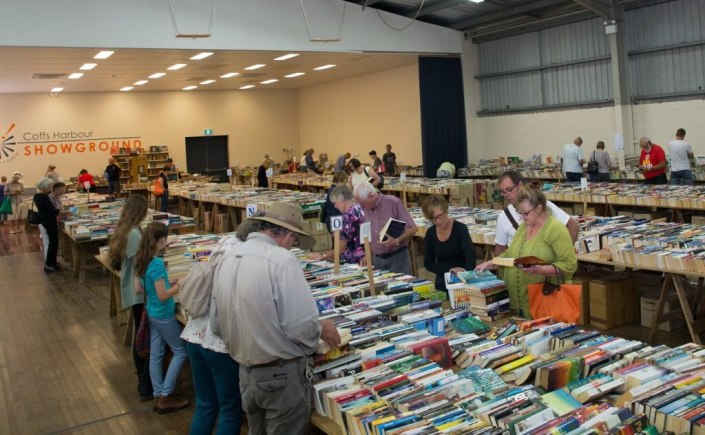
“At the Coffs Harbour Rotary Club’s annual charity bookfest”, I replied.

“Then you did the right thing”, he said.

“Your books will enjoy a new life. They will continue their work, giving pleasure and knowledge to new readers”.

I made that last bit up – poetic license, familiar to all book lovers.


© Paul Hemphill 2024. All rights reserved

Below are a selection of recent articles from the Sydney Morning Herald on the joys of books and of reading. The first is the story I referred to above. It illustrates beautifully how books lead you into imaginary worlds, or, as the author puts it, “the limitless wonderland of all I’ve read”. The second tells the story of the “street libraries” that have proliferated in recent years. Here on the Coffs Coast, there are shelves in in the two main shopping malls where folk can donate, swap or borrow books of all genres or simply browse whilst shopping, whilst there are several tiny libraries in our local towns of Bellingen and Urunga. The last considers the changing faces, forms and functions of public libraries. “These aren’t libraries your parents or older siblings may have visited”, the writer  observes. A visit to Coffs Harbour’s new, beaut library would confirm that.

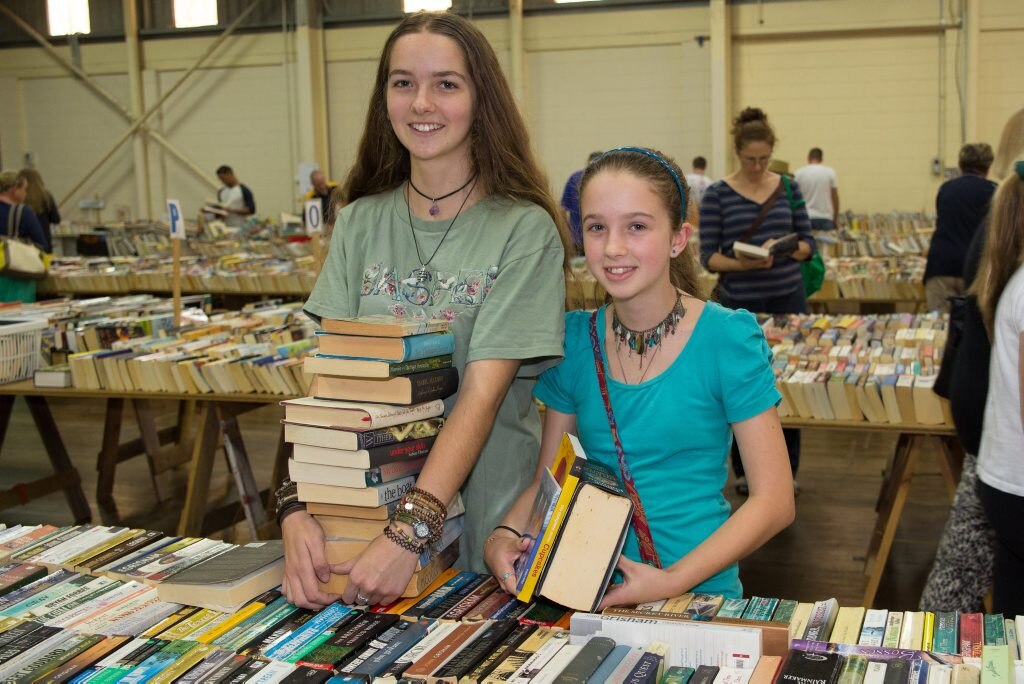
The featured image and that below are of the Coffs Harbour Rotary Club’s annual Bookfest, a hugely popular event on the Mid North Coast of New South Wales that raises thousands of dollars for Rotary’s charitable works. I’ve taken home some surprising “finds” in recent years.

Read also in In That Howling Infinite, Better Read Than Dead – the joy of public libraries

Coffs Harbour Rotary Club BookFest

Australia’s last reader was on my tram, travelling to another world

Anson Cameron, Sydney Morning Herald, June 28, 2024

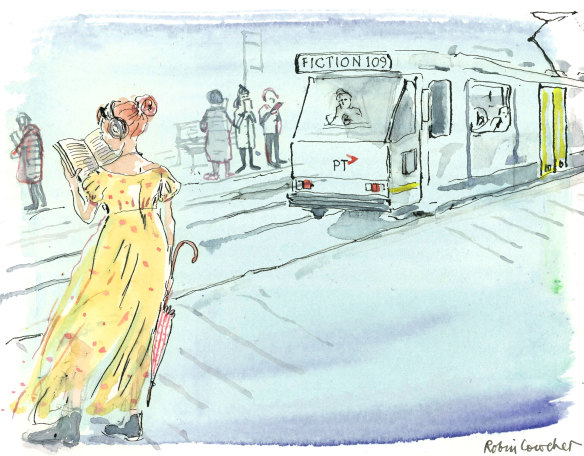
The last reader in Australia turns out to be a young woman. No surprise. John Logie Baird rendered men illiterate at a stroke when he invented the TV in 1926.

She sits on the 109 heading for Box Hill reading a paperback, her mind pincered and freed by noise-cancelling headphones. Look at her face – she is not here, she is there, in that world she and the author have agreed on. I can’t see the book’s cover – hence it is all books to me. It’s an Indian novel, an anthology of verse, a cavernous collection of short stories – it’s the limitless wonderland of all I’ve read.

She’s deeply engaged, attendant to the thousand tasks that go to running a fictional state. She is raising castles, razing San Francisco, riding a dragon or a night train, watching lords and ladies gavotte clockwise to chamber music, lying in a military hospital in Milan wounded and in love. But her face is frustratingly passive.

I’m waiting for her eyes to widen as Oliver Twist asks for more. I’m waiting for her to shake her head and hold the book out and stare at its cover and silently mouth the words, “Doris Lessing … girl, what the absolute f—?”

A block further on up Collins Street she nearly laughs, but catches herself, because … these 109 riders, these TikTokettes who surround her – they are not to know or understand that Quixote has taken his sword to puppets while believing them men.

If she is an assiduous reader, the young woman on 109, (and I believe she is: look at her bend to the page) she is accumulating stories, adding them to the library of self, becoming larger. She might become as large as all literature. She will, at any rate, have a voyager’s easy wherewithal among this society of the unread and unworldly, these cerebral homebodies, her fellow tram riders, these addicts stoned by the blizzard of micro-vids blowing from their phones.

Reading requires sharp neurological footwork. It is not a passive activity. Scans of the brain show areas of it are lit like aurora when you are reading. Imagining 1930s Maycombe, Alabama during the Depression, its streets and stores, its loungers and livery, is a mental workout that the cleavage vignettes on OnlyFans and the skateboard pratfalls of TikTok don’t require and can’t supply.

Rates of literacy were low before the printing press. Reading was confined to clerks, diplomats and priests – a tool-of-trade, and a skill as rare and dubious as clairvoyance. Guttenberg enabled the novel – a new handheld entertainment, a portable story for which you didn’t need a whole theatre – you could now hold escapades and hemispheres in your hand.

People now see reading as a quaint, historical diversion, a pastime for those who lacked more splendid options, a drag, something akin to needlepoint or whittling, a distraction for castaways and folk who got snowed-in for long winters without power, a hobby for paranoid misanthropes, abandoned widows and anti-social geeks – for Victorians, Edwardians and colonials. The citizens of the TikTok epoch think of libraries as a type of asylum.

Watching her read her paperback, this young woman on the 109, I know she is a juggler of empires, a traveller in limitless cities, is becoming wise in love, and steeped in tragedy’s lore, and, as well, is an addict of hilarity, and goes to sleep listening to orchestras play at unsuspecting ducal balls held on the eve of revolutions.

I also know she is the final ambassador sent by Australia to the country of Fiction to represent us there, to meet its ancient and vibrant people and assure its VIPs we love reading and will always be their allies. But this is mere diplomacy. It is not true. She will be the last visitor from here. That place’s splendours are undiminished, but superseded – and Australians do not go there any more.

Anson Cameron is a columnist for Spectrum in The Age and the author of several books, including Boyhoodlum and Neil Balme: A Tale of Two Men.

My street library was just a family project. What happened next, well, you wouldn’t read about it

Amy Adeney, Sydney Morning Herald, June 28, 2024

I’ll be honest – my motives for installing a street library outside my house were not particularly community-minded. At the time I was really into “projects”. We’d just finished transforming our swimming pool into a trout pond (yes, really), and I was looking for something new to keep my kids busy during the summer holidays. As a picture book reviewer, my bookshelves were overflowing, so a street library felt like a two-birds-one-stone solution.

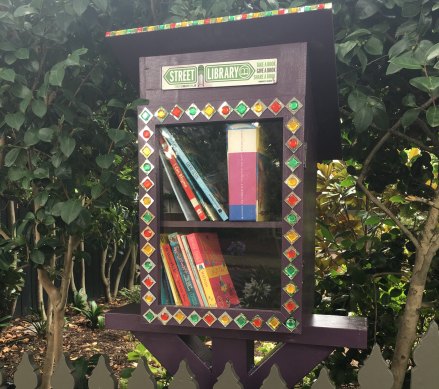
I’d heard about street libraries and noticed the occasional book box on side streets – but I didn’t know much about the movement, or how they worked. I purchased a large ready-made raw timber unit from the Street Library Australia website and got to work on the fun bit – bringing it to life. We chose a deep purple paint colour called Dumbledore and adorned the doorframe with mirrors and jewels.

Dumbledore the street library.
Dumbledore the street library

The website advises that it’s a good idea to give your street library a name, and Dumbledore felt perfect – a font of wisdom and knowledge, like the books that it would hold. When the paint and glue were dry, Dumbledore was glorious to behold, and once it was installed on a post behind our front fence with a bunch of books inside, I dropped a note in every letterbox on the street informing residents of the new street library. At that point I was ready to sign off – mission accomplished.

What came next was entirely unexpected. Notes and cards began to appear in our letterbox, thanking me for “adding a touch of beauty to our neighbourhood,” for initiating such a “fabulous venture,” and promising to add and swap books. The cards were mainly from strangers. We had lived in the house for six years but had never spoken to many of our neighbours.

Suddenly, we found ourselves striking up conversations with people as they browsed the library, chatting about books and offering recommendations. On days when the box was full, small piles of books would be left on our doorstep, to be squished into the shelves when there was space available.

Amy Adeney is a Melbourne-based children’s author and teacher. Her book, The Little Street Library, is published by Affirm Press.

The little library that has a 20 per cent chance of winning best in world

At Sydney’s Marrickville Library, you can get pizza delivered to your lounge chair or secret nook. Even better, you can eat it there or in the sunken garden while using the wifi.

In China, the 31,800 square metre New Ningbo Library is open 24 hours a day and will serve around 8000 visitors a day.

These two libraries are among five finalists announced last Friday for the International Public Library of the Year Award 2021 to be announced in August.

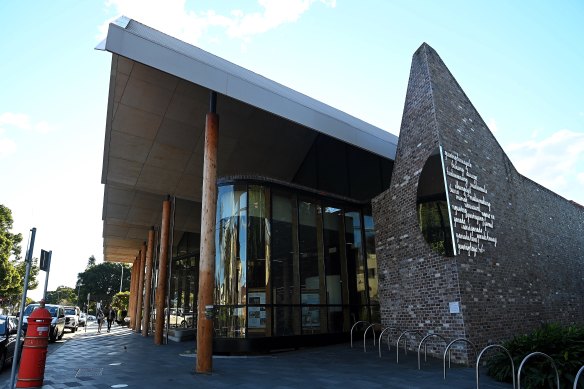
The Marrickville Library is in the running to win an international award for library of the year.
Marrickville Library. These aren’t libraries your parents or older siblings may have visited.
Another finalist, the new Deichman Bjørvika in Oslo Norway, includes a secret and hidden library for the future. The six-storey building has a gaming zone, secret rooms for children and views of the fjord. As well as borrowing from the collection of 450,000 books, locals can learn to sew or play the piano.

Its “Future Library” project has commissioned authors including Margaret Atwood to write novels that won’t be published – or even available to be read – until 100 years from now.

Oslo’s new library is called the library with a view.
Oslo’s new library is called the library with a view. Eric Thaulung

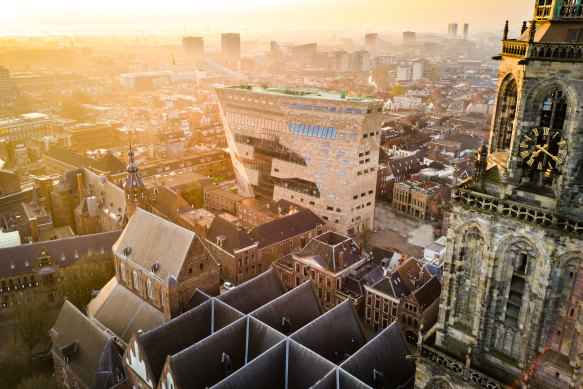
Another finalist, the library and cultural centre Forum Groningen in the Netherlands, is based on the Roman forum. And the Het Predikheren, the new library in Belgium, incorporates a Baroque monastery. It was described by judges as “poetic” with a sense of “mystique”.

Nearly all have cinemas, play and meeting areas and public spaces.

Even 20 years ago, many libraries were “supermarkets of books” with rows of dimly lit books, said Cameron Morley, the manager of public library services with the State Library of NSW.

Today’s libraries had a greater variety of nuanced spaces for different types of visitors with different needs and differing amounts of tolerance for noise. They had also made it easier to find items in the collection, he said.

Many libraries were now being designed with increased outdoor space where patrons could use the wifi but still be safely spaced, he said.

Marrickville Library, designed by architects BVN, has already won nine national architecture awards, three National Trust heritage awards and a NSW landscaping award.

Announcing the shortlist, the judges admired Marrickville’s beautiful adaptive re-use of the old Marrickville hospital. The floating canopy roof originates from the pitched roof of the existing building.

Since the announcement that the Australian library was a finalist for the international award, staff have been awed by the quality and size of the international competitors.

So what does Marrickville have that they don’t?

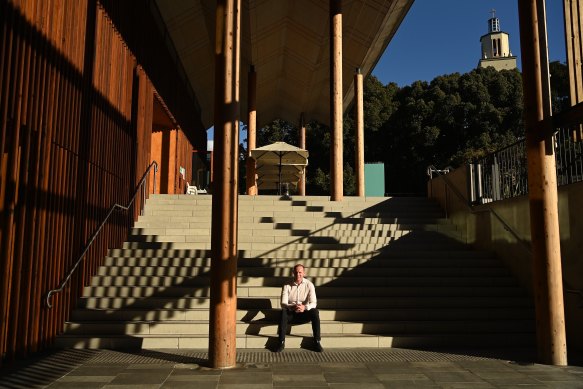
Heart, said Inner West council mayor Darcy Byrne. “It’s not just a library, it is the town square. It is the heart of Marrickville. It is such a lively place. There are so many young people coming in. It is not quiet or old or dead. It is lively and youthful.”

Inner West Mayor Darcy Byrne says the heart of the community found inside the Marrickville Library distinguishes it from its international competitors.
Inner West Mayor Darcy Byrne . Kate Gerachty

Last October, the 3600 square metre library had 53,000 visitors, including a record number of young people studying at university or the HSC. It’s become so popular that the council’s senior manager of libraries Caroline McLeod has had to place three orders for additional chairs.

SInce it opened in late 2019, visitors numbers have more than doubled. Many come for the day. “It’s a joyous thing to see how many people are in the library,” said Ms McLeod.

Ms McLeod said it might not have a hidden library like Norway’s. But it did “have secret spots or secluded spots where you can be alone”.

Ningbo’s new library is one of five finalists for the International Federation of Library Associations (IFLA) library of the year.
Ningbo’s new library is one of five finalists for the International Federation of Library Associations (IFLA) library of the year. Hammer Lassen Architects
Het Predikheren Library in Belgium was built to incorporate an old Baroque monastery.
Het Predikheren Library in Belgium,built to incorporate an old Baroque monastery. Stadmechelen
The Forum Groningen in the Netherland is competing against Marrickville’s library for best library in the world 2021.
The Forum Groningen, Netherlands is competing against Marrickville’s library for best library in the world 2021. Deon Prins

Arguments of Monumental Importance – statuary declarations

The past is another country – they thought things differently there; and if the past shapes the present, the present also shapes the past.  Arguments of Monumental Proportions – Fallen Idols

The defacing and destruction of monuments to dead and dubious white men is back in vogue – not that the practice has ever actually gone out of style. As The Australian’s Art columnist Christopher Allen writes in an article republished below, statues have been set up as monuments to great and not so great men and removed by their enemies for a very long time. Even without considering the many precedents in antiquity, countless statues were destroyed during the French Revolution, others during the mob violence of the short-lived “Commune” government in Paris in early 1871 – including the figure of Napoleon on the Colonne Vendôme – and many more under the Nazi occupation of Paris.

Then there is the tearing down the statues of tyrants in the fall of dictatorships, from the former Soviet empire to Iraq. In those instances, the state or a despot had set up multiple effigies all over the country as symbols of power and instruments of oppression, and they were overthrown in the collective movement of popular revolution.

To paraphrase Allen, portrait monuments proliferated in more recent times, particularly in the 19th century, as a consequence of increasing prosperity, patriotism or nationalism and local municipal pride. Monarchs, politicians, leaders of national unification or liberation movements, explorers and founders of new colonies, notable scientists and writers, philanthropists and other prominent citizens were commemorated in public statuary. Arguably, too many were raised; sometimes their subjects have lost the prominence they once had; or some of their deeds may now today be considered reprehensible. An argument could be made to relocate a statue to a museum instead, but such decisions ought not be taken lightly, especially if the justification for removal and relocation are ideological or made in response to online protests and vandalism.

in Arguments of Monumental Proportions – Fallen Idols, I wrote a while back:

As an Aussie and a Brit of Irish parents, and as a history tragic, I find the long running monuments furore engrossing. Statues of famous and infamous generals, politicians and paragons of this and that grace plazas, esplanades and boulevards the world over, and their names are often given to such thoroughfares. They represent in visual and tangible form the historical memory of a nation, and as such, can generate mixed emotions reflecting the potentially conflicted legacies and loyalties of the citizenry”.  

“It is”, I wrote, “about the control of history – and who controls it. We all use history, incorporating perceptions of our national story into lessons that guide or confirm our present actions and outlooks. Our history is written not only in scholarly narratives, but also, in commemorations, in statues, flags and symbols, in the stories that children are taught about their country and their community from their earliest school years, and in the historical figure skating they are taught to remember and honour. History, it is said, is written mostly by the victors – but not always. So, the inevitable tensions between different versions of the past fosters tension and conflict, and grievance and offense in the present. Particularly in onetime colonialist and settler countries, and the lands these once ruled and exploited … All sorts of emotions, hopes and fears lie behind our various creation myths. No matter the source of our different “dream-times” we are all correct in one way or another. People wheel out the wise old “blind men and the elephant” story to illustrate how blinkered we are; but in reality, if those blind men were given more time, they would have expanded their explorations and discovered a bigger picture”.

Which brings to recent events in Hobart, in our most southern state and one of Australia’s earliest colonies and the location of many of many bloody atrocities in Australia’s Frontier Wars, and to Allen’s article which tells the tale of a nineteenth century public figure whom very few Australians have heard of and of his illicit trafficking in the remains of a decease indigenous man. 

Read also In That Howling Infinite another story of the British Empire’s sticky fingers: Bringing it all back home – the missing mosaic and other ‘stolen’ stuff  

Felling Crowther’s statue is not the way to right a historical wrong

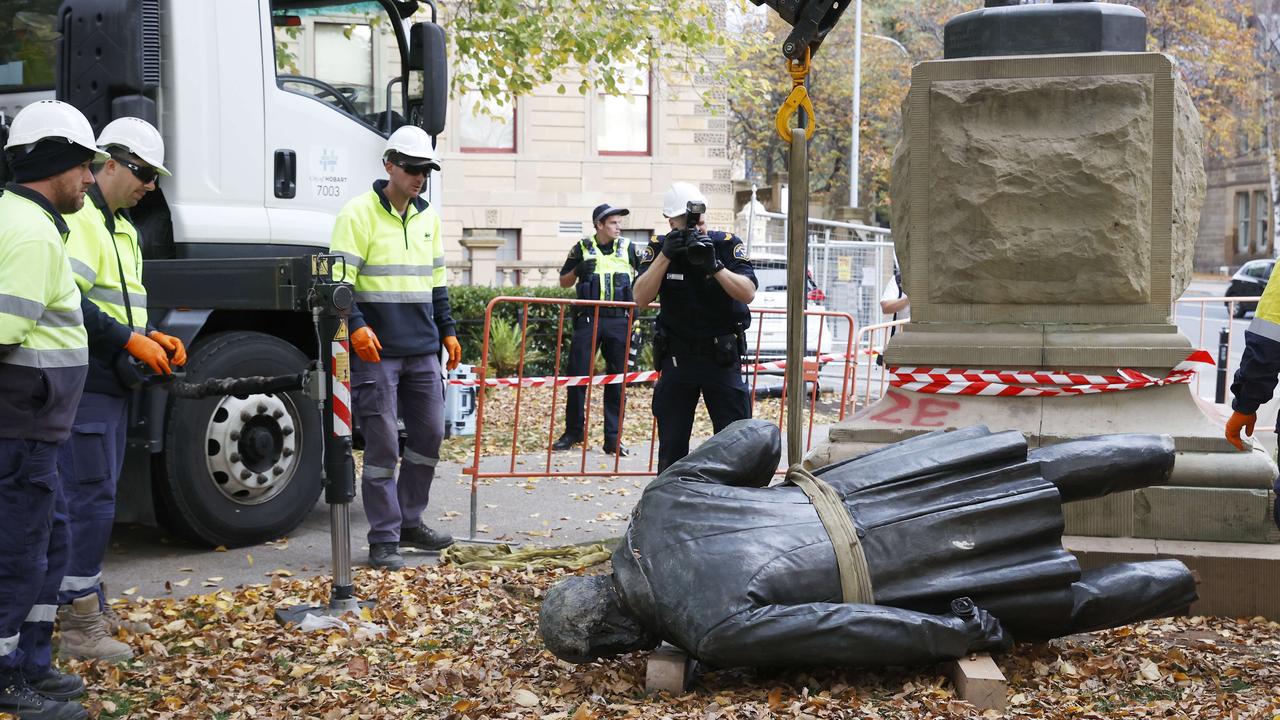
The William Crowther statue in Franklin Square Hobart was vandalised in May 2024. Picture: Nikki Davis-Jones.

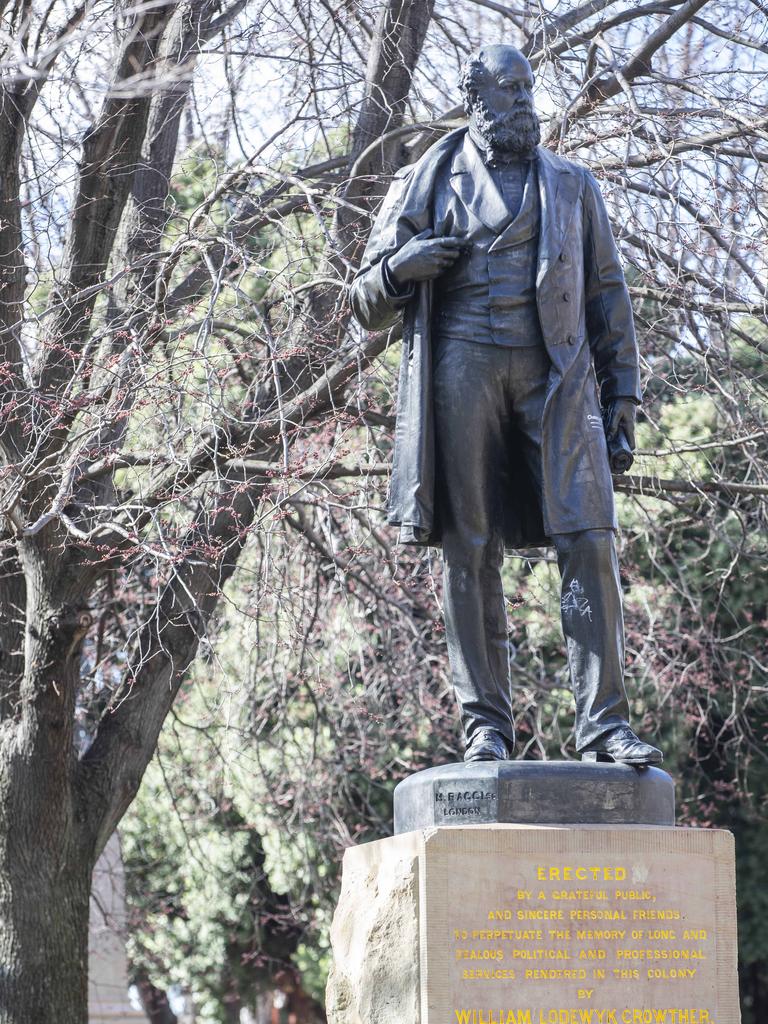
William Crowther’s statue, Franklin Square Hobart, May 2024. Nikki Davis-Jones.

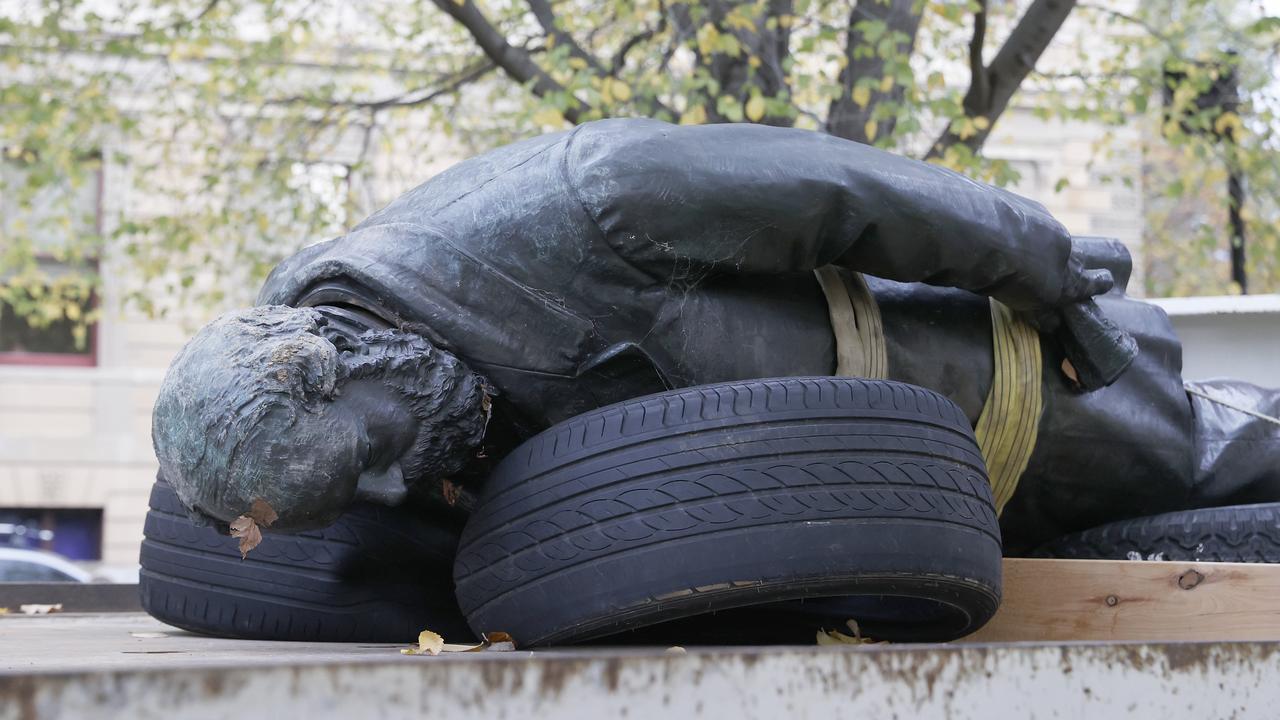
No doubt many people, regardless of their political orientation, were disturbed by the recent news that a civic statue had been vandalized and destroyed under the cover of night by an anonymous gang of attackers in Hobart. The event was all the more shocking because the city council had already determined to remove the statue from its public location following controversy about the actions of the individual it celebrated.

This kind of attack, to be quite clear, has nothing in common with tearing down the statues of tyrants in the fall of dictatorships, from the former Soviet empire to Iraq. In those instances, the state or a despot had set up multiple effigies all over the country as symbols of power and instruments of oppression, and they were overthrown in the collective movement of popular revolution. In this case an individual monument to a respected citizen, erected by the community, was destroyed by a small group of zealots.

Statues have been set up as monuments to great men and removed by their enemies for a long time. Even without considering the many precedents in antiquity, countless statues were destroyed during the French Revolution, others during the mob violence of the short-lived “Commune” government in Paris in early 1871 – including the figure of Napoleon on the Colonne Vendôme – and many more under the Nazi occupation of Paris.

Statues have not always been effigies of individuals; some of the most beautiful Greek sculptures were simply of the ideal body; others represented divinities, as also in Christian, Buddhist or Hindu traditions. Portrait sculpture began in the Hellenistic kingdoms and flourished in the Roman period. After the fall of the Empire, and with the decline of all the arts, no sculptural likeness was made for a thousand years. The Renaissance rediscovered portraiture with enthusiasm, both in painting and sculpture, and over the next few centuries portraits of monarchs and other leaders became common in big cities.

Portrait monuments proliferated in more recent times, particularly in the 19th century, as a consequence of increasing prosperity, patriotism or nationalism and local municipal pride. Not only monarchs but prominent politicians, leaders of national unification or liberation movements, explorers and founders of new colonies, notable scientists and writers, philanthropists and other prominent citizens were commemorated in public statuary. Often these adorned and helped to shape the new public parks laid out for the enjoyment of populations in great modern cities.

Arguably too many of these monuments were put up, and sometimes the individuals in question have lost the prominence they once had; or some of their deeds may now be considered reprehensible. In certain cases an argument could be made to relocate a statue to a museum instead, but such decisions should not be taken lightly, especially if the grounds for removal and relocation are ideological, or made in response to the digital mob behaviour of social media.

The felled William Crowther statue in Franklin Square Hobart. Picture: Nikki Davis-Jones

The case of William Crowther (1817-85) is an interesting one. He was a member of a prominent Hobart family of doctors and natural historians, including his own father and then his son and grandson who enjoyed distinguished careers in medicine, science, war and politics over the following century. He was an expert surgeon, a keen natural scientist and an entrepreneur with important shipping and whaling interests, as well as a member of the colonial parliament and briefly premier of Tasmania. Less than four years after his death, a statue was set up by public subscription to honour an eminent fellow citizen.

Crowther is controversial because of his alleged, and it seems fairly certain, involvement in a grisly, if scientifically motivated, affair in 1869. Darwin’s great book On the Origin of Species had only appeared a decade earlier, in 1859, and scientists were eager to understand more about the comparative morphology of different human families. Tasmania held a particular interest because the Indigenous Tasmanian population differed considerably from the mainland people.

By those years, however, over a generation after the end of the Black War (1824-31), very few individuals of unmixed Tasmanian descent survived, and just one male: William Lanne (c. 1836-69) – sometimes given as Lanney or Lanné – who worked as a whaler, was well-known in Hobart, and had even been introduced by the governor to Prince Alfred, the Duke of Edinburgh in 1868. When he died of cholera in 1869, he was buried at Saint David’s Church in Hobart, where Prince Alfred had just laid the foundation stone for the present Saint David’s Cathedral (consecrated in 1874).

Lanne’s funeral was a solemn occasion, attended by a large number of Hobart citizens. The Hobart Mercury reported (March 8, 1869): “Having been duly sealed, the coffin was covered with a black opossum skin rug, fit emblem of the now extinct race to which the deceased belonged; and on this singular pall were laid a couple of native spears and waddies, round which were twined the ample folds of a Union Jack, specially provided by the shipmates of the deceased. It was then mounted upon the shoulders of four white native lads, part of the crew of the Runneymede, who volunteered to carry their Aboriginal countryman to his grave.”

Behind the scenes, however, there was a struggle to secure a “perfect” Tasmanian skeleton for scientific research; the Royal Society of Tasmania, founded in 1843 and the first Royal Society outside Britain, wrote to the government, and according to the same article in the Mercury, “The Government at once admitted their right to it, in preference to any other institution, and the Council expressed their willingness at any time to furnish casts, photographs, and all other particulars to any scientific society requiring them. Government, however, declined to sanction any interference with the body, giving positive orders that it should be decently buried.”

The William Crowther statue as it was. Picture: Chris Kidd

The William Crowther statue as it was. Chris Kidd

On the night before the burial, nonetheless, someone stole Lanne’s skull from the morgue, as the article goes on to relate: “The dead-house at the Hospital was entered on Friday night, the head was skinned and the skull carried away, and with a view to conceal this proceeding, the head of a patient who had died in the hospital on the same day, or the day previously, was similarly tampered with and the skull placed inside the scalp of the unfortunate native, the face being drawn over so as to have the appearance of completeness.”

Crowther was suspected of having carried out this mutilation because he had wanted the skeleton to go to the Royal College of Surgeons in London. The Royal Society, concerned that the rest of the body might similarly be stolen, then removed the hands and feet, partly to render the remaining skeleton less attractive to thieves. They also alerted the governor to the need to guard the grave against possible robbery, and while this was agreed on, it seems that the Hobart municipality failed to arrange watchmen; the grave was opened on the night after the funeral and the skeleton removed, leaving behind the skull that had been inserted into Lanne’s head.

It is not entirely clear who was responsible for these events, although it seems to be generally assumed that Crowther sent Lanne’s skull to the Royal College of Surgeons, who awarded him a gold medal and a fellowship. His entry in the Australian Dictionary of Biography (1969) states: “In 1860 he was appointed one of the four honorary medical officers at the Hobart General Hospital, but was suspended in March 1869 over charges of mutilating the body of William Lanney, the last male Tasmanian Aboriginal. An inquiry showed that two mutilations had taken place, the first at the Colonial Hospital, the other at the cemetery the night of the burial. Drs Crowther and G. Stokell, resident medical officer at the hospital, were suspected of the first, the Royal Society of Tasmania of the second.”

Whatever the truth, the story is gruesome, a window into another time and a world of which we can be highly critical but from which there is also much to learn. Perhaps it would have been preferable to move the statue to the Tasmanian Museum and Art Gallery, where it will no doubt now be transferred and where it can be accompanied by displays that explain what we know about the events surrounding Lanne’s death and burial.

Simply cutting the statue down, however, closes off the opportunity for reflection; erasing the traces of the past may offer short-term satisfaction, but in the long run it encourages forgetting rather than remembrance and reflection. Is it not better to understand this episode and ponder its implications than to bury it under self-indulgent slogans like “decolonize”, which was scrawled on the statue’s base?

The most fundamental principle in this and similar cases, however, is the protection of public space in a democratic society. In a figurative sense, it is imperative to protect the public space of free discourse and open debate. Today that space is more than ever under attack from ideologues of different political orientations who seek to suppress or silence those who disagree with their views.

We saw recently the attempt by a city council in the west of Sydney to ban a book on same-sex parenting; but we could equally have seen another group trying to ban a book critical of the same arrangements.

Freedom of speech means accepting that those who disagree with you have a right to argue their case.

The preservation of freedom of discourse and debate is harder than ever in the digital age; this may seem paradoxical, since social media ostensibly allows everyone to express their opinions more promiscuously than ever before. But in practice that expression is quickly drawn into various competing maelstroms in which people vie to agree with each other ever more vociferously.

The same kind of mechanics endanger the physical public spaces of the modern city, the streets and squares and parks which are shared by all its citizens and residents. This public space must be one of order and peaceful process, where people can live and work and socialise in security and as much as possible in an environment of harmony.

The public space is one of lawful communal process. If, in this case, a monument is put up by the community, any decision about moving it must also be taken by the community (albeit in a different time and context)..

It is as unacceptable for a self-appointed gang to destroy a public monument as it is for selfish residents to cut down trees that block their view or greedy developers to demolish a heritage building for commercial gain or looters to smash a shopfront during a natural disaster. We must be unequivocal in our condemnation of the violation of common space in a democratic society.

The Forest Wars – myths, spin and bare-faced lies

What are the roots that clutch, what branches grow
Out of this stony rubbish? Son of man,
You cannot say, or guess, for you know only
A heap of broken images, where the sun beats,
And the dead tree gives no shelter, the cricket no relief,
And the dry stone no sound of water.
TS Elliot, The Wasteland

This murky world of (the state-owned forestry industries) is at best ignorant and self-interested and at worst sinister and corrupt. Its most cynical manoeuvres involve aggressively logging forest as soon as there is a movement for its protection. Another is co-opting First Nations groups under the guise of “forestry gardening” or “cultural thinning”. Here, business-as-usual logging becomes “healing Country”, an attempt to “blackwash” a calamitous PR image … Attempts to regulate have been underfunded and politically compromised … ‘if everyone is losing, why does it continue? When the answer arrives, it is depressingly banal: government capture by vested interests.
Professor David Lindenmayer

There is little that surprises in the following review of Forest Wars by environmental scientist David Lindenmayer.

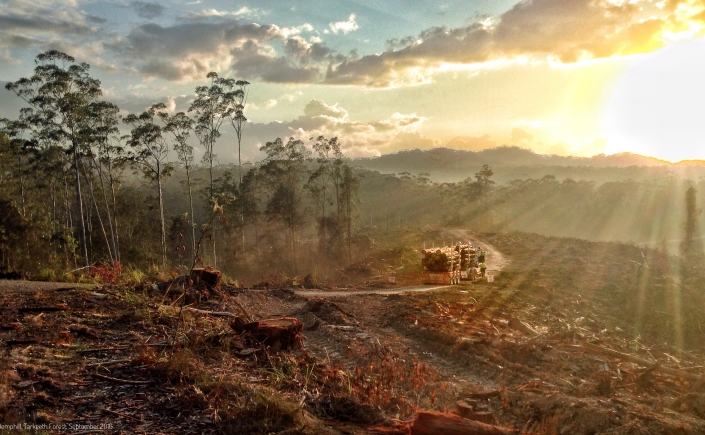
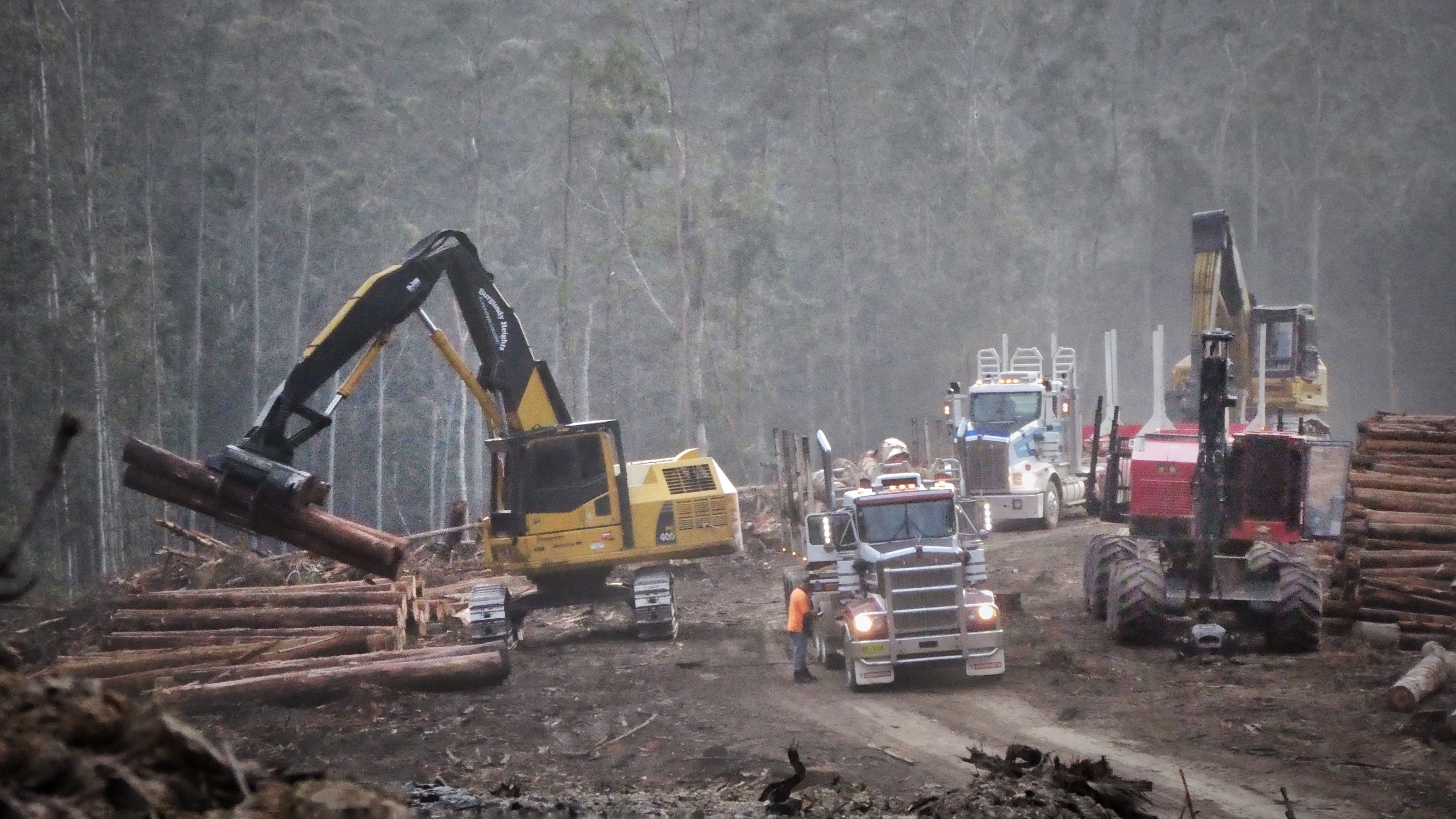
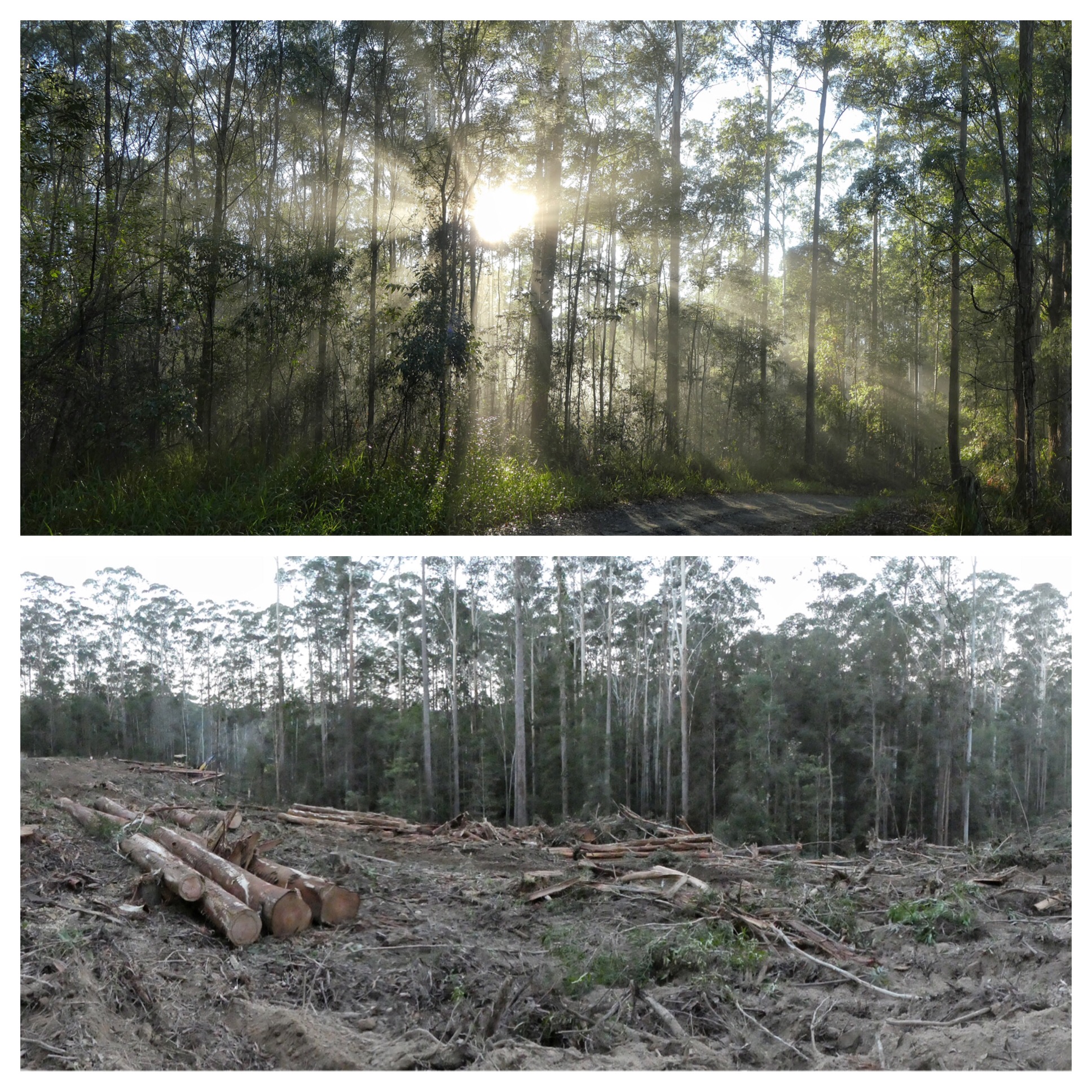
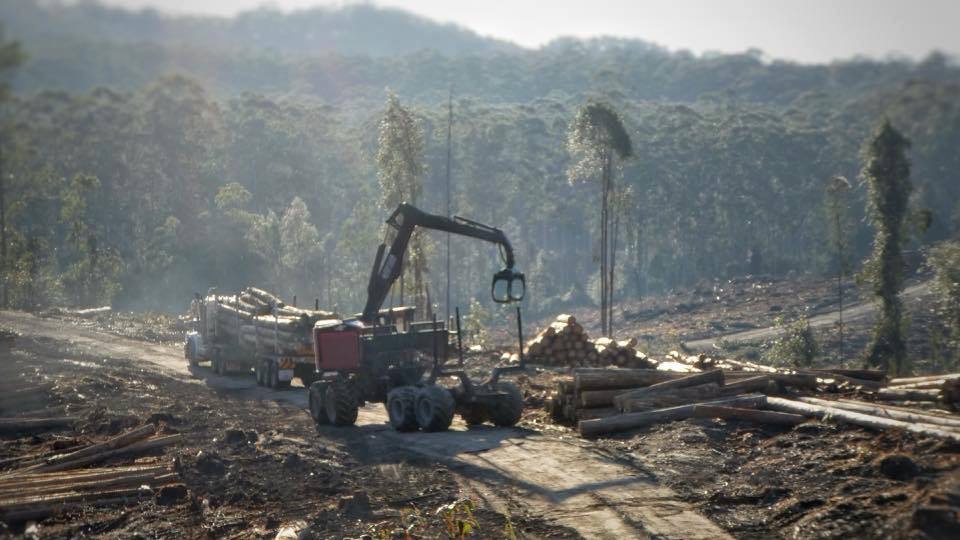
Eight years ago, In That Howling Infinite published If You Go Down to the Woods Today describing what was then happening to the forest in which we live. As logging has intensified throughout the mid-north coast over the last year, things have not changed, but rather, have gotten much, much worse. 

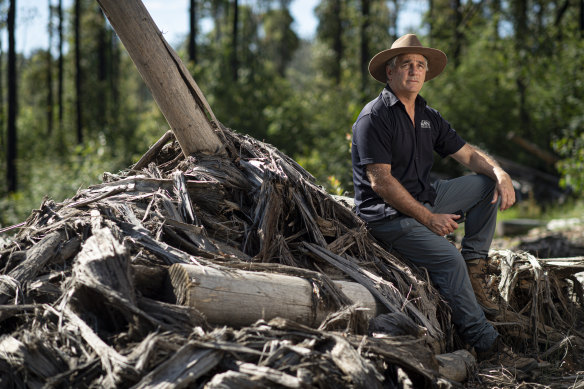
As we survey the desolation and devastation of state forests on the mid-north coast of New South Wales, we bear witness to his words at first hand. For years now we have witnessed the destruction of our ecosystems and critical wildlife habitat by large scale, broad acre industrial logging as harvesters as large as battle tanks camp upon the land like an occupying army. Forestry Corporation NSW’s operations on the Coffs Coast and its hinterland has left us and our precious ecosystem at the mercy of what is by any account a destructive and seemingly unaccountable extractive industry.

See also in In That Howling Infinite’s  Losing Earth series:

“Like an occupying army”


Tarkeeth morning, And Tarkeeth evening.
What a difference a day makes

Myths, spin and outright lies: the truth behind the logging industry

Kurt Johnson, Sydney Morning Herald 7th June 2024

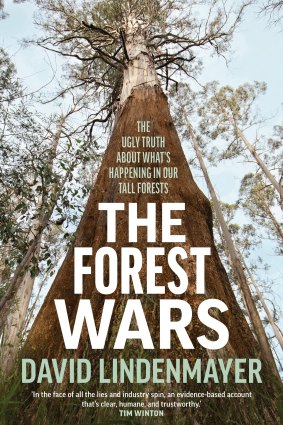
The Forest Wars, by David Lindenmayer (Allen & Unwin 2024)

It was once possible to walk the 1500 kilometres from Melbourne to Brisbane enclosed in native forest. Today Australian forests have been pushed to the margins, surviving as scattered islands, logged around and through. In most states this continues, enabled by expedient myths about forest’s resilience and replaceability that have become entrenched in popular wisdom. These range from “logging is good for fire safety” to “wildlife can simply scuttle away to another tree as soon as one is felled”.

Renowned scientist David Lindenmayer confronts these fables that he was educated on as a young student in his latest offering, The Forest Wars. He is concerned with native forest, which provides a range of benefits beyond forest plantations. Tall, wet eucalypts in particular are not only habitats for native wildlife but are more resistant to fire, better sinks for carbon and can conserve clean water for cities.

Many myths rely on a neoliberal lexicon where native forests are “resources”, or “green capital” and logging can be “sustainable”. It assumes the fungibility of nature, as if one tree were as good as another. The author explains that native forests are complex ecosystems that have developed sometimes for hundreds of years, with ancients that cannot simply be bulldozed and replanted by saplings in another cycle.

Forest Wars begins with its author tracking wildlife, trudging around wet eucalypts and through mossy gullies, but soon evolves into a sustained and righteous tract as we follow him up the production line to the sheer waste at the heart of the enterprise. Another myth: old-growth forest will end as fine furniture. In fact, only four per cent becomes sawn lumber and half of that is used for beer pallets. A whopping 60 per cent is lost as waste, with most wood taken from the forest simply pulped for paper and packaging.

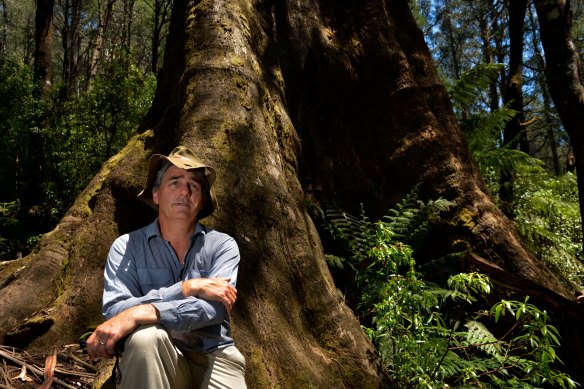
Scientist David Lindenmayer in Healesville.
David Lindenmayer in Healesville. Michael Clayton-Jones

The economics surrounding the destruction of native forests are obscene. State-run enterprises are loss-running, essentially charging taxpayers to destroy their own native forests. VicForests, for instance, has only once reported a profit, while Forestry Tasmania lost an eye-watering $1.3 billion in the decade from 1998. Over the years they have survived on generous loans from state treasuries that will never be repaid, with expenses that include settling lost court cases, and, in the case of VicForests, hiring a private investigator to spy on the author. “Melbourne is not Moscow,” Lindenmayer states.

This murky world is at best ignorant and self-interested and at worst sinister and corrupt. Its most cynical manoeuvres involve aggressively logging forest as soon as there is a movement for its protection. Another is co-opting First Nations groups under the guise of “forestry gardening” or “cultural thinning”. Here, business-as-usual logging becomes “healing Country”, an attempt to “blackwash” a calamitous PR image.

Attempts to regulate have been underfunded and politically compromised. In one instance the author meticulously investigates violations of logging boundaries and gradient guidelines, then submits the analysis to regulators, only to have his findings contradicted. Through an FOI request he discovers their results are nearly identical to his, entering a Kafkaesque netherworld.

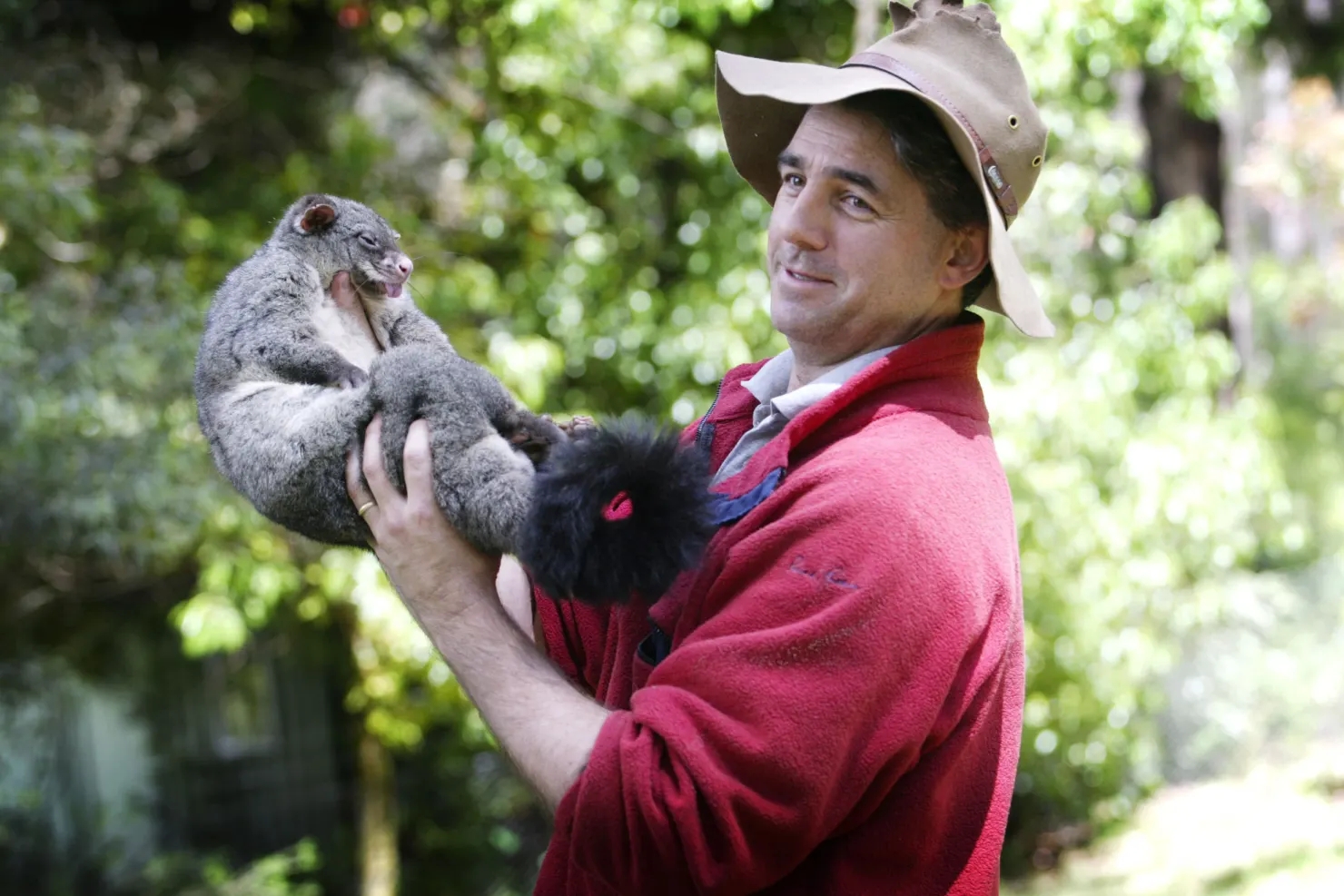
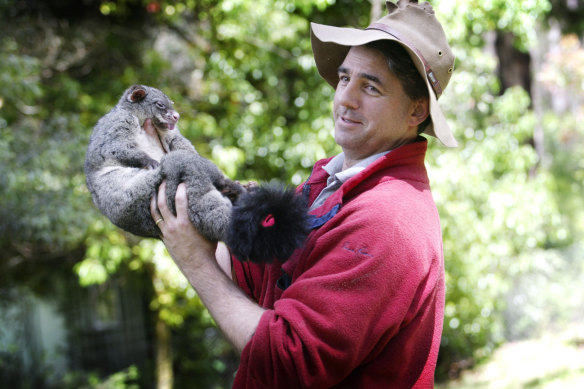
Lindenmayer with a mountain brushtail possum, 2004. Rebecca Halas

The most pressing question is left to the final chapter: if everyone is losing, why does it continue? When the answer arrives, it is depressingly banal: government capture by vested interests.

To lift us from our funk, Lindenmayer offers an invigorating alternate universe. Here forests are protected and valued. They provide habitat for endangered native species, income through carbon sequestering and tourism as well as jobs in management and conservation – far more than heavily mechanised logging provides at present.

As one of the most referenced researchers, Lindenmayer is a world-renowned scientist. Yet again he demonstrates that he is also an excellent science communicator. The book’s 37 myths are mostly treated soberly and, with the aid of diagrams, dispel many popular misconceptions without a hint of condescension. The reader will permit the author wandering from hard science to rhetoric to sum up in the final myths.

I found I was more comfortable in the forest’: The scientist who took on the logging industry

To be honest, the conversation did not begin promisingly.

Everything else was going well. I managed to get there on time and Professor David Lindenmayer was waiting out the front with a cheery grin. He had suggested we go for fish, but not too fancy. I had proposed Fich, which I’d heard was good – a takeaway joint adjoining a smart seafood restaurant in Sydney’s inner west.

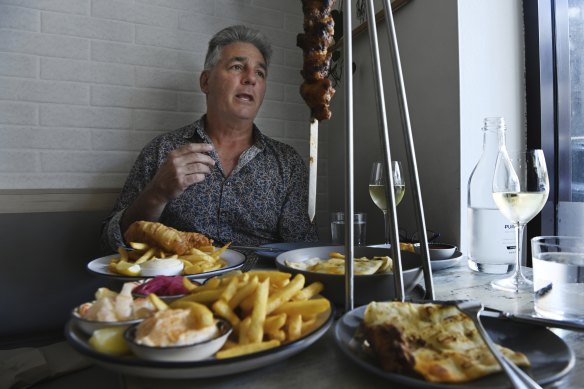
David Lindenmayer at lunch at Fich.

David Lindenmayer at lunch at Fich.Kate Gerachty

He looked neater than you’d expect from a bloke famous for the years he has spent deep in Australia’s oldest and wettest forests and for finding his way into the political heart of the sprawling battles fought over the industries that depend on cutting them down.

Tasmanian salmon is admired by conservationists about as much wood chipping is. The problem is, Lindenmayer explains with the sort of detail you’d expect from a scientist that the salmon are raised in great big floating pens in places like Macquarie Harbour.

There, he says, great clouds of fish poo sinks, sucking the oxygen and life out of the surrounds. Native species like the Maugon Skate, already threatened, are pushed towards extinction.

He explains that these salmon-farming fish-poo death clouds can also contain tiny parasitic worms called nematodes. A quick Wiki session later in the afternoon informs me that nematodes can be found in half the world’s population and that having travelled into space in the payload of the space shuttle Columbia, they are the first known life form to survive a virtually unprotected atmospheric descent to Earth’s surface.

Lindenmayer might be famous as (for a time) the nation’s single most-cited scientist (93,500) for his work on forests and regenerative farming, but he began his career in the water, and before that, he began to explore the natural world with his father, Bruce.

“He was a very, very difficult man to talk to,” recalls Lindenmayer when we get to the scallops.

The old man worked as a rocket scientist at the Woomera missile range and in Melbourne, helping to develop rockets and the propellant that would drive missiles into space or between continents. Eventually, disturbed by the machines’ violent potential, Bruce gave up the work and retrained as an economist.

Around this time, father and son began spending more time together, birdwatching in the bush. Men, says Lindenmayer, communicate better side-by-side, looking out at something rather than towards one another. “No bloke says, ’Let’s go and look at the sunset; they say, ‘let’s go fishing’.”

David Lindenmayer with a mountain brushtail possum in 2004.

Lindenmayer with a mountain brushtail possum in 2004. Rebecca Hallas

And so another world began to open somewhere between them. It was not just about what they saw but what they heard. Beside his father, Lindenmayer learned that the sounds birds made could reveal not just what species they were but what sex they were, what they were doing, and what was bothering them.

Those quiet moments resonated.

In the late 1970s, at school in Melbourne and then Canberra, Lindenmayer became a useful athlete, even playing for a graded football team in the Netherlands. Within a year, he realised he was not going to make it.

“I was a goalie. Everyone in the Netherlands has the perfect physique for a goalkeeper. I didn’t. I realised my hands are smaller than Donald Trump’s.” (First noted in the wild by Vanity Fair editor Grayden Carter, Trump’s small hands became a thing during the 2016 election.)

On his return to Australia, Lindenmayer dived into ecology, studying marine biology in Townsville and apprenticing himself to the famous reef ecologist Dr John “Charlie” Veron, the man who would become known as the “godfather to the corals” for his work in building the first expansive and accurate taxonomy of the Great Barrier Reef.

Lindenmayer volunteered on some of that world-leading work, trailing behind Veron underwater in Scuba gear, helping to gather and carry Veron’s coral samples. “He must have spent 10,000 hours underwater,” says Lindenmayer, who spent hundreds of hours in the sea with his mentor. He was calm, and he used less air than anyone. He must have had a set of gills or something. His breathing was incredible.”

Lindenmayer’s was not. “I found that I was more comfortable in the forest rather than in the water. I learnt I could see more in the forest than I could underwater,” he explains. “I didn’t have to concentrate on breathing.”

Our mains have arrived. Lindenmayer has ordered fish and chips and I have opted for a fish skewer. His plate lands like proper fish and chips should. The batter has erupted volcanically around the flesh, and the chips are holding up in the heat. My fish comes in spiced cubes impaled on a fat metal skewer hanging on its own scaffolding over a warm bed of flatbread, attended bowls of pickles and sauces.

It looks much like the famous beef and pork you get at Silvas, the famous old Portuguese joint a block up the road.

Reading Lindenmayer latest book (his 49th), The Forest Wars, you don’t get any sense of comfort. Lindenmayer’s description of his early work in the 1980s building a scientific baseline of how species like the Leadbeater possum, “the sweet-faced faunal emblem of Victoria”, use their habitat trees reads as deeply unpleasant.

The young scientist hauled bundles of traps and equipment, a tall ladder over one shoulder, deep into the dense understory of wattles and ferns, fallen logs and moss of Victoria’s central highlands to set traps, one for every 50 metres of forest. He soon discovered that the possums were “feisty and lighting fast” with a bite. By day’s end, his neck was garlanded with leeches, and in the shower, the water ran red “like a horror movie”.

He immediately fell in love with the work.

Lindenmayer’s work in those forests overturned how modern Australia understands them. When he began in the field, he believed, like everybody else, that trees would rejuvenate endlessly after their logging. His research shows the ecosystems they support are simply lost when they are felled.

His work reveals that rather than protecting us from fire, selective logging removes trees, drying forests out and creating highways for the infernos of the modern era. It has also shown that the animals that live in towering old trees do not move on from logged areas to reestablish themselves elsewhere but die in them when they are cut down.

Professor David Lindenmayer in a native forest near Currawon.

David Lindenmayer in a native forest near Currawon. Wolter Peeters

To establish this, Lindenmayer and the teams he has worked with over 40-odd years spent thousands of hours in the forests.

They sat in silence, watching the animals they had carefully caught, radio-tagged and released – birds, gliders and possums – return time and again to the same hollows high in the bows of the old mountain trees.


Killing for Country … dark deeds in a sunny land

… they were standin’ on the shore one day
Saw the white sails in the sun
Wasn’t long before they felt the sting
White man, white law, white gun
Solid Rock, Goanna 1982

As indigenous author and academic Victoria Grieves-Williams writes below in her essay regarding journalist David Marr’s recently published family history: “We live in a time of reckoning over the colonisation of the land mass that we now know as Australia. While British officials carefully avoided acknowledging that people existed on this continent prior to their arrival by adopting the infamous doctrine of terra nullius, many Australians are now re-examining the historical basis of their presence here. They know that they enjoy the material wealth and lifestyle of the lands they have come to call home and until recently there was no need to doubt, or be self-conscious, about Australia being “home”. Yet there clearly were people here, and it was only the idea of an empty country that made it possible for agents of Empire, such as the Uhr brothers, ancestors of the journalist David Marr, to go about attempting to empty it”.

I’ve written often about the indigenous history of our country. The following passage from my piece on Australia’s The Frontier Wars. This passage therefrom encapsulates my perspective:

”There is a darkness at the heart of democracy in the new world “settler colonial” countries like Australia and New Zealand, America and Canada that we struggle to come to terms with. For almost all of our history, we’ve confronted the gulf between the ideal of political equality and the reality of indigenous dispossession and exclusion. To a greater or lesser extent, with greater or lesser success, we’ve laboured to close the gap. It’s a slow train coming, and in Australia in these divisive days, it doesn’t take much to reignite our “history wars” as we negotiate competing narratives and debate the “black armband” and “white blindfold” versions of our national story”.

Below are pieces published in In That Howling Infinite in regard to Australian history and politics as these relate to Indigenous Australians:

Healing country key in David Marr’s awful family history of murder and mayhem

Victoria Grieves Williams, The Weekend Australian. 16th March 2024

Journalist and biographer David Marr with Indigenous leader Noel Pearson in 1997.
                      David Marr with Indigenous leader Noel Pearson in 1997

We live in a time of reckoning over the colonisation of the land mass that we now know as Australia. While British officials carefully avoided acknowledging that people existed on this continent prior to their arrival by adopting the infamous doctrine of terra nullius, many Australians are now re-examining the historical basis of their presence here. They know that they enjoy the material wealth and lifestyle of the lands they have come to call home and until recently there was no need to doubt, or be self-conscious, about Australia being “home”.

Yet there clearly were people here, and it was only the idea of an empty country that made it possible for agents of Empire, such as the Uhr brothers, ancestors of the journalist David Marr, to go about attempting to empty it.

Thus, settler colonials are having to come to terms with the fact that their ancestors were often murderous, criminal and racist, to what we may now understand as absurd and totally unnecessary lengths. And if they were not actually involved in these dirty deeds they were condoning them and even cheering them on. There were voices of dissent, but few are in the historical record. It is a ghastly story.

It is hardly surprising that Marr is now at the forefront, telling a family story about one of his great great grandparents and siblings that truly angers him. He has said that researching and writing this history is “partly an act of atonement and partly an act of rage”.

Marr is palpably angry. The book is written with an urgent passion, brave in what it reveals and unforgiving in the light it casts on bloody deeds.

I can only echo all that reviewers and commentators have said about this book. As Richard King said in his review (The Australian, October 13, 2023, republished below)this is “a magnificent achievement and a necessary intervention, on a subject that still divides Australia: the violent dispossession of its native peoples”.

It is what we have come to expect from a master journalist and storyteller who has a brilliant track record in publishing. The research is thorough and in this Marr was assisted by his partner Sebastian Tesoriero who connected with the joys of Trove, the online historical newspaper database. The search for the deeds of the Uhr brothers and the bloody swathe they and the Black Troopers cut through northern NSW and up through Queensland and into The Gulf country during the 19th century is satisfyingly forensic.

The aim of my essay is to place the book Killing for Country: A Family Story in the context of a process of truth telling. There is no doubt about the truth and veracity of this argument, that the frontier was a place of bloody mayhem and murder. Many Aboriginal people have always known this; the more naive of us have known at least since the early 1980s, with the publication of Geoffrey Blomfield’s groundbreaking Baal Belbora: The End of the Dancing and Henry Reynold’s important work, The Other Side of the Frontier.

What is left is to find a way to deal with this history in the best way possible, so as not to exacerbate social tensions and negatively impact race relations. My contention is that this is indeed a family story, to be resolved at that level.

On finishing reading the book I was left with the question: “What now?” What do we do with this awful history of murder and mayhem, the rage and need for atonement?

The first thing is to understand these events as history in a deeper sense, that is within a larger historical frame. Perhaps then we can understand what it is telling us of the true nature of human beings. This is the approach evident in Aboriginal cultural understandings of time and the ways in which conflicts are resolved.

Killing for Country, by David Marr


Victoria Grieves Williams is an Indigenous academic based in New York.
                                          Victoria Grieves Williams 

Historians are now recognising that the colonial wars unleashed from the 16th century onwards are the first of the Great Wars. The death toll was immense: the Spanish conquest of the Americas from the 16th-18th centuries has an estimated death toll of 28 million. The British Empire, which held 24 per cent of the Earth’s total land area by 1920, wrought an estimated death toll of 100 million people. It was by far the largest empire in history and a source of great pride for those who tied their fortunes to it.

One could say that it was the fashion. Colonial wars were fought by European powers over the Indigenous people of the global south, not only in Australia but in Africa, Asia, South America and Mexico, India and China. The aim was to dispossess, enslave, destroy and claim all of what these people had of value, for the Empire. They were enormously successful.

No small part of this success is due to the specific kind of white masculinity that enabled the bloody conquest, that seemed to relish the lawless frontier and the opportunity to prove oneself.

This specific masculine ideal of violence as normative was nurtured and fostered as a part of the imperial ambitions of Britain, and thus built into colonial culture and politics. The workings of what the anthropologist Rita Laura Segato refers to as the masculine mandate whereby the libido is conscripted into providing constant proof that one truly is a man was the order of the day. Subservience to the masculine mandate is for both men and women the only way to exercise any power “power is expressed … exhibited and consolidated, as virile potency in a brutal form”.

Thus arises the pedagogy of cruelty through which Segato names all of what is manifest on human bodies to reduce them to things – violence, terror and cruelty.

In interviews, Marr has been emphatic that the people of the killing times are the same as those of today. It is my view that they are separated by huge social, cultural and political gaps and contexts that shape them. This has been a long debate in sociology, is it nature or nurture that produces certain kinds of people? In the case of settler colonial masculinist ideology, the society back in Britain was often shocked by the excessive violence of the frontier. They sought ways to curb them. Perhaps some realised they were a necessary evil and continued to fund and support them.

An Invasion Day ceremony held in Kings Domain park in Melbourne. Invasion Day ceremony held in Kings Domain park in Melbourne

However, Marr has a point about the unchanged nature of people over time when you consider the murdered and missing Aboriginal women and children in Australia. For example, the crimes of the serial murderer Richard Dorrough against Aboriginal and Pacifica women. He, who perversely wanted his crimes to be known, can be seen as subservient to the masculinist mandate. There are many other perpetrators. The phenomenon of murdered and missing Aboriginal women and children is evidence of the continuation of the gendered conquest and pedagogy of cruelty in contemporary Australian society.

To enlarge on the macro view, the huge death toll in all of the worldwide wars since the 16th century has not seemed to make a dent on the continuing overpopulation of the Earth. We need to consider that huge hordes of Europeans moved out to the global south because they could not continue to live in home countries that were already overpopulated. The 18th century saw famines and food riots in Britain and France.

The colonial wars and subsequent mass migrations were a result of the very pressing need to find other lands on which to grow food and be able to live, as well as the search for the bounty that these lands could offer in timber, animal and mineral resources. While the idea of Manifest Destiny propelled settlers in North America, settlers in Australia were not untouched by this and also had the idea of an empty continent – therefore those who were there beforehand were not legitimate, had no rights, were not truly human.

And still yet – what now?

It’s important to understand that the way people see history, utilise it or deal with it varies according to cultural approaches. Aboriginal cultural understanding has it that our ancestors beyond the last two generations (that are usually in living memory) go back into eternal time where they are part of the paradigms for the proper human behaviour on Earth, also known as the Law. These paradigms are accessed through stories that are often attached to constellations and landforms. Eternal time is ever-present, it is here “running along beside us” enabling a connection through eruptions of eternal time into the present.
Eternal time then is connected to normal time in which we live, this is the “everywhen” that is often used to describe Aboriginal understandings of time. It is more than that, it is known as tjukurpa by Central Australian Anangu, and by other names elsewhere. Altogether it is the sacred, that is more easily accessed when in the state between dreaming and wakefulness. Hence the misnomer, the Dreaming.

David Marr.
David Marr.

If the Law is transgressed then people have to be held to account for their actions and the aim of a full and frank hearing is for people to be able to continue to live together in a good way. All involved are given an opportunity to speak their truth and an appropriate punishment is decided on and meted out. Once resolved, settled, these matters are never spoken of again. It is considered that the business is finished.

So, what now? The Yoorrook Commission in Victoria defines truth telling as the act of telling true history by listening to the experiences of First Peoples.

Marr has written this book as a contribution to the truth-telling process and this is, as he says, a family story. It holds the key to the important connections and relationships that can grow out of meeting with the “other” side. There are many descendants of the survivors of the killing times in north Queensland who have their own stories to tell. In some places the notorious Darcy Uhr is still in living memory.

What remains is for the Uhr family descendants to reach out and begin to make connections across the divide of a brutal history, for which no-one alive today is responsible or culpable, but for which we can feel deep regret and seek to heal the bonds that bind us as human beings. Our lives will all be so much better for it.

Victoria Grieves Williams is an historian and Warraimaay woman whose mother worked as a cook and housemaid at sheep stations at Brewarrina. She is based in New York

Killing for Country book review: examining the Native Police’s violent dispossession of Indigenous Australians

Richard King, The Australian. October 13th 2023

Young guns: journalist David Marr listens to lawyer Noel Pearson speak during 1997 National Law Week Forum meeting. Marr has this week released his latest book on his own family’s links to Indigenous massacres.

Running to almost half a thousand pages, prodigiously researched and immaculately written, David Marr’s Killing for Country: A Family Story is surely one of the books of the year. Modestly described as a “family story”, it is in fact as solid a work of history as one could hope to find on the shelves. Clearly, the book holds enormous significance – enormous personal significance – for its author. But Marr brings the same forensic approach to this narrative of the frontier wars as he did to his celebrated biography of Patrick White, to his monographs of Tony Abbott and George Pell, and to his indispensable account of the Tampa/Children Overboard affair and Pacific Solution, Dark Victory.

It is a magnificent achievement, and a necessary intervention, on a subject that still divides Australia: the violent dispossession of its native peoples.

It was the discovery that his great-great-grandfather had served with the Native Police that set Marr off on this bold endeavour. The son of Edmund Blucher Uhr, scion of a poorly connected family with pretensions to Irish nobility, Reginald Uhr and his brother D’arcy were both officers in this notorious outfit, which cleared land of its Aboriginal owners at the behest of the squattocracy, avenging attacks on farmers’ livestock and “dispersing” troublesome gatherings. “Dispersing” was a euphemism, of course, but so too was “police”: as even contemporaries understood, the NP was a quasi-military unit, not a tool of law enforcement. It’s estimated that over 60 years it murdered more than 10,000 people (Marr says a “cautious interpretation” of these figures has seen estimates rise from 10,000 to 20,000 and now to more than 40,000).

The NP began its campaign of killing in the Darling Downs in 1848, but its brutality reached its feverish peak as it moved north in the 1860s, in the wake of Queensland’s break from New South Wales. Its campaigns were characterised by a basic asymmetry, as the belligerents in the frontier wars operated according to different principles: the Indigenous peoples saw themselves as redressing grievances through evening up the score, while white retaliation was inordinate. A pattern quickly established itself. Colonial expansion led to Indigenous resistance, which led in turn to further dispersals. Notwithstanding that these acts of violence were often met with disapproval by the colonial authorities, the indulgence shown towards them was baked in, in a way that gives the lie to the idea that the NP was dispensing justice. The reality is that it was clearing the land of black bodies.

Killing for Country by David Marr is about the author’s great-great-grandfather, who served with the Native Police, which cleared land of its Aboriginal owners, often by murdering them.

This picture is complicated by the fact that the NP comprised units of eight to ten such bodies under the command of a single white one. But in Marr’s telling, this organisational structure was something of a genius-stroke, in that it drew on the multinational nature of the Indigenous population and on the profound connection to place – to country – that characterises Indigenous society in general. As he puts it:

“What made them strange and dangerous to each other was being away from their own country, the country that made them who they were. Here was a deadly conundrum. While officially denying their attachment to land, colonial authorities would rely on that profound attachment – and the divisions it provoked – to raise a black force that would strip them of their country.”

Such an arrangement also allowed the NP to characterise the murdering as what a US Republican might call “black on black” violence. The recruitment of Aboriginal men gave white officers a handy alibi when questioned by their superiors.

Why would the killers need an alibi? The question may sound ridiculous, but conservative history warriors who criticise histories such as these, will often suggest that their authors are guilty of projecting modern values backwards (this is the so-called “black armband” charge). But what emerges from these grisly pages, and from the accounts of the contemporary outrage directed against the clearances, is a picture of a system of “justice” founded on a gargantuan hypocrisy – hypocrisy being the compliment that vice implicitly pays to virtue. In other words, many of the men in this “story” knew full well that they were involved in an immoral undertaking, and commentary that attempts to downplay this reality is, itself, unhistorical. This is not to say that the picture is simple: history is a tragedy, not a morality play. It is simply to agree with the author that if it is possible to feel pride in one’s country, it should be possible to feel ashamed of it too.

Author and journalist David Marr adopts an even, controlled tone for his devastating new book. (Picture: Lorrie Graham)

Marr does not make a show of such feelings. In his television appearances, he will often adopt the sort of demeanour that (I imagine) sends conservatives round the bend: the more-in-sorrow-than-in-anger eyes; the casual, cruising exasperation at the politics he doesn’t share, and is, therefore, self-evidently preposterous. But here the tone is even and controlled. One notes the slightly ironic adjectives and the occasionally sardonic descriptions. (“He recruited blacks as guides. He also shot blacks who stood in his way. Somerville was a genial and unscrupulous gentleman of the warrior class.”) But in general he lets the material speak for itself. Goodness knows, there’s plenty of it. As Marr notes – again, a little sardonically – one good thing about the colonists is that they wrote plenty of fine letters home.

The attitudes evinced in those letters, or the language in which those attitudes are couched, will no doubt distress most contemporary readers, and it would be vacuously polemical to assert that nothing’s changed. It has. Nevertheless, it is the achievement of this book to invite us to reflect on the many connections between contemporary Australia and its bloody past. That past is not a foreign country. It just speaks in thicker accents than we are used to.

Richard King is an author and critic. His most recent book is Here Be Monsters: Is Technology Reducing Our Humanity? (Monash University Press)

Killing for Country: A Family Story
By David Marr
Black Inc, Nonfiction
$39.99; 468pp

A bridge from past to present – the forgotten memoirs of Alice Duncan-Kemp

We lost so much when the old people went. No one else wrote down what they had to say and the chance to preserve their knowledge and wisdom died with them. Without Alice’s passion, without her parents being open to our culture all those years ago, we would know a lot less today about our language and traditions. For us, she is a bridge to both the past and present.  Mithaka elder Lorraine McKellar

The seed of my knowledge, of that corner of sand-hills, was implanted within me as a mere babe straddling Mary Ann’s hip, or toddling with little black mates after the billy-cart. In later youth the seed grew and fruited. The secret lay in a profound respect for the aborigines (sic) and their customs. In return, these trusty folk taught me to read, with wonder and pleasure, in Nature’s Infinite Book of Secrecy, the reading of which was as simple as ABC to them”.

These are quotations from an illuminating feature article in The Weekend Australian on the forgotten memoirs of Alice Duncan-Kemp, describing her childhood on a remote station in south west Queensland almost a century ago, in which she vividly describes her first contact with indigenous Australians.

Whether it is the stories she tells, or the manner in which she tells them – or even the language and syntax she uses, her work dividing today’s experts.

Predictably, the shadow of Bruce Pascoe’s Dark Emu looms large. The debate over who the First Australians were and how they lived prior to contact was picked up in the Voice campaign – prominent No advocate Jacinta Nampijinpa Price bitingly referred to the “Pascoisation” of Australia’s pre-settlement history when arguing that the intergenerational effects of colonisation had been overstated. Pascoe says that Duncan-Kemp deserves all the belated attention and more. “She suffered from being a woman outside the academy,” he tells The Weekend Australian Magazine. “Her work was judged with unnecessary harshness by white male ethnographers. There are flaws in her work but compared to most ethnographic work of the time it is enlightened.”

But, veteran anthropologist Peter Sutton, co-author of a searing 2021 book rebutting Dark Emu, “insists Nash is right to raise questions about Duncan-Kemp’s reliability when she “mixed memory with plagiarism from works about quite different regions”. Sutton is critical of the weight being placed on her books by ­researchers who claim to be “testing Pascoe’s theories” on the ground. “Archaeologists and others who rely on those works for Mithaka traditions, in the absence of proper investigation of them, are in danger of mistaking Duncan-Kemp’s descriptions for Mithaka traditions when they may in fact not be,” he says”.

Notwithstanding these academic polemics, the story as described in the article is a beautiful one. It is republished below. The reader may take whatever he or she wants from it. Austrian novelist and Nobel laureate Peter Handke Has written, “if a nation loses its storytellers, it loses its childhood.“ One thing is for certain in this uncertain world : we all love a good story. As they say, in Arabic, as indeed in all tongues, times and places, “ka-n ya ma ka-n bil ‘adim izzama-n wa sa-lifi al aSri wa la-wa-n”‘ or, “once upon an time”.

Storytelling has played an important role in the evolution of society. Storytellers were the keepers of our memories, our culture, our history. Indeed, are a storytelling species. We think in story, talk in story, and admire those who keep and spread our stories.

Most of the familiar faces have gone, gone to Malkuri, their god – into shadow time … The homesteads seem so utterly dead without old-time familiar sounds, corroborees, and the merry laughing chatter … To walk or ride about the sand-hills and swamps today is like entering a house suddenly emptied of children. Silence, where before there had been laughter and the merry pitter-patter of baby feet; a desperate loneliness which can be felt but is hard to describe.

I’ll leave the last word to none other than Tyrion Lannister:

What unites people? Armies? Gold? Flags? Stories. There’s nothing in the world more powerful than a good story. Nothing can stop it. No enemy can defeat it.

Author’s note

I’ve written often about the indigenous history of our country. The following passage from my piece on Australia’s The Frontier Wars.This passage therefrom encapsulates my perspective:

”There is a darkness at the heart of democracy in the new world “settler colonial” countries like Australia and New Zealand, America and Canada that we struggle to come to terms with. For almost all of our history, we’ve confronted the gulf between the ideal of political equality and the reality of indigenous dispossession and exclusion. To a greater or lesser extent, with greater or lesser success, we’ve laboured to close the gap. It’s a slow train coming, and in Australia in these divisive days, it doesn’t take much to reignite our “history wars” as we negotiate competing narratives and debate the “black armband” and “white blindfold” versions of our national story”.

Read more In That Howling Infinite on Indigenous history:

Read more in In That Howling Infinite on the Indigenous Voice to Parliament, 2023:

‘Improbable tales’: trailblazing historian’s Dark Emu moment

The forgotten memoirs of Alice Duncan-Kemp vividly describe first contact with indigenous Australians almost 100 years ago. So why is her work dividing today’s experts?

Copies of Alice Duncan-Kemp’s memoirs. Picture: Lyndon Mechielsen

Copies of Alice Duncan-Kemp’s memoirs.  Lyndon Mechielsen

It’s hard not to be enchanted by the lost books of Alice Duncan-Kemp when they resonate so deeply with the nation Australia would become. A photograph of her, on a winter’s day 90 years ago, shows her tapping out her childhood on Mooraberrie station, a speck in the red dirt of southwest Queensland’s far-flung Channel Country. The story of boom and bust in the bush, of hope given over to despair, of cattle dying of thirst one day and drowning the next in a frothing flood, is as old as the Outback ­itself. We know it by heart.

What sets Duncan-Kemp apart – and why the rediscovery of her work is causing a stir in academe and out in the field where scientists use it like a “road map” to unlock the secrets of how the First Australians lived – is the detailed and partly disputed account she provides of the contact era. A voice like hers was rarely heard at the time: ­admiring of the tribal ­Aborigines she grew up with, heavy of heart for a way of life in its death throes. Recalling the Aboriginal nanny who helped raise her on the family beef run, 1200km west of Brisbane, she wrote in 1933:

The seed of my knowledge, of that corner of sand-hills, was implanted within me as a mere babe straddling Mary Ann’s hip, or toddling with little black mates after the billy-cart. In later youth the seed grew and fruited. The secret lay in a profound respect for the aborigines (sic) and their customs. In return, these trusty folk taught me to read, with wonder and pleasure, in Nature’s Infinite Book of Secrecy, the reading of which was as simple as ABC to them.

Duncan-Kemp’s name and oeuvre – running to five out-of-print volumes and many more unpublished manuscripts – was forgotten by all but her family until a new generation of Australian historians dusted them off. Tom Griffiths, of the Australian National University, was 14 when he chanced across her second book, Where Strange Paths Go Down. He loved it, inspiring a lifelong passion for her work. Decades later the W.K. Hancock Professor of History would extol “the exciting truthfulness of her memoir – one tinged by innocence and nostalgia and prey to the glitches of memory, but faithfully told. A precious possibility emerges that Alice’s books comprise one of the richest ethnographic sources Australia possesses”.

University of Queensland archaeologist ­Michael Westaway began tracking down the scenes and places she described. There were dead-ends, of course. (“Alice was a bit airy-fairy on distances,” her grandson Will explains.) But in instance after instance, 21st-century technology and old-fashioned legwork confirmed her observations. Traces of sizeable Indigenous villages were found where she said they had been; a thriving trade in the narcotic pituri leaf did indeed span the length of the great inland ­rivers, from northwest Queensland to Kati Thanda-Lake Eyre, just as she described it; the jarra-jarra millstones she saw Aboriginal women sweat over to grind grass seed and other bush “grains” came from vast quarries dotted across the nearby desert; rare medicine plants continued to flourish in the out-of-the-way spots she had documented.

“It’s a bit like following the Iliad to find Troy,” says Westaway, referring to Heinrich Schliemann’s 1870 feat to unearth the ruins of the fabled city in Turkey through clues in Homer’s text. “You know … we’ve been able to go through what she wrote and test it as a hypothesis: here’s a site or activity or plant she mentions, so let’s go and find proof of it.”

But some things haven’t changed. The critics are still at it, chipping away at Duncan-Kemp’s credibility. Take this 1961 review of book three, Our Channel Country. “Mrs Duncan-Kemp ­proceeds to unfold improbable tales of her childhood which dwarf most previous ‘tall ­stories’ of the outback,” the Sydney Morning Herald’s man sniffed. “It is impossible to take many of them seriously.”

These days, the carping is couched in more academic terms. The revival of interest in Duncan-Kemp engaged serious people in serious research that underpinned a successful Native Title claim by the Mithaka people of southwest Queensland in 2015. At the same time she was quoted approvingly by Bruce Pascoe in his polemic Dark Emu, which challenged the ­orthodoxy that Aborigines were “hapless” hunter-gatherers prior to European settlement and argued that they had developed the makings of an agricultural society. That willing skirmish, as we will see, has spilled into the reappraisal of Alice Duncan-Kemp’s work and legacy and in turn the national debate over the Voice, with its denouement at today’s referendum.

Linguist Dr David Nash has picked apart her writing phrase by phrase. An honorary senior lecturer at the Australian National University’s School of Literature, Language and Linguistics, Nash compiled dozens of examples of her ­appropriating Aboriginal vernacular and plagiarising text from other writers. “Users” of her work need to be wary, he cautions.

Cooper Creek in Queensland’s Channel Country wasn’t even explored by Europeans until the 1860.

Cooper Creek in Queensland’s Channel Country unexplored by Europeans until the 1860s

Will Duncan-Kemp is a keeper of the flame, carefully tended in a two-bedroom cottage in Toowoomba cluttered with his grandmother’s manuscripts, papers and family memorabilia. Bearded and full-bellied, the retired geologist, 66, wouldn’t look out of place in the sepia-tinged photos we’re looking through. He points to a faded image of Alice and her sister, Laura, as young women, standing beside a flooded river, backs to the camera, about the time she started on her debut book, Our Sandhill Country. “It was a hard life out there,” he says quietly.

Then as now, the vast chameleonic landscape on the edge of the Simpson Desert defied the efforts of mere mortals to tame it. The region, cut by intermittently-running rivers such as the Diamantina, Thomson, Barcoo and Cooper Creek, wasn’t even explored by Europeans until the 1860s; Burke and Wills would have approached the western boundary of Mooraberrie on their ill-fated trek through the interior. The pioneering Durack family settled there before embarking on a cross-continental cattle drive to open up the Kimberley in 1883. When Alice’s father, William Duncan, ­arrived eight years later to manage the 93,000ha station, ­violence with the Mithaka clans was still an ever-present threat. Native Mounted Police ­detachments – death squads in all but name, ­according to the ANU’s Griffiths, made up of Aborigines from outside tribal groups under the command of a white sergeant – would roam the Channel Country terrorising the black population.

Occasionally the young warriors would strike back and spear an unlucky squatter, unleashing a fresh round of bloodletting. The Mithaka refused to lie down. In her celebrated memoir Kings in Grass Castles, Mary Durack captured the raw brutality of late colonisation, citing the settlers’ belief that far southwest Queensland would only be made safe when the last of the Indigenous inhabitants had been killed off, “by bullet or by bait”.

Still, some graziers were sympathetic. What became known as the Debney Peace was ­brokered by a friend of William Duncan in 1889, ending the vicious frontier war. Scottish-born Duncan was himself an enlightened figure among the hard-nosed settlers, well-read and deeply interested in the emerging science of ethnography. After securing the leasehold to Mooraberrie, he would refer to the Aborigines as his “landlords”, making them welcome on the property. Alice, the second of the couple’s four children, became “twice born” at the age of two during a midwinter drama on a raging Bulloo River. Negotiating the flood in 1903, her father had slammed their horse-drawn buggy into a semi-submerged tree, nearly overturning the carriage. Then a heavy bough crashed down on where the infant lay swaddled, gravely injuring a harnessed colt. Somehow, Alice emerged unscathed. The astonished black stockmen accompanying them, Wooragai and Bogie, lit a ceremonial fire and started up a chant: from then on, she would be the reincarnation of a spirit sacred to the Aborigines.

Moorabberrie in 1939, courtesy of William Duncan Kemp.

In due course, she was initiated and given the name Pinningarra, or leaf spirit. But there were limits even for her open-minded parents. Duncan put his foot down after the red-hot stone tip of a naming spear was drawn across the little girl’s chest, leaving a welt. There would be no more ritual scarring, he insisted. But for the rest of her life, Alice wore the faded mark above her heart with immense pride, a visible link to the Mithaka.

The death of her father in a riding fall when she was six reinforced their role as her second family. Between showering her with affection, Mary Ann Coomindah – Bogie’s wife and the sisters’ nanny, who possibly breastfed them as infants – taught her to see the world through different eyes. Years later, Duncan-Kemp would write of the day Mary Ann took her on a long walk through the bush with Laura and ­little Beatrice. (Their older brother, David, had died of diphtheria aged four.) They were hours from the homestead when the sky clouded over. Mary Ann sniffed the air and told the children a wildfire was bearing down on them. Hurry! Their only chance was to get to Teeta Lake, 2km away. Running through the reed beds, they were overtaken by Indigenous families and wildlife fleeing to the shallow water. Mary Ann ushered the frightened girls into the deepest part of the lake, leaving only their heads exposed, shielded from the radiant heat and falling ash with strips of wet bark and sacking – and when that failed, with her own body. Leading the children home, testing every step to make sure the scorched ground was safe, the selfless woman said nothing of the second-degree burns she had incurred. Instead, she whispered to Alice: “This is our country, missee.”

You can only shake your head at how the ­settlers clung to their heavy British clothes and customs that were as out of place as could be in this remote corner of the Outback. One ­summer, Duncan-Kemp would write, the ­thermometer hovered between 123F and 125F (50.5-51.6C) for three endless days and nights. Her mother, now managing Mooraberrie on her own, hung blankets set in tubs of water across the doorways and windows in an attempt to cool the place down.

The homestead was built of pale anthill clay, the 60cm thick walls paired with 3.6m high ­ceilings. Drinking water was hand-drawn from an outside tank; what was needed for cooking, laundry and personal care came from the waterhole at the back, past the open-sided kitchen shack that was washed away the year Farrar’s Creek erupted. Regardless of the outside temperature, meals were prepared in enervating proximity to the wood-fired range; well into the 20th Century, carbide-powered lamps lit the living spaces after dark.

Alice Duncan-Kemp at home in Toowoomba, west of Brisbane, using a typewriter to record her memoirs.
Alice Duncan-Kemp’s wedding pictures taken in 1922.

Alice Duncan-Kemp’s wedding pictures taken in 1922.

Young Alice would sit on the canegrass ­veranda listening to the stockmen talk of epic ­cattle drives and the characters they met along the way; for the women, life was a drudgery of caring for children, cooking and housework. The nearest town, Windorah, lay 210km away across the empty blacksoil plains. Yet where other Europeans saw arid desolation, Alice perceived beauty and the promise of renewal; when they complained about the heat and the interminable, all-consuming waiting for rain, she enthused about “one of the healthiest ­climates” going, dry and clear unlike the “clammy” coast, in the “great heart of Australia stretching away for hundreds of lonely miles beyond the Cooper, Diamantina, beyond Birdsville, Bedourie and Alice Springs; destined yet, with the advent of railways and population, to pour out through countless channels a hidden wealth that will command wonder and envy”.

Yet to the Mithaka, the world was held in Yamma-coona’s net, tethering every living thing by invisible silken threads to a mythical witch. Yamma-coona held court with the spirits of the trees and the air beneath a needle bush, while her left hand spun the lives of people. Those who strayed too far felt a tug at the heart that made them ache for home. Her net, the blue sky, was set in the morning; at night, the spirits drew it in and gathered the souls of the dead, Alice recounted.

At first the bush frightens and repels; the loneliness of the open spaces, lack of companionship, the hardships, dangers and privations, seem too big a price for so little a gain. Then by degrees the bush awakens interest; the open spaces begin to have a magnetic charm all of their own; the ‘bush sense’ develops. At last, it holds men’s souls in an iron clasp that relaxes only with death. The woman wizard makes magic and entangles them … spinning, spinning, always spinning her net until the strands of her captives’ lives run out.

Along with her sisters, she spent most of World War I at boarding school and then worked on another station as a governess. On returning home, she married a bank clerk, Fred Kemp, but was adamant she would preserve the family name to become Alice Duncan-Kemp. They moved from post to post in southwest Queensland with Fred’s bank, raising cattle and sheep on the side. But Duncan-Kemp, by now a softly-spoken woman in her thirties, busy with her own family, never let go of her childhood with the Mithaka. As a girl, she had always jotted her thoughts down in a notebook and now she began writing her memoir in longhand, ­typing and retyping drafts until she felt ready to approach a publisher, Griffiths discovered.

Our Sandhill Country, completed while she was staying at Mooraberrie with Laura, who’d taken over from their mother, was released in 1933 by Angus & Robertson and did well enough to be reprinted. But Duncan-Kemp wasn’t finished yet, not by a long way.

Scattered over the river-flats and highlands maybe seen the remains of humpies, circular impressions where a one-time humpy stood with earth scooped out and piled around the back and sides to form a moat or drain for river waters; yerndoos, or cracking stones, where they cracked their shell food before or after cooking; jara-jaras, or large sandstone grinding slabs, some with elaborate hieroglyphics and carvings upon them; stone chisels and bluestone tomahawks; burnt-out clay ovens; charcoal ridges in the soil that denote middens and the dead ashes of many campfires; a few battered wooden or flint weapons; old wooden coolamons and smaller pitches corroded by age and sands; mounds of red and yellow ochre, in chalky slices of lumps mixed ready for some long forgotten corroboree; glittering mounds of crab and mussel shells bleached white by sun and winds – are all that remain to record the passing of the original owners of this bushland. To anyone who troubles to read them, these mute records unfold a poignant story.

Michael Westaway made it his business to absorb just about every word Duncan-Kemp had published. The 52-year-old archaeologist reached out to Griffiths in 2017, keen to recruit him to what would become a multifaceted exploration of the region’s pre-colonial history. Supported and guided by Mithaka elders, field teams comprising dozens of scientists and support staff from three universities have been busy excavating sites and cataloguing native plants identified through her writings. What they found partly vindicates the Dark Emu ­theory that Aborigines developed village-like settlements and technology beyond that of ­nomadic hunter-gatherers. Westaway, however, stops short of Bruce Pascoe’s contentious conclusion that they were early agriculturalists who behaved much like subsistence farmers the world over to till the soil, sow crops, irrigate, and build dams and permanent stone homes, their lives rooted to a single spot.

Associate Professor Michael Westaway. Picture: Lyndon Mechielsen
Jennifer Silcock holds a specimen of trichodesma zeylanicum (commonly known as camel bush) which was located at the Mooraberrie-Morney Plains boundary. Picture: Supplied
Jennifer Silcock holds a specimen of trichodesma zeylanicum (
(camel bush) at the Mooraberrie-Morney Plains boundary
y. 

The reality, he believes, was more nuanced. An ever-changing landscape, never far from those extremes of feast or famine, demanded mobility and quick-stepping adaptability for these people to survive, let alone thrive. In the absence of written records – rock art and artefacts such as stone tools or weapons can only say so much when there was no textual ­language, Westaway says – the observations of the explorers and first settlers are critical. Sadly, detailing their experiences, if any, with Indigenous populations wasn’t a priority for most of them. This is where Duncan-Kemp comes in. She grew up only a generation removed from the fraught contact period in the Channel Country, schooled by Mithaka teachers still steeped in the ancient ways. “She provided a ­diverse social history of these communities at a time when they were basically disintegrating, when all of this accumulated knowledge of the country, traditional practice and lore was being lost,” Westaway says. “You would never see any record of that in the archaeology alone; we could never hope to reconstruct it from the archaeology. So what we’ve done is go, ‘OK, Alice says people did this or that at a given place we can identify from her books’. We treat that as a hypothesis we can test – we go out on country and look for the proof. We’ve been doing this for seven years now and I feel we’re very much in the early stages. But … there’s nothing really that we’ve been able to detect to say that she was bullshitting. Nothing substantial at all.”

One eye-opening finding was that the ­Mithaka practised “industrial-scale mining” – Westaway’s words – for millstone. The quarry fields contained tens of thousands of pits, so vast their scope could only be seen with satellite imagery. The scale of the enterprise suggests the completed grindstones, typically weighing 6kg-7kg, and often elaborately carved, would have been traded up and down an Indigenous silk road tracking the great inland rivers. ­Nicotine-laced pituri leaf, prized for ceremonial use and as an everyday pick-me-up, was carried on human backs to destinations as far north as Arnhem Land and south to the red-rock Flinders Ranges. The footsore porters returned with rock axes, red ochre and razor-sharp stone knives.

Duncan-Kemp’s account of the Debney Peace is the only known record of the 1889 agreement to end the frontier war in the ­Channel Country. A ceremony to seal the deal brokered by George Debney, manager of ­Monkira station, was attended by more than 500 people from the local clans. ANU’s Tom Griffiths, who is writing a biography of ­Duncan-Kemp, says the colonial authorities kept the accord secret, probably to avoid having to acknowledge the standing it conferred on the Indigenous parties to the peace.

Clearly, Duncan-Kemp could not have been writing from first-hand knowledge. But her ­father kept a meticulous journal, which she had access to. (Griffiths believes the Debney Peace might have been one of the factors that drew William Duncan to Mooraberrie, after which he married Laura, the daughter of a ­Sydney ­solicitor. Her sister also wed a local grazier.) Duncan owned an impressive library filled with the books and journal articles of early Aboriginal anthropologists such as Walter Roth, one of the many unattributed sources Duncan-Kemp would later use and, in some cases, ­appropriate. This brings us to the thorny new question that hangs over her writing: how much of it was the work of others?

After the release of Our Sandhill Country, she struggled to find a publisher for the planned ­follow-up. In the event, life would have intruded on the busy young mother’s time: while she juggled family responsibilities with managing the cattle properties that she and Fred acquired, the 1930s devolved into the Great Depression and a Second World War. Her next book, Where Strange Paths Go Down, building on her experience of growing up with the Mithaka, didn’t come out until 1952, almost 20 years later. It was followed by Our Channel Country in 1961, Where Strange Gods Call in 1968 and People of the Grey Wind, published privately by the family after her death in 1988, a few months short of her 87th birthday.

The dismissive reviews continued. The commissioned historians of western Queensland’s Barcoo Shire scoffed that she had been “only a child or a very young woman” during the period she was writing of, and couldn’t possibly be taken seriously. It must have hurt. Yet Duncan-Kemp kept at it, typing and retyping drafts on her old Remington Rand

By her own admission she was “no scientist”. For all their whimsical charm, her books are unstructured, the narrative ebbing and flowing like a sleepy conversation around the campfire. You have to keep up as she meanders through a childhood filled with memories of her beloved Indigenous mentors. The story of her life – and theirs – emerges episodically, and there are gaps that the family and researchers such as Griffiths have had to fill in. “Alice wrote like a blackfella,” Will says. “She gets sidetracked, she doesn’t necessarily go in a straight line or in the direction you’re expecting. You’ve got to ­wander around a bit before you get to where you’re going with her.”

For Jen Silcock, an ethnobotanist at the University of Queensland who works alongside Westaway, Duncan-Kemp’s reproduction of traditional language marked out another page of road map for the field teams to explore. After poring through the books, correspondence and manuscripts in the family archive, Silcock identified 900 references to 100 different plants and set out to track them down. “She goes into what the Mithaka called these plants, what they were used for in terms of food or medicine or other applications and in some cases where they could be found,” the 38-year-old explains. “It’s a pretty extensive botanical record … and we can match her landscape descriptions and the vegetation descriptions with what’s there today.”

As with Westaway’s investigation, the ­results have been mixed. “But when she’s ­accurate, she’s mind-blowingly accurate,” ­Silcock continues, pointing to the discovery of an unusual form of native camel bush growing on an inaccessible cliff-edge, exactly as ­described. The fleshy taproot was used by medicine women such as Mary Ann to ease the pain of childbirth, Duncan-Kemp wrote. “Alice couldn’t have made that up,” Silcock says. “There’s just no other record of that plant being used in that way.”

Trouble is, many of the Aboriginal words peppering the books turned out not to have ­derived from the Mithaka, but from different traditional languages spoken as far away as the Pilbara in WA. The title of David Nash’s draft paper, Where Strange Words Fit: Channelling Alice Duncan-Kemp, pithily sums up the problem. Although a “sizeable” number of the vernacular terms matched other records of the Channel Country lexicon, “another portion must have been copied from further afield”, sometimes with a “varied sense”, he says.

For example, she copied the spelling of ­Pitta-Pitta words recorded by Walter Roth near today’s Boulia, 270km away, down to the ­conventions and phonetic detail he used; Roth published an 1897 monograph that was relevant to the Mooraberrie area and Nash says ­Duncan-Kemp’s father may well have acquired this, explaining how the identical language turned up under her name.

Mithaka Country. Picture: Peter McRae

More damagingly, she duplicated entire passages from Daisy Bates’ best-selling 1938 book The Passing of the Aborigines, and lifted terms from a 1951 Women’s Weekly article to describe a gathering of Aborigines she professed to have seen. Her plagiarism of a 1954 piece published in the popular Walkabout magazine was even more blatant, Nash found. His conclusion: “As a ­witness of events her work would be valuable, especially since the other historical records of that time and place are so meagre. But once it is shown that some supposed events can’t have been quite as stated, a shadow is surely cast over any uncorroborated recountings.”

Is Duncan-Kemp being held to too high a standard? After all, she made no claim to have penned anything other than her memoirs, with all the limitations that decades-long endeavour entailed. Griffiths, who knows more than anyone about her life and work, argues that she stands as a uniquely important Australian writer. “I think Alice felt a sacred responsibility to record the stories of her Mithaka teachers as she heard them,” he says. “It’s possible that even where she is drawing on other published sources, she is elaborating her own experience and trying to make sense of it.” To his credit, Will Duncan-Kemp supports Nash’s hard-driving approach. “It’s fair enough, what he’s doing,” he says. “I just don’t necessarily agree with some of his conclusions.”

The shadow of Dark Emu looms large. The debate over who the First Australians were and how they lived prior to contact was picked up in the Voice campaign – prominent No advocate Jacinta Nampijinpa Price bitingly referred to the “Pascoisation” of Australia’s pre-settlement history when arguing that the intergenerational effects of colonisation had been overstated – but author Bruce Pascoe says Duncan-Kemp deserves all the belated attention and more. “She suffered from being a woman outside the academy,” he tells The Weekend Australian Magazine. “Her work was judged with unnecessary harshness by white male ethnographers. There are flaws in her work but compared to most ethnographic work of the time it is enlightened.”

But veteran anthropologist Peter Sutton, co-author of a searing 2021 book rebutting Dark Emu, insists Nash is right to raise questions about Duncan-Kemp’s reliability when she “mixed memory with plagiarism from works about quite different regions”. Sutton is critical of the weight being placed on her books by ­researchers who claim to be “testing Pascoe’s theories” on the ground. “Archaeologists and others who rely on those works for Mithaka traditions, in the absence of proper investigation of them, are in danger of mistaking Duncan-Kemp’s descriptions for Mithaka traditions when they may in fact not be,” he says.

Most of the familiar faces have gone, gone to Malkuri, their god – into shadow time … The homesteads seem so utterly dead without old-time familiar sounds, corroborees, and the merry laughing chatter … To walk or ride about the sand-hills and swamps today is like entering a house suddenly emptied of children. Silence, where before there had been laughter and the merry pitter-patter of baby feet; a desperate loneliness which can be felt but is hard to describe.

Duncan-Kemp was clear-eyed about the changes she saw around her. The world she grew up in had faded away, so too the old ­people she adored – Mary Ann, dependable Bogie and Mary Ann’s tribal brother, Moses Yoolpee. Perhaps the most intriguing of her Mithaka family, Moses spoke English with a clipped, drawing-room accent and enjoyed quoting scripture, Griffiths recounts, sometimes in Latin; as a boy, he had been taken to Victoria by a white family and likely attended Melbourne’s elite Scotch College. But he could never escape Yamma-coona’s net and made his way back to the Channel Country on foot sometime in the 1890s where he took charge of instructing Alice and her sisters in the ways of the bush and the Mithaka. “A word to the wise, miss,” he would say, gently admonishing the girls when they erred.

Towards the end of his life, the proud old ­fellow refused to speak the white man’s tongue in silent protest at the misfortune that had ­befallen his people.

Will Duncan-Kemp at home in Toowoomba. Picture: Lyndon Mechielsen

The ultimate tragedy was that countless generations of knowledge would die with Moses, Mary Ann, Bogie and their like. Duncan-Kemp saw it coming. As early as the 1930s, she complained that the missions had contrived to break up the murdu or totem ­organisation of the tribes, marrying young Arunta men to Dieri women, and vice versa, something that would never have happened in the old times. There was no longer black company on the cattle stations for the few Myall people left on the Diamantina, so they had stopped coming. Traditional customs, totemic restrictions on food, the stringent sexual laws governing circumcision and subincision and mores that once prevented young unwed men and women from sharing a campfire had been discarded, one by one. “The semi-civilised product is, in nine cases out of ten, pretty awful,” Duncan-Kemp wrote.

Will wishes his grandmother had lived to see her books being read again, if only by feuding academics. The few copies that remain are tightly held in university and state libraries or by private collectors. But the family is open to a publishing offer to get them in front of a wider audience. His 62-year-old sister, ­Heather, retains the copyright. She remembers their gran being a quiet woman, thoughtful and clever, who didn’t smoke at a time when most people did and rarely drank anything stronger than black tea. “What really fascinates me is how progressive she was in her thinking about Indigenous people,” Heather says. “I think a lot of that came from her father, our great-grandfather. He understood that they were only ­custodians of the land, and that the tribes had a special relationship with the land.”

On this bracing Toowoomba afternoon – it’s chilly atop the range west of Brisbane – Will has been joined by Mithaka elder ­Lorraine McKellar to sort another stack of yellowed papers. The prolific Duncan-Kemp left a mountain of material, including several near-complete manuscripts. Will hopes there might be an opportunity one of these days to add volume six to the canon.

McKellar, 73, says the Mithaka’s 55,000 sqkm native title claim fired her interest in Duncan-Kemp after the Federal Court accepted the books as evidence of their enduring ties to the lands. More than that, it has helped her people understand who they were. “We lost so much when the old people went,” she explains. “No one else wrote down what they had to say and the chance to preserve their knowledge and wisdom died with them. Without Alice’s passion, without her parents being open to our culture all those years ago, we would know a lot less today about our language and traditions. For us, she is a bridge to both the past and present.”

Will Duncan-Kemp smiles at those words. Gran would be so pleased. “She was ahead of her time, wasn’t she?” he says, before returning to his reading

Farewell to Old England forever … reappraising The Fatal Shore

A previous article In That Howling Infinite, Martin Sparrow’s Blues, wrote about historian Peter Cochrane’s excellent historical novel The Making of Martin Sparrow. It is an enthralling tale of adventure and more often than not, misadventure, set on the middle reaches of the Hawkesbury River, north of Windsor, NSW. and the treacherous terrain of the picturesque Colo Gorge. Taking my cue from Cochrane’s  narrative, and the vibe of the late Robert Hughes’ iconic history of early white settlement in Australia,The Fatal Shore, I wrote:
“In the young colony, for free and unfree, men and women alike, life could be nasty, brutish and short, beset by hard labour, hard living and for many, hard liquor, cursed with casual violence, and kept in order by a draconian regime of civil and military justice. Particularly so for the felons, formerly of the convict transports, and only moderately less for free settlers and the expirees, former convicts endeavouring to make a living on hard-scrabble blocks on the outer fringes of the Sydney Basin, far from young and barely civilized Sydney Town”.

But, as author and journalist Luke Slattery has written in a brace of articles published six years apart in The Australian, whilst The Fatal Shore says many true things about early Australia, it leaves many true things unsaid.

“Three decades after its publication”, he writes, “The Fatal Shore remains the most influential work of popular Australian history written – certainly the most widely read. Yet it is, in a very fundamental sense, wrong about early Australia. The book’s flaws have their origins in the same common source: an imagination drawn to the infernal notes of the early Australian story and insufficiently attentive to the lighter tones, the grace notes. Hughes sets out to tell a harrowing tale of systematic oppression and abuse that has been aptly described as a “gallery of horrors”. The result is a ghoulish Goya-esque aquatint rather than a rounded picture of early Australian society”.

I republish both articles below. I do not do so to gild the white settlement lily. As we now acknowledge, Australia was not an empty land. It was a peopled landscape, a much revered, well-loved, and worked terrain, its inhabitants possessed of deep knowledge, wisdom and respect for “country”. I have written passionately and often about whatI have referred to as the darkness at the heart of our history, and what many historians refer to as “the great Australian silence”. The failure of our recent referendum on an Indigenous Voive to Parliament demonstrated that as a nation, we have still to come to terms with our past. Whilst acknowledging this clearly,, Slattery’s pieces, brief as they are, tell a fascinating story of how strangers in a strange land, transplanted from half a world away, struggled, survived and over time, prospered.

But first, some background …,

Farewell to Old England forever …

Now all my young Dookies and Dutchesses
Take warning from what I’ve to say
Mind all is your own as you toucheses
Or you’ll find us in Botany Bay
Traditional folk song

Between 1788 and 1868, about 162,000 convicts were transported by the British government to various penal colonies in Australia. It had begun transporting convicts to the American colonies in the early 17th century, but the American Revolution had put an end to this. An alternative was required to relieve the overcrowding of British prisons and on the decommissioned warships, the hulks, that were used to house the overflow. In 1770, navigator Captain James Cook had claimed possession of the east coast of Australia for Britain, and pre-empting French designs on Terra Australis, the Great Southern Land was selected as the site of a penal colony.

In 1787, the First Fleet of two Royal Navy vessels, three store ships and six convict transports. On 13 May 1787 the fleet under the command of Captain Arthur Phillip, with some 1400 people, mostly convicts with an additional number of marines, sailors, civil officers and free settlers – departed Portsmouth, England on a journey of over 24,000 kilometres (15,000 miles) and over 250 days to eventually arrive in what would become the first British settlement in Australia. On 20 January 1788 the fleet made landfall at Botany Bay, named by Cook for its abundant and unique flora and fauna. Phillip deemed it unsuited due to poor soil, the lack of secure anchorage and of reliable water source. Six days later, the fleet hove to in the natural harbour to its north landing not at wha became Sydney Cove in Port Jackson (or Sydney Harbour as it is known today). On 26th January, raising the British flag and formally claiming the land for King George III. The building for the settlement began on 27th January, and on Phillip officially declared the establishment of the colony of New South Wales on 7th February 1788, becoming its first Governor.

Other penal colonies were later established in Tasmania –
Van Diemen’s Land – in 1803 and Queensland In 1824, whilst Western Australia, founded in 1829 as a free colony, received convicts from 1850. Penal transportation to Australia peaked in the 1830s and reduced significantly in succeeding decades. The last convict ship, Hougoumont, left Britain in 1867 and arrived in Western Australia on 10 January 1868. In all, about 164,000 convicts were transported to the Australian colonies from Britain and Ireland between 1788 and 1868 onboard 806 ships.

Convicts were transported primarily for petty crimes – serious crimes, like rape and murder, were punishable by death. But many were political prisoners, exiled for their participation in the Irish Rebellion of 1798 and the nascent trade union movement. Their terms served, most ex-convicts remained in Australia, and joining the free settlers, many rose to prominent positions in Australian society and commerce. Yet they and their heirs bore a social stigma – convict origins were for a long time a source of shame: “the convict stain”. Nowadays, more confident of our identity and our national story, many Australians regard a convict lineage as a cause for pride. A fifth of today’s Australians are believed to be descended from transported convicts.

Almost straight away, the new colony faced starvation. The first crops failed because of the lack of skilled farmers, spoilt seed brought from England, poor local soils, an unfamiliar climate and bad tools. Phillip insisted that food be shared between convicts and free settlers. The British Officers didn’t like this, nor the fact that Phillip gave land to trustworthy convicts. But both actions meant that the colony survived

In a brief but succinct summary, Britannica describes what came next: “Increasingly, the convict element was overshadowed by men and women who came to the colony as free people. The British government encouraged migrants who, it was hoped, could employ, discipline, and perhaps reform the convicts. Few arrived until after 1815, by which time the activities of John Macarthur and other pastoralists had shown that New South Wales was well suited to the production of meat and especially wool. During the 1820s the pastoral industry attracted men of capital in large numbers. They were joined in the 1830s and ’40s by some 120,000 men, women, and children who sought to escape the harsh conditions of industrial England. Their passages were in many cases paid from a fund resulting from the decision of the British government in 1831 to sell crown land in colonies instead of giving it away. Often, they were carefully selected to remedy imbalances perceived in colonial society, such as the young women – “God’s police” – whom the philanthropist Caroline Chisholm worked to settle in pastoral districts. These migrants brought skills rather than capital and added greatly to the workforce”.

The rest, as we say, is our white history. The experience of indigenous Australians is an altogether different story: see, for example, in In That Howling Infinite, The Frontier Wars – Australia’s heart of darkness and Dark Deeds in a Sunny Land – a poet’s memorial to a forgotten crime   

© Paul Hemphill 2024.  All rights reserved.

Sydney Society 1800

Echoes

“History – and indeed, our lives – have a way of echoing across the world and down the years. In 1804, Irish convicts in the far-away penal colony of New South Wales, raised the flag of rebellion against the British soldiery and the colonial masters they served. It was the only convict rising in Australia. Many of those convicts would have been involved in the ‘98 and transported to Botany Bay for their part in it. Their quixotic Intifada was crushed at a place they called Vinegar Hill after the Wexford battle. In 1979, having migrated to Australia, I visited what is believed to be the site of the convicts’ revolt, the Castlebrook lawn cemetery on Windsor Road, Rouse Hill, where a monument commemorating the revolt was dedicated in 1988, Australia’s bicentennial year. Once open farmland, a place of market gardens and horse riding (back in the day, Adèle and I would canter across its  gently rolling paddocks), it is now a suburban sprawl of McMansions”.

Extract from The Boys of Wexford – memory and memoir 

It was one of life’s ironies that in London, I married an Aussie and in April 1979, immigrated Down Under. There I remained, becoming an Australian citizen and learning more and more about Australia’s history, politics and culture. See Down Under.

In Birmingham, back in the day, all I knew about Australia came from Irish folk songs like The Wild Colonial Boy and The Black Velvet Band, and The Rolf Harris Show, with the now disgraced songster painting scenes of the Australian bush on a big canvass with a broad paintbrush. It was all kangaroos, koalas and aborigines, didgeridoo and wobble board, Sun Arise and Tie Me Kangaroo Down, Sport – with winsome long-legged ladies dancing about.  Everyone know the chorus of Waltzing Matilda, of course, though few know about swagmen, billabong and coolabah trees (see Banjo’s Not So Jolly Swagman – Australia’s could’ve been anthem). Then there were The Dubliners, entering the Top Ten with their rousing version of The Black Velvet Band (they also recorded the famous Pub With No Beer, about a place that just happens to be quite near where we now live in rural New South Wales – although there are other claimants). At my favourite folk club, there was a Walsall chap called Barry Roberts who sang Australian folk songs – I won a copy of his EP in the raffle – whilst touring Aussie songster, the late Trevor Lucas, gave us Fair Brisbane Ladies. Trevor went on to join Fairport Convention, marry its lead singer Sandy Denny, and later, become a founding member of The Bushwhackers, Australia’s iconic bush band.

Writing this postscript, I resolved to find out more about Barry Roberts. I discovered that he was much much than a folkie. In his daytime job as a civil liberties campaigner, legal adviser and  administrator, he worked prodigiously to improve the rights of Travelers, worked on the case to exonerate the Birmingham Six convicted wrongfully of the 1974 IRA Birmingham bombings, and later, after a stint in South Australia, worked on the campaign to redress victims of Britain’s atomic tests at Maralinga. Read an excellent obituary here: https://www.theguardian.com/news/2007/aug/27/obituaries.mainsection

The Battle of Vinegar Hill, Rouse Hill, New South Wales 1804


Further reading 

For wider reading about Australian history, I highly recommend William Lines’ challenging Taming of the Great South Land’ – a history of the conquest of naturecin Australia, David Day’s Claiming a Continent, and Bruce Pascoe’s challenging Dark Emu.

In an earlier piece, The agony and extinction of Blinky Bill  I wrote about Lines’ book:

“It was, and remains, an eye-opener and a page-turner. All our past, present and future environmental hotspots are covered. Squatters and selectors,  rabbits and real estate, hydro and homosexuals, uranium and aluminium, environmental degradation and deforestation, and the trials of our indigenous fellow-citizens who up until a referendum in 1967 were excluded from the census – and therefore not counted [The referendum of October 14th 2023, rejecting the Indigenous Voice to Parliament and the inclusion of our First Nations in the Australian constitution, demonstrates that we have yet to come to terms with our past. [See Silencing The Voice – the Anatomy of a No voter]

Behind many of the names that are attached to our suburbs, our highways, our rivers and our mountains are the names of dead white men who were aware of, even witnessed, and were often complicit in “dark deeds in a sunny land”. Perhaps I shall write more on this at a later date, but meanwhile, the following is what Lines has to say about our iconic wildlife, and particularly, our endangered koalas”.

Captain Cook, his chopsticks and his lunch.
Whitby, Yorks


Lachlan Macquarie, Hyde Park, Sydney

Detail from the cover of The Fatal Shore

Hughes’s Fatal Shore unfairly shows early Australia as a Gulag

Augustus Earle’s <i>A Government Jail Gang </i>(1830).

Augustus Earle’s A Government Jail Gang (1830).

A year before his 50th birthday, at the height of his protean literary powers, expatriate art critic Robert Hughes published his masterpiece: a long-arc history of early colonial Australia titled The Fatal Shore. Hughes’s account, written in his engagingly virile prose, would quickly vault to bestseller status.

Three decades after its publication The Fatal Shore remains the most influential work of popular Australian history written — certainly the most widely read. Yet it is, in a very fundamental sense, wrong about early Australia.

The book’s flaws have their origins in the same common source: an imagination drawn to the infernal notes of the early Australian story and insufficiently attentive to the lighter tones, the grace notes. Hughes sets out to tell a harrowing tale of systematic oppression and abuse that has been aptly described as a “gallery of horrors”. The result is a ghoulish Goya-esque aquatint rather than a rounded picture of early Australian society.

Time magazine, to which ­Hughes contributed his splendid art criticism, got this right when it awarded The Fatal Shore 47th place at in its all-time top 100 nonfiction titles, describing the book as the “shocking story” of Australia’s penal colony origins: a story that submerged readers in “the dark heart of the subject matter”.

Its title, taken from a convict ballad about conditions in Tasmania soon after white settlement, has become shorthand for the early Australian reality. It has never seemed to matter that the “fatal shore” refers to the sites of secondary correction, not the mother colony at Port Jackson. The latter quickly saw itself as a way station between its origins as a penal colony and its future as a branch of civilisation.

The interesting thing about early Australia — interesting socially, politically, philosophically — was how and why it rose from a state of base felonry to democracy and prosperity. But this is not the focus of Hughes’s lengthy narrative. He’s interested in the inner circles of this antipodean hell, the lower realms of the convict system, the heart of darkness.

By the time Charles Darwin visited the colony on the Beagle in 1836, the student of natural evolution was moved to report: “On the whole, as a place of punishment the object is scarcely gained, but as a means of making men outwardly honest — of converting vagabonds, most useless in one hemisphere, into active citizens in another, and thus giving birth to a new and splendid country — a grand Centre of Civilisation — it has succeeded to a degree perhaps unparalleled in history.” Hughes records Darwin’s visit, yet he ignores this sunny manifesto of the colony’s moral significance.

Hughes framed his narrative around a powerful and lasting image of colonial Australia as a precursor to the Soviet Gulag, or concentration camp, and secondarily as a Grand Guignol, or horror story. “In Australia,” he writes, “England drew the sketch for our own century’s vaster and more terrible fresco of repression, the Gulag.” In the conclusion he again describes it as an “ancestor” of the Gulag.

Conditions at Port Jackson may have been harsh, particularly in the early years before the soils of Rose Hill (Parramatta) and the Hawkesbury began to yield maize, wheat and barley, and the colony’s sheep and cattle began to multiply. But the convicts enjoyed basic freedoms such as protection from harsh treatment under the rule of law. Their masters were not permitted to flog them. Only a court could sentence an offender to corporal punishment.

The image of the roguish convict iron gang is preserved in popular memory thanks to Augustus Earle’s watercolour of a string of malefactors at their morning muster at Hyde Park Barracks. They have threadbare hats, simian stoops, sly grins and glints in their eyes; and they regard the viewer on something like equal terms. This may have been a reality for serious offenders, re­offenders and absconders who were clapped into irons and forced to undergo hard labour. But it was manifestly not the reality for most. Most of the men, in the early years, worked unfettered in the government lumberyards, dockyards and quarries; most of the women were assigned as ­servants.

“Go and provide lodgings where they can be found for the remainder of the day and come to work in the morning,” the principal supervisor is reported to have told the convicts after their first muster. Before the completion of the Hyde Park Barracks most convicts were lodged in huts under the care of a convict woman. They were expected to pay for their board and washing out of money earned from overtime work.

A 20-year-old marine officer, Watkin Tench, perhaps the most appealing of the early chroniclers, describes how the fledgling colony readied itself in its first autumn for the approach of winter. Barracks were erected for the soldiers and lodgings built for married couples.

“Nor were the convicts forgotten,” he writes, “and as leisure was frequently afforded them for the purpose, little edifices quickly multiplied on the ground allotted them (on the harbour’s western edge) to build upon.” The liberality of this arrangement is astounding in the light of the Gulag metaphor.

The convict system in Tasmania was a much better fit with the Gulag image. But even then recent research of a near complete sample of Tasmanian convicts shows that they lived an average of 10 years longer than their free counterparts back in Britain.

Beyond the hours of work — dawn to 3pm in summer with Saturday afternoons and Sundays off — the convict was permitted to sell his labour, though payment was more often than not in goods or spirits. Profit-sharing schemes were not unknown. James Ruse, the first convict to be granted land by a colonial governor, induced convicts to clear his land in their own time and paid them with a share of the first crop. As skilled ­labour was scarce it could be sold at a high price. A man who could fix a watch could make a small fortune, even while he was serving out his term.

Before long convicts assigned to settlers on the expanding frontier were earning a set £10 a year for regular overtime, and within the first 30 years of settlement this mutated into a standard £10 annual wage. Convicts working at difficult tasks, such as construction, could earn even more in indul­gences such as cuts from the settler’s table, tobacco, tea, sugar and rum.

Before their sentences had expired, usually after four years for a seven-year term, though often earlier, many were given tickets of leave: forms, in effect, of early parole. Conditional and full pardons were also used as incentives to reformation of character and neces­sary measures to ensure specific projects, such as the road across the Blue Mountains, were completed on time. Following a pardon, the typical emancipist was granted 30 acres (12ha) and implored to go make his fortune.

Skilled convicts such as David Dickenson Mann quickly settled into a life of bondage without any great sense of confinement. Convicted of defrauding his master in 1798, the clerk was transported for life. Arriving in Sydney in 1799, he soon found work as a clerk in the colonial bureaucracy. Less than three years later he had received an absolute pardon.

A convict such as architect Francis Greenway more or less stepped off the transport and into government employment in his former profession.

In 1819 a French ship commanded by Louis de Freycinet entered Sydney Cove. On board was Freycinet’s wife Rose and an illustrator-writer named Jacques Arago. The latter’s account of his journey, published in 1822 as Narrative of a Voyage Round the World, describes Sydney Cove in tones that seem to anticipate Darwin.

“Spacious buildings assume the place of smoky huts; an active and intelligent population is now in motion, and eager in pursuit of pleasure, on the very spot where savages formerly engaged in bloody combats,” he writes. “Obscure paths become broad and level roads: a town arises — a colony is formed — Sydney becomes a flourishing city.”

Hughes ignores this paean to the convict revolution, just as he had ignored Darwin’s.

“Some Frenchmen — though not, as a rule, those who had actually been there — did admire the English penal settlement in Australia,” he writes

As a matter of fact most French witnesses — including both Freycinets, Francois Peron in 1802 and the splendidly named Hyacinthe de Bougainville (1825) — pondered the miracle of social and moral reformation: the convict revolution.

Early in his book Hughes avers that colonial Australia was “a more normal place than one might imagine”. In his conclusion, too, he acknowledges the powerful reforming impact of the assignment system. And at various points in the book he cites ­evidence about the convict labour system and convict society that undermines his own broad rhetoric.

Historian John Hirst, author of Convict Society and its Enemies (1983), understood Hughes’s narrative strategy with penetrating clarity. Hughes’s acknowledgment of normality, Hirst insisted, did nothing to disturb the “controlling image of the book: that one society determined on a sort of final solution for crime by shipping its ‘scum’ to the other side of the world”.

Thirty years after its first Australian publication, The Fatal Shore still astonishes with the seductive power of its writing — its rhetoric. And in his wonderful rococo sentences, Hughes gave his all: he shows flashes of lyricism and asperity; he varies the pace of his narrative, its syntax and rhythm.

The 600-page narrative is, above all else, a masterclass in the neglected craft of writing.

He may not make of the grace notes of his narrative what the full story of convict Australian demands, but he doesn’t ignore them.

He records, for example, that the first generations of the native-born currency lads and lasses “turned out to be the most law-abiding, morally conservative people in the country. Among them, the truly durable legacy of the convict system was not ‘criminality’ but the revulsion from it: the will to be as decent as possible, to sublimate and wipe out the convict stain, even at the cost — heavily paid for in later education — of historical amnesia.”

As Hughes winds towards his ambivalent conclusion, his deep target reveals itself: the sin of sublimation, the fog of forgetting. And the book’s great triumph is that it restores the horrors of the convict system to vivid — unforgettable — life.

The Fatal Shore says many true things about early Australia, but it leaves many true things unsaid.

Luke Slattery is a Sydney-based freelance writer

A unique story with a powerful contemporary resonance

The founding of modern Australia is much more than a tale of colonization.

Controversy can focus the mind, and the more we debate the history of the country’s colonisation, the better. Illustration by Eric Lobbecke.

Illustration, Eric Lobbecke.

There is much to celebrate in their story. It tells how a miserable convict underclass in exile went on to build a dynamic, prosperous, open and relatively egalitarian society. This had never happened before, and it hasn’t happened since.

It’s a historical story with a powerful contemporary resonance. How do contemporary societies, both developing and developed, find ways to improve and empower citizens trapped at the lower end of the social scale? It’s an intractable dynamic that, expressed as grievance, finds expression in Trumpism, nationalism, separatism – even terrorism. But colonial Australia found answers to the problem of social advancement when a criminal class was empowered to create a society defined by the idea of advancement and liberation. It was a social and economic revolution – a revolution without a proclamation. An accidental revolution. But a revolution nevertheless.

The chief obstacle to the dissemination of this story is the usual culprit: ignorance. To take one example: many Australians – and visitors to Australia – picture colonial Sydney and Hobart as vicious prison systems. They imagine convicts incarcerated, in leg irons, flogged for petty offences, subjected to cruel and arbitrary forms of torture.

The Founding of Australia By Captain Arthur Phillip R.N. Sydney Cove, January 26th 1788 by Algernon Talmage R.A First Fleet, 1787-1788. Picture: Supplied

The Founding of Australia by Captain Arthur Phillip R.N. Sydney Cove, January 26th 1788
Algernon Talmage R.A First Fleet, 1787-1788

At no stage were the run-of-the-mill convicts who went ashore at Port Jackson clapped in chains: that’s part folklore, part colonial Gothic cliche, part lazy assumption.

In 1822, the British government published the detailed report of a punctilious London lawyer named John Thomas Bigge – reputedly very small – who’d been sent to investigate the state of the convict system and suggest reforms. At their first muster the newly arrived convicts were, Bigge found, “told by the principal superintendent ‘to go and provide lodging where they could for the remainder of the day, and to come to their work in the morning’.” They weren’t chained. They weren’t imprisoned. They weren’t even confined – and they didn’t shuffle around town in leg irons.

After the hours of 3pm weekdays and on Saturdays, the convicts generally worked for themselves – fixing watches, building fences or furniture – and with their earnings they were expected to pay for their “weekly lodgings and their washing”, in Bigge’s words.

[Slattery’s account of Bigge’s inquiry does not mention that he and Governor Macquarie did not get on at all, and indeed were at loggerheads over political and bureaucratic seniority – see his entry in The Australian Dictionary of Biography]

The most remarkable thing about the convict colony at the end of the earth was its air of liberality, despite the harshness of the work and the climate. Convicts were formed into various work gangs. Only hardened criminals and repeat offenders were assigned to the chain gangs.

Commissioner Bigge observed that tradesmen were generally paid “a certain weekly sum, generally amounting to 10 shillings … In return for this payment, and so long as it is regularly made, the convict is allowed to be at large at Sydney, and elsewhere, and to be at his own disposal.”

A Tory and a snob with an unshakeable disdain for the convict classes, Bigge was determined to stamp out the payment of wages drawn from His Majesty’s coffers to felons who had subverted the British property system. As the Yale historian Peter Gay wrote in his groundbreaking study of the Enlightenment, British law in these years “grew more stringent, religiously safeguarding property – or, rather, safeguarding property as if it were a new religion”.

In 1810, more than 220 offences, most of them petty, incurred the death penalty.

Convicts in government service benefited from the shortage of skilled labour in the early years. Francis Greenway, the colony’s first architect – and a convicted ­forger – stepped straight from his transport into permanent employment. The most common gubernatorial indulgence was the ticket-of-leave – an early form of parole that gave the convict freedom, though not freedom to leave the colony. Between 1810 and 1816, some 50 per cent of male convicts who had been sentenced to seven-year terms were paroled in this fashion after they had served three years or less.

The trouble with Robert Hughes’ Fatal Shore myth of an antipodean gulag is that it’s not only an illusion, it’s an occlusion: it obscures the very real social, moral and political value in those features of the convict system that were in part a pragmatic response to economic need. We get a very different impression from the witness accounts of visitors to, and, in one rather special case, victims of the system.

The First Fleet in Sydney Cove. Picture: National Library of Australia

The First Fleet in Sydney Cove. Picture: National Library of Australia

In 1802, a young Frenchman named Francois Peron arrived at Sydney Harbour as part of the French “scientific” expedition commanded by Nicholas Baudin. In his journals of that voyage, Peron explicitly, though fleetingly, uses the term “revolution” to describe the mechanism of social advancement he’d witnessed first-hand at the penal colony at the end of the earth.

The mechanism of this “revolution” was, in Peron’s view, rational self-interest. The emancipated convicts were generally given land grants and starter provisions from the government stores. They were concerned with “the maintenance of order and justice, for the purposes of preserving the property they have acquired”, Peron observed.

At the same time, they “behold themselves in the situation of husbands and fathers; they have … powerful motives for becoming good members of the community in which they exist”.

Peron’s account has an English equivalent in the witness account of the 26-year-old Charles Darwin, who arrived at Sydney Cove in 1836 aboard HMS Beagle. “On the whole, as a place of punishment the object is scarcely gained, but as a means of making men outwardly honest – of converting vagabonds, most useless in one hemisphere, into active citizens in another, and thus giving birth to a new and splendid country – a grand Centre of Civilisation – it has succeeded to a degree perhaps unparalleled in history,” Darwin wrote.

It was the French who seemed the most acutely attuned to the political and moral force of the social experiment at Sydney Cove. The writer and illustrator Jacques Arago arrived in Sydney in 1819 aboard a ship commanded by Louis de Freycinet, who had smuggled his spirited wife Rose on board in the disguise of a deckhand.

Arago, too, was keen to lay bare the mechanisms of social elevation. “A convict arrives, condemned to seven years’ transportation. If he be of any trade, he may procure employment at it as soon as he arrives: and if he be industrious and frugal, he is soon enabled to work on his own account, and to earn money enough to begin a little business.”

A convict in this condition – unable to leave the colony yet free to earn wages – “is given as an assistant, or servant” in the form of a ­convict whose term has recently finished or “has been granted an exemption”. The servant’s labours are “recompensed; and, if he be frugal when his time has expired, he in his turn, obtains the same advantages as his master, and, like him, receives servants, who assist him in clearing fresh lands. In this manner the labour, the trouble, and the reward have been equally distributed; and while the country is improved, the man becomes better, and society is benefited.”

The Governor's rest house at Rooty Hill in 1918. Picture: State Library of NSW

The Governor’s rest house at Rooty Hill in 1918. Picture: State Library of NSW

We have another early colonial narrative of personal elevation, though one that lies outside this French tradition of looking on – somewhat admiringly as Voltaire had also done – to English society from without. It’s the narrative of Joseph Mason, a convict who arrived in the colony in 1831 and returned home after an early pardon. Far from being fettered or in any sense constrained, Mason was free to roam and explore the countryside. “I have traced the (Nepean) river its whole length through the mountain both alone and with company,” he boasted.

These witness accounts of early Sydney miss much detail, some supporting their vision of a benign social revolution, some challenging it. They fail, for example, to note the tensions in the colony between ex-convict emancipists, free settlers, convicts and the military; there is only a glancing mention of the fact that many convicts spend their earnings on grog, while others return to crime. And they fail by and large to see that the sunny social experiment was made possible by an act of colonial dispossession.

Contemporary Australians, and particularly the young, tend to view the early settlement solely through the prism of colonisation and dispossession. Many others have absorbed the gulag myth propagated by Hughes, who wilfully confused the harshness of the places of secondary punishment – such as Port Arthur, Norfolk Island and Moreton Bay – with conditions and practices in the main settlements.

The untold story of the Australian revolution carries its freight – moral, political, philosophical – into our century. It suggests that individuals, and entire societies, can be improved by improving their conditions; that work and purpose are, in fact, morally uplifting.

It illuminates some of the causes of social misery, as well as some of the cures. It’s an optimistic, and a badly needed, tale.

Peron, Arago and de Bougainville were convinced they’d witnessed something worthy of philosophical reflection. Their compatriot Jules (20,000 Leagues Beneath the Sea) Verne would later embellish Peron’s account in a non-fiction mash-up of famous maritime voyages. “A more worthy subject for the reflection of a philosopher or statesman never existed – no brighter example of the influence of social institutions can be imagined – than that afforded on the distant shores of which we are speaking,” wrote Verne.

But philosophers and statesmen were a little short on the ground at Sydney Cove.

Protesters at Frenchmans Bay, La Perouse for the First Fleet re-enactment carry banners "Australia Day = Invasion Day" in 1988. Picture: Michael Jones
Protesters at Frenchmans Bay, La Perouse for the First Fleet re-enactment carry banners “Australia Day = Invasion Day” , 1988. Picture: Michael Jones

This cheering vision of what has often been seen as an infernal colony, shouldn’t skew towards utopianism. In its broad outlines the convict experience was, as Darwin put it, about remaking, conversion and elevation. But it was, nevertheless, at heart, a form of extreme punishment for mostly petty offences. For many coveys the pursuit of freedom, despite the considerable risks, was preferable to the rigidities of indentured servitude. They escaped – even from the strictly supervised chain gangs – into the bush. Many perished there.

The reason, I think, that French observers were keen to stress the philosophical implications of the Australian revolution – the wonderfully named Hyacinthe de Bougainville also makes this point during his visit of 1825 – is that the French Revolution had been so heavily freighted with unrealised, or betrayed idealism. They were attuned to the sentiments of equality and fraternity. But they had lived through bloodshed, repression and, at the end of it all, the heady swell of Bonapartism and the restoration of a repressive monarchy. What they observed at Sydney Cove was the realisation of humane social ideas without any espousal of those ideals: a revolution without a Robes­pierre; a revolution without a guillotine.

It was not, of course, a revolution without bloodshed. Or violence, in the form of dispossession. Or murder, on both sides. But it would be facile to reduce the one story – the celebratory story with a powerful contemporary resonance – to the other. To reduce everything to black and white. Sophisticated cultures deal with complex origin stories of many strands.

Luke Slattery is the author of four works of non-fiction and one of fiction

Blood and Brick … a world of walls

When our gallant Norman foes
Made our merry land their own,
And the Saxons from the Conqueror were flying,
At his bidding it arose in its panoply of stone,
A sentinel unliving and undying.
Insensible, I trow, as a sentinel should be,
Though a queen to save her head should come a-suing,
There’s a legend on its brow that is eloquent to me,
And it tells of duty done and duty doing.
The screw may twist and the rack may turn,
And men may bleed and men may burn,
O’er London town and its golden hoard
I keep my silent watch and ward!
WS Gilbert and Arthur Sullivan, The Yeomen of the Guard

I read British historian David Fry’s informative Walls: a history of civilisation in blood and brick a few years ago.

We’re not talking here of idioms, metaphors and analogies, like “facing the wall”, “up against the wall”, “another brick in the wall” and the anodyne “blank wall”. It’s all about imposing and impressive, massive and deliberately built structures designed to protect, contain or separate.

The breaching of Israel’s formidable high-tech wall which ostensibly sealed off the Palestinian enclave of Gaza on October 7th 2023 (more on that later) brought me back to my earlier notes. I’d gathered a few excellent reviews and random thoughts thereon, and I resolved to complete this article. The reviews republished below are informative and comprehensive, and well-worth reading.

I offer my own thought on the subject by way of an introduction. Neither they or I mention of a certain iconic song by Pink Floyd (I “almost mentioned the war” above) but I couldn’t resist opening with what many would call “the wall of walls”. It’s not Hadrian’s Wall, which has fascinated me since our first visit in 2015, when we stood atop the windswept knoll that is Housesteads Roman Fort on a freezing May morning. Nor is the Great Wall of China, iconic and impressive as it is – though I’m sure that if it had existed, you’d’ve been able to see this too from space. By the way, the opening quotation is a paean to the Tower of London, which, “if walls could talk” would have a great tale to tell.

The author at Housesteads Fort on Hadrian’s Wall

The view from Housesteads Fort, Hadrian’s Wal

The Wall has stood through it all …

I am the watcher on the wall. I am the shield that guards the realms of men. I pledge my life and honor to the Night’s Watch, for this night and all the nights to come.
The Oath of The Night’s Watch, Game of Thrones

George RR Martin, the author of the Game of Thrones epic has said that his Ice Wall separating the northern wintry waste with its nomads and its demons from the settled and temperate Westeros with its castles and cities, its palaces and slums, and destitute and the depraved, was inspired by a visit to Hadrian’s Wall – only he built it much longer and much, much higher. “We walked along the top of the wall just as the sun was going down. It was the fall. I stood there and looked out over the hills of Scotland and wondered what it would be like to be a Roman centurion … covered in furs and not knowing what would be coming out of the north at you” However, the author adds thats: Hadrian’s Wall is impressive, but it’s not really tall. A good ladder would be all you need to scramble right on over it. When you’re doing fantasy, it has to be bigger than in real life”.

We built a wall once …

A big one. Separating the backyard of our house from Camden Street, Newtown, Sydney. It was well over six foot high, rendered and scored to look “authentic” and entered thought a gate set into an ornate arch moulded to replicate the century-old portico of our front door. To build a wall that high, we had to take Council to the Land and Environment Court. We left that house over two decades ago. Our old house has changed hands several times since, but when the present owners wanted to redevelop the back end of that one-time corner shop that we once called home, Council mandated that the wall and the gateway had to be preserved because it was “heritage”. Such is the power and presence of walls.

Which brings us to the punchline. We built the wall for privacy and for security. But one night, while we were socialising upstairs, person or persons unknown scaled our wall, entered our house and swiped the handbags on the kitchen table. When the police came to investigate, a very agile constable shimmied up the wall and sat atop. So much for our wall. We ought to have laid broken glass or razor wire!

And that is the thing about walls:

Walls work … until they don’t 

We know that the Ice Wall protected by those Watchers of our opening quote fell to the zombie ice dragon Viserion and the dead. Drogon, the last of Queen Daenerys Targaryen’s “children” shattered the walls of Kings Landing, the decadent yet depressing capital of Westeros, and incinerated its unfortunate townsfolk.

The dead watch Visarion do his thing

Hadrian’s Wall fell into disrepair – it was always permeable, and in time, had served its purpose – which was perhaps as much about public relations as protection. Archeologist Terri Madenholme wrote in Haaretz: “Despite itself having a culture of violence, Rome aimed to project an image of a nation of the civilized, and what better way than having it monumentalized in stone? When Hadrian set to build the 73-miles-long wall drawing the border between Roman Britannia and the unconquered Caledonia, the message became even more clear: this is us, and that’s them. Hadrian’s Wall was much more than just a border control, keeping the Scots in check: it was a monument to Roman supremacy, an attempt to separate the civilized world from the savages”.

“He set out for Britain”, Hadrian’s historian tells us, “and there he put right many abuses and was the first to build a wall 80 miles long [Roman miles] to separate the barbarians and the Romans.

The Great Wall of China has in many places withstood the ravages of time, which says something about the skills of the workers who built it and the quality of its brickage. It had only been breached by Genghis Khan and the Manchus – until August 24 2023 when two Chinese construction workers in Shanxi province, were looking for a shortcut and drove heavy machinery through it, causing what authorities described as “irreversible damage” when they used an excavator to widen a gap in the wall.

The hole in the wall

The famous Theodosian Walls protected Constantinople since the foundation of the new capital of the Roman Empire by Emperor Constantine in 324 until they were breached by the Ottoman sultan Mehmet the Conqueror in 1453. He’d brought along a huge army and a bloody big gun. [The event is imaginatively recreated in Cloud Cuckoo Land  the 2021 novel by Pulitzer prize-winning author Anthony Doerr] Istanbul remained the capital of then Ottoman Empire for over half a millennium, and though dilapidated and discontinuous, they endure still. We have walked around them.

During the Cold War, Soviet controlled East Germany built its Berlin Wall virtually overnight to halt the haemorrhage of its population to the west and freedom, and it endured for thirty years with all its concrete, wire, guards, guns and deaths, until it fell, over thirty years ago, virtually overnight. And rejoicing Germans demolished it for souvenirs.

In Belfast, the capital of Northern Ireland, there are imposing walls that have actually stood longer than that in Berlin. Now called the the Peace Walls, they were first erected by the British army in 1969. They were temporary affairs of corrugated iron, as the inter-community conflict solidified and ossified, they were soon  extended and upgraded to bricks, steel and concrete. The walls separated predominantly Protestant loyalist and Catholic nationalist enclaves throughout The Troubles, the three decades of bombings, murders, riots and civil-rights protests.

Though not all linked, 38 kilometres of walls still slice through the city, outliving the conflict that engendered them. Only some short sections have been removed – partly they’ve become a tourist attraction, while the communities that live closest to them say they still provide a sense of security – though tensions may have eased, people are easily divided and it’s much harder to bring them together again. In the Shankill and Falls roads area of western Belfast, which were particularly notorious during The Troubles, the wall is splattered with political messaging, which makes it easy to know which side you’re on. One side has portraits of British soldiers and the queen and kerbs are painted red, white and blue. On the other the colours of the Irish flag predominate, framing portraits of Republican heroes and hunger-strike martyrs.

Belfast’s Peace Wall

Walls or fortified fences are all the fashion in the Middle East. Egypt has built one on its border with Libya – and also with Gaza. Saudi Arabia has put one between it a Yemen and also, one with Iraq. Kuwait has one too with its former invader. In the Maghreb, Morocco constructed the longest wall in the world dividing the former colony of Spanish Sahara from its independence fighters in their Algerian sanctuaries; and yet, the modern world’s longest enduring independence struggle continues.

The Israelis built the Separation Wall to halt the bombings of buses and bistros in Jerusalem and Tel Aviv during the Second Intifada and have maintained it as an instrument of security and control and of divisive national politics. And on the whole, it has worked, except that it has entrenched the isolation from each other of the Israeli and Palestinian communities, and increased in many, a lack of familiarity and empathy and a mutual fear and loathing that does not auger well for peaceful coexistence.

If you walk atop the Ottoman Walls that still circle the Old City of Jerusalem, you can see it and the Haram Al Sharif, the Dome of the Rock, from where the walls pass Mount Zion. It snakes away in the distance through the arid landscape and white sandstone suburbs like an incongruous grey scar. We’ve crossed through the wall and IDF and Border Police checkpoints many times in our travels through Israel and Palestine. On one journey, a cross-country drive across the Judean desert from the satellite city of Ma’ale Adumin to the ancient and amazing monastery of Mar Saba, we passed through fields where Bedouin women harvested wild wheat with sickles as their forebears did of old and actually walked across the footings of a section of the wall that has been abandoned when the high court determined that its construction would prevent the Bedouin from traversing their traditional grazing grounds.

In his final book, Night of Power, published posthumously in 2024, the late foreign correspondent Robert Fisk provides a dramatic description of this “immense fortress wall” which snakes “firstly around Jerusalem but then north and south of the city as far as 12 miles deep into Palestine territory, cutting and escarping its way over the landscape to embrace most of the Jewish colonies … It did deter suicide bombers, but it was also gobbled up more Arab land. In places it is 26 feet or twice the height of the Berlin wall. Ditches, barbed wire, patrol roads and reinforced concrete watchtowers completed this grim travesty of peace. But as the wall grew to 440 miles in length, journalists clung to the language of ‘normalcy’ a ‘barrier’ after all surely is just a pole across the road, at most a police checkpoint, while a ‘fence’ something we might find between gardens or neighbouring fields. So why would we be surprised when Italian Prime Minister Silvio Berlisconi, traveling through the massive obstruction outside Bethlehem in February 2010 said that he did not notice it. But visitors to Jerusalem are struck by the wall’s surpassing gray ugliness. Its immensity dwarfed the landscape of low hills and Palestinian villages and crudely humiliated beauty of the original Ottoman walls Churches mosques and synagogues .. Ultimately the wall was found to have put nearly 15% of West Bank land on the Israeli side and disrupted the lives of a third of the Palestine population. It would, the UN discovered, entrap 274,000 Palestinians in enclaves and cut off another 400,000 from their fields, jobs, schools and hospitals”.

Leftwing Israeli journalist Amira Haas, who lives in the West Bank, takes Fisk on a tour of the wall:

“Towering 26 feet above us, stern, monstrous in its determination, coiling and snaking between the apartment blocks and skulking in wadis and turning back on itself until you have two walls, one after the other. You shake your head a moment – when suddenly through some miscalculation surely – there is no wall at all but a shopping street or a bare hillside of scrub and rock. And then the splash of red, sloping rooves and pools and trees of the colonies and yes, more walks and barbed wire fences and yet bigger walls. And then, once more the beast itself, guardian of Israel’s colonies: the Wall.

The Separation Wall between Jerusalem and Ramallah. Paul Hemphill 2016

Israel also built a forty-mile so-called smart fence around the Hamas-controlled enclave of Gaza, decked out with cameras, radars, and sensors. It was meant to both stop large-scale Hamas attacks and provide warning if Hamas was gathering its forces. This failed disastrously on October 7th 2023.

Those defenses, of course, did work for many years. The Hamas, which used to send numerous suicide bombers into Israel, was largely unable to penetrate the border from Gaza, in large part due to the fence. In fact, Hamas had to plan for several years and conduct a massive operation to overcome the defenses – not an easy task and one that should have been detected and disrupted by Israeli intelligence.

The Hamas’ assault on the black Shabbat demonstrated chillingly that defenses by themselves are never sufficient. They must be backed up by intelligence and a rapid-response capability, making any breach less consequential for Israel and potentially disastrous for Hamas. Indeed, had Israel been able to scramble a small number of attack helicopters to Gaza quickly as the assault force was breaching the fence, Hamas would have suffered huge losses.

Yes, walls work, until, for one reason or another, they don’t …

Aida Refugee Camp outside  Bethlehem, Paul Hemphill 2016

An illusion of safety

I will ask more of you than any khal has ever asked of his khalassar! Will you ride the wooden horses across the black salt sea? Will you kill my enemies in their iron suits and tear down their stone houses? Will you give me the Seven Kingdoms, the gift Khal Drogo promised me before the Mother of Mountains? Are you with me? Now… and always!”  
Danearys Targaryen, Game of Thrones

And they were, and they did, with the help, of course, of dragons.

While walls are destined to fall one day, people like walls. They project a language of security – but their construction stems from a sense of insecurity, an intense fear of losing what you have.

In an early post, The Twilight of the Equine Gods, we talked of the horsemen of the plains and steppes who descended violently upon the sedentary lands of Europe the Middle East and China. The folk on the pointy end of their depredations built walls to keep them out.

But while people feel safe behind walls, their impregnability is often illusory.

Walls have gates and these permit ordinary, decent folk to enter and exit – to work, to trade, to parlay, to mingle, communicate and court. The forts along Hadrian’s Wall tell the story of such coexistence and cohabitation. But some people don’t bother with gates. Thieves can scale them and climb over them. Enemies too – they clamber over them, dig under them, mine them and bring them tumbling down, or by subterfuge, they can suborn, beguile or bribe a turncoat or waverer to open the gates or reveal a secret entrance. The ancient Greeks bearing their dubious gifts brought down “the topless towers of Illium” with a ruse that launched a thousand analogies and the famous aphorism “beware Greeks bearing gifts”. The Greeks have never lived that one down.

I’ve had the privilege and pleasure of walking the corridors and standing on battlements of some of those great crusader castles of Syria and Palestine – of Qala’t al Husn, known to the world as Krak de Chevaliers, of Qala’t Salahuddin in Syria’s Alawite heartland, and Belvoir in Israel. These fell not by storm but by subterfuge – plants, turncoats or bribes By geological happenstance, these three significant citadels were built above the great Rift Valley that runs from Africa to Turkey and from their still imposing ramparts, the traveller can look out over several countries and appreciate the strategic importance of these man-made megaliths.

Krak de Chevaliers, Husn, near Homs, Syria. Paul Hemphill 2006

Krak de Chevaliers,Paul Hemphill 2006

The Golden Gate, Jerusalem, from Gethsemene. Paul Hemphill 2016

A world of walls

And the great and winding wall between us
Seem to copy the lines of your face
Bruce Cockburn, Embers of Eden

In his Booker Award winning novel Apeirogon, Irish author Column McCann’s Palestinian protagonist Rami, speaking of the death of his daughter at the hands of the IDF, says: “all walls are destined to fall, no matter what”. But Rami “was not so naive, though, to believe that more would not be built. It was a world of walls. Still, it was his job to insert a crack in the one most visible to him”.

Walls are in vogue nowadays. We declare that we should be building bridges, and yet, we keep building walls. Indeed, walls and wire define and divide the brotherhood of man.

Walls keep unwanted people out and nervous people in. Or prisoners – the world is full of those. The USA, The Land of the Free, incarcerates more than any other nation – except China. More than Iran, or Turkey, each with tens of thousands of political prisoners. The majority of inmates in American and Australian jails are black.

And walls protect us from “the other”.

Australian commentator Waleed Aly wrote in the SMH 9 November 2019: “A wall doesn’t just exclude. It obscures. It renders those on the other side invisible. And once people are invisible, they become mythological beasts. Their lives, their attitudes, their aspirations all become figments of our imagination”. Read the full article below.

To my thinking, this can apply to several of today’s intractable conflicts. The division between North and South Korea, for example, with its heavily weaponized DMZ. Iran and its ostensible enemies. And as I alluded to above, the walls that divide Israelis and Palestinians in the West Bank and in Gaza.

Back in the day, I would walk from Ramallah, then but a small town, to Jerusalem. I’d traverse the old city, and head up the Jaffa Road to the bus station and thence, to Tel Aviv. Today, there is the Separation Barrier and checkpoints, and exclusive roads – easier for visitors like ourselves as we traversed the Occupied Territories, but excruciating and humiliating for the tens of thousands of Palestinians who, until October 7, crossed into Israel daily to work “on the other side” and visit family and friends in East Jerusalem and in Israel.

Amira Haas describes the road I once walked down: “It’s a destruction of peoples life – it’s the end of the world. See here? We go straight to Jerusalem. Not now. This was a busy road and you can see here how people invested in homes with a little bit of grace, the strength of the houses, the stone. Look at the Hebrew signs because these Palestinians used to have so many Israeli customers”. But, Fisk writes, “almost all the shops are closed, the houses shuttered, weeds and sticks along the broken curb. The graffiti is pitiful, the sun merciless, the sky so caked with the heat that the grey of the Wall sometimes merges into the grey stone of the sky. “It is pathetic this place” Amira Hass says. I’ve always been showing it to people always, you know hundred times and it never stop shocking me”.

The border fence between Saudi Arabia and Iraq

The border fence between Kuwait and Iraq

Girt by sea … 

That’s from our Australian national anthem, a paean to our pale Anglo-Celtic Christian heritage, continually updated as our values and our demography changes. It reminds us that walls are not necessarily built of bricks and mortar. An ocean can serve the same purpose.

The English, for example, have always rejoiced in their insular status. As early as the 13th century, an English chronicler described England as “set at the end of the world, the sea girding it around”. It was the sentiment which Shakespeare put into the mouth of the dying John of Gaunt in Richard II”: This precious stone set in the silver sea, which serves it in the office of a wall, or as a moat defensive to a house, against the envy of less happy lands.” It is part of the classic canon of English patriotism. Yet it was and remains a myth. As historian Jonathan Sumption, has pointed out, politically, England was not an island until defeat in the Hundred Years War made it one – had been part of a European polity.

Indeed, the aforementioned Hadrian’s Wall served as a more strategic historical reference point. In the preface to Pax, the latest volume of his magisterial history of the Roman Empire, English historian Tom Holland notes that the northern bank of the river Tyne was the furthest north that a Roman Emperor ever visited. What was so important about Hadrian’s visit to Tyneside in 122AD was his decision there to mark in stone, for the first time, the official limits of his Empire. North of this great wall, there was paucity and unspeakable barbarism, scarcely worth bothering about; below the wall was civility and abundance and the blessings of Romanitas. To this day, those 73 miles of the Vallum Hadriani across the jugular of Britain still shape the common conception of where England and Scotland begin and end, even though the wall has never delineated the Anglo-Scottish border. For this colossal structure left enduring psychological as well as physical remains. To the Saxons, it was “the work of giants” and was often thought of as a metaphysical frontier with the land of the dead – George  R got that part right too.

The “sceptred isle” tag prevails, but. It’s how many Brit’s saw themselves back then and right up to the sixties when we had to memorise it at grammar school: This earth of majesty, this seat of Mars, this other Eden, demi-paradise, this fortress built by Nature for herself against infection and the hand of war. This happy breed of men, this little world”. I couldn’t resist quoting it.

Our Island Story: A Child’s History of England, by British author Henrietta Elizabeth Marshall, first published in 1905, covered the history of England from the time of the Roman occupation until Queen Victoria’s death, using a mixture of traditional history and mythology to explain the story of British history in a way accessible to younger readers. It depicted the union of England and Scotland as a desirable and inevitable event, and praises rebels and the collective will of the common people in opposing tyrants, including kings like John and Charles I. It inspired a parody, 1066 and All That. Former Prime Minister David Cameron chose the book when asked to select his favourite childhood book in October 2010: “When I was younger, I particularly enjoyed Our Island Story … It is written in a way that really captured my imagination and which nurtured my interest in the history of our great nation”.

Maybe the Island Nation prevailed in its time – notwithstanding John Bull’s Other Island just over the water and the “troubles” it caused. But the French port of Calais that was such a headache to the Plantagenet kings back in the day is a persistent migraine today as folk from faraway places arrivethere hoping to board flimsy boats, casting their fortunes and their lives to the waves of one of the world’s busiest and tempestuous sea ways in the hope of a better life in the green and pleasant land of song and story.

We in Australia do have a unique wall – the ocean surrounding us.

Our former and now disgraced Australian prime minister Scott Morrison prime minister once declared that he himself was a wall, barring what we in official Australia call unauthorized arrivals by sea. The wall surrounding our continent – we are indeed the only nation that covers exclusively its own continent – is a wide watery one – huge, forbidding, and, depending on the operating budget and competence of the Australian Border Force, impenetrable. And it costs is a motza. In December 2020, The Guardian reported that Australia will spend nearly $1.2 billion on offshore detention – it’s called “processing” – that financial year, even though fewer than 300 people remained in ‘offshore detention” in Papua New Guinea and Nauru That’s roughly $4m for each person. Our government has spent more than $12 billion on offshore processing in the past eight financial years.

It might be less than the US$20 billion President Trump wanted to waste on a border wall, but it is far more as a proportion of government revenue and national income and more than five times the UN refugee agency’s entire budget for all of Southeast Asia.

That’s all from me. The reviews follow, but first some of the articles referred to in my narrative.

© Paul Hemphill 2024.  All rights reserved.

Al Tariq al Salabiyin – the Crusaders’ Trail

Roman Wall Blues – life and love in a cold climate

The Twilight of the Equine Gods

Thirty years after the fall of the Berlin Wall, we are building them again

Waleed Ali, Sydney Morning Herald, November 7, 2019

Sometimes that is literal as in the case of Donald Trump most famous, still unfulfilled promise. Sometimes this is figurative as in the case of Brexit (though it has dangerously literal implications in Northern Ireland). And sometimes this is a particularly pointed development, as in the case of countries that were once part of the Soviet bloc, which have turned in sharply illiberal, nationalist, anti-immigrant directions: places like Hungary and Poland.

Even as far afield as Australia we are being lightly stalked by this fortress mentality, too. Mostly this has focused on boats, but it is spreading now to a populist suspicion of globalisation more generally, especially where it involves us having obligations to other countries or the environment.

I don’t want to stretch the comparison too far. Today’s walls are about excluding the foreigner, while the Berlin Wall was built for the opposite reason: to keep East Germans in. But there is still an important continuity here, something powerful and important in the idea of a wall, that makes it so symbolic, whatever immediate function it serves. More profound than the physical barrier is the psychological one. That’s as true today as it was in Berlin.

Konrad Schumann leaps the barbed wire into West Berlin on 15 August 1961

Children at the Berlin Wall on Sebastianstrasse, around 1964 (Lehnartz/ullstein bild, Getty Images)

The fall of the Berlin Wall, November 1989

These narratives tell an uncomplicated story of the other that is really designed to tell an uncomplicated, heroic story about oneself. The East’s imagined multitudes of poor Westerners was a way of saying the Eastern system was superior and just. Hence, the West had to be wild and unequal. Meanwhile, the Western story of the East was a way of eliding its own shortcomings, establishing a triumphant narrative of freedom that swept away concerns about social injustice.

Walls make this so much easier. Aside from all else they do, walls prevent us from knowing each other. That has serious real-world consequences. We call the period after the Berlin Wall fell “reunification”, but it was really a Western annexation of the East. East became West, not some other accommodation. So thorough was the West’s self-regard, so comprehensive its belief in the East’s unmitigated bleakness, that it respected none of the institutions the East had built. It privatised and sold off its industries to the highest bidder – inevitably West Germans. It shut down its companies, more or less assuming they had nothing to offer.

The result saw East Germans with little choice but to head West for jobs, and the East hasn’t quite recovered. Today it is older, poorer, and endures higher unemployment. It’s only by knowing this that we can understand why a government study found 38 per cent of East Germans think reunification was a bad thing. A majority feel they are now second-class citizens. We’re seeing a rise of far-right radicalism, even neo-Nazism, in Germany. Its heartland is in the East.

Today’s walls are built on the same logic. They all offer some self-aggrandizing view of the world in which everyone else deep down wishes they were like us. Whether believing in the eternal supremacy of the British Empire in the case of Brexit, or that asylum seekers are really more interested in finding a back door to Australia than they are in fleeing persecution, the foreigner exists mostly as a counterpoint to our own magnificence. What matters is that they remain unknown and unknowable so we can mould them to our opposites, and they can be scapegoated for our problems.

We’re so committed to this kind of psychology that we will establish walls precisely where we’re told they can’t be built. Even something as borderless as the internet has become a landscape of barricades, populated by people talking only about their enemies and only to their friends. As a result, almost no one is knowable anymore.

So let me add one more idea to this week’s litany of Berlin Wall reflections: that it be a symbol of human arrogance. The arrogance to control and lie to one’s own people, sure. But the arrogance of choosing isolation, too. The arrogance of believing that the other has nothing to offer us. And the arrogance of believing that we can be fully formed in others’ absence; of treating other people as mere raw material from which we can manufacture ourselves.

Waleed Aly is a regular columnist and a lecturer in politics at Monash University.

A crash course in barrier building

Walls: a history of civilisation in blood and brick by David Fry Faber 2018.
Reviewed in the Australian by Pat Shell, March 16, 2019

“Build bridges, not walls. It’s a slogan”, writes Frye (Ancient and Middle Eastern History/Eastern Connecticut State Univ.), “designed to give military historians fits.”

Bridges, after all, have military purposes: to get across moats and earthworks and to ford rivers into enemy territory. Walls, on the other hand, make peace – history offers plenty of examples, he writes, to show that “the sense of security created by walls freed more and more males from the requirement of serving as warriors.”

Indeed, by Frye’s account, walls are hallmarks of civilization, if ones that are easily thwarted.

One of his examples is the Tres Long Mur, a defensive structure built more than 4,000 years ago, stretching across the Syrian desert and shielding some of the world’s oldest towns from marauders from the steppes beyond. There are mysteries associated with the ruins, just as there are with the Great Wall of China, another of Frye’s examples—and one that proves, readily, that where walls go up, people find ways to get around and over them.

The author’s pointed case study of Hadrian’s Wall shows that it may not have been a defensive success, but that does not mean it didn’t have a defensive purpose, as some scholars have recently argued. As he writes, wittily, “there is little to be gained from rationalizing an irrational past.”

Another defensive failure is the Maginot Line, which became more symbolic than practical in an age of modern tanks; on the reverse side are spectacular successes, such as the great walls of Constantinople, which shielded the city from siege by as many as 200,000 soldiers of the caliphate, “one of the greatest turning points in history.”

Walls have many purposes, he concludes, and it is rather ironic that the matter of walls is often as divisive as a wall itself.

A provocative, well-written, and – with walls rising everywhere on the planet – timely study.

Walls work, and walls save lives. So declared Donald Trump in the 2019 State of the Union address. Not long after that, he went a step further, just clearing Congress’ refusal to front with the funds for 4 billion bricks to be a national emergency.

There are times when that view could be right. How a well-built levee might postpone the inevitable when the rain keeps fallin’ and the river done rose. For a while it least.

But the US president wasn’t talking about breakwaters and climate change mitigation. The tsunami he is hoping to surf home to a tsecond term is a tidal bore of human flesh. He thinks that a Mexican wall is needed to keep out rapists, drug dealers, terrorists and Venezuelan communists.

But his wall, if ever built, will never achieve what wall builders through the ages have vainly striven for: to stop time itself, to freeze history at the pinnacle of their power. And in so doing, through the erection of military masonry on a monumental scale, confidently wallow in the triumphant delusions screamed by Ozymandias at weary gods who have heard it all before.

In short, the inevitable corollary of the invention of Real Estate: the creation of an exclusive neighbourhood to keep out riffraff.

Walls, David Frye’s fascinating and timely analysis of the rise and fall of empires, religions, cultures and languages, is so compellingly readable because it urges to look closely at human artifacts so everyday, so ordinary that we only rarely see them as instruments of power and authority. They can be impressive, sure, but not like an aircraft carrier steaming lies and all the flight of the two banners overhead.

We walk past walls every day. We live behind them. They hold up our roofs. Once fitted with a solid locked door and the steel-grated windows, they protect us, and not just from the wind and the rain.

Frye is an American historian. His main point is not just that walls, the stone and earthen shield of homesteads, palaces, towns, indeed entire nations, are as old as civilisation itself. He thinks that for all intents and purposes, walls are civilisation itself, or, at the very least have allowed civilisations to come into being.

He reminds us that like armies, walls don’t go anywhere. Like armies, they can be enormous, and symbolic of great power and proprietary rights, but they rise and fall in situ, and define the status of all who live around them.

Either you live inside the wall, or you don’t. And depending on how you define civilizations, they rarely flourish without a stable address of some sort. The Athenians wouldn’t have bothered building the Parthenon if they’d had to pull it down every winter to follow their goats to Macedonia in search of greener pastures. But they had to be able to go to bed at night confident that the marvels of the Acropolis would still be there in the morning.

And while the kind of people who write and read books such as Walls are by definition “inside the wall” characters, Frye notes the disdain with which “basket carrying” sybarites were regard by those on the outer.

The barbarians, the hordes. The marauding warriors. Luxury is for wimps, art an affectation citation for the feeble and effete. The Huns, Mongols, Cossacks, Names that are synonymous for people who would rather burn a city to the ground than simply move in and celebrate their luxurious residential arrangements by draining the wine cellars and frolicking in the fountains.

When the great unwashed arrived in sufficient numbers to break down the ramparts, they didn’t mess around. To them, plumbing, hanging gardens, marble theatres and elegant geometry will not try ounce of human aspiration, but conversions.

It is this primal fear of defenses overwhelmed that fuels Trump’s calculated hysteria today. While he may, without quite saying it in so many words, be grasping for historical legitimacy by asking his countrymen to “Remember The Alamo”, He does play on fears food in for thousands of years of siege warfare, and the grizzly fates that befell the losers.

And while the discounted insurance premiums that come with the electrified fences and gated communities of Bel Air and Rhode Island might ease the terror of wealthy Americans, a home invasion is small beer compared to the total collapse of “homeland security” in the real world.

Of the examples Frye gives of barriers breached and the resultant bloodbaths, and there are many, perhaps the most extraordinary is the Mongol demolition of Thirteenth Century China. “ The population of China fell from a 120 million in 1207 to 60 million in 1290. Mongols “boasted that they could ride over the sites of many former cities without encountering any remains high enough to make their horses stumble”.

Genghis Khan, born and bred on the merciless steppe, saw Chinese sophistication as an affront to nature, much as the Spartans mocked the music and theatre of the Athenians.

He shrugged off the carnage and destruction he had wrought as nature’s mockery of Chinese hubris and pretensions: “Heaven is weary of the beauty of the inordinate luxury of China”.

Trump doesn’t care for it much either, it seems. Perhaps a wise adviser might take a moment to point out to him the bridges are usually a far better long-term investment than barbed wire.

as The Eurasian Steppe by the archaeologist Warwick Ball makes clear, rather than a semi-wild anteroom to the continent, “the history, languages, ideas, art forms, peoples, nations and identities of the steppe have shaped almost every aspect of the life of Europe”. Europeans from further west have for centuries been prone to viewing the steppe as the haunt of wild tribes, and the source of occasional, fearsome destruction.
https://unherd.com/2022/07/the-fate-of-europe-lies-in-the-steppes/

Review of Walls: history of civilisation in blood and brick 

John M. Formy-Duval, retired teacher of ancient and medieval history and educator, on this books and  reading blogspot.

In Walls: a History of Civilization in Blood and Brick, David Frye has written an encompassing and enlightening review of walls through the centuries, ranging from 2000 B.C. to the present. A “Selected Timeline” covers the subject matter in four geographical areas: Near East and Central Asia; Europe; China; and the Americas. Frye writes that walls can take the form of “protectionist economic policies,” a “great internet firewall,” razor wire with motion sensors, or concrete barriers. Stringent, punitive immigration policies around the world seek to keep the perceived destroyers of “our culture out.” That is, we belong here; you do not.

“Few civilized people have even lived without them,” Frye emphasizes. From ditches to sapling fences to berms to walls, the level of sophistication rose as people perceived an increasing need for protection from, literally, the barbarians at the gate. Farmers settled and fortified their small villages. Even today one finds fences around Maasai villages in Tanzania. As villages transitioned into cities, their walls grew with them, often into great defensive bulwarks. Even Shakespeare’s Juliet recognized that “these walls are high and hard to climb.”

The epilogue “Love Your Neighbor, but Don’t Pull Down Your Hedge” covers the period from 1990 to the present. This section begins and ends with an account of how the Malibu coastline transitioned from the single ownership of May Rindge in 1892 until 1926, when she grudgingly agreed to lease some properties after numerous shootings, sheep poisonings, and a Supreme Court decision that went against her. Focusing on the present, Frye embarks on an account of the spate of walls built since the Berlin Wall was torn down. From the United States to the Middle East to Southern Europe and India, and nearly everywhere else, it seems, the pace, enormity, and sophistication of these walls is astounding.

People are familiar with the walls Israel has erected in which “infrared night sensors, radar, seismic sensors for detecting underground activity, balloon-born cameras, and unmanned, remote-controlled Ford F-350 trucks, equipped with video cameras and machine guns, augment the wall’s concrete slabs and concertina wire.” Lesser known is Saudi Arabia’s effort, begun in 2003, to create a barrier across its eleven-hundred-mile border with Yemen. The barrier rises across the desolate Empty Quarter, home of significant oil reserves. “Ten-foot high steel pipes, filled with concrete” provide the frame for razor wire while tunnels burrow deep underground. The Saudis have a second, more heavily fortified wall that ranges six hundred miles along their border with Iraq. Egypt, Jordan, India, Thailand and Malaysia, Morocco and Algeria, and Kenya are also in the wall-building business, often with funds or construction assistance either from the United States government or private businesses.

The U.S. was in the wall-building business along our border with Mexico long before the present administration, although the present focus changed the dialogue. We had barriers, little more than fences, before the Berlin Wall fell. Under President Clinton, for example, extensions were added to the existing barriers in 1993, 1994, and 1997. After Berlin, however, the word “wall” was largely abandoned in favor of softer language, and in 2006 the “Secure Fence Act” extended the extensions undertaken during Clinton’s time in office. Who knows what will happen at the present time?

Walls have deep effects on us. They box us in; they shut us out; they keep others out. They come in physical form, but they can be purely psychological, designed to prevent us from sinking into “the other side of the tracks.” Professional nomenclature excludes people and gives the holders of the language key a sense of superiority. Myriad iterations of “wall” provide endless means to isolate us and keep them out.

Frye provides the who, what, where, when, and how of walls ancient and modern. The Great Wall and Hadrian’s Wall are generally known, but he touches on the thousands of walls that continue to exist today and continue to be built “while we wait on everyone else to become just as civilized as we are.”

About Walls

Review in Always Trust in Books blog

For thousands of years, humans have built walls and assaulted them, admired walls and reviled them. Great Walls have appeared on nearly every continent, the handiwork of people from Persia, Rome, China, Central America, and beyond. They have accompanied the rise of cities, nations, and empires. And yet they rarely appear in our history books.

Spanning centuries and millennia, drawing on archaeological digs to evidence from Berlin and Hollywood, David Frye uncovers the story of walls and asks questions that are both intriguing and profound. Did walls make civilization possible? Can we live without them?

This is more than a tale of bricks and stone: Frye reveals the startling link between what we build and how we live, who we are and how we came to be. It is nothing less than the story of civilization.

‘The creators of the first civilisations descended from generations of wall builders. They used their newfound advantages in organization and numbers to build bigger walls. More than a few still survive. In the pages that follow, I will often describe these monuments with imposing measures – their height, their thickness, sometimes their volumes, almost always their lengths. These numbers may begin to lose their impact after a while. They can only tell us so much. We will always learn more by examining the people who built the walls or the fear that lead to their construction.’

David Frye’s Walls is a classic non-fiction read that left me not only well informed but with a deeper appreciation and understanding of world history. From 10,000 B.C right up to the present day, David Frye explains how fundamental the invention, construction and development of walls were (and still are) to the progression of humanity. If you are here purely for a history of walls then you may be disappointed as DF is more interested in the influence instead of the existence of walls. DF took me on a guided tour through key periods in the history of mankind and how the creation (and protection) of walls allowed us to flourish as a species but also the ramifications and innovations that they led to later on.

DF lead me through civilisations that either accepted or rejected the concept of being walled (or caged) in and how their decisions affected the population and also the other nations around them. Walls redefined our ability to exist in a barbaric world and allowed us to focus on scientific and cultural advancements. It also allowed some kingdoms to go soft, so to speak. DF also focuses on the absence of walls and how it changed the civilisations who refused to hide behind them; nations like the Spartans, Mongols and Native Americans who lived to fight for what was theirs or claim new lands for themselves.

The amount of coverage is exceptional, from the Roman Empire, Mesopotamia and China (with their many great walls) to Greece, Constantinople and Berlin. Walls are essential to the telling of history and David Frye did a fantastic and immersive job with his writing. Informative, concise, engrossing (narrative elements), well structured and paced out, David’s writing made this book totally worth my time. He could have easily knocked out this book with his extensive knowledge of war and culture but he went the extra mile. Making connections, observations and theories that made the content more comprehensive and digestible (with some hilarious comments too).

Recent history seems in part to be governed by a chain reaction that saw the building of more and more elaborate walls. Each emperor saw fit to out do their predecessors or competition. Each iteration of wall has its successes and failures, while destroying them advanced weaponry and military tactics along the way. I loved spending time with different time periods and walking amongst the mythos, history, socio-economic backgrounds, knowledge and statistics surrounding the world’s walls and those compelled to build them for their own needs or the needs of many. I especially enjoyed how David Frye’s message about walls was fluid and how it evolved over the course of the book. How humanity grew out of their need for walls and yet still see them in a symbolic nature. How destroying a wall can be as powerful as building one.

Frye knows perfectly where to stop and elaborate or move on to new points. He also doesn’t shy away from the darker shades of history so be aware of graphic detail. There is a lot to learn in this book but DF has written it in a way that it is never too much and I always wanted to know more. There are many highlights to Walls and I can’t recommend it enough to Non-Fiction lovers of many varieties. If you like detail, history, mythology (and ghost stories), the many aspects of building civilisation and humanity’s past then Walls is a great book to get stuck into. We owe walls our lives and without their protection our societies would have never been the same.

‘The walls alone have seen the truth, and they are mute’

David Frye

A native of East Tennessee, David Frye received his Ph.D. in late ancient history from Duke University in 1991 and is presently a professor of history at Eastern Connecticut State University, where he teaches ancient and medieval history. Frye’s academic articles have appeared in the UK, Germany, Sweden, and Denmark, as well as the United States, in journals such as Nottingham Medieval Studies, Classical World, Byzantion, Historia, Hermes: Zeitschrift fur klassische Philologie, The Journal of Ecclesiastical History, and Classica et Mediaevalia. In addition, he has published in various popular archaeological and historical magazines and on the online humor site McSweeney’s. As part of his research, he has participated in archaeological excavations in Britain and Romania. (Goodreads Biography)


Thinking globally, acting locally – how landowners can protect koalas

It is generally acknowledged that we in Australia, as elsewhere on Earth, are facing an extinction crisis brought on by climate change and environmental destruction. We see in our own little part of the planet the crisis in microcosm, with accelerated clear fell logging operations in the state forests immediately adjacent to our towns and villages, and in close proximity to our rivers and flood plains with most of the timber extracted from these forests destined for chipping on the wharfs of Port Brisbane for shipping to Asia, or to feed the ostensibly “green” bio-mass power plant at Broadwater, near Byron Bay.

Such harvesting is highly aggressive. It is clear-fell by highly sophisticated and costly harvesters rather than selectively harvest by chains saws as in the past, followed by burning of what cannot be sold off in windrows or in power stations, and ground-spraying of the naked land with a cocktail of toxic chemicals. There is then plantation re-establishment with highly flammable eucalyptus monoculture. All this on moist forest escarpments and lowlands bordering large rivers, where, with heavy rains and frequent flooding, everything – soil, ash, and poison, flows downhill. Ongoing clear-felling in the state forest plantations closely rounding Bellingen and its peri-urban areas adds to the cumulative impact of similarly aggressive harvesting operations in other forests in the Coffs Harbour and Bellingen region in recent years.

Here in Bellingen Shire, people report refugee koalas, many sick, injured and starving, koalas on roadways, in backyards, and on bush properties like our own that border the logging areas. And it is not just our iconic koalas who are threatened by what is in all but name a highly mechanised and relatively unregulated extractive industry. For residents close to and adjacent to these areas, it is equivalent to living next to a open-cut coal mine.

Sitting on the edge of the wilderness
An injured koala beside the clearfell

There are many other protected and endangered species living in the understory and old habitat trees in plantations that are “waiting for the chop”. These include koalas, quolls, sooty and powerful owls, great barred frogs, and fruit doves where forty years of native forest ingrowth and state plantation neglect have ensured the development of a biodiverse ecosystem. But the fragmentation of forest, logging in both state and private forests is destroying the connectivity of healthy koala populations, and koalas are increasingly forced forced to survive on the fringes of the state forests in private landholdings.

So, what can we who live on these borderlands do?

As habitats come increasingly under threat, and as reform and remediation take time, private landholders must do all they can for themselves and for the environment. One option available to them is a legally binding agreement between the landholder and the Biodiversity Conservation Trust under the NSW Biodiversity Conservation Act of 2016

Local Land Services NSW also offers partnerships concentrating specifically on the protection of koalas. It has successfully delivered a koala project, funded by the Australian Government, that focused on recovery actions that protect, enhance and restore Koala habitat on private land in four key Areas of Regional Koala Significance (ARKS) between Port Macquarie and Coffs Harbour. Below is a short video presented by LLS officer Asheley Goodwills about the project, focussing on Bellingen Shire.

LLS’ website notes:

“Koalas are uniquely Australian. They are one of our most loved and iconic animals and people come from all over the world to see them. Koalas, like all native animals, are culturally significant to the Indigenous People of the lands in which they live. Unfortunately, koala populations are more and more at risk of decline for a variety of reasons.

A growing human population, particularly in areas along Australia’s east coast, has led to large-scale clearing of better-quality koala habitats with many koala populations struggling within smaller, fragmented patches of poorer quality habitat. Other threats, such as drought, fire, climate change, disease, vehicle strike and dog attack are further impacting koala populations.

Creating ‘habitat refuges’ in areas remote from, and resilient to, such threats is extremely important for long-term koala persistence”.

What are Conservation Agreements? 

They are designed  and financed by NSW government’s department of environment and heritage, it is available to landholders who demonstrate that their property or part of has conservation value in flora or fauna or both and who wish to preserve its environmental integrity and biodiversity through an agreement creating a Wildlife Refuge or a Conservation Area.

What do they mean?

• The landholder establishes legal protection over a specific part of their property, effectively safeguarding it from logging and from development that might compromise its ecological integrity.

• Conservation agreements are entered on the property’s certificate of title.

• There are a range of options through the BCT or also private covenants that can be on title. Some conservation agreements are in perpetuity; others can be terminated by a future owner.

• In return for preserving part of the property, the landholder can obtain practical and financial help to preserve, protect and enhance its biodiversity.

What are the drawbacks to a conservation agreement?

• Landholders may be worried about an affectation on title and may therefore be reticent about entering into an agreement for perpetuity.

• Prospective buyers may also be reluctant to undertake the obligations under the agreement.

• But times are a’changin’ and increasingly, landholders and potential purchasers of properties in areas of ecological value are interested in conserving and enhancing our natural environment and are willing to do play their own part.

• Real estate agents, valuers and banks are becoming more and more accustomed to dealing with properties containing Wildlife Refuges and Conservation Areas.

What are the landholder’s obligations?

• To maintain the property and keep it in good order.

• To take practical steps to improve its conservation values and prevent harm to its biodiversity.

• To carrying out work where necessary to protect flora and fauna and soil and drainage, and to control invasive weeds and feral animals.

• To permit inspections by BCT to ensure compliance, review work, and undertake surveys and research.

What are the benefits to the landholder?

• The individual landholder can make an important contribution to the long-term conservation of biodiversity in NSW.

• An important incentive of the Conservation Partners Programme is that owners can apply for a conservation partner’s grant. Grants available for Conservation Areas are larger than those available for Wildlife Refuges. They are utilized to maintain and enhance the ecological integrity and biodiversity of the land.

• They can be applied to a range of activities, e.g. revegetation, weed and feral animal control, and infrastructural repairs and maintenance, including access trails, drainage and fencing.

• BCT provides advice and guidance throughout the process, including how to complete the application, recommending contractors, and assessing their quotations.

What is the agreement process?

• The landholder contacts BCT and submits an “expression of interest” in making an agreement. BCT arranges a site visit to explain the process and undertake a preliminary inspection.

• The landholder decides whether the agreement is for a Wildlife Refuge or a Conservation Area.

•An application is submitted providing property details, the area/areas proposed to be conserved, and the landholder’s assessment of the ecological values.

• BCT engages a professional ecologist to provide an expert opinion, make an assessment, draft supporting maps, and recommend whether an agreement should proceed after which BCT decides to make the agreement and commences its preparation.

• The landholder provides supplementary information and schedules, including maps showing what areas are included and which are excluded, e.g. buildings and infrastructure.

Who do you call?

• Bct.nsw.gov.au; info@bct.nsw.gov.nat; 1300 992 688

• You can also reach out to North Coast Local Land Services about natural resource management and funding opportunities. Call 1300 795 299 or emailadmin.northcoast@lls.nsw.gov.au

What are we doing in our Conservation Area?

• We are in year one of a three-year grant cycle with a grant of $15000 a year. and have engaged an experienced local regenerator recommended by BCT.

• The team is engaged in extensive vine and weed control (particularly lantana which may attract invasive bell myna).

• We are very pleased with its work, particularly as it provided good feedback on species present and has identified rare flora that we had not expected to find.

• BCT has been fabulous throughout the process, providing advice and encouragement.

Further posts in In That Howling InfiniteThe agony and extinction of Blinky Bill; Paradise Regained – back to nature in Queensland; The Bonfire of the Insanities – the biofuel greenwash

Koala Detection dogs

We have encountered two koalas on our property over the last two years, including a breeding female with a joey, and we’ve had the good fortune to have been assisted by Canines for Wildlife. 

Here is a lovely film of the detection dogs in action made by our friend Sarah George. They also feature in the LLS film featured above.

Scat hunting on our conservation area

Scats of a female koala and it’s joey found by Canines for Wildlife in our conservation area

Our latest koala high up in a tallowood

Author’s note

We live in heart of the Tarkeeth Forest, some ten kilometers from the seaside town of Urunga on the mid north coast of New South Wales.

The forest rises on Fernmount Range from the Bellinger River to the north and Kalang River to the south forming a watershed and providing a vital connecting forested corridor for koalas between the habitats of the hinterland and coastal lowlands. Above and between the two rivers, the forest is an important rain-harvesting, filtration, and stabilization ecosystem vital to the wetlands and rivers. The lower estuary is formed where the two rivers converge, creating a large and dynamic system which flows into the Pacific Ocean at Urunga.

It is an important habitat for bird, reptilian, mammalian and marsupial wildlife, including koalas, quolls. wallabies, echidnas, goannas, owls, fruit doves, and cockatoos.

The east-west Fernmount Range Trail is an ancient highway from the plains to Urunga, known to the Gumbaynggirr nation as a “place of plenty”. The forest contains areas of significant indigenous culture, recalling song lines and stories of the Dreamtime, places of ceremony, of birth and burial, and of atrocity.

This land was rainforest once. In the late nineteenth and early twentieth centuries, much of it was cleared manually and laboriously for dairy farming, and in the late sixties, most of the landowners sold their farms to Australian Pulp Mills. APM cleared the farmland and established the flooded gum plantation that is now Tarkeeth State Forest to supply a paper mill that was to be built just south of Coffs Harbour. This never happened – the project’s planners had inexplicably overlooked the lack of a massive water supply. Eventually, the plantations were sold to the government-owned Forestry Commission of New South Wales – now Forestry Corporation NSW. The plantation has now been harvested – clear felled, actually, burned, sprayed, and replanted with a highly flammable eucalyptus monoculture. – a matter of considerable concern to us forest neighbours and to many in the Shire.

Silencing The Voice – the Anatomy of a No voter

It takes love over gold
And mind over matter
To do what you do that you must
When the things that you hold
Can fall and be shattered
Or run through your fingers like dust
Mark Knopfler, Dire Straits

The vibe in Bellingen town on the mid north coast of New South Wales during our months of campaigning for Yes and right up to 6pm on Saturday was such that you’d think we’d brought it home. But that was our hearts and hopes speaking – our heads were well aware that we were in trouble. The Yes vote in the two Bellingen booths was at the last count 66% – much like inner city Sydney and Melbourne – but alas we were just a cork bobbing in a rough sea of No. The overall national count was 60% No, an almost mirror image, whilst our federal electorate Cowper, with 67% No, was one of the highest in the country. In 1967, it recorded the lowest Yes vote. Plus ça change, plus c’est la même chose

Like the campaign and media coverage leading up to 14 October, the poll reflected and exposed pre-existing divisions in our society, economy and politics, each melding into each other: Inner city versus outer suburbs, cities versus the regions, younger versus older, affluent versus the less well-off, educated versus less educated, black versus white (and even, black versus black) and the the so-called black armband and the white blindfold narratives of our history. Aboriginal communities wanted the Voice, but suburban and regional Australia rejected it. Even a large number of Labor and Green Party supporters cast No votes. The further one got from the cities, the more Australia said No.

Are we a nervous, frightened nation unwilling to look back, and unable to look forward? Perhaps a less accusatory explanation is that most Aussies are not feeling too generous right now, and that they don’t want to give our First Nation fellow-citizens what they perceive is more than anybody else gets. And we allowed politics and politicians’ interests to erode Australians’ inherent goodwill. We were, it seems easy prey. As Peter Hartcher wrote in Sunday’s online Sydney Morning Herald:

“The giant Gulliver of Australian goodwill allowed itself to be immobilized by a hundred petty Lilliputian doubts and fears, turning five years of Yes into a decisive No. Most Australian adults were unable to sustain their natural big-heartedness when it was beset by an unrelenting storm of hostility and suspicion. John Howard, for instance, urged people to vote No because of the need to “maintain the rage”. What on earth does the former prime minister have to be so angry about? What is it about a disadvantaged minority comprising 3 per cent of the population that demands a sustained national rage? … Political combat overtakes rationality and, regrettably, it easily overwhelms innate human goodwill. The No campaign will be very pleased with itself for so easily frightening and befuddling the electorate out of its inherent good intentions. Australia could be forgiven for being embarrassed.”

Bernard Keane of Crikey was less constrained:

“The Voice, according to the No campaign, is a threat to white Australians – a threat mostly unarticulated, but some particularly racist No campaigners have gone there, saying it will impose reparations, or dispossess Australians of their property. The message of the No campaign, from Peter Dutton and former Liberal leaders like Howard and Abbott, is: be scared. There is always someone out to get you, to take something of yours, to get something you don’t have. You’re the victim. Indigenous peoples are just the latest in a long line of people trying to do you over, with the help of an “elite” that hates you. Live in fear, and huddle in resentment”.

Spruiking the Voice at market stalls over the last three months and visiting many booths in our shire, copping shouts of both encouragement and expletive laden opprobrium, and reading-up on a variety of media, here are some observations by myself and others. Each can apply to one or to many No voters, though not necessary to all.

There were, after all, many, many fair-minded, thoughtful and well-meaning voters who sincerely believed that the Voice was not the way to go, and they would most likely have voted for the constitutional recognition of our First Nations people if it had stood alone as the referendum question – notwithstanding that symbolic recognition by itself was not what the 250 delegates to the First Nations National Constitutional Convention of Australia Aboriginal and Torres Strait Islander leaders asked for in the Uluṟu Statement from the Heart six long years ago.

But all reflect in some way the mindset of a change-averse, suspicious and nervous nation.

Many No voters …
  1. Thought that the Voice went too far and was too powerful – some arguing that it would be litigious and would grind government to a standstill whilst others claimed it would invite indigenous intervention in all areas of policy
  2. Thought that the Voice didn’t go far enough and wasn’t powerful enough – that it was potentially impotent
  3. Thought that it would threaten their property ownership – the cry  “they’ll come after our homes!” echoed claims raised during the Mabo days
  4. Thought that it would take away native title rights from aboriginals (with help from the UN, one person told us)
  5. Thought that a mere 3.5% of the population would control our government (some people actually think the percentage is much greater than that)
  6. Thought that a Voice would lead to a treaty, “pay the rent” and reparations – a bridge too far
  7. Thought a Voice would “divide us” and render one group “more equal than others” – as if we weren’t divided and unequal already as anyone with a skerrick of awareness of Australian history, politics and society would know (but pundits believe that in the end, this was the prime factor in the No victory)
  8. Didn’t understand what they were voting for and didn’t care – lack of knowledge and interest in our political system among so many people is quite worrying.
  9. Didn’t get the Voice model – there were many who didn’t understand it and also many who did and had valid questions on detail and proces
  10. Had little or no knowledge or interest in Australia’s history since 1788
  11. Didn’t have any idea of the process First Nations people went through to arrive at the Statement from the Heart
  12. Were disgruntled with and don’t trust governments, and are basically anti any and everything.- some, like the International Socialists urged a boycott arguing that each side represented a capitalist plot
  13. Thought compulsory voting is a chore and a bore – and is seen by some as anti democraticWe’re rusted on LNP voters who like Dutton, want to take paint off the Labor government
  14. Were PHON, PUP and UAP people; antipodean Trumpistas and Putinophiles, RWNJs, QAnon, anti vaxxers and other conspiritualists; and sovereign citizens (who do not recognize the Australian state at all – “we are all individuals!”, and each man “is an island unto himself”, to reverse the John Donne aphorism
  15. Were Blak Sovereignty indigenous and their white supporters who do not recognize what they see as the colonialist state and demand sovereignty of their own – and ironically, these now claim the outcome as a victory as it will have established their credentials and even attract disappointed and disillusioned Yes voters to their cause. What might have seemed like a cul de sac may one day become a reality
  16. Were misinformed, gullible, naive and easily misled by opportunists, misinformation and downright lies, and came up with the most fantastical scenarios and ridiculous assumptions
  17. Were selfishly thinking that by depriving others of something they’d be better off, that aboriginals get too much already, that they get more than everybody else, and if they get more, they’ll waste it
  18. Were more concerned about money than anything else – we are going through straightened economic times right now with seemingly insolvable cost of living, health  and housing crises – and that it will negatively affect themselves
  19. Weren’t impressed when their rock idols Farnsey, Barnsey and the Oils supported the Voice in song and statement. As left wing columnist Julie Szego noted in a nuanced piece in my favourite  e-zine Unherd, the use of You’re the Voice “was intended to rouse the already converted into evangelical fervour — nostalgic Gen X’ers like me dutifully blubbered – but talkback callers expressed their displeasure at the soundtrack to their youth enlisted in the service of a partisan cause”
  20. Weren’t influenced by our indigenous sports icons Cathy Freeman, Nova Peris, Ash Barty and Yvonne Goolagong Cawley advocating for a Yes vote – and weren’t impressed that the major sporting codes all signed up to Yes
  21. Certainly weren’t impressed when banks and other large corporations put their shareholders’ money into the Yes  campaign – though large donors to No, including Gina Rhinehart, Australia’s richest person, kept their largesse out of the public eye (taking advantage of our lax laws on political donations)
  22. Weren’t put off by the company they had been keeping, including the likes of old Tory warhorses like John Howard and Tony Abbot, the discredited Scott Morrison, the aforementioned Gina, Rupert Murdoch, Pauline Hanson, Alan Jones, Peta Credlin, and an almost unanimous coven of Sky at Night opinionistas
  23. Didn’t have any idea of the process First Nations people went through in 2017 to arrive at the Uluṟu Statement from the Heart (see our prior article The Uluru Statement from the Heart‘)
  24. Believed that The Voice was cooked up by the Albanese Labor government and Aboriginal elites (whoever they are) otherwise know as the so-called “Canberra Voice” – these same people probably deride aboriginals for being uneducated and that when they do get an education, deride them as elites
  25. Were smug and paternalistic, thinking they know exactly what First Nations people need – and that is certainly not A Voice – even though they haven’t been within cooee of or spoken to an aboriginal in their lives
  26. Labor and Green supporters who subscribed to some but not all of the above

What next?

As the indigenous leaders of the Yes23 campaign take time out for refection and grieving, I guess we can now all go back to feeling good about ourselves and our nation, or, as former PM John Howard described it a couple of decades ago, “relaxed and comfortable”.

Questions will most certainly be asked. How did the high levels of support for the Voice slide so far? Why wasn’t there a better response to misinformation? Why couldn’t the falsehoods be sufficiently countered? Why were so many still unsure about this simple proposition? As for some other form of constitutional recognition, as suggested by Dutton, that seems far-fetched without the support of Indigenous Australians. And Labor is in no mood right now to bowl up another referendum on anything, either this term or next. So, while the political caravan moves on, the problems for Indigenous Australians will remain.

This will probably be my last word on the Indigenous Voice to Parliament in In That Howling Infinite (though, of course, never say never!). I’ll leave you with these words of the late Margaret Thatcher on the night she became prime minister of the United Kingdom in May 1979:

“I would just like to remember some words of St. Francis of Assisi which I think are really just particularly apt at the moment. ‘Where there is discord, may we bring harmony. Where there is error, may we bring truth. Where there is doubt, may we bring faith. And where there is despair, may we bring hope’ …  . and to all …. people – howsoever they voted – may I say this. Now that the election is over, may we get together and strive to serve and strengthen the country of which we’re so proud to be a part … There is now work to be done’.

We know what happened next …

Relaxed and Comfortable

© Paul Hemphill 2023 All rights reserved

See also other articles on the Voice to Parliament in In That Howling Infinite, including The Uluru Statement from the Heart, Hopes and fears – the morning after the referendum for The Voice, and A Voice crying in the wilderness

Postscript: on referendums

“Until Saturday, we had not had a referendum for 24 years, and since Saturday, no successful referendum for 45 years. They have become sport for opposition governments to gain political points and a petri dish for propagating misinformation and conspiracy theories. In a hyper-partisan and post-truth world, the prospects of referendum success now depend more than ever on an elusive spirit of bipartisan cooperation”.
Anne Twoomey, constitutional lawyer, SMH 17th October 2023


Hopes and fears – the morning after the referendum for The Voice

“We remember emotions … long after the details have faded. For the potency of emotion is barnacled on memory … and I know I’ll remember forever how I will feel when the vote for an Indigenous voice to parliament is declared. Win or lose”. Nikki Gemmell, The Weekend Australian, 23rd September 2023

“At a time when surveys tell us our sense of national pride is falling to alarming levels, we need to ask whether rejecting a voice would help us feel proud of our nation or fuel the growing sense of disconnection”. Chris Kenny, The Weekend Australian, 23rd September 2023

In July, I wrote in A Voice crying in the wilderness:

“Peter Dutton declared  that “the Prime Minister is saying to Australians ‘just vote for this on the vibe”. And yet, it is the “vibe” that will get The Voice over the line. Perhaps the good heart will prevail Australia-wide on polling day and those “better angels of our nature” will engender trust in our indigenous and also political leaders to deliver an outcome that dispels the prevailing doubt, distrust and divisiveness, and exorcise the dark heart that endures still in our history, our culture and our society. Because if the referendum goes down, none of us will feel too good the morning after …

The divisiveness of this referendum will probably be felt for years to come. The polarization it has brought into the open (for some would argue that it has already been there as illustrated by our perennialcukrure and history wars) is a path from which it is notoriously hard to turn back. Whether you were  “Yes” or  “No” may well will be a key marker of political identity? Will it also some to symbolize Australia’s great continental divide?

Sky after Dark and News Corp opinionista Chris Kenny, who is almost alone among his colleagues in speaking out in support of the Indigenous and Torres Strait Islander Voice to Parliament, wrote today of the daunting prospect of a No vote on October 14th, and what it might mean for our country and how we feel about it, and also, about ourselves as Australians. To help readers scale The Australian’s pay-wall, I republish it below.

Here are some cogent points from his article:

“When we wake on Sunday, October 15, it will be too late to reconsider …

First and foremost, a No victory would have repudiated Indigenous aspiration, rejecting a proposal for constitutional recognition and non-binding representation formulated after decades of consideration and consultation. This would not so much be a setback for reconciliation but a roadblock that will take many years to get around …

Would a No vote resolve a single issue or merely delay our attempts to resolve them? Would it make us a better nation, or anchor us to unflattering elements of our past?

Would a Yes victory give us a sense of accomplishment and set us on a course for improvement? Would a Yes vote rejuvenate reconciliation and wrap our arms around Indigenous Australians and their challenges?

Would a Yes victory display a bigger, more optimistic and accepting country? Would a No vote confirm us as a frightened, insular and small-minded nation?

While the No leadership would presumably counsel against celebrations in favour of making sober pronouncements about preventing a constitutional mistake, there would likely be outbreaks of triumphalism from many No supporters if they defeat the referendum proposal.

This would create a harrowing contrast with a mournful Yes camp and the reality of Indigenous Australians feeling rejected in their own country.

Where Yes would have provided a path forward, with immediate work to be done to legislate, construct and implement the voice, defeat will lead to nothing. The task ahead will be simply a return to the status quo, the failed status quo.

Indigenous people, communities and organisations understandably would feel dispirited. Whatever the merits of the respective campaigns, negative politics again would have proven more effective than positive advocacy – a misleading scare campaign would have thwarted a carefully devised and constitutionally conservative reform.

A nation that has been talking the talk on reconciliation would have been revealed as too timid to walk the walk.

We would have spent decades of consideration and consultation to come up with the desired constitutional amendment, and then strangely rejected it.

A country in which all sides of politics say they want reconciliation, representation and recognition would have deliberately refused to give Indigenous people a guaranteed say on matters affecting them. We would have become, for a time at least, the scared weird little country”.

Read the full article below, but first, Back to Gemmell:

“Once upon a time I was tremendously naive. I assumed the Voice would bring Australia together, in joy and healing; that it would mark a new waypoint of maturity in the evolution of our nation. In simpler times I dreamed that the vision of an advisory body on Indigenous affairs, painstakingly devised over 15 long years, would be agreed to, and a new era of nationhood would be ushered in.

The proposal felt necessary, suturing, for all of us. It felt like a proposal that went some way towards lifting the corrosive weight of past wrongs. Considered and careful, it seemed a simple request: for an Indigenous committee to be able to advise parliament on Indigenous issues, without being able to make laws or control funding. Yet what a sour-spirited campaign we’ve seen from the forces determined to scupper this vision …

More than 80 per cent of Indigenous people support this voice proposal. The idea came directly from Aboriginal communities, not politicians. I cannot imagine the broken hearts among many of them if this proposal isn’t carried; it would feel like a soul blow, along with all the other soul blows over generations, that would reverberate for years to come.

Once I dreamt of a feeling of great national pride, and relief, following a successful vote for the Voice. Now I worry there’ll be despair and disbelief among many, that in the end it came to this. And anger. Towards one of its scupperers-in-chief most of all. I feel certain Mr Dutton will never become prime minister if the No vote prevails. Be careful what you wish for, sir. The feeling towards you will linger, long after the specifics have faded”.

Press Gallery journalist of the year David Crow observed in the Sydney Morning Herald on 19th June, “The Voice is more than recognition because Indigenous leaders wanted practical change. The terrible suffering of First Australians over 235 years gave those leaders good cause to demand a right to consult on federal decisions, even at the risk of a tragic setback for reconciliation if the referendum fails. Practical change is ultimately about power, and the polls suggest many Australians do not want to give Indigenous people more power. It is too soon to be sure”.

A gloomy prospect, eh?

See other related stories in In That Howling Infinite: 

No vote would confirm us as a frightened, insular nation

The Weekend Australian, 23rd September 2023
If Australia votes No, the task ahead will be simply a return to the status quo, the failed status quo, writes Chris Kenny. Picture: NCA NewsWire / Morgan Sette

A morning is looming for this nation, just three weeks away, that warrants attention from all voters entrusted with a historic choice.

My worry is that, instead of Ron­ald Reagan’s Morning in America, the dawn after the voice referendum will herald Kris Kristofferson’s Sunday Morning Coming Down. We owe it to ourselves to think carefully about what a No vote would say and do in this country. When we wake on Sunday, October 15, it will be too late to reconsider.

First and foremost, a No victory would have repudiated Indigenous aspiration, rejecting a proposal for constitutional recognition and non-binding representation formulated after decades of consideration and consultation. This would not so much be a setback for reconciliation but a roadblock that will take many years to get around.

Similar to how the same-sex marriage plebiscite overwhelmed the gay and lesbian communities with a sense of acceptance and inclusion, a No victory would represent a fend-off to our Indigenous population. They were promised recognition, engaged in good faith to find a suitable path, made their considered request to the nation, and their fellow citizens will have slammed a door in their face.

And why? To save the nation from the risk of entrenched racial division? Or to deliver an ephemeral partisan win?

After a No victory (the phrase seems like an oxymoron) we would face a vacuum, with Labor, Greens and Liberal voice supporters left defeated and impotent, and the Coalition leadership promising more of the same – although weirdly, a vague promise of some kind of legislated voice in the future. If the referendum is defeated, we would be a discombobulated, dispirited and divided federation for some time to come.

Offers of a second referendum would be seen as a cruel joke. The option of bipartisan support for purely symbolic recognition in the preamble would be the epitome of condescension – telling Indigenous Australians we have rejected their voice but propose, instead, something less, something we are prepared to give, not because it is worthy but because it is easy.

Beads and trinkets.

This strikes to the heart of the reconciliation bargain. Reconciliation is about making good and restoring friendly relations – it is about compromise. Just as apologies require acceptance, reconciliation demands concession from all sides.

Indigenous people have provided a road map to put the sins and trauma of the past behind us and forge a future together. The No campaign rejects this because they believe they will lose something, or risk losing something. This seems selfish and paranoid given we are talking about only a constitutional guarantee to have some kind of body giving Indigenous people a non-binding say on issues that affect them.

What the No campaign is saying is that they want reconciliation without compromise or cost. They want reconciliation where the aggrieved party is given nothing, not even a constitutional protection that injustices cannot easily be perpetrated against them again.

This represents a shrivelled view of this nation’s history and future. The No campaign wants our political architecture to curl up like an echidna under attack, remaining defensive and prickly until the Indigenous issues go away.

If we put aside the deceptive scare campaigns from the No side, which pretends the voice will have real power rather than merely an advisory platform, there is an even uglier aspect to the voice opposition. The campaign has increasingly morphed into an opportunity to vent grievances against any aspect of Indigenous people’s place in our society.

The No advocates now argue that if you do not like welcomes to country, you should vote No to a voice. If you think a lot of money is wasted on Indigenous programs, vote No. If you think Indigenous people should not be given additional opportunities for university, jobs or contracts, vote No. If you think we hear too much about Indigenous culture and history, vote No. If you oppose treaties, Vote No. And if you do not want to shift the date of Australia Day, vote No.

This has become a grab-bag of anti-Indigenous grievance, which makes it the worst manifestation of politics this nation has seen in living memory.

But it is also a collection of issues that will continue to be debated and tackled, whether we have an Indigenous voice or not – which makes the argument inane.

There is a harsh, resentful and divisive element in the debate. And we must be able to call it out without the shrill cries that we are accusing others of racism or demonising people for their views.

It is clear many voters do not want to be troubled by Indigenous issues or aspirations. They might have little or no contact with Indigenous people or problems and want it all to go away. That is a benign and plausible interpretation of what seems to be a visceral rejection of the voice proposition.

These sentiments are not reason enough to vote No. And it should be beneath the No campaign to attempt to exploit them.

Voting No will not make anything go away, except a voice.

Nyunggai Warren Mundine. Picture: NCA NewsWire / Morgan Sette

Prominent No campaigner Nyunggai Warren Mundine, for instance, wants to shift the date of Australia Day and supports treaties and other agreements between Indigenous groups and governments. And state governments are negotiating treaties and establishing voices regardless.

Yet the No campaign creates irrational fear about treaties and Australia Day. If the No case wins, Mundine and others still will advocate for treaties and shifting Australia Day. So, what is the scare campaign about?

The lead No campaigner, opposition Indigenous Australians spokeswoman Jacinta Nampijinpa Price, is a brave advocate. I have helped to platform her determined efforts to give voice to grassroots Indigenous people for many years, helping her to become a national voice.

Price began speaking up for Indigenous Australians, for her community, as an Alice Springs councillor and entered federal politics to become a voice for the “silent victims” in Indigenous communities. So it is paradoxical that her robust politicking is probably the most influential factor in threatening a permanent Indigenous voice.

Her good intentions are beyond question; Price, her family and supporters believe a voice will amplify the views of the wrong people – the same Indigenous leadership she and her family have battled for years.

This novice senator and rising political star is campaigning against the possibility of a bad voice – yet the Coalition promises to legislate a voice, go figure.

The alternative was for the Coalition to throw in their lot with the voice and ensure it is effective and driven by grassroots concerns – practical rather than ideological. We will never know what might have been.

Taken to its logical conclusion, this fear of the voice running astray is a surrender that would have thwarted the creation of our Federation in the 1890s. Any representative or governance model requires constant engagement and vigilance to protect the complacent mainstream from the activism of the ideologues.

The Coalition decided instead to make this a partisan contest. While Anthony Albanese must wear his share of blame for the failure of bipartisanship, it is rich indeed for the Coalition to blame Labor for the division when it deliberately chose to make this a defining debate between the major parties.

If it is successful, the No campaigners would have done nothing but preserve a situation that the entire nation knows is grossly unsatisfactory. How would history judge them?

We should consider what this does to our sense of worth as a nation. At a time when surveys tell us our sense of national pride is falling to alarming levels, we need to ask whether rejecting a voice would help us feel proud of our nation or fuel the growing sense of disconnection.

Would a No vote resolve a single issue or merely delay our attempts to resolve them? Would it make us a better nation, or anchor us to unflattering elements of our past?

Would a Yes victory give us a sense of accomplishment and set us on a course for improvement? Would a Yes vote rejuvenate reconciliation and wrap our arms around Indigenous Australians and their challenges?

Would a Yes victory display a bigger, more optimistic and accepting country? Would a No vote confirm us as a frightened, insular and small-minded nation?

While the No leadership would presumably counsel against celebrations in favour of making sober pronouncements about preventing a constitutional mistake, there would likely be outbreaks of triumphalism from many No supporters if they defeat the referendum proposal.

This would create a harrowing contrast with a mournful Yes camp and the reality of Indigenous Australians feeling rejected in their own country.

Where Yes would have provided a path forward, with immediate work to be done to legislate, construct and implement the voice, defeat will lead to nothing. The task ahead will be simply a return to the status quo, the failed status quo.

Indigenous people, communities and organisations understandably would feel dispirited. Whatever the merits of the respective campaigns, negative politics again would have proven more effective than positive advocacy – a misleading scare campaign would have thwarted a carefully devised and constitutionally conservative reform.

A nation that has been talking the talk on reconciliation would have been revealed as too timid to walk the walk.

We would have spent decades of consideration and consultation to come up with the desired constitutional amendment, and then strangely rejected it.

A country in which all sides of politics say they want reconciliation, representation and recognition would have deliberately refused to give Indigenous people a guaranteed say on matters affecting them. We would have become, for a time at least, the scared weird little country.