Down Under

Last Sunday, The Guardian published a delightful opinion piece by Guardian producer Madhvi Pankhania entitled ‘So long and thanks for all the flat whites: an English view of Australia’.

She began: “Recently my colleague Paul Owen shared his experiences about being an Englishman in New York, from the volatile customer service, to the way bragging is completely normal. This was after American Scott Waters FaceBook post about being won over by the England’s quaint villages where pubs are “community living rooms” went viral. I lived and worked in Sydney, Australia, for two years until this July, and I got to know its people and its outsider’s view of the rest of the world. Australians know something of the English – there are enough expats over there, and they also still have our Queen. Here’s my take on Australiana”.

I was amused and inspired enough to write a response from the land down under.

Dear Madhvi,

Seeing the title, for a moment, I thought you were writing about me. I enjoyed your article immensely, and was inspired to pen (type, really, but you know what I mean) a detailed response. Here it is, your points, one by one, and my perspective thereof in parenthesis.

1) Government policies on asylum seekers, prime ministerial cock-ups and sports achievements drive the international perception of Australia.

Sadly so, but our embarrassment of a prime minister was replaced and even though his replacement is still a Tory, it is as though a dark cloud has lifted. Politics dominates our front pages to the extent that old timers pine for the days when sport dominated the front pages. These days, it does so only when there is corruption, inappropriate behaviour or a doping scandal.

2) Don’t feel guilty about not tipping – unlike the US, businesses are responsible for paying staff decent wages and benefits, so anything extra you give doesn’t serve to prop up pay, but is a bonus. Cuts to take-home pay on weekends and public holidays, though, are a big current issue.

“Penalty rates” as we call them, on weekends and public holidays, including double-time on Sundays, are sacrosanct to unions and to those who have to work on weekends, but a shibboleth to conservatives and business who would like to see them smoothed out if not abolished.

3) Many Australians are the sons and daughters of migrants from all over the world, and have incredible stories of their journey to the country. And they’ll share these with you.

4) Australians have the gift of the gab; you can expect to hear some great stories.

5) There’s never a wrong time to strike up a conversation – the taxi driver, the barista, the dentist, the guy fixing your internet – they will ask how you are and tell you about their day. And why wouldn’t you want to hear their opinion on Tony Abbott’s latest blooper?

Yes indeed. But don’t let some people loose on issues like Muslims, asylum seekers, and immigration. We can be quite a conservative country at heart. And ironically, it is the naturalized immigrants who can be quite opposed to our “humanitarian intake” policy (Australians have a great penchant for euphemisms). And we do love a tall story. Like this one.

Number Six is missing? Was this censored or self-censored? Australians are great ones for conspiracy theories, especially those subtly alluded to above, though no here near as bad as the Americans.

7) But a word of warning, Australians can be sensitive – convict jokes will go down like a lead balloon.

8) In fact, making quips about Australia – unless you’re Australian – is a big no no.

Strange observation these. Apart from historians and politicians who like to engage in culture wars no one really thinks or cares about our convict heritage. And as for quips about Aussies, you might’ve been talking to the wrong Aussies. Generally, anyone and everything is fair game.

9) Europeans in Australia are ubiquitous. Try not to fall into the trap of only hanging out with other British people, as many others do – how else will you ask them about Peter Andre and Shane Warne?

Certainly true. There is a world of diversity here, and some great stories. See 3, 4, and 5.  As our National Anthem says, “For those who’ve come across the seas we’ve boundless plains to share”, (except if you arrive in small, leaky boats).

10) Whether it’s state, postcode, sports, media, or politics, competition between teams can fierce. Pick your side and be loyal. This is truest for contests like State of Origin – a rugby league match between states where the real prize of winning is the feeling of superiority.

We are quite a tribal bunch, and yes, irrationally loyal to our mob of choice. It’s often a bad case of “my mind is made up – don’t confuse me with the facts!”

11) In politics, even within parties, rivalries can go on for years. Prime ministers come and go, ousted by colleagues driven on by the spectre bad opinion polls. They are usually replaced by a former PM whose resentment has been bubbling for years. It’s the Dynasty of political entertainment.

12) Politics is the entertainment. Live, routine interviews with politicians’ scripted responses is considered prime time television. No one seems to get bored with impromptu press conferences, maybe because the rerun shows on other channels are about as interesting as watching paint dry. It’s either that or sports.

Indeed. Politics is our very own “blood sport”, and prime- time entertainment. And views can be quite polarized, predictable, and passionate. Virulent too – Games of Thronesy, even, but without he blood and bonking. Loyalties and hatreds linger for year – generations, evens.  Voting is compulsory DownUnder, and elections are full-on, emotional, high octane events. Election Day at the booths is one big party whilst the evening coverage of the counting, on all free to air channels, is all-night family entertainment, often filled with argument and alcohol.   

13) A politics/current affairs show is the most popular TV programme. Q&A is a politer version of a Question Time panel because why would they interrupt each other? British comedians and Greek singers are invited to make the panel more lively. And if you don’t watch it, you’ll be completely out of the loop with stories in the newspapers for the next few weeks.

Q&A is a strange beast, part current affairs, part reality TV show, loathed by the more extreme partisans of left and right, and often used as the whipping boy for conservative  politicians who would like to see the ABC abolished or owned by Rupert Murdoch. And yes, those British comedians and exotic singers often look and sound like lost extraterrestrials. But Nana Mouskouri and Joan Baez gave the oldies some sublime kumbaya moments at the end of all the partisan posturing.

14) Many politicians become big media presences. Like Clive Palmer, the Australian version of Donald Trump. He was a billionaire, says what he thinks and before he was an MP he was the owner of a dinosaur park and twerked for the public. It’s true! Some other politicians have done strange things, too, like threaten Johnny Depp’s dogs, or eat raw onions.

Queensland mining magnate Clive Palmer is a legend in his own longlunchtime, larger than life literally and figuratively. Not only was he actually elected to parliament – quite an achievement for an independent, but he formed his own party (which very rapidly disintegrated), and he donates his parliamentary salary to charity.  And yes, Tony Abbott’s onion eating was very peculiar, and the less said about Neanderthal Party deputy leader and wannabe dog killer Barnaby Joyce, the better.

15) Remember when Australia passed the law mandating plain packaging for cigarettes and another one imposing a price on carbon and people thought they were a new progressive force in the world? Now they can’t even pass gay marriage legislation, even with widespread public backing.

Relax, Madhvi. The world will be set aright. The carbon tax was abolished by the next, and now defunct prime minister, and Big Tobacco is taking us to court in Singapore to overturn the plain packaging legislation. Gay marriage will get through in the short to medium term now that the dead hand of Toney Abbott is taken off the wheel of state, but the Republic is still a long way away. Though we love Her Maj to death, and have no time for Chuck and Camilla, young and old alike are mad about Kate, Wills, George and Sophie.

16) is missing. See 13 above.

17) If you didn’t guess it yet, everyone’s really into politics.  And sport. Football is Australian Rules football (AFL), and football is soccer or A-league, rugby league is NRL. Or you could just follow the international cricket – but don’t mention this year’s Ashes.

19) Fancy learning to surf? It will only take years of practice and dedication to tame those waves – and most of the time you’ll feel like you’re drowning and being slammed against the bottom of the sea floor. And if you break surfing etiquette, you’ll feel the hard anger of professional surfers and wave police.

Sport certainly is a national religion, although we are quite ecumenical. Anything with a ball is divine, and horses, dogs and pokies are holy too.  Even politicians who hate sport are obliged to attend the various Finals and look enthusiastic about it. Serious interviews are interrupted with questions about which team they are barracking for on Saturday, or their tips on the Melbourne Cup. When one bookish state premier was filmed reading a volume from the western canon (probably Flaubert in the original French), he was ridiculed from Bendigo to Broome. Scandals, whether of substance abuse or sexual excess, are salaciously savoured with a mix of sadness and satisfaction.

20) The birds are beautiful, but why can’t they just stop squawking in the mornings and respect that you need a lie-in?

The birds are indeed amazing. They rise at five o’clock in the morning and sing, cackle or squawk all the live long day.  Bye the bye, item 21 is missing too. See 13 and 16. What was it you were not permitted to say in print? The fact that we have some of the most venomous snakes and spiders in the Universe, and some pretty mean denizens of the deep? Wouldn’t want to scare the tourists away.

22) Cockroaches will enter your home without fear, swivel their antennae and scuttle across your floor.

Yes, roaches can be very cheeky. As can fleas, ticks, sand flies, blowflies, horseflies and leeches which refuse to respect one’s personal space.

23) Queues are non-existent. Apart from when you wait to get a sandwich at lunchtime as they’re making it from fresh ingredients for every customer.

24) A sip of coffee is nectar to your lips, and even the cheap coffee is good. Some places even measure the water to the “perfect” temperature in chemistry beakers, and guys with big bushy beards hand you your flat white in the street.

Queues for good coffee are ubiquitous. Especially first thing in the morning when you crave a slug from the wonderful jug before you hit the hamster wheel. And yes, coffee here is the world’s best. Starbucks went broke in Sydney because it couldn’t compete (which is why it pays very little tax in Oz – but that, and the matter of Google, Apple, IKEA, and others paying their jus and fair share of income tax, is another story,  and another upcoming political battle).

25) A daily commute for some people is sailing past the Opera House and the Harbour Bridge, watching the occasional pod of dolphins.

And don’t forget the whales that play in Sydney Harbour, one of the most beautiful in the world.

25) People regularly sell all of their unwanted clothes and furnishings in front gardens, like an impromptu garage sale. You can go out for a walk and return with an old salad bowl.

In England, car park sales are held in, well, car parks. In Australia, garage sales are held, well, not in garages, but in front yards, and on the pavement. You can find everything that you never really wanted, from china to chainsaws, books to banana chairs, dildos to desks.

26) Cars are king of the roads and cities mainly have highways running straight through them. If you do walk in the centre of cities, the minutes spent waiting for the lights to change will feel like an eternity. Jaywalking is illegal though, so you’ll need to not let impatience get the better of you.

The car is indeed king (it was forever thus) and public transport neglected. Politicians promise public transit infrastructure, and pledge millions of dollars or our money, and all we get is roads, roads, and more roads. It could be to do with influence of the road transport and fossil fuel lobbies, but that is probably just another conspiracy theory – see 6. And yes, jaywalking is illegal and you can actually be fined in Sydney – although this is often to do with the fact that incredulous pedestrians start arguing with the enforcement officer.

27) Avocado is fresh, ripe and ubiquitous. Order it served on toast with some lemon and pepper and you will be told it’s the best brekkie in the world. It is.         28) Vegetables aren’t sold in packages of plastic. Then again, it’s just easier to eat out; Vietnamese pho is one of the great migrant dish imports.

Ah! The fruit and veggies. In abundance, but can be pricey in the wake of droughts, fires, and floods. The Thai, Arab and Turkish restaurants and cafes are great too.

29) If you get homesick, there’s a UK shelf in some supermarkets that stocks Marmite, PG Tips and Tunnocks caramel wafers

And there’s Barry’s Irish tea and Harrogate Yorkshire Tea, digestive biscuits, liquorice allsorts, and Dr Who tea pots. And of course, UK TV and BBC First channels on FOXTEL cable with a surfeit of English soaps, comedies and drama. Not to mention the History Channel’s stodgy diet of long-dead kings and queens.

30) There are English people everywhere. Most still believe they’ll move home one day.

31) There are none of the familiar comforts of high-street chain stores. No Marks & Spencer, Primark, or WH Smith. Small independent stores and restaurants do a better trade, and you tend to get better quality, individual products

And there ARE English people everywhere. And most will never go home. Why would you when this place is perfect one day, paradise the next (except for all the usual first world maladies like racism, refugees, child abuse, domestic violence, ice, corruption, inequality, and poverty). Lots of Irish people too, but the way. And Indians. Almost like home, really.

32) Anyone who’s everyone is on social media, and Instagramming every small achievement is standard … breakfast – delicious! New casual sportswear – so hot! Selfie on the beach – so amazing!

Social media is definitely full on, though no more so than in the UK, where wi fi availability is streets ahead of us. Here, it is patchy, depending on where you are, and vulnerable to political posturing and promises. We live in the bush and we are definitely the forgotten people.

33) Flying between states is the equivalent of taking a really luxurious bus.

We have forever suffered the tyranny of distance. It is a very long way between places, and whilst road trips are fun, and the scenery magical, the bush does tend to go on and on and on. Bus and train services are neglected (see 26), interminable and uncomfortable, so, unless you really like driving very long distances, flying is always the preferred option. Expensive but – it is cheaper to fly to Bali for a beano. See 44.

34) Australian slang – arvo, onya, sledge – is more fun, loose and creative than proper English, and the shortness is useful for Twitter. I remember hearing “ranga”, though, about someone with red hair and reeling at how mean it sounded. The words are good ammunition for Australian humour that laughs political correctness in the face. They laugh at everyone and everything, politicians, friends, family, but most of all you. Self-deprecation is a form of modesty, guys.

Language is fun in Oz. and yes, Madhvi, you are spot on. But I reckon the Poms are more politically-correct, particularly the liberal, middle class ones. You would never get Greek, Arab and Vietnamese comedians doing things like “Wogs out of Work” in the UK. Offensive. Off-colour (sorry about the pun). Tsk, tsk!

35) Finding a late-night drinking venue is an arduous journey that reaps few rewards. You think it’s because you’ve missed hidden spots, but no, they just don’t exist. Fun has a curfew of midnight; some Cinderellas have to go home. And no, one seedy hotel does not count as a late-night venue. What happens is that karaoke replaces real going out. Yep, it’s either that or a casino. Daytime weekend electronic music festivals also don’t count.

There is a good reason for this. Innocent people were literally getting killed on the streets at night. The “lock-out” laws have seen the level of booze-induced violence decrease dramatically. The owners of the swill palaces and 24 hour party people would dispute this, but.

36) Listening to Triple J’s Hottest 100 will keep your finger on the pulse of cool.

There is music for all tastes and passions on the dial, from hip hop to be bop, and all beats in between. Concerts by big name overseas artists require a small mortgage, however.

37) Everyone goes on about which is better – Sydney or Melbourne. What I’ll bring your attention to though, is that Brisvegas (Brisbane) has the better nickname.

Melbourne is cool, but Sydney is better. Brisvegas? Must be a Pom term. We don’t use it around here.

38) Wherever you are, you’ll have a great time commemorating Anzac Day. This national day, to mourn and respect soldiers who died at war, is when crowds come together to hoot, whoop, get steaming drunk and bet on the winner of … a coin toss.

This is the uncool picture of Anzac, our secular Christmas, Easter, Eid, and Hanukkah rolled into one. It is now a political and marketing extravaganza as people get up at dawn for the memorial services, watch the parades and the  piped bands, and endure hours of History Channel commemorations whilst Aussies young and old wonder the globe, suffering crowds and cold on the scattered battlefields of old. But folk still do get drunk and play Two Up on the “one day of the year” that it is legal.

39) The Australian way to drink beer is: on tap, all day long.

An old and increasingly inaccurate. stereotype. Wine sales overtook beer sales a long time ago. And Australian wine is world-class and reasonably priced in Sainbury’s, Tesco’s and M&S.

40) Indigenous Australians tend to be ignored on national holidays. They don’t really celebrate much – they’ve had their land stolen, their children taken, and have high suicide and incarceration rates. Many Australians do care about these issues, even though there isn’t a quick fix solution. A referendum in 2017 may give them recognition in the Australian constitution.

Yes, the indigenous Australians are still with us, contrary to the expectations of early twentieth century missionaries who endeavoured to give them comfort on their way out of this world. Our treatment of the aborigines and their present predicament is our original sin and national stain. Many care about these issues, and many don’t. Much has been done, and much still must be done. It’s a long winding road strewn with lost opportunities, good intentions, broken promises, and political expediency. But, as Martin Luther King once said, “Lord, we ain’t what we want to be; we ain’t what we ought to be; we ain’t what were gonna be, but thank God, we ain’t where we was!”

41) Most Australians aren’t racist. Not everyone is on board with the government’s hardline treatment of asylum seekers.

Most Aussies are not racists, sure, but there is a xenophobic streak that emerges in times of economic and political stress. Our divided response to asylum seekers and boat people, and Islamic terrorism shows us at our best and worst. But at most times, the better angels of our nature come to the fore.

42) Some of the vast outer suburbs of cities have thriving small communities, with kick-ass restaurants, though inner city dwellers stay away. This could be due to the hours of driving it takes just to get there. Or maybe its ruthless tribalism – a friend who grew up in Sydney said beach suburb kids weren’t too keen on “westies”, and north and south goad each other too.

43) Tasmania in winter is a dark and bleak land of no hope. The exquisite food and wine won’t be therapy enough for seeing barely any human beings. And definitely don’t visit Port Arthur in winter, unless you get a kick out of cold, austere tragedy.

We are a broad, wide land, and a diverse, multicultural society, twenty first century in many places, twentieth in others. That’s the joy of the place.

44) If you want sunset cocktails, Australians decamp to Bali over winter to spiritually revive. Or party.

Ah, to be young and free and living in Australia! But we do have a wee problem with alcohol abuse and binge drinking, and quite a bit of ancillary violence.

45) Australian women have swagger. They’re confident, powerful and words will not puncture them.

But, in Australia, there is still a toughened glass ceiling in politics and business, and two women are killed by domestic violence each week. Confident and powerful, maybe, in some places, but frustrated, exploited, vulnerable and frightened in others.

The Watchers Of The Water

A song about Gallipoli, sung by a Turkish soldier

Once upon a war…

Monday 25th April is Australia and New Zealand’s national day of remembrance for all Anzac solders killed and wounded in their nation’s wars, and to honour servicemen and women past and present. At first, the Anzacs fought in the British Empire’s Wars, beginning with the Boer War, and then through two World Wars. From the mid -twentieth century, they have fought and died in what could ostensibly be called America’s wars even though these were waged under UN, EU or western alliance auspices: Korea, Gulf Wars II and III, Afghanistan, and the current interventions in Syria and Iraq. Incidentally, Australian veterans commanded mercenary forces hired by Saudi Arabia and the United Arab Emirates that laid waste to towns and villages in Yemen during its recent civil way – with the help of American and British weaponry.

At the heart of the Anzac Day remembrance is the Australian and New Zealand Army Corps’ role the Dardanelles campaign of 1915-16, Winston Churchill’s grandiose and ill-conceived plan to take the Ottoman Empire out of the war by seizing the strategic strait between the Black Sea and the Mediterranean, thereby threatening Istanbul, the Ottoman capital. It was a military failure. From the initial seaborne assault to the evacuation, it lasted eight months and cost 114,000 lives with 230,000 wounded.

In 1915, Australians greeted the landings at Gallipoli with unbridled enthusiasm as a nation-making event. But it wasn’t long before they were counting the dreadful cost. More than 8000 Australians died during the Gallipoli campaign. As a loyal member of the British Empire, Australia eventually sent 330,000 men overseas to fight for the King. Volunteers all, not all of them white men – despite the authorities policy of recruiting only Australians of Anglo-Celtic stock, their ranks included many indigenous, Chinese and others. By the time the war ended in 1918, 60,000 of them were dead. As the late historian Ken Inglis once pointed out: “If we count as family a person’s parents, children, siblings, aunts and uncles and cousins, then every second Australian family was bereaved by the war.

[As for the Anzac Day march], I’d say only returned people could march. And then the day would come, I’d hope, when there’d be the last person marching, the last survivor as it were. And I’d think what a great day that would be … because it would mean we’d been at peace for a long time. And that’s what those men in the First World War were fighting for.”
Bill Gammage, historian and author of The Broken Years.

Gallipoli is cited as the crucible of Australian nationhood, but the Anzacs’ part in the doomed campaign was but a sideshow of the wider campaign. Although it is celebrated in Australian song and story, it was the Ottomans’ most significant victory in the war that was to destroy the seven hundred year old Ottoman Empire secure the reputation of its most successful general Mustafa Kemal, who as Ataturk, became the founder of modern Turkey.

Some thirty four thousand British soldiers died on the peninsula, including 3,400 Irishmen, and ten thousand Frenchmen – many of these latter being “colonial” troops from West and North Africa. Australia lost near on ten thousand and NZ three. Some 1,400 Indian soldiers perished for the King Emperor. Fifty seven thousand allied soldiers died, and seventy five thousand were wounded. The Ottoman army lost fifty seven thousand men, and one hundred and seven thousand were wounded (although these figures are probably much higher). An overlooked fact is that some two thirds of the “Turkish” solders in Kemal’s division were actually Arabs from present day Syria, Israel and Palestine – and  a small number of European Jews who had settled there and who as Ottoman citizens were subject to conscription.

Gallipoli was indeed a multicultural microcosm of a world at war.

Whilst the flower of antipodean youth is said to have perished on Gallipoli’s fatal shore, this was just the overture. Anzac troops were despatched to the Western Front, and between 1919 and 1918, 45,000 Aussies died there and 124,000 were wounded.

Once upon a war, the Dardanelles Campaign of 1915-16 was a sideshow to the bigger theatres of the Eastern and Western Fronts. To some, it was a reminder that they could not stomach Winston Churchill for this was said to be his greatest stuff up in a career replete with such (although they would admit that he more than exonerated himself his and Britain’s Finest Hour). For many Australians and New Zealanders, it was a national baptism of fire, of youthful sacrifice on the altar of Empire. And notwithstanding the  military defeat and retreat, the folly and foolhardiness, in the harrowing adversity and heroism, lay the bones of a young country’s enduring creation myth.
Former soldier James Brown, Anzac’s  Long Shadow

There are abundant primary and secondary sources relating to the Dardanelles campaign and the Anzacs, but here is a wiki primer: Gallipoli Campaign

The genesis of a song …

Back in the last century, before ANZAC Day became the secular Christmas that it has become, before marketing people and populist politicians saw its commercial and political potential, before the fatal shore became a crowded place of annual pilgrimage, my Turkish friend, the late Naim Mehmet Turfan, gave me a grainy picture of a Turkish soldier at Gelibolu carrying a large howitzer shell on his back. Then there was this great film by Australian director Peter Weir, starring young Mel Gibson and Mark Lee. There were these images of small boats approaching a dark and alien shore, of Lighthorsemen sadly farewelling their Walers as they embarked as infantry, and of the doomed Colonel Barton humming along to a gramophone recording of Bizet’s beautiful duet from The Pearl Fishers, ‘Au fond du temple saint’ before joining his men in the forlorn hope of The Nek.

There were other melodies I could never quite get out of my head. One I first heard in a musical in Beirut before that magical city entered its Dark Ages  –  Al Mahatta, written by the famous Rabbani Brothers and starring the Lebanese diva Fayrouz. And The Foggy Dew, one of the most lyrical and poignant of the Irish rebel songs:

Right proudly high over Dublin town, they hung out the flag of war. ‘Twas better to die ‘neath that Irish sky than at Suvla or at Sud el Bar…Twas England bade our Wild Geese go that small nations might be free,  But their lonely graves are by Suvla’s waves or the fringe of the grey North Sea.

Over three thousand Irishmen died at Gallipoli.

The song grew out of these many inspirations.

It was first performed in public by HuldreFolk in the closing concert of Coffs Harbour Folk Festival at the RSL on Australia Day 1984. When we had finished, there was absolutely silence in the hall. Then a voice cried out “the sky didn’t fall down!”, and the hall erupted with applause.

And here is HukdreFolk’s rendering of Russian poet Yevtushenko’s account of the parade of German prisoners of war through the streets of Moscow in 1941, juxtaposed with The Watchers of the Water.

Anthem for Doomed Youth
Wilfred Owen

What passing-bells for these who die as cattle?
Only the monstrous anger of the guns.
Only the stuttering rifles’ rapid rattle
Can patter out their hasty orisons.
No mockeries now for them; no prayers nor bells;
Nor any voice of mourning save the choirs,—
The shrill, demented choirs of wailing shells;
And bugles calling for them from sad shires.

What candles may be held to speed them all?
Not in the hands of boys, but in their eyes
Shall shine the holy glimmers of goodbyes.
The pallor of girls’ brows shall be their pall;
Their flowers the tenderness of patient minds,
And each slow dusk a drawing-down of blinds.


Dermott’s Last Ride

So, when my time it comes  and at last I leave this place, I’ll walk out past the charge hand’s gate and never turn my face. Up to the gates and into the sun, and I’ll leave it all behind, with one regret for the lads I’ve left to carry on their grind.    Factory Lad, Colin Dryden

Dermott Ryder, poet, writer, collector and chronicler of songs and stories, singer and songwriter, stalwart of the seventies and eighties Sydney folk scene, one-time manager of the legendary ‘‘Liz” Folk Club, and creator and longtime presenter of the iconic weekly folk radio programme Ryder ‘Round Folk, headed off to his big gig at the great folk club in the sky on the night of Tuesday 3rd March.

A retrospective follows, but first, enjoy two minutes of delight with the theme to Ryder Round Folk: a merrie morris, a hornpipe, and a hoot!

Dermott and I go back a long way, though not as long as most.

He arrived in Oz in 1968 as a Ten Pound Pom. Before that, he’d spent five years in the Royal Artillery on a short term commission, seeing service in Germany and in Malaya,  avoiding the nasty places that proliferated during the declining decades of the moribund British Empire. Trained in management, accounting and IT, he worked in Papua New Guinea before settling down in Sydney where he became a pillar of the folk music scene. Since his retirement, he has devoted his energies to his music and writing.

Dermott In Bougainville

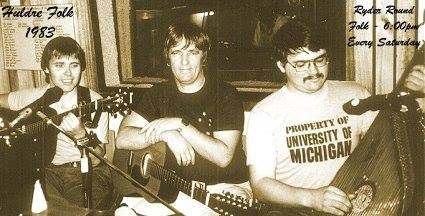
It was Victor Mishalow who first introduced me to Dermott in 1983. He was dropping into 2MBS for an interview on Ryder Round Folk, and he brought me and Yuri the Russian Storyteller along too. We had just launched our short and almost illustrious career as HuldreFolk. Dermott, as guru, mentor, and propagandist for the Sydney folk scene, gave us our first radio appearance. There is a famous photograph to commemorate it (Dermott’s archive of folkdoms’ seventies and eighties should be a national treasure. All the wannabes and could’ve beens, the famous and almost famous are celebrated therein).

HuldreFolk - Early Days. Ryder Round Folk 1983

The live concerts at 2MBS’s Chandos Street studios were a must-listen on the monthly calendar, with the good and the great of Sydney’s folksingers and musicians doing their thing. Guests included Victor, Yuri, Jim Taylor, Robin Connaughton, Penny Davies, Roger Illot, John Broomhall, Gordon McIntyre and Kate Delaney, Phil Lobl, Mary Jane Field, and the Fagans.

This was when Adele and I got to know Dermott and Margaret Ryder for the first time. We then learnt of his history: his part in the famous folk revival of the late sixties and early seventies, the first Port Jackson Folk Festival, the foundation if the NSW Folk Federation, and the famous Liz Folk Club in the Sydney CBD. He was among that first golden generation of folkies, including Colin Dryden, Gary Shearston, Declan Affley, Warren Fahey, John Dengate, Danny Spooner, Mike McClellan, Bernard Bolan, and Judy Small. Many other performers moved in Dermott’s musical orbit, including Andy George, Rhonda Mawer and the Shackistas of Narrabeen, Jim Jarvis, Al Ward, John Summers, and many, many more.

Dermott and I bonded further with our shared origins in the old country. He of Lancashire Irish heritage (Widnes, actually), and me, an Irish Brummie. We had a shared love of traditional Irish and English folk music. We probably even crossed bars in one of the many English folk clubs, in the ‘sixties. Most notably, the celebrated Jug O’Punch in the Birmingham suburb of Digbeth, run by the famous Ian Campbell Folk Group.*

        The Parting Glass

        Trad. as sung by Liam Clancy and Tommy Makem

Oh all the money that e’er I had
I spent it in good company
And all the harm that e’er I’ve done
alas, it was to none but me
For all I’ve done for want of wit
to memory now I can’t recall
So fill to me the parting glass
good night and joy be with you all

Oh all the comrades that e’er I’ve had
they are sorry for my going away
And all the sweethearts that e’er I’ve had
they would wish me one more day to stay
But since it falls unto my lot that
that I should rise and you should not
I’ll gently rise and I’ll softly call
good night and joy be with you all

Farewell, old friend.

Dermott and Margaret Ryder

  Leaving Can Be Easy

  By Dermott Ryder

  Leaving can be easy, when the right time comes.                                                                               Many will have gone before, in a long, long line.                                                                                 When it’s your turn, you look back, and smile,                                                                                     then look forward to your own new, far horizon.

 There are people to tell, and books to return,                                                                                 Broken bridges to mend now, better this way,                                                                                   leave no hurt feelings behind at the end of the day.                                                                           We are all travellers, and we will meet again.

 Don’t think of sleep. Keep that for much later.                                                                                    Give and take addresses and phone numbers.                                                                                  Make promises you probably won’t remember.                                                                                 Be pleasantly surprised and strangely grateful.

Welcome the crowd come to see you on your way,                                                                             and to share this rite of passage, to keep the faith                                                                             in this next step in the long tradition of the traveller.                                                                         Shake hands, and know that you cannot return.

* What a club that was. Back in the day, it hosted the cream of British folk music, including the Dubliners, the Furey Brothers, Martin Carthy, Peter Bellamy, and a very young and acoustic Al Stewart. Overseas guests included Tom Rush, an unknown Paul Simon, a young goddess called Joni Mitchell, and on an antipodean note, Trevor Lucas, who went to marry Fairport’s fair maid, Sandy Denny, and later, become a founding member of The Bushwhackers before his untimely demise in 1989.

John Cleverley’s Long March

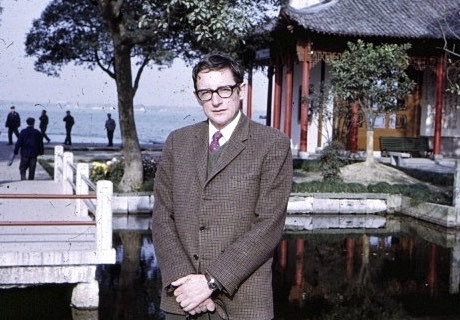
In memoriam for our old friend, scholar, wise man, and neighbour of 20 Watkin Street.

John Cleverley was a stalwart of many battles with Council, and indeed, with any overbearing and presumptuous authority. At his funeral service, his brother told the story of how his dad sent him to participate in the school nativity play dressed not in shepherd garb, but in the white shirt and red scarf of Mao’s little pioneers.

Adele and I first met John during one of those numerous stoushes we had with the now defunct South Sydney Council, and were good friends ever since. For many years, I would entertain his many Chinese visitors with a formal presentation on accounting in a publishing company. Whenever I would encounter John in the street, we would have a good yack about Australian politics, the doings of the Tories, and the manipulations of the Murdoch empire.

John lived a full and colourful life and left a very large footprint. The obituary tells a great story.

John Cleverley

JOHN CLEVERLEY 1931-2014    

Education Academic Reached Out To China

John Cleverley, formerly pro dean of the Faculty of Education at the University of Sydney, first visited China in 1972. He was an organising member of the first study tour led by Australian UNESCO education chairman, Professor of education Bill Connell. This group, the first delegation of Australian educators to visit China, was there when the Whitlam government recognised the People’s Republic of China. China was an abiding interest for the rest of Cleverley’s life.

John Farquhar Cleverley was born on June 4, 1931, in an England at peace, but ravished by the Depression. His early years were at Lime Grove in London, from which he was evacuated in 1939 at the outbreak of war. His education started at Lime Grove Preschool, which was followed by Canon Lane Elementary School and later the John Lyon School in Harrow, an endowed grammar school.

Cleverley began work in a cottage industry and progressed to be an office boy in publishing. His decision to migrate to Australia in 1949 with a £10 berth (halved as he was under 18), was fired by his reaction to post-war Britain. He once posed the question: “Why should the accident of status and birth accord status and arrogance?” He believed people should be their own masters, was uninterested in army service to uphold the Empire and hoped for a reconstructed world after the horrors of the war.

In Australia he became a grocery assistant, Commonwealth public servant and a sales representative in publishing. Although unaligned politically he actively opposed the Communist Dissolution Act Referendum in 1951. He wanted a better, fairer more just society based on social inclusion and the free exchange of ideas.

UIn 1951 Cleverley set out on a program of “self-improvement” which continued throughout his life. He took classes at Sydney Technical College, took the NSW Leaving Certificate, matriculated for university entry in 1954, and supported himself by working in a printing foundry at night.

He entered primary teacher training at Balmain Teachers College in 1952 and became president of the Student Representative Council in 1953. He taught at Randwick, Balmain Demonstration and Woollahra Public Schools (in the latter teaching the opportunity class) while he pursued part-time studies at the University of Sydney. In 1958, he married Cecily Kearney.

Work in teacher education followed at Wagga Wagga Teachers College, where the family moved in 1960, before a stint in the Commonwealth Department of Education supporting Colombo Plan students.

At the University of Sydney he systematically pursued his undergraduate and post-graduate studies – a BA, MEd (Hons), and PhD. He moved to Monash University in 1965 then back to Sydney in 1972 to teach international and comparative studies in education and to help Connell to organise the now famous China education study tour of 1972.

Another tour followed in 1976, then many others, as well as many personal visits, often instigated by the Chinese. As a result, Cleverley developed a prodigious network of institutional and personal contacts from which a sustained program of outreach and exchange grew.

With the establishment of the pioneering Sydney University China Education Society (SUCES) in 1972 and under Cleverley’s careful guidance, educational and cultural exchange between China and Australia flourished.

SUCES morphed into the University of Sydney China Education Centre (Australia) in 1986. Cleverley imprinted his view that the society/centre was an apolitical grouping that saw cultural exchange as a public good. Much of what the group did was enlivened by Cleverley’s commitment to “people to people” contact and exchange. This gave the group strong capacity to reach out and host Chinese students and visitors in Australian homes and help them to engage with the Australian community.

Cleverley saw this as a different but successful “relational” approach for sustained success, antithetical to the current “transactional” norm focused on short-term dollar returns. The benefits and value of such exchange have been recognised by successive Chinese ambassadors to Australia.

SUCES received its first guest “worker, peasant, soldier” Chinese students who were studying in Canberra in 1973/4. Then a famous group came in 1979. It was known in China as “Aobang” (The Australian Gang) and in Australia as the “Gang of 9” and the members primarily studied literature or linguistics.

When the group returned to China, six of them established Australian Studies Centres in their home universities. In 2009 there was a 30-year celebration in China of this group and Cleverley was invited and honoured there. Over the years he was appointed an honorary professor at East China Normal University, Jiangxi Agricultural University, Shanpou University and South China Normal University, positions he held until his death.

The education centre, led by Cleverley (who was promoted to professor and married Margaret Teo in 1986) until his retirement, became well-known in educational circles in China and Australia, in Commonwealth and state education departments and by the Chinese Ministry of Education and the consulate in Sydney. It brought prestigious visiting scholars to speak at the University of Sydney, ran cultural exhibitions and displays, obtained grants for cultural exchange, published books and newsletters, held conferences, and was supported by a loyal following of Australian and Chinese associates.

As well as his work with China, Cleverley developed a national social studies curriculum in Papua New Guinea with Gerald Johnston and Roger Hunter. He also did some educational consultancy work in Thailand.

When a new building was proposed and planned for the Faculty of Education at the University of Sydney, Cleverley was called on to oversee the project. The outcome (opened in 1993) gave the faculty excellent facilities, but this was not without rancour. Access to some of the building space was fiercely coveted by some outside the faculty. The battle was won but not without challenge but the Faculty of Education’s position was ably carried by Cleverley.

Cleverley was also active in supporting opportunity for indigenous Australians at the University of Sydney, especially through the Aboriginal Teachers Aides (ATA) program offered through the Koori Centre. In 1983 he was invited to take management responsibility for this program which, though 10 years old, had been poorly funded and was barely viable, running heavily on goodwill and dedication.

His view was that the “disadvantages and disabilities facing Aboriginal people were historic and continuing, and this was indisputable”. For Cleverley the ATA program represented a major social equity initiative. He championed the Koori Centre before and after Commonwealth funding was forthcoming in 1990, and led it until his retirement in 1993.

Cleverley contributed significantly to teaching, scholarship and research in a number of education fields especially in comparative and international studies, particularly Chinese education. At the time of his death two additional works on China were approaching completion. These will be carried to publication by his close colleagues.

John Cleverley is survived by Margaret, children Anne, Helen, Jane, David and Elizabeth, seven grandchildren and his many students, colleagues and friends.

John Barclay

Sydney Morning Herald December 17th 2014

http://www.smh.com.au/comment/obituaries/obituary-education-academic-john-cleverley-reached-out-to-china-20141216-1261wn.html

Yuri The Storyteller … we’ll sure miss the old bastard!

No man could kill him – but his heart did. Anon

My old friend and Huldrefolk founder member, George Hofsteters, Yuri The Storyteller, passed away peacefully in his sleep yesterday morning, 9th July 2014.

Passing strangest is Yuri’s passing. He had such a life force. He was a force of nature, even, the kind of person you’d think would outlive us all. And it was ironic that he who raged so long against the establishment should go so quietly into the night. I would have expected a contrarian like Yuri to have been lynched by a mob of irate god-botherers.

Yuri’s departure brought me back to the dying decades of the last century, when the shadowy and iconoclastic HuldreFolk appeared out of nowhere with their unique combination of stories and songs, and then almost as suddenly, disappeared into the mists of memory.

I was playing at the celebrated Three Weeds Folk Club in Rozelle in the spring of 1983, performing a cover of Roman poet Meniscus Diabetes‘ popular song Roman Holiday.  I was distracted by a cackling in the front row; and there was Yuri, laughing his head off. After my set, we got together and swapped notes on life, the universe and everything. Fate would have it that celebrated bandurist Victor Mishalow was also on the bill that night. And Yuri and I were enthralled by the magic of the Carlingford Cossack’s grand instrument.

Yuri told us he was a Russian Storyteller, and that he was performing at the Humanist Society the following Tuesday. “Come along and play some songs and tunes”, he said. And so we did. Yuri enthralled us with his spirited rendering of Alfred Noyes’ The Highwayman.  And it was there, in Shepherd Street, Surrey Hills, that HuldreFolk was born. Over the next two years, HuldreFolk, named for the mythical and mystical ‘hidden people’ of Icelandic legend, played throughout Australia.

One such occasion was the very first time I visited Coffs Harbour, a seaside graveyard with lights on the mid north holiday coast of New South Wales, sometimes known as the Costa Geriatrica (as fate would have it, we now live in the forest some forty clicks away from there). Looking for a parking space outside the venue, Yuri cut into a space ahead of a car that had already bagged that spot. A few minutes later, the occupants of the car approached us, looking mean and moody. Tall, broad and hairy, they looked like bad news. Yuri was unperturbed. “My mate Paul is a black belt in karate”, he chirped …

On a return visit to Coffs Harbour, he and Victor Mishalow got a gig performing on the back of a flatbed truck in the mall for a smattering of disinterested passers-by. When they’d finished, the organiser asked Yuri how much they wanted, “Two hundred dollars”, Yuri said. Before the paymaster could reply, Yuri added: “Each!” And they got it.

Yuri could be a proper bastard sometimes.

Although HuldreFolk pursued their own paths and projects, during the following decades, they would pop up in unexpected places, like their namesakes, in ones, twos, threes, and on occasions with guest HuldreFolkies. Their last outing as a trio was in October 2007 at the North By Northwest Poetry And Folk Club. Google the videos on YouTube.

Such was his energy, after a series of concerts, I’d need several months away from him to recover. Whenever we had to do a road trip, Yuri would tell jokes non-stop – it was as if they were on a loop. Once he’d finished his repertoire, he’d automatically start again.

Whenever HuldreFolk worked together, their collaborations were creative and at times, crazy.

Listen to Victor’s haunting bandura arrangements behind many of Yuri’s stories, the bravado of ‘The Ballad of Boreslav’ and the wackiness of ‘The Song Of The Volga Shearers’. Back in the day when I was performing ‘I Still Call Mongolia Home’, ‘Brave Goliath’, and ‘Roman Holiday’, Yuri would say: “There has never been as song about the Spanish Inquisition. Why don’t you write one”. Or, “How about a song about the Vikings?” The rest, of course, is hysterical.

We would always introduce George as “The One And Only Yuri The Storyteller”. Watch him on You Tube reciting the epical ‘McArthur’s Fart’ or the poignant ‘Claudy’, and telling the magical story of ‘The Algonquin Cinderella’ or the faerie ‘Green Lady’, and you will see that he really was.

Goodbye old friend.

Blast from the past

On 28th October 2013, Yuri posted on the HuldreFolk Facebook page:

Hi, Amigo!

You’ve done a great job on the Huldrefolk page, I’m with you 100% and will support at every opportunity. Could not be on your side more if I was Eddie Obeid. Now here comes the ‘but’. It’s only a tiny elephant in a big room.

It’s been quite a while since we’ve trod the boards together. Obviously neither of us will get the applause or the audiences we once had and sensibly, we should be content to let someone else drive the celebrity bus. We once had the opportunity to be bigger than the Kingston Trio and Tiny Tim together, but the choices that were made ensured we would never be plagued by the paparazzi. Yet I do believe we have influenced others with the idea we once spearheaded. Story, song, music are being metamorphosed in countless variations. I’m glad we had something to do with that.

Today, however, I’m puzzled at why one would go to the trouble of going to the ‘Pet Cemetary’ of entertainment to resurrect on social media a tired old dinosaur that is hardly remembered, let alone noticed by all but a small coterie of moth eaten folkies whose perception of “Macarthur’ is deemed akin to ‘high culture’. Traditional folktales, I’m afraid, will always belong in the musty archives and forgotten bookshops. They are a relic. Fossils belong in museums. But then, being the sentimental bastard that my nature dictates me to be, I hope you get something nice and rewarding for your efforts. If it’s sentiment before oblivion, light the fuse. Cheers!

Yuri’s race had less than a year to run when he penned this piece.

In many ways, he was right – a cruel man but fair, as they say.

But what times we had!