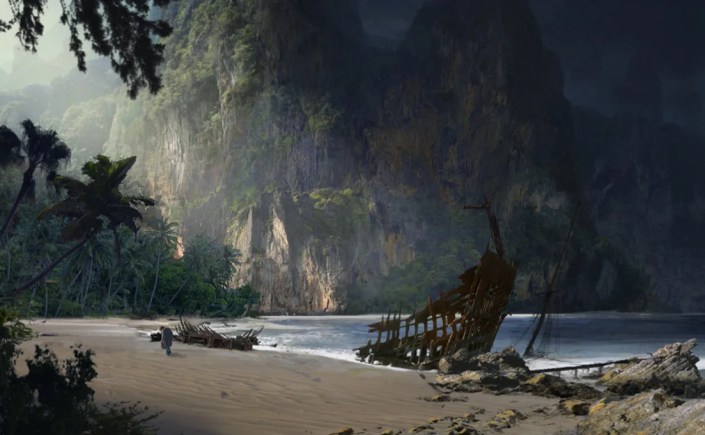
You won’t have to worry anymore
When you hear the cry for home
Van Morrison
Alec Derwent Hope (21 July 1907 – 13 July 2000) was an Australian poet and essayist known for his satirical slant, and also, a critic, teacher and academic: He ended his career as Professor of English at the Australian National University, Canberra. He was referred to in an American journal as “the 20th century’s greatest 18th-century poet”.
Man Friday, published in 1958, is actually set in those faraway days of Georgian England. It begins where English novelist and journalist Daniel Defoe leaves off his 1719 tale of the iconic castaway Robinson Crusoe. Readers will recall that Crusoe was shipwrecked and subsequently spent 28 years on a remote tropical desert island near the coasts of Venezuela and Trinidad, encountering cannibals, captives, and mutineers before being rescued. To refresh memories, there is a 200 word synopsis at the end of this post.
Hope takes up the story of Crusoe’s companion and servant Friday after he is brought by his “master” and sole companion to live in England. The completely alien culture that Friday, now a stranger in a strange land, encounters on this new “desert island” requires a huge and disturbing recalibration of his temporal, cultural and spiritual compass. He gradually arrives at an acceptance of the way of life that has been imposed upon him by circumstance.
His transformation and quiet resignation into an upper-class servant and his subsequent marriage and children take him farther and farther away from his memories and encase him within an artificial persona – until the day he accompanies Crusoe to an English sea port and hears the ocean’s beckoning roar for the first time in many years. The song of the ocean, the rush of memory, and Friday’s response to the call of the sea crystalizing in the poem’s ending.
It is a remarkably imaginative work juxtaposing Friday’s former life on an idyllic “island in the sun” (to quote the late Harry Belafonte’s lovely rhapsody’) to the stitched-up, hung-up, and in his perception, confined world of polite Georgian society. It is also captivating insofar it employs the sea as an extended metaphor (a device that I myself have used in poems and songs – see the Sound Cloud audio clips at the end of this post).
The sea runs like a leitmotif throughout the poem even when it is not mentioned explicitly. It has multiple associations: journeys by sea, separation and exile, isolation and loneliness, and the idea of home as an anchor, a goal, a safe haven, and as a longing. AD Hope further infuses it with the cultural differences and divisions, of social and spiritual barriers, of acclimatisation and assimilation of a kind. And in the end, an atavistic crying for home.
Saved, at long last through Him whose power to save
Kept from the walking, as the watery grave,
Crusoe returned to England and his kind,
Proof that an unimaginative mind
And sober industry and common sense
May supplement the work of Providence.
He, no less providential and no less
Inscrutably resolved to save and bless,
Eager to share his fortune with the weak
And faithful servants whom he taught to speak,
By all his years of exile undeterred,
Took into exile Friday and the bird.
The bird no doubt was well enough content.
She had her corn – what matter where she went?
Except when once a week he walked to church,
She had her master’s shoulder as a perch.
She shared the notice of the crowds he drew
Who praised her language and her plumage too,
And like a rational female could be gay
On admiration and three meals a day.
But Friday the Dark Caribbean Man,
Picture of his situation if you can:
The gentle savage, taught to speak and pray
On England’s Desert Island cast away,
No God like Crusoe is issuing from his cave
Comes with his thunder-stick to slay and save;
Instead from caves of stone, as thick as trees,
More dreadful than ten thousand savages,
In their strange clothes and monstrous mats of hair,
The pale-eyed English swarm to joke and stare
With endless questions round him crowd and press,
Curious to see and touch his loneliness.
Unlike his master Crusoe long before,
Crawling half drowned upon the desolate shore,
Mere ingenuity useless in his need,
No wreck supplies him biscuits, nails and seed,
No fort to builds, no call to bake, to brew,
Make pots and pipkins, cobble coat and shoe,
Gather his rice and milk his goats and rise
Daily to some absorbing enterprise.
And yet no less than Crusoe so he must find
Some shelter for the solitary mind;
Some daily occupation to contrive
To warm his wits and keep the heart alive;
Protect among the cultured, if he can,
The “noble savage” and the “natural man”.
As Crusoe made his clothes, so he no less
Must labour to invent his nakedness
And, lest their alien customs without trace
Absorb him, tell the legends of his race
Each night aloud in the soft native tongue
That filled his world when, bare and brown and young,
His brown, bare mother held him to her breast,
Then say his English prayers and sink to rest.
And each day waking in his English sheets,
Hearing the wagons in the cobble streets,
The morning bells, the clatter and cries of trade,
He must recall, within their palisade,
The sleeping cabins in the tropic dawn,
The wrapt leaf-breathing silence, and the yawn
Of naked children as they wait and drowse,
The women chattering around their fires, the prows
Of wet canoes nosing the still lagoon;
At each meal, handling alien fork and spoon,
Remember the spice mess of yam and fish
And the brown fingers meeting in the dish:
Remember too those island feasts, the sweet
Blood frenzy and the taste of human meat.
He piled memories against his need;
In vain! for still he found the past recede
Try as he would, recall, relieve rehearse,
The cloudy images would still disperse.,
Till as in dreams, the island world hecknew
Confounded the fantastic with the true
While England, less unreal day by day,
The cannibal Island ate his past away.
But for the brooding eye, the swarthy skin,
Witness to the Natural Man within,
Year following year, by inches, as they ran
Transformed the savage to an English man
Brushed, barbered, hatted, trousered and baptised,
He looked, if not completely civilised,
What came increasingly to be the case:
An upper servant, conscious of his place,
Friendly but not familiar in address
And prompt to please, without obsequiousness
Adept to dress , to shave, to carve, to pour
And skilled to open or refuse the door,
To keep on terms with housekeeper and cook,
But quell maids and footman with a look.
And now his master, thoughtful for his need,
Bought him a wife and gave him leave to breed.
A fine mulatto, once a ladies maid,
She thought herself superior to Trade
And, reared on a Plantation, much too good
for a low native Indian from the wood;
Yet they contrived at last to rub along
For he was strong and kind, and she was young
And soon a father, then a family man
Friday took root in England and began
To be well thought of in the little town,
And quoted in discussions at The Crown
Whether the Funds would fall, the French would treat
Or the new ministry could hold its seat
For though he seldom spoke, the rumour ran
The master had no secrets from his man
And Crusoe’s ventures prospered so, in short,
It was concluded he had friends at Court.
Yet, as the years of exile came and went,
Though first he was he grew resigned and then content,
Had you observed him close, you might surprise
A stranger looking through the servant’s eyes.
Some colouring of speech , some glint of pride,
Not born of hope, for hope had long since had died,
Not even desire, scarce memory at last
Preserved that stubborn vestige of the past.
It happened once that man and master made
A trip together on affairs of trade;
A ship reported founding in the Down
Brought them to visit several seaport towns.
At one of these great Yarmouth or Kings Lynn,
Their business done, they baited at an inn,
And in the night were haunted by the roar
Of a wild wind and tide against the shore.
Crusoe soon slept again but Friday lay
Awake and listening till the dawn of day.
For the first time in all his exiled years
The thunder of the ocean filled his ears;
And that tremendous voice so long unheard
Released and filled and drew him till he stirred
And left the house and passed the town, to reach
At last the dunes and rocks and open beach:
Pale bare and gleaming in the break of day
A sweep of new-washed sand around the bay,
and spindrift arriving up the bluffs like smoke
As the long combers reared their crests and broke.
There, in the sand beside him, Friday saw
A single naked footprint on the shore
His heart stood still, for as he stared, he knew
The foot made it never had worn shoe
And, at glance, that no such walker could
Have been a man of European blood.
From such a footprint once he could describe
If not the owner’s name, at least his tribe,
And tell his purpose as men read a face
And still his skill sufficed to know the race;
For this for this was such a print as long ago
He too had made and taught his eyes to know.
There could be no mistake. A while he stood
Staring at that great German Ocean’s flood;
And suddenly he saw those shores again
Where Orinoco flows into the main,
And, stunned with an incredible surmise,
Heard it his native tongue once more the cries
Of spirits silent now for many a day;
And all his years of exile fell away.
The sun was nearly to the height before
Crusoe arrived hallowing at the shore,
Followed the footprints to the beach and found
The clothes and shoes and thought his servant drowned
Much grieved he sought saw him up and down the bay
But never guessed, when later in the day
They found the body drifting in the foam,
That Friday had been rescued and gone home.
See also in In That Howling Infinite, Better read than Dead – books, poems and reading
Daniel Defoe’s Robinson Crusoe in 200 words
Courtesy of the Cliff’s Notes blog
Robinson Crusoe is an English adventure novel by Daniel Defoe (1660- 1731. an English novelist, journalist, merchant, pamphleteer and spy. First published on 25 April 1719, it is claimed to be second only to the Bible in its number of translations.
Written with a combination of epistolary, confessional, and didactic forms, the book follows the title character (born Robinson Kreutznaer) after he is cast away and spends 28 years on a remote tropical desert island near the coasts of Venezuela and Trinidad, encountering cannibals, captives, and mutineers before being rescued. The story has been thought to be based on the life of Alexander Selkirk, a Scottish castaway who lived for four years on a Pacific island called “Más a Tierra” (now part of Chile) which was renamed Robinson Crusoe Island in 1966. Pedro Serrano is another real-life castaway whose story might have inspired the novel.
The first edition credited the work’s protagonist Robinson Crusoe as its author, leading many readers to believe he was a real person and that the book was a non-fiction travelogue.Despite its simple narrative style, Robinson Crusoe was well received in the literary world and is often credited as marking the beginning of realistic fiction as a literary genre. Some allege it is a contender for the first English novel.
It tells the story of one Robinson Crusoe, a young and impulsive wanderer who, having his defied his parents, ran away to sea.
He was rescued by a Portuguese ship and started a new adventure. He landed in Brazil, and, after some time, he became the owner of a sugar plantation. Hoping to increase his wealth by buying slaves, he aligned himself with other planters and undertook a trip to Africa in order to bring back a shipload of slaves. After surviving a storm, Crusoe and the others were shipwrecked. He was thrown upon shore only to discover that he was the sole survivor of the wreck.
Crusoe made immediate plans for food, and then shelter, to protect himself from wild animals. He brought as many things as possible from the wrecked ship, things that would be useful later to him. In addition, he began to develop talents that he had never used in order to provide himself with necessities. Cut off from the company of men, he began to communicate with God, thus beginning the first part of his religious conversion. To keep his sanity and to entertain himself, he began a journal. In the journal, he recorded every task that he performed each day since he had been marooned.
As time passed, Crusoe became a skilled craftsman, able to construct many useful things, and thus furnished himself with diverse comforts. He also learned about farming, as a result of some seeds which he brought with him. An illness prompted some prophetic dreams, and Crusoe began to reappraise his duty to God. Crusoe explored his island and discovered another part of the island much richer and more fertile, and he built a summer home there.
One of the first tasks he undertook was to build himself a canoe in case an escape became possible, but the canoe was too heavy to get to the water. He then constructed a small boat and journeyed around the island. Crusoe reflected on his earlier, wicked life, disobeying his parents, and wondered if it might be related to his isolation on this island.
After spending about fifteen years on the island, Crusoe found a man’s naked footprint, and he was sorely beset by apprehensions, which kept him awake many nights. He considered many possibilities to account for the footprint and he began to take extra precautions against a possible intruder. Sometime later, Crusoe was horrified to find human bones scattered about the shore, evidently the remains of a savage feast. He was plagued again with new fears. He explored the nature of cannibalism and debated his right to interfere with the customs of another race.
Crusoe was cautious for several years, but encountered nothing more to alarm him. He found a cave, which he used as a storage room, and in December of the same year, he spied cannibals sitting around a campfire. He did not see them again for quite some time.
Later, Crusoe saw a ship in distress, but everyone was already drowned on the ship and Crusoe remained companionless. However, he was able to take many provisions from this newly wrecked ship. Sometime later, cannibals landed on the island and a victim escaped. Crusoe saved his life, named him Friday, and taught him English. Friday soon became Crusoe’s humble and devoted slave.
Crusoe and Friday made plans to leave the island and, accordingly, they built another boat. Crusoe also undertook Friday’s religious education, converting the savage into a Protestant. Their voyage was postponed due to the return of the savages. This time it was necessary to attack the cannibals in order to save two prisoners since one was a white man. The white man was a Spaniard and the other was Friday’s father. Later the four of them planned a voyage to the mainland to rescue sixteen compatriots of the Spaniard. First, however, they built up their food supply to assure enough food for the extra people. Crusoe and Friday agreed to wait on the island while the Spaniard and Friday’s father brought back the other men.
A week later, they spied a ship but they quickly learned that there had been a mutiny on board. By devious means, Crusoe and Friday rescued the captain and two other men, and after much scheming, regained control of the ship. The grateful captain gave Crusoe many gifts and took him and Friday back to England. Some of the rebel crewmen were left marooned on the island.
Crusoe returned to England and found that in his absence he had become a wealthy man. After going to Lisbon to handle some of his affairs, Crusoe began an overland journey back to England. Crusoe and his company encountered many hardships in crossing the mountains, but they finally arrived safely in England. Crusoe sold his plantation in Brazil for a good price, married, and had three children. Finally, however, he was persuaded to go on yet another voyage, and he visited his old island, where there were promises of new adventures to be found in a later account.
 In That Howling Infinite
[…] Man Friday … a poet’s Robinson Crusoe sequel […]
[…] poet Taha Muhammad Ali, and a look at iconic Australian poet AD Hope’s very original poem Man Friday; and four on books, including a long essay of the genesis, context and content of the famous […]