Calling Australia! Reading the Trump revolution

Countless left-wing memes about American stupidity illustrate how out of touch, self righteous, arrogant and morally “superior” many of the so-called “left” have become – unlike the Democrats whom New York Times columnist Maureen Dowd said were “finally waking up and realizing that woke is broke” after having embraced a self-defeating world view of “hyper-political correctness, condescension and cancellation”.

The Democrats. – and indeed, our Labor party – would ignore the outcome of the presidential election at their peril. The people, for better or worse, have spoken, and it’s a pointless exercise for the Democrats to live in a fantasy world of denial, not accepting their own responsibility in the loss. The Sydney Morning Herald’s Peter Hartcher wrote on 12 November:“ It’s also extremely condescending and arrogant to assume you know better and anyone who didn’t agree must be an idiot. In that light, I’d suggest Trump didn’t win this. The Democrats lost it in a spectacular fashion, and if you can lose it to the likes of Trump, something is majorly wrong on the left side of politics”.

There are lessons aplenty for Australian politics. The Coalition wants to spend the months leading up to next year’s election talking about migration driving up household bills. It has no actual plan for decreasing immigration or reducing inflation, but voters don’t care. They don’t do nuance. They’re disatisfied with the status quo and disappointed in the government. They’ll just want to punish the mob in charge. Sure, they’ll be burning down the house, and they’ll be in the house when it burns down (two song references there!) but they won’t care. The question will be “are you better off today than you were four years ago?” And, like in America, for a great many, the answer will be a big “no!”

Waleed Ali’s recent article on why Trump won concurs with the above: “Last week, a historically unpopular government, presiding over a period of high inflation that saw food prices especially explode, got thrown out of office. There is quite simply nothing extraordinary about that”. Former Liberal attorney general and high commissioner to the UK George Brandis wrote similar in the Herald on 18 November:“… the sheer weirdness of Donald Trump himself: narcissistic, vulgar, bombastic, mendacious, idiosyncratic, outrageous; while at the same time flamboyant, mesmerizing and on occasions very funny. He broke every rule, told every lie, did the unthinkable, said the unsayable and still came up … (you complete the pun). The epic unconventionality of Trump’s campaign dramatised a result that would probably have been the same had the Republican candidate been less unorthodox. For that reason, the outcome is fertile ground for over-interpretation and exaggeration”.

On a different but not dissimilar tack, John Carroll, Professor Emeritus of Sociology at La Trobe University wrote in The Australian:

“The resounding Trump victory confirms the cardinal law: politics is about power. In times of peace and prosperity, such as we in Australia have enjoyed for almost 80 years, it is easy to forget, and continue along in the hopeful illusion that life is good, people are intrinsically nice, and problems can be solved amicably …

… One of the appeals of Donald Trump to the United States electorate – I suspect his main appeal – has been that, in his bluster and braggadocio, he flexes power muscles and seems to show he is unafraid to mobilise power for his own ends. There is an intuitive understanding across middle and lower-middle America that progressive posturing and feel-good speeches will not steer the ship of state safely through turbulent waters. In contrast, Trump policy appears clear, direct, and down-to-earth – booming economy, secure borders, and resolved international conflict. When 70 per cent of Americans feel worse off than they were four years ago, they want strength in leadership and focus on their everyday interests.

…The Trump persona – aggressive, confrontational, and petulant, not to mention pathologically narcissistic – also seems to have appealed to marginalised social strata. Those living in poorer states, young black and Latino males, recent immigrants, and the old city working classes resenting their decline, all seem to have been drawn to his maverick contempt for the trendy issues of the time. His character may be suspect – indeed he is widely disliked – but he appears powerful, practical, and not of the coterie elite. In politics, power eclipses niceness”.

I republish below an opinion piece by The Australian’s editor at large Paul Kelly. It is to my mind one if the best articles I have read to date regarding the outcome of the  American elections and how this may impact Australian politics. It is particularly interesting insofar as Kelly pushes back against the conservative narrative prevalent in the Murdoch media and among more extreme right wing commentators, politicians and culture warriors. Regarding Australian politics, he writes:

“If Trump succeeds he will further undermine the shaky policy framework of the Labor Party. The optics will be: Trump’s strength versus Albanese’s weakness. In this situation, the pro-Trump media and conservative drum-beaters in this country – in effect the Trump Appeasement Syndrome lobby – will demand the Peter Dutton-led Coalition follow their messiah while they will use Trump’s success to undermine Albanese. Destroying former prime minister Kevin Rudd as ambassador to the US is just the first step”.

“So what’s driving the campaign to target Rudd”, asked Hartcher on 16 November. “The Murdoch media, in short. Some other commentators have been drawn into it, too, useful idiots for the Murdoch effort. Ostensibly they demand that Rudd go because he was critical of Trump, but in reality, “this is revenge”, as Malcolm Turnbull explained this week. “This is a campaign that News Corp kicked off, and they are running a vendetta,” he told my colleague Matthew Knott. Revenge for what? Rudd founded a movement called Australians for a Murdoch Royal Commission. Murdoch’s empire was “a cancer on our democracy”, he said. A royal commission would examine the level of concentration in Australian media ownership and the conduct of the Murdoch group in particular”.
“But the Murdoch media is not monolithic”, Hartcher continues.”Its éminence grise is Paul Kelly. Kelly has the stature to make his own judgment. The campaign to remove Rudd as “a ritual sacrifice before Trump has even said anything” is “part of Trump Appeasement Syndrome”. “This shows a contempt for Australian sovereignty and a craven weakness before Trump,” Kelly wrote this week. “For any Americans wasting their time following this saga, we must look a sad, pathetic little country.”

Trump and his cabinet picks Robert F Kennedy Jr and Elon Musk

Donald Trump’s revolution leaves Albanese exposed

America’s leap to the right will have political repercussions for Australia.

The Trump Revolution is coming and, like all revolutions, its outcome will fluctuate between a glorious remaking of the existing order or a spectacular overreach and fall – maybe even a contradictory mix of both – with Anthony Albanese and Australia in front-row seats for the drama.

[In the same issue as this article, national affairs editor Joe Kelly summed up this revolution: “Trump’s sweeping “day one agenda” includes dismantling the deep state, pursuing mass deportations, imposing across-the-board tariffs, scrapping the “Green New Scam”, withdrawing from the Paris Agreement, rolling back environmental regulations, ending the Ukraine conflict, unpicking pro-transgender policies, pardoning January 6 offenders, and rolling back the Biden health and education agendas. This is a blueprint to overhaul the country. Leading thinkers are already focused on which items are set in stone and which could merely be attempts to enhance Trump’s negotiating position. While Trump is a familiar political figure, this exercise reveals his policy agenda has still generated widespread uncertainty. Paradoxically, no one knows how the experiment will turn out or even exactly what it is – a recipe for a populist catastrophe, or a profound new American reinvention”.]


From the Trump appointments so far, the big “America First” play is on. The sharemarket has been excited, the bond market is wary, Big Tech is king, Beijing should be worried. President Trump Mark II is more resolute and revolutionary than Trump Mark I.

His hunger for change seems ferocious; his willingness to take risks is more pronounced. He is assembling a tribe of Trump loyalists to punch through the disintegrating Democratic scaffold. Trump demands loyalty and prioritises vindication.

Two lights are flashing – danger and opportunity. Some people will make a stack of money and others will be cast into painful obscurity.

Trump is going to remind everyone of the extent of power vested in the office of US president when pushed to the limit.

Consider the Elon Musk appointment. Surely this can’t be true. The world’s richest man, heading social-media platform X, hanging out at Mar-a-Lago, almost part of the Trump family, will now co-lead a Department of Government Efficiency – sitting outside the federal government – and while keeping all his existing corporate positions, he will pursue his pledge to cut US agency budgets by $US2 trillion ($3 trillion), or about one-third.

Tesla CEO Elon Musk will now co-lead a Department of Government Efficiency. Picture: AFP

Tesla CEO Elon Musk will now co-lead a Department of Government Efficiency. Picture: AFP

Of course, it is true – only in America. Think about this marriage: Trump’s America meets the Big Tech oligarchs. This is a serious moment for US capitalism, great for innovation, bad for integrity. Trump likens Musk’s brief to “the Manhattan Project of our time”. How many struggling Americans are going to be punished in the process? Australian officials, long familiar with our experience of external budget audits (think Tony Shepherd in 2013), know Musk’s promise is impossible in delivery terms. It can’t be done, short of a massive anti-Trump electoral revolt from the public.

At this time, however, such quibbles don’t matter. Nothing seems impossible in the exaggerated hype of Trump’s vindication. A tariff of 60 per cent on China’s imports? Sure. Cutting a third off federal agency budgets? No problem. Licensing the king of Big Tech, loaded with conflict-of-interest federal contracts, to stage a shooting gallery across the entire federal bureaucracy? Great idea. It’s called purging the deep state.

Change on the scale Trump wants generates both high excitement and high risk. Nobody can be sure of the consequences because these things have never been tried before and we don’t know where the line will be drawn between impression and reality. How long before Trump and Musk fall out?

Trump’s appointments show his priority to purge the “deep state” institutions of justice and intelligence. Given his history, these seem non-negotiable personal passions for Trump. He appointed former Democrat, now Trump loyalist, Tulsi Gabbard as director of national security despite, or perhaps because of, her sustained support for Russian leader Vladimir Putin.

He appointed a professional provocateur, Republican congressman Matt Gaetz, as attorney-general with Gaetz, already at political war with the Justice Department he is supposed to run, praised by Trump, who said Gaetz will end “the partisan weaponisation of our justice system”. That means a purge.

Trump has appointed Republican congressman Matt Gaetz as attorney-general. Picture: AFP

Trump has appointed Republican congressman Matt Gaetz as attorney-general. AFP

The wilful naivety of Trump’s apologists in this country looks embarrassing given Trump’s resolve to impose his will on the ­intelligence community, justice and the FBI. Gabbard’s appointment is highly dubious and Gaetz’s should be overruled, with The Wall Street Journal saying it would “undermine confidence in the law” and would be used for “political revenge”.

Trump’s mind seems a cross between powerful insights into the flaws of the Obama-Biden-Harris age and the vindictive fantasies of all rebels pulling down the established order.

But Trump’s experiment will resonate far beyond America. Markets seem alert to the inflationary consequences of his fiscal policy. The combination of Trump and our tight labour market will further weaken Anthony Albanese’s hope of an interest-rate cut before the election.

But the big picture consequences are far larger. At a time when most Western democracies are burdened by disillusion, poor economic and social outcomes and leadership that lacks either conviction or courage, Trump arrives as a giant on the stage of history.

He mocks the orthodox governing model. Much of Trump’s appeal is because he presents as a change agent against leaders running a failed status quo, witness the dismissed Biden-Harris team. More than 70 per cent of Americans felt their country was going in the wrong ­direction.

Trump’s win is the antithesis of Albanese’s victory in 2022 when Albanese ran on reassurance, incrementalism and “safe change”. Trump consigns “safe change” to the dustbin of history. He will steamroll Albanese’s “safe change” into the gutter. Trump’s American political strategy is the complete opposite of Albanese’s Australian strategy.

Of course, America is not Australia; we are different countries and in different moods. Yet the stakes for Australia cannot be denied – the more Trump succeeds, the more Labor’s policies will look feeble, ineffective and missing the big picture.

At almost every point in his agenda, Trump is diametrically opposed to Labor’s framework.

Consider the list: Trump wants savage public-sector cuts, a reduction in federal bureaucratic numbers, a purging of regulation, cutting the corporate tax rate to 15 per cent (half that of Australia), extending income tax cuts, imposing punitive tariffs on China where Australia is just restoring trade normality, repudiating free trade by resurrecting across-the-board tariffs, more support for oil and gas, walking out of the Paris Agreement on climate, dismantling ­environmental obstacles to development, cracking down on immigration, launching a domestic war on all forms of identity politics, boosting US defence spending and disdaining global institutions.

It is folly to think Trump won’t be influenced by the chasm between himself and Albanese. It’s good he told Albanese on the phone that Australia was the “perfect friendship”. Let’s cut to reality – if Trump has initial success in fuelling the animal spirits of the US economy, the governance model for Western democracy will be shaken to its foundations. Parties of the radical right will gain fresh traction everywhere.

It is folly to think Trump won’t be influenced by the chasm between himself and Anthony Albanese. Picture: AFP

It is folly to think Trump won’t be influenced by the chasm between himself and Albanese. AFP

If Trump succeeds he will further undermine the shaky policy framework of the Labor Party. The optics will be: Trump’s strength versus Albanese’s weakness. In this situation, the pro-Trump media and conservative drum-beaters in this country – in effect the Trump Appeasement Syndrome lobby – will demand the Peter Dutton-led Coalition follow their messiah while they will use Trump’s success to undermine Albanese. Destroying Kevin Rudd as ambassador is just the first step.

Of course, it might not evolve this way. It might be the precise ­opposite. You never know with Trump. He may overreach from the start, prioritising vengeance, smash too many institutional norms and, drunk on hubris, alienate even his own voters.

But last week Trump sent another message of profound significance for Australia – he is riding with the China hawks. This means Trump will expect Albanese to muscle up and toughen up against China. Forget the idea of Trump going cool on Australia – he likes us, he’ll go hot on Australia and ­expect more action from us to ­reinforce his China hawks.

This is surely the coming message from the appointment of Senator Marco Rubio as Secretary of State and Congressman Mike Waltz as his National Security ­Adviser.

Waltz, in a jointly written essay for The Economist, said the US must wind up the Ukraine conflict and direct its assets towards confronting and deterrence of China. Rubio warns China is “far more dangerous” than the old Soviet Union and poses the central threat of the 21st century. They will drive deeper US rivalry with China.

Rubio supports AUKUS. That’s the good news – but under Trump the US support for AUKUS means more action and commitment from Australia against China. That’s the transactional deal, got it?

China's President Xi Jinping. Picture: AFP

China’s President Xi Jinping. AFP

How does this fit with Albanese’s “stabilisation” agenda with China? Answer: not comfortably. History tells us that Australian domestic support for the US alliance falls when there’s a US president we don’t like, witness the fall in popular backing for the alliance under George W. Bush. Now we will likely have in Trump a US president who expects us to get more hawkish on China while domestic support for that Trump-induced option will plummet.

It’s better for Australia that Trump rides with the China hawks, not the China doves. But you cannot miss the problem. Paul Keating sees it and fell upon the remarkable political monitor poll in The Sydney Morning Herald showing that 57 per cent said Australia should avoid taking sides in any war between the US and China, with only 16 per cent disagreeing. Extraordinary stuff.

Keating said this repudiated ­Albanese’s “lock-in” military ­arrangement with the US, the AUKUS agreement and the ­assumption Australia is tied to the US in any conflict.

Trump’s China policy looks ominous for Labor – his tariff strategy will weaken our trade with China while his overall “get tough” strategy will intensify anti-Trump sentiments within the public in Australia and ignite a debate within Labor, with protests the party is too accommodating of Trump’s anti-China stand. It will be dangerous and unpredictable.

The broader political takeout from Trump’s victory is the failure of Democratic Party progressivism – economic and cultural. This is a mammoth event. Of course, direct political lessons cannot be simply transposed from America to Australia. These are very different countries. Yet it would be unwise to assume there is no connection point for Australia from this epic US election.

Here are three propositions – that US progressives are no longer the party of the working class or the non-college educated; that US progressivism contains the seeds of its own destruction, witness the Trump counter-revolution; and that the deepest faith of the progressives – that Trump is a threat to democracy – didn’t work because the progressives constitute their own threat to democracy.

Let’s consider the first proposition – in effect, the voter realignment. Australian pollster Kos Samaras wrote post-election that low-income, working-class voters were heading right-wing. This realignment would reshape politics including in Australia and was tied to the changing nature of left-wing politics with its new priorities around climate change, social justice, urban fashions and housing.

Analysis by the Financial Times shows that in the US poorer and less-educated voters think Republicans best represent them, with the Democrats now the party of high-income and college-educated voters.

Trump won a majority of households with incomes of less than $100,000 while the Democrats won more support from the top third of the income bracket. Education is a sharp line of division – nearly two-thirds of voters without a college degree supported Trump.

Samaras warns the realignment in Australia deepens the divide between urban and rural voters and between professional and low-income voters, “creating fertile ground for conservative and populist leaders”. Is the urban professional class slowly suffocating Labor? Obviously, Dutton will be exploiting this divide at the coming poll.

On the second proposition, most progressives and elites in Australia are in denial, unable to admit what is happening, despite the defeat of the voice referendum at home and the evidence in the American election – many people voted for Trump on cultural grounds, pointing to a counter-­revolution.

There are numerous pro-Trump commentators hailing the moment. Many exaggerate, yet the trend is manifest. Writing in the Financial Times, respected analyst John B Judis said Democrats must dissociate themselves from support for “gender-affirming care”, their opposition to strong borders, their backing of equal outcomes rather than equal opportunity on racial issues, their indifference to the plight of working-class men, just dismissing Trump supporters as racists and sexists, and their focus on imminent planetary apocalypse to justify draconian ­climate action.

He said the priorities of many voters who deserted the Democrats are decent jobs, safe streets and a proper safety net. But Judis warns even action on these fronts will fail politically “if Democrats don’t sever their identification with cultural radicalism”.

Labor hasn’t gone as far as the Democrats – but it is largely and proudly a progressive party now, and this risk is potent. Most progressive leadership elites in Australia don’t understand the consequences of the cultural positions they champion. Their cultural ignorance is astonishing and dangerous. They need to read the long masterclass provided in July this year by David Brooks in The New York Times.

Prime Minister Anthony Albanese. Labor hasn’t gone as far as the Democrats – but it is largely and proudly a progressive party. Picture: NewsWire / Nikki Davis Jones.

s

Brooks said that with the demise of religion, US public life became secular in recent decades with “science and reason” becoming the methods by which the nation could be held together. It is now obvious that this answer, championed by the elites, has failed. “By the 21st century, it became clear that Americans were no longer just disagreeing with one another,” Brooks said. “They didn’t even perceive the same reality.”

Was there anything to fill this moral void? As usual, the left produced an answer – identity politics. Brooks said: “This story provides a moral landscape – there are those bad guys over there and us good guys over here. The story provides a sense of belonging. It provides social recognition.” It is orientated around proper esteem for and inclusion of different identity groups.

The problem, however, is the incompatibility of identity politics with the liberal principle of equality – that regardless of identity we are bonded by a common humanity. This is the foundation stone of our liberal democracy. Undermine this principle and our society is undermined. As Brooks says, “the problem with this form of all-explaining identity politics is that it undermines democracy”.

Trump’s voters don’t offer such sophisticated reasoning for their vote. But their visceral distrust of how they are being treated says this is what they feel in their bones. It is reinforced by numerous examples across their lives, telling them they don’t really count.

The more progressives in Australia push this ideology, the more they guarantee a backlash. Dutton knows this – he just needs to judge how far it has gone in Australia and how much to advance the counter-revolution.

This leads directly to the third proposition. The Democrats were consumed by the idea of Trump as a threat to democracy. Ultimately, this was the Harris campaign – and the argument was correct. Watching Trump’s backers in this country trying to pretend black was white was pitiful intellectual dishonesty. Trump refused to concede he lost in 2020 – of course he was a threat to democracy.

But what the Democrats didn’t get was the point brilliantly made by political scientist Yascha Mounk – some exit polls suggested that people felt Harris was a greater threat to democracy than Trump. “This hints at the fundamental fact of the past decade,” Mounk said. “A fact that elite discourse still has not fully confronted: citizens’ trust in mainstream institutions has been absolutely shattered. Corporations and the military, universities and the courts, all used to enjoy a certain modicum of residual trust. That trust is now gone. It is unlikely to return any time soon.”

It is gone because of the left’s march through the institutions, the story in both America and Australia. Progressive activists took charge, while established leaders were weak and ignorant. When people look across the landscape – universities, bureaucracies, cultural bodies, corporates, government departments – they see progressive values, great and small, shoved in their faces. It’s not the democracy they voted for

Welcome to Country, a symbol of mutual respect

We aknowledge the Gumbaynggirr People, the traditional custodians of the Land we are standing upon, and the Land from the Tablelands to the sea; and who have been here for over sixty-five thousand years. We also pay respect to Elders past, present and emerging of the Gumbaynggirr nation and to other Aboriginal and First Nation people present.

Today, at public gatherings and meetings, at carnivals and ceremonials, at conferences and conventions, many of us recognize and acknowledge our first peoples as the traditional owners of this land and acknowledge elders past, present and future.

Last year, among Murdoch’s myrmidons and his stablemates on Foxtel’s Sky after Dark, Chris Kenny was the only advocate for the Indigenous Voice to Parliament.

In the an opinion piece republished below, he writes: “In my view they have become a welcome and useful addition to our national culture. However, there is no reason they should be treated as some sacred rite, beyond criticism or even a laugh … In recent weeks there has been more anger and outrage rather than laughter over welcomes to country, and much of it is entirely unreasonable. It is clear some Australians resent them; we often hear people completely misconstrue the sentiment by declaring they do not want to be “welcomed to their own country”.

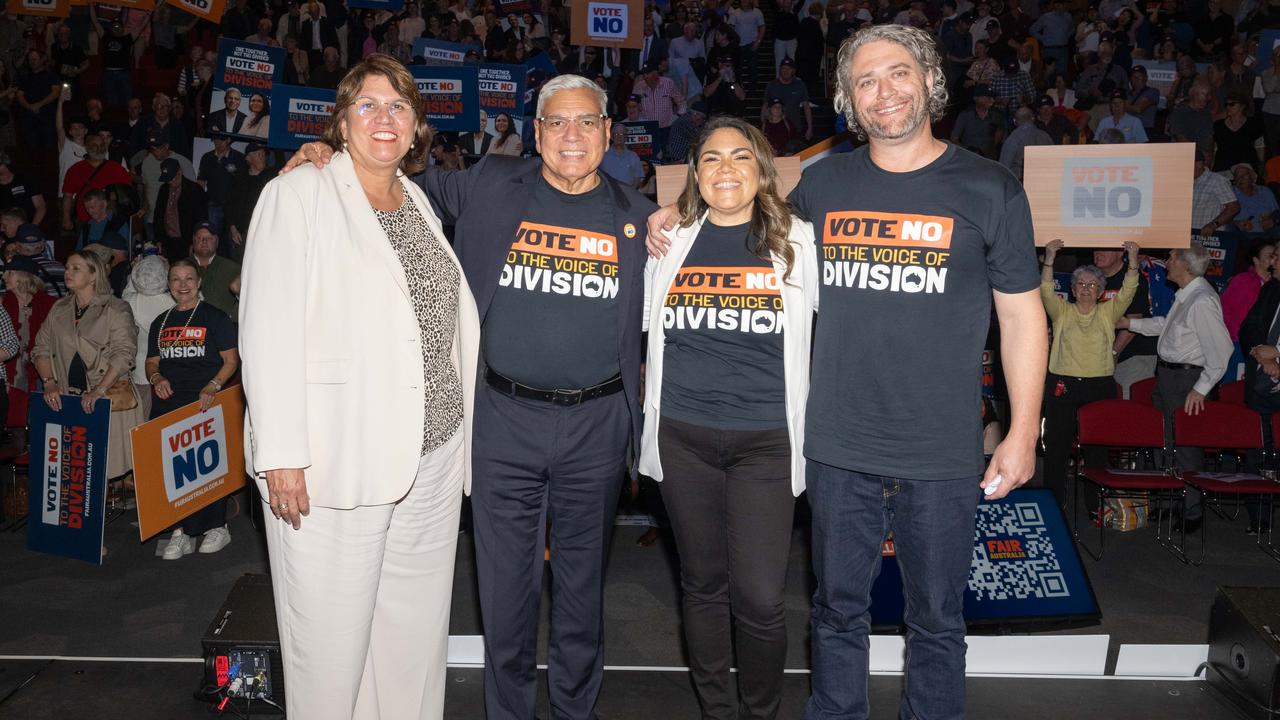
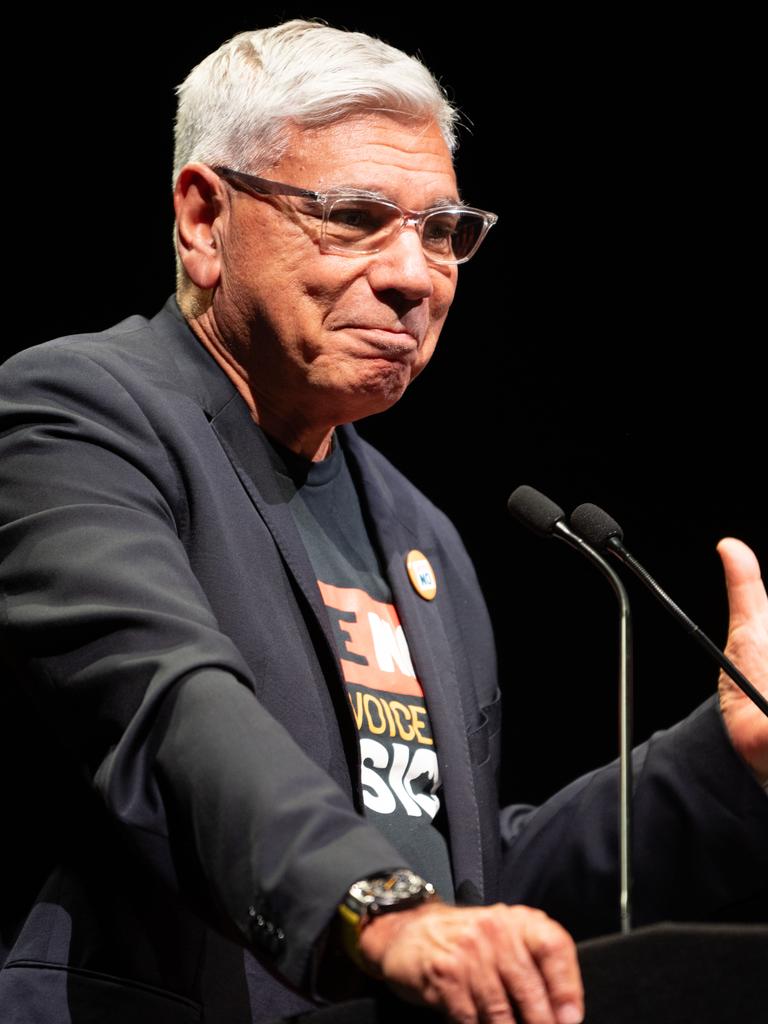
On the first anniversary of the unsuccessful Voice referendum, the Sydney Morning Herald reported that leading No campaign spokesperson Nyunggai Warren Mundine had said that debate on the Voice provoked a more profound national discussion about whether Indigenous people should have what he termed “special rights”. He says progressives and conservatives he spoke to during the campaign wanted practical improvements on issues such as education but were sick of gestures such as welcome to country ceremonies. “People like the concept but it goes overboard when it is every meeting at work and every plane when you land. It’s like a new religion, like the new saying of grace before meals. The Yes people haven’t realised they are actually turning people against them by overkill.”

Much of the antagonism towards Welcome to Country has indeed been fuelled by the divisive hangover of the referendum. In its aftermath, there was talk among some right-wing commentators, including former Liberal prime minister Tony Abbott, and organizations like Advance Australia, that the time had come to see off the irritatingly woke and ubiquitous welcomes and acknowledgements. The “silent majority” of Australians, they claimed, had made their view known with the resounding rejection of the Indigenous Voice to Parliament. The attacks have expanded and amplified on talkback radio and by some of Kenny’s colleagues on Sky News (particularly the opinionated and misanthropic swamp creatures of Sky After Dark) which had run a news-stream dedicated to promoting the No case.

But the reality is that these expectations have not been realized and that regardless of the unfortunate outcome of the referendum of October 14th, 2023, the Welcome to Country is alive and well among Australians of goodwill throughout our wide land.

I concur with what Kenny writes, including his admonition that the ritual ought not be overdone and inappropriate, such as in events wherein a local Indigenous representative offers an official welcome to country, and then every speaker feels the need to share their own version of recognition in well-intentioned but redundant virtue-signalling.

There are also instances where welcomes and acknowledgements can be too political and aggressive. Declaring that “sovereignty was never ceded”, or demanding that we defer to a particular culture can be interpreted as is an unwelcome and uncomfortable imposition and is not the reason people may have turned up to a particular event.

Back in July 2022, when The Voice was a hopeful prospect, the ABC’s Q&A programme was hosted by the indigenous Garma Festival in the Northern Territory. Its MC, Stan Grant, journalist, writer, academic and a Wiradjuri man, defined sovereignty in the context of the indigenous Voice to Parliament and the Uluru Statement from the Heart as a spiritual concept. White folk associate it with powers and thrones, with control over states and nations and their citizens, with ownership, particularly of territory, of land, of real estate. Country, as Kenny concludes in his opinion piece, does not mean a sovereign nation, but rather, the traditional lands of indigenous people – just as these routinely talk about going back to their traditional family regions as being “on country”.

To some Welcome to Country  might be a “woke” imposition, but to many others, it is a mark of respect and an acknowledgment of our history. To borrow from Mark Twain, reports of its death have been greatly exaggerated.

I’m quite relaxed  and comfortable about that …

For more in In That Howling Infinite on on Indigenous Australians and The Voice Referendum, see:

Welcomes to country are a mark of mutual respect

Brendan Kerin gave a brilliantly welcoming and informative speech prior to the GWS Giants and Brisbane Lions game at Sydney Olympic Park. Picture: Fox Sports

Brendan Kerin gives a Welcome to Country at Sydney Olympic Park.  Fox Sports

Welcomes to country and recognitions of traditional owners have rapidly become ubiquitous, if not universally embraced. They continue to spark unnecessary controversy and acrimony.

In my view they have become a welcome and useful addition to our national culture. However, there is no reason they should be treated as some sacred rite, beyond criticism or even a laugh.

Early on, I was sceptical and remember two decades ago, when working for then foreign minister Alexander Downer, we were at a function at the Adelaide Convention Centre, built over the city’s main railway station, and Downer was on stage waiting to speak when then Democrats senator Natasha Stott-Despoja began her remarks by recognising the “traditional owners”. It was quite a novel and woke gesture at the time, and I texted Downer asking why we needed to recognise the South Australian railways?

Boom Tish! The private quip was just to see the amusement on Downer’s face, and I wasn’t dis­appointed.

In recent weeks there has been more anger and outrage rather than laughter over welcomes to country, and much of it is entirely unreasonable. It is clear some Australians resent them; we often hear people completely misconstrue the sentiment by declaring they do not want to be “welcomed to their own country”.

Kenny acknowledges that there were rational and reasonable reasons to oppose the referendum, but “it was clear then and is perhaps even more obvious now that a sizeable minority voted no because they did not want to hear from their Indigenous compatriots again”.

A welcome to country speech is made ahead of the International Test Match between the Wallabies and Georgia at Allianz Stadium in Sydney in July. Picture: Getty

 Welcome to country speech of the International Test Match between the Wallabies and Georgia at Allianz Stadium in Sydney in July. Getty

Much of this antagonism has been fueled by the divisive hangover from the unsuccessful voice referendum. During that debate, Marcia Langton said that if the no vote prevailed it might be difficult for Indigenous elders to accept invitations to provide welcomes to country.

This understandably emotional reflection has been twisted into a promise to abandon the ceremonies if the referendum failed and thrown back at Professor Langton and Indigenous Australians ever since, with demands for the promise to be honoured. As a voice advocate, I was at pains to point out there were rational and reasonable reasons to oppose the referendum, but it was clear then and is perhaps even more obvious now that a sizeable minority voted no because they did not want to hear from their Indigenous compatriots again.

“Controversial Welcome to Country at AFL semi-final sparks bitter backlash,” screamed the Daily Mail this week after Brendan Kerin performed the ceremony at the GWS Giants versus Brisbane Lions match at Homebush. The story quoted social media posts saying: “What a disgrace, referring to BC as Before Cook and then lecturing everyone” and “Woke Joke. Australia has fallen.”

Others pointed out, in a chippy display, that there would be no AFL if Captain Cook had not voyaged to Australia. Our nation’s history is not a zero-sum equation.

The attacks were expanded and amplified on talkback radio and by some of my colleagues on Sky News. In my view, Kerin’s speech was brilliantly welcoming and informative, and genuinely aimed at explaining why these ceremonies are not about welcoming people to Australia.

Kerin said the ceremony had existed for 250,000 years BC, which he explained as “Before Cook” drawing laughs from the crowd. Sure, the figure he used was ridiculous (homo sapiens are only known to have existed for 200,000 years) but let us call that poetic license – his point was that welcome to country ceremonies existed in ancient Indigenous cultures as a way for members of one tribe or language group to gain permission to traverse or visit the country of another group.

“Within Australia we have many Aboriginal lands, and we refer to our lands as ‘country’,” Kerin said. “So it’s always a welcome to the lands you’ve gathered on – a welcome to country is not a ceremony we’ve invented to cater for white people.”

That was a terrific and generous explainer. Country does not mean a sovereign nation but the lands of that people – just as Indigenous people routinely talk about going back to their traditional family regions as being “on country”.

Dancers perform during the welcome to country before the friendly between AC Milan and AS Roma in Perth in May. Picture: Getty

Dancers perform during the welcome to country before the friendly between AC Milan and AS Roma in Perth in May. Getty

Major sporting events are occasions when these ceremonies are most appropriate; the crowd was about to enjoy a terrific game of a sport Indigenous Australians love, claim some role in creating, and excel at. And Kerin was there to welcome people, not to their nation, but to that particular region, letting them know about the ­cultural history of that place, and inviting them to have a wonderful night. It astounds me that anyone could find this anything but up­lifting, adding to the richness of the experience.

Sometimes welcomes to country are overdone and inappropriate. I have been to events where they open proceedings with a local Indigenous representative doing an official welcome to country, but then every speaker feels the need to share their own version of recognition, as if they have to tick it off for fear of being seen to boycott the gesture.

Even online meetings can ­labour under the same endless ­virtue-signalling. This sort of stuff is over the top and unnecessary, and in the end, it must be counterproductive because it generates eye-rolling or open resistance.

There are also instances where welcomes to country can be too political and aggressive. Telling us that sovereignty was never ceded, or demanding that we defer to a particular culture, is not welcoming. Especially at sporting, artistic or entertainment events, any sort of political lecturing is an unwelcome imposition – it is not the reason people have turned up.

Ancient tribal practices about visiting other tribal lands were very different and varied across the continent, so it is true that the modern welcome to country model has only been around for about 40 years. This does not delegitimise it; rather it correctly identifies it as a modern cultural evolution to help bring Indigenous and non-Indigenous Australians together.

In these pages last month, Melbourne barristers Lana Collaris and Georgina Schoff aired a spirited legal debate about whether a welcome to country is appropriate for law council meetings. My view is that it is hardly necessary in such a context.

More to the point, if people try to invest some legal weight to the custom – with references to “nationhood” and “sovereignty” – they will kill it off. I too object to the “first nations” terminology which has been imported from the US and is heavily politicised.

Welcomes to country work best and will survive best if we keep ­politics and legality right out of it. At heart, it is simply about people sharing their histories and offering a hand of friendship.

Just like toasts at birthday parties or speeches at weddings, these things are sometimes over-cooked or strike the wrong chord. Other times they just seem completely inappropriate and out of place – last year I heard a recorded welcome to country on a bus from Melbourne’s Spencer Street station to Tullamarine.

But conducted properly at the right events, this practice enriches all of us and furthers reconciliation. As I travel around Australia I find it fascinating to know which Aboriginal group covers which territory, and it is terrific that children learn this at school.

That does not mean that we need to change the names of our cities or places, and it does not mean that schools should send kids on a guilt trip. However, it does mean we can have a richer sense of our history, one that stretches at least 40,000 years BC.

When I have travelled in Ireland, for instance, I have wanted to know which county I am in and learn a little about its unique history, likewise the states of the US. And in America I have wanted to know a little about the indigenous groups, the Sioux or Lakota, Cherokee, Cheyenne and Navajo, their similarities, differences, battles, and their impact on contemporary events.

Why would we not want to know about all this in our own cities and states, in our own country? Sure, there are Indigenous activists who run extreme agendas, just as there are racist extremists who have abhorrent attitudes towards Indigenous people, but surely the overwhelming majority of us want to know each other, help each other, and respect each other.

It is that simple. Welcomes to country are a mark of mutual ­respect, and a touchstone for deeper understanding. I am hopeful and confident they will be part of our national culture for centuries to come

The many lives of an unsung Anzac hero

Once upon a war

Back in the last century, before ANZAC Day became the secular Christmas that it has become, before marketing people and populist politicians saw its commercial and political potential, before the fatal shore became a crowded place of annual pilgrimage, my Turkish friend, the late Naim Mehmet Turfan, gave me a grainy picture of a Turkish soldier at Gelibolu carrying a large howitzer shell on his back. Then there was this great film by Australian director Peter Weir, starring young Mel Gibson and Mark Lee. There were these images of small boats approaching a dark and alien shore, of Light Horsemen sadly farewelling their Walers as they embarked as infantry, and of the doomed Colonel Barton humming along to a gramophone recording of Bizet’s beautiful duet from The Pearl Fishers, ‘Au fond du temple saint’ before joining his men in the forlorn hope of The Nek …

At the heart of the Anzac Day remembrance is the Australian and New Zealand Army Corps’ role the Dardanelles campaign of 1915-16, Winston Churchill’s grandiose and ill-conceived plan to take the Ottoman Empire out of the war by seizing the strategic strait between the Black Sea and the Mediterranean, thereby threatening Istanbul, the Ottoman capital. It was a military failure. From the initial seaborne assault to the evacuation, it lasted eight months and cost 114,000 lives with 230,000 wounded.

In 1915, Australians greeted the landings at Gallipoli with unbridled enthusiasm as a nation-making event. But it wasn’t long before they were counting the dreadful cost. More than 8000 Australians died during the Gallipoli campaign. As a loyal member of the British Empire, Australia eventually sent 330,000 men overseas to fight for the King. Volunteers all, not all of them white men – despite the authorities’ policy of recruiting only Australians of Anglo-Celtic stock, their ranks included many indigenous, Chinese and others. By the time the war ended in 1918, 60,000 of them were dead. As the late historian Ken Inglis once pointed out: “If we count as family a person’s parents, children, siblings, aunts and uncles and cousins, then every second Australian family was bereaved by the war.

Gallipoli is cited as the crucible of Australian nationhood, but the Anzacs’ part in the doomed campaign was but a sideshow of the wider campaign. Although it is celebrated in Australian song and story, it was the Ottomans’ most significant victory in the war that was to destroy the seven-hundred-year-old Ottoman Empire secure the reputation of its most successful general Mustafa Kemal, who as Ataturk, became the founder of modern Turkey.

Some thirty-four thousand British soldiers died on the peninsula, including 3,400 Irishmen who are remembered In The Foggy Dew, one of the most lyrical and poignant of the Irish rebel songs: Right proudly high over Dublin town, they hung out the flag of war. ‘Twas better to die ‘neath that Irish sky than at Suvla or at Sud el Bar…Twas England bade our Wild Geese go that small nations might be free, But their lonely graves are by Suvla’s waves or the fringe of the grey North Sea.

Ten thousand Frenchmen perished too, many of these being “colonial” troops from West and North Africa. Australia lost near on ten thousand and New Zealand three. Some 1,400 Indian soldiers perished for the King Emperor. Fifty seven thousand allied soldiers died, and seventy five thousand were wounded. The Ottoman army lost fifty seven thousand men, and one hundred and seven thousand were wounded (although these figures are probably much higher). An overlooked fact is that some two thirds of the “Turkish” solders in Kemal’s division were actually Arabs from present day Syrian and Palestine. Gallipoli was indeed a multicultural microcosm of a world at war.

Whilst the flower of antipodean youth is said to have perished on Gallipoli’s fatal shore, this was just the overture. Anzac troops were dispatched to the Western Front, and between 1919 and 1918, 45,000 Aussies died there and 124,000 were wounded.

Once upon a war, the Dardanelles Campaign of 1915-16 was a sideshow to the bigger theatres of the Eastern and Western Fronts. To some, it was a reminder that they could not stomach Winston Churchill for this was said to be his greatest stuff up in a career replete with such (although they would admit that he more than exonerated himself his and Britain’s Finest Hour). For many Australians and New Zealanders, it was a national baptism of fire, of youthful sacrifice on the altar of Empire. And notwithstanding the military defeat and retreat, the folly and foolhardiness, in the harrowing adversity and heroism, lay the bones of a young country’s enduring creation myth.
Former soldier James Brown, Anzac’s Long Shadow

From The Watchers of the Water – a song about Gallipoli, © Paul Hemphill 2015. All rights reserved

Official war historian Charles Bean went ashore at Anzac Cove on 25 April, more than 5 hours after the first troops. Here is his first dispatch (it was not published in Australia until 13th May):

It was eighteen minutes past four on the morning of Sunday, 25th April, when the first boat grounded. So far not a shot had been fired by the enemy. Colonel McLagan’s orders to his brigade were that shots, if possible, were not to be fired till daybreak, but the business was to be carried through with the bayonet. The men leapt into the water, and the first of them had just reached the beach when fire was opened on them from the trenches on the foothills which rise immediately from the beach. The landing place consists of a small bay about half-a-mile from point to point with two much larger bays north and south. The country rather resembles the Hawkesbury River country in New South Wales, the hills rising immediately from the sea to 600 feet [183m]. To the north these ridges cluster to a summit nearly 1,000 feet [305m] high. Further northward the ranges become even higher. The summit just mentioned sends out a series of long ridges running south-westward, with steep gullies between them, very much like the hills and gullies about the north of Sydney, covered with low scrub very similar to a dwarfed gum tree scrub. The chief difference is that there are no big trees, but many precipices and sheer slopes of gravel. One ridge comes down to the sea at the small bay above mentioned and ends in two knolls about 100 feet [30m] high, one at each point of the bay.

It was from these that fire was first opened on the troops as they landed. Bullets struck fireworks out of the stones along the beach. The men did not wait to be hit, but wherever they landed they simply rushed straight up the steep slopes. Other small boats which had cast off from the warships and steam launches which towed them, were digging for the beach with oars. These occupied the attention of the Turks in the trenches, and almost before the Turks had time to collect their senses, the first boatloads were well up towards the trenches. Few Turks awaited the bayonet. It is said that one huge Queenslander swung his rifle by the muzzle, and, after braining one Turk, caught another and flung him over his shoulder. I do not know if this story is true, but when we landed some hours later, there was said to have been a dead Turk on the beach with his head smashed in. It is impossible to say which battalion landed first, because several landed together. The Turks in the trenches facing the landing had run, but those on the other flank and on the ridges and gullies still kept up a fire upon the boats coming in shore, and that portion of the covering force which landed last came under a heavy fire before it reached the beach. The Turks had a machine gun in the valley on our left, and this seems to have been turned on to the boats containing part of the Twelfth Battalion. Three of these boats are still lying on the beach some way before they could be rescued. Two stretcher-bearers of the Second Battalion who went along the beach during the day to effect a rescue were both shot by the Turks. Finally, a party waited for dark, and crept along the beach, rescuing nine men who had been in the boats two days, afraid to move for fear of attracting fire. The work of the stretcher-bearers all through a week of hard fighting has been beyond all praise.

And this was just the beginning …

More on the Anzacs in In That Howling Infinite: Tel al Sabi – Tarkeeth’s ANZAC Story 

On 27th July 2024, the Australian published extracts from a recently published biography of Henry Koba Freame, adventurer, soldier, orchardist and interpreter. It provides such a stirring account of the landing of Australian soldiers at what is now Anzac Cove on 25th April 2015 and the subsequent Gallipoli campaign that it was worth republishing below. But first, a brief summary of Freame’s eventful life.

The road to Gallipoli

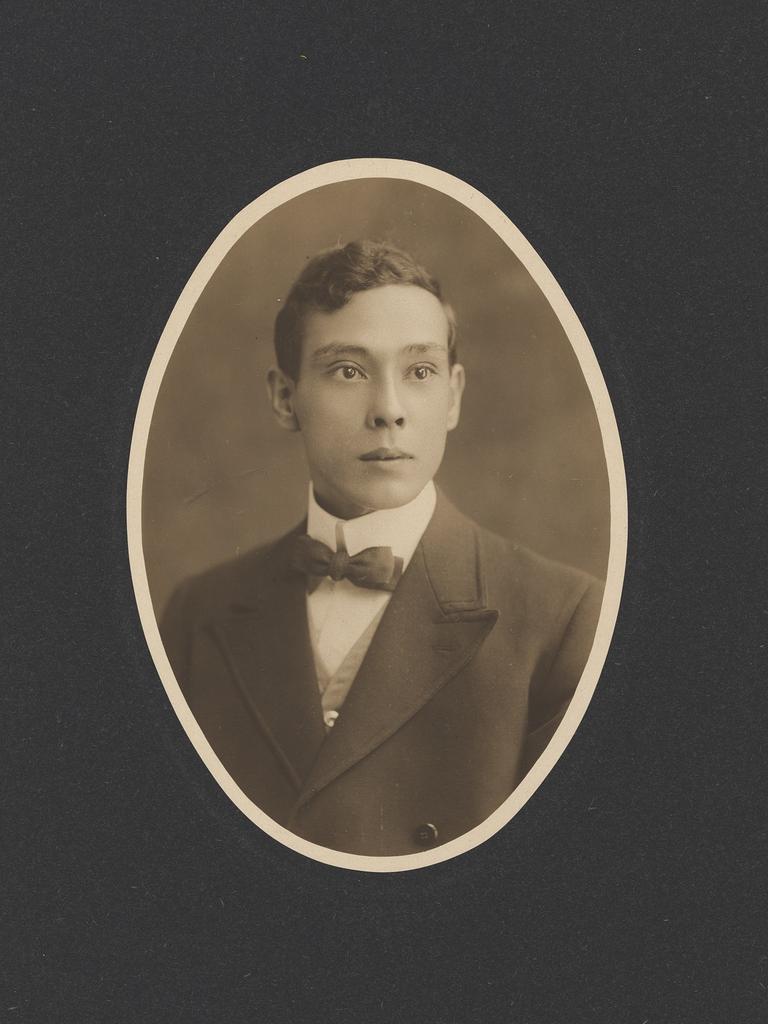
Wykeham Henry Koba Freame is believed to have been born on 28 February 1885 at Osaka, Japan, though on his enlistment in the Australian Imperial Force he gave his birthplace as Kitscoty, Canada. He was the son of Henry Freame, sometime teacher of English at the Kai-sei Gakko in Japan, and a Japanese woman, Shizu, née Kitagawa. As he was fluent in Japanese and spoke English with an accent it is likely that he was brought up in Japan. In 1906 he was a merchant seaman and on 19 July of that year married Edith May Soppitt at St John’s Anglican Church, Middlesbrough, England.

Freame probably came to Australia in 1911 and on enlisting in the A.I.F. on 28 August 1914 described himself as a horse-breaker of Glen Innes, New South Wales. Posted to the 1st Battalion as a private, he embarked for Egypt on the troopship Afric on 18 October and was promoted lance corporal on 7 January 1915. On 25 April he landed at Anzac and after three days of heavy fighting was promoted sergeant. He was awarded one of the A.I.F.’s first Distinguished Conduct Medals for ‘displaying the utmost gallantry in taking water to the firing-line although twice hit by snipers’. He was mentioned in dispatches for his work at Monash Valley in June when Charles Bean described him as ‘probably the most trusted scout at Anzac’.

Having served in the Hottentot rising of 1904-06 in German East Africa and in the Mexican wars, Freame was an accomplished scout before joining the A.I.F. He had an uncanny sense of direction and would wriggle like an eel deep into no man’s land, and at night even into enemy trenches, to pick up information. His dark complexion and peculiar intonation of speech had led his companions to believe that he was Mexican—an impression which he reinforced at Anzac where, in cowboy fashion, he carried two revolvers in holsters on his belt, another in a holster under his armpit and a bowie knife in his boot pocket. On 15 August he was wounded during operations at Lone Pine and was evacuated to Australia. He was discharged as medically unfit on 20 November 1916.

Freame settled on the Kentucky estate in New England, New South Wales, when the estate was subdivided for a soldier settlement scheme, and was appointed government storekeeper. He eventually acquired a Kentucky block and was a successful orchardist. His wife died in 1939 and on 16 August 1940 he married Harriett Elizabeth Brainwood, nurse and divorced petitioner, at St John’s Anglican Church, Milson’s Point, Sydney. With the outbreak of World War II he offered his services to the Australian Military Forces and in December 1939 was planted among the Japanese community in Sydney as an agent by military intelligence. In September 1940 he was appointed as an interpreter on the staff of the first Australian legation to Tokyo.

Early in April 1941, however, Freame returned to Australia because of ill health and was admitted to North Sydney Hospital suffering from a severe throat condition which greatly impaired his speech. He died on 27 May and was buried in Northern Suburbs cemetery with Anglican rites. His death certificate records the cause of death as cancer though Freame himself and later his wife alleged that he had been the victim of a garrotting in Japan. He considered that the attack was the consequence of the injudicious wording of the announcement in the Australian press of his posting to Tokyo. He had been described as employed by the Defence Department at a time when he was telling his Japanese acquaintances another story. Extant evidence provides no definite clarification of the circumstances of his death, though the claim of garrotting was investigated, and rejected, at the time.

James W. Courtney, the Australian Dictionary of Biography, Volume 8,1981

How did we forget this Anzac hero?

Harry Freame in 1915 before departing for Gallipoli

Harry Freame in 1915 before departing for Gallipoli

In the years after World War I, Harry Freame had a legitimate claim to be considered the most famous Anzac soldier to have landed at Gallipoli. Born in Japan and raised as a Samurai, he was the recipient of the first Distinguished Conduct Medal to be awarded to an Australian soldier for his efforts in those first bloody days of Gallipoli, and his name was legend among the Australian troops who had fought that tragic battle. As the landing turned into trench warfare, the troops knew Harry risked his neck each night to venture out into no-man’s land and map the Turkish defences.

Harry was on personal terms with the key Anzac commanders, and in the postwar years generals would visit him and reminisce about the war. Australia’s official war historian for World War I, Charles Bean, who first met Harry in June 1915, was fascinated by Harry his whole life. The Australian public came to know Harry through the newspapers of the day that splashed his wartime exploits of courage and daring across their pages.

What became of him?

The Bravest Scout at Gallipoli by Ryan Butta

Harry Freame’s boots hit the sands of Anzac Cove at around 7.40am on April 25, 1915. He was part of D Company, 1st Battalion. By the time they landed, Anzac Beach, as it came to be known, was already strewn with the broken and bloodied bodies of the men and pack animals that had come before them on that infamous morning.

It wasn’t Harry’s first sight of the region – he had sailed this way before – and it wasn’t his first taste of war.

There is a picture of Harry taken before the landing, most likely in Egypt. In it he is in full uniform, flat-brimmed hat, a bandana tied around his neck, wire clippers and binoculars attached to his belt. He holds his Lee–Enfield full wood .303 rifle by the barrel, the butt resting on the ground. He is looking slightly downwards at the camera. There is none of the naive merriment so often seen in the pictures of young Australian soldiers who had mistaken war for a great boys’ own adventure. But nor is there any fear in those eyes. Harry knew what he was in for, and he was ready for it.

As he waded through the waist-high water towards the sand, Harry carried in his pack three days’ rations and an extra 150 rounds of ammunition. He would have heeded the warning of Lieutenant General William Birdwood, the British officer in overall command of the ANZAC (Australian and New Zealand Army Corps) forces, who had advised the troops prior to landing to drink as much water as they could, as once ashore supply of food and water could not be guaranteed for at least three days.

The landing itself had been rehearsed as much as possible on the nearby Greek islands, under conditions nothing like what Harry and the rest of the Anzacs would soon face, but as the 1st Battalion’s official war diary records, “we knew very little of the actual plans for the attack – in fact, the whole thing seemed to be rather in the air, and so it proved”.

All that the officers of the 1st Battalion knew was that the 3rd Brigade was to land first and rush the enemy positions. When Harry and D Company landed on Anzac Beach, they had no idea what success, if any, the 3rd Brigade had had. Judging by the dead and dying who littered the beach, staining the Aegean waters red, and the enemy bullets and shells that whistled around their heads and whipped the waves to foam, it could be easily believed that none of the 3rd Brigade had survived that hellfire of a dawn.

Harry at age the age of 24

Harry at age the age of 24

Harry’s battalion formed up just north of Anzac Beach, in the shadow of Ari Burnu, sheltered from the murderous fire being poured down upon the landing from the peaks of Gaba Tepe, and waited for orders. When the orders came, they “were very vague”, alluding to nothing more than the need for the battalion to reinforce the firing line. But to reinforce a firing line, you needed to first find the firing line, and when the men looked up towards the imposing ridges and valleys that confronted them, there was no firing line.

The ridges above the beaches were crawling with pockets of men, some engaged in isolated fights, hand-to-hand combat wherein they lived or died by the thrust of their bayonets or the quickness of their wits.

Recalling that bloody morning, poet John Masefield wrote:

“All over the broken hills there were isolated fights to the death, men falling into gullies and being bayoneted, sudden duels, point blank, where men crawling through the scrub met each other and life went to the quicker finger, heroic deaths, where some half section which had lost touch were caught by ten times their strength and charged and died.

“No man of our side knew that cracked and fissured jungle. Men broke through it on to machine guns, or showed up on a crest and were blown to pieces, or leaped down from it into some sap or trench, to catch the bombs flung at them and hurl them at the thrower.

“Going as they did, up cliffs, through scrub, over ground … they passed many hidden Turks, who were thus left to shoot them in the back or to fire down at the boats, from perhaps only fifty yards away.”

The firing line, a concept easily imagined in the safety of an officer’s headquarters, was non-existent on the actual field of battle. On that first morning there was just a mad rush for high ground, up the forbidding slopes and into the ridges and valleys that held not only Turkish and German and Syrian troops and gunners but also the hope of cover and survival.

A primeval need to push further and further inland gripped the soldiers, in the hope that there, beyond the next valley, the next ridge, lay safety.

By 10am, with clothes still heavy with sea water after the landing and many of their rifles jammed with sand, now useful only for bayonet thrusts and charges, Harry and what elements of D Company were able to be formed up left the beach and set off for the ridges. Coming upon officers from the 3rd Battalion, D Company was redirected to the hill known as Baby 700, where reinforcements were urgently needed.

Through dense, waist-high scrub of gorse-like bushes and along the dried-up water courses littered with boulders, the men forged ahead uphill, legs heavy but the words of the commanding officers to advance, advance, advance running through their heads. Many of the men of D Company who fought their way up towards Baby 700 that clear bright morning would etch their names into the history of the Anzacs and the 1st Battalion: Major FJ Kindon, second-in-command of 1st Battalion; Major Blair Swannell, commanding officer of D Company; Captain Harold Jacobs, second-in-command of D Company; Lieutenant Geoffrey Street; and Captain Alfred Shout, the man who would leave Gallipoli the most decorated soldier of all, though sadly not with his life. And beside Shout, as was so often the case in the blood-soaked months that followed, in lock step, there was Lance Corporal Harry Freame.

Strategically important, Baby 700 had been the focus of intense fighting all morning, with remnants of the Australian 9th, 11th and 12th battalions all joining the battle as the Turkish troops advanced and retreated in a series of intense skirmishes conducted under the continuous hail of shrapnel fire from unseen Turkish positions. The approaches to Baby 700 were complicated by folds of ridges and valleys, and in these the Australian men became detached from their companies and lost until they could connect up with other Australian soldiers, sometimes from their own company, sometimes not.

Freame at his final Anzac Day march, in 1940.

Freame at his final Anzac Day march, in 1940.

By 11am, Harry and D Company had reached The Nek, a thin strip of ridge that connected to Baby 700. The area was being held by Captain Lalor and men of the 12th Battalion. Lalor was the grandson of Peter Lalor, the man who had led the revolt at Eureka. With him on that morning on the approaches to Baby 700, Lalor carried a magnificent sword, said to be the one used by his grandfather at that famous stockade. Swords had been prohibited to be carried during the landing, but Lalor had disregarded the order.

Across The Nek on the slopes of Baby 700, Turkish troops were gathering. Joining up with Lalor’s group, the newly arrived men of D Company formed up and charged the Turkish troops, driving them back into a gully before advancing up Baby 700.

After reaching the summit, D Company started to dig into that hardscrabble ground. The Turkish troops they had driven before them had retreated, but only to a previously unseen trench, and from here they poured heavy fire on the entrenching D Company. It was here that D Company’s commander, Major Blair Swannell, was killed on that first morning, shot dead just as he had earlier predicted he would be to his mates aboard the Minnewaska in the predawn fog before the landing.

Against the fierce Turkish assault, the Australians had only their rifles (when they worked), bayonets and pistols. The naval guns offered no support, as those manning them were afraid of firing on their own troops in the complicated mess of invaders and invaded that swarmed the hills of the peninsula.

A few artillery guns had been brought ashore at midday but were then ordered to be sent back out to the boats. Other commanders had refused to allow their guns to be landed, such was the chaos on the beaches, and it wasn’t until dusk that the first artillery guns came into action in support of the Australian troops.

The Australian firing line on Baby 700 could not hold, and over the course of the morning the Australian troops moved over the summit only to be thrown back by vicious counterattacks no fewer than five times.

In the midst of the fighting, there was Harry Freame, moving from position to position, scouting the ground and enemy positions, running messages between commanding officers.

At one point Harry and a small group of men drove a contingent of Turkish troops from a trench. But having gained the trench they found they were then held in place by persistent enemy fire. The men hadn’t heeded the words of Lieutenant General Birdwood, and who could blame them, and they were out of water, exhausted and near death. Without water they felt that they would soon perish or be forced to surrender.

Harry called for volunteers to brave the bullets and shrapnel and go for water. None raised a hand or spoke a word, so over the side of the trench he went, collecting water bottles from those who would never thirst again, fallen soldiers whose twisted repose could never be mistaken for the sleeping, a last look, a last thought of home or their best girl held fast in a glassy eye like a butterfly trapped in amber.

When Harry returned, he brought not only precious water but food and pickaxes for the grateful men.

All day the fighting raged on Baby 700, with ground taken then lost, the attackers and counterattackers continually changing roles, the air perfumed with the smell of the wild thyme that had been lashed by the bullets and shrapnel bursts. And as the day stretched on, still the men had no idea where the firing line was, only supposing that it was somewhere ahead of them, always somewhere over the next ridge, and that they must get to it. And if they could not advance, then at all costs they tried to hold on to whatever patch of land they had come to stop on.

At around 4.30pm, as D Company, reinforced now with New Zealand troops, fought to hold the right side of the Baby 700 slope, a massive Turkish counterattack was launched that peeled the Australians off the slope. Alfred Shout, who had been with Lalor when he was killed, had earlier left Harry and fourteen men at The Nek with orders to hold it no matter what. The small group came under intense fire and before long only nine men were left, and by the time Shout returned, retreating from Baby 700, only Harry and one other man held the position. The rest lay dead or dying about them. Shout ordered them both to follow him in retreat towards the beach.

After regrouping on the beach, Shout and Harry then set about rounding up men from various battalions, a combination of the stragglers and shirkers, the lost and the shell-shocked. Harry collected around two hundred men and led them back up the slopes to reinforce the New Zealand troops who were holding Walker’s Ridge, a key position leading back to Baby 700, which was by now firmly in Turkish hands.

Recording the efforts of Lance Corporal Harry Freame on that chaotic first day at Anzac Cove, official war correspondent Charles Bean wrote:

 “With such fighters as Lieutenant A.J. Shout, Lieutenant G.A. Street and Lieutenant Jacobs, all of his own battalion, he and others held vital positions in that constantly moving and changing fight but none was so ubiquitous as he, now holding a key ­position on The Nek leading to Baby 700, now ­finding for his commander the scattered parts of his battalion.”

As night fell on the evening of April 25, the fighting abated only somewhat; rifle fire and shrapnel bursts echoed through the night. At around midnight, Lieutenant General Birdwood sent an urgent message to his commander-in-chief, Sir Ian Hamilton, urging an immediate evacuation of the peninsula. Hamilton, from the comfort of the HMS Queen Elizabeth, was having none of it, advising Birdwood that he had “got through the difficult business and you have only to dig, dig, dig until you are safe”.

Freame with his stepsister in 1898.

Freame with his stepsister in 1898.

The following morning, April 26, the hills of the peninsula rang with the sounds of shovels, digging, digging, digging. Those not digging or engaged in holding a position were out scouring the ravines and hillsides for the wounded and missing, and it was while thus engaged that Harry came across a detachment of men under the command of Captain Harold Jacobs sheltering in a trench at Quinn’s Post. The men had had no water to drink and were in a desperate state. Harry offered to go for water and without a second thought braved the enemy fire that came in from unseen snipers and dashed back down the valley from where he had just come. He soon returned with the promised water, allowing the position to be held.

Realising that Lieutenant-Colonel Leonard Dobbin, the company commander, would need information on Captain Jacobs’ position and situation, Harry was again up and over the side of the trench, making his way back down the valley to where Lieutenant-Colonel Dobbin was located. As Harry approached Dobbin’s trench, he was heard to yell out, ‘All right!’ Arriving, he delivered his message to Dobbin. Mission accomplished, it was only then that Harry revealed that on the descent he’d been struck twice by snipers’ bullets, once through the fingers of the left hand and once through the left arm.

For the duration of the fighting at Gallipoli, Quinn’s Post remained the Anzacs’ most advanced position and the key to their defensive positions. It would never have been held if not for the bravery of Harry Freame.

Charles Bean later noted that very few men received decorations for the deeds performed at the Anzac Cove landings. But when the recommendations came out, the name Harry Freame was first among them. His citation read: “Has displayed the utmost gallantry in taking water to the firing line, though twice hit by sniper fire.” Harry’s commanding officer further reported: “Since I have assumed command of the Brigade, Serjeant Freame has almost daily performed some action worthy of recognition in the shape of carrying out night reconnaissance, conveying messages through dangerous zones etc etc. He is a fine fearless soldier who I strongly recommend for recognition.”

The recommendation was heeded and Harry, for his work over those first days of Gallipoli, was awarded the Distinguished Conduct Medal. Writing both publicly and privately years after the war, Bean offered the view that Harry should have been awarded the Victoria Cross and that the only reason he wasn’t awarded the VC was because, “Australian commanders hesitated to set up for that hallowed decoration any standard short of the impossible. I think that it is safe to say but for that Harry would have been awarded the highest decoration”.

When I set out to write this book, I wanted to discover why we had forgotten Harry Freame. Why, when our schoolchildren learn of the history of the Anzacs, do they learn more about a donkey than a man who was known at the time as the Marvel of Gallipoli? And I wanted to know why the Australian government covered up their role in the death of Harry Freame, why the man Charles Bean described as probably the most trusted scout at Gallipoli was never believed when he said, “They got me”.

This is an extract from The Bravest Scout At Gallipoli by Ryan Butta (Affirm Press) out now.

Arguments of Monumental Importance – statuary declarations

The past is another country – they thought things differently there; and if the past shapes the present, the present also shapes the past.  Arguments of Monumental Proportions – Fallen Idols

The defacing and destruction of monuments to dead and dubious white men is back in vogue – not that the practice has ever actually gone out of style. As The Australian’s Art columnist Christopher Allen writes in an article republished below, statues have been set up as monuments to great and not so great men and removed by their enemies for a very long time. Even without considering the many precedents in antiquity, countless statues were destroyed during the French Revolution, others during the mob violence of the short-lived “Commune” government in Paris in early 1871 – including the figure of Napoleon on the Colonne Vendôme – and many more under the Nazi occupation of Paris.

Then there is the tearing down the statues of tyrants in the fall of dictatorships, from the former Soviet empire to Iraq. In those instances, the state or a despot had set up multiple effigies all over the country as symbols of power and instruments of oppression, and they were overthrown in the collective movement of popular revolution.

To paraphrase Allen, portrait monuments proliferated in more recent times, particularly in the 19th century, as a consequence of increasing prosperity, patriotism or nationalism and local municipal pride. Monarchs, politicians, leaders of national unification or liberation movements, explorers and founders of new colonies, notable scientists and writers, philanthropists and other prominent citizens were commemorated in public statuary. Arguably, too many were raised; sometimes their subjects have lost the prominence they once had; or some of their deeds may now today be considered reprehensible. An argument could be made to relocate a statue to a museum instead, but such decisions ought not be taken lightly, especially if the justification for removal and relocation are ideological or made in response to online protests and vandalism.

in Arguments of Monumental Proportions – Fallen Idols, I wrote a while back:

As an Aussie and a Brit of Irish parents, and as a history tragic, I find the long running monuments furore engrossing. Statues of famous and infamous generals, politicians and paragons of this and that grace plazas, esplanades and boulevards the world over, and their names are often given to such thoroughfares. They represent in visual and tangible form the historical memory of a nation, and as such, can generate mixed emotions reflecting the potentially conflicted legacies and loyalties of the citizenry”.  

“It is”, I wrote, “about the control of history – and who controls it. We all use history, incorporating perceptions of our national story into lessons that guide or confirm our present actions and outlooks. Our history is written not only in scholarly narratives, but also, in commemorations, in statues, flags and symbols, in the stories that children are taught about their country and their community from their earliest school years, and in the historical figure skating they are taught to remember and honour. History, it is said, is written mostly by the victors – but not always. So, the inevitable tensions between different versions of the past fosters tension and conflict, and grievance and offense in the present. Particularly in onetime colonialist and settler countries, and the lands these once ruled and exploited … All sorts of emotions, hopes and fears lie behind our various creation myths. No matter the source of our different “dream-times” we are all correct in one way or another. People wheel out the wise old “blind men and the elephant” story to illustrate how blinkered we are; but in reality, if those blind men were given more time, they would have expanded their explorations and discovered a bigger picture”.

Which brings to recent events in Hobart, in our most southern state and one of Australia’s earliest colonies and the location of many of many bloody atrocities in Australia’s Frontier Wars, and to Allen’s article which tells the tale of a nineteenth century public figure whom very few Australians have heard of and of his illicit trafficking in the remains of a decease indigenous man. 

Read also In That Howling Infinite another story of the British Empire’s sticky fingers: Bringing it all back home – the missing mosaic and other ‘stolen’ stuff  

Felling Crowther’s statue is not the way to right a historical wrong

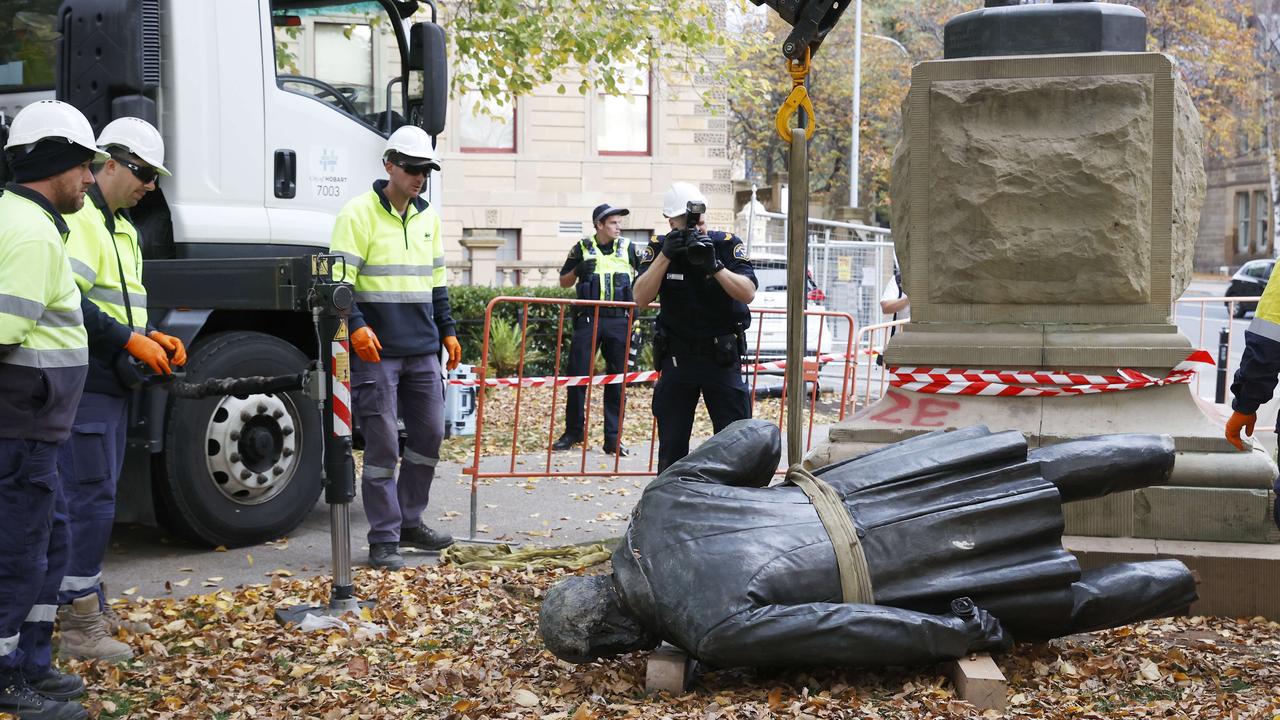
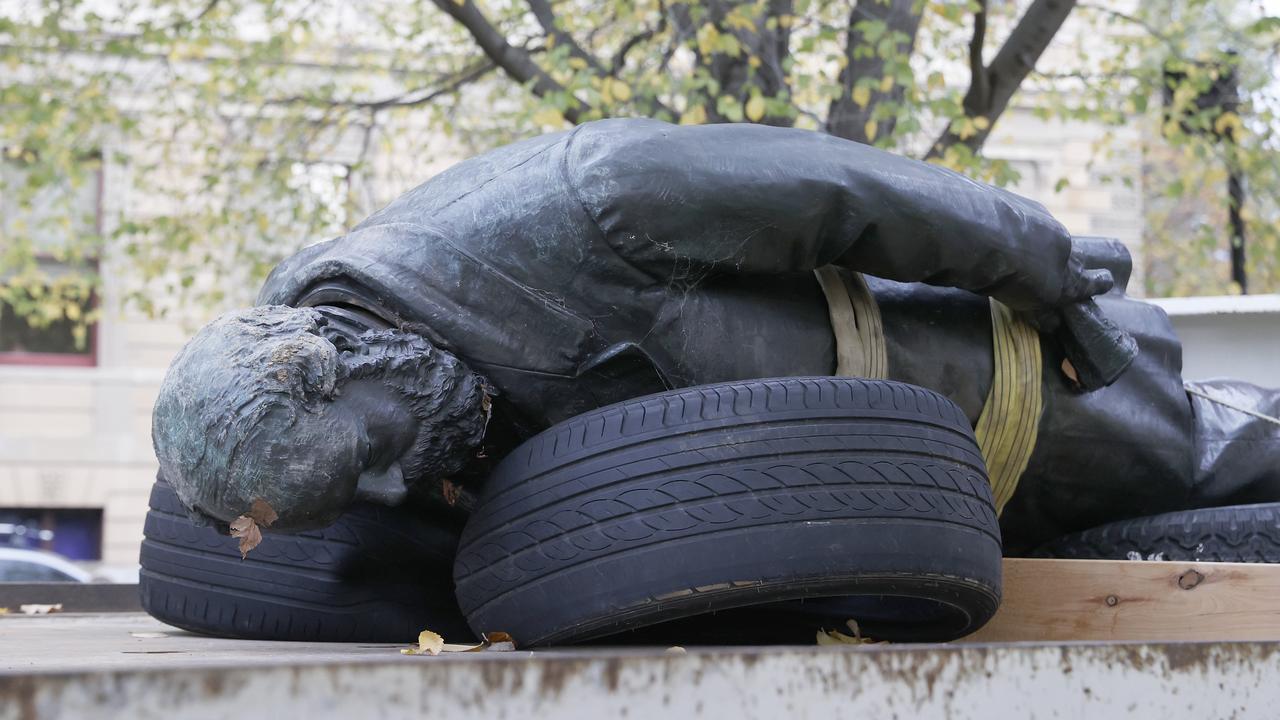
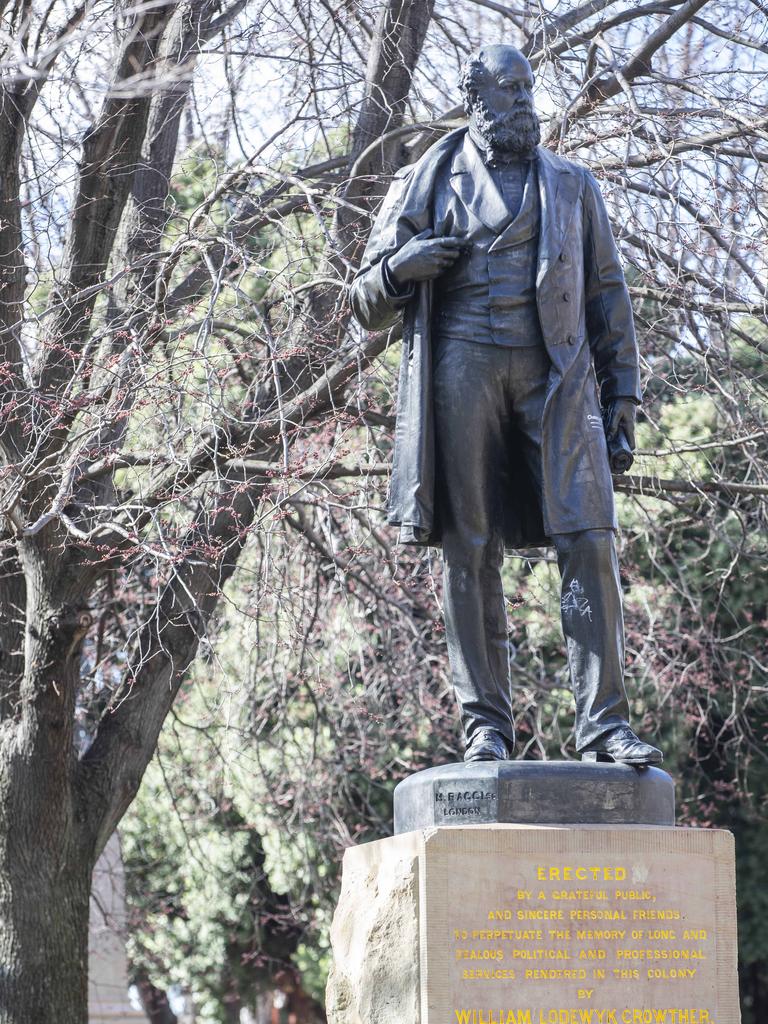
The William Crowther statue in Franklin Square Hobart was vandalised in May 2024. Picture: Nikki Davis-Jones.

William Crowther’s statue, Franklin Square Hobart, May 2024. Nikki Davis-Jones.

No doubt many people, regardless of their political orientation, were disturbed by the recent news that a civic statue had been vandalized and destroyed under the cover of night by an anonymous gang of attackers in Hobart. The event was all the more shocking because the city council had already determined to remove the statue from its public location following controversy about the actions of the individual it celebrated.

This kind of attack, to be quite clear, has nothing in common with tearing down the statues of tyrants in the fall of dictatorships, from the former Soviet empire to Iraq. In those instances, the state or a despot had set up multiple effigies all over the country as symbols of power and instruments of oppression, and they were overthrown in the collective movement of popular revolution. In this case an individual monument to a respected citizen, erected by the community, was destroyed by a small group of zealots.

Statues have been set up as monuments to great men and removed by their enemies for a long time. Even without considering the many precedents in antiquity, countless statues were destroyed during the French Revolution, others during the mob violence of the short-lived “Commune” government in Paris in early 1871 – including the figure of Napoleon on the Colonne Vendôme – and many more under the Nazi occupation of Paris.

Statues have not always been effigies of individuals; some of the most beautiful Greek sculptures were simply of the ideal body; others represented divinities, as also in Christian, Buddhist or Hindu traditions. Portrait sculpture began in the Hellenistic kingdoms and flourished in the Roman period. After the fall of the Empire, and with the decline of all the arts, no sculptural likeness was made for a thousand years. The Renaissance rediscovered portraiture with enthusiasm, both in painting and sculpture, and over the next few centuries portraits of monarchs and other leaders became common in big cities.

Portrait monuments proliferated in more recent times, particularly in the 19th century, as a consequence of increasing prosperity, patriotism or nationalism and local municipal pride. Not only monarchs but prominent politicians, leaders of national unification or liberation movements, explorers and founders of new colonies, notable scientists and writers, philanthropists and other prominent citizens were commemorated in public statuary. Often these adorned and helped to shape the new public parks laid out for the enjoyment of populations in great modern cities.

Arguably too many of these monuments were put up, and sometimes the individuals in question have lost the prominence they once had; or some of their deeds may now be considered reprehensible. In certain cases an argument could be made to relocate a statue to a museum instead, but such decisions should not be taken lightly, especially if the grounds for removal and relocation are ideological, or made in response to the digital mob behaviour of social media.

The felled William Crowther statue in Franklin Square Hobart. Picture: Nikki Davis-Jones

The case of William Crowther (1817-85) is an interesting one. He was a member of a prominent Hobart family of doctors and natural historians, including his own father and then his son and grandson who enjoyed distinguished careers in medicine, science, war and politics over the following century. He was an expert surgeon, a keen natural scientist and an entrepreneur with important shipping and whaling interests, as well as a member of the colonial parliament and briefly premier of Tasmania. Less than four years after his death, a statue was set up by public subscription to honour an eminent fellow citizen.

Crowther is controversial because of his alleged, and it seems fairly certain, involvement in a grisly, if scientifically motivated, affair in 1869. Darwin’s great book On the Origin of Species had only appeared a decade earlier, in 1859, and scientists were eager to understand more about the comparative morphology of different human families. Tasmania held a particular interest because the Indigenous Tasmanian population differed considerably from the mainland people.

By those years, however, over a generation after the end of the Black War (1824-31), very few individuals of unmixed Tasmanian descent survived, and just one male: William Lanne (c. 1836-69) – sometimes given as Lanney or Lanné – who worked as a whaler, was well-known in Hobart, and had even been introduced by the governor to Prince Alfred, the Duke of Edinburgh in 1868. When he died of cholera in 1869, he was buried at Saint David’s Church in Hobart, where Prince Alfred had just laid the foundation stone for the present Saint David’s Cathedral (consecrated in 1874).

Lanne’s funeral was a solemn occasion, attended by a large number of Hobart citizens. The Hobart Mercury reported (March 8, 1869): “Having been duly sealed, the coffin was covered with a black opossum skin rug, fit emblem of the now extinct race to which the deceased belonged; and on this singular pall were laid a couple of native spears and waddies, round which were twined the ample folds of a Union Jack, specially provided by the shipmates of the deceased. It was then mounted upon the shoulders of four white native lads, part of the crew of the Runneymede, who volunteered to carry their Aboriginal countryman to his grave.”

Behind the scenes, however, there was a struggle to secure a “perfect” Tasmanian skeleton for scientific research; the Royal Society of Tasmania, founded in 1843 and the first Royal Society outside Britain, wrote to the government, and according to the same article in the Mercury, “The Government at once admitted their right to it, in preference to any other institution, and the Council expressed their willingness at any time to furnish casts, photographs, and all other particulars to any scientific society requiring them. Government, however, declined to sanction any interference with the body, giving positive orders that it should be decently buried.”

The William Crowther statue as it was. Picture: Chris Kidd

The William Crowther statue as it was. Chris Kidd

On the night before the burial, nonetheless, someone stole Lanne’s skull from the morgue, as the article goes on to relate: “The dead-house at the Hospital was entered on Friday night, the head was skinned and the skull carried away, and with a view to conceal this proceeding, the head of a patient who had died in the hospital on the same day, or the day previously, was similarly tampered with and the skull placed inside the scalp of the unfortunate native, the face being drawn over so as to have the appearance of completeness.”

Crowther was suspected of having carried out this mutilation because he had wanted the skeleton to go to the Royal College of Surgeons in London. The Royal Society, concerned that the rest of the body might similarly be stolen, then removed the hands and feet, partly to render the remaining skeleton less attractive to thieves. They also alerted the governor to the need to guard the grave against possible robbery, and while this was agreed on, it seems that the Hobart municipality failed to arrange watchmen; the grave was opened on the night after the funeral and the skeleton removed, leaving behind the skull that had been inserted into Lanne’s head.

It is not entirely clear who was responsible for these events, although it seems to be generally assumed that Crowther sent Lanne’s skull to the Royal College of Surgeons, who awarded him a gold medal and a fellowship. His entry in the Australian Dictionary of Biography (1969) states: “In 1860 he was appointed one of the four honorary medical officers at the Hobart General Hospital, but was suspended in March 1869 over charges of mutilating the body of William Lanney, the last male Tasmanian Aboriginal. An inquiry showed that two mutilations had taken place, the first at the Colonial Hospital, the other at the cemetery the night of the burial. Drs Crowther and G. Stokell, resident medical officer at the hospital, were suspected of the first, the Royal Society of Tasmania of the second.”

Whatever the truth, the story is gruesome, a window into another time and a world of which we can be highly critical but from which there is also much to learn. Perhaps it would have been preferable to move the statue to the Tasmanian Museum and Art Gallery, where it will no doubt now be transferred and where it can be accompanied by displays that explain what we know about the events surrounding Lanne’s death and burial.

Simply cutting the statue down, however, closes off the opportunity for reflection; erasing the traces of the past may offer short-term satisfaction, but in the long run it encourages forgetting rather than remembrance and reflection. Is it not better to understand this episode and ponder its implications than to bury it under self-indulgent slogans like “decolonize”, which was scrawled on the statue’s base?

The most fundamental principle in this and similar cases, however, is the protection of public space in a democratic society. In a figurative sense, it is imperative to protect the public space of free discourse and open debate. Today that space is more than ever under attack from ideologues of different political orientations who seek to suppress or silence those who disagree with their views.

We saw recently the attempt by a city council in the west of Sydney to ban a book on same-sex parenting; but we could equally have seen another group trying to ban a book critical of the same arrangements.

Freedom of speech means accepting that those who disagree with you have a right to argue their case.

The preservation of freedom of discourse and debate is harder than ever in the digital age; this may seem paradoxical, since social media ostensibly allows everyone to express their opinions more promiscuously than ever before. But in practice that expression is quickly drawn into various competing maelstroms in which people vie to agree with each other ever more vociferously.

The same kind of mechanics endanger the physical public spaces of the modern city, the streets and squares and parks which are shared by all its citizens and residents. This public space must be one of order and peaceful process, where people can live and work and socialise in security and as much as possible in an environment of harmony.

The public space is one of lawful communal process. If, in this case, a monument is put up by the community, any decision about moving it must also be taken by the community (albeit in a different time and context)..

It is as unacceptable for a self-appointed gang to destroy a public monument as it is for selfish residents to cut down trees that block their view or greedy developers to demolish a heritage building for commercial gain or looters to smash a shopfront during a natural disaster. We must be unequivocal in our condemnation of the violation of common space in a democratic society.

The sickness at the heart of the international order

Last week, in sheeplike conformity with diplomatic niceties, Australia, together with the US, the EU and NATO offered condolences for Iran’s vicious hanging judge President Ebrahim Raisi.

A year ago, the International Criminal Court issued a warrant for the arrest of Russian President Vladimir Putin for crimes against humanity. It would deepen Russia’s international isolation, pundits pronounced. The announcement did not receive the breathless coverage of the recent news that the court was considering similar warrants with respect to Israeli and Hamas leaders with repeat to the atrocities of October 7th and the bloody war that has followed.

A year on, and Vlad’s star still shines as Russia makes gains on the Ukrainian battlefield.

But the ICC is only one part of the malaise that has contaminated international institutions.

I have long believed that the United Nations has long passed its usefulness – if it ever had any purpose at all having been strangled at birth by the veto wielded in the Security Council by the US and Russia.

It has indeed gotten worse. As Greg Sheridan wrote in The Australian on 25th May

“The ethos of institutional liberal internationalism, especially when associated with the UN, has become an inverted parody of what it was once meant to be. The UN culture is a result of a combination of activism from dictatorships, especially China and Russia; plus the in-built voting power of the Arab, North African and Muslim blocs, none of which is sympathetic to democracy, and the ideological leftism of the activist and NGO class in Western societies themselves. Thus.  the UN frequently produces abominations with a kind of PG Wodehouse comic quality – committees on women’s rights headed by Saudi Arabia, human rights bodies chaired by China, non-proliferation committees headed by Pakistan and the like”.

On Ebrahim Raisi in particular, Sheridan wrote:

“Before becoming president Raisi was most famous for his role on the Tehran Death Committee in 1988. Across the Islamic Republic of Iran at that time many thousands of political prisoners were tortured and killed. No jurist was a more enthusiastic deliverer of death than Raisi. Later, when president, he looked back on those days with fondness and claimed the executions as a particular achievement for Iran.

Raisi ran unsuccessfully for president a couple of times. He was neither popular nor in the first rank of Iranian leaders, or of Islamic theologians, though he gave himself the title of Ayatollah. In 2021 Iran’s Supreme Leader, Ayatollah Ali Khameini, decided, with the Islamic Revolutionary Guard Corps, they would make Raisi president. He was a reliable hardliner and someone the IRGC in particular thought they could control”.

For more on Israel and Palestine in In That Howling Infinite, see Middle East Miscellany. See also, Lebensraum Redux – Hamas’ promise of the hereafter, Total war in an urban landscape – Israel’s military quandary, Flight into Egypt, and the promise of the hereafter , and The Calculus of Carnage – the mathematics of Muslim on Muslim mortality

The ICC is a sign of a deep sickness

That UN agencies mourn the Butcher of Tehran as they seek to arrest democratic Israel’s leaders presents the morally inverted, politically corrupted nature of what passes for liberal internationalism today.

Greg Sheridan, The Weekend Australian, 26th May 2024

Left to right: ICC chief Karim Khan, Israel PM Benjamin Netanyahu, Iran President, Ebrahim Raisi.

The contrasting treatment, especially at the UN, of Israel’s Prime Minister, Benjamin Netanyahu, and Iran’s president, Ebrahim Raisi, who died in a helicopter crash on May 19, starkly presents the morally inverted, politically corrupted and more than half insane nature of what passes for liberal internationalism today.

The chief prosecutor at the International Criminal Court in The Hague has formally requested arrest warrants for Netanyahu and Israel’s Defence Minister, Yoav Gallant, accusing them of war crimes in Gaza.

Netanyahu is the duly elected Prime Minister of the Middle East’s only democracy. On October 7 his country was attacked, while a ceasefire was in place, by the terrorist group Hamas, which is sponsored by Iran. In the attack the most savage, sadistic and sexually depraved terror was unleashed as 1200 people were exuberantly tortured and butchered, and some 250 taken hostage. Hamas then retreated into its tunnels below the civilians of Gaza.

The ICC has formally requested arrest warrants for Israel’s PM, Benjamin Netanyahu, and Defence Minister, Yoav Gallant, accusing them of war crimes in Gaza.
The ICC has formally requested arrest warrants for Benjamin Netanyahu, and Yoav Gallant

Netanyahu’s government retaliated, with a few clear objectives – to end Hamas rule in Gaza, to destroy Hamas and to ensure October 7 wouldn’t happen again. Hamas vowed it would repeat October 7 over and over. Meanwhile it killed some of the hostages, tortured others, even small children (there’s video) and subjected women and girls to sexual assault, sexual terror.

Raisi, unlike Netanyahu, didn’t have a background in politics, certainly not democratic politics, more the legal system, specifically as a prosecutor. In a totalitarian theocracy such as Iran, prosecutors are always busy. Before becoming president Raisi was most famous for his role on the Tehran Death Committee in 1988. Across the Islamic Republic of Iran at that time many thousands of political prisoners were tortured and killed. No jurist was a more enthusiastic deliverer of death than Raisi. Later, when president, he looked back on those days with fondness and claimed the executions as a particular achievement for Iran.

Raisi ran unsuccessfully for president a couple of times. He was neither popular nor in the first rank of Iranian leaders, or of Islamic theologians, though he gave himself the title of Ayatollah. In 2021 Iran’s Supreme Leader, Ayatollah Ali Khameini, decided, with the Islamic Revolutionary Guard Corps, they would make Raisi president. He was a reliable hardliner and someone the IRGC in particular thought they could control.

Ayatollah Ali Khameini.

Iranian elections used to have some limited meaning. Elected officials never really had power and Iranian voters several times elected notionally moderate presidents to no avail. The real powers, the IRGC and the office of the Supreme Leader, decided who could run. But much more than

Iranian elections used to have some limited meaning. Elected officials never really had power and Iranian voters several times elected notionally moderate presidents to no avail. The real powers, the IRGC and the office of the Supreme Leader, decided who could run. But much more than the president, they wielded state power.

Consequently, Iranians stopped bothering to vote. When Raisi won, the turnout was claimed to be 49 per cent, though even this is regarded as an exaggeration.

Since Raisi became president in 2021, Iran has been energetic. It redoubled the vice police. Iranian women and girls are routinely arrested, sexually assaulted and beaten to death for offences such as not wearing their hijabs properly. One such case, of a young woman named Mahsa Amini, who died in 2022, set off a round of riots and protests that were savagely repressed, with hundreds dead and more than 20,000 imprisoned.

Internationally, Raisi’s government became famous for murdering Iranian dissidents in Europe and the US. Western governments regard Iran as the chief state sponsor of terrorism. Apart from Hamas, Iran has built Hezbollah, in southern Lebanon, into a powerful non-state military force, with perhaps 150,000 missiles and tens of thousands of soldiers.

Mourners hold posters of Iranian President Ebrahim Raisi during a funeral ceremony in Tehran, on May 22. Picture: AFP
Mourners hold posters of Ebrahim Raisi during a funeral ceremony in Tehran. AFP

Tehran funds and provides weapons to Shi’ite militias in Iraq and Syria. All these groups deal out death fairly indiscriminately to their opponents and internal critics. Iran also backs the Houthi rebels, whom Australia has just declared a terrorist organisation under our law. They fire missiles at Israel but the Houthis’ great significance has been to massively disrupt shipping in the Red Sea. They exempt Chinese and Russian shipping, which is as sure a sign of Iranian control of their activities.

Many of the deaths Iran caused under Raisi occurred on the soil of nations over which the International Criminal Court claims jurisdiction. Yet the ICC never produced a warrant for Raisi’s arrest. Indeed, the UN lowered its flag to half-mast to honour Raisi after his death. The EU, not quite as otiose as the UN but surely its first cousin in the fatuousness of much that it says and does, used its most senior officials to send heartfelt and sincere condolences over Raisi’s death.

A former immigration minister of Belgium, Theo Francken, chided the EU for praising a “butcher and a mass murderer”. A Swedish member of the European parliament, David Lega, asked the EU leaders: “Can you ever look the brave women and freedom fighters of Iran in the eye again?”

You’ve never heard of Franck­en or Lega and you never will. Voices like theirs are marginal now.

The ethos of institutional liberal internationalism, especially when associated with the UN, has become an inverted parody of what it was once meant to be. The UN culture is a result of a combination of activism from dictatorships, especially China and Russia; plus the in-built voting power of the Arab, North African and Muslim blocs, none of which is sympathetic to democracy, and the ideological leftism of the activist and NGO class in Western societies themselves.

Thus the UN frequently produces abominations with a kind of PG Wodehouse comic quality – committees on women’s rights headed by Saudi Arabia, human rights bodies chaired by China, non-proliferation committees headed by Pakistan and the like.

Feeding into that are two other dynamics. One is that most nations are concerned, understandably but dismally, only to avoid getting themselves criticized in any UN committee. So they go along to get along. And they like to get their little share of UN goodies. So they don’t object to some moral grotesquerie to secure the position of deputy rotating chairperson of the Pots and Pans Committee of the Under Secretary’s eminent Consultative Group.

Far more toxic is the sick obsession in this fetid culture with Israel and Jews. This is a kind of reverse intersectionality. Modern demented left-wing activism absurdly defines Israel as a colonist state. Demented right-wing activism draws on centuries of Western anti-Semitism. Most Arab nations, though many have recently made good accommodations with Israel, would nonetheless rather not have any non-Muslim state in the Middle East, while the tradition of Arab anti-Semitism roars. China, Russia and all their friends will routinely seek to hurt Israel in order to hurt America.

All of this comes together in a witch’s brew of anti-Semitism cloaked in the faux high-minded verbiage of liberal internationalism. Very frequently, specialist UN human rights bodies pass more resolutions criticising Israel than they do concerning the rest of the world combined. Don’t worry about Uighurs or Tibetans or Christians in China; never mind about labour camps in North Korea; leave the Arab world’s treatment of women or indeed of gays to one side – all the human rights evil in the world is insanely attributed to Israel.

By the way, the only nation in the Middle East that has big gay pride days is Israel. I’ve seen the gay pride days in Jerusalem and Tel Aviv. But somehow you never see a protest march with a sign: Queers for Israel.

That the UN and its institutions have become so morally corrupted is partly the fault of the West, as it has lost power, cohesion, self-confidence and the ability to believe in and argue for the values it once regarded as universal.

The UN has been a politically corrupt body for a long time. Our response was not always this feeble. In 1975, only 30 years after the Holocaust, the UN General Assembly passed a resolution equating Zionism with racism. At the time, under Gerald Ford’s presidency, the US seemed all astray, after Watergate and the failures in Vietnam. Its ambassador to the UN was the professorial, slightly dishevelled-looking Daniel Patrick Moynihan, a cloud of stray hairs and half-dropped papers but a whirlwind of moral force. He went on, this most untelegenic of figures, to be a long-term Democrat senator for New York.

He strode, this ungainly figure, to the lectern and thundered forth a modern Gettysburg Address, in its way the finest speech ever delivered at the UN. Moynihan began: “The United States rises to declare before the General Assembly of the United Nations and the world that it does not acknowledge, it will not abide by and it will never acquiesce in this infamous act.” This was not bluster. The US stirred itself to get what was in fact a racist motion reversed, and it succeeded.

Back then Australia voted with the US, unlike now. Joe Biden denounced the ICC action as an outrage. His Secretary of State, Antony Blinken, said he’d work with Republican senators, notably Lindsey Graham, to consider imposing US sanctions on officials of the ICC who enacted such infamy. Biden, in my view a generally weak president, on this has been strong. Perhaps the issue called to an earlier version of Biden, when America itself was stronger.

Of course, Netanyahu deserves great criticism. He has become an increasingly counter-productive Prime Minister for Israel. This is despite past mighty achievements – liberalising and growing the Israeli economy, pioneering new relationships in Asia, welcoming millions of immigrants into the country, creating a good life for Jewish and Arab Israelis alike, and then, during Donald Trump’s presidency, achieving the Abraham Accords in which Israel exchanged diplomatic recognition with the United Arab Emirates, Bahrain, Sudan and Morocco.

But he became too arrogant, too self-obsessed, too complacent. The October 7 attacks are wholly the moral responsibility of Hamas, but they also reflect a shocking intelligence failure, and simple preparedness failure, on Israel’s part. Similarly, Netanyahu has not been able, or perhaps not willing to try, in recent years to control the lawlessness of some of the Israelis who live in the West Bank.

Netanyahu must bear responsibility for these matters. Now, he faces intense criticism from his cabinet colleagues for refusing to address governance in the Gaza Strip once Israel is finished its military operation. None of this remotely makes Netanyahu a war criminal. Israel has not starved Gaza. Hamas itself has made it difficult to get aid convoys safely into Gaza. Egypt has shut its border with Gaza because it doesn’t like Israel controlling the other side. But this means no aid from that quarter. Hamas and its allies have attacked aid shipments coming through the pier the US built to provide a sea route for aid to Gaza.

Similarly, Hamas’s casualty figures are greatly exaggerated. There has been terrible death and destruction in Gaza and this is entirely Hamas’s responsibility. Even today, Hamas could end all the suffering by releasing some Israeli hostages and accepting the ceasefire Israel has been offering for months. Hamas attacked Israel in the most sickening manner possible, then hid among and underneath Palestinian civilians. The ICC seems to be of the view that this means Israel is forbidden from waging a military campaign against Hamas. The UN itself recently halved its estimate of the number of women and children killed in Gaza, which suggests Israel’s efforts to keep civilian casualties as low as it can have been meaningful.

The ICC has no jurisdiction as Palestine is not a state and Israel is not a signatory to the Rome Statute that established the ICC. And finally, the ICC is meant to act only where national governments can’t or won’t act. Israel has a strong judicial system and will certainly have a plenitude of inquiries once the military action in Gaza is complete. The odious ICC action therefore has to be seen as a political expression of the cultural collapse and degradation of the old liberal international ideals.

It’s up to the nations that believe in those ideals, most importantly the US but, you would expect, also its allies and like-minded nations, to vigorously reform or, if this is impossible, simply walk away from those institutions.

Instead, Ireland, Spain and Norway extended formal diplomatic recognition to the state of Palestine. This is a common but bizarre conceit of our day. There is no state of Palestine. Hopefully one day there will be, but this can come about, as the US argues, only through negotiation between Israel and Palestinian representatives.

But, as everyone knows, any Palestinian leader who makes any kind of peace with Israel will surely be assassinated by extremists in his own camp. Some Palestinian groups, such as Hamas, are utterly transparent in their anti-Semitism and vow never to recognise any Jewish state. Others theoretically recognise Israel’s right to exist but have erected a whole lot of preconditions and red lines they know Israel can never possibly meet. Therefore, they won’t ever have to face the hard compromises and choices a Palestinian state would necessitate.

Instead, all the Western gestures of solidarity with the Palestinians have amply and warmly justified Hamas’s terror. The Albanese government rewarded Hamas when it declared, through a very confused and poor speech by Wong, it would recognise Palestine before an agreement was reached with Israel.

Israeli legal scholar and commentator Eugene Kontorovich surely calls out a gruesome truth when he writes: “Hamas’ grisly terror raid on October 7 has proved to be the single most stunningly successful act in gaining support for the Palestinian cause … The bloodier the terror attacks, the more stark the eliminationist rhetoric, the more support for a Palestinian state.”

Kontorovich identifies a crippling syndrome. The more savage the terror, the more entranced Western elite opinion becomes. If Israel responds that same elite instantly reverts to the rhetoric and operating principle of de-escalation.

When Biden was backing Israel most strongly early in the campaign, Hamas released hostages and agreed to a ceasefire. Washington’s efforts more recently have caused Israel delay, and this delay itself prolonged Palestinian suffering and helped Hamas. As Hamas has seen Biden come under political pressure, and therefore put Israel under pressure, it has been effectively rewarded for its barbarism and encouraged to make no compromise.

The ICC is not a court but a sign of the deep sickness at the heart of the international system. Don’t think that sickness cannot kill us here in Australia in time.

Greg Sheridan is The Australian’s foreign editor.

Killing for Country … dark deeds in a sunny land

… they were standin’ on the shore one day
Saw the white sails in the sun
Wasn’t long before they felt the sting
White man, white law, white gun
Solid Rock, Goanna 1982

As indigenous author and academic Victoria Grieves-Williams writes below in her essay regarding journalist David Marr’s recently published family history: “We live in a time of reckoning over the colonisation of the land mass that we now know as Australia. While British officials carefully avoided acknowledging that people existed on this continent prior to their arrival by adopting the infamous doctrine of terra nullius, many Australians are now re-examining the historical basis of their presence here. They know that they enjoy the material wealth and lifestyle of the lands they have come to call home and until recently there was no need to doubt, or be self-conscious, about Australia being “home”. Yet there clearly were people here, and it was only the idea of an empty country that made it possible for agents of Empire, such as the Uhr brothers, ancestors of the journalist David Marr, to go about attempting to empty it”.

I’ve written often about the indigenous history of our country. The following passage from my piece on Australia’s The Frontier Wars. This passage therefrom encapsulates my perspective:

”There is a darkness at the heart of democracy in the new world “settler colonial” countries like Australia and New Zealand, America and Canada that we struggle to come to terms with. For almost all of our history, we’ve confronted the gulf between the ideal of political equality and the reality of indigenous dispossession and exclusion. To a greater or lesser extent, with greater or lesser success, we’ve laboured to close the gap. It’s a slow train coming, and in Australia in these divisive days, it doesn’t take much to reignite our “history wars” as we negotiate competing narratives and debate the “black armband” and “white blindfold” versions of our national story”.

Below are pieces published in In That Howling Infinite in regard to Australian history and politics as these relate to Indigenous Australians:

Healing country key in David Marr’s awful family history of murder and mayhem

Victoria Grieves Williams, The Weekend Australian. 16th March 2024

Journalist and biographer David Marr with Indigenous leader Noel Pearson in 1997.
                      David Marr with Indigenous leader Noel Pearson in 1997

We live in a time of reckoning over the colonisation of the land mass that we now know as Australia. While British officials carefully avoided acknowledging that people existed on this continent prior to their arrival by adopting the infamous doctrine of terra nullius, many Australians are now re-examining the historical basis of their presence here. They know that they enjoy the material wealth and lifestyle of the lands they have come to call home and until recently there was no need to doubt, or be self-conscious, about Australia being “home”.

Yet there clearly were people here, and it was only the idea of an empty country that made it possible for agents of Empire, such as the Uhr brothers, ancestors of the journalist David Marr, to go about attempting to empty it.

Thus, settler colonials are having to come to terms with the fact that their ancestors were often murderous, criminal and racist, to what we may now understand as absurd and totally unnecessary lengths. And if they were not actually involved in these dirty deeds they were condoning them and even cheering them on. There were voices of dissent, but few are in the historical record. It is a ghastly story.

It is hardly surprising that Marr is now at the forefront, telling a family story about one of his great great grandparents and siblings that truly angers him. He has said that researching and writing this history is “partly an act of atonement and partly an act of rage”.

Marr is palpably angry. The book is written with an urgent passion, brave in what it reveals and unforgiving in the light it casts on bloody deeds.

I can only echo all that reviewers and commentators have said about this book. As Richard King said in his review (The Australian, October 13, 2023, republished below)this is “a magnificent achievement and a necessary intervention, on a subject that still divides Australia: the violent dispossession of its native peoples”.

It is what we have come to expect from a master journalist and storyteller who has a brilliant track record in publishing. The research is thorough and in this Marr was assisted by his partner Sebastian Tesoriero who connected with the joys of Trove, the online historical newspaper database. The search for the deeds of the Uhr brothers and the bloody swathe they and the Black Troopers cut through northern NSW and up through Queensland and into The Gulf country during the 19th century is satisfyingly forensic.

The aim of my essay is to place the book Killing for Country: A Family Story in the context of a process of truth telling. There is no doubt about the truth and veracity of this argument, that the frontier was a place of bloody mayhem and murder. Many Aboriginal people have always known this; the more naive of us have known at least since the early 1980s, with the publication of Geoffrey Blomfield’s groundbreaking Baal Belbora: The End of the Dancing and Henry Reynold’s important work, The Other Side of the Frontier.

What is left is to find a way to deal with this history in the best way possible, so as not to exacerbate social tensions and negatively impact race relations. My contention is that this is indeed a family story, to be resolved at that level.

On finishing reading the book I was left with the question: “What now?” What do we do with this awful history of murder and mayhem, the rage and need for atonement?

The first thing is to understand these events as history in a deeper sense, that is within a larger historical frame. Perhaps then we can understand what it is telling us of the true nature of human beings. This is the approach evident in Aboriginal cultural understandings of time and the ways in which conflicts are resolved.

Killing for Country, by David Marr


Victoria Grieves Williams is an Indigenous academic based in New York.
                                          Victoria Grieves Williams 

Historians are now recognising that the colonial wars unleashed from the 16th century onwards are the first of the Great Wars. The death toll was immense: the Spanish conquest of the Americas from the 16th-18th centuries has an estimated death toll of 28 million. The British Empire, which held 24 per cent of the Earth’s total land area by 1920, wrought an estimated death toll of 100 million people. It was by far the largest empire in history and a source of great pride for those who tied their fortunes to it.

One could say that it was the fashion. Colonial wars were fought by European powers over the Indigenous people of the global south, not only in Australia but in Africa, Asia, South America and Mexico, India and China. The aim was to dispossess, enslave, destroy and claim all of what these people had of value, for the Empire. They were enormously successful.

No small part of this success is due to the specific kind of white masculinity that enabled the bloody conquest, that seemed to relish the lawless frontier and the opportunity to prove oneself.

This specific masculine ideal of violence as normative was nurtured and fostered as a part of the imperial ambitions of Britain, and thus built into colonial culture and politics. The workings of what the anthropologist Rita Laura Segato refers to as the masculine mandate whereby the libido is conscripted into providing constant proof that one truly is a man was the order of the day. Subservience to the masculine mandate is for both men and women the only way to exercise any power “power is expressed … exhibited and consolidated, as virile potency in a brutal form”.

Thus arises the pedagogy of cruelty through which Segato names all of what is manifest on human bodies to reduce them to things – violence, terror and cruelty.

In interviews, Marr has been emphatic that the people of the killing times are the same as those of today. It is my view that they are separated by huge social, cultural and political gaps and contexts that shape them. This has been a long debate in sociology, is it nature or nurture that produces certain kinds of people? In the case of settler colonial masculinist ideology, the society back in Britain was often shocked by the excessive violence of the frontier. They sought ways to curb them. Perhaps some realised they were a necessary evil and continued to fund and support them.

An Invasion Day ceremony held in Kings Domain park in Melbourne. Invasion Day ceremony held in Kings Domain park in Melbourne

However, Marr has a point about the unchanged nature of people over time when you consider the murdered and missing Aboriginal women and children in Australia. For example, the crimes of the serial murderer Richard Dorrough against Aboriginal and Pacifica women. He, who perversely wanted his crimes to be known, can be seen as subservient to the masculinist mandate. There are many other perpetrators. The phenomenon of murdered and missing Aboriginal women and children is evidence of the continuation of the gendered conquest and pedagogy of cruelty in contemporary Australian society.

To enlarge on the macro view, the huge death toll in all of the worldwide wars since the 16th century has not seemed to make a dent on the continuing overpopulation of the Earth. We need to consider that huge hordes of Europeans moved out to the global south because they could not continue to live in home countries that were already overpopulated. The 18th century saw famines and food riots in Britain and France.

The colonial wars and subsequent mass migrations were a result of the very pressing need to find other lands on which to grow food and be able to live, as well as the search for the bounty that these lands could offer in timber, animal and mineral resources. While the idea of Manifest Destiny propelled settlers in North America, settlers in Australia were not untouched by this and also had the idea of an empty continent – therefore those who were there beforehand were not legitimate, had no rights, were not truly human.

And still yet – what now?

It’s important to understand that the way people see history, utilise it or deal with it varies according to cultural approaches. Aboriginal cultural understanding has it that our ancestors beyond the last two generations (that are usually in living memory) go back into eternal time where they are part of the paradigms for the proper human behaviour on Earth, also known as the Law. These paradigms are accessed through stories that are often attached to constellations and landforms. Eternal time is ever-present, it is here “running along beside us” enabling a connection through eruptions of eternal time into the present.

Eternal time then is connected to normal time in which we live, this is the “everywhen” that is often used to describe Aboriginal understandings of time. It is more than that, it is known as tjukurpa by Central Australian Anangu, and by other names elsewhere. Altogether it is the sacred, that is more easily accessed when in the state between dreaming and wakefulness. Hence the misnomer, the Dreaming.

David Marr.
David Marr.

If the Law is transgressed then people have to be held to account for their actions and the aim of a full and frank hearing is for people to be able to continue to live together in a good way. All involved are given an opportunity to speak their truth and an appropriate punishment is decided on and meted out. Once resolved, settled, these matters are never spoken of again. It is considered that the business is finished.

So, what now? The Yoorrook Commission in Victoria defines truth telling as the act of telling true history by listening to the experiences of First Peoples.

Marr has written this book as a contribution to the truth-telling process and this is, as he says, a family story. It holds the key to the important connections and relationships that can grow out of meeting with the “other” side. There are many descendants of the survivors of the killing times in north Queensland who have their own stories to tell. In some places the notorious Darcy Uhr is still in living memory.

What remains is for the Uhr family descendants to reach out and begin to make connections across the divide of a brutal history, for which no-one alive today is responsible or culpable, but for which we can feel deep regret and seek to heal the bonds that bind us as human beings. Our lives will all be so much better for it.

Victoria Grieves Williams is an historian and Warraimaay woman whose mother worked as a cook and housemaid at sheep stations at Brewarrina. She is based in New York

Killing for Country book review: examining the Native Police’s violent dispossession of Indigenous Australians

Richard King, The Australian. October 13th 2023

Young guns: journalist David Marr listens to lawyer Noel Pearson speak during 1997 National Law Week Forum meeting. Marr has this week released his latest book on his own family’s links to Indigenous massacres.

Running to almost half a thousand pages, prodigiously researched and immaculately written, David Marr’s Killing for Country: A Family Story is surely one of the books of the year. Modestly described as a “family story”, it is in fact as solid a work of history as one could hope to find on the shelves. Clearly, the book holds enormous significance – enormous personal significance – for its author. But Marr brings the same forensic approach to this narrative of the frontier wars as he did to his celebrated biography of Patrick White, to his monographs of Tony Abbott and George Pell, and to his indispensable account of the Tampa/Children Overboard affair and Pacific Solution, Dark Victory.

It is a magnificent achievement, and a necessary intervention, on a subject that still divides Australia: the violent dispossession of its native peoples.

It was the discovery that his great-great-grandfather had served with the Native Police that set Marr off on this bold endeavour. The son of Edmund Blucher Uhr, scion of a poorly connected family with pretensions to Irish nobility, Reginald Uhr and his brother D’arcy were both officers in this notorious outfit, which cleared land of its Aboriginal owners at the behest of the squattocracy, avenging attacks on farmers’ livestock and “dispersing” troublesome gatherings. “Dispersing” was a euphemism, of course, but so too was “police”: as even contemporaries understood, the NP was a quasi-military unit, not a tool of law enforcement. It’s estimated that over 60 years it murdered more than 10,000 people (Marr says a “cautious interpretation” of these figures has seen estimates rise from 10,000 to 20,000 and now to more than 40,000).

The NP began its campaign of killing in the Darling Downs in 1848, but its brutality reached its feverish peak as it moved north in the 1860s, in the wake of Queensland’s break from New South Wales. Its campaigns were characterised by a basic asymmetry, as the belligerents in the frontier wars operated according to different principles: the Indigenous peoples saw themselves as redressing grievances through evening up the score, while white retaliation was inordinate. A pattern quickly established itself. Colonial expansion led to Indigenous resistance, which led in turn to further dispersals. Notwithstanding that these acts of violence were often met with disapproval by the colonial authorities, the indulgence shown towards them was baked in, in a way that gives the lie to the idea that the NP was dispensing justice. The reality is that it was clearing the land of black bodies.

Killing for Country by David Marr is about the author’s great-great-grandfather, who served with the Native Police, which cleared land of its Aboriginal owners, often by murdering them.

This picture is complicated by the fact that the NP comprised units of eight to ten such bodies under the command of a single white one. But in Marr’s telling, this organisational structure was something of a genius-stroke, in that it drew on the multinational nature of the Indigenous population and on the profound connection to place – to country – that characterises Indigenous society in general. As he puts it:

“What made them strange and dangerous to each other was being away from their own country, the country that made them who they were. Here was a deadly conundrum. While officially denying their attachment to land, colonial authorities would rely on that profound attachment – and the divisions it provoked – to raise a black force that would strip them of their country.”

Such an arrangement also allowed the NP to characterise the murdering as what a US Republican might call “black on black” violence. The recruitment of Aboriginal men gave white officers a handy alibi when questioned by their superiors.

Why would the killers need an alibi? The question may sound ridiculous, but conservative history warriors who criticise histories such as these, will often suggest that their authors are guilty of projecting modern values backwards (this is the so-called “black armband” charge). But what emerges from these grisly pages, and from the accounts of the contemporary outrage directed against the clearances, is a picture of a system of “justice” founded on a gargantuan hypocrisy – hypocrisy being the compliment that vice implicitly pays to virtue. In other words, many of the men in this “story” knew full well that they were involved in an immoral undertaking, and commentary that attempts to downplay this reality is, itself, unhistorical. This is not to say that the picture is simple: history is a tragedy, not a morality play. It is simply to agree with the author that if it is possible to feel pride in one’s country, it should be possible to feel ashamed of it too.

Author and journalist David Marr adopts an even, controlled tone for his devastating new book. (Picture: Lorrie Graham)

Marr does not make a show of such feelings. In his television appearances, he will often adopt the sort of demeanour that (I imagine) sends conservatives round the bend: the more-in-sorrow-than-in-anger eyes; the casual, cruising exasperation at the politics he doesn’t share, and is, therefore, self-evidently preposterous. But here the tone is even and controlled. One notes the slightly ironic adjectives and the occasionally sardonic descriptions. (“He recruited blacks as guides. He also shot blacks who stood in his way. Somerville was a genial and unscrupulous gentleman of the warrior class.”) But in general he lets the material speak for itself. Goodness knows, there’s plenty of it. As Marr notes – again, a little sardonically – one good thing about the colonists is that they wrote plenty of fine letters home.

The attitudes evinced in those letters, or the language in which those attitudes are couched, will no doubt distress most contemporary readers, and it would be vacuously polemical to assert that nothing’s changed. It has. Nevertheless, it is the achievement of this book to invite us to reflect on the many connections between contemporary Australia and its bloody past. That past is not a foreign country. It just speaks in thicker accents than we are used to.

Richard King is an author and critic. His most recent book is Here Be Monsters: Is Technology Reducing Our Humanity? (Monash University Press)

Killing for Country: A Family Story
By David Marr
Black Inc, Nonfiction
$39.99; 468pp

A bridge from past to present – the forgotten memoirs of Alice Duncan-Kemp

We lost so much when the old people went. No one else wrote down what they had to say and the chance to preserve their knowledge and wisdom died with them. Without Alice’s passion, without her parents being open to our culture all those years ago, we would know a lot less today about our language and traditions. For us, she is a bridge to both the past and present.  Mithaka elder Lorraine McKellar

The seed of my knowledge, of that corner of sand-hills, was implanted within me as a mere babe straddling Mary Ann’s hip, or toddling with little black mates after the billy-cart. In later youth the seed grew and fruited. The secret lay in a profound respect for the aborigines (sic) and their customs. In return, these trusty folk taught me to read, with wonder and pleasure, in Nature’s Infinite Book of Secrecy, the reading of which was as simple as ABC to them”.

These are quotations from an illuminating feature article in The Weekend Australian on the forgotten memoirs of Alice Duncan-Kemp, describing her childhood on a remote station in south west Queensland almost a century ago, in which she vividly describes her first contact with indigenous Australians.

Whether it is the stories she tells, or the manner in which she tells them – or even the language and syntax she uses, her work dividing today’s experts.

Predictably, the shadow of Bruce Pascoe’s Dark Emu looms large. The debate over who the First Australians were and how they lived prior to contact was picked up in the Voice campaign – prominent No advocate Jacinta Nampijinpa Price bitingly referred to the “Pascoisation” of Australia’s pre-settlement history when arguing that the intergenerational effects of colonisation had been overstated. Pascoe says that Duncan-Kemp deserves all the belated attention and more. “She suffered from being a woman outside the academy,” he tells The Weekend Australian Magazine. “Her work was judged with unnecessary harshness by white male ethnographers. There are flaws in her work but compared to most ethnographic work of the time it is enlightened.”

But, veteran anthropologist Peter Sutton, co-author of a searing 2021 book rebutting Dark Emu, “insists Nash is right to raise questions about Duncan-Kemp’s reliability when she “mixed memory with plagiarism from works about quite different regions”. Sutton is critical of the weight being placed on her books by ­researchers who claim to be “testing Pascoe’s theories” on the ground. “Archaeologists and others who rely on those works for Mithaka traditions, in the absence of proper investigation of them, are in danger of mistaking Duncan-Kemp’s descriptions for Mithaka traditions when they may in fact not be,” he says”.

Notwithstanding these academic polemics, the story as described in the article is a beautiful one. It is republished below. The reader may take whatever he or she wants from it. Austrian novelist and Nobel laureate Peter Handke Has written, “if a nation loses its storytellers, it loses its childhood.“ One thing is for certain in this uncertain world : we all love a good story. As they say, in Arabic, as indeed in all tongues, times and places, “ka-n ya ma ka-n bil ‘adim izzama-n wa sa-lifi al aSri wa la-wa-n”‘ or, “once upon an time”.

Storytelling has played an important role in the evolution of society. Storytellers were the keepers of our memories, our culture, our history. Indeed, are a storytelling species. We think in story, talk in story, and admire those who keep and spread our stories.

Most of the familiar faces have gone, gone to Malkuri, their god – into shadow time … The homesteads seem so utterly dead without old-time familiar sounds, corroborees, and the merry laughing chatter … To walk or ride about the sand-hills and swamps today is like entering a house suddenly emptied of children. Silence, where before there had been laughter and the merry pitter-patter of baby feet; a desperate loneliness which can be felt but is hard to describe.

I’ll leave the last word to none other than Tyrion Lannister:

What unites people? Armies? Gold? Flags? Stories. There’s nothing in the world more powerful than a good story. Nothing can stop it. No enemy can defeat it.

Author’s note

I’ve written often about the indigenous history of our country. The following passage from my piece on Australia’s The Frontier Wars.This passage therefrom encapsulates my perspective:

”There is a darkness at the heart of democracy in the new world “settler colonial” countries like Australia and New Zealand, America and Canada that we struggle to come to terms with. For almost all of our history, we’ve confronted the gulf between the ideal of political equality and the reality of indigenous dispossession and exclusion. To a greater or lesser extent, with greater or lesser success, we’ve laboured to close the gap. It’s a slow train coming, and in Australia in these divisive days, it doesn’t take much to reignite our “history wars” as we negotiate competing narratives and debate the “black armband” and “white blindfold” versions of our national story”.

Read more In That Howling Infinite on Indigenous history:

Read more in In That Howling Infinite on the Indigenous Voice to Parliament, 2023:

‘Improbable tales’: trailblazing historian’s Dark Emu moment

The forgotten memoirs of Alice Duncan-Kemp vividly describe first contact with indigenous Australians almost 100 years ago. So why is her work dividing today’s experts?

Copies of Alice Duncan-Kemp’s memoirs. Picture: Lyndon Mechielsen

Copies of Alice Duncan-Kemp’s memoirs.  Lyndon Mechielsen

It’s hard not to be enchanted by the lost books of Alice Duncan-Kemp when they resonate so deeply with the nation Australia would become. A photograph of her, on a winter’s day 90 years ago, shows her tapping out her childhood on Mooraberrie station, a speck in the red dirt of southwest Queensland’s far-flung Channel Country. The story of boom and bust in the bush, of hope given over to despair, of cattle dying of thirst one day and drowning the next in a frothing flood, is as old as the Outback ­itself. We know it by heart.

What sets Duncan-Kemp apart – and why the rediscovery of her work is causing a stir in academe and out in the field where scientists use it like a “road map” to unlock the secrets of how the First Australians lived – is the detailed and partly disputed account she provides of the contact era. A voice like hers was rarely heard at the time: ­admiring of the tribal ­Aborigines she grew up with, heavy of heart for a way of life in its death throes. Recalling the Aboriginal nanny who helped raise her on the family beef run, 1200km west of Brisbane, she wrote in 1933:

The seed of my knowledge, of that corner of sand-hills, was implanted within me as a mere babe straddling Mary Ann’s hip, or toddling with little black mates after the billy-cart. In later youth the seed grew and fruited. The secret lay in a profound respect for the aborigines (sic) and their customs. In return, these trusty folk taught me to read, with wonder and pleasure, in Nature’s Infinite Book of Secrecy, the reading of which was as simple as ABC to them.

Duncan-Kemp’s name and oeuvre – running to five out-of-print volumes and many more unpublished manuscripts – was forgotten by all but her family until a new generation of Australian historians dusted them off. Tom Griffiths, of the Australian National University, was 14 when he chanced across her second book, Where Strange Paths Go Down. He loved it, inspiring a lifelong passion for her work. Decades later the W.K. Hancock Professor of History would extol “the exciting truthfulness of her memoir – one tinged by innocence and nostalgia and prey to the glitches of memory, but faithfully told. A precious possibility emerges that Alice’s books comprise one of the richest ethnographic sources Australia possesses”.

University of Queensland archaeologist ­Michael Westaway began tracking down the scenes and places she described. There were dead-ends, of course. (“Alice was a bit airy-fairy on distances,” her grandson Will explains.) But in instance after instance, 21st-century technology and old-fashioned legwork confirmed her observations. Traces of sizeable Indigenous villages were found where she said they had been; a thriving trade in the narcotic pituri leaf did indeed span the length of the great inland ­rivers, from northwest Queensland to Kati Thanda-Lake Eyre, just as she described it; the jarra-jarra millstones she saw Aboriginal women sweat over to grind grass seed and other bush “grains” came from vast quarries dotted across the nearby desert; rare medicine plants continued to flourish in the out-of-the-way spots she had documented.

“It’s a bit like following the Iliad to find Troy,” says Westaway, referring to Heinrich Schliemann’s 1870 feat to unearth the ruins of the fabled city in Turkey through clues in Homer’s text. “You know … we’ve been able to go through what she wrote and test it as a hypothesis: here’s a site or activity or plant she mentions, so let’s go and find proof of it.”

But some things haven’t changed. The critics are still at it, chipping away at Duncan-Kemp’s credibility. Take this 1961 review of book three, Our Channel Country. “Mrs Duncan-Kemp ­proceeds to unfold improbable tales of her childhood which dwarf most previous ‘tall ­stories’ of the outback,” the Sydney Morning Herald’s man sniffed. “It is impossible to take many of them seriously.”

These days, the carping is couched in more academic terms. The revival of interest in Duncan-Kemp engaged serious people in serious research that underpinned a successful Native Title claim by the Mithaka people of southwest Queensland in 2015. At the same time she was quoted approvingly by Bruce Pascoe in his polemic Dark Emu, which challenged the ­orthodoxy that Aborigines were “hapless” hunter-gatherers prior to European settlement and argued that they had developed the makings of an agricultural society. That willing skirmish, as we will see, has spilled into the reappraisal of Alice Duncan-Kemp’s work and legacy and in turn the national debate over the Voice, with its denouement at today’s referendum.

Linguist Dr David Nash has picked apart her writing phrase by phrase. An honorary senior lecturer at the Australian National University’s School of Literature, Language and Linguistics, Nash compiled dozens of examples of her ­appropriating Aboriginal vernacular and plagiarising text from other writers. “Users” of her work need to be wary, he cautions.

Cooper Creek in Queensland’s Channel Country wasn’t even explored by Europeans until the 1860.

Cooper Creek in Queensland’s Channel Country unexplored by Europeans until the 1860s

Will Duncan-Kemp is a keeper of the flame, carefully tended in a two-bedroom cottage in Toowoomba cluttered with his grandmother’s manuscripts, papers and family memorabilia. Bearded and full-bellied, the retired geologist, 66, wouldn’t look out of place in the sepia-tinged photos we’re looking through. He points to a faded image of Alice and her sister, Laura, as young women, standing beside a flooded river, backs to the camera, about the time she started on her debut book, Our Sandhill Country. “It was a hard life out there,” he says quietly.

Then as now, the vast chameleonic landscape on the edge of the Simpson Desert defied the efforts of mere mortals to tame it. The region, cut by intermittently-running rivers such as the Diamantina, Thomson, Barcoo and Cooper Creek, wasn’t even explored by Europeans until the 1860s; Burke and Wills would have approached the western boundary of Mooraberrie on their ill-fated trek through the interior. The pioneering Durack family settled there before embarking on a cross-continental cattle drive to open up the Kimberley in 1883. When Alice’s father, William Duncan, ­arrived eight years later to manage the 93,000ha station, ­violence with the Mithaka clans was still an ever-present threat. Native Mounted Police ­detachments – death squads in all but name, ­according to the ANU’s Griffiths, made up of Aborigines from outside tribal groups under the command of a white sergeant – would roam the Channel Country terrorising the black population.

Occasionally the young warriors would strike back and spear an unlucky squatter, unleashing a fresh round of bloodletting. The Mithaka refused to lie down. In her celebrated memoir Kings in Grass Castles, Mary Durack captured the raw brutality of late colonisation, citing the settlers’ belief that far southwest Queensland would only be made safe when the last of the Indigenous inhabitants had been killed off, “by bullet or by bait”.

Still, some graziers were sympathetic. What became known as the Debney Peace was ­brokered by a friend of William Duncan in 1889, ending the vicious frontier war. Scottish-born Duncan was himself an enlightened figure among the hard-nosed settlers, well-read and deeply interested in the emerging science of ethnography. After securing the leasehold to Mooraberrie, he would refer to the Aborigines as his “landlords”, making them welcome on the property. Alice, the second of the couple’s four children, became “twice born” at the age of two during a midwinter drama on a raging Bulloo River. Negotiating the flood in 1903, her father had slammed their horse-drawn buggy into a semi-submerged tree, nearly overturning the carriage. Then a heavy bough crashed down on where the infant lay swaddled, gravely injuring a harnessed colt. Somehow, Alice emerged unscathed. The astonished black stockmen accompanying them, Wooragai and Bogie, lit a ceremonial fire and started up a chant: from then on, she would be the reincarnation of a spirit sacred to the Aborigines.

Moorabberrie in 1939, courtesy of William Duncan Kemp.

In due course, she was initiated and given the name Pinningarra, or leaf spirit. But there were limits even for her open-minded parents. Duncan put his foot down after the red-hot stone tip of a naming spear was drawn across the little girl’s chest, leaving a welt. There would be no more ritual scarring, he insisted. But for the rest of her life, Alice wore the faded mark above her heart with immense pride, a visible link to the Mithaka.

The death of her father in a riding fall when she was six reinforced their role as her second family. Between showering her with affection, Mary Ann Coomindah – Bogie’s wife and the sisters’ nanny, who possibly breastfed them as infants – taught her to see the world through different eyes. Years later, Duncan-Kemp would write of the day Mary Ann took her on a long walk through the bush with Laura and ­little Beatrice. (Their older brother, David, had died of diphtheria aged four.) They were hours from the homestead when the sky clouded over. Mary Ann sniffed the air and told the children a wildfire was bearing down on them. Hurry! Their only chance was to get to Teeta Lake, 2km away. Running through the reed beds, they were overtaken by Indigenous families and wildlife fleeing to the shallow water. Mary Ann ushered the frightened girls into the deepest part of the lake, leaving only their heads exposed, shielded from the radiant heat and falling ash with strips of wet bark and sacking – and when that failed, with her own body. Leading the children home, testing every step to make sure the scorched ground was safe, the selfless woman said nothing of the second-degree burns she had incurred. Instead, she whispered to Alice: “This is our country, missee.”

You can only shake your head at how the ­settlers clung to their heavy British clothes and customs that were as out of place as could be in this remote corner of the Outback. One ­summer, Duncan-Kemp would write, the ­thermometer hovered between 123F and 125F (50.5-51.6C) for three endless days and nights. Her mother, now managing Mooraberrie on her own, hung blankets set in tubs of water across the doorways and windows in an attempt to cool the place down.

The homestead was built of pale anthill clay, the 60cm thick walls paired with 3.6m high ­ceilings. Drinking water was hand-drawn from an outside tank; what was needed for cooking, laundry and personal care came from the waterhole at the back, past the open-sided kitchen shack that was washed away the year Farrar’s Creek erupted. Regardless of the outside temperature, meals were prepared in enervating proximity to the wood-fired range; well into the 20th Century, carbide-powered lamps lit the living spaces after dark.

Alice Duncan-Kemp at home in Toowoomba, west of Brisbane, using a typewriter to record her memoirs.
Alice Duncan-Kemp’s wedding pictures taken in 1922.

Alice Duncan-Kemp’s wedding pictures taken in 1922.

Young Alice would sit on the canegrass ­veranda listening to the stockmen talk of epic ­cattle drives and the characters they met along the way; for the women, life was a drudgery of caring for children, cooking and housework. The nearest town, Windorah, lay 210km away across the empty blacksoil plains. Yet where other Europeans saw arid desolation, Alice perceived beauty and the promise of renewal; when they complained about the heat and the interminable, all-consuming waiting for rain, she enthused about “one of the healthiest ­climates” going, dry and clear unlike the “clammy” coast, in the “great heart of Australia stretching away for hundreds of lonely miles beyond the Cooper, Diamantina, beyond Birdsville, Bedourie and Alice Springs; destined yet, with the advent of railways and population, to pour out through countless channels a hidden wealth that will command wonder and envy”.

Yet to the Mithaka, the world was held in Yamma-coona’s net, tethering every living thing by invisible silken threads to a mythical witch. Yamma-coona held court with the spirits of the trees and the air beneath a needle bush, while her left hand spun the lives of people. Those who strayed too far felt a tug at the heart that made them ache for home. Her net, the blue sky, was set in the morning; at night, the spirits drew it in and gathered the souls of the dead, Alice recounted.

At first the bush frightens and repels; the loneliness of the open spaces, lack of companionship, the hardships, dangers and privations, seem too big a price for so little a gain. Then by degrees the bush awakens interest; the open spaces begin to have a magnetic charm all of their own; the ‘bush sense’ develops. At last, it holds men’s souls in an iron clasp that relaxes only with death. The woman wizard makes magic and entangles them … spinning, spinning, always spinning her net until the strands of her captives’ lives run out.

Along with her sisters, she spent most of World War I at boarding school and then worked on another station as a governess. On returning home, she married a bank clerk, Fred Kemp, but was adamant she would preserve the family name to become Alice Duncan-Kemp. They moved from post to post in southwest Queensland with Fred’s bank, raising cattle and sheep on the side. But Duncan-Kemp, by now a softly-spoken woman in her thirties, busy with her own family, never let go of her childhood with the Mithaka. As a girl, she had always jotted her thoughts down in a notebook and now she began writing her memoir in longhand, ­typing and retyping drafts until she felt ready to approach a publisher, Griffiths discovered.

Our Sandhill Country, completed while she was staying at Mooraberrie with Laura, who’d taken over from their mother, was released in 1933 by Angus & Robertson and did well enough to be reprinted. But Duncan-Kemp wasn’t finished yet, not by a long way.

Scattered over the river-flats and highlands maybe seen the remains of humpies, circular impressions where a one-time humpy stood with earth scooped out and piled around the back and sides to form a moat or drain for river waters; yerndoos, or cracking stones, where they cracked their shell food before or after cooking; jara-jaras, or large sandstone grinding slabs, some with elaborate hieroglyphics and carvings upon them; stone chisels and bluestone tomahawks; burnt-out clay ovens; charcoal ridges in the soil that denote middens and the dead ashes of many campfires; a few battered wooden or flint weapons; old wooden coolamons and smaller pitches corroded by age and sands; mounds of red and yellow ochre, in chalky slices of lumps mixed ready for some long forgotten corroboree; glittering mounds of crab and mussel shells bleached white by sun and winds – are all that remain to record the passing of the original owners of this bushland. To anyone who troubles to read them, these mute records unfold a poignant story.

Michael Westaway made it his business to absorb just about every word Duncan-Kemp had published. The 52-year-old archaeologist reached out to Griffiths in 2017, keen to recruit him to what would become a multifaceted exploration of the region’s pre-colonial history. Supported and guided by Mithaka elders, field teams comprising dozens of scientists and support staff from three universities have been busy excavating sites and cataloguing native plants identified through her writings. What they found partly vindicates the Dark Emu ­theory that Aborigines developed village-like settlements and technology beyond that of ­nomadic hunter-gatherers. Westaway, however, stops short of Bruce Pascoe’s contentious conclusion that they were early agriculturalists who behaved much like subsistence farmers the world over to till the soil, sow crops, irrigate, and build dams and permanent stone homes, their lives rooted to a single spot.

Associate Professor Michael Westaway. Picture: Lyndon Mechielsen
Jennifer Silcock holds a specimen of trichodesma zeylanicum (commonly known as camel bush) which was located at the Mooraberrie-Morney Plains boundary. Picture: Supplied
Jennifer Silcock holds a specimen of trichodesma zeylanicum (
(camel bush) at the Mooraberrie-Morney Plains boundary
y. 

The reality, he believes, was more nuanced. An ever-changing landscape, never far from those extremes of feast or famine, demanded mobility and quick-stepping adaptability for these people to survive, let alone thrive. In the absence of written records – rock art and artefacts such as stone tools or weapons can only say so much when there was no textual ­language, Westaway says – the observations of the explorers and first settlers are critical. Sadly, detailing their experiences, if any, with Indigenous populations wasn’t a priority for most of them. This is where Duncan-Kemp comes in. She grew up only a generation removed from the fraught contact period in the Channel Country, schooled by Mithaka teachers still steeped in the ancient ways. “She provided a ­diverse social history of these communities at a time when they were basically disintegrating, when all of this accumulated knowledge of the country, traditional practice and lore was being lost,” Westaway says. “You would never see any record of that in the archaeology alone; we could never hope to reconstruct it from the archaeology. So what we’ve done is go, ‘OK, Alice says people did this or that at a given place we can identify from her books’. We treat that as a hypothesis we can test – we go out on country and look for the proof. We’ve been doing this for seven years now and I feel we’re very much in the early stages. But … there’s nothing really that we’ve been able to detect to say that she was bullshitting. Nothing substantial at all.”

One eye-opening finding was that the ­Mithaka practised “industrial-scale mining” – Westaway’s words – for millstone. The quarry fields contained tens of thousands of pits, so vast their scope could only be seen with satellite imagery. The scale of the enterprise suggests the completed grindstones, typically weighing 6kg-7kg, and often elaborately carved, would have been traded up and down an Indigenous silk road tracking the great inland rivers. ­Nicotine-laced pituri leaf, prized for ceremonial use and as an everyday pick-me-up, was carried on human backs to destinations as far north as Arnhem Land and south to the red-rock Flinders Ranges. The footsore porters returned with rock axes, red ochre and razor-sharp stone knives.

Duncan-Kemp’s account of the Debney Peace is the only known record of the 1889 agreement to end the frontier war in the ­Channel Country. A ceremony to seal the deal brokered by George Debney, manager of ­Monkira station, was attended by more than 500 people from the local clans. ANU’s Tom Griffiths, who is writing a biography of ­Duncan-Kemp, says the colonial authorities kept the accord secret, probably to avoid having to acknowledge the standing it conferred on the Indigenous parties to the peace.

Clearly, Duncan-Kemp could not have been writing from first-hand knowledge. But her ­father kept a meticulous journal, which she had access to. (Griffiths believes the Debney Peace might have been one of the factors that drew William Duncan to Mooraberrie, after which he married Laura, the daughter of a ­Sydney ­solicitor. Her sister also wed a local grazier.) Duncan owned an impressive library filled with the books and journal articles of early Aboriginal anthropologists such as Walter Roth, one of the many unattributed sources Duncan-Kemp would later use and, in some cases, ­appropriate. This brings us to the thorny new question that hangs over her writing: how much of it was the work of others?

After the release of Our Sandhill Country, she struggled to find a publisher for the planned ­follow-up. In the event, life would have intruded on the busy young mother’s time: while she juggled family responsibilities with managing the cattle properties that she and Fred acquired, the 1930s devolved into the Great Depression and a Second World War. Her next book, Where Strange Paths Go Down, building on her experience of growing up with the Mithaka, didn’t come out until 1952, almost 20 years later. It was followed by Our Channel Country in 1961, Where Strange Gods Call in 1968 and People of the Grey Wind, published privately by the family after her death in 1988, a few months short of her 87th birthday.

The dismissive reviews continued. The commissioned historians of western Queensland’s Barcoo Shire scoffed that she had been “only a child or a very young woman” during the period she was writing of, and couldn’t possibly be taken seriously. It must have hurt. Yet Duncan-Kemp kept at it, typing and retyping drafts on her old Remington Rand

By her own admission she was “no scientist”. For all their whimsical charm, her books are unstructured, the narrative ebbing and flowing like a sleepy conversation around the campfire. You have to keep up as she meanders through a childhood filled with memories of her beloved Indigenous mentors. The story of her life – and theirs – emerges episodically, and there are gaps that the family and researchers such as Griffiths have had to fill in. “Alice wrote like a blackfella,” Will says. “She gets sidetracked, she doesn’t necessarily go in a straight line or in the direction you’re expecting. You’ve got to ­wander around a bit before you get to where you’re going with her.”

For Jen Silcock, an ethnobotanist at the University of Queensland who works alongside Westaway, Duncan-Kemp’s reproduction of traditional language marked out another page of road map for the field teams to explore. After poring through the books, correspondence and manuscripts in the family archive, Silcock identified 900 references to 100 different plants and set out to track them down. “She goes into what the Mithaka called these plants, what they were used for in terms of food or medicine or other applications and in some cases where they could be found,” the 38-year-old explains. “It’s a pretty extensive botanical record … and we can match her landscape descriptions and the vegetation descriptions with what’s there today.”

As with Westaway’s investigation, the ­results have been mixed. “But when she’s ­accurate, she’s mind-blowingly accurate,” ­Silcock continues, pointing to the discovery of an unusual form of native camel bush growing on an inaccessible cliff-edge, exactly as ­described. The fleshy taproot was used by medicine women such as Mary Ann to ease the pain of childbirth, Duncan-Kemp wrote. “Alice couldn’t have made that up,” Silcock says. “There’s just no other record of that plant being used in that way.”

Trouble is, many of the Aboriginal words peppering the books turned out not to have ­derived from the Mithaka, but from different traditional languages spoken as far away as the Pilbara in WA. The title of David Nash’s draft paper, Where Strange Words Fit: Channelling Alice Duncan-Kemp, pithily sums up the problem. Although a “sizeable” number of the vernacular terms matched other records of the Channel Country lexicon, “another portion must have been copied from further afield”, sometimes with a “varied sense”, he says.

For example, she copied the spelling of ­Pitta-Pitta words recorded by Walter Roth near today’s Boulia, 270km away, down to the ­conventions and phonetic detail he used; Roth published an 1897 monograph that was relevant to the Mooraberrie area and Nash says ­Duncan-Kemp’s father may well have acquired this, explaining how the identical language turned up under her name.

Mithaka Country. Picture: Peter McRae

More damagingly, she duplicated entire passages from Daisy Bates’ best-selling 1938 book The Passing of the Aborigines, and lifted terms from a 1951 Women’s Weekly article to describe a gathering of Aborigines she professed to have seen. Her plagiarism of a 1954 piece published in the popular Walkabout magazine was even more blatant, Nash found. His conclusion: “As a ­witness of events her work would be valuable, especially since the other historical records of that time and place are so meagre. But once it is shown that some supposed events can’t have been quite as stated, a shadow is surely cast over any uncorroborated recountings.”

Is Duncan-Kemp being held to too high a standard? After all, she made no claim to have penned anything other than her memoirs, with all the limitations that decades-long endeavour entailed. Griffiths, who knows more than anyone about her life and work, argues that she stands as a uniquely important Australian writer. “I think Alice felt a sacred responsibility to record the stories of her Mithaka teachers as she heard them,” he says. “It’s possible that even where she is drawing on other published sources, she is elaborating her own experience and trying to make sense of it.” To his credit, Will Duncan-Kemp supports Nash’s hard-driving approach. “It’s fair enough, what he’s doing,” he says. “I just don’t necessarily agree with some of his conclusions.”

The shadow of Dark Emu looms large. The debate over who the First Australians were and how they lived prior to contact was picked up in the Voice campaign – prominent No advocate Jacinta Nampijinpa Price bitingly referred to the “Pascoisation” of Australia’s pre-settlement history when arguing that the intergenerational effects of colonisation had been overstated – but author Bruce Pascoe says Duncan-Kemp deserves all the belated attention and more. “She suffered from being a woman outside the academy,” he tells The Weekend Australian Magazine. “Her work was judged with unnecessary harshness by white male ethnographers. There are flaws in her work but compared to most ethnographic work of the time it is enlightened.”

But veteran anthropologist Peter Sutton, co-author of a searing 2021 book rebutting Dark Emu, insists Nash is right to raise questions about Duncan-Kemp’s reliability when she “mixed memory with plagiarism from works about quite different regions”. Sutton is critical of the weight being placed on her books by ­researchers who claim to be “testing Pascoe’s theories” on the ground. “Archaeologists and others who rely on those works for Mithaka traditions, in the absence of proper investigation of them, are in danger of mistaking Duncan-Kemp’s descriptions for Mithaka traditions when they may in fact not be,” he says.

Most of the familiar faces have gone, gone to Malkuri, their god – into shadow time … The homesteads seem so utterly dead without old-time familiar sounds, corroborees, and the merry laughing chatter … To walk or ride about the sand-hills and swamps today is like entering a house suddenly emptied of children. Silence, where before there had been laughter and the merry pitter-patter of baby feet; a desperate loneliness which can be felt but is hard to describe.

Duncan-Kemp was clear-eyed about the changes she saw around her. The world she grew up in had faded away, so too the old ­people she adored – Mary Ann, dependable Bogie and Mary Ann’s tribal brother, Moses Yoolpee. Perhaps the most intriguing of her Mithaka family, Moses spoke English with a clipped, drawing-room accent and enjoyed quoting scripture, Griffiths recounts, sometimes in Latin; as a boy, he had been taken to Victoria by a white family and likely attended Melbourne’s elite Scotch College. But he could never escape Yamma-coona’s net and made his way back to the Channel Country on foot sometime in the 1890s where he took charge of instructing Alice and her sisters in the ways of the bush and the Mithaka. “A word to the wise, miss,” he would say, gently admonishing the girls when they erred.

Towards the end of his life, the proud old ­fellow refused to speak the white man’s tongue in silent protest at the misfortune that had ­befallen his people.

Will Duncan-Kemp at home in Toowoomba. Picture: Lyndon Mechielsen

The ultimate tragedy was that countless generations of knowledge would die with Moses, Mary Ann, Bogie and their like. Duncan-Kemp saw it coming. As early as the 1930s, she complained that the missions had contrived to break up the murdu or totem ­organisation of the tribes, marrying young Arunta men to Dieri women, and vice versa, something that would never have happened in the old times. There was no longer black company on the cattle stations for the few Myall people left on the Diamantina, so they had stopped coming. Traditional customs, totemic restrictions on food, the stringent sexual laws governing circumcision and subincision and mores that once prevented young unwed men and women from sharing a campfire had been discarded, one by one. “The semi-civilised product is, in nine cases out of ten, pretty awful,” Duncan-Kemp wrote.

Will wishes his grandmother had lived to see her books being read again, if only by feuding academics. The few copies that remain are tightly held in university and state libraries or by private collectors. But the family is open to a publishing offer to get them in front of a wider audience. His 62-year-old sister, ­Heather, retains the copyright. She remembers their gran being a quiet woman, thoughtful and clever, who didn’t smoke at a time when most people did and rarely drank anything stronger than black tea. “What really fascinates me is how progressive she was in her thinking about Indigenous people,” Heather says. “I think a lot of that came from her father, our great-grandfather. He understood that they were only ­custodians of the land, and that the tribes had a special relationship with the land.”

On this bracing Toowoomba afternoon – it’s chilly atop the range west of Brisbane – Will has been joined by Mithaka elder ­Lorraine McKellar to sort another stack of yellowed papers. The prolific Duncan-Kemp left a mountain of material, including several near-complete manuscripts. Will hopes there might be an opportunity one of these days to add volume six to the canon.

McKellar, 73, says the Mithaka’s 55,000 sqkm native title claim fired her interest in Duncan-Kemp after the Federal Court accepted the books as evidence of their enduring ties to the lands. More than that, it has helped her people understand who they were. “We lost so much when the old people went,” she explains. “No one else wrote down what they had to say and the chance to preserve their knowledge and wisdom died with them. Without Alice’s passion, without her parents being open to our culture all those years ago, we would know a lot less today about our language and traditions. For us, she is a bridge to both the past and present.”

Will Duncan-Kemp smiles at those words. Gran would be so pleased. “She was ahead of her time, wasn’t she?” he says, before returning to his reading

Hopes and fears – the morning after the referendum for The Voice

“We remember emotions … long after the details have faded. For the potency of emotion is barnacled on memory … and I know I’ll remember forever how I will feel when the vote for an Indigenous voice to parliament is declared. Win or lose”. Nikki Gemmell, The Weekend Australian, 23rd September 2023

“At a time when surveys tell us our sense of national pride is falling to alarming levels, we need to ask whether rejecting a voice would help us feel proud of our nation or fuel the growing sense of disconnection”. Chris Kenny, The Weekend Australian, 23rd September 2023

In July, I wrote in A Voice crying in the wilderness:

“Peter Dutton declared  that “the Prime Minister is saying to Australians ‘just vote for this on the vibe”. And yet, it is the “vibe” that will get The Voice over the line. Perhaps the good heart will prevail Australia-wide on polling day and those “better angels of our nature” will engender trust in our indigenous and also political leaders to deliver an outcome that dispels the prevailing doubt, distrust and divisiveness, and exorcise the dark heart that endures still in our history, our culture and our society. Because if the referendum goes down, none of us will feel too good the morning after …

The divisiveness of this referendum will probably be felt for years to come. The polarization it has brought into the open (for some would argue that it has already been there as illustrated by our perennialcukrure and history wars) is a path from which it is notoriously hard to turn back. Whether you were  “Yes” or  “No” may well will be a key marker of political identity? Will it also some to symbolize Australia’s great continental divide?

Sky after Dark and News Corp opinionista Chris Kenny, who is almost alone among his colleagues in speaking out in support of the Indigenous and Torres Strait Islander Voice to Parliament, wrote today of the daunting prospect of a No vote on October 14th, and what it might mean for our country and how we feel about it, and also, about ourselves as Australians. To help readers scale The Australian’s pay-wall, I republish it below.

Here are some cogent points from his article:

“When we wake on Sunday, October 15, it will be too late to reconsider …

First and foremost, a No victory would have repudiated Indigenous aspiration, rejecting a proposal for constitutional recognition and non-binding representation formulated after decades of consideration and consultation. This would not so much be a setback for reconciliation but a roadblock that will take many years to get around …

Would a No vote resolve a single issue or merely delay our attempts to resolve them? Would it make us a better nation, or anchor us to unflattering elements of our past?

Would a Yes victory give us a sense of accomplishment and set us on a course for improvement? Would a Yes vote rejuvenate reconciliation and wrap our arms around Indigenous Australians and their challenges?

Would a Yes victory display a bigger, more optimistic and accepting country? Would a No vote confirm us as a frightened, insular and small-minded nation?

While the No leadership would presumably counsel against celebrations in favour of making sober pronouncements about preventing a constitutional mistake, there would likely be outbreaks of triumphalism from many No supporters if they defeat the referendum proposal.

This would create a harrowing contrast with a mournful Yes camp and the reality of Indigenous Australians feeling rejected in their own country.

Where Yes would have provided a path forward, with immediate work to be done to legislate, construct and implement the voice, defeat will lead to nothing. The task ahead will be simply a return to the status quo, the failed status quo.

Indigenous people, communities and organisations understandably would feel dispirited. Whatever the merits of the respective campaigns, negative politics again would have proven more effective than positive advocacy – a misleading scare campaign would have thwarted a carefully devised and constitutionally conservative reform.

A nation that has been talking the talk on reconciliation would have been revealed as too timid to walk the walk.

We would have spent decades of consideration and consultation to come up with the desired constitutional amendment, and then strangely rejected it.

A country in which all sides of politics say they want reconciliation, representation and recognition would have deliberately refused to give Indigenous people a guaranteed say on matters affecting them. We would have become, for a time at least, the scared weird little country”.

Read the full article below, but first, Back to Gemmell:

“Once upon a time I was tremendously naive. I assumed the Voice would bring Australia together, in joy and healing; that it would mark a new waypoint of maturity in the evolution of our nation. In simpler times I dreamed that the vision of an advisory body on Indigenous affairs, painstakingly devised over 15 long years, would be agreed to, and a new era of nationhood would be ushered in.

The proposal felt necessary, suturing, for all of us. It felt like a proposal that went some way towards lifting the corrosive weight of past wrongs. Considered and careful, it seemed a simple request: for an Indigenous committee to be able to advise parliament on Indigenous issues, without being able to make laws or control funding. Yet what a sour-spirited campaign we’ve seen from the forces determined to scupper this vision …

More than 80 per cent of Indigenous people support this voice proposal. The idea came directly from Aboriginal communities, not politicians. I cannot imagine the broken hearts among many of them if this proposal isn’t carried; it would feel like a soul blow, along with all the other soul blows over generations, that would reverberate for years to come.

Once I dreamt of a feeling of great national pride, and relief, following a successful vote for the Voice. Now I worry there’ll be despair and disbelief among many, that in the end it came to this. And anger. Towards one of its scupperers-in-chief most of all. I feel certain Mr Dutton will never become prime minister if the No vote prevails. Be careful what you wish for, sir. The feeling towards you will linger, long after the specifics have faded”.

Press Gallery journalist of the year David Crow observed in the Sydney Morning Herald on 19th June, “The Voice is more than recognition because Indigenous leaders wanted practical change. The terrible suffering of First Australians over 235 years gave those leaders good cause to demand a right to consult on federal decisions, even at the risk of a tragic setback for reconciliation if the referendum fails. Practical change is ultimately about power, and the polls suggest many Australians do not want to give Indigenous people more power. It is too soon to be sure”.

A gloomy prospect, eh?

See other related stories in In That Howling Infinite: 

No vote would confirm us as a frightened, insular nation

The Weekend Australian, 23rd September 2023
If Australia votes No, the task ahead will be simply a return to the status quo, the failed status quo, writes Chris Kenny. Picture: NCA NewsWire / Morgan Sette

A morning is looming for this nation, just three weeks away, that warrants attention from all voters entrusted with a historic choice.

My worry is that, instead of Ron­ald Reagan’s Morning in America, the dawn after the voice referendum will herald Kris Kristofferson’s Sunday Morning Coming Down. We owe it to ourselves to think carefully about what a No vote would say and do in this country. When we wake on Sunday, October 15, it will be too late to reconsider.

First and foremost, a No victory would have repudiated Indigenous aspiration, rejecting a proposal for constitutional recognition and non-binding representation formulated after decades of consideration and consultation. This would not so much be a setback for reconciliation but a roadblock that will take many years to get around.

Similar to how the same-sex marriage plebiscite overwhelmed the gay and lesbian communities with a sense of acceptance and inclusion, a No victory would represent a fend-off to our Indigenous population. They were promised recognition, engaged in good faith to find a suitable path, made their considered request to the nation, and their fellow citizens will have slammed a door in their face.

And why? To save the nation from the risk of entrenched racial division? Or to deliver an ephemeral partisan win?

After a No victory (the phrase seems like an oxymoron) we would face a vacuum, with Labor, Greens and Liberal voice supporters left defeated and impotent, and the Coalition leadership promising more of the same – although weirdly, a vague promise of some kind of legislated voice in the future. If the referendum is defeated, we would be a discombobulated, dispirited and divided federation for some time to come.

Offers of a second referendum would be seen as a cruel joke. The option of bipartisan support for purely symbolic recognition in the preamble would be the epitome of condescension – telling Indigenous Australians we have rejected their voice but propose, instead, something less, something we are prepared to give, not because it is worthy but because it is easy.

Beads and trinkets.

This strikes to the heart of the reconciliation bargain. Reconciliation is about making good and restoring friendly relations – it is about compromise. Just as apologies require acceptance, reconciliation demands concession from all sides.

Indigenous people have provided a road map to put the sins and trauma of the past behind us and forge a future together. The No campaign rejects this because they believe they will lose something, or risk losing something. This seems selfish and paranoid given we are talking about only a constitutional guarantee to have some kind of body giving Indigenous people a non-binding say on issues that affect them.

What the No campaign is saying is that they want reconciliation without compromise or cost. They want reconciliation where the aggrieved party is given nothing, not even a constitutional protection that injustices cannot easily be perpetrated against them again.

This represents a shrivelled view of this nation’s history and future. The No campaign wants our political architecture to curl up like an echidna under attack, remaining defensive and prickly until the Indigenous issues go away.

If we put aside the deceptive scare campaigns from the No side, which pretends the voice will have real power rather than merely an advisory platform, there is an even uglier aspect to the voice opposition. The campaign has increasingly morphed into an opportunity to vent grievances against any aspect of Indigenous people’s place in our society.

The No advocates now argue that if you do not like welcomes to country, you should vote No to a voice. If you think a lot of money is wasted on Indigenous programs, vote No. If you think Indigenous people should not be given additional opportunities for university, jobs or contracts, vote No. If you think we hear too much about Indigenous culture and history, vote No. If you oppose treaties, Vote No. And if you do not want to shift the date of Australia Day, vote No.

This has become a grab-bag of anti-Indigenous grievance, which makes it the worst manifestation of politics this nation has seen in living memory.

But it is also a collection of issues that will continue to be debated and tackled, whether we have an Indigenous voice or not – which makes the argument inane.

There is a harsh, resentful and divisive element in the debate. And we must be able to call it out without the shrill cries that we are accusing others of racism or demonising people for their views.

It is clear many voters do not want to be troubled by Indigenous issues or aspirations. They might have little or no contact with Indigenous people or problems and want it all to go away. That is a benign and plausible interpretation of what seems to be a visceral rejection of the voice proposition.

These sentiments are not reason enough to vote No. And it should be beneath the No campaign to attempt to exploit them.

Voting No will not make anything go away, except a voice.

Nyunggai Warren Mundine. Picture: NCA NewsWire / Morgan Sette

Prominent No campaigner Nyunggai Warren Mundine, for instance, wants to shift the date of Australia Day and supports treaties and other agreements between Indigenous groups and governments. And state governments are negotiating treaties and establishing voices regardless.

Yet the No campaign creates irrational fear about treaties and Australia Day. If the No case wins, Mundine and others still will advocate for treaties and shifting Australia Day. So, what is the scare campaign about?

The lead No campaigner, opposition Indigenous Australians spokeswoman Jacinta Nampijinpa Price, is a brave advocate. I have helped to platform her determined efforts to give voice to grassroots Indigenous people for many years, helping her to become a national voice.

Price began speaking up for Indigenous Australians, for her community, as an Alice Springs councillor and entered federal politics to become a voice for the “silent victims” in Indigenous communities. So it is paradoxical that her robust politicking is probably the most influential factor in threatening a permanent Indigenous voice.

Her good intentions are beyond question; Price, her family and supporters believe a voice will amplify the views of the wrong people – the same Indigenous leadership she and her family have battled for years.

This novice senator and rising political star is campaigning against the possibility of a bad voice – yet the Coalition promises to legislate a voice, go figure.

The alternative was for the Coalition to throw in their lot with the voice and ensure it is effective and driven by grassroots concerns – practical rather than ideological. We will never know what might have been.

Taken to its logical conclusion, this fear of the voice running astray is a surrender that would have thwarted the creation of our Federation in the 1890s. Any representative or governance model requires constant engagement and vigilance to protect the complacent mainstream from the activism of the ideologues.

The Coalition decided instead to make this a partisan contest. While Anthony Albanese must wear his share of blame for the failure of bipartisanship, it is rich indeed for the Coalition to blame Labor for the division when it deliberately chose to make this a defining debate between the major parties.

If it is successful, the No campaigners would have done nothing but preserve a situation that the entire nation knows is grossly unsatisfactory. How would history judge them?

We should consider what this does to our sense of worth as a nation. At a time when surveys tell us our sense of national pride is falling to alarming levels, we need to ask whether rejecting a voice would help us feel proud of our nation or fuel the growing sense of disconnection.

Would a No vote resolve a single issue or merely delay our attempts to resolve them? Would it make us a better nation, or anchor us to unflattering elements of our past?

Would a Yes victory give us a sense of accomplishment and set us on a course for improvement? Would a Yes vote rejuvenate reconciliation and wrap our arms around Indigenous Australians and their challenges?

Would a Yes victory display a bigger, more optimistic and accepting country? Would a No vote confirm us as a frightened, insular and small-minded nation?

While the No leadership would presumably counsel against celebrations in favour of making sober pronouncements about preventing a constitutional mistake, there would likely be outbreaks of triumphalism from many No supporters if they defeat the referendum proposal.

This would create a harrowing contrast with a mournful Yes camp and the reality of Indigenous Australians feeling rejected in their own country.

Where Yes would have provided a path forward, with immediate work to be done to legislate, construct and implement the voice, defeat will lead to nothing. The task ahead will be simply a return to the status quo, the failed status quo.

Indigenous people, communities and organisations understandably would feel dispirited. Whatever the merits of the respective campaigns, negative politics again would have proven more effective than positive advocacy – a misleading scare campaign would have thwarted a carefully devised and constitutionally conservative reform.

A nation that has been talking the talk on reconciliation would have been revealed as too timid to walk the walk.

We would have spent decades of consideration and consultation to come up with the desired constitutional amendment, and then strangely rejected it.

A country in which all sides of politics say they want reconciliation, representation and recognition would have deliberately refused to give Indigenous people a guaranteed say on matters affecting them. We would have become, for a time at least, the scared weird little country.

If you can bear to hear the truth you’ve spoken … the emptiness of “No”

This is a critical group of voters, whose natural generosity may be undermined by the dog-whistle of division. Their votes will deliver or doom the referendum. Greg Craven.

This referendum is a genuine, good idea to simply get it right. Bill Shorten

The title of this piece is borrowed from the poem by Rudyard Kipling that has served as the source of inspirational manuals, mottos and memes for over a century. It has inspired songs, stories, plays and films – my favourite being Lindsay Anderson’s 1968 anarchist fantasy set in a tyrannical English public school.

Sky after Dark and News Corp opinionista Chris Kenny is almost alone among his colleagues in speaking out in support of the Indigenous and Torres Strait Islander Voice to Parliament. To help readers scale The Australian’s pay-wall, I republish here his advice not to be fooled by the No campaign’s shallow and disingenuous scare tactics. To paraphrase Kipling’s poem, the words of both the referendum and the Uluru Statement from The Heart from which it sprang are “twisted by knaves to make a trap” for the ill-informed and disinterested.

This comes as in the same weekend edition Janet Albrechtsen, one of News’ several No camp tricoteuses * recycles her customary legal arguments (she was a lawyer after all in a past life, though according to a friend of mine who actually worked with her back then, “she thinks she’s much cleverer than she is”). She wrote, disingenuously riffing on the anniversary of Martin Luther King’s seminal “I have a dream” speech – how even the martyred MLK spoke of a land in which there was no distinction between black and white (with the benefi of hindsight, we know how well that dream worked out):

“Australians, without a scintilla of legal training, understand we are inserting into our Constitution brand-new special rights given to a group of people simply because of their race. It is something entirely different to anything in the Constitution right now. By placing this squarely in the Constitution, many Australians understand the High Court will be the ultimate determinant of those rights, not the parliament”.

A dog-whistle if ever I heard one, dressed up in lawyer-speak. Most Australians know sweet FA about our constitution, and their knowledge of our political institutions and the laws which govern them is likewise limited. Moreover, the Voice will not impinge on the lives of most Australians, and yet it’ll mean an enormous amount to First Australians.

Kenny is not alone in The Australian’s pages, however. Conservative expert in constitutional law, Greg Craven, whom I have featured several times in this blog’,  provides a cogent rebuttal of many of the No campaign’s claimsprovides a cogent rebuttal of many of the No campaign’s claims, explaining how the High Court will cleave to constitutional realities and not to conservative fears and fantasies:

“… it is a constitutional principle that powers of the federal parliament should be interpreted broadly. This is a legal fact, rather than the clueless constitutional riffing of senior No campaigners such as Nyunggai Warren Mundine and Senator Jacinta Nampijinpa Price …constitutional provisions are to be interpreted as a whole, not cut and diced for media opportunities. The proposed amendment does not just give parliament power to make laws about the voice. It gives specific capacity to make laws about its composition, functions, powers and procedures. Every one of these envelopes enables parliament to make laws firmly locating the voice within proper constitutional and political limits … make a law compelling the voice to give priority to practical improvements rather than international frolics.

Worried the voice will be an exclus­ive clan of excessively remunerated, over-budgeted bur­eau­crats? Make laws requiring strong qualifications for members, forcing membership to be turned over at regular intervals, mandating modest remuneration, setting overall budget limits, confining staff numbers and banning business-class flights.

Worried about endless, expensive inquiries that could go anywhere, without focus and evidence? Make laws imposing reporting times and parameters for inquiries, mandating that they be based on documented evidence, and making the whole operation subject to the normal assurance measures for government action: the auditor-general, Freedom of Information, administrative review and the criticism of the person who makes the tea.

The court will give parliament the full extent of its power, but no more. It will give proper constitutional respect to the voice, but nothing extra. This is real adherence to the Constitution, not peddling constitutional zombies”.

Craven wrote in The Australian on 12 August 2023:

“Indigenous citizens will have no new powers or constitutional rights. They will have no differential status. Unlike in Canada and the US, there will be no unique Indigenous privileges. There simply will be a means for ­Indigenous people to express collective views to Canberra …The No case is misleading in maintaining the law never differentiates between groups of people based on disadvantage. Multiple equal opportunity Acts, let alone special laws for disabled people, stand out. Will we repeal them?

…The irony is that there is indeed a dramatic division between Indigenous and non-Indigenous Australians, but it is not constitutional, nor does it favour Indigenous citizens. Indigenous people suffer social and economic disadvantage that would see white Australians rise in armed revolt … Preaching against ­division, it divides by pretending to non-Indigenous Australians that Indigenous Australian are getting a cushy, special deal …

Resentment is always a bad base for policy. Logically, one group loses nothing when it is unaffected by modest change assisting some other, profoundly disadvantaged group. Their gain is nobody’s loss. But as a cynical promotion of division, the politics of grudge is highly attractive. Given encouragement, some proportion of people will feel neglected and disadvantaged by the voice. In practice, these will be Australians most exposed to economic hardship through social background or lack and opportunity. .

… Constitutionally, the greatest division and inequality in Australia is that every state gets the same 12 senators, regardless of population. Tasmania gets more places per ­person than Victoria. This is real power, not a constitutionalised chat. It is irrelevant that it was part of the Federation package. The principle is the same”

Recently, Mark Speakman, NSW Leader of the Opposition, former NSW Attorney General and Solicitor General weighed in:

“I don’t see this amendment as racist because, at the end of the day, it is an advisory body that has no constitutional entitlement to be consulted; is not a third chamber; and has no veto rights over legislation or decisions”.

He is is clear-eyed that the Voice is not a “magic wand”, but after decades of failures to close the gap between Indigenous and non-Indigenous Australians, something has to give.  A Voice enshrined in the Constitution offers a pathway forward, he says. “There’s a real possibility it will make no difference. But you’re not running a criminal trial trying to prove beyond reasonable doubt that the Voice will work. You’re weighing up the pros and cons and probabilities. “And other things being equal, we’ll be better off with a Voice like this than without one.” (Sydney Morning Herald 12 August 2023).

Chris Kenny is convinced that is about the politics.

It is almost a tribal thing. Almost two-thirds of Coalition voters oppose altering the Constitution to establish an Aboriginal and Torres Strait Islander Voice, according to July’s Resolve poll. Only 17 per cent are in favour. Near one-in-five Coalition voters remain undecided. As recent analyses of election result illustrate, young and even middle-aged voters are deserting the Coalition in droves – and most women overall, parking their votes with Labor, the Grrens abd the Teal independents.

If the coalition introduced a referendum identical to this on it own initiative – an unlikely prospect, I know, given it had a decade to do so, but chose to do nothing- its boosters in the media, including its News Corp enablersand the Sky After Dark cabal, would be standing in its corner. If the Prime Minister decided that he’d replace a constitutional Voice with a legislated one, as indeed as he has “advocated” – though his National Party counterpart begged to differ – the part room would probably oppose it, as it has done with nearly everything the Labor govern has put up.

Kenny writes:

“The historically significant reconciliation project of the Indigenous voice has now been seized as a partisan, political weapon to be used against the federal Labor government – any doubt about that was removed this week. Senior Coalition figures now see defeating the referendum as their primary political priority to inflict political damage on the Prime Minister.

It is that ugly. It is that cynical … Yet think of what the Coalition might willingly trash in its hard-hearted ploy to take some bark off Anthony Albanese. Decades of Indigenous advocacy and consultation, including by Coalition governments, driven by the noblest of intentions, are being dis­respected. Imperilling reconciliation for partisan advantage is hardcore. Yet this week the opposition led question time with scares about the voice and attempted to censure the Prime Minister, accusing him of running a secret agenda to undermine the nation’s future” (The Australian, 5th August 2023)

And so, here we are on the eve of the “actual” Yes campaign, and we are out on the street and at our local markets handing out information and answering questions on The Voice to Parliament. The vibe is good. You’d think we were home and hosed, but we know therein is a lot of wishful thinking. There’s still way t. I’ll leave the last word to Rudyard who is incidentally one of my favourite poets: “If you can fill the unforgiving minute with sixty seconds’ worth of distance run …”  we certainly shall. But, win or lose, neither those who vote Yes or those who vote No will feel too good on the morning after.

* Tricoteuses is French for a knitting women. The term is most often used in its historical sense as a nickname for the women who supported French Revolution and sat beside the guillotine during public executions of the Reign of Terror, supposedly continuing to knit.

© Paul Hemphill 2023 All rights reserved

See other related stories in In That Howling Infinite: 

Martin Sparrow’s Blues; The Frontier Wars – Australia’s heart of darkness ; Dark Deeds in a Sunny Land – a poet’s memorial to a forgotten crime ; We oughtn’t to fear an Indigenous Voice – but we do; Warrior woman – the trials and triumphs of Marcia Langton 

A Voice crying in the wilderness


Indigenous voice to parliament: Busting eight myths of the No campaign

Chris Kenny, The Weekend Australian, August 26, 2023

The No campaign is designed to generate anxiety, writes Chris Kenny. Pictured: prominent No campaigner and Coalition Senator Jacinta Nampijinpa Price. Picture: Kevin Farmer

No campaigner and Coalition Senator Jacinta Nampijinpa Price

It was a simple interest in the truth that first entangled me in Indigenous issues almost 30 years ago. Back then I helped to expose the fabrication of the Hindmarsh Island secret women’s business and was scarified by the Keating Labor government, the ABC, Indigenous groups, environmental organisations, activist churches and every other arm of the broader green left.

It was a tough time, but it triggered a royal commission which exposed the episode, vindicated my reporting and endorsed the evidence and integrity of the Ngarrindjeri women who had called out the prostitution of their heritage. “Reconciliation starts with the truth,” said the late Beryl Kropinyeri, one of those courageous and wonderful women back in 1995.

Three decades later, my longstanding support for an Indigenous voice has seen me cross swords with many from the conservative side of the political debate. And again, in a different way, truth is central.

The referendum debate has been toxic at times, on both sides. The aim of the Yes case is to reassure, and the No case aims to heighten fears. I cannot deal with the myriad minor lies and distortions arising day by day but let me outline what I see as some of the major myths of the No campaign:

1 The voice “inserts race” into the Constitution.

This is a blatant mistruth. Race has been in the Constitution since Federation and still exists in two clauses, including under the so-called “race power”. The voice does not mention race (surely an outdated concept) but would ensure that when the government makes special laws or policies ­relating to Indigenous people (ironically, under that existing race power) then Indigenous people will at least have had the opportunity to offer their views.

2 The voice will deliver a treaty, reparations and more.

These claims form the heart of the scare campaign and deliberately ignore the most central ­element of the voice – it will have no legal power, it is advisory only and cannot implement any law or policy. The No campaign persistently raises extreme demands made by activists and pretends they will be delivered through the voice, even though the voice can deliver nothing.

Because it is only advisory, the effectiveness of the voice will be directly linked to the quality of its ideas. If the voice makes wild recommendations, governments will easily ignore it; whereas if it makes sensible recommendations, the voice will carry some weight. Either way, all the power of implementation rests with government and parliament, so the scares are baseless.

3 The Uluru Statement from the Heart is more than one page long.

The Indigenous consensus for a voice is expressed in the 2017 Uluru Statement, which has become the foundational document for political action. Anthony Albanese committed to “implement it in full” – in other words, he has committed to three elements, of voice, truth and Makaratta (a Yolngu word for agreement-making after disputes). The No campaign has used this to raise fears about treaties but then, earlier this month, they suddenly claimed there was a longer, secret version of the statement, explicitly mentioning treaties and reparations, so Labor had signed up to a more radical agenda.

The claim is false. The documents they refer to are background papers and meeting summaries from consultations leading up to Uluru. They have been public all along (including during five years of Coalition government) and no one has signed up to them. The No campaigners have rejected what is obvious from reading the papers, selectively quoting one of the authors, Megan Davis, and ignoring her clarification – Davis had urged people to read these documents to understand the Uluru statement and her choice of words was poor, but so much for secrecy. The “longer” statement claim is a confection aimed at sustaining a scare campaign but, incredibly, some persist with it.

[The Statement From The Heart is published in full at the end of this post]

4 The voice will divide the nation.

The No campaign argues the 1967 referendum ensured Indigenous Australians were “recognised as part of the population” and that a voice will “enshrine division” in the Constitution. This ignores how the main change in 1967 gave the federal government power to make special policies and laws for Indigenous people. Since, we have seen laws, policies, organisations, and government ministers specifically focused on Indigenous Australians – for good or ill. The voice push recognises this power is still required – to manage native title and cultural heritage issues, for instance, and to close the gap. But it proposes that to help ensure these powers are used effectively and not against the interests of Indigenous people, a representative body should provide non-binding advice to government. To characterise this as divisive is to turn practical reality on its head; alternatively, we would remove division by repealing the race power, abolishing native title and cultural heritage laws, scrapping the Indigenous affairs department (NIAA), axing the Indigenous portfolio, and removing every program and project specific to Indigenous communities. The notion is absurd. Given these special provisions must stay, allowing Indigenous people to provide advice on these matters is not divisive but inclusive – nothing more than a fair go.

Yes campaigner Noel Pearson. Picture: Getty Images
Yes campaigner Noel Pearson. 

5 The voice is an elite forum or a “Canberra voice”.

This, too, is the opposite to reality. It accurately describes the Indigenous advisory councils that Labor and Liberal governments appointed in the past – under Tony Abbott such a forum was headed by Warren Mundine. These hand-picked bodies have been the epitome of a “Canberra voice” and Indigenous people have had no say on membership.

The voice proposal aims to provide an advisory body chosen by Indigenous people in communities around the country, so that the federal government hears ideas from grassroots communities. The whole thrust of the voice proposal, including under the detailed work I was involved in under the Morrison Coalition government, is to provide local representatives from disparate communities.

6 The voice is overreach beyond recognition.

A constant refrain from No advocates is that the voice is overreach and they would support a simple statement of recognition in the Constitution. This ignores the fact voters were given this choice in the 1999 republic referendum when a constitutional preamble was put, including the words, “honouring Aborigines and Torres Strait Islanders, the nation’s first people, for their deep kinship with their lands and for their ancient and continuing cultures which enrich the life of our country”. It was rejected. Bipartisan support for recognition was kicked along again by John Howard in 2007, and subsequent political and Indigenous consultations settled on the voice as the preferred means of constitutional recognition. If the current proposal is defeated it will be a rejection of the only form of recognition on offer, and a repudiation of Indigenous aspiration for recognition.

Reconciliation cannot progress meaningfully if non-Indigenous Australia declares it will offer constitutional recognition only on its own minimalist terms – a modern version of trinkets and beads.

7   The voice allows 3 per cent of the population to hold sway over the rest.

This myth flips power balance and victim status on their heads. The idea that redressing disadvantage and a lack of agency for our most downtrodden cohort is a threat to the more successful majority is a perversion. To begin, the constitutional wording ensures the voice can make representations only on matters relating to Indigenous people, and even if opponents argue this could be liberally interpreted to cover virtually any government decision, nothing changes the fact the voice is advisory only.

So the idea the voice is a threat to the nation is to create resentment where there should be none. The proposal aims to redress imbalance, not create it. The voice could lead to some difficult political debates, so be it, but all power remains with parliament and the executive.

8 The voice will not fix Indigenous traumas or close the gap.

This argument is desperate but common. It sidesteps the important issues of justice, recognition, and future safeguards by feigning an overarching concern for contemporary outcomes. Opponents assert that a voice would not fix law and order problems in Alice Springs or end domestic ­violence trauma in Indigenous communities. None of us knows. What we do know is that these problems exist now, and current policies have failed.

A voice could provide the grassroots insights and ideas to make a difference, or it could fail like everything else. But the critics cannot pretend to know the outcomes of a consultative body that has not yet been tried.

One of the most prospective aspects of the voice, which ­conservatives should embrace, is that it would give Indigenous communities not only some input, but a share of responsibility for delivering outcomes. It takes away the excuse, if you like, of a lack of agency.

There have been failures on both sides of the voice debate. Early on, leading Yes campaigners engaged in personal abuse, and emotional blackmail remains a recurring theme.

The No campaign is designed to generate anxiety. Without fear, they have no persuasive arguments, especially given that the Coalition has long argued a voice is worthwhile (the only proviso that it is not mandated in the Constitution).

It is a tall ask to scare people about mandating the legislation of a voice when you propose to legislate a voice under existing powers anyway. But so far it is working.

The debate has hardly been front of mind for mainstream voters, so the next six weeks will be crucial.

No doubt the myths will still be peddled. Opponents are intent on baring their teeth at a toothless body.

The Uluru Statement From The Heart

We, gathered at the 2017 National Constitutional Convention, coming from all points of the southern sky, make this statement from the heart:

Our Aboriginal and Torres Strait Islander tribes were the first sovereign Nations of the Australian continent and its adjacent islands, and possessed it under our own laws and customs. This our ancestors did, according to the reckoning of our culture, from the Creation, according to the common law from ‘time immemorial’, and according to science more than 60,000 years ago.

This sovereignty is a spiritual notion: the ancestral tie between the land, or ‘mother nature’, and the Aboriginal and Torres Strait Islander peoples who were born therefrom, remain attached thereto, and must one day return thither to be united with our ancestors. This link is the basis of the ownership of the soil, or better, of sovereignty. It has never been ceded or extinguished, and co-exists with the sovereignty of the Crown.

How could it be otherwise? That peoples possessed a land for sixty millennia and this sacred link disappears from world history in merely the last two hundred years?

With substantive constitutional change and structural reform, we believe this ancient sovereignty can shine through as a fuller expression of Australia’s nationhood.

Proportionally, we are the most incarcerated people on the planet. We are not an innately criminal people. Our children are aliened from their families at unprecedented rates. This cannot be because we have no love for them. And our youth languish in detention in obscene numbers. They should be our hope for the future.

These dimensions of our crisis tell plainly the structural nature of our problem. This is the torment of our powerlessness.

We seek constitutional reforms to empower our people and take a rightful place in our own country. When we have power over our destiny our children will flourish. They will walk in two worlds and their culture will be a gift to their country.

We call for the establishment of a First Nations Voice enshrined in the Constitution.
Makarrata is the culmination of our agenda: the coming together after a struggle. It captures our aspirations for a fair and truthful relationship with the people of Australia and a better future for our children based on justice and self-determination.

We seek a Makarrata Commission to supervise a process of agreement-making between governments and First Nations and truth-telling about our history.

In 1967 we were counted, in 2017 we seek to be heard. We leave base camp and start our trek across this vast country. We invite you to walk with us in a movement of the Australian people for a better future

Hearing voices – is Teal the real deal?

In the past, the major parties have seen independents as a passing nuisance that fades over time, like the Australian Democrats. Their only concern was their preference flow. Times are indeed changing; unless the major parties change, these independents are here to stay … There are no safe seats any more. 
Peter Beattie, former premier of Queensland, 22 April Sydney Morning Herald

To paraphrase old Karl, a spectre is looming over Australian politics – commentators on the right  believe it’s haunting the Liberal and National Party Coalition. But it also hovers over the Labor opposition.

One number is now keeping major party leaders and their confidants awake at night: 76. That is the bare minimum needed to form majority government in the 151 seat House of Representatives. It is the number the Coalition currently commands. And, right now, all the public polls show neither major party has electoral support to hit it.

Voters decide who gets their preferences, not parties. But history shows that the most disciplined flow is from the Greens to Labor. Antony Green’s research on the 2019 result confirms that more than 80 per cent of Greens voters put a two in the Labor column.  With the Greens primary at, or above, 10 per cent Labor appears in the best shape to form government because minor party preferences flow to the Coalition at a lower rate. And there is a smorgasbord on offer for disaffected Coalition voters on the left and right. Clive Palmer’s billions have bought roughly 3 per cent of the primary and Pauline Hanson’s One Nation commands a similar number. In 2019, both delivered 65 per cent of their second preferences to the Coalition and 35 per cent to Labor.

But a recent development in Australian electoral politics is sending the statistics skewiff.

Enter the self proclaimed ‘community independents, the so-called ‘voices of …’ movement, labelled by observers across the political spectrum as ‘The Teals’, named for their almost uniform choice in campaign colour. I republish below two typical opinion pieces.

The first is by Paul Kelly, The Australian’s Editor at Large. From time to time, I republish articles by News Ltd commentators that I believe are worth sharing with those who cannot scale the News Corporation paywall. Kelly is one of those. Though undoubtedly of the right, often assuming many of the positions adopted by his more partisan colleagues, though in a much more nuanced and ‘reasonable’ manner, he writes well and wisely, most probably due to his long experience and high reputation on the Australian political scene.

He recently wrote a cogent piece on how the cohort of Teal Independents, backed up by the financial and political resources, and very substantial donations ‘war chest’ of the Climate 200 group, are offering their electorates and ourselves a model of participatory parliamentary democracy that is built on shaky foundations. Climate 200 founder and funder Simon Holmes a Court claims that “the shortest and surest path to good government is a minority government with a quality cross-bench”.

It is probably one of the best analyses of the aspirations and apparent appeal of this relatively recent political phenomenon. I also republish a left-wing perspective by journalist Mark Stanley on the MichaelWestMedia blog. He endeavours to answer the same basic and obvious question as Kelly: is teal the real deal?

Kelly has observed that an unprecedented passion for independents is taking hold in some of the richest suburbs of Australia. Its vanguard comes from predominantly professional, business and educated women who reside in affluent inner-city suburb. Not exclusively so, however. There is Helen Haines, the sitting member for the rural Victorian seat of Indi – and her colour is actually orange. In my own seat of Cowper, on the mid north coast, the anointed independent is well-known and popular health professional with strong local and indeed left wing roots: she is a former member of the Greens. Nor are they all female. Andrew Wilkie, long time Tasmanian MP, Stephen is on the ticket as is Stephen Pocock in the ACT who is running for senate.

These independents believe their voice has been denied for too long. This denial is the genesis of the ‘voices of … ‘ movement although their call is a world of difference from the nihilistic ‘mad as hell and we ain’t gonna take it any more’ populism of the far right and it’s lugubrious svengalis. There is an apparent conviction that the political system somehow is either discredited or broken or corrupt – perhaps all three – and needs to be rescued by a higher moralism. And they appeal to the many voters who see the Labor and the Coalition as Tweedledum and Tweedledee, and possible hope that the independents will ‘keep the bastards honest”, to use an old and defunct catchphrase.

But, Kelly notes, “this is delusion on a grand scale. Public disenchantment with the major parties is a statistical fact. But leaping to the assertion the public wants minority government is a false conclusion”.

The preoccupations of Holmes a Court and his coterie of self-proclaimed ‘community’ Independents do not reflect the country at large. The idea that people in a few rich seats, some of the wealthiest (and least ethnically diverse) electorates in the nation, can redirect Australia towards the path of superior policy morality testifies to denial about the diversity and competing interests across Australia.

Whilst an infusion of progressive populists into the House of Representatives might sound exciting, the outcome could be a more fractured polity and a further decline in the capacity of parliament to legislate challenging national interest policy. This is no way to run a parliament or a government and to look after our country’s interests.

The most important function of an election, Kelly states, is to elect a government. Everyone knows where Liberals, Labor and the Greens stand – but the independents will not say, if given minority government, which party they want in office. A group espousing integrity and transparency will not be honest with the public on the single most important decision they would be required to take as MPs. The reason, of course, is they seek to maximize their vote; like the singer in Leonard Cohen’s sardonic song, they endeavour to be all things to all people: “If you want a lover, I’ll do anything you ask me to. And if you want another kind of love, I’ll wear a mask for you”. “In a sense”, Kelly notes, they trade genuine influence for gesture politics”.

So far so good – and for the most part, I couldn’t agree with him more. But at this juncture, Kelly removes HIS mask. I ought t gave seen it coming when he has commented earlier in his article : “if the public wants more action on climate change, here an easy answer. Vote Labor”. And then, midway through, he lets his conservative cat out of the bag: “It is one thing for these voters to elect independents over sitting Liberal MPs in an act of protest, but it is entirely another thing for voters to tolerate the independents putting a Labor government into power. Do that and your future as an independent is fatally compromised – your future will be tied to the Labor government and any decisions your electorate doesn’t like”.

He points to the lessons learned the hard way by erstwhile Coalition parliamentarians Tony Windsor and Rob Oakeshott who in 2010 ignored the conservative disposition of their seats when they put Julia Gillard’s government into office. Facing hate mail, trolling and even death threats, they were unprepared to stand at the next election. This is the salutary lesson for the teal wave of Independents – for that way madness lies.

Kelly sees the independents as a progressive movement to defeat the Morrison government and that this is their raison d’être: “They seek not just to defeat the Liberal Party but also to engineer, from the outside, a progressive remaking of the party

I disagree strongly with his contention that the independents seek to install Anthony Albanese and his social democrats, I actually regard them as a threat to the prospects of a Labor government. Teal, after all, is not a primary colour. Indeed, it’s primary color is blue, and it’s secondary is green. Chris Kenny,  a colleague  of Kelly’s  at The Australian, has quipped that teal is a blend of Green and blue blood – a thinly veiled swipe at what he perceives the affluent upper-middle class status of most of the inner city independents. But to my mind, one thing thing is for certain – teal is no friend of red.

But I do concur with the argument that are trying to change the system from within. But I would argue that these are conservative “wet liberals” who rather than betraying the party, are trying to drag its dominant right wing grudgingly towards the centre, the so-called “reasonable middle” where the majority of engaged Australians reside. Katrina Grace Kelly, another commentator for The Australian  reported a comment from an voter in treasurer Josh Frydenberg’s blue-ribbon but threatened inner-Melbourne seat of Kooyong: “We are educated, moderate and bewildered small ‘L” Liberals wondering what the hell happened top out party”. Kelly writes: ‘Using the brand “independent” is brilliant but also deceptive. They are not a party as such but they have a common cause, common funding and common strategy. They only target government MPs. Frydenberg calls them “fake independents”’. Grumpy former prime minister John Hoard recently referred to them as ‘anti-Liberal groupies’, his ‘banger sisters’ allusion going down a treat among those who reckon that the Coalition has a problem with women.

The irony is that far from recreating the Liberal Party in their own image, insisting en passant that Scott Morrison – and as a bonus, deputy PM Barnaby Joyce – are replaced, and targeting the seats of what moderate Liberal MPs remain in the government, members who actually agree with most of what the independents are advocating, and are also, incidentally, more culturally and ethnically diverse than their challengers, they could potentially hand the leadership and the Lodge not to all-around nice guy Josh Frydenberg but to the not so lean and but definitely hungry defence minister Peter Dutton. Maybe they believe that the prospects of the potentially unelectable Dutton ascending to the party leadership will shock the it into a rush to centre-field. But that is magical thinking!

I believe that the independents are actually a political party in all but name. They spruik the same issues and causes, they sing from the same song sheet, and whilst they receive many donations from idealistic sympathisers from across the political spectrum, they are heavily funded by Climate 200. They even share that body’s financial controller. And they cleave broadly to the mission of Climate 200 cabal – a fairly homogeneous collective of like-minded, disaffected former politicians and pundits. It’s advisory panel includes former Tory John Hewson, disgraced Democrat leader Meg Lees (who many believe destroyed that party), former member for Wentworth Karyn Phelps, Tony Windsor and Rob Oakeshott. The only former Labor luminary is Barry Jones. When I first viewed the panel a month or so back, I swear that list was considerably longer, including several high profile rebel Tories, including defecting MP Julia Banks.  As the say, “if it walks like a duck and squawks like a duck, then it is a duck”. QED.

The independents promote a false reality amid a fog of moralism. As Kelly notes, they might “offer much, but their capacity to change politics is heavily limited. In their strengths and flaws, they are a genuine manifestation of Australian democracy” – in all its infinite variety, I might add, and its contradictions. 

In the MichaelWest Media blog,  Mark Sawyer argues that if  the independents are a threat to the Liberals, why’s would Labor get in the way? After, all.the enemy of my enemy is my friend, right. But, he writes: “… smarter heads on the progressive side of politics are likely to be looking a bit further. They know the short-term gain of putting Liberal MPs to the sword could lead to long-term pain”.

Indeed. Whilst challenging the Coalition, the independents’ attitude of “a plague on both their houses”, and a  refusal to make deals with the major parties, not only hurts the Liberals, but also weakens Labor. Because, long story short.they want  the parties to depend on them.

And yet, as any soft-left and disaffected and defecting Labor and Green supporters argue naively, the Independents’s Big Four pledges around which they rally – climate, integrity, fiscal discipline and treatment of women – do resonate with the electorate.

But there scope is a restricted one.  The progressive policies in their brief manifesto theirs are feel-good positions, not policy. In being all things to all men and women they’ve cherry-picked what Sawyer called “the fun bits of the progressive agenda”.

They won’t touch the hard bits, including education and health, and the redistributive economic and fiscal policies (like including increasing taxes for the wealthy and for large corporations) which are central to the social democratic values of the true believers. The independents’ push for equity equality only goes so far.

And there are more areas where the independents fear to tread, other than acknowledging their worthiness. Support for the National Disability Insurance Scheme, for example; help for small business in recovery from the pandemic; truth in political advertising; enshrining a First Nations voice in the Constitution. Issues that require well-thought out policies.

It is much easier to argue as they do that the party system has run its course. But this disingenuous if nor ignorant of Australian history and politics. Although political parties are not mentioned in the constitution, they are parties are actually needed  to form and run governments. As all politics 101 students are told, parties inform, articulate and mobilize otherwise unorganized electorates around coherent political platforms. Our parliamentary system is representative democracy, not participatory democracy.

Sawyer states it bluntly: “Broad-based parties gave us Medicare, the NDIS, anti-discrimination legislation – an endless list of civilising measures that have enhanced our democracy. Whether the independents make a better replacement to these mass movements, and whether they are the solution to the challenges facing the nation, is a question that should be posed by the progressive side of Australian politics”.

I’ll leave the last word to Dennis:

Arthur: I am your king!
Woman: Well I didn’t vote for you!
Arthur: You don’t vote for kings!
Woman: Well ‘ow’d you become king then?
Arthur: The Lady of the Lake, her arm clad in the purest shimmering samite, held aloft Excalibur from the bosom of the water, signifying by divine providence that I, Arthur, was to carry Excalibur. THAT is why I am your king!
Man: Listen: Strange women lying in ponds distributing swords is no basis for a system of government! Supreme executive power derives from a mandate from the masses, not from some farcical aquatic ceremony. You can’t expect to wield supreme executive power just ’cause some watery tart threw a sword at you!! I mean, if I went ’round, saying I was an emperor, just because some moistened bint had lobbed a scimitar at me, they’d put me away!
Monty Python’s The Holy Grail

Where otherwise credited, © Paul Hemphill 2022.  All rights reserved


Also in In That Howling Infinite: Political World – thoughts and themes, and  Down Under – Australian history and politics

Election 2022: New ‘independents’ promote false reality in a fog of moralism

There are many delusions in election 2022 but few match the ambition of Climate 200 founder and funder Simon Holmes a Court with his claim that “the shortest and surest path to good government is a minority government with a quality cross-bench”.

“The assertion that Australia’s purpose and performance can be resurrected by building up the independent crossbench and shifting towards minority government is a triumph of cultural fashion over governing reality”.

Paul Kelly .The Weekend  Australian, April 8th 2022

Simon Holmes a Court ‘should pray his goal of minority government doesn’t eventuate’. Picture: Aaron Francis

Simon Holmes a Court ‘should pray his goal of minority government doesn’t eventuate’There are many delusions in election 2022 but few match the ambition of Climate 200 founder and funder Simon Holmes a Court with his claim that “the shortest and surest path to good government is a minority government with a quality cross-bench”.

This is an astonishing claim – that improvement in Australian governance hinges upon denying a majority party in the House of Representatives and expanding the cross bench. It is a novel idea seen by its champions as an idea whose time has come.

The assertion that Australia’s purpose and performance can be resurrected by building up the independent cross-bench and shifting towards minority government is a triumph of cultural fashion over governing reality. Campaigning in the cause of a weak national government – in order to maximizing your own leverage – makes the Liberal and Labor parties look honourable and honest in their effort to represent their broader constituencies.

Yet the passion for independents is taking hold in some of the richest suburbs of Australia. Its vanguard comes from professional, business and educated women who believe their voice has been denied for too long; from climate-change believers who are sure the supreme test of government today, beyond any other issue, is radical action against global warming; from a visceral distrust, and perhaps a loathing, of Scott Morrison; and from the apparent conviction that the political system somehow is either discredited or broken or corrupt – perhaps all three – and needs to be rescued by a higher moralism.

The independents enjoy a surge of refreshing, spontaneous support, against the backdrop of disenchantment with the major parties and Holmes a Court’s laments about a political system plagued by inaction, self-interest and corruption. He has waxed lyrical, saying if his plan works “the pay-off for Australia will be enormous”. His tweets talk about flipping three Liberal seats. That would do the job and “we wake up on the morning after the election to a new country, visualize that!”

A new country? Based on minority government? Well, we do need to visualize that. How does that actually work? Holmes a Court in his tweets offered an answer: “We’ve seen the strength of minority government. From 2010-13, Julia Gillard’s government worked effectively and efficiently with a quality cross-bench to deliver a well-designed framework for climate action” and, evidently, “opinion polls show there is enthusiasm among voters to make it happen again”.

This is delusion on a grand scale. Public disenchantment with the major parties is a statistical fact. But leaping to the assertion the public wants minority government is a false conclusion. It may be a consequence of a series of voting results across seats – but that’s a different issue. Certainly, the Gillard example cannot sustain the proposition.

If the public wants more action on climate change, there’s an easy answer. Vote Labor. Give Labor a sound mandate. But the leafy seats cultivated by Holmes a Court cannot stomach voting Labor. That’s because this movement (talking now about the blue-ribbon Liberal seats) is one of the most elitist, high-income revolts ever witnessed in our political history.

Its preoccupations don’t reflect the country at large while they do reflect a sizable slice of the post-material, high-wealth seats in question. The extent of uncritical media support for the independents is an insight into the outlook and values of much of the progressive media in Australia. The idea that people in a few rich seats can redirect Australia towards the path of superior policy morality testifies to denial about the diversity and competing interests across this big country.

Central to this movement is a community idealism, the rise of single-issue causes and crusades and intolerance of the major parties whose task is to reflect a wider constituency with its myriad views. The idea that climate-change independents holding the balance of power will intimidate or persuade the major parties into revising their election platforms and going for more climate ambition is neither realistic nor a sound basis on which to achieve change.

An infusion of progressive populists into the House of Representatives might sound exciting but the outcome will be a more fractured polity and a further decline in the capacity of parliament to legislate challenging national interest policy. How do we know this? We know by looking at the way the Senate is now hostage to special-interest minority crossbenchers and is a graveyard for any politically tough reform.

The more scrutiny the independents get, the more dubious their claims become. The most important function of an election is to elect a government. Everyone knows where Liberals, Labor and the Greens stand – but the independents won’t say, if given minority government, which party they want in office. They won’t be honest with the public on the single most important decision they would be required to take as MPs. Where’s the integrity in that?

The reason, of course, is they seek to maximize their vote. It’s about their self-interest, and that’s as old-fashioned as politics. Nothing new there. Holmes a Court should pray his goal of minority government doesn’t eventuate because that would mean the independents would confront the central dilemma of their existence: the conflict between their progressive policies based on their rejection of the Morrison Liberal Party, and the enduring Liberal identity of their seats in the Liberal-versus-Labor contest.

It is one thing for these voters to elect independents over sitting Liberal MPs in an act of protest, but it is entirely another thing for voters to tolerate the independents putting a Labor government into power.

Do that and your future as an independent is fatally compromised – your future will be tied to the Labor government and any decisions your electorate doesn’t like.

The examples of independents Tony Windsor and Rob Oakeshott in 2010 constitute the enduring morality tale. Violating the conservative disposition of their seats, they put the Gillard government into office – far preferring her policies – and neither was prepared to stand at the next election. This is the fast route to terminating an independent’s career.

Rob Oakeshott and Tony Windsor after announcing their decision to back Julia Gillard in 2010.Rob Oakeshott and Tony Windsor after announcing their decision to back Julia Gillard in 2010.

This dilemma was captured by independent Zali Steggall on the ABC’s recent Q+A program, when she vacillated on which side she would support in minority government only to suggest she might consider the Liberals if they ditched Morrison as leader and that her other problem was Barnaby Joyce as Nationals leader. What’s next? Because the good people of Warringah don’t like Joyce, does he have to go as well?

This is political farce, no way to run a parliament or government, and no way to advance Australia’s real interest. Our political system is already struggling to deliver public interest outcomes, and having minority government for one term or longer is the last step the nation needs.

Sitting Liberals, however, know they face a threat from pivotal cultural changes in their seats. ABC election analyst Antony Green recently told Michelle Grattan from The Conversation that he believed “some” of the new independent candidates will win, thereby increasing the size of the cross-bench and deepening the Liberal Party’s woes.

A bigger question arises about the 2022 election: might success for the independent movement presage a structural change or realignment within conservative politics and the Liberal Party? Is the formula on which John Howard relied – social conservatism and liberal economics – now outdated?

If so, how will the Liberals renovate their profile? And how deep might any re-positioning run?

Basic to this issue is how do blue-ribbon Liberal electorates feel about being rendered largely impotent in the parliament. These are the seats that now or in the recent past have been represented by the most influential figures in the Liberal Party and in Australian governments – Josh Frydenberg, Joe Hockey, Malcolm Turnbull, Tony Abbott, Peter Costello, Andrew Robb, Julie Bishop, Andrew Peacock, among others.

This history and guaranteed influence in the cabinet room is a substantial sacrifice to make. And for what? Independents always get far greater publicity than the standard Liberal MP. Most, if not all, independents are hardworking, intelligent and diligent in following the needs of their electorates. But independents have limited real impact, policy influence and political leverage. In a sense, voters, by making this decision, trade genuine influence for gesture politics.

Perhaps voters won’t care. Independents have a record of holding their seats once they win. Yet the full ramifications of the cultural realignment that is under way are not clear. The independents, driven above all by climate change, believe the Liberals have betrayed their mission and dismiss with contempt Morrison’s major shift in Coalition policy to net zero at 2050.

They demand a climate-change policy that a Coalition government in the current context of Australian politics cannot deliver. But if you are a Wentworth voter keen for climate action, on what basis would you prefer independent Allegra Spender to sitting Liberal Dave Sharma, who is a supporter of more action and destined for a future cabinet? Again, to be brutal, it is the difference between waving the flag and having real influence in future governments.

Cabinet potential: Dave Sharma. Picture: Renee NowytargerCabinet potential: Dave Sharma

The independents constitute a progressive movement designed to defeat the Morrison government. This is their reason for being and, in that sense, they assist Labor’s cause at this election. Indeed, their role in securing a change of government could be vital.

Using the brand “independent” is brilliant but also deceptive. They are not a party as such but they have a common cause, common funding and common strategy. They only target government MPs. Frydenberg calls them “fake independents”. They seek not just to defeat the Liberal Party but also to engineer, from the outside, a progressive remaking of the party.

They specialise in a “feel good” elusive rhetoric that sounds appealing but is designed to deceive and disguise. They say their task is always to consider legislation “on its merits” – but as journalist Margaret Simons pointed out in The Monthly, politics is about “competing merits” and competing interests. Their language aims only to conceal and deny scrutiny.

The job of politicians and parties is to arbitrate between competing merits. That’s what politics is about. It’s why politics is hard, tough and risky. It’s why political parties cannot satisfy everybody, why they need to compromise in meeting the demands of a diverse nation, and why they will always upset people.

The independents promote a false reality amid a fog of moralism. They offer much but their capacity to change politics is heavily limited. In their strengths and flaws, they are a genuine manifestation of Australian democracy.

The big question is whether they will peak at this poll with its anti-Liberal, anti-Morrison sentiment or whether they will put down deeper roots in promise of a political realignment.

Paul Kelly is Editor-at-Large on The Australian. He was previously Editor-in-Chief of the paper and he writes on Australian politics, public policy and international affairs.

Is teal the real deal? It’s not just the right facing a shake-up 

Mark Sawyer, 26th April 2022

Decapitating the Liberals, eliminating the Nationals from the councils of state: what’s not to like for progressive voters about the strong push by the climate independents at the May 21 federal election? Apart from the fact that they are pushing Labor where it cannot realistically go and eating the Greens’ lunch, quite a lot. Mark Sawyer looks at the progressive case against the independents  associated with Simon Holmes a Court’s Climate 200 political lobby, and the Voices Of movement?

One of the big pitches of this movement is that these candidates, if elected to Parliament, will vote not on the party line, but consider every issue on its merits and in keeping with the wishes of their electorates. And while it’s an uncomfortable comparison to make, that’s exactly what Manchin and Sinema are doing.

It’s not the thing the rising independents have in common with those so-called enemies of progressive policy.

It’s not only the right under threat

A lot of the attention surrounding the independents standing at the May 21 federal election has come from the right. Not surprisingly since they are a threat to the Liberals. Why would Labor get in the way – the enemy of my enemy is my friend, right?

Smarter heads on the progressive side of politics are likely to be looking a bit further. They know the short-term gain of putting Liberal MPs to the sword could lead to long-term pain.

For a start, there are elements of the progressive agenda that are neatly suppressed by the Independents. Redistributive policies on private schools, taxes, negative gearing  and franking credits are not a priority. In 2019 successful independent candidate Zali Steggall pledged to oppose any Labor government action on these issues. They are absent from the Labor agenda in 2022.

The most progressive of the mass-membership parties, the Greens, have switched focus to the Senate as the independent push diminishes their chances of adding to their one MP in the House of Representatives.

The Greens have their dossier of House votes by independents in favour of Stage 3 tax cuts for the wealthy and reforms which effectively restricted class actions against companies. Party hard-heads are making the best of the rise of the green-tinged independents whose economic stance is anathema to them.

As a senior Greens figure, who asked to be not named, put it: “We are glad they are there. We are all for it. They are stealing some of our funding – but that’s not our money anyway – and some of our voter base but they are on the same platform on climate and integrity.

“What we are most worried about is that they are against reform to the tax cuts.

“We still prefer them to LNP any day of the week but they will still pursue an inequality agenda whenever they get the chance.’’

Has the party system run its course?

Then there is the delegitimising of political parties as a vehicle for beneficial change. The Greens have derided the ‘’old parties’’. The independents shove them aside. The latter candidates refuse to answer direct questions about who they would support – Coalition or Labor – in the event of a hung parliament.

Their stance is dictated by the need to maximise support in traditionally conservative electorates. Partly this is because it has proved impossible for candidates to state clearly who they would support in the event of a hung parliament, knowing that most of their supporters want Labor and yet such an admission would open them to claims by the Liberals that they are captive to the left.

Better to argue that the party system has run its course. The future is not only female (in the case of almost all the candidates), but independent. The cause has been helped by the narrative that political parties are toxic places for women, full of bullying, assaults, cover-ups, sexism and even mean girls picking on other women.

But there’s a less comforting side to this individualistic vision. Collectivism is one of the keystones of progressive politics. ‘’Better together; stronger together’’ and all that. ‘’The people united, will never be defeated.’’ Now we are being told to trust the vision of one gifted individual, generally someone who has excelled in elite sport, the corporate world (such progressive beacons as McKinsey is on one CV), medicine and charitable activities. Calling Ayn Rand, it’s Margaret Thatcher on the line.

No person is an island and of course the independents have their networks and their supporters. And their big four pledges (climate, integrity, fiscal discipline and treatment of women) do chime with the interests of their electorate. But there are other issues.

As that previously quoted Greens operative puts it:

“They have to look after wealth, we get that.’’

A government of independents would be an unwieldy beast

Another little examined aspect of the independent push is the difficulties a big bloc of independents would experience and present under the current system.

Nobody reading this article needs to be told that the system expects MPs to form a government, not a ginger group. Over time, the system has demonstrated that political parties are the best way to form a government. And that’s the case even in Australia, where our constitution does not mention parties. The executive is formed from the legislature. The prime minister and other ministers have to be members of parliament.

A parliament of independents could only work in Australia if we separated the executive from the parliament, as in the US and France.

The last time Australians supported a referendum proposal, three propositions were adopted. One was designed to ensure that in the event of any vacancy in the Senate, a person from the former senator’s political party be appointed. The people agreed, in effect, that no independent  could replace an elected member of a party if a Senate vacancy arose. The referendum was held 45 years ago on May 21, this year’s election day.

Our parliamentary system is representative democracy, not participatory democracy. And in the chamber, it is that MP alone, voting on government and opposition bills, setting the laws of our nation. An individual, thinking for himself or herself – like Joe Manchin and Kyrsten Sinema. When it comes to a vote in parliament, it can’t be argued that every independent is at the top of a tree made up of grassroots supporters.

It’s not so simple with Simon

Which brings us to Simon Holmes à Court, convenor of Climate 200. Wherever he has made the money he is bestowing on the independents via Climate 200, well, it’s his money and he can do what he likes. And despite attempts by Liberals such as Warren Mundine to make the link, he’s not the Clive Palmer of the left.

But even in the softest interviews, this seemingly reluctant svengali leaves the impression something’s not right. It’s not just tendentious claims that Coalition MPs take their seats for granted (would that be true of any?), or statements that, with just one word change, would be racist or sexist: ‘’There are enough white men in Parliament, we don’t need any more.’’ (And in an era that rightly emphasises diversity in all aspects of society, the diversity presented by the climate independents is something readers can make up their own mind about).

Take the issue of a possible hung parliament and the question of who the independents would support. Interviewers allow Holmes à Court to claim that the Liberals are already in a minority government because of their coalition with the Nationals. Other candidates may be running that line, certainly Zoe Daniel (Goldstein) has said it.

It is political sophistry to match Clive Palmer’s claim that his United Australia Party is the same party that provided two prime ministers in the 1930s. The Liberals and Nationals are in a formal coalition that has been presented, explicitly, to the voters in advance of every election since World War II (except in 1987). The media should challenge the false claim that the Liberals are in a minority government. Hating the Nationals is one thing for a progressive, but to blot out the choices of 16 electorates is anti-democratic.

Holmes à Court hasn’t told us the public would happen to any erring candidate who deviated from the path, who voted in opposition to their colleagues, or gave the government a vital vote, in other words, did a Joe Manchin.

In the end we are left with a Mr Moneybags doing his small bit for a bunch of aspiring parliamentarians. Now there’s a new way of doing things!

Blue-sky thinking: just the fun bits

It seems clear that ‘’Community Independents’’ have a program that cherry-picks the fun bits of the progressive agenda.

Labor accepts that fossil fuels still have a place on the energy grid and as export income. Labor’s man-mountain candidate for Hunter (NSW), Daniel Repacholi, isn’t talking about getting out of coal in a hurry. Labor makes its spokespeople sit on the ducking chair of progressive opinion and defend the continued association with fossil fuels and that emissions target that is more modest than the one the voters rejected in 2019.

Climate change and energy spokesman Chris Bowen battled gamely on the ABC’s Q+A (April 14) but the deck was stacked. It’s easier to shout ‘’no brainer’’ and soak up the applause when calling for an end to the use and export of fossil fuels than get down into the difficult details.

The tough part (raising the money) is left aside. The Greens state they’ll make billionaires pay for their program. The independents don’t even give us that level of complexity. Take Georgia Steele in Hughes (NSW).

Like the fellow independents, Steele’s key planks are, as described on her website: Taking action on climate change; Integrity in politics; Building a robust, sustainable economy; Working towards a more equitable Australia. Opening up any of those topics gets a few extras, such as support for the National Disability Insurance Scheme, help for small business in recovery from the pandemic, truth in political advertising, enshrining a First Nations voice in the Constitution. Stuff Labor would do (minus the subjectivity quagmire of truth in advertising).

Steele’s policy states: ‘’Long term (but starting immediately), we need to transition the economy from one reliant on fossil fuels to one with renewable energy at its centre.

‘’The opportunities here are endless, and the Government needs to recognise and run with them. Maintaining a strong economy is key to a bright future for all.’’

Blue-sky thinking without any sharp edges, such as maintaining the level of exports that underpin the economy. In other words, the perfect pitch.

The new populism

It is possible the Liberal Party could be destroyed by the independents if elected. The Coalition would be reduced to a right-wing rump. That’s the good news, right?

Maybe. But maybe, too, Labor would be sucked into the undertow. In the 1980s Labor decided it needed more than the politics of the ‘’warm inner glow’’ to make lasting changes to Australia. But now we seem to be seeing some sort of mass hypnosis, using key words of integrity, climate and equality, on environment-destroying posters in some of the most affluent places in the nation.

The idea that broad-based political parties are the healthiest thing for Australian democracy might sound hokey, but it is true. Broad-based parties gave us Medicare, the NDIS, anti-discrimination legislation – an endless list of civilising measures that have enhanced our democracy. Whether the independents make a better replacement to these mass movements, and whether they are the solution to the challenges facing the nation, is a question that should be posed by the progressive side of Australian politics.

In 2016, progressives were stunned by the election of Donald Trump and the victory of the Brexit forces in the UK referendum. Hot on the heels of those earthquakes came the victories of Bolsonaro in Brazil and Orban in Hungary, and the strong electoral showing of the right in France and Italy. Some analysts saw these events as the revolt of the masses against the elites. But more analysts, especially on the progressive side, saw populism triumphing over policy.

Now we have populism’s respectable cousin. This is not the ‘’populism’’ that has become a byword for toxic rabble-rousing. This is sane policymaking. We are being told that there is a voice of the people that should be directly transmitted through the parliamentary process. And we are being told that it can only be delivered by independents, not the political parties.

The Climate 200 and Voices Of movements make no bones that, beyond the implementation of a few key principles, the electorate comes first. These movements are focused on some of the wealthiest (and least ethnically diverse) electorates in the nation.

But that’s a story for another day.