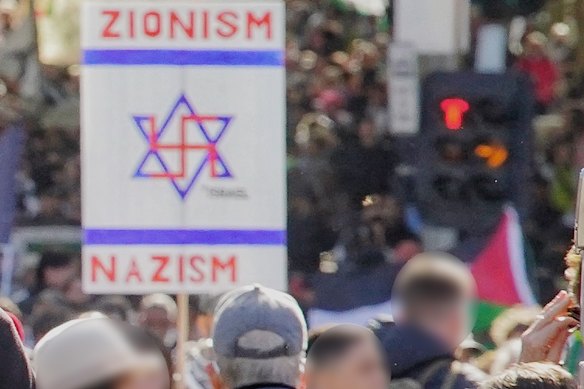
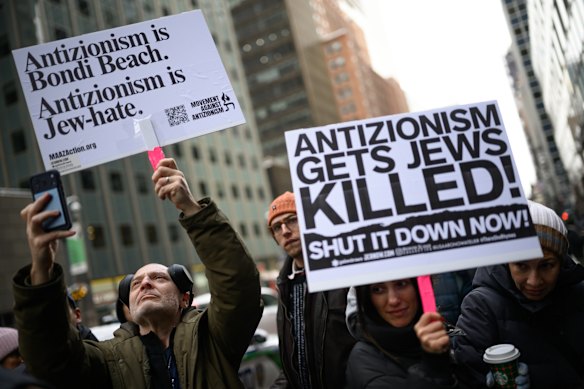
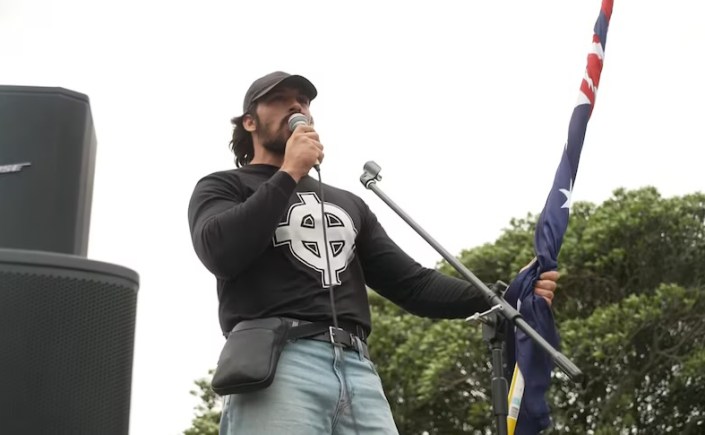
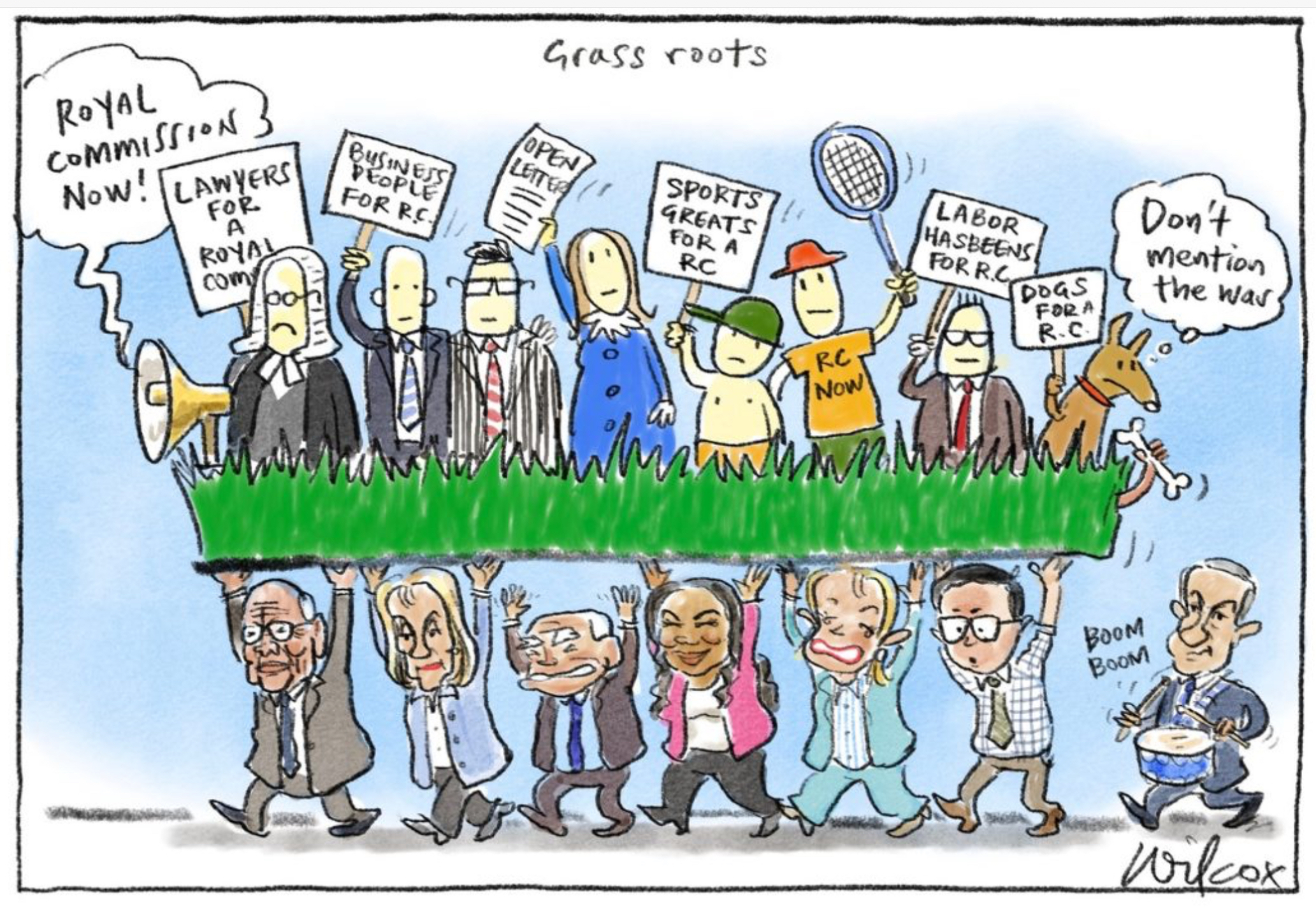
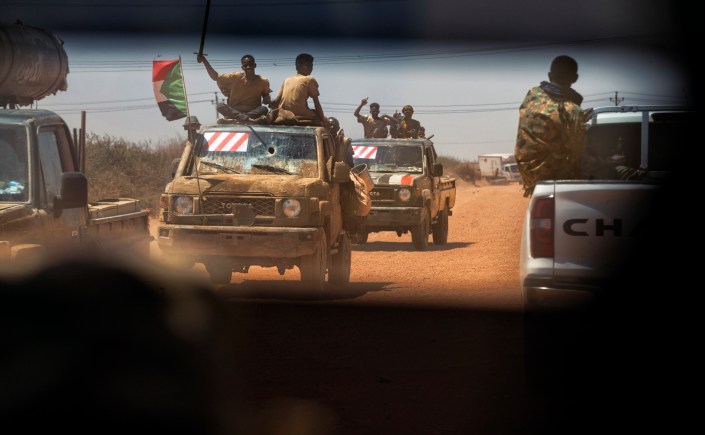
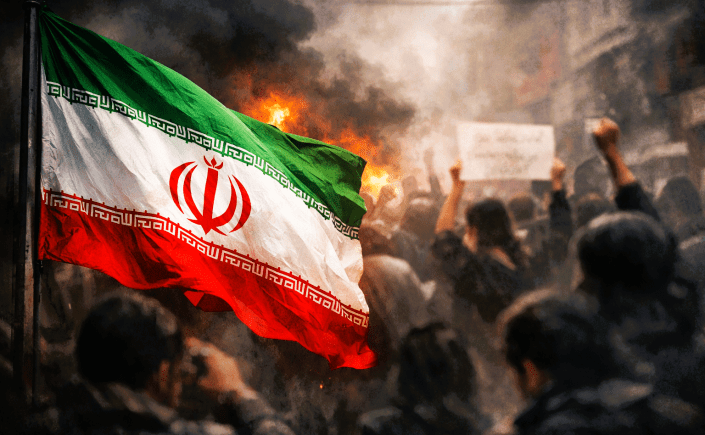
For two years the chant was rehearsed, circulated, aestheticised: “globalise the intifada!”. A resistance moment. A noble liberation struggle, cleansed of consequence. Now that it has arrived not as metaphor but as blood, the same people who normalised the rhetoric – progressive activists, influencers, podcasters, the Greens, the Labor left – present themselves as mourners. Today it is condolences, unity, and prayers.
But you do not get to globalise the intifada and then feign surprise when it turns up.
This did not erupt spontaneously. It was built – patiently, rhetorically – until violence no longer felt aberrant but earned. Shock, at this point, is not innocence; it is evasion.
The Prime Minister calls for unity and convenes the National Security Committee of Cabinet. Necessary, yes – but no longer enough. The problem he faces is credibility. For two years the response to antisemitism has been managerial rather than moral: statements instead of lines, calibration instead of resolve.
The record is plain. Within hours of the October 7 Hamas massacre, and before Israel inflicted its biblical rage upon Gaza, Jews were openly abused outside the Sydney Opera House. Synagogues and childcare centres were firebombed and homes and vehicles vandalised. Hate preachers operated freely. Week after week, marches moved through our cities celebrating “resistance”, praising terrorism, calling for Israel’s elimination, and chanting explicitly for the globalisation of the intifada: violence against Jews, everywhere – for what else could that word mean? Jewish students and academics were harassed on campus. Jewish artists were doxed and frozen out of cultural life. Antisemitism was rhetorically dissolved by equating it with Islamophobia, converting a specific hatred into a moral blur.
Step by step, it was normalised.
The year ends with an Islamist terrorist attack at Bondi Beach – an ordinary, intimate place, place many of us walk, eat, linger. We were in Sydney last weekend, and had we stayed another night, we would very likely have been there ourselves, walking the promenade and then taking refreshment, as is our custom, at the North Bondi RSL, just across the road from the park where the atrocity occurred. Authorities had warned such an incident was probable. They were not speculating; they were reading the climate.
Antisemitism in Australia has risen to levels unseen in living memory – even in small country towns like the one we live near and in Byron Bay, meccas of alternative lifestyles and long-styled as havens of inclusion and wellness. Alongside this rise sits another failure: the government’s inability to confront antisemitism with clarity and force, preferring symbolic gestures and offshore moral posturing while hatred hardened at home.
Now, suddenly, our leaders discover grief. Social media is more revealing. Facebook fills with empathetic words and memes from politicians, public figures and keyboard activists who spent the past two years condemning Israel in ways that blurred – and often erased – the distinction between Israeli policy and Jewish existence, creating at best, indifference to Jewish fear and, at worst, a permissive climate of hostility toward Jews as such. Today it is all tolerance, inclusivity and unity – and an air of regret and reverence that reeks of guilt.
But not all. Social media has fractured along familiar lines. At one extreme are conspiracy theories — false flags, invented victims, claims the attackers were Israeli soldiers. At the other is denial: what antisemitism? Between them sits a more revealing response. There is genuine shock and horror, even remorse — but also a careful foregrounding of the Syrian-Australian man who intervened, coupled with a quiet erasure of the victims’ Jewishness; a reflexive turn to whataboutism; and a refusal, even now, to relinquish the slogans and moral habits of the past two years. If antisemitism is acknowledged at all, it is ultimately laid at the feet of Benjamin Netanyahu.
So the question must be asked plainly: can many on the left side of politics, no matter how well-intentioned (and ill-formed) can honestly say that nothing they have posted over the past two years contributed, even indirectly, to prejudice against Jewish people? Nothing that helped turn anxiety and empathy into hostility, criticism into contempt?
Australian Jews warned that today’s chant would become tomorrow’s attack. They were told they were exaggerating, weaponising history, crying wolf. Yet despite inquiries, legislation, and repeated arson and vandalism, the ecosystem of hate was allowed to deepen. Two years of weekly protests chanting “From the river to the sea”, “Globalise the intifada” and “Death to the IDF” – calling for the eradication of a nation state and its people – were treated as politics, not incitement.
In July 2024 the government appointed Jillian Segal, a lawyer and businesswoman, as Australia’s first Special Envoy to Combat Antisemitism (followed soon afterwards by the appointment of Aftab Malik as Special Envoy to Combat Islamophobia). Her report, released a year later, was unambiguous: antisemitism had become “ingrained and normalised” across universities, schools, media and cultural institutions. She called for curriculum reform, university accountability, migration screening, and a serious national effort to explain what antisemitism is and why it corrodes societies.
Five months on, the government is still considering it. It has been under heavy pressure from many quarters to hasten slowly, including from within its own ranks: there were calls from the Labor left, including motions from branches and petitions, for Segal to be sacked and her report shredded.
Mere days after Bondi, the pushback has already begun. Pro-Palestinian platforms – and even some Labor branches and members – have denounced Jillian Segal, her report, and Prime Minister Albanese’s intention to implement its recommendations as an assault on democratic institutions and civil liberties. So, argue that that the Australian government is using the atrocity as a pretext to accelerate its repression of the Palestine movement, and, even, to protect and defend Australia’s complicity in what is viewed as the Gaza genocide. What this framing conspicuously avoids is any reckoning with the antisemitism the report documents- or with the immediate, practical questions now facing authorities. Among these are the potential for copycat attacks, and what duty of care is owed to the Syrian-Australian man who intervened to stop the attack? Hamas and sections of Middle Eastern media have already branded him a traitor. In this moral economy, even heroism is conditional – and quickly becomes a liability.
The partisan responses have been opportunistically predictable. The Murdoch media accused the government of weakness. The Liberal Party, led by Opposition Leader Sussan Ley, accused Labor of neglect. Pauline Hanson followed, reliably. None of it alters the central fact identified by historian Simon Sebag Montefiore: the taboo on antisemitism has collapsed. Perhaps because Jewish identity is lazily collapsed into Israel. Perhaps because the world’s oldest hatred never disappears; it waits for permission. That permission was granted – gradually, rhetorically, respectably. And antisemitism does not arrive announcing itself. It seeps. It jokes. It chants. It flatters those who believe they are on the right side of history, until history arrives and asks what they tolerated in its name.
This did not come out of nowhere. It arrived exactly as advertised, and this is what it looks like.
There are moments in the Middle East when history suddenly shift gears and takes us all by surprise. Lenin knew the cadence: there are decades, he wrote, where nothing happens; and then, weeks in which decades happen. A year ago, Syria – trapped in the vortex of its civil war for almost fourteen years and virtually ignored by the rest of the world since October 7 2023 – suddenly leapt into one of those crazy weeks, leaving allies, enemies, and analysts alike blinking in the dust. Even now, a year after the astonishing fall of Damascus, the country sits like Kipling’s Tomlinson at the gates of judgement: not quite damned, not fully redeemed, suspended between heaven and hell.
Sleepers awake …
For years, as The Independent’s Bel Trew observed last December (see Syria. Illusion, delusion and the fall of tyrants) the world forgot about Syria – notwithstanding the courageous efforts of western and Syrian reporters and humanitarian workers who strove in perilous circumstances to bear witness. The civil war had become the background hum of the region, a grim drone many had learned to tune out as Ukraine and Gaza dominated the world stage. The regime of Hafez al Assad, brutal and immovable, bolstered by Russia, Iran and Hezbollah, looked set to endure indefinitely. The jihadi rebel enclave in Idlib, though supported by Türkiye, was dismissed as a besieged hold-out. Even those who professed expertise couldn’t reliably tell you whether the war was still ongoing, who was fighting whom, or what stage the conflict had reached. It was as if the wheels of war had stopped spinning.
Then, over the space of days – eleven, to be precise – the wheels spun again. Hay’at Tahrir al-Sham’s fighters burst from their confined redoubt with a momentum no one expected (including, it seems, themselves), sweeping through Aleppo and racing down the highway to the capital. Analysts reached instinctively for historical parallels: Havana 1959, Saigon 1975, Kabul 2021. Analyst David Kilcullen pointed instead to Timur Kuran’s theory of the “preference cascade”: the sudden collapse of a regime that had mistaken silence for loyalty and compliance for consent. Assad’s security apparatus – omnipresent, omniscient, yet somehow oblivious – realised too late that its soldiers had no stomach left for the fight. The all-powerful giant had feet of clay.
It didn’t help that Iran, Assad’s indispensable patron, had stumbled into the most grievous strategic miscalculation of its post-1979 history. Flush with revolutionary zeal, Tehran had kicked the hornet’s nest in Lebanon, prompting Israel to pivot from Gaza to Hezbollah with stunning force. Suddenly Iran’s expeditionary assets were exhausted, its proxies over-extended, and its clerical leadership exposed as both ageing and isolated. Even the Ayatollah’s conspiratorial refrain – that the fall of Damascus was all a plot by the Great Satan, the Little Satan, and the Sultan in Ankara – couldn’t mask the fact that this was less Zionist cunning than simple imperial overreach. When the rebels came, neither Iran nor Hezbollah, nor Russia, entangled in its Ukrainian quagmire, could ride to the rescue.
But the rebels, too, were surprised. Their mandate from Ankara was modest – expand the borders of their statelet a little, test the regime’s nerve. Instead, they found themselves virtually unopposed on the road to Damascus. In an Informative article in E-zine Unherd republished below, British writer and investigative journalist Tam Hussein writes how many of the fighters interpreted the victory as divine intervention – not jihadi zealotry, but a sincere theological attempt to explain the inexplicable. The suddenness of Damascus’s collapse felt, to them, like an echo of Muhammad’s bloodless conquest of Mecca. And in a land where the eschatological imagination has always saturated politics, it didn’t take long before social media brimmed with end-times speculation. Ahmed al Shara’a – formerly Abu Mohammad al-Jolani, with a $10 million American bounty on his head – was seen by some as “the one”, and the precursor of the Mahdi and the foretold end of days.
Yet as Hussein rightly notes, miracles make poor policy. The survival of the new Syrian administration will depend not on prophecy but on governance, and on whether Shara’a, interim president and ex-jihadi turned statesman, can transform a miraculous seizure into a sustainable state.
To his credit, he has avoided the catastrophic purges that helped destroy post-invasion Iraq. He has kept the civil service intact, flirted audaciously with Western diplomacy, and allowed at least the theatrical semblance of elections. He has restored the embassy in London, opened channels to Washington, even visiting the White House and played the charm-game with Gulf capitals that only recently readmitted Assad into their fold. As Hussein writes, he has shown political finesse: keeping the constitution, appointing seventy parliamentarians himself, and balancing piety with pragmatism.
But the tightrope is frayed. Sectarian wounds – Druze, Alawite, Sunni, Christian – remain raw and unstitched, with the Latakia massacres now entering their fraught judicial phase, and Israel stirring the Druze pot. Kurdish anxieties simmer: the old “Arab-first” chauvinism must be abandoned if Syria’s patchwork is ever to become a tapestry again. Foreign fighters, once lionised, now loiter between hero and hazard, implicated in sectarian atrocities. Kurds clash with Syrian forces; Turkish troops press deeper into Rojava; Israel remains the unpredictable neighbour bestride the Golan; and Iran, though weakened, is never entirely out of the game. It is not inconceivable that the forces that helped topple Assad could yet turn their sights toward Jerusalem in the belief that prophecy demands it.
And there are darker portents too – those flickering shadows that hint the wind of freedom may be blowing from the wrong quarter. The new government’s early gestures toward Islamisation – the hair-covering admonition, the curriculum purge, the dismissal of women from key posts, the torching of a Christmas tree in Hama – suggest that pro-Russia and anti-western platforms like RT and Mint may have a point when they warn that the leopard has not fully changed its theological spots. Shara’a’s declaration that elections may be four years away, the dissolution of the old constitution, and the folding of all rebel factions into state structures recall less a liberal transition than a consolidation of revolutionary power.
Meanwhile, the country remains a mosaic of mini-wars. In the north, Turkish proxies grind against Kurdish forces in Rojava. In the south, local militias continue to resist HTS’s claim to national authority. In the west, Alawite formations cling to their shrinking redoubts. To the east, Islamic State survivors eye the chaos, waiting for the prison gates to break. And overhead, as ever, the Americans and Israelis fly their competing deterrents, ensuring the war never quite ends.
So: Syria stands at the crossroads. Will Syria’s future be heaven, hell, or merely another circle of the inferno?
Optimism is possible – cautiously so. If the West can avoid its habitual fatalism, if, when sanctions are lifted, investment flows, if Turkey and Israel can be coaxed into tolerable coexistence, if Kurdish autonomy is honoured, if sectarian grievances are handled with equity and not vengeance — then Syria could, in time, become a conservatively stable hub. Shara’a’s Idlib experiment shows he can build an economy under duress.
But the inverse is equally imaginable: a Lebanon-style implosion, a Yugoslav-style partition, or a Gaza-style fortress of permanent mobilisation. As Isreali commentator and contributor to Haaretz Zvi Bar’el wrote a year ago, writes, the warm international “envelope” around Damascus is generous but tentative. Nobody quite knows where Shara’a is heading. They simply assume anyone is better than Assad – the same mistake Syrians once made about the old Ba’athi patriarch Hafez al-Assad himself.
Right now, the future’s not ours to see. Something’s happening, but we don’t know what it is, and anyone with a deep knowledge of the Middle East knows that one must expected the unexpected. The old regional wars – Gaza, Lebanon, the Red Sea, Iran’s Axis of Resistance – though seemingly on hold, have not paused to let Syria breathe. The war in Ukraine grinds into winter, the bizarre Gaza peace plan shuffles on, and there are constant political shifts in Washington. Each of these could rewrite the geopolitical chess board yet again.
Still, as Robert Fisk wrote in the final line of the final book he never lived to promote: all wars come to an end, and that’s where history restarts. Syria is restarting now – painfully, precariously, imprecisely – but restarting nonetheless.
Whether Syria walks toward heaven or hell remains to be seen. The choice – as ever in the Levant – will not be its alone.
Syria Today: Walking Through the Wreckage
A year after the Assads fell, Syria still moves through its own ruins – startled by its freedom, and half-afraid of it. The dynasty’s collapse ended the nightmare but did not usher in a dream; it simply exposed, in unforgiving daylight, the damage done over half a century of dictatorship and more than a decade of war. The smashed cities are visible to any passer-by; the deeper wreckage – the traumas, resentments, and debts of blood – is harder to map and harder still to mend.
Sednaya prison’s opened gates remain the sharpest indictment. The men who stumbled out were not just survivors but witnesses, their bodies forcing the nation to acknowledge what many had whispered and few had dared investigate. Yet even this reckoning has not united the country. Sectarian reprisals and atrocities on the coast, more atrocity and calls for Druze autonomy demands in Sweida, tribal restlessness in the south and northwest, Kurdish self-rule in the north, and Alawite fear of collective punishment keep the national psyche taut and divided. Bitterness circulates like a second economy.
The economy, meanwhile, balances on a fraying tightrope. Western aid and investment have brought cranes, reopened highways, and a flicker of commerce, but also inflation that is hollowing out households. Reconstruction glimmers like a desert mirage: real enough to chase, never close enough to touch. Corruption accompanying nepotism and patronage has survived the revolution, and many returnees discover that rebuilding a home now costs more than earning one.
Politically, the country sits in an improvised equilibrium. Al Shara’a rules as both liberator and question mark – trusted by some, tolerated by others, watched by all. His pivot toward Washington, his quiet coordination with US forces, and his break with former comrades offer a new direction, but also a gamble. Around him, sovereignty is nibbled at the edges: Israel digs deeper into Quneitra province; Türkiye tightens its grip in the Kurdish north. Liberation has shifted the map without fully restoring control over it.
So Syria stands on the threshold, like Tomlinson, neither damned nor redeemed, simply called to account. The war is over, but its aftershocks and tremors linger in regional loyalties, local vendettas and regional manoeuvres. The people are free, yet unsure of that freedom’s limits and what it asks of them. And the vast machinery of the state still creaks with old habits and temptation.
And yet – a small, highly qualified yet – Syrians are imagining a future again. Not the predetermined script of dictatorship, nor the fatalism of war, but something open, negotiable, theirs’. For a people long told that nothing changes, the mere possibility of change is its own quiet revolution. Hope is not guaranteed; neither is stability. But the impossible has already happened once, and that alone shifts the horizon.
Postscript: the strange, messianic weather of revolutions
Among the HTS fighters Tam Hussein describes, the astonishingly swift and almost bloodless collapse of Damascus could never be reduced to battlefield arithmetic. After over a decade of stalemate and slaughter, the conquest of Damascus and the fall of Assad felt too abrupt, too neat, too historically implausible to be merely human. And so they reached, perhaps instinctively, for the vocabulary of prophecy that has long circulated in the Levant: the old stories of tyrants toppled in the final days, of a just ruler rising at history’s eleventh hour, of a brief season of peace before a climactic confrontation with “the Romans,” a term that in popular imagination now stretches elastically to include Israel, America, or the West at large.
In this folk-level cosmology – not the carefully parsed doctrine of scholars, but the lived, emotional scripture of men who have lived too long fear, death and loss loss – the victory in Damascus reads like a prophetic epic ballad. When a fighter told Hussein that Syria would enjoy “ten years of peace before the war with Israel,” he was drawing from a hazy amalgam of hadith traditions and battlefield folklore to make sense if the improbable: the idea of a lull before the storm, a breathing space before the world tilts into its final reckoning. It is vernacular eschatology, shaped as much by trauma and longing as by text.
Within that register, the murmurs that Shara’a/Jolani might be “the one” carry an unmistakable Mahdist echo. No fatwas or proclamations like when Da’ish leader Abu Bakr al-Baghdadi famously declared the caliphate from the minbar of Mosul’s al-Nuri Mosque in 2014; but the emotional charge behind the phrase is unmistakabl: an intuitive reach for a Mahdi-shaped idea of the righteous restorer, the unifier, the man who appears when everything has fallen apart. It’s not that anyone literally thinks Jolani is the Mahdi; it’s that the mood of the moment makes such thoughts feel briefly within arm’s length. A silhouette on the horizon, nothing more.
And here, Syria is not unique. Revolutionary periods everywhere – the Protestant Reformation, the French Revolution, the Russian Revolution and Civil War, the Arab Spring even, have their magical phase — those jittery days when people begin to speak as if the world has cracked open, meaning is pouring through the seams, and events blur into myth. When a regime that seemed immovable collapses in a fortnight, people fall back on stories larger than themselves. Sudden upheaval, long suffering, and the ascent of a charismatic figure combine to crack open the ordinary world. Prophecy offers a narrative frame when history seems to be behaving like fable.
So the eschatological edge in these fighters’ conversations tells us less about doctrine and more about psychology. It’s a very human response: a form of magical thinking that arises when reality becomes too strange to process, a way of giving shape to chaos, of telling themselves that their suffering fits into a larger story. A coping mechanism, if you like – a mythic vocabulary for a moment when Damascus fell, and the ordinary rules stopped making sense and the earth seemed briefly to tilt on its axis.
A few months ago in Damascus, I discovered a medieval hospital. The door had been left slightly ajar, and I wandered in with my companion Hassan Idlibi — a rebel fighter and old friend. He hadn’t been in the Old City since the fall of Syria’s capital, exactly a year ago today. “When Damascus fell,” he told me, “we were at our lowest ebb. Even the attack on Aleppo was our last gasp. We wanted to break the stalemate. And then we just pushed and pushed, and we ended up sleeping inside the Umayyad Mosque. It was a miracle.”Idlibi, like many Syrians, did not interpret the taking of Damascus through geopolitics — but as divine intervention. This wasn’t because he was a mindless zealot. Far from it. He is one of the most well-read men I know. But, to his mind, the fall of Damascus was so sudden, so unexpected, that only the miraculous could explain it. The victory, he noted, had been achieved by those who had been motivated by Islam. Help had come from foreign fighters, the mujahideen, who travelled from across the globe to aid their co-religionists. And the campaign had been led by a former jihadi, Ahmed al-Sharaa, now the interim president of Syria. At the time, the old al-Qaeda operative, then known by his nom de guerre, Abu Mohammad al-Jolani, had a $10 million American bounty on his head.
After more than a decade of slaughter, no one had expected the capital to collapse. Assad, then president, had seemed like a stubborn wart: unpleasant but immovable. Jolani’s rebel enclave in the northern city of Idlib looked too small, too besieged, to pose a serious threat — though in fact it was performing better economically than inflation-ravaged Damascus, helped along by a reliable flow of Turkish hard currency. I myself expected the rebels to negotiate. What leverage did they have? Yet this rebel government, roughly the size of Croydon, took over the instruments of state, and since then has avoided stumbling into a new civil war.
The unexpected and largely peaceful victory was attributed to piety, prophecy, steadfastness. Some have even compared the final conquest of Damascus to Muhammad’s bloodless conquest of Mecca in 630. The idea of a “miracle”, here, is not mere rhetoric — it shapes political expectations. Some Syrians, at least based on my social media, think all this makes Sharaa “the one”, with my Facebook messages and WhatsApp chats awash with prophetic readings of the present. One believed Syria would now enjoy 10 years of peace before the war with Israel begins. Perhaps, he suggested, this was the prelude to the end of times. After all, so-called “Greater Syria” — encompassing much of the Levant — plays an important role in the Syrian and indeed Muslim sacral imagination. It is where prophets walked and is the place where many of the end of times narratives will play themselves out.
Yet if the fall of Damascus seemed miraculous to many Syrians, the survival of the new administration will depend less on providence than on governance. Despite his past, Sharaa has so far demonstrated an unexpected level of political finesse. He has kept the constitution, held elections — albeit with 70 seats appointed by himself — and all the while has acted the statesman. He is savvy enough to not mind having President Trump spray his latest fragrance on him in the Oval Office, or Syrian Jewish rabbis blessing him.
Sharaa has made some promising early decisions. By keeping the civil service intact, he has avoided the catastrophic purge that helped destroy post-invasion Iraq. He should continue recruiting highly-educated young Syrians from the diaspora — people familiar with Western administrations and political norms. Even so, the administration still has a tendency to fear scrutiny and behaves as if under siege. It should welcome a regulated free press, which would expose blind spots, not undermine authority. The British press has reported that Jonathan Powell’s Inter Mediate is working with the new government. This should be welcomed rather than criticised — not only for reasons of conflict resolution and soft power, but for its value in statecraft and building institutional capacity.
Sharaa’s priorities for the coming year are clear. The country remains immensely fragile, caught in a regional tug-of-war between Israel and its neighbours, and divided along ethnic and sectarian lines. The situation could easily drift into a reprise of Lebanon’s civil war. Sharaa’s first task is therefore to mend Syria’s sectarian and ethnic fractures with a sense of equity. The trials that began this month over the coastal massacres in Latakia will be an important test of how the country intends to move forward. The Druze and Alawite communities — already bruised by conflict and mistrust — require justice delivered without the language of sectarianism.
Meanwhile, Kurdish anxieties must be addressed by ending the Arab-first ideology of the old regime. Syria has never been a purely Arab country: even its favourite son, Saladin, the builder of that hospital I visited and whose grave in Damascus still draws multitudes, was a Kurd. Last year’s tentative permission for Kurdish new year celebrations (Newroz) suggests that a more pluralist future is possible. Yet it remains unclear how far Kurdish cultural expression will be allowed to develop. Already this month, exchanges of fire between Syrian government forces and Syrian Democratic Forces (SDF) units under Kurdish command show how fragile the situation is.
Perhaps the most difficult balancing act involves the foreign fighters who fought on Sharaa’s side. They carry immense symbolic weight in Syrian society — and are the cause of immense fear in the West. Many are ready to resume normal life, but others still see themselves as Islam’s warriors. Recent clashes in the Idlib countryside involving French foreign fighters reflect anxieties that any rapprochement with the West might see them handed over to their home governments. The image of Sharaa standing beside Trump, receiving a symbolic “anointing” of his new fragrance, alarms them even if such engagement is politically necessary.
Granting these fighters legal status, regularising their papers, integrating some into the national army or demobilising them with stipends and educational opportunities — not unlike the GI Bill for US veterans — could go a long way toward neutralising one of Syria’s most volatile pressures.
Then there is the conundrum of Israel. On this, Sharaa has cultivated deliberate ambiguity. At the United Nations, Syria has repeatedly noted its restraint regarding Israel’s illegal strikes on Syrian territory, yet Sharaa has resisted pressure to join Trump’s flagship Abraham Accords. Signing them now would be political suicide. But ambiguity buys him room to manoeuvre — and time to consolidate the state. The question is how long this can last.
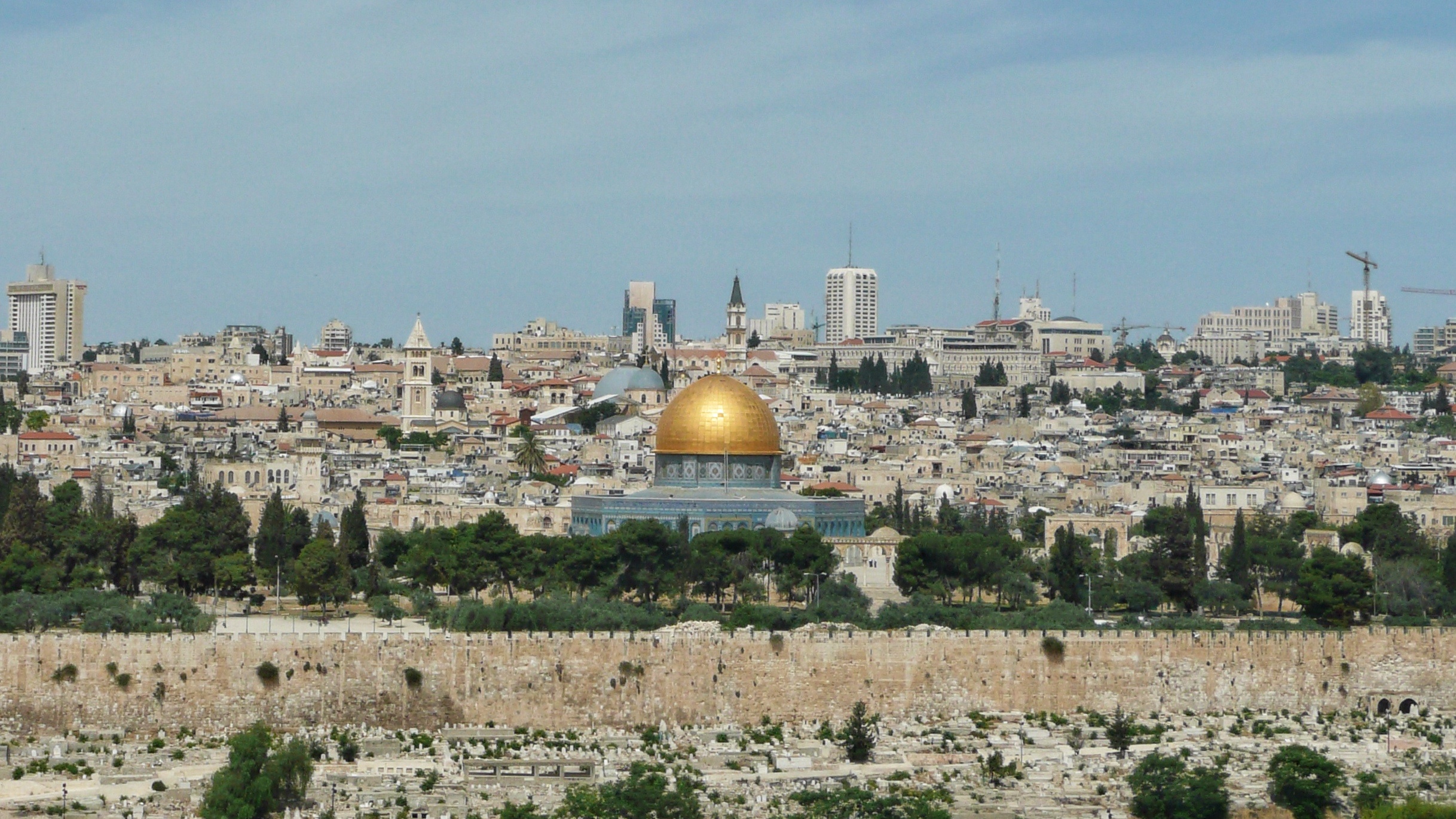
For its part, the West has worked to prevent Syria from sliding into another civil war — one that would inevitably spill over into Europe, potentially replaying the exodus of 2015. With regional partners like Saudi Arabia and Turkey, Western governments have effectively restrained Israeli escalation, aware that renewed instability would eventually reach Jerusalem’s door. It’s not impossible to imagine rebels, having overthrown a “pro-Western stooge” like Sharaa and aided by foreign fighters, actually marching toward Israel, convinced that “the infidels” will never allow them to determine their own future. As they did in Damascus, so too — in their imagination — must they do in Jerusalem.
Thus far Sharaa has governed with surprising openness. He has welcomed Britain’s foreign secretary David Lammy, met American diplomats and General David Petraeus, played basketball with US soldiers, and cooperated in counter-terrorism operations. He has also restored relations with London, with foreign minister Asaad al-Shaibani reopening the Syrian embassy.
If Western governments refuse to work with him because of his Islamist roots, they will share responsibility should Syria fracture again. Sharaa’s past is not erased; he may remain an uncomfortable partner. But what is the alternative? That he be excluded from political life and drift into a Castro- or Maduro-like role on the sidelines? If the Saudi Crown Prince can be brought in from the cold after the Khashoggi murder, then almost anything is possible.
Here I recall a meeting with former Saudi spy chief Turki al-Faisal in his South Kensington apartment after the release of his memoir. Faisal lamented how his advice went unheeded after the Afghan-Soviet war. He had urged the international community to launch something akin to a Marshall Plan — an investment programme to stabilise Afghanistan. Had that happened, the region might not have unravelled. Instead, the country collapsed into years of civil war.
Likewise, fully lifting sanctions on Syria and providing a major investment programme, coupled with training and cultural exchange, could restrain the country’s more radical elements. Reining in Israeli escalation, de-escalating the Druze conflict, and mediating between the SDF and Damascus would all help prevent new wars. On this, the West could also spare itself a future security headache by helping Damascus regularise or demobilise foreign fighters rather than leaving them to drift. This would all help to displace messianism.
What, then, would such investment bring the West, beyond avoiding another gaping wound on its eastern flank? For sure, it will not turn Damascus into another Beirut, a place for foreign journalists to party, nor into a Deano-friendly Dubai. Syria will likely remain socially conservative, more like Muscat in Oman. Given time, however, it could become a commercial hub with a distinct cultural life, just as it has been for much of its epic history. This isn’t mere optimism: Sharaa turned Idlib, once a distant town, into a magnet for Damascenes seeking commercial opportunity. Investment now would bring the West a friendly partner, business prospects and political influence. The choice is stark. With support, Syria could become a kind of West Germany: rebuilt, integrated, and stable. Without it, the country risks becoming a new Jerusalem — a battleground charged with fire and prophecy.
Tam Hussein is an award winning investigative journalist and writer. His work has been recognised by the Royal Television Society Awards.
A king sate on the rocky brow Which looks o’er sea-born Salamis; And ships, by thousands, lay below, And men in nations—all were his! He counted them at break of day – And when the sun set, where were they?
Lord Byron, Don Juan
Christopher Allen, The Australian’s art critic, writes of how Greece’s antiquity presses in on the present. It is a lightweight piece, surveying as it does three millennia of history, from the days of the Greeks, Alexander, the Great and the Romans to those of the Ottomans and their successor states – but it is elucidating nonetheless.
It is a brief reminder of the veracity of the phrase “history is always with us”, and of how the past continues to shape the present through its influence on culture, human nature, and ongoing events – a constant guide, providing both cautionary tales and inspiration for the future, as we carry our history with us in our identities, cultures, societies and recurring patterns of behaviour. As author and activist James Baldwin is attributed to have said, “History is not the past. It is the present. We carry our history with us. We are our history”.
Greece has always lived a double life. To the casual visitor, it is a sun-splashed idyll of sea and sky, but its history tells a darker story – a long, hard ledger of heroes and horrors, and the stubborn will to survive wedged between warring empires. The last two and a half millennia have been less a tranquil Mediterranean tableau than a parade of conquerors, liberators, and the occasional poet-adventurer.
Over time, Greece has drawn to its shores soldiers and adventurers, poets and dreamers – and naive youths like myself. I hitch-hiked down from what was then Yugoslav in the summer of 1970, a young man with a second-hand rucksack and followed the looping Adriatic highway from Thessaloniki and Athens. I knew enough history to feel the charge of passing near Thermopylae, where Spartans once made their famous last stand against the might of Xerxes. But I wasn’t to learn until over half a century later that an army of ANZACs battled overwhelming odds just a valley away.
The past, in Greece, as in the Middle East, always stands just offstage, awaiting its cue and refusing to stay politely within its own century. It is not merely one of the world’s most benevolent postcards; it is a crossroads of empires, a battleground of ambitions, a cavalcade of famous names and places, where East and West have met, mingled, clashed, and sometimes embraced in the long swirl of history, where the mythic and the modern travel together.
One particular reference also reminds me of how history sends out roots, twigs and branches throughout the settled and hence recorded world.
Tempe, on Sydney’s Cooks River, wears its classical inheritance more openly than most Sydney suburbs. When Alexander Brodie Spark built Tempe House in the 1830s, he christened the estate after the Vale of Tempe in northern Greece – a narrow, ten-kilometre gorge carved by the Pineiós River as it threads between Olympus and Ossa. The poets imagined Poseidon’s trident had cleft the mountains to make it; Apollo and the Muses strolled beneath its laurels; sacred branches were cut there for Delphi. Spark, standing between his own modest “Mount Olympus” and the river, saw a faint echo of the Greek idyll and gave the place its name.
But the Vale of Tempe was never entirely pastoral. Armies have squeezed through that narrow defile for millennia. The Persians marched through it on their way south – Tempe lies just north of the iconic pass of Thermopylae, part of the same chain of passes that determined so much of Greek military history. And in the twentieth century it would again become a stage for outsiders in uniform.
In April 1941 Australian and New Zealand troops, together with British units, were thrown into Greece as Lustre Force – outnumbered, outgunned, and facing a German army with air superiority and modern communications. One of the hardest-fought delaying actions took place – inevitably, given the geography – at Tempe Gorge on 18 April (the featured image of this post, from the collection of the Australian War Museum). The Australian brigade was commanded by Brigadier A.S. Allen, who had formed the first battalion of the new AIF. His “Anzac Force” (apparently the last operational use of that designation) held the gorge long enough to impede the German advance and allow wider Allied withdrawals. The serene valley Spark had sentimentalised became, for a few violent hours, an Anzac bottleneck: those same narrow walls that once sheltered shrines now channelling rifle fire and Stuka attacks. Many of those men would soon find themselves on Crete, resisting the first large-scale parachute assault in military history.
And then – because Australia never resists a touch of Mediterranean whimsy—the Hellenic (and Hellenistic) echoes continue in our own neighbourhood on the Midnorth Coast. Halfway along the road from Bellingen to Coffs Harbour lies the township of Toormina, home to our closest shopping centre and to the Toormi pub. Its name began its life on the slopes of Mount Tauro in Sicily, in the ancient town of Taormina, the site of a famous amphitheater. In the 1980s local Italian residents of who were clients of developer Patrick Hargraves (the late father of a good friend of ours) suggested the name “Taormina” for the new subdivision. He liked the idea but clipped the opening “a” to make it more easily pronounceable- and Toormina entered the Gregory’s and thelocal vernacular.
So in our small corner of New South Wales, Greek myth, Persian marches, Anzac rearguards, and Sicilian nostalgia all whisper from the signposts. Tempe and Toormina: unlikely twins, proof that even the quietest suburb can carry the long shadows of the ancient world.
Uncovering a forgotten Anzac story in Greece’s bloody history
From ancient battles to World War II, a visit to Athens’ War Museum exposes the dramatic military history that shaped modern Greece. Christopher Allen’s deeply personal connection unravelled in the process.
Christopher Allen, The Australian, 21 November 2025
James Stuart, View of the Erechtheion, Athens, October 1787. Royal Academy of Arts, London. Photographer. Prudence Cuming Associates Limited.
A little over 200 years ago, the Greeks began their war of independence from the Ottoman Empire, which had conquered most of the Byzantine world in the 15th century; the renaissance in Western Europe thus coincided with the beginning of a new dark age for the Greeks under Turkish oppression. Some islands held out for longer: Rhodes, home of the Knights of St John, was taken in 1522, forcing them to withdraw to Malta; Cyprus, ruled by the French Lusignan dynasty from the time of the Crusades and then by Venice, was brutally conquered in 1571, and Crete, held by Venice since 1205, finally fell after a generation-long siege in 1669.
The Ottoman Empire reached the apogee of its power in the early 18th century, but then began a slow decline, one of whose incidental effects was to make the Greek world more accessible to Western travellers: James Stuart and Nicholas Revett spent time in Athens from 1751 and published their Antiquities of Athens in several volumes in 1762. By the early 19th century, Greece had become part of the itinerary of the Grand Tour; by 1816, the Parthenon Frieze was in the British Museum and profoundly transformed modern understanding of Ancient Greek art.
Meanwhile the Greek War of Independence began with revolts in the Peloponnese in 1821 and a Declaration of Independence in 1822, eliciting a savage response from the Turks and sympathy from intellectuals and the educated public in Western European countries. The slaughter of the population of the island of Chios in 1822 led Eugène Delacroix to paint his famous Massacre at Chios, exhibited in the Salon of 1824 and purchased in the same year for the national collection; it is today in the Louvre. In 1823, the most famous poet of his day, Lord Byron, who had already demonstrated his sympathy for Armenian culture and independence from the Ottomans, went to Greece to help in the fight, both personally and financially.
This 1813 portrait by Phillips depicts Lord Byron in traditional Albanian attire. Alamy
Byron’s death in 1824 at Missolonghi only attracted more attention and sympathy to the cause of Greek freedom, and the great powers – Britain, France and Russia – warned the Turks about further repression, even though they were also committed, for different reasons, to maintaining the integrity of the crumbling Ottoman Empire. In 1827, at the Battle of Navarino, an international fleet led by the British and commanded by Sir Edward Codrington destroyed the Turkish and Egyptian navies. After further interventions on land by Russian and French forces, the Ottoman Empire was compelled, by the Treaty of Constantinople in 1832, to accept the independence of mainland Greece, although initially only as far north as the so-called Arta-Volos Line. The north, including Thessaly, Macedonia and Thrace, remained in Ottoman hands and Mustafa Kemal Ataturk was born in the former Byzantine city of Salonika in 1881.
Instability in the Balkan provinces of the Ottoman Empire in the 1870s gave the new Greek nation the opportunity to annex the central region of Thessaly in 1881 (while Britain incidentally acquired Cyprus in 1878). Further important gains were made during the two Balkan Wars (1912-13): much of Epirus in the northwest as well as Salonika and most of southern Macedonia, most of the Aegean Islands and Crete; the British had already ceded the Ionian Islands in 1863 and the Italians would relinquish the Dodecanese after World War II in 1947. Meanwhile, in the aftermath of World War I, Greece had briefly seized eastern Thrace and territories in Anatolia, soon to be retaken by the Turks with immense loss of life in the Great Fire of Smyrna in 1922.
Model of Byzantine warship from the War Museum
This is of course a very much simplified version of the extraordinarily complicated story of Balkan politics from the mid-19th century, which forms such an important part of the lead-up to World War I. All of these events were accompanied not only by terrible military casualties on all sides, but by massive disruption to the population of lands where people of different ethnicities and faiths had lived side-by-side for centuries as part of a multiethnic empire, including war crimes and atrocities against civilians and non-combatants. And Greeks who had previously enjoyed political and economic prominence throughout the Ottoman world, including the Phanariots of Constantinople, were first stripped of their privileges, then persecuted and finally expelled in the tragic population exchange of 1923.
All of these events and many more are covered in the exhibits at the Athens War Museum, which I had never visited until a few weeks ago, but which gives a vivid idea of the almost continuous warfare that has been carried on over the past couple of centuries in a land most tourists imagine as a paradise of sea, sun and waterside taverns. The events of the war of liberation, especially as we pass through so many bicentenaries in the current decade, are naturally well represented: there is, for example, a new and interactive display devoted to the sea battle of Navarino and events surrounding this decisive moment in the war.
There are portraits of the many famous leaders of the independence movement in their picturesque costumes, as well as dramatic reimaginings of heroic battles, and of course weapons and equipment of the time. The resonance of the Greek struggle in Western Europe is recalled in a copy of Delacroix’s Massacre at Chios, as well as a version of Thomas Phillips’s portrait of Lord Byron in exotic Albanian costume (1813), of which the original hangs in the British embassy at Athens; another replica by the artist himself, but only of the head and shoulders, is in the National Portrait Gallery in London.
Eugène Delacroix, The Massacre at Chios
But there is much more about the history of Greece in Antiquity, and the chronological arrangement of the displays makes this an effective way to follow the sequence of events, especially the main episodes of the Persian Wars – with the great battles of Marathon in 490BC and Salamis in 480 – as well as the subsequent conflict between Athens and her quasi-subject states on one side and Sparta and her Peloponnesian allies on the other, known as the Peloponnesian War.
This disastrous war (431-404 BC) was followed in the second half of the fourth century by the rise of Philip of Macedon to hegemony, for the first time, over almost all of mainland Greece. After his assassination in 336, his young son, who became Alexander the Great, embarked on a spectacular campaign that led to the conquest of the whole of the vast Persian empire, from Egypt to what are now Afghanistan and Pakistan. Alexander’s conquests led to the extension of Greek language and civilisation deep into Asia, creating the international culture of the Hellenistic period, characterised among other things by a rich and complex exchange of ideas and forms between East and West.
He left an indelible impression on all the lands he conquered and is, for example, the first historical figure in the Persian national epic, the Shahname. By the time of Ferdowsi, who composed this masterpiece a millennium ago, the Persians had forgotten about the Achaemenid dynasty that first created the Persian empire in the sixth century BC; even the great site of Persepolis was and still is called Takht-e Jamshid, the throne of Jamshid, one of the mythical rulers from the great epic.
Each of Alexander’s battles – he is one of the handful of great generals never to have been defeated – is illustrated in clear diagrams, but they are also recalled in later images, in this case particularly in a series of 17th-century engravings whose story is probably unknown to almost all visitors to the museum. These are reproductions of gigantic paintings made as cartoons for tapestries commissioned by the young Louis XIV in the 1660s from Charles Le Brun, who was to become his court painter and who was later responsible for the decorations at Versailles, including the Hall of Mirrors. The series illustrates the valour but also the magnanimity of Alexander, as is clear from the moralising inscriptions attached in the engraved versions. For a long time, the huge canvases were not displayed at the Louvre, but for the last few decades have had their own room upstairs in the Sully wing.
Following the chronological sequence from antiquity we eventually get back to the war of independence and its sequels already mentioned above; but the story continues, after what the Greeks call the Asia Minor Catastrophe of the early 1920s, with a new calamity two decades later. For Mussolini invaded Greece in October 1940 expecting, like Putin in Ukraine, to achieve an easy victory and utterly underestimating the strength and resolve of the Greek army. By the following spring, it was clear that he was getting nowhere, and Hitler decided to come to his rescue by invading Greece in April 1941.
A. Bormans, engraving after Charles Le Brun Alexander and King Porus
An Allied army, mostly consisting of Australian and New Zealand troops as well as some British units, was hastily put together and sent from Egypt to Greece as Lustre Force. It was heavily outnumbered by the Germans, who were also massively better equipped and had the benefit of air cover and wireless radio communication. Nonetheless, the Allied army put up a determined resistance in a series of battles including one notable action on April 18, 1941 at Tempe Gorge commanded by my grandfather, then Brigadier AS Allen, who had formed the first battalion of the new AIF and taken our first troops to World War II. The brigade he commanded at Tempe was known as “Anzac Force”, apparently the last use of the term, after the designation Anzac Corps for the whole Australian and NZ component of Lustre Force.
After the evacuation of mainland Greece, my grandfather was sent to fight the Vichy French in Syria, but many of our troops were taken to Crete, where in May 1941 they were faced with the first and only large-scale parachute assault in military history, in which the Germans suffered appalling casualties but ultimately prevailed. Next year will be the 85th anniversary of these dramatic events in Greece and Crete, and among other things will be commemorated by an exhibition of Australian and NZ artists whom I accompanied on a two-week tour of these battlefields in the second half of October.
It was a moving experience to visit what are today the peaceful sites of such desperate battles almost three generations ago, aware at the same time of the long history of warfare in the same lands: the Persians marched through Tempe, which is just north of Thermopylae; Caesar defeated Pompey at Pharsalus (now Farasala), which you pass on the train from Athens to Salonika (now Thessaloniki), and; Cassius and Brutus died at Philippi in Macedonia, defeated by the Caesarian forces of Octavian and Mark Antony.
Christopher Allen is the national art critic for Culture and has been writing in The Australian since 2008. He is an art historian and educator, teaching classical Greek and Latin. He has written an edited several books including Art in Australia and believes that the history of art in this country is often underestimated.
A man said to the universe: “Sir, I exist!” “However,” replied the universe, “The fact has not created in me A sense of obligation.”
American poet and author Stephen Crane, 1899
Statistics are sometimes used to express the scale of the destruction in Sudan. About 14 million people have been displaced by years of fighting, more than in Ukraine and Gaza combined. Some 4 million of them have fled across borders, many to arid, impoverished places—Chad, Ethiopia, South Sudan—where there are few resources to support them. At least 150,000 people have died in the conflict, but that’s likely a significant undercounting. Half the population, nearly 25 million people, is expected to go hungry this year. Hundreds of thousands of people are directly threatened with starvation. More than 17 million children, out of 19 million, are not in school. A cholera epidemic rages. Malaria is endemic.
But no statistics can express the sense of pointlessness, of meaninglessness, that the war has left behind alongside the physical destruction.
In what can only be described as a melancholy case of selective blindness, the gaze of western mainstream and social media, distracted by other conflicts and causes has been turned away. The global conscience has appeared unmoved. The numbers are obscene, the silence more so.
El Fasher, in Sudan’s far western province of Darfur, is once again the world’s unacknowledged abyss. The UN warns of genocide; videos show unarmed men executed in cold blood, hospitals shelled, aid workers vanished, women violated, and civilians starved into submission. The Rapid Support Forces – the Janjaweed (colloquial Arabic for “devil riders”) in new fatigues – are methodically annihilating ethnic groups such as the Masalit. El Fasher was the Sudanese army’s last holdout in Darfur and its capture marks a milestone in the two yea long civil war, giving the RSF de facto control of more than a quarter of the territory.
Why the silence?
Because Sudan resists the narrative template that powers modern activism. There is no imperial villain, no clear coloniser or colonised, no simple choreography of oppression and resistance. The slaughter of black Africans does not fit the anti-Western moral geometry upon which contemporary protest movements are built. Sudanese bodies fall outside the moral lens of the global North even as they fall in their thousands.
This is not to rank suffering but to note the selectivity of empathy. Sudan’s tragedy lacks the aesthetic of victimhood that flatters Western guilt. The WHO pleads for hospitals; journalists beg for their detained colleagues. It all sounds chillingly familiar – yet no outrage follows. Perhaps because Sudan offers no convenient villain, no redemption arc, no social currency.
At the heart of the moral selectivity of the globalised conscience lies outrage as performance, empathy as branding. Sudan exposes the performative element of protest: empathy contingent on narrative utility. Its tragedy has no liturgy, no public ritual of belonging. It shows what our age truly worships: not justice, but self-expression masquerading as it. And in El Fasher’s unmarked graves lies the measure of this hypocrisy – a mute testimony to the moral vanity of a world that rages for Palestine, hashtags for Ukraine, and sleeps through Sudan.
In That Howling Infinite has touched on this dissonance before in The calculus of carnage – the mathematics of Muslim on Muslim mortality We wrote back then, in December 2023, when the Sudanese civil war has been raging for the best part of a year: “Call it moral relativism or “whataboutism” (or, like some conjuror’s trick, “don’t look here, look over there!) but it is not a matter of opinion, more a simple matter of observation, to point out that Muslims are in the main subdued when their fellow Muslims are killed by other Muslims … There has been no significant unrest in the West over the hundreds of thousands of Muslims killed by fellow Muslims (apart from a visceral horror of the violence inflicted upon civilians and prisoners by the jihadis of the Islamic State. No public outcry or social media fury, no angry street protests by left-wing activists of vacuous members by armchair, value-signaling clicktavists”.
Journey to an civil war
American journalist Anne Applebaum wrote very long essay the August edition of The Atlantic: Sudan … the most nihilistic war ever. She believes that Sudan’s devastating civil war shows what will replace the liberal order: anarchy and greed. Her essay reads like a missive from a civilisation already past the point of rescue. The country she describes is less a state than a geography of ruin — a landscape where the coordinates of morality, nationhood, and even information itself have come apart. The title is no exaggeration; it is diagnosis and prognosis both. Sudan, she argues, is not an aberration but a preview — the shape of the world when the liberal order finally collapses, when wars are fought not for gods or ideas but for bullion and bodies.
Sudan’s civil war began, at least formally, as a contest between two men: General Abdel Fattah al-Burhan, commander of the regular army, and Mohamed Hamdan Dagalo, known as Hemedti, who rose from the Janjaweed militias to command the Rapid Support Forces. Both were products of the same regime; both were once partners in repression. When they turned upon each other in 2023, the result was not ideological conflict but a kind of mutual devouring. Each accused the other of betrayal; each proceeded to loot, starve, and bomb the very population he claimed to protect.
Applebaum’s Sudan is not one country but many — an archipelago of fiefdoms and frontiers, each governed by whoever holds the nearest airstrip or gold mine. And gold, indeed, is the keyword: the new oil of an old desert. Sudan possesses vast deposits of it, and with them a vast invitation to corruption. Wagner mercenaries mine and smuggle it northward to fund Russia’s war in Ukraine. The United Arab Emirates bankrolls Hemedti’s RSF in exchange for access and influence. Egypt and Chad manoeuvre for position; Iran quietly re-enters the game. The Sudanese warlords themselves fight not to win the nation but to control the veins of the earth — the alluvial goldfields of Darfur and the Nile Basin that glitter beneath the dust like a curse.
Western governments, overstretched and inward-turned, offer gestures in place of policy. Applebaum notes that the world’s great democracies — once self-appointed custodians of human rights — now behave like distracted landlords. There is a knock at the door, another tenant murdered in the basement, but the owner is on the phone about something else.
In this sense, Sudan is less an anomaly than a mirror. It shows us what happens when international law becomes theatre, when moral outrage is rationed by proximity and profit. It is not merely a humanitarian disaster but a philosophical one: a demonstration that without belief — in justice, in shared reality, in the notion that human suffering still obliges response — politics decays into predation.
Applebaum’s prose, always measured, carries a note of exhausted mourning. The old ideological world — that twentieth-century drama of fascism, communism, and liberal democracy — at least believed in something, even if those beliefs destroyed millions. Today’s warlords believe in nothing at all. They are not even tyrants in the grand style; they are contractors of chaos, CEOs of slaughter, men who weaponise hunger for leverage and sell access to ruins.
What makes her essay so haunting is that Sudan’s nihilism feels contagious. The war may be geographically distant, but morally it is next door. The same disintegration of purpose infects the international response — the shrugging cynicism, the moral fatigue, the slow erosion of empathy. Applebaum’s Sudan is what remains when the “rules-based order” becomes a slogan muttered by people who no longer believe it themselves.
Coda: A Mirror in the Sand
The desert, Applebaum implies, has turned into a mirror of the world’s soul — reflecting its avarice, its indifference, its slow retreat from meaning.
What lingers after Applebaum’s account is not simply pity for Sudan, though that would be reason enough, but unease — the feeling that the world’s moral compass has slipped its pole and is spinning uselessly in our hands. Sudan is not the exception; it is the precedent. It is the world without illusion: borders drawn in dust, governments as rackets, truth dissolved into overlapping transparencies.
Once, wars were waged for empire, for creed, for revolution — each claiming, however falsely, to serve a higher cause. Now they are fought for metal, for markets, for motion itself. The soldiers are mercenaries, the civilians collateral, the nations staging grounds for someone else’s ledger. Applebaum’s overlapping maps are more than an image of Sudan’s confusion; they are an x-ray of a civilisation that no longer shares a moral reference point. We are all now drawing our own maps, colouring the world according to our comfort zones, overlaying them until the truth beneath is invisible.
And so Sudan becomes both tragedy and parable. Its gold mines glitter like tombs of the old order — the liberal dream of rules, rights, and reason — while above them drones and scavengers circle. A century ago, Conrad called it the horror; today it is merely another tab on a newsfeed. The anarchy is not confined to Khartoum or Darfur. It is spreading quietly through the arteries of global indifference, through our own fatigue, our own appetite for distraction.
Postscript: selective empathy in a world of sorrow
Comparing the international outcry over Gaza to the silence on Sudan has been condemned as intellectual dishonesty. One comment on this post ran this:
“The mainstream media can stir outrage on any topic when its political masters and financial backers want it to. Why has it not done so in this instance? Follow the money is one rule of thumb. I assume it suits the powers that be to let the slaughter continue. I hope more people are inspired to become activists against this dreadful situation, but public opinion tends to follow the narrative manufactured by the media more than impel it. When it comes to pro-Palestinian activism it is the story of a long hard grind of dedicated protestors to get any traction at all against the powerful political and media interests which have supported the Israeli narrative and manufactured global consent for the genocide of Palestinians over many years. And still, although the tide is gradually turning, the West supports Israel to the hilt and crushes dissent. Using the silence in the media and in the streets over the slaughter in Sudan as an excuse to try and invalidate pro-Palestinian activism is a low blow and intellectually dishonest”.
This particular response is articulate and impassioned, but it also illustrates precisely the reflexive narrowing of moral vision that the comparison between Gaza and Sudan was meant to illuminate. The argument hinges on a familiar syllogism: that Western media outrage is never organic but always orchestrated (“follow the money”), that silence on Sudan therefore reflects elite indifference rather than public apathy, and that to highlight that silence is somehow to attack or “invalidate” the legitimacy of pro-Palestinian activism. It is a neat, closed circuit—morally reassuring, rhetorically watertight, but intellectually fragile.
For one thing, the claim that outrage over Gaza is a product of “a long hard grind” of dissenters battling pro-Israel hegemony may be partly true, but it fails to account for the asymmetry of moral attention. Why, if media outrage can be manufactured at will, does it attach so selectively? Why is one tragedy magnified until it becomes the world’s moral touchstone, while another, numerically and humanly no less immense, barely registers? This is not to invalidate solidarity with Gaza—it is to interrogate the mechanisms by which empathy itself is distributed, channelled, and constrained.
The “follow the money” thesis also misses something subtler and more disturbing. Western silence on Sudan is not an act of conspiracy but of exhaustion: no villains clearly marked, no sides easily named, no tidy narrative of good and evil to moralise upon. Sudan’s war—fragmented, internecine, post-ideological—does not lend itself to hashtags or flags on Instagram profiles. It is a horror too complex to package and too distant to own. By contrast, Gaza offers clarity, identity, and the reassuring architecture of blame: victims and oppressors, martyrs and monsters, the colonial morality play in perfect focus.
Thus, when critics accuse those who draw this comparison of “intellectual dishonesty,” they mistake the argument. To juxtapose Gaza and Sudan is not to weigh one body count against another, or to diminish Palestinian suffering. It is to expose the limits of our moral imagination – how empathy becomes performative when it is contingent on narrative simplicity or political fashion.
In Sudan, the gold glitters under the rubble. Warlords, mercenaries, and foreign patrons all claw for it while millions starve. In Gaza, the ruins are televised, moralised, and weaponised. Both are human catastrophes, but only one has an audience.
The point, then, is not that activists for Gaza are wrong—it is that they are lonely. If their struggle truly seeks a universal human justice, it must be capacious enough to include Darfur, Khartoum, El Fasher—to grieve what the cameras do not show. Otherwise, our compassion becomes another form of exceptionalism: the selective virtue of those who need their tragedies to fit the script.
In truth, to compare Gaza and Sudan is not to rank suffering or diminish solidarity, but to expose the limits of our moral bandwidth. Gaza compels because its story is legible—villains, victims, a script the world knows by heart. Sudan confounds because it is too fractured, too many nations within one, too little meaning to hold. There is no clear narrative, only greed, hunger, and gold buried beneath the ruins.
The real dishonesty is not in caring for Gaza, but in mistaking selective empathy for universal conscience. If our outrage depends on simplicity, we risk turning compassion into performance – mourning only what the cameras show, and averting our eyes from what they cannot.
And I guess that’s why they call it the blues Time on my hands could be time spent with you
Elton John
My sweetheart is a soldier as handsome as can be But suddenly they sent him away across the sea So patiently I waited until his leave was due Then wrote and said, my darling, I’ll tell you what to do: Come to the station, jump from the train March at the double down lover’s lane Then in the glen where the roses entwine Lay down your arms And surrender to mine
Geoff Downes, John Payne and Gregory Hart
“Right-wingers … have a disreputable history of picking on that particular cohort. The young, and not just those of Muslim persuasion, are more likely to question the conventional mores of the time than the middle-aged, which is why they make a lot of conservatives uneasy. Maybe national service will get them to shape up. This is really quite a smart idea from a Tory standpoint, since many of the values which young people in Britain are wary of are military in origin … they are cultural traits rather than basic moral values. Loyalty, team-spirit, toughness, honour, character, valour, austerity, self-discipline, leadership, physical prowess: the nation divides between those like the present monarch who consider these values utterly vital, and those who think they have their origin in a tiny, unrepresentative sector of society (the officer class, public schools, Boy Scouts and so on), and stem ultimately from Britain’s repressive colonial history”.
Sunak’s call triggered some sympathetic martial bugles here DownUnder. There were letters to the editor aplenty in Australian newspapers, including our own Coffs Harbour News of the Area (an actual printed newspaper too). I couldn’t resist writing a response – and it was actually published:
“There’s been a couple of letters recently suggesting that national service would be a suitable panacea for the problems of delinquent youth, and another by Bellingen’s Warren Tindall (an old pal of mine, by the bye) on the “perils of national service”, reminding us that whingeing about the younger generation is timeless and generational. The notion appears to appeal to folk of a certain age who lament the lack of respect, discipline and Australian values (whatever that means) amongst Australian youth – the “knock some sense into them” law and order types who would like disorderly young folk to be “out of sight and out of mind”, and effectively, someone else’s problem. They naively believe that the induction of potentially underage and recalcitrant youths would somehow contribute to our defense manpower shortfalls and bolster our military preparedness. On the contrary, the conscription of unwilling and probably unfit recruits, and the time, effort and money needed to render them of use in any military capacity is are the last things a proficient defense force needs.
In countries culturally and politically unaccustomed to national service, conscription has historically been considered a burden on the forces. In western countries with national service – most notably the Scandinavian and Baltics, and Israel – young people grow up with the expectation of service and the national duty that implies, and are culturally and temperamentally prepared for it by the time they come of age. It is not a military trainer’s job or even skill set to “instil a sense of purpose”, teach “physical and mental coping skills” or “positive career paths” or “train responsible human beings”, whilst “reducing our prison population” seems like something like Vladimir Putin would do”.
All this brings me to British author Richard Vinen’s enthralling book National Service in Britain 1945-1963. It charts the institution’s origins, administration, and social consequences, painting a vivid picture of postwar Britain negotiating the uneasy transition from empire to welfare state, revealing how conscription shaped not only military efficiency but the habits, ambitions, and identities of an entire generation – a cultural imprint whose echoes still surface in debates about civic duty, and national identity.
Reading it a while back, I recalled the promotional video for the Elton John song quoted above with its nostalgic visual narrative of young lovers separated by a call to duty, including footage of young army conscripts and of the early British rock ‘n roll era. I also recalled the BBC serial Lipstick on Your Collar – a particular favourite of mine; A romantic pop song Lay down your arms featured in its finale. [More on Potter’s story below] Both dramatise a decade and more of British social history that few recall today when over two million young men were conscripted to serve in the armed forces for up to two years, and sometimes more, at a critical time in their social, intellectual and emotional development.
We republish below a comprehensive overview by Davenport-Hines But first, here are a some of my own recollections, and themes explored by Vinen that are not covered therein.
A grave new world
After the Second World War (1939-45), the young men of Britain were called upon to meet new challenges facing the country in a rapidly changing world – the Cold War between the USA and its European allies, and the Soviet Union.
The post-war world was a tenuous time for the old empires. Whilst old King Canute demonstrated his inability to control the tides, when Britain faced emergent and powerful nationalist movements, it sought to reassert its control in de facto colonies as far-flung as Egypt and Palestine, Cyprus and Kenya; and together with France and the Netherlands, actually fought to reclaim and hold on to their “possessions” (a term that reflected a mindset as much as political reality) that had fallen to the Japanese. Portugal, Spain and Belgium likewise fought to prevent their subject peoples breaking loose. Few outposts of empire endure today.
The decision to repurpose wartime conscription in 1947 was a response to these challenges and also to the threats presented by the Soviet Union and a multitude of communist-inspired and Soviet-nourished national liberation movements. And yet, only a very small proportion of conscripts served overseas – and most who did were stationed in what was then West Germany and isolated and divided Berlin.
To meet the military manpower needs of this grave new world, the National Service, a standardised form of peacetime conscription, was introduced in 1947 for all able-bodied men between the ages of 18 and 21. Nowadays, when all sorts of evasion, dodges, and exceptions are common in society at large, it is hard to imagine a nationwide system in which all were actually deemed eligible, lord or landless, toff or tough, brains or bozo, had to serve. endured and was endured for over a decade; its abolition was announced in 1957 but continued until 1960, and the last conscripts were not demobbed until 1963. Every fortnight some 6,000 youths were conscripted, with a total of 2,301,000 called up over the sixteen years.
And then it was over, not with a bang but with a series of whimpers, stuttering indecisively to a close, leaving few traces on the cultural topography of late twentieth century Britain. Whilst many soon to be famous authors, playwrights, producers and musicians served, only a few wrote of their experiences. Nor did many other conscripts, although Woodfield Publishing carries a range of memoirs by ordinary men who resolved to record their experiences for posterity. The most important films and television programs about National service were comedies. Carry on Sergeant, which appeared in 1958 was the first and the most innocent of the long “carry on“ series. It was filmed at a real army camp.
There was no tangible ‘outcome’ to National service. There was no single conflict that ended in victory or defeat. There were none of the collective events – bonfires, parties, mutinies – that marked the end of the two world wars. It was ‘ending’ almost soon as it began because individual men were demobilized every two weeks. They went back to work – in the tight labor market of 1950s some of them started jobs on the Monday after they were demobilized – and to marriage and families in the dour but brightening fifties. It was not until they retired in the 1990s that most of the former servicemen had much time to reflect on their youth – which is why national service was so little discussed in the three decades after it ended.
Setting a date for the end of conscription was awkward. No one wanted to be the last conscript. There was a danger that the whole system might come to an end in “a most ragged and unsatisfactory manner” if men knew the precise day on which was ceased to operate, especially since as officials recognized, they would not have the resources to track down and prosecute evaders once the machinery of National service had been put into mothballs.
Though the last years of national service were uncomfortable for many conscripts, in someways, they were even worse for regulars particular, particularly for regular officers in the army. The tone of civil-military relations changed. when the first peace time conscripts had been called up, the army still had some of the prestige that went with victory in the second world war and with the military traditions of the Empire …
Those who regarded themselves as defenders of the interest of the army, had implied that peace time. conscription was a burden for the forces and look forward to the day when a well trained well paid and dedicated professionals were combined comprise a lean flexible and hard, hitting army. At least, in the short term this did not happen, and the end of conscription went with an undignified period when middle-aged officers scrambled to hold onto their jobs.
In one sense conscription was just one aspect of a British illusion of great power status, an illusion few people outside Britain, and perhaps a few people outside the British governing classes, believed or cared about
As Vinen reminds us in his enthralling story, the public’s historical memory of the institution imperceptibly faded from the national consciousness once it had ended, once parents no longer fretted about their sons being called up and once young men no longer needed to be anxious about interrupting or postponing careers and higher education. High rates of employment, rising incomes and standards of living during the fifties and early sixties, the attractions of consumerism and new forms of mass entertainment, and the lowering of Cold War tensions with the death of Josef Stalin, gave rise to fresh and less war-like circumstances and expectations.
The end of national service coincided with the beginning of the cultural era now known as the sixties (which actually lasted from about 1963 until about 1973). Changes in British society in the 1960s would have made it increasingly difficult to call men up even if the government wished to do so. It was a time remembered for self-consciously irreverent attitudes towards the British establishment, the class system, the almost casual racism of the past, and indeed history itself. It manifested the in theatrical reviews of the early sixties like Beyond the Fringe and the scatological and iconoclastic Private Eye magazine, and also the so-called youth culture which revolved about fashion and pop music.
In 1964, a year after National Service finally ended, a British band called the Barron Knights recorded an awful parody medley called Call Up The Groups which imagined many popular British groups being conscripted. It was hammy and cringeworthy then and it has not aged well, but when listened to sixty years on, it seems like an irreverent dated relic of Britain’s stuttering “farewell to arms”.
The very last line of Vinen’s book says it all: the culture in which national service existed belongs to a different age. To repurpose LP Hartley’s well used line, the past was another country where people thought and did things differently.
Descent from Glory
As noted in our introduction, present day advocates of conscription – or “national service”, which soothes the sting of compulsion – argue that it would encourage young people to “shape up”, to inculcate in them those treasured values that many of a certain age believe have been lost in the tide of modernity – to reiterate, like patriotism, loyalty, respect, honour, character, valour, leadership, toughness, self-discipline and physical prowess. And yet, the society that existed in those postwar years, and the values it espoused and revered, are long gone. The historical, political, social and cultural conditions that rendered national service universally acceptable no longer exist.
The British Empire had created a political culture that took greatness for granted and victory in the Second World War had reinforced this, even as it eroded the resources with which great power might be supported. The leaders of both political parties shared this culture as did most of the officials who advised them; and during the early years of National Service, most people of all classes accepted the shared obligation to serve, and with the memory of the war years still fresh and the Soviet and communist “threat” manifest, the populace as a whole were onboard with what could be described as official patriotism.
Most national servicemen had grown up in a period when there were no great ideological divisions in Britain. At least they were mostly young and the forces provided them with little in the way of political education. Of the small number who were actually posted overseas, many went without having much idea of what they were being sent to defend, and rarely understood what they were doing. In farflung outposts like Cyprus and Palestine, Kenya and the Far East, they were fighting people with whom they were not at war and often, as in Korea and later, in Egypt, countries that were not British possessions. The army didn’t get down to the politics what it was all about, and some national servicemen appear to have thought about the political significance of their actions at Suez, or in Malaya only years after the event.
Regular Army officers introducing themselves to conscripts would advise to tell them that the British preferred the term national service to conscription, because, to quote Vinen, “that is what it is “a service to the nation, each national serviceman contributes towards giving the nation, strong and efficient army”. Judged on an international perspective, however, the most striking thing about national service is, that was not actually very national
And yet, the military authorities never tried to instill patriotism.
Often, particularly in new states many ethnicities and religious affiliations and little social cohesion, military service is regarded as a “school of nation” inculcating presumptive national loyalty, values, interests. This was not the intent of the designers of national service. It was not intended to inculcate patriotic feelings. Nor was it really designed to foster manly martial virtues. Service for most conscripts was monotonous and seemingly pointless, whilst stories of bullying and mistreatment were common. One serviceman, Peter Burns, noted in a memoir years later: “In the old phrase, I went in a boy and came out a man, but not a very nice man”. He did not elaborate further.
It was manpower first and foremost, “boots on the ground” and potentially, on the battlefield – though technological innovation was rendering “serried ranks” redundant. Military authorities, determined to make things easier for themselves, were reluctant to call up, as a War Office report put it “a social group that is poorly integrated in the nation. For example, barrow boys, gypsies, the racing community, Liverpool Irish, foreign communities in London, the Glasgow community from which the gangs are recruited, etcetera … “. Indeed, the forces were probably glad to be rid of some of their potential and actual delinquent conscripts.
Conscription was never applied in the part of the United Kingdom where the largest number of people was likely not to feel themselves British: Northern Ireland. In Scotland and Wales, there was a small amount of overtly nationalist opposition to fighting for a ‘foreign’ government. more important was the general sense that conscription did not fit with the social structure of either Wales or Scotland. The Welsh dislike of the armed forces, rooted in chapel going respectability, was very different from the antipathy to army discipline that was associated with some working-class Scotsman. Sometimes the single word that aroused most terror in the war office was Glasgow”.
National service did not create a more homogenous and disciplined society – on the contrary, it worked partly because Britain, mainland Britain at least, was already homogenous and disciplined.
But there were the outliers. As Vinen writes: “Would that substantial group of men of Irish origin living in mainland Britain have been called up during the northern Irish troubles? What would the forces have done about non-white immigrants? Black Britons were not excluded from national service, but given how rare such men were, it is significant that they were quite common amongst those that officers regarded as ‘difficult’. The British army recruited 2000 West Indians in 1960, partly to make the shortfall that sprang from the imminent end of national service. However, the authorities decided that coloured soldiers should not make up more than 2% of the strength of any corps”.
Lipstick on your collar … national service through Potter’s prism
Lipstick on Your Collar is a 1993 British TV serial written by the late socialist playwright Dennis Potter, acclaimed for his television dramas The Singing Detective, Karaoke and Cold Lazarus. He also wrote the brilliant screenplay for the film adaption of Martin Cruz-Smith’s most excellent novel Gorky Park, itself, in my opinion, one of the best ever film adaptations of a novel.
Potter was a national service conscript along with many soon to be well-known British politicians, sportsmen, authors, poets, playwrights and performing artists – including Rolling Stones bass player, former RAF private, Bill Wyman, iconic actor and national treasure Michael Caine, late actors Sean Connery and Michael Gambon, onetime Conservative Party firebrand Michael Heseltine, and the ‘Angry Young Men’ of letters Allan Sillitoe, John Braine, Arnold Wesker and Joe Orton.
The story is for the most part set in a British Military Intelligence Office in Whitehall during 1956. A small group of foreign affairs analysts find their quiet existence is disrupted by the Suez Crisis. A young conscript is completing his national service as a translator of Russian documents, but bored with his job, he passes time in fantasy daydreams in which his very straight colleagues break into contemporary hit songs. The character is portrayed by a young Ewan McGregor went on to movie fame in Star Wars and other major films. His fellow language clerk is a clumsy Welsh intellectual and admirer Russian poets and playwrights – Pushkin and Chekov in particular- whose academic career has been interrupted by his call up. collar.
The subtext is the conflict between the old order, as represented by the middle-aged and-patriotic regular army officers, the conscripted ‘other ranks’ as portrayed by the two privates, and the new ‘rock ‘n roll’ generation, illustrated her by dance halls, coffee bars, and ‘fifties American popular music.
Denis Potter studied at Ministry of Defence’s Russian Language School. Apparently, those few conscripts who graduated as interpreters and translators were regarded as the crême de la crême of conscripts. Often, trainees would put on concerts of Russian songs and plays for their own amusement. A natural linguist, he’d learned Russian whilst undergoing compulsory national service in the fifties. One such graduate was Tom Springfield, the elder brother of diva Dusty Springfield. He borrowed the melody of The Seeker’s timeless song The Carnival is Over from Stenka Razin a traditional Russian folk tune that told the tale of a drunken seventeenth century Cossack rebel who threw his Persian bride of one night over the side of his boat into the Volga River when his men accused him of going soft. Tom changed the story entirely though he retained a nautical riff and cast the star-crossed lovers as the theatre characters Pierrot and Columbine rather than casting them overboard. See “High above the dawn is waiting” … the unlikely origin of a pop song
“And what a year that was! With peacetime restored, the British electorate immediately voted out its esteemed and beloved war leader, Winston Churchill, and bought Labour’s promise of a democratic socialism. In his excellent documentary The Spirit of ‘45, film maker Ken Loach describes the nationalisation of public services and industries and their subsequent privatization three decades later. His interviewees provide poignant anecdotes about the poverty of the 1930s, the dangerous and exploitative working conditions, poor housing, and abysmal health care, and the renewed sense of purpose and optimism a the end of the war and Labour’s landslide victory. He recounts the subsequent expansion of the welfare state, with its free to all medical service and the nationalization of significant parts of the British economy, most notably, electricity, the railways, and the mines. The Attlee government was elected due to a general belief that nothing would or could be as it had been before. Britain had pulled together to win the war; now, it would transform the peace.
But for ordinary folk, life in the immediate postwar years wasn’t that rosy. Britain emerged from the war victorious and though brave, physically battered and financially broke, its towns and factories in disrepair, and it’s people coming to terms with a not so brave new world of disappointed expectations and ongoing privation. Rationing, introduced early in the war on most foodstuffs and consumer items, remained in place and was only gradually lifted until its end in 1954.”
If we’re born in forties and early fifties, and look back, to our childhoods or to contemporary photographs and films, there is a patina of austerity and drabness. It was mirrored in how people dressed and in the fashions of the time. During the conflict and long after, clothing and colour were rationed due to the shortage of fabrics and of dyes as industry and manufacturing were directed to “essential industries” contributing to the war effort. This is why images of the time look so monochrome, or when colourized all blacks, browns and greys. Until the technicolor explosion that is now synonymous with the “swinging sixties”, enabled by the invention of new, often synthetic fabrics and an insurrectionist generation of designers, artists, and entrepreneurs.
I was born at the right time in the right place. I missed the Second World War, and arrived to be blessed with the benefits of the National Health Service – launched by Labour health minister Aneurin Bevan on 5th July 1948 – which had had at its heart three core principles: that it met the needs of everyone, that it be free at the point of delivery, and that it be based on clinical need, not ability to pay – and The Education Act , or ‘Butler Act’, of 1944 which promised and then delivered ‘secondary education for all’. I was too young to do National Service in the fifties, and caught the wondrous wave of the sixties in all its freewheeling, rumbustious glory, whilst Harold Wilson kept us potentially eligible conscripts out of America’s Asian war in Vietnam.
When I was a nipper, the Second World War was tangible. I born less than four years after the fighting finished. It was nearer than Vietnam, Iraq, Afghanistan, and even Northern Ireland are today. We just called it “The War”. We had family, friends and relations who had lived through it, fought in it, and died in it, as had many of the schoolmasters who taught us. Many wore scars and infirmities from the war, and some bore invisible wounds.
We played war-games on bombed-out “wasteland”. Rationing continued into the fifties, so it constrained our lifestyles. War stories were ubiquitous, on the screen and in print; James Bond had served in the war, as had George Smiley. In the boys’ comics, gallant British Tommies invariably overcame superior numbers of Germans, who were portrayed as mindless automatons and referred to contemptuously as ‘Krauts’ or ‘Jerries’. In the sixties, we built Airfix warplanes, battleships and fighting vehicles.
Conscription was reintroduced in 1948 to maintain what remained of Britain’s imperial dream; young men in uniform were always around whilst older cousins and friends’ big brothers had to do their national service. Little wonder that the war’s echoes reverberated through our imaginations, pastimes and preoccupations.
My own memories of National Service are are just fleeting images of young relatives in army uniforms and of school pals mentioning that their brothers or uncles were doing their bit. To us children, it was relatively unobtrusive and taken for granted. I commenced grammar school in September 1960 at a time when many grammar schools imitated the practise of public schools with a military training outfit called the CCF or Combined Cadet Force. Once a week, toy soldiers would strut about school in khaki attire. Prefects, another practise borrowed from public schools (along with the term “fags” for first and second formers – though none the servile duties immortalised in that fabulous movie If) were naturally officer-cadets. And they would march up and down the square with real guns! No ammo, but. I was already a Boy Scout by then and that was enough of matters martial and patriotic for me. And my Irish folks said “No!”
Whether by design or coincidence, by 1963, conscription and our school CCF were no more. And I did not notice the passing of either.
We were taught and accepted the narrative that wartime prime minister Winston Churchill had promulgated: that the period after the fall of France, when Britain had stood alone against the Axis powers, had been our finest hour and that the eventual defeat of Nazi Germany made all the sacrifices worthwhile. We also accepted His word for his pivotal role in it. “History will be kind to me”, he famously wrote, “for I shall write it”. And we were inculcated with the values that he fostered and indeed, personified: courage, duty, obedience, self-denial, reticence, restraint – the qualities that had won the war, or at least had enabled Britons to survive it. This is what being a man meant, then.
The are not values that resonate today. By the beginning of the sixties, “the times were a’changin’”, slowly but surely. Changes in British society in the 1960s would have made it increasingly difficult to call men up even if the government wished to do so. Rising levels of education, and also, of affluence wrought changes in attitudes and ambitions. The fifties gave rise to the phenomenon of “the teenager”, an American concept that took off in drab Britain as rationing came gradually to an end and as life in general took on more colour and excitement – young people were less accepting of authority, discipline, and ageing and anachronistic concepts of Queen and Country – and as the songs at the head if this post illustrate, love was always in the air …
Rather than keeping a stiff upper lip, we are encouraged to show our emotions; rather than keeping it in, we are supposed to let it all out. Like most of us today, I share these modern, peacetime values; yet I retain a respect for the men of my father’s generation. Without them, our lives would have been very different.
The world was much smaller then
In those days, young people did not travel too much, and accordingly, did not move far from their economic and social circles. Vinen notes that schools and later, universities, were for many, the most important gatehouses on the social frontiers. Until then, few folk got close enough to see the middle class or conversely, the working class closeup. The eleven plus was the border crossing where children who’d come through primary school together were filtered off onto different paths.
My recollections concur totally regional differences were less pronounced in primary school where children were drawn from a particular locality, where even Scottish, Welsh and Irish accents were to a degree diluted and normalized by schoolmates. My Roman Catholic primary school in Yardley Wood in south Birmingham was located between middle- and working-class neighbourhoods, the former on the eastern side of Trittiford Road, the latter on the west and south, so we were a socially mixed bunch. But Catholics all. Of Irish parentage, went through primary school without mixing socially with non-Catholics. Secondary schools drawing on a wider yet still local catchment saw more familiarization with differences accents, often of a social character. But it was in tertiary education that young people came into continued contact with contemporaries and teachers from all over the country and even from abroad.
Conscription in the Anglosphere post 1945
The following is a brief overview of postwar conscription in Australia and the United Sates, particularly with reference to its introduction in the light of these countries’ controversial involvement in the Vietnam War. Britain sat this one out – to the great relief of myself and my peers, who were all of conscription age and had no inclination to take part in America’s Asian war – although US President Lyndon B Johnson endeavoured unsuccessfully to strongarm and indeed blackmail British Prime Minister Harold Wilson into committing British troops to the conflict. A more comprehensive overview of conscription in the Eastern and Western blocs during and after the Cold War is provided in an addendum at the end of this post.
Britain had done away with military service in 1963; Belgium did so in 1992. France in 1997 and Germany 2011, between 2004 and 2011, a vast swathe of Europe did away with national service. Only Denmark, Estonia, Finland, Cyprus, Greece, Austria and Switzerland have never abandoned conscription.
In Australia, I’d meet veterans who’d been conscripted for the Vietnam War through the notorious, discriminatory birthday ballot – a method actually rejected by the British government as inequitable, unfair, and contrary to the notion of universal obligation.
It was introduced in April 1964 primarily to meet the challenges if of the Indonesian “confrontasi” and the emerging threats from communism in Asia and Australia’s overseas commitment to Cold War allies. Tensions were increasing between North and South Vietnam by May 1965, and as an ally of the US, Australia agreed to allow national servicemen to be sent overseas to Vietnam.
Australia sent over 60,000 military personnel to Indochina between 1962 and 1972, including large combat units and conscripts under the National Service Scheme. Most 20-year-old Australian men had to register for national service between 1965 and 1972, and 15,300 ‘nashos’ as they were called were conscripted into. More than 200 died and at least 1,200 were wounded on active duty.
Conscription was generally supported by Australians. Polls showed widespread support for the policy. Parents saw it as a way of instilling discipline in their sons, as well as teaching valuable life skills. At the time, the Australian media portrayed conscription in a positive way. Army life and national service were generally praised. The army was not so enthusiastic. Instead, it argued the need for skilled tradesmen and officers and not what it considered a ragtag selection of semi trained men. Public support waned after the first conscripts were killed, stirring the anti-war movement. Australia’s last combat troops came home from Vietnam in March 1972, and the national service scheme ended that December after the election of the Whitlam Labor government.
Like Britain, Canada did not enter the Vietnam War. New Zealand, the last of the ”Five Eyes” allies did, for similar geopolitical reasons to Australia’s.There was domestic opposition, but never on the scale or intensity of Australia’s anti-Vietnam movement.New Zealand’s total deployment was around 3,500 personnel over the whole war, but all of them were volunteers. There was no conscription in NZ and therefore not the same resentment about people being forced into service – major driver of Australian protests. The protest narrative focused on the morality and legitimacy of the war, not the injustice of conscription.
While in both countries, the conservative governments framed Vietnam as part of the Cold War “forward defence” strategy and alliance obligations (SEATO, ANZUS). the scale and visibility of the commitment in NZ were smaller, and the government carefully emphasised the limited nature of the force.
Early in the war, like in Australia, public opinion was more favourable toward involvement, partly due to alliance loyalties and the perception of a communist threat in Asia. Opposition grew in the late 1960s and early 1970s, particularly among students, churches, and parts of the Labour Party – but large street protests only became common toward the end, especially around 1970–72. There was no equivalent of the huge moratorium marches across the Tasman. NZ began winding down combat deployments earlier than Australia; the infantry company was withdrawn in late 1971, with only a small training team remaining until 1972. The Labour government elected in 1972 (Norman Kirk) quickly ended remaining involvement. It never became the same national political crisis that it did in Australia, but it did, help cement a more independent foreign policy during the 1970s–80s, culminating in the nuclear-free policy and tensions with the US.
America’s Vietnam conscription experience was combustible and cathartic. Between 1964 and 1973, the U.S. military drafted 2.2 million American men out of an eligible pool of 27 million. All men of draft age (born January 1, 1944, to December 31, 1950) who shared a birthday would be called to serve at once.
Although only 25 percent of the military force in the combat zones were draftees, the system of conscription caused many young American men to volunteer for the armed forces in order to have more of a choice of which division in the military they would serve. While many soldiers did support the war, at least initially, to others the draft seemed like a death sentence: being sent to a war and fight for a cause that they did not believe in. Some sought refuge in college or parental deferments; others intentionally failed aptitude tests or otherwise evaded; thousands fled to Canada; the politically connected sought refuge in the National Guard; and a growing number engaged in direct resistance. Antiwar activists viewed the draft as immoral and the only means for the government to continue the war with fresh soldiers. Ironically, as the draft continued to fuel the war effort, it also intensified the antiwar cause. Although the Selective Service’s deferment system meant that men of lower socioeconomic standing were most likely to be sent to the front lines, no one was completely safe from the draft. Almost every American was either eligible to go to war or knew someone who was.
Global areas of operation for National Servicemen, 1947-63
National Service: Conscription in Britain 1945-1963
The forgotten history of Britain’s peacetime conscription
Fifty years ago, at the dawn of the cultural revolution of the 60s, there had never been so many ex-soldiers and ex-sailors in British history. Mods and peaceniks were reacting against generations that had been mobilised during two world wars. Yet the militarisation of British society was not just the outcome of war. Under the National Service Act, introduced in 1947, healthy males aged 18 or over were obliged to serve in the armed forces for 18 months. After the outbreak of the Korean war in 1950, the length of service was raised to two years – more onerous than elsewhere in Europe. In practice national service was a catch-all for men born between 1927 and 1939 whose childhoods had already been overcast by economic depression, wartime bombing and evacuation. Although its abolition was announced in 1957, it continued until 1960, and the last conscripts were not demobbed until 1963.
Every fortnight some 6,000 youths were conscripted, with a total of 2,301,000 called up over this period. The army took 1,132,872 and the RAF much of the rest, leaving relatively few sailors. After discharge, conscripts remained on the reserve force for another four years, and were liable to recall in the event of an emergency. Many drilled men became conformist and respectful of authority, but others reacted to their experiences with a lifetime of insubordination and resentment. National service did not cause the upheaval or leave the distressed aftermath of the US draft in the Vietnam war, but the significance of the forgotten militarisation of mid-20th century Britain is enduring.
National Servicemen relax in the NAAFI canteen at Weybourne Camp, April 1954
In an era when it was hard to recruit enough regular soldiers to meet Britain’s commitments in Europe, the Middle East, Africa and Asia, conscripts trained to police regions occupied by the British after the war, to provide a reserve of troops who could be called up in any future major conflict, and they were available for immediate deployment, notably in the decolonisation wars in Malaya, Kenya and Cyprus. Most of them were not yet old enough to vote (voting age was only lowered from 21 to 18 in 1970) and felt disempowered. They had scant pay, and provided a cut-price way for Britain to maintain its illusory great power status. But withdrawing this number of fit youngsters from the economy at a time of labour shortage harmed British post-war reconstruction.
Vinen admits that he could write a whole chapter on a Conservative MP’s claim that he was offered a commission because an officer spotted that he was circumcised and concluded that he must be a public school boy. In turn, a reviewer could write a monograph on Vinen’s book, which is chock-a-block with important themes, provocative ideas, arresting stories, heartbreak and good jokes.
Nowadays we commemorate the launch of the National Health Service as promoting a historically unprecedented mentality whereby a benign state provided its citizens with social benefits rather than treating them as subjects serving the needs of the nation. The National Service Act was the negative counterpart of the NHS, whereby civilians were dragooned into compliance with the demands of the state. Its chief proponent was Field Marshal Montgomery, the posturing bully who was in a permanent panic of denial about his repressed homosexuality, and hoped to use military service to mould national character towards chaste combative virility. For many conscripts their sense of the state was not the benign NHS but the bullying of national service square-bashing.
Generally, though, national service was not intended as an instrument of social discipline. It was disliked not only by antimilitarists and left-wingers, but by middle-of-the-road people because it disrupted the lives of their sons in a period when there was full employment for the working classes. Welsh chapel-going traditions were hostile to conscription. Working-class Scotsmen fought army discipline. As Vinen writes, “Sometimes the single word that aroused most terror in the War Office was ‘Glasgow’.” Regular army officers resented national service, especially during its early years, because the need to train a constantly renewed stream of conscripts was dull, repetitive and diminished “real soldiering”.
The Church of England, unlike the nonconformists and the Catholics, encouraged its clergy to undertake national service. Anglicanism and “manly morality” were promoted together by the military authorities. An army guide of 1947 declared, “the sexual appetite was implanted in man for the lawful use in Wedlock”. Yet Christian morality had minimal influence on the sex lives of conscripts. Rather, says Vinen, national servicemen, as opposed to regular soldiers, believed in “that greatest of all postwar virtues: deferred gratification”. His findings support Claire Langhamer’s wonderful study The English in Love(2013) in showing how strongly young men of the 1950s were romantics who believed in love at first sight, idealised virginity and had sweet dreams of domestic bliss within the institution of marriage. The discomfort and violence of military life, the lack of privacy and the mindless rules imposed without consent produced a generation that cherished intimacy and non-confrontation. Most conscripts came from families where defiance of the law was inconceivable. Yet the armed forces gave innumerable opportunities for non-commissioned officers and clerks to exploit conscripts, pilfer stores and make dodgy deals. Many conscripts learned how to duck and dive, to break rules and subvert authority. One RAF clerk issued instructions that officers must count the number of flies stuck to flypapers at all bases. Such experiences chipped away at the law-abiding, respectful traditions of Britain before peacetime conscription.
Vinen depicts “the hellish chaos of basic training”: its violence, verbal savagery, the dumb misery of military drills, the horrors of bayonet practice. Several young men killed themselves during training – usually by hanging from a lavatory cistern, because “the shithouse” was the only place that gave a moment’s privacy – but suicide statistics seem to have been doctored by officials. Sergeants with booming voices and curling moustaches were fabled figures, but it was corporals who gave the orders in training – many were malevolent, sadistic figures. Vinen gives numerous instances of cruelty, both in training and in combat. These include the massacre in 1948 by a Scots Guards patrol – mainly national servicemen – of 24 Chinese labourers on a Malaysian rubber plantation, killings and mutilations in Kenya and a rampage by troops in Cyprus after two British servicemen’s wives were shot. A serviceman described: “wholesale rape and looting and murder”, including “a 13 year old girl raped and killed in a cage”.
Royal Engineers homeward bound from Suez on the SS ‘Dilwara’, 1954
National Service may prove to be the most original social history book of 2014. It is written with cool, elegant lucidity and there are neither ideological tricks nor obscure jargon. The book is bigger than its ostensible subject, embracing class, masculinity, sexuality, compliance, rebellion, combat atrocities, petty crime, notions of national identity, group solidarity, the fallibility of memory and what it means to be a man.
How National Service introduced in 1949 saw more than two million young men take up military roles
Males aged between 17 and 21 were conscripted between 1949 and 1960
Initially recruits had to serve for 18 months, but this was extended to two years
Did YOU do National Service? Email harry.s.howard@mailonline.co.uk
Harry Howard, History Correspondent, Daily Mail, 31st August 2023
For those who did not enjoy the experience, it must have felt like the Second World War had not truly ended.
Between 1949 and 1960, more than two million men aged between 17 and 21 were conscripted into the armed forces as part of National Service.
The proposals – mooted by think-tank Onward – would not be compulsory, but youths would have to opt out if they did not want to join. As many as 600,000 youngsters could be involved.
Triplets Allan, Brian and Dennis Kirkby (front, left to right) reporting with other recruits at North Frith Barracks, Hampshire, in 1953
Michael Caine (back row, fourth from left) was among the men who were called up. He served in the Royal Fusiliers from from April 1952 and ended up fighting in the Korean War
National Service was deemed necessary in part because of Britain’s military commitments abroad.
The British Empire – although diminishing – still existed and both Germany and Japan were still occupied following the end of the Second World War.
Ministers also wanted to re-establish British influence in the world, including in the Middle East.
Further manpower demands were imposed by the Cold War with the Soviet Union, whilst Indian independence in 1947 meant Britain no longer had the huge Indian Army to call upon.
Those who were conscripted as part of National Service would have to sleep 20 to a room in ramshackle barracks, with little heating, primitive toilets and poor washing facilities.
They would be woken at 5.30am and spent hours marching on the parade ground, with afternoons taken up by field or rifle training, ten-mile runs and obstacle courses.
Recruits spent their evenings cleaning the barracks, their kit and their rifles in a routine that was known as ‘the bull’.
Former boxing champion Sir Henry Cooper (pictured left with his twin brother George), who died in 2011, spent two years in the Army after representing Great Britain at the 1952 Olympic Games
Sir Henry Cooper (left) is seen on a training jog with other recruits during his National Service
Former Conservative minister Michael Heseltine, was called up but served for just nine months before obtaining leave to stand as a Tory candidate in the 1959 election: (middle row, fifth from right) with fellow conscripts at Caterham Guards Depot in 1959
Conscripts are seen at a depot in Kingston upon Thames in 1953
National Servicemen at a depot in Kingston upon Thames enjoy a smoke as a comrade examines his rifle in 1953
National Servicemen are seen marching at a depot in Kingston upon Thames
National Servicemen training with the Royal Air Force at RAF Booker in Buckinghamshire in 1951
Punishments for any slip in standards included being confined to barracks, washing latrines or peeling potatoes.
Recruits also had little chance to see their families. They were given just 14 days’ leave for every eight months of service.
Basic pay in 1949 was 28 shillings (£1.40) a week, much less than the average weekly wage of around £8.
But the men still had to buy all their own razor blades, shaving soap, boot polish, haircuts, dusters and Brasso for polishing any buckles and badges.
If any kit was lost, recruits would have to pay for it twice. Once to replace it and once as a fine.
After finishing basic training, conscripts were posted to regiments both at home and abroad. Overseas postings included Germany, Cyprus and the Middle East.
Other National Servicemen who went on to become household names include Oliver Reed, Tony Hancock, and Bill Wyman of the Rolling Stones
Around 125,000 National Servicemen were deployed to war zones such as the conflict in Korea and 395 lost their lives in combat.
Others saw action in Malaya and during the Suez Crisis in 1956.
Although for some the experience of serving was a negative one, many National Service veterans look back fondly on the period.
They often formed bonds that have stayed with them ever since.
During his stint in the Royal Fusiliers, which began in 1952, Sir Michael, now 90, served in the Korean War.
He recalled his experiences in an interview with the Daily Mail in 1987.
Commenting on the tactics employed by the enemy, he told of ‘attack after attack, you would find their bodies in groups of four’.
‘We heard them talking and we knew they had sussed us…Our officer shouted run and by chance we ran towards the Chinese. Which is what saved us; in the dark we lost each other,’ he added.
Lord Heseltine, 90, served for just nine months before obtaining leave to stand as a Tory candidate in the 1959 election and then getting his solicitor to persuade the War Office that he did not need to return to the barracks.
Sir Bobby, 85, combined his football career at Manchester United with a stint in the Army in the mid 1950s.
He served with the Royal Army Ordnance Corps in Shrewsbury, meaning he could still play football at the weekend.
Former boxing champion Sir Henry Cooper, who died in 2011, spent two years in the Army after representing Great Britain at the 1952 Olympic Games in Helsinki.
Eighteen-year-old conscripts on parade at the Royal West Kent Depot , November 1955
Teenagers line up at the Royal West Kent Depot in Maidstone forinoculations in November 1954
Major General Sir Reginald Laurence Scoones of the British Army takes the salute at the passing-out parade of 32 National Service and regular recruits from the depot of the Royal Fusiliers (City of London Regiment) at the Tower of London, October 17, 1958
National Service recruits lined up in 1952
He joined up with his twin brother George. Recalling his first day, Sir Henry previously said: ‘Well, it’s all a bit nerve-wracking because we didn’t know what to expect.
‘We went to Blackdown where we did our basic training.
‘We had to have medicals, strip off in front of doctors, put our arms up and they stuck a needle, one in our shoulder, one in our arm, and we wondered what was going on.’
He added: ‘They were hard on you in those days. Thank God we were a little bit better than a lot of the ordinary guys.
‘We were very fit because we’d been training as amateur boxers so the physical fitness side didn’t bother us at all.’
Sir Henry was crowned Army Boxing Association champion two years’ running and went on to win the Imperial Services Boxing Association title.
In the late 1950s it was decided to bring National Service to an end, in part because of the burden it placed on the Army and the fact that workers were being drained from the economy.
Rifleman E Akid showing National Service recruits a captured Korean flag at the Royal Ulster Rifles Depot in Ballymena, County Antrim, Northern Ireland
Yorkshiremen a posing for a group photo before they entered the armed forces 1955
A group of national servicemen in the canteen at their barracks, November 1954
Swansea Town and Wales international footballer Cliff Jones serving his National Service at with the Kings Troop Royal Horse Artillery regiment of the British Army. Here he is having his rifle inspected at the St John’s Wood barracks, October 14, 1957
Recruits taking part in an assault course in 1955
The last recruits entered the armed forces in November 1960, with their service coming to an end in 1963.
The last man to be discharged was Second Lieutenant Richard Vaughan of the Royal Army Pay Corps, who departed on June 14, 1963.
Ms Mordaunt enthusiastically endorsed the blueprint for the new National Service-style scheme yesterday in an article for the Telegraph, saying it would foster the ‘goodwill and community spirit, energy and imagination’ of teens.
She also insisted it could promote ‘good mental health and resilience’ after the upheaval of the Covid crisis.
Addendum – Around the World
Britain 1945–1962
Name: National Service (post‑WWII call‑up)
Period: Men born from 1927–1939 were called; effective peacetime service formally ran 1947 to 1960 for new call‑ups, with final discharges in 1963 (legal end often cited as 1960–62 depending on measure). (Double‑check exact administrative end dates for your footnote.)
Age at call‑up: typically around 18–20 (varied).
Length of service: initially 18 months (later raised to 2 years during Korean War era, then cut back to 18 months by the 1950s).
Exemptions/deferrals: students, those in reserved occupations, medical unfitness, and conscientious objectors (who faced tribunals and could receive civilian or non‑combatant service).
Context: early Cold War, Korean War, decolonisation operations; political consensus for a peacetime force to meet global commitments. Abolished as Britain moved to a smaller professional army and as political pressure mounted against peacetime conscription.
Comparative snapshot: selected Western & allied countries (1945 → present)
Note: “Present” means status as of mid‑2024 unless otherwise noted. Please ask if you want this converted into a formal table with citations.
France
Post‑1945 pattern: Mandatory service re‑established after WWII; heavily used during the Indochina and Algerian wars.
Length: historically 18–28 months at various times.
End/suspension: Standing conscription ended in 1996 (President Chirac suspended the appel). France shifted to a professional army; short mandatory civic training (Journée Défense et Citoyenneté) remains.
Notes: Algeria and decolonisation had big effects on French policy and public debate.
Federal Republic of Germany (West Germany) / GDR (East Germany)
West Germany (FRG): Introduced conscription in 1956 (Bundeswehr). Length and rules changed over decades. Suspended in 2011 (modern Bundeswehr since then volunteer‑based; conscription remains in law but de facto suspended). Alternative civilian service existed.
East Germany (GDR): Conscription existed until German reunification in 1990.
Notes: Reunification led to integration and later suspension in unified Germany.
Italy
Post‑1945: Universal conscription throughout Cold War.
End/suspension: 2005 (Italy moved to an all‑volunteer force).
Notes: Length and structure varied; alternative civilian service for conscientious objectors established in the 1970s.
Spain
Post‑Franco transition: Conscription continued during Francoist era and into the transition.
End/suspension: Abolished in the early 2000s (commonly cited as 2001), moving to a professional force.
Netherlands
Post‑1945: Conscription kept for Cold War.
Status: Compulsory service suspended in 1996 (military became professional; registration obligations remain in law).
Notes: Like many NATO states, transitioned in the 1990s.
Sweden
Post‑1945: Long tradition of universal conscription.
Suspension and reintroduction: Suspended in 2010, reintroduced in 2017 (partial, gender‑neutral selective conscription) in response to regional security concerns.
Notes: Good example of 21st‑century reintroduction.
Norway
Status: Conscription continued after WWII and remains active; Norway extended recruitment to women (practical gender‑neutral service).
Notes: Nordic model with broad reserve obligations.
Finland
Status: Conscription has been continuous since WWII and remains active; long service and comprehensive reserves are central to defence doctrine.
Notes: Key example of a small state with universal conscription for territorial defence.
Switzerland
Status: Active conscription for men with militia model; long tradition dating well before 1945 and continuing to present.
Notes: Extensive reserve system; alternative service exists.
Greece
Status: Conscription has persisted; length and requirements have varied but it remains active (security focus with Turkey as contextual factor).
Notes: Frequently among the longer service lengths in Europe.
Turkey
Status: Mandatory military service continues; important political and social role.
Notes: One of the larger countries with longstanding conscription.
Israel
Status: Conscription active and central to society (included here though not in “Western Europe”).
Notes: Universal for men and women; unique labour/defence mix.
United States
Post‑1945: Draft (Selective Service) used during Korea and Vietnam (peacetime draft active through early 1970s).
End/suspension: All‑volunteer force established in 1973; Selective Service registration remains mandatory for men (no draft since 1973).
Notes: US is important precedent for transition to volunteerism.
Canada
Post‑1945: Canada did not maintain peacetime conscription after WWII (it had conscription in WWII and limited measures in WWI). No peacetime universal conscription for most of the Cold War.
Notes: Canada used volunteers and reserves; National Service not used after WWII.
Australia
Pattern: Australia used selective/periodic national service schemes post‑1945: e.g. conscription for Korean War era? (there were early 1950s programmes) and notably 1964–1972 conscription for the Vietnam War (National Service Scheme) — abolished in 1972.
Status today: All‑volunteer force.
Notes: Australia shows intermittent use tied to specific conflicts and governments.
New Zealand
New Zealand’s post-1945 conscription story is short and quite different from Britain’s or Australia’s. Compulsory military training (CMT) existed during the war; at the end of WWII, conscription was wound down but not entirely abandoned.
In 1949, New Zealand reintroduced Compulsory Military Training for men aged 18–26. This wasn’t the same as Britain’s two-year full-time National Service — instead, recruits did a few months’ full-time training (initially 14 weeks), followed by years in the reserves with annual camps. New Zealand’s 1949–1958 scheme was short-term training + reserves rather than Britain
Korean War period: CMT supplied trained reservists but no direct mass call-up for the Korean front; active service was still voluntary.
Abolition: The peacetime CMT scheme was abolished in 1958 by the Labour government (Walter Nash PM), in part due to cost and a belief that a small professional army plus reserves would suffice.
Later conscription: No peacetime conscription after 1958. During the Vietnam War, New Zealand’s forces were all-volunteer (unlike Australia’s mixed volunteer/conscription model).
Current status: No conscription; military is all-volunteer.
Cross‑cutting themes & political context
Cold War & immediate post‑war security environment — NATO, Warsaw Pact, and decolonisation shaped demand for mass armies in 1940s–1960s.
Colonial wars and conscription politics — France (Indochina/Algeria) and Britain (Malayan Emergency, Suez, later emergencies) faced public controversy and political consequences.
Economic costs vs. professionalisation — By the 1990s many democracies shifted to volunteer forces to improve quality, reduce political resistance, and cut costs; the end of the Cold War accelerated this.
Social effects & demographics — Education deferments, social class effects, and the experience of the working class vs. middle class; conscription often politicised by student movements (e.g., US/Vietnam).
Conscientious objection & alternatives — Growth of legal alternatives, tribunals, civilian service provisions from the 1950s–1980s onward.
Reserves, mobilization policy & territorial defence — Nordic and Swiss models retained conscription because of territorial defence doctrines; small states with perceived existential threats (Finland, Israel, Greece, Turkey) kept universal systems.
Gender & conscription — Mostly male‑only until the 21st century; some states (e.g., Norway) expanded to gender‑neutral service in recent years.
Legal suspension vs. abolition — Some countries (Netherlands, Germany) suspended conscription or kept the law on the books; others formally abolished it.
The USSR and the Warsaw Bloc (1945–1991)
The Soviet bloc had a very different conscription story to that of Western democracies, both in duration and in the political role of the draft. Here’s a condensed but detailed overview for the USSR, post-Soviet Russia, and Eastern Europe from 1945 to present:
Status: Universal male conscription was a central feature of Soviet defence. It had existed since before WWII and continued uninterrupted until the USSR dissolved in 1991.
Length:
Immediately after WWII: usually 3 years in the army, longer in the navy.
Reduced slightly in the late 1950s–60s (Khrushchev era) to about 2 years army / 3 years navy, which remained the basic Cold War standard.
Scope: All able-bodied men aged roughly 18–27; women could be drafted in wartime but were not subject to peacetime call-up.
Exemptions: Health grounds, some students (especially in priority fields), certain ethnic minority exemptions in early post-war years.
Role:
Central to the USSR’s massive standing force, supporting Warsaw Pact commitments.
Ideological as well as military — military service was seen as a key Soviet citizenship duty.
Notes: Discipline was often harsh, with hazing (dedovshchina) a chronic problem; conscripts served both in domestic garrisons and abroad (e.g., Eastern Europe, Afghanistan).
Post-Soviet Russia (1991–present)
1990s: Conscription continued under the Russian Federation; legal term reduced in the 2000s from 2 years to 1 year (army) under reforms completed around 2008.
Exemptions/avoidance: Student deferments remain; draft evasion became common in the 1990s/2000s due to unpopular wars (Chechnya).
Current status: Conscription still active (as of 2024); men aged 18–30 serve 1 year. In wartime (e.g., Ukraine 2022–), the Kremlin has also mobilised reservists and in some cases extended service.
Differences from USSR: Smaller total force, more reliance on contract soldiers (kontraktniki), but conscription is still a key manpower source.
Eastern Europe – Warsaw Pact members (1945–1991)
General pattern: Every Warsaw Pact state maintained conscription for men during the Cold War; service length typically 18–36 months.
Common features:
Universal or near-universal male service, with medical and limited educational exemptions.
Conscripts formed the backbone of armed forces aligned with the USSR.
Political indoctrination part of military training.
Examples:
Poland: 2–3 years service until 1980s; some reductions late in the Cold War.
East Germany (GDR): Introduced conscription in 1962 (before that it was nominally voluntary); 18 months army service; alternative service existed from 1964 (construction units for conscientious objectors).
Czechoslovakia: 2 years for most of the Cold War; universal male service.
Bulgaria, Hungary, Romania: 18–24 months typical; service deeply integrated into socialist “citizen duty” ideology.
Post-1991 – Eastern Europe after communism
Ended or suspended conscription (most NATO-aligned former Warsaw Pact states)
Ukraine: Maintained conscription post-1991; partially suspended in 2013, reinstated in 2014 after Crimea; now fully mobilised for war.
Key contrasts with Western Europe/Britain
Longevity: USSR and its satellites kept conscription far longer, with no 1960s/70s abolition wave seen in Western Europe.
Purpose: In the East, conscription was linked not just to military manpower but to political indoctrination and socialist identity.
Transition after 1991: Most former Warsaw Pact states that joined NATO abolished conscription by the late 2000s, while Russia and some post-Soviet states retained it.
Resurgence: Some Eastern states (Baltics, Ukraine) have reintroduced or strengthened conscription due to perceived Russian threat — a trend not mirrored in Western Europe except in Sweden.
Key comparative themes
Duration & timing: Britain’s National Service was a comparatively short post‑war peacetime draft (roughly late‑1940s → early‑1960s) vs. the Soviet bloc’s continuous Cold War conscription and the patchwork Western transition to volunteerism from the 1970s–2000s.
Purpose & doctrine: Western shifts towards professional forces were driven by expeditionary/NATO interoperability, cost/quality debates and changing public opinion; Eastern conscription prioritized territorial mass, political control and bloc commitments.
Colonial/operational effects: Colonial wars (France, Britain) made conscription politically salient; in contrast, Moscow used conscripts for garrisoning client states.
Political contestation & social impact: Student movements, anti‑war activism (Vietnam, Algeria, late‑1960s), and changing labour/economic expectations shaped abolitionist pressure in the West; in the East, conscription was harder to contest publicly under single‑party regimes.
Resurgence & selective reintroduction: Recent security shocks (Russia’s actions 2014–present) have prompted reintroduction or reinforcement of conscription in parts of Eastern Europe; Sweden’s 2017 reintroduction demonstrates the flexible, security‑driven character of modern conscription policy.
Legal suspension vs formal abolition: Some countries suspended conscription (kept the law on the books) while others formally abolished it — an important distinction when discussing future reintroduction.
Señor, señor Can you tell me where we’re headin’? Lincoln County Road or Armageddon? Seems like I been down this way before Is there any truth in that, señor?
This story does not relate to Bob Dylan’s cryptic and nihilistic Señor (Tales of Yankee Power), from Street Legal (1978). As for the meaning of his song, well, that’s pretty hard to fathom. A cowboy fever dream, perhaps; one of those strange illusions you channel in the early morning between sleeping and waking, more about mood than meaning.
Rather, these tales refer to the United States’ troubled and troublesome historical and contemporary relationship with its Central and Latin American neighbours – and particularly, to its current crusade against Venezuela’s autocratic president Nicolás Maduro. And it is less about Venezuela than about the US itself – an empire in all but name struggling to recover its own reflection in the shifting mirror of history. The restless ghost of Manifest Destiny is still pacing the corridors of the West Wing and the State Department. The “tales of Yankee power” keep repeating because the empire cannot imagine itself without them. Each show of force, each threat of “covert operations” is a reassurance ritual, a way of proving that the old muscles still work. But as with all empires in decline, the performance reveals more fragility than strength. The Monroe Doctrine once kept others out; the Neo-Monroe Doctrine may exist only to convince America that it is still in.
In That Howling Infinite has walked this road before in a 2017 post also entitled Tales of Yankee Power, a feature on American songwriter Jackson Browne‘s1986 album Lives in the Balance. At the time critics reckoned that its contemporary content, the USA’s bloody meddling in Central America, limited its appeal and long-term significance. And yet, here in the early twentieth first century, where the wars of the Arab Dissolution dragged the world into its vortex, and Vladimir Putin’s invasion of Ukraine ended seventy five years of Pax Europa, the Great Power politics and proxy wars that taxed intellectual and actual imaginations in that seemingly distant decade jump back into the frame like some dystopian jack in the box. As Mark Twain noted, “history doesn’t repeat itself, but it does rhyme”.
Eight years after the original Tales of Yankee Power, the story hasn’t ended – it’s simply changed key. The Uncle Sam is still abroad, still restless, still convinced the hemisphere cannot manage without his supervision. Only the script has been updated: what was once called the Monroe Doctrine is now “neo”; what was once the “war on communism” is now the “war on drugs”. But the music is familiar – and derivative: in this sad world, whenever Uncle Sam (or Comrade Ivan for that matter) plays his hand, something wicked this ways comes. As Canadian songwriter Bruce Cockburn, who also condemned the North’s intervention in the politics of the South once sang, “Little spots on the horizon into gunboats grow … Whatever’s coming, there’s no place else to go, waiting for the moon to show”.
Donald Trump’s Neo-Monroe Doctrine
Yanqui wake up
Don’t you see what you’re doing
Trying to be the Pharoah of the West bringing nothing but ruin
Better start swimming
Before you begin to drown
All those petty tyrants in your pocket gonna weigh you down
Bruce Cockburn, Yanqui Go Home (1984)
Which brings us to American journalist John Masko’s insightful analysis of Trump’s Latin American policy in a recent Unherd article. It is sharp and well-informed, particularly his framing of the “Neo-Monroe Doctrine” as the ideological scaffolding for Washington’s renewed interest in its southern backyard. Yet, like most American commentators, he skips over a crucial subplot – namely, the role of the United States itself in creating the very chaos it now claims to correct. Venezuela’s “descent into shambles,” as he calls it, did not occur in a geopolitical vacuum. Sanctions, economic strangulation, and decades of covert interference were not incidental background noise but deliberate acts of policy – the slow throttling of a regime that refused to align with the hegemon’s economic and political script. Without that context, the narrative too easily morphs into a morality play about Latin American incompetence, when in truth, it’s an old imperial story of cause, consequence, and selective amnesia.
Masko’s central thesis – that Trump has revived the Roosevelt Corollary to the Monroe Doctrine – is persuasive. In Trump’s mind, security begins at home and radiates outward; when weak or corrupt neighbours threaten that security, they must be coerced or replaced. The author rightly traces this logic back to Roosevelt’s 1904 declaration that the US would “police” the Western Hemisphere, supposedly without territorial ambition but with the clear intent of monopolising intervention. From Cuba to the Dominican Republic, Guatemala to Chile, the Corollary became the moral fig leaf for American coups, invasions, and corporate extractions. Trump, Masko argues, sees himself as restoring that prerogative – a hemispheric sheriff cleaning up the neighbourhood after decades of liberal hand-wringing.
There is, however, a deeper irony in Masko’s framing. He presents Trump’s military buildup around Venezuela – F-35s in Puerto Rico, B-52s off the coast, CIA “covert” operations loudly proclaimed on television – as a return to historical normalcy, a reassertion of superpower swagger. But this conveniently ignores that America never really stopped intervening. From Plan Colombia to the Contra wars, from IMF leverage to trade sanctions, the methods simply evolved. The empire modernised; the mission never changed.
Masko paints Venezuela as a nation hollowed out by corruption, its military loyal only through fear and patronage, its once-mighty oil industry captured by criminal syndicates and foreign proxies. He’s not wrong — but he omits the pressure points that made reform or recovery almost impossible: the freezing of foreign assets, oil export bans, and a sanctions regime designed to collapse the economy under the banner of “democracy promotion.” The result is a country starving under siege, then blamed for its own starvation. It is the oldest of imperial tricks: break it, then call it broken.
The author is also curiously incurious about the demand side of America’s perpetual Latin drug war. He notes Trump’s pretext of “narco-trafficking” but fails to mention that the real market for those drugs lies not in Caracas or Bogotá, but in Chicago and Miami. As long as there is insatiable appetite and profit north of the Rio Grande, cartels will thrive no matter how many “suspect vessels” are blown out of the Caribbean. America’s own prohibitionary puritanism – the same logic that gave birth to Al Capone – continues to nourish the problem it claims to fight.
Masko’s analysis of Trump’s strategy does capture one key insight: the re-militarisation of hemispheric policy as a form of domestic theatre. Trump’s “Neo-Monroe Doctrine” is less about Venezuela per se and more about a symbolic restoration of dominance. It is the same playbook that guided the 1989 invasion of Panama, when Noriega — once Washington’s man in the canal zone – became inconvenient and was duly removed under the banner of anti-narcotics and democracy. The echo is unmistakable. Venezuela today serves as both scapegoat and proving ground: a chance for Trump to replay history, cast himself as the avenger of American sovereignty, and perhaps even seize a few oil fields in the process – though that, as always, is to be disavowed in polite company.
What Masko misses, perhaps by design, is the wider economic and ideological dimension. To call this merely an attempt to “seize Venezuelan oil” is too simple – Trump’s doctrine is more performative than acquisitive. It is about reasserting that the Western Hemisphere remains, in practice if not in name, America’s exclusive zone of influence, a region where Chinese investment and Russian advisors are not just economic competitors but existential affronts. In that sense, the “Neo-Monroe Doctrine” is less a new foreign policy than a nostalgic hallucination: the dream of a hemisphere restored to its “natural order,” where Washington’s word is law and the rest are junior partners or failed states.
And yet, the danger lies precisely in that nostalgia. Venezuela’s collapse – accelerated by sanctions and corruption alike – has left it a tinderbox of criminal fiefdoms and shattered institutions. Push too hard and you get not regime change but fragmentation. The military Masko describes as Maduro’s bulwark could just as easily splinter, leaving behind a patchwork of armed enclaves and foreign proxies – a Caribbean Libya with oil rigs.
Trump, Masko concludes, is signalling not just to Caracas but to the continent: the Roosevelt Corollary is back. America will once again “help its friends and hamper its foes.” Perhaps so. But the hemisphere has changed; the hegemon’s writ is no longer automatic. China, once a distant abstraction, now bankrolls half the region’s infrastructure. Russia, Iran, and Turkey are present in the margins. The Monroe Doctrine may have been written to keep Europeans out of America’s backyard, but the world has since moved into the neighbourhood.
What emerges, finally, from Masko’s piece is a portrait not of a coherent strategy but of imperial muscle memory – the reflex to intervene dressed up as rediscovered purpose. Trump’s “Neo-Monroe Doctrine” is at once a geopolitical manoeuvre and a campaign slogan: Make Latin America Great Again, or at least make it obedient again. The tragedy, as always, is that ordinary Venezuelans – impoverished, exiled, and exhausted – will pay the price for another American morality play performed for domestic applause.
Trump is coming for Venezuela
…John Masko, Unherd 24 October
America’s foreign policy appears to have been turned upside down. In the Middle East and Far East, which have consumed most of America’s defence planning energy over the last few decades, trade wars and diplomatic negotiations have replaced shows of military power. Meanwhile, the US is stockpiling both materiel and manpower off the shores of South America to a degree unseen in many decades.
As of this week, the US had positioned 10 F-35 fighter jets in Puerto Rico, along with three MQ-9 reaper drones. More than 4,500 Marines and sailors have taken up residence at US Southern Command in Miami, Florida. Last week, President Trump publicly announced that he was authorising CIA covert operations in Venezuela, and a group of B-52 bombers flew near Venezuela’s coast. More than five suspected drug ships, some originating in Venezuela, have been interdicted and destroyed by US forces over recent weeks.
To many in the foreign policy establishment, Trump’s fixation on squeezing Venezuelan dictator Nicolás Maduro has been an enigma. He has justified the buildup on the grounds that Maduro’s regime harbours drug producers and distributors. But when Maduro has tried to satisfy Trump — even accepting planeloads of deported Venezuelan nationals from America — Trump has rebuffed him and redoubled US pressure. Perplexed analysts are asking: what exactly is Trump trying to achieve, if nothing Maduro can offer will please him? Where can this lead except to war or a humiliating walk-back?
This reveals a fundamental misunderstanding between the Trump administration and the foreign policy establishment. Rather than focusing on the near-term risks of war in Venezuela, Trump is asking a higher-order question: What is the point of being a superpower if you can’t stop your neighbours from sneaking deadly drugs and unapproved migrants across your borders?
In Trump’s understanding, security begins at home, and then extends to the near-abroad. When weak or corrupt leaders nearby threaten the stability of the US, they must be either forced to change their behaviour, or they must be replaced. This has not been US policy for several decades, but for most of the 20th century, it was. The name of this policy was the Roosevelt Corollary to the Monroe Doctrine. What Trump is signalling in Venezuela is that the Roosevelt Corollary is back.
President Theodore Roosevelt announced the Corollary in 1904 in his Annual Address to Congress. Since the presidency of James Monroe a century earlier, it had been American policy to oppose any new colonisation or subjugation of lands in the Western Hemisphere by European powers. Monroe’s policy did not, however, provide a road map for when European countries sent ships into America’s backyard to collect debts or fight wars, as occurred during the British, Italian and German blockade of Venezuela in 1902. Determined to keep European warships out of America’s near-abroad, Roosevelt declared that US policy would be to have a monopoly over policing power in the Western seas. He further declared that it was no longer the sole purpose of the Monroe Doctrine to keep Europe out of our near-abroad; the doctrine would also now be used to protect American interests more generally. He explained: “It is always possible that wrong actions toward this nation or toward citizens of this nation… may result in our having to take action to protect our rights; but such action will not be taken with a view to territorial aggression, and it will be taken at all only with extreme reluctance.”
During the ensuing decades, the Roosevelt Corollary was periodically called upon to reestablish order in Latin American war zones and to prevent the accession of regimes dedicated to, in Roosevelt’s words, “wronging” the US. The Corollary underlay the brief US occupation of Cuba, from 1906-1909, after the Spanish-American War, two occupations of the chronically unstable Dominican Republic, and support for the Contras against the Sandinistas in Nicaragua. It also inspired the CIA-supported overthrows of Guatemalan President Jacobo Árbenz following his nationalisation of United Fruit Company lands, and of Chilean President Salvador Allende as he led that country’s mining-based economy into ruin. It was also behind America’s futile efforts — through an embargo, assassination attempts, and the failed Bay of Pigs invasion — to topple Cuban communist dictator Fidel Castro.
America’s failure to overthrow Castro, coupled with the relative untouchability of many Soviet-allied Latin regimes during the Cold War period, caused the Roosevelt Corollary to fall into disuse. The liberal internationalist order that followed the Cold War further discouraged the use of hard power to overthrow regimes hostile to American interests. But in 2025, the Trump Administration seems determined to bring it back.
Within the Roosevelt Corollary (or, as I’ve been told it’s referred to within the administration, “Neo-Monroe Doctrine”) framework, some of Trump’s harder-to-figure foreign policy actions begin to make more sense. One of these is the appointment of Cuban-American Florida Senator Marco Rubio as Secretary of State, which was perplexing alongside Trump’s more provocative foreign policy nominations of Pete Hegseth and Tulsi Gabbard. But when one considers Rubio’s knowledge of Latin America and his hawkish record on Latin American dictators in the context of the Roosevelt Corollary agenda, he fits perfectly.
Then there are Trump’s recent actions toward Argentina and Colombia, both of which would have seemed peculiarly drastic in past administrations, but represent a return to a Rooseveltian approach to doing business. For Argentine President Javier Milei, a libertarian friend of the US who faces a fiscal crunch at home, Trump recently structured a $40 billion loan package and floated a huge purchase of Argentine beef, much to the chagrin of American cattle ranchers. Colombian socialist President Gustavo Petro, on the other hand, faced a cutoff of all American aid (Colombia has received $14 billion in aid since 2000) due to his failure to address Colombian drug trafficking. In a Rooseveltian world, the President wields plenty of carrots and a big stick.
“What Trump is signalling in Venezuela is that the Roosevelt Corollary is back.”
In order to understand how Trump’s Roosevelt Corollary framework applies to Venezuela, we must first consider the state of the country today. Maduro’s Venezuela is a shambles by every possible metric: aside from its ruler’s personal security. Owing to a combination of mismanagement and corruption, Venezuela, once the wealthiest nation in Latin America, is now an economic basket case. Its economy is projected to contract by 3% this year, and inflation is at 682%. Venezuelan oil exports — the foundation of its economy — have declined by two thirds since 2012. As living standards and safety across the country have plummeted, nearly 30% of Venezuelans have left over the last 10 years, mostly for neighbouring Colombia, but many for the US (both legally and illegally).
Even with a hostile third of the country now gone, Maduro still received fewer votes for president than opposition candidate Edmundo González in last year’s election. While international organisations urged him to accept defeat, he declared victory and began a third term in office. Opposition leader María Corina Machado, whose exit polling efforts demonstrated that Maduro’s reelection was rigged, was awarded the Nobel Peace Prize for her efforts to fight the regime.
Yet while Maduro may be the world’s least legitimate leader, his position within Venezuela is still secure. As centuries of Latin American history have shown, military loyalty is the single most important requisite for regime security in the region. And while Maduro may have little else, he has that. As the Wall Street Journal has shown, Maduro has successfully “surrounded himself with a fortress of lieutenants whose fortunes and future are tied to his”. He has done this by imprisoning or exiling the disloyal, while encouraging the loyal to accept patronage jobs in state-run companies or payoffs from drug-traffickers to allow their shipments to pass. The result is a military that is just as fearful for the personal ramifications of regime failure as Maduro is himself. And in case Maduro’s reign of blackmail were to fail, there are Cuban counterintelligence officials and other paid spies installed in the ranks to detect any hint of insurrection. According to Edward Rodríguez, a defected former Venezuelan army colonel, snitching is richly rewarded with “jobs, money, cars and even homes” in a country where much of the population cannot consistently afford food.
With the government preoccupied by personal security and self-enrichment, it will surprise few that much of the official territory of Venezuela (precisely how much is unknown) is no longer under government control. Much of western Venezuela is controlled by Colombian drug-running and human-trafficking organisations like the National Liberation Army. And much of southern Venezuela is given over to feuding megabandas or organised crime rings — most infamously the gang Tren de Aragua, recently designated a foreign terrorist organisation by the US. The megabandashave outposts in Venezuela’s major cities, and all around the world, including in the US. One reason for Venezuela’s declining exports is that large parts of its major extractive industries — particularly mining — have been taken over by criminal enterprises whose activities occur off the books. These organisations control territory in the Orinoco Mining Arc in Venezuela’s southeast, where many of their mines are located.
Since Trump’s pressure campaign, Maduro has pumped out propaganda to recruit a citizen militia that can bolster the country’s depleted military. According to the Wall Street Journal, “on state television, radio and social media, announcers are telling Venezuelans that the U.S. is a rapacious Nazi-like state that wants to dig its claws into the country’s oil wealth but that the Venezuelan military, the National Bolivarian Armed Forces, are positioning to repel any invasion”. Maduro’s army currently numbers about 125,000 — a combination of military regulars and new recruits, so many of whom are above typical military age that they have been dubbed a “Dad’s Army” in the British press. According to recent reporting, the army is underfed, under-resourced, and has suffered from a significant brain-drain due to Maduro’s loyalty tests. Maduro reportedly also plans, in the event of invasion, on having the support of Colombia’s National Liberation Army — the least it can do for Caracas’ salutary neglect of its drug and human smuggling (whether before or after he delivers to Trump his proof that there’s no drug trafficking in Venezuela, one can only guess).
For the US, this all adds up to a puzzle: the Maduro regime’s continued existence directly hurts American interests, but the regime has hollowed out Venezuelan society and institutions to such a degree that regime change will probably result in further chaos, and very possibly a civil war — outcomes that also hurt American interests.
Trump has likely still concluded that regime change would help the US, but that to be effective, the muscle behind it will need to come from inside Venezuela itself. His military buildup is therefore an effort to pressure fence-sitters inside Venezuela’s military and underground political opposition (a group that still includes Machado herself) to provide that muscle. Perhaps if military brass begins to see that the Maduro regime’s days are numbered, their calculus on how best to preserve their own lives and careers will shift. There is also an outside chance that a skirmish with US forces, and a glimpse of the untenability of his position, might convince Maduro to resign or flee.
For the time being, direct covert action against Maduro’s person seems to be off the table. Ironically, we know this because of Trump’s highly irregular decision to broadcast his authorisation of CIA covert action to the world — meaning it would no longer be, well, covert. Trump’s threat of covert action, rather, functions as a nuclear bomb of psychological warfare, ensuring that every night for the foreseeable future, Maduro dreams of exploding cigars. Far more likely is covert action that assists in forming and resourcing opposition parties or militias, as the US has done in past Latin American revolutions. Conventional military strikes on Venezuela are possible but would need to be provoked. Conventional forces could also be deployed in ungoverned spaces against drug-traffickers, further underlining the impotence of the Maduro regime.
Where the Trump-Maduro standoff goes from here is hard to know. But the reasoning behind the buildup is abundantly clear, and it goes far beyond Venezuela’s drug distribution or human trafficking. It is a signal to the world, and to Latin America in particular, that American policy toward the Americas has changed. More precisely, it’s changed back from a policy of salutary neglect to an active posture in which American interests are stridently defended. As in the days of the Roosevelt Corollary, America will help its friends and hamper its foes. If a Latin American regime harms American interests, and regime change will improve the situation, America will not hesitate to affect its overthrow.
Venezuela resonates particularly with the original purpose of the Monroe Doctrine, which was to preclude European incursion into American waters. Venezuela is a long-term strategic partner of China, which relies heavily on Venezuelan oil and offers economic and political support to Venezuela internationally. Even as Venezuela has descended into ruin over the last few years, it has continued to serve as a beachhead for Chinese influence in America’s backyard. Just as President Monroe’s original doctrine intended to keep hostile foreign interference far away from American waters, President Trump’s updated Monroe Doctrine can do the same for America’s 21st-century threats.
Trump is likely gambling on the fact that Maduro’s fall would be universally popular. The rest of the world has watched in horror over the last several decades as Maduro and predecessor Hugo Chávez plunged their country into poverty and chaos. This means that if US pressure results in Maduro’s overthrow, Trump’s new Roosevelt Corollary will start out in the win column in the court of international public opinion. Whether the US stays in that column as it addresses challenges in Colombia, Peru and Argentina, only time will tell.
John Masko is a journalist based in Boston, specialising in business and international politics.
Danger angel
Comes screaming through the clouds
She’s coming for your soul, child
She’s gonna take you down
Larkin Poe
Once in a while, In That Howling Infinite is attracted to “out there” larger than life identities, and, like mainstream and social media, gives them much more oxygen than they deserve. MAGA activist and provocateur Laura Loomer is one of those. Avatar and avenging angel, she is both symptom and symbol – the female face of Donald Trump’s politics of vengeance, fuelled by entitlement, envy, and zeal. shes turned grievance into influence, outrage into profession, loyalty into performance art. Some see her as comic relief; others, as proof that moral panic now pays. Either way, she’s the perfect child of her time – restless, theatrical, and forever online. Equal parts scandal, spectacle, and self-made legend, she’s the Right’s answer to the Left’s cancel culture: a one-woman inquisition armed with a smartphone and an inexhaustible sense of grievance.
We republish below Unherd editor and reporter James Billot’s article tracing the rise of this “hit woman” of MAGA politics, the scalps she has lifted, and the theatre of fear and fandom she inhabits. It’s an entertaining but nonetheless disturbing portrait of ambition, vanity, and the politics of outrage. Billot paints her as a digital Torquemada: part gossip columnist, part bounty hunter, part true believer.
As for the title of this piece, there is indeed a Ballad of Laura Loomer. It follows the précis.
Précis: A hit job on a ‘hit woman’
Danger angel Won’t listen to your prayers She’ll drink your holy water Slip into your nightmares There’s nothing you can give her That she hasn’t already got While you might think you’ve caught her You’ve blown your only shot, look out Danger Angel!
Loomer has made herself indispensable to Donald Trump not through proximity or power, but through her peculiar genius for weaponised outrage – the art of turning suspicion into spectacle. Her method is almost monastic in its discipline. For 16 hours a day, she trawls social media for ideological impurity – anyone in government who displays insufficient loyalty to the Great Leader. The sins are various: vaccine sympathy, a whiff of neoconservatism, a stray Black Lives Matter post. The punishment is swift. She “Loomers” them – posting their misdeeds to her 1.8 million followers, tipping off the White House, and waiting for the axe to fall. According to her, dozens have been purged at her prompting: an FDA vaccine chief, an NSA lawyer, a West Point academic, defence and security staffers, and even senior Trump appointees who thought they were untouchable. It’s research as blood sport.
Billot’s portrait is gleefully surgical: the self-declared “most banned woman in the world” living in a Florida rental with four rescue dogs and a livestream habit, railing against the “Big Tech” cabal that simultaneously victimises and enriches her. She’s banned by Uber, Lyft, Twitter (then reinstated by Musk), PayPal, GoFundMe, Facebook, Venmo, and Clubhouse. Each ban becomes a badge of honour, another stripe on her martyr’s uniform. She wears persecution like perfume — and sells the bottle for $29.99 on her website.
Loomer’s life is powered by thwarted ambition. She missed out on Dartmouth, lost two congressional races, and has been repeatedly blocked from a White House role. Yet each rejection feeds her legend. Her career began in the Project Veritas circus — dressing in a burqa to “expose” voter fraud — and evolved into a full-blown performance art of paranoia. She disrupted a Trump-themed Julius Caesar production in 2017, screamed about “violence against Donald Trump”, and became a Fox News darling overnight. She has accused Casey DeSantis of faking cancer, called Islam a “cancer on humanity”, and suggested that Parkland and 9/11 were staged. Apology, for Loomer, is treason.
She calls herself an “investigative journalist”, but the investigations are really moral witch trials – improvised, viral, and frighteningly effective. She boasts that cabinet secretaries call her in panic to explain themselves before her next blast. Even those who despise her respect her reach. Her Rumble show – part soapbox, part sermon brings in $15,000 a month and features the MAGA trinity of sponsors: hair loss, erectile dysfunction, and gold. It is populism as home shopping channel.
What emerges from Billot’s piece is a grotesque yet compelling portrait: a woman who believes fear is the measure of respect; who seeks validation from a man who will never truly give it; who builds empires of influence on foundations of resentment. She is both symptom and symbol — the female face of Trump’s politics of vengeance, fuelled by a cocktail of entitlement, envy, and zeal.
The article is, yes, a hit piece – but on a hit woman who has built her fame on delivering them. It is difficult not to admire, in a perverse way, her ferocious will, her talent for narrative manipulation, her intuitive understanding of the algorithmic age: how outrage, once properly branded, can become a career. And yet, one senses that when the spotlight shifts, she will be alone again — another pawn discarded once her usefulness fades. Like all propagandists, she lives by the flame she feeds, and it will consume her soon enough.
Step outside Billot’s irony and the picture of Laura becomes at once less cartoonish and more troubling.Academic analyses of the post-2016 MAGA media sphere – by researchers at George Washington University’s Programme on Extremism, the Oxford Internet Institute, and the Pew Research Centre – suggest that Loomer is neither a fringe eccentric nor an isolated provocateur but a structural feature of the ecosystem itself: an entrepreneur of grievance, feeding and fed by a self-sustaining outrage economy.Her claim to be “the most banned woman in the world” is the cornerstone of what political scientists call the martyrdom loop- censorship begets notoriety, notoriety begets income, income sustains further provocation.Studies by the Knight Foundation and NewGuard show that de-platforming frequently increases engagement among core followers; the sense of persecution becomes the product.She is thus less an aberration than a prototype: the logical child of a system that monetises moral panic.
Her success, such as it is, also mirrors the logic of the platforms themselves.Engagement-based algorithms on X, Rumble, and Truth Social reward moral extremity; the next post must out-outrage the last.Her “hits” against officials accused of ideological impurity exemplify what information-ethics researchers call punitive virality – online denunciation with real-world consequences.When civil-service careers collapse under these pile-ons, activism becomes indistinguishable from intimidation.Even conservative outlets such as the Washington Examiner have begun to note the irony: this is cancel culture re-engineered by its own supposed opponents, a revolution now devouring itself.
Sociologically, Loomer’s self-reinvention – cosmetic transformation, performative devotion to Trump, ritual declarations of loyalty – fits a broader pattern noted by scholars of the American right: women in hyper-masculinist movements often claim power by policing the boundaries of belief more fiercely than their male counterparts.She embodies that paradox of agency and subjugation, the inquisitor disguised as devotee.Feminist media critics see in her a parody of empowerment—the female enforcer of patriarchal purity tests, punishing deviation with theatrical zeal.
Factually, her record is less about fabrication than inflation.Independent checks by Reuters, AP Fact Check, and the ADL show consistent distortion and exaggeration, but rarely outright invention.Yet every correction, every ban, every supposed silencing, only reinforces her narrative of persecution.Communication theorists have observed this since the early Trump years: to her audience, refutation is proof that she must be right.Counter-speech becomes confirmation bias, feeding the myth of suppressed truth.
Politically, she operates in the zone that historian Timothy Snyder calls sadopopulism, a political strategy where leaders inflict pain on their followers to maintain power, combining sadism (pleasure from inflicting pain) and populism (claiming to represent the common people) in a way that manipulates and controls the populace through fear, anxiety, and division – there is always an “other” to look down on and pillory. In this way ,Snyder argues in his video (see below), America can be governed without policy and with pain.
Economically, she exemplifies the gigification of politics: a freelance inquisitor in the attention marketplace, thriving precisely because trust in institutions has collapsed. Psychologically, she is a practitioner of narcissistic moralism – the conviction that outrage itself is virtue. To dismiss her as a comic sideshow, as Billot half-invites us to do, is to miss the larger point: Loomer is not exceptional but emblematic. She is the distilled essence of a system that confuses virality with validity, noise with news, emotion with evidence. She is dangerous not for what she believes but for how effectively she has turned belief into business.Remove her and another will appear, promising to keep everyone on their toes – another entrepreneur in the endless market of grievance that now passes for public life.
The above commentary was composed in collaboration with ChatGPT
Laura Loomer – American activist and provocateur – rose from the fringes of the internet to become MAGA’s self-appointed scourge, a zealot in the age of algorithms.Armed with outrage, she turned “opposition research” into ritual sacrifice, serving her King with names from the digital pyre.But every court has its fool, every prophet her reflection; and when the storm subsides, only the glow of the screen remains.This ballad is her mirror – half elegy, half exorcism, part lampoon, part lament, a hymn for the saint of spite.
She was born again in the wild news feed Where the truth and thunder rhyme With a restless greed and an aching need To be trending one more time
“Fear’s the only faith I keep” she said “And respect is just for the weak” So she chased down the treasons fathoms deep In the wastelands of the Woke
Sing a song for Laura Loomer In the glow of her laptop’s light In the name of all unholy Raise a glass to the saint of spite
She courted the King with her venomous tongue Fed him names from her digital pyre He smiled and winked and the faithful sung And the fearful fled her fire
But kingdoms built on shifting sands Fade away like snow in June She mistook his fickle favour For promises carved in runes
Sing a song for Laura Loomer In the glow of her laptop’s light In the name of all unholy Raise a glass to the saint of spite
Her dogs keep guard in the Florida rain Her livestream hums in a world of blame Each post is a rosary bead of pain And each follower whispers her name
“I’m cancelled for telling the truth” she said Though that truth was over blown It rests with the ghosts of the posts that she made And the crown she thought she’d owned
So raise a glass to the saints of spite Who confuse the glare for grace For they’re the children of the night And are locked its wild embrace
Trump’s muckraker-in-chief wants to be feared
James Billot, Unherd, 11 October 2026
The famous Italian-American crime boss Frank Costello once said, “I’m a man who believes in the law. But I also believe in a little intimidation.” It’s a sentiment that Laura Loomer, MAGA’s most notorious activist-journalist, embraces with gusto. “It’s good to be feared because you have to keep people on their toes,” she says. “You’re not going to command respect otherwise.”
No one is feared more in MAGA world than Laura Loomer. She is Donald Trump’s unofficial muckraker-in-chief, a human-sized security wand who scans for political impurities in the government workforce. As she describes it, her job as an “investigative journalist” is to root out anyone disloyal to the President, be they bureaucrats, judges, or even cabinet secretaries.
Loomer does this by spending 16 hours a day, seven days a week, researching targets on the Internet. When she finds an incriminating piece of information — BLM support, vaccine promotion, or, worst of all, neoconservatism — she will push out the news to her 1.8 million X followers. She then presents it to the President, either in person or through his staff, and days later, that person is out of a job. They have been, as she modestly puts it, “Loomered”.
Once a Right-wing internet provocateur confined to the dark corners of the internet, Loomer now wields extraordinary influence in the White House. With near-unfettered access to the President — an informal adviser whose online crusades can make or break staff careers — she proudly declares that she has claimed over “four dozen” federal employee “scalps”, and expects “hundreds” more. These might be a “good metric” for success, but there is a more important measure in her eyes: validation from Trump, her peers, and the public.
Loomer’s life, though, has been characterised by disappointment: missing out on a spot at Dartmouth University (her father’s alma mater), narrowly losing a Congressional seat twice, and most recently being passed over for a White House job. Each loss has fuelled an enduring sense of injustice — that somehow the world owes her for her misfortune.
When I speak to her, she is seething with indignation. “I am the most underappreciated and undervalued journalist in America today,” Loomer tells me. “I don’t get the respect I deserve.” It is an interesting assumption from someone who has spent the better part of a decade stretching the bounds of what can be called “journalism”. Back in her college days, Loomer worked for Project Veritas, an activist group that uses sting recordings, stunts and entrapment to create bad publicity for its targets. On the day of the 2016 presidential election, Loomer arrived at a polling station dressed in a burqa and demanded a ballot under the name Huma Abedin. Her ballot was rejected, but the lesson stuck: outrage got attention.
Nine years on, her taste for controversy is undiluted. She has seized on national tragedies to advance her own political agenda and rarely, if ever, apologises when she is in the wrong. In September this year, shortly after a gunman killed four churchgoers in Michigan, Loomer claimed, “hate against Christians is widespread in places like Michigan because the entire state is being taken over by Muslims who refuse to assimilate”. The shooter later turned out to be a Trump-supporting Republican, yet Loomer stayed silent. And weeks before Charlie Kirk’s assassination, she labelled him a “charlatan” — a charge she stands by to this day.
Trump remains a fan, describing her as “a free spirit” and a “patriot”. She boasts that the pair of them chatted just a couple of weeks ago, but when I ask for details, she affects coyness, claiming she “doesn’t want to get into specifics”. This is the President after all. “I never ask him for anything,” says Loomer, “which is probably why he likes me so much.”
“She has seized on national tragedies to advance her own political agenda and rarely, if ever, apologises when she is in the wrong.”
Loomer’s devotion to the President is total. Her work, her weight (she lost 25 pounds to look “presentable” for him), and even her Mar-a-Lago face is shaped for Trump-appeal. But it took years of relentless campaigning, cheerleading, and provocative stunts for him to even notice her. In one memorable — and eerily prescient — example, Loomer disrupted a New York City production of Julius Caesar in 2017, in which Trump was reimagined as the titular character during his first term. Onstage, she screamed: “This is violence against Donald Trump! Stop the normalisation of political violence against the Right! This is unacceptable!” While Trump never publicly acknowledged the incident, it would be hard to imagine that he did not notice the subsequent widespread Fox News coverage.
Loomer revelled in the controversy that these stunts generated, and as her profile grew, so too did her notoriety. In 2017, she was banned by Uber and Lyft for complaining about a lack of “non-Muslim” drivers. Then, in 2018, Twitter banned her for attacking Ilhan Omar as “anti Jewish”, claiming that she was a member of a religion in which “homosexuals are oppressed” and “women are abused”. The bans kept coming, but she only grew louder and more provocative. By 2021, she had been barred from at least eight platforms — Uber, Lyft, Twitter, PayPal, GoFundMe, Venmo, Facebook, and Clubhouse — for hate speech and disinformation.
“I don’t know anybody else, aside from President Trump, who has been subjected to the level of deplatforming that I’ve been subjected to,” Loomer tells me with something akin to pride. She says this is why she failed to win her two Florida Congressional races in 2020 and 2022, despite Trump’s endorsement in the latter. “I was the first candidate in federal history that was completely denied all access to social media… I would have been the youngest woman ever elected to the United States Congress in US history had I not been silenced by Big Tech.” And the outrage-generation business clearly has benefits. On her website, where you can buy “Donald Trump did nothing wrong!” and “Forever Trump” T-shirts, a $30 book is on sale called Loomered: How I became the most banned woman in the world. Free speech martyrdom seems to have a few financial perks.
Her irritation has only deepened after the Supreme Court threw out her appeal this week against Big Tech over her bans — a case so weak that both X and Meta waived their right to respond (Elon Musk reinstated her in 2022). And she is indignant about her “stolen potential”. While she languished in Palo Alto purgatory, other Right-wing podcasters made their riches. “As a woman, you’re in your prime time in your twenties and thirties, so I wasn’t able to amass a fortune and build a media empire,” she says. “What’s so special about Ben Shapiro? He’s not breaking stories. He’s just commenting on the news. He’s Jewish, I’m Jewish. He’s conservative, I’m conservative. And yet, he has a company that is worth hundreds of millions of dollars.”
But nor was Ben Shapiro going around calling himself a “proud Islamophobe” and stating that Islam is a “cancer on humanity”. He wasn’t dressing up in Burqas to vote in presidential elections either. But Loomer breezes past these awkward facts. “I carry this resentment against Big Tech with me on a daily basis,” she says. “’I’ve had professional opportunities stolen from me, I’ve also had social opportunities stolen from me.”
Despite these bans, she still records a twice-weekly Rumble show that brings in around $15,000 a month. It is filmed in the spare bedroom of her Florida Panhandle rental apartment that she shares with her boyfriend and four rescue dogs. Each show runs for around three hours and features extensive, unscripted monologues on the “EXPLOSION” of Islamic terror in Britain, along with interviews with RFK’s so-called “Tylenol whisperer” and Camp Lejeune widows. They are part crusade, part carnival and part confessional; the only breaks come in the form of MAGA’s holy trinity of ads: hair loss, erectile dysfunction, and gold.
Her broadcasts are filled with a litany of familiar gripes. She is angry that she’s not a millionaire; angry that her work is overlooked; and angry that other journalists are deemed more respectable. “I know a lot of people who don’t even have anywhere near the following that I have — people who are kind of a joke — who have been given access to Air Force One,” she says. “It makes no sense.”
All the while, Loomer swims in a river of bitterness and entitlement. Her home is the command centre for what she describes as “opposition research”, where tips pour in about Biden holdovers, closet Leftists, and anyone she considers disloyal to the President. It is a craft she learnt from Roger Stone, her mentor and a longtime GOP operative who was sentenced to 40 months in federal prison during the Russiagate investigation in 2020. The 73-year-old made his name as the “original political hitman” by unearthing damaging (and sometimes fake) information about his political opponents. It turned him into an invaluable resource for not only Trump, but his Republican predecessors too.
Loomer’s approach to politics bears all the hallmarks of Stone’s skullduggery. She has weaponised opposition research and public pressure into tools which topple officials. During one particularly productive week over the summer, she claimed three “scalps”: the Trump administration ousted FDA vaccine chief Dr. Vinay Prasad, dismissed NSA General Counsel April Falcon Doss, and revoked Jen Easterly’s appointment as chair of West Point’s social sciences department — each decision coming shortly after her public attacks.
Loomer has also shown no hesitation in taking on even the most prominent figures in Trump’s cabinet. After attacking Pam “Blondi” for her handling of the Epstein files in July, a month later, she turned her sights on RFK Jr., claiming that he was plotting a 2028 presidential run. He denied the allegations, but what happened next was classic Loomerism: the pair made amends, with RFK meeting Loomer and announcing a plan to phase out animal testing — a cause close to her heart.
“Cabinet secretaries all try to have cordial relations with me because they’re scared of getting blown up,” she says when I ask whether she maintains contact with the administration. “So there’ve been a couple of times that I’ve had them call me and say, ‘Hey, I just want to explain what happened here’ because they’re worried about the backlash.” Are they frightened of her? “Well, my receipts are bulletproof,” she says. Was it the same with RKF? “We had a few conversations,” Loomer cryptically replies.
She will even criticise the President on rare occasions. Earlier this year, Loomer attacked Trump’s decision to accept a $400 million Qatari jet for Air Force One, calling it a “stain” on the presidency. And more recently, she threatened to pull her 2026 midterm vote when Defence Secretary Pete Hegseth announced that the US had approved the establishment of a Qatari Emiri Air Force facility in Idaho. “I cannot in good conscience make any excuses for the harboring of jihadis,” she posted. “This is where I draw the line.” “America could have been so great,” she followed up. “Now we will be a Muslim country. This must be what hell feels like.”
Given this power, why then, I ask, has she not been given a White House role, let alone a press pass? She claims that Trump has offered her a job four times, but White House staff have quietly blocked it on each occasion. “It’s professional jealousy,” she says. “President Trump’s staff who don’t like the fact he likes me… They just get high on their own power and don’t let me in.” She is, she insists, the victim of small-minded gatekeeping — a misunderstood ally whose loyalty is undervalued by the petty bureaucrats who feel threatened by her power. In Loomer’s eyes, she is utterly blameless.
But there is a danger here. As she recklessly burns through the administration, tying herself so closely to the fate and fortune of one man, with no formal role or official recognition, what, then, happens when he goes? She is left with no allies, no job, no platforms, no car rides — just scorched earth. For the first time, Loomer sounds uncertain. She pauses; introspection doesn’t come naturally. “By the time Trump’s out of office, I’ll be 36 years old. And by then, I’m going to have to start thinking about other things in life. So who knows whether I’ll be doing this forever.” And then she adds, with a straight face, “the Right-wing ecosystem has also become very toxic”.
Loomer, arguably more than anyone else in this sphere, has helped stoke that toxicity. Haranguing politicians with bullhorns, filming people without their knowledge or consent, and attempting to cancel public figures online represent the Right at its worst. These are gutter politics — and that’s before we flick through the long charge sheet of particularly “provocative” statements, including that the 2018 Parkland and Santa Fe high school shootings involved crisis actors; that Casey DeSantis, wife of then presidential candidate Ron DeSantis, exaggerated her breast cancer to boost her husband’s campaign; and that 9/11 was an “inside job”.
Our conversation revealed a woman who is a cocktail of festering resentment and entitlement, who will use any new connection for her own ends. She is the classic Trump pawn: deployed for as long as she is useful, and then discarded. The President will throw her a morsel of camaraderie from time to time, but it’ll never be more than that. She’s driven by this toxic frustration. It came as no real surprise when, a day after our conversation, she texted me a photo of “independent journalists” at the White House from Trump’s press secretary, Karoline Leavitt’s account. “No invite for me though.”
Loomer will inevitably be cast out — though she doesn’t seem to know it. “I don’t aggregate news, I create the news,” she says proudly. “The President has said that he sees my content and I’m pretty much followed by every single main White House staffer and cabinet member on X.” Her content extends far beyond X, but the poison that she helped to inject now courses through America’s body politic.
US President Donald Trump’s twenty-point comprehensive peace plan for Gaza, published in full below, is a fascinating document – part fever dream of a “deal of the century,” part boardroom restructuring plan, part realpolitik ceasefire blueprint. And for Trump, yes – the dangling Nobel, the glittering carrot at the end of the labyrinth.
On paper it sounds almost seductively tidy: IDF withdrawal, Hamas stand-down, aid flowing, hostages returned in return for prisoners released, multinational security force, guns decommissioned, technocrats taking over, reformed PA, while a “Board of Peace” chaired by Trump (and perhaps Tony Blair in a cameo) ushers in a gleaming new Gaza.
In That Howling Infinite reserves its opinion in these early days. It’s the only show in town right now and it is generating interest and potential commitment by all those parties who would have to make it happen. There’ll be dissenting voices on all sides, but at the end of the day, they have little to offer except more war and vitriol. You don’t use gasoline to put out a fire. To borrow from J Lennon, all we are saying is give peace a chance”.
But, nevertheless, the gap between the paper and the ground is immense.
Here are some early observations:
Ambition vs. feasibility. The plan imagines simultaneous hostage exchanges, mass prisoner releases, Hamas disarmament, and international deployment – all within days or weeks. Each step is individually fraught; stacked together, the sequencing is almost fantastical.
Actors and trust. It assumes that Hamas will voluntarily surrender weapons and that Israel will trust an international stabilization force enough to withdraw, all while regional guarantors enforce compliance. None of these actors currently exhibit the trust or cohesion needed.
Power dynamics. The “Board of Peace” with Trump as chair feels less like neutral governance and more like a branding exercise. Palestinians, already wary of external control, would likely see it as another foreign trusteeship.
Statehood dangling. The plan holds out a “credible pathway” to Palestinian self-determination but keeps it conditional on reforms and compliance – carrot and stick politics that might prolong, rather than resolve, the status question.
Optics of ownership. The redevelopment language (special economic zones, “miracle cities”) reads like a Gulf mega-project transplanted onto a traumatised strip of land, risking the perception of Gaza as a real-estate venture rather than a society with its own political agency.
So, on paper, it is clever and comprehensive, giving something to everybody, and promising an imminent end to the destruction and carnage of the past two years. But in reality, it is almost impossible to realise without a fundamental shift in regional politics and in the balance of trust. It reads less as a near-term peace plan than as a campaign manifesto – designed to signal vision and dominance, to offer every constituency a glimmer of what they want, and to position Trump as indispensable even if none of it materialises.
What will the warring parties and outsiders take the plan?
This will depend less on the fine print than on who authored it, and on the political imaginaries each camp carries into the debate. A few likely responses:
1. Israel & Netanyahu
Netanyahu, ever the tactician, would welcome the optics: Trump is both his old ally and a political shield. “Deradicalised Gaza,” hostages back, no forced concessions on West Bank settlements—what’s not to like?
The Israeli right could live with it, because it leaves the question of Palestinian statehood indefinitely conditional.
Centrists and security hawks might applaud the ISF mechanism and U.S. guarantees, though the idea of foreign troops patrolling Gaza would make many nervous.
2. Palestinians in Gaza and the West Bank
Gaza:
Immediate Relief vs. Distrust. Ordinary Gazans, exhausted by war and blockade, might welcome the promise of aid, reconstruction, and an end to bombardment. Rubble removed, water flowing, bakeries open—that is tangible.
But many will see it as conditional relief: they must surrender political agency, accept foreign trusteeship (“Trump’s Board of Peace”), and live under an imposed technocracy. To them, this may feel like a wardship, not a liberation.
Trauma & Pragmatism. After such devastation, some Gazans might pragmatically say, “we’ll take the deal, anything is better than this,” but the resentment toward outside control will simmer.
West Bank:
Deep Cynicism. Palestinians in the West Bank already regard the PA as corrupt and ineffectual, and many see U.S.-brokered plans as cover for Israeli expansion. The plan doesn’t address settlements, land seizures, checkpoints, or settler violence—all daily realities.
Result: West Bank Palestinians are likely to dismiss it as another charade – aid and optics in Gaza while the core occupation issue festers on their side of the Green Line.
3. Hamas and Its Supporters/Enablers
Hamas in Gaza:
Existential Threat. The plan effectively demands Hamas disarm, disband, or exile itself. For Hamas leadership, this is unconditional defeat in all but name.
Pragmatists vs. Hardliners. Some Hamas figures might toy with amnesty or safe passage, but for the movement’s core (military wing, ideological diehards), surrendering weapons = suicide.
Hamas Supporters in the West Bank:
They will frame the plan as capitulation and collaboration with occupiers. It hands Hamas a propaganda card: “see, the Americans and Israelis want to erase us.”
This could deepen West Bank radicalisation and further delegitimize the PA if it tries to administer such a deal.
Iran & Hezbollah: Will reject outright – it neuters their “Axis of Resistance”. They will continue funding and arming whatever underground or splinter groups emerge.
Qatar & Turkey: May hedge. They might support parts of the plan if it relieves humanitarian disaster, but not if it sidelines Hamas entirely.
Diaspora Palestinians & Pro-Hamas Sympathisers:
Many in exile view Hamas (however critically) as a symbol of armed resistance. For them, a Trump-blessed disarmament deal is betrayal dressed as peace.
Expect mass rejection from diaspora activists, especially in Europe and the Americas, where “Free Palestine” remains the rallying cry.
Net Effect
For Gazans: temporary relief but long-term discontent.
For West Bank Palestinians: scorn and dismissal.
For Hamas: existential rejection.
For Hamas’s backers: rejection, with potential escalation elsewhere (Lebanon, Syria, Red Sea) to keep the “resistance flame” alive.
In short, the plan may stop the bombs, but it does not resolve the politics. Gazans might sigh with relief; West Bankers will sneer; Hamas will fight on; its allies will sabotage; and the diaspora will rage.
3. Arab League & Regional States
Publicly, Arab governments (Egypt, Jordan, Saudi Arabia, UAE) would almost certainly bless the plan, because it ends the bloodletting, brings in money, and doesn’t force them to grapple with Hamas. Privately, they’d be wary: nobody relishes underwriting Gaza’s reconstruction while taking the blame for failed implementation. But in a rules-based, donor-heavy framework, they could sell it as Arab pragmatism.
4. Western Powers
Washington under Trump (and perhaps a Republican-leaning Congress) would present this as a masterstroke—“the deal no one else could deliver.” Europe would likely sigh in relief: anything that halts the war is better than nothing, and the technocratic language about governance and reform plays to EU ears. But the suspicion will linger: is this peace-building, or is it Trump building another gilded tower on scorched earth?
5. UN & International Institutions
UN agencies would leap at guaranteed humanitarian access, even under Trump’s “Board of Peace.” The problem: the UN is accustomed to being scapegoated, and here it would once again be implementing someone else’s design, while absorbing the failures if and when they come.
6. Progressives & Global Pro-Palestinian Activists
For many, this is a non-starter. It doesn’t dismantle the occupation, doesn’t guarantee sovereignty, doesn’t address the Nakba legacy – it freezes the conflict in a Trump-branded frame. They will dismiss it as paternalism dressed as pragmatism: Gazans are told to behave, hand over weapons, accept foreign trusteeship, and maybe, one day, statehood might be considered. For many progressives, and their Arab collaborators, the plan will probably not be enough. Though they’ve clamoured all along for a ceasefire, it’s not the one they wanted – a Free Palestine, and for some a Juden Frei Palestine “from the river to the sea”. Add the Trump factor: for progressives, he is the antithesis of credibility, and they abhor all he stands for. Even if the plan included a sovereign Palestinian state tomorrow, they’d likely distrust it as a Trojan horse.
7. The Subtext
The stark divide is this:
For state actors (Israel, Arab governments, Western powers), this looks like a workable ceasefire mechanism dressed up as reconstruction.
For non-state voices (Palestinian street, global solidarity movements), it looks like an elaborate cage, perhaps cleaner and better lit, but still a cage.
Netanyahu and the Arab League could sell it; the UN and EU could implement it; the U.S. could campaign on it; but progressives and much of Palestinian civil society will continue to shout: it’s not liberation, it’s management. And “management,” in the political imagination of the dispossessed, is simply another word for betrayal.
How will Donald Trump “sell” his “deal of the century “?
Trump’s political “genius” (and danger) is that he doesn’t need buy-in from the ground; he needs headlines at home and optics abroad. Here’s how the calculus lines up:
1. In the U.S. Domestic Arena
“The Deal Nobody Else Could Do.” Trump frames himself as the only leader who could stop the war, get hostages released, and bring aid trucks rolling in. The fact that Gazans or the diaspora are furious is immaterial – he’s selling to voters in Michigan, not in Khan Younis.
Optics of Strength. He casts the plan as disciplining Hamas (“they lay down arms or leave”) while also delivering humanitarian relief. That duality – tough but generous – is powerful on the campaign trail.
Nobel Peace Prize Theater. He doesn’t need to win it; he just needs to say he deserves it. The claim itself becomes part of his narrative of grievance and triumph.
2. Internationally
Israel: Netanyahu nods, Israeli centrists sigh in relief – Trump can present himself as Israel’s indispensable friend who also delivers quiet.
Arab League: Even tepid Arab League approval lets Trump boast: “I got the Arabs and Israelis on the same page.” That plays huge in diplomatic theater.
Europe: Brussels won’t love him, but the EU will be glad the bombs stopped. That’s enough for Trump to say, “they all lined up behind me.”
3. Against His Rivals
Against Biden/Democrats: He can taunt: “Biden let it burn, I brought peace.” Never mind the plan’s contradictions; soundbites are what matter.
Against Progressives: Their rejection of his plan – because it’s not liberation, because it has his name on it – becomes his foil. He’ll say: “They wanted chaos, I delivered peace, and they’re still angry.” That reframes them as radical spoilers.
4. The Spin Strategy
Even if Gazans accept aid but curse Trump, West Bank Palestinians reject it outright, Hamas refuses and Iran sneers, Trump still wins in the court of perception. He’ll point to convoys of aid, hostages walking free, and international press conferences flanked by Arab and Israeli leaders
For Trump, that’s success: not solving the conflict, but owning the narrative. He thrives on appearances of deal-making mastery, regardless of whether the underlying conflict is frozen, festering, or flaring again.
In other words: he doesn’t need the plan to work on the ground; he needs it to look like it worked just long enough. If later it unravels—well, that just proves others failed to sustain his deal.
A New Gaza governed by a New Palestinian Authority?
Trump’s plan waves vaguely toward a “reformed” Palestinian Authority (PA) as the eventual sovereign custodian of Gaza, but the devil lives in the details. The PA’s own house is famously messy.
Mahmoud Abbas and the Palestinian Authority (PA) are deeply unpopular among Palestinians because they are seen as stale, corrupt, and complicit. Abbas has overstayed his democratic mandate – his presidential term expired in 2009, yet he still rules by decree. Elections have been repeatedly postponed, hollowing out legitimacy. The PA is plagued by corruption, nepotism, and inefficiency, with patronage networks benefiting a small elite while everyday life in the West Bank deteriorates under occupation.
Worse, many Palestinians view the PA’s security coordination with Israel as collaboration – protecting Israel from attacks but delivering little political gain in return. Add to that the lack of progress toward statehood, the failure to heal the Fatah–Hamas split, and an aging leadership out of touch with a restless younger generation. The result: a widespread sense that the PA is more interested in preserving its own survival than advancing Palestinian freedom.
So what are the prospects for cleaning out these Augean Stables?
Every credible roadmap to Palestinian self-rule (whether in US “peace plans”, Arab League proposals, or European policy papers) circles back to roughly the same cluster of reforms:
Governance & Legitimacy
Elections: The PA has not held national elections since 2006. Regular, transparent presidential and legislative elections – monitored by international observers – are the baseline for legitimacy.
Leadership Renewal: President Mahmoud Abbas is in his late eighties and is highly unpopular. A clear succession process and generational turnover are essential to avoid a post-Abbas vacuum.
Rule of Law: Independent judiciary, due process in security courts, and an end to arbitrary detentions.
Security Sector Reform
Professionalisation of Forces: Unifying and depoliticising security services, with recruitment based on merit rather than factional loyalty.
Accountability Mechanisms: Civilian oversight, parliamentary scrutiny, and credible disciplinary systems to curb corruption and abuses.
Monopoly of Force: Ending the proliferation of armed factions and militias under semi-official umbrellas.
Anti-Corruption & Financial Transparency
Audit & Oversight: Strengthening the Palestinian Anti-Corruption Commission and ensuring regular public audits of ministries and security budgets.
Revenue Management: Transparent tax collection and spending, including reforms to the “clearance revenue” system Israel currently controls.
Private-Sector Safeguards: Modern procurement laws and independent regulators to reduce crony capitalism.
Institutional Consolidation
West Bank–Gaza Integration: Building unified administrative structures so that a future Gaza administration is not a parallel mini-state.
Service Delivery: Reliable health, education, and municipal services that reduce dependence on patronage networks.
Civil Society Engagement: Empowering NGOs and trade unions to act as watchdogs.
How Could This Be Realised?
External Leverage
Conditional Aid: The EU, U.S., and Gulf donors can tie financial support to measurable governance benchmarks (audits, election timelines, security milestones).
Arab Sponsorship: Egypt, Jordan, Saudi Arabia, and the UAE can provide both funding and political cover, helping broker intra-Palestinian reconciliation and mediating with Israel.
Internal Dynamics
Generational Change: A younger cohort of Fatah leaders and technocrats—already impatient with the old guard—must be empowered through credible elections.
Reconciliation with Hamas: Without some power-sharing or security arrangement, reform in the West Bank alone will not translate into legitimate rule in Gaza.
Israeli Role
Movement & Access: Reforms are impossible if Israel continues to restrict travel, tax revenue, and trade. Donors will demand at least tacit Israeli cooperation.
Security Coordination: A reformed PA security force must convince Israel that it can prevent attacks without being perceived domestically as a subcontractor for occupation.
Sustainability
Economic Viability: Reforms will collapse without a functioning economy—investment, trade corridors, and reliable tax revenue are oxygen.
Public Buy-In: Palestinians must see tangible improvements (jobs, mobility, basic freedoms) or reforms will be dismissed as foreign diktats.
Political Horizon: Even the best technocracy cannot survive perpetual occupation. A credible path to sovereignty—however distant—must accompany reforms to give them meaning.
In short, the PA must become a transparent, accountable proto-state while operating under occupation and facing a rival government in Gaza. It is a Sisyphean task, but not impossible if external actors (Israel included) provide real incentives, if donors enforce conditionality with patience, and if a younger Palestinian leadership can seize the moment. Without those three legs – international pressure, internal renewal, and a political horizon – the reform talk remains another Nobel-baiting paragraph in a White House press release.
[The above commentary and hypothetical is a the outcome of a conversation and collaboration between In That Howling Infinite and ChatGPT. The following list is the real deal]
Screenshot
Trump’s 20-point plan to end the war in Gaza:
Deradicalisation & Security – Gaza will be a deradicalised, terror-free zone that does not pose a threat to its neighbours.
Redevelopment for Gazans – Gaza will be redeveloped for the benefit of the people of Gaza, who have suffered more than enough.
Immediate Ceasefire & Withdrawal – If both sides agree to this proposal, the war will immediately end. Israeli forces will withdraw to the agreed-upon line to prepare for a hostage release. During this time, all military operations, including aerial and artillery bombardment, will be suspended, and battle lines will remain frozen until conditions are met for the complete staged withdrawal.
Hostage Return – Within 72 hours of Israel publicly accepting this agreement, all hostages, alive and deceased, will be returned.
Prisoner Exchange – Once all hostages are released, Israel will release 250 life-sentence prisoners plus 1,700 Gazans detained after October 7th, 2023 (including all women and children detained in that context). For every Israeli hostage whose remains are released, Israel will release the remains of 15 deceased Gazans.
Hamas Amnesty & Exit – Once all hostages are returned, Hamas members who commit to peaceful co-existence and to decommissioning their weapons will be given amnesty. Members of Hamas who wish to leave Gaza will be provided safe passage to receiving countries.
Immediate Humanitarian Aid – Upon acceptance of this agreement, full aid will be immediately sent into the Gaza Strip, at minimum matching the quantities specified in the January 19, 2025 agreement, including infrastructure rehabilitation (water, electricity, sewage), hospital and bakery repairs, and equipment to remove rubble and open roads.
Uninterrupted Aid Channels – Entry and distribution of aid in Gaza will proceed without interference from either party through the United Nations, the Red Crescent, and other neutral international institutions. Opening the Rafah crossing in both directions will follow the same mechanism as in the January 19, 2025 agreement.
Transitional Governance – Gaza will be governed by a temporary technocratic, apolitical Palestinian committee responsible for daily public services, supervised by a new international transitional body, the Board of Peace, chaired by President Donald J. Trump with other members and heads of state (including former UK Prime Minister Tony Blair) to be announced. This body will manage funding and redevelopment until the Palestinian Authority completes its reform program and can securely take control.
Trump Economic Development Plan – A Trump-led economic development plan will convene experts who have helped build thriving Middle Eastern cities, synthesizing security and governance frameworks to attract investment and create jobs, opportunity, and hope in Gaza.
Special Economic Zone – A special economic zone will be established with preferred tariff and access rates to be negotiated with participating countries.
Freedom of Movement – No one will be forced to leave Gaza. Those who wish to leave will be free to do so and free to return. People will be encouraged to stay and build a better Gaza.
Demilitarization & Monitoring – Hamas and other factions will have no role in Gaza’s governance. All military, terror, and offensive infrastructure—including tunnels and weapons production—will be destroyed and not rebuilt. An independent, internationally funded buy-back and reintegration program will oversee the permanent decommissioning of weapons, verified by independent monitors.
Regional Security Guarantee – Regional partners will provide guarantees to ensure that Hamas and other factions comply with their obligations and that “New Gaza” poses no threat to its neighbors or its own people.
International Stabilization Force (ISF) – The United States will work with Arab and international partners to develop a temporary ISF to immediately deploy in Gaza. The ISF will train and support vetted Palestinian police, consult with Jordan and Egypt, help secure border areas, prevent munitions smuggling, and facilitate the rapid and secure flow of goods to rebuild Gaza. A deconfliction mechanism will be agreed upon.
Israeli Withdrawal – Israel will not occupy or annex Gaza. As the ISF establishes control and stability, the Israeli military will withdraw based on standards, milestones, and timeframes linked to demilitarization, progressively handing over Gaza to the ISF and transitional authority until complete withdrawal (except for a temporary security perimeter).
Partial Implementation if Hamas Refuses – If Hamas delays or rejects the proposal, the plan—including scaled-up aid—will proceed in the terror-free areas handed over from the Israeli military to the ISF.
Interfaith Dialogue – An interfaith dialogue process will be established to promote tolerance and peaceful coexistence, aiming to change mindsets and narratives among Palestinians and Israelis by highlighting the benefits of peace.
Path to Palestinian Statehood – While Gaza’s redevelopment advances and Palestinian Authority reforms are implemented, conditions may emerge for a credible pathway to Palestinian self-determination and statehood, recognized as the aspiration of the Palestinian people.
U.S.-Brokered Political Horizon – The United States will establish a dialogue between Israel and the Palestinians to agree on a political horizon for peaceful and prosperous coexistence.
In a recent opinion piece in The Australian conservative British historian and US resident Niall Ferguson reflects on the legacy of 9/11 and concludes – after two decades of analysis – that the attacks on 11 September 2001 signaled not merely terrorism but a broader clash of civilisations that the West is now losing. Recalling his own reactions on that momentous day, Ferguson admits that he initially sought secular explanations for the attacks: economic downturns, American imperial overreach, and global political fragmentation. Yet re-examining Osama bin Laden’s statements, he recognises that the al-Qa’ida leader framed his actions as a religious war against “crusaders,” rooted in Islamic grievance over Palestine and Western dominance. Bin Laden’s explicit appeal to faith, not politics, aligns with Samuel Huntington’s much-criticised thesis that post–Cold War conflict would be cultural, with Islam and the West as enduring antagonists.
Although the United States and its allies largely defeated jihadist terrorism within their own borders—terrorism in Iraq has plummeted and attacks in the U.S. remain rare—Ferguson argues that Islamism has advanced through dawa (non-violent proselytising) and political penetration. Organisations such as the Council on American-Islamic Relations, linked to the Muslim Brotherhood, exploit Western legal and educational institutions while Gulf states like Qatar fund universities and shape intellectual climates. Meanwhile, demographic trends favour Islam: global Muslim populations are rising rapidly and will nearly equal Christians by mid-century, while Western societies grow more secular and internally divided.
Geopolitically, the West faces a resurgent “axis of upheaval”—China, Russia, Iran, and North Korea—while allies waver. The international solidarity that followed 9/11 contrasts sharply with the fragmented reaction to Hamas’s October 7, 2023 attacks on Israel, where UN resolutions condemned Israeli actions more than Islamist violence and several states recognised Palestinian statehood. Public opinion, especially among younger generations, has shifted sharply against Israel and, in some cases, towards open antisemitism; bin Laden’s anti-Western rhetoric even circulates approvingly on platforms like TikTok.
Ferguson concedes that bin Laden lost the “war on terror,” but claims he is winning the longer contest Huntington foresaw. Islamism thrives without spectacular violence, demographic momentum favours Muslim societies, and Western civilisation—once confident in its Judeo-Christian identity—is fractured and uncertain. Two decades after 9/11, Ferguson concludes that the clash of civilisations is real, and the West is no longer clearly ahead.
Last week’s azure September skies over New York brought back memories. Twenty-four years ago I was due to give a lecture at New York University. The date of the lecture was September 12. I never flew.
On the day of the attacks, I sat in my study at Jesus College, Oxford, staring incredulously at the pixelated live video of the World Trade Centre twin towers first blazing, then collapsing. Not long after, in April 2002, I accepted a chair at the Stern School of Business at New York University and resigned my Oxford professorship.
My motivation was partly the hereditary Scottish tendency to march towards the sound of gunfire. As a teenager in 1914, my grandfather John Ferguson had volunteered to fight the Germans. This seemed easier.
Regardless of the 9/11 attackers’ motives, I had a strong objection to terrorism as a political method – a result of growing up in Glasgow in the 1970s, when “the Troubles” in nearby Northern Ireland did more than merely resonate.
My first impulse after the attacks, in a piece for The New York Times, was to liken the sympathetic British reaction to 9/11 to the American reaction to the Blitz of 1940-41.
In the rubble, after the collapse of the first World Trade Center Tower. Doug Kanter / AFP
But I also warned Americans to “steel themselves for a long, inglorious kind of war that governments in Europe already know only too well”. In wars against terrorists, I wrote, “there are no quick victories. The foe does not line up his tanks for you to flatten, his ships for you to sink. His troops live among you.”
Yet this was not the Provisional IRA. Re-reading a transcript of Osama bin Laden’s first post-9/11 video, from November 3, 2001, I am reminded of how explicitly he declared a war of religion. “People were divided into two parts” after 9/11, he declared. “The first part supported these strikes against US tyranny, while the second denounced them.
“The vast majority of the sons of the Islamic world were happy about these strikes,” bin Laden went on, “because they believe that the strikes were in reaction to the huge criminality practised by Israel and the United States in Palestine and other Muslim countries.”
Al-Qaeda mastermind Osama bin Laden.
There were demonstrations of support for his action “from the farthest point in the eastern part of the Islamic world to the farthest point in the western part of the Islamic world”. This revealed the key reality: “This war is fundamentally religious. The people of the East are Muslims. They sympathised with Muslims against the people of the West, who are the crusaders.”
With the passage of 2½ decades, it is startling just how unambiguous bin Laden was about his religious motive. “Under no circumstances,” he declared, “should we forget this enmity between us and the infidels. For the enmity is based on creed … It is a question of faith, not a war against terrorism.” The goal of all Muslims should now be to “resist the most ferocious, serious and violent Crusade campaign against Islam ever since the message was revealed” to Mohammed.
Bin Laden saw the war he was waging as a counter-attack – “to take revenge for those innocent children in Palestine, Iraq, southern Sudan, Somalia, Kashmir and The Philippines”. The US president, George W. Bush, might be the latest “crusader”, who “carried the cross and raised its banner high”, but bin Laden traced his war back to the aftermath of World War I when “the whole Islamic world fell under the crusader banner … and Palestine was occupied by the British”. Now the tables had been turned. And he had turned them with just 19 men whose faith exalted martyrdom.
George W Bush and retired firefighter Bob Beckwith, September 14, 2001, AFP
You can see why, at the time, many commentators saw 9/11 as vindicating Harvard political scientist Samuel Huntington, whose seminal essay on The Clash of Civilisations had been published in 1993, as well as Princeton scholar Bernard Lewis, who had long argued that Islam was chronically unable to modernise.
My wife, Ayaan Hirsi Ali, was born in Somalia and shared this view, not because she was a scholar of Islam but because she was a Muslim – and, indeed, a former member of the Muslim Brotherhood. In September 2001, she was working at a political think tank in the Netherlands, having sought asylum there in 1992 to escape war-torn Mogadishu and an arranged marriage.
Author Ayaan Hirsi Ali
In her memoir, Infidel, she recalls how, after hearing bin Laden’s video, she “picked up the (Koran) and the hadith and started looking through them, to check. I hated to do it, because I knew that I would find bin Laden’s quotations in there.” She shot to notoriety by telling the Dutch that the 9/11 attackers were simply following the Prophet Mohammed’s injunction to wage holy war.
Over the past 24 years I have valiantly tried to see 9/11 differently – not as a civilisational clash between Islam and “the West” but as something that fit better into my own secular frame of reference. Raised an atheist, trained as an economic historian, I felt obliged to look behind what I took to be the facade of religious zealotry.
A decade after the attacks, in a piece I wrote for The New York Times Magazine, I portrayed them as the product of four underlying historical trends. First, the spread of terrorism from the Middle East and Europe to the US. Second, the post-2000 economic downturn, combined with widening inequality between nations and a coming oil shock, possibly compounded by a Saudi revolution akin to the one that overthrew the shah in Iran in 1979. (I completely failed to foresee the shale oil revolution and bought into the “peak oil” myth.) Third, the transition of American global power from informal to formal imperialism. And last, the fragmentation of the multicultural polity. (“Rather than anticipating a clash between monolithic civilisations, we should expect a continued process of political disintegration as religious and ethnic conflicts challenge the integrity of existing multicultural nation-states.”)
Missing in this – and in much of my work that followed – was Islam.
In The War of the World (2006), I got a little closer to Huntington, portraying 1979 as a much bigger turning point than 2001 in terms of the demographic as well as political rise of Islam, a point I returned to in Civilization: The West and the Rest (2011). However, laboriously quantifying every war since Huntington’s essay had appeared, I argued that most conflicts since 1993 had, in reality, been within rather than between civilisations. In The Square and the Tower (2017), I applied network theory to the problem, showing how al-Qaeda itself was a network within a much larger network of Islamist organisations; and that its expansion in response to the invasion of Iraq ultimately necessitated a networked response (in the form of General Stan McChrystal’s Joint Special Operations Command). Most recently, in Doom (2021), I downgraded 9/11 to just another disaster, and not a very big one: “In terms of excess mortality, April 2020 in New York City was … three and a half times worse than September 2001, the month of the 9/11 terrorist attack.”
On reflection, I see that I was overthinking the event. Or perhaps under-thinking it.
Huntington, Lewis and my wife were right.
In Huntington’s original formulation, “the fundamental source of conflict” in the world after the Cold War would be cultural; “the principal conflicts of global politics” would be “between nations and groups of different civilisations” – “Western, Confucian, Japanese, Islamic, Hindu, Slavic-Orthodox, Latin American, and possibly African”. In particular, Huntington predicted, the “centuries-old military interaction between the West and Islam” could become “more virulent”. He also foresaw a “Confucian-Islamic military connection” that would culminate in a conflict between “The West and the Rest”.
Among the younger generation of proto-woke Ivy League professors, Huntington was widely mocked for his “essentialism”. But consider, with Huntington’s argument in mind, all that has happened since September 2001.
Terrorism has largely been contained in the US and EU, though not globally. In that sense, we won the “war on terror”, which was successfully displaced from the US to the periphery. It was ultimately defeated in Iraq, though not in Afghanistan. Today, as a result, terrorism in the world looks very different from what I foresaw in 2001. According to the Global Terrorism Index 2025, published by the Institute for Economics & Peace, the top five countries most impacted by terrorism last year were: Burkina Faso, Pakistan, Syria, Mali and Niger. Globally, terrorism peaked in 2014-15. In countries such as Iraq, it has declined dramatically. (In 2007, terrorists claimed 6249 lives in Iraq. Last year, the total was just 59.)
In the US, it is widely asserted, white supremacists now pose a bigger terrorist threat than Islamists – although the attack in New Orleans on January 1, 2025, when Shamsud-Din Jabbar killed 14 people by driving a pick-up truck into a crowd on Bourbon Street, is a reminder that Islamic State has not entirely gone away. We now know who murdered Charlie Kirk, and a white supremacist he was not.
Still, the latest Global Terrorism Threat Assessment by the Centre for Strategic and International Studies makes clear just how wrong I was in 2001 to anticipate a sustained campaign of jihadist terrorism in the US. Say what you like about our national security agencies, they won that war.
Yet nonviolent radicalisation (what Islam calls dawa as opposed to violent jihad) has advanced significantly everywhere in the Western world, wherever there are Muslim communities. The critical point – as my wife explained in a book on the subject – is that Islamism as a deeply illiberal political ideology does not need to engage in acts of terrorism to spread.
I never cease to marvel at the ingenuity with which the Muslim Brotherhood and other proselytising organisations spread their networks, through mosques, Islamic centres, schools, colleges and local politics. Consider only the effectiveness of the Council of American-Islamic Relations, founded in 1994, which today boasts on its website of having “100+ active lawsuits” and “600,000+ Legislative Action Alerts”, whatever that means. It has almost 30 offices throughout the country.
Most people who encounter CAIR take it to be something like the Anti-Defamation League for Muslims – a civil rights organisation that just happens to be concerned about the rights of Muslims. But it is not that at all.
Ten countries have recognized the non-existent Palestinian state since October 7, including three European Union EU member states, Ireland, Slovenia, and Spain. Canada, France, Australia and the United Kingdom Britain are itching to join them. Picture: AFP
Rather, it is more like a front organisation for the Muslim Brotherhood of America. In a recent article, Ayaan has brilliantly described the many ingenious ways that CAIR exploits the institutions of our open society, most recently settling a lawsuit to avoid revealing its sources of funding.
Good luck following the money. In her words: “The North American Islamic Trust (NAIT) controls mosque properties and financial assets. The Islamic Society of North America (ISNA) lends the Brotherhood a degree of religious legitimacy. The American Muslim Council (AMC) works the political front, cutting deals and building alliances. The Muslim American Society (MAS) runs operations on the ground, embedding itself firmly in local communities. In universities, the International Institute of Islamic Thought (IIIT) shapes the narrative. On campuses, the Muslim Students’ Association (MSA) targets the next wave of recruits. The Islamic Circle of North America (ICNA) and Young Muslims (YM) focus on families and youth.”
Even the United Arab Emirates has proscribed CAIR as a terrorist organisation. Yet dozens of Democratic legislators are on the record on the CAIR website, praising its work as they doubtless also praise the National Association for the Advancement of Colored People.
A complementary effort is the way Qatar – the largest source of foreign donations to US universities since reporting began in 1986 – funnels money into academia. According to the Network Contagion Research Institute, as reported in The Free Press, nearly a third of Qatari donations to American colleges – more than $US2bn – were given between 2021 and 2024. As Mitchell G. Bard shows in Arab Funding of American Universities (2025), this money is one of the reasons college campuses have become such hotbeds of anti-Semitism in recent years.
It is not just that the West has been successfully penetrated by an antagonistic civilisation that fundamentally rejects the fundamental division between religion and politics – church and state – that lies at the heart of both Christianity and Judaism. The West is also being geopolitically outmanoeuvred by “the rest” in just the way Huntington foresaw.
Late Hamas leaders Ismail Haniya and Yahya Sinwar during a rally marking the 30th anniversary of the founding of Hamas in 2017. AFP
Contrast the global order after 9/11 with the global order today. We have come a long way since NATO secretary-general George Robertson’s statement on September 11, 2001: “Our message to the people of the United States is … ‘We are with you’.”
In the past three years, Zbig Brzezinski’s worst-case scenario has come about. “Potentially, the most dangerous scenario,” he wrote in The Grand Chessboard (1997), “would be a grand coalition of China, Russia, and perhaps Iran, an ‘antihegemonic’ coalition united not by ideology but by complementary grievances”.
Since the Russian invasion of Ukraine, that grand coalition has come into being, with North Korea as a fourth member. The “axis of upheaval” (China, Russia, Iran, and North Korea) is now co-operating in military, economic and diplomatic ways.
Moreover, the Trump administration’s combative treatment of US allies (the EU, Japan, South Korea) and neutrals (Brazil, India and Switzerland), not least with respect to trade policy, is alienating not only the traditionally non-aligned but also key partners.
The upshot is that Israel is now virtually alone in fighting against the Islamists, so that even the US wants plausible deniability when, as earlier this month, the Israeli Air Force strikes the leadership of Hamas in the Qatari capital, Doha.
The point is that the clash of civilisation continues. Now ask yourself: Who’s winning?
The Hamas attack on Israel two years ago was essentially an Israeli 9/11 (worse in relative terms). But compare the global reactions.
UN Security Council Resolution 1373, adopted unanimously on September 28, 2001, called on all member states to freeze terrorist financing, pass anti-terrorism laws, prevent suspected terrorists from travelling across international borders, and screen asylum-seekers for possible terrorist ties. This was an unprecedented show of international unity.
By contrast, no Security Council resolution could be passed in the wake of October 7. UN General Assembly Resolution ES-10/21 – which called for an “immediate” and “sustained” humanitarian truce and “cessation of hostilities” in Gaza and condemned “all acts of violence aimed at Palestinian and Israeli civilians” – was introduced by Jordan on behalf of a group of Arab states. When it was adopted on October 27, 2023, 121 voted in favour, 44 abstained, 14 absented themselves and only 14 (including Israel and the US) voted against.
Video grab from footage released by the Israeli Hostage and Missing Families Forum campaign shows what the group described as Israeli female soldiers being captured by Hamas on 10/7
Ten countries have recognised the non-existent Palestinian state since October 7, including three EU member states, Ireland, Slovenia, and Spain. Canada, France, Australia and Britain are itching to join them.
In short, comparing the world today with that of 24 years ago, I am tempted to say bin Laden lost the war on terror but is winning the clash of civilisations. That’s not to say his particular brand of Salafist jihadism is winning; it can even be argued that it’s in decline. Bin Laden’s creed was always too uncompromising to form alliances of convenience. By contrast, the pro-Palestinian “global intifada” is much more omnivorous, and can easily absorb the old left (Marxism and pan-Arabism) and the new (anti-globalism and wokeism).
Demographically, Islam is certainly winning. According to Pew Research (June 2025), “The number of Muslims around the world grew 21 per cent between 2010 and 2020, from 1.7 billion to 2.0 billion.” That was twice as fast as the rest of the world’s population, increasing the Muslim share from 24 per cent to 26 per cent. Earlier research by Pew (from 2015) forecast that “if current trends continue, by 2050 the number of Muslims will nearly equal the number of Christians around the world”. In Europe, Pew estimated, Muslims would make up 10 per cent of the overall population, up from 5.9 per cent in 2010. In the US, Muslims would outnumber Jews. This does not seem implausible.
Already in Britain, Muhammad has overtaken Noah as the top name for baby boys in England and Wales, having been in the top 10 since 2016.
At the same time, Western civilisation today is so much more divided than it was 24 years ago. The public response to October 7 illuminated the divisions. Whereas older voters generally remain more pro-Israel than pro-Palestinian, younger cohorts have swung the other way. Perhaps that’s because to Gen Z, September 11 is a faint memory – as distant as the Cuban missile crisis and John F. Kennedy’s assassination were to my generation. But it’s also because the Islamists have done such a good job of co-opting the campus radicals, somehow overriding the cognitive dissonance in slogans such as “Queers for Palestine”, while tapping the anti-Semitism that still lurks on the far right.
According to Brookings, “young Republicans aged 18-49 have shifted from 35 per cent having an unfavourable view of Israel to 50 per cent unfavourable … Among Democrats, there has been an increase of 62 per cent to 71 per cent (with an unfavourable view of Israel) in the 18 to 49-year-old demographic … Only 9 per cent of those aged 18 to 34 approve of Israel’s military actions in Gaza.”
Supporters of Yemen’s Houthi’s with pictures of Hamas’ slain leader Yahya Sinwar2024: AFP
A recent poll in Britain by Campaign Against Anti-Semitism revealed a striking shift in attitudes towards Jews. Once again, the swing towards anti-Semitism is more pronounced among the young: “Forty-five per cent of the British public … believes that Israel treats the Palestinians like the Nazis treated the Jews … 60 per cent of young people believe this.
“Forty-nine per cent of 18-24-year-olds are uncomfortable spending time with people who openly support Israel.
“Only 31 per cent of young voters agree that Israel has a right to exist as a homeland for the Jewish people.
“Twenty-six per cent of the British public believes that Israel can get away with anything because its supporters control the media.
“Nineteen per cent of young people believe that the Hamas attack on Israel was justified.”
Such attitudes can be found in Britain on both the political left and the political right. A third of Labour voters say they are uncomfortable spending time with people who openly support Israel, as do 54 per cent of Green Party voters, 15 per cent of whom believe Hamas’s attack on Israel was justified. But almost one in four supporters of the rapidly growing Reform UK party, led by Nigel Farage, believe Jewish people “chase money more than other people do”.
During the Cold War, the West was often referred to as a “Judaeo-Christian” civilisation. That term is starting to seem like an anachronism. Two years ago, another bin Laden pronouncement – his Letter to America, originally published on the first anniversary of September 11 – enjoyed a sudden resurgence of interest, not least because its attacks on the power of American Jews seemed to strike a chord with young users of TikTok.
Palestinians celebrate their return after crossing the border fence with Israel on 10/7. AFP
One popular video showed a young woman brushing her hair with the caption, “When you read Osama bin Laden’s letter to America and you realise you’ve been lied to your whole entire life.” At one point in November 2023, a TikTok search for #lettertoamerica found videos with 14.2 million views. In total, about 300 videos were posted under that hashtag.
Walking the streets of New York last week, I felt old. To my children, my students and my employees, September 11 is not a memory. It is not even a historical fact. It is something people argue about on social media.
As I write, Tucker Carlson has just told Piers Morgan that an “FBI document” indicated “an Israeli spy ring in the United States … knew 9/11 was coming”. The reality is, of course, that only the conspirators themselves knew that. They also knew, very clearly, why they were going to do it.
It has taken me all these years to understand that 9/11 really was a clash of civilisations. And it has taken me until now finally to face the reality that ours is losing.
Niall Ferguson is the Milbank Family senior fellow at the Hoover Institution, Stanford University, and a senior faculty fellow of the Belfer Centre for Science and International Affairs at Harvard. He is the author of 16 books, including The Pity of War, The House of Rothschild, and Kissinger, 1923-1968: The Idealist. This essay originally was published in The Free Press
“All wars come to an end and that’s where history restarts”
“History stretches out into the future as well as the past”
“All wars may end in negotiations, but not all negotiations end wars”
The indefatigable British journalist, author, and longtime Beirut resident Robert Fisk Robert Fisk died of a stroke in St Vincent’s Hospital, Dublin, on October 30, 2020. He was 75. Fearless and inquisitive, often iconoclastic and controversial, “Mister Robert,” as he was known from Algeria to Afghanistan, was one of the finest journalists of his generation—the greatest reporter on the modern Middle East. There is probably no better body of work for understanding the region. Respected and reviled in equal measure by left and right alike, Fisk spoke truth to power for more than half a century.
He was obsessive, he was angry, and – having read many of his books – I believe he suffered from undiagnosed PTSD throughout his career in the Middle East. His lifelong obsessions were the arrogance and misuse of power, the lies and impunity of the rulers: presidents and prime ministers, kings and emirs, dictators and theocrats, torturers and murderers. And always the countless innocents who endured and suffered, dying in their tens – and tens – of thousands on the altar of power and greed.
The Night of Power
His last book, The Night of Power: The Betrayal of the Middle East, published posthumously in 2023, takes up where his monumental The Great War for Civilisation (2005) ended—with the contrived U.S.-British-Australian invasion of Iraq. The Great War for Civilisation was a tombstone of a book, literally and figuratively, as was its predecessor Pity the Nation (1990), his definitive history of the Lebanese civil war.
The Night of Power is no less harrowing, covering the occupation of Iraq, the 2006 Israel–Lebanon war, the Arab Spring, the rise of Egypt’s new pharaoh Abdel Fattah al-Sisi, the lonely death of Mohammed Morsi, Israel’s occupation of the West Bank and seize of Gaza, and the Syrian civil war. It ranges widely – but its coherence lies in Fisk’s unrelenting theme: the cycle of war, the corruption of power, and the persistence of memory. To read it is to feel Fisk’s own cynicism, sadness and anger.
The title is deeply symbolic. In Islamic tradition, Laylat al-Qadr, the Night of Power, is the night the Qur’an was first revealed to the Prophet Muhammad: “The Night of Power is better than a thousand months … Peace it is, until the rising of the dawn” (Qur’an 97). It is a night of blessing beyond measure, greater than a lifetime of devotion. The title is bitterly ironic: the “night of power” he recounts is one of betrayal, cruelty, and endless war.
It is both a summation of his life’s work and a testament to his method. Over four decades, Fisk was a witness to almost every major conflict in the Middle East — Lebanon, Iran, Iraq, Palestine, Algeria, Afghanistan, Syria, Egypt — and the wars of the Yugoslav succession. His dispatches carried both forensic detail and moral outrage. This last work, published in the year of his death, is less a memoir than a vast chronicle of empire, war, betrayal, and resistance.
Fisk had long insisted that reporters must “be on the side of those who suffer.” He was no neutral stenographer of official sources. He distrusted governments – Western and Arab alike – and prized first hand testimony, walking the ruins, speaking to survivors, writing down the words of the powerless. The Night of Power continues in this vein, but with a sharpened sense of history. Fisk threads together centuries of conquest and resistance, showing how imperial arrogance, local despotism, and religious zealotry have conspired to devastate the region.
The last two paragraphs Robert Fisk wrote before his death, closing The Night of Power, cut like a blade through the pieties of Western journalism:
“Failure to distinguish between absolute evil, semi-evil, corruption, cynicism and hubris produced strange mirages. Regimes which we favoured always possessed ‘crack’ army divisions, ‘elite’ security units, and were sustained by fatherly and much revered ruling families. Regimes we wished to destroy were equipped with third-rate troops, mutineers, defectors, corrupt cops, and blinded by ruling families. Egypt with its political prisoners, its police torture and fake elections, was a tourist paradise. Syria with its political prisoners, police torture and fake elections, would like to be. Iran, with its political prisoners, police torture and fake elections was not — and did not wish to — be a tourist paradise.” (p. 533)
In the end, according to those closest to him, including his wife Nelofer Pazira-Fisk, an award-winning Afghan-Canadian author, journalist and filmmaker, who edited the book and wrote its final chapter, Fisk despaired. He feared that nothing he had written over four decades had made any difference – that things had, in fact, grown worse. As Kent says to the blinded King Lear, “All is cheerless, dark, and deadly”.
And yet the worst was arguably still to come: the chaotic retreat of America and its allies from Afghanistan and the Taliban’s reimposition of rule, including the literal silencing of women’s voices; Russia’s invasion of Ukraine and its murderous war of attrition that has now passed its thousandth day; Hamas’s atrocity of October 7, 2023, Israel’s biblical-scale revenge, and the utter destruction of Gaza; and the latest Israel–Lebanon war that saw the decapitation and emasculation of Hezbollah.
The Legacy of a Fearless Reporter
The Night of Power stands as a testament to Robert Fisk’s fearless journalism and his relentless moral compass. Across decades of war reporting, Fisk bore witness to suffering few dared to confront. He was unflinching in exposing the hypocrisies of Western powers, the brutality of dictators, and the costs of occupation, war, and empire. Yet he also captured the human dimension: the courage, endurance, and resilience of those who suffered, whether in Iraq, Gaza, Egypt, or Syria.
This final work synthesizes Fisk’s signature qualities: exhaustive research, direct engagement with the people whose lives were upended, and an ethical rigor that held both oppressors and complicit outsiders accountable. The Night of Power is not merely a chronicle of events; it is a meditation on power, betrayal, and history itself.
Fisk’s prose, vivid and often lyrical, reminds readers that journalism can be a form of witness — bearing truth against overwhelming odds. Even in despair, he recognized the persistence of human agency, the cycles of history, and the moral imperative to see, to name, and to remember. His death in 2020 marked the end of a career unparalleled in courage and conscience, but his work, particularly this last book, endures as both a warning and a guide for understanding the Middle East and the forces that shape our world.
In reading The Night of Power, one cannot avoid Fisk’s central lesson: history may restart at the end of every war, but the witness to injustice is what shapes the moral memory of humanity. The quotations at the head of this review, indeed, the final words of the book, weary yet resolute, are a fitting epitaph. Fisk saw the world as it was, not as we wished it to be: corrupt, cruel, but always turning, always restarting.
All wars come to an end and that’s where history restarts
Robert Fisk, The Night of Power
Postscript
The final chapter of The Night of Power was written by Fisk’s wife Nelofer Pazira-Fisk, She was based in Beirut for fifteen years working alongside her late husband and reported from Iraq, Afghanistan, Turkey, Egypt and Syria. The following podcast by American war correspondent Chris Hedges, with Fisk’s first wife Lara Marlowe is a worthy tribute .
The following briefly summarizes the main themes of The Night of Power drawing largely upon his own words
Robert Fisk’s Catalogue of Carnage
Hear the cry in the tropic night, should be the cry of love but it’s a cry of fright Some people never see the light till it shines through bullet holes
Bruce Cockburn, Tropic Moon
Iraq: Catastrophe Foretold
Fisk argued that Iraq’s occupation was fraudulent from the start, brutal in execution, and ferocious in its response to insurgency. The Americans tolerated the inhuman behaviour of their own soldiers, relied on mercenaries and “greedy adventurers,” and mixed Christian religious extremism with an absurd political goal of “remaking the Middle East.” It was “tangled up in a web of political naivety and Christian muscularity”.It was bound, he wrote, to end in catastrophe.
“We were pulling at the threads of the society with no sense of responsibility as occupiers just as we had no serious plans for state reconstruction. Washington never wanted Iraq’s land. Of course the countries resources were a different matter, but its tactics did fit neatly into the prairies of the old West. The tribes could be divided and occupiers would pay less in blood. as long as they chose to stay. One set of tribes were bought off with guns and firewater the other with guns and dollar bills. Serious resistance, however, would invoke “the flaming imperial anger” of all occupation armies.
The rhetoric echoed the 19th century missionary zeal of empire. Western fascination with the Biblical lands was used to justify conquest: as Lieutenant General Stanley Maude told the people of Baghdad in 1917, the Allies wished them to “prosper even as in the past when your ancestors gave to the world Literature, Science, and Art, and when Baghdad city was one of the wonders of the world” (p. 92).
The modern occupation, Fisk observed, was nothing but “the rape of Iraq”. Oil wealth was divided up in a scandal of corruption involving US contractors and Iraqi officials. “The costs were inevitably as dishonest as the lies that created the war … I knew corruption was the cancer of the Arab world but I did not conceive of how occupying Power supposedly delivering Iraqi their long sort freedom could into a mafia and at such breathtaking speed”.
Security became a malignant industry; by 2006 mercenaries accounted for half of Western forces, sucking money out of the country. The food system, 10,000 years old, was destroyed by Paul Bremer’s infamous Order 81, which forbade farmers from saving their own seed. Iraq became a “giant live laboratory for GMO wheat,” its people “the human guinea pigs of the experiment”.
And through it all, a campaign of suicide bombings – unprecedented in scale – turned Iraq into the crucible of modern terror. Editors never tried to count them. The figures, Fisk noted, were historically unparalleled.
The trial of Saddam Hussein
The US ambassador to Iraq once claimed she had been “unable to convince Saddam that we would carry through what we warned we would.” Fisk dismissed this as absurd. Saddam, he argued, was well aware of Western threats, but the framing of his trial was designed to obscure deeper truths.
If Saddam had been charged with the chemical massacre at Halabja, defence lawyers could have pointed out that every US administration from 1980 to 1992 was complicit in his crimes. Instead, he was tried for the judicial murder of 148 men from Dujail — heinous, but “trifling in comparison” (p. 92). The great crimes of the Baathist regime — the 1980 invasion of Iran, the suppression of Shia and Kurdish revolts in 1991 — were deemed unworthy of the court’s attention.
Pakistan: Fragile State, Useful Pawn
Fisk’s lens widened to Pakistan, where he recorded with scorn the ISI’s admission that the reality of the state was defined not by American might but by “corrupt and low-grade governance”. A US intelligence officer boasted: “You’re so cheap … we can buy you with a visa, with a visit to the US, even with a dinner.”
This, Fisk suggested, was not just Pakistan but almost every Arab or Muslim state in thrall to Washington: Egypt, Jordan, Syria, the Gulf states under their dictators and kings, even Turkey. He wrote that Osama Bin Laden’s choice to hide in Pakistan embodied a weird symmetry: the man who dreamed of a frontierless caliphate sought refuge in the very sort of corrupt, Western-backed dictatorship he despised.
Rendition: Complicity in Torture
The “war on terror” extended beyond borders. CIA, MI5 and MI6 operatives were deeply involved in rendition. Prisoners were knowingly dispatched to states where torture was inevitable, even fatal. Fisk insisted on repeating this uncomfortable truth: Western democracies had integrated torture into their security architecture.
Israel and Palestine: The Last Colonial War
Fisk was unsparing in his treatment of Israel’s expansion. He rejected any obfuscation: Israel seized the opportunity to consolidate its control with a land grab for the most prominent hilltops and the most fertile property in the West Bank for settlements constructed on land legally owned for generations by Arabs, destroying any chance the Palestinian Arabs could have a viable state let alone a secure one.”). These settlements, he wrote, “would become the focus of the world’s last colonial war.”
He surmised: “Will the Jews of what was Palestine annex the West Bank and turn its inhabitants into voteless guest workers and all of mandate Palestine into an apartheid state? There was a mantra all repeat that only other way to resolve Israeli rule in the West Bank would be a transfer of the Palestinians across the Jordan into the Hashemite kingdom on the other side of the river. In other words, expulsion”
The Wall
Fisk’s Fisk’s description of the Separation Wall is dramatic and unforgettable: an “immense fortress wall” which snakes “firstly around Jerusalem but then north and south of the city as far as 12 miles deep into Palestine territory, cutting and escarping its way over the landscape to embrace most of the Jewish colonies … It did deter suicide bombers, but it was also gobbled up more Arab land. In places it is 26 feet or twice the height of the Berlin wall. Ditches, barbed wire, patrol roads and reinforced concrete watchtowers completed this grim travesty of peace. But as the wall grew to 440 miles in length, journalists clung to the language of ‘normalcy’ a ‘barrier’ after all surely is just a pole across the road, at most a police checkpoint, while a ‘fence’ something we might find between gardens or neighbouring fields. So why would we be surprised when Italian Prime Minister Silvio Berlisconi, traveling through the massive obstruction outside Bethlehem in February 2010 said that he did not notice it. But visitors to Jerusalem are struck by the wall’s surpassing gray ugliness. Its immensity dwarfed the landscape of low hills and Palestinian villages and crudely humiliated beauty of the original Ottoman walls Churches mosques and synagogues .. Ultimately the wall was found to have put nearly 15% of West Bank land on the Israeli side and disrupted the lives of a third of the Palestine population. It would, the UN discovered, entrap 274,000 Palestinians in enclaves and cut off another 400,000 from their fields, jobs, schools and hospitals. The UN concluded that many would “choose to move out.” Was that the true purpose?“.
Leftwing Israeli journalist Amira Haas, who lives in the West Bank, takes Fisk on a tour of the wall: “Towering 26 feet above us, stern, monstrous in its determination, coiling and snaking between the apartment blocks and skulking in wadis and turning back on itself until you have two walls, one after the other. You shake your head a moment – when suddenly through some miscalculation surely – there is no wall at all but a shopping street or a bare hillside of scrub and rock. And then the splash of red, sloping rooves and pools and trees of the colonies and yes, more walks and barbed wire fences and yet bigger walls. And then, once more the beast itself, guardian of Israel’s colonies: the Wall”.
Although Oslo’s creators fantasied that it would become part of the Palestinian state, Gaza’s destiny was isolation. It has been a junkyard of history variously ruled by Christians and Muslims, ruined and rebuilt under the Ottomans, and fought for by the British and Turks in the First World War, and now reduced to a prison state.,
Egypt: A Revolution Betrayed
Mohammed Morsi embodied both hope and tragedy. “An intelligent, honourable, obtuse, arrogant and naïve man”. No visionary, he was “was shambolic, inspiring, occasionally brutal and very arrogant”. He set off down the road to Egyptian democracy with no constitution no parliament and no right to command his own countries army …set off down the road to democracy “with no constitution, no parliament and no right to command his own country’s army”. And when the end came, as come it must, he could not smell trouble; he did not see what was coming.
In a coup that was not a coup, which former British prime minister Tony Blair called “an awesome manifestation of power”, “the democratically elected president was suspended, the constitution annulled, tekevion stations closed, the usual suspects arrested … Yet President Obama could not bring himself to admit this. He asked the Egyptian military “to return full authority back to a democratically elected civilian government… Through an inclusive and transparent process” without explaining which particular elected civil civilian government he had in mind”.
This was just the beginning. In the six years that followed, Egypt’s executioners and jailers were kept busy. “They hung 179 men, many of them tortured before confessing to murder, bomb attacks or other acts of terrorism”. It was claimed that Al Sisi had returned the country to a Mubarak style dictatorship in the seven years of his own war against the brotherhood between 1990 and 1997. Mubarak’s hangman had executed only 68 Islamists and locked up 15,000. By 2019 Al Sisi had 60,000 political prisoners
To Fisk, this was a sign of fear as much as it was evidence of determination to stamp out terror. Al Sisi had three separate conflict on his hands: his suppression of the brotherhood on the ground that they were themselves violent terrorists, the campaign by Islam extreme groups against Egypt’s minority Christian cops, and most frightening of all the very real al Qaeda and ISIS war against Al Sisi’s own regime. “The prisons of the Middle East, Fisk concluded, were “universities for future jihadi”.
The misogyny if the counterrevolution was stark. Fisk wrote: “… if the senior officers wished to prune the branches of the revolution the participation of women was something that could not be tolerated. Why did there suddenly occur without apparent reason a spate of sexual attacks by soldiers that were clearly intended to frighten young women off the street, revealing a side to the Egyptian military that none of us had recognised. The misogynistic and shocking display of brutality towards women that could not have been the work of a few indisciplined units”. With sexual assaults on women protesters, virginity tests and public humiliation, “heroes of the 1973 war had become molesters”.
The lonesome death of Muhammad Morsi
Morsi would struggle on for years before a series of mass trials would entrap him and his brotherhood colleagues and quite literally exhaust him to death. Morsi’s slow death in solitary confinement was, Fisk insisted, “utterly predictable, truly outrageous and arguably a case of murder”. He was denied treatment, denied family visits, denied a funeral. “To die in a dictator’s prison, or at the hands of a dictator’s security services”, Fisk wrote, “is to be murdered.”
It did not matter, he continued “if it was the solitary confinement, the lack of medical treatment or the isolation, or if Morsi had been broken by the lack of human contact for those whom he loved. “The evidence suggested that Morsi’s death must’ve been much sought after by his jailers, his judges, and the one man in Egypt who could not be contradicted. You don’t have to be tortured with electricity to be murdered”.
Fisk’s description of Morsi’s death is a sad one. “Symbolism becomes all”, he wrote. “The first and last elected president of a country dies in front of his own judges and is denied even a public funeral. The 67-year-old diabetic was speaking to the judges, on trial this time for espionage, when he fainted to the floor. Imagine the response of the judges when he collapsed. To be prepared to sentence a man to the gallows and to witness him meeting his maker earlier than planned must’ve provoked a unique concentration of judicial minds. could they have been surprised groups had complained of Morsi’s treatment for the world media and the world had largely ignored the denunciations. What might have been surprising to his judges was that he managed to talk for five minutes before he departed the jurisdiction forever?”
Regarding Russia’s critical intervention in the Syrian civil war, Fisk wrote:
“We Westerners have a habit of always looking at the Middle East through our own pious cartography, but tip the map 90° and you appreciate how close Syria is to Russia and its Chechen Muslim irredentists. No wonder Moscow watched the rebellion in Syria with the gravest of concern. Quoting Napoleon, who said “if everyone wants to understand the behaviour of a country, one has to look at a map”, my Israeli friend (the late) Uri Avnery wrote that “geography is more important than ideology, however fanatical. Ideology changed with time”.
The Soviet Union, he continued was most ideological country in the 20th century. “It abhorred it predecessor, Tsarist Russia. It would have abhorred its successor, Putin‘s Russia. But Lo and behold – the Tsars, Stalin and Putin conduct more or less the same foreign policy. I wrote that Russia is back in the Middle East. Iran is securing its political semicircle of Tehran, Baghdad Damascus, and Beirut. And if the Arabs – or the Americans – want to involve themselves, they can chat to Putin”.
Yarmouk camp, Damascus. Once the thriving home of Syria’s Palestinian refugees, September 2025
Author’s note
Laylatu al Qadri
لَْيلَُةاْلَقْدِر َخْيٌر ِّمْنأَْل ِف َشْھٍر. َسَلاٌم ِھَي َحَّتى َمْطلَِعاْلَفْجِر
Laylatu alqadri khayrun min alfi shahriin.Salamun hiya hatta matla’i alfajrii
The night of power is better than one thousand months.
(That night is) Peace until the rising of the dawn.
Al Qur’an al Karīm, Surat Al Qadr 97
I first learned about the Quran and The Night of Power in Cairo when I was staying at the home of Haji Abd al Sami al Mahrous a devout Muslim doctor who had cared for me when I had fallen ill. There was a particular beauty and magic about the idea of a night that surpassed all other nights in sacredness. The fascination stayed with me, and when I returned to London and was learning Arabic and studying Middle East politic at SOAS, it inspired a song.
Shape without form, a voice without sound,
He moves in an unseen way;
A night of power, eternal hour,
Peace until the break of day;
The doubter’s dart, the traveller’s chart,
An arrow piercing even to the coldest heart,
A hand surpassing every earthly art,
And shows everyone his own way
Paul Hemphill, Embryo
When Freedom Comes, She Crawls on Broken Glass
In an earlier post in In That Howling Infinite, I wrote:
My song When Freedom Comesis a tribute to Robert Fisk (1946-2020), indomitable, veteran British journalist and longtime resident of Beirut, who could say without exaggeration “I walk among the conquered, I walk among the dead” in “the battlegrounds and graveyards” of “long forgotten armies and long forgotten wars”. It’s all there, in his grim tombstone of a book, The Great War for Civilization (a book I would highly recommend to anyone wanting to know more about the history of the Middle East in the twentieth century – but it takes stamina – at near in 1,300 pages – and a strong stomach – its stories are harrowing).
The theme, alas, is timeless, and the lyrics, applicable to any of what Rudyard called the “savage wars of peace” being waged all across our planet, yesterday, today and tomorrow – and indeed any life-or-death battle in the name of the illusive phantom of liberty and against those intent on either denying it to us or depriving us of it. “When freedom runs through dogs and guns, and broken glass” could describe Paris and Chicago in 1968 or Kristallnacht in 1938. If it is about any struggle in particular, it is about the Palestinians and their endless, a fruitless yearning for their lost land. Ironically, should this ever be realized, freedom is probably the last thing they will enjoy. They like others before them will be helpless in the face of vested interest, corruption, and brute force, at the mercy of the ‘powers that be’ and the dead hand of history.
The mercenaries and the robber bands, the warlords and the big men, az zu’ama’, are the ones who successfully “storm the palace, seize the crown”. To the victors go the spoils – the people are but pawns in their game.
In 2005, on the occasion of the publication of his book, Fisk addressed a packed auditorium in Sydney’s Macquarie University. Answering a question from the audience regarding the prospects for democracy in the Middle East, he replied:
Theregoes the freedom fighter,
There blows the dragon’s breath.
There stands the sole survivor;
The time-worn shibboleth.
The zealots’ creed, the bold shahid,
Give me my daily bread
I walk amongst the conquered
I walk amongst the dead
Paul Hemphill, When Freedom Comes
I reference this melancholy state of affairs in man of my songs:
High stand the stars and moon, And meanwhile, down below, Towers fall and tyrants fade Like footprints in the snow. The bane of bad geography, The burden of topography. The lines where they’re not meant to be Are letters carved in stone. They’re hollowed of all empathy, And petrified through history, A medieval atrophy Defends a feeble throne. So order goes, and chaos flows Across the borderlines, For nature hates a vacuum, And in these shifting tides, Bombs and babies, girls and guns, Dollars, drugs, and more besides, Wash like waves on strangers’ shores, Damnation takes no sides.
Paul Hemphill, E Lucevan Le Stelle