‘Twas was in the darkest depths of Mordor, I met a girl so fair, ’til Gollum and the evil one crept up and slipped away with her, her, her…yeah! Led Zepellin, Ramble On
And the embers of Eden burn. You can even see it from space. Bruce Cockburn
In September 2016, as the Tarkeeth drama unfolded, I published Tolkien”s Tarkeeth – Images of Isengard. The aggressive forestry harvesting practices employed by Forestry Corporation New South Wales conjured up images of the sorcerer Saruman’s devastation of the forests of Isengard.
On Tuesday 11th April 2017, Forestry Corporation NSW set ablaze the debris left over from its clear-felling. That evening, Gwaihir, the Lord of the Eagles, flew over the burning hills of Bellingen Shire. This is what he saw:
That November, FCNSW set the northside of the Fernmount Range escarpment ablaze in that they describe as routine hazard reduction to enhance our safety from bushfires. Forest defenders called it the Inferno.
JRR had never heard of the Tarkeeth Forest, but if he had, I am certain he would have had some harsh words for the clear-felling and burning big that is razing our forest even as I write.
In 1962, he wrote:
“Every tree has its enemy, few have an advocate. In all my works I take the part of trees against all their enemies”.
In 1972, just over a year before his death, he wrote:
“Dear Sir,
With reference to the Daily Telegraph of June 29th, I feel that it is unfair to use my name as an adjective qualifying ‘gloom’, especially in a context dealing with trees. In all my works I take the part of trees as against all their enemies. Lothlorien is beautiful because there the trees were loved; elsewhere forests are represented as awakening to consciousness of themselves. The Old Forest was hostile to two legged creatures because of the memory of many injuries. Fangorn Forest was old and beautiful, but at the time of the story tense with hostility because it was threatened by a machine-loving enemy. Mirkwood had fallen under the domination of a Power that hated all living things but was restored to beauty and became Greenwood the Great before the end of the story.
It would be unfair to compare the Forestry Commission with Sauron because as you observe it is capable of repentance; but nothing it has done that is stupid compares with the destruction, torture and murder of trees perpetrated by private individuals and minor official bodies. The savage sound of the electric saw is never silent wherever trees are still found growing.”
JRR Tolkien Letters 241 and 339
Yes, he really did say “Forestry Commission” – an old British statutory authority that bears no relation to our own government-owned Forestry Corporation, but keep Sauron and also Saruman in mind as you read the following.
As I survey the desolation of the Tarkeeth, I remember the words of poets long-departed.
Thomas Hardy, in his poignantly uplifting ‘The Darkling Thrush’:
The land’s sharp features seemed to be
The Century’s corpse outleant,
His crypt the cloudy canopy,
The wind his death-lament.
The ancient pulse of germ and birth
Was shrunken hard and dry,
And every spirit upon earth
Seemed fervourless as I.
And TS Elliot, in ‘The Wasteland’, a title so prophetically apt when I view the impact of clear-felling on what was until barely a week ago was a diverse ecosystem that had prospered in a failed monoculture plantation (See: my post ‘If You Go Down To the Woods Today‘):
What are the roots that clutch, what branches grow
Out of this stony rubbish? Son of man,
You cannot say, or guess, for you know only
A heap of broken images, where the sun beats,
And the dead tree gives no shelter, the cricket no relief,
And the dry stone no sound of water.
As far as we know, Meniscus Diabetes was born in Rome in 25 CE, and acquired his poetic licence during the reign of Emperor Claudius. He had an abiding interest in Rome’s eastern provinces, and one of his surviving manuscripts is this epic ballad. See Roman Holiday – The Perils of a Poet in Nero’s Rome.
Lilith is a retelling of the “Legend of the Fall”. The style of Lilith differs markedly from that of other poems attributed to Meniscus – most notably the Hebrew Heroes cycle (again, refer to Roman Holiday), and was evidently written for a different manner of presentation. It was most likely written to be recited rather than sang (as were his other “story songs”). Recitations were a common form of entertainment in the middle Roman period, owing their popularity to the enduring reputations of the “classical” writers of the time, Ovid, Horace and the like. It was not uncommon for such recitations to last several hours. But Meniscus, mindful of the fast moving times, and also of the attention span of his audiences, appears to have honed his pieces down to between ten or fifteen minutes.
If Meniscus’ tale of Adam, Eve, Lilith and Lucifer has not been lost to literature until its very recent discovery, one wonders whether John Milton would have bothered to retell it in such lengthy and verbose detail.
Lilith, however, has been around for thousands of years. In the Talmud, she is described as a winged demoness with a human appearance. She appears in the bible, in the Dead Sea Scrolls, and in Hebrew folklore, and has been mentioned in black magic treatises. The apocryphal story is that Lilith was Adam’s first wife. God made Adam from dirt and clay. Adam bored, requested a companion, and God obliged with Lilith. Legend has it that her dirt was dirtier than Adam’s, but put that down to patriarchal prejudice and propaganda. More likely, she had the dirt on him! But I digress. Apparently, Lilith was not as inferior to Adam as he wanted. She wanted to be her own person, not Adam’s wife-slave. The story is that when Adam insisted on the missionary position, Lilith refused, saying “Why must I lie beneath you? We are both equal. We come from the same earth”. Adam got mad, and Lilith took off.
Because of this, she was banished from Eden and became a spirit associated with the seductive side of a woman. Eve came in her place to stand behind Adam, not beside him. Lilith became the timeless femme fatale, preying on the easily tempted weaker sex, the fabled incubus who comes at night upon men as they sleep. It is not for nothing that she has been hailed the (informal) goddess of wet dreams.
The legends are many and various. If you buy into the Lilith theory, you will see her cropping up throughout history in a variety of guises. In biblical times: Delilah, Salome, and Potophar’s wife. In fact and fable: Sheherazade, Lucrezia Borgia, Mata Hari, Evita Peron. Hollywood’s screen ‘sirens’ like Vivien Leigh, Elizabeth Taylor, and Marilyn Monroe. All of them antitheses to secular saints like Eve, Mary Magdalene, Joan of Arc, Florence Nightingale, Jackie Onassis, Mother Theresa, and Princess Diana.
Long time ago In a time before time,
When man was an atom in primeval slime,
When darkness lay hard on the face of the deep,
God called for his angels to sing him to sleep.
God made these angels from the fire ‘neath his throne,
Gave them existence and thought them his own.
‘Til one fiery angel professed discontent
At the whole pointless purpose to which he’d been sent.
He expressed his dissent towards God’s Constitution,
Fomented unrest and unleashed revolution.
The shackles of God he now deigned to throw off
With his old black beret and his Kalashnikov.
So Lucifer made for celestial hills,
Preaching an end to society’s ills;
Whilst God, declaration of martial law made,
And dispatched forthwith Michael’s Archangel brigade.
They tracked down the rebels to their mountain lair,
And challenged them forth for to give battle there.
Brave Lucifer fought and at terrible cost.
God, Paradise saved; he, Paradise lost!
From fire he came and to fire he descended,
And thus the battle for Paradise ended.
And bold Lucifer from sight of God, now rejected,
Reduced down to basics a mate he selected.
Having fought hard and failed, life just wasn’t the same,
So he sought to continue the family name.
He gathered the girls of his wandering band,
To choose the best and the brightest in his new found land.
He chose Lilith the Fair, he chose Lilith the wild,
Lilith the wonderful archangel child.
The grace and the charm of this heavenly belle
Did brighten the darkness of exile in Hell.
Her beauty brought visions of Heaven so bright;
Her songs fired the furnace of Hell’s fiery night;
Her dancing filled all of the exiles’ desire,
And upstaged the flames of the infernal fire.
But Lilith, a gypsy, quite soon got the shits
With the workaday life of her husband’s hot pits.
She yearned for adventure, she longed for to run
Naked and nimble, ‘neath God’s newborn Sun.
So she ventured to Earth and quite soon did perceive
That a fellow called Adam was fed up with Eve.
He’d never forgiven, he’d let his heart harden
Since she’d let him down badly that day in the Garden.
And Lilith knew well in her womanly way
That Adam was close to going astray.
She took off her wings and right at him, she hurled,
As if he was the only man left in the world.
(Which he was, in a way, in a manner of talking –
His sons, Cain and Abel, had not started walking.
And the Daughters of Eve, were infants at best –
And none had discovered the art of incest).
So Lilith moved in with her serpentine charm.
Poor Eve was pushed out in a state of alarm.
But you don’t press the point, you don’t try to shrug off
The aim of old Lucifer’s Kalashnikov!
She bunked up with Adam for seven score years
and pandered to all of his passions and fears.
But just like a man, he took her for granted
‘Til she said, “No more”! And her cloven feet, planted.
She made his life hell, (well, she knew all about it).
Poor Adam was grieved and rushed outdoors to shout it:
“Oh God, must you let me go through this alone?”
A voice said: “This party is not on the ‘phone!”
Then one day she took off , went to live with her sister
And true to his kind, our pal, Adam, he missed her.
He prayed to the Lord for to fetch his girl back
So the Lord sent three angels to pick up her track.
Now, Lilith went wild, when she found she was followed;
Fled into the night, and in shadows was swallowed.
And from that day to this she has been on the run,
Ne’er more to gaze on the face of the Sun.
Banished forever from Lucifer’s bed,
She wanders the world seeking mortals instead.
And in darkness of night when tired mankind is sleeping,
Out of the shadows, fell Lilith comes creeping.
Taking revenge for old Adam’s conceit,
She searches the land town by town, street by street.
House by House, ’til alone in your bed, you’re discovered;
In the wink of an eyelid, by Lilith you’re covered.
You’re caressed with the touch of a cold, seizing hand;
You’re rocked by a tremor you don’t understand;
You’re fastened upon with a grip of a vice;
And her lips are like coals and her body’s like ice;
And you’re trapped in your bed with no strength to resist,
Yet you feel that this moment’s too good to be missed.
And you wake in the morning, a terrible mess,
And you know then that Lilith has found your address!
During the Shoah, the biblical word for ‘the destruction”, and today, the standard Hebrew word for The Holocaust, the Nazi’s progress towards the Final Solution was aided and abetted by governments, armies, auxiliaries, officials, and individuals in the many countries that fell under the Axis thrall between 1939 and 1945. But there were also many, many people of goodwill and extraordinary courage from all walks of life who risked their lives and often, those of their families and friends, to protect Jews from persecution, and to save them from capture, deportation and extermination. untold numbers perished along with their charges. Many survived, as did thousands of Jews.
For Oscar Schindler, Raoul Wallenberg, and the ‘Righteous Gentiles’. In the words of the Talmud, “he who saves a life, saves the world entire”
We said “the worst is over”,
When the laws began to bite,
And our people crouched in silent fear
That fiery crystal night.
When they burned down the synagogues
And made Jews wear the star.
“this madness will not last”, we said,
“Nor reach us where we are”.
And we said “the worst is over”,
Bought the optimistic line.
We shared the hopes of millions,
Prayed for peace in our own time.
And we listened to our elders,
And we kept our fears controlled.
And we thought the worst was over.
Until the panzers rolled.
Then we thought the worst was over
When our army laid down arms.
And we went back to our daily lives,
Dismissed as false alarms
The rumours that these conquerors
Would wipe us from this earth.
It didn’t take us long to learn
What such false hope was worth.
Still, we thought the worst was over
When they made us wear the star,
And gathered all our people
From their townships near and far.
And they forced into ghettos
And set guards upon the gates.
We had seen worse persecution
In the history of our faith.
But we knew the worst still to come
As we watched the trucks appear.
And whispered talk of death camps
Gave dark substance to our fear.
When they sent in dogs and soldiers
To cull those trapped inside,
The ghetto was a station
On the road to genocide.
In the world beyond the wire
None could hear our people crying
As silence like a curtain fell
And cloaked a nation’s dying.
The ears of men were stricken deaf,
The eyes of men were blind
As the free world’s incredulity
Built the wall we died behind.
But we believed that at the hour of death,
When all our hopes had gone,
From the ranks of Gentiles
A just man would soon come.
He would part engulfing waters
With bold deeds and sleight of hand.
He would lead a tortured people
To a safe and promised land.
And, we believe
That when all doors are bared against us,
He will come.
When all hands are raised against us,
He will come.
When no man will defend us,
He will come
Into our darkest day.
He will walk up to our sepulcher
And roll the stone away.
Yes we believe
That in the hour of our worst torment,
He will come.
Like an angel in the darkness,
He will come.
When all our hope is dying,
He will come.
And in our blackest day,
He will walk up to our sepulcher
And roll the stone away.
Featured Image, from Yad Vashem, the World Holocaust Remembrance Centre
When it comes to stories about The Middle East, I am reminded of the Bobster’s closing lines in the wonderful ‘Black Diamond Bay’: “Seems like every time you turn around, there’s another hard-luck story that you’re gonna hear”. Anyhow, getting away from all the doom and gloom, here is something completely different.
Our recent visit to Jerusalem inspired several posts on this blog, and several songs. One of the latter, published below, examines the Jerusalem Syndrome.
This is a group of mental phenomena involving the presence of either religiously themed obsessive ideas, delusions or other psychosis-like experiences that are triggered by a visit to the city of Jerusalem. It is not exclusive to one particular religion or denomination, having affected Jews, Christians and Muslims from many different countries and backgrounds.
Jerusalem is all about faith and passion, and there is no city on Earth that people get more passionate about. The light is luminous. In high summer it almost shimmers. The very air is full of prayer and politics, passion and pain, and the rocks and stones virtually sing a hallelujah chorus of history. I am not a religious person, but I cannot help getting excited by the place – although I do not transcend to transports of delight and delirium.
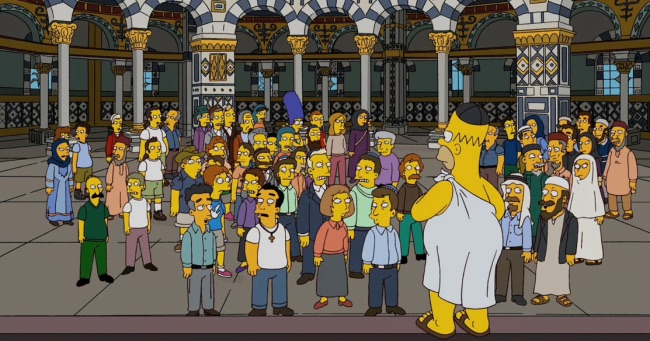
In The Simpsons episode The Greatest Story Ever D’ohed, the Simpsons travel to Israel where Homer is afflicted with the syndrome, the illness and its effect on Homer being one of the plot’s central themes. In The X-Files episode Revelations, agents Scully and Mulder try to subdue a man afflicted with a form of the syndrome.
The featured photograph at the head of this blog is a real-life version of the above Simpsons picture. The man at centre stage is Carl James Joseph of Detroit, Michigan, ‘The Jesus Guy’ we encountered in the Church Of The Holy Sepulchre. He has been a common sight around the Old City for many years now.j
Of all the cities in the world, why Jerusalem?
“ The Arabs call the city ‘Al Quds’, “The Holy’. It was deemed sacred from pre-history. Those aforementioned iconoclast scholars suggest that Jerusalem was actually the holiest place in Islam, and that like Islam itself and the Prophet, Mecca and Medina were retrofitted to suit the conqueror’s narrative. A city of the mind as much as of this earth, it haunts the prayers and dreams of three faiths, and to this this day, it is coveted and contested. “The air above Jerusalem”, wrote Israeli poet Yehuda Amichai, “is filled with prayers and dreams, like the air above cities with heavy industry. Hard to breathe”. Arthur Koestler wrote: “The angry face of Yahweh is brooding over the hot rocks which have seen more holy murder, rape and plunder than any other place on earth”. Perhaps it is because Jerusalem is mankind’s number one hot spot! “There’s this thing that happens here, over the hell mouth”, says Buffy, “where the way a thing feels – it kind of starts being that way for real. I’ve seen all these things before – just not all at once”. More Jews have probably died violently in Jerusalem than in the Holocaust. And countless folk of other faiths have likewise perished”. From A Brief History Of The Rise And Fall Of The West by Paul Hemphill
A lot of folk put a lot of energy into mattters millenarian, when they could divert it to more practical matters like health, water, human rights, blah, blah blah… Some diligent souls have constructed a 3D virtual second temple as a template for its reconstruction. And they don’t care if they start a world war to get it built. Others strive to create a Caliphate that will precipitate the long foretold great battle at The End of Days. And yet others are endeavoring to recreate Noah’s Ark in Kentucky, USA. Different tribe, same psychosis. Never underestimate the irrational mind. For such is the power of myth and magic even in this techno day and age. More blood has been shed in and for Jerusalem than any other city on earth, and we ain’t done yet!
O Jerusalem!
Sound the trumpets of Zion to summon forth the saints.
From The Song of Solomon
O Jerusalem!
I never thought that faith could be so strong!
Ah, Jerusalem!
I never knew that faith could be such fun!
It’s something you don’t do at home.
It happens in Paris and Rome.
The fevered faithful’s illusion
That causes such holy confusion.
Scully and Mulder have fought it,
Homer Simpson has caught it
In Jerusalem.
Bear me up on angels wings
And other transcendental things.
Cradle me in Jesus’ arms,
Far from home but safe from harm.
Where the Golden Walls still glow,
Let my people go
To Jerusalem.
Never knew that faith could be so strong!
O Jerusalem,
Never knew that faith could be such fun!
Filipinas in a row harmonizing with “Swing Low
Sweet Chariot”.
Charismatic holy clown roams the alleys of the town,
Says he’s hunting down Iscariot.
Pentecostal Germans heard
Their pastor preach the Holy Word.
Drab babushkas clutch their crosses,
Eastern priest in black now blesses
Those who lie with arms out swept
On the rock where Jesus wept,
In Jerusalem.
Never knew that faith could be so strong!
O Jerusalem,
I want whatever they are on!
See that women dressed so plain, thinks she’s
Mary Magdelene
Waiting just beyond the Tomb for her Lord
To come again.
Is he not already here? Don’t you see him
Over there?
In his robe of woven wool, sandals, beard,
And flowing hair.
There’s lady known to me
Who would make a cup of tea
And take it to Mount Scopus every morning
To give to Christ when he returned in glory –
I tell you, I’m not making up this story!
Its Jerusalem!
I never knew that faith could be such fun!
O Jerusalem!
I want whatever they are on!
Sometimes in morning dreams, I see
The Holy City in front of me:
Forever and ever, and world without end,
We all need an invisible friend
In Jerusalem.
Jerusalem Syndrome? Tourist Goes Treasure Hunting in Old City Cave
Nir Hasson Ha’Aretz Mar 15, 2016
Zedekiah’s Cave is a remnant of what was the largest quarry in Jerusalem that dates back to at least Second Temple times. Daniel Bar-On
An American tourist was arrested last week after spending the night in Zedekiah’s Cave, also known as Solomon’s Quarries, which lies under the Muslim Quarter of Jerusalem’s Old City.
Last Thursday afternoon, when the site was open to the public, the 19-year-old entered the cave carrying a backpack. When closing time came, he hid in one of the crevices of the cave and the security people did not notice him as they checked the site before closing. He was there overnight and started digging in various sections of the cave, apparently seeking to find some of the treasures that various legends say have been buried there over the centuries.
While the cave is usually closed on Fridays, last Friday it was opened to do some development work. The workers found the tourist in the cave covered with mud, his backpack full of stones and shards that he’d dug up from the floor of the cave. He was handed over to police and his findings were confiscated.
During questioning the young man could not explain his motives for what he did. Police said he apparently has emotional problems and may have contracted the so-called Jerusalem Syndrome, a phenomenon involving religious obsessions or other psychosis-like experiences seemingly triggered in some people by visiting Jerusalem. He was released and has since left the country.
Zedekiah’s Cave is a remnant of what was the largest quarry in Jerusalem that dates back to at least Second Temple times. It covers some nine dunams (two and a quarter acres), with an entrance between the Old City’s Damascus Gate and Herod’s Gate. Over the years a number of legends and traditions have sprung up involving the cave. The Jewish tradition is that King Zedekiah tried to flee through the cave during the destruction of the First Temple.
A later Muslim tradition identifies the cave as “the cave of Korah,” the place where the biblical Korah and his allies were swallowed up by the earth when they tried to revolt against Moses.
In 1968 a resident of the Old City claimed that his grandfather had hidden three crates of gold coins in the cave before the War of Independence. He asked permission to search for the crates using signs his grandfather had left him and promised in return to give three-quarters of the treasure to the authorities. He was given permission to search but found nothing.
The cave also serves as a ceremonial site for the Freemasons from the 1920s to this day. The Freemasons revere the place, believing it to have been the site from which the stones for the First Temple were quarried. Since the 1980s the cave is operated by the East Jerusalem Development Corporation as a tourist site, and events are held there from time to time.
The Jerusalem Syndrome: Why Some Religious Tourists Believe They Are the Messiah
Chris Nashawaty, Wired, 17th February 2012
Shortly after his 40th birthday, the life of a man we’ll call Ronald Hodge took a strange turn. He still looked pretty good for his age. He had a well-paying job and a devoted wife. Or so he thought. Then, one morning, Hodge’s wife told him she no longer loved him. She moved out the next day. A few weeks later, he was informed that his company was downsizing and that he would be let go. Not knowing where to turn, Hodge started going to church again.
Even though he’d been raised in an evangelical household, it had been years since Hodge had thought much about God. But now that everything seemed to be falling apart around him, he began attending services every week. Then every day. One night, while lying in bed, he opened the Bible and began reading. He’d been doing this every night since his wife left. And every time he did, he would see the same word staring back at him—the same four syllables that seemed to jump off the page as if they were printed in buzzing neon: Jerusalem. Hodge wasn’t a superstitious man, he didn’t believe in signs, but the frequency of it certainly felt like … something. A week later, he was 30,000 feet over the Atlantic on an El Al jet to Israel.
When Hodge arrived in Jerusalem, he told the taxi driver to drop him off at the entrance to the Old City. He walked through the ancient, labyrinthine streets until he found a cheap hostel near the Church of the Holy Sepulchre. He had a feeling that this was important. Supposedly built on top of the spot where Jesus Christ was crucified and three days later rose from the dead, the domed cathedral is the holiest site in Christendom. And Hodge knew that whatever called him to the Holy Land was emanating from there.
During his first few days in Jerusalem, Hodge rose early and headed straight to the church to pray. He got so lost in meditation that morning would slip into afternoon, afternoon into evening, until one of the bearded priests tapped him on the shoulder and told him it was time to go home. When he returned to his hostel, he would lie in bed unable to sleep. Thoughts raced through his head. Holy thoughts. That’s when Hodge first heard the Voice.
Actually, heard is the wrong word. He felt it, resonating in his chest. It was like his body had become a giant tuning fork or a dowsing rod. Taking a cue from the sign of the cross that Catholics make when they pray, Hodge decided that if the vibrations came from the right side of his chest, it was the Holy Ghost communicating with him. If he felt them farther down, near the base of his sternum, it was the voice of Jesus. And if he felt the voice humming inside his head, it was the Holy Father, God himself, calling.
Soon, the vibrations turned into words, commanding him to fast for 40 days and 40 nights. None of this scared him. If anything, he felt a warm, soothing peace wash over him because he was finally being guided.
Not eating or drinking came easily at first. But after a week or so, the other backpackers at his hostel began to grow concerned. With good reason: Hodge’s clothes were dirty and falling off of him. He had begun to emit a pungent, off-putting funk. He was acting erratically, hallucinating and singing the word Jesus over and over in a high-pitched chirp.
“Jesus … Jesus … Jesus …”
Hodge camped out in the hostel’s lobby and began introducing himself to one and all as the Messiah. Eventually, the manager of the hostel couldn’t take it anymore. He didn’t think the American calling himself Jesus was dangerous, but the guy was scaring away customers. Plus, he’d seen this kind of thing before. And he knew there was a man who could help.
Herzog Hospital sits on a steep, sun-baked hill on the outskirts of Jerusalem. Its sprawling grounds are dotted with tall cedars and aromatic olive trees. Five floors below the main level is the office of Pesach Lichtenberg, head of the men’s division of psychiatry at Herzog.
Lichtenberg is 52 years old and thin, with glasses and a neatly trimmed beard. Born into an Orthodox Jewish family in Crown Heights, Brooklyn, he moved to Israel in 1986 after graduating from Albert Einstein College of Medicine in the Bronx and has worked at Herzog more or less ever since. It’s here that he has become one of the world’s leading experts on the peculiar form of madness that struck Ronald Hodge—a psychiatric phenomenon known as Jerusalem syndrome.
On a bright, late summer morning, Lichtenberg greets me in the chaotic lobby of the hospital, smiling and extending his hand. “You missed it!” he says. “We had a new Chosen One brought into the ward this morning.” We go down to Lichtenberg’s office; on top of a bookcase is a giant shofar, a curved ram’s horn that religious Jews sound on the high holidays. A middle-aged British man under the doctor’s care had used it to trumpet the Messiah’s—that is to say, his own—coming. Lichtenberg explains that allowing me to meet his latest patient would violate hospital policy, and he can’t discuss ongoing cases. He’ll talk about past patients as long as I agree to de-identify them, as I did with Hodge. “But,” he adds, “that doesn’t mean we can’t try to find a messiah of our own. In a few days, we’ll take a walk around the Old City and maybe we’ll find one for you there.”
There’s a joke in psychiatry: If you talk to God, it’s called praying; if God talks to you, you’re nuts. In Jerusalem, God seems to be particularly chatty around Easter, Passover, and Christmas—the peak seasons for the syndrome. It affects an estimated 50 to 100 tourists each year, the overwhelming majority of whom are evangelical Christians. Some of these cases simply involve tourists becoming momentarily overwhelmed by the religious history of the Holy City, finding themselves discombobulated after an afternoon at the Wailing Wall or experiencing a tsunami of obsessive thoughts after walking the Stations of the Cross. But more severe cases can lead otherwise normal housewives from Dallas or healthy tool-and-die manufacturers from Toledo to hear the voices of angels or fashion the bedsheets of their hotel rooms into makeshift togas and disappear into the Old City babbling prophecy.
Lichtenberg estimates that, in two decades at Herzog, the number of false prophets and self-appointed redeemers he has treated is in the low three figures. In other words, if and when the true Messiah does return (or show up for the first time, depending on what you believe), Lichtenberg is in an ideal spot to be the guy who greets Him.
“Jerusalem is an insane place,” one anthropologist says. “It overwhelms people.”
While it’s tempting to blame the syndrome on Israel’s holiest city, that wouldn’t be fair. At least, not completely. “It’s just the trigger,” says Yoram Bilu, an Israeli psychological anthropologist at the University of Chicago Divinity School. “The majority of people who suffer from Jerusalem syndrome have some psychiatric history before they get here.” The syndrome doesn’t show up in the Diagnostic and Statistical Manual of Mental Disorders, but it and its kissing cousins are well-known to clinicians. For example, there’s Stendhal syndrome, in which visitors to Florence are overwhelmed by powerful works of art. First described in the early 19th century in Stendhal’s Naples and Florence: A Journey from Milan to Reggio, the disorder can lead to spontaneous fainting, confusion, and hallucinations. Paris syndrome, first described in 1986, is characterized by acute delusions in visitors to the City of Light and for some reason seems to preferentially affect Japanese tourists. Place, it seems, can have a profound effect on the mind.
What’s actually happening in the brain, though, isn’t completely clear. Faith isn’t easy to categorize or study. Andrew Newberg, a neuroscientist at Thomas Jefferson University in Philadelphia, has conducted several brain-imaging studies of people in moments of extreme devotion. The limbic system, the center for our emotions, begins to show much higher activity, while the frontal lobes, which might ordinarily calm people, start to shut down. “In extreme cases, that can lead to hallucinations, where someone might believe they’re seeing the face of God or hearing voices,” Newberg says. “Your frontal lobe isn’t there to say, ‘Hey, this doesn’t sound like a good idea.’ And the person winds up engaging in behaviors that are not their norm.”
SHE WOULD RUB HER TEMPLES, DESPERATE TO DIAL IN THE VOICE OF GOD LIKE SOMEONE TRYING TO TUNE IN A FAR-OFF RADIO STATION.
The psychosis typical of Jerusalem syndrome develops gradually. At first the victim may begin to feel symptoms of anxiety, nervousness, and insomnia. The next day, there may be a compulsive urge to break away from the rest of the tour group and visit holy places like the Church of the Holy Sepulchre or the Church of the Nativity in Bethlehem. Sufferers might follow this with a series of purification rituals such as shaving all of their body hair, clipping their nails, or washing themselves free of earthly impurities. The afflicted may then venture into the Old City to shout confused sermons claiming that redemption is at hand. In some cases, victims believe they are merely a cog in an ineffable process, helping to set the stage for the Messiah’s return with some small task they’ve been given. In more extreme cases, they can be swept up by psychotic delusions so intense, so ornate, that they become convinced they are Jesus Christ. “Jerusalem is an insane place in some ways. It overwhelms people, and it has for centuries,” Bilu says. “The city is seductive, and people who are highly suggestible can succumb to this seduction. I’m always envious of people who live in San Diego, where history barely exists.”
In other words, what you can blame Jerusalem for is looking like, well, Jerusalem. The Old City is a mosaic of sacred spaces, from the al-Aqsa Mosque to the Western Wall of the Temple Mount to the well-trodden stones on which Jesus supposedly walked. Like every city, it’s the combination of architecture and storytelling that makes Jerusalem more than just a crossroads. Great cities, the places that feel significant and important when you walk their streets, always rely on stagecraft—a deftly curving road, finely wrought facades, or a high concentration of light-up signage can all impart a sense of place, of significance. This architectural trickery can even instill a feeling of the sacred. The colonnades around St. Peter’s Square at the Vatican, the rock garden at Ryoanji temple in Kyoto, and the pillars at the Jamarat Bridge near Mecca all shoot laser beams of transcendence into the brain of a properly primed visitor. “Part of the experience of going to these places is the interweaving of past and present,” says Karla Britton, an architectural historian at the Yale School of Architecture. “There’s a collapse of time. And for some people who visit these sacred sights and spaces, this collapse can be psychologically disorienting. The whole act of pilgrimage is deliberately intended as a kind of disorientation.”
That in and of itself doesn’t make someone crazy. “There are a lot of people who come to Israel and feel God’s presence, and there’s nothing wrong with that,” Lichtenberg says. “That’s called, at the very least, a good vacation. God forbid a psychiatrist sticks his nose into something like that.” He smiles and rubs his beard. “But the question is, at what point is belief OK and at what point is it not OK? If someone says, ‘I believe in God,’ OK. And if they say, ‘I believe the Messiah will come,’ fine. And if they say, ‘I believe His coming is imminent,’ you think, well, that’s a man of real faith. But if they then say, ‘And I know who it is! I can name names!’ you go, wait a second—hold on!”
When people with Jerusalem syndrome show up at the hospital, doctors often just let them unspool their stories, however strange the narratives may seem. If the people aren’t dangerous, they are usually discharged. Violent patients might be medicated and kept under observation pending contact with their family or consulate. After all, the most effective treatment when it comes to Jerusalem syndrome is often pretty simple: Get the person the hell out of Jerusalem. “The syndrome is a brief but intense break with reality that is place-related,” Bilu says. “When the person leaves Jerusalem, the symptoms subside.”
Lichtenberg didn’t know any of this when he started at Herzog. Then, shortly after he began his residency in the late 1980s, he met a 35-year-old Christian woman from Germany. She was single and traveling alone in Israel. He remembers her as being gaunt, prematurely gray, and highly educated. The police had picked her up in the Old City for badgering tourists about the Lord’s return. “She arrived in a state of bliss because she believed the Messiah was coming,” Lichtenberg says. “I probably thought, she’s just meshuggeneh.”
Over the next few days, Lichtenberg underwent a transformation of his own. He became obsessed with the German woman’s case. He thought about how she would ricochet from periods of giddy rapture to moments of outright hostility and confusion. During her more manic moments, she wanted to share the Good News with the doctor. In her more depressive ones, she wandered the psychiatric ward desperately trying to hear the voices in her head that had gone momentarily silent. She would rub her temples as if she could dial in the voice of God, like someone trying to tune in a far-off radio station.
The woman stayed at the hospital for a month, until the doctor could arrange for her to be sent home. Lichtenberg has no idea what happened to her after she returned to Germany, but more than 20 years later he can still recall the smallest details of her case. “It was so interesting talking to her, but I was also a little embarrassed because there was no one at the hospital to encourage that sort of thing back then. At the time, the thinking here was more like, OK, what dosage is she getting? Should we increase it?”
This way of thinking is more sympathetic than many psychiatrists would call for. Actually, it wasn’t that long ago that one respected Israeli physician put two patients who both claimed to be the Messiah in a room together just to see what would happen. Each rabidly accused the other of being an impostor, barking fire-and-brimstone threats.
“People come to Israel and feel God’s presence,” Pesach Lichtenberg says. “There’s nothing wrong with that.”
Self-styled prophets have been journeying to Jerusalem on messianic vision quests for centuries. A certain Nazarene carpenter was merely the most charismatic and most written about. But it wasn’t until the 1930s that an Israeli psychiatrist named Heinz Herman clinically described Jerusalem syndrome for the first time. One of his early cases involved an Englishwoman who was so convinced the Second Coming was at hand that she climbed to the top of Jerusalem’s Mt. Scopus every morning with a cup of tea to welcome the Lord.
Most cases are harmless, but there have been disturbing exceptions. In 1969 an Australian tourist named Denis Michael Rohan was so overwhelmed by what he believed to be his God-given mission that he set fire to the al-Aqsa Mosque, one of Islam’s most sacred sites, which sits atop the Temple Mount directly above the Wailing Wall. The blaze led to rioting throughout the city. Rohan later said that he had to clear the site of “abominations” so it would be cleansed for the Second Coming. (The mosque was rebuilt by a Saudi construction company owned by Osama bin Laden’s father.)
More recently, an American man became so convinced he was Samson that he tried—and failed—to move a block of the Wailing Wall. An American woman came to believe she was the Virgin Mary and went to nearby Bethlehem to search for her baby, Jesus. And a few years ago, the Israeli press reported on a 38-year-old American tourist who, after spending 10 days in Israel, began roaming the surrounding hills muttering about Jesus. Shortly after being hospitalized, he jumped off a 13-foot-high walkway near the emergency room, breaking several ribs and puncturing his lung.
Lichtenberg says that during times of uncertainty and conflict (not infrequent in Israel), admissions to his ward spike. For example, in late 1999, when the rest of the world quaintly panicked about the Y2K bug and whether they’d be able to use their ATMs on January 1, Israel was on high alert, afraid that deranged religious crazies would flock to Jerusalem in anticipation of a millennial apocalypse. At the peak, five patients a week were brought into Lichtenberg’s ward. The country’s defense forces were concerned that someone would try to blow up the al-Aqsa Mosque, finishing the job Rohan started 30 years earlier.
One of the patients brought into Herzog at the time was an old man who sold novelty wooden back-scratchers near Lichtenberg’s home. The doctor knew him. He also knew that the man firmly believed he was King David. “Was he psychotic? Yeah, OK,” the doctor says with a shrug. “But I didn’t see any need to keep him. Unfortunately, he passed away recently. Otherwise, I would have loved for you to meet him. He would have been happy to talk to you.”
At 9 the next morning, the doctor and I are walking the narrow streets of the Old City. It seems like a good way to conduct an interview, outside the sterile confines of the hospital. Plus, we are still hoping to meet a messiah.
The scents of cumin and turmeric and cardamom are so overwhelming that my eyes begin to water. And even though the doctor has lived in Jerusalem for 25 years, his sense of direction in the winding alleys of the Muslim Quarter seems sketchy at best. After several embarrassing wrong turns and switchbacks, we find ourselves standing face-to-face with an Arab butcher skinning a goat that hangs on a giant rusty hook. We detour left down a dark passageway and nearly crash into a dozen elderly Italian women dressed in the black clothes of mourning, carrying a 6-foot wooden cross on their hunched backs. They’re huddled together like a rugby scrum, chanting in Latin as they take plodding steps along the Stations of the Cross, reenacting Jesus’ bloody march to his crucifixion.
We move aside to let them slowly pass. Neither one of us says a word. And as soon as they turn the corner and disappear from view, he turns to me. “I’ve got chills. Do you?”
I have to admit I do.
The doctor asks me to try to describe what I’m feeling as if I am one of his patients, and I stammer a response about going to Sunday School as a kid and the thick smell of incense I remember at Easter Mass at my father’s Syrian Orthodox church. But, really, as soon as I try to put the sentiment into words, the chills subside and trickle away.
This is essentially what happened to the patient I’ve called Ronald Hodge. After a month of taking antipsychotic drugs under Lichtenberg’s care at Herzog, he gradually came to accept the hazy reality of what he’d been through. He was still confused, but he was calmer, more cooperative, and he no longer felt voices thrumming through his body. The American consulate arranged for his discharge and put him on a flight back to the States. He went back to his old life.
Lichtenberg and I come to the Church of the Holy Sepulchre. Inside the entrance is the Stone of Unction, symbolizing the spot where Jesus’ body was anointed and wrapped in a shroud after he was taken down from the cross. Men are kneeling with lit candles. Women are kissing the stone and running their rosaries along the top of it. Many are crying. It’s profoundly moving.
We head east toward the Wailing Wall. There, rows of men dressed in black and wearing sidecurls are rocking back and forth as they pray. Lichtenberg grows quiet and slowly approaches the wall, rubbing his hand on one of the giant stones. He leans forward and softly kisses it. After a few minutes, he looks around and says, “No messiahs here today. Sorry.” He seems honestly apologetic.
Later, over a cold drink, Lichtenberg confesses that he sometimes views his patients with less-than-scientific eyes. “I guess when someone comes into the hospital claiming to be the Messiah, my interest is not just clinical,” he says. “Sometimes you can see right away that the patient isn’t the charismatic type. They’re just a sick patient. But, OK, yes, I’ll admit it. There have been a number of people over the years who managed to arouse a certain hope that, hey, wouldn’t it be great if this person really is the One? So far I’ve been disappointed. But you never know who will walk through that door tomorrow.” His cell phone buzzes on the table. He’s needed back at Herzog.
As Lichtenberg walks off toward the hospital, the drone of the muezzin’s call to prayer crackles and hisses over a loudspeaker. The hairs on the back of my neck stand up. Is this the strange power of Jerusalem? Or just the result of an overactive limbic system? It feels deeper than that—more holy. But then again, what is deeper than neurochemistry?
My old friend and Huldrefolk founder member, George Hofsteters, Yuri The Storyteller, passed away peacefully in his sleep yesterday morning, 9th July 2014.
Passing strangest is Yuri’s passing. He had such a life force. He was a force of nature, even, the kind of person you’d think would outlive us all. And it was ironic that he who raged so long against the establishment should go so quietly into the night. I would have expected a contrarian like Yuri to have been lynched by a mob of irate god-botherers.
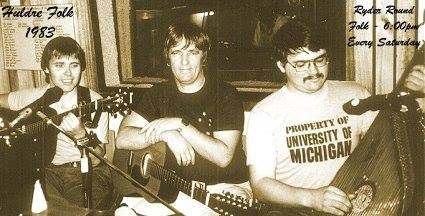
Yuri’s departure brought me back to the dying decades of the last century, when the shadowy and iconoclastic HuldreFolk appeared out of nowhere with their unique combination of stories and songs, and then almost as suddenly, disappeared into the mists of memory.
I was playing at the celebrated Three Weeds Folk Club in Rozelle in the spring of 1983, performing a cover of Roman poet Meniscus Diabetes‘ popular song Roman Holiday. I was distracted by a cackling in the front row; and there was Yuri, laughing his head off. After my set, we got together and swapped notes on life, the universe and everything. Fate would have it that celebrated bandurist Victor Mishalow was also on the bill that night. And Yuri and I were enthralled by the magic of the Carlingford Cossack’s grand instrument.
Yuri told us he was a Russian Storyteller, and that he was performing at the Humanist Society the following Tuesday. “Come along and play some songs and tunes”, he said. And so we did. Yuri enthralled us with his spirited rendering of Alfred Noyes’ The Highwayman. And it was there, in Shepherd Street, Surrey Hills, that HuldreFolk was born. Over the next two years, HuldreFolk, named for the mythical and mystical ‘hidden people’ of Icelandic legend, played throughout Australia.
One such occasion was the very first time I visited Coffs Harbour, a seaside graveyard with lights on the mid north holiday coast of New South Wales, sometimes known as the Costa Geriatrica (as fate would have it, we now live in the forest some forty clicks away from there). Looking for a parking space outside the venue, Yuri cut into a space ahead of a car that had already bagged that spot. A few minutes later, the occupants of the car approached us, looking mean and moody. Tall, broad and hairy, they looked like bad news. Yuri was unperturbed. “My mate Paul is a black belt in karate”, he chirped …
On a return visit to Coffs Harbour, he and Victor Mishalow got a gig performing on the back of a flatbed truck in the mall for a smattering of disinterested passers-by. When they’d finished, the organiser asked Yuri how much they wanted, “Two hundred dollars”, Yuri said. Before the paymaster could reply, Yuri added: “Each!” And they got it.
Yuri could be a proper bastard sometimes.
Although HuldreFolk pursued their own paths and projects, during the following decades, they would pop up in unexpected places, like their namesakes, in ones, twos, threes, and on occasions with guest HuldreFolkies. Their last outing as a trio was in October 2007 at the North By Northwest Poetry And Folk Club. Google the videos on YouTube.
Such was his energy, after a series of concerts, I’d need several months away from him to recover. Whenever we had to do a road trip, Yuri would tell jokes non-stop – it was as if they were on a loop. Once he’d finished his repertoire, he’d automatically start again.
Whenever HuldreFolk worked together, their collaborations were creative and at times, crazy.
Listen to Victor’s haunting bandura arrangements behind many of Yuri’s stories, the bravado of ‘The Ballad of Boreslav’ and the wackiness of ‘The Song Of The Volga Shearers’. Back in the day when I was performing ‘I Still Call Mongolia Home’, ‘Brave Goliath’, and ‘Roman Holiday’, Yuri would say: “There has never been as song about the Spanish Inquisition. Why don’t you write one”. Or, “How about a song about the Vikings?” The rest, of course, is hysterical.
We would always introduce George as “The One And Only Yuri The Storyteller”. Watch him on You Tube reciting the epical ‘McArthur’s Fart’ or the poignant ‘Claudy’, and telling the magical story of ‘The Algonquin Cinderella’ or the faerie ‘Green Lady’, and you will see that he really was.
Goodbye old friend.
Blast from the past
On 28th October 2013, Yuri posted on the HuldreFolk Facebook page:
Hi, Amigo!
You’ve done a great job on the Huldrefolk page, I’m with you 100% and will support at every opportunity. Could not be on your side more if I was Eddie Obeid. Now here comes the ‘but’. It’s only a tiny elephant in a big room.
It’s been quite a while since we’ve trod the boards together. Obviously neither of us will get the applause or the audiences we once had and sensibly, we should be content to let someone else drive the celebrity bus. We once had the opportunity to be bigger than the Kingston Trio and Tiny Tim together, but the choices that were made ensured we would never be plagued by the paparazzi. Yet I do believe we have influenced others with the idea we once spearheaded. Story, song, music are being metamorphosed in countless variations. I’m glad we had something to do with that.
Today, however, I’m puzzled at why one would go to the trouble of going to the ‘Pet Cemetary’ of entertainment to resurrect on social media a tired old dinosaur that is hardly remembered, let alone noticed by all but a small coterie of moth eaten folkies whose perception of “Macarthur’ is deemed akin to ‘high culture’. Traditional folktales, I’m afraid, will always belong in the musty archives and forgotten bookshops. They are a relic. Fossils belong in museums. But then, being the sentimental bastard that my nature dictates me to be, I hope you get something nice and rewarding for your efforts. If it’s sentiment before oblivion, light the fuse. Cheers!
Yuri’s race had less than a year to run when he penned this piece.
In many ways, he was right – a cruel man but fair, as they say.










 In That Howling Infinite