A Brief History of the Rise and Fall of the West

The great and the good, the wise and the weary, have all offered a definition of ‘history’. To Napoleon, it was “a myth that men agree to believe”. Historian Marc Bloch observed that it was “an endeavour towards better understanding”. His Nazi killers disagreed – their’s was a less nuanced, more zero-sum approach. Abba Eban, long time Israeli foreign minister, wrote that it “teaches us that men and nations behave wisely once they have exhausted all other alternatives”. Aldous Huxley wrote “that men do not learn very much from the lessons of history is the most important of all the lessons that history has to teach.” And channeling Mark Twain and Karl Marx, Buffy Summers remarked, “You know what they say. Those of us who fail history are, doomed to repeat it in summer school”. But best is John Banville’s admission in The Sea that “the past beats inside me like a second heart”. Simply put, we like to see some pattern, some sense of order to it all. Arthur Schlesinger Jr. commented: “The passion for tidiness is the historian’s occupational disease”. Niccolo Machiavelli wrote: “Whoever wishes to foresee the future must consult the past; for human events ever resemble those of preceding times. This arises from the fact that they are produced by men who have ever been, and shall ever be, animated by the same passions. And thus they necessarily have the same results”. And yet, whilst seeking patterns, we cannot really use them to predict outcomes. And it is impossible to know what really happened. The past is another country and all that. All we can say for sure is that in the end, history will remember where we end up much more than how we got there. And, history takes time. All the time in the world.

As Mark Twain remarked sardonically, “history doesn’t repeat itself. A best, it sometimes rhymes”. A recent rhyme was evident when an opulent exhibition on the life and legacy of Alexander The Great of Macedon was brought from ‘old world’ St.Petersburg, the twice renamed city of Peter The Great of Russia, to ‘ new world’ Sydney, Australia. For all his ‘greatness’, young Alexander was, like Lord Byron “mad, bad, and dangerous to know”, but with murderous psycho mixed in. In his ‘Inferno’, Dante had him standing in the river of boiling blood, along with war-mongers and murderers. Why don’t these people just stay at home! Well, what would you think? You are minding your own business down beside the rivers of Babylon, and then suddenly, there’s an army of 50,000 Greeks on the other bank intent on doing damage. Or there you are, beside the sacred Indus, just about to tuck into your chicken vindaloo, when a rampaging horde of homesick Greeks come charging over the horizon. And you ask to no one in particular, because they have all been massacred or enslaved by now, “Why don’t they do the things they do back in their own bloody country?” And there you are on the banks of the Tigris, minding your own business, and keeping out of the way of the Mukhabarat, when over the horizon in a cloud of dust and disco sweeps a column of armoured vehicles and hordes of ka-firi-n with rifles and ray-bans. And you ask to no one in particular, because they have all been bombed or strafed by now, “Why don’t they do the things they do back in their own bloody country?” Plus ça change, plus c’est la meme chose. Nothing much has changed, really.

Which brings us back perhaps, to what Basil Fawlty called ‘the bleeding obvious”. Beyond the scholars’ passion for patterns, and the dry dialectics of cause and effect, there is the personal dimension. Who were the actual inhabitants of ‘history’? What did they think and feel? The thinking of another time can be hard to understand. Ideas and ideologies once compelling may become unfathomable. And the tone and sensibility that made those ideas possible is even more mysterious. We read, we ponder, and we endeavour to empathize, to superimpose the template of our value system, our socialization, our sensibilities upon the long-dead. And thence, we try to intuit, read between the lines, draw out understanding from poems, plays, novels, memoirs, pictures, photographs, and films of the past. We feel we are experiencing another facet of the potential range of human experience. But in reality, we are but skimming the surface, drawing aside a heavy curtain for a momentary glimpse through an opaque window into the past. Simply put, people who lived ‘then’ are not at all the same as we who live ’now’.

Over two and a half thousand years ago, the controversial Greek poetess Sappho wrote:”I tell you, someone will remember us; even in another time”. And so we do, for one thing is for certain: we all love a good story. As they say, in Arabic, as indeed in all tongues, times and places, “ka-n ya ma ka-n bil ‘adim izzama-n wa sa-lifi al aSri wa la-wa-n”‘ or, “once upon an time”.

So, let us walk down what Welsh poet RS Thomas called ‘the long road of history”, beginning with, yes, the usual suspects: power and pride, greed, and aggrandizement, and as accessories after the fact, dolour, devastation, and death.

Time: Year Zero of the Christian era. Place: The Mediterranean littoral

Often, with overwhelming political and military power and economic wealth come arrogance, decadence, and complacency. And with lean and hungry barbarians on the borderland, the geographical interface between the desert and the sown, and soon hanging around the gates, so the seeds of decline and destruction are scattered and germinate. The Pharaohs conquered and ruled over much of North Africa and the Middle East for centuries. Indeed, the first historical record of a ‘formal’ set piece battle between two armies took place in 1468 BCE at Meggido, just south east of Haifa in present day Israel – some five thousand Egyptians took on and bested two thousand Canaanite soldiers of local city states. But Egypt was to fall to the ascendant and ambitious Greeks and Persians, and later, the Romans. And down went these mighty successors. Thebes, Athens, Sparta, Persepolis, Ctesiphon, Rome, Carthage, Byzantium, Constantinople. Grand names, but now bones, bones, dry bones. The Bard of Avon declaimed “The cloud-capp’d tow’rs, the gorgeous palaces, the solemn temples, the great globe itself, Yea, all which it inherit, shall dissolve”. As Percy B Shelley intoned: “My name is Ozymandias, king of kings: look on my works, ye Mighty, and despair!” Nothing beside remains. Round the decay of that colossal wreck, boundless and bare, the lone and level sands stretch far away”.

It was the English historian Toynbee who suggested that “civilizations die from suicide, not murder”. They lose their “mojo”. The 14th Century Arab philosopher of history, Ibn Khaldun, called it “assabiyah” – in short, they lose their élan, their sense of direction and their minds. His point was that the moribund Byzantine and Sassanian empires were broke and militarily overstretched, corrupt, venal and soft, and hence no match for the desert hardened, combat keen, tribally cohesive, spiritually zealous warriors of the one true faith.

At the dawn of the Christian era, the known world was divided up between the those Romans and Persians, who themselves had subjugated and subsumed the Greeks and Phoenician Carthaginians, and Hittites and Assyrians respectively (in the east, the Chinese and Indians boasted powerful, prosperous civilizations as old as The Pharaohs, but this is not their story). Anyhow, the Romans, who morphed into the Byzantines with the loss of the western empire (to nomadic rovers from out of the east) in the third and fourth centuries, and the Persians, were over extended and overspent, slave societies living off the land and labour of conquered peoples. Until they were challenged and defeated by another ascendant power. Those Arabs of Arabia and of the imperial marches.

For generations this lot had served as mercenaries and satraps of both empires, and fired up by the energy and unity of a new but hybrid faith, and muscled up with a martial spirit built upon generations of mercenary employment and privateering, stormed the sclerotic empires from within and without, and in the space of fifty years after the prophet’s death, built a domain that extended from Spain to Afghanistan. Modern genetic analysis has shown that the bloodline of these desert conquerors is as much a mosaic as most other overlords. Assyrian, Babylonian, Hittite, Persian, Egyptian, Nubian, Greek, Phoenician, Roman, Arabian, Hebrew. And whoever else may have been passing through. Many races came and settled, and many too were invaded and scattered. The ruins and artefacts endure still to remind us of their passage.

And this genetic calabash was stirred some more with the Arab conquests. As they surged eastwards and westwards, slaves were sent homewards as plunder and labour. This was the modus operandi of carnivorous empires throughout history. The Babylonians did it; the Romans too. They conquered and controlled though mass death and deportation, dragging their broken subjects in tens and hundreds of thousands across the known world. So too with the Arabs, therefore, as hundreds of thousands of souls from afar afield as the Pyrenees and the Hindu Kush ended their days in Cairo, Damascus, Jerusalem, and Baghdad. Blue eyed blondes and redheads, sallow skinned Turkic and Chinese. You see their heirs today in Homs and Aleppo, Gaza and Hebron. In a fascinating post-classical irony, the European empires were likewise catalysts for ethic trans-migration. The suburbs of Paris and Marseilles, Birmingham and Bradford reflect the colours, cuisines, and conflicts of once-upon-a-homeland.

It is the view of some revisionist historians that whilst Mohammad and his revelations provided the impetus for the Arab “surge”, the religion that we know as Islam was actually retrofitted to the Arab adventurers’ ethos, a kind of ex post facto justification for what was in reality an old fashioned smash and grab. They suggest, therefore, that Islam and the role of Mohammad within it as the messenger and final word were cleverly constructed one to two hundred years after his death by Arab dynasties seeking legitimacy and heavenly sanction for their own aggrandizement. But then, wasn’t it always thus? As Jarred Dimond and others have written, this pandering to invisible friends and post-mortem insurance is part of our genetic baggage. It goes back to way back, to Neanderthals, and before them, to chimpanzees, our closest relatives).

Notwithstanding this, these parvenus ushered in the flowering of Arab culture in the arts, architecture, literature, and science as caliphs encouraged intellectual inquiry, and invited polymaths from across the known world to abide in their domains. Indeed, much of the work of the Greek and Roman philosophers, mathematicians, astronomers, doctors and scientists was translated into Arabic and preserved for posterity when the Roman Empire was overrun by waves of barbarians, the beginning of what are called The Dark Ages.

One other ‘safe house’ for these tracts during these dire days was Ireland, in the monasteries of the far west, where monks would meticulously copy rare texts, often embellishing them with their own, ‘Celtic’ art work. The Book of Kells owes a stylistic debt to the monasteries of the Byzantine Levant. And whilst we digress on the subject of books, it is believed by some scholars that The Quran was not actually written in Mecca or Medina, but most likely in Baghdad, which did not exist whilst Mohammad breathed. Learned iconoclasts also purport that it was originally written in Aramaic, the language of the Levant at the time of Jesus, and that Arabic has not yet evolved as a written language. The Torah, the basis of Jewish law and custom, and of The Bible, was written in Babylon and not Jerusalem. And The New Testament? Well. that was assembled all over the shop: in cosmopolitan Athens, Rome, the desert solitudes of Syria and the Sinai. The Quran itself drew on both of these. Such is the power of foundation myths. There are always issues surrounding the literal ‘Word of God’.

Contrary to popular assumptions, these centuries were not that dark at all. The Islam tide was turned at Tours by the Frankish forces of Charles ‘the Hammer’’ Martel, named nostalgically for the Israelite rebel who defied and defeated the Seleucid Greeks in the Maccabee Revolt in the second century BCE. Charlemagne founded the French monarchy which endured until the unfortunate Louis the Last lost his head to the French revolutionaries in 1793. The Western Christian church established many fundamentals of law, politics and theology that endure to this day. There was, nevertheless, a lot of fighting, most of it between squabbling European potentates, and a major doctrinal rift in the Christian Church that saw it bifurcate, often with accompanying bloodshed, into the Catholic Church of Rome, and the Eastern Church of Constantinople. Between the Christian ‘West’ and the Muslim ‘East” however, there endured an armed peace interspersed with occasional warfare until the eleventh century. The Byzantine heirs of Constantine were reasonably content to maintain a kind of Cold War with the many fractious emirs who ruled the lands to their east, and to sustain their power and influence through canny diplomacy, alliances, mercenaries, and proxies (It is testament to the ‘byzantine’ skills of these emperors and their servants that the empire endured for a thousand years as a powerful political, economic, and military force until Constantinople fell to the Ottoman Mehmed the Conqueror in 1453).

Things changed utterly for east-west relations towards the end of the eleventh century. The heirs to the Roman Empire in the west, the Franks and the Normans, descendants of those nomadic marauders who broke the power of Rome, fired up with religious zeal and the prospects of material gain, embarked upon a series of Crusades to free the Holy Land, the paths that Jesus trode, from the heathen Mohammedan. But do not for a moment dismiss the power of religious fervour in those far-off days. The promise of a full remission of all sins and a place in paradise was a powerful motivator. Nevertheless, God and gilt, backed by martial grunt, conveniently colluded with another new power, out of the east. The Mongols had spilled out of the steppes of central Asia, having conquered the ancient Chinese empire, and once again, the nomads were on the move as the sons and heirs of Genghis Khan sought khanates and kingdoms of their own in the west. And when they advanced into the Levant, they came up against, and collaborated with the Franks against the Saracens. History is never black and white – the crusaders also did deals with Muslim warlords if it suited their common interests. In their politics as well as their lifestyles, many ‘went native’.

It was always thus. The barbarians, usually horsemen originating from central Asia, surge in from the wild lands, devastate the settled lands, and take the cities. In Eastern as well as Western Europe, and the Middle East, they came, they saw, they conquered, and they moved in. Settled down, intermingled, and developing a taste for the good life, and gave up their roving, rampaging ways. We are their heirs and successors, us descendants of Celts and Saxons, Goths and Vikings, Vandals and Huns, as are French people, Italians, Spaniards, Turks, and Arabs.

Vaslily Grossman encapsulated all this poignantly and succinctly in An Armenian Sketchbook: “The longer a nation’s history, the more wars, invasions, wanderings, and periods of captivity it has seen – the greater the diversity of its faces .Throughout the centuries and millennia, victors have spent the night in the homes of those whom they have defeated. This diversity is the story of the crazed hearts of women who passed away long ago, of the wild passion of soldiers intoxicated by victory, of the miraculous tenderness of some foreign Romeo towards some Armenian Juliet”.

The story of the Vandals is an epic in itself. From out of what we now call Sweden they came, ethnic kin to the Norsemen and Vikings. Scouring through the Baltic lands, and present day Poland, Germany, and France, they settled in Spain. Andalusia is Arabic for ‘Land of the Vandals’. And eventually they established a kingdom in Libya, challenging and then paying tribute to the ascendant Roman Empire.

But the Norsemen were not quite finished with the east. On a rail of the gallery of the beautiful Aya Sofya basilica in Istanbul, there is some graffiti carved by Halvden, a 9th Century soldier of the Emperor’s Varangarian Guard, an elite force of Viking mercenaries. One commander of this guard was Harald Hardrada, who, as King of Norway, died in Yorkshire at the Battle of Stamford Bridge, the first of two kings to die during the English summer of 1066. Whilst specifically the imperial bodyguard, the Varangarians fought on the empire’s frontiers against Arab pirates and raiders, marauding nomads from the steppes, Saracens, Normans and Bulgarians. How Harald came to Mickelgard, or Great City, as the Norsemen called Contantinople, is a story in itself, but the sagas say that he even travelled to Jerusalem, protecting caravans of Christian pilgrims. Just picture it. A brigade of Norseman slashing and bashing their way through the wadis and wastelands of Syria, fifty years before the first crusaders put Jerusalem to the sword. One further Scandinavian digression: in 1110, Sigurd, the teenage King of Norway, having fought his way around the Mediterranean with a sixty ship fleet massacring infidels as he went, landed at Acre in Palestine and wintered in what the Norsemen called Jorsalaberg (See Harald Went a ‘Viking).

“If I forget thee, Oh Jerusalem!” The Arabs call the city ‘Al Quds’, “The Holy’. It was deemed sacred from pre-history. Those aforementioned iconoclast scholars suggest that Jerusalem was actually the holiest place in Islam, and that like Islam itself and the Prophet, Mecca and Medina were retrofitted to suit the conqueror’s narrative. A city of the mind as much as of this earth, it haunts the prayers and dreams of three faiths, and to this day, it is coveted and contested. “The air above Jerusalem”, wrote Israeli poet Yehuda Amichai, “is filled with prayers and dreams, like the air above cities with heavy industry. Hard to breath”. Arthur Koestler wrote: “The angry face of Yahweh is brooding over the hot rocks which have seen more holy murder, rape and plunder than any other place on earth”. Perhaps it is because Jerusalem is mankind’s number one hot spot. “There’s this thing that happens here, over the Hell Mouth”, says Buffy, “where the way a thing feels – it kind of starts being that way for real. I’ve seen all these things before – just not all at once”. More Jews have probably died violently in Jerusalem than in the Holocaust. And countless folk of other faiths have likewise perished.

Razed down to the bedrock like Jerusalem of old

Razed down to the bedrock like Jerusalem of old

The crusader kingdoms of Palestine lasted a hundred years, leaving their castles and churches to remind us of their passing, and have haunted the Arab historical memory to this day. The Arabic word for foreigner, ‘faranjiye’ is derived from Frank (or maybe not – it is also said that Varangarian derived from the Greek Varangos, for the Scandinavian Varing or Vara, either a placename or a family name, which became the Arabic Varank). They fell to the Kurdish warlord from Tikrit (hometown of Saddam Hussein, small world that it is), Salah ad Din Ibn Ayyubi, and were restored to the House of Islam. But even this renowned soldier and schemer could not escape the assassin’s poison forever (it may have been just typhoid, but why spoil a good yarn?). He was supplanted by other despots, not the least, the famed one-time slave, the blonde, blue-eyed Mameluk Barbars who ruled Egypt, conquered Syria, and died when he inadvertently ate the poison he intended for his dinner guest. And then, out of the east, came the aforementioned Mongols, and these brought the house down. They conquered, settled, assimilated, and then weakened and fell as they, in their turn, were supplanted by, yes, another nomad band, this time the Turkic Ottomans (and again, out of central Asia). That’s how assabiyeh works. Once you have it, you have to work on it. Lose it and you are done.

The Ottoman Empire inherited the Arab, Islamic patrimony and assumed the caliphate as the official ‘Deputy of God’. The Ottoman Caliphate, successor to the famed Umayyad and Abbasid Caliphates of Damascus and Baghdad, endured until its abolition in 1924 by Kemal Ataturk, the creator of modern Turkey. It was restored in 2014 as ad Dawlet al Islamiye fi Iraq w ash Sham or Da’esh. We will get to that later, but meantime, the wars and plagues and famines that beset the Middle East brought an end to the golden age of Arab civilization, with all its ecumenical, martial, intellectual, artistic, and scientific adventurousness (the same wars, plagues, and famines scoured the western world too, but these had less far to fall). And so, time stood still for Islam and the Arab world, as the outlying, often neglected provinces of the ascendant Ottoman Empire. It is said of old, that before the advent of the Mongol lord, Hulagu, a cockerel could graze from Baghdad to Basra without alighting to earth, such was the fertility and prosperity of the Land of the Two Rivers. In the wake of the Mongol, with his mass slaughter and the destruction of the long-lasting irrigation systems, came the Arab proverb: “When God made Hell he did not think it bad enough so he created Mesopotamia.” The place never recovered, although the Marsh Arabs of southern Iraq endured through all of this until the present, when their way of life was finally destroyed by Saddam.

Meanwhile, the focus of our story shifts westwards with the crusader armies returning home, bringing with them a taste for the luxuries of the east, and scientific and philosophical ideas and inventions lost to the west during the Dark Ages (what they didn’t take home, however, was a tolerance for folk of different colours and creeds). The Islamic world settled into the backward looking atrophy that we see today. And in time, came the rise of the great European powers. To Western Europe came the social and economic upheavals of war and plague, and the social and intellectual unravelling that was to lead to the age of discovery. Came the power of the papacy, the questioning of that power, the end of the feudal system and the rise of absolute monarchy, and the invention of the printing press and with it, the dissemination of knowledge. All this set the stage for the next act.

Enter the Spanish and Portuguese, resource poor and priest-ridden, astutely patronizing the adventurers, and hence, made wealthy and powerful on the riches that then flowed in from the New World. Enter the inquisition and the straighteners of religious conformity, the bedrock of imperial power. And enter also, the mercantile nations who challenged their claim to the Americas (sanctioned and sanctified as it was by Alexander, the Borgia Pope) and papal supremacy: England, France, and Holland. The era of world empires thus began against a backdrop of trade and religious wars that would set the stage for the very gradual evolution of what would become democratic institutions. But that was way, way down the bloody track.

The wars of religion, between Catholicism and Protestantism morphed into great powers’ wars by proxy (for there is nothing new under the sun). These endured some two hundred years, giving us the renaissance and the reformation, and many, many people perished. And amidst the scramble for colonies and resources, and the ever-widening scope of scientific and intellectual inquiry, there ensued interminable blood-letting. Folk got much too close to the fire, literally and figuratively. Many were dragged there, and many were eager pyromaniacs. The Thirty Years War wasn’t called that for nothing, and unlike The Hundred Years War between France and England before that, which enjoyed a few time-outs between bouts, this was an interminable danse macabre that was at once mediaeval and mid-20th Century in its savagery. ‘Full on’ is the term we use today. It is said that it staggered to an end in 1648 because the combatants just collapsed with exhaustion.

And in its shattered wake, came the decline of the Spanish and the Portuguese, and the ascendency of the English, the French, and the Dutch. Germany and Italy were still a profusion of principalities and oppressed satellites, Russia had yet to emerge out of an anarchic fog, and the USA had not even been thought of. Meanwhile, in the most populous parts of the planet, the Chinese and Indian empires carried on ever, in splendid isolation, narcissistic and ethnocentric, though not above trading profitably with the occident. The potentates that is – the lower orders were, and in many in many ways remain, in a state of repression and submission.

So came an era of religious and intellectual ferment and the mass movement of peoples across the known world and beyond it, to the Americas. Innovation in transport, communications, industry and warfare, and the trans-global transit of armies and of international commerce in goods and in humanity literally changed the face of the planet. Eleven million slaves crossed the Atlantic in four centuries. Over forty million migrants “went west” in less than one. The inscription on Our Lady Of The Harbour, a gift from the Old World to the New, still says: “Give me your tired, your poor, your huddled masses, yearning to breathe free, the wretched refuse of your teeming shore, send these, the homeless, tempest tost to me, I lift my lamp beside the golden door”. And so indeed did folk travel, fleeing poverty and pogroms, powerlessness and persecution, seeking “a new home in the sun”. From the glens of the Gael, from the shtetl and the steppe, from Old Europe and Old Asia. The Great American Dreaming. Today, some 1,300 airplanes a day cross ‘the pond” (475,000 transits a year).

And the printing press and the bible in the vernacular changed the way men thought. Merchants and missionaries and military men, seekers and makers of fortunes, slavers and saviours, prophets and potentates, philosophers and pamphleteers, poets and painters. Enlightenment, revolution, and war. And in America, the creation of democratic institutions.

Royal France was a midwife to this American Revolution, and endured the ironic blowback when French armies returned home harbouring the virus of republicanism and the concepts of liberty and equality. Be careful what you wish for, for liberty wields a two-edged sword as the revolution devours its children. Mounting the scaffold, the doomed Girondin Manon Roland exclaimed “Oh Liberty, what crimes are committed in thy name!” The redoubtable journalist Robert Fisk noted that freedom and liberty often had to crawl over broken glass.

And thence, the Nineteenth Century and the Age of Revolutions – political, industrial, and ideological, bountiful and bloody. And the rise of new empires – Russia, Germany, and the USA, competing with the old, and all extending their power and influence throughout the world, conquering and colonizing the oldest – India, China, and the Ottomans – and spanning the globe. The Americas, Africa, Asia, Australasia, no place was beyond the reach of the empire’s military and mercantile power, and no indigene was safe from the depredations of these latter-day Medes and Assyrians. Diamond again: it was all down to “guns, germs, and steel”. The ‘discovered’ world was ripe for plunder. For land, for minerals, for food. And if the natives got fractious, we had machine guns and gun boats to back us up. For this was the era of militant and muscular Christianity and gunboat diplomacy, synergized in a divine plan to render the world a holier and happier place. Rudyard Kipling said it best: “Take up the White Man’s burden, send forth the best ye breed. Go bind your sons to exile to serve your captives’ need”. A new age of Empire had arrived wherein competing white countries seeking economic and political aggrandizement, sent their boys to die far away from home. The West, it seemed, had got its mojo back!

So far away from home

So far away from home

A little known facet of that century’s history is that contemporaneous to the western expansion of ‘These United States” and the spread of British red across the globe, Imperial Russia was moving eastwards. One outstanding volume of George McDonald Fraser’s rollicking, picaresque and quite political incorrect Flashman series sees the eponymous anti-hero fleeing eastwards out of The Crimea having precipitated the disastrous Charge Of the Light Brigade (Captain Nolan was fitted up), and making his way through the vast Asian hinterland, one step ahead of the invading Czarist armies, and of sundry Muslim warlords. In the Flashman books, the unreconstructed villain of Thomas Hughes’ Victorian yarn “Tom Brown’s Schooldays” is roving and rogering his way through the late nineteenth century, somehow managing to escape by the skin of his teeth from one military disaster after another, including Custer’s famous “Last Stand” at Little Big Horn, and the last stand of the 44th Foot at Gandamak during the disastrous First Afghan War of 1842.

Amidst the humour and ribaldry is a poignant reminder of those ‘lost worlds’ that succumbed to the relentless blade of progress, a theme revisited in Thomas Berger’s Little Big Man and Theodore Olsen’s Soldier Blue, set in the American West, and Vincent Cronin’s The Last Migration and James A Michener’s Caravans, set in Iran and Afghanistan respectively. Ibn Khaldun’s ‘asabiyyah’ is no match for modern weaponry.,

With trade and economic wealth creation came the rise of the middle class. The urban, mercantile elite who seek political power commensurate with their economic clout thus demand a say in how they are governed. In an age of mass production and the beginnings of mass communication, we see the emergence of the masses as a political concept, and of mass society in which rulers are responsive and reactive to the needs fears, and rages of the masses and their representatives. The times of Machiavelli give way to those of Marx. And the focus of history is as much on the ruled as on the rulers.

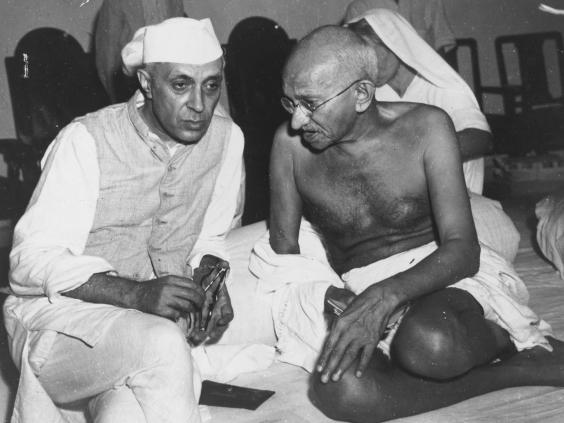
So passed the Nineteenth Century. The Old World ruled. The New had its own preoccupations, with civil war and western expansion. The east and the south were conquered and colonized. God (European and most probably, English-speaking) was in His heaven and all was good and right in the world. The old scourges continued as they has since time immemorial: plague and famine, drought and flood, economic boom and bust, migration and invasion, war and peace, and comme d’habitude, death and destruction on a large scale. Good times and bad times as ever, with little to impede the onward march of progress. A reporter once asked Gandhi: “What do you think of Western civilization?” The Mahatma replied: “I think it would be a very good idea”.

In came the Twentieth Century. Same old, same old, but with markets and machines much more efficient, and likewise our capacity to create and destroy. A time of totalitarian regimes and total war, social change and technological wizardry. In 1905, the Imperial Russian Navy sailed eighteen thousand miles to the Korea Strait only to be broken by the Imperial Japanese Navy. There was a new boy on the block, and once the guns of Tsushima Bay had fallen silent, signalling that the white man could indeed be beaten, and thence, the decline of the colonial empires of old as the “our new-caught, sullen peoples” threw off their chains. In the political, economic, military and demographic spheres, balances of power changed, and changed again. In the wake of two World Wars, from Old Europe to the USA and the Soviet Union, and then, in these present times, to a totally new configuration that reflects the transitory rise and fall of nations. As I write, we see a hesitant America and a struggling Europe competing with a resurgent and belligerent Russia, and the rise and rise of its fellow BRICs, Brazil, India and China – an ascendency that is not however assured in this unstable and unpredictable world of ours. And in the post-Cold War, global financial crisis world of wide-open borders and the mass movement across them of people, goods, and capital, everything has a price and can be bought and sold. Immoral mathematics: “in these shifting tides, bombs and babies, girls and guns, dollars, drugs, and more besides, wash like waves on strangers’ shores – damnation takes no sides” (from E Lucevan le Stelle).

And passing strange it is that whilst we can place men on the moon and machines on Mars, we still live in a world riven by superstition. We have come through the age of enlightenment, the age of revolutions, the age of machines, the age of mass society, mass war, and of mass communications, And yet, we are so, so ignorant. We thought that the rising tide of progress and knowledge would raise all the boats. But how wrong we were. The Muslims in their glory days would refer to what went before as al Jahiliyya, the age of ignorance. But in so many ways, we have returned there. Helped in no small part by their more atavistic descendants who see some wisdom and benefit to all in reverting to a mediaeval ethos and lifestyle.

One thing is pretty certain. We are almost closing a circle. The history of the West, for the past two millennia has been dominated by the emergence and triumph of Christianity and of Islam. As the early Muslims saw it, al Dar al Harb and al Dar al Islam, the houses of war and peace respectively. A pretty good description if the terms are used interchangeably. Much of what has passed has been refracted through the prisms of these theologies. Call it crusade or call it jihad; or call it blow back on a grand scale. The legacy of two millennia of empire is coming back up the pipes. “Take up the White Man’s burden (or any conqueror’s burden, in fact) and reap his old reward: the blame of those ye better, the hate of those ye guard”.

For surely, “by all ye cry or whisper, by all ye leave or do, the silent, sullen peoples shall weigh your gods and you”. Weigh them all and find them wanting. In compassion and loving kindness, in reason and rationality, in patience and peacefulness. And the greatest, saddest irony of all for all who have a passion for history and for charting the unbroken story of humankind, and for those with this passion who treasure the depths of their cultural lineage through all the fugues, follies, and fault lines of our heritage, is the dawning realization and regret, that after two millennia, the religion that kicked off so much controversy and conflict, schism and schadenfreude, brilliance and bigotry, bounty and bloodshed, that was the heir to ancient faiths and the progenitor of many more, is probably now doomed in the lands wherein it was born.

It’s as if over a millennium of painful, staggering, stuttering, blood soaked, inventive, and pioneering progress has meant naught, and that we might as well have remained in the dark, literally and figuratively. “It is written in the Book of Days where the names of God a wrought, where all our dead a buried and all our wars a fought”. We range through “the battlefields and graveyards and the fields our fathers knew”. The cartography of carnage: Bali, Beslan, Gaza, Grozny, Kabul, Kigali, Sabra, Srebrenica, to mention but a few of those “far-away places with strange sounding names”. ”Many have perished, and more most surely will”. This latter quotation is adapted from Auden’s often overlooked masterpiece The Age of Anxiety, a meditation on a world between the wreckage of The Second World War and the foreboding for the impending armed peace. “The bane of bad geography, the burden of topography. The lines where they’re not meant to be are letters carved in stone”. And all this against a back-drop of the revolution despoiled, hijacked and betrayed. “The revolution’s father, the hero psychopath” shows us how hopes and dreams can be “fooled by the riddle of the revolution”. “Words carried far in time and space will topple tyrants, but there’s no salvation”. (see In That Howling Infinite – Poems of Paul  Hemphill)

When Miranda exclaimed “what brave new world, with such people in’t!’, when the dismal Dane moaned ‘what a piece of work is man, how noble in reason, how infinite in faculty, in form and moving, how express and admirable’, was the Bard being singularly ironic? He was writing at the dawn of the Sixteenth Century when the wars of religion were well under way, and yet, the reign of Elizabeth had brought a degree of civil calm, and King James was determined to heal the schisms, using his translation of The Bible as his balm. Reasons to be cheerful, perhaps. The Thirty Years War had yet to devastate continental Europe, and the English Civil war had still to come. Sweden had not yet ravaged Eastern Europe (yes, the Swedes had indeed attempted world dominion before ABBA). The Pilgrim Fathers were not to set sail for a decade, the Inca and Aztec were already no more, and as the Plains Indians rode the range mounted on the descendants of the conquistadors’ horses, the American West had not yet been discovered let alone ‘won’.

Some digression, that! So, back to where are we now, in the first decade of the 21st century. A world of wonders, no doubt, of technological advances in medicine, machines, and mass communications. But the new millennium began with the destruction of the Twin Towers, and war in Afghanistan and Iraq. The wars in these sad states continue. Conflagrations now engulf Syria, Libya, and Yemen, and turmoil threatens Egypt and Turkey. These are all the battlegrounds of old. Alexander marched this way and back (he burned Persepolis and died in Babylon, and his body, embalmed in gold, lies waiting to be discovered). In 1853 Czar Nicholas I of Russia demanded the right to protect Christian shrines in Ottoman Jerusalem, setting in train the chain of events that led to the Crimean War, and thence to the dissolution of the once grand Ottoman Empire. Indeed, the long decline and eventual demise of what the ascendant Europeans called ‘the sick man of Europe”, accompanied by Europe’s cultural and political – and in the case of France, territorial – conquest of the Muslim Middle East and South Asia bred a bitterness that endures and manifests today. In June 1914, in Sarajevo, a former outpost of that empire, a wrong turn put Archduke Franz Ferdinand, the heir to the throne of the imminently moribund Habsburg Empire in pistol range of Bosnian Serb Gavrilo Princip. The sixth attempt on his life that morning sounded the first shot of “the war to end all wars”, which led, incidentally to the destruction of the long-declining Ottoman Empire, to the Balfour Declaration, and to the Sykes Picot Agreement that created the tortured Middle East that today is the sum of all our fears.

So, we are still paying the price as all these ghosts watch over a brave new world of asymmetrical, ideological warfare weaponized by the Lords of War who know no frontiers or ethics, and waged by rag-tag armies who likewise know neither. The sundered and sullied tribes of man are caught up in the dreams and fears of their fathers and grandfathers, all the old hatreds and habits, schemes and shibboleths, the ethnic, sectarian and partisan traps of their elders. “There rides the mercenary, here roams the robber band. In flies the emissary with claims upon our land. The lesser breed with savage speed is slaughtered where he stands, his elemental fantasy felled by a foreign hand” (from ‘Freedom Comes’).

Over to the good and the noble players of the new Great Game who wage those ‘savage wars of peace’ that are “the white man’s burden”. As the seventeenth century philosopher Thomas Hobbes expounded gloomily, “I show in the first place that the state of men without civil society (which state may be called the state of nature) is none other than a war of all against all; and that in that war, all has a right to all things”. He had the English civil war on his mind, but, if he had slept for over four hundred and fifty years, and awoke today, he would cry “See! What did I tell you?” In the war of all against all, Homer’s blinded Cyclops is staggering around, endeavouring to catch the one who robbed him of his sight.

And he wages his savage wars of peace with weapons that would make the inquisition jealous. In his tombstone of a book about Lebanon’s civil war, and Israel’s intervention therein, the redoubtable journalist Robert Fisk writes of a Lebanese doctor, Amal Shamaa: “I had to take the babies and put them in buckets of water to put out the flames. When I took them out half an hour after, they were still burning. Even in the mortuary, they smouldered for hours”. “Next morning”, Fisk continues, “Amal Shamaa took the tiny corpses out of the mortuary for burial. To her horror, they again burst into flames”. Such is the effect of phosphorous shells on mortals. Made in America, used on Arabs, by Jews. But it happens anywhere and everywhere, inflicted by anyone on everyone.

And meanwhile, back in the lands of the rich folks, economic recession and high unemployment, and political and social instability, financial graft and funny money dressed up in manufactured metaphors like derivatives, sub-prime mortgages, and collateralised debt obligations. And in the lands of the poorer folks, those “faraway places with strange sounding names”, as The Springfields once sang, and of those who are climbing out of the mud, a sliding scale of prosperity and poverty, venality and violence. And threatening all of us, environmental degradation and climate change, with ice caps melting, low lands flooding, pasturelands turning to dust, and oceans becoming deserts. Fires and floods, and twisters and earthquakes, famines and plagues. As Joni Mitchell sang, paraphrasing Yeats, “Surely some revelation is at hand, surely it’s the second coming and the wrath has finally taken form” (the word ‘apocalypse’ is derived from the Greek for ‘revelation’).

We are not on the ‘Morningtown Ride’ to Honalee, but are we on the road to Pichipoi? This not the last stand of the 44th Foot at Gandamak but are we Israelites looking out over Canaan Land? We are not climbing Jacob’s ladder to Paradise, but are we sliding down the road to Ragnarok? In Dante Alighieri’s Inferno, the poet begins his descent into Hell saying:”I came to myself in a dark wood where the straight way was lost”. Journeying down and then back up through the seven levels of Hell, he finally returns to the surface saying: “And thence we emerged to see the stars again”. We yearn, to quote Nigella Lawson, “that blissful moment when the bagpipes stop”. But in all truth, the crystal ball is shattered. All bets are off. Everyone has a game, and all is now in play. And remember what Bob said: “Come writers and critics who prophesize with your pen, and keep your eyes wide, the chance won’t come again. And don’t speak too soon for the wheel’s still in spin, and there’s no tellin’ who that it’s namin’, for the loser now will be later to win, for the times they are a-changin”’.

Epilogue
Yarmouk Camp, Damascus 2014

Yarmouk Camp, Damascus 2014

Since I wrote this history, the final paragraph has effectively been mugged by reality. The heady days of February 2011, with the green of the Arab Spring fresh sprung from the soil of the economic and political bankruptcy of the Arab Middle East, had not yet transformed into a long, hard and bloody winter. Five years on, the wars of the Arab Dissolution have dragged the world into its vortex. Great Power politics and proxy wars are taxing intellectual and actual imaginations.

The fall of longtime dictators Zine el Abidine Ben Ali of Tunisia and Hosni Mubarak of Egypt, was precipitated by the yearning of their oppressed and impoverished people, and particularly the young, for freedom, justice, dignity and employment, and an end to endemic corruption, nepotism and brutality. It was followed rapidly by the outbreak of insurrections in Syria, Libya, and Yemen that have led, five years later, to the virtual destruction and disintegration of these countries, the ongoing dismantling of Iraq, and an expanding arc of violence, bloodshed and repression from Morocco to Pakistan, that has extended southwards across Africa into Mali, Nigeria, Somalia and the Sudans, and their unfortunate neighbours.

Civil war and economic desperation have propelled millions of refugees across the Mediterranean and the Aegean into Europe, threatening the unity and stability of the European Union. Islamic fundamentalism has filled the vacuum created by crumbling dictatorships and vanishing borders, unleashing atavistic, uncompromising and vicious Jihadis against their own people and coreligionists, and onto the streets of cities as far apart as Paris, Istanbul, Beirut, Djakarta, and Mogadishu. In Syria particularly, but also in Iraq, Libya and Yemen, outsiders have intervened to further complicate the chaos, rendering an early end to these wars a forlorn hope.

In the game of political ifs and buts, the world reaps the whirlwind of bad decisions by our owners and rulers. If “the Coalition of the Willing” hadn’t destroyed Iraq in the Third Gulf War; if the war in Afghanistan hadn’t been subcontracted out to warlords and private security firms; if the west hadn’t propped up tyrants and kleptocrats for decades; if it hadn’t turned a blind eye to its Saudi friends financing and inspiring the Salafi Killers; if the US had destroyed the Da’esh convoys as they crossed the open desert to capture and desecrate Palmyra; if the Russians had attacked IS rather than other Syrian militias; if the coalition had made as many bombing runs as the Russians. If so many events that had come before had not happened – the fall of the Shah and Iraq’s invasion of Kuwait (apparently given the nod by the US), and the wars that ensued; the Russian invasion of Afghanistan and the civil war that followed it; the rise of al Qa’ida. If, if, if. But, at the end of the day, Muslims pay the price, and yet, it will have to be Muslims who sort it out. Western boots on the ground will not fix it, but, rather, as in days of yore, it will create yet another whirlwind for us all to reap.

We are in midst of what could be described as the final phase of the Wars of the Ottoman Succession. The lines drawn on maps by British and French bureaucrats in the years after The Great War have been dissolved. The polities fabricated by Messrs Sykes and Picot, and manifested in the mandates that evolved into the present states of Syria and Iraq have effectively disintegrated. The future of the other former mandates, Lebanon, Jordan and Israel, is uncertain, as is that of Turkey, the country which rose out of the ashes of defeat and civil war to inherit the Ottoman Anatolian heartland. Indeed, new states could emerge from the maelstrom. A Kurdistan long denied; a partitioned Iraq; Ottoman redux: and the atavistic Islamic Caliphate.

All is, as Kent lamented in King Lear, “cheerless, dark and deadly.
Children of the Revolution

Children of the Revolution

© Paul Hemphill 2013, 2016. All rights reserved

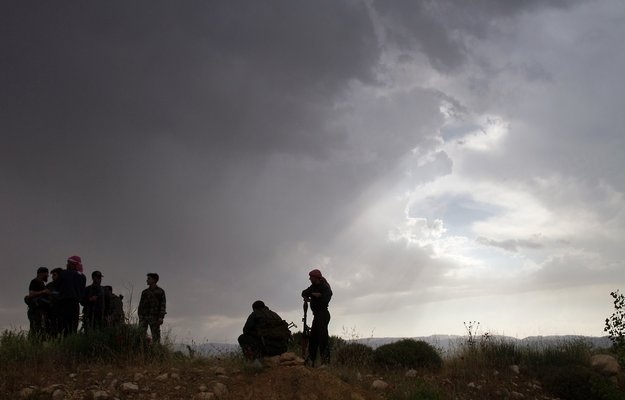
The featured image: Timeless. A Syrian moment, in Foreign Policy 23rd July 2012. Paul Simon once sang “On the side of a hill in a land called somewhere”. Little changes.
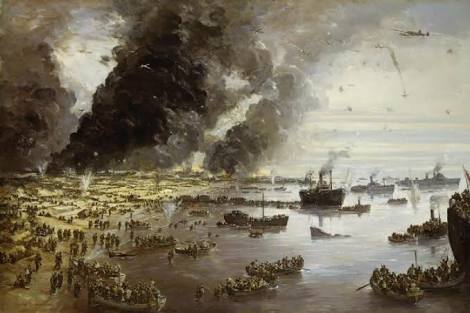
The Destruction of the Temple, AD70, Francesco Hayes
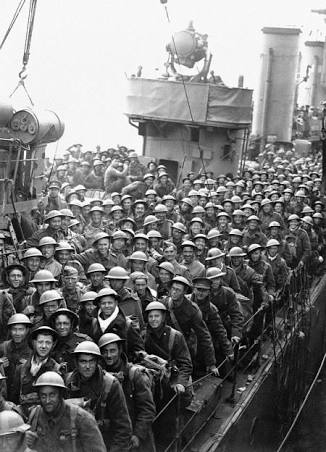
So Far From Home, William Barnes Wollen’s The Last Stand of the 44th Foot at Gandamak, 13th January 1842 (1898). The phrase ‘so far from home’ is the title of young Mary Driscoll’s 1847 account of her migration from Ireland to America.
Yarmouk Camp, Damascus February 2014. Al Jazeeraz 26 February 2014
Babes in the Wilderness. Syrian children in the eye of the storm. Al Jazeera, September 2011

Some References

In addition to a multitude of Wiki and Google searches, and references to and quotations from many songs and poems, including my own poetry and verse , special note is made of the following books that I have read of late that have inspired this piece:

Karen Armstrong, Fields of Blood (Knopf)
Thomas Cahill, How The Irish Saved Civilization (Sceptre)
William Dalrymple, From The Holy Mountain (Harper Perennial)
William Dalrymple, Return Of A King (Knopf)
Robert Fisk, The Great War For Civilisation (HarperCollins)
Robert Fisk, Pity The Nation (Andre Deutsch)
Vaslily Grossman, An Armenian Sketchbook (NYRB Classics)
Tom Holland, In The Shadow Of The Sword (Doubleday)
Robert D Kaplan, The Revenge Of Geography (Random House)
Amin Malouf, The Crusades Through Arab Eyes (Schoken)
Simon Sebag Montefiore, Jerusalem, The Biography (Orion)
Simon Winchester, Atlantic (HarperCollins)

 

The hand that signed the paper


Great is the hand that holds dominion over
Man by a scribbled name.
Dylan Thomas, The Hand That Signed the Paper,

Foreign Office, November 2nd, 1917

Dear Lord Rothschild,

I have much pleasure in conveying to you on behalf of His Majesty’s Government, the following declaration of sympathy with Jewish Zionist aspirations which has been submitted to, and approved by, the Cabinet

His Majesty’s Government view with favour the establishment in Palestine of a national home for the Jewish people, and will use their best endeavors to facilitate the achievement of this object, it being clearly understood that nothing shall be done which may prejudice the civil and religious rights of existing non-Jewish communities in Palestine or the rights and political status enjoyed by Jews in any other country.

I should be grateful if you would bring this declaration to the knowledge of the Zionist Federation.

Yours,

Arthur James Balfour

One wonders if, in the long, dark night of his eternal soul, Arthur James Balfour regrets the short letter he penned to Lord Walter Rothschild, of the international Rothschild financial dynasty, MP and Britain’s first Jewish peer. He remains a hero to Zionists and a villain to Arabs and their respective supporters. The brief document that bears his name is seen the beginning of what today is widely considered the world’s most intractable conflict. On that, if on little else, Israelis and Palestinians agree.

The Sykes Picot Agreement of  May 1916 and the Balfour Declaration of November 1917, the first, divvying up the Ottoman Empire between Britain and France, the second, ostensibly laying the foundation stone for a Jewish state between the Mediterranean and the Jordan River, were effectively redundant by war’s end, as other agendas interposed. Yet, their misbegotten shots ricocheted through the twentieth century and on into the twenty first.

After 100 years, the two sides in the most closely studied conflict on earth are still battling over the past. Truth and reconciliation, let alone closure, are remote fantasies. Unlike slavery, apartheid, the Irish famine, and western colonialism – all, at least formally, consigned to the dust heap of history – the Arab-Jewish conflict between the Mediterranean and the River Jordan shows no signs of abating. Indeed, it remains as bitter as ever, stuck in a cul de sac of continued occupation and political deadlock.

Here, in this beautiful, ancient, tortured land, the past is not another country. History is alive, exhilarating, toxic, intensely political, and bitterly divisive – and it will be revisited with passion and anger on this resonant anniversary.

In That Howling Infinite presents here three quite different commemorative analyses of the Balfour Declaration and its legacy.

The Guardian presents an historical overview in its “Long Read” essay, Britain’s Calamatous Promise. 

Ha’aretz discusses how Balfour’s legacy is toxic for both for Israelis and Palestinians,  how it nourishes the idea that somehow the conflict between the sides was caused by external powers and can be solved by them. Palestinians  maintain the myth that the Jews are somehow a foreign transplant that must be excised whilst Israelis persist in endeavouring to convince the world of the justice of our cause, as an alternative to actually making it in to a just one. “Lord Balfour did not give Palestine to anyone. Even if he had never written Lord Rothschild a letter, there would still be two nations with claims to this land. Their only hope of ever finding a way to share it is by letting go of these bankrupt historical myths”.

In The Original No – Why Arabs Rejected Zionism and Why it Matters, Natasha Gill examines the conflict from an original dispute resolution perspective. She argues that a viable peace process does not require either party to embrace or even recognize the legitimacy of the other’s narrative. It requires that both have an informed understanding of that narrative, and accept that it cannot be wished away, but must be recognized and acknowledged in the negotiation process.

Gill concludes: “Schoolyard choruses – “they started it” and “they are worse than us” – cannot serve as an interpretive framework for a 130-year-old conflict, or form the basis of national policy”.  She is referring here to Israel, but it applies equally to the Palestinians..

A common thread of the three articles referred to above that of reversing out of the dead-end of competing  and apparently irreconcilable perspectives and narratives  – my story versus yours, my feelings versus yours, my hurt versus yours – and finding common ground to move forward. This is indeed an important aspect of conflict resolution per se.  It is also about allaying assumptions and prejudices with regard to your competitor, opponent, or enemy, your mutual fears and suspicions.

Many would argue that the ‘peace process’ has been clinically dead for three years, and moribund for nearly three decades more. With Netanyahu’s ultra-nationalist coalition government contemplating the annexation of Area C, and ageing Mahmoud Abbas’ demise imminent, physically or polically, whichever happens first, time is running out for a just and equitable settlement that all sides can live with, no matter how begrudgingly.

The hand that signed the treaty bred a fever

A hand rules pity as a hand rules heaven;
Hands have no tears to flow
Dylan Thomas, The Hand That Signed the Paper

The following are some brief thoughts on the destructive aftermath of the Balfour Declaration.

The irony of the present Middle East is that so many many of its problems – its intractable conflicts, its porous and indefensible borders, its mosaics of coexisting, and at times competing and conflicting faiths and ethnicities, its artificially created states with shallow political and institutional roots, its unreconciled and conflicting allegiances to family clan, tribe, sect and country, its atavistic attachment to the ‘ra-is’, the big man – can be traced back to two documents initiated in the midst of a European war, the Sykes Picot Agreement and the Balfour Declaration .

Two documents that were driven and  shaped by the exigencies of that war and the planning for the peace that would follow it – and influenced by the diplomatic, strategic and imperial interests of European powers engaged in a long and bloody conflict, with hardly a thought for the millions of souls whose fate they were deciding, people who were in the most part, totally unaware and ignorant of the waves that were about to break over them. Hence the quotation from Dylan Thomas at the head of this post.

There is a school of thought that holds that the Balfour Declaration, like the Sykes Picot Agreement before it, was the cynical, opportunistic, duplicitous and predictably disastrous outcome of imperial skulduggery that set the Arab Middle East on a fateful course.  And yet, others hold that the die were already cast, and that HMG’s formal favour for a Jewish national home was aspirational rather than practicable, let alone realistic, designed to please the influential and wealthy Jewish diaspora – and particularly that in the USA, a late-entrant to the European war. Both, of course, has unintended consequences that led to a century of turbulence (see The Economist‘s article of the centenary of Sykes Picot).

Zionism was already on its determined way. It had grown out of the circumstances that prevailed in Europe at the time when Theodore Herzl was working on his project. Pogroms in the east, the Dreyfus case in France, and the conviction that antisemitism was indelible in the European psyche: Jews would never be fully accepted anywhere, no matter how well they assimilated. Hence the need for a Jewish national home. But he and his early Zionists were not initially exclusively focused on Palestine – there were vague visions of Jewish settlements in Kenya and Latin America. But the old, atavistic – secular Zionists would not have used the term “messianic” – yearning for Jerusalem got the better of them. It was the historical itch that couldn’t be scratched. And the Ottoman government was, as the time, quite amenable to the idea of enterprising, tax-paying settlers.

But, the notion of an actual Jewish state was quite clearly in the minds of the politically-aware and motivated Eastern Europeans, however, and this, augmented by a socialistic fervour common to  fin de siècle dissidents and refugees meant hat that there was little doubt about their intentions from the beginning. Regardless of the Balfour Declaration, the endgame was Eretz Israel – although those early pioneers hadn’t conceived a name for their ‘national home’, and indeed did not  do so until the very last minutes of the Mandate when David Ben Gurion made an executive decision.

Balfour did not actually commit to doing anything substantive. “Best endeavours to facilitate the achievement of this object” was as far as he went. It was the qualifier that followed that has forever branded “perfidious Albion”: “nothing shall be done which may prejudice the civil and religious rights of existing non-Jewish communities”.

The Palestinians Arabs were wise to the Zionist settlers’ long game, raising their concerns with the Ottomans and, post-Balfour, the British Mandate authorities, and rising in revolt when those concerns were ignored – only to be subdued by British arms. During the tumultuous and violent Mandate years, they were out-played, outwitted, out-gunned, never really having a chance against the well organized and determined Yishuv with its shadow government, institutions, and, most critically, military forces. And they were badly let down by the quality of their own leadership, by the political infighting, disunity, and opportunism, and a patriarchal political system that stymied the development of a coherent national consciousness and institutional framework to match that of the Jews.

The British too were outplayed and our-maneuvered, both before the Second World War and during the years leading up to 1948. As with India through the thirties and forties, lacking a cogent policy and a clear vision, Britain hamfistedly endeavoured to please everyone and ultimately satisfied no one. “Best intentions”, and “muddling through” concluded with “cut and run”, resulting in duplicity, desperation, death and destruction. The vagueness of Balfour’s promise came back to haunt them with a vengeance.

As events in Germany gave added urgency to the Zionist project, Ben Gurion and his colleagues adopted a wise if opportunist strategy of siding with the British in the war against Hitler. Arabs, like the Mufti of Jerusalem, Haj Amin al Husseini, in Palestine, and the Iraqi military junta led by Rashid Ali al Gaylani and Egyptian military conspirators, threw their lot in with the Third Reich, and indeed conspired against Britain. The Iraqi coup triggered Al Farhūd, a bloody pogrom in Baghdad in June 1941 in than 180 Jews were killed and 1,000 injured and 900 Jewish homes were destroyed. A bad move, paralleling, as it did, the Shoah. World opinion, or more precisely, the opinion of those who in those days controllled the new-born United Nations – the USA and the Soviet Union – weighed in behind the Zionists.

The Palestinian people, as most commentators have agreed, were essentially abandoned. By the British, by their Arab neighbours, by their own leaders. When all attempts by Britain to resolve the matter of Palestine by partition failed, and the Atlee government decided to abandon its mandate (in much the same hurried and chaotic manner as it had departed India the year before (see my post, Freedom at Midnight), the Arab inhabitants of the towns and villages of the area destined to become a Jewish state were disunited, unarmed and unorganized, and easy prey for the well-trained and determined Jewish military forces tasked by the Jews’ political leadership with the mission of seizing, clearing, and claiming The Land.

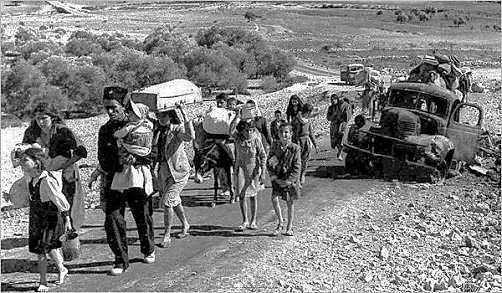
By the time neighbouring Arab armies entered Palestine, in numbers too small to make any difference to the military situation, Arab suburbs of the coastal cities has beeen emptied, hundreds of villages erased from the map, and over half a million people had fled to Egyptian Gaza, Lebanon, Syria, Jordan, and what is today the West Bank. The Palestinian state envisaged by British and the UN was strangled in its crib by King Abdullah of Jordan who seized for himself those areas not claimed by the new state of Israel, including Jerusalem, his hearts desire, whilst the ancient city of Gaza and its satellites was taken by Egypt.

Although the statement that the Palestinians “never missed an opportunity to miss an opportunity” is a cliche based on out-of-date and erroneous assumptions and prejudices, the cards were always stacked against them, and they were badly served by their leaders – most notably Husseini, who refused to let go of his pride and prejudice, King Abdullah of Jordan who played a game of double cross, his eyes fixed on al Quds, and who annexed what was to become Palestine instead of establishing its independence, and the Arab League which refused Israel’s offer after the Six Day War to return the West Bank in return for recognition (that Israel cannily knew this was an offer they couldn’t not refuse is another matter).

Almost seventy years have passed, and the Palestinians are abandoned still, by the world, by their Arab neighbours, and by their own leaders. Meanwhile, Zionism has moved on and has morphed into something much more sinister. Who knows how it will all play out.

Paul Hemphill, October 2017

Postscript – casting new light on an old narrative

In April 2025, In That Howling Infinite wrote a review of British historian Sean McMeekin’s excellent The fall of the Ottoman Empire and the birth of Türkiye 

“The Sykes Picot Agreement of 1916 – the bête noir of most progressive narratives of the modern Middle East, and to many ill-informed partisans, the causus bello of the intractable Arab Israeli conflict – was not the brainchild of perfidious Albion and duplicitous France, but rather a plan for the dismemberment of the Ottoman Empire concocted by the foreign minister of Imperial Russia. France’s Monsieur François-George Picot and Britain’s Sir Mark Sykes played second and third violin to the “third man” Sergei Sazonov. Both Russia and France had for decades sought to establish their political, strategic and economic interests at the expense of the so-called “sick man of Europe”, an ostensibly terminal invalid who throughout the nineteenth century, had experienced many deathbed recoveries. Czar Nicholas II, in common with his Russian Orthodox predecessors, dreamt of bringing Istanbul, formerly Constantinople, the heart of the orthodox patriarchate, or Tsargrad into the empire. It was no coincidence that the infamous Sykes Picot pact was outed by Russia’s Bolshevik regime after the collapse of the Czarist regime to discombobulate the revolution’s foremost European enemies”.

For more on the Middle East, see A Middle East Miscellany, and particularly, The first Intifada … Palestine 1936 

The Hand That Signed the Paper – Dylan Thomas

Never has as a poem been so precise in description of cause and consequence of great powers’ agreements, treaties, and declarations than that published by Dylan Thomas in 1936, a year replete with its own calamities:

The hand that signed the paper felled a city;
Five sovereign fingers taxed the breath,
Doubled the globe of dead and halved a country;
These five kings did a king to death.

The mighty hand leads to a sloping shoulder,
The finger joints are cramped with chalk;
A goose’s quill has put an end to murder
That put an end to talk.

The hand that signed the treaty bred a fever,
And famine grew, and locusts came;
Great is the hand that holds dominion over
Man by a scribbled name.

The five kings count the dead but do not soften
The crusted wound nor pat the brow;
A hand rules pity as a hand rules heaven;
Hands have no tears to flow.


Tales of Yankee Power

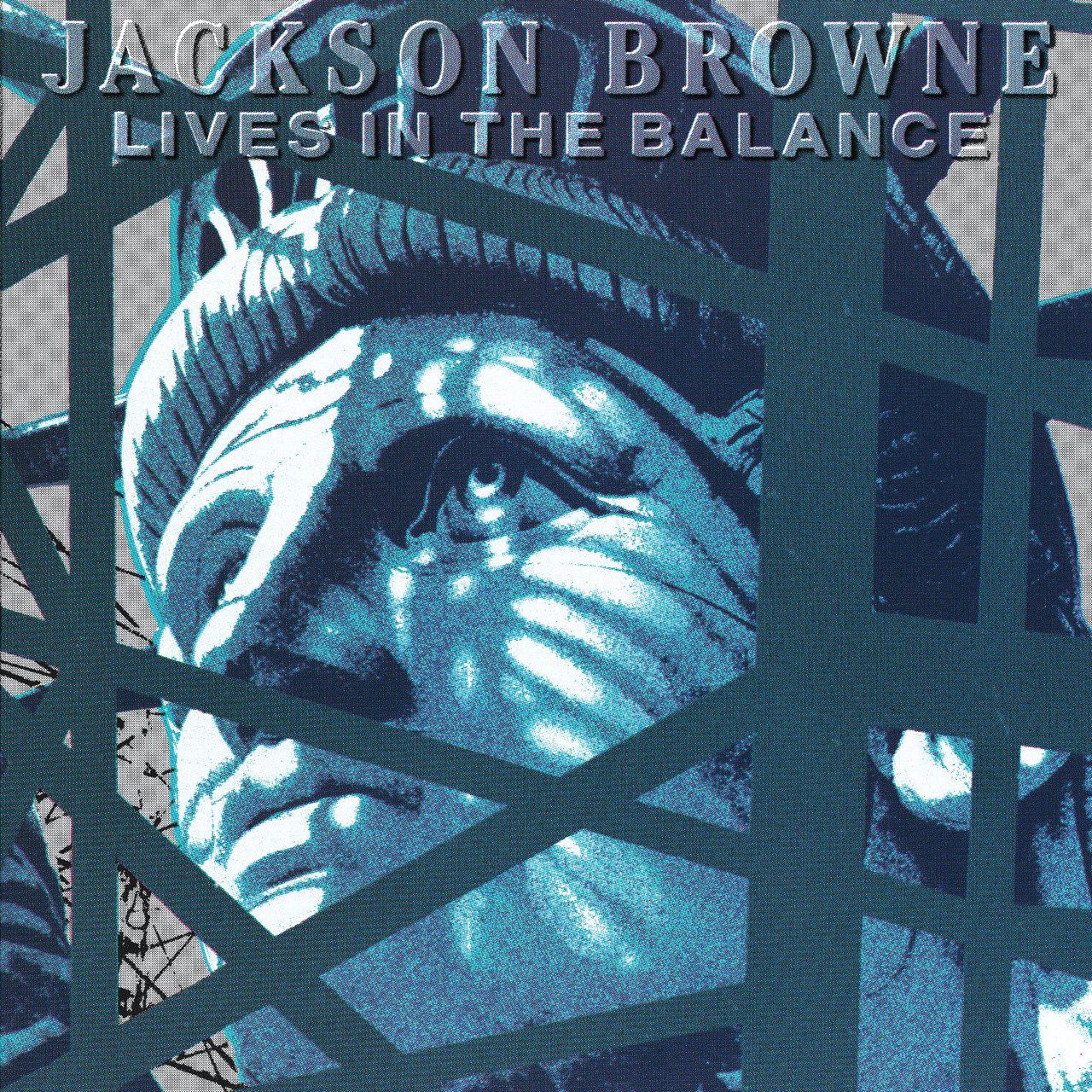
When Jackson Browne released Lives in the Balance in 1986, critics reckoned that its contemporary content, the USA’s bloody meddling in Central America, limited its appeal and long-term significance. And yet, here in the early twentieth first century, with the wars of the Arab Dissolution dragging the world into its vortex, the Great Power politics and proxy wars that taxed intellectual and actual imaginations in that seemingly distant decade jump back into the frame like some dystopian jack in the box. As Mark Twain noted, “history doesn’t repeat itself, but it does rhyme”.

Lives in the Balance was certainly a record for and of its times. Months before the Iran-contra scandal broke, Browne sang “I want to know who the men in the shadows are, I want to hear somebody asking them why. They can be counted on to tell us who our enemies are but they’re never the ones to fight or to die”. After the “arms for hostages” deals hit the news, increased public awareness of the US’ secret and dirty war in Nicaragua inspired him to produce a video for the title track well after the album had passed its sales peak.

Lives in the Balance

The album’s other songs sustained the assault. Soldier of Plenty condemns America’s paternalism towards its poor Latin neighbours. Lawless Avenues, with poignant Spanish lyrics by Browne and Warren Zevon’s old friend and collaborator, Jorge Calderón, takes us down the mean streets of Latino Los Angeles before sending its young anti-hero off to die in America’s wars. In the driving and ironic For America, Browne regrets his prior indifference and qualifies his conflicted patriotism: “I have prayed for America; I was made for America; it’s in my blood and in my bones. By the dawn’s early light! by all I know is right, we’re going to reap what we have sown”. in Til I Go Down, he sings “I’m not gonna shut my eyes, I’ve already seen the lies on the faces of the men of war leading people to the killing floor”. This song aptly plays out the end credits of the harrowing academy award winning The Panama Deception  which documents the US’ invasion of that unfortunate country.

Browne was not the first mainstream singer and songwriter to address America’s long and troublesome relationship with its Latin American neighbours. In his 1983 Stealing Fire and 1984 World of Wonders, Canadian Bruce Cockburn gave us the tragically beautiful Nicaragua and Santiago Dawn and the visceral If I Had a Rocket Launcher. On The Trouble With Normal (1983), there is Tropic Moon, with its cinematic imagery, and the lyrically deceptive Waiting For The Moon. The theme is the same as Browne’s – the North’s intervention in the politics of the South – particularly when comes to financing and arming rogue militias and warlords, and pliable, vicious and corrupt dictators: “Yanqui wake up, don’t you see what you’re doing, trying to be the Pharoah of the West bringing nothing but ruin…You’re my friend but I say Yanqui go home!”

World of Wonders

In this sad world, whenever Uncle Sam (or Uncle Ivan for that matter) plays his hand, something wicked this ways comes: “Little spots on the horizon into gunboats grow – waiting for the moon to show. Might be a party, might be a war when those faceless sailors come ashore. Whatever’s coming, there’s no place else to go, waiting for the moon to show”.

Cockburn’s poetic muse trumps Browne’s agit-prop. These lines from Tropic Moon are nonpareil: “Away from the river, away from the smoke of the burning, fearful survivors, subject of government directives. One sad guitar note echoes off the wall of the jungle. Seen from the air they’re just targets with nowhere to run to”. And: “the light through the wire mesh plays on the president’s pistol like the gleam of bead of sweat in the flow of a candle”.

Very little has changed since Browne and Cockburn sang their Tales of Yankee Power. “But who are the ones that we call our friends? These governments killing their own? Or the people who finally can’t take anymore, and they pick up a gun or a brick or a stone. And there are lives in the balance; there are people under fire; there are children at the cannons; and there is blood on the wire”. And if you were one of those people, why wouldn’t you say “If I had a rocket launcher, I would retaliate!“  As Cockburn sings in Santiago Dawn, “military thugs with their dogs and clubs spreading through the poblacion, hunting whoever has a voice, sure that everyone will run. They come in strong but its not that long before they know its not that easy to leave. To keep a million homeless down takes more than a strong arm up your sleeve”.

From Petrograd to Palestine, the story-line endures. The eighties were also the years of Russia’s Afghan quagmire, which led, ideologically if not geographically to the Chechen pogroms; and of a decade of bloodletting in Lebanon and in what in reality was the First Gulf War, that between Iran and Iraq. The Berlin Wall fell a few years before the events that drove these records, inspiring an outpouring of optimism as the countries of Eastern Europe broke free of the Soviet thrall. But this was not the Kumbaya moment that dreamers yearn for. Ensuing decades have seen a cartography of carnage: Bali and Beslan, Gaza and Grozny, Kabul and Kigali, Manhattan and Mogadishu, Sarajevo and Srebrenica.

We witness the anatomy of the new world economy in which millions of souls are on the move and everything can be traded for value. Bombs and babies, girls and guns, dollars, drugs and more besides. False prophets and bad dreams, broken promises and forlorn hopes, obscured visions and false horizons. “Many have perished, and more most surely will” – a line taken from WH Auden’s often overlooked masterpiece The Age of Anxiety, a meditation on a world in transition between the wreckage of The Second World War and foreboding for the impending armed peace that was itself to endure for another forty five years.

It is sadly ironic that our present world is passing through another time of uneasy transition, between the fixed certainties of great power rivalry and the intractable and bloody asymmetrical conflicts of today.

Paul Hemphill, November 2015 © All rights reserved

Postscript

The other day, I was listening to Dire Straits’ excellent 1985 album Brothers in Arms, and was reminded that several of the songs thereon refer, albeit obliquely, to the “bush wars” of Central America, and possibly also, to the US and Soviet Union’s proxy wars in Southern Africa and Afghanistan. There is Ride Across the River, with its Latino mood, and the beautiful and haunting title track. And there is The Man’s Too Strong, a powerful indictment of the cult of “the big man” that plagues countries all over the world. How often have these tyrants “re-written history with my armies and my crooks. Invented memories. I did burn all the books”. And how often too have they been tolerated, supported and bankrolled by Uncle Sam and Comrade Ivan.

Somewhere In Syria

Author’s Note:

This post is very much a companion piece to my recent post, Allende’s Desk and Osama’s Pyjamas, another tale of Yankee power, and its subject matter echoes that of A Brief History of the Rise and the Fall of the Westand my poem  E Lucevan le Stelle.

Its story does not relate to Bob Dylan’s cryptic and nihilistic Señor (Tales of Yankee Power), from Street Legal (1978), played here by bluegrass wiz Tim O’Brien. As for the meaning of the Bobster’s song, well, that’s pretty hard to fathom. A cowboy fever dream, perhaps; one of those strange illusions you channel in the early morning between sleeping and waking, more about mood than meaning. Perhaps it deserves a post of its own one find day.

Listen to Lives in the Balance in full be clicking on the blue text. Amid the its hard-hitting political commentary sits In the Shape of a Heart, considered to be one of Browne’s finest love songs. Yet this too might be regarded as controversial with regard to what it may or may not imply about the doomed relationship it describes. But like “the ruby she wore on the chain around her neck”, it is a finely cut gem.


Seeing through the eyes of ‘the other’

But who are the ones that we call our friends?
These governments killing their own?
Or the people who finally can’t take anymore
And they pick up a gun or a brick or a stone.
And there are lives in the balance;
There are people under fire;
There are children at the cannons;
And there is blood on the wire.
Jackson Browne, Lives in the Balance

Indomitable ninety-four year old Uri Avnery is an Israeli writer, founder of the Gush Shalom peace movement, veteran of Israel’s Independence War, and former member of the Knesset. He has written a weekly column for Gush Shalom since 1993. I republish his latest in In That Howling Infinite as a reminder that the world looks different from the other side of the wire.

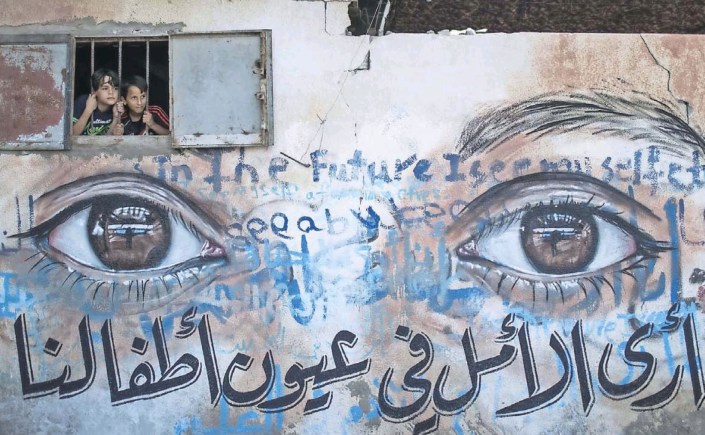
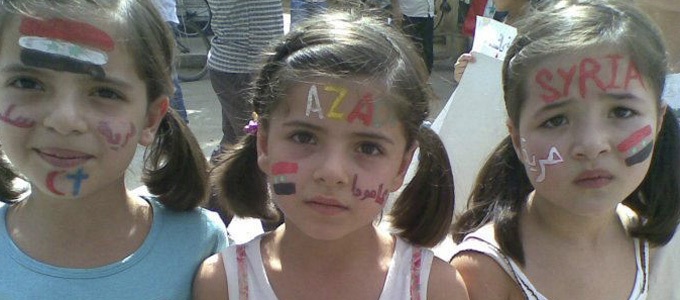
The Arabic in the featured picture says: “View Us Through the Eyes of Our Children”.

See also, my Facing the Fear of the Other, and Children of Abraham

For more posts on Jerusalem, Israel and the Middle East, visit:
https://m.facebook.com/HowlingInfinite/
https://m.facebook.com/hf1983/

A Tale of Two Stories

Uri Avnery, September 29, 2017

This is the story: at 7 o’clock in the morning, an Arab approaches the gate of Har Adar, a settlement close to the Green Line near the Israeli-Arab village of Abu Ghosh.

The man is a “good Arab”. A good Arab with a work permit in the settlement. He lives in the nearby West Bank Arab village of Beit Surik. He received a work permit there because he fits all the criteria – he is 37 years old, married and father of four children. The inhabitants of Har Adar know him well, because he has been cleaning their homes for years.

This Tuesday morning he arrived at the gate as usual. But something aroused suspicion among the guards.. He was wearing a jacket, though the weather was quite hot on this early autumn day. The guards asked him to remove his jacket.

Instead, the man took out a loaded pistol and shot three of the guards in the head at close range – two civilian guards and a member of the semi-military Border Guards. Two of the victims were Arabs (one of them a Druze) and one was a Jew. Another Jew, the local commander of the guards, was severely wounded. Since the assailant had never received military training, the precision of his shots was astounding. The pistol had been stolen 15 years ago.

All Israel was shocked. How could this happen? A good Arab like this? An Arab with permits? Why would he do such a thing in a place where he was well liked and well treated? Where he played with the children? And that after he was thoroughly vetted by the Security Service, which has innumerable Arab spies and is considered well-nigh infallible?

Something extraordinary must have happened. Someone must have incited him against the Jews and the nice people of Har Adar, who had treated him so well. Perhaps the UN speech by Mahmoud Abbas. Or perhaps some secret contacts with Hamas. “Incitement!” cried Binyamin Netanyahu.

But then another fact emerged, which explained everything. The man had quarreled with his wife. He had beaten her up, and she had escaped to her family in Jordan, leaving the four children behind.

So, obviously, he had become temporarily unhinged. In a state of mental derangement he had forgotten the kindness of the Har Adar people. Just a unique case, that need not trouble us further.

But it all shows that you can’t trust the Arabs. They are a bunch of murderers. You cannot make peace with them until they change completely. So we must keep the occupied territories.

THAT IS the story. But there is another story, too. The story as seen by the man himself.

From his home in neighboring Beit Surik, the man – whose name was, by the way, Nimr (“leopard”) Mahmoud Ahmed al-Jamal – could see Har Adar from his home every day when he woke up. For him, as for every Arab, it was a flourishing Jewish settlement, built on expropriated Arab land. Like his own village, it belonged to the Palestinian West Bank which is occupied territory.

He had to get up in the darkness of the night in order to get to Har Adar on time – 7.00 o’clock in the morning – and work hard until late in the night, arriving home at about 10 o’clock. This is the lot of tens of thousands of Arab laborers. They may look friendly, especially when their livelihood depends on it. They may even be really friendly to benevolent masters. But deep in their hearts they cannot forget for a moment that they are cleaning the toilets of the Jews who came to Arab Palestine and occupied their homeland.

Since most of the agricultural land of their villages has been expropriated for Jewish settlements, they have no choice but to work in these low-status jobs. There is no industry to speak of in the West Bank. Wages are minimal, often below the legal minimum wage in Israel proper (some 1500 dollars per month). Since they have no choice, they are not far from being slaves. Like the nice slaves in “Gone with the Wind”.

Such a man may be at peace with this reality, but if something bad happens, he may suddenly become upset with his status and decide to become a martyr. Nimr left behind a letter in which he defended his wife and absolved her from any responsibility for the deed he had planned for the next day.

So these are the two stories, which have very little in common.

The people of Har Adar are completely shocked. Since they live 20 minutes drive from Jerusalem, they do not consider themselves settlers at all, but Israelis like any other. They don’t really see the Arabs all around them as people like themselves, but as primitive natives.

The Har Adar people are not like the fanatical, religious and nearly fascist people in some settlements. Far from it. Har Adar people vote for all parties, including Meretz, the left-wing Zionist party which advocates the return of the occupied territories to the Palestinians. This is not seen as including Har Adar, of course, since there is a consensus among Zionists, right and left, that the settlements close to the Green Line should be annexed to Israel.

Har Adar people can rightly be proud of their achievements. From the air, the place looks very orderly. It has 3858 inhabitants. Their average income is about 5000 dollars a month, well over the national Israeli average (some 3000 dollars). Their local council is the third most efficient in the entire country.

Located in the mountainous area around Jerusalem, it has a beautiful landscape. It also has man-made amenities: a library, a youth club, a skate-park and an amphitheater that seats 720 people. Even for an average Israeli, this is paradise. For the Arabs around, who cannot enter without a special permit, it is a perpetual reminder of their national disaster.

Of course, like other settlements, Har Adar is not located on land that was empty. It occupies the location on which stood a village called Hirbat Nijam, a village which already stood there in Persian-Hellenistic times, some 2500 years ago. Like most Palestinian villages, they were Canaanite, then Judean, then Hellenist, then Byzantine, then Muslim, then crusader, then Mameluk, then Ottoman, then Palestinian – without the population ever changing. Until 1967.

WHEN NIMR was born, all this long history was long forgotten. What remained was the reality of the Israeli occupation.

This now looks like the normal state of things. The members of Har Adar are happy, feeling secure and well guarded by the efficient Security Service, the Border Guard and local mercenaries, mostly Arab citizens of Israel. Neighbors like Nimr seem content, and probably are, if they are lucky enough to have a job and a work permit, even with pitiful wages. The historical grudge lies deeply buried within their consciousness.

And then something happens, something that may be quite irrelevant – like the escape of his wife to Jordan – to bring it all up. Nimr the lowly laborer suddenly becomes Nimr the freedom-fighter, Nimr the martyr on his way to paradise. All his village respects his sacrifice and his family.

Israelis are furious that the families of “martyrs” are paid an allowance by the Palestinian Authority. Binyamin Netanyahu accuses Mahmoud Abbas (Abu Mazen) of incitement to murder with these payments. But it is quite impossible for Abbas to annul them – the outrage reaction of his people would be tremendous. Martyrs are holy, their families respected.

THE DAY after Nimr’s dastardly terrorist act and/or heroic martyrdom, a grandiose national ceremony took place in another settlement.

All the country’s major dignitaries, led by the President and the Prime Minister, assembled to commemorate the 50tth anniversary of “our return to our homeland, Judea and Samaria, the Jordan Valley and the Golan Heights”.

Missing in the list is the Gaza Strip, which Israel has evacuated, leaving behind a tight land and sea blockade aided by Egypt. In the Strip there are about two million Palestinians. Who the hell wants them?

All hell broke loose when the President of the Supreme Court, who was supposed to send a judge to represent the court at this ceremony, canceled his attendance because of the highly propagandist style of the event. She decided that this is party propaganda, in which her court would not take part.

Altogether not a day of quiet in this country, a state without borders and without a constitution, where every story has two totally different sides, where nice and quiet people suddenly become raging martyrs.

There will be no quiet until there is peace, with each of the two peoples living in their own state, a situation where real friendship has a chance of blooming.

Deconstructing Dunkirk

During the closing scenes of The Man Who Shot Liberty Valance, the journalist says: “This is the West, sir. When the legend becomes fact, print the legend”.

Acclaimed British historian Max Hastings examines the reality of the events behind Christopher Nolan’s blockbuster whilst pricking the illusions and delusions of the Brexit balloon. “The irony…is that Churchill himself never saw anything in the least glorious about standing alone”. “Wars” said Winston, “are not won by evacuations”.

“After Brexit takes place I fear that this time around we shall be unable to rely upon the Russians to stage a grand diversion in the East to spare us from the hideous economic, social, cultural, and political consequences of attempting to fight on alone, without the impeccable justification that Hitler has forced such a course upon us”.

Whilst these are Hasting’s principal themes, he also demolishes a couple of common misconceptions. Firstly, the Dunkirk “miracle”, impressive as it was, was not the only major evacuation that harrowing summer. A few weeks later, “some 144,000 British troops, together with 24,352 Poles and 42,000 other Allied soldiers, were brought to England. Only historians are much aware of this “second Dunkirk”. Secondly, soldiers on the beach and commentaries thereafter talk of how the “bloody RAF!” was nowhere to be seen in the skies above Dunkirk. Recent archival research how shown that the RAF was indeed active in the hinterland, suffering heavy losses as it fought to prevent reinforcements and materiel reaching the Wehrmacht and and as it attacked the Luftwaffe before it hit the beaches.

During early 2018, I posted the following on the In That Howling Infinite Facebook page in response to an article in The Independent:

Once more into the breach…on Belgian beaches and parliamentary benches

This article, like many of its recent ilk, is bound to a create a furore among the “make Britain great again” brigade (I loved the Katie Hopkins connection…)
I recently watched Dunkirk and Darkest Hour to back, and they made curiously compelling companions. The best thing about Darkest Hour was Gary Oldman’s  portrayal of Winston, and his delivery of the famous speeches (and I could happily watch loyal stenographer Lily James typing out menus all day long – she gave us a luminous Natasha in the Beeb’s recent and eminently bodacious War and Peace).
Dunkirk was harrowing for its portrayal of the chaos aboard the sinking hospital ship and the other doomed rescue ships, and for the chaos and confusion in the cockpits of the spitfires (is there anything Mad Max Tom Hardy isn’t in these days?)
But both films were quite corny and cartoonish in their representation of the “bulldog spirit” of the brave, plucky , and yes, white Englanders (Kenneth Branagh at his Shakespearean best, and Mark Rylance channeling Foyle’s War – there was, however, a token black chap with a small speaking role during Winston’s apocryphal trip on the London Underground – “Yes, Mister Churchill, we shall never surrender!”; and there was a single Frenchie on the beach, although he was nefariously disguised as a Brit and was outed immediately prior to his  demise – played by Aneurin Barnard, another refugee from War and Peace, but being shell-shocked,incognito, or both, didn’t say a word). And apart from the speeches in Darkest Hour, the script in both films was hamfistedly cliched and clunky, and not much different from a Monty Python movie – or those patriotic Ealing Studios English war films.
Which might, of course, have been the intention.These two films and other nostalgia fests like the Crown and Victoria and Albert are quite in keeping with those Ealing films of old with their high production values, great actors like John Mills and Alec Guinness, stirring music in the Vaughn Williams vein, and hammy but patriotic scripts that were in their day Great Britishly politically correct.

For more posts by In That Howling Infinite, visit:
https://m.facebook.com/HowlingInfinite/
https://m.facebook.com/hf1983/

Splendid Isolation
Max Hastings, New York Review of Books, October 12 2017

Christopher Nolan’s epic movie about the rescue of the British army from the beaches of northeastern France in May 1940 has become a worldwide box office success. This is splendid news for its makers, and can do no harm to American, Taiwanese, or for that matter Rajput audiences. In the eyes of some of us, however, its impact upon the British people is calamitous at this moment in our fortunes.

Dunkirk contains no foreigners except a few understandably grumpy French soldiers. It is a British tale that feeds the myth that has brought Churchill’s nation to the cliff edge of departure from the European Union: there is splendor in being alone. This was most vividly expressed at the time by King George VI, who wrote to his mother: “Personally I feel happier now that we have no allies to be polite to & pamper.” One of the British officers who escaped with his battalion via the beaches greeted news that the French had surrendered on June 17 by exulting mindlessly to his comrades in the mess: “Thank heavens they have, now at last we can get on with the war.”

Michael Korda, for decades a celebrated New York publisher, was born in Britain in 1933; his father was Vincent Korda, one of three Hungarian-born brothers who were cinema wizards of their day. Now he offers two books for the price of one, interweaving a historical narrative of the events of 1939–1940, climaxing with Dunkirk, and a succession of vivid fragments of autobiography. He describes the flow of Jewish refugees through the North London homes of his childhood: “They had the haunted look of people who have just witnessed a bad accident, people with aggressive charm and formal manners who had grown up with the Kordas in Túrkeve, or had been to university in Budapest with Alex, or loaned him money, or worked with my father on film sets in Vienna, Paris or Berlin.”

Vacationing in France in the summer of 1939, as the world tumbled toward catastrophe, he recalls his actress mother constantly reprising the comic hit song of the day “Tout va très bien, Madame La Marquise,” which tells of an aristocratic woman on holiday who calls home to check that all is well and hears from her servants of one catastrophe after another, each described as “a little incident, a nothing,” culminating in the suicide of her husband and the incineration of her château. Korda writes: “Even as a boy of six, I observed that everybody in France talked about la ligne Maginot reverentially as if it were a holy object.”

He is very funny about his family’s experiences embarking on the film That Hamilton Woman, which eventually became one of Churchill’s favorites: his father, as set designer, failed to grasp that this was a tale of Admiral Nelson. Supposing it to be about General Wellington, he began to create a backdrop for the Duchess of Richmond’s ball in Brussels before Waterloo.

Once the European struggle began in earnest with the launch of Hitler’s blitzkrieg, Korda writes, “my mother, when she thought about the war at all, had the cheerful conviction that everything would work out well in the end because it always had for Britain, except for the war against the American colonies, and that was too long ago to matter.” He discerns among Britain’s modern Brexiters the mood that he himself witnessed after Dunkirk.

This comparison seems valid. Boris Johnson, Liam Fox, Michael Gove, David Davis, Iain Duncan Smith, Jacob Rees-Mogg, and their misbegotten Tory kin daily assure the British people that once we have cast off the shackles that bind us to Europe, caravels laden with the spoils of free trade will bring gold, frankincense, and myrrh to our island; as an added bonus, the sun will shine every day. Watching Dunkirk, I half-expected Foreign Secretary Johnson to appear in lieu of Winston Churchill, promising to hurl back the Hunnish hordes led by Angela Merkel, and to show no mercy to such knock-kneed Pétainistes as France’s Emmanuel Macron.

The irony, of course, is that Churchill himself never saw anything in the least glorious about standing alone. In May and June 1940 he moved heaven and earth—even fantastically offering Paul Reynaud’s government political union with Britain—to persuade France to stay in the war rather than sign an armistice. When the Nazis invaded Russia in June 1941, Churchill embraced the tyranny of Stalin, morally hard to distinguish from that of Hitler, and greeted the Russians as comrades in arms. The foremost objective of his premiership was to woo the United States into belligerence.

No man understood better than Churchill that while Britain might somehow avert defeat, without fighting alongside friends it could not conceivably aspire to victory. Only necessity and a supremely courageous willingness to defy reason, which many British politicians and generals felt unable to share, caused him in June 1940 to proclaim his country’s determination to fight to the last.

Our most eminent living historian, Sir Michael Howard, who lived through that era relatively early in his ninety-four years, observed to me recently: “The great lesson of my lifetime is that all difficult problems and challenges are best addressed with partners and allies.” This is the wisdom that the modern Brexiters seek to trample. They find the “Dunkirk spirit” refreshingly bracing, which Churchill certainly did not. “I cannot say that I have enjoyed being Prime Minister v[er]y much so far,” he wrote wryly on June 4, 1940, to one of his predecessors, Stanley Baldwin.


And so to the Nolan film. It possesses many of the virtues and vices of Steven Spielberg’s epics, wrapped in a Union flag instead of the Stars and Stripes. It looks terrific, though it is noisier than any battle I have ever attended. It contains some adequate acting, reminiscent of the silent movie era, because the stars deliver few coherent lines, being merely required to look staunch, stressed, and indomitable at appropriate moments.

The film opens with unseen Germans firing on a group of British soldiers in the deserted streets of Dunkirk, killing all but one, Tommy (Fionn Whitehead), whose experiences during the ensuing week, on the beaches and offshore, form a principal theme of what follows. At intervals between being bombed and strafed by the Luftwaffe, Tommy and various companions board ships in hopes of escape, only to find each in turn stricken. Nolan offers some extraordinary sinking scenes: Tommy’s escapes make Leonardo DiCaprio’s misfortunes aboard the Titanic seem tame stuff.

Meanwhile the Royal Navy has commandeered a host of small boats from the harbors of the South Coast and dispatched them to aid the evacuation. One boat owner, named Dawson (Mark Rylance), sets forth with his teenage son, Peter (Tom Glynn-Carney), and a young helper named George (Barry Keoghan). Their first encounter with the war comes when they rescue a traumatized soldier (Cillian Murphy) from a floating hulk. He is so appalled on finding that they are heading for Dunkirk, from which he has just escaped, that he tries to seize control of the boat, hurling George onto a ladder below, which his head strikes with fatal effect—a mawkish moment.

Meanwhile in the air, there are spectacular scenes as three Spitfires duel with the Luftwaffe over the Channel. One RAF pilot (Jack Lowden) ditches in the sea, from which he is rescued by Dawson and his son. As they then approach the beaches amid a throng of such craft, a colonel on the Dunkirk mole (an old term for a pier or jetty) asks the Royal Navy’s Commander Bolton (Kenneth Branagh) what the boats mean. Branagh offers a performance as the elegant, unruffled naval officer that Noël Coward—who played Captain Kinross, based on Lord Mountbatten, in that notable wartime weepie In Which We Serve—might identify with. Bolton answers the colonel laconically: “Hope.” In the cinema where I saw the film, at that moment the audience burst into applause.

The small boats, including Dawson’s, load up with soldiers amid worsening perils—oil from a sunken minesweeper blazes on the water—before setting course for home and a heroes’ welcome. Commander Bolton gallantly lingers on the mole to ensure that some French soldiers can also get away. He remarks wryly that it has been not a bad fortnight’s work to rescue 338,000 British, French, and Belgian troops, when at the outset it was thought that no more than 30,000 could be taken off. Back home, the rescued Tommy reads in a newspaper Churchill’s heroic words to the nation, concluding with the vow that Britain will never surrender.

Most of us would agree that no work of art, whether novel, play, or film, has a responsibility to represent history accurately, any more than Shakespeare did, or David Lean’s Lawrence of Arabia. Spielberg’s Saving Private Ryan opens with a thirty-minute portrayal of the 1944 D-Day landings that is as vivid and realistic as anything we are ever likely to see on screen. Thereafter, however, that film deteriorates into routine Superman stuff that bears no relationship to anything that happened to US soldiers in Normandy. The mini-series Band of Brothers is a superb piece of filmmaking, probably the best ever made about Americans in World War II, but it is suffused with the romanticism that colors all of Spielberg’s work as well as much of that of Stephen Ambrose, who wrote the book from which it derives.

Nonetheless, for the record, we shall consider how far Nolan’s film tells the Dunkirk story like it was. There is no historical background to explain why the British army found itself on the beaches. On May 10, 1940, Hitler invaded France and the Low Countries. The British army, together with a substantial French force, promptly hastened north into Belgium, expecting the Germans to reprise their 1914 Schlieffen offensive.

Instead, however, in fulfillment of the only authentic personal inspiration of Hitler’s career as a warlord, the Wehrmacht’s main thrust pushed through the Ardennes, meeting the French army where it was weakest and bursting across the Meuse. The British found themselves falling back, fighting desultory actions but chiefly making haste to avoid encirclement. When the panzers reached the Channel coast, cutting off the British, the Belgians, and the French Seventh Army from the bulk of France’s forces further south, evacuation became the only plausible, though immensely difficult, option.

The first miracle of Dunkirk was that the German army scarcely interfered with the evacuation, partly because Hermann Goering assured Hitler that the Luftwaffe could dispose of the British, and partly because Churchill’s contingent was marginal alongside the forty-three divisions of the French army still in the field further south. There was no ground fighting in the town or port, so Nolan’s opening scene is spurious.

In the film, all the big ships seeking to rescue troops are sunk in dramatic circumstances, leaving small craft to do the business. This is a travesty. The Royal Navy sent thirty-nine destroyers to Dunkirk, of which only six were sunk, although many were damaged. Two thirds of all the men brought home sailed in big ships, notably including the destroyers, just one third in smaller ones.

The film shows air battles low over the Channel, whereas many soldiers came home full of bitterness toward the RAF because they never saw its aircraft: combat took place thousands of feet above, invisible to those on the ground or at sea. On the British side, it was dominated by Hurricanes, not Spitfires. Nolan shows a fighter floating for some minutes after ditching, whereas the huge Rolls-Royce Merlin engine in its nose would have sent the plane plunging to the bottom within seconds.

The character of Dawson may owe something to Charles Lightoller, a former officer on the Titanic who at the age of sixty-six took his boat Sundowner to Dunkirk, accompanied by his son and a friend, and brought home 120 men. Commander Bolton’s role at Dunkirk was fulfilled in reality by Captain Bill Tennant, who did a superb job as senior naval officer. Oddly enough Tennant, as evidenced by his diary, later became a bitter critic of Churchill’s war leadership.

Onscreen, endless British soldiers perish. Michael Korda suggests that the British army’s rate of loss was “comparable to that in the bloodiest battles of the First World War or the American Civil War, and an indication of just how hard the fighting was.” Yet what was remarkable about the real event was how few men died. In the entire May–June 1940 campaign, including Dunkirk and later episodes, just 11,000 British troops were killed, compared with at least 50,000 French dead.

A further 41,000 British troops were taken prisoner by the Germans, but alongside the 193,000 brought home, the “butcher’s bill” was small. General Sir Harold Alexander, who commanded the rear guard, told Anthony Eden on his return: “We were not hard pressed, you know.” This remark is sometimes cited as an example of his bent for heroic understatement, but was no more than the truth.

Cinema audiences are left to assume that after Dunkirk, the British sat down on their island and prepared to resist the Nazis on the beaches. In truth, in one of Churchill’s more spectacular follies, he promptly insisted upon dispatching another two divisions, one of them newly arrived Canadians, to Normandy and Brittany to show the French government and people that Britain remained committed to fight on at their side.

His chief of staff, Major General “Pug” Ismay, gently suggested to the prime minister that it might be wise for these troops to proceed slowly toward France, since it was obviously doomed. “Certainly not,” replied Churchill angrily. “It would look very bad in history if we were to do any such thing.” Few great actors on the stage of world affairs have been so mindful of the verdict of future generations. On June 13, four days before the French surrender and nine days after the Dunkirk evacuation ended, British soldiers were still landing at Breton ports.

By yet another miracle, within days of arrival in France their commander, Lieutenant General Sir Alan Brooke, persuaded Churchill that they must come home. This time there were no beaches—they embarked through the ports. Many prisoners, tanks, and vehicles, including the entire 51st Highland Division, fell into German hands and there was a spectacular disaster when the liner Lancastria, carrying over three thousand men, was sunk by air attack.

But thanks to Brooke, the prime minister was spared from evil consequences of his reckless gesture. Some 144,000 British troops, together with 24,352 Poles and 42,000 other Allied soldiers, were brought to England. Only historians are much aware of this “second Dunkirk,” and it seems ill-natured to make much of the fact that of 100,000 French soldiers brought to Britain, even De Gaulle at his most sanguine admitted that only one third agreed to serve with his newly created Free French forces, while the remainder preferred repatriation to France.

As for the British people, for the rest of 1940—the mood turned sourer in the following year—they did indeed display a stoicism and even euphoria as irrational as today’s Brexiter exultation. The MP Harold Nicolson wrote in his diary on June 15:

My reason tells me that it will now be almost impossible to beat the Germans, and that the probability is that France will surrender and that we shall be bombed and invaded…. Yet these probabilities do not fill me with despair. I seem to be impervious both to pleasure and pain. For the moment we are all anaesthetised.

The writer Peter Fleming, then an army staff officer, wrote in a similar vein: “It was as though the whole country had been invited to a fancy-dress ball and everybody was asking everybody else “What are you going as?” A latent incredulity [gave]…problems connected with invasion the status of engrossing digressions from the main business of life…. The British, when their ally was pole-axed on their doorstep, became both gayer and more serene than they had been at any time since the overture to Munich struck up in 1937.

Among countless reasons for revering Churchill’s performance in 1940 is that he himself never for a moment succumbed to such silliness. Though he justly described Dunkirk as a deliverance, he also warned the House of Commons and the nation that “wars are not won by evacuations.” He knew that while the men had been brought home, almost all their weapons and equipment had been lost: the British army was effectively disarmed.

Thereafter he and his nation set the world a magnificent example of defiance. But it was an impotent defiance, from which both Britain and democracy were redeemed only by the belated arrival of allies. It was 1944 before Churchill’s soldiers, aided by huge infusions of American men, matériel, and especially tanks, were fit to face a major European battlefield.

In the intervening four years, relatively tiny British forces fought the Germans in North Africa and Italy, and a large imperial army surrendered to the Japanese at Singapore in February 1942. Contrary to persisting British delusions, Hitler’s enmity and ambitions always focused on the East. Because of his invasion of Russia, the British and later the Americans were granted the priceless luxury of being able to prepare at leisure for the belated June 1944 liberation of northwest Europe: the band of brothers of the US 101st Airborne Division, for instance, spent almost two years in uniform before hearing a shot fired in anger.

Michael Korda suggests that thanks to the final triumph in 1945, “Dunkirk was, and remains, perhaps the greatest British victory of World War Two, that rarest of historical events—a military defeat with a happy ending.” This assertion stretches a very large point, not least because Churchill himself regarded the outcome of World War II as anything but happy, since Britain’s voice in the world, not to mention his own, had become so much diminished.

It would be unreasonable to demand that Christopher Nolan should have injected more than a fraction of these realities into his Dunkirk. The most absurd assaults on the film come from India, where critics complain that he does not feature the two companies of Indian service troops who were present on the beaches. This is comparable to the British wailing when Saving Private Ryan appeared that their soldiers were absent without leave from the screen. I wrote at the time that if any nation wants its part in any conflict glorified, it must make the films for itself.

Nolan seems to deserve congratulations for declining to include even a token American, for decades a prerequisite for securing a US audience for a British war movie. Indeed, this imperative so intimidated many British directors and their screenwriters that gallant American characters were often depicted showing the stupid English how battles should be fought.

This latest epic represents a version of history little worse than The Longest Day, A Bridge Too Far, or The Guns of Navarone. Some of us are grateful that so many schoolchildren are going to see it, because they will at least discover that in 1940 there were beaches, the rescue of an army, and sacrifice and considerable fortitude by their forefathers. Britain’s grown-ups, however, should have been forcibly denied entrance to cinemas at this moment when we are threatened with embarkation upon one of the most self-indulgent, willfully foolish acts of self-harm in the nation’s history.

For all the charm of Michael Korda’s personal reminiscence of 1939–1940, he is on much less sure ground in his narrative of the big events, partly because he is obviously a romantic, and partly because he relies heavily on elderly sources, including the British official history of the campaign in France, much of which is tosh. He is surely right, however, to conclude his book by comparing the emotions of the modern Brexiters with those of the British in June 1940: “There was a national sense of relief…at leaving the Continent and withdrawing behind the White Cliffs of Dover.” After Brexit takes place I fear that this time around we shall be unable to rely upon the Russians to stage a grand diversion in the East to spare us from the hideous economic, social, cultural, and political consequences of attempting to fight on alone, without the impeccable justification that Hitler has forced such a course upon us.


The politics of Shakespeare’s Julius Caesar

In the wake of controversial production of Shakespeare’s play in New York’s Central Park,  here is an excellent exposition of the politics of this play by American screenwriter, novelist and producer Joseph Suglia. One forgets just how politically sophisticated and daring William Shakespeare was – potentially dangerous and, indeed, deadly during the unsettled and bloody times of the Tudor monarchs.

Dr. Joseph Suglia's avatarSelected Squibs, Scrips, and Essays by Joseph Suglia

Caesar Anti-Trump

by Joseph Suglia

“Nackt kann die Wahrheit vor dem Volke nicht erscheinen.”

—Arthur Schopenhauer, Die Welt als Wille und Vorstellung, Zweiter Band, Kapitel 17

The election of Donald Trump to the presidency of the United States of America gives further evidence, if needed, that Americans wish to be led by cartoon characters.  It was not Trump the human being who acceded to the presidency.  It was his screen double, which is all the American electorate has ever known of him.  It was Trump the Rich Man of Home Alone 2: Lost in New York (1992).  It was Trump the Boss of The Apprentice (2004-2015).  It was Trump the Billionaire of Wrestlemania 23 (2007).  Donald Trump is every bit as unreal as Flo the Progressive Insurance Girl or Colonel Sanders—all three of these characters are strategic unrealities.  All are holograms, shadows of living beings rather than living…

View original post 5,091 more words

Freedom at Midnight (2) – the legacy of partition

Seventy years ago India and Pakistan came into being, the first of the tumbling dice that were the longtime colonies of European nations. Over the next two decades, Britain, France, the Netherlands and Belgium would retreat from their possessions in Africa, Asia, South America, and the Caribbean. The importance August 15th 1947 cannot be understated, and its echoes reverberate still.

In an earlier post, Freedom at Midnight (1) – the birth of India and Pakistan, I discussed the process by which this came about. Below are links to two articles published today which examine the legacy of partition, a legacy that, as these pieces demonstrate, it still subject to much debate.

Writing in the New York Times, Pankaj Mishra deconstructs Jawahawal Nehru’s famous declaration of independence on 15th August 1947: “…one can, of course, mourn this August 15 as marking the end of India’s tryst with destiny or, more accurately, the collapse of our exalted ideas about ourselves. But a sober reckoning with the deep malaise in India can be bracing, too. For it confirms that the world as we have known it, molded by the beneficiaries of both Western imperialism and anti-imperialist nationalism, is crumbling, and that in the East as well as the West, all of us are now called to fresh struggles for freedom, equality and dignity”.

Anil Dharker, writing in The Independent, paints a rosier picture. India emerged from the trauma of partition and proposed. prospered. “Seventy years on, that’s something to be proud of. Even more is the fact that the idea of India as one country has survived, in spite of the country’s huge diversity and population, which makes it akin to a continent. Numbers confirm this amazing story: India’s population is now over 1.2 billion, spread over 29 states and seven union territories. There are 22 official languages and very many more dialects. Each state has its own language, culture and cuisine”.

And yet, he concludes, India has not yet realized the ecumenical promise of Nehru’s famous “tryst with destiny”: “Not even the most flag-waving Indian however, will claim that everything is perfect. The caste system refuses to die out; Dalits (the term used for untouchables) still face upper-caste persecution; they and minorities (especially Muslims) remain equal citizens only on paper; conservative and orthodox men still resist women’s fight for equality; the criminal justice system and the police still favour the affluent; reactionary religious elements still create tensions and face the future backwards”.

WH Auden composed a poem commemorating the events of 1947.

Specifically, he wrote of Sir Cyril Radcliffe, the English lawyer appointed by the British government to determine the borders of the new states. It was he who drew the fateful lines on the map of British India. An ironically objective narrative which recounts the story just as Collins and Lapierre tell it in Freedom at Midnight. It is, perhaps by design and intent, reminiscent of a celebrated poem by Dylan Thomas, and indeed, to paraphrase the Welsh Bard, “the hand that signed the paper” felled a city and bred a fever.

Partition

Unbiased at least he was when he arrived on his mission,
Having never set eyes on the land he was called to partition
Between two peoples fanatically at odds,
With their different diets and incompatible gods.
“Time,” they had briefed him in London, “is short. It’s too late
For mutual reconciliation or rational debate:
The only solution now lies in separation.
The Viceroy thinks, as you will see from his letter,
That the less you are seen in his company the better,
So we’ve arranged to provide you with other accommodation.
We can give you four judges, two Moslem and two Hindu,
To consult with, but the final decision must rest with you.”

Shut up in a lonely mansion, with police night and day
Patrolling the gardens to keep the assassins away,
He got down to work, to the task of settling the fate
Of millions. The maps at his disposal were out of date
And the Census Returns almost certainly incorrect,
But there was no time to check them, no time to inspect
Contested areas. The weather was frightfully hot,
And a bout of dysentery kept him constantly on the trot,
But in seven weeks it was done, the frontiers decided,
A continent for better or worse divided.

The next day he sailed for England, where he could quickly forget
The case, as a good lawyer must. Return he would not,
Afraid, as he told his Club, that he might get shot.

Freedom at Midnight (1) – the birth of India and Pakistan

The partition of India, seventy years ago this month, is at the heart of the identity of two of the world’s most most populous nations, branded painfully and indelibly onto their consciousness by memories of almost unimaginable violence.

The paradox of Indian (and Pakistani) independence is that the long and torturous struggle for freedom was built upon nonviolence and civil disobedience (led by, and indeed personified by Mahatma Ghandi), and concluded with the peaceful handover of authority from an impoverished Britain that was downsizing its Empire, and yet ended with the partition of the Indian subcontinent into a majority Hindu state and a Muslim one.

The British army departed India with barely a shot fired and only seven casualties, and yet partition brought violent death to between one and two million souls, and the largest enforced mass movement of people in modern history – an estimated fifteen million people were uprooted as communities that had lived together for millennia disintegrated in bloodshed as Muslims fled to the new Pakistan and Hindus and Sikhs fled from that Muslim state to India. The Partition was one of the greatest humanitarian disasters of the 20th Century, a century that was replete with such.

Britain’s exit from India has been well-documented, and yet, is still subject to debate and disagreement. The recent film The Viceroys House, dramatizes the critical months leading up to August 14th 1947, and the countdown to “freedom at Midnight” the title of the celebrated book by Larry Collins and Dominique Lapierre (1975). The film is centered around Lord Louis Mountbatten, the last Viceroy, and his wife Edwina. It one of history’s great ironies that this aristocratic socialite, sportsman, and decorated war-hero, scion of European royals and cousin to the King of England, should be appointed by a Labour prime minister to bring down the curtain on “the jewel in the imperial crown”, ending over three hundred years of British rule, and to usher in a socialist Indian government and a brand-new Muslim state.

It is a story replete with depressing ironies. The atavistic poisons released by partition resulted in the assassination of the Mahatma at the hands of a Hindu fundamentalist. Mountbatten, who had his ship sink under him in the Mediterranean during WW2, and travelled unscathed through a dangerous and disintegrating India, died at sea at the hands of the IRA just over twenty years later. Chilling omens for the modern world – as Mark Twain reportedly observed, history doesn’t repeat itself, but it often rhymes.

Freedom at Midnight, a chronological narrative of that dramatic year, and cited as a source for the film, is an entertaining and informative account. It paints sympathetic yet critical portraits of the principal players – Mr and Mrs Mountbatten, the ascetic and quixotic Gandhi the aloof and shrewd Jawahawal Nehru, the subaritic, dying Muhammad Ali Jinnah, and other leading lights of the Congress Party and the Muslim League, the civil servants and lawyers who had to implement Mountbatten’s exit plan, and India ‘s five hundred and sixty five princes and maharajahs, often sordid, subaritic and picaresque, very occasionally, liberal and progressive, but by 1947, anachronistic and doomed.

Nehru, Mountbatten and Jinnah

A counterpoint to Freedom at Midnight, is another book also cited as a source for The Viceroy’s House: The Shadow of the Great Game: The Untold Story of India’s Partition, by former aide to Mountbatten and longtime India civil servant, Narendra Singh Sarila. Whereas Freedom at Midnight sees HMG as virtually handing Mountbatten a free hand in extricating impoverished Britain from unruly and potentially ungovernable India, Sarila, like many Indian historians, sees the Brits as more clever and subtle than in fact they actually were. Perfidious Albion redux. The film juxtaposes a Romeo and Juliet tale of love across the religious divide against Britain’s alleged strategy of creating a friendly Pakistan as a buffer between newly independent and potentially socialistic India and an aggressive Soviet Union, and also, as a prospective British outpost close to the oil fields of Iraq, Iran and Arabia.

It is as if ingenue  India, and Pakistan, the latter viewed by many some British policy makers as little more than an acronym, were set up to fail. And yet, they did not.

Bu the long arm of history reaches from the partition to the present, and from the present into an  uncertain future. It’s icy fingers probe deeply into the politics and psyches of the Raj’s successor states and the relationships, rarely harmonious, mostly acrimonious, and oftimes toxic, between them. The unrsolved armed truce that exists between India and Pakistan in the wake of two wars, with Kashmir, the one-time, much-beloved rose now a sharp and inextricable thorn. The bloody birth of Bangladesh as Muslim but culturally and racially different East and West Pakistan found that they could not share the same Muslim house. The long and brutal racial and religious civil war in Sri Lanka. The rise of Islamic extremism in Pakistan and Hindu fundamentalism in India, which combined with political and military rivalry and atavistic hatreds, passed on from generation to generation, has exacerbated the already insoluble, seemingly permanent war-zone that is modern Afghanistan, another unfortunate piece on the confused battlefield of that old “Great Game”.

India for all its problems and paradoxes, remains the world’s largest democracy, and is today one of the world’s new economic and technological powerhouses (the so-called BRICs). Pakistan, which many predicted would not last its first decade, but would reunite with India, survived, and today, is regarded by many observers as a nuclear armed, potentially failed state, poised perpetually between rowdy democrats, “born to rule” dynasties, ambitious generals, and medieval mullahs.

Acclaimed historian and longtime resident of India, William Dalrymple, concluded in a succinct review of Nisid Hajari’s Midnight’s Furies in The New Yorker:

“Today, both India and Pakistan remain crippled by the narratives built around memories of the crimes of Partition, as politicians (particularly in India) and the military (particularly in Pakistan) continue to stoke the hatreds of 1947 for their own ends. Nisid Hajari ends his book by pointing out that the rivalry between India and Pakistan “is getting more, rather than less, dangerous: the two countries’ nuclear arsenals are growing, militant groups are becoming more capable, and rabid media outlets on both sides are shrinking the scope for moderate voices.” Moreover, Pakistan, nuclear-armed and deeply unstable, is not a threat only to India; it is now the world’s problem, the epicenter of many of today’s most alarming security risks. It was out of madrassas in Pakistan that the Taliban emerged. That regime, which was then the most retrograde in modern Islamic history, provided sanctuary to Al Qaeda’s leadership even after 9/11”.

The story of one-time Imperial South Asia still has a long way to run.

See also, Freedom at Midnight (2) – the legacy of partition. 

Postscript

In 1947, WH Auden composed a poem commemorating the partition.  Specifically, he wrote of Sir Cyril Radcliffe, the English lawyer appointed by the British government to determine the borders of the new states. It was he who drew the fateful lines on the map of British India. An ironically objective narrative which recounts the story just as Collins and Lapierre tell it in Freedom at Midnight. It is, perhaps by design and intent, reminiscent of a celebrated poem by Dylan Thomas, and indeed, to paraphrase the Welsh Bard, “the hand that signed the paper” felled a city and bred a fever.

Partition

Unbiased at least he was when he arrived on his mission,
Having never set eyes on the land he was called to partition
Between two peoples fanatically at odds,
With their different diets and incompatible gods.
“Time,” they had briefed him in London, “is short. It’s too late
For mutual reconciliation or rational debate:
The only solution now lies in separation.
The Viceroy thinks, as you will see from his letter,
That the less you are seen in his company the better,
So we’ve arranged to provide you with other accommodation.
We can give you four judges, two Moslem and two Hindu,
To consult with, but the final decision must rest with you.”

Shut up in a lonely mansion, with police night and day
Patrolling the gardens to keep the assassins away,
He got down to work, to the task of settling the fate
Of millions. The maps at his disposal were out of date
And the Census Returns almost certainly incorrect,
But there was no time to check them, no time to inspect
Contested areas. The weather was frightfully hot,
And a bout of dysentery kept him constantly on the trot,
But in seven weeks it was done, the frontiers decided,
A continent for better or worse divided.

The next day he sailed for England, where he could quickly forget
The case, as a good lawyer must. Return he would not,
Afraid, as he told his Club, that he might get shot.