Killing for Country … dark deeds in a sunny land

… they were standin’ on the shore one day
Saw the white sails in the sun
Wasn’t long before they felt the sting
White man, white law, white gun
Solid Rock, Goanna 1982

As indigenous author and academic Victoria Grieves-Williams writes below in her essay regarding journalist David Marr’s recently published family history: “We live in a time of reckoning over the colonisation of the land mass that we now know as Australia. While British officials carefully avoided acknowledging that people existed on this continent prior to their arrival by adopting the infamous doctrine of terra nullius, many Australians are now re-examining the historical basis of their presence here. They know that they enjoy the material wealth and lifestyle of the lands they have come to call home and until recently there was no need to doubt, or be self-conscious, about Australia being “home”. Yet there clearly were people here, and it was only the idea of an empty country that made it possible for agents of Empire, such as the Uhr brothers, ancestors of the journalist David Marr, to go about attempting to empty it”.

I’ve written often about the indigenous history of our country. The following passage from my piece on Australia’s The Frontier Wars. This passage therefrom encapsulates my perspective:

”There is a darkness at the heart of democracy in the new world “settler colonial” countries like Australia and New Zealand, America and Canada that we struggle to come to terms with. For almost all of our history, we’ve confronted the gulf between the ideal of political equality and the reality of indigenous dispossession and exclusion. To a greater or lesser extent, with greater or lesser success, we’ve laboured to close the gap. It’s a slow train coming, and in Australia in these divisive days, it doesn’t take much to reignite our “history wars” as we negotiate competing narratives and debate the “black armband” and “white blindfold” versions of our national story”.

Below are pieces published in In That Howling Infinite in regard to Australian history and politics as these relate to Indigenous Australians:

Healing country key in David Marr’s awful family history of murder and mayhem

Victoria Grieves Williams, The Weekend Australian. 16th March 2024

Journalist and biographer David Marr with Indigenous leader Noel Pearson in 1997.
                      David Marr with Indigenous leader Noel Pearson in 1997

We live in a time of reckoning over the colonisation of the land mass that we now know as Australia. While British officials carefully avoided acknowledging that people existed on this continent prior to their arrival by adopting the infamous doctrine of terra nullius, many Australians are now re-examining the historical basis of their presence here. They know that they enjoy the material wealth and lifestyle of the lands they have come to call home and until recently there was no need to doubt, or be self-conscious, about Australia being “home”.

Yet there clearly were people here, and it was only the idea of an empty country that made it possible for agents of Empire, such as the Uhr brothers, ancestors of the journalist David Marr, to go about attempting to empty it.

Thus, settler colonials are having to come to terms with the fact that their ancestors were often murderous, criminal and racist, to what we may now understand as absurd and totally unnecessary lengths. And if they were not actually involved in these dirty deeds they were condoning them and even cheering them on. There were voices of dissent, but few are in the historical record. It is a ghastly story.

It is hardly surprising that Marr is now at the forefront, telling a family story about one of his great great grandparents and siblings that truly angers him. He has said that researching and writing this history is “partly an act of atonement and partly an act of rage”.

Marr is palpably angry. The book is written with an urgent passion, brave in what it reveals and unforgiving in the light it casts on bloody deeds.

I can only echo all that reviewers and commentators have said about this book. As Richard King said in his review (The Australian, October 13, 2023, republished below)this is “a magnificent achievement and a necessary intervention, on a subject that still divides Australia: the violent dispossession of its native peoples”.

It is what we have come to expect from a master journalist and storyteller who has a brilliant track record in publishing. The research is thorough and in this Marr was assisted by his partner Sebastian Tesoriero who connected with the joys of Trove, the online historical newspaper database. The search for the deeds of the Uhr brothers and the bloody swathe they and the Black Troopers cut through northern NSW and up through Queensland and into The Gulf country during the 19th century is satisfyingly forensic.

The aim of my essay is to place the book Killing for Country: A Family Story in the context of a process of truth telling. There is no doubt about the truth and veracity of this argument, that the frontier was a place of bloody mayhem and murder. Many Aboriginal people have always known this; the more naive of us have known at least since the early 1980s, with the publication of Geoffrey Blomfield’s groundbreaking Baal Belbora: The End of the Dancing and Henry Reynold’s important work, The Other Side of the Frontier.

What is left is to find a way to deal with this history in the best way possible, so as not to exacerbate social tensions and negatively impact race relations. My contention is that this is indeed a family story, to be resolved at that level.

On finishing reading the book I was left with the question: “What now?” What do we do with this awful history of murder and mayhem, the rage and need for atonement?

The first thing is to understand these events as history in a deeper sense, that is within a larger historical frame. Perhaps then we can understand what it is telling us of the true nature of human beings. This is the approach evident in Aboriginal cultural understandings of time and the ways in which conflicts are resolved.
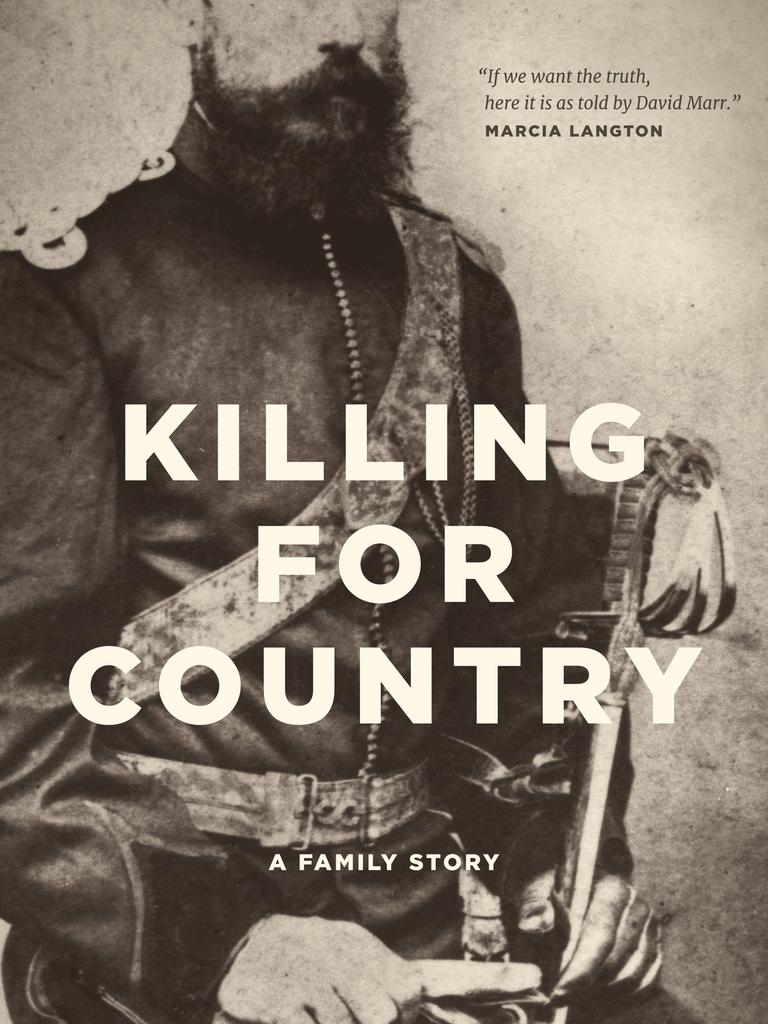
Killing for Country, by David Marr


Victoria Grieves Williams is an Indigenous academic based in New York.
                                          Victoria Grieves Williams 

Historians are now recognising that the colonial wars unleashed from the 16th century onwards are the first of the Great Wars. The death toll was immense: the Spanish conquest of the Americas from the 16th-18th centuries has an estimated death toll of 28 million. The British Empire, which held 24 per cent of the Earth’s total land area by 1920, wrought an estimated death toll of 100 million people. It was by far the largest empire in history and a source of great pride for those who tied their fortunes to it.

One could say that it was the fashion. Colonial wars were fought by European powers over the Indigenous people of the global south, not only in Australia but in Africa, Asia, South America and Mexico, India and China. The aim was to dispossess, enslave, destroy and claim all of what these people had of value, for the Empire. They were enormously successful.

No small part of this success is due to the specific kind of white masculinity that enabled the bloody conquest, that seemed to relish the lawless frontier and the opportunity to prove oneself.

This specific masculine ideal of violence as normative was nurtured and fostered as a part of the imperial ambitions of Britain, and thus built into colonial culture and politics. The workings of what the anthropologist Rita Laura Segato refers to as the masculine mandate whereby the libido is conscripted into providing constant proof that one truly is a man was the order of the day. Subservience to the masculine mandate is for both men and women the only way to exercise any power “power is expressed … exhibited and consolidated, as virile potency in a brutal form”.

Thus arises the pedagogy of cruelty through which Segato names all of what is manifest on human bodies to reduce them to things – violence, terror and cruelty.

In interviews, Marr has been emphatic that the people of the killing times are the same as those of today. It is my view that they are separated by huge social, cultural and political gaps and contexts that shape them. This has been a long debate in sociology, is it nature or nurture that produces certain kinds of people? In the case of settler colonial masculinist ideology, the society back in Britain was often shocked by the excessive violence of the frontier. They sought ways to curb them. Perhaps some realised they were a necessary evil and continued to fund and support them.

An Invasion Day ceremony held in Kings Domain park in Melbourne. Invasion Day ceremony held in Kings Domain park in Melbourne

However, Marr has a point about the unchanged nature of people over time when you consider the murdered and missing Aboriginal women and children in Australia. For example, the crimes of the serial murderer Richard Dorrough against Aboriginal and Pacifica women. He, who perversely wanted his crimes to be known, can be seen as subservient to the masculinist mandate. There are many other perpetrators. The phenomenon of murdered and missing Aboriginal women and children is evidence of the continuation of the gendered conquest and pedagogy of cruelty in contemporary Australian society.

To enlarge on the macro view, the huge death toll in all of the worldwide wars since the 16th century has not seemed to make a dent on the continuing overpopulation of the Earth. We need to consider that huge hordes of Europeans moved out to the global south because they could not continue to live in home countries that were already overpopulated. The 18th century saw famines and food riots in Britain and France.

The colonial wars and subsequent mass migrations were a result of the very pressing need to find other lands on which to grow food and be able to live, as well as the search for the bounty that these lands could offer in timber, animal and mineral resources. While the idea of Manifest Destiny propelled settlers in North America, settlers in Australia were not untouched by this and also had the idea of an empty continent – therefore those who were there beforehand were not legitimate, had no rights, were not truly human.

And still yet – what now?

It’s important to understand that the way people see history, utilise it or deal with it varies according to cultural approaches. Aboriginal cultural understanding has it that our ancestors beyond the last two generations (that are usually in living memory) go back into eternal time where they are part of the paradigms for the proper human behaviour on Earth, also known as the Law. These paradigms are accessed through stories that are often attached to constellations and landforms. Eternal time is ever-present, it is here “running along beside us” enabling a connection through eruptions of eternal time into the present.

Eternal time then is connected to normal time in which we live, this is the “everywhen” that is often used to describe Aboriginal understandings of time. It is more than that, it is known as tjukurpa by Central Australian Anangu, and by other names elsewhere. Altogether it is the sacred, that is more easily accessed when in the state between dreaming and wakefulness. Hence the misnomer, the Dreaming.

David Marr.
David Marr.

If the Law is transgressed then people have to be held to account for their actions and the aim of a full and frank hearing is for people to be able to continue to live together in a good way. All involved are given an opportunity to speak their truth and an appropriate punishment is decided on and meted out. Once resolved, settled, these matters are never spoken of again. It is considered that the business is finished.

So, what now? The Yoorrook Commission in Victoria defines truth telling as the act of telling true history by listening to the experiences of First Peoples.

Marr has written this book as a contribution to the truth-telling process and this is, as he says, a family story. It holds the key to the important connections and relationships that can grow out of meeting with the “other” side. There are many descendants of the survivors of the killing times in north Queensland who have their own stories to tell. In some places the notorious Darcy Uhr is still in living memory.

What remains is for the Uhr family descendants to reach out and begin to make connections across the divide of a brutal history, for which no-one alive today is responsible or culpable, but for which we can feel deep regret and seek to heal the bonds that bind us as human beings. Our lives will all be so much better for it.

Victoria Grieves Williams is an historian and Warraimaay woman whose mother worked as a cook and housemaid at sheep stations at Brewarrina. She is based in New York

Killing for Country book review: examining the Native Police’s violent dispossession of Indigenous Australians

Richard King, The Australian. October 13th 2023

Young guns: journalist David Marr listens to lawyer Noel Pearson speak during 1997 National Law Week Forum meeting. Marr has this week released his latest book on his own family’s links to Indigenous massacres.

Running to almost half a thousand pages, prodigiously researched and immaculately written, David Marr’s Killing for Country: A Family Story is surely one of the books of the year. Modestly described as a “family story”, it is in fact as solid a work of history as one could hope to find on the shelves. Clearly, the book holds enormous significance – enormous personal significance – for its author. But Marr brings the same forensic approach to this narrative of the frontier wars as he did to his celebrated biography of Patrick White, to his monographs of Tony Abbott and George Pell, and to his indispensable account of the Tampa/Children Overboard affair and Pacific Solution, Dark Victory.

It is a magnificent achievement, and a necessary intervention, on a subject that still divides Australia: the violent dispossession of its native peoples.

It was the discovery that his great-great-grandfather had served with the Native Police that set Marr off on this bold endeavour. The son of Edmund Blucher Uhr, scion of a poorly connected family with pretensions to Irish nobility, Reginald Uhr and his brother D’arcy were both officers in this notorious outfit, which cleared land of its Aboriginal owners at the behest of the squattocracy, avenging attacks on farmers’ livestock and “dispersing” troublesome gatherings. “Dispersing” was a euphemism, of course, but so too was “police”: as even contemporaries understood, the NP was a quasi-military unit, not a tool of law enforcement. It’s estimated that over 60 years it murdered more than 10,000 people (Marr says a “cautious interpretation” of these figures has seen estimates rise from 10,000 to 20,000 and now to more than 40,000).

The NP began its campaign of killing in the Darling Downs in 1848, but its brutality reached its feverish peak as it moved north in the 1860s, in the wake of Queensland’s break from New South Wales. Its campaigns were characterised by a basic asymmetry, as the belligerents in the frontier wars operated according to different principles: the Indigenous peoples saw themselves as redressing grievances through evening up the score, while white retaliation was inordinate. A pattern quickly established itself. Colonial expansion led to Indigenous resistance, which led in turn to further dispersals. Notwithstanding that these acts of violence were often met with disapproval by the colonial authorities, the indulgence shown towards them was baked in, in a way that gives the lie to the idea that the NP was dispensing justice. The reality is that it was clearing the land of black bodies.

Killing for Country by David Marr is about the author’s great-great-grandfather, who served with the Native Police, which cleared land of its Aboriginal owners, often by murdering them.

This picture is complicated by the fact that the NP comprised units of eight to ten such bodies under the command of a single white one. But in Marr’s telling, this organisational structure was something of a genius-stroke, in that it drew on the multinational nature of the Indigenous population and on the profound connection to place – to country – that characterises Indigenous society in general. As he puts it:

“What made them strange and dangerous to each other was being away from their own country, the country that made them who they were. Here was a deadly conundrum. While officially denying their attachment to land, colonial authorities would rely on that profound attachment – and the divisions it provoked – to raise a black force that would strip them of their country.”

Such an arrangement also allowed the NP to characterise the murdering as what a US Republican might call “black on black” violence. The recruitment of Aboriginal men gave white officers a handy alibi when questioned by their superiors.

Why would the killers need an alibi? The question may sound ridiculous, but conservative history warriors who criticise histories such as these, will often suggest that their authors are guilty of projecting modern values backwards (this is the so-called “black armband” charge). But what emerges from these grisly pages, and from the accounts of the contemporary outrage directed against the clearances, is a picture of a system of “justice” founded on a gargantuan hypocrisy – hypocrisy being the compliment that vice implicitly pays to virtue. In other words, many of the men in this “story” knew full well that they were involved in an immoral undertaking, and commentary that attempts to downplay this reality is, itself, unhistorical. This is not to say that the picture is simple: history is a tragedy, not a morality play. It is simply to agree with the author that if it is possible to feel pride in one’s country, it should be possible to feel ashamed of it too.

Author and journalist David Marr adopts an even, controlled tone for his devastating new book. (Picture: Lorrie Graham)

Marr does not make a show of such feelings. In his television appearances, he will often adopt the sort of demeanour that (I imagine) sends conservatives round the bend: the more-in-sorrow-than-in-anger eyes; the casual, cruising exasperation at the politics he doesn’t share, and is, therefore, self-evidently preposterous. But here the tone is even and controlled. One notes the slightly ironic adjectives and the occasionally sardonic descriptions. (“He recruited blacks as guides. He also shot blacks who stood in his way. Somerville was a genial and unscrupulous gentleman of the warrior class.”) But in general he lets the material speak for itself. Goodness knows, there’s plenty of it. As Marr notes – again, a little sardonically – one good thing about the colonists is that they wrote plenty of fine letters home.

The attitudes evinced in those letters, or the language in which those attitudes are couched, will no doubt distress most contemporary readers, and it would be vacuously polemical to assert that nothing’s changed. It has. Nevertheless, it is the achievement of this book to invite us to reflect on the many connections between contemporary Australia and its bloody past. That past is not a foreign country. It just speaks in thicker accents than we are used to.

Richard King is an author and critic. His most recent book is Here Be Monsters: Is Technology Reducing Our Humanity? (Monash University Press)

Killing for Country: A Family Story
By David Marr
Black Inc, Nonfiction
$39.99; 468pp
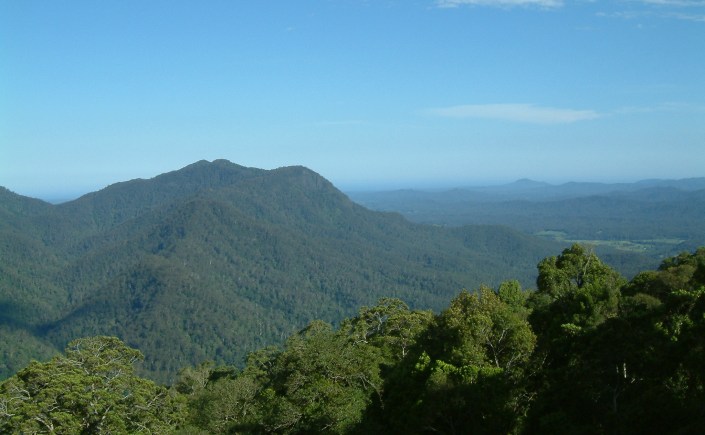
Dark Deeds in a Sunny Land – a poet’s memorial to a forgotten crime

… they were standin’ on the shore one day
Saw the white sails in the sun
Wasn’t long before they felt the sting
White man, white law, white gun
Solid Rock, Goanna 1982

The Great Australian Silence

Archaeologist WEH Stanner wrote in 1968 of “the great Australian silence – it was almost as if there was a “cult of forgetfulness”. And indeed, white historical memory is like a sieve. Give it a good shake and only the big chunks are left. For a long time in Australia, the story of our frontier wars was not one of those. But in recent decades, an ever-widening crack has let the light in.

The first hairline fissures appeared in the early years of settlement as a small number of humanitarians voiced their concerns, although not with enough impetus to cool our pioneer fervour. Henry Reynolds, acclaimed historian of the frontier wars, quotes one such: ‘How is it our minds are not satisfied? What means this whispering in the bottom of our hearts?’

I touched upon this paradox in a review I wrote of historian Peter Cochrane’s novel The Making of Martin Sparrow: – Martin Sparrow’s Blues:

“The country into which most characters venture is not, as we now acknowledge, an empty land. It was a peopled landscape, a much revered, well-loved, and worked terrain, its inhabitants possessed of deep knowledge, wisdom and respect for “country” … 

… Whilst many colonists, particularly the soldiery, regard the native peoples as savages and inflict savage reprisals upon them for their resistance to white encroachment, others, in the spirit of the contemporary ‘Enlightenment’ push back against the enveloping, genocidal tide with empathy and understanding …

… “It’s the first settlers do the brutal work. Them that come later, they get to sport about in polished boots and frock-coats … revel in polite conversation, deplore the folly of ill-manners, forget the past, invent some bullshit fable. Same as what happened in America. You want to see men at their worst, you follow the frontier”. “I don’t reckon we’re the Christians … We’re the Romans. We march in, seize the land, crucify them, stringing ‘em up in trees, mutilate their parts”.

… They knew in their hearts that this ancient people and its ancient ways are helpless against the relentless tide of the white man’s mission civilatrice. “It might be that the bolters have the ripest imagination, but sooner or later, an official party will get across the mountains and find useful country, and the folk and the flag will follow, that’s the way of the world. It’s a creeping flood tide and there’s no ebb, and there’s no stopping it. No amount of … goodwill”. 

At Bellingen’s  Readers and Writers Festival in July 2019, we attended a powerful “conversation” between Reynolds and indigenous activist and academic Marcia Langton. Reynolds reminded us that these wars raged for decades from Tasmania in our far south  to Queensland’s far north. It was a story of vicious raids and reprisals.

In August 2019, in a piece called The Frontier Wars – Australia’s heart of darkness, I wrote:

“Australia at the time of first settlement, and particularly on the frontier, was a brutal, violent place. It was colonized by soldiers and convicts, most of them young men chock-full of testosterone and aggression, bitterness and prejudice, greed and ambition. The conflict, which in Queensland, endured  into the last decades of the 19th Century, was a war of conquest and extrajudicial killings – or more bluntly, murders. The subdued territories were patrolled  by the native police – effectively paramilitary forces. The wars were waged by an outgunned people on the one hand, and, on the other, what were effectively robber bands raised and provisioned by the local magnates and squatters intent on seizing, holding and expanding their often enormous landholdings. There were to be no ceasefires, no parlays and no treaties. And no recognition of indigenous rights. None were ever on offer – not that that would’ve made a difference”.

We have come a long way in a short time; but we’re not there yet. There exists still a darkness at the heart of our democracy that we struggle to come to terms with; and in these divisive days, it doesn’t take much to reignite our “history wars” as we negotiate competing narratives and debate the “black armband” and “white blindfold” versions of our national story.

‘A sorry place’

We live in heart of the Tarkeeth Forest which lies between the Bellinger and Kalang Rivers in Bellingen Shire the mid north coast of New South Wales. Traversing the ridge just north of us is the east-west Fernmount Range Trail. In the days gone by, it was an ancient highway called the Yildaan Dreaming Track and Trade Route  which linked the plains beyond the Dorrigo massif to what is now the seaside town of Urunga, known then to the Gumbaynggirr people as a “place of plenty”. The first people would descend the spurs on the north and south flanks of the range for fishing and ceremonies on the riverside. The Tarkeeth Forest contains areas of significant indigenous culture, recalling song lines and stories of the Dreamtime, places of ceremony, of birth and burial, and of atrocity.

We have been told that the Gumbaynggirr regarded Bellingen and its environs as a “sorry place”, one of discrimination, expulsion and worse. But Bellingen Shire is just one of many places that have a dark history of which most  residents are unaware.

Three historic massacre sites committed against Gumbaynggirr and Bundjalung people of the Coffs Clarence region have been recorded on the Aboriginal massacres map, created by University of Newcastle researchers. They are listed as being near Bellingen, modern day Coutts Crossing, and near Seelands and Ramornie. [See below]

The scenic Waterfall Way linking Armidale to the coast is a drive we never get tired of as it winds along riverside meadowlands and climbs through world heritage rainforests to the Dorrigo Plateau with its windswept escarpments, clear creeks, and just off the beaten track, magnificent waterfalls, landmarks like Cathedral Rock, and stunning views. But, in the words of activist and academic and Ambēyang man Callum Clayton-Dixon, this highway conceals signposts to a bloody past. [We republish his article below]

One of these signposts points the way to north of Point Lookout on the New England Tableland, where, jutting out from the plateau and dropping in sheer cliffs into the thick rainforest below, is a place once known as Darkie Point.

Judith Wright was the first white Australian poet to publicly name and explore the experiences of its Indigenous people. Through her poetry, and especially in her later histories, Wright sought to confront the violence in Australian settler history and to re-imagine it through the eyes of the first Australians. Her words breathed sorrow and compassion into the early encounters between settlers and Indigenous people, evoking the tragedy of the Australian frontier. Her love of the New England highlands was bound to a creeping uneasiness about its past. As Billy Griffiths wrote in in his story of archaeologist Isabel McBryde, she lived in “haunted country.” In an early poem, Bora Ring(1946), she mourned the passing of a dynamic world:

The hunter is gone; the spear
is splintered underground; the painted bodies
a dream the world breathed sleeping and forgot.
The nomad feet are still.

She lived on New England  tablelands and camped at Point Lookout with her father, as he had with his mother. “She remembered being mesmerized by the splendour of the cliffs, the mystery of the thickly forested valley and the “the great blue sweep of the view from the Point to the sea.” But she saw a darkness here, too, at Darkie Pont. It is just north of Ebor and the scenic Waterfall Way linking Armidale to the Coast via Dorrigo and Bellingen.

Wright’s father told her the story of how it got its name: how, “long ago,” a group of Aboriginal people were driven over those cliffs by white settlers as reprisal for spearing cattle. Their sickening plunge was re-imagined in one of Wright’s early poems, “Nigger’s Leap, New England”, published in her first collection The Moving Image (1946). The story was later revealed to be an “abstracted and ahistoricised” account of a documented event. It was, in fact, August 1852, that scores of Aboriginal people were chased to the edge of a cliff, shot and pushed over. Some in this day and age may be offended by the use of what is now a forbidden word – but Wright chose it specifically for its shock effect, commemorating as it does what was then a forgotten crime. “Did we not know”, she asks, “their blood channelled our rivers, and the black dust our crops ate was their dust?”

In her short story, On Reading Nigger’s Leap, Teacher and writer Anne Vince asks her class – and  us, her readers – to imagine what Wright did describe in words words:

‘Local aborigines were driven over the falls. Stockmen from neighbouring stations rounded them up like cattle and beat them to the cliff’s edge. Mothers leapt, leaving their babies clinging to shrub roots. Some tried to hide their children in the burnt out husks of the giant gums that used to grow around here. After a while the riders would release their dogs…There is such a silence my words falter before tumbling forward. I have to breathe deeply to continue, to remember … How do we know this? Hard evidence. Skeletal remains at the bottom of the cliffs – and, yes – they are human remains. And, of course, oral history… Judith Wright had heard these stories.’  [We republish Vince’s story below]

© Paul Hemphill 2021 All rights reserved

Nigger’s Leap, New England

The eastward spurs tip backward from the sun.
Nights runs an obscure tide round cape and bay
and beats with boats of cloud up from the sea
against this sheer and limelit granite head.
Swallow the spine of range; be dark. O lonely air.
Make a cold quilt  across the bone and skull
that screamed falling in flesh from the lipped cliff
and then were silent, waiting for the flies.

Here is the symbol, and climbing dark
a time for synthesis. Night buoys no warning
over the rocks that wait our keels; no bells
sound for the mariners. Now must we measure
our days by nights, our tropics by their poles,
love by its end and all our speech by silence.
See in the gulfs, how small the light of home.

Did we not know their blood channelled our rivers,
and the black dust our crops ate was their dust?
O all men are one man at last. We should have known
the night that tidied up the cliffs and hid them
had the same question on its tongue for us.
And there they lie that were ourselves writ strange.

Never from earth again the coolamon
or thin black children dancing like the shadows
of saplings in the wind. Night lips the harsh
scarp of the tableland and cools its granite.
Night floods us suddenly as history
that has sunk many islands in its good time.

‘On Reading “Nigger’s Leap” by Judith Wright’ by Anne Vince

Judith Wright knifes the scab off an old, unhealed wound.

In the classroom I explain that this poem is set in their own backyard – at the local falls – where three generations ago white men, squatters and landowners alike, regularly went ‘hunting’ and it wasn’t for kangaroos.

A snarl sweeps across the pig-shooter’s son.  ‘Supposedly,’ he interjects.

I’m stunned. Not because it’s the first time I’ve heard four consecutive syllables from this boy – it’s the ferocity of the denial. There’s a history here, a hint of blood knowledge.

Under this remark I can hear the lazy slam of a fly screen door, the indignant scrape of a chair rasped over cracked, worn lino.

‘Yeah…’ drawls another student. Then another. The heat in the room builds. Even the incessant flies hesitate. ‘Well…?’

A sea of sun-scorched faces, eyes ready to pass judgment, stare.

To gather my thoughts, I glance outside. Massive cumulus clouds the colour of dark bruises roil and tumble over each other, mocking the scrubby horizon, piling higher and higher in the expectant sky.

I have to be careful. These are children well versed in suspicion. I know anything I say will make it back to shoddy verandahs and the town’s single, stainy-tiled bar.

I want to tell them their disbelief makes them complicit but that would mean slipping a fingernail under that lino, scraping at the decades of dirty reasoning and the trampled effort of surviving in a place like this.

The class waits – a collective held breath willing the relief of a reply.

I look at their hands. Some of them are men’s hands, thick-knuckled from weekend labour or cutting horses in low rent rodeos. Most of these students are already helping shoulder the burden of overgrazed, drought-stricken farms, riddled with dieback. They are tough kids from decent families who believe they’ve been given the whole country for their own.

‘No,’ I finally say. ‘Local aborigines were driven over the falls. Stockmen from neighbouring stations rounded them up like cattle and beat them to the cliff’s edge. Mothers leapt, leaving their babies clinging to shrub roots. Some tried to hide their children in the burnt out husks of the giant gums that used to grow around here. After a while the riders would release their dogs…’

There is such a silence my words falter before tumbling forward. I have to breathe deeply to continue, to remember.

‘How do we know this? Hard evidence. Skeletal remains at the bottom of the cliffs – and, yes – they are human remains. And, of course, oral history… Judith Wright had heard these stories.’ This is what I tell them.

I don’t tell them that swimming one afternoon in the dark pools of the falls, just as the sun slanted shadows through saplings at the water’s edge, I met those shrill, anguished spirits. I don’t tell them of the high-pitched keening and tortured wailing that filled my ears each time I dived, or of the roaring bush silence that greeted me when I emerged, clean-skinned and gutted. I don’t tell them how I choked, sick with sudden comprehension as I lay on the hard granite, resisting the pull of those blood channelled ghosts to join their sway and wander in the waters far under.

Now, Slessor they will understand. White man’s words. White man’s war.

They are excused by the bell.

To me it is the sound of alarm

Myall Creek, New England

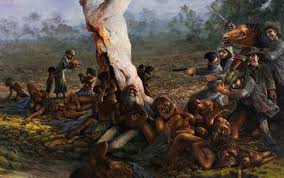
At Myall Creek Station near Inverell, in 1838, twelve armed and mounted stockmen rounded up 28 unarmed Wirrayaraay people – largely women and children – and, without provocation, hacked them to death. This story, the Myall Creek massacre, is relatively well known because of John Plunkett’s heroic prosecution of the stockmen – several were hanged for murder – but numerous other, similar incidents in the area are less well known. These include the follow-up murder of thirty or so remaining Wirrayaraay men and killings of sometimes hundreds of people at sites such as Slaughterhouse Creek, Waterloo Creek and Terrible Creek.

Few locals know that Dangar Falls in Dorrego,  Dangarsleigh, and Armidale’s Dangar Street were all named in honour of Henry Dangar, a squatter known for his role in the attempted cover up of the atrocity, and for trying to pervert to course of justice in the subsequent trial.

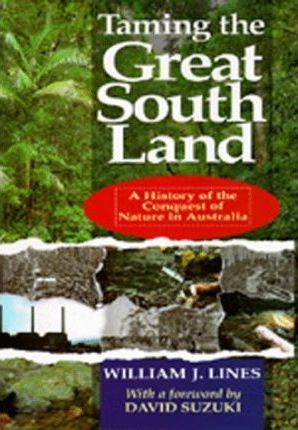
We recently republished extracts for William Lines’ Taming of the Great South Land regarding the eradication koala and other wildlife in the earthy twentieth century. Here is what he had to say about Myall Creek and other massacres.

The Myall Creek Massacre

He wrote:

“Most squatters abhorred the Aborigines. They resented their “wandering propensities”, their independence, their pride and their unwillingness to accept the hierarchical authority Europeans equated with enlightenment. For 50 years Aborigines the civilisation Europeans had sought to impose on Australia, their inclination towards independence of action and refusal to accept the values of the invaders invaders greatly exasperated the British. Their disdain for European habits marked them as barbarians and supplied the Europeans with an antithesis – civilisation versus barbarism – highly useful as a rationalisation for aggression. To counter aboriginal resistance, the squatters appealed to the government to clear the land. When the colonial authorities equivocated,  the squatters adopted at their own solutions.

At Myle Creek, 650 km north of Sydney, shortly before sundown one day in June 1838, a group of mounted stockmen with muskets, swords and pistols, rounded up 30 or 40 aboriginals encamped at a sheep station. The Horseman roped the men, women and most of the children together and force them to march 4 kilometres into the bush. The untied children, crying, followed their mothers, who carried those too young to walk. One of the stockmen snatched up an untied boy of about seven ( a favourite of his), placed in behind a tree and told him to remain there until later. The child, however, ran back, crying “no, I will go with my mammy”. He was then fastened with rope to the adults.

A few days later the station manager became curious as to the whereabouts of the Aborigines previously camped in the area. The hovering of eagles, hawks and other birds of prey, directed him to a spot where he discovered the mangled and half burnt remains at least 28 people. For the most part, heads was separated from bodies, and fire marks appeared on the disjointed limbs. Charcoal and burnt logs indicated an attempt to efface all evidence. The manager, however, recognise 10 to 12 small heads he took to those of children, and a large body which he believed belonged to “Daddy”, an Aborigine know for his remarkably large frame.

When the government laid murder charges against the men responsible, squatters and the press screamed in outage at the absurdity of indicting civilised man for the deaths of creatures on the lowest rung of creation. A few of those associated with squatting have not killed aboriginals and they continued to declare their right to clear the land of an inferior race. One squatter boasted that he “would shoot a Blackfellow whenever he met him as he would a mad dog. The jury returned a verdict of not guilty. Once juror explained:

“I look to the blacks as a set of monkeys and I think the earlier they are exterminated, the better. I know well [the accused] are guilty of murder, but I, for one, would never consent to see a white man suffer for shooting black one”.

The government eventually obtained a conviction at a second trial. Before their execution , the seven condemned men acknowledged their guilt but stated in their defence “that in destroying the Aborigines, they were not aware that they had violated the law, or that it would take cognizance of their having done so, as it had been so frequently done in the colonies before”.

The Myall Creek massacre became notorious – not because of the murder of the aboriginals but because of the conviction and punishment of the murderers.It was only the second and the last time in Australian history that Europeans were executed for the murder of aborigines. Henceforward squatters acted with impunity; the Myall Creek trial only encouraged them to be more secretive and thorough. One recommended that, where the firearms failed or became too obvious, poison in the form of strychnine or arsenic mixed with flour be given to the aborigines.

Squatters believed that the £10 license fee and entitled them to the exclusive one of their use of the runs – a right which justified the violent expulsion of the original residents. In February 1840 the Whyte  brothers took up their Kooning-wootong run in the Western District. A month later they hunted down an aboriginal group suspected of stealing 127 sheep and killed between 20 and 30 of them. Although the Whytes admitted to the killings, the government failed to prosecute, and a month later the brothers pursued and killed members of another group of aborigines. In 1841 a party of seven settlers shot dead 51 aborigines on the banks of the Glenelg River near the South Australia-Victoria border, for abducting 50 sheep. Long after, according to a local squatter, the bones of the men and sheep lay mingled together bleaching in the sun at the Fighting Hills.

Taming The Great South Land – a history of the conquest of nature in Australia, William J Lines (Allen and Unwin 1991) p78-79

What to do with  signposts to New England’s bloody past?

View at Medium.com

Callum Clayton-Dixon

The names of various creeks, streets, parks, and pastoral properties across the Tableland hark back to New England’s violent colonial origins. In this unprecedented time of truth-telling, is taking down these symbols of past injustices enough?

Majors Creek, near the village of Ebor, named for squatter Major Edward Parke.

Travelling along Waterfall Way, not far from the village of Ebor, you’ll drive across Major’s Creek, and nearby there’s a signpost for Major’s Point Road which takes you towards Major’s Point bluff. These places were named after Major Edward Parke, who took up Guy Fawkes Station in the mid-1840s. Ebor itself has a Major Street, and a Parke Street. Parke, an ex-military man, acquired a reputation for his brutal treatment of local Aboriginal people. A profile of the New England district published by the Singleton Argus in 1883 referred to how Parke “established such a reign of terror…that for twenty-five years no Aboriginal would approach his run, although through it ran their favourite and most prolific fishing streams”.

“The name of the gentleman in question is held in awe by the darkeys till the present day, and to mention it is sufficient to induce any stray Aboriginal to make back tracks to the nearest shelter.” — Singleton Argus, 12/12/1883, p2

The Darkie Point Massacre illustrated by Narmi Collins-Widders

Just east of Major’s Point is Darkie Point. According to the well-known pastoralist P.A. Wright of Wallamumbi Station, this particular bluff was the site of a massacre —in August 1852, a large group of Aboriginal people were chased to the edge, shot and pushed over. An article about the history of the Dorrigo Plateau printed in the Dungog Chronicle in 1932 talked of Edward Parke’s involvement in this atrocity: “A great number of them were shot by Major Parke and other residents of the district who had joined the chase”. It’s likely that Michael Clogher of Bostobrick Station, a former convict and constable with the New England Border Police, was involved in the Darkie Point massacre as well. That same month, Clogher led a posse of settlers “in pursuit of the natives” on the Aberfoyle run, and “followed them to Paddy’s Land, where they shot down as many as they could”. Joshua Scholes’ account of this incident appeared in a 1923 issue of the Uralla Times; Scholes was a long-time resident of the Tableland “with a wealth of knowledge of the early days”. I suspect Clogher’s Creek at Nymboida is named after Michael Clogher, who was also notorious for terrorizing Aboriginal people; he would ride into camps brandishing his cavalry sword, and apparently didn’t hesitate to use his pistol or carbine.

“The name [Terrible Vale] was derived from one of the men working on the place in the early days and known as ‘Terrible Billy’, being a terror to the blacks.” —Uralla Times, 03/05/1923, p2

Terrible Vale, south of Uralla, took its name from William ‘Terrible Billy’ Stephenson, the head stockman during the mid-1830s. Elizabeth Gardner’s history of the Station documents a story “passed down through some people who worked on the station…that a large number of Aborigines were killed near the creek on Terrible Vale”, and it was Terrible Billy who shot a great many Aboriginal people there. Then there’s Macdonald Park in Armidale, which is named after the district’s first Crown Lands Commissioner George James Macdonald. Commissioner Macdonald commanded the New England Border Police, and over the course of two days of skirmishing on the Beardie Plains in March 1840, his troopers shot dead nine Aboriginal warriors and wounded a tenth. In reporting this to his superiors, Macdonald justified the slaughter, claiming that it had been “absolutely necessary…to check the boldness and daring of their attacks”.

Dangar Falls, Dangarsleigh, and Armidale’s Dangar Street were all named in honour of Henry Dangar, a squatter known for his role in the attempted cover up of the infamous 1838 Myall Creek Massacre, and for trying to pervert to course of justice in the subsequent trial. On the Macdonald River run — named after Henry Macdonald, Station manager there in the mid-1830s — colonists poisoned local Aboriginal people by giving them milk containing arsenic. This is, in all likelihood, why a waterway on the outskirts of Bendemeer is called Poison Swamp Creek.

Most New Englanders would be completely oblivious of the horrific history to which these signpost names point. Why? Wilful ignorance in some cases. Complete denial in others. Most have no idea because they’ve never had the opportunity to learn about it. But the thick fog of the great conspiracy of silence is lifting as the push for truth-telling advances. Bolstered by the global Black Lives Matter movement, calls for the removal of statues and place names honouring those who contributed to the violent colonization of Aboriginal lands and lives are gaining momentum. However, there are a whole raft of questions and issues that arise from this crucial conversation.

What, if anything, should replace these symbols of past injustices? Plaques acknowledging the atrocities committed by the likes of Major Parke? Memorials recognizing the pain and suffering endured by Aboriginal people at the hands of the New England colonial project? Or monuments to the warriors who laid down their lives to protect kin and country? After all, the massacres, the poisonings, and the campaigns of terror were often carried out in response to our ancestors’ fierce resistance to the invasion. Their courage and sacrifice must also be remembered.

And what shall replace names like ‘Macdonald Park’ and ‘Dangar Falls’? One of the most common suggestions has been to use words from the local Aboriginal language (Anēwan) for this purpose, thus paying respect to the traditional owners, and contributing to the revival of our ancestral tongue. But symbolic acts alone aren’t enough, nowhere near in fact. Symbolism has to be, in my view, accompanied by commitments to real change, tangible change.

The savagery of Parke, Clogher, Terrible Billy, and their ilk was foundational to the development of New England as a thriving pastoral district. So were government agents like Commissioner Macdonald, overseeing ruthless police repression, and administering the carving up of the Tableland into hundreds of stations. We have to go beyond statues and signposts to conversations about redress for the protracted dispossession and decimation of Aboriginal communities. Substantial reforms to the education system are, of course, a given. Let’s talk about the return of stolen lands. Let’s talk about reparations. And it’s vital that these conversations (and the actions they give rise to) take place locally, as well as at the state and national level. Truth and justice, from the ground up — a shattering of the colonial status quo, not a tinkering.

Callum Clayton-Dixon is an Ambēyang Aboriginal man whose people come from the southern end of the New England Tableland in New South Wales. He is the author of Surviving New England: A History of Aboriginal Resistance & Resilience through the First Forty Years of the Colonial Apocalypse (2019), and a PhD candidate at the University of Technology Sydney, working to develop a dictionary and grammar of his ancestral language.

The Colonial Frontier Massacres Map

The Coffs Coast Advocate reported  in November 2019, how stage one of the project has recorded 172 incidents across Eastern Australia between 1788 and 1872.  About 97% of people killed in these massacres were Aboriginal men, women and children Massacres became more violent, systematic and calculated over time. The average number of Indigenous deaths increased over time, before declining in the 1900s, but massacres continued up to 1928.  At least 65 massacres of Indigenous people were in retaliation for the killing or theft of livestock, or theft of property

Darkie Point, Bellinger River, near Ebor  

Ten people were killed at Darkie Point on the Bellingen River in May, 1841 with settlers and stockmen using firearms and muskets to attack a local Baanbay Aboriginal tribe in an act of reprisal. The narrative by the Colonial Frontier Massacres research team reads.  “Following the brutal murder of three shepherds on Eldershaw’s outstation in the north eastern part of New England and the taking of 2000 sheep by Bundjalung, Eldershaw organised a ‘pursuing party’ of ten men (including Eldershaw, three neighbours and six stockmen) … ‘Well mounted and accoutred’ and set off with ten days provisions for the south branch of the Clarence. According to Eldershaw they shot the entire group – ‘a great number’ in daylight.’

Orara River, near Seelands and Ramornie

More than 20 people were killed on the Orara River, near Sealands between April 1, 1841 and April 30, 1841. The attackers included colonisers, a government official and settlers and stockmen. “In response to stock theft, from Ramornie station, CLC Oakes of Clarence PD swore in stockmen as special constables to surround a Bundjalung (Ngarabal? speakers) camp at night and at daybreak charged and killed indiscriminately Aboriginal men, women and children.” A man named Lynch was later charged with the stock theft.

Kangaroo Creek, near today’s Coutts Crossing

An estimated 23 Gumabynggnir people were killed on November 29, 1847. “In February 1848, Crown Lands Commissioner, Oliver Fry, was told by a stockman and an Aboriginal man at Grafton that squatter Thomas Coutts had poisoned 23 Aboriginal people by offering them flour laced with arsenic at his station at Kangaroo Creek.” Fry set off for Kangaroo Creek Station to investigate. He found human remains, but they were too decomposed for analysis. Coutts was arrested and taken to Sydney where he was bailed for 1,000 pounds, but was discharged in May for lack of evidence.

The Frontier Wars – Australia’s heart of darkness

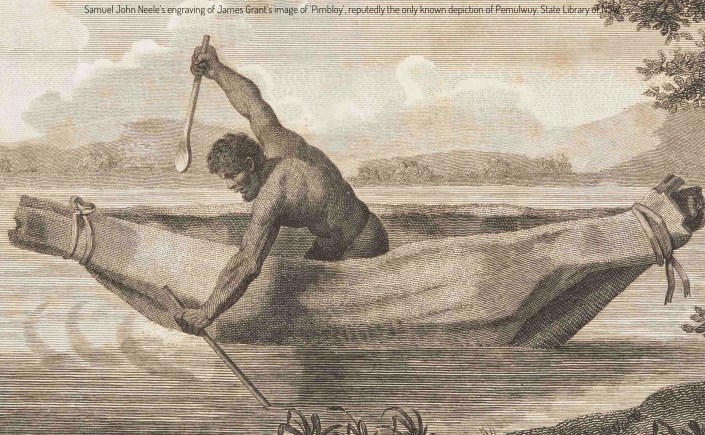
Pemulwuy

It was recently announced that Phillip Noyce, Director of the award winning Rabbit-Proof Fence, is to bring to our screens the story of Bidjigal warrior and resistance leader Pemulwuy who lived near present day Botany Bay and who united local tribes in a twelve year guerrilla war against the British invaders of what we now call New South Wales.

As is always often the case with such fearless but forlorn intifadat, Pemuluy came to a sad, bad end. Shot down in a a totally one-sided firefight, his pickled head was sent by Governor Philip King to renowned botanist Joseph Banks in England, a grisly souvenir of Britain’s self-ordained, and, to many in power, god-given, mission civilatrice. 

And thus began Australia’s frontier wars. 

White historical memory is like a sieve. Give it a good shake and only the big chunks are left. For a long time in Australia, the story of our frontier wars was not one of those. But in recent decades, an ever-widening crack has let the light in.  

The first hairline fissures appeared in the early years of settlement as a small number of humanitarians voiced their concerns, although not with enough impetus to cool our pioneer fervour. Henry Reynolds, acclaimed historian of the frontier wars, quotes one such: ‘How is it our minds are not satisfied? What means this whispering in the bottom of our hearts?’ 

I touched upon this paradox in a review I wrote of historian Peter Cochrane’s novel The Making of Martin Sparrow:

“The country into which most characters venture is not, as we now acknowledge, an empty land. It was a peopled landscape, a much revered, well-loved, and worked terrain, its inhabitants possessed of deep knowledge, wisdom and respect for “country” … 

… Whilst many colonists, particularly the soldiery, regard the native peoples as savages and inflict savage reprisals upon them for their resistance to white encroachment, others, in the spirit of the contemporary ‘Enlightenment’ push back against the enveloping, genocidal tide with empathy and understanding …

… “It’s the first settlers do the brutal work. Them that come later, they get to sport about in polished boots and frock-coats … revel in polite conversation, deplore the folly of ill-manners, forget the past, invent some bullshit fable. Same as what happened in America. You want to see men at their worst, you follow the frontier”. “I don’t reckon we’re the Christians … We’re the Romans. We march in, seize the land, crucify them, stringing ‘em up in trees, mutilate their parts”.

… They knew in their hearts that this ancient people and its ancient ways are helpless against the relentless tide of the white man’s mission civilatrice. “It might be that the bolters have the ripest imagination, but sooner or later, an official party will get across the mountains and find useful country, and the folk and the flag will follow, that’s the way of the world. It’s a creeping flood tide and there’s no ebb, and there’s no stopping it. No amount of … goodwill”. 

No ceasefires, no parlays and no treaties

At Bellingen’s recent Readers and Writers Festival, it was our pleasure and privilege to attend a powerful “conversation” between Reynolds and indigenous activist and academic Marcia Langton (and, by fortunate serendipity, to share a meal with them at the Federal Hotel afterwards). One of many discussion points was that old conundrum: are those who rebel against authority and resist oppression and dispossession terrorists or freedom fighters? The festival event’s tight schedule precluded what was shaping up to be a very lively question time. 

Australia’s frontier wars, Reynolds reminded us, raged for decades from Tasmania in our far south  to Queensland’s far north. It was a story of vicious raids and reprisals. 

Australia at the time of first settlement, and particularly on the frontier, was a brutal, violent place. It was colonized by soldiers and convicts, most of them young men chock-full of testosterone and aggression, bitterness and prejudice, greed and ambition. The conflict, which in Queensland, endured  into the last decades of the 19th Century, was a war of conquest and extrajudicial killings – or more bluntly, murders. The subdued territories were patrolled  by the native police – effectively paramilitary forces. 

The wars were waged by an outgunned people on the one hand, and, on the other, what were effectively robber bands raised and provisioned by the local magnates and squatters intent on seizing, holding and expanding their often enormous landholdings. 

There were to be no ceasefires, no parlays and no treaties. And no recognition of indigenous rights. None were ever on offer – not that that would’ve made a difference. 

Reynolds observed how we as a nation celebrate war and warriors, but do not recognize, and indeed, forget our foundational wars of martial conquest. We commenced our national journey with a declaration that our land  was terra nullius, an empty land that was “ceded and  conquered”. There is still no proper explanation at law of how sovereignty passed from the indigenous people to Britain and thence the Australian State. 

Waterloo Creek Massacre, January 1838

Until the momentous Mabo decision of 1992 when the High Court held that the doctrine of terra nullius, which imported all laws of England to a new land, did not apply in circumstances where there were already inhabitants present – even if those inhabitants had been regarded at the time as “uncivilized”, and that as such, any indigenous land rights which had not been extinguished by subsequent grants by the Crown continued to exist in Australia. The concept of indigenous land title was thus born.

And today, at public gatherings and meetings, at carnivals and ceremonials, at conferences and conventions, many of us now recognize and acknowledge our first peoples as the traditional owners of this land and acknowledge elders past, present and future. 

We have come a long way in a short time; but we’re not there yet.

There exists still a darkness at the heart of our democracy that we struggle to come to terms with; and in these divisive days, it doesn’t  take much to reignite our “history wars” as we negotiate competing narratives and debate the “black armband” and “white blindfold” versions of our national story. 

© Paul Hemphill 2019.  All rights reserved

Read also:

                            Solid Rock
They were standin’ on the shore one day
Saw the white sails in the sun
Wasn’t long before they felt the sting
White man, white law, white gun
Don’t tell me that it’s justified
’cause somewhere, someone lied
And now you’re standing on olid rock
Standing on a sacred ground
Living on borrowed time
And the winds of change are blowin’ down the line