Spring is here, spring is here Life is skittles and life is beer I think the loveliest time of the year Is the spring, I do, don’t you? Course you do But there’s one thing that makes spring complete for me And makes every Sunday a treat for me…
Tom Lehrer
That music always round me, unceasing, unbeginning, yet long untaught I did not hear, but now the chorus I hear and am elated. Walt Whitman
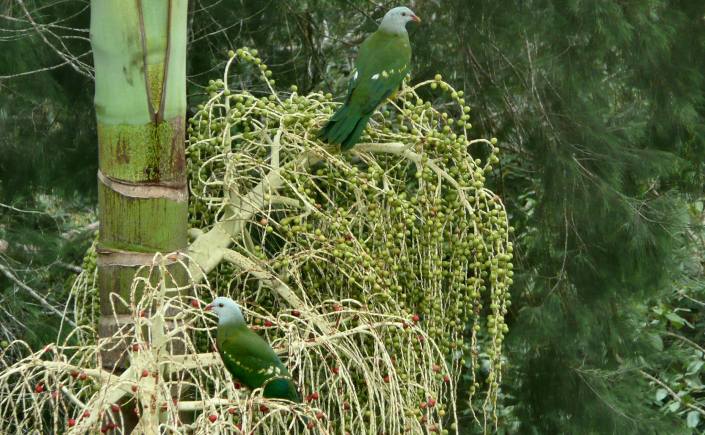
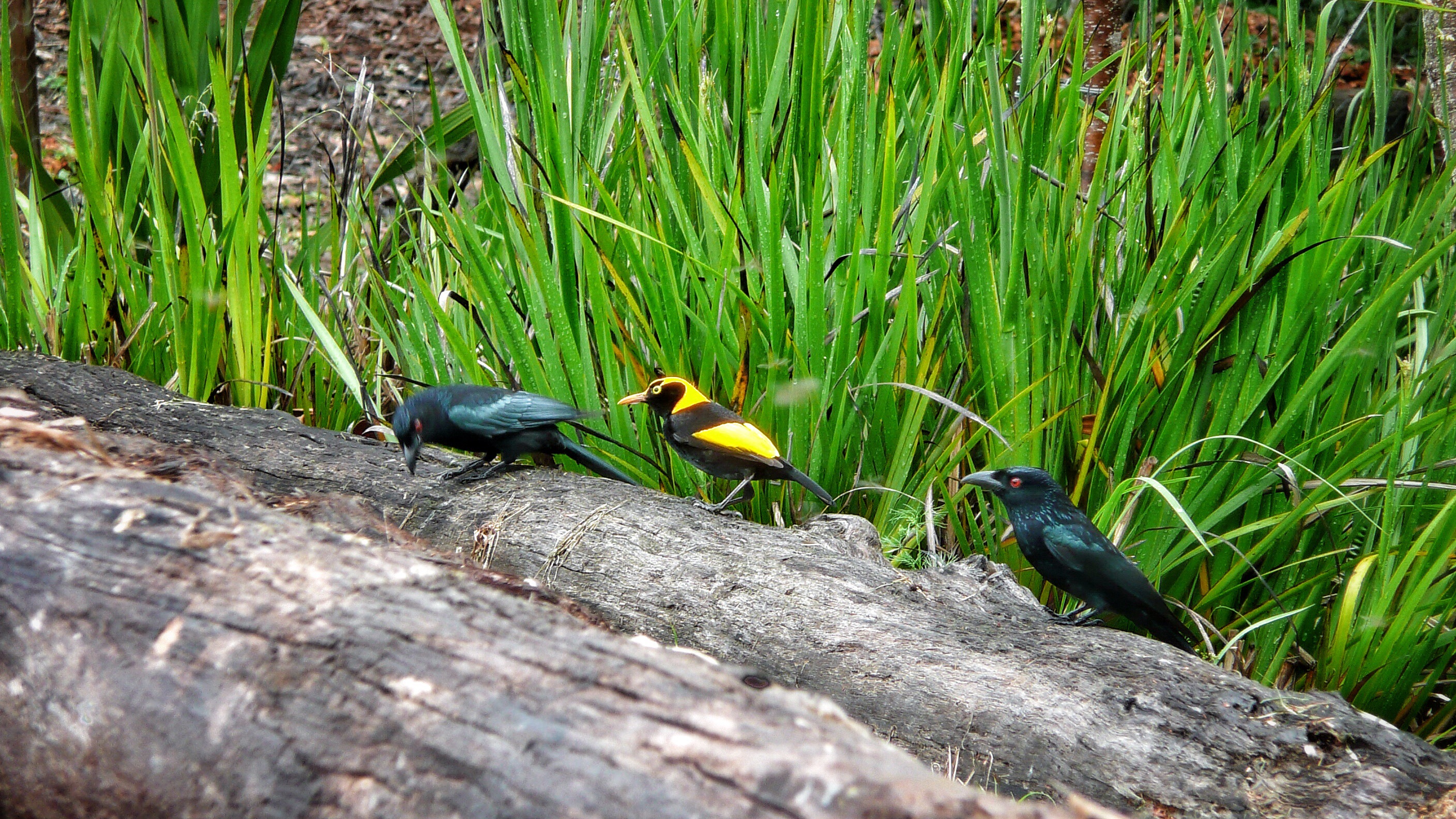
It is five in the morning and the sun she’s rising. Old King Koel has been making his lovelorn call for two hours already. As the shadows lift, a lone kookaburra calls. Another answers, and is immediately joined by a choral cacophony. A whip bird calls in the forest nearby, and somewhere therein, a white-chested pigeon commences its hopeful “woo woo”. Just across the way, barrel-chested wongas waddle across the grass, their heads bobbing fore and aft, abd on a dance floor bedecked with festive straw swiped from the garden and blue trophies gathered from all over, a bower bird rasps loudly to a potential lady love who is edging across the garden. As she enters his bower, he sits on a branch and serenades her with a melody that is all sweetness. A mob of spangled drongos chortle and jingle amidst the trees as if they were about to watch the show.
Spangled Drongos and a Regent Bower Bird feeding on a termite swarm
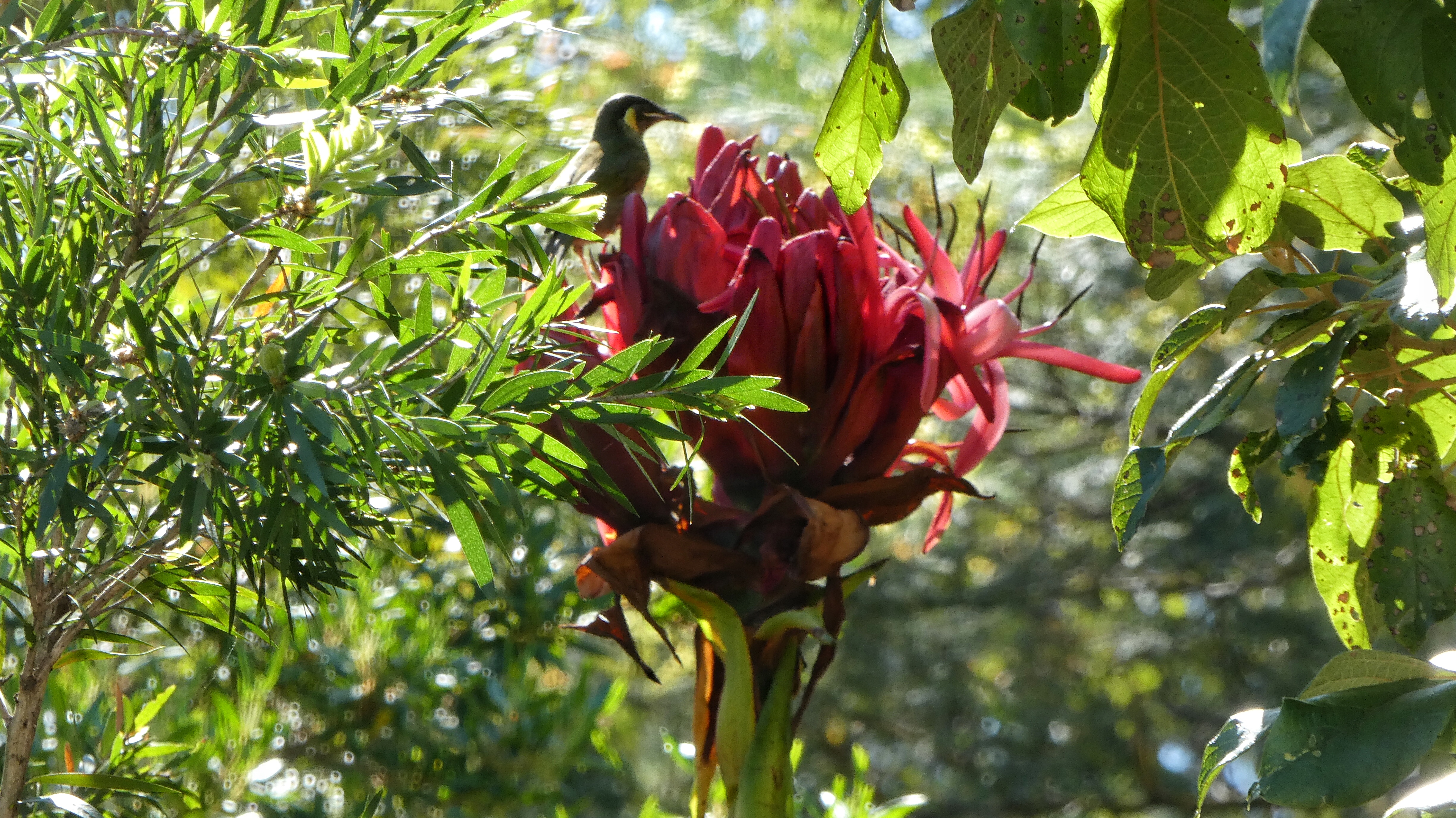
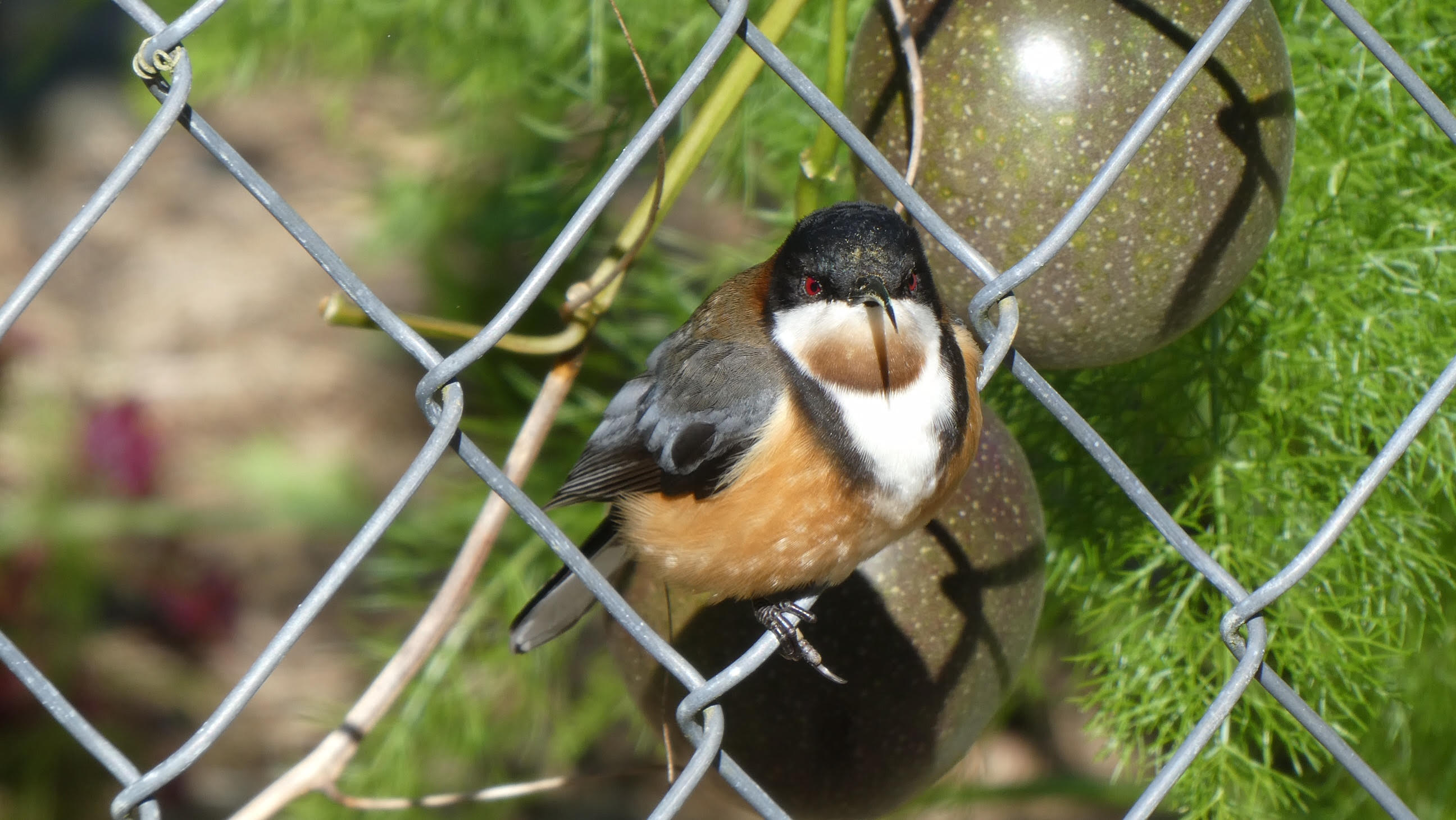
The day brightens and as the nectar warms in the sun, spine-bills, tiny scarlet honey-eaters and lithe wattlebirds flock to the bottle brushes, flocks of red-browed finches twitter in the grass, “Ollie, ollie” oriole carols in the tea trees, the noisy friar bird lives up to his name, and satin and regent bower birds bounce on the grevillia ground cover. The fig birds, all green coats and red eyes, are up early, their minds set on the ripening figs, getting in early before the competition gathers. Through the morning, king parrots squeal as they keep watch over ripening bananas and pawpaws, and yellow robins ring like bells, following us through the gardens as we turn the earth to reveal juicy takeaway. On the forest fringes, a wompoo bassoons his courting carol. Bollocks are blue, bollocks are blue, wom-poo!
Eastern Spinebill and Gymea Lily
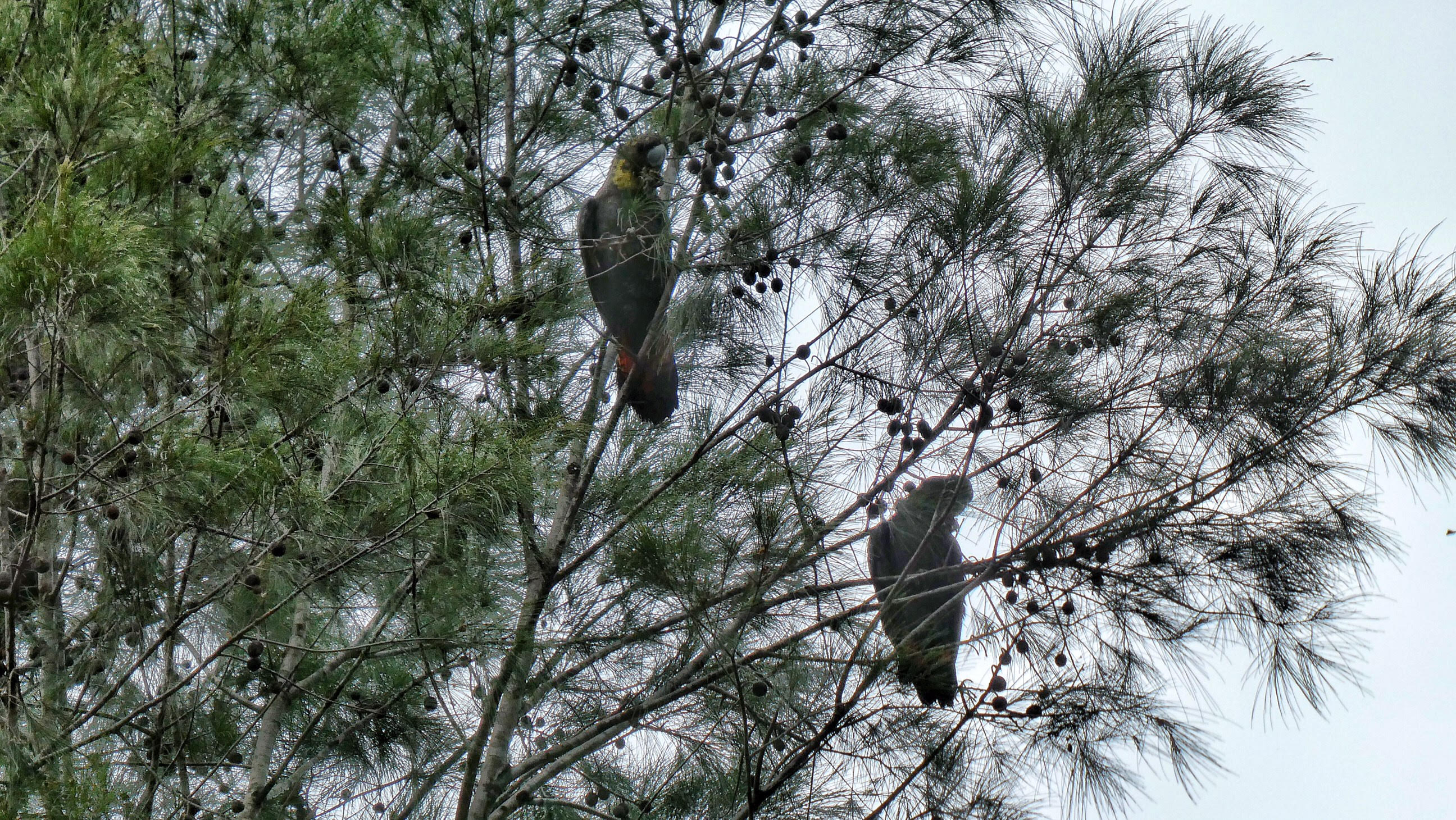
The sun moves on, and the day is subdued in the noonday heat. Afternoon reaches for evening and at four o’clock, and as if to schedule, a flight of yellow-tailed black cockatoos cruise in, squarking to each other as they settle into the banksias and casuarinas for a feed. Drongos chuckle and chatter, gamboling and chasing each other through the trees, carrying on like, well, drongos, as they take turns to swoop into the dam for a dip.
Then it is beer o’clock, and as we are sitting here, we hear some serous catbird courting. She’s way down in the valley below, and he, up on the spur, and they’re calling to each other like some Forest Cathie and Heathcliff. Over the next hour, they draw closer and closer together, her call becoming louder and louder, his keener and keener, their calls converging in the forest to our right. And maybe, soon, catbird kittens?
Changeover is upon us, that magical interlude when daytime segues into night-tide and the sounds of daylight and darkness meet, mingle and separate as the one melts and the other flows. Twilight approaches, and there is a flurry of argument and scuffling as birds grab their last snacks and hassle and hustle each other as they retire to their roosts. Mobs of kookaburras squawk like David Bowie’s monkey birds. But the night-tide hunters stir in silence, and tawnies, boobooks and powerful owls depart their shady day-time perches.
And then it is frog time. The generator frog heralds the changeover from day to night. Next, the bleaters start up, followed by the ding dings, the bonk bonks, barkers, and bubble wraps, wark warks and wot wots, and the rubber duckies. And among them, little Peronii, the frog who drops down from the foliage of overhanging trees as the air cools. The music of the night! We are waiting for the flying foxes to cross the evening sky for the silky oak nectar, and soon they will be slurping and chirping. The fireflies are ascending from the moist gullies, and for a brief time, bob like wandering bands of fairies through the forest that surrounds us; and the mozzies have begun to nip our ankles as we watch he show.
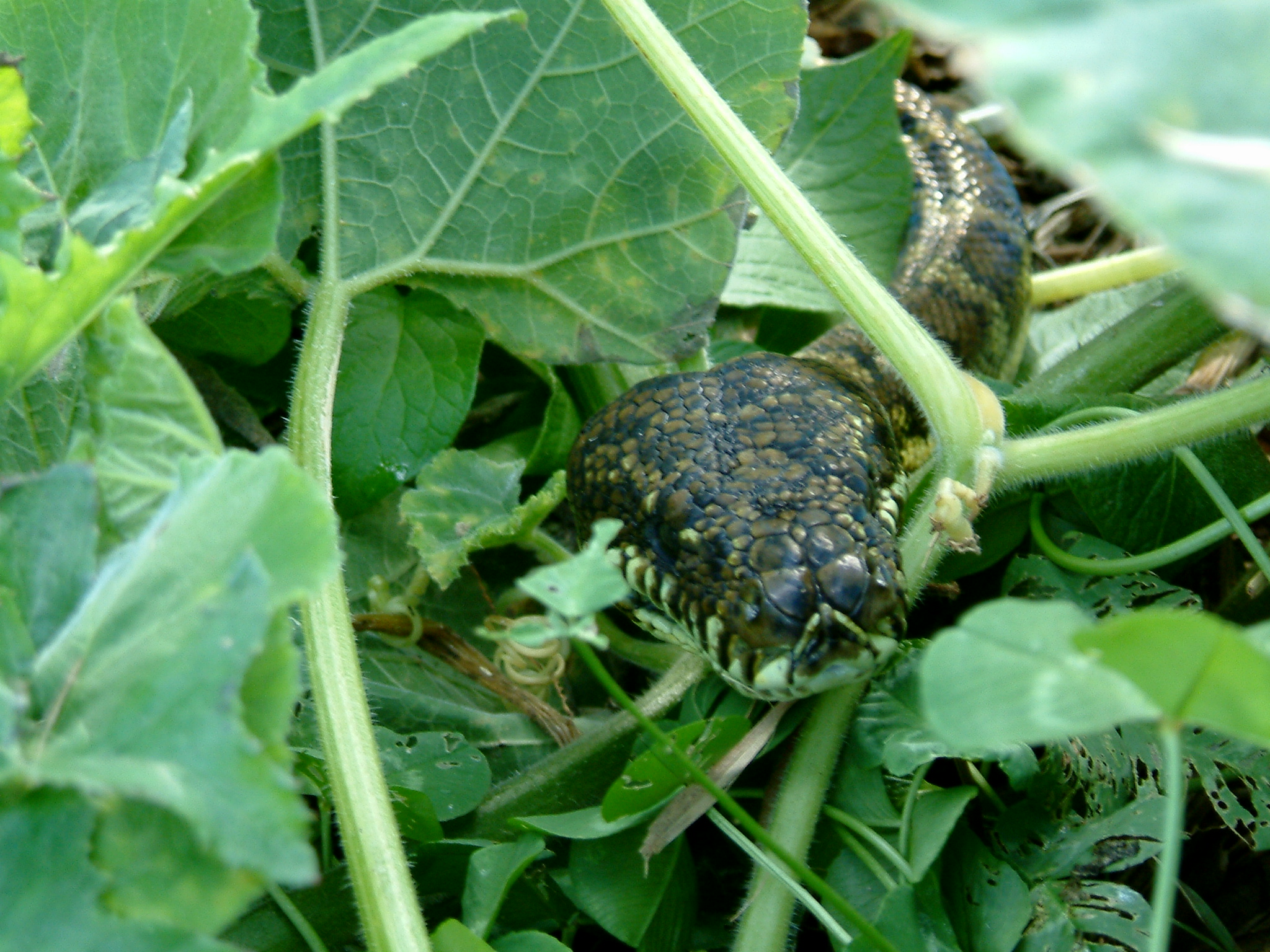
And did I mention the snakes? They’re waking early with these unseasonable Septembers. There’s one that set up home on the veggie garden on the lookout for little meals on legs …
Ah! The country life!
Carpet Python
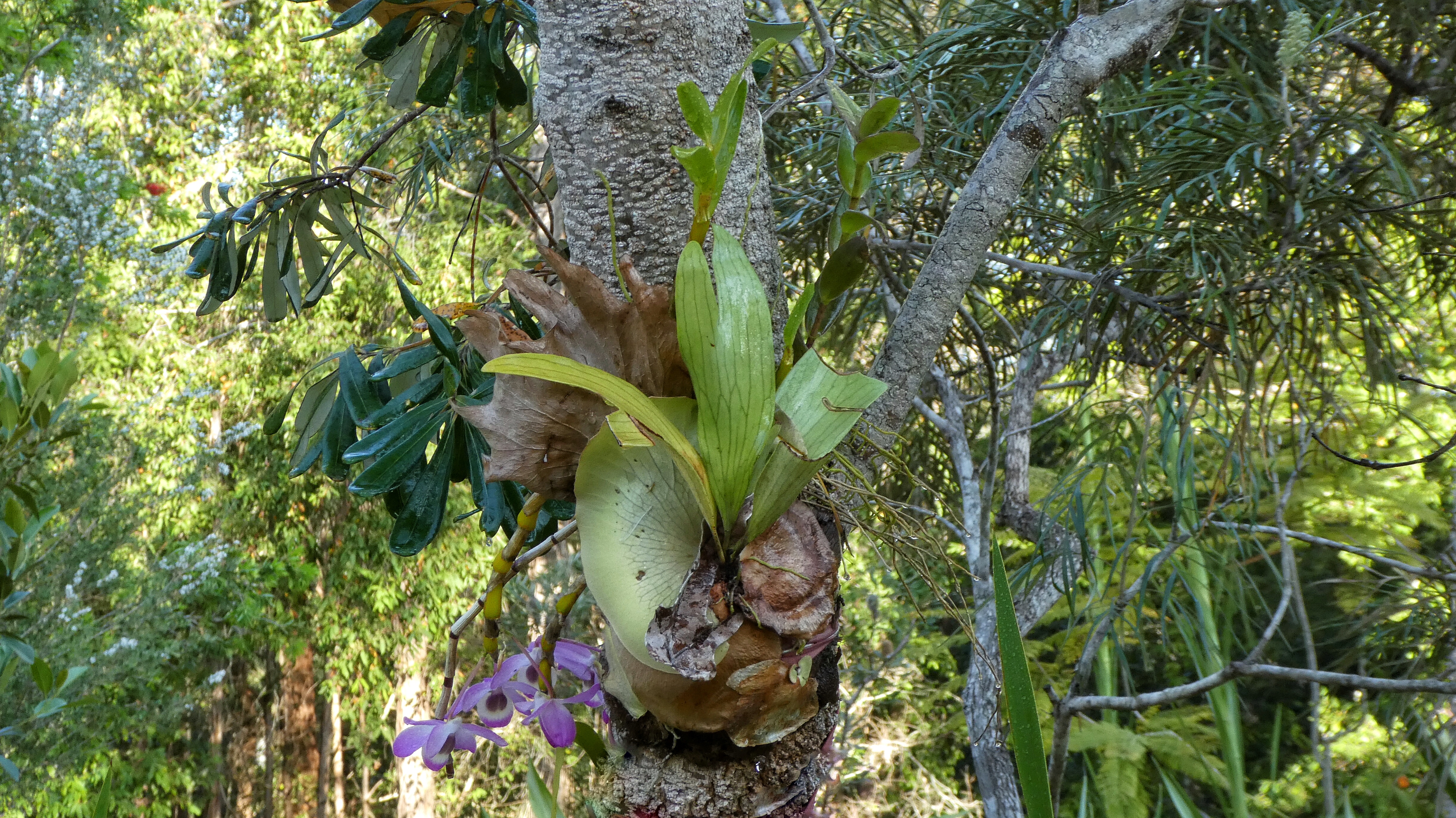
See below for a picture gallery of our wild friends and neighbours …
We in Bellingen Shire, some ten kilometres west of the seaside town of Urunga on the mid north coast of New South Wales. The forest lies between the Bellinger and Kalang Rivers, and these are connected tidally to the ocean at Urunga – the only place in Australia where two rivers meet the ocean together. The forest rises from the rivers on either side of the Fernmount Range, the easternmost extension of the Great Dividing Range that spans the eastern edge of our island continent. Above and between the two rivers, it is a rain-harvesting, filtration and stabilization ecosystem vital to the waterways and wetlands around them, and is a habitat for bird, reptilian, mammalian and marsupial wildlife, including koalas, wallabies, echidnas, quolls, goannas, owls, fruit doves and cockatoos. The east-west Fernmount Range Trail is an ancient highway called the Yildaan Dreaming Track. It led from the plains beyond the Dorrigo massif to what is now the seaside town of Urunga, known then to the Gumbaynggirr people as a “place of plenty”. The first people would descend the spurs on the north and south flanks of the range to fishing and ceremonies on the riverside. The Tarkeeth Forest therefore contains areas of significant indigenous culture, recalling song lines and stories of the Dreamtime, places of ceremony, of birth and burial, and of atrocity.
We have been visiting Bellingen Shire for the last thirty years, and moved a house onto our bush block over twenty years ago. in the Bellinger Valley on the Mid North Coast of New South Wales. Bellingen is well known as a picturesque, well-preserved (founded in 1870) country town. In former times, it was the centre of a thriving dairy and timber industry, and in more recent times, as a popular tourist transit between the university city of Armidale and the country music capital of Tamworth to the west, and the Pacific “holiday coast” of Coffs Harbour, Sawtell, Urunga, and Nambucca Heads, with their sand, surf and sun.
Between the two is the Great Dividing Range, the rolling, high country escarpment of the New England Plateau with its gorges and waterfalls, and the world-heritage Dorrigo National Park with it timeless, untouched rainforests – a “land that time forgot”. And linking them all, the old trunk road, aptly if touristically named Waterfall Way.
Bellingen is popular for its cafes and coffee shops, craft industries and shops, music festivals, and federation facades. It’s visual appeal, and it’s bucolic rural environs have seen the town used on many occasions as a film location. In the seventies, it was a Mecca for young people seeking an alternative lifestyle. The hills thereabout are still scattered with cooperatives and communes, or, in local council-speak, multiple occupancy. In those days, no love was lost between the “hippies” and the farmers and loggers, and politics were dominated by the rural, conservative “born to rule” National and Country Party. Nowadays, it’s heir, the National Party still dominates the political scene, but its clear majorities decrease election by election, and by the turn of the century, there may no longer be a National Party member. But demographics do change, as does society. The hippies’ children and the farmers kids grew up together, attended the high school together, played, partied, and paired, and now, there are grand children and great grandchildren.
As the timber and dairy industry has declined, Bellingen’s economy has changed. Once exclusively agrarian – including a time as one of the prime producers of cannabis sativa – tourism plays a a vital role, Bellingen advertises itself to visitors and to present and future residents as a clean, green and sustainable shire. Nature’s wonderland, from its golden beaches to its mountain rainforests and waterfalls. Tourist Heaven with a cornucopia of recreational activities for young and old. Lazy bathing and picnicking to energetic rambling and trecking, camping and climbing, canoeing and fishing. Cultural mecca with its cafes, live music,craft and artisan shops, and music festivals.
Two years ago, the online magazine Traveller published a breathless paean to “the bohemian town that is heaven on earth’. Happy traveller Sheriden Rhodes wrote: Some places are so beautiful; it feels like holy ground. For me, Bellingen has always had that consecrated feeling. It’s obvious, given the name the early pioneers gave the Promised Land, a scenic 10 minute-drive from Bellingen’s township itself. Here the land is so abundantly verdant and fruitful; it literally drips with milk and honey. It’s a place so special the fortunate locals that call it home, including its most famous residents George Negus and David Helfgott would much rather keep all to themselves”.
This is the spin. The reality is somewhat different. Bellingen and the “Holiday Coast” generally have seen a large influx of city folk seeking a different lifestyle for themselves and their children, and also of retirees seeking rural or seaside tranquility -in such numbers that Coffs Harbour and its seaside satellites have become in many ways the Costa Geriatrica.
Many newcomers are not fully aware that the Coffs Coast generally is one of the poorest areas of rural New South Wales. Statistics for youth unemployment and senior poverty are among the highest in the state with all the attendant economic, social and psychological impacts as evidence in high rates of depression, domestic violence and substance abuse. Health and transport services outside the urban centres are pretty poor. But on the right side of the ledger, despite the environmental degradation of clear-felling, land-clearing, flammable, monoculture, woodchip-bound eucalyptus plantations that encircle Bellingen, a potential fire bomb primed to explode during one of our scorching, hot dry summers, the generational degradation of the Bellinger’s banks and the graveling up of its once deep depths, and the encroachment and expansion of water-hungry, pesticide and herbicide reliant blueberry farms, we in the Shire are indeed blessed by Mother Nature.
The coastline boasts magnicent headlands and promontories, and long, pristine and often deserted beaches. The World Heritage Gondwana rainforests are a national treasure, and surrounding national parks truly are a natural wonderland. We never tire of the drive from Urunga to Armidale via Waterfall Way, as it crosses the Great Dividing Range and the New England Plateau. The Kalang River as it flows beside South Arm Road and between the Tarkeeth and Newry State Forests is itself one of the Shire’s hidden and largely unvisited secrets, a haven for fishermen, canoeist and all who love mucking about in boats.
Compared to many places on this planet, we’ve really not much to complain about …
For other posts in our Small Stories series of ordinary folk doing extraordinary things, see: TheOdyssey of Assid Corban, the story of a Lebanese migrant to New Zealand, and The Monarch of the Sea, the rollicking tale of an unlikely “pirate king”.
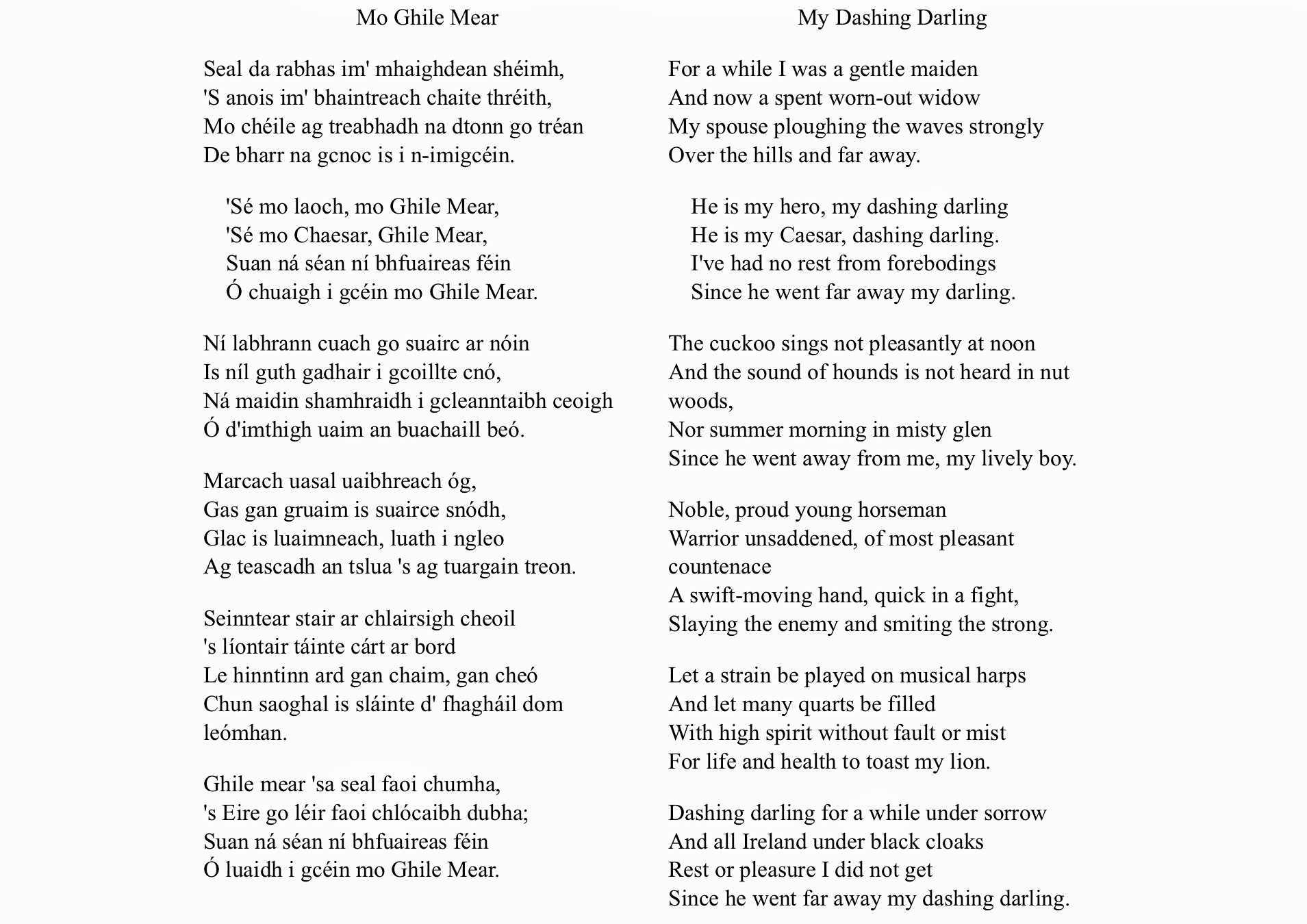
Sé mo laoch, mo Ghile Mear, ‘Sé mo Chaesar, Ghile Mear, Suan ná séan ní bhfuaireas féin Ó chuaigh i gcéin mo Ghile Mear
The song begins as the camera focuses on the face of the singer. A soft and confident tenor, he gently leans into a long-gone poet’s Gaelic verse. The camera pulls back to reveal a phalanx of young people behind him. They are dressed plainly. The lads in dark suits and open-neck, white shirts, and most sport five o’clock shadows. The lassies in dark dresses, blouses and pants. They join the soloist, quietly at first, but rising soon in unison. A bodhran kicks in, sharp and deliberate. The young folk stand still, yet their heads nod almost imperceptibly to the bodhran’s driving beat, and the song lifts off and soars. The camera pans across the choir, focusing on their faces, and particularly, their eyes – almost all of them clear and blue. The joy in the eyes, their smiles, and their voices is there for all to see and hear. Their voices rise, and then gradually fall, as if to glide to a gentle landing. The choir hums softly as the singer gently repeats the last line. Ó chuaigh i gcéin mo Ghile Mear – “since my darling went away”, And it is done.
Mo Ghile Mearis a paradoxical, quixotic song that is at once romantic and political. If you have but a drop of Celtic blood in your veins or a rebel heart in your breast, you will fall under its spell.
Variously translated as “my gallant hero”, “my gallant star”, and “my dashing darling”, Mo Ghile Mear is a Jacobite love song that is as muchabout politics as about romance. Inspired as it was was by theJacobite Rising against Protestant England’s rule in 1745, romance and politics do indeed unite in heroic, insurrectionary failure.
it was written in Gaelic by poet Seán Clárach Mac Domhnaill after the battle of Culloden which dashed for two and a half centuries the Scots’ dreams of independence. Composed in the convention of Aisling (Gaelic for “dream” or “vision”) poetry, it is a lament by the Gaelic goddess Éire for Bonnie Prince Charlie, Charles Stuart, the “Young Pretender” to the Protestant Hanoverian English throne that once belonged to the Roman Catholic Stuart clan, and who after the bloody failure of the ’45, fled into exile in France. And that’s where he remained, although his last resting place is in the crypt of Saint Peter’s Basilica in Rome – an ironic ending for this could’ve been champion of Catholic hopes.
Bonny Prince Charlie had many romantic and rousing songs written about him. But in reality he wasn’t the dashing, gallant leader that the songs portrayed and that the Scots and their Celtic Irish allies yearned for – most certainly not the Caesar of this song. He was an indecisive and vacillating leader, who thought himself much cleverer and popular than he actually was, and when the going got rough, he got going – and left the the Scots and Irish who supported him with blood and treasure to the tender mercies of the Sassenach foe.
And yet, the songs live on to this day, most notably in The Skye Boat Song, Will Ye No Come Back Again. The old and well-recorded favourite Óró sé do bheatha ‘bhaile has also been associated with the Jacobite cause as Séarlas Óg (“Young Charles” in Gaelic). The poet Padraig Pearse, leader of the doomed intifada we know as the Easter Rising of 1916, added new verses, and so the song entered the rebel canon.
Mo Ghile Mear differs from more conventional Aisling poems in which the poet is asleep or otherwise minding his own business when he experiences a dream or vision of a fair maid. In this cerebral wet dream, the poet personifies Éire – Ireland, the country itself – as a woman who once was a fair maiden but is now a widow. Her husband, the “Gallant” whatever is not dead but, but he is far away. As a consequence the land is failing and nature itself is in decline.
Popular since the 18th century, song has come to international attention in our own drear times – largely due to a host of recordings, and accompanying You Tube interest.
Iconic chanteuse Mary Black presents the song as a gentle, sad air. Sting famously recorded it with the renowned Celtic ensemble The Chieftains, and they give an understated and fair account of themselves, although the reinvented English lyrics turn “Our Hero” into a dashing cavalier”, swords and harps and all, far removed from original dream song. It is an easy song to overcook, but Sting managed to resist the temptation. Not so that be-kilted posse Celtic Thunder who ramp up the Celtic bombast, reinventing the English lyrics as a curiously anachronistic, latter-day “rebel song” – “Hail the Hero”, the Battle Hymn of the Irish Republic, with a massive Irish flag waving o’er them all. What would The Minstrel Boy have thought about this?
Then there is the overreach of the much-loved and very popular, kitsch-laden, outings of Celtic Woman, invariably staged to maximum visual effect and capacity audiences at fantastically photogenic Irish castles. These handsome, well-dressed colleens do not crimp on the gowns, choirs, drums and bagpipes. Their Gaelic rewrite, transforms our “dashing darling” into a lovelorn mariner, replete with waves and tides, sails and sunsets. The ladies’ latest outing, with a relatively new lineup, sustains the razzmatazz with the eponymous “gallant star” resurrected as a martial beacon for “freedom’s sons”. It would seem that maritime motif of the girls’ original rendering was superfluous on an album that included My Heart Will Go On, from that damp, tear-jerking, blockbuster, “Titanic”. Oh, Danny Boy, the pipes the pipes are calling!
That such liberties are taken with the lyrics is no big thing, however. Old Seán Clárach would probably agree that his original Aisling poem would be a wee bit archaic in this day and age, and that the undefeated despair, hope and longing of Éire’s dream were no longer relevant in a free, democratic and relatively prosperous (that is, post GFC) Ireland. He would no doubt have updated his verse, just as Padraig Pearse did with his song in 1916, substituting a 16th Century Irish pirate, the “great sea warrior” Gráinne Mhaol for the foreign born Charlie (so the ladies of Celtic Woman were not that far off-track with their nautical rewrite after all). But this mythologizing of Ireland’s heroes too often comes across as self-reverentially corny.
Cynics might blame the atmospheric, anthemic stadium rock of Bono and U2 for this commercialization of Irish music. Others blame Enya’s symphonic, new age outings once she put behind her the Celtic mist and moodiness of her Clannad siblings. But I reckon that hitherto timeless, soulful and folksy Irish music has been like this since the Riverdancecrew first stamped their collective hard shoes during the intermission of the Eurovision Song Contest and stole the show. But most Irish folk blame Michael Flatley, as the authoritative Waterford Whisperermade clear.
Meanwhile, in my opinion, the most sensitive, beautiful and indeed, rousing rendition of Mo Ghile Mear is the one described at the head of this post. No naff English lyrics are required. The original words of the Gaelic poem resonate powerfully through the hall.
It is sung by the Choral Scholars of University College, Dublin, an amateur, mostly acapella bunch of Irish students. These young folk formally audition for a scholarship with the ensemble. There is little glamour or artifice, no fireworks or vocal gymnastics. Plainly dressed, they look like folk you would pass on the streets of Dublin or Galway. Mark Waters, the portly lead singer would never get a gig in an Irish boy band, but wouldn’t look out of place in a church choir. The drama is achieved by inflection, modulation and tone, the lighting and way the choir is physically arranged in an eerily martial wedge, their only movement being that almost imperceptible nod of their heads in time with the lone bodran’s beat as the song builds momentum.
Here is Brendan Graham’s achingly beautiful song Orphan Girl with the Choral Scholars featuring Abby Molloy. Sung from the perspective of one of Ireland’s famine orphans, on the eve of her inspection, which would decide whether she could travel to Australia, to escape the workhouse which had become her life.
And here are the recordings I referred to above. Enjoy.:
In the dark times will there also be singing? Yes, there will also be singing. About the dark times.
Berthold Brecht
Rhiannon Giddens, a multifaceted singer, musician, folklorist and storyteller brings American history alive in her her drive to unearth the stories of forgotten people so that her audiences and listeners may remember them.
On Moon Meets The Sun, a defiantly joyous song, Giddens and her comrades of Our Native Daughters sing in the round over a polyrhythmic lacework of banjo and guitar, vowing not to let radical suffering diminish humanity. “You put the shackles on our feet, but we’re dancing”, she sings, “You steal our very tongue, but we’re dancing” “Ah, you sell our work for your profit, but we’re dancing,” she scoffs. “Ah, you think our home we have forgotten, but we’re dancing.” Then she recedes into the jubilant tangle of voices: “You can’t stop us now (We’ll be dancing). You can’t keep us down (We’ll be dancing)”.
Rhiannon Giddens: “There is surely racism in this country — it’s baked into our oldest institutions – just as there is sexism, millennia old. At the intersection of the two stands the African American woman. Used, abused, ignored and scorned, she has in the face of these things been unbelievably brave, groundbreaking and insistent. Black women have historically had the most to lose, and have therefore been the fiercest fighters for justice — in large, public ways that are only beginning to be highlighted, and in countless domestic ways that will most likely never be acknowledged.”
Quasheba, Quasheba
You’re free now, you’re free now
How does your spirit fly?
Blood of your blood
Bone of your bone
By the grace of your strength we have life
From the Golden Coast of Ghana
To the bondage of Grenada
You kept the dream of hope alive
They burned your body
They cursed your blackness
But they could not take your lights
Raped and beaten, your babies taken
Starved and sold and sold again
Ain’t you a woman, of love deserving
Ain’t it somethin’ you survived?
Quasheba, Quasheba
You’re free now, you’re free now
How does your spirit fly?
Blood of your blood
Bone of your bone
By the grace of your strength we have life
You dreamt of home, you dreamt of freedom
You died a slave, you died alone
You came from warriors who once built empires
Ashanti’s kingdom carries on
You were forgotten, almost forsaken
Your children founded generations
Your strength sustained them
They won their freedom
Traced their roots to find you [waiting?]
Quasheba, Quasheba
You’re free now, you’re free now
How far your spirit’s flown
Blood of your blood
Bone of your bone
By the grace of your strength we are home
Blood of your blood
Bone of your bone
By the grace of your strength we are home
By the grace of your strength we are home
We are home
We are home
We are home
I am reminded of Pete Seeger’s adaptation of the old Baptist hymn:
” My life flows on in endless song
Above earth’s lamentation.
I hear the real, thought far off hymn
That hails the new creation
Above the tumult and the strife,
I hear the music ringing;
It sounds an echo in my soul
How can I keep from singing?”
Here is the wondrous Éabha McMahon of Celtic Woman:
In the dark times
Will there also be singing?
Yes, there will also be singing
About the dark times.
– Bertolt Brecht, motto to Svendborg Poems, 1939
In an essay called ‘Undefeated Despair’, John Berger wrote of ‘Despair without fear, without resignation, without a sense of defeat.’ ‘However you look at it’, the Guardian editorialised a few days ago, ‘2017 offers a fearful prospect for America and the world.’ In the words of Paul Simon’s ‘American Tune’, I don’t have a friend who feels at ease when weighing the prospects for the year ahead. In the spirit that some solace may be found in poetry in these dark times, I offer a selection of poems or brief extracts – some have which have appeared in posts here before – which seem to offer meaning and hope; they may reflect Berger’s stance of undefeated despair, offering not ‘a promise, or a consolation, or an oath…
In Invisible Republic, his masterful telling of the story behind “The Basement Tapes”, Greil Marcus, quotes Bob Dylan: “Traditional music is based on hexagrams. It comes about from legends, Bibles, plagues, and it revolves around vegetables and death”.
And this is precisely the theme of Dylan’s belated Nobel Lecture, a presentation that is in its style, scope and subject matter, a a laid-back, folksey spoken edition of the long-awaited and probably never to be written “Chronicles – Volume 2”.
Constructed around his précis of three of the many books that have influenced his writing over more than half a century – Moby-Dick, All Quiet of the Western Front, and The Odyssey – he recalls how he had mined the literary canon for myth and meaning, often uncertain and uncaring about how one ended and the other began. As he concludes:
“If a song moves you, that’s all that’s important. I don’t have to know what a song means. I’ve written all kinds of things into my songs. And I’m not going to worry about it – what it all means”.
The full text of Bob’s lecture follows this recording:
Bob Dylan’s Nobel Lecture
When I first received this Nobel Prize for Literature, I got to wondering exactly how my songs related to literature. I wanted to reflect on it and see where the connection was. I’m going to try to articulate that to you. And most likely it will go in a roundabout way, but I hope what I say will be worthwhile and purposeful.
If I was to go back to the dawning of it all, I guess I’d have to start with Buddy Holly. Buddy died when I was about eighteen and he was twenty-two. From the moment I first heard him, I felt akin. I felt related, like he was an older brother. I even thought I resembled him. Buddy played the music that I loved – the music I grew up on: country western, rock ‘n’ roll, and rhythm and blues. Three separate strands of music that he intertwined and infused into one genre. One brand. And Buddy wrote songs – songs that had beautiful melodies and imaginative verses. And he sang great – sang in more than a few voices. He was the archetype. Everything I wasn’t and wanted to be. I saw him only but once, and that was a few days before he was gone. I had to travel a hundred miles to get to see him play, and I wasn’t disappointed.
He was powerful and electrifying and had a commanding presence. I was only six feet away. He was mesmerizing. I watched his face, his hands, the way he tapped his foot, his big black glasses, the eyes behind the glasses, the way he held his guitar, the way he stood, his neat suit. Everything about him. He looked older than twenty-two. Something about him seemed permanent, and he filled me with conviction. Then, out of the blue, the most uncanny thing happened. He looked me right straight dead in the eye, and he transmitted something. Something I didn’t know what. And it gave me the chills.
I think it was a day or two after that that his plane went down. And somebody – somebody I’d never seen before – handed me a Leadbelly record with the song “Cottonfields” on it. And that record changed my life right then and there. Transported me into a world I’d never known. It was like an explosion went off. Like I’d been walking in darkness and all of the sudden the darkness was illuminated. It was like somebody laid hands on me. I must have played that record a hundred times.
It was on a label I’d never heard of with a booklet inside with advertisements for other artists on the label: Sonny Terry and Brownie McGhee, the New Lost City Ramblers, Jean Ritchie, string bands. I’d never heard of any of them. But I reckoned if they were on this label with Leadbelly, they had to be good, so I needed to hear them. I wanted to know all about it and play that kind of music. I still had a feeling for the music I’d grown up with, but for right now, I forgot about it. Didn’t even think about it. For the time being, it was long gone.
I hadn’t left home yet, but I couldn’t wait to. I wanted to learn this music and meet the people who played it. Eventually, I did leave, and I did learn to play those songs. They were different than the radio songs that I’d been listening to all along. They were more vibrant and truthful to life. With radio songs, a performer might get a hit with a roll of the dice or a fall of the cards, but that didn’t matter in the folk world. Everything was a hit. All you had to do was be well versed and be able to play the melody. Some of these songs were easy, some not. I had a natural feeling for the ancient ballads and country blues, but everything else I had to learn from scratch. I was playing for small crowds, sometimes no more than four or five people in a room or on a street corner. You had to have a wide repertoire, and you had to know what to play and when. Some songs were intimate, some you had to shout to be heard.
By listening to all the early folk artists and singing the songs yourself, you pick up the vernacular. You internalize it. You sing it in the ragtime blues, work songs, Georgia sea shanties, Appalachian ballads and cowboy songs. You hear all the finer points, and you learn the details.
You know what it’s all about. Takin’ the pistol out and puttin’ it back in your pocket. Whippin’ your way through traffic, talkin’ in the dark. You know that Stagger Lee was a bad man and that Frankie was a good girl. You know that Washington is a bourgeois town and you’ve heard the deep-pitched voice of John the Revelator and you saw the Titanic sink in a boggy creek. And you’re pals with the wild Irish rover and the wild colonial boy. You heard the muffled drums and the fifes that played lowly. You’ve seen the lusty Lord Donald stick a knife in his wife, and a lot of your comrades have been wrapped in white linen.
I had all the vernacular all down. I knew the rhetoric. None of it went over my head – the devices, the techniques, the secrets, the mysteries – and I knew all the deserted roads that it traveled on, too. I could make it all connect and move with the current of the day. When I started writing my own songs, the folk lingo was the only vocabulary that I knew, and I used it.
But I had something else as well. I had principals and sensibilities and an informed view of the world. And I had had that for a while. Learned it all in grammar school. Don Quixote, Ivanhoe, Robinson Crusoe, Gulliver’s Travels, Tale of Two Cities, all the rest – typical grammar school reading that gave you a way of looking at life, an understanding of human nature, and a standard to measure things by. I took all that with me when I started composing lyrics. And the themes from those books worked their way into many of my songs, either knowingly or unintentionally. I wanted to write songs unlike anything anybody ever heard, and these themes were fundamental.
Specific books that have stuck with me ever since I read them way back in grammar school – I want to tell you about three of them: Moby-Dick, All Quiet on the Western Front and The Odyssey.
President Barack Obama presents rock legend Bob Dylan with a Medal of Freedom, Tuesday, May 29, 2012, during a ceremony at the White House in Washington. (AP Photo/Charles Dharapak)
Moby-Dick is a fascinating book, a book that’s filled with scenes of high drama and dramatic dialogue. The book makes demands on you. The plot is straightforward. The mysterious Captain Ahab – captain of a ship called the Pequod – an egomaniac with a peg leg pursuing his nemesis, the great white whale Moby Dick who took his leg. And he pursues him all the way from the Atlantic around the tip of Africa and into the Indian Ocean. He pursues the whale around both sides of the earth. It’s an abstract goal, nothing concrete or definite. He calls Moby the emperor, sees him as the embodiment of evil. Ahab’s got a wife and child back in Nantucket that he reminisces about now and again. You can anticipate what will happen.
The ship’s crew is made up of men of different races, and any one of them who sights the whale will be given the reward of a gold coin. A lot of Zodiac symbols, religious allegory, stereotypes. Ahab encounters other whaling vessels, presses the captains for details about Moby. Have they seen him? There’s a crazy prophet, Gabriel, on one of the vessels, and he predicts Ahab’s doom. Says Moby is the incarnate of a Shaker god, and that any dealings with him will lead to disaster. He says that to Captain Ahab. Another ship’s captain – Captain Boomer – he lost an arm to Moby. But he tolerates that, and he’s happy to have survived. He can’t accept Ahab’s lust for vengeance.
This book tells how different men react in different ways to the same experience. A lot of Old Testament, biblical allegory: Gabriel, Rachel, Jeroboam, Bildah, Elijah. Pagan names as well: Tashtego, Flask, Daggoo, Fleece, Starbuck, Stubb, Martha’s Vineyard. The Pagans are idol worshippers. Some worship little wax figures, some wooden figures. Some worship fire. The Pequod is the name of an Indian tribe.
Moby Dick is a seafaring tale. One of the men, the narrator, says, “Call me Ishmael.” Somebody asks him where he’s from, and he says, “It’s not down on any map. True places never are.” Stubb gives no significance to anything, says everything is predestined. Ishmael’s been on a sailing ship his entire life. Calls the sailing ships his Harvard and Yale. He keeps his distance from people.
A typhoon hits the Pequod. Captain Ahab thinks it’s a good omen. Starbuck thinks it’s a bad omen, considers killing Ahab. As soon as the storm ends, a crewmember falls from the ship’s mast and drowns, foreshadowing what’s to come. A Quaker pacifist priest, who is actually a bloodthirsty businessman, tells Flask, “Some men who receive injuries are led to God, others are led to bitterness.”
Everything is mixed in. All the myths: the Judeo Christian bible, Hindu myths, British legends, Saint George, Perseus, Hercules – they’re all whalers. Greek mythology, the gory business of cutting up a whale. Lots of facts in this book, geographical knowledge, whale oil – good for coronation of royalty – noble families in the whaling industry. Whale oil is used to anoint the kings. History of the whale, phrenology, classical philosophy, pseudo-scientific theories, justification for discrimination – everything thrown in and none of it hardly rational. Highbrow, lowbrow, chasing illusion, chasing death, the great white whale, white as polar bear, white as a white man, the emperor, the nemesis, the embodiment of evil. The demented captain who actually lost his leg years ago trying to attack Moby with a knife.
We see only the surface of things. We can interpret what lies below any way we see fit. Crewmen walk around on deck listening for mermaids, and sharks and vultures follow the ship. Reading skulls and faces like you read a book. Here’s a face. I’ll put it in front of you. Read it if you can.
Tashtego says that he died and was reborn. His extra days are a gift. He wasn’t saved by Christ, though, he says he was saved by a fellow man and a non-Christian at that. He parodies the resurrection.
When Starbuck tells Ahab that he should let bygones be bygones, the angry captain snaps back, “Speak not to me of blasphemy, man, I’d strike the sun if it insulted me.” Ahab, too, is a poet of eloquence. He says, “The path to my fixed purpose is laid with iron rails whereon my soul is grooved to run.” Or these lines, “All visible objects are but pasteboard masks.” Quotable poetic phrases that can’t be beat.
Finally, Ahab spots Moby, and the harpoons come out. Boats are lowered. Ahab’s harpoon has been baptized in blood. Moby attacks Ahab’s boat and destroys it. Next day, he sights Moby again. Boats are lowered again. Moby attacks Ahab’s boat again. On the third day, another boat goes in. More religious allegory. He has risen. Moby attacks one more time, ramming the Pequod and sinking it. Ahab gets tangled up in the harpoon lines and is thrown out of his boat into a watery grave.
Ishmael survives. He’s in the sea floating on a coffin. And that’s about it. That’s the whole story. That theme and all that it implies would work its way into more than a few of my songs.
Moby-Dick
All Quiet on the Western Front was another book that did. All Quiet on the Western Front is a horror story. This is a book where you lose your childhood, your faith in a meaningful world, and your concern for individuals. You’re stuck in a nightmare. Sucked up into a mysterious whirlpool of death and pain. You’re defending yourself from elimination. You’re being wiped off the face of the map. Once upon a time you were an innocent youth with big dreams about being a concert pianist. Once you loved life and the world, and now you’re shooting it to pieces.
Day after day, the hornets bite you and worms lap your blood. You’re a cornered animal. You don’t fit anywhere. The falling rain is monotonous. There’s endless assaults, poison gas, nerve gas, morphine, burning streams of gasoline, scavenging and scabbing for food, influenza, typhus, dysentery. Life is breaking down all around you, and the shells are whistling. This is the lower region of hell. Mud, barbed wire, rat-filled trenches, rats eating the intestines of dead men, trenches filled with filth and excrement. Someone shouts, “Hey, you there. Stand and fight.”
Who knows how long this mess will go on? Warfare has no limits. You’re being annihilated, and that leg of yours is bleeding too much. You killed a man yesterday, and you spoke to his corpse. You told him after this is over, you’ll spend the rest of your life looking after his family. Who’s profiting here? The leaders and the generals gain fame, and many others profit financially. But you’re doing the dirty work. One of your comrades says, “Wait a minute, where are you going?” And you say, “Leave me alone, I’ll be back in a minute.” Then you walk out into the woods of death hunting for a piece of sausage. You can’t see how anybody in civilian life has any kind of purpose at all. All their worries, all their desires – you can’t comprehend it.
More machine guns rattle, more parts of bodies hanging from wires, more pieces of arms and legs and skulls where butterflies perch on teeth, more hideous wounds, pus coming out of every pore, lung wounds, wounds too big for the body, gas-blowing cadavers, and dead bodies making retching noises. Death is everywhere. Nothing else is possible. Someone will kill you and use your dead body for target practice. Boots, too. They’re your prized possession. But soon they’ll be on somebody else’s feet.
There’s Froggies coming through the trees. Merciless bastards. Your shells are running out. “It’s not fair to come at us again so soon,” you say. One of your companions is laying in the dirt, and you want to take him to the field hospital. Someone else says, “You might save yourself a trip.” “What do you mean?” “Turn him over, you’ll see what I mean.”
You wait to hear the news. You don’t understand why the war isn’t over. The army is so strapped for replacement troops that they’re drafting young boys who are of little military use, but they’re draftin’ ‘em anyway because they’re running out of men. Sickness and humiliation have broken your heart. You were betrayed by your parents, your schoolmasters, your ministers, and even your own government.
The general with the slowly smoked cigar betrayed you too – turned you into a thug and a murderer. If you could, you’d put a bullet in his face. The commander as well. You fantasize that if you had the money, you’d put up a reward for any man who would take his life by any means necessary. And if he should lose his life by doing that, then let the money go to his heirs. The colonel, too, with his caviar and his coffee – he’s another one. Spends all his time in the officers’ brothel. You’d like to see him stoned dead too. More Tommies and Johnnies with their whack fo’ me daddy-o and their whiskey in the jars. You kill twenty of ‘em and twenty more will spring up in their place. It just stinks in your nostrils.
You’ve come to despise that older generation that sent you out into this madness, into this torture chamber. All around you, your comrades are dying. Dying from abdominal wounds, double amputations, shattered hipbones, and you think, “I’m only twenty years old, but I’m capable of killing anybody. Even my father if he came at me.”
Yesterday, you tried to save a wounded messenger dog, and somebody shouted, “Don’t be a fool.” One Froggy is laying gurgling at your feet. You stuck him with a dagger in his stomach, but the man still lives. You know you should finish the job, but you can’t. You’re on the real iron cross, and a Roman soldier’s putting a sponge of vinegar to your lips.
Months pass by. You go home on leave. You can’t communicate with your father. He said, “You’d be a coward if you don’t enlist.” Your mother, too, on your way back out the door, she says, “You be careful of those French girls now.” More madness. You fight for a week or a month, and you gain ten yards. And then the next month it gets taken back.
All that culture from a thousand years ago, that philosophy, that wisdom – Plato, Aristotle, Socrates – what happened to it? It should have prevented this. Your thoughts turn homeward. And once again you’re a schoolboy walking through the tall poplar trees. It’s a pleasant memory. More bombs dropping on you from blimps. You got to get it together now. You can’t even look at anybody for fear of some miscalculable thing that might happen. The common grave. There are no other possibilities.
Then you notice the cherry blossoms, and you see that nature is unaffected by all this. Poplar trees, the red butterflies, the fragile beauty of flowers, the sun – you see how nature is indifferent to it all. All the violence and suffering of all mankind. Nature doesn’t even notice it.
You’re so alone. Then a piece of shrapnel hits the side of your head and you’re dead. You’ve been ruled out, crossed out. You’ve been exterminated. I put this book down and closed it up. I never wanted to read another war novel again, and I never did.
Charlie Poole from North Carolina had a song that connected to all this. It’s called “You Ain’t Talkin’ to Me,” and the lyrics go like this:
I saw a sign in a window walking up town one day.
Join the army, see the world is what it had to say.
You’ll see exciting places with a jolly crew,
You’ll meet interesting people, and learn to kill them too.
Oh you ain’t talkin’ to me, you ain’t talking to me.
I may be crazy and all that, but I got good sense you see.
You ain’t talkin’ to me, you ain’t talkin’ to me.
Killin’ with a gun don’t sound like fun.
You ain’t talkin’ to me.
Bob Dylan and Robbie Robertson
The Odyssey is a great book whose themes have worked its way into the ballads of a lot of songwriters: “Homeward Bound, “Green, Green Grass of Home,” “Home on the Range,” and my songs as well.
The Odyssey is a strange, adventurous tale of a grown man trying to get home after fighting in a war. He’s on that long journey home, and it’s filled with traps and pitfalls. He’s cursed to wander. He’s always getting carried out to sea, always having close calls. Huge chunks of boulders rock his boat. He angers people he shouldn’t. There’s troublemakers in his crew. Treachery. His men are turned into pigs and then are turned back into younger, more handsome men. He’s always trying to rescue somebody. He’s a travelin’ man, but he’s making a lot of stops.
He’s stranded on a desert island. He finds deserted caves, and he hides in them. He meets giants that say, “I’ll eat you last.” And he escapes from giants. He’s trying to get back home, but he’s tossed and turned by the winds. Restless winds, chilly winds, unfriendly winds. He travels far, and then he gets blown back.
He’s always being warned of things to come. Touching things he’s told not to. There’s two roads to take, and they’re both bad. Both hazardous. On one you could drown and on the other you could starve. He goes into the narrow straits with foaming whirlpools that swallow him. Meets six-headed monsters with sharp fangs. Thunderbolts strike at him. Overhanging branches that he makes a leap to reach for to save himself from a raging river. Goddesses and gods protect him, but some others want to kill him. He changes identities. He’s exhausted. He falls asleep, and he’s woken up by the sound of laughter. He tells his story to strangers. He’s been gone twenty years. He was carried off somewhere and left there. Drugs have been dropped into his wine. It’s been a hard road to travel.
In a lot of ways, some of these same things have happened to you. You too have had drugs dropped into your wine. You too have shared a bed with the wrong woman. You too have been spellbound by magical voices, sweet voices with strange melodies. You too have come so far and have been so far blown back. And you’ve had close calls as well. You have angered people you should not have. And you too have rambled this country all around. And you’ve also felt that ill wind, the one that blows you no good. And that’s still not all of it.
When he gets back home, things aren’t any better. Scoundrels have moved in and are taking advantage of his wife’s hospitality. And there’s too many of ‘em. And though he’s greater than them all and the best at everything – best carpenter, best hunter, best expert on animals, best seaman – his courage won’t save him, but his trickery will.
All these stragglers will have to pay for desecrating his palace. He’ll disguise himself as a filthy beggar, and a lowly servant kicks him down the steps with arrogance and stupidity. The servant’s arrogance revolts him, but he controls his anger. He’s one against a hundred, but they’ll all fall, even the strongest. He was nobody. And when it’s all said and done, when he’s home at last, he sits with his wife, and he tells her the stories.
____________________
So what does it all mean? Myself and a lot of other songwriters have been influenced by these very same themes. And they can mean a lot of different things. If a song moves you, that’s all that’s important. I don’t have to know what a song means. I’ve written all kinds of things into my songs. And I’m not going to worry about it – what it all means. When Melville put all his old testament, biblical references, scientific theories, Protestant doctrines, and all that knowledge of the sea and sailing ships and whales into one story, I don’t think he would have worried about it either – what it all means.
John Donne as well, the poet-priest who lived in the time of Shakespeare, wrote these words, “The Sestos and Abydos of her breasts. Not of two lovers, but two loves, the nests.” I don’t know what it means, either. But it sounds good. And you want your songs to sound good.
When Odysseus in The Odyssey visits the famed warrior Achilles in the underworld – Achilles, who traded a long life full of peace and contentment for a short one full of honor and glory – tells Odysseus it was all a mistake. “I just died, that’s all.” There was no honor. No immortality. And that if he could, he would choose to go back and be a lowly slave to a tenant farmer on Earth rather than be what he is – a king in the land of the dead – that whatever his struggles of life were, they were preferable to being here in this dead place.
That’s what songs are too. Our songs are alive in the land of the living. But songs are unlike literature. They’re meant to be sung, not read. The words in Shakespeare’s plays were meant to be acted on the stage. Just as lyrics in songs are meant to be sung, not read on a page. And I hope some of you get the chance to listen to these lyrics the way they were intended to be heard: in concert or on record or however people are listening to songs these days. I return once again to Homer, who says, “Sing in me, oh Muse, and through me tell the story.”
“Bear me up on angels’ wings, and other transcendental things. Where the golden walls still glow, let my people go to Jerusalem”.
Jerusalem is all about faith and passion, and there is no city on Earth that people get more passionate about. The light is luminous. In high summer it almost shimmers. The very air is full of prayer and politics, passion and pain, and the rocks and stones virtually sing a hallelujah chorus of history. I am not a religious person, but I cannot help getting excited by the place – although I do not transcend to transports of delight and delirium. Some folk love Jerusalem so much, they go mad.
I was in love with Dusty Springfield. In the drear tea-time of my adolescent soul, I worshiped her truly, madly, deeply. Tiny girl, big hair, panda eyes, hands moving like a beckoning siren. I just had to hear “da da da da da da” and then “I don’t know what it is that makes me love you so…” and I was hers for the next two and a half minutes. Until…
It was one of those beautiful late-spring evenings that you would get in the England of memory. The evening sun poured through the gothic stained glass windows of the school library – it was one of those schools. A group of lower sixth lads, budding intellectuals all, as lower sixth tended to be, gathered for a ‘desert island disks” show-and tell of their favourite records. Mine was ‘Wishin’ and Hopin‘ by you know who. Then it was on to the next. Clunk, hiss, guitar intro, and: “My love she speaks like silence, without ideas or violence, she doesn’t have to say she’s faithful, but she’s true like ice, like fire…” Bob had arrived, and I was gone, far gone. So was Dusty.
I bought a guitar. A clunky, eastern European thing. I tried ‘Blowin’ in the Wind’, but what came out was unrecognisable. My dad said he’d break it over my head. One day, that tipping point was reached. It sounded indeed like ‘Blowin’ in the Wind’, or something similar. I was away, and the rest, as they say, was hearsay.
On a high of hope and hype, so it all began. With a heritage of Irish rebel songs and folksongs, and the ‘sixties folkie canon (but never, ever ‘Streets of London’). Sea shanties, a capella Watersons, Sydney Carter’s faith-anchored chants, ‘The Lord of the Dance’ being the most beloved (a song now and forever burdened with the curse of Michael Flatley). Across the pond, young Bob Dylan, Joan Baez, and Peter, Paul & Mary decanted fine old wine into new bottles, and during the Easter CND march in London in 1966, billeted in an old cinema in Southall, a first public ‘performance’ with Ewan MacColl’s “Freeborn Man of the Traveling People”. The journey had begun, and, as the father of America poetryhad crooned, “Afoot and light-hearted, I take to the open road, healthy, free, the world before me, the long brown path before me, leading wherever I choose”.
And it led beside strange waters. “Marc Bolan warbled “My people were fair, and had sky in their hair, but now they’re content to wear crowns stars on their brows“. But didn’t they all in the days when Tolkien was king, and elves and ents walked amongst us. We thoroughly understood and empathized. And we marveled at the Scottish bard who could pen ‘The Minotaur’s Song‘ and ‘Job’s Tears‘, and then run off with Old Father Hubbard. Then Roy Harper, the high priest of Anglo angst, sang ‘McGoohan’s Blues’, a twenty minute digression from the concept if not the plot of an iconic if indecipherable television series. “The Prisoner is taking his shoes off to walk in the rain”.
The rebel yell that resounded in Paris in the summer of 1789 reverberated around Europe for 26 years until it sounded for the last time on the fields of Waterloo. On an overcast summer’s morning on Sunday 18th June, two hundred years ago, over one hundred thousand soldiers prepared to face each other in damp Belgian farmland. More gathered during that “longest day”. When darkness fell, up to fifty thousand of them lay dead or seriously wounded. A British rifleman would later recall: “I had never yet heard of a battle in which everybody was killed, but this seemed likely to be an exception, as all were going by turns.”
To historians, Waterloo is one of the great battles of history, a turning point, the beginning of the modern era. It ended the wars that had convulsed Europe – and since the French Revolution, theFirst FrenchEmpire and the career of Napoleon Bonaparte, one of the greatest commanders and statesmen in history. And it ushered in almost half a century of international peace in Europe; no further major conflict occurred until the Crimean War.
This song is for all those men who, after these long years of war, never came home.
Chaos is majestic in its way. I contemplate this vista of destruction and death with pain and helplessness in my soul. Red Army Captain Pavel Kovalenko, in All Hell Let Loose, Max Hastings, 2011
Before him, he carries noise, and behind him, he leaves tears; death, that dark spirit, in’s nervy arm doth lie; which, being advanc’d, declines, and then men die. Volumnia, in Shakespeare’s Corialanus, Act 2, Scene 1.
A new age dawned when the Bastille fell
Twenty six long years ago.
We marched the road of Europe
In the revolution’s glow.
In the floodtide of that revolution,
We bartered our young lives away.
And shoulder to shoulder we stood to arms
And held our foes at bay.
Against the might of empires,
Beyond our wildest dreams,
We fought the professional armies
Of Europe’s old regimes.
And hungry, tired and poorly armed,
We ragged volunteers
Pushed them back in disarray
Far from our own frontiers.
And we talked that time of setting stars
And the twilight of great powers.
And we never once thought that the sun would set
On an empire such as ours’.
But the siren song of liberty
Has lost its golden thrill.
The new age is now stained with blood
And we are marching still.
There came a great adventurer
For whom France was much too small.
As if we’d had not enough of war,
We answered to his call.
He was like a father unto us.
He served his children’s need.
A substitute for politics, for intellect and greed.
But he overreached in pomp and pride
To serve his vanity.
And we, the soldiers of the line,
Paid with our blood his fee.
‘til the whole world turned against us.
It neither forgot nor forgave
We who came to liberate
But stayed on to enslave
And we talked that time of setting stars
And the twilight of great powers.
And we never once thought that the sun would set
On an empire such as ours’.
But the siren song of liberty
Has lost its golden thrill.
The new age is now stained with blood
And we are marching still.
From the dust of Torres Vedras
To the bloodstained Russian snow.
We followed the Eagles loyally.
Never questioned why we go.
‘til the tide of conquest turned abut,
And showed us how it feels
To retrace weary footsteps
With the wolves hard at our heels.
And now we march our final march
On Belgium’s fertile soil.
We see an end to all or pain
And an end to mortal toil.
And the dream which fired us through the years
Has nothing left to yield
But peace that comes from a nameless death
On a confused battlefield.
And we talked that time of setting stars
And the twilight of great powers.
And we never once thought that the sun would set
On an empire such as ours.
But the tyrant song of liberty
Has lost its golden thrill.
The new age is now stained with blood
And we are marching still.

















 In That Howling Infinite