The fall of the Ottoman Empire and the birth of Türkiye

Preface

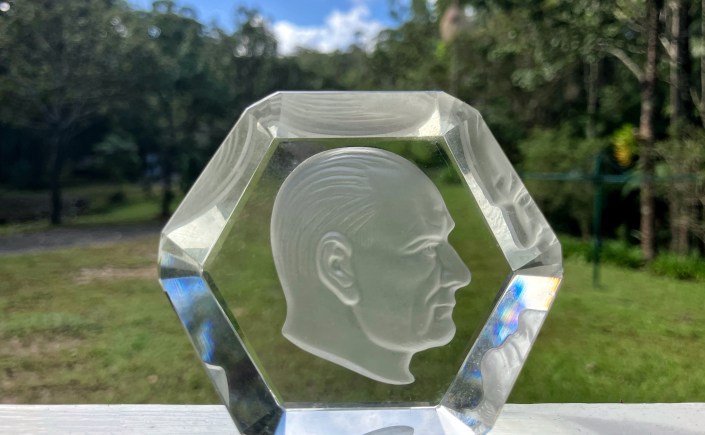
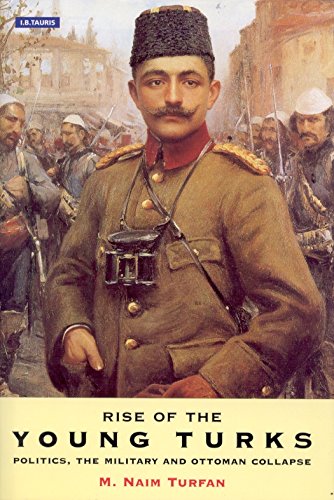
The featured image of this post is a profile in crystal of Kemal Atatürk that sits on my bookshelf as a reminder of my late friend and academic colleague Mehmet Naim Turfan. Naim, like millions of his compatriots, harboured a deep affection and respect for the legacy of Atatürk, the founder of modern Türkiye and its first president. It was gifted to me by His wife soon after his passing by his wife Barbara. His doctoral thesis was published posthumously in 2000 as Rise of the Young Turks: Politics, the Miliary and Ottoman Collapse. He is cited several times in the book that is the subject of this article. I thought of Naim often while reading the book and writing what follows.

Enver Pasha, soldier, politician and member of the troika that ruled the Ottoman Empire before and during WW1

Ottoman Endgame

Many believe that prior to the outbreak of World War 1 in August 1914, Europe had been at peace. In matter of fact, brutal and bloody little wars had raged in Eastern Europe three years prior, whilst Italy fought the Ottoman Empire for Tripoli and Cyrenaica, both now modern Libya and yet also presently two warring parts of a fractured whole and now being triggered by the aftermath of equally nasty little wars in the same lands in the last quarter of the Nineteenth Century. The Ottoman Empire’s entry into alliance with the Central Powers in 1915 against the Entente of Britain, France and Russia was the direct outcome of what we know refer to generically as The Balkan Wars – which aided and abetted by Russia, saw the emergence of Serbia, Romania and Bulgaria. In retrospect, with the benefit of hindsight, they were the beginning of what we might now refer to as The Wars of the Ottoman Succession. They are not over.

The empire’s entry into the war on the side of the Central Powers against the Entente of Britain France and Russia was a devious, drawn-out business as it sought to take advantage of its potential allies in recovering why it lost in the preceding Balkan Wars that had deprived it of its European provinces,

Few have told the story of the fall of the Ottoman Empire and the birth of modern Türkiye as well as English historian Sean McMeekin in his geographically sprawling and historically enthralling book The Ottoman Endgame. He juxtaposes military operations in the empire with those on Europe’s eastern and western fronts, demonstrating how, in the shifting fortunes of war in Europe, each impacted the other from the first offensives in France and on the eastern front to the Russian Revolutions of 1917.

Author and journalist Christopher de Bellaigue sets the scene well in a brief but compelling review (published in full below with some excellent pictures, along with a article by the author himself):

”For the historian of the first world war, the Ottoman theatre is a blur of movement compared to the attrition of the western front. Its leading commanders might race off to contest Baku and entirely miss the significance of events in the Balkans, while the diffuse nature of operations tended to encourage initiative, not groupthink. The war of the Ottoman succession, as Sean McMeekin calls it, was furthermore of real consequence, breaking up an empire that had stifled community hatreds, and whose absence the millions who have fled sectarian conflict in our age may rue …

For the Ottomans, the “great war” of western historiography was part of a much longer period of conflict and revolution, and arguably not even its climax. The process started with the collapse of the Ottomans’ Balkan empire – encouraged by Russia, moderated by Britain – and it brought to power the militaristic regime of the Committee of Union and Progress, or CUP. When Turkey entered the European war on 10 November 1914, Ottoman innocence was long gone, the army fully mobilised, the people benumbed by loss and refugees and the empire hanging in the balance. And yet, for the CUP and its triumvirate of leading pashas, the Young Turk troika of Enver, Talat and Djemal, the moment was as fraught with opportunity as it was with danger. On the opportunity side of the ledger was the prospect of riding Germany’s coat tails to victory, overturning the Balkan reverses and winning back provinces in the east from the old enemy, Russia. Enver, the CUP’s diminutive generalissimo, even spoke of appealing to Muslim sentiment and marching all the way to India.

For the Russians, the game was about winning Constantinople (or Tsargrad, as they presumptuously called it) and with it unimpeded access to the Mediterranean through the Bosphorus; it was with “complete serenity”, Tsar Nicholas II informed his subjects, that Russia took on “this ancient oppressor of the Christian faith and of all Slavic nations”

The European war on the eastern and western fronts was characterized by attrition and stalemate, but that waged by the Ottomans and the Russians, and soon, the British and French, was in contrast, highly mobile and constantly shifting, with the exception perhaps of the allied assault on the Gallipoli Peninsula which very soon resembled the trench warfare and brutal but futile offensives that characterized the Western Front. It is difficult to comprehend to scale of the war fought in the Middle East in terms of its territorial extent. From Baghdad to Baku, Gallipoli to Gaza, the Black Sea to the Gulf of Aqaba and the Caspian Sea. It was waged across European and Asian Ottoman lands including present day Greece, Bulgaria and Romania in the west, in the Caucasus in the east, in present day Armenia, Georgia and Azerbaijan and Iran, and in the south in present day Syria, Iraq, Jordan, Israel and Palestine.

Though the Sultan departed, and with him, the Islamic Caliphate, and most of the empire’s non-Turkish lands – were lost, under the leadership of former Ottoman commander and war hero Mustafa Kemal Pasha, the Anatolian heartland resisted and ultimately repelled invading foreign armies, and the Turkish state he created endures today as an influential participant in world affairs.

Casting new light on old narratives

McMeekin, writes de Bellaigue, is an old-fashioned researcher who draws his conclusions on the basis of the documentary record. In the case of a conflict between Ottoman Turkey and Germany on one side, and Russia, Britain and France on the other, and involving Arabs, Armenians and Greeks, this necessitates linguistic talent and historical nous of a high order. McMeekin is at home in the archives of all major parties to the conflict and his accounts of some of the more contested episodes carry a ring of finality. Access to previously closed Russian and Turkish archives has provided new and potentially controversial insights into accepted narratives regarding the last years of the Ottoman Empire. Challenging long accepted narratives, he addresses three of the most enduring shibboleths of the First World War.

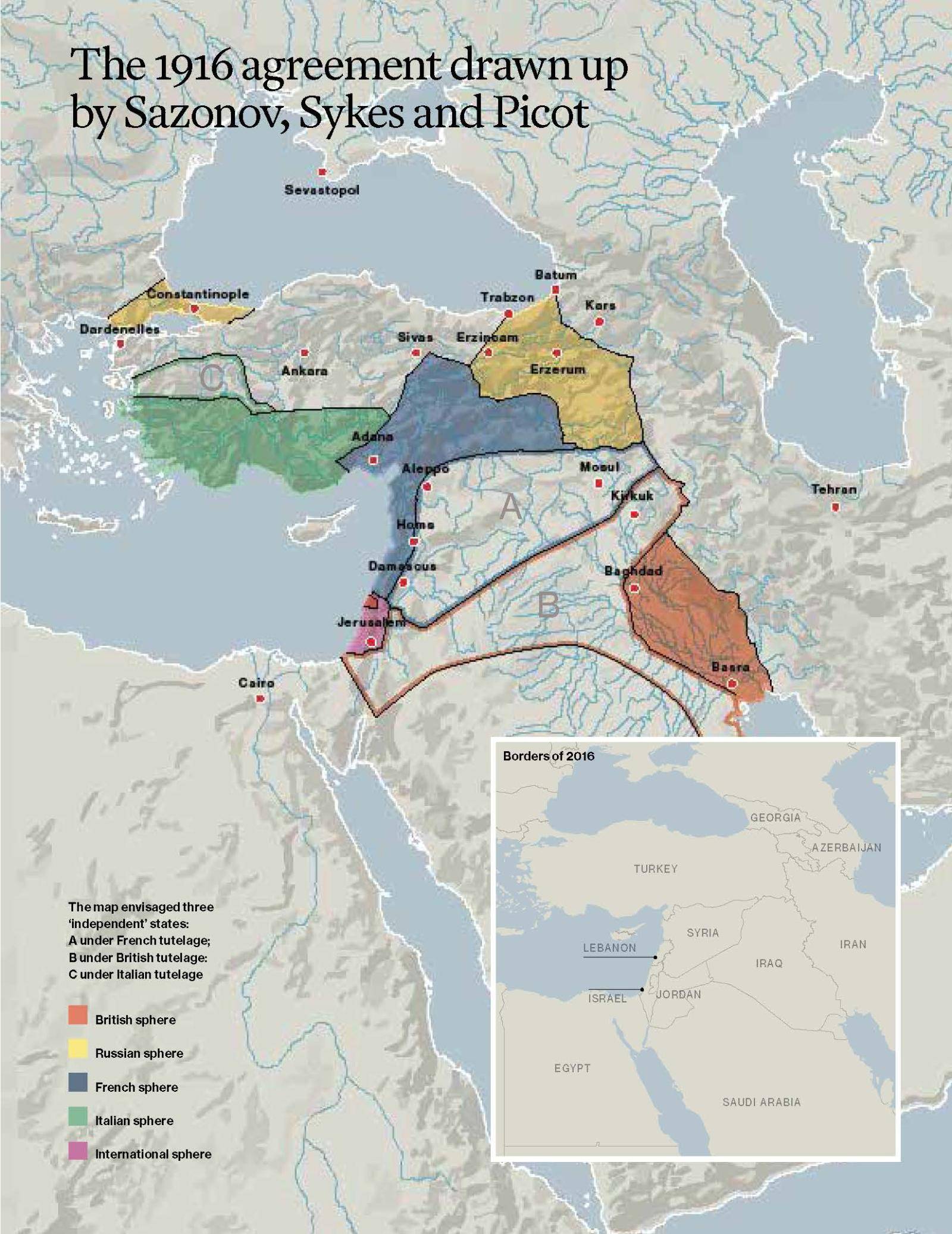
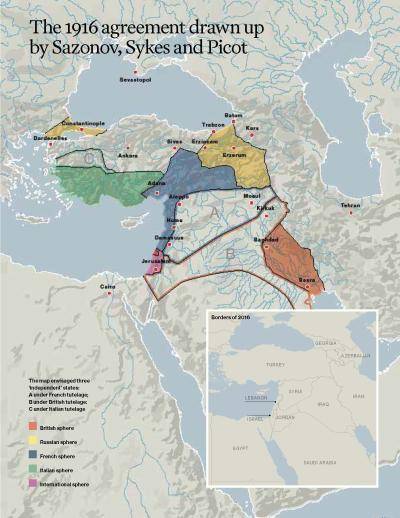
He jumps right in even before he begins his wide-ranging story, leaves hanging in the air like a predator drone until he returns to it in chronologically due course. The Sykes Picot Agreement of 1916 – the bête noir of most progressive narratives of the modern Middle East, and to many ill-informed partisans, the causus bello of the intractable Arab Israeli conflict – was not the brainchild of perfidious Albion and duplicitous France, but rather a plan for the dismemberment of the Ottoman Empire concocted by the foreign minister of Imperial Russia. France’s Monsieur François-George Picot and Britain’s Sir Mark Sykes played second and third violin to the “third man” Sergei Sazonov. Both Russia and France had for decades sought to establish their political, strategic and economic interests at the expense of the so-called “sick man of Europe”, an ostensibly terminal invalid who throughout the nineteenth century, had experienced many deathbed recoveries. Czar Nicholas II, in common with his Russian Orthodox predecessors, dreamt of bringing Istanbul, formerly Constantinople, the heart of the orthodox patriarchate, or Tsargrad into the empire. It was no coincidence that the infamous Sykes Picot pact was outed by Russia’s Bolshevik regime after the collapse of the Czarist regime to discombobulate the revolution’s foremost European enemies. 

The second icon of “received history” in McMeekin’s sights, is one Australia’s foundation stories – the ill-starred Dardanelles Campaign of 1915 and particularly, the the ANZAC’s Gallipoli legend. It was, from McMeekin’s perspective, a misconceived, poorly planned endeavour to capture the Ottoman capital, to relieve pressure on Russian forces engaged in bitter fighting in Eastern Anatolia, and potentially, to knock the Ottomans out of the war. Contrary to popular conceptions, the British were not exactly enthused by the idea. First Lord of the Admiralty Winston Churchill’s preference was for an assault on the “soft underbelly” of the empire – the port of Alexandretta in Ottoman Syria (now Turkish Antakya), with its strategic and logistic proximity to the Hijaz railway and the hinterland of the Levant. One indisputable fact about Gallipoli is that it assured the ascent Mustafa Kemal, a key commander who had already distinguished himself in the Balkan Wars, who would go on to conduct a fighting retreat of Ottoman Armies through what is now present-day Palestine and Syria, lead Turkish forces to victory in the war of liberation that followed, and, as Kemal Atatürk, would become the founder of modern Türkiye.

The third widely held narrative concerns the Armenian Genocide. Unlike the rulers of modern Türkiye, McMeekin does not deny its occurrence. Nor does he downplay or even ignore it, as does Israel for the idiosyncratic reason that it potentially minimises the horrors of the Shoah. Rather, he places it in the context of events in the empire’s Anatolian heartland. Two predominantly Armenian provinces in Eastern Anatolia were home to active nationalist independence movements, and these gave tacit and actual support to the Russian forces encroaching on the empire from the Caucasus and the Caspian Sea (in present day Azerbaijan and Georgia). Armenian militias fought alongside Russian forces on the Caucasian front whilst partisans operated behind ottoman lines, and cities, town and villages were actually “liberated”, fostering fears in the Istanbul government of an treasonous” fifth column”. McMeekin acknowledges the death toll of what we now recognise the systematic destruction of the Armenian people and identity which was spearheaded by the ruling Committee of Union and Progress (CUP) and implemented primarily through the mass deportation and murder of around one million Armenians during death marches to the Syrian Desert and the forced Islamization of others, primarily women and children. Whilst most probably died of inhumane treatment, exposure, privation and starvation, unknown numbers were murdered.

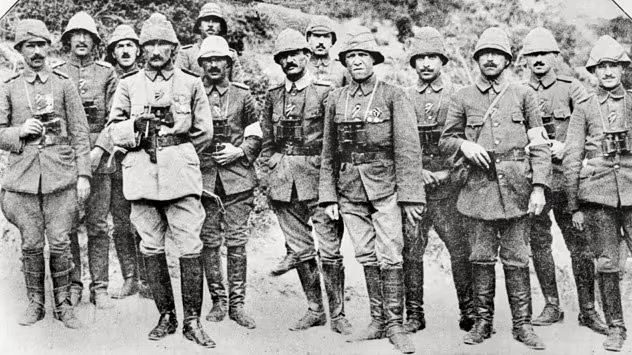
Kemal Pasha and Ottoman offices at Gallipoli

Parallels

Reading The Ottoman Endgame, I was reminded often of his compatriot Anthony Beevor’s harrowing tale of the Russian Revolution (reviewed in In That Howling Infinite’s Red and white terror – the Russian revolution and civil war. That Revolution and the end of the Ottoman Empire converged. McMeekin notes that with regard to the war in Anatolia and the Caucasus, the treaty of Brest-Litovsk, which ended the war between Czarist Russia and the Central Powers, was poisoned chalice for both Russia and Turkey and as significant as any of the treaties that followed the end of the war.

I found it fascinating that many individuals who were to play a significant part in the Russian Civil war also feature in Ottoman Endgame. Admiral Alexander Kolchak, commander of the imperial Black Sea fleet and General Anton Deniken, commander of Russian forces on the Caucasian front, became leaders of the Tsarist cause and were to command the counter-revolutionary White forces against the Red Army with the Siberian People’s Army and the Volunteer Army in Ukraine.

None were more prominent or as controversial in western narratives, however, as Winston Churchill. As noted above, McMeekin lays to rest the notion that the Dardanelles campaign and Gallipoli were Churchill’s sole doing and his folly – though he did blame himself later on and has been pilloried for it ever since. Ironically, once disgraced, and having volunteered to serve on the Western Front, at the end of the war, he was brought back into Lloyd George’s cabinet as Secretary of State for War. There, he advised against military intervention against Kemal’s nationalist forces and indeed mused about the option of dumping the Sazonov-Sykes-Picot dispensation imposed on the moribund empire’s Arab provinces after the armistice and of restoring the prewar territorial status quo, a kind of circumscribed Ottoman Redux. And yet, as civil war broke out and spread in the nascent Soviet Union, he was alone of his cabinet colleagues in advocating for a full-on allied intervention. Critics claimed that he dreamt, – though some believed that he fantasized – about of creating an effective White army and a borderlands alliance to defeat the Bolsheviks. But his aspirations were foiled by the imperialism of the White leadership and of White officers, and the various national movements’ fear that that if the Whites prevailed, they would restore Russian rule. Britain’s rulers were reticent about shoring up and providing financial, material support and also, soldiers sailors and airmen to brutal to demonstrably homicidal Cossack brigades and revanchist and reactionary royalist autocrats. It is not without reason that admirers and critics alike would agree that Winston had more positions than the Karma Sutra.

The Russian Revolutions – there were two, in February and October 1917 – and the Civil War that followed it, the disintegration of the Ottoman Empire followed by foreign intervention, the war of liberation, and the creation and endurance of Türkiye can be said to have defined the contours of modern Middle Eastern geopolitics, setting the stage for many if not most of the conflicts that have inflicted the region since, including three Gulf wars, the rise and fall of the Islamic State, the Lebanese, Iraqi and Syrian civil wars, and the Arab-Israel conflict, arguably the most intractable conflict of modern times. Cold War and also, the current Ukraine war.

In the wake of the fall of the Russian Empire, the Twentieth Century was not kind to the countries of Central and Eastern Europe. Historian Timothy Snyder called them “the blood lands”. Nor was it kind to the heirs and successors of the Ottoman Empire. Though the tyranny and oppression and the death and destruction wrought by rulers and outsiders upon the lands and peoples of the Middle East has been significantly less than that endured by the people of Eastern Europe and Russia, the region would fit Snyder’s sombre soubriquet.

© Paul Hemphill 2025. All rights reserved

Also in In That Howling Infinite, see Ottoman Redux – an alternative history and Red and white terror – the Russian revolution and civil war

For more on the Middle East, see A Middle East Miscellany

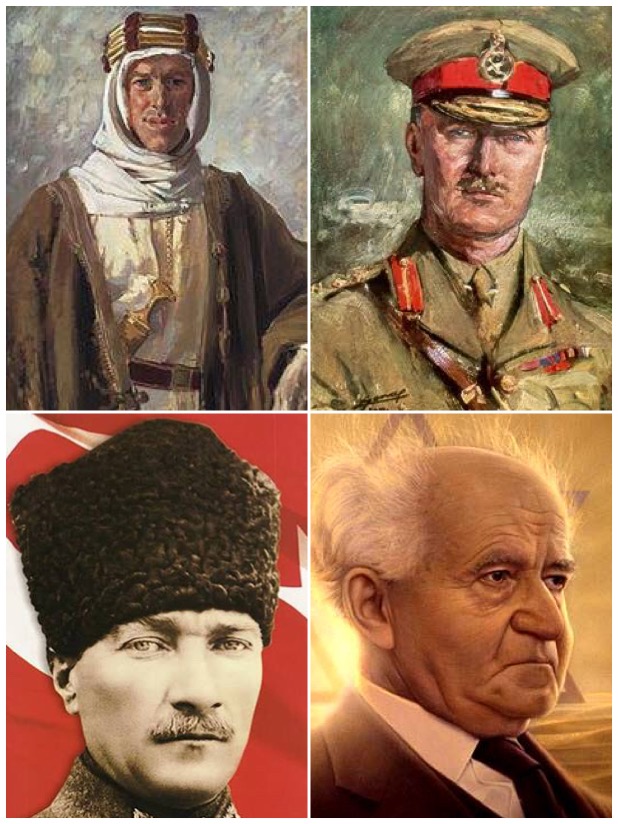
TE Lawrence, General Allenby, Kemal Ataturk, and Ben Gurion

Clone of Russia returns to a Middle East it never really left

Sykes and Picot have taken the blame but actually it was a Russian who drew the map of the Middle East, writes Sean McMeekin

The World Today, 7 December 2018

To judge from press coverage, the emergence of Islamic State has brought about a cartographic revolution in the Middle East. With the borders of Syria and Iraq in flux, journalists have resurrected the legend of Sykes-Picot, wherein Britain and France are said to have divided up the Ottoman empire between them in an agreement signed 100 years ago, in May 1916. Russia’s intervention in Syria, by upstaging the United States and her allies, seems in this view to be completing the rout of western influence in the Middle East, putting the final nail in the coffin of ‘Sykes-Picot’.

Rarely has history been more thoroughly abused. In reality, none of the contentious post-Ottoman borders of the Middle East was settled by Sykes and Picot in 1916: not the Iraq-Kuwait frontier notoriously crossed by Saddam’s armies in 1990, not those separating the Palestinian mandate from (Trans) Jordan and Syria, not the highly contested and still-in-flux Israeli/Palestinian partition of 1948, nor, in the most relevant example from today, those separating Syria from Iraq.

To take an obvious example from recent headlines, Mosul, the Iraqi city whose capture in June 2014 led Abu Bakr al-Baghdadi of Islamic State to proclaim himself Caliph Ibrahim, was actually assigned to French Syria in the 1916 agreement.

Journalists are even more spectacularly wrong in describing the Ottoman partition agreement as exclusively (or even primarily) a British-French affair, omitting the driving role played by Tsarist Russia and her Foreign Minister, Sergei Sazonov.

The final terms of what should more accurately be called the Sazonov-Sykes-Picot agreement were actually hashed out in the Russian capital of Petrograd in the spring of 1916, against the backdrop of crushing Russian victories over the Turks at Erzurum, Erzincan, Batum, and Trabzon (the British were reeling, having been humiliated at Gallipoli and in Iraq, where an expeditionary force would shortly surrender).

The conquest of northeastern Turkey in 1916 left Russia, unlike her grasping allies, in possession of most of the Ottoman territory she was claiming – barring only Constantinople (called ‘Tsargrad’ by the Russians), which still needed to be taken.

At the dawn of 1917, Tsarist Russia was poised to inherit the crown jewels of the Ottoman empire, including Constantinople, the Straits, Armenia, and Kurdistan, all promised to her in the Sazonov-Sykes-Picot Agreement. Along the Black Sea coast, Russian engineers were building a rail line from Batum to Trabzon, with the latter city a supply base for the Caucasian Army, poised for a spring assault on Sivas and Ankara. With Russia enjoying virtually uncontested naval control of the Black Sea, preparations were underway for an amphibious strike at the Bosphorus, spearheaded by a specially created ‘Tsargradskii Regiment’.

After watching her allies try, and fail, to seize the Ottoman capital during the Dardanelles/Gallipoli campaign of 1915 (when Sazonov had first put forward Russia’s sovereign claim on Constantinople and the Straits), Russia was now poised to seize the prize for herself – weather permitting, in June or July 1917.

Of course, it did not turn out that way. After the February Revolution of 1917, mutinies spread through the Russian army and navy, including the Black Sea fleet, just as it was poised to strike.

In a remarkable and little-known coincidence, on the very day the Foreign Minister of the Provisional Government, Pavel Milyukov, first aroused the anger of the Petrograd Soviet and the Bolsheviks by refusing to renounce Russia’s territorial claims on the Ottoman empire – April 4, 1917 – a Russian naval squadron approached the Bosphorus in ‘grand style’, including destroyers, battle cruisers, and three converted ocean liner-carriers which launched seaplanes to inspect Constantinople’s defences from the air. The amphibious plans were not abandoned until fleet commander Admiral AV Kolchak threw his sword overboard on June 21 during a mutiny. Even after ‘revolutionary sailors’ had taken control of the Black Sea fleet, a Russian amphibious strike force landed on the Turkish coastline as late as August 23, 1917, in one last sting by the old Tsargrad beast.

After the Bolsheviks took power, Russia collapsed into civil war, which left her prostrate, at Germany’s mercy. By signing a ‘separate peace’ with the Central Powers at Brest-Litovsk in March 1918, Russia forfeited her treaty claims to Armenia, Kurdistan, Constantinople, and the Straits, throwing the Sazonov-Sykes-Picot agreement of 1916 into chaos, even as new claimants were appearing on the scene, such as Italy and Greece – not to mention local actors: Jewish, Arab, and Armenian troops were attached as national ‘Legions’ to General Allenby’s mostly British army as it rolled up Palestine and Syria. These forces, along with French, Italian, and Greek expeditionary forces sent after the war, and the Turkish nationalists who regrouped under Mustafa Kemal in Ankara to oppose them, would determine the final post-Ottoman borders in a series of small wars between 1918 and 1922, with scarcely a nod to the Sazonov-Sykes-Picot Agreement.

While Russia’s forfeiture of her claims in 1918 was welcome, in a selfish sense, to the other players vying for Ottoman territory, it was not necessarily a positive one for the region. In the absence of Russian occupying troops to police the settlement, the

Allies, in 1919, offered Russia’s territorial share, now defined (in deference to Woodrow Wilson) as mandates, to the United States – only for the Senate to vote down the Versailles Treaty, rendering the arrangement moot. Lacking Russian or American troops as ‘muscle’, the Allies leaned on weaker proxies such as the Italians and, more explosively, local Greeks and Armenians, which aroused the anger of the Muslim masses and spurred the Turkish resistance led by Kemal (the future Atatürk). Armenians, Greeks and Kurds, too, could only lament the vacuum left behind by the departing Russians, which left them to face Turkish wrath alone.

Soviet Russia re-emerged as a player in the Middle East fairly quickly, not least as Mustafa Kemal’s key diplomatic partner during his wars against the West and its proxies from 1920-22. In a reminder of the enduring prerogatives of Russian foreign policy, the Cold War kicked into high gear when Stalin made a play for Kars, Ardahan, and the Ottoman Straits in 1946: these moves, along with the British withdrawal from Greece, Turkey, and Palestine, inspired the Truman doctrine.

In an eerily similar replay of the history of 1917-18, the collapse of Soviet power in 1991 led Moscow to turn inward, withdrawing from the Middle East and inaugurating a period of US and western hegemony in the region, which turned out no less well than the Middle Eastern free-for-all of 1918-22. A prostrate and impoverished Russia put up no objection during the First Gulf War of 1991, and did little more than sputter during the Iraq War of 2003. Russia’s recovery of strength and morale in the Putin years led, almost inevitably, to her return in force to the Middle East – from which, in reality, she never truly left.

The Russian return to the region, along with Turkey’s increasingly overt hostility over her Syrian intervention, resurrects historical patterns far, far older than Sykes-Picot. For centuries, the Ottoman empire was the primary arena of imperial ambition for the Tsars, even as Russians were the most feared enemies of the Turks. In many ways, the Crimean War of 1853-56, which saw western powers (Britain, France, and an opportunistic Piedmont-Sardinia) unleash an Ottoman holy war against the Tsar to frustrate Russian ambitions in the Middle East, is a far more relevant analogy to the present crisis in Syria than the pseudo-historical myths of 1916. It is time we put the Sykes-Picot legend in the dustbin where it belongs.

Diplomatic carve-up: the third man

In David Lean’s 1962 film, ‘Lawrence of Arabia’, a cynical British official explains how the carcass of the Ottoman Empire was to be divided at the end of the First World War under the Sykes-Picot Agreement.

‘Mr Sykes is an English civil servant. Monsieur Picot is a French civil servant. Mr Sykes and Monsieur Picot met and they agreed that after the war, France and England would share the Turkish Empire, including Arabia. They signed an agreement, not a treaty, sir. An agreement to that effect.’

This summary of wartime diplomacy has proved long-lived. It encapsulates the less than honest dealings of the British government with the Arabs – who wanted independence after being liberated from Turkish domination, rather than rule by the European colonial powers – but it leaves out the key figure in the deliberations, Sergei Sazonov, Russian foreign minister, 1910-1916.

Sazonov was one of the most significant diplomats both before and during the Great War. It was thanks to his adroit manipulation that Britain and its allies came to accept that Russia would gain the Ottoman capital Constantinople, in the event of an Allied victory, an outcome that Britain had tried for decades to prevent.

At the talks in the Russian capital Petrograd in 1916, the British and French emissaries were far lesser agents of empire than their host.

Sir Mark Sykes was a gifted linguist, travel writer and Conservative politician, but no top-flight diplomat. As for François Georges-Picot, he was an experienced diplomat and lawyer and noted advocate for a greater Syria under French rule.

But with France having no troops in the eastern theatre of war, he had to accept Russia’s demand to swallow up large parts of what is now eastern Turkey, but which Paris had set out to claim.

Sykes died of influenza in 1919 at the Paris Peace Conference, where Sazanov represented the White Russians. He died in Nice in 1927

The Ottoman Endgame: War, Revolution, and the Making of the Modern Middle East, 1908-1923” by Sean McMeekin

Czar Nicolas I of Russia is sometimes credited with coining the phrase “Sick Man of Europe” to describe the decrepit Ottoman Empire of the mid-nineteenth century. By the early 20th century, there could be little doubt that the disparaging sobriquet applied in spades. The Ottoman Empire was soundly defeated in two Balkan wars in 1912 and 1913 by the comparatively pipsqueak countries of Bulgaria, Greece, Montenegro and Serbia. One result of the wars was that the Empire lost all of its European territories to the west of the River Maritsa, which now forms the western boundary of modern Turkey. Then, when World War I broke out, the Ottomans made the disastrous decision to side with the Central Powers against the Triple Entente, ending up on the losing side of that cataclysm.

882094291

A popular theory is that the carving up of the Ottoman lands after the war, pursuant to the Sykes-Picot Agreement between France and Britain, is the source of many of the problems of the current Middle East. In The Ottoman Endgame, Sean McMeekin concedes that it is not wrong to look to the aftermath of the war for the roots of many of today’s Middle Eastern problems, but the “real historical record is richer and far more dramatic than the myth.” For example, the notorious Sykes-Picot Agreement was sponsored primarily by Russia, whose foreign secretary, Alexander Samsonov, was the principal architect of the agreement. McMeekin’s retelling of the demise of the Ottoman Empire and its recrudescence as modern Turkey is a fascinating and complicated narrative.

Among the interesting facts McMeekin points out is that according to an 1893 census only 72% of the Ottoman citizens were Muslim, and that in the middle of the 19th century the majority of the population of Constantinople may have been Christian. The Balkan Wars started a trend, exacerbated by World War I, toward ethnic cleansing, with hundreds of thousands of Christians leaving the Empire and similar numbers of Muslims moving from territory lost by the Empire to areas it still controlled.

We in the West tend to think of World War I as a static slugfest conducted in the trenches of northern France. But the war in the East, particularly as it applied to the Ottoman Empire, was a much more mobile affair. In fact, the Ottomans ended up fighting the war on six different fronts, as the Entente Powers invaded them from many different angles.

Winston Churchill in 1914

Winston Churchill in 1914

At the outbreak of WWI, the Ottomans allied themselves with Germany out of fear of Russia, which had coveted control over the straits connecting the Black and Mediterranean seas for centuries. In 1914 the Russians invaded Eastern Anatolia and met with initial success. However, Russia feared its early success was quite precarious, and so it inveigled its ally, Britain, to launch a diversionary assault on the Gallipoli peninsula. The “diversion” became one of the most deadly killing grounds of the war, as the British poured hundreds of thousands of men into the battle in hopes of breaking the stalemate on the Western Front. The author credits Russian prodding more than Winston Churchill’s stubbornness for the extent of the British commitment. The Ottomans, led by Mustapha Kemal (later to be known as Ataturk, the “father of modern Turkey”), prevailed in this hecatomb, showing that there was still plenty of fight left in the “Sick Man.”

Turkish General Mustafa Kemal, center, at Gallipoli, 1915

Turkish General Mustafa Kemal, Gallipoli, 1915

The Ottomans also soundly defeated the British in Mesopotamia (modern Iraq) in late 1915, but they were less successful against the Russians, who invaded across the Caucasus and held much of eastern Anatolia until the Bolshevik revolution in 1917 caused them to withdraw voluntarily. The British ultimately prevailed against the Ottomans in 1918 by invading from Egypt through Palestine, with a little help from the Arabs of Arabia.

The Treaty of Versailles, which ended the war in Europe in 1919, did not end the war for the Ottomans. The victorious Allies were ready to carve up much of the Empire for themselves. The Ottoman armies were to disband; England was to keep Egypt and to get Palestine and Mesopotamia; France was to get Syria, Lebanon, and parts of modern Turkey; and Greece was to get a large swath of western Turkey. All might have gone according to that plan, but Mustapha Kemal (Attaturk) was still in charge of a small but effective fighting force in central Anatolia. Attaturk husbanded his forces and fought only when he had an advantage. In a war that lasted until 1923, he was able to expel the Greeks from Anatolia and to establish the boundaries of modern Turkey.

large

McMeekin deftly handles this complexity with a lucid pen. His descriptions of the various military campaigns are riveting. This is not to say that he shortchanges the political machinations taking place. He gives more than adequate coverage to the “Young Turks,” a triumvirate that ruled the Empire from 1909 until they eventually brought it to its ruin in 1919. He also covers the Armenian massacres as objectively as possible, given the enormity of the events described.

Evaluation: This is a very satisfying book and an excellent addition to the enormous corpus of World War I literature. The book includes good maps and photos.

Published by Penguin Press, an imprint of Penguin Random House, 2015

Modern history is built upon exodus and displacement

“We are cursed to live in a time of great historical significance: when future historians look back at 2023, the distinguishing feature of this year will likely be the recurrence of ethnic cleansing on a vast scale”.

Thus wrote Unherd columnist and former war correspondent Aris Roussinos in December. 2023, but he would draw the same conclusion in 2024 and in 2025. He notes that ethnic cleansing is taking place on a vast scale in many parts of the world. Yet, apart from the current outrage at Israel’s war on Hamas in Gaza, turbocharged as it is by unprecedented and arguably one-sided mainstream and social media coverage, international reaction has been muted to the point of indifference. Roussinos’ article is republished below, and the following overview is inspired by and draws on his observations.

The term ethnic cleansing is elusive and politically charged. In an age of endemic conflict, identity politics and competing narratives, it has become a contested and often diluted concept invoked with increasing frequency. Yet, it remains undefined in law. Unlike genocide or war crimes, it has never been codified as a distinct offence under international law, and so its use is contested.

A United Nations Commission of Experts investigating violations during the wars in the former Yugoslavia offered the most widely cited descriptions. In its interim report it defined ethnic cleansing as “rendering an area ethnically homogeneous by using force or intimidation to remove persons of given groups from the area.” In its final report the following year, the Commission elaborated: it is “a purposeful policy designed by one ethnic or religious group to remove by violent and terror-inspiring means the civilian population of another ethnic or religious group from certain geographic areas.” What is clear in these descriptions is that ethnic cleansing is deliberate, systematic, and political in nature.

The Commission also catalogued the methods through which such policies are carried out. They include murder, torture, arbitrary arrest and detention, extrajudicial executions, rape and sexual violence, severe injury to civilians, confinement of populations in ghettos, forcible deportation and displacement, deliberate military attacks or threats of attacks on civilian areas, the use of human shields, the destruction and looting of property, and assaults on hospitals, medical staff and humanitarian organisations such as the Red Cross and Red Crescent. The Commission concluded that these acts could amount to crimes against humanity, war crimes, and in some instances, fall within the meaning of the Genocide Convention.

Many people today use the term ethnic cleansing interchangeably with genocide, since both involve the violent removal and destruction of communities and often lead to similar outcomes of death, displacement, and cultural erasure. Ethnic cleansing, which refers to the forced expulsion of a group from a territory through intimidation, violence, or coercion, frequently overlaps with acts that fall under the 1948 UN Genocide Convention, such as mass killings and the destruction of cultural or religious life. This blurring of concepts reflects not only the moral outrage provoked by such crimes but also frustration at the narrowness of legal categories, which can leave survivors feeling their suffering has been minimized by technical distinctions. Historical cases illustrate how the line between the two has often been perilously thin: the mass deportations and killings of Armenians in 1915, which many scholars and states regard as genocide and even describe as a holocaust – though Türkiye denies it and Israel avoids official recognition for fear of diluting the unique status of the Shoah – the expulsions and massacres of Bosnian Muslims in the 1990s, and the flight of the Rohingya from Myanmar all show how ethnic cleansing has so often carried genocidal dimensions – as is particularly the case today with the war in Gaza which has polarized and politicized ordinary people and activists alike worldwide who have through lack of knowledge or opportunism conflated the two.

Yet it is important to recognize that genocide and ethnic cleansing are not strictly interchangeable. Genocide requires proof of an intent to destroy, in whole or in part, a national, ethnic, racial, or religious group, whereas ethnic cleansing focuses primarily on expulsion, which may or may not involve that deeper intent to annihilate. Ethnic cleansing can amount to genocide when the purpose is to eradicate a group, but not all instances meet this threshold. In public discourse, however, people motivated more by empathy and emotion than by detailed knowledge of history or law are often inclined to conflate the two, since the lived experience of the victims—violence, displacement, and cultural obliteration – appears indistinguishable from destruction itself. More informed observers, by contrast, emphasize legal precision and historical context, recognizing that while the outcomes often overlap, preserving the distinction remains vital for accurate analysis and accountability.

The moral revulsion ethnic cleansing excites is the natural and humane reaction, but historically and also presently, it is not an uncommon phenomenon. For the American sociologist and academic Michael Mann, ethnic cleansing is the natural consequence of modernity, “the dark side of democracy”: a recurring temptation of the modern nation-state. The following sections provided examples from the last thirty years, followed by a survey of instances of ethnic cleansing during the early to mid Twentieth Century. They describe how ethnic cleansing is not only a crime of forced removal and murder but also an assault on identity, memory, and the very visibility of a people.

[The featured picture at the head of this blog post is one of Palestinian artist Ismail Shammout’s striking illustrations of Al Nakba, the dispossession of tens of thousands of Palestinian Arabs during Israel’s war of independence, from In That Howling Infinite’s Visualizing the Palestinian Return – the art of Ismail Shammout]. More of his art is included below]

Expulsion, eradication and exile

The Wars of the Yugoslav Succession in the 1990s – encompassing Croatia, Bosnia, and Kosovo – offer a clear illustration of ethnic cleansing in a modern European context. As Yugoslavia disintegrated, political and military leaders pursued campaigns aimed at creating ethnically homogeneous territories, often through the systematic targeting of civilians. In Bosnia, Serb forces carried out mass killings, forced deportations, rape, and the deliberate destruction of homes, schools, and cultural heritage sites, culminating in the Srebrenica massacre of 1995, in which more than 8,000 Muslim men and boys were killed. In Croatia and Kosovo, similar tactics were deployed: ethnic minorities were expelled, villages razed, and communities terrorised into flight. The International Criminal Tribunal for the former Yugoslavia (ICTY) documented and prosecuted these actions as crimes against humanity and war crimes, establishing that the campaigns were not chaotic consequences of war, but deliberate, coordinated policies of ethnic removal. The tribunal’s rulings provide a legal benchmark for understanding ethnic cleansing as the purposeful removal of populations through violence, intimidation, and coercion, a pattern that recurs across history and geography—from the forced expulsions of Armenians in 1915, to the population exchanges of Greece and Turkey in 1923, to the contemporary displacement of Rohingya, Palestinians, Ukrainians, and Afghans. These cases demonstrate that ethnic cleansing combines physical violence, forced migration, and cultural erasure, often leaving long-term social, political, and demographic scars that endure generations after the immediate conflict.

Sudan has witnessed repeated waves of ethnic cleansing over recent decades, most infamously in Darfur in the early 2000s, when government-backed Arab Janjaweed militias targeted non-Arab communities with systematic violence. Villages were burned, civilians massacred, women subjected to mass rape, and more than 2.5 million people displaced, in what the International Criminal Court later described as crimes against humanity, war crimes, and genocide. The displacement and destruction in Darfur followed earlier campaigns of forced removal during Sudan’s long north–south civil war, where entire communities in the south and Nuba Mountains were uprooted by aerial bombardment, scorched earth tactics, and starvation sieges. Today, ethnic cleansing has returned with devastating intensity: since April 2023, renewed fighting between the Sudanese Armed Forces and the Rapid Support Forces (successors to the Janjaweed) has triggered mass atrocities, including the killing of thousands and the flight of more than 7 million civilians, many across borders into Chad, South Sudan, and Egypt. Reports of targeted massacres against non-Arab groups in West Darfur suggest continuity with earlier campaigns, underscoring how ethnic cleansing in Sudan is not an isolated event but a recurring feature of its violent political landscape.

The Rohingya expulsions in Myanmar provide a stark contemporary example of ethnic cleansing. Since 2017, Myanmar’s military has carried out systematic campaigns of violence, including mass killings, sexual violence, arson, and the destruction of villages, aimed at driving the Rohingya Muslim population from Rakhine State. More than 700,000 Rohingya have fled to neighbouring Bangladesh, creating one of the world’s largest refugee crises. The violence has been accompanied by measures of cultural and social exclusion: denial of citizenship, restrictions on movement, and the erasure of Rohingya identity from official records. The United Nations and international observers have described these actions as ethnic cleansing, noting the deliberate intent to remove an entire ethnic group from a geographic area, while some investigators have determined that elements of the campaign meet the criteria for genocide.

Armenia and its surrounding regions have been scarred by cycles of ethnic cleansing for more than a century. The Armenian genocide of 1915–1916, carried out by the Ottoman Empire, combined forced deportations, massacres, and cultural destruction with the intent of removing Armenians from their ancestral lands in Anatolia. More than a million were killed or died on death marches, and countless others were scattered into diaspora communities across the Middle East, Europe, and the Americas. Later, in the Soviet period, Armenians and Azerbaijanis experienced repeated forced movements, with pogroms and expulsions erupting during times of political instability. Most recently, the 2023 offensive by Azerbaijan in Nagorno-Karabakh resulted in the flight of almost the entire Armenian population of the enclave—around 120,000 people—into Armenia proper, effectively erasing a centuries-old community. These waves of displacement illustrate how ethnic cleansing in Armenia is not confined to the past but has recurred across generations, leaving lasting demographic, cultural, and political consequences for the region.

During the past two years, mass expulsions from neighbouring countries returned large numbers of Afghans to Taliban-run Afghanistan. Pakistan has deported nearly half a million Afghans; Iran has driven out hundreds of thousands more. What is packaged as “repatriation” is, in many cases, forced displacement: exiles who had tenuous livelihoods, access to education, or limited civil freedoms in exile are now returned to a polity where the rights — especially the rights of women and girls — are ruthlessly curtailed. The Taliban’s record on gender is well known: it controls a society where women are barred from education and work, forced into early marriages, and denied even minimal public freedoms. Public-life prohibitions and systematic punishments disproportionately harm women and girls. Returning families are therefore being pushed into what many observers describe as among the worst possible places in the world for women — a profoundly gendered and life-threatening form of displacement.

The erasure of culture and historical memory

Like genocide, ethnic cleansing may not be limited the physical expulsion or eradication of people. It can be political, cultural and geographical, and often works through more insidious forms of erasure.

China’s policies in Xinjiang are an example. It has renamed at least 630 villages in Xinjiang, erasing references to Uyghur culture in what human rights advocates say is a systematic propaganda rebrand designed to stamp out the Muslim minority group’s identity. Human Rights Watch has documented a campaign of renaming thousands of villages across the region, stripping out references to Uyghur religion, history and culture. At least 3,600 names have been altered since 2009, replaced by bland slogans such as “Happiness,” “Unity” and “Harmony.” Such bureaucratic changes appear mundane, but they are part of a systematic project to erase Uyghur identity from the landscape itself.

Ukraine illustrates another, more violent dimension of contemporary ethnic cleansing. Russia is coercively integrating five annexed Ukrainian regions — an area the size of South Korea — into its state and culture. Ukrainian identity is being wiped out through the imposition of Russian schooling and media, while more than a million Russian citizens have been settled illegally into the occupied zones. At the same time, some three million Ukrainians have fled or been forced out. Torture centres have been established, with one UN expert describing their use as “state war policy.” Russian forces have employed sexual violence, disappearances and arbitrary detentions, and carried out massacres. Civilian deaths officially stand at around 10,000, but independent estimates suggest a figure closer to 100,000. Homes and businesses have been seized and redistributed to the cronies of Russian officials and officers. On top of these abuses, thousands of Ukrainian children have been taken from their families and deported into Russia for adoption and assimilation, with the threat that when they reach 18 they will be conscripted into the Russian military. This programme of child transfers has been declared a war crime by international courts, and represents perhaps the most chilling element of the campaign to erase Ukrainian identity across generations. Russian propagandists, including ideologues such as Alexander Dugin, routinely describe Ukrainians as “vermin” to be eliminated — language that many experts say is consistent with genocidal intent.

The long arm of history

Historical precedent is sobering, underscoring how entrenched practices definable as ethnic cleansing are. Some examples follow.

The Armenian genocide of 1915–1916 is a historical example where the term “ethnic cleansing” can be applied alongside, though not identical to, the legal concept of genocide. Ottoman authorities systematically deported, massacred, and starved Armenians from their ancestral homelands in Anatolia, often under the guise of military necessity. Entire villages were emptied, survivors forced on death marches into the Syrian desert, and cultural and religious heritage deliberately destroyed. These actions aimed to remove the Armenian population from the territory of the Ottoman Empire, making the region ethnically and religiously homogeneous, which aligns closely with contemporary definitions of ethnic cleansing. The genocide combined mass killing with forced displacement and cultural erasure, illustrating how ethnic cleansing and genocide can overlap in both intent and method. (See The Fall of the Ottoman Empire and the birth of Türkiye)

The Armenian case also illustrates how recognition of genocide is often bound up not only with history but with contemporary politics. Türkiye continues to deny that the mass deportations and killings of Armenians in 1915 amounted to genocide, framing them instead as wartime relocations within the collapsing Ottoman Empire. Israel, despite wide acknowledgment among its own scholars of the genocidal character of the events, has avoided official recognition, partly out of diplomatic considerations toward Türkiye, once a key regional ally, but also out of concern that equating the Armenian tragedy with the Shoah might dilute the unique historical and moral status attached to the Holocaust in Jewish memory and international discourse. This reluctance is not unique to Israel: several states have long hesitated to employ the term “genocide” for fear of straining relations with Ankara or complicating their own foreign policy priorities. Such debates demonstrate how the line between ethnic cleansing and genocide is not only a matter of legal precision but also of political narrative, with governments and institutions sometimes reluctant to apply the most condemnatory labels even where evidence overwhelmingly supports them.

As the Northern Irish writer Bruce Clark observed in his excellent book Twice A Stranger on the euphemistically termed “population exchanges” between Greece and Turkey exactly a century ago, “Whether we like it or not, those of us who live in Europe or in places influenced by European ideas remain the children of Lausanne,” the 1923 peace treaty, finalizing the dismemberment of the Ottoman Empire after the First World War, which decreed a massive, forced population movement between Turkey and Greece”, and in effect, One and a quarter million Greek Orthodox Christians were removed from Anatolia, the heartland of the new republic of Türkiye, and nearly 400,000 Muslims from Greece, in a process overseen by the Norwegian diplomat Fridtjof Nansen leading a branch of the League of the Nations which would later – perhaps ironically – evolve into today’s UNHCR.

During the Second World War, Soviet Union alone deported half a million Crimean Tatars and tens of thousands of Volga Germans to Siberia. In 1945, the victorious Allied powers oversaw the removal of some 30 million people across Central and Eastern Europe to create ethnically homogeneous states. At Yalta and Potsdam, Britain, the US, and the Soviet Union endorsed the expulsion of 12 million Germans, over 2 million Poles, and hundreds of thousands of Ukrainians, Hungarians, and Finns.

The partition of British India in 1947 produced one of the largest and bloodiest forced migrations in modern history. As the new states of India and Pakistan were created, an estimated 12 to 15 million people crossed borders in both directions – Muslims moving into Pakistan, Hindus and Sikhs into India – in a desperate effort to reach what they hoped would be safer ground. The upheaval was marked by extreme communal violence, massacres, abductions, and sexual assaults. Between 500,000 and 1 million people are thought to have been killed, and millions more were uprooted from ancestral homes they would never see again. The trauma of Partition continues to shape Indian and Pakistani national identities, as well as the politics of South Asia to this day. (See Freedom at Midnight (2): the legacy of partition) and Freedom at Midnight (1): the birth of India and Pakistan

The dismemberment of Mandate Palestine by the new state of Israel, Jordan and Egypt in 1948 brought two simultaneous mass displacements that remain unresolved. During the first Arab–Israeli war more than 700,000 Palestinians fled or were expelled from their homes in what became Israel. Known as the Nakba or “catastrophe,” this created a vast refugee population now numbering in the millions, many still stateless. Jews living in what is now the Old City and East Jerusalem, and the West Bank seized by Jordan were expelled. Jews living across the Arab world in Iraq, Yemen, Egypt, Libya, Syria and elsewhere – faced growing hostility, persecution, and expulsion. Between 1948 and the 1970s, an estimated 800,000 to 1,000,000 Jews left or were forced out, many stripped of property and citizenship. Most resettled in Israel, where their presence profoundly altered the country’s politics and culture. Palestinians and Jews alike endured dispossession, trauma and exile, and both experiences fuel competing narratives of grievance that continue to define the conflict.

Israelis are themselves, for the most part, the product of 20th-century ethnic cleansings, in the Middle East as well as Europe: indeed the descendants of Middle Eastern Jews, like the Security Minister Itamar Ben-Gvir, are the country’s most radical voices on the Palestinian Question. But unlike the Mizrahim,  and displaced of Eastern and south-eastern Europe, the Palestinians have no Israel to go to. There is no Palestinian state waiting to absorb them. Indeed, for Gaza’s population, the vast majority of whom descend from refugees from what is today Israel, Gaza was their place of refuge, and the 1948 Nakba the foundational event in their sense of Palestinian nationhood. For all that ethnic cleansing punctuates modern history, there is no precedent for such a process of double displacement, and the political consequences cannot at this stage be determined. We may assume they will not be good, and an analogue to Europe’s post-war neighbourly relations will not be found.

Conclusion: The Age of Dispossession 

In many historical cases, expulsions, however brutal, were stabilized by the existence of ethnic homelands ready to absorb the displaced. Refugees were incorporated into nationalist projects in Greece and Türkiye, or into newly homogenized states such as Poland and Ukraine, where they became central to the shaping of modern politics. The Karabakh Armenians driven into Armenia may follow this precedent, potentially reshaping the political order of a small and embattled state.

Ethnic cleansing in the twenty-first century, however, combines these older methods with new techniques. Violence, rape, deportation, and massacre continue, but are now accompanied by cultural erasure, bureaucratic renaming, engineered resettlement, propaganda, and the deliberate targeting of children for assimilation. Unlike many twentieth-century precedents, today’s displaced populations often have nowhere safe to go, forced into territories with no protective homeland or into environments of repression, creating open-ended cycles of dispossession. The erasure of identities in Xinjiang, the coercive integration of Ukrainian territories, the expulsion of Rohingyas and Afghans, the depopulation of Karabakh, and the looming threat of Gaza – where Palestinians face the looming threat of another mass displacement, echoing the 1948 Nakba – collectively demonstrate that ethnic cleansing is not a relic of the past.

It remains a recurring feature of our age – modern history is indeed built upon exodus and displacement – and its human cost is profound and incalculable.

© Paul Hemphill 2024,2025. All rights reserved

Nagoorno Karabakh

Postscript … Al Nakba, a case study in dispossesion

In the late nineteenth and early twentieth centuries, European Jews came to a land that was already inhabited by another, different people. Over two decades, they forced the guarantor power out by terrorism and took the land by conquest, expelling most of  its original inhabitants by force. They have sowed their share of wind, too. Both sides want all the land for themselves.

Al Nakba, is the Arabic name for the “catastrophe” that befell the Arab inhabitants of Mandate Palestine during the war that was fought between Arabs and Jews in 1947-1948, resulting in the expulsion of upwards of 700,000 Arab Palestinians. That it happened is incontrovertible. But the facts, even those that are attested to by all reputable politicians and academic authorities, including Israelis, have long been subject to doubt and distortion by all sides of what has since been called “The Middle East Conflict” – notwithstanding that there have been conflicts in the Middle East more devastating and bloodier in terms of destruction and mortality including in Lebanon, Iraq, Syria, Algeria, Libya, and Sudan.

I do not to intend here to retell the history of Al Nakba. There many accounts available in print including those by Arab and Israeli authors, and in film, particularly an excellent documentary broadcast by Al Jazeera in May 2013 and repeated often?

June 17th, 2018, I wrote about it in a Facebook post:

Al Nakba did not begin in 1948. Its origins lie over two centuries ago….


So begins this award-winning series from Al Jazeera, a detailed and comprehensive account of al Nakba, the establishment of the State of Israel in 1948 and the dispossession and expulsion of the Palestinians who lived within its borders.

It is a well-balanced narrative, with remarkable footage, that will not please the ardent partisans of both sides who prefer their story of 1948 to be black and white.

Revisionist Israeli historians Ilan Pappe, Avi Shlaim, and Teddy Katz describe the ruthless and relentless military operations to clear and cleanse “Ha’aretz”, the land, of its Arab inhabitants and their history, whilst Palestinian historians tell the story from the Palestinian perspective, describing the critical failings of Palestinian’s political leaders and neighbouring Arab governments. Elderly Palestinians who were forced into exile and to camps in Jordan and Lebanon tell their sad stories of starvation and poverty, violence and death, and of terrible sadness, homesickness and longing that the passing years and old age have never diminished.

“When I left my homeland, I was a child. Now, I’m an old man. So are my children. But did we move forward? Where is our patriotism? Patriotism is about the pockets of our current leaders. They build high buildings and go to fancy banquets. They pay thousands for their children’s weddings”. Refugee Hosni Samadaa.

“We’re repeating the same mistakes. Before 1948 the Palestinian National Movement was split on the basis of rival families. Today, it is split into different parties over ideology, jurisdiction and self-interests. We didn’t learn our lesson. We were led by large, feudal landowners. Today, we are led by the bourgeoisie. Before 1948, we were incapable of facing reality. Today, we are just as inept. Before 1948, people chose the wrong leadership. And today, we are following the wrong leaders”. Researcher Yusuf Hijazi.

https://www.aljazeera.com/program/featured-documentaries/2013/5/29/al-nakba

I republish below Roussinos’ article in full, also a brief but comprehensive account about Al Nakba by economist and commentator Henry Ergas.

al Nakba, Ismail Shammout

al Nakba, Ismail Shammout

The truth about the ethnic cleansing in Gaza – modern Europe was built on exodus and displacement

Aris Roussinos, Unherd, December 18 2023

We are cursed to live in a time of great historical significance: when future historians look back at 2023, the distinguishing feature of this year will likely be the recurrence of ethnic cleansing on a vast scale. In just the past few months, Pakistan has deported nearly half a million Afghan migrants, while Azerbaijan has forced 120,000 Armenians — the statelet’s entire population — from newly-conquered Karabakh, both to broad international indifference. As the UNHCR has warned, the forced expulsion — that is, the ethnic cleansing — of Gaza’s Palestinian population is now the most likely outcome of the current war.

With no prospect of Palestinians and Israelis living together peaceably, anything short of absolute military victory unacceptable to both the Israeli government and its voters, but no meaningful plan for who will rule the uninhabitable ruins of post-war Gaza, the only realistic solution to the Palestinian problem, for Israel, is the total removal of the Palestinians. As Israel’s former Interior Minister has declared: “We need to take advantage of the destruction to tell the countries that each of them should take a quota, it can be 20,000 or 50,000. We need all two million to leave. That’s the solution for Gaza.”

Israeli officials have not been shy in promoting this outcome to a war, according to the President Isaac Herzog, for which “an entire nation… is responsible”. Israel’s agriculture minister Avi Dichter has asserted that “We are now rolling out the Gaza Nakba,” adding for emphasis that the result of the war will be “Gaza Nakba 2023. That’s how it’ll end.”Israel’s Intelligence Ministry has published a “concept paper” proposing the expulsion of Gaza’s entire population to the Sinai desert, and Israeli diplomats have been trying to win international support for this idea. According to the Israeli press, Israeli officials have sought American backing for a different plan to distribute Gaza’s population between Egypt, Turkey, Iraq and Yemen, tying American aid to these countries’ willingness to accept the refugees. In a Wall Street Journal opinion piece, two Israeli lawmakers have instead urged Western countries — particularly Europe — to host Gaza’s population, asserting that: “The international community has a moral imperative—and an opportunity—to demonstrate compassion [and] help the people of Gaza move toward a more prosperous future.” The outcome for Gaza’s Palestinians does not appear to be in doubt: what remains to be haggled over is their final location.

The only actor that can prevent the ethnic cleansing of Gaza is the United States, and for domestic political reasons it is disinclined to do so. While the Biden administration declaresit does not support “any forced relocation of Palestinians outside of the Gaza Strip”, it is not taking any action to prevent it. If the expulsion of Gaza’s 2.3 million population comes to pass, the result will be the most significant instance of ethnic cleansing in a generation, which will define Biden’s presidency for future historians. Yet outrage over such events is selective. It is not entirely true, as some Middle Eastern commentators claim, that Western complicity in the looming ethnic cleansing of Gaza highlights a lesser interest in Arab or Muslim lives: the Armenian case highlights that eastern Christians also barely flicker on the world’s moral radar.

This week’s awarding of the right to host next year’s COP29 climate conference to Azerbaijan, just a few months after its ethnic cleansing of Karabakh, reminds us that the supposed international taboo on the practice does not, in reality, exist. When ethnic cleansing is permissible, and when it is a war crime, depends, it seems, on who is doing it, and to whom. Azerbaijan is oil-rich, useful to Europe, and able to buy favourable Western coverage; Armenia is poor, weak and friendless in the world. Similarly, the extinction of much of the Christian population of the Middle East as a result of the chaos following the Iraq War won very little international attention or sympathy: communities which survived in their ancient homelands from Late Antiquity, riding out the passage of Arab, Mamluk, Ottoman and European imperial rule, did not survive the American empire.

Yet while the moral revulsion such events excite is the natural and humane reaction, ethnic cleansing is less rare an event than the crusading military response to its Nineties occurrence in the Balkans may make us think. For the sociologist Michael Mann, ethnic cleansing is the natural consequence of modernity, “the dark side of democracy”. As the Northern Irish writer Bruce Clark observed in his excellent book Twice A Stranger on the euphemistically termed “population exchanges” between Greece and Turkey exactly a century ago, “Whether we like it or not, those of us who live in Europe or in places influenced by European ideas remain the children of Lausanne,” the 1923 peace treaty “which decreed a massive, forced population movement between Turkey and Greece”. One and a quarter million Greek Orthodox Christians were removed from Anatolia, and nearly 400,000 Muslims from Greece, in a process overseen by the Norwegian diplomat Fridtjof Nansen leading a branch of the League of the Nations which would later — perhaps ironically — evolve into today’s UNHCR.

It was a cruel process, wrenching peoples from ancestral homelands in which they had lived for centuries, even millennia— and by the end of it half a million people were unaccounted for, presumably dead. Yet it was viewed as a great diplomatic triumph of the age, perhaps with good reason: without meaningful minorities on each side of each others’ borders to stoke tensions, Greece and Turkey have not fought a war in a century. Indeed, as late as 1993, the Realist IR scholar John Mearsheimer could propose a “Balkan Population Exchange commission” for the former Yugoslavia explicitly modelled on the 1923 precedent, asserting that “populations would have to be moved in order to create homogeneous states” and “the international community should oversee and subsidize this population exchange”. For the younger Mearsheimer, ethnic cleansing was the only viable solution to Yugoslavia’s bloody and overlapping ethnic map: “Transfer is a fact. The only question is whether it will be organized, as envisioned by partition, or left to the murderous methods of the ethnic cleansers.” Thirty years later, however, Mearsheimercondemns Israel’s planned expulsions from Gaza outright.

There is a dark irony here: the forced expulsion of peoples is an affront to liberal European values, yet it is rarely acknowledged that our modern, hitherto peaceful and prosperous Europe is built on the foundation of ethnic cleansing. Perhaps the ramifications of such a truth are too stark to bear, yet it is nevertheless the case that the peaceable post-1945 order depended on mass expulsions for its stability. Using the 1923 exchange as their explicit model, the victorious allies oversaw the forced removal of 30 million people from their homes in Central and Eastern Europe towards newly homogeneous ethnic homelands they had never seen. At the Yalta and Potsdam conferences, Britain, the United States and the Soviet Union settled upon the expulsion of 12 million Germans, more than 2 million Poles and hundreds of thousands of Ukrainians, Hungarians and Finns from their ancestral homes.

As Churchill declared in Parliament in 1944, “expulsion is the method that, so far as we have been able to see, will be the most satisfactory and lasting. There will be no mixture of populations to cause endless trouble, as has been in the case of Alsace-Lorraine. A clean sweep will be made.” Only two years later, once the Cold War had begun and the Soviet Union and its vassal Poland become a rival, did Churchill fulminate against the “enormous and wrongful inroads upon Germany, and mass expulsions of millions of Germans on a scale grievous and undreamed of” by “the Russian-dominated Polish Government”. In ethnic cleansing, as in so many other things, political context is the final arbiter of morality.

But as a result, Germany has never since unsettled Europe with revanchist dreams; both Poland and Western Ukraine became, for the first time in their histories, ethnically homogenous entities. As the Ukrainian-Canadian historian Orest Subtelny has observed, the forced separation of Poles and Ukrainians, once locked in bitter ethnic conflict against each other, has led to today’s amicable relationship: “It seems that the segregation of the two peoples was a necessary precondition for the development of a mutually beneficial relationship between them. Apparently the old adage that ‘good fences make for good neighbors’ has been proven true once more.” That we have forgotten the vast scale of the forced expulsions which established Europe’s peaceful post-war order is, in a strange way, a testament to their success.

Yet what made the mass expulsions following the First and Second World Wars broadly successful was that those expelled at least had ethnic homelands to receive them. In Greece and Turkey, the refugees fully adopted the ethnic nationalism of their new countries, in Greece providing the bedrock of later republican sympathies, and in Turkey the core support for both secular Kemalist nationalism and occasional bouts of military rule. In the newly-homogenous Poland and Ukraine, refugees shorn of their previous local roots and at times ambiguous ethnic identities fully adopted in recompense a self-identification with their new nation-states which has helped define these countries’ modern politics. The 120,000 Karabakh refugees will likely become a political bloc in tiny Armenia, affecting the country’s future political order in ways yet hard to discern.

Israelis are themselves, for the most part, the product of 20th-century ethnic cleansings, in the Middle East as well as Europe: indeed the descendants of Middle Eastern Jews, like the Security Minister Itamar Ben-Gvir, are the country’s most radical voices on the Palestinian Question. But the Palestinians, like the ethnic French narrator of Houellebecq’s Submission, have no Israel to go to. Unlike the 20th century displaced of Eastern and south-eastern Europe, there is no Palestinian state waiting to absorb them. Indeed, for Gaza’s population, the vast majority of whom descend from refugees from what is today Israel, Gaza was their place of refuge, and the 1948 Nakba the foundational event in their sense of Palestinian nationhood. For all that ethnic cleansing punctuates modern history, there is no precedent for such a process of double displacement, and the political consequences can not at this stage be determined. We may assume they will not be good, and an analogue to Europe’s post-war neighbourly relations will not be found.

Egypt’s disinclination to host two million Gazan refugees is not merely a matter of solidarity, but also self-preservation: flows of embittered Palestinian refugees helped destabilise both Lebanon, where their presence set off the country’s bloody ethnic civil war, and Jordan, where they make up the demographic majority. It is doubtful too, given the recent tenor of its politics, that Europe will be eager to receive them, no matter how humanitarian the language with which Israeli officials couch their planned expulsion. Rendered stateless, driven from their homes and brutalised by war, Gaza’s refugees remain unwanted by the world, perhaps destined to become, as the Jews once were, a diaspora people forever at the mercy of suspicious hosts.

A terrible injustice for the Palestinians, their ethnic cleansing may yet provide Israel with a measure of security, even as it erodes the American sympathy on which the country’s existence depends. The broader question, perhaps, is whether or not the looming extinction of Palestinian life in Gaza, like the expulsion of Karabakh’s Armenians, heralds the beginning of a new era of ethnic cleansing, or merely the settling of the West’s unfinished accounts. Like the movements which bloodily reshaped Central Europe, Israel’s very existence is after all a product of the same nationalist intellectual ferment of fin-de-siècle Vienna. In 1923, while acknowledging its necessity, the British Foreign Secretary Lord Curzon called the Greco-Turkish population exchange “a thoroughly bad and vicious [idea] for which the world would pay a heavy penalty for a hundred years to come”. Exactly a century later, Gaza’s Palestinians look destined to become the final victims of Europe’s long and painful 20th century

Nakba, where Palestinian victim mythology began

‘Nakba Day’ was commemorated this week with even more vehemence than usual. The greatest tragedy is that the Palestinian people who fled remain frozen in time.

The Australian, 18th May 2024

Pro-Palestinian protesters hold banners and flags as they listen to speakers at a rally held to mark the anniversary of the ‘Nakba’ or ‘catastrophe’ of 1948, in Sydney on Wednesday. Picture: David Gray/AFP

Protestors at a Sydney rally to mark the anniversary of the ‘Nakba’. David Gray/AFP

On Wednesday, “Nakba Day” was commemorated around the world with even more vehemence than usual as outpourings of hatred against Israel, sprinkled with ample doses of anti-Semitism, issued from screaming crowds.

What was entirely missing was any historical perspective on the Nakba – that is, the displacement, mainly through voluntary flight, of Palestinians from mandatory Palestine. Stripped out of its broader context, the event was invested with a uniqueness that distorts the processes that caused it and its contemporary significance.

It is, to begin with, important to understand that the displacement of Palestinians was only one facet of the sweeping population movements caused by the collapse of the great European land empires. At the heart of that process was the unravelling of the Ottoman Empire, which started with the Greek war of independence in 1821 and accelerated during subsequent decades.

As the empire teetered, religious conflicts exploded, forcing entire communities to leave. Following the Crimean War of 1854-56, earlier flows of Muslims out of Russia and its border territories became a flood, with as many as 900,000 people fleeing the Caucasus and Crimea regions for Ottoman territory. The successive Balkan wars and then World War I gave that flood torrential force as more than two million people left or were expelled from their ancestral homes and sought refuge among their co-religionists.

The transfers reshaped the population geography of the entire Middle East, with domino effects that affected virtually every one of the region’s ethnic and religious groups.

The formation of new nation-states out of what had been the Ottoman Empire then led to further rearrangements, with many of those states passing highly restrictive nationality laws in an attempt to secure ethnic and religious homogeneity.

Nothing more starkly symbolised that quest for homogeneity than the Convention Concerning the Exchange of Greek and Turkish Populations signed on January 30, 1923. This was the first agreement that made movement mandatory: with only a few exceptions, all the Christians living in the newly established Turkish state were to be deported to Greece, while all of Greece’s Muslims were to be deported to Turkey. The agreement, reached under the auspices of the League of Nations, also specified that the populations being transferred would lose their original nationality along with any right to return, instead being resettled in the new homeland.

Underlying the transfer was the conviction, articulated by French prime minister (and foreign minister) Raymond Poincare, that “the mixture of populations of different races and religions has been the main cause of troubles and of war”, and that the “unmixing of peoples” would “remove one of the greatest menaces to peace”.

That the forced population transfers, which affected about 1.5 million people, imposed enormous suffering is beyond doubt. But they were generally viewed as a success. Despite considerable difficulties, the transferred populations became integrated into the fabric of the recipient communities – at least partly because they had no other option. At the same time, relations between Turkey and Greece improved immensely, with the Ankara Agreements of 1930 inaugurating a long period of relative stability.

The result was to give large-scale, permanent population movements, planned or unplanned, a marked degree of legitimacy.

Thus, the formation of what became the Irish Republic was accompanied by the flight of Protestants to England and Northern Ireland, eventually more than halving, into an insignificant minority, the Protestant share of the Irish state’s population; that was viewed as easing the tensions that had so embittered the Irish civil war.

It is therefore unsurprising that further “unmixing” was seen by the allies in World War II as vital to ensuring peace in the post-war world. In a statement later echoed by Franklin Roosevelt, Winston Churchill made this explicit in 1944, telling the House of Commons he was “not alarmed by the prospect of the disentanglement of populations, nor even by these large transferences, which are more possible in modern conditions than they ever were before”.

The immediate effect, endorsed as part of the Potsdam Agreements and implemented as soon as the war ended, was the brutal expulsion from central and eastern Europe of 12 million ethnic Germans whose families had lived in those regions for centuries. Stripped of their nationality and possessions, then forcibly deported to a war-devastated Germany, the refugees – who received very little by way of assistance – gradually merged into German society, though the scars took decades to heal.

Even more traumatic was the movement in 1947 of 18 million people between India and the newly formed state of Pakistan.

As Indian novelist Alok Bhalla put it, India’s declaration of independence triggered the subcontinent’s sudden descent into “a bestial world of hatred, rage, self-interest and frenzy”, with Lord Ismay, who witnessed the process, later writing that “the frontier between India and Pakistan was to see more tragedy than any frontier conceived before or since”. Yet in the subcontinent too, and especially in India, the integration of refugees proceeded to the point where little now separates their descendants from those of the native born.

All that formed the context in which the planned partition of Palestine was to occur. The 1937 Peel Commission, which initially proposed partition, had recommended a mandatory population exchange but the entire issue was ignored in UN Resolution 181 that was supposed to govern the creation of the two new states.

When a majority of the UN General Assembly endorsed that resolution on November 29, 1947, the major Zionist forces reluctantly accepted the proposed partition, despite it being vastly unfavourable to them. But the Arab states not only rejected the plan, they launched what the Arab League described as “a war of extermination” whose aim was to “erase (Palestine’s Jewish population) from the face of the earth”. Nor did the fighting give any reason to doubt that was the Arabs’ goal.

At least until late May 1948, Jewish prisoners were invariably slaughtered. In one instance, 77 Jewish civilians were burned alive after a medical convey was captured; in another, soldiers who had surrendered were castrated before being shot; in yet another, death came by public decapitation. And even after the Arab armies declared they would abide by the Geneva Convention, Jewish prisoners were regularly murdered on the spot.

While those atrocities continued a longstanding pattern of barbarism, they also reflected the conviction that unrestrained terror would “push the Jews into the sea”, as Izzedin Shawa, who represented the Arab High Committee, put it.

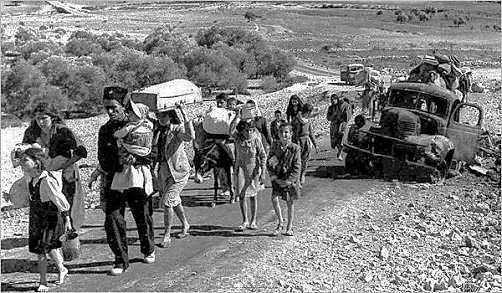
Arabs flee in 1948 ahead of the ‘war of extermination’ against Israel. Picture: History/Universal Images Group via Getty Images
Arabs flee in 1948 ahead of the ‘war of extermination’ against Israel.
History/Universal Images Group via Getty Images

A crucial element of that strategy was to use civilian militias in the territory’s 450 Arab villages to ambush, encircle and destroy Jewish forces, as they did in the conflict’s first three months.

It was to reduce that risk that the Haganah – the predecessor of the Israel Defence Force – adopted the Dalet plan in March 1948 that ordered the evacuation of those “hostile” Arab villages, notably in the surrounds of Jerusalem, that posed a direct threat of encirclement. The implementation of its criteria for clearing villages was inevitably imperfect, but the Dalet plan neither sought nor was the primary cause of the massive outflow of Arab refugees that was well under way before it came into effect.

Nor was the scale of the outflow much influenced by the massacres committed by Irgun and Lehi – small Jewish militias that had broken away from the Haganah – which did not loom large in a prolonged, extremely violent, conflict that also displaced a very high proportion of the Jewish population.

Rather, three factors were mainly involved. First, the Muslim authorities, led by the rector of Cairo’s Al Azhar Mosque, instructed the faithful to “temporarily leave the territory, so that our warriors can freely undertake their task of extermination”.

Second, believing that the war would be short-lived and that they could soon return without having to incur its risks, the Arab elites fled immediately, leaving the Arab population leaderless, disoriented and demoralised, especially once the Jewish forces gained the upper hand.

Third and last, as Benny Morris, a harsh critic of Israel, stresses in his widely cited study of the Palestinian exodus, “knowing what the Arabs had done to the Jews, the Arabs were terrified the Jews would, once they could, do it to them”.

Seen in that perspective, the exodus was little different from the fear-ridden flights of civilians discussed above. There was, however, one immensely significant difference: having precipitated the creation of a pool of 700,000 Palestinian refugees, the Arab states refused to absorb them.

Rather, they used their clout in the UN to establish the UN Relief and Works Agency for Palestine Refugees, which became a bloated, grant-funded bureaucracy whose survival depended on endlessly perpetuating the Palestinians’ refugee status.

In entrenching the problem, the UN was merely doing the bidding of the Arab states, which increasingly relied on the issue of Palestine to convert popular anger at their abject failures into rage against Israel and the West. Terminally corrupt, manifestly incapable of economic and social development, the Arab kleptocracies elevated Jew-hatred into the opium of the people – and empowered the Islamist fanaticism that has wreaked so much harm worldwide.

Nor did it end there. Fanning the flames of anti-Semitism, the Arab states proceeded to expel, or force the departure of, 800,000 Jews who had lived in the Arab lands for millennia, taking away their nationality, expropriating their assets and forbidding them from ever returning to the place of their birth. Those Jews were, however painfully, integrated into Israel; the Palestinian refugees, in contrast, remained isolated, subsisting mainly on welfare, rejected by countries that claimed to be their greatest friends. Thus was born the myth of the Nakba.

That vast population movements have inflicted enormous costs on those who have been ousted from their homes is undeniable. Nor have the tragedies ended: without a murmur from the Arab states, 400,000 Palestinians were expelled from Kuwait after the first Gulf War, in retaliation for the Palestine Liberation Organisation’s support of Saddam Hussein. More recently, Myanmar has expelled 1.2 million Rohingya.

But the greatest tragedy associated with the plight of the Palestinians is not the loss of a homeland; over the past century, that has been the fate of tens of millions. Rather, it is the refusal to look forward rather than always looking back, an attitude encapsulated in the slogan “from the river to the sea”.

That has suited the Arab leaders, but it has condemned ordinary Palestinians to endless misery and perpetual war. Until that changes, the future will be a constant repetition of a blood-soaked past

Red and white terror – the Russian revolution and civil war

… as a policeman, I would say, get hold of a man’s brother and you’re halfway home. Nor was it admiration for a better man than me. I did admire him, but I didn’t think he was a better man. Besides, I’ve executed better men than me with a small pistol. 

She’d come to Moscow to look for her child. I helped her as best I could, but I knew it was hopeless. I think I was a little in love with her. One day she went away and didn’t come back. She died or vanished somewhere, in one of the labor camps. A nameless number on a list that was afterwards mislaid. That was quite common in those days.

Yevgraf Zhivargo, in David Lean’s Doctor Zhivago (1965)

“The terror,” declared British Historian Simon Schama in his iconic Citizens: A Chronicle of the French Revolution “was merely 1789 with a higher body count; violence … was not just an unfortunate side effect … it was the Revolution’s source of collective energy. It was what made the Revolution revolutionary’. In short, “From the very beginning […] violence was the motor revolution”.

At the end of the chapter on the coming of thw Revolutionary Wars, he writes: ‘ … poets of romantic weather forecasting like William Wordsworth continued to describe the revolution is a cyclonic disturbance, but increasingly it was no longer the storm that invigorates in cleanses rather a dark and potent elemental rage moving forward in indiscriminate destruction its breath was no longer sweet but foul. It was the wind of war and if the wind of war comes, can the storm clouds of war be far behind’.

I thought a lot about the events of the French Revolution and the Napoleonic wars which followed it as I read English author and historian Anthony Beevor’s latest foray into Russian and Soviet history, Russia – Revolution and Civil War 1917-1921

Some books can be unrelentingly bleak and brutal, so grim and graphic in fact that you have to push yourself to finish them. Cormac McCarthy’s odyssey tale The Road is one such. But one doesn’t often say that about history books. Usually it is time, ennui or both that cry “enough, already!” You set it aside, promising to return to your bookmark – but you never do. I persevered with a veritable catalogue of the horrors that men can inflict upon their fellow humans (and yes, the perpetrators are apparently exclusively male, and the victims are males and females of many ethnicities). Beevor’s previous, highly acclaimed books Stalingrad and Berlin 1945 are chilling, but his latest takes top prize. And finish it I did …

The following is not a review of Beavor’s grim opus as such, but rather a thematic compendium of thoughts and observations derived from or inspired by the book.

Most academic accounts and university courses focus on the ideological and geopolitical dimensions of the origins, rise and consolidation of the Soviet Union, and its ultimate disintegration seventy years later. General public knowledge of the Russian Revolution and the civil war which followed it is relatively limited and cursory, often derived and books like Mikail Sholokhov’s saga of the Don Cossacks, Quiet Flows the Don and The Don Flows Home To The Sea, and Boris Pasternak’s Doctor Zhivago. Indeed, it was these novels and David Lean’s powerful adaptation of Doctor Zhivago that first attracted my interest in Russia as a school student in Birmingham. I majored in Politics at the University of Reading in the United Kingdom, and Soviet history and politics were an important part of my studies. Between those days and today, I’ve read widely about Russia’s history, past and present, and I am familiar with the events, ideas and personalities, their role in the broader and longer tableau of history, and the reverberations that are still felt today.

I have written often in In That Howling Infinite on Russian and Ukrainian history. Although I am no expert, and profess an amateur interest only, I do possess a short and humble pedigree. My tutor in Soviet Studies at Reading was exiled Hungarian academic and historian Tibor SzamuelyLike many refugees from Communism, he was descended from both perpetrators and victims. An uncle of the same name served in the Hungarian Soviet Republic that took power for six months under Béla Kun in 1919 and died violently that year when the revolution failed. He was among that government’s most bloodthirsty ministers and was called “Butcher Szamuely”. Szamuely’s family wound up in Moscow, where Tibor was born, and where his father was executed in Stalin’s purges. Young Tibor served in the Red Army, and he too was arrested and sent to a labour camp. Rehabilitated, he served as Chancellor of Budapest University. In 1964, then nearing 40, he was teaching in the “ideological institute” of Ghana’s Marxist president Kwame Nkrumah when he defected to England.

Back then, I was a political ingenue and a naïve communist sympathizer and fellow traveler, although my evolving perspectives were transforming and expanding. As my tutor, he advised me to study with an open mind and to put off juvenile thinking. He hadn’t been well when I knew him, and he died a year after I graduated. Under his tuition, I’d resolved to specialize in Soviet Studies – but events intervened, and I ended up in the Middle East (and that is another story. see: Tanks for the Memory – how Brezhnev changed my life). I nevertheless retained an active interest in the history and politics of Eastern Europe.

He would always impress upon me the historical and political continuity of what he called The Russian Tradition – the title of his one and only book, The Russian Tradition, published shortly before his death, and now, regrettably, out of print. I purchased a first edition when it was published and it is on my bookshelf still.

Szamuely believed that the bloodstained drama of the revolutions of 1917 – there were two, the social democratic one in the February, the Bolshevik one in November – and the years that followed, including civil war, the establishment of the USSR and Stalinism largely obscured the underlying consistency of Russian history. He did not live to see the decline and fall of the Soviet Union, and the advent of Putin and Russia Redux, but the basic pattern persists, circular and repetitive. The frequent turmoils that have overtaken this vast continent have in their various ways made changes that were essentially superficial, leading in the end to the intensification, under new forms, of the old authoritarian structure.

You – Bolshevik recruiting poster 1918


Contemplating civil wars

A civil war can emerge from the ashes of a wider, ongoing conflagration when factions or parties dispute the nature and terms of the post-bellum status quo and fracture along political and ideological lines. Many civil wars have arisen from the ashes of a prior war when there are what are perceived as existential issues unresolved and the availability of weapons and materièl and experienced and discontented men to use them.

There is a view that civil war can retrospectively be seen as a crucible of nation, a fiery furnace through which the righteous must walk – an ex post facto rationalization of the Nietzschean paradox of “that which does not kill us makes us strong”. Abraham Lincoln verbalized this in his Gettysburg Address in 1863 on a battlefield where the fallen had been only recently interred. Franco made a similar play as he laid claim to the wreckage that was Spain in the wake of three years of carnage, but then petrified his riven, country in autocratic stone until his death many decades later. The Russian Civil War was not accorded such a nation-building ethos as it was viewed by the Bolshevik victors as the crushing of a counter-revolution against a new world already being born.

Given Russia’s vast expanse, long history of restive regions, and large non-Russian ethnicities – all a result of centuries of imperial conquests – there is always the potential for the disintegration of centralized control and fragmentation. There is a rich history of state collapse following wars, revolutions, system breakdowns, economic crises, and other epochal events. Napoleon’s empire collapsed after his disastrous march on Moscow and subsequent defeat at the Battle of Leipzig. In 1918, the Ottoman, Austro-Hungarian, German, and Russian empires all collapsed in military defeat. Of course, people, decisions, and policies played a role, but ultimately it was war and the attendant economic and social crises that pushed these states over the edge into political chaos and often violence.

Once thing for sure, civil war, the Hobbesian “war if all against all” (Hobbes was thinking England’s) is undoubtedly the saddest, bloodiest and most visceral of all conflicts. I leave the last words to WB Yeats:

Things fall apart; the centre cannot hold;
Mere anarchy is loosed upon the world,
The blood-dimmed tide is loosed, and everywhere
The ceremony of innocence is drowned;
The best lack all conviction, while the worst
Are full of passionate intensity.

See: In that Howling Infinite, A House Divided – the Nature of Civil War

All fall down 

Revolutions are unpredictable. They never run in straight lines. They reverberate, the shockwaves expanding and impacting on their vicinity, and way beyond. The shots ricochet, like drive-by shootings and crossfires, and you never know who will be hit, where the bullets will come to rest, and who will be damaged or destroyed. Many people will be liberated, and many enslaved. Many peoples will prosper, and many, many will perish. As TS Elliot wrote, “between the idea and the reality falls the shadow”.”

When the Tsarist Russian empire collapsed halfway through the First World War, it was the first of four great empires to disintegrate. By war’s end, the conflict had destroyed the German, Hapsburg and Ottoman empires. But unlike these three, though the imperial house perished, the empire it ruled did not disintegrate. A handful of national movements, Finnish, Polish, Estonian, Latvian, and Lithuanian succeeded in breaking free, but most of murdered Tsar’s realm emerged from the convulsions of world war, revolution and civil war within a new Soviet empire, one that still ruled millions of square miles and a multitude of peoples.

The Russian Revolutions – the two in 1917, and a failed rising in 1905 in the wake of the disastrous (for Russia) of Russo-Japanese War – and the civil war that followed can be said to have defined the contours of modern European geopolitics, setting the stage for the Cold War and also, the current Ukraine war. The 20th Century was not kind to the countries of Central and Eastern Europe. Historian Timothy Snyder called them “the blood lands”.

The USSR was officially declared in the Bolshoi Theatre on 30th December 1922. Most people find this slightly surprising, because we assume that the Soviet Union must have been proclaimed immediately after The Bolshevik Revolution in November 1917. In fact, it only came into existence after a horrendous civil war that killed an estimated 10 million people, in which the deep national and ethnic tensions inside the old Russian Empire had been laid bare for all to see.

Historian Orlando Figes says in his seminal book about the Bolshevik revolution, A People’s Tragedy, that the failure of democracy in 1917 was deeply rooted in Russian culture and social history and what had started as a people’s revolution contained the seeds of its degeneration into violence and dictatorship.

In Russia, the revolution of February 1917 did not provoke a counterrevolution. The initial absence of any attempt to fight back was illustrative not so much apathy, as a feeling that there was very little of the ancien regime left that was worth defending. The overthrow of the czarist regime prompted a variety of reactions amongst the former ruling class: a resignation to events, bitterness at the incompetence and obstinacy of the Imperial Court, yet also an initial optimism among its more liberal and idealistic members. Most of the nobility and bourgeoisie supported the Provisional Government in the hope that it would at least restrain the worst excesses and keep the country together.

Soon after the November 1917 revolution, Lenin made it clear to the Bolsheviks that civil war was necessary to cleanse Russia of reactionary forces and old ways and to rebuild as a communist state and society. Moreover, he was confident that the Bolsheviks’ example would ignite revolution in the countries of Western Europe. German and Hungarian communists obliged, establishing people’s republics, which in turn invited counter revolution, the ousting of the revolutionaries, and reactionary military and police exacting bloody revenge on any leftists that could find.

The determination to resist only crystallized when the Bolshevik programme in the wake of the Bolshevik Revolution of October 1917 polarized opinion. The question is important when it comes to the origins of the Civil War itself, which led to the deaths of up to 12,000,000 people, the impoverishment of the whole country, and suffering on an unimaginable scale.

In June 1918 the Bolshevik regime was enjoying a brief respite from the rigors of revolution and civil war. Although surrounded on all sides by hostile forces, the Bolsheviks were in no immediate military danger. This welcome hiatus, lasting from the Treaty of Brest-Litovsk (March 1918) to the collapse of the Central Powers at the end of the year, allowed the Bolsheviks to consolidate their political and military strength.

In an uneasy alliance with the Bolsheviks were leftwing Socialist Revolutionaries who still dreamed of a constituent assembly and the anarchists who regarded Brest-Litovsk represented the watershed of the Revolution. In coming to terms with the Central Powers, the Bolsheviks had paid a staggering price in territory and resources. But, more importantly, they had preferred to make a pact with the imperialists rather than attempt to propagate the Revolution through popular initiatives, in particular, by partisan warfare.

Shortly after Brest-Litovsk the Bolsheviks turned against their erstwhile allies. The Cheka (the successor to the Czar’s Okrana secret police and the precursor to the NKVD, the KGB and the FSB) ostensibly created to suppress counterrevolutionaries, was unleashed on the Bolsheviks’ critics on the left. There were fierce battles between Chekists and anarchists in Petrograd and many other Russian cities.

It was game on.

It is difficult to comprehend to scale of the civil war that broke out in Russia in terms of its territorial extent, the numbers of nations and would-be states engaged in the conflict, and the destruction and carnage it wrought to soldier and civilian alike. Nor the ongoing relentlessness. Western European invaders had been defeated in the past (and indeed, the future) by what Mikhail Kutuzov, the Russian general who defeated Napoleon, called General Winter, but within the empire and its Soviet successor, weather did not stop play. Certainly, it complicated military operations, played havoc with logistics and supply-chains, and inflicted indescribable suffering upon soldiers and civilians. And the war went on …

The last of the Romanovs – Tsar Nicholas and his family, murdered by the Bolsheviks in July 1918

Revolution and reaction

If Lenin was politically flexible with foreign powers, he was ruthless with his own people, including rival parties on the left. He grabbed power when the hapless provisional government lost its way in setting up a constituent assembly that was intended to be a democratic representation of all Russians. Lenin initially paid lip service to the assembly, while calling for power to go the “soviets” – people’s councils. In reality he had no intention of allowing any diminishment or oversight of his control of the Bolshevik party and, through its Council of People’s Commissars, the battered Russian state.

But no sooner had the Bolsheviks cemented their rule than they were fighting a civil war on multiple fronts against a mind-boggling array of enemies, stretching from revolutionary socialists  and anarchists to unreconstructed “White Russian” tsarists, nostalgic for a corrupt and flagrantly unjust regime and in between the Reds and Whites were the Greens or Partisans, mainly deserters from all sides who hated both Reds and Whites and attacked both, increasingly so as the war continued. And a range of foreign powers dealt themselves into the game to further their own strategic and ideological interests. [the featured picture of this piece is an idealized manga depiction of charismatic Ukrainian anarchist and Green Nestor Makhno, a larger-than-life figure who miraculous survived the civil way and died in his bed in exile]

The Whites were a confused, fractured and often dysfunctional coalition with rapid changes of command occasioned by personal ambitions and fluctuating military fortunes. White generals were committed to restoring the integrity of the Russian Empire, a self-defeating handicap that alienated potential allies on the fringes, like Finland, the Baltic states and Poland. Churchill underestimated this imperial obsession which prevented the alliances he wanted to defeat the Bolsheviks. The Greater Russia obsession also hampered efforts in the Caucasus where Georgians stirred regions like Ingushetia, Chechnya and Dagestan, giving Britain nightmares of Bolshevism spreading through Central Asia towards India, an obsession that continued through the twenties as described in Peter Hopkirk’s Setting the East Ablaze – Lenin’s Dream of an Empire in Asia.

Out on the edge of the old empire, White warlords endeavoured to carve out kingdoms for themselves. Many commanders spent more time terrorizing locals than fighting the Red partisans who were operating behind enemy lines across the war zone, creating a legacy and tradition the persist to this day.

The diffusion of opponents played into the Bolsheviks’ hands, as their differences were so extreme that a unified opposition fighting force was never a viable option. But if the battle lines were often blurred, the hatred felt by the combatants for each other was nightmarishly vivid.

The White’s defeat in the civil war wasn’t for lack of outside moral and materiel support. It was due largely to their inflexibility, including their refusal to contemplate land reform until it was far too late, and their refusal to grant any autonomy to nationalities of the Czarist Empire. Their administration was so useless that it’s barely existed. Paradoxically, they lost for reasons very similar to the way the Republicans lost the Spanish Civil War two decades later. In Spain, the antifascist alliance of the Republic could not prevail against Generalissimo Franciso Franco‘s disciplined and militarized regime. In Russia, the utterly incompatible alliance of socialist revolutionaries and reactionary monarchists didn’t stand a chance against the single-minded Communist dictatorship.

A leftist libertarian with St. George’s Cross, and a Sister of Mercy nurse, 1916.

World War 1.2

It in many ways it became World War 1.2. The idea of a purely Russian Civil War is misleading simplification, prompting one historian recently to describe it instead as ‘a world war condensed’.

It was waged across European and Asian Russia, including present day Belarus and Ukraine and the successor states of the Soviet Union in the Baltic, the Caucasus, and Central Asia – from Warsaw and Eastern Europe to the Urals and eastwards through the vastness of Siberia’s forests, deserts and tundra to Vladivostok in the Far East, from the arctic north to Crimea and the Black Sea, the Caspian Sea and the borders of what in 1918 ceased to be the Ottoman Empire. Fronts stretched for thousands of miles and advances and retreats likewise. The Trans-Siberian Railway, stretching the length of the former empire from Moscow to Vladivostok, was almost six thousand miles long, and it’s tributary lines served as strategic and logistical thoroughfares for all protagonists who weren’t mounted like the innumerable Cossacks tribes and the nascent Red Cavalry, bringing to prominence the armoured trains that became a symbol of the revolution.

It drew in most of Russia’s contemporary neighbours and more far-flung nations, including The USA, Britain, France, Germany Italy and Japan – the latter providing the largest contingent, estimated by British Intelligence as some 85,000 soldiers, more than many of the various White armies. Combatants included soldiers from these countries, the British dominions of Canada, Australia, South Africa, and India, and Chinese and Mongolian troops. And a multitude of ethnicities fought for their own warlords, their national place in the sun or else their very survival. Caught up in the transcontinental maelstrom were Slavs, Cossacks, Tartars, Turkmen, Arabs, Azeris, Persians, Turks, Armenians, Chechens, Kazakhs, Buryat Mongols, Kalmyks (Europe’s only Buddhist nation) and Jews. White divisions were augmented in Siberia by Mongolian, Chinese, Uighur and Kirghiz mercenaries.

Various nationalist movements arose, successfully and unsuccessfully in all parts of the former Russian Empire. The aftermath of the First World War and the collapse of the Russian Empire saw Polish, German, Italian, Hungarian, Romanian, Czech, and myriad other nationalities fighting for disparate sides, and Beevor skillfully frames the bizarre impact of this on the ethnic nationalist dimensions of the conflict.

The scale of military manoeuvres was unprecedented, as were the physical and supply difficulties over vast distances, and the extremities in climate, particularly the bitter Russian winter. The conflict became very much a cavalry war and indeed, a “railway war” notable for its armoured trains and the logistical lifeline of the Trans-Siberian Railway, protected for much if the conflict by the Czechoslovak Legion, a force of Czech and Slovak nationalists who having fought in the Czarist army, joined the Whites who controlled many towns in Siberia.

In addition to the Czechs, there was also a Polish Legion operating in the Far East. The commanders of both forces became increasingly disenchanted with the White officers who refused to countenance the independence of the border states and who shocked many with their brutality towards prisoners and civilians, and though thousands of miles from Europe, demanded repatriation – ostensibly by sea from Vladivostok.

Western Allies’ ideological perspective of the civil war was ambivalent. Though many, politicians and military alike, were viscerally opposed to Bolshevism and what it stood for, and feared a Red contagion infecting their own countries, a fear that was not unfounded. In the wake of the Revolution, a concatenation of revolts detonated across the globe. Bolshevism spread westwards, from Vienna through Budapest and Sofia to Kiel. The Bavarian Soviet Republic was briefly established in April 1919, before the far-Right Freikorps did it in. Britain wasn’t immune to the ferment. Between the February and October Revolutions, the Leeds Soviet did indeed appear to be the beginning of something, whilst strikes and demonstrations proliferated to be violently put down by the police and army. Winston Churchill alone of his cabinet colleagues wanted a full-on allied intervention and dreamed – some believed he was indeed dreaming but others claimed that he fantasized – of creating an effective White army and a borderlands alliance to defeat the Bolsheviks. But his aspirations were foiled by the imperialism of the White leadership and of White officers and the various national movements’ fear that that if the Whites prevailed, they would restore Russian rule. Britain’s rulers were reticent about shoring up and providing financial, material support and also, soldiers sailors and airmen to brutal to demonstrably homicidal Cossack brigades and revanchist and reactionary royalist autocrats.

British regiments were nevertheless deployed in Siberia and in the Far East as well as the Arctic and Caspian Sea. Royal Navy flotillas blockaded Petrograd in the Baltic, floated up the Volga in the south and down the Dvina in the arctic north, and controlled the Caspian Sea and the waters around the Crimean Peninsula. The Royal Air Force deployed Sopwith Camels and sea planes in surveillance and surveillance missions against the Red forces, who British officers called the “Bolos”. And artillery units and armoured car squadrons were attached to the various White armies.

Wider imperial concerns were in play too. Churchill rang alarm bells as the Reds pushed the Whites back in Siberia and Central Asia, alarming even his reticent cabinet colleagues with prospect of Reds on the borders of the Raj. The Great Game still had over a quarter of century to run before the final whistle blew. In the Far East, Britain and the US, and Reds and Whites alike, were nervous about the designs imperial Japanese was revealing with regard to the resources and the empty lands of eastern Siberia, the island of Sakhalin, the pacific littoral and Manchuria. Intelligence reports revealed that Japanese forces in the region exceeded all others involved, including the warring Russians.

Pogrom

Fratricidal wars are bound to be cruel because of the lack of definable front lines, because of their instant extension into civilian life, and because of the terrible hatreds and suspicions which they engender. The fighting ranged right across the Eurasian landmass was violent beyond belief, especially the unspeakable cruelty of the Cossack atamans in Siberia. Even that archconservative politician VV Shukgin believed that one of the major reasons for the failure of the whites what is a “moral collapse” – that they behaved as badly as their enemy.

There was nevertheless one subtle yet important difference. All too often, whites represented the worst examples of inhumanity, yet on that score, the Bolsheviks were unbeatable. It has been said that their ruthlessness has few parallels in recorded European history up until that time – believing that history was on their side, and that a new world was being created. The almost religious zeal with which they brutalized and killed combatants and innocents alike could be likened to the Albigensian Crusade in the early thirteenth century. [The Crusaders were accompanied by an official representative of the Pope, a French Cistercian monk named Arnaud Amalric. According to accounts written decades later, as the attack began, a soldier asked Amalric how they would be able to tell which Beziers townspeople were Catholics and which were Cathars. Some sources give the alleged quote as “Kill them all, for the Lord knows his own” or as “Kill them all. The Lord knows his own.”]

The focus on ordinary people also means their suffering is brought to the fore. And Beevor is unsparing in showing the chaotic violence of the conflict, and unrelenting in showing the sheer violence of both sides. Reds and Whites are both revealed as more than comfortable burning villages, shooting traitors, suspected or real, and torturing and massacring prisoners, and men women and children caught in the crossfire.

There were many instances of racist violence mainly on the White side – particularly towards Jews. The Whites’ antipathy towards Jews was to some degree due to their perception that most senior Bolshevik were Jewish, but mostly it was that old devil that never went away, antisemitism. The fall of the Romanovs and the ancien regime and the anti-Semitic pogroms they perpetuated continued. Retreat from the major cities brought out the worse in the Whites, with terrible massacres of Jews – although they were not the only perpetrators. Playwright And author Isaac Babel, attached as a correspondent and propagandist to the Red Cavalry on the Polish Soviet front in late 2020 posed the question: “what sort of person is our (Red) Cossack? Many layered: looting, reckless daring, professionalism, revolutionary spirit, bestial cruelty. The population await their saviors. The Jews look for liberation – and in ride the Kuban Cossacks”.

It is estimated that there were some 1300 anti-Semitic pogroms in the Ukraine during the civil war, with some 50000 to 60000 killed by both sides. There were pogroms in Belarus also, but these were not nearly as murderous as in Ukraine. A Soviet report of 1920 mentions 150,000 dead and as many again badly injured.

Churchill was well aware of the effect of the pogroms on public opinion in the West and sought in vain to exert pressure on white leaders to restrain their forces.,

Terror begat terror, leading to greater acts of conspicuous cruelty. After a particularly hard-fought battle in early 1919, a young White horse artillery officer recalled “for the first time since the start of the civil war, prisoners were not shot. There were too many of them”. This did not happen often – and such was the brutality meted out to captives on both sides, shooting was actually a blessing. An Odesa women witness after the fall of the city to the Whites, “Urrrraaa! Four and a half months under these five-pointed star oppressors”. Two days later, Beevor notes, she noted that all the Jews were in hiding. When a city held by the Reds fell to the Cossacks, a a female surgeon observed that fearing a program, two Jewish doctors in her hospital wisely ran to hide in the attic.

Bolshevik leaders and commanders on the field eventually realized that brutality did not endear their cause to the general populace and moderated their behaviour. Some Whites too came to that conclusion, and sought to prevent it at least limit atrocities, but reactionary officers and uncontrollable Cossacks persisted in burning, looting, torturing and murdering, inflicting irreparable damage to the anti-Bolshevik cause. Beevor reports instances when allied forces actually fired on Cossack perpetrators.

The End

As the whites retreated, support for the red army amongst the populace grew, as did its numbers as deserters returned to its ranks encouraged by the announcement of an amnesty and as defections from the White forces grew. Peasants grew less reluctant to serve in the Red Army Fear that with white advances and victory, old landlords would reclaim their land. Success bred success. The Whites’ ranks thinned with desertions defections and the need to transfer troops to defend its rear from attacks by partisans and freelance militias units. The Cossacks, disappointed and tired of war, turned about and headed home to their stanitsas laden with loot. The size of the frontline Red Army was eventually twice that of the Whites, as it eliminated the White armies in the north and east and closed in on the last remaining area under White control, Crimea, where rearguards held out long enough to ensure the evacuation of 150,000 soldiers and civilians by sea protected by the British and French navies.

In the aftermath of total Soviet victory, starvation struck the towns and cities across the land. Food requisitioning detachments scoured the countryside for supplies, their rapaciousness and brutality igniting peasant rebellions from Belarus to Siberia; tens of thousands of peasants rose in revolt, dealing brutally with any Bolshevik that came into their hands. The Red Army and Cheka reciprocated in spades with burning and looting, rape and torture, execution and exile to the emergent Gulag. Workers went on strike in the starving cities, and with the Whites vanquished and the civil war won, the call for democratization of Soviet rule grew louder.

And then, the sailors of the Baltic Fleet at the Kronstadt naval base, who’s guns had heralded the fall of the Romanovs, and whom Trotsky had called “the pride and glory of the Russian Revolution”, rebelled. The regime responded with lies – that the sailors had been suborned and were now Whites – and that White forces in Finland would be crossing the ice to help them. When this didn’t work, I resolved to crush them without mercy, dispatching trustworthy forces against them.

At the end, of 16000 sailors and their families, most were able to cross that ice to final and. But some 3000 fought a last stand and died by assault or firing squad. One of the last cries of protest by the Kronstadt sailors was “All of Soviet Russia has been turned into a Russian penal colony”.

Thus ended the Russian Civil War in November 1920.

… all wars come to an end. And that’s where history restarts.
British war and foreign correspondent Robert Fisk

Evacuees board ship in a Crimean portEpilogue

Epilogue … history repeats

Whilst there were many active fronts during the civil war, often simultaneously, extending for thousands of kilometers, around Archangelsk and Murmansk in the arctic, along the great rivers the Volga, the Don and the Dniester in the south, in the Baltic provinces, and in Belarus, and along the length of the Trans-Siberian Railway. And as during WW2 and the present-day Ukraine war, opposing armies advanced and retreated across Ukraine. Kiev was occupied, often several occasions, by Reds, Whites and Greens, and finally, the Polish Army which invaded Russia and Ukraine in 1920 to reclaim and defend the independence of the onetime Polish state, long divided between the now destroyed Russian, German and Austro-Hungarian empires. The names of the war-torn cities are today tragically familiar. Mariupol and Melitopol, Karchiv and Kherson. Kiev, Odessa and Lvov are now Kyiv, Odesa and Lviv.

© Paul Hemphill 2023 All rights reserved

Posts in In That Howling Infinite, about Eastern Europe:

I am the enemy you killed – Wilfred Owen’s solemn testament

If you could hear, at every jolt, the blood
Come gargling from the froth-corrupted lungs,
Obscene as cancer, bitter as the cud
Of vile, incurable sores on innocent tongues,
My friend, you would not tell with such high zest
To children ardent for some desperate glory,
The old Lie: Dulce et decorum est
Pro patria mori.

Poet Wilfred Owen died on 4 November 1918 – seven days before the guns fell silent in the war that people though would end all wars – as it turned out, the Treaty of Versailles became the peace that ended all peace.

That “old Lie,” from which his most famous poem Dulce et Decorum Est takes its title, comes from the Roman poet Horace. No bitter irony was intended, though, as Horace beseeched Romans to embrace the cleansing fire of a noble death.

In a brief article in the e-zine Quillette, titled The End of War Poetry, Simon British stand-up comic, satirist, writer, and broadcaster Simon Evans wrote:  “Privately, I still find the idea of young men gladly ploughing themselves back into the earth of their homeland unbearably moving. But after Owen, recreating such an ecstatic embrace of death in the service of a greater cause became as impossible as nailing Christ back onto the cross, or rather, nailing that cross back onto the wall”.

As Evans observes, the First World War at least gave us some of the most cherished and painfully beautiful verse in our history. “Poetry bubbled from the trenches in France as abundantly as methane, oaths, and blisters … [and] central to earlier war poetry was the tension between the terror, devastation, and death on one hand, and the opportunity for virtues like loyalty and honour on the other”.

Contemplating explanations, he writes that a junior officer’s prospects of survival were considerably worse than those of his men. According to one account, as little as six weeks. That might explain the poetry. Such a violently diminished life expectancy must have focused the mind wonderfully. World War Two was—on that score at least—considerably more democratic and egalitarian … By 1939, the culture had shifted for officers and men alike. The practice of soldiers carrying a slim volume of Browning or Keats, and of aspiring to emulate whoever was in their pockets, had passed. In 1914, the available persona of the poet was still vital—or seems so now, in sepia vignette. He was the sensitive man quietly scratching a wet match against sandpaper and putting it to a candle, careful not to wake the slumbering cattle. Ignoring the grotesque shadows that leapt in the dug-out, he would unfold his notebook, its neat ruled lines like trenches in which the words would hunker, later pressed against his breast as a Talisman once returned to his pocket. Working slowly through his exhaustion and his tobacco ration, setting down his impressions in bottled ink, striving with purpose to resolve the lunacy and the oceans of spilt blood just a few dark yards away”.

Second lieutenant Wilfred Owen, 25 years of age, was one of the last to die in a war that claimed 20 million dead and 20 million injured.  At least for the past half-centur­y, his poems have served as a prism through which the so-called Great War is viewed. But, despite being anthologised by his friend Siegfried Sassoon in 1920 and Edmund Blunden a decade later, they did not enter popular parlance until pacifist composer Benjamin Britten incorporated some of Owen’s most pot­ent verses in his War Requiem, written for the 1962 inauguration of the restored Coventry Cathedral

Gassed, John Singer Sargent 1919

Owen entered Britain’s national curriculum during the 1960s, and eventually the high school curricula of Commonwealth nations, which is where I first encountered him – and I was shocked by his viscer­al descriptions and implicit denunciations of war. He did not dwell on the causes but seemed to suggest that the sheer awfulness of military conflict between nations had stripped away all justifications.

“There had been many wars before, of course, but none where the poet was the soldier and, therefore, the intimate witness. This war was the rendering of wounds, both flesh and spiritual, by words”.

We republish below two excellent articles on Wilfred Owen and the poets of the First World War.

Othe posts in In That Howling Infinite: Dulce et Decorum est – the death of Wilfred Owen. A Son Goes To War – the grief of Rudyard Kipling and November 1918 – the counterfeit peace

Bent double, like old beggars under sacks,
Knock-kneed, coughing like hags, we cursed through sludge,
Till on the haunting flares we turned our backs,
And towards our distant rest began to trudge.
Men marched asleep. Many had lost their boots,
But limped on, blood-shod. All went lame; all blind;
Drunk with fatigue; deaf even to the hoots
Of gas-shells dropping softly behind.

Gas! GAS! Quick, boys!—An ecstasy of fumbling
Fitting the clumsy helmets just in time,
But someone still was yelling out and stumbling
And flound’ring like a man in fire or lime.—
Dim through the misty panes and thick green light,
As under a green sea, I saw him drowning.

In all my dreams before my helpless sight,
He plunges at me, guttering, choking, drowning.

If in some smothering dreams, you too could pace
Behind the wagon that we flung him in,
And watch the white eyes writhing in his face,
His hanging face, like a devil’s sick of sin;
If you could hear, at every jolt, the blood
Come gargling from the froth-corrupted lungs,
Obscene as cancer, bitter as the cud
Of vile, incurable sores on innocent tongues,—
My friend, you would not tell with such high zest
To children ardent for some desperate glory,
The old Lie: Dulce et decorum est
Pro patria mori.

Qurba-n قُرْبان

Sacrifice -Rayner Hoff, Anzac Memorial, Hyde Park, Sydney

War poet Wilfred Owen: sweet and honourable lie 

Artwork: Sturt Krygsman.

Artwork: Sturt Krygsman.

Mahir Ali, Weekend Australian, 10th November 2018

During a visit to London in 1920, Bengali poet, philosopher and polem­icist Rabindranath Tagore receive­d an unexpected letter from a Mrs Susan Owen. She wished to share some information about her favourite son.

“It is nearly two years ago, that my dear eldest son went out to the War for the last time,” she wrote, “and the day he said Goodbye to me … my poet son said these wonderful words of yours … ‘when I leave, let these be my parting words: what my eyes have seen, what my life received, are unsurpassable’. And when his pocket book came back to me — I found these words written in his dear writing — with your name beneath.”

Tagore was something of a celebrity in Britain at the time, a white-bearded Indian sage who bore a resemblance to the then recently ­deceased Leo Tolstoy. He had won the Nobel Prize in Literature in 1913 on the strength, essentially, of Gitanjali, a collection of poetry he had translated from the original Bengali with the assistance of William Butler Yeats, which is the source for the aphorism that appealed to Owen’s son. That son, Wilfred, is likely to have perceived rather differently from Tagore the context of what each of them considered “unsurpassable”.

It is equally likely that the young Englishman was unfamiliar with Tagore’s thought-provoking critique of nationalism as well as the poem, compos­ed on the last day of the 19th century, that demonstrates a remarkable prescience about the maelstrom that sneaked up on Europe shortly afterwards:

The last sun of the century sets amidst the blood red clouds of the West and the whirlwind of hatred The naked passion of self-love of Nations, in its drunken delirium of greed, is dancing to the clash of steel and the howling verses of vengeance The hungry self of Nation shall burst in a violence of fury from its own shameless feeding For it has made the world its food …

A plate from <i>Poems by Wilfred Owen </i>(1920).

               A plate from Poems by Wilfred Owen (1920)

Wilfred Owen’s final foray into that maelstrom came in August 1918. He won a Military Cross shortly afterwards. But while the Armistice Day bells pealed on November 11, his family received a telegram informing them that Wilfred had been killed a week earlier — 100 years ago last Sunday — while leading the men under his command across the Sambre-Oise canal at Ors.

The second lieutenant was 25, his longevity abbreviated by a year even in comparison with the life span of his favourite predecessor poet, John Keats.

Unlike all too many of his contemporaries, though, Owen did not exactl­y die in vain. At least for the past half-centur­y, his poems have served as a prism through which the so-called Great War is viewed. But, despite being anthologised by his friend Siegfried Sassoon in 1920 and Edmund Blunden a decade later, they did not enter popular parlance until pacifist composer Benjamin Britten incorporated some of Owen’s most pot­ent verses in his War Requiem, written for the 1962 inauguration of the restored Coventry Cathedral.

Coincidentally, about the same time, a fellow composer appropriated a contemporary young poet’s verses as the centrepiece of his 13th symphony: Dmitri Shostakovich immortalised Yevgen­y Yevtushenko’s poem Babi Yar, which catapults from a reflection on an egregiously atrocious component of the Judeocide that accompa­nied World War II into a searing condem­nation of anti-Semitism. It also serves as a reminder that the “war to end all wars” not only did nothing of the kind but in fact sowed the seeds for an even more outrageous bloodbath.

Owen entered Britain’s national curriculum during the 1960s, and eventually the curricula of Commonwealth nations, which is where I first encountered him and was blown away by his viscer­al descriptions and implicit denunciations of war. He did not dwell on the causes but seemed to suggest that the sheer awfulness of military conflict between nations stripped away all justifications.

The alliteration and onomatopoeia of the sonnet Anthem for Doomed Youth made a powerful impression, but so did the realisat­ion that “those who die as cattle” were by no means restricted to Gallipoli or the Somme, and that “the stuttering rifles’ rapid rattle” continued to “patter out” all too many “hasty orisons”.

Dulce et Decorum Est stands out not only for nailing Horace’s destructive untruth about the value of patriotic sacrifice but also because gas attac­ks against unsuspecting victims remain par for the course on Middle Eastern battlefields — notably in Syria, where chlorine, used to such devastating effect in World War I, continues to serve as a favourite weapon for the Assad regim­e and some of its opponents.

Owen pictured a gas attack on a retreating column of comrades in which just one fails to fit “the clumsy (helmet) just in time”. “In all my dreams, before my helpless sight, / He plunges at me, guttering, choking, drowning,” he declares, comparing the soldier’s “hanging face” to “the devil’s sick of sin”, before going in for the kill, so to speak:

If you could hear, at every jolt, the blood
Come gargling from the froth-corrupted lungs,
Obscene as cancer, bitter as the cud
Of vile, incurable sores on innocent tongues,
My friend, you would not tell with such high zest
To children ardent for some desperate glory,
The old Lie: Dulce et decorum est
Pro patria mori.

The Latin translates as “it is sweet and honoura­ble to die for one’s country”, and Owen’s oeuvre offers incontrovertible evidence to the contrary.

He goes much further in Futility, whose title has been cited by scholars as a key to framing contemporary conceptions of the conflict. Yet in this poem Owen is questioning not just the war but the very point of life on earth. Again, it’s based on a single casualty, a human being the sun can no longer manage to revive after having roused it for so many years. “Was it for this the clay grew tall?” the poet asks: “O what made fatuous sunbeams toil / To break earth’s sleep at all?”

Then there’s Strange Meeting, a reinforcement of the trope whereby warriors in the battlefield come up against a foe who is a doppel­ganger, as in Bob Dylan’s relatively obscu­re early song John Brown, where the narrat­or informs his mother: “But the thing that scared me most was when my enemy came close / And I saw that his face looked just like mine.” In Owen’s case, the resemblance is not physical but spiritual, in a poem replete with the half-rhymes that distinguished his style; groined/groaned, moan/mourn, spoiled/spilled, mystery/mastery and so on.

He escapes “down some profound dull ­tunnel” to a “sullen hall”, and by the “dead smile” of an inmate who greets him “with piteou­s recognition in fixed eyes” knows that “we stood in Hell”. Back in the day, those socia­l democrats (synonymous at the time with socialists and communists) who had not fallen into the patriotic trap tended to describe a bayonet as “a weapon with a worker at both ends”. Owen sees a blade with a poet at both ends: “Whatever hope is yours, / Was my life also,” his new acquaintance tells him. “I went hunting wild / After the wildest beauty in the world … For by my glee might many men have laughed, / And of my weeping something had been left, / Which must die now. I mean the truth untold, / The pity of war, the pity war distilled­.” The poem concludes thus:

I am the enemy you killed, my friend.
I knew you in this dark: for so you frowned
Yesterday through me as you jabbed and killed.
I parried; but my hands were loath and cold.
Let us sleep now …

In The Parable of the Old Man and the Young, meanwhile, Owen subverts a key narrat­ive from the Old Testament to formul­ate his angst. An angel intervenes as Abraham prepares to murder his firstborn, Isaac, and offer­s a ram instead. “But the old man would not so, but slew his son / And half the seed of Europe one by one.” It’s unlikely he would have quarrelled with American “singer-journalist” Phil Ochs’s declaration almost a half-century later: “It’s always the old to lead us to the war / It’s always the young to fall / Now look at all we’ve won with the sabre and the gun / Tell me is it worth it all …”

It wasn’t, of course, just the seed of Europe that perished in the early 20th-century carnag­e. We never cease to be reminded how Australia answered the call — and paid proportionat­ely a higher price than any other country in what purportedly served as a nation­-building cull. Its effort was voluntary, a precursor to almost every Western-waged war through the 20th century and beyond — from Korea to Vietnam, Afghanistan and Iraq — to which our nation has contributed its young blood, chiefly as a means of ingratiating itself with its imperial “protectors”, and partly by regurgi­tating “the old Lie”.

But plenty of countries that were still colonie­s in 1914 also contributed their spawn — a million men in India’s case, as reflected in Trench Brothers, a play premiered in Brighton a couple of weeks ago. Besides, the Ottoman Empire was a participant, on Germany’s side, in the Great War, so substantial parts of the Middle East were not immune to the conflict. And the war’s last shots were fired in southern Africa, where the imperial urge had drawn several European nations, including Britain and Germany.

Owen wasn’t a conscientious objector by nature. As a Shropshire lad he was deeply religio­us, to the extent that initially the liturgy trumped his second love, poetry, and for a time he was expected to join the clergy. But better sense prevailed, and he was teaching in France when the war broke out. He returned home, joined up and underwent training, but wasn’t cast into the cauldron until January 1917. He was back home by midsummer, after having been blown out of a trench into a well. He recuperated at Craiglockhart Hospital near Edinburgh, a facility for the shell-­shocked, or those with what today would be designated as post-traumatic stress disorder.

It was there that he encountered Sassoon, an army captain who had been dispatched partly as means of silencing his increasingly trenchant anti-war propaganda.

Owen was familiar with the poetry of Sassoon, who was six years older, and tentatively approached him for an autograph before sharing his own efforts at wartime verse. In response, Sassoon combined constructive criticism with a great deal of encouragement, and soon enough the pent-up poems began pouring out of Owen.

Almost all of his best-known poems surface­d during the year or so between then and his demise, most of them emotions re­collected during the relative tranquillity of sojourn­s in his homeland. Among the first was The Send-Off, in which he compares soldiers on an outward bound train, their “faces grimly gay”, with “wrongs hushed-up”. He goes on to ask: “Shall they return to beating of great bells / In wild train-loads? / A few, a few, to few for drums and yells, // May creep back, silent, to villag­e wells, / Up half-known roads.”

In Exposure, we encounter frozen corpses as: “The burying-party, picks and shovels in ­shaking grasp, / Pause over half-known faces. All their eyes are ice, / But nothing happens.” In Mental Cases, there is the devastating verse: “Surely we have perished/ Sleeping, and walk hell; but who these hellish?”

In a draft preface to a planned 1919 collection of his verse, Owen wrote: “Above all, this book is not concerned with Poetry. The subject of it is War, and the pity of War. The Poetry is in the pity. Yet these elegies are to this generation in no sense consolatory. They may be to the next. All the poet can do to-day is to warn.’’

Less than 30 years later, Wilfred Burchett, the Australian who became the first Western journalist to witness the devastation of Hirosh­ima, prefaced his accoun­t with the words: “I write this as a warning to the world.”

Unheeded warnings remain one of the drivin­g forces of history’s chariot wheels, clogged as they are with much blood, but who can sensibly argue that they ought not to have been articulated? Who can say when we will ever learn, but it’s unlikely Owen would have disputed his contemporary Robert Graves’s reflectio­n on November 11, 1918:

When the days of rejoicing are over,
When the flags are stowed safely away,
They will dream of another ‘War to end Wars’
And another wild Armistice Day

Poets in action: How writers captured the horrors of the Great War

Warwick McFadyen, Sydney Morning Herald 2nd 

One hundred years ago today, Wilfred Owen, poet and soldier, had 24 hours to live. On November 4, 1918, Owen and his men were trying to cross a canal near Ors in France. As Owen was walking among his men, offering encouragement, German machine guns burst into action. Owen fell. He was one of the last to die in a war that claimed 20 million dead and 20 million injured. He was promoted to lieutenant the next day.

In the cruellest twist, Owen’s mother in Shrewsbury received the telegram of his death on November 11, Armistice Day, as the bells were ringing for peace.

A generation of young men marched to the front in World War I, often singing and with cheerful abandon, at least in the beginning, to be slaughtered.

Poetry would mourn the loss of a singular talent, whose star was just beginning to light the sky. Owen had seen but a handful of his poems in print before his death, aged 25. He had written all we have, in little more than 12 months, from August 1917.

The first collection, edited by Siegfried Sassoon, was published in 1920, and then in 1931 appeared an expanded collection. In the latter edition, editor Edmund Blunden wrote that Owen “was a poet without classifications of war and peace. Had he lived, his humanity would have continued to encounter great and moving themes, the painful sometimes, sometimes the beautiful, and his art would have matched his vision.”

Wilfred Owen had seen but a handful of his poems in print before his death, aged 25.

Apart from what are regarded as classics such as Anthem for Doomed Youth and Dulce Et Decorum Est, it is Owen’s preface to the collection that is as famous as the poems: “Above all I am not concerned with Poetry/ My subject is War, and the pity of War/ The Poetry is in the pity/ Yet these elegies are to this generation in no sense consolatory/ They may be to the next/ All a poet can do today is warn/ That is why the true Poets must be truthful.”

The First World War was a charnel house. A generation of young men marched to the front, often singing and with cheerful abandon, at least in the beginning, to be slaughtered. Poetry, unlike any time before or since, was the vehicle for their voices and those of bystanders. At first, it was celebratory, but as the days of carnage rolled on and on, truth came to be heard.

There had been many wars before, of course, but none where the poet was the soldier and, therefore, the intimate witness. This war was the rendering of wounds, both flesh and spiritual, by words.

Robert Giddings, in The War Poets, writes that “before 1914, when poets dealt with war it was to render it exotically or historically removed from immediate experience. War, in the hands of Macaulay, Tennyson, Arnold, Newboult and Aytoun, had all the conviction of modern television costume drama. There were two outstanding exceptions – Rudyard Kipling and Thomas Hardy.”

<i>Anthem for Doomed Youth</I> by Wilfred Owen is regarded as a classic.
    Anthem for Doomed Youth, World Archive 

The primacy of the poet in people’s lives a century ago can be seen in the immediate bringing into action of writers to support war aims. On September 2, 1914, only five weeks after war was declared, The Times, published a letter from the Poet Laureate, Robert Bridges, in which he likened the good soldiers of empire fighting the Devil. The image of the soldier as Christ was popular in these early stages, as was the theory that war was a necessary purification of nations. The government’s Propaganda Bureau enlisted writers such as Arthur Conan Doyle and G.K. Chesterton to promote Britain’s war aims. It took the pre-eminent war poet Sassoon to use the figure of Christ in a heightened awareness of spirit, flesh and suffering that had nothing to do with patriotism.

Professor Tim Kendall, in Poetry of the First World War, writes that during the war “poetry became established as the barometer for the nation’s values: the greater the civilisation, the greater its poetic heritage”. He believes that the “close identification of war poetry with a British national character persists to the present day”.

Siegfried Sassoon was among the poets who showed that there was art in death and suffering.
Siegfried Sassoon 

As to Australia’s war effort in poetry, despite more than 415,000 men enlisting (from a population of fewer than 5 million) with 60,000 killed and more than 150,000 injured or taken prisoner, the results hardly trouble the margins of anthologies.

As Geoff Page noted in Shadows from Fire: Poems and Photographs of Australians in the Great War, the literary efforts of those Australians with direct experience in the war were less than memorable. His intention with the book was to juxtapose recent poems “with Australians poems actually written during the conflict”.

“On closer examination, however, I found the quality of these latter poems to be depressingly low – especially when contrasted with those of the English war poets: Owen, Sassoon and Rosenberg . . . It rapidly became apparent that a much more appropriate and powerful record of the conflict could be found among the contemporary photographs held by the Australian War Memorial. These speak with a directness and truth seldom attempted, at that time, by our poets.”

By the end of 1914, two anthologies of wartime verse had been published. Many poets in the early years were no more than writers of patriotic doggerel. The Georgian movement, of pastoral whimsy, and gentle beauty, had found a cause in which to celebrate England. The modernism that had slowly been growing in Europe had not permeated English literary minds, but in the aftermath of the war it blossomed, seen no more so than in T.S. Eliot’s The Waste Land, published in 1922.

Dominic Hibberd and John Onions, in their book The Winter of the World, cite the work of historian Catherine Reilly in which she records 2225 British writers who experienced the war, and published poems of their experience. A quarter of the writers were women. By contrast Westminster Abbey honours 16 poets of WWI, all men: Richard Aldington, Laurence Binyon, Edmund Blunden, Rupert Brooke (“If I should die, think only this of me: That there’s some corner of a foreign field that is for ever England”), Wilfred Gibson, Robert Graves, Julian Grenfell, Ivor Gurney, David Jones, Robert Nichols, Owen, Sir Herbert Read, Isaac Rosenberg, Sassoon, Charles Sorley and Edward Thomas.

Since suffering and death were universal there were no frontiers in the writing of it, geographically, with Austrian Georg Trakl, German Alfred Lichtenstein, Italian Giuseppe Ungaretti, Canadian John McCrae and Frenchmen Guillaume Apollinaire and Henri Barbusse, or in gender, Edith Sitwell, Margaret Sackville, Alice Meynell and Vera Brittain, whose Testament of Youth is regarded as a masterpiece of the period.

This was the flowering that has not been captured again. The poets of the Second World War do not go much beyond Keith Douglas and Paul Celan.

It seems curious and strange now, but the biggest barricade to the acceptance of the war poets in the immediate years after came from the towering figure of Nobel Laureate W.B. Yeats.

The Oxford Book of Modern Verse 1892-1935, published in 1936, was edited by Yeats. It contained nothing from the war. Yeats defended his decision thus: “In poems that had for a time considerable fame, written in the first person, they made suffering their own. I have rejected these poems . . . passive suffering is not a theme for poetry. In all the great tragedies, tragedy is a joy to the man who dies, in Greece the tragic chorus danced. If war is necessary, or necessary in our time and place, it is best to forget its suffering, as we do the discomforts of fever, remembering our comfort at midnight when our temperature fell.”

Yeats was wrong, comprehensively so. But the glory was that Owen, Sassoon, Thomas, Rosenberg et al showed that there was art in death and suffering. The war poets found in the desolation of France and in the ruined bodies and spirits in hospital wards, a voice transcendent. Theirs was the fundamental expression of what it meant – still means – to be human. And there was a warning, but as history turned, no one was listening.

“Out there, we’ve walked quite friendly up to death;/ Sat down and eaten with him, cool and bland,/ Pardoned his spilling mess tins in our hand./ We’ve sniffed the green thick odour of his breath,/ Our eyes wept, but our courage didn’t writhe./ He’s spat at us with bullets and he’s coughed/ Shrapnel. We chorused when he sang aloft;/ We whistled while he shaved us with his scythe.” (The Next War, Wilfred Owen)

Siegfried Sassoon wrote in his diary of November 11: “The war is ended. It is impossible to realise. I got to London about 6.30 and found masses of people in streets and congested Tubes, all waving flags and making fools of themselves – an outburst of mob patriotism. It was a wretched wet night, and very mild. It is a loathsome ending to the loathsome tragedy of the last four years.”

A Son Goes To War – the grief of Rudyard Kipling

These were our children who died for our lands: they were dear in our sight.
We have only the memory left of their home-treasured sayings and laughter.
The price of our loss shall be paid to our hands, not another’s hereafter.
Neither the Alien nor Priest shall decide on it. That is our right.
But who shall return us the children?

In an excellent article commissioned by Vanity Fair in 1997, and republished below, the late author and celebrated contrarian Christopher Hitchens told a poignant story of the British poet Rudyard Kipling and the death in battle of his son John in France in 1915.

 He prefaced his tale with a scene-setting prelude:

“A ghost is something that is dead but won’t lie down. Those who were slaughtered between 1914 and 1918 are still in our midst to an astonishing degree. On the first day of the Battle of the Somme, in July 1916, the British alone posted more killed and wounded than appear on the whole of the Vietnam memorial. In the Battle of Verdun, which began the preceding February, 675,000 lives were lost. Between them, Britain, France, the United States, Germany, Turkey, and Russia sacrificed at least 10 million soldiers. And this is to say nothing of civilian losses. Out of the resulting chaos and misery came the avenging forces of Fascism and Stalinism”.

Hitchens referred to many of Kipling’s poems in his article, particularly those relating to the First World War, the jingoistic ones that greeted, indeed welcomed the beginning of hostilities, and the melancholy ones that marked their end, reflecting his personal loss and also that of tens of thousands of other parents and partners and siblings.

He does not mention however, Kipling’s post war short story, The Gardener, which directly addresses the grief and the loss felt by so many. John Kipling’s body was never found, but the poet and his wife made fruitless inquiries as to his fate and his whereabouts and, as patrons of the War Graves Commission, made many visits to the military cemeteries of Flanders.

British War Cemetery in Flanders

The Gardener tells the tale of a woman’s search for a loved one who fell. It is told from the woman’s point of view. Is the missing solder her her nephew or or son? Kipling is deliberately ambiguous, reflecting perhaps the morality of his times. It is up to the reader to draw his or her own conclusion. The ending is likewise opaque. Unlike the author, she does indeed find her lost soldier, but only with the the help of a kind, anonymous stranger. Again it is for the reader to judge – although Kipling himself left little room for ambiguity. The story ends in some editions with an asterisk in the text that links to a line from the Bible, John 20:15: “Jesus saith unto her, ‘Woman, why weepest thou; whom seekest thou?’ She, supposing him to be the gardener, saith unto him, ‘Sir, if thou has borne him hence, tell me where thou has laid him.’”

The Gardener is is republished below, following Hitchens’ article.

In 1992 the Commonwealth War Graves Commission announced that it had identified an Irish Guards lieutenant’s body in St Mary’s Advanced Dressing Station (ADS) near Loos as that of John Kipling. Seven years later authors Tonie and Valmai Holt published a book My Boy Jack, named for Kipling’s poemwhich disputed that the body in St Mary’s ADS is that of John Kipling. They based their case on two separate arguments: John Kipling was a 2nd lieutenant not a lieutenant when he died, and his body was found six kilometres away from where he fell. My Boy Jack is the story of a father in pursuit oh his son whose body was never found. Although Kipling’s poem, quoted by Hitchens in his piece, was a tribute to a 16 year old sailor, Jack Cornwell, who perished at his post during the Battle of Jutland in 1915, becoming the youngest recipient of the Victoria Cross, the book and the play and film adapted from it tell the story of Kipling and his son.

For all their money, fame and connections, the Kiplings were just another one of the 415,325 British and Irish families whose sons were killed during the first World War and were left with no place to grieve. It was Kipling who gave us the headstone words “known unto God”.

The Death of Son

American novelist Scott Spencer wrote about The Gardener in an opinion piece in The Atlantic in June 2017. He wrote:

“It’s hard to talk about a Kipling story without talking about Kipling, a shameless apologist for English imperialism who coined the phrase “the white man’s burden” and who was the first person to refer to the Germans as Huns. He was a man who glorified war without ever having fought in one—and that’s where you get into the intense mix of grief and shame that Kipling surely brought to this story. Like so many young men at the time, Kipling’s son John was frantic to get into the war, but was at first turned down for duty because of weak eyes. His father, a person of almost unimaginable influence for a writer—the youngest Nobel prize winner, a darling of the English military and the British aristocracy—intervened, greasing the wheels and getting his son into the war, with the result that the younger Kipling was killed almost instantly.

When all hope of finding his son alive or dead was at last abandoned, Kipling, in his famous “Epitaphs of the War,” wrote: “If any question why we died / tell them, because our fathers lied.” You sense this same self-implication in “The Gardener.” After all, why were those boys clamoring to go over and get themselves blown up like that? Because a culture had been created that glorified that military sacrifice, and encouraged you to feel that your life was incomplete if you hadn’t fought for your country. Millions of English boys like John Kipling (and like the fictional Michael) were raised in this atmosphere of almost rabid patriotism, an atmosphere that Rudyard Kipling had not only exploited in his writing but also helped to create. And when war was declared, some six million Englishmen, many of them little more than boys, were put to battle; nearly one million were killed, and still more were grievously injured.

The Gardener gets to the grief and futility Kipling must have felt by the end of it all.

In Kipling’s case, he never found that grave. But in Helen’s case, Jesus leads her right to it. Was Kipling himself looking for an expiation of the shame he felt for his share of the responsibility for the loss of his son in such a useless and meaningless way—and all the other hundreds of thousands of wartime deaths? It could be said that all armed conflicts are a ludicrous and shameful waste of lives, but World War I has a special place in the history of futility—a war without clear purpose, a war whose resolution would ultimately make the world a far worse place. What moves me in “The Gardener” is the way Kipling so artfully seeks relief from his own complicity in the myths that led to war

On his 18th birthday, Michael enlists in the British Army, and is slaughtered shortly after, his body covered over by debris and unable to be located. Much, much later Michael’s body is discovered and finally Helen is able to travel to his grave in a military cemetery in France to pay her last respects. The story, which is not very long, moves with the efficiency of a fable—years go by in a half sentence. The tone is almost matter-of-fact, but we are being set up by a master craftsman for the story’s devastating climactic scene. Helen wanders through a vast expanse of graves, all of them marked with a number, not a name, each individual soldier located only through a painstaking process of record-keeping. (It was Kipling who lifted the phrase “known unto God,” out of the Bible and into the cemeteries and the monuments for unknown soldiers.) Then, while searching the endless sea of crosses, helpless, Helen comes upon a gardener. Kipling describes the exchange this way:

[The gardener] rose at her approach and without prelude or salutation asked: “Who are you looking for?”

“Lieutenant Michael Turrell—my nephew,” said Helen slowly and word for word, as she had many thousands of times in her life.
The man lifted his eyes and looked at her with infinite compassion before he turned from the fresh-sown grass toward the naked black crosses.

“Come with me,” he said, “and I will show you where your son lies.”

“The man lifted his eyes and looked at her with infinite compassion before he turned from the fresh-sown grass toward the naked black crosses.
“Come with me”, he said, “and I will show you where your son lies.”

The story ends in some editions with an asterisk in the text that links to a line from the Bible, John 20:15: “Jesus saith unto her, ‘Woman, why weepest thou; whom seekest thou?’ She, supposing him to be the gardener, saith unto him, ‘Sir, if thou has borne him hence, tell me where thou has laid him.’”

See also in In That Howling Infinite, November 1918 – the counterfeit peace and  Dulce et ducorem est – the death of Wilfred Owen

Rudyard Kipling

Kipling and the Great War

© Paul Hemphill 2022. All rights reserved

Young Men and War

Christopher Hitchens, Vanity Fair, February 1997

Recently, amid the legions of anonymous W.W.I grave sites that cover northern France, the body of Rudyard Kipling’s son, John, was identified, almost 80 years after he died in the Battle of Loos. His tragic story explains the guilt and rage that consumed his father, England’s immortal Bard of Empire

Fin de Siècle

In Regeneration, the opening book of Pat Barker’s “Ghost Road” trilogy, about the First World War, one of the characters summons the waking nightmare of the trenches: “I was going up with the rations one night and I saw the limbers against the skyline, and the flares going up. What you see every night. Only I seemed to be seeing it from the future. A hundred years from now they’ll still be ploughing up skulls. And I seemed to be in that time and looking back. I think I saw our ghosts.”

A ghost is something that is dead but won’t lie down. Those who were slaughtered between 1914 and 1918 are still in our midst to an astonishing degree. On the first day of the Battle of the Somme, in July 1916, the British alone posted more killed and wounded than appear on the whole of the Vietnam memorial. In the Battle of Verdun, which began the preceding February, 675,000 lives were lost. Between them, Britain, France, the United States, Germany, Turkey, and Russia sacrificed at least 10 million soldiers. And this is to say nothing of civilian losses. Out of the resulting chaos and misery came the avenging forces of Fascism and Stalinism.

One reason for the enduring and persistent influence of the Great War (as they had to call it at the time, not knowing that it would lead to a second and even worse one) is that it shaped the literature of the Anglo-American world. Think of the titles that remain on the shelves: Good-Bye to All That, by Robert Graves, Anthem for Doomed Youth, by Wilfred Owen. The poetry of Rupert Brooke and Siegfried Sassoon. Translations from German and French, such as Erich Maria Remarque’s All Quiet on the Western Front and Under Fire, by Henri Barbusse. By enlisting in the Great War, a whole generation of Americans, including William Faulkner, Ernest Hemingway, e. e. cummings, and John Dos Passos, made the leap from small-town U.S.A. to 20th-century modernism. Loss of moral virginity and innocence is the burden of Sebastian Faulks’s elegiac novel, Birdsong, written in this decade, but as full of pain and poetry as if composed in his grandfather’s time. We owe the term “shell shock” to this period, and it sometimes feels as if the shock has never worn off.

I’ve been passing much of my time, over the past year or so, in trying to raise just one of these ghosts. On September 27, 1915, during the Battle of Loos, a young lieutenant of the Irish Guards was posted “wounded and missing.” His name was John Kipling, and he was the only son of the great Bard of Empire, Rudyard Kipling. Kipling never goes out of print, because he not only captured the spirit of imperialism and the white man’s burden but also wrote imperishable stories and poems—many of them to the boy John—about the magic and lore of childhood. And on that shell-shocked September day, the creator of Mowgli and Kim had to face the fact that he had sacrificed one of his great loves—his son, whom he called his “man-child”—to another of his great loves: the British Empire. You can trace the influence of this tragedy through almost every line that he subsequently wrote.

Go to the small towns of northern France today if you want to discover that the words “haunted landscape” are no cliche. Around the city of Arras, scattered along any road that you may take, are cemeteries. Kipling called them “silent cities.” (I came across an article in a French tourist magazine that recommended Arras to those who wished to pursue “de tourisme de necropole”—mass-grave tourism. Indeed, there isn’t much else to see.) This used to be the coal-bearing region of France, and great slag heaps and abandoned mine works add an additional layer of melancholy to the scenery. But otherwise it’s graveyards, graveyards all the way. Some of them are huge and orderly, with seemingly endless ranks and files of white markers stretching away in regimental patterns. But many are small and isolated, off in the middle of fields where French farmers have learned to plow around them. These represent heaps of bodies that simply couldn’t be moved and were interred where they lay. Huge land grants have been made by the government and people of France, in perpetuity, to Britain and Canada and India and the United States, just to consecrate the fallen.

His is one of the few parts of France where the locals are patient with Anglo-Saxon visitors trying to ask directions in French. And those French plowmen know what to do when, as so often happens, they turn up a mass of barbed wire or a batch of shells and mortars or a skeleton. (“A hundred years from now they’ll still be ploughing up skulls.”) They call the police, who alert the Commonwealth War Graves Commission. And then the guesswork can begin. There’s a good deal of latitude. Of the 531,000 or so British Empire dead whose remains have been fertilizing the region for most of the century, about 212,000 are still unidentified.

“Every now and then we have a bit of luck,” I was told by Peter Rolland of the commission, which runs a large and quiet office just outside Arras and which is charged with keeping all the graves clean. “Last year we dug up 12 corpses. Most of their dog tags and uniforms were eroded or decayed hopelessly. But we did manage to identify one Australian chap called Sergeant J. J. White. We even found his daughter, who was two years old when he was killed, and she came over for the funeral.”

And a few years ago, almost eight decades after he went missing, they found Kipling’s son, John. His body had lain in no-man’sland for three years and then been hastily shoveled into an unmarked grave. Kipling and his wife made several desperate visits to the area in the hope of identifying him, touring battlefield after battlefield. But this was in the days before proper dental records and DNA, and they gradually gave up. In 1992, thanks to painstaking record-keeping and the amateur interest taken by a member of the commission staff, one anonymous grave in one small cemetery was finally commemorated as John’s.

This means that a new marker has been erected. The old one read, A LIEUTENANT OF THE GREAT WAR. KNOWN UNTO GOD. The wording is actually that of Kipling Sr., who in order to atone for John’s disappearance became a founding member of what was then called the Imperial War Graves Commission, and helped design its monuments and rituals. As another atonement, he took on the unpaid job of writing the wartime history of the Irish Guards. In that work, he coldly summed up the regiment’s toll of 324 casualties in a single battle and noted that “of their officers, 2nd Lieutenant PakenhamLaw had died of wounds; 2nd Lieutenants Clifford and Kipling were missing. … It was a fair average for the day of a debut.”

John Kipling’s body had lain in no-man’s-land for three years and then been hastily shoveled into an unmarked grave.

Kipling’s autobiography, Something of Myself, is even more eerily detached. “My son John arrived on a warm August night of ’97, under what seemed every good omen.” That’s the only mention of the boy in the entire book. Kipling had already lost a beloved daughter to influenza. He seems to have felt that if he wrote any more he wouldn’t be able to trust himself.

For a father to mourn or to bury his son is an offense to the natural order of things. Yet another reason for the endless fascination of the Great War is the reverse-Oedipal fashion in which, for several lunatic years, the sight of old men burying young men was the natural order. And this in a civilized Europe bred to the expansive optimism of the late 19th century.

John Kipling was only 16 when the war broke out. Pressed, by his father to volunteer, he was rejected on the grounds of poor eyesight. (Those who have read “Baa Baa, Black Sheep,” Rudyard’s chilling story derived from his own childhood at the mercy of sadistic guardians, will remember the horror of the small boy being punished for clumsiness and poor scholarship when actually he has an undiagnosed myopia.) The proud and jingoistic father used his influence with the high command to get young John commissioned anyway. His mother’s diary recorded that “John leaves at noon. . . . He looks very straight and smart and young, as he turned [sic] at the top of the stairs to say: ‘Send my love to Dad-o.’ “

He didn’t last more than a few weeks. The village of Loos, where he disappeared, was also where the British found out about modern warfare; it was at Loos that they first tried to use poison gas as a weapon of combat. (It blew back into their own trenches, with unimaginable results.) In a neighboring sector a short while later, the British became the first to deploy a tank. But in late 1915, war was mainly blood, mud, bayonets, and high explosives.

Accounts of the boy’s last moments differ, but Kipling’s friend H. Rider Haggard (creator of King Solomon’s Mines and She) took a lot of trouble interviewing witnesses. He recorded in his diary that one of them, a man named Bowe, “saw an officer who he could swear was Mr Kipling leaving the wood on his way to the rear and trying to fasten a field dressing round his mouth which was badly shattered by a piece of shell. Bowe would have helped him but for the fact that the officer was crying with the pain of the wound and he did not want to humiliate him by offering assistance. I shall not send this on to Rudyard Kipling—it is too painful.”

Indeed it would have been: a halfblind kid making his retreat under fire and in tears, with a devastating wound. No definition of stiff upper lip would have covered it. And almost the last of John’s letters home had said, “By the way, the next time would you get me an Identification Disc as I have gone and lost mine. . . . Just an aluminum Disc with a string through it.” Probably it’s a good thing that the poet of the Raj never knew his boy died weeping. At one point he wrote, in a cynical attempt to brace himself, “My son was killed while laughing at some jest. I would I knew / What it was, and it might serve me in a time when jests are few.”
To a friend he wrote, “I don’t suppose there is much hope for my boy and the little that is left doesn’t bear thinking of. However, I hear that he finished well. . . . It was a short life. I’m sorry that all the years’ work ended in one afternoon, but lots of people are in our position, and it’s something to have bred a man.” His wife, Caroline, wrote more feelingly to her mother, “If one could but know he was dead …”

Haggard may have wished to spare Kipling pain, but one has to say that Kipling did not try to spare himself. His whole personality as an author underwent a deep change. At different stages, one can see the influence of parental anguish, of patriotic rage, of chauvinistic hatred, and of personal guilt. A single couplet almost contrives to compress all four emotions into one: “If any question why we died, / Tell them, because our fathers lied.”

These Spartan lines are anti-war and pro-war to almost the same extent. The fathers had lied, not just by encouraging their sons to take lethal risks, but by not preparing enough for war and therefore letting the young people pay for their complacency. Kipling’s longer poem “The Children” possesses the same ambiguity:

These were our children who died for our lands: they were dear in our sight.

    We have only the memory left of their home-treasured sayings and laughter.
    The price of our loss shall be paid to our hands, not another’s hereafter.
Neither the Alien nor Priest shall decide on it.    That is our right.
        But who shall return us the children?
At the hour the Barbarian chose to disclose his pretences,
    And raged against Man, they engaged, on the breasts that they bared for us,
    The first felon-stroke of the sword he had long-time prepared for us—
Their bodies were all our defence while we wrought our defences.
They bought us anew with their blood, forbearing to blame us,
Those hours which we had not made good when the Judgment o’ercame us.
They believed us and perished for it.    Our statecraft, our learning
Delivered them bound to the Pit and alive to the burning
Whither they mirthfully hastened as jostling for honour—
Nor since her birth has our Earth seen such worth loosed upon her.
Nor was their agony brief, or once only imposed on them.
    The wounded, the war-spent, the sick received no exemption:
    Being cured they returned and endured and achieved our redemption,
Hopeless themselves of relief, till Death, marveling, closed on them.
That flesh we had nursed from the first in all cleanness was given
To corruption unveiled and assailed by the malice of Heaven—
By the heart-shaking jests of Decay where it lolled in the wires—
To be blanched or gay-painted by fumes— to be cindered by fires—
To be senselessly tossed and retossed in stale mutilation
From crater to crater.    For that we shall take expiation.
        But who shall return us our children?

After a few lines of expressive loathing about the German foe, Kipling returns to the idea that the massacre of the innocents has an element of domestic responsibility to it:

(Chalk Pit Wood was the last place his son was seen alive.) And then, giving vent to all the ghastly rumors he and his wife had heard about what happened to bodies caught in no-man’sland, he continues:

Uncertainty was torturing Kipling here into imagining the worst and most obscene fate for his son. At other times he was more resigned and more wistful, as in the short poem “My Boy Jack” (1915):

“Have you news of my boy Jack? ”
Not this tide.
“When d’you think that he’ll come back?”
Not with this wind blowing, and this tide.

“Has any one else had word of him?”
Not this tide.
For what is sunk will hardly swim,
Not with this wind blowing, and this tide.

“Oh, dear, what comfort can I find?”
None this tide,
Nor any tide,
Except he did not shame his kind—
Not even with that wind blowing, and that tide.

Then hold your head up all the more,
This tide,
And every tide;
Because he was the son you bore,
And gave to that wind blowing and that tide!

The impression that the seeker in the poem is a woman. Odd to think of Kipling as having a feminine aspect, but perhaps the verse is meant as a tribute to his American wife, who was driven almost out of her mind with grief. On the other hand, one might throw sentiment to one side and remember that Kipling famously wrote (in a poem designed to tease a daughter who favored female suffrage) that “the female of the species is more deadly than the male.” And this is most certainly true of the main character in a subsequent short story of Kipling’s entitled “Mary Postgate.” Angus Wilson once described it as evil; at all events it is a paean of hatred and cruelty and shows Kipling banishing all his doubts and guilts in favor of one cathartic burst of sickening revenge.

Mary Postgate is a wartime spinster who looks after an elderly lady in an English village. One day, a German airman crashes in her garden and lies crippled in the laurel bushes. Mary Postgate decides to see how long it will take him to die. She tells nobody about the intruder and makes no effort to summon help. She waits and watches “while an increasing rapture laid hold on her.” As the young man finally expires, she “drew her breath short between her teeth and shivered from head to foot.” Then she takes a “luxurious hot bath before tea” and, “lying all relaxed on the other sofa,” startles her employer by looking, for once, “quite handsome!”

It’s really seriously creepy to find Kipling—normally rather reticent in such matters—writing a caricature of a female orgasm and wallowing in the voluptuousness of sadism. The justification for it all is that a child has been killed by a bomb in the village. “I have seen the dead child,” says Mary Postgate to the dying airman. So the link is unmistakable. And the story—published in 1917—is closed by one of the worst sets of verses that this splendid poet ever composed. Its refrain is the line “When the English began to hate.” Omitted from most anthologies, it is a vulgar and bullying rant, which promises that “Time shall count from the date / That the English began to hate.”

I first became aware of the poem when it was dished out as a leaflet by a British Nazi organization in the 1970s. (David Edgar makes use of it in Destiny, his incisive play about the mentality of Fascism.) I have often thought it very fortunate that Kipling died in 1936. He had already begun to praise Mussolini by then, and God knows what he might have said about the manly new Germany-even though his visceral dislike of all Germans would perhaps have kept him in check. He certainly disliked Germans (whom he habitually called “Huns”) even more than he did Jews (whom he generally called “Hebrews”).

His letters are fiercer than his poems and short stories, and like them they took a turn for the worse after John’s disappearance. To his old friend L. C. Dunsterville he wrote, at the height of the bloodletting in September 1916, that things seemed to be going jolly well on the Western Front. “It’s a scientific-cumsporting murder proposition with enough guns at last to account for the birds, and the Hun is having a very sickly time of it. He has the erroneous idea that he is being hurt, whereas he won’t know what real pain means for a long time. I almost begin to hope that when we have done with him there will be very little Hun left.”

The word for this, in or out of context, is “unseemly.”

Most interesting, though, was his extensive wartime correspondence with Theodore Roosevelt. One has to remember that Kipling at that time was the best-known living writer in the English language. His following in the United States was immense. His famous poem “The White Man’s Burden,” more often quoted than read, had actually been written for Roosevelt in 1898 and was addressed to the U.S. Congress. It urged that body (successfully) to “take up the white man’s burden” by annexing the newly conquered Philippines. Such was Kipling’s ability to sway public opinion on both sides of the Atlantic that in 1914, when the Liberal British foreign secretary, Sir Edward Grey, heard that Kipling was planning a trip to America, Grey told the Cabinet that unless he was assured that this dangerous Tory poet was going in an unofficial capacity he would resign at once.

Teddy Roosevelt, of course, favored American entry into the Great War, and Kipling made a point of supplying him with ammunition. The poet didn’t hesitate to make very emotional appeals, and as a result gave a few hostages to fortune. In December 1914 he wrote to T.R. telling him encouragingly that the Germans “have been sending up their younger men and boys lately on our front. This is valuable because these are prospective fathers, and they come up to the trenches with superb bravery. Then they are removed.”

The letter goes on, “Suppose my only son dies, I for one should not View with equanimity’ Mr Wilson (however unswayed by martial prejudice) advising or recommending my country how to behave at the end of this War.” Kipling really despised Woodrow Wilson and his hypocritical neutrality, and after John’s death he gave his contempt free rein, describing Wilson as equivalent to an ape looking down from a tree. “My grief,” he wrote, “is that the head of the country is a man unconnected by knowledge or experience with the facts of the world in which we live. All of which must be paid for in the lives of good men.”

This relentless drumbeat, which also urged T.R. in menacing tones to beware of the millions of potentially disloyal German-Americans, helped breed a prowar atmosphere in the United States. Many of the Americans who went to fight in Europe did so as volunteers, preparing the ground for later, full-scale intervention. And when the American Expeditionary Force got going, it took heavy casualties. Among these was Quentin Roosevelt, son of Teddy, who was killed while serving as a pilot. T.R.’s response was almost Kiplingesque in its gruffness. “My only regret is that I could not give myself,” he said. But of course he could not have given himself, any more than Kipling could. This was an opportunity open strictly to sons.

The creator of Mowgli and Kim sacrificed one of his great loves-his son-to another of his great loves: the British Empire.

The current tenant of Headstone Two I in Row D of Plot Seven in St. Mary’s I Advanced Dressing Station Cemetery never had any idea of what a titanic conflict had snuffed out his life. Nor had he any notion of the role his death would play in his father’s poetry or his father’s propaganda. His is just one of 1,768 British and 19 Canadian graves in St. Mary’s ADS, 1,592 of which are unidentified and likely to remain so forever.

The gardener, Ian Nelson, met me at the gate and took me around. He was a working-class type from my hometown in Hampshire, just one of the many hundreds of people who live and work in northern France, stranded in time, preserving a moment and observing the decencies. He wasn’t the garrulous type, preferring to roll his own cigarettes and to say briefly that he was “old-fashioned” and “felt we owed something” to the fallen. His main enemies were the moles, which spoil the flower beds and lawns. He explained to me how certain alpine and herbaceous plantings protect the headstones from mud splashes in the winter and mowing machines in the summer. Floribunda roses were in profusion, and baby maple trees, and there was the odd Flanders poppy.

The register and the visitors’ book were kept in a metal-and-stone safe in a corner of the cemetery, and as we got there we found an old metal button in the dirt. It was a standard-issue Great War soldier’s button, with a faded lion-and-unicorn motif, and Mr. Nelson let me keep it with a look that said, Plenty more where that came from. Most of the names in the register are printed and have been for decades, and it is reprinted every few years. But a handwritten addition had just been made, showing that John, only son of Mr. and Mrs. Rudyard Kipling of Bateman’s, Burwash, Sussex, England, had made the supreme sacrifice while serving as a lieutenant in the Irish Guards. The visitors’ book had a space for remarks, and many visitors had done their best to say something. I didn’t want to let down the side, so I put in the last few lines of Wilfred Owen’s “The Parable of the Old Man and the Young.”

Owen was killed in a futile canal crossing skirmish just a few days before the end of the war, in November 1918 (his mother got the telegram just as the church bells were pealing for victory and a general rejoicing was getting under way), but before he died he composed the most wrenching and lyrical poetry of the entire conflict. Nearly 50 years later, it furnished the libretto for Benjamin Britten’s War Requiem. In Owen’s rewriting of the story of Abraham and Isaac, the old man is about to press the knife to the throat of his firstborn:

When lo! an angel called him out of heaven, Saying, Lay not thy hand upon the lad, Neither do anything to him. Behold,

A ram, caught in a thicket by its horns; Offer the Ram of Pride instead of him.

But the old man would not so, but slew his son,

And half the seed of Europe, one by one. □
British women tending war graves, Abbeville

The Gardener

By Rudyard Kipling

Every one in the village knew that Helen Turrell did her duty by all her world, and by none more honourably than by her only brother’s unfortunate child. The village knew, too, that George Turrell had tried his family severely since early youth, and were not surprised to be told that, after many fresh starts given and thrown away he, an Inspector of Indian Police, had entangled himself with the daughter of a retired non-commissioned officer, and had died of a fall from a horse a few weeks before his child was born.

Mercifully, George’s father and mother were both dead, and though Helen, thirtyfive and independent, might well have washed her hands of the whole disgraceful affair, she most nobly took charge, though she was, at the time, under threat of lung trouble which had driven her to the south of France. She arranged for the passage of the child and a nurse from Bombay, met them at Marseilles, nursed the baby through an attack of infantile dysentery due the carelessness of the nurse, whom she had had to dismiss, and at last, thin and worn but triumphant, brought the boy late in the autumn, wholly restored, to her Hampshire home.

All these details were public property, for Helen was as open as the day, and held that scandals are only increased by hushing then up. She admitted that George had always been rather a black sheep, but things might have been much worse if the mother had insisted on her right to keep the boy. Luckily, it seemed that people of that class would do almost anything for money, and, as George had always turned to her in his scrapes, she felt herself justified – her friends agreed with her – in cutting the whole non-commissioned officer connection, and giving the child every advantage. A christening, by the Rector, under the name of Michael, was the first step. So far as she knew herself, she was not, she said, a child-lover, but, for all her faults, she had been very fond of George, and she pointed out that little Michael had his father’s mouth to a line; which made something to build upon.

As a matter of fact, it was the Turrell forehead, broad, low, and well-shaped, with the widely spaces eyes beneath it, that Michael had most faithfully reproduced. His mouth was somewhat better cut than the family type. But Helen, who would concede nothing good to his mother’s side, vowed he was a Turrell all over, and, there being no one to contradict, the likeness was established.

In a few years Michael took his place, as accepted as Helen had always been – fearless, philosophical, and fairly good-looking. At six, he wished to know why he could not call her ‘Mummy’, as other boys called their mothers. She explained that she was only his auntie, and that aunties were not quite the same as mummies, but that, if it gave him pleasure, he might call her ‘Mummy’ at bedtime, for a pet-name between themselves.

Michael kept his secret most loyally, but Helen, as usual, explained the fact to her friends; which when Michael heard, he raged.

“Why did you tell? Why did you tell?” came at the end of the storm.

“Because it’s always best to tell the truth”, Helen answered, her arm round him as he shook in his cot.

“All right, but when the troof’s ugly I don’t think it’s nice.”

“Don’t you, dear?”

“No, I don’t and” – she felt the small body stiffen – “now you’ve told, I won’t call you ‘Mummy’ any more – not even at bedtimes.”

“But isn’t that rather unkind?” said Helen softly.

“I don’t care! I don’t care! You have hurted me in my insides and I’ll hurt you back. I’ll hurt you as long as I live!”

“Don’t, oh, don’t talk like that, dear! You don’t know what – “

“I will! And when I’m dead I’ll hurt you worse!”

“Thank goodness, I shall be dead long before you, darling.”

“Huh! Emma says, ‘Never know your luck’.” (Michael had been talking to Helen’s elderly, flat-faces maid.) “Lots of little boys die quite soon. So’ll I. Then you’ll see!”

Helen caught her breath and moved towards the door, but the wail of ‘Mummy! Mummy!’ drew her back again, and the two wept together.

At ten years old, after two terms at a prep. school, something or somebody gave him the idea that his civil status was not quite regular. He attacked Helen on the subject, breaking down her stammered defences with the family directness.

“Don’t believe a word of it”, he said, cheerily, at the end. “People wouldn’t have talked like they did if my people had been married. But don’t you bother, Auntie. I’ve found out all about my sort in English Hist’ry and the Shakespeare bits. There was William the Conqueror to begin with, and – oh, heaps more, and they all got on first-rate. ‘Twon’t make any difference to you, by being that – will it?”

“As if anything could – ” she began.

“All right. We won’t talk about it any more if it makes you cry”. He never mentioned the thing again of his own will, but when, two years later, he skilfully managed to have measles in the holidays, as his temperature went up tot the appointed one hundred and four he muttered of nothing else, till Helen’s voice, piercing at last his delirium, reached him with assurance that nothing on earth or beyond could make any difference between them.

The terms at his public school and the wonderful Christmas, Easter, and Summer holidays followed each other, variegated and glorious as jewels on a string; and as jewels Helen treasured them. In due time Michael developed his own interests, which ran their courses and gave way to others; but his interest in Helen was constant and increasing throughout. She repaid it with all that she had of affection or could command of counsel and money; and since Michael was no fool, the War took him just before what was like to have been a most promising career.

He was to have gone up to Oxford, with a scholarship, in October. At the end of August he was on the edge of joining the first holocaust of public-school boys who threw themselves into the Line; but the captain of his O.T.C., where he had been sergeant for nearly a year, headed him off and steered him directly to a commission in a battalion so new that half of it still wore the old Army red, and the other half was breeding meningitis through living overcrowdedly in damp tents. Helen had been shocked at the idea of direct enlistment.

“But it’s in the family”, Michael laughed.

“You don’t mean to tell me that you believed that story all this time?” said Helen. (Emma, her maid, had been dead now several years.) “I gave you my word of honour – and I give it again – that – that it’s all right. It is indeed.”

“Oh, that doesn’t worry me. It never did”, he replied valiantly. “What I meant was, I should have got into the show earlier if I’d enlisted – like my grandfather.”

“Don’t talk like that! Are you afraid of its ending so soon, then?”

“No such luck. You know what K. says.”

“Yes. But my banker told me last Monday it couldn’t possibly last beyond Christmas – for financial reasons.”

“I hope he’s right, but our Colonel – and he’s a Regular – say it’s going to be a long job.”

Michael’s battalion was fortunate in that, by some chance which meant several ‘leaves’, it was used for coast-defence among shallow trenches on the Norfolk coast; thence sent north to watch the mouth of a Scotch estuary, and, lastly, held for weeks on a baseless rumour of distant service. But, the very day that Michael was to have met Helen for four whole hours at a railway-junction up the line, it was hurled out, to help make good the wastage of Loos, and he had only just time to send her a wire of farewell.

In France luck again helped the battalion. It was put down near the Salient, where it led a meritorious and unexacting life, while the Somme was being manufactured; and enjoyed the peace of the Armentières and Laventie sectors when that battle began. Finding that it had sound views on protecting its own flanks and could dig, a prudent Commander stole it out of its own Division, under pretence of helping to lay telegraphs, and used it round Ypres at large.

A month later, and just after Michael had written Helen that there was noting special doing and therefore no need to worry, a shell-splinter dropping out of a wet dawn killed him at once. The next shell uprooted and laid down over the body what had been the foundation of a barn wall, so neatly that none but an expert would have guessed that anything unpleasant had happened.

By this time the village was old in experience of war, and, English fashion, had evolved a ritual to meet it. When the postmistress handed her seven-year-old daughter the official telegram to take to Miss Turrell, she observed to the Rector’s gardener: “It’s Miss Helen’s turn now”. He replied, thinking of his own son: “Well, he’s lasted longer than some”. The child herself came to the front-door weeping aloud, because Master Michael had often given her sweets. Helen, presently, found herself pulling down the house-blinds one after one with great care, and saying earnestly to each: “Missing always means dead.” Then she took her place in the dreary procession that was impelled to go through an inevitable series of unprofitable emotions. The Rector, of course, preached hope end prophesied word, very soon, from a prison camp. Several friends, too, told her perfectly truthful tales, but always about other women, to whom, after months and months of silence, their missing had been miraculously restored. Other people urged her to communicate with infallible Secretaries of organizations who could communicate with benevolent neutrals, who could extract accurate information from the most secretive of Hun commandants. Helen did and wrote and signed everything that was suggested or put before her.

Once, on one of Michael’s leaves, he had taken her over a munition factory, where she saw the progress of a shell from blank-iron to the all but finished article. It struck her at the time that the wretched thing was never left alone for a single second; and “I’m being manufactured into a bereaved next of kin”, she told herself, as she prepared her documents.

In due course, when all the organizations had deeply or sincerely regretted their inability to trace, etc, something gave way within her and all sensations – save of thankfulness for the release – came to an end in blessed passivity. Michael had died and her world had stood still and she had been one with the full shock of that arrest. Now she was standing still and the world was going forward, but it did not concern her – in no way or relation did it touch her. She knew this by the ease with which she could slip Michael’s name into talk and incline her head to the proper angle, at the proper murmur of sympathy.

In the blessed realization of that relief, the Armistice with all its bells broke over her and passed unheeded. At the end of another year she had overcome her physical loathing of the living and returned young, so that she could take them by the hand and almost sincerely wish them well. She had no interest in any aftermath, national or personal, of the war, but, moving at an immense distance, she sat on various relief committees and held strong views – she heard herself delivering them – about the site of the proposed village War Memorial.

Then there came to her, as next of kin, an official intimation, backed by a page of a letter to her in indelible pencil, a silver identity-disc and a watch, to the effect that the body of Lieutenant Michael Turrell had been found, identified, and re-interred in Hagenzeele Third Military Cemetery – the letter of the row and the grave’s number in that row duly given.

So Helen found herself moved on to another process of the manufacture – to a world full of exultant or broken relatives, now strong in the certainty that there was an altar upon earth where they might lay their love. These soon told her, and by means of time-tables made clear, how easy it was and how little it interfered with life’s affairs to go and see one’s grave.

So different”, as the Rector’s wife said, “if he’d been killed in Mesopotamia, or even Gallipoli.”

The agony of being waked up to some sort of second life drove Helen across the Channel, where, in a new world of abbreviated titles, she learnt that Hagenzeele Third could be comfortably reached by an afternoon train which fitted in with the morning boat, and that there was a comfortable little hotel not three kilometres from Hagenzeele itself, where one could spend quite a comfortable night and see one’s grave next morning. All this she had from a Central Authority who lived in a board and tar-paper shed on the skirts of a razed city of whirling lime-dust and blown papers.

“By the way”, said he, “you know your grave, of course?”

“Yes, thank you”, said Helen, and showed its row and number typed on Michael’s own little typewriter. The officer would have checked it, out of one of his many books; but a large Lancashire woman thrust between them and bade him tell her where she might find her son, who had been corporal in the A.S.C. His proper name, she sobbed, was Anderson, but, coming of respectable folk, he had of course enlisted under the name of Smith; and had been killed at Dickiebush, in early ‘Fifteen. She had not his number nor did she know which of his two Christian names she might have used with his alias; but her Cook’s tourist ticket expired at the end of Easter week, and if by then she could not find her child she should go mad. Whereupon she fell forward on Helen’s breast; but the officer’s wife came out quickly from a little bedroom behind the office, and the three of them lifted the woman on to the cot.

“They are often like this”, said the officer’s wife, loosening the tight bonnet-strings. “Yesterday she said he’d been killed at Hooge. Are you sure you know your grave? It makes such a difference.”

“Yes, thank you”, said Helen, and hurried out before the woman on the bed should begin to lament again.

Tea in a crowded mauve and blue striped wooden structure, with a false front, carried her still further into the nightmare. She paid her bill beside a stolid, plain-featured Englishwoman, who, hearing her inquire about the train to Hagenzeele, volunteered to come with her.

“I’m going to Hagenzeele myself”, she explained. “Not to Hagenzeele Third; mine is Sugar Factory, but they call it La Rosière now. It’s just south of Hagenzeele Three. Have you got your room at the hotel there?”

“Oh yes, thank you, I’ve wired.”

“That’s better. Sometimes the place is quite full, and at others there’s hardly a soul. But they’ve put bathrooms into the old Lion d’Or – that’s the hotel on the west side of Sugar Factory – and it draws off a lot of people, luckily.”

“It’s all new to me. This is the first time I’ve been over.”

“Indeed! This is my ninth time since the Armistice. Not on my own account. I haven’t lost anyone, thank God – but, like everyone else, I’ve lot of friends at home who have. Coming over as often as I do, I find it helps them to have someone just look at the – place and tell them about it afterwards. And one can take photos for them, too. I get quite a list of commissions to execute.” She laughed nervously and tapped her slung Kodak. “There are two or three to see at Sugar Factory this time, and plenty of others in the cemeteries all about. My system is to save them up, and arrange them, you know. And when I’ve got enough commissions for one area to make it worth while, I pop over and execute them. It does comfort people.”

“I suppose so”, Helen answered, shivering as they entered the little train.

“Of course it does. (Isn’t lucky we’ve got windows-seats?) It must do or they wouldn’t ask one to do it, would they? I’ve a list of quite twelve or fifteen commissions here” – she tapped the Kodak again – “I must sort them out tonight. Oh, I forgot to ask you. What’s yours?”

“My nephew”, said Helen. “But I was very fond of him”.

“Ah, yes! I sometimes wonder whether they know after death? What do you think?”

“Oh, I don’t – I haven’t dared to think much about that sort of thing”, said Helen, almost lifting her hands to keep her off.

“Perhaps that’s better”, the woman answered. “The sense of loss must be enough, I expect. Well I won’t worry you any more.”

Helen was grateful, but when they reached the hotel Mrs Scarsworth (they had exchanged names) insisted on dining at the same table with her, and after the meal, in the little, hideous salon full of low-voiced relatives, took Helen through her ‘commissions’ with biographies of the dead, where she happened to know them, and sketches of their next of kin. Helen endured till nearly half-past nine, ere she fled to her room.

Almost at one there was a knock at her door and Mrs Scarsworth entered; her hands, holding the dreadful list, clasped before her.

“Yes – yes – I know”, she began. “You’re sick of me, but I want to tell you something. You – you aren’t married, are you? Then perhaps you won’t… But it doesn’t matter. I’ve got to tell someone. I can’t go on any longer like this.”

“But please -” Mrs Scarsworth had backed against the shut door, and her mouth worked dryly.

“In a minute”, she said. “You – you know about these graves of mine I was telling you about downstairs, just now? They really are commissions. At least several of them are.” Here eye wandered round the room. “What extraordinary wall-papers they have in Belgium, don’t you think? … Yes. I swear they are commissions. But there’s one, d’you see, and – and he was more to me than anything else in the world. Do you understand?”

Helen nodded.

“More than anyone else. And, of course, he oughtn’t to have been. He ought to have been nothing to me. But he was. He is. That’s why I do the commissions, you see. That’s all.”

“But why do you tell me?” Helen asked desperately.

“Because I’m so tired of lying. Tired of lying – always lying – year in and year out. When I don’t tell lies I’ve got to act ’em and I’ve got to think ’em, always. You don’t know what that means. He was everything to me that he oughtn’t to have been – the real thing – the only thing that ever happened to me in all my life; and I’ve had to pretend he wasn’t. I’ve had to watch every word I said, and think out what lie I’d tell next, for years and years!”

“How many years?” Helen asked.

“Six years and four months before, and two and three-quarters after. I’ve gone to him eight times, since. Tomorrow I’ll make the ninth, and – and I can’t – I can’t go to him again with nobody in the world knowing. I want to be honest with someone before I go. Do you understand? It doesn’t matter about me. I was never truthful, even as a girl. But it isn’t worthy of him. So – so I – I had to tell you. I can’t keep it up any longer. Oh, I can’t!”

Next morning Mrs Scarsworth left early on her round of commissions, and Helen walked alone to Hagenzeele Third. The place was still in the making, and stood some five or six feet above the metalled road, which it flanked for hundreds of yards. Culverts across a deep ditch served for entrances through the unfinished boundary wall. She climbed a few woodenfaced earthen steps and then met the entire crowded level of the thing in one held breath. She did not know that Hagenzeele Third counted twenty-one thousand dead already. All she saw was a merciless sea of black crosses, bearing little strips of stamped tin at all angles across their faces. She could distinguish no order or arrangement in their mass; nothing but a waist-high wilderness as of weeds stricken dead, rushing at her. She went forward, moved to the left and the right hopelessly, wondering by what guidance she should ever come to her own. A great distance away there was a line of whiteness. It proved to be a block of some two or three hundred graves whose headstones had already been set, whose flowers were planted out, and whose new-sown grass showed green. Here she could see clear-cut letters at the ends of the rows, and, referring to her slip, realized that it was not here she must look.

A man knelt behind a line of headstones – evidently a gardener, for he was firming a young plant in the soft earth. She went towards him, her paper in her hand. He rose at her approach and without prelude or salutation asked: “Who are you looking for?”

“Lieutenant Michael Turrell – my nephew”, said Helen slowly and word for word, as she had many thousands of times in her life.

The man lifted his eyes and looked at her with infinite compassion before he turned from the fresh-sown grass toward the naked black crosses.

“Come with me”, he said, “and I will show you where your son lies.”

When Helen left the Cemetery she turned for a last look. In the distance she saw the man bending over his young plants; and she went away, supposing him to be the gardener.

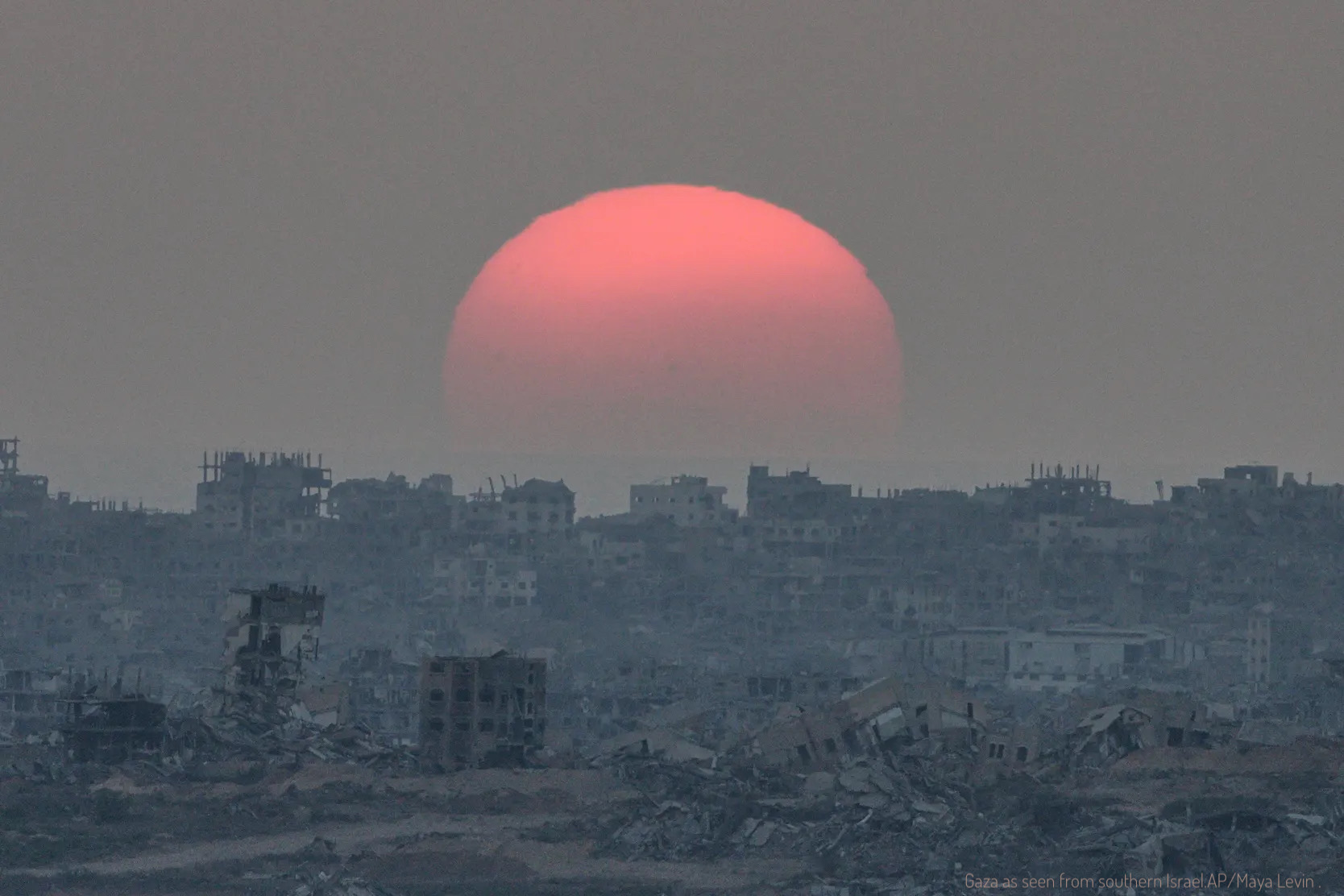
November 1918, the counterfeit peace

Of our elaborate plans, the end
Of everything that stands, the end
No safety or surprise, the end
Jim Morrison

For God so loved the world, that He gave His only begotten Son.  John 3:16

The eleventh hour of the eleventh day of the eleventh month of 1918 saw an end to four years of carnage on the western front and the end of of the First World War. The armies were demobbed and men went home to lives that were changed utterly:  British and French, Austrian and German, Belgian and Italian, Serbs and Bulgarians, Turks and Arabs, and also, soldiers from across the ocean – Americans and Canadians, Australians and New Zealanders,  South Africans and Indians. Friends and foes.

The victors retired to a restless peace, but the vanquished, Germany, Austria, and Hungary, descended into revolution and civil war for a time as  gangs of former soldiers fought on the left and the right. In eastern Europe, the crumbling of empires, the Russian revolution, civil war and the struggle to establish the borders of newly established states meant that armed violence continued, leaving deep scars and bitterness that many ways set the stage for the autocracies of the 1930s and further bloodshed.

The Polish-Soviet war lasted until 1921. The Russian Civil War, ending in 1923, raged across most of today’s Ukraine, Belarus, Moldova and the Baltic region. British, Australian, American and French soldiers were dispatched to Murmansk and Archangel to fight the Red Army; Poles fought Ukrainians and Lithuanians, and defeated the Soviets at the gates of Warsaw; pogroms were perpetrated against Jews just as they had been for years, decades, centuries prior, accelerating  ,  with subsequent consequence, Aliyah to Palestine.

The Greek-Turkish war of 1919-1922, which saw the Greeks, with British and French support, endeavouring to seize Constantinople, led to terrible massacres, and a forced exchange of populations that uprooted one and a half million Greeks and Turks from towns and villages they had occupied for a millennium. Armies marched back and forth across the Great European Plain, bringing devastation and starvation and destroying millions of lives. Central Asia, the lands now covered by the once Soviet ‘’stans likewise became battlegrounds for Reds, Whites and local warlords.

And in ‘John Bull’s Other Island’, as expat GBS Shaw called it, a “terrible beauty was born” – WB Yeats’ exquisite words – the doomed intifada that was the rebellion of Easter 1916, launched, opportunistically yet quixotically whilst English eyes were elsewhere, led exponentially into open rebellion, a qualified victory, and a civil war and partition that rested, roused and then resurrected in Derry in 1968 and decades termed somewhat innocuously ‘The Troubles’.

For some, there was light at the end of the terrible territorial tunnel. Poles, Czechs, Slovaks, Finns, Estonians, Latvians and Lithuanians, achieved statehood, or the restoration of nationhood, as did, fleetingly, Ukrainians, Armenians and Azerbaijanis. Poland reappeared on the map after over a century of having been carved up by empires. Hungarians lost two-thirds of their territory and more than half of their population. “Little” Serbia, which had ignited the Balkan powder keg in 1914, with Gavril Princip’s famous shot that ricocheted through complacent, twitchy and mightily armed Europe, was united with its Slav but religiously fractured Balkan neighbours in the Kingdom of Yugoslavia – and we now know how well that worked out.

Beyond Europe too, a bitter ‘Peace’ sowed dragon’s teeth. Last year, we commemorated the centenaries of the infamous Sykes Picot Agreement, the first draft of a colonial dispensation that established borders that remained unchallenged until Da’ish assaulted the status quo in 2014, and the Balfour Declaration, which set in train the rise and rise of the state of Israel and the long descent of Palestinian hopes for a land of their own. Ironically, the most militant Zionist pioneers and later, soldiers, terrorists and statesmen, emigrated from Poland and the Tsarist empire. These many legacies resonate today.

The end of WW1 saw the destruction of the Ottoman Empire and left Britain in control of Palestine and Mesopotamia. The peace conferences that followed led to the creation of modern Turkey, and, though for decades under French and British colonial rule, Lebanon, Syria, Iraq and Jordan. The Kurds turned up at the conference table but were denied a seat and thereafter, a state.

The war changed more than maps, frontiers and regimes. The needs of modern warfare brought women into the workforce, galvanizing the movements that won them the vote in many democracies. The pace of technological change already underway in industrialized countries was quickened by the demands of war, and advances in land transportation and aviation continued exponentially, as did the development of weaponry, together with the insatiable demand for fossil fuels. Economic privation precipitated the first successful Communist revolution and many failed ones, whilst the peace, resentments, reparations, and recession prompted many to turn to far-right authoritarians in Italy and then Germany. The mass movements of populations helped spread the deadliest epidemic the world has ever known: the 1918 influenza virus or Spanish Flu, which quietly killed possibly up to a hundred million souls – more than both world wars combined.

In the last decades of the Twentieth Century, historians would observe with the benefit of hindsight how the Second World War rose ineluctably from the ashes of the first, just as the division of Europe and the Soviet enslavement (and I say this as a lifelong leftist) of those Eastern European countries that emerged after 1918 led to the Europe of today, and as the peoples of the Middle East reaped the whirlwinds of both conflagrations. Many look back on the tumultuous decades that followed the Great War, and sensing signals and signposts in contemporary  temporal tea leaves, advise is to be afraid, be very afraid.

We like to identify patterns in history that help us understand and explain our contemporary world. But we should exercise caution. To continue the hindsight riff, remember that things we see in the rear view mirror appear closer than they really are. The world is very much different today, as is our knowledge, our perception, our hopes and fears, and so also, our prognostications and expectations. If we can do it all over again, we’ll do it differently, and much more dangerously and destructively. Having learned so much, we have, one fears, understood so little.

 As we remember that moment in Western Europe and the Levant when the guns at last fell silent, let us contemplate melancholy mathematics of the human toll poignantly described by American economist and academic Patrick Chovanec in a fine article in the New York Review of Books, which I have reproduced below:

 “In the Great War itself, over sixteen million people died, including almost seven million civilians. The US got off relatively lightly, with 117,465 people killed, just 0.13 percent of its population. In Serbia, somewhere between 17 and 28 percent of the country’s population was killed. But even numbers like these leave little concrete impression on our minds … people would (tell) me about a grandfather or great-uncle who fought and died in the war, and is forever twenty-four-years old in some field in France, or Turkey, or Italy, or at sea. For most people, that absence is what defined the war: someone left and never came home. The world that they shaped, by their presence and their absence, is the one that we live in, whether we realize it or not. And we, like them, can only grope our way forward, day by day, into an unknown future”.

Qurba-n قُرْبان

Sacrifice  – Rayner Hoff, Anzac Memorial, Sydney

On the occasion of the centenary, read also, Dulce et ducorem est – the death of Wilfred Owen, and A Brief History of the Rise and Fall of the West, 


World War I Relived Day by Day

Photo12/UIG via Getty Images

Gavrilo Princip arrested after his assassination of Archduke Franz Ferdinand of Austria, Sarajevo, June 28, 1914

Four years ago, I went to war. Like many of the people whose stories I followed in my daily “live-tweets” on World War I, I had no idea what I was getting myself into. What began as an impulsive decision to commemorate the hundredth anniversary of Austrian Archduke Ferdinand’s death at the hands of a Serbian assassin, in June 1914, snowballed into a blood-soaked odyssey that took me—figuratively and literally—from the rolling hills of northern France, to the desert wastes of Arabia, to the rocky crags of the Italian Alps, to the steel turret of a rebel cruiser moored within range of the czar’s Winter Palace in St. Petersburg, Russia. And like the men and women who actually lived through it, now that the Great War is ending I find myself asking what, if anything, I’ve learned from it all.

In the American mind, World War I typically occupies an unimpressive place as a kind of shambolic preamble to the great good-versus-evil crusade of World War II, a pointless slugfest in muddy trenches for no worthy purpose, and no worthwhile result. Its catchphrases—“The War to End All Wars,” “Make the World Safe for Democracy”—evoke a wry and knowing chuckle. As if. But the war I encountered, as it unfolded day by day, was far more relevant, passionate, and unpredictable.

Posting daily newspaper clippings and photographs, found mainly in books and online archives, I began to see the Great War as a kind of portal between an older, more distant world—of kings with handlebar mustaches, splendid uniforms, and cavalry charges—and the one that we know: of planes and tanks, mass political movements, and camouflage. It snuffed out ancient monarchies in czarist Russia, Habsburg Austria, and Ottoman Turkey, and gave birth to a host of new nations—Poland, Hungary, Czechoslovakia, Syria, Iraq, Jordan, Lebanon, Finland, Estonia, Latvia, Lithuania, Ukraine, Armenia, Azerbaijan—that, in their struggles to survive and carve out an identity, continue to shape our world today. The British declared their intent to create a national homeland in Palestine for the Jews.

Daily Mirror/Mirrorpix via Getty Images

Russian infantry marching to battle, Poland, August 1914

The needs of the war brought women into the workforce, and helped win them the right to vote. The huge privations it inflicted triggered the world’s first (successful) Communist revolution, and the frustrations it unleashed prompted many, afterward, to turn to far-right authoritarians in Italy and then Germany. And finally—though many have forgotten it—the comings and goings of people caused by the war helped spread the deadliest epidemic the world has ever known: the 1918 influenza virus, which quietly killed an estimated 50–100 million human beings in their homes and in hospitals, more than both world wars combined.

I also encountered a cast of characters more varied and amazing than I thought possible. Rasputin, the dissolute Russian mystic who warned Czar Nicholas that going to war would destroy his dynasty, and was murdered in part because he was (falsely) suspected as a German agent. The Austrian Emperor Karl, who inherited a war he didn’t want, and tried fruitlessly to make peace. T.E. Lawrence, a scholarly young intelligence officer whose affinity for the Arabs helped turn them to the Allied cause, and shaped the modern Middle East. Mata Hari, a Dutch-born exotic dancer who played double-agent, seducing high-ranking Allied and German officers for valuable information, until she was caught and shot by the French as a spy.

Some of the names are familiar, and offer hints of future greatness—or infamy. A young anti-war journalist named Benito Mussolini, sensing the way the wind blows, changes his tune and aggressively advocates for Italy to enter the war, before signing up himself. A young Charles De Gaulle is wounded at Verdun and taken prisoner for the rest of the conflict. A relatively young Winston Churchill plans the disastrous Gallipoli Campaign and pays his penance by serving in the trenches, before making a political comeback. A young Harry S. Truman serves as an artillery officer on the Western Front, alongside (and outranked by) a young George C. Marshall (his future Army Chief of Staff and Secretary of State) and Douglas MacArthur (his future general in the Pacific and Korea). A young George S. Patton develops a fascination with tanks. A young Walt Disney doodles cartoons on the side of the ambulances he drives, in the same unit as a young Ray Kroc (the founder of McDonald’s). Another young ambulance driver, Ernest Hemingway, finds inspiration on the Italian Front for his novel A Farewell to Arms. A young Hermann Göring (later head of the Luftwaffe) becomes a dashing flying ace, while a young Erwin Rommel wins renown fighting at Verdun and in the Alps. Meanwhile, an odd young German corporal, who volunteered in the very first days of the war, is blinded by poison gas in its final days, and wakes up in hospital to the bitter news that Germany has lost. His name is Adolf Hitler.

General Photographic Agency/Getty Images

French troops under shellfire during the Battle of Verdun, 1916

The dramatic panoply of people, places, and events, however, only occasionally rises to the fore. For the most part, the war is a steady stream of ordinary people doing ordinary things: washing their clothes, attending a concert, tallying supplies, fixing a car. History books give us a distorted sense of time, because they fast forward to major events. A day may take a chapter, a month may be passed over in a sentence. In fact, there were periods where nothing much happened—plans were being made, troops trained, supplies positioned—and when you live-tweet, you experience that waiting. Sometimes, it led to intriguing surprises, like photographs of dragon dances performed by some of the 140,000 Chinese laborers brought over to France to lend muscle to the Allied war effort. Mostly, it was a matter of endurance. Each winter, the fighting came to almost a complete stop as each country hunkered down and hoped its food would last. The “turnip winter” of 1916–1917, when the potato crop failed, nearly broke Germany; the increasingly desperate craving for “bread and peace” did break Russia the following year.
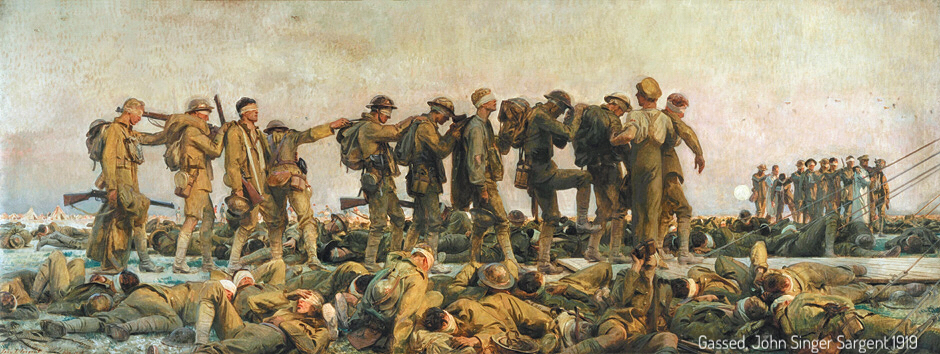
The future president Herbert Hoover made his reputation by coordinating food relief shipments to German-occupied Belgium, and later as the US “food czar” ensuring Allied armies and populations were fed. The vast mobilization was effective: by 1918, the Allies were able to relax their food rationing, while Germany and its confederates, strangled by an Allied naval blockade, were on the verge of starvation. America’s war effort was accompanied by a vast expansion in the federal government’s power and reach. It nationalized (temporarily) the railroads and the telephone lines. It set prices for everything from sugar to shoes, and told motorists when they could drive, workers when they could strike, and restaurants what they could put on their menus. It seized half a billion dollars of enemy-owned property, including the brand rights to Bayer aspirin, and sold them at auction. The US government also passed espionage and sedition laws that made it illegal to criticize the war effort or the president. Some people were sent to prison for doing so, including the Socialist Party leader Eugene V. Debs, who ran for president for a fifth and final time from a cell.

Hulton Archive/Getty Images

A woman munitions worker operating a machine in an armaments factory, Britain, circa 1915

Winning the war, however, was far from a sure thing. For three years, the Allies threw themselves against an evenly-matched enemy on the Western Front, without making any breakthroughs, while the Eastern Front gradually crumbled. An early Allied foray to take out Turkey, at Gallipoli in 1915, ended in bloody disappointment. Inducing Italy to enter the war on the Allies’ side, that same year, was supposed to swing the entire conflict in their favor; instead, the catastrophic Italian rout at Caporetto, in the autumn of 1917, put the Allied effort in greater jeopardy. When Lenin seized power in Russia, at the end of 1917, he took it immediately out of the war and ceded immense land and resources to German control. True, the US had by then entered the war, in response to Germany’s submarine campaign against merchant ships and its clumsy diplomatic scheming in Mexico. But with the war in the East essentially won, the Germans saw a window in which they could shift all of their armies to the West and crush the exhausted British and French before enough American troops could arrive to make a difference. Their spring offensive, or “Kaiser’s Battle,” in early 1918 drove deep into Allied lines, prompting the French government to evacuate Paris.

The Germans’ big roll of the dice failed. The Allies held, and the US mobilized much faster than anyone expected. By the summer of 1918, a perceptible change had taken place. Hundreds of thousands of American troops were arriving every month at French ports, and their first units were taking part in battles, piecemeal at first, to push the Germans back. Even in September, however, nearly everyone expected the war to continue into 1919. That was when a huge US army of 3 million men would be ready to take part in a big Allied offensive that would drive all the way to Berlin. It never happened. That fall, the German army—and those of Turkey, Austria, and Bulgaria—first buckled, then collapsed like a rotten log. By November 11, the war was over.

The fact that nobody saw the end coming, the way it did, highlights the value of going back, a hundred years later, and reliving events day by day, as they took place. What may seem obvious now was anything but so then, and we do the people who lived through it, and our understanding of them, a real disservice when we assume that it was. “Life can only be understood backwards,” the Danish philosopher Søren Kierkegaard observed, “but it must be lived forwards.” The British historian C.V. Wedgewood elaborated on the same idea: “History is lived forwards but is written in retrospect. We know the end before we consider the beginning and we can never wholly recapture what it was like to know the beginning only.” We can’t entirely forget that we know what happened next, but when we at least try to identify with people who did not know, we shed new light on them, and on what did happen.

Fine Art Images/Heritage Images/Getty Images

Leon Trotsky with the Soviet delegation to negotiate a peace treaty with Germany, Brest-Litovsk, 1918

Take the Russian Revolution. We see it as the birth of a Communist superpower, and struggle to make sense of the seemingly half-baked, half-hearted effort by the Allies to intervene by sending troops, including Americans, to Russia’s ports in the far north and far east. People at the time, however, saw it almost entirely through the prism of the Great War. At first, the Allies welcomed the overthrow of the czar, and believed it would rejuvenate the failing Russian war effort. By replacing an infamous autocrat on the Allied roster with a fledgling democracy, it made “making the world safe for democracy” a more credible call to arms, and helped pave the way for the US to enter the war. When Lenin took over and made a ruinous peace with the Central Powers, he was seen as simply a German puppet. And when Bolshevik forces, augmented with released German and Austrian prisoners of war, attacked a unit of Czech soldiers crossing Siberia to rejoin the Allies on the Western Front, those suspicions blossomed into fear of a full-fledged German takeover of Russia. The Allies sent troops to key Russian ports to secure the war supplies stockpiled there and provide an exit route for the loyal Czechs. They considered trying to “reopen” the Eastern Front, but realized it would take far too many men. They assumed that when Germany was defeated, their proxy Lenin would eventually fall, and when the war ended, they naturally lost interest. It all makes sense, but only if you see through the eyes that people saw through at the time.

Did it really matter who won the war? In its aftermath, the Great War came to be seen as a colossal waste, a testament to the vanity of nations, of pompous older men sending foolish younger men into the meat-grinder for no good reason. War poems like “Dulce et decorum est” and novels like All Quiet on the Western Front have crystalized this impression. But this was not how people felt at the time. German atrocities in Belgium and on the high seas—some exaggerated, but others quite real—convinced many people that civilization, as they knew it, really was at stake. I was consistently and often surprisingly struck by the sincerity of support, not just on the home front, but among soldiers who had seen the worst of combat, for pursuing the war unto victory. The tone matures, but remains vibrant: these were, for the most part, people who believed in what they were fighting for. At what point the bitter cynicism set in, after the war ended, I cannot say. But at some point, that enthusiasm, and even the memory of it, became buried with the dead.

Bettmann/Getty Images

Boys wearing bags of camphor around their necks to ward off influenza, 1917

Though, in fact, in many places the war did not actually end. An armistice was declared on the Western Front, and the armies there were disbanded and sent home. But Germany, Austria, and Hungary all descended into revolution and civil war for a time, with gangs of demobilized soldiers fighting on all sides. In Russia, the Soviet regime and its multiple enemies would battle for several years, while trying to reconquer territory surrendered when it quit the war against Germany. The Greeks tried to reclaim Constantinople from the Turks, and would be massacred when the Turks succeeded in reconsolidating their country. The Poles fought wars with the Ukrainians and the Soviets to define the boundaries of their newly independent country. Jews and Arabs continue to fight over the new lands liberated from the Ottoman Empire to this day.

In the Great War itself, over 16 million people died, including almost 7 million civilians. The US got off relatively lightly, with 117,465 people killed, just 0.13 percent of its population. In Serbia, somewhere between 17 percent and 28 percent of the country’s population was killed. But even numbers like these leave little concrete impression on our minds. Some of the most touching parts of my experience live-tweeting were the times when people would tweet back to me about a grandfather or great-uncle who fought and died in the war, and is forever twenty-four-years old in some field in France, or Turkey, or Italy, or at sea. For most people, that absence is what defined the war: someone left and never came home. The world that they shaped, by their presence and their absence, is the one that we live in, whether we realize it or not. And we, like them, can only grope our way forward, day by day, into an unknown future.

Historica Graphica Collection/Heritage Images/Getty Images

British artillery at the Somme, France, 1916

Dulce et decorum est – the death of Wilfred Owen

Poet Wilfred Owen died on 4 November 1918 – seven days before the guns fell silent. The centenary of his death was marked in the village where he died by a ceremony in which the Last Post was played on a bugle Owen took from a German soldier killed during the battle to cross the nearby Sambre-Oise.

A poignant, fitting tribute by Gerry Condon of Liverpool to all the “doomed youth” of all wars. Lest we forget …

On the road to the last resting place of Wilfred Owen

Ors Communal Cemetery, the last resting place of Wilfred Owen

See also in Into That Howling Infinite,: In the dark times, will there also be singing?, a selection of poetry compiled by Gerry Cordon around the theme of “undefeated despair”

https://youtu.be/GRkQIxwE5lk