
In 1839, in the midst of a half-century of post-Napoleonic political ferment and incipient revolution, English author Edward Bulwer-Lytton coined the adage “the pen is mightier than the sword”, implying that the written word is more effective than violence as a tool for communicating a point. It’s no wonder that the straighteners, the autocrats and the fundamentalists want to ban and even burn books. In his dystopian novel Fahrenheit 451, published in 1953 at the height of America’s McCarthy anti-communist witch-hunts, Ray Bradbury wrote: “The problem in our country isn’t with books being banned, but with people no longer reading. You don’t have to burn books to destroy a culture. Just get people to stop reading them”.
But, encouragingly, reports of the demise of the written word in the form of the humble published book are exaggerated and premature.
Which brings us to keepers of the flame – the torch of knowledge and not the bearers of the fire-brands, the people who look after our public libraries. Oscar-winning documentary-maker Michael Moore once said admiringly that librarians were a more dangerous group than he had realized: “You think they’re just sitting there at the desk, all quiet and everything. They’re, like, plotting the revolution, man.”
To the American industrialist and philanthropist Andrew Carnegie, libraries were temples of learning and self-improvement. “A library outranks any other one thing a community can do to benefit its people,” said Carnegie, who put his money where his mouth was. By 1929, he had paid for the construction of more than 2500 libraries, most of them in the USA.
Back in the day …
I reckon that I was visiting libraries even before I could read, but that could well be my mind playing tricks on my memory. But once I commenced grammar school, the local library, but a short walk away, was a world of wonders. Yardley Wood Library, in south Birmingham on the quiet northerly extension of busy Highfield Road, between a small housing estate of postwar prefabs on the east and a large expanse of recreation field at its rear, and but ten minutes from home, was the grail of my early education and my widening general knowledge of the outside world.
As an early teen, I’d stay weekends at my Aunt Mary’s house in the inner city on the border of Moseley and Balsall Heath, and the Victorian grandeur and shadowy interior of Balsall Heath Library became yet another “garden of earthly delights”. This library is the featured picture of this post. The tall chimney on the left belongs to the immediately adjacent Balsall Heath swimming baths, where my uncles and aunts who shared our home would take their weekly baths (even if they didn’t need them, as the old saw goes), where I’d go in my weekend sleep-overs, and where, when struggling with my Boy Scout swimming test, I’d push myself through the pool. And loathed every minute, Although I now live in a land blessed with beautiful beaches, I still hate being in water any deeper than my bath!

Yardley Wood Library, Birmingham
In these two “houses of wisdom”, I’d browse the stacks, thumbing through art books and atlases, encyclopaedias and illustratatives, and I’d always have three or four books on loan, with a particular interest in history, biographies and historical fiction. My reading was eclectic ab initio, from the early adolescent “he went with … “ great explorer adventures by Louse Andrews Kent and the many books of H Rider Haggard, both quite politically incorrect and vulnerable to ‘cancellation’ in today’s prescriptive cultural climate, to the relatively anodyne French ‘soft-porn’ of Anne Golon’s Angélique series, to Mikhail Sholokhov’s And Quiet Flows the Don and its sequel The Don Flows Home to the Sea, which introduced me to Russian history and politics and a youthful dalliance with The Communist Manifesto and the Communist Party. I remain very interested, and have written often on the subject. For example, Stalin’s Great Terror, The Russian Tradition – Russia, Ukraine and Tibor Szamuely, and Red and white terror – the Russian revolution and civil war
Eventually, as I studied for A Levels in the late ‘sixties, I entered Birmingham’s cavernous Central Library in the heart of the Second City. Opening in 1865 and rebuilt in 1882: it was a magnificent edifice within and without. I recall it when I rewatch the Game of Thrones episode in which would-be meister Sam Tarly enters the Citadel in Old Town for the first time. This Victorian relic was replaced by a brand new, brutalist building in 1974 – which I never saw as this too was closed in 2013 and replaced by the present Birmingham Library – which I visited when I was in Birmingham two years later.

Birmingham Central Library

The interior of Birmingham Central Library
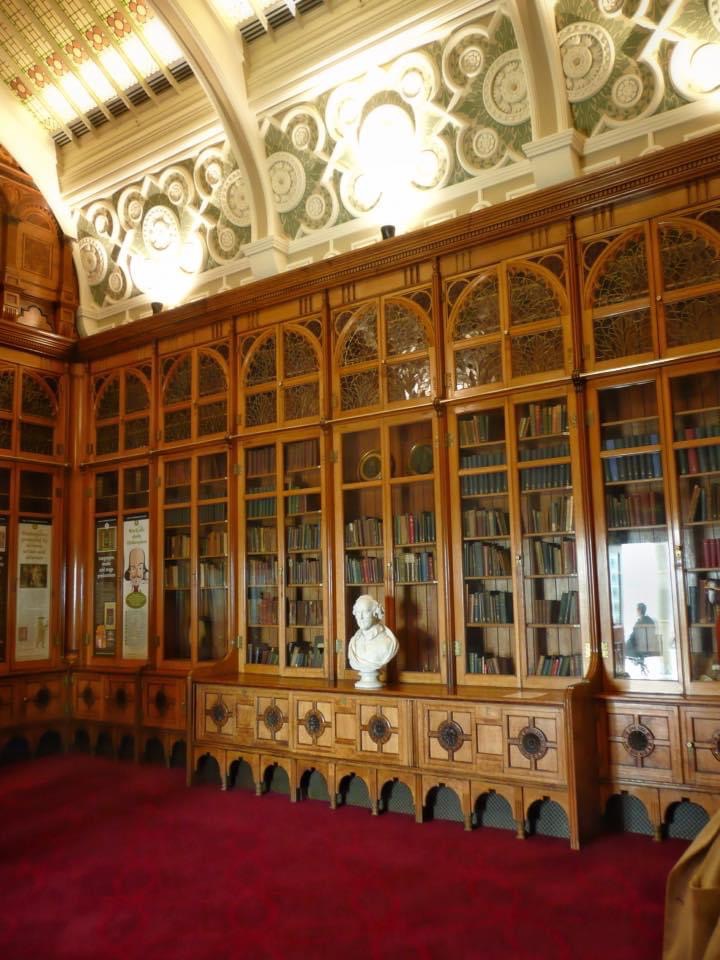
The William Shakespeare Room reconstructed atop the new BirminghamLibrary, 2015
My alma mater, Moseley Grammar School boasted a small but diverse library that beckoned during lunch breaks, with its high, wooden-beamed ceiling, it’s wrought iron balcony and the spiral staircase that led up to the landmark school tower in subsequent years, the library was closed for safety reasons, but a recently completed renovation project has brought it back into use as the photo of former pupils gathered therein on the occasion of Heritage Day 2022 shows.
I’ve written fleetingly of this library before: “It was one of those beautiful late-spring evenings that you would get in the England of youthful memory. The evening sun poured through the gothic stained glass windows of the school library – it was one of those schools. A group of lower sixth lads, budding intellectuals all, as lower sixth tended to be, gathered for a ‘desert island disks” show-and tell of their favourite records. Mine was Wishin’ and Hopin’ (by (Dusty Springfield). Then it was on to the next. Clunk, hiss, electric guitar intro, and: “My love she speaks like silence, without ideas or violence, she doesn’t have to say she’s faithful, but she’s true like ice, like fire…” I was gone, far gone. So was Dusty”. From Whats Bob Got To Do With It?
It is one of those instances of serendipity we encounter on our journey through life that the first serious love of my life was studying to be … drum roll! …a librarian, and in time became the chief librarian of a major English university, whilst one of my oldest London friends rose to a that position in the university I attended in the ‘seventies. How about that?
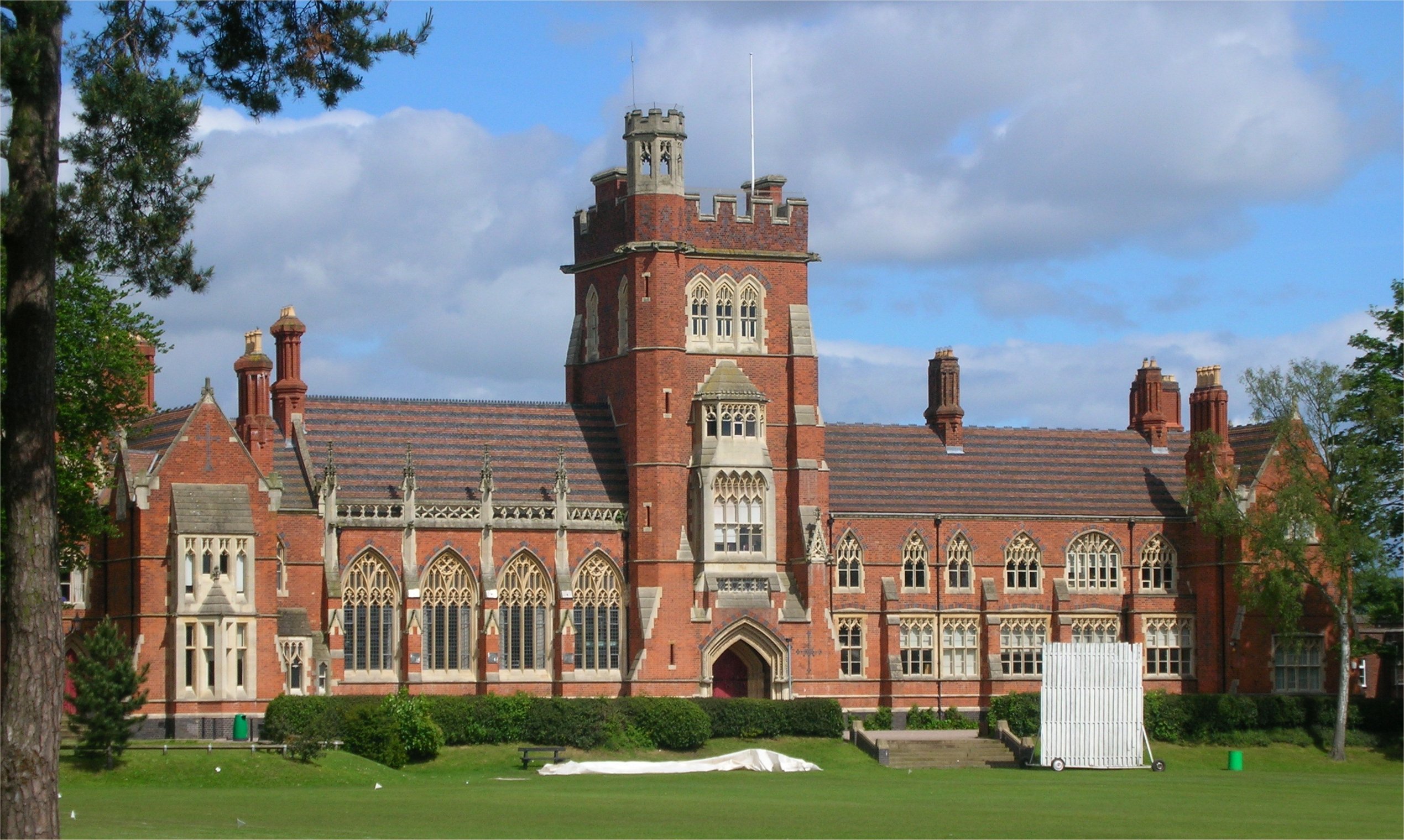
Moseley Grammar School, Birmingham
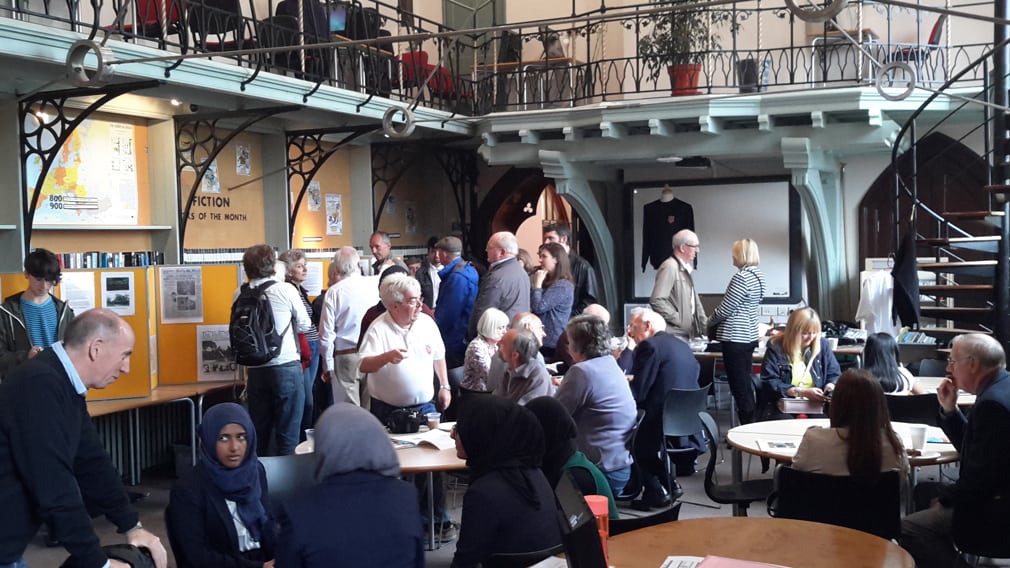
Former pupils of Moseley Grammar School gather in the refurbished library, 2022
Here in the now …
In Australia, if attendance figures are any indication, the public library is our most valued cultural institution. In the year to July 2018, about 7.6 million people visited Australian libraries – more than went to museums (6.7 million), art galleries (6.3 million), plays (3.9 million) or musicals and opera (3.5 million). But it was the return rate that really set libraries apart. Whereas at least half of those who visited museums or the theatre went only once in the year, three-quarters of library visitors went back at least three times, and one-third visited more than 10 times. Australians make about 114 million visits to public libraries annually.
Here where I now live in Australia, on the Mid North Coast of New South Wales, Coffs Harbour library is the mother ship with satellites at the outlying townships of Woolgoolga and Toormina – the latter is named for Taormina in Sicily, the site of one of the most famous theatres of Greek antiquity. Our own shire has libraries in Bellingen, Dorrigo and Urunga.
I get to the library nearly every time I’m in Coffs Harbour, just to browse the stacks (there is something there for everyone) and check out the history books – as ever – and the large collection of cds. I almost always come away with something I had not intended to read or listen too. It’s a calm and peaceful space, with friendly and helpful staff, and yet always quite busy – particularly at its free computer and wi-fi benches. Members can even borrow ukuleles! [Since this article was written, the library has relocated to brand new premises, and it is even better than before, with a more computers for public use, study rooms off-side for small groups, and meeting rooms available to the public. The ukulele shelf is still there]
As a volunteer with Settlement Services International, before Covid 19 closed our office and cut the flow of refugees to Australia, I often took newly-arrived refugee families there as part of their orientation. I’d help them enroll and give them a brief tour of the facilities, and particularly the computers, the foreign language section which houses a growing collection, including books in Arabic and Farsi, and the children’s section (which hosts regular and free storytelling and craft sessions for preschools kiddies), and encourage them to return – it’s such an excellent introduction to our language, society and culture.

The old Coffs Harbour Library
As the following essay shows, libraries are much much more than their books and their educational and technical resources and facilities. They are not just a reference service but also a place for the vulnerable and the lonely, a “shelter from the storm” for people of all ages and circumstances. In a world where social and community services are being ground down, and loneliness and isolation are endemic, libraries provide vital lifelines for all manner of folk. from elderly people who value the human interaction with library staff and with other visitors, to the isolated young mother who enjoys the support and friendship that grows from a baby rhyme time session, to people who want to play the ukulele (visitors can actually borrow ukuleles as one would borrow books), to people like me just seeking time out time in a peaceful and welcoming space.
© Paul Hemphill 2022. All rights reserved
Postscript
I wrote recently about Moseley Grammar School in an article on JRR Tolkien:
“Learning more about the author, I was to discover that he’d grown up in Birmingham, my home town, first in leafy Edgbaston (the home of Cadbury and the Warwickshire County Cricket Club), where he’d attended the prestigious King Edward’s Grammar School – my own school, Moseley Grammar, was not in its league. He lived near Sarehole Mill, in present day Hall Green, around the turn of century, between the ages four and eight, and would have seen it from his house. The locale at that time was rural Worcestershire farmland and countryside and not in the Birmingham ‘burbs. He has said that he used the mill as a location in The Lord of the Rings for the Mill at Hobbiton: “It was a kind of lost paradise … There was an old mill that really did grind corn with two millers, a great big pond with swans on it, a sandpit, a wonderful dell with flowers, a few old-fashioned village houses and, further away, a stream with another mill … “ Sarehole Mill was just down the road from my school, and our sports field and cross country tracks were adjacent to it. On many a wintry, cold, wet and windy Wednesday afternoon, I’d stagger past it on a muddy track. How I hated wet Wednesdays; dry ones were for rugby, and I hated them too!” From: One ring to rule us all – does Tolkein matter?
For more stories like this one in In That Howling Infinite, see Tall tales, small stories, eulogies and epiphanies, and on books and reading generally, see Better read than dead – books, poetry and reading.
One for the books: the unlikely renaissance of libraries in the digital age
With the rise of the internet, public libraries were supposed to be on borrowed time. But they’re thriving – their renaissance as much about community as the literary riches they contain. It’s enough to make you Dewey-eyed.
By Jane Cadzow, Sydney Morning Herald, September 28th 2019
Don Royce had an exceptionally happy marriage. “I was the luckiest person I knew,” says the 72-year-old former school principal. When his wife, Laura, died in 2016, Royce felt as if the ground had gone from beneath his feet: “We had been together for nearly 50 years, and suddenly my life … It was like I went over a cliff.” What saved him, or at least cushioned his fall, was his local library.
Australia has about 1500 public lending libraries. Royce, who lives in the Victorian city of Geelong, is one of the nine million of us – more than one-third of the population – who are card-carrying library members. When Laura was alive, he would duck in, grab a few books or magazines, and head home. After her death, he was in less of a hurry. “I wasn’t loitering at the library,” he says, “but I was spending more time there than I had.”
He discovered that his library and others in Geelong offered free tuition on a range of subjects, from tracing family history to efficiently operating a laptop, and he started signing up for classes: “They were useful information sessions. And they were valuable distractions.” Having somewhere to be at a particular time forced him out of bed in the mornings, and into the world. “It just got me up and about.”
Since then, Royce has recovered his equilibrium. He is back to being an occasional rather than constant visitor to the library, but whenever he goes, he is struck anew by how cheering the place is. “Young mothers with their babies meet there,” he says. “I walk past the open windows and see some old guy with a bunch of young people playing chess.” What Royce understands is that local libraries have many different purposes. People go to them for company as well as for literature. They’re centres for research, for recreation, for respite from the daily slog. They’re refuges for the broken-hearted. “They’re really important,” he says.
If attendance figures are any indication, the public library is our most valued cultural institution. In the year to July 2018, about 7.6 million people visited Australian libraries – more than went to museums (6.7 million), art galleries (6.3 million), plays (3.9 million) or musicals and opera (3.5 million). But it was the return rate that really set libraries apart. Whereas at least half of those who visited museums or the theatre went only once in the year, three-quarters of library visitors went back at least three times, and one-third visited more than 10 times. Australians make about 114 million visits to public libraries annually.
“Thirty years ago, people were thinking libraries wouldn’t survive the internet – that they’d just die out,” says NSW State Librarian John Vallance, who supervises NSW’s public library network. “A lot of city planners and council planners were actually planning for a future without local libraries, because the assumption was that everyone would be at home looking at their screens. It’s hard to imagine pundits getting something more wrong.” Far from losing relevance, “libraries are undergoing a renaissance”, says Vallance. It turns out that people love being around books. “And around other people. In fact, I would say the people are just as important as the books. That’s something the planners never really understood.”
Being with people in a pleasant indoor setting usually carries a price of admission, whether it’s $5 for a cup of coffee in a cafe or $100 for a theatre ticket. Even in shopping malls, security guards are likely to ask you to move on if you look like hanging about indefinitely without spending money. “The public library,” says Vallance, “is the one place where absolutely everyone – regardless of their background, their wealth, their status – can be assured of a respectful welcome and a friendly reception.”
Entry to the library is free. You need a (free) library card to borrow items, but anyone can amble in and stay for as long as they like, reading the newspapers, browsing through the books, using the computers, cramming for exams or just occupying a comfortable chair. “You don’t have to buy anything,” says Patti Manolis, chief executive of the Geelong Regional Library Corporation, who, like most librarians she knows, is driven by the conviction that every member of the community deserves access to knowledge and culture. “In Geelong, just under 40 per cent of our members are on incomes of less than $30,000,” Manolis says. “That makes me really happy, because it means our services are reaching those who I believe need them most.”
Oscar-winning documentary maker Michael Moore once said admiringly that librarians were a more dangerous group than he had realised: “You think they’re just sitting there at the desk, all quiet and everything. They’re, like, plotting the revolution, man.” Manolis laughs when I remind her of the quote. “That’s right!” she says. “That’s us.” Chris Buckingham, president of Public Libraries Victoria, agrees that when it gets right down to it, libraries are about people power: “The pursuit of a just and fair society sits at the very core of what we do.” Buckingham thinks of librarians as subversives with big hearts. And a lot of patience. “I mean, they get a thousand questions a day.”
Some of which aren’t easy to answer. “The other day someone came to the desk and asked, ‘How do you have a good life?’ ” says Monica Dullard, who works at inner Melbourne’s St Kilda Library. The inquirer was a middle-aged woman. The librarians on duty found her some books and articles they thought might be enlightening. Also, “they had a nice chat to her,” Dullard says. “The thing is, we take the time.”
People phone with questions, too. “We had someone ring up and ask us how to make chicken soup, because he was feeling a bit poorly,” Dullard says. “We’ve got a huge collection of Jewish cookbooks, so we got a recipe from one of the books we knew was really good and talked this bloke through it, step by step. He made the soup and came in the next week saying he felt much better.”
Even now, in the digital age, the thousands of volumes that line a library’s shelves are its greatest asset. As NSW State Librarian John Vallance likes to point out, “the most cost-effective, long-lasting and energy-efficient form of data storage is paper”. People with library cards have the option of downloading digital versions of books, magazines, music or movies to their electronic devices. But of the 41 million loans a year from NSW public libraries, less than 5 per cent are in digital format. “People still love having something that they can hold in their hands,” Vallance says.
If it’s a real page-turner, all the better. The most borrowed books in Australian libraries in the 12 months to March were The Midnight Lineand Night School, both by bestselling British thriller writer Lee Child. (It was the third year in a row that Child topped the chart.) Next came two Australian novels: Tim Winton’s The Shepherd’s Hut and Jane Harper’s Force of Nature. The most borrowed non-fiction book – the 10th most popular book overall – was The Barefoot Investor, by money-management adviser Scott Pape
For those who visit libraries to use the computers and free WiFi – one in seven Australian households aren’t connected to the internet – the bonus is having someone on hand to help with, say, navigating a job-search website, preparing a resumé or filling in an online citizenship application form. Through necessity, librarians have become tech experts, says Dullard. “At Mother’s Day and Christmas, we get a flood of people coming in, 65-plus, who have been given an iPad as a present and don’t know how to use it. They’re too embarrassed to tell their children, so they sneak into the library and we teach them how to set it up.”
Sometimes staff have to intuit what it is that customers require. Hobart librarian Ryan Burley was shelving books one afternoon when a man who looked to be in his late 20s asked where he could find something to read on anger management. Burley led him to the right area and pulled out a few titles. Sensing that the man wanted to talk, he asked him if he was okay. The customer said he had lost jobs and girlfriends because of his inability to control his anger. Burley said he himself had suffered from depression. The ensuing conversation was long and candid, and by the end of it, the man seemed relieved. “It was like he had actually been heard for the first time,” Burley says. “One key thing stands out to me: libraries are safe spaces. We don’t judge. We don’t discriminate. What that guy needed was empathy, and to know that he wasn’t alone.”
At Burwood Library in inner-western Sydney, librarian Helen Kassidis formed an instant bond with a woman who, after asking for information on divorce, confided that she was going through a painful marriage break-up. “I said to her, ‘Look, I know how you feel,’ ” says Kassidis, who had been through a divorce of her own. Library visitors spill out their troubles quite often, in Kassidis’s experience. “Sometimes there are tears, theirs and mine. Sometimes all I can say is ‘I’m sorry’. ” But usually she can point them toward a possible source of assistance – be it a book title, a website address or the phone number of a government agency. Librarians are in the business of helping people make informed choices, she says. “Whether it’s a kid who chooses that they’re going to read Harry Potter or Enid Blyton, or somebody who’s making massive life decisions, you are, in a small way, empowering them.”
Burwood Library, like others around the country, has customers who practically live there. “Our regulars have formed friendships among themselves,” Kassidis says. “They read the papers and they all have a chat. It’s super-cool.” Over the years, this loose-knit band has contained some colourful characters. “One person we called Cardboard Man, because he made sleeves and collars out of cardboard and wore them every day. He also wore a black cardboard moustache, beard and eyebrows. We totally understood why he never came to the library in a downpour.”
The tide of humanity that washes in and out of the library engenders both fondness and fascination in Kassidis. “I think a lot of people are lonely,” she says. “And working in a library, there is the privilege of helping somebody not feel so lonely, even if it’s just for a couple of minutes.” Basically, she regards her job as a gift. “People and books! It doesn’t get much better than that.”
When John Vallance was a boy in Sydney, lending libraries were parsimonious with their books. “You weren’t allowed to borrow more than three at a time,” the NSW State Librarian says. Similar restrictions applied in Brisbane, where I grew up. My mother, a former librarian and voracious reader, would be at the library to swap her books for new ones the minute the fortnightly borrowing period elapsed. When my uncle died, my aunt kept the news from the library so that he could take out books on both their library cards. These days, the sky’s the limit for borrowers. When Vallance visited the NSW Hunter Valley town of Raymond Terrace, which is serviced by a mobile library, he saw an old man with a suitcase leaving the converted semitrailer. “He opened the suitcase and there would have been about 50 books that he’d borrowed,” Vallance says. “The suitcase was so heavy that he had it in a wheelbarrow.”
I admire that fellow’s style. The thrill of knowing I can borrow anything I like hits me every time I walk into my local library. I’m usually there to collect a book I have reserved online, having read a review of it somewhere, but I can rarely resist picking up a couple of extras. What’s most exhilarating is that the system runs on trust: I take the books on the understanding that I will return them on time, in good condition, for others to enjoy. The library lifts my spirits because it makes me feel that I live in a civilised society.
Most people do bring books back by the due date, says Public Libraries Victoria’s Chris Buckingham, who applauds a trend to abolish fines for late returns. The sums may seem low – about 25¢ a day – but some people are on such tight budgets that every cent counts, Buckingham argues, and if they forget to return a book, racking up a few dollars’ debt, it can be enough to stop them going back to the library. In places where financial penalties have been scrapped, he says, the number of people borrowing books has risen.
It seems to Jenny Thompson, of Wollongong City Libraries, that library patrons overwhelmingly want to do the right thing: “There’s a lot of respect there from most people.” In Wollongong, south of Sydney, the central library’s most loyal customers gather outside each morning, waiting to be admitted. On the days it doesn’t open, they have to find somewhere else to go.
“But one public holiday, something went wrong and the electronic doors opened anyway,” Thompson says. “The regulars were able to come in, even though the library was supposed to be closed.” The absence of librarians was barely noticed: “The people who use the computers just went upstairs and got themselves onto the computers. The newspaper-reading guys sat down and started the newspapers. It was really quite funny.”
Though well-ordered – the Dewey Decimal classification system still holds sway – libraries are less hushed and hidebound than they used to be. “We call it the community living-space,” says Monica Dullard, who doesn’t blink when backpackers use the bathrooms at the St Kilda Library to have a wash and rinse out their underwear, then emerge fresh and clean to Skype their parents on the computers. She loves that people now eat in libraries, even sending out for takeaway if they forget to bring a snack: occasionally a pizza delivery guy appears at the desk and asks loudly who ordered the margherita. “Sometimes you see people cooking,” she says. “There are power points all over the place, and we have people who heat up rice, or two-minute noodles.”
So relaxed is the atmosphere that when someone produced a foot spa, plugged it in and started using it, others presumed this was a new service the library was offering. According to Dullard, a queue quickly formed at the counter. “People were saying, ‘Where’s my foot spa?’ ”
To the American industrialist Andrew Carnegie, libraries were temples of learning and self-improvement. “A library outranks any other one thing a community can do to benefit its people,” said Carnegie, who put his money where his mouth was. By 1929, he had paid for the construction of more than 2500 libraries, most of them in the US.
Six years later, a report funded by the Carnegie Corporation painted a bleak picture of the situation in Australia. We had subscription libraries, but they charged membership fees and their collections were pitifully inadequate (“Wretched little institutes which have long since become cemeteries of old and forgotten books”, the report called them). We had a public reference library in each state capital – the oldest and grandest being Melbourne’s, with its magnificent domed reading room – but borrowing from these was not permitted. The books had to be read on the premises. In all of Australia, there were fewer than half a dozen free lending libraries.
Concerned citizens responded to the report by founding the Free Library Movement, and in 1939 NSW became the first jurisdiction to take decisive action, introducing legislation that promised state government financial backing to local councils that opened free lending libraries. As a nation, we haven’t looked back. In the US, the Trump Administration has proposed eliminating almost all federal library funding. In the UK, funding cuts by the Conservative government have seen more than 800 libraries closed or handed to volunteers to run. Here, though, public libraries are not only surviving but thriving. Total government expenditure on libraries has risen to more than $1.2 billion a year, or just less than $50 per person. “In Australia, we’re actually in a very good position,” says Sue McKerracher, chief executive of the Australian Library and Information Association.
Librarians aren’t by nature publicity-seekers. “They go to work each day in the knowledge that they make a difference in people’s lives, and for them that’s enough,” says Public Libraries Victoria president Chris Buckingham. “They’re not necessarily big on making a lot of noise about it.” But when word goes out that this piece is being written, library staff across the country contact me, eager to pass on anecdotes.
From Port Stephens, north of Newcastle on the NSW coast, I get a message about Les, the library regular who brings a bunch of flowers for the desk each week, and Lorna, who brings the librarians baked goods, and Frank, the keen gardener who presents them with home-grown produce. From Tasmania comes the tale of John, the retired butcher, who asked the library for help earning to read and write. Assigned a voluntary tutor, John made good progress. Within a couple of years, he was whipping through Agatha Christie novels and writing his life story for his grandson to read.
From Darwin comes news of a refugee couple who took their daughter to story-time sessions at the library and asked if they could celebrate her birthday there, because the place meant so much to them. “They brought a cake and the father gave a speech and thanked everyone,” says Karen Conway, executive manager of library services in the Northern Territory’s capital city. Obviously there wasn’t a dry eye in the house.
I get emails about libraries that host concerts, book club meetings, knitting circles, author talks, English-language classes, puppet shows and Girl Guides’ sleep-overs. Several correspondents impress on me that libraries are havens for the homeless – cool in summer, warm in winter and dry when it rains. Tracy Fraser, a librarian at Broken Hill, in far-western NSW, talks enthusiastically about the Outback Letterbox Library, a scheme that delivers parcels of books to people living in remote settlements across a 240,000-square-kilometre swathe of inland Australia. “We get letters saying it’s like Christmas every time the books arrive,” Fraser says.
Ed Oberg and Nathalie Fritzen met in the library at Thirroul, a suburb of Wollongong. Ed, a retired mechanical and industrial engineer, had long been an almost daily visitor to the library. On this particular morning, he arrived with his laptop a little later than usual and found all the tables already occupied. He asked Nathalie, an unfamiliar face, if he could share her table. She agreed, though he has since learnt she wasn’t happy about it. “She wanted to be working there by herself,” he says.
Ed noticed that Nathalie’s laptop was a Toshiba, like his. That was an excuse to strike up a conversation, during which he discovered she was visiting from France. “She had a few issues with her computer and I was able to help her,” he tells me. Romance blossomed, and 18 months later, in 2016, the two invited the Thirroul librarians to their wedding. Ed still spends most of his time at the library. Nathalie often joins him. “It’s fantastic,” he says. “We typically know everybody there, she and I.”
SMH pictures, credit: Jennifer So.

 In That Howling Infinite