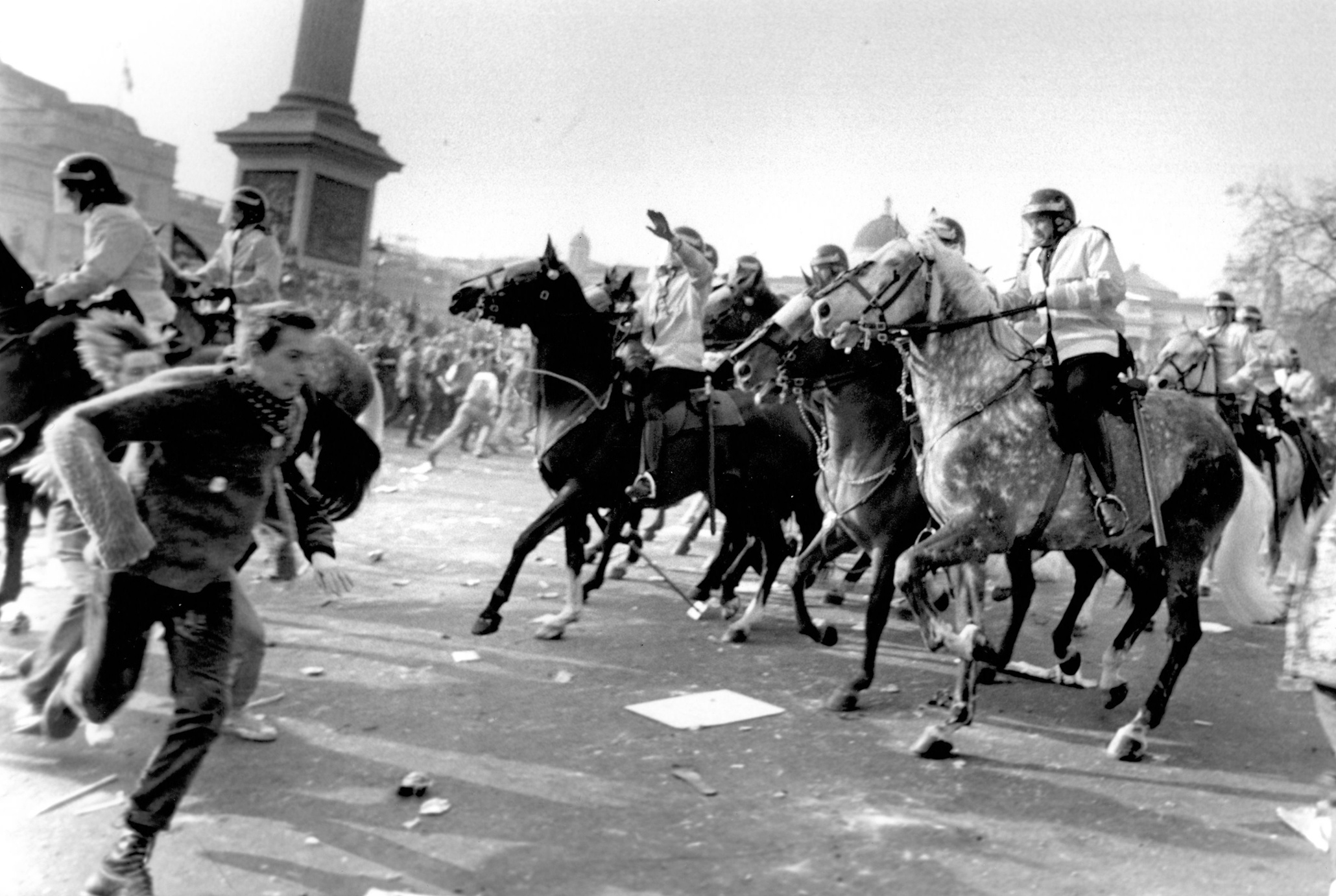
Feints, refrains and unfinished business. 2025 in review

And we are here as on a darkling plain
Swept with confused alarms of struggle and flight,
Where ignorant armies clash by night.
Mathew Arnold, Dover Beach

We called 2024 a “year of everything, everywhere, all at once”, and it earned the name. Crises collided, news arrived faster than we could process it, and the world seemed to exist in a state of constant shock. 2025 did not bring relief. Instead, the chaos began to settle. Wars dragged on, political divides hardened, social tensions deepened, and technology reshaped how we saw and understood it all.

It was the year the world stopped exploding in real time and started being what it had already become: messy, uneven, morally complicated, and stubbornly persistent. A year, indeed, in a world of echoes, refrains and unfinished business. And we spent the year watching power bargain brazenly in plain sight, trying to describe what was happening while it unfolded around us.

From Gaza to Ukraine, Sudan to Syria, from America’s self-inflicted fracture to Australia’s sudden wake-up call on Bondi Bondi, 2025 forced a reckoning: the world did not pause, but it did sort itself – deciding what we would notice, what we would ignore, and what we would learn to live with. Alongside human crises came the continuing advance of AI and chatbots, and the dominion of the algorithms that now govern attention, proving that disruption can be structural as well as geopolitical.

Gaza: War, Then “Ceasefire”

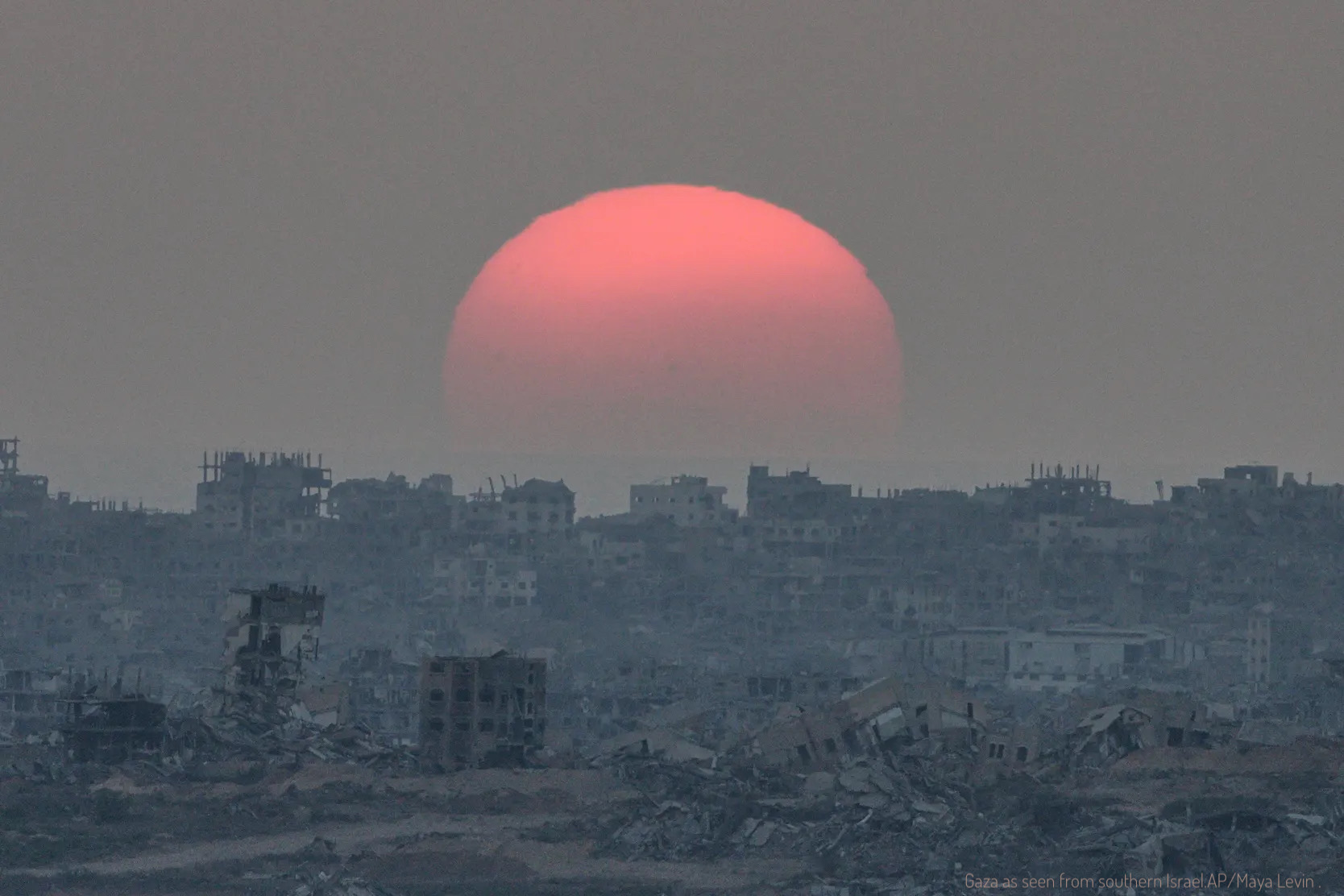
The war in Gaza dominated the year internationally and here in Australia, even as attention ebbed and flowed. Military operations continued for months, followed eventually by a “ceasefire” – a word doing far more work than it should or even justified. Fighting paused, hostages living and dead were returned and prisoners released, but the devastation remained: tens of thousands dead, cities demolished, humanitarian catastrophe unresolved. And the causes of the consequences standing still amidst the ruins and the rubble.

Western governments continued to back Israel while expressing concern for civilians, a contradiction that grew harder to defend, while street protests and online anger seethed all across the world. At the same time, antisemitism surged globally, often hiding behind the language of anti-Zionism. Two realities existed together, and too many people insisted on choosing only one.

By the end of the year, the war had not been resolved – merely frozen. Trust in Western moral leadership had been badly damaged, and Israelis and Palestinians remain in bitter limbo.

See Gaza sunrise or false dawn? Spectacle or Strategy
Iran, Israel and America’s bunker busters

Long-simmering tensions between Israel and Iran spilled into open conflict. What had once been indirect – proxies, cyberattacks, covert strikes – became visible. A brief but destructive war of missile exchanges ended with the United States asserting ordinance, deterrence and control.

The episode was brief but telling. It showed that America still reaches for its guns quickly, even as it struggles to define long-term goals. Another line was crossed, then quickly absorbed into the background of “normal” geopolitics.

Russia, Ukraine and Trump’s “Peace”

Ukraine entered 2025 mired in stalemate. Front lines barely moved. Casualties continued to mount. Western support held, but with clear signs of fatigue. And Donald Trump’s re-emergence reshaped the conversation. His promise to deliver instant “peace” reframed the war not as a question of justice or sovereignty, but of exhaustion. Peace was no longer about what Ukraine deserved, but about what the world was tired of sustaining and what the “art of the deal” could deliver.

The war didn’t end. It simply became something many wanted to stop thinking about. Not Ukraine and Russia, but. The carnage continues.

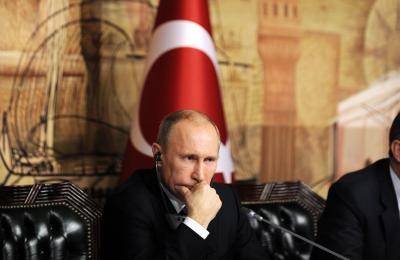
Donald Trump’s one-way crush on Vladimir gave us the one of the+most cringeworthy moments in global politics – Trump greeting the Russian president in Alaska: As the US president rolled out the red carpet for the world’s most dangerous autocrat, Russia’s attack on Ukraine accelerated. Trump got precisely nothing out of the meeting, except for the chance to hang out with a gangster he so obviously admires and of whom he is embarrassingly in awe.

Syria: Free, but stranded at the crossroads

A year after Assad’s fall, Syria remained unstable and unresolved. The regime was gone, but the future was unclear. Old sectarian tensions resurfaced, often in bloodshed, new power struggles emerged, powerful neighbours staked claims and  justice for past crimes remained distant.

Syria in 2025 was neither a success story nor a collapse – but suspended between heaven and hell, a country trying to exist after catastrophe with the rest of the world largely moving on.

See Between heaven and hell … Syria at the Crossroads
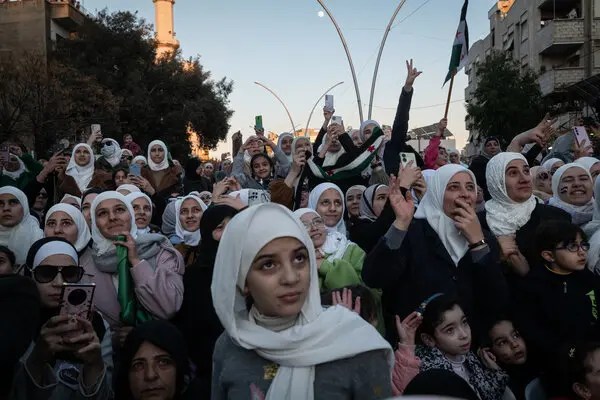
Women in Damascus celebrate the fall of the Assad regime

Sudan: what genocide actually looks like

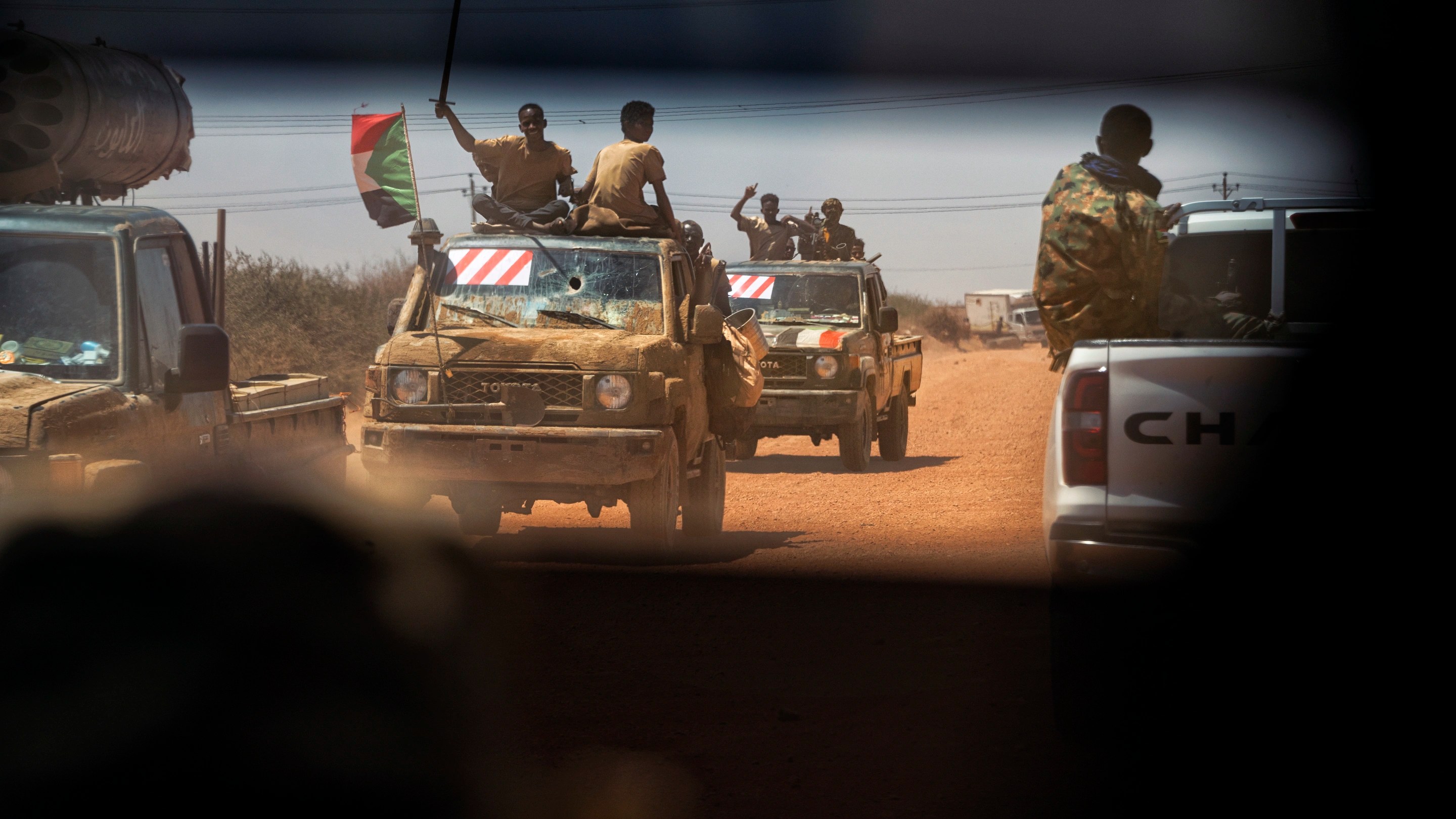
Sudan’s civil war continued with little international attention. Mass killing, ethnic cleansing, famine, and displacement unfolded slowly and relentlessly. This was genocide without spectacle. No clear narrative. No sustained outrage. It showed how mass atrocity can now occur not in secrecy, but in plain sight – and still be ignored.

see The most nihilistic war ever …Sudan’s waking nightmare
America: a country divided against itself

The United States spent 2025 deeply divided, with no sign of healing. Pew Research polling showed that seven out of ten republicans think that the opposite side is immoral while six of ten democrats thinks the same of their rivals.

Trump’s return to power sharpened those divisions. His administration governed aggressively: mass deportations, punitive tariffs, the dismantling of foreign aid, political retribution, and pressure on democratic institutions. The country looked inward and outward at the same time – less cooperative, more transactional, more openly nationalist. Democratic norms eroded not overnight, but through constant stress and disregard. With three years still to run and the tell-tale midterms approaching, allies and cronies are adjusting, bickering rivals are taking notes, and uncertainty has become the defining feature of American leadership. Meanwhile, #47 is slapping his name on everything he can christen, from bitcoins to battleships.

See, for light relief, Danger Angel … the ballad of Laura Loomer 

Monroe Redux: the return of “the Ugly American”

US foreign policy took on a blunt, old-fashioned tone. Pressure on Canada and Mexico increased. Talk of annexing Greenland resurfaced. Venezuela, caught in the maw of Yanqui bullying and bluster, waits nervously for Washington’s next move. The administration promised imminent land operations – and then bombed Nigeria! The revival of the old Monroe Doctrine felt, as baseball wizz Yogi Berra once remarked, like déjà vu all over again, not as strategy, but as instinct. Influence asserted, consultation discarded. The “ugly American” was back, and unapologetic.

See Tales of Yankee power … Why Venezuela, and why now?

Europe at a inflection point

Europe in 2025 didn’t collapse, as many pundits suggested it might, but it shifted. Far-right ideas gained ground even where far-right parties didn’t win and remained, for now, on the fringes albeit closer to electoral success. Borders tightened; policies hardened; street protests proliferated – against immigration and against Israel, Support for Ukraine continued, but cautiously. The continent stood at a crossroads: still committed to liberal values in theory, but increasingly selective in practice.

Uncle Sam’s  cold-shoulder

Rumbling away in the background throughout year was the quiet but  cumulative alienation of America’s allies. Not with a single rupture, but through a thousand small slights. transactional diplomacy dressed up as realism, alliances treated as invoices rather than covenants, multilateralism dismissed as weakness. Europe learned that security guarantees come with a mood swing; the Middle East heard policy announced via spectacle; Asia watched reassurance coexist uneasily with unpredictability.

The new dispensation was illustrated by the Trump National Security Strategy. It is at once candid and contradictory: it outlines a narrower, realist vision of American interests, emphasising sovereignty, burden-sharing, industrial renewal, and strategic clarity, yet it is riddled with silences, evasions, and tensions between rhetoric and likely action. Allies are scolded for weakness while the document avoids naming Russia’s aggression, underplays China, and projects American cultural anxieties onto Europe. These contradictions expose both strategic incoherence and the limits of paper doctrine against presidential temperament, leaving Europe facing an irreversible rupture in trust and revealing a strategy as much about America’s insecurities as its actual global posture.

The post-WW2 order has not so much been dismantled as shrugged at, and indeed, shrugged off. Trust eroded not because the United States has withdrawn from the world, but because it has remained present without being reliable, and presumed itself to be in charge. Power, exercised loudly but inconsistently, has discovered an old truth: allies can endure disagreement, but they struggle with contempt.

Australia in 2025 … high flight and crash landing

Though beset by a multitude of crises – the cost of living, housing, health and education services – the Albanese Labor government was returned comfortably in May, helped by a divided, incoherent, and seemingly out of touch opposition. For the rest the year, federal politics felt strangely frictionless with policy drift passing for stability. The Coalition remained locked in internal conflict, unable to present a credible alternative. The Greens, chastened by electoral defeat and in many formerly friendly quarters, ideological disillusionment, treaded water.

But beneath the surface, social cohesion frayed. Immigration debates sharpened. Antisemitism rose noticeably, no longer something Australians could pretend belonged elsewhere. Attacks on Jewish Australians forced a reckoning many had avoided and hoped would resolve once the tremors of the war in Gaza had ameliorated. Until 6.47pm on 7th December, a beautiful evening on Sydney’s iconic Bondi Beach. Sudden, brutal and in our summer playground, sectarian violence shattered the sense of distance Australians often feel from global disorder. At that moment, politics stopped feeling abstract. The world, with all its instability, barged in and brought the country down to earth.

See This Is What It Looks Like

Lifesavers on Bondi Beach, 20 December 2025. Edwina Pickles

Featured photograph and above:

A handful of bodies on Bondi Beach, and behind them, the howling infinite of expectation, obligation, and the careful rationing of human empathy. The smallness of the beach against the vastness of consequences. On December 20, 2025, Bondi’s iconic lifesavers formed a line stretching the entire length of the beach -silent, solemn, a nation visibly in mourning. Similar tributes unfolded from Perth to Byron Bay, gestures of unity in the face of a shock that touched the whole country.

The Year of the Chatbot: Promise, Power, and Risk

And now, a break from the doom and gloom …

2025 was the year when artificial intelligence became part of daily life. Chatbots ceased to be experimental and became integral, transforming from novelty to utility seemingly overnight. People used it to write, research, translate, plan, argue, comfort, and persuade; institutions and individuals adopted it instinctively. Setting tone as much as content, the ‘bots have lowered barriers to knowledge, sharpened thinking, and helped people articulate ideas they might otherwise struggle to express. Used well, they amplified curiosity rather than replace it.

The opportunities are obvious – but so are the risks. Systems that can clarify complexity can also flatten it. Chatbots sound confident even when wrong, smooth over disagreement, and made language cleaner, calmer, and more persuasive – but not necessarily truer. They reinforce confirmation bias, outrage, and tribal certainty, generating arguments instantly and flooding the zone with plausible-sounding text. As information has became faster, cheaper, and less reliable, Certainty has spread more easily than truth, so truth has to work much harder.

Dependence is subtler but real. Outsourcing thinking – summaries instead of reading, answers instead of wrestling – did not make humans stupid, but less patient. Nuance, doubt, and slow understanding became harder to justify in a world optimised for speed. Yet conversely, man people still seek context, history, and complexity. Used deliberately, AI could slow the pace, map contradictions, and hold multiple truths at once.

By the end of 2025, the question was no longer whether AI would shape public life – it already had. The real question is whether humans would use it as a shortcut, or as a discipline. The technology is neutral. The danger – and the promise – lies in how much thinking we are willing to give up, and how much responsibility we are prepared to keep.

See The promise and the peril of ChatGPT 

Algorithm and blues

Alongside the chatbot sat a quieter, more insidious force: the algorithm itself. By 2025 it no longer simply organised information – it governed attention. What people saw, felt, and argued about was shaped less by importance than by engagement. To borrow from 20th century philosopher and communication theorist and educator Marshall McLuhan, the meme had become the message. Complex realities were compressed into images, slogans, clips, and talking points designed not to inform but to travel. The algorithm rewarded speed over reflection, certainty over doubt, heat over light. Politics, war, and grief were all flattened into content, stripped of context, and ranked by performance. What mattered most was not what was true or necessary, but what disseminated.

Passion without Wisdom

I wrote during the year that we seemed “full of passionate intensity” – Yeats’ phrase still apt in the twenty first century- but increasingly short on wisdom and insight. 2025 confirmed it. Anger was everywhere, empathy highly selective, certainty worn like armour. People felt deeply but thought narrowly. Moral energy surged but rarely slowed into understanding. The problem was not indifference; it was excess – too much feeling, too little reflection. In that environment, nuance looked like weakness and patience like complicity. What was missing was not information, but judgement – the harder work of holding contradiction, of resisting instant conclusions, of allowing complexity to temper conviction. Passion was abundant. Insight, increasingly rare.

Looking Toward 2026

Looking back on 2025, it seems that there  were no endings, neither happy or sad. Just a promise, it seems, of more of the same. The year didn’t solve anything. It clarified things. And if it clarified anything, it was that the world has grown adept at managing, ignoring, or absorbing what it cannot fix. It revealed a world adjusting to permanent instability. In this year of echoes, refrains, and unfinished sentences.

Passion, intensity, and outrage were abundant, but patience, wisdom, and insight remained scarce. Democracies strained under internal and external pressures. Wars lingered unresolved. Technology reshaped thought and attention.

Some argue that hope springs eternal, that yet, even amid the drift and the fractures, glimpses of understanding and resistance persisted, that although the world has settled into its chaos, we can be riders on the storm. But, I fear, 2026 arrives not as break, a failsafe, a safety valve, but as continuation. It looms as a test of endurance rather than transformation.  In my somnolent frame of mind, I’ve reached again for my Yeats. “Things fall apart; the centre cannot hold; mere anarchy is loosed upon the world, the blood-dimmed tide is loosed …”

After the chaos of 2024 and the hardening of 2025, the question is no longer what might go wrong. It’s what we’re prepared to live with.

And so we come to what In That Howling Infinite wrote in 2025.

What we wrote in 2025

It was a year that refused neat endings.

It began in a wasteland – Gaza as moral ground zero – and moved, restlessly, through revolutions real and imagined: Trump as symptom and accelerant, Putin as a man racing his own shadow, Syria forever at the crossroads where history idles and then accelerates without warning. Gaza returned, again and again, sunrise and false dawn, as spectacle and strategy; Sudan burned in near silence; Venezuela re-entered the frame as empire’s backyard as the US disinterred its Monrovian legacy. In That Howling Infinite featured pieces on each of these – several in many cases , twenty in all, plus a few of relevance to them, including an overview of journalist Robert Fisk’s last book (The Night of Power – Robert Fisk’s bitter epilogue). A broadranging historical piece written in the previous year and deferred, Modern history is built upon exodus and displacement, provided a corrective of sorts to the distorted narratives that have emerged in recent years due to a dearth of historical knowledge and the partisan weaponisation of words. 

It was almost as light relief that we turned to other subjects. Of particular interest was AI. Approaching remorselessly yet almost unrecognised in recent years, it banged a loud gong and crept from curiosity to condition, from tool to weather system, quietly rewriting the newsroom, the internet, and the idea of authorship. ChatGPT and other chatbots appeared not as saviours but as promise and peril in equal measure. By year end, we were fretting about using ChatGPT too much and regarding it as something to moderate like alcohol or fatty foods. We published three pieces on the subject in what seemed like rapid succession, and then pestered out – sucked into the machinery, I fear.

What with so much else attracting our attention, we nevertheless managed to find time for some history – including a  particularly enthralling and indeed iconoclastic book on the fall of the Ottoman Empire; the story of an Anzac brigade lost in Greece in 1942; “the Lucky Country” revisited after half a century;  and a piece long in the pipeline on the iconic singer and activist Paul Robeson.

In August, as on a whim, for light relief, we summoned up a nostalgic old Seekers’ song from the mid-sixties, a time when the world was on fire with war and rage much as it is today, but for us young folk back in the day, a time of hope and hedonism. For us, the carnival, clearly, is not over. The machinery is still whirring, the music still loud, and the lights still on. History is insisting on one more turn of the wheel, and the dawn, so often promised, so frequently invoked, has not yet broken.

January
The Gaza War … there are no winners in a wasteland
The way we were … reevaluating the Lucky Country

February
Let’s turn Gaza into Mar e Largo
Trump’s Second Coming … the new American Revolution
Cold Wind in Damascus … Syria at the crossroads

March
Trumps Revolution… he can destroy but he cannot create
Where have all the big books gone?
Putin’s War … an ageing autocrat seeks his place in history

April
The Trump Revolution … I run the country and the world
The Fall of the Ottoman Empire and the birth of Türkiye
Let Stalk Strine .. a lexicon of Australian as it was spoken (maybe)

May
The phantom of liberty … the paradoxes of conservativism
Shadows in search of a name … requiem for a war
The continuing battle for Australia’s history

July
A mighty voice … the odyssey of Paul Robeson

August
109 years of Mein Kampf … the book that ravaged a continent
High above the dawn is breaking … the unlikely origin of a poo song

September
Gaza sunrise or false dawn? Trump’s peace plan
Gaza sunrise or false dawn? Spectacle or Strategy
Will there ever be a Palestinian state?
Why Osana bin lost the battle but won the war
The Night of Power … Robert Fisks bitter epilogue
The promise and peril of ChatGPT
Who wrote this? The newsroom’s AI dilemma

October
AI and the future of the internet
Danger Angel … the ballad of Laura Loomer

November
A forgotten Anzac story in Greece’s bloody history
The most nihilistic war ever … Sudan’s waking nightmare
Answering the call … National Service in Britain 1945-1963
Tales of Yankee Power … at play in Americas backyard

December
Delo Kirova – the Kirov Case … a Soviet murder mystery
Between heaven and hell … Syria at the crossroads
This Is What It Looks Like
Tales of Yankee power … Why Venezuela, and why now?
Marco Rubio’s Venezuelan bargain

Read out reviews of prior years:

That was the year that was – retrospectives

A song for 2026: Lost love at world’s end …

It is our custom to conclude our annual wrap with a particular song that caught our attention during the year. Last year, we chose Tears for Fears’ Mad World.  It would be quite appropriate for 2025. But no repeats! so here is something very different. An outwardly melancholy song that is, in the most ineffable way quite uplifting. that’s what we reckon, anyway …

The Ticket Taker is on the surface a love song for the apocalypse; and it’s it’s one of the prettiest, most lyrically interesting songs I’ve heard in a long while. I could almost hear late-period Leonard Cohen and his choir of angels.

The apocalypse is both backdrop and metaphor. We’re not sure which. Is it really about a world ending, or just about the private ruin of a man left behind by love and fortune. The lyrics are opaque enough to evade final meaning, but resonant enough to keep circling back, like the ferry itself, between hope and futility. A love song, yes, but also a confession of entrapment: the gambler’s hope, the ark one cannot board.

The “Ticket Taker” song was written by Ben Miller and Jeff Prystowsky and is featured on The Low Anthem’s album Oh My God, Charlie Darwin. It features on Robert Plant’s latest foray into roots music – this time with English band Saving Grace. This flawless duet with Suzi Dian is mesmerising and magical.

Jeff will tell you that the song is “pure fiction,” that Ben “just made it up one day” – but fiction, as we know, has a way of smuggling deeper truths than fact dares admit.

Tonight’s the night when the waters rise
You’re groping in the dark
The ticket takers count the men who can afford the ark
The ticket takers will not board, for the ticket takers are tied
For five and change an hour, they will count the passers-by

They say the sky’s the limit, but the sky’s about to fall
Down come all them record books, cradle and all
They say before he bit it that the boxer felt no pain
But somewhere there’s a gambling man with a ticket in the rain

Mary Anne, I know I’m a long shot
But Mary Anne, what else have you got?
I am a ticket taker, many tickets have I torn
And I will be your ark, we will float above the storm

Many years have passed in this river town, I’ve sailed through many traps
I keep a stock of weapons should society collapse
I keep a stock of ammo, one of oil, and one of gold
I keep a place for Mary Anne, soon she will come home

Mary Anne, I know I’m a long shot
But Mary Anne, what else have you got?
I am a ticket taker, many tickets have I torn
And I will be your ark, we will float above the storm

Mary Anne, I know I’m a long shot
But Mary Anne, what else have you got?
I am a ticket taker, many tickets have I torn
And I will be your ark

A forgotten Anzac story in Greece’s bloody history

A king sate on the rocky brow
Which looks o’er sea-born Salamis;
And ships, by thousands, lay below,
And men in nations—all were his!
He counted them at break of day – 
And when the sun set, where were they?
Lord Byron, Don Juan

Christopher Allen, The Australian’s art critic, writes of how Greece’s antiquity presses in on the present. It is a lightweight piece, surveying as it does three millennia of history, from the days of the Greeks, Alexander, the Great and the Romans to those of the Ottomans and their successor states –  but it is elucidating nonetheless.

It is a brief reminder of the veracity of the phrase “history is always with us”, and of how the past continues to shape the present through its influence on culture, human nature, and ongoing events – a constant guide, providing both cautionary tales and inspiration for the future, as we carry our history with us in our identities, cultures, societies and recurring patterns of behaviour. As author and activist James Baldwin is attributed to have said, “History is not the past. It is the present. We carry our history with us. We are our history”.

Greece has always lived a double life. To the casual visitor, it is a sun-splashed idyll of sea and sky, but its history tells a darker story – a long, hard ledger of heroes and horrors, and the stubborn will to survive wedged between warring empires. The last two and a half millennia have been less a tranquil Mediterranean tableau than a parade of conquerors, liberators, and the occasional poet-adventurer.

Over time, Greece has drawn to its shores soldiers and adventurers, poets and dreamers – and naive youths like myself. I hitch-hiked down from what was then Yugoslav in the summer of 1970, a young man with a second-hand rucksack and followed the looping Adriatic highway from Thessaloniki and Athens. I knew enough history to feel the charge of passing near Thermopylae, where Spartans once made their famous last stand against the might of Xerxes. But I wasn’t to learn until over half a century later that an army of ANZACs battled overwhelming odds just a valley away.

The past, in Greece, as in the Middle East, always stands just offstage, awaiting its cue and refusing to stay politely within its own century. It is not merely one of the world’s most benevolent postcards; it is a crossroads of empires, a battleground of ambitions, a cavalcade of famous names and places, where East and West have met, mingled, clashed, and sometimes embraced in the long swirl of history, where the mythic and the modern travel together.

One particular reference also reminds me of how history sends out roots, twigs and branches throughout the settled and hence recorded world.

Tempe, on Sydney’s Cooks River, wears its classical inheritance more openly than most Sydney suburbs. When Alexander Brodie Spark built Tempe House in the 1830s, he christened the estate after the Vale of Tempe in northern Greece – a narrow, ten-kilometre gorge carved by the Pineiós River as it threads between Olympus and Ossa. The poets imagined Poseidon’s trident had cleft the mountains to make it; Apollo and the Muses strolled beneath its laurels; sacred branches were cut there for Delphi. Spark, standing between his own modest “Mount Olympus” and the river, saw a faint echo of the Greek idyll and gave the place its name.

But the Vale of Tempe was never entirely pastoral. Armies have squeezed through that narrow defile for millennia. The Persians marched through it on their way south – Tempe lies just north of the iconic pass of Thermopylae, part of the same chain of passes that determined so much of Greek military history. And in the twentieth century it would again become a stage for outsiders in uniform.

In April 1941 Australian and New Zealand troops, together with British units, were thrown into Greece as Lustre Force – outnumbered, outgunned, and facing a German army with air superiority and modern communications. One of the hardest-fought delaying actions took place – inevitably, given the geography – at Tempe Gorge on 18 April (the featured image of this post, from the collection of the Australian War Museum). The Australian brigade was commanded by Brigadier A.S. Allen, who had formed the first battalion of the new AIF. His “Anzac Force” (apparently the last operational use of that designation) held the gorge long enough to impede the German advance and allow wider Allied withdrawals. The serene valley Spark had sentimentalised became, for a few violent hours, an Anzac bottleneck: those same narrow walls that once sheltered shrines now channelling rifle fire and Stuka attacks. Many of those men would soon find themselves on Crete, resisting the first large-scale parachute assault in military history.

And then – because Australia never resists a touch of Mediterranean whimsy—the Hellenic (and Hellenistic) echoes continue in our own neighbourhood on the Midnorth Coast. Halfway along the road from Bellingen to Coffs Harbour lies the township of Toormina, home to our closest shopping centre and to the Toormi pub. Its name began its life on the slopes of Mount Tauro in Sicily, in the ancient town of Taormina, the site of a famous amphitheater. In the 1980s local Italian residents of who were clients of developer Patrick Hargraves (the late father of a good friend of ours) suggested the name “Taormina” for the new subdivision. He liked the idea but clipped the opening “a” to make it more easily pronounceable- and Toormina entered the Gregory’s and thelocal vernacular.
So in our small corner of New South Wales, Greek myth, Persian marches, Anzac rearguards, and Sicilian nostalgia all whisper from the signposts. Tempe and Toormina: unlikely twins, proof that even the quietest suburb can carry the long shadows of the ancient world.

See also in In That Howling Infinite, Ottoman Redux – an alternative history and The fall of the Ottoman Empire and the birth of Türkiye 

Uncovering a forgotten Anzac story in Greece’s bloody history

From ancient battles to World War II, a visit to Athens’ War Museum exposes the dramatic military history that shaped modern Greece. Christopher Allen’s deeply personal connection unravelled in the process.

Christopher Allen, The Australian, 21 November 2025
James Stuart, View of the Erechtheion, Athens, October 1787. Photo: Royal Academy of Arts, London. Photographer: Prudence Cuming Associates Limited.

James Stuart, View of the Erechtheion, Athens, October 1787. Royal Academy of Arts, London. Photographer. Prudence Cuming Associates Limited.

A little over 200 years ago, the Greeks began their war of independence from the Ottoman Empire, which had conquered most of the Byzantine world in the 15th century; the renaissance in Western Europe thus coincided with the beginning of a new dark age for the Greeks under Turkish oppression. Some islands held out for longer: Rhodes, home of the Knights of St John, was taken in 1522, forcing them to withdraw to Malta; Cyprus, ruled by the French Lusignan dynasty from the time of the Crusades and then by Venice, was brutally conquered in 1571, and Crete, held by Venice since 1205, finally fell after a generation-long siege in 1669.

The Ottoman Empire reached the apogee of its power in the early 18th century, but then began a slow decline, one of whose incidental effects was to make the Greek world more accessible to Western travellers: James Stuart and Nicholas Revett spent time in Athens from 1751 and published their Antiquities of Athens in several volumes in 1762. By the early 19th century, Greece had become part of the itinerary of the Grand Tour; by 1816, the Parthenon Frieze was in the British Museum and profoundly transformed modern understanding of Ancient Greek art.

Meanwhile the Greek War of Independence began with revolts in the Peloponnese in 1821 and a Declaration of Independence in 1822, eliciting a savage response from the Turks and sympathy from intellectuals and the educated public in Western European countries. The slaughter of the population of the island of Chios in 1822 led Eugène Delacroix to paint his famous Massacre at Chios, exhibited in the Salon of 1824 and purchased in the same year for the national collection; it is today in the Louvre. In 1823, the most famous poet of his day, Lord Byron, who had already demonstrated his sympathy for Armenian culture and independence from the Ottomans, went to Greece to help in the fight, both personally and financially.

This 1813 portrait by Phillips depicts Lord Byron, the famous English poet, wearing traditional Albanian attire. It captures his fascination with the Balkans and his travels, marking a moment of cultural exchange in his life. Picture: Alamy

This 1813 portrait by Phillips depicts Lord Byron in traditional Albanian attire. Alamy

Byron’s death in 1824 at Missolonghi only attracted more attention and sympathy to the cause of Greek freedom, and the great powers – Britain, France and Russia – warned the Turks about further repression, even though they were also committed, for different reasons, to maintaining the integrity of the crumbling Ottoman Empire. In 1827, at the Battle of Navarino, an international fleet led by the British and commanded by Sir Edward Codrington destroyed the Turkish and Egyptian navies. After further interventions on land by Russian and French forces, the Ottoman Empire was compelled, by the Treaty of Constantinople in 1832, to accept the independence of mainland Greece, although initially only as far north as the so-called Arta-Volos Line. The north, including Thessaly, Macedonia and Thrace, remained in Ottoman hands and Mustafa Kemal Ataturk was born in the former Byzantine city of Salonika in 1881.

Instability in the Balkan provinces of the Ottoman Empire in the 1870s gave the new Greek nation the opportunity to annex the central region of Thessaly in 1881 (while Britain incidentally acquired Cyprus in 1878). Further important gains were made during the two Balkan Wars (1912-13): much of Epirus in the northwest as well as Salonika and most of southern Macedonia, most of the Aegean Islands and Crete; the British had already ceded the Ionian Islands in 1863 and the Italians would relinquish the Dodecanese after World War II in 1947. Meanwhile, in the aftermath of World War I, Greece had briefly seized eastern Thrace and territories in Anatolia, soon to be retaken by the Turks with immense loss of life in the Great Fire of Smyrna in 1922.

Model of Byzantine warship from the War Museum

Model of Byzantine warship from the War Museum

This is of course a very much simplified version of the extraordinarily complicated story of Balkan politics from the mid-19th century, which forms such an important part of the lead-up to World War I. All of these events were accompanied not only by terrible military casualties on all sides, but by massive disruption to the population of lands where people of different ethnicities and faiths had lived side-by-side for centuries as part of a multiethnic empire, including war crimes and atrocities against civilians and non-combatants. And Greeks who had previously enjoyed political and economic prominence throughout the Ottoman world, including the Phanariots of Constantinople, were first stripped of their privileges, then persecuted and finally expelled in the tragic population exchange of 1923.

All of these events and many more are covered in the exhibits at the Athens War Museum, which I had never visited until a few weeks ago, but which gives a vivid idea of the almost continuous warfare that has been carried on over the past couple of centuries in a land most tourists imagine as a paradise of sea, sun and waterside taverns. The events of the war of liberation, especially as we pass through so many bicentenaries in the current decade, are naturally well represented: there is, for example, a new and interactive display devoted to the sea battle of Navarino and events surrounding this decisive moment in the war.

There are portraits of the many famous leaders of the independence movement in their picturesque costumes, as well as dramatic reimaginings of heroic battles, and of course weapons and equipment of the time. The resonance of the Greek struggle in Western Europe is recalled in a copy of Delacroix’s Massacre at Chios, as well as a version of Thomas Phillips’s portrait of Lord Byron in exotic Albanian costume (1813), of which the original hangs in the British embassy at Athens; another replica by the artist himself, but only of the head and shoulders, is in the National Portrait Gallery in London.

Eugène Delacroix, The Massacre at Chios

But there is much more about the history of Greece in Antiquity, and the chronological arrangement of the displays makes this an effective way to follow the sequence of events, especially the main episodes of the Persian Wars – with the great battles of Marathon in 490BC and Salamis in 480 – as well as the subsequent conflict between Athens and her quasi-subject states on one side and Sparta and her Peloponnesian allies on the other, known as the Peloponnesian War.

This disastrous war (431-404 BC) was followed in the second half of the fourth century by the rise of Philip of Macedon to hegemony, for the first time, over almost all of mainland Greece. After his assassination in 336, his young son, who became Alexander the Great, embarked on a spectacular campaign that led to the conquest of the whole of the vast Persian empire, from Egypt to what are now Afghanistan and Pakistan. Alexander’s conquests led to the extension of Greek language and civilisation deep into Asia, creating the international culture of the Hellenistic period, characterised among other things by a rich and complex exchange of ideas and forms between East and West.

He left an indelible impression on all the lands he conquered and is, for example, the first historical figure in the Persian national epic, the Shahname. By the time of Ferdowsi, who composed this masterpiece a millennium ago, the Persians had forgotten about the Achaemenid dynasty that first created the Persian empire in the sixth century BC; even the great site of Persepolis was and still is called Takht-e Jamshid, the throne of Jamshid, one of the mythical rulers from the great epic.

Each of Alexander’s battles – he is one of the handful of great generals never to have been defeated – is illustrated in clear diagrams, but they are also recalled in later images, in this case particularly in a series of 17th-century engravings whose story is probably unknown to almost all visitors to the museum. These are reproductions of gigantic paintings made as cartoons for tapestries commissioned by the young Louis XIV in the 1660s from Charles Le Brun, who was to become his court painter and who was later responsible for the decorations at Versailles, including the Hall of Mirrors. The series illustrates the valour but also the magnanimity of Alexander, as is clear from the moralising inscriptions attached in the engraved versions. For a long time, the huge canvases were not displayed at the Louvre, but for the last few decades have had their own room upstairs in the Sully wing.

Following the chronological sequence from antiquity we eventually get back to the war of independence and its sequels already mentioned above; but the story continues, after what the Greeks call the Asia Minor Catastrophe of the early 1920s, with a new calamity two decades later. For Mussolini invaded Greece in October 1940 expecting, like Putin in Ukraine, to achieve an easy victory and utterly underestimating the strength and resolve of the Greek army. By the following spring, it was clear that he was getting nowhere, and Hitler decided to come to his rescue by invading Greece in April 1941.

A. Bormans, engraving after Charles Le Brun Alexander and King Porus

A. Bormans, engraving after Charles Le Brun Alexander and King Porus

An Allied army, mostly consisting of Australian and New Zealand troops as well as some British units, was hastily put together and sent from Egypt to Greece as Lustre Force. It was heavily outnumbered by the Germans, who were also massively better equipped and had the benefit of air cover and wireless radio communication. Nonetheless, the Allied army put up a determined resistance in a series of battles including one notable action on April 18, 1941 at Tempe Gorge commanded by my grandfather, then Brigadier AS Allen, who had formed the first battalion of the new AIF and taken our first troops to World War II. The brigade he commanded at Tempe was known as “Anzac Force”, apparently the last use of the term, after the designation Anzac Corps for the whole Australian and NZ component of Lustre Force.

After the evacuation of mainland Greece, my grandfather was sent to fight the Vichy French in Syria, but many of our troops were taken to Crete, where in May 1941 they were faced with the first and only large-scale parachute assault in military history, in which the Germans suffered appalling casualties but ultimately prevailed. Next year will be the 85th anniversary of these dramatic events in Greece and Crete, and among other things will be commemorated by an exhibition of Australian and NZ artists whom I accompanied on a two-week tour of these battlefields in the second half of October.

It was a moving experience to visit what are today the peaceful sites of such desperate battles almost three generations ago, aware at the same time of the long history of warfare in the same lands: the Persians marched through Tempe, which is just north of Thermopylae; Caesar defeated Pompey at Pharsalus (now Farasala), which you pass on the train from Athens to Salonika (now Thessaloniki), and; Cassius and Brutus died at Philippi in Macedonia, defeated by the Caesarian forces of Octavian and Mark Antony.

Christopher Allen is the national art critic for Culture and has been writing in The Australian since 2008. He is an art historian and educator, teaching classical Greek and Latin. He has written an edited several books including Art in Australia and believes that the history of art in this country is often underestimated.

Continue reading

The fall of the Ottoman Empire and the birth of Türkiye

Preface

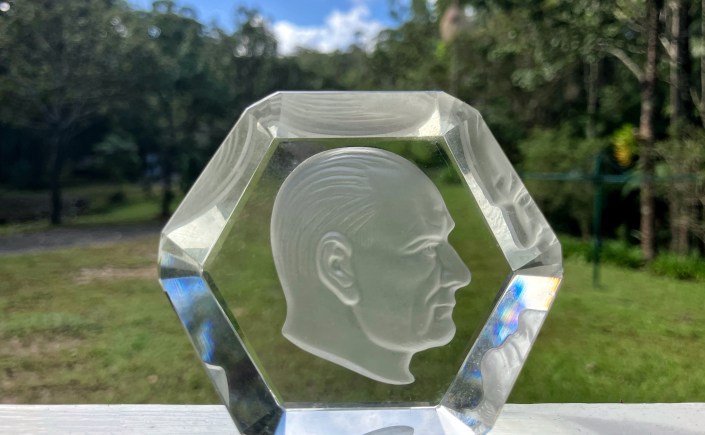
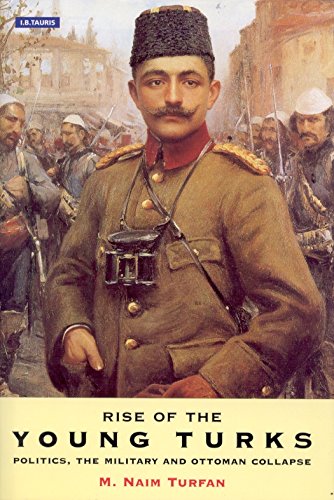
The featured image of this post is a profile in crystal of Kemal Atatürk that sits on my bookshelf as a reminder of my late friend and academic colleague Mehmet Naim Turfan. Naim, like millions of his compatriots, harboured a deep affection and respect for the legacy of Atatürk, the founder of modern Türkiye and its first president. It was gifted to me by His wife soon after his passing by his wife Barbara. His doctoral thesis was published posthumously in 2000 as Rise of the Young Turks: Politics, the Miliary and Ottoman Collapse. He is cited several times in the book that is the subject of this article. I thought of Naim often while reading the book and writing what follows.

Enver Pasha, soldier, politician and member of the troika that ruled the Ottoman Empire before and during WW1

Ottoman Endgame

Many believe that prior to the outbreak of World War 1 in August 1914, Europe had been at peace. In matter of fact, brutal and bloody little wars had raged in Eastern Europe three years prior, whilst Italy fought the Ottoman Empire for Tripoli and Cyrenaica, both now modern Libya and yet also presently two warring parts of a fractured whole and now being triggered by the aftermath of equally nasty little wars in the same lands in the last quarter of the Nineteenth Century. The Ottoman Empire’s entry into alliance with the Central Powers in 1915 against the Entente of Britain, France and Russia was the direct outcome of what we know refer to generically as The Balkan Wars – which aided and abetted by Russia, saw the emergence of Serbia, Romania and Bulgaria. In retrospect, with the benefit of hindsight, they were the beginning of what we might now refer to as The Wars of the Ottoman Succession. They are not over.

The empire’s entry into the war on the side of the Central Powers against the Entente of Britain France and Russia was a devious, drawn-out business as it sought to take advantage of its potential allies in recovering why it lost in the preceding Balkan Wars that had deprived it of its European provinces,

Few have told the story of the fall of the Ottoman Empire and the birth of modern Türkiye as well as English historian Sean McMeekin in his geographically sprawling and historically enthralling book The Ottoman Endgame. He juxtaposes military operations in the empire with those on Europe’s eastern and western fronts, demonstrating how, in the shifting fortunes of war in Europe, each impacted the other from the first offensives in France and on the eastern front to the Russian Revolutions of 1917.

Author and journalist Christopher de Bellaigue sets the scene well in a brief but compelling review (published in full below with some excellent pictures, along with a article by the author himself):

”For the historian of the first world war, the Ottoman theatre is a blur of movement compared to the attrition of the western front. Its leading commanders might race off to contest Baku and entirely miss the significance of events in the Balkans, while the diffuse nature of operations tended to encourage initiative, not groupthink. The war of the Ottoman succession, as Sean McMeekin calls it, was furthermore of real consequence, breaking up an empire that had stifled community hatreds, and whose absence the millions who have fled sectarian conflict in our age may rue …

For the Ottomans, the “great war” of western historiography was part of a much longer period of conflict and revolution, and arguably not even its climax. The process started with the collapse of the Ottomans’ Balkan empire – encouraged by Russia, moderated by Britain – and it brought to power the militaristic regime of the Committee of Union and Progress, or CUP. When Turkey entered the European war on 10 November 1914, Ottoman innocence was long gone, the army fully mobilised, the people benumbed by loss and refugees and the empire hanging in the balance. And yet, for the CUP and its triumvirate of leading pashas, the Young Turk troika of Enver, Talat and Djemal, the moment was as fraught with opportunity as it was with danger. On the opportunity side of the ledger was the prospect of riding Germany’s coat tails to victory, overturning the Balkan reverses and winning back provinces in the east from the old enemy, Russia. Enver, the CUP’s diminutive generalissimo, even spoke of appealing to Muslim sentiment and marching all the way to India.

For the Russians, the game was about winning Constantinople (or Tsargrad, as they presumptuously called it) and with it unimpeded access to the Mediterranean through the Bosphorus; it was with “complete serenity”, Tsar Nicholas II informed his subjects, that Russia took on “this ancient oppressor of the Christian faith and of all Slavic nations”

The European war on the eastern and western fronts was characterized by attrition and stalemate, but that waged by the Ottomans and the Russians, and soon, the British and French, was in contrast, highly mobile and constantly shifting, with the exception perhaps of the allied assault on the Gallipoli Peninsula which very soon resembled the trench warfare and brutal but futile offensives that characterized the Western Front. It is difficult to comprehend to scale of the war fought in the Middle East in terms of its territorial extent. From Baghdad to Baku, Gallipoli to Gaza, the Black Sea to the Gulf of Aqaba and the Caspian Sea. It was waged across European and Asian Ottoman lands including present day Greece, Bulgaria and Romania in the west, in the Caucasus in the east, in present day Armenia, Georgia and Azerbaijan and Iran, and in the south in present day Syria, Iraq, Jordan, Israel and Palestine.

Though the Sultan departed, and with him, the Islamic Caliphate, and most of the empire’s non-Turkish lands – were lost, under the leadership of former Ottoman commander and war hero Mustafa Kemal Pasha, the Anatolian heartland resisted and ultimately repelled invading foreign armies, and the Turkish state he created endures today as an influential participant in world affairs.

Casting new light on old narratives

McMeekin, writes de Bellaigue, is an old-fashioned researcher who draws his conclusions on the basis of the documentary record. In the case of a conflict between Ottoman Turkey and Germany on one side, and Russia, Britain and France on the other, and involving Arabs, Armenians and Greeks, this necessitates linguistic talent and historical nous of a high order. McMeekin is at home in the archives of all major parties to the conflict and his accounts of some of the more contested episodes carry a ring of finality. Access to previously closed Russian and Turkish archives has provided new and potentially controversial insights into accepted narratives regarding the last years of the Ottoman Empire. Challenging long accepted narratives, he addresses three of the most enduring shibboleths of the First World War.

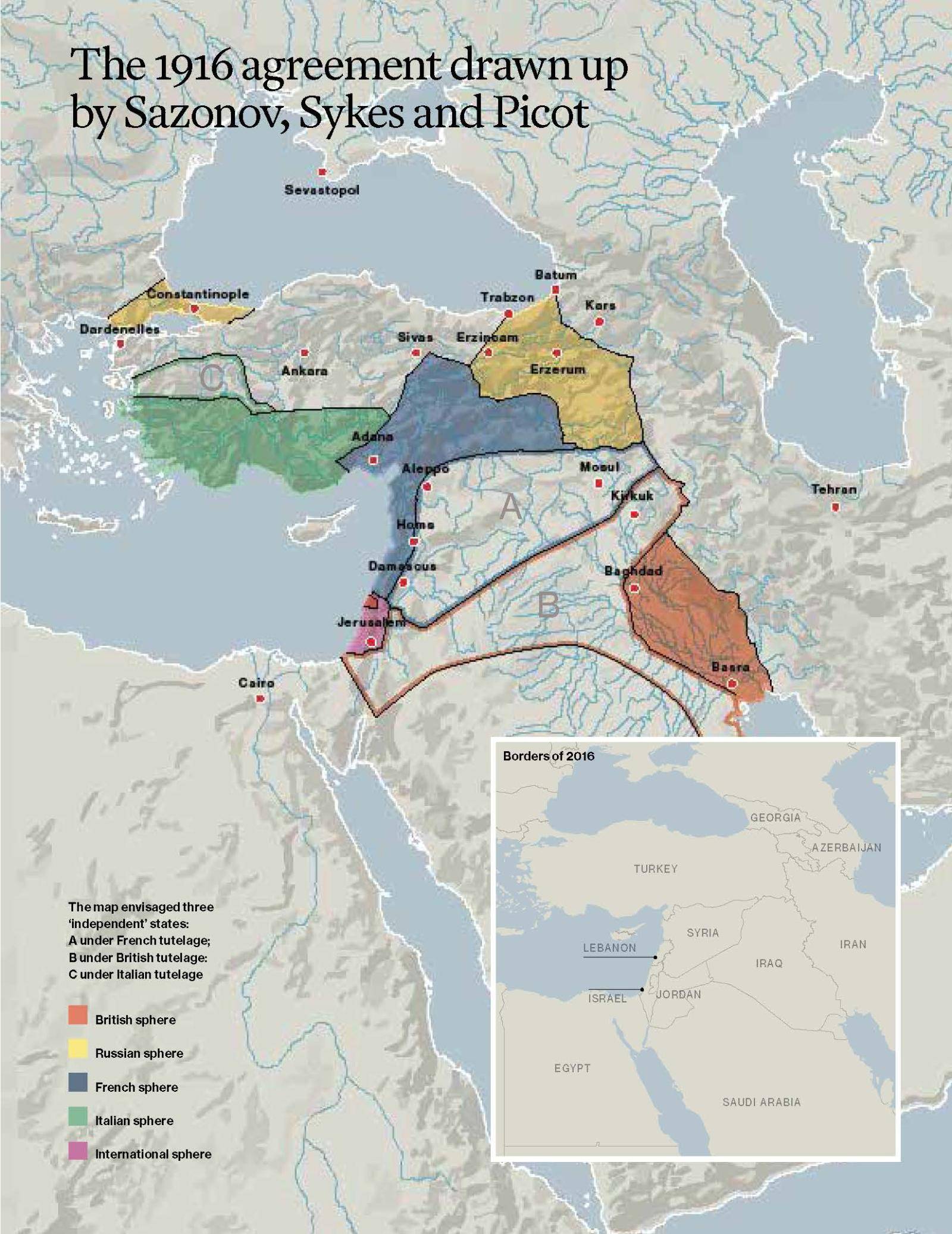
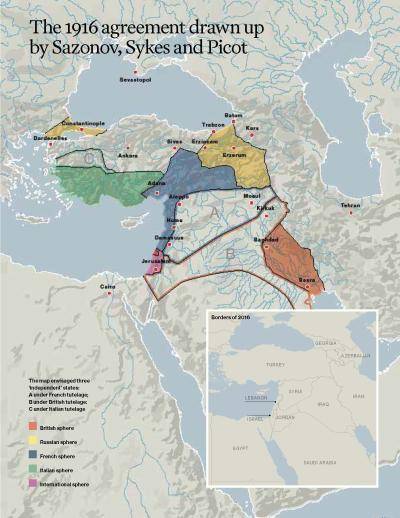
He jumps right in even before he begins his wide-ranging story, leaves hanging in the air like a predator drone until he returns to it in chronologically due course. The Sykes Picot Agreement of 1916 – the bête noir of most progressive narratives of the modern Middle East, and to many ill-informed partisans, the causus bello of the intractable Arab Israeli conflict – was not the brainchild of perfidious Albion and duplicitous France, but rather a plan for the dismemberment of the Ottoman Empire concocted by the foreign minister of Imperial Russia. France’s Monsieur François-George Picot and Britain’s Sir Mark Sykes played second and third violin to the “third man” Sergei Sazonov. Both Russia and France had for decades sought to establish their political, strategic and economic interests at the expense of the so-called “sick man of Europe”, an ostensibly terminal invalid who throughout the nineteenth century, had experienced many deathbed recoveries. Czar Nicholas II, in common with his Russian Orthodox predecessors, dreamt of bringing Istanbul, formerly Constantinople, the heart of the orthodox patriarchate, or Tsargrad into the empire. It was no coincidence that the infamous Sykes Picot pact was outed by Russia’s Bolshevik regime after the collapse of the Czarist regime to discombobulate the revolution’s foremost European enemies. 

The second icon of “received history” in McMeekin’s sights, is one Australia’s foundation stories – the ill-starred Dardanelles Campaign of 1915 and particularly, the the ANZAC’s Gallipoli legend. It was, from McMeekin’s perspective, a misconceived, poorly planned endeavour to capture the Ottoman capital, to relieve pressure on Russian forces engaged in bitter fighting in Eastern Anatolia, and potentially, to knock the Ottomans out of the war. Contrary to popular conceptions, the British were not exactly enthused by the idea. First Lord of the Admiralty Winston Churchill’s preference was for an assault on the “soft underbelly” of the empire – the port of Alexandretta in Ottoman Syria (now Turkish Antakya), with its strategic and logistic proximity to the Hijaz railway and the hinterland of the Levant. One indisputable fact about Gallipoli is that it assured the ascent Mustafa Kemal, a key commander who had already distinguished himself in the Balkan Wars, who would go on to conduct a fighting retreat of Ottoman Armies through what is now present-day Palestine and Syria, lead Turkish forces to victory in the war of liberation that followed, and, as Kemal Atatürk, would become the founder of modern Türkiye.

The third widely held narrative concerns the Armenian Genocide. Unlike the rulers of modern Türkiye, McMeekin does not deny its occurrence. Nor does he downplay or even ignore it, as does Israel for the idiosyncratic reason that it potentially minimises the horrors of the Shoah. Rather, he places it in the context of events in the empire’s Anatolian heartland. Two predominantly Armenian provinces in Eastern Anatolia were home to active nationalist independence movements, and these gave tacit and actual support to the Russian forces encroaching on the empire from the Caucasus and the Caspian Sea (in present day Azerbaijan and Georgia). Armenian militias fought alongside Russian forces on the Caucasian front whilst partisans operated behind ottoman lines, and cities, town and villages were actually “liberated”, fostering fears in the Istanbul government of an treasonous” fifth column”. McMeekin acknowledges the death toll of what we now recognise the systematic destruction of the Armenian people and identity which was spearheaded by the ruling Committee of Union and Progress (CUP) and implemented primarily through the mass deportation and murder of around one million Armenians during death marches to the Syrian Desert and the forced Islamization of others, primarily women and children. Whilst most probably died of inhumane treatment, exposure, privation and starvation, unknown numbers were murdered.

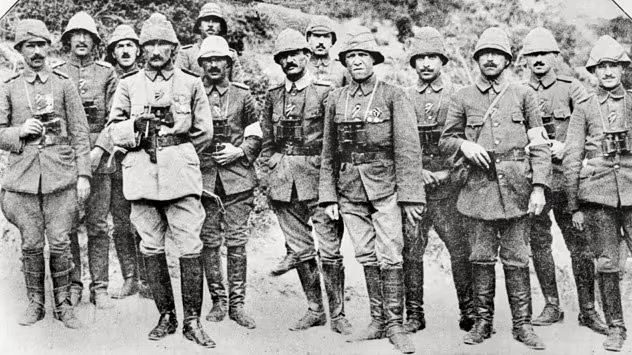
Kemal Pasha and Ottoman offices at Gallipoli

Parallels

Reading The Ottoman Endgame, I was reminded often of his compatriot Anthony Beevor’s harrowing tale of the Russian Revolution (reviewed in In That Howling Infinite’s Red and white terror – the Russian revolution and civil war. That Revolution and the end of the Ottoman Empire converged. McMeekin notes that with regard to the war in Anatolia and the Caucasus, the treaty of Brest-Litovsk, which ended the war between Czarist Russia and the Central Powers, was poisoned chalice for both Russia and Turkey and as significant as any of the treaties that followed the end of the war.

I found it fascinating that many individuals who were to play a significant part in the Russian Civil war also feature in Ottoman Endgame. Admiral Alexander Kolchak, commander of the imperial Black Sea fleet and General Anton Deniken, commander of Russian forces on the Caucasian front, became leaders of the Tsarist cause and were to command the counter-revolutionary White forces against the Red Army with the Siberian People’s Army and the Volunteer Army in Ukraine.

None were more prominent or as controversial in western narratives, however, as Winston Churchill. As noted above, McMeekin lays to rest the notion that the Dardanelles campaign and Gallipoli were Churchill’s sole doing and his folly – though he did blame himself later on and has been pilloried for it ever since. Ironically, once disgraced, and having volunteered to serve on the Western Front, at the end of the war, he was brought back into Lloyd George’s cabinet as Secretary of State for War. There, he advised against military intervention against Kemal’s nationalist forces and indeed mused about the option of dumping the Sazonov-Sykes-Picot dispensation imposed on the moribund empire’s Arab provinces after the armistice and of restoring the prewar territorial status quo, a kind of circumscribed Ottoman Redux. And yet, as civil war broke out and spread in the nascent Soviet Union, he was alone of his cabinet colleagues in advocating for a full-on allied intervention. Critics claimed that he dreamt, – though some believed that he fantasized – about of creating an effective White army and a borderlands alliance to defeat the Bolsheviks. But his aspirations were foiled by the imperialism of the White leadership and of White officers, and the various national movements’ fear that that if the Whites prevailed, they would restore Russian rule. Britain’s rulers were reticent about shoring up and providing financial, material support and also, soldiers sailors and airmen to brutal to demonstrably homicidal Cossack brigades and revanchist and reactionary royalist autocrats. It is not without reason that admirers and critics alike would agree that Winston had more positions than the Karma Sutra.

The Russian Revolutions – there were two, in February and October 1917 – and the Civil War that followed it, the disintegration of the Ottoman Empire followed by foreign intervention, the war of liberation, and the creation and endurance of Türkiye can be said to have defined the contours of modern Middle Eastern geopolitics, setting the stage for many if not most of the conflicts that have inflicted the region since, including three Gulf wars, the rise and fall of the Islamic State, the Lebanese, Iraqi and Syrian civil wars, and the Arab-Israel conflict, arguably the most intractable conflict of modern times. Cold War and also, the current Ukraine war.

In the wake of the fall of the Russian Empire, the Twentieth Century was not kind to the countries of Central and Eastern Europe. Historian Timothy Snyder called them “the blood lands”. Nor was it kind to the heirs and successors of the Ottoman Empire. Though the tyranny and oppression and the death and destruction wrought by rulers and outsiders upon the lands and peoples of the Middle East has been significantly less than that endured by the people of Eastern Europe and Russia, the region would fit Snyder’s sombre soubriquet.

© Paul Hemphill 2025. All rights reserved

Also in In That Howling Infinite, see Ottoman Redux – an alternative history and Red and white terror – the Russian revolution and civil war

For more on the Middle East, see A Middle East Miscellany

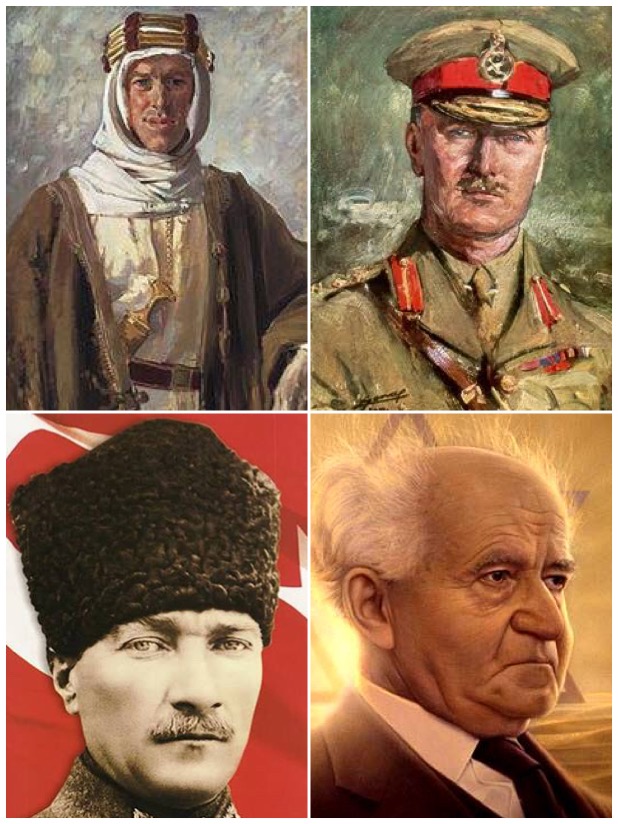
TE Lawrence, General Allenby, Kemal Ataturk, and Ben Gurion

Clone of Russia returns to a Middle East it never really left

Sykes and Picot have taken the blame but actually it was a Russian who drew the map of the Middle East, writes Sean McMeekin

The World Today, 7 December 2018

To judge from press coverage, the emergence of Islamic State has brought about a cartographic revolution in the Middle East. With the borders of Syria and Iraq in flux, journalists have resurrected the legend of Sykes-Picot, wherein Britain and France are said to have divided up the Ottoman empire between them in an agreement signed 100 years ago, in May 1916. Russia’s intervention in Syria, by upstaging the United States and her allies, seems in this view to be completing the rout of western influence in the Middle East, putting the final nail in the coffin of ‘Sykes-Picot’.

Rarely has history been more thoroughly abused. In reality, none of the contentious post-Ottoman borders of the Middle East was settled by Sykes and Picot in 1916: not the Iraq-Kuwait frontier notoriously crossed by Saddam’s armies in 1990, not those separating the Palestinian mandate from (Trans) Jordan and Syria, not the highly contested and still-in-flux Israeli/Palestinian partition of 1948, nor, in the most relevant example from today, those separating Syria from Iraq.

To take an obvious example from recent headlines, Mosul, the Iraqi city whose capture in June 2014 led Abu Bakr al-Baghdadi of Islamic State to proclaim himself Caliph Ibrahim, was actually assigned to French Syria in the 1916 agreement.

Journalists are even more spectacularly wrong in describing the Ottoman partition agreement as exclusively (or even primarily) a British-French affair, omitting the driving role played by Tsarist Russia and her Foreign Minister, Sergei Sazonov.

The final terms of what should more accurately be called the Sazonov-Sykes-Picot agreement were actually hashed out in the Russian capital of Petrograd in the spring of 1916, against the backdrop of crushing Russian victories over the Turks at Erzurum, Erzincan, Batum, and Trabzon (the British were reeling, having been humiliated at Gallipoli and in Iraq, where an expeditionary force would shortly surrender).

The conquest of northeastern Turkey in 1916 left Russia, unlike her grasping allies, in possession of most of the Ottoman territory she was claiming – barring only Constantinople (called ‘Tsargrad’ by the Russians), which still needed to be taken.

At the dawn of 1917, Tsarist Russia was poised to inherit the crown jewels of the Ottoman empire, including Constantinople, the Straits, Armenia, and Kurdistan, all promised to her in the Sazonov-Sykes-Picot Agreement. Along the Black Sea coast, Russian engineers were building a rail line from Batum to Trabzon, with the latter city a supply base for the Caucasian Army, poised for a spring assault on Sivas and Ankara. With Russia enjoying virtually uncontested naval control of the Black Sea, preparations were underway for an amphibious strike at the Bosphorus, spearheaded by a specially created ‘Tsargradskii Regiment’.

After watching her allies try, and fail, to seize the Ottoman capital during the Dardanelles/Gallipoli campaign of 1915 (when Sazonov had first put forward Russia’s sovereign claim on Constantinople and the Straits), Russia was now poised to seize the prize for herself – weather permitting, in June or July 1917.

Of course, it did not turn out that way. After the February Revolution of 1917, mutinies spread through the Russian army and navy, including the Black Sea fleet, just as it was poised to strike.

In a remarkable and little-known coincidence, on the very day the Foreign Minister of the Provisional Government, Pavel Milyukov, first aroused the anger of the Petrograd Soviet and the Bolsheviks by refusing to renounce Russia’s territorial claims on the Ottoman empire – April 4, 1917 – a Russian naval squadron approached the Bosphorus in ‘grand style’, including destroyers, battle cruisers, and three converted ocean liner-carriers which launched seaplanes to inspect Constantinople’s defences from the air. The amphibious plans were not abandoned until fleet commander Admiral AV Kolchak threw his sword overboard on June 21 during a mutiny. Even after ‘revolutionary sailors’ had taken control of the Black Sea fleet, a Russian amphibious strike force landed on the Turkish coastline as late as August 23, 1917, in one last sting by the old Tsargrad beast.

After the Bolsheviks took power, Russia collapsed into civil war, which left her prostrate, at Germany’s mercy. By signing a ‘separate peace’ with the Central Powers at Brest-Litovsk in March 1918, Russia forfeited her treaty claims to Armenia, Kurdistan, Constantinople, and the Straits, throwing the Sazonov-Sykes-Picot agreement of 1916 into chaos, even as new claimants were appearing on the scene, such as Italy and Greece – not to mention local actors: Jewish, Arab, and Armenian troops were attached as national ‘Legions’ to General Allenby’s mostly British army as it rolled up Palestine and Syria. These forces, along with French, Italian, and Greek expeditionary forces sent after the war, and the Turkish nationalists who regrouped under Mustafa Kemal in Ankara to oppose them, would determine the final post-Ottoman borders in a series of small wars between 1918 and 1922, with scarcely a nod to the Sazonov-Sykes-Picot Agreement.

While Russia’s forfeiture of her claims in 1918 was welcome, in a selfish sense, to the other players vying for Ottoman territory, it was not necessarily a positive one for the region. In the absence of Russian occupying troops to police the settlement, the

Allies, in 1919, offered Russia’s territorial share, now defined (in deference to Woodrow Wilson) as mandates, to the United States – only for the Senate to vote down the Versailles Treaty, rendering the arrangement moot. Lacking Russian or American troops as ‘muscle’, the Allies leaned on weaker proxies such as the Italians and, more explosively, local Greeks and Armenians, which aroused the anger of the Muslim masses and spurred the Turkish resistance led by Kemal (the future Atatürk). Armenians, Greeks and Kurds, too, could only lament the vacuum left behind by the departing Russians, which left them to face Turkish wrath alone.

Soviet Russia re-emerged as a player in the Middle East fairly quickly, not least as Mustafa Kemal’s key diplomatic partner during his wars against the West and its proxies from 1920-22. In a reminder of the enduring prerogatives of Russian foreign policy, the Cold War kicked into high gear when Stalin made a play for Kars, Ardahan, and the Ottoman Straits in 1946: these moves, along with the British withdrawal from Greece, Turkey, and Palestine, inspired the Truman doctrine.

In an eerily similar replay of the history of 1917-18, the collapse of Soviet power in 1991 led Moscow to turn inward, withdrawing from the Middle East and inaugurating a period of US and western hegemony in the region, which turned out no less well than the Middle Eastern free-for-all of 1918-22. A prostrate and impoverished Russia put up no objection during the First Gulf War of 1991, and did little more than sputter during the Iraq War of 2003. Russia’s recovery of strength and morale in the Putin years led, almost inevitably, to her return in force to the Middle East – from which, in reality, she never truly left.

The Russian return to the region, along with Turkey’s increasingly overt hostility over her Syrian intervention, resurrects historical patterns far, far older than Sykes-Picot. For centuries, the Ottoman empire was the primary arena of imperial ambition for the Tsars, even as Russians were the most feared enemies of the Turks. In many ways, the Crimean War of 1853-56, which saw western powers (Britain, France, and an opportunistic Piedmont-Sardinia) unleash an Ottoman holy war against the Tsar to frustrate Russian ambitions in the Middle East, is a far more relevant analogy to the present crisis in Syria than the pseudo-historical myths of 1916. It is time we put the Sykes-Picot legend in the dustbin where it belongs.

Diplomatic carve-up: the third man

In David Lean’s 1962 film, ‘Lawrence of Arabia’, a cynical British official explains how the carcass of the Ottoman Empire was to be divided at the end of the First World War under the Sykes-Picot Agreement.

‘Mr Sykes is an English civil servant. Monsieur Picot is a French civil servant. Mr Sykes and Monsieur Picot met and they agreed that after the war, France and England would share the Turkish Empire, including Arabia. They signed an agreement, not a treaty, sir. An agreement to that effect.’

This summary of wartime diplomacy has proved long-lived. It encapsulates the less than honest dealings of the British government with the Arabs – who wanted independence after being liberated from Turkish domination, rather than rule by the European colonial powers – but it leaves out the key figure in the deliberations, Sergei Sazonov, Russian foreign minister, 1910-1916.

Sazonov was one of the most significant diplomats both before and during the Great War. It was thanks to his adroit manipulation that Britain and its allies came to accept that Russia would gain the Ottoman capital Constantinople, in the event of an Allied victory, an outcome that Britain had tried for decades to prevent.

At the talks in the Russian capital Petrograd in 1916, the British and French emissaries were far lesser agents of empire than their host.

Sir Mark Sykes was a gifted linguist, travel writer and Conservative politician, but no top-flight diplomat. As for François Georges-Picot, he was an experienced diplomat and lawyer and noted advocate for a greater Syria under French rule.

But with France having no troops in the eastern theatre of war, he had to accept Russia’s demand to swallow up large parts of what is now eastern Turkey, but which Paris had set out to claim.

Sykes died of influenza in 1919 at the Paris Peace Conference, where Sazanov represented the White Russians. He died in Nice in 1927

The Ottoman Endgame: War, Revolution, and the Making of the Modern Middle East, 1908-1923” by Sean McMeekin

Czar Nicolas I of Russia is sometimes credited with coining the phrase “Sick Man of Europe” to describe the decrepit Ottoman Empire of the mid-nineteenth century. By the early 20th century, there could be little doubt that the disparaging sobriquet applied in spades. The Ottoman Empire was soundly defeated in two Balkan wars in 1912 and 1913 by the comparatively pipsqueak countries of Bulgaria, Greece, Montenegro and Serbia. One result of the wars was that the Empire lost all of its European territories to the west of the River Maritsa, which now forms the western boundary of modern Turkey. Then, when World War I broke out, the Ottomans made the disastrous decision to side with the Central Powers against the Triple Entente, ending up on the losing side of that cataclysm.

882094291

A popular theory is that the carving up of the Ottoman lands after the war, pursuant to the Sykes-Picot Agreement between France and Britain, is the source of many of the problems of the current Middle East. In The Ottoman Endgame, Sean McMeekin concedes that it is not wrong to look to the aftermath of the war for the roots of many of today’s Middle Eastern problems, but the “real historical record is richer and far more dramatic than the myth.” For example, the notorious Sykes-Picot Agreement was sponsored primarily by Russia, whose foreign secretary, Alexander Samsonov, was the principal architect of the agreement. McMeekin’s retelling of the demise of the Ottoman Empire and its recrudescence as modern Turkey is a fascinating and complicated narrative.

Among the interesting facts McMeekin points out is that according to an 1893 census only 72% of the Ottoman citizens were Muslim, and that in the middle of the 19th century the majority of the population of Constantinople may have been Christian. The Balkan Wars started a trend, exacerbated by World War I, toward ethnic cleansing, with hundreds of thousands of Christians leaving the Empire and similar numbers of Muslims moving from territory lost by the Empire to areas it still controlled.

We in the West tend to think of World War I as a static slugfest conducted in the trenches of northern France. But the war in the East, particularly as it applied to the Ottoman Empire, was a much more mobile affair. In fact, the Ottomans ended up fighting the war on six different fronts, as the Entente Powers invaded them from many different angles.

Winston Churchill in 1914

Winston Churchill in 1914

At the outbreak of WWI, the Ottomans allied themselves with Germany out of fear of Russia, which had coveted control over the straits connecting the Black and Mediterranean seas for centuries. In 1914 the Russians invaded Eastern Anatolia and met with initial success. However, Russia feared its early success was quite precarious, and so it inveigled its ally, Britain, to launch a diversionary assault on the Gallipoli peninsula. The “diversion” became one of the most deadly killing grounds of the war, as the British poured hundreds of thousands of men into the battle in hopes of breaking the stalemate on the Western Front. The author credits Russian prodding more than Winston Churchill’s stubbornness for the extent of the British commitment. The Ottomans, led by Mustapha Kemal (later to be known as Ataturk, the “father of modern Turkey”), prevailed in this hecatomb, showing that there was still plenty of fight left in the “Sick Man.”

Turkish General Mustafa Kemal, center, at Gallipoli, 1915

Turkish General Mustafa Kemal, Gallipoli, 1915

The Ottomans also soundly defeated the British in Mesopotamia (modern Iraq) in late 1915, but they were less successful against the Russians, who invaded across the Caucasus and held much of eastern Anatolia until the Bolshevik revolution in 1917 caused them to withdraw voluntarily. The British ultimately prevailed against the Ottomans in 1918 by invading from Egypt through Palestine, with a little help from the Arabs of Arabia.

The Treaty of Versailles, which ended the war in Europe in 1919, did not end the war for the Ottomans. The victorious Allies were ready to carve up much of the Empire for themselves. The Ottoman armies were to disband; England was to keep Egypt and to get Palestine and Mesopotamia; France was to get Syria, Lebanon, and parts of modern Turkey; and Greece was to get a large swath of western Turkey. All might have gone according to that plan, but Mustapha Kemal (Attaturk) was still in charge of a small but effective fighting force in central Anatolia. Attaturk husbanded his forces and fought only when he had an advantage. In a war that lasted until 1923, he was able to expel the Greeks from Anatolia and to establish the boundaries of modern Turkey.

large

McMeekin deftly handles this complexity with a lucid pen. His descriptions of the various military campaigns are riveting. This is not to say that he shortchanges the political machinations taking place. He gives more than adequate coverage to the “Young Turks,” a triumvirate that ruled the Empire from 1909 until they eventually brought it to its ruin in 1919. He also covers the Armenian massacres as objectively as possible, given the enormity of the events described.

Evaluation: This is a very satisfying book and an excellent addition to the enormous corpus of World War I literature. The book includes good maps and photos.

Published by Penguin Press, an imprint of Penguin Random House, 2015

The many lives of an unsung Anzac hero

Once upon a war

Back in the last century, before ANZAC Day became the secular Christmas that it has become, before marketing people and populist politicians saw its commercial and political potential, before the fatal shore became a crowded place of annual pilgrimage, my Turkish friend, the late Naim Mehmet Turfan, gave me a grainy picture of a Turkish soldier at Gelibolu carrying a large howitzer shell on his back. Then there was this great film by Australian director Peter Weir, starring young Mel Gibson and Mark Lee. There were these images of small boats approaching a dark and alien shore, of Light Horsemen sadly farewelling their Walers as they embarked as infantry, and of the doomed Colonel Barton humming along to a gramophone recording of Bizet’s beautiful duet from The Pearl Fishers, ‘Au fond du temple saint’ before joining his men in the forlorn hope of The Nek …

At the heart of the Anzac Day remembrance is the Australian and New Zealand Army Corps’ role the Dardanelles campaign of 1915-16, Winston Churchill’s grandiose and ill-conceived plan to take the Ottoman Empire out of the war by seizing the strategic strait between the Black Sea and the Mediterranean, thereby threatening Istanbul, the Ottoman capital. It was a military failure. From the initial seaborne assault to the evacuation, it lasted eight months and cost 114,000 lives with 230,000 wounded.

In 1915, Australians greeted the landings at Gallipoli with unbridled enthusiasm as a nation-making event. But it wasn’t long before they were counting the dreadful cost. More than 8000 Australians died during the Gallipoli campaign. As a loyal member of the British Empire, Australia eventually sent 330,000 men overseas to fight for the King. Volunteers all, not all of them white men – despite the authorities’ policy of recruiting only Australians of Anglo-Celtic stock, their ranks included many indigenous, Chinese and others. By the time the war ended in 1918, 60,000 of them were dead. As the late historian Ken Inglis once pointed out: “If we count as family a person’s parents, children, siblings, aunts and uncles and cousins, then every second Australian family was bereaved by the war.

Gallipoli is cited as the crucible of Australian nationhood, but the Anzacs’ part in the doomed campaign was but a sideshow of the wider campaign. Although it is celebrated in Australian song and story, it was the Ottomans’ most significant victory in the war that was to destroy the seven-hundred-year-old Ottoman Empire secure the reputation of its most successful general Mustafa Kemal, who as Ataturk, became the founder of modern Turkey.

Some thirty-four thousand British soldiers died on the peninsula, including 3,400 Irishmen who are remembered In The Foggy Dew, one of the most lyrical and poignant of the Irish rebel songs: Right proudly high over Dublin town, they hung out the flag of war. ‘Twas better to die ‘neath that Irish sky than at Suvla or at Sud el Bar…Twas England bade our Wild Geese go that small nations might be free, But their lonely graves are by Suvla’s waves or the fringe of the grey North Sea.

Ten thousand Frenchmen perished too, many of these being “colonial” troops from West and North Africa. Australia lost near on ten thousand and New Zealand three. Some 1,400 Indian soldiers perished for the King Emperor. Fifty seven thousand allied soldiers died, and seventy five thousand were wounded. The Ottoman army lost fifty seven thousand men, and one hundred and seven thousand were wounded (although these figures are probably much higher). An overlooked fact is that some two thirds of the “Turkish” solders in Kemal’s division were actually Arabs from present day Syrian and Palestine. Gallipoli was indeed a multicultural microcosm of a world at war.

Whilst the flower of antipodean youth is said to have perished on Gallipoli’s fatal shore, this was just the overture. Anzac troops were dispatched to the Western Front, and between 1919 and 1918, 45,000 Aussies died there and 124,000 were wounded.

Once upon a war, the Dardanelles Campaign of 1915-16 was a sideshow to the bigger theatres of the Eastern and Western Fronts. To some, it was a reminder that they could not stomach Winston Churchill for this was said to be his greatest stuff up in a career replete with such (although they would admit that he more than exonerated himself his and Britain’s Finest Hour). For many Australians and New Zealanders, it was a national baptism of fire, of youthful sacrifice on the altar of Empire. And notwithstanding the military defeat and retreat, the folly and foolhardiness, in the harrowing adversity and heroism, lay the bones of a young country’s enduring creation myth.
Former soldier James Brown, Anzac’s Long Shadow

From The Watchers of the Water – a song about Gallipoli, © Paul Hemphill 2015. All rights reserved

Official war historian Charles Bean went ashore at Anzac Cove on 25 April, more than 5 hours after the first troops. Here is his first dispatch (it was not published in Australia until 13th May):

It was eighteen minutes past four on the morning of Sunday, 25th April, when the first boat grounded. So far not a shot had been fired by the enemy. Colonel McLagan’s orders to his brigade were that shots, if possible, were not to be fired till daybreak, but the business was to be carried through with the bayonet. The men leapt into the water, and the first of them had just reached the beach when fire was opened on them from the trenches on the foothills which rise immediately from the beach. The landing place consists of a small bay about half-a-mile from point to point with two much larger bays north and south. The country rather resembles the Hawkesbury River country in New South Wales, the hills rising immediately from the sea to 600 feet [183m]. To the north these ridges cluster to a summit nearly 1,000 feet [305m] high. Further northward the ranges become even higher. The summit just mentioned sends out a series of long ridges running south-westward, with steep gullies between them, very much like the hills and gullies about the north of Sydney, covered with low scrub very similar to a dwarfed gum tree scrub. The chief difference is that there are no big trees, but many precipices and sheer slopes of gravel. One ridge comes down to the sea at the small bay above mentioned and ends in two knolls about 100 feet [30m] high, one at each point of the bay.

It was from these that fire was first opened on the troops as they landed. Bullets struck fireworks out of the stones along the beach. The men did not wait to be hit, but wherever they landed they simply rushed straight up the steep slopes. Other small boats which had cast off from the warships and steam launches which towed them, were digging for the beach with oars. These occupied the attention of the Turks in the trenches, and almost before the Turks had time to collect their senses, the first boatloads were well up towards the trenches. Few Turks awaited the bayonet. It is said that one huge Queenslander swung his rifle by the muzzle, and, after braining one Turk, caught another and flung him over his shoulder. I do not know if this story is true, but when we landed some hours later, there was said to have been a dead Turk on the beach with his head smashed in. It is impossible to say which battalion landed first, because several landed together. The Turks in the trenches facing the landing had run, but those on the other flank and on the ridges and gullies still kept up a fire upon the boats coming in shore, and that portion of the covering force which landed last came under a heavy fire before it reached the beach. The Turks had a machine gun in the valley on our left, and this seems to have been turned on to the boats containing part of the Twelfth Battalion. Three of these boats are still lying on the beach some way before they could be rescued. Two stretcher-bearers of the Second Battalion who went along the beach during the day to effect a rescue were both shot by the Turks. Finally, a party waited for dark, and crept along the beach, rescuing nine men who had been in the boats two days, afraid to move for fear of attracting fire. The work of the stretcher-bearers all through a week of hard fighting has been beyond all praise.

And this was just the beginning …

More on the Anzacs in In That Howling Infinite: Tel al Sabi – Tarkeeth’s ANZAC Story 

On 27th July 2024, the Australian published extracts from a recently published biography of Henry Koba Freame, adventurer, soldier, orchardist and interpreter. It provides such a stirring account of the landing of Australian soldiers at what is now Anzac Cove on 25th April 2015 and the subsequent Gallipoli campaign that it was worth republishing below. But first, a brief summary of Freame’s eventful life.

The road to Gallipoli

Wykeham Henry Koba Freame is believed to have been born on 28 February 1885 at Osaka, Japan, though on his enlistment in the Australian Imperial Force he gave his birthplace as Kitscoty, Canada. He was the son of Henry Freame, sometime teacher of English at the Kai-sei Gakko in Japan, and a Japanese woman, Shizu, née Kitagawa. As he was fluent in Japanese and spoke English with an accent it is likely that he was brought up in Japan. In 1906 he was a merchant seaman and on 19 July of that year married Edith May Soppitt at St John’s Anglican Church, Middlesbrough, England.

Freame probably came to Australia in 1911 and on enlisting in the A.I.F. on 28 August 1914 described himself as a horse-breaker of Glen Innes, New South Wales. Posted to the 1st Battalion as a private, he embarked for Egypt on the troopship Afric on 18 October and was promoted lance corporal on 7 January 1915. On 25 April he landed at Anzac and after three days of heavy fighting was promoted sergeant. He was awarded one of the A.I.F.’s first Distinguished Conduct Medals for ‘displaying the utmost gallantry in taking water to the firing-line although twice hit by snipers’. He was mentioned in dispatches for his work at Monash Valley in June when Charles Bean described him as ‘probably the most trusted scout at Anzac’.

Having served in the Hottentot rising of 1904-06 in German East Africa and in the Mexican wars, Freame was an accomplished scout before joining the A.I.F. He had an uncanny sense of direction and would wriggle like an eel deep into no man’s land, and at night even into enemy trenches, to pick up information. His dark complexion and peculiar intonation of speech had led his companions to believe that he was Mexican—an impression which he reinforced at Anzac where, in cowboy fashion, he carried two revolvers in holsters on his belt, another in a holster under his armpit and a bowie knife in his boot pocket. On 15 August he was wounded during operations at Lone Pine and was evacuated to Australia. He was discharged as medically unfit on 20 November 1916.

Freame settled on the Kentucky estate in New England, New South Wales, when the estate was subdivided for a soldier settlement scheme, and was appointed government storekeeper. He eventually acquired a Kentucky block and was a successful orchardist. His wife died in 1939 and on 16 August 1940 he married Harriett Elizabeth Brainwood, nurse and divorced petitioner, at St John’s Anglican Church, Milson’s Point, Sydney. With the outbreak of World War II he offered his services to the Australian Military Forces and in December 1939 was planted among the Japanese community in Sydney as an agent by military intelligence. In September 1940 he was appointed as an interpreter on the staff of the first Australian legation to Tokyo.

Early in April 1941, however, Freame returned to Australia because of ill health and was admitted to North Sydney Hospital suffering from a severe throat condition which greatly impaired his speech. He died on 27 May and was buried in Northern Suburbs cemetery with Anglican rites. His death certificate records the cause of death as cancer though Freame himself and later his wife alleged that he had been the victim of a garrotting in Japan. He considered that the attack was the consequence of the injudicious wording of the announcement in the Australian press of his posting to Tokyo. He had been described as employed by the Defence Department at a time when he was telling his Japanese acquaintances another story. Extant evidence provides no definite clarification of the circumstances of his death, though the claim of garrotting was investigated, and rejected, at the time.

James W. Courtney, the Australian Dictionary of Biography, Volume 8,1981

How did we forget this Anzac hero?

Harry Freame in 1915 before departing for Gallipoli

Harry Freame in 1915 before departing for Gallipoli

In the years after World War I, Harry Freame had a legitimate claim to be considered the most famous Anzac soldier to have landed at Gallipoli. Born in Japan and raised as a Samurai, he was the recipient of the first Distinguished Conduct Medal to be awarded to an Australian soldier for his efforts in those first bloody days of Gallipoli, and his name was legend among the Australian troops who had fought that tragic battle. As the landing turned into trench warfare, the troops knew Harry risked his neck each night to venture out into no-man’s land and map the Turkish defences.

Harry was on personal terms with the key Anzac commanders, and in the postwar years generals would visit him and reminisce about the war. Australia’s official war historian for World War I, Charles Bean, who first met Harry in June 1915, was fascinated by Harry his whole life. The Australian public came to know Harry through the newspapers of the day that splashed his wartime exploits of courage and daring across their pages.

What became of him?

The Bravest Scout at Gallipoli by Ryan Butta

Harry Freame’s boots hit the sands of Anzac Cove at around 7.40am on April 25, 1915. He was part of D Company, 1st Battalion. By the time they landed, Anzac Beach, as it came to be known, was already strewn with the broken and bloodied bodies of the men and pack animals that had come before them on that infamous morning.

It wasn’t Harry’s first sight of the region – he had sailed this way before – and it wasn’t his first taste of war.

There is a picture of Harry taken before the landing, most likely in Egypt. In it he is in full uniform, flat-brimmed hat, a bandana tied around his neck, wire clippers and binoculars attached to his belt. He holds his Lee–Enfield full wood .303 rifle by the barrel, the butt resting on the ground. He is looking slightly downwards at the camera. There is none of the naive merriment so often seen in the pictures of young Australian soldiers who had mistaken war for a great boys’ own adventure. But nor is there any fear in those eyes. Harry knew what he was in for, and he was ready for it.

As he waded through the waist-high water towards the sand, Harry carried in his pack three days’ rations and an extra 150 rounds of ammunition. He would have heeded the warning of Lieutenant General William Birdwood, the British officer in overall command of the ANZAC (Australian and New Zealand Army Corps) forces, who had advised the troops prior to landing to drink as much water as they could, as once ashore supply of food and water could not be guaranteed for at least three days.

The landing itself had been rehearsed as much as possible on the nearby Greek islands, under conditions nothing like what Harry and the rest of the Anzacs would soon face, but as the 1st Battalion’s official war diary records, “we knew very little of the actual plans for the attack – in fact, the whole thing seemed to be rather in the air, and so it proved”.

All that the officers of the 1st Battalion knew was that the 3rd Brigade was to land first and rush the enemy positions. When Harry and D Company landed on Anzac Beach, they had no idea what success, if any, the 3rd Brigade had had. Judging by the dead and dying who littered the beach, staining the Aegean waters red, and the enemy bullets and shells that whistled around their heads and whipped the waves to foam, it could be easily believed that none of the 3rd Brigade had survived that hellfire of a dawn.

Harry at age the age of 24

Harry at age the age of 24

Harry’s battalion formed up just north of Anzac Beach, in the shadow of Ari Burnu, sheltered from the murderous fire being poured down upon the landing from the peaks of Gaba Tepe, and waited for orders. When the orders came, they “were very vague”, alluding to nothing more than the need for the battalion to reinforce the firing line. But to reinforce a firing line, you needed to first find the firing line, and when the men looked up towards the imposing ridges and valleys that confronted them, there was no firing line.

The ridges above the beaches were crawling with pockets of men, some engaged in isolated fights, hand-to-hand combat wherein they lived or died by the thrust of their bayonets or the quickness of their wits.

Recalling that bloody morning, poet John Masefield wrote:

“All over the broken hills there were isolated fights to the death, men falling into gullies and being bayoneted, sudden duels, point blank, where men crawling through the scrub met each other and life went to the quicker finger, heroic deaths, where some half section which had lost touch were caught by ten times their strength and charged and died.

“No man of our side knew that cracked and fissured jungle. Men broke through it on to machine guns, or showed up on a crest and were blown to pieces, or leaped down from it into some sap or trench, to catch the bombs flung at them and hurl them at the thrower.

“Going as they did, up cliffs, through scrub, over ground … they passed many hidden Turks, who were thus left to shoot them in the back or to fire down at the boats, from perhaps only fifty yards away.”

The firing line, a concept easily imagined in the safety of an officer’s headquarters, was non-existent on the actual field of battle. On that first morning there was just a mad rush for high ground, up the forbidding slopes and into the ridges and valleys that held not only Turkish and German and Syrian troops and gunners but also the hope of cover and survival.

A primeval need to push further and further inland gripped the soldiers, in the hope that there, beyond the next valley, the next ridge, lay safety.

By 10am, with clothes still heavy with sea water after the landing and many of their rifles jammed with sand, now useful only for bayonet thrusts and charges, Harry and what elements of D Company were able to be formed up left the beach and set off for the ridges. Coming upon officers from the 3rd Battalion, D Company was redirected to the hill known as Baby 700, where reinforcements were urgently needed.

Through dense, waist-high scrub of gorse-like bushes and along the dried-up water courses littered with boulders, the men forged ahead uphill, legs heavy but the words of the commanding officers to advance, advance, advance running through their heads. Many of the men of D Company who fought their way up towards Baby 700 that clear bright morning would etch their names into the history of the Anzacs and the 1st Battalion: Major FJ Kindon, second-in-command of 1st Battalion; Major Blair Swannell, commanding officer of D Company; Captain Harold Jacobs, second-in-command of D Company; Lieutenant Geoffrey Street; and Captain Alfred Shout, the man who would leave Gallipoli the most decorated soldier of all, though sadly not with his life. And beside Shout, as was so often the case in the blood-soaked months that followed, in lock step, there was Lance Corporal Harry Freame.

Strategically important, Baby 700 had been the focus of intense fighting all morning, with remnants of the Australian 9th, 11th and 12th battalions all joining the battle as the Turkish troops advanced and retreated in a series of intense skirmishes conducted under the continuous hail of shrapnel fire from unseen Turkish positions. The approaches to Baby 700 were complicated by folds of ridges and valleys, and in these the Australian men became detached from their companies and lost until they could connect up with other Australian soldiers, sometimes from their own company, sometimes not.

Freame at his final Anzac Day march, in 1940.

Freame at his final Anzac Day march, in 1940.

By 11am, Harry and D Company had reached The Nek, a thin strip of ridge that connected to Baby 700. The area was being held by Captain Lalor and men of the 12th Battalion. Lalor was the grandson of Peter Lalor, the man who had led the revolt at Eureka. With him on that morning on the approaches to Baby 700, Lalor carried a magnificent sword, said to be the one used by his grandfather at that famous stockade. Swords had been prohibited to be carried during the landing, but Lalor had disregarded the order.

Across The Nek on the slopes of Baby 700, Turkish troops were gathering. Joining up with Lalor’s group, the newly arrived men of D Company formed up and charged the Turkish troops, driving them back into a gully before advancing up Baby 700.

After reaching the summit, D Company started to dig into that hardscrabble ground. The Turkish troops they had driven before them had retreated, but only to a previously unseen trench, and from here they poured heavy fire on the entrenching D Company. It was here that D Company’s commander, Major Blair Swannell, was killed on that first morning, shot dead just as he had earlier predicted he would be to his mates aboard the Minnewaska in the predawn fog before the landing.

Against the fierce Turkish assault, the Australians had only their rifles (when they worked), bayonets and pistols. The naval guns offered no support, as those manning them were afraid of firing on their own troops in the complicated mess of invaders and invaded that swarmed the hills of the peninsula.

A few artillery guns had been brought ashore at midday but were then ordered to be sent back out to the boats. Other commanders had refused to allow their guns to be landed, such was the chaos on the beaches, and it wasn’t until dusk that the first artillery guns came into action in support of the Australian troops.

The Australian firing line on Baby 700 could not hold, and over the course of the morning the Australian troops moved over the summit only to be thrown back by vicious counterattacks no fewer than five times.

In the midst of the fighting, there was Harry Freame, moving from position to position, scouting the ground and enemy positions, running messages between commanding officers.

At one point Harry and a small group of men drove a contingent of Turkish troops from a trench. But having gained the trench they found they were then held in place by persistent enemy fire. The men hadn’t heeded the words of Lieutenant General Birdwood, and who could blame them, and they were out of water, exhausted and near death. Without water they felt that they would soon perish or be forced to surrender.

Harry called for volunteers to brave the bullets and shrapnel and go for water. None raised a hand or spoke a word, so over the side of the trench he went, collecting water bottles from those who would never thirst again, fallen soldiers whose twisted repose could never be mistaken for the sleeping, a last look, a last thought of home or their best girl held fast in a glassy eye like a butterfly trapped in amber.

When Harry returned, he brought not only precious water but food and pickaxes for the grateful men.

All day the fighting raged on Baby 700, with ground taken then lost, the attackers and counterattackers continually changing roles, the air perfumed with the smell of the wild thyme that had been lashed by the bullets and shrapnel bursts. And as the day stretched on, still the men had no idea where the firing line was, only supposing that it was somewhere ahead of them, always somewhere over the next ridge, and that they must get to it. And if they could not advance, then at all costs they tried to hold on to whatever patch of land they had come to stop on.

At around 4.30pm, as D Company, reinforced now with New Zealand troops, fought to hold the right side of the Baby 700 slope, a massive Turkish counterattack was launched that peeled the Australians off the slope. Alfred Shout, who had been with Lalor when he was killed, had earlier left Harry and fourteen men at The Nek with orders to hold it no matter what. The small group came under intense fire and before long only nine men were left, and by the time Shout returned, retreating from Baby 700, only Harry and one other man held the position. The rest lay dead or dying about them. Shout ordered them both to follow him in retreat towards the beach.

After regrouping on the beach, Shout and Harry then set about rounding up men from various battalions, a combination of the stragglers and shirkers, the lost and the shell-shocked. Harry collected around two hundred men and led them back up the slopes to reinforce the New Zealand troops who were holding Walker’s Ridge, a key position leading back to Baby 700, which was by now firmly in Turkish hands.

Recording the efforts of Lance Corporal Harry Freame on that chaotic first day at Anzac Cove, official war correspondent Charles Bean wrote:

 “With such fighters as Lieutenant A.J. Shout, Lieutenant G.A. Street and Lieutenant Jacobs, all of his own battalion, he and others held vital positions in that constantly moving and changing fight but none was so ubiquitous as he, now holding a key ­position on The Nek leading to Baby 700, now ­finding for his commander the scattered parts of his battalion.”

As night fell on the evening of April 25, the fighting abated only somewhat; rifle fire and shrapnel bursts echoed through the night. At around midnight, Lieutenant General Birdwood sent an urgent message to his commander-in-chief, Sir Ian Hamilton, urging an immediate evacuation of the peninsula. Hamilton, from the comfort of the HMS Queen Elizabeth, was having none of it, advising Birdwood that he had “got through the difficult business and you have only to dig, dig, dig until you are safe”.

Freame with his stepsister in 1898.

Freame with his stepsister in 1898.

The following morning, April 26, the hills of the peninsula rang with the sounds of shovels, digging, digging, digging. Those not digging or engaged in holding a position were out scouring the ravines and hillsides for the wounded and missing, and it was while thus engaged that Harry came across a detachment of men under the command of Captain Harold Jacobs sheltering in a trench at Quinn’s Post. The men had had no water to drink and were in a desperate state. Harry offered to go for water and without a second thought braved the enemy fire that came in from unseen snipers and dashed back down the valley from where he had just come. He soon returned with the promised water, allowing the position to be held.

Realising that Lieutenant-Colonel Leonard Dobbin, the company commander, would need information on Captain Jacobs’ position and situation, Harry was again up and over the side of the trench, making his way back down the valley to where Lieutenant-Colonel Dobbin was located. As Harry approached Dobbin’s trench, he was heard to yell out, ‘All right!’ Arriving, he delivered his message to Dobbin. Mission accomplished, it was only then that Harry revealed that on the descent he’d been struck twice by snipers’ bullets, once through the fingers of the left hand and once through the left arm.

For the duration of the fighting at Gallipoli, Quinn’s Post remained the Anzacs’ most advanced position and the key to their defensive positions. It would never have been held if not for the bravery of Harry Freame.

Charles Bean later noted that very few men received decorations for the deeds performed at the Anzac Cove landings. But when the recommendations came out, the name Harry Freame was first among them. His citation read: “Has displayed the utmost gallantry in taking water to the firing line, though twice hit by sniper fire.” Harry’s commanding officer further reported: “Since I have assumed command of the Brigade, Serjeant Freame has almost daily performed some action worthy of recognition in the shape of carrying out night reconnaissance, conveying messages through dangerous zones etc etc. He is a fine fearless soldier who I strongly recommend for recognition.”

The recommendation was heeded and Harry, for his work over those first days of Gallipoli, was awarded the Distinguished Conduct Medal. Writing both publicly and privately years after the war, Bean offered the view that Harry should have been awarded the Victoria Cross and that the only reason he wasn’t awarded the VC was because, “Australian commanders hesitated to set up for that hallowed decoration any standard short of the impossible. I think that it is safe to say but for that Harry would have been awarded the highest decoration”.

When I set out to write this book, I wanted to discover why we had forgotten Harry Freame. Why, when our schoolchildren learn of the history of the Anzacs, do they learn more about a donkey than a man who was known at the time as the Marvel of Gallipoli? And I wanted to know why the Australian government covered up their role in the death of Harry Freame, why the man Charles Bean described as probably the most trusted scout at Gallipoli was never believed when he said, “They got me”.

This is an extract from The Bravest Scout At Gallipoli by Ryan Butta (Affirm Press) out now.

Tel as Sabi’ – Tarkeeth’s Anzac Story

The 25th April is Anzac Day, Australia’s national day of remembrance, honouring Aussies and Kiwis who perished in foreign wars from South Africa to Afghanistan. It takes its name from the ill-fated Gallipoli campaign – on this day in the spring time of 1915, Australian and New Zealand soldiers landed under heavy fire from Ottoman forces entrenched in the heights above what was later to be called Anzac Cove on Turkey’s Gallipoli peninsula. 

The Anzacs were just part of a wider campaign devised by British Secretary of the Navy Winston Churchill to knock The Ottoman Empire out of the war with one decisive blow by seizing the strategic Dardanelles Strait and occupying Istanbul, the capital. It do not go well. The Ottoman soldiers commanded by Mustafa Kamal Pasha, the future founder of modern Turkey, Kamal Atatürk, held the high ground and fought stubbornly and bravely, and ultimately, victoriously. 

The bloodshed ended in stalemate. The Allies withdrew eight months later leaving behind over eight thousand dead Australians and nearly three thousand New Zealanders (along with over thirty thousand English, Irish, and Frenchmen, Indians and North Africans, and close on ninety thousand Ottoman soldiers, Turks and Arabs, Muslims and Christians), without, historians say, having had any decisive influence on the course of the First World War. 

The rest, as we say, is our history. 

The Anzac Trail

Whenever we visit Israel, our friend and guide Shmuel of Israel Tours drives us all over tiny beautiful and vibrant country (travelling through the West Bank, we use Palestinian guides). During the pandemic year, most Israelis had been locked down three times and like in many countries, the all-important tourist trade barely has registered a pulse. When permitted to travel beyond his home in Jerusalem, Shmuel has spent the year exploring and learning, visiting places he has never guided to before. He believes that he has exited the plague year a better guide, and we are already making plans for our next Israel adventure, including recently excavated Herodian palaces and further travel in the Negev Desert. 

Shmuel recently told me that he had visited Tel Sheva, Tel as Sabi’ in Arabic, in the Negev, five kilometres east of the city of Beer Sheva, a site inhabited since the fourth   millennium BC. The ancient fortified town dates from the early Israelite period, around the tenth century BC. The walls, homes, storage warehouses and water reservoir system have been excavated and opened to the public. Today, Tel as Sabi’ s also known as the first of seven Bedouin townships established in the Negev as part of the Israeli government’s policy to plant the once-nomadic Bedouin permanent settlements. 

It was from the foot of this stark desert hill that the Light Horse Brigade launched its famous charge towards the Ottoman lines at the strategic rail-head and wells of Beersheva on October 31st 2017. 

Today, it is the ninth (not seventh) stop on The Anzac Trail which traces the route of the Light Horse Brigade from Gaza on the Mediterranean coast to Beer Sheva. For obvious reasons, it begins beyond Gaza’s wire and concrete encirclement and trail culminates at the Anzac Memorial Centre In Beer Sheva, inaugurated on the 100th anniversary of the battle. 

The Charge at Beersheba” by Sir Ivor Hele 1973

Tel as Sabi’ to Tarkeeth 

As we commemorate Anzac Day this Sunday, few folk in Bellingen Shire would know that there is a link between that hill in the heart of the Negev and Tarkeeth on the north bank of the Kalang River just six kilometres west of Urunga as the crow flies.  

In A Tale of Twin Pines, the first of our Small Stories, I wrote of how researching the history of the Urunga area where we live, I came across Lloyd Fell’s story of the Fell Family Farm. This was located close to the present Twin Pines Trail, just east of Fells Road on South Arm Road, and west of the Uncle Tom Kelly motorway bridge over the Kalang River. Click here to access TwinPinesStory.pdf

Lloyd tells the story of how in 1926, New Zealand farmer, solo-yachtsman, and returned ANZAC Chris Fell first saw the land that became the family farm, purchasing it from a deceased estate for a thousand pounds. Chris was impressed by the two mature hoop pines that stood on either side of the track leading to a rough timber house that already stood there – and these gave the farm its name. He cleared the bush, felling and hauling timber until he had sufficient land and capital to run cattle. In time, he built up a prosperous dairy business and cattle stud where he and his wife Laura, a Sydneysider from a well-to-do Vaucluse family, raised their three children. The house has long gone, but the two magnificent pines are still there. 

On October 31st 1917, Chris Fell and his comrades in the New Zealand Mounted Infantry fought on Tel as Sabi’. 

Tel as Sabi 1917, showing Ottoman trenches (AWM)

Chris Fell and the battle of Beer Sheva

As told in Short Stories – a tale of Twin Pines:

in his ebook The Twin Pines Story, Lloyd Fell tells how his father served as a mounted machine gunner with the New Zealand forces in the Gaza campaign of late 1917. His war record reports that he was one of the machine gunners who fought through the day before the famous charge to knock out the Turkish machine guns on the strategic Tel al Saba, east of the strategic desert town Beersheba.

The strong position the Ottomans had established on the hill was a key obstacle to the conquest of the town and the ANZACs had to seize it before storming Beersheva itself. The Ottoman soldiers fought valiantly, and it was only at around 3 p.m. that the fighters of the New Zealand Brigade, primarily the Auckland regiment, succeeded in capturing the hill in a face-to-face battle. Had these fortifications not been overrun, the Light Horse would have been prevented from advancing on the wells. Afterwards, the machine gunners and their Kiwi mates took part in a bayonet charge against the enemy.

As Jean Bou wrote in The Weekend Australian:

“The New Zealand brigade was sent against Tel el Saba’, but this steep-sided hill with terraced entrenchments was formidable. The dismounted horsemen, with the limited fire support of their machine-gunners and the attached horse artillery batteries, had to slowly suppress the enemy defences and edge their way forward. Chauvel sent light horse to assist, but as the afternoon crawled on, success remained elusive. Eventually the weight of fire kept the defenders’ heads down enough that the New Zealanders were able to make a final assault. The hill was taken and the eastern approach to Beersheba opened, but nightfall was approaching”

Major-General Harry Chauvel, the ANZAC commander faced a dilemma. The light was fading and there wasn’t enough time to properly regroup to assault the town. An unsuccessful attack would mean withdrawing far to the south, whilst delaying ng the attack until morning would deny him the element of surprise and and also give the Turks time to destroy the town’s vital wells. He decided to attack, and assigning the  the mission to the Australian 4th Light Horse Brigade. 

Epilogue

The 31 light horsemen who fell are buried in the Beersheba War Cemetery along with 116 British and New Zealand soldiers who perished in the Beersheba battle. There are 1,241 graves in the military cemetery, soldiers being brought in from other Great War Middle East battlefields. We visited it in May 2016.  It is a tranquil, poignant, and beautiful place in the Negev Desert, where the bodies of young men from Australia and New Zealand and from the shires of England, Ireland, Scotland and Wales were laid to rest. “Lest we forget”

See also, : The Taking of Tel el Saba

In In that Howling Infinite, see also, Tall Tales, Small Stories, Obituaries and Epiphanies,  The Watchers of the Water, and Loosing Earth – Tarkeeth and other matters environmental

Read in In That Howling Infinite more stories about Israel, Palestine and the Middle East: A Middle East Miscellany


November 1918, the counterfeit peace

Of our elaborate plans, the end
Of everything that stands, the end
No safety or surprise, the end
Jim Morrison

For God so loved the world, that He gave His only begotten Son.  John 3:16

The eleventh hour of the eleventh day of the eleventh month of 1918 saw an end to four years of carnage on the western front and the end of of the First World War. The armies were demobbed and men went home to lives that were changed utterly:  British and French, Austrian and German, Belgian and Italian, Serbs and Bulgarians, Turks and Arabs, and also, soldiers from across the ocean – Americans and Canadians, Australians and New Zealanders,  South Africans and Indians. Friends and foes.

The victors retired to a restless peace, but the vanquished, Germany, Austria, and Hungary, descended into revolution and civil war for a time as  gangs of former soldiers fought on the left and the right. In eastern Europe, the crumbling of empires, the Russian revolution, civil war and the struggle to establish the borders of newly established states meant that armed violence continued, leaving deep scars and bitterness that many ways set the stage for the autocracies of the 1930s and further bloodshed.

The Polish-Soviet war lasted until 1921. The Russian Civil War, ending in 1923, raged across most of today’s Ukraine, Belarus, Moldova and the Baltic region. British, Australian, American and French soldiers were dispatched to Murmansk and Archangel to fight the Red Army; Poles fought Ukrainians and Lithuanians, and defeated the Soviets at the gates of Warsaw; pogroms were perpetrated against Jews just as they had been for years, decades, centuries prior, accelerating  ,  with subsequent consequence, Aliyah to Palestine.

The Greek-Turkish war of 1919-1922, which saw the Greeks, with British and French support, endeavouring to seize Constantinople, led to terrible massacres, and a forced exchange of populations that uprooted one and a half million Greeks and Turks from towns and villages they had occupied for a millennium. Armies marched back and forth across the Great European Plain, bringing devastation and starvation and destroying millions of lives. Central Asia, the lands now covered by the once Soviet ‘’stans likewise became battlegrounds for Reds, Whites and local warlords.

And in ‘John Bull’s Other Island’, as expat GBS Shaw called it, a “terrible beauty was born” – WB Yeats’ exquisite words – the doomed intifada that was the rebellion of Easter 1916, launched, opportunistically yet quixotically whilst English eyes were elsewhere, led exponentially into open rebellion, a qualified victory, and a civil war and partition that rested, roused and then resurrected in Derry in 1968 and decades termed somewhat innocuously ‘The Troubles’.

For some, there was light at the end of the terrible territorial tunnel. Poles, Czechs, Slovaks, Finns, Estonians, Latvians and Lithuanians, achieved statehood, or the restoration of nationhood, as did, fleetingly, Ukrainians, Armenians and Azerbaijanis. Poland reappeared on the map after over a century of having been carved up by empires. Hungarians lost two-thirds of their territory and more than half of their population. “Little” Serbia, which had ignited the Balkan powder keg in 1914, with Gavril Princip’s famous shot that ricocheted through complacent, twitchy and mightily armed Europe, was united with its Slav but religiously fractured Balkan neighbours in the Kingdom of Yugoslavia – and we now know how well that worked out.

Beyond Europe too, a bitter ‘Peace’ sowed dragon’s teeth. Last year, we commemorated the centenaries of the infamous Sykes Picot Agreement, the first draft of a colonial dispensation that established borders that remained unchallenged until Da’ish assaulted the status quo in 2014, and the Balfour Declaration, which set in train the rise and rise of the state of Israel and the long descent of Palestinian hopes for a land of their own. Ironically, the most militant Zionist pioneers and later, soldiers, terrorists and statesmen, emigrated from Poland and the Tsarist empire. These many legacies resonate today.

The end of WW1 saw the destruction of the Ottoman Empire and left Britain in control of Palestine and Mesopotamia. The peace conferences that followed led to the creation of modern Turkey, and, though for decades under French and British colonial rule, Lebanon, Syria, Iraq and Jordan. The Kurds turned up at the conference table but were denied a seat and thereafter, a state.

The war changed more than maps, frontiers and regimes. The needs of modern warfare brought women into the workforce, galvanizing the movements that won them the vote in many democracies. The pace of technological change already underway in industrialized countries was quickened by the demands of war, and advances in land transportation and aviation continued exponentially, as did the development of weaponry, together with the insatiable demand for fossil fuels. Economic privation precipitated the first successful Communist revolution and many failed ones, whilst the peace, resentments, reparations, and recession prompted many to turn to far-right authoritarians in Italy and then Germany. The mass movements of populations helped spread the deadliest epidemic the world has ever known: the 1918 influenza virus or Spanish Flu, which quietly killed possibly up to a hundred million souls – more than both world wars combined.

In the last decades of the Twentieth Century, historians would observe with the benefit of hindsight how the Second World War rose ineluctably from the ashes of the first, just as the division of Europe and the Soviet enslavement (and I say this as a lifelong leftist) of those Eastern European countries that emerged after 1918 led to the Europe of today, and as the peoples of the Middle East reaped the whirlwinds of both conflagrations. Many look back on the tumultuous decades that followed the Great War, and sensing signals and signposts in contemporary  temporal tea leaves, advise is to be afraid, be very afraid.

We like to identify patterns in history that help us understand and explain our contemporary world. But we should exercise caution. To continue the hindsight riff, remember that things we see in the rear view mirror appear closer than they really are. The world is very much different today, as is our knowledge, our perception, our hopes and fears, and so also, our prognostications and expectations. If we can do it all over again, we’ll do it differently, and much more dangerously and destructively. Having learned so much, we have, one fears, understood so little.

 As we remember that moment in Western Europe and the Levant when the guns at last fell silent, let us contemplate melancholy mathematics of the human toll poignantly described by American economist and academic Patrick Chovanec in a fine article in the New York Review of Books, which I have reproduced below:

 “In the Great War itself, over sixteen million people died, including almost seven million civilians. The US got off relatively lightly, with 117,465 people killed, just 0.13 percent of its population. In Serbia, somewhere between 17 and 28 percent of the country’s population was killed. But even numbers like these leave little concrete impression on our minds … people would (tell) me about a grandfather or great-uncle who fought and died in the war, and is forever twenty-four-years old in some field in France, or Turkey, or Italy, or at sea. For most people, that absence is what defined the war: someone left and never came home. The world that they shaped, by their presence and their absence, is the one that we live in, whether we realize it or not. And we, like them, can only grope our way forward, day by day, into an unknown future”.

Qurba-n قُرْبان

Sacrifice  – Rayner Hoff, Anzac Memorial, Sydney

On the occasion of the centenary, read also, Dulce et ducorem est – the death of Wilfred Owen, and A Brief History of the Rise and Fall of the West, 


World War I Relived Day by Day

Photo12/UIG via Getty Images

Gavrilo Princip arrested after his assassination of Archduke Franz Ferdinand of Austria, Sarajevo, June 28, 1914

Four years ago, I went to war. Like many of the people whose stories I followed in my daily “live-tweets” on World War I, I had no idea what I was getting myself into. What began as an impulsive decision to commemorate the hundredth anniversary of Austrian Archduke Ferdinand’s death at the hands of a Serbian assassin, in June 1914, snowballed into a blood-soaked odyssey that took me—figuratively and literally—from the rolling hills of northern France, to the desert wastes of Arabia, to the rocky crags of the Italian Alps, to the steel turret of a rebel cruiser moored within range of the czar’s Winter Palace in St. Petersburg, Russia. And like the men and women who actually lived through it, now that the Great War is ending I find myself asking what, if anything, I’ve learned from it all.

In the American mind, World War I typically occupies an unimpressive place as a kind of shambolic preamble to the great good-versus-evil crusade of World War II, a pointless slugfest in muddy trenches for no worthy purpose, and no worthwhile result. Its catchphrases—“The War to End All Wars,” “Make the World Safe for Democracy”—evoke a wry and knowing chuckle. As if. But the war I encountered, as it unfolded day by day, was far more relevant, passionate, and unpredictable.

Posting daily newspaper clippings and photographs, found mainly in books and online archives, I began to see the Great War as a kind of portal between an older, more distant world—of kings with handlebar mustaches, splendid uniforms, and cavalry charges—and the one that we know: of planes and tanks, mass political movements, and camouflage. It snuffed out ancient monarchies in czarist Russia, Habsburg Austria, and Ottoman Turkey, and gave birth to a host of new nations—Poland, Hungary, Czechoslovakia, Syria, Iraq, Jordan, Lebanon, Finland, Estonia, Latvia, Lithuania, Ukraine, Armenia, Azerbaijan—that, in their struggles to survive and carve out an identity, continue to shape our world today. The British declared their intent to create a national homeland in Palestine for the Jews.

Daily Mirror/Mirrorpix via Getty Images

Russian infantry marching to battle, Poland, August 1914

The needs of the war brought women into the workforce, and helped win them the right to vote. The huge privations it inflicted triggered the world’s first (successful) Communist revolution, and the frustrations it unleashed prompted many, afterward, to turn to far-right authoritarians in Italy and then Germany. And finally—though many have forgotten it—the comings and goings of people caused by the war helped spread the deadliest epidemic the world has ever known: the 1918 influenza virus, which quietly killed an estimated 50–100 million human beings in their homes and in hospitals, more than both world wars combined.

I also encountered a cast of characters more varied and amazing than I thought possible. Rasputin, the dissolute Russian mystic who warned Czar Nicholas that going to war would destroy his dynasty, and was murdered in part because he was (falsely) suspected as a German agent. The Austrian Emperor Karl, who inherited a war he didn’t want, and tried fruitlessly to make peace. T.E. Lawrence, a scholarly young intelligence officer whose affinity for the Arabs helped turn them to the Allied cause, and shaped the modern Middle East. Mata Hari, a Dutch-born exotic dancer who played double-agent, seducing high-ranking Allied and German officers for valuable information, until she was caught and shot by the French as a spy.

Some of the names are familiar, and offer hints of future greatness—or infamy. A young anti-war journalist named Benito Mussolini, sensing the way the wind blows, changes his tune and aggressively advocates for Italy to enter the war, before signing up himself. A young Charles De Gaulle is wounded at Verdun and taken prisoner for the rest of the conflict. A relatively young Winston Churchill plans the disastrous Gallipoli Campaign and pays his penance by serving in the trenches, before making a political comeback. A young Harry S. Truman serves as an artillery officer on the Western Front, alongside (and outranked by) a young George C. Marshall (his future Army Chief of Staff and Secretary of State) and Douglas MacArthur (his future general in the Pacific and Korea). A young George S. Patton develops a fascination with tanks. A young Walt Disney doodles cartoons on the side of the ambulances he drives, in the same unit as a young Ray Kroc (the founder of McDonald’s). Another young ambulance driver, Ernest Hemingway, finds inspiration on the Italian Front for his novel A Farewell to Arms. A young Hermann Göring (later head of the Luftwaffe) becomes a dashing flying ace, while a young Erwin Rommel wins renown fighting at Verdun and in the Alps. Meanwhile, an odd young German corporal, who volunteered in the very first days of the war, is blinded by poison gas in its final days, and wakes up in hospital to the bitter news that Germany has lost. His name is Adolf Hitler.

General Photographic Agency/Getty Images

French troops under shellfire during the Battle of Verdun, 1916

The dramatic panoply of people, places, and events, however, only occasionally rises to the fore. For the most part, the war is a steady stream of ordinary people doing ordinary things: washing their clothes, attending a concert, tallying supplies, fixing a car. History books give us a distorted sense of time, because they fast forward to major events. A day may take a chapter, a month may be passed over in a sentence. In fact, there were periods where nothing much happened—plans were being made, troops trained, supplies positioned—and when you live-tweet, you experience that waiting. Sometimes, it led to intriguing surprises, like photographs of dragon dances performed by some of the 140,000 Chinese laborers brought over to France to lend muscle to the Allied war effort. Mostly, it was a matter of endurance. Each winter, the fighting came to almost a complete stop as each country hunkered down and hoped its food would last. The “turnip winter” of 1916–1917, when the potato crop failed, nearly broke Germany; the increasingly desperate craving for “bread and peace” did break Russia the following year.

The future president Herbert Hoover made his reputation by coordinating food relief shipments to German-occupied Belgium, and later as the US “food czar” ensuring Allied armies and populations were fed. The vast mobilization was effective: by 1918, the Allies were able to relax their food rationing, while Germany and its confederates, strangled by an Allied naval blockade, were on the verge of starvation. America’s war effort was accompanied by a vast expansion in the federal government’s power and reach. It nationalized (temporarily) the railroads and the telephone lines. It set prices for everything from sugar to shoes, and told motorists when they could drive, workers when they could strike, and restaurants what they could put on their menus. It seized half a billion dollars of enemy-owned property, including the brand rights to Bayer aspirin, and sold them at auction. The US government also passed espionage and sedition laws that made it illegal to criticize the war effort or the president. Some people were sent to prison for doing so, including the Socialist Party leader Eugene V. Debs, who ran for president for a fifth and final time from a cell.

Hulton Archive/Getty Images

A woman munitions worker operating a machine in an armaments factory, Britain, circa 1915

Winning the war, however, was far from a sure thing. For three years, the Allies threw themselves against an evenly-matched enemy on the Western Front, without making any breakthroughs, while the Eastern Front gradually crumbled. An early Allied foray to take out Turkey, at Gallipoli in 1915, ended in bloody disappointment. Inducing Italy to enter the war on the Allies’ side, that same year, was supposed to swing the entire conflict in their favor; instead, the catastrophic Italian rout at Caporetto, in the autumn of 1917, put the Allied effort in greater jeopardy. When Lenin seized power in Russia, at the end of 1917, he took it immediately out of the war and ceded immense land and resources to German control. True, the US had by then entered the war, in response to Germany’s submarine campaign against merchant ships and its clumsy diplomatic scheming in Mexico. But with the war in the East essentially won, the Germans saw a window in which they could shift all of their armies to the West and crush the exhausted British and French before enough American troops could arrive to make a difference. Their spring offensive, or “Kaiser’s Battle,” in early 1918 drove deep into Allied lines, prompting the French government to evacuate Paris.

The Germans’ big roll of the dice failed. The Allies held, and the US mobilized much faster than anyone expected. By the summer of 1918, a perceptible change had taken place. Hundreds of thousands of American troops were arriving every month at French ports, and their first units were taking part in battles, piecemeal at first, to push the Germans back. Even in September, however, nearly everyone expected the war to continue into 1919. That was when a huge US army of 3 million men would be ready to take part in a big Allied offensive that would drive all the way to Berlin. It never happened. That fall, the German army—and those of Turkey, Austria, and Bulgaria—first buckled, then collapsed like a rotten log. By November 11, the war was over.

The fact that nobody saw the end coming, the way it did, highlights the value of going back, a hundred years later, and reliving events day by day, as they took place. What may seem obvious now was anything but so then, and we do the people who lived through it, and our understanding of them, a real disservice when we assume that it was. “Life can only be understood backwards,” the Danish philosopher Søren Kierkegaard observed, “but it must be lived forwards.” The British historian C.V. Wedgewood elaborated on the same idea: “History is lived forwards but is written in retrospect. We know the end before we consider the beginning and we can never wholly recapture what it was like to know the beginning only.” We can’t entirely forget that we know what happened next, but when we at least try to identify with people who did not know, we shed new light on them, and on what did happen.

Fine Art Images/Heritage Images/Getty Images

Leon Trotsky with the Soviet delegation to negotiate a peace treaty with Germany, Brest-Litovsk, 1918

Take the Russian Revolution. We see it as the birth of a Communist superpower, and struggle to make sense of the seemingly half-baked, half-hearted effort by the Allies to intervene by sending troops, including Americans, to Russia’s ports in the far north and far east. People at the time, however, saw it almost entirely through the prism of the Great War. At first, the Allies welcomed the overthrow of the czar, and believed it would rejuvenate the failing Russian war effort. By replacing an infamous autocrat on the Allied roster with a fledgling democracy, it made “making the world safe for democracy” a more credible call to arms, and helped pave the way for the US to enter the war. When Lenin took over and made a ruinous peace with the Central Powers, he was seen as simply a German puppet. And when Bolshevik forces, augmented with released German and Austrian prisoners of war, attacked a unit of Czech soldiers crossing Siberia to rejoin the Allies on the Western Front, those suspicions blossomed into fear of a full-fledged German takeover of Russia. The Allies sent troops to key Russian ports to secure the war supplies stockpiled there and provide an exit route for the loyal Czechs. They considered trying to “reopen” the Eastern Front, but realized it would take far too many men. They assumed that when Germany was defeated, their proxy Lenin would eventually fall, and when the war ended, they naturally lost interest. It all makes sense, but only if you see through the eyes that people saw through at the time.

Did it really matter who won the war? In its aftermath, the Great War came to be seen as a colossal waste, a testament to the vanity of nations, of pompous older men sending foolish younger men into the meat-grinder for no good reason. War poems like “Dulce et decorum est” and novels like All Quiet on the Western Front have crystalized this impression. But this was not how people felt at the time. German atrocities in Belgium and on the high seas—some exaggerated, but others quite real—convinced many people that civilization, as they knew it, really was at stake. I was consistently and often surprisingly struck by the sincerity of support, not just on the home front, but among soldiers who had seen the worst of combat, for pursuing the war unto victory. The tone matures, but remains vibrant: these were, for the most part, people who believed in what they were fighting for. At what point the bitter cynicism set in, after the war ended, I cannot say. But at some point, that enthusiasm, and even the memory of it, became buried with the dead.

Bettmann/Getty Images

Boys wearing bags of camphor around their necks to ward off influenza, 1917

Though, in fact, in many places the war did not actually end. An armistice was declared on the Western Front, and the armies there were disbanded and sent home. But Germany, Austria, and Hungary all descended into revolution and civil war for a time, with gangs of demobilized soldiers fighting on all sides. In Russia, the Soviet regime and its multiple enemies would battle for several years, while trying to reconquer territory surrendered when it quit the war against Germany. The Greeks tried to reclaim Constantinople from the Turks, and would be massacred when the Turks succeeded in reconsolidating their country. The Poles fought wars with the Ukrainians and the Soviets to define the boundaries of their newly independent country. Jews and Arabs continue to fight over the new lands liberated from the Ottoman Empire to this day.

In the Great War itself, over 16 million people died, including almost 7 million civilians. The US got off relatively lightly, with 117,465 people killed, just 0.13 percent of its population. In Serbia, somewhere between 17 percent and 28 percent of the country’s population was killed. But even numbers like these leave little concrete impression on our minds. Some of the most touching parts of my experience live-tweeting were the times when people would tweet back to me about a grandfather or great-uncle who fought and died in the war, and is forever twenty-four-years old in some field in France, or Turkey, or Italy, or at sea. For most people, that absence is what defined the war: someone left and never came home. The world that they shaped, by their presence and their absence, is the one that we live in, whether we realize it or not. And we, like them, can only grope our way forward, day by day, into an unknown future.

Historica Graphica Collection/Heritage Images/Getty Images

British artillery at the Somme, France, 1916

O little town of Bethlehem, how still we see thee lie…

Bethlehem has captured the imagination of the world for centuries – we are culturally and spiritually drawn to this famous Palestinian town, and specifically, to an event that may or may not have happened 2,020 years ago. Many express doubt but we nevertheless embrace the myth and the magic it inspires: the appearance of a “star of wonder, star of light, star of royal beauty bright”, harking back to prophecies of old; stories of wise men journeying on camels’ back from the exotic and mysterious east, choiring angels, simple shepherds watching their flocks, and homely livestock; and an auspicious birth in the outhouse of a village pub – all the well-loved dramatis personae of the classic manger scene.

These moments in time have long inspired painters and poets, and are recalled by carol singers from the field mice of The Wind in the Willows to the sentimentality of that famous book by the one they now hail as “the man who invented Christmas” to the songs that make shopping at this time of the year cruel and unusual punishment.

For over a century, Christian pilgrims have flocked to Bethlehem from all over the world – until COVID and the current conflict. It has long been the bedrock of the town’s economy. As a frequent visitor to Israel and Palestine, an amateur historian and a one-time catholic, I’ve visited the town and the Church of the Nativity many times over the years. Though I do not profess faith, I treasure Bethlehem for what it represents in Christianity’s story and also my own.

Poets have always been ambivalent about Bethlehem. It’s been invested with a symbolism quite detached from the geographic. TS Elliot’s magi we’re unsure what it all actually meant, whilst to WB Yeats, it might’ve been a place where bad things would happen. But then they hardly knew the place, and them and countless others, it is a place of myth and memory, most of it imagined.

And whilst “the hopes and fears of all our years” abide with this town of some 27,000 souls, it has a life of its own, a history, a society, an economy, and a political story that reaches back eleven thousand years.

Like Jerusalem, its sacred, senior sibling, just ten kilometres away as the crow flies (and much, much longer by road due to the impositions of the occupation), the “little town of Bethlehem”  is as much a city of the mind and heart as one of bricks and mortar and of ordinary people with myriad preoccupations and passions.

British author and screenwriter Nicholas Blincoe has now written an affectionate and informative biography of a town that is as close to the heart of our culture as any town ever was, and yet one that is almost unknown. Whilst “the hopes and fears of all our years” abide with this town of some 27,000 souls, it has a story of its own that reaches back eleven thousand years.

Ballad of a border town 

Blincoe’s story is part history, part travelogue and memoir, the past intermingling with the present in informative and ofttimes entertaining anecdotes and interviews, memories and personal experiences, as he takes us on a journey from the stone age to the stone wall – one that is in places eight metres in height.

Bethlehem has since the beginning of recorded history been a border-town on a physical and metaphysical borderland.

A borderland between “the desert and the sown”, the Judean Desert with it’s sheep-herding nomads and Bedouin bandits, and the orchards and vineyards in the fertile wadis that for centuries had supplied world-famous wine and olive oil.

A borderland also between the Christians who once constituted a majority, and who for generations have tended to the churches, shrines, and monasteries that were drawn to the holy ground around the Church of the Nativity, and the vast Muslim hinterland from whence over the centuries have come traders and invaders, missionaries and marauders, tourists and tanks. For two thousand years, Jerusalem and Bethlehem have been one of the world’s preeminent destinations for religious tourism, and over two million tourists and pilgrims visit the town each year.

Bethlehem’s location has given it a social, political, economic, and strategic significance disproportionate to its size. It grew the confluence of the springs and aqueducts that have supplied nearby Jerusalem for millennia. “All ittakes to conquer Jerusalem is to seize its water supply…This is what every future invader did.” It was close to the historic trade route between the Kings Road that linked the Hijaz to the Hauran, Damascus and the north, and the ancient Palestinian ports on the Mediterranean.

Its importance as a Christian island in a sea of Islam saw it serve as a refuge for the oppressed and dispossessed of Ottoman pogroms and genocides and also of the Nakba, it has earned a reputuaion as a haven for the more secular and radical elements of the Palestinian national movement their struggle with more religious and indeed fundamentalist adversaries.

But over the last half-Century, it is town that is increasingly cut off and isolated by the Separation Wall, encircled and encroached upon by the ever multiplying and expanding Israeli settlements (forty one at the last count with well over 100,000 inhabitants), hostile and acquisitive settlers, and the daily impositions and injustices of the military occupation with its restricted roads, armed soldiers and border police, checkpoints and the Kafkaesque permit system.

A cultural caravanserai

For most of his historical narrative, Blincoe maintains a degree of scholarly detachment with regard to the serpentine history and politics of the region, and  crafts a captivating tale of warlords and adventurers, of soldiers and saints,  as a parade of foreign armies pass through. Egyptians, Hittites, Persians, Greeks, and Romans, Arabs, Franks, and Mamluks, Turks, Brits, and finally, Israelis. There is a great picture of a group of Anzacs from the far side of the world in their winter coats emerging from the cave of the nativity in December 1917. Rulers and rebels have passed this way, and many, like mad, bad King Herod, Bar Kokba’s Jewish fighters, and the Shabab of the Palestinian Intifada-t have died nearby.

Given its religious significance, Bethlehem has forever been a focus and at times, a flash-point for events that have enmeshed the Holy Land and its Holy Places, from the fossicking of Emperor Constantine’ mother Helena and the self-imposed exile of estranged Empress Eudocia, through the Muslim conquest, the Crusades and Mongol raids to the Crimean War, the Palestine Campaign of WW1, and the Arab-Israel conflict. Bethlehem’s history has been one of civilization, colonization and conquest.

As a former scholar of philosophy, Blincoe seems particularly at home amidst the theological disputes of the early Christian, Byzantine period, and brings to life a host of passionate, idiosyncratic, adventurous, and infuriating men and women – the wandering saints and scholars, clerics and ascetics, wealthy widows and society matrons of the Middle Ages, and an unending caravan of pilgrims, tourists, evangelical adventurers and amateur archaeologists that have walked these hills and valleys for centuries. As with Jerusalem, seekers of the numinous could never get enough of the place.

He doesn’t shy away from the social, theological and political complexities of his chronicle, but his objectivity is severely tested in his final chapters when writing of Bethlehem and the occupation.

But then he does after all have a lot of skin in the game: he is married to Bethlehem filmmaker Leila Samsour, dividing his time between London and Bethlehem. He is quite embedded with Leila’s Christian Palestinian family, one with deep roots in the town’s history and politics, and has often been in the thick of the crises, protests, incursions and violent clashes that periodically embroil his adopted home.

He is not some desktop warrior, NGO apparatchik or “occupation tourist”. And whilst he deplores the actions of the settlers and the right wing politicians – Avigdor Leiberman and other nationalist MKs are virtual neighbours of his – and ascribes to revisionist Israeli historians like Ilan Pape and Benny Morris’ reading of the Nakba, he is not one of Israel‘s haters But he is disappointed, saddened, infuriated even by the Jewish state’s often cavalier and callous approach to its Palestinians who are its neighbours and also, its sullen, subject people.

Banksy’s Bethlehem Bouquet. Paul Hemphill

Breaking the wheel

Palestine, and with it,  Jerusalem and Bethlehem, have always been under strangers’ dominion. But in the past, the rulers largely left the locals to live their own lives and manage their own affairs in accordance with their own social, political, and religious ways, and in the fullness of time, they departed, ceding the land to the next despot. Until, that is, the Israelis. In the words of Daenerys Targaryen: “ We’re not going to stop the wheel. I’m going to break the wheel.”

Year by year, Bethlehem’s economy shrinks. Over two million tourists and pilgrims visit “Royal David’s City” annually, but its economically stressed, and it has the highest unemployment rate (nearly 30%) in the West Bank.

Year by year, Bethlehem’s Christian population diminishes as people head overseas in search of a better life – and particularly its young folk. In 1950, Bethlehem and the surrounding villages were 86% Christian, but by 2016, the Christian population was but 12%.

Year by year, the settlements grow, and settlers, encouraged by an extremist, nationalist government and a seemingly compliant IDF, become more emboldened in their expansion onto Palestinian land. Considered illegal under international law, Israel regards them as legitimate suburbs of Jerusalem- a territorial fait accompli that is tantamount to de facto annexation.

Year by year, Bethlehem becomes more and more cut off from the rest of the West Bank by walls, wire, and a web of “Israeli only” highways, and indeed from the world beyond the wall. Travel to Jerusalem and to the rest of the West Bank is severely restricted by roads, checkpoints and permits, whilst the interaction between Israelis and Palestinians that existed during the seventies and eighties, in workplaces, educational and health institutions, friendships and romances, ceased after the terrors of the second, bomb Intifada as israel and Israelis withdrew into their mental and physical fortress.

A generation of young people on either side of the old and ostensibly moribund Green Line have grown up with negligible contact with their peers on the “other side” – and this is most likely to be limited to military service in the Occupied Territories on the one hand, and confrontations with armed soldiers on the other.

Writing of the 1948 war, Blincoe notes: “From their future actions it became clear that both Jordan and Israel saw the term “Palestine” as an empty tag: it was the name of a piece of real estate rather than the home of people demanding self representation”, this is how he sees the future for Palestine and for Bethlehem, his adopted home. He argues that the settlement project is first and foremost about land and cheap housing for middle and lower class Israelis pressed by rising property values and a shortage of affordable housing to rent or buy in Israel proper. it is real estate developers, he argues, with friends in high places, who are calling the shots, rather than the more visible and vocal Zionist nationalists. As the Israeli historian and one–time deputy mayor of Jerusalem Meron Benvenisti puts it, the settlements are a “commercial real estate project that conscripts Zionist rhetoric for profit”. The story of Jesus and the money-changers somehow comes to mind.

It is an intriguing argument that invites further research. it also echoes what would appear to be a similar patter in those parts of the West Bank that are under the direct control and administration of the Palestinian Authority, as we have reported earlier in Castles Made of Sand, an account of the land rush that is taking place in Area A.

With this and all the other pressures in play, from Blincoe’s perspective, the future prospects of Palestine and the little town of Bethlehem not appear to be promising. Bethlehem – Biography of a Town does not have a happy ending.

Synchronicity – a footnote

A few days after this post was published, an article by Hillel Zand appeared in the Matzav Review addressing the settlements and the real estate argument:  “Israel’s right-wing has strengthened in recent years because it has promoted heavily financing the settlement project as a way to compensate for the not insignificant negative side-effects of neoliberal economic policy, especially rising housing prices and increasing inequality and poverty…In Israel, the “losers” are being compensated by the advocates of these policies with incentives, subsidies and entitlements that allow them to maintain, or even raise, their quality of life by living in West Bank settlements”.

The Israel-Jordan collaboration referred to by Blincoe also raised its controversial head recently when Justice Minister Ayalet Shaked and her boss Naftali Bennett hinted, favourably, at the prospects of US’ impending “peace deal” that includes the West Bank being ceded to Jordan and Gaza to Egypt. Murmurings from US allies Egypt and Saudi Arabia have also indicated support for such an idea.

Aida Refugee Camp, Bethlehem. Paul Hemphill

Walls and wire define the brotherhood of man.  Paul Hemphill

Some further reading about Bethlehem:

There are the PLO’s official facts and figures, and the National Catholic Reporter on the declining Christian population. And there is always Wikipedia. There are a series of posts in In That Howling Infinite about Jerusalem and Palestine in: O Jerusalem, and A Middle Eat Miscellany

Author’s Note: 

Whenever I pen commentaries such as this, people ask why I rarely forward my own opinion on the issues I am presenting or discussing. On the contrary, I would argue that my views are fairly transparent in the subjects I chose to engage with, the words I use, and the vein in which I use them.

With respect to my numerous posts about Israel and Palestine, and the Middle East in general, I  come to my conclusions from a political science and sociology perspective – that’s where my academic experience came from – and a background in conflict resolution, supported by study and travel. If I do on occasions display any particular bias, it originates in my longtime interest, understanding and affection for the history, politics culture and language of the region, of its geography and archaeology, and of its people of all faiths and nationalities that I make my observations.

I am presently working on a piece that encapsulates my thoughts on this complex and controversial subject. But meanwhile, here is a brief exposition.

I do believe that the systematic dispossession of almost a million Palestinians and the destruction of half of their towns and villages in 1948 is Israel’s original sin. It is the primal stain that colours and corrupts all that followed. And yet, if not for the actions, often daring, often brave, often questionable, and often deplorable, of the politicians and soldiers of 1948 – and of the generations that folllowed –  Israel would not exist today. This paradox is addressed sympathetically by Avi Shalit in My Promised Land, referred to above, and scathingly by ‘new history’ scholar Ilan Pappe in The Ethnic Cleansing of Palestine.   

The Occupation, fifty years old this year, which grew out of the unexpectedly total victory of June 1967, has taken on strategic, ideological and indeed messianic dimensions by many in the  Israeli government and political elite. It compounded the original sin, deepened the primal stain, released the demons of messianic fervour, and wounded Israel’s soul. The settlements locked the nation into the the colonialist project. With the close-call of the Yom Kippur War, the violence and murder of the first and second Intifadat, and present Palestinian jaquerie, Israel’s heart has not just hardened, it has become sclerotic.

I admit that I have always been sympathetic towards Israel – from my first visit in 1972. But it is not a blinkered viewpoint. I am deeply critical of Israeli politics and policies, and have no respect for many of its leaders.

Ayelet Shaked, the nationalist’s La Passionaria, and her boss Naftali Bennett do not not represent ALL Israelis! They hold extremist views just like we in UK, US, and Australia have parties and individuals with extremist views. But there are hundreds of thousands of Israelis who oppose the present government and long for justice and peace. And if – a very big “if” – Arab Israelis and the Israeli left could work together, they could obtain a majority in the Knesset and change Israel’s politics.

Yet meanwhile, Binyamin Netanyahu and his nationalist allies call all the shots, the Israelis continue to control and exploit the land, its people, and its resources, whilst varying degrees of annexation are on the cards. The settlements are an abomination, as are the policies and practices of the state and its occupying army, as described by Lyons and others. There’s no escaping these facts.

But I am likewise critical of Palestinian governance, politics and politicians. Hamas and the PA are on the nose in their respective fiefdoms, and if a moderate “third force” were to arise – and survive, because sure as hell, they would risk being murdered – Palestinians who just want a quiet, normal life, adequate services, and opportunities for their children, and Israelis who want likewise, might – just might – reject their extremist, dogmatic, entrenched leaders and reach some form of modus vivendi.

Palestinians themselves have to take control of their own lives, kick out their corrupt leaders, cease inculcating their children with hatred and jihadism, and use all that international good will and dollars to build a viable economy that can provide jobs, opportunities, and security, economic and physical to the people. Only this way will they be inoculated against cronyism, corruption and extremism. And yet, the dead hand of a moribund, patriarchal, conservative and ethnocentric culture holds them back –  but that is the subject of another, future discussion for In That Howling Infinite.

Today, the ‘powers that be’, defenders and beneficiaries of a status quo that looks more like a cul de sac, predominate over a dispiriting array of competing, clamouring factions, left, right, nationalist, secular, tribal, Haredi, and Islamist alike. New, young, brace, local voices in both Israel and Palestine, are not heard.

So what happens next?

I get that question too. And I am perennially reluctant to venture an answer beyond one that runs like “on the one hand…but then on the other”.  I inevitably fall back on Robert Fisk’s response to the same question with regard to the calamitous freezing over of the Arab Spring and the fall and rise again of the same old autocrats and tyrants: “my crystal ball is broken”. It’s a cop out, really, but just as cogent as that famous line in that UK spy drama Spooks: “What’s gong to happen to me?” “Bad things!”

One thing is for sure: as songwriter Warren Zevon sang, “the hurt gets worse, and the heart get harder”.

October 8th 2017

For more posts on Jerusalem, Israel and the Middle East, visit:
https://m.facebook.com/HowlingInfinite/
https://m.facebook.com/hf1983/

See also, my collection of posts about Jerusalem. 

The Church of the Nativity. Paul Hemphill

Where Christianity began. Paul Hemphill

We’ve got them Australia Day blues … again

We Acknowledge the Gumbaynggirr People, the traditional custodians of the Land we live upon, and the Land from the Tablelands to the sea. We also pay respect to Elders past, present and emerging of the Gumbaynggirr nation  

Australia Day has always been celebrated on 26th January – except when it wasn’t …

On this day, we celebrate the first settlement of white settlers on Australian shores. Captain Cook had been here a decade before, and Dutch, Portuguese and English mariners had touched land at various point earlier in the century, but didn’t find the amenities attractive enough to stick around.

People, particularly right wing politicians and opinionistas, and white Anglo-Celtic nationalists regards this seminal moment as “a good thing” to borrow a phrase from “1066 and All That”. After all, it brought the benefits of European civilization to those whom Rudyard Kipling might later have referred to as “fluttered folk and wild, half demon and half child”. After two centuries of dispossession, enslavement, massacre, and, in recent times, gradual steps towards recognition and restitution, many descendants of the first peoples think otherwise and regard 26th January as Invasion Day, a time of mourning, as do an ever increasing proportion of the population generally, particularly the younger generations.

The day is celebrated throughout the land with ceremonies and performances by representatives of our many cultures. But indigenous artists, dancers, and musicians face a profoundly deep dilemma when asked to perform. By participating in official commemorations, are they helping to sanction and even sanitize a day they associate with deep historical pain and trauma? Conversely, by boycotting the event, would they be giving up an important opportunity to celebrate and promote indigenous culture, helping non-indigenous Australians to understand that Australia has an indigenous history as well as a white one, and that this is a living culture and that over two hundred years, it is still with us today.

Australia Day January 26th 1988

The days and weeks leading up to Australia Day have become a time for debating our history, and also, our  identity. Author and commentator Henry Ergas as wrote in The Australian on 18 January 2025: “Historical events need to be faced, not defaced. We can celebrate foundational events such as Australia Day without reducing them to a Manichean choice between good and evil, sin and virtue: as John Stuart Mill aptly put it, “Ages are no more infallible than individuals”, our own included. Rather, the point is that foundational events are foundational: they set a beginning whose course always remains to be shaped. And by maturely commemorating those events we can find, as others have, the enduring values to steer us along that course and make our common future one all Australians consider well worth having”.

Australia Day is also very much about memory and myth. As American author CE Morgan has written, “Repeated long enough, stories become memory and memory becomes fact”. German academic Ulrich Raulff put it this: “ … our historical memory is a motherland of wishful thinking, sacrificed to our faith and blind to known facts … This is why historical myths are so tenacious. It’s as though the truth even when it’s there for everyone to see, is powerless – it can’t lay a finger on the all powerful myth”.

And so  around this time every year, people argue about moving the date to one that is less divisive, and indeed, to one that more realistically commemorates the founding of the Commonwealth of Australia. January 1st for example. is put forward as the day six states came together as one Commonwealth under a federal government. The problem with January 1st is of course that being New Year’s Day, and already a fireworks and hoopla day off, no one would notice. The British monarch’s official birthday weekend in June (it’s actually George III’s, but never mind) is also mooted. But that’s wintertime And not good for the beach and a cold beer. Moreover, January 26th is ideally placed as the last long-weekend before the kids go back to school.

As if responding to Pavlov’s bell, folk of a conservative persuasion evoke the irrevocable sanctity of January 26th as a commemoration of how we became who we are – that is, a mainly white and Christian but increasingly multi-hued and multi-faith democracy at the fag-end of the earth. The conservative media seize upon it as an opportunity to serve up overblown, meretricious flimflam not withstanding the fact that the story of the First Fleet is thrilling enough without over-leavening it with patriotic flag-waving, triumphalism, and a big serve of manifest destiny.

The idea of celebrating the acknowledged virtues of our country – its tolerance and openness, its acceptance of immigrants of all colours, cultures, and religious beliefs, its mythical values of “mateship” and a “fair go” are sound. In citizenship ceremonies across our island continent, migrants from all over swear allegiance to our nation and it’s English monarch (but we won’t go there). And yet, the day itself has evolved into a shibboleth, a caricature, a bombastic, jingoistic carnival of flags and fireworks, partying and posturing. It’s as if we forget that on January 26 1788, Captain Arthur Phillip established a penal colony – not a nation. Of the 1336 souls who landed, over half of them were in chains, and most of the others were guarding them.

Ironically, the day is not at all sacrosanct. For most of the century of our existence as a nation, most Australian states did not see a reason to celebrate this Sydney-centric beano with such gusto. Indeed, as the picture below shows, the date itself was quite portable. the It was only on the occasion of our bicentenary in 1988 that it officially donned the aura of a secular holy day of obligation – and, of course a public holiday conveniently placed between the hot and lazy Xmas holidays and the commencement of the school year.

Recent polls have show that a majority of Australians wouldn’t be too fussed if the date was moved, although since the failure of the referendum for an Indigenous Voice to Parliament in October 2024, more Australians appear to favour sticking to the holiday we know (though a significant proportion are hard pressed to say what it is we are actually commemorating). Commentators on the right attribute the poll results to what they see as “the end of woke” (and emboldened by the failure of the referendum, they also advocate a winding back of Welcome to Country ceremonies and acknowledgements like the one at the head of this piece).

But has support for changing the date we celebrate Australia Day really fallen away, or was it never really there in the first place (“Australia Day roars back into favour: poll”, January 24, 2025)? The media megaphone has been magnifying the issue for some years, stoking controversy to create something of a self-fulfilling prophecy. Some Australians may be eager for change, but probably most of us Australians have always been content with 26th January, and besides, we have more pressing matters to think about.

“For now”, wrote Stan Grant, author, commentator, and Wiradjuri man, “26 January is all that we are. It is all that we are not. Australia lives in that tension”. We have yet to come to terms with it, and no matter what date we chose, it will continue to be challenged: Indigenous leader and Voice advocate Megan Davis said she was not a “change the date” person because the shift would only move rather than resolve a toxic argument.

Perhaps one good reason we ought to abolish Australia Day is that we are not grown up enough as a nation to deserve it.

And so, enjoy our national day, as the “black armband” and “white armband” tribes leave off their month-long cage-fight that has dominated the media during the Xmas holiday doldrums, and just enjoy a day off.

And we can have a break from self righteous patriotics until our next official day off: Anzac Day, when we celebrate our defeat the hands of Johnny Turk at Gallipoli, and when, of course, The Australian and it’s hired hacks will get carried away by all the Anzacery bluster, and express their indignation with all who criticize that shibboleth. The irony of Anzac Day is that whilst it rightfully remembers the cost and futility of war, its commercialization has meant that more money is spent on political and patriotic posturing than on our serving soldiers and on those who return home injured and traumatized. As Samuel Johnson quite rightly (is said to have) said, “patriotism is the last refuge of the scoundrel”.

© Paul Hemphill 2018, 2025. All rights reserved

We republish below a bit of Australia Day history, and. also, what I consider a reasonably well-nuanced appraisal of the culture wars being fought out over Australia Day. Paul Kelly of The Australian  is a conservative commentator, and is obliged to recite form the News Corp song sheet when it comes to repeating the cliched mantras of his mother-ship – or is it ‘fathership’?) but he weighs well the tired arguments of left and right and argues for what would, could or should pass for the ‘reasonable middle’.

See also, The Frontier Wars – Australia’s heart of darkness, and We oughtn’t  fear an indigenous voice – but we do.

For more in In That Howling Infinite on Australian history and politics, see Down Under


We’ve had those Australia Day blues for a long time as this report from the ABC demonstrates:

We thought they were going to be massacred’ 

ABC Broken Hill. Aimee Volkofsky, 25 January 2018

Watch the  video here:  Eighty years since forced First Fleet re-enactment (ABC News)

WARNING: This story contains images of deceased Indigenous people.

Aboriginal men perform a dance at a 1938 re-enactment of the landing and proclamation of Captain Arthur Phillip at the 150th Australia Day celebrations.    (State Library of NSW)

On January 26, 1938, as the first rally against Australia Day was held, 25 Indigenous men were told if they did not perform the role of ‘retreating Aborigines’ in a re-enactment of the First Fleet, their families would starve.

Government officials had selected the best dancers and singers from Menindee mission in far-west New South Wales and told them they were required to perform cultural dances in Sydney. What they were sent to take part in was a re-enactment of the landing and proclamation of Captain Arthur Phillip at the 150th Australia Day celebrations.

Ngiyaampaa elder Dr Beryl (Yunghadhu) Philp Carmichael, born and raised on the mission, was only three at the time, but her memory of the fear in the community never left her.

Ngiyaampaa elder Dr Beryl (Yunghadhu) Philp Carmichael,

My grandfather protested Australia Day in 1938

The inescapable reality is that Australia’s current national day excludes and alienates Indigenous people — 80 years after my grandfather marched the streets in a fight for equality, writes Ngarra Murray. “All I can remember is the crying, all the women were crying,” she said.  “Whether they were taking them away to be massacred or what, no-one knew. The community went into mourning once they were put on the mission truck.”

The men returned a week later, but Dr Carmichael said it was many years until they would talk about their experience. ‘They came back very quiet,” she said. “It was only in the late 70s they started saying something about what it was like down there. We knew whatever happened down there really hurt them and we didn’t question them.”

Hidden from friends and family

It is speculated that part of the reason for bringing Indigenous people all the way from Menindee was because those in Sydney refused to take part. In Sydney plans were afoot to hold a rally on Australia Day; the Aborigines Progressive Association would declare it a ‘day of mourning’.

Aboriginal rights leaders William Ferguson and John Patten published the Aborigines Claim Citizen Rights! pamphlet on January 12, 1938. In it they declared, “We do not ask you to study us as scientific freaks … the superstition that we are a naturally backward and low race … shows a jaundiced view of anthropologists’ motives”.

Those in power at the time seemed eager to keep the Menindee men well away from activists, keeping them locked away in police barracks.

The incident was detailed in a biography on William Ferguson, written by Jack B Horner in 1974. “The Secretary of the Protection Board had a shrewd idea that Ferguson would try to prevent the Menindee men from taking part in this re-enactment. The Board was taking no chances. Nobody could meet the Aborigines in the coming week in Sydney, without … obtaining personal permission.” — from Vote Ferguson for Aboriginal freedom: a biography by Jack B Horner
Dr Carmichael said there had been whisperings of the movement on the mission, and a direct link to Mr Ferguson.

“Most people on missions couldn’t read and write; that made it really hard for them to understand the government documents they were throwing around,” she said. “Old Bill [Ferguson], because he knew his brother Duncan was back on the mission, he used to send messages back to him. But in the end the mission manager found that out, picked the old fella [Duncan] up in a truck and dumped him over the hill [outside the mission boundary].”

Mr Ferguson attempted to get word to the Menindee men while they were in Sydney but, as elaborate as they were, his efforts were unsuccessful.  “Then followed in the week before the celebrations an amusing battle of tactics between the Protection Board officers and the executive of the Aborigines’ Progressive Association….Some Sydney relatives of a Peter Johnson from Menindee tried to see him at the barracks.  The relatives had been sent by Ferguson, of course, in order to pass to Hero Black (the leader of the Menindee party) a message not to take part in the mortifying ‘retreat’ from the ‘first party of Englishmen’.” (From Vote Ferguson for Aboriginal freedom: a biography by Jack B Horner) . They were eventually allowed a closely supervised visit from two female relatives.

The men soon discovered their duties would include playing the part of Aboriginal people fleeing British soldiers.

Threatened with ration cuts

While the activists may have gotten their message through to the performers, discouraging them from taking part in the re-enactment, the men were left with little choice.

Dr Carmichael said when it came to performing traditional dance, the men were troubled to find they would be led by an Aboriginal actor who did not speak their language or know their culture.

“The government unknowingly or knowingly put up a big Aboriginal, good looking fella as the leader of the dancers and they didn’t even know him. He wasn’t from Ngiyaempaa,” she said. “That really devastated the people and they refused to dance. [The government] threatened them and threatened them; if they didn’t perform they’d cut off the rations to their people on the mission. It was the toughest time of their lives, I think.  I’m just happy we survived’

Eighty years on, as debate continues around whether January 26 is celebrated or mourned, Dr Carmichael said she was happy to have survived, even though she was sad about the past. “We were brought up to tolerate a lot of things and to give thanks for being alive,” she said. “I’m just glad I survived with my culture intact and am alive to teach and pass it on. We should strive for peace, between all nations. We need to come together as people.”

Australia Day: we must face the two truths about January 26

Paul Kelly, Editor-At-Large, The Australian,  
Illustration: Eric Lobbecke

Australia Day is getting bigger, brighter, more celebratory and stained by the rising tide of culture war hostility. The transformation of January 26 from a sleepy public holiday two generations ago into a boisterous party and civic commemoration has provoked a political backlash conceived in two different sentiments — grievance and exploitation.

The debate is not just about our national day. It’s really about who we are, what symbols we honour and, ultimately, the legitimacy of our civilisation. This debate can break one of two ways: robust differences can generate a better understanding of Australia and its national day or the upshot can be a destructive orgy of self-interested identity politics leading to a diminished and divided country.

The progressive crusade to ­remove January 26 as Australia Day has won fresh momentum for a movement bent upon imposing its views on the nation. Nobody should be surprised.

The volatility of social media, the power of negative politics and the emotional manipulation around “invasion day” constitutes sufficient warning that things could go badly wrong.

A nation ignorant of its history or simply unable to handle its history is heading for trouble in the present age of populist and cheapjack disruption.

Those pledged to “change the day” underestimate the popularity of the late January public holiday before the kids return to school, when barbecues abound in parks and backyards, fireworks make a spectacular night, the Australian flag adorns cars and front verandas, the sense of community is tangible, and civic and citizenship ceremonies at the local level testify to a beating patriotism.

In every such event there are tributes to the first Australians. This is embedded in our civic ­culture. More indigenous peoples are participating and being recognised on Australia Day, with its ­official emphasis on multi­culturalism and diversity. Since governor Lachlan Macquarie nominated the public holiday in 1818, the day has seen enormous and essential reinterpretation.

Beware, however, the emerging malaise — a culture war between the green-identity, politics-progressive left determined to destroy the current day and the hopelessly unpersuasive conservatives who defend the status quo, speak and listen only to one another and lose every battle because they cannot find a language to appeal to a ­diverse mainstream.

There are two truths about January 26, 1788. It was the threshold moment for one of the most audacious experiments of the ­Age of Enlightenment seeding a British settlement and society on the continent most distant from Britain under the practical yet visionary leadership of Arthur Phillip, in many ways the true founder of Australia who, against almost every prospect, had the ­insight to believe this convict ­colony at the ends of the earth would one day be “the most valuable ­acquisition Great Britain ever made”.

Those who say the story of the First Fleet and settlement are boring and uninspiring are dead in their imagination and blind in their vision.

The associated truth is that the oldest civilisation on earth, isolated for thousands of years from the rest of the globe and hence ­extremely vulnerable, was unable to defend ­itself and suffered dis­possession of its lands, ravage from disease, loss of life in conflict and loss of its way of life.

Despite the ­initial good ­intentions towards the Aborigines displayed by Phillip, the great moral failure in Australian polity was the belief there was no place, no dignity and, indeed, no life for the original Australians.

Both truths are authentic. Neither can, nor should, be denied. This is our inheritance and, in its soaring achievement and murderous squalor, it constitutes the unique meaning of Australia. One of the central purposes of our existence is to find a way of living with these truths and ensuring the peoples who embody such different traditions can live together and thrive together. There is simply no alternative.

We should exist neither in perpetual grievance nursed by the ­indigenous peoples and those, like the Greens, who recklessly exploit their grievances, nor in the complacency of those Europeans who still pretend there was no dark side to the civilisation we enjoy.

The issue is whether we have the maturity to hold together conflicting truths and sort things through, or whether we choose ideological indulgence and cynical zero-sum politics.

Australia Day needs to stand because the nation cannot run or hide from either the glory or ­tragedy in its duality. The answer to indigenous feelings about January 26 is to construct, not destroy — if there is sufficient agreement, then construct a new day of indigenous commemoration, suffering, survival and triumph. That will take time but over time it may emerge as one of the constructive solutions for Australia.

Declaring that January 26 must be shut down as a day of shame, genocide and mourning offers no solution to anyone. Telling the ­descendants of Arthur Phillip that the origin of the British civilisation and prosperous multicultural democracy they have built lacks sufficient legitimacy to be honoured as the national day is dishonest and destructive. How could it not be?

In this paper today, indigenous leader Noel Pearson says the blackfellas were here 65,000 years before whites arrived and it is vital we “recognise and honour this”. Pearson also says the whitefellas aren’t going away, they created something and it is also vital to “recognise and honour this”.

Tearing one truth down in the cause of another is the road to ruin for Australia. Both truths need to be confronted and engaged. “Trying to erase January 26 is denying the very history we want Australians to face up to,” Pearson says. “There is no other relevant time or date other than those 24-48 hours when ancient Australia passed into the new Australia.” It is this transition the nation must face.

The enemies of this obligation are thick on the ground as radicals and conservatives, often peddling phony mantras. The self-interested cynicism in the stand of Greens leader Richard Di Natale is gobsmacking. With his eye on stealing future votes in inner-city Melbourne, Di Natale announces changing Australia Day will be a priority for the Greens during the rest of the year since the day is about theft and genocide.

What will replace January 26? Why should Di Natale bother with such trifles when there are ideological axes to be swung and votes to be purchased through cultivating national self-abasement under the fraudulent cover of morality?

In response, Labor leader Bill Shorten was just pathetic: he won’t defend Australia Day, he won’t abandon Australia Day and he doesn’t like another day of ­Aboriginal commemoration. In the end he says the day itself is not what really counts. Yes, this is the alternative PM on our national day. Perhaps we should be grateful he didn’t line up with Di ­Natale’s view that the flag should be flown at half mast on the national day.

Malcolm Turnbull, unsurprisingly, said he’d like to hear Shorten speak “proudly and passionately” about Australia Day. But Shorten has a problem, given the embrace by much of the Labor rank and file of a progressive orthodoxy ­towards changing the national day anyway and at odds with majority public opinion.

Indigenous ALP frontbencher Linda Burney stepped into this confusion, criticising the Greens, saying Australia Day won’t be changing any time soon, but highlighting the difficulty it poses for Aborigines as a day of celebration. Aware that NSW ALP policy calls for consultation about a new and separate public holiday devoted to indigenous commemoration, Burney put this idea on the table. It is not ALP policy but Burney was being constructive and her proposal merits serious consideration.

Turnbull preaches an Australia Day that brings people together and celebrates our multicultural diversity. The government has properly removed the right of local councils to hold citizenship ceremonies if they refuse to recognise Australia Day and hold citizenship ceremonies on that day. But the ­reality cannot be avoided: division over Australia Day will mount in the future and this will require astute leadership and management.

For many Aborigines, January 26 will remain invasion day, and that is understandable. But any alternative national day that commemorates British settlement or the foundation of Australia has a similar problem. The logical ­alternative of January 1 — the ­inauguration of the Commonwealth of Australia — would honour an event that denied any role or existence for Aboriginals and assumed they were a dying race.

In truth there is no escape from the history — yet the historical story must be authentic, not convenient mythology. Australia was always destined to be settled by a European power. The force of the Enlightenment and the Industrial Revolution would never be denied from the great southern land. There are few inevitabilities in history and this was inevitable.

We are fortunate the European power was Britain, not France or Spain. This was an 18th-century blessing. We are fortunate the British came not just to establish a convict colony but to bring their values and institutional ethos.

Phillip had an 18th-century faith in improvement, a belief he was founding a new British society and serving the cause of humanity. With slavery still not abolished in the empire, Phillip declared from the inception of Australia that “there can be no slavery in a free land and consequently no slaves”.

The Aborigines he encountered were not a nation state. They were a collection of hundreds of tribes speaking different lan­guages, devoid of collective political purpose or leadership, often at war with each other and without the structures to allow sovereign negotiations or dealings.

To say the British should not have come is a ludicrous denial of reality and makes as much sense as saying the early explorers should not have advanced inland to ­discover the continent. To pretend the Aborigines could or should have retained their possession of the continent forever is delusional and is a device to avoid historical reality.

The encounter between the British and the Aborigines was without precedent in human history. The idea that good intentions were enough for success is absurd. Historian Geoffrey Blainey says in first volume of his The Story of Australia’s People: “The racial conflict in Australia — nearly all would agree today — should have been handled more wisely and firmly but the British leaders lacked the political and cultural experience needed to handle a ­dilemma that was exceptional in world history. Furthermore, London at one end of the globe and Sydney and Hobart at the other end viewed the dilemma and their duties and powers, differently.”

The idea that the British ­arrivals should have negotiated a treaty is nonsense. With whom and on what basis? There is no ­answer. During the 70 years after settlement many thousands of ­Aborigines were killed by Europeans — though far more died from diseases — creating a moral legacy the nation cannot deny and must confront.

Efforts to do this have been substantial while incomplete. Witness the Reconciliation process, the Mabo case and granting of native title rights, huge though flawed public funding, and the continuing process of constitutional ­recognition.

The first Australians lost much from the events of 1788 yet they also gained much, eventually — proving that indigenous peoples could live and thrive in a modern urban society. Aborigines are poised to become more prominent in every facet of Australian life.

The related truth, however, is that as a nation we cannot pretend there is full atonement for the ­dispossession. We cannot say: “Sorry, let’s leave.” We could not do this in 1808, let alone 1901, let alone 2018. There can be no full rendering of justice, no full recompense after dispossession. History cannot be reversed.

We must honour and reflect on the history, restore Aboriginal rights, and strive for justice as much as practicable. But it cannot serve indigenous Australians to engage in perpetual grievance, to magnify the sins of the past in an endless demand for atonement and more atonement still, part of a futile quest to deny any legitimacy to January 26. That is the road to a self-defeating misery.

The bulk of the Australian population, including the millions of post-World War II immigrants and their descendants, will neither accept nor tolerate the idea that the British founding of this country was a shameful and illegitimate event. When the Greens and other progressives promote this sentiment — exploiting indigenous ­resentment for their own ideo­logical and electoral gains — there is no upside for our polity, just ­counterproductive bitterness with the risk of violence.

Where is the legitimacy in January 26? It lies in the society that evolved and continues to evolve, a nation that, for all its faults, is democratic, egalitarian, tolerant and, in per capita terms, has opened its door to immigrants on a more sustained basis than ­virtually any other developed country. This constitutes a powerful legitimacy.

It was Noel Pearson more than a decade ago, in a famous letter to John Howard, who offered the most honest and enduring framework for presenting and understanding contemporary Australia. For Pearson, the nation embodies three traditions: the indigenous peoples, the first Australians, who roamed this continent for 65,000 years, long before the ages of Babylon, Athens and Rome, finding a way to live and thrive in this environment; the British inheritance dating first from the voyages of James Cook and then from the ­initial colony under Phillip, followed eventually by Lachlan Macquarie and more settlements across the continent that led to a polity of British-derived laws, values and institutions that still operate today; and the immigrant tradition, the ethnic input from so many nations that broadened and deepened the culture and led to a multicultural nation, one of the most successful on earth.

These three traditions need formal embodiment. Pearson’s vision was adopted by Tony Abbott as PM. But it needs a more declaratory form authorised by the parliament or the people. This is a critical step in finding a national identity that is shared and inclusive and can win wide support ­because of its validity.

The issue of constitutional recognition of indigenous peoples needs to be reopened with a new process. This time there needs to be greater realism on all sides. The Turnbull cabinet rejected the final recommendation for an indigenous advisory body to be inserted into the Constitution because it believed such a referendum had no prospect of success. Those ­attacking this decision have singularly failed to offer any explanation or strategy of how such a referendum could be passed.

There have been some suggestions that the Australia Day issue can be postponed pending the ­inauguration of an Australian ­republic. That is a tempting but most unwise proposition. The ­republic will not provide the ­answer and, moreover, it is probably many years or decades away.

While the republic is a necessary step in Australia’s evolution, its cause is currently weak and devoid of energy. This is because of the ­destructive transformation in progressive politics to embrace change based on individual and group rights around sex, gender and race, a combination of tribal and narcissistic imperatives.

The republic has no voice or ­appeal in this world. It won’t change your personal life, it won’t relate to how you live, it won’t speak to your gender, sexual or ­racial identity. Paul Keating once lamented the republic had been consigned to an after-dinner conversation; these days it doesn’t even win that rating. When was the last dinner party you attended where the republic got anything more than the briefest mention?

Shorten pledges that in office he will launch a path to the republic. But that will prove immensely difficult in today’s Australia. The republic is now a token of progressive politics, nothing more. The emotions, energy and priorities of progressive politics lie ­elsewhere.

The nation must face the Australia Day issue and competing historical truths as a constitutional monarchy or not at all.

The Twilight of the Equine Gods

The horse has been man’s most important companion – forget cats and dogs – and the most durable of historical alliances – against which every other covenant has been fragile and ephemeral – not even our relationship with our gods has shown a comparable degree of stability. Our story resonates with an equine leitmotif – in our dreams, our fantasies, our histories, our literature, and our movies; in our aesthetics and our notions of speed, strength, power, courage, fortitude, loyalty and beauty.

Hey and away we go
Through the grass, across the snow,
Big brown beastie, big brown face,
I’d rather be with you than flying through space. 
Mike Oldfield, On Horseback

Pastorale

Oh the world is sweet
The world is wide
And she’s there where
The light and the darkness divide
And the steam’s coming off her
She’s huge and she’s shy
And she steps on the moon
When she paws at the sky
Leonard Cohen, The Ballad of the Absent Mare

What is there not to love about a horse?

Its big, brown, doe eyes; its earthy, sweaty aroma from a land somewhere between babies and barnyards; the warmth of its neck on your palm; the rough feel of its mane in your fingers; the smell and the squeak of saddle leather; the jingle-bells of the bridle. The strength you sense through your thighs; an exhilaration that is close to fear as you kick his flanks into a trot, a canter, a gallop, and whoa! and you’re never one hundred percent sure she will obey you. And then, when it’s over, the radiated heat, the damp hide, the glow of sweat, almost a mist of equine energy as you dismount after the ride. You feel wired, alive, and at one with the horse, with the land, with nature.

I first rode a horse in the late seventies, on my first visit to Australia with my first wife. Her old man was a doctor on locum in Coolah, New South Wales, beyond of the Black Stump’, which is to say, the back of beyond (and there really WAS a black stump on the outskirts of town, for the infrequent tourist to be photographed by in pre-selfie days). A local farmer had invited us out to ride his large property, and so we rode, in the heat haze of high summer, through wide, dry, open, paddocks, mobs of roos scattering as we approached, flocks of cockatoos roosting riotously in the branches of dead trees, and flies. Yes, I learned about the “Aussie salute” that summer. I fell in love with the Australian bush then and there, the “wide brown land” of Dorothea Mackelllar’s sunburnt country“. A few years later, as a newly arrived immigrant, I would go riding again, this time with country friends in the Dungog cattle country north of Sydney.

I was not a good rider, but I loved the craic. Not a natural like my future wife. When we first met, she kept four horses and looked after a whole riding school of them, bringing them in bareback riding, stock-whip cracking, a proper jillaroo. ‘Western pleasure’, it was called. No jackets and jodhpurs – it was cowboy hats, boots and blue jeans – before helmets and Occupational Health and Safety. I rode her gorgeous chestnut quarter horse called Twopence, and she, a handsome palomino named Trigger (of course). A riding accident put me in hospital – and I never rode a horse again.

Twopence & Trigger

That was a decades ago, but living in the bush, I still feel pleasure when I see horses in their paddocks. The sight, sound, and smell strike a melodious, atavistic chord that many would  recognize as distinctively Australian. How many Aussies of a certain age would not thrill at the Banjo’s ballad of the bushman that is almost our national poem:

He hails from Snowy River, up by Kosciusko’s side,
Where the hills are twice as steep and twice as rough,
Where a horse’s hoofs strike firelight from the flint stones every stride,
The man that holds his own is good enough’.

In this centennial year of the Palestine Campaign of WWI and the gallop of the Australian Light Horse towards the strategic Beersheba wells – praised, inaccurately, as history’s last great cavalry charge, the Light Horseman and his hardy “Waler” (from New South Wales) have achieved iconic status in a media supercharged on “Anzackery”. Calmer voices have argued that on the scale of the carnage on the western front, where Diggers died in their thousands, and indeed the Gaza battle itself, where the Anzacs were a very small part of a very large army, it was really no big thing, But never let the facts get between a politician and a photo-opportunity. During the closing scenes of The Man Who Shot Liberty Valance, the journalist says: “This is the West, sir. When the legend becomes fact, print the legend”.

And it was always thus. As German academic and cultural scientist Ulrich Raulff’s tells us in his captivating “micro-history” Farewell to the Horse: The Final Century of Our Relationship: 

“Like love and the stock exchange, our historical memory is a motherland of wishful thinking, sacrificed to our faith and blind to known facts…This is why historical myths are so tenacious. It’s as though the truth even when it’s there for everyone to see, is powerless – it can’t lay a finger on the all powerful myth”.

Farewell to the horse

It is an easy segue from my Australian pastorale to Raulff’s illuminating canter through the story of the “Centaurian Pact” between humans and horses. it is at once a ride, a revelation, and a reminiscence of my short-lived ‘cowboy’ days.

“The horse” Raulff begins, “has been man’s most important companion – forget cats and dogs – and the most durable of historical alliances – against which every other covenant into which we have entered has been fragile and ephemeral – not even our relationship with our gods has shown a comparable degree of stability”.

He then recounts how over the span of a few decades, a relationship that endured for six millennia went “to the dogs” – excuse my awful pet-food pun. And it happened almost unremarked, unnoticed, and unsung. “For a century, the oat-powered engine was the universal and irreplaceable power unit of the forced mechanization of the world”. And then it was gone, replaced by the internal combustion engine. And yet, the term “horsepower” is to this day a measure of the performance of vehicle engines (although now mostly replaced by kilowatts) – a horse was the equivalent of seven men.

“The twilight of the equine gods”, as Raulff describes it, was a long goodbye indeed, and in the realm of myth, memory and metaphor, horses are with us still; or as he so lyrically expresses it: “ghosts of modernity” (echoes of Dylan, in my mind, at least) that “haunt the minds of a humanity that has turned away from them”.

Like its subject, Farewell to the Horse is a handsome, wide-ranging, beast. More elegy than epitaph, eclectic and imaginative in scope, viewing the horse as muse, as mount, and as metaphor, Raulff sings the song of the horse – and if ever there was a ‘horse opera’, this is it.

Eloquently and at times poetically translated, and generously illustrated with pictures from galleries, libraries, and photo archives, Raulff takes the reader through the many worlds of the relationship. On his academic home-turf of sociology and psychology, his references are primarily German, but straying from his academic stable, he ambles into a lush and diverse pastureland of history and mythology, politics and philosophy. economics and geography, industry and commerce, physics and biology, science and medicine, sport and recreation. And art and literature: how artists and writers brought their perspectives, personas and passions onto canvas, photographs and the printed page. In many ways, its infinite variety reminded me of English historian Simon Schama’s fascinating Landscape and Memory.

Raulff has divided his book into four broad thematic sections, each with an evocative title – The Centauran Pact, A Phantom in the Library. The Living Metaphor, and The Forgotten Player – each exploring a particular aspect of the horse’s story. But he allows himself much extempore stream of consciousness as he periodically wanders off-script with childhood reminiscences and collected anecdotes, and dips into favourite paintings, books and films. He time-travels through six thousand years, and traverses the globe too in his long ride – from the Steppes of Eurasia to the Great Plains of America, from the cities of MittelEuropa to those of the Midwest, with side trips to the Middle East and Andalusia.

It was contagious. I too got to thinking beyond the page, recalling and contemplating a miscellany of ideas and images that came to mind whilst reading, and indeed, whilst writing this review, wandering down forgotten bridle-ways (literally, a horse riding path, or trail originally created for use by horses, but often now serving a range of travelers). And is this not what a good book should do?

The Song of the Horse

The horse, the intelligent mammal, the great vegetarian, a prey animal whose strength is in flight, who has no desire or need for confrontation or quarrel. It’s speed, its main asset, enabling it to flee its predators, is also what attracted it to the attention of man, with whom it entered into a long-lived, unequal devil’s bargain. “They were able to turn the inconspicuous potential energy of tough prairie grasses, inedible to almost all other animals into the spectacular energy of a fast endurance runner. Thanks to its natural properties as a converter of energy, the horse could bear kings, knights, female lovers and rural doctors, draw carriages and cannons, transport hordes of workers and employees, and mobilize entire nations”. And indeed, Raulff takes us on a jaunt   through these tableaux.

He quotes historian Ann Hyland: “it was a small step, albeit a brave one, for man to mount a horse”, and writes: “The comparison with the moon landing is certainly not exaggerated. The moment when man began, by domestication and breeding, to connect his fate to the horse – not with a nutritional intention, but with a vectorial aim – may have been, before the invention of writing, the narrow gate through which man entered the realm of history”.

And lo, our story resonates with an equine leitmotif.

The horse is in our dreams and our fantasies, in our literature, and our movies, in our aesthetics, and our notions of speed, strength, power, courage, fortitude, loyalty and beauty. In their mythology, the ancient Greeks gave them wings and narwhal horns, whilst centaurs, part human and part horse, were believed to represent the combined forces within human beings – animal instinct and intellect – and the connection between the physical and spiritual realities, symbolizing independence, knowledge, adventure, fertility and spiritual wisdom.

In our western culture their variety is infinite – from the diverse mounts that conveyed Chaucer’s pilgrims to Canterbury to that paragon of American folk culture, the cowboy. From the rambunctious centaurs and cute coloured unicorns of Disney’s’ Beethoven Fantasia to the gaunt quartet bearing the seer of Patmos’ four horsemen of the Apocalypse. From the teenage innocence of National Velvet and Black Beauty to Thomas Hardy and Carey Mulligan’s sensual and photogenic jaunt in the recent remake of Far From the Madding Crowd. From the patriotic jingoism of Alfred J Tennyson’s The Charge of the Light Brigade and Rudyard Kipling’s East is East and West is West to Banjo Patterson’s blokey bush ballad The Man From Snowy River, which I have quoted above (and will reprise below). The horse has even entered into the invented worlds of science fiction, with Joss Whedon’s rollicking space-pirate adventure, Firefly, and more recently, Westworld with its Wild West theme park populated by lifelike android cowboys and Indians on their robot horses.

Westworld

[If I have one small quibble about Farewell to the Horse, it is in its Eurocentricity. The Land Down Under doesn’t rate a mention even though the horse has played an important role in the evolution of Australia’s perceived national identity – “perceived” because here too, we are captive to that “powerful myth” that Raulff believes subverts fact]. We see horses every time we leave our rural property. They are an intrinsic part of our country life, and many of our friends are riders. Here are a couple of pictures of our good friend Chris riding the National Trail through Guy Fawkes National Park:

Whilst drawing cleverly on the arts – and the book is well-furnished with illustrations that are  well spoken to in the text – Raulff does not venture into poetry, where there are to be found many wonderful images. Take but a few examples drawn from just one poem, East is East and West is West, referred to above, and marvel at the metaphors in Rudyard Kipling’s ‘Boys Own’ tale of a young British officer tracking down a daring Pathan bandit:

The Colonel’s son has taken horse, and a raw rough dun was he,
With the mouth of a bell and the heart of Hell and the head of a gallows-tree”.

“It’s up and over the Tongue of Jagai, as blown dust-devils go,
The dun he fled like a stag of ten, but the mare like a barren doe.
The dun he leaned against the bit and slugged his head above,
But the red mare played with the snaffle-bars, as a maiden plays with a glove”.

“They have ridden the low moon out of the sky, their hoofs drum up the dawn,
The dun he went like a wounded bull, but the mare like a new-roused fawn”.

And, of course, there are the songs. Here’s the doomed Texan troubadour Townes van Zandt’s enigmatic anti-hero:

Pancho was a bandit, boys
His horse was fast as polished steel,
Wore his gun outside his pants
For all the honest world to feel
Pancho and Lefty

And whilst Raulff includes a poignant picture of a lone, pedestrian cowboy carrying his saddle through the scrub like a mariner lost on the land, he doesn’t mention Leonard Cohen’s bereft and distraught cowpoke :

Say a prayer for the cowboy
His mare’s run away
And he’ll walk til he finds her
His darling, his stray
The Ballad of the Absent Mare

But more from St. Leonard of Montreal later…

Frederic Remington’s Bronco

A Phantom Limb

The horse’s glory days may be over, but the echoes of a long and fruitful relationship linger in our lives and in our language – in our idioms and our figures of speech: “getting back in the saddle”, “pulling the reins” and “taking the reins”, “champing at the bit”, “gaining the whip hand”, and the timeless put-down, “get off your high horse!” Phrases such as these are used everyday by people who have never been physically close to a horse let alone ridden one, and whose visual encounters are limited to country outings, circuses, televised equestrian events and westerns (in Australia, as in the US, we can still enjoy country fairs and carnivals that feature rodeos and endurance rides).

Joe Curtin falls from his horse at a combined rodeo, branding, campdraft and gymkhana weekend in Birdsville, Australia. Nick Moir

And note that these usages are somehow connected to power, control, and aggression – and often, casual, almost matter-of-fact violence (the idea of being “horse-whipped”) – violence inflicted not only on humans but on the animals too.

Raulff asks: Why is it that the most powerful visual images of horses are in their warrior role?  Does it not say more about ourselves than what was genetically a passive, docile, tame-able (we call it “horse breaking”) grazer?

Equestrian Statues

Salah ud Din al Ayubi, Damascus

The horse has a complex and varied curriculum vitae. For six millennia, it has been our dependable beast of burden, the bearer of people, packages and progress, shrinking distance and opening up new lands. But it has also been the agent of power, politics and pogroms. A bearer of great ideas, and also of great tyrants.

The horse has long been a living metaphor of power – the absolute political metaphor, indeed.

“The combination of horse and rider is a powerful symbol of domination, and one of the oldest in the book”. The caudillo, the martial “man on horseback” so beloved of painters and sculptors – and of putative dictators (although Stalin and Hitler, Raulff reminds us, despised horses). There’s Alexander the Great on Bucephalus, defeating Darius; David’s conquering Napoleon crossing the Alps; bodacious Boudicca reining in her chariot steeds on The Embankment. To be physically and violently unhorsed is to be taken down literally and figuratively. Hence Richard III’s anguished “my kingdom for a horse”, and George Armstrong Custer and the men of the Seventh Cavalry demountd and doomed on Last Stand Hill.

The rise of the horse changes the position of the people and along with it, their view of the world around them – what Raulff calls the ‘cavalier perspective’. It is rooted in an age-old fantasy of the fusion of man and beast, from centaur to chevalier. The unfortunate Aztecs believed the mounted conquistadors to be half man half beast. That dismissive rebuke “get off your high horse” echoes a primal fear of the mounted marauder, be he the Scythian archer, the Mongol warrior, the rogue knight or the Red Indian (“savage” he was called back in the day) of the Great Plains. Recall the Cossacks lining up on the snow-covered square, about to charge the defenseless marchers in David Lean’s Dr Zhivago. Recall, in Game of Thrones, the Dothraki, screaming their war cries, thundering down on the doomed Lannister infantry. “We still see traces of horses’ archaic role as inspirers of terror when required to intimidate picketing workers or to drive rallies of protesters out of shopping precincts”.

Something wicked this way comes – Clive Owen’s Slav King Arthur

During his travels, Raulff visited Israel, where he chanced to observe ultra-orthodox Jews protesting against their youth being conscripted into the Israeli Defense Force. Jerusalem authorities mobilized mounted police officers against the recalcitrant religious. He indulges in pogrom projection, imagining the Haredim being intimated by a Cossack Shtetl flashback. Fanciful, perhaps, but as a young man during the Vietnam demonstrations in London’s Grosvenor Square, I learned that there’s no greater killer of revolutionary passion than the sight of than a wall of fat horse’s arses backing towards you with those nervous hooves a’twitching.

And yet, the use of the horse in this manner forces it to go against its nature, trained to stand its ground in dangerous circumstances when all its instincts are to flee danger. Ostensible police brutality in Grosvenor Square was juxtaposed by the reality that police horses were stabbed by banners and tripped and stoned with glass marbles. Several were so injured that they had to be euthanized.

Horse meets Haredim in Jerusalem

…and meanwhile, in the other side of town

 The Wide-Open Spaces

The power bestowed upon men by horses is much more than such authoritarian, martial muscle. The horse enabled landsmen to conquer what Australian historian Geoffrey Blainey called “the tyranny of distance”. For Rudyard Kipling’s “fluttered folk and wild”, it ushered in a tyranny of a malevolent kind.

The horse-led conquests of European and Asian empires during the second millennium BCE by the chariots and later, cavalry of the horse-people disgorging from the steppes like some equestrian blitzkrieg, transformed world history. They brought their political structures, their warfare, their masculine, spiritual character – their “asabiyyeh” or, literally “muscle” as famed Arab historian Ibn Khaldun put it. The Eurasian nomadic warrior, “that ‘natural born’ combatant, who, as tough and austere as his resilient horse, emerged as the terror of the sedentary populations of Europe and the orient”. The same could be said of the warriors of Islam as they erupted out of their Arabian heartland and reached the walls of Constantinople and the frontiers of the Franks.

One powerful factor in these invasions was the horsemen’s speed. “In every contemporary account of the Mongols, great stress is laid on their speed: suddenly they were there, only to vanish and appear somewhere else even more suddenly”. The alliance between man, horse, and the arrow was likewise significant, providing the ability to kill from a distance, whilst moving, on horseback.

“Thanks to the horse, distant territories could be conquered and vast dominions could be established. The horse and its rider made the land they traversed tangible, recognizable, and able to be taken”. The horse became indispensable in terms of control of the land, subduing its inhabitants, and enabling Its exploration. In America, it brought the conquistadors, and in time, ensured that The West was won with catastrophic consequences for the native Americans with the loss their land and hunting grounds.

War Horse

Since it’s domestication, we humans have never resiled from putting our beloved horses in harms way. As an inspirer of terror and as a battering ram of blood and bone, mounted cavalry have been used on battlefields against soldiers and in streets and villages against civilians. Horses and mules have long provided most of the muscle used to move men and machines – the true “horsepower” of any war effort – serving in a wide variety of roles, including being ridden, as draft animals pulling vehicles and heavy weapons, and as pack animals. They, like their human comrades have perished in uncounted numbers by shot and shell, by accident and cruelty, disease and starvation, and during World War I, by poison gas. Sending animals to war seems, today, somehow even more awful than sending people to war, but in the past, there was little room for that sentiment. Animals were absolutely essential to any war effort, and they had to be sent – during WWI, millions of them, Most were horses and mules, but dogs, pigeons, camels, and even water buffalo and elephants were also found in some theatres of the war.

Celebrated English composer Sir Edward Elgar wrote in August 1914: “Concerning the war I say nothing … the only thing that wrings my heart and soul is the thought of the horses … oh! my beloved animals … the men … and armies can go to hell but my horses: I walk round and round this room cursing God for allowing dumb brutes to be tortured … let him kill his human beings but … how can he? Oh my horses.”

Farewell Old Friend by Fortunio Matana

A Day at the Races

Our pact with the horse was much more than the power and the glory, the conquest and the trail-blazing. Horses’ fleetness, stamina and beauty satisfied other, more hedonistic yearnings, and today, their days on the field of battle long over, they serve to give us pleasure – and profit.

And they have always done thus – particularly in the antecedents and descendants of the Ancient Greek hippodrome (named thus for horses and the racing thereof). In the downtime between warring and raiding, hunting and horse and chariot racing attracted many a warrior’s energy and enthusiasm, and provided  less martial spectators with, vicarious thrills. We have been racing horses for as long as they have been our companions, and wagering on their speed and stamina. This passion fostered complementary endeavours in breeding, training, thieving, and gambling.

The racing carnival still exerts an atavistic, ofttimes addictive spell over riders, owners and punters alike. “The spectacle of race day echoes times and indeed conflicts past, the jockeys’ bright colours, representing a return of heraldry, a way of distinguishing otherwise indiscernible participants”.

It’s there you’ll see the jockeys and they’re mounted out so stately,
The pink, the blue, the orange and green, the emblem of our nation,
When the bell was rung for starting, all the horses seemed impatient,
I thought they never stood on ground their speed was so amazing
Galway Races (Ireland, traditional)

Wincanton races

In horse racing, nothing and no one is hunted, only the shadows of time”, Raulff notes prosaicly.

American author EC Morgan is similarly lyrical: “Time is a horse you never have to whip”,

In That Howling Infinite recently published a review of Morgan’s masterwork The Sport of Kings, a long and deep story about an old Kentucky horse-breeding family. She displays an unerring instinct for metaphor and music. A horse’s neck shudders under its rider’s hands “like a dreaming dog”. Of the racehorses, she writes: “they exploded out of the gate like doves from a cote”; and, “now the school of horses swung round the turn as if caught in a sweep net”.

Raulff explains why horse racing was indeed ‘the sport of kings: Britain emerged as the world power of thoroughbred racing under the racIng-mad Stuart Kings who transformed the sleepy village of Newmarket into the Mecca of the turf, supplanting hunting with punting as the favourite pastime of the idle rich and the indolent upper classes. When Scots King James wasn’t corralling and coaxing the best minds in the land into producing his beautiful Bible, he was both patron and participant with a keen eye for quality horse-flesh.

Teenage Daydream

Did I mention that horses can be dangerous? They are large, high, broad, and heavy, and for all their tameness in the hands of a seasoned rider, they can also be excitable, unpredictable, and wild. When you take up the reins, you literally put your life in your hands. In My Early Life , his biography of his cavalry days, Winston Churchill wrote: “No hour of life is lost that is spent in the saddle. Young men have often been ruined by owning horses or through backing horses, but never through riding them, unless, of course, they break their necks, which, taken at a gallop, is a very good way to die”.

But danger can come in other guises.

There was probably no way a cultural scientist trained in sociology and psychology could or would avoid how in its variegated pedigree, the horse has also figured as a sexual metaphor, conjuring up thoughts erotic with images of fair maids carried away by amorous riders. Raulff’s copious images include those famous abduction scenes beloved of renaissance painters, but there are many encounters in literature, art, cinema and song that are much less violent. It is as if the rider’s skill with his mount presages his prowess in the sack. There is titillation, there is temptation, and perhaps, surrender. Picture Ross Poldark cantering broodily across the Cornish clifftop, and lifting his Demelza up onto Seamus’ back (that is indeed his name).

True you ride the finest horse I’ve ever seen,
Standing sixteen one or two with eyes wild and green,
And you ride the horse so well, hands light to the touch.
I could never go with you no matter how I wanted to.
Jimmy McCarthy, Ride On (listen to the song at the end end of this post)

Ross Poldark and Seamus

Ulrich gets into his stride, so to speak, when he commits to print his daydreams of the object of many a teenage baby boomers’ longing, the androgynous, pony-tailed cow-girl. He ponders also the puzzle of pubescent girls and horses – that tom-boy world, temporary “islands in the flowing river of time”: “Somewhere between a doll and a real-life partner, the horse is the ultimate sex toy. It’s the largest, most beautiful and final plaything before the transition from home and family to a new relationship with a sexual partner”.

Arwen Evenstar

Having raised the subject of women on horseback, there no ignoring the Amazons. Legend says that they were adept horse-women. As are the heroines of the literary canon who express their subversive sexuality in equestrian interludes – Emma Bovary, Anna Karenina, and Thomas Hardy’s Bathsheba Everdene. Each are subjected to the author’s affectionate attention. When JRR Tolkien wanted to present a strong and wilful heroine in his ostensibly homoerotic epic, he placed Éowyn on a horse, albeit incognito. But she was the exception to JRR’s macho rule. He would never have sent elf princess Arwen Evenstar out like that. But director Peter Jackson, sensing how well it would translate to film, substituted the luminous Liv Tyler for elf lord Glorfindel to confound the Nazgul riders at the ford of Bruinen.  Here is a Carey Mulligan in glamorous array as Bathsheba:

The horse, the healer

So what is this spell that horses weave? We’ve talked about power. We’ve talked about prowess. We’ve talked about passion. Raulff doesn’t venture into the imaginative, the mystical, the magical, and, going further, ameliorative power of horses – that inexplicable feeling you sense when you’re in  close proximity to a horse. presence, an aura of sentient calmness. Let’s reprise our opening paragraph:

“What is there not to love about a horse? Its big, brown, doe eyes; its earthy, sweaty aroma from a land somewhere between babies and barnyards; the warmth of its neck on your palm; the rough feel of its mane in your fingers; the smell and the squeak of saddle leather; the jingle-bells of the bridle. The strength you sense through your thighs; an exhilaration that is close to fear as you kick his flanks into a trot, a canter, a gallop, and whoa! and you’re never one hundred percent sure she will obey you. And then, when it’s over, the radiated heat, the damp hide, the glow of sweat, almost a mist of equine energy as you dismount after the ride. You feel wired, alive, and at one with the horse, with the land, with nature”.

It is said that there there is more to a horse than its rider and that undeniably physical allure – that if you put your hands on or even near a horse’s body and close your eyes, you can feel a golden thread of energy travelling from your hands to its body, and from that body to your hands. There is a quiet strength to a horse that communicates a state of calm, relation, and peace. Therapists who work with grief and trauma are discovering that an emotional connection can exist between a horse and a human, that being in nature, in the presence of horses, seems to help children, teenagers and adults expand their emotional awareness and enhance their mental health, beginning the work of reconnecting them to the self, and to their environment, and even healing something inside that has been broken, often for years.

Poets might describe it as an opening up the heart – WH Auden’s “healing fountain”. Therapists call it limbic resonance, the capacity for sharing deep emotional states arising from the limbic system of the brain, which can include heightened feelings of empathic harmony. Horses, they believe, are highly sensitive creatures and possess an uncanny ability to read and mirror us because it is a skill that keeps them alive. They are instinctively prey animals, and in order to survive, they had to become excellent interpreters of energy, emotion and intention. Their sensitivity has been bred into their DNA for millions of years. But It is still all about the heart and the emotional states of calm and even joy when we feel positive emotions.

As a coda to this brief commentary on the horse as healer, a friend of mine passed away recently in Bellingen Hospital. The hospice ward is an impressive place in terms of its staff and the care they give. As he lay in declining repose, a horse came to his bedside and lay its head on his chest – a small horse, but a horse nonetheless. I have learned since that this pony is a regular visitor to hospices and aged care homes in the area. Bellingen hospital also allows cats and dogs to visit their owners.

For further reading on the horse as therapist, read this piece on horse heart math and an article by Candida Baker, an equine facilitated learning practitioner who helps people suffering  from trauma in the  Sydney Morning Herald. 

The Unequal Bargain

There are wealth of emotions associated with horses, such as pride and admiration, a desire for power, fear and joy, compassion, and companionship, and a lust for freedom. The pony is the cowboys’ closest pal. Western star and crooner Roy Rogers described it best:

Who carries your burden, who carries your load
On tumbleweed land or a long dusty road
Who asks you no questions, who tells you no lies
That four legged friend with the two honest eyes
A four legged friend, a four legged friend
He’ll never let you down
He’s honest and faithful right up to the end
That wonderful four legged friend
Roy Rogers, A Four Legged Friend (listen to the song at the end end of this post)

Over two millennia we have lavished depthless emotion, boundless affection and unlimited treasure upon horses. But we have also been capable of great cruelty both casual and calculated, – from willful neglect and senseless whipping to silent sacrifice as expendable extras on battlefields and motion picture sets. Raulff documents in prose and picture the violence inflicted upon our “four-legged friend”, and also how pathos and sympathy for the horses’ plight evolved into a worldwide movement for the prevention of cruelty to all creatures great and small.

That very same Banjo Paterson who gave us the Snowy Mountain man’s famous ride also glorifying the racetrack – and yet the annual Melbourne Cup,  Australia’s ‘race that stops a nation’, sees horses killed every year. we as a nation continue to praise and perpetuate what many see as animal cruelty. In Paterson’s day, horses were valuable and relied upon for transport and pleasure – theft was common – yet they were treated appallingly. Read The Man From Snowy River and reflect on the agony the hero inflicts upon his mount, which could barely move by the end of the ride and ‘was blood from hip to shoulder from the spur’. Yet Banjo, like apologists for the deaths on the track today – suggests that the horse was reveling in the chase.

But horses’ iconic place in our hearts and souls are sealed by their status as mobile metaphors of speed, of grace, of the wind in one’s hair, of wild, exhilarating, uninhibited freedom: “Run wild, run free”, like the troubled teen and the wild blue-eyed white colt in the 1969 British film of that name.

As Victorian bush poet James Cayce write in his poem A Magnificent Contradiction, a reminder of a debt that cannot be repaid:

The swirl of your mane alive in the wind, the glow on your flanks in the sun
The spirit of freedom you stir in my soul, the rhythm and grace when you run.
A whirlwind of power to wield or withhold; each movement made with conviction, 
A titan at work, a child at play; a magnificent contradiction

And it is with this in mind that Raulff concludes his epic ride, for it  is one of the most poignant paradoxes that the idea of freedom and movement associated with horses and being on horseback, the image of the wild mustangs in The Misfits and Banjo Paterson’s Colt from Old Regret, is juxtaposed with the reality that this “creature of the wind”, as the Arabs described him, has surrendered her freedom and free will in the service of man.

Quoting the poet Albrecht Schaefer, Raulff tells of how “the horse knows that it would like to be free … but the burden is never ending, and it is rarely allowed to run and has to stand there even when it is frightened and when it is seized by the urge to return to its nature, to flee … It is trapped in eternal captivity, always overshadowed by an inescapable will to which it resigns itself without ever realizing”.

This magnificent animal, Raulff  writes, “held in perpetual captivity, is seen by us as the epitome of all in nature that embodies nobility and magnanimity, stature, pride, and courage”.

Now the clasp of this union
Who fastens it tight?
Who snaps it asunder
The very next night
Some say the rider
Some say the mare
Or that love’s like the smoke
Beyond all repair
Leonard Cohen, The Ballad of the Absent Mare

© Paul Hemphill 2018.  All rights reserved


Icelandic horses play at a stud farm in Wehrheim near Frankfurt. M Proust/AP

 Epilogue

The Troubled Trail – an equine parable 

In primeval times, horses were indigenous to North America, but were long extinct by the time the white man came into the new world. He brought with him his deity and his diseases, his guns and his greed – and his horses. He conquered the land and broke it – its ecology, its  pre-Colombian history, and its people.

In the early years, the horses of the conquistadors humbled and harried the Native Americans. In time, many horses scattered and ran wild, and on the open prairie grasslands, they prospered and multiplied. The free people of the plains captured and tamed those feral mustangs, and so mounted, were better able to travel over great distances to fresh pastures and to the wide grazing grounds of the vast herds of buffalo, a rich source of food and fashion.

The horse gave the Native Americans mobility and speed, and an economic asset of value. They began trading horses with their neighbours, and also horse stealing, whilst their mounts gave them the edge in their territorial vendettas with neighbouring tribes. They bought steel axes and knives From the white traders who ventured into their lands from the east, and also, firearms which augmented their already effective mounted archery. This gave them a tactical edge when they first came up against the mounted soldiers of the US Army.

They were a formidable foe, their speed and maneuverability and their skill with bow and rifle, were more than a match for the clumsy, old-school heavy cavalry, and these, indeed, were compelled to adjust their own style and tactics to match their guerrilla adversaries, taking up light weapons – carbines and revolvers – and fighting on foot as circumstances dictated.

An irony of the Battle of Little Big Horn in the summer of 1876 is that George Armstrong Custer and his men rode over-confidently and fatefully onto a battlefield in which they were out-horsed, outgunned, and outmaneuvered by their numerically stronger foe. Another irony is that the only US Army survivors of that famous battle were the cavalry horses. As a contemporary witness of the aftermath wrote:

“As the men looked up and searched the broken terrain with weary, tearful eyes, down by the river a horse was struggling to get to its feet. Several of the men recognized the horse because of its peculiar buckskin-like colour. It was Comanche, the favourite mount of Capt. Myles Keogh, who had valiantly rallied the men of “I” Company right up to the end… He had apparently sustained at least seven wounds, and his coat was matted with dried blood and soil.” Comanche’s wounds were serious, but he recovered and spent his days as a celebrity, taking part in ceremonies and parades as a symbol of Custer’s memory. After his death, he was stuffed and placed on display at the University of Kansas Museum of Natural History. https://www.globetrotting.com.au/comanche-the-horse-that-survived-custers-last-stand/

The US Army exacted a terrible revenge for Little Big Horn. The days of the Plains Indian were numbered as the army and the hunters destroyed the buffalo herds that fed and clothed the tribes, and killed their horses, ending forever their wandering ways. As Neil Young was later to sing in Pocahontas:

They killed us in our tepee
And they cut our women down
They might have left some babies
Cryin’ on the ground
But the firesticks and the wagons come
And the night falls on the setting sun

© Paul Hemphill 2018.  All rights reserved

Frederic Remington’s Braves


The Ballad of the Absent Mare

Leonard Cohen 

Say a prayer for the cowboy
His mare’s run away
And he’ll walk til he finds her
His darling, his stray
But the river’s in flood
And the roads are awash
And the bridges break up
In the panic of loss.

And there’s nothing to follow
There’s nowhere to go
She’s gone like the summer
Gone like the snow
And the crickets are breaking
His heart with their song
As the day caves in
And the night is all wrong

Did he dream, was it she
Who went galloping past
And bent down the fern
Broke open the grass
And printed the mud with
The iron and the gold
That he nailed to her feet
When he was the lord

And although she goes grazing
A minute away
He tracks her all night
He tracks her all day
Oh blind to her presence
Except to compare
His injury here
With her punishment there

Then at home on a branch
In the highest tree
A songbird sings out
So suddenly
Ah the sun is warm
And the soft winds ride
On the willow trees
By the river side

Oh the world is sweet
The world is wide
And she’s there where
The light and the darkness divide
And the steam’s coming off her
She’s huge and she’s shy
And she steps on the moon
When she paws at the sky

And she comes to his hand
But she’s not really tame
She longs to be lost
He longs for the same
And she’ll bolt and she’ll plunge
Through the first open pass
To roll and to feed
In the sweet mountain grass

Or she’ll make a break
For the high plateau
Where there’s nothing above
And there’s nothing below
And it’s time for the burden
It’s time for the whip
Will she walk through the flame
Can he shoot from the hip

So he binds himself
To the galloping mare
And she binds herself
To the rider there
And there is no space
But there’s left and right
And there is no time
But there’s day and night

And he leans on her neck
And he whispers low
“Whither thou goest
I will go”
And they turn as one
And they head for the plain
No need for the whip
Ah, no need for the rein

Now the clasp of this union
Who fastens it tight?
Who snaps it asunder
The very next night
Some say the rider
Some say the mare
Or that love’s like the smoke
Beyond all repair

But my darling says
“Leonard, just let it go by
That old silhouette
On the great western sky”
So I pick out a tune
And they move right along
And they’re gone like the smoke
And they’re gone like this song


Grosvenor Square, London 1968

Poll Tax Riots, London 1990

Grosvenor Square 1968

Ottoman Redux – an alternative history

Counterfactual or alternative history had never gone out of fashion. As a history tragic with many kilometers on the clock, I enjoy such alternative history. “What if…?” and “if only…” are natural, if not instinctual responses to events around us – particularly the unpleasant ones. Hence the popularity of films like SS-GB and The Man in the High Castle (WW2 and the “Nazi victory” books they are based which on have always attracted us alternative history aficionados. There is currently excitement (and panic in some politically correct quarters) about the prospect of a project pitched by Game of Thrones’ show-runners visualizing a USA in which the Confederacy won the Civil War and slavery endures still. But such history is an indulgence that serious historians ought not take seriously – unless they are branching out into historical fiction, that is, which many indeed do. Popular English author Peter Ackroyd has said, the words “What if …” should never be on a historian’s lexicon. But writers of historical fiction have literary license to let their imaginations roam. Counterfactuals or alternative history is a fiction genre all of its own.

When we create alternative histories, we largely replicate a history we already know, often intimately. We replicate histories in which most of the same variables coexist, and the same historical trends prevail. Our motives are quite often as much to warn readers or audiences as to entertain them. Hence the tendency for such endeavours to drift into the depressing dystopian dramas that are so in vogue in these challenged times.

And yet, changing one or more of the players, removing or adding ingredients, hypothesizing different, even opposite scenarios, and imagining how events might have transpired differently, may not radically alter the result. In the case of the First World War, for example, if the conflict had not happened, the European empires may or may not gave endured. Often such multinational entities contain the seeds of their own demise – internal dynamics and contradictions, the impact of events in other countries. Whose to say what might have happened in say France, Germany, Russia, Türkiye or the US that might have upended the balance of power?

One surmises whether or not there is an iron law of inevitability that determines – predetermines, even – the same or similar outcome – a historical equivalent of Oedipus’ unsuccessful efforts to avoid his prophesied fate, affirming TS Elliot’s observation in Little Gidding: “And the end of all our exploring will be be to arrive where we started and know the place for the first time”.

In this entertaining podcast, British historians Dominic Sandbrook and Tom Holland discuss many examples of what might have been if …

In an interesting if light-weight and indeed disappointing exercise in alternative history, with an absolutely meaningless but catchy play on the title of a fabulous song, title, The Sultans of Spring, The Economist recently pondered how events would have unfolded if the Ottoman Empire had sat out WW1 or joined the Entente of Britain, France and Russia instead of throwing in its lot with the Central Powers of Germany and Austria-Hungary.  You may click on the above link, or page down to the full (and brief) transcript. Al-Sisi below, but preceding this is a brief précis of a a popular paperback historical novel published a short  while ago which presented an imaginative if overcooked and totally different Ottoman history.

But first, here is my own argument:

So, what if?

Removing the Ottoman Empire from the strategic equation, or else placing it in the military scales against the Central Powers, would certainly have a significant impact upon the conduct and progress of the European war on both the eastern and western fronts. Russia and Britain would not have had to divert forces and materiel to the Middle East arenas. The Ottomans could have reaped the political and economic benefit of either neutrality or victory, with commensurate benefits for their own survival. The hypotheticals with respect to what may have happened next are innumerable.

The Economist surmises: “How much of today’s mayhem in the Middle East, from civil wars to terror in the name of Islam (and of restoring the caliphate) to the emergence of sectarian dictators such as Bashar al-Assad, not to mention of such a grudge-bearing Ottoman revivalist as Recep Tayyip Erdogan, might have been avoided, if only Churchill had embraced Johnny Turk instead of sinking him?”

But would things have turned out radically different if this had happened – notwithstanding the fact that three to five million Turks, Arabs, Armenians, Africans, Indians, and Europeans who lived in or soldiered through the Middle East theatre would have lived to die a natural death after fulfilling their own particular destinies or to perish purposefully or pointlessly in some other conflict.

The previous century had seen the steady decline of the Sultan’s Empire. It had commenced with Napoleon, and the rise of Muhammad Ali in Egypt, an Albanian “slave soldier” who in practical terms, seceded from the empire. Greece followed next, assisted by European states, and then, bit by bit, the Balkans. The Czar dubbed the empire the “sick man of Europe”, or so British politician John Russell misquoted him, and everybody wanted a piece. The European powers were circling hoping to pick up pieces as the Empire’s borderlands detached – Russia in the east, France in the Levant, and Britain in Egypt and the Gulf. The Crimean War was but one manifestation of “the Eastern Question” that had excited European Chancellories for a hundred years. France and Britain challenged Russia for power and influence in the East and went to war on the Sultan’s side, ostensibly to protect Christian rights in the Holy Land, but weightier matters were in play – alliances have always been fluid in this part of the world, as today’s shifting allegiances demonstrate. Crimea ended in stalemate, but Russia kept encroaching, whilst France established its presence in the Levant. Britain, meanwhile, has its sights set on Egypt and the Red Sea, (the vital  route to its African and Asian empires), and when it was finally built, the Suez Canal, a strategic and commercial link that to this day concentrates the minds of foreign and state departments, military strategists and corporations worldwide.

The Balkan states continued to decouple from the empire, and prior to 1914, engaged in several bloody wars with each other, drawing their neighbours deeper and deeper into the tangle. The slow countdown to WW1 accelerated with the Austro-Hungarian archduke being killed by a Serbian student. Gavril Princip’s “shot that echoed around the world” in Sarajevo in 1914 was but one part of a chaotic picture, igniting tinder that had long awaited a match. Russia, supported the Serbs, Germany, the Austrians, Britain, and France, the Russians. And the Ottomans, forever hard pressed by the Russians, French and Brits, had already moved into the German orbit. When the Ottomans entered the war on the side of the central powers, the cards were dealt.

The Empire was already on a revolutionary path what with the Sultan’s desultory efforts with constitutional reform, the ascendency of Young Turks, a cabal of Turkish nationalist army officers, and the parlous state of the economy. Efforts to institute political and economic reform had faltered, and sooner or later, something was going to blow.

Arab nationalism had already taken root in the Levant, a secular creed spear-headed by Arab Christian intellectuals, to be brutally suppressed by the Young Turk triumvirate, Enver, Talat and Jamal. “Martyrs” were being strung up in Beirut, Damascus and Jerusalem. Perhaps the Ottoman Middle East would have unraveled like in the Balkans (and Balkanised too? Most probably). The “wars of the Ottoman Succession” that we are witnessing today amongst the states created in 1921 would eventually have erupted.

The Zionist project was already underway at the outbreak of war, with settlements of Jews from Eastern Europe and Russia well-established in Palestine, often encouraged by the Ottoman authorities. The pioneers included many of the founders of modern Israel, including its architect and first prime minister David Ben Gurion. The pressures that drove Jews from eastern Europe and Russia in the first place (the discrimination and the pogroms paramount) were unlikely to abate given the atavistic nationalism of Holy Russia and just as Holy Poland. Sooner or later, Zionism and Arab nationalism were going to collide. We will never know how the Ottoman state and its Arab provinces would have coped with the emergence of a Jewish state in Palestine. It certainly would have put the popular (but highly qualified) narrative of Ottoman tolerance of other faiths through a rigorous stress test. The Zionists had a pretty clear road map, and they weren’t sharing it with their new neighbours.

The British, French and Russians had been involving themselves in Middle Eastern affairs – that confounding “Eastern Question” – since the Napoleonic wars. , and Germany, seeking its coveted “place in the sun”, wanted in. German influence was already strong amongst progressive army officers – Prussian elan, ethos, menswear and weapons have exerted a powerful influence on wannabe juntas, the “men on horseback”, since the days Frederick the Great. The Kaiser’s government was very keen on expanding German influence in the east as a counter to British and French imperial power. Meanwhile, the industrial powers were already sniffing around the Gulf, Iranian, and Mesopotamian oilfields, the economic impetus behind imperialism having yet to run its course. The sea-lanes that preoccupied policy-makers in London, Paris and Moscow were soon to be joined by railways and pipelines, with the Germans making the running with its backing of the Berlin to Baghdad Bahnhof. Petroleum would soon join the fabled Great Game as a western imperial obsession. And this too, in time, would have to come up against rising Arab nationalism.

Would Ataturk and Ibn Saud’s ascendency in Turley and Arabia respectively have happened? Perhaps. The political instability in Anatolia and the Arabian Peninsula, and also, as we have described in the Levant, would have created conditions which could have brought these ambitious,  capable and charismatic men to power.

Mustafa Kemal was just one of many promising Young Turks. Whether he would have risen above his peers without his Gallipoli reputation is moot – he would still have had to shove aside the three amigos. His Turkish nationalism, like that of his Young Turk compadres, was not sympathetic to Arab aspirations. Nor was his agnosticism empathetic to what he considered to be a backward and suffocating Islam. Fezzes and face-coverings were amongst the first things to go once he established his secular republic. Whether he could have held the empire together is another question.

Ibn Saud was not the only kid on the Arabian block. The Hashimites (the descendants of Jordan’s King Abdullah) held the western edge of the peninsula, but also the most spiritually significant – the “haramayn” of Mecca and Medina, no less. The Hashimite princes has their eyes on an Arab Kingdom, but Ibn Saud had his eyes on them. The house of Saud, with its Salafi Wahhabi credentials of a cleaner Islam was way “out there” as far as Arab politics and religion went at the time. Apart from perennial outbreaks of intolerance towards and repression of religious and ethnic minorities and heterodox Muslim sects, Istanbul ruled its multinational and multicultural empire with a light if autocratic hand. But there was all that oil – and to British policy makers, that trumped loyalty to the Qurayshi wannabes in the west, for all their descent from the Prophet and their custodianship of the Holy Places.

How would British-controlled Egypt’s politics have developed? Resistance to Britain and its puppet monarchy (headed by the descendent of that famed Albanian schemer Muhammad Ali, who had caused the Europeans so much angst in the early days of the Eastern Question) was growing and would develop into a secular Egyptian nationalism on the one hand and the Islamist Muslim Brotherhood on the other.

So: no Gallipoli campaign (Churchill would have had to find another project, and young Australia another patriotic shibboleth); no Arab Revolt – the Hashemites would have remained just another influential desert clan and TE Lawrence would not have become a legend; no Balfour Declaration or Sykes Picot agreement to distort and dismember the Arab Levant with two conflicting and irreconcilable nationalisms, so, no Syria, Iraq and Lebanon; no British (and Australian) advance on Gaza, Jerusalem and Damascus (General Allenby might have ended up on the Western Front instead of the steps of King David’s Tower in Jerusalem) and arguably, therefore no Mandate, no Palestine, and no Israel; no Armenian genocide to darken Türkiye‘s reputation and prefigure the Shoah that was to come, or then again, perhaps never came; and no Türkiye as we know it today (although President Erdogan is certainly acting out his inner sultan).

As former and unlamented Secretary of State Condoleeza Rice prematurely proclaimed in 2006 too much ridicule from Arabs generally, “a new Middle East”.

© Paul Hemphill 2017 and 2023 All rights reserved

For further history stories in In That Howling Infinite, see Foggy Ruins of time – from history’s back pages

For stories about the Middle East in In That Howling Infinite, see A Middle East Miscellany

TE Lawrence, General Allenby, Ataturk, and Ben Gurion

The Ottoman Secret

By Raymond Khoury

The Ottoman siege of Vienna of 1683 sees the city fall and the Christian forces annihilated. Western Europe is conquered soon afterwards and in 2019, an increasingly repressive Sultan still rules the continent (though Britain and Russia withstood the onslaught and remain independent nations). A lot has happened in the world since 1683, and as Christendom was vanquished, many things just didn’t happen. Russia is still ruled by the Czars, and America by a post-Mayflower Christian theocracy. Concepts like democracy, freedom of thought and expression, and gender equality are ideas still struggling against heavy odds to be born.

We are in Muslim Paris in 2019. Kamal Arslan Agha is a patriotic, loyal subject of the the Sultan and a special investigator of the Tashkeelat-i Hafiye, the secret police, on the front line of the empire’s harsh response to increasing political and economic turmoil throughout Europe. The Caliphate’s efforts to maintain law and order spare no one, and soon, Kamal’s own family attracts the Hafiye’s attention.

His brother and sister-in-law discover a secret so dangerous, the Caliphate must suppress it, and with the foundations of the Empire under threat, Kamal’s family have no choice but to run. Whether or not they can escape the pursuing Hafiye will determine their own fate, and that of the Caliphate itself – its past, its present, and its future.

Khouri’s vision of a world dominated by conservative, repressive regimes combining religious conformity with modern technology is not a pleasant one. Western democracy might have its faults, but as Churchill said, it’s better than most of the alternatives.

This is, of course, fiction, written by a novelist and not a historian. Its political, cultural and technical milieu is predicated on “what if? What if the Ottomans had expanded and prospered for three centuries instead of gradually transforming into the “sick man of Europe” to be dissected and defeated by western powers? What if through serendipitous and underhand means, the empire has acquired the military, industrial, scientific and technical wherewithal to build over four centuries a world that in many ways in not unlike our own? What if their had been no enlightenment, no French or Russian revolutions, no Hitler, no Holocaust, no Hiroshima?

Incidentally, the siege of Vienna in 1683 gives its name to ‘Gates of Vienna’, a fanatically anti-Muslim far-right blog. Its essential thesis is that this was only one battle in a long war and that Europe and its civilisation are constantly threatened by a Muslim invasion.

As Kurt Vonnegut’s avatar Kilgore Trout would say, “so it goes …”

Sultans of Spring – if the Ottoman Empire hadn’t collapsed.

Imagine the mayhem that might have been avoided had the Ottoman Empire been saved rather than sunk. Blame, among others, Winston Churchill

When a Serb gunman shot an Austrian archduke in the summer of 1914, the nations of Europe tumbled into war with all the grace of bowling pins. Austria-Hungary declared war on Serbia, whose ally Russia declared war on Austria, whose ally Germany declared war on Russia, whose allies France and Britain declared war on Germany and Austria. By early August the continent was in flames.

Much as it wobbled like the rest, however, one of those bowling pins could not make up its mind. Which way would Turkey fall? Should the fading Ottoman Empire join the Triple Entente (Britain, France and Russia) or go with the Central Powers (Germany and Austria-Hungary)

Turkey’s 500-year-old empire was shrinking. It had lost its territories in Africa, nearly all its Mediterranean islands and most of its Balkan lands as well as chunks of eastern Anatolia. It was debt-ridden, industrially backward and politically shaky.

Still, the sultan’s lands straddled two continents, controlling access to the Black Sea. His Arabian territories stretched beyond the holy cities of Islam to the mountains of Yemen and the Persian Gulf, where there were rumoured to lie vast caverns of the sticky black liquid soon to replace coal as the world’s chief source of power.

Confident of Turkey’s weakness, Britain, France and Russia could have clobbered the Ottomans and divided the spoils. Thankfully, wiser heads prevailed. At a secret conclave aboard a British dreadnought off the coast of Norway in late July, a far-sighted politician by the name of Winston Churchill, then First Lord of the Admiralty, worked with French, Russian and Turkish diplomats to forge a treaty. The Turks drove a hard bargain for, as they coyly revealed, Germany too was proffering arms and gold in exchange for an alliance.

The deal that was reached proved immensely beneficial to all concerned. From France, Turkey received generous debt relief. Russia scrapped all claims to Ottoman territory, and made a limited goodwill withdrawal from parts of Anatolia. Churchill waived further payment on two warships that British shipyards were building for Turkey. And Turkey received assurances that its vulnerable extremities would not be attacked; for an empire that for a century had been preyed upon like a carcass this was a new lease of life.

The rewards to the Triple Entente were equally big. Granted exclusive access to the Black Sea, Russia’s allies could resupply the tsar’s armies when they faltered at the start of the war. With no need to defend its Turkish frontier, Russia moved thousands of crack troops from the Caucasus to shore up its front lines. Turkey signed separate agreements recognising British control of the Suez Canal, Aden and the Trucial sheikhdoms of the Persian Gulf, securing the sea lanes for Britain’s massive deployment of troops from the colonies to the Western Front. Turkey’s own army joined in a broad front against Austria-Hungary. Together, these Allied advantages are thought to have shortened the war by as much as a year; the Central Powers might not have sued for a truce as soon as America entered the war, but fought on instead.
Reprieved from collapse, the Ottoman Empire’s government pursued radical reforms. Challenged by growing nationalist tendencies from Arab, Armenian, Greek and Kurdish subjects, Sultan Mehmed V issued a historic firman or proclamation that recognised these as individual nations united under the Ottoman sovereign.

The sultan got to keep the title of caliph, commander of the Sunni Muslim faithful, which his ancestors had acquired four centuries earlier. This proved useful when the empire had to put down a rebellion of religious fanatics in central Arabia, led by a man called Ibn Saud who gained followers by claiming he would restore Islam to a purer state. But mostly the empire was seen as a tolerant place. When Nazi persecutions drove Jews from Europe in the 1930s, many took refuge there (as they had done when expelled from Spain in 1492), particularly in the province of Jerusalem.

If only…

Needless to say, none of the above happened. Quite the opposite. Turkey aligned with Germany in the first world war, and the allies did attempt to invade and divide its empire. Churchill, instead of handing over the warships that ordinary Turks had paid for by subscription, had them seized for the British navy. In 1915 he ordered a catastrophic attack on Turkey; the landing at Gallipoli cost the allies 300,000 casualties. British campaigns against Turkey in Iraq and the Levant cost another million lives.

Turkey’s casualties mounted, by war’s end, to 3m-5m people, nearly a quarter of the Ottoman population. This included some 1.5m Armenians, slaughtered because Turkish officials believed they might become a fifth column for a hostile Russia. And when Britain and France grabbed the Ottomans’ Arab lands, their suppression of uprisings cost thousands more lives.

How much of today’s mayhem in the Middle East, from civil wars to terror in the name of Islam (and of restoring the caliphate) to the emergence of sectarian dictators such as Bashar al-Assad, not to mention of such a grudge-bearing Ottoman revivalist as Recep Tayyip Erdogan, might have been avoided, if only Churchill had embraced Johnny Turk instead of sinking him?

Ataturk Monument, Istanbul

Here are other posts about Turkey past and present:

Sailing to Byzantium

The Watchers Of The Water

Cha … Cha … Changes

People Watching In Sultanahmet