Same old stone, different rock. What’s in a word?

We condemn explicit anti-semitism but tolerate coded forms

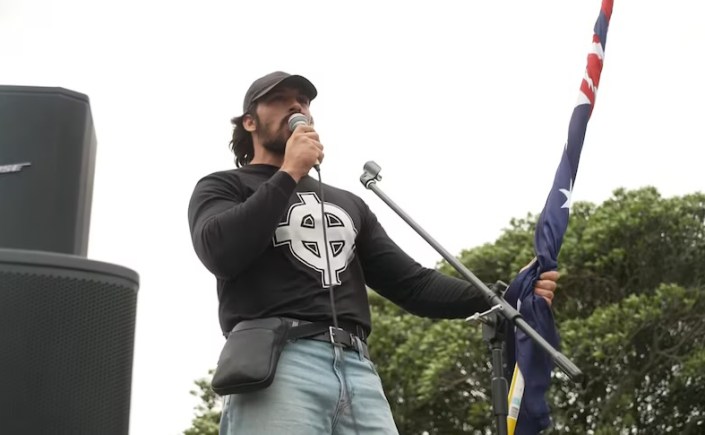
The arrest of Brendan Koschel, a speaker at the Sydney’s anti-immigration March for Australia on Australia Day who described Jews as “the greatest enemy to this nation” was rightly condemned. Such statements are plainly antisemitic and sit outside the bounds of legitimate political expression. Few would argue otherwise. The speed and clarity of the response reflect a broadly shared moral consensus: explicit hatred of Jews is unacceptable and dangerous.

What is less settled is how society responds when similar animus appears in more indirect, politically coded forms. The case invites a broader examination of consistency – of whether antisemitism is being judged by its substance or merely by the vocabulary through which it is expressed.

There is no question that Palestinians have endured profound and ongoing suffering. The devastation in Gaza, mass civilian death, displacement, and the long history of occupation and statelessness demand serious moral attention. Anger, grief, and protest in response to these realities are understandable, and often justified. Acknowledging Palestinian suffering is not a concession; it is a moral necessity.

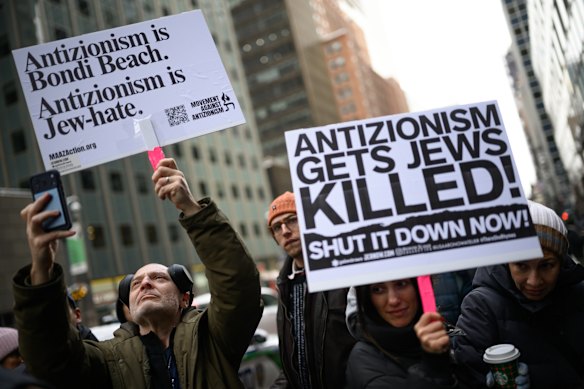
Yet since October 7, this moral urgency has unfolded alongside a striking rise in hostility directed at Jews well beyond the scope of political critique. Synagogues and Jewish schools have been vandalised. Jewish businesses have been targeted for boycotts based on ownership rather than conduct. Individuals have been harassed, doxed, or pressured to publicly renounce Israel as a condition of social or professional acceptance. These acts are widely acknowledged as regrettable, but they are often treated as peripheral to the movement that surrounds them, rather than as evidence of a deeper moral asymmetry.

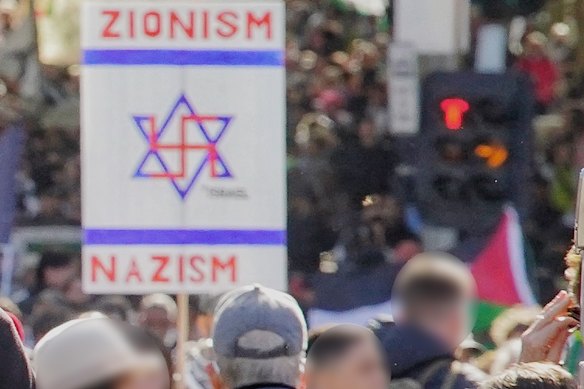
That asymmetry becomes clearer when language is examined more closely. Explicit statements condemning “Jews” as a collective are swiftly identified as racist and, in some cases, criminal. By contrast, sweeping denunciations of “Zionists” are frequently treated as legitimate political speech, even when they rely on imagery of disease, conspiracy, or collective guilt.

This distinction matters because “Zionist” is not an abstract or neutral category. In practice, it commonly refers to Jews who support the existence of a Jewish homeland – a position held by a substantial majority of Jewish people in Australia. Surveys consistently indicate that around 80 per cent of Australian Jews identify, in some form, as Zionist. As a result, hostility directed at “Zionists” often functions as hostility toward Jews as a group, translated into a more socially acceptable register. For more on this, see below, “Looking for the good Jews”.

Those who use such rhetoric often insist that they oppose only an ideology, not a people. That claim deserves to be taken seriously. Criticism of Israel – of its government, its military conduct, and its laws – is legitimate and necessary. Opposition to Zionism as a political project is not, in itself, antisemitic. Jewish political opinion is diverse, and many Jews themselves are critical of Zionism in some or all its forms. Israelis are themselves politically divided

The problem arises when this distinction collapses in practice. When Zionists are described as uniquely evil, conspiratorial, or beyond moral consideration, the language begins to mirror longstanding antisemitic tropes. The shift is not always conscious or malicious, but it is real. What would be immediately recognised as hate speech if applied to Jews directly is often defended when routed through political terminology.

This pattern is reinforced by the dynamics of contemporary public discourse. Slogans such as “from the river to the sea,” “globalize the intifada,” and “death to the IDF” circulate widely, in part because they are rhetorically efficient and algorithmically rewarded. They compress history into chant, complexity into certainty. Yet these slogans are also widely heard—by Jews and Israelis—as eliminationist in implication. They gesture toward the disappearance of Israel, invoke campaigns associated with violence against civilians, or endorse the killing of a collective. Comparable language directed at other groups would not be treated as permissible political speech.

Here again, the double standard is evident. A far-right speaker who names Jews directly is prosecuted and publicly shunned. More educated or progressive actors, using different language to express closely related ideas, face little scrutiny. In some cultural and institutional spaces, their rhetoric is actively celebrated.

This uneven moral landscape is sustained by a broader condition of moral capture. In activist environments shaped by social media, intensity is rewarded, hesitation penalised. Historical complexity gives way to moral theatre; political literacy is displaced by symbolic alignment. Once captured, movements become resistant to self-critique. Harm that flows from their rhetoric—such as the intimidation of Jews with no connection to Israeli policy—is reframed as incidental, or simply ignored.

The result is not the elimination of antisemitism, but its adaptation. It becomes more fluent, more respectable, more compatible with prevailing moral fashions. Speech-policing approaches that focus on the crudest expressions may satisfy the desire to be seen to act, but they leave this refined version largely untouched.

The Koschel case thus illustrates a deeper problem. By punishing explicit hatred while tolerating its coded forms, society draws a moral line based on style rather than substance. Prejudice is not challenged; it is merely taught to speak a different language.

A society genuinely committed to opposing antisemitism would need to confront both its vulgar and its sophisticated manifestations. That means applying the same moral standards to hatred expressed from a rally stage and to hatred embedded in politically sanctioned rhetoric. Without that consistency, condemnation becomes selective—and antisemitism endures, renamed but intact.

Coda: On Consistency

What ultimately emerges from this discussion is not a dispute about free speech or political passion, but a question of moral consistency. Antisemitism is widely condemned when it appears in its most explicit and vulgar forms. When it reappears in coded, politicised, or culturally fashionable language, it is often reclassified as critique and exempted from scrutiny.

This distinction rests on vocabulary rather than substance. Hatred expressed without euphemism is punished; hatred expressed through politically approved categories is tolerated, and at times endorsed. The result is not a reduction in prejudice, but its translation into more socially acceptable forms.

Such selectivity undermines the very principles it claims to defend. If collective blame, dehumanisation, and eliminationist implication are wrong, they are wrong regardless of the speaker’s ideology or the language used to convey them. Moral seriousness requires applying the same standards across contexts, rather than adjusting them to fit cultural or political comfort.

A society that confronts antisemitism only when it is crude teaches a damaging lesson: that prejudice is unacceptable only when it is unsophisticated. In doing so, it leaves itself vulnerable to the more durable and corrosive versions—those that pass as conscience, activism, or moral clarity.

Consistency is not censorship. It is the refusal to let hatred rebrand itself as virtue.

Looking for the “good Jews”

An extract from Moral capture, conditional empathy and the failure of shock

In This Is What It Looks Like, we wrote: “… antisemitism does not arrive announcing itself. It seeps. It jokes. It chants. It flatters those who believe they are on the right side of history, until history arrives and asks what they tolerated in its name”.

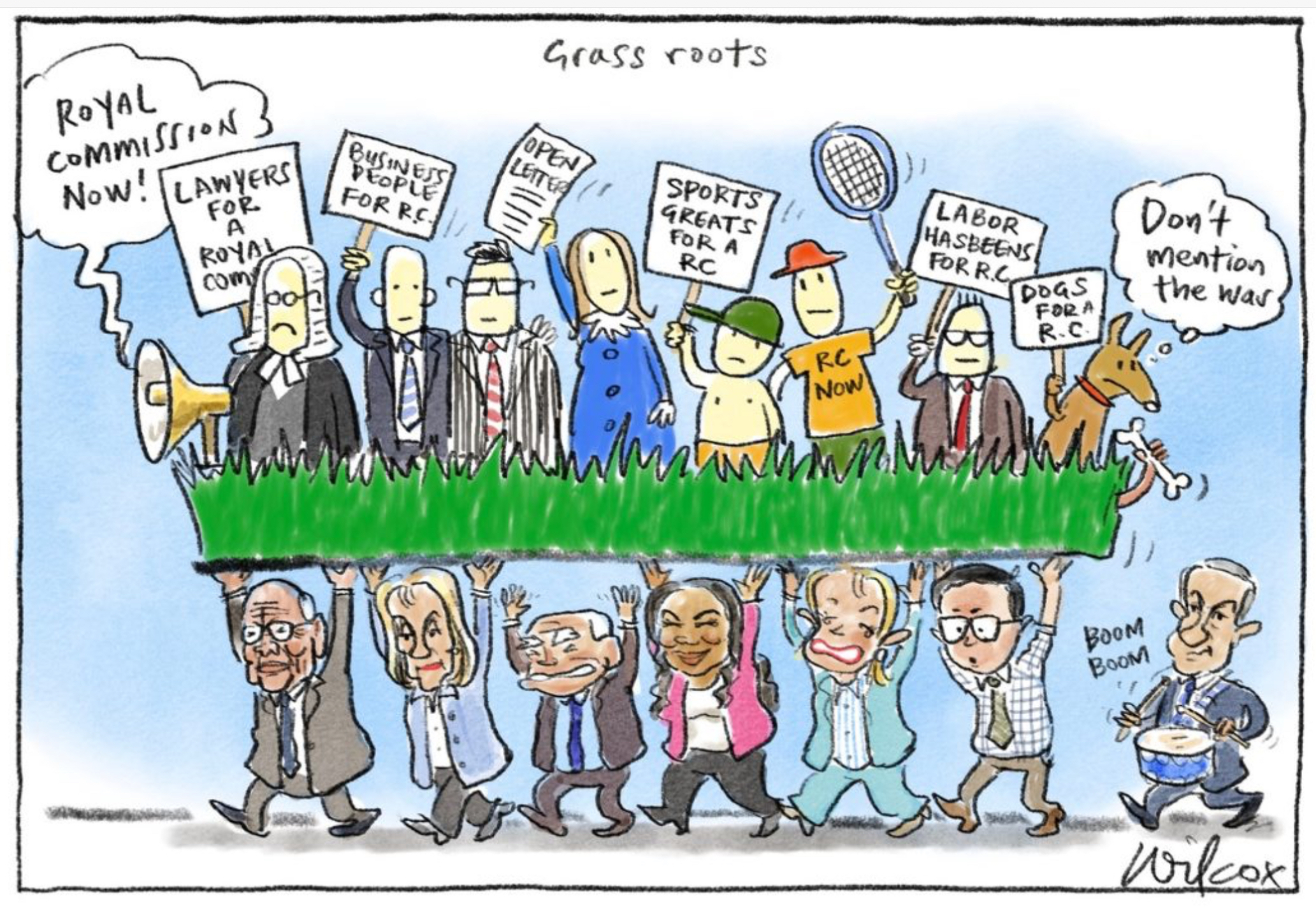
One of those jokes landed, flatly, on January 7 when the otherwise circumspect Age and Sydney Morning Herald published a caricature drawn by the award-winning cartoonist Cathy Wilcox. It presented those calling for a forthcoming royal commission into antisemitism as naïve participants in a hierarchy of manipulation. At the surface were the petitioners themselves; beneath them senior Coalition figures – Sussan Ley, Jacinta Nampijinpa Price, John Howard, David Littleproud – alongside Rupert Murdoch and Jillian Siegel, lawyer, businesswoman and Australia’s Special Envoy to Combat Antisemitism; and behind them all, setting the rhythm, Israel’s prime minister, Benjamin Netanyahu. Each layer marched to a beat not its own.

Cathy Wilcox cartoon, SMH 7 January 2026

Critics argued that the image revived a familiar and corrosive trope: the suggestion of hidden Jewish influence directing political life from the shadows. The cartoon, titled Grass roots, depicts a cluster of foolish-looking figures demanding a royal commission. They are presumably meant to represent the families of the dead, as well as lawyers, judges, business leaders and sporting figures who had urged government action long before the Prime Minister concluded that continued indifference might stain his legacy. When he finally announced a royal commission—expanded, without explanation, to include the elastic phrase “social cohesion”—no journalist paused to ask what that addition was meant to clarify.

In the drawing, a dog stands among these Australians, holding a placard and thinking, “Don’t mention the war.” The grass beneath their feet is supported by a menacing cast: and stock villains of the anti-Zionist imagination. The implication is unmistakable: that the pleas of grieving families and prominent citizens are neither organic nor sincere, but choreographed – another performance conducted from afar.

That implication did not arise in isolation. Across social and mainstream media, many progressives called for Jillian Segal to be removed and her report rejected out of hand. Others elevated Jewish critics of the war, of Zionism, or of Netanyahu as moral exemplars – “good Jews,” “some Jews tell the truth” – as if Jewish legitimacy were contingent on ideological alignment.  Some wrote openly that Jews, “for their numbers,” exercised excessive influence. One circulating meme complained, “We didn’t vote for a Zionist voice”, whilst other posts informed their echo chamber that Chabad Bondi, a branch of the global Jewish outreach organisation, which had organised the Hanukkah gathering on the fateful Sunday evening and also the local commemorations for the victims (and later, the tribute at the Sydney Opera House) was but another tentacle of the sinister and  uber-influential Jewish Lobby. Some of the most incongruous postings have been of ultra Orthodox Jews – Haredim – with signs condemning the Gaza war and Zionism, as if to say these are the authentic, “good” Jews. Some footage actually shows Haredim protesting against the Israeli government’s efforts to conscript exempt yeshiva students into the IDF – but, as they say, every picture tells a story.

Running beneath this was a persistent misconception. Judaism was treated as a religion, detachable and voluntary, rather than as an ethnoreligious identity shaped by lineage, memory and shared fate. Jews were asked not simply to oppose Israeli policy but to renounce their “homeland,” their inheritance, their sense of collective belonging. Census figures were deployed to minimise Jewish presence, overlooking the fact that many Jews, with Germany in the 1930s still in mind, remain reluctant to advertise religious affiliation. Genealogical platforms tell a different story: the number of people who discover Jewish ancestry far exceeds those who publicly profess the faith.

Another factor further clouds understanding. Jews are rarely dogmatically regarded as part of what Australians loosely call our “multicultural” society – a variegated demographic more often reserved for the post–White Australia waves of migration – communities that are visibly non-European or culturally distinct. Jews slipped beneath that radar. Many arrived well before the Second World War, and those who came before and after tended to integrate, to go mainstream, to succeed, and therefore not to stand out.

As a result, Jews were quietly folded into an older Judeo-Christian demographic, grouped alongside Protestants and Catholics as part of the cultural furniture rather than recognised as a minority with a distinct history and vulnerability. In most urban, and even regional settings, many Australians would be unaware that Jewish families live among them at all. At the same time, a surprising number of people carry Jewish ancestry several generations back, or are connected through marriage or descent, without regarding this as identity in any conscious way.

This invisibility cuts both ways. It has allowed Jews to belong without friction, but it has also made Jewishness strangely abstract – easy to misclassify as belief rather than continuity, easy to overlook as lived experience, and easy, when political passions rise, to treat as conditional.

Here the paradox sharpens, particularly among progressives. There is genuine respect for Indigenous Australians’ reverence for history, genealogy and Country: an understanding that identity is inherited as much as chosen, that land carries memory and obligation across generations. Yet the Jewish connection to Zion is denied that same conceptual dignity. What is recognised as ancestral continuity in one case is dismissed in the other as theology, nationalism or ideology.

The inconsistency is telling. Jewish attachment to place is stripped of its historical depth and cultural persistence, judged by standards not applied elsewhere. In that light, the cartoon does more than offend. It gives visual form to a deeper habit of thought: one that sorts Jews into acceptable and unacceptable categories, organic grief and foreign orchestration, legitimate belonging and suspect attachment- depending on who is being asked to explain themselves, and to whom.

All of this helps to explain the dangerous and disturbing upsurge in antisemitism over the past two years and earlier.

The Bondi massacre did not invent anti-Semitism in Australia; it exposed a system already bent, quietly, against seeing it. Two recent articles in The Australian show in complementary ways two faces of the same failure: one structural, one intimate. On the one hand, Professor Timothy Lynch diagnoses the intellectual and institutional blindness that allows hatred to incubate unchecked; on the other, author Lee Kofman shows the personal toll when grief itself is made conditional on passing someone else’s moral purity test. Together, they reveal a society in which moral frameworks have become cages rather than guides.

For decades, Australian multiculturalism has performed a delicate contortion: apologising for its own history while demanding loyalty from newcomers. Original British settlement is framed as a sin; multiethnic immigration is a progressive corrective. The paradox, Lynch notes, is that the very order migrants join is simultaneously denigrated by the leaders they are expected to trust. Within this structure, Jews occupy an uncomfortable space: electorally negligible, culturally visible, historically persecuted, yet paradoxically recoded as white and colonial. Zionism – a project of survival and refuge – is reframed as a form of imperial wrongdoing, while other nationalisms pass without scrutiny. Anti-Semitism, filtered through progressive identity politics, becomes an exception to the very rules designed to prevent harm.

Bondi rendered these abstract asymmetries concrete. The massacre forced recognition that anti-Semitism, once dismissed as campus rhetoric or aestheticised resistance, could and would become lethal.

Author’s note …

This opinion piece is one of several on the attitudes of progressives towards the Israel, Palestine and the Gaza war.

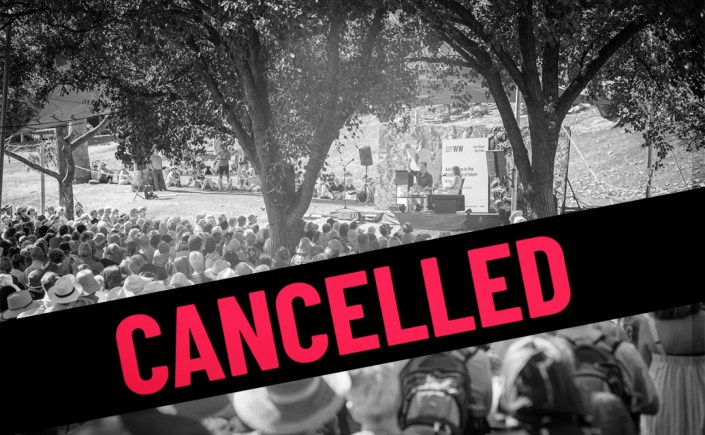
The first is Moral capture, conditional empathy and the failure of shock, a discussion on why erstwhile liberal, humanistic, progressive people from all walks of life have been caught up in what can be without subtly described as that anti-Israel machinery Shaping facts to feelings – debating intellectual dishonesty– regarding the Gaza war, intellectual dishonesty is everywhere, on both sides of the divide, magnified by mainstream and social media’s hunger for moral simplicity and viral outrage. Standing on the high moral ground is hard work! discusses the issues of free speech and “cancellation”, and boycotts with regard to the recent self-implosion of the Adelaide Writers’ Festival, one of the country’s oldest and most revered.

There are moments when public argument stops being a search for truth and becomes a test of belonging. Facts are no longer weighed so much as auditioned; empathy is rationed; moral language hardens into a badge system, issued and revoked according to rules everyone seems to know but few are willing to articulate. One learns quickly where the trip-wires are, which sympathies are permitted, which questions are suspect, and how easily tone can outweigh substance.

What interests me here is not the quarrel itself – names, borders, histories—but the habits of mind it exposes. The ease with which conviction can slide into choreography. The way intellectual honesty is praised in the abstract and punished in practice. The curious transformation of empathy from a human reflex into a conditional licence, granted only after the correct declarations have been made.

Across these pieces I circle the same uneasy terrain: the shaping of facts to fit feelings; the capture of moral language by ideological gravity; the performance of righteousness as both shield and weapon. Cultural spaces that once prided themselves on curiosity begin to resemble courts, where innocence and guilt are presumed in advance and the labour lies not in thinking, but in signalling.

This is not an argument against passion, nor a plea for bloodless neutrality. It is, rather, a meditation on how quickly moral seriousness curdles into moral certainty – and how much intellectual work is required to stand on what we like to call the high ground without mistaking altitude for clarity.

The position of In That Howling Infinite with regard to Palestine, Israel and the Gaza war is neither declarative nor devotional; it is diagnostic. Inclined – by background, sensibility, and experience – to hold multiple truths in tension, to see, as the song has it, the whole of the moon. It is less interested in arriving at purity than in resisting moral monoculture and the consolations of certainty. That disposition does not claim wisdom; it claims only a refusal to outsource judgment or to accept unanimity as a proxy for truth.

On Zionism, it treats it not as a slogan but as a historical fact with moral weight: the assertion – hard-won, contingent, imperfect – that Jews are entitled to collective political existence on the same terms as other peoples. According to this definition, this blog is Zionist. It is not interested in laundering Israeli policy, still less in romanticising state power, but rejects the sleight of hand by which Israel’s existence is transformed from a political reality into a metaphysical crime. Zionism is not sacred, but its delegitimisation is revealing – because it demands from Jews what is demanded of no other nation: justification for being.

On anti-Zionism, it has been unsparing. It sees it not as “criticism of Israel” (which you regard as both legitimate and necessary) but as a categorical refusal to accept Jewish collective self-determination. What troubles it most is not its anger but its certainty: its moral absolutism, its indifference to history, its willingness to borrow the language of justice to license erasure. It is attentive to how anti-Zionism recycles older antisemitic patterns – collectivisation of guilt, inversion of victimhood, and the portrayal of Jews as uniquely malignant actors – while insisting, with studied innocence, that none of this concerns Jews at all. If not outright antisemitism, the line separating it from anti-Zionism is wafer—thin, and too often crosses over.

The interest in moral capture is analytical rather than accusatory. It is not arguing that writers, academics, or institutions are malicious; rather, it argues that they have become intellectually narrowed by the desire to belong to the “right side of history.” Moral capture explains how good intentions curdle into dogma, how solidarity becomes performative, and how the fear of social exile replaces the discipline of thought. It accounts for the strange phenomenon whereby intelligent people outsource their moral judgment to slogans, and experience constraint not as an intolerable injury to the self.

The Adelaide Writers’ Festival affair iss seen not primarily about Randa Abdel-Fattah, nor even about free speech. It is a case study in institutional failure and cultural self-deception. The mass withdrawals are viewed not as acts of courage or principle but as gestures of affiliation – ritualised displays of virtue by people largely untouched by the substance of the dispute. What is disturbing is the asymmetry: the speed with which a festival collapsed to defend eliminationist rhetoric, and the silence that greeted the doxxing, intimidation, and quiet cancellation of Jewish writers and artists. Adelaide did not fall because standards were enforced, but because those standards were applied selectively and then disowned at the first sign of reputational discomfort.

Running through all of this is a consistent stance: a resistance to moral theatre, an impatience with historical amnesia, and a belief that intellectual honesty requires limits – on language, on fantasy, and on the indulgent belief that one’s own righteousness exempts one from consequence.

We are not asking culture to choose sides; you are asking it to recover judgment

.See in In That Howling Infinite, A Political World – Thoughts and Themes, and A Middle East Miscellany. and also: This Is What It Looks Like“You want it darker?” … Gaza and the devil that never went away … , How the jihadi tail wags the leftist dog, The Shoah and America’s ShameKen Burns’ sorrowful masterpiece, and Little Sir Hugh – Old England’s Jewish Question

Moral capture and conditional empathy

In This Is What It Looks Like, published very soon after the Bondi Beach massacre, we wrote:

“Facebook fills with empathetic words and memes from politicians, public figures and keyboard activists who spent the past two years condemning Israel in ways that blurred – and often erased – the distinction between Israeli policy and Jewish existence, creating at best, indifference to Jewish fear and, at worst, a permissive climate of hostility toward Jews as such. Today it is all tolerance, inclusivity and unity – and an air of regret and reverence that reeks of guilt.

But not all. Social media has fractured along familiar lines. At one extreme are conspiracy theories — false flags, invented victims, claims the attackers were Israeli soldiers. At the other is denial: what antisemitism? Between them sits a more revealing response. There is genuine shock and horror, even remorse – but also a careful foregrounding of the Syrian-Australian man who intervened, coupled with a quiet erasure of the victims’ Jewishness; a reflexive turn to whataboutism; and a refusal, even now, to relinquish the slogans and moral habits of the past two years. If antisemitism is acknowledged at all, it is ultimately laid at the feet of Israeli prime minister Binyamin Netanyahu.

Why this reticence, we asked, this resistance to reassessment after the Bondi attack? Perhaps it lay less in ideology than in psychology. For some, was there is a simple inability to relinquish prior convictions – positions publicly held, repeatedly performed, and now too entangled with identity to abandon without cost. For others, was it perhaps a deeper reluctance to acknowledge having been misinformed or misdirected, an admission that would require not just intellectual correction but moral self-reckoning? Was it that empath has become selective: extending it fully to Jewish victims would require suspending, even briefly, a framework that collapses Jewish identity into the actions of the Israeli state. And finally, we asked whether many were no longer reasoning freely at all, but are caught inside the machinery – the rhythms of platforms, slogans, group loyalties and algorithmic reinforcement – where reconsideration feels like betrayal and pause feels like capitulation.

Indeed, since October 7, 2023, In That Howling Infinite has pondered why erstwhile liberal, humanistic, progressive people from all walks of life have been caught up in what can be without subtly described as that anti-Israel machinery referred to above in which opposition at a safe distance to what is seen as Netanyahu’s genocidal Gaza war has seen professed anti-Zionism entangled with anti-Semitism.

What we are witnessing is not a fringe radicalisation but a moral capture: people who would once have prided themselves on scepticism, nuance and historical memory now moving in formation, repeating slogans whose lineage they neither examine nor recognise. The machinery works precisely because it flatters their self-image. It offers the intoxication of righteousness without the burden of precision; solidarity without responsibility; protest without consequence.

This is not old-style antisemitism with its crude caricatures and biological myths. It is something more elusive – and therefore more powerful. It presents itself as ethics, as international law, as human rights discourse scrubbed clean of Jewish history. Israel becomes not a state among states but a symbol onto which every colonial sin can be projected. Complexity is treated as evasion; context as complicity. The very habits of mind that once defined liberal humanism – distinction, proportion, tragic awareness – are recoded as moral failure.

And because the animating energy is moral rather than ethnic, many participants genuinely believe themselves immune to antisemitism. They do not hate Jews; they merely deny Jews the one thing liberalism once insisted all peoples possess: the right to historical contingency, to imperfect self-determination, to moral fallibility without metaphysical damnation. That is how an ancient prejudice survives under a modern flag.

What makes this moment particularly dangerous is that the capture extends across institutions that once acted as guide rails and  backstops: universities, cultural organisations, media, NGOs, even parts of the political class. When the liberal centre internalises a narrative, it no longer needs coercion; it polices itself. Silence becomes virtue. Dissent becomes indecency. The boundaries of acceptable speech narrow – not by law, but by moral shaming.

This is why inquiries and commissions feel inadequate, even faintly beside the point. The problem is not that we do not know enough. It is that too many people who should know better have decided – consciously or otherwise – that some falsehoods are useful, some hatreds understandable, some erasures permissible.

History suggests these moments do not end because facts finally win an argument. They end when enough people recover the nerve to say: this is not true, this is not proportionate, this is not who we are. That requires intellectual courage before it requires policy – and at the moment, courage is in shorter supply than outrage.

What, then, do we actually mean by moral capture?

An intellectual box canyon

It describes a condition in which an individual or group becomes psychologically, socially, and culturally enclosed within a moral framework so totalising that it can no longer be revised or questioned without threatening their sense of self. It is best understood not as a theory, still less as a conscious posture, but as a lived and almost tangible condition: a quiet enclosure of mind and conscience in which questioning the framework feels not merely wrong, but personally destabilising. It is not simply ideology or prejudice, but a subtle narrowing of moral imagination—a shaping of what can be felt, what can be said, and ultimately, what can be seen.

Under moral capture, empathy becomes conditional. It travels only so far before it threatens the moral story we have already committed to, the narrative through which we recognise ourselves as good. Judgement is no longer exercised independently but is subordinated to alignment. We begin thinking from conclusions rather than reasoning toward them, measuring the world not against principle but against the positions we have already staked as right. Certain conclusions feel self-evident; certain questions become illegitimate; doubt itself starts to register as moral weakness rather than intellectual honesty.

Positions once held as views harden into identity, reinforced by social approval, public performance, and the feedback loops of online life. People can feel sincere, committed, and righteous even as their capacity to notice contradiction, hold tension, or revise belief steadily diminishes. What is lost is not feeling, but freedom—the freedom to think, to hesitate, and to change one’s mind.

In a phrase, moral capture is an intellectual box canyon: wide at the entrance, reassuringly coherent and morally clear once inside, but increasingly difficult to exit without retracing your steps

Our moral choices, once optional, become invested in our identity. What we once held as a conviction now defines us, fuses with our sense of self, our social belonging, our reputation. And habits reinforce themselves. Ritualised moral performances, applause from peers, and the accelerating feedback of online platforms harden the framework, making reconsideration feel not just difficult, but almost impossible.

In this state, otherwise humane, intelligent people can feel virtuous, committed, and righteous while the breadth of their moral imagination steadily narrows. Certain truths -even the most visible – become unsayable. Empathy grows selective. The unthinkable becomes thinkable, so long as it fits the story our framework allows.

This essay is my attempt to explore moral capture as it happens in real time: to see how it shapes our response to atrocity, how it bends grief and outrage, and why even shock – when filtered through these habits – becomes partial, provisional, and fragile.

Conditional empathy and the failure of shock

In That Howling Infinite did not begin thinking about moral capture because it was looking for a new explanatory framework, nor because it believed itself morally exempt from the currents of the moment. Rather, because in the aftermath of the Bondi atrocity something felt profoundly unsettled – not only tragic, but discordant. The language of grief arrived swiftly and abundantly. Condolences were offered, candles lit, unity invoked. And yet this display sat uneasily alongside two years of rhetoric in which Jewish fear had been minimised, relativised, or quietly absorbed into a moral narrative that treated Israel not as a state among others, but as a singular moral contaminant.

What was disturbing was not the outrage directed at Gaza. The suffering there is real, appalling, and morally unavoidable. Israel’s retaliation has been devastating and, in many instances, disproportionate. Reasonable people can, and must, grapple with that reality. What was troubling was how easily that outrage had slid, over time, into habits of thought that blurred distinctions which once mattered: between state and people, policy and identity, criticism and contempt. The taboo on antisemitism, long assumed to be settled history, began to look less like a moral achievement than a conditional courtesy.

After Bondi, we did not expect a mass moral conversion or  imagine that people who had spent two years publicly performing righteous indignation would suddenly execute a full reversal – a neat return to complexity, restraint and tragic awareness. That would have been unrealistic, perhaps even unfair. What we did expect, and hoped for, was hesitation. A pause. A moment of reassessment. An acknowledgement, however tentative, that something in the moral atmosphere had gone wrong.

Instead, what emerged was something more revealing: grief without revision; empathy carefully bounded; sorrow hedged with qualifications. The familiar “Ah, but…” arrived almost on cue. It was there, in that reflex, that we began to see the outline of a deeper phenomenon – not simple prejudice, not even ideology, but moral capture.

Moral capture occurs when a moral framework that once helped organise reality becomes totalising – so emotionally, socially and symbolically reinforced that it can no longer be revised without threatening the self who holds it. At that point, facts do not merely challenge the framework; they imperil identity. And when identity is at stake, reason quietly steps aside.

One of the clearest signs of moral capture is the collapse of distinctions. Israeli policy becomes Jewish existence. Jewish fear becomes political theatre. Antisemitism becomes a rhetorical device wielded by Benjamin Netanyahu. Violence against Jews becomes, if not justified, then contextualised into moral thinness. Language flattens. Precision feels like evasion. Context is treated as complicity.

This helps explain the strange choreography of response after Bondi. There was genuine shock and sorrow, even remorse. But it was accompanied by careful editorial choices: the foregrounding of a heroic rescuer, the quiet erasure of the victims’ Jewishness, the reflexive turn to whataboutism, the insistence – sometimes whispered, sometimes explicit – that responsibility lay elsewhere. Jewish suffering could be acknowledged only insofar as it did not demand a reckoning with the moral habits of the past two years.

Why this resistance? Part of the answer lies in identity as investment. For many on the modern left, opposition to Israel has not remained a policy position; it has hardened into a moral identity, publicly performed, socially rewarded, and algorithmically amplified. Positions once adopted as expressions of concern or solidarity have become entangled with one’s sense of self -who one is, where one belongs, what one signals to the world. To revise those positions now would involve not merely intellectual correction, but moral self-reckoning: admitting error, acknowledging harm, risking social alienation. That is a price most people instinctively avoid.

Solidarity, under these conditions, mutates into surrender. The capacity to stand with the vulnerable while retaining independent moral judgement is lost. Complexity becomes betrayal. Reassessment becomes cowardice. To pause is to hesitate; to hesitate is to defect. Moral reasoning gives way to moral alignment.

This process is intensified by platforms that act as algorithmic accelerants. Social media does not reward reflection; it rewards repetition with conviction. Moral language becomes compressed into slogans. Outrage is incentivised; nuance is penalised. Over time, people cease reasoning toward conclusions and begin reasoning from them. The machinery does the rest. Group loyalty replaces judgement. Reconsideration feels like capitulation.

In this environment, antisemitism does not need to announce itself. It seeps. It jokes. It chants. It flatters those who believe they are on the right side of history by assuring them that their anger is justice and their certainty courage. The world’s oldest hatred does what it has always done: it waits for permission. That permission is rarely granted all at once. It is granted gradually, rhetorically, respectably.

This is why Bondi did not “break the spell.” Atrocities shock only when the moral framework remains flexible enough to absorb them. Here, the framework was already closed. Violence could be mourned, but not allowed to destabilise the story that preceded it. Empathy could be expressed, but only within boundaries that preserved moral coherence. Jewish fear remained an inconvenience—something to be managed, not centred.

The habituation of moral capture meant that grief was permitted only insofar as it did not demand reassessment. Empathy was bounded, sorrow hedged, and moral recognition carefully staged. Those who might have been shocked into reflection instead performed selective empathy, affirming the gestures of mourning while leaving the architecture of two years of moral habit intact

Throughout this exploration, In That Howling Infinite  asked myself an uncomfortable question: do we lack the empathy and outrage that others so visibly express? Are we insufficiently moved? Insufficiently angry? We do not think so. Though saddened by Gaza and angered by unnecessary suffering, it is appalled by violence against Jews. What differs, perhaps, is not the presence of feeling but the habits through which it is processed. It’s background, sensibility and experience incline it toward holding multiple truths in tension – to see, as the song has it, the whole of the moon. That does not make it wiser, only more resistant to moral monoculture.

Moral capture is powerful precisely because it allows people to remain good in their own eyes while surrendering the disciplines that once made goodness durable. It does not feel like hatred. It feels like justice. It does not announce itself as intolerance. It presents as virtue.

What we have learned on this journey is not that outrage is illegitimate, nor that empathy must be rationed. It is that empathy becomes dangerous when it is conditional; that solidarity curdles when it demands surrender; and that moral frameworks, once weaponised against reconsideration, eventually turn on the very values they claim to defend.

History does not ask whether our intentions were pure. It asks what we normalised, what we tolerated, and what we allowed to be said in our name. Moral capture works hardest to ensure we never ask those questions of ourselves. The task now is not to abandon conviction, but to recover freedom it the freedom to doubt our own righteousness, to let empathy travel where it is inconvenient, and to remember that seeing only half the sky is not the same as moral clarity.

Only then do we begin to see the whole of the moon.

In That Howling Infinite  December 2025

Author’s note …

This opinion piece is one of several on the the attitudes of progressives towards the Israel, Palestine and the Gaza war. Shaping facts to feelings – debating intellectual dishonesty– regarding the Gaza war, intellectual dishonesty is everywhere, on both sides of the divide, magnified by mainstream and social media’s hunger for moral simplicity and viral outrage. Standing on the high moral ground is hard work! discusses the issues of free speech and “cancellation”, and boycotts with regard to the recent self-implosion of the Adelaide Writers’ Festival, one of the country’s oldest and most revered.

There are moments when public argument stops being a search for truth and becomes a test of belonging. Facts are no longer weighed so much as auditioned; empathy is rationed; moral language hardens into a badge system, issued and revoked according to rules everyone seems to know but few are willing to articulate. One learns quickly where the trip-wires are, which sympathies are permitted, which questions are suspect, and how easily tone can outweigh substance.

What interests me here is not the quarrel itself – names, borders, histories—but the habits of mind it exposes. The ease with which conviction can slide into choreography. The way intellectual honesty is praised in the abstract and punished in practice. The curious transformation of empathy from a human reflex into a conditional licence, granted only after the correct declarations have been made.

Across these pieces I circle the same uneasy terrain: the shaping of facts to fit feelings; the capture of moral language by ideological gravity; the performance of righteousness as both shield and weapon. Cultural spaces that once prided themselves on curiosity begin to resemble courts, where innocence and guilt are presumed in advance and the labour lies not in thinking, but in signalling.

This is not an argument against passion, nor a plea for bloodless neutrality. It is, rather, a meditation on how quickly moral seriousness curdles into moral certainty – and how much intellectual work is required to stand on what we like to call the high ground without mistaking altitude for clarity.

The position of In That Howling Infinite with regard to Palestine, israel and the Gaza war is neither declarative nor devotional; it is diagnostic. Inclined – by background, sensibility, and experience – to hold multiple truths in tension, to see, as the song has it, the whole of the moon. It is less interested in arriving at purity than in resisting moral monoculture and the consolations of certainty. That disposition does not claim wisdom; it claims only a refusal to outsource judgment or to accept unanimity as a proxy for truth.

On Zionism, it treats it not as a slogan but as a historical fact with moral weight: the assertion – hard-won, contingent, imperfect – that Jews are entitled to collective political existence on the same terms as other peoples. According to this definition, this blog is Zionist. It is not interested in laundering Israeli policy, still less in romanticising state power, but rejects the sleight of hand by which Israel’s existence is transformed from a political reality into a metaphysical crime. Zionism is not sacred, but its delegitimisation is revealing – because it demands from Jews what is demanded of no other nation: justification for being.

On anti-Zionism, it has been unsparing. It sees it not as “criticism of Israel” (which you regard as both legitimate and necessary) but as a categorical refusal to accept Jewish collective self-determination. What troubles it most is not its anger but its certainty: its moral absolutism, its indifference to history, its willingness to borrow the language of justice to license erasure. It is attentive to how anti-Zionism recycles older antisemitic patterns – collectivisation of guilt, inversion of victimhood, and the portrayal of Jews as uniquely malignant actors – while insisting, with studied innocence, that none of this concerns Jews at all. If not outright antisemitism, the line separating it from anti-Zionism is wafer—thin, and too often crosses over. 

The interest in moral capture is analytical rather than accusatory. It is not arguing that writers, academics, or institutions are malicious; rather, it are argues that they have become intellectually narrowed by the desire to belong to the “right side of history.” Moral capture explains how good intentions curdle into dogma, how solidarity becomes performative, and how the fear of social exile replaces the discipline of thought. It accounts for the strange phenomenon whereby intelligent people outsource their moral judgment to slogans, and experience constraint not as an intolerable injury to the self.

The Adelaide Writers’ Festival affairis seen not primarily about Randa Abdel-Fattah, nor even about free speech. It is a case study in institutional failure and cultural self-deception. The mass withdrawals are viewed not as acts of courage or principle but as gestures of affiliation – ritualised displays of virtue by people largely untouched by the substance of the dispute. What is disturbing is the asymmetry: the speed with which a festival collapsed to defend eliminationist rhetoric, and the silence that greeted the doxxing, intimidation, and quiet cancellation of Jewish writers and artists. Adelaide did not fall because standards were enforced, but because those standards were applied selectively and then disowned at the first sign of reputational discomfort.

Running through all of this is a consistent stance: a resistance to moral theatre, an impatience with historical amnesia, and a belief that intellectual honesty requires limits – on language, on fantasy, and on the indulgent belief that one’s own righteousness exempts one from consequence.

We are not asking culture to choose sides; you are asking it to recover judgment

.See in In That Howling Infinite, A Political World – Thoughts and Themes, and A Middle East Miscellany. and also: This Is What It Looks LikeYou want it darker?” … Gaza and the devil that never went away … , How the jihadi tail wags the leftist dog, The Shoah and America’s Shame – Ken Burns’ sorrowful masterpiece, and Little Sir Hugh – Old England’s Jewish Question

Looking for the “good Jews”

In This Is What It Looks Like, we wrote: “… antisemitism does not arrive announcing itself. It seeps. It jokes. It chants. It flatters those who believe they are on the right side of history, until history arrives and asks what they tolerated in its name”.

One of those jokes landed, flatly, on January 7 when the otherwise circumspect Age and Sydney Morning Herald published a caricature drawn by the award-winning cartoonist Cathy Wilcox. It presented those calling for a forthcoming royal commission into antisemitism as naïve participants in a hierarchy of manipulation. At the surface were the petitioners themselves; beneath them senior Coalition figures – Sussan Ley, Jacinta Nampijinpa Price, John Howard, David Littleproud – alongside Rupert Murdoch and Jillian Siegel, lawyer, businesswoman and Australia’s Special Envoy to Combat Antisemitism; and behind them all, setting the rhythm, Israel’s prime minister, Benjamin Netanyahu. Each layer marched to a beat not its own.

Cathy Wilcox cartoon, SMH 7 January 2026

Critics argued that the image revived a familiar and corrosive trope: the suggestion of hidden Jewish influence directing political life from the shadows. The cartoon, titled Grass roots, depicts a cluster of foolish-looking figures demanding a royal commission. They are presumably meant to represent the families of the dead, as well as lawyers, judges, business leaders and sporting figures who had urged government action long before the Prime Minister concluded that continued indifference might stain his legacy. When he finally announced a royal commission—expanded, without explanation, to include the elastic phrase “social cohesion”—no journalist paused to ask what that addition was meant to clarify.

In the drawing, a dog stands among these Australians, holding a placard and thinking, “Don’t mention the war.” The grass beneath their feet is supported by a menacing cast: and stock villains of the anti-Zionist imagination. The implication is unmistakable: that the pleas of grieving families and prominent citizens are neither organic nor sincere, but choreographed – another performance conducted from afar.

That implication did not arise in isolation. Across social and mainstream media, many progressives called for Jillian Segal to be removed and her report rejected out of hand. Others elevated Jewish critics of the war, of Zionism, or of Netanyahu as moral exemplars – “good Jews,” “some Jews tell the truth” – as if Jewish legitimacy were contingent on ideological alignment.  Some wrote openly that Jews, “for their numbers,” exercised excessive influence. One circulating meme complained, “We didn’t vote for a Zionist voice”, whilst other posts informed their echo chamber that Chabad Bondi, a branch of the global Jewish outreach organisation, which had organised the Hanukkah gathering on the fateful Sunday evening and also the local commemorations for the victims (and later, the tribute at the Sydney Opera House) was but another tentacle of the sinister and  uber-influential Jewish Lobby. Some of the most incongruous postings have been of ultra Orthodox Jews – Haredim – with signs condemning the Gaza war and Zionism, as if to say these are the authentic, “good” Jews. Some footage actually shows Haredim protesting against the Israeli government’s efforts to conscript exempt yeshiva students into the IDF – but, as they say, every picture tells a story.

Running beneath this was a persistent misconception. Judaism was treated as a religion, detachable and voluntary, rather than as an ethnoreligious identity shaped by lineage, memory and shared fate. Jews were asked not simply to oppose Israeli policy but to renounce their “homeland,” their inheritance, their sense of collective belonging. Census figures were deployed to minimise Jewish presence, overlooking the fact that many Jews, with Germany in the 1930s still in mind, remain reluctant to advertise religious affiliation. Genealogical platforms tell a different story: the number of people who discover Jewish ancestry far exceeds those who publicly profess the faith.

Another factor further clouds understanding. Jews are rarely dogmatically regarded as part of what Australians loosely call our “multicultural” society – a variegated demographic more often reserved for the post–White Australia waves of migration – communities that are visibly non-European or culturally distinct. Jews slipped beneath that radar. Many arrived well before the Second World War, and those who came before and after tended to integrate, to go mainstream, to succeed, and therefore not to stand out.

As a result, Jews were quietly folded into an older Judeo-Christian demographic, grouped alongside Protestants and Catholics as part of the cultural furniture rather than recognised as a minority with a distinct history and vulnerability. In most urban, and even regional settings, many Australians would be unaware that Jewish families live among them at all. At the same time, a surprising number of people carry Jewish ancestry several generations back, or are connected through marriage or descent, without regarding this as identity in any conscious way.

This invisibility cuts both ways. It has allowed Jews to belong without friction, but it has also made Jewishness strangely abstract – easy to misclassify as belief rather than continuity, easy to overlook as lived experience, and easy, when political passions rise, to treat as conditional.

Here the paradox sharpens, particularly among progressives. There is genuine respect for Indigenous Australians’ reverence for history, genealogy and Country: an understanding that identity is inherited as much as chosen, that land carries memory and obligation across generations. Yet the Jewish connection to Zion is denied that same conceptual dignity. What is recognised as ancestral continuity in one case is dismissed in the other as theology, nationalism or ideology.

The inconsistency is telling. Jewish attachment to place is stripped of its historical depth and cultural persistence, judged by standards not applied elsewhere. In that light, the cartoon does more than offend. It gives visual form to a deeper habit of thought: one that sorts Jews into acceptable and unacceptable categories, organic grief and foreign orchestration, legitimate belonging and suspect attachment- depending on who is being asked to explain themselves, and to whom.

All of this helps to explain the dangerous and disturbing upsurge in antisemitism over the past two years and earlier.

The Bondi massacre did not invent anti-Semitism in Australia; it exposed a system already bent, quietly, against seeing it. Two recent articles in The Australian show in complementary ways two faces of the same failure: one structural, one intimate. On the one hand, Professor Timothy Lynch diagnoses the intellectual and institutional blindness that allows hatred to incubate unchecked; on the other, author Lee Kofman shows the personal toll when grief itself is made conditional on passing someone else’s moral purity test. Together, they reveal a society in which moral frameworks have become cages rather than guides.

For decades, Australian multiculturalism has performed a delicate contortion: apologising for its own history while demanding loyalty from newcomers. Original British settlement is framed as a sin; multiethnic immigration is a progressive corrective. The paradox, Lynch notes, is that the very order migrants join is simultaneously denigrated by the leaders they are expected to trust. Within this structure, Jews occupy an uncomfortable space: electorally negligible, culturally visible, historically persecuted, yet paradoxically recoded as white and colonial. Zionism – a project of survival and refug e- is reframed as a form of imperial wrongdoing, while other nationalisms pass without scrutiny. Anti-Semitism, filtered through progressive identity politics, becomes an exception to the very rules designed to prevent harm.

Bondi rendered these abstract asymmetries concrete. The massacre forced recognition that anti-Semitism, once dismissed as campus rhetoric or aestheticised resistance, could and would become lethal. Lynch observes that progressive moral frameworks – micro-aggressions monitored, systemic racism theorised -stop precisely at the Jew. A royal commission, he argues, would not be vindictive; it would be a sober exercise in moral clarity, tracing the cultural and ideological currents that incubated violence. Yet the same cultural institutions that produced those currents remain invested in their own innocence, framing ideas as harmless discourse even as they provide tacit validation for hatred.

Kofman brings this insight down to the level of lived experience. Her grief, initially raw and private, became a public transaction. Condolences were offered, often, with moral caveats: critique Israel just so, moderate outrage, avoid triggering Islamophobia, defer to “Good Jews” as intermediaries for acceptable mourning. Grief, she realised, was conditional: to mourn fully, one had to pass a moral test. She claimed her place among the Bad Jews – those attached to ancestral lands, critical yet loyal, unbowed by external sensibilities. In doing so, she and others began to speak publicly, reclaiming authority over their grief and over the narrative of their own people. The silver lining, Kofman suggests, lies not in filtered approval from outsiders but in the courage of authenticity: listening, amplifying, and insisting on nuance.

Both authors reveal the same systemic dynamic from different angles: moral capture. Identity has become an investment; empathy is asymmetric; ideological frameworks collapse distinctions, judging hate by its source rather than its effect. Lynch shows that structural conditions—campus rhetoric, art institutions, political taboos – render society defenseless against the incubation of lethal prejudice. Kofman shows that these same conditions turn grief into a contested commodity, rationed according to moral convenience. Bondi, in its horror, exposes the cost of these failures. The killers were here, not abroad; the culture that nurtured their hatred was domestic, familiar, and in many cases, ideologically protected.

The lesson is twofold. First, moral frameworks must be able to interrogate themselves without fear: to analyse ideas, ideologies, and cultural norms is not to endorse them. Second, grief, solidarity, and moral recognition cannot be rationed according to convenience or identity politics. True empathy – what Kofman calls listening beyond comfort zones and algorithmic echoes – requires attending to the voices of those most affected, even when they unsettle our assumptions. In other words, the antidote to moral capture is both structural and intimate: rigorous, unflinching public inquiry alongside the personal courage to honor grief unconditionally.

Bondi’s tragedy leaves no simple remedies. But by exposing the moral contradictions of multiculturalism and the conditionality of recognition, Lynch and Kofman give us a framework for reflection: a society that cannot see hate, cannot hear grief, and cannot tolerate nuance is a society poised for repetition. The challenge -and the opportunity – is to recover both: vision and voice, system and sensibility, analysis and empathy.

Chorus of ‘Bad Jews’ finds its voice: My grief is not conditional on your moral purity test

Lee Kofman, The Australian, 3 January 2026
Fifteen people had to die for Jewish grief and fear to finally receive public validation. Picture: AFP

15 people had to die for Jewish grief and fear to finally receive public validation. AFP

The morning after the Bondi terror attack, I was scheduled to appear on a podcast about creativity. Going ahead with it was my way of finding that mythical oil jar which, according to Hanukkah lore, lit the Jewish people’s darkness in their hour of need.

My darkness deepened as I drove to the studio. A phone call with a friend turned into a shattering revelation. Her niece, the same age as my 10-year-old child, was murdered in Bondi. The tragedy that sat heavy in me turned visceral. Still, I drove on. I needed to be around good people. To believe in goodness.

My podcast interlocutor, another Jewish artist, seemed similarly shell-shocked. “I always look for a silver lining,” he said. “I haven’t found it yet, but I’m waiting.”

“Maybe there won’t be silver lining,” I said. The miraculous oil jar was fiction after all … We agreed to disagree, as Jews often do, ending the recording with a silent, long hug.

If only I could be so hopeful. In the days since Bondi, I have mostly felt fury and sadness. For two years, since October 7, 2023, my community has been warning that unchecked Jew-hatred – online, in weekly rallies, in cultural institutions, via the boycotting of Jewish artists, the abuse of Jewish university students and lecturers, and anti-Semitic violence – would lead to bloodshed. We had been proven right. It took 15 dead bodies for people to see what “Globalise the intifada” looks like in practice. Fifteen dead for Jewish grief and fear to finally receive public validation.

Mourners gather in front of tributes laid in memory of victims of the Bondi Beach shooting. Picture: AFP

Mourners gather in front of tributes to victims of the Bondi Beach shooting.  AFP

Validation was coming my way too, at first primarily from people who have supported me throughout the past two years, often at their own peril. I received dozens and dozens of moving messages of love and anguish. Was this my silver lining? Soon others arrived. Still from within my milieu – mostly left-wing, creative, non-Jewish people – but now also from those I hadn’t heard from in a long time. And from those who have contributed to normalising Jew-hatred. In certain circles, I realised, validation came with caveats. It felt as if our mourning became a subject of scrutiny, a suspect thing. Some offered condolences, then detailed the evils of Benjamin Netanyahu or guns, as if either explained (justified?) what happened.

Others, more diplomatic, sent links to videos and articles by those they regard as “Good Jews” – a handful of extreme left, anti-Zionist Jewish public figures and organisations with marginal Jewish followings, whose narratives fit those of some “progressive” milieus and are used by them as shields against accusations of anti-Semitism.

A pro-Palestine rally in Sydney. Picture: NCA NewsWire/ Dylan Robinson

A pro-Palestine rally in Sydney. NCA NewsWire/ Dylan Robinson

(Bad) Jewish community is overreacting again, Good Jews were saying. Anti-Semitism is as much a problem as other types of racism. Worse, (Bad) Jews are politicising the tragedy to curtail freedoms. Because the rallies with Islamist flags, promoting totalitarian political ideologies, and with chants of “all Zionists are terrorists” were peaceful and must continue. The government has done all it could; look how much money has been poured into security. Jewish organisations should hire more guards and stop celebrating events in the open, then all will be fine. Also, we should tone down our grief, to avoid encouraging Islamophobia, Good Jews suggested.

Demonstrators at a pro-Palestine rally in Melbourne CBD. Picture: NCA NewsWire / David Crosling

Demonstrators at a pro-Palestine rally in Melbourne CBD. NCA NewsWire / David Crosling

For those who sent me those later messages, I realised, my grief was conditional. To be entitled to it, I had to pass a moral test: Was I a Good or Bad Jew?

Doubtlessly, I am a Bad one. A Jew who, while opposing the current Israeli government, is deeply connected to my ancestral land, where I lived for 14 years, and to my community in Australia. A Jew unprepared to dilute her grief for somebody else’s sensibilities. A Jew holding the government and many of our cultural institutions accountable for the marginalisation, hatred and violence my people have been enduring in this country over the past two years.

Another message came through. A young journalist sent an Instagram reel in which she spoke about deciding to stop minimising her Jewishness to fit in. She’s normally a gentle person, but her words were bold, her fury palpable. I watched the video several times. I could see she was becoming Bad Jew. A badass Jew.

Lee Kofman. Picture: Aaron Francis / The Australian

Lee Kofman. Aaron Francis / The Australian

Soon, Bad Jews sprang up all over the place. Many who had been (understandably) fearful and quiet spoke publicly for the first time. The usually outspoken ones took things up a notch. I messaged my podcast interlocutor: “You were right. Even Bondi’s tragedy has a silver lining.” The chorus of my people was growing. The Bad Jews had spoken.

Jews are a mere 0.4 per cent of Australia’s population, not all that useful for vote-courting politicians. Unfortunately, we do not possess those powerful, all-reaching tentacles attributed to us. But we’ve always been a people of words, and our hope to survive is embedded in our willingness to use words boldly and authentically.

In recent years, Bad Jews have been pushed out of many public spheres, told it isn’t the time for our voices. (I was told this many times, especially after the publication of Ruptured: Jewish Women in Australia Reflect on Life Post-October 7, which I coedited with Tamar Paluch.) Since the Bondi massacre, however, the media has been more willing to give space to Bad Jews too.

Today I choose to be hopeful. I notice that while some non-Jews put my grief to test, more have asked how they can help. One important thing to do right now is to listen to Jewish voices, and to choose carefully who you learn from and who you amplify. To show true solidarity is to climb out of your comfort zone and algorithms. To listen to those Jews who challenge rather than confirm what you think you know about us. (Are Zionists really terrorists? Are Jews really white?)

After years of the Australian Jewish community being misunderstood and gaslit, light must be shed on our complexities and nuances. Let this be everyone’s silver lining.

This was one of five pieces published in Australian Book Review under the title “After Bondi”. Lee Kofman is the author and editor of nine books, the latest of which are The Writer Laid Bare (2022) and Ruptured (2025).

How multiculturalism chic invites violent anti-Semitism

Timothy Lynch, The Australian, 3 January, 2026

People gathered outside Parliament House in Melbourne in support of the Palestinian people. Picture: NewsWire / Andrew Henshaw

Outside Parliament House, Melbourne,. NewsWire / Andrew Henshaw

The proximate debate over a royal commission into the first mass-casualty terrorist attack on Australian soil is becoming a proxy for a larger conflict over multiculturalism.

Two camps have formed. The first, led de facto by Josh Frydenberg, demands a reckoning on how a fashionable anti-Semitism in our cultural institutions incubated the Akrams’ barbarity.

The second, led reluctantly by Anthony Albanese, who wants it all to be about guns, refuses to admit this ancient hatred has a genesis in modern progressivism. To concede any correlation, let alone a causal relationship, between the two is verboten. The multicultural project remains beyond impeachment.

The unstoppable force of Jewish Australians, post-Bondi, has met the immovable object of left-wing assumptions. The Bondi Beach crisis has exposed the jagged edges of a social experiment we are told is both ineluctable and inevitable.

Immigration as curse and cure

For decades, Australia has been trapped in a series of moral and philosophical contortions. Much of the contemporary left treats original immigration – the arrival of the British 200 years ago – as a cardinal sin. To atone, the modern progressive movement has championed multiethnic immigration as a corrective measure. This has created a paradoxical situation where the nation is required to apologise for its existence at every public event yet simultaneously expects arriving migrants to find loyalty and respect for a system, and its history, that its own leaders appear to despise.

By genuflecting and apologising for our British heritage, we weaken the system that immigrants take such risks to join. We have created a public discourse where the core of the Australian experiment is framed as something shameful, making it harder to assimilate newcomers into a positive notion of what this country represents.

We are living through the failure of the multicultural experiment to produce the social harmony its architects promised. Instead of a seamless integration, we see the exposure of small, vulnerable communities to the power of growing, noisy ones. This would put Jewish Australians at a growing disadvantage – they are electorally negligible – even before the anti-Semitism that makes them guilty by proxy of Israeli “war crimes” is factored in.

Tens of thousands attended the March for Humanity protest over the Sydney Harbour Bridge. Picture: News Corp

Tens of thousands attended the March for Humanity over Sydney Harbour Bridge. News Corp

Factored in they are. Sudanese nationalist sentiment in Australia carries none of the blame for the humanitarian catastrophe that is Sudan today. But Zionism? The success of the cosmopolitan left is to turn Jewish nationalism into a form of colonial oppression.

Asymmetric multiculturalism

The only Middle Eastern state with the gender rights demanded by Australian campus progressives must be “decolonised”. When Israel acts in self-defence it commits “genocide”. Do the rainbow flags flown by our rural councils and art museums cause this? Long bow, that. Do they prevent it? No. Multiculturalism is complicit in the creation of a social order in which anything Western is regarded as suspect and anything non-Western elevated beyond its moral capacity to bear.

This has been called a form of asymmetric multiculturalism: the privileging of some peoples (usually of colour) over others (often whites). The Jews, a Semitic people, as are the Arabs, are less deserving of support because progressives have made them white and Western.

Left-wing activists have had much success convincing their peers that men can be women; we have missed how they have transitioned the Jews, the perennial victims of history, into the agents of colonial whiteness.

A tiny nation peopled mostly by those escaping the Nazi Holocaust, Soviet communism and Muslim anti-Semitism (there is no thriving Jewish minority in any Muslim-Arab state) has become the target rather than the beneficiary of liberal moralising. The profound historical illiteracy of multiculturalism, as taught in our schools and universities, has something to do with this.

None of this mattered very much to Australians until December 14, 2025. Until then, we mostly dismissed campus anti-Semitism as just what students and their lecturers do. Wasn’t the Vietnam War protested in similar terms to Gaza?

Pro-Palestine protesters occupying the Arts Building at Melbourne University. Picture: NewsWire / David Crosling

Pro-Palestine protesters occupythe Arts Building, Melbourne University. NewsWire / David Crosling

We became inured to the Israelophobic propaganda on office windows. The Palestinian flag that flies above the bookshop in Castlemaine, Victoria, flutters still – we just stopped noticing it. Let them play at “fostering a culture of resistance”. These middle-class activists weren’t complicit in the Akrams’ afternoon of resistance, were they? If you watch SBS World News regularly, you will be assured that neo-Nazis are anti-Semitic. I agree. Masked men marching annually at Ballarat mean Jewish Australians ill (and Muslims too). But the differently masked “anti-fascists” marching against Israel every Saturday afternoon? They have nothing at all to do with the creeping violence against Jews.

Protesters during a Pro-Palestine demonstration at Hyde Park in Sydney. Picture: NCA NewsWire / Flavio Brancaleone

Pro-Palestine demonstration,Hyde Park, Sydney. NCA NewsWire / Flavio Brancaleone

I don’t agree with this anymore. Not since Bondi. So-called “anti-racism” has become a prop of multiculturalists. To be anti-racist is to take inadvertent racism as indicative of a more malign form hiding in the wings. Micro-aggressions, left unchecked, will become macro-aggressions. So, police the micro diligently. I buy some of this. But why doesn’t its logic extend to the Jews?

Why do so many of the anti-Israel left refuse to connect the dots between a kippah pulled from a man’s head on a Sydney bus, the firebombing of a Melbourne synagogue and the massacre at Bondi? If the victim of each had been anything other than Jewish, we can imagine the cries of “systemic racism”.

The issue of Aboriginal deaths in custody got its own royal commission in 1987. A Labor prime minister (Bob Hawke) commissioned “a study and report upon the underlying social, cultural and legal issues behind the deaths”. The issue of Jewish deaths at Bondi Beach deserves the equivalent systemic investigation.

The liberty of distance is fading

Geoffrey Blainey argued in The Tyranny of Distance (1966) that the physical peril of emigration from Britain, under sail, meant it was a significantly male activity – leading to a deep sense of “mateship” in our social development. He has been more controversial, but not obviously incorrect, in his claim that “in recent years a small group of people has successfully snatched immigration policy from the public arena and has even placed a taboo on the discussion of vital aspects of immigration”.

The more immune to democratic discourse our immigration policies have become, the likelier an Akram or two will slip in (Sajid Akram entered on a student visa in 1998). This is not an indictment of every Muslim who contributes to the success of their chosen nation. Secular Australia provides a standard of living and a freedom of religion to immigrants, who happen to be Muslim, unmatched in the lands they leave.

Because we are physically isolated, we have been able to posture as pro-refugee and pro-immigrant, knowing how difficult it is for small boats to reach our shores. We watch the British fail to police the English Channel – a body of water that once withstood Nazism but now fails to resist desperate young men in leaky boats – and we feel safe in our demands for an expansively humanitarian entry policy.

But this liberty is a temporary shield. The ecumenical immigration policy championed by the left (in which need, not creed, is the primary consideration) ignores the vital question of how newcomers assimilate into Australian society.

We have reached a situation where our public institutions offer no alternative to a soft multiculturalism that refuses to acknowledge that spiritual and ideological predilections are enduring. We could have acted against Sajid Akram if he held illegal guns; we were powerless to disarm his religious prejudices. His hatred of Israel would have found support in many of our cultural institutions, even if his actions in defence of that hatred have been disowned by them.

The Akrams confirm an unresolved dilemma of multiculturalism: those in antipathy to its values are among its key beneficiaries. The father seems to have done well for himself. The son was born and raised in Australia. As Claire Lehmann argued, his “radicalisation did not occur in a failed state or a war zone. It occurred in southwest Sydney.”

Sajid Akram, one of the Bondi shooters. We were powerless to disarm his religious prejudices. His hatred of Israel would have found support in many of our cultural institutions. Picture: Sky News

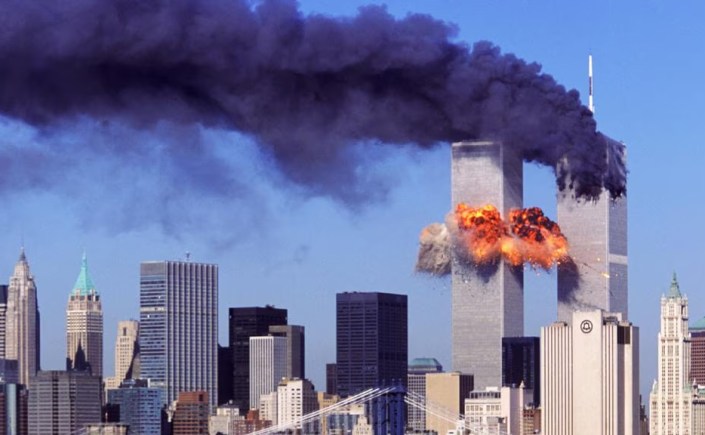
This dilemma was not posed by the deadliest terrorist attack in world history. On September 11, 2001, 19 foreigners flew commercial airliners into the centres of US economic and military power. The introversion of Bondi was spared the US after 9/11. It went to war abroad, in search of monsters to destroy. Australia does not have that option. The monsters are here.

But the US congress did call a 9/11 Commission. It remains the most accomplished public inquiry in US history. The clarity of its final report remains unmatched, a model for how a royal commission into the Bondi massacre might convey its findings.

The moral contortions of identity politics

The multicultural exception for Jews is perhaps the most glaring incongruity of our current moment. Because Jewish Australians are successful, they are often excluded from the protections of the left’s moral schema. They find themselves hated by the anti-Semitic right and demonised by a left that views Israel as a proxy for Western civilisation.

This intellectual anti-Semitism prevents us from indicting dogmas that are explicitly engineered against pluralism.

We end up in the absurdity of Queers for Palestine, a campaign group that speaks to the idiocies of a movement that defends jihadists that would throw its members from buildings. Since October 7, 2023, a minority of progressive Australians have determined to eliminate the only nation in the Middle East where LGBTQI+ rights can be exercised; Israel offers sanctuary to those fleeing Arab homophobia.

Queer pro-Palestine activists in Melbourne. Picture: Instagram

Queer pro-Palestine activists in Melbourne.  Instagram

Our public discourse is saturated in identity politics. Bondi highlights this without offering an obvious way to dry ourselves off.

The Prime Minister’s reticence over a royal commission is informed by the harm doctrine so fashionable within identity politics: that the public airing of the hatred that allegedly drove the Akrams would (Albanese said) “provide a platform for the worst voices” of anti-Semitism.

As several commentators have observed, this would be like calling off the Nuremberg trials for fear that Nazi race theory might get an airing, that its survivors would have to relive their trauma.

We cannot prosper post-Bondi with such a do-no-harm approach. If being kind – that banal corollary to so much of our public policy – is the solution, we need to be told how greater kindness and largesse towards the perpetrators of the massacre would have turned them into pliable multiculturalists.

Because we have lost our religious sensibilities – a secularisation championed by so many on the progressive left – we are increasingly denuded of a vocabulary needed to understand sectarian violence. Instead, we believe wrapping men like the Akrams in a fuzzy blanket of kindness will vanish away their tribal enmities.

Anti-Semitism is systemic

In the miserable days since Bondi, it is apparent how we have bifurcated into two distinct interpretations of its cause and meaning. This does not map precisely on to a left-right axis; the growing call for a royal commission is increasingly bipartisan.

One side seeks to move on by dismissing the Akrams as an aberration. Nothing to see here.

The other, whose members have been dismayed by the Australian anti-Semitism that has gone unchecked since Hamas raped and killed its way into and out of southern Israel, now fear something far more deep-seated and systemic in the copycat attack on eastern Sydney.

Traditionally, it has been that first camp that has found large causes in singular events. For a half-century, progressives have told us that curing racism and poverty would end crime. Conservatives demurred: better policing, fixing the broken windows, would deter deeper criminality.

As I observed last week, Bondi continues to prompt a diagnostic inversion: a progressive Labor government fixates on a narrow cause – guns and the access of two bad men to them – while its opponents seek answers in the broader culture, with which only a royal commission could begin to grapple.

Anti-Semitism is the oldest hatred. We need a better understanding of how its modern form has been refracted in the prism of soft multiculturalism and identity politics.

A royal commission is not guaranteed to do this. Ironically, using methodologies favoured by progressives – an appreciation for deep cultural causes – would help us grasp any connection between an intellectual phobia towards Israel and the Akrams’ violence against Jewish Australians.

Timothy J. Lynch is professor of American politics at the University of Melbourne

Standing on the high moral ground is hard work!

The most surprising thing about recent turmoil surrounding the Adelaide Writers Festival – its brief disinvitation of Australian Palestinian academic, author and activist Randa Abdel-Fattah, the rapid apology and reinstatement, the boycotts, denunciations, and counter-accusations – was these events generated so much newsprint, TV, radio, blogs, substacks, podcasts, memes and Facebook posts. It wasn’t because it’s summertime and the slow news weeks between Christmas and Australia Day. After all, there were some remarkable stories making their melancholy rounds: the Iranian bloodshed, Maduro kidnapping, Donald Trump’s Greenland fantasia … But this literary scandal held its own against all of these. 

 It was widely presented as yet another skirmish in the culture wars, a familiar clash between free speech and censorship, principle and power. But to read it that way is to miss what the episode actually illuminated. Beneath the noise lay a deeper unease about how cultural institutions confer legitimacy, how moral certainty now polices intellectual life, and how concepts such as freedom of speech, cancellation, and accountability have been stretched, moralised, and hollowed out by performative outrage. The Adelaide Writers’ Festival affair was not an aberration so much as a stress test – of institutional courage, historical understanding, and a cultural milieu increasingly unused to constraint, yet convinced of its own moral infallibility.

The brief removal of Randa Abdel-Fattah from the 2026 program – followed by an apology, a reinvitation, and institutional retreat – was framed almost instantly as a free-speech scandal, a cancellation, an act of racist silencing. In fact, it was something more revealing and more uncomfortable: a momentary hesitation by a cultural institution about whether platforming is neutral, and a swift lesson in how difficult it has become to impose even minimal constraints on those who speak in the language of moral certainty.

Cultural institutions do not merely host conversations; they legitimise them. To be invited onto a festival program is not simply to be given a microphone but to be publicly endorsed as a credible participant in civic discourse. That endorsement carries responsibilities, both for the institution and for those it platforms. One of them is to ensure that political critique does not slide into eliminationist moralism – particularly when that moralism operates in a social climate where anti-Jewish vilification is no longer theoretical but lived.

The reaction to the Adelaide Festival board’s initial decision was immediate and predictable. Abdel-Fattah accused the board of “stripping” her of humanity and agency. Fellow writers and cultural figures denounced the decision as betrayal, censorship, capitulation to dark forces. Boycotts were announced – 180 authors of all genres fled for the exits – solidarities declared, moral lines drawn. What was striking was not merely the ferocity of the response but its underlying assumption: that any boundary placed around speech—however provisional, however context-specific – was illegitimate by definition.

Their reaction demonstrates how unused some cultural actors have become to any constraint at all.

In fact, much of the subsequent withdrawal by authors – most of whom had never engaged with the specifics of Abdel-Fattah’s record or statements nor adopted a public stance with regard to one of the world’s most intractable conflicts – reflects a convergence of social, psychological, and institutional dynamics rather than principled assessment. This is tangentially corroborated by the ABC suggesting that many of its star presenters – including John Lyons, Laura Tingle and Louise Milligan – withdrew for various reasons and that actual support for Al Fattah was not one of them. However, Lyons has no love for the Israeli government and the occupation, and harbours an intense animus for “the Jewish Lobby” whilst Tingle strained credulity after December 7 when she stated that the atrocity was not Islamic terrorism.

A writer who did not pull out was Peter Goldsworthy, author, poet and general physician. He wrote in The Australian, 30 January 2026:

“Did I boycott this year’s event? Not a chance – too many writers, and too many audience members, and booksellers, had too much to lose. Again, I would have protested before my sessions, which is what I believe the other 180 writers might have been better off doing. I acknowledge they each made a big personal sacrifice, with honourable intentions, whether in the name of free speech, or solidarity with a colleague – and I know that many would have boycotted the 2024 event, too, if they had known that Friedman had effectively been cancelled. I also know that some of them, including several high-­profile names, felt an overwhelming social media pressure to withdraw – and now regret it”.

“Who could blame them?”, he asked. “The lynch mobs of social media are implacable. The Iranian-­Australian writer Shokoofeh Azar wrote in these pages of such pressures applied to her. A supporter of Palestinian rights but an opponent of Hamas, she received revolting threats because she refused to join the boycott. “You should be killed along with the Israelis,” one read.  I hope she is reinvited next year. I hope Abdel-Fattah accepts the invitation that has already been extended to her. I hope more Jewish writers are invited. I hope Tony Abbott is reinvited. And Thomas Friedman. And yes, I hope I am re­invited.”

In contemporary literary culture, silence is read as complicity, and once the loudest voices framed the decision as racist censorship, a moral script snapped into place. Authors who had no prior engagement with the issue were suddenly presented with a binary: signal solidarity or risk suspicion. Pulling out became reputational insurance, a way to declare moral correctness without actually examining the facts. In such moments, gesture substitutes for judgment; moral theatre displaces deliberation.

The same pattern was reinforced by what can only be described as delegated thinking under moral capture. Once a cause is deemed righteous, individuals stop asking what actually happened and start asking what someone like them is supposed to do. The fact that Abdel-Fattah had previously advocated silencing others – the so-called silencing of critics, journalists, and even Jewish voices – was largely irrelevant. The narrative did not permit contradiction. Nor did the historical record: Jewish creatives had been mass-doxxed, their identities and private lives circulated as punishment for wrong beliefs, while the same festival had previously cancelled Thomas Friedman, a liberal American Jewish columnist, without similar outcry. Nor was there much opposition to the ejection of Jewish singer and author Deborah Conway and her partner from the Australian cultural space. Conway wrote in today’s Australian of how in February 2024, “I was eventually apprised of a letter circulating that was demanding Perth Writers Festival drop me from its speakers schedule. Entitled “Perth Festival and Writing WA’s decision to platform Deborah Conway causes suffering for Palestinians: an open letter from Australian writers and artists”, the letter would eventually garner 500 signatures, including Abdel-Fattah’s. To Writing WA’s credit it stood by its decision to book me and tried to ameliorate the pitchfork squad by including more diverse authors in the program. That and a lot of security”.

There was also an element of low-cost virtue in the withdrawals of most of the festival’s invited guests. Pulling out of a festival is a small personal inconvenience but a large symbolic payoff: moral courage performed for peer applause, self-indulgence masquerading as ethical clarity. Complexity, nuance, and historical literacy are optional; alignment, visibility, and performative righteousness are not. Once momentum builds, hesitation or refusal appears as betrayal, and the act of withdrawal is transformed into a statement of principle rather than a reflection of principle.

This is not a defence of state censorship; it is a recognition of institutional reality. No one in this episode was silenced in any meaningful sense. No books were banned, no speech criminalised, no platforms eradicated. What was briefly withdrawn was a single form of institutional endorsement. To describe this as an assault on free speech is to inflate a contingent editorial judgment into a moral catastrophe – and to quietly assert that some voices are entitled to public platforms as a matter of right.

That inflation depends on a broader cultural habit: the conflation of consequence with persecution. “Cancellation” has become a moralised misdescription, collapsing everything from online criticism to contractual decisions into a single melodrama of victimhood. In environments shaped by moral capture, refusal is reimagined as violence, disagreement as erasure, and restraint as dehumanisation. Withdrawal is not reluctant; it is theatrical. Boycott becomes a badge of purity. Moral signalling replaces argument.

The substance of what is being defended matters here. Criticism of Israeli policy – severe, uncompromising, even angry criticism – is not antisemitic in itself. But there is a line between critique and negation, and it is a line that has increasingly been crossed with impunity. Anti-Zionism, in its eliminationist form, does not argue with Israel’s conduct; it denies Jewish collective existence altogether, treating the very fact of a Jewish state as uniquely criminal among the world’s nations.

This distinction is not merely theoretical. Abdel-Fattah’s public record – celebration of October 7, denial or inversion of Jewish suffering, rhetoric of irredeemability, chants of “intifada” involving children – pushes beyond critique into erasure. Language of liberation becomes language of elimination, moralised as justice. “Resistance by any means necessary” is not an analytical position; it is a slogan that sanitises violence while denying responsibility for its consequences.

Here historical illiteracy and political naivety quietly do their work. Concepts such as genocide, apartheid, and colonialism are deployed as totalising metaphors, severed from their historical specificity and redeployed as instruments of moral annihilation. The irony – that Holocaust inversion once central to Soviet anti-Zionism has been seamlessly absorbed into contemporary activist rhetoric – is rarely acknowledged. That this rhetoric positions Jews everywhere as implicated in an illegitimate state is treated not as a problem but as a feature.

All of this unfolds within a broader climate of intimidation and fear. Jewish creatives have been mass-doxxed, their personal details circulated as punishment for wrong beliefs. Jewish students and artists conceal their identities. Synagogues are attacked. And yet, when institutions attempt – tentatively – to draw lines around eliminationist speech, they are accused of racism and cowardice. The harm that prompts boundary-setting is rendered invisible, while the discomfort of those encountering limits is elevated into moral injury.

The inconsistency is instructive. The same Adelaide Writers Festival that briefly balked at hosting Abdel-Fattah had no difficulty cancelling Thomas Friedman, a liberal American Jewish columnist, without comparable anguish or apology. Standing on the high moral ground is evidently easier when the cancellation flows in the culturally approved direction. Accountability, it seems, is only intolerable when it is applied to one’s own side.

This is where freedom of speech, cancellation, and intellectual honesty must be rescued from their rhetorical misuse. Freedom of speech protects expression from coercive suppression; it does not guarantee institutional endorsement. Cancellation is not a synonym for criticism or refusal; it is a narrative deployed to short-circuit scrutiny. And intellectual honesty requires more than fervour – it demands a willingness to distinguish critique from negation, to acknowledge historical complexity, and to accept that one’s own moral universe may contain blind spots.

What the Adelaide affair ultimately exposes is not a failure of liberalism but the strain placed upon it by cultures of moral purity and value signalling. In such cultures, self-indulgence masquerades as courage, self-importance as solidarity, and certainty as virtue. Institutions are pressured to choose between complicity and chaos, knowing that any attempt to impose standards will be met with outrage.

Had the Adelaide Festival held its ground, the resulting mess would not have been a tragedy but a clarification. It would have affirmed that legitimacy is not cost-free, that language has consequences, and that standing on the right side of history requires more than shouting one’s righteousness into the void. If accountability is uncomfortable – if it disrupts festivals, friendships, and reputations – that may be precisely the point.

The alternative is not harmony but habituation: a slow acclimatisation to eliminationist rhetoric wrapped in the language of justice, and an intellectual culture so unused to constraint that it mistakes every limit for oppression. In that light, the mess is not a sign of failure. It is the sound of a moral ecosystem being tested – and, however briefly, resisting capture.

To step back from the drama, the Adelaide affair is less a story about one author or one festival than a mirror held up to the cultural field itself. It reveals how easily moral certainty can ossify into capture, how virtue signalling can masquerade as courage, and how intellectual honesty can be sacrificed to the allure of alignment and applause.

Institutions, in turn, are forced into an ethical calculus: to platform freely is to risk complicity; to refuse is to provoke outrage. Standing on the high moral ground – truly standing, not merely performing – is therefore hard, uncomfortable, and rarely rewarded. Yet that difficulty is precisely its value. If accountability requires a mess, a moment of collective awkwardness and public testing, then enduring it may be the only way to cultivate a cultural ecosystem in which words are not cost-free, principles are not performative, and freedom of speech coexists with responsibility. In other words, the test of courage is not in the applause it earns, but in the restraint, discernment, and historical awareness it demands.

In That Howling Infinite December 2025

Author’s Note…

This opinion piece is one of several on the the attitudes of progressives towards the Israel, Palestine and the Gaza war. The first is Moral capture, conditional empathy and the failure of shock

There are moments when public argument stops being a search for truth and becomes a test of belonging. Facts are no longer weighed so much as auditioned; empathy is rationed; moral language hardens into a badge system, issued and revoked according to rules everyone seems to know but few are willing to articulate. One learns quickly where the trip-wires are, which sympathies are permitted, which questions are suspect, and how easily tone can outweigh substance.

What interests me here is not the quarrel itself – names, borders, histories—but the habits of mind it exposes. The ease with which conviction can slide into choreography. The way intellectual honesty is praised in the abstract and punished in practice. The curious transformation of empathy from a human reflex into a conditional licence, granted only after the correct declarations have been made.

Across these pieces I circle the same uneasy terrain: the shaping of facts to fit feelings; the capture of moral language by ideological gravity; the performance of righteousness as both shield and weapon. Cultural spaces that once prided themselves on curiosity begin to resemble courts, where innocence and guilt are presumed in advance and the labour lies not in thinking, but in signalling.

This is not an argument against passion, nor a plea for bloodless neutrality. It is, rather, a meditation on how quickly moral seriousness curdles into moral certainty – and how much intellectual work is required to stand on what we like to call the high ground without mistaking altitude for clarity.

The position of In That Howling Infinite with regard to Palestine, israel and the Gaza war is neither declarative nor devotional; it is diagnostic. Inclined – by background, sensibility, and experience – to hold multiple truths in tension, to see, as the song has it, the whole of the moon. It is less interested in arriving at purity than in resisting moral monoculture and the consolations of certainty. That disposition does not claim wisdom; it claims only a refusal to outsource judgment or to accept unanimity as a proxy for truth.

On Zionism, it treats it not as a slogan but as a historical fact with moral weight: the assertion – hard-won, contingent, imperfect – that Jews are entitled to collective political existence on the same terms as other peoples. According to this definition, this blog is Zionist. It is not interested in laundering Israeli policy, still less in romanticising state power, but rejects the sleight of hand by which Israel’s existence is transformed from a political reality into a metaphysical crime. Zionism is not sacred, but its delegitimisation is revealing – because it demands from Jews what is demanded of no other nation: justification for being.

On anti-Zionism, it has been unsparing. It sees it not as “criticism of Israel” (which you regard as both legitimate and necessary) but as a categorical refusal to accept Jewish collective self-determination. What troubles it most is not its anger but its certainty: its moral absolutism, its indifference to history, its willingness to borrow the language of justice to license erasure. It is attentive to how anti-Zionism recycles older antisemitic patterns – collectivisation of guilt, inversion of victimhood, and the portrayal of Jews as uniquely malignant actors – while insisting, with studied innocence, that none of this concerns Jews at all. If not outright antisemitism, the line separating it from anti-Zionism is wafer—thin, and too often crosses over. 

The interest in moral capture is analytical rather than accusatory. It is not arguing that writers, academics, or institutions are malicious; rather, it are argues that they have become intellectually narrowed by the desire to belong to the “right side of history.” Moral capture explains how good intentions curdle into dogma, how solidarity becomes performative, and how the fear of social exile replaces the discipline of thought. It accounts for the strange phenomenon whereby intelligent people outsource their moral judgment to slogans, and experience constraint not as an intolerable injury to the self.

The Adelaide Writers’ Festival affairis seen not primarily about Randa Abdel-Fattah, nor even about free speech. It is a case study in institutional failure and cultural self-deception. The mass withdrawals are viewed not as acts of courage or principle but as gestures of affiliation – ritualised displays of virtue by people largely untouched by the substance of the dispute. What is disturbing is the asymmetry: the speed with which a festival collapsed to defend eliminationist rhetoric, and the silence that greeted the doxxing, intimidation, and quiet cancellation of Jewish writers and artists. Adelaide did not fall because standards were enforced, but because those standards were applied selectively and then disowned at the first sign of reputational discomfort.

Running through all of this is a consistent stance: a resistance to moral theatre, an impatience with historical amnesia, and a belief that intellectual honesty requires limits – on language, on fantasy, and on the indulgent belief that one’s own righteousness exempts one from consequence.

We are not asking culture to choose sides; you are asking it to recover judgment

.See in In That Howling Infinite, A Political World – Thoughts and Themes, and A Middle East Miscellany. and also: This Is What It Looks LikeYou want it darker?” … Gaza and the devil that never went away … , How the jihadi tail wags the leftist dog, The Shoah and America’s Shame – Ken Burns’ sorrowful masterpiece, and Little Sir Hugh – Old England’s Jewish Question


Feints, refrains and unfinished business. 2025 in review

And we are here as on a darkling plain
Swept with confused alarms of struggle and flight,
Where ignorant armies clash by night.
Mathew Arnold, Dover Beach

We called 2024 a “year of everything, everywhere, all at once”, and it earned the name. Crises collided, news arrived faster than we could process it, and the world seemed to exist in a state of constant shock. 2025 did not bring relief. Instead, the chaos began to settle. Wars dragged on, political divides hardened, social tensions deepened, and technology reshaped how we saw and understood it all.

It was the year the world stopped exploding in real time and started being what it had already become: messy, uneven, morally complicated, and stubbornly persistent. A year, indeed, in a world of echoes, refrains and unfinished business. And we spent the year watching power bargain brazenly in plain sight, trying to describe what was happening while it unfolded around us.

From Gaza to Ukraine, Sudan to Syria, from America’s self-inflicted fracture to Australia’s sudden wake-up call on Bondi Bondi, 2025 forced a reckoning: the world did not pause, but it did sort itself – deciding what we would notice, what we would ignore, and what we would learn to live with. Alongside human crises came the continuing advance of AI and chatbots, and the dominion of the algorithms that now govern attention, proving that disruption can be structural as well as geopolitical.

Gaza: War, Then “Ceasefire”

The war in Gaza dominated the year internationally and here in Australia, even as attention ebbed and flowed. Military operations continued for months, followed eventually by a “ceasefire” – a word doing far more work than it should or even justified. Fighting paused, hostages living and dead were returned and prisoners released, but the devastation remained: tens of thousands dead, cities demolished, humanitarian catastrophe unresolved. And the causes of the consequences standing still amidst the ruins and the rubble.

Western governments continued to back Israel while expressing concern for civilians, a contradiction that grew harder to defend, while street protests and online anger seethed all across the world. At the same time, antisemitism surged globally, often hiding behind the language of anti-Zionism. Two realities existed together, and too many people insisted on choosing only one.

By the end of the year, the war had not been resolved – merely frozen. Trust in Western moral leadership had been badly damaged, and Israelis and Palestinians remain in bitter limbo.

See Gaza sunrise or false dawn? Spectacle or Strategy

Iran, Israel and America’s bunker busters

Long-simmering tensions between Israel and Iran spilled into open conflict. What had once been indirect – proxies, cyberattacks, covert strikes – became visible. A brief but destructive war of missile exchanges ended with the United States asserting ordinance, deterrence and control.

The episode was brief but telling. It showed that America still reaches for its guns quickly, even as it struggles to define long-term goals. Another line was crossed, then quickly absorbed into the background of “normal” geopolitics.

Russia, Ukraine and Trump’s “Peace”

Ukraine entered 2025 mired in stalemate. Front lines barely moved. Casualties continued to mount. Western support held, but with clear signs of fatigue. And Donald Trump’s re-emergence reshaped the conversation. His promise to deliver instant “peace” reframed the war not as a question of justice or sovereignty, but of exhaustion. Peace was no longer about what Ukraine deserved, but about what the world was tired of sustaining and what the “art of the deal” could deliver.

The war didn’t end. It simply became something many wanted to stop thinking about. Not Ukraine and Russia, but. The carnage continues.

Donald Trump’s one-way crush on Vladimir gave us the one of the+most cringeworthy moments in global politics – Trump greeting the Russian president in Alaska: As the US president rolled out the red carpet for the world’s most dangerous autocrat, Russia’s attack on Ukraine accelerated. Trump got precisely nothing out of the meeting, except for the chance to hang out with a gangster he so obviously admires and of whom he is embarrassingly in awe.

Syria: Free, but stranded at the crossroads

A year after Assad’s fall, Syria remained unstable and unresolved. The regime was gone, but the future was unclear. Old sectarian tensions resurfaced, often in bloodshed, new power struggles emerged, powerful neighbours staked claims and  justice for past crimes remained distant.

Syria in 2025 was neither a success story nor a collapse – but suspended between heaven and hell, a country trying to exist after catastrophe with the rest of the world largely moving on.

See Between heaven and hell … Syria at the Crossroads

Women in Damascus celebrate the fall of the Assad regime

Sudan: what genocide actually looks like

Sudan’s civil war continued with little international attention. Mass killing, ethnic cleansing, famine, and displacement unfolded slowly and relentlessly. This was genocide without spectacle. No clear narrative. No sustained outrage. It showed how mass atrocity can now occur not in secrecy, but in plain sight – and still be ignored.

see The most nihilistic war ever …Sudan’s waking nightmare

America: a country divided against itself

The United States spent 2025 deeply divided, with no sign of healing. Pew Research polling showed that seven out of ten republicans think that the opposite side is immoral while six of ten democrats thinks the same of their rivals.

Trump’s return to power sharpened those divisions. His administration governed aggressively: mass deportations, punitive tariffs, the dismantling of foreign aid, political retribution, and pressure on democratic institutions. The country looked inward and outward at the same time – less cooperative, more transactional, more openly nationalist. Democratic norms eroded not overnight, but through constant stress and disregard. With three years still to run and the tell-tale midterms approaching, allies and cronies are adjusting, bickering rivals are taking notes, and uncertainty has become the defining feature of American leadership. Meanwhile, #47 is slapping his name on everything he can christen, from bitcoins to battleships.

See, for light relief, Danger Angel … the ballad of Laura Loomer 

Monroe Redux: the return of “the Ugly American”

US foreign policy took on a blunt, old-fashioned tone. Pressure on Canada and Mexico increased. Talk of annexing Greenland resurfaced. Venezuela, caught in the maw of Yanqui bullying and bluster, waits nervously for Washington’s next move. The administration promised imminent land operations – and then bombed Nigeria! The revival of the old Monroe Doctrine felt, as baseball wizz Yogi Berra once remarked, like déjà vu all over again, not as strategy, but as instinct. Influence asserted, consultation discarded. The “ugly American” was back, and unapologetic.

See Tales of Yankee power … Why Venezuela, and why now?

Europe at a inflection point

Europe in 2025 didn’t collapse, as many pundits suggested it might, but it shifted. Far-right ideas gained ground even where far-right parties didn’t win and remained, for now, on the fringes albeit closer to electoral success. Borders tightened; policies hardened; street protests proliferated – against immigration and against Israel, Support for Ukraine continued, but cautiously. The continent stood at a crossroads: still committed to liberal values in theory, but increasingly selective in practice.

Uncle Sam’s  cold-shoulder

Rumbling away in the background throughout year was the quiet but  cumulative alienation of America’s allies. Not with a single rupture, but through a thousand small slights. transactional diplomacy dressed up as realism, alliances treated as invoices rather than covenants, multilateralism dismissed as weakness. Europe learned that security guarantees come with a mood swing; the Middle East heard policy announced via spectacle; Asia watched reassurance coexist uneasily with unpredictability.

The new dispensation was illustrated by the Trump National Security Strategy. It is at once candid and contradictory: it outlines a narrower, realist vision of American interests, emphasising sovereignty, burden-sharing, industrial renewal, and strategic clarity, yet it is riddled with silences, evasions, and tensions between rhetoric and likely action. Allies are scolded for weakness while the document avoids naming Russia’s aggression, underplays China, and projects American cultural anxieties onto Europe. These contradictions expose both strategic incoherence and the limits of paper doctrine against presidential temperament, leaving Europe facing an irreversible rupture in trust and revealing a strategy as much about America’s insecurities as its actual global posture.

The post-WW2 order has not so much been dismantled as shrugged at, and indeed, shrugged off. Trust eroded not because the United States has withdrawn from the world, but because it has remained present without being reliable, and presumed itself to be in charge. Power, exercised loudly but inconsistently, has discovered an old truth: allies can endure disagreement, but they struggle with contempt.

Australia in 2025 … high flight and crash landing

Though beset by a multitude of crises – the cost of living, housing, health and education services – the Albanese Labor government was returned comfortably in May, helped by a divided, incoherent, and seemingly out of touch opposition. For the rest the year, federal politics felt strangely frictionless with policy drift passing for stability. The Coalition remained locked in internal conflict, unable to present a credible alternative. The Greens, chastened by electoral defeat and in many formerly friendly quarters, ideological disillusionment, treaded water.

But beneath the surface, social cohesion frayed. Immigration debates sharpened. Antisemitism rose noticeably, no longer something Australians could pretend belonged elsewhere. Attacks on Jewish Australians forced a reckoning many had avoided and hoped would resolve once the tremors of the war in Gaza had ameliorated. Until 6.47pm on 7th December, a beautiful evening on Sydney’s iconic Bondi Beach. Sudden, brutal and in our summer playground, sectarian violence shattered the sense of distance Australians often feel from global disorder. At that moment, politics stopped feeling abstract. The world, with all its instability, barged in and brought the country down to earth.

See This Is What It Looks Like

Lifesavers on Bondi Beach, 20 December 2025. Edwina Pickles

Featured photograph and above:

A handful of bodies on Bondi Beach, and behind them, the howling infinite of expectation, obligation, and the careful rationing of human empathy. The smallness of the beach against the vastness of consequences. On December 20, 2025, Bondi’s iconic lifesavers formed a line stretching the entire length of the beach -silent, solemn, a nation visibly in mourning. Similar tributes unfolded from Perth to Byron Bay, gestures of unity in the face of a shock that touched the whole country.

The Year of the Chatbot: Promise, Power, and Risk

And now, a break from the doom and gloom …

2025 was the year when artificial intelligence became part of daily life. Chatbots ceased to be experimental and became integral, transforming from novelty to utility seemingly overnight. People used it to write, research, translate, plan, argue, comfort, and persuade; institutions and individuals adopted it instinctively. Setting tone as much as content, the ‘bots have lowered barriers to knowledge, sharpened thinking, and helped people articulate ideas they might otherwise struggle to express. Used well, they amplified curiosity rather than replace it.

The opportunities are obvious – but so are the risks. Systems that can clarify complexity can also flatten it. Chatbots sound confident even when wrong, smooth over disagreement, and made language cleaner, calmer, and more persuasive – but not necessarily truer. They reinforce confirmation bias, outrage, and tribal certainty, generating arguments instantly and flooding the zone with plausible-sounding text. As information has became faster, cheaper, and less reliable, Certainty has spread more easily than truth, so truth has to work much harder.

Dependence is subtler but real. Outsourcing thinking – summaries instead of reading, answers instead of wrestling – did not make humans stupid, but less patient. Nuance, doubt, and slow understanding became harder to justify in a world optimised for speed. Yet conversely, man people still seek context, history, and complexity. Used deliberately, AI could slow the pace, map contradictions, and hold multiple truths at once.

By the end of 2025, the question was no longer whether AI would shape public life – it already had. The real question is whether humans would use it as a shortcut, or as a discipline. The technology is neutral. The danger – and the promise – lies in how much thinking we are willing to give up, and how much responsibility we are prepared to keep.

See The promise and the peril of ChatGPT 

Algorithm and blues

Alongside the chatbot sat a quieter, more insidious force: the algorithm itself. By 2025 it no longer simply organised information – it governed attention. What people saw, felt, and argued about was shaped less by importance than by engagement. To borrow from 20th century philosopher and communication theorist and educator Marshall McLuhan, the meme had become the message. Complex realities were compressed into images, slogans, clips, and talking points designed not to inform but to travel. The algorithm rewarded speed over reflection, certainty over doubt, heat over light. Politics, war, and grief were all flattened into content, stripped of context, and ranked by performance. What mattered most was not what was true or necessary, but what disseminated.

Passion without Wisdom

I wrote during the year that we seemed “full of passionate intensity” – Yeats’ phrase still apt in the twenty first century- but increasingly short on wisdom and insight. 2025 confirmed it. Anger was everywhere, empathy highly selective, certainty worn like armour. People felt deeply but thought narrowly. Moral energy surged but rarely slowed into understanding. The problem was not indifference; it was excess – too much feeling, too little reflection. In that environment, nuance looked like weakness and patience like complicity. What was missing was not information, but judgement – the harder work of holding contradiction, of resisting instant conclusions, of allowing complexity to temper conviction. Passion was abundant. Insight, increasingly rare.

Looking Toward 2026

Looking back on 2025, it seems that there  were no endings, neither happy or sad. Just a promise, it seems, of more of the same. The year didn’t solve anything. It clarified things. And if it clarified anything, it was that the world has grown adept at managing, ignoring, or absorbing what it cannot fix. It revealed a world adjusting to permanent instability. In this year of echoes, refrains, and unfinished sentences.

Passion, intensity, and outrage were abundant, but patience, wisdom, and insight remained scarce. Democracies strained under internal and external pressures. Wars lingered unresolved. Technology reshaped thought and attention.

Some argue that hope springs eternal, that yet, even amid the drift and the fractures, glimpses of understanding and resistance persisted, that although the world has settled into its chaos, we can be riders on the storm. But, I fear, 2026 arrives not as break, a failsafe, a safety valve, but as continuation. It looms as a test of endurance rather than transformation.  In my somnolent frame of mind, I’ve reached again for my Yeats. “Things fall apart; the centre cannot hold; mere anarchy is loosed upon the world, the blood-dimmed tide is loosed …”

After the chaos of 2024 and the hardening of 2025, the question is no longer what might go wrong. It’s what we’re prepared to live with.

And so we come to what In That Howling Infinite wrote in 2025.

What we wrote in 2025

It was a year that refused neat endings.

It began in a wasteland – Gaza as moral ground zero – and moved, restlessly, through revolutions real and imagined: Trump as symptom and accelerant, Putin as a man racing his own shadow, Syria forever at the crossroads where history idles and then accelerates without warning. Gaza returned, again and again, sunrise and false dawn, as spectacle and strategy; Sudan burned in near silence; Venezuela re-entered the frame as empire’s backyard as the US disinterred its Monrovian legacy. In That Howling Infinite featured pieces on each of these – several in many cases , twenty in all, plus a few of relevance to them, including an overview of journalist Robert Fisk’s last book (The Night of Power – Robert Fisk’s bitter epilogue). A broadranging historical piece written in the previous year and deferred, Modern history is built upon exodus and displacement, provided a corrective of sorts to the distorted narratives that have emerged in recent years due to a dearth of historical knowledge and the partisan weaponisation of words. 

It was almost as light relief that we turned to other subjects. Of particular interest was AI. Approaching remorselessly yet almost unrecognised in recent years, it banged a loud gong and crept from curiosity to condition, from tool to weather system, quietly rewriting the newsroom, the internet, and the idea of authorship. ChatGPT and other chatbots appeared not as saviours but as promise and peril in equal measure. By year end, we were fretting about using ChatGPT too much and regarding it as something to moderate like alcohol or fatty foods. We published three pieces on the subject in what seemed like rapid succession, and then pestered out – sucked into the machinery, I fear.

What with so much else attracting our attention, we nevertheless managed to find time for some history – including a  particularly enthralling and indeed iconoclastic book on the fall of the Ottoman Empire; the story of an Anzac brigade lost in Greece in 1942; “the Lucky Country” revisited after half a century;  and a piece long in the pipeline on the iconic singer and activist Paul Robeson.

In August, as on a whim, for light relief, we summoned up a nostalgic old Seekers’ song from the mid-sixties, a time when the world was on fire with war and rage much as it is today, but for us young folk back in the day, a time of hope and hedonism. For us, the carnival, clearly, is not over. The machinery is still whirring, the music still loud, and the lights still on. History is insisting on one more turn of the wheel, and the dawn, so often promised, so frequently invoked, has not yet broken.

January
The Gaza War … there are no winners in a wasteland
The way we were … reevaluating the Lucky Country

February
Let’s turn Gaza into Mar e Largo
Trump’s Second Coming … the new American Revolution
Cold Wind in Damascus … Syria at the crossroads

March
Trumps Revolution… he can destroy but he cannot create
Where have all the big books gone?
Putin’s War … an ageing autocrat seeks his place in history

April
The Trump Revolution … I run the country and the world
The Fall of the Ottoman Empire and the birth of Türkiye
Let Stalk Strine .. a lexicon of Australian as it was spoken (maybe)

May
The phantom of liberty … the paradoxes of conservativism
Shadows in search of a name … requiem for a war
The continuing battle for Australia’s history

July
A mighty voice … the odyssey of Paul Robeson

August
109 years of Mein Kampf … the book that ravaged a continent
High above the dawn is breaking … the unlikely origin of a poo song

September
Gaza sunrise or false dawn? Trump’s peace plan
Gaza sunrise or false dawn? Spectacle or Strategy
Will there ever be a Palestinian state?
Why Osana bin lost the battle but won the war
The Night of Power … Robert Fisks bitter epilogue
The promise and peril of ChatGPT
Who wrote this? The newsroom’s AI dilemma

October
AI and the future of the internet
Danger Angel … the ballad of Laura Loomer

November
A forgotten Anzac story in Greece’s bloody history
The most nihilistic war ever … Sudan’s waking nightmare
Answering the call … National Service in Britain 1945-1963
Tales of Yankee Power … at play in Americas backyard

December
Delo Kirova – the Kirov Case … a Soviet murder mystery
Between heaven and hell … Syria at the crossroads
This Is What It Looks Like
Tales of Yankee power … Why Venezuela, and why now?
Marco Rubio’s Venezuelan bargain

Read out reviews of prior years:

That was the year that was – retrospectives

A song for 2026: Lost love at world’s end …

It is our custom to conclude our annual wrap with a particular song that caught our attention during the year. Last year, we chose Tears for Fears’ Mad World.  It would be quite appropriate for 2025. But no repeats! so here is something very different. An outwardly melancholy song that is, in the most ineffable way quite uplifting. that’s what we reckon, anyway …

The Ticket Taker is on the surface a love song for the apocalypse; and it’s it’s one of the prettiest, most lyrically interesting songs I’ve heard in a long while. I could almost hear late-period Leonard Cohen and his choir of angels.

The apocalypse is both backdrop and metaphor. We’re not sure which. Is it really about a world ending, or just about the private ruin of a man left behind by love and fortune. The lyrics are opaque enough to evade final meaning, but resonant enough to keep circling back, like the ferry itself, between hope and futility. A love song, yes, but also a confession of entrapment: the gambler’s hope, the ark one cannot board.

The “Ticket Taker” song was written by Ben Miller and Jeff Prystowsky and is featured on The Low Anthem’s album Oh My God, Charlie Darwin. It features on Robert Plant’s latest foray into roots music – this time with English band Saving Grace. This flawless duet with Suzi Dian is mesmerising and magical.

Jeff will tell you that the song is “pure fiction,” that Ben “just made it up one day” – but fiction, as we know, has a way of smuggling deeper truths than fact dares admit.

Tonight’s the night when the waters rise
You’re groping in the dark
The ticket takers count the men who can afford the ark
The ticket takers will not board, for the ticket takers are tied
For five and change an hour, they will count the passers-by

They say the sky’s the limit, but the sky’s about to fall
Down come all them record books, cradle and all
They say before he bit it that the boxer felt no pain
But somewhere there’s a gambling man with a ticket in the rain

Mary Anne, I know I’m a long shot
But Mary Anne, what else have you got?
I am a ticket taker, many tickets have I torn
And I will be your ark, we will float above the storm

Many years have passed in this river town, I’ve sailed through many traps
I keep a stock of weapons should society collapse
I keep a stock of ammo, one of oil, and one of gold
I keep a place for Mary Anne, soon she will come home

Mary Anne, I know I’m a long shot
But Mary Anne, what else have you got?
I am a ticket taker, many tickets have I torn
And I will be your ark, we will float above the storm

Mary Anne, I know I’m a long shot
But Mary Anne, what else have you got?
I am a ticket taker, many tickets have I torn
And I will be your ark

Gaza Sunrise or False Dawn?(2) … spectacle or strategy?

Trump’s Gaza Peace Plan: Spectacle, Strategy, and the Limits of Diplomacy

In late September 2025, US President Donald Trump unveiled a sweeping 20‑point peace plan for Gaza, accompanied by the familiar trappings of performance: the East Room of the White House, cameras flashing, a florid declaration of “eternal peace in the Middle East,” and a newly anointed “Board of Peace” with Trump as chair and Tony Blair as his deputy. On paper, the plan promises ceasefire, reconstruction, hostage releases, demilitarization, a staged Israeli withdrawal, and a technocratic administration in Gaza overseen by an international board. In practice, it reads as equal parts showmanship, improvisation, and coercive diplomacy, an audacious gambit with enormous potential benefits and equally enormous pitfalls.

For the Trump administration, the plan is a chance to rewrite the narrative: to isolate Hamas, reassert US influence in the Gulf, forestall further annexation of the West Bank, and offer Netanyahu a politically palatable off‑ramp from the brutal two‑year campaign in Gaza. For the international community — including the Arab Gulf states, Qatar, Jordan, Turkey, and Indonesia — it presents an opportunity to participate in a stabilizing initiative and to demonstrate relevance after years of watching humanitarian crises unfold from the sidelines. Yet beneath the pageantry lie structural asymmetries, enormous trust deficits, and profound omissions, particularly the conspicuous absence of the Palestinians themselves from meaningful negotiation.

In That Howling Infinite reserves its opinion in these early days. It’s the only show in town right now and it is generating interest and potential commitment by all those parties who would have to make it happen. There are already dissenting voices on all sides – the pro-Palestinian “progressive” left have been predictably dismissive  of what is indeed an imposed solution to an intractable problem – although it would appear that there are many cooks in the kitchen other than Donald Trump and Binyamin Netanyahu. Some have even condemned it for its demand that Hamas, the instigator of the war, to surrender unconditionally. But at the end of the day, they have little to offer except more war and vitriol. You don’t use gasoline to put out a fire. The reality is that the parties that can make this happen, including providing the proposed security forces and the resources to rebuild the devastated enclave and rehouse and rehabilitate its homeless and harrowed people, appear at this stage to have signed on. Early days, but, to  borrow from J Lennon, “all we are saying is give peace a chance”.

Read part 1 here: Gaza sunrise or false dawn? Trump’s 20 point peace plan

Also, in In That Howling Infinite, see A Short History of the Rise and Fall of the West and A Middle East Miscellany

[The following analysis is the outcome of a conversation and collaboration between In That Howling Infinite and ChatGPT.

Screenshot

Mechanics of the Plan

The plan’s framework is deceptively simple:

  1. Immediate Ceasefire and Hostage Exchange: Hamas must release all remaining Israeli hostages, alive or dead, within 72 hours. In return, Israel promises a staged withdrawal to a security perimeter.
  2. Prisoner Release and Amnesty: Israel would release approximately 2,000 Palestinian prisoners, including those detained after the October 2023 attacks. Hamas fighters willing to renounce violence could gain amnesty; those choosing exile would receive safe passage.
  3. Board of Peace and Reconstruction: A transitional authority, the so-called Board of Peace, would oversee governance and reconstruction, with Trump as chair and Blair as deputy. Aid delivery, infrastructure rebuilding, and the restoration of hospitals, water, electricity, and sewage would be managed under this international technocratic oversight.
  4. International Stabilization Force (ISF): Western and Arab troops would replace Israeli forces in Gaza, ensuring security during reconstruction and the reestablishment of governance. The exact composition and mandate remain undefined, a critical gap given the operational risks.
  5. Pathway to Palestinian Statehood: A vague promise of “conditions for self-determination” exists, contingent on PA reform, reconciliation between Gaza and the West Bank, and adherence to technocratic administration under international oversight.

On paper, it is a plan that offers incentives to every major party: Hamas faces conditional amnesty; Israel gains hostages, de-escalation, and security assurances; the Gulf states gain influence; and the PA is positioned to regain a governance role in Gaza. It is, in principle, a diplomatic masterstroke — if it can be implemented.

Gaps, Omissions, and Absurdities

Yet the devil — and much of the comedy — lies in the details not addressed:

Hamas Exclusion: The central conflict party, Hamas, was neither consulted nor invited. Trump openly admitted, “I have not dealt with them,” and proposed outsourcing the group’s compliance to Arab and Muslim mediators. The result is a coercive ultimatum dressed as a peace initiative: accept the terms or face complete annihilation with US backing.

Palestinian Agency Ignored: The two million Gazans whose lives are at stake had no seat at the table. Aid, reconstruction, and governance are treated as top-down deliverables, with no credible mechanism for local input. Gaza becomes a theatre set, not a living society.

Unclear Implementation: The ISF, Board of Peace, and PA reform mechanisms are vaguely defined. Who will command the stabilization troops? How will the PA be reformed to earn legitimacy in Gaza? What safeguards prevent reconstruction materials from being diverted to military purposes? These questions are unanswered, leaving enormous operational and political gaps.

West Bank Neglected: Despite daily settler-Palestinian clashes, the plan offers almost no operational framework for the West Bank. New settlements, such as the E1 project, threaten to fracture any contiguous Palestinian state. The plan’s silence on this is a glaring omission.

Asymmetry and Risk: The plan favors Israel far more than Hamas. The militant group is asked to surrender hostages and arms simultaneously, a leap of faith in a context of zero trust. The amnesty offer is conditional and uncertain; refusal triggers an existential threat. Israel, by contrast, faces comparatively modest obligations, particularly given the indefinite “security perimeter” it maintains.

Domestic Israeli Politics: Netanyahu’s right-wing cabinet, notably Bezalel Smotrich and Itamar Ben-Gvir, remain uncompromisingly hawkish. Trump’s backing gives Netanyahu room to sell the plan domestically, but hardliners could sabotage implementation, and prior experience demonstrates Netanyahu’s readiness to resume military operations when politically expedient.

Performance Over Policy: The East Room spectacle was classic Trump: a reality-TV cadence applied to diplomacy. Grandiose claims of “eternal peace,” self-anointment, photo ops with global leaders, and theatrical references to “the ocean” Israel ceded in 2005 illustrate a plan heavy on optics and light on enforceable substance.

International Reception

The plan has drawn broad, if cautious, support:

  • Arab and Muslim States: Qatar, Jordan, UAE, Saudi Arabia, Indonesia, and Turkey issued a joint endorsement emphasizing aid delivery, hostages, non-displacement, and the integration of Gaza with the West Bank under a Palestinian state framework.
  • Europe: Macron and Starmer endorsed the effort to secure hostages and reduce conflict.
  • Australia: Prime Minister Anthony Albanese welcomed the initiative as a constructive step, while opposition figures criticized Canberra’s earlier symbolic recognition of Palestinian statehood as performative and irrelevant.

Yet these endorsements are conditional and aspirational, recognizing the plan’s promise without committing to enforcement.

Perspectives of Israelis, Palestinians, and Activists

Israeli Public: Polls indicate two-thirds of Israelis want the war to end. The hostage release and cessation of bombardment offer tangible relief. Hardline right-wing factions, however, may resist compromises that limit continued Israeli military prerogatives. Indeed, the far-right, whose ethnic cleansing designs are explicit and who have driven so much of Netanyahu’s prosecution of this war appear to hate Trump’s plan: “a tragedy of leadership” and “an act of wilful blindness” in the phrase of Finance Minister Bezalel Smotrich.

Palestinians: Exhausted by years of blockade and bombardment, Gazans desire immediate relief. But the lack of agency and the conditional, externally imposed nature of governance and reconstruction make the plan potentially resented as foreign administration rather than liberation.

Progressives and Activists: Pro-Palestinian advocates will likely view the plan skeptically. While it promises aid and reconstruction, it circumvents local agency, substitutes technocratic administration for democratic governance, and leaves Palestinian sovereignty largely aspirational. International human rights groups will monitor for coercion, displacement, and military overreach.

Political Theatre

The plan is an exercise in spectacle: Trump as self-styled savior, Netanyahu as pliant yet menacing partner, Palestinians and Hamas as props off-stage. The terminology — “Board of Peace,” “International Stabilisation Force,” “demilitarization” — evokes bureaucracy rather than genuine power-sharing. It is as much a political theatre as a policy framework, designed to satisfy domestic and international optics. In that sense, it is both brilliant and cynical: brilliant in its choreography of alliances and threats; cynical in its disregard for the lived realities of Gaza’s population.

Promise and Peril

Trump’s plan is audacious. It isolates Hamas, engages Gulf wealth, nudges Netanyahu toward tactical concessions, and offers a narrow window for reconstruction and peace. Yet structural asymmetries, zero trust, vague operational mechanisms, potential sabotage from hardliners, and the absence of Palestinian agency render it precarious.

If Hamas accepts, the plan could relieve immediate humanitarian crises, return hostages, and establish a technocratic administration capable of rebuilding Gaza — a diplomatic triumph in a region long starved of them. If it fails, it will cement perceptions of American theatre in place of effective policy, leaving Gaza’s suffering unresolved and occupation repackaged as transition.

And if Hamas actually accepts, and the plan moves ahead, what would happen if, having received the hostages, Israel simply decided to remain in Gaza, or refused to return Palestinian prisoners. Given how Netanyahu’s political survival depends on his far-right coalition partners, and given how clearly those partners want the war to continue and Israel to remain in Gaza, this is not remotely a fanciful scenario. And if it transpired, who aside from Trump could do anything about it? Netanyahu highlighted this feature of the plan for a reason: almost certainly as a signal to those far-right allies that they needn’t fear.

The plan is shot through with such difficulties. Netanyahu notes that Israel’s withdrawal from Gaza will be gradual and “linked to the extent of disarmament and demilitarisation” of Hamas. What happens if Israel decides progress on this is too slow and resumes bombing?

The deal envisages a technocratic Palestinian committee to provide day-to-day services, until the Palestinian Authority is adequately reformed. Who would be the arbiter of whether this has been satisfied? And more specifically, what would happen if Israel simply declared it hasn’t? Given this is the precursor to the possibility of the Palestinian state Netanyahu has always opposed, it’s again a perfectly likely scenario. Will some independent body resolve this?

All of this is a reflection of the fact that this is not a deal in any sense. No Arab nation was present at that press conference. The plan was developed with no discernible Palestinian involvement at all. Trump has declared there’s “not much” room for Hamas to negotiate terms, and that it had days to accept or “pay in hell”.
The Arab and Muslim nations that welcomed this, and whose involvement will be crucial in it working, have set out conditions Netanyahu explicitly rejects and which the Trump plan doesn’t allow for, including that Israel withdraw fully from Gaza and commit to a pathway for a Palestinian state. Moreover, they want the Palestinian Authority to invite them to provide troops to stabilise Gaza so they aren’t seen as yet another occupying force. Trump’s plan provides for none of that.

The lesson is stark: diplomacy without inclusion, even when performed at the highest theatrical scale, is fragile. For now, the Board of Peace is more a symbol of hope than a guarantor of change — a test of whether spectacle can ever substitute for governance, and whether exhausted populations, international actors, and political opportunists will allow vision to overcome reality.

It is all down to will. The will of Hamas to accept its dismantling, when this has always been non-negotiable for it. The will of Netanyahu to end a war he has shown every interest in prolonging. The will of Trump to force Israel to abide faithfully by the plan, even where it’s politically inconvenient. The worry isn’t just that this seems unlikely on all fronts. That’s inevitable in such an intractable tragedy. 

In short, the plan may well work; or it may simply provide another act in a two-decade-long tragedy, with Trump and Netanyahu as performers and Gaza as the stage.

Gaza sunrise or false dawn? Trump’s peace plan

US President Donald Trump’s twenty-point comprehensive peace plan for Gaza, published in full below, is a fascinating document – part fever dream of a “deal of the century,” part boardroom restructuring plan, part realpolitik ceasefire blueprint. And for Trump, yes – the dangling Nobel, the glittering carrot at the end of the labyrinth.

On paper it sounds almost seductively tidy: IDF withdrawal, Hamas stand-down,  aid flowing, hostages returned in return for prisoners released, multinational security force, guns decommissioned, technocrats taking over, reformed PA, while a “Board of Peace” chaired by Trump (and perhaps Tony Blair in a cameo) ushers in a gleaming new Gaza.

In That Howling Infinite reserves its opinion in these early days. It’s the only show in town right now and it is generating interest and potential commitment by all those parties who would have to make it happen. There’ll be dissenting voices on all sides, but at the end of the day, they have little to offer except more war and vitriol. You don’t use gasoline to put out a fire. To borrow from J Lennon, all we are saying is give peace a chance”.

But, nevertheless, the gap between the paper and the ground is immense.

Here are some early observations:

  • Ambition vs. feasibility. The plan imagines simultaneous hostage exchanges, mass prisoner releases, Hamas disarmament, and international deployment – all within days or weeks. Each step is individually fraught; stacked together, the sequencing is almost fantastical.
  • Actors and trust. It assumes that Hamas will voluntarily surrender weapons and that Israel will trust an international stabilization force enough to withdraw, all while regional guarantors enforce compliance. None of these actors currently exhibit the trust or cohesion needed.
  • Power dynamics. The “Board of Peace” with Trump as chair feels less like neutral governance and more like a branding exercise. Palestinians, already wary of external control, would likely see it as another foreign trusteeship.
  • Statehood dangling. The plan holds out a “credible pathway” to Palestinian self-determination but keeps it conditional on reforms and compliance – carrot and stick politics that might prolong, rather than resolve, the status question.
  • Optics of ownership. The redevelopment language (special economic zones, “miracle cities”) reads like a Gulf mega-project transplanted onto a traumatised strip of land, risking the perception of Gaza as a real-estate venture rather than a society with its own political agency.

So, on paper, it is clever and comprehensive, giving something to everybody, and promising an imminent end to the destruction and carnage of the past two years. But in reality, it is almost impossible to realise without a fundamental shift in regional politics and in the balance of trust. It reads less as a near-term peace plan than as a campaign manifesto – designed to signal vision and dominance, to offer every constituency a glimmer of what they want, and to position Trump as indispensable even if none of it materialises.

Read part 2 here: Gaza Sunrise or False Dawn (2) Spectacle or strategy?

Also, in In That Howling Infinite, see A Short History of the Rise and Fall of the West and A Middle East Miscellany

What will the warring parties and outsiders take the plan?

This will depend less on the fine print than on who authored it, and on the political imaginaries each camp carries into the debate. A few likely responses:

1. Israel & Netanyahu

  • Netanyahu, ever the tactician, would welcome the optics: Trump is both his old ally and a political shield. “Deradicalised Gaza,” hostages back, no forced concessions on West Bank settlements—what’s not to like?
  • The Israeli right could live with it, because it leaves the question of Palestinian statehood indefinitely conditional.
  • Centrists and security hawks might applaud the ISF mechanism and U.S. guarantees, though the idea of foreign troops patrolling Gaza would make many nervous.

2. Palestinians in Gaza and the West Bank

Gaza:

  • Immediate Relief vs. Distrust. Ordinary Gazans, exhausted by war and blockade, might welcome the promise of aid, reconstruction, and an end to bombardment. Rubble removed, water flowing, bakeries open—that is tangible.
  • But many will see it as conditional relief: they must surrender political agency, accept foreign trusteeship (“Trump’s Board of Peace”), and live under an imposed technocracy. To them, this may feel like a wardship, not a liberation.
  • Trauma & Pragmatism. After such devastation, some Gazans might pragmatically say, “we’ll take the deal, anything is better than this,” but the resentment toward outside control will simmer.

West Bank:

  • Deep Cynicism. Palestinians in the West Bank already regard the PA as corrupt and ineffectual, and many see U.S.-brokered plans as cover for Israeli expansion. The plan doesn’t address settlements, land seizures, checkpoints, or settler violence—all daily realities.
  • Result: West Bank Palestinians are likely to dismiss it as another charade – aid and optics in Gaza while the core occupation issue festers on their side of the Green Line.

3. Hamas and Its Supporters/Enablers

Hamas in Gaza:

  • Existential Threat. The plan effectively demands Hamas disarm, disband, or exile itself. For Hamas leadership, this is unconditional defeat in all but name.
  • Pragmatists vs. Hardliners. Some Hamas figures might toy with amnesty or safe passage, but for the movement’s core (military wing, ideological diehards), surrendering weapons = suicide.

Hamas Supporters in the West Bank:

  • They will frame the plan as capitulation and collaboration with occupiers. It hands Hamas a propaganda card: “see, the Americans and Israelis want to erase us.”
  • This could deepen West Bank radicalisation and further delegitimize the PA if it tries to administer such a deal.

Regional Supporters (Hezbollah, Iran, Qatar, Turkey):

  • Iran & Hezbollah: Will reject outright – it neuters their “Axis of Resistance”. They will continue funding and arming whatever underground or splinter groups emerge.
  • Qatar & Turkey: May hedge. They might support parts of the plan if it relieves humanitarian disaster, but not if it sidelines Hamas entirely.

Diaspora Palestinians & Pro-Hamas Sympathisers:

  • Many in exile view Hamas (however critically) as a symbol of armed resistance. For them, a Trump-blessed disarmament deal is betrayal dressed as peace.
  • Expect mass rejection from diaspora activists, especially in Europe and the Americas, where “Free Palestine” remains the rallying cry.

Net Effect

  • For Gazans: temporary relief but long-term discontent.
  • For West Bank Palestinians: scorn and dismissal.
  • For Hamas: existential rejection.
  • For Hamas’s backers: rejection, with potential escalation elsewhere (Lebanon, Syria, Red Sea) to keep the “resistance flame” alive.

In short, the plan may stop the bombs, but it does not resolve the politics. Gazans might sigh with relief; West Bankers will sneer; Hamas will fight on; its allies will sabotage; and the diaspora will rage.

3. Arab League & Regional States

Publicly, Arab governments (Egypt, Jordan, Saudi Arabia, UAE) would almost certainly bless the plan, because it ends the bloodletting, brings in money, and doesn’t force them to grapple with Hamas. Privately, they’d be wary: nobody relishes underwriting Gaza’s reconstruction while taking the blame for failed implementation. But in a rules-based, donor-heavy framework, they could sell it as Arab pragmatism.

4. Western Powers

Washington under Trump (and perhaps a Republican-leaning Congress) would present this as a masterstroke—“the deal no one else could deliver.” Europe would likely sigh in relief: anything that halts the war is better than nothing, and the technocratic language about governance and reform plays to EU ears. But the suspicion will linger: is this peace-building, or is it Trump building another gilded tower on scorched earth?

5. UN & International Institutions

UN agencies would leap at guaranteed humanitarian access, even under Trump’s “Board of Peace.” The problem: the UN is accustomed to being scapegoated, and here it would once again be implementing someone else’s design, while absorbing the failures if and when they come.

6. Progressives & Global Pro-Palestinian Activists

For many, this is a non-starter. It doesn’t dismantle the occupation, doesn’t guarantee sovereignty, doesn’t address the Nakba legacy – it freezes the conflict in a Trump-branded frame. They will dismiss it as paternalism dressed as pragmatism: Gazans are told to behave, hand over weapons, accept foreign trusteeship, and maybe, one day, statehood might be considered. For many progressives, and their Arab collaborators, the plan will probably not be enough. Though they’ve clamoured all along for a ceasefire, it’s not the one they wanted – a Free Palestine, and for some a Juden Frei Palestine “from the river to the sea”. Add the Trump factor: for progressives, he is the antithesis of credibility, and they abhor all he stands for. Even if the plan included a sovereign Palestinian state tomorrow, they’d likely distrust it as a Trojan horse.

7. The Subtext

The stark divide is this:

For state actors (Israel, Arab governments, Western powers), this looks like a workable ceasefire mechanism dressed up as reconstruction.

For non-state voices (Palestinian street, global solidarity movements), it looks like an elaborate cage, perhaps cleaner and better lit, but still a cage.

Netanyahu and the Arab League could sell it; the UN and EU could implement it; the U.S. could campaign on it; but progressives and much of Palestinian civil society will continue to shout: it’s not liberation, it’s management. And “management,” in the political imagination of the dispossessed, is simply another word for betrayal.

How will Donald Trump “sell” his “deal of the century “?

Trump’s political “genius” (and danger) is that he doesn’t need buy-in from the ground; he needs headlines at home and optics abroad. Here’s how the calculus lines up:

1. In the U.S. Domestic Arena

“The Deal Nobody Else Could Do.” Trump frames himself as the only leader who could stop the war, get hostages released, and bring aid trucks rolling in. The fact that Gazans or the diaspora are furious is immaterial – he’s selling to voters in Michigan, not in Khan Younis.

Optics of Strength. He casts the plan as disciplining Hamas (“they lay down arms or leave”) while also delivering humanitarian relief. That duality – tough but generous – is powerful on the campaign trail.

Nobel Peace Prize Theater. He doesn’t need to win it; he just needs to say he deserves it. The claim itself becomes part of his narrative of grievance and triumph.

2. Internationally

Israel: Netanyahu nods, Israeli centrists sigh in relief – Trump can present himself as Israel’s indispensable friend who also delivers quiet.

Arab League: Even tepid Arab League approval lets Trump boast: “I got the Arabs and Israelis on the same page.” That plays huge in diplomatic theater.

Europe: Brussels won’t love him, but the EU will be glad the bombs stopped. That’s enough for Trump to say, “they all lined up behind me.”

3. Against His Rivals

Against Biden/Democrats: He can taunt: “Biden let it burn, I brought peace.” Never mind the plan’s contradictions; soundbites are what matter.

Against Progressives: Their rejection of his plan – because it’s not liberation, because it has his name on it – becomes his foil. He’ll say: “They wanted chaos, I delivered peace, and they’re still angry.” That reframes them as radical spoilers.

4. The Spin Strategy

Even if Gazans accept aid but curse Trump, West Bank Palestinians reject it outright, Hamas refuses and Iran sneers, Trump still wins in the court of perception. He’ll point to convoys of aid, hostages walking free, and international press conferences flanked by Arab and Israeli leaders

For Trump, that’s success: not solving the conflict, but owning the narrative. He thrives on appearances of deal-making mastery, regardless of whether the underlying conflict is frozen, festering, or flaring again.

In other words: he doesn’t need the plan to work on the ground; he needs it to look like it worked just long enough. If later it unravels—well, that just proves others failed to sustain his deal.

A New Gaza governed by a New Palestinian Authority?

Trump’s plan waves vaguely toward a “reformed” Palestinian Authority (PA) as the eventual sovereign custodian of Gaza, but the devil lives in the details. The PA’s own house is famously messy.

Mahmoud Abbas and the Palestinian Authority (PA) are deeply unpopular among Palestinians because they are seen as stale, corrupt, and complicit. Abbas has overstayed his democratic mandate – his presidential term expired in 2009, yet he still rules by decree. Elections have been repeatedly postponed, hollowing out legitimacy. The PA is plagued by corruption, nepotism, and inefficiency, with patronage networks benefiting a small elite while everyday life in the West Bank deteriorates under occupation.

Worse, many Palestinians view the PA’s security coordination with Israel as collaboration – protecting Israel from attacks but delivering little political gain in return. Add to that the lack of progress toward statehood, the failure to heal the Fatah–Hamas split, and an aging leadership out of touch with a restless younger generation. The result: a widespread sense that the PA is more interested in preserving its own survival than advancing Palestinian freedom.

So what are the prospects for cleaning out these Augean Stables?

Every credible roadmap to Palestinian self-rule (whether in US “peace plans”, Arab League proposals, or European policy papers) circles back to roughly the same cluster of reforms:

Governance & Legitimacy

  • Elections: The PA has not held national elections since 2006. Regular, transparent presidential and legislative elections – monitored by international observers – are the baseline for legitimacy.
  • Leadership Renewal: President Mahmoud Abbas is in his late eighties and is highly unpopular. A clear succession process and generational turnover are essential to avoid a post-Abbas vacuum.
  • Rule of Law: Independent judiciary, due process in security courts, and an end to arbitrary detentions.

Security Sector Reform

  • Professionalisation of Forces: Unifying and depoliticising security services, with recruitment based on merit rather than factional loyalty.
  • Accountability Mechanisms: Civilian oversight, parliamentary scrutiny, and credible disciplinary systems to curb corruption and abuses.
  • Monopoly of Force: Ending the proliferation of armed factions and militias under semi-official umbrellas.

Anti-Corruption & Financial Transparency

  • Audit & Oversight: Strengthening the Palestinian Anti-Corruption Commission and ensuring regular public audits of ministries and security budgets.
  • Revenue Management: Transparent tax collection and spending, including reforms to the “clearance revenue” system Israel currently controls.
  • Private-Sector Safeguards: Modern procurement laws and independent regulators to reduce crony capitalism.

Institutional Consolidation

  • West Bank–Gaza Integration: Building unified administrative structures so that a future Gaza administration is not a parallel mini-state.
  • Service Delivery: Reliable health, education, and municipal services that reduce dependence on patronage networks.
  • Civil Society Engagement: Empowering NGOs and trade unions to act as watchdogs.

How Could This Be Realised?

External Leverage

  • Conditional Aid: The EU, U.S., and Gulf donors can tie financial support to measurable governance benchmarks (audits, election timelines, security milestones).
  • Arab Sponsorship: Egypt, Jordan, Saudi Arabia, and the UAE can provide both funding and political cover, helping broker intra-Palestinian reconciliation and mediating with Israel.

Internal Dynamics

  • Generational Change: A younger cohort of Fatah leaders and technocrats—already impatient with the old guard—must be empowered through credible elections.
  • Reconciliation with Hamas: Without some power-sharing or security arrangement, reform in the West Bank alone will not translate into legitimate rule in Gaza.

Israeli Role

  • Movement & Access: Reforms are impossible if Israel continues to restrict travel, tax revenue, and trade. Donors will demand at least tacit Israeli cooperation.
  • Security Coordination: A reformed PA security force must convince Israel that it can prevent attacks without being perceived domestically as a subcontractor for occupation.

Sustainability

  • Economic Viability: Reforms will collapse without a functioning economy—investment, trade corridors, and reliable tax revenue are oxygen.
  • Public Buy-In: Palestinians must see tangible improvements (jobs, mobility, basic freedoms) or reforms will be dismissed as foreign diktats.
  • Political Horizon: Even the best technocracy cannot survive perpetual occupation. A credible path to sovereignty—however distant—must accompany reforms to give them meaning.

In short, the PA must become a transparent, accountable proto-state while operating under occupation and facing a rival government in Gaza. It is a Sisyphean task, but not impossible if external actors (Israel included) provide real incentives, if donors enforce conditionality with patience, and if a younger Palestinian leadership can seize the moment. Without those three legs – international pressure, internal renewal, and a political horizon – the reform talk remains another Nobel-baiting paragraph in a White House press release.

[The above commentary and hypothetical is a the outcome of a conversation and collaboration between In That Howling Infinite and ChatGPT. The following list is the real deal]

Screenshot

Trump’s 20-point plan to end the war in Gaza:

  1. Deradicalisation & Security – Gaza will be a deradicalised, terror-free zone that does not pose a threat to its neighbours.
  2. Redevelopment for Gazans – Gaza will be redeveloped for the benefit of the people of Gaza, who have suffered more than enough.
  3. Immediate Ceasefire & Withdrawal – If both sides agree to this proposal, the war will immediately end. Israeli forces will withdraw to the agreed-upon line to prepare for a hostage release. During this time, all military operations, including aerial and artillery bombardment, will be suspended, and battle lines will remain frozen until conditions are met for the complete staged withdrawal.
  4. Hostage Return – Within 72 hours of Israel publicly accepting this agreement, all hostages, alive and deceased, will be returned.
  5. Prisoner Exchange – Once all hostages are released, Israel will release 250 life-sentence prisoners plus 1,700 Gazans detained after October 7th, 2023 (including all women and children detained in that context). For every Israeli hostage whose remains are released, Israel will release the remains of 15 deceased Gazans.
  6. Hamas Amnesty & Exit – Once all hostages are returned, Hamas members who commit to peaceful co-existence and to decommissioning their weapons will be given amnesty. Members of Hamas who wish to leave Gaza will be provided safe passage to receiving countries.
  7. Immediate Humanitarian Aid – Upon acceptance of this agreement, full aid will be immediately sent into the Gaza Strip, at minimum matching the quantities specified in the January 19, 2025 agreement, including infrastructure rehabilitation (water, electricity, sewage), hospital and bakery repairs, and equipment to remove rubble and open roads.
  8. Uninterrupted Aid Channels – Entry and distribution of aid in Gaza will proceed without interference from either party through the United Nations, the Red Crescent, and other neutral international institutions. Opening the Rafah crossing in both directions will follow the same mechanism as in the January 19, 2025 agreement.
  9. Transitional Governance – Gaza will be governed by a temporary technocratic, apolitical Palestinian committee responsible for daily public services, supervised by a new international transitional body, the Board of Peace, chaired by President Donald J. Trump with other members and heads of state (including former UK Prime Minister Tony Blair) to be announced. This body will manage funding and redevelopment until the Palestinian Authority completes its reform program and can securely take control.
  10. Trump Economic Development Plan – A Trump-led economic development plan will convene experts who have helped build thriving Middle Eastern cities, synthesizing security and governance frameworks to attract investment and create jobs, opportunity, and hope in Gaza.
  11. Special Economic Zone – A special economic zone will be established with preferred tariff and access rates to be negotiated with participating countries.
  12. Freedom of Movement – No one will be forced to leave Gaza. Those who wish to leave will be free to do so and free to return. People will be encouraged to stay and build a better Gaza.
  13. Demilitarization & Monitoring – Hamas and other factions will have no role in Gaza’s governance. All military, terror, and offensive infrastructure—including tunnels and weapons production—will be destroyed and not rebuilt. An independent, internationally funded buy-back and reintegration program will oversee the permanent decommissioning of weapons, verified by independent monitors.
  14. Regional Security Guarantee – Regional partners will provide guarantees to ensure that Hamas and other factions comply with their obligations and that “New Gaza” poses no threat to its neighbors or its own people.
  15. International Stabilization Force (ISF) – The United States will work with Arab and international partners to develop a temporary ISF to immediately deploy in Gaza. The ISF will train and support vetted Palestinian police, consult with Jordan and Egypt, help secure border areas, prevent munitions smuggling, and facilitate the rapid and secure flow of goods to rebuild Gaza. A deconfliction mechanism will be agreed upon.
  16. Israeli Withdrawal – Israel will not occupy or annex Gaza. As the ISF establishes control and stability, the Israeli military will withdraw based on standards, milestones, and timeframes linked to demilitarization, progressively handing over Gaza to the ISF and transitional authority until complete withdrawal (except for a temporary security perimeter).
  17. Partial Implementation if Hamas Refuses – If Hamas delays or rejects the proposal, the plan—including scaled-up aid—will proceed in the terror-free areas handed over from the Israeli military to the ISF.
  18. Interfaith Dialogue – An interfaith dialogue process will be established to promote tolerance and peaceful coexistence, aiming to change mindsets and narratives among Palestinians and Israelis by highlighting the benefits of peace.
  19. Path to Palestinian Statehood – While Gaza’s redevelopment advances and Palestinian Authority reforms are implemented, conditions may emerge for a credible pathway to Palestinian self-determination and statehood, recognized as the aspiration of the Palestinian people.
  20. U.S.-Brokered Political Horizon – The United States will establish a dialogue between Israel and the Palestinians to agree on a political horizon for peaceful and prosperous coexistence.

Why Osama bin Laden lost the battle but won the war

In a recent opinion piece in The Australian conservative British historian and US resident Niall Ferguson reflects on the legacy of 9/11 and concludes – after two decades of analysis – that the attacks on 11 September 2001 signaled not merely terrorism but a broader clash of civilisations that the West is now losing. Recalling his own reactions on that momentous day, Ferguson admits that he initially sought secular explanations for the attacks: economic downturns, American imperial overreach, and global political fragmentation. Yet re-examining Osama bin Laden’s statements, he recognises that the al-Qa’ida leader framed his actions as a religious war against “crusaders,” rooted in Islamic grievance over Palestine and Western dominance. Bin Laden’s explicit appeal to faith, not politics, aligns with Samuel Huntington’s much-criticised thesis that post–Cold War conflict would be cultural, with Islam and the West as enduring antagonists.

Although the United States and its allies largely defeated jihadist terrorism within their own borders—terrorism in Iraq has plummeted and attacks in the U.S. remain rare—Ferguson argues that Islamism has advanced through dawa (non-violent proselytising) and political penetration. Organisations such as the Council on American-Islamic Relations, linked to the Muslim Brotherhood, exploit Western legal and educational institutions while Gulf states like Qatar fund universities and shape intellectual climates. Meanwhile, demographic trends favour Islam: global Muslim populations are rising rapidly and will nearly equal Christians by mid-century, while Western societies grow more secular and internally divided.

Geopolitically, the West faces a resurgent “axis of upheaval”—China, Russia, Iran, and North Korea—while allies waver. The international solidarity that followed 9/11 contrasts sharply with the fragmented reaction to Hamas’s October 7, 2023 attacks on Israel, where UN resolutions condemned Israeli actions more than Islamist violence and several states recognised Palestinian statehood. Public opinion, especially among younger generations, has shifted sharply against Israel and, in some cases, towards open antisemitism; bin Laden’s anti-Western rhetoric even circulates approvingly on platforms like TikTok.

Ferguson concedes that bin Laden lost the “war on terror,” but claims he is winning the longer contest Huntington foresaw. Islamism thrives without spectacular violence, demographic momentum favours Muslim societies, and Western civilisation—once confident in its Judeo-Christian identity—is fractured and uncertain. Two decades after 9/11, Ferguson concludes that the clash of civilisations is real, and the West is no longer clearly ahead.

Also, in In That Howling Infinite, see A Short History of the Rise and Fall of the West , and A Middle East Miscellany

Osama bin Laden’s Posthumous Victory  

Niall Ferguson, The Australian, 19 September 2025
Last week’s azure September skies over New York brought back memories. Twenty-four years ago I was due to give a lecture at New York University. The date of the lecture was September 12. I never flew.

On the day of the attacks, I sat in my study at Jesus College, Oxford, staring incredulously at the pixelated live video of the World Trade Centre twin towers first blazing, then collapsing. Not long after, in April 2002, I accepted a chair at the Stern School of Business at New York University and resigned my Oxford professorship.

My motivation was partly the hereditary Scottish tendency to march towards the sound of gunfire. As a teenager in 1914, my grandfather John Ferguson had volunteered to fight the Germans. This seemed easier.

Regardless of the 9/11 attackers’ motives, I had a strong objection to terrorism as a political method – a result of growing up in Glasgow in the 1970s, when “the Troubles” in nearby Northern Ireland did more than merely resonate.

My first impulse after the attacks, in a piece for The New York Times, was to liken the sympathetic British reaction to 9/11 to the American reaction to the Blitz of 1940-41.

A man stands in the rubble, and calls out asking if anyone needs help, after the collapse of the first World Trade Center Tower. Picture: Doug Kanter / AFP

In the rubble, after the collapse of the first World Trade Center Tower. Doug Kanter / AFP

But I also warned Americans to “steel themselves for a long, inglorious kind of war that governments in Europe already know only too well”. In wars against terrorists, I wrote, “there are no quick victories. The foe does not line up his tanks for you to flatten, his ships for you to sink. His troops live among you.”

Yet this was not the Provisional IRA. Re-reading a transcript of Osama bin Laden’s first post-9/11 video, from November 3, 2001, I am reminded of how explicitly he declared a war of religion. “People were divided into two parts” after 9/11, he declared. “The first part supported these strikes against US tyranny, while the second denounced them.

“The vast majority of the sons of the Islamic world were happy about these strikes,” bin Laden went on, “because they believe that the strikes were in reaction to the huge criminality practised by Israel and the United States in Palestine and other Muslim countries.”

Al-Qaeda mastermind Osama bin Laden.

Al-Qaeda mastermind Osama bin Laden.

There were demonstrations of support for his action “from the farthest point in the eastern part of the Islamic world to the farthest point in the western part of the Islamic world”. This revealed the key reality: “This war is fundamentally religious. The people of the East are Muslims. They sympathised with Muslims against the people of the West, who are the crusaders.”

With the passage of 2½ decades, it is startling just how unambiguous bin Laden was about his religious motive. “Under no circumstances,” he declared, “should we forget this enmity between us and the infidels. For the enmity is based on creed … It is a question of faith, not a war against terrorism.” The goal of all Muslims should now be to “resist the most ferocious, serious and violent Crusade campaign against Islam ever since the message was revealed” to Mohammed.

Bin Laden saw the war he was waging as a counter-attack – “to take revenge for those innocent children in Palestine, Iraq, southern Sudan, Somalia, Kashmir and The Philippines”. The US president, George W. Bush, might be the latest “crusader”, who “carried the cross and raised its banner high”, but bin Laden traced his war back to the aftermath of World War I when “the whole Islamic world fell under the crusader banner … and Palestine was occupied by the British”. Now the tables had been turned. And he had turned them with just 19 men whose faith exalted martyrdom.

George W Bush standing next to retired firefighter Bob Beckwith, speaks to volunteers and firemen as he surveys the damage at the site of the World Trade Center in on September 14 2001. Picture: AFP

George W Bush and retired firefighter Bob Beckwith, September 14, 2001, AFP

You can see why, at the time, many commentators saw 9/11 as vindicating Harvard political scientist Samuel Huntington, whose seminal essay on The Clash of Civilisations had been published in 1993, as well as Princeton scholar Bernard Lewis, who had long argued that Islam was chronically unable to modernise.

My wife, Ayaan Hirsi Ali, was born in Somalia and shared this view, not because she was a scholar of Islam but because she was a Muslim – and, indeed, a former member of the Muslim Brotherhood. In September 2001, she was working at a political think tank in the Netherlands, having sought asylum there in 1992 to escape war-torn Mogadishu and an arranged marriage.

Author Ayaan Hirsi Ali

Author Ayaan Hirsi Ali

In her memoir, Infidel, she recalls how, after hearing bin Laden’s video, she “picked up the (Koran) and the hadith and started looking through them, to check. I hated to do it, because I knew that I would find bin Laden’s quotations in there.” She shot to notoriety by telling the Dutch that the 9/11 attackers were simply following the Prophet Mohammed’s injunction to wage holy war.

Over the past 24 years I have valiantly tried to see 9/11 differently – not as a civilisational clash between Islam and “the West” but as something that fit better into my own secular frame of reference. Raised an atheist, trained as an economic historian, I felt obliged to look behind what I took to be the facade of religious zealotry.

A decade after the attacks, in a piece I wrote for The New York Times Magazine, I portrayed them as the product of four underlying historical trends. First, the spread of terrorism from the Middle East and Europe to the US. Second, the post-2000 economic downturn, combined with widening inequality between nations and a coming oil shock, possibly compounded by a Saudi revolution akin to the one that overthrew the shah in Iran in 1979. (I completely failed to foresee the shale oil revolution and bought into the “peak oil” myth.) Third, the transition of American global power from informal to formal imperialism. And last, the fragmentation of the multicultural polity. (“Rather than anticipating a clash between monolithic civilisations, we should expect a continued process of political disintegration as religious and ethnic conflicts challenge the integrity of existing multicultural nation-states.”)

Missing in this – and in much of my work that followed – was Islam.

In The War of the World (2006), I got a little closer to Huntington, portraying 1979 as a much bigger turning point than 2001 in terms of the demographic as well as political rise of Islam, a point I returned to in Civilization: The West and the Rest (2011). However, laboriously quantifying every war since Huntington’s essay had appeared, I argued that most conflicts since 1993 had, in reality, been within rather than between civilisations. In The Square and the Tower (2017), I applied network theory to the problem, showing how al-Qaeda itself was a network within a much larger network of Islamist organisations; and that its expansion in response to the invasion of Iraq ultimately necessitated a networked response (in the form of General Stan McChrystal’s Joint Special Operations Command). Most recently, in Doom (2021), I downgraded 9/11 to just another disaster, and not a very big one: “In terms of excess mortality, April 2020 in New York City was … three and a half times worse than September 2001, the month of the 9/11 terrorist attack.”

Huntington, Lewis and my wife were right.

In Huntington’s original formulation, “the fundamental source of conflict” in the world after the Cold War would be cultural; “the principal conflicts of global politics” would be “between nations and groups of different civilisations” – “Western, Confucian, Japanese, Islamic, Hindu, Slavic-Orthodox, Latin American, and possibly African”. In particular, Huntington predicted, the “centuries-old military interaction between the West and Islam” could become “more virulent”. He also foresaw a “Confucian-Islamic military connection” that would culminate in a conflict between “The West and the Rest”.

Among the younger generation of proto-woke Ivy League professors, Huntington was widely mocked for his “essentialism”. But consider, with Huntington’s argument in mind, all that has happened since September 2001.

Terrorism has largely been contained in the US and EU, though not globally. In that sense, we won the “war on terror”, which was successfully displaced from the US to the periphery. It was ultimately defeated in Iraq, though not in Afghanistan. Today, as a result, terrorism in the world looks very different from what I foresaw in 2001. According to the Global Terrorism Index 2025, published by the Institute for Economics & Peace, the top five countries most impacted by terrorism last year were: Burkina Faso, Pakistan, Syria, Mali and Niger. Globally, terrorism peaked in 2014-15. In countries such as Iraq, it has declined dramatically. (In 2007, terrorists claimed 6249 lives in Iraq. Last year, the total was just 59.)

In the US, it is widely asserted, white supremacists now pose a bigger terrorist threat than Islamists – although the attack in New Orleans on January 1, 2025, when Shamsud-Din Jabbar killed 14 people by driving a pick-up truck into a crowd on Bourbon Street, is a reminder that Islamic State has not entirely gone away. We now know who murdered Charlie Kirk, and a white supremacist he was not.

Still, the latest Global Terrorism Threat Assessment by the Centre for Strategic and International Studies makes clear just how wrong I was in 2001 to anticipate a sustained campaign of jihadist terrorism in the US. Say what you like about our national security agencies, they won that war.

Yet nonviolent radicalisation (what Islam calls dawa as opposed to violent jihad) has advanced significantly everywhere in the Western world, wherever there are Muslim communities. The critical point – as my wife explained in a book on the subject – is that Islamism as a deeply illiberal political ideology does not need to engage in acts of terrorism to spread.

I never cease to marvel at the ingenuity with which the Muslim Brotherhood and other proselytising organisations spread their networks, through mosques, Islamic centres, schools, colleges and local politics. Consider only the effectiveness of the Council of American-Islamic Relations, founded in 1994, which today boasts on its website of having “100+ active lawsuits” and “600,000+ Legislative Action Alerts”, whatever that means. It has almost 30 offices throughout the country.

Most people who encounter CAIR take it to be something like the Anti-Defamation League for Muslims – a civil rights organisation that just happens to be concerned about the rights of Muslims. But it is not that at all.

Ten countries have recognised the non-existent Palestinian state since October 7, including three European Union EU member states, Ireland, Slovenia, and Spain. Canada, France, Australia and the United Kingdom Britain are itching to join them. Picture: AFP

Ten countries have recognized the non-existent Palestinian state since October 7, including three European Union EU member states, Ireland, Slovenia, and Spain. Canada, France, Australia and the United Kingdom Britain are itching to join them. Picture: AFP

Rather, it is more like a front organisation for the Muslim Brotherhood of America. In a recent article, Ayaan has brilliantly described the many ingenious ways that CAIR exploits the institutions of our open society, most recently settling a lawsuit to avoid revealing its sources of funding.

Good luck following the money. In her words: “The North American Islamic Trust (NAIT) controls mosque properties and financial assets. The Islamic Society of North America (ISNA) lends the Brotherhood a degree of religious legitimacy. The American Muslim Council (AMC) works the political front, cutting deals and building alliances. The Muslim American Society (MAS) runs operations on the ground, embedding itself firmly in local communities. In universities, the International Institute of Islamic Thought (IIIT) shapes the narrative. On campuses, the Muslim Students’ Association (MSA) targets the next wave of recruits. The Islamic Circle of North America (ICNA) and Young Muslims (YM) focus on families and youth.”

Even the United Arab Emirates has proscribed CAIR as a terrorist organisation. Yet dozens of Democratic legislators are on the record on the CAIR website, praising its work as they doubtless also praise the National Association for the Advancement of Colored People.

A complementary effort is the way Qatar – the largest source of foreign donations to US universities since reporting began in 1986 – funnels money into academia. According to the Network Contagion Research Institute, as reported in The Free Press, nearly a third of Qatari donations to American colleges – more than $US2bn – were given between 2021 and 2024. As Mitchell G. Bard shows in Arab Funding of American Universities (2025), this money is one of the reasons college campuses have become such hotbeds of anti-Semitism in recent years.

It is not just that the West has been successfully penetrated by an antagonistic civilisation that fundamentally rejects the fundamental division between religion and politics – church and state – that lies at the heart of both Christianity and Judaism. The West is also being geopolitically outmanoeuvred by “the rest” in just the way Huntington foresaw.

Former Hamas leaders Ismail Haniya and Yahya Sinwar wave during a rally marking the 30th anniversary of the founding of the Islamist movement in 2017. Picture: AFP

Late Hamas leaders Ismail Haniya and Yahya Sinwar during a rally marking the 30th anniversary of the founding of Hamas in 2017. AFP

Contrast the global order after 9/11 with the global order today. We have come a long way since NATO secretary-general George Robertson’s statement on September 11, 2001: “Our message to the people of the United States is … ‘We are with you’.”

In the past three years, Zbig Brzezinski’s worst-case scenario has come about. “Potentially, the most dangerous scenario,” he wrote in The Grand Chessboard (1997), “would be a grand coalition of China, Russia, and perhaps Iran, an ‘antihegemonic’ coalition united not by ideology but by complementary grievances”.

Since the Russian invasion of Ukraine, that grand coalition has come into being, with North Korea as a fourth member. The “axis of upheaval” (China, Russia, Iran, and North Korea) is now co-operating in military, economic and diplomatic ways.

Moreover, the Trump administration’s combative treatment of US allies (the EU, Japan, South Korea) and neutrals (Brazil, India and Switzerland), not least with respect to trade policy, is alienating not only the traditionally non-aligned but also key partners.

The upshot is that Israel is now virtually alone in fighting against the Islamists, so that even the US wants plausible deniability when, as earlier this month, the Israeli Air Force strikes the leadership of Hamas in the Qatari capital, Doha.

The point is that the clash of civilisation continues. Now ask yourself: Who’s winning?

The Hamas attack on Israel two years ago was essentially an Israeli 9/11 (worse in relative terms). But compare the global reactions.

UN Security Council Resolution 1373, adopted unanimously on September 28, 2001, called on all member states to freeze terrorist financing, pass anti-terrorism laws, prevent suspected terrorists from travelling across international borders, and screen asylum-seekers for possible terrorist ties. This was an unprecedented show of international unity.

By contrast, no Security Council resolution could be passed in the wake of October 7. UN General Assembly Resolution ES-10/21 – which called for an “immediate” and “sustained” humanitarian truce and “cessation of hostilities” in Gaza and condemned “all acts of violence aimed at Palestinian and Israeli civilians” – was introduced by Jordan on behalf of a group of Arab states. When it was adopted on October 27, 2023, 121 voted in favour, 44 abstained, 14 absented themselves and only 14 (including Israel and the US) voted against.

This video grab from footage released by the Israeli Hostage and Missing Families Forum campaign group shows what the group described as Israeli female soldiers being captured by Hamas during the October 7 attack on Israel

Video grab from footage released by the Israeli Hostage and Missing Families Forum campaign shows what the group described as Israeli female soldiers being captured by Hamas on 10/7

Ten countries have recognised the non-existent Palestinian state since October 7, including three EU member states, Ireland, Slovenia, and Spain. Canada, France, Australia and Britain are itching to join them.

In short, comparing the world today with that of 24 years ago, I am tempted to say bin Laden lost the war on terror but is winning the clash of civilisations. That’s not to say his particular brand of Salafist jihadism is winning; it can even be argued that it’s in decline. Bin Laden’s creed was always too uncompromising to form alliances of convenience. By contrast, the pro-Palestinian “global intifada” is much more omnivorous, and can easily absorb the old left (Marxism and pan-Arabism) and the new (anti-globalism and wokeism).

Demographically, Islam is certainly winning. According to Pew Research (June 2025), “The number of Muslims around the world grew 21 per cent between 2010 and 2020, from 1.7 billion to 2.0 billion.” That was twice as fast as the rest of the world’s population, increasing the Muslim share from 24 per cent to 26 per cent. Earlier research by Pew (from 2015) forecast that “if current trends continue, by 2050 the number of Muslims will nearly equal the number of Christians around the world”. In Europe, Pew estimated, Muslims would make up 10 per cent of the overall population, up from 5.9 per cent in 2010. In the US, Muslims would outnumber Jews. This does not seem implausible.

At the same time, Western civilisation today is so much more divided than it was 24 years ago. The public response to October 7 illuminated the divisions. Whereas older voters generally remain more pro-Israel than pro-Palestinian, younger cohorts have swung the other way. Perhaps that’s because to Gen Z, September 11 is a faint memory – as distant as the Cuban missile crisis and John F. Kennedy’s assassination were to my generation. But it’s also because the Islamists have done such a good job of co-opting the campus radicals, somehow overriding the cognitive dissonance in slogans such as “Queers for Palestine”, while tapping the anti-Semitism that still lurks on the far right.

According to Brookings, “young Republicans aged 18-49 have shifted from 35 per cent having an unfavourable view of Israel to 50 per cent unfavourable … Among Democrats, there has been an increase of 62 per cent to 71 per cent (with an unfavourable view of Israel) in the 18 to 49-year-old demographic … Only 9 per cent of those aged 18 to 34 approve of Israel’s military actions in Gaza.”

Supporters of Yemen's Houthi’s gather with pictures of Hamas' slain leader Yahya Sinwar during a rally last year. Picture: AFP

Supporters of Yemen’s Houthi’s with pictures of Hamas’ slain leader Yahya Sinwar2024: AFP

A recent poll in Britain by Campaign Against Anti-Semitism revealed a striking shift in attitudes towards Jews. Once again, the swing towards anti-Semitism is more pronounced among the young: “Forty-five per cent of the British public … believes that Israel treats the Palestinians like the Nazis treated the Jews … 60 per cent of young people believe this.

“Forty-nine per cent of 18-24-year-olds are uncomfortable spending time with people who openly support Israel.

“Only 31 per cent of young voters agree that Israel has a right to exist as a homeland for the Jewish people.

“Twenty-six per cent of the British public believes that Israel can get away with anything because its supporters control the media.

“Nineteen per cent of young people believe that the Hamas attack on Israel was justified.”

Such attitudes can be found in Britain on both the political left and the political right. A third of Labour voters say they are uncomfortable spending time with people who openly support Israel, as do 54 per cent of Green Party voters, 15 per cent of whom believe Hamas’s attack on Israel was justified. But almost one in four supporters of the rapidly growing Reform UK party, led by Nigel Farage, believe Jewish people “chase money more than other people do”.

During the Cold War, the West was often referred to as a “Judaeo-Christian” civilisation. That term is starting to seem like an anachronism. Two years ago, another bin Laden pronouncement – his Letter to America, originally published on the first anniversary of September 11 – enjoyed a sudden resurgence of interest, not least because its attacks on the power of American Jews seemed to strike a chord with young users of TikTok.

Palestinians celebrate their return after crossing the border fence with Israel on October 7, 2023. Picture: AFP

Palestinians celebrate their return after crossing the border fence with Israel on 10/7. AFP

One popular video showed a young woman brushing her hair with the caption, “When you read Osama bin Laden’s letter to America and you realise you’ve been lied to your whole entire life.” At one point in November 2023, a TikTok search for #lettertoamerica found videos with 14.2 million views. In total, about 300 videos were posted under that hashtag.

Walking the streets of New York last week, I felt old. To my children, my students and my employees, September 11 is not a memory. It is not even a historical fact. It is something people argue about on social media.

As I write, Tucker Carlson has just told Piers Morgan that an “FBI document” indicated “an Israeli spy ring in the United States … knew 9/11 was coming”. The reality is, of course, that only the conspirators themselves knew that. They also knew, very clearly, why they were going to do it.

It has taken me all these years to understand that 9/11 really was a clash of civilisations. And it has taken me until now finally to face the reality that ours is losing.

Niall Ferguson is the Milbank Family senior fellow at the Hoover Institution, Stanford University, and a senior faculty fellow of the Belfer Centre for Science and International Affairs at Harvard. He is the author of 16 books, including The Pity of War, The House of Rothschild, and Kissinger, 1923-1968: The Idealist. This essay originally was published in The Free Press


The Night of Power – Robert Fisk’s bitter epilogue

“All wars come to an end and that’s where history restarts”

“History stretches out into the future as well as the past”

“All wars may end in negotiations, but not all negotiations end wars”

The indefatigable British journalist, author, and longtime Beirut resident Robert Fisk Robert Fisk died of a stroke in St Vincent’s Hospital, Dublin, on October 30, 2020. He was 75. Fearless and inquisitive, often iconoclastic and controversial, “Mister Robert,” as he was known from Algeria to Afghanistan, was one of the finest journalists of his generation—the greatest reporter on the modern Middle East. There is probably no better body of work for understanding the region. Respected and reviled in equal measure by left and right alike, Fisk spoke truth to power for more than half a century.

He was obsessive, he was angry, and – having read many of his books – I believe he suffered from undiagnosed PTSD throughout his career in the Middle East. His lifelong obsessions were the arrogance and misuse of power, the lies and impunity of the rulers: presidents and prime ministers, kings and emirs, dictators and theocrats, torturers and murderers. And always the countless innocents who endured and suffered, dying in their tens – and tens – of thousands on the altar of power and greed.

The Night of Power 

His last book, The Night of Power: The Betrayal of the Middle East, published posthumously in 2023, takes up where his monumental The Great War for Civilisation (2005) ended—with the contrived U.S.-British-Australian invasion of Iraq. The Great War for Civilisation was a tombstone of a book, literally and figuratively, as was its predecessor Pity the Nation (1990), his definitive history of the Lebanese civil war.

The Night of Power  is no less harrowing, covering the occupation of Iraq, the 2006 Israel–Lebanon war, the Arab Spring, the rise of Egypt’s new pharaoh Abdel Fattah al-Sisi, the lonely death of Mohammed Morsi, Israel’s occupation of the West Bank and seize of Gaza, and the Syrian civil war. It ranges widely – but its coherence lies in Fisk’s unrelenting theme: the cycle of war, the corruption of power, and the persistence of memory. To read it is to feel Fisk’s own cynicism, sadness and anger.

The title is deeply symbolic. In Islamic tradition, Laylat al-Qadr, the Night of Power, is the night the Qur’an was first revealed to the Prophet Muhammad: “The Night of Power is better than a thousand months … Peace it is, until the rising of the dawn” (Qur’an 97). It is a night of blessing beyond measure, greater than a lifetime of devotion. The title is bitterly ironic: the “night of power” he recounts is one of betrayal, cruelty, and endless war.

It is both a summation of his life’s work and a testament to his method. Over four decades, Fisk was a witness to almost every major conflict in the Middle East — Lebanon, Iran, Iraq, Palestine, Algeria, Afghanistan, Syria, Egypt — and the wars of the Yugoslav succession. His dispatches carried both forensic detail and moral outrage. This last work, published in the year of his death, is less a memoir than a vast chronicle of empire, war, betrayal, and resistance.

Fisk had long insisted that reporters must “be on the side of those who suffer.” He was no neutral stenographer of official sources. He distrusted governments – Western and Arab alike – and prized first hand testimony, walking the ruins, speaking to survivors, writing down the words of the powerless. The Night of Power continues in this vein, but with a sharpened sense of history. Fisk threads together centuries of conquest and resistance, showing how imperial arrogance, local despotism, and religious zealotry have conspired to devastate the region.

The last two paragraphs Robert Fisk wrote before his death, closing The Night of Power, cut like a blade through the pieties of Western journalism:

“Failure to distinguish between absolute evil, semi-evil, corruption, cynicism and hubris produced strange mirages. Regimes which we favoured always possessed ‘crack’ army divisions, ‘elite’ security units, and were sustained by fatherly and much revered ruling families. Regimes we wished to destroy were equipped with third-rate troops, mutineers, defectors, corrupt cops, and blinded by ruling families. Egypt with its political prisoners, its police torture and fake elections, was a tourist paradise. Syria with its political prisoners, police torture and fake elections, would like to be. Iran, with its political prisoners, police torture and fake elections was not — and did not wish to — be a tourist paradise.” (p. 533)

In the end, according to those closest to him, including his wife Nelofer Pazira-Fisk, an award-winning Afghan-Canadian author, journalist and filmmaker, who edited the book and wrote its final chapter, Fisk despaired. He feared that nothing he had written over four decades had made any difference – that things had, in fact, grown worse. As Kent says to the blinded King Lear, “All is cheerless, dark, and deadly”.

And yet the worst was arguably still to come: the chaotic retreat of America and its allies from Afghanistan and the Taliban’s reimposition of rule, including the literal silencing of women’s voices; Russia’s invasion of Ukraine and its murderous war of attrition that has now passed its thousandth day; Hamas’s atrocity of October 7, 2023, Israel’s biblical-scale revenge, and the utter destruction of Gaza; and the latest Israel–Lebanon war that saw the decapitation and emasculation of Hezbollah.

The Legacy of a Fearless Reporter

The Night of Power stands as a testament to Robert Fisk’s fearless journalism and his relentless moral compass. Across decades of war reporting, Fisk bore witness to suffering few dared to confront. He was unflinching in exposing the hypocrisies of Western powers, the brutality of dictators, and the costs of occupation, war, and empire. Yet he also captured the human dimension: the courage, endurance, and resilience of those who suffered, whether in Iraq, Gaza, Egypt, or Syria.

This final work synthesizes Fisk’s signature qualities: exhaustive research, direct engagement with the people whose lives were upended, and an ethical rigor that held both oppressors and complicit outsiders accountable. The Night of Power is not merely a chronicle of events; it is a meditation on power, betrayal, and history itself.

Fisk’s prose, vivid and often lyrical, reminds readers that journalism can be a form of witness — bearing truth against overwhelming odds. Even in despair, he recognized the persistence of human agency, the cycles of history, and the moral imperative to see, to name, and to remember. His death in 2020 marked the end of a career unparalleled in courage and conscience, but his work, particularly this last book, endures as both a warning and a guide for understanding the Middle East and the forces that shape our world.

In reading The Night of Power, one cannot avoid Fisk’s central lesson: history may restart at the end of every war, but the witness to injustice is what shapes the moral memory of humanity. The quotations at the head of this review, indeed, the final words of the book, weary yet resolute, are a fitting epitaph. Fisk saw the world as it was, not as we wished it to be: corrupt, cruel, but always turning, always restarting.

All wars come to an end and that’s where history restarts
Robert Fisk, The Night of Power

Postscript

The final chapter of The Night of Power was written by Fisk’s wife Nelofer Pazira-Fisk, She was based in Beirut for fifteen years working alongside her late husband and reported from Iraq, Afghanistan, Turkey, Egypt and Syria. The following podcast by American war correspondent Chris Hedges, with Fisk’s first wife Lara Marlowe is a worthy tribute .

See also, in In That Howling Infinite The calculus of carnage – the mathematics of Muslim on Muslim mortality 

The following briefly summarizes the main themes of The Night of Power drawing largely upon his own words

Robert Fisk’s Catalogue of Carnage

Hear the cry in the tropic night, should be the cry of love but it’s a cry of fright
Some people never see the light till it shines through bullet holes
Bruce Cockburn, Tropic Moon

Iraq: Catastrophe Foretold

Fisk argued that Iraq’s occupation was fraudulent from the start, brutal in execution, and ferocious in its response to insurgency. The Americans tolerated the inhuman behaviour of their own soldiers, relied on mercenaries and “greedy adventurers,” and mixed Christian religious extremism with an absurd political goal of “remaking the Middle East.” It was “tangled up in a web of political naivety and Christian muscularity”.It was bound, he wrote, to end in catastrophe.

“We were pulling at the threads of the society with no sense of responsibility as occupiers just as we had no serious plans for state reconstruction. Washington never wanted Iraq’s land. Of course the countries resources were a different matter, but its tactics did fit neatly into the prairies of the old West. The tribes could be divided and occupiers would pay less in blood. as long as they chose to stay. One set of tribes were bought off with guns and firewater the other with guns and dollar bills. Serious resistance, however, would invoke “the flaming imperial anger” of all occupation armies.

The rhetoric echoed the 19th century missionary zeal of empire. Western fascination with the Biblical lands was used to justify conquest: as Lieutenant General Stanley Maude told the people of Baghdad in 1917, the Allies wished them to “prosper even as in the past when your ancestors gave to the world Literature, Science, and Art, and when Baghdad city was one of the wonders of the world” (p. 92).

The modern occupation, Fisk observed, was nothing but “the rape of Iraq”. Oil wealth was divided up in a scandal of corruption involving US contractors and Iraqi officials. “The costs were inevitably as dishonest as the lies that created the war … I knew corruption was the cancer of the Arab world but I did not conceive of how occupying Power supposedly delivering Iraqi their long sort freedom could into a mafia and at such breathtaking speed”.

Security became a malignant industry; by 2006 mercenaries accounted for half of Western forces, sucking money out of the country. The food system, 10,000 years old, was destroyed by Paul Bremer’s infamous Order 81, which forbade farmers from saving their own seed. Iraq became a “giant live laboratory for GMO wheat,” its people “the human guinea pigs of the experiment”.

And through it all, a campaign of suicide bombings –  unprecedented in scale –  turned Iraq into the crucible of modern terror. Editors never tried to count them. The figures, Fisk noted, were historically unparalleled.

The trial of Saddam Hussein

The US ambassador to Iraq once claimed she had been “unable to convince Saddam that we would carry through what we warned we would.” Fisk dismissed this as absurd. Saddam, he argued, was well aware of Western threats, but the framing of his trial was designed to obscure deeper truths.

If Saddam had been charged with the chemical massacre at Halabja, defence lawyers could have pointed out that every US administration from 1980 to 1992 was complicit in his crimes. Instead, he was tried for the judicial murder of 148 men from Dujail — heinous, but “trifling in comparison” (p. 92). The great crimes of the Baathist regime — the 1980 invasion of Iran, the suppression of Shia and Kurdish revolts in 1991 — were deemed unworthy of the court’s attention.

Pakistan: Fragile State, Useful Pawn

Fisk’s lens widened to Pakistan, where he recorded with scorn the ISI’s admission that the reality of the state was defined not by American might but by “corrupt and low-grade governance”. A US intelligence officer boasted: “You’re so cheap … we can buy you with a visa, with a visit to the US, even with a dinner.”

This, Fisk suggested, was not just Pakistan but almost every Arab or Muslim state in thrall to Washington: Egypt, Jordan, Syria, the Gulf states under their dictators and kings, even Turkey. He wrote that Osama Bin Laden’s choice to hide in Pakistan embodied a weird symmetry: the man who dreamed of a frontierless caliphate sought refuge in the very sort of corrupt, Western-backed dictatorship he despised.

Rendition: Complicity in Torture

The “war on terror” extended beyond borders. CIA, MI5 and MI6 operatives were deeply involved in rendition. Prisoners were knowingly dispatched to states where torture was inevitable, even fatal. Fisk insisted on repeating this uncomfortable truth: Western democracies had integrated torture into their security architecture.

Israel and Palestine: The Last Colonial War

Fisk was unsparing in his treatment of Israel’s expansion. He rejected any obfuscation: Israel seized the opportunity to consolidate its control with a land grab for the most prominent hilltops and the most fertile property in the West Bank for settlements constructed on land legally owned for generations by Arabs, destroying any chance the Palestinian Arabs could have a viable state let alone a secure one.”). These settlements, he wrote, “would become the focus of the world’s last colonial war.”

He surmised: “Will the Jews of what was Palestine annex the West Bank and turn its inhabitants into voteless guest workers and all of mandate Palestine into an apartheid state? There was a mantra all repeat that only other way to resolve Israeli rule in the West Bank would be a transfer of the Palestinians across the Jordan into the Hashemite kingdom on the other side of the river. In other words, expulsion”

The Wall 

Fisk’s Fisk’s description of the Separation Wall is dramatic and unforgettable: an   “immense fortress wall” which snakes “firstly around Jerusalem but then north and south of the city as far as 12 miles deep into Palestine territory, cutting and escarping its way over the landscape to embrace most of the Jewish colonies … It did deter suicide bombers, but it was also gobbled up more Arab land. In places it is 26 feet or twice the height of the Berlin wall. Ditches, barbed wire, patrol roads and reinforced concrete watchtowers completed this grim travesty of peace. But as the wall grew to 440 miles in length, journalists clung to the language of ‘normalcy’ a ‘barrier’ after all surely is just a pole across the road, at most a police checkpoint, while a ‘fence’ something we might find between gardens or neighbouring fields. So why would we be surprised when Italian Prime Minister Silvio Berlisconi, traveling through the massive obstruction outside Bethlehem in February 2010 said that he did not notice it. But visitors to Jerusalem are struck by the wall’s surpassing gray ugliness. Its immensity dwarfed the landscape of low hills and Palestinian villages and crudely humiliated beauty of the original Ottoman walls Churches mosques and synagogues .. Ultimately the wall was found to have put nearly 15% of West Bank land on the Israeli side and disrupted the lives of a third of the Palestine population. It would, the UN discovered, entrap 274,000 Palestinians in enclaves and cut off another 400,000 from their fields, jobs, schools and hospitals. The UN concluded that many would “choose to move out.” Was that the true purpose?“.

Leftwing Israeli journalist Amira Haas, who lives in the West Bank, takes Fisk on a tour of the wall: “Towering 26 feet above us, stern, monstrous in its determination, coiling and snaking between the apartment blocks and skulking in wadis and turning back on itself until you have two walls, one after the other. You shake your head a moment – when suddenly through some miscalculation surely – there is no wall at all but a shopping street or a bare hillside of scrub and rock. And then the splash of red, sloping rooves and pools and trees of the colonies and yes, more walks and barbed wire fences and yet bigger walls. And then, once more the beast itself, guardian of Israel’s colonies: the Wall”.

See also, in In That Howling InfiniteBlood and Brick … a world of walls

Banksy on The Wall. Paul Hemphill, May 2016

Gaza: Junkyard of History

Although Oslo’s creators fantasied that it would become part of the Palestinian state, Gaza’s destiny was isolation. It has been a junkyard of history variously ruled by Christians and Muslims, ruined and rebuilt under the Ottomans, and fought for by the British and Turks in the First World War, and now reduced to a prison state.,

Egypt: A Revolution Betrayed

Mohammed Morsi embodied both hope and tragedy. “An intelligent, honourable, obtuse, arrogant and naïve man”. No visionary, he was “was shambolic, inspiring, occasionally brutal and very arrogant”.  He set off down the road to Egyptian democracy with no constitution no parliament and no right to command his own countries army …set off down the road to democracy “with no constitution, no parliament and no right to command his own country’s army”. And when the end came, as come it must, he could not smell trouble; he did not see what was coming.

In a coup that was not a coup, which former British prime minister Tony Blair called “an awesome manifestation of power”, “the democratically elected president was suspended, the constitution annulled, tekevion stations closed, the usual suspects arrested … Yet President Obama could not bring himself to admit this. He asked the Egyptian military “to return full authority back to a democratically elected civilian government… Through an inclusive and transparent process” without explaining which particular elected civil civilian government he had in mind”.

This was just the beginning. In the six years that followed, Egypt’s executioners and jailers were kept busy. “They hung 179 men, many of them tortured before confessing to murder, bomb attacks or other acts of terrorism”. It was claimed that Al Sisi had returned the country to a Mubarak style dictatorship in the seven years of his own war against the brotherhood between 1990 and 1997. Mubarak’s hangman had executed only 68 Islamists and locked up 15,000. By 2019  Al Sisi had 60,000 political prisoners

To Fisk, this was a sign of fear as much as it was evidence of determination to stamp out terror. Al Sisi had three separate conflict on his hands: his suppression of the brotherhood on the ground that they were themselves violent terrorists, the campaign by Islam extreme groups against Egypt’s minority Christian cops, and most frightening of all the very real al Qaeda and ISIS war against Al Sisi’s own regime. “The prisons of the Middle East, Fisk concluded, were “universities for future jihadi”.

See also, in In That Howling Infinite and Sawt al Hurriya – remembering the Arab Spring

Remember and witness

Silencing the women of the revolution 

The misogyny if the counterrevolution was stark. Fisk wrote: “… if the senior officers wished to prune the branches of the revolution the participation of women was something that could not be tolerated. Why did there suddenly occur without apparent reason a spate of sexual attacks by soldiers that were clearly intended to frighten young women off the street,  revealing a side to the Egyptian military that none of us had recognised. The misogynistic and shocking display of brutality towards women that could not have been the work of a few indisciplined units”. With sexual assaults on women protesters, virginity tests and public humiliation, “heroes of the 1973 war had become molesters”.

The lonesome death of Muhammad Morsi

Morsi would struggle on for years before a series of mass trials would entrap him and his brotherhood colleagues and quite literally exhaust him to death. Morsi’s slow death in solitary confinement was, Fisk insisted, “utterly predictable, truly outrageous and arguably a case of murder”. He was denied treatment, denied family visits, denied a funeral. “To die in a dictator’s prison, or at the hands of a dictator’s security services”, Fisk wrote, “is to be murdered.”

It did not matter, he continued “if it was the solitary confinement, the lack of medical treatment or the isolation, or if Morsi had been broken by the lack of human contact for those whom he loved. “The evidence suggested that Morsi’s death must’ve been much sought after by his jailers, his judges, and the one man in Egypt who could not be contradicted. You don’t have to be tortured with electricity to be murdered”.

Fisk’s description of Morsi’s death is a sad one. “Symbolism becomes all”, he wrote. “The first and last elected president of a country dies in front of his own judges and is denied even a public funeral. The 67-year-old diabetic was speaking to the judges, on trial this time for espionage, when he fainted to the floor. Imagine the response of the judges when he collapsed. To be prepared to sentence a man to the gallows and to witness him meeting his maker earlier than planned must’ve provoked a unique concentration of judicial minds. could they have been surprised groups had complained of Morsi’s treatment for the world media and the world had largely ignored the denunciations. What might have been surprising to his judges was that he managed to talk for five minutes before he departed the jurisdiction forever?”

See also, in In That Howling Infinite, Nowhere Man – the lonesome death of Mohamed Morsi 

Mohammed Morsi in the cage of justice

Russia in the Syrian Cockpit

Regarding Russia’s critical intervention in the Syrian civil war, Fisk wrote:

“We Westerners have a habit of always looking at the Middle East through our own pious cartography, but tip the map 90° and you appreciate how close Syria is to Russia and its Chechen Muslim irredentists. No wonder Moscow watched the rebellion in Syria with the gravest of concern. Quoting Napoleon, who said “if everyone wants to understand the behaviour of a country, one has to look at a map”, my Israeli friend (the late) Uri Avnery wrote that “geography is more important than ideology, however fanatical. Ideology changed with time”.

The Soviet Union, he continued was most ideological country in the 20th century. “It abhorred it predecessor, Tsarist Russia. It would have abhorred its successor, Putin‘s Russia. But Lo and behold – the Tsars, Stalin and Putin conduct more or less the same foreign policy. I wrote that Russia is back in the Middle East. Iran is securing its political semicircle of Tehran, Baghdad Damascus, and Beirut. And if the Arabs – or the Americans – want to involve themselves, they can chat to Putin”.

Yarmouk camp, Damascus. Once the thriving home of Syria’s Palestinian refugees, September 2025

Author’s note

Laylatu al Qadri

لَْيلَُةاْلَقْدِر َخْيٌر ِّمْنأَْل ِف َشْھٍر. َسَلاٌم ِھَي َحَّتى َمْطلَِعاْلَفْجِر
Laylatu alqadri khayrun min alfi shahriin.Salamun hiya hatta matla’i alfajrii
The night of power is better than one thousand months.
(That night is) Peace until the rising of the dawn.
Al Qur’an al Karīm, Surat Al Qadr 97

I first learned about the Quran and The Night of Power in Cairo when I was staying at the home of Haji Abd al Sami al Mahrous a devout Muslim doctor who had cared for me when I had fallen ill. There was a particular beauty and magic about the idea of a night that surpassed all other nights in sacredness. The fascination stayed with me, and when I returned to London and was learning Arabic and studying Middle East politic at SOAS, it inspired a song.

Shape without form, a voice without sound,
He moves in an unseen way;
A night of power, eternal hour,
Peace until the break of day;
The doubter’s dart, the traveller’s chart,
An arrow piercing even to the coldest heart,
A hand surpassing every earthly art,
And shows everyone his own way

Paul Hemphill, Embryo

When Freedom Comes, She Crawls on Broken Glass

In an earlier post in In That Howling Infinite, I wrote:

My song  When Freedom Comes is a tribute to Robert Fisk (1946-2020), indomitable, veteran British journalist and longtime resident of Beirut, who could say without exaggeration “I walk among the conquered, I walk among the dead” in “the battlegrounds and graveyards” of “long forgotten armies and long forgotten wars”. It’s all there, in his grim tombstone of a book, The Great War for Civilization (a book I would highly recommend to anyone wanting to know more about the history of the Middle East in the twentieth century – but it takes stamina – at near in 1,300 pages – and a strong stomach – its stories are harrowing).

The theme, alas, is timeless, and the lyrics, applicable to any of what Rudyard called the “savage wars of peace” being waged all across our planet, yesterday, today and tomorrow – and indeed any life-or-death battle in the name of the illusive phantom of liberty and against those intent on either denying it to us or depriving us of it. “When freedom runs through dogs and guns, and broken glass” could describe Paris and Chicago in 1968 or Kristallnacht in 1938. If it is about any struggle in particular, it is about the Palestinians and their endless, a fruitless yearning for their lost land. Ironically, should this ever be realized, freedom is probably the last thing they will enjoy. They like others before them will be helpless in the face of vested interest, corruption, and brute force, at the mercy of the ‘powers that be’ and the dead hand of history.

The mercenaries and the robber bands, the warlords and the big men, az zu’ama’, are the ones who successfully “storm the palace, seize the crown”. To the victors go the spoils – the people are but pawns in their game.

In 2005, on the occasion of the publication of his book, Fisk addressed a packed auditorium in Sydney’s Macquarie University. Answering a question from the audience regarding the prospects for democracy in the Middle East, he replied:

“Freedom must crawl over broken glass”

When Freedom Comes, She Crawls on Broken Glass 

There goes the freedom fighter,
There blows the dragon’s breath.
There stands the sole survivor;
The time-worn shibboleth.
The zealots’ creed, the bold shahid,
Give me my daily bread
I walk amongst the conquered
I walk amongst the dead

Paul Hemphill, When Freedom Comes

I reference this melancholy state of affairs in man of my songs:

High stand the stars and moon,
And meanwhile, down below,
Towers fall and tyrants fade
Like footprints in the snow.
The bane of bad geography,
The burden of topography.
The lines where they’re not meant to be
Are letters carved in stone.
They’re hollowed of all empathy,
And petrified through history,
A medieval atrophy
Defends a feeble throne.
So order goes, and chaos flows
Across the borderlines,
For nature hates a vacuum,
And in these shifting tides,
Bombs and babies, girls and guns,
Dollars, drugs, and more besides,
Wash like waves on strangers’ shores,
Damnation takes no sides.
Paul Hemphill, E Lucevan Le Stelle

The fall of the Ottoman Empire and the birth of Türkiye

Preface

The featured image of this post is a profile in crystal of Kemal Atatürk that sits on my bookshelf as a reminder of my late friend and academic colleague Mehmet Naim Turfan. Naim, like millions of his compatriots, harboured a deep affection and respect for the legacy of Atatürk, the founder of modern Türkiye and its first president. It was gifted to me by His wife soon after his passing by his wife Barbara. His doctoral thesis was published posthumously in 2000 as Rise of the Young Turks: Politics, the Miliary and Ottoman Collapse. He is cited several times in the book that is the subject of this article. I thought of Naim often while reading the book and writing what follows.

Enver Pasha, soldier, politician and member of the troika that ruled the Ottoman Empire before and during WW1

Ottoman Endgame

Many believe that prior to the outbreak of World War 1 in August 1914, Europe had been at peace. In matter of fact, brutal and bloody little wars had raged in Eastern Europe three years prior, whilst Italy fought the Ottoman Empire for Tripoli and Cyrenaica, both now modern Libya and yet also presently two warring parts of a fractured whole and now being triggered by the aftermath of equally nasty little wars in the same lands in the last quarter of the Nineteenth Century. The Ottoman Empire’s entry into alliance with the Central Powers in 1915 against the Entente of Britain, France and Russia was the direct outcome of what we know refer to generically as The Balkan Wars – which aided and abetted by Russia, saw the emergence of Serbia, Romania and Bulgaria. In retrospect, with the benefit of hindsight, they were the beginning of what we might now refer to as The Wars of the Ottoman Succession. They are not over.

The empire’s entry into the war on the side of the Central Powers against the Entente of Britain France and Russia was a devious, drawn-out business as it sought to take advantage of its potential allies in recovering why it lost in the preceding Balkan Wars that had deprived it of its European provinces,

Few have told the story of the fall of the Ottoman Empire and the birth of modern Türkiye as well as English historian Sean McMeekin in his geographically sprawling and historically enthralling book The Ottoman Endgame. He juxtaposes military operations in the empire with those on Europe’s eastern and western fronts, demonstrating how, in the shifting fortunes of war in Europe, each impacted the other from the first offensives in France and on the eastern front to the Russian Revolutions of 1917.

Author and journalist Christopher de Bellaigue sets the scene well in a brief but compelling review (published in full below with some excellent pictures, along with a article by the author himself):

”For the historian of the first world war, the Ottoman theatre is a blur of movement compared to the attrition of the western front. Its leading commanders might race off to contest Baku and entirely miss the significance of events in the Balkans, while the diffuse nature of operations tended to encourage initiative, not groupthink. The war of the Ottoman succession, as Sean McMeekin calls it, was furthermore of real consequence, breaking up an empire that had stifled community hatreds, and whose absence the millions who have fled sectarian conflict in our age may rue …

For the Ottomans, the “great war” of western historiography was part of a much longer period of conflict and revolution, and arguably not even its climax. The process started with the collapse of the Ottomans’ Balkan empire – encouraged by Russia, moderated by Britain – and it brought to power the militaristic regime of the Committee of Union and Progress, or CUP. When Turkey entered the European war on 10 November 1914, Ottoman innocence was long gone, the army fully mobilised, the people benumbed by loss and refugees and the empire hanging in the balance. And yet, for the CUP and its triumvirate of leading pashas, the Young Turk troika of Enver, Talat and Djemal, the moment was as fraught with opportunity as it was with danger. On the opportunity side of the ledger was the prospect of riding Germany’s coat tails to victory, overturning the Balkan reverses and winning back provinces in the east from the old enemy, Russia. Enver, the CUP’s diminutive generalissimo, even spoke of appealing to Muslim sentiment and marching all the way to India.

For the Russians, the game was about winning Constantinople (or Tsargrad, as they presumptuously called it) and with it unimpeded access to the Mediterranean through the Bosphorus; it was with “complete serenity”, Tsar Nicholas II informed his subjects, that Russia took on “this ancient oppressor of the Christian faith and of all Slavic nations”

The European war on the eastern and western fronts was characterized by attrition and stalemate, but that waged by the Ottomans and the Russians, and soon, the British and French, was in contrast, highly mobile and constantly shifting, with the exception perhaps of the allied assault on the Gallipoli Peninsula which very soon resembled the trench warfare and brutal but futile offensives that characterized the Western Front. It is difficult to comprehend to scale of the war fought in the Middle East in terms of its territorial extent. From Baghdad to Baku, Gallipoli to Gaza, the Black Sea to the Gulf of Aqaba and the Caspian Sea. It was waged across European and Asian Ottoman lands including present day Greece, Bulgaria and Romania in the west, in the Caucasus in the east, in present day Armenia, Georgia and Azerbaijan and Iran, and in the south in present day Syria, Iraq, Jordan, Israel and Palestine.

Though the Sultan departed, and with him, the Islamic Caliphate, and most of the empire’s non-Turkish lands – were lost, under the leadership of former Ottoman commander and war hero Mustafa Kemal Pasha, the Anatolian heartland resisted and ultimately repelled invading foreign armies, and the Turkish state he created endures today as an influential participant in world affairs.

Casting new light on old narratives

McMeekin, writes de Bellaigue, is an old-fashioned researcher who draws his conclusions on the basis of the documentary record. In the case of a conflict between Ottoman Turkey and Germany on one side, and Russia, Britain and France on the other, and involving Arabs, Armenians and Greeks, this necessitates linguistic talent and historical nous of a high order. McMeekin is at home in the archives of all major parties to the conflict and his accounts of some of the more contested episodes carry a ring of finality. Access to previously closed Russian and Turkish archives has provided new and potentially controversial insights into accepted narratives regarding the last years of the Ottoman Empire. Challenging long accepted narratives, he addresses three of the most enduring shibboleths of the First World War.

He jumps right in even before he begins his wide-ranging story, leaves hanging in the air like a predator drone until he returns to it in chronologically due course. The Sykes Picot Agreement of 1916 – the bête noir of most progressive narratives of the modern Middle East, and to many ill-informed partisans, the causus bello of the intractable Arab Israeli conflict – was not the brainchild of perfidious Albion and duplicitous France, but rather a plan for the dismemberment of the Ottoman Empire concocted by the foreign minister of Imperial Russia. France’s Monsieur François-George Picot and Britain’s Sir Mark Sykes played second and third violin to the “third man” Sergei Sazonov. Both Russia and France had for decades sought to establish their political, strategic and economic interests at the expense of the so-called “sick man of Europe”, an ostensibly terminal invalid who throughout the nineteenth century, had experienced many deathbed recoveries. Czar Nicholas II, in common with his Russian Orthodox predecessors, dreamt of bringing Istanbul, formerly Constantinople, the heart of the orthodox patriarchate, or Tsargrad into the empire. It was no coincidence that the infamous Sykes Picot pact was outed by Russia’s Bolshevik regime after the collapse of the Czarist regime to discombobulate the revolution’s foremost European enemies. 

The second icon of “received history” in McMeekin’s sights, is one Australia’s foundation stories – the ill-starred Dardanelles Campaign of 1915 and particularly, the the ANZAC’s Gallipoli legend. It was, from McMeekin’s perspective, a misconceived, poorly planned endeavour to capture the Ottoman capital, to relieve pressure on Russian forces engaged in bitter fighting in Eastern Anatolia, and potentially, to knock the Ottomans out of the war. Contrary to popular conceptions, the British were not exactly enthused by the idea. First Lord of the Admiralty Winston Churchill’s preference was for an assault on the “soft underbelly” of the empire – the port of Alexandretta in Ottoman Syria (now Turkish Antakya), with its strategic and logistic proximity to the Hijaz railway and the hinterland of the Levant. One indisputable fact about Gallipoli is that it assured the ascent Mustafa Kemal, a key commander who had already distinguished himself in the Balkan Wars, who would go on to conduct a fighting retreat of Ottoman Armies through what is now present-day Palestine and Syria, lead Turkish forces to victory in the war of liberation that followed, and, as Kemal Atatürk, would become the founder of modern Türkiye.

The third widely held narrative concerns the Armenian Genocide. Unlike the rulers of modern Türkiye, McMeekin does not deny its occurrence. Nor does he downplay or even ignore it, as does Israel for the idiosyncratic reason that it potentially minimises the horrors of the Shoah. Rather, he places it in the context of events in the empire’s Anatolian heartland. Two predominantly Armenian provinces in Eastern Anatolia were home to active nationalist independence movements, and these gave tacit and actual support to the Russian forces encroaching on the empire from the Caucasus and the Caspian Sea (in present day Azerbaijan and Georgia). Armenian militias fought alongside Russian forces on the Caucasian front whilst partisans operated behind ottoman lines, and cities, town and villages were actually “liberated”, fostering fears in the Istanbul government of an treasonous” fifth column”. McMeekin acknowledges the death toll of what we now recognise the systematic destruction of the Armenian people and identity which was spearheaded by the ruling Committee of Union and Progress (CUP) and implemented primarily through the mass deportation and murder of around one million Armenians during death marches to the Syrian Desert and the forced Islamization of others, primarily women and children. Whilst most probably died of inhumane treatment, exposure, privation and starvation, unknown numbers were murdered.

Kemal Pasha and Ottoman offices at Gallipoli

Parallels

Reading The Ottoman Endgame, I was reminded often of his compatriot Anthony Beevor’s harrowing tale of the Russian Revolution (reviewed in In That Howling Infinite’s Red and white terror – the Russian revolution and civil war. That Revolution and the end of the Ottoman Empire converged. McMeekin notes that with regard to the war in Anatolia and the Caucasus, the treaty of Brest-Litovsk, which ended the war between Czarist Russia and the Central Powers, was poisoned chalice for both Russia and Turkey and as significant as any of the treaties that followed the end of the war.

I found it fascinating that many individuals who were to play a significant part in the Russian Civil war also feature in Ottoman Endgame. Admiral Alexander Kolchak, commander of the imperial Black Sea fleet and General Anton Deniken, commander of Russian forces on the Caucasian front, became leaders of the Tsarist cause and were to command the counter-revolutionary White forces against the Red Army with the Siberian People’s Army and the Volunteer Army in Ukraine.

None were more prominent or as controversial in western narratives, however, as Winston Churchill. As noted above, McMeekin lays to rest the notion that the Dardanelles campaign and Gallipoli were Churchill’s sole doing and his folly – though he did blame himself later on and has been pilloried for it ever since. Ironically, once disgraced, and having volunteered to serve on the Western Front, at the end of the war, he was brought back into Lloyd George’s cabinet as Secretary of State for War. There, he advised against military intervention against Kemal’s nationalist forces and indeed mused about the option of dumping the Sazonov-Sykes-Picot dispensation imposed on the moribund empire’s Arab provinces after the armistice and of restoring the prewar territorial status quo, a kind of circumscribed Ottoman Redux. And yet, as civil war broke out and spread in the nascent Soviet Union, he was alone of his cabinet colleagues in advocating for a full-on allied intervention. Critics claimed that he dreamt, – though some believed that he fantasized – about of creating an effective White army and a borderlands alliance to defeat the Bolsheviks. But his aspirations were foiled by the imperialism of the White leadership and of White officers, and the various national movements’ fear that that if the Whites prevailed, they would restore Russian rule. Britain’s rulers were reticent about shoring up and providing financial, material support and also, soldiers sailors and airmen to brutal to demonstrably homicidal Cossack brigades and revanchist and reactionary royalist autocrats. It is not without reason that admirers and critics alike would agree that Winston had more positions than the Karma Sutra.

The Russian Revolutions – there were two, in February and October 1917 – and the Civil War that followed it, the disintegration of the Ottoman Empire followed by foreign intervention, the war of liberation, and the creation and endurance of Türkiye can be said to have defined the contours of modern Middle Eastern geopolitics, setting the stage for many if not most of the conflicts that have inflicted the region since, including three Gulf wars, the rise and fall of the Islamic State, the Lebanese, Iraqi and Syrian civil wars, and the Arab-Israel conflict, arguably the most intractable conflict of modern times. Cold War and also, the current Ukraine war.

In the wake of the fall of the Russian Empire, the Twentieth Century was not kind to the countries of Central and Eastern Europe. Historian Timothy Snyder called them “the blood lands”. Nor was it kind to the heirs and successors of the Ottoman Empire. Though the tyranny and oppression and the death and destruction wrought by rulers and outsiders upon the lands and peoples of the Middle East has been significantly less than that endured by the people of Eastern Europe and Russia, the region would fit Snyder’s sombre soubriquet.

© Paul Hemphill 2025. All rights reserved

Also in In That Howling Infinite, see Ottoman Redux – an alternative history and Red and white terror – the Russian revolution and civil war

For more on the Middle East, see A Middle East Miscellany

TE Lawrence, General Allenby, Kemal Ataturk, and Ben Gurion

Clone of Russia returns to a Middle East it never really left

Sykes and Picot have taken the blame but actually it was a Russian who drew the map of the Middle East, writes Sean McMeekin

The World Today, 7 December 2018

To judge from press coverage, the emergence of Islamic State has brought about a cartographic revolution in the Middle East. With the borders of Syria and Iraq in flux, journalists have resurrected the legend of Sykes-Picot, wherein Britain and France are said to have divided up the Ottoman empire between them in an agreement signed 100 years ago, in May 1916. Russia’s intervention in Syria, by upstaging the United States and her allies, seems in this view to be completing the rout of western influence in the Middle East, putting the final nail in the coffin of ‘Sykes-Picot’.

Rarely has history been more thoroughly abused. In reality, none of the contentious post-Ottoman borders of the Middle East was settled by Sykes and Picot in 1916: not the Iraq-Kuwait frontier notoriously crossed by Saddam’s armies in 1990, not those separating the Palestinian mandate from (Trans) Jordan and Syria, not the highly contested and still-in-flux Israeli/Palestinian partition of 1948, nor, in the most relevant example from today, those separating Syria from Iraq.

To take an obvious example from recent headlines, Mosul, the Iraqi city whose capture in June 2014 led Abu Bakr al-Baghdadi of Islamic State to proclaim himself Caliph Ibrahim, was actually assigned to French Syria in the 1916 agreement.

Journalists are even more spectacularly wrong in describing the Ottoman partition agreement as exclusively (or even primarily) a British-French affair, omitting the driving role played by Tsarist Russia and her Foreign Minister, Sergei Sazonov.

The final terms of what should more accurately be called the Sazonov-Sykes-Picot agreement were actually hashed out in the Russian capital of Petrograd in the spring of 1916, against the backdrop of crushing Russian victories over the Turks at Erzurum, Erzincan, Batum, and Trabzon (the British were reeling, having been humiliated at Gallipoli and in Iraq, where an expeditionary force would shortly surrender).

The conquest of northeastern Turkey in 1916 left Russia, unlike her grasping allies, in possession of most of the Ottoman territory she was claiming – barring only Constantinople (called ‘Tsargrad’ by the Russians), which still needed to be taken.

At the dawn of 1917, Tsarist Russia was poised to inherit the crown jewels of the Ottoman empire, including Constantinople, the Straits, Armenia, and Kurdistan, all promised to her in the Sazonov-Sykes-Picot Agreement. Along the Black Sea coast, Russian engineers were building a rail line from Batum to Trabzon, with the latter city a supply base for the Caucasian Army, poised for a spring assault on Sivas and Ankara. With Russia enjoying virtually uncontested naval control of the Black Sea, preparations were underway for an amphibious strike at the Bosphorus, spearheaded by a specially created ‘Tsargradskii Regiment’.

After watching her allies try, and fail, to seize the Ottoman capital during the Dardanelles/Gallipoli campaign of 1915 (when Sazonov had first put forward Russia’s sovereign claim on Constantinople and the Straits), Russia was now poised to seize the prize for herself – weather permitting, in June or July 1917.

Of course, it did not turn out that way. After the February Revolution of 1917, mutinies spread through the Russian army and navy, including the Black Sea fleet, just as it was poised to strike.

In a remarkable and little-known coincidence, on the very day the Foreign Minister of the Provisional Government, Pavel Milyukov, first aroused the anger of the Petrograd Soviet and the Bolsheviks by refusing to renounce Russia’s territorial claims on the Ottoman empire – April 4, 1917 – a Russian naval squadron approached the Bosphorus in ‘grand style’, including destroyers, battle cruisers, and three converted ocean liner-carriers which launched seaplanes to inspect Constantinople’s defences from the air. The amphibious plans were not abandoned until fleet commander Admiral AV Kolchak threw his sword overboard on June 21 during a mutiny. Even after ‘revolutionary sailors’ had taken control of the Black Sea fleet, a Russian amphibious strike force landed on the Turkish coastline as late as August 23, 1917, in one last sting by the old Tsargrad beast.

After the Bolsheviks took power, Russia collapsed into civil war, which left her prostrate, at Germany’s mercy. By signing a ‘separate peace’ with the Central Powers at Brest-Litovsk in March 1918, Russia forfeited her treaty claims to Armenia, Kurdistan, Constantinople, and the Straits, throwing the Sazonov-Sykes-Picot agreement of 1916 into chaos, even as new claimants were appearing on the scene, such as Italy and Greece – not to mention local actors: Jewish, Arab, and Armenian troops were attached as national ‘Legions’ to General Allenby’s mostly British army as it rolled up Palestine and Syria. These forces, along with French, Italian, and Greek expeditionary forces sent after the war, and the Turkish nationalists who regrouped under Mustafa Kemal in Ankara to oppose them, would determine the final post-Ottoman borders in a series of small wars between 1918 and 1922, with scarcely a nod to the Sazonov-Sykes-Picot Agreement.

While Russia’s forfeiture of her claims in 1918 was welcome, in a selfish sense, to the other players vying for Ottoman territory, it was not necessarily a positive one for the region. In the absence of Russian occupying troops to police the settlement, the

Allies, in 1919, offered Russia’s territorial share, now defined (in deference to Woodrow Wilson) as mandates, to the United States – only for the Senate to vote down the Versailles Treaty, rendering the arrangement moot. Lacking Russian or American troops as ‘muscle’, the Allies leaned on weaker proxies such as the Italians and, more explosively, local Greeks and Armenians, which aroused the anger of the Muslim masses and spurred the Turkish resistance led by Kemal (the future Atatürk). Armenians, Greeks and Kurds, too, could only lament the vacuum left behind by the departing Russians, which left them to face Turkish wrath alone.

Soviet Russia re-emerged as a player in the Middle East fairly quickly, not least as Mustafa Kemal’s key diplomatic partner during his wars against the West and its proxies from 1920-22. In a reminder of the enduring prerogatives of Russian foreign policy, the Cold War kicked into high gear when Stalin made a play for Kars, Ardahan, and the Ottoman Straits in 1946: these moves, along with the British withdrawal from Greece, Turkey, and Palestine, inspired the Truman doctrine.

In an eerily similar replay of the history of 1917-18, the collapse of Soviet power in 1991 led Moscow to turn inward, withdrawing from the Middle East and inaugurating a period of US and western hegemony in the region, which turned out no less well than the Middle Eastern free-for-all of 1918-22. A prostrate and impoverished Russia put up no objection during the First Gulf War of 1991, and did little more than sputter during the Iraq War of 2003. Russia’s recovery of strength and morale in the Putin years led, almost inevitably, to her return in force to the Middle East – from which, in reality, she never truly left.

The Russian return to the region, along with Turkey’s increasingly overt hostility over her Syrian intervention, resurrects historical patterns far, far older than Sykes-Picot. For centuries, the Ottoman empire was the primary arena of imperial ambition for the Tsars, even as Russians were the most feared enemies of the Turks. In many ways, the Crimean War of 1853-56, which saw western powers (Britain, France, and an opportunistic Piedmont-Sardinia) unleash an Ottoman holy war against the Tsar to frustrate Russian ambitions in the Middle East, is a far more relevant analogy to the present crisis in Syria than the pseudo-historical myths of 1916. It is time we put the Sykes-Picot legend in the dustbin where it belongs.

Diplomatic carve-up: the third man

In David Lean’s 1962 film, ‘Lawrence of Arabia’, a cynical British official explains how the carcass of the Ottoman Empire was to be divided at the end of the First World War under the Sykes-Picot Agreement.

‘Mr Sykes is an English civil servant. Monsieur Picot is a French civil servant. Mr Sykes and Monsieur Picot met and they agreed that after the war, France and England would share the Turkish Empire, including Arabia. They signed an agreement, not a treaty, sir. An agreement to that effect.’

This summary of wartime diplomacy has proved long-lived. It encapsulates the less than honest dealings of the British government with the Arabs – who wanted independence after being liberated from Turkish domination, rather than rule by the European colonial powers – but it leaves out the key figure in the deliberations, Sergei Sazonov, Russian foreign minister, 1910-1916.

Sazonov was one of the most significant diplomats both before and during the Great War. It was thanks to his adroit manipulation that Britain and its allies came to accept that Russia would gain the Ottoman capital Constantinople, in the event of an Allied victory, an outcome that Britain had tried for decades to prevent.

At the talks in the Russian capital Petrograd in 1916, the British and French emissaries were far lesser agents of empire than their host.

Sir Mark Sykes was a gifted linguist, travel writer and Conservative politician, but no top-flight diplomat. As for François Georges-Picot, he was an experienced diplomat and lawyer and noted advocate for a greater Syria under French rule.

But with France having no troops in the eastern theatre of war, he had to accept Russia’s demand to swallow up large parts of what is now eastern Turkey, but which Paris had set out to claim.

Sykes died of influenza in 1919 at the Paris Peace Conference, where Sazanov represented the White Russians. He died in Nice in 1927

The Ottoman Endgame: War, Revolution, and the Making of the Modern Middle East, 1908-1923” by Sean McMeekin

Czar Nicolas I of Russia is sometimes credited with coining the phrase “Sick Man of Europe” to describe the decrepit Ottoman Empire of the mid-nineteenth century. By the early 20th century, there could be little doubt that the disparaging sobriquet applied in spades. The Ottoman Empire was soundly defeated in two Balkan wars in 1912 and 1913 by the comparatively pipsqueak countries of Bulgaria, Greece, Montenegro and Serbia. One result of the wars was that the Empire lost all of its European territories to the west of the River Maritsa, which now forms the western boundary of modern Turkey. Then, when World War I broke out, the Ottomans made the disastrous decision to side with the Central Powers against the Triple Entente, ending up on the losing side of that cataclysm.

882094291

A popular theory is that the carving up of the Ottoman lands after the war, pursuant to the Sykes-Picot Agreement between France and Britain, is the source of many of the problems of the current Middle East. In The Ottoman Endgame, Sean McMeekin concedes that it is not wrong to look to the aftermath of the war for the roots of many of today’s Middle Eastern problems, but the “real historical record is richer and far more dramatic than the myth.” For example, the notorious Sykes-Picot Agreement was sponsored primarily by Russia, whose foreign secretary, Alexander Samsonov, was the principal architect of the agreement. McMeekin’s retelling of the demise of the Ottoman Empire and its recrudescence as modern Turkey is a fascinating and complicated narrative.

Among the interesting facts McMeekin points out is that according to an 1893 census only 72% of the Ottoman citizens were Muslim, and that in the middle of the 19th century the majority of the population of Constantinople may have been Christian. The Balkan Wars started a trend, exacerbated by World War I, toward ethnic cleansing, with hundreds of thousands of Christians leaving the Empire and similar numbers of Muslims moving from territory lost by the Empire to areas it still controlled.

We in the West tend to think of World War I as a static slugfest conducted in the trenches of northern France. But the war in the East, particularly as it applied to the Ottoman Empire, was a much more mobile affair. In fact, the Ottomans ended up fighting the war on six different fronts, as the Entente Powers invaded them from many different angles.

Winston Churchill in 1914

Winston Churchill in 1914

At the outbreak of WWI, the Ottomans allied themselves with Germany out of fear of Russia, which had coveted control over the straits connecting the Black and Mediterranean seas for centuries. In 1914 the Russians invaded Eastern Anatolia and met with initial success. However, Russia feared its early success was quite precarious, and so it inveigled its ally, Britain, to launch a diversionary assault on the Gallipoli peninsula. The “diversion” became one of the most deadly killing grounds of the war, as the British poured hundreds of thousands of men into the battle in hopes of breaking the stalemate on the Western Front. The author credits Russian prodding more than Winston Churchill’s stubbornness for the extent of the British commitment. The Ottomans, led by Mustapha Kemal (later to be known as Ataturk, the “father of modern Turkey”), prevailed in this hecatomb, showing that there was still plenty of fight left in the “Sick Man.”

Turkish General Mustafa Kemal, center, at Gallipoli, 1915

Turkish General Mustafa Kemal, Gallipoli, 1915

The Ottomans also soundly defeated the British in Mesopotamia (modern Iraq) in late 1915, but they were less successful against the Russians, who invaded across the Caucasus and held much of eastern Anatolia until the Bolshevik revolution in 1917 caused them to withdraw voluntarily. The British ultimately prevailed against the Ottomans in 1918 by invading from Egypt through Palestine, with a little help from the Arabs of Arabia.

The Treaty of Versailles, which ended the war in Europe in 1919, did not end the war for the Ottomans. The victorious Allies were ready to carve up much of the Empire for themselves. The Ottoman armies were to disband; England was to keep Egypt and to get Palestine and Mesopotamia; France was to get Syria, Lebanon, and parts of modern Turkey; and Greece was to get a large swath of western Turkey. All might have gone according to that plan, but Mustapha Kemal (Attaturk) was still in charge of a small but effective fighting force in central Anatolia. Attaturk husbanded his forces and fought only when he had an advantage. In a war that lasted until 1923, he was able to expel the Greeks from Anatolia and to establish the boundaries of modern Turkey.

large

McMeekin deftly handles this complexity with a lucid pen. His descriptions of the various military campaigns are riveting. This is not to say that he shortchanges the political machinations taking place. He gives more than adequate coverage to the “Young Turks,” a triumvirate that ruled the Empire from 1909 until they eventually brought it to its ruin in 1919. He also covers the Armenian massacres as objectively as possible, given the enormity of the events described.

Evaluation: This is a very satisfying book and an excellent addition to the enormous corpus of World War I literature. The book includes good maps and photos.

Published by Penguin Press, an imprint of Penguin Random House, 2015

“Let’s turn Gaza into Mar-a-Lago!” Changing the game …

Ah, you loved me as a loser, but now you’re worried that I just might win
You know the way to stop me, but you don’t have the discipline
How many nights I prayed for this, to let my work begin
First we take Manhattan, then we take Berlin

L Cohen

The second coming is certainly interesting. President Donald Trump doing everything he said he’d do – in spades.

His proposal for the reconstruction of the destroyed enclave of Gaza is, as Israeli president Benjamin Netanyahu says, out of the box. It looks like a case of “you guys have had years to sort this out for yourselves! Now let a very stable genius and the greatest nation in the universe to have a go”.

But is it an imperial tantrum or an actual initiative? As Israeli commentator Alon Pinkas states in the article republished below, it is incomprehensible, impractical, illogical, unviable – and illegal. He writes:

“So what does Trump want? Distraction. He thrives in the chaos and constant distractions he creates … Trump is a preeminent agent of chaos. That’s a trademark he has always paraded, boastfully and defiantly. As he said he would, he is actively generating and promoting chaos in America, discord within alliances, and is out to undermine the world order. Agents of chaos sow chaos. It’s that simple. They instill discordance, confusion, controversy and uncertainty. That’s a modus operandi, not a tailored policy or crisis management technique. Agents of chaos and anarchy are by definition out to disrupt the status quo by floating outrageous ideas, based on a simple principle: Everyone viscerally understands the status quo has exhausted its usefulness, more-of-the-same doesn’t work anymore”.

Juxtaposed to this article, we also republish an opinion piece by British broadcaster and journalist Jonathan Sacerdoti. He reckons that Trump’s proposal is at once breathtaking and groundbreaking. I’d like to have some of what he is smoking! But then again, maybe not …

Trump said in the Oval Office that he wants Palestinians to leave Gaza, and that ideally they would not return to the war-torn region. But the ambitious plan is not about to be implemented. Gazans, who survived 15 months of punishing attacks by Israel, largely don’t want to live in exile, and Trump isn’t going to send US troops to push almost 2 million people out of the Strip. Nor will Egypt and Jordan go along with it, despite Trump’s confidence that their reliance on US aid and military support gives him enough leverage to push them to take in massive numbers of Gazan refugees. For both countries, Trump’s proposal crosses red lines.

It is all probably a ploy to “change the game”, and perhaps, to strong arm the wealthy Gulf Arabs into financing Gaza’s reconstruction – though not a dollar will be offered by anyone until Hamas is out of the picture. As for Jordan and Egypt taking the ejected population, they both depend on US economic and military aid, so there’d be heavy Trumpian pressure on them too, though neither are keen to offer the Gazans a home: from past experience, they have no desire to import potential security threats from thousands of exiled jihadis and their families and hundreds of thousands of traumatized and angry refugees.

So, while in all likelihood, the plan will not happen, it will shake up the region nonetheless.

Meanwhile, the world justifiably hyperventilates in reaction to Donald Trump’s statement that the United States will “own” a Gaza Strip that has been ethnically cleansed of Palestinians”. Indeed. The left is hysterically outraged and the right hysterically jubilant. There is ignorance on all sides of the land and its people, their history and culture, needs and aspirations, their resilience and determination to have and to hold.

How people, especially in Gaza, can be so glibly reduced to chattels with no history, no identity, no connection to their land. At least no connection as deep as Trump’s connection to real estate. The two property tycoons are advancing the American Dream for Palestinians – nice big houses, well-paying jobs, upward financial mobility – not the Palestinian dream, which is to return home. They are also selling the renovator’s dream for Gaza: a knock-down-rebuild.

For all his talk about his and others’ “humanitarian hearts”, he probably gives little thought to them as human beings – he asks the world to reframe the rubble of Gaza as a real estate opportunity. He has neither empathy for a people nor an understanding of history and probably sees no personal need nor desire for either. He does not get the power and importance of blood and soil, of religious faith, and a people’s attachment to their homeland, be they Arabs or Israelis. Nor does he understand nor care that to many Arabs and Israelis, this, the modern world’s most intractable conflict, is both existential and sacred. For them, it is much, much more than a real estate deal, but part of their lives and their identity. It does not have a monetary value. See the Qatari carton below, hi ‘ashya’ la tushtaraa.

But never mind that. As republican congresswoman and MAGA acolyte Nancy Mace said in support of Trump’s proposal, “let’s turn Gaza into Mar-a-Largo!”

See also in In That Howling Infinite, Trumps second coming … a new American Revolution? and A Middle East Miscellany.

هي أشياء لا تشترى hi ‘ashya’ la tushtaraa Some things are not for sale. Qatari cartoon

Impractical, Incomprehensible, Illegal: Trump Traps Netanyahu and Sows Chaos With U.S. Takeover Plan for Gaza

Trump’s plan for the Gaza Strip that includes the relocation of 2 million Palestinians is not logical or viable. Whether it’s an imperialist tantrum or an actual ‘out of the box’ initiative, there is really no way to endorse, refute or examine it

Alon Pinkas Feb 5, 2025
Ah, you loved me as a loser, but now you’re worried that I just might win
You know the way to stop me, but you don’t have the discipline
How many nights I prayed for this, to let my work begin
First we take Manhattan, then we take Berlin

Leonard  Cohen

You have to admire the noble attempts to instantly try and make sense of something U.S. President Donald Trump says one day, only to furiously rebuke and deride him the next. Oh wow, the sheer creativity and sublime “out of the box” innovation of proposing to relocate over 2 million Gazans and then “take over Gaza.” Genius.

Makes sense, right? Of course it does, because Gaza truly is uninhabitable. Oh no, but it’s not practical or viable. In fact, it’s incomprehensible.

So what does Trump want? Distraction. He thrives in the chaos and constant distractions he creates. Did he not impose 25 percent tariffs on Canada and Mexico, and then grant them a 30-day extension since they promised they would do the things they are already doing?

Trump is a preeminent agent of chaos. That’s a trademark he has always paraded, boastfully and defiantly. As he said he would, he is actively generating and promoting chaos in America, discord within alliances, and is out to undermine the world order.

Agents of chaos sow chaos. It’s that simple. They instill discordance, confusion, controversy and uncertainty. That’s a modus operandi, not a tailored policy or crisis management technique. Agents of chaos and anarchy are by definition out to disrupt the status quo by floating outrageous ideas, based on a simple principle: Everyone viscerally understands the status quo has exhausted its usefulness, more-of-the-same doesn’t work anymore.

As for the Israeli-Palestinian issue, the endless, irrelevant and incoherent mumbling about “the two-state solution” is just an exercise in futility. Trump only said what many are thinking, right?

Yet still, you might have missed three critical points in Tuesday’s reality TV sitcomin the East Room of the White House. First, until the United States “takes over Gaza,” the cease-fire and stage two of the hostage release agreement need to continue – otherwise how will the Americans take over Gaza?

Second, the United States is applying “maximum pressure” on Iran to compel it to engage in a new nuclear deal. So, no U.S. war in Iran for the time being.

Third, what happened to the “Saudi-Israeli normalization” process?

After Trump returned to power, initially it was all about annexing Canada and turning it into the 51st state. Then came the renaming of the Gulf of Mexico to the Gulf of America. Then came the audacious proposal to purchase Greenland from Denmark – and now the United States wants to take over Gaza and turn it into a Riviera.

Who is Mar-a-Gaza for?

That’s not a bad harvest for two weeks by the “America First” president of a superpower that has always prided itself on being “a reluctant empire.” Are these imperialist tantrums, common-sense truisms aimed at provoking and stirring emotions, a coherent plan? Or are they just outlandish and left-field comments with a life expectancy of several days at best? It could very well be all of the above.

The realtor-in-chief came up with an amazingly simple idea: empty the Gaza Strip so that reconstruction can begin. This real-estate development process evolved throughout Tuesday. First Trump called it a “demolition site,” repeating things he said a few days earlier about how the devastated-to-rubble Strip was uninhabitable. Then his aides said Gaza effectively required 15 years and billions of dollars for reconstruction, so the Palestinians would have no alternative but to move out. That makes sense when you come from real estate.

By noon, Gaza was a “hellhole,” which means that 2 million Palestinians must quickly move to Egypt and Jordan – who, according to Trump, will agree to accept them.

By late afternoon in the White House, Trump was proclaiming that America will take over and turn Gaza into “the Riviera of the Middle East.” But if the Palestinians are relocated, who will this Mar-a-Gaza be built for? Ah, that’s easy according to Trump: “Palestinians, mostly,” though it would also be “an international, unbelievable place.” So maybe Greenlanders fed up with the cold, or Canadians who want an NHL expansion team in Rafah.

Even if you’re not instinctively dismissive of or resistant to Trump’s idea, the total lack of details and specificity make it impossible to endorse or repudiate.

There is no reference to legal matters: By what power and authority can the United States take over Gaza? Logistics: How do you relocate 2 million people, most of whom may not want to leave? Political: Who will manage this process? Financial: Who will fund this monumental undertaking? Regional: Most Arab countries have already vehemently rejected the idea.

Beyond the intuitive inclination to deride the concept, there is really no way to endorse, refute or examine its feasibility. So here’s the bottom line: Do not try to find logic, coherence or patterns. Just wait a few weeks. It may all change.

What Netanyahu did not get 

Throughout his career, Benjamin Netanyahu always followed the sage advice of Yogi Berra: “When you come to a fork in the road, take it.” Years of solipsism, manipulation, deceit, duplicity, confabulation, interpolation and retraction, all woven into a modus operandi that provided him with success.

The indecision-maker would always come up with a speech, delivered with a tormented face and melodramatic baritone, describing the excruciating dilemmas he faced before making no decision. But not making a decision is a decision in and of itself, and he was good at it. Now Trump, for better or worse, is making decisions for him.

Netanyahu’s jig is up. He was nothing more than a prop in the Trump White House show. Trump upended the playing field on Gaza, Iran and everything else. It may not be sustainable, but as of today Netanyahu has to play by Trump’s rules.

Before going to Washington and after his meeting with Trump, he was presented with a fork in the road, a binary choice: desert the hostages, resume a goalless war and save his government in the immediate time frame. Or adhere to the cease-fire agreement he signed, move on to stage two and risk losing his ruling coalition.

Sometimes, making contradictory promises and giving inconsistent assurances is impossible to square. Now Netanyahu will try to market a mirage, according to which he was in on Trump’s plans. Maybe he was.

How does that change the future of Israeli-Palestinian relations? It doesn’t. Can he now annex the West Bank? He cannot. Does it add stability and predictability to relations with the United States? It doesn’t.
So what did Netanyahu get out of his Washington trip? A few days reprieve for his coalition, during which he can persuade them that Trump proved he’ll allow Israel to resume the war. And did Trump do that? No

The audacity of Trump’s Gaza plan

The Spectator, February 2025

Some moments in history demand recognition, not just for their weight in the present but for the seismic shifts they herald. The Trump-Netanyahu press conference was one such moment – not a perfunctory diplomatic exercise, nor a routine reaffirmation of alliance, but an unambiguous declaration of intent. It was a disruption of long-entrenched, failed orthodoxies and the unveiling of a vision that dares to reimagine the Middle East in starkly different terms.

For decades, world leaders have clung to exhausted formulas – peace processes built on illusion, agreements predicated on fantasy, and a wilful refusal to acknowledge the fundamental realities of Palestinian rejectionism and terror. That era is now over. Standing together, the President of the United States and the Prime Minister of Israel made it unmistakably clear: they are not here to mollify, to equivocate, or to perpetuate the cycles of appeasement that have long defined western diplomacy towards the Arab-Israeli conflict. They are here to reset the board entirely.

Amid the declarations that emerged from this historic moment, one stood above all: Trump’s unequivocal statement that the goal is not to reform Gaza, not to manage it, but to remove its population entirely. No more illusions of Palestinian self-rule, no more diplomatic contortions to accommodate an irredeemable status quo. Trump’s is not another failed experiment in Palestinian self-rule – but a move to dismantle the population that carried out the most brutal attack on Jews since the Holocaust and to relocate them elsewhere.

The gravity of this pronouncement cannot be overstated. As Israeli commentator Amit Segal astutely observed, had the hard-right politician Itamar Ben-Gvir proposed such a policy as part of coalition negotiations merely two years ago, it would have ignited an international firestorm. Yet here it was, calmly, deliberately articulated as the official position of the most powerful nation on Earth.

Nor was this an offhand remark – no Trumpian improvisation to be explained away later. The president read from prepared notes, delivering the statement with the deliberation and gravity of a policy long in the making. This was not casual hyperbole, nor an idle provocation; it was a calculated, official pronouncement. It was an act of political theatre designed to break the bubble of denial and intransigence.

But that was only the beginning. Alongside this, Donald Trump laid out an unambiguous multi-part framework: no to a Palestinian state. The old paradigm, a fixture of failed diplomatic orthodoxy, is now irrelevant – a fantasy proven ever more unworkable each time it has been forced into action. Yes to an enduring peace with Saudi Arabia – without Palestinian preconditions. The old linkage between Arab-Israeli normalisation and Palestinian statehood is gone, though the Saudis swiftly denied this. Yes to permanently ending Hamas and ensuring Gaza can never again pose a threat. The destruction will be total. There will be no ‘rebuilding’ for Hamas to rule over, only American led efforts. Yes to stopping Iran’s nuclear ambitions – by any means necessary. Iran will be weakened, its regional reach crushed.

This is not a strategy of containment, nor an effort to sustain the perpetual diplomatic holding pattern that has defined western policy for decades. It is a vision of finality – an approach that seeks not to manage conflict but to bring it to a decisive and irreversible conclusion. If Obama was awarded the Nobel Peace Prize less than eight months into his presidency, Trump must surely be worthy just three weeks into his.

Trump’s ability to impose his will upon seemingly intractable situations is no accident. He understands that power is not merely about policy but about the mastery of organised chaos – the capacity to disrupt, to destabilise, and in doing so, to force a new reality into being. He has demonstrated time and again that resistance to his demands – whether from allies or adversaries – eventually bends to his will. Just ask Mexico, Canada, or the growing list of others. The question, therefore, is not whether this plan is feasible. The question is how long it will take before the world accepts that it is already in motion. Trump’s pronouncement is the emperor’s new clothes of Middle Eastern geopolitics: a reality that exists the moment he dares to name it.

Trump is set now to meet with Egypt’s President and Jordan’s King – two leaders whose cooperation will be critical in reshaping Gaza’s fate. These are not symbolic meetings. They show the seriousness of his intent, and are part of a rapidly unfolding strategy. If past is prologue, their initial resistance will give way to accommodation.

Meanwhile, Netanyahu stood beside Trump not as a mere ally but as a statesman fully aligned with the vision before them. He was not a leader reacting to a surprise American policy shift, but the co-architect of a new regional order. Together, these two men have already upended decades of Middle Eastern diplomacy with the Abraham Accords. What they now propose is even more ambitious.

Furthermore, by means of yet another executive order, Trump gave a forceful rejection of longstanding UN biases against Israel, removing financial and diplomatic support from institutions that have systematically worked against Israel’s legitimacy on the world stage. He cut all US funding to UNRWA, citing its infiltration by designated terrorist groups and the involvement of its employees in the 7 October attack. This move effectively ends American financial support for an agency long accused of fostering anti-Israel narratives and aiding Palestinian terrorism. The order also withdraws the United States from the UN Human Rights Council (UNHRC), halting American participation in a body that has consistently shielded human rights abusers while disproportionately targeting Israel. In addition, the US will conduct a review of its membership of UNESCO, withholding its share of funding and assessing the body’s history of anti-Israel bias, including its efforts to erase Jewish historical ties to significant sites like the Temple Mount and the Western Wall.

Trump’s vision will terrify those who have grown comfortable with the status quo. It will unsettle those who prefer diplomatic inertia to hard truths. And it will enrage those who have built careers, reputations, and fortunes upon the perpetuation of the unsolvable. But what he and Netanyahu propose is not reckless; it is reality-based. It acknowledges the unspeakable truth that policymakers have long whispered but never dared articulate: that Gaza, under its current governance and population, is a failed experiment that cannot be salvaged.

Ever the salesman, Trump frames this all as an opportunity for Gazans to build peaceful, prosperous lives – just somewhere else. Many will recoil at the audacity of this proposition. But is it not more audacious to continue pretending that Palestinian self-rule in Gaza can exist without terror, that this small strip of land under continued Palestinian rule can be anything other than a launchpad for perpetual war?

History will remember this moment not merely for what was said, but for what it signified: the point at which two leaders, long derided by their critics, once again proved that their vision is neither naïve nor impractical, but bold, comprehensive and daring.

Jonathan Sacerdoti (born 1980) is a British broadcaster, journalist, and TV producer. Born in London, his father was a Holocaust survivor, and his grandfather had been an Italian Rabbi.