Castles Made of Sand

A recent article in Newsweek noted:

“More than three-quarters of Palestinians feel their government is corrupt. Asked to name the biggest problem in society, a majority of respondents choose internal ones: poverty, unemployment, corruption and the political schism between Hamas and Fatah. Just 27 percent say the occupation is their largest concern, according to the Palestinian Center for Policy and Survey Research, the top pollster in the territories. The official unemployment rate in the West Bank is 16 percent, and roughly one in five families lives in poverty. (The actual figures are thought to be higher). Yet the streets of Ramallah are lined with billboards advertising million-shekel apartments. A tenuous middle class has loaded up on consumer debt, which soared from $1.3 billion in 2012 to $2.2 billion just three years later. All of this has served to make Palestinians more risk-averse. The way a CEO of a major bank in Ramallah sees it: “You’re not going to join an intifada when you have to make mortgage payments.”

Meanwhile, the economies of Israel and Palestine are effectively integrated. Israel controls trade The Palestinian market us captive one for Israeli products, whilst Palestinian goods have limited acess to the Israeli market. Al Jazeera has recently published an informative piece this subject.

The following is based on our own observations and knowledge, and these are informed by what we have seen and read, and what we were told by Palestinians we talked to during our travels through the West Bank. We do not profess to be experts – we are neither academics nor professional commentators. And accordingly, we welcome objective comments and contributions that both support and question our observations.

Castles Made of Sand 

Whilst the attention of the international media and of NGOs is focused on Israeli settlements, there is a land rush going on in the cities of the West Bank.

A big surprise in our travels through the Occupied Territories, was the residential construction boom going on in cities fully governed by the Palestinian Authority (PA). We had been aware of this prior to coming to Israel, but not of its scale. To our knowledge, mainstream media has hardly  covered this at all, and when it does, more often than not it is PR rather than critical analysis (see links below). Our guides, for reasons of their own, were reticent about discussing it.

We often hear that development is held back by the Occupation, that buildings without official approval are subject to demolition, and that there is no land available for Palestinians to build on. Likewise, we hear about how the water supply to the Est Bank is severely restricted. Israeli settlements enjoy an abundance whist Palestinian homes endure meagre rations. Indeed, our guides would stand beneath hills covered in building sites and repeatedly tell us all this.

Most certainly, building by Palestinians is severely restricted in Area C (60% of the West Bank, and 4% of its Arab population) which is under Israeli control, and Area B, under the joint control Israel and the Palestinian Authority (22% and 41% respectively).  And water is indeed problem insofar as the aquifers are located in Israel itself, and supply is hostage  to logistical and political exingenices, and also, to an antiquated Jordanian distribution infrastructure vulnerable to regular breakdowns and leaks.

But billions of expatriate dollars are being invested in medium and high density apartment blocks in area A, the 18% of the West Bank controlled by the PA (and 55% of Palestinian Arabs) in Ramallah, the de facto capital, and in Nablus, Hebron and Jenin. It is a common practice throughout the Middle East for expatriates to remit funds to build a house or houses for their families, or to add extra storeys to the old family home (unfinished upper storeys are a familiar feature of Arab towns in the Levant). But since its establishment, the PA has actively encouraged Palestinians who have “made it” overseas to invest in their nascent homeland by repatriating their stash and putting it into the burgeoning property market. The national accounts prepared by the Palestinian Monetary Authorty show that remittances from overseas have risen steadily in recent years. But do not detail where it is ultimately invested

Where does the land available for development come from? Local commentators suggest that families sell their land to developers. There are suggestions too that speculators take advantage of Shariah inheritance laws, whereby a parcel of land or an apartment block is divided up between sons, by targeting the weakest link – the most needy for quick cash, or more easily intimidated by strong arm tactics – and then persuading the other siblings to sell. The PA is regarded by many as notoriously corrupt, and it is not unlikely that government land and land held in trust is transferred into private hands through cronyism, kickbacks and connections. And what better home for trousered cash that cannot be transferred into offshore bank accounts than bricks and mortar?

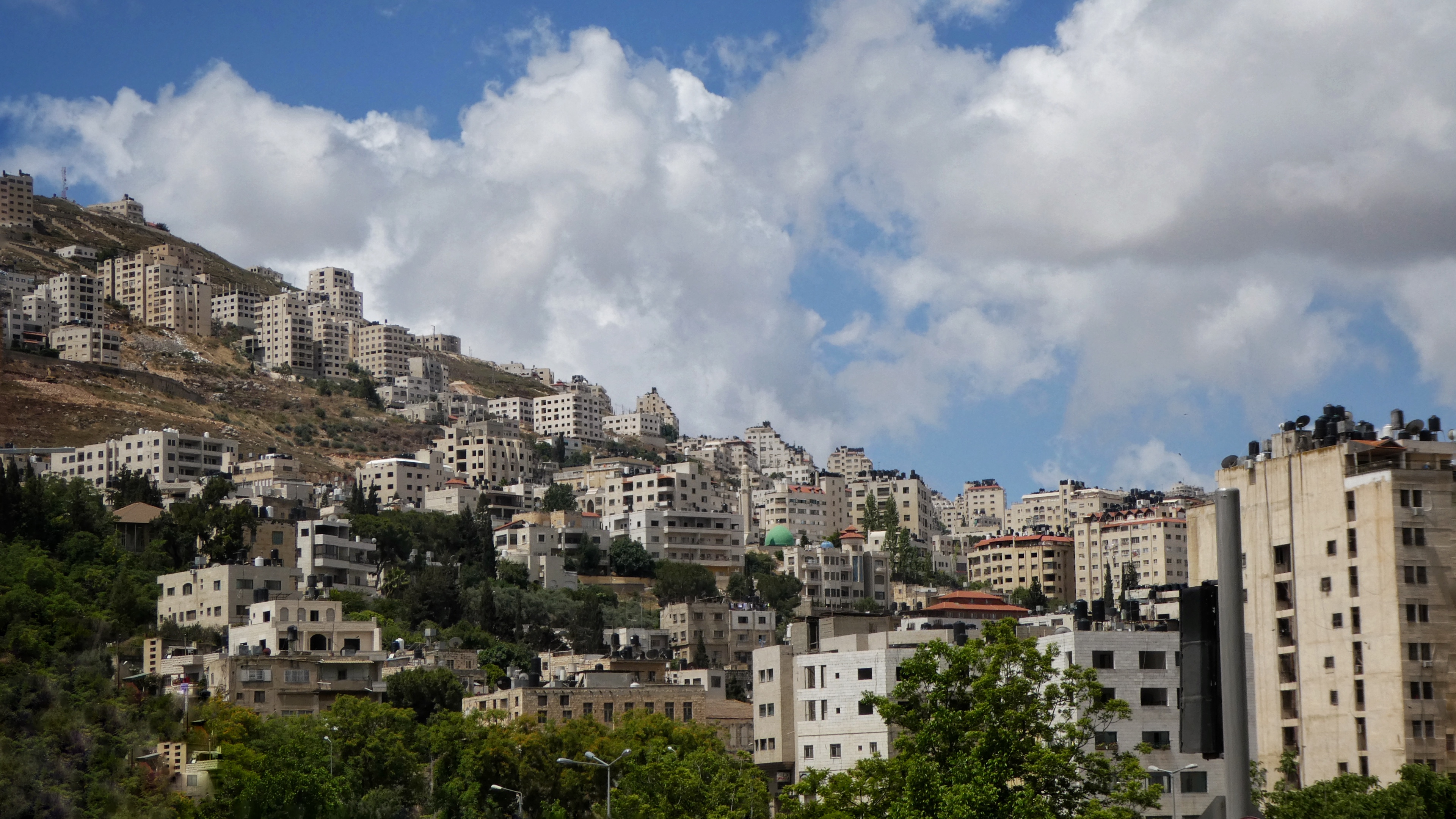
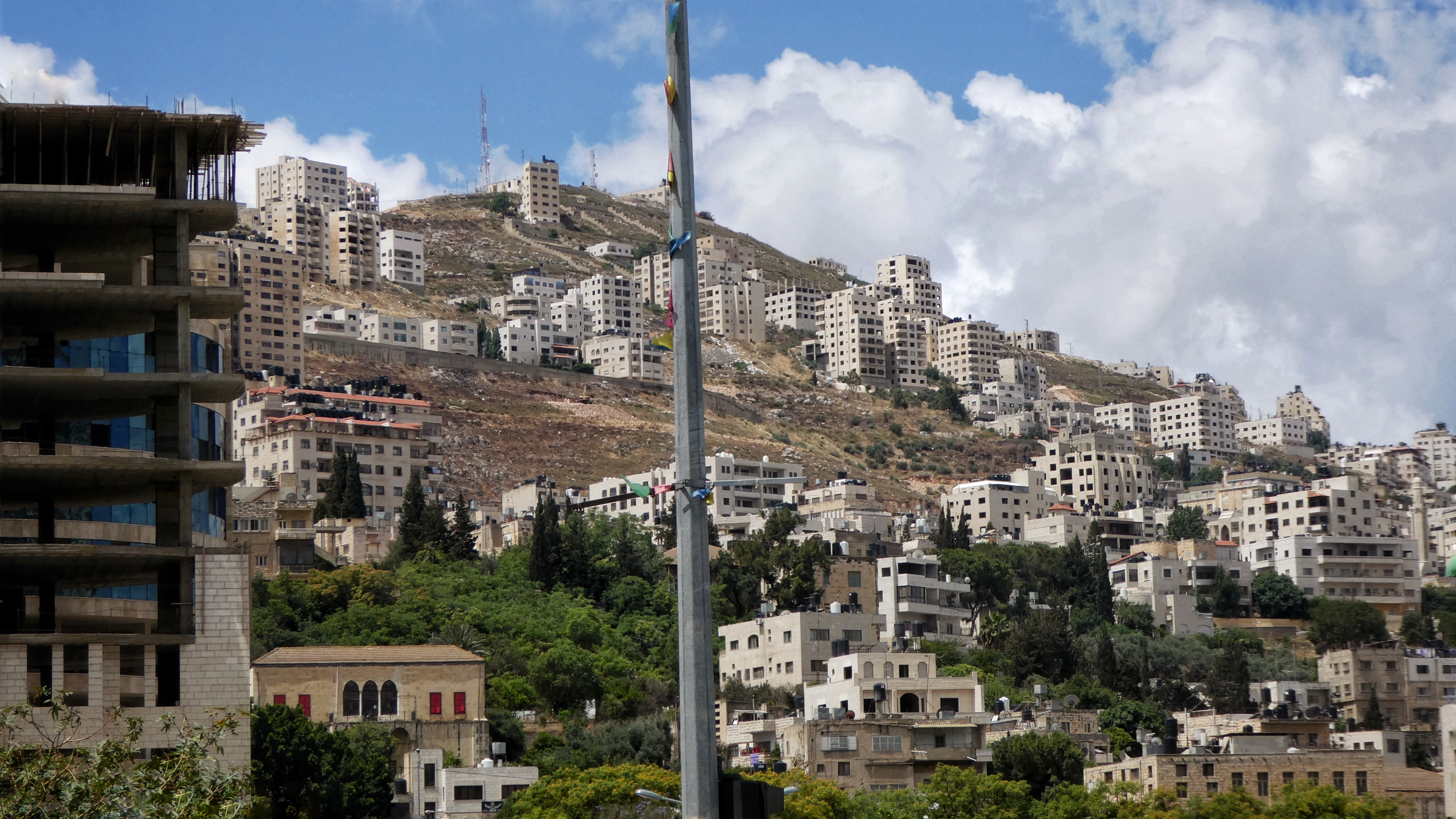
Whatever the mechanism, the slopes of the hills surrounding the larger cities are adorned with hectare after hectare of high rises. Most are works in progress, and much of those that are completed appear to be unoccupied. And, on the subject of water supply, we observed that the new buildings were not topped by the roof water tanks that are ubiquitous in most Palestinian towns and villages. No water shortages here, it would seem.

We were informed that a small apartment can cost between $60 and $100,000 before fit-out. Add another 10-20% for fixtures and fittings. Most Palestinians cannot afford these modest apartments. Those that do are in paid employment, mainly working for the PA or for UNRWA (United Nations Relief and Works Agency for Palestine Refugees in the Near East) and the many NGOs that operate here. And they raise the finance through very un-islamic mortgages. Large billboards on highways offer financial advice and funds to affluent-looking young professionals.

imageimage

The irony is that most employed Palestinians depend upon the survival of the PA and indeed, on the continuation of the Occupation. UNWRA, the United Nations agency that caters exclusively for Palestinian refugees employs some 30,000 people, the vast majority of whom are Palestinian (only a few hundred are not), and as such, it is the largest single employer of Palestinians in Gaza and the West Bank (by comparison, the UN High Commission for Refugees employs only 5,000 to 6,000 people globally).

Should the PA collapse or be abolished, should UNWRA be dissolved, should a Palestinian state be established in the West Bank, the government, and those businesses and agencies that depend upon it for contracts and custom could become insolvent, whilst there is always the possibility that international funding could be reduced or withdrawn. In short, the housing bubble could burst, the property market collapse, and those photogenic young professionals in the billboards, and their families, could lose their jobs and their homes.

The health of the Palestinian economy is also an perennial risk factor. The economy had been improving in recent years, with unemployment in the West Bank falling and and private investment in construction growing. The two might have been working hand in hand, coinciding with commencement of the building boom. But during the past three years, economic indicators have gone backwards owing to the political and economic uncertainty, with falling rates of growth, high inflation, and continuing high rates of unemployment and poverty. Economic recession, therefore, could likewise impact on the property market.

These are worst-case scenarios. But there are other economic implications.

For example, this property boom is speculative rather than productive investment in a Palestinian economy that is heavily dependent – some would argue almost totally – on Israel and on international aid. Whilst aid donors and agencies bankroll roads and essential services like schools, power, water, and the like, some say the money should instead be invested in business startups and entrepreneurial enterprises, developing the fiscal and human capital so that Palestinians can provide for their own welfare. National self-esteem should come from being economically sustainable and not from being an indigent state.

Also, there is growing economic inequality between the haves and the have nots. Before the establishment of the PA, we were told, things were more evenly balanced. Most of the population were on a more or less equal footing. There was a sense of “we are all in it together”. Now there is a palpable sense of every man for himself.

Author’s Note

Reiterating the forward to this post, this is based on our own observations and knowledge, and these are informed by what we have seen and read – we are neither academics nor professional commentators. But, as we sincerely desire to acquire and to present as accurate a picture as possible, we welcome objective comments and contributions that both support and question our observations. Any such insights will be incorporated into the post.

Much of what I have written is covered in this illuminating report by the Jerusalem Centre for a Public Affairs published in November 2015 (the picture gallery is an eye-opener): Luxury alongside poverty in the Palestinian Authority

See also: https://en.m.wikipedia.org/wiki/West_Bank

Photographic Postscript: every picture tells a story

Palestinian developer and billionaire Munib al Masri, so-called “Duke of Nablus” built himself a mansion atop a hill overlooking Nablus. That’s his personal mosque up there. Some locals say he could’ve built one for them in the city instead.

Al Misri's mosque

Al Masri’s mosque

New high-rise buildings look down on a billboard honouring a young shahi-d or martyr.

Those who can, invest. Those who cannot, become martyrs.

Those who can, invest. Those who cannot, become martyrs.

Afterword : The Duke of Nablus and his kin

Relatives Municipal al Masri include his cousin and fellow billionaire, Arab Bank and Paltel chairman Sabih al-Masri, and nephews, developer Bashar Masri, and Jordanian former prime minister Taher al-Masri. The Masris would appear to be the Palestininian Authority’s development choice, and also, Israel’s.

http://www.spiegel.de/international/world/dream-of-a-palestinian-tiger-boom-times-in-the-west-bank-a-759046.html
http://www.bbc.com/news/magazine-31154138
http://cnsnews.com/news/article/us-govt-funding-313m-mortgages-palestinians-west-bank
https://en.m.wikipedia.org/wiki/Munib_al-Masri
https://en.m.wikipedia.org/wiki/Bashar_Masri


Ottoman Redux – an alternative history

Counterfactual or alternative history had never gone out of fashion. As a history tragic with many kilometers on the clock, I enjoy such alternative history. “What if…?” and “if only…” are natural, if not instinctual responses to events around us – particularly the unpleasant ones. Hence the popularity of films like SS-GB and The Man in the High Castle (WW2 and the “Nazi victory” books they are based which on have always attracted us alternative history aficionados. There is currently excitement (and panic in some politically correct quarters) about the prospect of a project pitched by Game of Thrones’ show-runners visualizing a USA in which the Confederacy won the Civil War and slavery endures still. But such history is an indulgence that serious historians ought not take seriously – unless they are branching out into historical fiction, that is, which many indeed do. Popular English author Peter Ackroyd has said, the words “What if …” should never be on a historian’s lexicon. But writers of historical fiction have literary license to let their imaginations roam. Counterfactuals or alternative history is a fiction genre all of its own.

When we create alternative histories, we largely replicate a history we already know, often intimately. We replicate histories in which most of the same variables coexist, and the same historical trends prevail. Our motives are quite often as much to warn readers or audiences as to entertain them. Hence the tendency for such endeavours to drift into the depressing dystopian dramas that are so in vogue in these challenged times.

And yet, changing one or more of the players, removing or adding ingredients, hypothesizing different, even opposite scenarios, and imagining how events might have transpired differently, may not radically alter the result. In the case of the First World War, for example, if the conflict had not happened, the European empires may or may not gave endured. Often such multinational entities contain the seeds of their own demise – internal dynamics and contradictions, the impact of events in other countries. Whose to say what might have happened in say France, Germany, Russia, Türkiye or the US that might have upended the balance of power?

One surmises whether or not there is an iron law of inevitability that determines – predetermines, even – the same or similar outcome – a historical equivalent of Oedipus’ unsuccessful efforts to avoid his prophesied fate, affirming TS Elliot’s observation in Little Gidding: “And the end of all our exploring will be be to arrive where we started and know the place for the first time”.

In this entertaining podcast, British historians Dominic Sandbrook and Tom Holland discuss many examples of what might have been if …

In an interesting if light-weight and indeed disappointing exercise in alternative history, with an absolutely meaningless but catchy play on the title of a fabulous song, title, The Sultans of Spring, The Economist recently pondered how events would have unfolded if the Ottoman Empire had sat out WW1 or joined the Entente of Britain, France and Russia instead of throwing in its lot with the Central Powers of Germany and Austria-Hungary.  You may click on the above link, or page down to the full (and brief) transcript. Al-Sisi below, but preceding this is a brief précis of a a popular paperback historical novel published a short  while ago which presented an imaginative if overcooked and totally different Ottoman history.

But first, here is my own argument:

So, what if?

Removing the Ottoman Empire from the strategic equation, or else placing it in the military scales against the Central Powers, would certainly have a significant impact upon the conduct and progress of the European war on both the eastern and western fronts. Russia and Britain would not have had to divert forces and materiel to the Middle East arenas. The Ottomans could have reaped the political and economic benefit of either neutrality or victory, with commensurate benefits for their own survival. The hypotheticals with respect to what may have happened next are innumerable.

The Economist surmises: “How much of today’s mayhem in the Middle East, from civil wars to terror in the name of Islam (and of restoring the caliphate) to the emergence of sectarian dictators such as Bashar al-Assad, not to mention of such a grudge-bearing Ottoman revivalist as Recep Tayyip Erdogan, might have been avoided, if only Churchill had embraced Johnny Turk instead of sinking him?”

But would things have turned out radically different if this had happened – notwithstanding the fact that three to five million Turks, Arabs, Armenians, Africans, Indians, and Europeans who lived in or soldiered through the Middle East theatre would have lived to die a natural death after fulfilling their own particular destinies or to perish purposefully or pointlessly in some other conflict.

The previous century had seen the steady decline of the Sultan’s Empire. It had commenced with Napoleon, and the rise of Muhammad Ali in Egypt, an Albanian “slave soldier” who in practical terms, seceded from the empire. Greece followed next, assisted by European states, and then, bit by bit, the Balkans. The Czar dubbed the empire the “sick man of Europe”, or so British politician John Russell misquoted him, and everybody wanted a piece. The European powers were circling hoping to pick up pieces as the Empire’s borderlands detached – Russia in the east, France in the Levant, and Britain in Egypt and the Gulf. The Crimean War was but one manifestation of “the Eastern Question” that had excited European Chancellories for a hundred years. France and Britain challenged Russia for power and influence in the East and went to war on the Sultan’s side, ostensibly to protect Christian rights in the Holy Land, but weightier matters were in play – alliances have always been fluid in this part of the world, as today’s shifting allegiances demonstrate. Crimea ended in stalemate, but Russia kept encroaching, whilst France established its presence in the Levant. Britain, meanwhile, has its sights set on Egypt and the Red Sea, (the vital  route to its African and Asian empires), and when it was finally built, the Suez Canal, a strategic and commercial link that to this day concentrates the minds of foreign and state departments, military strategists and corporations worldwide.

The Balkan states continued to decouple from the empire, and prior to 1914, engaged in several bloody wars with each other, drawing their neighbours deeper and deeper into the tangle. The slow countdown to WW1 accelerated with the Austro-Hungarian archduke being killed by a Serbian student. Gavril Princip’s “shot that echoed around the world” in Sarajevo in 1914 was but one part of a chaotic picture, igniting tinder that had long awaited a match. Russia, supported the Serbs, Germany, the Austrians, Britain, and France, the Russians. And the Ottomans, forever hard pressed by the Russians, French and Brits, had already moved into the German orbit. When the Ottomans entered the war on the side of the central powers, the cards were dealt.

The Empire was already on a revolutionary path what with the Sultan’s desultory efforts with constitutional reform, the ascendency of Young Turks, a cabal of Turkish nationalist army officers, and the parlous state of the economy. Efforts to institute political and economic reform had faltered, and sooner or later, something was going to blow.

Arab nationalism had already taken root in the Levant, a secular creed spear-headed by Arab Christian intellectuals, to be brutally suppressed by the Young Turk triumvirate, Enver, Talat and Jamal. “Martyrs” were being strung up in Beirut, Damascus and Jerusalem. Perhaps the Ottoman Middle East would have unraveled like in the Balkans (and Balkanised too? Most probably). The “wars of the Ottoman Succession” that we are witnessing today amongst the states created in 1921 would eventually have erupted.

The Zionist project was already underway at the outbreak of war, with settlements of Jews from Eastern Europe and Russia well-established in Palestine, often encouraged by the Ottoman authorities. The pioneers included many of the founders of modern Israel, including its architect and first prime minister David Ben Gurion. The pressures that drove Jews from eastern Europe and Russia in the first place (the discrimination and the pogroms paramount) were unlikely to abate given the atavistic nationalism of Holy Russia and just as Holy Poland. Sooner or later, Zionism and Arab nationalism were going to collide. We will never know how the Ottoman state and its Arab provinces would have coped with the emergence of a Jewish state in Palestine. It certainly would have put the popular (but highly qualified) narrative of Ottoman tolerance of other faiths through a rigorous stress test. The Zionists had a pretty clear road map, and they weren’t sharing it with their new neighbours.

The British, French and Russians had been involving themselves in Middle Eastern affairs – that confounding “Eastern Question” – since the Napoleonic wars. , and Germany, seeking its coveted “place in the sun”, wanted in. German influence was already strong amongst progressive army officers – Prussian elan, ethos, menswear and weapons have exerted a powerful influence on wannabe juntas, the “men on horseback”, since the days Frederick the Great. The Kaiser’s government was very keen on expanding German influence in the east as a counter to British and French imperial power. Meanwhile, the industrial powers were already sniffing around the Gulf, Iranian, and Mesopotamian oilfields, the economic impetus behind imperialism having yet to run its course. The sea-lanes that preoccupied policy-makers in London, Paris and Moscow were soon to be joined by railways and pipelines, with the Germans making the running with its backing of the Berlin to Baghdad Bahnhof. Petroleum would soon join the fabled Great Game as a western imperial obsession. And this too, in time, would have to come up against rising Arab nationalism.

Would Ataturk and Ibn Saud’s ascendency in Turley and Arabia respectively have happened? Perhaps. The political instability in Anatolia and the Arabian Peninsula, and also, as we have described in the Levant, would have created conditions which could have brought these ambitious,  capable and charismatic men to power.

Mustafa Kemal was just one of many promising Young Turks. Whether he would have risen above his peers without his Gallipoli reputation is moot – he would still have had to shove aside the three amigos. His Turkish nationalism, like that of his Young Turk compadres, was not sympathetic to Arab aspirations. Nor was his agnosticism empathetic to what he considered to be a backward and suffocating Islam. Fezzes and face-coverings were amongst the first things to go once he established his secular republic. Whether he could have held the empire together is another question.

Ibn Saud was not the only kid on the Arabian block. The Hashimites (the descendants of Jordan’s King Abdullah) held the western edge of the peninsula, but also the most spiritually significant – the “haramayn” of Mecca and Medina, no less. The Hashimite princes has their eyes on an Arab Kingdom, but Ibn Saud had his eyes on them. The house of Saud, with its Salafi Wahhabi credentials of a cleaner Islam was way “out there” as far as Arab politics and religion went at the time. Apart from perennial outbreaks of intolerance towards and repression of religious and ethnic minorities and heterodox Muslim sects, Istanbul ruled its multinational and multicultural empire with a light if autocratic hand. But there was all that oil – and to British policy makers, that trumped loyalty to the Qurayshi wannabes in the west, for all their descent from the Prophet and their custodianship of the Holy Places.

How would British-controlled Egypt’s politics have developed? Resistance to Britain and its puppet monarchy (headed by the descendent of that famed Albanian schemer Muhammad Ali, who had caused the Europeans so much angst in the early days of the Eastern Question) was growing and would develop into a secular Egyptian nationalism on the one hand and the Islamist Muslim Brotherhood on the other.

So: no Gallipoli campaign (Churchill would have had to find another project, and young Australia another patriotic shibboleth); no Arab Revolt – the Hashemites would have remained just another influential desert clan and TE Lawrence would not have become a legend; no Balfour Declaration or Sykes Picot agreement to distort and dismember the Arab Levant with two conflicting and irreconcilable nationalisms, so, no Syria, Iraq and Lebanon; no British (and Australian) advance on Gaza, Jerusalem and Damascus (General Allenby might have ended up on the Western Front instead of the steps of King David’s Tower in Jerusalem) and arguably, therefore no Mandate, no Palestine, and no Israel; no Armenian genocide to darken Türkiye‘s reputation and prefigure the Shoah that was to come, or then again, perhaps never came; and no Türkiye as we know it today (although President Erdogan is certainly acting out his inner sultan).

As former and unlamented Secretary of State Condoleeza Rice prematurely proclaimed in 2006 too much ridicule from Arabs generally, “a new Middle East”.

© Paul Hemphill 2017 and 2023 All rights reserved

For further history stories in In That Howling Infinite, see Foggy Ruins of time – from history’s back pages

For stories about the Middle East in In That Howling Infinite, see A Middle East Miscellany
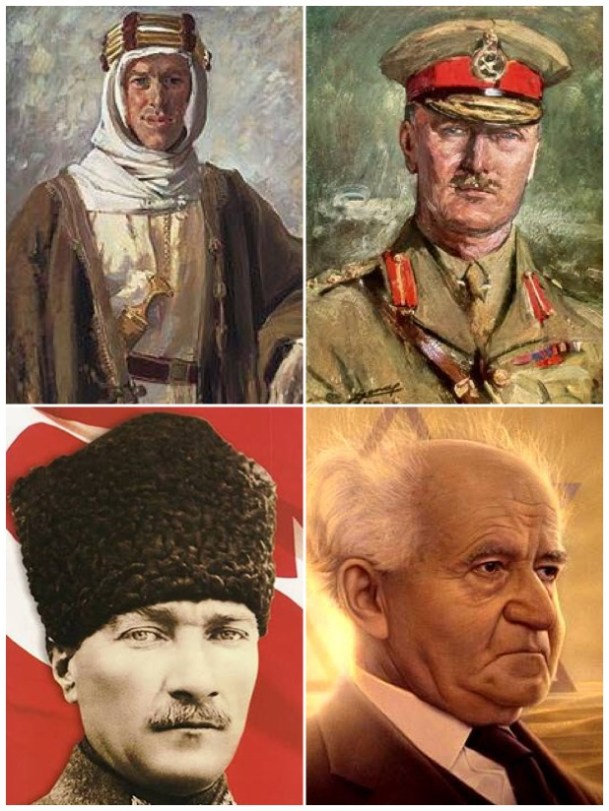
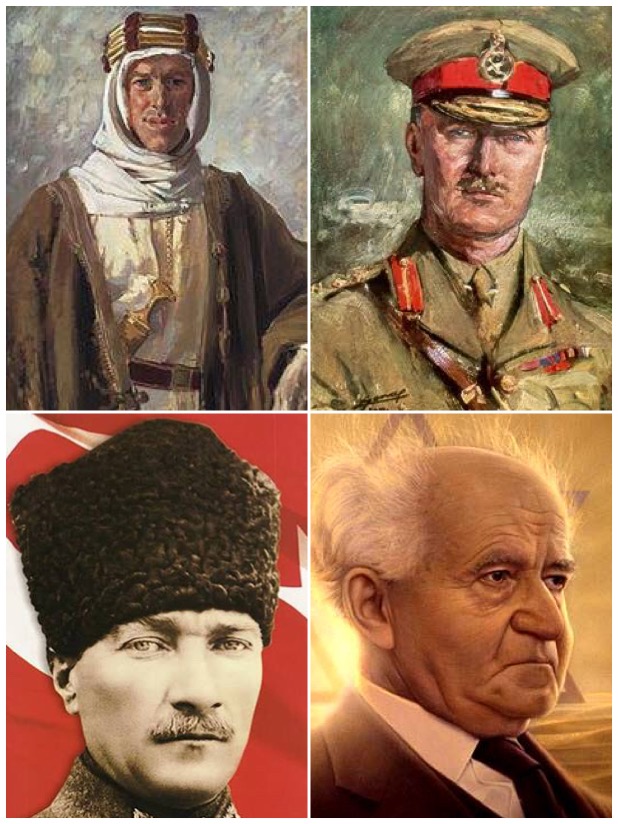
TE Lawrence, General Allenby, Ataturk, and Ben Gurion

The Ottoman Secret

By Raymond Khoury

The Ottoman siege of Vienna of 1683 sees the city fall and the Christian forces annihilated. Western Europe is conquered soon afterwards and in 2019, an increasingly repressive Sultan still rules the continent (though Britain and Russia withstood the onslaught and remain independent nations). A lot has happened in the world since 1683, and as Christendom was vanquished, many things just didn’t happen. Russia is still ruled by the Czars, and America by a post-Mayflower Christian theocracy. Concepts like democracy, freedom of thought and expression, and gender equality are ideas still struggling against heavy odds to be born.

We are in Muslim Paris in 2019. Kamal Arslan Agha is a patriotic, loyal subject of the the Sultan and a special investigator of the Tashkeelat-i Hafiye, the secret police, on the front line of the empire’s harsh response to increasing political and economic turmoil throughout Europe. The Caliphate’s efforts to maintain law and order spare no one, and soon, Kamal’s own family attracts the Hafiye’s attention.

His brother and sister-in-law discover a secret so dangerous, the Caliphate must suppress it, and with the foundations of the Empire under threat, Kamal’s family have no choice but to run. Whether or not they can escape the pursuing Hafiye will determine their own fate, and that of the Caliphate itself – its past, its present, and its future.

Khouri’s vision of a world dominated by conservative, repressive regimes combining religious conformity with modern technology is not a pleasant one. Western democracy might have its faults, but as Churchill said, it’s better than most of the alternatives.

This is, of course, fiction, written by a novelist and not a historian. Its political, cultural and technical milieu is predicated on “what if? What if the Ottomans had expanded and prospered for three centuries instead of gradually transforming into the “sick man of Europe” to be dissected and defeated by western powers? What if through serendipitous and underhand means, the empire has acquired the military, industrial, scientific and technical wherewithal to build over four centuries a world that in many ways in not unlike our own? What if their had been no enlightenment, no French or Russian revolutions, no Hitler, no Holocaust, no Hiroshima?

Incidentally, the siege of Vienna in 1683 gives its name to ‘Gates of Vienna’, a fanatically anti-Muslim far-right blog. Its essential thesis is that this was only one battle in a long war and that Europe and its civilisation are constantly threatened by a Muslim invasion.

As Kurt Vonnegut’s avatar Kilgore Trout would say, “so it goes …”

Sultans of Spring – if the Ottoman Empire hadn’t collapsed.

Imagine the mayhem that might have been avoided had the Ottoman Empire been saved rather than sunk. Blame, among others, Winston Churchill

When a Serb gunman shot an Austrian archduke in the summer of 1914, the nations of Europe tumbled into war with all the grace of bowling pins. Austria-Hungary declared war on Serbia, whose ally Russia declared war on Austria, whose ally Germany declared war on Russia, whose allies France and Britain declared war on Germany and Austria. By early August the continent was in flames.

Much as it wobbled like the rest, however, one of those bowling pins could not make up its mind. Which way would Turkey fall? Should the fading Ottoman Empire join the Triple Entente (Britain, France and Russia) or go with the Central Powers (Germany and Austria-Hungary)

Turkey’s 500-year-old empire was shrinking. It had lost its territories in Africa, nearly all its Mediterranean islands and most of its Balkan lands as well as chunks of eastern Anatolia. It was debt-ridden, industrially backward and politically shaky.

Still, the sultan’s lands straddled two continents, controlling access to the Black Sea. His Arabian territories stretched beyond the holy cities of Islam to the mountains of Yemen and the Persian Gulf, where there were rumoured to lie vast caverns of the sticky black liquid soon to replace coal as the world’s chief source of power.

Confident of Turkey’s weakness, Britain, France and Russia could have clobbered the Ottomans and divided the spoils. Thankfully, wiser heads prevailed. At a secret conclave aboard a British dreadnought off the coast of Norway in late July, a far-sighted politician by the name of Winston Churchill, then First Lord of the Admiralty, worked with French, Russian and Turkish diplomats to forge a treaty. The Turks drove a hard bargain for, as they coyly revealed, Germany too was proffering arms and gold in exchange for an alliance.

The deal that was reached proved immensely beneficial to all concerned. From France, Turkey received generous debt relief. Russia scrapped all claims to Ottoman territory, and made a limited goodwill withdrawal from parts of Anatolia. Churchill waived further payment on two warships that British shipyards were building for Turkey. And Turkey received assurances that its vulnerable extremities would not be attacked; for an empire that for a century had been preyed upon like a carcass this was a new lease of life.

The rewards to the Triple Entente were equally big. Granted exclusive access to the Black Sea, Russia’s allies could resupply the tsar’s armies when they faltered at the start of the war. With no need to defend its Turkish frontier, Russia moved thousands of crack troops from the Caucasus to shore up its front lines. Turkey signed separate agreements recognising British control of the Suez Canal, Aden and the Trucial sheikhdoms of the Persian Gulf, securing the sea lanes for Britain’s massive deployment of troops from the colonies to the Western Front. Turkey’s own army joined in a broad front against Austria-Hungary. Together, these Allied advantages are thought to have shortened the war by as much as a year; the Central Powers might not have sued for a truce as soon as America entered the war, but fought on instead.
Reprieved from collapse, the Ottoman Empire’s government pursued radical reforms. Challenged by growing nationalist tendencies from Arab, Armenian, Greek and Kurdish subjects, Sultan Mehmed V issued a historic firman or proclamation that recognised these as individual nations united under the Ottoman sovereign.

The sultan got to keep the title of caliph, commander of the Sunni Muslim faithful, which his ancestors had acquired four centuries earlier. This proved useful when the empire had to put down a rebellion of religious fanatics in central Arabia, led by a man called Ibn Saud who gained followers by claiming he would restore Islam to a purer state. But mostly the empire was seen as a tolerant place. When Nazi persecutions drove Jews from Europe in the 1930s, many took refuge there (as they had done when expelled from Spain in 1492), particularly in the province of Jerusalem.

If only…

Needless to say, none of the above happened. Quite the opposite. Turkey aligned with Germany in the first world war, and the allies did attempt to invade and divide its empire. Churchill, instead of handing over the warships that ordinary Turks had paid for by subscription, had them seized for the British navy. In 1915 he ordered a catastrophic attack on Turkey; the landing at Gallipoli cost the allies 300,000 casualties. British campaigns against Turkey in Iraq and the Levant cost another million lives.

Turkey’s casualties mounted, by war’s end, to 3m-5m people, nearly a quarter of the Ottoman population. This included some 1.5m Armenians, slaughtered because Turkish officials believed they might become a fifth column for a hostile Russia. And when Britain and France grabbed the Ottomans’ Arab lands, their suppression of uprisings cost thousands more lives.

How much of today’s mayhem in the Middle East, from civil wars to terror in the name of Islam (and of restoring the caliphate) to the emergence of sectarian dictators such as Bashar al-Assad, not to mention of such a grudge-bearing Ottoman revivalist as Recep Tayyip Erdogan, might have been avoided, if only Churchill had embraced Johnny Turk instead of sinking him?

Ataturk Monument, Istanbul

Here are other posts about Turkey past and present:

Sailing to Byzantium

The Watchers Of The Water

Cha … Cha … Changes

People Watching In Sultanahmet


Once in Royal David’s Citadel

During its long history, Jerusalem has been destroyed at least twice, besieged 23 times, attacked 52 times, and captured and recaptured 44 times.

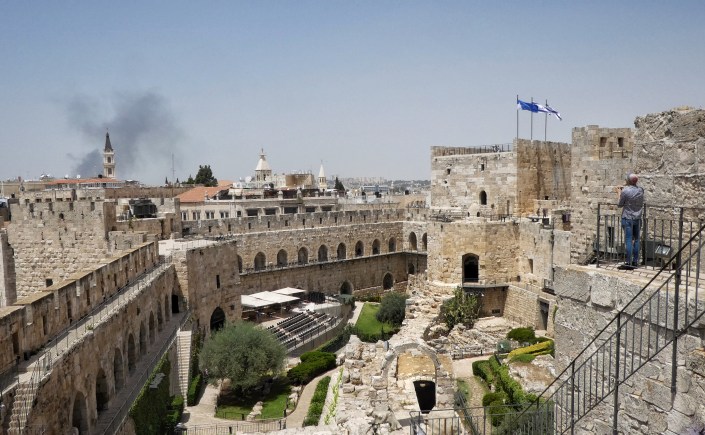
The Citadel or Tower Museum at the Jaffa Gate, the westernmost entrance to the city, is all the history you can eat in a four hour sitting. It’s a four thousand year old story: from the Canaanites and the Hebrews to the end of the Mandate and the establishment of the State of Israel, via Egyptians, Assyrians, Persians, Greeks, Hasmoneans, Romans, Byzantines, Umayyads, Abbasids, Fatamids, Crusaders, Ayyubids, Tartars, Mongols, Mamluks, Ottomans, British, and even Australians. Each left their mark on Jerusalem, and most planted their brickage upon and within the Citadel.

image

There is a long roll-call of famous names who may or may have not resided in the place.

King David didn’t, despite his name being given to the place and the apocryphal story that he once spied on the bathing Bathsheba from its ramparts – indeed, her bathroom is said to be underneath the New Imperial Hotel, just across the way. Nor did his son and heir, Solomon, builder of the First Temple. Conquerors Nebuchadnezzar and Cyrus did not. They just wrecked the joint. Judah Maccabee might have, and those other famous Jewish rebels, the Zealots didn’t, but during Great Revolt, they retreated there and trashed the place. Herod the Great, a psycho with an serious edifice complex, resided here. As did also Procurator Pontius Pilate when he was in town (he preferred the luxuries of Caesaea Maritimus (Latin for “on Sea). Historians now believe that the Citdel was where he actually cast judgement on Jesus, and not in the Antonine Fortress which overlooked the Temple (where the Haram al Sharif now stands) throwing into question the whole basis for the existence of the Via Dolorosa.

Roman general and future emperor Titus would have taken up residence therein after he destroyed the city in 70CE, leaving only the citadel standing. His troops needed somewhere to crash. Constantine didn’t, but his mom Helena most likely did when she “discovered” The True Cross, commissioned the construction of the Church of the Holy Sepulcher, and single-handedly invented the Holy Land pilgrim industry that endures to this day. The Muslim conquerors Omar Ibn Khattab, Salah ud-Din, and Baybars may have, but Ottoman Sultan Suleiman the magnificent, who built the city walls we see today, never set foot in Jerusalem, and nor did his successors.

image

Ottoman troops occupied it, and General Djemal Pasha would hang Arab Nationalists in the Square before it. General Allenby declared Jerusalem and Palestine liberated on the steps leading to the citadel in 1917, but most likely stayed across the square at our wonderful East New Imperial Hotel (the Kaiser stayed there too when he visited Jerusalem in 1898). British troops garrisoned it during the Mandate years – like the Roman legionaries before them, they’d’ve needed a place to lay their heads. The British-commanded Arab Legion of then Transjordan took control of it in during the the battle for Jerusalem in 1948 and defended it successfully against the new IDF. They did so again in 1967 only to lose it and the Old City.

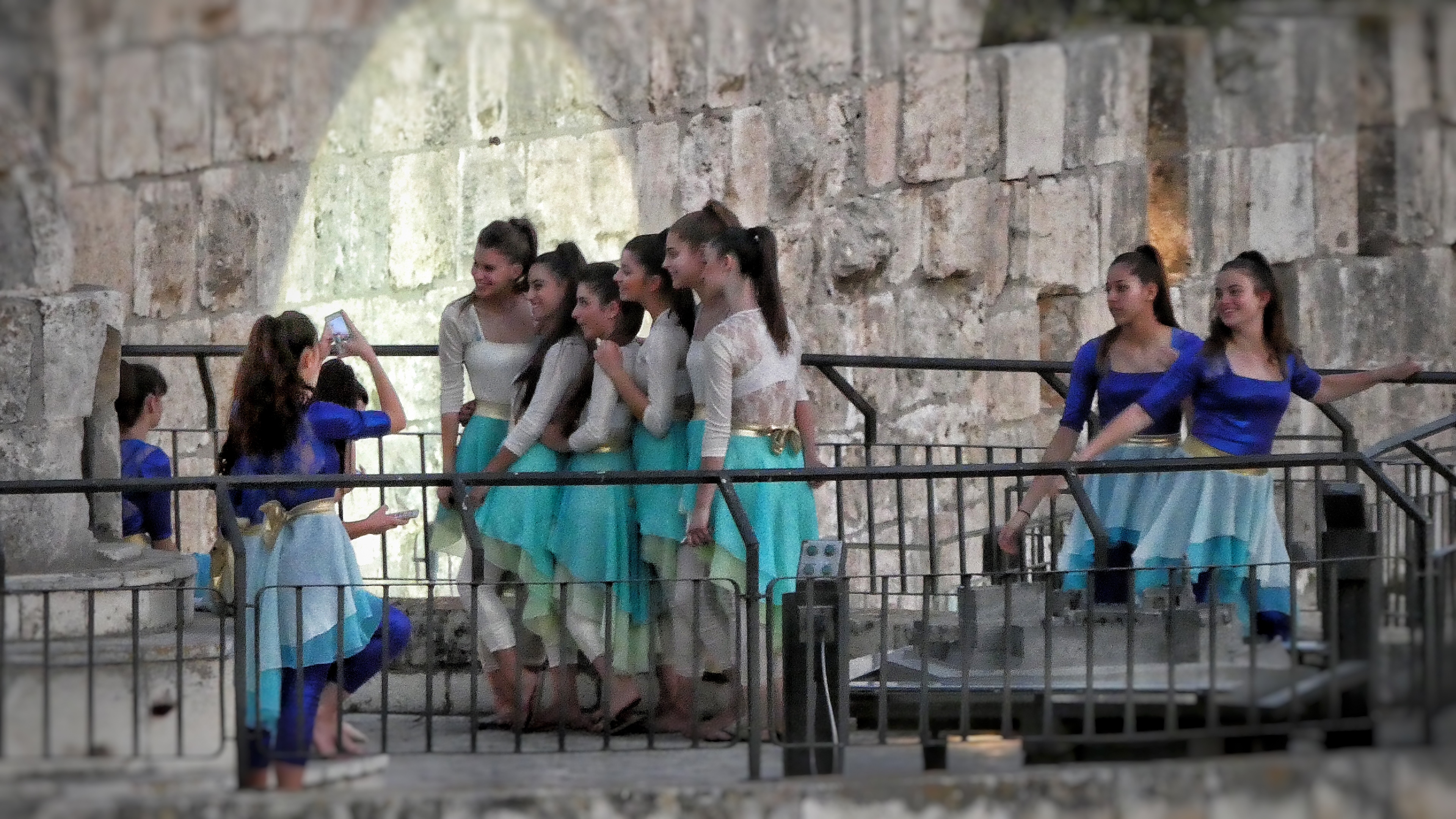
If the stones could talk, what a tale they would tell. And indeed, the museum now does just that, in content and in form. We sit on the roof garden of our hotel, directly across the street on Omar Ibn Al Khattab Square, and look across at its towers, ramparts and gardens, and sense it’s story in our souls. We watch present generations passing beneath its walls, and the young folk dancing on the ramparts, all part of the passing parade of humanity that has lingered by and upon these ancient walls.

For further reading, you can’t beat Simon Sebag-Montefiore’s Jerusalem : The Biography (Phoenix 2011).

See also in In That Howling Infinite, The Grand Old New Imperial Hotel, and Nova Via Dolorosa. For other posts about Jerusalem see: O Jerusalem

History Lessons

History Lessons

Carnivale

Dancers from the Son et Lumiere promenade

Sic semper tyrannis

You come at the king, you best not miss.
Omar Little, The Wire (after RW Emerson)

The phrase “one man’s freedom fighter is another man’s terrorist” is at once apt, correct, and yet often oversimplified to the point of disingenuousness. The word “terrorist” itself describes its goal. To instill fear in the heart of the enemy. In the past, the target would have been the king, the dictator, the ruling class, and those who served them and upheld their rule. Politicians, officials, solders and policemen. Today, terrorists indiscriminately target whole societies. Irish bombers blasted communities of the rival faith, murdered shoppers, office workers, and pub patrons, as well as soldiers and policemen. Palestinian suicide bombers hit malls and pizza bars in city centres. ISIS, al Qa’ida and the Taliban detonate cars in busy city streets and publicly execute prisoners in callous and calculating “lectures in flesh” (the phrase is civil rights lawyer Geoffrey Robertson’s, from his chilling account of the trials and execution of King Charles I of England and those who sentenced him, The Tyrannicide Brief.).

But targeted and random terrorism has a long historical pedigree. For centuries, it has been the desperate and nihilistic weapon of last resort of resistance and rebellion against perceived oppression and injustice, and against invaders and occupiers.

In the second century BCE Palestine, the Maccabees used assassination in their resistance to the Seleucid Greeks, and a century later, the Jewish zealots, the Sicarii, named for the easily concealed small daggers, paid the Romans in like coin, and ultimately in an insurrection that culminated in the destruction of Jerusalem in 70CE and the scattering of the Jewish race (giving history the emotive and symbolic last exit that was Masada). In an etymological irony that Mark Twain would have been proud of, the present unrest in Jerusalem, a large number of young Palestinians have perished in attempting to stab jewish soldiers and civilians. Their jaquerie is called the “Intifada Sakni-in”, the ‘Knife Uprising – an echo of those long-dead Sicarii “dagger men”.

Nowadays, one would be excused for thinking that “terrorism” and “terrorist” are synonymous with Arabs and Muslims. And a historical precedent reinforces this erroneous assumption. The Hashishan or “Assassins” of Middle East fame (yes, that is where that noxious noun originated) were Muslim men and boys mesmerized and mentored by Rashid ad Din as Sina-n, the “Old Man of the Mountain” (and all this, before Osama in the caves of Tora Bora), and were Twelfth Century  hit-men contracted out to rival Muslim princes in the internecine conflicts that plagued the Levant in the wake of the Crusades and the demise of the great Arab Caliphates.

But the assassin’s knife (and in modern times, the gun and bomb, and latterly cars and trucks) predates these medieval hoods and links the Hebrew rebels of old to the Irgun and Stern Gang who encouraged Britain and the UN to abandon Palestine in 1948, bequeathing most of it to the new state of Israel, and triggering the Palestinian diaspora. European anarchists and Irish rebels and loyalists were adept at shootings and ambushes. In Algeria, during the ‘fifties, the nationalist FLN and the “colon” OAS shot and bombed each other and those unfortunates caught in the crossfire. The IRA perfected the improvised explosive device that today has crippled thousands of American, Canadian, and Australian soldiers in Iraq abd in Afghanistan. Hindu Tamil separatists of Sri Lanka introduced the suicide bomber, an economical and efficient weapon against soft (civilian, that is) targets, deployed today by Islamist killers in the streets of London and Lahore, Damascus and Dar es Salaam, Jerusalem and Jakarta. Whilst Arabs – and particularly Palestinians may have given the world the hijacking of aircraft – a tactic that fell into disuse due to diminishing political returns and rapid response forces – other Arabs showed us how to fly them into public buildings as the whole world watched in horror and disbelief. The shockwaves of this one are still reverberating through the deserts of the east and the capitals of the western world.

In going up up against their occupiers, the Palestinians have an old heritage. In my old country, Boudicca and Caractacus fought a losing battle against the Romans in Britain during the First CE. The Roman historian Tacitus ascribed to a vanquished chieftain the memorable words  “solitudinem faciunt, pacem appellant” – they make a desert and they call it peace. After the battle of Hastings in 1066, the defeated Saxons pushed back against the Normans and brought the genocidal wrath of William the Conqueror down on their heads with the devastating “Harrying of the North”. The Green Man and Robin Hood legends are said to be a retrospective and romanticised remembering of the Saxon resistance. Warrior fugitives from that failed guerilla war fled as far as Constantinple, where many joined the Emperor’s acclaimed Varangarian Guard, (see When Harald Went A Viking) 

In the streets and the countryside of Ireland, my parents’ birthplace, the United Irishmen, Fenians, Free Staters, IRA and Unionists fought against the redcoats, tommies, and black and tans of the British Army. Fought amongst themselves, fought against each other, and killed and were killed in their centuries long war of liberation. And in my adopted country, indigenous Australians fought a futile frontier war against settlers and soldiers just as native Americans did, albeit on a much smaller scale, and paid the price in hangings, massacres, poisoned wells, dispossession, marginalization, and “stolen children”. The legacy of those times lingers still – see The Frontier Wars – Australia’s heart of darkness.

In Central America, Juarez led the Mexicans against the French, and Sandino, Nicaraguans against US marines. Spaniards rose up against Napoleon’s forces, giving the world the word “guerilla”, or “little war”. Russian partisans ambushed the Grande Armé and the Wehrmacht. Throughout occupied Europe, the very term “resistance” became synonymous with the heroic unequal struggle against tyranny. In another of history’s ironies, muqa-wamat, Arabic word for resistance, unites sectarian rivals Hamas and Hizbollah against Israel.

And not just resistance to invasion and occupation, but also against oppression by one’s own rulers. Religious tracts tie themselves in knots reconciling the obligation to obey our rulers with the right to resist and overthrow those that rule badly. The unequal struggle against tyranny – or what is perceived by the perpetrators as tyranny – is the cause that inspires men and women to desperate acts.

The most celebrated in fact, film and fiction is the death of Julius Caesar at the hands of peers who feared that he intended to usurp the ostensibly democratic Republic (ostensible because democratic it was not) and institute one-man rule. That ended badly for the conspirators, and for Rome, as it precipitated years of civil war and ultimately, half a century of empire).

In 1880 the reforming Czar Alexander II of Russia, discovered the hard way that liberating the serfs did not inoculate himself against the bomb that took his legs and his life. His fearful and unimaginative successors hardened their hearts and closed their minds against further reform. setting in train the crackdown on dissent and democratic expression that led eventually to the storming of the Winter Palace on Petrograd in 1917. Narodnaya Volya, the killers called themselves – the People’s Will. And that is what terrorists do. They appeal and owe fealty to a higher court, a greater good, a savage God.

So it was when student and Serbian nationalist Gavril Princip assassinated Archduke Ferdinand of Austria-Hungary in June 1914 and ignited the spark that lit the conflagration of World War 1 which precipitated the demise of the old European empires.

So too when John Brown and his sons brought their broadswords to bear on slavers and their sympathizers and made a date with destiny at Harpers Ferry. Their famous raid may or may not have accelerated the downward slide to the secession and civil war that erupted the following year, but it provided a moral and symbolic prelude and also, the resonating battle hymn of the republic. John Wilkes Booth bookended this bloody era with his histrionic and public murder of Abraham Lincoln, shouting “sic semper tyrannis”, “thus always to tyrants,” attributed to Brutus at Caesar’s assassination – today, it’s the Virginia state motto. Brown and Booth were quite clear in their motives. As was were the segregationalist shooters who did for African Americans Medgar Evers and Martin Luther King. Less so were the killers of the Kennedy brothers in the sixties.

To conclude, sometimes that savage, rebel God is one of faith, sometimes, of blood and soil. In some instances, it is revenge for wrongs real and imagined – the reasons at times lost or forgotten through the passage of time and fading memories. And often, “the cause” is corrupted by the immoral economics of illicit commerce, including contraband, kidnapping, blackmail and extortion. Sometimes all merge in an incongruous hybrid of religious passion, ethic identity, libertarian or anarchistic fervour, and protection racket. As was the case in Northern Ireland, in Lebanon, in sub-Saharan Africa, and currently so in Syria and Iraq.

But most times, terror and turmoil is simply a political weapon planned, targeted and executed as a mechanism of regime change. Rebellion, revolt and revolution. Resisting, opposing, challenging, confronting and defeating the central authority. The seizing, holding, consolidation and keeping of political power.

And one thing is for sure. The outcome is unpredictable. History does not move in straight lines, but often follows a bitter and twisted path. Cliched as it is, the phrase “be careful what you wish for” is an apt one. And when, as Bob Dylan sang, “the line it is drawn, the curse it is cast”, there is no going back. To quote WB Yeats’ famous lines, “all is changed, changed utterly”.

Terrorism, then, can shift the course of history. If we were to stumble into the swamp of alternative histories, imagine what might of happened

If Caesar had walked home from the senate on the Ides of March
If Lincoln had been able to guide the Reconstruction
If the reforming Czar had introduced democratic government to Russia
If Gavril Princip’s shot had missed the archduke
If Kennedy had returned from Dallas
If John Lennon outlived George Harrison
If Yitzak Rabin had left the peace concert in Tel Aviv
If the Twin Towers stood still

To quote “Stairway to Heaven”, a curiously apposite title given the millenarian mindset of many terrorists, “Oh, it makes you wonder!”

Amazing Grace : There’s Magic In The Air

“If I forget thee, Oh Jerusalem!”

Jerusalem, The Golden. The Arabs call the city ‘Al Quds’, “The Holy’. It was deemed sacred from pre-history. Iconoclast scholars suggest that Jerusalem was actually the holiest place in Islam, and that like Islam itself and the Prophet, Mecca and Medina were retrofitted to suit the conqueror’s narrative. A city of the mind as much as of this earth, it haunts the prayers and dreams of three faiths, and to this this day, it is coveted and contested. “The air above Jerusalem”, wrote Israeli poet Yehuda Amichai, “is filled with prayers and dreams, like the air above cities with heavy industry. Hard to breath”. Arthur Koestler wrote: “The angry face of Yahweh is brooding over the hot rocks which have seen more holy murder, rape and plunder than any other place on earth”. Perhaps it is because Jerusalem is mankind’s number one hot spot! “There’s this thing that happens here, over the hell mouth”, says Buffy, “where the way a thing feels – it kind of starts being that way for real. I’ve seen all these things before – just not all at once”. More Jews have probably died violently in Jerusalem than in the Holocaust. And countless folk of other faiths have likewise perished.

Paul Hemphill, A Brief History Of The Rise And Fall Of The West

Jerusalem is all about faith and passion, and there is no city on Earth that people get more passionate about. The light is luminous. In high summer it almost shimmers. The very air is full of prayer and politics, passion and pain, and the rocks and stones virtually sing a hallelujah chorus of history. I am not a religious person, but I cannot help getting excited by the place –  although I do not transcend to transports of delight and delirium.

These include a group of mental phenomena involving the presence of either religiously themed obsessive ideas, delusions or other psychosis-like experiences that are triggered by a visit to the city of Jerusalem. It is not exclusive to one particular religion or denomination, having affected Jews, Christians and Muslims from many different countries and backgrounds. In The Simpsons episode The Greatest Story Ever D’ohed, the Simpsons travel to Israel where Homer is afflicted with the syndrome, the illness and its effect on Homer being one of the plot’s central themes. In The X-Files episode Revelations, agents Scully and Mulder try to subdue a man afflicted with a form of the syndrome.  read all about in Messianic Carpet Rides

It is Shabbat in Jerusalem, and there’s magic in the air.

This morning, Enya wafting across the square in front of the Imperial Hotel. This afternoon, a Gregorian Chant rendering of REM’s “Losing my religion”. This evening, Haredim hustle through Omar Ibn Al-Khatab Square just inside the Jaffa Gate on the way to the Kotel, and the walls in Royal David’s Citadel are alive with Son et Lumiere, a weird blend of classical and faux movie music, retelling the ageless story of this ageless old town.

The Kotel, or Western Wall, is open to all, twenty four seven. Women now have their own section – a hard-fought for innovation. And Jews of all courts and communities share the space without rancour, each tribe differentiated by their interpretation of the Holy Torah, and by their garb, as determined by the fashion codes of 18th Century forebears in Eastern Europe and Mitteleuropa, heedless of the Mediterranean climate.

This, the only variable remnant of the Herodian Great Temple, is Judaism’s Holiest Place. And down below, in the tunnel, one can now actually walk the wall’s fundament (and view the biggest house-brick in history). This too is now a sacred site, the more holy the closer one gets to the location of the long-destroyed Holy of Holies. Tucked away in in a courtyard in the heart of the Arab Quarter is yet another, tiny remnant called appropriately The Little Wailing Wall. It’s location, up a narrow deserted alleyway is one Jews where do not venture. We had the space all to ourselves.

Immediately above the Kotel, on Temple Mount, is the Islam’s third holiest, Al Haram ash Sharif, the “noble sanctuary “. It is said that the Prophet alighted here on his night journey to Jerusalem on Borak, the winged horse with a human face, conversed with Abraham, the father of the three faiths, and thence, ascended to Paradise. Revisionist historians suggest that Jerusalem may indeed have been the primary Islamic city, sacred from times long forgotten, until Mecca and Medina were retrofitted to suit the conquering Muslims’ desert narrative.

Non-Muslims can enter the Haram for strictly limited times (three hours a day, on five days of the week), and then, only through the Maghrebi (or Western) Gate, which ascends like an unsightly concertina from the right of the Kotel Plaza. Admittedly, the Haram custodians are wary of would-be desecrators and of Jewish religious elements seeking to pray on the Mount (haram!), and set precedents for the rebuilding of The Temple. But they do themselves and Islam no favours when the other People Of The Book permit pilgrims of all persuasions and passions to enter their precincts.

And passion is the name of the game.

On the Church Of All The Nations, at the foot of The Mount Of Olives, pious of all nations prostrate hysterically across the stone where Jesus wept and prayed in the Garden of Gethsemene. There is bliss in the Filipino pilgrims choraling ‘Amazing Grace’ in the Basilica of St. Anne. There is ecstasy In The Church of the Holy Sepulcher, an Escher jumble of chapels and chalices. Russian pilgrims, most of them babushkas, led by a priest in black, and looking like they have just come in from their villages on the steppe, clutch their many wooden crosses and clamour at the penultimate Station Of The Cross. A young man dressed like Jesus sits in a terry-towel habit of white, beard and hair looking for all the world like the Jesuses in ‘GodSpell’ and ‘Super Star’. Groups gather in clumps, cabals, and covens and read the Word to each other. A kind of ecclesiastical book club with only one book.

Over the centuries, The Church, as it is called, has seen much biffo and bloodshed as three faiths butted each other for dominance. At times, knives and guns have been drawn. The Ottomans sent in troops at one time to restore order, and they didn’t pussyfoot around. They used their weapons and scores of faithful were killed. Nowadays, there is the occasional dust up with monks from the opposing teams going at each other with baskets and brooms. There is a ladder below the middle window that has not been moved for three hundred years because no one can agree as to which faith can remove it. The right hand door was sealed up several hundred years ago to control (and charge for) pilgrim access. Nowadays, entry is free.

It’s that centuries old conflict between the three custodian faiths, the Roman Catholics, the Greek Orthodox, and the Armenians. They each have their own chapels within the church. The Greek’s have the glitziest. Historically, the first two have always been the strongest, backed by the French and the Russians respectively! It was one of the many causes of the bloody and arguably unnecessary Crimean War. Russian influence prevails still with state-supported legions of pilgrims who throng the Via Dolorosa. The Ethiopians now have a small presence. They have be given a tiny little chapel ON THE ROOF!  And there is a rival Tomb of Christ just outside the Old City walls in Arab East Jerusalem , patronized mainly by Protestants. But that is another story.

You know you are near the the Church of The Holy Sepulcher because the aroma of frankincense and candle wax hits you before you reach the it. The Pope arrives for a flying visit next week, so there are banners and all manner of preparations taking place to greet His Holiness. Outside the church of churches, still the basilica that the crusaders restored to Christendom in a welter of blood and violence, shops hawk kaffiyehs, kippas and headscarves, icons, crucifixes and menorahs. Jerusalem is economically ecumenical. And the patronage of pilgrims unites the divided sects of the Old City in a common purpose that prevails regardless of the political impasse, positions, and non-negotiables that divide their political and pastoral leaders.

At the Jaffa Gate, we look out from our balcony in The grand old New Imperial Hotel, a late 19th Century mix of trash & treasure, five-star history, and ten-star views. The Kaiser slept here in the days when Germany had an emperor. His bust sits in the entrance hall (on the floor, strangely enough, but nothing is surprising in this Fawlty Towers of a hotel). The old gate was demolished to let him and his entourage pass through. He didn’t want to walk like Omar al Khatib did when he first entered al Quds and claimed the city for Islam. British General Allenby walked too, and may have even stood on this same balcony in 1918 when he addressed Jerusalem and declared it liberated from Turkish rule. He left the the best news for the politicians to reveal a while later, and for the world to agonize over ever since.

And meanwhile, back in the now: Jaffa Gate, Shabbat.

The pilgrims are still flowing though like schools of fish, with matching hats, and happy, awestruck faces. Filipinos and Brazilians, Indians and Americans. And in a poignant sort of irony, Germans. Gloria in excelsis Deo! Tourists and backpackers amble through in daggy dress, maps and cameras in hand, all mini-back-packs and sun hats. Why do tourists dress so badly? And why in bright reds and blues that make them stand out so in photographs! Thank god for Photoshop!

Jews of all sects walk by all day and all night, in a myriad of hats and coats, the men in their devotional array, their ladies in plain garb. Young men walk out in groups of black, locked in serious discourse, young women, in many shades of sober fashion, yet all striving somehow for an individual voice. Young folk don bright plumage regardless of the chains of faith. Young soldiers ramble by, a hotchpotch in khaki and beige, half with handbags and sandals, clutching their mobile phones, and half with weapons and in army boots. A reminder that this is at once a land of fable and also one on constant alert. And just to prove this, on occasions, noisy groups of stotting teens with Israeli flags gallivant through the Old City, and one time, semi-automatics, “trying it on” with the ever vigilant Border Police who endeavour to keep the peace on this here frontier. Unmarked white vans, and incongruously, horse floats, are never far behind to foil these attempts to mark territory.

Yes, Jerusalem is all about faith and passion, and there is no city on Earth that people get more passionate about.

© Paul Hemphill 2014.  All rights reserved

image

Read more about Jerusalem in In That Howling Infinite: Oh, Jerusalem, A Middle East Miscellany, and A Short History of The Rise and Fall of The West