“High above the dawn is waiting” … the unlikely origin of a pop song

It is three years since Australian songstress Judith Durham took the Morningtown Ride. Dusty Springfield’s brother Tom followed soon afterwards.

Judith might not have been my teenage crush – that was Dusty – but The Seekers were a significant part of my adolescent soundtrack. Aussies were an exotic species back then in Britain, and to me, more associated with now-disgraced Rolf Harris with Tie Me Kangaroo Down Sport and Sun Arise, but there was also Frank Ifield and Patsy Ann Noble. More Aussies followed them to Britain – the Easybeats and Bee Gees entering the pop charts soon afterwards, while soon to be famous actors, artists, authors and activists had already steamed back to Old England’s Shores and were busy making names for themselves.

The Seekers were “discovered” by Tom Springfield and were marketed as the new Springfields, the natural heirs to that wholesome folksey trio (he had written their greatest hits or adapted them from folk standards). When the Seekers folded in 1969, group member Keith Potger gave us the New Seekers, a bunch of pretty blonde Brits who most people now believe wanted to buy the world a coke! For trivia fans, that song was (spoiler alert!) the happy hippie  finale of that fabulous series Madmen.

The Seekers released their smash hit, the allegorical song of farewell The Carnival Is Over in 1965. Tom based it on a traditional Russian song about a brutal Cossack rebel [read all about him below]. A natural linguist, he’d learned Russian whilst undergoing compulsory national service in the fifties. Apparently, those few conscripts who graduated from the Ministry of Defence’s Russian Language School as interpreters and translators were regarded as the crême de la crême of conscripts. Often, trainees would put on concerts of Russian songs and plays for their own amusement.

Tom Springfield borrowed the melody of The Carnival is Over from Stenka Razin a traditional folk tune set to music in the 19th Century by Dimitry Sadovnikov. It told the tale of a drunken seventeenth century Cossack rebel who threw his Persian bride of one night over the side of his boat into the Volga River when his men accused him of going soft. Tom changed the story entirely though he retained a nautical riff and cast the star-crossed lovers as the theatre characters Pierrot and Columbine rather than casting them overboard.

Stepan Razin on the Volga (by Boris Kustodiev, (1918) State Russian Museum, St Petersburg.

Tom’s song was an ironic mid twentieth century reimagining in which a tragic, violent and mythic saga of patriotism, loyalty, and patriarchal authority illustrative of national an revolutionary folklore was reinvented into wistful pop as a saccharine song of romance, emotion, loss, and a meditation on the impermanence – how the joys of love are fleeting. No such maudlin melancholy on the part of the preening old riverboat pirate. Over the side she goes!

The lyrics and the sentiment couldn’t have been more different:

From beyond the wooded island
To the riverbank he came,
On his breast he held a maiden,
And his comrades called her name.
Then he flung her to the waters,
Crying, ‘Thus I make my vow,
I will have no foreign woman
As a wife to me now.’

Say goodbye, my own true lover
As we sing a lovers’ song
How it breaks my heart to leave you
Now the carnival is gone
High above the dawn is waiting
And my tears are falling rain
For the carnival is over
We may never meet again

Pierrot and Columbine

The shift from revolutionary folklore to wistful pop is emblematic of the 20th-century repurposing of folk traditions – filtering political anthems through modern, personal, and emotional frameworks. The lyrics and the sentiment couldn’t have been more different:

If you watch the hoary old Hammer horror film Rasputin, about the sinister Svengali who enchanted the last Czarina of Russia – portrayed herein by that eminent old frightener Christopher Lee – you will recognise the tune as a recurring leitmotif.

There is a clunky film reenactment of the story, sung by the famous Red Army Choir immediately below the Seekers‘ song.

Read more about music in In That Howling Infinite in Soul Food – Music and Musicians

Stenka Razin – A Cossack who scared the tsar

Old Seekers and New


The Carnival is Over 

Say goodbye, my own true lover
As we sing a lovers’ song
How it breaks my heart to leave you
Now the carnival is gone

High above the dawn is waiting
And my tears are falling rain
For the carnival is over
We may never meet again

Like a drum, my heart was beating
And your kiss was sweet as wine
But the joys of love are fleeting
For Pierrot and Columbine

Now the harbour light is calling
This will be our last goodbye
Though the carnival is over
I will love you ’til I die

Like a drum, my heart was beating
And your kiss was sweet as wine
But the joys of love are fleeting
For Pierrot and Columbine
Now the harbour light is calling

This will be our last goodbye
Though the carnival is over
I will love you ’til I die
Though the carnival is over
I will love you ’til I die

Stenka Razin

From beyond the wooded island
To the river wide and free
Proudly sailed the arrow-breasted
Ships of Cossack yeomanry.

On the first is Stenka Razin
With his princess by his side
Drunken holds in marriage revels
With his beauteous young bride.

From behind there comes a murmur
“He has left his sword to woo;
One short night and Stenka Razin
Has become a woman, too.”

Stenka Razin hears the murmur
Of his discontented band
And his lovely Persian princess
He has circled with his hand.

His dark brows are drawn together
As the waves of anger rise;
And the blood comes rushing swiftly
To his piercing jet black eyes.

“I will give you all you ask for
Head and heart and life and hand.”
And his voice rolls out like thunder
Out across the distant land.

Volga, Volga, Mother Volga
Wide and deep beneath the sun,
You have never such a present
From the Cossacks of the Don.

So that peace may reign forever
In this band so free and brave
Volga, Volga, Mother Volga
Make this lovely girl a grave.

Now, with one swift mighty motion
He has raised his bride on high
And has cast her where the waters
Of the Volga roll and sigh.

Now a silence like the grave
Sinks to all who stand and see
And the battle-hardened Cossacks
Sink to weep on bended knee.

“Dance, you fools, and let’s be merry
What is this that’s in your eyes?
Let us thunder out a chantey
To the place where beauty lies.”

From beyond the wooded island
To the river wide and free
Proudly sailed the arrow-breasted
Ships of Cossack yeomanry.

A mighty voice … the odyssey of Paul Robeson

Robeson’s extraordinary career intersects with some of modernity’s worst traumas: slavery, colonialism, the Cold War, Fascism. Stalinism. These are wounds covered over and forgotten, but never fully healed. Not surprisingly, the paths Robeson walked remain full of ghosts, whose whispers we can hear if we stop to listen. They talk to the past, but they also speak to the future.
Jeff Sparrow, No Way But This. In Search of Paul Robeson (2017)

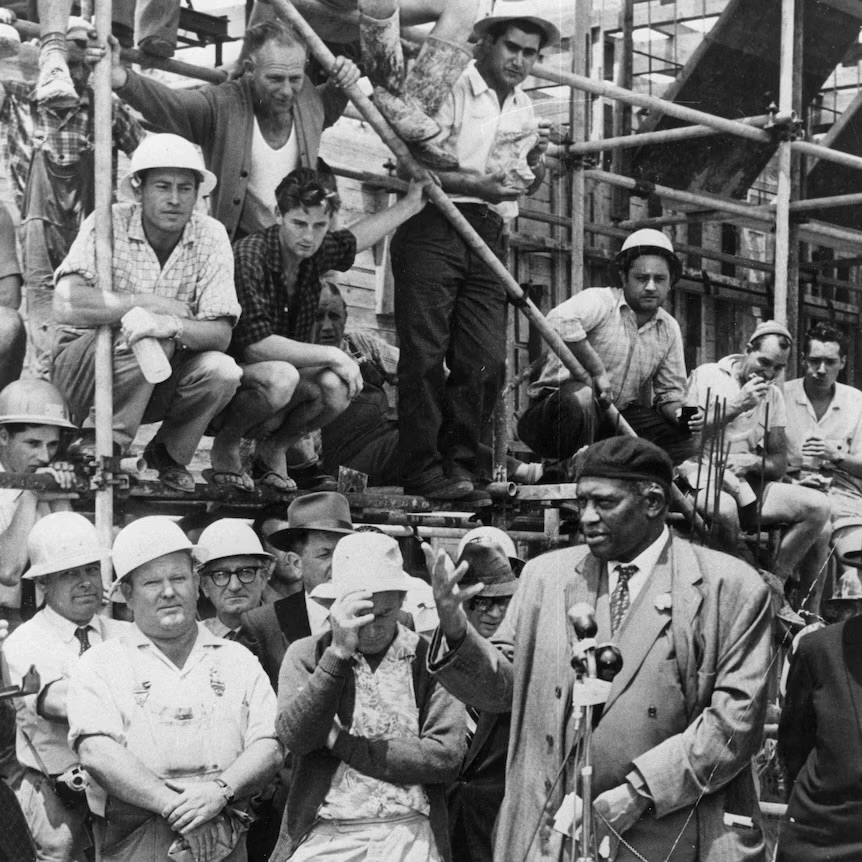
I read Jeff Sparrow’s excellent biography of the celebrated American singer and political activist Paul Robeson several years ago. I was reminded of it very recently with the publication of a book about Robeson’s visit to Australia in November 1960, a twenty-concert tour in nine cities. I have republished a review below, together with an article by Sparrow about his book, and a review of the book by commentator and literary critic Peter Craven. the featured picture is of Robeson singing for the workers constructing the Sydney Opera House.

I have always loved Paul Robeson’s songs and admired his courage and resilience in the face of prejudice and adversity.  Duriung his colourful and controversial career (see the articles below), he travelled the world, including Australia and New Zealand and also, Britain. He visited England many times – it was there that my mother met him. She was working in a maternity hospital in Birmingham when he visited and sang for the doctors, nurses, helpers and patients. My mother was pregnant at the time – and, such was his charisma, that is why my name is Paul.

Paul Robeson was a 20th-century icon. He was the most famous African American of his time, and in his time, was called the most famous American in the world. His is a story of political ardour, heritage, and trauma.

The son of a former slave, he found worldwide fame as a singer and an actor, travelling from Hollywood in the USA to the West End of London, to Europe and also Communist Russia. In the sixties, he visited Australia and is long remembered for the occasion he sang the song Old Man River for the workers building the famous Sydney Opera House.

He became famous both for his cultural accomplishments and for his political activism as an educated and articulate black man in a white man’s racist world.

Educated at Rutgers College and Columbia University, he was a star athlete in his youth. His political activities began with his involvement with unemployed workers and anti-imperialist students whom he met in Britain and continued with support for the Republican cause in the Spanish Civil War and his opposition to fascism.

A respected performer, he was also a champion of social justice and equality. But he would go on to lose everything for the sake of his principles.

In the United States he became active in the civil rights movement and other social justice campaigns. His sympathies for the Soviet Union and for communism, and his criticism of the United States government and its foreign policies, caused him to be blacklisted as a communist during the McCarthy era when American politics were dominated by a wave of hatred, suspicion and racism that was very much like we see today,

Paul Robeson, the son of a slave, was a gifted linguist. He studied and spoke six languages, and sang songs from all over the world in their original language.

But his most famous song was from an American musical show from 1927 – Show Boat, by Jerome Kern and Oscar Hammerstein – called Old Man River. The song contrasted the struggles and hardships of African Americans during and after the years of slavery, with the endless, uncaring flow of the Mississippi River. It is sung the point of view of a black stevedore on a showboat, and is the most famous song from the show.

It is a paradox that a song written by Jewish Americans from the Jewish villages of Eastern Europe, the targets of prejudice and pogrom, should voice the cries of America’s down-trodden people.

When the song was first heard, America was a divided country and people of colour were segregated, abused and murdered. The plot of the musical was indeed about race, although it pulled its punches with the romantic message that love is colour-blind

It reflected America’s split personality – the land of the free, but the home of the heartless. Robeson sung the words as they were written, but later in his career, as he became more and more famous, he changed them to suit his own opinions, feelings, sentiments, and politics. So, when he sang to the workers in Sydney, Australia, his song was not one of slavery but one of resistance.

© Paul Hemphill 2025. All rights reserved

For other posts in In That Howling Infinite on American history and politics, see My Country, ’tis of Thee – Matters American

The Big Voice of the Left … Paul Robeson Resounds to this Day

Mahir Ali The Australian November 9, 2010

FIFTY years ago today, more than a decade before it was officially inaugurated, the Sydney Opera House hosted its first performance by an internationally renowned entertainer when Paul Robeson, in the midst of what turned out to be his final concert tour, sang to the construction workers during their lunch break.

Alfred Rankin, who was at the construction site on November 9, 1960, recalls this “giant of a man” enthralling the workers with his a cappella renditions of two of his signature songs, Ol’ Man River and Joe Hill.

“After he finished singing, the men climbed down from the scaffolding, gathered around him and presented him with a hard hat bearing his name,” Paul Robeson Jr writes in his biography of his father, The Undiscovered Robeson. “One of the men took off a work glove and asked Paul to sign it. The idea caught on and the men lined up. Paul stayed until he had signed a glove for each one of them.”

Workers had the best seats when Robeson sang at the Sydney Opera House, 9 November 1960

The visit, Rankin tells The Australian, was organised by the Building Workers Industrial Union of Australia and the Australian Peace Council’s Bill Morrow, a former Labor senator from Tasmania.

In a chapter on Robeson’s visit in the book Passionate Histories: Myth, Memory and Indigenous Australia, which will be launched in Sydney tomorrow, Ann Curthoys quotes the performer as saying on the day after his visit to the Opera House site: “I could see, you know, we had some differences here and there. But we hummed some songs together, and they all came up afterwards and just wanted to shake my hand and they had me sign gloves. These were tough guys and it was a very moving experience.”

In 1998, on the centenary of Robeson’s birth, former NSW minister John Aquilina told state parliament his father had been working as a carpenter at the Opera House site on November 9, 1960: “Dad told us that all the workers – carpenters, concreters and labourers – sang along and that the huge, burly men on the working site were reduced to tears by his presence and his inspiration.”

Curthoys, the Manning Clark professor of history at the Australian National University, who plans to write a book about the Robeson visit, also cites a contemporary report in The Daily Telegraph as saying that the American performer “talked to more than 250 workmen in their lunch hour, telling them they were working on a project they would be proud of one day”. [Curthoy’s book, The Last Tour: Paul and Eslanda Robeson’s visit to Australia and New Zealand, was published at last in 2025]

According to biographer Martin Duberman, Robeson wasn’t particularly enthusiastic about the offer of a tour of Australia and New Zealand from music entrepreneur D. D. O’Connor, but the idea of earning $US100,000 for a series of 20 concerts, plus extra fees for television appearances and the like, proved irresistible.

Robeson had once been one of the highest paid entertainers in the world, but from 1950 onwards he effectively had been deprived of the opportunity of earning a living. A combination of pressure from the US government and right-wing extremists meant American concert halls were closed to him, and the US State Department’s refusal to renew his passport meant he was unable to accept invitations for engagements in Europe and elsewhere. Robeson never stopped singing but was able to do so only at African-American churches and other relatively small venues. His annual income dwindled from more than $US100,000 to about $US6000.

At the time, Robeson was arguably one of the world’s best known African Americans. As a scholar at Rutgers University, he had endured all manner of taunts and physical intimidation to excel academically and as a formidable presence on the football field: alone among his Rutgers contemporaries, he was selected twice for the All-American side.

Alongside his athletic prowess, which was also displayed on the baseball field and the basketball court, he was beginning to find his voice as a bass baritone. When a degree in law from Columbia University failed to help him make much headway in the legal profession, he decided to opt for the world of entertainment, and made his mark on the stage and screen as a singer and actor.

An extended sojourn in London offered relief from the racism in his homeland and established his reputation as an entertainer, not least through leading roles in the musical Show Boat and in Othello opposite Peggy Ashcroft’s Desdemona.

(He reprised the role in a record Broadway run for a Shakespearean role in 1943 and again at Stratford-upon-Avon in 1959)

Robeson returned to the US as a star in 1939 and endeared himself to his compatriots with a cantata titled Ballad for Americans.

In the interim, he had been thoroughly politicised, not least through encounters in London with leaders of colonial liberation movements such as Kenya’s Jomo Kenyatta, Ghana’s Kwame Nkrumah and India’s Jawaharlal Nehru.

He had sung for republicans in Spain and visited the Soviet Union at the invitation of filmmaker Sergei Eisenstein.

Robeson’s refusal to reconsider his political affiliations once World War II gave way to the Cold War made him persona non grata in his homeland: his infatuation with the Soviet Union did not perceptibly pale in the face of horrific revelations about Stalinist excesses, partly because he looked on Jim Crow as his pre-eminent foe. It is therefore hardly surprising that exposure in Australia to Aboriginal woes stirred his passion.

On the day after his appearance at the Opera House site, at the initiative of Aboriginal activist and Robeson fan Faith Bandler he watched a documentary about Aborigines in the Warburton Ranges during which his sorrow turned to anger, and he vowed to return to Australia in the near future to fight for their rights. He made similar promises to the Māori in New Zealand.

But the years of persecution had taken their toll physically and psychologically: Robeson’s health broke down in 1961 and, on returning to the US in 1963, he lived the remainder of his life as a virtual recluse. He died in 1976, long after many of his once radical aspirations for African Americans had been co-opted into the civil rights mainstream. His political views remained unchanged.

It’s no wonder that, as writer and broadcaster Phillip Adams recalls, Robeson’s tour was like “a second coming” to “aspiring young lefties” in Australia.

Duberman cites Aboriginal activist Lloyd L. Davies’s poignant recollection of Robeson’s arrival in Perth on the last leg of his tour, when he made a beeline for “a group of local Aborigines shyly hanging back”.

“When he reached them, he literally gathered the nearest half dozen in his great arms.”

Davies heard one of the little girls say, almost in wonder, “Mum, he likes us.”

She would have been less surprised had she been aware of the Robeson statement that serves as his epitaph: “The artist must take sides. He must elect to fight for freedom or slavery. I have made my choice. I had no alternative.”

Left for Good – Peter Craven on Paul Robeson

The Weekend Australian. March 11 2017

What on earth impelled Jeff Sparrow, the Melbourne-based former editor of Overland and left-wing intellectual, to write a book about Paul Robeson, the great African American singer and actor?

Well, he tells us: as a young man he was transporting the libraries of a lot of old communists to a bookshop and was intrigued by how many of the books were by or about Robeson.

All of which provokes apprehension, because politics is a funny place to start with

Robeson, even if it is where you end or nearly end. Robeson was one of the greatest singers of the 20th century. When I was a little boy in the 1950s, my father used to play that velvet bottomlessly deep voice singing not only Ol’ Man River — though that was Robeson’s signature tune and his early recording of it is one of the greatest vocal performances of all time — but all manner of traditional songs. Not just the great negro spirituals (as they were known to a bygone age; Sparrow calls them slave songs) such as Go Down, Moses, but Shenandoah, No, John, No and Passing By, as well as the racketing lazy I Still Suits Me.

My mother, who was known as Sylvie and loathed her full name, which was Sylvia, said the only time she could stand it was when Robeson sang it (“Sylvia’s hair is like the night … such a face as drifts through dreams, such is Sylvia to the sight”). He had the diction of a god and the English language in his mouth sounded like a princely birthright no one could deny.

It was that which made theatre critic Kenneth Tynan say the noise Robeson made when he opened his mouth was too close to perfect for an actor. It did not stop him from doing Eugene O’Neill’s All God’s Chillun’ Got Wings or The Emperor Jones, nor an Othello in London in 1930 with Peggy Ashcroft as his Desdemona and with Sybil Thorndike as Emilia.

Robeson later did Othello in the 1940s in America with Jose Ferrer as Iago and with Uta Hagen (who created Martha in Who’s Afraid of Virginia Woolf?) as his Desdemona. He toured the country; he toured the south, which was almost inconceivable. When he was told someone had said the play had nothing to do with racial prejudice, Robeson said, “Let him play it in Memphis.”

Southern white audiences were docile until Robeson’s Othello kissed Hagen’s Desdemona: then they rioted. Robeson also made a point, at his concerts and stage shows, of insisting the audience not be segregated. James Earl Jones. who would play Robeson on the New York stage, says in his short book about Othello, “I believe Paul Robeson’s Othello is the landmark performance of the 20th century.”

Robeson would play the Moor again in 1959 at Stratford-upon-Avon. By that time, though, he had fallen foul of 1950s America. He had been called before the McCarthyist House Un-American Activities Committee. You can hear a dramatisation of his testimony with Earl Jones as Robeson, which includes an immemorial reverberation of his famous words when senator Francis E. Walter asked him why he didn’t just quit the US and live in Russia.

“Because my father was a slave and my people died to build this country, and I am going to stay here and have a part of it just like you. And no fascist-minded people will drive me from it. Is that clear?”

It’s funny how it was the real communists such as Bertolt Brecht and Robeson who handled the committee best. Still, in an extraordinary act of illiberalism, they took away his US passport and it took two years for the Supreme Court to declare in 1958 in a 5-4 decision that the secretary of state was not empowered to withdraw the passport of any American citizen on the basis of political belief.

When Paul Robeson sang at the Sydney Opera House

It was this that allowed Robeson to do his Othello in Peter Hall’s great centenary Stratford celebration along with Charles Laughton’s Lear and Laurence Olivier’s Coriolanus. It also allowed him to come to Australia. Very early on Sparrow tells the story of watching the clip of Robeson singing Ol’ Man River to construction workers in Sydney with the Opera House still a dream in the process of meeting impediments. The version Robeson sings is his own bolshie rewrite (“I must keep fightin’/ Until I’m dyin’ ”).

Well, fight he did and bolshie he was. I remember when I was a child my father telling me Robeson was a brilliant man, that he had won a sporting scholarship for American football (to Rutgers, in fact), that he’d gone on to receive a law degree (from Columbia, no less) and that he was so smart he had taught himself Russian.

But the sad bit was, according to my father, that he’d become a communist. Understandably so, my father thought, because of how the Americans treated the blacks. My father’s own radical impulses as a schoolboy had been encouraged, as Robeson’s were on a grander scale, by World War II where Uncle Joe Stalin was our ally in the war against Hitler’s fascism.

But this was the Cold War now, and a lot of people thought, with good reason, that it was behind the Iron Curtain that today’s fascists were to be found. Even if others such as the great German novelist Thomas Mann and Robeson thought they were encroaching on Capitol Hill.

Sparrow’s book No Way But This is circumscribed at every point by his primary interest in Robeson as a political figure of the Left rather than as a performer and artist.

It’s an understandable trap to fall into because Robeson was an eloquent, intelligent man of the Left and his status was also for a while there — as Sparrow rightly says — as the most famous black American on Earth. So his radicalism is both pointed and poignant.

His father, who became a Methodist minister, was born a slave and was later cruelly brought down in the world. But, unlike the old Wobblies whose bookcases he transported, Sparrow is not inward with what made Robeson famous in the first place and it shows.

No Way But This is a great title (“no way but this / killing myself, to die upon a kiss” is what Othello says when he’s dying over the body of Desdemona, whom he has killed) but Sparrow’s search for Robeson is not a great book.

As the subtitle suggests, it is a quest book but Sparrow is a bit like the Maeterlinck character cited in Joyce’s Ulysses who ends up meeting himself (whether in his Socrates or his Judas aspect) on his own doorstep. Sparrow goes to somewhere in the US associated with Robeson and meets a black-deaths-in-custody activist full of radical fervour. She introduces him to an old African-American who was in Attica jail for years. There is much reflection on the thousands of black people who were slaves on the plantations and the disproportionate number of them now in US prisons.

Yes, the figures are disquieting. No, they are not aspects of the same phenomenon even though ultimately there will be historical connections of a kind.

And so it goes. But this is a quest book that turns into a kind of travelogue in which Sparrow goes around the world meeting people who might illuminate Robeson for him but don’t do much for the reader except confirm the suspicion that the author’s range of acquaintance ought to be broader or that he should listen to people for a bit more rather than seek confirmation of his own predilections.

There are also mistakes. Sparrow seems to know nothing about the people with whom Robeson did Othello. There’s no mention of Thorndike, and when Ashcroft comes up as someone he had an affair with, Sparrow refers to the greatest actress of the Olivier generation as “a beautiful glamorous star”. Never mind that she was an actress of such stature, Judi Dench said when she played Cleopatra she could only follow Ashcroft’s phrasing by way of homage.

Sparrow also says “American actor Edmund Kean started using paler make-up for the role, a shift that corresponded with the legitimisation of plantation slavery”. Kean, who was the greatest actor of the later romantic period, was English, not American. His Othello would, I think, be more or less contemporary with William Wilberforce lobbying to have slavery made illegal. Sparrow seems to be confusing Kean with Edwin Booth, the mid-century Othello who happens to have been the brother of John Wilkes Booth, the assassin of Abraham Lincoln. But it’s still hard to see where the plantations fit in.

A few pages later — and it’s not important though it’s indicative — we hear of the rumour that Robeson was “romancing Edwina Mountbatten, Countess Mountbatten of Burma”. Well, whatever she was called in the early 1930s, it wasn’t Countess Mountbatten of Burma because her husband, Louis Mountbatten, the supreme allied commander in Southeast Asia during World War II, didn’t get the title until after the Japanese surrendered to him — guess where?

Such slips are worth belabouring only because they make you doubt Sparrow’s reliability generally. It’s worth adding, however, that his chapter about the prison house that the Soviet Union turned itself into is his most impressive. And the story of the last few years of Robeson’s life, afflicted with depression, subject to a lot of shock treatment, with recurrent suicide attempts, is deeply sad.

He felt towards the end that he had failed his people. He just didn’t know what to do. It was the melancholy talking as melancholy will.

It’s better to remember the Robeson who snapped back at someone who asked if he would join the civil rights movement: “I’ve been a part of the civil rights movement all my life.”

It’s to Sparrow’s credit that he’s fallen in love with the ghost of Robeson even if it’s only the spectral outline of that power and that glory he gives us.

Peter Craven is a cultural and literary critic

The Last Tour: Paul and Eslanda Robeson’s visit to Australia and NZ

Australians of a certain age know all about Paul Robeson’s magnificent voice. They know, too, that on a warm November day more than 60 years ago, the bass-baritone sang to 250 construction workers on the Sydney Opera House building site as the workers sat on scaffolding and stacks of timber and ate their lunch. Fewer know of Robeson’s Pro-Communist and pro-Soviet views and of how those beliefs damaged his career at home and abroad. And that’s not so surprising – as historian Ann Curthoys points out, the Cold War suppression of Robeson’s career and memory has been very effective.

Recovering the story of a man who was once the most famous African-American in the world and his equally impressive wife, Eslanda, is the task Curthoys, who grew up in an Australian communist family in the 1950s and 60s, sets herself in a new book, The Last Tour: Paul and Eslanda Robeson’s visit to Australia and New Zealand.

It follows the couple’s tour – a mix of his concerts and their public talks and media interviews – to Australia and New Zealand over October, November and December 1960. Curthoys goes further, using the seven-week tour by this celebrated singer to explore the social and political changes just beginning in post-War Australia. Her interest is “the slow transition from the Cold War era of the late 1940s and 50s, to the 60s era of the New Left, new social movements and the demand for Aboriginal rights”.

Curthoys is 79 now, but when Robeson toured she was 15 and living in Newcastle, a city the singer did not visit. Her mother, Barbara Curthoys, a well-known activist and feminist, was a fan of the singer but the trip passed the teenager by.

It was only decades later, as she researched her 2002 book on the 1965 Aboriginal Freedom Ride through regional NSW, that Curthoys connected with the story. As a university student she had taken part in the ride and moved from communism to the New Left. When she approached the subject as a historian, she realised that for some riders, their attendance at Robeson’s concerts five years earlier had been a defining moment in their “understanding of racial discrimination and Aboriginal rights”.

Curthoys has had a long career in research and teaching at the Australian National University and the University of Technology, Sydney. She’s part of a remarkable family, and not just parents Barbara and Geoffrey, who was a lecturer in chemistry at Newcastle University. Her sister Jean is a leading feminist philosopher and her husband, John Docker, has written several books on cultural history, popular culture and the history of ideas.

Curthoys began researching The Last Tour in 2007, but put it aside for another project on Indigenous Australians before resuming work on it during the Covid-19 lockdowns. Post-­Robeson, she has worked with two scholars on a forthcoming book on the history of domestic violence in Australia.

The tour, she says, was really several tours rolled into one with the Robesons covering many bases – from music to Cold War politics to feminism to Aboriginal rights. It was a conservative era: Robert Menzies’ Liberals ruled federally and five of the six Australian states had conservative governments. Robeson’s presence went unremarked by governments but for fans of his music – and his ideals – the tour was a significant event that was well covered by the press, even those opposed to his views on the Soviet Union.

For some fans, it was a music tour – 20 concerts in nine cities in Australia and New Zealand, at which Robeson sang his show-stoppers, including Deep River, Go Down, Moses; We Are Climbing Jacob’s Ladder, and the song with which he is always identified, Ol’ Man River. The 62-year-old with the extraordinary voice also delivered “recitations” – a monologue from Shakespeare’s Othello, an anti-segregationist poem Freedom Train, and William Blake’s anthem, Jerusalem.

What a thrill for Australian audiences, some of whom had followed the handsome, 1.9m singer and actor since the 1920s. Even in an age of limited communications, Robeson was well-known here through films; records and radio. Curthoys notes that one indicator of his fame was the way promising Aboriginal singers in the 1930s were dubbed “Australia’s Paul Robeson”.

He was famous – and controversial. Unlike many other supporters of communist ideas, Robeson refused to break from the Soviets after the invasion of Hungary in 1958 and continued to defend Moscow. The “anti-communist repression and hysteria” that gripped the US in the McCarthy era had a profound effect on his life and career, Curthoys writes. He was cited in 1947 by the House Committee on Un-American Activities as “supporting the Communist Party and its front organisations”.

A 1949 US tour was destroyed “after mass cancelling of bookings by venue managers either vehemently opposed to his politics or afraid in such a hostile climate of being classed as communist sympathisers themselves”. Then in 1950, he lost his passport. Over the years, he would “become for communists an emblem of defiance in the face of adversity, and one of the communist world’s most prominent speakers for peace,” ­Curthoys writes.

Unable to travel until his passport was restored in 1958, Robeson was steadfast in his support for communist ideals. That commitment was evident in Australia when the “peace tour” – built around a series of public meetings – was as important to the singer as the popular concerts where he reached a different audience. Curthoys details a related strand – the “workers’ tour”, which involved seven informal concert performances to groups of railway workers, waterside workers and those at work on the Opera House on that November day.

She says the events revealed much about the “the nature of class in Australia and New Zealand” at a time when “strong and confident trade unions” were interested in “broad cultural concerns”. Over several weeks Robeson attracted people who loved his music alongside those who loved his politics. Far from being shunned for his pro-Soviet views, Curthoys suggests, there was support from two different audiences – music people and “left-wing ­people who were either pro-Soviet or not”.

Even so, the Cold War anxieties over the Soviets meant a positive reception was not necessarily assured when Paul and Eslanda flew into Sydney at midday on Oct­ober 12, 1960. They were greeted by several hundred fans carrying peace banners but they faced pointed questions about the Soviet Union at the 20-minute press conference at the airport.

Robeson refused to condemn the suppression of the Hungarian uprising and media reports suggested a torrid exchange. Curthoys reviewed a tape of the press conference and says while the questioning was “a little aggressive”, the event was not as bad as reported in the media. Indeed it was “fairly friendly” albeit for a “bad patch” when Robeson refused to budge on Hungary.

That tape and others, along with newspapers and Trades Hall documentation, yielded rich material but so too did the ASIO files on the couple. At the Palace Hotel in Perth on December 2 an ASIO operative appeared to be among those at a reception organised by the communist-influenced Peace Council. Among guests were the writer (and well-known communist) Katharine Susannah Prichard and “two women by the name of Durack, who were writers and/or artists”.

Curthoys sees Robeson as a “very courageous, very intelligent, intellectual person, very thoughtful about music, about folk music, about people”, but says his commitment to the Soviet Union was a costly mistake. He had embraced Moscow when he and Eslanda visited in 1934 at the invitation of Soviet film director Sergei Eisenstein. Later, Robeson, a fluent Russian speaker, would say it was in the Soviet Union that he felt for the first time he was treated “not through the prism of race but simply as a human being”. Curthoys writes: “The excitement and validation he received during this visit would create a loyalty that later events would not dislodge and the public expression of which would damage him politically, commercially and professionally.”

The couple made several trips to the Soviet Union and accepted its political system completely. Curthoys notes: “They made no public comments about Stalin’s forced collectivisation policies that were in place during the 1930s and led to famine and the loss of millions of lives.” In Sydney Robeson was careful, but on November 5 he celebrated the forthcoming anniversary of the Russian Revolution at the Waterside Workers Federation in Sussex Street. Two days later, during his first public concert in the city, he paid tribute to the Soviet Union as “a new society”.

The Soviet Union had been a great influence but so too was the Spanish Civil War, which Curthoys says helped define his view of the political responsibilities of the artist.

“Increasingly famous as a public speaker, on 24 June, 1937, he made a huge impression at a mass rally at the Albert Hall in London sponsored by prominent figures such as WH Auden, EM Forster, Sean O’Casey, HG Wells and Virginia Woolf, held to raise financial aid for Basque child refugees from the war. In what became his most well-known and influential speech, he stressed how important it was for artists and scientists and others to take a political stand: ‘Every artist, every scientist, every writer must decide NOW where he stands. He has no alternative. There is no standing above the conflict on Olympian heights.’”

After World War II, Robeson was deeply involved in radical and anti-racism politics in the US but in 1947, as the Cold War worsened, he had had enough. He announced he intended to abandon the theatre and concert stage for two years to speak out against race hatred and ­prejudice. In fact he stopped stage acting for 12 years but continued to perform as a singer, often in support of political causes.

It was another 13 years before Australian audiences heard that glorious voice “live”. Australians, it seemed were primed for Paul. The tour may have been ignored by governments but during her research, Curthoys was “overwhelmed” by people “ready to assist, donating old programs, photographs, pamphlets, records, cassette tapes, invitations and other documents”.

Today, much of the Robeson image is defined by his Opera House performance on November 9 – high culture delivered, without condescension, to a building crew by a champion of the workers. Robeson, in a heavy coat, despite the warm weather, sang “from a rough concrete stage”. A PR expert could not have dreamt up a a better way to “democratise” an opera house than having the “first concert” delivered in its half- built shell. Curthoys shows how the event, no matter how memorialised now, was a small part of a tour that proved a financial and political success for the Robesons, who left Australia on December 4.

A few months later, depressed and exhausted, Robeson tried to commit suicide in Moscow. Over the next three years he was treated but could no longer perform or engage in public speaking. Curthoys notes that though his affairs with other women had strained their marriage, he and Eslanda had a common political vision and were together until her death in 1965. Robeson died on January 23, 1976 at the age of 77.

Helen Trinca’s latest book is Looking for Elizabeth: The Life of 
Elizabeth Harrower (Black Inc.)

Putin’s war … an ageing autocrat seeks his place in history

In That Howling Infinite’ has written often about Russian and Ukrainian history, not only because personally it has been of long-term academic interest, but also, because of the ongoing Russia-Ukraine war.

In In That Howling Infinite’s post, Borderlands – Ukraine and the curse of mystical nationalism, we wrote:

“Like many countries on the borders of powerful neighbours, Ukraine has long endured the slings and arrows of outrageous history. Its story, like that its neighbours, is long and complex. In competing national narratives, Russians and Ukrainians both claim credit for the creation of the Russian state, though others attribute this, with some credence, to the Vikings. The historical reality of Ukraine is complicated, a thousand-year history of changing religions, borders and peoples. The capital, Kyiv, was established hundreds of years before Moscow, although both Russians and Ukrainians claim Kyiv as a birthplace of their modern cultures, religion and language.

I highly recommend Serhii Plokhy’s The Gates of Europe, a well told and fascinating story of the origins of Ukraine and Belarus, and how their histories were intertwined, and entwined with those of of Poland, Lithuania (which was a large and powerful state once) and Russia. Ukraine has historically been the border between the catholic west and the orthodox east, the division running virtually down the middle. The name Ukraine is Slav for border land. Its geopolitical location and natural resources have led to the land being inflicted by invaders, civil wars, man-made famine and repression.

Eastern European countries, Ukraine included, have with good reason no love for Russia, be it Czarist, Soviet or Putin’s. Hungarians, Czechs, Poles and East Germans have seen Russian “peacekeeping” troops and tanks on their city streets, as have the Baltic countries, Afghans and Chechens. Millions of Ukrainians died under Stalin’s rule (and many, many millions of fellow-Soviet citizens). The 20th Century was not kind to the countries of Central and Eastern Europe. Historian Timothy Snyder called them “the blood lands”.

We republish below a recent article in The Australian by Melbourne historian and academic Mark Edele. It gives the uninformed but interested reader a short but comprehensive history of the relationship between Russia and Ukraine from the ninth century to the present day.

Here are posts in In That Howling Infinite, about Russia, Ukraine and Eastern Europe:

Putin’s puppet sells out Ukraine

Donald Trump’s bullying ‘peace plans’ to end the Ukraine war will only embolden Vladimir Putin, who fancies himself a leading a great power with historical rights beyond his borders.

Mark Edele, The Australian, 8 March 2025

Last weekend, the United States vacated the post of leader of the free world. Supporters of democracy the world over watching in disbelief as the US President and Vice-President berated, belittled, and bullied the leader of a democracy at war. On Monday, then, followed what this “great television”, as Donald Trump called it, was all about: a pretext to halt military aid to Ukraine, followed soon by the end of intelligence-sharing. The end goal: force Ukraine to the negotiation table with no security guarantees included in a “deal” with Vladimir Putin.

Four things will come out of an emboldened Russia now: more air raids on Ukraine’s civilians; a renewed push at the frontline; praise for the US administration and its visionary leader; and a disinformation campaign to convince the democratic world that black is white, up is down, left is right, Ukraine the aggressor and Russia the victim in this war. Astonishingly, we can also expect the White House to parrot such propaganda. Welcome to the era of strategic chaos.

Kremlin spokesman Dmitry Peskov noted the obvious: The US’s shift from supporting its allies to courting Moscow “largely coincides with our vision”. Foreign Ministry spokeswoman Maria Zakharova ladled on now familiar Russian propaganda. Volodymyr Zelensky, she claimed, was the head of a “neo-Nazi regime”, a “corrupt individual who lost his grip on reality”, whose “outrageously rude behaviour during his stay in Washington … reaffirmed his status of the most dangerous threat to the international community”. Zelensky was an “irresponsible figure”, a “terrorist leader” who had “built a totalitarian state” and is “ruthlessly sending millions of his fellow citizens to their deaths”.

Sigmund Freud would have classified these statements as “projection”: they are true, but apply to Zakharova’s boss, Vladimir Vladimirovich Putin. Born in 1952, Putin grew up in St Petersburg, then called Leningrad. Surrounded with stories of World War II, in which his father served and his brother perished, he came of age on the rough streets of Leningrad during the heydays of Soviet superpower. In 1975 he joined the KGB, an organisation that deeply formed his world view and behaviour. His sport is judo, a deeply tactical martial art focused on exploiting the opponent’s weaknesses and redirecting the adversary’s momentum.

Putin came of age on the rough streets of Leningrad during the heydays of Soviet superpower. Picture: AFP

After the breakdown of the Soviet empire in 1991, he served in the city administration of St Petersburg. Later he moved to Moscow to make a career in the administration of the first president of post-Soviet Russia. When Boris Yeltsin looked for a successor who would guarantee his own and his family’s safety, Putin’s name came up. He was seen as competent but unthreatening to the oligarchs running Russia at the time. In 1999, Putin became premier. Later the same year, he was appointed acting president. His tenure was defined by the brutal second Chechen War, which he prosecuted with utter ruthlessness. In 2000, he was elected President. He remained in this post until today, with a stint stepping back to the prime ministership in 2008-12, to get around term limitations in the constitution (subsequently changed).

In the quarter-century he ruled Russia, Putin broke the power of the oligarchs, rebuilt the state as a security organisation run by former KGB officers, suffocated free speech, pluralism and the opposition, and built one of the most unpleasant electoral dictatorships of the post-Soviet space. Despite an economy still only a quarter of that of the EU or the US (to say nothing of China’s), Putin fancies himself as leading a great power with a right to a sphere of influence and a major say in shaping the international order.

By the end of the second decade of his rule, however, the ageing dictator in the Kremlin began to worry about his legacy. His track record was mixed. The Russian population had been declining steadily until the 2010s. The following uptick was mostly undone again during and after the Covid pandemic, fuelling longstanding apocalyptic fears that the Russians would be dying out. The economy had grown significantly, but social inequality had exploded alongside, while political liberties continually atrophied. The Covid crisis was handled extremely poorly. Great-power status remained an aspiration. Putin worried what the history books would say about him. The answers respectable historians gave him when asked were evasive. And he was turning 70 in 2022.

History, and his place in it, obsessed Vladimir Vladimirovich. During his, quite extreme, Covid isolation, he read history books, immersing himself in the Russian imperialist tradition. Such historians had long denied that Ukraine was anything but a part of Russia. He summarised this traditional Russian view “on the historical unity of Russians and Ukrainians” in an essay of that title, published on July 12, 2021. It read like the musings of an ageing Russian imperialist. A bit over seven months later, it revealed itself as the ideological justification of a full-scale invasion of Ukraine.

Ukraine and Russia: histories entangled but separate

At the heart of Putin’s worldview is that Russia continues to be a great power with historical rights on Ukraine. It thus bears repeating that Russia and Ukraine are separate nations, which trace their heritage back to a common origin: a collection of principalities centred on Kyiv, known as the Rus of the ninth to 13th centuries. After the Mongol invasions of the 1220s and 1230s, however, the southwestern and the northeastern parts of this civilisation developed in different and quite separate ways, eventually leading to Russia and Ukraine as we know them today. As a result of such divergence, Russian and Ukrainian have developed as separate, if related, languages.

Vladimir Putin attends the Victory Day military parade in central Moscow on May 9, 2024. Picture: AFP

Putin attends the Victory Day military parade in Moscow on May 9, 2024. AFP

Overlapping histories and linguistic similarities are not unique among nations. Both Germany and France claim the Frankish empire under Charlemagne (French) or Karl (German) as part of their deeper history. Yet nobody would suggest (any more) that therefore France should be part of Germany or vice-versa. Likewise, French and Portuguese have related grammatical structures and some overlap in vocabulary. And yet nobody would argue that Portuguese is a French dialect.

Ukrainians formed a state twice: once in 1649, the Cossack-led “Hetmanate” fighting for its independence from Poland; the second time in 1917-21, after both the Russian and Austro-Hungarian empires had collapsed in World War I. Both were defeated militarily, but both were important inspirations for a democratically minded national movement.

Ukraine’s lands and peoples came into the Russian orbit in stages. First was the disastrous Treaty of Periaslav of 1654, when the Hetmanate joined a temporary military alliance with Muscovy against Poland, which the Muscovites read as a subjugation under the autocrat instead. After much fighting and diplomatic manoeuvring, Poland and Russia agreed in 1667 that Moscow could control the lands east of the Dnipro (“left bank Ukraine”) as well as Kyiv on the “right bank”. When Poland was partitioned at the end of the 18th century, what was left of Ukraine came partially under Habsburg and partially under Romanov rule. At the end of World War I, Ukraine emerged as one of the successor states of the Romanov empire, alongside Latvia, Lithuania, Estonia, Finland, Poland and Bolshevik Russia. In contrast to these states, however, it did not survive the wars and civil wars that followed the disintegration of the empire in 1917.

In 1921, it was divided between the newly resurrected state of Poland and the emergent successor of the vast majority of the lands of the Romanov empire: Bolshevik Russia. Within the latter, Ukraine was granted a pseudo independence as one of the Union republics making up the newly formed “Union of Soviet Socialist Republics”, or USSR.

The Ukrainian SSR was a Bolshevik ploy to disarm national sentiment while reasserting imperial, and increasingly totalitarian, control by Moscow. In the long run, however, it allowed not just the maintenance but even the growth of national culture and national self-awareness. Ukraine also grew geographically. During World War II, the Soviets gobbled up the rest of Ukraine from Poland and Romania. In 1954, the government transferred Crimea to Ukraine, to ease the economic development of a region with no geographic connection to Russia. Thus Ukraine acquired its current, internationally recognised borders. Eventually, they provided a ready-made demarcation of post-imperial Ukraine, once the Soviet empire collapsed in 1989-91.

After the Soviet Union

Of the 15 successor states of the Soviet Union, Russia is the largest in terms of territory (17.1 million square kilometres). Ukraine, with 0.6 million square kilometres, comes third after Kazakhstan (2.7 million square kilometres). In a comparison of population sizes, Ukraine occupies the second position, with 37.7 million in 2023, according to the World Bank, quite a way behind Russia with 143.8 million. By comparison, the most populous country of the EU, Germany, has 83.3 million, while the EU as a whole counts 448.8 million.

Of the 15 successor states of the Soviet Union, Russia is the largest in terms of territory. Picture: istock

As the largest country in the post-Soviet region, in 2023 Russia had the largest GDP adjusted for purchasing power ($US6.5 trillion), followed by Kazakhstan ($US0.8 trillion) and Ukraine ($US0.6 trillion). Again, compare this to Germany ($US5.7 trillion) or Australia ($US1.9 trillion), to say nothing of the EU ($US26.4 trillion), the US ($US27.7 trillion) or China ($US34.7 trillion).

As far as the political system is concerned, between the breakdown of the Soviet empire and today Russia has been on a steady downwards slope, from some early democratic promises to ever darker authoritarianism. Ukraine, meanwhile, evolved in three waves of democratic surges followed by counter movements: the 1990s, the second half of the 2000s, and from the middle of the 2010s. While not the freest country in the post-Soviet space (that privilege belongs to the three Baltic republics of Latvia, Lithuania, and Estonia, all members of EU and NATO), it is in no way comparable to Russia. Zelensky was elected President in 2019 with 73 per cent of the vote. As of late February 2025, he had an approval rating of 52 per cent.

Zelensky was elected Ukraine President in 2019 with 73 per cent of the vote. Picture: AFP

Zelensky was elected president in 2019 with 73 per cent of the vote. AFP

The latest report on Ukraine from a Washington-based independent watchdog, Freedom House, notes that both the President and the current legislative were elected in free, competitive, and fair elections. Since 2022, there was some deterioration of political freedoms because of the war, including the suspension of elections due to martial law, new restrictions against parties that support Russia’s aggression, and greater control of the reporting in the main news channels. However, opposition parties continue to sit in parliament and their political activities “are generally not impeded by administrative restrictions or legal harassment”. Communication channels outside the official network, such as social media platforms, remain available and used freely.

All of this contrasts sharply to the repressive nature of Russian rule, not just in the occupied territories of Ukraine, but also in Russia itself. For 2025, Freedom House categorised Ukraine as a “transitional or hybrid regime”, while Russia was a “consolidated authoritarian regime”.

The war

Russia invaded Ukraine in 2014 after a popular revolution in Kyiv had ousted pro-Russian president Viktor Yanukovych. Russia illegally annexed Crimea and fostered a proxy war in Ukraine’s east, the Donbas, at times fought with regular Russian troops; at others by Russia-sponsored rebels. Most observers at the time assumed that this was the endgame: taking over Crimea was popular among Russians who saw it as their own Riviera; the frozen conflict in Ukraine’s east served as a festering wound keeping the recalcitrant democracy down.

Ukrainian firefighters push out a fire after a strike in Zaporizhzhia in 2022, amid the Russian invasion of Ukraine. Picture: AFP

Ukrainian firefighters putout a fire after a strike in Zaporizhzhia in 2022. AFP

Two ceasefire agreements, Minsk I (September 5, 2014) and Minsk II (February 12, 2015), failed. After the first, Russia sent troops across the border to defeat Ukraine’s armed forces in the Second Battle of Donetsk Airport (September 2014 to January 2015) and the Battle of Debaltseve (January to February 2015). After the second, the frontlines remained frozen, but shelling and sporadic fighting continued. No part of the agreement was ever fully implemented and soldiers kept dying. The world, however, moved on.

Who had not moved on was Putin, dreaming of great power and empire. While convincing himself of the righteousness of his position by reading Russian imperial historiography, he observed “the West” move from crisis to crisis. In Europe, the liberal consensus was challenged by new-right populist movements. The UK was in political chaos. The US could not even execute an orderly withdrawal from Afghanistan, unlike the Soviet army in 1988. And that army, now Russia’s, had been modernised significantly under Putin’s watch. It was time to strike.

Preparations for the invasion started shortly after the fall of Kabul in August 2021. By October, the US had conclusive evidence that Russia planned an assault with the goal of controlling all of Ukraine and eliminating its President. Between then and the start of the war, the US tried repeatedly to create diplomatic off-ramps for the Kremlin. Putin was not interested.

On February 24, 2022, Putin unleashed his war of conquest. Within 10 days, Ukraine’s military was supposed to be disabled, the country’s leaders arrested or executed, pro-Russian popular support mobilised, and resisters detained. By mid-August, all of Ukraine would be occupied, the plan went. Then, it could be either annexed or given over to a puppet regime.

The plan failed. There were few collaborators and much resistance. The battle for Hostomel airport was lost by the Russian airborne forces sent in at short notice; two groups of assassins sent to kill Zelensky were hunted down and eliminated; the columns advancing towards Kyiv were stopped by the fire of artillery and main battle tanks, both of Ukrainian origin. While social media was obsessed by the David-versus-Goliath spectacle of US-made shoulder-launched missiles taking out Russian tanks, the real damage was done using Ukraine’s own resources. Victory in the battle of Kyiv was achieved by late March 2022.

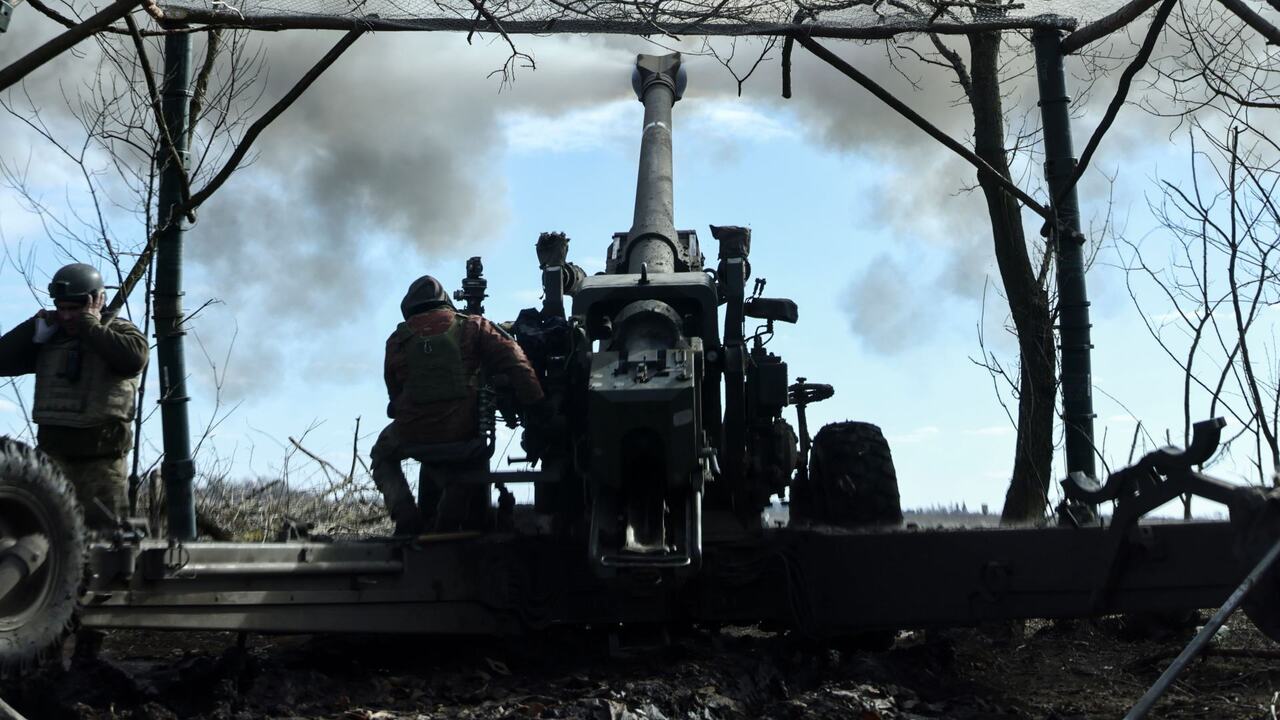
Over the next three years, the war changed from a battle of movement to position warfare and a war of attrition. Russia began to rely on massed use of artillery and the liberal sacrifice of manpower. This looked like WWII: the frontal assaults, the artillery barrages, the utter disregard for human resources. But there was a new element as well: terror attacks on civilians and their infrastructure. This was not a Soviet tradition: during WWII, it was British and US air forces that had flattened German and Japanese cities. Such bombing was not part of the Red Army’s military repertoire. Its air forces were geared towards support of ground troops, not “strategic” bombing of civilians.

In its changed focus on hurting civilians from the air, Putin’s army drew on the neo-imperial wars he had overseen: Chechnya and Syria. It was here that the Russian air force first flattened cities (Grozny in 1999-2000 and Aleppo in 2015-16) and it was this experience that now came to bear on the war in Ukraine. Except that here they did not control the airspace and did not face defenceless civilians they could simply “de-house” at will. Instead, they had to deal with an enemy capable of shooting down not just bombers, which as a result were not sent into Ukraine’s airspace, but also many of the missiles and drones sent from a safe distance.

While air assaults on civilian targets became part of the normalcy of Russia’s changing way of war, tactics on the ground also evolved: rather than mass assaults after preliminary artillery preparation, increasingly Russia used surprise attacks by small groups of storm troopers to conduct reconnaissance by force. If they encountered major resistance, they would then call in airstrikes or artillery barrages. They also stopped frontal assaults on fortified positions, bypassing and encircling them instead.

But none of this led to major breakthroughs. The war bogged down.

Russia was better prepared than Ukraine for a war of attrition. It had long built a food system that could withstand international isolation, demonstrating that a major war had been on the minds of the planners in the Kremlin for a very long time. The discrepancy in the size of both the economy and the population also meant Russia had the edge in the long run. And while the militarisation of the economy came with increasingly serious economic imbalances, they were not serious enough to force Putin’s dictatorship to back down. Instead, military salaries and the growing investments in military industries led to economic mini-booms in several of the regions that supplied the volunteers and the weapons to fight in Ukraine. To many Russians, this continues to be a profitable war.

Putin’s overall strategy thus shifted from a lightning war of conquest to outlasting the democratic world. Having the Soviet experience of extreme suffering and endurance in mind, and construing “the West” as weak, effeminate and degenerate, he had every confidence that Russia would be successful in the long run. With Trump’s election victory, this confidence grew. With his behaviour in the first six weeks in office, it must have soared. Putin has less reason than ever to compromise. And he can achieve much by playing Trump diplomatically.

What now?

After the spectacular dust-up in the Oval Office a week ago, doom and gloom have descended over Ukraine and its supporters. A pouting US President seems to assume that if he pulls the plug on Ukraine, the war will simply end: “Zelensky better move fast or is not going to have a Country left,” he wrote a week before he ambushed him in front of the cameras.

The withdrawal of US support is a serious setback for Ukraine. The US and Europe have provided about equal amounts of money to Ukraine. If Europe were to try to replace US contributions, it thus would have to double its financial commitments at a time when the economy is not exactly booming and will soon be further hit by Trump’s trade wars.

The withdrawal of US support is a serious setback for Ukraine. Picture: AFP

The withdrawal of US support is a serious setback for Ukraine. AFP

The major victims of Trump’s retreat will be Ukraine’s civilians. The US air defence systems currently protecting cities cannot be replaced easily. An increase in civilian deaths is the inevitable result. The withdrawal of intelligence is also a serious blow and difficult to substitute.

However, the EU’s economy is big enough to replace US contributions. An increase equal to 0.12 per cent of Europe’s GDP would suffice. Germany’s taxpayers spend three times more on domestic subsidies for diesel fuel than they devote to military aid to Ukraine. And production capacity is growing. At the start of the war, most military aid came from quickly depleting stockpiles. By 2024, the vast majority of materiel fuelling Ukraine’s war effort are newly produced weapons and equipment.

More than half of Ukraine’s weaponry is produced in Ukraine, a further 25 per cent comes from Europe. The 20 per cent the United States contributes is particularly valuable and high-quality, but it is not the backbone of Ukraine’s capacity. In a war of attrition heavily dependent on artillery, Europe will produce some two million artillery shells for Ukraine this year. The US, before Trump pulled the plug, was expected to deliver less than one million. Elon Musk’s Starlink, providing communications at the frontline, can be replaced with alternatives.

Thus, Ukraine’s defences are unlikely to collapse. Russia has been advancing recently, but progress was slow. By the third anniversary of the invasion, Russia controlled about 20 per cent of Ukraine’s territory, including some 4000 square kilometres gained in 2024. However, Ukraine is a big country. Russia’s 2024 gains represent a mere 0.6 per cent of Ukraine’s territory. Russia has not taken major cities in 2024 and urban life continues everywhere.

Meanwhile, Russia lost parts of the Kursk region to a counteroffensive the Russian military was unable to reverse. Russia has likely enough materiel for at least another year of fighting, but not enough for a major breakthrough.

In an assessment of the war written at the end of 2024, one of the most perceptive analysts of the military side of the war in Ukraine, exiled Russian historian and former civil rights activist Nikolai Mitrokhin, developed four possible scenarios for what could happen in 2025. None of them included a complete breakdown. His “catastrophic” scenario was a “partial collapse of the front due to the reduction of Ukrainian forward units”, leading to a “rapid advance of Russian units to the left bank of the Dnipro”. He predicted that this might lead to a leadership change, but also a further rallying around the flag and a continuation of the fight.

Less catastrophic would be a return to a grinding Russian offensive, as in 2024. “At the current rate of advance,” wrote the Institute for the Study of War in its Ukraine Fact Sheet of February 21, 2025, “it would take Russian forces over 83 years to capture the remaining 80 per cent of Ukraine, assuming that they can sustain massive personnel losses indefinitely”.

This outlook explains why Putin is so enthusiastic about Trump’s “peace plans”. They might achieve diplomatically what he cannot achieve on the battlefield: the subjugation of Russia’s democratic neighbour to neo-imperial domination.

Mark Edele is a historian of the Soviet Union and its successor states, in particular Russia. He is Hansen Professor in History at the University of Melbourne. His latest book is Russia’s War Against Ukraine: The Whole Story (Melbourne University Press, 2023

Trump and Vance ambush Zelensky at the White House

What did Lenin do for us? The welfare state, that’s what,

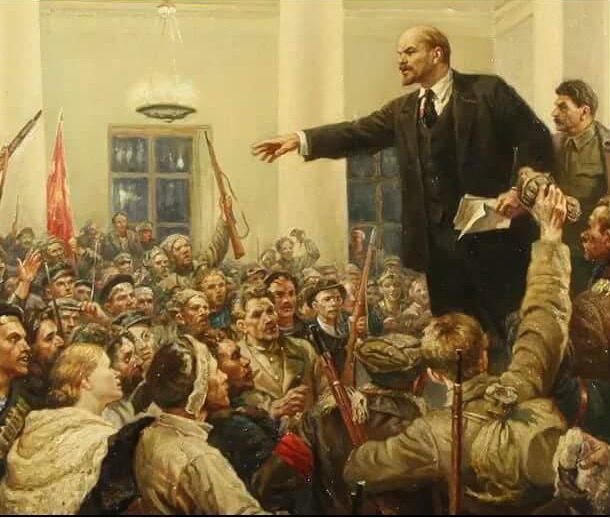
Vladimir Ilyich Ulyanov (22 April 1870 – 21 January 1924), better known as Vladimir Lenin, was a Russian revolutionary, politician, and political theorist. He is widely considered one of the most significant and influential figures of the 20th century. Yet whilst his embalmed body still lies in Red Square, the real Lenin has been buried by decades of dictatorship and Cold War, and a century of sanctification and vilification.

Lenin speaking to a crowd in Moscow’s Sverdlov Square with Leon Trotsky and Lev Kamenev beside him, May 1920

In That Howling Infinite has written often about Russian history. So, we couldn’t resist commemorating the centennial of Lenin’s death.

I first became acquainted with him in the fall of 1968 whilst reading politics at Reading University under the tutorship of émigré academic and historian of Russian and Soviet politics Tibor Szamuely. For a while,

Back then, I was a political ingenue and a naïve communist sympathizer and fellow traveler, although my evolving perspectives were transforming and expanding. As my tutor, he advised me to study with an open mind and to put off juvenile thinking. He hadn’t been well when I knew him, and he died a year after I graduated. Under his tuition, I’d resolved to specialize in Soviet Studies – but events intervened, and I ended up in the Middle East (and that is another story. see: Tanks for the Memory – how Brezhnev changed my life). I nevertheless retained an active interest in the history and politics of Eastern Europe.

Szamuely would always impress upon me the historical and political continuity of what he called The Russian Tradition – the title of his one and only book, The Russian Tradition, published shortly before his death, and now, regrettably, out of print. I purchased a first edition when it was published and it is on my bookshelf still.

He believed that the bloodstained drama of the revolutions of 1917 – there were two, the social democratic one in the February, the Bolshevik one in November – and the years that followed, including civil war, the establishment of the USSR and Stalinism largely obscured the underlying consistency of Russian history. He did not live to see the decline and fall of the Soviet Union, and the advent of Putin and Russia Redux, but the basic pattern persists, circular and repetitive. The frequent turmoils that have overtaken this vast continent have in their various ways made changes that were essentially superficial, leading in the end to the intensification, under new forms, of the old authoritarian structure. See The Russian Tradition – Russia, Ukraine and Tibor Szamuely. 

Studying Soviet politics, I read quite a few of Lenin’s writings – the mercifully short paperbacks like What Is To Be Done? Burning Questions of our Movement (1901), Imperialism, the highest state of Capitalism (1917), and The State and Revolution (1917), and Leftwing Communism, an Infantile Disorder (1920), the best title of them all. They cost very little at a Communist Bookshop, in Soho, I think – a source also, of posters from the Revolution and the Russian Civil War. In my Russian phase, I’d even bought a balalaika – though admittedly my purchase was inspired more by its use by Ian Anderson of Jethro Tull in a great concert in our hall of residence. I never did much with it and saw it last on the sideboard of my late mother’s house in Birmingham.

I still have those books, in addition to the panegyric 1942 edition of The Truth about Soviet Russia, by famous British socialists (and Stalinist apologists) Sydney and Beatrice Webb, which was everything but the truth, posing the rhetorical question “Is Soviet Communism a New Civilization based on the ethical principle of ‘From each man according to his faculty to each man according to his need’. 

Better Read than Dead

Vladimir Lenin has a way of confounding Marxist and indeed other historians for he was that rare thing – an individual and singular instigator of historical change. A hundred years after his death, hagiographies and obloquies continue to pouring off printing presses as once did concrete to erect statues of Uncle Volodya. Even his most hostile critics would be churlish to dismiss his outsized role during the heady months leading to Red October.

The principal protagonist of the Bolshevik Revolution of November 1917 and the brutal and bloody civil war that followed, Lenin served as the first and founding head of government of Soviet Russia from 1917 to 1924 and of the Soviet Union from 1922 to 1924. Under his administration, Russia, and later the Soviet Union, became a one-party socialist state governed by the Communist Party. Ideologically a Marxist, his additions to the ideology earned their own title: Leninism.

There is near universal consensus that Lenin had no use for “liberalism” in any form, or democracy which he regarded as a bourgeois delusion. He closed down the elected Constituent Assembly, when elections to it rejected his party, at gunpoint. He then proceeded to ban all other parties. He instigated the Red Terror via setting up the Cheka, the prototype KGB and brought about the deaths of hundreds of thousands, establishing the apparatus and mechanisms of terror so definitively exploited by Stalin. His administration laid the framework for the system of government that ruled Russia and the USSR for seven decades and provided the model for later Communist-led states that came to cover a third of the inhabited world in the mid-20th century.

As a result, Lenin’s influence was global. A controversial figure, he remains both reviled and revered, a figure who has been both idolized and demonized. Even during his lifetime, Lenin “was loved and hated, admired and scorned” by the Russian people. This has extended into academic studies of Lenin and Leninism, which have often been polarized along political lines.

Back in the day, I admired him for the smooth operator that he was, though I was shocked by his cold-bloodedness. No matter what his sophisticated musings in exile or during 1917 told his readers, he conducted the civil way to à l’outrance. See: Red and white terror – the Russian revolution and civil war. Today, I come not to bury Vladimir nor to praise him – Wikipedia provides a good overview of his life and times, and his legacy. It’s a good source for further reading: HERE

Detail of Man, Controller of the Universe, a fresco by Diego Rivera in the Palacio de Bellas Artes in Mexico City

I republish below and interesting article from Unherd, my favourite e-zine, on the debatable influence of Lenin and the Bolshevik Revolution in British politics.

In the immediate wake of World War One, and the outbreak of civil war, Western Allies’ ideological perspective of the conflict was ambivalent. Many, politicians and military alike, were viscerally opposed to Bolshevism and what it stood for, and feared a Red contagion infecting their own countries, a fear that was not unfounded. After the Revolution, a concatenation of revolts detonated across the globe. Bolshevism spread westwards, from Vienna through Budapest and Sofia to Kiel. The Bavarian Soviet Republic was briefly established in April 1919, before the far-Right Freikorps did it in.

Britain wasn’t immune to the ferment. Between the February and October Revolutions, the Leeds Soviet did indeed appear to be the beginning of something, whilst strikes and demonstrations proliferated to be violently put down by the police and army. Winston Churchill alone of his cabinet colleagues wanted a full-on allied intervention and dreamed – some believed he was indeed dreaming but others claimed that he fantasized – of creating an effective White army and a borderlands alliance to defeat the Bolsheviks. But his aspirations were foiled by the imperialism of the White leadership and of White officers and the various national movements’ fear that that if the Whites prevailed, they would restore Russian rule. Britain’s rulers were reticent about shoring up and providing financial, material support and also, soldiers sailors and airmen to brutal to demonstrably homicidal Cossack brigades and revanchist and reactionary royalist autocrats.

The concern of His Majesty’s Government with the the Bolsheviks is the theme of series three of the superlative British crime saga Peaky Blinders. It is set in 1924, three years after the civil war, and not long after the fabricated Zionoviev Letter implicating the British communist party and by association, the Labour Party in a seditious plot, instigated a “Red Scare” that saw Britain’s first Labour Government defeated in a general election. Home Secretary Mr WS Churchill employs the services of Thomas Shelby and his Brummie brethren in a devious plot to fit-up and compromise the Soviet regime. The White Russian èmigrés, a cabal of revanchist aristocrats that Tommy has to do business with are an unsavory, unprincipled, bigoted and amoral crew.

The fear of this “Red contagion” after  Revolution, saw conservative British governments preempt insurrection by mollifying, co-opting even, and caring for the workers and the disadvantaged. The interwar years saw major strides in universal education, healthcare, and insurance Post-war, all that was left for Labour to do was to extend it to one and all. Already covering some 80% of the population, welfare was brought to the remaining one-fifth of Britain by Clement Attlee and William Beveridge.

I qualify this by noting that the article ignores the trends that emerged in the UK during the 19th century, such as the Poor Law Amendment Act, the Factory Acts and the 1870 Education Act which were built upon during the 20th century.

Historian Anil Pratinav’s writes how paradoxically, Soviet communism unwittingly fortified British capitalism. The unintended upshot of Anglo-Marxism was to make the Establishment more heedful of working-class interests. The same went for the welfare state. Peace was preserved between the classes. Redistribution took the edge off class conflict. What’s more, an educated and healthy workforce proved good for business. Moderately progressive taxation was a tiny insurance premium to keep the workers in working condition and the barbarians at bay.

Lenin might’ve said there are decades when nothing happens; and there are weeks when decades happens – but “these days, barring a few libertarian crackpots, Tory radicals, nostalgics, and campus Marxists, nearly everyone is united in confirming the wisdom of this arrangement. The simple fact is that most Brits like their politics dull.

© Paul Hemphill 2024.  All rights reserved.

Lenin’s funeral, as painted by Isaac Brodsky, 1925

Other articles on Russian and Soviet history is In That Howling Infinite has written often about Russian history: Ghosts of the Gulag; The Death of Stalin is no laughing matter; Stalin’s Great Terror; Borderlands – Ukraine and the curse of mystical nationalism:The Roots and Fruits of Putin’s Irridentism

How Bolshevism built modern Britain

Lenin still haunts our welfare state

Pratinav Anil Unherd, 15th January 2024

Yet there is another achievement that Lenin was inadvertently, indeed perversely, responsible for: the Western welfare state. That we rarely recognise this owes to a common misperception. Very many of us regrettably buy that Labour conceit, hawked by spin doctors and court historians, that celebrates Clement Attlee and William Beveridge as the co-fathers of our welfare jstate. But as the historian David Edgerton reminds us, it is in fact the Liberal-Tory coalition of David Lloyd George in the immediate aftermath of the First World War that we ought to be thanking. These were the years when the major strides in education, healthcare, and insurance were made. Post-war, all that was left for Labour to do was to extend it to one and all. Already covering some 80% of the population, welfare was brought to the remaining one-fifth of Britain by Beveridge.

More importantly, it was neither paternalism nor prodigality that prompted these early stirrings of dirigisme. Rather it was red contagion. In the wake of the Russian Revolution, a concatenation of revolts detonated across the globe. Bolshevism spread westwards, from Vienna through Budapest and Sofia to Kiel. The Bavarian Soviet Republic was briefly established in April 1919, before the far-Right Freikorps did it in. Britain wasn’t immune to the ferment. Between the February and October Revolutions, the Leeds Soviet did indeed appear to be the beginning of something. That nothing came of it was down to Lloyd George’s unsentimental pragmatism. Many of the workers’ demands were duly conceded, taking the sting out of union radicalism, even as many leaders were put behind bars.
Two years later, Lloyd George’s Bolshevik bugbear was to return with a vengeance, when shipbuilders stormed the Glasgow City Chambers. With hindsight, it is obvious that “Red Clydeside” was never, in any meaningful sense, a harbinger of “Red Britain”: the radicalism of Glaswegian trade unions on either side of the River Clyde was never going to spread to the rest of the country. Yet at the time, the red threat was all too real. “This country was nearer to Bolshevism that day than at any time since,” Lloyd George would later recall of the police and prison officers’ strike. London and Birmingham were spared, but Merseyside had rocked to the sound of rioting and looting. Violence was brought to a halt only when the army was brought in.
It is difficult for us to conceive what the “peace” after the armistice actually looked like. Yet Simon Webb’s 1919: Britain’s Year of Revolutions reconstructs a society teetering on the brink of collapse: soldiers roughing up workers; martial law in Luton; tanks cruising the streets of Liverpool. The Italians call the two years immediately following the war the biennio rosso, and it seems fair to speak of a red biennium in Britain as well. For one thing, it would be impossible to understand British domestic and foreign policy without reference to that singular neurosis of the interwar ruling class. While cavorting with the antisemitic Whites to crush the Reds in Russia, Westminster and Whitehall were at the same time crushing the unruly bolshies back at home. Churchill, then minister for war, put forward the government line with characteristic crassness: “kill the Bolshie, kiss the Hun.”

As it must in democracies, with the stick also came the carrot. Yes, the workers were brutally put down. But they hadn’t protested in vain. Gone were the Gladstonian days of cheese-paring Liberalism. Lloyd George’s Liberals were an altogether different beast: by turns technocratic, interventionist and ambitious. They were, no doubt, building on pre-war precedent, in particular the health and insurance schemes of 1911, and making good on wartime promises, but they were above all trying to make peace with the bad, mad and dangerous Brits on the streets.

To begin with, they gave a great many people a greater share in government, shepherding them from the barricades into polling stations. Universal male suffrage in 1918 enfranchised unpropertied men — that is, two in five men — as well as propertied women over 30. The same year, the Education Act, lobbied by Lancashire unionists, raised the school-leaving age from 12 to 14 to forestall cotton bosses from battening on benighted boys. And in 1919, the Housing and Town Planning Act put in motion the construction of what became that instantly recognisable feature of the British urban landscape: the council estate.

Bettered by Attlee and Harold Wilson, battered by Margaret Thatcher and David Cameron, the early interwar consensus around the welfare state survives to this day. Both under Labour and the Tories, truculent workers with ideas above their station have been shown their place: from Ramsay MacDonald’s disciplining of the “communistic” trade unions in 1924 through Thatcher’s thwarting of the miners in 1984 to Keir Starmer’s disavowal of organised labour in 2024. Likewise, since 1945, both parties have shown a general commitment to public spending around the 40% of GDP mark. Creaking, underfunded, “our NHS” continues nevertheless to be spoken of only in hallowed whispers.

Time and again, our rulers have let slip the real reason why welfare matters. Here’s Attlee in Margate in 1950: “our policy of democratic socialism is the only dynamic alternative to totalitarian communism.” Is it any surprise that two of the most robust welfare states across La Manche were created in societies that boasted a formidable communist presence? The Parti Communiste Français in 1946 counted some 800,000 members, and the Partito Comunista Italiano nearly two million. It is true that the Communist Party of Great Britain never had much to recommend it, but the strength of the post-war British Left — independent of Labour — is undeniable. It was the miners who brought down Edward Heath in 1974.

As with the British welfare state, so with British intellectual life. Our republic of letters would have been a dreary landscape of conformity were it not for the Russian Revolution, which fired three generations of Anglo-Marxists. The interwar years were a time when communists could rise to the very top of the cultural establishment. E.H. Carr, for example, became a leader writer and deputy editor of The Times, a perch from which he preached the gospel of collectivist planning and conciliation with Stalin. His monumental History of Soviet Russia — running to 7,000 pages and 14 volumes — remains the best account of the early years of the revolutionary regime.

Even such a sceptic of the state as George Bernard Shaw was swept away by Russomania. By 1931, with Britain reeling from the Depression, he was singing Stalin’s praises. Fabian gradualism, his old creed, wasn’t going to cut it in the 20th century. MacDonald’s Labour had evidently failed, he reflected in a new preface to Fabian Essays in Socialism. What was needed was “swift effectiveness” — Soviet-style. A trip to Moscow was written up in glowing terms in The Rationalisation of Russia.

In a manner of speaking, the remoter reaches of the ivory tower, too, succumbed to the Soviets. G.E.M. de Ste. Croix inaugurated what was by far the most arresting development in classical studies. A child of empire born in Macau, “Croicks” turned his back on his “thoroughly Right-wing upbringing” on the “lunatic fringe of Christianity” — as he later put it — in the Twenties. A romp across the Soviet Union in 1937 with Intourist, the Soviet travel agency, left him critical of Stalinism but committed to Marxism, on the strength of observing the peasants of the Caucasus. Thereafter, he became a “thoroughgoing Marxist”, tutoring a generation of students at New College, Oxford, who, in their own writings, were to remain alert to class in the classics. The Class Struggle in the Ancient Greek World appeared in 1981.

Such profiles can be indefinitely multiplied. Suffice it to say that most of the smartest minds of the interwar period were on the Left. This would soon change with the emigration of Eastern and Mitteleuropean conservatives to Britain — Friedrich Hayek, Karl Popper, Lewis Namier, Ernest Gellner — producing a more balanced intellectual division of labour. But before that, Left hegemony was unrivalled. John Strachey was undoubtedly among the most important political commentators of the Thirties. His father was the editor of The Spectator for nearly 40 years, and Strachey’s best man was Oswald Mosley, then still on the Left. When Mosley founded the British Union of Fascists, Strachey led some of the largest demonstrations against him.

As it was, the Marxist Strachey lost the battle of ideas to the Liberal John Maynard Keynes, who famously had no truck with communism: “How can I adopt a creed which, preferring the mud to the fish, exalts the boorish proletariat above the bourgeois and intelligentsia who, with all their faults, are the quality of life and surely carry the seeds of all human advancement?” Yet Keynes could do little to prevent one of his Cambridge protégés, Maurice Dobb, from taking up the cudgels for the boorish proletariat.

Communism gained a bridgehead in Cambridge thanks to Dobb, who edited The Plebs, a Marxist magazine, in the Twenties. He extolled Lenin as a “stern realist” blessed “with all the Jesuit’s sincerity and idealism”. By contrast, “non-Marxists” were “as silly as pre-Darwinian biologists”. He helped found the Communist Party Historians Group, and set up Kim Philby — of the Cambridge Five ring of spies — with the NKVD. Later students included Amartya Sen and Eric Hobsbawm, whose own Oxbridge appointments were blocked by Tory dons.

Paradoxically, then, Soviet communism unwittingly fortified British capitalism. The unintended upshot of Anglo-Marxism was to make the Establishment more heedful of working-class interests. The same went for the welfare state. Peace was preserved between the classes. Redistribution took the edge off class conflict. What’s more, an educated and healthy workforce proved good for business. Moderately progressive taxation was a tiny insurance premium to keep the workers in working condition and the barbarians at bay. These days, barring a few libertarian crackpots, Tory radicals, Bridesheady (Saltburny?) nostalgics, and campus Marxists, nearly everyone is united in confirming the wisdom of this arrangement. The simple fact is that most Brits like their politics dull.

Pratinav Anil is the author of two bleak assessments of 20th-century Indian history. He teaches at St Edmund Hall, Oxford.

Other articles by Anil: The Marxism of Horrible Histories, and Gandhi hasnt aged well. Both are good reads.

I wrote on Facebook regarding his article Horrible Histories, a Marxist plot?,:

I am a lifelong history tragic and I’ve degrees in history and politics. Now I’ve heard about horrible histories, I’ll have to look further. All history is, in a manner of speaking, storytelling, its validity and verification changing with the perspectives, perspicacity and prejudices of the storyteller. And on a potentially controversial tangent, all history is political – exhibit one is the proliferation of the culture wars and their corollary, the history wars.

If HHs can bring young folk to history and encourage them to learn more, so much the better. From what I read here, the histories are a more detailed and graphic version of that old, corny chestnut 1066 And All That. Which I still dip into now and then, for its perspective on what we’re owecievd back in the day as “good kings” and “good things”. Bad kings were more often than not the stuff of Shakespeare, whilst there were remarkably few bad things. I share the view of one commentator – that Deary is probably no Marxist, but was taught by a history teacher with Marxist leanings. History can and should be fun as well as serious, and not just the bailiwick of crusty academics and history snobs and culture warriors.

There’s a Canadian writer who tells similar stories about world history called Sweary History or The Day Shit Went Down – I’m sure you get the drift. By the way, I highly recommend Dominic Sandbrook and Tom Holland’s excellent podcast  The Rest is History – a gift that keeps on giving. Solid and well researched stories from history’s back pages with bad impersonations , lots of friendly banter, and loads of humorous irreverence regarding assorted shibboleths and sacred cows”.

Sleeping still, in Red Square

Большой террор … Stalin’s Great Terror

You were taken away at dawn. I followed you
As one does when a corpse is being removed.
Children were crying in the darkened house.
A candle flared, illuminating the Mother of God…
The cold of an icon was on your lips
A death-cold sweat on your brow –
I will never forget this; I will gather
To wail with the wives of the murdered streltsy
Inconsolably, beneath the Kremlin towers.
Anna Akhmatova, Moscow 1935

I have written often in In That Howling Infinite on Russian and Ukrainian history. Although I am no expert, and profess an amateur interest only, I do possess a short and humble pedigree. Once in another lifetime, I read politics at the University of Reading in the United Kingdom.  My tutor in Soviet Studies was exiled Hungarian academic and historian Tibor SzamuelyLike many refugees from Communism, he was descended from both perpetrators and victims. An uncle of the same name served in the Hungarian Soviet Republic that took power for six months under Béla Kun in 1919, and died violently that year when the revolution failed. He was among that government’s most bloodthirsty ministers, and was called “Butcher Szamuely”. Szamuely’s family wound up in Moscow, where Tibor was born, and where his father was executed in Stalin’s purges. Young Tibor served in the Red Army, and he too was arrested and sent to a Labour camp. Rehabilitated, he served as Chancellor of Budapest University. In 1964, then nearing 40, he was teaching in the “ideological institute” of Ghana’s Marxist president Kwame Nkrumah when he defected to England.

Back then, I was a political ingenue and a naive communist sympathiser and fellow-traveler, although my evolving perspectives were transforming and expanding. As my tutor, he advised me to study with an open mind and to put off juvenile thinking. He hadn’t been well when I knew him and he died a year after I graduated. Under his tuition, I’d resolved to specialize in Soviet Studies – but events intervened and I ended up in the Middle East (and that is another story. see: Tanks for the Memory – how Brezhnev changed my life). I nevertheless retired an active interest in the history and politics of Eastern Europe. 

He would always impress upon me the historical and political continuity of what he called The Russian Tradition – the title of his one and only book, The Russian Tradition, published shortly before his death, and now, regrettably, out of print. I purchased a first edition when it was published and it is on my bookshelf still.

Szamuely believed that the bloodstained drama of the revolutions of 1917 – there were two, the social democratic one in the February, the Bolshevik one in November – and the years that followed, including civil war, the establishment of the USSR and Stalinism largely obscured the underlying consistency of Russian history. He did not live to see the decline and fall of the Soviet Union, and the advent of Putin and Russia Redux, but the basic pattern persists, circular and repetitive. The frequent turmoils that have overtaken this vast continent have in their various ways made changes that were essentially superficial, leading in the end to the intensification, under new forms, of the old authoritarian structure.

A few years back, I retrieved from my archive a dissertation I wrote under Szamuely’s supervision in 1970, entitled How Rational Was The Great Purge? Reading it fifty years later, I was surprised to observe that my writing style, the content and the conclusions I drew have changed little over the years. In retrospect the tenor is somewhat naïf but it foreshadows a perspective that I’ve developed over the years of “walking in the shoes of others – contemplating what might be going through the heads of the protagonists, be they the Old Bolsheviks who became the sacrificial victims or Stalin himself. Fathoming the mind of “Uncle Joe”, as the Allied PR departments dubbed him during WWII when he was deemed a friend and indeed a bulwark against Nazi aggression, was a bit of a pretentious stretch for a twenty one year old, even though I did only have an audience of one – and did earn a “first” in Soviet Studies.

A couple of days ago, I pulled it out again to show Adèle, and discovered to my horror that the handwritten foolscap roneo had faded almost to the point of vanishing. In a bright light, I managed to recite it into iPad notes and transcribe it into a fresh document and have now the privilege to publish it in  Into That Howling Infinite.

Privilege not pleasure, I must note. It does not make for easy reading.

When it was conceived, my dissertation was written with academic grades in mind, and particularly for Szamuely’s assessment alone. There is little explanation of context and of the events and personalities referred to therein (ironically, in the light of contemporary events, many of whom were Ukrainian and many, Jewish), and chronology was less important than argument. There was a word limit and also no need for explanation as my tutor knew, from his own academic and personal history, what had happened, who was what and who was who – and what became of them.

Most, sadly, did not die comfortable in their beds surrounded by family and friends, and more often than not in dark execution cells or in fields and forests beside their own graves. He was was also very much aware of the victims of the Great Purge and it’s many siblings, so many of them nameless, who perished during the Soviet Union’s two decades of terror, and for the millions – from the Baltic to the Crimea – who were deported en masse from ancestral lands to the Siberian or transported to the labour camps of the distant Gulags, to work, to starve, and to die.

The ordinary reader, of this blog and of world affairs generally is not very acquainted with the  history and politics of Russia and the defunct Union of Soviet Socialist Republics. Much of what casual observers know is learned from wide reading and often filtered through the distorted lenses of unreliable and potentially misleading and false analogies and partisan preconceptions, or worse, uninformed and prejudiced certainties. We see these in full flight in mainstream media commentary and particularly in social media with respect to the current conflict between Ukraine and its powerful neighbour. This article does not discus that conflict, although the reader will certainly see patterns, hear echoes and feel reverberations, for the consequences of events which occurred down the foggy ruins of time do indeed ricochet through history to strike us today.

And so, then, to my resurrected dissertation, which I have edited to include the full names of the principal actor. But first, some historical background to put it into perspective.

‘I’ve executed better men than me with a small pistol, Yevgraf Zhivago”

The Great Terror 

By strange symmetry, when I retrieved my now faded dissertation, I’d recently reread historian Robert Conquest’s tombstone of a book, The Great Terrora relentless and harrowing narrative of arrests, trials, fabricated confessions, hostage-taking, deportations, torture and executions as Soviet Communist Party General Secretary Josef Stalin consolidated his rule, eliminated enemies real and imagined, and created his own model of a twentieth century socialist state.

It commenced with the elimination of the Old Bolsheviks, his former comrades in arms in the Russian Revolution of October 1917 (there were two revolutions that year) and the bloody civil war that followed, and then expanded to embrace all in the party and society at large who may or may not have shared his vision. Intellectuals, philosophers, writers, poets, musicians, priests, scientists, academics, teachers, civil servants, workers and peasants, and the Red Army’s Officer Corps – the latter being a contributing factor to the Soviet Union’s need to make a pact with Nazi Germany in 1939 and its disastrously slow response to Hitlers invasion in June 1941.

An estimated death toll is difficult to determine. In those dark days, people simply disappeared, and the NKVD (the precursor to the KGB and present day FSI) covered its tracks well. The official number for the “Great Purge” of 1936-38, or “the Yezhovchina”, named for Victor Yezhov, head of the NKVD and Stalin’s lord high executioner, stands at 1,548,366 detained persons, of whom 681,692 were shot – an average of 1,000 executions a day. Various historians claim that the real number of victims could be twice as much.

But the the arrests, executions, and deportations commenced as early as 1930 and continued right up until Stalin’s death in 1953. Conquest, in his The Great Terror: A Reassessment does the gloomy math: 1930-36, 7 million; 1937-1938, 3 million; 1039-53, 10 million. The number of deaths in the Soviet Union that were explicitly ordered by someone – in other words, the number of executions – is actually relatively low at around 1.5 million. The majority of the deaths were caused by neglect or repressive policies – for example, those who died in the Soviet gulags, those who died while being deported, and German civilians and Prisoners of War are believed to have perished while under Soviet guard.

The numbers who were transported, exiled, displaced, and scattered to concentration camps or far-eastern towns and villages were likewise incalculable – as Yevgraf, the brother of Boris Pasternak’s Doctor Zhivago comments in the final scenes of David Lean’s beautiful but flawed movie):

“Indeed, as a policeman, I would say, get hold of a man’s brother and you’re halfway home. Nor was it admiration for a better man than me. I did admire him, but I didn’t think he was a better man. Besides, I’ve executed better men than me with a small pistol”

… and

“She (Lara) had come to Moscow to look for her child. I helped her as best I could, but I knew it was hopeless. I think I was a little in love with her. One day she went away and didn’t come back. She died or vanished somewhere, in one of the labor camps. A nameless number on a list that was afterwards mislaid. That was quite common in those days”.

There are a myriad of books and films about these events. Wikipedia is as good a place as any to start. Robert Conquest’s is the most acclaimed – and rightly so. Then there is Arthur Koestler’s chilling novel, Darkness at Noon, published in 1940, which recounts the thoughts of an Old Bolshevik as he awaits death in the execution cells:

A shapeless figure bent over him, he smelt the fresh leather of the revolver belt: but what insignia did the figure wear on the sleeves and shoulder-straps of its uniform – and in whose name did it raised the dark pistol barrel?

Both  books are cited often in my dissertation.

As for movies, there’s always David Lean’s Doctor Zhivago, which realistically albeit melodramatically portrays the choices and compromises confronting ordinary, intellectual Russians in the years of revolution and civil war. And I would highly recommend the poignant but powerful Burnt by the Sun, a 1994 film by Russian director and screenwriter Nikita Mikhailkov and Azerbaijani screenwriter Rustam Ibragimbekov. The film depicts the story of a senior officer (played by Mikhalkov) and his family during the purge of the Red Army.

And there was the poet Anna Akhmatova, whose words open this piece, bearing sad witness to the imprisoned, the deported, the disappeared and the dead – including in their number, two husbands and her only son – memorializing the suffering of herself, her family and millions of her compatriots in her tortured testament, RequiemUnlike so many of her contemporaries, she died of natural causes in March 1966. Russian born philosopher amd historian Isiah Berlin described the impact of her life: 

“The widespread worship of her memory in Soviet Union today, both as an artist and as an unsurrendering human being, has, so far as I know, no parallel. The legend of her life and unyielding passive resistance to what she regarded as unworthy of her country and herself, transformed her into a figure …  not merely in Russian literature, but in Russian history in (the twentieth) century”.

Anna Akhmatova, by Amedeo Modigliani

Russia’s Stations of the Cross did not cease with the end of the Terror. Three years later came Operation Barbarossa and the German invasion of the Soviet Union, the rapid blitzkreig that took the Wehrmacht to the gates of Leningrad, Moscow and Stalingrad, and the bloody clawback that brought the Red Army to Berlin and to take captive the peoples of Eastern Europe.

Over twenty five million Soviet citizens died during the Great Patriotic War, of which just under ten million were military. Most died as a direct result of the military conflict that ranged from the Baltic to the Caucasus. But miilions also perished at the hands of the NKVD and in the forced mass deportations of “suspect” peoples, including the Volga Germans and the Crimean Tartars.

At wars’ end, the Terror rolled on, albeit at a lower setting. Josef Stalin remained suspicious, vengeful and paranoid, and the purges continued right up until the moment he departed this mortal coil (as depicted in dubious slapstick in Armando Iannucci‘s recent The Death of Stalin).

Many, many Red Army soldiers who had been taken captive by the Nazis were arrested on their return from captivity. Many were shot for ‘desertion’, and thousands sent to the Gulags. Whether they had surrendered or had been subdued and taken captive, often as fast-moving battle fronts left them stranded, abandoned and entrapped behind enemy lines, they were deemed cowards, traitors and enemies of the Soviet Union and its people. They were moreover doubly damned. Whether from behind the wire of concentration camps or as slave labourers in German mines, fields and factories, they had witnessed, come into contact with, and had been contaminated by the world outside.

In one of his most cited poems, The Caucasus, written in 1845, Ukraine’s national poet, the 19th-century bard Taras Shevchenko, who’d helped build national identity through his verse, which he composed in both Russian and Ukrainian, ridicules Russian expansionism and mourns the immense loss of life it had already wrought. He could have been writing about tyranny, repression and violence all around the world and through the ages:

“We groan beneath the yoke of hangmen while drunken justice sodden sleeps”.

© Paul Hemphill 2023 All rights reserved, adapted from Ghosts of the Gulag,© Paul Hemphill 2018 

See also. The Death of Stalin is no laughing matter; Borderlands – Ukraine and the curse of mystical nationalism ;  TheRussian Tradition – Russia, Ukraine and Tibor Szamuely; and The Roots and Fruits of Putin’s Irridentism

How rational was the Great Purge? 

Paul Hemphill, Reading, 17 June 1970

When veteran Bolshevik leaders Grigory Zinoviev and Lev Kamenev had demanded reprisals against their comrade Leon Trotsky, party secretary Josef Vissarionovich Stalin replied: “a policy a lopping off heads is fraught with danger … you chop off one head today, another one tomorrow, still another one the day after – what in the end will be left of our party?” (Deutsche, Stalin, 344). Lenin himself and warned “let not blood flow between you” (Ibid 377). Yet in 1932, Stalin was forced to back down when having advocated the death sentence for oppositional activities, he met the opposition of Sergei Kirov, First Secretary of the Leningrad branch of the CPSU and the party – an opposition that may have contributed to Kirov’s untimely death in December 1934 and the events which followed). And in 1938, Trotsky was to proclaim that “Stalin is like a man who wants to quench his thirst with salted water” (Fainsod 356j). But not, in Stalin’s view, without reason.

Old Comrades Trotsky, Kamenev and Zinoviev

“We are a country surrounded by capitalist states … The internal enemies of our revolution are the agents of capitalism of all countries. In fighting against enemies at home….fight the counterrevolutionary elements of all countries”. Thus, Stalin attempts to rationalize terror. In his grim novel Darkness at Noon, Arthur Koestler described “how there were two elements in our party. One consisted of adventurers who wanted to risk all we had won to promote the revolution abroad. We recognized this current to be dangerous and have liquidated it … We stand alone … We have only one duty: not to perish”. The survival of the week and embryonic socialist state in a hostile world depended upon the strictest unity within that state, and no oppositional tendencies could be tolerated. “We have only one duty: not to perish”.

Victor Hugo once wrote: “ Mr Bonaparte’s crime is not a crime it is called a necessity. Mr Bonaparte’s robberies are not robberies, they are called measures of state. Mr Bonaparte’s murders are not murders, they are called public safety”. Here then was Machiavellian rationalism in action. “As long as the capitalist encirclement costs, there will be be wreckers, deviationists, spies, terrorists” (Stalin in Fainsod ibid 356 … and an endless host of counterrevolutionaries, bourgeois nationalists, kulaks or German and Japanese agents plotting the demise of socialist Russia.

Before 1917, the purge been excepted within the party. “Unity of Will” and submission to central authority being vital in the face of Czarist repression. Compromise was comparable to treason, obedience, the highest virtue. After 1917 the need remained in order to overcome inertia, suspicion and ignorance, hostility, subversion and sabotage. Lenin had stressed “better fewer and better”, and the consolidation of the party by the constant self purging of fellow travellers. The class struggle did not cease with Red October.

Indeed, as Lenin had prognosticated in “State and Revolution”, it intensified, as external enemies would find allies in the party. Every step towards socialism met with fierce resistance from within: the trade union dispute, the polemics of Trotsky, Kamenev and Zinoviev. When “enemies” infiltrate into the ranks of the vanguard itself, their suppression is not so easy as envisaged by Lenin’s ideals. In the years subsequent to the Civil War, therefore, constant vigilance and battle was all important. Yet the gradual liquidation of the old Bolsheviks in the years 1936 to 1938 pointed to less exalted motives, those of Stalin, using terror as a means for maintaining a monopoly of party leadership. The problem of reconciling this with the class struggle was solved by identifying any form of opposition to his rule with counterrevolution and espionage.

He effectively wrote the script that others followed. At his trial in August 1936 Kamenev confessed how “we have become fascists, we have organized counter-revolution against socialism. Zinoviev likewise: ”my defective Bolshevism was transformed into anti-Bolshevism, and through anti-Bolshevism, I arrived at fascism. Trotskyism is a variety of fascism and Zinovievism is a variety of Trotskyism” (Deutsche, The Prophet Outcast 333).

Having seized power after Lenin’s death, Stalin had to reconquer it again and again. Endless struggle will be terminated by the physical elimination of all whose party past or present attitudes made them potential opponents. Expulsion, Lenin’s penalty for “factionalism”, had been ineffective. Men who represented the potentiality of an alternative government of rival power centres had to be destroyed, be they active leaders or impotent symbols of opposition like Kamenev and Zinoviev. Reason justified the swift, merciless and all embracing preemptive strike to paralyse and to deter. Potential leaders, the men they influenced or were likely to influence, and an ever- widening circle of associates, friends and relative, who by the very nature of design were implicated. Vengefulness could engender opposition. Oppositional leaders had trained or promoted party man administrators and soldiers – in short, numberless alternative power centres.

The determining reason for Stalin‘s decision on his “final solution” lay perhaps in the realization that the mood of the Old Bolsheviks was one of hostility towards him, having remain unreconciled to personal dictatorship since the Kirov purges. Hostility could erupt into open challenge , and both he and his old comrades remembered the dying Lenin’s s pronouncement: “I propose to the comrades that they consider a means of removing Stalin from his post and appointing to it another person more patient, more loyal, more polite, and (relevant in this context) more considerate to his comrades” (Conquest 537)

When  the “Trial of the Sixteen began in August 1936, Trotsky wrote how “Stalin is staging this trial in order to suppress discontent and opposition … (he) treats every criticism and every form of opposition as a conspiracy”. (Deutsche, Outcast 322). Yet, in 1932 Trotsky himself had recognises the need for “unity of will”, “the upsetting at the bureaucratic equilibrium would benefit the forces of counter revolution” (Deutsche Stalin 344). But times had changed, and for the type of man Trotsky represented, there was no place in the party.

The reason for hostility perhaps lay in the basic psychology of the Old Bolsheviks. Nikolai Bukharin told historian Boris Nicolaevsky in 1936 that “we had all been trained in the psychology of oppositionalists … we are critics, destructionionists not builders” (Nicolaevsky 60) Soviet Russia wanted builders, not idealists. Stalin needed therefore to eliminate this millstone, to bring a new ruling class aimed at positive construction and not schismatic criticism. The theorist and the visionary were being supplanted by the young , hard and ambitious New Soviet Man, sincere communists holding key posts which merged political and professional leadership. The integration and stabilization of the regime necessitated increased centralization and the concentration of power in the hands of a select elite. The growing stability called for greater efficiency and control, the crystallization of totalitarianism demanding authority and obedience, and the accountability of the citizen for his inability to adjust to the new pattern.

Economic and social change that was not spontaneous as a product of attitudes and social relationships needed terror as a motive force. The men of the old revolution with the old ideas and ideals were liabilities to the new revolution. The “new man” created by Stalin’s regime, without a revolutionary past or tradition, ignorant and suspicious of intellectual arguments propounded by the oppositions, they were Koestler’s “Neanderthalers”, the generation “that started to think after of the flood … a generation without an umbilical cord”. Provided by Stalin with guidance, nurtured on Stalin’s Marxism- Leninism, and on the concrete achievements of the Five Year Plan.

Bukharin, in Nikolaevsky’s interview, and Koestler’s Rubachov see the new man as their creations, inevitable to socialist progress. They realise that survival depends upon success, and if they fail, they can no longer serve the revolution. History absolves those who are right – but those who are wrong must pay. Tthey understand the mechanics of the system. They share to some extent the values of the rulers. The process of selection is vital to stability and progress. And they are fatalistically determinist, agreeing to fabricated confessions because there was no existence outside of the party. Stalinism was the acceptable alternative to the counter-revolution.

“In a war which may be only a few months away”, Gletkin tells Rubachov in Darkness at Noon, “such currents (that is disaffection and popular dissatisfaction) could lead to catastrophe … the party must be cast in one mold, filled with blind discipline and absolute trust”. In 1936 the chances of agreement with Germany were slim. Cases such as “the homosexual conspiracy” of 1933-34 gave substance to fabricated charges of treason and espionage.

The threat of war and undoubtedly heightened Stalin’s fears for his political survival. He remembered how the Bolsheviks has seized power in such conditions after 1914. It certainly gave him a pretext, and legitimacy sanctioned by popular patriotism, for what Deutsche called a “perverted psychological truth” which instigated a pre-emptive strike to prevent instability and collapse during a national emergency. Yet, wouldn’t a conciliatory policy aimed at creating voluntary, popular and national cooperation and solidarity have been more logical than the disorganisation and demoralisation which Stalin had invited? Purges are deliberate and planned, and Stalin in no doubt realised their consequences if not their scope.

The motive for the Yezhovchina, named for Victor Yezhov, the head of the NKVD, does not hold its own independently. Neither does that of protecting the revolution. Bukharin in 1936, and Nikita Khrushkev in his groundbreaking Secret Speech to a closed plenum of the Central Committee in February 1956 claimed that Stalin had used too extreme means when the economy had been strengthening, the exploiting classes destroyed, and the party consolidated ideologically and numerically. Stalin himself would not have downplayed his achievements merely to attack his enemies. In reality, the new range of the charges brought against the “enemies of the people” avoid the question of a specific motivation, whilst not once did the chief victim of so many conspiracies. and yet the author, manager and producer, appear in court as a witness. Once again therefore, Machiavellian motives appear to predominate – those of Stalin consolidating his personal power. Potential opponents must be kept in a state of permanent insecurity so that all embracing terror by the “lopping off of heads” of possible alternatives to the regime. The party is cleansed of infiltrators and careerists, opening channels for new blood more loyal and more efficient. Individuals, uncontrolled and undirected, were susceptible to intrigue, and hence the unreliable need to be replaced.

The Nikolaev case following the assassination of Kirov by Leonid Nicolaev in December 1934.  Nikolaev and several suspected accomplices were convicted in the Moscow Trials and executed less than 30 days later, with complicity as a common charge for the condemned. Kirov’s assassination remains controversial and unsolved, with varying theories regarding the circumstances of his death., and provided a blueprint for discovery of accomplices and instigators, and the investigation of “ideologically undisarmed oppositions”, for “capacities for mischief” (Nicolaevsky 60), and for the punishment for the negligence of security and party organs for tolerating oppositional circles in their midst. In 1934, harmless Leningrad dissidents became terrorists; and in 1934, “Trotskyists” and ”Zinovievites” were tried, being told that by admitting complicity and condemning terrorism, they would check their own supporters.

The trials of 1936-38 merely keynoted the purge, the grand design finding full realisation in prisons and camps. The slaughter of the Old Guard showed that their day was gone, that resistance and opposition to the new regime was futile. Their fall, in a power struggle which had been waged since Lenin’s death, had been completed after Kirov’s murder, yet they were now called upon to justify the purge, to vilify the victims to publicise and popularize the forthcoming purges.

The trials of “the sixteen (August 1936 – Kamenev and Zinoviev, and others), of “the seventeen” (January 1937 – Pyatkov, Sokolnikov and the so-called anti-Soviet Trotskyist Centre), and of “the twenty one (March 1938 – Bukharin, Rykov, Yagoda, and the so called anti-Soviet Bloc of the Rightists and Trotskyists), saw the extermination of the Old Guard, and with it, the reputation of Trotsky, the arch-instigator and defendant in absentia. In colluding with Trotsky, the greatest “enemy of the people”, they were accused of treason, espionage, diversion, terrorism, and wr cling. They had plotted disrupt the economy to betray the Soviet state; they had plotted Kirov’s death, and had conspired to assassinate Stalin himself, together with others of his inner circle.

The case was different with popular national figures, and hence trial and publicity gave way to secrecy and speed trial “in camera”, illustrating Stalin’s determination bypassing even superficial legality. Hence, in secrecy, the party itself was purged by “electoral defeat” and arrest, by vigilance and police infiltration. 4434 Of 11,017 Moscow committee members were in 1937 new replacements, whilst elsewhere, 50 to 70% renovation was quite common, introducing new and ideologically pure cadres (Z Brzezinsky The Permanent Purge 94). Public trials would have strained loyalty and discipline.

This was also the case with the military, a fair accompli being necessary. In June 1937 civil war hero General Mikhail Tukachevsky and seven others were executed for treason and sabotage. Only by purging potentially disloyal or unduly independent commanders like Tukachevsky, who opposed politicisation, could be army be absorbed into the totalitarian system, and hence removing its strength as an alternative source of power while simultaneously developing its efficiency and its potency as a subordinate weapon. Whether a conspiracy existed or not is questionable, but but facility of suppression suggests the negative. Elimination would have been inevitable in order to insure full control in the event of war.

The purge of the Nationalities shows similar motivations. Nationalism had been contrary to the socialist ideals of international totalitarianism and international economics. Growing national resentment towards Russian central control had led Moscow to believe that national cadres and local leaders were responsible, whilst the atmosphere was highly conducive it the wide discovery of plots and conspiracies among the Nationalities. More objective reasoning saw the necessity of solidifying central control by removing sources independent national leadership, and hence, throughout the USSR bourgeois nationalists, deviationists, White Guards, kulaks and spies were exposed, the purges extending from the elimination of identifiable opponents to the impersonal elimination of thousands of suspects.

“Unity of Will” was all important, and all subsidiary elements had to be subordinated. Even the Comintern had to be cleansed to provide uniformity of policy in accordance with Soviet national interests, as opposed to Communist international interest. Soviet diplomats were removed. German, Hungarian, Polish, and Italian communists domiciled in the Soviet Union including former Hungarian strongman Bela Kun) were liquidated. Even in Spain, the KGB successfully purges the extremist left wing. Not even the KGB remained immune, Genrich Yagoda and Nikolai Yezhov both falling to their own terror.

Stalin and Yezhov

In the industrial and agricultural sectors, also. the politically unreliable became scapegoats for failure, and inefficiency, to be replaced by the new generation of graduates in technical and professional fields. Technicians holding key posts in the economic structure, and intellectuals – natural critics – had to be submissive. Socialist competition being achievement orientated meant that failure to produce and to fulfill norms was tantamount to wrecking and sabotage. Failure demanded retribution: to deter, and to provide additional stimuli for greater endeavours. Yet, Stalin’s prime aim was total control – imprisonment have have been deterrent enough to encourage efficiency, whilst a general improvement in the standard of living was beginning emerge, giving little cause for such repression. Physical liquidation was primarily a means of control and not of production … as Lazar Kagonovich failed to note when, at the 18th Congress, he proclaimed: “ we have now cadres which carry out every directive of the party, of the Central Committee of the Soviet power, every directive of Comrade Stalin” (ibid 90).

Isaac Deutsche describes “Trial of the Sixteen”as “so hallucinatory in its masochism and sadism that it seemed to surpass human imagination” (Deutsche Outcast 332)…The defendants were made to crawl to their deaths amidst denunciation and self-derision. Although this justifies the character rather than the reason behind the Great Purge, it’s illustrates an all important function of the Purge as an institution – what Fainsod calls prophylactic and preventative.

The first Five Year Plan had brought a degree of stability, but the regime could not afford to let stability lapseinto inactivity. The messianic and totalitarian nature of the regime, demanded further goals, and further fervour and enthusiasm, to avoid the degeneration of party and the state. The internal emigration of the silent majority was synonymous with negation and opposition; and hence participation was vital. The policy of critique had originally been intended as an instrument of improvement, of exposing inefficiency, and error, but now, Kritika was associated with denunciation and Samokritika, with confession (often false), mutual suspicion, and fear of denunciation for lack of fervour, providing mass participation, synthetic enthusiasm, and Revolutionary, Watchfulness”… Legitimacy and consensus was thus created whilst also serving to crystallise and dramatise the policies of the government… The success of propaganda campaigns was shown during the public trials when frequent and hostile emotional outbursts often provided an ex post facto rationale for physical liquidation. State Prosecutor Andrev Vyshynski was symptomatic of the popular hysteria generated… “These mad dogs of capitalism, tried to tear limb from limb the best of the Soviet land… I am joining my angry indignant voice to the, rumbling voices of millions… I demand that dogs gone mad should be shot, every one of them … “ (Conquest 335)

Propaganda campaigns were aimed at dehumanising the enemies, and developing an atmosphere of hostility that stifled resistance. The supreme correctness of the regime was asserted and failings were attributed to the accused, who would be charged with conspiring with hostile powers (Germany, in particular) planning to destroy the fruits of the revolution … their fate was pragmatic; resistance was useless; the system is unchallengeable; the leadership is in fallible. Confession, wrote Koestler in Darkness at Noon, is “to gild the right to blacken the wrong … to make the opposition appear contemptible, to make the masses understand that opposition is a crime… Sympathy and pity for the opposition are danger to the country…The can be no martyrs or heroes – no potential focii for factionalism … they must die as degenerate traitors, and this must be impressed upon the uninformed, easily influenced masses … Hence the victim is often called upon to collaborate in his own moral and physical destruction, often willingly, as a final service to the party and to the revolution …his duty is “to gild the right, to blacken the wrong” … his wrong – he must pay!

To Soviet leaders, the purge is an instrument employed in a rational and predetermined fashion, cleansing the system of undesirable elements, and streamlining organisation, revitalising the system and eliminating alternative power centres. Such motives, provide rationalism enough – but Stalin perhaps sinned in his excess … If his fear of war and collapse had precipitated his actions, then disaster of 1941 revealed his folly. In advancing and preserving the revolution, at face value, the immediate consequence was of detriment. The liquidations had outstripped available replacements, whilst privation and hardship, damage and hatred amongst the influential sectors, severely hampered the development of Soviet society … Yet, the dynamic momentum of industrialisation had been maintained, and “new men” quickly adapted to their new responsibilities, whilst fear of an rest had led many to great endeavours in all fields of production … Yet, the economic and social needs of the Soviet state could not justify the bloodshed … When Stalin told the 18th Congress that “we shall have no further for resorting to the method of mass purges” (Deutsche Stalin 381), he was, perhaps primarily reviewing his own position, firmly established at the apex of a hierarchy of power of his making. Frederick Engels may have told Karl Marx that “terror consist mostly of useless cruelties, perpetuated by frightened people in order to reassure themselves” – and Stalin was certainly in need of reassurance in 1934: but on the eve of the great purge, Stalin had held a position of strength, his opposition defeated, his Politburo hand-picked. Yet, the very nature, personal dictatorships necessitated control at all levels of the system – supreme control, unlimited and in divided. His aim was total control, the vanguard of the revolution personified – and all other aims, all other motive were subordinate and indivisible from this. It is therefore rational to secure complete personal power? Khrushchev condemned Stalin as a mad man – but was not Stalin his teacher, and the teacher and mentor of the Soviet leadership after his death – and no one would obviously seriously admit that his creator (for this was just what Stalin was) was a madman …

The question invites to consideration whether the acquisition and the maintenance of power is rational, or whether, in Stalin’s case, it was a men’s to an end escapes explanation, whether power was his aim – and this he had achieved – or whether power was a necessary means of strengthening the Soviet state and economy, for despite failure and setback he did create a major industrial power. Totalitarian purges are unnecessarily carefully planned, and controlled from the centre. In Stalin’s case the purge was perhaps carried too far, and with detrimental consequences, by the sheer force own momentum, but the fact that Stalin had maintained control was demonstrated by the facility and efficiency which the purgers themselves, and in particular, Yezhov, of were also purged after 1938, Stalin’s targets within the party, the nationalities, the economy, the intelligentsia in the army, were categorised and identified. Potential enemies and obstacles to his total control were officially eliminated. From the Machiavellian standpoint, this was more rational than Hitler’s “Final Solution”, although in both cases, pretexts were created, whether sabotage or treason or “lebensraum”. But once again, subjectivity is strong when a word such as rational is employed. “Expedient” would perhaps be more applicable. Innocent victims were numberless as the circle widened, yet even then, the psychological and deterrent effect on the population was beneficial to the regime. The toll and ensuing atmosphere of insecurity in the wasteland called peace induced submission and facilitated control, necessitating only occasional and selective terror, such as employed during 1939-41 in the newly sovietised Baltic states… In its way, the Great Purge was in fact a “final solution”, ridding the regime of opposition, and the disunity it brought. To Stalin, unity was essential to progress, and perhaps, like Peter the Great, it was necessary to employ barbaric means to modernise a backward, and perhaps in western eyes, barbaric state, and to ride roughshod over all obstacles to achieve this end …

The Old Bolsheviks. Most perished

Bibliography

I Deutsche, Stalin
I Deutsche, The Prophet Outcast
M Fainsod, How Russia is Ruled
A Koastler, Darkness at Noon
H Finer, The Man in Horseback
R Conquest, The Great Terror
H Nicolaevsky, Power and the Soviet Elite
Z Brzezinski, The Permanent Purge

The Russian Tradition – Russia, Ukraine and Tibor Szamuely

In a televised address on September 30th last year, Vladimir Putin said: Russia is a great, 1000-year-old power, a whole civilisation, and it is not going to live by such makeshift, false rules … What, if not racism, is the West’s dogmatic conviction that its civilisation and neoliberal culture is an indisputable model for the entire world to follow?”

Now, one might not agree with Putin, and today, he is certainly persona non grata in Western forums, but one thing is for sure: Russian history mines its own unique seamWe republish below an article by American author, journalist and editor Christopher Caldwell. He advocates that we adopt a cautious and open minded perspective on historical memory, contemporary perceptions, lexicological differences, the dangers of making assumptions, and coming to conclusions and adopting opposing positions on the basis of incomplete and inadequate knowledge of other countries than our own with their distinct but not hermetically sealed histories and cultures.

Caldwell’s central focus is the colourful life and legacy of exiled Hungarian academic Tibor Szamuely.

Like many refugees from Communism, Szamuely was descended from both perpetrators and victims. An uncle of the same name served in the Hungarian Soviet Republic that took power for six months under Béla Kun in 1919, and died violently that year when the revolution failed. He was among that government’s most bloodthirsty ministers, and was called “Butcher Szamuely”. Szamuely’s family wound up in Moscow, where Tibor was born, and where his father was executed in Stalin’s purges. Young Tibor served in the Red Army, and he too was arrested and sent to a Labour camp. Rehabilitated, he served as Chancellor of Budapest University. In 1964, then nearing 40, he was teaching in the “ideological institute” of Ghana’s Marxist president Kwame Nkrumah when he defected to England.

He taught at the University of Reading in England and befriended Kingsley Amis, Robert Conquest, and Anthony Powell, among other literary anti-Communists. His book, unfinished when he died of cancer in 1972, was edited into its final form by Conquest and published two years later.

Szamuely taught me Russian and Soviet history and politics at Reading University. Back then, I was a political ingenue and a naive communist sympathizer and fellow-traveler, although my evolving perspectives were transforming and expanding. As my tutor, he advised me to study with an open mind and to put off juvenile thinking. He hadn’t been well when I knew him and he died a year after I graduated. Under his tuition, I’d resolved to specialize in Soviet Studies – but events intervened and I ended up in the Middle East (and that is another story. see: Tanks for the Memory – how Brezhnev changed my life).

He he would always impress upon me the historical and political continuity of what he called The Russian Tradition – the title of his one and only book, published shortly before his death, and now, regrettably, out of print. I purchased a first edition when it was published and it is on my bookshelf still.

Szamuely believed that the bloodstained drama of the revolutions of 1917 – there were two, the social democratic one in the February, the Bolshevik one in November – and the years that followed, including civil war, the establishment of the USSR and Stalinism largely obscured the underlying consistency of Russian history. He did not live to see the decline and fall of the Soviet Union, and the advent of Putin and Russia Redux, but the basic pattern persists, circular and repetitive. The frequent turmoils that have overtaken this vast continent have in their various ways made changes that were essentially superficial, leading in the end to the intensification, under new forms, of the old authoritarian structure.

From medieval times, autocracy has coexisted with a revolutionary traditionalism – a contradiction in terms as only Russia could sustain, a unique Russian capacity to seek revolution and discover regression, to invoke liberty merely to reinforce repression. if he were with us today, Szamuely would explain that the Soviet Union under Lenin and his successors and the Russia of Vladimir Putin bears so disconcertingly close a resemblance to Russia under the most savage of its tsars. His people, it turned out, had wanted freedom but wanted to retain the idea of their old Russian empire more. They ended up with the would-be czar, Vladimir Putin. And so the world turns.

© Paul Hemphill 2023 All rights reserved

Posts in In That Howling Infinite, about Eastern Europe: The Roots and fruits of Putin’s irridentism; Borderlands – Ukraine and the curse of mystical nationalism; Ghosts of the Gulag, The Death of Stalin is no laughing matter, Tanks for the memory – how Brezhnev changed my life, 2nd September 1939 – the rape of Poland (1), 17th September 1939 – the rape of Poland (2)  

You – Bolshevik recruiting poster 1918

You Are Needed In Kiev 2014

Churchill, Roosevelt and Stalin divide Europe at the Yalta Conference in Crimea, 1945

Why is Russia obsessed with slavery?

Tibor Szamuely: ‘The Russian Tradition’

Christopher Caldwell, UnHerd, 23rd august 2022

There’s nothing wrong with being cautious. Since 1709, when Peter the Great routed the troops of Swedish King Charles XII at Poltava, smack-dab in the middle of modern-day Ukraine, Europeans have understood Russia as a military threat. Never has this required us to close our minds to the glories of Russian culture or to forget that Russia’s strategic posture always has an explanation — and sometimes even a rationale.

But what was intellectually possible for Westerners in the winter of 1943, when Hitler’s troops and Stalin’s were killing each other by the millions on the Eastern front, is apparently beyond our powers today. In the wake of Russia’s February invasion of Ukraine, many Europeans will not be content with anything less than wiping Russia and its culture off the map. In April, novelist Oksana Zabuzhko, writing in the TLS  that it was the morality of Tolstoy and other Russian writers that “wove the camouflage net for Russia’s tanks”, urged us to “take a long, hard look at our bookshelves”. In early August, the Russian-language novelist Wolodymyr Rafejenko declared he now felt a “revulsion” when he conversed in Russian, and vowed never again to write in it.

These are Ukrainians — one can understand their anguish and rage. But Western Europeans, who are not even at war, have been even more zealous. A Milan university cancelled its Dostoevsky class last spring. The EU and UK have blacked out the Russian internet channel RT. Russians have been declared unwelcome at venues from Wimbledon to Estonia.

Back in the middle of the 20th century, when Russia was capable of far worse, the Russian-born historian Tibor Szamuely wrote an extraordinary book. The Russian Tradition explained how Russian political behaviour (about which Szamuely was wary to the point of hostility) arose from Russian history and culture (about which Szamuely was respectful to the point of reverence). This is the right balance. It has not been struck so well since. Too bad the book is out of print, because it is strangely relevant to a lot of this decade’s preoccupations: slavery, political correctness and Ukraine, for starters.

Like many refugees from Communism, Szamuely was descended from both perpetrators and victims. An uncle of the same name served in the Hungarian Soviet Republic that took power for six months under Béla Kun in 1919, and died violently that year when the revolution failed. He was among that government’s most bloodthirsty ministers, which is really saying something. Szamuely’s family wound up in Moscow, where his father was executed in Stalin’s purges. In 1964, Szamuely, then nearing 40, was teaching in the “ideological institute” of Ghana’s Marxist president Kwame Nkrumah when he defected to England. He taught at Reading and befriended Kingsley Amis, Robert Conquest, and Anthony Powell, among other literary anti-Communists. His book, unfinished when he died of cancer in 1972, was edited into its final form by Conquest and published two years later.

The simple question that animates it is how Russia came to be the centre of Marxist revolution and late 20th-century totalitarianism. Did aggressive Communism subvert blameless Russia? Or was aggressive Russia using blameless Communism as a pretext?

The beginnings of an answer lie in geography. Lacking frontiers, Szamuely writes, Russia has faced “a history of armed struggle against invaders that, for length, intensity and ferocity has no parallel in the annals of any other nation”. That is a large claim. Russia is always vulnerable someplace — at least for as long as it takes to gather and concentrate its killing power. And it is always fighting for its life, which tends — at least in domestic Russian debates — to empty of meaning our concepts of just and unjust war. “Despotic government,” Szamuely writes, “was the instrument she shaped to cope with the everlasting emergency.”

For Szamuely, the central problem in Russian history is slavery. Yes, slavery. Using the word “serf” to describe its put-upon agricultural workers leads us to think of the society as merely backward, quaint, feudal. But this is wrong. Russian slavery was a creation of modernity. Once-free agricultural labourers somehow got buried under debt about 500 years ago, and in the mid-16th century the government bound them to the land, the better to tax them. The owner of the serfs was the state, not the notables on whose land they toiled. There was an equality in this, for the notables were beholden to the state, too. The upper crust owed the tsar military service. Until recent centuries, Russia was one of the rare countries where nobles could be publicly flogged.

But this changed, as Peter the Great tried to modernise the system — Russia got rum, minuets, a navy and of course St. Petersburg. For aristocrats it meant Western connections and new opportunities, for serfs an overload of labour and hard discipline. That was an end to society’s old “mystic unity” and the mumbo-jumbo that had surrounded it. Serfs could now be sold or lost at cards. Russia now had not one people, Szamuely writes, but two: “the Westernised upper classes, and the masses, whose way of life became ever less distinguishable from that of the population of the great Asian empires.” As middle classes in America and France were forging republics, aristocrats were living a Golden Age under Catherine the Great (1762-95). “The most striking feature of 18th-century Russian social history,” Szamuely writes, “was the great expansion and intensification of peasant bondage at the precise moment when, with the emancipation of the nobility, it finally lost any vestige of moral, political or legal justification.”

Szamuely’s preoccupation with slavery anticipates a lot of the “woke” discussion of our own time. If slavery warped the development of the United States (which was one-eighth slave at the start of its civil war in 1861), Szamuely asks, then why has there been so much less soul searching about Russia (which was seven-eighths slave at the time of emancipation that same year)? He may misunderstand the parallel: The difference lies not in the size of the enslavement but in the identity of the rememberer. Progressive white America is wracked by guilt over what it did to “them”. Russia feels no such guilt because the misdeeds were done to “us”. The moral tenor of its soul-searching is more like that of Sicily, or Ireland, or black America.

But it is not as if Russia had no reckoning with serfdom. As access to higher education and newsprint spread, “gradually the idea began to sink in that every Russian of education and leisure was an accomplice in a crime unparalleled in its enormity”. This was the cause around which a revolutionary and often violent intelligentsia arose in the late 19th century, a class unique in Europe until the rise of political correctness. “The Russian intelligentsia was an instrument of destruction,” Szamuely writes. “Unlike the European bourgeoisie it had no constructive purposes, neither was it equipped to fulfil any such tasks.”

There was something Messianic in the intelligentsia’s role. Szamuely recognises that it used others’ suffering as a rationale for autocracy. But he never entertains the idea that the intelligentsia was an outright racket. He even praises the “intellectual honesty” of the critic Nikolay Chernyshevsky, who saw that equality would be won only at a very steep price in liberty: “What a contrast he provides to certain Western ‘progressive’ intellectuals, who worship at the altar of egalitarianism yet refuse to recognise that their dream… can only be realised by an arbitrary dictatorial government. Chernyshevsky and his followers, down to the present day, have never harboured any illusions about this.”

He is nonetheless struck that the great 19th-century Russian novelists (“men of sensibility, compassion and humanity”) were almost unanimously contemptuous of the intelligentsia (“with their joyless utilitarianism, their dogmatic intolerance, their fanatical devotion to a messianic vision”).

The modern enslavement of Russia’s peasantry was not, strictly speaking, a capitalist project. But it felt like one. More than the exploitation undergone in advanced industrial countries, it resonated with the exploitation Marx described. In the end, the Russian revolution was a matter of adjusting Marx’s teaching to powerful Russian folk-institutions, above all the autonomous peasant cooperative known as the obshchina. Marx himself wound up backing peasant “populists” against his own more orthodox followers. It actually turned out to be a piece of good fortune for the revolutionaries that the Marxist spark caught in what Szamuely considers the most conservative country on earth.

That is where Szamuely’s book ends. It is a shame he was never able to write at book-length about the 20th century, of which he was a passionate chronicler. He considered Lenin “the supreme political genius of the century”, and was impressed with the way he and his followers allied Russia’s interests abroad to Asian and African nationalism, not Communism. It was, in a way, the same judgment Marx had made in backing the populists.

Szamuely was fascinated with Ukraine. “Perhaps no other historical experience,” he writes in The Russian Tradition, “has left as lasting an impression on the folk-memory of the Russian people as the horrors of [the] interminable struggle against the slavers and killers of the south. For centuries the steppe remained a source of constant menace, a land of terror, death, destruction and degradation. It was called the Wild Plain, or, as we would say today, the Frontier; the greater part of this region is now called the Ukraine…”

He was highly sympathetic to Ukraine’s modern struggles. In 1968 he wrote a fascinating and well-informed account of the nationalist protests and ensuing prosecutions that had then been going on in Ukraine for much of the decade. While granting that the Ukrainians welcomed the Nazis as liberators in June 1941, he wasn’t surprised by this nationalist sentiment, given the decade of famine and purges they had endured. He noted, too, the “methodological dilution” of Ukraine’s ethnic composition by Russia, insisting that Russian dominance of the country’s high culture was a recent and unnatural phenomenon. Only 41% of books published in Ukraine were in Ukrainian, it is true, but in 1930, before Russification and famine, that figure had been 84%.

Szamuely never let justified fear of Russia drive out justified fascination. Vastly well read in the country’s history, he still found it ambiguous, describing the policies of Ivan the Terrible at one point as “a strange mixture of farsightedness and paranoia — a combination frequently reproduced by his successors through the centuries”. Few historians have been better equipped than Szamuely to understand the paradoxes of Russia, where the novelists are sublime and the politics are unendurable, and often for the same reasons.

Tsar Nicholas the Last

The last of the Romanovs – Tsar Nicholas and his family, murdered by the Bolsheviks in July 1918


The Roots and Fruits of Putin’s Irridentism

Prologue

The Soviet invasion of Czechoslovakia in August 1968 was in many ways a seminal event in my own journeying. Until then, I was a political ingenue and a naive communist sympathizer and fellow-traveler, although my evolving perspectives were transforming and expanding as I studied the history and politics of Russia and the Soviet Union, under the tutelage of exiled Hungarian academic Tibor Szamuely. Born in Moscow to a prominent communist family, his father disappeared into the Gulag. Young Tibor served in the Red Army, and he too was arrested and sent to a Labour camp. Rehabilitated, he served as Chancellor of Budapest University encore finally settling in the UK he taught me Russian politics at Reading University. He advised my to study with an open mind and to put off juvenile thinking. He hadn’t been well when I knew him and he died in 1972, a year after I graduated. Under his tuition, I’d resolved to specialize in Soviet Studies – but events intervened and I ended up in the Middle East (see: Tanks for the Memory – how Brezhnev changed my life).

I am recalling Tibor Szamuely today because he would always impress upon me the historical and political continuity of what he called The Russian Tradition – the title of his one and only book, published shortly before his death. He believed that the bloodstained drama of 1917 and the years that followed largely obscured the underlying consistency of Russian history. It is this basic pattern, circular and repetitive, that has seen the frequent turmoils that have overtaken this vast continent have in their various ways made changes that were essentially superficial, leading in the end to the intensification, under new forms, of the old authoritarian structure. From medieval times, autocracy has coexisted with a revolutionary traditionalism – a contradiction in terms as only Russia could sustain, a unique Russian capacity to seek revolution and discover regression, to invoke liberty merely to reinforce repression. if he were with us today, Szamuely would explain that the Soviet Union under Lenin and his successors and the Russia of Vladimir Putin bears so disconcertingly close  a resemblance to Russia under the most savage of its tsars.

It is a theme echoed recently by Russian scholar and historian Simon Sebag Montefiore who wrote recently about how on 17th March, Putin appeared to threaten his people with a revival of Stalin’s Great Terror that began in 1937 and in which 1 million people were shot over two-and-a-half years:

“He’s dog-whistling 1937, so that’s pretty scary and the reason he’s doing it is because he realises there’s opposition in the elite and among the populace.He used all these keywords: ‘traitors,’ ‘enemy of the people,’ ‘scum,’ ‘bastards,’ all of which were from the thirties, which a Russian would know he’s threatening massive repression in Russia. He’s literally putting the fear, an ancestral, terrifying fear into these people. People who would have heard of these stories from their old parents, and grandparents and great-grandparents about the time when people didn’t sleep at night, they kept a bag packed in case they were deported. People were never seen again. It was a terrifying speech in only a way the Russians would know.”

One nation under an Orthodox god

In That Howling Infinite’s last post, Borderlands – Ukraine and the curse of mystical nationalism, we wrote:

‘Observing Putin’s mystical nationalism, his idea of Ukraine as part of Russia’s “spiritual space” … American historian Victoria Smolkin argues that his imagination of Ukraine is a fantasy of a fallen empire, a fever dream of imperial restoration. “Undoubtedly, many still harbour fantasies of such imperial restoration. But fantasy is not history, and it’s not politics. One can lament – as Putin does – that Soviet politics was not “cleansed” of the “odious” and “Utopian” fancies “inspired by the revolution,” which, in part, made possible the existence of contemporary Ukraine. But that is the burden of History –  it is full of laments”.’

By his own account, Putin sees himself not as the heir to the Soviets but as a champion of Russian civilization and Moscow’s Eurasian empire, whose roots extend back to a much earlier Vladimir—St. Vladimir, the Grand Prince of Kyiv from about 980 to 1015. St. Vladimir was ruler of what the Russians consider their first empire, the Slavic state known as Kievan Rus—based, of course, in Kyiv, the capital of what is now Ukraine. St. Vladimir’s conversion to Christianity in 988 later gave rise to the idea that Russia would be the “third Rome”—the heir to the fallen Roman and Byzantine Empires following the surrender of Constantinople to the Ottomans. It is why, like Putin, many Russians refer to Kievan Rus as “the cradle of Russian civilization” and Kyiv as “the mother of Russian cities.”

He didn’t realize that even most of the Russian-language speakers in eastern Ukraine see themselves now as Ukrainian—that over the past 30 years, the Ukrainians had formed their own country. He didn’t realize that their sense of identity had changed,”

Fortress Russia This attitude also has profound roots in Russian history, especially the Russian belief that Orthodox Christianity is superior to the West’s liberalized Christianity, which Putin and other conservative Russians view as corrupted by Enlightenment ideas. In the early 19th century, the Russian answer to the French Revolution’s Enlightenment creed, “Liberté, Égalité, Fraternité (Freedom, Equality, Fraternity), was “Orthodoxy, Autocracy, and Nationality”—which Sergey Uvarov, minister of public education to Tsar Nikolai I, formulated as the conceptual foundation of the Russian Empire. This tripartite credo isn’t mentioned in Putin’s speeches and writings—he still likes to pretend Russia is a democracy—but it has been invoked by the far-right thinkers said to influence Putin, including Aleksandr Dugin, Lev Gumilev, Ivan Ilyin, Konstantin Leontiev, Sergei Petrovich Trubetskoy, and others dating back 200 years.

It is a sense that goes back centuries: In order to survive, you need strategic depth, so you need to push borders out as far away from the heartland as possible—not so much physical as geopolitical barriers. You just push until you meet something that can resist you.”

It is little understood by many Westerners that Russian literary figures they revere, such as Leo Tolstoy, Fyodor Dostoevsky and Aleksandr Solzhenitsyn, were also devotees of this idea of a “greater Russia” under an absolute autocrat. Solzhenitsyn, the Nobel Prize-winning author best known for writings that exposed the horrors of the Soviet gulag, later became one of Putin’s favorite intellectuals. Before his 2008 death, Solzhenitsyn wrote in an essay: “All the talk of a separate Ukrainian people existing since something like the ninth century and possessing its own non-Russian language is recently invented falsehood.” Shortly before his death in 1881, Dostoevsky wrote: “To the people the Czar is the incarnation of themselves, their whole ideology, their hopes and beliefs.”

Many commentators on left and right are now pondering what they see as the inevitability of what is happening today in Ukraine, and several of them point to the malign influence of the man people are calling “Putin’s brain”, the nationalist ideologue Aleksandr Dugin -a latter day Rasputin, indeed, although  Vladimir Putin is not as naive and dependent as the doomed Tsar Nikolai II, he is seemingly appearing to be as isolated – he is nobody’s puppet. David von Drehle wrote recently in the Washington Post: “A product of late-period Soviet decline, Dugin belongs to the long, dismal line of political theorists who invent a strong and glorious past — infused with mysticism and obedient to authority — to explain a failed present. The future lies in reclaiming this past from the liberal, commercial, cosmopolitan present (often represented by the Jewish people). Such thinkers had a heyday a century ago, in the European wreckage of World War I: Julius Evola, the mad monk of Italian fascism; Charles Maurras, the reactionary French nationalist; Charles Coughlin, the American radio ranter; and even the author of a German book called “Mein Kampf.”

Greg Sheridan, Foreign Editor of The Australian and a committed Roman Catholic, wrote a very good piece not just discussing Dugin, but also, the long arm of Russian history and the depth of Russian culture, including not only those icons of the Russian literary cannon, but also, what he describes as the “self-obsessed and self-regarding Russian Orthodox Christianity”. It is, he says, “ a treasure of spiritual depth and theological insight. But it’s view if the rest if Christianity is tied up in its tangles relationship with Russian nationalism”. Russia, he writes, considers itself as the third Rome, the true heir and successor to Rome and Byzantium, and the chaplain to the tsars.

I republish Sheridan’s article below, along with a piece from the eZine Foreign Policy by Michael Hersh, Putins Thousand Year War, which follows a similar historical track although with more emphasis on its present day geopolitical implications.

Both lead us back to Tibor Szamuely’s perspective that in Russia, there is indeed nothing new under the sun.

© Paul Hemphill 2021. All rights reserved

Posts in In That Howling Infinite, about Eastern Europe: Borderlands – Ukraine and the curse of mystical nationalism; Ghosts of the Gulag, The Death of Stalin is no laughing matter, Tanks for the memory – how Brezhnev changed my life, 2nd September 1939 – the rape of Poland (1), 17th September 1939 – the rape of Poland (2)  

Inside the twisted mind of Vladimir Putin

Greg Sheridan, Foreign Editor, The Australian, 12th March 2022

Putin sees Ukraine and Belarus as the absolute minimum he must reclaim for Russia.

Ukraine and Belarus are the absolute minimum Putin must reclaim for Russia

Is Vladimir Putin out of his mind? As their savage invasion of Ukraine began a third week, Russian forces deliberately bombed a maternity and children’s hospital in the southern city of Mariupol. Last week, they attacked a nuclear power plant. The Ukrainian government accuses Moscow of using illegal thermobaric bombs, vacuum bombs, which suck the oxygen even out of people’s lungs.

Evacuation routes for civilians fleeing the heavy fighting in Mariupol have been repeatedly agreed, then shelled when terrified women and children try to escape.

International sanctions have crippled the Russian economy, crashed the rouble, caused a flight of capital. Russian oligarchs have lost tens of billions of dollars. Civilised nations won’t let Russian planes enter their air space. Moscow has created the biggest European refugee crisis since World War II. US intelligence thinks Putin might be about to use chemical weapons.

On the battlefield, Russia’s forces have been humiliated by a much smaller, less well-equipped Ukrainian military enjoying overwhelming civilian support.

But Putin cannot afford to lose. In Russian history, losing a war normally leads to government collapse and often the ruler’s assassination. The Russian govern­ment is now a one-man show. All power resides in Putin, the most comprehensive personal dictatorship since Josef Stalin. Only Xi ­Jinping of China wields a similar degree of absolute control in a big nation.

Putin has re-established not the Cold War, but the pre-Cold War norm that major powers invade other nations for conquest and territory, and population. Putin has even threatened the use of nuclear weapons.

US senator Marco Rubio thinks Putin is deranged. Former secretary of state Condoleezza Rice, who met him many times, thinks he has changed. Previously, Putin was cool and calculated; now he’s erratic and delusional.

The televised kabuki performance Putin had his national security council put on, in which they all advised him to be tougher, from across a vast room (like Xi and ­Donald Trump, Putin is a germaphobe), not only looked weird but seemed false and clumsy, unlike most of Putin’s theatricality.

But this analysis is surely overdone. Putin has miscalculated in Ukraine. He thought his military stronger, Ukraine weaker, and the West more divided. But these are mistakes leaders, especially dictators who seldom get disagreeable advice, sometimes make. There is no reason to think Putin mad, even unbalanced. He’s always been a gambler. The next few weeks could be terrible, as the main military tactic left is simply to bomb and shell Ukrainian cities, repeatedly if not relentlessly, to cut off food, water and power, and effectively starve and murder the population into submission.

While Putin cannot afford to lose, perhaps he can compromise, using that word loosely, to describe a situation where he keeps a chunk of Ukraine but stops fighting. Putin is intensely unpredictable but he is not irrational and the Ukraine campaign lies at the very heart of his long-held ideological world view. It was predictable, and he himself often predicted it.

That world view is very particular and sees Russia as the centre of a Eurasian empire. It relies on a theory called Traditionalism, which rejects modernism and every aspect of Western liberalism, especially the West itself. This ideology is most clearly expressed in the writings of Aleksandr Dugin, who has prospered as a public sage under Putin. Dugin’s exotic views have earned him the label of Putin’s Rasputin (a mad mystic whose influence on the family of the last tsar, Nicholas II, was wholly baleful).

More of Dugin below, but Putin of course is nobody’s puppet and embodies many distinctive influences. Putin, now 69, was born in St Petersburg, studied law and went into the KGB. He rose to lieutenant-colonel and served in East Germany.

After the collapse of the Soviet Union, Putin became active in St Petersburg politics. He has said the chief lesson he learnt there was that if there’s going to be a fight, make sure you hit first.

Russian ultra-nationalist philosopher Aleksandr Dugin.

Russian ultra-nationalist philosopher Aleksandr Dugin.

He was briefly in charge of intelligence services, then rose like a rocket to become prime minister, then president. He has been the boss of Russia for 20 years. That brings its own psychological baggage. Democratic leaders have told me they think people go a bit mad if they stay in the top job too long. That’s particularly so for dictators. As they grow older they seek a special place in history and become ever more paranoid. Numerous tsars were killed by ambitious rivals. Putin has no obvious succession plan. He has two daughters and may have a couple of sons, but none is involved in Russian politics or public life.

Putin is careful to look after his personal security detail. A number have become very wealthy. But the isolation, the gnawing paranoia, the eschatological date with history, these are the dark and lonely reaches of absolute power, which no human being is meant for.

Putin has said the collapse of the Soviet Union was the greatest tragedy of the 20th century. He was an orthodox communist, but this expresses nostalgia not for communism, which Putin routinely criticises or dismisses these days, but rather for the Russian empire embodied in the Soviet Union.

Dugin is an important expression of the dominant ideology of the Putin era, but Putin emerges out of a much broader tradition. That is the long history, the dark forest, of Russian nationalism and cultural hubris.

Russia is a paradox because it is indeed one of the greatest cultures. Fyodor Dostoevsky and Leo Tolstoy were perhaps the supreme novelists in any language. Life could not be complete without the melancholy sweetness of Tchaikovsky’s music. The Thief, a film made in Russia’s brief post-­communist freedom, surely rates among the finest of all films.

But this culture is also self-­obsessed and self-regarding. Russian Orthodox Christianity is a treasure of spiritual depth and theological insight. But its view of the rest of Christianity is tied up in its tangled relationship with Russian nationalism.

It considers itself the third Rome, and the true Rome. After the fall of Rome, in this view, Christianity was carried on in the Byzantine Empire. Constantinople (Istanbul) was the second Rome. Now Moscow is Byzantine’s rightful heir, the third Rome, the true Rome. Yet the Russian Orthodox Church has also always been the tsar’s chaplain.

Putin is much more a modern tsar than a modern communist like China’s Xi.

The tsars themselves, both the occasional liberal reformers and the aloof autocrats, resided at the heart of Russian cultural self-obsession and hostility to the West.

Dostoevsky was the supreme Christian novelist of the 19th century. His Christian vision was transcendent, at times sublime. The most Christ-like character in all Dostoevsky’s novels, Prince Myshkin, surely gives expression to Dostoevsky’s own views when he declares: “Our Christ must shine forth in opposition to the West … Catholicism is no more than an unchristian faith, it is not a faith but a continuation of the Holy Roman Empire.”

That last is an astonishing comment, given that the Holy Roman Empire hadn’t by then (1869) been powerful for hundreds of years. But that paranoid style, retaining grievance over hundreds of years, seeing enemies where none exist, that is characteristic of Russian culture both at the elite and the popular levels.

These qualities animate the mind of Vladimir Putin. He must have espoused atheism when a KGB colonel, but since ruling ­Russia he funds the Russian Orthodox Church and is happy to be filmed participating in its services on feast days.

Putin is said to own luxury yachts and enjoy living very well. But the Russian population never sees any debauchery from him. He is proud of his physical fitness and his private life is entirely private.

Putin may or may not hold any religious belief himself but he is in many ways a traditional tsarist leader. This tradition pays no lip service to Western liberalism.

I attended a lunch with Putin at the Sydney APEC summit in 2007. He told a long, and it must be said very funny, joke about what a fool Alexander Kerensky was. Kerensky was the social democrat leader the Russian communists deposed in 1917. Kerensky lived for a time in Brisbane in the 1940s. What Putin thought bizarre was that he formed a romantic liaison with a journalist. Putin thought this contemptible, grotesque, in any political leader. Putin went on and on about it. At the time it seemed funny enough, but odd. Looking back, I can’t imagine any other leader behaving that way.

Most dictators would ignore the press, democrats would celebrate it or josh it or whinge about it. Dictators pretending to be democrats would pretend to tolerate the media. Putin was none of those things. In expressing contempt for the press, in this case humorously, he was giving an early sign of the contempt in which he held all the norms of Western liberalism.

There is no better insight into the strategic mind of Putin than the book (which admittedly has a pretty wordy title): The American Empire Should be Destroyed – ­Aleksandr Dugin and the Perils of Immanentized Eschatology, by James Heiser, a Lutheran bishop in the US.

Dugin is a Russian political activist, university professor, prolific author and public commentator of great note. He has been a formal and informal adviser to several figures in the Russian leadership. Some of the things he says are truly bizarre and Putin doesn’t repeat those. But there is a deep continuity and overlap between Dugin’s writings and Putin’s recent long essay on why Russia and Ukraine are the one people, the one “spiritual space”.

There is no way Dugin could be as prominent as he is if Putin didn’t approve, and there is ample evidence that Putin, whom Dugin supports with wild enthusiasm, takes Dugin very seriously.

Dugin has written many books, but changed his fundamental views little over the years. A typical Dugin passage reads: “When there is only one power which decides who is right and who is wrong, and who should be punished and who not, we have a form of global dictatorship. This is not acceptable. Therefore, we should fight against it. If someone deprives us of our freedom, we have to react. And we will react. The American Empire should be destroyed. And at one point, it will be. Spiritually, globalisation is the creation of a grand parody, the kingdom of the Antichrist. And the United States is the centre of its expansion.”

For a time, Dugin was an anti-communist but he came to support the Soviet Union not long before it collapsed. He also sees good in Nazism, especially its paganism and its rejection of modernity, though of course he condemns its wildest excesses and certainly its war against Russia. Like many Nazis, he is obsessed with the occult.

People walk past a stencil painting depicting Ukraine's President Volodymyr Zelensky on a building in downtown Podgorica. Picture: AFP

People walk past a stencil painting of President Volodymyr Zelensky in Podgorica. AFP

He believes Russia is protected by a specific good angel, that every nation has its assigned angel. Russia’s angel is at war with the West’s angel.

Dugin is a member of the Russian Orthodox Church but has a very eccentric view of Christianity. He embraces Traditionalism, which he holds shows that traditional human life, which is decent and good, comes from primordial traditions which pre-date modernism, which is evil. He has a pretty arbitrary selection of some religions as OK – Russian Orthodox Christianity, Islam, Buddhism and a few others – and some as fraudulent and twisted, especially Catholicism and Protestantism.

He believes the good religions can all live side-by-side. More than that, he thinks all Russians are automatically Russian Orthodox. It doesn’t matter whether they go to church or not. The church is a kind of accompanying minor theme in the symphony of Russian nationalism. This ideology is immensely chauvinist, but not exactly racist. A nation is defined by cultural unity rather than race.

One of the things Dugin hates most about the West is its stress on individual rights. Peoples have rights, in Dugin’s view, but individual people do not. The society has rights; individuals do not have rights.

Dugin glorifies violence and the violent assertion of culture and national destiny.

Dugin also espouses the long-held Russian doctrine of Eurasianism. He sees the Eurasian culture as land-based, wholesome and good, and the Atlantic culture as sea-based, decadent and corrupt. He erects an enormous theological and philosophical sub-structure behind all this, but the bottom line is that Moscow should rule a Eurasian empire running from Western Europe all the way through central Asia and beyond.

The aftermath of Russian army bombardment on a children hospital in Mariupol, southeastern Ukraine.

The aftermath of Russian  bombardment on a children hospital in Mariupol

Putin, following Dugin but also of course interpreting him freely, sees Ukraine and Belarus as the absolute minimum he must reclaim for Russia. Their addition would make Russia a nation of 200 million, and an even more vast geographical behemoth. Putin sometimes calls his opponents Nazis, as he grotesquely labels the Jewish President of Ukraine, but Putin has himself become a hero for the far right in the West. The right is always inclined to fall for a strongman leader. Putin funds, and thereby compromises and corrupts, the Russian Orthodox Church. He despises Western liberalism, the failings of which also distress Western conservatives. Putin promotes traditional values, as Dugin also claims to do within his bizarre world view. So before invading Ukraine, Putin had a lot of fans on the far right.

Dugin’s writings are a rich and weird compendium of often frightening conspiracies and speculations and they certainly exist at the extremes of Russian nationalism. There are countless milder versions than Dugin.

But the final element of Dugin’s theories which ought to give concern is his conviction that these are the “end days” and that a mighty battle between Russian Eurasia and the vile West is at hand. Putin is much smarter and more practical than Dugin. But this ideological impulse – to hate the West, to see anti-Russian conspiracies everywhere, to reclaim territory for Russia and favour violence – are all evident in the mind and actions of the Russian leader.

As Dugin says, chaos can think.

Putin’s Thousand-Year War

Michael Hersh, Foreign Policy, March 12th 2022

Whether or not Vladimir Putin’s invasion of Ukraine ends any time soon, what is certain to continue is the Russian president’s abiding hatred and mistrust of the United States and other Western powers, which he believes left him no choice but to launch an unprovoked war.

It’s not just Putin. These views are shared by the many Russian elites who have supported him for two decades. They have also been a chief reason for Putin’s domestic popularity—at least until recently, when his invasion ran into fierce resistance—even as he has turned himself into a dictator and Russia into a nearly totalitarian state reminiscent of the Soviet Union at its worst. It is an enmity worth probing in depth, if only to understand why Washington and the West almost certainly face another “long twilight struggle” with Moscow—in former U.S. President John F. Kennedy’s words—rivaling the 45-year Cold War.

The Russian president’s enduring antagonism toward the West is a complex tale, one compounded of Putin’s 69-year-old personal history as a child of World War II and career Soviet spy as well as the tangled, thousand-year history of Russia itself—or at least Putin’s reading of it. At the bottom, Putin and the many right-leaning Russian officials, elites, and scholars who support him not only don’t want to be part of the West and its postwar liberal value system but believe their country’s destiny is to be a great-power bulwark against it.

Even if Putin is somehow ousted from power, the generals and security mandarins who surround him are just as vested in his aggression as he is. And already, Russia is almost as isolated economically as it was during the Soviet era.

Indeed, Putin may have been preparing for this moment longer than people realize: After the Russian leader annexed Crimea in 2014, the Kremlin’s longtime ideologist, Vladislav Surkov, wrote that it would mark “the end of Russia’s epic journey to the West, the cessation of repeated and fruitless attempts to become a part of Western civilization.” Surkov predicted that Russia would exist in geopolitical solitude for at least the next hundred years.

“Putin has no path back,” said Anna Ohanyan, a political scientist at Stonehill College and the author of several books on Russia. Like other Russia experts, Ohanyan believed at one point during Putin’s 20 years in power that he was seeking a way to wield Russian influence within the institutions of the international system while trying to build new, countervailing ones, such as the Shanghai Cooperation Organization. Now most of those initiatives have turned to ashes. “By challenging territorial norms, he’s throwing out the prospect of the path he’s been building,” she said.

Biden administration officials are still grappling with the implications of the new long-term struggle. To do so, they have already delayed publishing their new national security strategy slated for the spring. While the administration expects to maintain its Indo-Pacific focus, officials say Putin’s aggression is leading to much more intensive effort to pursue what was already one of U.S. President Joe Biden’s key goals: the revitalization of NATO and the Western alliance, especially the new militarization of major European Union nations such as Germany, which hitherto had been reluctant to play a leading defense role.

Ukraine became the touchstone of Putin’s anti-Western attitudes in large part because the Russian leader and his supporters saw their historical brother nation as the last red line in a long series of Western humiliations. Putin, in his speeches, has repeatedly called this the West’s “anti-Russia project.” These perceived humiliations go back a long, long way—not just in the 30 years since the Cold War ended, nor even in the 100 years since the Soviet Union was formed in 1922. They reach all the way back to the European Enlightenment of more than three centuries ago, which gave rise to liberty, democracy, and human rights. To Russian nationalists like Putin, these developments have gradually come to eclipse Russia’s distinct character as a civilization.

By his own account, Putin sees himself not as the heir to the Soviets but as a champion of Russian civilization and Moscow’s Eurasian empire, whose roots extend back to a much earlier Vladimir—St. Vladimir, the Grand Prince of Kyiv from about 980 to 1015. St. Vladimir was ruler of what the Russians consider their first empire, the Slavic state known as Kievan Rus—based, of course, in Kyiv, the capital of what is now Ukraine. St. Vladimir’s conversion to Christianity in 988 later gave rise to the idea that Russia would be the “third Rome”—the heir to the fallen Roman and Byzantine Empires following the surrender of Constantinople to the Ottomans. It is why, like Putin, many Russians refer to Kievan Rus as “the cradle of Russian civilization” and Kyiv as “the mother of Russian cities.”

Some scholars believe this obsession with long-ago history is why Putin, who during his two decades in power was often thought to be a wily and restrained tactician, made the biggest miscalculation of his career in invading Ukraine. In doing so, he united, in one reckless move, the Ukrainians and the Europeans as well as the rest of the world against him. “He didn’t realize that even most of the Russian-language speakers in eastern Ukraine see themselves now as Ukrainian—that over the past 30 years, the Ukrainians had formed their own country. He didn’t realize that their sense of identity had changed,” said Peter Eltsov, a professor at National Defense University and author of the new book The Long Telegram 2.0: A Neo-Kennanite Approach to Russia. “He also killed all the progress he was making in dividing Europe. Even Finland and Sweden, which had been neutral, are now talking about joining NATO. He achieved the 100 percent opposite result of what he wanted.”

Statue of Archangel Michael on the Lach Gates at Kyiv’s Independence Square

2nd September 1939 – the rape of Poland (1)

As we commemorate the 80th anniversary of the beginning of the Second World War, with Germany’s unprovoked invasion of Poland on 2nd September, and Britain and France’s declaration of war on Germany the day after, let us bow our heads for the victims of Nazism.

The term ‘Holocaust’ generally refers to the systematic and industrialized mass murder of the Jewish people in German-occupied Europe – called the Shoah or ‘catastrophe’ by Jews. But the Nazis also murdered unimaginable numbers of non-Jewish people considered subhuman – Untermenschen (the Nazis had a way with words!) – or undesirable.

Non-Jewish victims of Nazism included Slavs who occupied the Reich’s ostensible lebensraum – living space, or more bluntly, land grab (Russians – some seven million – Poles, another two – Ukrainians, Serbs and others in Eastern Europe caught in the Wehrmacht mincer; Roma (gypsies); homosexuals; the mentally or physically disabled, and mentally ill; Soviet POWs who died in their tens of thousands; Roman Catholics, Protestants, and Orthodox Christians who defied the regime; Jehovah’s Witnesses and Freemasons; Muslims; Spanish Republicans who had fled to France after the civil war; people of colour, especially the Afro-German Mischlinge, called “Rhineland Bastards” by Hitler and the Nazi regime; leftists, including communists, trade unionists, social democrats, socialists, and anarchists; capitalists, even, who antagonized the regime; and indeed every minority or dissident not considered Aryan (‘herrenvolk’ or part of the “master race”); French, Belgians, Luxemburgers, Dutch, Danes, Norwegians, Albanians, Yugoslavs, Albanians, and, after 1943, Italians, men, women and young people alike, involved with the resistance movements or simply caught up in reprisals; and anyone else who opposed or disagreed with the Nazi regime. See below, Ina Friedman’s The Other Victims of the Nazis and also, Wikipedia’s Victims of the Holocaust

The Nazis, with a little help from their allies and collaborators, murdered (there is no other word) an estimated six million Jews and 11 million others In camps and jails, reprisals and roundups, on the streets of cities, towns and villages, in fields and in forests, and in prison cells and torture chambers. And in the fog of war, the dearth of accurate records, and the vagaries of historical memory, the actual number is doubtless higher – much higher.
Lest we forget …

Worldwide, over seventy million souls perished during World War II. We’ll never know just how many …

DEATHS BY COUNTRY  

Country Military Deaths Total Civilian and Military Deaths
Albania 30,000 30,200
Australia 39,800 40,500
Austria 261,000 384,700
Belgium 12,100 86,100
Brazil 1,000 2,000
Bulgaria 22,000 25,000
Canada 45,400 45,400
China 3-4,000,000 20,000,000
Czechoslovakia 25,000 345,000
Denmark 2,100 3,200
Dutch East Indies 3-4,000,000
Estonia 51,000
Ethiopia 5,000 100,000
Finland 95,000 97,000
France 217,600 567,600
French Indochina 1-1,500,000
Germany 5,533,000 6,600,000-8,800,000
Greece 20,000-35,000 300,000-800,000
Hungary 300,000 580,000
India 87,000 1,500,000-2,500,000
Italy 301,400 457,000
Japan 2,120,000 2,600,000-3,100,000
Korea 378,000-473,000
Latvia 227,000
Lithuania 353,000
Luxembourg 2,000
Malaya 100,000
Netherlands 17,000 301,000
New Zealand 11,900 11,900
Norway 3,000 9,500
Papua New Guinea 15,000
Philippines 57,000 500,000-1,000,000
Poland 240,000 5,600,000
Rumania 300,000 833,000
Singapore 50,000
South Africa 11,900 11,900
Soviet Union 8,800,000-10,700,000 24,000,000
United Kingdom 383,600 450,700
United States 416,800 418,500
Yugoslavia 446,000 1,000,000

WORLDWIDE CASUALTIES*

Battle Deaths 15,000,000
Battle Wounded 25,000,000
Civilian Deaths 45,000,000

*Worldwide casualty estimates vary widely in several sources. The number of civilian deaths in China alone might well be more than 50,000,000.

Read also, in In That Howling Infinite: Righteous Among the Nations and Las Treces Rosas – Spain’s Unquiet Graves 

The Other Victims of the Nazis

Ina R. Friedman

Fifty years after the end of World War II, few people are aware that Jews were not the only victims of the Nazis. In addition to six million Jews, more than five million non-Jews were murdered under the Nazi regime. Among them were Gypsies, Jehovah’s Witnesses, homosexuals, blacks, the physically and mentally disabled, political opponents of the Nazis, including Communists and Social Democrats, dissenting clergy, resistance fighters, prisoners of war, Slavic peoples, and many individuals from the artistic communities whose opinions and works Hitler condemned.1
The Nazis’ justification for genocide was the ancient claim, passed down through Nordic legends, that Germans were superior to all other groups and constituted a “master race.”

Who constituted this “master race?” Blue-eyed, blond-haired people of Nordic stock, or “Aryans.” As such, they had the right to declare who was worthy of life and who was not, who was to be maimed by sterilization or experimented upon in the interest of attaining racial purity, and who was to be used as slave labor to further the Nazi empire.

In the world the Nazis wished to create, Jews and Gypsies were to be eliminated as racially, socially, and physically defective. The deaf, the blind, the physically disabled, homosexuals, the mentally ill, and alcoholics were either to be sterilized or killed simply because they were viewed as “genetically defective.” Slavic people, though labeled racially inferior by the Germans, would be allowed to exist as slaves in order to supply the Nazis with free labor. Criminals, political enemies of the state, and homosexuals were pronounced socially undesirable and subject to the will of the Nazis.

Barely two months after attaining power, the Nazis laid the constitutional foundation for Hitler’s dictatorship with the passage of the Enabling Act on March 24, 1933. This legislation was subtitled “The Law to Remove Stress from the People and State.” It gave Hitler the right to pass any law without the approval of the Reichstag. In effect, the implementation of this law allowed the Nazis to completely ignore the civil and human rights previously guaranteed by the German constitution.

In addition to passing laws legalizing their denial of human rights, the Nazis began a press and radio propaganda campaign to portray their intended victims as rats, vermin, and Untermenschen (subhumans). Inmates of concentration camps were listed as Stuecks (pieces), with assigned numbers, rather than being permitted the dignity of a name. If a German gave these victims a thought, he was to think of them as animals.

Although belief in the theory that one race was superior to others was not unique to Hitler and the Nazis, the enthusiastic support given to Nazis by all facets of German society, particularly the scientific community, was unique.2 Geneticists, scientists, doctors, and anthropologists from the internationally acclaimed Kaiser Wilhelm Institute cooperated in the process of experimenting on human beings to prove the theory of a master race. Spurious experiments to “show” the inferiority of non-Nordic groups such as blacks, Jews, Gypsies, Poles, and others were conducted. Teachers embarrassed Jewish and Gypsy children by directing so-called scientific efforts that included measuring the sizes of their heads in order to prove so-called “mental deficiencies.” Other efforts by the scientific community included certifying that sterilization or annihilation was necessary for “undesirable groups.”

In 1943, Professor Eugen Fischer, director of the Kaiser Wilhelm Institute for Anthropology, Human Genetics, and Eugenics, wrote to a German newspaper: “It is a rare and special good fortune for a theoretical scientist to flourish at a time when the prevailing ideology welcomes it, and its findings immediately serve the policy of the state.”3 Professor Fischer’s “good fortune” included creating an environment that allowed Dr. Mengele and others who took the Hippocratic oath the right to experiment on human beings and to murder them in the “interest” of science. This included the experiments Mengele performed on Jewish and Gypsy twins in Auschwitz, injecting them with chemicals and germs. If one twin died, the other twin was murdered to compare their physiognomy.

In efforts to breed a master race, more than 300,000 German Aryans were sterilized and countless numbers were gassed, under a law passed on July 14, 1933, the “Law for the Prevention of Genetically Diseased Offspring.” In his book Murderous Science, Dr. Benno Mueller-Hill notes that the aforementioned statute provided for compulsory sterilization in cases of “congenital mental defects, schizophrenia, manic-depressive psychosis, hereditary epilepsy . . . and severe alcoholism.”4 This included the blind and the deaf, even those who became deaf or blind from illnesses such as scarlet fever or from accidents.

A few years ago, on a trip to Germany, I interviewed deaf people who had been sterilized by the Nazis. In one case, a nine year-old girl had been removed from her school and taken to a hospital by the principal for sterilization. “When I came to,” she said, “I found my parents by my bed weeping.” To prevent them from protesting, the state had not notified them beforehand.

The Nazis also had a significant impact on the lives of black children, who were the offspring of German women and African soldiers stationed in the Rhineland after World War I. Many of these so-called “Rhineland Bastards” were picked up from the streets or from classrooms and sterilized, often without anesthesia. Due to the application of the “Law for the Prevention of Off-spring with Hereditary Defects,” which was passed in 1933, approximately 400 of these children were deprived of their right to reproduce.

Homosexuals were often given the choice of sterilization, castration, or incarceration in a concentration camp. This treatment was “legaquot; because of a law passed in 1871, under paragraph 175 of the German penal code, making homosexuality a criminal offense.5 Under the Nazis, thousands of persons were persecuted and punished on the charge of homosexuality. Many were sent to concentration camps, where they had to wear a pink triangle (rosa Windel).

When the war broke out in 1939, Hitler ordered the elimination of the severely retarded because they were “useless eaters.”6 Operating from headquarters at Tiergartenstrasse 4 in Berlin, the “T-4” program took the retarded to extermination centers and gassed them with carbon monoxide. In two years, from 1939 to 1941, more than 50,000 persons were killed in this program. In 1941, the Bishop of Muenster protested these gassings, and they were stopped. However, the victims had served their purpose as guinea pigs in the refinement of the use of gas for the mass killing of Jews and Gypsies. The lessons learned in these earlier executions were used in the death camps.

In Mein Kampf, Hitler had made known his antipathy toward Christianity. Reverence would be shown to Hitler and not to the traditional symbols of Christianity. Statues of Jesus Christ and the Virgin Mary would be banished and, in their place, the Fuehrer’s photographs would be displayed. The Old Testament was to be discarded as “a Jew book full of lies,” and Mein Kampf would supersede the New Testament. In place of the banished cross would stand the swastika.

Both the priests and ministers who spoke out against the Nazis were labeled “political opponents,” and “enemies of the state.” Many of these dissenters were sent to Dachau concentration camp, where a special barracks was set aside for religious leaders. This isolation was to keep the clergy from giving solace or rites to the rest of the prisoners. In the camps, the clergy, like other inmates, were used as slave laborers and in medical experiments.7 Of the 2,270 priests and ministers from nineteen occupied countries who were interned in Dachau, 1,034 perished.

The handful of Catholic priests in Germany who protested the actions of the Nazis was also punished. For example, Provost Bernard Lichtenberg of St. Hedwig’s Cathedral in Berlin was arrested, imprisoned for two years, rearrested at the end of his sentence, and shipped to Dachau. He died en route.

In 1938, when Cardinal Michael von Faulhaber of Munich, a leader of the Catholic hierarchy, protested the persecution of Jews, the Nazis attempted to burn down his house.

Most clergymen either did not read Mein Kampf or ignored its foreshadowing of things to come, and thus the majority of Germany’s religious leaders supported Hitler’s nationalistic ambitions. Yet there were those among the religious community who did challenge the Nazis. Out of 17,000 Protestant clergy, three thousand were Evangelical Lutherans who opposed the Nazis. Some of the members of the group were arrested and sent to concentration camps-never to return. Others worked quietly in their opposition. Some spoke out because of Hitler’s attacks on the church, and a few because of his actions against the Jews.

Jehovah’s Witnesses, though few in number, also were seen as a threat to the Nazis. Not only did they oppose war and refuse to fight, but they also urged others not to serve. In addition, Witnesses refused to salute the flag or to say “Heil Hitler.” To a Jehovah’s Witness, saluting the flag or any authority other than Jehovah God is the same as worshipping idols.

Along these lines, my book The Other Victims: First Person Stories of Non-Jews Persecuted by the Nazis relates the story of the Kusserow family. Not only the parents, but also their eleven children, were punished for being Jehovah’s Witnesses. In 1936, when the father, Franz Kusserow, refused to renounce his religion, he was put in jail until the end of the war. Two sons were executed because they refused induction into the army. Another son was incarcerated in Dachau, where he contracted tuberculosis and died shortly after the war. The three youngest children were sent to reform school for “re-education.” Mrs. Kusserow and the older girls were taken either to prison or to concentration camps.

The Gypsies, like the Jews, were condemned by the Nazis to complete annihilation for being racially impure, socially undesirable, and “mentally defective.”8 The persecution of Gypsies was not new in Germany. A “Central Office for the Fighting of the Gypsy Menace” had been established in 1899. In 1933, a plan to put thirty thousand Gypsies aboard ships and sink the ships in the middle of the Atlantic Ocean was abandoned, but many Gypsies were sterilized under a law that permitted the sterilization of “mental defectives.” In Dachau, Gypsies were used in experiments to test the amount of salt water an individual could drink before death occurred. At least half a million Gypsies were murdered by the Germans in the gas chambers, in experiments, or in general round-ups.

Although the Nazis declared Polish people Untermenschen, or subhumans, thousands of Polish children who were blond haired and blue eyed were separated from their families and sent to Germany to be raised in German homes as Aryans. The dark-haired, dark-eyed sisters and brothers remaining in Poland were to be taught only simple arithmetic, to sign their names, and to offer obedience to their German masters. Their purpose in life was to serve as slaves for the German empire. Anyone caught trying to give further instruction to Polish children was to be punished. Despite the ban on education, secret schools flourished in attics and basements.

Because of the ideological and racial antipathy toward Russian Communism, between two and three million Russian prisoners of war were purposely starved to death by the Nazis. Others were shipped in cattle cars to concentration or extermination camps. Most died of disease, exhaustion, or starvation.

No article on the non-Jewish victims would be complete without mentioning the first opponents of the Nazis: Germans who happened to be Communists or Social Democrats, judges and lawyers, or editors and journalists who had opposed the Nazis. They were the first to be arrested.

As soon as the Nazis came to power, the goal of eliminating all opposition took primacy. Trucks and police vans raced up and down the streets arresting any threat to Nazi rule, including those members of the artistic community who demanded cultural freedom. Books were burned. Authors and artists were either imprisoned or purposely denied the ability to earn a livelihood.

Even telling a joke about Hitler could lead to a death sentence. The evening before he was to give a concert, pianist Robert Kreitin remarked to the woman with whom he was staying, “You won’t have to keep Hitler’s picture over your mantle much longer. Germany’s losing the war.” The woman reported him to the Gestapo. The day of the concert, he was arrested and executed.

A few years ago, I conducted interviews in Germany for a biography, Flying Against The Wind: The Story of a Young Woman Who Defied the Nazis. The young woman, Cato Bontjes van Beek, was one of the few Germans to resist the Nazis. While she opposed the regime, her favorite cousin, Ulrich, supported Hitler and joined the Storm Troopers. Everyone I talked to described her blond-haired, blue-eyed cousin as “a sweet and sensitive person, an artist and a poet.”

“How was it possible,” I asked Cato’s mother, “that Ulrich was so fanatical about Hitler? He came from the same background as Cato.”

“When Ulrich looked in the mirror,” she said, “he saw the Master Race.”

It was people like Ulrich, along with the scientists and the judges who administered Nazi “justice,” who gave Hitler the manpower and the consent to murder six million Jews and five million non-Jews.

Although Hitler is dead, the theories that he espoused remain alive. With the modern tools being developed by biologists and other scientists, it is important for young people to be made aware that knowledge can be manipulated and turned into tools of destruction.

In every generation, educating the young is an awesome task. Today, with new scientific advances, the rapid spread of knowledge through computer networks, and the ability to alter the material being transmitted, it is more important than ever that students learn to think for themselves. Part of that learning process should include the devastating effects of prejudice. A true understanding of the history of the Holocaust would make that lesson clear.

Notes
1Susan Bachrach, Tell Them We Remember: The Story of the Holocaust (Boston: Little Brown, 1995), 20.

2 Nora Levin, The Holocaust. (New York: Thomas Y. Crowell, 1968), 11-15

3 Eugen Fischer, Deutsche Allgemeine Zeitung (Germany) March 28, 1943.

4 Benno Mueller-Hill, Murderous Science (New York: Oxford University Press, 1984), 28.

5 Richard Plant, The Pink Triangle: The Nazi War Against Homosexuals (New York: Holt, 1986), 211-19.

6 Robert Jay Lifton, The Nazi Doctors: Medical Killing and the Psychology of Genocide (New York: Basic Books, 1986), 46.

7 Barbara Distel, Dachau (Bruxelles: Comité International de Dachau, 1985), 11.

8 Ian Hancock, The Pariah Syndrome (Ann Arbor, Michigan: Karoma Publishers, 1987), 63-6

9. BibliographyBethge, Eberhard. Costly Grace: An Illustrated Biography of Dietrich Bonhoeffer. New York: Harper & Row, 1979.Forman, James. The Traitor. New York: Hawthorn Books, 1970.Friedman, Ina. The Other Victims: First Person Stories of Non-Jews Persecuted by the Nazis. Boston: Houghton Mifflin, 1990.—–. Flying Against the Wind: The Story of a Young Woman Who Defied the Nazis. Brookline: Lodgepole Press, 1995.Hancock, Ian. The Pariah Syndrome: An Account of Gypsy Slavery and Persecution. Ann Arbor: Karoma, Inc., 1986.Hanser, Richard. A Noble Treason: The Revolt of the Munich Students Against Hitler. New York: Putnam, 1979.Kanfer, Stefan. The Eighth Sin. New York: Random House, 1978.Lukas, Richard C., ed. Out of the Inferno: Poles Remember the Holocaust. Lexington: The University Press of Kentucky, 1989.Mueller-Hill, Benno. Murderous Science: Elimination by Scientific Selection of Jews, Gypsies, and Others. Germany 1933-1945. New York: Oxford University Press, 1988.Plant, Richard. The Pink Triangle: The Nazi War Against Homosexuals. New York: Holt, 1986.Ramati, Alexander. And the Violins Stopped Playing: A Story of the Gypsy Holocaust. New York: Watts, 1986.Snyder, L. Louis. Hitler’s German Enemies: Portraits of Heroes Who Fought the Nazis. New York: Hippocrene Press, 1990.Wise, Robert. The Pastors’ Barracks. Wheaton, Illinois: Victor Books, 1986.

Ina R. Friedman is the author of The Other Victims: First Person Stories of Non-Jews Persecuted by the Nazis (Boston: Houghton Mifflin, 1990), which was cited in 1991 as one of the “Best Books” of the American Library Association-Young Adult Division. Her latest book, Flying Against the Wind: The Story of a Young Woman Who Defied the Nazis, is a biography of a German Christian who resisted the Nazis (Brookline, Massachusetts: Lodgepole Press, 1995).

Howlinginfinite.com

The ghosts of Gandamak

Between the idea
And the reality
Between the motion
And the act
Falls the Shadow
TS Elliot, The Hollow Men

It’s like the Hotel California. You can check out any time you like, but you can never leave.

When in the wake of 9/11 the US and it’s allies invaded Afghanistan, critics and cynics invoked the long arm of history to declare that the venture was a forlorn hope. Many questioned latter day imperial hubris. Others asked what were the long term goals, and what was the exit strategy. Reference was made to the Soviet Union’s destructive, demoralizing and ultimately debilitating invasion and nine year occupation (some 15,000 Soviet soldiers died, and 35,000 were wounded whilst about two million Afghan civilians were killed) which left the land in the tyrannical thrall of competing warlords; and to America’s own Vietnam quagmire. And then there were the British history buffs who reminded the world that Afghanistan was indeed the graveyard of empires, so well illustrated in the famous painting of the last stand of the 44th Foot on the bleak hillside of Gandamak during the disastrous retreat from Kabul in 1842. Inevitably, we dust down Rudyard Kipling’s well worn rhyme:  

When you’re wounded and left on Afghanistan’s plains,
And the women come out to cut up what remains,
Jest roll to your rifle and blow out your brains
An’ go to your Gawd like a soldier.

After more than 17 years, Afghanistan is the longest war in American history, with over two thousand soldiers dead and some twenty three thousand wounded. And yet, US forces are no closer to defeating the Taliban, who ruled most of Afghanistan before 2001 – than they were a decade ago. Indeed, In fact, the proportion of the country under the full control of the elected, American-backed government is humiliatingly small. A war which has caused over 31,000 civilian deaths due to war-related violence and 29,900 wounded (over 111,000 Afghans, including civilians, soldiers and militants, are estimated to have been killed) has staggered to a bloody stalemate.

Whilst a American force that once reached 140,000 soldiers America could not wipe out the Taliban, a mere 13,000 troops bolstering the Afghan army today, seems capable keeping the Taliban more or less in check. Whilst the Taliban appear to control the arid, countryside But 10,000 Afghan police and soldiers, 3,400 civilians and an unknown number of insurgents died in 2017 alone. 

The US is now endeavouring to come to a peace deal with the Taliban, and its efforts are all the more urgent in the wake of President Trumps decision to extricate American troops from this expensive and dangerous entanglement. The Taliban appears happy to deal – and may be willing to accede to the US’ conditions  to rid themselves of the Americans knowing that if they renege on their word, the GIs are unlikely to return. 

Before America toppled the Taliban regime, Afghanistan was a violent theocratic despotism. Women were not allowed out of their homes unless covered head to toe and accompanied by a male relative. Any departure from the Taliban’s barbaric version of Islam, such as dancing or shaving or educating girls, could earn floggings, imprisonment or even death. Ancient statues were dynamited as pagan idols. Keeping such zealots at bay, for as long as they try to impose their beliefs by force, is an incalculable benefit to the two-thirds of Afghans (about 24 million people) who live in government-controlled areas.

Hearts and Minds

A US withdrawal could jeopardize all this If the Taliban were to overthrow the Afghan government after an American withdrawal, it would be a humiliation on a par with Vietnam when Nixon’s administration hung its South Vietnamese allies out to dry (read Max Hastings recently published Vietnam – an American Tragedy for a chilling account of the US’ cynical, cold-blooded duplicity). 

Even if the Afghan government staggered on, a US withdrawal without a solid peace agreement would cause chaos. In a 21st century replay of The Great Game, neighbours India, Iran, and Pakistan, and regional powers China and Russia would be tempted take advantage of the vacuum for their own strategic and economic ends, but to would all struggle to fill it. There could be a surge in fighting, as warlords once again reassert their influence and as ISIS and al Qaeda take advantage of the situation. The whole region could be further destabilized, and America and its allies could be sucked back in – on other’s terms. 

And Afghanistan, at war with itself for 40 years, would be condemned to continuing conflict and carnage. 

Click on the picture below to read the New York Times’ commentary on the negotiations. And below that is a recent piece by David Kilcullen, Australian author, strategist and counterinsurgency expert. He argues that talks between the US and the Taliban are not new. He asks: “What’s different now? A cynic might say that one reason the war has dragged on so long is that most sides have been achieving their objectives by letting it continue”. In essence, he argues, three new factors are driving the latest set of developments. Donald Trump and the shifting, unpredictable nature of US foreign policy; the growth of Chinese influence and engagement in Afghanistan’s political and economic development; and the rise of Islamic State-Khorasan, the Afghan branch of Abubakar al-Baghdadi’s Islamic State terrorist group, and now the Taliban’s is an arch-enemy. Kilcullen is, as ever, well worth reading.

In In That Howling Infinite, read also: The Devil Drives, and  One Two Three what are we fighting for?  

Ghost of a chance in talks with Taliban

David Kilcullen, The Australian, 16th February 2019

Training Wheels

The recent announcement that US and Taliban negotiators had agreed a framework for peace talks was greeted as a breakthrough in the 18-year war. But the twin issues around which those talks will be framed — a withdrawal pledge by Washington in return for a Taliban promise to never again let Afghanistan ­become a threat to any other country — are far from new.

These have been consistent Taliban demands since December 2009, when (as part of the headquarters team in Kabul) I met insurgent leaders who asked for the same deal in almost the same words. Likewise, I have heard these demands from many Taliban-aligned elders in Afghanistan over the years, and Taliban representatives proposed the identical quid pro quo during talks with the Obama administration in 2011-14.

What’s different now? A cynic might say that one reason the war has dragged on so long is that most sides have been achieving their objectives by letting it continue.

Since rebuilding Afghanistan was always recognized as a multi-decade project (akin to the US presence in South Korea, Japan and Germany), Washington was effectively telegraphing an intent to never leave — US forces are still present, after all, in all three of those countries more than 75 years after occupying them.

For coalition partners, and allies including Australia, the aim has been to demonstrate commitment, strengthen ties to Washington and thereby increase access to the political, economic and security benefits these ties offer. This goal, too, was achieved as soon as coalition forces entered Afghanistan: our hypothetical cynic might observe that we gain “alliance points” simply by being there and doing a decent job.

No coalition partner would be fighting in Afghanistan without Washington, and none can win or lose the war on its own. Thus, for the allies, whether the war is won or lost is, strictly speaking, irrelevant: having succeeded in being seen as a valuable ally, the only thing that could now undo that success would be to leave before the US does. Winning the war is, of course, a real objective for coalition capitals as it is for Washington — but it’s a secondary one.

Thus, for the coalition, given the open-ended nature of the Afghan commitment, the focus has been on calibrating troop levels, expenditure and other inputs to make the effort sustainable for the long haul. There are about 14,000 American troops in country (less than half the number stationed in Korea for the past several decades) and US spending on Afghan security forces is tracking at about $US3.7 billion ($5.2bn) a year — a tiny fraction of the overall US ­budget).

On Australia’s part, after peaking during 2010-11 with reconstruction and stabilization forces in Oruzgan province and a special operations task group that ­achieved widespread respect for its ­professionalism, our commitment now stands at about 300 ­personnel.

Most Australians are in headquarters roles in Kabul, at Camp Qargha (the officer academy near Kabul), as advisers to the Afghan Air Force, and at the training, advisory and assistance command for Afghanistan’s southern region in Kandahar. There is no doubt the Australians are performing a valuable role and enhancing our reputation with Afghans and allies — but again, we would achieve this effect whether the war is won or simply drags on; the only thing we could do to undermine ourselves at this point would be to withdraw ahead of the allies.

Coalition casualties are also relatively low — the coalition lost 18 personnel last year, dramatically down from 2010, the worst year of the war, when 711 US and allied troops were killed. Australia has suffered 41 fatalities, with more than half killed in 2010 and 2011 at the peak of our commitment. Our last fatality occurred in July 2014, while our last combat casualty was in June 2013.

While any loss of life is a horrendous tragedy, in the harsh logic of defense planners the US casualty rate is sustainable. In short, at the current level of financial and human cost, there is no strictly military (as distinct from political or humanitarian) reason why the US could not simply continue the war indefinitely. Of course, for the Afghan military and police — which have lost 45,000 killed since September 2014, compared with the coalition’s 72 — the war is far from sustainable, and its impact on civilians is both horrific and increasing. So while the coalition can essentially keep this up forever, the Afghan military and ordinary Afghans can’t.

For the Afghan government, another key stakeholder, our imaginary cynic might say that the main goal is to maintain the benefits of international presence including military aid, funding, donor engagement and reconstruction effort. Again, although winning is a real objective for Kabul, until its capture of Kunduz in October 2015 the Taliban showed no ability to seize provincial cities or do deep damage to the capital, so losing to the Taliban seemed an impossibility. And under those circumstances, winning the war was desirable but continuing it was mandatory, since it was the war that guaranteed international engagement.

This is no longer the case: given rising civilian casualties, the high loss rate of Afghan forces, the deadly string of Taliban bombings now afflicting Afghan cities and the fact that the Taliban are now capturing and briefly holding provincial capitals every few months, the Kabul government wants to reduce the war to a far lower level of intensity.

Containing the Taliban as a remote, rural threat, grave enough to stop the international community abandoning Afghanistan yet able to be gradually overcome as a long-term national project (with international money and help) would be ideal.

On the Taliban side, winning has always been the ultimate goal but, like other stakeholders, the insurgents have been willing to let the war drag on without a resolution. In the first few years after 9/11 the Taliban was in disarray — its senior leadership group, the Quitta Shura, wasn’t even founded until October 2003, two years after the US-led invasion.

Then after a resurgence in 2005-06, it suffered severe setbacks in the south and east of the country and its fighters were forced to bide their time as they rebuilt, recruited and rearmed in Pakistan, and stealthily recaptured territory in remote parts of Afghanistan. Then Barack Oba­ma, in announcing his surge in December 2009, also (very helpfully for the Taliban) announced its end date, later extended by NATO but still resulting in a rigid timetable for withdrawal.

As a result, Taliban leaders wisely decided their best course was to withhold most of their combat troops in Pakistan, do enough to stay in the public eye in Afghanistan, and wait for withdrawal, which duly took place right on schedule. After the International Security Assistance Force departed at the end of 2014, the Taliban immediately began ramping up its activity, and within a year it was gaining ground, taking the fight to Afghan cities, and projecting force into Afghanistan from its haven in Pakistan.

For Pakistan, which has historically seen India as its principal threat and feared encirclement by an India-Afghanistan alliance, keeping Afghanistan unstable is an important means of preventing that encirclement and achieving strategic depth. Pakistani decision-makers have long been extraordinarily open about this.

From their standpoint, the Afghan Taliban (as distinct from the Pakistani Taliban, which Islamabad sees as a real threat and has fought hard to contain) is an insurance policy, to be preserved in case of a need to crank up the pressure on Kabul and New Delhi. A Taliban victory would be problematic for Pakistan, as would an outright Taliban defeat, so keeping the war on a low boil and letting parts of Pakistan become a haven for the Taliban has made sense through much of the war since 2001.

This might be why, during the tentative talks in 2009-10 that I mentioned earlier, Pakistani intelligence officers arrested a key Taliban figure — Mullah Abdul Ghani Baradar, brother-in-law to Taliban founder Mullah Omar, a former deputy defense minister and a highly respected combat leader who had expressed willingness to talk with the coalition.

With Baradar out of the picture, the talks collapsed, but Pakistan now had a controlling hand in the resumption of talks, at a time and in a manner of its choosing. That’s why Baradar’s release by Pakistan last October — and his participation in the most recent talks in Doha last month, by far the most productive to date — was such a big deal. For the first time in years, the Taliban now has a negotiator at the table with the power to deliver on agreements, and the fact that Pakistan released Baradar to participate suggests that Islamabad, too, is serious about finding a path to peace in Afghanistan.

This brings us back to our original question: what’s different now? In essence, three new factors are driving the latest set of developments.

The first is Donald Trump.

I mentioned that two key assumptions have underpinned the enduring international presence, namely the fear of a Taliban takeover if we withdraw, leaving a weak Afghan government behind, and the expectation that such a takeover would result in terrorist attacks from Afghanistan. Trump doesn’t seem to care much about the first issue, and his answer to the second is that if an attack took place, he would order massive retaliation.

Given his generally mercurial approach to foreign policy and the fact that he has indeed ordered strikes in Syria and raids in Yemen and Africa, this threat is probably credible enough to give the Taliban pause — and, more importantly, reassure some in Kabul. The US President — who campaigned on getting out of Afghanistan as part of a broader policy of extricating America from its Middle Eastern wars of occupation — has been remarkably consistent in fulfilling his campaign promises. In his recent State of the Union address he repeatedly emphasized the need for a political solution in Afghanistan.

But while he seems entirely serious about settling (as he calls it) with the Taliban, his attitude is sharply at odds with that of the US foreign policy establishment, the Defense Department (where secretary James Mattis resigned in protest over the Afghan and Syrian withdrawals), the Democratic opposition, and even his own Republican Party in congress, which passed a bipartisan resolution calling on him to maintain forces in Afghanistan and Syria.

So, with a US presidential election next year and its guerrillas gaining ground, Taliban negotiators know that this is the best offer they are likely to get, while by January 2021 there could be a very different occupant in the White House and Washington’s Afghanistan “forever war” project could be back on.

A second factor is also preying on Taliban minds — the rise of Islamic State-Khorasan, the Afghan branch of Abubakar al-Baghdadi’s Islamic State terrorist group. Having lost 98 per cent of its territory in Iraq and Syria, the group is looking for greener pastures in Africa, The Philippines, and particularly Afghanistan. IS-K has been very active since its first appearance in September 2015, launching a series of horrendously violent bombings and massacres, and the Taliban is an arch-enemy of the group.

Still, the group’s reach and influence are growing, leaving the Taliban with the choice to make peace this year under relatively favourable circumstances or face a war on two fronts with an emboldened IS-K in the future. Again, this puts pressure on Taliban negotiators to find a solution.

The final new factor is that Pakistan seems to have finally decided its interests are best served by peace in Afghanistan — hence the release of Baradar and the willingness to support talks.

The reason for this change might partly be the new, tougher line on Pakistan adopted by the Trump administration, or a policy shift by the civilian administration in Islamabad. But for my money, the most plausible explanation has to do with Pakistan’s major ally, China.

Chinese business and political influence in Afghanistan have been growing significantly in recent years through investments in mining and infrastructure, aid money, diplomatic activity and a limited military presence (with troops often disguised as security contractors working for Chinese companies in country).

Afghanistan is also an increasingly important market for Chinese goods. This matters to Pakistan because, if the key factor driving Islamabad’s behaviour has been fear of encirclement by India, then one solution is for a major Pakistani ally, China, to play an important role in Afghanistan and thereby counterbalance Indian influence.

This would reduce the requirement for Pakistan to tolerate the Taliban, since there would no longer be a strategic rationale to destabilise Afghanistan. While many in Washington see Chinese influence in Afghanistan as a threat, in fact a greater Chinese role in the region is probably inevitable in the long term and is likely to be quite constructive.

All this means that — after 18 years in which everybody wanted to end the war, but everybody also wanted some other objective even more and was willing to continue the war rather than risk that other goal — things might finally be changing for Afghanistan. While I am not as cynical about this as my hypothetical observer, I am very sceptical about the prospects for peace anytime soon. This is not the first time that talks have been mooted, it’s not the first time the stars have seemed to align for peace, and it’s clear that the Taliban is both far from defeated and incapable of winning outright.

There is also the not-so-minor matter of the sovereign independent government of Afghanistan, which strongly resents being cut out of negotiations, has defense and interior ministries led by highly competent hard-line adversaries of the Taliban, and is highly unlikely to acquiesce in its own abandonment.

So, time will tell, but at this point, colour me sceptical but not entirely cynical about prospects for peace in Afghanistan.


That was the year that was – the road to nowhere

Well we know where we’re going
But we don’t know where we’ve been
And we know what we’re knowing
But we can’t say what we’ve seen
And we’re not little children
And we know what we want
And the future is certain
Give us time to work it out
The Talking Heads

To borrow from Boz, these were the worst of times, these were the strangest of times. So disillusioned were we with our politics and our politicians, so dispirited by the sad state of the plant, so fissured and fractured as a society, with our intractable culture wars, we retreated into own private Idahos, pulled up the drawbridge and settled in with our iPads and iPhones and our Foxtel with the vino collapso and watched all the fun of the fair.

The mellifluous but perennially entertaining Donald Trump had a bad year, and a resolute Theresa May likewise. Confounding critics, she endeavours to persevere as she steers her foundering shipm of State towards Brexit and China’s Uighur Muslims. Barbaric Da’ish had a bad year (which was rather a good thing) , as did the unfortunate Rohinga of Myanmar, and the long-suffering people of Gaza.. Resilient Bashar Assad had a good year, with a little help from his Russian, Iranian and Hezbollah friends, but the wars of the Ottoman succession grind on. Vladimir Putin and the fat conductor Kim Jong Un had an excellent year, courtesy of POTUS. Angela Merkel lost her sparkle but royal Markle sparkled, and the luminous Taylor Swift, all legs and lipstick, emerged from her apolitical closet to swing the vote against the Donald in the US midterms. Her trim gluteus maximus starredin a court case that typified a year that saw women stand up strongly against years of aberrant male behaviour.

The Australian parliament devolved into a circus of tantrums and turncoats as the Liberal and National coalition devoured its own in a year book-ended by smutty sexual scandals, whilst canny Labor kept its powder dry for what bodes to be an whopping electoral victory in 2019. We wished that our rulers and representatives would stop behaving like children and start running the country and governing it for all of us.and then the children walked out of school en mass and told us that when they grew up they’d do a better job. The circus clowns huffed and puffed and denigrated the young ones – which only served to embarrass them more for their paucity of vision and partisan division.

And so, to the year in review:

During what was to many observers a dispiriting year of division and destruction, In That Howling Infinite maintained its  watch  with an eclectic mix of commentary, commemoration, culture and comedy. It was a big year – some forty posts in all. So many indeed that decided to reposted my favourite top five – those that I most enjoyed writing – on In That Howling Infinite’s Facebook page. See these at the conclusion of this review.

In a December post, Free Speech, One Each, we expressed disappointment with the ignorance, naivety, and self-absorption of electorates, left and right: their lack of historical knowledge and of curiosity, an unhealthy and self-defeating habit of accepting facts, narratives and theories based upon their preconceptions and prejudices. Nowadays, it often seems as if the reasonable middle has been excised from political discourse, drained out by the shrill voices of the extremes with their identity politics, virtue signalling, and vested interests. Social media has exacerbated the situation as folk lock themselves into their own echo chambers, listening only to those with whom they agree, ignoring or even avoiding contrary opinions and perspectives. It is a self-defeating, delusional, zero-sum form of groupthink that erodes trust and goodwill and prevents the development of consensus and cooperation. Meanwhile, opportunistic politicians and commentators build their constituencies by appealing to the particularistic, even atavistic wants and fears of their followers. Too often this reduces things down to atavistic lowest common denominators. They literally seize the low moral ground. Peoples problems and fears are real enough, and do need to be solved or allayed, but too often they are gulled, manipulated and recruited by modern-day snake-oil salesmen and show-tent shysters.

It was with this in mind that we caste a weary and cynical eye over Australian politics and society, particularly the ongoing history and culture wars, beginning in January with the self-explanatory We’ve Got The Australia Day Blues , and continuing with Conservatism in CrisisMilo Downunder, an alt-right love story, and the ongoing angst about the Ramsay Centre and its proposed university course on western civilization. Never in recent memory have so many words been printed about so little – at least not until the right’s last holy war. And so, there is The long, dark teatime of The Australian’s soul and its sequel The Oz’s lonely crusade. By year’s end, both sides appear to have run out of puff and the course will most likely end up in small regional campuses rather than the prestigious halls of Sydney and Melbourne.

Southern Discomfort.

The year’s leitmotif was the ongoing fiftieth anniversary of 1968, a tumultuous year for the world, and a formative one for myself personally. Stories of the events of that year are interspersed my own recollections – what I was doing at at the time, and what was going through my youthful head.  In Encounters with Enoch, I revisit English politician Enoch Powell’s controversial ‘Rivers of Blood’ speech. Then it’s Springtime in Paris as I recall les Évènements de Mai. And thence to Prague and the Soviet invasion of Czechoslovakia with Tanks for the memory – how Brezhnev changed my life. Finally, there was the year in review with Things fall apart, the centre cannot hold – 1968 revisited.

2018 was also the centenary of the armistice that ended The Great War. November 1918 – the counterfeit peace discussed how for many countries and peoples in Europe and beyond, the conflict and the bloodshed continued. We also shared a poignant, fitting tribute by Gerry Condon  to all the “doomed youth” of all wars with Dulce et ducorem est – the death of war poet Wilfred Owen

There were other anniversaries. The Wild Wood and the Wide World revisited Kenneth Grahame’s riverbank pastorale The Wind in the Willows 110 years after it’s publication. Ghosts of the Gulag, which followed on from an earlier discussion of film The Death of Stalin released earlier in the year, looked at the contribution of Alexander Solzhenitsyn on the fiftieth anniversary of The Gulag Archipelago. The Russian theme continued with Whoar! And Peace – a light look at the BBC’s recent racey adaptation of Tolstoy’s celebrated house-brick.

The fiftieth anniversary of the death of John Steinbeck inspired The last rains came gently – Steinbeck’s dustbowl Blues. This featured the complete first chapter of The Grapes of Wrath, describing the unfolding of an environmental disaster. Two other posts also covered ecological bad news stories: The return of the forest wars in Australia, and Losing Earth – the decade we almost stopped climate change.

As always, the politics and people of the Middle East feature prominently in In That Howling Infinite. January kicked off with Ahed Tamimi – A Family Affair, a discussion about the young Palestinian activist and the first family of the resistance. Out of season, we visited the birthplace of the Christ child with O Little Town of Bethlehem, how still we see thee lie and tell the story of a border town that has existed since the beginning of recorded history. We considered whether an Israeli-Palestinian confederation was possible, and republished Israel author David Grossman’s A Fortess But Not Yet a Homeand a review of author Amos Oz’ Dear Zealots – letters from a divided land. Sadly, Oz passed on 28th December, his death and that of the indomitable Uri Avnery (see last September’s Seeing through the eyes of “the other’) in August saw the passing of two of the most forthright intellectual proponents of the receding ‘two state solution’. We also reviewed  the intimations, imperfections and implications of Donald Trump’s “ultimate deal”, an ostensible end to the intractable Arab-Israeli conflict but which is effectively Throwing Abbas under the bus. The wider Arab and Islamic world features in Islam’s house of many mansions, and, in the wake of the murder of journalist Jamal Khashoggi and the Yemen war, we consider the possibility of Sanctioning Saudi -1973 revisited.

Our history posts were as eclectic as ever. We continued our series of Small Stories with a profile of The Monarch of the Sea, Prince Roy of Sealand, the smallest country in the world, and The Odyssey of Assid Corban from a tiny village in Lebanon to a wine dynasty in Auckland, New Zealand. A video of University College Dublin’s celebrated Choral Scholars inspired a look at an old Jacobite song  Mo Ghile Mear, whilst the anniversary of the Irish rebellion of 1798 recalled another song and a host of personal memories: The Boys of Wexford – memory and memoir. We reviewed two historical novels. In Cuddling up to Caligula, we discovered a soft side to the controversial Roman Emperor; whilst melancholy Martin Sparrow’s Blues shone fresh light on the travails of Australia’s early white settlers. And a review of Ulrich Raulff’s Farewell to the Horse, a history of man’s long relationship with our four-legged friend, galloped away from me as we sang the song of the horse with The Twilight of the Equine Gods  – part history, part memoir, part prose-poem.

And that was the year that was.

And the top five?

Number five was that slap that resounded around the world – the story of young Ahed Tamimi and her family. Four, the tale of melancholy Martin SparrowThree, the Jacobite love song Mo Ghile Mear – Irish myth and melody. Two, the reverie of 1968. And, number one, my very, very favourite and indeed, a labour of love, The Twilight of the Equine Gods

Happy New Year. See you on the other side.

Our reviews of previous years: 20172016 2015