Losing Earth – the decade we almost stopped climate change

“Thirty years ago, we had a chance to save our planet. Almost nothing stood in our way – except ourselves”.

 The New York Times recently devoted its weekly magazine to one article only, a lengthy feature by American novelist and essayist Nathaniel Rich.

Losing Earth is a historical narrative of the years 1979 to 1989, a decade when humankind first came to a broad understanding of the causes and dangers of global warming and climate change. Complementing the text is a series of aerial photographs and videos taken over the past year by George Steinmetz. The article is based on 18 months of reporting and well over a hundred interviews. It tracks the efforts of a small group of American scientists, activists and politicians to raise the alarm and stave off catastrophe.

It will come as a revelation to understand how thoroughly they grasped the problem and how close they came to solving it.

As early as the mid ‘sixties, American scientists and intelligence experts were warning how increasing carbon emissions and what Rich describes as “the unwitting weaponisation of the weather” could alter weather patterns and wreak famine, drought and economic collapse. In 1965, President Lyndon Johnson’s Science Advisory Committee was its published its executive report on carbon dioxide warned of the rapid melting of Antarctica, rising seas, increased acidity of fresh waters — changes that would require no less than a coordinated global effort to forestall. In 1974, during Richard Nixon’s presidency, the C.I.A. issued a classified report on the carbon-dioxide problem. It concluded that climate change had begun around 1960 and had “already caused major economic problems throughout the world.” The future economic and political impacts would be “almost beyond comprehension.”

It was recognised that unless coal production and use was phased out and fossil fuel combustion dramatically reduced, the world was careering toward an existential crisis. And the all important questions were asked: Could the global warming trend be reversed? Was there time to act? How would a global commitment to cease burning fossil fuels come about,? And, crucially, who had the power to make such a thing happen?

The ritual repeated itself every few years. Industry scientists, at the behest of their corporate bosses, reviewed the problem and found good reasons for alarm and better excuses to do nothing. Why should they act when almost nobody within the United States government — nor, for that matter, within the environmental movement — seemed worried?

Why take on an intractable problem that would not be detected until this generation of employees was safely retired? Worse, the solutions seemed more punitive than the problem itself. Historically, energy use had correlated to economic growth — the more fossil fuels we burned, the better our lives became. Why mess with that?

In July 1883, National Academy of Sciences commissioned a 500 page report, ‘Changing Clinate’. Things were dire but there should be caution and not panic. Better to wait and see. Better to bet on American ingenuity to save the day. Yes, the climate would change, mostly for the worst, but future generations would be better equipped to change with it. America had solved every existential problem it had confronted over the previous generation; it would not be daunted by an excess of carbon dioxide.

The Washington Post called this “clarion calls to inaction”, loud-sounding nothing’s which the administration and the fossil-fuel industry willingly bought into.

Whilst acknowledging the phenomenon, scientists, politicians and fossil industry executives argued about the urgency and the means. President Reagan indeed appeared determined to reverse the environmental achievements of Jimmy Carter, before undoing those of Richard Nixon, Lyndon Johnson, John F. Kennedy and, if he could get away with it, Theodore Roosevelt.

Because of the lag between cause and effect, it was unlikely that humankind would detect hard evidence of warming until it was too late to reverse it. At a congressional hearing in 1982, Melvin Calvin, a Berkeley chemist who won the Nobel Prize for his work on the carbon cycle, said that it was useless to wait for stronger evidence of warming. The time for action was past … “It is already later than you think.”

Three decades ago, the problem was recognized by scientists, industrial leaders and politicians of all parties. But then, it was if a stupid bomb dropped. As Rich writes in his epilogue, “Everyone knew — and we all still know. We know that the transformations of our planet, which will come gradually and suddenly, will reconfigure the political world order. We know that if we don’t act to reduce emissions, we risk the collapse of civilization. We also know that, without a gargantuan intervention, whatever happens will be worse for our children, worse yet for their children and even worse still for their children’s children, whose lives, our actions have demonstrated, mean nothing to us”.

Can we turn things around? The prognosis is not an optimistic one. It would appear that human beings, whether in global organizations, democracies, industries, political parties or as individuals, are incapable of sacrificing present convenience to forestall a penalty imposed on future generations. “ … we have trained ourselves, whether culturally or evolutionarily, to obsess over the present, worry about the medium term and cast the long term out of our minds, as we might spit out a poison”.

Read on…

Throwing Abbas Under the Bus

You’re sposed to sit on you ass and nod at stupid things
Man that’s hard to do
But if you don’t they’ll screw you
And if you do they’ll screw you too
And I’m standing in the middle of the diamond all alone
I always play to win when it comes to skin and bone
Warren Zevon, Bill Lee

The details of US President Donald Trump’s “ultimate deal” for resolving the intractable Israel-Palestine conflict have been leaked, surmised or imagined – no one can be sure at this stage – for a while now. And it is one that the Palestinians would never agree to.

We provide below a selection of articles that discus the intimations, imperfections and implications of the plan that will ostensibly succeed where all other efforts have foundered because as Donald Trump has stated many times, “that is what I do”.

The US has lost its credibility as an “honest broker”, if it ever was one, that is. It is impossible to be a mediator in a conflict or develop a credible peace plan when one side refuses to even talk to you. Palestinian leaders have not met with senior U.S. officials for the past six months, not since Trump announced that he would move the U.S. Embassy in Israel to Jerusalem. Move, it did! And now there are hints that the plan actually takes Jerusalem off the negotiating table.

The Palestinians are in a bind. If they reject the deal, especially one accepted by Israel, the Israeli government could once again argue that it has no partner on the Palestinian side, and move towards annexing large parts of the West Bank, which indeed a number of Israeli openly advocate, rendering the ever-receding prospect of the two-state solution impossible. The end result would push the sides even further apart.

The dice are loaded and the deal is rotten in what is a win-lose game. The nationalists and settlers would would be delighted, and the Palestinians on one hand and the Israeli opposition on the other would be simultaneously cut out and boxed in.

Veteran Middle East correspondent and long time Lebanese resident Robert Fisk pulls no punches. “Is there no humiliation left for the Palestinians?” he asks. Soon to be granted the ultimate deal that, in Jared Kushner’s word, “will give them and their future generations new opportunities, more and better paying jobs and prospects for a better life.” Is Trump’s son-in-law – “adviser” on the Middle East, real estate developer and US investor – delusional? After three Arab-Israeli wars, tens of thousands of Palestinian deaths and millions of refugees, does Jared Kushner really believe that the Palestinians will settle for cash?… How can he humiliate an entire Arab people by suggesting that their freedom, sovereignty, independence, dignity, justice and nationhood are merely “politicians’ talking points”. “ The Palestinians, he states, will not be bought for a fistful of dollars Saudi, US or EU.

Yes they can, and maybe, they will …Maybe the prospect of a quiet, normal life with jobs for young (important given the depressingly high youth unemployment) and old and brass in pocket, might persuade ordinary Palestinians to accept the political and economic normalisation of what would be occupation-lite.

Meanwhile, there are reports that”moderate” Arab countries are supporting the US’s diktat. The current US-Gulf-israel nexus was a work-in-progress during the Obama years and whilst Donald Trump was but a candidate, and now he has delegated carriage of the “ultimate deal” to his neophyte, demonstratively pro-Israeli son-in-law, Jared Kushner. The plan is to remove the Palestinian problem off the table so that they can concentrate on their real enemy, Shiite Iran.

As for those ostensible “Moderates”, the term is an oxymoron. Saudi and the Gulf emirs are tyrants, autocrats and complicit lick-spittles who’d sell out the Palestinians (and the Israelis too, if they could) if they could conscript American blood and treasure in their perennial Sunni grudge match with Shi’a Iran. King Abdullah of Jordan is wise not to trust this shady bunch. With domestic troubles of his own, and over half of his subjects of Palestinian descent, he has good reason to be careful. Dependent on foreign aid, however, he would be vulnerable to US and Saudi pressure. Pressure is also being exerted on Egypt’s dictator al Sissi. Whilst needful of US and Saudi cash, he is probably wary of stirring up further trouble at home with the economic situation still dire, the Islamist threat in the Sinai unabated, and Gaza presenting a clear and present powder-keg on the eastern border. He has enough stuff to deal with without buying into an anti-Iranian alliance and a deal that the Palestinian will not accept. Neither Trump, Israel nor the Gulf plutocrats are popular on the Arab street.

There is talk of Saudi Arabia pumping money into a resurgent, potentially Singaporean Palestine (they do gild this hallucinatory lily). But this doesn’t gel with reports that the kingdom is in financial straits and has enough trouble at the moment at home, with Yemen, and with an ascendant Iran. Overweening crown prince Mohammed bin Salman, however, often ventures where angels fear to tread. That he has peremptorily “summoned” King Abdullah and Abbas to Riyadh with no apparent success (much like that farce with the Lebanese prime minister), might suggest that he has less influence over his fellow Arabs than he or his American pals imagine.

Meanwhile, corrupt, coopted and ailing old Abbas and his very unpopular PA, watching the Kushner caravan bumping over the rocky ground of Middle Eastern politics, would perhaps be wise to hang out for a fairer deal – should that deal ever come along.

It’s going to be an interesting journey.

https://www.independent.co.uk/voices/palestine-jared-kushner-ultimate-plan-israel-donald-trump-jerusalem-right-to-return-a8420836.html
https://www.newyorker.com/magazine/2018/06/18/donald-trumps-new-world-order

Kushner’s Peace Plan Is a Disaster Waiting to Happen


https://www.aljazeera.com/indepth/opinion/jared-kushner-latest-middle-east-tour-180624111143134.html

Mohammed bin Salman Has Thrown the Palestinians Under the Bus

Read other posts about Israel and Palestine in In The Howling Infinite in A Middle East Miscellany:

A Middle East Miscellany قصص الشرق الأوسط

Author’s Note: 
Whenever In That Howling Infinite posts commentaries such as this, people ask why I rarely forward my own opinion on the issues I am presenting or discussing. On the contrary, I would argue that my views are fairly transparent in in the subjects I chose to engage with, the words I use, and the vein in which I use them.
With respect to my numerous posts about Israel and Palestine, and the Middle East in general, I  come to my conclusions from a political science and sociology perspective – that’s where my academic experience came from – and a background in conflict resolution, supported by study and travel. If I do on occasions display any particular bias, it. originates in my longtime interest, understanding and affection for the history, politics and culture of the region, of its geography and archeology, and  of its people of all faiths and nationalities that I make my observations.
I am presently working on a piece that encapsulates my thoughts on this complex and controversial subject. But meanwhile, here is a brief exposition.
I do believe that the systematic dispossession of almost a million Palestinians and the destruction of half of their towns and villages in 1948 is Israel’s original sin. It is the primal stain that colours and corrupts all that followed. And yet, if not for the actions, often daring, often brave, often questionable, and often deplorable, of the politicians and soldiers of 1948 – and of the generations that followed –  Israel would not exist today. This paradox is addressed sympathetically by Avi Shalit in My Promised Land, referred to above, and scathingly by ‘new history’ scholar Ilan Pappe in The Ethnic Cleansing of Palestine.   
The Occupation, fifty years old this year, which grew out of the unexpectedly total victory of June 1967, has taken on strategic, ideological and indeed messianic dimensions by many in the  Israeli government and political elite. It compounded the original sin, deepened the primal stain, released the demons of messianic fervour, and wounded Israel’s soul. The settlements locked the nation into the the colonialist project. With the close-call of the Yom Kippur War, the violence and murder of the first and second Intifadat, and present Palestinian jaquerie, Israel’s heart has not just hardened, it has become sclerotic.
I admit that I have always been sympathetic towards Israel – from my first visit in 1972. But it is not a blinkered viewpoint. I am deeply critical of Israeli politics and policies, and have no respect for many of its leaders.
Ayelet Shaked, the nationalist’s La Passionaria, and her boss Naftali Bennett do not not represent ALL Israelis! They hold extremist views just like we in UK, US, and Australia have parties and individuals with extremist views. But there are hundreds of thousands of Israelis who oppose the present government and long for justice and peace. And if – a very big “if” – Arab Israelis and the Israeli left could work together, they could obtain a majority in the Knesset and change Israel’s politics.
Yet meanwhile, Binyamin Netanyahu and his nationalist allies call all the shots, the Israelis continue to control and exploit the land, its people, and its resources, whilst varying degrees of annexation are on the cards. The settlements are an abomination, as are the policies and practices of the state and its occupying army, as described by Lyons and others. There’s no escaping these facts.
But I am likewise critical of Palestinian governance, politics and politicians. Hamas and the PA are on the nose in their respective fiefdoms, and if a moderate “third force” were to arise – and survive, because sure as hell, they would risk being murdered – Palestinians who just want a quiet, normal life, adequate services, and opportunities for their children, and Israelis who want likewise, might – just might – reject their extremist, dogmatic, entrenched leaders and reach some form of modus vivendi.
Palestinians themselves have to take control of their own lives, kick out their corrupt leaders, cease inculcating their children with hatred and jihadism, and use all that international good will and dollars to build a viable economy that can provide jobs, opportunities, and security, economic and physical to the people. Only this way will they be inoculated against cronyism, corruption and extremism. And yet, the dead hand of a moribund, patriarchal, conservative and ethnocentric culture holds them back –  but that is the subject of another, future discussion for In That Howling Infinite.
Today, the ‘powers that be’, defenders and beneficiaries of a status quo that looks more like a cul de sac, predominate over a dispiriting array of competing, clamouring factions, left, right, nationalist, secular, tribal, Haredi, and Islamist alike. New, young, brace, local voices in both Israel and Palestine, are not heard.
So what happens next?
I get that question too. And I am perennially reluctant to venture an answer beyond one that runs like “on the one hand…but then on the other”.  I inevitably fall back on Robert Fisk’s response to the same question with regard to the calamitous freezing over of the Arab Spring and the fall and rise again of the same old autocrats and tyrants: “my crystal ball is broken”. It’s a cop out, really, but just as cogent as that famous line in that UK spy drama Spooks: “What’s gong to happen to me?” “Bad things!”
One thing is for sure: as songwriter Warren Zevon sang, “the hurt gets worse, and the heart get harder”.
October 8th 2017


Things fall apart, the centre cannot hold – 1968 revisited

The serpentine storylines of Nathan Hill’s astonishing debut novel The Nix converge on the chaos and carnage of the Democratic National Convention in Chicago in August 1968, when Hubert Humphrey was selected as candidate to run against Richard Nixon that fall, and Mayor Daley set the city’s finest upon the thousands who had gathered to protest the Vietnam War, racial injustice, and other social and political ills in what contemporary reports described as a “police riot”.

Hill sets the scene beautifully…

“The day before the riots the weather turned. The grip of the Chicago summer loosened and the air was spring-like and agreeable…In the very early dawn there appeared on the ground a thin, slick dew. The world was alive and lubricated. It felt hopeful, optimistic, and therefore disallowable as the city prepared for battle, as National Guard troops arrived by the thousands on green flatbed trucks, as police cleaned their gas masks and guns, as demonstrators practiced evasion and self-defense techniques and assembled various projectiles to lob at the cops. There was a feeling among them all that so great a conflict deserved an nastier day. Their hatred should ignite the air, they thought. Who could feel revolutionary when the sun shined pleasantly on one’s face. The city instead was full of desire. The day before the greatest, most spectacular, most violent protest of 1968, the city was saturated with want”.

Indeed, for most of that year, the western world was full of unfulfilled desires and unsatisfied wants.

In this, the third in a series of posts recalling the tumultuous events of 1968, we review a year that breathless commentators have dubbed “the year that changed America”, and, drawing an even longer bow, “the year that changed the world”. It was indeed a year of seismic social and political change, from the anti-Vietnam War and civil rights movements in America, to protests and revolutions in Europe, and famine in Africa. And as the year ended, Apollo 8 gave us our first view of our sad, blue planet from space.

It was indeed a great year to be alive, young and engaged – although a very great many endured grief, misery and pain, and met violent deaths. Yet, it is in our nature to imagine and indeed, re-imagine our salad days as the best of times and the worst of times. But looking back through our back pages, the year was perhaps no better or worse, no more significant or seminal than any year fore or aft. Like cars seen through the rear-vision mirror, memories always seem a lot closer and bigger. Recall the last verse of Bobby Goldsboro’s tear-jerker Honey, released that February: “…see the tree how big it’s grown. But friend it hasn’t been too long. It wasn’t big”. But we do, however, enhance our depth of perception, and accordingly, our understanding.

1968 conjures up a kaleidoscope of searing images apart from those of police clubbing demonstrators on the streets of Chicago.

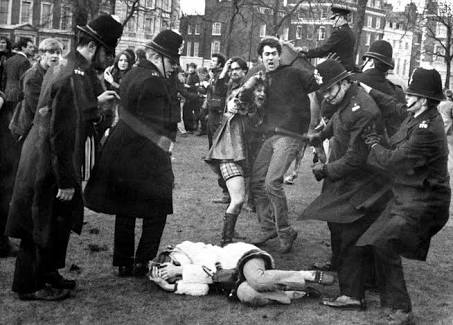
A South Vietnamese general blowing out the brains of a Vietcong prisoner on a Saigon street during the Tet Offensive. The Reverend Andrew Young Jr. and his colleagues, on the balcony of the Lorraine Motel in Memphis standing next to the body of Martin Luther King Jr. and point to where the assassin’s bullet was fired. Students at Columbia University taking over campus buildings, only to be hauled away, battered and bloody by police. Parisian protesters hurling tear gas canisters back at the police. Robert Kennedy felled by Sirhan Sirhan in the basement at the Ambassador Hotel in Los Angeles. Soviet tanks rolling into Prague. Women dumping bras and girdles into a trash can on the boardwalk outside Atlantic City’s Miss America pageant. Protesters facing off against coppers and horses in a violent mêlée in front of the US embassy in London’s Grosvenor Square. Tommy Smith and John Carlos on the Olympic medalists’ platform in Mexico City, raising their black-gloved fists in the Black Panther Salute as second-placed Aussie Peter Norman stands tall and silent in solidarity (a stance which would earn him opprobrium in his still prejudiced and conservative homeland).

As young people in the UK, we viewed these scenes to an exciting and eclectic soundtrack of blues, rock and psychedelia as the pop music cavalcade of the ‘sixties rock ‘n rolled on.

The Beatles sang Hey Jude, and The Rolling Stones, Street Fighting Man, and Jimi Hendrix delivered simply the best-ever cover of a Bob Dylan song with his blistering, sinister All Along the Watchtower. Imagining we were Born To Be Wild, we were invited to get our motors running and head out on the highway, or else to “take the load off, take the load for free”. We could pointlessly ponder the mysterious meaningless of MacArthur Park, or just lay back in a hazy daze with the Hurdy Gurdy Man (a strange ditty that has enjoyed a brief comeback with the recent hippy, trippy Romans-versus-druids soap Britannia). Koo-koo-ka-choo, Mrs. Robinson!

Images and music aside, what was it really like to experience 1968?

Christopher Allen, in a piece in The Australian reviews an exhibition commemorating the events of 1968 at the National Library of Australia in Canberra. His is an original overview, advising caution when seeking signs and patterns in contemporary events. The past, as they say, is a foreign country – they see things differently there. “The signs 50 years ago  were alarming, hopeful or dispiriting, depending on your point of view, but above all conflicting, as are the signs today. We will one day know where events on the Korean peninsula or the latest phase of tensions in the Middle East are leading. The shadowy, seemingly fluid future, with its dramatically ­different possible alternatives, will have become the ossified, unchangeable past.

In an entertaining and upbeat piece in The Guardian, Hendrick Herzberg rebuts that cliched putdown of how people who remember the sixties weren’t really there, recounts his own adventures, and claims that “In a modest way, 1968 was the kind of year that pushes history in some unforeseen, astonishing direction – a gentler little brother to 1492, 1776, 1848, 1914, 1945, and 2001”. I would add 1789, 1939, and 1989 and 2011.  Check them out.

I too remember the ‘sixties, and I too was there, albeit not on the political, social or cultural front lines. But I was at Grosvenor Square, occupied the vice-chancellor’s offices, did drugs (soft, mind), dug Cream, read Oz and IT, and totally got into Hair, which opened in London that year. And today, I share Hetzberg’s reverie: “In 1968, the ‘sixties were almost over, but The Sixties have never fully gone away. For me, and no doubt for many others of my vintage, it’s hard to believe that half a century now separates us from that momentous, tumultuous year, and that 1968 is now as distant in time as 1918 – the year of the end of World War I, the consolidation of Bolshevik power in Russia, and the flu pandemic that killed 50 million people – was in 1968. Fifty years from now, it’ll be 2068. The ‘sixties again! I Can’t wait!”

In contrast, Tod Gitlin gazes through a glass darkly in a sober retrospective for The New York Review of Books: “When we fight over the meaning of the past, we are fighting over what, today, we choose to care about. In this way, the 1968 anniversaries stalk 2018, depicting scene after scene of revolt, horror and cruelty, of fervor aroused and things falling apart, and overall, the sense of a gathering storm of apocalypse, even revolution. Inevitably, the “iconic” images of the time feature scenes of brutality, rebellion, and tragedy”.

And indeed, the enduring historical memory of 1968 is one of a succession of seemingly disconnected conflicts and collisions, turmoil and turbulence, not only in the USA but around the world. Yet beneath the apparent chaos, Gitlin seems to suggest, there were patterns that can only be discerned with the benefit of hindsight or as visions from a great height – much like, perhaps, that iconic image of our blue planet.

“Public life seemed to become a sequence of ruptures, shocks, and detonations. Activists felt dazed, then exuberant, then dazed again; authorities felt rattled, panicky, even desperate. The world was in shards. What were for some intimations of a revolution at hand were, for exponents of law and order, eruptions of the intolerable. Whatever was valued appeared breakable, breaking, or broken”.

The pendulum was swinging away from the previous year’s Summer of Love into a darker place. The lyrics of Steppenwolf’s Magic Carpet Ride, released that September, seem, in retrospect, to describe the turning tide: “Last night I held Aladdin’s lamp, so I wished that I could stay, but before the thing could answer me, well, someone took the lamp away. I looked around, and a lousy candle’s all I found”. In November 1968, Jimi Hendrix sang: “Outside in the cold distance, a wildcat did growl. Two riders were approaching, and the wind began to howl”.

There lurked a new narrative, and this was one of backlash and counterrevolution. “What haunted America”, writes Gitlin, “was not the misty spectre of revolution but the solidifying spectre of reaction. As the right consolidated around an alliance of Christian evangelicals, racial backlashers, and plutocrats, the left was unable, or unwilling, to fuse its disparate sectors. The left was maladroit at achieving political power; it wasn’t even sure that was its goal”.

”This country is going so far to the right you won’t recognize it,” Nixon’s attorney general, John Mitchell, said in 1969. He spoke prematurely. And presciently. Fifty years on from this momentous year, all that is old is new again.


Read on and enjoy these articles and the accompanying pictures.

But first, a poignant memento of 1968 from the 1979 film version of the “tribal love-rock musical” (yep, that how it was marketed back in the day) Hair, which i saw in London in the fall of 1968.

And here are other posts in In That Howling Infinite with regard to the ‘sixties: Springtime in Paris – remembering May 1968Encounters with Enoch; Recalling the Mersey Poets; The Strange Death of Sam Cooke; Looking for LehrerShock of the Old – the glory days of prog rock; Window on a Gone World; Back in the day; The Incorrigible Optimists Club

London

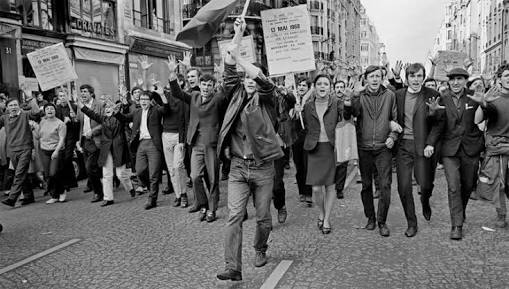
Paris

Prague 


1968: Year of Counter-Revolution

Associates of Dr. Martin Luther King Jr., the slain civil rights leader lying on the motel balcony, pointing in the direction of the assassin, Memphis, Tennessee, April 4, 1968

Commemorations are the greeting cards that a sensation-soaked culture sends out to acknowledge that we, the living, were not born yesterday. So it is with this year’s media reassembly of 1968. What is hard to convey is the texture of shock and panic that seized the world a half-century ago. What is even harder to grasp is that the chief political victor of 1968 was the counter-revolution.

When we fight over the meaning of the past, we are fighting over what, today, we choose to care about. In this way, the 1968 anniversaries stalk 2018, depicting scene after scene of revolt, horror and cruelty, of fervor aroused and things falling apart, and overall, the sense of a gathering storm of apocalypse, even revolution. Inevitably, the “iconic” images of the time feature scenes of brutality, rebellion, and tragedy: a South Vietnamese general’s blowing out the brains of a prisoner on a Saigon street during the Tet Offensive; the Reverend Andrew Young Jr. and his colleagues, on the balcony of the Lorraine Motel in Memphis, next to the body of Martin Luther King Jr., pointing at where the assassin’s bullet had come from; demonstrators at Columbia taking over campus buildings, then hauled away, battered bloody by cops; Parisian protesters hurling tear gas canisters back at the police; Robert Kennedy felled by Sirhan Sirhan’s shots at the Ambassador Hotel;Soviet tanks rolling into Prague; police clubbing demonstrators at the Democratic National Convention in Chicago; women’s liberation activists dumping girdles, hair curlers, and bras (unburnt) in a trash can on the boardwalk outside Atlantic City’s Miss America pageant; Tommy Smith and John Carlos on the Olympic medalists’ platform in Mexico City, raising their black-gloved fists in defiance.
Helmeted police blocking antiwar protesters in Grant       Park, Democratic National Convention, Chicago, Aug 1

A more thorough survey would take note of social collisions that, however violently repressive, failed to register in America with the same supersaturated significance. For example: the killing of three students in Orangeburg, South Carolina, by highway patrol officers after the students protested segregation at a bowling alley (February 8); the near-deadly shooting of the German radical student leader Rudi Dutschke in Berlin (April 11); Chicago police battering a wholly nonviolent antiwar protest (April 27).

As for less bloody demonstrations, there were so many, so routinely, that TheNew York Times regularly grouped civil rights and antiwar stories on designated pages. Neither does this rundown of calamities take into account images that did not see the light of day until much later, like the color shots of the My Lai massacre (March 16), not published until late 1969—by which time they were almost expected. Or the images that never materialized at all, like the slaughter of hundreds of demonstrating students by troops in Mexico City (October 2).

A feminist protester at the Miss America beauty pageant, Atlantic City, New Jersey, September 7 

Images aside, what was it really like to experience 1968? Public life seemed to become a sequence of ruptures, shocks, and detonations. Activists felt dazed, then exuberant, then dazed again; authorities felt rattled, panicky, even desperate. The world was in shards. What were for some intimations of a revolution at hand were, for exponents of law and order, eruptions of the intolerable. Whatever was valued then appeared breakable, breaking, or broken.

The textureof these unceasing shocks was itself integral to what people felt as “the 1968 experience.” The sheer number, pace, volume, and intensity of the shocks, delivered worldwide to living room screens, made the world look and feel as though it was falling apart. It’s fair to say that if you weren’t destabilized, you weren’t paying attention. A sense of unending emergency overcame expectations of order, decorum, procedure. As the radical left dreamed of smashing the state, the radical right attacked the establishment for coddling young radicals and enabling their disorder. One person’s nightmare was another’s epiphany.

The familiar collages of 1968’s collisions do evoke the churning surfaces of events, reproducing the uncanny, off-balance feeling of 1968. But they fail to illuminate the meaning of events. If the texture of 1968 was chaos, underneath was a structure that today can be—and needs to be—seen more clearly.

Two Viet Cong captured during the Tet Offensive, one already dead, the other about to be executed by pistol shot, Vietnam, May 1968

The left was wildly guilty of misrecognition. Although most on the radical left thrilled to the prospect of some kind of revolution, “a new heaven and a new earth” (in the words of the Book of Revelation), the main story line was far closer to the opposite—a thrust toward retrogression that continues, though not on a straight line, into the present emergency. The New Deal era of reform fueled by a confidence that government could work for the common good was running out of gas. The glory years of the civil rights movement were over. The abominable Vietnam War, having put a torch to American ideals, would run for seven more years of indefensible killing.

The main new storyline was backlash. Even as President Nixon assumed a surprising role as environmental reformer, white supremacy regrouped. Frightened by campus uprisings, plutocrats upped their investments in “free market” think tanks, university programs, right-wing magazines, and other forms of propaganda. Oil shocks, inflation, and European and Japanese industrial revival would soon rattle American dominance. What haunted America was not the misty specter of revolution but the solidifying specter of reaction.

Even as established cultural authorities were defrocked, political authorities revived and entrenched themselves. In so many ways, the counterculture, however domesticated or “co-opted” in Herbert Marcuse’s term, became the culture. Within a few years, in public speech and imagery, in popular music and movies, on TV (All in the FamilyM*A*S*HTheMary Tyler Moore Show) and in the theater (HairOh! Calcutta!), profanity and obscenity taboos dissolved. Gays and feminists stepped forward, always resisted but rarely held back for long. It would subsequently be, as the gauchistes of May ’68 in Paris liked to say, forbidden to forbid.

In the realm of political power, though, for all the many subsequent social reforms, 1968 was more an end than a beginning. After les évènements in France in May came June’s parliamentary elections, sweeping General De Gaulle’s rightist party to power in a landslide victory. After the Prague Spring and the promise of “socialism with a human face,” the tanks of the Soviet-run Warsaw Pact overran Czechoslovakia. In Latin America, the Guevarist guerrilla trend was everywhere repulsed, to the benefit of the right. In the US, the “silent majority” roared. As the divided Democratic Party lay in ruins, Richard Nixon’s Southern strategy turned the Party of Lincoln into the heir to the Confederacy. As the right consolidated around an alliance of Christian evangelicals, racial backlashers, and plutocrats, the left was unable, or unwilling, to fuse its disparate sectors. The left was maladroit at achieving political power; it wasn’t even sure that was its goal.

Counter-revolutions, like their revolutionary bêtes noires, suffer reversals and take time to cohere. The post-1968 counter-revolution held the fort against a trinity of bogeymen: unruly dark-skinned people, uppity women, and an arrogant knowledge class. In 1968, it was not yet apparent how impressively the recoil could be parlayed into national power. “This country is going so far to the right you won’t recognize it,” Nixon’s attorney general, John Mitchell, said in 1969. He spoke prematurely.

1968: the year that changed America

Hendrick Herzberg, The Guardian, April 15, 2018

Where were you in the 1960s? And what were you? A toddler, a grade schooler, a teenager? A young adult? Were you already old enough to form your own memories? Or were you old enough but in the “if you can remember The Sixties you really weren’t there” category?

Of course, if you’re like most people, you were nowhere. You hadn’t been born yet. You didn’t exist. But wherever and whatever you were or weren’t, it’s a safe bet that you’ve heard about The Sixties – quite enough, maybe. Ad nauseam, maybe.

There is a continuing theological controversy among sixtiesologists concerning when The Sixties can properly be said to have begun and ended. Tuesday 8 November1960 – the day Senator John F Kennedy was elected president – has a pretty good claim to the beginning. Kennedy’s campaign slogan, which appeared on every campaign poster, had been LEADERSHIP FOR THE 60’s. Out with the dull, conformist, priggish, crewcut, Eisenhowerish Fifties! In with the dashing, exciting, daring, sexy, slightly longer-haired, Kennedyesque Sixties!

A darker view – the view I take – sets the clock of The Sixties ticking three years later. The assassination of President Kennedy was a crack in time. Like Sunday 7 December 1941; and like Tuesday 11 September 2001; Friday 22 November 1963 was “a date that will live in infamy”. And, like them, it was a day that is remembered in vivid detail by those who experienced it.

I was taking a noontime shower in my Harvard dorm room, having been as usual up till dawn getting out the college daily, the Crimson. I heard a faint, muffled radio news bulletin coming through the wall from the neighboring room. As I dried off, I turned on my own radio. I can still see the edge of the shower stall and the little bathroom window next to it. On the grass below, a girl was standing under a tree, weeping. The Crimson put out an extra that afternoon, but without my help. It felt too much like a schoolboy stunt. Rightly or wrongly, I didn’t want to play newspaperman. I didn’t want to be distracted from the communal grief all around me.

So The Sixties, in this conceit, began either in 1960 or, like Philip Larkin’s sexual intercourse, in 1963. And the ending? That too has long been a subject of debate. There are plenty of nominees, two of which may be considered the frontrunners. Like the beginnings, one is light and one is dark. The light one: Friday 9 August 1974, the day Richard Nixon resigned the presidency, freeing the nation from a quarter-century of having had him to kick around. The dark one: Altamont. Sunday 6 December 1969. Google it. Or see the movie.

It is possible to build a narrative around two currents of the year’s events, currents that melded and crisscrossed and fed off each other, to startling effect: the music, mostly a kaleidoscopic, wildly imaginative explosion of rock’n’roll; and the politics, mostly a politics of protest – protest against the Vietnam war, against racial injustice, and, more broadly, against what was experienced as the joyless, stultifying blandness of mainstream American life.

Those two currents, the music and the protests, washed over me as they did over millions of others. In 1966, a year out of college and a newly minted cub reporter for Newsweek, I was lucky enough to land in San Francisco. Something was happening there, and I found myself in a position to absorb it.

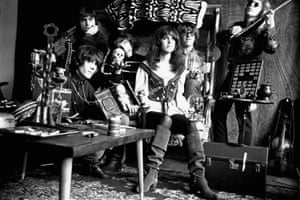
Jefferson Airplane pose for a portrait in San Francisco, 3 August 1968.
                              Jefferson Airplane  San Francisco, 3 August 1968. Photograph: AP
The scene, cultural and political, was quite something. A new kind of music – rooted in blues, rock, and electronica, and supercharged by psychedelia – was drawing motley-dressed weekend crowds to a couple of repurposed old dance halls, the Fillmore Auditorium and the Avalon Ballroom. For $2.50 you could spend hours listening and dancing to bands that were still unknown back east or down south in LA – bands still without record contracts but with wonderful names: Jefferson Airplane, the Grateful Dead, Big Brother and the Holding Company, Quicksilver Messenger Service – often paired with iconic bluesmen like Muddy Waters and James Cotton. The walls were mesmerizingly alive with rhythmically pulsating, ever-changing liquid projections. It was, in the patois of the moment, mind-blowing. For the gentle dreamers that Herb Caen, the San Francisco Chronicle’s gossip columnist, had dubbed hippies, the Fillmore and the Avalon were Carnegie Hall and the Philharmonic.

Like every young man of my generation, I had to reckon with the draft. I was against the war, of course, but I didn’t think I had the stomach to go to jail over it. I had zero desire to go to any more schools, graduate or otherwise. I was unmarried and childless. Canada was not my country, my country was the United States of America. I wasn’t physically or mentally ill and was too proud to fake it. And I wasn’t a conscientious objector. On the other hand, I didn’t want to get killed either. My solution was the US navy.

I got a haircut and reported to the naval base at Newport, Rhode Island, for three months of officer training. From there I asked to be sent to Vietnam, but it wasn’t like it sounds. Unless you were a flier (like John McCain, the future senator), a Seal (like Bob Kerrey, also a future senator) or a member of the Riverine Force (like John Kerry, a future senator, presidential nominee, and secretary of state), being a naval officer in Vietnam, especially a “public affairs” officer like me, posed very little physical risk. Instead, however, the navy, in its wisdom, assigned me to a desk job in lower Manhattan.

As the year rushed on, the pace of events grew ever more frenziedI stole away from the office whenever I could, and devoted the time to salving my conscience. I pitched in at the ramshackle headquarters of the War Resisters League. In March, after Robert Kennedy entered the presidential race, I took to hanging around his Manhattan headquarters, doing layouts and writing headlines for the Kennedy Current, the campaign’s weekly tabloid.

As the year rushed on, the pace of events grew ever more frenzied: the bloody shock of the Tet Offensive; the electoral abdication of President Lyndon Johnson; the assassination of Martin Luther King Jr and the riots that followed; the murder of Robert Kennedy; the chaotic, riotous Democratic convention in Chicago; Nixon’s hairsbreadth victory over Hubert Humphrey in November. And me? Well, at Christmastime I got the orders to Vietnam (as a “recreation officer” at the US base in Da Nang) I’d hoped for two years earlier. Only this time I didn’t want to go. My antiwar sentiments had hardened to the point that I decided I preferred jail to further military service, and I announced my intention to refuse the orders.

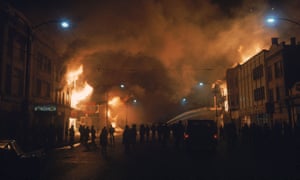
Riots in Chicago follow the assassination of Martin Luther King.
       Riots in Chicago follow the assassination of Martin Luther King.
Photograph: Lee Balterman/TimePix/Rex Features

But before I could achieve fame as a martyr for peace an unexpected medical difficulty developed: I had a wisdom tooth pulled, the wound bled for days, and when I was diagnosed with a (relatively mild) form of hemophilia, the navy quickly mustered me out. I had managed to have it both ways: veteran (kind of) and resister (in a way).

Why didn’t I think of that?

In 1968 the sixties were almost over, but The Sixties have never fully gone away. For me, and no doubt for many others of my vintage, it’s hard to believe that half a century now separates us from that momentous, tumultuous year, and that 1968 is now as distant in time as 1918 – the year of the end of World War I, the consolidation of Bolshevik power in Russia, and the flu pandemic that killed 50 million people – was in 1968. Fifty years from now, it’ll be 2068.

The Sixties again! I can’t wait!

This is an extract from the introduction to the 30th-anniversary edition of1968 in America: Music, Politics, Chaos, Counterculture, and the Shaping of a Generation by Charles Kaiser, published in the US by Grove Press on 17 April

Take a look back to our future

Christopher Allen, The Australian, June 23rd 2028

Many Cheers on the Founding of the Revolution Committee of Hubei Province, papercut poster (1968). All images from 1968: Changing Times exhibition, National Library of Australia

Many Cheers on the Founding of the Revolution Committee of Hubei Province, papercut poster (1968). All images from 1968: Changing Times exhibition, National Library of Australia

In one of the most famous stories from ­antiquity, Croesus, the proverbially rich king of sixth-century BC Lydia, in what is now Turkey, was disturbed by the rise of the Medes and the Persians on his eastern borders. Thinking it might be wise to crush these potential rivals before they became a serious threat, he consulted the oracle of Apollo at Delphi, plying it with gifts to ensure a favourable answer. The oracle replied that if he made war on the Persians, a great empire would be destroyed. Croesus accordingly gathered his ­armies and ­attacked, but he was defeated and taken prisoner by Cyrus the Great, founder of the Persian ­Empire.

The oracle had a reputation for accurate yet riddling answers. A half-century after these events, Heraclitus, one of the most brilliant Pre-Socratic thinkers and famous for enigmatic aphorisms, declared: “The lord whose oracle is at Delphi neither reveals nor conceals but sig­nifies.” It is up to us to read the sign he gives, and Croesus had fatally misconstrued that sign in his eagerness to hear what he wanted to hear.

The signs 50 years ago, in 1968, were alarming, hopeful or dispiriting, depending on your point of view, but above all conflicting, as are the signs today. We will one day know where events on the Korean peninsula or the latest phase of tensions in the Middle East are leading. The shadowy, seemingly fluid future, with its dramatically ­different possible alternatives, will have become the ossified, unchangeable past.

The political protests of May 1968 in Paris were among the most significant events of that year. Although partly emulating earlier student agitation in the US, the French protests were much broader in their implications. The term that the French use for this movement, la contest­ation, suggests its universal spirit of ­revolt and its nebulous sense of direction, if not nihilistic disorientation. It was a catastrophic time for many young people caught up in the hysteria and afterwards left to pick up the pieces of interrupted studies and broken careers, in an ambience of cynicism and disenchantment. Ever since the revolution of 1789, the French have been prone to political overexcitement, and throughout much of the 20th century ­communists continued to believe in their own kind of revolution in the same way Christians believe in the second coming.

The zealots thought 1968 heralded the end of days and the imminence of the dictatorship of the ­prole­tariat; but the grassroots movement, spreading from students to workers, was not supported by the Communist Party, which was still committed to a totalitarian and Stalinist model of ­central control. A few months later, a similar pattern evolved within the communist world: the opening up of Czechoslovakia to greater freedom, democracy and independence — the Prague Spring — was crushed in August when Soviet tanks invaded the country and ­occupied its capital.

The events of Paris and of Prague dealt a fatal blow to the credibility of communism in the West; the old left began slowly bleeding to death until its collapse with the fall of the ­Berlin Wall 21 years later. Thus May 1968, as in the story of Croesus, did indeed herald the fall of an ­empire, but not the one the student rioters thought they were going to bring down.

Much else happened in 1968, including the opening of the new National Library in ­Canberra, whose anniversary is the occasion for this exhibition. As we enter the exhibition, we are confronted by a wall of 21 tabloid bills, in the centre of which is one announcing the opening of the library. The remaining headlines sum up many other momentous events of the year, starting with the ­mysterious loss of prime minister Harold Holt, who dis­appeared, presumed drowned, while spearfishing off Portsea in December 1967.

America was shocked by two political assassinations: that of Martin Luther King in April and Robert Kennedy in June. Both events are covered in the exhibition by photographs, posters and copies of contemporary news magazines. Particularly interesting, especially today, is an article about the revulsion against gun culture that followed the death of Kennedy, whose brother, president John Kennedy, had been assassinated less than five years earlier. There are pictures of individuals willingly ­giving up guns at police stations: so many were handed in that the police, as we see in another photograph, ended up disposing of them by dumping them in the sea.

John Gorton Visiting Australian Troops in Vietnam, Australian News and Information Bureau (1968)

Meanwhile, the Vietnam War was growing more intense — it was the year of the Tet offensive — and provoking greater opposition at home, mainly because of the draft, of which fatal randomness we are reminded by a set of the wooden balls that were used in the birthday ballots. It was clearly a political mistake to send conscripted soldiers to Vietnam; professional soldiers expect to fight wherever their nation sees fit to send them, but conscripted troops should be reserved for national self-defence.

At the time, however, the spread of commun­ism in Asia looked like a serious ­menace, which it would be smug to discount with the benefit of hindsight. Communism had only recently been suppressed by the British in the course of the Malayan Emergency (1948-60) and, more recently still, by Suharto in Indonesia, in a far bloodier struggle from 1965 onwards. So the threat of violent totalitarian revolution was real. At the same time, there was a prima facie moral justification in helping South Vietnam defend itself against the north. The way that North Vietnamese ­aggression was turned into a fight for freedom in the eyes of many in the West was one of the first examples of the self-destructive neurosis that has afflicted the Western intel­ligentsia for the past couple of generations. A map of ­Vietnam published in the US in 1968 includes an insert labelled “Freedom’s struggle in Asia”, with a pall of black covering Siberia, Mongolia, China and North Vietnam. It is easy to understand the fear of the domino theory in Southeast Asia, and clear that this had serious consequences for Australia.

And to argue that time was running out for the communist dream, and that even China would, within a generation, be starting to build its own unique model, combining capitalist profiteering with communist authoritarianism, would have seemed mere wishful thinking.

For the time being Mao Zedong, after killing 45 million people by starvation during the Great Leap Forward of 1957-62, had launched the almost equally disastrous Cultural Revolution, which lasted from 1966 until his death in 1976, and posters showed beaming peasants and workers celebrating the foundation of new socialist ­regional committees.

This is the great difficulty in anticipating the future: we can imagine plausible scenarios but the really important things are often ones that seem entirely implausible until they happen. It would have seemed far-fetched to suggest that Southeast Asian countries racked with ­poverty and communist insurrection in 1968 would be booming capitalist economies by the early 20th century, but even more unbelievable that one of the most significant threats to s­ecurity, freedom and human rights would one day be the rise of fanatical Islamic belief among the populations of several regional countries. Religion in general was assumed to be a long-spent ­political factor, of marginal relevance in the thinking of left and right.

Even in the Middle East, religion was not yet an important factor. Israel had spectacularly crushed its Arab neighbours in the Six-Day War of 1967 and extended its control over buffer territories in the north and east; its neighbours were angry and humiliated, but were all ruled by secular dictators. Iran was a prosperous, secular and modernising nation under the rule of the shah, even though there was growing opposition to his authoritarian rule. But a map of The Daily Telegraph motor marathon from London to Sydney reminds us how essentially peaceful the region still was: it is many years since such a rally could follow an itinerary from London through Europe to ­Turkey, then on to Tehran, Kabul and Bombay (as Mumbai was then called), before the cars were ferried to Fremantle for the final legs from Perth to Sydney.

Culturally, the period represented a new level of mass consumption of pop music and other media. At the time, pop groups often seemed to give voice to various forms of social and political dissent, but in retrospect their ­objective role was to channel and neutralise the malaise, turning it into harmless entertainment. Television had more or less completed its takeover of family life by 1968; people who used to play the piano or talk or read a book after ­dinner now sat glued to serials and talk shows. TV was a new form of addiction, whose damaging effects we now can begin to understand in the age of far more serious ­addiction to smartphones and other devices.

National Library of Australia at Night from beneath Commonwealth Avenue Bridge near Regatta Point, Canberra, (1968, detail), by Max Dupain

The final part of the exhibition is devoted to the conception, planning and building of the new library. Canberra, only 55 years old in 1968, was still in the process of growing into its ­ambitious urban design. An area from Capital Hill down to the lake had been designated as a special ceremonial triangle, destined to house not only the new Parliament House but also some of the most significant cultural edifices of the new city. These included the National ­Library on one side and the National Gallery, which was established in 1967 and opened in 1982. The new library was a favourite project of Robert Menzies as prime minister, and the exhib­ition includes correspondence and his speech in introducing the National Library­ bill in 1960. Although he retired in January 1966, his successor Holt ­invited him to lay the foundation stone in March that year.

In his speech on that occasion, Menzies expressed­ the hope he would live long enough to see the white marble structure ­reflected in the waters of the lake: this is exactly how Max Dupain photographed the finished structure in 1968. Seeking grandeur in the depth of distance, he takes a view of the new building from across the lake at night, so the library appears as a small but radiant temple-like form, its reflection shimmering silently on the dark waters.

1968: Changing Times.  National Library of Australia, Canberra, Until August 12, 2018

https://www.theaustralian.com.au/arts/review/1968-changing-times-national-library-of-australia-look-back-at-future/news-story/ccefaad03c8a41c8b86a2820f5d53ca4


The man with the plan

All that was old is new again with the potential re-emergence of the US’ Cold War strategy of “offshore balancing”
Commentator and counterinsurgency expert David Kilcullen is always worth reading. Here is his latest piece  for The Australian on this subject.
It is a well-tried and well-documented strategy whereby an offshore power counters a rival by backing opposing coalitions in a region of ­strategic competition, supporting local allies indirectly (with weapons, money, advisers intelligence or diplomatic cover), and using proxy military muscle, regular and irregular, to prevent any one rival dominating the region.

Maritime powers (including Britain in the 18th and 19th centuries, and the US for much of its history until 1945) historically used offshore balancing to counter land-based rivals while lowering their own costs and avoiding ­decisive commitment. To succeed, the offshore power does not need to control a region itself, merely to prevent a rival doing so. As such, this is a low-cost approach — something military planners call an “economy of effort” strategy — that reduces exposure and preserves freedom of action.

This comes in the wake of hugely expensive and largely unsuccessful efforts by the US to dominate a region directly through direct military intervention – and subsequent entanglement that left it ‘neck deep in the big muddy’ to quote political activist and balladeer Pete Seeger. It was a maximalist approach that had ad­verse consequences in terms of lives lost, funds wasted, credibility eroded and loss of freedom of ­action (particularly after 9/11, as the US became bogged down in self-inflicted wars of ­occupation).

But, offshore balancing requires a cool nerves, a steady hand and deft footwork.

Bad timing and miscalculation can increase the risk of wars that the US neither wants or is prepared for. And in inexperienced, needful, and impetuous hands, it could render the US vulnerable to being played by its partners. Kilcullen notes that a body of opinion in the US intelligence community,  and also, within Israeli intelligence,  holds that the threat from Iran has been overstated, that Iran’s ability to dominate the so-called “land bridge” from Afghanistan to the Golan Heights is overblown, and that no regime in Tehran would be suicidal enough to consider a nuclear strike on Israel, Saudi Arabia or any of its other regional rivals.

But it would appear that Israeli Prime Minister Benjamin Netanyahu and the Saudi crown prince Muhammed bib Salem have successfully sold Donald Trump on their expansive vision of the Iranian threat, creating the possibility that Washington may be manipulated into decisions that run counter to its own wider interests.

Moreover, with regard to US foreign policy generally, one size does not necessarily fit all. Taking a strategy like offshore balancing, however successful it might prove to be in the Middle East, and blindly applying it on the Korean peninsula, to Russia or China  where conditions are dramatically different, would be full of risk.

Read on…

Donald Trump: The man with the plan

David Kilcullen, Contributing Editor for Military Affairs, The Australian, May

Donald Trump welcomes home three Americans released by North Korea. Picture: AFP
         Donald Trump welcomes home three Americans released by North Korea. Picture: AFP

    This week, as Donald Trump announced his decision to withdraw from the Iran nuclear deal and start reimposing sanctions on ­Teh­ran, a chorus of condemnation broke out on both sides of the Atlantic. European politicians condemned the decision and began working on ways to keep Iran in the deal, while in the US former secretary of state John Kerry engaged in last-minute direct negotiations with Iranian leaders.

    Fred Kaplan of Slate penned a piece that was typical of the mainstream media reaction, arguing that Trump withdrew “because of spite, ignorance, or both”.

    There is no doubt that the US President’s decision reflected animus toward his predecessor’s signature achievement in foreign policy. It also highlighted president Barack Obama’s self-­inflicted vulnerability over the deal, which he approved personally as an executive agreement rather than submitting it to the US Senate for formal ratification as a treaty. His administration also voted for a UN resolution lifting sanctions on Iran before congress had properly begun its review of the agreement. These ­decisions, over near-un­animous Republican opposition, made the deal a bone of partisan contention from the outset, a pro­blem Obama’s staff exacerbated through a manipulative media campaign that drew harsh criticism when disclosed in 2016. All this made it easier for Trump to leave the deal with just a stroke of the pen.

    Yet there’s reason to believe Trump may be acting from more than political spite. Indeed, it’s possible we might be witnessing the early signs of a new approach with the potential to transform America’s overseas military posture, though also carrying enhanced risk of war and other unintended consequences. The new approach may signal the re-emergence of Washington’s former strategy of working through regional coalitions to counter rivals in the ­Middle East, thereby enabling US military disengagement from the post-9/11 wars.

    The decision to dump the deal is far from the only indicator. Other recent signs include statements by Trump to the effect that he seeks to withdraw from Syria while sponsoring an Arab coalition to prevent the re-emergence of Islamic State. Under this scheme, Washington would support allies (including, potentially, Saudi Arabia and the United Arab Emirates, as well as a coalition of local Kurdish militias) but end combat troop deployments.

    Last month’s coalition strike on Syria sent a similar message in that it avoided targeting the Assad regime’s leadership or Russian and Iranian assets in Syria. It was also accompanied by clear statements that the US did not seek regime change — effectively acquiescing in Bashar al-Assad’s victory, moving away from Obama’s goal of regime change and further disen­gaging from involvement in the Syrian conflict.

    Iranians burn US flags and makeshift Israeli flags in Tehran. Picture: AFP
                         Iranians burn US flags and makeshift Israeli flags in Tehran. Picture: AFP

    Alongside an Arab coalition, ­Israel seems ready to step into any gap created by US withdrawal, while cheering Trump’s decision to exit the Iran deal. Indeed, an undeclared low-level air battle has been going on between Israel, Hezbollah and Iranian forces in Syria since February. Israel decided to retain its advanced fighter aircraft in-country rather than send them to a scheduled exercise in Alaska last month and this week it raised military forces to their highest alert level, called up air defence and intelligence reservists, and opened air-raid and missile shelters for Israelis living within range of the Syrian border. If anything, Israel’s willingness to directly engage Iranian and Iranian-backed forces in Syria has only increased after since Trump’s withdrawal from the nuclear deal.

    At the same time, statements by Saudi Arabia and the UAE indicate that the Sunni monarchies and their Gulf allies would consider participating in an Arab stabilisation force in Syria. Saudi leaders also have expressed a willingness to participate in strikes within Syria (making Saudi Arabia a de facto coalition partner with Israel, a tricky political position for Saudi leaders).

    Overtures by the US towards Egypt suggest Washington also is seeking ­Egyptian support for the same Arab coalition.

    All this may be evidence of an emerging post-deal strategy, whereby the US works through ­Israel and Arab partners in the region to weaken and contain Iran. For political reasons, Israeli and Arab components would operate separately, but Washington would co-ordinate with each and support both to prevent the re-emergence of Islamic State while containing and undermining Iran, ­Hezbollah and Russia (with the emphasis very much on Iran).

    As part of this strategy, US ­forces may launch periodic operations (missile and drone strikes, air raids or special forces operations) to preserve their preferred balance but would avoid protracted commitments, and troop numbers in Iraq and Syria would be drawn down. Washington would operate with allied support where possible, but strike unilaterally if needed.

    Provided Turkey can agree on a ­demarcation line with US-backed Kurdish groups — probably somewhere near the present line of control along the Euphrates river — the US also might support Turkey’s buffer zone in northern Syria. In that case Turkey, too, would play a role in containing Iran and preventing the re-­emergence of Islamic State — the two paramount US objectives.

    This approach, if it does emerge, would be a classic instance of offshore balancing, where an offshore power counters a rival by backing opposing coalitions in a region of ­stra­tegic competition, supporting local allies indirectly (with weapons, money, advisers intelligence or diplomatic cover) to prevent any one rival dominating the region.

    Maritime powers (including Britain in the 18th and 19th centuries, and the US for much of its history until 1945) historically used offshore balancing to counter land-based rivals while lowering their own costs and avoiding ­decisive commitment. To succeed, the offshore power does not need to control a region itself, merely to prevent a rival doing so. As such, this is a low-cost approach — something military planners call an “economy of effort” strategy — that reduces exposure and preserves freedom of action.

    One of the strategy’s key attractions would be that it might restore a critical strategic distinc­tion: the difference between hugely expensive (and largely unsuccessful) efforts to dominate a region directly, and the far cheaper and more achievable goal of merely preventing a rival doing so.

    In the post-Cold War era of liberal and neo-conservative interventionism, US leaders often con­flated the two, as if preventing a hostile power from dominating a region necessarily implied dominating it themselves.

    This maximalist approach had obvious ad­verse consequences in terms of lives lost, funds wasted, credibility eroded and loss of freedom of ­action (particularly after 9/11, as the US became bogged down in self-inflicted wars of ­occupation).

    Trump has been railing against these overseas commitments for years. Indeed, one of his themes on the campaign trail was the need to get out of overseas commitments, bring troops home, force allies to commit their own resources to their defence, cease putting American lives at risk to provide security guarantees for countries (in Europe, Asia or the Middle East) that were unwilling to pay their fair share, and stop spending money on nation-building that would be better used at home.

    An offshore-balancing strategy offers a way to do this while still acting tough and reserving the right to intervene unilaterally (another key Trump theme).

    Offshore balancing does not preclude periodic interventions to restore a favourable balance of power in a given region, but it does tend to rule out long-term occupation or decisive commitments of the post-9/11 kind. It also implies holding military power back, over the horizon or outside the region, rather than establishing permanent bases.

    As such, naval forces (including warships, expeditionary marine units, carrier-based aircraft and submarines) are the key assets needed for such a strategy — and for now, at least, the US leads the world in these capabilities, giving it a comparative advantage.

    The strategy’s other key benefit is its low cost and ability to preserve (or, in this case, restore) strategic freedom of action. Its disadvantage is that interventions, when they do occur, can be extremely costly.

    Britain’s approach to Europe from the 1680s to 1945 — periodic interventions to prevent any one power dominating the continent but reluctance to create permanent alliances or bases — is one ­example of offshore balancing. Another was the US strategy for the Middle East from just before the end of World War II (when Washington first became concerned about the strategic centrality of the region) until the Gulf war in 1991.

    From 1944 to 1992, despite periodic interventions (a CIA-backed coup in Iran in 1953, brief engagements in Lebanon in 1958 and 1983, bombing Libya in 1986) the US generally kept its military out of the region, preferring to counter Soviet influence through partners such as Israel, Turkey, the Arab monarchies, the Afghan mujaheddin in the 1980s and, until 1979, the shah of Iran.

    After 1991, everything changed: permanent US bases in Saudi Arabia (plus no-fly zones over Iraq, and the Clinton administration’s policy of “dual containment” towards Iraq and Iran) committed the US directly to the Middle East. US bases in Saudi Arabia, in particular, created intense grievances that led in part to the 9/11 attacks. After 2003, the Iraq war mired Americans in a full-scale military occupation. Successive presidents have sought to extricate themselves, but to little avail, proving what advocates of offshore balancing long have argued: hard though it is to avoid being dragged into permanent commitments, it’s far harder to ­extract yourself once committed.

    It’s unclear whether Trump knows any of this history; Harvard international relations professor Stephen Walt argued last month on Foreign Policy’s website that he probably does not.

    This may not matter, though, since offshore ­balancing so closely aligns with Trump’s instinctive preferences. Despite his surface volatility, Trump consistently follows certain patterns of strategic behaviour. His two main (and apparently contradictory) urges — the desire to appear strong, while disengaging from post-9/11 commitments in the Middle East and lopsided (“unfair”) treaty arrangements in Europe and Asia — would be well served by an offshore-balancing strategy, so he may consistently follow it, consciously or otherwise.

    A more serious criticism, from the few analysts who have yet commented on the emerging strategy, is that Trump is too mercurial and strategically illiterate, and his administration too incoherent, to enact this kind of strategy. These criticisms, too, are overblown. The sacking of secretary of state Rex Tillerson and national security adviser HR McMaster in March has removed competing power centres in US foreign policy, while former CIA director Mike Pompeo (Tillerson’s replacement as Secretary of State), and Defence Secretary James Mattis appear more than capable of executing an offshore balancing strategy.

    New national security adviser John Bolton is from the neo-conservative tradition that led directly to the post-9/11 wars of occupation and to the invasion of Iraq, and he will have to modify his views to be able to support this kind of strategy. Likewise, independent-minded UN ambassador Nikki Haley will need to collaborate more closely with the State Department and the White House than she has done to date.

    But neither Bolton nor Haley are likely to oppose the strategy if it appears to be succeeding.

    If it does succeed — a big if — offshore balancing may become a de facto Trump doctrine to be applied elsewhere. Opportunities to apply it include the Korean peninsula, where Trump seems willing to agree to partial US withdrawal and a permanent peace treaty in return for North Korean denuclearisation and enhanced sponsorship of Japan and South Korea to balance China.

    Another possible opportunity is eastern Europe, where Washington may continue arming Ukraine, and support the Baltics and Scandinavia to balance Russia while stepping back from permanent NATO commitments (or making them more conditional on European ­defence spending.)

    Africa, where efforts to work through regional coalitions against terrorists are already well advanced, naturally lends itself to this strategy, which could be further enhanced through France and its G5 Sahel regional coalition, which is already operating against Islamic State in northwest Africa.

    Likewise, in Southeast Asia, enhanced support for Vietnam and The Philippines may combine with existing US relationships with Australia, India and Japan to balance China.

    Whatever its possibilities, offshore balancing does carry significant risks. The most important is proxy conflict, which can spiral out of control when more than one external power backs local actors, drawing them into confrontation. This risk is severe in the Middle East, where Iran and Russia are sponsoring their own proxies. Saudi Arabia and the United Arab Emirates are already fighting a proxy war against Iran and its Houthi allies in Yemen, from where conflict is spilling into the Horn of Africa and bringing missile strikes to the heart of Saudi Arabia (most recently, this past week after the nuclear deal announcement).

    Internal conflict in Saudi Arabia is also a risk: a recent incident where a drone flew into the royal compound in Riyadh triggered a coup scare and highlighted nervousness within the Saudi royal family about opposition towards Crown Prince Mohammed bin Salman’s reforms. Co-operation between Saudi and Israeli forces (even tacit) would be highly controversial within Saudi Arabia and could prompt sharply increased internal unrest.

    For its part, given this week’s series of strikes and the ongoing air campaign, Israel appears to be posturing for imminent war against Hezbollah and Iranian-backed forces in Syria, and possibly Lebanon too. This could draw Israel into more direct conflict with Iran — indeed, one possibility here is that Israel is deliberately escalating conflict with Iran in order to increase its leverage in post-nuclear-deal Washington.

    In the same region, a US exit from Syria (a key element of a balancing approach) would remove deterrents on Turkey’s ability to attack Kurdish groups, heightening conflict risk between Ankara and the Kurds.

    Besides enhanced war risk, the other important concern of an ­offshore-balancing strategy is that it leaves Washington vulnerable to being played by its partners. A body of opinion in the US intelligence community (and also, ironically, within Israeli intelligence) holds that the threat from Iran has been overstated, Iran’s ability to dominate the so-called “land bridge” from Afghanistan to the Golan Heights is overblown, and no regime in Tehran would be suicidal enough to consider a nuclear strike on Israel, Saudi Arabia or any of its other regional rivals.

    But Israeli Prime Minister Benjamin Netanyahu and the Saudi crown prince seem to have successfully sold Trump on their expansive vision of the Iranian threat, creating the possibility that Washington may be manipulated into decisions that run counter to its own wider interests.

    Likewise, taking a strategy such as offshore balancing, however successful it might prove to be in the Middle East, and blindly applying it on the Korean peninsula or in Europe, where conditions are dramatically different, would be full of risk.

    Still, despite the ongoing condemnation from the policy establishment and allies alike, Trump’s decision to exit the Iran deal may indicate something deeper than mere ill-informed petulance — and if a strategy of offshore balancing does emerge, it just may point the way to disengagement from the post-9/11 wars, a goal that every president since 2001 (including George W. Bush himself, since about five minutes after his “mission accomplished” speech in May 2003) has sought but failed to achieve.

    Looking for Lehrer

    Happy Birthday Tom Lehrer

    Years ago, American humorist Tom Lehrer was said to quip: “Political satire became obsolete when Henry Kissinger was awarded the Nobel Peace Prize”. This is most probably apocryphal. But as contemporary American politics (and our own, to a lesser degree) increasingly resembles a political satire, Lehrer’s back catalogue is welcome light relief.

    Lehrer is ninety years of age this week. It is sixty years since the release of An Evening Wasted With Tom Lehrer, the first of his three live albums. This one-time mathematician at the Los Alamos nuclear laboratory, was, for a few short years, a concert performer. In his own words:  I’m sure you’ll all agree without hesitation that Tom Lehrer is the most brilliant creative genius that America has produced in almost 20 years  (and this was forty years ago). But for two years in the United States Army, he was a teacher of mathematics, and indeed until the 21st Century,  taught at UC Santa Cruz. Here is an excellent summation of his career: https://www.nature.com/articles/d41586-018-03922-x

    For sixty years, Tom Lehrer has had an enduring influence. There were other musical comedians of similar sardonic and satirical mien, Victor Borge and Alan Sherman, for example, but none had Tom Lehrer’s infectious, eternally youthful appeal.

    The late ‘fifties and early ‘sixties. They were the best of times, they were the worst of times.

    The United States was a culture on the cusp of change. The country still enjoyed postwar economic prosperity. The Cold War, with all its fears and uncertainties, with its sanction of mutually assured destruction , with its chosen enemies and innate hypocrisies, where any dictator opposed to the Soviets was a friend of the “free west” (now there’s a phrase we haven’t heard for years!), had been simmering for over fifteen years with no conclusion in sight. Americans (or more specifically, the Marines and the CIA) were the “cops of the world”. Kennedy had been assassinated, sending shock waves through the American psyche. Thanks to that same JFK, the United States was wading well into the morass that would become Vietnam. Knee deep in the big muddy as Pete Seeger was to put it. Rock ‘n’ Roll and “Popular” Music were elbowing out the crooners. No protest, no rebellion, no drugs (well, not that sort), no race riots (a bit of trouble in Alabama, but), no positive discrimination, no ride-by-shootings, no premarital sex (as far as decent people were concerned, and besides, good girls didn’t), no AIDS, no faxes, no mobile phones, no personal computers, no Internet. And America was relaxed and comfortable.

    England, where I was born and grew up, was much the same. The postwar austerity had given way to a new found prosperity and national self-confidence. Working class kids had brass in their pockets and smart clothes. More of these (the kids, that is) were getting an education, and were gate-crashing the cultural establishment. The “Angry Young Men” were breaking down all sorts of barriers with their iconoclasm. And the pop music of America provided anthems for youth to live by.

    Robert Zimmerman still lived with his folks back in Hibbing, Minnesota, and the Silver Beetles had yet to play in Hamburg. The times were not a changing just yet.

    I can remember the ‘sixties, and I was there! What I can’t remember is listening to Tom Lehrer. That pleasure had to wait until the early ‘eighties when my friend and partner in artistic crime, Yuri the Storyteller,  sat me down to listen to The Man. But I do remember the times which created Tom Lehrer, and to listen to his songs and the soliloquies that accompanied them on his live recordings, is to be put aboard a Tardis and sent back to those days.

    For Lehrer was a product of his times and his class: the liberal, pinkish intelligentsia that constituted America’s cultural elite. Harvard, Yale, ivy covered professors in ivy covered halls, as Lehrer put it. His audience was an educated and erudite mob, well read, with a wide vocabulary. They understood Lehrer’s jokes and puns and his witty double entendres. They appreciated his droll delivery and his often risque sense of humour. He was theirs’ and they were his. Shared experiences, shared schools, shared professions, shared pastimes, shared politics, and shared prejudices.

    There was also a shared condescension to the less cerebrally endowed (or, as we would put it nowadays in the declining years of political correctness, the more intellectually challenged): Rock-n-roll and other children’s records…and: the usual jokes about the army aside, one of the very fine things one has to admit is the way the army has carried out the American democratic ideal to its logical conclusion in the sense that not only do they prohibit discrimination on  the grounds of race,creed, and colour, but also on the grounds of ability.

    So, Life is like a sewer: what you get out of it depends on what you put in.

    Lehrer flirted with the big issues of the day.

    Race:  “I Wanna Go Back To Dixie”. I wanna talk to Southern gentlemen and put my white sheet on again, I ain’t seen one good lynchin’ for years. “National Brotherhood Week”.I’m sure we all agree that we ought to love one another, and I know there are people in the world that do not love their fellow human beings, and I hate people like that.

    Nukes: “We Will All Go Together When We Go”. Down by the old maelstrom, there’ll be a a storm before the calm. “MLF Lullaby”, and “Werner Von Braun”. Don’t say that he’s hypocritical, say rather that he’s apolitical.”Once the rockets go up, who cares where they come down”.

    Environment: “Pollution”. Wear a gas mask and a veil. Then you can breathe, long as you don’t inhale (where have I heard that before?).

    America’s place in the world: “Send the Marines”. They’ve got to be protected, all their rights respected, ’til somebody we like gets elected.

    He sparred affectionately with time-honoured American icons: “Be Prepared”, “Fight Fiercely, Harvard”, The Hunting Song”, “The Wild West Is Where I Want To be”, “It Makes A Fellow Proud To Be A Soldier”. He put culture and those with pretensions to it under a spotlight whilst pushing the boundaries of morality and taste: “Oedipus Rex”, “Masochism Tango”, (the singer exhorts his partner to haunt him and taunt him and, if at all possible, to consume him with a kiss of fire),”I Hold Your Hand In Mine”, “The Old Dope Pedlar”, “Smut”. He poked fun at the nostalgia of the popular music of his day: “She’s My Girl”, “When You Are Old and Grey”. “Bright College Days”, “My Home Town”, “A Christmas Carol”.

    He took a swipe at the nascent folk song revival, the particularly fashionable form of idiocy among the self-styled intellectual: “Clementine”, “The Irish Ballad”, “The Folk Song Army”….the theory I have held for some time to the effect that the reason most folk songs are so atrocious is that they were written by the people. And at times, he verged on the manic in a manner that was almost Pythonesque: “Poisoning Pigeons in the Park”, and “Old Mexico”. I hadn’t has so much fun since the day my brother’s dog Rover got run over.  And like Python, rather daring and yet safe at the same.

    I know it’s very bad form to quote one’s own reviews, but there is something the New York Times said about me [in 1958], that I have always treasured: ‘Mr. Lehrer’s muse [is] not fettered by such inhibiting factors as taste.

    Lehrer has said of his musical career, If, after hearing my songs, just one human being is inspired to say something nasty to a friend, or perhaps to strike a loved one, it will all have been worth the while.

    So, I’d like to take you now on wings of song as it were, and try and help you forget perhaps for a while your drab, wretched lives. Without further ado, here is a selection of Tom Lehrer sites:

    First of all, by way of an entree, there’s The Tom Lehrer Home Page, and wikipedia. Very highly recommended for main course is Jeremy Mazner’s excellent paper, “Tom Lehrer: The Political Musician That Wasn’t“, a detailed analysis of Lehrer’s life, times and music. And for dessert, Paul Lehrman’s conversation with Tom Lehrer, taped in September 1997. Finally, with the coffee and a brandy, the songs of Tom Lehrer, together with the introductions that were often as memorable as the songs themselves.  From our own Sydeney Morning Herald, “Stop Clapping – This is Serious“. And in this US Election year, a recent appraisal of  Leherer as a political satirist from AV Club.

    And here are a few samples of the wit and wonder of Tom Lehrer:

    Oedipus Rex

    https://www.youtube.com/watch?v=mScdJURKGWM

    I Wanna Go Back to Dixie

    https://www.youtube.com/watch?v=HAwhC_btAUU

    In Old Mexico

    474px-Tom_Lehrer_-_Southern_Campus_1960

    Conservatism in Crisis

    “In a fractured society”, writes The Australian’s Paul Kelly, “the Liberals are losing by choosing the wrong battles”. In his article, republlshed below, Kelly reveals the void in the heart and soul of a rudderless, directionless, dysfunctional government, and the loss of an ethos that once bound together the many mansions of the Liberal-National Coalition’s  broad but perennially fractious church.

    He writes: “The upshot is that the conservative movement in this country has no organisational structure, no agreed agenda or strategic mission.It features rival leadership contenders, crisscrosses the Coalition, pulls in a few celebrities, falls for the false mantra from its media champions and seizes up any grassroots eruptions of support from the suburbs and regions. This is not a winning formula. Conservatives suffer from serious tactical ineptitude and misread public opinion”.

    But behind all of this, challenging the Coalition, and haunting the long dark night of Mr Kelly’s  tortured conservative soul, is a social and cultural revolution that challenges all mainstream parties, and indeed, mainstream media (if the recent angst-ridden moralizing of the News Corp opinionistas is anything to go by) exemplified in the growth of social media and a new ethos of individual independence and “self-actualization”, accompanied by a decline in the status of and respect for the institutional political, commercial and cultural pillars of the past generations – government, church, family, and business.

    Out there on ‘battler’, dinky-di, aspirational and struggle streets, the prevailing attitude is that of ‘a plague on all their self-interested, opportunistic and hypocritical houses!”

    Kelly quotes the American conservative writer Yuval Levin:  “Our culture has been moved by an increasingly individualistic ideal and so by a drive for greater distinction, more customization and the elevation of personal choice and identity”. To conservatives, this has meant the erosion of a once-unifying moral and cultural consensus, and the loss of comfortable and reassuring certainties.

    Many of these old certainties, and the values, perceptions and assumptions that sustained them were actually quite regressive, and indeed, entrenched prejudice, oppression and discrimination, and it was good to see the back of them.

    Turnbull Liberals doomed while conservatism in crisis

    Paul Kelly, The Australian 10th March 2018

    Featured picture: Australian Prime Minster Malcolm Turnbull with ousted PM Tony Abbott after the Coalition’s campaign launch in Sydney in 2016.

    Conservatives in the Anglo democracies are confused, divided and mainly in retreat. The meaning of conservatism is now riddled with disputation. Conservatives fight over whether Donald Trump is saviour or demon, whether Brexit is a calamity or a liberation and whether the Turnbull government deserves to be saved or denounced.

    In Australia there is not a single leader among the six premiers and Prime Minister who is a self-declared conservative. The triumph conservatives enjoyed with Tony Abbott’s 2013 victory has surrendered to frustration under Malcolm Turnbull, who is not a conservative and shuns the label.
    President Trump brings the conservative dilemma to a peak. Many applaud him for defeating Hillary Clinton and are seduced by his success — yet Trump champions ideas that violate traditional conservatism. Witness his blowing the US budget deficit by $US1.5 trillion in his tax cut package and this week’s protectionist lurch, with his tariff policy denounced across the world, including by Reserve Bank governor Philip Lowe as “highly regrettable and bad”.

    What do conservatives believe in 2018? Are they for massive public deficits and debt, or governments that pay their way? Are they for unilateral protectionism or a global free trade order? Do they, like Trump, favour quitting the Paris climate change accords or sticking by this global pact of 175 nations? Do they want a US president capable of extolling the values of liberal democracy and freedom against the rival Chinese model of state capitalism and dictatorial repression? Do they want leadership that respects women and shuns racist wedges, or are they unfazed by insults to women and racist political ploys?

    Elected as a Republican, Trump is a pro-business populist nationalist who is a killing agent for traditional conservative norms. His success heralds the rise of a destructive populism that in the guise of revitalisation threatens to poison mainstream conservatism. But it is not just Trump who poses such fundamental questions. They are being put at home across the centre-right of Australian politics.

    Turnbull’s 2015 removal of Abbott was driven by electoral alarm and self-interest by MPs, but its progressive character was potent. Conservatives are thinner along the corridors of power, yet their frustration is driving a pent-up ideological purpose. The Liberal Party now suffers the sharpest rivalry for a generation between conservatives and progressives. This risks becoming a dagger at its heart: it damages the Turnbull government and the threat exists of a serious convulsion after any election defeat next year. This is not just about personalities. It goes to rising differences over core Liberal and centre-right belief.

    Conservatism is consumed by confusion over its principles and purpose. It is fragmenting in party terms — witness the Coalition bleeding votes to Hanson’s One Nation and Cory Bernardi’s Australian Conservatives. With John Howard long gone, it is devoid of any authority figure in office able to hold the movement together and retain it within the party. Abbott remains its figurehead with the faithful but his internal standing has nosedived.

    The upshot is that the conservative movement in this country has no organisational structure, no agreed agenda or strategic mission, it features rival leadership contenders, crisscrosses the Coalition, pulls in a few celebrities, falls for the false mantra from its media champions and seizes up any grassroots eruptions of support from the suburbs and regions. This is not a winning formula.

    Conservatives suffer from serious tactical ineptitude and misread public opinion. The array of prescriptions they demand from the Turnbull government — such as quitting the Paris accords, pitting coal against renewables, ditching Gonski funding, revisiting the National Disability Insurance Scheme and achieving small government with a new round of spending cuts — might delight conservatives but constitutes a package for guaranteed electoral suicide. No government would entertain it.

    Many of these issues are legacies from battle that conservatives have already lost with current public opinion. Conservatives in Australia, far more than in the US or Britain, have almost no cultural power, little institutional power and have suffered near-annihilation in schools and universities.

    The cultural ascendancy of the progressives has been a long and turbulent 40-year story originating with Gough Whitlam. The personal success of Howard as PM for 11 years merely disguised the extent to which progressives were taking control of institutions.

    The three institutions that long sustained conservative sentiment in Australia have been transformed — the church, the family and the business sector. The church, notably the Catholic Church, long the conservative sheet anchor, is discredited, with its influence in eclipse; the traditional family structure with its values has surrendered to the “modern” family on the new norm that one type of family is as valid as another; and the business community, more pluralistic but unpopular, has abandoned financial support for the Coalition and, desperate to purchase credibility, presents as an agent of social and environmental change while singularly inept at selling an economic reform message.

    Amid this political and cultural turbulence, former Liberal Party federal director Brian Loughnane has warned that restoration of unity on the centre-right — the condition that underwrote Howard’s success — is essential for Turnbull’s re-election.

    Such unity is unlikely as de facto political warfare between the progressive and conservative rank and file only intensifies. It would be equally wrong, however, to think progressive ideology is the solution for the Liberal Party or Turnbull government. The notion of “modernising” the Liberal Party with progressive ideas only guarantees the fracture of voters on the right, a process now far advanced. Hanson is the beneficiary at present but other breakaways on the right will emerge.

    The test for the Liberals is: can such fragmentation be contained or does it inevitably arise from the social and cultural forces being unleashed that have their most powerful demonstration in the Trump presidency? Trump’s success has ignited conservative energy, breakaways and populist revolts around the world.

    The Howard formula of a Liberal Party that unites both the conservative and liberal traditions seems lost these days, a victim of turbulence in the political system and social transformation. Put another way, the ultimate question is whether Howard’s successful party model can be reconstructed or whether it has been terminated by social change.

    In the US and Australia today the idea of a common culture is eroding. Ultimately, this threatens both sides of both politics — Liberal and Labor — since their ability to hold together a majority coalition of voters across shared values becomes harder if not impos­sible. It is a bottom-up revolution that has a long way yet to run.

    The American conservative writer Yuval Levin described this process in his 2016 book The Fractured Republic: “Our culture has been moved by an increasingly individualistic ideal and so by a drive for greater distinction, more customisation and the elevation of personal choice and identity. “The highest rated television program of the 1950s, I Love Lucy, earned a 67.3 Nielsen rating … in 1953. This meant that roughly 67 per cent of active television sets in the country were tuned to the program. By contrast, the highest rated program of the current decade, Sunday Night Football, maxed out at a 14.8 rating in 2014…The idea that the publication of a new novel by a leading author or the latest production by a noted playwright would be a huge cultural moment … now seems impossibly quaint. Such moments matter to the subcultures in which they emerge, but there is barely a mainstream culture at all to receive them.

    “The internet has been developing in our time in ways perfectly suited to advance this process of fragmentation …As each of us is encouraged by our culture, economy and politics to be more like our individual selves, we are naturally inclined to recoil from any demands that we conform to the requirements of some external moral standard — a set of rules that keeps ‘me’ from being ‘the real me’.”

    This stretches to breaking point Edmund Burke’s concept of conservatism as a contract to transit time-honoured values and traditions: “It is a partnership in all science; a partnership in all art; a partnership in every virtue … it becomes a partnership not only between those who are living but between those who are living, those who are dead and those who are to born.”

    This cannot apply to a society where individuals practise “living my truth” with as much emotion as possible — emotion now widely accepted as proof of sincerity. As our shared moral culture recedes, it is replaced by individuals being true to themselves and having the “courage” to reveal their authentic self to all and sundry.

    The issue for conservatism has been its paralysis before this gobsmacking rise in individual expressionism and its violation of Christian views of human nature. The first warning signs came from the pro-market economic-based individualism of the 1980s and then in the culturally based individualism of the past 20 years.

    The crisis of conservatism is a moral crisis. This has been apparent since the 90s in Australia, and the inability of conservatives to recognise and respond has been remarkable. Warning about the unpopularity of necessary economic reform after the loss of the 1993 election dominated by the Liberal Party’s free-market Fightback! agenda, the leader of the “dries” John Hyde said: “What Liberals must do is explain these policies in moral terms: in terms of the liberty of workers, of a fair shake for unprotected industry, of justice for all and compassion for the needy.”

    They failed. Reflect 20 years later on the inability of today’s Liberal Party to explain its policies in moral terms. From budget repair to inequality to climate change to same-sex marriage, the progressives win because they make a moral appeal — witness their campaigns around the need for compassion and fairness, egalitarian­ism, saving the planet and marriage equality. These became moral crusades.

    This is to justify neither their policies nor their arguments but to make the essential point that progressives typically tie their stance to a moral position. It is part of their cultural DNA. The conservatives, by contrast, are exposed in moral terms. They lack the intellectual depth and the language to persuade others of the merits of their position.

    The irony is that while conservatives obsessed over the decline of religion, progressives devised arguments based on secular morality. Just because the shared culture and religion of the nation is disintegrating doesn’t mean that morality is irrelevant. Morality always matters — the political contest over morality is pivotal and the conservatives mainly lose it.

    Conservatives despise what they see as the phony morality of progressives. But that doesn’t count. What counts are the moral arguments conservatives have fail­ed to mount with sufficient persuasion. The list of battles they have lost is impressive or frightening, depending on your viewpoint.

    In recent times conservatives have lost out over free speech and section 18C of the Racial Discrimination Act, spending cuts, opposition to creeping higher taxes, smaller government, less state regulation, trade union powers, industrial relations reform and jobs, same-sex marriage, union amalgamation, renewable energy, superannuation fund transparency and resistance to the Gonski model. They may lose the battle over the Adani coalmine and the defining contest over religious freedom.

    This is not to deny substantial victories on border protection and national sovereignty, national security laws, the first phase of corporate tax cuts, better policing of the industrial relations system and a series of budget measures to restrain the deficit.

    The failure of conservatism today is on vivid display when contrasted with Howard, a ruthless pragmatist. He surprised his opponents and the progressive class by turning his interpretation of conservatism into a weapon of political attack and electoral gain — yes, electoral gain.
    The grounds on which he fought told the story — gun laws, national sovereignty by halting unauthorised arrivals, national security, social conservatism seen in family tax benefits, mutual obligation and individual responsibility, consumer choice and middle-class self-improvement, a social concept that popularised the “mainstream mob” against either elites or minorities, depending on the need, and a cultural agenda that spanned the patriotism of the Anzac legend, the bush ethos and monarchical stability.

    There are three lessons from the Howard era that remain highly relevant. First, conservatism, like all movements, is lost without a leader whose task is to reinterpret the movement for the times and who delivers by exercising power. Second, it is a mistake to present conservatism as a rigid ideology, since that triggers the scepticism of the Australian public, but rather to frame initiatives as being practical, based in common sense, values and in the public interest.l

    Third, conservatism’s success depends on tactical political judgment. Howard, for example, never restored knighthoods as PM nor would he have given a knighthood to the Duke of Edinburgh.

    On the other hand, Howard as PM would have launched a high-profile national campaign against the Safe Schools program promoting gender and sexual diversity in schools, a campaign the current Liberal government declined to launch while insisting on reforms.

    In short, don’t fight battles you are destined to lose. By picking battles you can win, your cause wins traction, prestige and more followers. Too many conservatives today break the Howard rules — they run on the wrong issues with implausible arguments, fail to persuade, delude themselves into thinking the silent majority is with them, and get shot down when the contest becomes serious.

    The Liberal Party will not succeed while conservatism remains in crisis. Conservatism is too integral to the heart and soul of the party. If Turnbull believes his mission is to prove the Liberal Party can succeed essentially as a progressive entity, that project is doomed to fail as well.
    An analysis, however, of Turnbull’s policies suggest that he seeks to govern from the centre; the problem with Turnbull is that he remains a transactional rather than conviction politician, weak in defining the terms of engagement against Labor and in projecting a clear message to middle Australia about living standards and values.

    The 2019 election assumes a double meaning. It will determine not only whether the Turnbull government survives into a third term but also the future of the progressive-conservative power balance in the party, and whether the party stabilises or sinks into a full-blown crisis of identity.
    The irony is that Labor, if it comes to power, will confront from opening day the demoralising social, economic and cultural forces that have played havoc with the Coalition.

    There is no immunity for any government any more. Labor in office will reveal the equally lethal dilemma this time of a trade union/progressive party trying to hold together a fragile coalition of voters in an age of extreme individual self-expression.

    Why Melania looks so sad, and other stories

    Honestly, you couldn’t make this up!

    This long extract from the best-selling Fire and Fury: Inside the Trump White House by Michael Wolff, dismissed by the White House as “trashy, tabloid fiction”, reads like a novel by Joseph Heller, Thomas Pynchon or Kurt Vonnegut. “This was a real-life version of Mel Brooks’s The Producers, where the mistaken outcome trusted by everyone in Trump’s inner circle — that they would lose the election – wound up exposing them for who they really were”.

    You don’t have to treat it as the truth, the post-truth, or anything except the truth. Just jump on this runaway train and enjoy the ride .

    Reading might not necesssarily be believing, and Trumpistas certainly won’t believe, but, whatever! We should get our kicks anyway they come.

    Here are just a few of Wolff’s revelations.

    Stranger than fiction

    The From the moment of victory, the Trump administration became a looking-glass presidency: Every inverse assumption about how to assemble and run a White House was enacted and compounded, many times over. The decisions that Trump and his top advisers made in those first few months – from the slapdash transition to the disarray in the West Wing – set the stage for the chaos and dysfunction that have persisted throughout his first year in office. This was a real-life version of Mel Brooks’s The Producers, where the mistaken outcome trusted by everyone in Trump’s inner circle – that they would lose the election – wound up exposing them for who they really were.

    WYSIWYG

    Few people who knew Trump had illusions about him. That was his appeal: He was what he was. Twinkle in his eye, larceny in his soul. Everybody in his rich-guy social circle knew about his wide-ranging ignorance.

    Palestine

    Pivoting from Trump himself, Bannon plunged on with the Trump agenda. “Day one we’re moving the US Embassy to Jerusalem. Netanyahu’s all-in. Sheldon” – Adelson, the casino billionaire and far-right Israel defender –  “is all-in. We know where we’re heading on this … Let Jordan take the West Bank, let Egypt take Gaza. Let them deal with it. Or sink trying.”

    Bolton

    Bannon said he’d tried to push John Bolton, the famously hawkish diplomat, for the job as national-security adviser. Bolton was an Ailes favorite, too. “He’s a bomb thrower,” said Ailes (former head of Fox News). “And a strange little fucker. But you need him. Who else is good on Israel? Flynn is a little nutty on Iran. Tillerson just knows oil”. “Bolton’s mustache is a problem,” snorted Bannon. “Trump doesn’t think he looks the part. You know Bolton is an acquired taste.” “Well, he got in trouble because he got in a fight in a hotel one night and chased some woman.” “If I told Trump that,” Bannon said slyly, “he might have the job.”

    Rupert

    “In fact,” said Bannon, “I could use your help here.” He then spent several minutes trying to recruit Ailes to help kneecap Murdoch. Since his ouster from Fox over allegations of sexual harassment, Ailes had become only more bitter toward Murdoch. Now Murdoch was frequently jawboning the president-elect and encouraging him toward Establishment moderation. Bannon wanted Ailes to suggest to Trump, a man whose many neuroses included a horror of senility, that Murdoch might be losing it. “I’ll call him,” said Ailes. “But Trump would jump through hoops for Rupert. Like for Putin. Sucks up and shits down. I just worry about who’s jerking whose chain.”

    Jarvanka

    The First Children were having to navigate Trump’s volatile nature just like everyone else in the White House. And they were willing to do it for the same reason as everyone else – in the hope that Trump’s unexpected victory would catapult them into a heretofore unimagined big time. Balancing risk against reward, both Jared and Ivanka decided to accept roles in the West Wing over the advice of almost everyone they knew. It was a joint decision by the couple, and, in some sense, a joint job. Between themselves, the two had made an earnest deal: If sometime in the future the opportunity arose, she’d be the one to run for president. The first woman president, Ivanka entertained, would not be Hillary Clinton; it would be Ivanka Trump. Bannon, who had coined the term “Jarvanka” that was now in ever greater use in the White House, was horrified when the couple’s deal was reported to him. “They didn’t say that?” he said. “Stop. Oh, come on. They didn’t actually say that? Please don’t tell me that. Oh my God.”

    Hair

    She treated her father with a degree of detachment, even irony, going so far as to make fun of his comb-over to others. She often described the mechanics behind it to friends: an absolutely clean pate – a contained island after scalp-reduction ­surgery – surrounded by a furry circle of hair around the sides and front, from which all ends are drawn up to meet in the center and then swept back and secured by a stiffening spray. The color, she would point out to comical effect, was from a product called Just for Men – the longer it was left on, the darker it got. Impatience resulted in Trump’s orange-blond hair colour.

    Excerpted from Fire and Fury: Inside the Trump White House by Michael Wolff (Henry Holt and Co., January 9, 2018). This article appears in the January 8, 2018, issue of New York Magazine.

    http://nymag.com/daily/intelligencer/2018/01/michael-wolff-fire-and-fury-book-donald-trump.html

    See also other posts on In That Howling Infinite: The ricochet of Trump’s counter-revolutionDeep in the Heart of Texas, and The Loss of American Virtue,

    The Bard in the Badlands – Hell is empty and the devils are here

    What happens when the robots, androids, replicants, call them what you will, feel emotion and sentiment, establish relationships, and recall memories, like humans do? When the boss starts disrupting the storylines, the ‘droids go off-script, think their own thoughts, and live their own “lives”. And lo! bad things happen! Before you know it, robots start quoting the Bard of Avon.

    Westworld addresses some disturbing concepts. The mechanical and moral arcs of Artificial Intelligence. The ethical implications of an escapist theme park where well-heeled guests indulge in gamer-like fantasies, some of which that would see them jailed in their mainstream, material lives – play poker in a saloon (and cheat), go with a whore (of either sex), ride out with a posse, witness or even participate in a gunfight – and rape and pillage through a simulacrum Wild West, killing and fucking whomever they liked.

    And then there are the hosts, the oh-so-realistic (“are you one of them” is a question often asked by a fascinated and impressed guest) robots, androids, cyborgs, replicants – call them what you will depending on your favourite sci-if film – who play out pre-written, sometimes derivative, mostly anodyne, but often perverse storylines, with added code for improvisations to move the guests’ adventures along, and for prohibitions on the use of knives, axes and firearms, because management mandates that whist guests might get injured, by accident or for the thrill of it, none must get themselves killed.

    .

    The hosts are men, women, and children – cowboys and indians, bar-tenders and whores, soldiers and civilians, bandits and desperados. There cyber horses, cattle, dogs, wolves and snakes, even. They are the entertainers, the surrogates, the fantasy-toys, the extras in the guests’ real-time fables (and yet, you never a tourist raise a camera or a cell-phone on this unforgettable dream holiday).  And they are also the victims. Assaulted, bludgeoned, raped, massacred, and brought off-set for repair, maintenance, and software enhancements and updates designed to give the guests improved service. Periodically, their memories are erased, and new roles assigned, and they re-enter the vast, geographically and scenically amazing park with new clothes, new skills, and new storylines.

     Until one day…

    Most people of a certain age in the western world may recall the violent finale of the 1971 film Westworld starring Yul Brynner as the violent and relentless Man in Black. And yes, this is where Westworld Redux is taking us.

    What happens when these robots, androids, replicants, call them what you will, feel emotion, and sentiment, establish relationships , and recall memories, like humans do? When they succumb to thatvold Pinochio syndrome. When the boss, played by that redoubtable chameleon Anthony Hopkins, starts disrupting the storylines, the ‘droids go off-script, think their own thoughts, and live their own “lives”. And lo! bad things happen. Before you know it, robots start quoting the Bard of Avon:

    By most mechanical and dirty hand. Rouse up revenge from ebon den…  Henry IV Part 1

    These violent delights have violent ends.  Romeo and Juliet

    I shall have such revenges on you. The things I will do, what they are, yet I know not. But they will be the terrors of the earth”.  King Lear

    When we are born, we cry that we are come. To this great stage of fools. King Lear

    For in that sleep of death, what dreams may come. Hamlet

    Hell is empty, and all the devils are here!  The Tempest

    I am bound, upon a wheel of fire, that my own tears do scald like molten lead. King Lear

    Daniel Pollack-Pelzner writes in Slate Magazine:

    “Westworld suggests that once these replicants, who yearn like some feral Pinocchio to be real boys and girls start quoting Shakespeare, they can break free from their oppressors’ sadistic games. But Shakespeare’s lines aren’t the antidote to Wild West exploitation. They supplied the script for manifest destiny”.

    He continues:

    “What these portentous allusions don’t seem to register, however, is the actual role that Shakespeare played in the American West…(Settlers) performed Shakespeare from Missouri to San Francisco in the Wild Frontier. Gold-miners queued up to land a plum part in favorites like the bloodthirsty Macbeth or Richard III. “Traveling through America in the 1830s, Alexis de Tocqueville observed “There is hardly a pioneer’s hut that does not contain a few odd volumes of Shakespeare. I remember that I read the feudal drama of Henry V for the first time in a log cabin.” An army scout in Wyoming traded a yoke of oxen for an edition of Shakespeare; mines named Cordelia, Ophelia, and Desdemona dotted the Colorado mountains. More recent evocations of this period link the Bard to territorial conquest…When the United States prepared to defend the newly annexed state of Texas from Mexico in 1846, Ulysses S. Grant was cast as Desdemona in an army production of Othello in Corpus Christi”.

    Daniel’s source for this is an enthralling, very well-researched article in The Smithsonian by American author Jennifer Lee Carrell, which I reproduce in full below. Resident in Tucson Arizona, and a teacher and historical author by trade, she is well placed geographically and well-credentialed academically to tell the tale of How the Bard Won the West.

    Westworld references not just Shakespeare, by the way. There are literary, music and art motifs aplenty, and if this alternative universe seems at times to resemble a frontier Alice’s Adventures in Wonderland, that is because it is meant to. One character quotes Alice verbatim: “Dear dear, how queer everything is today and yesterday things went on just as usual. I wonder if I’ve been changed in the night.” And another, the Mad Hatter: “If I had a world of my own everything would be nonsense. Nothing would be what it is, because everything would be what it isn’t”. In Westworld’s vicarious and mechanical dreamland, things are constantly changing. Time Magazine has published a handy guide to Westworld’s many references.

    Android Armistice

    Westworld is not the first post-modern western to tread the boards, however.

    Over a decade ago, there was David Milch’s Deadwood – in my opinion is one of the most enthralling and memorable of historical dramas. Set in the lawless west of the eighteen seventies, it ticks all the parental guidance boxes: substances, sex, strong language, and that ambivalent catch-all “adult themes”. As a bonus, the acting is superb, the characterization likewise, and the script, inspired and inspiring,  traversing from the sacred to the (very) profane. It borrows heavily from the raw vernacular and from language that channels Shakespeare, Milton and Melville.

    Deadwood offers its myriad gamblers, pimps, whores, miners, cowboys, carpet baggers, and fortune seekers only the lowest forms of entertainment (not counting the inevitable bar-room piano (in Westworld, there is an automatic player-piano (of course).  Enter stage east,  Brian Cox’s flamboyantly eloquent Jack Langrishe and his disparate troupe of travelling players, seeking both financial opportunity and a chance to bring art and culture to the barbarians. He converts an old schoolhouse recently refurbished as a boutique brothel into a theatre, and opens it with a surreal and surprising amateur night, a come-all-ye music hall that that brings out many of the lights that the townsfolk have been hiding under their bushels. Its an all-singing, all-dancing jamboree with jugglers, plate-spinners, axe-balancers, and a dance of the several veils. Keeping faith with Carrell’s thesis, Jack Langrishe is based on an actual Deadwood historical theatre owner and comic. Langrishe and his sad band of thespians are naturally on intimate terms with the bard.

    I’ve recently rewatched Deadwood right through for the umpteenth time – and it’s as captivating as ever. Each viewing reveals new insights and gems of speeches but there are many I’ve missed due to the aural overload of its exquisite script. Like this one from Act 4 Scene 1 of King Lear. Gloucester, blinded by his enemies, encounters his son Edgar, disguised as a mad man, on a barren plain. Not recognizing his lad, he and asks that he guide him to a high place from whence he can leap and end it all. It doesn’t quite come to that in the play – there’s many twist and turn before he meets his maker. Langrishe and dying old friend and mentor Chesterton are at last taking their leave of each other, there is no other outcome.

    Chesterton: Hmm. (Chesterton seems to be pretty much out of it. Jack is looking sad)
    Jack: Dost thou know Dover? There is a cliff whose high unbending head looks fearfully on the confined deep. Bring me back to the brim of it, and from that place… I shall no leading need. Here’s the fly tower. If you mount up, take firm a rail in each hand. (He pauses and looks at his friend, who is motionless) I’ll boost your bum, darling.
    Chesterton: Here’s the place. (he seems to be fading away)
    Jack: How fearful and dizzy it is to cast one’s eyes so low.
    Chesterton: Set me where you stand. Let go my hand. (Jack slips his hand out of his friend’s grasp.)
    Jack: You’re now within a foot.
    Chesterton: Line. L-line. (He seems to have died)
    Jack: Our father, which art in heaven, hallowed be thy name. (We see motion in the shadows, the other members of the troupe appear) He’s gone. (Bellegarde puts his hand on the old man’s shoulder and slips off his glasses.)

    G. Know’st thou the way to Dover?
    E. Both stile and gate, horseway and footpath.
    Poor Tom hath been scared out of his good wits.
    Bless thee, good man’s son, from the foul fiend.
    Five fiends have been in Poor Tom at once: of lust,
    as Obidicut; Hobbididance, prince of dumbness;
    Mahu, of stealing; Modo, of murder; ⌜Flibbertigibbet,⌝
    of mopping and mowing, who since possesses
    chambermaids and waiting women. So, bless
    thee, master …
    G. Dost thou know Dover?
    E: Ay, master.
    G.There is a cliff, whose high and bending head
    Looks fearfully in the confinèd deep.
    Bring me but to the very brim of it,
    And I’ll repair the misery thou dost bear
    With something rich about me. From that place
    I shall no leading need.
    E. Give me thy arm.
    Poor Tom shall lead thee.

    Milch claims in an interview for American Heritage, The  Man Who Made Deadwood, that profanity functioned as a kind of social equalizer, a way for people from all walks of life to communicate with one another. “Many of them might have been illiterate, but they knew the King James Bible and Shakespeare, and that’s what shaped the way they thought and the way they expressed themselves.” Regardless of whether they were familiar with the works of Shakespeare, it is telling that Milch brings up the influence since almost every review of Deadwood compares it to Shakespeare.

    Read and enjoy Carrell’s intriguing piece. Watch and be captivated by Westworld and Deadwood. And see also:  Brogan Morris’ Deadwood’s Critique of the Rich and Powerful Matters Even More in 2016, and Ethan Tussey’s piece of the language of Deadwood in Critical Commons, and Deadwwod – An Introduction in Unaffiliated Critic.

    See other posts on American history from In That Howling Infinite: Blind Willie McTell – Bob Dylan’s Americana and Rebel Yell.


    How the Bard  Won the West

    By Jennifer Lee Carrell, Smithsonian, August, 1998

    Sometime late in 1863, a tall, thin man rode out of an Army camp in the Wyoming territory and headed across the prairie. He was just under 60 years old, one of the greatest scouts and Indian fighters, a man from whom Kit Carson took orders. It was the wild places that Jim Bridger liked best; following strange tales into the unknown, he was probably the first white man to see the Great Salt Lake. At that moment, however, he was headed toward people, not away from them. Not too far off, the Oregon Trail snaked westward across the landscape. Traffic had dwindled by 1863, but this trail still ranked as a highway by the standards of men such as Bridger; you could hardly follow its hard-packed earth so much as a day without running across somebody. That was exactly why Bridger was headed there.

    He was looking to do some trading. What he had to offer was a yoke of cattle, then worth about $125, or almost a month of his wages as an Army scout. What Bridger wanted, and what he thought he could get from a wagon train, was a book. And not just any book, but the book that an Army officer had told him was the best ever written. He wanted Shakespeare.

    Bridger’s quest might sound unlikely, but all over the American West trappers, cowboys, miners, outlaws, proper ladies, prostitutes and Army officers regarded Shakespeare with a familiar ease and delight that might astonish the average American in the late 20th century. The history of the West, in fact, is a history of playing Shakespeare, of playing with Shakespeare, in what now may seem peculiar places and surprising ways.

    The Oregon Trail

    Bridger, for instance, got what he wanted: someone, going west in wagons that could hold only the most necessary and precious possessions, had brought along a volume of Shakespeare. Out on the prairie, that someone judged the book not quite so precious as a yoke of cattle. For the additional sum of $40 per month, Bridger hired a German boy to read his new book to him. For though he could speak English, French, Spanish and a dozen Indian languages, and though he could draw, freehand, highly accurate maps of the West, Bridger could not read.

    He could listen, however, and listen he did. Bridger was already well known as a storyteller. Because he sometimes embellished the already extraordinary natural marvels of the West, and because writers and others made up wild tales and attributed them to him, he also had a growing though undeserved reputation as a liar. That winter, however, he added to his repertoire: from then on he could quote Shakespeare at length. The prospect of an old mountain man spouting Shakespeare now seems more fantastic than the same man spinning tales about salt lakes, glass mountains and hot- and cold-running rivers. Nonetheless, Bridger came to know Shakespeare’s cadences of speech so well that his own speech could slide through the poet’s rhythms, especially the insults. One of Bridger’s tricks was to insert his own oaths into Shakespeare, so that his audience did not know where the playwright stopped and the mountain man began.

    In search of the places that Bridger and others once took Shakespeare, I find myself heading off the main roads, and then off-road altogether. Up in Colorado’s Gunnison County, I wind north through a wide valley filled with quaking aspen and tall trumpet flowers. Passing beneath the mountain whose sky-hungry spires gave the town of Gothic its name, the road bounces up over a pass and creeps into a darker forest of pine and spruce. This is country that in summer is still best covered on horseback.

    But I am horseless, so when I give up on the car, I set off on foot. For somewhere up here, say century-old documents that briefly sound more like The Hobbit than legal records, “at the foot of the Treasure Mountain” there lies a mine called Shakespeare.

    Treasure Mountain, Colorado

    It was not a spectacularly rich mine, but it was respectable. Two years after it was located in 1879, the last of its original owners, John Blewett, sold out for $30,000. Blewett may have revered the Bard, but he didn’t spend all his free time reading. Having sold his rights to the mine, he promptly made his way down to Gothic and won a shooting contest.

    The name is scattered all over the West: “Shakespeare” names a town and a canyon in New Mexico, a mountaintop in Nevada, a reservoir in Texas and a glacier in Alaska. But it was the miners who most often staked Shakespeare to the earth. Nineteenth-century claims called Shakespeare dotted the landscape of Colorado and spilled over into Utah. The mines that still scar Western mountains now seem a curious honorific for a great poet. Yet, Shakespeare takes his place among heroes and sweethearts.

    In their quest for distinctive names, the miners delved into the Bard’s stories. Colorado sports mines called Ophelia, Cordelia and Desdemona. There is even a “Timon of Athens,” revealing that some prospectors dug into remote corners of Shakespeare as well as remote corners of North America, because Timon is one of Shakespeare’s least-known plays. It is a fitting name for a mine, though, because the play’s hero — a mad, bankrupt misanthrope — accidentally discovers “yellow, glittering, precious gold” while digging in the forest for roots.

    I did not, in the end, find the valley where modern survey maps and ancient mining records suggest the remains of Blewett’s mine lie. Far to the south, however, I did find an entire town called Shakespeare. By 1879, Ralston, New Mexico, was short on respectability, having been the site of a diamond-mine hoax that had produced a bank failure, a suicide and substantial losses for investors. In April of that year, therefore, Col. William G. Boyle renamed the town Shakespeare. He already owned the Stratford Hotel, and Main Street was familiarly known as Avon Avenue; soon after, Boyle organized the Shakespeare Gold and Silver Mining and Milling Company. The townsmen joined the trend, organizing the Shakespeare Guards to defend the place against Apache raids.

    Shakespeare was more than a name to miners, however. During the gold rush, playgoing had a prominent place among the drinking, gambling and carrying on that was the miners’ usual relief from hard and dangerous work. From Colorado to California, theaters that played Shakespeare more than any other playwright perched just across the street, or sometimes right upstairs, from the saloons and gambling halls that were sometimes brothels as well. All over the West, towns built elaborate gilt-and-plush theaters grandiosely called opera houses. A few of these jewel-box theaters still survive in former boomtowns such as Nevada City, California; Tombstone, Arizona; and Aspen, Central City, and Leadville, Colorado. When theaters weren’t available people gathered in saloons, hotel hallways or even tents to watch actors play on stages made of packing boxes or boards laid across billiard tables and lit by kerosene lanterns; in Calaveras County, California, actors performed on the stump of a giant redwood.

    The greatest actors from the Eastern Seaboard played to packed houses on these stages. Edwin Booth (elder brother of John Wilkes Booth) played his first Shakespearean leads on the magnificent and makeshift stages of California.

    From left to right: John Wilkes, Edwin, and their father Junius Brutus Booth in Julius Caesar, 1864

    That this caliber of actor regularly appeared in such venues might have been for adventure’s sake, but it was also partly because there was fame and wealth to be found among the miners. In the 1850s, top actors could earn up to $3,000 a week in San Francisco; the best theaters in the East were offering only a tenth as much. But it was up in the boisterous camps that the actors struck gold. In places with names like Rattlesnake, Rough and Ready, Git-up-and-Git and Hangtown, theater tickets were bought with gold dust, and cheering miners tossed nuggets and bags of gold dust onto the stage at curtain call.

    The first people to carry Shakespeare into the West were trappers, who threaded their way into the Rockies along the rivers on their quest for beaver. Mountain men were legendary for gathering around campfires to tell bear stories both hair-raising and hilarious. According to the recollections of trappers Joe Meek and Bill Hamilton, however, though they might indeed be swapping bear stories, they might just as well be sharing a little Shakespeare. Or they might even be doing both: after all, the Bard’s most infamous stage direction, from The Winter’s Tale, is “Exit pursued by a bear.”

    Alfred Jacob Miller, Moonlight — Camp Scene, 1858-60, Watercolor on paper
    Walters Art Museum, Baltimore

    On the frontier, Shakespeare was not “Art” to be adored in silent, solitary reading; Shakespeare was a set of stories to be told aloud, language to be tasted, toyed with, tossed about over a campfire. Bridger is a case in point: after he bought his precious book, it never seems to have occurred to him to learn to read. What he wanted from the book was specifically what was in it. Like Bridger, other Westerners might get their Shakespeare out of books, but in books they did not let him stay. The 19th century was an age of oral storytelling and public speaking; if Shakespeare was taught at all, it was taught as oratory and recitation — then parts of the most basic schooling. Since Shakespeare was seen and heard more than read, no one needed much, if any, formal education to have at least a passing acquaintance with the works. Montana rancher Philip Ashton Rollins said that many ranch owners brought Shakespeare west with them. It was not unusual to see “a bunch of cowboys sitting on their spurs listening with absolute silence and concentration while somebody read aloud.” Further, Shakespeare was popular because of the poetry, not in spite of it. After listening to the blood and thunder “dogs of war” speech in Julius Caesar, one top hand told Rollins, “Gosh! That fellow Shakespeare could sure spill the real stuff. He’s the only poet I ever seen what was fed on raw meat.”

    Roundup Camp, Wyoming, 1880s

    Among Westerners, the most popular Shakespearean plays were the tragedies and epic histories, with Richard IIIHamletOthelloMacbeth and Romeo and Juliet heading the list. Westerners, however, were not silenced into tongue-tied awe by high tragedy. Like Bridger — who was once heard to say that Falstaff (or “Mr. Full-stuff”) liked beer a little too much for his own good and might have been better off with bourbon — cowboys, outlaws, miners and trappers embraced Shakespeare. They brought it to life, retelling it in a mix of remembered poetry and the teller’s own salty language.

    Along with the enthusiasm came irreverence. It was common in 19th-century American theater to follow the main play, no matter how profound, with a comic song, a dance, and finally a farce in which the principal actors often reappeared. In Denver in 1859, a troupe followed Richard III with a polka and a farce called Luck in a Name; in San Francisco, King Lear was once followed by a dancing horse named Adonis. Sometimes the kind of mischief that led Bridger to alter Shakespeare’s oaths took over the stage completely. Audiences loved farces with titles like Hamlet and Egglet and Julius Sneezer, and burlesque Shakespeare was popular minstrel fare.

    Westerners also delighted in creative casting. In Army camps, all-male performances were not uncommon. In Texas on the eve of the Mexican War, Lieut. Ulysses S. Grant was drafted into the role of Desdemona because he supposedly looked the part. Before opening night, however, his superiors had to send off to New Orleans for a real woman, because Grant failed to show “the proper sentiment.” Great actresses playing Shakespearean heroes in serious productions were ticket-selling curiosities. The women’s success led to the brief vogue of having little girls play the major tragic roles; thus did Anna Maria Quinn, age 6, play Hamlet to a mostly adult male audience at San Francisco’s Metropolitan Theatre in 1854. In Deer Lodge, Montana, on the other hand, miners and cowboys were treated to the spectacle of an actress playing Juliet with an imitation Romeo: a “blockhead in every respect” reported one witness delighted by the wooden dummy outfitted with wig and red cambric gown, and even more by the parodic performance that followed.

    Because Shakespeare — as story or poetry or theater — was shared by so many people, it became a kind of imaginative meeting place. The readings organized by Bridger, for example, brought together an illiterate mountain man, a German boy and the well-educated Army officer who had first recommended the Bard. In the theater, there was no assumption that Shakespeare should be delivered in the plummy tones of the British upper class; audiences flocked to hear their favorite actors play Shakespeare in English heavily laden with German, Polish, French and Italian accents in addition to regional British, American and Australian inflections.

    For all the intensity of their love affair with Shakespeare, Westerners had no monopoly on it. In 1849, what is still one of the bloodiest riots in American history broke out in New York City — over styles of acting Shakespeare. A vigorous style was said to be democratic and American while more cerebral acting was said to be aristocratic and English. Enraged by a supposedly elitist performance of Macbeth, a crowd of 10,000 surged outside the Astor Place Opera House (Smithsonian, October 1985). When the mob turned from hurling insults to hurling paving stones, the New York militia opened fire, shooting directly into the crowd at least 22 people died and 150 others were wounded.

    The Astor Place Riot, New York City, 1849

    As the frontier straggled westward, the differences that had chafed in crowded New York were stretched out across the continent; Westerners favored flamboyant acting while disdaining polished elegance as snobbish and Eastern. Less than a year after the Astor Place Riot, Shakespeare arrived along with the forty-niners in the California goldfields, and by 1856, the Californians, too, were brawling over Shakespeare. In the West, though, it was not politics but the combination of characters acting badly and actors acting badly that provoked riots.

    At a Sacramento performance of Richard III, the audience began to get restive in the face of Richard’s mounting evil and the actor’s obvious incompetence. When at last Richard stabbed one of his victims in the back, the audience began tossing any and all handy garbage onto the stage: bags of flour and soot, old vegetables, a dead goose. At the request of the stage manager, the audience allowed Richard to reappear, but when he placed his sword in the hands of Lady Anne during the wooing scene, “one half the house, at least, asked that [the sword] might be plunged in his body,” the Sacramento Unionreported. The actor was finally driven from the stage by a “well directed pumpkin… with still truer aim, a potato relieved him of his cap, which was left upon the field of glory, among the cabbages.”

    In their noisy displays of pleasure and displeasure, Western audiences preserved and even heightened an exuberant tradition of theatergoing dating back to the Elizabethan audiences that Shakespeare knew. They expected to enter into the spirit of play, and the same enthusiasm that could produce showers of either rotten vegetables or gold dust also provoked, at less frenzied moments, stamping, cheering, whistling and hooting, as well as quips and running commentary on the play, the players and the production.

    This freewheeling audience participation had once been common all over America, but in the late 19th century Shakespearean theater was fast becoming an elite and stately affair in the East and in Europe. Western audiences preserved longer their right to play during the play. Appearing as Othello in 1886, Tommaso Salvini was so disturbed by the laughter and popping of champagne corks coming from “Silver King” Horace Tabor’s personal box in Denver’s Tabor Grand Opera House that he sent a note up during intermission threatening to stop the play if things in Box A did not quiet down. “My theater is a playhouse as much for the audience as for the actors,” Tabor reportedly bellowed back. “If that Eyetalian wants to pray,” Tabor fumed, “let him go to church.”

    The Tabor Grand Opera House, Denver, Colorado. Photo by J. Collier

    Nonetheless, changing attitudes eventually traveled westward; Lawrence Levine of George Mason University, in Fairfax, Virginia, has speculated that Shakespeare’s fall from popularity in America was caused by large-scale shifts in ideas about what is entertainment and what is art. When Shakespeare stopped being story and began to be art, it began to seem distant; when accuracy became more important than entertainment, it became boring; and when the language of Shakespeare ceased to be commonly heard aloud, it began to seem difficult. Beyond doubt, however, changing attitudes toward Shakespeare have resulted in what now looks like a paradox: Shakespeare’s popularity in the American West dwindled as the West was settled and ceased to be wild.

    Shakespeare has not, however, disappeared from the West without a trace: it still shapes the myth of what we think the West was, or ought to have been. The novel that established the genre of the western, Owen Wister’s The Virginian (published in 1902), features an aloof hero who is a dead shot and a deeply honorable man. He is also prone to quoting Shakespeare; the poet’s lyricism captivates him. “The singing masons building roofs of gold,” he says at one point, quoting from King Henry V. “Ain’t that a fine description of bees a-workin’?…Puts ’em right before yu’, and is poetry without bein’ foolish.” Following the novelists, Hollywood, too, has borrowed from Shakespeare in shaping our idea of the West that was. The film Broken Lance (1954), for instance, tells King Lear in the guise of a western, while Jubal (1956) reshapes Othello.


    Today up in Leadville, you can, as I did, climb onto the stage of the Tabor Opera House and stand in front of the painted scenery that once backed Romeo and Juliet. Facing the plush seats that curve toward you, you can let your voice roll out into the hushed and waiting darkness on the cadences of Shakespeare. In the ghost town of Shakespeare, you can, as I did, duck out of the New Mexico sun into the shade of the Stratford Hotel’s long narrow dining room, where the desert wind will send the fine silt of crumbling adobe drifting over your skin and through your hair; there you can listen to the stories that the town’s present owners, Janaloo Hill and Manny Hough, have spent a lifetime collecting from old-timers.

    The Stratford Hotel in Shakespeare, New Mexico. Photo by Jennifer Lee Carrell

    Yet Shakespeare is more than a ghost in the West. After the Bard ceased to be part of their everyday life, Westerners began to pioneer the Shakespeare festival. Every summer tourists descend upon the towns of Ashland, Oregon, and Cedar City, Utah, to gorge themselves on Shakespeare brilliantly brought to life in faux Elizabethan theaters set down among the forests of the Pacific Northwest and the red rock canyons of the Southwest. Scattered over the West as well are productions aimed more at local audiences, such as the Colorado Shakespeare Festival in Boulder and the Grand Canyon Shakespeare Festival in Flagstaff, Arizona. In Boulder, you can spend a summer’s evening picnicking on a wide lawn and then wander into a Greek-style amphitheater hewn out of local red stone. As the sky deepens to sapphire edged by the strange, stark shapes of the Flatiron Mountains that loom behind the set, you can be swept away to some far country on the tide of Shakespeare, sharing the laughter of a thousand Coloradans as Beatrice baits Benedick, or shivering with the hiss of indrawn breath as Romeo forever drinks poison a scant moment to early to see that Juliet still breathes.

    Colorado Shakespeare Festival, Boulder

    But here, as I listen to the crowds dispersing downhill through the trees, the laughter and the sorrow are tinged with surprise: that Shakespeare is here, that it is so good, that they have enjoyed it so much. In the frontier West, the fact that Shakespeare tells good stories, and that those stories should be told well in the West, was no surprise at all — at least not to Westerners. From Jim Bridger, to the forty-niners, to the cowboys, the old wanderers would hardly recognize anything in the modern cities that rise on the plains and mountains, strung out like glittering beads along the Interstate freeways. Yet they might recognize and be glad of one thing on such a summer night: Shakespeare still plays well under Western skies.

    © 1998 by Jennifer Lee Carrell
    All Rights Reserved

    Originally published in the Smithsonian, vol. 29, number 5 (August, 1998): 98-107.

    Back Story and Further Reading

    Image of Shakespeare in a cowboy hat courtesy of Northwest University Drama, Seattle

    Why we’ve never stopped loving the Beatles

    I have always wanted to write a tribute to the Beatles, but I can’t better Australian journalist and author David Leser’s piece in the Sydney Morning Herald on Nov 25-26 2017.

    So here it is in full, pictures included: 

    I was 6½ years old when I saw the Beatles perform Love Me Do on Britain’s Granada Television. Like anyone old enough to remember that moment in 1962, I was thunderstruck – by the harmonies, the haircuts and the wavering harmonica that John Lennon was playing.

    Our generation had never heard anything like it – not until we heard Please Please Me, and then I Saw Her Standing There, and then From Me to You, and then She Loves YouI Want to Hold Your HandCan’t Buy Me LoveI Feel FineTicket to RideHelp …

    They just kept coming didn’t they? One glorious foot-stomping pop classic after another. Songs that took us to places of head-shaking ecstasy in less than 2½ minutes, blending influences of rock ‘n’ roll, rhythm ‘n’ blues, rockabilly, skiffle and – later – reggae, folk, country and western, Indian, psychedelia and string quartets.

    Songs that started with choruses. Songs that went from minor falls to major lifts. Songs with beautiful bridges and mysterious openings, like that indescribable shimmering announcement of A Hard Day’s Night, or the 16-minute medley that concluded Abbey Road, their final recorded album. (And, yes, Abbey Road was always my favourite, even though Rubber SoulRevolverSgt Pepper and The White Albumcould always ambush me with their brilliant innovations.)

    Songs that were arrows aimed at the collective heart of nations. Songs that captured the tempo and temper of a generation. Songs that saw two geniuses – John Lennon and Paul McCartney – hunting as one pair to become the greatest songwriting duo in history – and this before George Harrison finally emerged from their oversized shadow.

     Songs that came to represent arguably the greatest outpouring of melody from one source since Mozart. Not scores of good songs. Hundreds of great songs that are still being analysed, deconstructed and, of course, played today.
    I was eight when the Beatles came to Australia in 1964 and 300,000 people poured onto the streets of Adelaide to welcome them. I had photos of the Beatles all over my bedroom wall (actually I still have photos all over my wall, although not my bedroom) and I remember crying when my mother went to see them at the Sydney Stadium and told me I couldn’t go.

    It was as if I’d lost a member of my own family, which in a way I had; only to be repeated 21 years later when George Harrison died from cancer.

    The Beatles were the stuff that dreams and screams were made of and like millions of boys my age, I learnt to play guitar and sing because of them. I fell in love to the Beatles. And with the Beatles – George first, then Paul, then John, then George all over again.

    And, truth is, this love has never deserted me – nor many in my generation – no matter how far we’ve travelled from their phenomenon, in time and space. Of course there were other loves too:  the Beatles’ great rivals – the Rolling Stones, the Who, Cream; the Beatles’ successors – Led Zeppelin, Talking Heads and Fleetwood Mac; the Jewish songwriters – Bob Dylan, Leonard Cohen and Paul Simon; the androgynous ground breakers Bowie, Michael Jackson and Prince; not to mention Nick Drake, Tim Buckley, Van Morrison, Cat Stephens and Bruce Springsteen. And all this well before we’d even entered the ’90s.

    Such a long list of musical loves, but never like that first great love. And now that Paul McCartney is about to arrive on our shores after a near 25 year absence it feels appropriate to reflect on why this should be so, notwithstanding the millions of words already penned about the Greatest Band the World has Ever Known.

     I remember the moment as though it were yesterday – standing in a hospital corridor waiting to see my sick grandmother – as a woman in the room next door yelled to her deaf mother: ‘Did you hear mum? A madman just shot John Lennon.’

    It was always about the music, but the multiple stories that attached themselves to the Beatles were no less compelling. Two motherless Liverpool teenagers, one caustic and witty (Lennon), the other conciliatory and hugely ambitious (McCartney), crossing their city one day to find the only person who could teach them the B7 chord.

    And then, in the space of a few short years, forging a songwriting partnership that would see them, by early 1964, capturing 60 per cent of the American singles market, all top five positions on the Billboard’s singles and then, the following week, 14 of the top 100 US singles.

    The Beatles give a press conference during their 1964 Australian tour.

    They’d honed their stage craft during their Hamburg years (1960-62) when – among the bouncers, gangsters and sex workers of the notorious Reeperbahn​ – they’d performed 800 hours on stage, mostly on Preludin to stay awake, with show-stopping songs like Ray Charles’ What’d I Say.

    They were the Rolling Stones before the Rolling Stones ever declared themselves a white Chicago blues band from London. For one thing, McCartney was a virtuoso musician who already knew his way around his left-handed guitar by the age of 15.

    Son of a big band leader, he was steeped in famous music hall songs, while also imbued with the rock ‘n’ roll of Fats Domino, Little Richard, Elvis and Chuck Berry, not to mention the revival of British jazz, known as skiffle. Plus he could sing harmonies like an angel and he taught Lennon how to tune his guitar.

    By the time he’d reached his prime, he was playing bass, electric guitar, acoustic guitar, piano, harmonica, trumpet, recorder, oboe, flugelhorn, cello, violin, harpsichord, even the drums.

    “Mr Lennon, is Ringo Starr the best drummer in the world?” a breathless interviewer once asked John Lennon. “Ringo isn’t even the best drummer in the Beatles,” Lennon replied.

    It was an apocryphal story and it belied Ringo’s mastery – his rock-steady backbeat, his tom tom grooves, his syncopated propulsion, his languid rolls. As McCartney noted after Ringo first sat in for original drummer Pete Best: “I remember the moment standing there and looking at John and then looking at George, and the look on our faces was like …what is this? And that was the moment, that was the beginning, really, of the Beatles.”

    And then the so-called “Quiet Beatle” George Harrison, the lead guitarist, whose magnificent songwriting talent only began to fully reveal itself in 1968, four years after Beatlemania had swept the world, with songs like While My Guitar Gently WeepsHere Comes the Sun and Something, the latter Frank Sinatra describing as “the greatest love song ever written.”

    All great stories naturally have their tension and for the Beatles it was, firstly, the global hysteria that saw them turn their backs on live performances in favour of the studio. There they would end up penning their most brilliant songs – Day TripperWe Can Work it OutNorwegian WoodNowhere ManIn My LifePaperback WriterEleanor Rigby. And all this before they got around to Sgt PepperThe White AlbumLet it Be and Abbey Road.

    It was the tension also of the Lennon-McCartney rivalry that, at its best, would see them trading song for song – Lennon’s Strawberry Fields Forever for McCartney’s Penny Lane; or lyric for lyric, as in Day in the Life, arguably their greatest collaboration.

    At its worst, though, was the feud that finally erupted in the wake of manager Brian Epstein’s death from a drug overdose in 1967. That’s when, according to Lennon, McCartney began bossing the others around, trying to assert his will over the band.

    Lennon was withering about McCartney in his final Rolling Stoneinterview, claiming McCartney was an “egomaniac” who’d tried to destroy – subconsciously – his [Lennon’s] songs. He also damned Yesterday, the most covered song in history, with faint praise.

    “Well, we all know about Yesterday,” he said. “I have had so much accolade for Yesterday. That is Paul’s song, of course, and Paul’s baby. Well done. Beautiful … and I never wished I had written it.”

    That final interview came three days before Lennon was gunned down and whatever chance there might have been of a true reconciliation between these old Liverpool friends ended with those five shots from Mark Chapman’s .38 Special revolver.

    In the 47 years since the Beatles disbanded the question has often been asked: “Who was the better songwriter, Lennon or McCartney?” In 2014, an American documentary crew attempted to provide an answer after spending 10 years asking 550 musicians, directors and actors for their verdict.

    One respondent said it was like choosing between your mum and dad. Another said it was like deciding between “food, shelter and clothing”. Lennon got the highest number of votes, although when US President Barack Obama awarded Paul McCartney the annual Gershwin prize for popular song in 2010 he described the now 75 year-old McCartney as “the most successful songwriter in history.

    “He has composed hundreds of songs over the years – with John Lennon, with others, or on his own. Nearly 200 of those songs made the charts. Think about that. And stayed on the charts for a cumulative total of 32 years. His gifts have touched billions of lives.”

    My friends and I are among those billions, although I might be the most hopelessly devoted of all. Once a month a few of us gather for a night of Beatles songs and I’ll be damned if I’m still not trying to work out the complex chord progressions and the high notes to their two and three-part harmonies.

    My daughters, too, are fans, even though they were born two decades after it all ended. When each girl turned five I gave them the complete works of the Beatles with the instruction: “If you want to learn about songwriting and melody then listen to this.”

    My elder daughter is now a singer-songwriter, my younger daughter a photographer. No prizes for guessing where we’ll be the night McCartney rolls back the years.Liverpool

    See also: Recalling the Mersey Poets 

    A Brief History of the Rise and Fall of the West

    The great and the good, the wise and the weary, have all offered a definition of ‘history’. To Napoleon, it was “a myth that men agree to believe”. Historian Marc Bloch observed that it was “an endeavour towards better understanding”. His Nazi killers disagreed – their’s was a less nuanced, more zero-sum approach. Abba Eban, long time Israeli foreign minister, wrote that it “teaches us that men and nations behave wisely once they have exhausted all other alternatives”. Aldous Huxley wrote “that men do not learn very much from the lessons of history is the most important of all the lessons that history has to teach.” And channeling Mark Twain and Karl Marx, Buffy Summers remarked, “You know what they say. Those of us who fail history are, doomed to repeat it in summer school”. But best is John Banville’s admission in The Sea that “the past beats inside me like a second heart”. Simply put, we like to see some pattern, some sense of order to it all. Arthur Schlesinger Jr. commented: “The passion for tidiness is the historian’s occupational disease”. Niccolo Machiavelli wrote: “Whoever wishes to foresee the future must consult the past; for human events ever resemble those of preceding times. This arises from the fact that they are produced by men who have ever been, and shall ever be, animated by the same passions. And thus they necessarily have the same results”. And yet, whilst seeking patterns, we cannot really use them to predict outcomes. And it is impossible to know what really happened. The past is another country and all that. All we can say for sure is that in the end, history will remember where we end up much more than how we got there. And, history takes time. All the time in the world.

    As Mark Twain remarked sardonically, “history doesn’t repeat itself. A best, it sometimes rhymes”. A recent rhyme was evident when an opulent exhibition on the life and legacy of Alexander The Great of Macedon was brought from ‘old world’ St.Petersburg, the twice renamed city of Peter The Great of Russia, to ‘ new world’ Sydney, Australia. For all his ‘greatness’, young Alexander was, like Lord Byron “mad, bad, and dangerous to know”, but with murderous psycho mixed in. In his ‘Inferno’, Dante had him standing in the river of boiling blood, along with war-mongers and murderers. Why don’t these people just stay at home! Well, what would you think? You are minding your own business down beside the rivers of Babylon, and then suddenly, there’s an army of 50,000 Greeks on the other bank intent on doing damage. Or there you are, beside the sacred Indus, just about to tuck into your chicken vindaloo, when a rampaging horde of homesick Greeks come charging over the horizon. And you ask to no one in particular, because they have all been massacred or enslaved by now, “Why don’t they do the things they do back in their own bloody country?” And there you are on the banks of the Tigris, minding your own business, and keeping out of the way of the Mukhabarat, when over the horizon in a cloud of dust and disco sweeps a column of armoured vehicles and hordes of ka-firi-n with rifles and ray-bans. And you ask to no one in particular, because they have all been bombed or strafed by now, “Why don’t they do the things they do back in their own bloody country?” Plus ça change, plus c’est la meme chose. Nothing much has changed, really.

    Which brings us back perhaps, to what Basil Fawlty called ‘the bleeding obvious”. Beyond the scholars’ passion for patterns, and the dry dialectics of cause and effect, there is the personal dimension. Who were the actual inhabitants of ‘history’? What did they think and feel? The thinking of another time can be hard to understand. Ideas and ideologies once compelling may become unfathomable. And the tone and sensibility that made those ideas possible is even more mysterious. We read, we ponder, and we endeavour to empathize, to superimpose the template of our value system, our socialization, our sensibilities upon the long-dead. And thence, we try to intuit, read between the lines, draw out understanding from poems, plays, novels, memoirs, pictures, photographs, and films of the past. We feel we are experiencing another facet of the potential range of human experience. But in reality, we are but skimming the surface, drawing aside a heavy curtain for a momentary glimpse through an opaque window into the past. Simply put, people who lived ‘then’ are not at all the same as we who live ’now’.

    Over two and a half thousand years ago, the controversial Greek poetess Sappho wrote:”I tell you, someone will remember us; even in another time”. And so we do, for one thing is for certain: we all love a good story. As they say, in Arabic, as indeed in all tongues, times and places, “ka-n ya ma ka-n bil ‘adim izzama-n wa sa-lifi al aSri wa la-wa-n”‘ or, “once upon an time”.

    So, let us walk down what Welsh poet RS Thomas called ‘the long road of history”, beginning with, yes, the usual suspects: power and pride, greed, and aggrandizement, and as accessories after the fact, dolour, devastation, and death.

    Time: Year Zero of the Christian era. Place: The Mediterranean littoral

    Often, with overwhelming political and military power and economic wealth come arrogance, decadence, and complacency. And with lean and hungry barbarians on the borderland, the geographical interface between the desert and the sown, and soon hanging around the gates, so the seeds of decline and destruction are scattered and germinate. The Pharaohs conquered and ruled over much of North Africa and the Middle East for centuries. Indeed, the first historical record of a ‘formal’ set piece battle between two armies took place in 1468 BCE at Meggido, just south east of Haifa in present day Israel – some five thousand Egyptians took on and bested two thousand Canaanite soldiers of local city states. But Egypt was to fall to the ascendant and ambitious Greeks and Persians, and later, the Romans. And down went these mighty successors. Thebes, Athens, Sparta, Persepolis, Ctesiphon, Rome, Carthage, Byzantium, Constantinople. Grand names, but now bones, bones, dry bones. The Bard of Avon declaimed “The cloud-capp’d tow’rs, the gorgeous palaces, the solemn temples, the great globe itself, Yea, all which it inherit, shall dissolve”. As Percy B Shelley intoned: “My name is Ozymandias, king of kings: look on my works, ye Mighty, and despair!” Nothing beside remains. Round the decay of that colossal wreck, boundless and bare, the lone and level sands stretch far away”.

    It was the English historian Toynbee who suggested that “civilizations die from suicide, not murder”. They lose their “mojo”. The 14th Century Arab philosopher of history, Ibn Khaldun, called it “assabiyah” – in short, they lose their élan, their sense of direction and their minds. His point was that the moribund Byzantine and Sassanian empires were broke and militarily overstretched, corrupt, venal and soft, and hence no match for the desert hardened, combat keen, tribally cohesive, spiritually zealous warriors of the one true faith.

    At the dawn of the Christian era, the known world was divided up between the those Romans and Persians, who themselves had subjugated and subsumed the Greeks and Phoenician Carthaginians, and Hittites and Assyrians respectively (in the east, the Chinese and Indians boasted powerful, prosperous civilizations as old as The Pharaohs, but this is not their story). Anyhow, the Romans, who morphed into the Byzantines with the loss of the western empire (to nomadic rovers from out of the east) in the third and fourth centuries, and the Persians, were over extended and overspent, slave societies living off the land and labour of conquered peoples. Until they were challenged and defeated by another ascendant power. Those Arabs of Arabia and of the imperial marches.

    For generations this lot had served as mercenaries and satraps of both empires, and fired up by the energy and unity of a new but hybrid faith, and muscled up with a martial spirit built upon generations of mercenary employment and privateering, stormed the sclerotic empires from within and without, and in the space of fifty years after the prophet’s death, built a domain that extended from Spain to Afghanistan. Modern genetic analysis has shown that the bloodline of these desert conquerors is as much a mosaic as most other overlords. Assyrian, Babylonian, Hittite, Persian, Egyptian, Nubian, Greek, Phoenician, Roman, Arabian, Hebrew. And whoever else may have been passing through. Many races came and settled, and many too were invaded and scattered. The ruins and artefacts endure still to remind us of their passage.

    And this genetic calabash was stirred some more with the Arab conquests. As they surged eastwards and westwards, slaves were sent homewards as plunder and labour. This was the modus operandi of carnivorous empires throughout history. The Babylonians did it; the Romans too. They conquered and controlled though mass death and deportation, dragging their broken subjects in tens and hundreds of thousands across the known world. So too with the Arabs, therefore, as hundreds of thousands of souls from afar afield as the Pyrenees and the Hindu Kush ended their days in Cairo, Damascus, Jerusalem, and Baghdad. Blue eyed blondes and redheads, sallow skinned Turkic and Chinese. You see their heirs today in Homs and Aleppo, Gaza and Hebron. In a fascinating post-classical irony, the European empires were likewise catalysts for ethic trans-migration. The suburbs of Paris and Marseilles, Birmingham and Bradford reflect the colours, cuisines, and conflicts of once-upon-a-homeland.

    It is the view of some revisionist historians that whilst Mohammad and his revelations provided the impetus for the Arab “surge”, the religion that we know as Islam was actually retrofitted to the Arab adventurers’ ethos, a kind of ex post facto justification for what was in reality an old fashioned smash and grab. They suggest, therefore, that Islam and the role of Mohammad within it as the messenger and final word were cleverly constructed one to two hundred years after his death by Arab dynasties seeking legitimacy and heavenly sanction for their own aggrandizement. But then, wasn’t it always thus? As Jarred Dimond and others have written, this pandering to invisible friends and post-mortem insurance is part of our genetic baggage. It goes back to way back, to Neanderthals, and before them, to chimpanzees, our closest relatives).

    Notwithstanding this, these parvenus ushered in the flowering of Arab culture in the arts, architecture, literature, and science as caliphs encouraged intellectual inquiry, and invited polymaths from across the known world to abide in their domains. Indeed, much of the work of the Greek and Roman philosophers, mathematicians, astronomers, doctors and scientists was translated into Arabic and preserved for posterity when the Roman Empire was overrun by waves of barbarians, the beginning of what are called The Dark Ages.

    One other ‘safe house’ for these tracts during these dire days was Ireland, in the monasteries of the far west, where monks would meticulously copy rare texts, often embellishing them with their own, ‘Celtic’ art work. The Book of Kells owes a stylistic debt to the monasteries of the Byzantine Levant. And whilst we digress on the subject of books, it is believed by some scholars that The Quran was not actually written in Mecca or Medina, but most likely in Baghdad, which did not exist whilst Mohammad breathed. Learned iconoclasts also purport that it was originally written in Aramaic, the language of the Levant at the time of Jesus, and that Arabic has not yet evolved as a written language. The Torah, the basis of Jewish law and custom, and of The Bible, was written in Babylon and not Jerusalem. And The New Testament? Well. that was assembled all over the shop: in cosmopolitan Athens, Rome, the desert solitudes of Syria and the Sinai. The Quran itself drew on both of these. Such is the power of foundation myths. There are always issues surrounding the literal ‘Word of God’.

    Contrary to popular assumptions, these centuries were not that dark at all. The Islam tide was turned at Tours by the Frankish forces of Charles ‘the Hammer’’ Martel, named nostalgically for the Israelite rebel who defied and defeated the Seleucid Greeks in the Maccabee Revolt in the second century BCE. Charlemagne founded the French monarchy which endured until the unfortunate Louis the Last lost his head to the French revolutionaries in 1793. The Western Christian church established many fundamentals of law, politics and theology that endure to this day. There was, nevertheless, a lot of fighting, most of it between squabbling European potentates, and a major doctrinal rift in the Christian Church that saw it bifurcate, often with accompanying bloodshed, into the Catholic Church of Rome, and the Eastern Church of Constantinople. Between the Christian ‘West’ and the Muslim ‘East” however, there endured an armed peace interspersed with occasional warfare until the eleventh century. The Byzantine heirs of Constantine were reasonably content to maintain a kind of Cold War with the many fractious emirs who ruled the lands to their east, and to sustain their power and influence through canny diplomacy, alliances, mercenaries, and proxies (It is testament to the ‘byzantine’ skills of these emperors and their servants that the empire endured for a thousand years as a powerful political, economic, and military force until Constantinople fell to the Ottoman Mehmed the Conqueror in 1453).

    Things changed utterly for east-west relations towards the end of the eleventh century. The heirs to the Roman Empire in the west, the Franks and the Normans, descendants of those nomadic marauders who broke the power of Rome, fired up with religious zeal and the prospects of material gain, embarked upon a series of Crusades to free the Holy Land, the paths that Jesus trode, from the heathen Mohammedan. But do not for a moment dismiss the power of religious fervour in those far-off days. The promise of a full remission of all sins and a place in paradise was a powerful motivator. Nevertheless, God and gilt, backed by martial grunt, conveniently colluded with another new power, out of the east. The Mongols had spilled out of the steppes of central Asia, having conquered the ancient Chinese empire, and once again, the nomads were on the move as the sons and heirs of Genghis Khan sought khanates and kingdoms of their own in the west. And when they advanced into the Levant, they came up against, and collaborated with the Franks against the Saracens. History is never black and white – the crusaders also did deals with Muslim warlords if it suited their common interests. In their politics as well as their lifestyles, many ‘went native’.

    It was always thus. The barbarians, usually horsemen originating from central Asia, surge in from the wild lands, devastate the settled lands, and take the cities. In Eastern as well as Western Europe, and the Middle East, they came, they saw, they conquered, and they moved in. Settled down, intermingled, and developing a taste for the good life, and gave up their roving, rampaging ways. We are their heirs and successors, us descendants of Celts and Saxons, Goths and Vikings, Vandals and Huns, as are French people, Italians, Spaniards, Turks, and Arabs.

    Vaslily Grossman encapsulated all this poignantly and succinctly in An Armenian Sketchbook: “The longer a nation’s history, the more wars, invasions, wanderings, and periods of captivity it has seen – the greater the diversity of its faces .Throughout the centuries and millennia, victors have spent the night in the homes of those whom they have defeated. This diversity is the story of the crazed hearts of women who passed away long ago, of the wild passion of soldiers intoxicated by victory, of the miraculous tenderness of some foreign Romeo towards some Armenian Juliet”.

    The story of the Vandals is an epic in itself. From out of what we now call Sweden they came, ethnic kin to the Norsemen and Vikings. Scouring through the Baltic lands, and present day Poland, Germany, and France, they settled in Spain. Andalusia is Arabic for ‘Land of the Vandals’. And eventually they established a kingdom in Libya, challenging and then paying tribute to the ascendant Roman Empire.

    But the Norsemen were not quite finished with the east. On a rail of the gallery of the beautiful Aya Sofya basilica in Istanbul, there is some graffiti carved by Halvden, a 9th Century soldier of the Emperor’s Varangarian Guard, an elite force of Viking mercenaries. One commander of this guard was Harald Hardrada, who, as King of Norway, died in Yorkshire at the Battle of Stamford Bridge, the first of two kings to die during the English summer of 1066. Whilst specifically the imperial bodyguard, the Varangarians fought on the empire’s frontiers against Arab pirates and raiders, marauding nomads from the steppes, Saracens, Normans and Bulgarians. How Harald came to Mickelgard, or Great City, as the Norsemen called Contantinople, is a story in itself, but the sagas say that he even travelled to Jerusalem, protecting caravans of Christian pilgrims. Just picture it. A brigade of Norseman slashing and bashing their way through the wadis and wastelands of Syria, fifty years before the first crusaders put Jerusalem to the sword. One further Scandinavian digression: in 1110, Sigurd, the teenage King of Norway, having fought his way around the Mediterranean with a sixty ship fleet massacring infidels as he went, landed at Acre in Palestine and wintered in what the Norsemen called Jorsalaberg (See Harald Went a ‘Viking).

    “If I forget thee, Oh Jerusalem!” The Arabs call the city ‘Al Quds’, “The Holy’. It was deemed sacred from pre-history. Those aforementioned iconoclast scholars suggest that Jerusalem was actually the holiest place in Islam, and that like Islam itself and the Prophet, Mecca and Medina were retrofitted to suit the conqueror’s narrative. A city of the mind as much as of this earth, it haunts the prayers and dreams of three faiths, and to this day, it is coveted and contested. “The air above Jerusalem”, wrote Israeli poet Yehuda Amichai, “is filled with prayers and dreams, like the air above cities with heavy industry. Hard to breath”. Arthur Koestler wrote: “The angry face of Yahweh is brooding over the hot rocks which have seen more holy murder, rape and plunder than any other place on earth”. Perhaps it is because Jerusalem is mankind’s number one hot spot. “There’s this thing that happens here, over the Hell Mouth”, says Buffy, “where the way a thing feels – it kind of starts being that way for real. I’ve seen all these things before – just not all at once”. More Jews have probably died violently in Jerusalem than in the Holocaust. And countless folk of other faiths have likewise perished.

    Razed down to the bedrock like Jerusalem of old

    Razed down to the bedrock like Jerusalem of old

    The crusader kingdoms of Palestine lasted a hundred years, leaving their castles and churches to remind us of their passing, and have haunted the Arab historical memory to this day. The Arabic word for foreigner, ‘faranjiye’ is derived from Frank (or maybe not – it is also said that Varangarian derived from the Greek Varangos, for the Scandinavian Varing or Vara, either a placename or a family name, which became the Arabic Varank). They fell to the Kurdish warlord from Tikrit (hometown of Saddam Hussein, small world that it is), Salah ad Din Ibn Ayyubi, and were restored to the House of Islam. But even this renowned soldier and schemer could not escape the assassin’s poison forever (it may have been just typhoid, but why spoil a good yarn?). He was supplanted by other despots, not the least, the famed one-time slave, the blonde, blue-eyed Mameluk Barbars who ruled Egypt, conquered Syria, and died when he inadvertently ate the poison he intended for his dinner guest. And then, out of the east, came the aforementioned Mongols, and these brought the house down. They conquered, settled, assimilated, and then weakened and fell as they, in their turn, were supplanted by, yes, another nomad band, this time the Turkic Ottomans (and again, out of central Asia). That’s how assabiyeh works. Once you have it, you have to work on it. Lose it and you are done.

    The Ottoman Empire inherited the Arab, Islamic patrimony and assumed the caliphate as the official ‘Deputy of God’. The Ottoman Caliphate, successor to the famed Umayyad and Abbasid Caliphates of Damascus and Baghdad, endured until its abolition in 1924 by Kemal Ataturk, the creator of modern Turkey. It was restored in 2014 as ad Dawlet al Islamiye fi Iraq w ash Sham or Da’esh. We will get to that later, but meantime, the wars and plagues and famines that beset the Middle East brought an end to the golden age of Arab civilization, with all its ecumenical, martial, intellectual, artistic, and scientific adventurousness (the same wars, plagues, and famines scoured the western world too, but these had less far to fall). And so, time stood still for Islam and the Arab world, as the outlying, often neglected provinces of the ascendant Ottoman Empire. It is said of old, that before the advent of the Mongol lord, Hulagu, a cockerel could graze from Baghdad to Basra without alighting to earth, such was the fertility and prosperity of the Land of the Two Rivers. In the wake of the Mongol, with his mass slaughter and the destruction of the long-lasting irrigation systems, came the Arab proverb: “When God made Hell he did not think it bad enough so he created Mesopotamia.” The place never recovered, although the Marsh Arabs of southern Iraq endured through all of this until the present, when their way of life was finally destroyed by Saddam.

    Meanwhile, the focus of our story shifts westwards with the crusader armies returning home, bringing with them a taste for the luxuries of the east, and scientific and philosophical ideas and inventions lost to the west during the Dark Ages (what they didn’t take home, however, was a tolerance for folk of different colours and creeds). The Islamic world settled into the backward looking atrophy that we see today. And in time, came the rise of the great European powers. To Western Europe came the social and economic upheavals of war and plague, and the social and intellectual unravelling that was to lead to the age of discovery. Came the power of the papacy, the questioning of that power, the end of the feudal system and the rise of absolute monarchy, and the invention of the printing press and with it, the dissemination of knowledge. All this set the stage for the next act.

    Enter the Spanish and Portuguese, resource poor and priest-ridden, astutely patronizing the adventurers, and hence, made wealthy and powerful on the riches that then flowed in from the New World. Enter the inquisition and the straighteners of religious conformity, the bedrock of imperial power. And enter also, the mercantile nations who challenged their claim to the Americas (sanctioned and sanctified as it was by Alexander, the Borgia Pope) and papal supremacy: England, France, and Holland. The era of world empires thus began against a backdrop of trade and religious wars that would set the stage for the very gradual evolution of what would become democratic institutions. But that was way, way down the bloody track.

    The wars of religion, between Catholicism and Protestantism morphed into great powers’ wars by proxy (for there is nothing new under the sun). These endured some two hundred years, giving us the renaissance and the reformation, and many, many people perished. And amidst the scramble for colonies and resources, and the ever-widening scope of scientific and intellectual inquiry, there ensued interminable blood-letting. Folk got much too close to the fire, literally and figuratively. Many were dragged there, and many were eager pyromaniacs. The Thirty Years War wasn’t called that for nothing, and unlike The Hundred Years War between France and England before that, which enjoyed a few time-outs between bouts, this was an interminable danse macabre that was at once mediaeval and mid-20th Century in its savagery. ‘Full on’ is the term we use today. It is said that it staggered to an end in 1648 because the combatants just collapsed with exhaustion.

    And in its shattered wake, came the decline of the Spanish and the Portuguese, and the ascendency of the English, the French, and the Dutch. Germany and Italy were still a profusion of principalities and oppressed satellites, Russia had yet to emerge out of an anarchic fog, and the USA had not even been thought of. Meanwhile, in the most populous parts of the planet, the Chinese and Indian empires carried on ever, in splendid isolation, narcissistic and ethnocentric, though not above trading profitably with the occident. The potentates that is – the lower orders were, and in many in many ways remain, in a state of repression and submission.

    So came an era of religious and intellectual ferment and the mass movement of peoples across the known world and beyond it, to the Americas. Innovation in transport, communications, industry and warfare, and the trans-global transit of armies and of international commerce in goods and in humanity literally changed the face of the planet. Eleven million slaves crossed the Atlantic in four centuries. Over forty million migrants “went west” in less than one. The inscription on Our Lady Of The Harbour, a gift from the Old World to the New, still says: “Give me your tired, your poor, your huddled masses, yearning to breathe free, the wretched refuse of your teeming shore, send these, the homeless, tempest tost to me, I lift my lamp beside the golden door”. And so indeed did folk travel, fleeing poverty and pogroms, powerlessness and persecution, seeking “a new home in the sun”. From the glens of the Gael, from the shtetl and the steppe, from Old Europe and Old Asia. The Great American Dreaming. Today, some 1,300 airplanes a day cross ‘the pond” (475,000 transits a year).

    And the printing press and the bible in the vernacular changed the way men thought. Merchants and missionaries and military men, seekers and makers of fortunes, slavers and saviours, prophets and potentates, philosophers and pamphleteers, poets and painters. Enlightenment, revolution, and war. And in America, the creation of democratic institutions.

    Royal France was a midwife to this American Revolution, and endured the ironic blowback when French armies returned home harbouring the virus of republicanism and the concepts of liberty and equality. Be careful what you wish for, for liberty wields a two-edged sword as the revolution devours its children. Mounting the scaffold, the doomed Girondin Manon Roland exclaimed “Oh Liberty, what crimes are committed in thy name!” The redoubtable journalist Robert Fisk noted that freedom and liberty often had to crawl over broken glass.

    And thence, the Nineteenth Century and the Age of Revolutions – political, industrial, and ideological, bountiful and bloody. And the rise of new empires – Russia, Germany, and the USA, competing with the old, and all extending their power and influence throughout the world, conquering and colonizing the oldest – India, China, and the Ottomans – and spanning the globe. The Americas, Africa, Asia, Australasia, no place was beyond the reach of the empire’s military and mercantile power, and no indigene was safe from the depredations of these latter-day Medes and Assyrians. Diamond again: it was all down to “guns, germs, and steel”. The ‘discovered’ world was ripe for plunder. For land, for minerals, for food. And if the natives got fractious, we had machine guns and gun boats to back us up. For this was the era of militant and muscular Christianity and gunboat diplomacy, synergized in a divine plan to render the world a holier and happier place. Rudyard Kipling said it best: “Take up the White Man’s burden, send forth the best ye breed. Go bind your sons to exile to serve your captives’ need”. A new age of Empire had arrived wherein competing white countries seeking economic and political aggrandizement, sent their boys to die far away from home. The West, it seemed, had got its mojo back!

    So far away from home

    So far away from home

    A little known facet of that century’s history is that contemporaneous to the western expansion of ‘These United States” and the spread of British red across the globe, Imperial Russia was moving eastwards. One outstanding volume of George McDonald Fraser’s rollicking, picaresque and quite political incorrect Flashman series sees the eponymous anti-hero fleeing eastwards out of The Crimea having precipitated the disastrous Charge Of the Light Brigade (Captain Nolan was fitted up), and making his way through the vast Asian hinterland, one step ahead of the invading Czarist armies, and of sundry Muslim warlords. In the Flashman books, the unreconstructed villain of Thomas Hughes’ Victorian yarn “Tom Brown’s Schooldays” is roving and rogering his way through the late nineteenth century, somehow managing to escape by the skin of his teeth from one military disaster after another, including Custer’s famous “Last Stand” at Little Big Horn, and the last stand of the 44th Foot at Gandamak during the disastrous First Afghan War of 1842.

    Amidst the humour and ribaldry is a poignant reminder of those ‘lost worlds’ that succumbed to the relentless blade of progress, a theme revisited in Thomas Berger’s Little Big Man and Theodore Olsen’s Soldier Blue, set in the American West, and Vincent Cronin’s The Last Migration and James A Michener’s Caravans, set in Iran and Afghanistan respectively. Ibn Khaldun’s ‘asabiyyah’ is no match for modern weaponry.,

    With trade and economic wealth creation came the rise of the middle class. The urban, mercantile elite who seek political power commensurate with their economic clout thus demand a say in how they are governed. In an age of mass production and the beginnings of mass communication, we see the emergence of the masses as a political concept, and of mass society in which rulers are responsive and reactive to the needs fears, and rages of the masses and their representatives. The times of Machiavelli give way to those of Marx. And the focus of history is as much on the ruled as on the rulers.

    So passed the Nineteenth Century. The Old World ruled. The New had its own preoccupations, with civil war and western expansion. The east and the south were conquered and colonized. God (European and most probably, English-speaking) was in His heaven and all was good and right in the world. The old scourges continued as they has since time immemorial: plague and famine, drought and flood, economic boom and bust, migration and invasion, war and peace, and comme d’habitude, death and destruction on a large scale. Good times and bad times as ever, with little to impede the onward march of progress. A reporter once asked Gandhi: “What do you think of Western civilization?” The Mahatma replied: “I think it would be a very good idea”.

    In came the Twentieth Century. Same old, same old, but with markets and machines much more efficient, and likewise our capacity to create and destroy. A time of totalitarian regimes and total war, social change and technological wizardry. In 1905, the Imperial Russian Navy sailed eighteen thousand miles to the Korea Strait only to be broken by the Imperial Japanese Navy. There was a new boy on the block, and once the guns of Tsushima Bay had fallen silent, signalling that the white man could indeed be beaten, and thence, the decline of the colonial empires of old as the “our new-caught, sullen peoples” threw off their chains. In the political, economic, military and demographic spheres, balances of power changed, and changed again. In the wake of two World Wars, from Old Europe to the USA and the Soviet Union, and then, in these present times, to a totally new configuration that reflects the transitory rise and fall of nations. As I write, we see a hesitant America and a struggling Europe competing with a resurgent and belligerent Russia, and the rise and rise of its fellow BRICs, Brazil, India and China – an ascendency that is not however assured in this unstable and unpredictable world of ours. And in the post-Cold War, global financial crisis world of wide-open borders and the mass movement across them of people, goods, and capital, everything has a price and can be bought and sold. Immoral mathematics: “in these shifting tides, bombs and babies, girls and guns, dollars, drugs, and more besides, wash like waves on strangers’ shores – damnation takes no sides” (from E Lucevan le Stelle).

    And passing strange it is that whilst we can place men on the moon and machines on Mars, we still live in a world riven by superstition. We have come through the age of enlightenment, the age of revolutions, the age of machines, the age of mass society, mass war, and of mass communications, And yet, we are so, so ignorant. We thought that the rising tide of progress and knowledge would raise all the boats. But how wrong we were. The Muslims in their glory days would refer to what went before as al Jahiliyya, the age of ignorance. But in so many ways, we have returned there. Helped in no small part by their more atavistic descendants who see some wisdom and benefit to all in reverting to a mediaeval ethos and lifestyle.

    One thing is pretty certain. We are almost closing a circle. The history of the West, for the past two millennia has been dominated by the emergence and triumph of Christianity and of Islam. As the early Muslims saw it, al Dar al Harb and al Dar al Islam, the houses of war and peace respectively. A pretty good description if the terms are used interchangeably. Much of what has passed has been refracted through the prisms of these theologies. Call it crusade or call it jihad; or call it blow back on a grand scale. The legacy of two millennia of empire is coming back up the pipes. “Take up the White Man’s burden (or any conqueror’s burden, in fact) and reap his old reward: the blame of those ye better, the hate of those ye guard”.

    For surely, “by all ye cry or whisper, by all ye leave or do, the silent, sullen peoples shall weigh your gods and you”. Weigh them all and find them wanting. In compassion and loving kindness, in reason and rationality, in patience and peacefulness. And the greatest, saddest irony of all for all who have a passion for history and for charting the unbroken story of humankind, and for those with this passion who treasure the depths of their cultural lineage through all the fugues, follies, and fault lines of our heritage, is the dawning realization and regret, that after two millennia, the religion that kicked off so much controversy and conflict, schism and schadenfreude, brilliance and bigotry, bounty and bloodshed, that was the heir to ancient faiths and the progenitor of many more, is probably now doomed in the lands wherein it was born.

    It’s as if over a millennium of painful, staggering, stuttering, blood soaked, inventive, and pioneering progress has meant naught, and that we might as well have remained in the dark, literally and figuratively. “It is written in the Book of Days where the names of God a wrought, where all our dead a buried and all our wars a fought”. We range through “the battlefields and graveyards and the fields our fathers knew”. The cartography of carnage: Bali, Beslan, Gaza, Grozny, Kabul, Kigali, Sabra, Srebrenica, to mention but a few of those “far-away places with strange sounding names”. ”Many have perished, and more most surely will”. This latter quotation is adapted from Auden’s often overlooked masterpiece The Age of Anxiety, a meditation on a world between the wreckage of The Second World War and the foreboding for the impending armed peace. “The bane of bad geography, the burden of topography. The lines where they’re not meant to be are letters carved in stone”. And all this against a back-drop of the revolution despoiled, hijacked and betrayed. “The revolution’s father, the hero psychopath” shows us how hopes and dreams can be “fooled by the riddle of the revolution”. “Words carried far in time and space will topple tyrants, but there’s no salvation”. (see In That Howling Infinite – Poems of Paul  Hemphill)

    When Miranda exclaimed “what brave new world, with such people in’t!’, when the dismal Dane moaned ‘what a piece of work is man, how noble in reason, how infinite in faculty, in form and moving, how express and admirable’, was the Bard being singularly ironic? He was writing at the dawn of the Sixteenth Century when the wars of religion were well under way, and yet, the reign of Elizabeth had brought a degree of civil calm, and King James was determined to heal the schisms, using his translation of The Bible as his balm. Reasons to be cheerful, perhaps. The Thirty Years War had yet to devastate continental Europe, and the English Civil war had still to come. Sweden had not yet ravaged Eastern Europe (yes, the Swedes had indeed attempted world dominion before ABBA). The Pilgrim Fathers were not to set sail for a decade, the Inca and Aztec were already no more, and as the Plains Indians rode the range mounted on the descendants of the conquistadors’ horses, the American West had not yet been discovered let alone ‘won’.

    Some digression, that! So, back to where are we now, in the first decade of the 21st century. A world of wonders, no doubt, of technological advances in medicine, machines, and mass communications. But the new millennium began with the destruction of the Twin Towers, and war in Afghanistan and Iraq. The wars in these sad states continue. Conflagrations now engulf Syria, Libya, and Yemen, and turmoil threatens Egypt and Turkey. These are all the battlegrounds of old. Alexander marched this way and back (he burned Persepolis and died in Babylon, and his body, embalmed in gold, lies waiting to be discovered). In 1853 Czar Nicholas I of Russia demanded the right to protect Christian shrines in Ottoman Jerusalem, setting in train the chain of events that led to the Crimean War, and thence to the dissolution of the once grand Ottoman Empire. Indeed, the long decline and eventual demise of what the ascendant Europeans called ‘the sick man of Europe”, accompanied by Europe’s cultural and political – and in the case of France, territorial – conquest of the Muslim Middle East and South Asia bred a bitterness that endures and manifests today. In June 1914, in Sarajevo, a former outpost of that empire, a wrong turn put Archduke Franz Ferdinand, the heir to the throne of the imminently moribund Habsburg Empire in pistol range of Bosnian Serb Gavrilo Princip. The sixth attempt on his life that morning sounded the first shot of “the war to end all wars”, which led, incidentally to the destruction of the long-declining Ottoman Empire, to the Balfour Declaration, and to the Sykes Picot Agreement that created the tortured Middle East that today is the sum of all our fears.

    So, we are still paying the price as all these ghosts watch over a brave new world of asymmetrical, ideological warfare weaponized by the Lords of War who know no frontiers or ethics, and waged by rag-tag armies who likewise know neither. The sundered and sullied tribes of man are caught up in the dreams and fears of their fathers and grandfathers, all the old hatreds and habits, schemes and shibboleths, the ethnic, sectarian and partisan traps of their elders. “There rides the mercenary, here roams the robber band. In flies the emissary with claims upon our land. The lesser breed with savage speed is slaughtered where he stands, his elemental fantasy felled by a foreign hand” (from ‘Freedom Comes’).

    Over to the good and the noble players of the new Great Game who wage those ‘savage wars of peace’ that are “the white man’s burden”. As the seventeenth century philosopher Thomas Hobbes expounded gloomily, “I show in the first place that the state of men without civil society (which state may be called the state of nature) is none other than a war of all against all; and that in that war, all has a right to all things”. He had the English civil war on his mind, but, if he had slept for over four hundred and fifty years, and awoke today, he would cry “See! What did I tell you?” In the war of all against all, Homer’s blinded Cyclops is staggering around, endeavouring to catch the one who robbed him of his sight.

    And he wages his savage wars of peace with weapons that would make the inquisition jealous. In his tombstone of a book about Lebanon’s civil war, and Israel’s intervention therein, the redoubtable journalist Robert Fisk writes of a Lebanese doctor, Amal Shamaa: “I had to take the babies and put them in buckets of water to put out the flames. When I took them out half an hour after, they were still burning. Even in the mortuary, they smouldered for hours”. “Next morning”, Fisk continues, “Amal Shamaa took the tiny corpses out of the mortuary for burial. To her horror, they again burst into flames”. Such is the effect of phosphorous shells on mortals. Made in America, used on Arabs, by Jews. But it happens anywhere and everywhere, inflicted by anyone on everyone.

    And meanwhile, back in the lands of the rich folks, economic recession and high unemployment, and political and social instability, financial graft and funny money dressed up in manufactured metaphors like derivatives, sub-prime mortgages, and collateralised debt obligations. And in the lands of the poorer folks, those “faraway places with strange sounding names”, as The Springfields once sang, and of those who are climbing out of the mud, a sliding scale of prosperity and poverty, venality and violence. And threatening all of us, environmental degradation and climate change, with ice caps melting, low lands flooding, pasturelands turning to dust, and oceans becoming deserts. Fires and floods, and twisters and earthquakes, famines and plagues. As Joni Mitchell sang, paraphrasing Yeats, “Surely some revelation is at hand, surely it’s the second coming and the wrath has finally taken form” (the word ‘apocalypse’ is derived from the Greek for ‘revelation’).

    We are not on the ‘Morningtown Ride’ to Honalee, but are we on the road to Pichipoi? This not the last stand of the 44th Foot at Gandamak but are we Israelites looking out over Canaan Land? We are not climbing Jacob’s ladder to Paradise, but are we sliding down the road to Ragnarok? In Dante Alighieri’s Inferno, the poet begins his descent into Hell saying:”I came to myself in a dark wood where the straight way was lost”. Journeying down and then back up through the seven levels of Hell, he finally returns to the surface saying: “And thence we emerged to see the stars again”. We yearn, to quote Nigella Lawson, “that blissful moment when the bagpipes stop”. But in all truth, the crystal ball is shattered. All bets are off. Everyone has a game, and all is now in play. And remember what Bob said: “Come writers and critics who prophesize with your pen, and keep your eyes wide, the chance won’t come again. And don’t speak too soon for the wheel’s still in spin, and there’s no tellin’ who that it’s namin’, for the loser now will be later to win, for the times they are a-changin”’.

    Epilogue
    Yarmouk Camp, Damascus 2014

    Yarmouk Camp, Damascus 2014

    Since I wrote this history, the final paragraph has effectively been mugged by reality. The heady days of February 2011, with the green of the Arab Spring fresh sprung from the soil of the economic and political bankruptcy of the Arab Middle East, had not yet transformed into a long, hard and bloody winter. Five years on, the wars of the Arab Dissolution have dragged the world into its vortex. Great Power politics and proxy wars are taxing intellectual and actual imaginations.

    The fall of longtime dictators Zine el Abidine Ben Ali of Tunisia and Hosni Mubarak of Egypt, was precipitated by the yearning of their oppressed and impoverished people, and particularly the young, for freedom, justice, dignity and employment, and an end to endemic corruption, nepotism and brutality. It was followed rapidly by the outbreak of insurrections in Syria, Libya, and Yemen that have led, five years later, to the virtual destruction and disintegration of these countries, the ongoing dismantling of Iraq, and an expanding arc of violence, bloodshed and repression from Morocco to Pakistan, that has extended southwards across Africa into Mali, Nigeria, Somalia and the Sudans, and their unfortunate neighbours.

    Civil war and economic desperation have propelled millions of refugees across the Mediterranean and the Aegean into Europe, threatening the unity and stability of the European Union. Islamic fundamentalism has filled the vacuum created by crumbling dictatorships and vanishing borders, unleashing atavistic, uncompromising and vicious Jihadis against their own people and coreligionists, and onto the streets of cities as far apart as Paris, Istanbul, Beirut, Djakarta, and Mogadishu. In Syria particularly, but also in Iraq, Libya and Yemen, outsiders have intervened to further complicate the chaos, rendering an early end to these wars a forlorn hope.

    In the game of political ifs and buts, the world reaps the whirlwind of bad decisions by our owners and rulers. If “the Coalition of the Willing” hadn’t destroyed Iraq in the Third Gulf War; if the war in Afghanistan hadn’t been subcontracted out to warlords and private security firms; if the west hadn’t propped up tyrants and kleptocrats for decades; if it hadn’t turned a blind eye to its Saudi friends financing and inspiring the Salafi Killers; if the US had destroyed the Da’esh convoys as they crossed the open desert to capture and desecrate Palmyra; if the Russians had attacked IS rather than other Syrian militias; if the coalition had made as many bombing runs as the Russians. If so many events that had come before had not happened – the fall of the Shah and Iraq’s invasion of Kuwait (apparently given the nod by the US), and the wars that ensued; the Russian invasion of Afghanistan and the civil war that followed it; the rise of al Qa’ida. If, if, if. But, at the end of the day, Muslims pay the price, and yet, it will have to be Muslims who sort it out. Western boots on the ground will not fix it, but, rather, as in days of yore, it will create yet another whirlwind for us all to reap.

    We are in midst of what could be described as the final phase of the Wars of the Ottoman Succession. The lines drawn on maps by British and French bureaucrats in the years after The Great War have been dissolved. The polities fabricated by Messrs Sykes and Picot, and manifested in the mandates that evolved into the present states of Syria and Iraq have effectively disintegrated. The future of the other former mandates, Lebanon, Jordan and Israel, is uncertain, as is that of Turkey, the country which rose out of the ashes of defeat and civil war to inherit the Ottoman Anatolian heartland. Indeed, new states could emerge from the maelstrom. A Kurdistan long denied; a partitioned Iraq; Ottoman redux: and the atavistic Islamic Caliphate.

    All is, as Kent lamented in King Lear, “cheerless, dark and deadly.

    Children of the Revolution

    Children of the Revolution

    © Paul Hemphill 2013, 2016. All rights reserved

    The featured image: Timeless. A Syrian moment, in Foreign Policy 23rd July 2012. Paul Simon once sang “On the side of a hill in a land called somewhere”. Little changes.
    The Destruction of the Temple, AD70, Francesco Hayes
    So Far From Home, William Barnes Wollen’s The Last Stand of the 44th Foot at Gandamak, 13th January 1842 (1898). The phrase ‘so far from home’ is the title of young Mary Driscoll’s 1847 account of her migration from Ireland to America.
    Yarmouk Camp, Damascus February 2014. Al Jazeeraz 26 February 2014
    Babes in the Wilderness. Syrian children in the eye of the storm. Al Jazeera, September 2011

    Some References

    In addition to a multitude of Wiki and Google searches, and references to and quotations from many songs and poems, including my own poetry and verse , special note is made of the following books that I have read of late that have inspired this piece:

    Karen Armstrong, Fields of Blood (Knopf)
    Thomas Cahill, How The Irish Saved Civilization (Sceptre)
    William Dalrymple, From The Holy Mountain (Harper Perennial)
    William Dalrymple, Return Of A King (Knopf)
    Robert Fisk, The Great War For Civilisation (HarperCollins)
    Robert Fisk, Pity The Nation (Andre Deutsch)
    Vaslily Grossman, An Armenian Sketchbook (NYRB Classics)
    Tom Holland, In The Shadow Of The Sword (Doubleday)
    Robert D Kaplan, The Revenge Of Geography (Random House)
    Amin Malouf, The Crusades Through Arab Eyes (Schoken)
    Simon Sebag Montefiore, Jerusalem, The Biography (Orion)
    Simon Winchester, Atlantic (HarperCollins)