Between heaven and hell … Syria at the Crossroads

There are moments in the Middle East when history suddenly shift gears and takes us all by surprise. Lenin knew the cadence: there are decades, he wrote, where nothing happens; and then, weeks in which decades happen. A year ago, Syria – trapped in the vortex of its civil war for almost fourteen years  and virtually ignored by the rest of the world since October 7 2023 – suddenly leapt into one of those crazy weeks, leaving allies, enemies, and analysts alike blinking in the dust. Even now, a year after the astonishing fall of Damascus, the country sits like Kipling’s Tomlinson at the gates of judgement: not quite damned, not fully redeemed, suspended between heaven and hell.

Sleepers awake …

For years, as The Independent’s Bel Trew observed last December (see Syria. Illusion, delusion and the fall of tyrants) the world forgot about Syria – notwithstanding the courageous efforts of western and Syrian reporters and humanitarian workers who strove in perilous circumstances to bear witness. The civil war had become the background hum of the region, a grim drone many had learned to tune out as Ukraine and Gaza dominated the world stage. The regime of Hafez al Assad, brutal and immovable, bolstered by Russia, Iran and Hezbollah, looked set to endure indefinitely. The jihadi rebel enclave in Idlib, though supported by Türkiye, was dismissed as a besieged hold-out. Even those who professed expertise couldn’t reliably tell you whether the war was still ongoing, who was fighting whom, or what stage the conflict had reached. It was as if the wheels of war had stopped spinning.

Then, over the space of days – eleven, to be precise – the wheels spun again. Hay’at Tahrir al-Sham’s fighters burst from their confined redoubt with a momentum no one expected (including, it seems, themselves), sweeping through Aleppo and racing down the highway to the capital. Analysts reached instinctively for historical parallels: Havana 1959, Saigon 1975, Kabul 2021. Analyst David Kilcullen pointed instead to Timur Kuran’s theory of the “preference cascade”: the sudden collapse of a regime that had mistaken silence for loyalty and compliance for consent. Assad’s security apparatus – omnipresent, omniscient, yet somehow oblivious – realised too late that its soldiers had no stomach left for the fight. The all-powerful giant had feet of clay.

It didn’t help that Iran, Assad’s indispensable patron, had stumbled into the most grievous strategic miscalculation of its post-1979 history. Flush with revolutionary zeal, Tehran had kicked the hornet’s nest in Lebanon, prompting Israel to pivot from Gaza to Hezbollah with stunning force. Suddenly Iran’s expeditionary assets were exhausted, its proxies over-extended, and its clerical leadership exposed as both ageing and isolated. Even the Ayatollah’s conspiratorial refrain – that the fall of Damascus was all a plot by the Great Satan, the Little Satan, and the Sultan in Ankara – couldn’t mask the fact that this was less Zionist cunning than simple imperial overreach. When the rebels came, neither Iran nor Hezbollah, nor Russia, entangled in its Ukrainian quagmire, could ride to the rescue.

But the rebels, too, were surprised. Their mandate from Ankara was modest – expand the borders of their statelet a little, test the regime’s nerve. Instead, they found themselves virtually unopposed on the road to Damascus.  In an Informative article in E-zine Unherd republished below, British writer and investigative journalist Tam Hussein  writes how many of the fighters interpreted the victory as divine intervention – not jihadi zealotry, but a sincere theological attempt to explain the inexplicable. The suddenness of Damascus’s collapse felt, to them, like an echo of Muhammad’s bloodless conquest of Mecca. And in a land where the eschatological imagination has always saturated politics, it didn’t take long before social media brimmed with end-times speculation. Ahmed al Shara’a – formerly Abu Mohammad al-Jolani, with a $10 million American bounty on his head – was seen by some as “the one”, and the precursor of the Mahdi and the foretold end of days.

Yet as Hussein rightly notes, miracles make poor policy. The survival of the new Syrian administration will depend not on prophecy but on governance, and on whether Shara’a, interim president and ex-jihadi turned statesman, can transform a miraculous seizure into a sustainable state.

To his credit, he has avoided the catastrophic purges that helped destroy post-invasion Iraq. He has kept the civil service intact, flirted audaciously with Western diplomacy, and allowed at least the theatrical semblance of elections. He has restored the embassy in London, opened channels to Washington, even  visiting the White House  and played the charm-game with Gulf capitals that only recently readmitted Assad into their fold. As Hussein writes, he has shown political finesse: keeping the constitution, appointing seventy parliamentarians himself, and balancing piety with pragmatism.

But the tightrope is frayed. Sectarian wounds – Druze, Alawite, Sunni, Christian – remain raw and unstitched, with the Latakia massacres now entering their fraught judicial phase, and Israel stirring the Druze pot. Kurdish anxieties simmer: the old “Arab-first” chauvinism must be abandoned if Syria’s patchwork is ever to become a tapestry again. Foreign fighters, once lionised, now loiter between hero and hazard, implicated in sectarian atrocities. Kurds clash with Syrian forces; Turkish troops press deeper into Rojava; Israel remains the unpredictable neighbour bestride the Golan; and Iran, though weakened, is never entirely out of the game. It is not inconceivable that the forces that helped topple Assad could yet turn their sights toward Jerusalem in the belief that prophecy demands it.

And there are darker portents too – those flickering shadows that hint the wind of freedom may be blowing from the wrong quarter. The new government’s early gestures toward Islamisation – the hair-covering admonition, the curriculum purge, the dismissal of women from key posts, the torching of a Christmas tree in Hama – suggest that pro-Russia and anti-western platforms like RT and Mint may have a point when they warn that the leopard has not fully changed its theological spots. Shara’a’s declaration that elections may be four years away, the dissolution of the old constitution, and the folding of all rebel factions into state structures recall less a liberal transition than a consolidation of revolutionary power.

Meanwhile, the country remains a mosaic of mini-wars. In the north, Turkish proxies grind against Kurdish forces in Rojava. In the south, local militias continue to resist HTS’s claim to national authority. In the west, Alawite formations cling to their shrinking redoubts. To the east, Islamic State survivors eye the chaos, waiting for the prison gates to break. And overhead, as ever, the Americans and Israelis fly their competing deterrents, ensuring the war never quite ends.

So: Syria stands at the crossroads. Will Syria’s future be heaven, hell, or merely another circle of the inferno?

Optimism is possible – cautiously so. If the West can avoid its habitual fatalism, if, when sanctions are lifted, investment flows, if Turkey and Israel can be coaxed into tolerable coexistence, if Kurdish autonomy is honoured, if sectarian grievances are handled with equity and not vengeance — then Syria could, in time, become a conservatively stable hub. Shara’a’s Idlib experiment shows he can build an economy under duress.

But the inverse is equally imaginable: a Lebanon-style implosion, a Yugoslav-style partition, or a Gaza-style fortress of permanent mobilisation. As Isreali commentator and contributor to Haaretz Zvi Bar’el wrote a year ago, writes, the warm international “envelope” around Damascus is generous but tentative. Nobody quite knows where Shara’a is heading. They simply assume anyone is better than Assad – the same mistake Syrians once made about the old Ba’athi patriarch Hafez al-Assad himself.

Right now, the future’s not ours to see. Something’s happening, but we don’t know what it is, and anyone with a deep knowledge of the Middle East knows that one must expected the unexpected. The old regional wars – Gaza, Lebanon, the Red Sea, Iran’s Axis of Resistance – though seemingly on hold, have not paused to let Syria breathe. The war in Ukraine grinds into winter, the bizarre Gaza peace plan shuffles on, and there are constant political shifts in Washington. Each of these could rewrite the geopolitical chess board yet again.

Still, as Robert Fisk wrote in the final line of the final book he never lived to promote: all wars come to an end, and that’s where history restarts. Syria is restarting now – painfully, precariously, imprecisely –  but restarting nonetheless.

Whether Syria walks toward heaven or hell remains to be seen. The choice –  as ever in the Levant – will not be its alone.

Syria Today: Walking Through the Wreckage

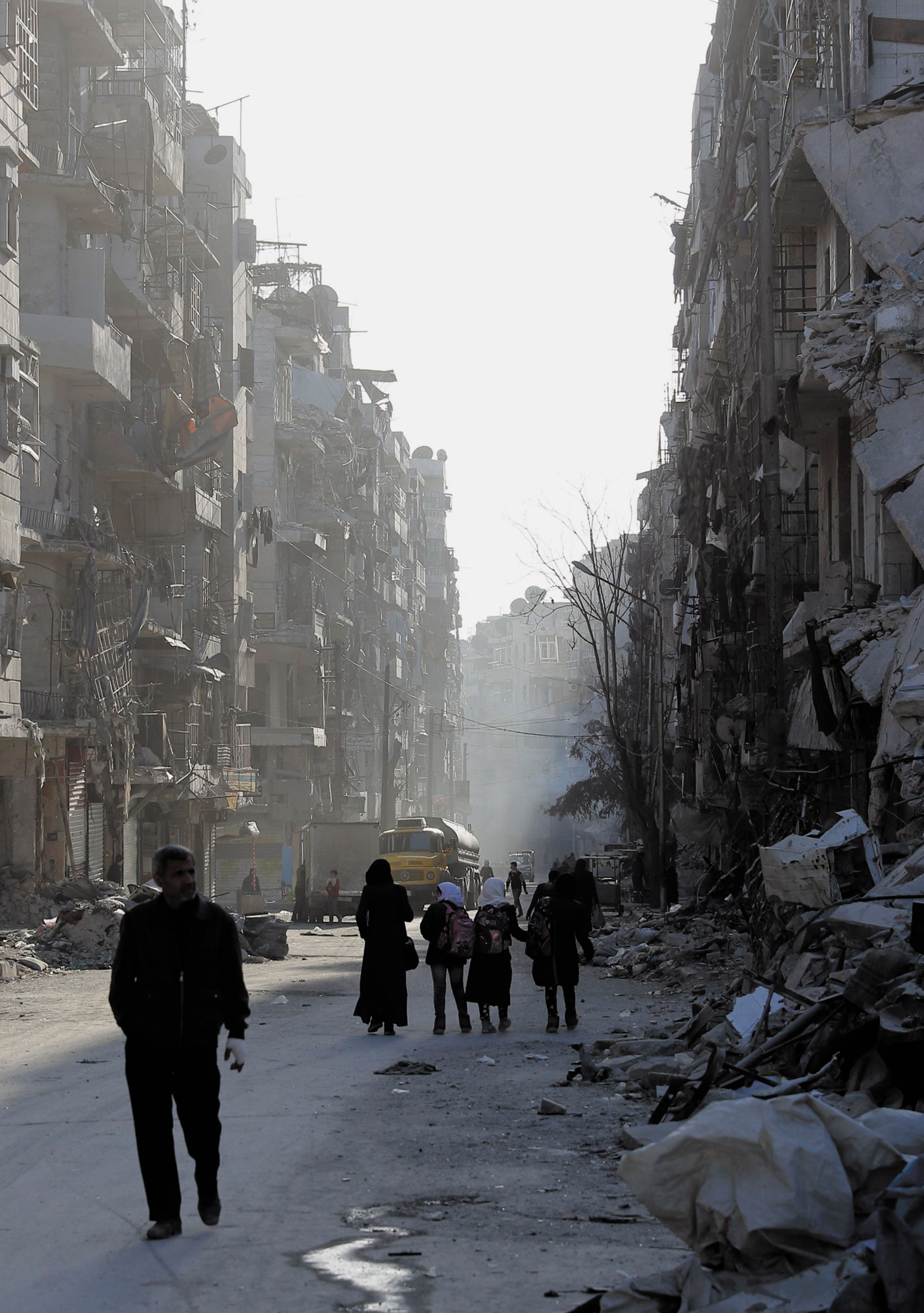
A year after the Assads fell, Syria still moves through its own ruins – startled by its freedom, and half-afraid of it. The dynasty’s collapse ended the nightmare but did not usher in a dream; it simply exposed, in unforgiving daylight, the damage done over half a century of dictatorship and more than a decade of war. The smashed cities are visible to any passer-by; the deeper wreckage – the traumas, resentments, and debts of blood – is harder to map and harder still to mend.

Sednaya prison’s opened gates remain the sharpest indictment. The men who stumbled out were not just survivors but witnesses, their bodies forcing the nation to acknowledge what many had whispered and few had dared investigate. Yet even this reckoning has not united the country. Sectarian reprisals and atrocities on the coast, more atrocity and calls for Druze autonomy demands in Sweida, tribal restlessness in the south and northwest, Kurdish self-rule in the north, and Alawite fear of collective punishment keep the national psyche taut and divided. Bitterness circulates like a second economy.

The economy, meanwhile, balances on a fraying tightrope. Western aid and investment have brought cranes, reopened highways, and a flicker of commerce, but also inflation that is hollowing out households. Reconstruction glimmers like a desert mirage: real enough to chase, never close enough to touch. Corruption accompanying nepotism and patronage has survived the revolution, and many returnees discover that rebuilding a home now costs more than earning one.

Politically, the country sits in an improvised equilibrium. Al Shara’a rules as both liberator and question mark – trusted by some, tolerated by others, watched by all. His pivot toward Washington, his quiet coordination with US forces, and his break with former comrades offer a new direction, but also a gamble. Around him, sovereignty is nibbled at the edges: Israel digs deeper into Quneitra province; Türkiye tightens its grip in the Kurdish north. Liberation has shifted the map without fully restoring control over it.

So Syria stands on the threshold, like Tomlinson, neither damned nor redeemed, simply called to account. The war is over, but its aftershocks and tremors linger in regional loyalties, local vendettas and regional manoeuvres. The people are free, yet unsure of that freedom’s limits and what it asks of them. And the vast machinery of the state still creaks with old habits and temptation.

And yet – a small, highly qualified yet – Syrians are imagining a future again. Not the predetermined script of dictatorship, nor the fatalism of war, but something open, negotiable, theirs’. For a people long told that nothing changes, the mere possibility of change is its own quiet revolution. Hope is not guaranteed; neither is stability. But the impossible has already happened once, and that alone shifts the horizon.

Postscript: the strange, messianic weather of revolutions

Among the HTS fighters Tam Hussein describes, the astonishingly swift and almost bloodless collapse of Damascus could never be reduced to battlefield arithmetic. After over a decade of stalemate and slaughter, the conquest of Damascus and the fall of Assad felt too abrupt, too neat, too historically implausible to be merely human. And so they reached, perhaps instinctively, for the vocabulary of prophecy that has long circulated in the Levant: the old stories of tyrants toppled in the final days, of a just ruler rising at history’s eleventh hour, of a brief season of peace before a climactic confrontation with “the Romans,” a term that in popular imagination now stretches elastically to include Israel, America, or the West at large.

In this folk-level cosmology – not the carefully parsed doctrine of scholars, but the lived, emotional scripture of men who have lived too long fear, death and loss loss – the victory in Damascus reads like a prophetic epic ballad. When a fighter told Hussein that Syria would enjoy “ten years of peace before the war with Israel,” he was drawing from a hazy amalgam of hadith traditions and battlefield folklore to make sense if the improbable: the idea of a lull before the storm, a breathing space before the world tilts into its final reckoning. It is vernacular eschatology, shaped as much by trauma and longing as by text.

Within that register, the murmurs that Shara’a/Jolani might be “the one” carry an unmistakable Mahdist echo. No fatwas or proclamations like when Da’ish leader Abu Bakr  al-Baghdadi famously declared the caliphate from the minbar of Mosul’s al-Nuri Mosque in 2014; but the emotional charge behind the phrase is unmistakabl: an intuitive reach for a Mahdi-shaped idea of the righteous restorer, the unifier, the man who appears when everything has fallen apart. It’s not that anyone literally thinks Jolani is the Mahdi; it’s that the mood of the moment makes such thoughts feel briefly within arm’s length. A silhouette on the horizon, nothing more.

And here, Syria is not unique. Revolutionary periods everywhere – the Protestant Reformation, the French Revolution, the Russian Revolution and Civil War, the Arab Spring even, have their magical phase — those jittery days when people begin to speak as if the world has cracked open, meaning is pouring through the seams, and events blur into myth. When a regime that seemed immovable collapses in a fortnight, people fall back on stories larger than themselves. Sudden upheaval, long suffering, and the ascent of a charismatic figure combine to crack open the ordinary world. Prophecy offers a narrative frame when history seems to be behaving like fable.

So the eschatological edge in these fighters’ conversations tells us less about doctrine and more about psychology. It’s a very human response: a form of magical thinking that arises when reality becomes too strange to process, a way of giving shape to chaos, of telling themselves that their suffering fits into a larger story. A coping mechanism, if you like –  a mythic vocabulary for a moment when Damascus fell, and the ordinary rules stopped making sense and the earth seemed briefly to tilt on its axis.

See also in In That Howling Infinite, Syria. Illusion, delusion and the fall of tyrants and Cold wind in Damascus – Syria at the crossroads. And  on the subject of messianism in general, see A Messiah is needed – so that he will not come

Will civil war return to Syria?

Its future is in the balance

Tam Hussein, Unherd December 8, 2025

A few months ago in Damascus, I discovered a medieval hospital. The door had been left slightly ajar, and I wandered in with my companion Hassan Idlibi — a rebel fighter and old friend. He hadn’t been in the Old City since the fall of Syria’s capital, exactly a year ago today. “When Damascus fell,” he told me, “we were at our lowest ebb. Even the attack on Aleppo was our last gasp. We wanted to break the stalemate. And then we just pushed and pushed, and we ended up sleeping inside the Umayyad Mosque. It was a miracle.”Idlibi, like many Syrians, did not interpret the taking of Damascus through geopolitics — but as divine intervention. This wasn’t because he was a mindless zealot. Far from it. He is one of the most well-read men I know. But, to his mind, the fall of Damascus was so sudden, so unexpected, that only the miraculous could explain it. The victory, he noted, had been achieved by those who had been motivated by Islam. Help had come from foreign fighters, the mujahideen, who travelled from across the globe to aid their co-religionists. And the campaign had been led by a former jihadi, Ahmed al-Sharaa, now the interim president of Syria. At the time, the old al-Qaeda operative, then known by his nom de guerre, Abu Mohammad al-Jolani, had a $10 million American bounty on his head.

After more than a decade of slaughter, no one had expected the capital to collapse. Assad, then president, had seemed like a stubborn wart: unpleasant but immovable. Jolani’s rebel enclave in the northern city of Idlib looked too small, too besieged, to pose a serious threat — though in fact it was performing better economically than inflation-ravaged Damascus, helped along by a reliable flow of Turkish hard currency. I myself expected the rebels to negotiate. What leverage did they have? Yet this rebel government, roughly the size of Croydon, took over the instruments of state, and since then has avoided stumbling into a new civil war.

The unexpected and largely peaceful victory was attributed to piety, prophecy, steadfastness. Some have even compared the final conquest of Damascus to Muhammad’s bloodless conquest of Mecca in 630. The idea of a “miracle”, here, is not mere rhetoric — it shapes political expectations. Some Syrians, at least based on my social media, think all this makes Sharaa “the one”, with my Facebook messages and WhatsApp chats awash with prophetic readings of the present. One believed Syria would now enjoy 10 years of peace before the war with Israel begins. Perhaps, he suggested, this was the prelude to the end of times. After all, so-called “Greater Syria” — encompassing much of the Levant — plays an important role in the Syrian and indeed Muslim sacral imagination. It is where prophets walked and is the place where many of the end of times narratives will play themselves out.

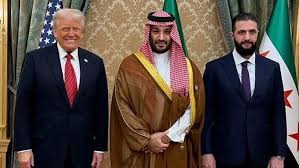
Yet if the fall of Damascus seemed miraculous to many Syrians, the survival of the new administration will depend less on providence than on governance. Despite his past, Sharaa has so far demonstrated an unexpected level of political finesse. He has kept the constitution, held elections — albeit with 70 seats appointed by himself — and all the while has acted the statesman. He is savvy enough to not mind having President Trump spray his latest fragrance on him in the Oval Office, or Syrian Jewish rabbis blessing him.

Sharaa has made some promising early decisions. By keeping the civil service intact, he has avoided the catastrophic purge that helped destroy post-invasion Iraq. He should continue recruiting highly-educated young Syrians from the diaspora — people familiar with Western administrations and political norms. Even so, the administration still has a tendency to fear scrutiny and behaves as if under siege. It should welcome a regulated free press, which would expose blind spots, not undermine authority. The British press has reported that Jonathan Powell’s Inter Mediate is working with the new government. This should be welcomed rather than criticised — not only for reasons of conflict resolution and soft power, but for its value in statecraft and building institutional capacity.

Sharaa’s priorities for the coming year are clear. The country remains immensely fragile, caught in a regional tug-of-war between Israel and its neighbours, and divided along ethnic and sectarian lines. The situation could easily drift into a reprise of Lebanon’s civil war. Sharaa’s first task is therefore to mend Syria’s sectarian and ethnic fractures with a sense of equity. The trials that began this month over the coastal massacres in Latakia will be an important test of how the country intends to move forward. The Druze and Alawite communities — already bruised by conflict and mistrust — require justice delivered without the language of sectarianism.

Meanwhile, Kurdish anxieties must be addressed by ending the Arab-first ideology of the old regime. Syria has never been a purely Arab country: even its favourite son, Saladin, the builder of that hospital I visited and whose grave in Damascus still draws multitudes, was a Kurd. Last year’s tentative permission for Kurdish new year celebrations (Newroz) suggests that a more pluralist future is possible. Yet it remains unclear how far Kurdish cultural expression will be allowed to develop. Already this month, exchanges of fire between Syrian government forces and Syrian Democratic Forces (SDF) units under Kurdish command show how fragile the situation is.

Perhaps the most difficult balancing act involves the foreign fighters who fought on Sharaa’s side. They carry immense symbolic weight in Syrian society — and are the cause of immense fear in the West. Many are ready to resume normal life, but others still see themselves as Islam’s warriors. Recent clashes in the Idlib countryside involving French foreign fighters reflect anxieties that any rapprochement with the West might see them handed over to their home governments. The image of Sharaa standing beside Trump, receiving a symbolic “anointing” of his new fragrance, alarms them even if such engagement is politically necessary.

Granting these fighters legal status, regularising their papers, integrating some into the national army or demobilising them with stipends and educational opportunities — not unlike the GI Bill for US veterans — could go a long way toward neutralising one of Syria’s most volatile pressures.

Then there is the conundrum of Israel. On this, Sharaa has cultivated deliberate ambiguity. At the United Nations, Syria has repeatedly noted its restraint regarding Israel’s illegal strikes on Syrian territory, yet Sharaa has resisted pressure to join Trump’s flagship Abraham Accords. Signing them now would be political suicide. But ambiguity buys him room to manoeuvre — and time to consolidate the state. The question is how long this can last.

For its part, the West has worked to prevent Syria from sliding into another civil war — one that would inevitably spill over into Europe, potentially replaying the exodus of 2015. With regional partners like Saudi Arabia and Turkey, Western governments have effectively restrained Israeli escalation, aware that renewed instability would eventually reach Jerusalem’s door. It’s not impossible to imagine rebels, having overthrown a “pro-Western stooge” like Sharaa and aided by foreign fighters, actually marching toward Israel, convinced that “the infidels” will never allow them to determine their own future. As they did in Damascus, so too — in their imagination — must they do in Jerusalem.

Thus far Sharaa has governed with surprising openness. He has welcomed Britain’s foreign secretary David Lammy, met American diplomats and General David Petraeus, played basketball with US soldiers, and cooperated in counter-terrorism operations. He has also restored relations with London, with foreign minister Asaad al-Shaibani reopening the Syrian embassy.

If Western governments refuse to work with him because of his Islamist roots, they will share responsibility should Syria fracture again. Sharaa’s past is not erased; he may remain an uncomfortable partner. But what is the alternative? That he be excluded from political life and drift into a Castro- or Maduro-like role on the sidelines? If the Saudi Crown Prince can be brought in from the cold after the Khashoggi murder, then almost anything is possible.

Here I recall a meeting with former Saudi spy chief Turki al-Faisal in his South Kensington apartment after the release of his memoir. Faisal lamented how his advice went unheeded after the Afghan-Soviet war. He had urged the international community to launch something akin to a Marshall Plan — an investment programme to stabilise Afghanistan. Had that happened, the region might not have unravelled. Instead, the country collapsed into years of civil war.

Likewise, fully lifting sanctions on Syria and providing a major investment programme, coupled with training and cultural exchange, could restrain the country’s more radical elements. Reining in Israeli escalation, de-escalating the Druze conflict, and mediating between the SDF and Damascus would all help prevent new wars. On this, the West could also spare itself a future security headache by helping Damascus regularise or demobilise foreign fighters rather than leaving them to drift. This would all help to displace messianism.

What, then, would such investment bring the West, beyond avoiding another gaping wound on its eastern flank? For sure, it will not turn Damascus into another Beirut, a place for foreign journalists to party, nor into a Deano-friendly Dubai. Syria will likely remain socially conservative, more like Muscat in Oman. Given time, however, it could become a commercial hub with a distinct cultural life, just as it has been for much of its epic history. This isn’t mere optimism: Sharaa turned Idlib, once a distant town, into a magnet for Damascenes seeking commercial opportunity. Investment now would bring the West a friendly partner, business prospects and political influence. The choice is stark. With support, Syria could become a kind of West Germany: rebuilt, integrated, and stable. Without it, the country risks becoming a new Jerusalem — a battleground charged with fire and prophecy.

Tam Hussein is an award winning investigative journalist and writer. His work has been recognised by the Royal Television Society Awards.

The Night of Power – Robert Fisk’s bitter epilogue

“All wars come to an end and that’s where history restarts”

“History stretches out into the future as well as the past”

“All wars may end in negotiations, but not all negotiations end wars”

The indefatigable British journalist, author, and longtime Beirut resident Robert Fisk Robert Fisk died of a stroke in St Vincent’s Hospital, Dublin, on October 30, 2020. He was 75. Fearless and inquisitive, often iconoclastic and controversial, “Mister Robert,” as he was known from Algeria to Afghanistan, was one of the finest journalists of his generation—the greatest reporter on the modern Middle East. There is probably no better body of work for understanding the region. Respected and reviled in equal measure by left and right alike, Fisk spoke truth to power for more than half a century.

He was obsessive, he was angry, and – having read many of his books – I believe he suffered from undiagnosed PTSD throughout his career in the Middle East. His lifelong obsessions were the arrogance and misuse of power, the lies and impunity of the rulers: presidents and prime ministers, kings and emirs, dictators and theocrats, torturers and murderers. And always the countless innocents who endured and suffered, dying in their tens – and tens – of thousands on the altar of power and greed.

The Night of Power 

His last book, The Night of Power: The Betrayal of the Middle East, published posthumously in 2023, takes up where his monumental The Great War for Civilisation (2005) ended—with the contrived U.S.-British-Australian invasion of Iraq. The Great War for Civilisation was a tombstone of a book, literally and figuratively, as was its predecessor Pity the Nation (1990), his definitive history of the Lebanese civil war.

The Night of Power  is no less harrowing, covering the occupation of Iraq, the 2006 Israel–Lebanon war, the Arab Spring, the rise of Egypt’s new pharaoh Abdel Fattah al-Sisi, the lonely death of Mohammed Morsi, Israel’s occupation of the West Bank and seize of Gaza, and the Syrian civil war. It ranges widely – but its coherence lies in Fisk’s unrelenting theme: the cycle of war, the corruption of power, and the persistence of memory. To read it is to feel Fisk’s own cynicism, sadness and anger.

The title is deeply symbolic. In Islamic tradition, Laylat al-Qadr, the Night of Power, is the night the Qur’an was first revealed to the Prophet Muhammad: “The Night of Power is better than a thousand months … Peace it is, until the rising of the dawn” (Qur’an 97). It is a night of blessing beyond measure, greater than a lifetime of devotion. The title is bitterly ironic: the “night of power” he recounts is one of betrayal, cruelty, and endless war.

It is both a summation of his life’s work and a testament to his method. Over four decades, Fisk was a witness to almost every major conflict in the Middle East — Lebanon, Iran, Iraq, Palestine, Algeria, Afghanistan, Syria, Egypt — and the wars of the Yugoslav succession. His dispatches carried both forensic detail and moral outrage. This last work, published in the year of his death, is less a memoir than a vast chronicle of empire, war, betrayal, and resistance.

Fisk had long insisted that reporters must “be on the side of those who suffer.” He was no neutral stenographer of official sources. He distrusted governments – Western and Arab alike – and prized first hand testimony, walking the ruins, speaking to survivors, writing down the words of the powerless. The Night of Power continues in this vein, but with a sharpened sense of history. Fisk threads together centuries of conquest and resistance, showing how imperial arrogance, local despotism, and religious zealotry have conspired to devastate the region.

The last two paragraphs Robert Fisk wrote before his death, closing The Night of Power, cut like a blade through the pieties of Western journalism:

“Failure to distinguish between absolute evil, semi-evil, corruption, cynicism and hubris produced strange mirages. Regimes which we favoured always possessed ‘crack’ army divisions, ‘elite’ security units, and were sustained by fatherly and much revered ruling families. Regimes we wished to destroy were equipped with third-rate troops, mutineers, defectors, corrupt cops, and blinded by ruling families. Egypt with its political prisoners, its police torture and fake elections, was a tourist paradise. Syria with its political prisoners, police torture and fake elections, would like to be. Iran, with its political prisoners, police torture and fake elections was not — and did not wish to — be a tourist paradise.” (p. 533)

In the end, according to those closest to him, including his wife Nelofer Pazira-Fisk, an award-winning Afghan-Canadian author, journalist and filmmaker, who edited the book and wrote its final chapter, Fisk despaired. He feared that nothing he had written over four decades had made any difference – that things had, in fact, grown worse. As Kent says to the blinded King Lear, “All is cheerless, dark, and deadly”.

And yet the worst was arguably still to come: the chaotic retreat of America and its allies from Afghanistan and the Taliban’s reimposition of rule, including the literal silencing of women’s voices; Russia’s invasion of Ukraine and its murderous war of attrition that has now passed its thousandth day; Hamas’s atrocity of October 7, 2023, Israel’s biblical-scale revenge, and the utter destruction of Gaza; and the latest Israel–Lebanon war that saw the decapitation and emasculation of Hezbollah.

The Legacy of a Fearless Reporter

The Night of Power stands as a testament to Robert Fisk’s fearless journalism and his relentless moral compass. Across decades of war reporting, Fisk bore witness to suffering few dared to confront. He was unflinching in exposing the hypocrisies of Western powers, the brutality of dictators, and the costs of occupation, war, and empire. Yet he also captured the human dimension: the courage, endurance, and resilience of those who suffered, whether in Iraq, Gaza, Egypt, or Syria.

This final work synthesizes Fisk’s signature qualities: exhaustive research, direct engagement with the people whose lives were upended, and an ethical rigor that held both oppressors and complicit outsiders accountable. The Night of Power is not merely a chronicle of events; it is a meditation on power, betrayal, and history itself.

Fisk’s prose, vivid and often lyrical, reminds readers that journalism can be a form of witness — bearing truth against overwhelming odds. Even in despair, he recognized the persistence of human agency, the cycles of history, and the moral imperative to see, to name, and to remember. His death in 2020 marked the end of a career unparalleled in courage and conscience, but his work, particularly this last book, endures as both a warning and a guide for understanding the Middle East and the forces that shape our world.

In reading The Night of Power, one cannot avoid Fisk’s central lesson: history may restart at the end of every war, but the witness to injustice is what shapes the moral memory of humanity. The quotations at the head of this review, indeed, the final words of the book, weary yet resolute, are a fitting epitaph. Fisk saw the world as it was, not as we wished it to be: corrupt, cruel, but always turning, always restarting.

All wars come to an end and that’s where history restarts
Robert Fisk, The Night of Power

Postscript

The final chapter of The Night of Power was written by Fisk’s wife Nelofer Pazira-Fisk, She was based in Beirut for fifteen years working alongside her late husband and reported from Iraq, Afghanistan, Turkey, Egypt and Syria. The following podcast by American war correspondent Chris Hedges, with Fisk’s first wife Lara Marlowe is a worthy tribute .

See also, in In That Howling Infinite The calculus of carnage – the mathematics of Muslim on Muslim mortality 

The following briefly summarizes the main themes of The Night of Power drawing largely upon his own words

Robert Fisk’s Catalogue of Carnage

Hear the cry in the tropic night, should be the cry of love but it’s a cry of fright
Some people never see the light till it shines through bullet holes
Bruce Cockburn, Tropic Moon

Iraq: Catastrophe Foretold

Fisk argued that Iraq’s occupation was fraudulent from the start, brutal in execution, and ferocious in its response to insurgency. The Americans tolerated the inhuman behaviour of their own soldiers, relied on mercenaries and “greedy adventurers,” and mixed Christian religious extremism with an absurd political goal of “remaking the Middle East.” It was “tangled up in a web of political naivety and Christian muscularity”.It was bound, he wrote, to end in catastrophe.

“We were pulling at the threads of the society with no sense of responsibility as occupiers just as we had no serious plans for state reconstruction. Washington never wanted Iraq’s land. Of course the countries resources were a different matter, but its tactics did fit neatly into the prairies of the old West. The tribes could be divided and occupiers would pay less in blood. as long as they chose to stay. One set of tribes were bought off with guns and firewater the other with guns and dollar bills. Serious resistance, however, would invoke “the flaming imperial anger” of all occupation armies.

The rhetoric echoed the 19th century missionary zeal of empire. Western fascination with the Biblical lands was used to justify conquest: as Lieutenant General Stanley Maude told the people of Baghdad in 1917, the Allies wished them to “prosper even as in the past when your ancestors gave to the world Literature, Science, and Art, and when Baghdad city was one of the wonders of the world” (p. 92).

The modern occupation, Fisk observed, was nothing but “the rape of Iraq”. Oil wealth was divided up in a scandal of corruption involving US contractors and Iraqi officials. “The costs were inevitably as dishonest as the lies that created the war … I knew corruption was the cancer of the Arab world but I did not conceive of how occupying Power supposedly delivering Iraqi their long sort freedom could into a mafia and at such breathtaking speed”.

Security became a malignant industry; by 2006 mercenaries accounted for half of Western forces, sucking money out of the country. The food system, 10,000 years old, was destroyed by Paul Bremer’s infamous Order 81, which forbade farmers from saving their own seed. Iraq became a “giant live laboratory for GMO wheat,” its people “the human guinea pigs of the experiment”.

And through it all, a campaign of suicide bombings –  unprecedented in scale –  turned Iraq into the crucible of modern terror. Editors never tried to count them. The figures, Fisk noted, were historically unparalleled.

The trial of Saddam Hussein

The US ambassador to Iraq once claimed she had been “unable to convince Saddam that we would carry through what we warned we would.” Fisk dismissed this as absurd. Saddam, he argued, was well aware of Western threats, but the framing of his trial was designed to obscure deeper truths.

If Saddam had been charged with the chemical massacre at Halabja, defence lawyers could have pointed out that every US administration from 1980 to 1992 was complicit in his crimes. Instead, he was tried for the judicial murder of 148 men from Dujail — heinous, but “trifling in comparison” (p. 92). The great crimes of the Baathist regime — the 1980 invasion of Iran, the suppression of Shia and Kurdish revolts in 1991 — were deemed unworthy of the court’s attention.

Pakistan: Fragile State, Useful Pawn

Fisk’s lens widened to Pakistan, where he recorded with scorn the ISI’s admission that the reality of the state was defined not by American might but by “corrupt and low-grade governance”. A US intelligence officer boasted: “You’re so cheap … we can buy you with a visa, with a visit to the US, even with a dinner.”

This, Fisk suggested, was not just Pakistan but almost every Arab or Muslim state in thrall to Washington: Egypt, Jordan, Syria, the Gulf states under their dictators and kings, even Turkey. He wrote that Osama Bin Laden’s choice to hide in Pakistan embodied a weird symmetry: the man who dreamed of a frontierless caliphate sought refuge in the very sort of corrupt, Western-backed dictatorship he despised.

Rendition: Complicity in Torture

The “war on terror” extended beyond borders. CIA, MI5 and MI6 operatives were deeply involved in rendition. Prisoners were knowingly dispatched to states where torture was inevitable, even fatal. Fisk insisted on repeating this uncomfortable truth: Western democracies had integrated torture into their security architecture.

Israel and Palestine: The Last Colonial War

Fisk was unsparing in his treatment of Israel’s expansion. He rejected any obfuscation: Israel seized the opportunity to consolidate its control with a land grab for the most prominent hilltops and the most fertile property in the West Bank for settlements constructed on land legally owned for generations by Arabs, destroying any chance the Palestinian Arabs could have a viable state let alone a secure one.”). These settlements, he wrote, “would become the focus of the world’s last colonial war.”

He surmised: “Will the Jews of what was Palestine annex the West Bank and turn its inhabitants into voteless guest workers and all of mandate Palestine into an apartheid state? There was a mantra all repeat that only other way to resolve Israeli rule in the West Bank would be a transfer of the Palestinians across the Jordan into the Hashemite kingdom on the other side of the river. In other words, expulsion”

The Wall 

Fisk’s Fisk’s description of the Separation Wall is dramatic and unforgettable: an   “immense fortress wall” which snakes “firstly around Jerusalem but then north and south of the city as far as 12 miles deep into Palestine territory, cutting and escarping its way over the landscape to embrace most of the Jewish colonies … It did deter suicide bombers, but it was also gobbled up more Arab land. In places it is 26 feet or twice the height of the Berlin wall. Ditches, barbed wire, patrol roads and reinforced concrete watchtowers completed this grim travesty of peace. But as the wall grew to 440 miles in length, journalists clung to the language of ‘normalcy’ a ‘barrier’ after all surely is just a pole across the road, at most a police checkpoint, while a ‘fence’ something we might find between gardens or neighbouring fields. So why would we be surprised when Italian Prime Minister Silvio Berlisconi, traveling through the massive obstruction outside Bethlehem in February 2010 said that he did not notice it. But visitors to Jerusalem are struck by the wall’s surpassing gray ugliness. Its immensity dwarfed the landscape of low hills and Palestinian villages and crudely humiliated beauty of the original Ottoman walls Churches mosques and synagogues .. Ultimately the wall was found to have put nearly 15% of West Bank land on the Israeli side and disrupted the lives of a third of the Palestine population. It would, the UN discovered, entrap 274,000 Palestinians in enclaves and cut off another 400,000 from their fields, jobs, schools and hospitals. The UN concluded that many would “choose to move out.” Was that the true purpose?“.

Leftwing Israeli journalist Amira Haas, who lives in the West Bank, takes Fisk on a tour of the wall: “Towering 26 feet above us, stern, monstrous in its determination, coiling and snaking between the apartment blocks and skulking in wadis and turning back on itself until you have two walls, one after the other. You shake your head a moment – when suddenly through some miscalculation surely – there is no wall at all but a shopping street or a bare hillside of scrub and rock. And then the splash of red, sloping rooves and pools and trees of the colonies and yes, more walks and barbed wire fences and yet bigger walls. And then, once more the beast itself, guardian of Israel’s colonies: the Wall”.

See also, in In That Howling InfiniteBlood and Brick … a world of walls

Banksy on The Wall. Paul Hemphill, May 2016

Gaza: Junkyard of History

Although Oslo’s creators fantasied that it would become part of the Palestinian state, Gaza’s destiny was isolation. It has been a junkyard of history variously ruled by Christians and Muslims, ruined and rebuilt under the Ottomans, and fought for by the British and Turks in the First World War, and now reduced to a prison state.,

Egypt: A Revolution Betrayed

Mohammed Morsi embodied both hope and tragedy. “An intelligent, honourable, obtuse, arrogant and naïve man”. No visionary, he was “was shambolic, inspiring, occasionally brutal and very arrogant”.  He set off down the road to Egyptian democracy with no constitution no parliament and no right to command his own countries army …set off down the road to democracy “with no constitution, no parliament and no right to command his own country’s army”. And when the end came, as come it must, he could not smell trouble; he did not see what was coming.

In a coup that was not a coup, which former British prime minister Tony Blair called “an awesome manifestation of power”, “the democratically elected president was suspended, the constitution annulled, tekevion stations closed, the usual suspects arrested … Yet President Obama could not bring himself to admit this. He asked the Egyptian military “to return full authority back to a democratically elected civilian government… Through an inclusive and transparent process” without explaining which particular elected civil civilian government he had in mind”.

This was just the beginning. In the six years that followed, Egypt’s executioners and jailers were kept busy. “They hung 179 men, many of them tortured before confessing to murder, bomb attacks or other acts of terrorism”. It was claimed that Al Sisi had returned the country to a Mubarak style dictatorship in the seven years of his own war against the brotherhood between 1990 and 1997. Mubarak’s hangman had executed only 68 Islamists and locked up 15,000. By 2019  Al Sisi had 60,000 political prisoners

To Fisk, this was a sign of fear as much as it was evidence of determination to stamp out terror. Al Sisi had three separate conflict on his hands: his suppression of the brotherhood on the ground that they were themselves violent terrorists, the campaign by Islam extreme groups against Egypt’s minority Christian cops, and most frightening of all the very real al Qaeda and ISIS war against Al Sisi’s own regime. “The prisons of the Middle East, Fisk concluded, were “universities for future jihadi”.

See also, in In That Howling Infinite and Sawt al Hurriya – remembering the Arab Spring

Remember and witness

Silencing the women of the revolution 

The misogyny if the counterrevolution was stark. Fisk wrote: “… if the senior officers wished to prune the branches of the revolution the participation of women was something that could not be tolerated. Why did there suddenly occur without apparent reason a spate of sexual attacks by soldiers that were clearly intended to frighten young women off the street,  revealing a side to the Egyptian military that none of us had recognised. The misogynistic and shocking display of brutality towards women that could not have been the work of a few indisciplined units”. With sexual assaults on women protesters, virginity tests and public humiliation, “heroes of the 1973 war had become molesters”.

The lonesome death of Muhammad Morsi

Morsi would struggle on for years before a series of mass trials would entrap him and his brotherhood colleagues and quite literally exhaust him to death. Morsi’s slow death in solitary confinement was, Fisk insisted, “utterly predictable, truly outrageous and arguably a case of murder”. He was denied treatment, denied family visits, denied a funeral. “To die in a dictator’s prison, or at the hands of a dictator’s security services”, Fisk wrote, “is to be murdered.”

It did not matter, he continued “if it was the solitary confinement, the lack of medical treatment or the isolation, or if Morsi had been broken by the lack of human contact for those whom he loved. “The evidence suggested that Morsi’s death must’ve been much sought after by his jailers, his judges, and the one man in Egypt who could not be contradicted. You don’t have to be tortured with electricity to be murdered”.

Fisk’s description of Morsi’s death is a sad one. “Symbolism becomes all”, he wrote. “The first and last elected president of a country dies in front of his own judges and is denied even a public funeral. The 67-year-old diabetic was speaking to the judges, on trial this time for espionage, when he fainted to the floor. Imagine the response of the judges when he collapsed. To be prepared to sentence a man to the gallows and to witness him meeting his maker earlier than planned must’ve provoked a unique concentration of judicial minds. could they have been surprised groups had complained of Morsi’s treatment for the world media and the world had largely ignored the denunciations. What might have been surprising to his judges was that he managed to talk for five minutes before he departed the jurisdiction forever?”

See also, in In That Howling Infinite, Nowhere Man – the lonesome death of Mohamed Morsi 

Mohammed Morsi in the cage of justice

Russia in the Syrian Cockpit

Regarding Russia’s critical intervention in the Syrian civil war, Fisk wrote:

“We Westerners have a habit of always looking at the Middle East through our own pious cartography, but tip the map 90° and you appreciate how close Syria is to Russia and its Chechen Muslim irredentists. No wonder Moscow watched the rebellion in Syria with the gravest of concern. Quoting Napoleon, who said “if everyone wants to understand the behaviour of a country, one has to look at a map”, my Israeli friend (the late) Uri Avnery wrote that “geography is more important than ideology, however fanatical. Ideology changed with time”.

The Soviet Union, he continued was most ideological country in the 20th century. “It abhorred it predecessor, Tsarist Russia. It would have abhorred its successor, Putin‘s Russia. But Lo and behold – the Tsars, Stalin and Putin conduct more or less the same foreign policy. I wrote that Russia is back in the Middle East. Iran is securing its political semicircle of Tehran, Baghdad Damascus, and Beirut. And if the Arabs – or the Americans – want to involve themselves, they can chat to Putin”.

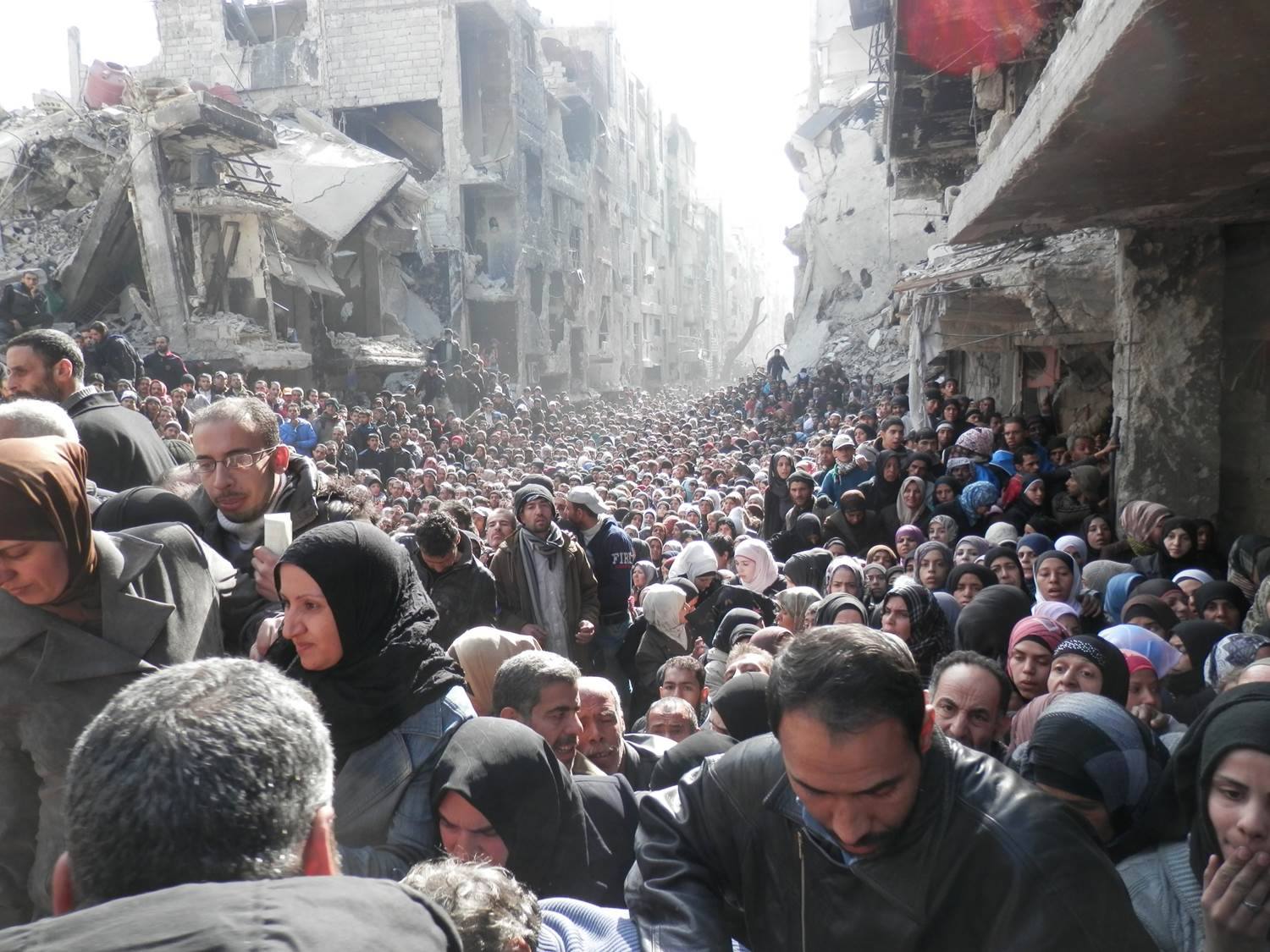
Yarmouk camp, Damascus. Once the thriving home of Syria’s Palestinian refugees, September 2025

Author’s note

Laylatu al Qadri

لَْيلَُةاْلَقْدِر َخْيٌر ِّمْنأَْل ِف َشْھٍر. َسَلاٌم ِھَي َحَّتى َمْطلَِعاْلَفْجِر
Laylatu alqadri khayrun min alfi shahriin.Salamun hiya hatta matla’i alfajrii
The night of power is better than one thousand months.
(That night is) Peace until the rising of the dawn.
Al Qur’an al Karīm, Surat Al Qadr 97

I first learned about the Quran and The Night of Power in Cairo when I was staying at the home of Haji Abd al Sami al Mahrous a devout Muslim doctor who had cared for me when I had fallen ill. There was a particular beauty and magic about the idea of a night that surpassed all other nights in sacredness. The fascination stayed with me, and when I returned to London and was learning Arabic and studying Middle East politic at SOAS, it inspired a song.

Shape without form, a voice without sound,
He moves in an unseen way;
A night of power, eternal hour,
Peace until the break of day;
The doubter’s dart, the traveller’s chart,
An arrow piercing even to the coldest heart,
A hand surpassing every earthly art,
And shows everyone his own way

Paul Hemphill, Embryo

When Freedom Comes, She Crawls on Broken Glass

In an earlier post in In That Howling Infinite, I wrote:

My song  When Freedom Comes is a tribute to Robert Fisk (1946-2020), indomitable, veteran British journalist and longtime resident of Beirut, who could say without exaggeration “I walk among the conquered, I walk among the dead” in “the battlegrounds and graveyards” of “long forgotten armies and long forgotten wars”. It’s all there, in his grim tombstone of a book, The Great War for Civilization (a book I would highly recommend to anyone wanting to know more about the history of the Middle East in the twentieth century – but it takes stamina – at near in 1,300 pages – and a strong stomach – its stories are harrowing).

The theme, alas, is timeless, and the lyrics, applicable to any of what Rudyard called the “savage wars of peace” being waged all across our planet, yesterday, today and tomorrow – and indeed any life-or-death battle in the name of the illusive phantom of liberty and against those intent on either denying it to us or depriving us of it. “When freedom runs through dogs and guns, and broken glass” could describe Paris and Chicago in 1968 or Kristallnacht in 1938. If it is about any struggle in particular, it is about the Palestinians and their endless, a fruitless yearning for their lost land. Ironically, should this ever be realized, freedom is probably the last thing they will enjoy. They like others before them will be helpless in the face of vested interest, corruption, and brute force, at the mercy of the ‘powers that be’ and the dead hand of history.

The mercenaries and the robber bands, the warlords and the big men, az zu’ama’, are the ones who successfully “storm the palace, seize the crown”. To the victors go the spoils – the people are but pawns in their game.

In 2005, on the occasion of the publication of his book, Fisk addressed a packed auditorium in Sydney’s Macquarie University. Answering a question from the audience regarding the prospects for democracy in the Middle East, he replied:

“Freedom must crawl over broken glass”

When Freedom Comes, She Crawls on Broken Glass 

There goes the freedom fighter,
There blows the dragon’s breath.
There stands the sole survivor;
The time-worn shibboleth.
The zealots’ creed, the bold shahid,
Give me my daily bread
I walk amongst the conquered
I walk amongst the dead

Paul Hemphill, When Freedom Comes

I reference this melancholy state of affairs in man of my songs:

High stand the stars and moon,
And meanwhile, down below,
Towers fall and tyrants fade
Like footprints in the snow.
The bane of bad geography,
The burden of topography.
The lines where they’re not meant to be
Are letters carved in stone.
They’re hollowed of all empathy,
And petrified through history,
A medieval atrophy
Defends a feeble throne.
So order goes, and chaos flows
Across the borderlines,
For nature hates a vacuum,
And in these shifting tides,
Bombs and babies, girls and guns,
Dollars, drugs, and more besides,
Wash like waves on strangers’ shores,
Damnation takes no sides.
Paul Hemphill, E Lucevan Le Stelle

Cold wind in Damascus … Syria at the crossroads

In December, In That Howling Infinite published Syria. Illusion, delusion and the fall of tyrants, an analysis of the downfall of the Assad dynasty. It observed: “…the immediate future is far from clear. It is axiomatic to say that most commentators who say they understand what is going to happen in the Levant often don’t. To quote B Dylan, something’s happening, and we don’t yet know what it is … Syria now pauses at a crossroads, where both hope for a better future, and skepticism that it will be achieved, are equally warranted. Whether or not the new Syrian regime can succeed is an open question”.

Syria’s political transition is literally a regime change: not simply the switching out of personalities on the throne, but a total philosophical and conceptual reordering of governance. Maybe it’s not the wind of freedom that is blowing through the streets of Damascus.

Russian-oriented media platforms like RT and Mint have been saying for two months now that despite their friendly noises, including pragmatic contacts with western countries like the USA, Britain and France that once treated the Assad regime as a pariah and also regarded Hayat al Tahrir al Shams as a terrorist outfit, and wealthy Gulf states that had only just made up with the old regime, whilst hedging on the thorny issue of relations with Turkey and Israel on the one hand, and former enables of the regime, Russia, Iran and even Hezbollah, on the other, Syria’s new rulers are Islamists at heart and will soon show their true colours.

Maybe they have a point …

In late December, Obaida Arnout, a spokesperson for the Syrian transitional government, said that women’s “biological and physiological nature” rendered them unfit for certain governmental jobs, sparking demonstrations in Damascus and other cities. At a press conference, the new Syrian leader asked a female reporter to cover her hair. There are reports that the new authorities are purging the school curriculum of pre-Islamic history and content deemed contrary to Islamic strictures. Before Christmas, foreign jihadis allied to Hayat al Tahrir al Sham torched a Christmas tree in Hama, leading to protests by Syrian Christians.

Syria’s de facto ruler Ahmed al Shara’a declared that free elections could be four years away, and in late January, seven weeks after he led the rebel offensive that overthrew Bashar al-Assad. he was named president for the “transitional period“. Rebel military commander Hassan Abdul Ghani also announced the cancellation of Syria’s 2012 constitution and the dissolution of the former regime’s parliament, army and security agencies, according to the Sana news agency. As president, Sharaa would form an interim legislative council to help govern until a new constitution was approved, he said. Meanwhile, he added, all rebel groups which opposed Assad in the 13-year civil war would be dissolved and integrated into state institutions.

This may provie difficult if not impossible. in the north, Turkish proxy forces battle with Kurdish forces in semi-autonomous Rojava. in the south, rebel militias oppose the imposition of HTS authority. In the west, Alawite militias who supported the Assads engage in firefights with HTS. In the east, meanwhile, the Americans bombing surviving pockets of Islamic State fighters who may be encouraged by the chaos to stage a jailbreak of tens of thousands of jihadis held in camps guarded by the embattled Kurds.

Maybe it’ll be business as usual in the middle eastern axis of awful. It may be the wind of freedom that is blowing, but then again, maybe not. So far so bad …?

© Paul Hemphill 2025. All rights reserved

For more on the Middle East in in That Howling Infinite, see A Middle East Miscellany.

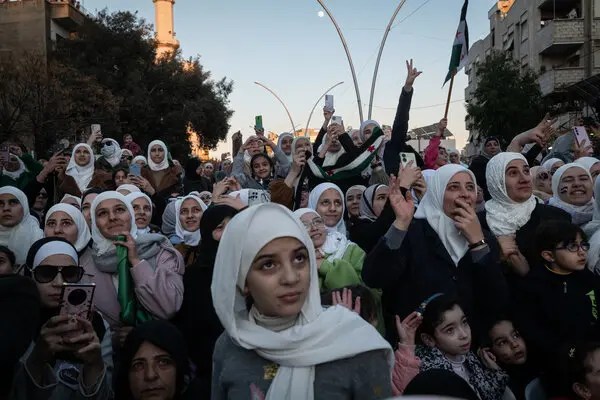
Women in Damascus celebrate the fall of the Assad regime

Fears Syria is the next Mid-East humanitarian nightmare

To describe the current Syria situation as combustible is consequently an understatement.

To describe the current Syria situation as combustible is consequently an understatement.

No one mourns the wicked, says the song. But, while the end of Bashar al-Assad’s blood-soaked rule is undoubtedly welcome, his overthrow is not likely to solve Syria’s crippling problems.

That Syria’s descent into a murderous civil war was partly triggered by economic factors is clear. Far-reaching land reforms in 1958 and 1962-63 created a vast number of small to very small farms, which accounted for 60 per cent of all agricultural holdings but only 23 per cent of cultivated land. That structure was always precarious; what destroyed it was a trebling in Syria’s population.

With inheritance laws subdividing those holdings as more and more sons survived into adulthood, the marginal farms, which accounted for the bulk of agricultural employment, became completely unviable. Steadily worsening water shortages, culminating in a disastrous drought from 2005 to 2010, then delivered the final blow, precipitating a flight to the cities, particularly from the Sunni areas, that left many rural villages without young men.

But Syria’s heavily regulated, corruption-ridden economy could scarcely absorb the inflow, so more than half of those young men became unemployed, eking out tenuous livelihoods in illegally built complexes on the urban fringes.

People gather to celebrate in Umayyad Square on December 11, 2024 in Damascus, Syria.

People gather to celebrate in Umayyad Square on December 11, 2024

None of that would have provoked the civil war had the rural collapse, and the subsequent rise in poverty, not aggravated deep-seated ethnic and religious conflicts. Exactly like Lebanon and Iraq, the country that gained independence in 1946 was a state without a nation. Nor were there any broadly shared goals or ideas that could shape a unifying national identity.

The extent of the differences became obvious in 1954, when a Sunni-dominated government enacted centralising laws that sparked a Druze revolt. The revolt was quickly suppressed but the inability to define a workable balance between the conflicting groups fuelled six military coups in rapid succession.

It was only in 1966, when the Baath (Resurrection) party seized power, and then in 1970, with the so-called Corrective Revolution, which vested undivided power in Hafez al-Assad, that a degree of stability prevailed. The Baath had secured just 15 per cent of the vote in 1963, the last more or less free election; but, at least initially, it managed to coalesce a viable, if never broad, base of support.

At the heart of that support was the army, whose officer corps, like the Baath, was dominated by Alawites, who replaced the Sunnis decimated in the military purges that followed the coups and countercoups of the previous decade. Complementing that core was a tidal wave of Baathist patronage as sweeping nationalisations in 1964-65 and a 20-fold increase in the size of the public service – enacted in the name of “the scientific Arab way to socialism” – politicised employment decisions.

There is, however, no doubt that the Sunnis, who derived few benefits from that patronage, were left behind, at a time when Islamic fundamentalism was gaining lavish funding from the newly wealthy petro-monarchies. Although a shadowy battle between the regime and the Muslim Brotherhood had raged for some years, the Hama revolt in 1982 proved the key turning point.

Suppressed in a sea of blood, the revolt of Hama’s Sunnis induced Assad to rely even more heavily on a pervasive security apparatus manned by Alawites and controlled by members of his family: of the 12 key officers who ran the military-security complex between 1970 and 1997, seven were linked to Assad by blood or marriage.

That pattern persisted when Bashar al-Assad acceded to the presidency in 2000. By then, however, the transition from “Arab socialism” to an especially degenerate form of crony capitalism had made the cracks in the regime’s foundations ever more glaring.

To begin with, because the Sunni birthrate was much higher than that of the ethnic and religious minorities, the minorities’ share of the Syrian population was a third lower than in 1980, narrowing the regime’s power base, heightening its paranoia and increasing its dependence on outside support (which eventually came from Iran and Russia).

At the same time, the growing concentration of young, unemployed Sunni men in the major towns created an immensely receptive audience for radical imams, who – repeating the Al-Jazeera sermons of Hamas’s spiritual leader, Sheik Youssef al-Qaradawi – denounced the Alawites as “even more defiled than the Jews”.

It is therefore no accident that it was a broadcast by al-Qaradawi, calling, on March 25, 2011, for an uprising to root out the unbelievers, that transformed highly localised demonstrations into a national civil war.

Retracing that civil war’s history would take too long. What matters is that each of its many protagonists sought to create a safe base for its constituency by ruthless ethnic cleansing.

The regime readily accepted – when it did not force – the displacement of some eight million people, mainly Sunnis, out of its area of control. That not only removed potential adversaries; it also allowed the regime, through a special law passed in mid-2018, to expropriate the displaced, reselling their assets (at bargain basement prices) to its Alawite, Christian and Druze supporters. That those minorities, which effected much of the regime’s dirty work, feel threatened by the victims’ return is readily understandable.

Nor was the ethnic cleansing any less brutal in the areas controlled by the regime’s Islamist opponents. In Turkish-controlled Afrin, for example, where Kurds previously comprised 90 per cent of the population, there are virtually no Kurds left, as Turkey’s military has replicated the “demolish and expel” strategy it implemented in Turkish-occupied Cyprus. To make things worse, it has, in what were relatively secular regions, enforced conformity to Islamic precepts to an extent unthinkable in Turkey itself.

Hayat Tahrir al-Sham chief Ahmed al-Sharaa

Hayat Tahrir al-Sham chief Ahmed al-Sharaa

Equally, in Idlib, which is governed by HTS (the Movement for the Liberation of the Levant), Christians, who were treated as dhimmis, have fled, as have any surviving Alawite, Ismaili and Yazidi “heretics”. Ahmed al-Sharaa, who heads HTS, presents himself as a technocratic nation-builder; the reality is that he never abandoned his jihadi outlook, reined in the Islamist fanaticism of HTS’s followers or relaxed the sharia-inspired prohibitions that dominate Idlib’s daily life.

Far from being a model of modernity, Idlib under Sharaa (who has reverted from Abou Mohammed al-Jolani to his original name) closely resembles Gaza under Hamas – an authoritarian, Islamist enclave that survives by diverting humanitarian assistance to fund HTS’s operations. There is every reason to fear Sharaa will try to take Syria down that road, provoking (in a repeat of the Iraqi scenario) a renewed conflict with the former regime’s supporters, as well as with the US-backed Kurds.

To describe the current situation as combustible is consequently an understatement. And it is an understatement too to say that Israel’s precautionary measures, which include strengthening its grip on the Golan Heights, are eminently rational.

Of course, that won’t stop the UN, and Australia with it, condemning the Israeli moves, while staying mum about Turkey’s expansion of its so-called “self-protection zone” in Syria and its indiscriminate bombing of Kurdish villages. But if the Syrian tragedy has a lesson, it is this: in the Arab Middle East, with its deep hatreds, long memories and searing fractures, only sheer power counts. To believe anything else is just a childish fantasy

Blood and Brick … a world of walls

When our gallant Norman foes
Made our merry land their own,
And the Saxons from the Conqueror were flying,
At his bidding it arose in its panoply of stone,
A sentinel unliving and undying.
Insensible, I trow, as a sentinel should be,
Though a queen to save her head should come a-suing,
There’s a legend on its brow that is eloquent to me,
And it tells of duty done and duty doing.
The screw may twist and the rack may turn,
And men may bleed and men may burn,
O’er London town and its golden hoard
I keep my silent watch and ward!
WS Gilbert and Arthur Sullivan, The Yeomen of the Guard

I read British historian David Fry’s informative Walls: a history of civilisation in blood and brick a few years ago.

We’re not talking here of idioms, metaphors and analogies, like “facing the wall”, “up against the wall”, “another brick in the wall” and the anodyne “blank wall”. It’s all about imposing and impressive, massive and deliberately built structures designed to protect, contain or separate.

The breaching of Israel’s formidable high-tech wall which ostensibly sealed off the Palestinian enclave of Gaza on October 7th 2023 (more on that later) brought me back to my earlier notes. I’d gathered a few excellent reviews and random thoughts thereon, and I resolved to complete this article. The reviews republished below are informative and comprehensive, and well-worth reading.

I offer my own thought on the subject by way of an introduction. Neither they or I mention of a certain iconic song by Pink Floyd (I “almost mentioned the war” above) but I couldn’t resist opening with what many would call “the wall of walls”. It’s not Hadrian’s Wall, which has fascinated me since our first visit in 2015, when we stood atop the windswept knoll that is Housesteads Roman Fort on a freezing May morning. Nor is the Great Wall of China, iconic and impressive as it is – though I’m sure that if it had existed, you’d’ve been able to see this too from space. By the way, the opening quotation is a paean to the Tower of London, which, “if walls could talk” would have a great tale to tell.

The author at Housesteads Fort on Hadrian’s Wall

The view from Housesteads Fort, Hadrian’s Wal

The Wall has stood through it all …

I am the watcher on the wall. I am the shield that guards the realms of men. I pledge my life and honor to the Night’s Watch, for this night and all the nights to come.
The Oath of The Night’s Watch, Game of Thrones

George RR Martin, the author of the Game of Thrones epic has said that his Ice Wall separating the northern wintry waste with its nomads and its demons from the settled and temperate Westeros with its castles and cities, its palaces and slums, and destitute and the depraved, was inspired by a visit to Hadrian’s Wall – only he built it much longer and much, much higher. “We walked along the top of the wall just as the sun was going down. It was the fall. I stood there and looked out over the hills of Scotland and wondered what it would be like to be a Roman centurion … covered in furs and not knowing what would be coming out of the north at you” However, the author adds thats: Hadrian’s Wall is impressive, but it’s not really tall. A good ladder would be all you need to scramble right on over it. When you’re doing fantasy, it has to be bigger than in real life”.

We built a wall once …

A big one. Separating the backyard of our house from Camden Street, Newtown, Sydney. It was well over six foot high, rendered and scored to look “authentic” and entered thought a gate set into an ornate arch moulded to replicate the century-old portico of our front door. To build a wall that high, we had to take Council to the Land and Environment Court. We left that house over two decades ago. Our old house has changed hands several times since, but when the present owners wanted to redevelop the back end of that one-time corner shop that we once called home, Council mandated that the wall and the gateway had to be preserved because it was “heritage”. Such is the power and presence of walls.

Which brings us to the punchline. We built the wall for privacy and for security. But one night, while we were socialising upstairs, person or persons unknown scaled our wall, entered our house and swiped the handbags on the kitchen table. When the police came to investigate, a very agile constable shimmied up the wall and sat atop. So much for our wall. We ought to have laid broken glass or razor wire!

And that is the thing about walls:

Walls work … until they don’t 

We know that the Ice Wall protected by those Watchers of our opening quote fell to the zombie ice dragon Viserion and the dead. Drogon, the last of Queen Daenerys Targaryen’s “children” shattered the walls of Kings Landing, the decadent yet depressing capital of Westeros, and incinerated its unfortunate townsfolk.

The dead watch Visarion do his thing

Hadrian’s Wall fell into disrepair – it was always permeable, and in time, had served its purpose – which was perhaps as much about public relations as protection. Archeologist Terri Madenholme wrote in Haaretz: “Despite itself having a culture of violence, Rome aimed to project an image of a nation of the civilized, and what better way than having it monumentalized in stone? When Hadrian set to build the 73-miles-long wall drawing the border between Roman Britannia and the unconquered Caledonia, the message became even more clear: this is us, and that’s them. Hadrian’s Wall was much more than just a border control, keeping the Scots in check: it was a monument to Roman supremacy, an attempt to separate the civilized world from the savages”.

“He set out for Britain”, Hadrian’s historian tells us, “and there he put right many abuses and was the first to build a wall 80 miles long [Roman miles] to separate the barbarians and the Romans.

The Great Wall of China has in many places withstood the ravages of time, which says something about the skills of the workers who built it and the quality of its brickage. It had only been breached by Genghis Khan and the Manchus – until August 24 2023 when two Chinese construction workers in Shanxi province, were looking for a shortcut and drove heavy machinery through it, causing what authorities described as “irreversible damage” when they used an excavator to widen a gap in the wall.

The hole in the wall

The famous Theodosian Walls protected Constantinople since the foundation of the new capital of the Roman Empire by Emperor Constantine in 324 until they were breached by the Ottoman sultan Mehmet the Conqueror in 1453. He’d brought along a huge army and a bloody big gun. [The event is imaginatively recreated in Cloud Cuckoo Land  the 2021 novel by Pulitzer prize-winning author Anthony Doerr] Istanbul remained the capital of then Ottoman Empire for over half a millennium, and though dilapidated and discontinuous, they endure still. We have walked around them.

During the Cold War, Soviet controlled East Germany built its Berlin Wall virtually overnight to halt the haemorrhage of its population to the west and freedom, and it endured for thirty years with all its concrete, wire, guards, guns and deaths, until it fell, over thirty years ago, virtually overnight. And rejoicing Germans demolished it for souvenirs.

In Belfast, the capital of Northern Ireland, there are imposing walls that have actually stood longer than that in Berlin. Now called the the Peace Walls, they were first erected by the British army in 1969. They were temporary affairs of corrugated iron, as the inter-community conflict solidified and ossified, they were soon  extended and upgraded to bricks, steel and concrete. The walls separated predominantly Protestant loyalist and Catholic nationalist enclaves throughout The Troubles, the three decades of bombings, murders, riots and civil-rights protests.

Though not all linked, 38 kilometres of walls still slice through the city, outliving the conflict that engendered them. Only some short sections have been removed – partly they’ve become a tourist attraction, while the communities that live closest to them say they still provide a sense of security – though tensions may have eased, people are easily divided and it’s much harder to bring them together again. In the Shankill and Falls roads area of western Belfast, which were particularly notorious during The Troubles, the wall is splattered with political messaging, which makes it easy to know which side you’re on. One side has portraits of British soldiers and the queen and kerbs are painted red, white and blue. On the other the colours of the Irish flag predominate, framing portraits of Republican heroes and hunger-strike martyrs.
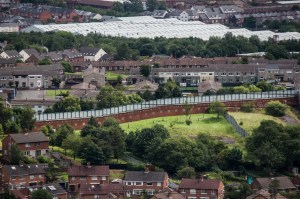
Belfast’s Peace Wall

Walls or fortified fences are all the fashion in the Middle East. Egypt has built one on its border with Libya – and also with Gaza. Saudi Arabia has put one between it a Yemen and also, one with Iraq. Kuwait has one too with its former invader. In the Maghreb, Morocco constructed the longest wall in the world dividing the former colony of Spanish Sahara from its independence fighters in their Algerian sanctuaries; and yet, the modern world’s longest enduring independence struggle continues.

The Israelis built the Separation Wall to halt the bombings of buses and bistros in Jerusalem and Tel Aviv during the Second Intifada and have maintained it as an instrument of security and control and of divisive national politics. And on the whole, it has worked, except that it has entrenched the isolation from each other of the Israeli and Palestinian communities, and increased in many, a lack of familiarity and empathy and a mutual fear and loathing that does not auger well for peaceful coexistence.

If you walk atop the Ottoman Walls that still circle the Old City of Jerusalem, you can see it and the Haram Al Sharif, the Dome of the Rock, from where the walls pass Mount Zion. It snakes away in the distance through the arid landscape and white sandstone suburbs like an incongruous grey scar. We’ve crossed through the wall and IDF and Border Police checkpoints many times in our travels through Israel and Palestine. On one journey, a cross-country drive across the Judean desert from the satellite city of Ma’ale Adumin to the ancient and amazing monastery of Mar Saba, we passed through fields where Bedouin women harvested wild wheat with sickles as their forebears did of old and actually walked across the footings of a section of the wall that has been abandoned when the high court determined that its construction would prevent the Bedouin from traversing their traditional grazing grounds.

In his final book, Night of Power, published posthumously in 2024, the late foreign correspondent Robert Fisk provides a dramatic description of this “immense fortress wall” which snakes “firstly around Jerusalem but then north and south of the city as far as 12 miles deep into Palestine territory, cutting and escarping its way over the landscape to embrace most of the Jewish colonies … It did deter suicide bombers, but it was also gobbled up more Arab land. In places it is 26 feet or twice the height of the Berlin wall. Ditches, barbed wire, patrol roads and reinforced concrete watchtowers completed this grim travesty of peace. But as the wall grew to 440 miles in length, journalists clung to the language of ‘normalcy’ a ‘barrier’ after all surely is just a pole across the road, at most a police checkpoint, while a ‘fence’ something we might find between gardens or neighbouring fields. So why would we be surprised when Italian Prime Minister Silvio Berlisconi, traveling through the massive obstruction outside Bethlehem in February 2010 said that he did not notice it. But visitors to Jerusalem are struck by the wall’s surpassing gray ugliness. Its immensity dwarfed the landscape of low hills and Palestinian villages and crudely humiliated beauty of the original Ottoman walls Churches mosques and synagogues .. Ultimately the wall was found to have put nearly 15% of West Bank land on the Israeli side and disrupted the lives of a third of the Palestine population. It would, the UN discovered, entrap 274,000 Palestinians in enclaves and cut off another 400,000 from their fields, jobs, schools and hospitals”.

Leftwing Israeli journalist Amira Haas, who lives in the West Bank, takes Fisk on a tour of the wall:

“Towering 26 feet above us, stern, monstrous in its determination, coiling and snaking between the apartment blocks and skulking in wadis and turning back on itself until you have two walls, one after the other. You shake your head a moment – when suddenly through some miscalculation surely – there is no wall at all but a shopping street or a bare hillside of scrub and rock. And then the splash of red, sloping rooves and pools and trees of the colonies and yes, more walks and barbed wire fences and yet bigger walls. And then, once more the beast itself, guardian of Israel’s colonies: the Wall.

The Separation Wall between Jerusalem and Ramallah. Paul Hemphill 2016

Israel also built a forty-mile so-called smart fence around the Hamas-controlled enclave of Gaza, decked out with cameras, radars, and sensors. It was meant to both stop large-scale Hamas attacks and provide warning if Hamas was gathering its forces. This failed disastrously on October 7th 2023.

Those defenses, of course, did work for many years. The Hamas, which used to send numerous suicide bombers into Israel, was largely unable to penetrate the border from Gaza, in large part due to the fence. In fact, Hamas had to plan for several years and conduct a massive operation to overcome the defenses – not an easy task and one that should have been detected and disrupted by Israeli intelligence.

The Hamas’ assault on the black Shabbat demonstrated chillingly that defenses by themselves are never sufficient. They must be backed up by intelligence and a rapid-response capability, making any breach less consequential for Israel and potentially disastrous for Hamas. Indeed, had Israel been able to scramble a small number of attack helicopters to Gaza quickly as the assault force was breaching the fence, Hamas would have suffered huge losses.

Yes, walls work, until, for one reason or another, they don’t …

Aida Refugee Camp outside  Bethlehem, Paul Hemphill 2016

An illusion of safety

I will ask more of you than any khal has ever asked of his khalassar! Will you ride the wooden horses across the black salt sea? Will you kill my enemies in their iron suits and tear down their stone houses? Will you give me the Seven Kingdoms, the gift Khal Drogo promised me before the Mother of Mountains? Are you with me? Now… and always!”  
Danearys Targaryen, Game of Thrones

And they were, and they did, with the help, of course, of dragons.

While walls are destined to fall one day, people like walls. They project a language of security – but their construction stems from a sense of insecurity, an intense fear of losing what you have.

In an early post, The Twilight of the Equine Gods, we talked of the horsemen of the plains and steppes who descended violently upon the sedentary lands of Europe the Middle East and China. The folk on the pointy end of their depredations built walls to keep them out.

But while people feel safe behind walls, their impregnability is often illusory.

Walls have gates and these permit ordinary, decent folk to enter and exit – to work, to trade, to parlay, to mingle, communicate and court. The forts along Hadrian’s Wall tell the story of such coexistence and cohabitation. But some people don’t bother with gates. Thieves can scale them and climb over them. Enemies too – they clamber over them, dig under them, mine them and bring them tumbling down, or by subterfuge, they can suborn, beguile or bribe a turncoat or waverer to open the gates or reveal a secret entrance. The ancient Greeks bearing their dubious gifts brought down “the topless towers of Illium” with a ruse that launched a thousand analogies and the famous aphorism “beware Greeks bearing gifts”. The Greeks have never lived that one down.

I’ve had the privilege and pleasure of walking the corridors and standing on battlements of some of those great crusader castles of Syria and Palestine – of Qala’t al Husn, known to the world as Krak de Chevaliers, of Qala’t Salahuddin in Syria’s Alawite heartland, and Belvoir in Israel. These fell not by storm but by subterfuge – plants, turncoats or bribes By geological happenstance, these three significant citadels were built above the great Rift Valley that runs from Africa to Turkey and from their still imposing ramparts, the traveller can look out over several countries and appreciate the strategic importance of these man-made megaliths.

Krak de Chevaliers, Husn, near Homs, Syria. Paul Hemphill 2006

Krak de Chevaliers,Paul Hemphill 2006

The Golden Gate, Jerusalem, from Gethsemene. Paul Hemphill 2016

A world of walls

And the great and winding wall between us
Seem to copy the lines of your face
Bruce Cockburn, Embers of Eden

In his Booker Award winning novel Apeirogon, Irish author Column McCann’s Palestinian protagonist Rami, speaking of the death of his daughter at the hands of the IDF, says: “all walls are destined to fall, no matter what”. But Rami “was not so naive, though, to believe that more would not be built. It was a world of walls. Still, it was his job to insert a crack in the one most visible to him”.

Walls are in vogue nowadays. We declare that we should be building bridges, and yet, we keep building walls. Indeed, walls and wire define and divide the brotherhood of man.

Walls keep unwanted people out and nervous people in. Or prisoners – the world is full of those. The USA, The Land of the Free, incarcerates more than any other nation – except China. More than Iran, or Turkey, each with tens of thousands of political prisoners. The majority of inmates in American and Australian jails are black.

And walls protect us from “the other”.

Australian commentator Waleed Aly wrote in the SMH 9 November 2019: “A wall doesn’t just exclude. It obscures. It renders those on the other side invisible. And once people are invisible, they become mythological beasts. Their lives, their attitudes, their aspirations all become figments of our imagination”. Read the full article below.

To my thinking, this can apply to several of today’s intractable conflicts. The division between North and South Korea, for example, with its heavily weaponized DMZ. Iran and its ostensible enemies. And as I alluded to above, the walls that divide Israelis and Palestinians in the West Bank and in Gaza.

Back in the day, I would walk from Ramallah, then but a small town, to Jerusalem. I’d traverse the old city, and head up the Jaffa Road to the bus station and thence, to Tel Aviv. Today, there is the Separation Barrier and checkpoints, and exclusive roads – easier for visitors like ourselves as we traversed the Occupied Territories, but excruciating and humiliating for the tens of thousands of Palestinians who, until October 7, crossed into Israel daily to work “on the other side” and visit family and friends in East Jerusalem and in Israel.

Amira Haas describes the road I once walked down: “It’s a destruction of peoples life – it’s the end of the world. See here? We go straight to Jerusalem. Not now. This was a busy road and you can see here how people invested in homes with a little bit of grace, the strength of the houses, the stone. Look at the Hebrew signs because these Palestinians used to have so many Israeli customers”. But, Fisk writes, “almost all the shops are closed, the houses shuttered, weeds and sticks along the broken curb. The graffiti is pitiful, the sun merciless, the sky so caked with the heat that the grey of the Wall sometimes merges into the grey stone of the sky. “It is pathetic this place” Amira Hass says. I’ve always been showing it to people always, you know hundred times and it never stop shocking me”.

The border fence between Saudi Arabia and Iraq

The border fence between Kuwait and Iraq

Girt by sea … 

That’s from our Australian national anthem, a paean to our pale Anglo-Celtic Christian heritage, continually updated as our values and our demography changes. It reminds us that walls are not necessarily built of bricks and mortar. An ocean can serve the same purpose.

The English, for example, have always rejoiced in their insular status. As early as the 13th century, an English chronicler described England as “set at the end of the world, the sea girding it around”. It was the sentiment which Shakespeare put into the mouth of the dying John of Gaunt in Richard II”: This precious stone set in the silver sea, which serves it in the office of a wall, or as a moat defensive to a house, against the envy of less happy lands.” It is part of the classic canon of English patriotism. Yet it was and remains a myth. As historian Jonathan Sumption, has pointed out, politically, England was not an island until defeat in the Hundred Years War made it one – had been part of a European polity.

Indeed, the aforementioned Hadrian’s Wall served as a more strategic historical reference point. In the preface to Pax, the latest volume of his magisterial history of the Roman Empire, English historian Tom Holland notes that the northern bank of the river Tyne was the furthest north that a Roman Emperor ever visited. What was so important about Hadrian’s visit to Tyneside in 122AD was his decision there to mark in stone, for the first time, the official limits of his Empire. North of this great wall, there was paucity and unspeakable barbarism, scarcely worth bothering about; below the wall was civility and abundance and the blessings of Romanitas. To this day, those 73 miles of the Vallum Hadriani across the jugular of Britain still shape the common conception of where England and Scotland begin and end, even though the wall has never delineated the Anglo-Scottish border. For this colossal structure left enduring psychological as well as physical remains. To the Saxons, it was “the work of giants” and was often thought of as a metaphysical frontier with the land of the dead – George  R got that part right too.

The “sceptred isle” tag prevails, but. It’s how many Brit’s saw themselves back then and right up to the sixties when we had to memorise it at grammar school: This earth of majesty, this seat of Mars, this other Eden, demi-paradise, this fortress built by Nature for herself against infection and the hand of war. This happy breed of men, this little world”. I couldn’t resist quoting it.

Our Island Story: A Child’s History of England, by British author Henrietta Elizabeth Marshall, first published in 1905, covered the history of England from the time of the Roman occupation until Queen Victoria’s death, using a mixture of traditional history and mythology to explain the story of British history in a way accessible to younger readers. It depicted the union of England and Scotland as a desirable and inevitable event, and praises rebels and the collective will of the common people in opposing tyrants, including kings like John and Charles I. It inspired a parody, 1066 and All That. Former Prime Minister David Cameron chose the book when asked to select his favourite childhood book in October 2010: “When I was younger, I particularly enjoyed Our Island Story … It is written in a way that really captured my imagination and which nurtured my interest in the history of our great nation”.

Maybe the Island Nation prevailed in its time – notwithstanding John Bull’s Other Island just over the water and the “troubles” it caused. But the French port of Calais that was such a headache to the Plantagenet kings back in the day is a persistent migraine today as folk from faraway places arrivethere hoping to board flimsy boats, casting their fortunes and their lives to the waves of one of the world’s busiest and tempestuous sea ways in the hope of a better life in the green and pleasant land of song and story.

We in Australia do have a unique wall – the ocean surrounding us.

Our former and now disgraced Australian prime minister Scott Morrison prime minister once declared that he himself was a wall, barring what we in official Australia call unauthorized arrivals by sea. The wall surrounding our continent – we are indeed the only nation that covers exclusively its own continent – is a wide watery one – huge, forbidding, and, depending on the operating budget and competence of the Australian Border Force, impenetrable. And it costs is a motza. In December 2020, The Guardian reported that Australia will spend nearly $1.2 billion on offshore detention – it’s called “processing” – that financial year, even though fewer than 300 people remained in ‘offshore detention” in Papua New Guinea and Nauru That’s roughly $4m for each person. Our government has spent more than $12 billion on offshore processing in the past eight financial years.

It might be less than the US$20 billion President Trump wanted to waste on a border wall, but it is far more as a proportion of government revenue and national income and more than five times the UN refugee agency’s entire budget for all of Southeast Asia.

That’s all from me. The reviews follow, but first some of the articles referred to in my narrative.

© Paul Hemphill 2024.  All rights reserved.

Al Tariq al Salabiyin – the Crusaders’ Trail

Roman Wall Blues – life and love in a cold climate

The Twilight of the Equine Gods

Thirty years after the fall of the Berlin Wall, we are building them again

Waleed Ali, Sydney Morning Herald, November 7, 2019

Sometimes that is literal as in the case of Donald Trump most famous, still unfulfilled promise. Sometimes this is figurative as in the case of Brexit (though it has dangerously literal implications in Northern Ireland). And sometimes this is a particularly pointed development, as in the case of countries that were once part of the Soviet bloc, which have turned in sharply illiberal, nationalist, anti-immigrant directions: places like Hungary and Poland.

Even as far afield as Australia we are being lightly stalked by this fortress mentality, too. Mostly this has focused on boats, but it is spreading now to a populist suspicion of globalisation more generally, especially where it involves us having obligations to other countries or the environment.

I don’t want to stretch the comparison too far. Today’s walls are about excluding the foreigner, while the Berlin Wall was built for the opposite reason: to keep East Germans in. But there is still an important continuity here, something powerful and important in the idea of a wall, that makes it so symbolic, whatever immediate function it serves. More profound than the physical barrier is the psychological one. That’s as true today as it was in Berlin.

Konrad Schumann leaps the barbed wire into West Berlin on 15 August 1961

Children at the Berlin Wall on Sebastianstrasse, around 1964 (Lehnartz/ullstein bild, Getty Images)

The fall of the Berlin Wall, November 1989

These narratives tell an uncomplicated story of the other that is really designed to tell an uncomplicated, heroic story about oneself. The East’s imagined multitudes of poor Westerners was a way of saying the Eastern system was superior and just. Hence, the West had to be wild and unequal. Meanwhile, the Western story of the East was a way of eliding its own shortcomings, establishing a triumphant narrative of freedom that swept away concerns about social injustice.

Walls make this so much easier. Aside from all else they do, walls prevent us from knowing each other. That has serious real-world consequences. We call the period after the Berlin Wall fell “reunification”, but it was really a Western annexation of the East. East became West, not some other accommodation. So thorough was the West’s self-regard, so comprehensive its belief in the East’s unmitigated bleakness, that it respected none of the institutions the East had built. It privatised and sold off its industries to the highest bidder – inevitably West Germans. It shut down its companies, more or less assuming they had nothing to offer.

The result saw East Germans with little choice but to head West for jobs, and the East hasn’t quite recovered. Today it is older, poorer, and endures higher unemployment. It’s only by knowing this that we can understand why a government study found 38 per cent of East Germans think reunification was a bad thing. A majority feel they are now second-class citizens. We’re seeing a rise of far-right radicalism, even neo-Nazism, in Germany. Its heartland is in the East.

Today’s walls are built on the same logic. They all offer some self-aggrandizing view of the world in which everyone else deep down wishes they were like us. Whether believing in the eternal supremacy of the British Empire in the case of Brexit, or that asylum seekers are really more interested in finding a back door to Australia than they are in fleeing persecution, the foreigner exists mostly as a counterpoint to our own magnificence. What matters is that they remain unknown and unknowable so we can mould them to our opposites, and they can be scapegoated for our problems.

We’re so committed to this kind of psychology that we will establish walls precisely where we’re told they can’t be built. Even something as borderless as the internet has become a landscape of barricades, populated by people talking only about their enemies and only to their friends. As a result, almost no one is knowable anymore.

So let me add one more idea to this week’s litany of Berlin Wall reflections: that it be a symbol of human arrogance. The arrogance to control and lie to one’s own people, sure. But the arrogance of choosing isolation, too. The arrogance of believing that the other has nothing to offer us. And the arrogance of believing that we can be fully formed in others’ absence; of treating other people as mere raw material from which we can manufacture ourselves.

Waleed Aly is a regular columnist and a lecturer in politics at Monash University.

A crash course in barrier building

Walls: a history of civilisation in blood and brick by David Fry Faber 2018.
Reviewed in the Australian by Pat Shell, March 16, 2019

“Build bridges, not walls. It’s a slogan”, writes Frye (Ancient and Middle Eastern History/Eastern Connecticut State Univ.), “designed to give military historians fits.”

Bridges, after all, have military purposes: to get across moats and earthworks and to ford rivers into enemy territory. Walls, on the other hand, make peace – history offers plenty of examples, he writes, to show that “the sense of security created by walls freed more and more males from the requirement of serving as warriors.”

Indeed, by Frye’s account, walls are hallmarks of civilization, if ones that are easily thwarted.

One of his examples is the Tres Long Mur, a defensive structure built more than 4,000 years ago, stretching across the Syrian desert and shielding some of the world’s oldest towns from marauders from the steppes beyond. There are mysteries associated with the ruins, just as there are with the Great Wall of China, another of Frye’s examples—and one that proves, readily, that where walls go up, people find ways to get around and over them.

The author’s pointed case study of Hadrian’s Wall shows that it may not have been a defensive success, but that does not mean it didn’t have a defensive purpose, as some scholars have recently argued. As he writes, wittily, “there is little to be gained from rationalizing an irrational past.”

Another defensive failure is the Maginot Line, which became more symbolic than practical in an age of modern tanks; on the reverse side are spectacular successes, such as the great walls of Constantinople, which shielded the city from siege by as many as 200,000 soldiers of the caliphate, “one of the greatest turning points in history.”

Walls have many purposes, he concludes, and it is rather ironic that the matter of walls is often as divisive as a wall itself.

A provocative, well-written, and – with walls rising everywhere on the planet – timely study.

Walls work, and walls save lives. So declared Donald Trump in the 2019 State of the Union address. Not long after that, he went a step further, just clearing Congress’ refusal to front with the funds for 4 billion bricks to be a national emergency.

There are times when that view could be right. How a well-built levee might postpone the inevitable when the rain keeps fallin’ and the river done rose. For a while it least.

But the US president wasn’t talking about breakwaters and climate change mitigation. The tsunami he is hoping to surf home to a tsecond term is a tidal bore of human flesh. He thinks that a Mexican wall is needed to keep out rapists, drug dealers, terrorists and Venezuelan communists.

But his wall, if ever built, will never achieve what wall builders through the ages have vainly striven for: to stop time itself, to freeze history at the pinnacle of their power. And in so doing, through the erection of military masonry on a monumental scale, confidently wallow in the triumphant delusions screamed by Ozymandias at weary gods who have heard it all before.

In short, the inevitable corollary of the invention of Real Estate: the creation of an exclusive neighbourhood to keep out riffraff.

Walls, David Frye’s fascinating and timely analysis of the rise and fall of empires, religions, cultures and languages, is so compellingly readable because it urges to look closely at human artifacts so everyday, so ordinary that we only rarely see them as instruments of power and authority. They can be impressive, sure, but not like an aircraft carrier steaming lies and all the flight of the two banners overhead.

We walk past walls every day. We live behind them. They hold up our roofs. Once fitted with a solid locked door and the steel-grated windows, they protect us, and not just from the wind and the rain.

Frye is an American historian. His main point is not just that walls, the stone and earthen shield of homesteads, palaces, towns, indeed entire nations, are as old as civilisation itself. He thinks that for all intents and purposes, walls are civilisation itself, or, at the very least have allowed civilisations to come into being.

He reminds us that like armies, walls don’t go anywhere. Like armies, they can be enormous, and symbolic of great power and proprietary rights, but they rise and fall in situ, and define the status of all who live around them.

Either you live inside the wall, or you don’t. And depending on how you define civilizations, they rarely flourish without a stable address of some sort. The Athenians wouldn’t have bothered building the Parthenon if they’d had to pull it down every winter to follow their goats to Macedonia in search of greener pastures. But they had to be able to go to bed at night confident that the marvels of the Acropolis would still be there in the morning.

And while the kind of people who write and read books such as Walls are by definition “inside the wall” characters, Frye notes the disdain with which “basket carrying” sybarites were regard by those on the outer.

The barbarians, the hordes. The marauding warriors. Luxury is for wimps, art an affectation citation for the feeble and effete. The Huns, Mongols, Cossacks, Names that are synonymous for people who would rather burn a city to the ground than simply move in and celebrate their luxurious residential arrangements by draining the wine cellars and frolicking in the fountains.

When the great unwashed arrived in sufficient numbers to break down the ramparts, they didn’t mess around. To them, plumbing, hanging gardens, marble theatres and elegant geometry will not try ounce of human aspiration, but conversions.

It is this primal fear of defenses overwhelmed that fuels Trump’s calculated hysteria today. While he may, without quite saying it in so many words, be grasping for historical legitimacy by asking his countrymen to “Remember The Alamo”, He does play on fears food in for thousands of years of siege warfare, and the grizzly fates that befell the losers.

And while the discounted insurance premiums that come with the electrified fences and gated communities of Bel Air and Rhode Island might ease the terror of wealthy Americans, a home invasion is small beer compared to the total collapse of “homeland security” in the real world.

Of the examples Frye gives of barriers breached and the resultant bloodbaths, and there are many, perhaps the most extraordinary is the Mongol demolition of Thirteenth Century China. “ The population of China fell from a 120 million in 1207 to 60 million in 1290. Mongols “boasted that they could ride over the sites of many former cities without encountering any remains high enough to make their horses stumble”.

Genghis Khan, born and bred on the merciless steppe, saw Chinese sophistication as an affront to nature, much as the Spartans mocked the music and theatre of the Athenians.

He shrugged off the carnage and destruction he had wrought as nature’s mockery of Chinese hubris and pretensions: “Heaven is weary of the beauty of the inordinate luxury of China”.

Trump doesn’t care for it much either, it seems. Perhaps a wise adviser might take a moment to point out to him the bridges are usually a far better long-term investment than barbed wire.

as The Eurasian Steppe by the archaeologist Warwick Ball makes clear, rather than a semi-wild anteroom to the continent, “the history, languages, ideas, art forms, peoples, nations and identities of the steppe have shaped almost every aspect of the life of Europe”. Europeans from further west have for centuries been prone to viewing the steppe as the haunt of wild tribes, and the source of occasional, fearsome destruction.
https://unherd.com/2022/07/the-fate-of-europe-lies-in-the-steppes/

Review of Walls: history of civilisation in blood and brick 

John M. Formy-Duval, retired teacher of ancient and medieval history and educator, on this books and  reading blogspot.

In Walls: a History of Civilization in Blood and Brick, David Frye has written an encompassing and enlightening review of walls through the centuries, ranging from 2000 B.C. to the present. A “Selected Timeline” covers the subject matter in four geographical areas: Near East and Central Asia; Europe; China; and the Americas. Frye writes that walls can take the form of “protectionist economic policies,” a “great internet firewall,” razor wire with motion sensors, or concrete barriers. Stringent, punitive immigration policies around the world seek to keep the perceived destroyers of “our culture out.” That is, we belong here; you do not.

“Few civilized people have even lived without them,” Frye emphasizes. From ditches to sapling fences to berms to walls, the level of sophistication rose as people perceived an increasing need for protection from, literally, the barbarians at the gate. Farmers settled and fortified their small villages. Even today one finds fences around Maasai villages in Tanzania. As villages transitioned into cities, their walls grew with them, often into great defensive bulwarks. Even Shakespeare’s Juliet recognized that “these walls are high and hard to climb.”

The epilogue “Love Your Neighbor, but Don’t Pull Down Your Hedge” covers the period from 1990 to the present. This section begins and ends with an account of how the Malibu coastline transitioned from the single ownership of May Rindge in 1892 until 1926, when she grudgingly agreed to lease some properties after numerous shootings, sheep poisonings, and a Supreme Court decision that went against her. Focusing on the present, Frye embarks on an account of the spate of walls built since the Berlin Wall was torn down. From the United States to the Middle East to Southern Europe and India, and nearly everywhere else, it seems, the pace, enormity, and sophistication of these walls is astounding.

People are familiar with the walls Israel has erected in which “infrared night sensors, radar, seismic sensors for detecting underground activity, balloon-born cameras, and unmanned, remote-controlled Ford F-350 trucks, equipped with video cameras and machine guns, augment the wall’s concrete slabs and concertina wire.” Lesser known is Saudi Arabia’s effort, begun in 2003, to create a barrier across its eleven-hundred-mile border with Yemen. The barrier rises across the desolate Empty Quarter, home of significant oil reserves. “Ten-foot high steel pipes, filled with concrete” provide the frame for razor wire while tunnels burrow deep underground. The Saudis have a second, more heavily fortified wall that ranges six hundred miles along their border with Iraq. Egypt, Jordan, India, Thailand and Malaysia, Morocco and Algeria, and Kenya are also in the wall-building business, often with funds or construction assistance either from the United States government or private businesses.

The U.S. was in the wall-building business along our border with Mexico long before the present administration, although the present focus changed the dialogue. We had barriers, little more than fences, before the Berlin Wall fell. Under President Clinton, for example, extensions were added to the existing barriers in 1993, 1994, and 1997. After Berlin, however, the word “wall” was largely abandoned in favor of softer language, and in 2006 the “Secure Fence Act” extended the extensions undertaken during Clinton’s time in office. Who knows what will happen at the present time?

Walls have deep effects on us. They box us in; they shut us out; they keep others out. They come in physical form, but they can be purely psychological, designed to prevent us from sinking into “the other side of the tracks.” Professional nomenclature excludes people and gives the holders of the language key a sense of superiority. Myriad iterations of “wall” provide endless means to isolate us and keep them out.

Frye provides the who, what, where, when, and how of walls ancient and modern. The Great Wall and Hadrian’s Wall are generally known, but he touches on the thousands of walls that continue to exist today and continue to be built “while we wait on everyone else to become just as civilized as we are.”

About Walls

Review in Always Trust in Books blog

For thousands of years, humans have built walls and assaulted them, admired walls and reviled them. Great Walls have appeared on nearly every continent, the handiwork of people from Persia, Rome, China, Central America, and beyond. They have accompanied the rise of cities, nations, and empires. And yet they rarely appear in our history books.

Spanning centuries and millennia, drawing on archaeological digs to evidence from Berlin and Hollywood, David Frye uncovers the story of walls and asks questions that are both intriguing and profound. Did walls make civilization possible? Can we live without them?

This is more than a tale of bricks and stone: Frye reveals the startling link between what we build and how we live, who we are and how we came to be. It is nothing less than the story of civilization.

‘The creators of the first civilisations descended from generations of wall builders. They used their newfound advantages in organization and numbers to build bigger walls. More than a few still survive. In the pages that follow, I will often describe these monuments with imposing measures – their height, their thickness, sometimes their volumes, almost always their lengths. These numbers may begin to lose their impact after a while. They can only tell us so much. We will always learn more by examining the people who built the walls or the fear that lead to their construction.’

David Frye’s Walls is a classic non-fiction read that left me not only well informed but with a deeper appreciation and understanding of world history. From 10,000 B.C right up to the present day, David Frye explains how fundamental the invention, construction and development of walls were (and still are) to the progression of humanity. If you are here purely for a history of walls then you may be disappointed as DF is more interested in the influence instead of the existence of walls. DF took me on a guided tour through key periods in the history of mankind and how the creation (and protection) of walls allowed us to flourish as a species but also the ramifications and innovations that they led to later on.

DF lead me through civilisations that either accepted or rejected the concept of being walled (or caged) in and how their decisions affected the population and also the other nations around them. Walls redefined our ability to exist in a barbaric world and allowed us to focus on scientific and cultural advancements. It also allowed some kingdoms to go soft, so to speak. DF also focuses on the absence of walls and how it changed the civilisations who refused to hide behind them; nations like the Spartans, Mongols and Native Americans who lived to fight for what was theirs or claim new lands for themselves.

The amount of coverage is exceptional, from the Roman Empire, Mesopotamia and China (with their many great walls) to Greece, Constantinople and Berlin. Walls are essential to the telling of history and David Frye did a fantastic and immersive job with his writing. Informative, concise, engrossing (narrative elements), well structured and paced out, David’s writing made this book totally worth my time. He could have easily knocked out this book with his extensive knowledge of war and culture but he went the extra mile. Making connections, observations and theories that made the content more comprehensive and digestible (with some hilarious comments too).

Recent history seems in part to be governed by a chain reaction that saw the building of more and more elaborate walls. Each emperor saw fit to out do their predecessors or competition. Each iteration of wall has its successes and failures, while destroying them advanced weaponry and military tactics along the way. I loved spending time with different time periods and walking amongst the mythos, history, socio-economic backgrounds, knowledge and statistics surrounding the world’s walls and those compelled to build them for their own needs or the needs of many. I especially enjoyed how David Frye’s message about walls was fluid and how it evolved over the course of the book. How humanity grew out of their need for walls and yet still see them in a symbolic nature. How destroying a wall can be as powerful as building one.

Frye knows perfectly where to stop and elaborate or move on to new points. He also doesn’t shy away from the darker shades of history so be aware of graphic detail. There is a lot to learn in this book but DF has written it in a way that it is never too much and I always wanted to know more. There are many highlights to Walls and I can’t recommend it enough to Non-Fiction lovers of many varieties. If you like detail, history, mythology (and ghost stories), the many aspects of building civilisation and humanity’s past then Walls is a great book to get stuck into. We owe walls our lives and without their protection our societies would have never been the same.

‘The walls alone have seen the truth, and they are mute’

David Frye

A native of East Tennessee, David Frye received his Ph.D. in late ancient history from Duke University in 1991 and is presently a professor of history at Eastern Connecticut State University, where he teaches ancient and medieval history. Frye’s academic articles have appeared in the UK, Germany, Sweden, and Denmark, as well as the United States, in journals such as Nottingham Medieval Studies, Classical World, Byzantion, Historia, Hermes: Zeitschrift fur klassische Philologie, The Journal of Ecclesiastical History, and Classica et Mediaevalia. In addition, he has published in various popular archaeological and historical magazines and on the online humor site McSweeney’s. As part of his research, he has participated in archaeological excavations in Britain and Romania. (Goodreads Biography)
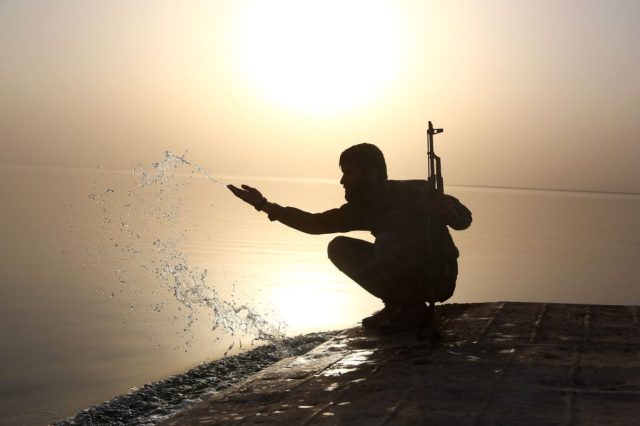
 

The calculus of carnage – the mathematics of Muslim on Muslim mortality

Call it moral relativism or “whataboutism” (or, like some conjuror’s trick, “don’t look here, look over there!) but it is not a matter of opinion, more a simple matter of observation, to point out that Muslims are in the main subdued when their fellow Muslims are killed by other Muslims.

The Syrian civil War has killed over half a million souls. 150,000 have did in Yemen.  In Sudan, more than ten thousand people have perished in the latest civil war. ISIS killed tens of thousands. Iraq, Libya, Afghanistan. Muslims killed by Muslims. And millions displaced and enduring famine and disease.

In recent years Muslims have slain more Muslims than those killed by Israeli forces and settlers since 1948 (though we”ll never know how many  – official and semiofficial figures cite casualties from the Independence War and al Nakba of 1948 to 2021, 63,543, including 31,227 fatalities, plus, of course, the ghastly toll of the current Gaza war, but this is probably massively understated).

There has been no significant unrest in the West over the hundreds of thousands of Muslims killed by fellow Muslims (apart from a visceral horror of the violence inflicted upon civilians and prisoners by the jihadis of the Islamic State. No public outcry or social media fury, no angry street protests by left-wing activists of vacuous members by armchair, value-signaling clicktavists.

Why this apparent indifference? Many left-wing impressions are coloured by a an antipathy for the policies of the United States, an antipathy that for many was born of the Vietnam War and was perpetuated by America’s interference in the affairs of nations large and small since then – and of course, America’s strong ideological and military support for Israel. Uncle Sam certainly does have a case to answer. There’s no denying the hundreds of thousands, millions maybe, of bodies of men, women and children that could be laid at the foot of Abe Lincoln’s huge statue in Washington DC.

And what of the rise in antisemitism around the world? After the blood Hamas pogrom of October 7, it took just 24 hours for anti-Israeli sentiment to turn into anti-Jewish sentiment. It was on full display throughout the West before the bodies of the men and women and children murdered had even been counted and identified, and the number of hostages revealed; and before Israel’s relentless and brutal retaliation again Gaza which has killed tens of thousands more innocents.

A charitable explanation would be a mix of political and historical ignorance and a dogmatic belief that renders Jews, whether Israeli or in the diaspora ‘white’, ‘colonial’ and ‘oppressors’, and Muslims ‘oppressed’, and encourages progressives to turn a blinkered or blind eye to some of the most hideous crimes on the planet. It is an ideological stance uninformed by knowledge and awareness of the nature of the Israeli and Palestinian entities, their peoples, and their cultures in the 21st Century.

But there is also reality that what we’ve been seeing in cities around the world is that antisemitism is the devil that never goes away.

I republish below an article that summarizes quite well the mathematics of Muslim on Muslim mortality. It is written by a rightwing author in a right-wing publication, and many of his observations thereon may be selective, subjective, controversial, and potentially exaggerated and inaccurate, but the underlying basic arguments is sound. Countries subject to interminable potentially intractable and often internecine conflict, rigid, authoritarian, and ofttimes theocratic conservative beliefs and social structures, and endemic political instability rarely prosper in our modern interconnected world and often end up serving as expendable pawns in more powerful players’ power games. 

I also republish a recent article by The Australian’s foreign editor Greg Sheriden on how the rising antisemitism in the West is undoubtable fueled by the increasing numbers of migrants form conservative countries where antisemitism is encouraged and inculcated by the media, by educational systems and by socialization.

These communities often have an enormous political and cultural impact on their host countries. While the overwhelming majority of Muslims in Australia and other western countries are law-abiding, productive citizens, a small minority is attracted to some form of political violence or intimidation. And, if Australia’s Arab and North African Muslims are remotely similar to those in Europe and the US, they harbour serious anti-Semitic attitudes, plus other views that are anti-Western.

In 2014, the Jewish Anti-Defamation League conducted an immense survey that sampled the opinions of 53,000 people in numerous countries. It found that 74 per cent of Middle East and North African respondents (not necessarily all of them Muslim, though the overwhelming majorty would be) expressed anti-Semitic attitudes, which was measured by endorsing six or more of 11 common anti-Semitic stereotypes, such as Jews controlling world banking, or the US government, or being responsible for most of the world’s wars. This figure of 73 per cent was vastly in excess of any other regional or national group. Non-Jewish think tanks produce similar results. A survey conducted by the Henry Jackson Society in 2020 found nearly half of British Muslims hold anti-Semitic views.

See also in On That Howling Infinite, “You want it darker?” … Gaza and the devil that never went away …

For more on antisemitism in In That Howling Infinite, see: Little Sir Hugh – Old England’s Jewish Question; and The Shoah and America’s Shame – Ken Burns’ sorrowful masterpiece 

For more on Palestine and Israel in In That Howling Infinite, see: A Middle East Miscellany

The paradox of piety
Observes no disconnect,
Nor registers anxiety
As the ship of fools is wrecked.
So, leaders urge with eloquence,
And martyrs die in consequence.
We talk in past and present tense.
As greed and fear persist.
For reasons only dead men know,
Few can resist the call to go.
That is your fate, the wise man said,
The good book in his fist!

From E Lucevan Le Stelle, Paul Hemphill

Journalists should not be duped into blaming Jews for the Middle East’s problems

Chris Mitchell, Australian Business Review, 17 December 2023

Syrians run for cover following Syrian government air strikes on the Eastern Ghouta rebel-held enclave of Douma, on the outskirts of the capital Damascus in 2018. Picture: AFP

Syrians run for cover following government air strikes on the Eastern Ghouta rebel-held enclave of Douma, Damascus 2018. AFP

Why do so many journalists analysing the Middle East’s problems think the answers lie in a tiny country of 9.7 million people, seven million of whom are Jewish?

Israel has no natural resources while Arab countries surrounding it occupy 1000 times more land, dominate global oil production and have a combined population of more than 400 million?

Look at income distribution patterns and one thing becomes apparent. The Arab and Persian worlds are among the poorest areas on Earth, despite the vast wealth of their rulers. Israel, with ingenuity its only resource, has average income about the same as Australia’s, while most in the Middle East languish on lower wages than black South Africans or Brazilians.

Yet it’s not only the grinding daily poverty of the Arab street that the moralising Western left ignores. It’s also the violence done to ordinary Muslims across the Middle East and North Africa by other Muslims. Add the 48,000 Islamic terror attacks listed by the French think tank Fondapol between 1979 and 2021 and their 210,000 mostly Muslim victims.

Where is the left on the medieval Arab and Persian regimes that spread Islamist terror from the Middle East to Europe, Pakistan, Afghanistan and Indonesia?

This is not another call for a Muslim reformation, but for political and media honesty.

Yet the Islamic Middle East certainly needs modernisation. The left’s favourite French economist Thomas Piketty and fellow Paris School of Economics writers Facundo Alvaredo and Lydia Assouad in 2018 analysed income inequality in the Middle East. They found “the Middle East appears to be the most unequal region in the world with a top decile share as high as 64 per cent (of national wealth) compared with 37 per cent in Western Europe, 47 per cent in the US and 55 per cent in Brazil”.

Regular readers will know this writer has a daughter living in Tel Aviv and working in the tech sector. Previously, family members have lived and worked in Jordan. Comparisons between the two countries are fascinating given both were once part of British mandate Palestine.

Thomas Piketty and colleagues analysed Middle East income inequality. Picture: Getty Images
Thomas Piketty and colleagues analysed Middle East income inequality. Getty 

Jordan has a slightly larger population of 11.3 million. With at least three million Palestinians according to the government, and perhaps many more if you follow the historical arguments, it occupies four times the land area of Israel.

Life expectancy for males in Israel is 81 years and 85 for females.

In Jordan the averages are 72 and 77.

Israel’s unemployment rate is 3.5 per cent, Jordan’s 17.9.

Average income in Israel is $80,000 and in Jordan $6,500.

Jordan is a good and safe place to visit but it is clear within hours that it is much poorer than Israel. Israel’s GDP of $783bn dwarfs Jordan’s of $72bn.

The wealth picture is less stark comparing Israel with the Middle East’s oil states. Saudi Arabia has 32 million people, GDP of $1.5 trillion and is the world’s No.18 economy. Its GDP per capita is $40,000, so half Israel’s. Saudi average wages are less than Israel’s, although Saudi prices can be cheaper.

Iranian GDP sits at $549bn but its wage levels are far below those in Saudi Arabia and Israel. Its legislated minimum wage this year sits at $1700 a month.

The Western left also ignores violence against Muslims by Muslims. Few demonstrators took to the streets of Western cities to protest during the Syrian civil war this past decade. The death toll as of last March stood at 613,000, dwarfing the casualties in Gaza the past two months.

Ditto the ongoing Yemen civil war that started in 2014 and in which 150,000 have died fighting and 227,000 have perished in famine.

The disastrous Somalian civil war has been going for 40 years. Genocide Watch last year said between 350,000 and one million mainly Muslims have been killed since 1991 and 3.5 million displaced Somalis, including 1.5 million children, face starvation. The country is 99 per cent Muslim.

Add the millions killed in the Iran-Iraq war in the 1980s and the thousands killed by al-Qa’ida in Iraq after the US invasion in 2003.

To put the Israel story into perspective, between 1948 and 2021 total Palestinian deaths number 31,227. Total Israeli deaths in war excluding terrorism number 24,981. The 1948, 1967 and 1973 wars that cost Palestinians so much of their land followed invasions by Israel’s Arab neighbours.

Former farmer Habiba Osman Ahmed in Dollow refugee camp in southern Somalia in 2011. After Somalia's 20-year civil war pushed the drought into famine she didn’t even have a pot to cook in, and had to share with another family.
Former farmer Habiba Osman Ahmed in Dollow refugee camp in southern Somalia. 2011. After Somalia’s 20-year civil war pushed the drought into famine she didn’t even have a pot to cook in, and had to share with another family.

Islam has also been waging war on black Africa for much of the past 100 years.

Tablet Magazine on December 12 said “the same Jihad that targeted Jews on October 7 has been targeting black Africans for decades”.

Tablet discusses the “hidden holocaust” from 1983 to 2005 when “northern Sudanese Arabs sought to subjugate and enslave the black Sudanese of the mostly Christian south. The onslaught cost the lives of perhaps 2.5 million black Sudanese. The Arab Muslim government’s jihad utilised kidnapping as its terror weapon of choice, not to mention casual gang rape and mutilation”.

Tablet cites Arab pogroms against black Africans in Nigeria, Mauritania and Sudan’s Western Darfur. Asking why the civil rights left ignores these, it says “on account of their ‘intersectional’ dogma – which makes Jews ‘white’ and Muslims ‘oppressed’ – the Western human rights industry, media and campus left activists are ideologically determined to mostly ignore some of the most hideous crimes on the planet”.

Trouble is, most journalists know nothing about Islam or Islamism. The Koran is not a peaceful book: it does encourage Jew hatred and other violent behaviours against non-believers. When large communities celebrate the martyrdom of their sons and daughters, the left needs to understand that fanatics mean and do what they say. They really do see Jihad as the road to paradise.

This religious outlook has served the interests of the Sunni princes who finance the spread of Wahabism and the Islamic boarding schools (Pesantren) that spread it to Pakistan and Indonesia. It serves Iran well to finance Hamas and Hezbollah.

Blaming Jews for the Middle East’s problems lets the mullahs and princes off the hook for what they don’t do for their own people. Journalists covering the Middle East should not be duped the way the Arab street is. Of course Palestinian lives matter but Islamism is the real “context”.

Matti Friedman
Matti Friedman

Back on August 26, 2014, after another Israeli-Gaza war, former AP Jerusalem bureau editor Matti Friedman published a fascinating account in Tablet explaining how much the Western media mis-reports what is really happening in Israel and Palestine. He says AP had more than 40 staff in Israel in 2011 but only a single stringer in Syria where tens of thousands were dying each week. Its Israel bureau was bigger than staff numbers in Russia, China or India. Why?

The answer then was the same as now: it’s about Western media assumptions about Jews, power and victimhood.

That combines with a complete media disregard for what real Palestinians think and want and what Islamists really believe.

Here’s a clue. Most Palestinians and Hamas do not support a two-state solution. They support the elimination of Israel, and at least some support the elimination of all Jews.

A poll last week by the Palestinian Centre for Policy and Survey Research found 72 per cent support across Gaza and the West Bank for Hamas’s murder of 1200 civilians on October 7. While 95 per cent thought Israel had committed war crimes since October 7, only 10 per cent believed Hamas had.

Chris Mitchell began his career in late 1973 in Brisbane on the afternoon daily, The Telegraph. He worked on the Townsville Daily Bulletin, the Daily Telegraph Sydney and the Australian Financial Review before joining The Australian in 1984. He was appointed editor of The Australian in 1992 and editor in chief of Queensland Newspapers in 1995. He returned to Sydney as editor in chief of The Australian in 2002 and held that position until his retirement in December 2015.

Muslim migrants and Western Left create new anti-Semitism crisis

Greg Sheridan.

Palestinian supporters demonstrate in Melbourne against the current Israeli bombardment and invasion of the Gaza Strip.
Palestinian supporters demonstrate in Melbourne against the Israeli bombardment and invasionThe worldwide crisis in anti-Semitism, so much of it fuelled by Arab and North African anti-Semitism, now in a crude alliance with the anti-Semitism of the far left, points to a deeper malaise in Western democ­racies.

It raises again the compatibility of large Arab and North African populations with the traditions and culture of liberal democracy.

Consider. EU Home Affairs Commissioner Ylva Johansson declared Europe confronts a “huge risk of terrorist attacks” over Christmas because of the conflict between Israel and Hamas in Gaza.

In December a terrorist killed one tourist and injured others in Paris. In Dublin a knife attack allegedly by a Muslim asylum-seeker left children and adults severely wounded, though Irish police say they believe it was not terror related. In Germany, alleged terrorists were arrested preparing a bomb. In Brussels in October a Tunisian terrorist killed two Swedish football fans.

If Middle East conflict pro­duces terrorism in Western democratic nations, it’s reasonable to ask how anyone living in a modern, free, democratic society views random murder as a constructive, purposeful, moral response.

Australian agencies believe there is an increased risk of politically or communally motivated violence here, too, but not to the point where they’ve formally altered the terror alert level.

We’ve also seen US President Joe Biden plead for the world, including Western feminists, to condemn the “horrific” sexual violence of the October 7 Hamas atrocities. The deliberate, premeditated Hamas attacks were the most depraved, sexualised sadism the world has seen. Yet Western feminists, deafening in their silence, practise #MeToo unless you’re a Jew.

In Australia, the authorities decided that Islamic clerics who welcomed the Hamas atrocities and urged all Muslim nations to spit on Israel so it would drown had no legal case to answer. Demonstrators filmed on the Sydney Opera House forecourt screaming “Kill the Jews! Gas the Jews! F..k the Jews!” – none of them has been arrested or charged either.

Imagine the shuddering national convulsions that would follow if some group of extremist Christian activists gathered a few hundred demonstrators to scream: “Kill the Muslims!” All society would be rightly outraged. The whole nation would denounce it. The counselling bill at the ABC alone would double the national debt.

But society seems never to react this way when the target group is Jewish, although NSW has moved to strengthen its laws.

The Albanese government has been mealy-mouthed, equivocal, all at sea on all of this. It can’t mention anti-Semitism without conjuring a spectral, matching Islamophobia. Let’s be clear. The global anti-Semitism crisis, a profound civilisational challenge, is not matched by an equal, opposite and morally equivalent phenomenon called Islamo­phobia.

Start with the numbers. There are perhaps 1.9 billion Muslims and about 16 million Jews. There are about 50 Muslim majority nations and one Jewish majority nation. In dozens of other nations, Muslims make up a big minority. Only in the US do Jews pass even 2 per cent. Within Australia there are about 100,000 Jews, perhaps a touch more, and almost 900,000 Muslims. The size of the Jewish population is static. The Muslim population will continue to grow rapidly. Its age profile is younger, it has a higher birthrate and continuing Muslim immigration.

Opposition foreign affairs spokesman Simon Birmingham will lead a bipartisan delegation to Israel in solidarity with the Jewish state. The Albanese government is terrified of being seen as too pro-Jewish or pro-Israel. No head of government solidarity visit from it. Instead, in response to Birmingham, the anonymous Tim Watts, Assistant Minister for Foreign Affairs, will call in on Israel as part of a Middle East Cook’s tour. Foreign Minister Penny Wong will visit Israel early next year as part of a wider Middle East tour. By then it’s certainly not a visit of solidarity but an old-fashioned Australian pretence of participating in Middle East diplomacy.

Jews are the most intensely targeted people in the world for terrorism and irrational hatred. It’s true there have been a small number of violent attacks on Muslims in the US by people it would be fair to call far-right terrorists. Such attacks are horrific and deserve absolute condemnation. Their number, thankfully, is very small.

The vast majority of Muslims who die in terrorism are killed by fellow Muslims. Hamas killed Israeli and foreign Muslims on October 7.

A pro-Palestinian rally in Sydney in October. Picture: NCA NewsWire / Monique Harmer
Pro-Palestinian rally in Sydney in October. CA NewsWire / Monique Harmer

The plague of anti-Semitism is a crime against Jewish people. It is the world’s oldest racial hatred. There are distinct anti-Semitic traditions in the West, but after the Holocaust, in which the Nazis murdered six million Jews, all of the old Western traditions of anti-Semitism have been repudiated.

The West has a new tradition of anti-Semitism in the West, on the far left, especially at universities.

This week, in US congressional testimony, Harvard University president Claudine Gay, Liz Magill of the University of Pennsylvania and Sally Kornbluth of the Massachusetts Institute of Technology all said anti-Semitism was a serious and growing problem at their institutions.

That is astonishing, and grotesquely illiberal, for 2023.

But it’s hooked up with an entirely different anti-Semitism too. For by far the most important dynamic of anti-Semitism, globally and within the West itself, is the age-old Arab and North African anti-Semitism.

Naturally, a concern for the suffering of innocent people in Gaza is not a sign of anti-Semitism. Every human being feels compassion for the people of Gaza. The moral responsibility for their suffering lies 100 per cent with Hamas.

Anti-Semitism has broadened and is now a deep, pervasive ideological, cultural and fanatical strain in contemporary Western life. Proceeding from the left’s identity politics ideology, which damns the entire Western project as intrinsically unjust, sexist, economically exploitative, colonialist, racist, hetero-normative, the left has, logically enough, arrived at a hatred of Jews, for the Jewish tradition is so central to the West. And because the left sees all Muslims as victims, it has allied with Islamic anti-Semitism.

But the cross-pollination of Islamic and Western anti-Semitism goes back a long way. It reached a height in the deep Nazi collaboration with both the Muslim Brotherhood and the mufti of Jerusalem. Arab anti-Semitism long predates either Nazis or the Muslim Brotherhood.

The earliest military victories of Muslims involved conquering and sometimes slaughtering Jewish communities. Christians and Jews were often allowed to live reasonably safely in Muslim kingdoms, but only as acknowledged inferiors, dhimmis. Frequently that status was abrogated.

Bernard Lewis, the legendary scholar of Islam, has written that “the golden age of equal rights (under Islam) was a myth”. In the ninth century Baghdad Jews were required to wear a yellow badge, echoed by the Nazis a millennium later. This happened in many Arab centres.

It’s important to note many Christian kingdoms practised similar or worse persecution of Jews. The facts about Arab history simply establish the obvious that a long and pervasive anti-Semitism flourished in Arab and North African culture. There are indeed some explicitly anti-Jewish pas­sages in the Koran.

The contrast with Christianity is that all Christian denominations comprehensively repudiated their past anti-Semitism, which in any event was never uncontested. There has not been a similar Arabic repudiation of anti-Semitism. Some Arab states are liberalising a little, but it’s easy to over-estimate this.

Arab anti-Semitism also obviously long predates the modern state of Israel.

From the mid-1930s the Nazis strongly backed Arab anti-Semitism. They co-operated especially with Amin al-Husseini, the mufti of Jerusalem, who helped recruit Bosnian Muslims into Hitler’s SS.

Sayyid Qutb, the leading thinker of the Muslim Brotherhood, was notable for his hatred of the West. However, he also hated Jews, describing them as “the bitterest enemies of Islam” and urging Muslims: “Do not rest until your land is free of the Jews.”

Sayyid Qutb.
Sayyid Qutb.

The Nazis provided money for the Muslim Brotherhood and translated some Islamist publications into German. The Nazis wanted to eradicate European Jews and also the Jews of the Middle East. For six years, the Nazis broadcast anti-Semitic material, in Arabic, on radio. In the 1930s and ’40s, radio was the one true mass medium.

The first most important rejection of the two-state solution, a Jewish Israel next to an independent Palestine, came when all of Israel’s neighbours and the local Palestinians refused to accept the UN partition of the territory and launched an all-out war against Israel.

Today there are probably 40 million Muslims in Western Europe and North America, though so much population movement is irregular and undocumented that it’s impossible to establish reliable figures. They are having an enormous political and cultural impact. They also have introduced into those nations a savage new burst of anti-Semitism. It is neither racist nor discriminatory to look at the beliefs and behaviours of potential and actual immigrant populations and question problematic features for a liberal democratic society.

It goes without saying, but must be said, that the overwhelming majority of Muslims in Australia are law-abiding, productive citizens. A small minority is attracted to some form of political violence or intimidation. And, if Australia’s Arab and North African Muslims are remotely similar to those in Europe and the US, they harbour serious anti-Semitic attitudes, plus other views that are anti-Western.

In 2014, the Jewish Anti-Defamation League conducted an immense survey that sampled the opinions of 53,000 people in numerous countries. It found that 74 per cent of Middle East and North African respondents (not necessarily all of them Muslim, though the overwhelming majorty would be) expressed anti-Semitic attitudes, which was measured by endorsing six or more of 11 common anti-Semitic stereotypes, such as Jews controlling world banking, or the US government, or being responsible for most of the world’s wars. This figure of 73 per cent was vastly in excess of any other regional or national group.

Non-Jewish think tanks produce similar results. A survey conducted by the Henry Jackson Society in 2020 found nearly half of British Muslims hold anti-Semitic views.

In 2015 German chancellor Angela Merkel admitted a million Muslim irregular immigrants to Germany. By 2017 she pronounced that German multiculturalism had “utterly failed”. By 2018 she said “refugees or people of Arabic background” had brought a new wave of anti-Semitism to Germany.

In 2020, the libertarian Cato Institute published a long essay, Freedom in the Muslim World, by Mustafa Akyol. This was a systematic comparison of human freedom across a range of dimensions among Muslim societies and against international averages.

Akyol found that Muslim societies were substantially less free than the global average, and much less free than Western Europe or North America. Of course, there was great variety among Muslim nations and some were relatively free. The least free of all were the Muslim nations of the Middle East and North Africa.

He also found, paradoxically, in numerous Muslim nations increasing democracy led to decreasing personal liberties. In other words, the curtailing of human freedom was often a popular move by Muslim governments.

I’ve spent some time in the past few years in Poland, Hungary and Greece. In Poland and Hungary I interviewed Jewish leaders who told me these were the safest countries for Jews in Europe. In every case the government and society had turned against traditional anti-Semitism. But, most important, there were very few Muslims, so little active, threatening anti-Semitism.

Greece does receive a lot of asylum-seekers but doesn’t give them much welfare and they quickly move on. In Thessaloniki in northern Greece recently I saw a hotel hosting a big international delegation and there was the Israeli flag flying proudly out the front with no sign, in the days I was there, of demonstrations or disturbance.

Australia, on the other hand, is subject to an Israeli travel warning; it’s not safe for identifiable Jews or Israelis.

Nobody wants a religiously or ethnically discriminatory immigration program. But countries and cultures with deep traditions of anti-Semitism and anti-Western sentiment pose a big challenge if they are a major source of immigration.

Consider three books.

The French Intifada, by Andrew Hussey, establishes an extraordinary degree of hostility towards France itself by its Muslims. Reflections on the Revolution in Europe by Christopher Caldwell establishes how attitudes have in some manner grown more radical through succeeding generations among Europe’s Muslims. He also establishes that European voters never wanted this huge influx. The Strange Death of Europe by Douglas Murray shows Europe being eaten up by hostile attitudes among its citizens, both some immig­rants and the left establishment at universities, with no one to defend Europe’s traditional beliefs.

As we watched anti-Semitic demonstrations in London recently, an English colleague remarked: “Imagine what it’ll be like in 20 years, when the Muslim population is twice as big as now.”

In France, where Muslims may be nearly 10 per cent of the population, they are younger and have a higher birthrate than the host population. They could be 40 per cent of France by 2060.

Islam holds that its mission is to establish a political order in accordance with its teachings. Once the Islamic minority becomes big enough, that becomes a problem.

To settle immigrants successfully, a society should be self-confident, secure in its history, civic identity and ethical culture. Sound like the West at the moment? There are now types of self-loathing in our societies almost beyond parody. The Canadian Human Rights Commission recently argued that having public holidays for Christmas and Easter is discriminatory because other religions’ holiest days don’t have public holidays.

There’s plenty of equivalent nuttiness in Australia. When we hate our own traditions that much, how can we imagine migrants with contrary ideas will fall in love with our nation?

Greg Sheridan is The Australian’s foreign editor. His most recent book, Christians, the urgent case for Jesus in our world, became a best seller weeks after publication. 

Song of the Road (2) – The Accidental Traveller

In a highway service station
Over the month of June
Was a photograph of the earth
Taken coming back from the moon
And you couldn’t see a city
On that marbled bowling ball
Or a forest or a highway
Or me here least of all
You couldn’t see these cold water restrooms
Or this baggage overload
Westbound and rolling taking refuge in the roads
From Joni Mitchell’s Hejira

When the Beatles and their partners, with Donovan and Mia Farrow in tow, travelled to India to sit at the well-kissed feet of the Maharishi, they would’ve travelled by BOAC jetliner. But hundreds if not thousands of young people from Europe and North America were already making their own own way, by boats, trains, trucks and automobiles, motorbikes and bicycles, and in extremis, shank’s pony, some ten thousand kilometres and more  to the end of the line, be this Kathmandu, Kolkata (where I ended up), South East Asia (Tim Page, a recently departed friend, ended up there as a war photographer in America’s “crazy Asian war) or Australia (that’s where my uni pals washed up – see below). Other adventurers set out in the opposite direction from conservative Australia and New Zealand-Aotearoa heading for Britain, the “old country” and a wider world. The numbers would swell during the seventies and the “overland” as it was then called became the well-travelled “Hippie Trail” – until the Iranian Revolution and the Afghan wars effectively blocked it to all but a resolute and crazy-brave few.

The Beatles in India

I’d never intended to hit the hippie trail back in the day. In the northern summer of 1971, I didn’t even know it existed.

I’d just finished my final exams, graduating with a good degree, but after three exciting and formative years, it was as if everything had suddenly ground to a halt. Uni was over; a romantic relationship was on the rocks; I was footloose and free, floating and feeling the urge to escape elsewhere, somewhere, anywhere. I’d no idea at all what I would do next, other than an inchoate plan to undertake post-graduate study – guided by my tutor and mentor exiled Hungarian academic Tibor Szamuely, my academic interest was Eastern Europe and the Soviet Union, but that was to be down the track.

When the finals results came out, I spent the evening at the student union with friends, unwinding and getting pissed; and the very next day, I walked into the Student Travel office and booked a one-way air ticket to Athens (only my second time on an aeroplane), passage by steamer from Piraeus, Athen’s port, to Alexandria, Egytpt, via Limassol, Cyprus, and back from Egypt to Piraeus and thence to Tel Aviv, Israel, with no bookings for onward travel.

Seized by the idea of visiting the two principal antagonists of the almost recent Six Day War, I’d a naive and uninformed notion to view both sides of the Arab-Israeli puzzle (and we’re no nearer a solution today, and I’ve spent half a century since watching and waiting – but that is another story). Within a few weeks, I’d bought a second-hand rucksack and sleeping bag, converted my savings to traveler’s cheques – there were still currency restrictions in the UK on how much cash you could take out of the country – packed a few things, and in the words of Cat Stevens, I was “on the road to find out”.

That road took me through the Middle East, and on and on, until I reached Kolkata in Bengal. What was planned as but a two month holiday to “clear my mind out”, to quote that Cat song again, extended to over six months as the appetite grew with the eating.

I traveled through lands of which I knew very little, picking up fragments of history and heritage, parables and politics as eastwards I roamed, through the lands of antiquity and of empire: Greece and Cyprus; Egypt and Israel; the Levant (old French for the lands of the rising sun – Lebanon, Syria, and Jordan); Iraq before Saddam, and Iran under the Shah; Pakistan and India, who went to war with each other as I crossed their frontiers (a story for another time); and then back to Britain by way of Turkey and the fabled Pudding Shop.

I stood beside the great rivers of ancient stories – the Nile and the Jordan, the Orontes and the Yarmouk, the Tigris and Euphrates, the Indus and the Ganges. I traveled though deserts and mountains, the Himalayas and the Hindu Kush. I climbed through the Kyber Pass, immortalised by imperial endeavour and hubris, and the valley of Kashmir, a betrayed and battered paradise. I crossed Lake Van, in the shadow of Mount Ararat, and the Bosphorus, from into Europe. I stood atop ancient stones in Memphis and Masada, Baalbek and Babylon, Jalalabad and Jerusalem.

On my return, my plan to specialize in Soviet Studies evaporated as I resolved to learn more about these lands, their peoples, and their histories, and this I did. The Middle East has long-since captivated and colonized much of my intellectual life, imbuing it with a passion that has found expression in my persona, my politics, my prose, my poetry, and my songs.

See: East – an anthology and Song of the Road (1)  – my hitchhiking days

Broken statues, empty tombs.
Ghosts of commoners and kings
Walk the walls and catacombs,
The castles and the shrines,
Marking lives and story lines,
Lie the ruins and the bones,
The ruins and the bones,
Ruins and bones.

Through the desert to the beyond … 

I was at the end of the beginning. Having travelled through Egypt and Israel, I’d decided, for many reasons, that I wasn’t ready to return to England as planned, and recalling the advice of a fellow traveler I’d met in Cairo, I resolved to head east …

In early 1972, I wrote in an empty1962 diary: “Friday 20th August 1971, a fateful day indeed, when manifold and manifest destinies unfolded, when plans were forgotten and begotten, when the past was shelved and the future postponed. To the desert. Through the desert. To the beyond. To see. To decide. To move forever onwards with no direction home. With no grip of time to defeat me or dictate to me …”

Less prosaically, my actual travel diary recorded on that day:

“Arriving in Nicosia from Tel Aviv at 15.15 after a neglectful and body-shaking El Al flight, I headed straight into town from.an almost deserted airport. How much Anglo, how much Greek, how empty. Hot and boring in my mobile mood. Bought a ticket to Beirut and headed straight out again on the six o’clock Air Liban Boeing 707. A highly hospitable fifty five minute flight and by seven o’clock I was passing through Lebanese customs … “

The following day, I wrote:

Saturday, 21st August 1971, Beirut
“Now for a calculation space … I have £55 in travelers’ cheques and £25 in cash. Eighty quid in all. How far will that go? Syria? Iraq? Jordan? Afghanistan, Iran? Then home? Visas, maybe five quid? Amman to Baghdad, four? Damascus Amman Two? Amman to Baghdad, Teheran, Kabul 10 quid? That’s £21 all up. Kabul to Istanbul, £13, so £34 in all. £3 max in each for contingencies? £15 or £49. Leaving about 30 quid by Istanbul. Cutting Jordan, could save four. India? There is time, but little money … Even if the three quid were cut and Jordan too, that would leave £19 from Kabul to Delhi – but I must eat, I must eat somewhere – hence, no India…this time … “

But the appetite grew with the eating and the road led on and on …

Life on the road …

People will tell you where they’ve gone
They’ll tell you where to go
But till you get there yourself you never really know
Where some have found their paradise
Others just come to harm
Amelia, it was just a false alarm

Joni Mitchell, Amelia

Traveling was sooo different back then in the days before ubiquitous air travel, the Internet and mobile phones. On the road, our destinations were set, but these were fluid in their timeline and attainment. Much of our information came by word of mouth from other travellers on the road. You’d head to places other people had recommended, without having seen pictures and read descriptions on the internet. You couldn’t book a hotel room in advance so we often never knew where we’d sleep. You’d find a bed for the night once we’d arrived in a city, town or village or if you were in the information loop, you’d rock up at well-frequented hostelries like Amir Kabir in central Teheran, Mrs Dunkeley’s Guest House in the heart of New Delhi, and the famed houseboats on Dal Lake in Kashmir. Often, you slept on floors, in railway station waiting rooms, in constant fear of robbery, or beneath the stars. You’d spend long hours waiting in the post office to place a call home, and sometimes the operator didn’t know where that was. Letters would take an age to reach their destination. I wrote letters to England from Amir Kabir, and picked up the replies on my return journey months later. You’d work out how to deal with banks and money changers to convert travelers cheques to the local currency – and  keep a close count of every cent because these were limited, and you were constantly worried about being ripped off.

Hotel Amir Kabir, Teheran

Like many on the road, I travelled on the cheap, crowded onto local buses, struggling to grab a third class seat on packed trains, eating street food. watched every dinar and dollar, rial and rupee. To supplement my diminishing funds, I washed dishes – and sold blood twice, to the Red Crescent in Jerusalem’s Old City (risky) and In New Delhi (in hindsight, potentially suicidal).

I’d only intended to be out of the country for about a month, but had cleaned out my bank account. I’d worked on building sites in Birmingham during the summer breaks from University, and had earned enough to keep me in books and records and other “luxuries” and also for travel. And I got to India and back to Istanbul before I ran out of cash and had to get my folks to wire me enough for a ticket home. My university pals who took The Overland a year later washed up in Darwin stoney broke and had to work their way all the way south to Bondi Beach, where they’d resolved to rent a flat overlooking the Pacific Ocean. Of the five who roved out, three returned to England, but two remained, establishing careers, marrying “sheilas” and raising children and grandchildren – by happy circumstance, I too settled in Australia six years later, and John (RIP) and Christian became my oldest friends in Australia.

Most of us travelled without cameras and so relied on travel diaries and memories. I had a dinky old Kodak and couldn’t afford a lot of film – I sold some for extra cash somewhere along the way – so I had had just a few pictures on a couple of rolls. And I had to wait until my return to England to take them to Boots Chemist for processing. And looking back, perhaps it was easier and also most adventurous in those days to be present, to live in the moment, and to be surprised over things you hadn’t seen before, not even in books and photographs. So many everyday things are now very practical with ATMs and mobile phones and travel advisories to hand, whilst our mobile phones and tablets absorb so much of our attention. In some ways these take away much of the vicarious risks and also, magic. I’m sure glad to have experienced travelling in the old-fashioned way.

If you never go, you’ll never grow 

I’ll conclude this story by observing in the present how in all my journeying, I never came to harm, whether by mishap or misadventure, malice or malignancy.

The accidental journey was driven by a combination of whim, thrift, expedience, and necessity, but also, by a sense of romantic adventure – buoyed by what seems in retrospect, a naive feeling of dare-devil invulnerability.

Passers-by, and local people I’d meet would often ask where I was going and why I traveled thus. They’d tell me it was dangerous, that there were men out there who would rob me or do me harm. When I returned home, folk would ask if I faced danger and if I was  afraid. Yet, we who traveled the world before jumbo jets and cruise ships understood that bad things could happen and that they sometimes did whether you journeyed by thumb, van, bus or train. In hotels and hostels from Beirut to Baghdad, Kabul to Kolkata, you’d pick up word-of-mouth “travel advisories”, warnings and “war stories”. In India, I’d been told of a chap who’d been robbed and stranded in Afghanistan, and I actually met him when I bunked down in a backpackers’ in Sultanahmet, Istanbul, on my way back to Britain.

As I journeyed “there and back again”, I took risks on rickety buses and in reckless cars. I’d walk alone through slums and shanty towns and eat food sold on the streets. I risked typhoid and cholera outbreaks, caught “Cairo belly”, sold blood in “third world” clinics, and ran from thrown stones and the sound of gunfire. I was arrested for spying on the Aswan Dam in upper Egypt (though released soon afterwards) and handcuffed as a “joke” in a Beirut police station. I’d crossed a battle-scarred landscape between Syria and Jordan on foot, and watched the military buildup in Kashmir as the Indo-Pakistan war was breaking out.

So yes, there always was a risk; but if you think too much about it, you’d never go, and if you never go, you’ll never grow.

The Road goes ever on and on
Down from the door where it began.
Now far ahead the Road has gone,
And I must follow, if I can,
Pursuing it with eager feet,
Until it joins some larger way
Where many paths and errands meet.
And whither then? I cannot say.
Walking Song, JRR Tolkien

© Paul Hemphill 2023 All rights reserved

My road in pictures

The brown fedora, Giza 1971

By the rivers of Babylon, August 1971

Srinegar, October 1971

Luxor, Egypt 1971

Me and the gang, Mount Scopus, Jerusalem 1971

Layers, Damascus 2009

Salah ad Din al Ayubi, Damascus 2009

Sun al Hamadiyya, Damascus 2006

Bakdash ice cream parlour, Damascus 2009

Cruising the Golden Horn, Istanbul 2014

The Sulaymaniya Mosque, Istanbul 2014

Jerusalem the Golden

Bondi or Bust

The morning after the night before …
In late summer 1972 we housemates threw an all-night farewell party before going our separate ways. Christian, Brendan, John, Mike and Eric embarked on the hippie trail across Asia and ended up in God’s Own Country. Having recently returned from that same odyssey, I remained in London, but destiny saw me washed up DownUnder five years later. The first picture portrays the laid-back lethargy of that morning in East Finchley. Chris is in the shot so Brendan must’ve taken the photograph. The second is taken when we got it all together for a more formal tableau with Chris behind the camera.


Shortly thereafter, the five pioneers set off for Dover and the East. Many years later, Christian revealed these pictures from their journey. The first is of John and Chris soon after landing in northern Australia. The others are pictures of Chris’ tote bag. He still has it.

A House Divided – the nature of civil war

A house divided against itself cannot stand. Abraham Lincoln

The North would not let us govern ourselves, so the war came. Jefferson Davis

Perhaps is the personal dimension that makes civil wars so attractive to re-enactors in the U.K the US – the gloomy and yet paradoxically romantic concept of “a family divided” and “brother against brother”. When hundreds of ordinary folk meticulously don period garb and take up replica weaponry to replay Gettysberg and Shiloh, Worcester and Naseby, Towton and Bosworth Field, it is much, much more than a fun day out in the countryside. It might be good-natured play-acting, or participating in “living history”, but might it not also speak to some inner-need to connect with long-dead forbears who endured “the longest day” on those very fields in mortal combat with their own kith and kin.

This is just one of the many thoughts that entered my head on reading an article in the New York Review of Books in 2017 reviewing Civil Wars: A History in Ideas byDavid Armitage, and another in the Times in January 2022 reviewing a new book by american political scientist Barbara F Walter called How Civil Wars Start – And How To Stop Them. The review are reprinted in full below, but first, some of  of my own observations.

Notwithstanding the fact that civil wars are so devastating in terms of lives lost, the destruction wrought on the urban and rural environment, and the shattering of social and political institutions, fear of civil war and its consequences apparently does not deter belligerent parties from marching down that road. Often, one or another actually forces the issue, aware of the potentially disastrous consequences, but rationalizing it along the lines of national, ideological or sectional interest, and indeed, some concept of community, social, religious or ethnic survival, a perception defined nowadays as an existential threat, as happened historically, one could argue, in England, in the US, Russia, Spain, and Bosnia. Sometimes, it is an accumulation of seemingly minor events, perceived slights, discrimination, actual atrocities, miscalculations, or overreactions that ignite pyres that have been building for ages – generations even. I think of Lebanon here, and Syria.

So often, casus belli that are in hindsight viewed by historians as pivotal, are not seen as critical to the participants, and indeed, many would protest that they had “no idea that things would come to this”, and that even then, there may have been a sense that wiser heads would prevail, that it would blow over or that it would be all over soon. The idea of what people are fighting about often looks different from the perspective of those actually engaged in it to his outside observers, both contemporarily and retrospectively. Indeed, sometimes, reasons are tacked on afterwards, and indeed, actually mutate progressively as matters escalate.

Lebanon and Syria, again, and perhaps even the southern slave states that sought to secede from the Union in 1861, and the English parliamentarians who challenged the royal prerogative. But one can be damn sure Generalissimo Franco knew what he was doing when he flew the Spanish Foreign Legion with its Moorish mercenaries to the mainland in 1936, as did Leon Trotsky when he unleashed the Red Army against the Whites in the wake of the Russian Revolution.

A civil war can spawn from a wider, ongoing conflagration when factions or parties dispute the nature and terms of the post-bellum status quo and fracture along political and ideological lines. Many civil wars have arisen from the ashes of a prior war, when there are what are perceived as existential issues unresolved and the availability of weapons and materiel and experienced and discontented men to use them. The Russian Civil War which followed on from The First World War and the Chinese and Vietnamese civil wars which followed the second spring to mind, and historically, the Paris Commune which raised its red banner after the Franco-Prussian War whilst the victorious Prussian Army was still camped outside the city. Ireland’s civil war bled out of its independence struggle against British rule after  the Anglo-Irish Treaty left Ireland divided and dependent with the six Ulster counties excised as Northern Ireland.

The experience, cost, and legacy of civil war is often a powerful political and social disincentive to venture there again. It is this fear that probably prevents Lebanon from falling back into the abyss notwithstanding the many centrifugal forces at play in this perennially divided country. It most probably had a powerful influence on the political development of post-bellum England in the mid seventeenth century. The next and ultimate showdown between crown and parliament, and indeed “regime change” as we now call it, was a relatively peaceful one, and indeed, was thus named the “Glorious Revolution”. And yet, the deposition of James III and the ascension of Queen Mary and her husband,the Dutch Prince William of Orange, was preceded by what can be described as the last invasion of England by a foreign force. The spectre of the Commune haunts still the French soul. The beautiful church of Sacre Coeur was built as a penance for and as a solemn reminder of the bloodletting In the streets of Paris in much the same way as Byzantine emperor Justinian raised the glorious Hagia Sophia in Constantinople as a form of contrition after his soldiers had slaughtered tens of thousands of his rebellious citizens and buried their bodies under the Hippodrome.

There is a view that civil war can be retrospectively be seen as a crucible of nation, a fiery furnace through which the righteous must walk – an ex post facto rationalization  of the Nietzschean paradox of “that which does not kill us makes us strong”. Abraham Lincoln verbalized this in his Gettysberg Address in 1863 on a battlefield where the fallen had been only recently interred. Franco made a similar play as he laid claim to the wreckage that was Spain in the wake of three years of carnage, but then petrified his riven, country in autocratic stone until his death many decades later. The Russian Civil War was not accorded such a nation-building ethos as it was viewed by the Bolshevik victors as the crushing of a counter-revolution against a new world already being born.

 And finally, to conclude this conversation, let us briefly contemplate the article’s discussion of how and when protagonists actually define their internecine conflict as civil war. The American Civil War is a case in point, referred to at times as “The Rebellion” and “The War Between the States”. The American War of Independence, also know as The American Revolution was indeed a civil war as defined by the author, fought along political lines by people who had race, faith, culture and identity in common. The English Wars of the Roses, which staggered on for thirty years in in the  fifteenth century is largely viewed as a dynastic struggle between noble houses rather than civil wars per se. And yet, nearly thirty thousand Englishmen died on the snow-swept fields of Towton, near York, the largest loss of English lives on a single day (a third more than perished on the first day of the Somme in June 1916).

 The Syrian tragedy, as the author notes, is regarded by the concerned, and hypocritically entangled outside world, a civil war by any definition. But it is at present a harrowing work in progress, viewed by the Assad regime and its supporters as a rebellion and as an assault by extremist outsiders, and by the rebel forces, as a revolution, albeit a comprised and even hijacked one. Jihadis for their many sins, see it as a messianic prelude to Armageddon.

Once thing for sure, civil war, the Hobbesian “war if all against all” (Hobbes was thinking England’s) is undoubtably the saddest, bloodiest and most visceral of all conflicts. I leave the last words to WB Yeats:

    Things fall apart; the centre cannot hold;
   Mere anarchy is loosed upon the world,
   The blood-dimmed tide is loosed, and everywhere
   The ceremony of innocence is drowned;
   The best lack all conviction, while the worst
   Are full of passionate intensity.

© Paul Hemphill 2017, 2022.  All rights reserved


This is a revised version of the original post of June 1st 2017

See also: Rebel Yell. Pity the Nation, Sic Semper Tyrannis, and A Brief History of the Rise and Fall of the West

Now, read on…


What Gets Called ‘Civil War’?

Linda Colley, New York Review of Books, June 8, 2017
Civil Wars: A History in Ideas,  by David Armitage (Knopf) 

The end of the world is on view at Philadelphia. Hurtling across a twenty-five-foot-wide canvas in the Pennsylvania Academy of the Fine Arts are the Four Horsemen of the Apocalypse. Together, Death, Pestilence, Famine, and War ravage the earth amid blood-red banners and what looks like cannon smoke. Warriors fall before their swords and spears, and women, children, and babies are slaughtered.

Benjamin West completed this version of Death on the Pale Horse in 1817, two years after the Battle of Waterloo. It is tempting therefore to see in the painting not only the influence of the book of Revelation, and perhaps the elderly West’s intimations of his own imminent mortality, but also a retrospective verdict on the terrible catalogue of death and destruction that had been the Napoleonic Wars. Yet West’s original inspiration seems to have been another conflict. He first sketched out his ideas for Death on the Pale Horse in 1783, the concluding year of the American War of Independence. Bitterly divisive on both sides of the Atlantic, the war imposed strains on West himself. Pennsylvanian born and bred, he was a supporter of American resistance.

But in 1763 he migrated to Britain, and he spent the war working as a historical painter at the court of George III. So every day he served the monarch against whom some of his countrymen were fighting, knowing all the while that this same king was launching his own legions against Americans who had once been accounted British subjects. It was this tension that helped to inform West’s apocalyptic vision. More viscerally than most, he understood that the American Revolution was also in multiple respects civil warfare.

Tracing some of the histories of the idea of civil war, and showing how definitions and understandings of this mode of conflict have always been volatile and contested, is the purpose of this latest book by David Armitage. Like all his work, Civil Wars: A History in Ideas is concise, wonderfully lucid, highly intelligent, and based on a confident command of a wide range of printed sources. It is also ambitious, and divided into three parts in the manner of Julius Caesar’s Gaul. This seems appropriate since Armitage roots his account in ancient Rome. It was here, he claims, between the first century BCE and the fifth century CE, that lethal conflicts within a recognized society, a common enough experience in earlier eras and in other regions, began to be viewed and categorized as a distinctive form of war: bellum civile.

How this came to pass is the subject of Part One of the book. In Part Two, Armitage switches to the early modern era, which is here defined mainly as the seventeenth and eighteenth centuries, and shows how elite male familiarity with classical texts encouraged Europeans and some of their overseas colonizers to interpret the civil commotions of their own times very much in Roman terms. Part Three takes the story from the nineteenth century to the dangerous and precarious present. Whereas the incidence of overt conflicts between major states has receded during the post-1945 “long peace,” civil wars have proliferated, especially in parts of Eastern Europe, Asia, the Middle East, and Africa. The “shadow of civil war,” Armitage contends, has now become “the most widespread, the most destructive, and the most characteristic form of organized human violence.”

But why ancient Rome to begin with? Armitage attributes its centrality to evolving Western conceptions of civil warfare partly to this culture’s marked success in establishing and stabilizing the idea of a distinct citizenry and political community. “Civil War could, by definition, exist only after a commonwealth (civitas) had been created.” More significant, as far as perceptions in later centuries were concerned, were the writings and careers of two brilliant Romans, each of whom in different ways was caught up in the rivalry between Julius Caesar and Pompey and destroyed by the violence of their warring successors.

Cicero, an opponent of Caesar, is the earliest-known writer to have used the term “civil war.” He also employed it in a speech that he delivered at the Forum in 66 BCE, close to the spot where his severed head and hands would be put on display twenty-three years later, as punishment for his activism and his words. In the following century, the youthful poet Lucan completed a ten-book masterwork, De Bello Civile, on how, under Caesar, “Rome’s high race plunged in her [own] vitals her victorious sword.” Lucan dedicated his saga to Nero, the emperor who later forced him to commit suicide.

Their writings and the gory fate of these men helped to foster and perpetuate the idea that civil warfare was a particularly nasty variant of organized human violence. It is in part this reputation, Armitage contends, that has made the subject of civil war a more impoverished field of inquiry than inter-state conflict. Given that the English, American, and Spanish civil wars have all long been historiographical cottage industries, I am not sure this is wholly correct. But it is the case, and he documents this powerfully throughout, that the ideas and negative language that have accumulated around the notion of “civil war” have resulted in the term’s use often being politically driven in some way. As with treason, what gets called civil war, and becomes remembered as such, frequently depends on which side eventually prospers.

 At times, the term has been deliberately withheld for fear of seeming to concede to a set of antagonists even a glimmer of a claim to sovereignty in a disputed political space. Thus the royalist Earl of Clarendon chose in his history to describe the English Parliament’s campaigns against Charles I after 1642 not as a civil war, but as a rebellion. In much the same way, an early US official history of the Union and Confederate navies described their encounters between 1861 and 1865 as a “War of the Rebellion,” thereby representing the actions of the Southern states as a mere uprising against an indisputably legitimate government.

For Abraham Lincoln at Gettysburg in 1863, by contrast, it was essential to insist that America was undergoing a civil war. He wanted to trumpet in public more than simply the rightness of a particular governing regime. Since its survival was still in doubt, he needed as well to rally support for the Union itself, that “new nation, conceived in liberty” as he styled it: “Now we are engaged in a great civil war, testing whether that nation, or any nation so conceived, and so dedicated, can long endure.”

Of course, had the American Civil War ended differently, it might well not have been called a civil war at all. Later generations might have remembered it as a “War of Southern Independence,” or even as a “Southern Revolution.” As Armitage points out, when major insurrections break out within a polity, they almost invariably start out as civil wars in the sense that the local population is initially divided in its loyalties and responses. But if the insurrectionists eventually triumph, then—as in Russia after 1917, or China after 1949—it has increasingly been the case that the struggle is redescribed by the victors as a revolution. Partly because of the continuing influence of the ancient Roman cultural inheritance, “revolution” possesses far more positive connotations than the more grubby and ambivalent “civil war.”

Joseph Eid/AFP/Getty Images

Rebel–held al-Shaar neighborhood of Aleppo,  recaptured by government forces, March 2017

As a searching, nuanced, and succinct analysis of these recurring ideas, linguistic fluctuations, and shifting responses over a dramatic span of time, and across national and continental boundaries, Armitage’s account is a valuable and suggestive one. But as he admits, it is hardly comprehensive. This is not simply because of the scale of his subject matter, but also because of his chosen methodologies.

In dealing with civil wars he practices what, in an earlier work, he styled “serial contextualism.” This means that he offers detailed snapshots of a succession of discrete moments and of particular intellectual, political, and legal figures spread out over a very long stretch of time. The strategy is sometimes illuminating, but one has to mind the gaps. Most obviously, there are difficulties involved in leaping, as he does, almost immediately from ancient Rome to the seventeenth century. By the latter period, for instance, England’s “Wars of the Roses” were sometimes viewed and described in retrospect as civil wars. But at the time, in the 1400s, commentators do not seem to have resorted to medieval Latin phrases such as bella civilia or guerre civiles to describe these particular domestic and dynastic conflicts. Although classical texts such as Lucan’s De Bello Civile were known to medieval scholars, the impress of this ancient Roman inheritance on contemporary interpretations of fifteenth-century England’s internal wars does not appear to have been a vital one.

Why might this have been? The question could be rephrased. Why should it be imagined that language and concepts drawn from the ancient Roman past supplied the only or even the dominant ideas and methods for subsequent Westerners wanting to make sense of the experience of large-scale civil contention and slaughter? After all, in the medieval era and long after, most men and even more women possessed no direct knowledge of the Roman classics. Multitudes in Europe and everywhere else could not even read, never mind afford books. Yet in the past as now, it was precisely these sorts of “ordinary” people who were often the most vulnerable to the chaos and bloodshed of civil warfare, and so had little choice but to work out some ideas about it. What were these ideas?

A practitioner of intellectual history from the so-called Cambridge School of that discipline, Armitage barely touches on such questions. More international in range than many of his fellow scholars, he shares some of this school’s leading characteristics: its fascination with the long-term impact of Aristotelian and Roman republicanism, its overwhelming focus on language and on erudite elite males, and its comparative neglect of religious texts. It is partly this deliberately selective approach to the past and its sources that allows Armitage to venture on such an enormous topic over such a longue durée. But again, there is a mismatch between this methodology and the full extent and vital diversity of his subject.

To be sure, many of the impressive individuals who feature in his book were much more than desk-bound intellectuals or sheltered and austere political players. One of the most striking segments in Civil Wars is Armitage’s treatment of the multiple roles of the Prussian-born American lawyer Francis Lieber, who provided Lincoln with a legal code for the conduct of the Civil War. Lieber had fought at Waterloo and was left for dead on the battlefield. During the 1860s, he also had to bear the death of one of his sons who fought for the South, even as two others were fighting for the North. As he remarked: “Civil War has thus knocked loudly at our own door.” The fact remains, however, that most men caught up in civil wars throughout history have not been educated, prosperous, and high-achieving souls of this sort. Moreover—and this has a wide significance—civil wars have often been viewed as having a particular impact on women.

In harsh reality, even conventional warfare has usually damaged non-combatants, women, children, the elderly, and the infirm. Nonetheless, the idea long persisted that war was quintessentially a separate, masculine province. But civil wars were seen as taking place within, and cutting across, discrete societies. Consequently, by their very nature, they seemed likely to violate this separation of spheres, with women along with children and the old and frail all patently involved. This was a prime reason why civil warfare was so often characterized in different cultures not just as evil and catastrophic, but as unnatural. In turn, this helps to explain why people experiencing such conflicts have often resorted, far more avidly than to any other source of ideas, to religious language and texts for explanations as well as comfort.

The major holy books all contain allusions to civil warfare and/or lines that can be read as addressing its horrors. “I will set the Egyptians against the Egyptians,” declares the King James version of the book of Isaiah: “and they shall fight every one against his brother, and every one against his neighbour.” It was often the Apocalypse, though, as demonstrated by Benjamin West’s great canvas, that Christians mined for terrifying and allusive imagery. Such biblical borrowings sometimes crowded out references to the Roman classics as a means of evoking and explaining civil war altogether, as seems often to have happened in medieval England.

At other times, religious and classical imagery and arguments were combined. Thus, as Armitage describes, the English poet Samuel Daniel drew on Lucan’s verses on the Roman civil war when composing his own First Fowre Bookes of the Civile Wars between the Two Houses of Lancaster and Yorke in 1595, a work plundered for its plots and characters by William Shakespeare. But it is also easy to see in portions of Daniel’s text the influence of the Apocalypse:

Red fiery dragons in the aire doe flie,

And burning Meteors, poynted-streaming lights,

Bright starres in midst of day appeare in skie,

Prodigious monsters, gastly fearefull sights:

Straunge Ghosts, and apparitions terrifie,

…Nature all out of course to checke our course,

Neglects her worke to worke in us remorse.

It was never just Christians who turned to holy books and religious pieties so as to cast some light on the darkness of civil war. Unlike allusions to the Roman past, such responses seem to have been universal. Indeed, I suspect that the only way that a genuinely trans-continental and socially deep history of civil warfare could conceivably be written would be through an examination of how civil wars have been treated by the world’s various religions, and how such texts and interpretations have been used and understood over time. In particular, the idea that Samuel Daniel hints at in the passage quoted above—that civil war was a punishment for a people’s more than usually egregious sins—has proved strikingly ecumenical as well as persistent.

Thus for Sunni Muslims, the idea of civil war as fitna has been central to understandings of the past. But fitna in this theology connotes more than civil warfare. The term can evoke sexual temptation, moral depravity—once again, sin. The First Fitna, for instance, the war of succession between 656 and 661, is traditionally viewed by Sunnis as marking the end of the Rightly Guided Caliphs, the true followers of Muhammad.

As Tobie Meyer-Fong has shown, the civil wars that killed over twenty million Chinese in the 1850s and 1860s, the so-called Taiping Rebellion, were also often interpreted as divine retribution for immoral, decadent, or irreligious behavior.* Confucian, Daoist, and Buddhist commentators on all sides rationalized the carnage and disorder in these terms. Poor, illiterate Chinese caught up in this crisis seem also to have regularly turned to religion to make sense of it, and not simply out of faith, or as a means to explain apparently arbitrary horrors. By viewing civil war as punishment for Chinese society’s sins in general, they could also secure for themselves a strategy and a possible way out, even if only in spiritual terms. They could make extra and conscious efforts to follow a moral pathway, and hope thereby to evade heaven’s condemnation.

Analogous responses and patterns of belief continue today, and understandably so. As the ongoing civil warfare in Syria illustrates all too terribly, vulnerable people caught up in such ordeals can easily be left feeling that no other aid is available to them except a deity, and that the only alternative is despair. David Armitage concludes his book with a discussion of how the “long-term decline of wars between states” (a decline that should not be relied on) has been “accompanied by the rise of wars within them.” As in his previous book, The History Manifesto (2014), co-written with Jo Guldi, he also insists that historians have a duty—and a particular capacity—to address such large and recurrent features of human experience:

Where a philosopher, a lawyer, or even a political scientist might find only confusion in disputes over the term “civil war,” the historian scents opportunity. All definitions of civil war are necessarily contextual and conflictual. The historian’s task is not to come up with a better one, on which all sides could agree, but to ask where such competing conceptions came from, what they have meant, and how they arose from the experience of those who lived through what was called by that name or who have attempted to understand it in the past.

Certainly, a close reading of Civil Wars provides a deeper understanding of some of the semantic strategies that are still being deployed in regard to this mode of warfare. Thus President Bashar al-Assad and his supporters frequently represent Syria’s current troubles as the result of rebellion, revolt, or treason; while for some of his Russian allies, resistance in that country is to be categorized as terrorism.

But historians can illumine the rash of civil warfare that has characterized recent decades more deeply than this. Whereas Armitage focuses here on the making and unmaking of states, it is the rise and fall of empires that have often been the fundamental precipitants of twentieth- and early-twenty-first-century civil wars. At one level, the decline and demise of some old, mainly land-based empires—Austrian, Ottoman, and Soviet—have contributed to a succession of troubles in Eastern Europe. At another, the old maritime empires that invaded so much of Asia, Africa, and the Middle East frequently imposed new boundaries and yoked together different peoples in those regions in ways that were never likely to endure, and stoked up troubles for the future. In these and other respects, Armitage is right to insist that history can equip men and women with a better understanding of the past and of the troubled present. It always has done this. But only when its practitioners have been willing to adopt broad and diverse and not just long perspectives.

Linda Colley is Shelby M.C. Davis 1958 Professor of History at Princeton. Her latest book is Acts of Union and Disunion: What Has Held the UK Together—and What Is Dividing It? 
. (June 2017)

Is America’s second civil war brewing? All the signs are all there

The Balkans conflict gives an ominous glimpse of potential future strife in the US. A democracy founded more than two centuries ago, has entered very dangerous territory

David Aaaronovitch, The Times,  January 21, 2022

It turns out that there is a discipline that you might call “civilwarology” – the study of the factors that lead to civil war. It exists in think tanks and universities, and its experts are consulted by state agencies anxious to better understand the world in which they operate.

Barbara F. Walter became a civilwarologist nearly a quarter of a century ago and her entry is evidently well thumbed in the Rolodexes of the CIA and the US State Department.

In other words, she knows what she’s talking about – which makes this book rather scary.

The discipline is based on observation and measurement over time. Out of these have emerged a series of data sets and analytical tools relating to the progression towards or away from the conditions likely to lead to civil war. And it adds a word to the list of possible-ocracies.

Anocracy, disappointingly, is not government by assholes, but a troubling middle point between democracy and autocracy. An anocracy may exist during the transition from authoritarianism to full democracy, or the other way round, but it is less stable than either. Right now some states that lay claim to being democracies are in fact anocracies.

If anocracy is a key precondition for the outbreak of a civil war, “factionalisation”, Walter says, is another. Not to be confused with polarisation, this is “when citizens form groups based on ethnic, religious or geographic distinctions – and a country’s political parties become predatory, cutting out rivals and enacting policies that primarily benefit them and their constituents”. Winner takes all. Or loser loses all.

The postwar conflict that features most prominently in this book happened in the territories that had once been Yugoslavia. For 35 years the communist autocrat Marshal Tito had suppressed any latent ethnic rivalry between a series of closely related peoples. When he died in 1980 this settlement died with him.

As the component republics of the old state began to agitate for more autonomy, one group – the Serbs – saw themselves as losing out. This sense of loss on the part of a large group, Walter says, is a significant element in creating the conditions for war.

She reminds us that the election of Abraham Lincoln as US president in 1860 meant slaveholding Southern states no longer exercised a veto on federal policy; the other states could outvote them.

In Yugoslavia the new anocracy opened the way for what experts call “ethnic entrepreneurs” – a breed of politician that mobilises around ethnic grievances or anxieties. These included most notably Slobodan Milosevic in Serbia, Franjo Tudjman in Croatia and Radovan Karadzic for the Bosnian Serbs.

At a more local level ethnic politics became exploited by “violence entrepreneurs” – the men who formed and armed militias to take control and to kill their enemies. These militias do not need to be large. In the town of Visegrad one man with 15 gang and family members carried out a local genocide of Bosnian Muslims.

Rescue workers remove the body of victim following mortar attack on Sarajevo market in 1994.

A common dimension in civil war development, Walter tells us, is a rural/urban divide, in which resentful “sons of the soil”, organising away from the supervision of the authorities, see themselves at cultural war with the more cosmopolitan town-dwellers. In Bosnia this was embodied in the bloody four-year siege of Sarajevo, with the Serb hicks from the hills mortaring and sniping the occupants of the city.

One of Walter’s reasons for reminding us of the horrors of the former Yugoslavia is to point out that to the population of these lands, civil war had never seemed likely until it happened and suddenly, one day, their good neighbours turned into their executioners.

And here we come to the nub of it. The title of the book is misleading. It isn’t really about civil wars generically, but about one conceivable conflict in particular: the Second American Civil War. Roughly at the halfway point, having established how fratricidal conflict occurs, Walter turns her attention fully to her own country. Naturally, she knows how absurd such a possibility will seem to many readers as they take the subway to their downtown offices or listen to the audiobook as they drive the children to school.

“No one wants to believe,” she writes, “that their beloved democracy is in decline, or headed toward war; the decay is often so incremental that people often fail to notice it or understand it, even as they’re experiencing it.”

Yet objectively the danger signs are there. So that “if you were an analyst in a foreign country looking at events in America – the same way you’d look at events in Ukraine or the Ivory Coast or Venezuela – you would go down a checklist, assessing each of the conditions that make civil war likely. And what you would find is that the United States, a democracy founded more than two centuries ago, has entered very dangerous territory.”

My psychological disposition inclines me against claims such as these. In the Great Journalistic Division between the hysterics and the phlegmatists, I tend to side with the latter. But happenings in the US since 2016 – and especially the events of the past two years – have shaken my complacency.

There has been the loss of conventional politics from much of the national discourse, so that sharp political difference no longer concerns taxes or the environment, but (for one side at least) is almost entirely about ethnicity, identity, culture and loss. The Kyle Rittenhouse court case arose from armed men stalking the ungoverned streets shooting at each other in pursuit of political, not criminal objectives. Militias line statehouse steps openly carrying weapons of civil war lethality.

Erick and Jade Jordan guard the perimeter of Civic Center Park while activists protest the verdict in the Kyle Rittenhouse trial on November 21, 2021 in Kenosha, Wisconsin. Picture: AFP

Then there was January 6, 2021, and the storming of the Capitol, in which political thugs sought to prevent the accession of a democratically elected president. Even more alarming than the mere fact of this act of what the CIA classified as “open insurgency” has been the way the Republican Party and its supporters have minimised this attempt at insurrection.

Walter shows how developments in the US match the conditions for other civil wars.

The sense of loss among many white-identifying voters (the US as a whole will follow where California and Texas have led by becoming minority white by 2045), the rural-urban divide, a failure of trust in politicians and other citizens, the factionalisation of politics, the rise of grievance-exploiting “ethnic entrepreneurs” (in this case most obviously Donald Trump), and all of this hugely exacerbated by the catalyst of that great creator of anxiety, social media.

Portland police officers chase demonstrators after a riot was declared during a protest against the killing of Daunte Wright on April 12, 2021 in Portland, Oregon. Picture: AFP

The psychological fuel for civil war, Walter reminds us, is not hate, but fear. Between January and October 2020 a record 17 million firearms were sold in the US. In December 2020 one poll showed that 17 per cent of respondents agreed with the statement: “A group of Satan-worshipping elites who run a child sex ring are trying to control our politics.”

Walter admits that in light of all this she and her husband, children of European migrants to the US, considered leaving the US last year. A useful rule of thumb could be that when your experts on civil strife start moving abroad you may be in trouble.

Yet for all that, Walter is not fatalistic. If the forces of division have a playbook, then, she writes, “we have a playbook too”. She advocates better civics lessons in schools, prosecuting armed militias as terrorists, reform of what is a terribly inefficient and patchwork voting system, tech regulation and much greater attention to developing policies that benefit the majority of citizens. The threat can be averted. To which the watching Brit, otherwise powerless, can only whisper a heartfelt: “Amen.”

How Civil Wars Start – And How to Stop Them, by Barbara F. Walter (Viking)

Ghayath al Madhoun – the agony of an exiled poet

Never in modern times – since the Second World War – have there been so many refugees. There are over sixty nine million people around the world on the move today – people who have been forcibly displaced from their homes and are fleeing from persecution or conflict. Forty million people have been internally displaced within their own countries – including six million Syrians. Over 25 million are refugees in neighbouring countries and further afield -. 25% of them are in Turkey, Lebanon, Iran, Pakistan, and Uganda. five million are Syrians. These figures are of those registered by the UNHCR. The real numbers are much higher. [See below, The World Refugee Crisis in Brief]

no one leaves home until home is a sweaty voice in your ear
saying-
leave,
run away from me now
i don’t know what i’ve become
but i know that anywhere
is safer than here
Somali poet Warsan Shire, Home

A million spaces in the earth to fill, here’s a generation waiting still – we’ve got year after year to kill, but there’s no going home. Steve Knightley, Exile

Historical and social memory, and indeed, remembrance and commemoration, and their opposites, forgetfulness and letting go, are intrinsic to our human story. Often our interpretation of history, and our historical narrative, is a version of what we want rather than what actually existed. And hence, the enduring, enthralling, captivating, and almost existential power of invention, if not quite myth, in the telling of our national stories. It is of particular potency amongst people who have for one reason or another left their native land and reside in another.

It is to varying degrees applicable to all migrants – myself included as a migrant to Australia in the Seventies, and my parents, as working class Irish immigrants to England in the late Nineteen Forties – but it is most poignant and melancholy with respect to exiles and refugees.

“We cannot imagine, us in our safe, comfortable, connected anglophone worlds the pain of exile. We cannot begin to imagine. No amount of empathy and Saint Paul’s exhortation to walk a mile on the shoes of The Other. For thousands, tens of thousands, hundred of thousands, millions even, there is no going home. For there is no home.  “Crying for home”, as Van Morrison so lyrically sung it, the idea of homecoming is a chimera, a forlorn hope. Van the Man could, can, and will forever be able to go home, just as I, an immigrant and the son of immigrants can go home. I can return to my father’s town, my mother’s town, my home town, and London Town”.  From In That Howling Infinite‘s No Going Home

I live in a our country town in northern New South Wales, and work as a community volunteer with Yazidis – mostly Iraqi Kurds but also Syrian. These were the ethnic and religious minority that suffered egregiously at the hands of Islamic State ( and indeed have suffered throughout history at the hands of Muslims who regarded their ancient religion and its rever bee for the mystical Melek Taus, The Peacock Angel, as akin to devil-worship. It is salutary to listen to their stories and to understand how they cleave to their history, faith and culture, and also, hold onto their pain as they adapt to living in Australia. I am conscious of their terrible homesickness, and the pain that they feel because for them, there is no going home – home for many of them no longer exists. I have Bosnian friends from once cosmopolitan Sarajevo who endured the Serbian siege and still have family in Sarajevo and Belgrade. They visit their relatives often but their Bosnia, their Sarajevo, their childhood and youth, indeed, are gone forever.

For the exile, the refugee, the involuntary migrant, their’s is a yearning, a longing, an absence of belonging – an existential homelessness and rootlessness, that is almost like a phantom limb. It is a bereavement, a loss, a spiritual and cultural death that could qualifies for descriptors drawn from Elisabeth Kübler-Ross’ Five Stages of Grief: (Shock and disbelief), denial, anger, bargaining, depression, (testing) and acceptance.

One way the refugee can assuage his or her anguish is through writing. Chicago librarian and writer Leslie Williams notes: “The literature of exile encompasses bitter, impassioned indictments of unjust, inhumane regimes, but also includes wrenching melancholy for lost homes, lost families, and a lost sense of belonging. The pervasive feeling of rootlessness, of never being quite at home echoes across centuries of exile writing” (read here her The Literature of Exile).

It is from this perspective that we look at the poetry of Syrian Palestinian poet Ghayath al Madhoun. His work is the fruit of two exiles. His father fled Palestine for Syria  in 1967 after the Six Day War, known to Palestinians as al Naksa, ‘the setback’. and the occupation of the West Bank, and marrying a Syrian from Dara’a in southern Syria. He settled in the Yarmouk refugee camp in southern Damascus. Occupied by rebel militias and ultimately Syrian and Russian forces during Syria’s civil war, Yarmouk was devastated and Madhoun fled to Europe, washing up in Stockholm, Sweden, where he now lives and writes.

Yarmouk camp,.Refugees wait for UNRWA food-deliveries February 2014

Of his life as a Palestinian in Syria, he wrote:

How beautiful life would’ve been
if I had an ID card in my pocket.
I’d travel with it to my mother in Daraa
without explaining to the policeman from Idlib
the difference between the Palestinians of 48 and the Palestinians of 67 —
or I’d just lose it as my friends do.

In Sweden, he was a stranger in a strange land – “like an olive tree at the north pole,” he once said. However, the irony is that while he was struggling alone with the northern ice, he became, after the Syrian exodus, a host in the house of exile. In I Can’t Attend, he writes:

In the North, close to God’s boundary wall, enjoying a developed culture, the magic of technology, the latest achievements of human civilization, and under the influence of the drug that grants safety, health insurance, social security and freedom of expression, I lie in the summer sun as if I am a white man and think of the South, contriving excuses to justify my absence.

In an excellent overview of modern Syrian poets, Waeed Wahesh writes that for Madhoun, exile Is a personal war;

“Ghayath al Madhoun’s poetry is full of paradoxes, news, and scientific and historical information. It’s crowded with names. It’s a poetry with appetite for saying. It wants to argue, but it doesn’t want to do that immediately. It conjures more the tools of modern art, especially installation art. A poetic narration comes out of a cluster of vocabulary and miscellaneous meanings. This narration combines magic and real, eastern and western, question and answer.

al Mahjar – or émigré – poets carried on their shoulders a renaissance burden, and their poetry was characterized by nostalgia, but they didn’t present examples of the environments and the struggles they went through at these exiles. This is what we find in the writings of the author of “Each Time the City Expanded, my Room Became Narrower.” His poetry faces, especially in his two latest books, questions entangled with the idea of European centralism. We who followed him to the north can see the reality of this struggle. The stereotypes faced on this journey can be summarized as follows: Islamophobia; anti-Arabism; hostility toward Palestinians by Israel’s supporters; the hostility of citizens – who may not have animosity toward Islam or Arabs – toward immigrants; and the resentment of previous generations of immigrants regarding the new ones, based on fear of losing their privileges. Furthermore, if a person survived all of this, then there is the impassable bump: the hatred toward the eastern men. Being an eastern man in the west means you despise women and seek to assemble wives like slaves.

On the edge of these sharp blades, the poet stands in confrontation, and converts this conflict into poet material, inquiring about the Palestinian’s rights and condemning the Mediterranean Sea, which has turned into a “predatory animal.”

Despite all the political background, al Madhoun doesn’t write political poetry. He writes about a life he knows. It’s true that its trait is violence, terrorism, oppression and asylum, but it’s true also that he searches for a horizon of possible life”.

Madhoun’s entry in Wikipedia is unusually lyrical”:

“The central themes in al Madhoun’s poetry, which has been translated into numerous languages, are war and destruction, death and fight, exile and homesickness. The speaker is a witness to violence and demise and, as the only survivor, lends his voice to the dead … The protagonists of the poems are the victims of the Syrian civil war, the injured, people fleeing and seeking asylum, and those who remain in the war zone. The complex, prosaic poems are nourished by the rich imagery of Arabic poetry as well as the traditions of European poetry. “Cruelty, brutalization, and love are just as universal in al Madhoun’s texts as the language of poetry. They impressively demonstrate that the Palestinian refugee from Syria is much closer to us than many would like to believe” (Deutschlandfunk). »His poems are carried by graphic vividness, absurdity, and great stylistic sensitivity”.The FAZ wrote: “He is the great poet of a great catastrophe”.

We present I Can’t Attend in full below, in English and also in the original Arabic. We also republish two other poems by this excellent poet.

In the poem, we meet the exiled poet as a stranger in a strange land, enjoying all the benefits of an advanced, heterogeneous Scandinavian country but constantly thinking of his homeland and endeavouring to justify to himself why he cannot return. The exile can never shake off a pervasive feeling of rootlessness, of never being quite at home.

The obvious reason for his exile is the Syrian civil war, now in its tenth year, which has shattered his country and scattered its people across the globe – and which has killed many of his friends. He now has a a northern girlfriend who he suggests has caused him to forget, though but for a while, for the memory of his life in Damascus and his family there.. He gives us a pathetic excuse – who will feed his fish when he is away.

He is terribly homesick and suffers from grief and depression, and also, survivor’s guilt. He has this deep longing, a wrenching melancholy for his lost home, his distant family, his sense of identity and belonging. He feels guilty about his exile,  It is as if the line between what was, what is and what shall be is blurred, as if he has become a non-person, a living ghost indeed. He fears that he will lose his connection with home, that he will loosen and loose the threads that bind him to his home – his memories.

But the war is forever in his thoughts, Its imagery shapes his prose poem, and he feels the immense loneliness, dislocation and uncertainty that is part of being a stranger, a dark-skinned Arab stranger at that, in a Nordic Land. There is, after all no place like home, and but home is far, far away. He juxtaposes the two societies:“Slow rhythms, slow grief, slow death”. There is a paradox at the heart of a western society, a society that protects you from being killed by others but is unable to protect you from yourself.

The poem concludes with a litany of excuses as to why he is in Sweden and not in Damascus. These become more and more fanciful, more and more mystical, magical realism indeed. He no longer speaks his own language. His old self is disappeared. It is as if he has died inside.

See also in In That Howling Infinite on the theme of exile and loss: Songs for a wounded city – Beirut, Fairuz and Nizar Qabbani, Visualizing the Palestinian Return – the art of Ismail Shammout, and, in Arabic, تصور عودة الفلسطينيين – فن إسماعيل شموط

For Damascus

I Can’t Attend

In the North, close to God’s boundary wall, enjoying a developed culture, the magic of technology, the latest achievements of human civilization, and under the influence of the drug that grants safety, health insurance, social security and freedom of expression, I lie in the summer sun as if I am a white man and think of the South, contriving excuses to justify my absence. Emigrants, travellers, refugees go by me, genuine inhabitants, bogus inhabitants, tax-dodgers, alcoholics, the newly rich and racists, all of them crossing in front of me as I sit in the North thinking of the South, composing spurious stories in order to cover up my absence and explain how I can’t attend.

Yes, I can’t attend, for the road between my poem and Damascus is cut off for postmodern reasons: these include the fact that my friends are ascending to God at a rapidly increasing rate, faster than my computer processor, while other reasons relate to a woman I met in the North who made me forget the taste of my mother’s milk, and some are connected to the fishes in the fish tank, who won’t find anyone to feed them in my absence.

I can’t attend, for the distance between my reality and my memory confirms that Einstein was right and the energy produced by my longing equals mass multiplied by the speed of light squared.

I can’t attend but I can be absent, yes, I can be absent with great skill. I’ve become an expert in recent times and I’ve acquired a diary where I make a note of the times I have to be absent and I have memories that haven’t happened yet.

I can be absent as if I have never existed, as if I am nothing, as if air has never entered my lungs, as if I’ve never had enemies before, as if I’m concentrated memory loss, a coma transmitted like a contagious disease.

I can’t attend as I’m currently busy with the cold war I fight daily with isolation, with indiscriminate shelling by darkness, with systematic depression, with the attacks of loneliness that target the kitchen, the checkpoints that stand between me and summer, the bureaucracy caused by the separation of the legislative and executive powers, the routine procedures of the tax department. You’ve talked to me at length about the war, now let me tell you a little about the peace that I enjoy here in the North. Let me tell you about gradations of skin colour, what it means when people don’t know how to pronounce your name, about black hair, about the democracy that always favours the rich, the health insurance that doesn’t cover your teeth because they aren’t part of the body. Let me talk to you about the tasteless vegetables, the flowers with no smell, the racism masked by a smile. Let me tell you about the fast food, fast trains, fast relationships, slow rhythms, slow grief, slow death.

Will you believe me if I say to you that my shoes are tired, that inside me is a wolf I can’t restrain once he’s smelt blood? Will you believe me if you see on my body the marks of the bullets that have hit my friends there, while I’m sitting here in front of a computer screen? Do you believe in coincidence? My absence is a coincidence planned with extreme care, a well-considered random act. I’ve discovered by coincidence that it’s no coincidence that coincidences happen, and in fact the coincidence is when they don’t happen. The point is, will you believe me if I swear to you by music? I swear by music that a European residence permit prevents us from being shot but makes it more likely that we’ll kill ourselves.

Fine, I’ll tell you the truth. I’ll tell you why I can’t attend. It happened on a summer’s evening when I met a sad woman on my way home. In her hand she carried a forest and in her bag a bottle of wine. I kissed her and she became eleven months pregnant…

That’s not what’s stopping me attending. I’ll tell you the truth. Damascus caught me in bed with another woman. I tried to put things right, to say what happened was a spur of the moment thing, nothing more, and it wouldn’t happen again. I swore by everything, by the moon, fireworks, women’s fingers, but it was all over, so I fled to the North.

That’s not what’s stopping me attending. I’ll tell you the truth. When I was a child I didn’t know anything about the market economy. Now, after I’ve become a citizen of a first world country, I don’t know anything about the market economy.

This isn’t what’s stopping me attending. I’ll tell you the truth. When I was intending to come, my suitcase collided with an item of breaking news and my language was smashed to bits, the passersby grabbed hold of the pieces and I no longer had a language…

That isn’t what is stopping me attending. I’ll tell you the truth, I’m dead, yes, I died several years ago.

That isn’t what’s stopping me attending. I’ll tell you the truth…

Translation: Catherine Cobham

I Can’t Attend

لا أستطيعُ الحضور.

غياث المدهون

في الشمالِ، بالقربِ من سياجِ الله، مستمتعاً بالتطورِ الحضاري وسحرِ التكنولوجيا، وبآخرِ ما توصلتْ إليهِ البشريةُ من أساليبِ التمدن، وتحتَ التأثيرِ المخدرِ الذي يمنحهُ الأمانُ والتأمينُ الصحيُّ والضمانُ الاجتماعي وحريةُ التعبير، أتمدَّدُ تحتَ شمس الصيفِ كأنَّني رجلٌ أبيض، وأفكرُ بالجنوب، مختلقاً أعذاراً تبررُ غيابي، يمرُّ بجانبي مهاجرونَ ورحالةٌ ولاجؤون، يمرُّ سكانٌ أصليونَ ومزيفونَ ومتهربونَ من الضرائب، كحوليونَ وأغنياءُ جددٍ وعنصريون، كلُّهم يعبرون أمامي وأنا جالسٌ في الشمالِ أفكرُ بالجنوب، وأؤلفُ قصصاً مزيفةً كي أُغطي على غيابي، وكيفَ أنَّني لا أستطيعُ الحضور.

نعم، لا أستطيعُ الحضور، فالطريقُ بين قصيدتي ودمشق مقطوعةٌ لأسباب ما بعد حداثية، منها أنَّ أصدقائي يصعدون إلى الله بتسارعٍ مُضطردٍ أعلى من سرعةِ مُعالجِ كمبيوتري، وبعضُها يخصُّ امرأةً قابلتها في الشمالِ فأنستني حليبَ أمي، وبعضها متعلقٌ بحوضِ السمكِ الذي لنْ يجدَ منْ يطعِمَهُ في غيابي.

 لا أستطيعُ الحضور، فالمسافةُ بين واقعي وذاكرتي تؤكِّدُ أنَّ أينشتاين على حقّ، وأنَّ الطاقةَ المنبثقةَ من اشتياقي تساوي حاصلَ ضربِ الكتلةِ في مربَّعِ سرعةِ الضوء.

 لا أستطيعُ الحضور، لكنَّني قادرٌ على الغياب، نعم، أستطيعُ الغيابَ بمهارةٍ عالية، وقد أصبحتُ محترفاً في الآونة الأخيرة، وصارَ لي أجندةٌ أرتِّبُ فيها مواعيدَ غيابي، وصارَ لي ذكرياتٌ لم تقعْ بعد.

أستطيعُ الغياب، كما لو أنَّني لم أكنْ، كما لو أنَّني عَدَم، كما لو أنَّ الهواءَ لم يدخلْ رئتي من قبل ولم يكُ لي أعداء، كما لو أنَّني فقدانُ ذاكرةٍ مُرَكَّز، كما لو أنَّني غيبوبةٌ تنتقلُ بالعدوى.

لا أستطيعُ الحضور، فأنا الآنَ مشغولٌ بالحربِ الباردة التي أخوضها يومياً مع العزلة، بالقصفِ العشوائيِّ للعتْم، بالاكتئابِ الممنهجِ وغاراتِ الوحدةِ التي تستهدفُ المطبخ، بحواجزِ التفتيشِ التي تقفُ بيني وبين الصيف، بالبيروقراطية بسببِ فَصْلِ السلطاتِ التشريعيةِ والتنفيذية، بالروتينِ في دائرةِ الضريبة، لقد حدَّثْتَنِي طويلاً عن الحرب، دعني أحدِّثك قليلاً عن السلامِ الذي أنعمُ به هنا في الشمال، دعني أحدِّثك عن تدرجاتِ لونِ البشرة، عن معنى ألَّا يعرفَ الناسُ أنْ يلفظوا اسمك، عن الشَّعر الأسود، عن الديمقراطيةِ التي تقفُ دائماً في صالحِ الأغنياء، عن التأمين الصحِّي الذي لا يشمل الأسنان لأنَّها ليست جزءاً من الجسد، دعني أحدِّثكَ عن الخضار التي لا طعمَ لها، عن الورودِ التي لا رائحةَ لها، عن العنصريةِ المغلفةِ بابتسامة، دعني أخبركَ عن الوجباتِ السريعةِ والقطاراتِ السريعةِ والعلاقاتِ السريعة، عن الإيقاعِ البطيءِ والحزنِ البطيءِ والموتِ البطيء.

هل ستُصدقني إنْ قُلتُ لكَ إنَّ حذائي متعبٌ، وإنَّ في داخلي ذئباً لا أستطيعُ كبحَهُ بعد أن اشتمَّ رائحة الدم، هل تصدقني إنْ رأيتَ على جسدي آثارَ الرصاصاتِ التي أصابتْ أصدقائي هناكَ بينما أنا جالسٌ هنا خلفَ شاشةِ الكمبيوتر، أتؤمنُ بالمصادفة، إنَّ غيابي مصادفةٌ مخططٌ لها بعنايةٍ بالغة، خبط عشواء مدروسة، ولقد اكتشفتُ مصادفةً أنْ ليس مصادفةً أنْ تحدثَ المصادفة، إنما المصادفةُ ألَّا تحدث. المهم، هل ستصدقني إنْ حلفتُ لكَ بالموسيقى، أقسمُ بالموسيقى أنَّ تصريحَ الإقامةِ في أوروبا قد يباعد ما بيننا وبين الموتِ بالرصاص، لكنَّه يقاربُ ما بيننا وبين الانتحار.

حسناً، سأخبركَ الحقيقة، سأخبركَ لمَ لا أستطيعُ الحضور، حدثَ ذلك في إحدى أمسياتِ الصيف، حين صادفتُ في الطريق إلى البيت امرأةً حزينة، كانتْ تحملُ في يدها غابة، وفي حقيبتها زجاجةَ نبيذ، قبَّلتُها فأصبحتْ حاملاً في الشهر الحادي عشر…

ليس هذا ما يمنعني من الحضور، سأخبركَ الحقيقة، لقد أمسكتني دمشقُ مع امرأةٍ أُخرى في الفراش، حاولتُ أنْ أُصلحَ الموقف، وأنَّ ما جرى نزوةَ ليس إلا، وأنَّها لن تتكرر، أقسمتُ بكلِّ شيء، بالقمر، بالألعابِ النارية، بأصابعِ النساء، لكنَّ كلَّ شيءٍ كانَ قد انتهى، فهربتُ إلى الشمال…

ليس هذا ما يمنعني من الحضور، سأخبركَ الحقيقة، حين كنتُ طفلاً، لم أكنْ أعرفُ أي شيءٍ عن اقتصاد السوق، الآن وبعدَ أنْ أصبحتُ مواطناً في إحدى دول العالمِ الأول فإنَّني لا أعرفُ أي شيءٍ عن اقتصادِ السوق…

ليس هذا ما يمنعني من الحضور، سأخبركَ الحقيقة، حينَ كنتُ أهمُّ بالمجيء، اصطدمتْ حقيبتي بخبرٍ عاجلٍ فانكسرتْ لغتي إلى قطعٍ وتناهبها المارة، ولم يعدْ لديَّ لغة…

ليس هذا ما يمنعني من الحضور، سأخبركَ الحقيقة، أنا ميِّت، نعم، لقد توفيتُ منذ عدةِ سنوات…

How I became…

Her grief fell from the balcony and broke into pieces, so she needed a new grief. When I went with her to the market the prices were unreal, so I advised her to buy a used grief. We found one in excellent condition although it was a bit big. As the vendor told us, it belonged to a young poet who had killed himself the previous summer. She liked this grief so we decided to take it. We argued with the vendor over the price and he said he’d give us an angst dating from the sixties as a free gift if we bought the grief. We agreed, and I was happy with this unexpected angst. She sensed this and said ‘It’s yours’. I took it and put it in my bag and we went off. In the evening I remembered it and took it out of the bag and examined it closely. It was high quality and in excellent condition despite half a century of use. The vendor must have been unaware of its value otherwise he wouldn’t have given it to us in exchange for buying a young poet’s low quality grief. The thing that pleased me most about it was that it was existentialist angst, meticulously crafted and containing details of extraordinary subtlety and beauty. It must have belonged to an intellectual with encyclopedic knowledge or a former prisoner. I began to use it and insomnia became my constant companion. I became an enthusiastic supporter of peace negotiations and stopped visiting relatives. There were increasing numbers of memoirs in my bookshelves and I no longer voiced my opinion, except on rare occasions. Human beings became more precious to me than nations and I began to feel a general ennui, but what I noticed most was that I had become a poet.   

… كيف أصب.حتُ

سقطَ حُزنُها من الشرفةِ وانكسر، أصبحتْ تحتاجُ إلى حزنٍ جديد، حين رافقتُها إلى السوق، كانتْ أسعارُ الأحزان خياليةً فنصحتُهَا أنْ تشتريَ حُزناً مستعملاً، وجدنا حزناً في حالةٍ جيدة، غيرَ أنَّهُ واسعٌ قليلاً، كانَ كما أخبرَنَا البائعُ لشاعرٍ شابٍ انتحرَ في الصيفِ الماضي، أعجبَها الحزنُ وقرَّرنا أخذه، اختلفنا مع البائعِ على السعرِ، فقال إنَّه سيعطينا قلقاً يعودُ إلى الستينياتِ كهديةٍ مجانيةٍ إن اشترينا الحزن، وافقنا وكنتُ فرحاً بهذا القلقِ الذي لم يكنْ في الحسبان، أحسَّتْ بفرحتي فقالت هو لك، أخذتُ القلقَ في حقيبتي ومضينا، مساءً تذكرتُ القلق، أخرجتُهُ من الحقيبةِ وقلَّبتُهُ، لقد كانَ بجودةٍ عاليةٍ وبحالةٍ جيدةٍ رغم نصفِ قرنٍ من الاستعمال، لا بدَّ أنَّ البائعَ يجهلُ قيمتَهُ وإلَّا ما كان ليعطينَاهُ مقابلَ شراء حزنٍ رديءٍ لشاعرٍ شاب، أكثرُ ما أفرحني به هو أنَّهُ قلقٌ وجودي، مشغولٌ بحرفيةٍ عاليةٍ وفيه تفاصيلُ غايةٌ في الدقةِ والجمال، لا بدَّ أنَّهُ يعودُ لمثقفٍ موسوعيٍ أو سجينٍ سابق، بدأتُ باستعمالهِ فأصبحَ الأرقُ رفيقَ أيَّامي، وصِرتُ من مؤيدي مباحثاتِ السلام، توقفتُ عن زيارةِ الأقاربِ وازدادتْ كتبُ المذكراتِ في مكتبتي ولم أعدْ أُبدي رأياً إلا ما ندر، صارَ الإنسانُ عندي أغلى من الوطنِ وبدأتُ أشعرُ بمللٍ عام، أمَّا أكثر ما لفتَ انتباهي هو أنني أصبحتُ شاعراً.

Massacre

Massacre is a dead metaphor that is eating my friends, eating them without salt. They were poets and have become Reporters With Borders; they were already tired and now they’re even more tired. ‘They cross the bridge at daybreak fleet of foot’ and die with no phone coverage. I see them through night vision goggles and follow the heat of their bodies in the darkness; there they are, fleeing from it even as they run towards it, surrendering to this huge massage. Massacre is their true mother, while genocide is no more than a classical poem written by intellectual pensioned-off generals. Genocide isn’t appropriate for my friends, as it’s an organised collective action and organised collective actions remind them of the Left that let them down.

Massacre wakes up early, bathes my friends in cold water and blood, washes their underclothes and makes them bread and tea, then teaches them a little about the hunt. Massacre is more compassionate to my friends than the Universal Declaration of Human Rights. Massacre opened the door to them when other doors were closed, and called them by their names when news reports were looking for numbers. Massacre is the only one to grant them asylum regardless of their backgrounds; their economic circumstances don’t bother Massacre, nor does Massacre care whether they are intellectuals or poets, Massacre looks at things from a neutral angle; Massacre has the same dead features as them, the same names as their widowed wives, passes like them through the countryside and the suburbs and appears suddenly like them in breaking news. Massacre resembles my friends, but always arrives before them in faraway villages and children’s schools.

Massacre is a dead metaphor that comes out of the television and eats my friends without a single pinch of salt.

Translated from the Arabic by Catherine Cobham

المجزرة

المجزرة مجازٌ ميتٌ يأكل أصدقائي، يأكلهم بلا ملحٍ، كانوا شعراءَ، وأصبحوا مراسلين مع حدود، كانوا متعبين وأصبحوا متعبين جداً، “يعبرون الجسر في الصبح خفافاً “، ويموتون خارج التغطية، إنني أراهم بالمناظير الليلية، وأتتبعُ حرارة أجسادهم في الظلام، ها هم يهربون منها إليها، مستسلمين لهذا المساج الهائل، المجزرة أمهم الحقيقية، أما الإبادة الجماعية فهي مجردُ قصيدةٍ كلاسيكيةٍ يكتبها جنرالاتٌ مثقفون أحيلوا إلى التقاعد، الإبادة الجماعية لا تليق بأصدقائي، فهي عملٌ جماعي منظم، والأعمال الجماعية المنظمة تذكرهم باليسار الذي خذلهم.

المجزرةُ تصحو باكراً، تحمّمُ أصدقائي بالماء البارد والدم، تغسلُ ملابسهم الداخلية وتعدُ لهم الخبز والشاي، ثم تعلمهم قليلاً من الصيد، المجزرة أحنُّ على أصدقائي من الإعلان العالمي لحقوق الانسان، فتحتْ لهم الباب حين غُلِّقتْ الأبواب، ونادتهم بأسمائهم حين كانت نشراتُ الأخبار تبحث عن عدد الضحايا، المجزرة هي الوحيدةُ التي منحتهم اللجوء بغض النظر عن خلفياتهم، لم يهمها وضعهم الاقتصادي، لم يهمها إنْ كانوا مثقفين أو شعراء، إنها تنظر إلى الأشياء من زاوية محايدة، لها نفس ملامحهم الميتة، وأسماءُ زوجاتهم الأرامل، تمرُّ مثلهم على الأرياف والضواحي، وتظهرُ فجأة مثلهم في الأخبار العاجلة، المجزرة تشبه أصدقائي، لكنها دائماً تسبقهم إلى القرى النائية ومدارس الأطفال.

المجزرة مجازٌ ميتٌ يخرجُ من التلفزيون، ويأكل أصدقائي دون رشة ملح واحدة.


The World Refugee Crisis in Brief

The Melancholy Mathematics

Like death and taxes, the poor and racism, refugees have always been with us.  But never in modern times – since the Second World War – have they been so many!

There are over sixty nine million people around the world on the move today – that have been forcibly displaced from their homes – fleeing from persecution or conflict.

This doesn’t count economic migrants who have hit the roads of sub Saharan Africa and Central America fleeing drought and crop failure, economic recession and unemployment, poverty, gangs and cartels, seeking a better life for themselves and the families in Europe or the USA.

Three quarters of a million ‘economic migrants’ are on the move in Central America, whilst the UN estimates that at least four million people have left Venezuela because of its political and economic crisis in what has been described as the biggest refuge crisis ever seen in the Americas. There are refugee camps on the Colombian border. Most are in Columbia but others have entered Brazil and Peru.  But these are not by legal definition refugees – see below, The Refugees’ Journey .

Of those sixty nine million people over 11 million or 16% are Syrians. The numbers keep growing Thirty one people at being displaced every minute of the day. In 2018 alone, 16.2 million people were newly displaced.

Forty million people have been internally displaced within their own countries – this includes six million Syrians and off our radars, some two million souls who once lived in the contested regions of eastern Ukraine.

Over 25 million are refugees in neighbouring countries and further afield. 25% of them are in Turkey, Lebanon, Iran, Pakistan, and Uganda. Some 57% of them come from three countries: Syria, 6.3 million, Afghanistan 2.6 million and South Sudan 2.4 million. The top hosting counties are Turkey 3.5 million, Lebanon, 1 million, Pakistan 1.4 million, Uganda 1.4 million and Iran 1 million.

Jordan shelters over three quarters of a million Syrians; during the Iraq wars, this relatively poor country sheltered a similar number of Iraqis, and still hosts tens of thousands of Iraqi Christians who’ve fled persecution at home.

These figures are of those registered by the UNHCR. The real numbers are much higher. The Lebanese government estimates that there are more than 1.5 million Syrian refugees in the country.

Much of the focus these days is on the Middle East – Syria and its neighbours, on Libya and the frail boats crossing the Mediterranean, on the war in Yemen which has killed over thirteen thousand and displaced over two million.

But situation in Africa is as dire.

More than 2 million Somalis are currently displaced by a conflict that has lasted over two decades. An estimated 1.5 million people are internally displaced in Somalia and nearly 900,000 are refugees in the near region, including some 308,700 in Kenya, 255,600 in Yemen and 246,700 in Ethiopia.

By August 2018, the Democratic Republic of the Congo hosted more than 536,000 refugees from Burundi, the Central African Republic and South Sudan. And yet, there are over 4.5 million Congolese people displaced inside their own country and over 826,000 in neighbouring countries, including Namibia, Angola and Kenya.

Should the present situation in Sudan deteriorate into civil war, another tide of humanity will hit the road.

And closer to home, there are millions of refugees in Asia.

As of March 2019, there are over 100, 000 refugees in 9 refugee camps in Thailand (as of March 2019), mainly ethnic Karen and Shan. Refugees in Thailand have been fleeing ethnic conflict and crossing Myanmar’s eastern border jungles for the safety of Thailand for nearly 30 years.

There were an estimated 1 million Rohingya living in Myanmar before the 2016–17 crisis, and since August 2017, an estimated 625,000 refugees from Rakhine, had crossed the border into Bangladesh.

The top-level numbers are stupendous. The detail is scary.

Some 52% of the world’s refugees and displaced are children. And many are unaccompanied. Every hour, around 20 children run for their lives without their parents to protect them.

Children are the most vulnerable to disease and malnutrition and also to exploitation and lose years of schooling. Millions are elderly and are also face health problems.

And the problems facing young people and adults are all enormous. International aid is limited and host countries often unsympathetic. Work opportunities are few, some countries even forbidding refugees to take work, whilst unscrupulous employers exploit the desperate. Migrants are often encouraged, sometimes forcibly, to return to their countries of origin regardless of whether or not it is safe for them to return. There are reports that many have returned to Syria into the unwelcoming hands of the security services.

Refugees have lived in camps and towns in Pakistan and Thailand, Namibia and Kenyan for decades. Most refugee children were not born in their parents’ homelands.

And the camps are by no means safe havens. There may be no shelter or only basic shelter in tents; no privacy; a lack of clean water; meagre food; limited medical care; and the threat of injury, disease and epidemics. They may be poor physical security and armed attacks, and abuse by the authorities and officials. There may be organized crime, shakedowns and extortion, corruption and bribery.

Families may have become separated, exposing women and children without the protection of male family members to more fear and violence. Women are subsequently vulnerable to harsh conditions, including potential sexual and physical and abuse, poor healthcare, and unequal access to food and water. They may be coping with the loss of the head of the family and with the changing roles and responsibilities that come from being the sole parent. They may not know if their male family members will return to them safely and they must deal with the stress and anxiety, the grief and loss arising from their recent experiences. They might be fearful of the future, which in a camp is unknown and unpredictable.

From In That Howling Infinite’No Going Home

Song of the Road (1) – my hitchhiking days

May the road rise up to meet you.
May the wind be always at your back.
May the sun shine warm upon your face,
The rains fall soft upon your fields
And until we meet again,
May God hold you in the palm of His hand.
An old  Irish blessing

You just picked up a hitcher
A prisoner of the white lines on the freeway
Joni Mitchell, Coyote

On the road

A recent story in Haaretz brought back memories of my hitchhiking days.

Whilst hitching has lost much of its allure in the west, it remains very popular in Israel. From my very first visit, There are always young people waiting by the roadside – it has always been so for young conscripts travelling home on leave, and motorists have traditionally been comfortable with picking up soldiers waiting with their rifles and kit bags (all non-Haredi or ultra orthodox Israelis must complete national service when they reach 18, and are required to carry their weapons with them at all times if these can’t be securely stored). It is also a popular mode of travel in the occupied West Bank where settlers regard hitching a ride as a political statement of sovereignty and freedom to travel through all of HaAretz, “the land”, and as an economical means of reaching scattered and often isolated (not to mention illegal under international law) settlements. Many drivers regard picking up fellow-settlers as a political and religious duty.


Hitching in the West Bank

This attachment to hitchhiking harbours a strong sense of community, but also, a delusion of safety –  it can and does have deadly consequences. For example, in June 2014, three Israeli teenagers were kidnapped by Hamas operatives at the bus/hitching stop at the Alon Shvut settlements in Gush Etzion and subsequently murdered. The atrocity precipitated Operation Protective Edge, an Israeli bombardment of Gaza which resulted in thousands of civilian deaths, and the kidnap and murder of a Palestinian boy by Jewish extremists. But that is not what this story is about …

In the second decade of the 21st century, hitchhiking is widely viewed as an edgy, even dangerous, activity to be avoided by both a potential hitcher and a prospective motorist contemplating whether to pull over or to drive on. For some, it also carries undertones of bludging and of indigence, although in rural areas like where I live, during these straightened times with high youth unemployment and poor public transport, many young people hitch out of necessity.

But the practice flourished for several decades, particularly during the fifties and sixties when few people owned vehicles and catching a ride with a friendly stranger was means of adventure as well as a mode of travel. Hitchhikers did so for a variety of reasons – a combination of thrift, expedience, and necessity, but also, a sense of romantic adventure – buoyed by what seems in retrospect, a naive sense of invulnerability.

More than just a means of transportation, it was also about social interaction and the opportunity for conversations with strangers. Jack Kerouac, American beat poet and secular patron saint of hitchers. begged to differ. In his seminal On the Road, a book revered more than read, he whinged: “One of the biggest troubles hitchhiking is having to talk to innumerable people, make them feel that they didn’t make a mistake picking you up, even entertain them almost, all of which is a great strain when you are going all the way and don’t plan to stay in hotels”.

In his recent Roadside Americans – the rise and fall of hitchhiking in a changing nation, North Carolina historian Jack Reid writes: “The waning of hitchhiking in the 1980s was a result of social change, but the main reason was related to the economy and to engineering. The highways changed. At the exits from cities, there are now huge interchanges rather than simple junctions, where it was easy to stop a car. Added to that was a sense of alienation, a growing fear of strangers and a loss of intimacy. Another reason was that years of economic prosperity and a significant reduction in car prices enabled many young people to buy their own cars”.

Allons! the road is before us! 

Afoot and light-hearted I take to the open road,
Healthy, free, the world before me,
The long brown path before me leading wherever I choose.
Strong and content I travel the open road.
Walt Whitman, Song of the Open Road

I was thumbing lifts before I’d even heard of Jack Kerouac,  It seemed like the easiest and cheapest thing to do when cash was scarce  and modes of carriage were few, and the open road and the horizon beckoned.

.In the days gone by, when money was tight and adventure beckoned, I hitched all-over England – visiting friends in far-flung towns and villages, attending music festivals and anti-war and anti-nuclear demonstrations, and often, simply for the joy of travelling and exploration.

Looking back, my hitching was destination focused,  getting to where I wanted to go and the route that would take me there rather than exploring the highways and byways, the towns and village in between and the folk therein – although I would take in appreciatively the landscapes and cityscapes I would pass through. The roadside and the adjoining nature strip, were, on the other hand, a world of their own. Between rides, standing at a place I’d never been and to which I would not return, I’d note the micro-milieu – the grass and the wildflowers, the flotsam and jetsam, the discarded bottles and butt ends, the empty cigarette packets and the candy bar wrappers. Vehicles  whizzed by and I’d observe their type and frequency to calculate when I’d likely be picked up. And then, destination in mind’s eye, like stepping into a cold pool,or breaking into a run, I’d extend my arm and raise a thumb, gingerly at first and then with bravado.

Living on the northeastern edge of Birmingham,  close to the motorways heading north and south, I’d simply pack a bag, walk to the nearby roundabout, and put out my thumb. It was, after it own fashion, a kind of commuting between hometown domesticity and the great beyond.

When first I roved out, the M1 started on the outskirts of London at Watford, and ended between Coventry and Rugby. The first section of the M1 Motorway between Watford and Crick, Rugby opened in 1959. Watford Gap Services, known then as The Blue Boar Services, opened on the same day. It was long hailed as the unofficial boundary between the North and South parts of the Britain.

The Coventry Road in south west Birmingham was my launching pad. Watford Gap services was like a transit lounge, as was Newport Pagnell. The large road sign Hatfield and the North was a landmark on the road to home. Daytime, nighttime, the wee small hours, in spring and summer sunshine or winter rain, it didn’t really matter – the M1 never slept.

In time, the road system extended and the M1-M6 link lay just a hundred metres in front my family home. One summer, I worked on that section of the motorway as an “on the lump”  casual navvy. No workers comp,or occupational health and safety in those days. Helmets and gloves were optional. My blood, and that of many others, including some who clocked one fine summer morning and never clocked off, is in that  concrete.

As a sixth former, I’d often hitch to “swinging” London for the weekend, to explore the capital and visit folk and jazz clubs, kipping in shop door-ways and underground car parks under cardboard and napping wrapped in newspapers, and eating at Wimpy bars and Lyons teas houses.

A few years later, whilst at Reading University,  the M4 began near Maidenhead and finished at Chiswick, and every few weekends, I’d stand opposite the cemetery in eastern Reading and hitch a ride to London and back – for sit-ins, marches, happenings at The Roundhouse, free open-air concerts (including the famous Rolling Stones concert in Hyde Park), and to hang with my London girlfriend.

                                                              The Roundhouse, Chalk Farm

When first I roved abroad, I thumbed my way from Budapest to Athens via Yugoslavia and thence back to Blighty, and the following year, on a side-step from the famous hippie trail, from Beirut to Aqaba and back via Petra and Wadi Rum. I slept a night in Petra itself – in those days, a deserted and un-restored hideaway for fugitive Palestinian  fedayeen after the Black September intifada. For reasons that I can not fully explain, I took my future first wife down the same road two years later, including sleeping out among Petra’s Nabatean tombs. And this was to be the end of my gypsy ways and hitching days. They lasted eight years. Thereafter, the famous “open road” was replaced by planes and trains, buses and cars – and one agonizingly crippled Ford transit van (to … an old saying, when life gives you a lemon, you’d wish you’d’ve been willing to spend more on a reliable motor).

If you’ve taken all you need from this post already, off you go … What follows now are an assortment of self-indulgent reminiscences of my hitchhiking days.

From this hour I ordain myself loos’d of limits and imaginary lines,
Going where I list, my own master total and absolute,
Listening to others, considering well what they say,
Pausing, searching, receiving, contemplating,
Gently,but with undeniable will, divesting myself of the holds that would hold me.
I inhale great draughts of space,
The east and the west are mine, and the north and the south are mine.
Walt Whitman, Song of the Open Road

Travellers’ Tales

Well I left my happy home
To see what I could find out
I left my folk and friends
With the aim to clear my mind out
Well I hit the rowdy road
And many kinds I met there
And many stories told me on the way to get there
So on and on I go, the seconds tick the time out
So much left to know, and I’m on the road to find out
Cat Stevens, Tea for the Tillerman

The toad road licked my wheels like a sabre. Marc Bolan

And what should they know of England …

There’s always a first time. We’d all like to daydream that we’d be picked up by Joni Mitchell, like she picked up that scallywag Coyote on her sublime Hejira album. Mine, alas, was as as stocky sixth former with long hair (long for those days) and horn-rims, heading down to London to meet meet up with school chums for the CND Easter March (that was a first too). Standing at the roundabout where the M1 and the world began, having already thumbed from the Coventry Road roundabout opposite the old Swan public house at Yardley, It wasn’t long before a Rolls Royce pulled up. “WTFl!” is what I’d say today A handsome bloke with shades and sideburns who looked like Englebert Humperdinck asked me where I was heading. “London”, I replied. “Of course – where else? Get in”, he said. It was all the way to Marble Arch with pop star Don Fardon – whom I’d never heard of at the time – he later entered the hit parade with a cover of John Loudermilk’s song Indian Reservation. Not a good song, I would say – with many similarly empathetic ballads, it is long on heartstring-pulling  and fucked on imagery and lyrics. If you want to listen to a good song, check out Bruce Cockburn’s evocative Indian Wars and the Australian Goanna Band’s anthemic Solid Rock.

Henceforward, that motorway from Brum to London was a road well-traveled. In my final year at Moseley Grammar, I’d often hitch down to London for a weekend with pals who’d gone there before. We’d hang out at cheap and cheerful Pollo’s Italian restaurant in Old Compton Street in Soho and the Coach and Horses right across the road, and go to Cousins folk and blues joint in a cellar in nearby Greek Street and the 101 Jazz Club off Oxford Street. Bunjies folk club and Ronnie Scott’s jazz Club were just around the corner. After a meal or a pint, I’d often catch the last tube to the end of the line closest to the M1. I can’t recall how many times I headed off into the night; and and there were always drivers on the road at the witching hour. I guess many folks “get the urge for going”, as Joni sang back then, “and they had to go …” And in those generous times, folks were willing to offer a lift to a wayfaring stranger – gentle souls who would not leave strays stranded by the dark wayside; lonesome folks seeking company and conversation in the dark night of the soul; curios people wondering why a young  man would hitch the highways in the middle of the night.

It is now early spring of 1968. I’d repeated my last year at Grammar School, and with assignments completed, an amenable headmaster let me take a week off to travel. This time, I headed northwest across Brum to Darkaston, near Walsall, and what was then the beginning of the M6 – it ended at Lancaster. Travelling through Lancashire, Cumbria and the Lowlands, I reached the outskirts of Glasgow by nighttime. Hitching across the city, I was picked up by a young couple who insisted that I spend the night at their place – they reckoned the green scarf I’d worn around my hat was a risky proposition in that part of sectarianist Glasgow. I loved that old brown fedora; it traveled with me all over England, to Greece and Yugoslavia, and the Middle East until it was stolen along with my harmonica at Wadi Musa, near Petra. Next morning, I was on the road to Edinburgh, crossed the silvery Tay of bad poet William McGonagall fame, transited the granite city of Aberdeen, and by nightfall, I was on the road into Inverness, where I slept by the roadside and woke up covered in snow. Next morning, I was on Culloden field, and thence, continued on my journey. It took me through the Great Glen where I’d caught a local bus that delivered the mail to isolated homesteads, a journey so slow that I was hallucinating mountains and braes for days, and thence to to Loch Lomond and beyond, southering homewards.


The brown fedora, Giza 1971

During my first year at the University of Reading, I kept on hitching – many more journeys to London and back and day trips to nearby Oxford and Windsor. In a cold and rainy April, with first year exams done, I headed east to London and north to the Humber and the port of Hull, to drop on a good friend who had dropped out of uni and to visit an former school chum. In a student share-house near the university, I took my first mescaline trip to the soundtrack of Roy Harper’s sang McGoohan’s Blues’, a twenty minute digression from the concept if not the plot of an iconic if indecipherable television series. “The Prisoner is taking his shoes off to walk in the rain”.  For 1,200 blissful seconds of cosmic consciousness, I found the meaning of life down that wonderful rabbit hole – and had forgotten what I’d found when I’d resurfaced the next morning. Peyote is a very colourful hallucinogenic. I still recall the Fantasia images that passed before my eyes as Roy sang:

Daffodil April petal hiding the game
Forests of restless chessmen life is the same
Tides in the sand sun lover watching us dream
Covered in stars and clover rainbows downstream …
Under the toadstool lover down by the dream
Everything flowing over rainbows downstream
Silver the turning water flying away
I’ll come to see you sooner I’m on my way

As I headed back down south, the wet and windy old weather changed and as I rode through rural Oxfordshire, all a sudden, the sun came out for behind dull English clouds and and Springtime came in verdant glory – as doomed young Robert Browning once declaimed

Oh to be in England now that April ’s there
And whoever wakes in England sees, some morning, unaware,
That the lowest boughs and the brushwood sheaf
Round the elm-tree bole are in tiny leaf,
While the chaffinch sings on the orchard bough
In England—now!

On arrival at my digs in Reading, there was a note from friends telling me that they’d headed off to Devon to spend a weekend with a fellow student’s farming family, and that me and my friend Jean should join them. So within minutes of arriving home, we were off into the west. Navigating Bristol where, I recall for no apparent reason, that on impulse. I’d bought a copy of The Beano comic) and Somerset. Late that night, we arrived in the tiny town Cullompton in the heart of rustic Devon. After some now forgotten but fun times, including a trip to the seaside and getting blotto on local cider, we hitched home. I don’t recall too much of the journey except that it took us through Basingstoke.

                                                                       Cullompton 1969

One glorious English summer I arranged to meet up with my late pal Dave Shaw in Cambridge, where he was attending a summer school at the University, and go to the celebrated Cambridge Folk Festival. I clocked off from my work on the motorway, got home, just ten minutes away – I said we were close! – showered and packed, and headed to the Clock Garage roundabout and put out my thumb. I took the M1 to London’s North Circular, and cut across to the A10 (there was no M11 in those days) and, And, my stars were alignment on this night ride, arrived at Dave’s digs in time for breakfast.I don’t remember much of the festival bill, but American folk diva Odetta was singing, and also, our idol, Roy Harper, England’s high priest of angst.

I had to leave Cambridge around Sunday lunchtime, after Roy’s last set, to return to Brum for work on Monday. Rather than head back down to London, to save time – a quixotic idea when you are hitching – I decided to cut cross-country to connect with the M1 at Newport Pagnell – in those days before GPS and route planners, a cheap, creased road map from WH Smith was the best we had, plus a good sense of direction, fair weather and loads of luck. And such are the movements of the cosmos, that my one and only only ride took me to, yes, what was then the bucolic village of Newport Pagnell. It was one of those summer evenings in England, when the days are long, the air warm and languorous, and the light, luminous. Birds were singing and church bells were ringing for evensong, and in my mind’s ear, I’d like to imagine that cows were lowing and sheep were bleating. One could almost feel an ode coming on. So there I was, once more, at the services on-ramp, hitching a ride to Birmingham , and hopping aboard an old Land Rover for what was the slowest and noisiest ride ever – which took me almost to my door.

… who only England know

The above header is the second half of Rudyard Kipling’s well known if oft misunderstood poem The English Flag, in which the old Imperialist exhorts his insular countrymen to go forth and conquer … In later and less jingoism times, it has been given a more benign slant, along the lines of the adages like “travel broadens the mind” to which I readily subscribe, or as Cat Stevens was to sing at the time “the road to find out”.

And so it was during the holidays before my final year at Grammar School that I tried my thumb on the Continent. With another school pal, I hopped across La Manche to Belgium with the idea of hitching to Amsterdam. Why we chose Belgium, I can’t recall, but my brother had been there shortly before and he reckoned it was a great place for art and architecture (that was his thing – he scored a rare First in architecture at Uni and went to become the chief architect for Nottingham City Council, designing the international ice rink in partnership with Jane Torvill of of skating icons Torvill and Dean fame). We did a lot of beer and chips and saw a lot of great art and architecture in Bruges, Ghent and Brussels – and we visited the Waterloo battlefield, as one would. As for the Netherlands, we got as far as Antwerp but gave up on Amsterdam after a long day of futile thumbing. We were, however, adopted by a young Belgian lass who took us home to meet her ma and pa. We enjoyed a  bucolic Sunday picnic on the banks of a tributary of the Scheldt before heading back to Oostende and England. In retrospect, I regretted that hadn’t turned south south and set a course for Paris, a  pleasure which would have to wait several more years.

My next “big hitch” was by happenstance in Eastern Europe. I’ve written of this before in In That Howling Infinite in Tanks for the Memory – how Brezhnev changed my life. Therein, I recalled how I’d flown to Prague on the first anniversary of the Soviet Invasion for Czechoslovakia, only to have the flight diverted to Budapest in Hungary.

“Given the circumstances of our arrival, and the atmosphere prevailing in the Bloc on the anniversary of Prague invasion, the authorities had given me a visa for four days only. I had therefore to depart the country quick-smart. I had effectively two choices of non-Soviet countries –  westwards to Austria, or south to what was then Yugoslavia. In a split second decision, I took the road less traveled – south to Szeged and the Serbian border. Wondering through the rural outskirts of Novi Sad, I was taken home by a pair of Serbian boys. I spent my first evening with their most hospitable family and slept that night on a bed of furs. “Novi Sad, Beograd” the lads had chanted, and so, instead of setting my direction home, I hitch-hiked south to the ancient Danube city of Belgrade. In the Yugoslav capital, I resolved to keep going southwards. Over the next two weeks, I transited Yugoslavia to Thessaloniki, where decided to continue with my southern odyssey – to Athens and the Greek Islands. At journeys end, I hitchhiked back the way I’d come, only this time, reaching Austria via the Croatian capital of Zagreb”.

My Balkan and Aegean adventures included that aforesaid sleepover in Novi Sad; sleeping by the highway south of Niš where I was awoken in the middle of the night by military police who reckoned I was a security risk; being propositioned – solicited more like – by a gypsy girl whose favours I forsook as she mustn’t have showered for a week; picked up by a Greek lorry-driver near the famous pass of Thermopylae who insisted we skinny-dip in the aquamarine Adriatic; and heading out of Thessaloniki on the road to Macedonia (the Slav one), I was picked by a bus load of frisky young Greek conscripts – I jumped out quicksmart into the night.

By the time I reached Zagreb, I’d had enough of the road and took the train to Vienna and thence to Calais and Albion. But, as I wrote in Tanks for the Memory, my southwards diversion to the Mediterranean fixed my gaze on other pastures and inspired  a lifetime interest in the Middle East. For that is where I roved next: “… the clear Hellenic sky and the cobalt blue of the Mediterranean, the parched hills and pine woods of the Peloponnese, the dazzling light and the warm sun on my body, and the ruins and bones of antiquity sang a siren’s song. As Jack Bruce warbled: You thought the leaden winter would bring you down forever, but you rode upon a steamer to the violence of the sun. And the colours of the sea bind your eyes with trembling mermaids, and you touch the distant beaches with tales of brave Ulysses. My thoughts and dreams no longer ranged eastwards. My next journey took me back to the Mediterranean, and thence, following in the footsteps of Alexander the Great – the golden hero of legend, not the “mad, bad and dangerous to know” destroyer – through the Middle East and on to the famous well-trodden Hippie Trail to India”.

I’d never intended to hit the Hippie Trail back then, in the northern summer of 1971. In fact, I didn’t even know it existed.

I’d just finished my final exams and graduated with a good degree, and after three exciting and formative years, it was as if everything had suddenly ground to a halt. Uni was over; a romantic relationship was on the rocks; I was footloose and free, floating and feeling the urge to escape elsewhere, somewhere, anywhere. I’d no idea at all what I would do next, other than an inchoate plan to undertake post-graduate study – guided by my tutor and mentor exiled Hungarian academic Tibor Szamuely, my academic interest was Eastern Europe and the Soviet Union, but that was to be down the track.

When the finals results came out, I spent the evening at the student union with friends, unwinding and getting pissed; and the very next day, I walked into the Student Travel office and booked a one-way air ticket to Athens, passage by steamer from Piraeus to Alexandria via Limassol, Cyprus, and from Egypt to Piraeus and thence to Tel Aviv, Israel, with no bookings for onward travel.

Seized by the idea of visiting the two principal antagonists of the almost recent Six Day War, I’d a naive and uninformed notion to view both sides of the Arab-Israeli puzzle. Within a few weeks, I’d bought a second-hand rucksack and sleeping bag, converted my savings to traveller’s cheques – there were still currency restrictions in the UK on how much cash you could take out of the country – packed a few things, and in the words of Cat Stevens, I was “on the road to find out”. That road took me through the Middle East, and on and on, until I reached Kolkata in Bengal. What was planned as but a two month holiday to “clear my mind out”, to quote Cat again, extended to over six months as the appetite grew with the eating.

And so I travelled through lands of which I knew little, picking up fragments of history and heritage, parables and politics as onwards I roamed

My final hitching hejiras were played out in the Levant – an Indian traveller I’d met in a Cairo youth hostel had told me that if I thought the slums of Cairo were bad – and to a naive Brummie, they were – I should see those in Kolkata. So that is what I resolved to do. Leaving Egypt, I found my way to Damascus by way of Beirut, with a side-trip to Israel via Cyprus, and on a quixotic notion, I resolved to visit Aqaba, and also Petra, the ancient “rose” city. Back then, I knew next to nothing about the Middle East. I’d recalled Aqaba from the film Lawrence of Arabia; and I’d been told that Petra was a “must see” by a fellow traveller in my Damascus hostel. So, I set off south, to Dara’a, a border town where Lawrence was allegedly captured and buggered by the Turks, and which was, in recent times, the spark that ignited the Syrian civil war.

The Jordanian border lay just beyond Dera’a, but all traffic thereto was forbidden – the Syrian and Jordanian army had just fought a desultory tank battle in one of the many ricochets of the latter’s suppression of the Palestinian Liberation Organisation after the failed Black September intifada the year before. The border checkpoints were still open, however, to traffic from Jordan only. So I walked across a kind of no man’s land, past tank tracks and the occasional military wreck. There was a large concrete marker at the actual borderline, with “welcome to jordan” on one side and “welcome to Syria” on the other. It was a surreal space. It’s was twilight and high summer. The air was hot and still and there was almost total silence. No birdsong, an imperceptible warm wind. And of a sudden, there was a buzzing of flies which which swarmed all about me and the marker. I walked on and before too long, passed through passport control with a tourist visa, and thumbed a ride to Amman, the capital.

I slept that night on the outskirts of Amman and continued on to Ma’an, the jump-off point for the village of Wadi Musa and Petra. Onwards then to Aqaba where, having paddled in the sea and walked about the town, I headed back straightaway the way I’d come, to Ma’an, Amman, Dera’a and Damascus – from whence I took the fabled Nairn Bus across the desert to Baghdad. From there, I traveled by bus through Iran, Afghanistan, and Pakistan, and finally, by train, to Delhi and journey’s end, Kolkata, in the midst of a cholera epidemic and a refugee crisis that was a prelude to the Indo-Pakistan war that led to the birth of Bangladesh.

                                                      By the rivers of Babylon, August 1971
                                                              Agra September 1971
                                                                 Srinegar, October 1971
                                                                           Petra 1973

If you never go, you’ll never grow 

With that, I’ll conclude these travellers’ tales, observing in the present how in all my journeying, I never came to harm, whether by accident, misadventure or malignancy.

As noted in opening paragraphs, there was the “combination of thrift, expedience, and necessity, but also, a sense of romantic adventure – buoyed by what seems in retrospect, a naive sense of invulnerability” .

Back in the day, hitchhiking in Britain and on the continent was taken for granted and hitchers were commonplace, even if the practice was frowned upon by the straighteners and the fearful. In the Levant, it was a rare thing. Passers-by would often ask what I was doing, and why I traveled thus. Saving money, I’d reply, I was on a budget and had a long way to go – which was indeed the case in the days when credit cards had yet to be invented and the cash and travellers’ cheques in your body belt were all you had to get your thousands of miles. But you come from a rich country, they’d say, adding that there were cheap service-taxis and buses, and that it was dangerous and there were men out there who would rob you or do you harm. Yes, but I have a long way to go. A policeman in Jerash in northern Jordan served me Arab tea and cakes and sat me down on a bench outside the police station whilst he flagged down a driver he considered to be a decent man.

Like those Israelis hitching between towns and villages in Israel and between settlements in the Occupied Territories, we who traveled the world before jumbo jets and cruise ships understood that bad things could happen and that they sometimes did whether you journeyed by thumb, van, bus or train. In hotels and hostels from Beirut to Baghdad, Kabul to Kolkata, you’d pick up word-of-mouth “travel advisories”, warnings and “war stories”. In India, I’d been told of a chap who’d been robbed and stranded in Afghanistan, and I actually met him when I bunked down in Sultanahmet, Istanbul, on my way back to Britain.

So yes, there always was a risk; but if you think too much about it, you’d never go, and if you never go, you’ll never grow.

© Paul Hemphill 2021. All rights reserved.

Also in In That Howling Infinite, read: Tanks for the memory – how Brezhnev changed my lifeBack in the Day ; and A Window on a Gone World


Hitching in the West Bank

Continue reading

Sawt al Hurriya – remembering the Arab Spring

Ten years ago, people across the Middle East and North Africa rose up in protest against their corrupt, autocratic and repressive rulers, demanding freedom and democracy. Tyrants were toppled or feared that power was being torn from their grasp as millions of demonstrators surged through the streets, chanting that “the people demand the fall of the regime”.  

Myth and memory often embellish the stories and the glories of oppressed people rising up against the power, but when we recall these oft-times forlorn hopes, from Spartacus to the Arab Spring, it is difficult to imagine ourselves, in our relatively comfortable, free and democratic countries, in the position of people desperate and passionate enough to risk life and limb and to face the terrible consequences of heroic failure.  We can but sense, vicariously, the ache and the urge behind Lord Byron’s passionate couplet:

Yet, Freedom! thy banner, torn, but flying,
Streams like the thunder-storm against the wind.

As Patrick Cockburn writes in a gloomy opinion piece in The Independent,

“There was nothing phoney about this mass yearning for liberty and social justice. Vast numbers of disenfranchised people briefly believed that they could overthrow dictatorships, both republican and monarchical. But …the dream of a better tomorrow expressed by herself and millions during the Arab Spring in 2011 was to be brutally dispelled as the old regimes counter-attacked. Crueler and more repressive than ever, they reasserted themselves, or where they had fallen, they were replaced by chaotic violence and foreign military intervention.

… none of the kleptocratic powers-that-be intended to give up without a fight. They soon recovered their nerve and struck back with unrestrained violence. … across the Middle East and North Africa, rulers used mass imprisonment, routine torture and summary executions to crush dissent. Repression not only affected places where the Arab Spring had been at its peak, but spread throughout the region, which is home to 600 million people, as frightened rulers sought to stamp out the slightest hint of dissent in case it could become a threat to their regimes …

… Could could the Arab Spring have ever succeeded against such odds? The question is highly relevant today because oppression by regimes, aptly described as “looting machines” on behalf of a tiny elite, is no less than it was in 2011. Even more people now live crammed into houses with raw sewage running down the middle of the street outside while their rulers loll on yachts anchored offshore.”

We published the following piece just over a year ago. Little has changed since them – if anything, with the world distracted by the pandemic and the US and its allies – and also  adversaries, indifferent if not complicit, the situation has gotten much worse. 

In Egypt, the grip of Egyptian strongman Abd al Fattah al Sisi has tightened. Civil wars rage still in Yemen and Libya exacerbated by outside interference (see Tangled – a cynic’s guide to alliances in the Middle East). Syria’s misery continues with the regime almost but not quite on the verge of victory, and the Kurds betrayed by the Trump administration and defeated by Turkish forces and their Syrian mercenaries. Lebanon, which avoided the fate of other Arab countries a decade ago, although enduring the influx of millions of Syrian refugees, in the wake of a winter of protests, economic meltdown and political paralysis, and the explosive destruction of Beirut’s port and environs, is on the edge of an abyss (see our Lebanon’s WhatsApp Intifada).

All is, as Kent lamented in King Lear, “cheerless, dark and deadly”.

Sawt al Hurriya – Egypt’s slow-burning fuse

In That Howling Infinite, 9th October 2019

Déjà vu

Last month saw the death in exile of former Tunisian strongman, dictator and kleptocrat Zine el Abidine Ben Ali, and the resurgence on 20th September of Friday street protests in Cairo and smaller Egyptian towns – and around the world – against the corruption and oppression of Egyptian strongman Abd al Fattah al Sisi and his military cronies. Predictably, some three thousand people have been arrested – protesters, prominent activists, journalists, lawyers and politicians, including Islamist and leftists alike and dissenters in general. These have now been added to the tens of thousands that have already been incarcerated on conspiracy and terrorism charges, largely without trial.

it appears to be an indiscriminate backlash, The Independent’s Bel True writes: “… according to rights groups and people I’ve interviewed, among those haphazardly rounded up are children who were out buying school uniform, tourists holidaying in Cairo, human rights lawyers going to court to represent clients, confused bystanders, young men popping out for evening strolls, visiting foreign students and street vendors. All are now swallowed up in Egypt’s notoriously opaque justice system”.

The protests have for the moment been contained, but with a third of Egypt’s population below the poverty line (and that’s a government figure – it’s very likely much higher), about one-third of the total under age 14 and sixty percent under 30, one can’t help feeling a hint of déjà vu. It is hard to keep one hundred million people down with just a strong arm up your sleeve.

Meeting with al Sisi in New York, US President Donald Trump praised him for restoring order to Egypt. At this year’s G7 summit in Biarritz, Trump had referred to the Egyptian president  as his “favourite dictator”, a comment that was met with stunned silence from American and Egyptian officials. Boris Johnson has likewise found a friend in Al Sisi. Tru quotes a British-Egyptian filmmaker: “There is a misconception that Sisi is a partner in stability which allows governments, particularly in Europe, to turn a blind eye to his behaviour: as long he keeps buying weapons and submarines and power stations”.

The Voice of Freedom

In our relatively comfortable, free and democratic countries, it is difficult to put ourselves in the position of people desperate and passionate enough to risk life and limb and to face the terrible consequences of potentially heroic failure. We can but sense, vicariously, the ache and the urge behind Lord Byron’s passionate couplet:

Yet, Freedom! thy banner, torn, but flying,
Streams like the thunder-storm against the wind.

The courage of the of the Egyptian protesters – for brave they are indeed For having experienced six years of brutal and vengeful military regime, they are fully aware of the consequences of their actions – reminded me of an exhilarating song and video created by a young Egyptian and his friends, celebrating the demonstrations in Cairo’s Tahrir Square that precipitated the fall of practically president-for-life Hosni Mubarak eight years ago last February. Sawt Al Huriya (The Voice of Freedom)), went viral on YouTube after its release on 11 February 2011, the day before Mubarak’s departure.

Bur first, let us revisit those heady days and the doleful years that followed.

Remembering Tahrir Square

The self-immolation in December 20111 of young Tunisian Muhammed Bouazizi was the catalyst for the pent-up popular outrage that led to the heady days of January and February 2011, with the green of the Arab Spring fresh sprung from the soil of the economic and political bankruptcy of the Arab Middle East.

The fall of longtime dictators Zine el Abidine Ben Ali of Tunisia and Hosni Mubarak of Egypt, was precipitated by the yearning of their oppressed and impoverished people, and particularly the young, for freedom, justice, dignity and employment, and an end to endemic corruption, nepotism and brutality; for a society in which there were jobs and a decent living, where you could save up enough money to get married, where you didn’t have to bribe corrupt officials for everything from traffic fines to court decisions to business permits to jobs, where you could be arbitrarily arrested and/or beaten up or worse for speaking out against the government, the system, or just…speaking out.

Egypt had only known a handful of military rulers until Mubarak was ousted in February 2011, following weeks of protests centred around Cairo’s Tahrir Square.

When elections were held a year later, Mohammed Morsi, standing for the Muslim Brotherhood’s Freedom and Justice Party, emerged as president. After decades of repression of the Muslim Brotherhood under Egypt’s military rulers, Morsi promised a moderate agenda that would deliver an “Egyptian renaissance with an Islamic foundation”.

A year later, he was gone, replaced by Abd al Fatah al Sisi, his own defense minister, who threw him in jail and cracked down on the Muslim Brotherhood, putting hundreds of its members in front of courts that sentenced them to death in mass trials. 

His year in office was turbulent, however, as Egypt’s competing forces struggled over the direction the country should go in. Opponents had accused him of trying to impose an Islamist agenda on the country and mass protests began on the anniversary of his election. After more than a week of spreading protests and violence and talks with Sisi in which Morsi reportedly was prepared to make concessions to the opposition, the army announced it had removed Morsi and taken control on 3rd July 2013.

Morsi’s supporters had gathered in Cairo’s Rabaa Square before he was toppled, and there they remained, demanding he be reinstated. On 13th August, the army moved in, clearing the square by force. More than a thousand people are believed to have been killed in the worst massacre of peaceful demonstrators since China’s Tienanmen Square in 1999.

Whereas Hosni Mubarak died in pampered confinement, Mohamed Morsi, Egypt’s only elected president, was held in solitary confinement for six years, and died in June 2019 after collapsing in a courtroom, the place where his face has been seen most often, behind metal bars, since he was removed from power. See: Nowhere Man – the lonesome death of Mohamed Morsi 

Morsi’s fall led to a military regime more brutal and corrupt than any that preceded it, and with full support from the US and it’s European allies, and of the Egyptian elites, has consolidated the rise and rise of the new pharoah. Al Sisi and other US supporterd and armed Arab autocrats have transformed an already volatile Middle East into a powder keg. 

Mohamed Morsi, Egypt’s only elected president died  in June 2019 after collapsing in a courtroom, the place where his face has been seen most often, behind metal bars, since he was removed from power in 2013

The Arab Spring failed because its youthful vanguard were not prepared for the next stage. In reality, it only occurred in Tunisia and in Egypt. Like the Occupy movement in the west, it lacked coherent leadership and purpose, and in the end, unity against the forces of the establishment that were mobilized against them. But the young, inexperienced idealists were no match for the experienced activists of the Muslim brotherhood, the apparatchiks of the established political parties, and the cadres of the mukhabarat, the military, and the “deep state” that were able to hijack and subvert the revolution.

The Arab Spring was effectively over once the Tunisian and Egyptian dictators had departed and the counterrevolution had already begun – in Egypt particularly with the electoral success and later putsch of the Ikhwan, and finally the “tamarrud” or “rising” of the fearful and conservative middle classes that ushered in military rule.

 The great unravelling

The Tunisian and Egyptian risings were followed rapidly by the outbreak of insurrections in Bahrain, Syria, Libya, and Yemen. These were more sectarian and tribal based, with less reliance on social media, and while media chose to consider them as part of the Arab Spring, in reality, they were not.

This was transformed into a long, hard and bloody winter., and eight years on, the wars of the Arab Dissolution have dragged the world into its vortex. Great Power politics and proxy wars are taxing intellectual and actual imaginations.

And they led to the virtual destruction and disintegration of these countries, the ongoing dismantling of Iraq, and an expanding arc of violence, bloodshed and repression from Morocco to Pakistan, extending southwards across Africa into Mali, Nigeria, Somalia and the Sudans, and their unfortunate neighbours.

Tunisia alone has held on to some of the gains of its “Spring”, but there it is often a case of two steps forward one step back. Nevertheless, the country is holding ostensibly free and fair elections as I write. Elsewhere, the misnamed Arab Spring entered into a cycle of protest and repression little different from earlier unrest, and also, as in the past, foreign intervention. And the story has still a long way to run…

Civil war and economic desperation propelled millions of refugees across the Mediterranean and the Aegean into Europe, threatening the unity and stability of the European Union. Islamic fundamentalism filled the vacuum created by crumbling dictatorships and vanishing borders, unleashing atavistic, uncompromising and vicious Jihadis against their own people and coreligionists, and onto the streets of cities as far apart as Paris, Istanbul, Beirut, Djakarta, and Mogadishu. In Syria particularly, but also in Iraq, Libya and Yemen, outsiders intervened to further complicate the chaos, rendering an early end to these wars a forlorn hope.

All is, as Kent lamented in King Lear, “cheerless, dark and deadly”.

See also in In That Howling Infinite, A Middle East Miscellany

 The voice of freedom

Against this a back-drop of the revolution despoiled, hijacked, and betrayed, I share the song created by Seed Mostafa Fahmy and his friends and the video they shot in Tahrir Square during the demonstrations. “In every street in my country, the voice of Freedom is calling!”

Sawt al Hurriya

I  went (to go protest), vowing not to turn back.
I wrote, in my blood, on every street.
We raised our voices, until those who had not heard us could.
We broke down all barriers.

Our weapon was our dreams.
And we could see tomorrow clearly.
We have been waiting for so long.
Searching, and never finding our place.

In every street in my country,
The voice of freedom is calling.

We raised our heads high into the sky.
And hunger no longer mattered to us.
Most important are our rights,
And that with our blood we write our history.

If you are one of us,
Stop your chattering,
Stop telling us to leave and abandon our dream.
Stop saying the word, “I”.

In every street in my country,
The voice of freedom is calling.

Brown Egyptian hands
Are outstretched amidst the roars (of the crowd)
Breaking barriers.

Our innovative youth
Have turned autumn into spring.

They have achieved the miraculous.
They have resurrected the dead,
Saying: “Kill me,
But my death will not resurrect YOUR country.
I am writing, with my blood,
A new life for my nation.
Is this my blood, or is it spring?
In color, they are both green.”

I do not know whether I smile from happiness,
Or from my sadnesses.
In every street in my country,

The voice of freedom is calling.

(Translated by Egyptian Seed Mariam Bazeed.)

Sout al-Hurriya
صوت الحرية

Nezelt We qolt ana mesh rage3
نزلت وقلت انا مش راجع
I went out and said I would not return

we katabt bedamy fe kol share3
وكتبت بدمي في كل شارع
And I wrote on each street with my blood

Sama3na elli makansh same3
سمعنا اللي ما كمش سامع
We heard what was not heard

we etkasaret kol el mawane3
واتكسرت كل الموانع
And all the barriers were broken

sela7na kan a7lamna
سلحنا كان احلامنا
Our weapon was our dreams

we bokra wade7 odamna
وبكره واضح قدمنا
And tomorrow was clear ahead of us

men zaman benestana
من زمان بنستني
We’ve been waiting a long time

bendawar mesh la2een makkanna
بندور مش لاقيين مكانا
Seeking but not finding our place

fe kol share3 fe beladi
في كل شارع في بلادي
In every street of my country

sout el houriya beynadi
صوت الحريه بينادي
the voice of freedom is calling
……………….
rafa3na rasna fe elsama
رفعنا رسنا في السما
We lifted our heads high (in the sky)

we elgo3 maba2ash beyhemna
والجوع مبقاش بيهمنا
And hunger no longer bothered us

aham 7aga 7a2ena
اهم حاجه حقنا
What’s most important are our rights

wenekteb tarekhna be damena
ونكتب تاريخنا بدمنا
And to write our history with our blood

law kont wa7ed mnena
لو كنت واحد مننا
If you were really one of us

balash terghi we t2ol lena
بلاش ترغي وتقولنا
don’t blather and telling us

nemshy we neseeb &elmna
نمشي ونسيب حلمنا
To leave and abandon our dream

we batal te2ol kelmt ana
وبطل تقول كلمه انا
And stop saying the word “I”

fe kol share3 fe beladi
في كل شارع في بلادي
In every street of my country

Sout El-7ouria beynadi
صوت الحريه بينادي
the sound of freedom is calling
……………..
spoken poetry at 2:14:
ايادي مصريه سمره
Dark Egyptian arms
ليها في التمييز
knows how to characterize (against discrimination)
ممدوده وسط الذئير
reached out through the roar
بتكسر البراويز
breaking the frams
طلع الشباب البديع
the creative youth came out
قلبوا خريفها ربيع
turned it’s fall into spring
وحققوا المعجزه
and achieved the miracle
صحوا القتيل من القتل
awakinging the murdered from death
اقتلني , اقتلني
kill me , kill me
قتلي ما هايقيم دولتك تاني
killing me is not going to build up you regime again
بكتب بدمي حياه تانيه لوطاني
I am writing with my blood another life for my country
دمي ده ولا الربيع
is this my blood or the spring
اللي اتنين بلون اخضر
both seem green
وببتسم من سعادتي ولا أحزاني
am i smiling from my happiness or my sadness
في كل شارع في بلادي
In every street of my country
صوت الحريه بينادي
the sound of freedom is calling
في كل شارع في بلادي
In every street of my country
صوت الحريه بينادي
the sound of freedom is calling