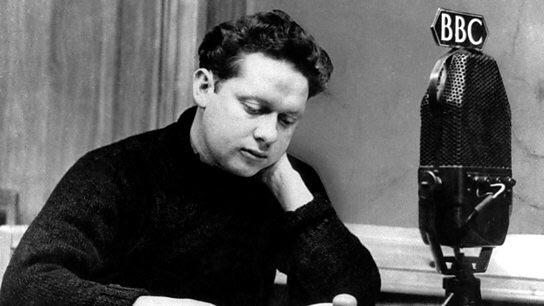
2013 was the sixtieth anniversary of the death peerless Welsh poet Dylan Thomas, one of the many famous artists who departed this planet in New York’s Chelsea Hotel. The following piece by Peter Craven is a beautiful tribute, illustrating the magic of Dylan Thomas’ poetry. And listen, pray, to the man himself reciting his poems.
Welsh poet Dylan Thomas did not go gentle into that good night
Peter Craven, Weekend Australian, 29 November, 2014
ACCORDING to legend, Bob Dylan took his name from him and he was a kind of rock star: Dylan Thomas, the Welsh poet who gave to the people of Wales — and to that part of the world that reveres what they stand for — a poetry of such reverberating bardic magnificence that he became a popular poet long after the age of popular poetry was over.
Thomas, who died, reportedly of alcohol poisoning, in New York at 39 in 1953, has his centenary this year and for the Welsh there has been no tomorrow.
Michael Sheen (the Welsh actor who played Tony Blair and David Frost) has been doing Under Milk Wood, Thomas’s great dreamscape of a radio play, in New York with Kate Burton — daughter of Richard Burton, who first did it on the BBC and even made a film of it with Elizabeth Taylor as Rosie Probert and Peter O’Toole as Captain Cat.
And in Wales they’ve been reading every jot of verse that Thomas ever penned. Distinguished Welsh actors such as Jonathan Pryce have been part of the mass recital and even that northerner, Ian McKellen, old Gandalf himself, has been dragooned into the celebration as if that rhapsodic sense of wizardry could encompass an entire world.
And he was a wizard, Thomas. I remember a lifetime ago lying in the dark of my parents’ bungalow as a young teenager listening to the black graven voice of Burton as he recited:
In my craft or sullen art
Exercised in the still night
When only the moon rages
And the lovers lie abed
With all their griefs in their arms …
It was a poetry made out of mouthfuls of air, as poetry must be, and it was also full of a rich kaleidoscope of imagery, and that seemed to make perfect sense because the emotional thrust was clear from the power of the rhetoric that sustained it.
This was a poetry that was deeply traditional in its sound patterns. It had a romantic grandiloquence and an alliterative richness, a reckless audacity of effects that was a bit like that priestly poet who had anticipated modernism, Gerard Manley Hopkins.
And, of course, it’s that lassoing effect of poetry as a language of the gods that can encompass a universe of feeling and imagining. It can intoxicate itself with language but see the world with a radiant clarity as a consequence of the intoxication. That makes people surrender to Thomas, the way when they are young they surrender to the first stirring of desire, that strange sense of body and soul coming together at the prospect of love.
If that sounds a bit much for mere poetry to achieve, listen to the lilting lyricism of Fern Hill:
Now as I was young and easy under the apple boughs
About the lilting house and happy as the grass was green,
The night above the dingle starry,
Time let me hail and climb
Golden in the heydays of his eyes …
It’s poetry of almost total sensuous suggestion and it is saturated with the feeling of sap and possibility. In one way, it’s a poetry that seems to embody the idea of youth even though it is constantly talking about shadows and spectres of mortality. Indeed, Fern Hill ends with a great splash of verbal colour, and an intimation of how the erotic glory of the world, the sense of it as a many-shaped thing of wonder, is inseparable from the pang of transience.
Thomas led an irregular life and before he died in New York’s Chelsea Hotel he told someone he had had 18 consecutive whiskies in a bar. It couldn’t have been quite true but it had a poetic truth because Thomas and his wife Caitlin hit the bottle like a destiny.
Part of Thomas’s fame came from the fact he had a tremendous histrionic gift as a reader of poetry. He read in a very posh-sounding voice with a kind of conscious grandeur that gives a less sinewy sense of his music than Burton does, but has a majestical quality that many people find mesmerising. His reading style tilts towards the preacherly with its Welsh undertone as part of the incantatory quality. But, then, some of his greatest poetry projects a religious vision, which is why Thomas’s poems have become hymns for a modern world that may not know what it believes but has a deep sense of the resonance and the afterglow of belief.
Do not go gentle into that good night,
Old age should burn and rave at close of day;
Rage, rage against the dying of the light.
The language is magical in the way it creates, with a fierce flaming elegiac power, the refusal to accept the fact of death. And the fact the perspective is not Christian — we know the darkness does overcome — makes the poem a tremendous affirmation of the heroism of life in the face of death. It’s a poem with a reckless bravery and that urging to “rage” — that impossible, nearly preposterous imperative — sits in such tension with “the dying of the light” that the effect is very poignant.
Some people sneer at Thomas, sometimes in reaction to their own earlier infatuation with him. His poetry enthrals the mind (and heart) long before you know exactly what is being said or meant. Is that a disqualification for greatness? Isn’t it a version of what TS Eliot meant when he said that poetry communicates before it’s understood?
If you want the organ notes of elegy, the sombre power that comes from the breath of death on the backs of our necks, and at the same time the sense of the resurrection as always now, try this:
You can, if you like, say the trick is all in the one great line, the line Thomas uses as his refrain, and that he creates a decorative web around it.
And death shall have no dominion.
Dead men naked they shall be one
With the man in the wind and the west moon;
When their bones are picked clean and the clean bones gone,
They shall have stars at elbow and foot;
Though they go mad they shall be sane,
Though they sink through the sea they shall rise again;
Though lovers be lost
love shall not;
And death shall have no dominion.
But that’s not quite the effect of the poem when it is read aloud. If you listen to Burton recite it, for instance, you get a sense of rushing soliloquy, of confusion and conflict and spectacular profusion, resolving itself in the refrain, which becomes like a religious affirmation, a faith in what seems impossible, a refusal to be conquered by something that cannot fail to conquer.
This is compatible with a believer’s position or an atheist’s, because when it comes to poetry we all suspend disbelief. And Thomas’s poetry is such a headlong act of faith in the act of creating poetry that it presents this spectacle — it, in fact, dramatises it — with a sort of breathtaking self-confidence that goes a long way to explain why his poems seem so genuinely bardic, why the Welsh have taken to them like anthems. And also perhaps, commandeering the tragic fact of his early death, why it makes a kind of sense that Thomas died so young.
If your schtick is to give your audience another piece of your heart over and over, you will burn yourself out or you’ll have to change your art.
God knows what Thomas would have done if he had lived. “It was my 30th year to heaven,” he wrote in Poem in October, which with its wonderful sense of the self roaming like a god is one of the greatest lyrical poems of the 20th century.
My birthday began with the water
Birds and the birds of the winged trees flying my name
Above the farms and the white horses And I rose
In a rainy autumn
And walked abroad in shower of all my days.
It was his 30th year to heaven and he already wrote like an angel and he was already talking as if he were in the presence of his own tombstone.
It’s the hugeness of the gift that makes people back away from Thomas and makes them deny his achievement, partly because the mesmerism of his manner can create fear of the highest claims.
It makes sense, of course, that there was reaction against the rhetoric of poetry associated with the “New Apocalyptics”, as Thomas’s admirers called themselves and that was partly a reaction against the battering ram of rhetoric the world had suffered with Hitler and Churchill and World War II.
People were sceptical of majesty in poetry. They remembered that the “terrible beauty” of Yeats had been a landing field for a fascist politics. But how unfair to mix Thomas up with this.
Under Milk Wood is the most successful piece of poetic drama of a postwar period haunted by the idea. It has extraordinary brio, and the way Thomas manages to create this surrealist brew of poetic hocus-pocus with choruses of schoolkids and scolding old women and blind, mad Captain Cat and dead lovers, all within a circumambient poetic idiom that is at once rich and grounded in earth, is pretty stunning when you remember that it is also a credible evocation of a village in Wales.
It’s no wonder the Welsh have taken Thomas as their red dragon and their prize dreamer. He was an incomparable poet. He did not go gentle into that good night; he lived hard.
But when it comes to the kingdom of poetry, death shall have no dominion.
 In That Howling Infinite