Better read than dead … where have all the big books gone?

The big books. The ambitious books, the life-changing books, the long books, the time-consuming books, the dense books. Not the “classics” because classics aren’t necessarily big and big isn’t necessarily classic (whatever that means, anyway) but the important books our culture used to produce but, today, we rarely see on bookshelves, where have they gone?

My mother used to tell me I was reading almost as soon as I could walk, and I was enrolled in libraries at an early age. In my lifetime, I’ve probably gone through tens of thousands of books of all sizes and genres. Now in my twilight years, though I still I love reading books, I would no longer regard reading as a hobby like I would be in the past, and I do not consume as many books as I did in earlier days. I often feel that I have lost the appetite for “big books” – big in the dimension and the number of pages, but not in the sense of scope and content and the literary reputation of the author. Back in day, I would tackle both the size and the sensibility of books with alacrity and and excitement, eager as I was then for knowledge and insight – those lengthy, complicated, and yes, ambitious, life-changing and time-consuming books that novelist Steve Orr name-checks in the opinion piece republished below.

As for those “big books”, I started early. Grammar School curricula mandated “set books” from the “canon” of English literature. William Shakespeare and Charles Dickens, of course, and also, among others, Christopher Marlowe, Geoffrey Chaucer, Oscar Wilde, GB Shaw, and John Steinbeck. Although we deep-dived into specific books, we were encouraged to read their other works, and more besides. So, I came to know The Iliad, The Odyssey and The Aenead, and also the French ‘greats’ Alexander Dumas and Victor Hugo. I can’t recall how I came to discover Mikhail Sholokov’s dramatic tales of the Don Cossacks, but they gave me a fascination with Russian history that has endured to this day, and introduced me to the Russian Revolution and Civil War – and socialism (see The Russian Tradition – Russia, Ukraine and Tibor Szamuely and other pieces).

During my university years, few non-fiction works of note come to mind though I’m sure I’d have read a few – including all three books of Tolkien’s trilogy which I binged on over one cold and rainy English weekend in Reading. Three years later, whilst traveling the celebrated Hippie Trail to India and back, I’d pick up random tomes in hotels and doss houses along the road. It was between Kashmir and Istanbul, I met James Joyce’s Leopold Bloom and Dostoevsky’s melancholy Prince Mishkin.

Moving to London in the early seventies, I spent hours traveling back and forth on the London Underground – always with a good book in hand. I went through phases. The Russian canon of Tolstoy, Dostoevsky, Pasternak, and Solzhenitsyn, all angst and agony, suited me well in my restless years. When my mood changed from melancholy to mellow, from the blues to the bucolic, I worked through all of Thomas Hardy’s tales of rural England, and discovered that Rudyard Kipling was much, much more than Mowgli. I encountered Milton’s fallen angel ( see Lucifer Descending … encounters with the morning star) whilst Don Quixote and Captain Ahab gave me a good literary workout. The name of this blog is taken from Moby-Dick. Meanwhile, the current best-seller lists provided many worthy reads.

Through the eighties and nineties, I would have several books on the go and would plough through several works of fiction and non-fiction each month. With the onset of the internet and the social media age, my decades long passion for history and politics superseded my fondness for a good book or two as I dedicated more of my leisure hours to news media and on-line feeds. The acquisition of an iPad in 2011 accelerated the demise of the actual printed word. I have never, however, read an e-book, and probably never will, and I buy books still, including several I would argue fitted Orr’s criteria of “big” – particularly CE Morgan’s “great American novel” The Sport of Kings and Hilary Mantel’s Wolf Hall trilogy. But since retiring to the bush, my reading capacity is down to a book every one or two months, depending in on its size.

Orr’s piece reminded me of my once prevailing but receding passion for the tangible printed word, providing not so much an obituary to the “big books” but a wake-up call.

“Maybe it’s time to commit”, he writes, “Maybe it’s time to (re-)rewire our brains to work in years, months, instead of fractions of seconds. Maybe it’s time to stop saying, “I’ll wait for the movie”. Maybe it’s time to admit we all have a little of Ahab’s obsession, Humbert’s lustings – maybe there’s a bit of Christian Stead’s controlling Sam Pollit in all us’.

“In short’, he concludes, “maybe we are the book and the book is us. Let’s admit, as Stead did when writing The Man Who Loved Children, the best way to exorcise the past is to write (and read) about it. This, as it turns out, isn’t a desirable but a necessary thing. Shall we admit, in the end, the questions the big books pose no longer interest us because we no longer interest ourselves?”

Postscript

From Better read than dead – are books the footprints from our past?

Last year, I jettisoned half of a book collection I’d accumulated over sixty years, more went this year – books that had followed me as I moved from Birmingham to Reading to London in the sixties and seventies, migrated to Australia, and moved from house to house in Sydney and finally settled in the midst of a forest in northern New South Wales.

Out went books of all formats and genres. Mementos of former passions and fashions. Relics of past courses and careers. Old school textbooks, university texts, fiction, nonfiction, dictionaries, coffee table books. I’d worked for years in publishing, so the complimentary copies alone were colossal..

I’d already culled boxes of books a decade ago when we’d last moved house and home, and this time, I was determined to downsize further. My primary criteria was that if I hadn’t looked inside the covers of a book for twenty, thirty, fifty years, then I wasn’t likely to do so in the next five, ten, twenty years I have left on this planet.

Nevertheless, I kept back five full shelves Books of poetry, some of them a century old. All-time favourite novels, including the iconic Russians, Hardy, Herbert and Heinlein. Non-fiction histories I regard with particular nostalgia or think might be of use again one day. Books about music and musicians, particularly the Beatles and the Bobster. Recent purchases. And, books I consider “rare” – a subjective descriptor that I can only explain as old books which I picked up in secondhand bookshops when I lived in London in the sixties and seventies. Some, I reckon, are actually rare!

For more on books and reading in In That Howling Infinite, see Better Read Than Dead – the joy of public libraries

Where have all the big books gone?

The big books. The ambitious books, the life-changing books, the long books, the time-consuming books, the dense books. Not the “classics” because classics aren’t necessarily big and big isn’t necessarily classic (whatever that means, anyway) but the important books our culture used to produce but, today, we rarely see on bookshelves, where have they gone?

Why aren’t (many) people writing them? And more importantly, why aren’t people reading them?

This is a not a new concern. Charles Bukowski in 1990 asked: “… well, where are they?/ the Hemingways, the T.S. Eliots, the Pounds … dead, I know/ but where are the re-/ placements, where are the new/ others?’

Poet and writer Charles Bukowski.

Poet and writer Charles Bukowski.

What was a casual question back then seems to have a new ­urgency now.

There are lots of reasons, and I’d like to explore some of them here. I suspect technology, in its various forms, is taking over the jobs we used to trust our brains to do: critical thinking, imagination, reasoning and speech and (civilised) argument and social intercourse at a personal and public level. We say, “Oh, well, I’m too busy to tackle Anna Karenina,” then pick up our phone to check the latest tweet.

We don’t value time in the same way we used to – slow, precious, filled with good smells and sounds and ideas and meaningful things. We’re happy to waste time. Like, surely, we’ll get it back? We’re happy to fill the gap with more technology, updated phones and watches. And the result? We’ve become lazy, and lonely. We’ve privatised our inner spaces, sold off our opinions, let someone else make Pixar and Marvel dreams for us. And worse, for too many people now, everything’s about money. We’ve shat on our curiosity, given up on the daily awe that came from sensing our place in nature, the consolations and compromises that made civilisation possible, and pleasant. The result? Each new generation bleeding out its limited reserves of empathy, understanding and wisdom.

Readers seem hung up on plot. Easy plots. Familiar plots. Plots that come from and return to a screen. Problem being, the big books are about big characters: Miss Havisham, Elizabeth Hunter, Captain Ahab, Tom Joad. It takes time to build up a complex, flawed life on a page, each verb and adjective competing for the smallest breath and bit of meaning. Even when contemporary writers have a crack, readers falter, stray, give up. There’s something easier, more immediate to hand. Something involving the discovery of a body on a beach and working out how it go there. Harold Bloom: “I am not unique in my elegiac sadness at watching reading die, in the era that celebrates Stephen King and J.K. Rowling rather than Charles Dickens and Lewis Carroll.”

Ironically, it’s the loss of critics like Bloom that’s allowed the problem to fester. The loss of literary criticism generally, space in newspapers, reviews themselves (ironically, surviving in 50-word online grabs where they’re easily ignored).

Today, there are fewer places to publish extracts, to make meandering explorations that interrogate context, subtext, the way authors’ lives morph onto the page, how we needn’t make the mistakes of the past, how too many of our views are founded on faulty assumptions.

All of this might seem ho-hum: “It’s a shame but, you know, the world’s changing.”

If it wasn’t for what we risked losing. That is, the understanding of what it means to be a human on Earth, a human among millions who’ve lived and died with the same urges and joys and terrors and disappointments. How else to connect with the tribe of humanity that’s fallen through time’s long ruin? Bloom again: “We read deeply for various reasons, most of them familiar: that we cannot know enough people profoundly enough; that we need to know ourselves better.”

Keira Knightley in a scene from film Anna Karenina.

Keira Knightley in a scene from film Anna Karenina.

Or as Jonathan Franzen put it in How to Be Alone: “Readers and writers are united in their need for solitude … in their reach inward, via print, for a way out of loneliness.”

The very idea of reading deeply; of making connections in order to become better people (or at least remain sane, or maybe even happy). But now, visual seems to have won out over text; we have a poorer understanding of irony, sarcasm, the art of persuasion, voice, a well-turned sentence, the art of choosing the best word (even grammar, spelling); we can’t grasp complex sentences, let alone the formal language that glues so many big books together. In short, we’re out of practice. Kids grow up without books in the house, without reading role models (family, let alone politicians and public figures, having been replaced with sporty types). No one demands sustained reading and schools are too busy teaching “multi-modal” texts (more screens) while avoiding quality books lest they disadvantage non-readers. Meanwhile, the books that are read are short, plotish, weighed down with well-meaning but yawn-worthy attempts at solving the world’s problems. Despite schools’ mission to create readers, at the end of the day they leave more waiting for a bus that’ll never come. Apart from this, schools and universities are busy “de-colonising” bookshelves, removing Pip because (I suspect) the local gauleiter has never read Great Expectations. In short, there goes the Western canon. Anyway, chances are younger English teachers haven’t read much, or they’ve been co-opted from the geography department to make up the numbers.

And what about the writers? Bukowski: “I don’t ask for Dostoevsky, there’s no replacement for Feodor Mikhailovich. But these now, what are/ they: making their tiny splashes, what practiced ineptness, what boredom of language, what a/ crass bastardly trick against print against pages …”

The reasons are complex, but the outcomes clear: writers are no longer culturally important; big books are rarely produced by profit-driven publishers, therefore fewer are written, creating a self-fulfilling Coriolis effect of big books down little drains. But mostly, big books are hard to write. Think of Patrick White churning out an Eye of the Storm or Riders in the Chariot: a hundred thousand-plus handwritten words, typed up, corrected, typed again, “oxy-welded”, years and years of solid, thankless, grinding warfare with an Olivetti and the English language to produce a masterpiece that, even then, required a visionary ­publisher (Ben Huebsch) and well-read public to give it any chance at all.

And talking about the journey. Perhaps part of the problem is that we’ve lost interest in the journey on which writers can take us over our lives. From comics, to pre-franchised, pre-teen Tolkien, the discovery of Holden Caulfield, the oh-so-clever twenty-something Infinite Jest, then to something serious, Bolano, perhaps, and on and on it goes, the road less travelled that’s no longer travelled at all. And what have we lost? The unbroken chain of meaning from Homer to Dante, Chaucer to Shakespeare, to a 20th century profusion of styles that offered Joyce in the morning and Hesse in the afternoon.

For me, as a 12- or 13-year-old, it was Dickens. To think, someone had actually dreamed up Micawber and Betsey Trotwood! Without that narrative, that connection, how do we even know what we’re missing, or misunderstanding? Are we ready to give up the collective memory that, according to Italo Calvino, holds together “the imprint of the past and the plan for the future …”

Or is it simply that we no longer know how to be alone anymore? Bloom said it was all about finding a mind “more original than our own”. But now, we’re all creators, posting a hundred daily autobiographies on TikTok. Ironically, this seems to be leaving us more lonely than ever and, having withdrawn within ourselves, having discovered we’re bored with what’s being said and sung and tweeted, we can’t work out what’s next?

Maybe it’s time to commit. Maybe it’s time to (re-)rewire our brains to work in years, months, instead of fractions of seconds. Maybe it’s time to stop saying, “I’ll wait for the movie”. Maybe it’s time to admit we all have a little of Ahab’s obsession, Humbert’s lustings – maybe there’s a bit of Christian Stead’s controlling Sam Pollit in all us.

In short, maybe we are the book and the book is us. Let’s admit, as Stead did when writing The Man Who Loved Children, the best way to exorcise the past is to write (and read) about it. This, as it turns out, isn’t a desirable but a necessary thing. Shall we admit, in the end, the questions the big books pose no longer interest us because we no longer interest ourselves?

Stephen Orr is an award-winning novelist. He will be a guest at Adelaide Writers’ Week on Wednesday 5 March.
Man Friday … a poet’s Robinson Crusoe sequel

You won’t have to worry anymore
When you hear the cry for home

Van Morrison

Alec Derwent Hope (21 July 1907 – 13 July 2000) was an Australian poet and essayist known for his satirical slant, and also, a critic, teacher and academic: He ended his career as Professor of English at the Australian National University, Canberra. He was referred to in an American journal as “the 20th century’s greatest 18th-century poet”.

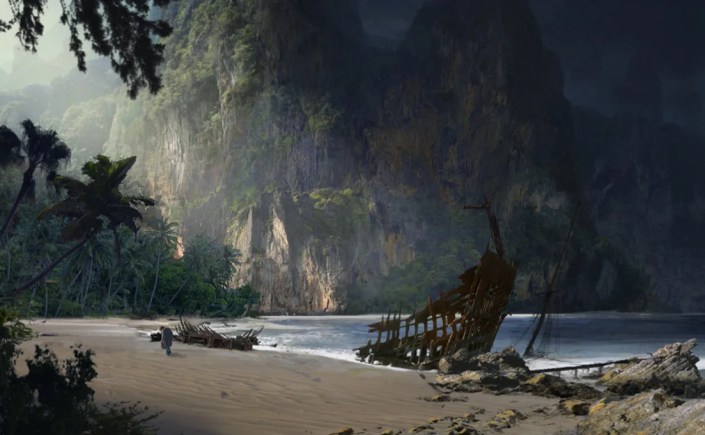
Man Friday, published in 1958, is actually set in those faraway days of Georgian England. It begins where English novelist and journalist Daniel Defoe leaves off his 1719 tale of the iconic castaway Robinson Crusoe. Readers will recall that Crusoe was shipwrecked and subsequently spent 28 years on a remote tropical desert island near the coasts of Venezuela and Trinidad, encountering cannibals, captives, and mutineers before being rescued. To refresh memories, there is a 200 word synopsis at the end of this post.

Hope takes up the story of Crusoe’s companion and servant Friday after he is brought by his “master” and sole companion to live in England. The completely alien culture that Friday, now a stranger in a strange land, encounters on this new “desert island” requires a huge and disturbing recalibration of his temporal, cultural and spiritual compass. He gradually arrives at an acceptance of the way of life that has been imposed upon him by circumstance.

His transformation and quiet resignation into an upper-class servant and his subsequent marriage and children take him farther and farther away from his memories and encase him within an artificial persona – until the day he accompanies Crusoe to an English sea port and hears the ocean’s beckoning roar for the first time in many years. The song of the ocean, the rush of memory, and Friday’s response to the call of the sea crystalizing in the poem’s ending. 

It is a remarkably imaginative work juxtaposing Friday’s former life on an idyllic “island in the sun” (to quote the late Harry Belafonte’s lovely rhapsody’) to the stitched-up, hung-up, and in his perception, confined world of polite Georgian society. It is also captivating insofar it employs the sea as an extended metaphor (a device that I myself have used in poems and songs – see the Sound Cloud audio clips at the end of this post).

The sea runs like a leitmotif throughout the poem even when it is not mentioned explicitly. It has multiple associations: journeys by sea, separation and exile, isolation and loneliness, and the idea of home as an anchor, a goal, a safe haven, and as a longing. AD Hope further infuses it with the cultural differences and divisions, of social and spiritual barriers, of acclimatisation and assimilation of a kind. And in the end, an atavistic crying for home.

Saved, at long last through Him whose power to save
Kept from the walking, as the watery grave,
Crusoe returned to England and his kind,
Proof that an unimaginative mind
And sober industry and common sense
May supplement the work of Providence.
He, no less providential and no less
Inscrutably resolved to save and bless,
Eager to share his fortune with the weak
And faithful servants whom he taught to speak,
By all his years of exile undeterred,
Took into exile Friday and the bird.

The bird no doubt was well enough content.
She had her corn – what matter where she went?
Except when once a week he walked to church,
She had her master’s shoulder as a perch.
She shared the notice of the crowds he drew
Who praised her language and her plumage too,
And like a rational female could be gay
On admiration and three meals a day.

But Friday the Dark Caribbean Man,
Picture of his situation if you can:
The gentle savage, taught to speak and pray
On England’s Desert Island cast away,
No God like Crusoe is issuing from his cave
Comes with his thunder-stick to slay and save;
Instead from caves of stone, as thick as trees,
More dreadful than ten thousand savages,
In their strange clothes and monstrous mats of hair,
The pale-eyed English swarm to joke and stare
With endless questions round him crowd and press,
Curious to see and touch his loneliness.
Unlike his master Crusoe long before,
Crawling half drowned upon the desolate shore,
Mere ingenuity useless in his need,
No wreck supplies him biscuits, nails and seed,
No fort to builds, no call to bake, to brew,
Make pots and pipkins, cobble coat and shoe,
Gather his rice and milk his goats and rise
Daily to some absorbing enterprise.

And yet no less than Crusoe so he must find
Some shelter for the solitary mind;
Some daily occupation to contrive
To warm his wits and keep the heart alive;
Protect among the cultured, if he can,
The “noble savage” and the “natural man”.
As Crusoe made his clothes, so he no less
Must labour to invent his nakedness
And, lest their alien customs without trace
Absorb him, tell the legends of his race
Each night aloud in the soft native tongue
That filled his world when, bare and brown and young,
His brown, bare mother held him to her breast,
Then say his English prayers and sink to rest.
And each day waking in his English sheets,
Hearing the wagons in the cobble streets,
The morning bells, the clatter and cries of trade,
He must recall, within their palisade,
The sleeping cabins in the tropic dawn,
The wrapt leaf-breathing silence, and the yawn
Of naked children as they wait and drowse,
The women chattering around their fires, the prows
Of wet canoes nosing the still lagoon;
At each meal, handling alien fork and spoon,
Remember the spice mess of yam and fish
And the brown fingers meeting in the dish:
Remember too those island feasts, the sweet
Blood frenzy and the taste of human meat.

He piled memories against his need;
In vain! for still he found the past recede
Try as he would, recall, relieve rehearse,
The cloudy images would still disperse.,
Till as in dreams, the island world hecknew
Confounded the fantastic with the true
While England, less unreal day by day,
The cannibal Island ate his past away.
But for the brooding eye, the swarthy skin,
Witness to the Natural Man within,
Year following year, by inches, as they ran
Transformed the savage to an English man
Brushed, barbered, hatted, trousered and baptised,
He looked, if not completely civilised,
What came increasingly to be the case:
An upper servant, conscious of his place,
Friendly but not familiar in address
And prompt to please, without obsequiousness
Adept to dress , to shave, to carve, to pour
And skilled to open or refuse the door,
To keep on terms with housekeeper and cook,
But quell maids and footman with a look.
And now his master, thoughtful for his need,
Bought him a wife and gave him leave to breed.
A fine mulatto, once a ladies maid,
She thought herself superior to Trade
And, reared on a Plantation, much too good
for a low native Indian from the wood;
Yet they contrived at last to rub along
For he was strong and kind, and she was young
And soon a father, then a family man
Friday took root in England and began
To be well thought of in the little town,
And quoted in discussions at The Crown
Whether the Funds would fall, the French would treat
Or the new ministry could hold its seat
For though he seldom spoke, the rumour ran
The master had no secrets from his man
And Crusoe’s ventures prospered so, in short,
It was concluded he had friends at Court.

Yet, as the years of exile came and went,
Though first he was he grew resigned and then content,
Had you observed him close, you might surprise
A stranger looking through the servant’s eyes.
Some colouring of speech , some glint of pride,
Not born of hope, for hope had long since had died,
Not even desire, scarce memory at last
Preserved that stubborn vestige of the past.

It happened once that man and master made
A trip together on affairs of trade;
A ship reported founding in the Down
Brought them to visit several seaport towns.
At one of these great Yarmouth or Kings Lynn,
Their business done, they baited at an inn,
And in the night were haunted by the roar
Of a wild wind and tide against the shore.
Crusoe soon slept again but Friday lay
Awake and listening till the dawn of day.
For the first time in all his exiled years
The thunder of the ocean filled his ears;
And that tremendous voice so long unheard
Released and filled and drew him till he stirred
And left the house and passed the town, to reach
At last the dunes and rocks and open beach:
Pale bare and gleaming in the break of day
A sweep of new-washed sand around the bay,
and spindrift arriving up the bluffs like smoke
As the long combers reared their crests and broke.
There, in the sand beside him, Friday saw
A single naked footprint on the shore
His heart stood still, for as he stared, he knew
The foot made it never had worn shoe
And, at glance, that no such walker could
Have been a man of European blood.
From such a footprint once he could describe
If not the owner’s name, at least his tribe,
And tell his purpose as men read a face
And still his skill sufficed to know the race;
For this for this was such a print as long ago
He too had made and taught his eyes to know.
There could be no mistake. A while he stood
Staring at that great German Ocean’s flood;
And suddenly he saw those shores again
Where Orinoco flows into the main,
And, stunned with an incredible surmise,
Heard it his native tongue once more the cries
Of spirits silent now for many a day;
And all his years of exile fell away.

The sun was nearly to the height before
Crusoe arrived hallowing at the shore,
Followed the footprints to the beach and found
The clothes and shoes and thought his servant drowned
Much grieved he sought saw him up and down the bay
But never guessed, when later in the day
They found the body drifting in the foam,
That Friday had been rescued and gone home.

See also in In That Howling Infinite, Better read than Dead – books, poems and reading

Daniel Defoe’s Robinson Crusoe in 200 words

Courtesy of the Cliff’s Notes blog  

Robinson Crusoe is an English adventure novel by Daniel Defoe (1660- 1731. an English novelist, journalist, merchant, pamphleteer and spy. First published on 25 April 1719, it is claimed to be second only to the Bible in its number of translations.

Written with a combination of epistolary, confessional, and didactic forms, the book follows the title character (born Robinson Kreutznaer) after he is cast away and spends 28 years on a remote tropical desert island near the coasts of Venezuela and Trinidad, encountering cannibals, captives, and mutineers before being rescued. The story has been thought to be based on the life of Alexander Selkirk, a Scottish castaway who lived for four years on a Pacific island called “Más a Tierra” (now part of Chile) which was renamed Robinson Crusoe Island in 1966. Pedro Serrano is another real-life castaway whose story might have inspired the novel.

The first edition credited the work’s protagonist Robinson Crusoe as its author, leading many readers to believe he was a real person and that the book was a non-fiction travelogue.Despite its simple narrative style, Robinson Crusoe was well received in the literary world and is often credited as marking the beginning of realistic fiction as a literary genre. Some allege it is a contender for the first English novel.

It tells the story of one Robinson Crusoe, a young and impulsive wanderer who, having his defied his parents, ran away to sea. 

He was rescued by a Portuguese ship and started a new adventure. He landed in Brazil, and, after some time, he became the owner of a sugar plantation. Hoping to increase his wealth by buying slaves, he aligned himself with other planters and undertook a trip to Africa in order to bring back a shipload of slaves. After surviving a storm, Crusoe and the others were shipwrecked. He was thrown upon shore only to discover that he was the sole survivor of the wreck.

Crusoe made immediate plans for food, and then shelter, to protect himself from wild animals. He brought as many things as possible from the wrecked ship, things that would be useful later to him. In addition, he began to develop talents that he had never used in order to provide himself with necessities. Cut off from the company of men, he began to communicate with God, thus beginning the first part of his religious conversion. To keep his sanity and to entertain himself, he began a journal. In the journal, he recorded every task that he performed each day since he had been marooned.

As time passed, Crusoe became a skilled craftsman, able to construct many useful things, and thus furnished himself with diverse comforts. He also learned about farming, as a result of some seeds which he brought with him. An illness prompted some prophetic dreams, and Crusoe began to reappraise his duty to God. Crusoe explored his island and discovered another part of the island much richer and more fertile, and he built a summer home there.

One of the first tasks he undertook was to build himself a canoe in case an escape became possible, but the canoe was too heavy to get to the water. He then constructed a small boat and journeyed around the island. Crusoe reflected on his earlier, wicked life, disobeying his parents, and wondered if it might be related to his isolation on this island.

After spending about fifteen years on the island, Crusoe found a man’s naked footprint, and he was sorely beset by apprehensions, which kept him awake many nights. He considered many possibilities to account for the footprint and he began to take extra precautions against a possible intruder. Sometime later, Crusoe was horrified to find human bones scattered about the shore, evidently the remains of a savage feast. He was plagued again with new fears. He explored the nature of cannibalism and debated his right to interfere with the customs of another race.

Crusoe was cautious for several years, but encountered nothing more to alarm him. He found a cave, which he used as a storage room, and in December of the same year, he spied cannibals sitting around a campfire. He did not see them again for quite some time.

Later, Crusoe saw a ship in distress, but everyone was already drowned on the ship and Crusoe remained companionless. However, he was able to take many provisions from this newly wrecked ship. Sometime later, cannibals landed on the island and a victim escaped. Crusoe saved his life, named him Friday, and taught him English. Friday soon became Crusoe’s humble and devoted slave.

Crusoe and Friday made plans to leave the island and, accordingly, they built another boat. Crusoe also undertook Friday’s religious education, converting the savage into a Protestant. Their voyage was postponed due to the return of the savages. This time it was necessary to attack the cannibals in order to save two prisoners since one was a white man. The white man was a Spaniard and the other was Friday’s father. Later the four of them planned a voyage to the mainland to rescue sixteen compatriots of the Spaniard. First, however, they built up their food supply to assure enough food for the extra people. Crusoe and Friday agreed to wait on the island while the Spaniard and Friday’s father brought back the other men.

A week later, they spied a ship but they quickly learned that there had been a mutiny on board. By devious means, Crusoe and Friday rescued the captain and two other men, and after much scheming, regained control of the ship. The grateful captain gave Crusoe many gifts and took him and Friday back to England. Some of the rebel crewmen were left marooned on the island.

Crusoe returned to England and found that in his absence he had become a wealthy man. After going to Lisbon to handle some of his affairs, Crusoe began an overland journey back to England. Crusoe and his company encountered many hardships in crossing the mountains, but they finally arrived safely in England. Crusoe sold his plantation in Brazil for a good price, married, and had three children. Finally, however, he was persuaded to go on yet another voyage, and he visited his old island, where there were promises of new adventures to be found in a later account.

When Freedom comes, she crawls on broken glass

Flashing for the warriors whose strength is not to fight
Flashing for the refugees on the unarmed road of flight
An’ for each an’ ev’ry underdog soldier in the night
An’ we gazed upon the chimes of freedom flashing
Bob Dylan, Chimes of Freedom

Hear the cry in the tropic night, should be the cry of love but it’s a cry of fright
Some people never see the light till it shines through bullet holes
Bruce Cockburn, Tropic Moon

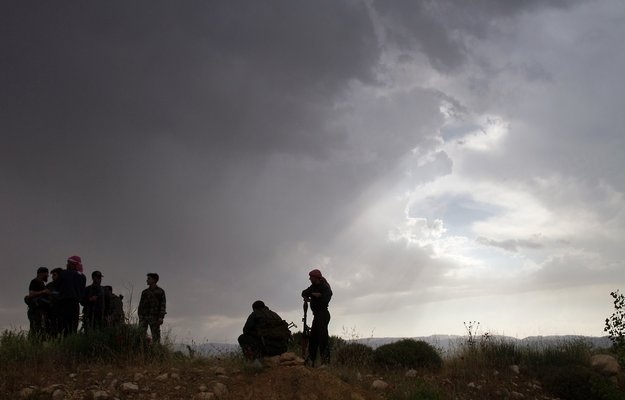
When Freedom Comes is a tribute to Robert Fisk (1946-2020), indomitable, veteran British journalist and longtime resident of Beirut, who could say without exaggeration “I walk among the conquered, I walk among the dead” in “the battlegrounds and graveyards” of “long forgotten armies and long forgotten wars”. It’s all there, in his grim tombstone of a book, The Great War for Civilization (a book I would highly recommend to anyone wanting to know more about the history of the Middle East in the twentieth century – but it takes stamina – at near in 1,300 pages – and a strong stomach – its stories are harrowing).

The theme, alas, is timeless, and the lyrics, applicable to any of what Rudyard called the “savage wars of peace” being waged all across our planet, yesterday, today and tomorrow – and indeed any life-or-death battle in the name of the illusive phantom of liberty and against those intent on either denying it to us or depriving us of it. “When freedom runs through dogs and guns, and broken glass” could describe Paris and Chicago in 1968 or Kristallnacht in 1938. If it is about any struggle in particular, it is about the Palestinians and their endless, a fruitless yearning for their lost land. Ironically, should this ever be realized, freedom is probably the last thing they will enjoy. They like others before them will be helpless in the face of vested interest, corruption, and brute force, at the mercy of the ‘powers that be’ and the dead hand of history.

The mercenaries and the robber bands, the warlords and the big men, az zu’ama’, are the ones who successfully “storm the palace, seize the crown”. To the victors go the spoils – the people are but pawns in their game.

In 2005, on the occasion of the publication of his book, Fisk addressed a packed auditorium in Sydney’s Macquarie University. Answering a question from the audience regarding the prospects for democracy in the Middle East, he replied:

“Freedom must crawl over broken glass”

Freedom Comes 

… all wars come to an end. And that’s where history restarts.  Robert Fisk

There goes the freedom fighter,
There blows the dragon’s breath.
There stands the sole survivor;
The time-worn shibboleth.
The zealots’ creed, the bold shahid,
Give me my daily bread
I walk amongst the conquered
I walk amongst the dead

Here comes the rocket launcher,
There runs the bullets path,
The revolution’s father,
The hero psychopath.
The wanting seed, the aching need
Fulfill the devil’s pact,
The incremental balancing
Between the thought and act.

The long-forgotten army
In the long-forgotten war.
Marching to a homeland.
We’ve never seen before.
We feel the wind that blows so cold amidst
The leaves of grass.
When freedom comes to beating drums
She crawls on broken glass

There rides the mercenary,
Here roams the robber band.
In flies the emissary
With claims upon our land.
The lesser breed with savage speed
Is slaughtered where he stands.
His elemental fantasy
Felled by a foreign hand.

The long-forgotten army
In the long-forgotten war.
Marching to a homeland.
We’ve never seen before.
We feel the wind that blows so cold amidst
The leaves of grass.
When freedom comes to beating drums
She crawls on broken glass.

Thy kingdom come, thy will be done
On heaven and on earth,
And each shall make his sacrifice,
And each shall know his worth.
In stockade and on barricade
The song will now be heard
The incandescent energy
Gives substance to the word.

Missionaries, soldiers,
Ambassadors ride through
The battlegrounds and graveyards
And the fields our fathers knew.
Through testament and sacrament,
The prophecy shall pass.
When freedom runs through clubs and guns,
She crawls on broken glass.

The long-forgotten army
In the long-forgotten war.
Marching to a homeland.
We’ve never seen before.
We feel the wind that blows so cold amidst
The leaves of grass.
When freedom comes to beating drums
She crawls on broken glass
When freedom comes to beating drums
She crawls on broken glass

© Paul Hemphill 2012

From: In That Howling Infinite – Poems of Paul Hemphill Volume 5

See also in In That Howling Infinite, A Middle East Miscellany, See also: East – An Arab Anthology and   A Short History of the Rise and Fall of the West

Wystan and Christopher’s excellent adventure

As evening fell the day’s oppression lifted
Far peaks came into focus, it had rained.
Across wide lawns and cultured flowers drifted
The conversation of the highly trained.
Two gardeners watched them pass and priced their shoes
A chauffeur waited, reading in the drive
For them to finish their exchange of views.
It seemed a picture of the private life.
Far off, no matter what good they intended
The armies waited for a verbal error
With all the instruments for causing pain
And on the issue of their charm depended
A land laid waste, its towns in terror
And all its young men slain.
Embassy, WH Auden, from Journey to a War

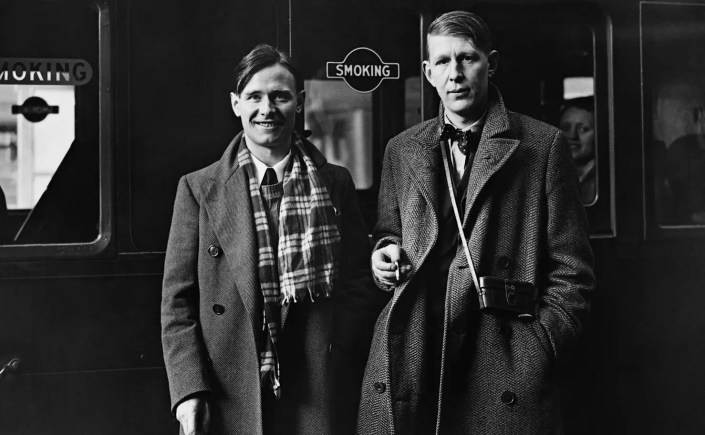
In 1938, English writers WH Auden and  Christopher Isherwood were commissioned by their publishers to write a travel book about the East. Auden was already established as one of Britain’s foremost poets whilst his friend and onetime lover Isherwood was acclaimed as an author and dramatist. His Berlin Stories, two novels set in the last days of the Weimar Republic and today acclaimed as classics of modern fiction; the semi autobiographical Goodbye to Berlin (1939) inspired the remarkable musical Cabaret (1966).

By adventurous choice they went to China for six months, their journey coinciding with Imperial Japan’s brutal invasion. American poet and educator Mildred Boie, reviewing the book for Atlantic in November 1939, takes up the story:  

“With the good fortune of famous and attractive young men they were helped and shown about by everybody from coolies to ambassadors, journalists to generals. They behaved, as they observed and wrote (to judge from the diary), with the engaging frankness and immaturity of English schoolboys, with the ingenious confidence and casual incompleteness of amateurs. But these qualities are inadequate for reporting war, for evaluating life and death in so desperate and disastrously complicated a country as China. The authors were not only amateurs as foreign correspondents, they were also dilettantes: they played at getting to the front, at taking notes on slums, at dashing from formal garden parties to meetings with intellectuals and busy military and diplomatic leaders. They suffered almost as much, certainly as consciously, from blisters, constipation, boredom, sleeplessness, and hangovers as from the shape of poverty, the taste of fear, the sight and smell of death. They were always safe, always outside.” 

Collectively, perhaps, we most resemble a group of characters in one of Jules Verne’s stories about lunatic English explorers. 

War is bombing an already disused arsenal, missing it and killing a few old women. War is lying in a stable with a gangrenous leg. War is drinking hot water in a barn and worrying about one’s wife. War is a handful of lost and terrified men in the mountains, shooting at something moving in the undergrowth. War is waiting for days with nothing to do; shouting down a dead telephone; going without sleep, or sex, or a wash. War is untidy, inefficient, obscure, and largely a matter of chance. 

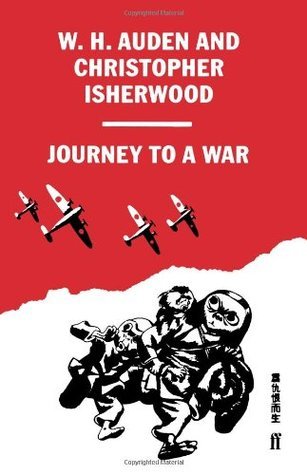
On their safe return, the pair put together Journey to a War, travel book in prose and verse that was published in 1939. The book is in three parts: a series of poems by Auden describing his and Isherwood’s journey to China in 1938; a “Travel-Diary” by Isherwood (including material first drafted by Auden) about their travels in China itself, and their observations of the Sino-Japanese War; and “In Time of War: A Sonnet Sequence with a Verse Commentary” by Auden, with reflections on the contemporary world and their experiences in China. The book also contains a selection of photographs by Auden.

I am never much good at defending the British Empire, even when drunk
Christopher Isherwood

I republish below an excellent article in the blog Books and Boots – Reflections on Books and Art. It provides a more detailed background to the genesis of the book, setting the geopolitical scene, describing  Auden’s  anticlimactic and, it would seem, personally disappointing visit to Spain during its civil war, and the poetry within.

See also in In That Howling Infinite, Better read than dead … books, poetry and reading


WH Auden and Christopher Isherwood

Journey To A War by W.H. Auden and Christopher Isherwood (1939)

When we awoke early next morning the train was crossing a wide valley of paddy fields. The rising sun struck its beams across the surfaces of innumerable miniature lakes; in the middle distance farmhouses seemed actually to be floating on water. Here and there a low mound rose a few feet above the level of the plain, with a weed-grown, ruinous pagoda, standing upon it, visible for miles around. Peasants with water-buffaloes were industriously ploughing their arable liquid into a thick, brown soup.
(Journey To A War, p.191)

Collectively, perhaps, we most resemble a group of characters in one of Jules Verne’s stories about lunatic English explorers. (p.104)

The Sino-Japanese War

In July 1937 – exactly a year after the start of the Spanish Civil War – Japan attacked China. It was hardly a surprise. In 1931 the so-called ‘Mukden Incident’ had helped spark the Japanese invasion of Manchuria (the large area to the north east of China, just above Beijing). The Chinese were defeated and Japan created a new puppet state, Manchukuo (setting up the last Qing emperor as its puppet ruler) through which to rule Manchuria.

Going further back, in 1894–1895 China, then still under the rule of the Qing dynasty, was defeated by Japan in what came to be called the First Sino-Japanese War. China had been forced to cede Taiwan to Japan and to recognise the independence of Korea which had, in classical times, been under Chinese domination.

In other words, for 40 years the rising power of militaristic, modernising Japan had been slowly nibbling away at rotten China, seizing Taiwan, Korea and Manchuria. Now the military junta in Tokyo decided the time was right to take another bite, engineered an ‘incident’ at the Marco Polo bridge on the trade route to Beijing, and used this as a pretext to attack Beijing in the north and Shanghai in the south.

Thus there was quite a lot of military and political history to get to grips with in order to understand the situation in China, but what made it even more confusing was the fact that China itself was a divided nation. First, the nominal government – the Chinese Nationalist Party or Kuomintang under its leader Chiang Kai-shek – had only with difficulty put down or paid off the powerful warlords who for decades had ruled local regions of China after the collapse of the Qing Dynasty in 1911.

But second, Chiang faced stiff competition from the Chinese Communist Party. The two parties had lived in uneasy alliance until Chiang staged a massacre of communists in Shanghai in 1927 which brought the tension between Chinese nationalists and communists into the open.

It was the three-way destabilisation of China during this period – warlords v. Nationalists v. Communists – which had helped Japan invade and take over Manchuria. Prompted by the 1937 Japanese attack the Nationalists and Communists formed an uneasy alliance.

Auden in Spain

Meanwhile, back in Europe, the great political issue of the age was the Spanish Civil War which began when General Franco led a military uprising against the democratically elected government in July 1936. Like many high-minded, middle class liberals, Auden and Isherwood both felt the time had come to put their money where their mouths were. Auden did actually travel to Spain in January 1937 and was there till March, apparently trying to volunteer to drive an ambulance in the medical service. Instead, red tape and the communists who were increasingly running the Republican forces apparently blocked him from getting a useful job. He tried to help out at the radio station but discovered its broadcasts were weak and there were no vacancies.

Frustrated and embarrassed, Auden was back in England by mid-March 1937. The long-term impact of the trip was his own surprise at how much it upset him to see the churches of Barcelona which had all been torched and gutted by a furious radical populace as symbols of oppression. Auden was shocked, and then shocked at his reaction. Wasn’t he meant to be a socialist, a communist even, like lots of other writers of his generation? The Spain trip was the start of the slow process of realisation which was to lead him back to overt Christian faith in the 1940s.

Also Auden saw at first hand the infighting on the Republican side between the communist party slavishly obeying Stalin’s orders, and the more radical Trotskyite and Anarchist parties who, later in 1937, it would crush. Later he paid credit to George Orwell’s book Homage To Catalonia for explaining the complex political manoeuvring far better than he could have. But watching the Republicans fight among themselves made him realise it was far from being a simple case of black and white, of Democracy against Fascism.

So by March 1938 Auden had returned to Britain, where he was uncharacteristically silent about his experiences, and got on with writing, editing new works for publication (not least an edition of his play The Ascent of F6 and Letters From Iceland).

Meanwhile, Christopher Isherwood was living in Paris managing his on-again, off-again relationship with his German boyfriend Heinz. And although he had accommodated Auden on an overnight stop in the French capital and waved him off on the train south to Spain, Isherwood hadn’t lifted a finger for the Great Cause.

Then, in June 1937, Auden’s American publisher, Bennet Cerf of Random House, had suggested that after the reasonable sales of his travel book about Iceland, maybe Auden would be interested in writing another travel book, this time travelling to the East. Isherwood was a good suggestion as collaborator because they had just worked closely on the stage play, The Ascent of F6 and had begun work on a successor, which was to end up becoming the pay On The Frontier. The pair were considering the travel idea when the Japanese attacked China, quickly took Beijing and besieged Shanghai.

At once they seized on this as the subject of the journey and the book. Neither had really engaged with the war in Spain; travelling east would be a way to make amends and to report on what many people considered to be the Eastern Front of what was developing into a worldwide war between Fascism (in this case Japan) and Democracy (in this case the Chinese Nationalists).

China also had the attraction that, unlike Spain, it wouldn’t be stuffed full of eminent literary figures falling over themselves to write poems and plays and novels and speeches. Spain had been a very competitive environment for a writer. Far fewer people knew or cared about China: it would be their own little war.

And so Auden and Isherwood left England in January 1938, boat from Dover then training it across France, then taking a boat from Marseilles to Hong Kong, via Egypt, Colombo and Singapore.

Journey to a War

Journey To A War is not as good as Letter From Iceland, it’s less high spirited and funny. There isn’t a big linking poem like Letter To Lord Byron to pull it together, and there isn’t the variety of all the different prose and verse forms Auden and MacNeice cooked up for the earlier book.

Instead it overwhelmingly consists of Isherwood’s very long prose diary of what happened to them and what they saw in their three months journey around unoccupied China.

The book opens with a series of sonnets and this was the form Auden chose to give the book poetic unity – sonnets, after all, lend themselves to sequences which develop themes and ideas, notably the Sonnets of Shakespeare, or his contemporaries Spencer and Sidney. There’s a collection of half a dozen of them right at the start, which give quick impressions of places they visited en route to China (Macau, Hong Kong). Then, 250 pages of Isherwood prose later, there’s the sonnet sequence titled In Time of War.

But instead of the bright and extrovert tone of Letters From Iceland, Auden’s sonnets are often obscure. They are clearly addressing some kind of important issues but it’s not always clear what. This is because they are very personal and inward-looking. Auden is clearly wrestling with his sense of liberal guilt. The results are rather gloomy. Spain had disillusioned him immensely. He went to Spain thinking the forces of Evil were objective and external. But his first-hand experience of the internecine bickering on the Republican side quickly showed him there is no Good Side, there are no Heroes. History is made by all of us and so – all of us are to blame for what happens. Travel as far as you want, you’re only running away from the truth. If we want to cure the world, it is we ourselves that we need to cure first.

Where does this journey look which the watcher upon the quay,
Standing under his evil star, so bitterly envies,
As the mountains swim away with slow calm strokes
And the gulls abandon their vow? Does it promise a juster life?

Alone with his heart at last, does the fortunate traveler find
In the vague touch of a breeze, the fickle flash of a wave,
Proofs that somewhere exists, really, the Good Place,
Convincing as those that children find in stones and holes?

No, he discovers nothing: he does not want to arrive.
His journey is false, his unreal excitement really an illness
On a false island where the heart cannot act and will not suffer:
He condones his fever; he is weaker than he thought; his weakness is real…

(from The Voyage by W.H. Auden)

‘An illness on a false island’ which is clearly England, a place ‘where the heart cannot act’. The traveller is trying to escape himself but cannot and glumly realises ‘he is weaker than he thought’. Or the thumping final couplet of the sonnet about Hong Kong:

We cannot postulate a General Will;
For what we are, we have ourselves to blame.

Isherwood’s diary

Luckily, the prose sections of the book are written by Isherwood and these are much more fun. He keeps up the giggling schoolboy persona of the novel he’d recently published, Mr Norris Changes Trains (1935), he notes the way the Chinese pronounce their names Au Dung and Y Hsaio Wu, he sounds wide-eyed and optimistic. He hadn’t seen what Auden had seen in Spain, wasn’t struggling with the same doubts.

On February 28 1938 they leave Hong Kong by steamer for Canton and Isherwood finds everyone and everything hilarious. Look a Japanese gunboat! Listen, the sound of bombs falling! He has same facility for the disarmingly blunt image which he deploys in the Berlin stories. The mayor of Canton (Mr Tsang Yan-fu) is always beaming, has a face like a melon with a slice cut out of it. After dinner the Chinese general entertains them by singing Chinese opera, showing how different characters are given different tones and registers (‘the romantic hero emits a sound like a midnight cat’).

He refers to the whole trip as a dream and as a landscape from Alice in Wonderland – they expected Chinese people to behave as in a Gilbert & Sullivan opera and had rehearsed elaborate compliments, and are disarmed when they’re much more down to earth. The train journey on through Hunan province is boring, the tea tastes of fish, they amuse themselves by reading out an Anthony Trollope novel or singing in mock operatic voices.

But this sense of unreality which dogs them is simply because both of them didn’t have a clue what was going on, what was at stake, the military situation,  had never seen fighting or battle and weren’t proper journalists. They were privileged dilettantes, ‘mere trippers’, as Isherwood shamefacedly explains when they meet real war correspondents at a press conference (p.53).

In Hankow the Consul gives them Chiang, a middle-aged man with the manners of a perfect butler to be their guide. They attend the official war briefings alongside American and Australian journalists, they meet Mr Donald, Chiang Kai-shek’s military adviser, the German adviser General von Falkenhausen, Agnes Smedley, Madame Chiang Kai-shek herself, and with delight are reunited with Robert Capa, the soon-to-be legendary American war photographer who’d they’d met on the boat out. They attend traditional Chinese opera, which Isherwood observes with the eye of a professional playwright.

They catch the train to Cheng-chow which has been repeatedly bombed by the Japanese, capably looked after by their ‘boy’, Chiang. They are heading north on the train when they learn that Kwei-teh has fallen, nonetheless they decide to press on to Kai-feng. With them is an exuberant and seasoned American doctor, McClure, who takes them to watch some operations. They walk round the stinking foetid town. They go to the public baths which stink of urine. Then they catch a train to Sü-chow. And then onto Li Kwo Yi where they argue with Chinese commanding officers (General Chang Tschen) to allow them to go right up to the front line, a town divided by the Great Canal.

If you’ve no idea where any of these places are, join the club. I was reading an old edition but, even so, it had no map at all of any part of the journey. Which is ludicrous. The only map anywhere appears to have been on the front cover of the hardback edition, replaced (uselessly) by an anti-war cartoon on the paperback editions, and even this doesn’t show their actual route.

First US edition (publ. Random House)

With no indication where any of these places are, unless you are prepared to read it with an atlas open at your side, Isherwood’s long prose text becomes a stream of clever observations largely divorced from their context. Even an atlas is not that useful given that Isherwood uses the old form of the placenames, all of which, along with most people’s names, have changed. Thus Sian, capital of Shen-si province, is now Xian, capital of Shaanxi Province, Sü-chow is now Suzhou, and so on.

We are intended to enjoy the surreal aspects of travelling in a deeply foreign land – the village restaurant which was papered entirely with pages of American tabloid magazines, and so covered with photos of gangsters and revelations about fashionable divorcees (p.126); or the expensive hotel in Sian whose menu included ‘Hat cake’ and ‘FF potatoes’ (p.141). Beheading is a common punishment because the Chinese believe a body needs to be complete to enter the afterlife. They meet lots of tough and brave American missionaries, mostly from the American south.

Finally, back in Hankow (Hankou) they become part of polite society again, are invited to a party of Chinese intellectuals, a party given by the British admiral and consul, where they meet the legendary travel writer Peter Fleming and his actress wife Celia Johnson, the British ambassador Archibald Kerr, the American communist-supporting journalist, Agnes Smedley (p.156). Fleming pops up a lot later at their hotel in Tunki, and is too suave, handsome and self-assured to possibly be real.

Militarily, Journey To A War confirms the opinions of the modern histories of the war I’ve read, namely that the Nationalist side was hampered by corruption, bad leadership and, above all, lack of arms & ammunition. When they retook cities which had been under communist influence the Chiang’s Nationalists realised they needed some kind of ideology which matched the communists’ emphasis on a pure life and so, in 1934, invented the New Life Movement i.e. stricter morals, which Madame Chiang politely explains.

Isherwood notices the large number of White Russian exiles, often running shops, come down in the world. This reminds me of the Russian nanny J.G. Ballard had during his boyhood in 1930s Shanghai, as described in his autobiography Miracles of Life.

From pages 100 to 150 or so our intrepid duo had hoped to approach the front line in the north and had crept up to it in a few places, but ultimately refused permission to go further, to visit the Eighth Route Army, and so have come by boat back down the Yangtze River to Hankou. Now they plan to travel south-east towards the other main front, where the Japanese have taken Shanghai and Nanjing.

On the Emperor of Japan’s birthday there is a particularly large air-raid on Hankow and they make themselves comfortable on the hotel lawn to watch it. The Arsenal across the river takes a pasting and they go to see the corpses. 500 were killed. Nice Emperor of Japan.

They take a river steamer to Kiukiang and stay at the extraordinary luxury hotel named Journey’s End and run by the wonderfully eccentric Mr Charleton. They catch the train from Kiukiang to Nanchang, stay there a few days, then the train on to Kin-hwa (modern Jinhua). Here they are horrified to discover their arrival has been anticipated and they are treated like minor royalty, including a trip to the best restaurant in town with 12 of the city’s top dignitaries.

Auden and I developed a private game: it was a point of honour to praise most warmly the dishes you liked least. ‘Delicious,’ Auden murmured, as he munched what was, apparently, a small sponge soaked in glue. I replied by devouring, with smiles of exquisite pleasure, an orange which taste of bitter aloes and contained, at its centre, a large weevil. (p.195)

They are taken by car to the town of Tunki. They try to get permission to push on to see the front near the Tai Lake, They have to cope with the officious newspaperman, A.W. Kao. This man gives a brisk confident explanation of what’s happening at the front. Neither Auden nor Isherwood believe it. Isherwood’s explanation describes scenes they’ve seen on their visit, but also hints at what Auden might have seen on his (mysterious) trip to civil war Spain. Auden is given a speech defining the nature of modern war:

War is bombing an already disused arsenal, missing it and killing a few old women. War is lying in a stable with a gangrenous leg. War is drinking hot water in a barn and worrying about one’s wife. War is a handful of lost and terrified men in the mountains, shooting at something moving in the undergrowth. War is waiting for days with nothing to do; shouting down a dead telephone; going without sleep, or sex, or a wash. War is untidy, inefficient, obscure, and largely a matter of chance. (p.202)

Peter Fleming turns up looking gorgeous, professional, highly motivated, speaking good Chinese. He attends briefings, manages the locals with perfect manners. They organise an outing towards the front, with sedan chairs, bearers, two or three local notables (T.Y. Liu, A.W. Kao, Mr Ching, Major Yang, Shien), Fleming is indefatigable. On they plod to Siaofeng, Ti-pu and Meiki. Here the atmosphere is very restless, the miltary authorities are visibly unhappy to see them, half their own Chinese want to get away. The spend a troubled night, with people coming and going at the military headquarters where they’ve bivouaced and, after breakfast, they give in to the Chinese badgering, turn about, and retrace their steps. Twelve hours later the town of Meiki fell to the Japanese. On they plod up a steep hillside, carried by coolies, and down the precipitous other side, down to Tien-mu-shan and then by car to Yu-tsien (p.229).

We stopped to get petrol near a restaurant where they were cooking bamboo in all its forms – including the strips used for making chairs. That, I thought, is so typical of this country. Nothing is specifically either eatable or uneatable. You could being munching a hat, or bite a mouthful out of a wall; equally, you could build a hut with the food provided at lunch. Everything is everything. (p.230)

Isherwood hates Chinese food and, eventually, Auden agrees. At Kin-hwa Fleming leaves them. It’s a shame they’ve ended up getting on famously. It’s interesting that both Auden and Isherwood initially were against him because he went to Eton. The narcissism of minor differences knows no limits.

They say goodbye to all the people they’ve met in Kin-hwa and set off by bus for Wenchow. They take a river steamer from Wenchow to Shanghai.

Arrival in Shanghai on 25 May signals the end of their adventures. They stay in the chaotic, colourful, corrupt city till 12 June. Fascinating to think that over in his house in the International Settlement, young James Graham Ballard was playing with his toy soldiers, dreaming about flying and laying the grounds for one of the most distinctive and bizarre voices in post-war fiction.

And Isherwood confirms the strange, deliriously surreal atmosphere of a Chinese city which had been invaded and conquered by the Japanese, who had destroyed a good deal of the Chinese city but left the International and the French Settlements intact. They attend receptions at the British Embassy, are the guest of a British businessman hosting high-level Japs.

There is no doubt Auden and Isherwood hate the Japanese, can’t see the flag hanging everywhere without thinking about all the times in the past four months when they’ve ducked into cover as Japanese bombers rumbled overhead and fighters swooped to strafe the roads.

This is the only section of this long book with real bite. Isherwood interviews a British factory inspector who describes the appalling conditions Chinese workers endure and notes that they’ll all be made much worse by the Japanese conquerors.

Schoolboys

It’s a truism to point out that the Auden Generation was deeply marked by its experience of English public schools, but it is still striking to see how often the first analogy they reach for is from their jolly public schools, endless comparisons with school speeches and prize days and headmasters.

  • Under the camera’s eye [Chiang kai-shek] stiffened visibly like a schoolboy who is warned to hold himself upright (p.68)
  • Mission-doctors [we were told] were obliged to smoke in secret, like schoolboys (p.88)
  • They scattered over the fields, shouting to each other, laughing, turning somersaults, like schoolboys arriving at the scene of a Sunday school picnic (p.142)
  • The admiral, with his great thrusting naked chin… and the Consul-General, looking like a white-haired schoolboy, receive their guests. (p.156)
  • [Mr A.O. Kao] has a smooth, adolescent face, whose natural charm is spoiled by a perpetual pout and by his fussy school-prefect’s air of authority (p.201)
  • Producing a pencil, postulating our interest as a matter of course, he drew highroads, shaded in towns, arrowed troop movements; lecturing us like the brilliant sixth-form boy who takes the juniors in history while the headmaster is away. (p.200)
  • The cling and huddle in the new disaster
    Like children sent to school (p.278)
  • With those whose brains are empty as a school in August (p.291)

The photos

At the end of the huge slab of 250 pages of solid text, the book then had 31 pages of badly reproduced black and white photos taken by Auden. In fact there are 2 per page, so that’s 62 snaps in all.

I don’t think there’s any getting round the fact that they’re average to poor. Some are portraits of people they met, notably Chiang kai-shek and Madame Chiang, Chou en-lai of the communists, and celebrities such as Peter Fleming the dashing travel writer and Robert Capa the handsome war photographer. A dozen or more named people, Chinese, missionaries and so on. And then lots of anonymous soldiers and scenes, the dead from an air raid, the derailed steam train, coolies in poverty, a Japanese prisoner of war, a Japanese soldier keeping guard in Shanghai, Auden with soldiers in a trench and so on.

Remarkably, few if any of these seem to be online. I can’t imagine they’re particularly valuable and their only purpose would be to publicise the book and promote Auden and Isherwood’s writings generally, so I can’t imagine why the copyright holders have banned them. If I owned them, I’d create a proper annotated online gallery for students and fans to refer to.

In Time of War

The book then contains a sequence of 27 sonnets by Auden titled In Time of War. In later collections he retitled them Sonnets from China. They are, on the whole, tiresomely oracular, allegorical and obscure. The earlier ones seem to be retelling elements of the Bible, Genesis etc as if recapitulating the early history of mankind. These then somehow morph into the ills of modern society with its bombers.

But one of them stands out from the rest because it reports real details and rises to real angry eloquence.

Here war is simple like a monument:
A telephone is speaking to a man;
Flags on a map assert that troops were sent;
A boy brings milk in bowls. There is a plan

For living men in terror of their lives,
Who thirst at nine who were to thirst at noon,
And can be lost and are, and miss their wives,
And, unlike an idea, can die too soon.

But ideas can be true although men die,
And we can watch a thousand faces
Made active by one lie:

And maps can really point to places
Where life is evil now:
Nanking; Dachau.

(Sonnet XVI from In Time of War)

Those last lines have stayed with me all my life. Nanking. Dachau. The darkness at the heart of the twentieth century.

Commentary

The last thing in the book is a long poem in triplets, from pages 289 to 301 and titled simply Commentary.

It’s a sort of rewrite of Spain, again giving a hawk’s eye view of history and society, the world and human evolution. It starts off describing what they’ve seen in Auden’s characteristic sweeping style, leaping from one brightly described detail to another, before wandering off to give snapshots of great thinkers from Plato to Hegel.

But at quite a few points voices emerge to deliver speeches. Then, on the last page, the Commentary becomes extremely didactic, ending with a speech by the Voice of Man, no less, the kind of speech he turned out by the score for his plays and choruses and earlier 1930s poems.

But in this context it seems inadequate to the vast and catastrophic war in China which they have just glimpsed, and which was to last for another seven years (till Japan’s defeat in 1945) and was itself followed by the bitter civil war (1945-48) which was only ended by the triumph of Mao Zedong’s communist party early in 1949.

The Japanese invasion of 1937 turned out to be just the start of a decade of terror and atrocity, and Auden’s response is to have the ‘Voice of Man’ preach:

O teach me to outgrow my madness.

It’s better to be sane than mad, or liked than dreaded;
It’s better to sit down to nice meals than nasty;
It’s better to sleep two than single; it’s better to be happy.

Ruffle the perfect manners of the frozen heart,
And once again compel it to be awkward and alive,
To all it suffered once a silent witness.

Clear from the head the masses of impressive rubble;
Rally the lost and trembling forces of the will,
Gather them up and let them loose upon the earth,

Till they construct at last a human justice,
The contribution of our star, within a shadow
Of which uplifting, loving, and constraining power
All other reasons may rejoice and operate.

It yet another of his prayers, deliberately personal in scale, addressed mostly to chums from public school, fellow poets, friendly dons and reviewers. It is calling on people who are already well-fed, well-educated and mostly decent chaps to be a bit more decent, if that’s alright. But ‘ruffling up your perfect manners’ wasn’t going to stop Franco or the Japs, Hitler or Stalin.

It is ironic of Auden to ask people to remove from their heads ‘impressive rubble’, which I take to mean the luggage of an expensive education in the arts – as that is precisely what he was going to use to make a living out of for the next 35 years and which was to underpin and inform all his later works.

And there are numerous small but characteristic examples of learnèd wit it here, such as when they light a fire which is so smokey that it forces them out of the room and Auden wittily remarks, ‘Better to die like Zola than Captain Scott’ (i.e. of smoke asphyxiation rather than from freezing).

In this respect the Commentary is another grand speech which, like the grand speeches in the plays he’d just written with Isherwood, was, in the end, addressed to himself. Once again, as with Spain, Auden has used a huge historical event to conduct a lengthy self-analysis.

Auden’s contemporary readers were impressed, as ever, by his style and fluency but, as ever, critical of his strange inability to engage with anything outside himself and, specifically, to rise to the occasion of such a massive historical event.

Half way through the text Isherwood tells a story about Auden’s complete conviction that the train they’re on won’t be shot at by the Japanese, whose lines they are going to travel very close to. Sure enough the train emerges on to a stretch of line where it is clearly visible from the forward Japanese lines, which they know to contain heavy artillery, and so they pass a few minutes of terror, petrified that the Japanese might start shelling any second. In the event, there is no shelling, and the train veers away to safety. ‘See. I told you so,’ says Auden, and Isherwood reflects that there’s no arguing with ‘the complacency of a mystic’.

It’s a joke at his old mate’s expense and yet I thought, yes – complacency – in Auden’s case complacency means undeviating confidence in his own mind and art to hold off, inspect and analyse. He creates a rhetoric of concern but it is nothing more than that, a poet’s rhetoric, fine to admire but which changes nothing.

And he knew this, had realised it during the trip to Spain, and had lost heart in the political verse of the 1930s. The pair returned from China via America, where all mod cons were laid on by his American publishers and Auden realised that here was a much bigger, richer, more relaxed, open, friendly and less politically pressurised environment in which to think and write.

He returned to England just long enough to wind up his affairs, pack his bags, then in January 1939 he and Isherwood sailed back to the States which would become his home for the next 30 years, and set about rewriting or suppressing many of his most striking poems from the troubled Thirties, trying to rewrite and then censor what he came to think of as his own dishonesty, pursuing a quest for his own personal version of The Truth.


Related links

1930s reviews

Journey To A War by W.H. Auden and Christopher Isherwood (1939)

Lukannon … Rudyard Kipling’s deep sea song

You’ve got to feel sorry for Rudyard Kipling (1865-1936)

This remarkable poet and storyteller is today rarely read and is often vilified and dismissed as a jingoistic and chauvinistic booster of empire and white civilization. When critics reach for their guns, they “bring out the white man’s burden“and “east and west is west, and ne’er the Twain shall meet”. He is definitely guilty as charged, but he was of his time, and voiced what was then the imperial zeitgeist that enraptured his British constituency. The past, as they say, is another country – they thought much differently then.

But, as those who are familiar with his many poems and stories would attest, the poet was so much more than this.

It was Kipling’s habit to preface and bookend his remarkable if, to contemporary readers, politically incorrect stories with short poems of singular quality.

Lukannon is one of these. The story of The White Seal first appeared in print in the August 1893 issue of the London-based magazine National Review and published again in 1894 as part of the anthology The Jungle Book. Yes, that one. Mowgli, Wolf Cubs, Akela, and all. But, exceptionally for a story in The Jungle Book, none of the action in The White Seal  takes place in India. And, presaging the environmental activism and protests against the controversial seal hunts of the late 20th Century, it is remarkably prescient and pertinent.

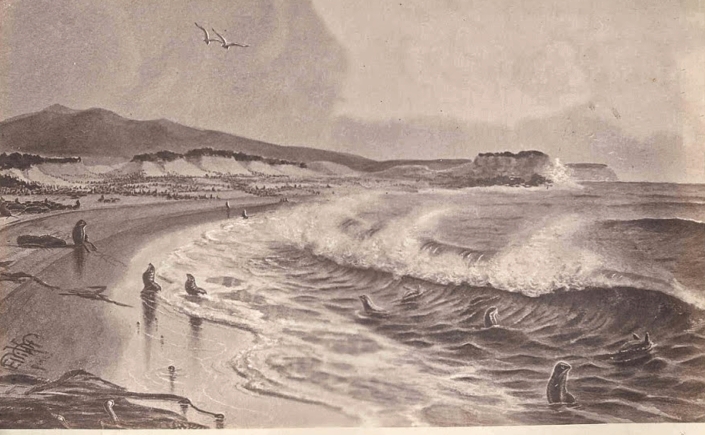
The story is set on an island in the Aleutians in the Bering Sea between Russia and Alaska. It tells of a unique seal who, by leading his fellow seals to a secret hidden beach, saves his kind from the seal hunters. He referred to his poem as “a kind of national anthem for seals”. The title of the poem is the name of a Russian seal-fur trader, Lukanin, who gave his name to these lonely Aleutian beaches in 1788. Kipling wrote: “This is the great deep-sea song that all the St. Paul seals sing when they are heading back to their beaches in the summer. It is a sort of very sad seal National Anthem”.

Back in the day, I set the poem to music. It is featured on the rare recording HuldreFolk Live in London 1988, featuring Paul Hemphill, Victor Mishalow and Adèle Hemphill. During HuldreFolk’s tour of English folk clubs in the northern summer of 1988, it was recorded on a cheap audio cassette by a dinky, clunky old analogue tape recorder – and it shows. But the natural acoustics of the cellar at Bracknell Arts Centre, and the audience’s participation in the choruses made up for a multitude of sins.

© Paul Hemphill 2024. All rights reserved

Lukannon is such a lyrical poem that it lends itself effortlessly to musical settings. Apart from my own, i have discovered three alone, and I am pretty certain that there are many more out there on the world wide web. There is a version by folk duo William Pint and Felicia Dale set to a tune by American musician Bob Zentz from their 1997 album Round the Corner. There is also a contemporary “prog-rock” version by British band Shadows of the Sun.

In 1947, the eccentric Australian expatriate composer Percy Grainger composed a song cycle of The Jungle Book and chose as his centrepiece the story of The White Seal – and particularly, Lukannon “as a protest against civilization.” For more on Grainger’s opus, see below.

Lukannon

I met my mates in the morning (and oh, but I am old!)
Where roaring on the ledges the summer ground-swell rolled;
I heard them lift the chorus that dropped the breakers’ song –
The beaches of Lukannon – two million voices strong!

The song of pleasant stations beside the salt lagoons,
The song of blowing squadrons that shuffled down the dunes,
The song of midnight dances that churned the sea to flame –
The beaches of Lukannon — before the sealers came!

I met my mates in the morning (I’ll never meet them more!);
They came and went in legions that darkened all the shore.
And through the foam-flecked offing as far as voice could reach
We hailed the landing-parties and we sang them up the beach.

The beaches of Lukannon – the winter-wheat so tall –
The dripping, crinkled lichens, and the sea-fog drenching all!
The platforms of our playground, all shining smooth and worn!
The beaches of Lukannon — the home where we were born!

I meet my mates in the morning, a broken, scattered band.
Men shoot us in the water and club us on the land;
Men drive us to the Salt House like silly sheep and tame,
And still we sing Lukannon – before the sealers came.

Wheel down, wheel down to southward; oh, Gooverooska go!
And tell the Deep-Sea Viceroys! the story of our woe;
Ere, empty as the shark’s egg the tempest flings ashore,
The beaches of Lukannon shall know their sons no more!

Percy Grainger’s Jungle Book Cycle

In 1947, the eccentric Australian expatriate composer dedicated a song cycle of The Jungle Book and chose as his centrepiece the story of The White Seal – and particularly, Lukannon. My Kipling ‘Jungle Book’ Cycle, begun in 1898 and finished in 1947, was composed as a protest against civilization.” (Grainger’s programme note, 1947)

Grainger (1882-1961) studied at the Hoch Conservatory in Frankfurt, Germany from 1895-1901 (aged 13-19). Grainger’s mother Rose wrote to her husband John of her fears that young Percy was becoming “more Germanized every day.” In response to Rose’s concern, and to “tickle up the British Lion in him,” John (who was estranged from Rose) sent Percy, among other things, several books by Rudyard Kipling . Kipling’s writings captivated Percy immediately, and he soon started writing choral settings of the poetry, especially those of Kipling’s Jungle Books.

Grainger’s settings of the poetry of Kipling are as extensive as his settings of British folk music; Kay Freyfus’s catalog of Grainger’s manuscript scores lists 36 settings, though Grainger in a 1926 letter to Kipling mentions “some 40 or 50” settings. Grainger felt a strong kinship for Kipling’s writing, and Kipling appreciated and approved of Grainger’s work at setting his poetry. Grainger played several of his choral settings for Kipling during a meeting at Kipling’s home in 1905. Of Grainger’s settings of his poetry, Kipling said, “Till now I’ve had to reply on black and white, but you do the thing for me in colour.”

The Beaches of Lukannon is the centerpiece of the cycle, and arguably the strongest piece musically and emotionally. It tells us the tale of the tragic slaughter of seals by wicked sealers from the seals’ perspective. The opening section, told from the point of view of a seal elder, recounts what the beaches of the Bering Sea Island of Lukannon originally were for the seals – their annual meeting (and mating) opportunity. The central section, reminiscent of the music of Charles Ives in its shifting chromatics, conveys the beauty of the surroundings “before the sealers came.” The final section musically revisits the opening material, but in a smore somber mode.

For more on Rudyard Kipling in In That Howling Infinite, see A Son Goes To War – the grief of Rudyard Kipling 

We did not weep when we were leaving – the poet of Nazareth

Thursday July 15, 1948, began as another ordinary day for the Ali family in the Palestinian village of Saffuriyya in the Lower Galilee. It was during Ramadan and Umm Taha was busy preparing mulukhiyah for the iftar meal to break the daily fast at sundown. The eldest son, Taha – who was also the family breadwinner – returned after a busy day at the shop. After finishing his meal, he washed his hands and went out to the field to graze two goats he had recently bought. Taha found them to be restless, but couldn’t understand their strange behavior. Suddenly, he heard a strange whirring sound. This sound intensified and then he saw two planes approaching his village. I heard a terrifying boom. I fell to the ground, my knees shaking. Then another boom, and another boom,” he would later recall. Then he heard wailing and saw smoke in the distance, and parents and children scattering in terror. He left the goats and ran toward home to find his family, but found no one there.
Sheren Falah Saab, Haaretz

Taha Muhammad Ali was born in 1931 in the village of  Saffuriyya in the Galilee, then in the British Mandate of Palestine, and now, northern Israel. He fled to Lebanon with his family after their village came under heavy bombardment during the 1948 Arab-Israeli War, part of Operation Dekel (the 10-day Israeli military campaign that captured the Lower Galilee),

They were among more than 700,000 Palestinian Arabs – about half of prewar Mandatory Palestine‘s Arab population – who from their homes or were expelled by Jewish militias and, later, the Israeli army.

We did not weep
when we were leaving –
for we had neither
time nor tears
and there was no farewell.
We did not know
at the moment of parting
that it was a parting
so where would our weeping 
have come from?”

Unlike most who fled, he returned the following year – to Nazareth, where he lived until his death in 2011. During the 1950s and 1960s, he sold religious souvenirs to pilgrims and tourists during the day to Christian pilgrims, and studied poetry at night. Self-taught, through his readings of classical Arabic literature, including Despite ending his formal studies, Ali continued to be interested in reading and writing. He was self-taught and learned the Quran and Arabic grammar and adored classical Arabic poetry. He read American fiction, and English poetry in translation. He began his poetry career in his forties. His shop in Nazareth, near the Church of the Annunciation, became a meeting place for local and visiting writers. his family settled in Nazareth and he opened a souvenir shop.

In fact, his door was always open to intellectuals and cultural figures of that era. “My shop turned into a literary salon,” he told his biographer. Prominent intellectuals and authors like Rashid Hussein, Emile Habiby and Hanna Abu Hanna visited him regularly. He mentioned that even Mahmoud Darwish, the most celebrated of Palestinian poets, and Samih Al-Qasim, who were high school students at the time, visited him and conversed with him about current events.

The Saffuriya of his youth  and the political and social upheavals he endured served as inspiration poetry and fiction that is grounded in everyday experience and driven by a storyteller’s vivid imagination.

A profile on the From the Poetry Foundation website reads:

“Taha Muhammad Ali writes in a forceful and direct style, with disarming humor and an unflinching, at times painfully honest approach; his poetry’s apparent simplicity and homespun truths conceal the subtle grafting of classical Arabic onto colloquial forms of expression. In Israel, in the West Bank and Gaza, and in Europe and in America, audiences have been powerfully moved his poems of political complexity and humanity. He has published several collections of poetry and is also a short story writer.

In a direct, sometimes humorous, and often devastating style, He combines the personal and political as he details both village life and the upheaval of conflict. Comparing Muhammad Ali to his contemporaries, John Palattella commented in a review in The Nation: “Whereas Darwish and al-Qasim, like most Palestinian poets, have favoured the elevated and ornate rhetoric of fus’ha, or classical Arabic, Muhammad Ali writes non-metrical, unrhymed poems that blend classical fus’ha with colloquial Arabic’.”

Amongst contemporary Palestinian poets, Taha was an atypical. His aversion to performing poems that referred to intifada and resistance raised numerous questions in the hothouse atmosphere Israeli and Palestinian politics and conflict. When asked his opinion on what he called “placard like-poetry”, he declared: “The poetry of the stones is fleeting, and the true poetry that lasts is that which depicts what’s behind the stones and what’s behind the intifada, which shows life brimming with feeling and sensation and pain.”

His collections in English include Never Mind: Twenty Poems and a Story (2000) and So What: New and Selected Poems, 1971–2005 (2006), both translated by Gabriel Levin, Yahya Hijazi, and Peter Cole. He traveled to read his work in Europe and the United States, including at the Geraldine R. Dodge Poetry Festival. In 2009, the writer Adina Hoffman published a biography, My Happiness Bears No Relation to Happiness: A Poet’s Life in the Palestinian Century, which won the 2010 Jewish Quarterly Wingate Prize.

Meeting at an airport

I made my first acquaintance with the poetry of Taha Muhammad Ali with a poem about a chance meeting at an airport. Aware of his background, and the tumultuous  times he lived through, it spoke to me on many levels.

In common with much contemporary Palestinian poetry, it portrays thepain of separation and of leaving home – and of exile. It recounts a chance meeting four decades after an event which we are to assume is al Nakba.

Two friends are taking their customary walk to a village spring. The language suggests that they are more than friends – he recalls how is his companion surprises with him questions that send his blood rushing. He answers and she laughs – her laughter startles the starlings into flight,

They part or are parted – we do not know which – and do not see each other again until forty years later when they just chance to bump into each other at a foreign airport in what we assume from the Arabic title of the poem, liqa’ fi matar mahayid , is a “neutral” or “friendly” airport. Are they just travelers or is his old friend an exile? Again we are not told – although Taha did not leave what became Israel, living in Nazareth all his life, so we assume it was the latter.

He is absolutely shocked to encounter his old friend. “Ya lalmuhal min al muhali!” he exclaims, using the a high Arabic idiom equivalent to “Oh my god!
“ or “wow!” He doesn’t think she recognizes him – but it is not so. She asks the very same questions she asked all those years ago. Again his blood rushes. He gives the very same answer. But this time, she does not laugh – instead, she weeps, and there no birds to sing, but invisible, heartbroken doves.

And so, two people meet at last and harbour the same feelings for each other as the first time they met long, long ago. But in life as in art, reconnecting with a loved one does not just bring joy – it can also bring sorrow and regret. It is a timeless theme – think Rick and Lisa reunited unexpectedly and ultimately temporarily in the “gin joint” in Casablanca.

I could go out on a limb and suggest that the lost love encountered at the airport could also be construed as a metaphor for the lost Palestine.

The Israeli newspaper Haaretz provides some further insight into the poem:

“He was in love with his cousin Amira, who would later become a central figure in his poems. He wanted to ask for her hand in marriage, but decided to wait until he was financially stable and had the dowry to offer her family.

On that fateful night when Saffuriyya was bombed as, his hopes of marrying Amira were shattered. He continued to carry her in his heart after his family fled to Lebanon, and he got to meet her again in the refugee camp. However, after a year, Ali’s father decided to try his luck and returned to Israel with his children. Thus, Ali’s love for Amira was buried on the day the family left the Ein el-Hilweh refugee camp.

We were not awake, and we did not fall asleep
on the night we left, that night was not a night for us
No fire was lit, no moon rose

He is not crying over the ruins. Rather, he writes about parting from his beloved Amira. There’s room for sorrow over lives that were cut short, but he always roots it in the personal, without assimilating it into the collective pain.”

Meeting at an Airport follows, in English and in Arabic, together with a selection of Taha Muhammed Ali’s poems – all translated by Peter Cole, Yahya Hijazi and Gabriel Levin

Arab poets and exile

 A million spaces in the earth to fill, here’s a generation waiting still – we’ve got year after year to kill, but there’s no going home. Steve Knightley, Exile

Historical and social memory, and indeed, remembrance and commemoration, and their opposites, forgetfulness and letting go, are intrinsic to our human story … For the exile, the refugee, the involuntary migrant, theirs’ is a yearning, a longing, an absence of belonging – an existential homelessness and rootlessness, that is almost like a phantom limb. It is a bereavement, a loss, a spiritual and cultural death that could qualifies for descriptors drawn from Elisabeth Kübler-Ross’ Five Stages of Grief: (Shock and disbelief), denial, anger, bargaining, depression, (testing) and acceptance.

One way the refugee can assuage his or her anguish is through writing. Chicago librarian and writer Leslie Williams notes: “The literature of exile encompasses bitter, impassioned indictments of unjust, inhumane regimes, but also includes wrenching melancholy for lost homes, lost families, and a lost sense of belonging. The pervasive feeling of rootlessness, of never being quite at home echoes across centuries of exile writing” (read here her The Literature of Exile).

See also, No Going Home – the refugee’s journey (1) and Hejira – the refugee’s journey (2)

Read about other Arab poets in In That Howling Infinite: O Beirut – Songs for a wounded city, Ghayath al Madhoun – the agony of an exiled poet  and Muzaffar al Nawab, poet of revolutions and sorrow 


Jerusalem Rooftops, Sliman Mansur

Jerusalem Heritage, Sliman Mansur

Hope, Sliman Mansur

Meeting at an Airport

Taha Muhammad Ali

You asked me once,
on our way back
from the midmorning
trip to the spring:
“What do you hate,
and who do you love?”

And I answered,
from behind the eyelashes
of my surprise,
my blood rushing
like the shadow
cast by a cloud of starlings:
“I hate departure . . .
I love the spring
and the path to the spring,
and I worship the middle
hours of morning.”
And you laughed . . .
and the almond tree blossomed
and the thicket grew loud with nightingales.

. . . A question
now four decades old:
I salute that question’s answer;
and an answer
as old as your departure;
I salute that answer’s question . . .

And today,
it’s preposterous,
here we are at a friendly airport
by the slimmest of chances,
and we meet.
Ah, Lord!
we meet.
And here you are
asking—again,
it’s absolutely preposterous—
I recognized you
but you didn’t recognize me.
“Is it you?!”
But you wouldn’t believe it.
And suddenly
you burst out and asked:
“If you’re really you,
What do you hate
and who do you love?!”

And I answered—
my blood
fleeing the hall,
rushing in me
like the shadow
cast by a cloud of starlings:
“I hate departure,
and I love the spring,
and the path to the spring,
and I worship the middle
hours of morning.”

And you wept,
and flowers bowed their heads,
and doves in the silk of their sorrow stumbled.

From So What New & Selected Poems, 1971-2005

لقاء في مطار محايد

طه محمد علي

سألتني
وكنا من ضُحى النبعِ
مرة
عائديْْنْ
‘ماذا تكره
ومن تُحِب؟

فأجبتُكِ
من خَلفِ أهدابِ الفُجاءة
ودمي
يُسرعُ ويُسرعْ
كظل سحابِة الزُرْزُورْ
‘اكرهُ الرحيلَ
أحبُّ النبعَ والدربَ
واعبُدُ الضُحى
فَضَحِكْتِ
فأزهرَ لوز
وشدَتْ في الايكِ أسرابُ العنادِلْ

سؤآلٌ
عُمرُه الآن عقودٌ أربعةْ
يا للْجواب من السؤالْ
وجوابٌ
عُمرُه عُمرُ رحيلك
يا لَلْسؤآلِ من الجوابْ

واليومَ
يا للْمُحالْ
ها نحن في مطارٍ مُحايِِدْ
على شفا صُدفةٍ
نَلتَقي
وّيحيْ…؟
نلتقي…؟
وها أنتِ
تُعيدين السؤالْ؟
يا لَلْمُحالِ من المُحالِْ
عَرَفْتُكِ
ولم تعرفيني
‘أهذا أنتَ؟
ولم تُصَدِّقي
وفجأة
انفجرتِ تسألين
‘إن كنتَ أنتَ أنتَ
فماذا تكره
ومن تُحبْ؟

فأجتبكِ
ودمي
يغادرُ الشُرفةْ
يُسْرعُ ويُسْرعُ
كظلِّ سحابةِ الزُرْوُرْ
‘أكره الرحيلَ
أُحبُّ النبعَ والدربَ
وأعبُدُ الضحى

فبكيتِ
فاطرقت ورُودً
وتعثرتْ بحرير حُرقتِها حَمائِمْ

Revenge

At times … I wish
I could meet in a duel
the man who killed my father
and razed our home,
expelling me
into
a narrow country.
And if he killed me,
I’d rest at last,
and if I were ready—
I would take my revenge!

But if it came to light,
when my rival appeared,
that he had a mother
waiting for him,
or a father who’d put
his right hand over
the heart’s place in his chest
whenever his son was late
even by just a quarter-hour
for a meeting they’d set—
then I would not kill him,
even if I could.

Likewise … I
would not murder him
if it were soon made clear
that he had a brother or sisters
who loved him and constantly longed to see him.
Or if he had a wife to greet him
and children who
couldn’t bear his absence
and whom his gifts would thrill.
Or if he had
friends or companions,
neighbors he knew
or allies from prison
or a hospital room,
or classmates from his school …
asking about him
and sending him regards.

But if he turned
out to be on his own—
cut off like a branch from a tree—
without a mother or father,
with neither a brother nor sister,
wifeless, without a child,
and without kin or neighbors or friends,
colleagues or companions,
then I’d add not a thing to his pain
within that aloneness—
not the torment of death,
and not the sorrow of passing away.
Instead I’d be content
to ignore him when I passed him by
on the street—as I
convinced myself
that paying him no attention
in itself was a kind of revenge.

Nazareth, April 15, 2006

ِنْتِقام

أَحْياناً
أَتَمَنّى أَن أُبارِزَ
الشَّخْصَ الذي
قَتَلَ والِدي
وَهَدَمَ بَيْتَنا
فَشَرَّدَني
في بِلادِ النّاسِ
الضَيِّقَةِ
فَإِذا قَتَلَني
أَكونُ قَدْ ارْتَحْتُ
وَإِنْ أَجْهَزْتُ عَلَيْهِ
أَكونُ قَدِ انْتَقَمْتُ!

لكِنْ…
إِذا تَبَيَّنَ لي
أَثْناءَ المُبارَزَةِ
أَنَّ لِغَريمي أُمّاً
تَنْتَظِرُهُ
أَوْ أَباً
يَضَعُ كَفَّ يَمينِهِ
عَلى مَكانِ القَلْبِ مِنْ صَدْرِهِ
كُلَّما تَأَخَّرَ ابْنُهُ
وَلَوْ رُبْعَ ساعَةٍ
عَنْ مَوْعِدِ عَوْدَتِهِ
فَأَنا عِنْدَها
لَنْ أَقْتُلَهُ إِذا
تَمَكَّنْتُ مِنْهُ

كَذلِكَ…
أَنا لَنْ أَفْتِكَ بِهِ
إِذا ظَهَرَ لي
أَنَّ لَهُ إِخْوَةٌ وَأَخَوات
يُحِبّونَهُ
وَيُديمونَ تَشَوُّقَهُمْ إِلَيْهِ.
أَوْ إِذا كانَ لَهُ
زَوْجَةٌ تُرَحِّبُ بِهِ
وَأَطْفالٌ
لا يُطيقونَ غِيابَهُ
وَيَفْرَحونَ بِهَداياه.
أَوْ إِذا كانَ لَهُ
أَصْدِقاءٌ أَوْ أَقارِبٌ
جيرانٌ مَعارِفٌ
زُمَلاءُ سِجْنٍ
رِفاقُ مُسْتَشْفى
أَوْ خُدَناءُ مَدْرَسَةٍ
يَسْأَلونَ عَنْهُ
وَيَحْرِصونَ عَلى تَحِيَّتِه

أَمَّا إِذا كانَ وَحيداً
مَقْطوعاً مِنْ شَجَرَةٍ
لا أَبٌ وَلا أُمٌّ
لا إِخْوَةٌ وَلا أَخَواتٌ
لا زَوْجَةٌ وَلا أَطْفالٌ
بِدونِ أَصْدِقاءٍ وَلا أَقْرِباءٍ وَلا جيران
مِنْ غَيْرِ مَعارِفٍ
بِلا زُمَلاءٍ أَوْ رُفَقاءٍ أَوْ أَخْدان
فَأَنا لَنْ أُضيفَ
إِلى شَقاءِ وَحْدَتِهِ
لا عَذابَ مَوْتٍ
وَلا أَسى فَناءٍ
بَلْ سَأَكْتَفي
بِأَنْ أُغْمِضَ الطَّرْفَ عَنْهُ
حينَ أَمُرُّ بِهِ في الطَّريقِ
مُقْنِعاً نَفْسي
بِأَنَّ الإِهْمالَ
بِحَدِّ ذاتِهِ هُوَ أَيْضاً

نَوْعٌ مِنْ أَنْواعِ الإِنْتِقامِ!

Below, poems from Norbert Bier’s Poetry Dispatch and othet notes from the Undergoud

Where

Poetry hides
somewhere
behind the night of words
behind the clouds of hearing,
across the dark of sight,
and beyond the dusk of music
that’s hidden and revealed.
But where is it concealed?
And how could I
possibly know
when I am
barely able,
by the light of day,
to find my pencil?

from SO WHAT New & Selected Poems, 1971-2005, Copper Canyon Press, 2006,

Empty Words

Ah, little notebook,
yellow as a spike of wheat
and still as a face,
I’ve protected you
from dampness and rodents
and entrusted you with
my sadness and fear,
and my dreams—
though in exchange I’ve gotten from you
only disobedience and betrayal…
For otherwise where are the words
that would have me saying:
If only I were a rock on a hill…
unable to see or hear,
be sad or suffer!
And where is the passage
whose tenor is this:
I wish I could be
a rock on a hill
which the young men
from Hebron explode
and offer as a gift to Jerusalem’s children,
ammunition for their palms and slings!

And where is the passage
in which I wanted
to be a rock on a hill
gazing. out from on high
hundreds of years from now
over hordes ,.
of masked liberators!

And where is what belongs
to my dream of being
a rock on a hill
along the Carmel—
where I call on the source of my sadness,
gazing out over the waves
and thinking of her
to whom I bade
farewell at the harbor pier
in Haifa forty years ago
and still…
I await her return
one evening
with the doves of the sea.

Is it fair, little notebook,
yellow as a spike of wheat
and still as a face,
that you conceal
what you cancel and erase,
simply because it consists of empty words—
which frighten no enemy
and offer no hope to a friend?

From Never Mind – Twenty Poems and a Story,

Twigs

Neither music,
fame, nor wealth,
not even poetry itself,
could provide consolation
for life’s brevity,
or the fact that King Lear
is a mere eighty pages long and comes to an end,
and for the thought that one might suffer greatly
on account of a rebellious child.

My love for you
is what’s magnificent,
but I, you, and the others,
most likely,
are ordinary people.

My poem
goes beyond poetry
because you
exist

Abd al Hadi Fights a Superpower 

In his life
he neither wrote nor read.
In his life he
didn’t cut down a single tree,
didn’t slit the throat
of a single calf.
In his life he did not speak
of the New York Times
behind its back,
didn’t raise
his voice to a soul
except in his saying:
“Come in, please,
by God, you can’t refuse.”

Nevertheless—
his case is hopeless,
his situation
desperate.
His God-given rights are a grain of salt
tossed into the sea.

Ladies and gentlemen of the jury:
about his enemies
my client knows not a thing.
And I can assure you,
were he to encounter
the entire crew
of the aircraft carrier Enterprise,
he’d serve them eggs
sunny-side up,
and labneh
fresh from the bag.

The Palestinian poet who never lamented the occupied land

Sheren Falah Saab, Haaretz, August 30 2023

The play ‘Taha’ offers a glimpse into the life of a poet who eschewed politics, preferring to write about personal pain and lost masculinity

The late poet Taha Muhammad Ali.
The late poet Taha Muhammad Ali. Nina Subin
Thursday July 15, 1948, began as another ordinary day for the Ali family in the Palestinian village of Saffuriyya in the Lower Galilee. It was during Ramadan and Umm Taha was busy preparing mulukhiyah for the iftar meal to break the daily fast at sundown.
The eldest son, Taha – who was also the family breadwinner – returned after a busy day at the shop. After finishing his meal, he washed his hands and went out to the field to graze two goats he had recently bought. Taha found them to be restless, but couldn’t understand their strange behavior. Suddenly, he heard a strange whirring sound. This sound intensified and then he saw two planes approaching his village.
“I heard a terrifying boom. I fell to the ground, my knees shaking. Then another boom, and another boom,” he would later recall. Then he heard wailing and saw smoke in the distance, and parents and children scattering in terror. He left the goats and ran toward home to find his family, but found no one there.
The story of Taha, from an eponymous play that was recently published in Hebrew (as part of the Maktoob project that translates Arabic literature into Hebrew), is based on the life of the Palestinian poet Taha Muhammad Ali, who died in 2011 at age 80.
הכפר ספוריה 1948

Amer Hlehel, the actor and playwright who wrote the play, takes the reader on a reflective journey through the poet’s personal life: from his escape from Saffuriyya as a teenager in 1948 following the occupation of the village, through his adaptation to life in a Lebanese refugee camp, to his return to Israel, which was fraught with dangers.

The play was first produced in 2014 and performed in Arabic at the Al-Midan Theater in Haifa. It was subsequently staged in Nazareth, Jerusalem and Ramallah, and was well-received by Palestinians on both sides of the Green Line. In the play, Hlehel incorporates quotes from things Ali said in interviews and in his meetings with him, as well as excerpts from his poetry.

Writing about leaving their Galilee village, Ali writes: “We did not weep / when we were leaving – for we had neither / time nor tears / and there was no farewell. / We did not know / at the moment of parting / that it was a parting / so where would our weeping / have come from?”

In the play, just as in real life, Ali does not manage to overcome the personal pain, but confronts it by writing poetry. He does not weep for the stones of the house that were destroyed, nor for the land that was occupied, but for the love that he lost and the life that ceased to exist.
Taha Muhammad Ali. 'He is not crying over the ruins. Rather, he writes about parting from his beloved Amira. There’s room for sorrow over lives that were cut short, but he always roots it in the personal, without assimilating it into the collective pain.'

Taha Muhammad Ali was born in Saffuriyya in 1931. At age 10, he stopped his formal education in order to help his father support the family. Later, he opened a grocery store in the village, as described by Hlehel in the play: “I opened the diwan [central room] in our house, which overlooked the main road. I filled the shelves with cigarettes and chocolate and halvah and chewing gum and pens, and the crown jewel was a block of ice inside a bowl with bottles of orange-, apple- and lemon-flavored soda.”

Despite ending his formal studies, Ali continued to be interested in reading and writing. He was self-taught and learned the Quran and Arabic grammar thanks to his neighbor, il-Hajj Taher. “He had a shelf of books and called it a library: the people of the village would read and return them,” he recounted in an interview with Adina Hoffman, who wrote the biography of Ali’s life, “My Happiness Bears No Relation to Happiness: A Poet’s Life in the Palestinian Century.”
It was through Taher’s books that Ali learned about the poets of the Umayyad and Abbasid dynasties (between the seventh and eighth centuries, and eighth and 13th centuries, respectively), and fell in love with classical Arabic poetry.
The sacrifices Ali made on behalf of his family reveal a generous and reserved personality. He was in love with his cousin Amira, who would later become a central figure in his poems. He wanted to ask for her hand in marriage, but decided to wait until he was financially stable and had the dowry to offer her family.
Dr. Daniel Behar. 'Taha Muhammad Ali had a talent to separate himself from the bitterness and political performance that surrounded Palestinian poetry.'

On that fateful night when Saffuriyya was bombed as part of Operation Dekel (the 10-day Israeli military operation that captured the Lower Galilee), his hopes of marrying Amira were shattered. He continued to carry her in his heart after his family fled to Lebanon, and he got to meet her again in the refugee camp. However, after a year, Ali’s father decided to try his luck and returned to Israel with his children. Thus, Ali’s love for Amira was buried on the day the family left the Ein el-Hilweh refugee camp.

In an interview with Hoffman, Ali described that moment as really tough. He immortalized this moment in a poem that is quoted in the play: “We were not awake, and we did not fall asleep / on the night we left, that night was not a night for us / No fire was lit, no moon rose.”
“Taha Muhammad Ali dedicates space to personal sadness in his poetry,” says Daniel Behar, a lecturer in modern Arabic literature at the Hebrew University who translated Ali’s poems for the play. He stresses that Ali’s poems distance themselves from performative-collective lamentation. “He is not crying over the ruins. Rather, he writes about parting from his beloved Amira. There’s room for sorrow over lives that were cut short, but he always roots it in the personal, without assimilating it into the collective pain.”
According to Behar, Ali decided to write in such a personal style as he was not writing with a specific audience in mind.
Ali confirmed these observations while speaking with Hoffman, when he said he would throw his writing “in the drawer and forget about it.” He said he had never thought of becoming a poet or publishing his poems, even though he was interested in culture and literature. After his return from Lebanon in the fall of 1949, his family settled in Nazareth and he opened a souvenir shop. In fact, his door was always open to intellectuals and cultural figures of that era.
'As I read his poems, I felt it was important for the Hebrew audience to get to know him,' says Guy Elhanan, a theater director, actor and translator of the play 'Taha.'

“My shop turned into a literary salon,” he told Hoffman. Prominent intellectuals and authors like Rashid Hussein, Emile Habiby and Hanna Abu Hanna visited him regularly. He mentioned that even Mahmoud Darwish and Samih Al-Qasim, who were high school students at the time, visited him and conversed with him about current events.

But, adds Behar, Ali’s poetry was different from the works of well-known Palestinian poets like Darwish, Tawfiq Zayyad and Al-Qasim, who often focused on Palestinian heroism. “Taha Muhammad Ali had a talent to separate himself from the bitterness and political performance that surrounded Palestinian poetry,” he notes. According to Behar, “his writing was intended to fill the silence of the archive for marginalized forms of life and nameless experiences, and whose voices were absent from written history.”
In 1983, Ali published his first collection of poems, “The Fourth Qasida [ode] and Ten More Poems.” This happened only after his friends urged him to publish his work. He later published a collection of stories, “Fooling the Killers” (1989), and three more collections of poetry: “Fire in the Convent Garden” (1992), “God, Caliph and the Boy with Colorful Butterflies” (2002) and “No More” (2005). A collection of his poems was published in Hebrew in 2006, translated by the author and poet Anton Shammas (published by Andalus).
The cover of Hebrew translation of the play 'Taha.'

“As I read his poems, I felt it was important for the Hebrew audience to get to know him,” says Guy Elhanan, a theater director, actor and translator of the play “Taha.”

One of the key motifs in Ali’s poetry was his native village. “Saffuriyya was dear to his heart and his love for it stood out in all his poems,” says Behar. Taha’s brother, Amin Muhammad Ali, said in an interview with the Al-Raed channel in 2016 that “the village never left him.” He added that his brother documented the small and large details in Saffuriyya throughout his life – in conversations with people, in his poetry, both day and night. The Palestinian poet Naji Daher from Nazareth added in an interview with the same Arab channel that “Ali carried Saffuriyya in his heart everywhere, and he also succeeded in conveying it to the world at large.”
The poem “Abd el-Hadi Fights a Superpower,” written by Ali in 1973 and published in Hebrew in 2006, embodies his approach as a poet. He does not write about Palestinian heroes seeking revenge against the Jews, nor does he try to conceal the sense of defeat and lost masculinity. In the poem, he portrays the character of the village fool Abd el-Hadi as an illiterate person who does not even know what The New York Times is. Between the lines, Ali reveals parts of himself, drawing the reader closer to him. “You can see aspects of Taha Muhammad Ali in the character of Abd el-Hadi – he has a joy and love of life that punctures the sadness and gives value to human love,” says Behar.
Ali concludes the poem with a description of Abd el-Hadi’s forgiving behavior: “Ladies and gentlemen of the jury / about his enemies my client knows not a thing / And I can assure you / were he to encounter the entire crew of the aircraft carrier Enterprise / he’d serve them eggs sunny-side up / and labneh fresh from the bag.”
According to Behar, in this poem (and others), Ali plays with words and sounds that were not customary in Palestinian poetry, offering sharp transitions between dialect and a high literary language.
In 2007, in an interview with the U.S. television program “PBS NewsHour,” Ali talked about his attempts to write poetry in the years after he left school. “This went together, reading and trying to write,” he said. “You have to take the pen and to take a paper, and to be ready to wait for it – otherwise it will come and you are not there. As a writer, you have to train yourself to write. Write anything, but everyday.”
Eight months after the outbreak of the second intifada at the start of the 2000s, Ali was published in London. He and Al-Qasim gave poetry readings to audiences in the British capital. Al-Qasim read his “Poem of the Intifada,” an indictment of those he called “Occupiers Who Do Not Read.” Ali, on the other hand, read distinctly different poems. “None of the poems he read contained a single direct reference to the uprising, to the ‘struggle,’ to children or to stones,” Hoffman wrote in her book.
His aversion to performing poems that referred to the intifada raised numerous questions. Hoffman noted in her book that he was indeed asked his opinion on what she called “placard like poetry.”
“The poetry of the stones is fleeting,” he declared, “and the true poetry that lasts is that which depicts what’s behind the stones and what’s behind the intifada, which shows life brimming with feeling and sensation and pain.”


McGoohan’s Blues – sunbathing in the rain

All along the ancient wastes the thin reflections spin
That gather all the times and tides at once we love within
That build the edges round the shrouds that cloud the setting sun
And carry us to other days and other days to one

Roy Harper, The Same Old Rock, Stormcock

It must’ve been May 1969. A cold, wet and windy day in Hull, Yorkshire. I’d hitch-hiked from Reading in Berkshire to London and then northwards on the A1 to visit an old school chum in the Humberside port city. And it is there, in a student share house that I first dropped Mescaline, a derivative of peyote, an hallucinogenic psychotropic favoured by Mexican shamans of yore. In our circles, it was prized for its visual and aural delights rather than the more ”head trip”, mood-manipulating and psychologically unpredictable and potentially unsettling lysergic acid. And that evening, headphones on, I first listened to McGoohan’s Blues.

This eighteen minute digression from the concept if not the plot of an iconic if indecipherable ‘sixties’ television series (that’s the featured picture), was the penultimate track on Folkjokeopus, the third album of English folk singer, songwriter and acoustic guitarist extraordinaire Roy Harper. The song was indeed the whole point of Folkjokeopus – its raison d’être- the rest of the album was predominantly light-weight, comedic psychedelia – with the exception of the bleak and bitter but nevertheless captivating “love gone wrong” song She’s The One.

Wikipedia and generic music sites tell us that Folkjokeopus was released in June 1969, but more hip sources reckon it was released on May Day – and my memory concurs with that because Spring sprung as I was hitching homeward, and I reveled in the record all summer long.

Though I’d been going to folk clubs for several years, I’d not heard much of Roy Harper apart from a throwaway hippie-vaudeville track from his second album on The Rock Machine Turns You On, one of the many popular ”sampler” albums of that. The best was CBS’ double album gatefold Fill Your Head With Rock (loosely defined – it included Leonard Cohen and Laura Nyro).

Sunbathing in the rain …

And how does it feel with your god strapped to your wrist?
And him leading you such a chase …

Roy Harper, How Does It Feel, Flat Baroque and Berserk 

So, there was I, on Humberside in a space “somewhere between Heaven and Woolworths”, to borrow from contemporary Mersey poet Brian Patten, who I was into at the time, listening to a sprawling and bawling, angry, eighteen minute solo acoustic guitar-driven folkie rant against capitalism, consumerism, hedonism, religion, conformity, ignorance, deceit, hypocrisy, the system, the establishment, the plutocracy, the banks, the media, the baubles and bibles, modern life … everything really. You can’t fight the manipulated, oppressive, powerless, pointless and utter futility of it all – as the song unfolds, you start out questioning, but you end up obeying.

The singer had indeed become the eponymous Prisoner, yearning for liberty but trapped in a deceptively bucolic and scenic and yet sinister “village” that is in reality an open-air jail – kind of nightmare Butlins Holiday Camp (beloved yet satirised by a generation of Britons) with all attempts at escape foiled. It was in fact filmed in Portmeirion in North Wales, a town that has developed a robust tourist industry on the back of the cult classic.

Patrick McGoohan and Virginia Maskell in  The Prisoner

Roy Harper was twenty-eight years of age and already a jaded veteran of the folk-circuit and ad bitter divorcee with heavy personal baggage, a wee son he dotes on and chips on both shoulders (well-balanced, I suppose) raging against the machine. His is a seemingly nihilistic anomie with no direction home, denouncing “the deceit of my friends the betrayals of which I am part …” He sees himself as an outsider, “the festive consumer who end up consumed by the feast”, but nevertheless questioning “the rules and the codes and the system that keeps them in chains, which is where they belong with no poems, no love and no brains”.

This is reflected in many of his songs from that era, most particularly those featured on his fifth and to many, his best album, Stormcock, released in May 1971; and this led me then and always to regard him a kind of high priest of Anglo angst.

There’s this from 1970’s Flat, Baroque and Berserk, already quoted above:

And how does it feel to be the master’s right hand nose?
How does it feel to be lieutenant?
And how does it feel to be stood on someone’s toes?
With a leech bleeding you for rent
When you say you want a bit more rank
You wanna be a big wheel
You can feel magnified if you hide in your pride
It’s not real
And how does it feel with a white flag in your fist?
How does it feel to have two faces?
And how does it feel with your god strapped to your wrist?
And him leading you such a chase

During my many, many years on the hamster wheel as the mater’s right-hand nose, I would often remember often that penultimate line.

In 1969, Roy had a few more years on the clock than me. I was twenty. A naïf, ingenue, whatever, at the end of the beginning of my journey. I was optimistic, adventurous, devil-may-care, inexperienced with people and their variegated behaviours, untainted by pride and prejudice, and in retrospect unfamiliar with the bitterness and vitriol that he injected into his song. But I guess I “got it”, understood what he was saying to me through those headphones in the sanctum of my “trip” – yeah, that’s where I was at that point in time, for the want of a better description. Though I was aware of what he was preaching, I’d had precious little direct experience – those lessons were down the road apiece, and not that far away either. But that’s another tale … long story short, I was radical when I first heard the song. I remain so half a century hence. And. I still “get it”!

The title of this article, by the way, is taken from an entertaining an informative book by Welsh author Gwyneth Lewis: Sunbathing in the Rain – a cheerful book about depression. This is not to suggest that Roy Harper is actually a depressive – but he’s certainly a master of writing excruciatingly sad, depressing and borderline nihilistic songs and delivering them with an angry, emotional intensity. Having seen him perform live many many times over the following five years, I recall that many times he would deliver rambling and even disjointed introductions and extended soliloquies that taxed his audience’s patience and forbearance. I once walked out at the interval during a gig at the Royal Albert Hall even though he was accompanied by guitar icon and Led Zeppelin alumni Jimmy Page. The songs did indeed mirror the man.

Roy in his seventies, still rockin’ in the free world

But, back to Hull and my headphones …

Having ridden the rollercoaster through the seemingly stream of consciousness rant for some ten minutes, Roy imperceptibly segues into a lyrical, calmer (though still edgy) and quieter mood, a dreamy, trippy vision of hope and resilience, suggesting that despite all the difficulties and diversions, the compromises and cop outs that went with being enveloped, embedded, trapped even, in the system, there is still hope for a better future. And climaxes in a folk-rock coda cum apotheosis.

The band kicked in – and so did the mescaline. Listening today, the band’s entry entrance feels contrived and ponderous, but in my mind’s eye, I can still recall the multicoloured images that flashed across bay closed eyelids. Disneyesque “Fantasia” forms of many ebbed and flowed, shape-shifted and morphed with the music and the lyrics. Rivers and rainbows, fairies and fires, sunrise and sunset, galaxies and stars.

Under the toadstool lover down by the dream
Everything flowing over rainbows downstream
Silver the turning water flying away
I’ll come to see you sooner I’m on my way
And there’s a mirror that I’m looking straight through
And I get it
And there’s a doorway that I’m ducking into
To forget it
But flashing just beyond the sky
The shattering midnight gathers
And reminding me behind my mind
The earth quakes, the sun flakes flutter

Over the mountain fairground
Candy flies stay
Under the moonshine fountain
I’m on my way
Lemon tree blossom ladies
Poured my tea
After the blue sky breezes following me
There’s a river that I’m making it with
And I know it
And I’m floating to I don’t care where
I just go it
But flashing just beyond the sky
The shattering midnight gathers
And reminding me behind my mind
The earth quakes, the sun flakes flutter

Daffodil April petal hiding the game
Forests of restless chessmen life is the same
Tides in the sand sun lover watching us dream
Covered in stars and clover rainbows downstream
And the question in the great big underneath is forever
And the fanfare that I’m forcing through my teeth answers “Never”
But flashing just beyond the sky
The shattering midnight gathers
And reminding me behind my mind
The earth quakes, the sun flakes flutter …

But it was not Roy’s way to end on a brighter note. As with all trips, there is often a comedown:

The pumpkin coach and the rags approach
And the wind is devouring the ashes

Words and images such as those McGoohan’s apotheosis were commonplace back in those days, when Marc Bolan could warble “My people were fair, and had sky in their hair, but now they’re content to wear crowns stars on their brows“. We thoroughly understood that and empathized. And we marveled at the Scottish bard who could pen ‘The Minotaur’s Song‘ and ‘Job’s Tears‘, and then run off with Old Father Hubbard. But then didn’t we all in the days when Tolkien was king, and elves and ents walked amongst us. So when Roy went gambolling through toadstools and daffodils, fairgrounds and fountains, that was just the way it was back then in that Middle Earth between Shangri La and the real world that we’d have to re-enter sooner or later – which I did adventurously two years later.

… down through the years

I dropped mescaline and acid many times over the next few months but though I longed to repeat it, never again did I recreate that very first journey. By year’s end, I’d done with both, and by the end of the eighties, was done with dope. But I remember it still over half a century down the road and I still get flashbacks and glimpses of those fantastical images … How does the great song by that Irish band go?

Unicorns and cannonballs, palaces and piers
Trumpets, towers, and tenements, wide oceans full of tears
Flags, rags, ferry boats, scimitars and scarves
Every precious dream and vision underneath the stars
Yes, you climbed on the ladder with the wind in your sails
You came like a comet blazing your trail
Too high, too far, too soon
You saw the whole of the moon

And what happened next? I graduated, travelled, moved on, and following Roy’s lead, wrote lengthy, opaque songs well over ten minutes long with sonic, narrative and lyrical transitions just like he had done on Folkjokeopus and Stormcock. These include London John and Christopher Columbus in the seventies, and in latter days In That Howling Infinite which gave its name to this blog, an allegorical saga of a Mad Sea Captain and a White Whale, the dystopian E Lucivan le Stelle, and the irreverent O Jerusalem.

I’ve harked back to Roy Harper in several posts in In That Howling Infinite. There’s When An Old Cricketer Leaves The Crease, a eulogy to one of my oldest friends, an avid cricketer who passed last year; and Back in the Day, a chronicle of roots and fruits.  And for more stories like these in In That Howling Infinite, see Tall Tales, Small Stories, Eulogies and Epiphanies.

As for Roy Harpe, he is eighty three, with some thirty albums under belt. He was still touring in 2019, but is now officially retired’, and living in a secluded corner of Ireland,

© Paul Hemphill 2023 All rights reserved

The complete lyrics of McGoohan’s Blues follow the song below.

“I am not a number. I am a free man!” What was The Prisoner?

A Facebook group called Silver Screen Hub posted the following on 26 May 2025:

“What kind of mad genius builds a show like The Prisoner and drops it on 1967 television like a philosophical hand grenade? Patrick McGoohan, that’s who—a man too intense to play James Bond (he turned it down), yet too restless to stay in the spy-fi comfort zone of Danger Man. So he created something far weirder, more provocative, and utterly uncategorizable. The Prisoner  is what happens when a Cold War paranoia thriller gets hijacked by Kafka, Orwell, and a pinch of Lewis Carroll, then force-fed into a psychedelic blender. It starts like an espionage mystery, but by the end, we’re in a surreal, existential theme park ride where the rails vanish and the ride turns inward.

For the first batch of episodes, the hook is clean: Number Six resigns from British Intelligence for reasons unknown. He’s abducted and wakes up in the Village, a whimsically sinister resort-like prison where everyone has a number, no one uses names, and nothing is quite as it seems. Each new Number Two—those middle managers of manipulation—takes their turn trying to crack the riddle of his resignation. Why did he quit? Was he going to defect? Is he a threat, or just an enigma wrapped in a black turtleneck? It’s a classic “information is power” game, and Six refuses to play. That stubborn defiance—his relentless “I am not a number, I am a free man!”- is more than a catchphrase. It is the moral engine of the show.

But as the series barrels toward its final episodes, the narrative glue begins to melt. “Fall Out,” the finale, detonates any sense of traditional resolution. Suddenly we’re dealing with masked judges, dancing robed figures, Beatles songs, and an underground lair that feels like Monty Python got hired to direct 1984. The reveal—that Number One is, in fact, Number Six himself (or at least his own darker self)—doesn’t just bend the show’s premise, it vaporizes it. What began as a battle of wills between prisoner and captors transforms into a full-blown identity crisis. We’re left not with answers, but with allegory, ambiguity, and the unnerving suspicion that the Village isn’t just a place. It’s a condition.

So, why was Number Six in the Village? The surface-level answer is: because he quit and they couldn’t risk what he knew. But that’s just the narrative scaffolding. McGoohan had bigger fish to fry—he wasn’t interested in tidy spy plots. The Village, in the end, is less about geography and more about psychology. It’s conformity. It’s societal pressure. It’s the quiet terror of losing your individuality in a world that insists you define yourself by the systems you serve. Number Six’s imprisonment is the cost of his nonconformity—and maybe, his own unresolved ego. In that light, the final episodes aren’t incoherent so much as unflinchingly internal.

What makes The Prisoner brilliant—and infuriating—is that it never lets you settle. It evolves from a stylish spy series into a metaphysical character study, then swerves into satirical opera. No one episode is like the next. “The Chimes of Big Ben” feels like *Mission: Impossible* with better tailoring; “Living in Harmony” is a Western pastiche with mind control; “Once Upon a Time” is a claustrophobic descent into madness. And “Fall Out”? That’s McGoohan lighting the whole set on fire while cackling in Esperanto. The studio was stunned. Audiences were baffled. And fifty years later, we’re still unpacking it.

In Hollywood, that kind of swing-for-the-fences storytelling is rare, especially in an era when networks wanted neat resolutions and smiling leads. McGoohan didn’t care. He wrote, directed, and performed with the fevered conviction of a man trying to warn the world about something too dangerous to name. If Number Six is trapped in the Village, it’s because we all are. Our habits, our fears, our roles—we build our own prisons.T he Prisoner just had the guts to show us the bars.”

McGoohan’s Blues

Nicky my child he stands there with the wind in his hair
Wondering whether the water the wind of the where
I fear that someday he might ask me if mine is the blame
And I’ve got no reply save to tell him it’s all just a game
And Heather and I lay together and I was in love
She weighted up the gains and the losses and gave me the shove
The fear of mankind’s untogetherness pounds in my heart
The deceit of my friends the betrayals of which I am part
And O how the sea she roars with laughter
And howls with the dancing wind
To see my two feet standing here questioning

And I’m just a social experiment tailored to size
I’ve tried out the national machine and the welfare surprise
I’m the rich man the poor man the peace man the war man the beast
The festive consumer who ends up consumed in the feast
And my fife eyed promoter is clutching two birds in the bush
He’s a thief he’s as bad as the joker they’re both in the rush
He’s telling me Ghandi was handy and Jesus sold his ring
(Dunno who to, God maybe)
“And everyone knows dat dis dough’s gonna make me de king”

And O how the sea she roars with laughter
And howls with the dancing wind
To see my two feet standing here questioning

Meanwhile the ticket collectors are punching their holes
Into your memories your journeys and into your souls
Your life sentence starts and the judge hands you down a spare wig
Saying: “Get out of that and goodbye old boy have a good gig”
And the town label makers stare down with their gallery eyes
And point with computer stained fingers each time you arise
To the rules and the codes and the system that keeps them in chains
Which is where they belong with no poems no love and no brains

And O how the sea she roars with laughter
And howls with the dancing wind
To see my two feet standing there questioning

Meanwhile the TV commercials are sweeping the day
Brainwashing innocent kids into thinking their way
The wet politicians and clergymen have much to say
Defending desires of the sheep they are leading astray
And Ma’s favourite pop star is forcing a grin he’s a smash
Obliging the soft-headed viewers to act just as flash
The village TV hooks its victims on give away cash
The addicts are numbers who serve to perpetuate trash

And O how the sea she roars with laughter
And howls with the dancing wind
To see my stupid poetry shuffleing

And the bankers and tycoons and hoarders of money and art
Full up with baubles and bibles and full of no heart
Who travel first class on a pleasure excursion to fame
Are the eyes that are guiding society’s ludicrous aim
And the village is making its Sunday collection in church
The church wobbles ‘twixt hell and heaven’s crumbling perch
Unnoticed the money box loudly endorses the shame
As the world that Christ fought is supported by using his name

And O how the sea she roars with laughter
And howls with the dancing wind
To see my stupid poetry burbling

And the pin-striped sardine-cum-magician is packed in his train
Censoring all of the censorship filling his brain
He glares through his armour-plate vision and says “Hmm, insane”
The prisoner is taking his shoes off to walk in the rain
And the luminous green prima donna is sniffing the sky
She daren’t tread the earth that she’s smelling her birth was too high
Her bank balance castle is built on opinion and fear
Which is all she allows within three hundred miles of her ear

And O how the sea she roars with laughter
And howls with the dancing wind
To see my stupid poetry burbling

And I’ve seen all your pedestal values your good and your bad
If you really believe them your passing is going to be hard
And I’ve thought through our thought and I know that its blind silly season
Occurs when our reasoning is trying to fathom a reason
And if you really know it’s all a joke but you’re just putting me on
Well it’s sure a good act that you’ve got ‘cos you never let on
But if all of that supersale overkill world is for real
Well there’s nowhere to go kid so you might as well start to freewheel

And O how the sea she roars with laughter
And howls with the dancing wind
To see my two feet standing there burbling

And I had this dream in here same time as standing awake
These various visions rushed through as I giggled and quaked
The distant guns thunder my end and I duck for a while
Auntie Lily is handing me candy she chuckles I smile
And our village is where I was born and it’s where I will die
And I’ll never be able to leave it whatever I try
The ebb and the flow of the forces of life pass me by
Which is all that I’ll know from my birth to my last gasping sigh

And O how the sea she roars with laughter
And howls with the dancing wind
To see the dying lying there obeying

My age and my time
The blood fire wine and rhyme
That fills my dream reminds me of an atom in a bubble on a wave
That held its breath for one sweet second then was popped and disappeared
Into fruitful futilities meaningless meaning
Meaningless meaning

Under the toadstool lover down by the dream
Everything flowing over rainbows downstream
Silver the turning water flying away
I’ll come to see you sooner I’m on my way
And there’s a mirror that I’m looking straight through
And I get it
And there’s a doorway that I’m ducking into
To forget it
But flashing just beyond the sky the shattering midnight gathers
And reminding me behind my mind the earth quakes the sun flakes flutter

Over the mountain fairground
Candy flies stay
Under the moonshine fountain
I’m on my way
Lemon tree blossom ladies
Poured my tea
After the blue sky breezes following me
There’s a river that I’m making it with
And I know it
And I’m floating to I don’t care where
I just go it
But flashing just beyond the sky the shattering midnight gathers
And reminding me behind my mind the earth quakes the sun flakes flutter

Daffodil April petal hiding the game
Forests of restless chessmen life is the same
Tides in the sand sun lover watching us dream
Covered in stars and clover rainbows downstream
And the question in the great big underneath is forever
And the fanfare that I’m forcing through my teeth answers “Never”
But the flashing just beyond the sky the shattering midnight gathers
And reminding me behind my mind the earth quakes the sun flakes flutter

The pumpkin coach and the rags approach and the wind is devouring the ashes

I am the enemy you killed – Wilfred Owen’s solemn testament

If you could hear, at every jolt, the blood
Come gargling from the froth-corrupted lungs,
Obscene as cancer, bitter as the cud
Of vile, incurable sores on innocent tongues,
My friend, you would not tell with such high zest
To children ardent for some desperate glory,
The old Lie: Dulce et decorum est
Pro patria mori.

Poet Wilfred Owen died on 4 November 1918 – seven days before the guns fell silent in the war that people though would end all wars – as it turned out, the Treaty of Versailles became the peace that ended all peace.

That “old Lie,” from which his most famous poem Dulce et Decorum Est takes its title, comes from the Roman poet Horace. No bitter irony was intended, though, as Horace beseeched Romans to embrace the cleansing fire of a noble death.

In a brief article in the e-zine Quillette, titled The End of War Poetry, Simon British stand-up comic, satirist, writer, and broadcaster Simon Evans wrote:  “Privately, I still find the idea of young men gladly ploughing themselves back into the earth of their homeland unbearably moving. But after Owen, recreating such an ecstatic embrace of death in the service of a greater cause became as impossible as nailing Christ back onto the cross, or rather, nailing that cross back onto the wall”.

As Evans observes, the First World War at least gave us some of the most cherished and painfully beautiful verse in our history. “Poetry bubbled from the trenches in France as abundantly as methane, oaths, and blisters … [and] central to earlier war poetry was the tension between the terror, devastation, and death on one hand, and the opportunity for virtues like loyalty and honour on the other”.

Contemplating explanations, he writes that a junior officer’s prospects of survival were considerably worse than those of his men. According to one account, as little as six weeks. That might explain the poetry. Such a violently diminished life expectancy must have focused the mind wonderfully. World War Two was—on that score at least—considerably more democratic and egalitarian … By 1939, the culture had shifted for officers and men alike. The practice of soldiers carrying a slim volume of Browning or Keats, and of aspiring to emulate whoever was in their pockets, had passed. In 1914, the available persona of the poet was still vital—or seems so now, in sepia vignette. He was the sensitive man quietly scratching a wet match against sandpaper and putting it to a candle, careful not to wake the slumbering cattle. Ignoring the grotesque shadows that leapt in the dug-out, he would unfold his notebook, its neat ruled lines like trenches in which the words would hunker, later pressed against his breast as a Talisman once returned to his pocket. Working slowly through his exhaustion and his tobacco ration, setting down his impressions in bottled ink, striving with purpose to resolve the lunacy and the oceans of spilt blood just a few dark yards away”.

Second lieutenant Wilfred Owen, 25 years of age, was one of the last to die in a war that claimed 20 million dead and 20 million injured.  At least for the past half-centur­y, his poems have served as a prism through which the so-called Great War is viewed. But, despite being anthologised by his friend Siegfried Sassoon in 1920 and Edmund Blunden a decade later, they did not enter popular parlance until pacifist composer Benjamin Britten incorporated some of Owen’s most pot­ent verses in his War Requiem, written for the 1962 inauguration of the restored Coventry Cathedral

Gassed, John Singer Sargent 1919

Owen entered Britain’s national curriculum during the 1960s, and eventually the high school curricula of Commonwealth nations, which is where I first encountered him – and I was shocked by his viscer­al descriptions and implicit denunciations of war. He did not dwell on the causes but seemed to suggest that the sheer awfulness of military conflict between nations had stripped away all justifications.

“There had been many wars before, of course, but none where the poet was the soldier and, therefore, the intimate witness. This war was the rendering of wounds, both flesh and spiritual, by words”.

We republish below two excellent articles on Wilfred Owen and the poets of the First World War.

Othe posts in In That Howling Infinite: Dulce et Decorum est – the death of Wilfred Owen. A Son Goes To War – the grief of Rudyard Kipling and November 1918 – the counterfeit peace

Bent double, like old beggars under sacks,
Knock-kneed, coughing like hags, we cursed through sludge,
Till on the haunting flares we turned our backs,
And towards our distant rest began to trudge.
Men marched asleep. Many had lost their boots,
But limped on, blood-shod. All went lame; all blind;
Drunk with fatigue; deaf even to the hoots
Of gas-shells dropping softly behind.

Gas! GAS! Quick, boys!—An ecstasy of fumbling
Fitting the clumsy helmets just in time,
But someone still was yelling out and stumbling
And flound’ring like a man in fire or lime.—
Dim through the misty panes and thick green light,
As under a green sea, I saw him drowning.

In all my dreams before my helpless sight,
He plunges at me, guttering, choking, drowning.

If in some smothering dreams, you too could pace
Behind the wagon that we flung him in,
And watch the white eyes writhing in his face,
His hanging face, like a devil’s sick of sin;
If you could hear, at every jolt, the blood
Come gargling from the froth-corrupted lungs,
Obscene as cancer, bitter as the cud
Of vile, incurable sores on innocent tongues,—
My friend, you would not tell with such high zest
To children ardent for some desperate glory,
The old Lie: Dulce et decorum est
Pro patria mori.

Qurba-n قُرْبان

Sacrifice -Rayner Hoff, Anzac Memorial, Hyde Park, Sydney

War poet Wilfred Owen: sweet and honourable lie 

Artwork: Sturt Krygsman.

Artwork: Sturt Krygsman.

Mahir Ali, Weekend Australian, 10th November 2018

During a visit to London in 1920, Bengali poet, philosopher and polem­icist Rabindranath Tagore receive­d an unexpected letter from a Mrs Susan Owen. She wished to share some information about her favourite son.

“It is nearly two years ago, that my dear eldest son went out to the War for the last time,” she wrote, “and the day he said Goodbye to me … my poet son said these wonderful words of yours … ‘when I leave, let these be my parting words: what my eyes have seen, what my life received, are unsurpassable’. And when his pocket book came back to me — I found these words written in his dear writing — with your name beneath.”

Tagore was something of a celebrity in Britain at the time, a white-bearded Indian sage who bore a resemblance to the then recently ­deceased Leo Tolstoy. He had won the Nobel Prize in Literature in 1913 on the strength, essentially, of Gitanjali, a collection of poetry he had translated from the original Bengali with the assistance of William Butler Yeats, which is the source for the aphorism that appealed to Owen’s son. That son, Wilfred, is likely to have perceived rather differently from Tagore the context of what each of them considered “unsurpassable”.

It is equally likely that the young Englishman was unfamiliar with Tagore’s thought-provoking critique of nationalism as well as the poem, compos­ed on the last day of the 19th century, that demonstrates a remarkable prescience about the maelstrom that sneaked up on Europe shortly afterwards:

The last sun of the century sets amidst the blood red clouds of the West and the whirlwind of hatred The naked passion of self-love of Nations, in its drunken delirium of greed, is dancing to the clash of steel and the howling verses of vengeance The hungry self of Nation shall burst in a violence of fury from its own shameless feeding For it has made the world its food …

A plate from <i>Poems by Wilfred Owen </i>(1920).

               A plate from Poems by Wilfred Owen (1920)

Wilfred Owen’s final foray into that maelstrom came in August 1918. He won a Military Cross shortly afterwards. But while the Armistice Day bells pealed on November 11, his family received a telegram informing them that Wilfred had been killed a week earlier — 100 years ago last Sunday — while leading the men under his command across the Sambre-Oise canal at Ors.

The second lieutenant was 25, his longevity abbreviated by a year even in comparison with the life span of his favourite predecessor poet, John Keats.

Unlike all too many of his contemporaries, though, Owen did not exactl­y die in vain. At least for the past half-centur­y, his poems have served as a prism through which the so-called Great War is viewed. But, despite being anthologised by his friend Siegfried Sassoon in 1920 and Edmund Blunden a decade later, they did not enter popular parlance until pacifist composer Benjamin Britten incorporated some of Owen’s most pot­ent verses in his War Requiem, written for the 1962 inauguration of the restored Coventry Cathedral.

Coincidentally, about the same time, a fellow composer appropriated a contemporary young poet’s verses as the centrepiece of his 13th symphony: Dmitri Shostakovich immortalised Yevgen­y Yevtushenko’s poem Babi Yar, which catapults from a reflection on an egregiously atrocious component of the Judeocide that accompa­nied World War II into a searing condem­nation of anti-Semitism. It also serves as a reminder that the “war to end all wars” not only did nothing of the kind but in fact sowed the seeds for an even more outrageous bloodbath.

Owen entered Britain’s national curriculum during the 1960s, and eventually the curricula of Commonwealth nations, which is where I first encountered him and was blown away by his viscer­al descriptions and implicit denunciations of war. He did not dwell on the causes but seemed to suggest that the sheer awfulness of military conflict between nations stripped away all justifications.

The alliteration and onomatopoeia of the sonnet Anthem for Doomed Youth made a powerful impression, but so did the realisat­ion that “those who die as cattle” were by no means restricted to Gallipoli or the Somme, and that “the stuttering rifles’ rapid rattle” continued to “patter out” all too many “hasty orisons”.

Dulce et Decorum Est stands out not only for nailing Horace’s destructive untruth about the value of patriotic sacrifice but also because gas attac­ks against unsuspecting victims remain par for the course on Middle Eastern battlefields — notably in Syria, where chlorine, used to such devastating effect in World War I, continues to serve as a favourite weapon for the Assad regim­e and some of its opponents.

Owen pictured a gas attack on a retreating column of comrades in which just one fails to fit “the clumsy (helmet) just in time”. “In all my dreams, before my helpless sight, / He plunges at me, guttering, choking, drowning,” he declares, comparing the soldier’s “hanging face” to “the devil’s sick of sin”, before going in for the kill, so to speak:

If you could hear, at every jolt, the blood
Come gargling from the froth-corrupted lungs,
Obscene as cancer, bitter as the cud
Of vile, incurable sores on innocent tongues,
My friend, you would not tell with such high zest
To children ardent for some desperate glory,
The old Lie: Dulce et decorum est
Pro patria mori.

The Latin translates as “it is sweet and honoura­ble to die for one’s country”, and Owen’s oeuvre offers incontrovertible evidence to the contrary.

He goes much further in Futility, whose title has been cited by scholars as a key to framing contemporary conceptions of the conflict. Yet in this poem Owen is questioning not just the war but the very point of life on earth. Again, it’s based on a single casualty, a human being the sun can no longer manage to revive after having roused it for so many years. “Was it for this the clay grew tall?” the poet asks: “O what made fatuous sunbeams toil / To break earth’s sleep at all?”

Then there’s Strange Meeting, a reinforcement of the trope whereby warriors in the battlefield come up against a foe who is a doppel­ganger, as in Bob Dylan’s relatively obscu­re early song John Brown, where the narrat­or informs his mother: “But the thing that scared me most was when my enemy came close / And I saw that his face looked just like mine.” In Owen’s case, the resemblance is not physical but spiritual, in a poem replete with the half-rhymes that distinguished his style; groined/groaned, moan/mourn, spoiled/spilled, mystery/mastery and so on.

He escapes “down some profound dull ­tunnel” to a “sullen hall”, and by the “dead smile” of an inmate who greets him “with piteou­s recognition in fixed eyes” knows that “we stood in Hell”. Back in the day, those socia­l democrats (synonymous at the time with socialists and communists) who had not fallen into the patriotic trap tended to describe a bayonet as “a weapon with a worker at both ends”. Owen sees a blade with a poet at both ends: “Whatever hope is yours, / Was my life also,” his new acquaintance tells him. “I went hunting wild / After the wildest beauty in the world … For by my glee might many men have laughed, / And of my weeping something had been left, / Which must die now. I mean the truth untold, / The pity of war, the pity war distilled­.” The poem concludes thus:

I am the enemy you killed, my friend.
I knew you in this dark: for so you frowned
Yesterday through me as you jabbed and killed.
I parried; but my hands were loath and cold.
Let us sleep now …

In The Parable of the Old Man and the Young, meanwhile, Owen subverts a key narrat­ive from the Old Testament to formul­ate his angst. An angel intervenes as Abraham prepares to murder his firstborn, Isaac, and offer­s a ram instead. “But the old man would not so, but slew his son / And half the seed of Europe one by one.” It’s unlikely he would have quarrelled with American “singer-journalist” Phil Ochs’s declaration almost a half-century later: “It’s always the old to lead us to the war / It’s always the young to fall / Now look at all we’ve won with the sabre and the gun / Tell me is it worth it all …”

It wasn’t, of course, just the seed of Europe that perished in the early 20th-century carnag­e. We never cease to be reminded how Australia answered the call — and paid proportionat­ely a higher price than any other country in what purportedly served as a nation­-building cull. Its effort was voluntary, a precursor to almost every Western-waged war through the 20th century and beyond — from Korea to Vietnam, Afghanistan and Iraq — to which our nation has contributed its young blood, chiefly as a means of ingratiating itself with its imperial “protectors”, and partly by regurgi­tating “the old Lie”.

But plenty of countries that were still colonie­s in 1914 also contributed their spawn — a million men in India’s case, as reflected in Trench Brothers, a play premiered in Brighton a couple of weeks ago. Besides, the Ottoman Empire was a participant, on Germany’s side, in the Great War, so substantial parts of the Middle East were not immune to the conflict. And the war’s last shots were fired in southern Africa, where the imperial urge had drawn several European nations, including Britain and Germany.

Owen wasn’t a conscientious objector by nature. As a Shropshire lad he was deeply religio­us, to the extent that initially the liturgy trumped his second love, poetry, and for a time he was expected to join the clergy. But better sense prevailed, and he was teaching in France when the war broke out. He returned home, joined up and underwent training, but wasn’t cast into the cauldron until January 1917. He was back home by midsummer, after having been blown out of a trench into a well. He recuperated at Craiglockhart Hospital near Edinburgh, a facility for the shell-­shocked, or those with what today would be designated as post-traumatic stress disorder.

It was there that he encountered Sassoon, an army captain who had been dispatched partly as means of silencing his increasingly trenchant anti-war propaganda.

Owen was familiar with the poetry of Sassoon, who was six years older, and tentatively approached him for an autograph before sharing his own efforts at wartime verse. In response, Sassoon combined constructive criticism with a great deal of encouragement, and soon enough the pent-up poems began pouring out of Owen.

Almost all of his best-known poems surface­d during the year or so between then and his demise, most of them emotions re­collected during the relative tranquillity of sojourn­s in his homeland. Among the first was The Send-Off, in which he compares soldiers on an outward bound train, their “faces grimly gay”, with “wrongs hushed-up”. He goes on to ask: “Shall they return to beating of great bells / In wild train-loads? / A few, a few, to few for drums and yells, // May creep back, silent, to villag­e wells, / Up half-known roads.”

In Exposure, we encounter frozen corpses as: “The burying-party, picks and shovels in ­shaking grasp, / Pause over half-known faces. All their eyes are ice, / But nothing happens.” In Mental Cases, there is the devastating verse: “Surely we have perished/ Sleeping, and walk hell; but who these hellish?”

In a draft preface to a planned 1919 collection of his verse, Owen wrote: “Above all, this book is not concerned with Poetry. The subject of it is War, and the pity of War. The Poetry is in the pity. Yet these elegies are to this generation in no sense consolatory. They may be to the next. All the poet can do to-day is to warn.’’

Less than 30 years later, Wilfred Burchett, the Australian who became the first Western journalist to witness the devastation of Hirosh­ima, prefaced his accoun­t with the words: “I write this as a warning to the world.”

Unheeded warnings remain one of the drivin­g forces of history’s chariot wheels, clogged as they are with much blood, but who can sensibly argue that they ought not to have been articulated? Who can say when we will ever learn, but it’s unlikely Owen would have disputed his contemporary Robert Graves’s reflectio­n on November 11, 1918:

When the days of rejoicing are over,
When the flags are stowed safely away,
They will dream of another ‘War to end Wars’
And another wild Armistice Day

Poets in action: How writers captured the horrors of the Great War

Warwick McFadyen, Sydney Morning Herald 2nd 

One hundred years ago today, Wilfred Owen, poet and soldier, had 24 hours to live. On November 4, 1918, Owen and his men were trying to cross a canal near Ors in France. As Owen was walking among his men, offering encouragement, German machine guns burst into action. Owen fell. He was one of the last to die in a war that claimed 20 million dead and 20 million injured. He was promoted to lieutenant the next day.

In the cruellest twist, Owen’s mother in Shrewsbury received the telegram of his death on November 11, Armistice Day, as the bells were ringing for peace.

A generation of young men marched to the front in World War I, often singing and with cheerful abandon, at least in the beginning, to be slaughtered.

Poetry would mourn the loss of a singular talent, whose star was just beginning to light the sky. Owen had seen but a handful of his poems in print before his death, aged 25. He had written all we have, in little more than 12 months, from August 1917.

The first collection, edited by Siegfried Sassoon, was published in 1920, and then in 1931 appeared an expanded collection. In the latter edition, editor Edmund Blunden wrote that Owen “was a poet without classifications of war and peace. Had he lived, his humanity would have continued to encounter great and moving themes, the painful sometimes, sometimes the beautiful, and his art would have matched his vision.”

Wilfred Owen had seen but a handful of his poems in print before his death, aged 25.

Apart from what are regarded as classics such as Anthem for Doomed Youth and Dulce Et Decorum Est, it is Owen’s preface to the collection that is as famous as the poems: “Above all I am not concerned with Poetry/ My subject is War, and the pity of War/ The Poetry is in the pity/ Yet these elegies are to this generation in no sense consolatory/ They may be to the next/ All a poet can do today is warn/ That is why the true Poets must be truthful.”

The First World War was a charnel house. A generation of young men marched to the front, often singing and with cheerful abandon, at least in the beginning, to be slaughtered. Poetry, unlike any time before or since, was the vehicle for their voices and those of bystanders. At first, it was celebratory, but as the days of carnage rolled on and on, truth came to be heard.

There had been many wars before, of course, but none where the poet was the soldier and, therefore, the intimate witness. This war was the rendering of wounds, both flesh and spiritual, by words.

Robert Giddings, in The War Poets, writes that “before 1914, when poets dealt with war it was to render it exotically or historically removed from immediate experience. War, in the hands of Macaulay, Tennyson, Arnold, Newboult and Aytoun, had all the conviction of modern television costume drama. There were two outstanding exceptions – Rudyard Kipling and Thomas Hardy.”

<i>Anthem for Doomed Youth</I> by Wilfred Owen is regarded as a classic.
    Anthem for Doomed Youth, World Archive 

The primacy of the poet in people’s lives a century ago can be seen in the immediate bringing into action of writers to support war aims. On September 2, 1914, only five weeks after war was declared, The Times, published a letter from the Poet Laureate, Robert Bridges, in which he likened the good soldiers of empire fighting the Devil. The image of the soldier as Christ was popular in these early stages, as was the theory that war was a necessary purification of nations. The government’s Propaganda Bureau enlisted writers such as Arthur Conan Doyle and G.K. Chesterton to promote Britain’s war aims. It took the pre-eminent war poet Sassoon to use the figure of Christ in a heightened awareness of spirit, flesh and suffering that had nothing to do with patriotism.

Professor Tim Kendall, in Poetry of the First World War, writes that during the war “poetry became established as the barometer for the nation’s values: the greater the civilisation, the greater its poetic heritage”. He believes that the “close identification of war poetry with a British national character persists to the present day”.

Siegfried Sassoon was among the poets who showed that there was art in death and suffering.
Siegfried Sassoon 

As to Australia’s war effort in poetry, despite more than 415,000 men enlisting (from a population of fewer than 5 million) with 60,000 killed and more than 150,000 injured or taken prisoner, the results hardly trouble the margins of anthologies.

As Geoff Page noted in Shadows from Fire: Poems and Photographs of Australians in the Great War, the literary efforts of those Australians with direct experience in the war were less than memorable. His intention with the book was to juxtapose recent poems “with Australians poems actually written during the conflict”.

“On closer examination, however, I found the quality of these latter poems to be depressingly low – especially when contrasted with those of the English war poets: Owen, Sassoon and Rosenberg . . . It rapidly became apparent that a much more appropriate and powerful record of the conflict could be found among the contemporary photographs held by the Australian War Memorial. These speak with a directness and truth seldom attempted, at that time, by our poets.”

By the end of 1914, two anthologies of wartime verse had been published. Many poets in the early years were no more than writers of patriotic doggerel. The Georgian movement, of pastoral whimsy, and gentle beauty, had found a cause in which to celebrate England. The modernism that had slowly been growing in Europe had not permeated English literary minds, but in the aftermath of the war it blossomed, seen no more so than in T.S. Eliot’s The Waste Land, published in 1922.

Dominic Hibberd and John Onions, in their book The Winter of the World, cite the work of historian Catherine Reilly in which she records 2225 British writers who experienced the war, and published poems of their experience. A quarter of the writers were women. By contrast Westminster Abbey honours 16 poets of WWI, all men: Richard Aldington, Laurence Binyon, Edmund Blunden, Rupert Brooke (“If I should die, think only this of me: That there’s some corner of a foreign field that is for ever England”), Wilfred Gibson, Robert Graves, Julian Grenfell, Ivor Gurney, David Jones, Robert Nichols, Owen, Sir Herbert Read, Isaac Rosenberg, Sassoon, Charles Sorley and Edward Thomas.

Since suffering and death were universal there were no frontiers in the writing of it, geographically, with Austrian Georg Trakl, German Alfred Lichtenstein, Italian Giuseppe Ungaretti, Canadian John McCrae and Frenchmen Guillaume Apollinaire and Henri Barbusse, or in gender, Edith Sitwell, Margaret Sackville, Alice Meynell and Vera Brittain, whose Testament of Youth is regarded as a masterpiece of the period.

This was the flowering that has not been captured again. The poets of the Second World War do not go much beyond Keith Douglas and Paul Celan.

It seems curious and strange now, but the biggest barricade to the acceptance of the war poets in the immediate years after came from the towering figure of Nobel Laureate W.B. Yeats.

The Oxford Book of Modern Verse 1892-1935, published in 1936, was edited by Yeats. It contained nothing from the war. Yeats defended his decision thus: “In poems that had for a time considerable fame, written in the first person, they made suffering their own. I have rejected these poems . . . passive suffering is not a theme for poetry. In all the great tragedies, tragedy is a joy to the man who dies, in Greece the tragic chorus danced. If war is necessary, or necessary in our time and place, it is best to forget its suffering, as we do the discomforts of fever, remembering our comfort at midnight when our temperature fell.”

Yeats was wrong, comprehensively so. But the glory was that Owen, Sassoon, Thomas, Rosenberg et al showed that there was art in death and suffering. The war poets found in the desolation of France and in the ruined bodies and spirits in hospital wards, a voice transcendent. Theirs was the fundamental expression of what it meant – still means – to be human. And there was a warning, but as history turned, no one was listening.

“Out there, we’ve walked quite friendly up to death;/ Sat down and eaten with him, cool and bland,/ Pardoned his spilling mess tins in our hand./ We’ve sniffed the green thick odour of his breath,/ Our eyes wept, but our courage didn’t writhe./ He’s spat at us with bullets and he’s coughed/ Shrapnel. We chorused when he sang aloft;/ We whistled while he shaved us with his scythe.” (The Next War, Wilfred Owen)

Siegfried Sassoon wrote in his diary of November 11: “The war is ended. It is impossible to realise. I got to London about 6.30 and found masses of people in streets and congested Tubes, all waving flags and making fools of themselves – an outburst of mob patriotism. It was a wretched wet night, and very mild. It is a loathsome ending to the loathsome tragedy of the last four years.”

Lost in the rain with no direction home – Dylan’s poem for Woody

Stop this day and night with me and you shall possess the origin of all poems.
Walt Whitman, Song of Myself.

The words of America’s national bard came to me as I read for the first time this very morning Last Thoughts on Woody Guthrie, written by Bob Dylan in honour of his idol Woody Guthrie, who at the time was dying from Huntington’s disease.

I hear America singing, the varied carols I hear, wrote Walt Whitman, setting song lines for a young nation, and what was seen at the time as its promise and its bold, independent identity. He reflected his country’s growing up and coming of age to his own personal awakening and awareness, in his seeing and being enlightened. Dylan was to become the young voice of an older but not wiser nation that seemed very much like it was not busy being born, but, rather, under the weight of its myriad contradictions – of the old and the new, the youth and their elders, of war and peace,  black and white. Dylan heard the his country’s song in the turbulent, transformed and transforming sixties declaiming that he’d know my song well before I start singing.

In 1855, when Whitman published his first incarnation of Leaves of Grass, no one had yet heard anything like the raw, declamatory, and jubilant voice of this self- proclaimed “American”.  And the same could be said of the young Bob Dylan when he broke out from the pack that had gathered in the folk cafés and clubs of New York City in the early years of the nineteen sixties, an enigmatic poetic figure whose songs spotlighted the chaos and division that have long defined what it meant to be an American. It is no wonder that in later years,  Dylan would acknowledge his debt to Whitman in I Contain Multitudes – unoriginal and some would argue, pretentious, but then Bob has always borrowed, be it from the Anthology of American Folk Music, the British folk tradition, the avant guard poets of Europe, and the great books of the western literary canon.

Dylan read his poem for Woody aloud once only, reciting it at New York City’s Town Hall on April 12th 1963.

Introducing the poem, he told the audience he’d been asked to “write something about Woody … what does Woody Guthrie mean to you in twenty-five words,” for an upcoming book on the icon left wing singer-songwriter. He explained that he “couldn’t do it – I wrote out five pages, and, I have it here, have it here by accident, actually.” What followed was not a simple eulogy, but a lengthy, 1705 word stream of consciousness treatise on the importance of hope.

Dylan sets the scene by describing the stresses and strains of everyday life and challenging choices we have to make as we navigate it. He describes how these can cause us to feel alone, lost, and without direction. He then explains the need for hope and how we need something to give our lives meaning. He concludes by suggesting that, for him, Woody Guthrie is as much a source of hope and beauty in the world as God or religion.

Reading it for the first time ever this morning, I could hear words, lines and themes from songs that were yet to be written, songs that have followed me down these past sixty years, from those early albums of anger and introspection, protest and perception, through to My Rough And Rowdy Ways.

The recitation was recorded, but was not officially released until 1991, on The Bootleg Series Volumes 1-3 (Rare & Unreleased) 1961-1991, after circulating on bootleg releases for years. The poem is published in full below. The images in the video that follows it are clichéd and distracting; just shut your eyes and listen to the words. I prefer just reading and recalling all those uncounted ballads, songs and snatches and the improbable ‘echoes’ of things to come. I have added a gallery of favourite pictures of the man himself. Enjoy.

More on Bob Dylan in In That Howling InfiniteWhat’s Bob got to do with it?; Legends, bibles, plagues – Bob Dylan’s Nobel Lecture; Blind Willie McTell – Bob Dylan’s Americana; Cross the Green Mountain – Bob Dylan’s Americana; Still tangled up in Bob

In That Howling Infinite, read also, I hear America singing – happy birthday, Walt Whitman; The last rains came gently – Steinbeck’s dustbowl ballad, and The Sport of Kings – CE Morgan’s “great American novel”

Bob and Woody

Last Thoughts On Woody Guthrie

When yer head gets twisted and yer mind grows numb
When you think you’re too old, too young, too smart or too dumb
When yer laggin’ behind an’ losin’ yer pace
In a slow-motion crawl of life’s busy race
No matter what yer doing if you start givin’ up
If the wine don’t come to the top of yer cup
If the wind’s got you sideways with with one hand holdin’ on
And the other starts slipping and the feeling is gone
And yer train engine fire needs a new spark to catch it
And the wood’s easy findin’ but yer lazy to fetch it
And yer sidewalk starts curlin’ and the street gets too long
And you start walkin’ backwards though you know its wrong
And lonesome comes up as down goes the day
And tomorrow’s mornin’ seems so far away
And you feel the reins from yer pony are slippin’
And yer rope is a-slidin’ ’cause yer hands are a-drippin’
And yer sun-decked desert and evergreen valleys
Turn to broken down slums and trash-can alleys
And yer sky cries water and yer drain pipe’s a-pourin’
And the lightnin’s a-flashing and the thunder’s a-crashin’
And the windows are rattlin’ and breakin’ and the roof tops a-shakin’
And yer whole world’s a-slammin’ and bangin’
And yer minutes of sun turn to hours of storm
And to yourself you sometimes say
“I never knew it was gonna be this way
Why didn’t they tell me the day I was born”
And you start gettin’ chills and yer jumping from sweat
And you’re lookin’ for somethin’ you ain’t quite found yet
And yer knee-deep in the dark water with yer hands in the air
And the whole world’s a-watchin’ with a window peek stare
And yer good gal leaves and she’s long gone a-flying
And yer heart feels sick like fish when they’re fryin’
And yer jackhammer falls from yer hand to yer feet
And you need it badly but it lays on the street
And yer bell’s bangin’ loudly but you can’t hear its beat
And you think yer ears might a been hurt
Or yer eyes’ve turned filthy from the sight-blindin’ dirt
And you figured you failed in yesterdays rush
When you were faked out an’ fooled while facing a four flush
And all the time you were holdin’ three queens
And it’s makin you mad, it’s makin’ you mean
Like in the middle of Life magazine
Bouncin’ around a pinball machine
And there’s something on yer mind you wanna be saying
That somebody someplace oughta be hearin’
But it’s trapped on yer tongue and sealed in yer head
And it bothers you badly when your layin’ in bed
And no matter how you try you just can’t say it
And yer scared to yer soul you just might forget it
And yer eyes get swimmy from the tears in yer head
And yer pillows of feathers turn to blankets of lead
And the lion’s mouth opens and yer staring at his teeth
And his jaws start closin with you underneath
And yer flat on your belly with yer hands tied behind
And you wish you’d never taken that last detour sign
And you say to yourself just what am I doin’
On this road I’m walkin’, on this trail I’m turnin’
On this curve I’m hanging
On this pathway I’m strolling, in the space I’m taking
In this air I’m inhaling
Am I mixed up too much, am I mixed up too hard
Why am I walking, where am I running
What am I saying, what am I knowing
On this guitar I’m playing, on this banjo I’m frailin’
On this mandolin I’m strummin’, in the song I’m singin’
In the tune I’m hummin’, in the words I’m writin’
In the words that I’m thinkin’
In this ocean of hours I’m all the time drinkin’
Who am I helping, what am I breaking
What am I giving, what am I taking
But you try with your whole soul best
Never to think these thoughts and never to let
Them kind of thoughts gain ground
Or make yer heart pound
But then again you know why they’re around
Just waiting for a chance to slip and drop down
“Cause sometimes you hear’em when the night times comes creeping
And you fear that they might catch you a-sleeping
And you jump from yer bed, from yer last chapter of dreamin’
And you can’t remember for the best of yer thinking
If that was you in the dream that was screaming
And you know that it’s something special you’re needin’
And you know that there’s no drug that’ll do for the healin’
And no liquor in the land to stop yer brain from bleeding
And you need something special
Yeah, you need something special all right
You need a fast flyin’ train on a tornado track
To shoot you someplace and shoot you back
You need a cyclone wind on a stream engine howler
That’s been banging and booming and blowing forever
That knows yer troubles a hundred times over
You need a Greyhound bus that don’t bar no race
That won’t laugh at yer looks
Your voice or your face
And by any number of bets in the book
Will be rollin’ long after the bubblegum craze
You need something to open up a new door
To show you something you seen before
But overlooked a hundred times or more
You need something to open your eyes
You need something to make it known
That it’s you and no one else that owns
That spot that yer standing, that space that you’re sitting
That the world ain’t got you beat
That it ain’t got you licked
It can’t get you crazy no matter how many
Times you might get kicked
You need something special all right
You need something special to give you hope
But hope’s just a word
That maybe you said or maybe you heard
On some windy corner ’round a wide-angled curve
But that’s what you need man, and you need it bad
And yer trouble is you know it too good
“Cause you look an’ you start getting the chills
“Cause you can’t find it on a dollar bill
And it ain’t on Macy’s window sill
And it ain’t on no rich kid’s road map
And it ain’t in no fat kid’s fraternity house
And it ain’t made in no Hollywood wheat germ
And it ain’t on that dimlit stage
With that half-wit comedian on it
Ranting and raving and taking yer money
And you thinks it’s funny
No you can’t find it in no night club or no yacht club
And it ain’t in the seats of a supper club
And sure as hell you’re bound to tell
That no matter how hard you rub
You just ain’t a-gonna find it on yer ticket stub
No, and it ain’t in the rumors people’re tellin’ you
And it ain’t in the pimple-lotion people are sellin’ you
And it ain’t in no cardboard-box house
Or down any movie star’s blouse
And you can’t find it on the golf course
And Uncle Remus can’t tell you and neither can Santa Claus
And it ain’t in the cream puff hair-do or cotton candy clothes
And it ain’t in the dime store dummies or bubblegum goons
And it ain’t in the marshmallow noises of the chocolate cake voices
That come knockin’ and tappin’ in Christmas wrappin’
Sayin’ ain’t I pretty and ain’t I cute and look at my skin
Look at my skin shine, look at my skin glow
Look at my skin laugh, look at my skin cry
When you can’t even sense if they got any insides
These people so pretty in their ribbons and bows
No you’ll not now or no other day
Find it on the doorsteps made out-a paper mache¥
And inside it the people made of molasses
That every other day buy a new pair of sunglasses
And it ain’t in the fifty-star generals and flipped-out phonies
Who’d turn yuh in for a tenth of a penny
Who breathe and burp and bend and crack
And before you can count from one to ten
Do it all over again but this time behind yer back
My friend
The ones that wheel and deal and whirl and twirl
And play games with each other in their sand-box world
And you can’t find it either in the no-talent fools
That run around gallant
And make all rules for the ones that got talent
And it ain’t in the ones that ain’t got any talent but think they do
And think they’re foolin’ you
The ones who jump on the wagon
Just for a while ’cause they know it’s in style
To get their kicks, get out of it quick
And make all kinds of money and chicks
And you yell to yourself and you throw down yer hat
Sayin’, “Christ do I gotta be like that
Ain’t there no one here that knows where I’m at
Ain’t there no one here that knows how I feel
Good God Almighty
THAT STUFF AIN’T REAL”
No but that ain’t yer game, it ain’t even yer race
You can’t hear yer name, you can’t see yer face
You gotta look some other place
And where do you look for this hope that yer seekin’
Where do you look for this lamp that’s a-burnin’
Where do you look for this oil well gushin’
Where do you look for this candle that’s glowin’
Where do you look for this hope that you know is there
And out there somewhere
And your feet can only walk down two kinds of roads
Your eyes can only look through two kinds of windows
Your nose can only smell two kinds of hallways
You can touch and twist
And turn two kinds of doorknobs
You can either go to the church of your choice
Or you can go to Brooklyn State Hospital
You’ll find God in the church of your choice
You’ll find Woody Guthrie in Brooklyn State Hospital
And though it’s only my opinion
I may be right or wrong
You’ll find them both
In the Grand Canyon
At sundown

Bringin’ it all back home …

Bob and Sara

Bob and Joan

Bob and Alan Ginsberg at the grave of Jack Kerouac

21st Century Bob – the Never Ending Tour

That was the year that was – don’t stop (thinking about tomorrow)

The prophet’s lantern is out
And gone the boundary stone
Cold the heart and cold the stove
Ice condenses on the bone
Winter completes an age
WH Auden, For the Time Being – a Christmas Oratorio, 1941

I considered using a line from the above as the title of this retrospective of 2022.  It was written during 1941 and 1942, though published in 1947, when the poet was in self-exile in the United States and viewing the war in Europe from afar – although the long poem from which it has been extracted does not in itself reflect such pessimism. A more fitting title could be taken from another long poem that was published in another (very) long poem published in 1947 – Auden’s often overlooked masterpiece The Age of Anxiety, a meditation on a world between the wreckage of The Second World War and of foreboding for the impending armed peace that we now look back on as the Cold War, with its oft-repeated mantra: “many have perished, and more most surely will”.

The year just gone was indeed a gloomy one, meriting a dismal heading. There are few indications of where it might take us in ‘23 and beyond, and my crystal ball is broken. Pundits reached for convenient comparisons. Some propounded that it was like the 1930s all over again when Europe constantly teetered on the brink of war. Others recalled 1989 with the fall of the aneroid Wall and the collapse of the Soviet Union. But, beware of false analogies. In 2022, things were more confused. The tides of history have often resembled swirling cross-currents.

Things, of course, might have been worse. There are, as I’ve noted in successive posts on my own Facebook page, many qualified “reasons to be cheerful”. The  year could have ended with Ukraine under Russian control. An emboldened China might have been encouraged to launch an assault on Taiwan. A red wave in the midterms would have buoyed Trump. And here in Australia, Scott Morrison might have secured another “miracle” election victory. The West could have retreated on all fronts.

Instead, therefore, I have selected a title that hedges its bets, because, to paraphrase the old Chinese adage, and the title of an earlier retrospective, we certainly live in interesting times and in 2023, and a lot of energy will be spent endeavouring to make sense of them – or, to borrow from Bob:

Pointed threats, they bluff with scorn
Suicide remarks are torn
From the fool’s gold mouthpiece
The hollow horn plays wasted words
Proves to warn that he not busy being born
Is busy dying

B Dylan

The year in review 

Christine McVie, longtime and founder member of Fleetwood Mac departed the planet on 30th November this year. And contemplating this year’s posts in In That Howling Infinite, I could not help thinking about one her most famous songs. I recalled that it featured on newsreels of the revolution that ousted the Shah of Iran in 1979.

Why not think about times to come?
And not about the things that you’ve done
If your life was bad to you
Just think what tomorrow will do
Don’t stop thinking about tomorrow
Don’t stop, it’ll soon be here
It’ll be better than before
Yesterday’s gone, yesterday’s gone

The song seemed quite apposite as the soundtrack of a revolution that had overthrown one of America’s many friendly autocrats. At the time, no one could predict what would happen, but, as with the fall of the Berlin Wall in 1989, it was a time optimistic expectation. And yet its shock waves have reverberated and ricocheted in ways unimagined at the time.

As 2022 ends, with blood flowing on the streets of Iran and in the mullahs’s torture cells as young people rise up against a hypocritically brutal theocratic tyranny, we see again and again how that which goes around comes around.

Women, Freedom, Life

If the malign hand of history has literally reached out and gripped Iran’s young women and girls by their hair, it has also endeavoured to strangle the thousand year old Ukrainian nation in the name of an atavistic irredentism. Russian troops invaded the Ukraine on February 24, causing what has since become the largest conflict in Europe since World War II. Out if the spotlight of the world’s easily distracted attention. intractable conflicts lumbered mercilessly on – in Syria, Yemen, Ethiopia, the Congo and many other “far away  places with strange sounding names”.  

On the far side of the world, the USA continued to struggle with the reverberations of January 6th 2021. Donald Trump, like Dracula, has not gone away, and whilst his 2024 presidential run is looking increasingly shaky, he continues to poison the atmosphere like radioactive dust. The unfortunate folk of the United Kingdom endured three prime ministers during the year, including the shortest ever in the history of the office, and after two years of pandemic, are facing a bleak economic winter as well as a frigid actual one.

In Australia, it was the year of the teal – at least according to those who study the evolution of language, the year we lost a queen, our long-serving foreign head of state, and a king of spin, the down-fallen and disgraced Scott Morrison. And a sodden La Nina saw incessant rain drown large swathes of eastern Australia, visiting misery on thousands. COVID-19 mutated, the Omicron variant surging from beginning of the year, ensuring no end to the pandemic – today, it seems like everyone we know has had it, including ourselves (and we were soooo careful for a full two years!). As restrictions were cautiously lifted, we as a nation are learning to live with it. 

Politically, it’s been a grand year for the Australian Labor Party. With our stunning Federal election win in May and in Victoria in November, the Albanese government’s star is on the ascendant and it’s legislative record in six months has out run nine years of Tory stagnation on climate, integrity and equality – a neglect that saw the rise of a new political force in the shape of a proto-party, the aforementioned “teal”, named for the colour of the candidates’ tee shirts. The opposition has been reduced to a bickering and carping crew, and whilst Labor continues to ride high in the polls, the Coalition bounces along the bottom of the pond.

Lismore, northern NSW, March 2023

Flooded house aflame, Lismore March 2022

Christine McVie was just one of many music icons who checked out this past year. The coal miner’s daughter, Loretta Lynn, crooned her last, as did rock ‘n roll bad boy Jerry Lee Lewis and Ronnie “the Hawk” Hawkins, who gave the boys in The Band their big break. Rock heavyweight (literally) Meatloaf took off like his bat out of hell and keyboard evangelist Vangelis boarded his chariot of fire.

Acclaimed British author Hilary Mantel, whose Wolf Hall trilogy inspired back to back posts in In That Howling Infinite in 2020 found “a place of greater safety”, and French author Dominique Lapierre also joined the choir invisible. I had first learned about Israel’s war of independence and the Palestinians’ al Nakba in his O Jerusalem, and about the bloody tragedy that accompanied the birth of India and Pakistan, in Freedom at Midnight, both books featuring in past posts. 

Mark Rylance and Damian Lewis as Tom and Hal

One could argue that the most significant departure was that of Britain’s longest serving monarch. Queen Elizabeth II had been on the throne for almost all of my life, as has the now King Charles III who was born four months before me, and of whom, as a nipper, I was jealous. I recall how I watched the queen’s coronation on a tiny black and white television in the crowded and smokey parlour of the boarding house run by a friend of our family. By happenstance, Netflix served up two over the top regal sagas to binge on: the penultimate season of The Crown, which whilst entertaining, was a disappointment in comparison with earlier seasons, and Harry and Meghan which was whilst excruciatingly cringe-worthy, was nevertheless addictive viewing. The passing of Her Maj reminded me that in my lifetime, I have witnessed three monarchs and eighteen British prime ministers (and incidentally, eighteen Australian prime ministers).  The public outpouring of grief for the Queen’s ascent to the choir invisible was unprecedented – the picture below demonstrates what the Poms do best …
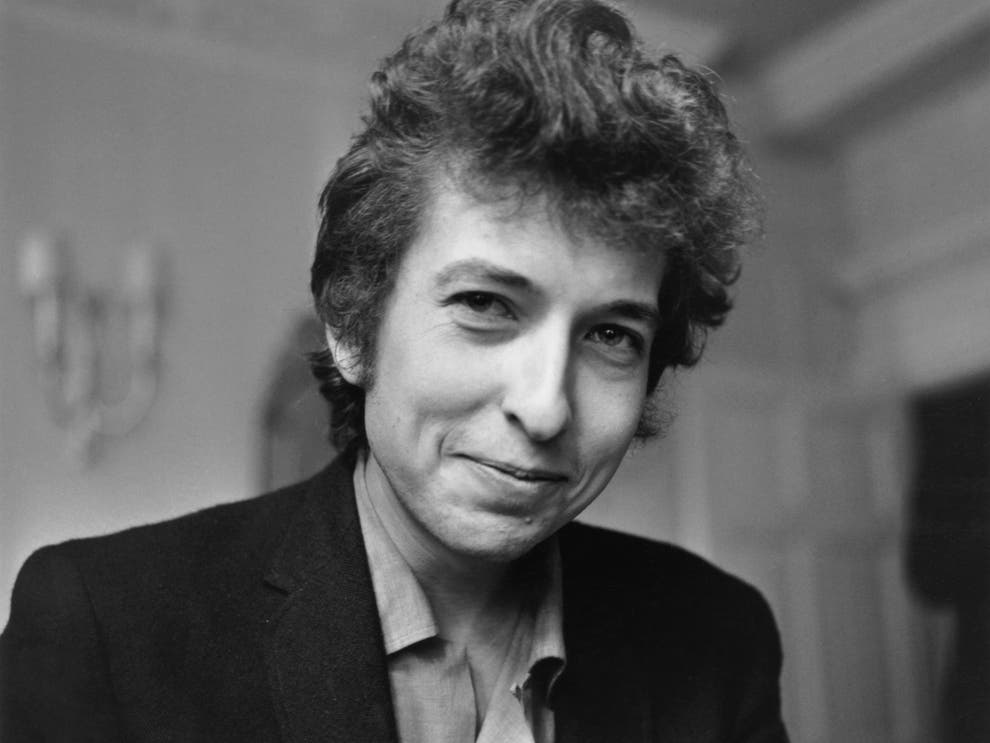
The Queue along the Thames to pay respect to Her Maj

There were farewells much closer to home. My mediation colleague, aspiring author and friend John Rosley, and Beau Tindall, the son of my oldest Bellingen friend Warren, took off on the same day in May. Peter Setterington, my oldest friend in England – we first met in 1972 – died suddenly in London in March, and our friend and forest neighbour, the world-famous war photographer Tim Page, in August, after a short but nasty illness. Pete is memorialized in When an Old Cricketer Leave His Crease whilst Journey’s end – Tim Page’s wild ride,is an adaptation of the eulogy I gave for Tim in September, one of many on that sunny afternoon day in Fernmount. It is a coda to Tim Page’s  War – a photographer’s  Vietnam journey, a story we published a year ago.

Tim Page by Joanne Booker

What we wrote in 2022

The ongoing Ukraine War has dominated our perception of 2022, from the morning (Australian time) we watched it begin on CNN as the first Russian missiles struck Kyiv, to the aerial assault on infrastructure that has left Ukrainians sheltering through a cold, dark winter. Two posts in In That Howling Infinite examined the historical origins of the conflict: Borderlands – Ukraine and the curse of mystical nationalism and The Roots and Fruits of Putin’s Irridentism. “Because of …” Iran’s voice of freedom looks at the song that has become the rising’s anthem. None can predict the outcome – whether it will be a doomed intifada, the Arabic word that literally means a shaking off – historically of oppression – and figuratively, a rising up, like that in Ireland in 1798 and 1916, Warsaw in 1943 and 1945, and Hungary in 1956, or an Inqilab, another Arabic word meaning literally change or transformation, overturning or revolution.

The run up to May’s Australian elections inspired Teal independents – false reality in a fog of moralism.; and Australia votes – the decline and fall of the flimflam man. 

More distant history featured in Menzie’s Excellent Suez Adventure, the story of the Suez crisis of 1956 that historians argue augured the end of the British imperium, and the role played therein by longtime Australian prime minister Sir Robert Menzies. Johnny Clegg and the Washing of the Spears is a tribute to the late South African singer, dancer and songwriter, and a brief history of the war that destroyed the great Zulu nation, setting the scene for the modern history of South Africa. And journeying further back in time to sixteenth century Ireland, there is O’Donnell Abú – the Red Earl and history in a song, a discussion of the origins of a famous and favorite rebel song.

Then there are the semi-biographical “micro-histories” in In That Howling Infinite’s Tall tales, small stories, obituaries and epiphanies. In 2023, these included: Folksong Au Lapin Agile, the evening we visited Montmarte’s famous folk cabaret; Ciao Pollo di Soho – the café at the end of the M1, the story of a café that played a minor part in my London days, as described in detail in an earlier travelogue, Song of the Road – my hitchhiking days; Better read than dead – the joy of public libraries; The quiet tea time of the soul, an ode in prose to a favourite beverage; and The work, the working, the working life recalling the many jobs I took on in the sixties to keep myself in music, books, travel and sundry vices. 

We cannot pass a year without something literary. We celebrated the centenary of three iconic literary classics in The year that changed literature, and with the release of The Rings of Power, the controversial prequel to The Lord of the Rings, we published a retrospective on the influence of JRR Tolkien. One ring to rule us all – does Tolkien matter? – a personal perspective with an opinion piece by English historian Dominic Sandbrook, an informative and entertaining chronicler of postwar British history and society which featured, in Unherd, an online e-zine that became a “must read” in 2022. A Son Goes To War – the grief of Rudyard Kipling recalls the death in battle on the Western Front in 1917 of the poet’s only son, it’s influence upon his subsequent work, whilst Muzaffar al Nawab, poet of revolutions and sorrow is an obituary for another poet, who seen a lifetime speaking truth to power.

And that was that for what was in so man ways a sad year. Meanwhile, In That Howling Infinite already has several works in progress, including a review of historian Anthony Beevor’s Russia – Revolution and Civil War, what King Herod really thought about the birth of baby Jesus, and the story of a famous and favourite British army marching song.

Best wishes for 2023 …

Death of a Son

That was the year that was – retrospectives

Life in Wartime – images of Ukraine